Aid where it counts
pp. 22-26 · Read in the full issue
The Region
John Zubrzycki, a journalist with the Australian International Development Assistance Bureau (AIDAB), reports on three Australian self-help aid projects under way in the region.
Weighing More Than 200
kilograms and reaching a
length of more than a metre, the giant clam is one of the largest reef-dwelling animals in the world It is also a delicacy, and with buyers willing to pay up to SA4O a kilogram for the clam’s adductor muscle it is not surprising that the number still to be found ‘in the wild’ is dwindling.
Now, however, a means of satisfying demand for clam meat without en
dangering the species is being de
veloped in the Solomon Islands. Using the latest agricultural techniques, a giant clam hatchery has been set up at the Coastal Aquaculture Centre (GAG) close to the capital of Honiara. It aims to develop economically viable farm ing systems for giant clams and, if suc cessful, could become the basis for an
important rural industry with fishing
communities raising clams on offshore reefs and marketing the meat.
Graham Usher, natchery manager at the GAG, says that the Solomon Is
lands villagers have responded posi
tively to growing clams as an extra source of income: “We’ve already got more requests than we can handle there is an enormous amount of in terest in the project.” Established with funding from AIDAB and other de velopment agencies, the Centre is one of a number of research stations oper ated by the International Centre for
Living Aouatic Resources Manage
ment (ICLARM), an autonomous, non-profit international scientific and technical organisation based in Manila, which supports and conducts research into fisheries and other aquatic re sources. Last financial year AIDAB provided $lOO,OOO ‘core funding’ for ICLARM, a substantial proportion of which supports the clam project.
Scientists at the GAG have about 30 brood stock of giant clams for spawn
ing, and have already successfully
transferred several thousand baby clams to ocean nurseries. The brood clams are held in large fibreglass tanks to enable easy collection of eggs at spawning time. The eggs are collected, placed in tanks and allowed to hatch: after about two weeks the larvae settle on the bottom of the tank and meta
morphose into baby clams.
When the baby clams reach a length
of two or three centimetres (which can take from five to seven months) they are transferred to cages in the sea: it then takes five to six years before the clams are ready for harvest.
Mr Usher says the work being undertaken at the Centre has given the South Pacific a head start over South East Asia in giant clam farming
an important advantage given the
possible commercial spin-offs for
fishing communities in the Solomon Islands and neighbouring countries.
During the first 50 years of Euro pean contact with New Guinea, the Central Highlands, defied all attempts at exploration, but since the construc tion of the Highlands Highway in the 1950 s and the opening up of the re gion, its inhabitants have proved will ing to try new methods and crops.
Coffee production has grown rapidly and has provided an important source of income to thousands of small holders, but despite the region’s rela
tive prosperity, rising population
growth and a shortage of arable land are beginning to make their presence felt. One of tne worst affected areas is Simbu, among the smallest and most
densely populated of PNG’s provinces.
Simbu is also the site of the first
large-scale rural development project
in PNG to be funded by outside aid donors. AIDAB is co-financing a six year, SUSI. 7 million South Simbu Ru
ral Development Project (SSRDP) to increase incomes and improve nutri tion in Gumine and Karamui, the poorest districts in the Simbu valley together with the International Fund
for Agricultural Development (IFAD)
and the PNG Government.
“The crop rotation periods in Gumine and Karamui have declined from about 15 years to two or three years,” says Peter Kamis, the project co-ordinator. Himself a Highlander, Kamis has a clear understanding of the economic and social implications of oyer-population. “Yields are dimi nishing, disputes over land are in creasing, ana more and more people are leaving Simbu to look for work in the cities, ,v he notes. The drift to the cities is particularly worrying for the
PNG government. High unemploy
ment m urban areas is causing law and order problems that are having an adverse effect on investment.
Meanwhile, nutrition standards and incomes throughout Simbu are falling.
By focusing on the food sector, SSRDP hopes to reverse these trends.
The introduction of new crops and farming methods and assistance in the
marketing of produce are already
showing considerable promise. Project
manager Jonathan Hampshire attri butes this success to the way in which the project is integrated into the ex isting management and administrative system in Simbu. “The project also supports an integrated set of compo nents including administrative sup
port, agriculture, health, literacy,
training and capital works,”' Hamp shire says. “The aim is to improve the existing system and leave those things that are sustainable.”
Perhaps the most successful compo nent of the project has been the veget able production and marketing prog ramme. Starting from a zero base, far mer groups are now selling an average of one tonne of vegetames a weex.
“The response from farmers and far mer groups has been very enthusiastic.
Before the project started the oppor tunities for vegetable marketing were very scarce,” Fiampshire says.
PNG’s fast-growing urban popula
tion is creating a strong demand for introduced fruit and vegetables such as lettuce, potatoes and carrots: but lack of continuity in quality and supp ly has meant mat many buyers are turning to overseas suppliers. A recent Asian Development Bank study found that PNG imports more introduced fruit and vegetables than it produces, and that the consumption of intro duced produce will likely grow at 5 to 7 per cent each year. All this is good news for Simbu farmers: “If Simbu can offer consistent quality and regu lar supply, there’s little doubt buyers
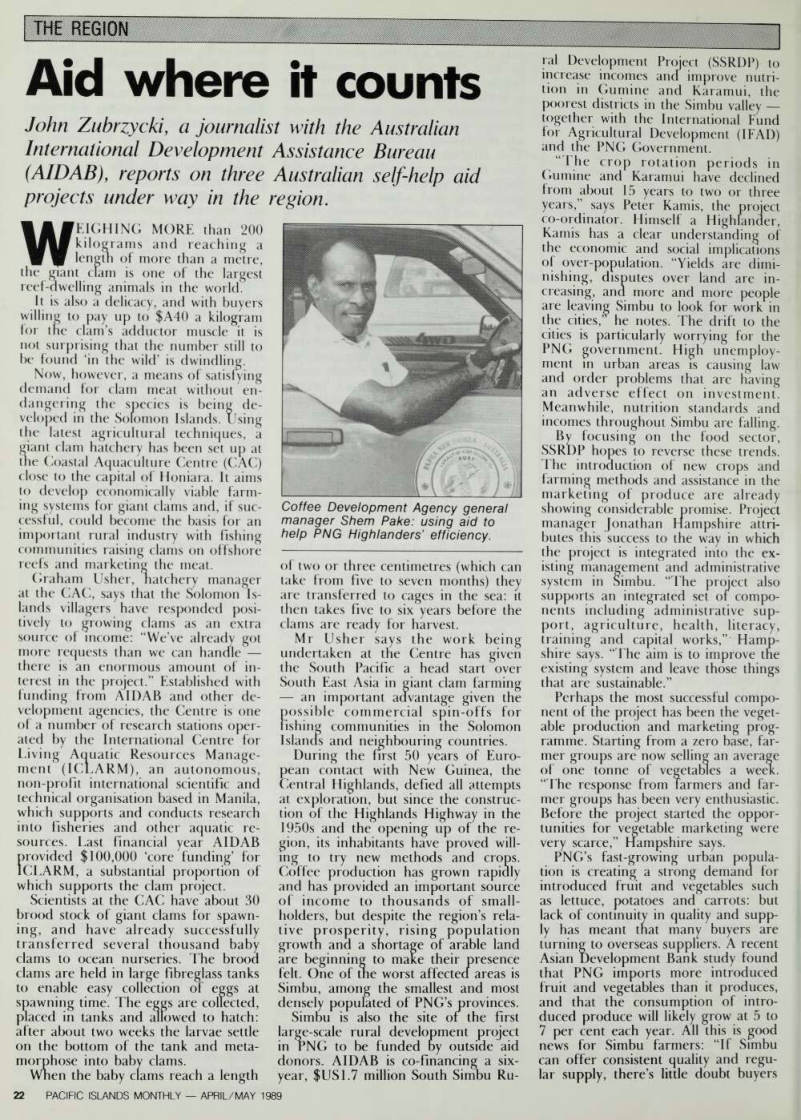
Coffee Development Agency general manager Shem Pake: using aid to help PNG Highlanders’ efficiency.
will come to us/^V*,.
Hampshire says.
About 300 growers m S N the Gumine district have organised themselves into groups of 10 to 30 people for veget able growing. To overcome marketing problems, SSRDP has set up buying centres and a cold storage plant ana has provided three trucks for trans porting the vegetables to a distribution oepot. Eventually, an estimated 2500 smallholder farmers are expected to benefit from the scheme, injecting around K 450,000 ($A600,000) into the local economy.
A key component of the project has been tne establishment of 10 Rural Extension Centres (RECs) in South Simbu, each equipped with a nursery where local farmers can purchase seeds and seedlings of vegetables, fruit trees and other cash crops such as cof fee. According to Peter Kamis, the RECs are fulfilling an important need because it is too costly for farmers to establish their own nurseries. “Our main problem is overcoming the perception that because we are an aid programme, people can get what they want for free,” he says. Regular field days allow farmers to purchase seeds and seedlings at subsidised prices and to see new crops such as cardamom, pyrethrum and soya beans being grovyn in demonstration gardens. Ex tension workers based at the RECs are responsible for teaching farmers about
new crops, mixed farming methods and better management techniques.
By introducing cash crops in addi tion to coffee, the project will also im prove the situation of Simbu women, who are largely excluded from the cash benefits of coffee farming.
Women are also being encouraged to
participate in literacy programmes
through a financial incentive system set up under the project.
Nurses and villages health workers are also being recruited to improve health and nutrition in the region. Ab out 20 houses for medical staff and a 12-bed hospital ward are being built, and an extended community health care programme in Karamui, offering vaccinations, prenatal and child health services and family planning advice, has also been undertaken.
The next major undertaking will be to establish a marketing depot in the
provincial capital, Kundiawa, situated
on the Highlands Highway and linked by air to Port Moresby and other ma jor towns. A depot in Kundiawa would give growers better access to major markets and would allow continued development of smallholder vegetable
production in the area.
Few plant diseases have had as pro found an impact on a country’s drink ing habits as coffee leaf rust. When the disease appeared in Ceylon (now Sri Lanka) late in the 19th century, it devastated the island’s coffee industry.
The result was that Ceylon went from being a coffee producer to a tea pro ducer and its main export market,
England, changed from being a cof
fee-drinking to a tea-drinking nation.
The current outbreak of coffee leaf rust in Papua New Guinea may not
change the region’s coffee-drinking
habits, but, if left uncontrolled, could have a devastating effect on the hun dreds of thousands of smallholders who grow the majority of the crop.
Coffee is PNG’s largest agricultural
export commodity, accounting for
around 14 per cent of the country’s
total export earnings. Grown mainly
in the Highlands, coffee is also an im portant source of cash income for an estimated 260,000 smallholders; last financial year exports of coffee were worth around $3OO million.
However, the discovery of coffee leaf rust near Mount Hagen in 1986, and its rapid spread to other growing areas, has forced the industry to take drastic measures to curb the effects of the disease. It has been estimated that if no rehabilitation or rust control is carried out, the average level of pro-
Continued Page 26
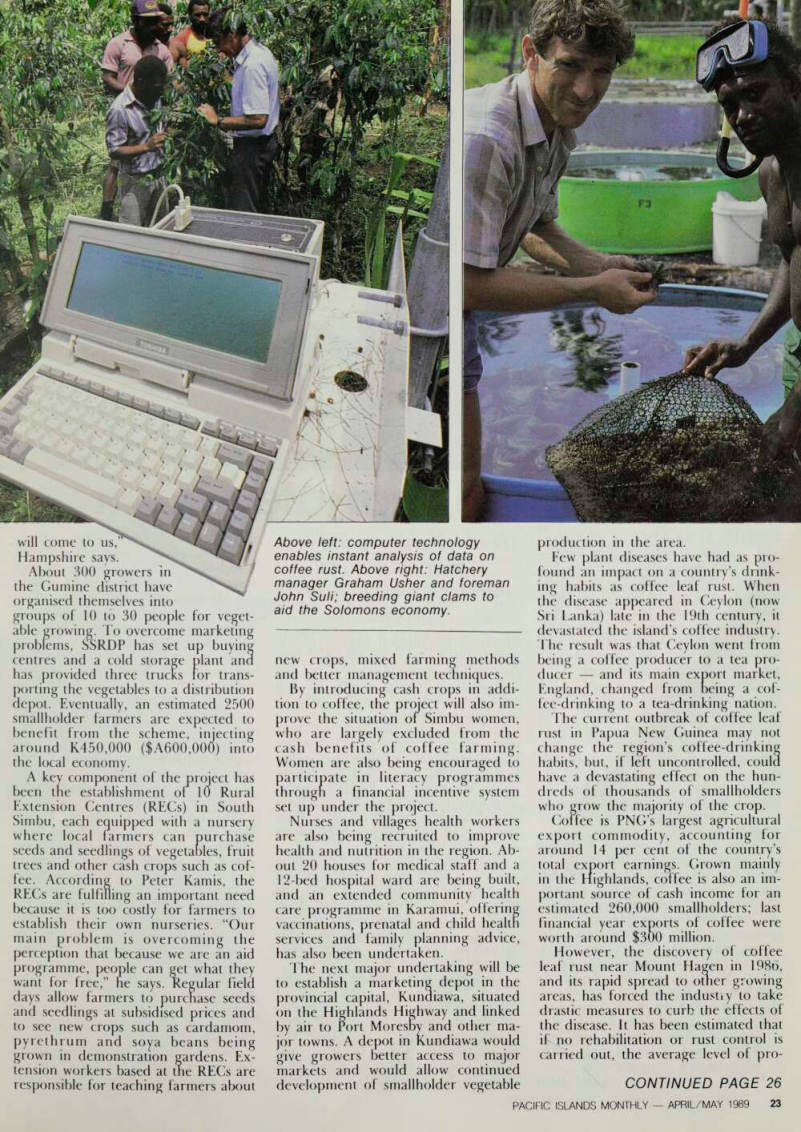
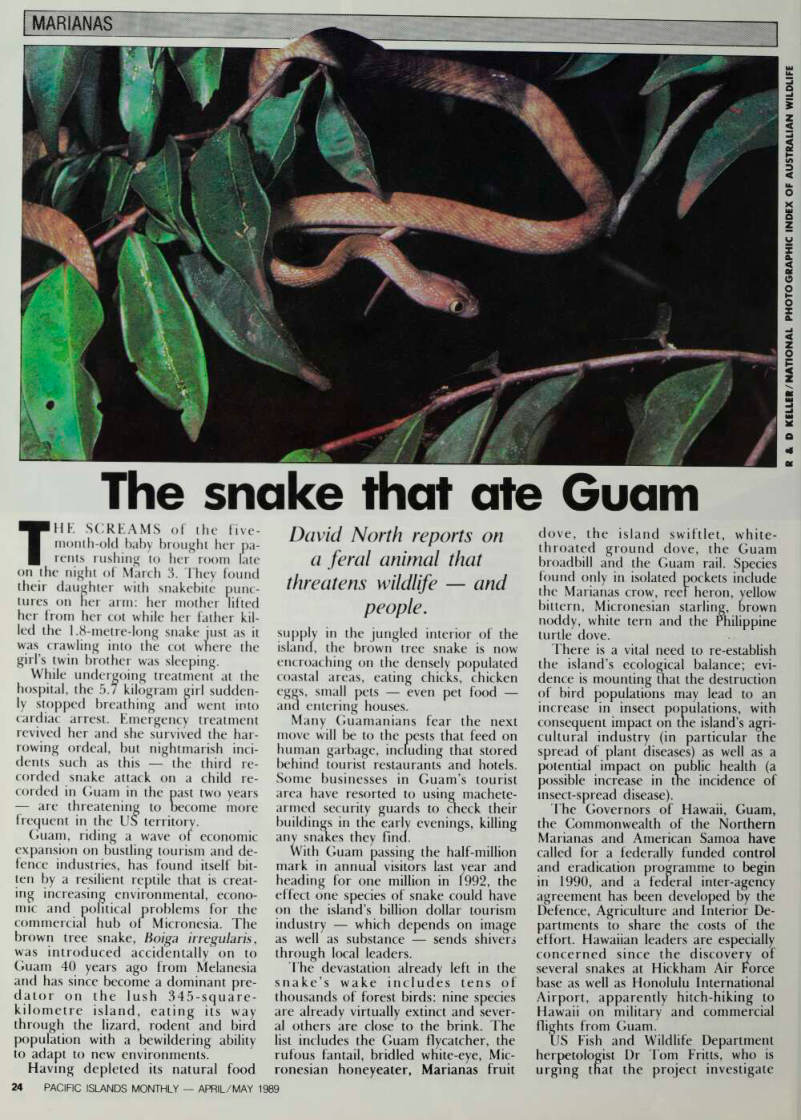
Above left: computer technology enables instant analysis of data on coffee rust. Above right: Hatchery manager Graham Usher and foreman John Suli; breeding giant clams to aid the Solomons economy.
duction for a smallholder family would drop from around 100 kilo grams a year to just 15kg. In 1987 the PNC; Government requested assistance for dealing with the outbreak of cof fee rust and AIDAB responded with SAS million to assist the Coffee De velopment Agency with a crop man agement, rust control and prevention programme and the Coffee Research Institute with research into rust
resistant varieties, spraying techniques
and epidemiology.
Based in Goroka, the Coffee De velopment Agency (CDA), which is
funded primarily by a levy imposed
on coffee growers and an annual con tribution from the National Govern ment, is charged with implementing the Government’s coffee rehabilitation and rust control programme. Shem Pake, CDA general manager, says that if coffee farmers do not learn how to deal with leaf rust the industry could be wiped out in five years. “That’s the effect we have been warned about: if we weren’t here to help, that’s the sort of result coffee growers can expect.”
In November last year the PNG Government announced it was con sidering disbanding the CDA, but was met witn opposition from growers and some provincial governments. Shem Pake says the agency provides an effi cient administrative structure for ex
tension services to increase production and control the spread of coffee rust, “Our objective nere is to train far mers. Once the farmers learn to man age their coffee, there won’t be any necessity to carry on administrative structures,” he says. “It’s my firm opinion that [our] impact has been ex
tremely significant. The village people
have been supporting us all the way.”
I erry Quinlan, the project’s team leader, at the CDA, says the logistics of planning and implementing a re habitation and rust control program me in PNG are enormous: coffee is grown under a variety of conditions; smallholder plantations are scattered, and often located in inaccessible areas, “We base our extension staff in the middle of the coffee growing areas, concentrate on small groups respon sive to new methods and make sure they succeed. Other farmers then fol low their lead and the whole thing snowballs,” Quinlan says,
Although improved management
practices such as pruning, weeding,
shade control and drainage can mim mise the effect of leaf rust on yield, fungicide spraying remains the major
means of control. Determining the most suitable mix of rust control methods for the PNG environment is the task of the Coffee Research Insti tute, which works in close collabora tion with extension workers from the CDA. A collaborative research prog ramme has been established to link the Institute and Australian research bodies in the area of spray technology and the epidemiology of coffee rust.
Project manager Dr Jim Whan re ports that the Institute is applying overseas findings on coffee rust to the PNG environment. “We’ve set up trial sites to find out how the coffee rust is developing under different weather conditions. We’re also trying to de
velop economic thresholds by seeing
how various levels of coffee rust relate to yield. Then we can start advising on whether spraying is economically vi able.”
Better management techniques have already slowed its spread, but Dr Whan warns that if left unchecked, coffee rust could lead to far-reaching social and economic problems. “Seven ty to 80 per cent of the coffee pro duced in PNG is produced by smal lholders. For a lot of these smallhol ders, that is their only source of cash income, so if that yield decreases to 50 per cent their casn income is reduced by 50 per cent . . . which has enor mous social implications.” □
Inset: Simbu smallholder project manager Jonathan Hampshire and designer Koma Kuman. Main picture: Development technician Sorme Kola discusses progress with project co-ordinator Peter Kamis.