Erosion
pp. 20-21 · Read in the full issue
As erosion reduces island size, groundwater lenses will shrink be neath larger islands and virtually dis appear under smaller ones. All except the most hardy vegetation will perish.
Sea levels rising at the rates contem plated under future Greenhouse con ditions would outstrip the ability of the islands to grow upward, leading to a reduction in ‘island freeboard’ height above mean sea level. Storm overwash will therefore become an in
creasingly frequent occurrence, caus
ing damage to buildings and vegeta tion and irreversible sahnisation of the groundwater lens.
The most severe situations are likely to occur on what are today the widest and most productive islands. These typically occur at bends in the reef crest where waves approach from two or more directions and recurved spits form around a central low area. Many islands of this type support relatively high population densities, and the effect of a marine incursion on this type of island would be destruction of food-producing areas in the interior by salt water and a reduction in the froundwater lens and decreased prouctivity of coconut and breadfruit crops. Construction of expensive sea walls would be, at best, a stopgap measure; as sea levels continue to rise, so will the ground water table. The central parts of the island would become a shallow and relatively unproductive lake of fresh water that becomes increasingly brackish as storms wash over the iSand surface.
Coral reefs provide the most limited range of resources for human existence and the most tenuous of human habitats in the Pacific. The soil is infertile and fresh groundwater is very limited; maintaining a livelihood is a considerable task and many atolls have
been depopulated and repopulated
following abandonment in the wake of
storm damage, inspiring migration
movements of various Idnds. The
dying phases of the small community
on Merir atoll in Palau were well
documented: during the 1960 s the
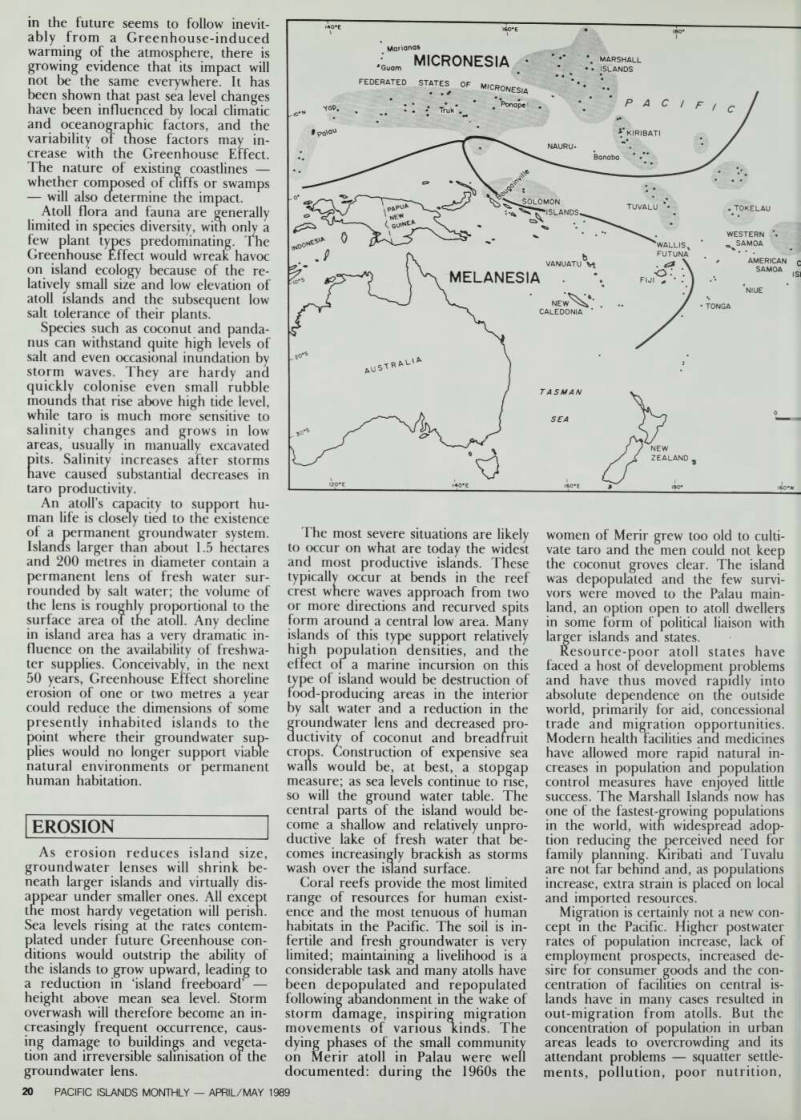
women of Merir grew too old to culti vate taro and the men could not keep the coconut groves clear. The island was depopulated and the few survi vors were moved to the Palau main land, an option open to atoll dwellers in some form of political liaison with larger islands and states.
Resource-poor atoll states have faced a host of development problems and have thus moved rapidly into absolute dependence on the outside world, primarily for aid, concessional
trade and migration opportunities.
Modern health facilities and medicines have allowed more rapid natural in creases in population and population control measures have enjoyed little success. The Marshall Islands now has one of the fastest-growing populations in the world, with widespread adop tion reducing the perceived need for family planning. Kiribati and Tuvalu are not far behind and, as populations increase, extra strain is placed on local and imported resources.
Migration is certainly not a new con cept m the Pacific. Higher postwater rates of population increase, lack of employment prospects, increased de sire for consumer goods and the con centration of facilities on central is lands have in many cases resulted in out-migration from atolls. But the concentration of population in urban areas leads to overcrowding and its attendant problems squatter settle ments, pollution, poor nutrition,
increased unemployment and higher crime rates. Thus the idea of perma nent emigration to seek one’s fortune elsewhere is often the only answer to
economic problems confronting the
atoll microstates.
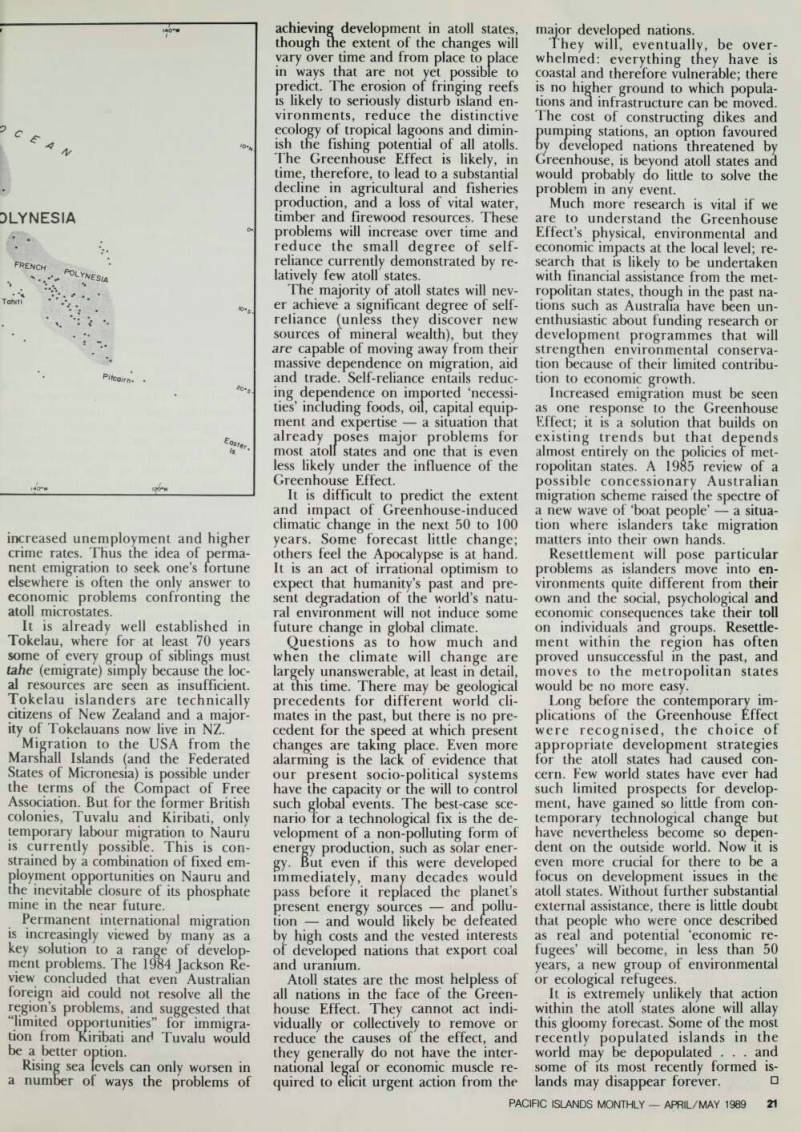
It is already well established in Tokelau, where for at least 70 years some of every group of siblings must take (emigrate) simply because the loc al resources are seen as insufficient.
Tokelau islanders are technically citizens of New Zealand and a major ity of Tokelauans now live in NZ.
Migration to the USA from the Marshall Islands (and the Federated States of Micronesia) is possible under the terms of the Compact of Free Association. But for the former British colonies, Tuvalu and Kiribati, only temporary labour migration to Nauru is currently possible. This is con strained by a combination of fixed em ployment opportunities on Nauru and the inevitable closure of its phosphate mine in the near future.
Permanent international migration is increasingly viewed by many as a key solution to a range of develop ment problems. The 1984 Jackson Re view concluded that even Australian foreign aid could not resolve all the region’s problems, and suggested that
“limited opportunities” for immigra
tion from Kiribati and Tuvalu would be a better option.
Rising sea levels can only worsen in a number of ways the problems of
achieving development in atoll states, though tne extent of the changes will vary over time and from place to place in ways that are not yet possible to predict. The erosion of fringing reefs is likely to seriously disturb island en vironments, reduce the distinctive
ecology of tropical lagoons and dimin
ish the fishing potential of all atolls.
The Greenhouse Effect is likely, in time, therefore, to lead to a substantial decline in agricultural and fisheries production, and a loss of vital water, timber and firewood resources. These problems will increase over time and reduce the small degree of self reliance currently demonstrated by re latively few atoll states.
The majority of atoll states will nev er achieve a significant degree of self reliance (unless they discover new sources of mineral wealth), but they are capable of moving away from their massive dependence on migration, aid and trade. Self-reliance entails reduc
ing dependence on imported ‘necessi
ties’ including foods, oil, capital equip
ment and expertise a situation that
already poses major problems for
most atoll states and one that is even less likely under the influence of the Greenhouse Effect.
It is difficult to predict the extent and impact of Greenhouse-induced climatic change in the next 50 to 100 years. Some forecast little change; others feel the Apocalypse is at hand.
It is an act of irrational optimism to expect that humanity’s past and pre sent degradation of the world’s natu ral environment will not induce some future change in global climate.
Questions as to how much and when the climate will change are largely unanswerable, at least in detail, at this time. There may be geological precedents for different world cli mates in the past, but there is no pre cedent for the speed at which present
changes are taking place. Even more
alarming is the lack of evidence that our present socio-political systems have the capacity or the will to control such global events. The best-case sce nario for a technological fix is the de velopment of a non-polluting form of energy production, such as solar ener gy. But even if this were developed immediately, many decades would pass before it replaced the planet’s present energy sources and pollu tion and would likely be defeated by high costs and the vested interests of developed nations that export coal and uranium.
Atoll states are the most helpless of all nations in the face of the Green house Effect. They cannot act indi vidually or collectively to remove or reduce the causes of the effect, and they generally do not have the inter national legal or economic muscle re quired to elicit urgent action from the
major developed nations.
They will, eventually, be over whelmed: everything tney have is coastal and therefore vulnerable; there is no higher ground to which popula tions and infrastructure can be moved.
The cost of constructing dikes and pumping stations, an option favoured
by developed nations threatened by
Greenhouse, is beyond atoll states and would probably ao little to solve the problem in any event.
Much more research is vital if we are to understand the Greenhouse Effect’s physical, environmental and economic impacts at the local level; re search that is likely to be undertaken with financial assistance from the met ropolitan states, though in the past na tions such as Australia have been un enthusiastic about funding research or development programmes that will strengthen environmental conserva tion because of their limited contribu tion to economic growth.
Increased emigration must be seen as one response to the Greenhouse Effect; it is a solution that builds on existing trends but that depends almost entirely on the policies of met ropolitan states, A 1985 review of a
possible concessionary Australian
migration scheme raised the spectre of a new wave of ‘boat people’ a situa tion where islanders take migration matters into their own hands.
Resettlement will pose particular problems as islanders move into en vironments quite different from their own and the social, psychological and economic consequences take their toll on individuals and groups. Resetde ment within the region has often proved unsuccessful in the past, and moves to the metropolitan states would be no more easy.
Long before the contemporary im plications of the Greenhouse Effect were recognised, the choice of
appropriate development strategies
for the atoll states had caused con cern. Few world states have ever had such limited prospects for develop ment, have gained so little from con
temporary technological change but
have nevertheless become so depen dent on the outside world. Now it is even more crucial for there to be a focus on development issues in the atoll states. Without further substantial external assistance, there is little doubt that people who were once described as real and potential ‘economic re fugees’ will become, in less than 50 years, a new group of environmental
or ecological refugees.
It is extremely unlikely that action within the atoll states alone will allay this gloomy forecast. Some of the most recently populated islands in the world may be depopulated . . . and some of its most recently formed is lands may disappear forever. □