logical problems.
pp. 17-20 · Read in the full issue
Special Report
fi NVIRONMENTAL issues have ■■ attracted unprecedented media B|| and public attention in the past and everywhere there is a growing awareness of the problems, if not the solutions. The Greenhouse Effect has become the ‘flagship’ of the international environmentalist cause, and the springboard to the front pages for many other man-made eco
No environmental issue has ever stimulated such global interest and spawned such a variety of popular and academic accounts: ironically, howev er, while it is a 20th century dilemma, the term “Greenhouse Effect” was coined almost a century ago. Yet there is still considerable uncertainty over the actual nature of the Greenhouse Effect and future rates of climatic change. In the absence of concrete in formation prophets of doom have gained wide exposure with forecasts of cataclysm, but recent scientific studies have increasingly begun to draw con sistent conclusions about future trends and point to the regions where the Greenhouse Effect win cause the most
severe problems.
Most nations of reasonable wealth and substantial land mass will adapt to the climatic changes some may even find considerable economic advantage in new agricultural possibilities. But m the Pacific, the predicted rise in sea level will mean widespread upheaval and potential disaster. “If the Green house Effect raises sea levels by one metre it will virtually do away with Kiribati,” says that nation’s President, leremia Tabai. “In 50 or 60 years my. country will not be here.”
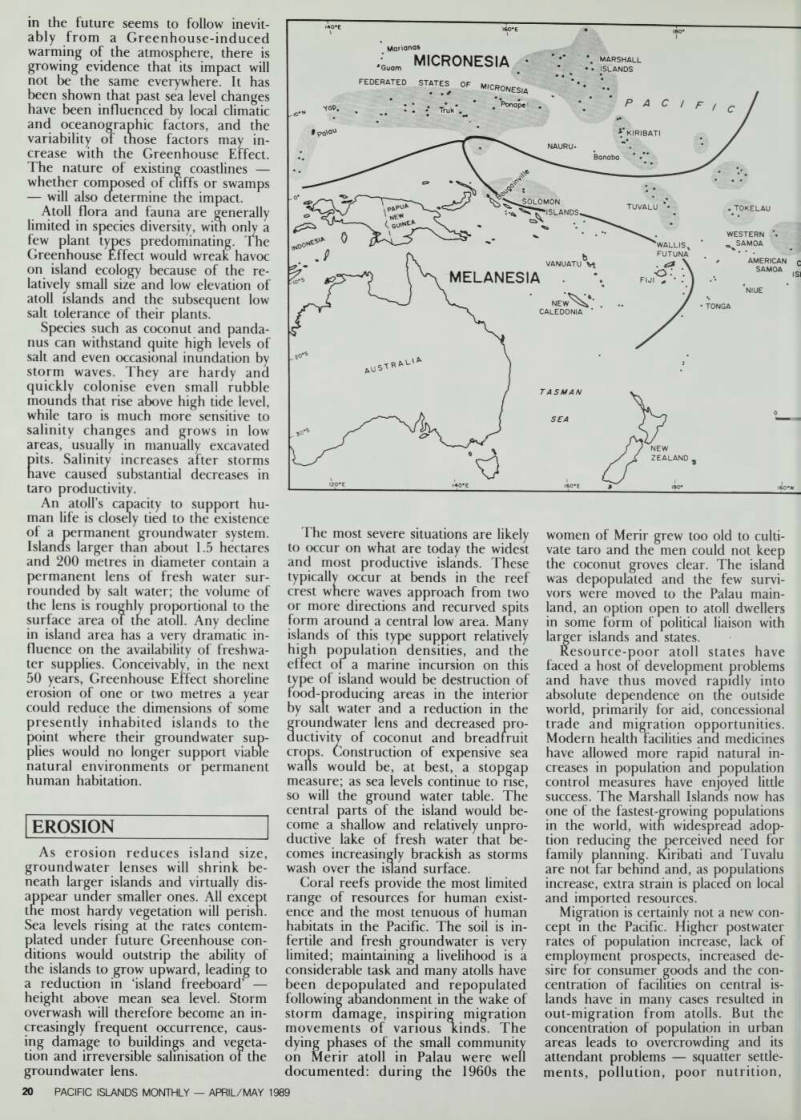
He is only too aware that the most extreme situations will be faced by small ocean island states occupying low coral islands. Four Pacific nations Kiribati, the Marshall Islands, Tokelau and Tuvalu are composed entirely of low relief atolls and recent studies warn that these states will be devastated if projected sea level rises occur. They may simply cease to con tain any habitable land.
The four atoll states are quite diffe rent in language, culture, history and physical environment. Tuvalu and Tokelau are part of Polynesia; the Marshall Islands and Kiribati are in Micronesia. The state of Tuvalu con sists of nine coral atolls and reef is lands with a total land area of no more than 24 square kilometres, yet spread over 590 kilometres. Kiribati has 20 populated atolls and a land area of 700 square kilometres, but more than half of this (363 square kilometres) is on Kiritimati (Christmas Island), some 3500 kilometres from the national capital, Tarawa. The Mar shall Islands has 24 populated atolls, but the majority of the population lives in the capital, Majuro, or on
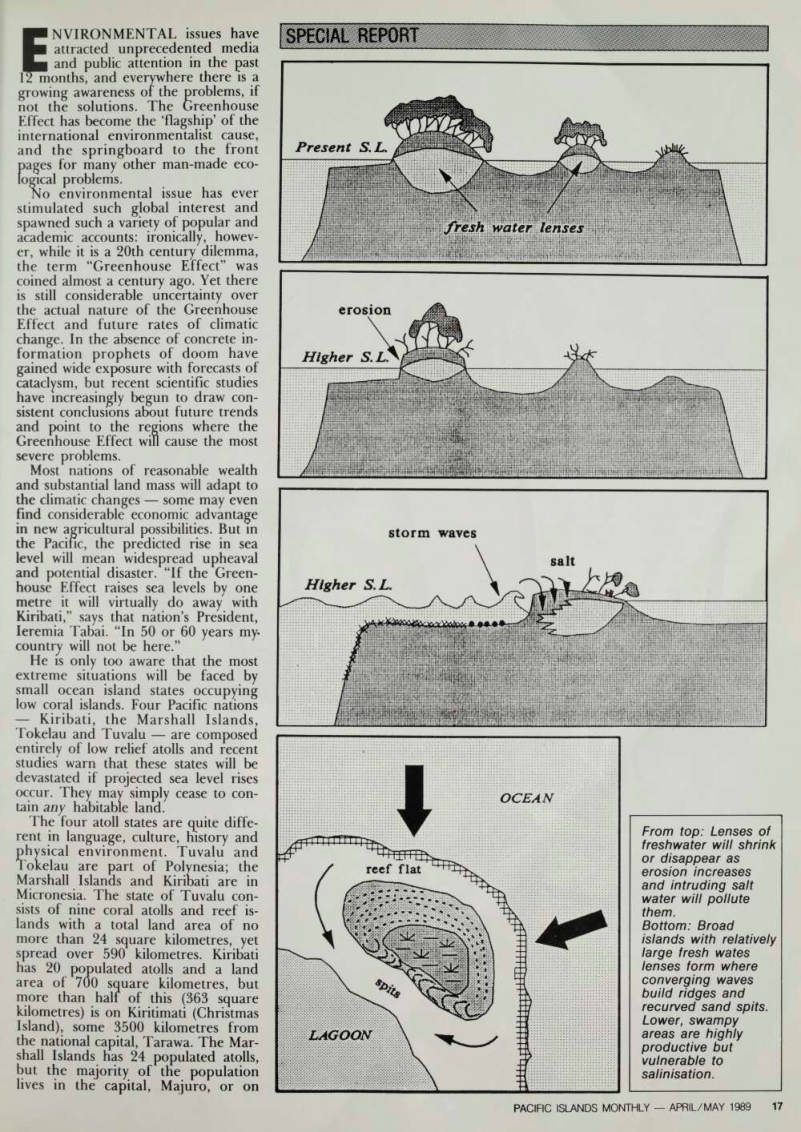
From top: Lenses of freshwater will shrink or disappear as erosion increases and intruding salt water will pollute them.
Bottom: Broad islands with relatively large fresh wates lenses form where converging waves build ridges and recurved sand spits.
Lower, swampy areas are highly productive but vulnerable to salinisation.
Ebeye near the American missile range on Kwajalein Atoll.
Trie buildup of industrial gases in Earth’s atmosphere over the past 30 to 40 years is now well documented. The resulting Greenhouse Effect is expected to raise temperatures over much of the planet’s surface and lead to a rise in ocean levels. The rise will initially come about through an expansion of surface waters and the melting of mountain glaciers; not until much later will melting of the polar ice sheets significantly augment ocean volumes. Coastal erosion will increase as sea-level rises accelerate beyond the upward growth of corals, and will probably be accentuated by a greater frequency of storms.
Analysis of tide gauge records from around the world reveals a small rise
in relative sea level (1.0-1.5 mm per year) over the past few decades. These results have been variously interpreted and it is not clear whether the appa rent sea level changes are caused by a global Greenhouse Effect, local clima tic variability or increased river dis charges into the oceans following the
construction of large irrigation
schemes and dams, Rates of expansion of the oceans cannot be determined with any accuracy because of uncertainty con cerning the pattern and extent of fu ture heating of the earth’s surface, and the rate at which the heat will be absorbed by the oceans, Extreme scenarios for the next 50 years range from virtually no change m mean sea level to an elevation many
metres higher.
The basic effect of a Greenhouse induced rise in sea level is for lowlying lands to be inundated and for coasts to erode. Erosion, as opposed to inun dation, is most severe on shorelines composed of unconsolidated sediment exposed to storm wave attack: a gra dual rise of mean sea level will prog ressively lift the zone of flooding, storm wave and surge effects to new levels, eroding areas previously consi dered safe. Human responses will vary depending on the values of the coastal land under attack and the resources available to provide protective mea sures. In Pacific atoll states, where re sources are very limited, the provision of expensive engineering works will
rarely be an option.
Atolls are accumulations of the re
mains of reef-forming organisms
usually arranged into a rim around a central lagoon and restricted to tropic al ocean waters within 20 degrees of the equator. Drilling results from a number of atolls essentially confirm the early speculations of Charles Dar win that the reef deposits accumulated on the peaks of submerging mid ocean volcanoes. Atoll islands are among the most recent of geological formations and the youngest in terms of human colonisation.
Islands on atoll rims vary enormous ly in size and shape, but rarely rise more than three metres above mean sea level. They may be stable but the occurrence of exposed and eroding outcrops of beachrock/coral con glomerate on one hand and newly formed boulder ridges and sand spits on the other indicate that islands are
constantly changing shape. The build
ing of atoll superstructures, especially islands, results from a combination of processes of small scale erosion and accretion that can be observed on a
day-to-day basis, interspersed by catas
trophic changes caused by rare but ex tremely violent cyclones and hurri canes. Storms have been documented in which waves passed across islands up to eight metres above their land surfaces, hundreds of islanders died and whole island environments were destroyed either washed away or buried in rubble.
These changes have been viewed in terms of dynamic equilibrium rather than stages in an evolutionary prog ression, with periods of island accre tion alternating with (and largely balancing) erosion. A state of dis equilibrium may arise if environmen tal conditions such as relative sea level or storminess change with time. The theoretical effect of slow changes in relative sea level can be predicted: negative movements would tend to promote the accumulation of sediment masses, while positive movements should increase erosion.
While the spectre of rising sea levels ►
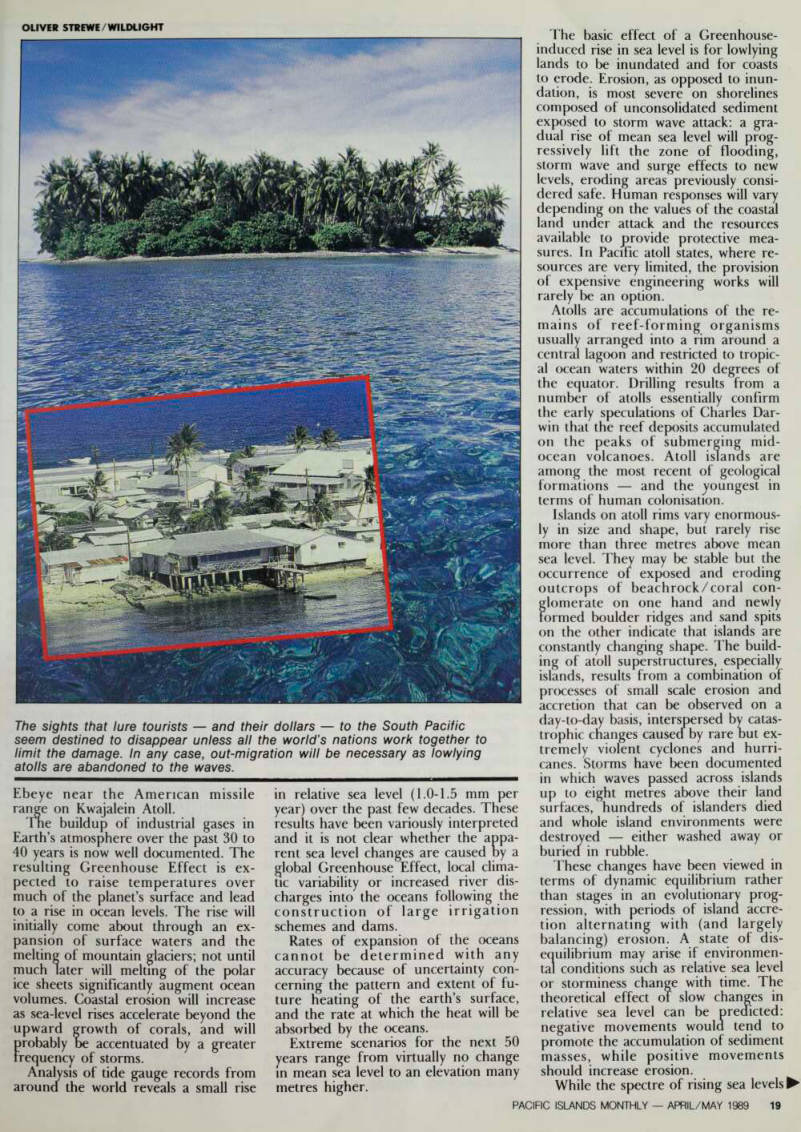
Oliver Strewe / Wildlight
The sights that lure tourists - and their dollars - to the South Pacific seem destined to disappear unless all the world’s nations work together to limit the damage. In any case, out-migration will be necessary as lowlying atolls are abandoned to the waves.
in the future seems to follow inevit ably from a Greenhouse-induced warming of the atmosphere, there is growing evidence that its impact will not be the same everywhere. It has been shown that past sea level changes have been influenced by local climatic and oceanographic factors, and the variability of those factors may in crease with the Greenhouse Effect.
The nature of existing coastlines whether composed of cliffs or swamps will also determine the impact.
Atoll flora and fauna are generally limited in species diversity, with only a
few plant types predominating. The
Greenhouse Effect would wreak havoc on island ecology because of the re latively small size and low elevation of atoll islands and the subsequent low salt tolerance of their plants.
Species such as coconut and panda nus can withstand quite high levels of salt and even occasional inundation by storm waves. They are hardy and quickly colonise even small rubble mounds that rise above high tide level, while taro is much more sensitive to salinity changes and grows in low areas, usually in manually excavated pits. Salinity increases after storms nave caused substantial decreases in
taro productivity.
An atoll’s capacity to support hu man life is closely tied to the existence of a permanent groundwater system.
Islands larger than about 1.5 hectares and 200 metres in diameter contain a permanent lens of fresh water sur rounded by salt water; the volume of the lens is roughly proportional to the surface area of tne atoll. Any decline in island area has a very dramatic in fluence on the availability of freshwa ter supplies. Conceivably, in the next 50 years, Greenhouse Effect shoreline erosion of one or two metres a year could reduce the dimensions of some presently inhabited islands to the point where their groundwater sup plies would no longer support viable natural environments or permanent human habitation.