Sabotage, killings grow as
pp. 12-14 · Read in the full issue

Papua New Guinea
Sabotage, killings grow as Bougainville crisis deepens
What began as a compensation claim has erupted into random shootings, ambushes and unexpectedly efficient guerrilla warfare. Frank Senge reports.
THE VIOLENCE on Bougainville
island has become a confused nightmare for all concerned: national and provincial governments; law enforcement agencies; local land owners, business houses and the peo ple of all Papua New Guinea.
What began as a simple, if ludic rous, compensation claim of KlO bil lion in April last year has turned into a spiral of bloodletting that threatens to affect the entire nation. At the time of writing six men have been shot dead and more than 20 wounded in
sporadic exchanges of gunfire be
tween landowners and a combined
police-defence force operation. Four
of the seven dead two plantation labourers and two defence force sol diers were non-Bougainvilleans iro nically chosen by fate to represent the three regions of the country: High lands, Mamose (New Guinea main land) and Papua.
In regionalistic PNG, this twist of fate is significant. Already, tensions are building up in several educational
institutions against the Bougainvillean
student population: a certain baro
meter of public feeling.
Though the perpetrators of violence remain the same elusive militant land owners, the target of their anger has shifted dramatically from one foreign company to the Government and peo ple of PNG. On the face of it the problem appears to have become more complex, but the complexity was there from the beginning. Few people realised the potential (or, if they aid, failed to voice it) that existed starkly in the island’s poignant history of cultu ral clashes, succession movements and long-standing demands for a better deal out of the copper mine.
When the landowners made a com pensation claim for KlO billion last April, it was seen as no more than another in a history of such claims throughout PNG ignoring the fact that this particular claim was already 20 years old and had behind it frus trated, angry people with the full sup port of the provincial government and an important coalition partner, the Melanesian Alliance led by Catholic priest and regional member for
Bougainville Father John Momis.
When landowners lea by University of Technology graduate and former Bougainville Copper Limited surveyor Francis Ona broke into the company armoury, stole huge quantities of ex plosives last November and set about
systematically destroying company in
stallations, it caught the Government of Prime Minister Rabbie Namaliu
completely unaware.
Shocked, the Government tried to establish direct communications be tween the State and the rebels an effort doomed to failure. Negotiations had been the least of the landowners’ requests for those 20 years, and their patience had now run out. They wanted their claims met. Immediately.
With Ona still in the bush and no-one fully appreciating what he wanted, a high-powered ministerial committee was established. Headed by Deputy Prime Minister Akoka Doi, the com mittee was to review the 1974 BCL Agreement that had already been de ferred in 1980 (at the time of writing, there has yet been no communication between BCL and this committee).
The problem was compounded by
simple under-estimation of Mr Ona ana his group of militant landowners.
He was referred to facetiously as a u ßambo- style terrorist” in the Papua New Guinean media, ordered to re turn the explosives he had stolen and to come out of the bush or feel the full weight of the law.
Few took notice of the effectiveness with which his group was blowing up guarded BCL installations, worth mil lions of kina, at will and giving the police the slip each time.
Further, if few observers realised Ona’s capacity to carry on an effective campaign, fewer still studied the frus trations driving him on. In matrilineal Bougainville, he was never in direct line to benefit from the royalties and other benefits derived from the mine: whether he received anything at all was the prerogative of his maternal uncle, Matthew Kove, a titleholder of the mine lease land and direct be neficiary of royalties. The holding of
Only a few months ago, sabotage was the worst of BCL’s problems.
the titles by elders led to conflicts with more highly educated, younger men; and one such resulted m Kove being
kidnapped, allegedly by Ona’s group.
He is now feared dead.
The violence on Bougainville, so far directed at installations and with only isolated exchanges of fire between police and landowners, took on a more direct aura of menace on March 17, when a lone gunman armed with a semi-automatic rifle stole into Arova Plantation and sprayed a labourer’s house with bullets.
Two men from the Western High lands were shot dead; three others
were hospitalised with gunshot
wounds. The shooting was allegedly in retaliation for the brutal killing of a woman a week earlier, and was unre lated to the Ona cause. However, it unleashed a chain of events that dras tically affected Ona and his cause.
Suddenly it was not only BCL, the Government and the police the land owners were dealing, with but non- Bougainvilleans on the island.
On the Sunday after the shooting and in the week following, riots and violent mass demonstrations rocked the townships of Toniva, Kieta and Arawa. Arova International Airport terminal was burnt down, the runway dynamited and two aircraft belonging to local aviation firm Bougair burnt.
The police armoury at Bum govern ment station was raided and burnt, and policemen’s families had to be evacuated. A district office at Toroki na on the West Coast was burnt down.
There were armed clashes between
police and villagers, leading to the
death of a villager and the wounding of scores of others on both sides.
Police recovered a large amount of unexploded World War II bombs in the possession of landowners. The National Government deployed an additional 100 policemen, called out the PNG Defence Force to assist the police and extended a previous curfew for a further two months in the affected areas.
Foreign media and diplomats were banned from Bougainville; Australian Deputy Commissioner Howard Brown ana a Channel 7 news team from Au stralia were ordered out of the pro vince. Mr Namaliu announced later that he had implemented the ban out of consideration for the safety of the
foreigners.
On the morning of Thursday, April
6, 20 PNGDF soldiers on patrol near Irang village, six kilometres south of
Panguna mine, were suddenly
ambushed by about 30 landowners armed with automatic weapons.
Lieutenant James Yandu and Private Lomas Jaruga were shot dead and Warrant Officer Zerry Gari was wounded: soldiers retaliated, killed two militants and wounded two others.
The latest shootings have led to a general feeling of unease and tension
outside Bougainville, particularly at
the University of PNG and University of Technology in Lae where threats have been made to the lives of
Bougainvillean students.
Prime Minister Namaliu, Deputy PM Doi and Foreign Affairs Minister Somare jointly appealed to the nation, and particularly the provinces and the relatives of those who had been shot, to show restraint.
The killings have marred the origin al aims of the landowners’ uprising: to force BCL and the Government to re turn more of the proceeds from the mine to the province. Indeed, BCL management told Pacific Islands Monthly that the focus of the land owners’ attention had been turned away from the company completely until April 15, when the destruction by explosives of a power transmission tower forced the mine to close down for two days.
Sympathisers are slowly withdrawing
their support from Mr Ona. One of the first to publicly withdraw his sup port was North Solomons Premier Joseph Kabui. When Ona failed to meet an ultimatum to come out of hiding on Thursday, March 23, Mr Kabul ceased his attempts at liaison with him, and for him with the National Government. Kabui had gone to the extent of having his cabinet endorse a resolution to request the National Government to guarantee Mr Ona safety and immunity from prosecution, but the Government re jected his request, saying it was “im possible”. With the police now accus ing Kabui of aiding Ona, he told PIM : “I haye done enough communication.
Francis should realise that the longer he stays, the worse it is going to be.
“A lot of things are happening, and people are pointing accusing fingers at
him. Events are now clouding the ori ginal issue and that is striking a better economic deal. We wanted to work out a formula [that] would en able a lot of the money generated in the province to stay here.
One thing in Ona’s favour has been a lack of proper intelligence: in the seven months ne and his group have wreacked havoc on Bougainville, no body had been able to discover how many people are in his group or how well equipped it is. Ona not only knows his Panguna landscape well, but it has become increasingly apparent that he has access to very modern semi- or fully automatic weapons.
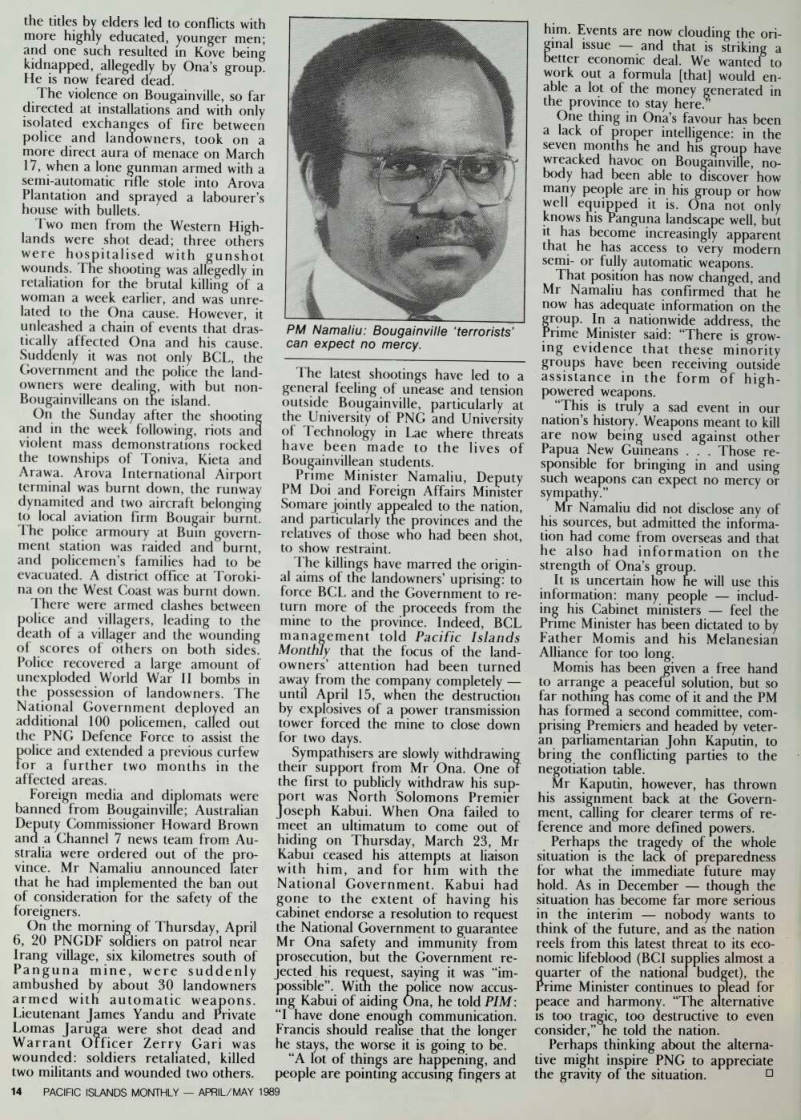
That position has now changed, and Mr Namaliu has confirmed that he now has adequate information on the group. In a nationwide address, the Prime Minister said: “There is grow ing evidence that these minority groups have been receiving outside assistance in the form of high
powered weapons.
“This is truly a sad event in our nation’s history. Weapons meant to kill are now being used against other Papua New Guineans . . . Those re sponsible for bringing in and using such weapons can expect no mercy or
sympathy.”
Mr Namaliu did not disclose any of his sources, but admitted the informa tion had come from overseas and that he also had information on the strength of Ona’s group.
It is uncertain how he will use this information: many people includ ing his Cabinet ministers feel the Prime Minister has been dictated to by Father Momis and his Melanesian Alliance for too long.
Momis has been given a free hand to arrange a peaceful solution, but so far nothing has come of it and the PM has formed a second committee, com prising Premiers and headed by veter
an parliamentarian John Kaputin, to
bring the conflicting parties to the
negotiation table.
Mr Kaputin, however, has thrown his assignment back at the Govern ment, calling for clearer terms of re ference and more defined powers.
Perhaps the tragedy of the whole situation is the lack of preparedness for what the immediate future may hold. As in December though the situation has become far more serious in the interim nobody wants to think of the future, and as the nation reels from this latest threat to its eco nomic lifeblood (BCI supplies almost a quarter of the national budget), the Prime Minister continues to plead for peace and harmony. “The alternative is too tragic, too destructive to even consider,” he told the nation.
Perhaps thinking about the alterna
tive might inspire PNG to appreciate
the gravity of the situation. D
PM Namaliu: Bougainville ‘terrorists’ can expect no mercy.