Business Report
pp. 28-35 · Read in the full issue
Marshall Islands joins
the South Pacific
THE MARSHALL Islands has sig nailed its intention of reducing its dependence on trade ties with the United States by sending a trade mission to Fiji, Australia and New Zea land. It was also a sign that the gulf between the North and South Pacific that has existed for so long because of colonial history may be on the
way to being bridged.
The mission’s leader, Mr Edinal Jor kan of the recently formed divison of trade and industry in the Marshall Is lands’ Ministry of Resources and De velopment, said the country’s business men have been particularly impressed by the level of industrial development in Fiji, which showed what could be done with tax incentives.
Marshall Islands development is well behind many of the small island states of the Pacific, partly due to its re latively late Independence in 1979.
Also, Pacific experts generally agree that the US did little during its occupation of the Marshall Islands to better the lot of its people (who now number 45,000, with one of the high est birth rates in the world). Copra products account for about 90 per cent of the country’s exports, while ab out SO per cent of imports originate in the US, most of the rest being in the form of cars from Japan.
The Marshalls’ greatest economic opportunity is that it has free access to the Mainland American market, as do other former US territories. The problem for any investor would be to raise a workforce; life in the Marshalls is easy, food and clothing are abun dant and there is little imperative to earn a living. In the Federated States of Micronesia (FSM) there are plans to build a clothing factory that would ex port to the US Mainland, and the gov ernment is talking of importing 700 Sri Lankan workers presumably be cause both skills and interest are lack ing among local people.
The Marshall Islands has made some headway with new economic activities, though copra and the huge US base on Kwajalein atoll are the main sources of revenue. More than one million tonnes of shipping is now
registered under the Marshals flag,
the latest being a 115,000-tonne,
Hong Kong-owned dry bulk carrier
that will be operated with a Marshall Islands crew. The government has also decided to sell Marshall Islands passports for $U5250,000, the idea
being that buyers would enjoy the
same rights to settle in the US as the Marshallese (though the US State De
partment has said naturalised citizens of the Marshalls will have to live in the Islands for five years before they qual
ify lor Mainland residency).
Most recently, the Government hired a company to study the coun try’s economic zone for its mineral potential. President Amata Kabua said the Marshalls was looking to exploit its seabed resources following a recent re port by the East-West Centre, Honolu lu, that identified the area round the Marshalls as likely to contain deposits of manganese, the extraction ana pro cessing of which could be aided by the
country’s comparatively lax environ
mental laws and low taxes.
Most Marshallese who do take jobs find employment in the service sector in supermarkets, shops and hotels.
However, tourism is relatively unde veloped due to a combination of poor air communications and lack of top class hotel accommodation. There are connections with the US, but the cost of travel is high compared with other destinations. This is particularly true if one is trying to reach the Marshalls from the South Pacific, which involves obtaining a seat on the twice-weekly HS74B flight from Fiji via Tuvalu and Kiribati (in fact, the trade commission had to cool its heels in Sydney over Easter because it could not get seats on the flight out of Fiji until later in the week aboard the Airlines of the Marshall Islands aircraft).
The Marshall Islands is now seeking a loan of SUS4O million to upgrade its national airline, including the purch ase of a DCS to operate oetween Ma juro, the capital, and Hawaii and Fiji.
At the same time, the Kiribati airline Air Tungaru is believed to be plan ning the lease of a Boeing 737 to fly Honolulu/Christmas IslandsZfarawa/ Nadi; the nation’s communications have been hit hard by the grounding of Air Nauru, which formeny offered a service from Australia via Nauru. A 737 Kiribati and a DCS to the Mar shalls would be a massive improve ment on the twice-weekly flight, from the Marshalls to Fiji, that also has to service Kiribati ancf Tuvalu.
Continental-Air Micronesia is also now flying a DC 10 direct from Guam to Sydney, which will revolutionise air access to Micronesia from the south.
Sea links are also being improved: Pacific Forum Line has now extended its Kiribati sailings to include Majuro.
The problem for any company wanting to set up in the Marshalls is that the Government has yet to pass a law regulating foreign investment: the desire to enjoy the benefits of de velopment has not been matched by
the drafting of guidelines.
With copra’s future on a seemingly endless downward trend, the country has a genuine need to diversify. It has made few moves toward developing fishing other than setting up a focal company: unlike the FSM, which has ordered three multi-million-dollar tuna boats from Australian shipyards (though three confiscated Japanese ships are tied up in port by political and regional rivalries m the FSM).
What the trade mission’s visit does indicate is that the Marshall Islands is looking to downgrade its economic ties with tne US; a typical post-colonial attitude. The most likely beneficiary is Fiji, whose production methods and
costings impressed the Marshallese
businessmen. They are expected to
buy Fijian-manufactured clothing,
food, small machinery and aluminium boats in the first instance.
The second phase will be to seek out industries that can be developed in the Marshall Islands. Mission leader Jorkan told Pacific Islands Monthly the members had been surprised at what they saw in Fiji and the trip was a useful familiarisation with the econo mies of Australia and New Zealand.
Mr Jorkan said likely industries for the Marshalls could include garment factories and beer brewing.
Bird of Paradise may
gain extra wings
Jl IR NIUGINI could be looking
to further major expansion
within 12 months by adding a secona A3lO Airbus to its fleet. It took delivery of its K 54 million Airbus in mid-March and is considering leas ing the second aircraft.
A second A3lO would imply con siderable route expansion to keep the aircraft fully utilised. The Airbus that went into service last month has a work load designed to produce enough income to cover its costs: twice weekly to Sydney via Brisbane, once
weekly to Sydney direct, weekly from
Port Moresby to Cairns, weekly to Manila and Hong Kong and twice
weekly to Singapore.
A second aircraft would mean new routes, simply because Air Niugini could not expect to be able to double its traffic on existing routes. There has been speculation in aviation circles that the airline is looking at a direct
Port Moresby/Hong Kong flight as
well as services to Tokyo and Auck land. There could be increased ser vices on the Singapore route as traffic has proved better than expected, with not only good business from Asian corporate travellers to Papua New
Guinea but the use by expatriates as the most direct route to Europe.
Air Niugini made its third consecu tive profit in 1987, putting behind it the dismal results of the early 1980 s.
The airline is the only national carrier in the South Pacific that has main tained its independence . . . some part of which can be explained by the fact that it is the only regional carrier that has a substantial domestic network.
The airline made a profit of K 3.54 million after tax last year on revenue of K 83.96 million and carried just over half a million passengers. Air
Niugini general manager Dieter
Seefeld attributed the profit to in creased traffic and better training of the company’s workforce. The airline’s internal traffic has increased as a re sult of its Weekender, Nambawan and Family concession rates, which have reductions of up to 50 per cent on
normal fares. Traditionally, expatriate
residents have gone overseas for vaca tions and have rarely travelled within Papua New Guinea; the new fares maxe that alternative more attractive and make it possible for PNG nation als to better afford air travel.
Since October 1987, Air Niugini has expanded its services rapidly, intro ducing its extension from Honiara to Port Vila; adding services to Sydney
and Singapore to existing flights; re
introducing a service to Daru; adding Misima, Tabubil and Wapenamanda to its internal destinations; Winging in a non-stop flight between Kieta and Cairns and flights between Port Moresby and Townsville, with a Mon day flight to Hong Kong the latest in novation. Air Niugini owns six F2B jets the workhorses of its main domestic routes as well as some short hop international runs such as to Cairns and Honiara and two Dash 7 aircraft. The company also owns 51 per cent of Douglas Airways, a long established third level airline in Papua New Guinea, and is looking at re
equipping Douglas (which currently
uses a variety of aircraft to small aerodromes) and making it more of a feeder service to the national airline’s domestic operations. During 1987, as part of K 3 million staff training scheme, the airline also began a pilot training programme to accelerate the pace of localisation.
Fiji looks to mop up
excess liquidity
Fiji’S Government, Faced
with an excess liquidity situation, is to use its Reserve Bank to mop up money for which the com mercial banks can find no borrowers.
The situation has been brought about by reduced business activity since the two military coups; the subsequent lack of confidence has meant people
are harbouring their savings and few
companies are borrowing to expand,
so commercial banks are left with money (estimated at 10 per cent of
deposits) earning no interest.
The Government has accepted that the Reserve Bank’s earnings will be down this year as a result of the scheme. The first issue of notes offered to the banks was made by the Reserve Bank of Fiji (RBF) in late March, for SFIO million with issues for another $3O million expected be fore the end of May. The notes will be issued in denominations of $F200,000 over three months, one and two years.
The exercise is aimed at enabling the commercial banks and institutions such as the National Provident Fund and insurance companies to earn in come on their funds. The interest to be paid has not been announced.
The RBF’s statement said the exces sive liquidity situation was undesirable because it threatened the stability of the banking system and the future effectiveness of Fiji’s monetary policy.
Banks and insurance companies
have sought permission to expatriate
their funds to countries where they could be invested at good rates, but this was denied: an outrush of funds would seriously affect Fiji’s current account balance, but with such high interest rates prevailing in Australia
and NZ the banks could have solved their problems immediately if offshore investment had been allowed.
Carving a slice of
PNG's oil action
EACARC NIUGINI NL, the first *apua New Guinean company to ist on the Australian stock ex _l since Independence, is looking to farm out a share of its prospect and discussions are under way witn a ma jor oil company.
PacArc, whose home exchange is Brisbane and whose chairman is Peter
Donigi, also currently president of the
PNG Law Society, has raised $A2.6 million from a fully subscribed public float of 10 million one Kina shares issued at $A0.26; since listing on February 23, only small parcels of the company’s shares have been traded within a band of 29c to 32c and, with shares issued to vendors, its total working capital is SA7.B million.
The company has a licence covering 4289 square kilometres within the Pa puan Basin, within 70 km of the oil discovery at lagifu and 15 km north of BP’s discoveries at Hides. The re gion is believed to contain six trillion cubic feet of gas and 600 million bar
rels of liquid nydrocarbons.
The permit to PacArc’s prospect is
held by Rigg Exploration Pty Ltd,
which is now a totally owned subsidi ary. Rigg applied for the licence area, known as PPL93, and sold it into PacArc (under the PNG Petroleum Act, licences are issued for six years after which the holder can apply only for half its prospect area to be re newed). PPL93 was previously held as part of BP’s licence area and four companies applied for it in 1986 when the area became available, including Chevron Oil and Rigg Exploration.
The founder of Rigg Exploration and now general manager of PacArc Niugini, Mr Kevin Rigg, told PIM the company was fortunate there was a roacf almost to the planned first drill site and it was looking at extending the road: if it is not forced to employ helicopters the company could elimin ate a third of its drilling cost.
Mineral and oil exploration will be come cheaper, according to Kevin Rigg, as the increased level of activity means more in-country support be comes available. PacArc has also faced a common second barrier to prospect ing in PNG: landowners. Mr Rigg says the company has taken particular care to encourage Southern Highlanders to become shareholders and, while most local holdings are small, PacArc will continue to encourage local participa tion: “It’s good for us, and for our
long-term plans,” he says.
Major tourism boost
for Vanuatu
has re-entered the battle for the South Pacific tourist dollar. In recent weeks it nas announced that it will buy a Boeing 727 from Australian Airlines, that Japan and Australia will pay for an upgrading of Port Vila’s airport so it can take Airbus and 767 aircraft, and that SAI.S million will be spent in Australia to encourage tourists to de cide on Vanuatu for their next vaca tion.
Vanuatu’s tourist industry has taken a few knocks since the halcyon days of 1983-84, when almost 33,000 visitors holidayed in the country. In 1986-87 the figure was down to 9000, recover ing to 14,000 in 1987-88. The Govern ment is targeting 21,500 visitors this year; 27,000 next year.
The main cause of the downturn in visitor numbers was Cyclone Uma, which caused SA2OO million in dam age, including the flattening of Iririki Hotel. Addea to this have been con
tinuing political problems which, while
they have not had any effect on daily life in Vanuatu, have probably at least partly because of negative cover age in metropolitan countries frightened off some tourists.
The country will gain some control over its own tourism destiny with the
purchase of a Boeing 727 from Au stralian Airlines. The three-engined jet, to be named Spirit of Vanuatu, will take over the weekly Sydney/Port Vila service now operated by Austra lian Airlines under the Air Vanuatu name and will in addition fly direct services to Melbourne and Auckland
the latter destination, due in Au
gust, being particularly significant as
tnere is currently no direct flight to Vanuatu from New Zealand, a major potential source of tourists.
Vanuatu has decided that its tour ism industry needs a strong, stable and independent carrier; it remem
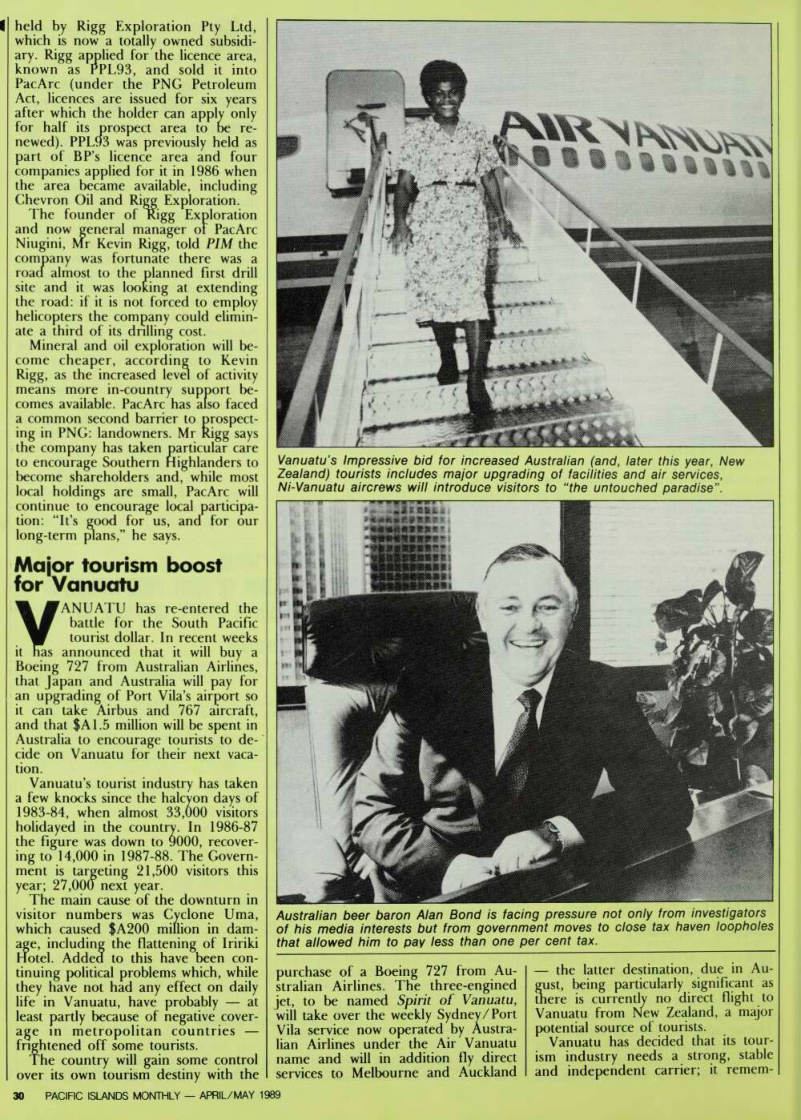
Vanuatu’s Impressive bid for increased Australian (and, later this year, New Zealand) tourists includes major upgrading of facilities and air services, Ni-Vanuatu aircrews will introduce visitors to “the untouched paradise".
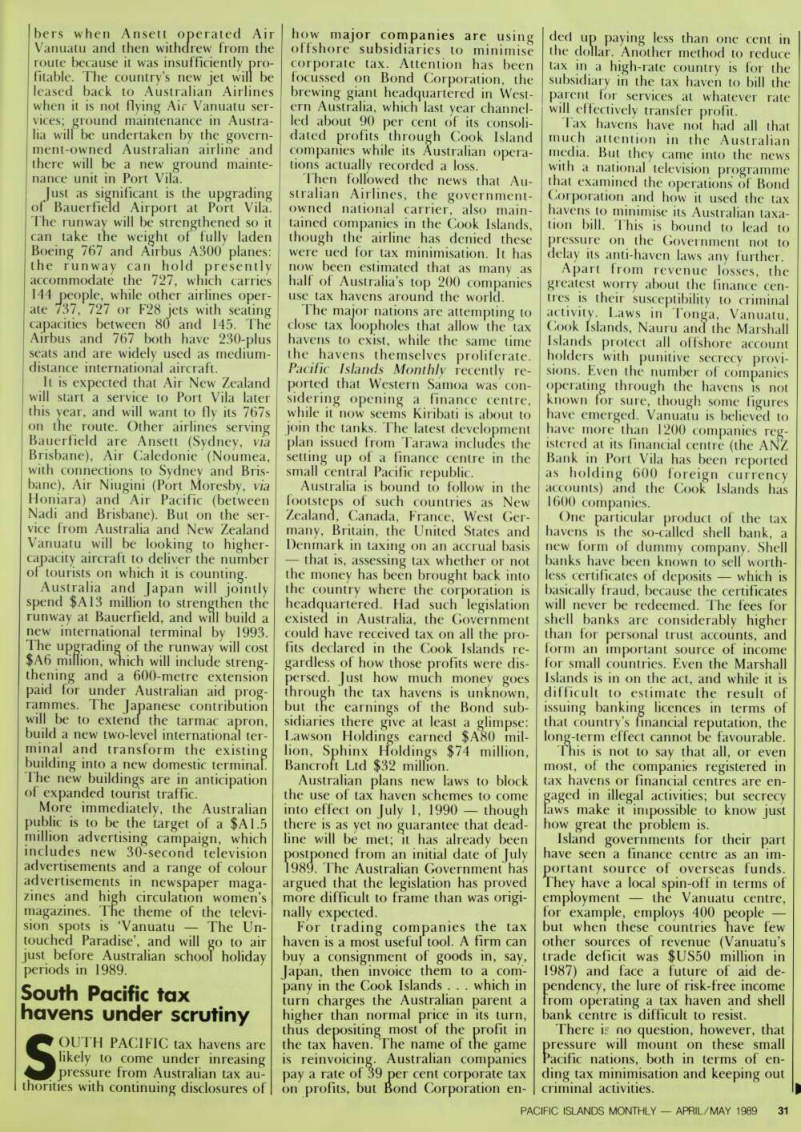
Australian beer baron Alan Bond is facing pressure not only from investigators of his media interests but from government moves to close tax haven loopholes that allowed him to pay less than one per cent tax.
bers when Ansett operated Air Vanuatu and then withdrew from the route because it was insufficiently pro fitable. The country’s new jet will be leased back to Australian Airlines when it is not flying Air Vanuatu ser vices; ground maintenance in Austra lia will be undertaken by the govern ment-owned Australian airline and there will be a new ground mainte nance unit in Port Vila.
Just as significant is the upgrading of Bauerfield Airport at Port Vila.
The runway will be strengthened so it can take the weight of fully laden Boeing 767 and Airbus A3OO planes: the runway can hold presently accommodate the 727, which carries 144 people, while other airlines oper ate 737, 727 or F2B jets with seating capacities between 80 and 145. The Airbus and 767 both have 230-plus seats and are widely used as medium distance international aircraft.
It is expected that Air New Zealand will start a service to Port Vila later this year, and will want to fly its 767 s on the route. Other airlines serving Bauerfield are Ansett (Sydney, via Brisbane), Air Caledonie (Noumea, with connections to Sydney and Bris bane), Air Niugini (Port Moresby, via Honiara) and Air Pacific (between Nadi and Brisbane). But on the ser vice from Australia and New Zealand Vanuatu will be looking to higher capacity aircraft to deliver the number of tourists on which it is counting.
Australia and Japan will jointly spend SAI3 million to strengthen the runway at Bauerfield, and wnl build a new international terminal by 1993.
The upgrading of the runway will cost SA6 million, which will include streng thening and a 600-metre extension paid for under Australian aid prog rammes. The Japanese contribution will be to extend the tarmac apron, build a new two-level international ter minal and transform the existing building into a new domestic terminals The new buildings are in anticipation of expanded tourist traffic.
More immediately, the Australian public is to be the target of a SAI.S
million advertising campaign, which
includes new 30-second television advertisements and a range of colour advertisements in newspaper maga zines and high circulation women’s magazines. The theme of the televi sion spots is ‘Vanuatu The Un touched Paradise’, and will go to air just before Australian school holiday periods in 1989.
South Pacific tax
havens under scrutiny
SOUTH PACIFIC tax havens are likely to come under inreasing pressure from Australian tax au thorities with continuing disclosures of
how major companies are using offshore subsidiaries to minimise corporate tax. Attention has been focussed on Bond Corporation, the
brewing giant headquartered in West
ern Australia, which last year channel led about 90 per cent of its consoli dated profits through Cook Island companies while its Australian opera tions actually recorded a loss.
Then followed the news that Au stralian Airlines, the government ovyned national carrier, also main tained companies in the Cook Islands, though the airline has denied these were ued for tax minimisation. It has now been estimated that as many as half of Australia’s top 200 companies use tax havens around the world.
The major nations are attempting to close tax loopholes that allow the tax havens to exist, while the same time the havens themselves proliferate.
Pacific Islands Monthly recently re ported that Western Samoa was con sidering opening a finance centre, while it now seems Kiribati is about to join the tanks. The latest development plan issued from Tarawa includes the setting up of a finance centre in the small central Pacific republic.
Australia is bound to follow in the footsteps of such countries as New Zealand, Canada, France, West Ger many, Britain, the United States and Denmark in taxing on an accrual basis that is, assessing tax whether or not the money has been brought back into the country where the corporation is
headquartered. Had such legislation
existed in Australia, the Government could have received tax on all the pro fits declared in the Cook Islands re gardless of how those profits were dis persed. Just how much money goes through the tax havens is unknown, but the earnings of the Bond sub sidiaries there give at least a glimpse: Lawson Holdings earned SABO mil lion, Sphinx Holdings $74 million, Bancroft Ltd $32 million.
Australian plans new laws to block the use of tax haven schemes to come into effect on July 1, 1990 though there is as yet no guarantee that dead line will be met; it has already been postponed from an initial date of July 1989. The Australian Government has
argued that the legislation has proved
more difficult to frame than was origi
nally expected.
For trading companies the tax haven is a most useful tool. A firm can buy a consignment of goods in, say, Japan, then invoice them to a com pany in the Cook Islands . . . which in turn charges the Australian parent a higher than normal price in its turn, thus depositing most of the profit in the tax haven. The name of the game is reinvoicing. Australian companies pay a rate of 39 per cent corporate tax on profits, but Bond Corporation en
ded up paying less than one cent in the dollar. Another method to reduce tax in a high-rate country is for the subsidiary in the tax haven to bill the parent for services at whatever rate
will effectively transfer profit.
fax havens have not had all that much attention in the Australian media. But they came into the news with a national television programme that examined the operations of Bond Corporation and how it used the tax havens to minimise its Australian taxa tion bill. This is bound to lead to pressure on the Government not to delay its anti-haven laws any further.
Apart from revenue losses, the greatest worry about the finance cen tres is their susceptibility to criminal activity. Laws in Tonga, Vanuatu, Cook Islands, Nauru ana the Marshall Islands protect all offshore account holders with punitive secrecy provi sions. Even the number of companies operating through the havens is not known lor sure, though some figures have emerged. Vanuatu is believed to have more than 1200 companies reg istered at its financial centre (the ANZ Bank in Port Vila has been reported as holding 600 foreign currency accounts) and the Cook Islands has
1600 companies.
One particular product of the tax havens is the so-called shell bank, a new form of dummy company. Shell banks have been known to sell worth less certificates of deposits which is basically fraud, because the certificates will never be redeemed. The fees for shell banks are considerably higher than for personal trust accounts, and form an important source of income for small countries. Even the Marshall Islands is in on the act, and while it is difficult to estimate the result of issuing banking licences in terms of that country’s financial reputation, the long-term effect cannot be favourable.
This is not to say that all, or even most, of the companies registered in tax havens or financial centres are en gaged in illegal activities; but secrecy laws make it impossible to know just how great the problem is.
Island governments for their part have seen a finance centre as an im portant source of overseas funds.
They have a local spin-off in terms of employment the Vanuatu centre,
for example, employs 400 people
but when these countries nave few other sources of revenue (Vanuatu’s trade deficit was |USSO million in 1987) and face a future of aid de pendency, the lure of risk-free income from operating a tax haven and shell bank centre is difficult to resist.
There is no question, however, that Pressure will mount on these small acific nations, both in terms of en ding tax minimisation and keeping out criminal activities.
□ Canadian Fisheries Aid
CANADA is to provide assistance to
projects being undertaken by the
Forum Fisheries Agency, based on Honiara. Canada’s International Cen tre for Ocean Development will pro vide about $A400,000 to help small
scale fishery projects being developed
in member countries, a pilot scheme for placing observers on foreign fishing vessels and for the training of Pacific islanders in specialised fishing methods.
□ Cocoa Assistance Urged
There is growing concern in Papua New Guinea about the plight of the cocoa industry. The K 6 million in the Cocoa Stabilisation Fund is expected to be exhausted by the end of April, and cocoa prices have halved since early 1987, under pressure since the early 1980 s due to the lagged re sponse of world production to the high real prices in the late 19705.
PNG exports were also hit in 1987 as a result of a drought.
A further slump in prices is ex pected in April unless there is a major assistance intervention by the Govern ment. It is reported that many small holders growing cocoa are barely sur viving financially, with both the com mercial banks and the Government
owned Agriculture Bank pressing
many growers for loan repayments.
Growers receive Kl5OO a tonne with the bounty from the stabilisation fund, but would get only K9OO if the fund is exhausted.
Large cocoa-producing companies
in East New Britain, including New Guinea Islands Produce Company, have already threatened mass lay-offs and it has been estimated that the Cocoa Stabilisation Fund would need a possible total of Kl 5 million in 1989 if it were to meet its obligations to growers.
□ Apia Port Development
JAPAN is to provide funds so Western Samoa can upgrade the main wharf at Matautu, as well as work to improve facilities at two other ports and to pro vide a new ferry.
□ Png S Rice Bill Up
PAPUA New Guinea’s rice imports are up, despite continuing efforts to in crease local production. It has been estimated that farms so far established will produce 309 tonnes of rice, but the imports mostly from Australia totalled 17,430 tonnes a year, which cost PNG K 26 million. The worrying trend is for the imported quantity to grow each year.
The Government has announced incentives to farmers growing rice, in
eluding a long-term plan to replace
imports, with provincial governments
being given the task of distributing
rice seeds. Just over 1000 farmers established rice projects in 1988.
□ Tonga-Us Shipping Service
COLUMBUS Line has opened a new direct shipping service between Tonga and the west coast of the United States. The new service will give Ton gans access to the American market and Tongan seamen, trained by a
joint Columbus-Tonga-West German
scheme, will man the vessel Columbus
Canada, registered in Tonga.
□ New Copra Mill Punned
A NEW copra crushing mill is to be built at Madang, PNG, with 50 tons of copra to be crushed each day. Initially
the plant will produce only crude
coconut oil, which has a ready market in India, Pakistan and Bangladesh, and will operate on a diesel engine.
PNG Copra Marketing Board chair man Sir John Guise has called on in
terested companies to lodge applica
tions; overseas companies can apply for the mill project as well as Papua New Guinean enterprises. Sir John
says it is important to ensure that the copra industry is still an important fe ature of the economy.
Plunging world prices hit Papua
New Guinea’s copra exports last year, wiping an estimated million of re ceipts according to the PNG copra Marketing Board. Production last year was down 9 per cent on 1987, the Board’s report says.
□ Craft Body Disbanded
WESTERN Samoa’s Handicraft Cor poration, established in 1965 to im prove the quality of the industry’s pro ducts, is to be closed after losing money for many years.
The corporation has grown in creasingly irrelevant as many hand icraft producers deal direct with hotels and shops rather than through the Government agency.
□ Hawaii’S Visitors Increase
FIGURES show that Hawaii ended 1988 with strong tourist arrival figures and indications of a good start in 1989. The Hawaii Visitors Bureau (HVB) has estimated total tourism spending for 1988 of SUSB.3 billion, up 25.8 per cent on the previous year.
The $1.7 billion increase is greater in size than most other industries’ total contribution to the state’s economy.
Preliminary estimates of Japanese
visitor spending have been increased f rom |4OO to $5OO per person as the earlier estimates are now regarded as too conservative. Even spending by tourists from the US Mainland appears to be higher than expected.
□ Marshalls Waste Deal
A PLAN by a US companv to dump non-toxic waste in the Marshall Is lands now seems set to proceed after die country’s parliament approved the intention of High Chief Amatu Kabua
to begin negotiations with Admiralty
Pacific Inc. The company wants to ship 10 per cent of the household gar bage generated on the West Coast of the US and create landfills in the Mar shall Islands. It will earn the republic about SUSSO million a year.
□ Melbourne-Nadi Service
AIR Pacific has introduced a new weekly direct flight from Melbourne to Nadi, designed to increase passen ger traffic from Victoria.
Air Pacific will thus become the only
airline flying under its own colours in Fiji from Melbourne, Sydney and Bris bane, and will be supporting the ser vice with advertising campaigns in
April and (uly.
□ Vanuatu Forest Agreement
TIEN Bou Enterprises of Taiwan has entered into an agreement with the Government of Vanuatu to log rain forests on the island of Malekida, the second largest in the Vanuatu group at 88km in length and 24km at its
widest point.
□ Fui Woodchip Plan
A LAUTOKA company has signed an agreement to supply SFS6 million worth of woodchips to Japan from its pine plantations over five years. Tro pik Wood Industries Ltd believes the
deal signifies that Japan has accepted
the country as a credible long-term area of investment. The agreement was signed with the Japanese firm of C Itoh 8c Co, though the chips will be shipped to three other Japanese com
panies, including Oji Paper, Japan’s
largest paper manufacturer.
A preliminary schedule shows Tro pik will export 11,000 tonnes by May,
the monthly shipments rising to
20,000 tonnes by November. Under the terms of the contract the Fiji com pany is committed to supplying a minimum 850,000 tonnes of wood chips to the Japanese pulp and paper industry. Earlier this year, Tropik Wood installed a$F 1.5 million sweep saw line to increase the recovery rate in processing swept or curved logs.
□ Taiwan Loans To Fiji
FIJI is about to raise its first-ever loan in Taiwan, with a SUS 2 million adv ance from the Export-Import Bank of China. The money will be used for the purchase of motor vehicles and com munications equipment for govern
ment departments.
□ Png Seeks Fishing Aid
THE Government of Papua New Guinea has asked Japan to fund K 7 million needed for development of the nation’s fishing industry. The cabinet approved the expenditure but learned that there were no funds available, so Fisheries and Marine Resources Minis ter Allan Ebu sought the aid during a recent visit to Tokyo.
Mr Ebu proposed to make the money available through commercial banks under relaxed guidelines to 100 per cent nationally owned companies already involved in fishing or prawn ing, and which have sound and proven management. Japan has
already made available Kl 7 million
through the Agriculture Bank for
agriculture and fisheries development
over the next five years.
□ Kwajalein Worker Layoffs
RADIO Australia has reported that hundreds of American and Marshal lese workers at the US Army testing range ol Kwajalein Atoll have been laid off because of funding cuts. The army base is one of the main sources for the Marshall Islands and the cuts of SUSIS million in funds have cost 250 expatriate and 150 Marshal lese their jobs. The remaining 540 Marshallese still on the payroll have been switched to shorter working
weeks and Job sharing.
□ Hawaii Airport Expansion
MORE than 30.5 million passengers will pass through Hawaii’s airports in
1989; and the number is expected to double within 25 years. The Hawaii
State Department of Transportation
(DOT) has embarked on a programme of renovation and expansion of the
state-run airports.
DOT is bringing back the ‘old Hawaii days’ at Honolulu International Air port, complete with strolling musicians and hula dancers. The department is now in the process of selecting a new site for a SUSI3O million international arrivals building, which will cover 29,750 square metres (320,000 square feet) and will centralise immigrations, customs and public health services on one level. DOT is also planning to in
stall ‘people-movers’ (moving foot
wavs) at Honolulu International to link the various terminals.
The old inter-island terminal has been torn down to make way for a multi-storey structure, to cost $lOO million, witn the airlines operating out of a temporary building.
Work is already underway on a new
While mechanisation has yet to change the way in which sugar cane is harvested in Fiji, economies of scale dictate that the era of small, local crushing mills is past. World prices for sugar have not improved as producers hoped, and the $F400 million establishment cost of even a small mill makes it imperative for Fiji’s largest domestic industry to make the same cost-cutting measures as other sugar-growing nations.
$4l million terminal complex at Kahu lui Airport on the island of Maui, the state’s second busiest airport, as well as a multi-lane access road to the airport.
A 1370-metre extension is planned at Keahole Airport, at Kona on Hawaii Island, while Lihue Airport on Kauai recently saw a new terminal opened.
□ East Sepik Rubber Plans
EAST Sepik Provincial Government is seeking funds to expand rubber pro duction, with plans to produce about K 3 million worth of rubber a year. A rubber factory has already been estab lished at Gavien under the East Sepik Rural Development project, but about K 300,000 is needed to fund the buying of the rubber from the growers; funds the provincial govern ment is seeking from Port Moresby.
□ Small Mills Out
THE Fiji Government has shelved plans for small sugar mills around the country after a study concluded that such operations would not be econo mically viable in view of the huge capital cost involved. The cabinet noted that Australia, Hawaii, and the Philippines had all been moving away from using smaller mills.
A small mill costs up to SF4OO mil lion, to establish, and current prices on the world market are not attractive.
Furthermore, existing mill capacity
has been fully used in only three of the past eight years.
□ Vanuatu Trade Deficit Grows
VANUATU’S trade shortfall in 1987 amounted to almost SUSSI.S million, an increase of SUSI3.S million on the 1986 result. The major items in the SUS7O million import bill were machines and transport equipment, food and live animals. Inflation for the year to September 1988 averaged 8.8 per cent.
□ Png Forests For Nationals
THE Papua New Guinea Government is moving to increase local processing of the country’s timber reserves, while at the time heading off increased fore
ign exploitation. Already ebony, teak,
balsa and conifer logs are banned for export and rosewood, pencil cedar, walnut, blackbean and phanconella will be added to this list. By 1991 no new log export permits will be issued.
The Government became concerned when exports of processed timber dropped from 36,000 cubic metres in 1983 to just 4000 cubic metres last year. Forests Minister Karl Stack has proposed legislation that will promote reafforestation, increase the log expert
levy and provide new processing re
quirements. The plan is to switch from log export to processing within the country.
Yet in the same week as the minister announced the new policy, the Post- Courier in Port Moresby revealed that a foreign company, incorporated for only three months, had geen granted exclusive negotiation rights for the giant Arawe timber tract m West New Britain. Cakara Alam (PNG) Ltd has been approved as the potential de veloper of 196,000 hectares.
□ Vanuatu Fish For Export
VANUATU is to seek a market for its chilled fish in Australia. The trial will be organised by the Government owned Port Vila Fisheries, and ship ments of deep-water snapper will be sent to the Sydney Fish Market.
□ Texas In Png
NIUGINI Mining Ltd has taken the Texas-based Battle Mountain Gold Company as controlling partner in order to find enough capital to de velop its stake in the Lihir goldfield in New Ireland Province. Battle Moun tain will pay SAIOO million for a 32 per cent stake in the company, which m turn has a 20 per cent share in the
giant Lihir gold aeposit.
Niugini Mining revealed in January
that it was having talks with several companies to raise funds for work at Lihir, which has an estimated 42.7 million ounces of gold. The other ma jor share will be neld by Rio Tinto-
Zinc Corporation after a buy-out of BP Minerals’ interest.
Battle Mountain has indicated it may seek a further equity increase in
Niugini Mining, either by market or
private transaction, though it is under stood the Texas company has agreed not to J»° beyond 75 per cent for five years. The American company already operates one of the largest gold mines in the United States, at the Fortitude pit in Nevada, and has also acquired a °qe-third share of a Peruvian gold
mining company.
Meanwhile, Niugini Mining has
posted a K 7.5 million loss for the six months to December 31 compared with K 1.3 million for the same period the previous year. It wrote off K 3.7 million from its oil exploration activi ties and now plans to farm out its ex ploration interests in order to limit the company’s exposure. But its K 2.5 mil lion revenue signals its emergence as a
gold producer.
□ American Samoa Deficit
THE Government of American Samoa has recorded a budget deficit of SUSI. 2 million for the quarter to De cember 31, signalling a shortfall for the year close to $5 million. However, the quarter may be a typical as it in cluded elections, which meant un
budgetted personnel hiring by the
outgoing government and a blow-out in Election Office spending. □