Cannibal Feast on Tanna:
pp. 40-42 · Read in the full issue
Pacific Arts
Cannibal Feast on Tanna: art records history
Artist Gordon Frazer chanced on a cannibal feast on the island of Tanna, and the resulting canvas was a masterwork that intrigued artists and audiences. Nicolas Rothwell looks closely at the painter and his major work.
HIS EYES wide with wonder, his heart stuttering with ex citement and fear, Charles Cordon Frazer stared through the long grass as the tribesmen of faneka hi performed their rival.
He was one of the only white men ever to witness a cannibal ceremony, and certainly the only artist of his time to penetrate so deep into the magic realm of the New Hebrides; the result is Gordon Frazer’s masterpiece, the extraordinary Cannibal Feast on the Island of Tanna, one of the most im
portant anthropological paintings of
the 19th century and a work of start
ling power and immediacy even today.
Cannibal Feast was tne object of great attention and controversy when it was first exhibited in Melbourne in 1891, after it was painted, and pro voked such interest when shown in Liverpool in 1895 that the artist even wrote a vivid paper describing how he came to paint his canvas. Lost from view for decades, this invocation of a vanished world resurfaced briefly a couple of years ago at an obscure Brit ish country auction; it appeared once more at a London sale last November, but was not recognised for the master piece of Pacific art it so obviously is and failed to make the reserve price.
Moves are now underway for the painting to be displayed in a major regional museum, wnere its central importance as a document of the en counter between Western and indige nous Pacific cultures can be fully
appreciated.
Behind Cannibal Feast lurks an in triguing tale. The artist’s own life seems to be an apt metaphor for the spirit of his age; the circumstances surrounding the painting itself are the stuff of penny romances indeed, one such breathless novel has been written about Gordon Frazer, inevit ably bearing the title Cannibal Feast.
The tale of the twists and turns the painting took in its journey from Au stralia in the 1890 s to the British auc
tion market of the 1980 s is worthy of an attractive detective story, the paint ing itself is both an articial masterwork and a crucialpiece of evidence for the customs for Tannese natives in the last years of the 19th century.
Frazer’s career had a fanciful begin ning. The young artist as can be seen from contemporary photographs, a handsome, sensually faced inaividual sporting a fine moustache went to a lecture oy the great African explorer,
Sir Henry Morton Stanley.
Stanley advised the young man against exploring in Africa: the Paci fic, he explained, was the new frontier for adventure and knowledge. In June 1885, Frazer, fresh from studies at London’s St John’s Wood School of Art and the Royal Academy, embarked for New Zealand; his stu dies and his experiences sketching in Paris and Italy had decided him he determined to become a topographical
painter.
A number of his canvases from New Zealand survive; they show an artist still seeking self-definition in his work, possessed of a keen eye and surpri singly lush sense of colour (one has the feeling he would have been at home in Technicolor). Frazer settled in Melbourne, where he cut a swathe
through smart society, establishing
himsetf as a portraitist of note . . and breaking a few hearts. The National Gallery in Melbourne still holds* a number of his works.
But Frazer had not forgotten his larger mission; over the following two years he travelled extensively through Australasia, visited the New Hebrides (today’s Republic of Vanuatu) and New Caledonia, as well as New Guinea and the Gulf of Carpenteria in Au stralia’s far north. Throughout his journeys he combined, in the fashion of the time, artistic and scientific
preoccupations, photographing and
collecting ethnographic samples while
also making preliminary sketches for a series of oil paintings.
During one of his visits to the New Hebrides Frazer whose reflective nature was oddly matched by a reck less adventurer’s streak made a foray to the southern islands of the group, far from the well-trodden ports of Santo and Efate. In Tanna, the volcanic island that still preserves a vivid sense of ritual, he was following in the steps of none other than Cap tain James Cook, who landed on the island in 1774, at a site he named Port Resolution to honour one of his ves sels on the expedition.
Just inland from this spot, Il’po, is lanekahi the village site where Fraz er half-surreptitiously observed his cannibal feast.
Research is now underway on Tan na to establish the precise details of the ceremony recorded in the paint ing, but Frazer’s claim that he de picted exactly what he saw with his own eyes has been largely borne out
by preliminary investigations, reported
to Pacific Islands Monthly by the cura tor of the Vanuatu Cultural Centre, Kirk Huffman. There is a certain pride on the island of Tanna that this elaborate ritual should have been pre served in such exact detail by the visit ing artist; many families from the re gion of the island visited by Frazer are keen to trace the part played by their own ancestors in the ceremony.
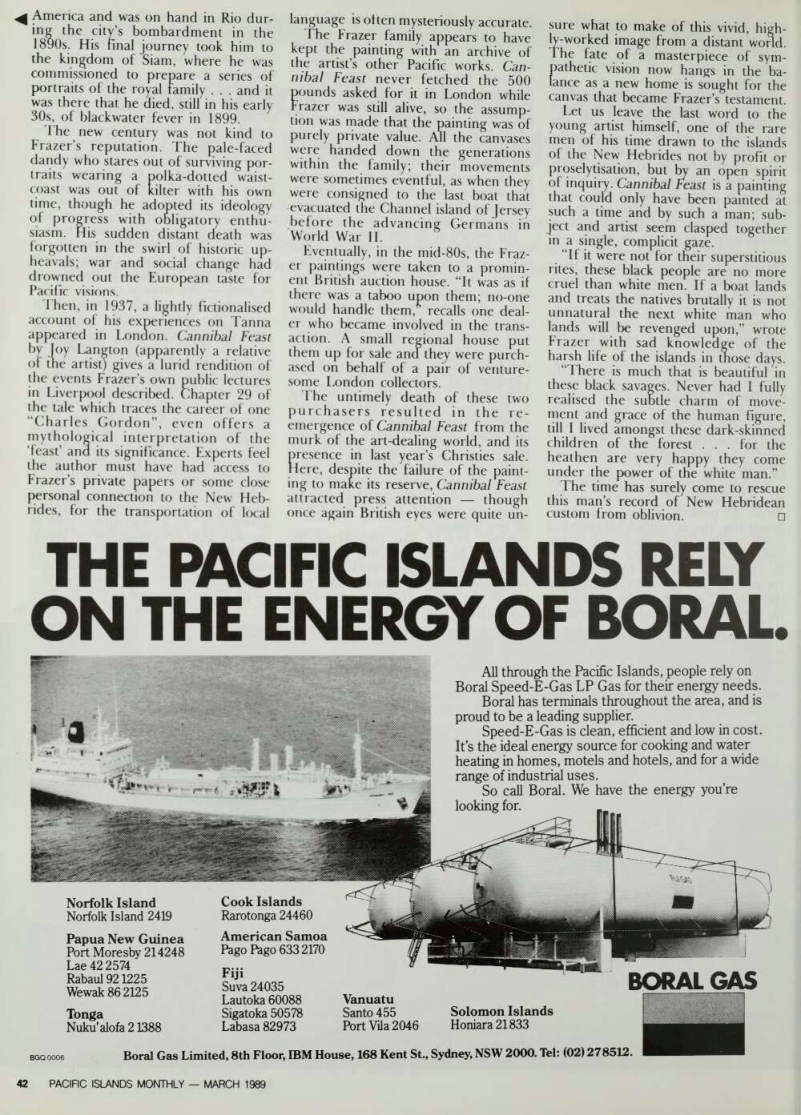
The painting itself is a swirl of col our, composed with fluid ease. Be neath a thick jungle canopy, a feast is
being prepared; figures throng the
background while smoke rises beside a giant pile of yams. In a clearing, men in ceremonial costumes are bearing on poles two bound figures the still living sacrificial victims of the feast.
The detail is painstakingly rendered the musculature and stance of the fi-
Frazer’s keen eye captured the scene but often horrified audiences disputed his claim the painting was a faithful depiction a claim supported by an increasing body of research.
gures will be instantly recognisable to anyone who has visited the island. A figure bearing a sacrificial club and spear-stick gestures; all around, seated tribesmen look on.
In the middle distance stands a slender figure of haunting grace, his back to the viewer, lit by a shaft of sunshine. Each of the cnief players in the sacrificial drama is shown with a keen, unsentimental fidelity; the contrast between the bound limbs of the victims and the bunched frames of their bearers is poignantly captured, and is the sense of motion and turbulent, holy energy mantling the whole tableau. In short, this is the work in which all Frazer’s artistic strengths found their fullest flowering in precise observation or detail combined with his sense of awe and wonder at the scale of nature; the artifice of his composition is matched only by the immediacy of his recollection.
The painting was intensely controversial in its time, provoking when exhibited in Melbourne some memorably parochial reviews one critic described the scene as a ‘walkabout by a load of washed-out niggers’. A century later, it has emerged as an anthropolo-
gical treasure.
Frazer’s sure eye is confirmed by an examination of the ritual he records. At present, it has been established that the ceremony he observed is of a type called Me/, and it can indeed be localised to the precise area he claimed as the site for his ‘feast’, for only in that part of the island are the unusual giant yams he includes in his canvas encountered. Since only 28
lineages on Tanna had the right to consume human flesh, such a ceremony must have been a comparatively rare event. The only anthropological solecisms Frazer commits come in the depiction of his celebrants’ decorations: some of the men wear curved pig’s tusk waist-bands and earrings, which he could not have seen on Tanna itself, but otherwise his depiction of the elaborate hairstyles of the men, the rare banana-leaf hats of the watching women and the strange dresses that leave the sides of their legs uncovered was scientifically correct.
His record is all the more valuable because of the paucity of our knowledge of customs of this period on Tanna, one of the most fascinating of the rich cultures of the archipelago, Many of our sources for the late 19th century are missionary, and so tinged with a certain moral slant that tends to demonise ‘godless’ native customs; one
standard 1930 s history, Langridge’s
Conquest of Cannibal Tanna a Brief Record of Christian Persistency in the New Hebrides Islands is peo-
pled by unappealing ‘witch-doctors
and warmongers’. Though missionar-
ies were already established on Tanna at the time of Frazer’s visit, their activity was centred on the southwest coast of the island; a recent earthquake had made the harbour at Port Resolution all but impassable.
After Frazer had completed his painting, he was evidently aware he had produced a masterwork. Then as now, the eating of human flesh provoked an exotic frisson; the subject was shocking, as was Frazer’s
approach in an accompanying lecture, He steers well clear of moralising and seems rather awed by the religious atmosphere he encountered, and while the customary weight of Victo rian ideology hangs heavy in his mind he conceals with difficulty his own fas cination with the spectacle that pro duced his greatest canvass: “In choos ing this subject”, he wrote, “it was not from any desire for sensation, nor from any sense of morbideness, but from the fact of having witnessed by accident a scene of superstition so ancient, a custom that must soon be come extinct all over the world before the great march of civilisation, that I considered it my duty to illustrate this dark and terrible phase in the history of man this strange custom of dis appearing races, which embraces in its origins the belief that in eating the flesh of the enemy, they imbibed the strength of their tribes.” Frazer con tinued by expressing the hope that “if the work affords interest to the ethno logist and student of human nature, and shows how links with the animal humanity can exist without any form of civilising influence, and from what civilisation may have had its source, my picture becomes historical, and my object and reward are gained, After the success de scandale of the
painting’s debut, Frazer’s “thrilling
adventures” (as. a biographical note of the day gushed) continued at break neck pace. There is a record of his once having sailed by open boat from New Caledonia to the New Hebrides —he all but drowned. After his Faci fic sojourn he headed for Souths
<4 America and was on hand in Rio dur ing the city’s bombardment in the 1890 s. His final journey took him to the kingdom of Siam, where he was commissioned to prepare a series of portraits of the royal family . . . and it was there that he died, still in his early 30s, of blackwater fever in 1899.
The new century was not kind to
Frazer’s reputation. The pale-faced
dandy who stares out of surviving por traits wearing a polka-dotted waist coast was out of kilter with his own
time, though he adopted its ideology
of progress with obligatory enthu siasm. His sudden distant death was forgotten in the swirl of historic up heavals; war and social change had drowned out the European taste for Pacific visions.
Then, in 1937, a lightly fictionalised account of his experiences on Tanna appeared in London. Cannibal Feast
by Joy Langton (apparently a relative
of the artist) gives a lurid rendition of the events Frazer’s own public lectures in Liverpool described. Chapter 29 of the tale which traces the career of one “Charles Gordon”, even offers a
mythological interpretation of the
‘feast’ and its significance. Experts feel the author must have had access to Frazer’s private papers or some close personal connection to the New Heb rides, for the transportation of local
language is of ten mysteriously accurate.
The Frazer family appears to have kept the painting with an archive of the artist’s other Pacific works. Can nibal Feast never fetched the 500 pounds asked for it in London while Frazer was still alive, so the assump tion was made that the painting was of purely private value. All the canvases were handed down the generations within the family; their movements were sometimes eventful, as when they were consigned to the last boat that evacuated the Channel island of Jersey before the advancing Germans in World War 11.
Eventually, in the mid-80s, the Fraz er paintings were taken to a promin ent British auction house. “It was as if there was a taboo upon them; no-one would handle them, recalls one deal er who became involved in the trans action. A small regional house put them up for sale ana they were purch ased on behalf of a pair of venture some London collectors.
The untimely death of these two purchasers resulted in the re emergence of Cannibal Feast from the murk of the art-dealing world, and its presence in last year’s Christies sale.
Here, despite the failure of the paint ing to mate its reserve, Cannibal Feast attracted press attention though once again British eyes were quite un
sure what to make of this vivid, high
ly-worked image from a distant world.
The fate of a masterpiece of sym pathetic vision now hangs in the ba lance as a new home is sought for the canvas that became Frazer’s testament.
Let us leave the last word to the young artist himself, one of the rare men of his time drawn to the islands of the New Hebrides not by profit or
proselytisation, but by an open spirit
of inquiry. Cannibal Feast is a painting that could only have been painted at such a time and by such a man; sub
ject and artist seem clasped together
in a single, complicit gaze.
“If it were not for their superstitious rites, these black people are no more cruel than white men. If a boat lands and treats the natives brutally it is not unnatural the next white man who lands will be revenged upon,” wrote Frazer with sad knowledge of the harsh life of the islands in tnose days.
“There is much that is beautiful in these black savages. Never had I fully realised the suotle charm of move ment and grace of the human figure, till I lived amongst these dark-skinned children of the forest ... for the heathen are very happy they come under the power of the white man.”
The time has surely come to rescue this man’s record of New Hebridean custom from oblivion. □