Pacific Stamp Box
p. 39 · Read in the full issue
Edited by John Hunter
IT SEEMS New Zealand Post has successfully defended its postal ser
vices monopoly against private mail
contractors. The Document Exchange Service initiated by the Coast Com munity Society near Hamilton (see Pacific Islands Monthly , January and
February) has closed following a High
Court ruling that the operation and the stamps it issued were illegal.
Attention has once again oeen fo cused on Australia Post and its cost cutting measures. A leaked document proposes the closure of 590 post offices Australia-wide (350 country and 240 metropolitan) and their re
placement by private contractors,
agencies or vending machines. The Australian newspaper has encountered a stone wall of secrecy in its attempts to confirm which offices will close.
Likely victims will be post offices with less than four staff members, or offices that cannot pay at least 80 per cent of their running costs. Closures are also mooted in towns with popula tions less than 3000.
Federal Minister for Telecom munications Gary Punch has warned Australia Post that it is inappropriate for a government instrumentality to develop a reputation for “ruthlessness and an obsession with profit”. Mr Punch said the Government might have to accept a lower financial return if the alternative meant cutting much needed services.
The philatelic subsidiaries of the Crown Agents, Caphco Limited and CAPC Inc, have been taken over by
Westwood Rogers Marketing Group.
Caphco is responsible for arranging
the production and marketing of post age stamps on behalf of 50 or so clients, nine of whom are Pacific is land agencies. Westwood Rogers is best known in the stamp world as the licensing agent of both Australia Post and New Zealand Post. Westwood Ro gers has recently acquired the services of two Australia Post staffers credited with swinging that organisation into its
present aggressive market profile.
The implications of the takeover are yet to be realised. However, I am con fident we will see a more aggressive
Caphco emerge.
Plans are underway for a Regional
Philatelic Marketing Workshop, being
organised by the Forum Secretariat for June in Rarotonga, Cook Islands.
The workshop aims to provide in formation on all aspects of marketing stamps. I applaud the planned work shop, having long held the view that Pacific nations need to create a region
al philatelic organisation that can share problems, give advice, promote sales and formulate marketing and issue policies. Such a group could adopt an annual stamp theme to be used by member nations on their stamps as done by European Com munity members.
PAPUA NEW GUINEA is about to enter the Frama scene with a first issue of Frama labels on September 6.
Frama label collecting has proved popular around the world, especially m Europe. The first labels reportedly will appear without a design aue to a late adoption of the Frama design.
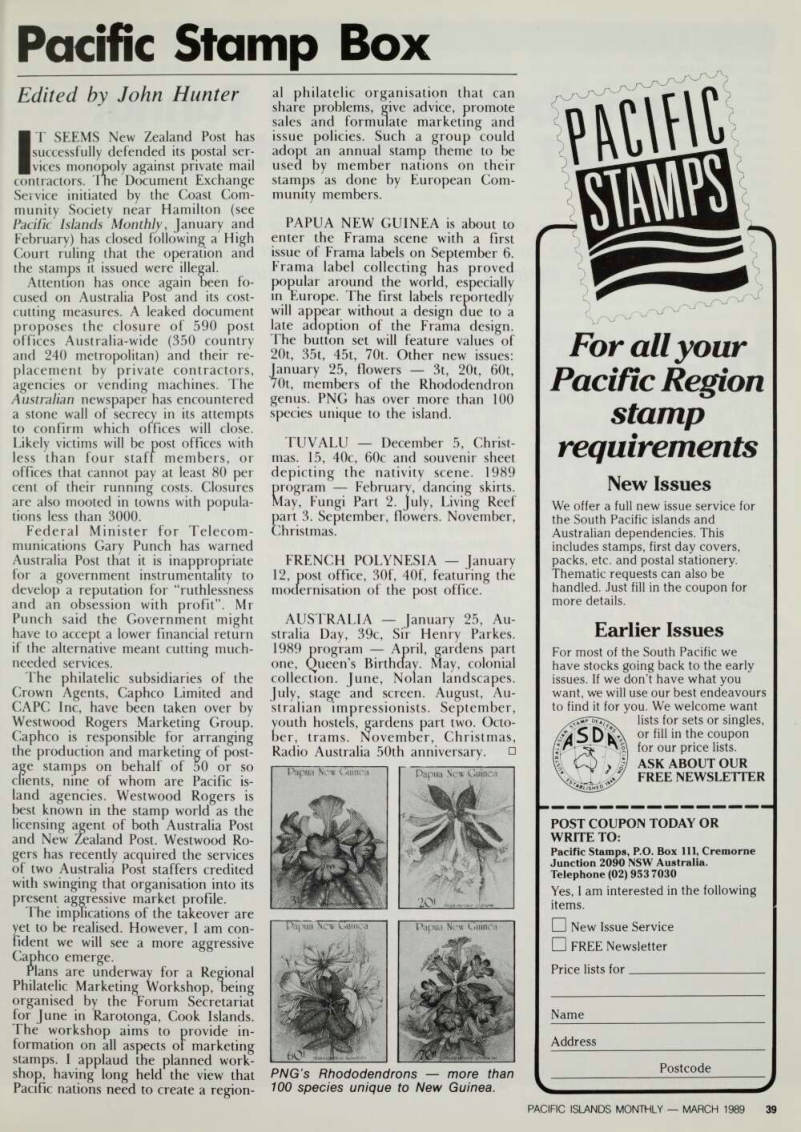
The button set will feature values of 20t, 35t, 45t, 70t. Other new issues: January 25, flowers 3t, 20t, 60t, /Ot, members of the Rhododendron genus. PNG has over more than 100 species unique to the island.
TUVALU December 5, Christ mas. 15, 40c, 60c and souvenir sheet depicting the nativity scene. 1989
program February, dancing skirts.
May, Fungi Part 2. July, Living Reef part 3. September, flowers. November, Christmas.
French Polynesia January
12, post office, 30f, 40f, featuring the modernisation of the post office.
AUSTRALIA January 25, Au stralia Day, 39c, Sir Henry Parkes. 1989 program April, gardens part one, Queen’s Birthday. May, colonial collection. June, Nolan landscapes.
July, stage and screen. August, Au stralian impressionists. September, youth hostels, gardens part two. Octo ber, trams. November, Christmas, Radio Australia 50th anniversary. □
PNG’s Rhododendrons - more than 100 species unique to New Guinea.