Facing the Vail of death'
pp. 43-45 · Read in the full issue

Trade Winds
Robin Bromby reports on the latest and most horrifying threat to the viability of the region’s fisheries.
mmHE FORUM Fisheries Agency (FFA) is hopeful it will get Japan to the negotiating table witnin the next few months, but is less opti mistic about the outcome of such talks.
Two main issues will be discussed: the
gill net fishing Japanese boats under
take both in the Tasman and in the Pacific east of New Zealand, and a multilateral treaty with FFA countries for the right to fish in their exclusive economic zones.
Along with the Taiwanese and South Koreans, Japanese fishing fleets are using gill nets dubbed the ‘Wall of Deatn to catch large numbers of mostly juvenile albacore tuna, a prac tice that has serious implications for the Pacific albacore fishery.
But, in the matter of reaching a fishing agreement with Forum coun tries, the Japanese have been a good deal more intransigent than their Asian counterparts. They broke off their deal with Papua New Guinea when the Government in Port Mores by wanted an increase in the fee (an increase to which the Taiwanese and South Koreans had agreed, but one the Japanese would not countenance).
Similarly, boats from Japan withdrew from the Tuvalu economic zone; they had agreed to pay the price required by Funafuti, but the Tuvalu Govern ment, in order to balance its budget for the year, asked for payment in advance. For Japan, one of the richest nations in the world, the request from a micro-state of fewer than 9000 peo ple could hardly have been a major issue . . . but refuse they did.
Tuna caught legally in the Pacific either by approved methods in inter national waters or under a fee arrangement in economic zones amounts to 600,000 tonnes a year: 375,000 by purse seine, 75,000 by pole and line and 150,000 by longhne.
Then there is gill netting.
Between the latitudes of 38 and 41 degrees in the South Pacific, juvenile albacore tuna come to the surface as part of their annual migration to the warmer tropical waters. They are on their way north to spawn. But vast
numbers are being caught by Asian
boats before they have a chance to re produce and as a consequence the portents for the future are grim.
The culprit is the gill net, which is suspended about 15 metres below the
“The gill nets are up
to 55 kilometres long
... and for the fish
there is simply no way
around.”
surface and has holes just large enough to catch tuna by their gills.
The nets are up to 55 kilometres long and for the fish there is simply no way around.
Gill nets catch not only tuna, but dolphins, small whales, sea birds and turtles as well and represent an ecological disaster that threatens not just Tonga and the Solomon Islands out, ironically, the Asian fishing indus tries themselves.
For while one group of boast clears the oceans with its gill nets, they will
deprive Japanese and Taiwanese long
line boats (which catch the adults after spawning) of a future. The longliners generally operate in territorial econo mic zones and pay the island govern ments for the right: gill-netters, in contrast, operate m international wa ters and pay nothing.
The Honiara-based Forum Fishing Agency estimates that within five years the numbers of albacore tuna could be down to 10 per cent of present levels.
It has been estimated that Asian fishermen are catching about 40,000 tonnes a year with gill nets, of which 30.000 tonnes are juvenile fish. The sustainable yield is reckoned at about 10.000 tonnes, with a maximum 5000 tonnes of juveniles. About 162 boats are now involved in gill netting; 130 Taiwanese, 30 Japanese and two South Koreans.
The FFA’s researchers have evi dence that the length and width of the gill nets, which are made of nylon, appear to have increased in the past year. Most of the catch is being sent to Taiwan, with some going to canneries in Thailand.
Canneries in Fiji and American Samoa have refused to buy fish caught with gill nets: French Polynesia and Vanuatu have refused gill net boats servicing or refuelling in their ports; and the Cook Islands turned down a Taiwanese proposal to build a cold store in that country.
Only New Caledonia and New Zea land nave allowed Japanese boats to
trans-ship tuna caught by gill netting,
but now the New Zealand Govern ment is lobbying the three Asian coun tries to phase out the method.
However, the first to feel the effect of such huge numbers of fish being caught will be the longline vessels, which seek adult fish in the deeper reaches of the tropical oceans.
Fiji has 17 longline vessels, which provide jobs both on the ships and at the cannery at Levuka. Vanuatu has a considerable investment in longlining, with a cold store and trans-shipment base and licences to 40 Taiwanese boats crewed partly by local men.
The Cook Islands earns licence fees from 53 South Korean longline boats, while American Samoa has two can neries and about 100 Taiwanese boats landing their catches there. French Polynesia has licensed Japanese and
Korean longliners.
Other countries also count fishing as part of their future: the Solomon Is lands is investing in its own fishing fleet, while Papua New Guinea has estimated that the present harvest of 2000 tonnes could be expanded to 180.000 tonnes of tuna a year without depleting the stock.
While the South Koreans and the Taiwanese have the gill net issue aside been prepared to strike deals by which they can fish in the econo mid zones of the small Pacific island states, the Japanese have been reluc tant to sign agreements unless they get all the conditions they seek. Both Tuvalu and PNG have cancelled agreements and the Marshall Islands has now given notice that it wants the Japanese out of its waters.
The annual catch of all types of tuna in the central and western Pacific has been estimated to be more than 600.000 tonnes a year, with a value of about SUS6OO million. The island states cannot afford fleets of boats; just one boat the size of the average US tuna vessel would cost SUSII mil lion to build and $3 million a year to operate, so these countries are reliant on what the big fishing nations do. If
they persist in over-fishing the re
source, and resisting reasonable pay ments, the hopes the small Pacific States have for economic development will be dashed. □
□ Spares Not Short
UK aircraft manufacturer Short Brothers has expanded its spare parts inventory in Australia following suc cessful sales campaigns there and in Southeast Asia. Spares for Shorts air craft operating in Australia and the Pacific will now be supplied from their Sydney office.
Short’s general manager in Australia John Burleigh says tne expansion, Lacked by the company’s major avionics suppliers, is worth SA2 mil lion over the past three months.
□ Columbus Discovers Tonga
COLUMBUS Line will commence a direct shipping service between Tonga in the US west coast. The container vessel Columbus Canada, which flies the Tongan flag and is crewed by Tongan rating seamen and cadets, will operate the service. A second vessel may operate the route at a later stage.
Loading on the west coast for tne first service was due in early March and the vessel is due in Nukualofa by April 10.
□ Pac-Dunlop Contract
PACIFIC Dunlop will share in SA6O
million contract to produce super sized batteries for the Australian Sub marine Corporation (ASC).
The contract was awarded to a joint venture company owned by Pacific Dunlop and German manufacturer, Varta Batteries AC.
The joint venture will invest $A6.5 million in a new manufacturing plant in Adelaide, South Australia, where the ASC has its submarine building facility. ASC received the contract to build six submarines from the Austra lian Navy. Each battery has a mass of 230 tonnes and consists of 448 cells.
Pacific Dunlop managing director
Philip Brass says the technology trans fer involved in the project could open up export opportunities and new de velopments in the supply of electrical power to remote areas.
□ Landowners In Sydney Talks
LANDOWNERS IN the Special Min ing Lease (SML) area of Porgera in the Highlands of Papua New Guinea are dissatisfied with the handling of their affairs by the local representa tives of the Porgera Joint Venture
(PJV) company.
So the landowners decided to go straight to the top, last month sending
a 10-member delegation to Sydney for talks with the overseas managers of the company. A chief of the SML area, Pakitu Pundi, led the delegation to discuss problems with the people landowners feel are the “real” mana gers of the venture.
The delegation dismissed claims by mine developers that there was no
Peter Walker - entrepreneur now facing criminal charges.
problem with the landowners and warned the national government not to rush negotiations.
The delegation reportedly sought
an assurance of 10 per cent free share participation in the mine, construction of a permanent township before min
ing begins, upgrading of the local
health centre, the awarding of con tracts to Porgerans, and training and
employment.
PNG Prime Minister Rabbie Nama liu later warned foreign investors against deceiving landowners after it was revealed the delegation received counter-offers from an Australian businessman. Peter Walker, the for mer managing director of the Private Blood Bank of Australia Ltd reported ly told the landowners he could offer a better deal on Porgera than the joint ventures. Mr Walker currently faces serious criminal charges in Australia.
□ Intelsat For Pacific
PACIFIC nations will gain economic access to international satellite links through a special arrangement with Australia’s OTC International. The
Demand Assigned Multiple Access
(DAMA) system is the basis for the Pacific Area Co-operative Telecom munications (PACT) network foi which OTCI has gained endorsement by the South Pacific Forum.
DAMA will allow shared use of the Intelsat satellite network to small na tions that could not afford full-time access. Representatives of 25 Pacific nations met in Sydney in late February to discuss implementation of the scheme. Some nations will have satel lite telephone links with each other, the rest of the world and, more importantly, some of their own remote
islands by early 1990.
As the scheme develops, facsimile services will become available, then data links and eventually broadcast facilities, making local television ser vices a possibility.
□ Blue Lagoon Upgrade
FIJI’S Blue Lagoon Cruises has ad justed its passenger services to better meet customer demands. Passenger services manager Peter Kerr says the
firm has introduced procedures to “take Blue Lagoon into the 1990s”.
New staff and crew training prog rammes have been introduced to up
grade standards, with improvements
planned to menus and wine lists. Blue Lagoon operates daily sailings on va rious schedules, and plans to intro duce a new vessel as part of the mod ernisation of its cruise fleet.
□ Austrade Mission
AUSTRADE Suva is to mount a major selling mission in the Pacific and is calling for expressions of interest from Australian companies interested in establishing or expanding a Pacific market. Delegates led by Trade Com missioner Clare McMahon and Au strade marketing officer Fred Thomas
will charter an aircraft to cover the region in a vigorous two-week mission at the end of May.
The mission will spend time in Fiji, Western Samoa, Tonga and American Samoa. Participation in the mission will offer companies the opportunity
to develop or expand potential market
opportunities for their products and services. Austrade suggests products that offer best potential in the Pacific include processed foods, fresh fruit
and vegetables, beverages, medicines,
building materials and hardware, elec trical and electronic equipment, con sultancy and construction services and office equipment. □
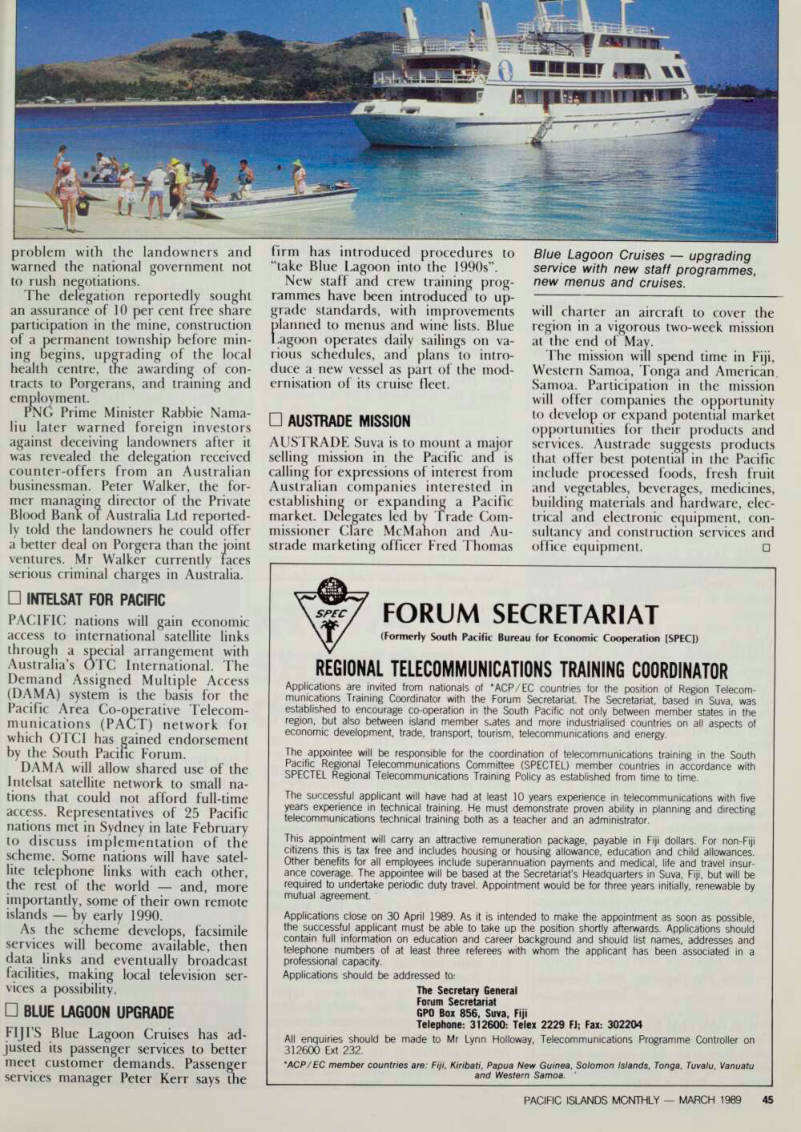
Blue Lagoon Cruises - upgrading
service with new staff programmes, new menus and cruises.