Tax burdens anger residents
pp. 22-23 · Read in the full issue
Hawaii
Hawaiians blame Asian buyers for high property but as Robin Bromby reports, the State’s counties are the culprits.
While Australians Have
been blaming Japanese inves-
ers for meteoric rises in property values, Asian buyers have also been coming under attack in Hawaii for their effect on the state’s nroperty taxes (see Pacific Islands
Monthly, February).
But, as a report from the Bank of
Hawaii points out, the property tax issue on those islands is more directly linked to the problems facing county administration in the State. While the State Government’s coffers are showing a healthy surplus, the counties are starved of money and the only way they have to redress that is by property taxes (or rates, as they known in
countries that follow the British sys tern). As the bank points out, apprais als on which taxes are now based were undertaken before the current prop erty boom, and the effect is especially noticeable in the city of Honolulu, “It appears that Honolulu needs to raise the property taxes aggressively, and the Japanese have come along at
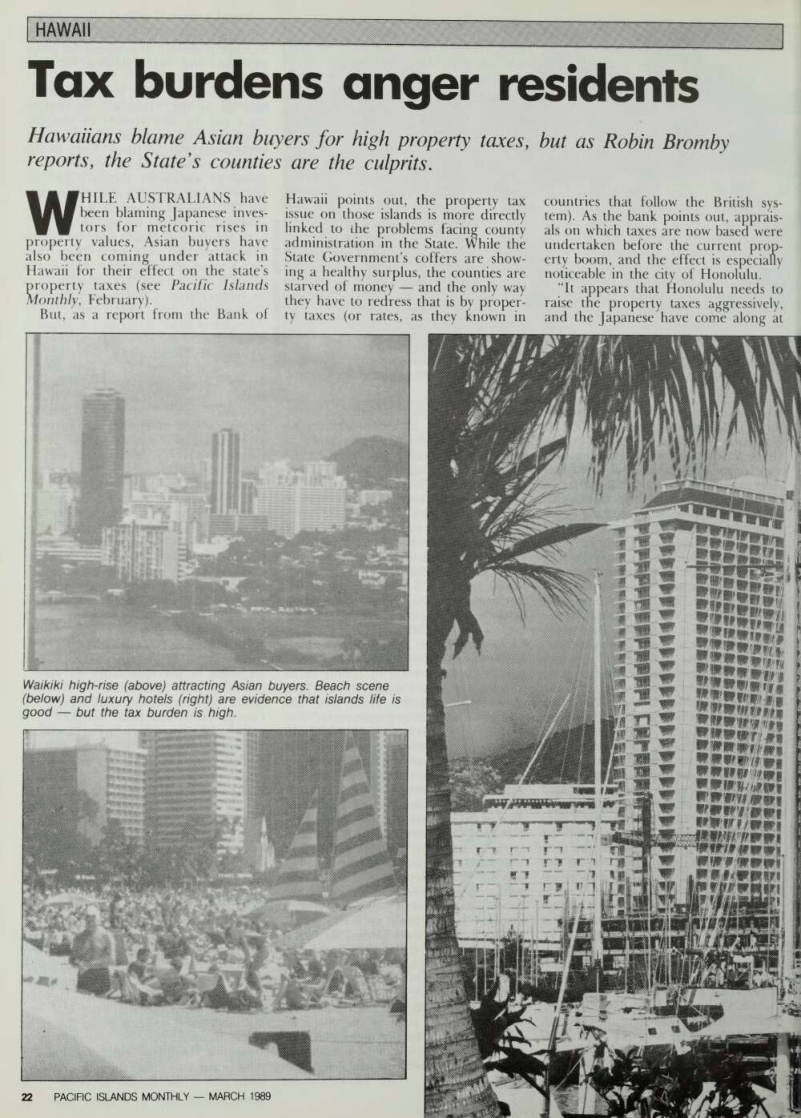
Waikiki high-rise (above) attracting Asian buyers. Beach scene (below) and luxury hotels (right) are evidence that islands life is good - but the tax burden is high.
the right time to absorb the blame,” says the bank in its latest Business Trends report.
The disparity between government sectors in Hawaii has been demons trated by the fact that the State’s re venue has risen at double-digit rates in the past two years, while county in come has gone just 5 per cent in that time. The state has a surplus of more than SUSSOO million.
The bank suggests that the State stop taxing the counties through ex cise duties (Hawaii is the only US state that does so), distribute some of the surplus to the counties and cut State taxes. Hawaii, it says, has an unusually high tax rate the average house hold pays a third of its income in tax, compared with a mainland average of less than a quarter. Awash with
money, the Hawaiian State administration has been addressing itself to avenues for spending money rather than cutting taxes. There is also considerable duplication of services by State and county governments, another factor that adds to the cost of running the islands.
In the meantime, says the bank, there is a simple way to defuse the issue of high-priced sales and their effect on rising valuations; allow residential assessments to rise but lower the tax rate, which would essentially keep county revenue at its current level. Then the State’s surplus could be used to provide a State income tax credit for property tax burdens that exceed certain percentages of homeowner income.
Even then, Hawaiian counties would remain captive to the very narrow and inflexible tax base that leaves the State with the lowest taxable urban land area per capita in the United States a compelling reason to allow more land to be released for urban development. Such a move would also help the current urgent need for more housing: on a State average, only 5.2 per cent of land is subject to county urban property tax.
“If the counties cannot expand their revenue sources beyond the existing
urban districts, individual property owners will continually be faced with rising assessments,” the bank report said. These future tax increases nave little to do with foreigners buying land; in fact, development of the re maining 95 per cent of Hawaii’s land (and the conversion of it to urban use, thus producing urban property tax) depends to a significant extent on
foreign investment.
In response to concern about fore
ign ownership, Honolulu city and
county leaders are proposing to pro
hibit foreign ownership of agricultural
land; but while that will no doubt appease those concerned about the level of Japanese property investment in Hawaii, the locking up of the land will mean that present taxpayers will be called on to shoulder the growing county revenue burden.
Meanwhile, construction in Hawaii has been rising at an increaingly rapid rate and has now reached an annual figure of SUS2.S billion a 26.5 per cent increase on 1987. The Bank of Hawaii believes that continued con struction growth is likely. Permit values for the year ending October 1988 show an 11.1 per cent rise in private construction authorisations, and the bank predicts a solid pace of construction through 1989. □