self-determination languishes
pp. 16-21 · Read in the full issue

Hawaii celebrates 30 years of Statehood - but self-determination languishes
Mainland tourists, Japanese investors even Australian businesses are moving into the Aloha State. But as Ed Rampell reports, the Polynesians who first settled the islands are beginning to agitate for a better deal.
MARCH 12 this year marks the 30th anniversary of Hawaii’s attainment of Statehood. On three decades ago, the United States Congress formally handed to
President Dwight Eisenhower legisla-
tion passed bv the House of Rentesentanves by 323 votes to 89 and by the Senate 76 votes to 15, endorsing the Territory of Hawaii’s admission to the Union. Eisenhower signed the bill, a political status plebiscite was held on June 27 and Hawaii’s electorate approved Statehood by a margin of 17 votes to 1. Out of 240 voting precincts, on repudiated the measure: the only electoral precinct to vote against statehood was Niihau, the ‘forbidden island’ off the coast of Kauai, where a few hundred pure Hawaiians still live, on a privately owned isle, speaking their Polynesian tongue and pursuing
a traditional Pacific way of life.
The vote of this islander enclave was at once a prophecy and a reflec tion of the tortous course of events
leading up to the archipelago’s absorp
tion by empire.
* Tarewell t 0 you> farewell t 0 you , Q fragrance ( n the blue depths, onp £ nf i and I leave Umil we meet again” .. , * „ T , , Aloha Oe, by Queen Liluokalam It is a great irony that the composer of Hawaii’s most famous song of part
ing was the Kingdom’s last ruling
monarch, Queen Liliuokalani. Perhaps
Her Majesty was metaphorically bid
ding adieu to Polynesian sovereignty
in the place mark Twain called ‘the loveliest fleet of islands that lies anchored in any ocean .
It is beyond the scope of this report
to document Hawaiian history in de tail, but within half a century of the first fatal contact with the haole (white man), the archipelago had experi enced a depopulation that brought the indigenous people from an estimated pre-contact population of at least 300,000 to 60,000 within 80 years.
The coming of the West led by force of arms to the transformation of tribal chiefdoms into a European-style, highly centralised monarchy. Many contemporary critics point to King Kamehameha Ifs disastrous 1848 land reform program, the ‘Great Mahele’, as being directly responsible for the Hawaiian landlessness that still plagues this insular society. At that time, only about 1 per cent of the Aina (land) ended up in the hands of the Maka’ainana (commoners).
Throughout the 19th century mis sionaries, merchants, whalers, plan ters, adventurers, indentured labour ers and other (predominantly Amer ican) foreigners entrenched them selves in the Kingdom. Their interests clashed increasingly with the royalty, which died off at an alarming rapid rate. This confrontation came to a
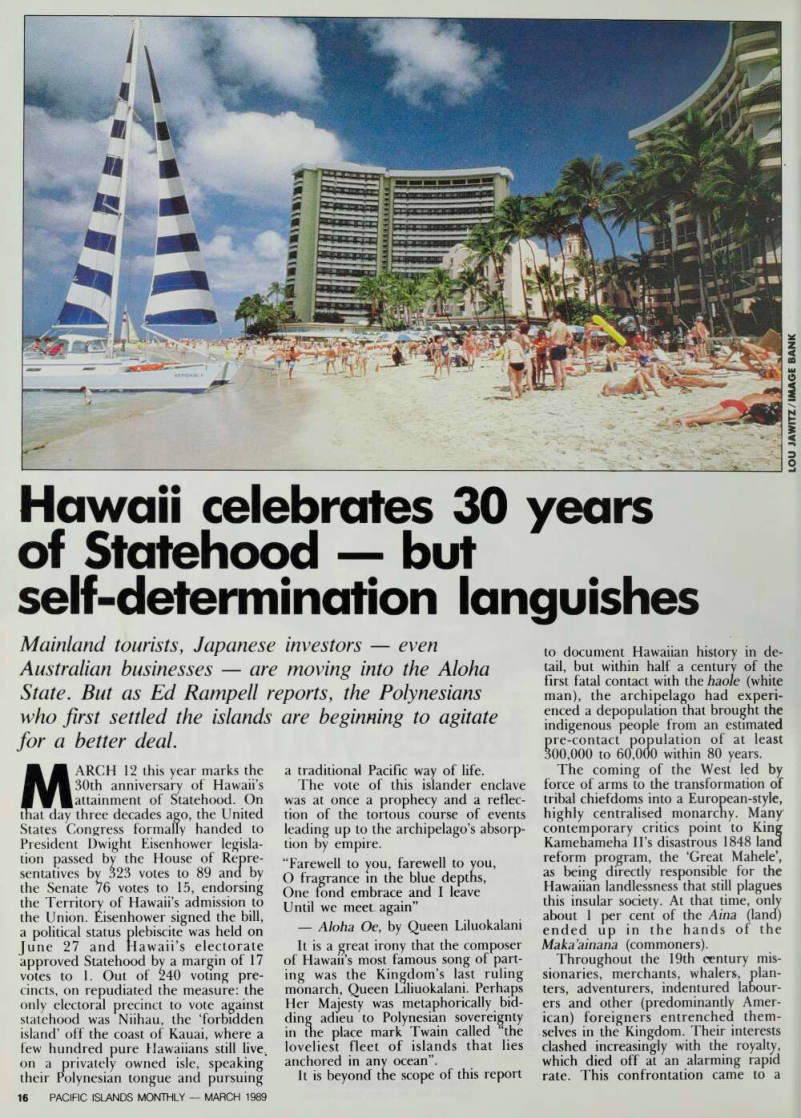
Lou Jawitz/ Image Bank
head in 1893, during the reign of Queen Liliuokalani, and resulted in the colonisation of a sovereign state.
Attorney Hayden Burgess, vice
president of the UN-affiliated World Council of Indigenous Peoples relates the series of events that saw the over throw of the Hawaiian monarchy: “in 1893 the Americans invaded, sending 162 US Marines, armed and ready for war. Basically, what they did was to support a puppet government calling itself a Provisional Government. They told Queen Liliuokalani to either sur render to this government or to go to war with the United States.”
Shortly after the January 1983 coup d’etat, a new US president, Grover Cleveland, took up residence at the White House. Cleveland, an anti
expansionist Democrat, was appalled
at the preceding Republican adminis tration’s gunboat diplomacy and dis
patched special investigator James
Blount to Honolulu for five months to assess the situation. The former Con federate Army officer reported that “a great wrong has been done to the
Hawaiians”, a people “overwhelmingly
opposed to annexation.” Blount went on to say that “their legitimate govern ment should be restored” post haste.
In a supremely cynical move, the Provisional Government went ahead and declare the Republic of Hawaii.
With the so-called pineapple dynasty’s Sanford B Dole as its first President, the Republic haughtily went on to refuse Cleveland’s exhortation to res tore Liluokalani to her throne on the pretext that as an independent nation, the Republic did not have to follow
Washington’s dictates.
A counter-revolution was crushed in 1895, the Queen was placed under house arrest and sentenced to five years’ hard labour and a SUSSOOO fine. In 1986, the Republicans re turned to office and President William
McKinley inaugurated America’s im
perialist age of Manifest Destiny. The ethos that had tamed a contingnet now eyes the world at large once America’s indigenous inhabitants as well as its former British, French and Spanish colonists had been ex punged ‘from sea to shining sea’.
The expansionism that had begun in Honolulu exploded on to the world stage on April 21, 1898, with the Spanish-American War. This brief conflict resulted in Washington seizing control of former Spanish possessions in the Caribbean as well as m the Paci fic, where Guam and the Philippines became US colonies. On July 7, Hawaii was finally annexed by the Un ited States: Pago Pago quickly fol lowed suit as the Panama tanal, link ing the Atlantic and Pacific, was con structed. Thus, the United tates, once a beacon of ati-colonualism, became an imperial power that in the words of
Theodore Roosevelt would “walk softly but carry a big stick”.
During the first half of the 20th
century, the missionary-descended Big
Five Castle & Cooke, Alexander & Baldwin, American Factors, Theo H Davies, C Brewer consolidated its monopoly over land, power and wealth in the archipelago. The rule of this Republican-linked elite was similar to that of a Central American planta tion-based oligarchy; prior to World War II almost half of the Territory’s land mass approximately 1,665,000 hectares was owned by fewer than 80 private owners.
The bombing of Pearl Harbour in 1941 heralded a new era in Hawaii, culminating with Statehood and the ascendancy of a new power structure led by the Democratic Party, unions and various non -haole ethnic groups, But Statehood perpetuated many of the same unresolved problems of the Hawaiian . . . and created new ones, The Hawaiian national liberation movement that has emerged has, in the past decade, centred on two cornerstones: land and culture.
Kekuni Blaisdell describes how col-
“Most Hawaiian dissidents firmly believe the root cause of the present tragedy lies in estrangement from Aina (the land),
turning Hawaii’s aboriginal inhabitants
into aliens in their own homeland”
onisation has impacted on the mental and physical health of the native. Dr Blaisdell, acting interim director of the Centre for Hawaiian Studies at the University of Hawaii, analyses an ‘in-
organic’ situation where “we
Hawaiians in our native land have the poorest health profile of all the ethnic groups in the State. For example, we have the shortest life expectancy and the highest mortality rates for the major causes of death, namely: heart diseases, cancer, stroke, accidents and diabetes. We have the highest rates for chronic illnesses such as hypertension, diabetes and kidney disease.
“Among our young people, we have the highest infant mortality rates; our school children have the highest dental caries rates and among young adult males, we have the highest suicide rates. We have the highest teenage pregnancy rate and for women who become pregnant regardless of age, we have the highest rates for complications . . . and the lowest for those who seek prenatal care.
“So this is a tragic situation and it’s not new. It has been going on since the white man came 200 years ago,” Dr Blaisdell laments. Hawaiians also have the state’s highest rate of
high school dropouts, drug/alcohol
abusers, family/chiid abusers and pris on inmates. A proponent of Hawaiian sovereignty, he contends that this health crisis is the result of an imposed society where colonised peo ple are out of kilter with their natural and social environments a sort of schizophrenia Franz Fanon called “black skins, white masks”.
UA MAU KE EA O KA AINA I KA
Pono (The Life Of The Land
Is Perpetuated In Right
Eousness’)
The motto of the State of Hawaii Kekuni Blaisdell and most Hawaiian dissidents firmly believe the root cause of the firmly present tragedy lies in their estrangement from Aina (the land), turning Hawaii’s aboriginal in habitants into aliens in their own homeland. The alienation of the Aina is a curse, according to barrister Mili lani Trask, who accuses both Federal and State government of what she calls “a massive breach of trust”.
“At the present time,” she says, “there are two Native Hawaiian land
trusts managed by the State. The first was created by act of Congress in 1921 and is called the Hawaiian Homes Commission Trust. It has about [74,000 ha] in it, scattered across the islands with the exception of Lanai.
These lands were set aside by Con gress for the purpose of encouraging
homesteading and pastoral uses.
“The second Native Hawaiian land trust was created in 1959 when we be came a State. Hawaii is the only State in the American Union where the federal government required as part of the compact for its admission into the Union that the State receive approximately [566,800 ha], which it would hold in trust for the public and for Native Hawaiians. In all the other States of the Union the public land of the state in preserved for public pur poses only, but in Hawaii the lands are preserved for the public and the native.” These ceded lands account for almost 580,000 ha.
Though these laws exist on the books, they have not been im plemented: there are two legal cate gories for people of Hawaiian ancestry (see Pacific Islands Monthly, Decem ber 1988) and only one group is legal ly entitled to benefit from the land
trusts the Native Hawaiian benefici ary class, legally defined as being 50 per cent or more Hawaiian blood. Part Hawaiians, who have less than 50 per cent Hawaiian ancestry, have no legal claim to the two land trusts, meaning the overwhelming majority has no land entitlements at all.
Native Hawaiians currently number about 40,000, while part Hawaiians are estimated to be lbo,ooo out of a State population of around one mil lion. This division into two distinctly different classes has recently caused major controversy in the community, with an effort being made to create a
‘single definition’ Hawaiian entitling
all to land trust benefits.
In any case, Mililani Trask charges that these benefits have not been re ceived by the majority of the benefici ary class for which they are ear marked. “In 1982, we had the first federal investigation into how the state had managed those lands and the re sult revealed extensive breach of trust.
At that time there were 8500 families waiting for homes. At the present time there are 18,000 families waiting for entitlements. The report revealed that [much of the land is being used by] State, Federal and country agencies
for various public purposes.” Airports
and military installations, for example, have been established on ceded lands.
Land struggles have characterised Hawaiian nationalism since its reem ergence in the late 1960 s and early
’7os. Japanese speculation, runaway
development ana military occupation
of land the Pentagon occupies 25 per cent of Oahu and 3 per cent of the entire State, and though Hawaii is the third smallest State it is the third largest in terms of actual lands owned by the military and first in terms of land ownership ratio affects the en tire community, but it is the aboriginal people who are hit hardest.
Activists have waged a series of pro tests in an effort to reclaim and pre serve Kalama Valley, Hilo Airport, Waiaole-Waikane, Sand Island, Makua Valley, Waimanalo Beach, Hoae’ae, Sandy Beach and more.
The movement that has come to epitomise the Hawaiian land struggle concerns Kaho’alawe, an island offtne coast of Maui that is regularly used for target practice. The US Navy has invited Japan, Australia, New Zealand, Canada and Britain to participate in manoeuvres that in 1984, for example, involved 80 warships and submarines, 250 aircraft and 50,000 troops. All of the island’s 11,740 ha are part of the ceded land trust and in 19/7, activists George Helm and Kimo Mitchell dis appeared at sea during a protest ac tion. There have been some conces sions, but the Navy continues to bomb Kaho’olawe despite more than a de cade of land occupations and other
demonstrations by the Protect Kaho’olawe Ohana.
If the Hawaiian’s land has been torn from beneath his feet, Western and Eastern acculturation seem to have rent his soul. Missionaries and others sought to banish Hawaiian religion, arts, language and oral tradition ev erything that made Hawaii, Hawaiian.
At times it seemed as if the very act of being Hawaiian was seditious be haviour: as George Helm, the activist to whom the song Hawaiian Soul is dedicates, said: “Far worse than not having land is not having identity, cul ture, pride and dignity.’ 9
“The public
schools that once
banned the
language now
offer Hawaiian as
a subject”
But the exorcism of the inner Hawaiian never fully succeeded, for side by side with the land struggles came Hawaii’s cultural renaissance.
Hawaiian culture has re-emerged in music, dance, fashion, language, reli gion, film, visual arts, theatre and sea
faring. The double-hulled sailing
canoe Hokulea is to this renaissance what Kaho’olawe Island is to the land
rights movement.
Since 19705, Hokulea has traversed the vast stretches of the Pacific with out modern technology, using the stars, the wind, the waves and clouds to navigate from Hawaii to the root of Polynesia. The twin masted canoe proved that the Hawaiians possessed the knowledge necessary for trans oceanic voyaging and that they had not made landfalls at their archipelago perhaps as long ago as 300 AD by accident. Nainoa Thompson, the navigator who guided the canoe dur ing its later voyages, described his Oceanic odyssey as a moment of self perspective, of one person in a vast ocean given an opportunity of looking througn a window into my heritage”.
Indeed, the entire Hawaiian renaiss ance provides a heritage window: musicians such as Gabby Pahinui, the Peter Moon Band, the Makaha Sons of Niihau, the Cazimeros and many others give voice to Kanaloa (Tangar oa), the Polynesian god of creation.
It is in songs, too, that the Hawaiian language literally finds a tongue and the public schools that once ban ned the language now offer Hawaiian as a subject.
Video is playing a key role in cultu
ral preservation and protest politics.
The Make O Ka Aina (the Eyes of the
Land) group creates documentaries about feather weaving as well as prop
aganda vehicles attacking developers,
as in its West Beach Story and Kapu Kau documentaries. Director Puhipau declares that his camera is the “gun” with which he fights the good fight.
The hula has seen a major revival, with festivals such as the Merrie Monarch highlighting traditional choreography; sarongs and other
Polynesian-style garb are worn by
Hawaiians to affirm their Pacific roots.
The realm of the visual arts is also richly diverse. Hawaiian aesthetics stormed the Islands’ art preserves in 1987, with paniolo (cowboy) folk art and a contemporary Hawaiian exhibi tion at the Honolulu Academy of Arts.
In early 1988 Rocky Jensen, the
Hawaiian renaissance’s own Renaiss ance Man, held an exhibition at the Contemporary Arts Centre that may have been the first such display by a Native Hawaiian. Jensen is probably the best Polynesian sculptor outside New Zealand, able to give form to artifacts or carvings that are suffused with a true Pacific sensibility.
Chief Maui Loa, like his cousin
Rocky Jensen a descendant of King
Kalakaua, is also an activist and was instrumental in Hawaiians’ inclusion in the American Indian Religious Free dom Act. Traditional believer and Pele worshipper Dr Emmett Aluli and others oppose the development of geothermal energy and a mooted spaceport on the Big Island out of de ference to the volcano deity. Across the State heiau aboriginal temples are being restored and visited as places of prayer and offerings.
Nineteen eighty-seven was officially
designated Ho’olako, the Year of the Hawaiian, in honour of the descen dants of the State’s first settlers. In early 1988 Ho’olakahi, Hawaiian Unity Day, was held at Aloha Stadium: an estimated 40,000 Hawaiians and their supporters came to the event, billed as the first time since the early 19th cen tury that the Hawaiians nave come together as people. Interviewed at the event, then-thairman of the Office of Hawaiian Affairs Moses Keale re vealed the movement’s master plan and the link between the land rights cause and the cultural rebirth: “First, make people feel good about them selves through ethnic pride. Then, unification. Next comes the major struggle: the return of the land.”
Sovereignty: On Ipa A !
(‘Stand Firm’)
As Hawaiians mark the 30th anniversary of Statehood, a number of matters are reaching a critical stage of development. While Hawaiians remain
an admittedly disadvantaged minority,
the twin land and culture movements
have nevertheless propelled them forward. They now have the Office of Hawaiian Affairs (OHA), the agency charged with serving their interests, and Hawaiian Governor John Waihee, America’s first Polynesian State chief executive. OHA and the Governor’s office are reportedly conducting negotiations regarding the Hawaiian trust lands, which OHA is seeking to place under its jurisdiction.
In January, OHA trustees travelled to Washington and met with Hawaii’s
Congressional delegation to discuss
Federal reparations to Hawaiians for the coup, annexation and the loss of land as the centennial of the monar-
chy’s overthrow approaches. Another
decade will probably see demonstrations similar to those staged by the
Aborigines during Australia’s
bicentennial in 1988, since a number of legal questions in relation to the deposmg of Queen Liliuokalani and the annexation remain unresolved: some activists even speak of trying the United States before the International Court of Justice or the United Nations’ Committee on Decolonisation.
The hottest political issue in Hawaii today is the move for sovereignty (See PIM, January 1989). The word is defined differently by different factions: a small minority favours outright inde-
pendence, including Hayden Burgess
of the WCIP and Peggy Hao Ross, a pretender to the throne claiming to be Hawaii’s rightful oueen, whose group declared independence from the Uo in 1980. But considering the fact that CINCPAC, the Pentagon’s Pacific and Indian Oceans command, is based at Pearl Harbour and that the US has substantial other interests in its Fiftieth State, Hawaii’s withdrawal from the Union is highly improbable.
Ka Lahui Hawaii, or the Sovereign
Hawaiian Nation, is agitating for the next best thing to independence. Ka Lahui Hawaii defines sovereignty as self-determination, and is basically calling for “a nation-within-a-nation ’ based on the Hawaiian Homelands where Hawaiians would have extensive reservations and a government-to government relationship with Washington. At the same time that Hawaiians practised limited home rule over part of the archipelago, they would remain US citizens and Amer ica would exercise control over much of the island chain, Hawaii’s Senator Daniel Inouye, Chairman of the Senate Select Com mittee on Indian Affairs, has been speaking out recently in favour of li mited sovereignty, saying: “Some peo pie may scoff at this whole idea, but parts of it at least are achievable.” For example, there are currently 308 Indi an, Inuit and Aleut ‘nations’ in the continental United States, operating within federal and state confines but with various forms of local control.
Parity for Hawaiians with their Native American brethren seems an attain able goal, but there are many obstacles on tne path to nationhood. The Hawaiian movement has not had a unified leadership, and this lack of solidarity has taken on many forms, Some factions concentrate on special interest issues such as Kaho’olawe, Pele or various court battles; Ka Lahui competes with OHA for political hege mony; the dispute over the blood quantum intended by OHA to uni fy all Hawaiians erupted instead into a bitter feud; and there are per sonality clashes, such as the attack by Ka Lanui’s Kia Aina (governor) Milila ni Trask on Governor Waihee as “a brown puppet held prisoner by busi ness interests”. The backstabbing
among many of Hawaii’s artists
reaches positively Shakespearean prop
ortions, and tneir hatred for one another is poisonous.
Furthermore, what is loosely refer red to as the Hawaiian movement does not by any stretch of the im agination represent all Hawaiians or even a majority of them. Even in the OHA elections, which permit only those of Hawaiian ancestry to cast their ballots, participation is low (60,000 out of a potential 200,000, minus those under the age of 18). Cri tics contend that not only do Hawaiians not vote as a bloc, they don’t vote at all; many Hawaiians identify as patriotic US citizens, such as former state Chief Justice William Richardson, who proclaims: “We’re Americans now. American civilisation is not destroying Hawaiian culture; it’s giving it a chance to revive, progress and grow.” OHA land officer Linda Delaney asserts: “You cannot make Hawaiians choose between the Hawaiian mother and the American father.” Even independence advocate Hayden Burgess estimates that at the most, only 20 per cent of all Hawaiians favour leaving the Union.
The greatest single problem within the Hawaiian movement is lack of mass participation. Though there are 18,000 signatories on the state’s De partment of Hawaiian Home Lands (DHHL) waiting list. Civil Rights for Hawaiians was only able to turn out 200 people for a demonstration at the State Capital . . . one of the largest Hawaiian demonstrations in recent times. Last December’s sovereignty conference likewise drew only 200 participants. A football match attracted more spectators to Aloha Stadium than Hawaiian Unity Day, and a 1987 commemorative service for George Helm and Kimo Mitchell held at the University of Hawaii’s amphitheatre was at least half empty.
Continued inequity has high social costs: crime, welfare, unemployment and the other indicators of anomie, all of which must be borne by society.
Injustice is expensive and impractical:
Hawaiian activist Kawaipuna Prejean
contends that the State’s current SUSSOO million surplus exists because the state refuses to honour its trustee commitments to Hawaiians, such as providing them with the necessary capital for infrastructure on DHHL homesteads and farms. If there is no redress for Hawaiian grievances, Hawaii could sink into a situation where settlers are pitted against na tives. Former OHA Trustee Hayden Burgess points out that “the UN rec ognises armed struggle to be the right of an occupied people,” and refuses to renounce Hawaiians’ right to do to the Americans the same thing the Amer icans did to the British in 1776. □
The Hawaiian cultural renaissance is expressed in ‘newly traditional’ forms such as non-tourist dance.