$10 million in aid 'misused'
pp. 24-25 · Read in the full issue
Solomon Islands
A Commission of Inquiry finds that an Australian academic has questions to
answer in the operation of a primary education project.
By Richard Dinnen
N education development pro iect worth SAIO million may nave been distorted and ren-. derea ineffective by the commercial interests of an Australian academic, a commission of inquiry has found.
Dr Rod Treyvaud, principal of the Northern Rivers College of Advanced Education in Lismore, New South Wales, was employed in 1982 by the Solomon Islands Government to work on the World Bank Primary Education Project. In 1988 the Government ordered an inquiry into the project, following evidence of a scandal over
dealings involving Dr Treyvaud,
senior public servants and politicians.
The Commission’s report, a copy of which has been obtained by Pacific Is
lands Monthly, cites major irregular
ities in the appointment of Dr Treyvaud and the subsequent per formance of his duties. It claims Dr Treyvaud had almost ‘total control’ of the $lO million aid project.
There were grounds to suspect Dr Treyvaud had performed some of his duties primarily to benefit himself and commercial interests owned or con trolled by him, the report said. His involvement had led to breaches of Solomon Islands Government proce dure, contravention of World Bank
guidelines and costly problems with
curriculum development.
The World Bank approved funding for the project in 1982 after two years of negotiation with the Solomon Is lands Government. The project was designed to effect vital improvements
in primary education by providing
training of indigenous administrative
and teaching staff, purchase of con struction materials for school buildings and purchase of schoolbooks.
Dr Treyvaud’s appointment as pro ject director was surrounded by irre gularity, the Commission found. He had been nominated in a confidential memo written by then-Permanent Secretary of the Ministry for Educa tion, Geoffrey Siapu. The Public Ser vice Commission recommended his appointment for a two-year term but then-Prime Minister Solomon Mama loni intervened and ordered that Dr Treyvaud not be appointed. Mr Mamaloni recommended a six-month appointment after reading a letter
drafted by Mr Siapu.
“It would appear that Dr Treyvaud himself draftee! the contract,” the re-
port says in reference to Dr Treyvaud s contract of employment, signed on behalf of the Government by Gina Tekulu, an Education Depart ment under-secretary. The Commis sion found that the contract was pre sented to Mr Tekulu by Dr Treyvaud and that it had not been discussed with other Government officers before it was signed by Mr Tekulu who had no authority to sign contracts on be half of the Government.
Dr Treyvaud began work in July
1982, three months oefore any formal contract was signed. Subsequent con tract renewals were not referred to Public Service authorities as required by Solomon Islands law.
The Commission paid close scrutiny to the relationship between Dr Treyvaud and Mr Siapu, which it de scribed as “as a very close business and
personal relationship”. A notebook
containing details of project expendi
ture made reference to a $5OOO pay ment to Mr Siapu as “Solomon Islands adviser”. Both Dr Treyvaud and Mr Siapu denied that this or any consul tancy payment had been made, but the Commission “did not find [Mr Siapu] a convincing witness”. He had been “not at all frank . . . concerning his financial affairs.”
Mr Siapu was listed as a director and major shareholder of South Paci fic Development Associates Ltd (SPDAL). Dr Treyvaud is a former director of and is now a consultant to SPDAL. In January 1985 Mr Siapu re ceived a banker’s draft for $lOOO
drawn on the Westpac Bank in Lis more, where an account is held by E T Development Assistance Associates Pty Ltd (ETDA), a company owned
and operated by Dr Treyvaud. School
fees worth $6OOO have been paid by Dr Treyvaud for one of Mr Siapu’s children, who attends school in Lis more. Mr Siapu described the arrangement as a loan, but did not declare it as required. A loan of $lO,OOO to Mr Siapu from the Hong Kong and Shanghai Bank is being re paid by SPDAL on his behalf.
The Commission recommended Mr
Siapu be investigated by the Public
Service Commission, the Leadership Code Commission and the Commis sioner for Income Tax.
Of particular concern to the Com mission was a contract awarded to ETDA, a business owned or controlled
by Dr Treyvaud, to produce curricu
lum materials specifically for the Solo mon Islands. It found the contract had been awarded in contravention of the World Bank’s published guidelines for use of consultants and in Breach of Solomon Islands Government proce dures. Mr Siapu may have been in breach of the Constitution in recom mending the award of the contract, and other public officers have been guilty of incompetence. The report finds there are grounds to suspect the contract was deliberately performed to benefit Dr Treyvaud and commercial interests owned or controlled by him.
The members of ETDA are Dr Treyvaud, his wife, his brother and sister-in-law. The Commission held that the company was formed specifi cally to operate the Solomon Islands
project. Its obligations to the project
were expressed in terms so vague as to be unenforceable, and nowhere in the agreement was ETDA made account able to the Government for disburse ments to individual consultants. The agreement was not submitted to the World Bank for approval or evalua tion. The Commission found Mr Siapu had been instrumental in the award of the contract.
Payments under the contract total $337,000 but the Commission could not establish how ETDA Justified that amount. A Lismore publishing firm, was awarded a $50,000 contract from the Solomons project. The Commis sion described the contract as “waste ful and unnecessary”.
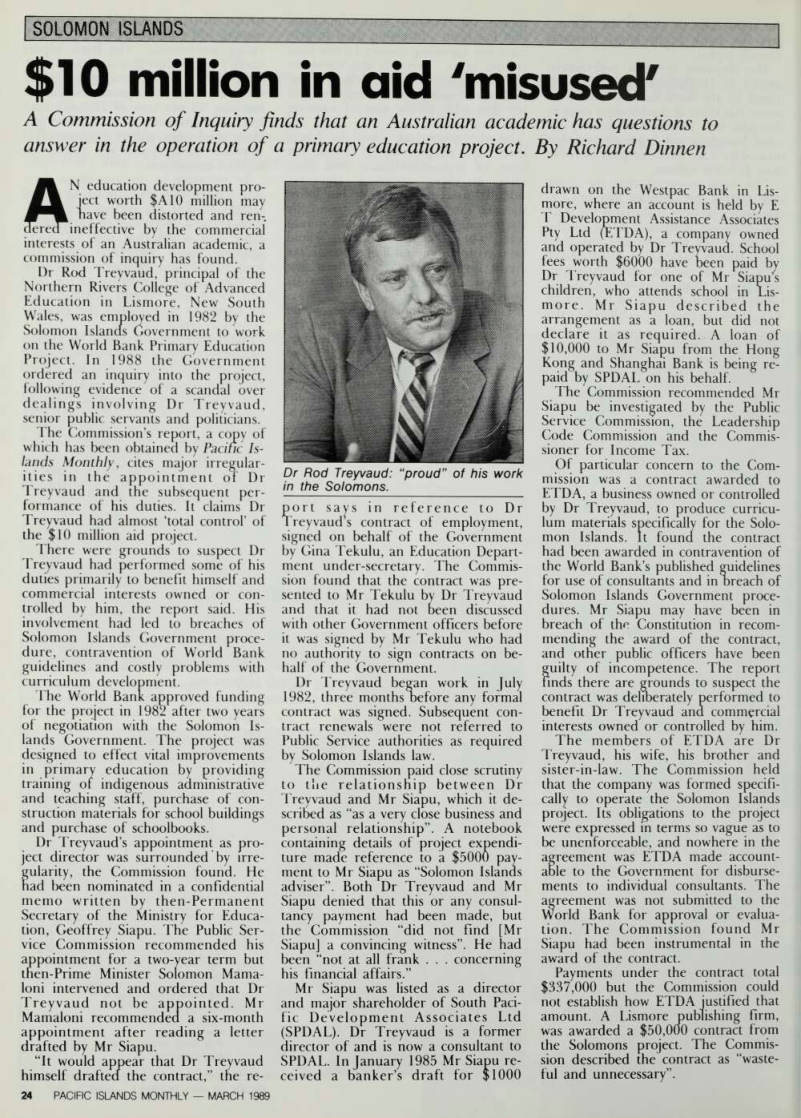
Dr Rod Treyvaud: “proud” of his work in the Solomons.
Concern over shortcomings in curri culum material provided oy ETDA prompted it to recommend a full reas sessment because of the “profound effect” it was likely to have on future generations. “There is a real danger that the educational objectives of the
curriculum development project have
been distorted . . . with a view to en hancing the image and profits of pri vate commercial interests,” the report said. “It should not have been allowed for the situation to arise whereby one individual played a dual role as educa tion adviser/project director and as a businessman representing a company in a contractual relationship with the project.” The report found this situa tion developed because of the willing ness of Solomon Islands officials, in
particular Mr Siapu, to be manipu
lated by Dr Treyvaud, and because Dr Treyvaud was not directly answerable
to any superior and was allowed almost total control over the project.
The Commission also investigated the affairs of SPDAL and found them to be “shrouded in confusion ... its financial affairs, in particular, are un
satisfactory”. The relationship between
SPDAL and ETDA was at first diffi cult to establish, but funds had been transferred between the two com panies. The Solomon Islands Govern ment entered into an agency agree ment with SPDAL because it was thought to be a locally owned com pany. In reality, SPDAL’s affairs were controlled by Australian business in terests. The Commission found “it would be reasonable to describe SPDAL as a mere sham for ETDA”, and that the bona fides of ETDA are open to “considerable doubt”. The Commission found SPDAL’s accounts were incomplete, contained errors of
omission and commission, referred to apparently fictitious bank overdrafts and had overstated liabilities.
In a prepared statement to his col lege council last month, Dr Treyvaud claimed he was the victim of a cam paign of defamation by opponents of a proposed property development he supports. Dr Treyvaud alleged those opponents had caused the Commis sion of Inquiry to be established.
He maintained that he was proud of the work he had done in the Solomon Islands and that he had gained great “satisfaction” from “contributing to the development of a National Prim ary Education Curriculum”. The Com mission, however, cited shortcomings in financial management, non
completion or non-delivery of projects
and materials, and an apparent net
work of influence-peddling, nepotism
and croneyism. □