new regional strategies
pp. 22-23 · Read in the full issue
Australia
Bums Philp shake-up leads to new regional strategies
A few years ago, reports Robin Bromby, the firm known either as “BP’s” or “Bloody Pirates” was headed for the scrapheap. A new lean, efficient approach has seen the old South Seas trader recovering and expanding.
HEAD office of Burns Philp "I & Co in Sydney preserves the image of the old South Seas trading company, with its brass plate at the street entrance, polished door
handles, engraved glass panels and
models of ola island trading ships. But the image belies the reality: Burns Philp is now a widely diversified, in ternational company, its South Pacific
operations having become something
of a commercial backwater.
In fact it is running out of expatri ate staff who can serve in the islands, as its management needs are so far removed from those of an island trad er there is little synergy between its new and old business.
Burns Philp chief executive Andrew Turnbull says this does not mean the company is about to pull out of the islands (despite its abortive attempt to sell all its Papua New Guinea opera tions): Burns Philp’s Pacific operations have not shrunk, he maintains; they have just been dwarfed by other de velopments within the company.
Food and fermentation now account for more than 40 per cent of the com pany’s business. It is the world’s lead ing producer of industrial vinegar, and number two in the United States in the manufacture of baker’s yeast its plants in 11 countries make it the third largest international supplier. In North America, its subsidiary supplies retailers with dates, bakery mixes and
spices.
The wholly owned BBC hardware chain has 88 stores in eastern Austra lia, and Burns Philp is further en
gaged in joint operations and agencies
for shipping companies, as well as holding a 46 per cent share of the QBE Insurance Group.
Then there is BP’s Pacific division, which includes the listed Burns Philp (South Sea) Company, of which the parent owns 71 per cent. Together with Burns Philp (PNG) Ltd, the pa rent controls operations in Papua New Guinea, Fiji, Vanuatu, Tonga, Solo mon Islands, Niue, Western Samoa and American Samoa.
The company’s 1988 report shows the following contribution to group results: BP South Sea $A365,000,
Burns Philp PNG $4,323,000, Burns Philp Vanuatu $842,000, Solomon Islands Investments Ltd $412,000.
James Burns and Robert Philp joined forces in 1874, running a store and trading house at Townsville, Queensland. The businesses were incorporated into a limited liability company in 1883 to raise money for further expansion, and every year since then Burns Philp has not only made a profit but has declared a dividend.
The company established its first trading post in Port Moresby in 1891, then branched out to the then-New Hebrides, Fiji and the Solomons.
The trading business was underpinned by government mail contracts and supply contracts with missions throughout the islands.
In many places, the Burns Philp manager was more influential and powerful than the local governor or administrator, the company filling the vacuum caused by the absence of banks by issuing its own credit lines and bank notes.
In the 1970 s the company seemed to be growing without apparent plan: its collection of enterprises included plastic factories, a stake in the Robe River iron ore project and a half share of Avis in Australia. It was a company rich in assets and mediocre in per formance, a conglomerate without a long-term strategy. Indeed, as one sharebroker put it in 1981: “You could bomb the head office and it would not be missed by any of the
component parts.”
In fact, another sharebroking firm at that time investigated a takeover of Burns Philp and found it was ready for dismemberment. It is recom mended that any buyer would find
Burns Philp could easily be parcelled
out the Pacific division to the Swire group or to a Japanese enterprise, the food division into one of the bigger companies in that field, and so on.
What made Burns Philp such an attractive takeover opportunity was its assets. But this all changed after Andrew Turnbull was appointed chief
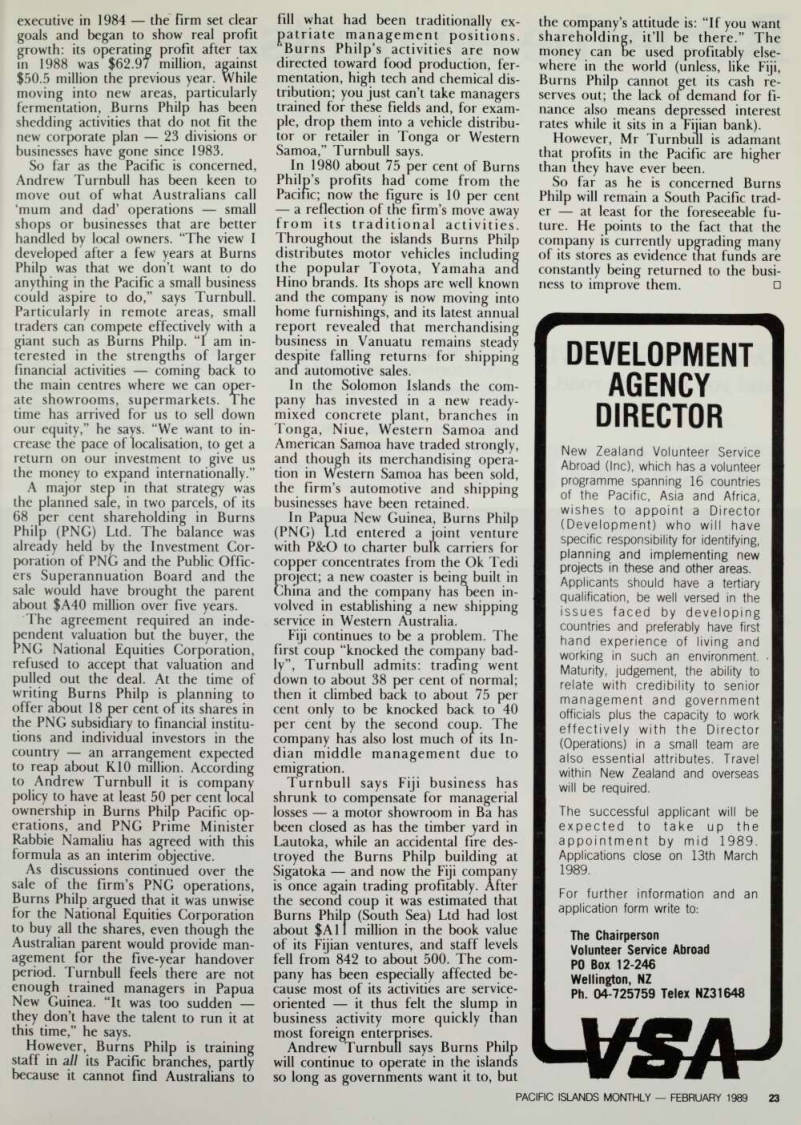
Burns Philp chief executive Andrew Turnbull: as far as he is concerned, the company will retain its Pacific presence - at least for the foreseeable future.
executive in 1984 the firm set clear goals and began to show real profit
growth: its operating profit after tax
m 1988 was $62.9/ million, against $50.5 million the previous year. While moving into new areas, particularly fermentation, Burns Philp has been shedding activities that do not fit the new corporate plan 23 divisions or businesses have gone since 1983.
So far as the Pacific is concerned, Andrew Turnbull has been keen to move out of what Australians call ‘mum and dad’ operations small shops or businesses that are better handled by local owners. “The view I developed after a few years at Burns Philp was that we don’t want to do anything in the Pacific a small business could aspire to do,” says Turnbull.
Particularly in remote areas, small traders can compete effectively with a giant such as Burns Philp. “I am in terested in the strengths of larger financial activities coming back to the main centres where we can oper ate showrooms, supermarkets. The time has arrived for us to sell down our equity,” he says. “We want to in crease the pace of localisation, to get a return on our investment to give us the money to expand internationally.”
A major step in that strategy was the planned sale, in two parcels, of its 68 per cent shareholding in Burns Philp (PNG) Ltd. The balance was already held by the Investment Cor poration of PNG and the Public Offic ers Superannuation Board and the sale would have brought the parent about SA4O million over five years.
The agreement required an inde- Pendent valuation but the buyer, the
NG National Equities Corporation,
refused to accept that valuation and pulled out the deal. At the time of
writing Burns Philp is planning to
offer about 18 per cent ofits shares in the PNG subsidiary to financial institu tions and individual investors in the country an arrangement expected to reap about KlO million. According to Andrew Turnbull it is company policy to have at least 50 per cent local ownership in Burns Philp Pacific op erations, and PNG Prime Minister Rabbie Namaliu has agreed with this formula as an interim objective.
As discussions continued over the sale of the firm’s PNG operations, Burns Philp argued that it was unwise for the National Equities Corporation to buy all the shares, even though the Australian parent would provide man agement for the five-year handover period. Turnbull feels there are not enough trained managers in Papua New Guinea. “It was too sudden they don’t have the talent to run it at this time,” he says.
However, Burns Philp is training staff in all its Pacific branches, partly because it cannot find Australians to
fill what had been traditionally ex
patriate management positions.
Burns Philp’s activities are now directed toward food production, fer mentation, high tech and chemical dis tribution; you just can’t take managers trained for these fields and, for exam ple, drop them into a vehicle distribu tor or retailer in Tonga or Western Samoa,” Turnbull says.
In 1980 about 75 per cent of Burns Philp’s profits had come from the Pacific; now the figure is 10 per cent a reflection of the firm’s move away from its traditional activities.
Throughout the islands Burns Philp distributes motor vehicles including the popular Toyota, Yamaha and Hino brands. Its shops are well known and the company is now moving into home furnishings, and its latest annual report revealed that merchandising business in Vanuatu remains steady
despite falling returns for shipping
ana automotive sales.
In the Solomon Islands the com pany has invested in a new ready mixed concrete plant, branches m Tonga, Niue, Western Samoa and American Samoa have traded strongly, and though its merchandising opera tion in Western Samoa has been sold, the firm’s automotive and shipping businesses have been retained.
In Papua New Guinea, Burns Philp (PNG) Ltd entered a joint venture with P&O to charter bulk carriers for copper concentrates from the Ok Tedi project; a new coaster is being built in China and the company has oeen in volved in establishing a new shipping service in Western Australia.
Fiji continues to be a problem. The first coup “knocked the company bad ly”, Turnbull admits: trading went down to about 38 per cent of normal; then it climbed back to about 75 per cent only to be knocked back to 40 per cent by the second coup. The company has also lost much of its In dian middle management due to
emigration.
Turnbull says Fiji business has shrunk to compensate for managerial losses a motor showroom in Ba has been closed as has the timber yard in Lautoka, while an accidental fire des
troyed the Burns Philp building at
Sigatoka and now the Fiji company
is once again trading profitably. After
the second coup it was estimated that Burns Philp (South Sea) Ltd had lost about sAll million in the book value of its Fijian ventures, and staff levels fell from 842 to about 500. The com pany has been especially affected be cause most of its activities are service oriented it thus felt the slump in business activity more quickly than
most foreign enterprises.
Andrew Turnbull says Burns Philp will continue to operate in the islands so long as governments want it to, but
the company’s attitude is: “If you want shareholding, it’ll be there.” The money can be used profitably else where in the world (unless, like Fiji, Burns Philp cannot get its cash re serves out; the lack of demand for fi nance also means depressed interest rates while it sits in a Fijian bank).
However, Mr Turnbull is adamant that profits in the Pacific are higher than they have ever been.
So far as he is concerned Burns Philp will remain a South Pacific trad er at least for the foreseeable fu ture. He points to the fact that the company is currently upgrading many of its stores as evidence that funds are constantly being returned to the busi ness to improve them. □