CSIRO begins PNG
pp. 26-28 · Read in the full issue
tree seed project
World demand for seed from Australian trees has been increasing steadily: now scientists are studying
native trees in PNG.
By Ingrid Strewe
IN OCTOBER 1988 scientists from the Australian Commonwealth Sci entific and Industrial Research Organisation (CSIRO) Tree Seed Cen tre mounted a six-week expedition to Oriomo Plateau, in the Western Pro vince of Papua New Guinea, to collect seed from several species of native trees; in particular those from acacia mangium known in Australia as a scrubby little tree, but growing straight and tall in PNG.
It has become common in the de veloping nations of the world to en counter plantations of native Austra lian trees, usually eucalypts and aca cias. China has a ‘green wall’ of she oaks ( Casuarina ) more than a thousand kilometres long; indeed, common wisdom has it that there are now more she-oaks in China than in their country of origin.
The tallest eucalypt in the world grows in Tanzania; there are eucalypt stands in the Sahara, and eucalypt nurseries in Sri Lanka trees tnat will be used for reafforestation and for fuel. Areas of Thailand, where once-wooded land has been inundated with an almost useless blady grass that suffocates native trees, are being brought back into production with Australian acacias.
Though there is a private seed ex port business in Australia, many of these international plantings are the work of the Tree Seed Centre of the CSIRO’s Division of Forest Research.
Originally wholly government funded, an increasing proportion of the Cen tre’s funds come from the private sec tor or aid organisations: Comalco Au stralia, for example, in return for financial assistance, has the use of the results of research or seed collection when revegetating mined areas.
Since 1961, Tree Centre scientists have been collecting and sending seed from Australian provenances (growing areas) to tropical and subtropical zones. Trees grown from this seed have many uses; reafforestation, re duction of soil erosion, soil salinity prevention* or cure, and specific in dustrial uses.
Demand for seed from PNG is
already high and likely to increase,
and the scientists envisage returning to PNG at least twice in the next three
years. Their first expedition cost $A 150,00, and was sponsored jointly by Australia, Sweden, France, the Un ited States and Malavsia: PNG sup plied the resource. The sponsors will
probably begin immediate breeding
trials, and the CSIRO has entered into discussions with the Queensland Fore stry Department on the viability of a seed orchard, an important step for the future that will make seed collec tion less expensive, more easily moni tored and more readily available.
There is a rising demand for acacias from countries in the west humid tro pics, where the genus has an impor tant role as secondary forest growth.
Disturbed or destroyed forest must fiass through several stages as the orest is gradually returned to rain forest, and acacias are especially useful in shading out weed species such as the blady imperta grass, enriching the soil and ‘nursing’ other rainforest spe cies as they re-colonise. In some areas of Thailand and Malaysia, the situa tion is already desperate and these species offer the only hope for a con
tinuing supply of high quality timber
while providing opportunities for rain
forest to begin regrowing.
Arid zones such as West Africa have different problems, but these are being overcome by the same versatile species. In those regions there is heavy human and animal pressure on the landscape, and thougn the native aca cias are useful, they are slow-growing.
Australian and Papua New Guinean
species, already popular in places such
as Senegal and the Cape Verde Is lands, are being planted as protection around native species so that when wood fuel is neeaed, nomadic herders are more likely to cut down an Austra lian acacia than the slow-growing local which provides better fodder.
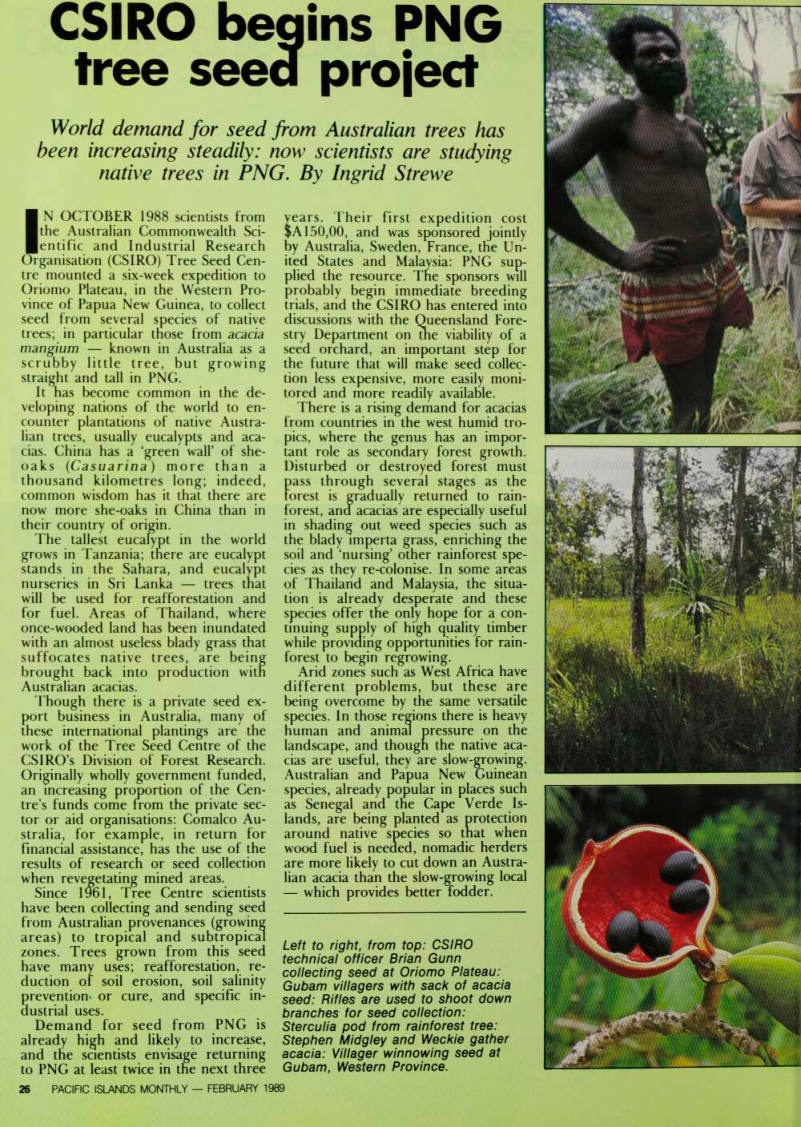
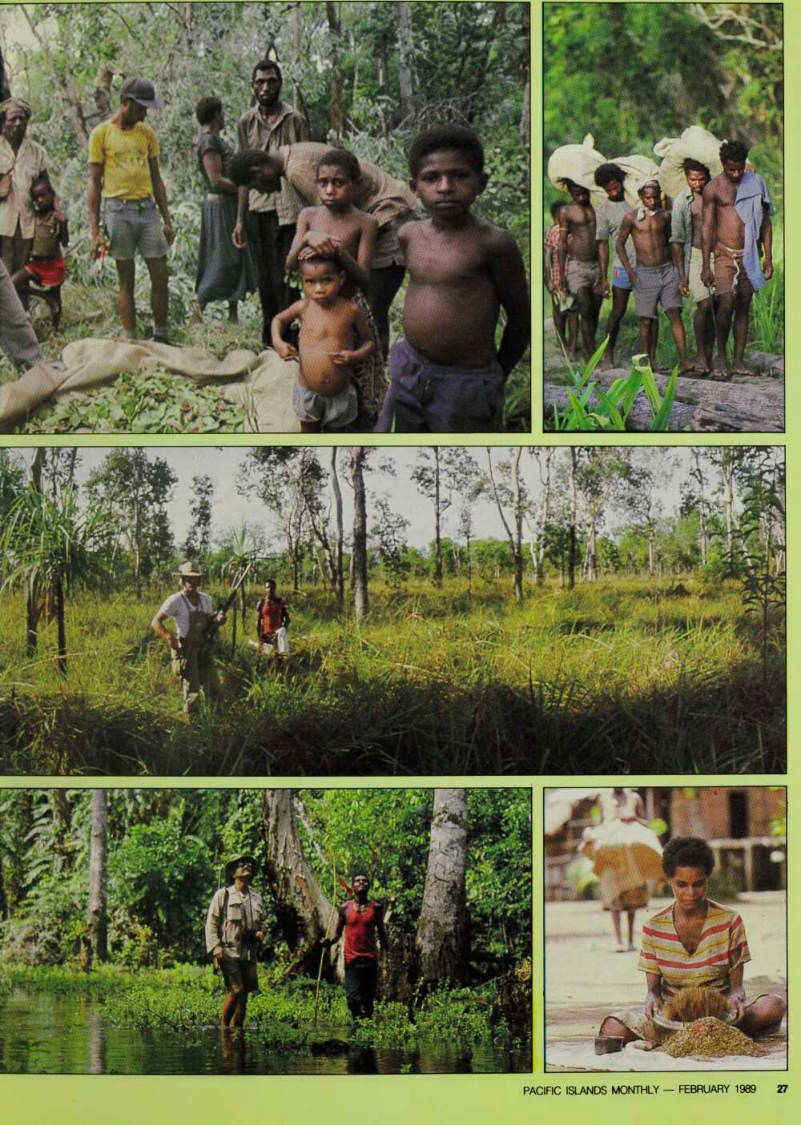
Left to right, from top: CSIRO technical officer Brian Gunn collecting seed at Oriomo Plateau: Gubam villagers with sack of acacia seed: Rifles are used to shoot down branches for seed collection: Sterculia pod from rainforest tree: Stephen Midgley and Weckie gather acacia: Villager winnowing seed at Gubam, Western Province.
There has, however, been trouble in some areas where Australian trees are blamed for changing economic condi tions. Landholders have discovered that trees as a cash crop are more valuable than anything a tenant far mer can grow for them. This is not the aim of Australian or international aid, and everything possible is done to discourage destruction of newly estab lished forest resources. There have also been claims by some Australian scientists that the country is givin away a previous genetic pool too easily and too cheaply. The Australian Depart ment of Conservative and Land Man agement has estimated that four ton nes of seed were harvested commer cially throughout Australia in 1980-81; an estimated 80 million seeds sold for less than a cent a seed.
But with the planet being rapidly
stripped of forest, can we afford to wait for the right price for seed? The United Nations Food and Agriculture Organisation estimates that almost a third of the world’s population de pends solely on wood for cooking and heating: in developing countries, a massive 86 per cent of trie annual con sumption of wood is used for fuel.
Annual global demand for wood for non-industrial use is at present esti mated at a minimum of 50 million hectares and the total will have risen to 100 million hectares by the end of this century. □
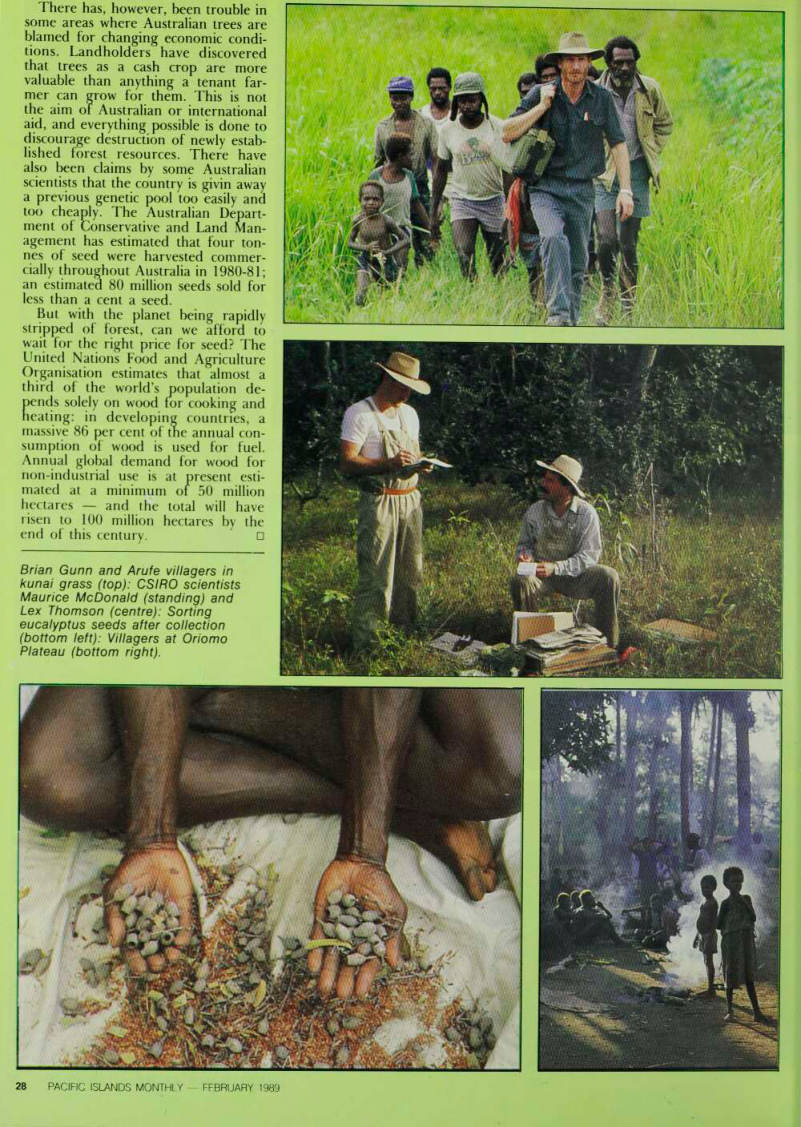
Brian Gunn and Arufe villagers in kunai grass (top): CSIRO scientists Maurice McDonald (standing) and Lex Thomson (centre): Sorting eucalyptus seeds after collection (bottom left): Villagers at Oriomo Plateau (bottom right).