Rank in Manila
p. 21 · Read in the full issue
The Region
Delegates at a Manila conference on regional peace and development ran the
gauntlet of military harassment.
By David Robie
THE MANILA Declaration seemed harmless enough. “Out going US President Ronald Reagan has prophesied that the 21st century will be the Asia-Pacific cen tury,” it said. “His vision is one where
transnational corporations exploit
Asia-Pacific peoples and natural re sources.
“Let us collectively reshape that vi sion. Let us together turn the world’s
largest region into its largest nuclear
free and foreign military bases-free zone.”
Several anti-nuclear senators addres sed the 200 delegates from Asian and Pacific countries including Fiji, New Caledonia and Papua New Guinea at the four-day conference in January,
sponsored by a coalition of Filipino
trade unions, social justice movements, church groups and the Partido ng Bayan (National Party). Their declara tion, to resist a growing nuclear and military presence in the region, focus sed on the United State’s Clark Air Base and Subic Bay Naval Station in
the Philippines.
Delegates accused France and the US of increasing the nuclear threat in the region, and the Soviet Union was also criticised. The meeting also pro tested against the role of Australia and New Zealand and the ‘policemen of the Pacific’, noting “with alarm” the growing posture of Japan, Australia and New Zealand as junior partners of the US in the region.
Among demands cited in the dec laration for the Pacific were; the with drawal of US, French and other forces; reparation payments from France and the US to the people of the region for destruction caused by nuclear testing in the Marshall Islands and Polynesia; independence in New Caledonia, restoration of democracy in Fiji and the demilitarisation of Guam.
Almost the only nation to win the con ference’s approval was Vanuatu, for its anti-nuclear stance; the
“courageous struggle of the people of
Belau against US attempts to subvert their nuclear-free constitution” was also hailed.
Pastor Djoubelly Wea of the FLNKS appealed to delegates to lobby the Un ited Nations and to pressure France to comply with the lyB6 resolution on decolonisation. He insisted last year’s Matignon accord was no guarantee of independence. “The results of the re
ferendum in Kanaky show that more than 11,000 Caldoches in Noumea voted against the Matignon accord,
against [Jacques] Lafleur and against
Kanak independence,” he said. “For us this raises the question of whether the accord has already been broken.
“These Caldoches are already com ing up strongly racism and fascism are growing and will continue to grow.
On Christmas Eve, a girl from Ouvea was shot by a Caldocne in Noumea.”
Wea declared that pro-independence barricades would remain in force on Ouvea until May 4.
The presence of the delegates in the Philippines was regarded as a threat
by tne military authorities, and trig
gered a wave of what delegates claimed was paranoia, disinformation and harassment by the armed forces.
“Who’s afraid of a bunch of peace lovers?” asked one.
A few days after the arrival of 80 Australians, 18 Japanese, 17 New Zealanders and scores of other dele gates from Asia and Pacific countries, Manila’s national newspapers splashed
front-page reports attacking the so
called peace brigade. Major-General
Ramon Montano, chief of the Philip pine Constabulary, accused the bri gade of interfering in the country’s in ternal affairs. He said that intelligence reports alleged the brigade was sup porting the local communist movement; one report even claimed collaboration with Phillippine author
ities by foreign intelligence networks.
Montano warned that if any dele gates committed “acts inimical to national security” they would be tre ated as “common criminals just like
paedophiles”.
Montano pledged to arrest anybody found actively participating in '‘rebel teach-ins”; contacting leaders of the outlawed Communist Party of the Phi lippines/New People’s Army and visit
ing guerilla zones; joining peace cara
vans or solidarity marches; carrying or distributing “rebellious or seditious” leaflets or making utterances that might incite rebellion.
Montano also claimed that armed forces could “lick” the 20-year-old communist insurgency if they could join forces with “the civilian lead
ership” clearly attempting to tar the
peace brigade with the insurgency
brush.
The response may seem bizarre, but
since President Corazon Aquino took office three years ago with a pledge to protect human rights, her government has failed to shaxe off the legacy of repression left by ousted dictator Fer dinand Marcos. The church-backed Task Force Detainees reports that in 1987 alone, 7444 people were arrested without warrants. A further 602 peo ple were tortured and 284 were killed or wounded in 29 massacres of civi
lians by right-wing vigilantes, the milit
ary or private security forces.
The day after Montano’s statement, the extremist right-wing group Sandi gan and a newly formed umbrella
D of vigilantes responsible for
eds of ‘salvagings’ murders of activists, suspected rebel suppor ters and human rights lawyers, took up the cue. Sandigan alerted the country against the entry of “foreign communist propagandists” whose pre sence could only “undermine efforts to attain national stability”.
Opening the peace and develop ment conference, Senator Wigberto Tanada lashed out at the “ironic” harassment of the peace brigade.
“Under the Marcos dictatorship, hu man rights and people’s security were
trampled upon,” Tanada added.
“Under this present democratic gov ernment, we cannot allow the security of the people to be sacrificed once again on the altar of ‘national secur ity’.” □
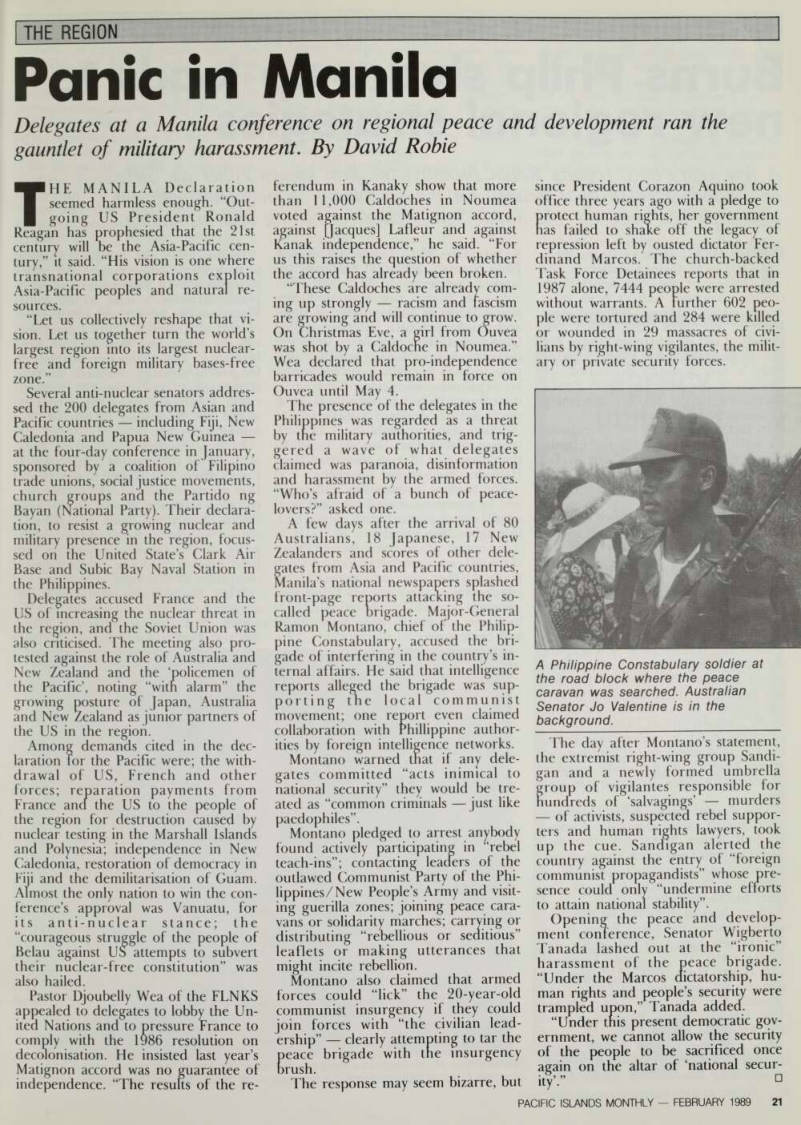
A Philippine Constabulary soldier at the road block where the peace caravan was searched. Australian Senator Jo Valentine is in the background.