fatally efficient
pp. 18-20 · Read in the full issue

Plasmodium : A complex and fatally efficient lifecycle
By Dr Noel Tait
THE PARASITE responsible for
malaria in humans is a single celled animal called Plasmodium, a member of the Protozoa. There are four species ineffective to humans; others nave been recorded in reptiles, birds and other mammals. By no means are all species of Plasmodium significantly harmful to their host, but since they invade and destroy host cells they all have some effect on the host. Plasmodium is usually transmit ted from one host to another by the female mosquito, which feeds on blood, and therefore acts as the malaria vector.
Within the host, only asexual repro duction of the parasite takes place: in the mosquito vector, both asexual and sexual reproduction occur, resulting in one of the most complex life cycles of any organism. While the life cycle of Plasmodium is essentially similar in all species, a number of terms are used to describe its stages, and this is compli cated by the use of synonyms.
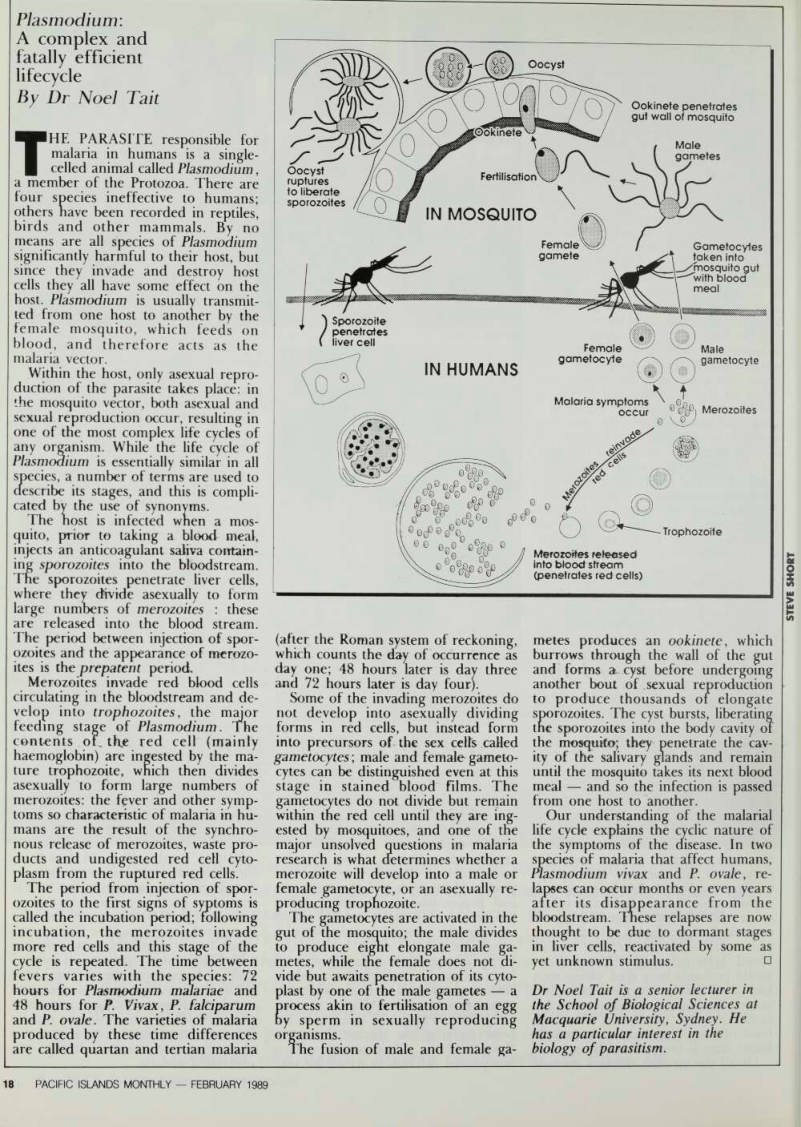
The host is infected wnen a mos quito, prior to taking a blood meal, injects an anticoagulant saliva contain ing sporozoites into the bloodstream.
The sporozoites penetrate liver cells, where they divide asexually to form large numbers of merozoites : these are released into the blood stream.
The period between injection of spor ozoites and the appearance of mcrozo ites is (he prepatent period Merozoites invade red blood cells circulating in the bloodstream and de
velop into trophozoites, the major
feeding stage of Plasmodium. The contents of th.e red cell (mainly haemoglobin) are ingested by the ma ture trophozoite, which then divides asexually to form large numbers of merozoites: the fever and other symp toms so characteristic of malaria in hu mans are the result of the synchro nous release of merozoites, waste pro ducts and undigested red cell cyto plasm from the ruptured red cells.
The period from injection of spor ozoites to the first signs of syptoms is called the incubation period; following incubation, the merozoites invade more red cells and this stage of the cycle is repeated. The time between fevers vanes with the species: 72 hours for Plasmodium malariae and 48 hours for P. Vivax, P. falciparum and P. ovale. The varieties of malaria produced by these time differences are called quartan and tertian malaria
(after the Roman system of reckoning, which counts the day of occurrence as day one; 48 hours later is day three and 72 hours later is day four).
Some of the invading merozoites do
not develop into asexually dividing
forms in red cells, but instead form into precursors of the sex cells caHed gametocytes ; male and female gametocytes can be distinguished even at this stage in stained blood films. The gametocytes do not divide but remain within tne red cell until they are ingested by mosquitoes, and one of the major unsolved questions in malaria research is what determines whether a merozoite will develop into a male or female gametocyte, or an asexually re-
producing tropnozoite.
The gametocytes are activated in the gut of the mosquito; the male divides
to produce eight elongate male ga-
metes, while the female does not divide but awaits penetration of its cyto plast by one of the male gametes a process akin to fertilisation of an egg oy sperm in sexually reproducing
organisms.
The fusion of male and female ga-
metes produces an ookinete, which burrows through the wall of the gut and forms a cyst before undergoing another bout of sexual reproduction to produce thousands of elongate sporozoites. The cyst bursts, liberating the sporozoites into the body cavity of the mosquito; they penetrate the cav ity of the salivary glands and remain until the mosquito takes its next blood meal and so the infection is passed from one host to another.
Our understanding of the malarial life cycle explains the cyclic nature of the symptoms of the disease. In two species of malaria that affect humans, Plasmodium vivax and P. ovale, re lapses can occur months or even years after its disappearance from the bloodstream. Tnese relapses are now thought to be due to dormant stages in liver cells, reactivated by some as yet unknown stimulus. □ Dr Noel Tait is a senior lecturer in the School of Biological Sciences at Macquarie University, Sydney. He has a particular interest in the biology of parasitism.
A bacillus called BTI a specific toxin that kills mosquito larvae with out affecting other aquatic animals has been used with some success, but its short-term effect limits its applica tion. AMRU is investigating possible methods of biological control that aug ment and turn back on the host the pathogens and parasites that occur naturally in the mosquito, but preven tion of mosquito attack remains, for the moment, the most effective method of avoiding the disease. “The Anopheles mosquito, the main carrier of the parasite, is a nocturnal species,” says Lt Col Sweeney. “By remaining inside screened houses at night and using repellents, a good deal of con trol can oe achieved.”
The AMRU is currently researching long-term control methods for mos quitos and the development of effec tive prophylactic and treatment regim es. Older drugs to which falciparum malaria proved resistant are also being examined to see if their efficacy can
be improved by combining them with
other drugs.
Vaccine researchers are also finding the parasite difficult to control. Medic-
Robert Simms
So eager is the female Anopheles mosquito to gorge on blood that she excretes fluid even as she is ingesting a blood meal: eventually even fresh blood is excreted.
al scientists at the Walter and Elisa Hall Institute in Melbourne are
attempting to develop a vaccine using
antigens in the asexual stage of repro duction, hoping that one or more could be incorporated into a vaccine.
Dr Robin Anders, head of the Insti tute’s malaria laboratory, says his team
is attempting to produce an antigen
using recombinant DNA technology:
the team’s research partner, tne Queensland Institute for Medical Re search, is attacking the problem through the use of a synthetic peptide.
Research in other countries is ex amining the sporozoite the infective stage of parasite development and the production of an immune re sponse in the mammal host to block the development of the sexual stages in the mosquito. The latter is classified as an altruistic form of treatment in that it would not directly help the per son being immunised.
Dr Anders predicts the solution will develop from a combination of these approaches. “A vaccine could possibly
be developed using one antigen from
the sporozoite, one or two from the sexual stages for transmission block ing, and three or four from the asex ual stages, which are the ones that cause the disease and need to be sup pressed to prevent morbidity and mortality,” he says.
In 1988, a Colomobian researcher published the results of a clinical trial
using a synthetic peptide combining
parts of several different molecules.
Volunteers were immunised, then
‘challenged’ with virulent plasmodium
falciparum malaria. Three of the five
volunteers developed immunity a
result described by Dr Graham Brown, head of the Hall Institute’s cli nical program, as “very encouraging but not good enough to justify wide spread trials. We need to be cautious
aoout predictions concerning vac
cines,” he says. “It could be more than a decade before one is available, though we expect it will be developed
in stages giving us something along
the way. Unlike smallpox, you cannot become immune naturally to malaria and it would be unrealistic to expect that in the future a vaccine will be better than nature.”
Australian vaccine research involves a budget in excess of SAS million. It is
supported by a consortium comprising
the Hall and Queensland Institutes as research partners, with Federal Gov
ernment backing. Encouraged by
promising research being conducted
around tne world, the United States
Agency for International Development
has decided to fund the establishment of a test site for the vaccine in Papua New Guinea. It is hoped the first trial vaccines will be available for testing after the base study is completed in about four years’ time.
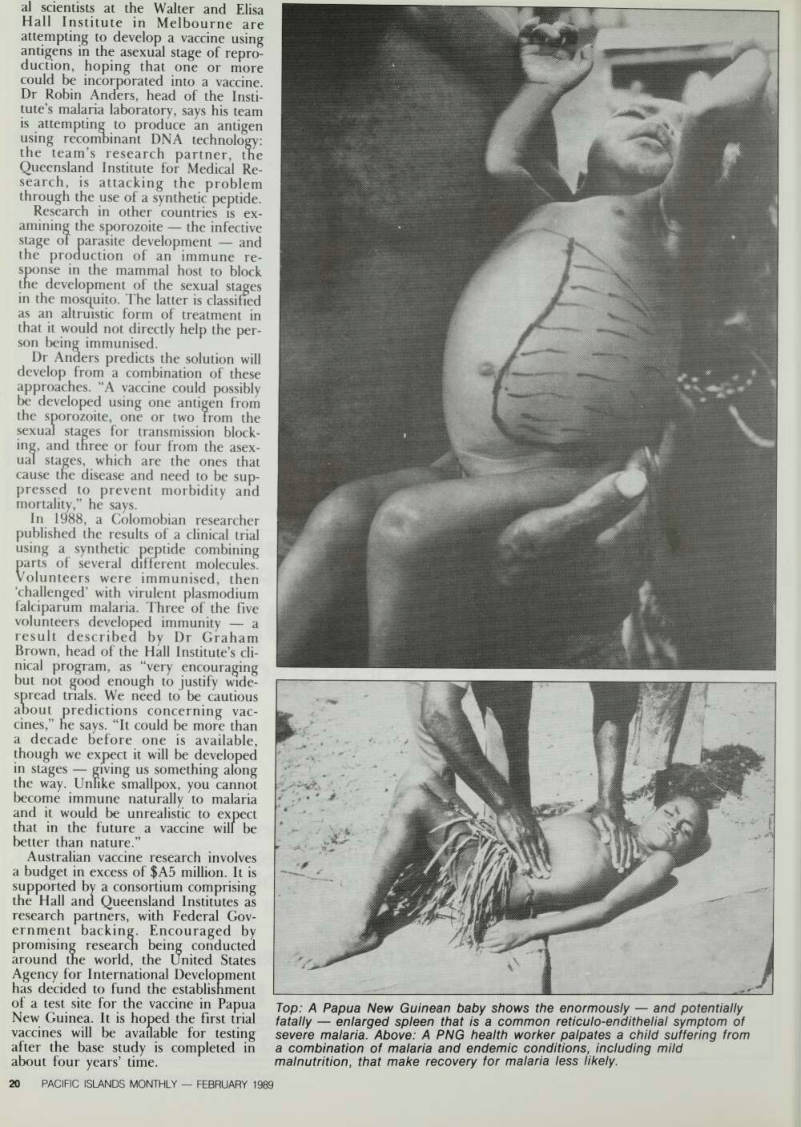
Top: A Papua New Guinean baby shows the enormously - and potentially fatally - enlarged spleen that is a common reticulo-endithelial symptom of severe malaria. Above: A PNG health worker palpates a child suffering from a combination of malaria and endemic conditions, including mild malnutrition, that make recovery for malaria less likely.