Malaria
pp. 16-17 · Read in the full issue
The Killer Returns
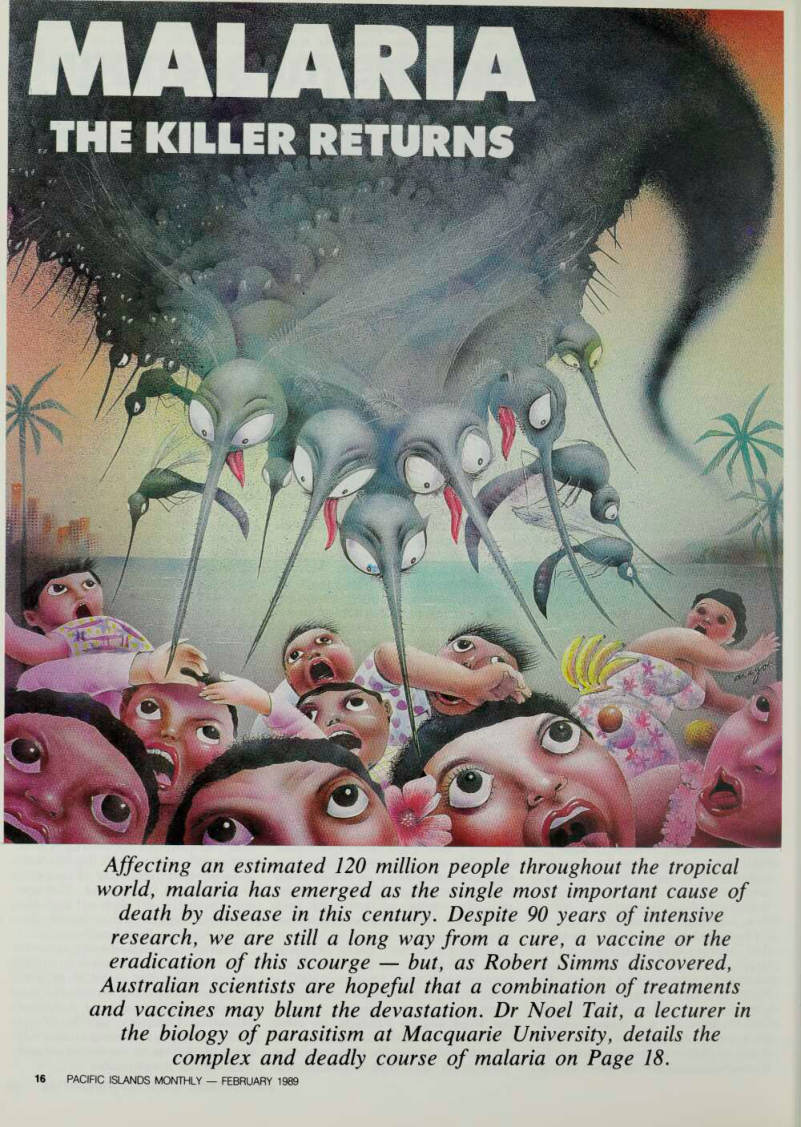
Affecting an estimated 120 million people throughout the tropical world, malaria has emerged as the single most important cause of death by disease in this century. Despite 90 years of intensive research, we are still a long way from a cure, a vaccine or the eradication of this scourge - but, as Robert Simms discovered, Australian scientists are hopeful that a combination of treatments and vaccines may blunt the devastation. Dr Noel Tait, a lecturer in the biology of parasitism at Macquarie University, details the complex and deadly course of malaria on Page 18.
M M ALARIA is an ancient disease first documented by Hippo- Berates in the sth century BC.
It was thought originally to be caused by evil emanations of bad air near swamps hence the name ‘mal-aria’.
Explorers, travellers and natives feared its burning fevers and dreadful chills, and by the time Sir Ronald Ross discovered tne malaria parasite in the stomach of the Anopheles mosquito in 1897, the disease was a leading cause of death in many regions.
Modern advances m medicine have led to the development of treatments and vaccines but malaria is by no means conquered yet. A late i97os study estimated that 120 million peo ple worldwide were affected by malar ia and the disease develops resist ance to new drugs almost as quickly as researchers can develop them.
The four types of malaria, vivax, falciparum, ovale and malariae are
carried mainly by the Anopheles mos
quito. Parasites enter the Body in the saliva of the mosquito and travel in the blood to the liver (see Page 18).
In falciparum malaria the parasites multiply in red blood cells between 12 and 24 times each 48 hours. The cells are destroyed, liberating toxins that cause chills and fever; the level of pa rasitaemia increases rapidly, and leads to anaemia. Parasited cells can accumulate in the brain and cause cerebral malaria, or in the kidneys, with renal failure a likely consequence.
The organs became enlarged as the reticulo-endothelial system begins to absorb the parasites: which is why fal ciparum malaria can often be fatal.
Vivax malaria is more prevalent but less likely to prove fatal because it attacks only young blood cells. This limits its reproduction and prevents cell infection reaching critical level.
Malaria should always be considered a possibility in anyone who becomes ill after an overseas trip, and the danger of misdiagnosis cannot be overstated.
“The symptoms are very similar to flu and are easily mistaken,” says Profes sor Karl Rieckman, director of medic al research at the Sydney-based Army Malaria Research Unit (AMRU). “The diagnosis can only be made by ex amining blood films.” Professor Rieck man cites a recent case of a man who showed no improvement after symp tomatic treatment for influenza. A second opinion was sought and subse quent blood tests revealed para sitaemia had reached a critical point, with more than 10 per cent of red blood cells infected. “The patient would probably have died within days had the correct diagnosis not been made. Misdiagnosis often occurs be cause the first blood film shows no trace of the parasite; a second test 24 hours later is imperative,” he says.
Of all the virulent diseases encoun-
tered in human history, Plasmodium falciparum, one of the four types of malaria, has proved the most defiant, In the latitudes roughly bounded by the Tropics of Capricorn and Cancer, it has resisted all attempts at eradication or even significant control.
The forerunner of AMRU was established at Cairns, North Queensland during World War 11, and pioneered research into the treatment and prevention of the disease using paludrine. This was successful at the time but the parasite had developed a resistance to the drug by the late 19505. The problem of drug resistance has continued with falciparum malaria becoming resistant to successive treat-
ments with terrifying efficiency.
AMRU’s Professor Rieckman has been fighting the disease for more than 30 years. “Falciparum malaria has proved difficult to treat,” he says,
“During the 50s and 60s chloroquine was usually the most effective drug available, but by the late 70s the para site had become resistant in many Carts of the world.” Fansidar, a com ination of pyrimethamine and a sul phonamide, was tried next, but resist ance to this became evident in some areas within five or six years.
The degree of parasite resistance can vary widely in some patients the clinical response is very good, but usually some parasites will be un affected by the treatment and the symptoms return three or four weeks later. “There is some improvement on the intermediate level but the parasite still exists in large numbers. There are patients who don’t respond at all be cause it is totally resistant. Even with
the latest drug, mefloquine, the prob
lems remains with cases in Thailand
already showing resistance.”
Lieutenant Colonel Tony Sweeney,
an entomologist and commanding officer at AMRU, advocates a com bination of drug treatment and mos quito control as the most effective solution. “It takes 10 to 14 days from the time the mosquito becomes in fected with the parasite to the time it can infect another person,” he says. It is in this period that control must be attempted. In Papua New Guinea and other Pacific countries, mass spraying with DDT and the painting of interior walls or houses with the chemical have resulted in a reduction of mosquito numbers. However, this is expensive and difficult to achieve in the remote areas of some affected countries and is in its own way almost as fatal as un controlled malaria.
Robert Simms
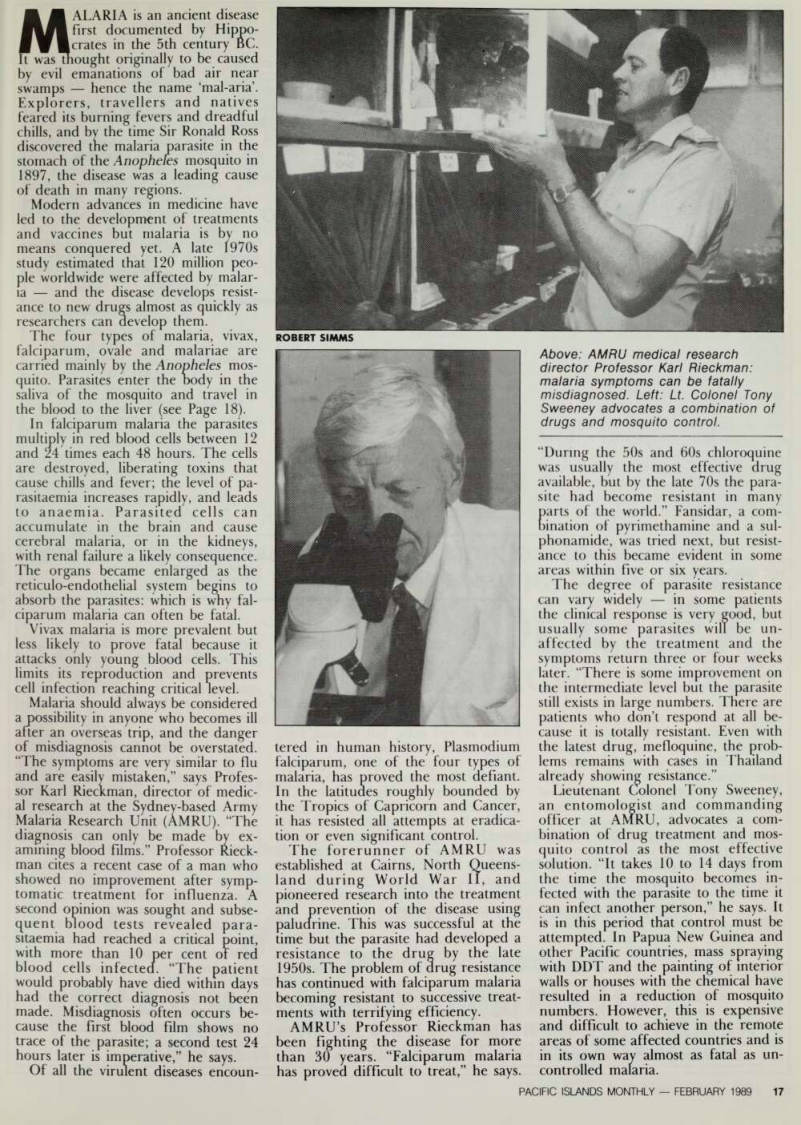
Above: AMRU medical research director Professor Karl Rieckman: malaria symptoms can be fatally misdiagnosed. Left: Lt. Colonel Tony Sweeney advocates a combination of drugs and mosquito control.