AIDS Campaign Fights Taboos
p. 10 · Read in the full issue
Tonga
As Western nations fight AIDS with condoms and promotes ‘safe sex’ Tone a relies on traditional virtues of fidelity and chastity.
Mk Ids Prevention In West
ern nations focus on the use of condoms and explicit methods of safe sex, but the attitudes to sex found in many Pacific nations force health workers to adopt a diffe rent approach to the killer virus. It is not easy to talk about sex in the king dom of Tonga, where a strict Victo rian morality remains as a legacy of the missionaries of the 19th century.
In this context, fidelity and chastity are seen as mightier than the condom
in Tonga’s fight against AIDS and
policy-makers believe that laws pre scribing a life sentence for sodomy will deter hjgh-risk behaviour.
The Tongan Government has laun ched what must be, per capita, one of the most comprehensive anti-AIDS campaigns in the world. A massive education program is under way, with posters, stickers and leaflets, work shops for MPs, church leaders and Health Department staff. There are
village meetings, billboards and hourly
radio announcements. When overseas visitors arrive at Nukualofa airport, the first Tongan they are likely to see is a young man seated at a desk hand ing out AIDS education pamphlets.
He also carefully observes new arrivals for obvious signs of the virus.
Tonga has had only one AIDS vic tim. In June 1987, a Tongan man ar rived back in the Kingdom from Texas. Health officials observing his
arrival on a Friday evening, suspected
he IVas a likely carrier of the Human Immunodeficiency Virus (HIV) which causes AIDS. Dr Tili Puloka, chief medical officer for public health, with responsibility for the government AIDS program, visited the man at home the next day where he ex amined him and offered a blood test
which proved positive. On Monday
morning Dr Puloka informed the Minister of Health that an AIDS car rier was in the kingdom. Though he had told no-one else, everyone knew of the carrier’s presence and Nukualofa was in a state of panic.
The report was on the radio news, people discussed it in shops and clubs, around the kava bowl and on the streets. It was even debated for two days in the Parliament.
Dr Puloka realised that future car riers must be treated with absolute confidentially and compassion. He is against screening of overseas arrivals
and insists that blood tests must re-
mam voluntary.
As longas one-man AIDS program, 62-year-old Dr Puloka pounds the streets and bars of Nukualofa counselling and educating the town’s relatively few members of groups at high-risk of contracting the virus.
I hey accept and welcome his attention he recalls one night when he was applauded as he walked into the upstair: bar at Joe’s, a Nukualofa nightspot favoured by transvestites and prostitutes.
Dr Puloka attributes a dramatic drop in sexually transmitted diseases to a heightened awareness of AIDS.
Promiscuity, he says, is on the way
out, and homosexuality does not have the degree of social acceptance in Tonga that it has gained in some Western nations.
As in the rest of Polynesia, there is a fairly relaxed attitude to homosexual ity and transvestites have a recognised role in village and family life, though they have not been as accepted as the fa afafine of Samoa. But the moral panic over AIDS has reinforced belief in biblical injunctions against homosexuality and driven Tonga’s fakafefine into the closet.
Tapu, such as the faka’apa’apa (be tween brother and sister) prohibit frank discussion of sexual matters but Dr Puloka is determined they will not prevent education. “Tapu is important but not as important as prevention of AIDS,” he says.
Tapu are likely to be further under mined by the sort of activities held on World AIDS day last December when the town’s schoolchildren amassed for
singing competitions. Original songs
on the AIDS theme were composed for the occasion.
Condoms don’t feature in Tonga’s armoury against AIDS. “We teach our people to refrain from sexual prom iscuity. It would be contradictory to then give them the means to practice it,” says Dr Puloka. Condoms are available on request, but Tongan men don’t like to use them. While resear ching in Sydney’s Kings Cross red light district, he met brothelkeepers wno had chased out Tongan men who refused to use condoms. □
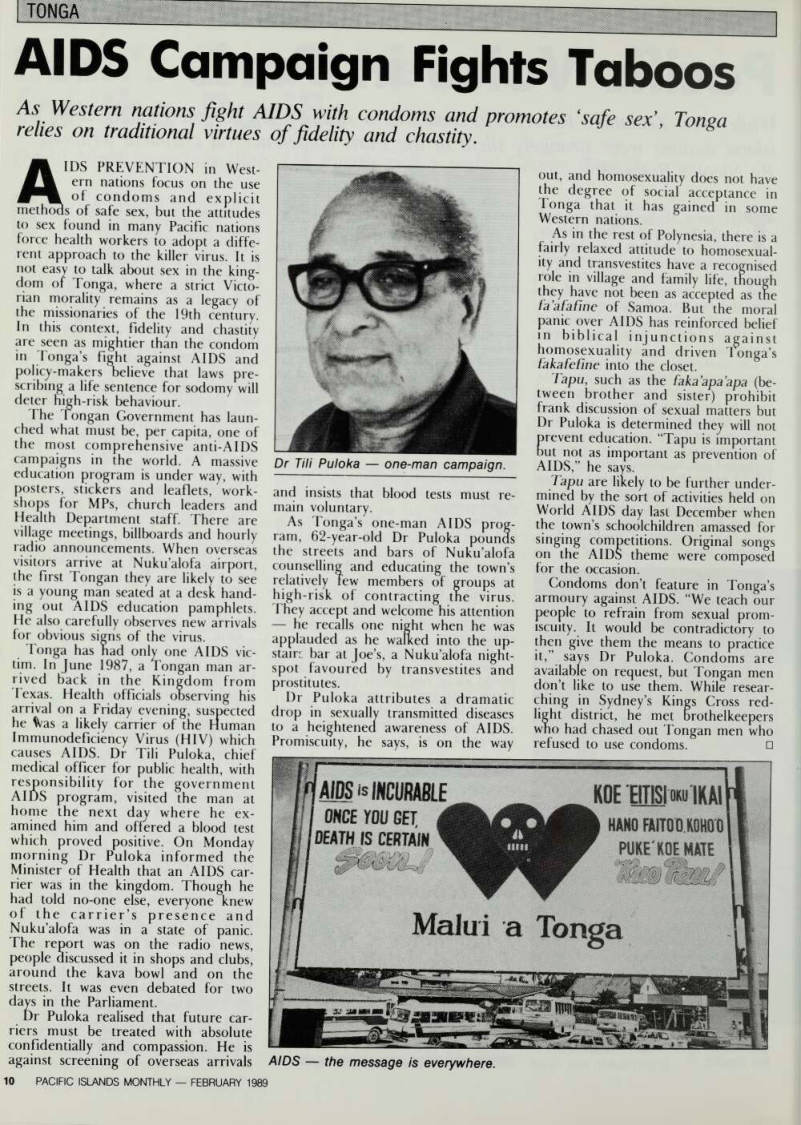
AIDS - the message is everywhere.
Dr Tili Puloka - one-man campaign.