Australia Recalls Envoy
p. 12 · Read in the full issue
Papua New Guinea
Controversial High Commissioner Lance Joseph returns to Canberra.
But the early recall is a promotion, writes Frank Senge.
FTER ONLY 18 months in Port Moresby, Australian High Commissioner Lance Josepn leaves for Canberra in April.
In his brief period of service, Mr Joseph created an image unlike any High Commissioner before him an image some observers claim may have caused a degree of estrangement in relationships betwen Australia and Papua New Guinea. Indeed, some observers have gone so far as to say Canberra made a mistake in sending Mr Joseph to Port Moresby.
Well Known in Canberra for his
forthright, upright approach, Mr
Joseph’s appointment to one of Au stralia’s four biggest missions seems to have indicated that Canberra judged the relationship between the two na tions firm enough to tolerate a High Commissioner of his character.
The past has fostered in the minds of Papua New Guineans a dreamy, almost hallowed image of benevolent
Australia, the un-mterfering big
brother, aid giver and protector. Pre vious High Commisioners have allowed that perception to stand, con ducting their missions out of the pub lic eye and the result has been that PNG’s only knowledge of Australia’s presence in the country consisted of annual talks, the odd trade seminar and the sponsorship of an occasional rural project.
Mr Joseph, however, by his direct and public approach, has dissipated Australia’s benign image, making it not only more numan ‘big brother’ and aid giver but also a trade partner and investor ... and one with its own socioeconomic problems.
In matters wnere the Government’s decisions or, as in the case of recent strikes, industrial unrest affected Australia and Australians, Mr Joseph made his views known publicly, often inviting severe criticism from both the Government and the public.
This bold new approach naturally made a lot of people unhappy: and it happens that some were so unhappy that in January, PNG foreign affairs officials caused a serious breach of di plomatic protocol.
On January 15, Mr Joseph released a press statement to voice his concerns about the safety of Australians in PNG as a result of widespread violent in dustrial unrest in the country.
The media led their bulletins the next day with slightly exaggerated versions of Mr Joseph’s concerns, which co vered Australian investment as well as
personal safety.
Predictably there were immediate reprisals from the Government and unions, accusing Mr Joseph of in terfering in domestic unions and Gov ernment affairs.
On the same day the High Commis sioner secured an appointment with
the Acting Foreign Affairs Secretary,
John Balagetuna, to personally deliver a letter dated January 11 to let PNG know he was returning to Canberra on a promotion. But almost as soon as it had been lodged, the letter was leaked. Six Foreign Affairs officers called a newspaper journalist into their confidence and revealed the con tents of the letter.
When the first journalist did not treat the subject with prominence, the officers found another, presumbaly less squeamish, journalist.
The next day, banner headlines in
one Port Moresby newspaper told of Mr Joseph being recalled” to Canber ra because of his public statements on
January 15.
Mr Joseph was not surprisingly livid at what Australian High Commission sources claim was “scurrilous rumour
mongering”. Foreign Affairs Minister
Michael Somare was equally angry, and made a public apology to the
High Commisioner.
One question remains in the minds of observers on both sides of the Tor res Straits: did Canberra err in judg ing the relationship between the two countries ready ana mature enough to receive a Lance Joseph? The Austra lian newspaper has already reported that the new High Commissioner to PNG, Allan Taylor, had been in structed to take a ‘softly softly’ approach. Which leads to a further query: when will the relationship be mature enough to allow the appoint ment of another Lance Josepn a High Commissioner able to speak the hard and unpalatable truth? □
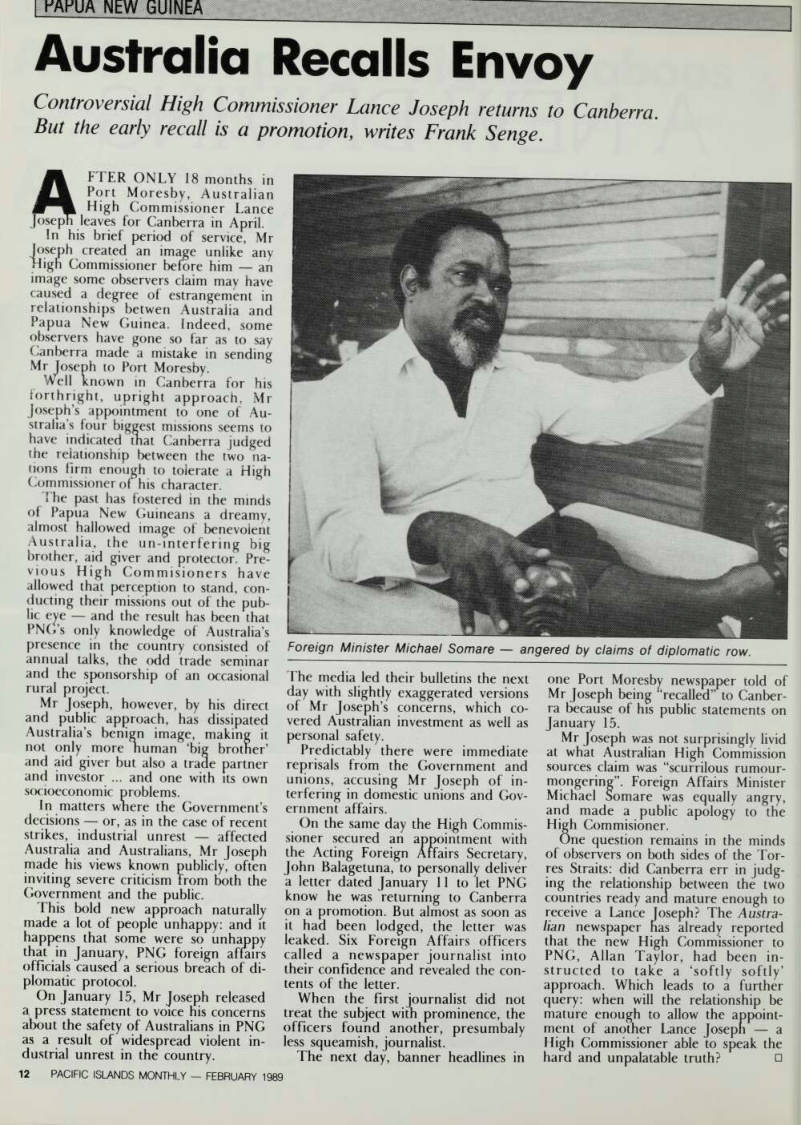
Foreign Minister Michael Somare angered by claims of diplomatic row.