Pacific Voice in Paris
The Region
While New Zealand’s Russell Marshall was a strong voice for the Pacific, some island nations were strangely silent at the Paris conference on chemical weapons.
By Nicolas Rothwell
THE voice of the Pacific was well to the fore at the Paris interna tional conference on chemical weapons control with key presenta tions from Australia and New Zea land. While many Pacific island na tions did not send delegations or pre sent speeches, Papua New Guinea and the Cook Islands were prominently
represented.
The conference was convened as an urgent meeting following initiatives by then US President Ronald Reagan and French President Francois Mitterand at the United Nations last year. Fore ign ministers from some 80 states and representatives of 140 nations gathered to re-affirm the existing 1925 Geneva Protocol against the use of chemical weapons, but the four day event turned into an agonised consid eration of infringements of that pro tocol. The spotlight of media and di plomatic attention was turned on the
recent use of chemical weapons in the Iran-Iraq war, and on American
allegations that Libya, supplied by
West European chemical companies,
was in the process of constructing a chemical munitions factory.
Chief exponent of Pacific concerns was New Zealand Foreign Minister Russell Marshall who announced his country’s decision to withdraw the re servation it had initially made more than 50 years ago when it acceded to the Geneva Protocol. New Zealand has now given up the right to use chemic al weapons even if it is attacked by another nation using such weapons.
Mr Marshall stressed the special concerns of the Pacific region m the main explanation the Paris conference was to hear of this distant geographic
al perspective.
J New Zealand is a South Pacific na tion and though our ties and bonds of friendship have kept us close to coun tries in many other parts of the world, our immediate concern is, not un naturally, for our own neighbour hood. We value our quality oflife and our clean and still largely unspoilt environment.
“The very thought of any chemical warfare in our region fills us, as it would all of our South Pacific neigh bours, with great repugnance.”
But Mr Marshall also spoke of New Zealand’s much wider concern: more important than the remote possibility
of chemical warfare in the Pacific is the very real fear of chemical pollu tion in the region.
“As we now know, the damage being done to the global environment by the careless use of chemicals needs underscoring. The pollution of the atmosphere could, in a matter of de cades, have a devastating impact on the South Pacific.
“New Zealand had also expressed sympathy at the United Nations, the
International Atomic Energy Agency
and elsewhere, for those developing countries confronted with attempts to dump toxic waste in their territories.
The fragile economies of our own area of the South Pacific depend on an environmentally respons ole atti tude being taken towards preserving the delicate equilibrium of nature.”
Mr Marshall stressed an urgent
need to more closely couple together
arms control and environmental poli cies. He suggested as a model the South Pacific Nuclear Free Zone (SPNFZ) treaty, especially its provi sions against radioactive waste dump ing and nuclear weapons.
Less “Pacific” in his outlook but nevertheless one of the major di plomatic influences at the conference was the Australian representative David Reese, his country’s new ambas sador to UN disarmament negotiations underway in Geneva.
Mr Reese outlined Australian moves to control chemical weapons prolifera tion, through the activities of the in formal “Australian group” of adv anced Western nations, wnich moni
tors exports of potential “precursor”
chemicals, and through an important
regional initiative.
This Asia-Pacific initiative, launched at the UN last year by Australian Prime Minister Bob Hawke, is aimed at keeping the region chemical weapons-free and has been highly
praised by international experts for its
value in building contacts between re gional states on this sensitive issue. is fortunate to inhabit a chemical weapons-free environment we want it to stay that way we want our region to be free of chemical weapons in a world that is free of che mical weapons,” Mr Reese told the conference. □
“The thought of chemical warfare in our region fills us with great repugnance”: NZ Foreign Minister Russell Marshall.
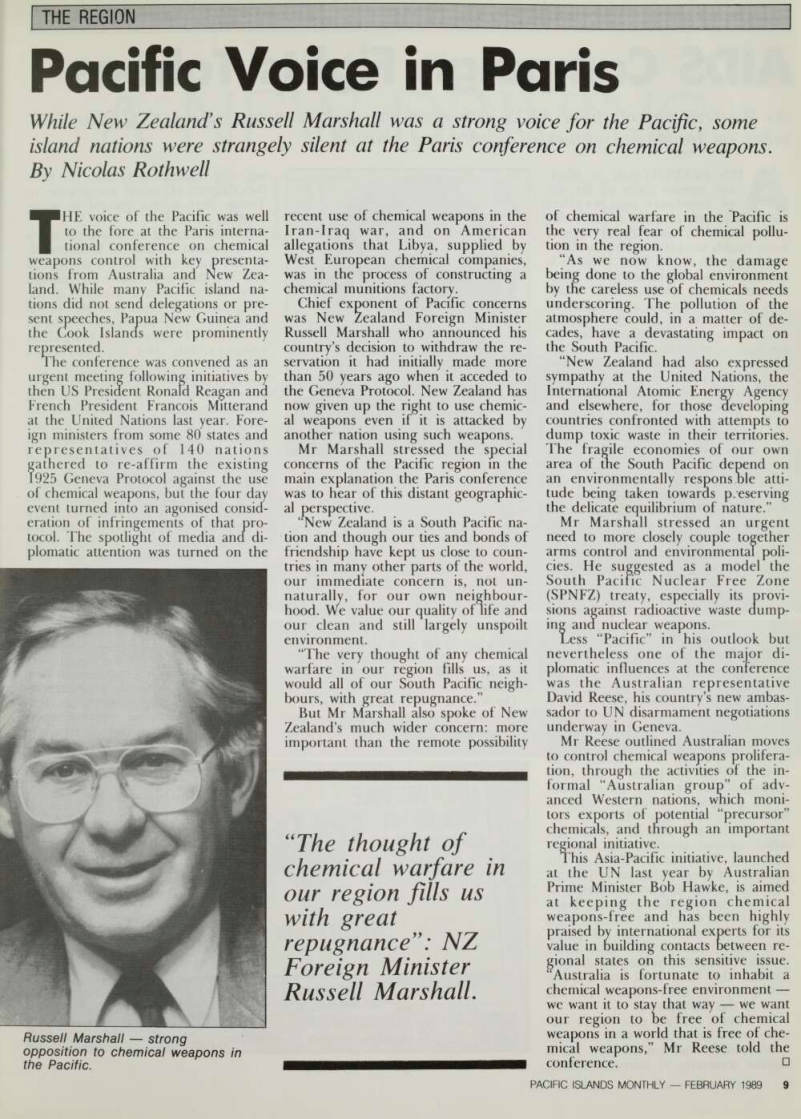
Russell Marshall - strong
opposition to chemical weapons in the Pacific.