A century of service
pp. 20-22 · Read in the full issue
Fiji
The Fiji School oj Medicine faces an uncertain future as it celebrates 100 years of service and achievements. By Professor Harry Lander
THE Fiji School of Medicine in Suva is justifiably proud of its record of service and achieve ment to the South Pacific. Its alumni have made notable contributions to health services and in the political are na and public service. Several have be come leaders of considerable stature, including Fiji Prime Ministers Ratu Sir Kamisese Mara who spent two years at the school and Doctor I imoci Bavadra. Other alumni include Tuvalu’s Prime Minister, Doctor I omasi Puapua, the vice-president of the Federated States of Micronesia, Doctor Hiroshi Ismael, the former Speaker of the House in Papua New Guinea, Doctor John Kiri, and the de- D Prime Minister of the Cook Is s, Doctor Terepai Moate.
The school grew out of a program to teach natives basic medical skills launched by Doctor (later Sir) William MacGregor, the colony’s Chief Medical Officer during the 1870 s. The para mount chief of the day, Ratu Scru Cakobau, had returned with his en
tourage from a visit to Sydney with many of the party incubating measles.
The disease was spread through the country by those wno had gathered to welcome the returning chief, and Fiji’s immunologically virgin people of the islands were devastated bv a virulent epidemic that killed at least 40,000 almost a third of the indigenous population in just three months.
Subsequent epidemics of dysentery and respiratory diseases killed many more and caused a severe labour shor tage. The practice of ‘blackbirding’
luring natives from neighbouring
Melanesian islands to work the cane fields and coconut plantations failed to ease the shortage and a sys tem of indentured Indian labour was introduced. But. tragically, the first boatload of Indian workers to arrive in 1879 brought cholera and smallpox.
Doctor MacGregor quarantined all on board and trained three young Fijian men as ‘vaccinators’ to go into the country and innoculate communities most at risk.
The Colonial Office refused, on grounds of cost, MacGregor’s requests for additional medical assistance Just as the vaccinators returned from out lying communities with alarming
accounts of disease and lack of
hygiene. He eventually won funding
for a scheme to train Fijians in West ern medicine and eight voting men began a three-year course in 1885.
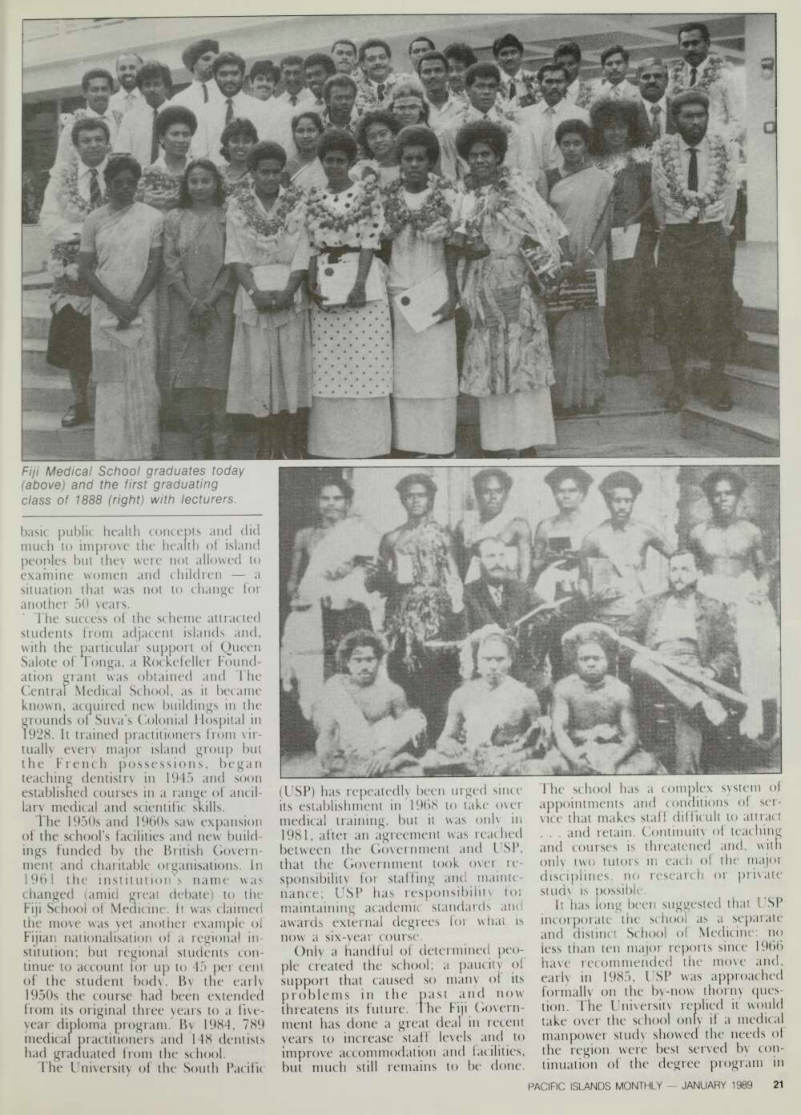
The program became known as the Suva Medical School, and its first graduates were licensed to practise in 1888: they succeeded in introducing
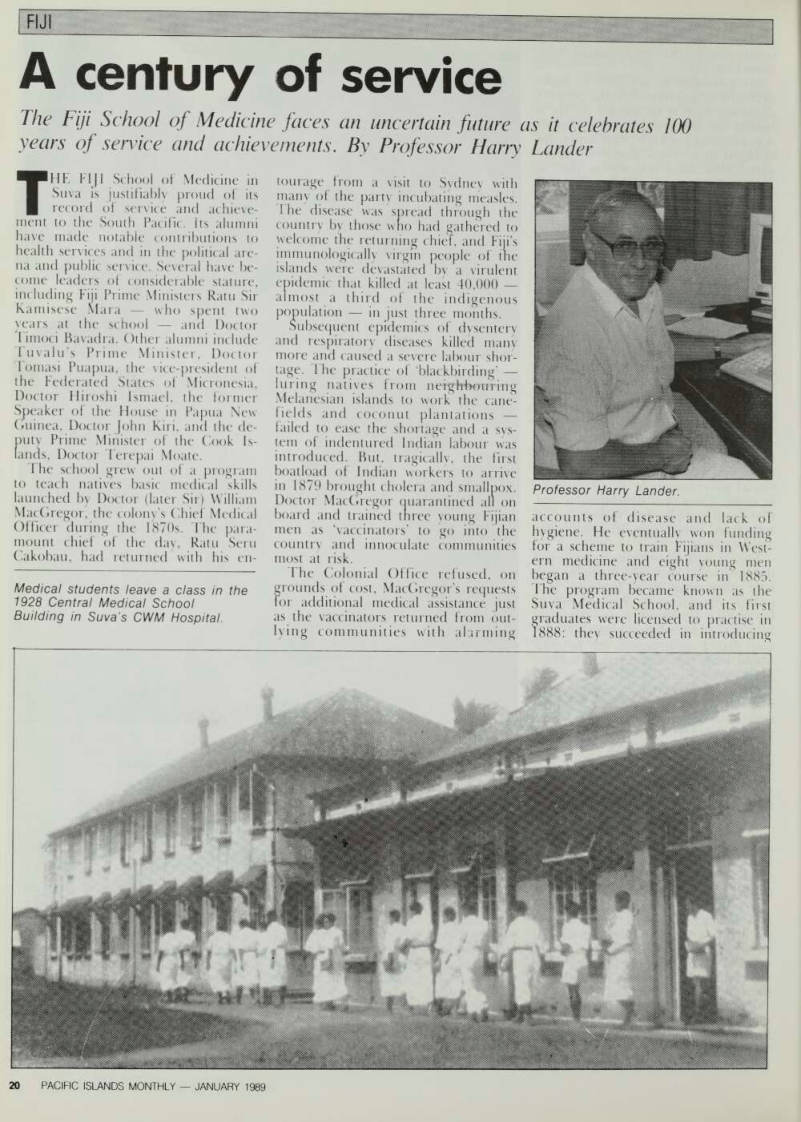
Medical students leave a class in the 1928 Central Medical School Building in Suva's CWM Hospital.
Professor Harry Lander.
basic public health concepts and did much to improve the health of island peonies but they were not allowed to examine women and children a situation that not to change for another 50 years.
The success of the scheme attracted students from adjacent islands and, with the particular support of Queen Salote of Tonga, a Rockefeller Found ation grant was obtained and The Central Medical School, as it became known, acquired new buildings in the grounds of Suva’s Colonial Hospital in 1928. It trained practitioners from vir tually every major island group but
the French possessions, began
teaching dentistry in 1945 and soon established courses in a range of ancil lary medical and scientific skills.
The 1950 s and 1960 s saw' expansion of the school’s facilities and new build ings funded by the British Govern ment and charitable organisations. In 1961 the institutions name was changed (amid great debate) to the Fiji School of Medicine. It w r as claimed the move was yet another example of Fijian nationalisation of a regional in stitution; but regional students con tinue to account for up to 45 per cent of the student bodv. By the early 1950 s the course had been extended from its original three years to a five year diploma program. By 1984, 789 medical practitioners and 148 dentists had graduated from the school.
The University of the South Pacific
(USP) has repeatedly been urged since its establishment in 1968 to take over medical training, but it was only in 1981, after an agreement was reached between the Government and USP, that the Government took over re sponsibility for staffing and mainte nance; USP has responsibility for maintaining academic standards and awards external degrees lor what is now a six-year course.
Only a handful ol determined peo ple created the school; a paucity ol support that caused so many ol its problems in the past and now threatens its future. The Fiji Govern ment has done a great deal in recent years to increase stall levels and to Improve accommodation and facilities, but much still remains to be done.
The school has a complex system of appointments and conditions of ser vice that makes stall difficult to attract . . . and retain. Continuity of teaching and courses is threatened and. with only two tutors in each of the major disciplines, no research or private stud\ is possible.
It has long been suggested that USP incorporate the school as a separate and distinct School of Medicine: no less than ten major reports since 1966 have recommended the move and, early in 1985, USP was approached formally on the by-now thorny ques tion. The University replied it would take over the school only il a medical manpower study showed the needs of the region were best served by con tinuation of the degree program in
Fiji Medical School graduates today (above) and the first graduating class of 1888 (right) with lecturers.
Fiji. The survey is oUlimited value for projecting future needs (who would nave predicted, for example, the ex odus of 40 per cent of Fiji’s doctors since March 1987?) and its results could be manipulated to support pre conceived plans of action. Tnere can be no doubt Pacific nations will con tinue to require doctors trained in the region, but to suggest these doctors’
study in neighbouring metropolitan
nations is absurd.
The Fiji Government has empha sised it will maintain its present finan cial support for medical training if USP taxes over the school. A 1986 au dit showed an operating cost of $F1.12 million for its medical course, of which the Government provided $0.78 million. USP has said it will re quire $2.75 million to operate a suit aolv upgraded program each year.
The $2 million shortfall is peanuts in
today’s Pacific.
The failure to merge is a result of
complex political considerations. The
Government is committed to continue training doctors and ancillary person nel in Fiji and the school is by defini tion one that serves the needs of Fiji and the region. As the Government foots most of the bill, it has behaved in the past as if the school owes little to its regional neighbours, so it is
hardly surprising that the Govern
ment’s request for USP to incorporate the school is viewed with suspicion by those neighbouring nations who view the move as an additional financial burden to be imposed on them.
A co-ordinated move by interested donors could raise the additional funds if all the nations involved made a combined request.
The South Pacific’s various ministers and directors of health and education must forget past differences and begin to co-operate, perhaps under the au spices of the World Health Organisa tion, which has already taken a lead in
this matter. They must work toward a sensible long-term solution to the problems of medical education in the region, recognising that such a step win be of benefit to all. □
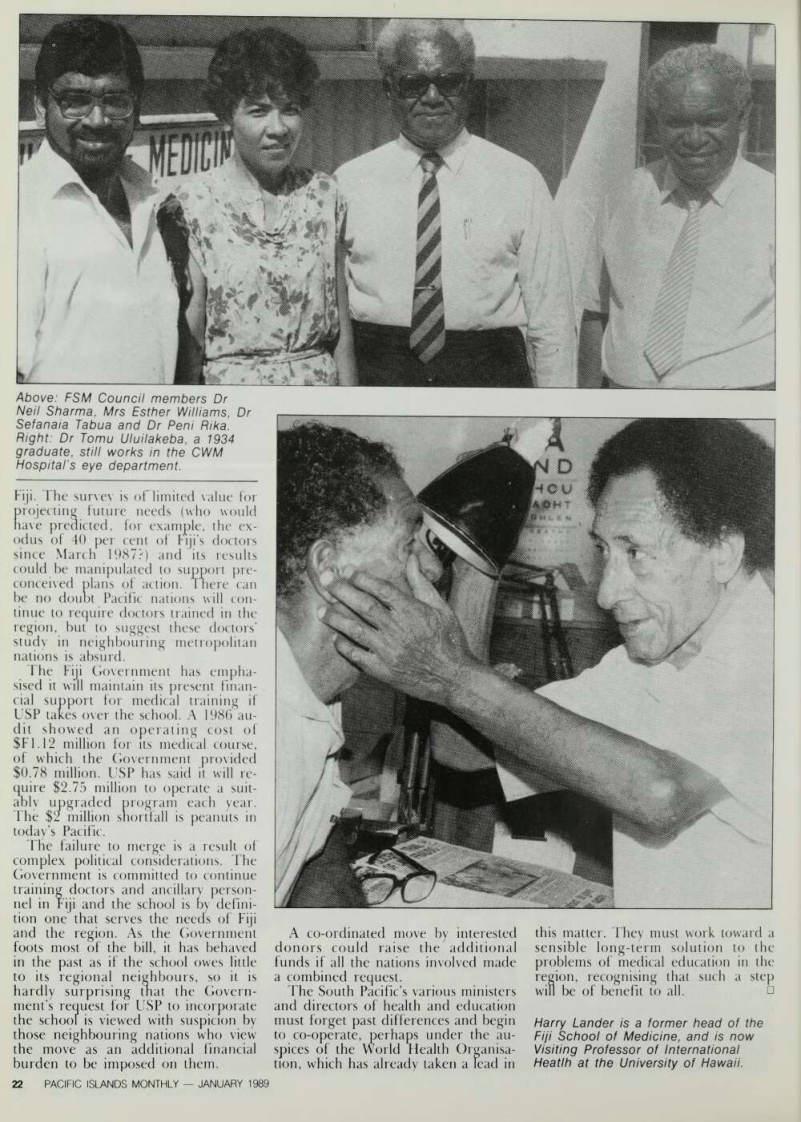
Above: FSM Council members Dr Neil Sharma, Mrs Esther Williams, Dr Sefanaia Tabua and Dr Peni Rika.
Right: Dr Tomu Uluilakeba, a 1934 graduate, still works in the CWM Hospital's eye department.
Harry Lander is a former head of the Fiji School of Medicine, and is now Visiting Professor of International Heatlh at the University of Hawaii.