Lini quashes coup attempt
pp. 24-26 · Read in the full issue
Vanuatu
Vanuatu’s latest power struggle ends with the dismissal of the country’s first president and the arrest of several MPs. by David Robie
1 A MITH last month’s abortive wflff attempt to become the na- W W tion’s power-broker, observers believe Vanuatu president Ati George Sokomanu has at last exposed his poli
tical ambitions by naming rebel politi
cian Barak Sope as caretaker Prime Minister. Within hours of Sope and his interim administration being sworn in on December 18, paramilitary police arrested Sope, and Prime Minis ter, Father Walter Lini, was once more firmly in control.
The next day, the Supreme Court upheld the legality of the elected Lini Government and ruled that the Presi dent had acted unconstitutionally in attempting to dissolve Parliament on December 16. Ruling on a petition from the Parliamentary speaker, Chief Justice Frederick "Cooke issued an in junction banning the President from trying to entrench his rebel ‘govern ment . Both Australia and New Zea land declared their support for the Lini administration.
Later that day, Sokomanu publicly admitted he had acted against the Constitution. Defending his move, he declared that he was right to appoint an interim government “although it was against the Constitution”, and to push for a new general election. “Why should I wait tor the advice of the [Lini] government when I know that things are not going well?” he asked.
The President added that he expected to be sacked from office.
Two days later, on December 20, Parliament actually moved to dismiss Sokomanu, accusing him of gross mis conduct. The parliamentary resolution invoked the republic’s Electoral Col lege for a review of the crisis two weeks later and called for the dismis sal of the President for attempted treason. The Electoral College com prises the 46 members of Parliament and the 11 presidents of local govern ment councils.
Sokomanu is related to Sope, and is a former deputy prime minister in the Lini Government. He has been ac cused in Vanuatu of “betraying” the impartiality of his office as ceremonial head of state ever since the year-long power struggle between Lini and Sope erupted in public. In a surprise speech at the opening of Parliament following
the controversial by-elections for 18 seats, Sokomanu tried to dissolve the chamber and call an election for February. He warned that because of the boycott of the by-elections by the opposition Union of Moderate Parties (UMP) and Sope’s Melanesian Progressive Pati, a one-party state would
emerge if events continued along the same path. “This is not, in my opin ion, democracy at all and this must be obvious to any reasonable person look ing at events as they are unfolding,”
SoKomanu said. “We have a Constitu tion which, I believe is being flouted in every respect, and the actions of
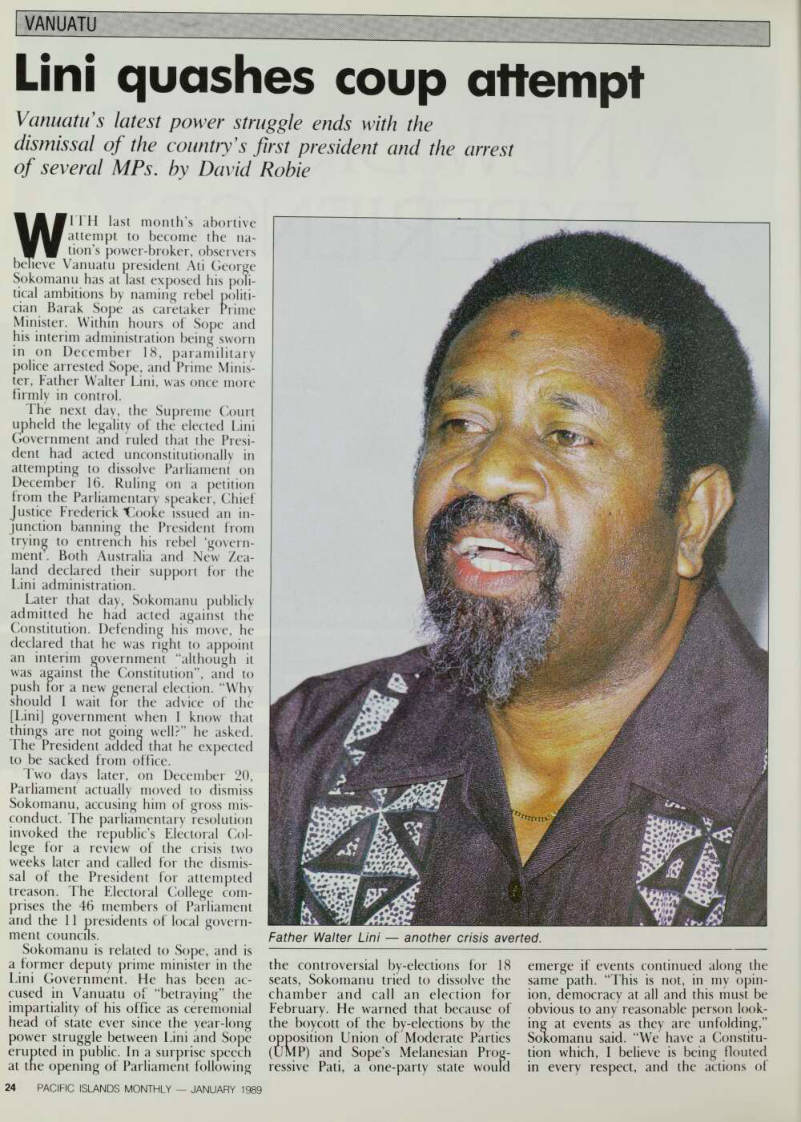
Father Walter Lini - another crisis averted.
everybody involved in the politically turbulent past six months or so, irrespective of the technicalities in volved, are a sad legacy to our inten tions when we founded our republic.”
Though his words sounded noble, critics cited as evidence of political bias the speed with which he appointed his protege, Barak Sope, as “Prime Minis ter”. Sope had been sacked from Cabinet and ousted by the ruling Vanuaaku Pati. The Lini Cabinet re sided him as the instigator of anti ciovernment rioting last May which caused the death of one man and SA2 million dollars damage in the capital.
After making his address, Sokoma nu picked up his papers and stormed out of Parliament. But less than half an hour later Parliament was recon vened for a speech by the Prime Minister. Lini condemned the Presi dent, described him as a “disgrace and a political fraud” and called on him to
resign. Branding the move a “political
coup”, Lini added that the attempted dissolution had no effect.
Guarded by armed paramilitary
Vanuatu Mobile Force troopers, MPs gathered in the chamber next day in defiance of the President for the start of the Budget session. Under the Con stitution, Parliament can only be dis solved by the President after a resolu tion by a two-thirds majority of MPs
or on the advice of the Prime Minister and the Council of Ministers.
As tension mounted, the President was barred at gunpoint from making a broadcast on government-controlled Radio Vanuatu and the security forces set up roadblocks around the capital.
A 22-year-old Australian tourist wounaed after the car in which he was travelling failed to stop at a roadblock outside Port Vila.
A “hit-list” was reportedly circulated
by close supporters of Sope naming
leading members of the Lmi Cabinet and senior civil servants as revenge targets. Written in Bislama and signed ‘Mr Black Dog’, the list warned that a man had already been ‘martyred’ for land rights and that if anybody else died ‘one of you will either die or will disappear without trace’.
Politicians and civil servants named on the list were Home Affairs and Police Minister lolu Abil, Lands Minis ter William Mahit, Finance Minister Sela Molisa and Lini’s private secretary and spokesman Joe Natuman. Also in cluded were Prime Minister’s Office deputy secretary Grace Molisa, deputy
Foreign Affairs secretary Raymond
Malapa and Police Special Branch Chief Superintendent Waimini Perei.
Vietnamese businessmen named in cluded the owner of Dovair, Dinh Van Than, a major financial supporter ot the Vanua’aKii Pati and one of Lini’s closest associates, and Rene Ah Pow, owner of the Au Bon Marche super market. Luan Van Dinh was said to have “already been dealt with” as an example to the other 16 people named on the list. Dinh’s photo-
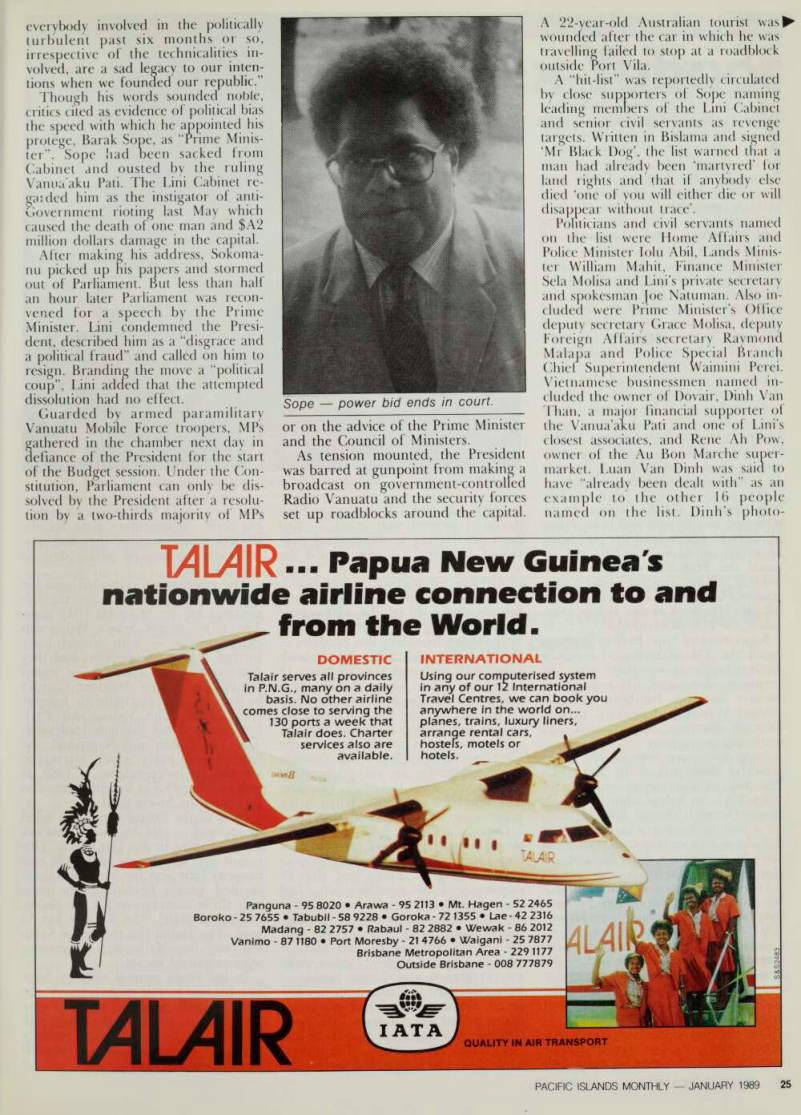
Sope - power bid ends in court.
M graphic shop was wrecked by protes tors during the anti-government riot ing last May and, in November, he was beaten up by a gang of Sope’s supporters. He was flown to Noumea for surgery with a badly smashed jaw.
At least two of Sope’s colleagues, David Trene and Albert Sanday, were reportedly arrested in connection with the list, along with 16 people arrested
in the purge. Sope, putative deputy
Prime Minister Maxime Carlot and three other ministers of the short-lived interim government were charged with sedition which carries a three year Jail term and taking unlawful oaths. They were remanded until January 4 when a Port Vila court, packed with their supporters, commit ted them to stand trial. Sokomanu also appeared on January 4 to answer a
charge of inciting mutiny; if convicted
he could face a maximum life sent ence. All six were due to stand trial on January 13 in Port Vila.
Even as Sokomanu faced the court, the Electoral College met to decide whether he should be dismissed from the presidency. But with several coun cil heads stranded by Cyclone Delilah the College failed to attain a quorum and resolved to reconvene on January 10 when Sokomanu was dismissed.
When Sokomanu called in late November for the by-elections to be scrapped and a fresh poll held, Prime
Minister Lini prevented the plea being
broadcast on Radio Vanuatu and ac cused the President of meddling in political affairs; then he went further, claiming Sokomanu was trying to use his office to back Sope’s bid to over throw the Lini Government.
Supporters of Sope have in turn ac cused the PM of trying to create a dictatorship or a one-party state. In response, Lini and his supporters counter that Sope has been trying to subvert Vanuatu’s democratic process
through coercion, opportunism and
increasing corruption.
Sope was once one of the most powerful ideologues of the Vanua’aku rati and its secretary-general for 14 years. He is an ardent admirer of Fiji’s Major General Sitiveni Rabuka, and, on a visit to Suva in October, Joined Rabuka in a bitter attack on Australian (and, by implication, New Zealand) di plomacy in the Pacific, Folowing a series of constitutional law challenges to the Lini administra tion, Sope’s New Zealand-born laywer, Peter Coombe, was given one month to leave the country. Though he peti tioned Lini to revoke the order, the Prime Minister refused to reconsider and Coombe was forced to leave the country three days after the attempted dissolution of Parliament.
Lini did not reveal the reason for the expulsion, but Government sources claimed Coombe along with
an American and a West Papuan both declared pesona non grata had been interferring in the internal poli tics of Vanuatu. Coombe denied the
allegation, claiming an interest “purely
in offering legal advice and service”.
Coombe had given legal representa tion to about 40 of the 120 people arrested during the post-riot purge in Port Vila including two brothers of Barak Sope who were last month jailed with sentences ranging from 11 to 14 months. Three others also charged were given suspended sent ences, and all had been arrested for
rioting and causing malicious damage.
Six years ago, Coombe’s former wife Christine was expelled from Vanuatu after publishing an anti-government newspaper, The Voice of Vanuatu.
The republic’s only other paper is the government organ Vanuatu Weekly.
Coombe failed in July to win three constitutional challenges on behalf of Sope and his renegade MPs, the so called Gang of Five, and the 18 opposition UMP members who had been expelled from Parliament. But he later won a Court of Appeal judg ment. Shortly after Sope and his four Melanesian Progressive Pati MPs William Edgell, Charles Godden, Ana tole Lingtamat and Jimmy Simon were reinstated in Parliament they res igned, declaring they had no confi dence in Speaker Onneyn Tahi. Sope claimed in a statement that Tahi had “disgraced” the office of Speaker, while Tahi had repeatedly warned the
five they would have problems retain ing their Parliamentary seats for the Budget session because they had mis sed three consecutive sitting days in late July 1988.
The resignations coincided with the closure of nominations for the by elections for the 18 vacant UMP seats.
The move meant Sope’s Melanesian Progressives who would have formed a token Opposition had they remained in the chamber joined Opposition leader Maxime Carlofs boycott of the elections to honour their deal. The Vanua’aku Pati, however, was not the only contender.
The Tan Union and Nagriamel, the Santo-based party which attempted secession at independence in 1980, as well as a handful of independents also contested the by-elections.
Nine of the vacant seats were filled unopposed six to the Vanua’aku Pati and three to the Tan Union. This meant the VP already had a 29 seat majority [one seat for Santo Rural re mained vacant because there were only three nominations for the electo rate’s four seats]. The VP now has 35 seats, Tan Union five, while the Santo seat and five Melanesian Progressive seats remained vacant.
In last year’s general election, Sope
won his seat by just three votes. At the time, he challenged Lini for the Prime Ministership, attacking the leader’s ill health after he had become partially paralysed as a result of a stroke 10 months earlier. D
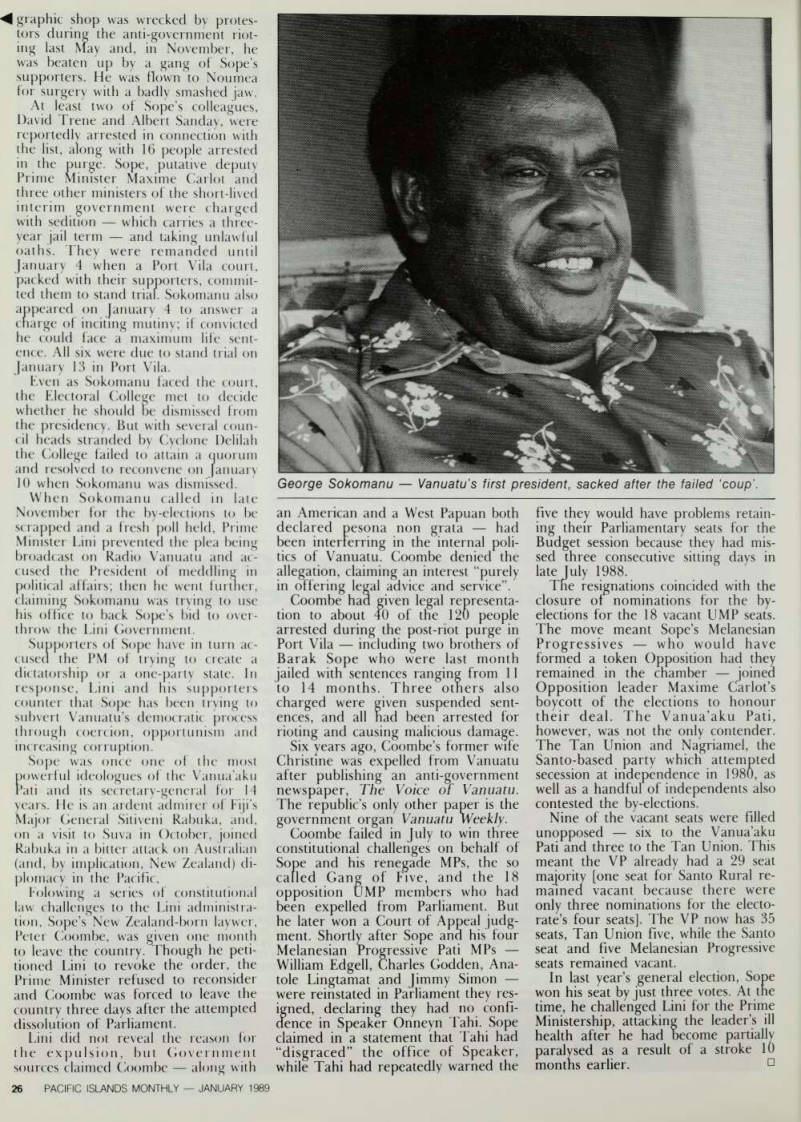
George Sokomanu - Vanuatu’s first president, sacked after the failed ‘coup’.