sabotage in Panguna
pp. 16-19 · Read in the full issue
Papua New Guinea
Landowners resort to sabotage in Panguna
Bougainville landowners force the shutdown of PNG’s largest revenue earner as they turn to violence in their quest for compensation, by Wally Hiambohn
II N APRIL last year, when landown-
|ers of Papua New Guinea’s giant
|copper mine on Bougainville Island lodged a KlO billion compensation claim for their land (or what was left of it), no-one took them seriously.
Understandably so; it was thought the claim was ludicrously far-fetched and that no-one in the world much less in PNG had that kind of money. So the matter was left to die a natural death. No-one expected the landowners, generally known as quiet and easygoing, to press on with their claim to the extent of violence.
Almost all negotiating parties were therefore unprepared when the threatened violence did erupt at the end of November. Bougainville Copper Limited (BCL) and the National Government were left stunned as a handful of landowners, led by former BCL surveyor Francis Ona, set about
burning buildings and destroying vital
communications and electricity supply
installations.
Equipped with a massive quantity of
explosives and walkie-talkies thought
to have been stolen from BCL, the
landowners became guerilla fighters and, operating from thick forests, set about crippling PNG’s largest revenue earner. For a fortnight they continued sporadic attacks on mine property, leaving no clue to their whereabouts.
A police squad of 200 men specifically trained to quell trouble and led by Police Commissioner Paul Tohian left to chase without success the saboteurs, who were described as “terrorists” and “Rambo-style rebels”. And up to the end of December last year, the police were still searching in vain for the saboteurs.
The troubles began on November 22 when a group of armed men held
up security guards at BCL’s explosives
magazine and stole 228 items of ex
plosives, including detonators and
fuses. Before the company or the Gov ernment could act they struck on November 24, burning an administra live block, a helicopter and its hangar, and a guest house, The attacks continued on November 26 when an electric shovel used for digging ore was damaged and attempts were also made to destroy
other installations at the Panguna mine site. The total cost of the saboteurs’ actions was estimated at K 700,000.
While police reinforcements were called in from Rabaul, BCL chairman Don Carruthers flew to Port Moresby to assess the situation and to hold ur gent talks with Prime Minister Rabbie Namaliu. Mr Carruthers later issued a statement that promised CRA, the majority shareholder in BCL, would “seriously reconsider” its future invest ments in the country: CRA is the ma jor developer of an alluvial gold de posit at Mt Rare in the Highlands and Hidden Valley in Morobe Province.
Carruthers said the weekend “acts of terrorism” at Panguna were the result of “unrealistic expectations”.
“There could not be anything more damaging to PNG’s reputation as a place to invest than an attack on Bougainville Copper, which has been operating here for many years and al ways tried to do the right thing,” Mr Carruthers’ statement read. “Raising money for future investments in any sector would be almost impossible if
international backers thought explo
sives might be used on equipment or
innocent people.”
The impact of a CRA withdrawal
from exploration and gold mining
would be felt severely in PNG. The company spends KlO million a year in exploration, had planned to invest K2OO million this year to develop Hid den Valley and was reinvesting K 250 million a year from 1988 to 1990 to extend the Panguna mine’s lifetime.
Mr Namaliu reacted to the state ment with resentment, describing it as a “regrettable over-reaction”, pfe cal led for a “mature and considered re
sponse”, saying “problems at the mine
site are hardly confined to PNG, as CRA would well know.
“I seem to recall numerous Austra
lian mining companies having difficul
ties with local tribal landowners, en vironmental groups and even state and national governments. We want to maintain harmony with the mining in dustry, but we must do so on a basis of mutual co-operation and an under
standing of important local problems
such as land tenure,” the Prime Minis ter said.
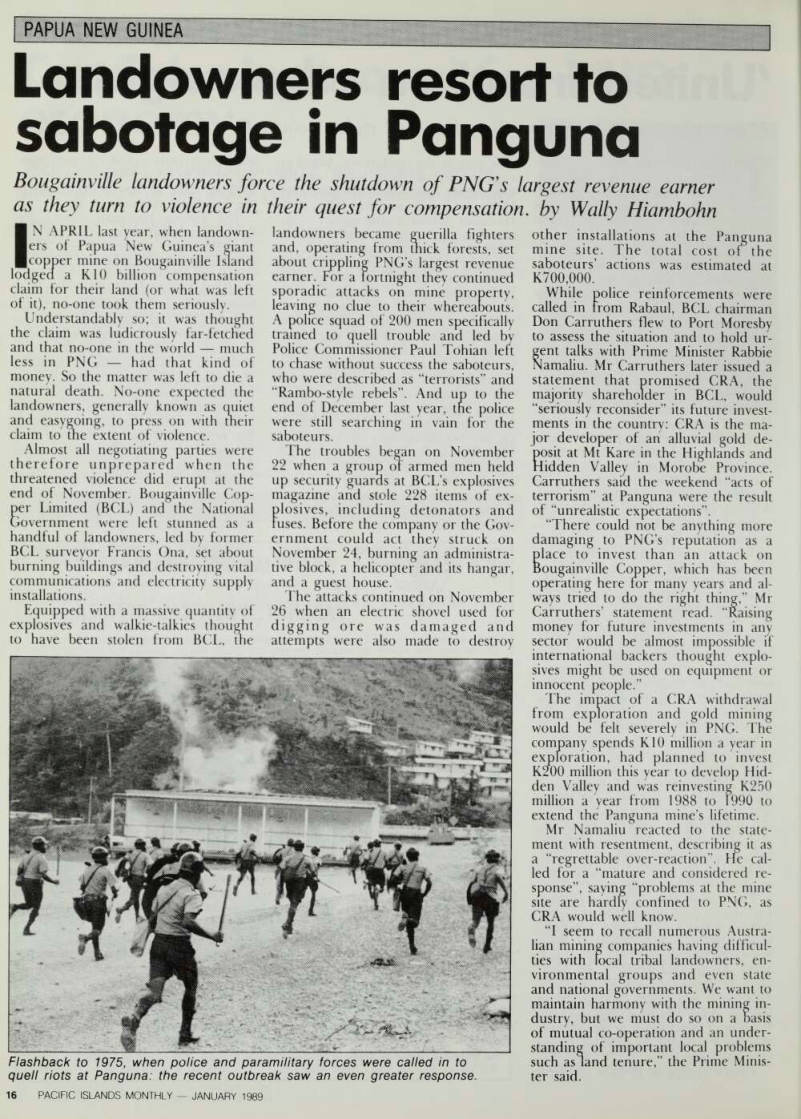
Flashback to 1975, when police and paramilitary forces were called in to quell riots at Panguna: the recent outbreak saw an even greater response.
The same day Father John Momis, a
leading figure in the renegotiation of
the BCL agreement, urged that it was time landowners who had been ignored for too long were taken seriously. He called for a tripartite agreement in which the Government, the company and the landowners all played an active role in the venture.
The troubles were far from over.
On December 1 another magazine store belonging to the Bougainville
Development Corporation’s Arawa
limestone quarry was broken into and
a large quantity of explosives stolen
the tne ft raised fears that parts needed to complete a major act of sabotage had now been taken and, the following night, a power transmission tower was blown completely off its base and sent crashing down a cliff.
The blast plunged the Panguna mine into total darkness and its huge machines, including the ore crushers, conveyor and concentrator, all ground to a halt.
Mine workers laboured around the clock to set up a temporary pole to restore power on Saturday; but the mine by then was virtually under siege. A repeater station linking the mine to the outside world was burned to the ground, and on Sunday a second power transmission tower was blown up, causing a second blackout at the mine and forcing a complete shutdown of operations for six days.
Opposition leader Paias Wingti
reacted predictably, putting the blame
on Mr Namaliu and his Government for “complacency” in handling the cris j s anc j sa ying the Government's disregard ()r Carruthers’ concern about the situation and its failure to deal firmly with the landowners had led to the escalation of the violence. Mr Wingti also claimed Father Momis has “implanted false expectations” in the minds of the Panguna landowners.
Mr Namaliu appointed a ministerial committee, led by his deputy Akoka Doi, and ordered it to Bougainville to meet landowners, the company and the provincial government and settle the matter. Police Commissioner Tohian, on arrival at Panguna, ordered his men to shoot and kill saboteurs if necessary, while PNG Defence Force soldiers were mobilised to be deployed if the crisis deepened.
The Doi delegation, though meeting
with company officials and provincial government representatives, failed for a week to bring Ona and his men to the negotiating table: he refused point-blank to come out of hiding unless police were withdrawn.
In the meantime, on December 7 saboteurs bombed a BCL maintenance building in Arawa, causing an estimated K 350,000 damage.
Patience was running out and the deployment of soldiers seemed inevitable: in Port Moresby PM Namaliu warned the saboteurs ‘our patience is not unlimited” and the company, despite restoring power to the mine, refused to continue production, fearing for the safety of its workers. The Goveminent delegation finally met Ona and his men on December 8 and received a guarantee of peace from the
landowners. The delegation left for Port Moresby with high hopes of a settlement, but BCL continued to re fuse to open the mine with a large
quantity of explosives still at large,
In Port Moresby the Government considered declaring a curfew in the mine area and its immediate locality, but gave the saboteurs until spm on December 12 to hand over the missing explosives or come under severe res trictions on freedom of movement, The saboteurs responded and sur rendered a quantity of explosives be fore the deadline, A personal assurance from Mr Namaliu saw Panguna return to pro duction on December 11. Five days la ter, the Government appointed a second team, again headed by Mr Doi, to take part in the renegotiation of the
Bougainville Copper Agreement. Car
ruthers and the Prime Minister also met again in Port Moresby to make peace a meeting Carruthers called ‘amicable and constructive”, At that meeting Mr Carruthers gave his assurances that the company would work out the problems affecting mine operations and would co-operate in reviewing the agreement. He also said that despite its problems, BCL was looking forward to an “excellent year .
In 1964, an Australian colonial administrator went to Panguna, on Bougainville Island, to negotiate ac quisition of the copper-rich land. In one sentence he told the landowners, “You get nothing”, climbed back into his helicopter and left, Now, 24 years later, the legacy of that attitude is at last being felt, both in Australia and PNG. Deprived of
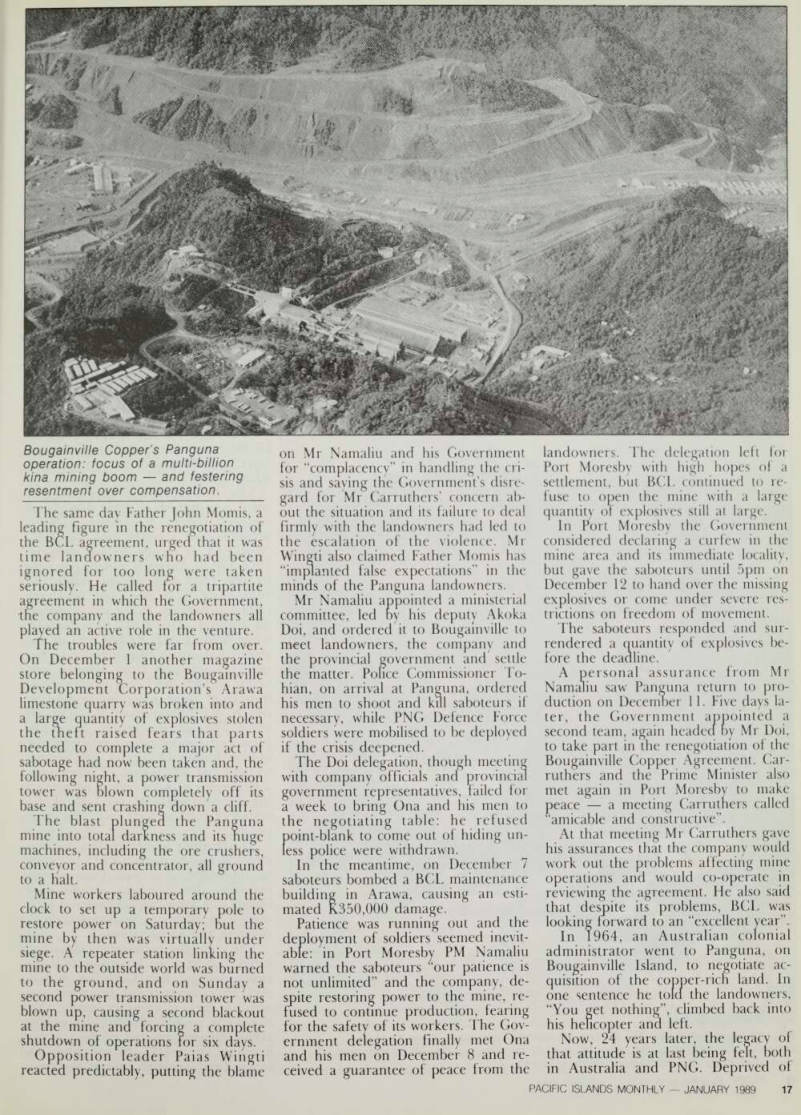
Bougainville Copper’s Panguna operation: focus of a multi-billion kina mining boom - and festering resentment over compensation.
their land, their river, their hunting grounds and other resources and leu with only a consolation prize of com pensation and royalties, Panguna land owners justify their sabotage by saying they have suffered long enough and that they are determined to pursue their demands which, if not met, must result in the closure of the mine.
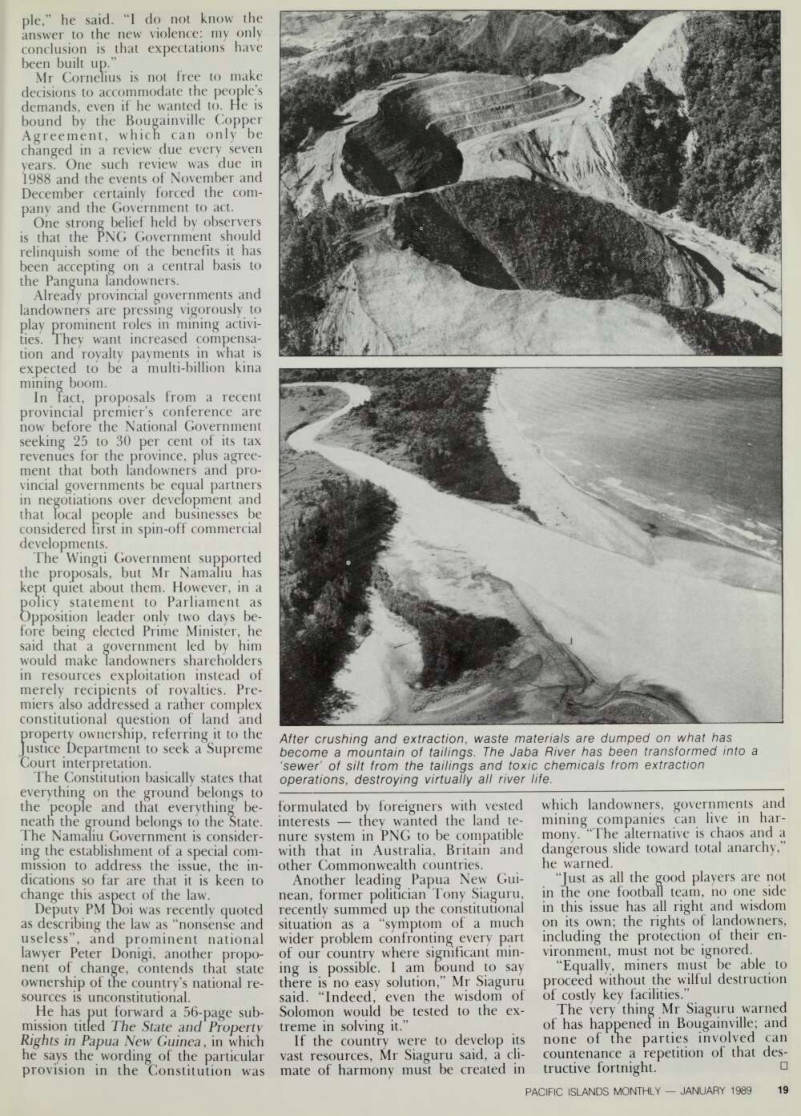
The wealth they had anticipated from the mine being established on their land has still not eventuated, yet they are paying dearly: they fear they will be left with no more than a giant hole in a valley that once provided excellent hunting and garden sites, and a heavily polluted river. Take a trip down the Jaba River, where mil lions of tonnes of waste is dumped to become floating filth and it is not dif ficult to appreciate their sentiments.
“My people have become nomadic,” says Perpetua Serero, the leader of the matrilineal landowners. “We don’t grow healthy crops any more, our tra ditional customs and values have been disrupted and we have become mere spectators as our earth is being dug up, taken away and sold for minions'; “Our land was taken away from us by force: we were blind then, but we have finally grown to understand whafs going on.”
The Bougainville Copper Agree ment was signed in June 1967," and renegotiated in November 1974 to accommodate a better deal for PNG.
Now BCL is owned 53 per cent by CRA Ltd of Australia and 19 per cent by the PNG Government, wnile the remaining 27.3 per cent of share capital is held by public shareholders, all foreign. The PNG Government, while holding only 19 per cent of the shares has, apart from dividends, be nefited immensely from royalties and taxes. In fact, the Government’s earn ings from these revenues amount to nearly K 1 billion over the past 16 years. The company in that period has produced concentrates containing 2.8 million tonnes of copper, 285 tonnes of gold and 715 tonnes of silver, with a total value of K 4.4 billion, represent ing approximately 44 per cent of the country’s total exports over the same period.
The mine’s contribution to the national purse amounts to 17 per cent of internally generated Government revenue. But Panguna’s landowners within that same period received Kl 7 million in all forms of compensation, royalties and social services.
The company believes strongly that it has paid its dues. According to man aging director Bob Cornelius, it has met all compensation requirements and has been in constant liaison with the local people through its public affairs division, headed by Bougainvil lian Joe Auna. “We do not think it’s fair to think we have ignored the peo
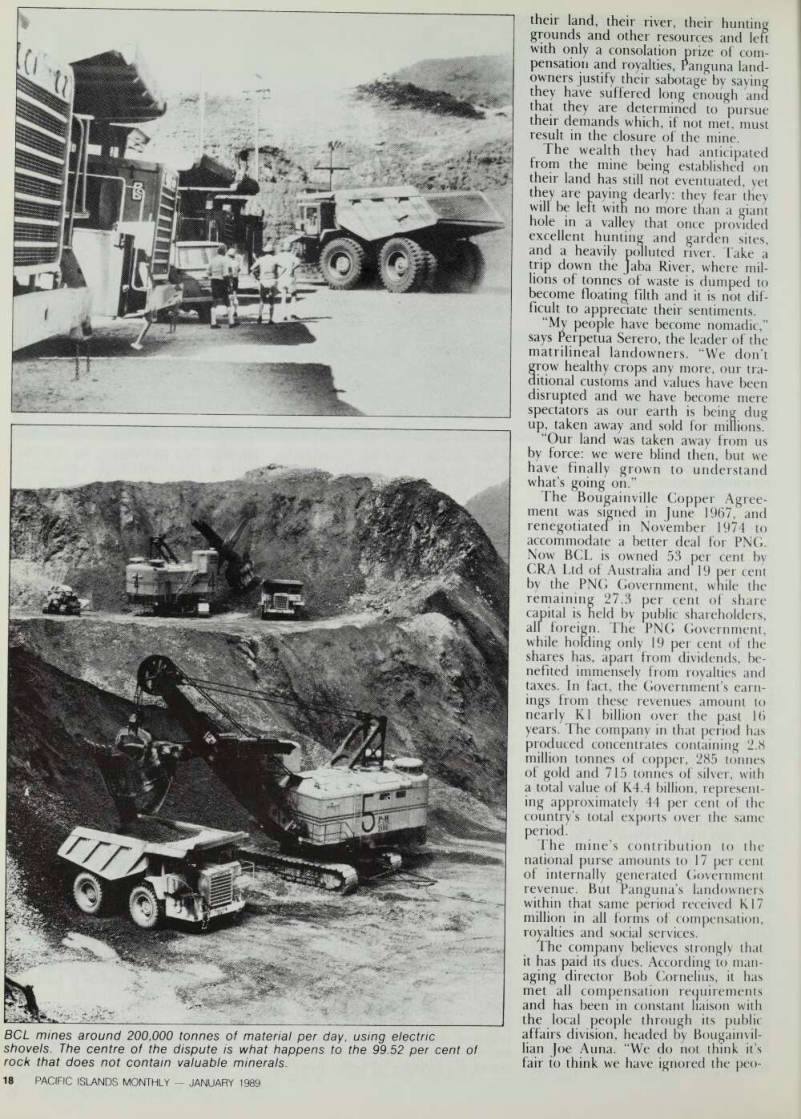
BCL mines around 200,000 tonnes of material per day, using electric shovels. The centre of the dispute is what happens to the 99.52 per cent of rock that does not contain valuable minerals.
pie,” he said. “I do not know the answer to the new violence: my only conclusion is that expectations have been built up.”
Mr Cornelius is not free to make decisions to accommodate the people’s demands, even if he wanted to. He is
bound by the Bougainville Copper
Agreement, which can only be changed in a review due every seven years. One such review was due in 1988 and the events of November and December certainly forced the com pany and the Government to act.
One strong belief held by observers is that the PNG Government should relinquish some of the benefits it has been accepting on a central basis to the Panguna landowners.
Already provincial governments and
landowners are pressing vigorously to
play prominent roles in mining activi
ties. They want increased compensa tion and royalty payments in what is expected to be a multi-billion kina
mining boom.
In fact, proposals from a recent
provincial premier’s conference are
now before the National Government seeking 25 to 30 per cent of its tax revenues for the province, plus agree ment that both landowners and pro vincial governments be equal partners in negotiations over development and that local people and businesses be considered first in spin-off commercial
developments.
The Wingti Government supported
the proposals, but Mr Namahu has kept quiet about them. However, in a Solicy statement to Parliament as
•pposition leader only two days be
fore being elected Prime Minister, he said that a government led by him would make landowners shareholders in resources exploitation instead of
merely recipients of royalties. Pre
miers also addressed a rather complex constitutional question of land and
property ownership, referring it to the
Justice Department to seek a Supreme
Court interpretation.
The Constitution basically states that
everything on the ground belongs to
the people and that everything be neath the ground belongs to the State.
The Namahu Government is consider ing the establishment of a special com mission to address the issue, the in dications so far are that it is keen to change this aspect of the law.
Deputy PM Doi was recently quoted
as describing the law as “nonsense and useless”, and prominent national lawyer Peter Donigi, another propo nent of change, contends that state ownership of tne country’s national re sources is unconstitutional.
He has put forward a 56-page sub mission titled The State and Property Rights in Papua New Guinea , in whicn he says the wording of the particular provision in the Constitution was
formulated by foreigners with vested interests tney wanted the land te nure system in PNG to be compatible with tnat in Australia, Britain and other Commonwealth countries.
Another leading Papua New Gui
nean, former politician Tony Siaguru,
recently summed up the constitutional situation as a “symptom of a much wider problem confronting every part of our country where significant min ing is possible. I am hound to say there is no easy solution,” Mr Siaguru said. “Indeed, even the wisdom of Solomon would be tested to the ex treme in solving it.”
If the country were to develop its vast resources, Mr Siaguru said, a cli mate of harmony must be created in
which landowners, governments and mining companies can live in har mony. “The alternative is chaos and a dangerous slide toward total anarchy, he warned. ‘‘Just as all the good players are not in the one football team, no one side in this issue has all right and wisdom on its own; the rights of landowners, including the protection of their en vironment, must not be ignored, “Equally, miners must be able to proceed without the wilful destruction
of costly key facilities.”
The very thing Mr Siaguru warned of has happened in Bougainville; and none of tne parties involved can countenance a repetition of that des- Inactive fortnight. D
After crushing and extraction, waste materials are dumped on what has become a mountain of tailings. The Jaba River has been transformed into a ‘sewer’ of silt from the tailings and toxic chemicals from extraction operations, destroying virtually all river life.