Raun Isi long Sydney
p. 33 · Read in the full issue
Australia
PNG brings its arts to Australian children.
By Matthew McKee
ONDI BEACH Public School, Sydney, tasted the culture of Papua New Guinea’s East Sepik province last month in the form of a visit from the Raun Isi Travelling Theatre. The red brick and sandstone school is just across the road from Australia’s most famous beach, and it has witnessed the growth of Sydney’s sun worship since it was built in 1923: indeed, there is abundant irony in the contrast of the ancient traditions of PNG being performed scant metres from a strip of sand, surf (and, nowadays, of sewage) that has become one of the sacred sites of modern Australian culture provided you can find two Australians who will agree on just what constitutes Australian culture.
The question didn’t seem to be worrying the students of Bondi Beach school as they sat entranced by Raun Isi performing a song of welcome, miming a comic tribute to the ‘infectious’ atmosphere of a doctor’s waiting room or dancing in celebration of the
graceful flight of the seagull.
Raun Isi - whose name comes from a Pidgin term meaning a leisure
trip, strolling about or ‘travelling easy’
- was in New South Wales for a fortnight of performances and social vists, beginning with a week in the central western NSW town of Wellington, sister city of the East Sepik provincial capital of Wewak. The troupe's visit
had been arranged by Wellington
businessman Lyall Agnew, and its members stayed with local families. 1 Raun Isi spent a second week in
Sydney, sponsored by Australian busi-
ness houses that have interests in PNG. The Sydney sponsors raised $lO,OOO to cover food, accommodation and transport costs, and arranged per formances at Sydney schools, before lunchtime crowds in the city’s Martin Plaza pedestrian precinct, and at bicentennial celebrations for the City of Parramatta. The travelling theatre company was established by the East Sepik Provincial Government in 1980, and includes members from all parts of the province.
Cultural and linguistic diversity is also the norm at Bondi Beach Public School, whose enrolment includes stu dents from 22 countries in Europe, the Middle East, Africa, Asia and the Pacific (even including one student from PNG). Many of these students speak a second language in addition to English, and the school encourages a variety of multicultural activities to foster a sense of pride in every child’s
heritage. Melise Fanning, an English
as a Second Language (ESL) teacher at Bondi, explains that: “Because we have children from so many non En
glish-speaking backgrounds in the
school, we encourage them to keep up with their first language; to use it at home, to read in it even to write stories in it. Children with two lan guages,” she says, “seem to have a good approach to work and do well with their schooling.
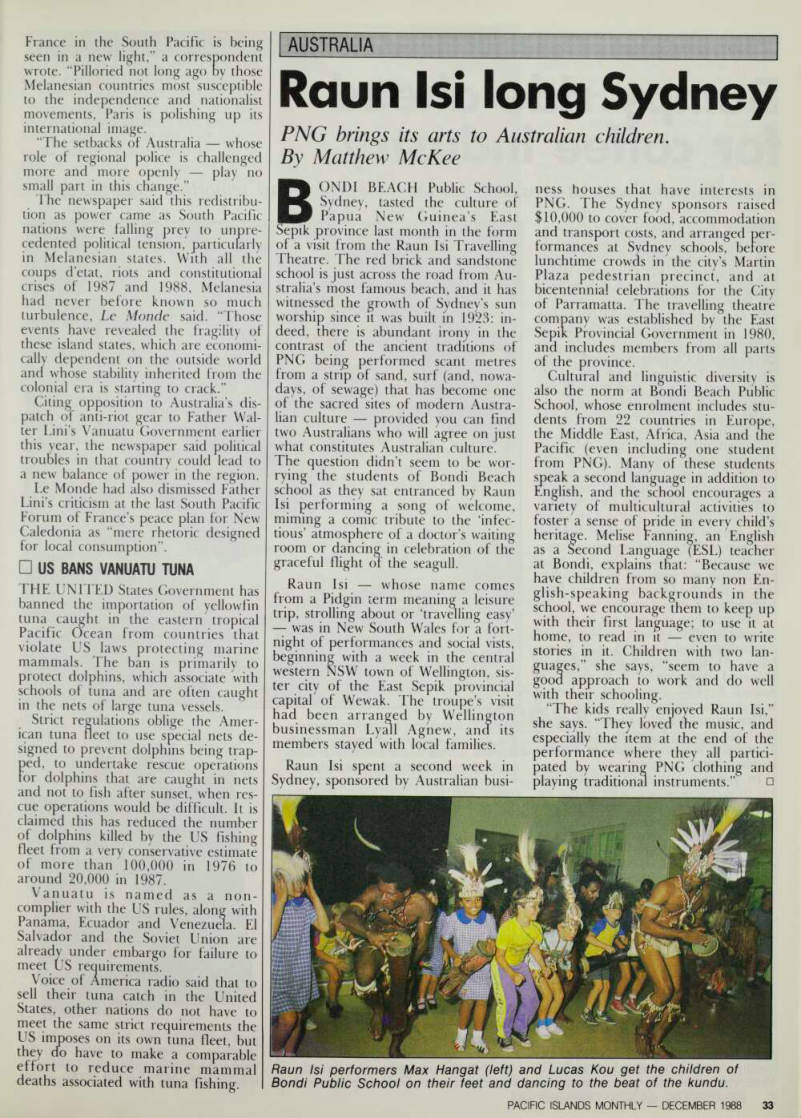
“The kids really enjoyed Raun Isi,” she says. “They loved the music, and especially the item at the end of the
performance where they all partici
pated by wearing PNG clothing and
playing traditional instruments.” □
Raun Isi performers Max Hangat (left) and Lucas Kou get the children of Bondi Public School on their feet and dancing to the beat of the kundu.