for coffee industry
pp. 34-35 · Read in the full issue
Papua New Guinea
Bumpy ride ahead for coffee industry
Robin Bromby looks at prospects for one of PNG’s most important export crops.
THE Papua New Guinea Govern ment is still publicly insisting on local ownership of coffee export ing companies by October 1989, though many in the industry cannot see now local investors will come up with enough capital to make the policy work. Recently, the nationally owned coffee producer Eastern Highlands
Development Corporation tried to buy
the largely German-owned PNG Cof fee Exports, only to find it could not meet trie K 8 million asking price.
One clue to the Government’s think ing is the reported statement of an unnamed official who said the Gov ernment could buy the shares and hold them in trust until it was possible for citizens to take up the stocks. It seems the only way out for the Gov ernment, unless it lets the deadline slide quietly by next October; but the problem is that coffee is such an emo tional issue about 300,000 rural households are involved in its produc tion that the Government may have painted itself into a corner.
The deadline was first set at the be ginning of 1988 by former Minister of Agriculture and Livestock, Gai Duwa bane. At that time, two of the 10 affected companies Angco and Kumul Kopi were cited as having met the Government’s guideline of all coffee exporting companies being at least 90 per cent locally owned; Mr Duwabane wanted farmers to be able to buy shares in them.
In January, the then minister said his department was writing to the ex port companies telling them to start selling their shares to Papua New Guinea nationals. He said those who refused to sell would face ‘consequ ences’, and there was the suggestion made that future allocations of export quotas would be decided in part by what proportion of each company’s shares was held by local people rather
than by foreigners.
Mr Duwabane cited Angco Pty Ltd, the country’s largest exporter, which had decided to float K 5 million worth of shares, as showing localisation was possible. The problem was that the share float, as already reported in Pacific Islands Monthly, was a flop, with only about a third of the five million shares being taken up. The float coincided with poor returns for
coffee and there was some sentiment that at K 1 per share the company was a little overvalued.
The companies that would have been most affected by the Govern ments included PNG Coffee Exports, Wahgi Mek, Nambusu, Coffee inter national, Kundu Coffee and the
Carpenter’s operation.
With a world glut, this is hardly the time to be investing in coffee export companies. Furthermore, some of the companies spent heavily several years ago when the world quota on produc tion exporting was lifted temporarily; there was a rush to buy up coffee crops and prices were forced up. The growers did well and there was plenty of spending in the Highlands in 1986/ 87, but the industry is currently in the doldrums. Coffee prices, after
peaking at K 4900 a tonne in early 1986, have fallen steadly since and the reintroduction of the global Quota sys tem in late 1987 also Fed to depressed
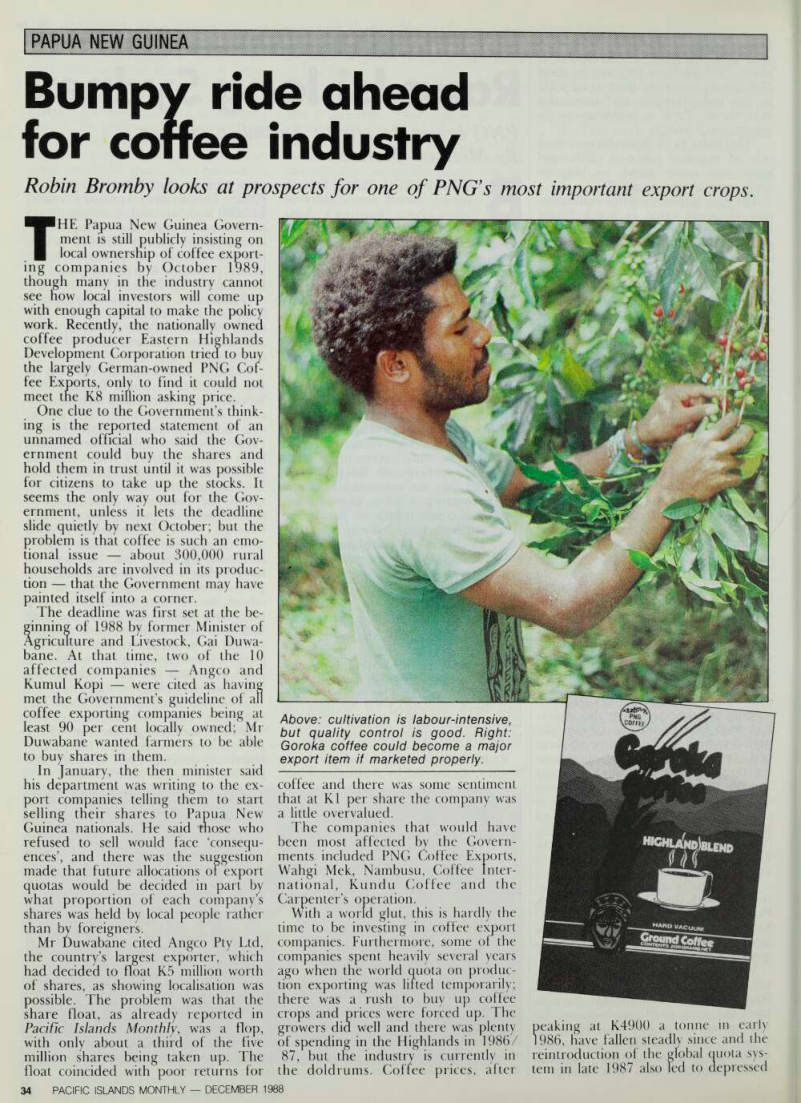
Above: cultivation is labour-intensive, but quality control is good. Right: Goroka coffee could become a major export item if marketed properly.
prices in the international market.
The quota is imposed on the main
exporting and importing countries
that are members of the International
Coffee Organisation. Papua New
Guinea cannot export all the 1.3 mil lion bags it will produce this year; the excess over the 750,000 bag export quota has to be stockpiled or can be sold to non-ICO members, which in clude China, the Eastern European countries and South Korea.
The big question each year is how well Brazil will do. A new element that some industry people believe may be come important is the greenhouse effect. Brazilian coffee growers have traditionally worried about frosts ruin ing their crops. That has not occurred in recent years; instead, Brazil has been hit by droughts in 1985 and 1988 the country’s exports in 1986 were consequently down to about 12 million bags, then up to about 35 mil lion in 1987 and the forecast total for this year is 20 million bags.
The Coffee Board in Papua New Guinea is now requiring only 75 per cent of each of tne exporting com panies to be held locally, with the same deadline of October 31. The board’s executive officer has been re ported as saying that there will be no change of mind.
Coffee exporters who spoke to PIM still insist tne plan is completely un realistic; they say there is simply not the spare equity capital in the country to meet the cost of localisation. De pressed coffee prices combined with less than 12 months to meet the dead line would defeat the Government’s timetable. Apart from Angco’s float there has been little sign of Papua New Guinea being interested in ac quiring shares, and the Eastern High lands Development Corporation is re luctant to meet the quoted price.
Meanwhile, the coffee exporters are
watching the Mt Hagen-based Panga
Coffee company owned by Walter Per dacher. He plans to begin manufac turing instant coffee, and told PIM that ne planned to have the plant operating by the end of 1990; it will be capable of processing 15,000 ton nes, about a quarter of Papua New Guinea’s annual crop. He said the main export markets would be West ern Europe and Arab countries.
While other companies view Per dacher’s plans skeptically, he has already received agreement in princi ple from the Coffee Board. The pub lished cost of the plant is K 1.5 million and it was designed as a joint venture with West German interests; Panga has already shipped beans to West
Germany for trial processing.
The success of the venture would rely on export markets in a highly
competitive industry. Papua New Gui
neans rarely drink coffee, and the ex-
patriates living in the country account for most of tne one per cent of the nation’s output consumed in PNG.
Coffee is the country’s third largest export after copra and gold: in the 1986/87 year, the crop earned the na tion K 203 million.
Smallholders account for about 70 per cent of coffee production; the average family smallholding consists of about 600 trees covering 0.15 hectares and yielding an income of K4OO a year. Plantations range between 20 and 100 ha and generally produce higher quality beans due to better cul
tivation techniques.
The industry has faced problems in recent years with the outbreak of cof
fee leaf rust. If unchecked, the rust could reduce coffee output substan
tially: the Coffee Development Agency
has estimated a decline in production from one million bags in 1987 to 300.000 bags in 1992 if the disease is not brought under control. Australia has donated K 3 million to the battle and by early 1988, 30,000 smallholder gardens had been rehabilitated, with 72.000 others being ‘attended to’.
The Coffee Research Institute has reported success with a new type of rust-resistant coffee it has been testing in the Highlands. Though trials are still at an early stage the catimor cof fee strain imported from Kenya, Por
tugal and Queensland looks as though
it might be the answer, an institute agronomist has been reported as saying. The catimor plant has other payoffs it is also more compact than the plants now grown in Papua New Guinea, so that smallholders would be able to increase the number of their trees. It is expected tests on catimor will be completed in 1992.
One export company manager, however, takes a more sanguine view.
He said that every country that has rust problems ends up with an in creased crop. Fighting the rust prob lem, he said, leads to better husbandry and **gets the growers off their tails
and growing bigger crops.” □
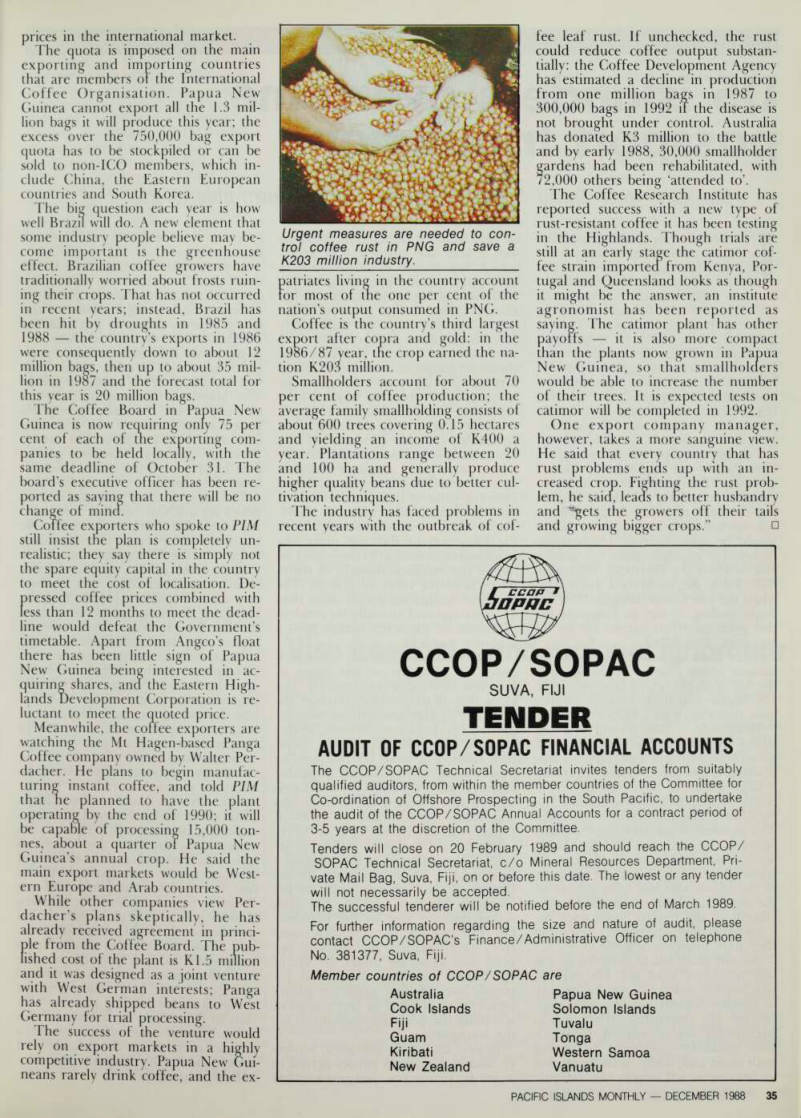
Urgent measures are needed to con trol coffee rust in PNG and save a K 203 million industry.