Medical aid on the move
pp. 31-32 · Read in the full issue
Australia
A team of Australian volunteer plastic surgeons is providing vital assistance to the
islands.
By Robert Simms
IMAGES of swaying palms and san dy beaches usually come to mind at tHe mention of the Pacific islands . . ut those islanders born with a cleft palate or badly burnt have a less idylic view of Oceania.
Plastic surgery in the Pacific Islands until 1983 was limited to major hospit als in Fiji and Papua New Guinea; and even there, lack of expertise meant only basic operations could be per formed. But an organisation called In terplast Australia has now come to the aid of islanders in need.
Interplast Australia is an association of plastic surgeons based in Mel bourne that co-ordinates small teams of surgeons, anaesthetists and nurses who travel throughout the Pacific re gion to carry out crucial plastic surgery on those with congenital and acquired deformities. Cleft lips and palates account for about 90 per cent of congenital problems, while burn scar contractures and scar revision cre ate the greatest demand for the skills
of the visiting specialists.
Interplast was conceived at Stanford University, Connecticut, in 1968: surgeons from Stanford had for years been treating congenital and burns cases from Mexico and South Amer ican countries. Because this was an ex pensive exercise that was limited to the most serious cases, they decided to take a team to the region to assess the viability of doing some of the work in the countries concerned. They found there was a huge demand for assist ance in Mexico, Ecuador, Peru and Honduras, and since then have been totally committed in that area.
The Australian group was formed after Dr Leo Rozner, a specialist who had been visiting America, returned in 1982 and spoke enthusiastically of the work being performed by the Stan ford surgeons. After consultation with the Royal Australasian College of Surgeons and initial funding from Rotary International District 980 in Melbourne, it was decided that a num ber of Australian specialists should join the American teams to see how the system worked.
Finally, in November 1983 Mr Donald Marshall, a prominent Mel bourne plastic surgeon and at that time chairman of the Division of Plas tic Surgeons within the College, led the first all-Australian team to Fiji and operated on 60 cases at the Colonial War Memorial Hospital in Suva.
The success of those operations led to requests for more help; it was evident the need for this service in the pacific was as great as in Central and South America, and Pacific countries
including Tonga, Solomon Islands,
Vanuatu, Western Samoa, Tuvalu, Kiribati and, more recently, the Cook Islands have since been included, As the demand increased, additional financial backing was sought from the Australian Government through the Australian International Development Assistance Bureau (AIDAB). Funding covering about 80 per cent of expenses has been made available, with additional help from Rotary International and general donations.
Donald Marshall, now vice-president of Interplast Australia, explains that the surgeons are volunteers. “All Interplast pays is the airfares and the cost of accommodation,” he says.
“Of course, all of these specialists are in private practice, so the main cost to them is their lack of earnings while away. This limits the length of the trips to two weeks for the majority of the surgeons.”
What, tnen, is the motivation for
specialists who give their time freely,
yet pay for the privilege? Dr Richard Barnett, a Sydney surgeon who has been to Labasa, Fiji, feels that though the surgery was generally routine, he receives a tremendous amount of per sonal satisfaction from the work.
“The children were the best patients that I’ve had,” he says. “They do ex actly what’s asked of them! Tne enor mous smiles of the parents and the amazing hospitality of the islanders made the trip memorable.”
Donald Marshall goes further, saying that the true plastic surgeon is very attracted to the roots of the pro fession to work for people who are genuinely disfigured. “In the western world,” he explains, “the origins of
plastic surgery early this century in
the ravages of war and disease nave become less of a dominant factor, while cosmetic surgery is now more prominent.” But while cosmetic
surgery is intellectually stimulating
and financially rewarding, surgery for those who need it is more fulfilling.
During the year to June 1987, more than 1200 consultations and almost ►
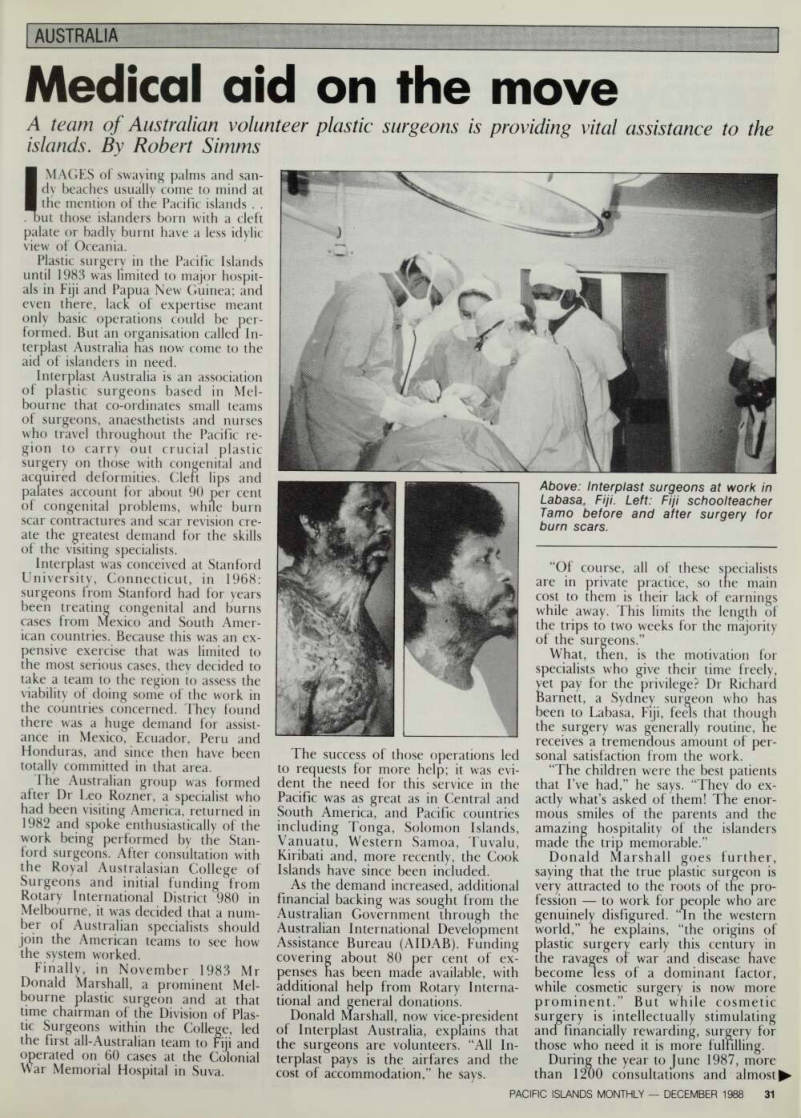
Above: Interplast surgeons at work in Labasa, Fiji. Left: Fiji schoolteacher Tamo before and after surgery for burn scars.
operations were carried out in Pacific countries, bringing the total number of operations to 2100 in the four years since the inception of Inter plast Australia.
Apart from the transport costs to hospital for those who live on outlying islands, no payment is expected from the patients, yet their quality of life
improves immeasurably. Donald Mar
shall recalls a particular patient, a teacher from Rakiraki in Fiji. “His name is Tamo, and he was so terribly burnt on his hands and face that he couldn’t even hold the chalk to draw on the blackboard,” Mr Marshall says.
It was decided that Tamo’s case was too complicated and time consuming to handle in Fiji, so he was transferred to a private hospital in Melbourne.
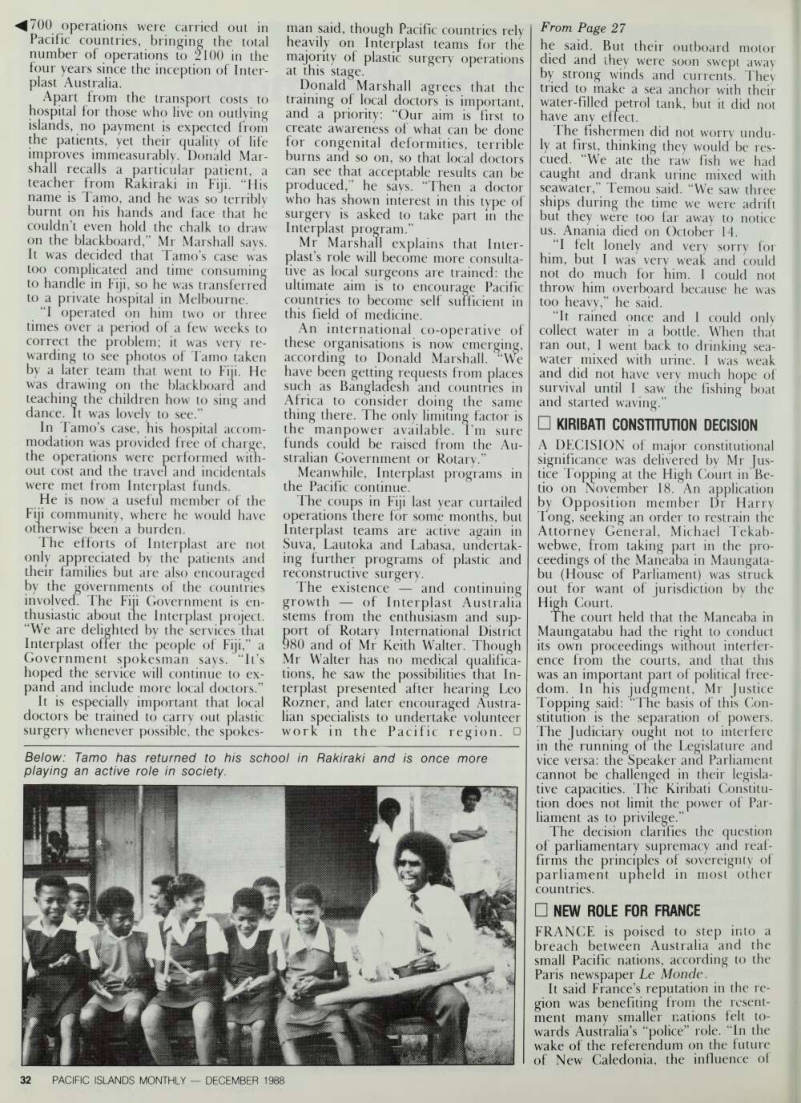
“I operated on him two or three times over a period of a few weeks to correct the problem; it was very re warding to see photos of Tamo taken by a later team that went to Fiji. He was drawing on the blackboard and teaching the children how to sing and dance. It was lovely to see.”
In Tamo’s case, his hospital accom modation was provided free of charge, the operations were performed with out cost and the travel and incidentals were met from Interplast funds.
He is now a useful member of the Fiji community, where he would have otherwise been a burden.
The efforts of Interplast are not
only appreciated by the patients and
their families but are also encouraged by the governments of the countries involved. The Fiji Government is en thusiastic about the Interplast project.
“We are delighted by the services that Interplast offer the people of Fiji,” a Government spokesman says. “It’s hoped the service will continue to ex pand and include more local doctors.”
It is especially important that local doctors be trained to carry out plastic surgery whenever possible, the spokes
man said, though Pacific countries rely heavily on Interplast teams for the majority of plastic surgery operations at this stage.
Donald Marshall agrees that the training of local doctors is important, and a priority: “Our aim is first to create awareness of what can be done for congenital deformities, terrible burns and so on, so that local doctors can see that acceptable results can be produced,” he says. “Then a doctor who has shown interest in this type of surgery is asked to take part m the Interplast program.”
Mr Marshall explains that Inter plast’s role will become more consulta tive as local surgeons are trained: the ultimate aim is to encourage Pacific countries to become self sufficient in this field of medicine.
An international co-operative of these organisations is now emerging, according to Donald Marshall. “We have been getting requests from places such as Bangladesh and countries in Africa to consider doing the same thing there. The only limiting factor is the manpower available. I’m sure funds could be raised from the Au stralian Government or Rotary.”
Meanwhile, Interplast programs in the Pacific continue.
The coups in Fiji last year curtailed operations there for some months, but Interplast teams are active again in Suva, Lautoka and Labasa, undertak ing further programs of plastic and reconstructive surgery.
The existence and continuing growth of Interplast Australia stems from the enthusiasm and sup port of Rotary International District 980 and of Mr Keith Walter. Though Mr Walter has no medical qualifica tions, he saw the possibilities that In terplast presented after hearing Leo Rozner, and later encouraged Austra lian specialists to undertake volunteer work in the Pacific region. □
Below: Tamo has returned to his school in Rakiraki and is once more playing an active role in society.