Nouméa’s Window On Kanak Culture
pp. 36-37 · Read in the full issue
New Caledonia
Emmanuel Kasarherou is exposing the “fantastic force” of his homeland’s
heritage to a broader audience.
By Nicolas Rothwell
FROM a discreet office behind the display area of Noumea’s Museum, the youthful Emmanuel Kasar herou. director of New Caledonia’s Serv ice des Musees et Patrimoine, is presiding over a far-reaching project to restore in terest in Kanak culture.
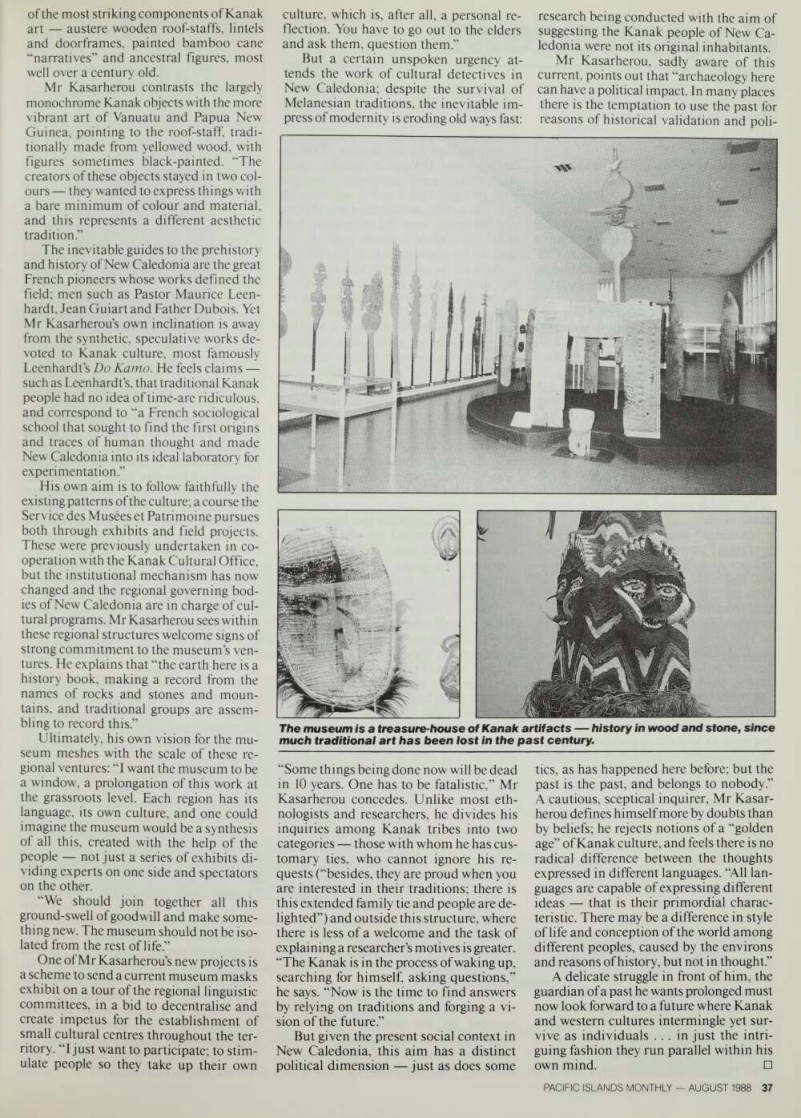
Just two years away from his doctorate in prehistory at the Sorbonne, the 27- year old half-French, half-Kanak stands at the crossroads of western and Melanesian cul tures. Both museum curator and director of an archaeological program, he must manage his ambitious venture with only three scientific workers.
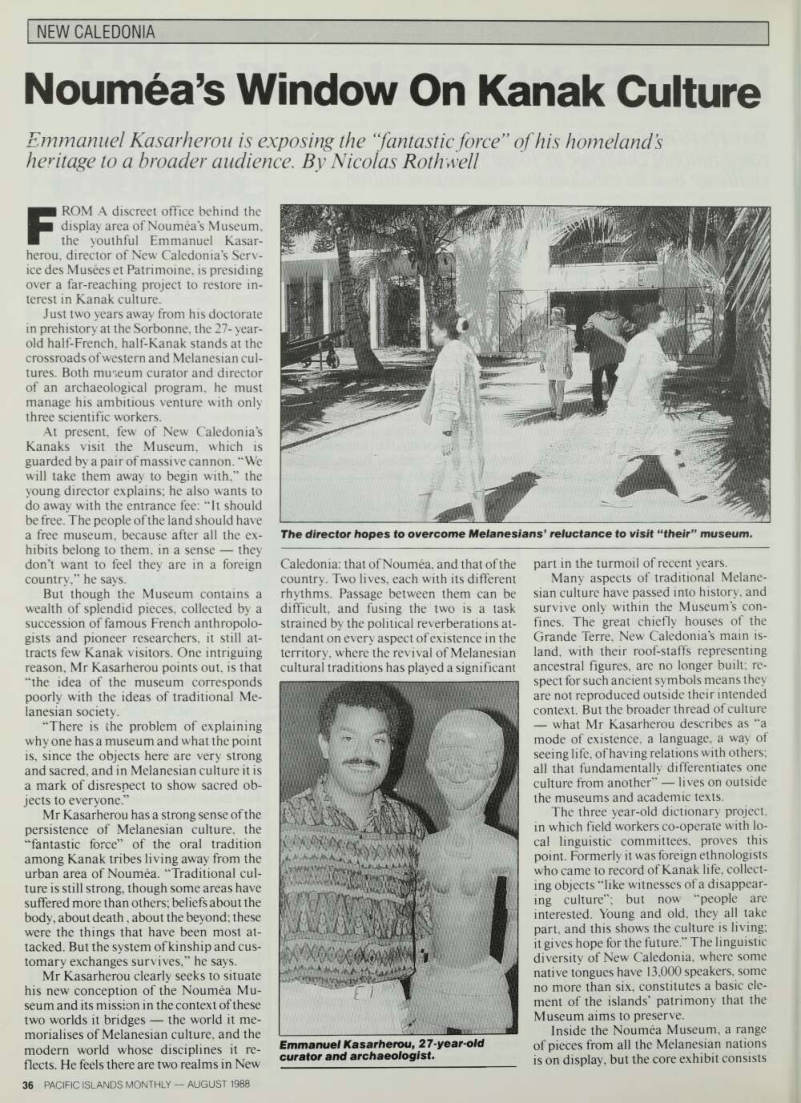
At present, few of New Caledonia’s Kanaks visit the Museum, which is guarded by a pair of massive cannon. “We will take them away to begin with,” the young director explains: he also wants to do away with the entrance fee: “It should be free. The people of the land should have a free museum, because after all the ex hibits belong to them, in a sense they don’t want to feel they are in a foreign country,” he says.
But though the Museum contains a wealth of splendid pieces, collected by a succession of famous French anthropolo gists and pioneer researchers, it still at tracts few Kanak visitors. One intriguing reason, Mr Kasarherou points out, is that “the idea of the museum corresponds poorly with the ideas of traditional Me lanesian society.
“There is the problem of explaining why one has a museum and what the point is, since the objects here are very strong and sacred, and in Melanesian culture it is a mark of disrespect to show sacred ob jects to everyone.”
Mr Kasarherou has a strong sense of the persistence of Melanesian culture, the “fantastic force” of the oral tradition among Kanak tribes living away from the urban area of Noumea. “Traditional cul ture is still strong, though some areas have suffered more than others: beliefs about the body, about death, about the beyond: these were the things that have been most at tacked. But the system of kinship and cus tomary exchanges survives,” he says.
Mr Kasarherou clearly seeks to situate his new conception of the Noumea Mu seum and its mission in the context of these two worlds it bridges the world it me morialises of Melanesian culture, and the modern world whose disciplines it re flects. He feels there are two realms in New
Caledonia: that of Noumea, and that of the country. Two lives, each with its different rhythms. Passage between them can be difficult, and fusing the two is a task strained by the political reverberations at tendant on every aspect of existence in the lerritory, where the revival of Melanesian cultural traditions has played a significant
part in the turmoil of recent years.
Many aspects of traditional Melane sian culture have passed into history, and survive only within the Museum’s con fines. The great chiefly houses of the Grande Terre. New Caledonia’s main is land, with their roof-staffs representing ancestral figures, are no longer built: re spect for such ancient symbols means they are not reproduced outside their intended context. But the broader thread of culture what Mr Kasarherou describes as “a mode of existence, a language, a way of seeing life, of having relations with others: all that fundamentally differentiates one culture from another” lives on outside the museums and academic texts.
The three year-old dictionary project, in which field workers co-operate with lo cal linguistic committees, proves this point. Formerly it was foreign ethnologists who came to record of Kanak life, collect ing objects “like witnesses of a disappear ing culture”; but now “people are interested. Young and old, they all take part, and this shows the culture is living: it gives hope for the future.” The linguistic diversity of New Caledonia, where some native tongues have 13,000 speakers, some no more than six, constitutes a basic ele ment of the islands’ patrimony that the Museum aims to preserve.
Inside the Noumea Museum, a range of pieces from all the Melanesian nations is on display, but the core exhibit consists
Emmanuel Kasarherou, 27-year-old curator and archaeologist.
The director hopes to overcome Melanesians’ reluctance to visit “their” museum.
of the most striking components of Kanak art austere wooden roof-staffs, lintels and doorframes, painted bamboo cane “narratives” and ancestral figures, most well over a century old.
Mr Kasarherou contrasts the largely monochrome Kanak objects with the more vibrant art of Vanuatu and Papua New Guinea, pointing to the roof-staff, tradi tionally made from yellowed wood, with figures sometimes black-painted. “The creators of these objects stayed in two col ours they wanted to express things with a bare minimum of colour and material, and this represents a different aesthetic tradition.”
The inevitable guides to the prehistory and history of New Caledonia are the great French pioneers whose works defined the field; men such as Pastor Maurice Leen hardt, Jean Guiart and Father Dubois. Yet Mr Kasarherou’s own inclination is away from the synthetic, speculative works de voted to Kanak culture, most famously Leenhardt’s Do Kamo. He feels claims such as Leenhardt’s, that traditional Kanak people had no idea of time-are ridiculous, and correspond to “a French sociological school that sought to find the first origins and traces of human thought and made New Caledonia into its ideal laboratory for experimentation.”
His own aim is to follow faithfully the existing patterns of the culture; a course the Service des Musees et Patrimoine pursues both through exhibits and field projects.
These were previously undertaken in co operation with the Kanak Cultural Office, but the institutional mechanism has now changed and the regional governing bod ies of New Caledonia are in charge of cul tural programs. Mr Kasarherou sees within these regional structures welcome signs of strong commitment to the museum’s ven tures. He explains that “the earth here is a history book, making a record from the names of rocks and stones and moun tains, and traditional groups are assem bling to record this.”
Ultimately, his own vision for the mu seum meshes with the scale of these re gional ventures: “I want the museum to be a window, a prolongation of this work at the grassroots level. Each region has its language, its own culture, and one could imagine the museum would be a synthesis of all this, created with the help of the people not just a series of exhibits di viding experts on one side and spectators on the other.
“We should join together all this ground-swell of goodwill and make some thing new. The museum should not be iso lated from the rest of life.”
One of Mr Kasarherou’s new projects is a scheme to send a current museum masks exhibit on a tour of the regional linguistic committees, in a bid to decentralise and create impetus for the establishment of small cultural centres throughout the ter ritory. “I just want to participate; to stim ulate people so they take up their own
culture, which is, after all, a personal reflection. You have to go out to the elders and ask them, question them.”
But a certain unspoken urgency attends the work of cultural detectives in New Caledonia; despite the survival of Melanesian traditions, the inevitable impress of modernity is eroding old ways fast:
“Some things being done now will be dead in 10 years. One has to be fatalistic,” Mr Kasarherou concedes. Unlike most ethnologists and researchers, he divides his inquiries among Kanak tribes into two categories those with whom he has customary ties, who cannot ignore his requests (“besides, they are proud when you are interested in their traditions; there is this extended family tie and people are delighted”) and outside this structure, where there is less of a welcome and the task of explaining a researcher’s motives is greater, “The Kanak is in the process of waking up, searching for himself, asking questions,” he says. “Now is the time to find answers by relying on traditions and forging a vision of the future.”
But given the present social context in New Caledonia, this aim has a distinct political dimension just as does some
research being conducted with the aim of suggesting the Kanak people of New Ca ledonia were not its original inhabitants.
Mr Kasarherou, sadly aware of this current, points out that “archaeology here can have a political impact. In many places there is the temptation to use the past for reasons of historical validation and poli
tics, as has happened here before; but the past is the past, and belongs to nobody.”
A cautious, sceptical inquirer, Mr Kasar herou defines himself more by doubts than by beliefs; he rejects notions of a “golden age” of Kanak culture, and feels there is no radical difference between the thoughts expressed in different languages. “All lan guages are capable of expressing different ideas that is their primordial charac teristic. There may be a difference in style of life and conception of the world among different peoples, caused by the environs and reasons of history, but not in thought.”
A delicate struggle in front of him, the guardian of a past he wants prolonged must now look forward to a future where Kanak and western cultures intermingle yet sur vive as individuals ... in just the intri guing fashion they run parallel within his own mind. □
The museum is a treasure-house of Kanak artifacts - history in wood and stone, since much traditional art has been lost in the past century.