Book Reviews
pp. 38-40 · Read in the full issue
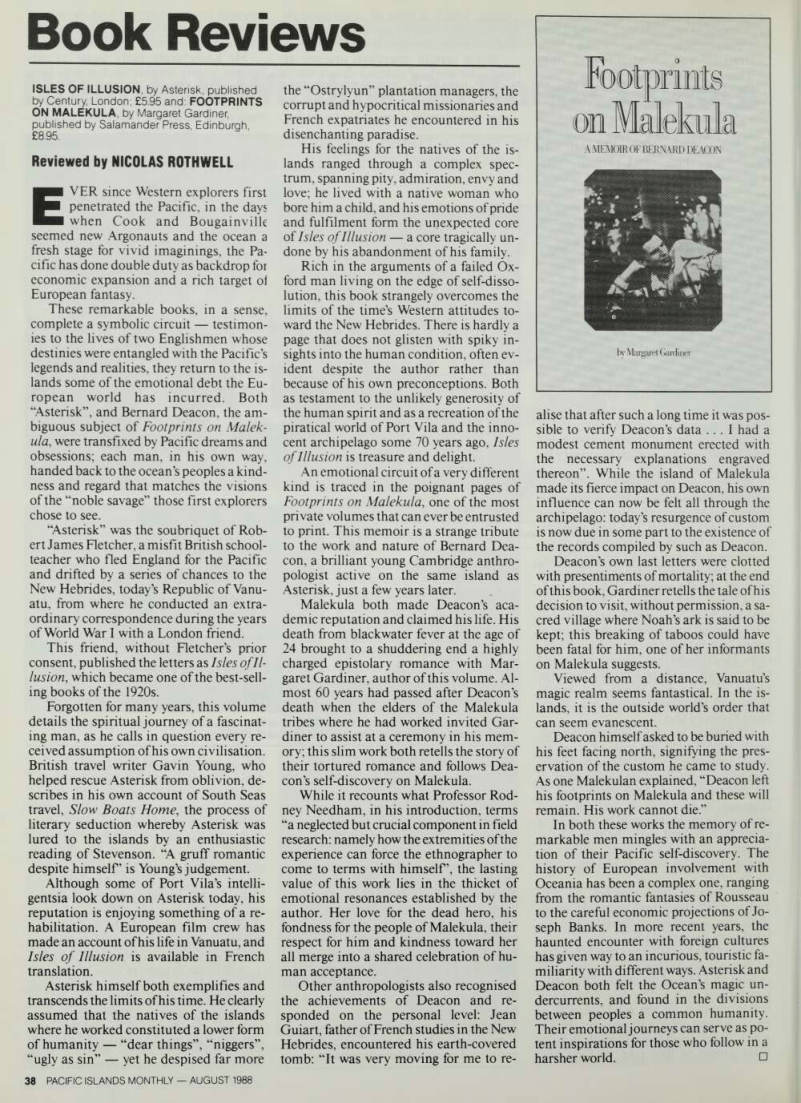

ISLES OF ILLUSION, by Asterisk, published by Century, London; £5.95 and FOOTPRINTS ON MALEKULA. by Margaret Gardiner, published by Salamander Press, Edinburgh, £8.95.
Reviewed by NICOLAS ROTHWELL EVER since Western explorers first penetrated the Pacific, in the days when Cook and Bougainville seemed new Argonauts and the ocean a fresh stage for vivid imaginings, the Pa cific has done double duty as backdrop for economic expansion and a rich target ol European fantasy.
These remarkable books, in a sense, complete a symbolic circuit testimon ies to the lives of two Englishmen whose destinies were entangled with the Pacific’s legends and realities, they return to the is lands some of the emotional debt the Eu ropean world has incurred. Both “Asterisk”, and Bernard Deacon, the am biguous subject of Footprints on Malek ula, were transfixed by Pacific dreams and obsessions; each man, in his own way, handed back to the ocean’s peoples a kind ness and regard that matches the visions of the “noble savage” those first explorers chose to see.
“Asterisk” was the soubriquet of Rob ert James Fletcher, a misfit British school teacher who fled England for the Pacific and drifted by a series of chances to the New Hebrides, today’s Republic of Vanu atu, from where he conducted an extra ordinary correspondence during the years of World War I with a London friend.
This friend, without Fletcher’s prior consent, published the letters as Isles of Il lusion, which became one of the best-sell ing books of the 19205.
Forgotten for many years, this volume details the spiritual journey of a fascinat ing man, as he calls in question every re ceived assumption of his own civilisation.
British travel writer Gavin Young, who helped rescue Asterisk from oblivion, de scribes in his own account of South Seas travel, Slow Boats Home, the process of literary seduction whereby Asterisk was lured to the islands by an enthusiastic reading of Stevenson. “A gruff romantic despite himself’ is Young’s judgement.
Although some of Port Vila’s intelli gentsia look down on Asterisk today, his reputation is enjoying something of a re habilitation. A European film crew has made an account of his life in Vanuatu, and Isles of Illusion is available in French translation.
Asterisk himself both exemplifies and transcends the limits of his time. He clearly assumed that the natives of the islands where he worked constituted a lower form of humanity “dear things”, “niggers”, “ugly as sin” yet he despised far more
the “Ostrylyun” plantation managers, the corrupt and hypocritical missionaries and French expatriates he encountered in his disenchanting paradise.
His feelings for the natives of the is lands ranged through a complex spec trum, spanning pity, admiration, envy and love; he lived with a native woman who bore him a child, and his emotions of pride and fulfilment form the unexpected core of Isles of Illusion a core tragically un done by his abandonment of his family.
Rich in the arguments of a failed Ox ford man living on the edge of self-disso lution, this book strangely overcomes the limits of the time’s Western attitudes to ward the New Hebrides. There is hardly a page that does not glisten with spiky in sights into the human condition, often ev ident despite the author rather than because of his own preconceptions. Both as testament to the unlikely generosity of the human spirit and as a recreation of the piratical world of Port Vila and the inno cent archipelago some 70 years ago, Isles of Illusion is treasure and delight.
An emotional circuit of a very different kind is traced in the poignant pages of Footprints on Malekula , one of the most private volumes that can ever be entrusted to print. This memoir is a strange tribute to the work and nature of Bernard Dea con, a brilliant young Cambridge anthro pologist active on the same island as Asterisk, just a few years later.
Malekula both made Deacon’s aca demic reputation and claimed his life. His death from blackwater fever at the age of 24 brought to a shuddering end a highly charged epistolary romance with Mar garet Gardiner, author of this volume. Al most 60 years had passed after Deacon’s death when the elders of the Malekula tribes where he had worked invited Gar diner to assist at a ceremony in his mem ory; this slim work both retells the story of their tortured romance and follows Dea con’s self-discovery on Malekula.
While it recounts what Professor Rod ney Needham, in his introduction, terms “a neglected but crucial component in field research: namely how the extremities of the experience can force the ethnographer to come to terms with himself’, the lasting value of this work lies in the thicket of emotional resonances established by the author. Her love for the dead hero, his fondness for the people of Malekula, their respect for him and kindness toward her all merge into a shared celebration of hu man acceptance.
Other anthropologists also recognised the achievements of Deacon and re sponded on the personal level: Jean Guiart, father of French studies in the New Hebrides, encountered his earth-covered tomb: “It was very moving for me to re
alise that after such a long time it was pos sible to verify Deacon’s data ... I had a modest cement monument erected with the necessary explanations engraved thereon”. While the island of Malekula made its fierce impact on Deacon, his own influence can now be felt all through the archipelago: today’s resurgence of custom is now due in some part to the existence of the records compiled by such as Deacon.
Deacon’s own last letters were clotted with presentiments of mortality; at the end of this book, Gardiner retells the tale of his decision to visit, without permission, a sa cred village where Noah’s ark is said to be kept; this breaking of taboos could have been fatal for him, one of her informants on Malekula suggests.
Viewed from a distance, Vanuatu’s magic realm seems fantastical. In the is lands, it is the outside world’s order that can seem evanescent.
Deacon himself asked to be buried with his feet facing north, signifying the pres ervation of the custom he came to study.
As one Malekulan explained, “Deacon left his footprints on Malekula and these will remain. His work cannot die.”
In both these works the memory of re markable men mingles with an apprecia tion of their Pacific self-discovery. The history of European involvement with Oceania has been a complex one, ranging from the romantic fantasies of Rousseau to the careful economic projections of Jo seph Banks. In more recent years, the haunted encounter with foreign cultures has given way to an incurious, touristic fa miliarity with different ways. Asterisk and Deacon both felt the Ocean’s magic un dercurrents, and found in the divisions between peoples a common humanity.
Their emotional journeys can serve as po tent inspirations for those who follow in a harsher world. □
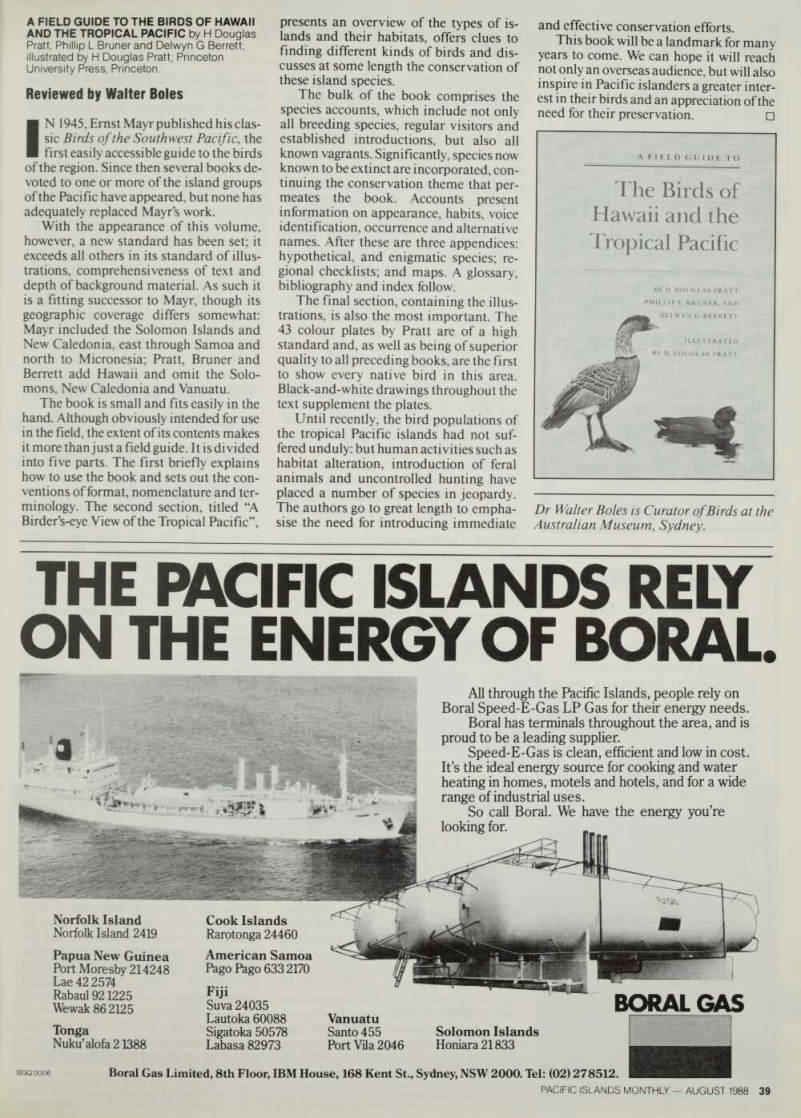
A FIELD GUIDE TO THE BIRDS OF HAWAII AND THE TROPICAL PACIFIC by H Douglas Pratt, Phillip L Bruner and Delwyn G Berrett; illustrated by H Douglas Pratt; Princeton University Press, Princeton.
Reviewed by Walter Boies IN 1945, Ernst Mayr published his clas sic Birds of the Southwest Pacific , the first easily accessible guide to the birds of the region. Since then several books de voted to one or more of the island groups of the Pacific have appeared, but none has adequately replaced Mayr’s work.
With the appearance of this volume, however, a new standard has been set; it exceeds all others in its standard of illus trations, comprehensiveness of text and depth of background material. As such it is a fitting successor to Mayr, though its geographic coverage differs somewhat: Mayr included the Solomon Islands and New Caledonia, east through Samoa and north to Micronesia; Pratt, Bruner and Berrett add Hawaii and omit the Solo mons, New Caledonia and Vanuatu.
The book is small and fits easily in the hand. Although obviously intended for use in the field, the extent of its contents makes it more than just a field guide. It is divided into five parts. The first briefly explains how to use the book and sets out the con ventions of format, nomenclature and ter minology. The second section, titled “A Birder’s-eye View of the Tropical Pacific”,
presents an overview of the types of is lands and their habitats, offers clues to finding different kinds of birds and dis cusses at some length the conservation of these island species.
The bulk of the book comprises the species accounts, which include not only all breeding species, regular visitors and established introductions, but also all known vagrants. Significantly, species now known to be extinct are incorporated, con tinuing the conservation theme that per meates the book. Accounts present information on appearance, habits, voice identification, occurrence and alternative names. After these are three appendices: hypothetical, and enigmatic species; re gional checklists; and maps. A glossary, bibliography and index follow.
The final section, containing the illus trations, is also the most important. The 43 colour plates by Pratt are of a high standard and, as well as being of superior quality to all preceding books, are the first to show every native bird in this area.
Black-and-white drawings throughout the text supplement the plates.
Until recently, the bird populations of the tropical Pacific islands had not suf fered unduly: but human activities such as habitat alteration, introduction of feral animals and uncontrolled hunting have placed a number of species in jeopardy.
The authors go to great length to empha sise the need for introducing immediate
and effective conservation efforts.
This book will be a landmark for many years to come. We can hope it will reach not only an overseas audience, but will also inspire in Pacific islanders a greater inter est in their birds and an appreciation of the need for their preservation. □
Dr Walter Boles is Curator of Birds at the Australian Museum, Sydney.
New Caledonia Or Kanaky?: The
Political History of a French Colony by John Connell, Australian National University National Centre for Development Studies Pacific Research Monograph No 16, 1988. $25.
Reviewed by Michael Spencer
SURROUNDED by independent island states such as Vanuatu, Fiji and Papua New Guinea (all of them Melanesian), New Caledonia’s status is of ficially that of a French overseas territory.
though many observers (including John Connell and myself) would regard it as in essence still a colony; Nor does it have any immediate pros pect of independence and if it ever be came independent, Connell argues that nothing dramatic would occur, in eco nomic terms at least. In other words New Caledonia, like many of its neighbours and despite its apparent mineral wealth (nickel, cobalt and so on), would continue its cur rent economic dependence; both on the world economy and on foreign aid. A re treat into coutume and reliance on tradi tional values and structures or subsistence agriculture alone is no longer possible for the Kanaks: New Caledonia is part of the modern world and Kanak society must adapt though exactly how is the subject of much debate on the part of Kanaks and non-Kanaks.
Connell’s book is an important one. It is probably the most comprehensive sin gle-author work ever to be written on New Caledonia, for while it is presented as a political history, it is informed by the ex pertise of a geographer and an economist who also uses a wide range of sources for his discussion of Melanesian society and the international context (strangely, how ever, George Pisier’s Bibliographie de la Nouvelle-Caledonieis not listed in the 28page bibliography). Virtually every aspect of New Caledonia since its original settle ment is covered: European discovery, French colonisation and the subsequent acquisition of land, Melanesian revolts, the development of the mineral industry, non- European immigration and especially the post-1945 period.
The author’s sympathies are made clear, but his discussion of the 1878 Kanak revolt, for example, is a careful and useful review of a wide range of interpretations and his account of the choices and dilem mas faced by the current independence movement, particularly the debate over economic and cultural strategy, is balanced.
Simply because of its lucidity, how ever, the book makes depressing reading.
Virtually every recipe for disaster appears to have been tried (and to have succeeded) in New Caledonia, from attempts to grow sugar cane or coffee which is actually imported so it can be re-sold as Cafe Me lanesienl) to persistent French govern ment intervention in the 1960 s and 70s to sabotage the development of a genuinely multiracial society and autonomy. Con nell argues, as I have done, that “contin ued French rejection of demands for autonomy pushed [the UC, largest com ponent of the FLNKS] toward independ ence”. From Jacquinot in 1963 to Bernard Pons in 1988, whenever consensus or con ciliation appeared possible it was sub verted by Paris with the connivance of the
local right and extreme right. In 1953, for example, the Union Caledonienne, sup ported by Melanesians, petits blancs and even some metropolitan French, won 15 out of 25 seats in the local Assembly with a policy of considerable autonomy, with France being asked to retain control of only foreign affairs, defence and finance all of which sounds suspiciously like the 1985 Pisani plan. Is it then any wonder then, that, 35 years later, many Kanaks have fi nally lost patience?
In his discussion of the international context, Connell reminds us of the reasons (basically strategic, but also cultural and economic) behind France’s determination to stay in this part of the world. They may be legitimate but “the ambiguity and style of France’s purported balance of power in the Pacific ... is such that serious doubt must be attached to its present and future role in contributing to the consolidation and stabilisation of democracies in the re gion”. For this kind of reason, “future prospects [for New Caledonia] are partic ularly unpleasant”: France’s colonial pol icies “have created a nation where one had never existed before”, but it is in a minor ity in its own homeland.
I note in passing that Connell might appear to be agreeing with an argument developed by the right-wing and highly controversial French writer Alain Fin kielkraut, in La Defaite de la Pensee (The Defeat of Thought ), published last year: that national liberation movements are virtually obliged to create a false concept of ethnic nationhood instead of a free or “elective” one. However, it is clear from Connell’s account of the debate on the 1979 Dijoud Plan that he accepts the genuine ness of the claim that the concept of Kanak independence is not inherently racist.
But the concept is clearly open to mis interpretation, and while within the con text of Melanesian nationalism it could hardly not be used by the UC and later the FLNKS, it has certainly not reassured a fair number of “floating voters” in New Caledonia. Perhaps one should question seriously the principle of “one person, one vote” in situations such as New Cale donia, where a large ethnic minority is so persistently and dishonestly denied its le gitimate aspirations.
Connell’s book should be on the shelves of everyone genuinely interested in New Caledonia and the South Pacific region. Its seriousness, comprehensiveness and lu cidity more than compensate for the mis prints, the not particularly attractive presentation and the occasional mistranslation. □
Dr Michael Spencer is Processor of French at the University of Queensland and an authority in French involvement in the South Pacific.