Pacific
Islands
Monthly
nmcnuau oai nua uo<pc.UU Australia A 52.00 Cook Islands NZ$3.OO Fiji F 51.75 Hawaii US$2.5O Kiribati A 52.00 Nauru A 52.00 New Caledonia CFP2SO New Zealand NZ$3.OO Niue NZ$2.5O Norfolk Island A 52.00 Papua New Guinea K 2.00 Solomon Islands 552.00 Tahiti CFP3OO Tonga P 2.00 Tuvalu A 52.00
Usa Us$3.Oo
USTT and Guam US$2.5O Vanuatu VT2.00 Western Samoa T 2.75 ♦Recommended retail price only
August, 1988
Tonga Celebrates
New Caledonia Peace or Ruin?
Up Ip- \ 'ifc I y, ... m PM Moves v F HB SMMd % % 4 m ■ .. •
■ am m m ''' am
Special Report
Today**?
Advertisements & other items, pp. 2-4 (1 item)
A symphony on wheels.
Our search for the
ultimate in rear wheel
control technology
makes every Mazda
driver a maestro.
Truly great music gives you a feeling of freedom and of joy. At Mazda, we believe this is also the feeling you should get from driving a truly great car; a car like the new Mazda 626.
Its unique suspension geometry is tuned with the precision of a Stradivarius. And the results are sensational. High speed lane changes become smooth legato passages.
Cornering loses its histrionic swerving. All that remains is extraon dinary control.
What’s behind it all.
The reason is that Mazda has been concentrating on developing rear wheel suspension systems that actually help steer the car. It starteo with the award winning TTL suspension found on the 323 and the original 626.
The search for the ultimate ontinued with the development of i 4-Wheel Steering system. What we earned in that search was applied to he development of our award winning DTS System for the RX-7 md the E-Link suspension for the •29. This continuous process of efinement has come full circle again o the new 626, and applied to its PTL suspension. We’ve completely recalculated its suspension geometry to deliver a feeling of control that’s clearly superior and absolutely exhilarating.
Keeping on our toes.
It’s Mazda’s unique dedication to engineering the ultimate in rear wheel toe control and suspension technology that has resulted in such enjoyable driving in the Mazda 626.
And in fact, in all Mazda vehicles.
But don’t take our word for it.
Take one out for a drive, and become a maestro of the road.
New Mazda 626 Models and features shown may not be available in your area. Please consult your local Mazda dealer. This warranty is valid only in Australia.
Your kind of car. © Mazda Motor Corporation
A NEW DRIVING
EXPERIENCE
m
SL-A
a&g i
tiaa^llis
•IliiiiS
In better shape here
A^NIPkVSJ
A HIGHER STANDARD:
ALL NEW COROLLAS NOW COME WITH
TOYOTA MULTI-VALVE ENGINES.
Here is a blend of elegance and performance usually found only in big, luxury cars. That’s because Toyota believes everyone should enjoy the newest automotive advancements. And the latest example of this thinking is the all-new Corolla. It has an elegantly rounded shape to be proud of. And the high output and efficient multi-valve engine in all Corollas puts their performance in far better shape.
Expand your driving experience to new horizons with the all-new Corolla. Toyota World’s No. 1 producer of multi-valve engines.
TOYOTA
Pacific
Islands
Monthly
Vol 59. No. 8
Voice Of The Pacific
August, ’BB
Cover Story ie
As Tonga’s ruler, Taufa’ahau Tupou IV, celebrates his 70th birthday and 21 years as monarch of Polynesia’s sole remaining kingdom his people pay homage to a man who has maintained stable government and a modest degree of prosperity amid an ocean of turmoil.
Yet all is not as it seems in Tonga, and the commoners’ search for greater representation is becoming louder. Although His Majesty can assert with some confidence that the breakdown of the monarchy and majority rule will not happen in his lifetime, he is widely believed to be supportive of change in the Pacific’s most conservative nation.
Cover Photograph: Rizzoli/Austral International
WINGTI OUSTED AND NAMALIU STEPS IN 10
PNG has a new PM, but stability may still be far off
Diro To Face Criminal Prosecution 13
Controversial minister admits “wrongdoing”
NUCLEAR VICTIMS FIGHT FOR A NEW HOME 14 Rongelap’s ailing people claim they were used as guinea-pigs
New Caledonia’S New Deal 18
Michel Rocards compact with the territory could spell peace
Special Report: What Future
For Transport? 21
Aviation and shipping face growing problems
Conserving The Region’S Botanical
Heritage 28
Hawaii strives to save endangered species
Page 10
Page 52
Marshalls Overwhelmed By
A Junk-Food Diet 44
How cola won out over coconuts on island tables
Aggie Grey Remembered 52
Stuart Inder pays tribute to a South Seas legend
Marimed’S “Floating Doctors”
Bring Health 30
A gift of life to remote islands from the USA
Forum: Indonesia’S Deadly
Diplomacy 32
A controversial analysis of a gift gone wrong
Tonga’S Rebel Journalist Tilts
At Nobles’ Privileges 35
Akilisi Pohiva is threatening the status quo
New Caledonian Heritage On
Display 36
An overworked curator’s battles
Acting Editor Carson Creagh Art Director Warren Scott Editorial Adviser John Carter Contributors Robert Aldrich Robin Bromby David Hyndman Stuart tnder David Robie Nicolas Rothwell Peter Schroeder Frank Senge Rodney Smith Gabriel Singh Phil Twyford Deborah Woodside Gabriel Singh Publisher and Managing Editor Geoffrey Hussey Advertising Sales Sydney & Melbourne — Warren Grey (02) 288 3521 Fergus Maclagan (02) 412 3918; Brisbane — Robert Walker (07) 371 0533 Adelaide — Hastwell Williamson Representations (08) 79 9522
Cover prices are recommended retail only. Registered by Australia Post, publication No. NBPI2K). Copyright, Fiji Times Limited, Suva, Fiji.
Advertisements & other items, pp. 5-7 (4 items)
Departments
OPINION 7
BOOKS 38
PACIFIC REPORT 42
ISLAND PRESS 45
TROPICALITIES 46
TRADE WINDS 48
STAMPS 51
TRANSITION 52
SHIPPING 54
OUT OF THE PAST 58
5
PACIFIC ISLANDS MONTHLY AUGUST 1988
A Fiji Times Limited Production.
Founded 1930 (USPS 952480) 2o Gor don Street, Suva, Fiji; Telex: FJ2124; Fax: (679) 301521; GPO Box 1167, Suva, Fiji; Telephone: (679)31 4111.
Pacific Islands Monthly (APPS No.
NBP 1210) is published monthly by Pa cific Publications Pty Ltd, a division of Nationwide News, 2 Holt St, Surry Hills, NSW 2010. Second class postage paid at Honolulu, Hawaii, POSTMASTER.
Send address changes to PACIFIC IS
LANDS MONTHLY, PO Box 22250,
Honolulu, Hawaii 96822. Typeset by David Graphics, Sydney, and printed by Fiji Times Limited, 20 Gordon Street,
Suva, Fiji.
Super Power
FOR BIG SOUND EXCITEMENT
Super high power of 1000 watts (PMPO), with three-way speakers and full remote control. That’s the X-88 system, bringing big sound excitement to your listening room. Plus, features like graphic equalizer sound control, a double cassette deck with high speed dubbing, quartz synthesizer tuning with one-touch station memory presets, and more give you the edge in convenient music enjoyment.
The AIWA X-88: yours for unforgettable sound excitement.
MOOw
11 a w laipiP ■ K
AIWA
Stereo Component System X-88 Mobex Pty., Ltd. 12 Barcoo Street, East Roseville, Sydney, N.S.W. 2069, AUSTRALIA PHONE: (02)-406-6277/Oceania Indent Agency (P.N.G.) Pty., Ltd. Ago St., Gordon Box 5518, Boroko Port Moresby, Papua New Guinea PHONE: 256411/The Sound Centre Ltd. P.O. Box 434 Port Vila, Vanuatu PHONE; 2035/P. Hargovind Bros. 190 Renwick Road P.O. Box 490 Suva Fiji PHONE: 24350/Hardy Distributors Ltd. P.O. Box 5919, 5 Howe Street, Auckland New Zealand PHONE: (09) 399-175/Hifivox 79, rue de Sebastopol, B.P. 1458, Noumea, New Caledonia PHONE: 27. 24. 66/Haryest Pacific Limited G.P.O. Box 517. Honiara. Solomon Islands PHONE: 131/Fare Hi-Fi Stereo Ruedu Marechal Foch—P.O. Box 269, Papeete, Tahiti PHONE: 2-4814/Micropac Audio, Inc. P.O. Box 3478 Agana, Guam 96910 PHONE: 646-9304. 646-9305
Monthly
Pacific Islands
Vol. I—No. !.
SYDNEY; SATURDAY, AUGUST 16, 1930
rt
Finds A New Home
Pacific Islands Monthly Finds A New Home
THIS issue of Pacific Islands Monthly is remarkable for two reasons it marks the magazine’s 58th birthday, and it is the first published under its new ownership by Fiji Times Limited.
Fiji Times Limited took over Pacific Islands Monthly on July 1 from News Limited in Sydney, to locate the magazine’s headquarters where we believe it belongs in the heart of the Pacific. From this issue onwards, Pacific Islands Monthly will be published in Suva. Administration, advertising and distri bution headquarters also will be in Suva. The magazine’s editorial operation will be transferred from Sydney in stages.
Pacific Islands Monthly will join the Fiji Times Limited stable, comprising the daily English-language Fiji Times and the weekly vernacular publications Nai Lalakai and Shanti Dut.
But this is not the first time Fiji Times Limited, now a wholly owned sub sidiary of News Limited in Australia, has been associated with Pacific Islands Monthly. R W Robson, who founded the magazine in August 1930, bought the Fiji Times and Herald Ltd, as it was then known, in 1956 and owned both publications until he sold out in 1973.
Although it has had other owners since, it is well known that Pacific Islands Monthly owes its survival to its founder who, against great odds, steered it through World War II when many other publishing houses crumbled and firmly established it as “the voice of the Pacific”. Robson, of course, is still warmly remembered in Fiji from his many years as proprietor of the Fiji Times.
So much for the past. For the future we see exciting prospects for this mag azine and its readership. At birth, Pacific Islands Monthly's horizons covered the 17 colonies that made up the South Pacific, as well as Tonga. Today most of these are new nations, still cutting their teeth on the rigours of independence, both economic and political. Much will depend on strong leadership and co operation between the countries not only of the South Pacific, but of the whole Pacific basin. The times are tumultuous but the opportunities are vast.
As the Pacific Islands’ sphere of interest has grown to encompass all of the Pacific Ocean, so has that of this magazine. Its new horizons will reach to the extremities of the Pacific rim . . . and beyond. Now that it is in Fiji the “hub” of the Pacific Pacific Islands Monthly is better placed to offer broader and more up-to-the-moment editorial coverage and analysis of events and devel opments throughout the Pacific.
We plan to broaden the scope of our coverage, too, with greater emphasis on business, travel and people, while maintaining the traditional editorial val ues that have made Pacific Islands Monthly the most authoritative and reliable publication of Pacific affairs.
So to our many thousands of regular readers around the world and the many more to come ni sa bula , and welcome to Fiji!
Geoffrey Hussey Publisher and Managing Editor Suva, Fiji
Advertisements & other items, p. 7 (1 item)
Pacific
SLANDS
IMQNT H L Y I
FIJI: Distribution, subscriptions and advertising: Fiji Times Limited, GPO Box 1167, Suva, Fiji. Phone 31-4111 telex FJ2124.
FRENCH POLYNESIA; Distribution: Hachette Pacifique 10 Ave., Bruat, Papeete. Phone 25-610.
HAWAII: UNITED STATES: Distribution: PIM, Hawaii, PO Box 22250, Honolulu, Hawaii, 96822 Advertising: Brian C Asgill, Apt. 1308,1676 Ala Moana Blvd., Honolulu, Hawaii, 96815. Phone (808) 955-9718.
JAPAN: Advertising and subscriptions: Universal Media Corporation, GPO Box 46, Tokyo. Phone 666-3036, cable UNIMEDIA Tokyo, telex 2524665 MALAYSIA: Advertising and subscriptions: Worldwide Media Services, 57-B Komplex Damai, Jin Dato Haji Eusoff, Kuala Lumpur. Phone 63-9340, cables WORLDMEDIA Kuala Lumpur, telex 31533.
VANUATU: Distribution: The Vanuatu Stationery and Book Centre, PO Box 557 Port Vila Advertising: Norman Bros. Bookshop. Port Vila Phone 2232.
NEW CALEDONIA: Distribution: Depot Centre de Presse Michel Pentecost. CBP2, Noumea. Phone 27- 2434, 27-4729 NEW ZEALAND: Distribution; Gordon & Gotch, PO Box 584, 2 Carr Road, Mt Roskill, Auckland 4 Advertising: McKay International Media Reps Ltd, C/- Albany PO, Auckland 10, New Zealand. Phone 413-9119.
Telex NZ22701, FAX 413-9110 WELLINGTON; Ross Quaid Media, 1 Scholes Ln Petone (04) 68-7593, PO Box 38699, Petone PAPUA NEW GUINEA: Distribution: Gordon & Gotch, PO Box 3395, Port Moresby. Phone 25-4551. 25-4855 Advertising: Ken Head, PNG Post-Courier, PO Box 85, Port Moresby Phone 21-2577, telex 22120 SOLOMON ISLANDS: Distribution and Advertising; The Bookshop, (Norman Bros.) PO Box 503, Honiara PHILIPPINES: Advertising: The GF Group, 12 San Ignacio St., Uroaneta Village, Makati, Metro Manila. Phone 817-7299, telex 45950 and 4233 UNITED KINGDOM F A Smyth and Associates, 23A Aylmer Parade, London NZOPO, England, Phone (01) 340 5088, fax (01)341 9602 UNITED STATES MAINLAND: Advertising: Joshua B. Powers Jr., Powers International Inc., Suite 708, 271 Madison Ave., New York, NY 10016. Phone 867-9580, Subscriptions: PIM, Hawaii, PO Box 22250, Honolulu.
Hawaii, 96822.
SUBSCRIPTIONS
American Samoa US$45 Australia AUSS24 Canada US$45 Cook Islands AUSS46 Fiji AUSS46 French Polynesia US$45 Guam US$45 Hawaii US$45 Japan US$3B Kiribati AUSS46 Micronesia US$35 Nauru AUSS42 New Caledonia US$32 New Zealand AUSS42 Niue AUSS46 Norfolk Island AUSS42 Northern Marianas US$36 Papua New Guinea AUSS42 Solomon Islands AUSS46 Tonga AUSS46 Tuvalu AUSS46 United Kingdom Stg£2B US (Mainland) US$45 Vanuatu AUSS42 Western Samoa AUSS6O Elsewhere AUSS63 Payments to Pacific Islands Monthly: Subscriptions Dept, GPO Box 1167, Suva, Fiji.
Subscriptions rates includes the cost of airspeeding to all destinations set out above. Direct airmail rates on application.
Can Namaliu Survive?
Opinion
The challenges are immense for PNG’s new Prime Minister
IRONY is never far from the surface in politics, though politicians are generally loath to admit it. Nowhere has this been more obvious than in Papua New Guinea, where recent events have demonstrated that a few hours can be just as long as time in a week.
Paias Wingti’s increasingly frantic (some would say ir rational) attempts to hold on to power were doomed from the moment he appointed a Cabinet weighted too openly in favour of fellow Highlanders, even to the extent of nam ing Thomas Negints, from Tambul Nebilyer electorate some 200 mountainous kilometres from the sea, as Min ister for Fisheries and Marine Resources in place of Pap uan Gulf representative Allan Ebu.
Government and Opposition members from Papua, Mamose and the New Guinea Islands rebelled.. .and the 11-month-old Wingti Government was ousted in an other superb piece of irony by only one vote less than it had needed to win office on a vote of no confidence in the Prime Minister.
Rabbie Namaliu has a gigantic task ahead of him, and few would envy him the Augean labour he faces. He must unite a Parliament inured to instability and the ceaseless quest for numbers; he must forge a truly national Govern ment in a country where only a generation ago it was, in many areas, death to travel more than a day’s walk from one’s own village; he must create an atmosphere in which Papua New Guinea a land of breathtaking potential, and not only in resources can take its place as the stra tegic, economic and political leader of the region; and he must weld a nation from the raw materials of parochial ism, contempt for law, and horrifying predation on women, the weak and the poor.
Mr Namaliu must meet these challenges while Aus tralia, Indonesia, Japan and the United States are breath ing down his neck; and they are only the largest of the many players eager to win influence in this young democracy.
He must convince them that they cannot so easily criticise PNG’s political instability, lack of public order and cease less political machinations while they attempt to grab a share of the mineral and oil wealth.
Fortunately, the days are long gone when Pacific Is lands Monthly or any other publication would dare dic tate what “must” or “should” be done in any Pacific country. Today, the whole world watches Pacific events with renewed and somewhat bemused interest: the South Seas aura of indolence and indulgence has disappeared.
In its place there has emerged an appreciation of the geopolitical importance of Oceania, and a recognition that many of the ocean continent’s states “must” and “should” be allowed to progress in ways that suit their histories.
There is a new breed of Pacific leader at the helm; men and women who have experienced at first hand the decay and corruption of supposedly great nations, and who are determined to find a new, uniquely regional, approach to progress.
Rabbie Namaliu appears to possess exactly the right qualifications for his new position; rather like newly
elected French PM Michel Rocard, he is a pragmatist who believes, in his own words, in “democratic participatory government”. His career so far supports that less than startling statement. He may lack the wisdom and matu rity of Michael Somare, but he also lacks the unfettered ambition of his predecessor, and his practical ironi cally, one might even call it apolitical brand of politics may be exactly what Papua New Guinea needs.
Transport’s Rocky Future
FEW contemporary issues strike as close to the heart of the Pacific as transport, the subject of this month’s Special Report. As writer Robin Bromby reveals, the dilemma facing many of the region’s more favoured states is that they cannot achieve real economic growth without an effective transport infrastructure yet they cannot create such an infrastructure without having first achieved meaningful economic growth.
What lies at the heart of the transport problem (and it is no mere academic question, but a matter in some cases of sheer quality of life) is a system that is must be, in a world context run for the benefit of the large and pow erful. Yet it is just as true that those operators would lose only a minuscule amount of their profits by co-operation with regional transport networks rather than consigning freight and passengers to Pacific destinations only when it is in their immediate interest to do so.
How much, for example, would major flag airlines lose by allowing regional networks a share of their revenue?
When today’s giant aircraft fly more often than not half empty, their owners might argue that to allow any intru sion into their arrangements is to diminish their profits even further. This is patent nonsense: permitting a small regional airline access to coastal destinations in larger markets only feeds those markets’ internal and inter national transport networks. Everyone benefits.
The same explanation has been given to justify the cost, and frequency, of shipping services to island destina tions. Poor facilities do increase shipping costs, and low volume does mean charges are increased as timetables are lengthened. But a similar solution would see little, if any, decrease in major lines’ advantages ... and would effec tively remove the headache of providing, much less co ordinating, services to unimportant destinations. If a re gional shipping line such as Forum were granted a signif icant share of inter-islands and regional shipping, it would enhance the region’s ability to provide products and serv ices that would attract business.
The time for excuses is passing. Clients will complain until they find someone else more willing to listen. and governments, like businesses, may then discover that the people listening are not those they would like to see gain ing influence in the region. □
Advertisements & other items, p. 9 (1 item)
Important
Now Exporters To The South
Pacific Can Easily Reach An
New Market
MM ns
Sfi
f 1 w w fig Ring Up EM TV And Cash In On A Huge Market At last, you can deliver your message to the huge Papua New Guinean market through one medium. With a television audience of more than one million potential viewers, EM TV offers an unmatched level of penetration in this vast and lucrative market.
EM TV is Papua New Guinea’s only television network. And today, EM TV is broadcasting in the Country’s largest and most attractive market areas: Port Moresby, Lae, Rabaul, Mt Hagen, Goroka, and Madang.
That adds up to a minimum daily average viewing audience of 220,000. An audience that continues to grow dramatically each month.
What’s more, EM TV is developing a satellite service to access PNG’s entire population -- a staggering 3.5 million viewers.
It has never been easier to register your message on such a profitable market.
Ring EM TV today and cash in on PNG.
JAPAN AUSTRALIA NEW ZEALAND PNG
Universal Media QRTV Thomson Pacific EM TV Tokyo 666 3036 Brisbane (07) 831 8872 Auckland (09) 784 275 Port Moresby 25 7322 Sydney (02) 959 5522 Lae 42 4499 Melbourne (03) 266 3706 For your complimentary brochure and VHS cassette on EM TV and the PNG market, call Gerry Thorley, EM TV, ASj»**yoißondM«*oi«*d Port Moresby, Telephone 25 7322 FAX: 25 4450 0
EM TV
PAPUA NEW
GUINEA
A Division of Medio Niugini Pty Limited
P.O BOX 44 3
BOROKO, N C D
PAPUA NEW
GUINEA
PHONE 2 5 73 2 2
FAX 25 4450
How Wingti Was Toppled

Papua New Guinea
Frank Senge reports on the drama that saw Rabbie Namaliu become Prime Minister.
PAPUA New Guinea’s turbulent political history has repeated itself once more. The 11-month-old government of Prime Minister Paias Wingti fell in a successful vote of no con fidence on July 4.
Former academic, political adviser, public servant and Opposition leader of one week Rabbie Namaliu was elected Prime Minister by 58 votes to 50.
Once more the 108 members of PNG’s Parliament had exercised the by now famous Section 145 of the Constitution. It is the third successful such motion, and the 11th counting unsuccessful attempts, since 1978. In August of that year, when Roy EVARA moved a motion of no confidence in the government of Prime Minister Mi chael Somare, he cited “division and dis unity, the inability of the government to govern effectively and the need to provide a stable, honest and sound government” as the reason.
Over the years, the individuals spon soring the motion and the names nomi nated may have changed but the reasons have remained the same. In this latest ex ercise Mr Wingti was accused of “nepo tisma and having a lust of power”.
And only three days before the vote was taken, Finance Minister Galeva Kwarara resigned from government. In a personal statement on the floor of Parliament, he said, “I can no longer serve in this govern ment under Mr Wingti, who is leading this nation on a path to disaster.”
“Mr Wingti has openly deceived those who trusted him, and has arrogantly in sulted those who were loyal to him. There is no more decisive leadership from the Prime Minister. What gives the Prime Minister the right to hijack the nation’s re sources for the exclusive benefit of his cro nies in the Highlands?”
Mr Wingti’s reply outside the chamber was, “Oh, well, at least that’s another bad one out of the way. It’s been like cancer.”
Inside Parliament, he said Mr Kwarara had made his move because he had been pulled into line on several important de cisions he [Kwarara] had taken to sell government-owned corporations. But the “cancer” that finally toppled Mr Wingti was not a matter of issues: it was instead his failure to take note of the cancer in the system, and to address it entrenched regionalism.
Over the months leading to the change of government, conferences and public debate had been dedicated to the subject of votes of no confidence. It was, in fact, long identified as one of the chief contrib uting factors to PNG’s fluid politics.
“In a country where regional feelings and loyalties effectively dictate the rise and fall of governments, Mr Wingti had done nothing less than commit political suicide”
The overwhelming opinion was to change the provisions of the Constitution to make such motions less frequent; to have Parliament dissolve itself and face elections once a motion was successful; or to abolish it altogether. Among the 31 bills the Government wanted passed in this sitting were proposed amendments to that effect, One Monday June 27 (a week after an electoral reform seminar presented these views on Section 145) one of the authors of PNG’s Constitution, Father John Momis, gave notice that Parliament had no confidence in Mr Wingti.
It was Father Momis’s second motion in as many months. He sponsored the first on April 11 before the Wingti government adjourned Parliament, but that motion lapsed as Michael Somare, who was named alternate Prime Minister, stepped
down as Pangu Pati and Opposition leader on May 20.
Following the abrupt adjournment of Parliament in April, there followed a se ries of political events that culminated in the overthrow of the Wingti Government.
The most important of these was the double failure to form a grand coalition between the Opposition Pangu Pati and Mr Wingti’s ruling People’s Democratic Movement. Other Government and Op position coalition partners felt left out, particularly the Papuan bloc led by the controversial Ted Diro.
The grand coalition was aimed at “weeding out” bad elements in govern ment, it was announced. Ted Diro, who had been under serious scrutiny in the Forestry Inquiry, felt it was aimed directly at him. The grand coalition having failed, ►
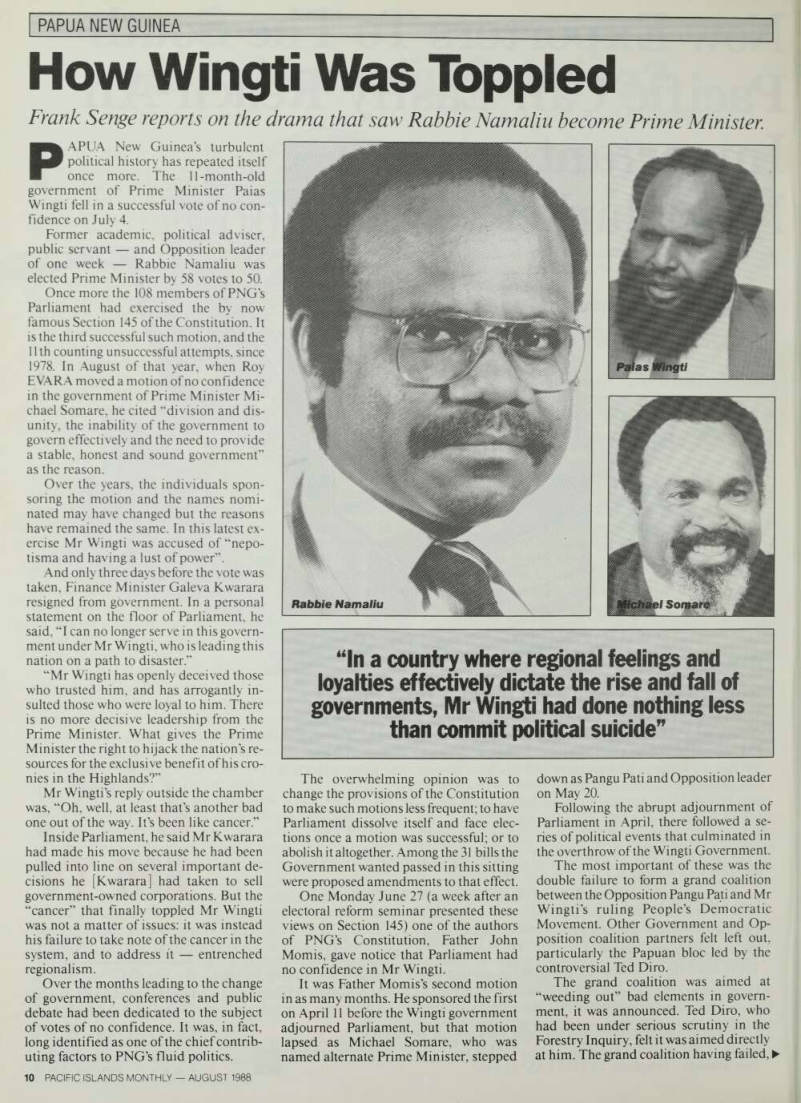
Michael Somare
Paias Wingti
Rabbie Namaliu
“Mr Namaliu has brushed off accusations of‘inexperience’, saying he has the education, the qualifications and the drive to make a successful Prime Minister”
Mr Wingti dumped Pangu and opted for the smaller Opposition partner, the National Party led by fellow Western Highlander Michael Mel.
That invitation, and the ministerial reshuffle that followed, almost certainly sealed the fate ofMrWingti’s government.
Not only were Papuans given a very raw deal, but most of the important economic portfolios went to the Highlands.
By prior arrangement two Papuans, Albert Karo and Allan Ebu, were allocated ministries while with Mr Diro’s People’s Action Party; they then signed on with Mr Wingti’s party. However, Mr Ebu had his Fisheries and Marine Resources ministry taken away and given to Highlander Thomas Negints. Mr Ebu was given Corrective Institutions Service instead, but pressure from his maritime Kikori electorate in the Gulf of Papua led to his resignation from PDM and the government one week later.
Minority Papua Party leader Galeva Kwarara had his Finance and Planning Ministry halved and the all-important policy aspect given to National Party leader Michael Mel in a new Treasury Ministry.
Papuan Akoka Doi had his Foreign Affairs portfolio taken away and kept by the Prime Minister. At the height of the lobying prior to the no-confidence vote it was offered back, but Mr Doi refused.
Mr Wingti also held on to the Deputy Prime Ministership after Sir Julius Chan was suspended to face a leadership tribunal over the Placer Pacific shares affair.
The Papuan bloc, as the second largest group in government, had always demanded that post.
In the reshuffle Mr Wingti also stripped Rabaul MP John Kaputin (from Mr Namaliu’s New Guinea Islands region) of the Minerals and Energy portfolio and gave it to Highlander Wiwa Korowi. Thus the Prime Ministership, Deputy Prime Ministership (for two crucial weeks), Treasury, Minerals and Energy, Foreign Affairs, Fisheries and Marine Resources, Police, Health and Lands among the nation’s most important ministries were all in the hands of Highlanders.
The other regions Papua, Mamose and New Guinea Islands controlled the lesser ministries. So in a country where regional feelings and loyalties effectively dictate the rise and fall of governments, Mr Wingti had done nothing less than commit political suicide.
Two other incidents also had a significant bearing: the PNG Defence Force takeover of Lae Airport, and the grounding of third level airline Talair. The two events were quite unrelated, but both involved central figures Civil Aviation Minister Hugo Berghuser and Talair owner Denis Buchanan.
On June 1, two Defence Force DC3s took off from Port Moresby in the early hours of the morning with armed soldiers, obstensibly headed for Nadzab. They flew over Nadzab but landed at Lae airport, where they proceeded to take over the facilities and stood guard.
The government, it emerged, had or-
dered the airport closed as from June 1 and over the following week soldiers physically harrassed civilian Civil Aviation workers, saying they had orders to guard Defence Force facilities.
Talair, which has hangars and other maintenance facilities at Nadzab, sup ported the Defence Force much to the anger of the Government, which regard the action for what it was: a direct disobedi ence of Government orders. The Prime Minister severely reprimanded the Def ence Force commander, and Mr Berghu ser accused Talair of flying over 200 unapproved routes, threatening to ground the airline unless it stopped immediately.
Mr Buchanan, however, had beaten him to the draw. On June 30 he grounded his entire airline, saying he could not op erate under the Wingti Government and that he would resume operations only if the government changed.
The Government was outraged. It ac cused Mr Buchanan of trying to “black mail” the country and taking part in the politics of PNG. The Opposition claimed Mr Buchanan had been pushed into grounding the airline. Pressure was brought to bear on members to rescue the largest third-level airline in the southern hemisphere, and an essential link with all rural areas of the country. (As soon as Mr Namaliu gained Government, Mr Buch anan lifted the groundings.) But even at the last moment, Mr Wingti still had the numbers to stay in Govern ment. What sealed his fate was a split in the National Party.
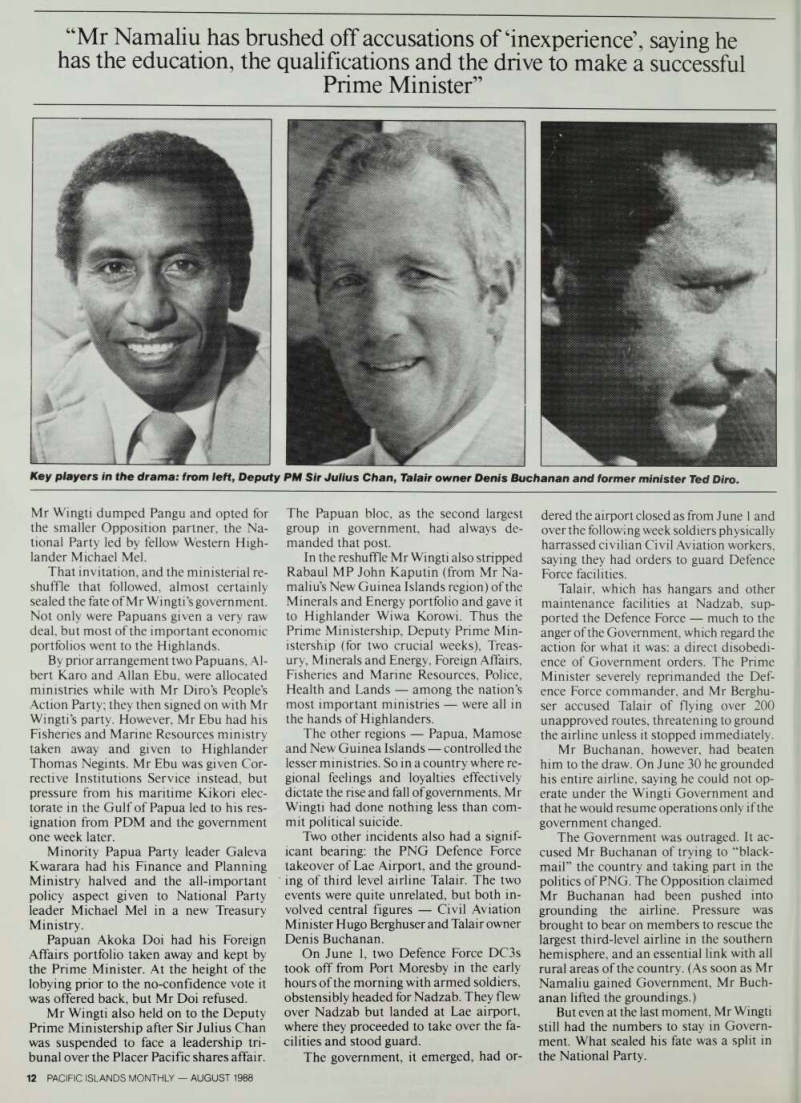
Key players in the drama: from left, Deputy PM Sir Julius Chan, Talair owner Denis Buchanan and former minister Ted Diro.
A splinter group of five members led by an old political rival. Mount Hagen busi nessman Paul Pora, joined the Opposi tion. In a last-ditch stand to stem the tide of resignations, Mr Wingti tabled the For estry Inquiry’s second interim report rec ommending criminal prosecution against Mr Diro and other persons concerned. . . but his timing was awry. With three days to the vote, nobody bothered to read the two voluminous reports.
When defeat finally came, Mr Wingti took it calmly. He was first across the floor to congratulate the new Prime Minister.
“It has been very difficult governing the country given the different factions in government,” he said. “It has been very tiring and I faced a lot of problems.” Pri vately, he has said he is much relieved.
His Deputy, Sir Julius Chan, had words of thanks, praise and prediction. “I think the greatest victory today is that the people, through this parliament, have chosen the change in Government,” Mr Julius said.
“From time to time your Mr Wingti’s leadership will be called on to test again the need to make change if change is necessary, and we should not be afraid to do so when the time comes.”
Mr Namaliu, while promising a review of government activity, is supportive of Mr Wingti’s emphasis on economic development.
At 41 he is not only three years older than Mr Wingti, but has been close to PNG politics longer. He graduated from the University of PNG with a Bachelor of Arts, majoring in History and English, in 1970.
He was awarded a Canadian scholarship to do a Master’s degree at the University of Victoria in British Columbia, and on his return to PNG he tutored at UPNG before becoming principal private secretary to Chief Minister Michael Smoare in 1974.
Not only after he became one of the first Papua New Guineans to be appointed a District Commissioner, and in 1976 he was made chairman of the Public Services Commission.
Mr Namaliu entered politics in 1982 as member for Kokopo, and served under both Somare and Wingti (when he was deputy Pangu Pati leader): he held the For eign Affairs and Primary Industry port folios in the Somare government.
He has brushed off accusations of “inex perience”, saying he has the education, the qualifications and the drive to make a suc cessful Prime Minister. “I am not afraid to lead, nor am I so naive as to swerve from responsibilities of firm and decisive lead ership. I believe in democratic participa tory government and that is exactly what the people of PNG will get,” he said.
At time of going to press, the new Govern ment comprised Pangu, Melanesian Alli ance, the Papuan bloc, the League for National Advancement and the National Party splinter group. The Opposition comprises the the People’s Progress Party, the Melanesian United Front and the rest of the National Party. □
Advertisements & other items, p. 11 (1 item)
To most people it’s a puzzle
...to us it’s childs play.
Stowage factor, tween decks, union purchase, McGregor hatches confusing language unless you really .know the shipping and stevedoring industry We have been operating as ships agents and stevedores for over 20 years throughout Papua New Guinea and have offices in all major ports. As a member of the P&0 family we can offer you fully co-ordinated ship management/materials handling throughout the world.
Whatever type of vessel or cargo, from container ships to tankers, LCT’s to barges, coffee to copra, rice to rubber, we welcome the opportunity to be of service.
RIS
Robert Laurie Company Pty Ltd PO Box 922, Port Moresby, Papua New Guinea Telephone 21 2466, Facsimile 21 7895 Tfelex NE22182
Diro’s Star Fades
.. . with claims of a "personal vendetta By Frank Senge
THE Commission of Inquiry into the PNG forest industry has recom mended serious criminal prosecu tion against former army commander and Papua bloc leader Ted Diro.
Mr Diro has also been referred to the Ombudsman Commission, the Chief Col lector of Taxes, Police Commissioner and the Collector of Customs for further in vestigations and for possible criminal prosecution relating to a “conspiracy to defraud the State, Magi Wopten Devel opment Pty Ltd and perhaps Angus Pty Ltd by completed and attempted transfer pricing schemes”.
Inquiry Judge Mr Justice Barnett found from the very beginning that available documents “supported the rumours and indicated very serious misconduct by Mr Ted Diro”. In his opening address, Coun sel Assisting the Commission John Reeve laid out the various allegations and the available evidence. He alleged that Mr Diro used his position as Minister for For ests to grant the Gadaisu timber permit to Angus; that he secretly retained 35 per cent of the shares of Angus; that he was a per son code-named Andrew' and that he was party to Angus schemes to make illegal offshore profits by transfer pricing as well benefits from Angus.
Justice Barnett reports that this was done in the hope that Mr Diro would come forward to offer explanations or make ad missions. He found instead Mr Diro adopting an “aggressively defensive pos ture” denying all allegations.
This forced Mr Reeve to search out every voucher, airline ticket, accounting record, telex, facsimile and restaurant bill.
“Only when confronted with an over
whelming volume of documentary evi dence did Mr Diro begin to make concessions and he did so grudgingly, fact by fact, admitting only as much as he was obliged to at any one time. In the process he told a mixture of reluctant truths, half truths and untruths,” the report men tions. As a result he was charged with six different counts of lying under oath.
Mr Justice Barnett said Diro gave evi dence that shows he has deliberately made false declarations to the Ombudsman Commission and in his income returns both of which are criminal offences.”
“While trying to explain various pay ments he received, Mr Diro gave evidence that seriously compromises the Govern ment of Vanuatu. At first he swore that he received consultancy fees from the Vanu atu Government while he was a Minister of State. He subsequently ’revised’ this evidence and said it was received from a firm known as Mr Juicy.
“One of two explanations given for re ceiving cash sums amounting to SUS 134,000 seriously compromised Gen eral Benny Murdani, the Chief of the In donesian Defence Force;” the report states.
The Commission has made referral, as it does not have powers to prosecute and convict for criminal offences disclosed during the inquiry.
Mr Diro’s role in other areas of the in quiry may be disclosed in later reports.
Outgoing Prime Minister Paias Wingti said in a statement to Parliament that the report exposes the very people “charged under the constitution with the protection of our resources and people, as being in volved in the most sordid and degrading examples of malpractice.”
Mr Diro’s own explanations to Parlia ment were a mixture of self praise, sym pathy and anger. “I stand before you a very much a sinner,” He said. “I stand before you a man condemned by the media.
“I have not had the opportunity to re spond to the criticism levelled against me.
I have not tried to justify the reason for the wrongdoings I have carried out.”
That justification, as he explained to Parliament, was that Mr Reeve had a per sonal vendetta against him; that some of the allegations levelled against him were because he was carrying out intelligence operations vital to national security, and that the two Australians conducting the inquiry (Messrs Barnett and Reeve) did not understand PNG mentality well.
He hoped Papua New Guineans would be “more understanding.”
Mr Diro also told Parliament he would not accept any ministerial portfolio until he was cleared of the charges. □
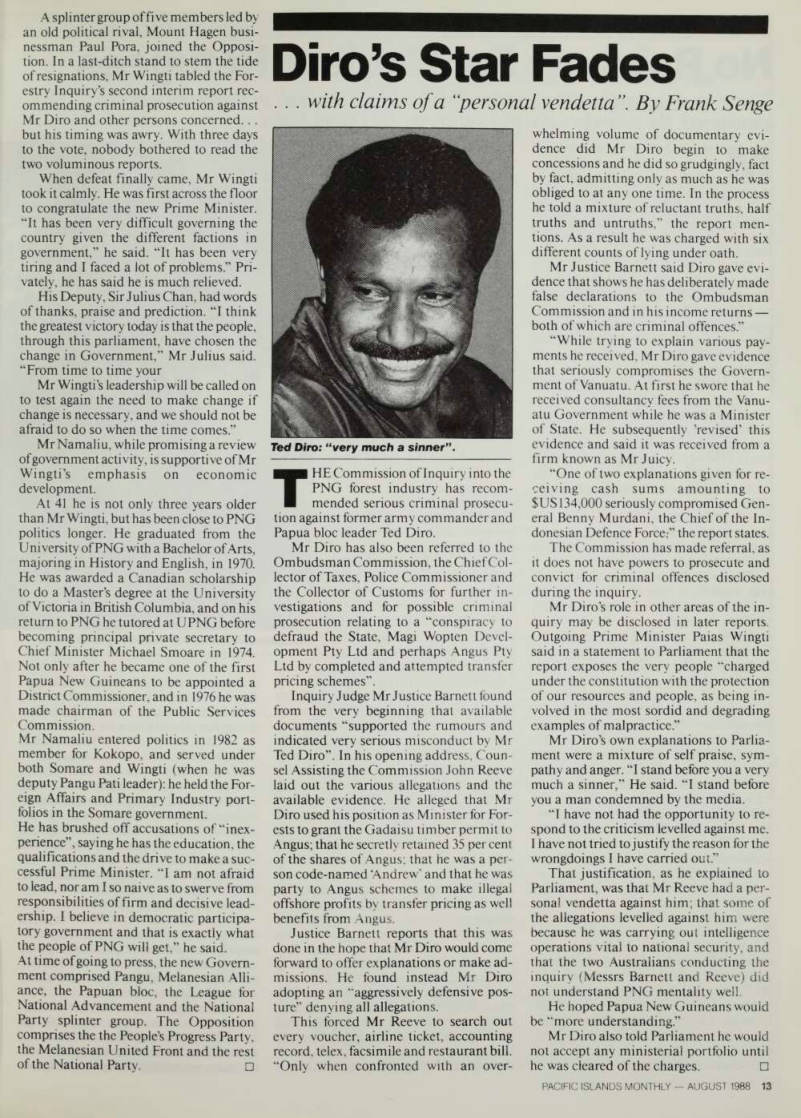
Ted Diro: “very much a sinner”.
No Rainbow For Nuclear Refugees
Marshall Islands
Three years after the irradiated population from the atoll of Rongelap was
evacuated, the islanders are still suffering.
By David Robie
MORE THAN 300 nuclear refu gees evacuated from Rongelap atoll by the Rainbow Warrior shortly before the peace ship was bombed in New Zealand three years ago are still looking for a new home after an inde pendent report has confirmed some of their radiation fears.
Elders of the islanders, now living a harsh lifestyle on Mejato in the Marshall Islands, are seeking an uninhabited island on Majuro atoll close to the capital of the republic. But they have not lost hope of re luming to their home and are still lobby ing for a full health and radiological survey on Rongelap.
The US Department of Energy (DOE) is claimed by the report to have had evi dence the Rongelap islanders may have suffered from radiation exposure for sev eral years after the Bravo thermonuclear test in 1954 yet it lets them live on their contaminated atoll without explaining the medical findings to them. Even though DOE scientists monitored depressed white blood-cell counts and high levels of plu tonium in the urine of the Rongelap is landers, the report claims, they interpreted the findings as “anomalous”.
The medical data emerged during a re cent scientific review of a 1982 DOE re port that concluded that all but the atoll’s northern ring of islets the islanders’ food larder was now safe. The United States Congress ordered the review after a sec ond mass exodus by islanders aboard the Rainbow Warrier in May 1985; the pop ulation had earlier been evacuated by United States authorities after the Bravo test and allowed to return three years later.
The islanders are not satisfied with the impartiality of the latest survey; they be lieve they were used as quinea pigs by US authorities to monitor the long-term ef fects of radiation on a human population, and had sought a study conducted by for eign researchers. They are also still seek ing SUS 6 million to pay for a full radiological survey of their homeland and in compensation for their exile.
The islanders last year sought a three member team to conduct the investiga tion; Canadian radiobiologist Dr Rosalie Bertell, author of No Immediate Danger (an expose on how world nuclear auth orities cover up the dangers and conse quences of irradiation) and a researcher for the Toronto-based International Institute of Concern for Public Health; and West Germans Dr Ute Boikat, of the Univer sity of Bremen, and Bemd Franke, of Hei delberg’s Institute of Energy and Environmental Research.
But the Marshall Islands Government, acting under pres sure from US authorities, re fused to give a clearance for this team under Dr Bertell’s direc tion alone. Another possibility had been a team headed by American radiation specialist Dr Robert Gale, who went to the So viet Union to perform bone marrow transplants on radiation victims after the 1986 Chernobyl meltdown disaster.
That proposal also fell through.
Instead, an 11-member panel of international experts was set up that included Dr Bertell and Mr Franke. The panel’s prelimi nary report to the Congress house appropriations subcommittee has concluded that returning to Rongelap is “permissible” for adults providing they are given geographical and dietary restric tions. The team deferred any recommendation on children until further review.
Bertell and Franke dissented, calling for more extensive phys ical examinations and radioac tivity measurements.
Among the majority was Dr Robert Conard. who headed the Marshall Islands medical pro gram for Brookhaven National
Laboratory from 1957 to 1980. In his first year in charge, three years after the Bravo Test, the laboratory produced a document that declared: “Greater knowledge [of ra diation effects on human beings] is badly needed ... Though the radioactive con tamination of Rongelap island is consid ered perfectly safe for human habitation, the levels of activity are higher than those found in other inhabited locations in the world. The habitation of these people on the island will afford the most valuable ecological radiation data on human beings.”
Thirty-one years of tragedy and suffer ing forced 320 Rongelap Islanders to abandon their atoll. They were evacuated at their own request less than two months before the Greenpeace movement’s flag ship was sabotaged by French agents in Auckland harbour on July 10, 1985.
The nuclear refugees settled on Me jato, a 16-hectare uninhabited island on the northwestern tip of the vast Kwajalein atoll across the lagoon from the US missile testmg range. Today living conditions re main bleak: a village has been constructed
from their stripped buildings on Ronge lap, but life remains hard and depressing and food is always running short. The Rongelap elders believe they will be able to build a better life on Majuro atoll, wherea new home is being considered.
Their ordeal began on March 1, 1954 now known as Bikini Day when the United States dropped a 15 megaton ther monuclear bomb on Bikini atoll, 160 km west of Rongelap. Taken off three days later, the Rongelap islanders were allowed to return in 1957, but the damage had already been done: a legacy of leukaemia, miscarriages, birth defects, thyroid tu mours and damaged genes.
“Like many of our women exposed during the bomb tests, I have many mis carriages; seven,” says Lijon Eknilang, one of the island leaders. “I have lived in fear and I feel my life is in danger. I sometimes feel my body is on fire.”
Miscarriages used to be rare on Ron gelap. “Now miscarriages happen all the time. We take them for granted,” Eknilang says. “We never used to have problems with mentally retarded children, or youngsters
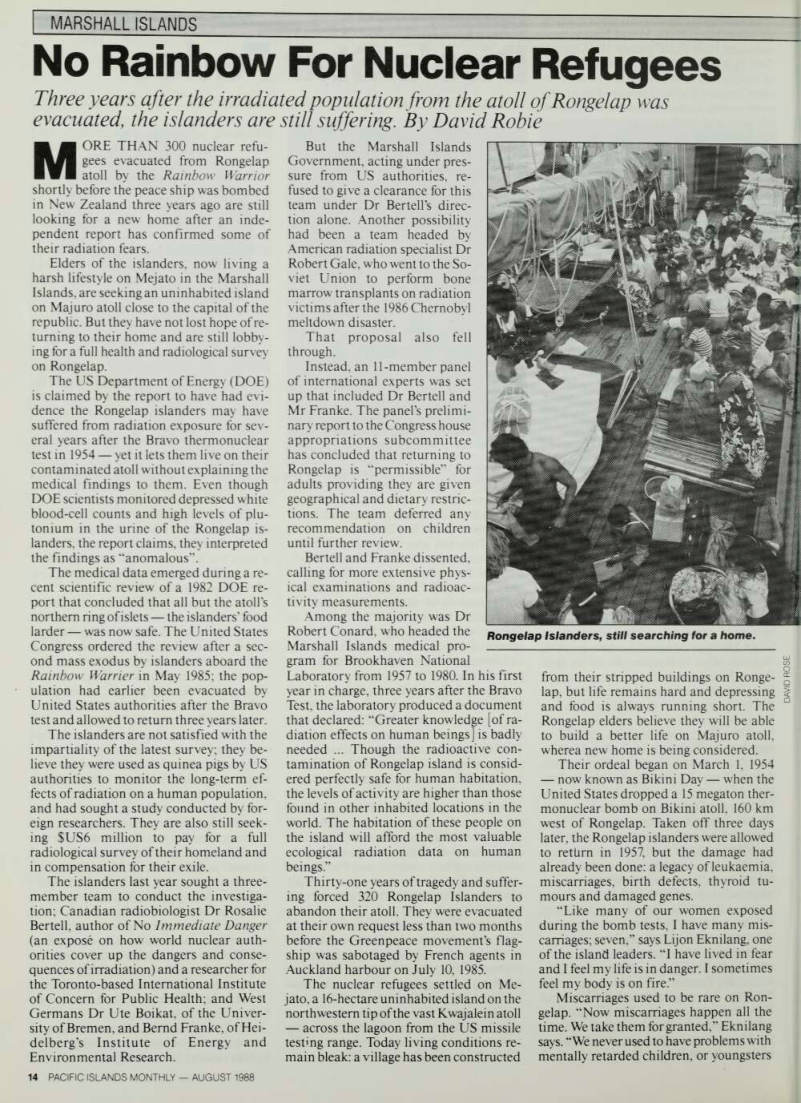
Rongelap Islanders, still searching for a home.
with stunted growth. Now it is frequent.
“There have been at least six or seven ‘jellyfish babies’ they have no face. They have short bodies, stubby legs and look fat and shapeless. They live for half a day or so and then die.
“Losing my homeland really hurts. It hurts me terribly. It is sad for our children; they’ll grow up hearing about our tradi tional home, but I don’t know if they will ever be able to go back there.”
Rongelap elders, supported by Ameri can lawyers and Bertell and Franke (who obtained the controversial medical data) said the DOE should have investigated what were obvious signs of radiation dis ease and kept the islanders fully informed.
Instead, they claimed, the agency had “covered up” the data to deflect criticism from the US nuclear-weapons program and avoid high compensation claims.
However, officials of the DOE and sci entists at Bookhaven laboratory, which has tested the Rongelap Islanders since 195 Z claimed the data had “little medical sig nificance” and that radiation “posed no health danger”.
The 1982 survey, translated into the Marshallese language and labelled by government scientists as the “last word” on the controversy, neglected to mention the urine and blood tests. Instead it gave assurances that living in the southern part of the atoll and eating local food exposed the inslanders to less radiation than the maximum permissible dose in the United States. However, it did not say plutonium levels in the soil were 500 times greater than average levels in the Northern Hem isphere and that radioactivity in local fruit exceeded US standards.
DOE officials denied there had been any coverup. “There were lots of things that might have been added to that re port,” one official told the Washington Post. “The people who wrote it made their choices based on what they believed to be most significant for the people who had to use it: there was no attempt to conceal information.”
However, Bertell, computing averages for the control groups from 1957 to 1961. found abnormally low counts of mono cytes; large white blood cells produced in bone marrow to fight bacteria. Exposure to high levels of radiation can depress the production of monocytes.
Compared with the normal range of 200 to 800 monocytes per cubic millilitre of blood, the control group averaged 169 but scored as low as 60.
Bertell said the data indicated high ra diation levels on Rongelap after the then Atomic Energy Commission (which later became the Department of Energy) de clared it safe or that fallout from the Bravo test reached further than estimated, to contaminate control group members. “It should’ve at lease raised questions about contamination of Rongelap,” she told the Post. “They should never have been al lowed to go back in 1957.” □
Advertisements & other items, p. 15 (1 item)
Economic Co-operation
spec T
South Pacific Bureau for
Applications are invited from citizens of member countries for the following positions with the South Pacific Bureau for Economic Cooperation (SPEC).* SPEC is a regional organisation based in Suva and was established to encourage co-operation in the South Pacific not only between member states in the region, but also between island member states and the more industrialised countries on all aspects of economic development, trade, transport, tourism, telecommunications, and energy. SPEC is also the Secretariat to the South Pacific Forum.
Project Officer (Trade Division)
The Project Officer will be responsible for the co-ordination, development and administration of trade relations between South Pacific Forum countries and with other countries and regions. Duties include monitoring and reporting on the operation of SPARTECA, providing advice and assistance to FICs on trade and trade-related matters and analysis and dissemination of information.
Applications for this position should be University graduates with a major in economics or commerce or possess relevant trade experience. A minimum of five years experience in the commercial and/or public sector is essential. Experience in dealing with regional and international organisations would be an advantage.
Energy Officer
The Energy Officer will be responsible for the co-ordination of Energy Development in the South Pacific under the Pacific Energy Programme with other organisations in the region. Duties include evaluation of project proposals and provision of advice to Forum Island Countries; co-ordination of consultancies for energy projects; co-ordination and implementation of small energy projects programme: dissemination of information; arranging regional training programmes, seminars and workshops.
Applicants should have tertiary qualifications preferably in economics and/or engineering and at least 3-5 years practical experience in technical aspects of energy production, control, and/or conservation.
Experience in government administrative procedures is desirable.
General information regarding all positions Appointees will be based at SPEC Headquarters in Suva but will be required to travel within the region. Appointment will be for two years initially and can be extended under certain conditions. Competitive salaries at regional levels are paid in Fiji dollars and are tax-free to non-Fiji nationals. Housing or housing allowances, overseas and education allowances, school holiday travel, superannuation provisions, medical, travel and life insurance benefits combine to make a most attractive package. Further details can be obtained from the address below..
Applications close on 31 August, 1988 and should provide full informatk)n on education and employment background and should list the names of three referees with whom the applicant has been associated in a professional capacity.
Applications and enquiries should be addressed to:
The Director,
South Pacific Bureau for Economic Co-operation,
P.O. Box 856, Suva, Fiji.
Telephone: 312600; Telex: 2229FJ; Fax: 302204.
* Member countries of SPEC are: Australia, Cook Islands, Federated States of Micronesia, Fiji, Kiribati, Republic of Marshall Islands, Nauru, New Zealand, Niue, Papua New Guinea, Solomon Islands, Tonga, Tuvalu, Vanuatu, Western Samoa.
Taufa’ahau Tupou IV Turns 70
Tonga
Polynesia’s greatest monarch celebrates.
By Gabriel Singh
IT WAS by far the largest and most ex travagant birthday bash the South Pa cific has ever seen.
Tonga, Polynesia’s ancient oldest and only remaining kingdom, revelled in the international limelight during the five-day 70th birthday celebrations for King Ta ufa’ahau Tupou IV. The royal capital of Nuku’alofa was inundated, with hotels and guest houses fully booked. Tongans from outlying islands and hundreds of overseas based residents added to the kaleidoscope.
The 170 islands of the group are scat tered over a vast area, but their actual land area is only 691 square kilometres. Just west of the international dateline, Tonga is the first country to usher in the new day.
According to legend the demigod Maui yanked the islands out of the sea with a fish hook; they were settled 3000 years ago by people who soon gained a reputation as great seafarers, undertaking long journeys in double-hulled canoes called kalia, which held up to 200 people.
By the 13th century the Tongan empire stretched from Rotuma and part of Fiji’s Lau Group to Wallis and Futuna, Samoa, Tokelau and Niue.
Captain James Cook was the first Eu ropean to land on Tongatapu in 1777. He presented his hosts with a male Galapagos tortoise which, though blind, could be seen wandering around the royal compound until 1966. A plaque marks the spot where Cook rested under a banyan tree at Mu’a, more than two centuries ago.
Methodist missionaries returned to Tonga in 1822 after being forced out in 1804, and their most noteworthy convert was the Chief of Ha’apai, who with their help in 1845 became King George Tupou I, ruler of a united Tonga. King George was baptised in 1831.
In 1862 he freed the slave class from the obligation to perform labour for chiefs and made hereditary nobles of chiefs, and at the same time established a constitutional government with a Privy Council and rep resentation for both commoners and no bles in a legislative assembly.
This system institutionalised into the Tongan Constitution of 1875 re mains in force today. King George died in 1893, at the age of 97, the creator of a united Christian Tonga.
Germany wished to include Tonga in its Pacific empire late in the 19th century, but bowed to British pressure in exchange for a free hand in Samoa. A new Treaty of Friendship signed in 1900 gave Britain control of Tonga’s foreign affairs as a means of forestalling encroachments by other for eign powers; British protection remained
King Taufa’ahau was born on July 4, 1918 and with his birth came the unifica tion of Tonga’s three ancient kingly lines: the ancient Ha’a (tribes with the status of kings) of the Tu’i Tonga, Tu’i Ha’atakalaua and Tu’i Kanokupolu. His Majesty’s li neage can be traced to the ancient Tu’i Tonga through his mother Queen Salote Tupou 111, while his father’s can be traced to the lineage of Tu’i Ha’atakalaua.
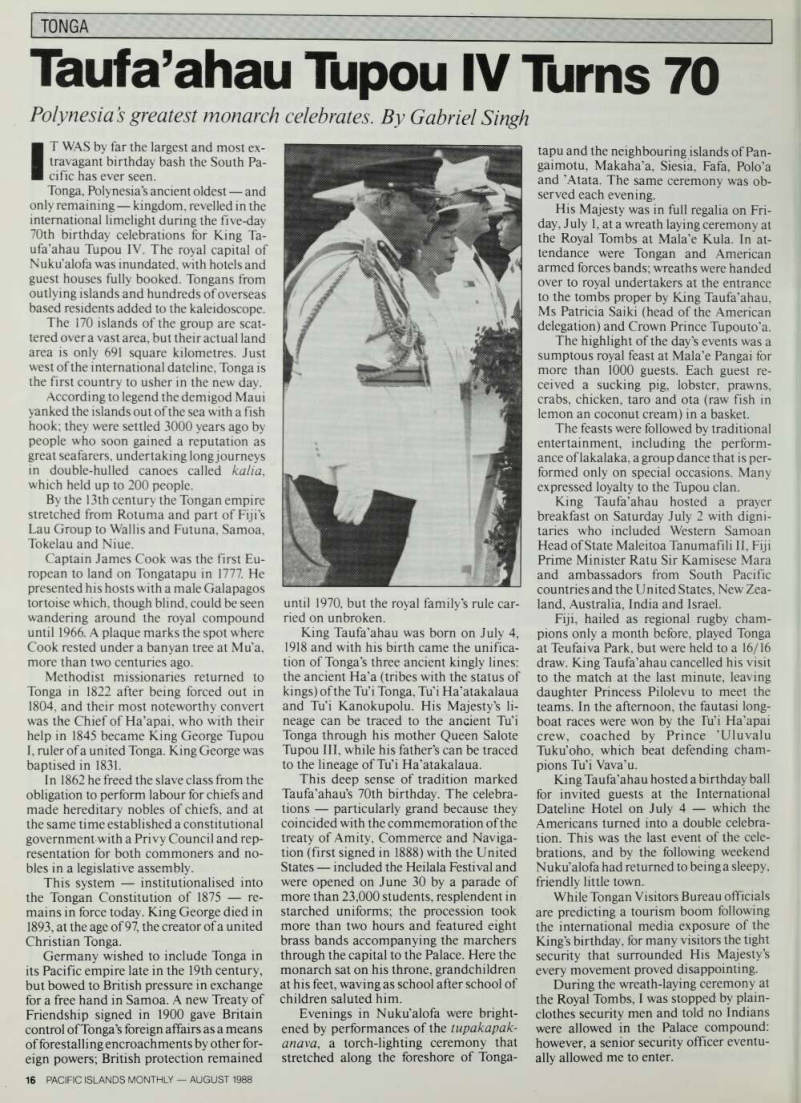
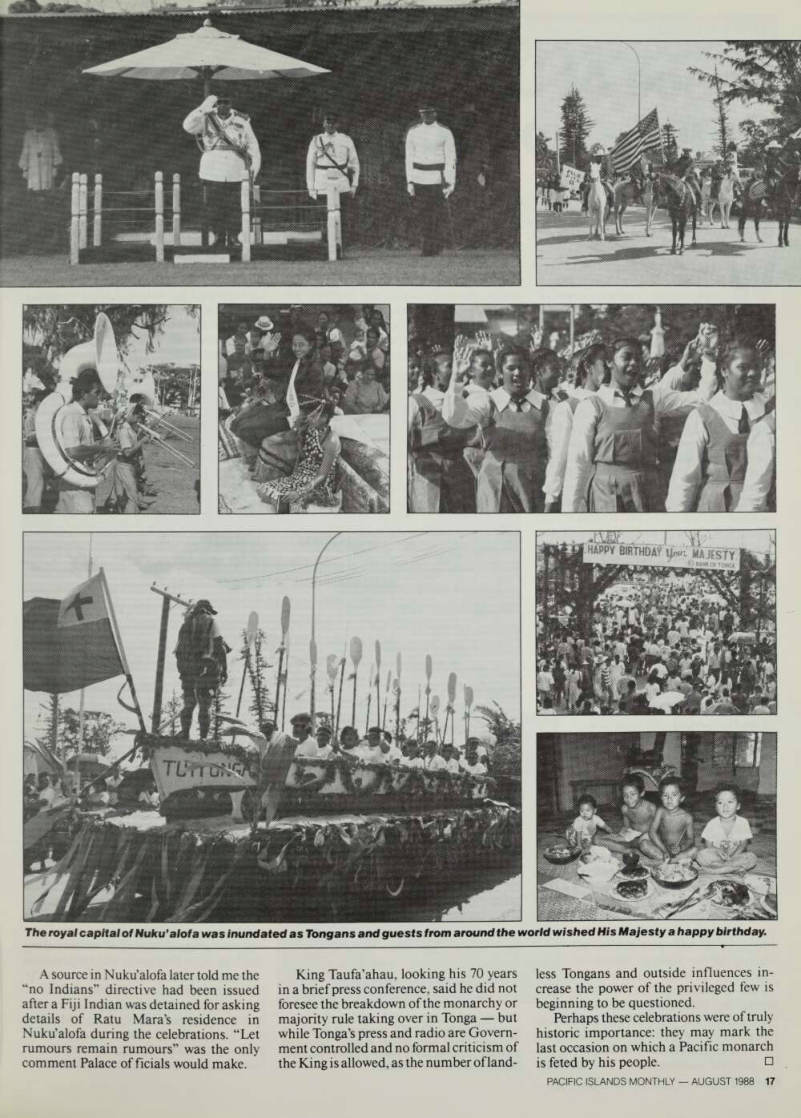
This deep sense of tradition marked Taufa’ahau’s 70th birthday. The celebra tions particularly grand because they coincided with the commemoration of the treaty of Amity, Commerce and Naviga tion (first signed in 1888) with the United States included the Heilala Festival and were opened on June 30 by a parade of more than 23,000 students, resplendent in starched uniforms; the procession took more than two hours and featured eight brass bands accompanying the marchers through the capital to the Palace. Here the monarch sat on his throne, grandchildren at his feet, waving as school after school of children saluted him.
Evenings in Nuku’alofa were bright ened by performances of the tupakapak anava, a torch-lighting ceremony that stretched along the foreshore of Tonga
tapu and the neighbouring islands of Pan gaimotu, Makaha’a, Siesia, Fafa, Polo’a and ’Atata. The same ceremony was ob served each evening.
His Majesty was in full regalia on Fri day, July 1, at a wreath laying ceremony at the Royal Tombs at Mala’e Kula. In at tendance were Tongan and American armed forces bands; wreaths were handed over to royal undertakers at the entrance to the tombs proper by King Taufa’ahau, Ms Patricia Saiki (head of the American delegation) and Crown Prince Tupouto’a.
The highlight of the day’s events was a sumptous royal feast at Mala’e Pangai for more than 1000 guests. Each guest re ceived a sucking pig, lobster, prawns, crabs, chicken, taro and ota (raw fish in lemon an coconut cream) in a basket.
The feasts were followed by traditional entertainment, including the perform ance of lakalaka, a group dance that is per formed only on special occasions. Many expressed loyalty to the Tupou clan.
King Taufa’ahau hosted a prayer breakfast on Saturday July 2 with digni taries who included Western Samoan Head of State Maleitoa Tanumafili 11, Fiji Prime Minister Ratu Sir Kamisese Mara and ambassadors from South Pacific countries and the United States, New Zea land, Australia, India and Israel.
Fiji, hailed as regional rugby cham pions only a month before, played Tonga at Teufaiva Park, but were held to a 16/16 draw. King Taufa’ahau cancelled his visit to the match at the last minute, leaving daughter Princess Pilolevu to meet the teams. In the afternoon, the fautasi long boat races were won by the Tu’i Ha’apai crew, coached by Prince ’Uluvalu Tuku’oho, which beat defending cham pions Tu’i Vava’u.
King Taufa’ahau hosted a birthday ball for invited guests at the International Dateline Hotel on July 4 which the Americans turned into a double celebra tion. This was the last event of the cele brations, and by the following weekend Nuku’alofa had returned to being a sleepy, friendly little town.
While Tongan Visitors Bureau officials are predicting a tourism boom following the international media exposure of the King’s birthday, for many visitors the tight security that surrounded His Majesty’s every movement proved disappointing.
During the wreath-laying ceremony at the Royal Tombs, I was stopped by plain clothes security men and told no Indians were allowed in the Palace compound: however, a senior security officer eventu ally allowed me to enter.
until 1970, but the royal family’s rule car ried on unbroken.
A source in Nukualofa later told me the “no Indians” directive had been issued after a Fiji Indian was detained for asking details of Ratu Mara’s residence in Nukualofa during the celebrations. “Let rumours remain rumours” was the only comment Palace of ficials would make.
King Taufa’ahau, looking his 70 years in a brief press conference, said he did not foresee the breakdown of the monarchy or majority rule taking over in Tonga but while Tonga’s press and radio are Govern ment controlled and no formal criticism of the King is allowed, as the number of land
less Tongans and outside influences in crease the power of the privileged few is beginning to be questioned, Perhaps these celebrations were of truly historic importance: they may mark the last occasion on which a Pacific monarch is feted by his people. □
The royal capital of Nuku’alofa was inundated as Tongans and guests from around the world wished His Majesty a happy birthday.
Peace At Last -
New Caledonia
Peace At Last - Or A Recipe For Ruin?
Nicolas Rothwell reports from Paris on the talks that may provide a solution to New Caledonia’s struggle for self-determination.
WHEN France’s Prime Minister, Mr Michel Rocard, announced a comprehensive agreement on the future of New Caledonia, reached in dra matic style on the morning of June 26, he not only pulled off a dramatic political coup for his newly appointed Govern ment, but pointed a way forward out of the New Caledonian morass.
Any resolution of the long-running cri sis in this French Pacific territory has seemed impossible in recent years but after the completion of the Paris accord between Jean-Marie Tjibaou of the Kanak Socialist National Liberation Front (FLNKS) and Jacques Lafleur of the Ras semblement pour la Caledonie dans la Re publique (RPCR), it is clear several drastic changes in the overall equation laid the groundwork for the accord so carefully midwifed by Mr Rocard.
Although Tjibaou must now persuade FLNKS militants at a special congress at Thio in late July to agree to the terms of the accord, and Mr Lafleur must also sell the deal to his supporters in the European settler community on the territory, it seems certain that a period of cooling off will now follow. Observers were stunned by the de termination and evident sincerity both
camps brought to the Paris talks held in the Hotel Matignon, the office of the French Prime Minister. They put forward as the reasons for the sudden break in the deadlock a number of key factors.
First, the re-election of President Mitterand for a second seven-year term (and the prompt election of a divided parliament without a strong majority for the president’s own So cialist Party) has created an atmos phere of enthusiasm for the politics of tolerance, consensus and open ness. The dramatic defeat of Gaull ist presidential candidate Jacques Chirac in the May poll, despite his staging of the hostage rescue on Ouvea, undercut conservative forces in French politics and dis mayed the Caledonian loyalists
in the main die hard Chirac supporters counting on the prolongation of their par ty’s rule on the French mainland.
Political commentators in Paris also
point out that the scale of the bloodshed on Ouv’aaea, and the alarming speed at which the situation in the territory was spiralling out of control earlier in the year, convinced the leaders of both communi ties in New Caledonia that the time had come for negotiations the alternative
was more death and mayhem.
And on a more personal level, sources close to Caldoche leader Lafleur make no secret of the fact that he is ailing; it is said he believed he was the only politician in the pro-French camp with the authority to negotiate a settlement with the Kanaks, and stressed his determination to see an agreement during his own lifetime. Like wise, the reflective Tjibaou is not a man with a taste for violence, and evidently persuaded others in his delegation that an
acceptable solution was in reach.
The complex deal signed by Kanaks and Caldoches provides for a careful mix of political and economic changes, all to be watched over by France. Each of the controversial points of difference between the two communities is not so much ad dressed, as erased.
Later this year, French voters will take part in a referendum that will define the State’s responsibilities toward New Cale donia. For the following 12 months from July 14, New Caledonia will be governed directly by the High Commissioner as rep resentative of the State. This spells the end of the statute pushed through Parliament in Paris early this year by former Minister for Overseas Territories Bernard Pons, who was mystified by the signature of the ac cord. “I don’t understand what could have
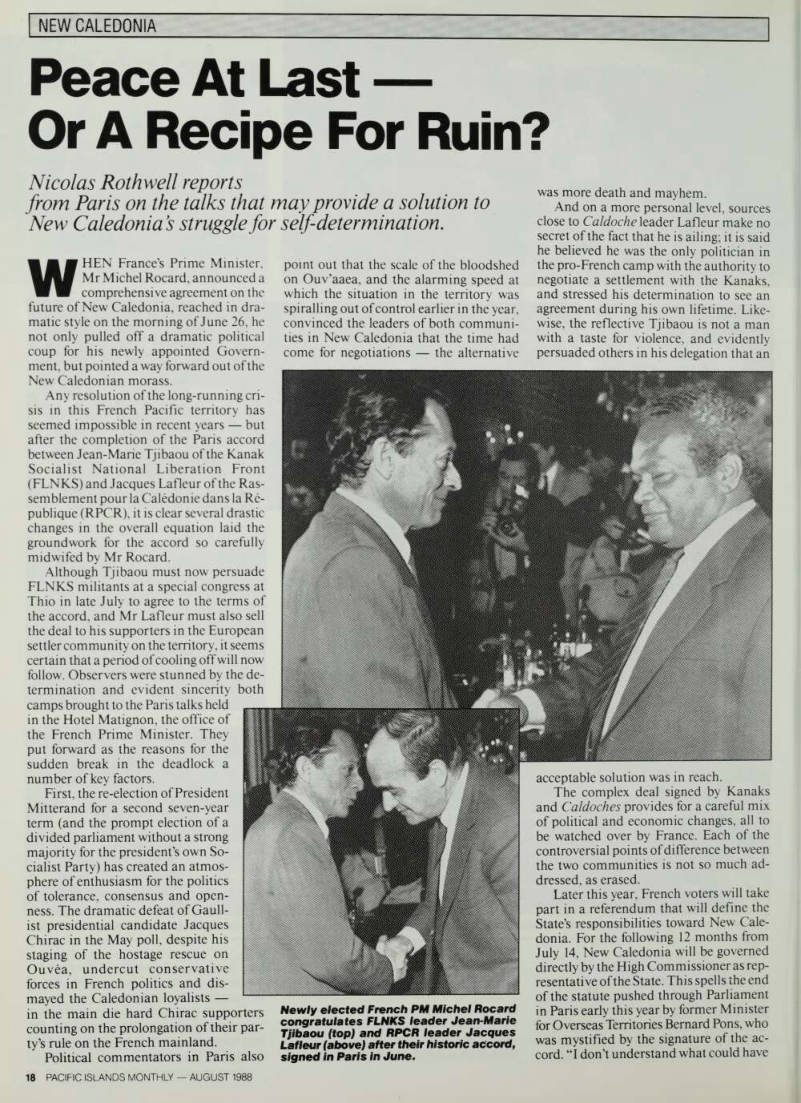
Newly elected French PM Michel Rocard congratulates FLNKS leader Jean-Marie Tjibaou (top) and RPCR leader Jacques Lafleur (above) after their historic accord, signed in Paris in June.
persuaded them to change their minds in such a way,” he said of the FLNKS.
The terms of the agreement are already well known, and are substantially similar to the recommendations made by the study mission under Christian Blanc sent to New Caledonia in late May by Mr Rocard: di vision of the territory into three regions, economic development to be targeted to the Kanak areas, and a self-determination referendum in 10 years’ time with all Caledonians now established on the ter ritory, plus their descendants, voting.
This “freezing” of the electorate changes the highly charged debate over electoral eligibility into a political ques tion, since it effectively guarantees that on the vital polling day the Kanak popula tion will have a clear majority; yet a ma jority, of course, does not mean there will be an automatic vote for independence.
The political significance of the agree ment is extreme, both in mainland poli tics (where it gives the Rocard Government a sensational triumph) and in the Cale donian arena, where the possibilities for the two communities have been radically redefined. Mr Rocard, in a message to the people of New Caledonia, whom he was expected to visit late in July, said he had “tried to stitch together the threads of dia logue one could have thought were broken by decades of troubles and incomprehen sion, by too many dead in all the communities.”
“I want to say to my compatriots in New Caledonia: have hope once more, it will be possible to write a new page of history, not by force of arms but through dialogue and tolerance. I want to help you to bring about your destiny, through reconciliation, sol idarity and the creation of the future.”
In effect, a trade-off has been brokered, with Tjibaou and the FLNKS accepting a shift in their preferred time table for in dependence from five to 10 years, while Lafleur and the RPCR have tacitly ac cepted the likelihood that the territory will indeed cut its links with France.
But there are worrying signs that the j ü bilation is not universal. There are rejec tionist groups in both Caledonian communities; the increasingly significant National Front in Noumea is matched in its hostility to the deal only by the radical FULK (Kanak United Liberation Front) faction of the FLNKS.
More disturbingly, the number three leader of the FLNKS, Leopold Joredie, has made plain his own disappointment with the details of the accord accepted by his movement.
In Paris, meanwhile, New Caledonia serves as the emblem of hope for the reign of the centrist Government of Michel Ro card a forward-looking socialist com mitted to seeking the centre ground. Yet skeptics among the Kanak leadership will still wonder whether the commitment of Paris to grant independence stems more from political convenience than deep conviction. □
The French Press Responds
Robert Aldrich examines the view from Paris.
IN A matter of weeks, New Caledonia appears to have matured from a form of violence and bloodshed to hopes of a peaceful solution to one of the Pacific’s most difficult problems. Photographs of the corpses of gendarmes and Kanak mil itants in May were followed in less than a month by photographs of Jacques Lafleur and Jean-Marie Tjibaou shaking hands in a Paris garden. What happened?
Changes in New Caledonia have al ways depended on what happens both in the territory itself and in metropolitan France. Pressure from New Caledonia has proved effective in Paris, but so too have the demands of party politics in France: under the centrist government of Presi dent Giscard d’Estaing in the 19705, the tactic was to defuse the situation by prom ises of economic development (with the Dijoud Plan).
After 1981, socialist President Francois Mitterrand initially wanted to proceed to independence in association with France the Pisani Plan.
In 1986, Prime Minister Chirac used the Pons Plan in an attempt to wipe out the pro-independence movement and once and for all affirm New Caledonia’s place in the French Republic.
The taking of hostages by the FLNKS and the killing of the gendarmes proved in a dramatic way that Pons’s efforts to extin guish the indepentantistes had failed. The Fayaoue episode showed that the Kanaks had not been coerced into silence: accord ing to Professor Alban Bensa, a French specialist on New Caledonia and sup porter of the FLNKS, the events showed the Kanaks were “ready to take hostages, to kill and to die” for their cause; “no one can now doubt their will to achieve inde pendence,” he said.
The reaction to the kidnappings, the assault on the cave on Ouvea and the deaths of Kanaks and two French soldiers, Bensa says, showed the true colours of the Chirac government. In choosing to send crack troops to New Caledonia, using sol diers rather than police to storm the cave, Pons undertook “an act of war carried out by soldiers”. Combined with the mach inations for the release of French hostages in Lebanon and the return of Major Dom inique Prieur from Hao atoll, this repre sented a blatant vote-catching strategy.
An editorial in the June issue of Kan aky, a French journal published by a Kanak support group, said the assault on Ouvea “was not a question of freeing the gendarmes taken prisoner, even less of as suring their safety, but of profiting from the affair to snatch a few votes away from the Le Pen electorate.”
Subsequently, press reports revealed
various behind-the-scenes aspects of the Gossana siege. Paris-Match, the Paris right-wing weekly, reported that Pons had been so determined to defeat the Kanaks that he had considered dropping napalm on Ouvea. Le Monde revealed that Al phonse Dianou, Wenceslas Lavelloi and “tea boy” Waina Amossa died in suspi cious circumstances: Dianou, several ob servers claimed, had been summarily executed or left to die on a stretcher.
Captain Philippe Legorjus, who led the assault, revealed in a report published in Le Monde that the French commander in New Caledonia, General Jacques Vidal, had ordered “a solution by force no matter what the consequences”, that Pons was primarily interested in political objectives and that he had refused last-minute negotiations.
Le Nouvel Observateur charged that a letter from then Minister of Defence Andre Giraud telling Vidal to avoid bloodshed, may either not have been delivered or was simply ignored. And Liberation reported the rumour that one of the soldiers whose names had not been made public involved in the assault on Gossana had been cho sen because his father, a gendarme, had died at Fayaoue.
The new Minister of Defence, Jean- Pierre Chevenement, stated that acts con trary to military honour had been com mitted and blamed the Chirac government for “a policy that led to confrontation”.
President Mitterand said he wanted to know the “whole truth” about the affair, and has ordered a “thorough and honest” investigation. These reports and the deaths on Ouvea appear to have pulled the rug out from under Chirac’s RPCR supporters in New Caledonia. After the smoke had cleared, Jacques Lafleur announced that the caldoches would have to make “sacri fices”, and Jean-Marie Tjibaou said he was willing to discuss the future of New Caledonia.
Whether their respective camps will follow their leaders remains unsure, but the alternatives to what is already being called the Rocard Plan are few.
Neither immediate independence nor the triumph of the loyalists have even tuated; neither guerrilla warfare nor bloody repression have achieved the ambitions of each side in the conflict.
President Mittenrand and Prime Min ister Rocard are trying to re-create, both in metropolitan France and in New Ca ledonia, a new consensus on the ruins of failed initiatives, discredited ideologies international concern and the deaths of more than 50 French citizens in the past four years. It will be a task of stupendous difficulty. □
Advertisements & other items, p. 20 (1 item)
now servicing
Fuels and lubricants.
Plastics. Chemicals. Bitumen.
Aviation Services. Bunkering.
Shell has penetrated even more of the Pacific to widen its network of offices, terminals and
Network Shell
now servicing
even more
of the Pacific.
distributors as well as service stations.
Now you can re-assess your source of supply, because Shell quality and value is close at hand, with the service to back it up. REGIONAL OFFICES: GLAM (vl 4"" 4350. Also servicing Marshall Islands (Majuro), Northern Marianas (Saipan), Palau, jl 679 313 933 . Also servicing Tonga, Cook Islands. American Samoa. Western Samoa • FAIT A NEW GI'INEA 6"5 228 1)0. Also servicing Solomon Islands.
NEW CALEDONIA 687 285 "20. Also servicing Tahiti. Vanuatu.
Transport
Special Report
Transport In The Pacific
Burdened by high costs, imperfect timetables and a low share of international traffic, the region faces great problems in carrying people and freight by sea or air. A special report
by Robin Bromby
THE States of the South Pacific re main in thrall to the major nations of the region and their own op erators in the transport industry. At tempts by Pacific nations to run their own transport systems are typified by com mercial nightmares: Air Pacific and Air Nauru have both suffered extensive losses, while smaller island operators have failed to gain the traffic rights that would make them commercially viable. In shipping, the Pacific Forum Line owned by the is land governments is predicted to make a loss this year as “foreign” shippers be come predators on the more lucrative routes.
Transport links run by outsiders have generally been tailored to operators’ rather than Pacific clients’ needs; for example, Ansett has withdrawn from both Air Van uatu and Cook Islands International Air ways for its own commercial reasons. The major shipping companies are eager to service the port of Suva because of the vol ume of freight available there, but will not often call at smaller Pacific ports so eat ing away at the Forum Line’s most lucra tive runs and leaving it financially less attractive calls at Apia or Nuku’alofa.
There are inherent transport problems in the Pacific: low export volumes mean that containers bringing in consumer goods and food often have to be shipped out empty. Nations such as Tonga and Western Samoa can rebuild their airport runways, but do not have the accommo dation and other infrastructure to cope with the number of people who could be flown in. Schedules to smaller countries are often dictated by the seven-day pack age holiday concept; if in, say, March this
year a Sydney businessperson had wanted to go to Vanuatu, he would have had to spend a week there Air Vanuatu and Ansett fly out of Sydney only at weekends, Historically, transport links have been al their best when keeping them thus has been in the interests of the metropolitan powers or colonial companies. Bums Philp was a good example of this principle, being subsidised by Australia, but it was exemplified by Germany before World War I.
The establishment of monopolies in the
German colonies of New Guinea, West ern Samoa, Nauru and the Caroline Is lands meant German-registered ships operating in the South Pacific were second in number only to those with British re gistry; companies such as Lloyd had their own wharves in Sydney, so frequent were their services to the islands, Concern and attention to transport is not a major issue. Most of the states are small in area, internal air services and in ter-island shipping are not subject to com- ►
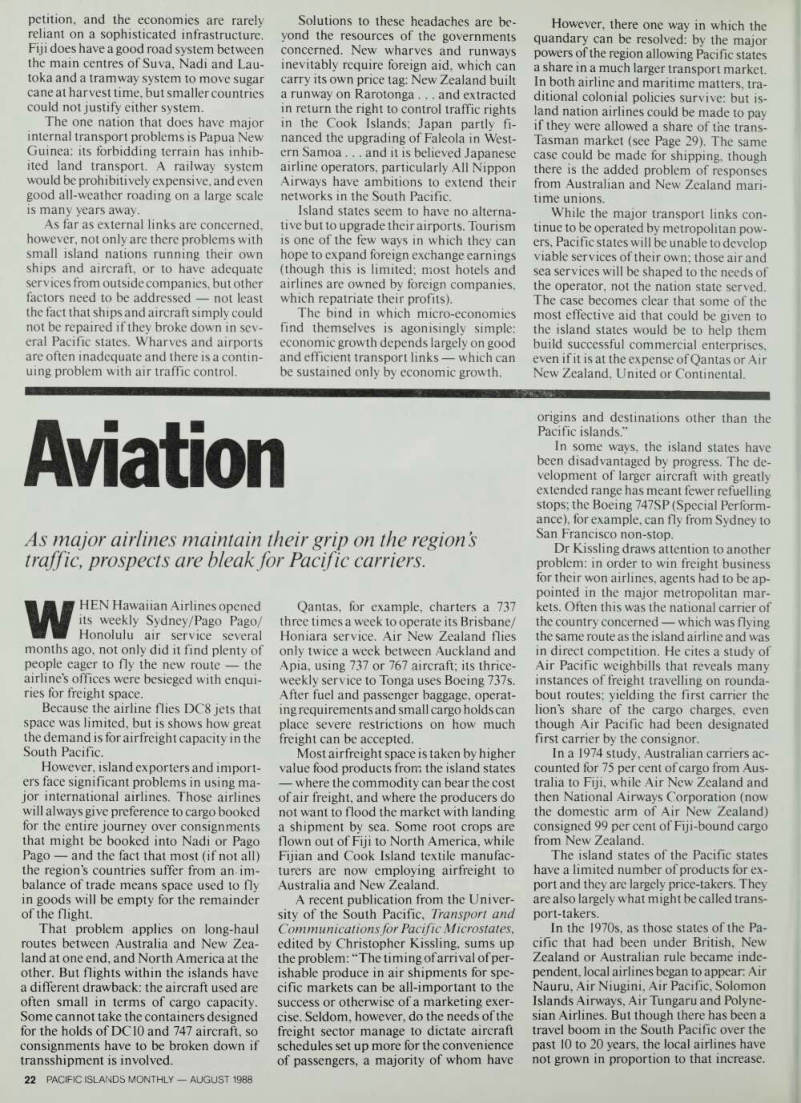
The way things were: an inter-islands tramp steamer of colonial days.
petition, and the economies are rarely reliant on a sophisticated infrastructure.
Fiji does have a good road system between the main centres of Suva, Nadi and Lau toka and a tramway system to move sugar cane at harvest time, but smaller countries could not justify either system.
The one nation that does have major internal transport problems is Papua New Guinea: its forbidding terrain has inhib ited land transport. A railway system would be prohibitively expensive, and even good all-weather reading on a large scale is many years away.
As far as external links are concerned, however, not only are there problems with small island nations running their own ships and aircraft, or to have adequate services from outside companies, but other factors need to be addressed not least the fact that ships and aircraft simply could not be repaired if they broke down in sev eral Pacific states. Wharves and airports are often inadequate and there is a contin uing problem with air traffic control.
Solutions to these headaches are be yond the resources of the governments concerned. New wharves and runways inevitably require foreign aid, which can carry its own price tag: New Zealand built a runway on Rarotonga . . . and extracted in return the right to control traffic rights in the Cook Islands; Japan partly fi nanced the upgrading of Faleola in West ern Samoa . . . and it is believed Japanese airline operators, particularly All Nippon Airways have ambitions to extend their networks in the South Pacific.
Island states seem to have no alterna tive but to upgrade their airports. Tourism is one of the few ways in which they can hope to expand foreign exchange earnings (though this is limited; most hotels and airlines are owned by foreign companies, which repatriate their profits).
The bind in which micro-economies find themselves is agonisingly simple: economic growth depends largely on good and efficient transport links which can be sustained only by economic growth.
However, there one way in which the quandary can be resolved; by the major powers of the region allowing Pacific states a share in a much larger transport market.
In both airline and maritime matters, tra ditional colonial policies survive: but is land nation airlines could be made to pay if they were allowed a share of the trans- Tasman market (see Page 29). The same case could be made for shipping, though there is the added problem of responses from Australian and New Zealand mari time unions.
While the major transport links con tinue to be operated by metropolitan pow ers, Pacific states will be unable to develop viable services of their own; those air and sea services will be shaped to the needs of the operator, not the nation state served.
The case becomes clear that some of the most effective aid that could be given to the island states would be to help them build successful commercial enterprises, even if it is at the expense of Qantas or Air New Zealand, United or Continental.
Aviation
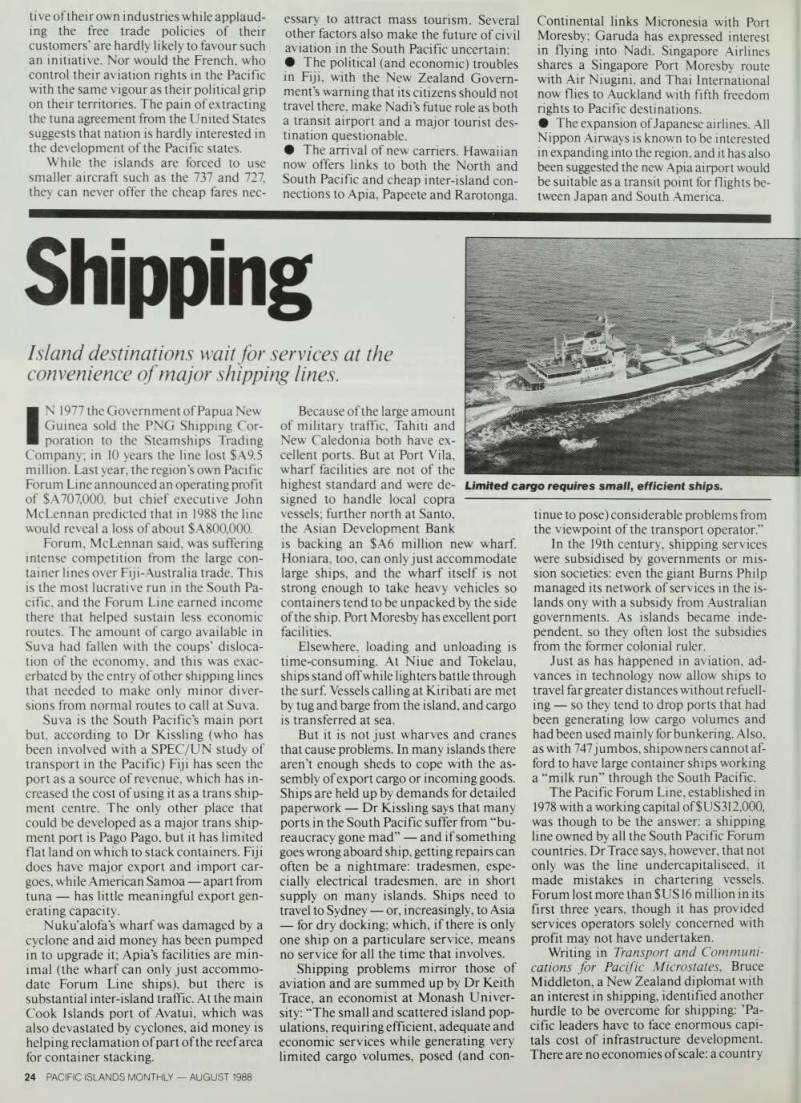
As major airlines maintain their grip on the region’s traffic, prospects are bleak for Pacific carriers.
WHEN Hawaiian Airlines opened its weekly Sydney/Pago Pago/ Honolulu air service several months ago, not only did it find plenty of people eager to fly the new route the airline’s offices were besieged with enqui ries for freight space.
Because the airline flies DCS jets that space was limited, but is shows how great the demand is for airfreight capacity in the South Pacific.
However, island exporters and import ers face significant problems in using ma jor international airlines. Those airlines will always give preference to cargo booked for the entire journey over consignments that might be booked into Nadi or Pago Pago and the fact that most (if not all) the region’s countries suffer from an. im balance of trade means space used to fly in goods will be empty for the remainder of the flight.
That problem applies on long-haul routes between Australia and New Zea land at one end, and North America at the other. But flights within the islands have a different drawback; the aircraft used are often small in terms of cargo capacity.
Some cannot take the containers designed for the holds of DC 10 and 747 aircraft, so consignments have to be broken down if transshipment is involved.
Qantas, for example, charters a 737 three times a week to operate its Brisbane/ Honiara service. Air New Zealand flies only twice a week between Auckland and Apia, using 737 or 767 aircraft; its thrice weekly service to Tonga uses Boeing 7375.
After fuel and passenger baggage, operat ing requirements and small cargo holds can place severe restrictions on how much freight can be accepted.
Most airfreight space is taken by higher value food products from the island states where the commodity can bear the cost of air freight, and where the producers do not want to flood the market with landing a shipment by sea. Some root crops are flown out of Fiji to North America, while Fijian and Cook Island textile manufac turers are now employing airfreight to Australia and New Zealand.
A recent publication from the Univer sity of the South Pacific, Transport and Communications for Pacific Microstates , edited by Christopher Kissling, sums up the problem; “The timing of arrival of per ishable produce in air shipments for spe cific markets can be all-important to the success or otherwise of a marketing exer cise. Seldom, however, do the needs of the freight sector manage to dictate aircraft schedules set up more for the convenience of passengers, a majority of whom have
origins and destinations other than the Pacific islands.”
In some ways, the island states have been disadvantaged by progress. The de velopment of larger aircraft with greatly extended range has meant fewer refuelling stops; the Boeing 7475 P (Special Perform ance), for example, can fly from Sydney to San Francisco non-stop.
Dr Kissling draws attention to another problem: in order to win freight business for their won airlines, agents had to be ap pointed in the major metropolitan mar kets. Often this was the national carrier of the country concerned which was flying the same route as the island airline and was in direct competition. He cites a study of Air Pacific weighbills that reveals many instances of freight travelling on rounda bout routes; yielding the first carrier the lion’s share of the cargo charges, even though Air Pacific had been designated first carrier by the consignor.
In a 1974 study, Australian carriers ac counted for 75 per cent of cargo from Aus tralia to Fiji, while Air New Zealand and then National Airways Corporation (now the domestic arm of Air New Zealand) consigned 99 per cent of Fiji-bound cargo from New Zealand.
The island states of the Pacific states have a limited number of products for ex port and they are largely price-takers. They are also largely what might be called trans port-takers.
In the 19705, as those states of the Pa cific that had been under British, New Zealand or Australian rule became inde pendent, local airlines began to appear: Air Nauru, Air Niugini, Air Pacific, Solomon Islands Airways, Air Tungaru and Polyne sian Airlines. But though there has been a travel boom in the South Pacific over the past 10 to 20 years, the local airlines have not grown in proportion to that increase.
In 1986 the managing director of Singa pore Airlines, Mr Cheong Choong Kong, said that the rapid growth of passenger traffic in the Asia-Pacific area was provid ing challenges in terms of developing suit able airports, tourist facilities and the right kind of aircraft.
Apia’s runway can now take 747 and DC 10 aircraft, but Apia itself has only 350 first class hotel rooms (though it was an nounced in 1986 that the Royal Samoan Hotel, with 227 rooms, was to be built).
Tonga’s airport, which can now take 767 and DCB aircraft, is being lengthened and strengthened for 7475. In the Solomons, Kuwait supplied 5A6.5 million to pay for an 1100-metres extension to the Hender son airfield at Honiara.
Nevertheless, airfields in the region are still of widely varying standard. In Fiji, Nadi Airport is excellent by world stand ards, and Nausori near Suva can take Boeing 737 jets. Tonga’s international air port is not up to top standards in terms of navigational equipment, and the airport at Vava’u will be upgraded to take 737 jets and 748 turbo-props.
A study is under way on upgrading Port Vila to take 767 aircraft; this would mean a great deal to the languishing tourist in dustry in Vanuatu, which has been hit both by political unrest and cyclones. The air port at present lacks 24-hour capability, which severely limits its potential as a stopover point.
There is another advantage to Faleola’s new 747 status it and Pago Pago, which is only about 15 minutes’ flying time away, can now be alternative airports if the other is closed in.
Rarotonga has been improved so that* the outer engines of 747 aircraft no longer overhang the edges of the runway, and turning areas for jets have been extended.
Port Moresby has world-class facilities, while at the other end Kiribati’s airfield is plagued by coral dust a serious threat to jet aircraft.
The two-engined jet still dominates Pacific air routes, especially the 737 and 767 but despite the 767’s reliability, it is caught by the 90-minute rule that means it can be no more than an hour and a halfs flying time from the nearest airstrip. The A3OO and the new Boeing 757 are simi larly affected.
These regulations do not inhibit oper ations between most of the islands and Australia and New Zealand, but only four engined jets have the range to operate to Hawaii and the United States. Air Pacif ic’s attempt to break into the long-haul traffic was a cautionary tale. In 1983, the airline leased a DC 10 and launched Pro ject America, with three flights a week to Honolulu. Air Pacific was already losing money and the failure of the new service to attract sufficient passengers had the ef fect of doubling the airline’s loss to FlO million in 1984 and Fll million in 1985.
Qantas has since bought a share of Air Pacific, which effectively ended Ansett’s
chances of dominating the South Pacific.
The Australian company had ambitions of developing an integrated airline system within the region, and its failure to acquire the management of Air Pacific was a bitter pill. Had Ansett, in effect, controlled the Fijian carrier it would have been in a pow erful position: it already operated Polyne sian Airlines and Cook Islands International, as well as having Ansett New Zealand as a second domestic network ca pable of feeding into a Pacific operation.
Things, however, did not work out that way: Ansett had already quit Air Vanuatu (of which it owned 49 per cent) because of losses and, more crucially, the problems caused by the Vanuatu Government’s de sire to control the airline a function An sett obviously though it was better fitted to fulfil. Now Ansett is pulling out of Cook Islands International Airways because of poor financial performance, and how long it will continue to operate Polynesian Air lines is a matter of speculation.
At one stage Ansett had ambitions to equip Polynesian with 767 airliners and, when the 90-minute rule was relaxed (there is now talk of engines being re-rated to al low a 120-minute rule), it would fly to Ha waii. Certainly, when the Cook Islands’ then premier Sir Thomas Davis signed with Ansett, he was confident the coun try’s national carrier would soon be show ing its clours in North America.
But neither airline had the potential of Air Pacific, carrying with it Fiji’s traffic rights to Hawaii, the US mainland, Can ada, Japan, Singapore and South Korea.
That and the high (and highly profita ble) utilisation of aircraft, which would have been possible with two major do mestic networks and three international airlines was a heady prospect for Ansett.
Without such an integrated approach, island airlines face an uphill battle. Air Nauru, with only a tiny local population,
was almost brought to its knees in 1985: it cut services drastically, sacked 26 aircrew and disposed of five aircraft because its network of 26 destinations was running it into enormous losses. Even the giant Pan Am found the Pacific experience ruinous and was succeeded by United, which had its own domestic service. Kiribati’s Air Tungaru, in an attempt to link its nation with Hawaii and tap the tourist market, leased a Boeing 727 but failed to attract enough business to pay its way.
At time of writing Qantas is negotiat ing with the aim of taking a share of Air New Zealand; some aviation experts ar gue that the two airlines are, separately, too small to compete with the giants of world aviation. In support of that analysis, air line executive John King has written that the International Civil Aviation Organi sation recognises the need for developing areas such as the South Pacific and Car ibbean to merge their air rights. Mr King, who has worked for Ansett and been a di rector of both Air Vanuatu and Polynesian Airlines, added: “The microstates of the South Pacific should be encouraged to pool their air traffic resources’ and developed states with which they interact should re cognise this need... It provides a glimmer of hope that substantial deficits need not be the everlasting headache of island governments called upon to shore up ail ing national carriers.”
King also asked whether Qantas would really suffer if Air Tungaru, for example, had fifth freedom rights out of Sydney via the Solomon Islands: “One lonely mixed configuration 8727-100 QC can make but a small intrusion into the totality of Qan tas operations internationally.”
Such a change in policy would most likely come from Australia and New Zea land (if it were to come at all); the Japa nese, who send large numbers of tourists to the South Pacific and are highly protec
Even in 1951, air services (such as TEAL’s flying boat to the Cook Islands) were at the convenience of international carriers rather than islanders.
tive of their own industries while applaud ing the free trade policies of their customers’ are hardly likely to favour such an initiative. Nor would the French, who control their aviation rights in the Pacific with the same vigour as their political grip on their territories. The pain of extracting the tuna agreement from the United States suggests that nation is hardly interested in the development of the Pacific states.
While the islands are forced to use smaller aircraft such as the 737 and 727, they can never offer the cheap fares nec
essary to attract mass tourism. Several other factors also make the future of civil aviation in the South Pacific uncertain: The political (and economic) troubles in Fiji, with the New Zealand Government’s warning that its citizens should not travel there, make Nadi’s futue role as both a transit airport and a major tourist destmation Questionable. The arrival of new carriers. Hawaiian now offers links to both the North and South Pacific and cheap inter-island connections to Apia, Papeete and Rarotonga.
Continental links Micronesia with Port Moresby; Garuda has expressed interest in Hying into Nadi. Singapore Airlines shares a Singapore Port Moresby route with Air Niugini, and Thai International now Hies to Auckland with fifth freedom rights to Pacific destinations, The expansion of Japanese airlines. All Nippon Airways is known to be interested in expanding into the region, and it has also been suggested the new Apia airport would be suitable as a transit point for Hights be tween Japan and South America.
Advertisements & other items, p. 23 (1 item)
ortwML ncrum
Shipping
Island destinations wait for services at the convenience of major shipping lines.
IN 1977 the Government of Papua New Guinea sold the PNG Shipping Cor poration to the Steamships Trading Company; in 10 years the line lost $A9.5 million. Last year, the region’s own Pacific Forum Line announced an operating profit of $A707,000, but chief executive John McLennan predicted that in 1988 the line would reveal a loss of about SABOO,OOO.
Forum, McLennan said, was suffering intense competition from the large con tainer lines over Fiji-Australia trade. This is the most lucrative run in the South Pa cific, and the Forum Line earned income there that helped sustain less economic routes. The amount of cargo available in Suva had fallen with the coups’ disloca tion of the economy, and this was exac erbated by the entry of other shipping lines that needed to make only minor diver sions from normal routes to call at Suva.
Suva is the South Pacific’s main port but, according to Dr Kissling (who has been involved with a SPEC/UN study of transport in the Pacific) Fiji has seen the port as a source of revenue, which has in creased the cost of using it as a trans ship ment centre. The only other place that could be developed as a major trans ship ment port is Pago Pago, but it has limited flat land on which to stack containers. Fiji does have major export and import car goes, while American Samoa apart from tuna has little meaningful export gen erating capacity.
Nukualofa’s wharf was damaged by a cyclone and aid money has been pumped in to upgrade it; Apia’s facilities are min imal (the wharf can only just accommo date Forum Line ships), but there is substantial inter-island traffic. At the main Cook Islands port of Avatui, which was also devastated by cyclones, aid money is helping reclamation of part of the reef area for container stacking.
Because of the large amount of military traffic, Tahiti and New Caledonia both have ex cellent ports. But at Port Vila, wharf facilities are not of the highest standard and were de signed to handle local copra vessels; further north at Santo, the Asian Development Bank
is backing an SA6 million new wharf.
Honiara, too, can only just accommodate large ships, and the wharf itself is not strong enough to take heavy vehicles so containers tend to be unpacked by the side of the ship. Port Moresby has excellent port facilities.
Elsewhere, loading and unloading is time-consuming. At Niue and Tokelau, ships stand off while lighters battle through the surf. Vessels calling at Kiribati are met by tug and barge from the island, and cargo is transferred at sea.
But it is not just wharves and cranes that cause problems. In many islands there aren’t enough sheds to cope with the as sembly of export cargo or incoming goods.
Ships are held up by demands for detailed paperwork Dr Kissling says that many ports in the South Pacific suffer from “bu reaucracy gone mad” and if something goes wrong aboard ship, getting repairs can often be a nightmare: tradesmen, espe cially electrical tradesmen, are in short supply on many islands. Ships need to travel to Sydney or, increasingly, to Asia for dry docking; which, if there is only one ship on a particular service, means no service for all the time that involves.
Shipping problems mirror those of aviation and are summed up by Dr Keith Trace, an economist at Monash Univer sity: “The small and scattered island pop ulations, requiring efficient, adequate and economic services while generating very limited cargo volumes, posed (and con-
tinue to pose) considerable problems from the viewpoint of the transport operator.”
In the 19th century, shipping services were subsidised by governments or mis sion societies: even the giant Burns Philp managed its network of services in the is lands ony with a subsidy from Australian governments. As islands became inde pendent, so they often lost the subsidies from the former colonial ruler.
Just as has happened in aviation, ad vances in technology now allow ships to travel far greater distances without refuell ing so they tend to drop ports that had been generating low cargo volumes and had been used mainly for bunkering. Also, as with 747 jumbos, shipowners cannot af ford to have large container ships working a “milk run” through the South Pacific.
The Pacific Forum Line, established in 1978 with a working capital of $U5312,000, was though to be the answer: a shipping line owned by all the South Pacific Forum countries. Dr Trace says, however, that not only was the line undercapitaliseed, it made mistakes in chartering vessels.
Forum lost more than SUSI 6 million in its first three years, though it has provided services operators solely concerned with profit may not have undertaken.
Writing in Transport and Communi cations for Pacific Microstates , Bruce Middleton, a New Zealand diplomat with an interest in shipping, identified another hurdle to be overcome for shipping: ’Pa cific leaders have to face enormous capi tals cost of infrastructure development.
There are no economies of scale: a country
Limited cargo requires small, efficient ships.
as small as Niue or Tuvalu with only a few thousand people still needs an airport, a harbour and wharves.
One of the contributing factors to the Forum Line’s costs is that while there is an over-supply of semi-skilled seamen in the Pacific, most of the officers are expatriate.
There have been some attempts to train is landers to officer standard, but they have been inadequate; in the meantime, the line must pay its officers high rates of pay at a time when there is severe over-capacity in shipping, which in turn has led to price cutting on a massive scale.
Keith Trace summarises the four cate gories of Pacific shipping services: • Large trans-Pacific (Asia to North America) container ships that do not call at island ports. • Japan Australia, Australia New Zea land North America container ships that pass close to island ports and may make limited stops. For example, the PACE Line advertises a fully containerised service every 17 days from Melbourne, Sydney and Brisbane leaving for North America but calling at Noumea, Suva and Lautoka. • Direct services to Pacific island ports, operated by smaller and older vessels, fre quently by semi-container and conven tional vessels. • Inter-island services, in general un
profitable (Burns Philp has abandoned this trade). An example is the Forum run from Fiji to Kiribati and Tuvalu. Dr Trace believes shipping in the Pacific is still in a transitional era; it has yet to adjust fully to the container age and the growing capital intensity of vessels, and direct services have continued rather than being replaced by main regional trans shipment centres with feeder services to smaller ports.
Because of this, he says, island trade does not reap the benefits of economies of scale in shipping.
Moreover, ships now calling at ports through voyages because of over-capacity might no longer call once world trade picks up again; this is hardly a reliable basis for the development of island trade.
Dr Trace also argues that regional ship ping is in general old and inefficiently managed. Substantial fleet modernisa tion is required, including the scrapping of obsolete tonnage.
It seems that a priority is to develop one regional loading centre, just as Hong Kong and Singapore have emerged in that role in east Asia. Suva would normally be a logical choice, but the political uncer tainty in Fiji would deter any major in vestment by other island nations.
Australasian and New Zealand ports are crippled by high costs and unreliable
unions.
Meanwhile, the shipping industry as with aviation is largely controlled outside the region; companies such as PACE, Columbus, Bank, China Naviga tion, Kyowa, NYK, Mitsui OSK and Pol ish Ocean Lines mean for shipping what the dominance of Qantas, Air New Zea land, CP Air and UTA imply for air serv ice. All concentrate on the more lucrative routes, leaving the scraps to the Pacific Forum Line or Air Tungaru.
Christopher Kissling says that his ar gument can be applied to shipping as much as it can aviation: if Australia and New Zealand allow island companies even a small share of the trans Tasman business, their ships could be profitable. With ship ping, however, there is an additional hur dle in that if Pacific vessels operate in competition with Australian and New Zealand companies, Australasian mari time unions would demand that the is landers be paid equivalent wages; which would effectively destroy the economics of Pacific operators.
It seems it is one thing for metropolitan powers to donate aid money for airport ex tensions, a new wharf or an inter-island trader vessel, but quite another to alllow those small island countries a share of the lucrative Pacific transport industry.
Advertisements & other items, p. 25 (2 items)
Special Report
Kca9B26
Volvo Renta Dealers —they're never far away.
Boating in the Pacific with Volvo Renta powered boats.
I Papua
|New Guinea
I Guam Solomon Is.
Vanuatu
PENTA %
New\*
Caledonia Australia Fiji „
, tonga
New Zealand I * Tahiti
When you cruise through the Pacific,
rest assured that an authorised Volvo Renta service centre is never far away.
Volvo Renta are supported by a truly
international network of dedicated
service dealers, with factory trained
personnel and genuine Volvo
Renta parts to protect your
investment. Dealers are strategically located in the
Pacific area so you don’t have
to detour from course or
back-track.
Papua New Guinea Aqua Service Marine PO Box 7, Lae Phone: 42 2587 Solomon Islands Melanesia Holdings Ltd PO Box 173, Honiara Phone: 23749 Vanuatu M. Henri Leroux BP 68, Espiritou Santo Phone: 437 New Caledonia N. Johnston + Cie BP 52, Noumea Phone: 272697 Fiji Leebrown Ltd PO Box 1081, Suva Phone: 25795 Tonga Scan Tonga Engineering Ltd Private Bay, Nuku’alofa Phone; 22599 Tahiti Comptoir Polynesien BP 628, Papeete Phone: 28027 Guam Pacific Orient Company PO Box 6247, Tamuning Phone: 646 1400 S-405 08 Gothenberg, Sweden , Telex 20755 S
KCA9B26
Opening Up The Skyways
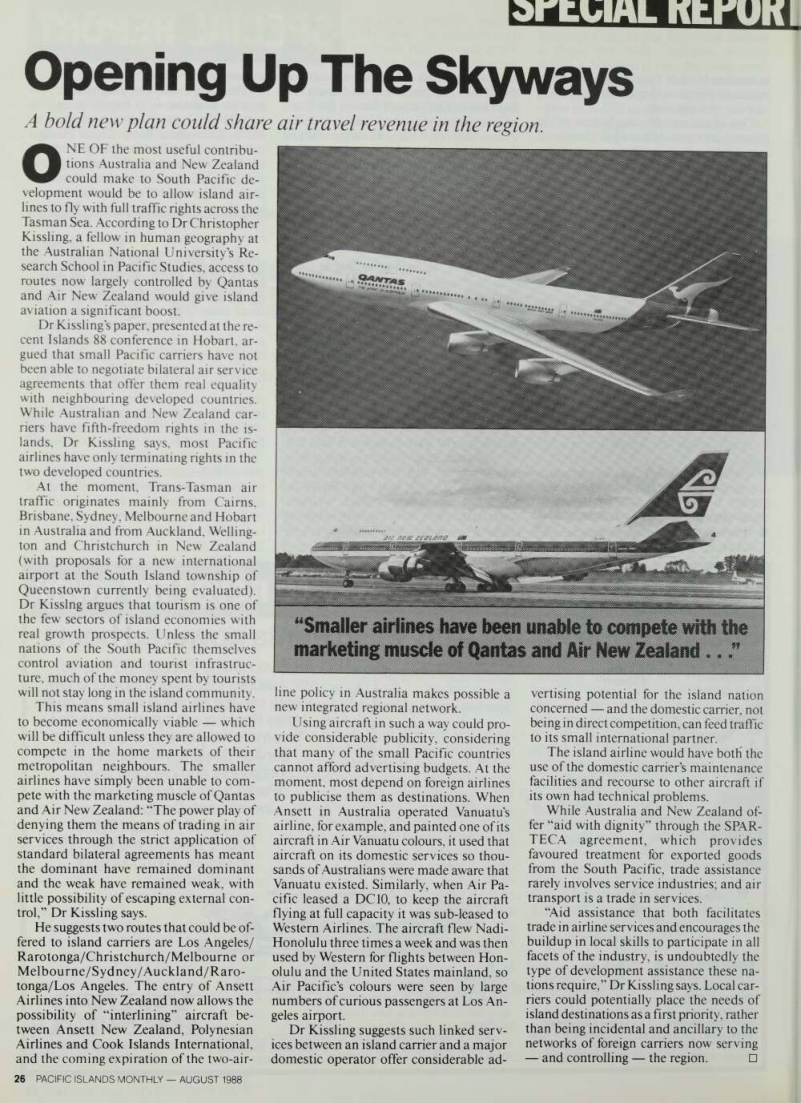
A bold new plan could share air travel revenue in the region.
ONE OF the most useful contribu tions Australia and New Zealand could make to South Pacific de velopment would be to allow island air lines to fly with full traffic rights across the Tasman Sea. According to Dr Christopher Kissling, a fellow in human geography at the Australian National University’s Re search School in Pacific Studies, access to routes now largely controlled by Qantas and Air New Zealand would give island aviation a significant boost.
Dr Kissling’s paper, presented at the re cent Islands 88 conference in Hobart, ar gued that small Pacific carriers have not been able to negotiate bilateral air service agreements that offer them real equality with neighbouring developed countries.
While Australian and New Zealand car riers have fifth-freedom rights in the is lands, Dr Kissling says, most Pacific airlines have only terminating rights in the two developed countries.
At the moment, Trans-Tasman air traffic originates mainly from Cairns, Brisbane, Sydney, Melbourne and Hobart in Australia and from Auckland, Welling ton and Christchurch in New Zealand (with proposals for a new international airport at the South Island township of Queenstown currently being evaluated).
Dr Kissing argues that tourism is one of the few sectors of island economies with real growth prospects. Unless the small nations of the South Pacific themselves control aviation and tourist infrastruc ture, much of the money spent by tourists will not stay long in the island community.
This means small island airlines have to become economically viable which will be difficult unless they are allowed to compete in the home markets of their metropolitan neighbours. The smaller airlines have simply been unable to com pete with the marketing muscle of Qantas and Air New Zealand: “The power play of denying them the means of trading in air services through the strict application of standard bilateral agreements has meant the dominant have remained dominant and the weak have remained weak, with little possibility of escaping external con trol,” Dr Kissling says.
He suggests two routes that could be of fered to island carriers are Los Angeles/ Rarotonga/Christchurch/Melbourne or Melbourne/Sydney/Auckland/Raro tonga/Los Angeles. The entry of Ansett Airlines into New Zealand now allows the possibility of “interlining” aircraft be tween Ansett New Zealand, Polynesian Airlines and Cook Islands International, and the coming expiration of the two-air-
line policy in Australia makes possible a new integrated regional network.
Using aircraft in such a way could provide considerable publicity, considering that many of the small Pacific countries cannot afford advertising budgets. At the moment, most depend on foreign airlines to publicise them as destinations. When Ansett in Australia operated Vanuatu’s airline, for example, and painted one of its aircraft in Air Vanuatu colours, it used that aircraft on its domestic services so thousands of Australians were made aware that Vanuatu existed. Similarly, when Air Pacific leased a DC 10, to keep the aircraft flying at full capacity it was sub-leased to Western Airlines. The aircraft flew Nadi- Honolulu three times a week and was then used by Western for flights between Honolulu and the United States mainland, so Air Pacific’s colours were seen by large numbers of curious passengers at Los Angeles airport.
Dr Kissling suggests such linked services between an island carrier and a major domestic operator offer considerable ad-
vertising potential for the island nation concerned and the domestic carrier, not being in direct competition, can feed traffic to its small international partner, The island airline would have both the use of the domestic carrier’s maintenance facilities and recourse to other aircraft if its own had technical problems.
While Australia and New Zealand of fer “aid with dignity” through the SPAR TECA agreement, which provides favoured treatment for exported goods from the South Pacific, trade assistance rarely involves service industries; and air transport is a trade in services, “Aid assistance that both facilitates trade in airline services and encourages the buildup in local skills to participate in all facets of the industry, is undoubtedly the type of development assistance these na tions require,” Dr Kissling says. Local car riers could potentially place the needs of island destinations as a first priority, rather than being incidental and ancillary to the networks of foreign carriers now serving and controlling the region. □
"Smaller airlines have been unable to compete with the marketing muscle of Qantas and Air New Zealand..."
Advertisements & other items, pp. 26-27 (2 items)
ortUAL tVLrUK I
corrugated-iron tanks.
Arnall water tanks. The longer-
life tanks with up to
3 times the lifespan of ordinary
corrugated-iron tanks.
M .
Ideal for:
• Domestic use
• Village water supply
• Mining & Rural areas • General industry
• Public utility buildings,
schools etc.
CHECK THE
ADVANTAGES
Wide range of capacities A size to suit every need, with a choice of 2,3, 5 or 10,000
gallon capacities.
Water stays cleaner, longer Steel roof, walls and floor, with 3 times the normal galvanising thickness. ArnaU’s unique design keeps water free from dust, insects and leaves.
Minimum site preparation Can be placed on the ground, on concrete-slab or timber
platform, and are flat-packed
for easy transportation to remote sites.
Easy to assemble yourself Fully-prefabricated, with stepby-step instructions for preparing foundations, and assembling. Precision-made components are easy to handle and fast to fix.
A DIVISION OF THE
ANI CORPORATION
LIMITED
ANI-ARNALL
25 Pacific Hwy, Bennetts Green, N.S.W. Australia. Phone: (049) 489099 FAX; (049) 484087
FOiTmORE INFORMATION, CONTACT YOUR NEAREST DISTRIBUTOR:
NOUMEA & PAPUA NEW RABAUL
TAHITI GUINEA Rabaul Metal Sun Pacific John Lysaght Industries Company Lae Ph; 42 1866 Ph: 92 1044 92 1875 Ph; Noumea 27 8026 Port Moresby Ph: 26 4688
VANUATU WESTERN SAMOA NORFOLK
Vate Natural Foods ISLAND Industries Ph; 22800 23380 Irvines Limited Ph: 2273 Ph: (6723) 2065
LORD HOWE
ISLAND
Lagoon Stores P.O. Box 1
PEM85134
Saving Pacific Plants
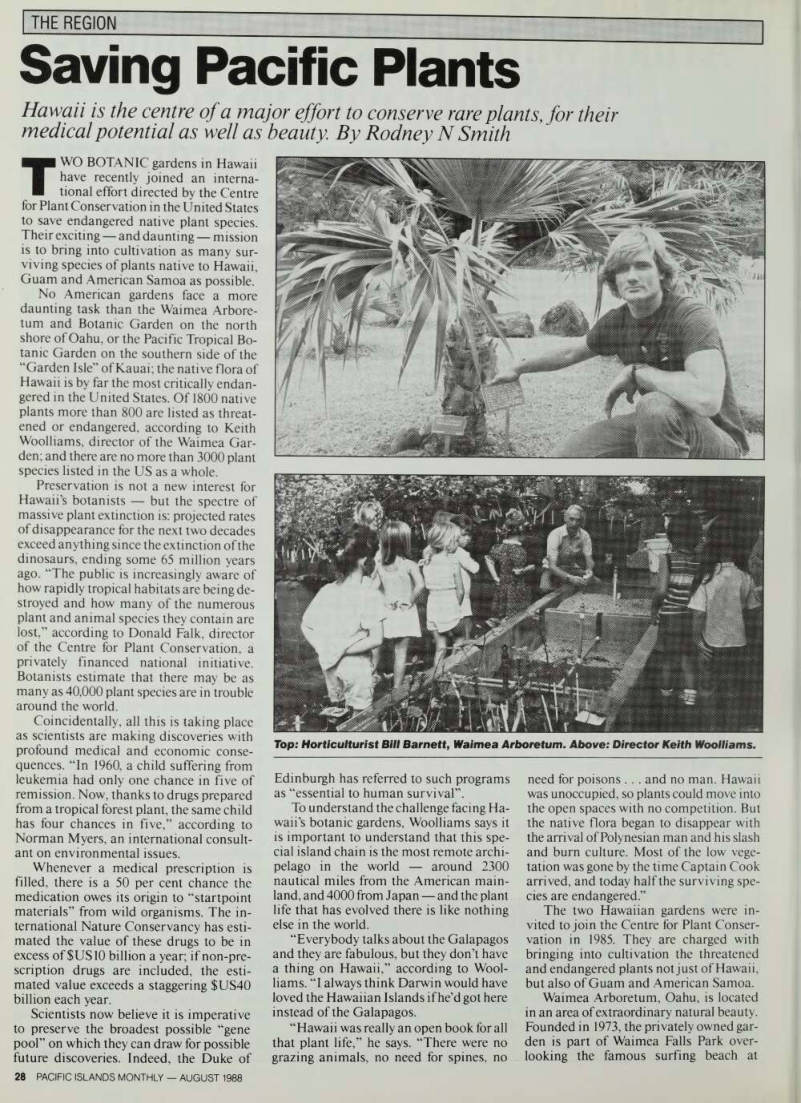
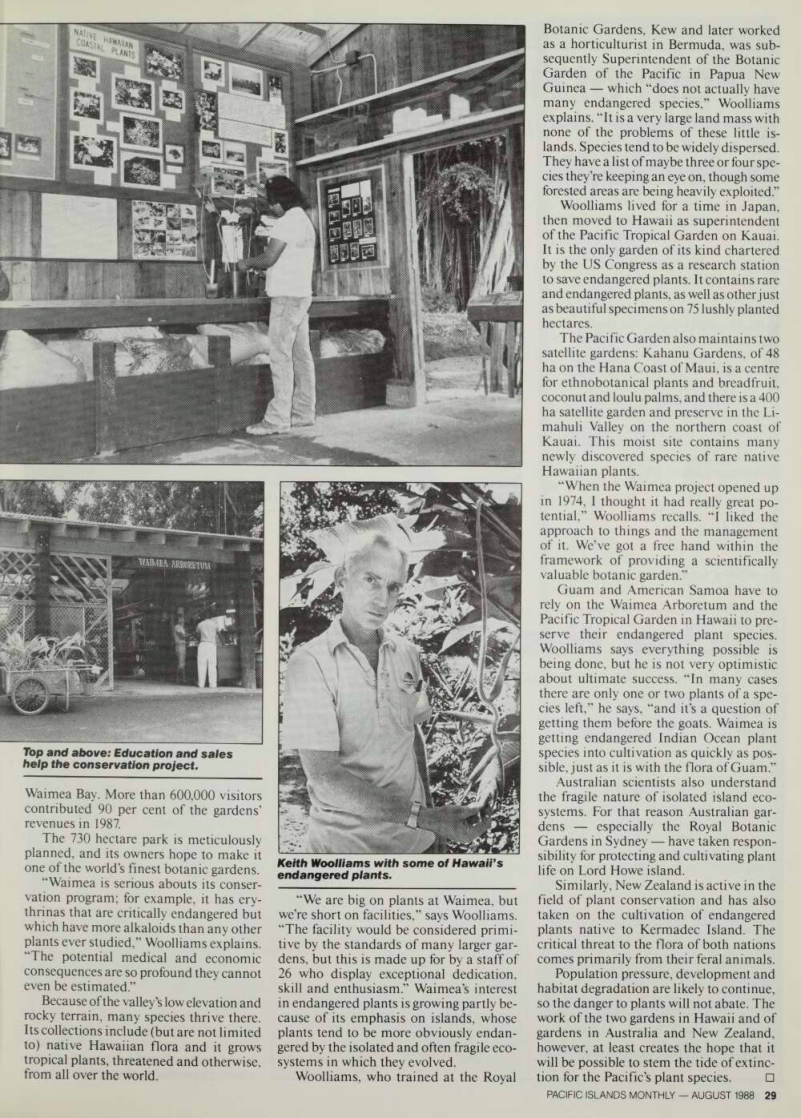
The Region
Hawaii is the centre of a major effort to conserve rare plants, for their
medical potential as well as beauty.
By Rodney N Smith
TWO BOTANIC gardens in Hawaii have recently joined an interna tional effort directed by the Centre for Plant Conservation in the United States to save endangered native plant species.
Their exciting and daunting mission is to bring into cultivation as many sur viving species of plants native to Hawaii, Guam and American Samoa as possible.
No American gardens face a more daunting task than the Waimea Arbore tum and Botanic Garden on the north shore of Oahu, or the Pacific Tropical Bo tanic Garden on the southern side of the “Garden Isle” of Kauai; the native flora of Hawaii is by far the most critically endan gered in the United States. Of 1800 native plants more than 800 are listed as threat ened or endangered, according to Keith Woolliams, director of the Waimea Gar den; and there are no more than 3000 plant species listed in the US as a whole.
Preservation is not a new interest for Hawaii’s botanists but the spectre of massive plant extinction is; projected rates of disappearance for the next two decades exceed anything since the extinction of the dinosaurs, ending some 65 million years ago. “The public is increasingly aware of how rapidly tropical habitats are being de stroyed and how many of the numerous plant and animal species they contain are lost,” according to Donald Falk, director of the Centre for Plant Conservation, a privately financed national initiative.
Botanists estimate that there may be as many as 40,000 plant species are in trouble around the world.
Coincidentally, all this is taking place as scientists are making discoveries with profound medical and economic conse quences. “In 1960, a child suffering from leukemia had only one chance in five of remission. Now, thanks to drugs prepared from a tropical forest plant, the same child has four chances in five,” according to Norman Myers, an international consult ant on environmental issues.
Whenever a medical prescription is filled, there is a 50 per cent chance the medication owes its origin to “startpoint materials” from wild organisms. The in ternational Nature Conservancy has esti mated the value of these drugs to be in excess of SUSIO billion a year; if non-pre scription drugs are included, the esti mated value exceeds a staggering SUS4O billion each year.
Scientists now believe it is imperative to preserve the broadest possible “gene pool” on which they can draw for possible future discoveries. Indeed, the Duke of
Edinburgh has referred to such programs as “essential to human survival”.
To understand the challenge facing Ha waii’s botanic gardens, Woolliams says it is important to understand that this spe cial island chain is the most remote archi pelago in the world around 2300 nautical miles from the American main land, and 4000 from Japan and the plant life that has evolved there is like nothing else in the world.
“Everybody talks about the Galapagos and they are fabulous, but they don’t have a thing on Hawaii,” according to Wool liams. “I always think Darwin would have loved the Hawaiian Islands if he’d got here instead of the Galapagos.
“Hawaii was really an open book for all that plant life,” he says. “There were no grazing animals, no need for spines, no
need for poisons . . . and no man. Hawaii was unoccupied, so plants could move into the open spaces with no competition. But the native flora began to disappear with the arrival of Polynesian man and his slash and burn culture. Most of the low vege tation was gone by the time Captain Cook arrived, and today half the surviving spe cies are endangered.”
The two Hawaiian gardens were in vited to join the Centre for Plant Conser vation in 1985. They are charged with bringing into cultivation the threatened and endangered plants not just of Hawaii, but also of Guam and American Samoa.
Waimea Arboretum, Oahu, is located in an area of extraordinary natural beauty.
Founded in 1973, the privately owned gar den is part of Waimea Falls Park over looking the famous surfing beach at
Top: Horticulturist Bill Barnett, Waimea Arboretum. Above: Director Keith Woolliams.
Waimea Bay. More than 600,000 visitors contributed 90 per cent of the gardens’ revenues in 1987.
The 730 hectare park is meticulously planned, and its owners hope to make it one of the world’s finest botanic gardens.
“Waimea is serious abouts its conser vation program; for example, it has ery thrinas that are critically endangered but which have more alkaloids than any other plants ever studied,” Woolliams explains.
“The potential medical and economic consequences are so profound they cannot even be estimated.”
Because of the valley’s low elevation and rocky terrain, many species thrive there.
Its collections include (but are not limited to) native Hawaiian flora and it grows tropical plants, threatened and otherwise, from all over the world.
“We are big on plants at Waimea, but we’re short on facilities,” says Woolliams.
“The facility would be considered primi tive by the standards of many larger gar dens, but this is made up for by a staff of 26 who display exceptional dedication, skill and enthusiasm.” Waimea’s interest in endangered plants is growing partly be cause of its emphasis on islands, whose plants tend to be more obviously endan gered by the isolated and often fragile eco systems in which they evolved.
Woolliams, who trained at the Royal
Botanic Gardens, Kew and later worked as a horticulturist in Bermuda, was sub sequently Superintendent of the Botanic Garden of the Pacific in Papua New Guinea which “does not actually have many endangered species,” Woolliams explains. “It is a very large land mass with none of the problems of these little is lands. Species tend to be widely dispersed.
They have a list of maybe three or four spe cies they’re keeping an eye on, though some forested areas are being heavily exploited.”
Woolliams lived for a time in Japan, then moved to Hawaii as superintendent of the Pacific Tropical Garden on Kauai.
It is the only garden of its kind chartered by the US Congress as a research station to save endangered plants. It contains rare and endangered plants, as well as other just as beautiful specimens on 75 lushly planted hectares.
The Pacific Garden also maintains two satellite gardens: Kahanu Gardens, of 48 ha on the Hana Coast of Maui, is a centre for elhnobotanical plants and breadfruit, coconut and loulu palms, and there is a 400 ha satellite garden and preserve in the Li mahuli Valley on the northern coast of Kauai. This moist site contains many newly discovered species of rare native Hawaiian plants.
“When the Waimea project opened up in 1974, I thought it had really great po tential,” Woolliams recalls. “I liked the approach to things and the management of it. We’ve got a free hand within the framework of providing a scientifically valuable botanic garden.”
Guam and American Samoa have to rely on the Waimea Arboretum and the Pacific Tropical Garden in Hawaii to pre serve their endangered plant species.
Woolliams says everything possible is being done, but he is not very optimistic about ultimate success. “In many cases there are only one or two plants of a spe cies left,” he says, “and it’s a question of getting them before the goats. Waimea is getting endangered Indian Ocean plant species into cultivation as quickly as pos sible, just as it is with the flora of Guam.”
Australian scientists also understand the fragile nature of isolated island eco systems. For that reason Australian gar dens especially the Royal Botanic Gardens in Sydney have taken respon sibility for protecting and cultivating plant life on Lord Howe island.
Similarly, New Zealand is active in the field of plant conservation and has also taken on the cultivation of endangered plants native to Kermadec Island. The critical threat to the flora of both nations comes primarily from their feral animals.
Population pressure, development and habitat degradation are likely to continue, so the danger to plants will not abate. The work of the two gardens in Hawaii and of gardens in Australia and New Zealand, however, at least creates the hope that it will be possible to stem the tide of extinc tion for the Pacific’s plant species. □
Top and above: Education and sales help the conservation project.
Keith Woolliams with some of Hawaii’s endangered plants.
A “Gift Of Health” For The Islands
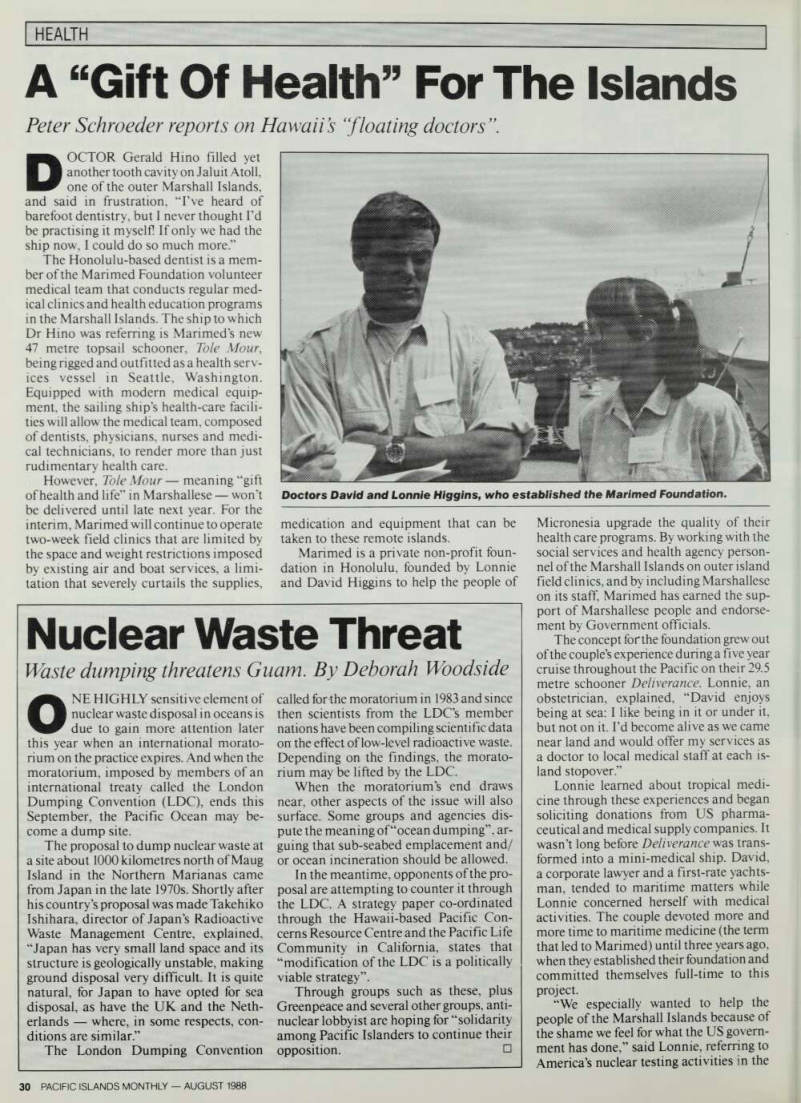
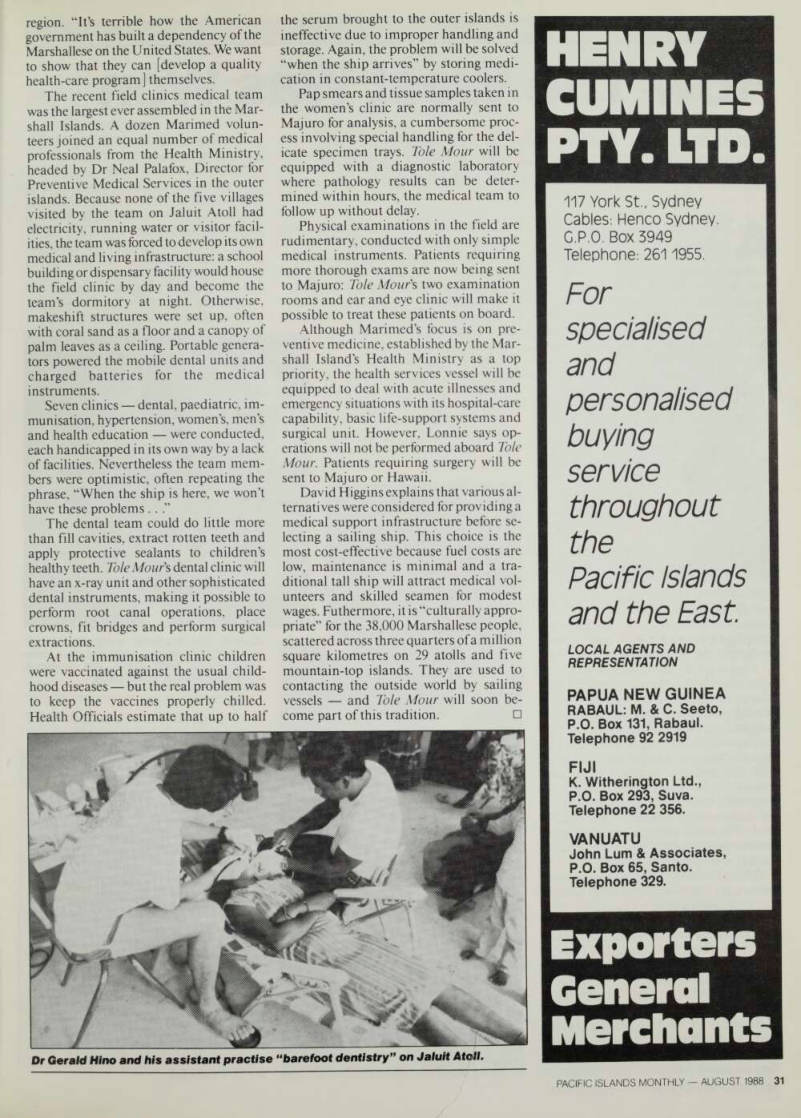
Health
Peter Schroeder reports on Hawaii’s “floatingdoctors’’.
DOCTOR Gerald Hino filled yet another tooth cavity on Jaluit Atoll, one of the outer Marshall Islands, and said in frustration, “I’ve heard of barefoot dentistry, but I never thought I’d be practising it myself If only we had the ship now, I could do so much more.”
The Honolulu-based dentist is a mem ber of the Marimed Foundation volunteer medical team that conducts regular med ical clinics and health education programs in the Marshall Islands. The ship to which Dr Hino was referring is Marimed’s new 47 metre topsail schooner, Tole Mour, being rigged and outfitted as a health serv ices vessel in Seattle, Washington.
Equipped with modern medical equip ment, the sailing ship’s health-care facili ties will allow the medical team, composed of dentists, physicians, nurses and medi cal technicians, to render more than just rudimentary health care.
However, Tole Mour meaning “gift of health and life” in Marshallese won’t be delivered until late next year. For the interim, Marimed will continue to operate two-week field clinics that are limited by the space and weight restrictions imposed by existing air and boat services, a limi tation that severely curtails the supplies,
medication and equipment that can be taken to these remote islands.
Marimed is a private non-profit foundation in Honolulu, founded by Lonnie and David Higgins to help the people of
Micronesia upgrade the quality of their health care programs. By working with the social services and health agency person nel of the Marshall Islands on outer island field clinics, and by including Marshallese on its staff, Marimed has earned the sup port of Marshallese people and endorse ment by Government officials.
The concept forthe foundation grew out of the couple’s experience during a five year cruise throughout the Pacific on their 29.5 metre schooner Deliverance. Lonnie, an obstetrician, explained, “David enjoys being at sea: I like being in it or under it, but not on it. I’d become alive as we came near land and would offer my services as a doctor to local medical staff at each is land stopover.”
Lonnie learned about tropical medi cine through these experiences and began soliciting donations from US pharma ceutical and medical supply companies. It wasn’t long before Deliverance was trans formed into a mini-medical ship. David, a corporate lawyer and a first-rate yachts man, tended to maritime matters while Lonnie concerned herself with medical activities. The couple devoted more and more time to maritime medicine (the term that led to Marimed) until three years ago, when they established their foundation and committed themselves full-time to this project.
“We especially wanted to help the people of the Marshall Islands because of the shame we feel for what the US govern ment has done,” said Lonnie, referring to America’s nuclear testing activities in the
Doctors David and Lonnie Higgins, who established the Marimed Foundation.
region. “It’s terrible how the American government has built a dependency of the Marshallese on the United States. We want to show that they can [develop a quality health-care program] themselves.
The recent field clinics medical team was the largest ever assembled in the Mar shall Islands. A dozen Marimed volun teers joined an equal number of medical professionals from the Health Ministry, headed by Dr Neal Palafox, Director for Preventive Medical Services in the outer islands. Because none of the five villages visited by the team on Jaluit Atoll had electricity, running water or visitor facil ities, the team was forced to develop its own medical and living infrastructure: a school building or dispensary facility would house the field clinic by day and become the team’s dormitory at night. Otherwise, makeshift structures were set up, often with coral sand as a floor and a canopy of palm leaves as a ceiling. Portable genera tors powered the mobile dental units and charged batteries for the medical instruments.
Seven clinics dental, paediatric, im munisation, hypertension, women’s, men’s and health education were conducted, each handicapped in its own way by a lack of facilities. Nevertheless the team mem bers were optimistic, often repeating the phrase, “When the ship is here, we won’t have these problems ...”
The dental team could do little more than fill cavities, extract rotten teeth and apply protective sealants to children’s healthy teeth. ToleMour's dental clinic will have an x-ray unit and other sophisticated dental instruments, making it possible to perform root canal operations, place crowns, fit bridges and perform surgical extractions.
At the immunisation clinic children were vaccinated against the usual child hood diseases but the real problem was to keep the vaccines properly chilled.
Health Officials estimate that up to half
the serum brought to the outer islands is ineffective due to improper handling and storage. Again, the problem will be solved “when the ship arrives” by storing medi cation in constant-temperature coolers.
Pap smears and tissue samples taken in the women’s clinic are normally sent to Majuro for analysis, a cumbersome proc ess involving special handling for the del icate specimen trays. Tole Mour will be equipped with a diagnostic laboratory where pathology results can be deter mined within hours, the medical team to follow up without delay.
Physical examinations in the field are rudimentary, conducted with only simple medical instruments. Patients requiring more thorough exams are now being sent to Majuro: Tole Mour' s two examination rooms and ear and eye clinic will make it possible to treat these patients on board.
Although Marimed’s focus is on pre ventive medicine, established by the Mar shall Island’s Health Ministry as a top priority, the health services vessel will be equipped to deal with acute illnesses and emergency situations with its hospital-care capability, basic life-support systems and surgical unit. However, Lonnie says op erations will not be performed aboard Tole Mour. Patients requiring surgery will be sent to Majuro or Hawaii.
David Higgins explains that various al ternatives were considered for providing a medical support infrastructure before se lecting a sailing ship. This choice is the most cost-effective because fuel costs are low, maintenance is minimal and a tra ditional tall ship will attract medical vol unteers and skilled seamen for modest wages. Futhermore, it is “culturally appro priate” for the 38,000 Marshallese people, scattered across three quarters ofa million square kilometres on 29 atolls and five mountain-top islands. They are used to contacting the outside world by sailing vessels and Tole Mour will soon be come part of this tradition. □
Dr Gerald Hino and his assistant practise “barefoot dentistry" on Jaluit Atoll.
Nuclear Waste Threat
Waste dumping threatens Guam.
By Deborah Woodside
ONE HIGHLY sensitive element of nuclear waste disposal in oceans is due to gain more attention later this year when an international moratorium on the practice expires. And when the moratorium, imposed by members of an international treaty called the London Dumping Convention (LDC), ends this September, the Pacific Ocean may become a dump site.
The proposal to dump nuclear waste at a site about 1000 kilometres north of Maug Island in the Northern Marianas came from Japan in the late 19705. Shortly after his country’s proposal was made Takehiko Ishihara, director of Japan’s Radioactive Waste Management Centre, explained, “Japan has very small land space and its structure is geologically unstable, making ground disposal very difficult. It is quite natural, for Japan to have opted for sea disposal, as have the UK and the Netherlands where, in some respects, conditions are similar.”
The London Dumping Convention
called forthe moratorium in 1983 and since then scientists from the LDCs member nations have been compiling scientific data on the effect of low-level radioactive waste, Depending on the findings, the morato rium may be lifted by the LDC.
When the moratorium’s end draws near, other aspects of the issue will also surface. Some groups and agencies dis pute the meaning of “ocean dumping”, ar guing that sub-seabed emplacement and/ or ocean incineration should be allowed.
In the meantime, opponents of the pro posal are attempting to counter it through the LDC. A strategy paper co-ordinated through the Hawaii-based Pacific Con cerns Resource Centre and the Pacific Life Community in California, states that “modification of the LDC is a politically viable strategy”.
Through groups such as these, plus Greenpeace and several other groups, anti nuclear lobbyist are hoping for “solidarity among Pacific Islanders to continue their opposition. □
Advertisements & other items, p. 31 (1 item)
Exporters
141! =H
PTY. LTD.
117 York St., Sydney Cables: Henco Sydney.
C.P.O. Box 5949 Telephone: 261 1955.
For
specialised
and
personalised
buying
service
throughout
the
Pacific Islands
and the East.
LOCAL AGENTS AND
REPRESENTATION
PAPUA NEW GUINEA
RABAUL: M. & C. Seeto, P.O. Box 131, Rabaul.
Telephone 92 2919
FIJI
K. Witherington Ltd., P.O. Box 293, Suva.
Telephone 22 356.
VANUATU
John Lum & Associates, P.O. Box 65, Santo.
Telephone 329.
Exporters
General
Merchants
How The West Was Won
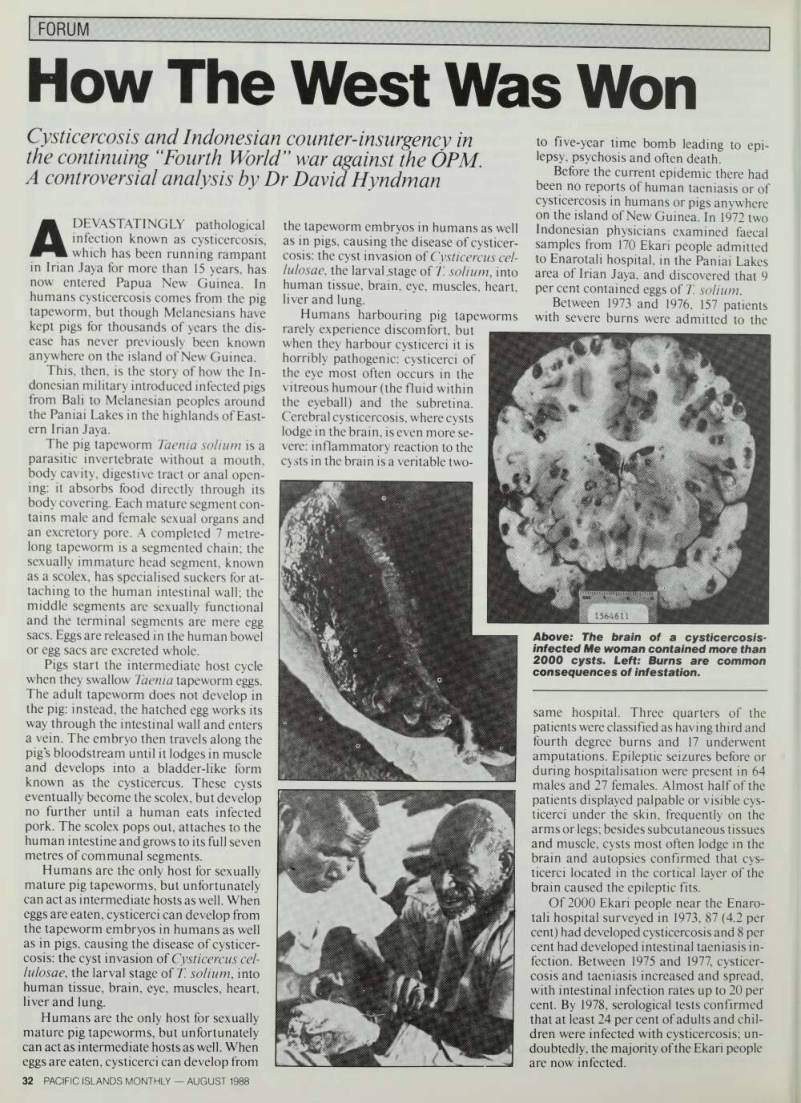
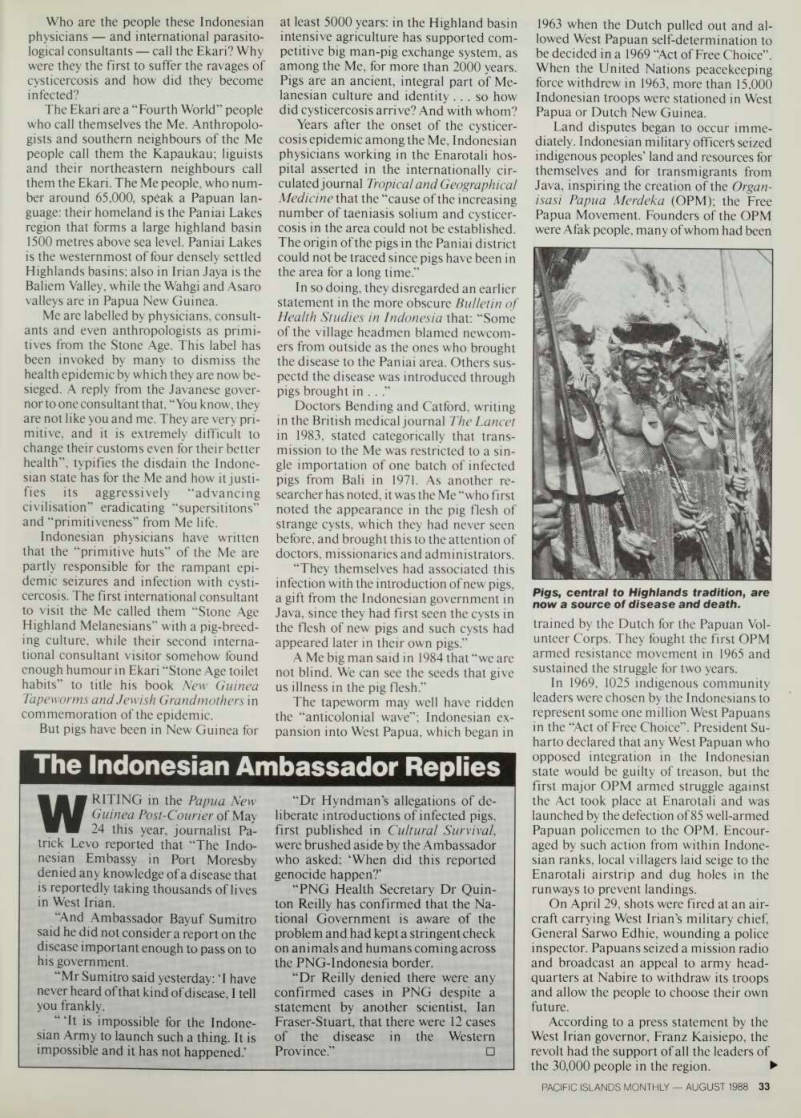
Forum
Cysticercosis and Indonesian counter-insurgency in the continuing “Fourth World” war against the OPM.
A controversial analysis by Dr David Hyndman
ADEVASTATINGLY pathological
infection known as cysticercosis, which has been running rampant in Irian Jaya for more than 15 years, has now entered Papua New Guinea. In humans cysticercosis comes from the pig tapeworm, but though Melanesians have kept pigs for thousands of years the dis ease has never previously been known anywhere on the island of New Guinea.
This, then, is the story of how the In donesian military introduced infected pigs from Bali to Melanesian peoples around the Paniai Lakes in the highlands of East ern Irian Jaya.
The pig tapeworm Taenia solium is a parasitic invertebrate without a mouth, body cavity, digestive tract or anal open ing; it absorbs food directly through its body covering. Each mature segment con tains male and female sexual organs and an excretory pore. A completed 7 metre long tapeworm is a segmented chain; the sexually immature head segment, known as a scolex, has specialised suckers for at taching to the human intestinal wall; the middle segments are sexually functional and the terminal segments are mere egg sacs. Eggs are released in the human bowel or egg sacs are excreted whole.
Pigs start the intermediate host cycle when they swallow Taenia tapeworm eggs.
The adult tapeworm does not develop in the pig: instead, the hatched egg works its way through the intestinal wall and enters a vein. The embryo then travels along the pig’s bloodstream until it lodges in muscle and develops into a bladder-like form known as the cysticercus. These cysts eventually become the scolex, but develop no further until a human eats infected pork. The scolex pops out, attaches to the human intestine and grows to its full seven metres of communal segments.
Humans are the only host for sexually mature pig tapeworms, but unfortunately can act as intermediate hosts as well. When eggs are eaten, cysticerci can develop from the tapeworm embryos in humans as well as in pigs, causing the disease of cysticer cosis: the cyst invasion of Cysticercus cel lulosae, the larval stage of T solium , into human tissue, brain, eye, muscles, heart, liver and lung.
Humans are the only host for sexually mature pig tapeworms, but unfortunately can act as intermediate hosts as well. When eggs are eaten, cysticerci can develop from
the tapeworm embryos in humans as well as in pigs, causing the disease of cysticer cosis: the cyst invasion of Cysticercus cel lulosae, the larval .stage of f. solium , into human tissue, brain, eye, muscles, heart, liver and lung.
Humans harbouring pig tapeworms
rarely experience discomfort, but when they harbour cysticerci it is horribly pathogenic: cysticerci of the eye most often occurs in the vitreous humour (the fluid within the eyeball) and the subretina.
Cerebral cysticercosis, where cysts lodge in the brain, is even more se vere: inflammatory reaction to the cysts in the brain is a veritable two-
to five-year time bomb leading to epi lepsy, psychosis and often death.
Before the current epidemic there had been no reports of human taeniasis or of cysticercosis in humans or pigs anywhere on the island of New Guinea. In 1972 two Indonesian physicians examined faecal samples from 170 Ekari people admitted to Enarotali hospital, in the Paniai Lakes area of Irian Jaya, and discovered that 9 per cent contained eggs of T solium.
Between 1973 and 1976, 157 patients with severe burns were admitted to the
same hospital. Three quarters of the patients were classified as having third and fourth degree burns and 17 underwent amputations. Epileptic seizures before or during hospitalisation were present in 64 males and 27 females. Almost half of the patients displayed palpable or visible cys ticerci under the skin, frequently on the arms or legs; besides subcutaneous tissues and muscle, cysts most often lodge in the brain and autopsies confirmed that cys ticerci located in the cortical layer of the brain caused the epileptic fits.
Of 2000 Ekari people near the Enaro tali hospital surveyed in 1973, 87 (4.2 per cent) had developed cysticercosis and 8 per cent had developed intestinal taeniasis in fection. Between 1975 and 1977, cysticer cosis and taeniasis increased and spread, with intestinal infection rates up to 20 per cent. By 1978, serological tests confirmed that at least 24 per cent of adults and chil dren were infected with cysticercosis; un doubtedly, the majority of the Ekari people are now infected.
Above: The brain of a cysticercosis infected Me woman contained more than 2000 cysts. Left: Burns are common consequences of infestation.
Who are the people these Indonesian physicians and international parasito logical consultants call the Ekari? Why were they the first to suffer the ravages of cysticercosis and how did they become infected?
The Ekari are a “Fourth World” people who call themselves the Me. Anthropolo gists and southern neighbours of the Me people call them the Kapaukau; liguists and their northeastern neighbours call them the Ekari. The Me people, who num ber around 65,000, speak a Papuan lan guage: their homeland is the Paniai Lakes region that forms a large highland basin 1500 metres above sea level. Paniai Lakes is the westernmost of four densely settled Highlands basins; also in Irian Jaya is the Baliem Valley, while the Wahgi and Asaro valleys are in Papua New Guinea.
Me are labelled by physicians, consult ants and even anthropologists as primi tives from the Stone Age. This label has been invoked by many to dismiss the health epidemic by which they are now be sieged. A reply from the Javanese gover nor to one consultant that, “You know, they are not like you and me. They are very pri mitive, and it is extremely difficult to change their customs even for their better health”, typifies the disdain the Indone sian state has for the Me and how it justi fies its aggressively “advancing civilisation” eradicating “supersititons” and “primitiveness” from Me life.
Indonesian physicians have written that the “primitive huts” of the Me are partly responsible for the rampant epi demic seizures and infection with cysti cercosis. The first international consultant to visit the Me called them “Stone Age Highland Melanesians” with a pig-breed ing culture, while their second interna tional consultant visitor somehow found enough humour in Ekari “Stone Age toilet habits” to title his book New Guinea Tapeworms and Jewish Grandmothers in commemoration of the epidemic.
But pigs have been in New Guinea for
at least 5000 years: in the Highland basin intensive agriculture has supported com petitive big man-pig exchange system, as among the Me, for more than 2000 years.
Pigs are an ancient, integral part of Me lanesian culture and identity ... so how did cysticercosis arrive? And with whom?
Years after the onset of the cysticer cosis epidemic among the Me, Indonesian physicians working in the Enarotali hos pital asserted in the internationally cir culated journal Tropical and Geographical Medicine that the “cause of the increasing number of taeniasis solium and cysticer cosis in the area could not be established.
The origin of the pigs in the Paniai district could not be traced since pigs have been in the area for a long time.”
In so doing, they disregarded an earlier statement in the more obscure Bulletin of Health Studies in Indonesia that: “Some of the village headmen blamed newcom ers from outside as the ones who brought the disease to the Paniai area. Others sus pectd the disease was introduced through pigs brought in . . .”
Doctors Bending and Catford, writing in the British medical journal The Lancet in 1983, stated categorically that trans mission to the Me was restricted to a sin gle importation of one batch of infected pigs from Bali in 1971. As another re searcher has noted, it was the Me “who first noted the appearance in the pig flesh of strange cysts, which they had never seen before, and brought this to the attention of doctors, missionaries and administrators.
“They themselves had associated this infection with the introduction of new pigs, a gift from the Indonesian government in Java, since they had first seen the cysts in the flesh of new pigs and such cysts had appeared later in their own pigs.”
A Me big man said in 1984 that “we are not blind. We can see the seeds that give us illness in the pig flesh.”
The tapeworm may well have ridden the “anticolonial wave”; Indonesian ex pansion into West Papua, which began in
1963 when the Dutch pulled out and al lowed West Papuan self-determination to be decided in a 1969 “Act of Free Choice”.
When the United Nations peacekeeping force withdrew in 1963, more than 15,000 Indonesian troops were stationed in West Papua or Dutch New Guinea.
Land disputes began to occur imme diately. Indonesian military officers seized indigenous peoples’ land and resources for themselves and for transmigrants from Java, inspiring the creation of the Organ isasi Papua Merdeka (OPM); the Free Papua Movement. Founders of the OPM were Afak people, many of whom had been
trained by the Dutch for the Papuan Vol unteer Corps. They fought the first OPM armed resistance movement in 1965 and sustained the struggle for two years.
In 1969, 1025 indigenous community leaders were chosen by the Indonesians to represent some one million West Papuans in the “Act of Free Choice”. President Su harto declared that any West Papuan who opposed integration in the Indonesian state would be guilty of treason, but the first major OPM armed struggle against the Act took place at Enarotali and was launched by the defection of 85 well-armed Papuan policemen to the OPM. Encour aged by such action from within Indone sian ranks, local villagers laid seige to the Enarotali airstrip and dug holes in the runways to prevent landings.
On April 29, shots were fired at an air craft carrying West Irian’s military chief.
General Sarwo Edhie, wounding a police inspector. Papuans seized a mission radio and broadcast an appeal to army head quarters at Nabire to withdraw its troops and allow the people to choose their own future.
According to a press statement by the West Irian governor, Franz Kaisiepo, the revolt had the support of all the leaders of the 30,000 people in the region. ►
Pigs, central to Highlands tradition, are now a source of disease and death.
◄ The Indonesian army responded to OPM armed resistance by firing machine guns from aircraft and flying in para troopers, forcing more than 14,000 Me people from their villages and into the bush as refugees.
A few months later, another major con frontation took place in the Paniai Lakes region. Thousands of Me abandoned their villages; women established food gardens in the remote portions of their mountain homeland and the men attacked Indone sian patrols.
The “election” was completed by August 1969, and Indonesia officially an nounced West Papua as the province of West Irian within Indonesia Irian Jaya.
It is not difficult to see why the Me people were singled out for the transcul lural transfer of infected pigs. By Irian Jayan standards they were densely settled around the Paniai Lakes; thousands had taken up continuing armed resistance against incorporation into Indonesia, and their homeland was a prime locality for Javanese transmigrants.
Indonesia’s President Suharto soft ened the military action in the Me home land by sending a gift of pigs. The pigs came from Bali, the area in which pig rear ing in Indonesia is largely concentrated, since Bali is Hindu and the rest of the country is mostly Muslim.
Whatever the political and social ad vantages of the gift, the medical result was an unmitigated tragedy.
The Indonesian military is certainly not admitting that it introduced cysticer cosis as a diabolical form of biological warfare, but I cannot accept that the cys ticercosis epidemic is no more than a trag ically unforeseen consequence of a beneficent military gift.
One small batch of infected pigs proved to be an insidiously simple counter-insur gency tactic to decimate and demoralise the enemy. The extent of that demoralis ation is testified to by a Me big man who said: “No one lives forever, and if we must die, then we must die. Life is not longer a pleasure. We are only half men. The Indonesians will not let us make warfare that gave us manhood.
“I no longer care if I eat corrupt pig flesh . . . When the missionaries brought us the coughing sickness [a whooping cough epidemic in 1956], we rose in anger; this time we have no heart to do so.”
In fewer than five years after its intro duction cysticercosis was present in doz ens of communities near the PNG/Irian Jaya border communities, indicating how rapidly the epidemic spread among the people of the Irian Jayan highlands. There is evidence that the infection has now spread to other parts of Irian Jaya: by 1973, taeniasis and cysticercosis had already spread to the Western Dani people living in the Baliem Valley, and by 1975 the dis ease had spread to the Mountain Ok people around Ok Sibil.
The severity of the epidemic is attested
to by Drs Bending and Catford, who led the last medical research expedition to the Paniai Lakes in 1977. They were con cerned that cysticercosis threatens the continued existence of the Me people, and that “it ranks as one of the major causes of mortality in the adult population.”
The Mountain Ok people live on both sides of the contemporary political bor der. In 1978, a WHO medical research team reported that the Wopkaimin Mountain Ok in nearby Papua New' Guinea showed no signs of cysticercosis “either as sbucutaneous nodules, calcified muscular nodules on X-ray, or epilepsy”, but the continuing West Papuan war escalated in 1984, when Indonesian coun terinsurgency actions and road building on the border forced more than 1800 refugees to seek asylum in Kamokpin camp and more than 400 more to Niogomban camp among the Yonggam people. The Papua New Guinea Government referred to the refugees as “border crossers”.
Conditions were so dreadful in the ref ugee camps that by August 1984, 52 per cent of the children from one to five years of age had severe malnutrition with signs of kwashiorkor; conditions at home were perceived as worse, so more than 10,000 refugees remained in these and other camps along the border of the Western and West Sepik Provinces.
What can be done to combat the spread of cysticercosis? The most efficient method would be for the OPM to inau gurate a massive education program among indigenous West Papuan peoples; public health measures undertaken by missionaries and Indonesian officialdom have been unsuccessful because of dis trust and other cultural reasons.
Papuan people should also be encour aged to dispose of body wastes in pit la trines and to thoroughly cook pork. These realistic preventative measures can and should be taken.
Intestinal taeniasis is treatable with drugs such as mebendazole, and newborn pigs can be immunised, but the expense of these drugs forecloses their use. A disad vantage of immunisation is that Highlan ders encourage their domestic stock to breed with feral pigs an efficient way of ensuring the gene pool is as broad as pos sible in which tapeworms are endemic.
If domestic pigs could be freed of tape worm infestation, other measures would still be needed to control parasite infest tation in wild pigs.
Massive pig killing to break the para site life cycle is also unrealistic, given the enduring cultural importance attached to the pig throughout Irian Jaya and Papua New Guinea. n
Dr David Hyndman is a senior lecturer in the Department of Anthropology and So ciology at the University of Queensland.
He has 14 years’ research experience in PNG, with a focus on the political ecology of indigenous peoples.
The Indonesian Ambassador Replies
WRITING in the Papua New Guinea Post-Courier of May 24 this year, journalist Pa trick Levo reported that “The Indo nesian Embassy in Port Moresby denied any knowledge of a disease that is reportedly taking thousands of lives in West Irian.
“And Ambassador Bayuf Sumitro said he did not consider a report on the disease important enough to pass on to his government.
“Mr Sumitro said yesterday: T have never heard of that kind of disease, I tell you frankly, “’lt is impossible for the Indone sian Army to launch such a thing. It is impossible and it has not happened.’
“Dr Hyndman’s allegations of de liberate introductions of infected pigs, first published in Cultural Survival , were brushed aside by the Ambassador who asked: ’When did this reported genocide happen?’
“PNG Health Secretary Dr Quin ton Reilly has confirmed that the Na tional Government is aware of the problem and had kept a stringent check on animals and humans coming across the PNG-Indonesia border.
“Dr Reilly denied there were any confirmed cases in PNG despite a statement by another scientist, lan Fraser-Stuart, that there were 12 cases of the disease in the Western Province” □
Advertisements & other items, p. 34 (1 item)
Free
to owners of
DIESEL
GENERATORS
In villages, resorts and in mining applications our proven diesel/battery equipment will;
• SAVE 65% TO 75%
OF FUEL
• GIVE 24 HOUR
POWER.
A Northern Territory, Australia government report says that our equipment can supply reliable power up to 40% cheaper than a stand-alone diesel generator.
At no cost to you we will prepare a report on the cost efficiency of your present generating set up compared with the cost of our equipment.
FOR DETAILS SEND TO:
POWERMAKERS PTY. LTD.
P.0.80X 1083,
FYSHWICK 2609
AUSTRALIA.
I PHONE: (062) 39 1015
I FAX: (062) 39 1018
I Please send me details of your Power I equipment.
I Name: Address: Phone: j Size of diesel generator: I Type of
j application:
DEALER INQUIRIES
WELCOME
Legal Battle Shakes Kingdom
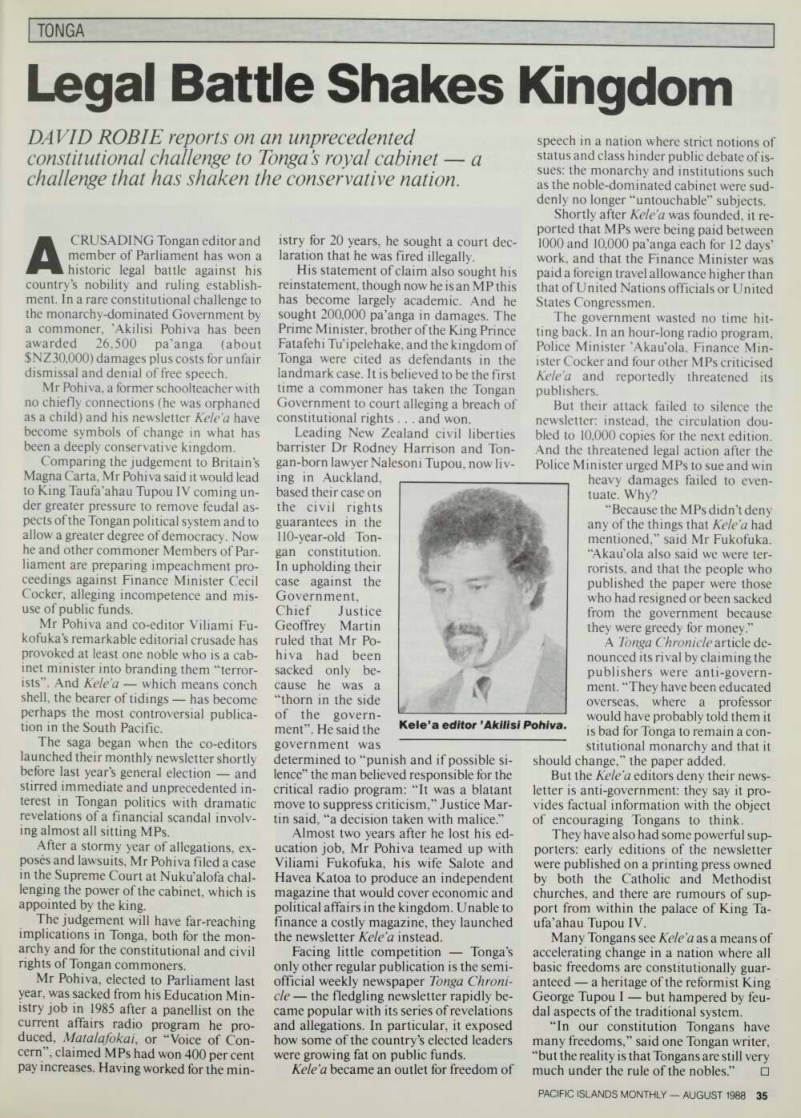
Tonga
DA VID ROBIE reports on an unprecedented constitutional challenge to Tonga s royal cabinet a challenge that has shaken the conservative nation.
A CRUSADING Tongan editor and member of Parliament has won a historic legal battle against his country’s nobility and ruling establish ment. In a rare constitutional challenge to the monarchy-dominated Government by a commoner, ’Akilisi Pohiva has been awarded 26,500 pa’anga (about SNZ3O,OOO) damages plus costs for unfair dismissal and denial of free speech.
Mr Pohiva, a former schoolteacher with no chiefly connections (he was orphaned as a child) and his newsletter Kele’a have become symbols of change in what has been a deeply conservative kingdom.
Comparing the judgement to Britain’s Magna Carta, Mr Pohiva said it would lead to King Taufa’ahau Tupou IV coming un der greater pressure to remove feudal as pects of the Tongan political system and to allow a greater degree of democracy. Now he and other commoner Members of Par liament are preparing impeachment pro ceedings against Finance Minister Cecil Cocker, alleging incompetence and mis use of public funds.
Mr Pohiva and co-editor Viliami Fu kofuka’s remarkable editorial crusade has provoked at least one noble who is a cab inet minister into branding them “terror ists”. And Kele’a which means conch shell, the bearer of tidings has become perhaps the most controversial publica tion in the South Pacific.
The saga began when the co-editors launched their monthly newsletter shortly before last year’s general election and stirred immediate and unprecedented in terest in Tongan politics with dramatic revelations of a financial scandal involv ing almost all sitting MPs.
After a stormy year of allegations, ex poses and lawsuits, Mr Pohiva filed a case in the Supreme Court at Nukualofa chal lenging the power of the cabinet, which is appointed by the king.
The judgement will have far-reaching implications in Tonga, both for the mon archy and for the constitutional and civil rights of Tongan commoners.
Mr Pohiva, elected to Parliament last year, was sacked from his Education Min istry job in 1985 after a panellist on the current affairs radio program he pro duced, Matalafokai , or “Voice of Con cern , claimed MPs had won 400 per cent pay increases. Having worked for the min
istry for 20 years, he sought a court dec laration that he was fired illegally.
His statement of claim also sought his reinstatement, though now he is an MP this has become largely academic. And he sought 200,000 pa’anga in damages. The Prime Minister, brother of the King Prince Fatafehi Tu’ipelehake, and the kingdom of Tonga were cited as defendants in the landmark case. It is believed to be the first time a commoner has taken the Tongan Government to court alleging a breach of constitutional rights . . . and won.
Leading New Zealand civil liberties barrister Dr Rodney Harrison and Ton gan-born lawyer Nalesoni Tupou, now liv
ing in Auckland, based their case on the civil rights guarantees in the 110-year-old Ton gan constitution.
In upholding their case against the Government, Chief Justice Geoffrey Martin ruled that Mr Po hiva had been sacked only be cause he was a “thorn in the side of the govern ment”. He said the government was
determined to “punish and if possible si lence” the man believed responsible for the critical radio program: “It was a blatant move to suppress criticism,” Justice Mar tin said, “a decision taken with malice.”
Almost two years after he lost his ed ucation job, Mr Pohiva teamed up with Viliami Fukofuka, his wife Salote and Havea Katoa to produce an independent magazine that would cover economic and political affairs in the kingdom. Unable to finance a costly magazine, they launched the newsletter Kele’a instead.
Facing little competition Tonga’s only other regular publication is the semi official weekly newspaper Tonga Chroni cle the fledgling newsletter rapidly be came popular with its series of revelations and allegations. In particular, it exposed how some of the country’s elected leaders were growing fat on public funds.
Kele’a became an outlet for freedom of
speech in a nation where strict notions of status and class hinder public debate of is sues: the monarchy and institutions such as the noble-dominated cabinet were sud denly no longer “untouchable” subjects.
Shortly after Kele’a was founded, it re ported that MPs were being paid between 1000 and 10,000 pa’anga each for 12 days’ work, and that the Finance Minister was paid a foreign travel allowance higher than that of United Nations officials or United States Congressmen.
The government wasted no time hit ting back. In an hour-long radio program.
Police Minister ’Akau’ola, Finance Min ister Cocker and four other MPs criticised Kele’a and reportedly threatened its publishers.
But their attack failed to silence the newsletter: instead, the circulation dou bled to 10,000 copies for the next edition.
And the threatened legal action after the Police Minister urged MPs to sue and win
heavy damages failed to even tuate. Why?
“Because the MPs didn’t deny any of the things that Kele’a had mentioned,” said Mr Fukofuka.
“Akau’ola also said we were ter rorists, and that the people who published the paper were those who had resigned or been sacked from the government because they were greedy for money.”
A Tonga Chronicle article de nounced its rival by claiming the publishers were anti-govern ment. “They have been educated overseas, where a professor would have probably told them it is bad for Tonga to remain a con stitutional monarchy and that it
should change,” the paper added, But the Kele’a editors deny their news letter is anti-government: they say it pro vides factual information with the object of encouraging Tongans to think.
They have also had some powerful sup porters: early editions of the newsletter were published on a printing press owned by both the Catholic and Methodist churches, and there are rumours of sup port from within the palace of King Ta ufa’ahau Tupou IV.
Many Tongans see Kele’a as a means of accelerating change in a nation where all basic freedoms are constitutionally guar anteed a heritage of the reformist King George Tupou I but hampered by feu dal aspects of the traditional system, “In our constitution Tongans have many freedoms,” said one Tongan writer, “but the reality is that Tongans are still very much under the rule of the nobles.” □
Kele’a editor ’Akilisi Pohiva.
Nouméa’s Window On Kanak Culture
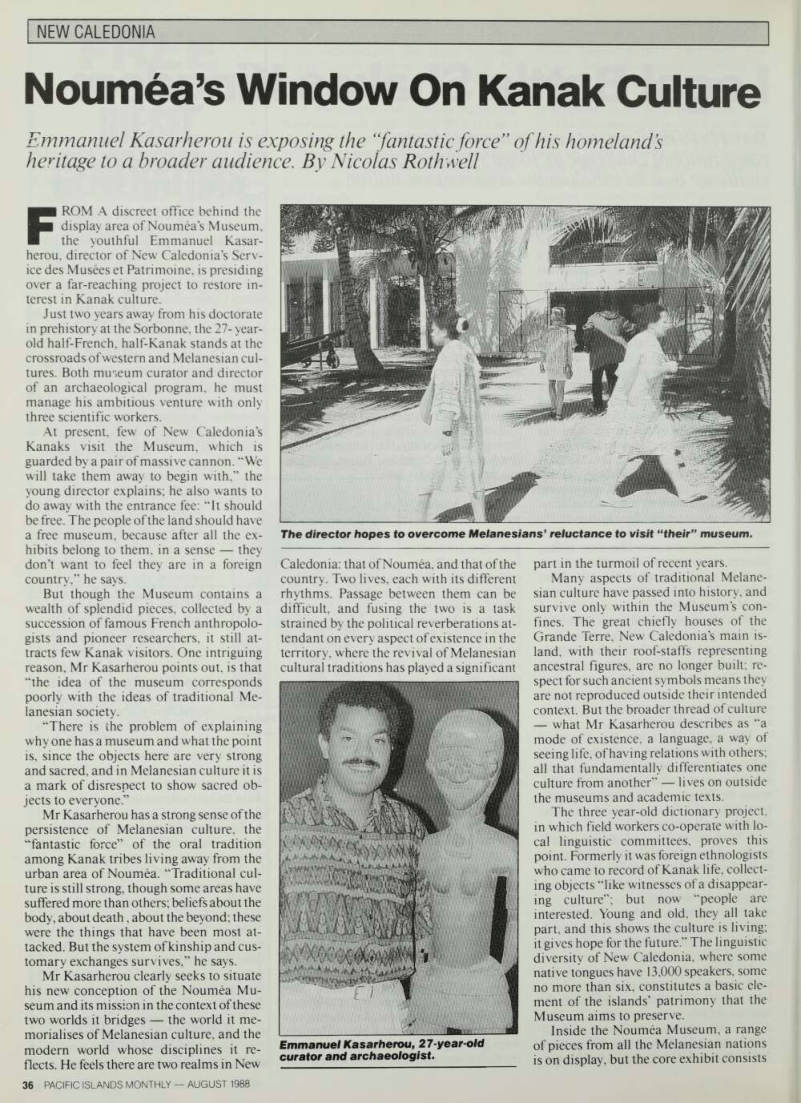
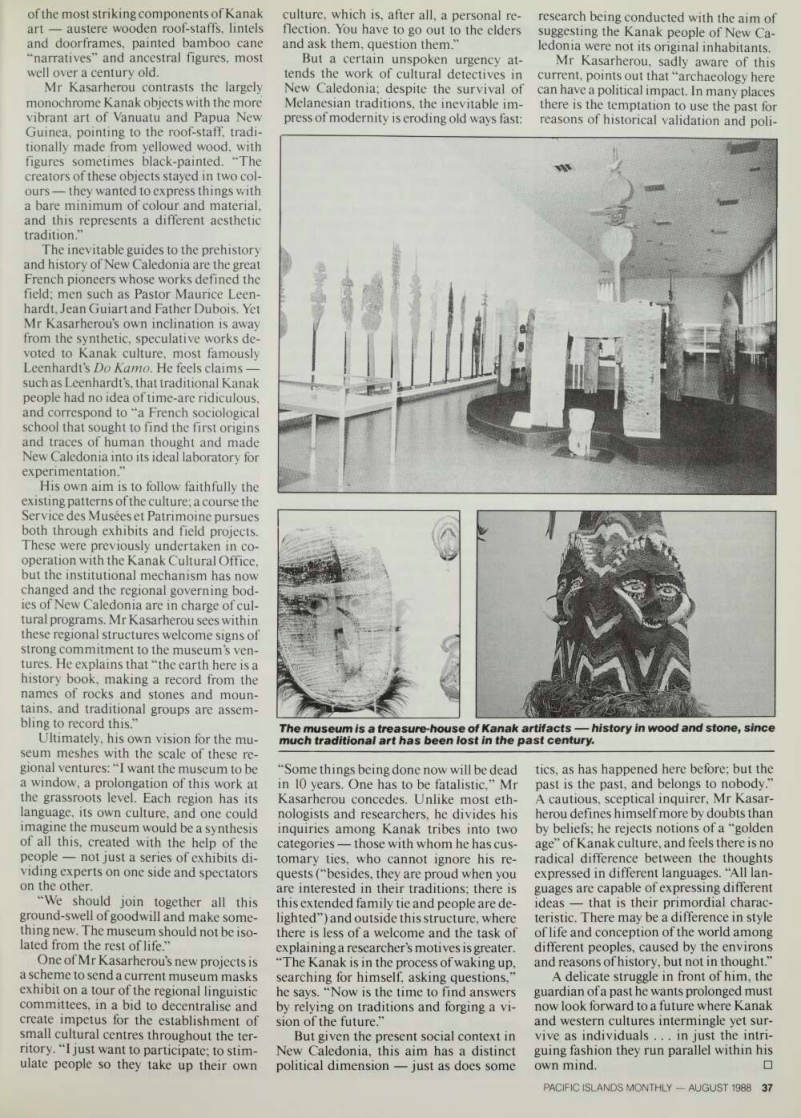
New Caledonia
Emmanuel Kasarherou is exposing the “fantastic force” of his homeland’s
heritage to a broader audience.
By Nicolas Rothwell
FROM a discreet office behind the display area of Noumea’s Museum, the youthful Emmanuel Kasar herou. director of New Caledonia’s Serv ice des Musees et Patrimoine, is presiding over a far-reaching project to restore in terest in Kanak culture.
Just two years away from his doctorate in prehistory at the Sorbonne, the 27- year old half-French, half-Kanak stands at the crossroads of western and Melanesian cul tures. Both museum curator and director of an archaeological program, he must manage his ambitious venture with only three scientific workers.
At present, few of New Caledonia’s Kanaks visit the Museum, which is guarded by a pair of massive cannon. “We will take them away to begin with,” the young director explains: he also wants to do away with the entrance fee: “It should be free. The people of the land should have a free museum, because after all the ex hibits belong to them, in a sense they don’t want to feel they are in a foreign country,” he says.
But though the Museum contains a wealth of splendid pieces, collected by a succession of famous French anthropolo gists and pioneer researchers, it still at tracts few Kanak visitors. One intriguing reason, Mr Kasarherou points out, is that “the idea of the museum corresponds poorly with the ideas of traditional Me lanesian society.
“There is the problem of explaining why one has a museum and what the point is, since the objects here are very strong and sacred, and in Melanesian culture it is a mark of disrespect to show sacred ob jects to everyone.”
Mr Kasarherou has a strong sense of the persistence of Melanesian culture, the “fantastic force” of the oral tradition among Kanak tribes living away from the urban area of Noumea. “Traditional cul ture is still strong, though some areas have suffered more than others: beliefs about the body, about death, about the beyond: these were the things that have been most at tacked. But the system of kinship and cus tomary exchanges survives,” he says.
Mr Kasarherou clearly seeks to situate his new conception of the Noumea Mu seum and its mission in the context of these two worlds it bridges the world it me morialises of Melanesian culture, and the modern world whose disciplines it re flects. He feels there are two realms in New
Caledonia: that of Noumea, and that of the country. Two lives, each with its different rhythms. Passage between them can be difficult, and fusing the two is a task strained by the political reverberations at tendant on every aspect of existence in the lerritory, where the revival of Melanesian cultural traditions has played a significant
part in the turmoil of recent years.
Many aspects of traditional Melane sian culture have passed into history, and survive only within the Museum’s con fines. The great chiefly houses of the Grande Terre. New Caledonia’s main is land, with their roof-staffs representing ancestral figures, are no longer built: re spect for such ancient symbols means they are not reproduced outside their intended context. But the broader thread of culture what Mr Kasarherou describes as “a mode of existence, a language, a way of seeing life, of having relations with others: all that fundamentally differentiates one culture from another” lives on outside the museums and academic texts.
The three year-old dictionary project, in which field workers co-operate with lo cal linguistic committees, proves this point. Formerly it was foreign ethnologists who came to record of Kanak life, collect ing objects “like witnesses of a disappear ing culture”; but now “people are interested. Young and old, they all take part, and this shows the culture is living: it gives hope for the future.” The linguistic diversity of New Caledonia, where some native tongues have 13,000 speakers, some no more than six, constitutes a basic ele ment of the islands’ patrimony that the Museum aims to preserve.
Inside the Noumea Museum, a range of pieces from all the Melanesian nations is on display, but the core exhibit consists
Emmanuel Kasarherou, 27-year-old curator and archaeologist.
The director hopes to overcome Melanesians’ reluctance to visit “their” museum.
of the most striking components of Kanak art austere wooden roof-staffs, lintels and doorframes, painted bamboo cane “narratives” and ancestral figures, most well over a century old.
Mr Kasarherou contrasts the largely monochrome Kanak objects with the more vibrant art of Vanuatu and Papua New Guinea, pointing to the roof-staff, tradi tionally made from yellowed wood, with figures sometimes black-painted. “The creators of these objects stayed in two col ours they wanted to express things with a bare minimum of colour and material, and this represents a different aesthetic tradition.”
The inevitable guides to the prehistory and history of New Caledonia are the great French pioneers whose works defined the field; men such as Pastor Maurice Leen hardt, Jean Guiart and Father Dubois. Yet Mr Kasarherou’s own inclination is away from the synthetic, speculative works de voted to Kanak culture, most famously Leenhardt’s Do Kamo. He feels claims such as Leenhardt’s, that traditional Kanak people had no idea of time-are ridiculous, and correspond to “a French sociological school that sought to find the first origins and traces of human thought and made New Caledonia into its ideal laboratory for experimentation.”
His own aim is to follow faithfully the existing patterns of the culture; a course the Service des Musees et Patrimoine pursues both through exhibits and field projects.
These were previously undertaken in co operation with the Kanak Cultural Office, but the institutional mechanism has now changed and the regional governing bod ies of New Caledonia are in charge of cul tural programs. Mr Kasarherou sees within these regional structures welcome signs of strong commitment to the museum’s ven tures. He explains that “the earth here is a history book, making a record from the names of rocks and stones and moun tains, and traditional groups are assem bling to record this.”
Ultimately, his own vision for the mu seum meshes with the scale of these re gional ventures: “I want the museum to be a window, a prolongation of this work at the grassroots level. Each region has its language, its own culture, and one could imagine the museum would be a synthesis of all this, created with the help of the people not just a series of exhibits di viding experts on one side and spectators on the other.
“We should join together all this ground-swell of goodwill and make some thing new. The museum should not be iso lated from the rest of life.”
One of Mr Kasarherou’s new projects is a scheme to send a current museum masks exhibit on a tour of the regional linguistic committees, in a bid to decentralise and create impetus for the establishment of small cultural centres throughout the ter ritory. “I just want to participate; to stim ulate people so they take up their own
culture, which is, after all, a personal reflection. You have to go out to the elders and ask them, question them.”
But a certain unspoken urgency attends the work of cultural detectives in New Caledonia; despite the survival of Melanesian traditions, the inevitable impress of modernity is eroding old ways fast:
“Some things being done now will be dead in 10 years. One has to be fatalistic,” Mr Kasarherou concedes. Unlike most ethnologists and researchers, he divides his inquiries among Kanak tribes into two categories those with whom he has customary ties, who cannot ignore his requests (“besides, they are proud when you are interested in their traditions; there is this extended family tie and people are delighted”) and outside this structure, where there is less of a welcome and the task of explaining a researcher’s motives is greater, “The Kanak is in the process of waking up, searching for himself, asking questions,” he says. “Now is the time to find answers by relying on traditions and forging a vision of the future.”
But given the present social context in New Caledonia, this aim has a distinct political dimension just as does some
research being conducted with the aim of suggesting the Kanak people of New Ca ledonia were not its original inhabitants.
Mr Kasarherou, sadly aware of this current, points out that “archaeology here can have a political impact. In many places there is the temptation to use the past for reasons of historical validation and poli
tics, as has happened here before; but the past is the past, and belongs to nobody.”
A cautious, sceptical inquirer, Mr Kasar herou defines himself more by doubts than by beliefs; he rejects notions of a “golden age” of Kanak culture, and feels there is no radical difference between the thoughts expressed in different languages. “All lan guages are capable of expressing different ideas that is their primordial charac teristic. There may be a difference in style of life and conception of the world among different peoples, caused by the environs and reasons of history, but not in thought.”
A delicate struggle in front of him, the guardian of a past he wants prolonged must now look forward to a future where Kanak and western cultures intermingle yet sur vive as individuals ... in just the intri guing fashion they run parallel within his own mind. □
The museum is a treasure-house of Kanak artifacts - history in wood and stone, since much traditional art has been lost in the past century.
Book Reviews
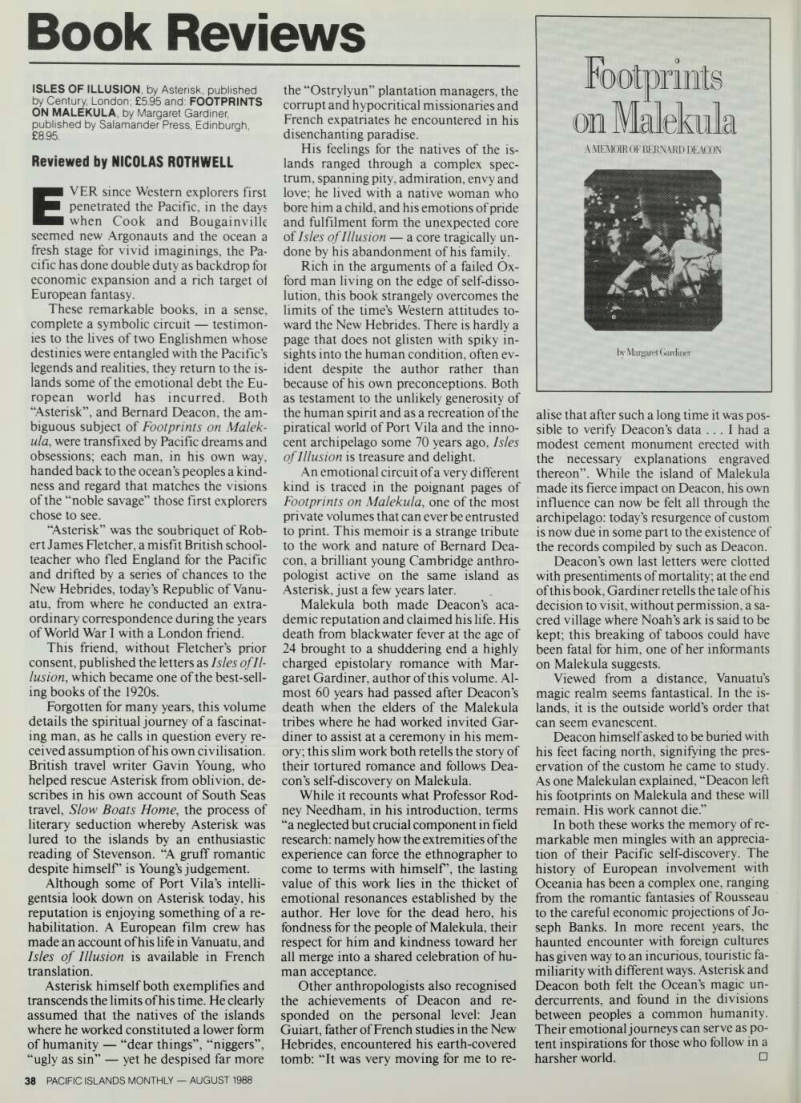
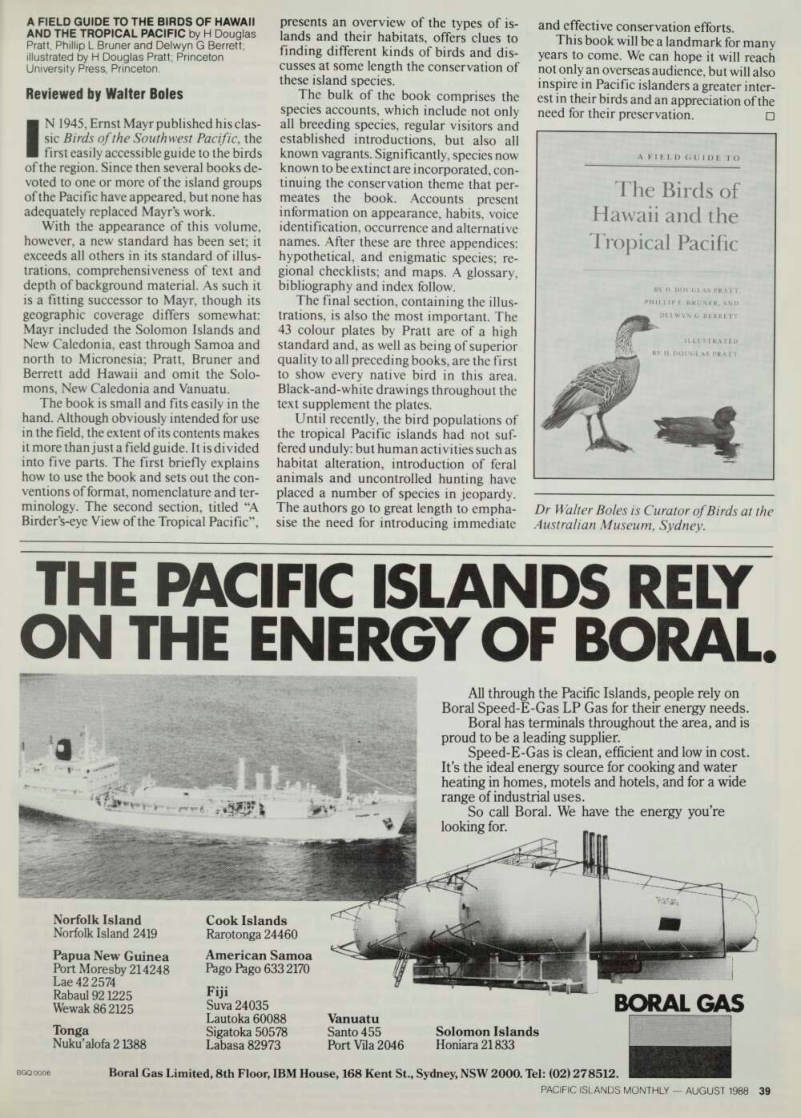
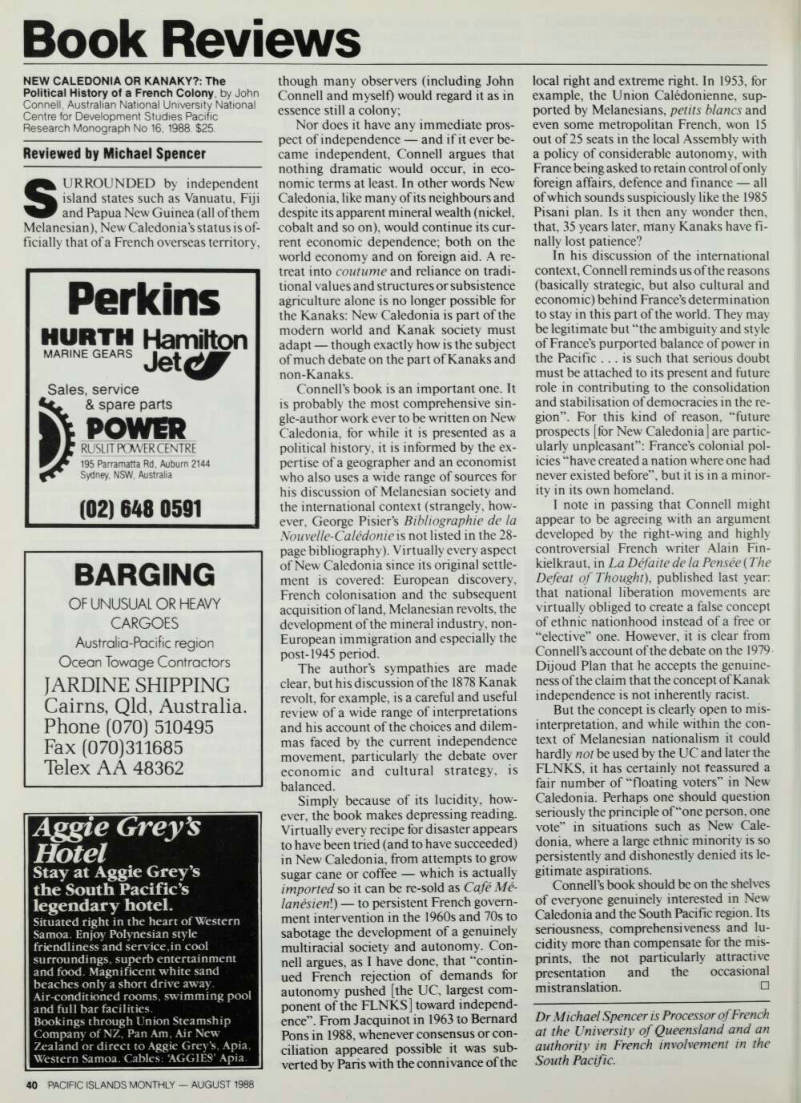
ISLES OF ILLUSION, by Asterisk, published by Century, London; £5.95 and FOOTPRINTS ON MALEKULA. by Margaret Gardiner, published by Salamander Press, Edinburgh, £8.95.
Reviewed by NICOLAS ROTHWELL EVER since Western explorers first penetrated the Pacific, in the days when Cook and Bougainville seemed new Argonauts and the ocean a fresh stage for vivid imaginings, the Pa cific has done double duty as backdrop for economic expansion and a rich target ol European fantasy.
These remarkable books, in a sense, complete a symbolic circuit testimon ies to the lives of two Englishmen whose destinies were entangled with the Pacific’s legends and realities, they return to the is lands some of the emotional debt the Eu ropean world has incurred. Both “Asterisk”, and Bernard Deacon, the am biguous subject of Footprints on Malek ula, were transfixed by Pacific dreams and obsessions; each man, in his own way, handed back to the ocean’s peoples a kind ness and regard that matches the visions of the “noble savage” those first explorers chose to see.
“Asterisk” was the soubriquet of Rob ert James Fletcher, a misfit British school teacher who fled England for the Pacific and drifted by a series of chances to the New Hebrides, today’s Republic of Vanu atu, from where he conducted an extra ordinary correspondence during the years of World War I with a London friend.
This friend, without Fletcher’s prior consent, published the letters as Isles of Il lusion, which became one of the best-sell ing books of the 19205.
Forgotten for many years, this volume details the spiritual journey of a fascinat ing man, as he calls in question every re ceived assumption of his own civilisation.
British travel writer Gavin Young, who helped rescue Asterisk from oblivion, de scribes in his own account of South Seas travel, Slow Boats Home, the process of literary seduction whereby Asterisk was lured to the islands by an enthusiastic reading of Stevenson. “A gruff romantic despite himself’ is Young’s judgement.
Although some of Port Vila’s intelli gentsia look down on Asterisk today, his reputation is enjoying something of a re habilitation. A European film crew has made an account of his life in Vanuatu, and Isles of Illusion is available in French translation.
Asterisk himself both exemplifies and transcends the limits of his time. He clearly assumed that the natives of the islands where he worked constituted a lower form of humanity “dear things”, “niggers”, “ugly as sin” yet he despised far more
the “Ostrylyun” plantation managers, the corrupt and hypocritical missionaries and French expatriates he encountered in his disenchanting paradise.
His feelings for the natives of the is lands ranged through a complex spec trum, spanning pity, admiration, envy and love; he lived with a native woman who bore him a child, and his emotions of pride and fulfilment form the unexpected core of Isles of Illusion a core tragically un done by his abandonment of his family.
Rich in the arguments of a failed Ox ford man living on the edge of self-disso lution, this book strangely overcomes the limits of the time’s Western attitudes to ward the New Hebrides. There is hardly a page that does not glisten with spiky in sights into the human condition, often ev ident despite the author rather than because of his own preconceptions. Both as testament to the unlikely generosity of the human spirit and as a recreation of the piratical world of Port Vila and the inno cent archipelago some 70 years ago, Isles of Illusion is treasure and delight.
An emotional circuit of a very different kind is traced in the poignant pages of Footprints on Malekula , one of the most private volumes that can ever be entrusted to print. This memoir is a strange tribute to the work and nature of Bernard Dea con, a brilliant young Cambridge anthro pologist active on the same island as Asterisk, just a few years later.
Malekula both made Deacon’s aca demic reputation and claimed his life. His death from blackwater fever at the age of 24 brought to a shuddering end a highly charged epistolary romance with Mar garet Gardiner, author of this volume. Al most 60 years had passed after Deacon’s death when the elders of the Malekula tribes where he had worked invited Gar diner to assist at a ceremony in his mem ory; this slim work both retells the story of their tortured romance and follows Dea con’s self-discovery on Malekula.
While it recounts what Professor Rod ney Needham, in his introduction, terms “a neglected but crucial component in field research: namely how the extremities of the experience can force the ethnographer to come to terms with himself’, the lasting value of this work lies in the thicket of emotional resonances established by the author. Her love for the dead hero, his fondness for the people of Malekula, their respect for him and kindness toward her all merge into a shared celebration of hu man acceptance.
Other anthropologists also recognised the achievements of Deacon and re sponded on the personal level: Jean Guiart, father of French studies in the New Hebrides, encountered his earth-covered tomb: “It was very moving for me to re
alise that after such a long time it was pos sible to verify Deacon’s data ... I had a modest cement monument erected with the necessary explanations engraved thereon”. While the island of Malekula made its fierce impact on Deacon, his own influence can now be felt all through the archipelago: today’s resurgence of custom is now due in some part to the existence of the records compiled by such as Deacon.
Deacon’s own last letters were clotted with presentiments of mortality; at the end of this book, Gardiner retells the tale of his decision to visit, without permission, a sa cred village where Noah’s ark is said to be kept; this breaking of taboos could have been fatal for him, one of her informants on Malekula suggests.
Viewed from a distance, Vanuatu’s magic realm seems fantastical. In the is lands, it is the outside world’s order that can seem evanescent.
Deacon himself asked to be buried with his feet facing north, signifying the pres ervation of the custom he came to study.
As one Malekulan explained, “Deacon left his footprints on Malekula and these will remain. His work cannot die.”
In both these works the memory of re markable men mingles with an apprecia tion of their Pacific self-discovery. The history of European involvement with Oceania has been a complex one, ranging from the romantic fantasies of Rousseau to the careful economic projections of Jo seph Banks. In more recent years, the haunted encounter with foreign cultures has given way to an incurious, touristic fa miliarity with different ways. Asterisk and Deacon both felt the Ocean’s magic un dercurrents, and found in the divisions between peoples a common humanity.
Their emotional journeys can serve as po tent inspirations for those who follow in a harsher world. □
A FIELD GUIDE TO THE BIRDS OF HAWAII AND THE TROPICAL PACIFIC by H Douglas Pratt, Phillip L Bruner and Delwyn G Berrett; illustrated by H Douglas Pratt; Princeton University Press, Princeton.
Reviewed by Walter Boies IN 1945, Ernst Mayr published his clas sic Birds of the Southwest Pacific , the first easily accessible guide to the birds of the region. Since then several books de voted to one or more of the island groups of the Pacific have appeared, but none has adequately replaced Mayr’s work.
With the appearance of this volume, however, a new standard has been set; it exceeds all others in its standard of illus trations, comprehensiveness of text and depth of background material. As such it is a fitting successor to Mayr, though its geographic coverage differs somewhat: Mayr included the Solomon Islands and New Caledonia, east through Samoa and north to Micronesia; Pratt, Bruner and Berrett add Hawaii and omit the Solo mons, New Caledonia and Vanuatu.
The book is small and fits easily in the hand. Although obviously intended for use in the field, the extent of its contents makes it more than just a field guide. It is divided into five parts. The first briefly explains how to use the book and sets out the con ventions of format, nomenclature and ter minology. The second section, titled “A Birder’s-eye View of the Tropical Pacific”,
presents an overview of the types of is lands and their habitats, offers clues to finding different kinds of birds and dis cusses at some length the conservation of these island species.
The bulk of the book comprises the species accounts, which include not only all breeding species, regular visitors and established introductions, but also all known vagrants. Significantly, species now known to be extinct are incorporated, con tinuing the conservation theme that per meates the book. Accounts present information on appearance, habits, voice identification, occurrence and alternative names. After these are three appendices: hypothetical, and enigmatic species; re gional checklists; and maps. A glossary, bibliography and index follow.
The final section, containing the illus trations, is also the most important. The 43 colour plates by Pratt are of a high standard and, as well as being of superior quality to all preceding books, are the first to show every native bird in this area.
Black-and-white drawings throughout the text supplement the plates.
Until recently, the bird populations of the tropical Pacific islands had not suf fered unduly: but human activities such as habitat alteration, introduction of feral animals and uncontrolled hunting have placed a number of species in jeopardy.
The authors go to great length to empha sise the need for introducing immediate
and effective conservation efforts.
This book will be a landmark for many years to come. We can hope it will reach not only an overseas audience, but will also inspire in Pacific islanders a greater inter est in their birds and an appreciation of the need for their preservation. □
Dr Walter Boles is Curator of Birds at the Australian Museum, Sydney.
New Caledonia Or Kanaky?: The
Political History of a French Colony by John Connell, Australian National University National Centre for Development Studies Pacific Research Monograph No 16, 1988. $25.
Reviewed by Michael Spencer
SURROUNDED by independent island states such as Vanuatu, Fiji and Papua New Guinea (all of them Melanesian), New Caledonia’s status is of ficially that of a French overseas territory.
though many observers (including John Connell and myself) would regard it as in essence still a colony; Nor does it have any immediate pros pect of independence and if it ever be came independent, Connell argues that nothing dramatic would occur, in eco nomic terms at least. In other words New Caledonia, like many of its neighbours and despite its apparent mineral wealth (nickel, cobalt and so on), would continue its cur rent economic dependence; both on the world economy and on foreign aid. A re treat into coutume and reliance on tradi tional values and structures or subsistence agriculture alone is no longer possible for the Kanaks: New Caledonia is part of the modern world and Kanak society must adapt though exactly how is the subject of much debate on the part of Kanaks and non-Kanaks.
Connell’s book is an important one. It is probably the most comprehensive sin gle-author work ever to be written on New Caledonia, for while it is presented as a political history, it is informed by the ex pertise of a geographer and an economist who also uses a wide range of sources for his discussion of Melanesian society and the international context (strangely, how ever, George Pisier’s Bibliographie de la Nouvelle-Caledonieis not listed in the 28page bibliography). Virtually every aspect of New Caledonia since its original settle ment is covered: European discovery, French colonisation and the subsequent acquisition of land, Melanesian revolts, the development of the mineral industry, non- European immigration and especially the post-1945 period.
The author’s sympathies are made clear, but his discussion of the 1878 Kanak revolt, for example, is a careful and useful review of a wide range of interpretations and his account of the choices and dilem mas faced by the current independence movement, particularly the debate over economic and cultural strategy, is balanced.
Simply because of its lucidity, how ever, the book makes depressing reading.
Virtually every recipe for disaster appears to have been tried (and to have succeeded) in New Caledonia, from attempts to grow sugar cane or coffee which is actually imported so it can be re-sold as Cafe Me lanesienl) to persistent French govern ment intervention in the 1960 s and 70s to sabotage the development of a genuinely multiracial society and autonomy. Con nell argues, as I have done, that “contin ued French rejection of demands for autonomy pushed [the UC, largest com ponent of the FLNKS] toward independ ence”. From Jacquinot in 1963 to Bernard Pons in 1988, whenever consensus or con ciliation appeared possible it was sub verted by Paris with the connivance of the
local right and extreme right. In 1953, for example, the Union Caledonienne, sup ported by Melanesians, petits blancs and even some metropolitan French, won 15 out of 25 seats in the local Assembly with a policy of considerable autonomy, with France being asked to retain control of only foreign affairs, defence and finance all of which sounds suspiciously like the 1985 Pisani plan. Is it then any wonder then, that, 35 years later, many Kanaks have fi nally lost patience?
In his discussion of the international context, Connell reminds us of the reasons (basically strategic, but also cultural and economic) behind France’s determination to stay in this part of the world. They may be legitimate but “the ambiguity and style of France’s purported balance of power in the Pacific ... is such that serious doubt must be attached to its present and future role in contributing to the consolidation and stabilisation of democracies in the re gion”. For this kind of reason, “future prospects [for New Caledonia] are partic ularly unpleasant”: France’s colonial pol icies “have created a nation where one had never existed before”, but it is in a minor ity in its own homeland.
I note in passing that Connell might appear to be agreeing with an argument developed by the right-wing and highly controversial French writer Alain Fin kielkraut, in La Defaite de la Pensee (The Defeat of Thought ), published last year: that national liberation movements are virtually obliged to create a false concept of ethnic nationhood instead of a free or “elective” one. However, it is clear from Connell’s account of the debate on the 1979 Dijoud Plan that he accepts the genuine ness of the claim that the concept of Kanak independence is not inherently racist.
But the concept is clearly open to mis interpretation, and while within the con text of Melanesian nationalism it could hardly not be used by the UC and later the FLNKS, it has certainly not reassured a fair number of “floating voters” in New Caledonia. Perhaps one should question seriously the principle of “one person, one vote” in situations such as New Cale donia, where a large ethnic minority is so persistently and dishonestly denied its le gitimate aspirations.
Connell’s book should be on the shelves of everyone genuinely interested in New Caledonia and the South Pacific region. Its seriousness, comprehensiveness and lu cidity more than compensate for the mis prints, the not particularly attractive presentation and the occasional mistranslation. □
Dr Michael Spencer is Processor of French at the University of Queensland and an authority in French involvement in the South Pacific.
Advertisements & other items, pp. 38-41 (1 item)
TOOtarints
A MEMOIR OF BERN ARD DEACON
hv Margaret Gardiner
A V\ KID GUIDE TO
The Birds of
Hawaii and the
Tropical Pacific
BY H. DOCCLAS PRATT’,
PHIU.fP 1.. BBt,'NKK, AM>
kmh-
&U..WVN o MMir
ILLUSTRATES*
BV H (JO I. •(',(.*s PRATT
THE PACIFIC ISLANDS RELY
ON THE ENERGY OF BORAL
!■ ■ *s W > '
HHI
vgsfi
% Cook Islands Rarotonga 24460 All through the Pacific Islands, people rely on Boral Speed-E-Gas LP Gas for their energy needs.
Boral has terminals throughout the area, and is proud to be a leading supplier.
Speed-E-Gas is clean, efficient and low in cost.
It’s the ideal energy source for cooking and water heating in homes, motels and hotels, and for a wide range of industrial uses.
So call Boral. We have the energy you’re looking for.
Norfolk Island Norfolk Island 2419 Papua New Guinea Port Moresby 214248 Lae 422574 Rabaul 921225 WewakB62l2s Tonga Nukualofa 21388 American Samoa Pago Pago 6332170 Fiji Suva 24035 Lautoka 60088 Sigatoka 50578 Labasa 82973 Vanuatu Santo 455 Port Vila 2046
BORAL GAS
Solomon Islands Honiara 21833 Boral Gas Limited, Bth Floor, IBM House, 168 Kent St., Sydney, NSW 2000. Tel: (02) 278512.
Perkins
SSIKOS
Sales, service & spare parts
ft POWER
Wt RUSH! POWER CENTRE
195 Parramatta Rd, Auburn 2144 Sydney, NSW, Australia (02) 648 0591
BARGING
OF UNUSUAL OR HEAVY
CARGOES
Australia-Pacific region Ocean Towage Contractors
JARDINE SHIPPING
Cairns, Qld, Australia.
Phone (070) 510495 Fax (070)311685 Telex AA 48362
Aggie Grey’s
Hotel
Stay at Aggie Grey’s
the South Pacific’s
legendary hotel.
Situated right in the heart of Western Samoa. Enjoy Polynesian style friendliness and service,in cool surroundings, superb entertainment and food. Magnificent white sand beaches only a short drive away.
Air-conditioned rooms, swimming pool and full bar facilities.
Bookings through Union Steamship Company of NZ, Pan Am, Air New Zealand or direct to Aggie Grey’s, Apia, Western Samoa. Cables: AGGIES’ Apia.
I
y HONDA. Progress with Distinction.
Breaking some
rules to achieve
a new standard
of quality.
The new Civic Series makes its debut.
And it's a series that bound to change the way people view popular compact cars. Take the new 4-door Civic Sedan.
It looks like a quiet, decorous sedan.
But the new Civic 4-door Sedan breaks with convention in more ways than one.
For instance, each Civic 4-door Sedan features as standard a newly-developed sporty 16-valve engine and a 4-wheel double wishbone suspension. Hardly the rule in conventional cars of its class, these significant technological advantages allow the new Civic 4-door Sedan to transcend all conventional concepts of its class.
A prerequisite for a sedan today is refined, well-balanced styling. The Civic Sedan skillfully incorporates elements of aviation aerodynamics to achieve a classic silhouette. Entirely flush-surfaced, its elegant, rounded body lines combine with extensive glass areas to form one sleek, unbroken curve from the low nose to spoiler-shaped tail. And inside, there's an increased sense of wai wp 4 - V\/hool "VALV t Double Wishbone spaciousness, with the comfort quotient reaching new heights.
Sedans that stick to conventional rules.
Perfectly acceptable, but be prepared for conventional performance. Then try the new Civic Sedan. You'll be happy Honda broke some rules. 0 f Specifications and equipment may vary in some countries. - ?v Honda engines have powered the Williams/Honda team to consecutive Constructors' Championships in 1986 and 1987, and last year powered Nelson Piquet to victory in the Driver's Championship For 1988, Honda engines will continue to compete in motor sports' toughest arena with the Lotus and McLaren teams AUSTRALIA: Honda Australia Pty., Ltd. Lot 95 Sharps Road, Tullamarine, Victoria 3043; Bennett Honda Pty., Ltd. 250 Victoria Road, Wetherlll Park, N.S.W. 2164/NEW ZEALAND NZMC Limited Manners Plaza, 57-65 Manners St , Wellington/PAPUA NEW GUINEA; Toba Pty., Ltd, P.O. Box 503, Port MoresbynAHlT Honda Distribution S.A. R.L B.P 1665, Papeete/ RIBATI Atoll Motor & Marino Services P.O. Box 49, Bairiki Tarawa, Republic of Klrlbatl/U.S. TRUST TERRITORY: United Micronesia Development Association P.O. Box 235, CHRB Saipan CM 96950/COOK « DS: C ° ok l3lands Motor Cenfe Ltd. P.O. Box 74, Rarotonga/ Mark's Motor Co., Inc. P.O. Box DV, Agana/WESTERN SAMO; Motor Distributors (Samoa) Ltd. P.O. Box 576, Apia/ SLANDS Lee Kwok Kuen & Co., Ltd. P.O Box 537, Honlara/NAURU Nauru Cooperation Republic of Nauru/Fui Coral Island Motors Ltd. Robertson Road, Suva, FIJI/AMERICAN MO“ Holiday Motors, Parts and Service P C Box 968, Pago Pago, American Samoa 96799: Heleck's Service Center Ltd. P.O. Box 1138. Pago Pago, American Samoa 967997T0NGA: Tonga Industrial Traders PO. Box 1035, Nukualofa, Tonga/NORFOLK ISLAND; Duncombe Bay Garage New Cascade Road, Norfolk Island/VANUATU: Honda Farm Ltd. P.O. Box 1031, Pori Vila, Vanuatu
Pacific Report
□ Win A Trip To Png
SCHOOL children in New South Wales, Queensland and the ACT have a chance to win a free trip to Papua New Guinea in a competition organised by the PNG Con sulate in Sydney. In the junior division (up to 11 years of age), first prize for a pic ture showing life in a PNG village and a description of the things children enjoy about village life is SAIOO and a book.
The middle division, for children 12 to 15 years of age, asks entrants to draw a map that shows a tour parly itinerary visiting four to six places and to provide a descrip tion of each location; the prize in this cat egory is $2OO and a book. The senior division, for students 16 years of age and over, involves a 1500-word essay on the importance of PNG’s role in the region, and first prize is SA3OO and a book.
Best overall entry will be awarded a free package tour to PNG with an adult com panion: entries close August 31 and should be addressed to the Papua New Guinea Consulate-General, GPO Box 4201, Syd ney NSW 2001.
□ Laperouse Revisited In
Tasmania
RUSSELL Shelton’s recently published book, From Hudson Bay to Botany Bay: The Lost Frigates Of Laperouse (re viewed by Darrell Tryon in Pacific Is lands Monthly, May) is available to Australian and New Zealand booksellers from the Blubber Head Press, PO Box 475, Sandy Bay, Tasmania 7005 (telephone 002 23 8644).
□ Cyclone Conference
REPRESENTATIVES of 16 South Pacific countries held a week-long meeting in Brisbane in June to discuss co-operative action on tropical cyclone warning sys tems and disaster preparedness.
The conference the second session of the Tropical Cyclone Committee of the South Pacific was conducted under the auspices of the World Meteorological Or ganisation and hosted by the Australian Bureau of Meteorology. It was opened by Australia’s Minister for Administrative Services, Stewart West, who is responsible for meteorological services in Australia.
The meeting concentrated on planning the sharing of resources and knowledge, par ticularly in the fields of observations, communications, technical expertise, disaster preparedness, public education, research and training.
Countries represented included Fiji, Kiribati, Tonga, Tuvalu, the Cook Islands, Solomon Islands, Indonesia, Niue, Tokelau, Western Samoa, Vanuatu, New Caledonia, Papua New Guinea, New Zealand, the United Kingdon and Aus tralia. Representatives of international and Australian organisations also attended.
□ Ptc ’B9 Program Set
PTC ’B9 will be held in Honolulu from Sunday January 15 to January 18, 1989 and will be followed by two days of workshops and tutorials.
The theme of PTC ’B9 is Pacific Tele communications Connectivity: Users, Networks and Information Services. The emphasis is on how things fit together and work, with special attention to the telecom user perspective. The key term in the title is connectivity.
PTC ’B9 continues the customary con ference pattern of Sunday afternoon key note addresses, then a plenary session each morning followed by concurrent paper sessions or other parallel activities such as the working groups.
Further information can be obtained from PTC ’B9, 1110 University Ave, Suite 308, Honolulu, Hawaii 96826 USA.
□ Consortium Moa Signed
MONTHS of hard work by representa tives of the American Samoa Community College, the National University of West ern Samoa, the Tongan Education De partment and the Pacific-International Centre for High Technology and Research (PICHTR) in Honolulu resulted recently in the signing of a memorandum of un derstanding for the establishment of the South Pacific Education Consortium
(Sppec).
Tongan Education Minister Langi Hu’akavameiliku, NUWS President Tuau’ili’ili Meredith and Chariman of the American Samoa Board of Higher Edu cation Abe Malae signed the memoran dum, which was witnessed by Governor A P Lutali. The MOU expresses the desire of the three institutions to establish an ed ucation consortium with American Sa moa, Western Samoa and Tonga as founding members.
The signing of the document will ena ble PICHTR, of the University of Hawaii, to proceed with the search for funding and to organise the administrative body that will manage the newly formed education consortium. “SPPEC will provide a new concept in regional education,” said Gov ernor Lutali after the signing of the MOU.
“It will introduce a system that is benefi cial for small countries that cannot afford to provide an adequate university educa tion in specialised areas for their people.”
Under the present arrangement, the consortium will provide high technology training at ASCC, agriculture, science and maths at NUWS and marine technology at an institution of higher education to be selected in Tonga.
□ Air Niugini Fraud
AIR Niugini General Manager Dieter Seefeld confirmed late in June that a ma
jor fraud had been uncovered within the airline. And the man suspected of taking the money identified only as a senior purchasing officer had been sacked.
Mr Seefeld said that internal audit checks had shown the crime had been committed over four years, with amounts of between K 100,000 and K 150,000 being syphoned off every year.
“The fraud was discovered by the in ternal audit department as part of routine checks: indications are that the company could have lost between K 100,000 and K 150,000 a year and the fraud may have involved five non-recognised by Air Niu gini Tenders Committee- suppliers,” Mr Seefeld said.
The man believed responsible for the crime had been found to be a director of one of the companies. Air Niugini will be trying to recover the lost money under its “fidelity” insurance policy, while Na tional Fraud Squad police have been going through the accounts of the five suppliers suspected of being involved.
□ Aust Influence Declining
AUSTRALIAN influence in the South Pacific is on the wane, Fedor Mediansky, political science professor at the Univer sity of New South Wales, said in June at the Smithsonian Institution’s Wilson Center in Washington DC. The shift, which Mediansky terms “if not actual then at least perceptively”, can be attributed to a number of factors, including Japan re placing Australia as the area’s largest aid donor. Regional changes among the South Pacific nations are also factors: the break down of regional homogeneity, the gen erational change to a more independently minded, assertive elite and the assymetry of outlook between Australia and its Pa cific neighbors contribute to its waning influence.
For the past 20 years, Mediansky maintains, Australia has had difficulty balancing its interests with the Western al liance and regional players. Canberra con siders itself part of the Western strategic community (with all the access to intelli gence and technology this entails), but the nation has moved increasingly closer to its regional environment. Asian immigration is on the rise, as is trade and investment with her Pacific neighbours.
While Australian influence has de clined, the US continues to maintain a low profile in the area. This Mediansky atri butes to the lack of a large Pacific constit uency in the US and Washington’s perception of the region as being “strate gically marginal”.
□ Fsm Congress “Stumped”
THE Federated States of Micronesia con gress adjourned in June following a 30-day session that the Speaker declared “one of
the most trying ever faced”. Unity speeches dominated the closing session in the wake of an outburst by a Trukese sen ator that led to a two-week boycott by three Pohnpeian legislators. There is frustration over Truk’s dominance in the Congress by senators from the smaller states.
Truk holds nearly half the seats, but Trukese complain that Pohnpeians dom inate in executive branch jobs.
□ Marshalls Get Sl3 Million
THE Government of the Marshall Islands has approved two joint ventures with US businesses, using a SUSIO million devel opment fund and $3.5 million from the Marshall Islands Development Authority for the purchase of a purse seiner and es tablishment of a foreign ship registry.
□ Palau Compact Update
THE United Nations Trusteeship Council has voted 3-1 (US, UK, France vs USSR) to adopt a report recommending approval of the Compact and leaving it to the US and Palau to resolve disputes over the pact’s interpretation. The US Department of the Interior will re-allocate $3.5 million in funds from money set aside for Trust Territory debt retirement to avoid a repeat of the deficit that forced the government to lay off hundreds of workers last year.
□ Maori Land Regained
THE New Zealand Government is to re turn an area in Auckland to a Maori tribe, following a land dispute that began last century and came to a head in 1978, in a clash between police and protestors in which 222 people were arrested when po lice moved in to clear land rights demon strators who had occupied the site for 506 days. The 70 hectares of prime harbour side land at Bastion Point, near the afflu ent Auckland suburb of Mission Bay, is to be returned to the Ngati Whatua tribe.
The Government rejected a recom mendation from the Waitangi Tribunal that additional compensation of SNZ3 million be paid to the tribe but will make available a housing and develop ment grant of the same amount. The Wai tangi Tribunal was set up by the present Labour Government to rule on claims lodged under the 1840 treaty under which Maori chiefs accepted British rule.
Bastion Point remains one of the major turning points in Maori land issues and claims that now cover nearly three-quar ters of the country. However, the Govern ment’s landmark decision will not be welcomed by a growing number of pake has made nervous by a rising tide of Maori nationalism.
□ Honiara Celebrates 10 Years
THE Solomon islands celebrated the tenth anniversary of its independence from Britain early in July. The Government of Prime Minister Alebua allocated about SUSSOO,OOO for the week-long celebra tions, which began in the capital, Hon
iara, on July 4: activities included an agriculture and trade fair, choir festivals, sports competitions and a cultural show.
Overseas dignitaries including the leaders of Papua New Guinea, Vanuatu and the Cook Islands were invited, but despite the festivities, vandals and drunken youths created disturbances.
In Sydney, the Solomons’ Honorary Consul, Mr Henry Cumines, hosted a re ception on July 8 that was attended by diplomats, members of the business com munity and friends of the Solomon Islands.
Mr Cumines thanked guests for their support for the 10-year-old nation and called on Australian and international media to abandon the sensationalism with which they approached news from the Sol omons. Commenting that larger nations cover up internal difficulties, he said great progress had been made throughout the South Pacific in combining progress, de velopment and a uniquely Melanesian ap proach to problem-solving, and that the difficulties inherent in such a process would be resolved in time.
□ Nz A New Las Vegas?
A PUBLIC committee of inquiry in New Zealand is to examine the idea of allowing casinos similar to those operating in some Australian States. The Minister for Tour ism, Mr Goff, said he believed casinos should be allowed in New Zealand pro vided there were appropriate safeguards.
Casinos would help brighten nightlife and would create significant employment.
But because they were a controversial is sue, parliamentarians would vote accord ing to their own views rather than along party lines.
□ France Tests 99Th Device
FRANCE tested another nuclear device at Mururoa Atoll in French Polynesia in June the fourth this year and the 99th since the underground tests began more than 10 years ago.
New Zealand’s Department of Scien tific and Industrial Research said the test, detected by instruments in the Cook Is lands, had a yield of 30 kilotonnes. Dis armament and Arms Control Minister Russell Marshall noted that the latest test was the second at Mururoa in a week, and said that “in the final days of the third United Nations special session on disar mament, when most of the countries of the world are striving to achieve progress on disarmament and arms control, the French are setting off nuclear explosions one after the other. It is necessary to wonder about the logic of such behaviour.”
□ New Guide To Western Samoa
WESTERN Samoa has emerged as a growing destination, but little has been published on this beautiful island. Re tired school teacher Barbara McGovern has remedied the situation with the pub lication of Talofa Means Welcome. But
what began as a simple pamphlet with tips for tourists developed into a reference guide including information on accom modation, shopping, tours and local cus toms, history, local legends, recipes, personalities and rituals. Talofa Means Welcome was published with the assist ance of the South Pacific Trade Commis sion for the Western Samoan Visitor’s Bureau, and is available from the SPIC at 255 Clarence Street, Sydney, NSW 2000.
□ Palau Fights Alcohol Abuse
AUTHORITIES in Palau have asked the World Health Organisation’s regional of fice for the Western Pacific to collaborate in drawing up measures to reduce alcohol consumption. WHO consultants have vis ited Palau and offered suggestions for the development of an effective national pro gram for the prevention and control of al cohol and drug abuse.
Problems associated with increased consumption of alcohol seem to be affect ing the whole society: alcohol abuse may have become the leading health and social problem in the country and stress associ ated with sweeping social and political changes seems to be a significant factor behind the problem.
Palau’s alcohol imports increased more than 10 times between 1979 and 1983, and the MacDonald Memorial Hospital re ported that during a one-month period from July 28 to August 27 1985, 72 per cent of patients treated for injuries had con sumed alcohol.
Of patients aged 20 to 29 years, 95 per cent were under the influence of alcohol at the time of injury.
Figures also show that in 1985, a total of 135 persons were arrested for being drunk and disorderly. This had risen to 196, representing an increase of 45 percent, by 1986. (Palau has a population of about 14,000 spread over 200 islands.) WHO suggests the most lasting way to solve alcohol-related problems is to re duce per capita consumption through ed ucation activities aimed at raising consumer awareness. Measures to limit availability of alcohol are also needed.
Recommendations include increasing the price of alcoholic beverages, more stringent rules on the selling of liquor, and strict implementation of these measures as well as enforcement of laws governing the drinking age.
Campaigns to promote healthy life styles must be pursued vigorously: efforts should be made to reach the young, spe cifically school children, with positive health messages. □
□ New Kon Tiki Sets Sail
A GROUP of five Spaniards left Peru on a reed boat at the end of June, hoping to demonstrate that the ancient Incas could have travelled to New Zealand. The vessel left the port of Callao and is expected to take 50 days to complete the voyage. □
War Declared On Junk Food
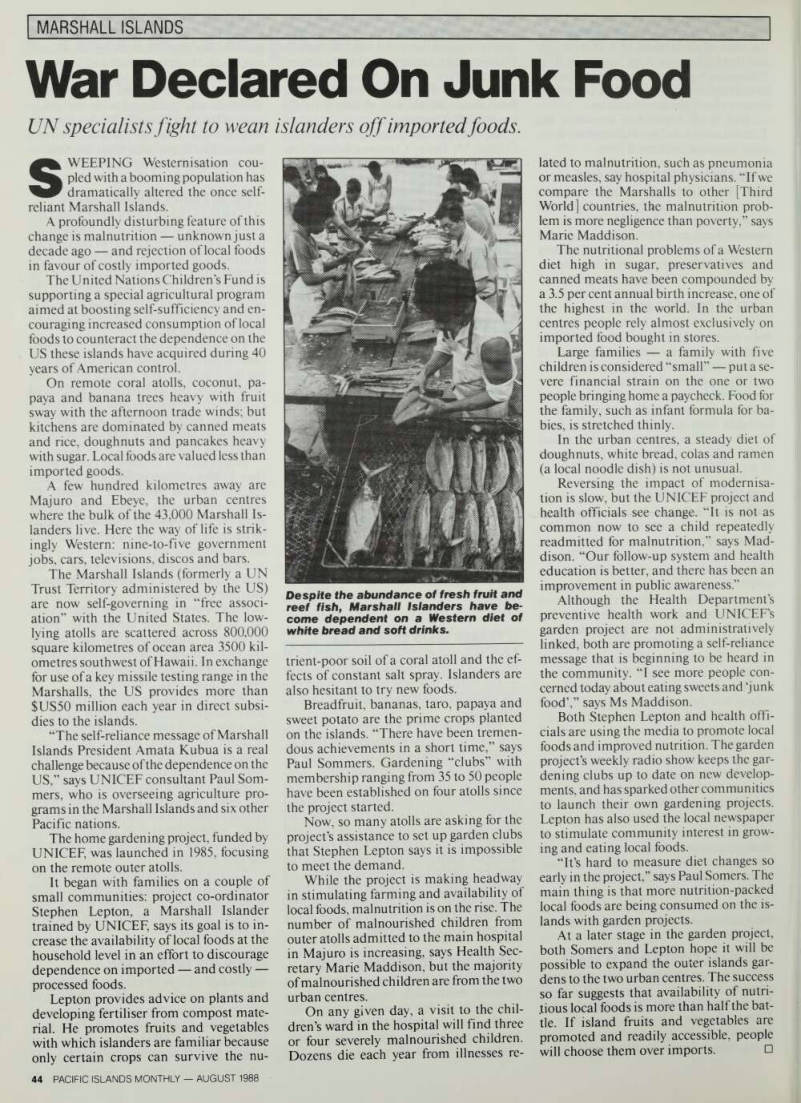
Marshall Islands
UN specialists fight to wean islanders off imported foods
S WEEPING Westernisation cou pled with a booming population has dramatically altered the once self reliant Marshall Islands.
A profoundly disturbing feature of this change is malnutrition unknown just a decade ago and rejection of local foods in favour of costly imported goods.
The United Nations Children’s Fund is supporting a special agricultural program aimed at boosting self-sufficiency and en couraging increased consumption of local foods to counteract the dependence on the US these islands have acquired during 40 years of American control.
On remote coral atolls, coconut, pa paya and banana trees heavy with fruit sway with the afternoon trade winds; but kitchens are dominated by canned meats and rice, doughnuts and pancakes heavy with sugar. Local foods are valued less than imported goods.
A few hundred kilometres away are Majuro and Ebeye, the urban centres where the bulk of the 43,000 Marshall Is landers live. Here the way of life is strik ingly Western: nine-to-five government jobs, cars, televisions, discos and bars.
The Marshall Islands (formerly a UN Trust Territory administered by the US) are now self-governing in “free associ ation” with the United States. The low lying atolls are scattered across 800,000 square kilometres of ocean area 3500 kil ometres southwest of Hawaii. In exchange for use of a key missile testing range in the Marshalls, the US provides more than SUSSO million each year in direct subsi dies to the islands.
“The self-reliance message of Marshall Islands President Amata Kubua is a real challenge because of the dependence on the US,” says UNICEF consultant Paul Som mers, who is overseeing agriculture pro grams in the Marshall Islands and six other Pacific nations.
The home gardening project, funded by UNICEF, was launched in 1985, focusing on the remote outer atolls.
It began with families on a couple of small communities: project co-ordinator Stephen Lepton, a Marshall Islander trained by UNICEF, says its goal is to in crease the availability of local foods at the household level in an effort to discourage dependence on imported and costly processed foods.
Lepton provides advice on plants and developing fertiliser from compost mate rial. He promotes fruits and vegetables with which islanders are familiar because only certain crops can survive the nu-
trient-poor soil of a coral atoll and the ef fects of constant salt spray. Islanders are also hesitant to try new foods.
Breadfruit, bananas, taro, papaya and sweet potato are the prime crops planted on the islands. “There have been tremen dous achievements in a short time,” says Paul Sommers. Gardening “clubs” with membership ranging from 35 to 50 people have been established on four atolls since the project started.
Now, so many atolls are asking for the project’s assistance to set up garden clubs that Stephen Lepton says it is impossible to meet the demand.
While the project is making headway in stimulating farming and availability of local foods, malnutrition is on the rise. The number of malnourished children from outer atolls admitted to the main hospital in Majuro is increasing, says Health Sec retary Marie Maddison, but the majority of malnourished children are from the two urban centres.
On any given day, a visit to the chil dren’s ward in the hospital will find three or four severely malnourished children.
Dozens die each year from illnesses re
lated to malnutrition, such as pneumonia or measles, say hospital physicians. “If we compare the Marshalls to other [Third World] countries, the malnutrition prob lem is more negligence than poverty,” says Marie Maddison.
The nutritional problems of a Western diet high in sugar, preservatives and canned meats have been compounded by a 3.5 per cent annual birth increase, one of the highest in the world. In the urban centres people rely almost exclusively on imported food bought in stores.
Large families a family with five children is considered “small” put a se vere financial strain on the one or two people bringing home a paycheck. Food for the family, such as infant formula for ba bies, is stretched thinly.
In the urban centres, a steady diet of doughnuts, white bread, colas and ramen (a local noodle dish) is not unusual.
Reversing the impact of modernisa tion is slow, but the UNICEF project and health officials see change. “It is not as common now to see a child repeatedly readmitted for malnutrition,” says Mad dison. “Our follow-up system and health education is better, and there has been an improvement in public awareness.”
Although the Health Department’s preventive health work and UNICEF’s garden project are not administratively linked, both are promoting a self-reliance message that is beginning to be heard in the community. “I see more people con cerned today about eating sweets and ‘junk food’,” says Ms Maddison.
Both Stephen Lepton and health offi cials are using the media to promote local foods and improved nutrition. The garden project’s weekly radio show keeps the gar dening clubs up to date on new develop ments, and has sparked other communities to launch their own gardening projects.
Lepton has also used the local newspaper to stimulate community interest in grow ing and eating local foods.
“It’s hard to measure diet changes so early in the project,” says Paul Somers. The main thing is that more nutrition-packed local foods are being consumed on the is lands with garden projects.
At a later stage in the garden project, both Somers and Lepton hope it will be possible to expand the outer islands gar dens to the two urban centres. The success so far suggests that availability of nutri tious local foods is more than half the bat tle. If island fruits and vegetables are promoted and readily accessible, people will choose them over imports. □
Despite the abundance of fresh fruit and reef fish, Marshall Islanders have be come dependent on a Western diet of white bread and soft drinks.
The Island Press
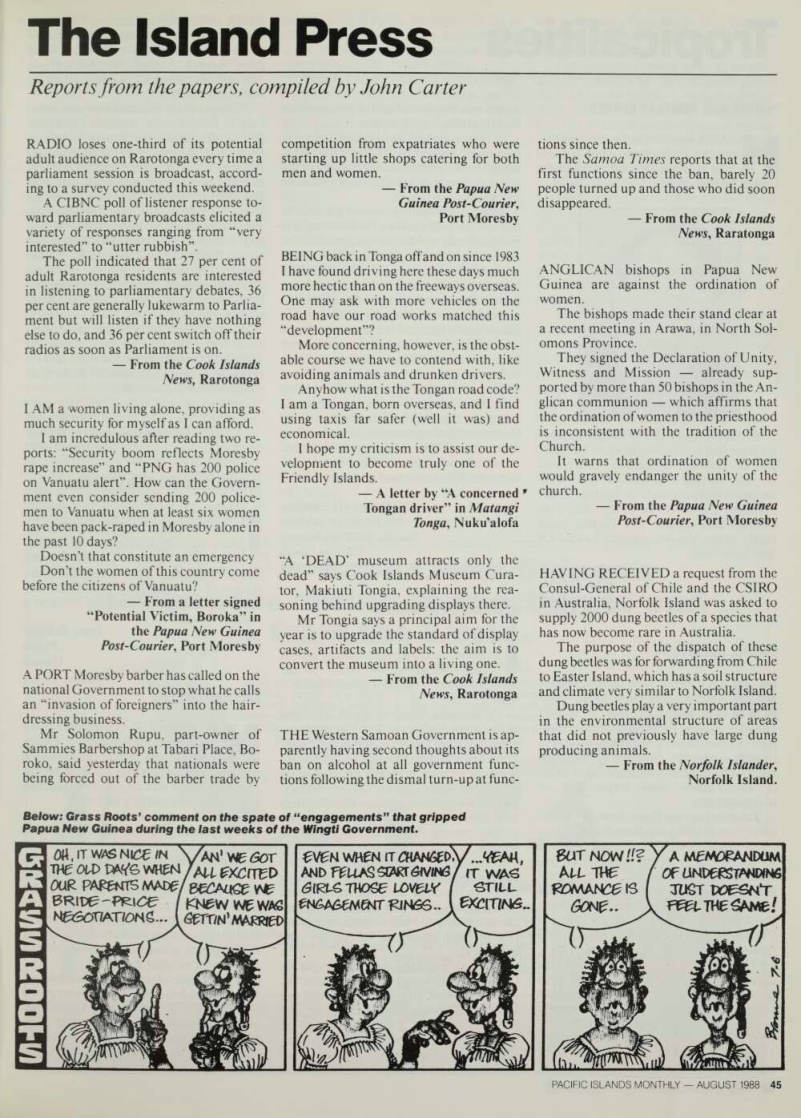
Reports from the papers, compiled by John Carter
RADIO loses one-third of its potential adult audience on Rarotonga every time a parliament session is broadcast, accord ing to a survey conducted this weekend.
A CIBNC poll of listener response to ward parliamentary broadcasts elicited a variety of responses ranging from “very interested” to “utter rubbish”.
The poll indicated that 27 per cent of adult Rarotonga residents are interested in listening to parliamentary debates, 36 per cent are generally lukewarm to Parlia ment but will listen if they have nothing else to do, and 36 per cent switch off their radios as soon as Parliament is on.
From the Cook Islands News, Rarotonga I AM a women living alone, providing as much security for myself as I can afford.
I am incredulous after reading two re ports: “Security boom reflects Moresby rape increase” and “PNG has 200 police on Vanuatu alert”. How can the Govern ment even consider sending 200 police men to Vanuatu when at least six women have been pack-raped in Moresby alone in the past 10 days?
Doesn’t that constitute an emergency Don’t the women of this country come before the citizens of Vanuatu?
From a letter signed “Potential Victim, Boroka” in the Papua New Guinea Post-Courier , Port Moresby A PORT Moresby barber has called on the national Government to stop what he calls an “invasion of foreigners” into the hair dressing business.
Mr Solomon Rupu, part-owner of Sammies Barbershop at Tabari Place, Bo roko, said yesterday that nationals were being forced out of the barber trade by
competition from expatriates who were starting up little shops catering for both men and women.
From the Papua New Guinea Post-Courier , Port Moresby BEING back in Tonga off and on since 1983 I have found driving here these days much more hectic than on the freeways overseas.
One may ask with more vehicles on the road have our road works matched this “development”?
More concerning, however, is the obst able course we have to contend with, like avoiding animals and drunken drivers.
Anyhow what is the Tongan road code?
I am a Tongan, born overseas, and I find using taxis far safer (well it was) and economical.
I hope my criticism is to assist our de velopment to become truly one of the Friendly Islands.
A letter by “A concerned • Tongan driver” in Matangi Tonga , Nukualofa “A ‘DEAD’ museum attracts only the dead” says Cook Islands Museum Cura tor, Makiuti Tongia, explaining the rea soning behind upgrading displays there.
Mr Tongia says a principal aim for the year is to upgrade the standard of display cases, artifacts and labels: the aim is to convert the museum into a living one.
From the Cook Islands News , Rarotonga THE Western Samoan Government is ap parently having second thoughts about its ban on alcohol at all government func tions following the dismal turn-up at func
tions since then.
The Samoa Times reports that at the first functions since the ban, barely 20 people turned up and those who did soon disappeared.
From the Cook Islands News , Raratonga ANGLICAN bishops in Papua New Guinea are against the ordination of women.
The bishops made their stand clear at a recent meeting in Arawa, in North Sol omons Province.
They signed the Declaration of Unity, Witness and Mission already sup ported by more than 50 bishops in the An glican communion which affirms that the ordination of women to the priesthood is inconsistent with the tradition of the Church.
It warns that ordination of women would gravely endanger the unity of the church.
From the Papua New Guinea Post-Courier , Port Moresby HAVING RECEIVED a request from the Consul-General of Chile and the CSIRO in Australia, Norfolk Island was asked to supply 2000 dung beetles of a species that has now become rare in Australia.
The purpose of the dispatch of these dung beetles was for forwarding from Chile to Easter Island, which has a soil structure and climate very similar to Norfolk Island.
Dung beetles play a very important part in the environmental structure of areas that did not previously have large dung producing animals.
From the Norfolk Islander , Norfolk Island.
Below: Grass Roots’ comment on the spate of “engagements” that gripped Papua New Guinea during the last weeks of the Wingti Government.
Tropicalities
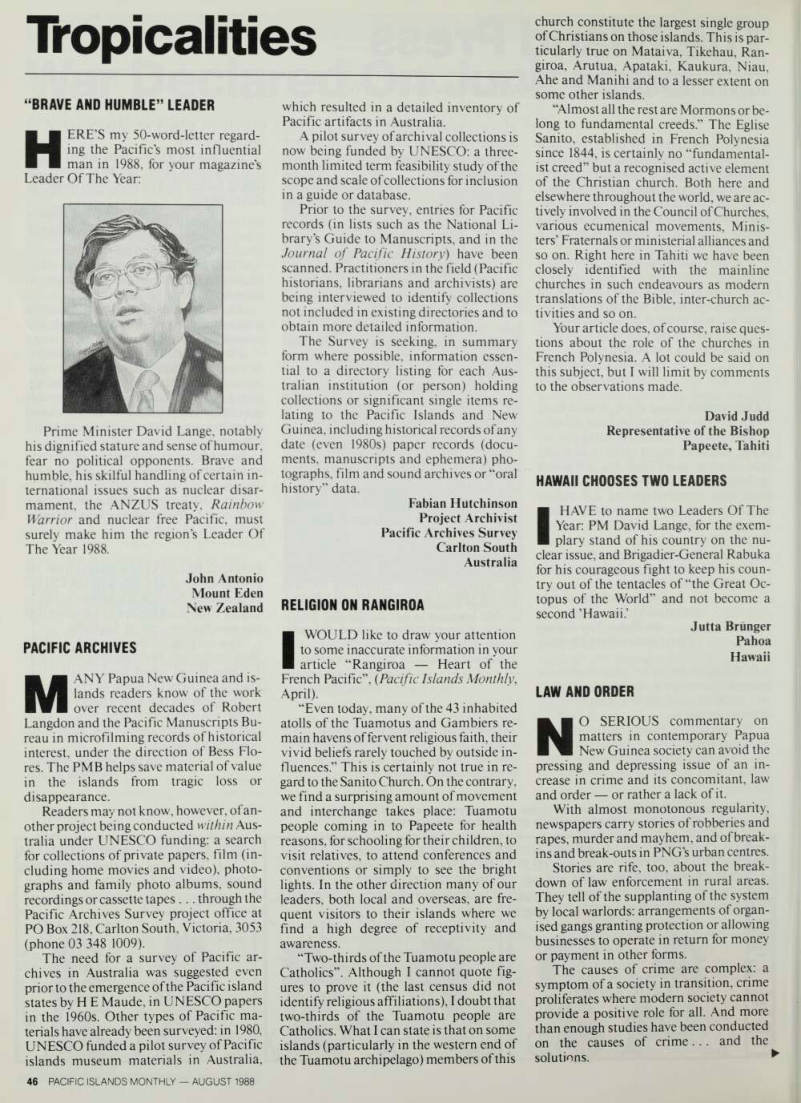
“Brave And Humble” Leader
HERE’S my 50-word-letter regard ing the Pacific’s most influential man in 1988, for your magazine’s Leader Of The Year:
Prime Minister David Lange, notably his dignified stature and sense of humour, fear no political opponents. Brave and humble, his skilful handling of certain in ternational issues such as nuclear disar mament, the ANZUS treaty. Rainbow Warrior and nuclear free Pacific, must surely make him the region’s Leader Of The Year 1988.
John Antonio
Mount Eden New Zealand
Pacific Archives
MANY Papua New Guinea and is lands readers know of the work over recent decades of Robert Langdon and the Pacific Manuscripts Bu reau in microfilming records of historical interest, under the direction of Bess Flo res. The PMB helps save material of value in the islands from tragic loss or disappearance.
Readers may not know, however, of an other project being conducted within Aus tralia under UNESCO funding: a search for collections of private papers, film (in cluding home movies and video), photo graphs and family photo albums, sound recordings or cassette tapes .. .through the Pacific Archives Survey project office at PO Box 218, Carlton South, Victoria, 3053 (phone 03 348 1009).
The need for a survey of Pacific ar chives in Australia was suggested even prior to the emergence of the Pacific island states by H E Maude, in UNESCO papers in the 19605. Other types of Pacific ma terials have already been surveyed: in 1980, UNESCO funded a pilot survey of Pacific islands museum materials in Australia,
which resulted in a detailed inventory of Pacific artifacts in Australia.
A pilot survey of archival collections is now being funded by UNESCO: a three month limited term feasibility study of the scope and scale of collections for inclusion in a guide or database.
Prior to the survey, entries for Pacific records (in lists such as the National Li brary’s Guide to Manuscripts, and in the Journal of Pacific History) have been scanned. Practitioners in the field (Pacific historians, librarians and archivists) are being interviewed to identify collections not included in existing directories and to obtain more detailed information.
The Survey is seeking, in summary form where possible, information essen tial to a directory listing for each Aus tralian institution (or person) holding collections or significant single items re lating to the Pacific Islands and New Guinea, including historical records of any date (even 1980 s) paper records (docu ments, manuscripts and ephemera) pho tographs, film and sound archives or “oral history” data.
Fabian Hutchinson
Project Archivist Pacific Archives Survey Carlton South Australia
Religion On Rangiroa
I WOULD like to draw your attention to some inaccurate information in your article “Rangiroa Heart of the French Pacific”, ( Pacific Islands Monthly, April).
“Even today, many of the 43 inhabited atolls of the Tuamotus and Gamblers re main havens of fervent religious faith, their vivid beliefs rarely touched by outside in fluences.” This is certainly not true in re gard to the Sanito Church. On the contrary, we find a surprising amount of movement and interchange takes place: Tuamotu people coming in to Papeete for health reasons, for schooling for their children, to visit relatives, to attend conferences and conventions or simply to see the bright lights. In the other direction many of our leaders, both local and overseas, are fre quent visitors to their islands where we find a high degree of receptivity and awareness.
“Two-thirds of the Tuamotu people are Catholics”. Although I cannot quote fig ures to prove it (the last census did not identify religious affiliations), I doubt that two-thirds of the Tuamotu people are Catholics. What I can state is that on some islands (particularly in the western end of the Tuamotu archipelago) members of this
church constitute the largest single group of Christians on those islands. This is par ticularly true on Mataiva, Tikehau, Ran giroa, Arutua, Apataki, Kaukura, Niau, Ahe and Manihi and to a lesser extent on some other islands.
“Almost all the rest are Mormons or be long to fundamental creeds.” The Eglise Sanito, established in French Polynesia since 1844, is certainly no “fundamental ist creed” but a recognised active element of the Christian church. Both here and elsewhere throughout the world, we are ac tively involved in the Council of Churches, various ecumenical movements, Minis ters’ Fratemals or ministerial alliances and so on. Right here in Tahiti we have been closely identified with the mainline churches in such endeavours as modern translations of the Bible, inter-church ac tivities and so on.
Your article does, of course, raise ques tions about the role of the churches in French Polynesia. A lot could be said on this subject, but I will limit by comments to the observations made.
David Judd
Representative of the Bishop Papeete, Tahiti
Hawaii Chooses Two Leaders
IH AVE to name two Leaders Of The Year: PM David Lange, for the exem plary stand of his country on the nu clear issue, and Brigadier-General Rabuka for his courageous fight to keep his coun try out of the tentacles of “the Great Oc topus of the World” and not become a second ’Hawaii.’
Jutta Brünger
Pahoa Hawaii
Law And Order
NO SERIOUS commentary on matters in contemporary Papua New Guinea society can avoid the pressing and depressing issue of an in crease in crime and its concomitant, law and order or rather a lack of it.
With almost monotonous regularity, newspapers carry stories of robberies and rapes, murder and mayhem, and of break ins and break-outs in PNG’s urban centres.
Stories are rife, too, about the break down of law enforcement in rural areas.
They tell of the supplanting of the system by local warlords: arrangements of organ ised gangs granting protection or allowing businesses to operate in return for money or payment in other forms.
The causes of crime are complex: a symptom of a society in transition, crime proliferates where modern society cannot provide a positive role for all. And more than enough studies have been conducted on the causes of crime... and the solutions.
< In 1984 we had the K 100,000 Clifford Report. Before that there was the Morgan Report. We have heard of the “49 Steps” and the Minimum Penalties Laws. We saw the appointment of the Kerepia Task Force, witnessed the Lucas Awareness Cam paign and experienced a curfew in the National Capital.
To what purpose, we might all ask. The cynics would see their views confirmed by the official reaction to the latest of these studies, the Harris Report released, withdrawn and re-released all in a space of six weeks.
Whether the content of the Harris re port is palatable or not, the truth is that a succession of governments heeded a fun damental reality; that regardless of the measures adopted, for there to be any chance of success there must be a deter mination on the part of political leader ship hitherto unseen in Papua New Guinea.
The 1984 Parliamentary Committee on the State of Emergency put the same basic problem in these words: “It became glar ingly obvious during our investigations that the poor relationship, lack of consul tation and co-ordination between govern ment departments is as much a problem as the problem of law and order itself’.
The Clifford Report, after highlighting some of the problems and canvassing ideas on how they might be tackled, makes it clear there is little hope for success unless
the structure of public decision-making is altered to provide close co-operation be tween the various justice agencies in im plementation and priority setting.
Despite recommendations by all these reports, the basic problem remains one of apathy by the Government until hell breaks loose and society becomes con cerned enough to organise mass protests as happened in 1984, when a particu larly horrendous rape galvanised large sections of the Moresby citizenry into action.
The apparent indifference on the part of Government is manifested in several ways. The most recent is its reaction to the Harris report. Perhaps the author unwit tingly blurred the picture of a well-organ ised crime machine; he may also have used outdated police figures and crime statis tics but Government reaction was so negative that the Institute which itself commissioned the report attempted to withdraw it from circulation.
Is this lack of a positive, co-ordinated attitude reflective of a lack of a balanced approach to development by the Government?
We certainly hope not; though we won der when we see constant Government emphasis on economic activities at the ex pense of social sectors such as education and health.
It needs to be pointed out again (and we don’t need another major report, cost
ing thousands of kina, to do this) that the ultimate causes of crime in our country are economic and social, The economic causes seem to be ade quately cared for by Government’s prior ities. As for the social. . . well, it remains to be seen. The fundamental fact remains that our political leadership must realise that any concerted campaign to settle the law and order problem requires involve ment from the highest level, Maybe the Prime Minister and Cabi net have their hands full trying to workout ways to govern our nation more effec lively. Maybe that’s why they have been unable to address this major issue. But whatever their reasons, we hope they are not so preoccupied with their own sur vival that they risk compromising the safety of our society, After all, their preoccupation with political survival is as legitimate as soci ety’s preoccupation with its own survival, a key element of which is the law and order issue. All societies are (or at least should be) as privileged as their leaders. Law and order must not be regarded as a luxury for the privileged, but as a right for the masses: not patrician; not plebeian. A birthright bestowed on all of us.
A M Siaguru
Boroko Papua New Guinea
Advertisements & other items, p. 47 (1 item)
IAIA\R --- Papua New Guinea's
nationwide airline connection to and
from the World.
I £
DOMESTIC
Talair serves all provinces in P.M.G., many on a daily basis. No other airline comes close to serving the 130 ports a week that Talair does. Charter services also are available. ihv,B
INTERNATIONAL
Using our computerised system
in any of our 12 International Travel Centres, we can book you anywhere in the world 0n...
planes, trains, luxury liners,
arrange rental hostefs, motels or hotels. • M Panguna - 95 8020 • Arawa - 95 2113 • Mt. Hagen - 52 2465 Boroko - 25 7655 • Tabubll - 58 9228 • Goroka - 72 1355 • Lae - 42 2316 Madang - 82 2757 • Rabaul - 82 2882 • Wewak - 86 2012 Vanlmo - 87 1180 • Port Moresby - 21 4766 • Walganl - 25 7877 Brisbane Metropolitan Area - 229 1177 Outside Brisbane - 008 777879
ATA
QUALITY IN AIR TRANSPORT
i • 4141
Toxic Waste Plans Slammed
Trade Winds
South Pacific states have been courted by United States firms wishing to
export dangerous industrial by products.
By Phil Twyford
WITH THE disposal of industrial byproducts now a hot issue in the West, waste companies are beat ing a path to the doors of island govern ments. Five South Pacific nations have been approached by United States com panies seeking waste disposal sites but as yet none have been swayed by the jobs, cash and other lures offered by waste company entrepreneurs.
After three months’ deliberations, Tonga has finally rejected a waste incin eration project promoted by the King’s daughter. Princess Pilolevu. The Solo mon Islands and Papua New Guinea have both considered toxic waste disposal plants, and in 1986 Western Samoa was the target of a waste burning scheme mooted by Californian and American Samoan in terests. The idea provoked such a furore that Apia rejected it. . . only to see its backers take their wares next door to Pago Pago. The plan was rejected there, too, but not before island leaders were offered the dazzling prospect of$USll5 million worth of investment and more than 3000 jobs downstream.
Attracted by a possible SUSIOO mil lion a year in compensation payments, Marshall Islands president Amata Kabua stirred controversy earlier this year by asking the US to look at storing high level radioactive waste in the Marshalls.
But the waste dumpers came closest to securing a South Pacific site in Tonga, where the Princess’s plan gained the qual ified support of King Taufa’ahau Tupou IV. Debate raged in the normally sedate kingdom and civil servants suspected of leaking information to the overseas press were placed under police investigation.
The plan was the brainchild of Ha waiian-based Tongan businessman and former professional wrestler Sione Filipe, who was linked to two similar schemes re jected by the Tongan cabinet last year. Fi lipe recruited Princess Salote Pilolevu Tuita (daughter-in-law of Deputy Prime Minister Baron Tuita) as a 40 per cent shareholder and presented a second scheme convincing King and Cabinet to overturn an earlier decision to reject any further waste proposals.
Cabinet sent a delegation led by Health Minister Dr Sione Tapa to check out state of-the-art waste disposal technology in the US. Filipe and the Princess envisaged a SUSS million incineration plant accept ing one container load of toxic waste a day shipped from California; using as yet un
proved technology, the plant was to gen erate electricity through waste burning and was to incorporate plastics recycling. Toxic ash left over would be used as landfill.
But the plan ran into stiff opposition from civil servants concerned about en vironmental dangers, prompting the Prin cess to write in a confidential letter to the committee considering the project that she resented their implication she might sell out her responsibility to the Tongan people for money or through influence from out side sources.
After details of the scheme were leaked to a New Zealand newspaper, the Princess and her agents Nukualofa entrepre neurs Jerry Fletcher and Kelepi Tupou launched a public relations campaign to woo the locals. They bought full page ad vertisements in the weekly Tonga Chron icle saying the plant would be environmentally harmless and would pro vide jobs and cheap electricity, and brought out their Californian business partner to help sell the scheme.
Fletcher, a Vietnam veteran who holds the Tongan franchise for Budweiser beer, and local trader Tupou run Nukualofa’s airport canteen in a joint venture with the Princess.
Supplying the waste and putting up the funds was to be Californian firm Omega Recovery Services, which last year was caught up in controversy in the Califor nian city of Maricopa. The firm was de nied a permit to build a waste incinerator after city authorities criticised its environ mental impact reports as inadequate and questioned the company’s managerial skills and financial capacity.
In its business plan, Omega said it is politically impossible for any municipal ity in the US to accept a new hazardous waste plant and that the granting of new permits had ground to a halt. In the US which generates 275 million tonnes of toxic waste each year planning laws mean it takes around seven years before a plant can get off the ground. Tonga, like most South Pacific nations, is unhindered by such legislation.
The Princess was quick to allay fears that nuclear or radioactive waste, PCBs, asbestos or dioxins were to be imported.
Likely substances were said to include old batteries, refrigerator coolants, newspa per ink, pesticides, paints and solvents used in the cosmetics industry.
Opponents argued that US companies would not bother shipping their harmless
wastes all the way to Tonga. And anyway, the most dangerous toxins associated with incineration need not be present in the original wastes: deadly dioxins, for ex ample, are formed in incinerator stacks as a byproduct of combustion.
Members of Parliament, schoolteach ers, students and civil servants high lighted the threat to public health, the ecosystem and essential industries such as tourism and agriculture posed by possible handling and storage accidents.
In June, King and Cabinet finally gave the Princess’s scheme the thumbs down.
An approach by another US firm, Global Telesis, found little support in the Solomons: a delegation from the corpo ration visited Honiara in June, but its pro posal met short shrift from Minister of Energy and Natural Resources Robert Bera. “They are not able to dispose of their toxic waste in their own country. Why should they be able to go around the globe trying to get rid of it?” he asked. He said the Solomon Islands Government was concerned about Global Telesis touting its waste dumping proposal around the west ern Pacific.
The thrust into the Pacific coincides with a worldwide move by waste com panies in the West to dump their refuse on developing nations. In June, Nigeria sev ered diplomatic ties with Italy and threat ened to shoot anyone found guilty of importing toxic wastes after it was re vealed numerous shipments of Italian ra dioactive waste had been dumped in the inland port of Koko.
The tiny West African nation of Guinea tried in vain to force the removal of toxic ash shipped from the US and dumped there in February: shipments roundly condemned by the Organisation of Afri can Unity and the European Parliament.
Earlier in the year, a ship carrying in cinerator ash from Philadelphia off-loaded 4000 tonnes of ash on a remote Haiti beach, and left in the night after local authorities ordered it to retrieve the waste.
“Africa, Latin America, the Caribbean and the South Pacific are becoming the fa vourite dumping grounds of waste ped dlers from industrialised countries,” said Jim Vallette, author of a report on waste dumping published by Greenpeace.
“Industries in Europe and the United States are dumping their waste disposal problems on developing countries and are thereby avoiding their responsibility to prevent the production of wastes.” □
□ New Ship Service To Png
BARBICAN Line, a development of Bar bican Marine, has announced a new non conference shipping service to Papua New Guinea from Australian east coast ports.
With an expanded consortium covering the trade, Barbican founder Roger Rich ards believes there is room for an addi tional non-conference service using container vessels chartered from the Bra zilian BB Line; fast container fitted ships with capacities up to 20,000 tons and fit ted to carry reefer containers.
The new line, which will provide a monthly service, will load in Melbourne, Sydney and Brisbane for Port Moresby, Lae and Rabaul; this will be extended to Honiara and Suva. Managing agents will be Barbican Bridge, assisted by Union Bulkships in Melbourne and Adelaide and Australian National Shipping Agencies in Brisbane.
□ Pacific Harbour Sold
A JAPANESE company, South Pacific Development, has bought the Pacific Har bour International Hotel on Figi’s Coral Coast for an undisclosed sum. The trans fer deal, approved early in July by Fiji’s Minister for Lands, Ratu Toganivalu, also includes the golf course and the country club at Deuba.
Pacific Harbour, Fiji’s largest resort, is the second major resort to be bought by Japanese interests in the past three months.
Electrical Industrial Enterprises bought the Regent of Fiji on Denarau Island, near Nadi International Airport, last April (see Pacific Islands Monthly , July).
Fiji’s Minister of Finance, Mr Josefata Kamikamica, welcomed the latest trans fer deal, saying the planned expansion would help boost employment.
□ Centralised Buying For Coffee
THE Papua New Guinea Coffee Industry Board is encouraging the establishment of coffee buying depots. Executive Officer Ron Ganarafo said buying depots re duced the risk of holdups, are better places for both growers and buyers to do business and cut down operating costs.
Mr Ganarafo says growers are paid bet ter prices at depots than they would re ceive from buyers visiting their blocks.
Most major coffee buyers have already set up depots but Mr Ganarafo wants them established in other areas during the cur rent coffee season.
□ Vanimo Denies Wrongdoing
AN Australian timber company has de nied breaking an agreement with the Papua New Guinea Government. The Secretary for Forests, Mr Michael Komtagerea, or
dered Vanimo Forest Products to cease its operations in West Sepik province for an indefinite period late in June.
Vanimo, a subsidiary of the West Aus tralian company Bunnings Limited, was alleged to have failed to comply with an agreement to undertake development projects for the benefit of landowners after timber has been removed.
Mr Komtagerea ordered the company to stop tree felling operations until all logs have been removed from timber areas to its sawmill. Vanimo will also be required to submit a new 12-month working plan to the Government for approval from log ging operations can resume.
Deputy chairman of Bunnings lan Kuba said in Perth that Vanima Products had been carrying out all its obligations under a five-year-plan agreed with the PNG Government, and called on the For ests Department to lift the ban.
□ Vanuatu Trade Scare
TWO Vanuatu cabinet ministers have warned that poor quality copra is endan gering the country’s largest export earner.
The Government-owned Vanuatu Weekly newspaper quoted Finance Minister Sela Molisa and Agriculture Minister Jack Hopa as saying once secure markets would be lost unless the standard of copra im proved. Mr Molisa said European buyers had warned that if Vanuatu did upgrade its copra quality they would not buy; Mr Hopa said a lack of good farming practice may be the reason behind the fall in copra quality.
□ Fiji Wage, Rent Freeze Lifted
FIJI’S Government has lifted its freeze on wages, saying the economy is showing signes of recovery. Finance Minister Jo sefata Kamikamica said despite the lifting of the wage freeze, strict controls on ex change outflow imposed after the May 14 coup last year will remain in force.
About 10,000 Fiji Indians, mainly businessmen and professionals, are re ported to have left Fiji following the coups, draining the state of capital funds. Exact estimates are not available, but it is esti mated more than SUS2O million flowed out of the country.
Mr Kamikamica said Government workers, whose wages were cut by 15 per cent in January, would be given a rise of up to 6 per cent. The freeze on industrial and commercial rents has also been lifted, but the freeze on residential rents will remain.
The Finance Minister predicted the country’s overall budget deficit for 1988 will be nearly $A 135 million; a decrease of SA7 million on the original estimate. He
said this was due to expenditure cuts, a slight increase in revenue collection and restoration of Australian and New Zea land aid suspended after the coup.
□ Nz Bank For Sale
NEW Zealand has announced plans to sell its merchant bank for SUS 77 million.
Trade and Industry Minister David Cay gill said in late June the sale of DEC New Zealand was part of a plan to reduce the national debt.
The country’s largest pension fund, the National Provident Fund, would buy 80 per cent of the bank, with the remainder going to the Solomon Brothers Invest ment Bank of New York. The deal would be closed in November.
DEC, formerly the Development Fi nance Corporation, was established in 1964 but has operated as a state-owned company since April 1987.
□ Sugar, Coffee Prices Eratic
World sugar prices have continued to move erratically. After opening the 1987/88 sea son last September at US5.5c/lb, the In ternational sugar Organisation’s daily price had almost doubled in less than five months to reach USIOc/lb in mid-Janu ary. Since then, prices have continued to fluctuate, but again moved above US9c/ lb by the end of May. The average price so far in 1987/88 is 8.31 c/lb, 30 per cent higher than the previous season’s average.
The recent price volatility has resulted from a combination of mixed reports on consumption and production trends, as well as larger-than-expected purchases from China and the USSR. With the maintenance of steady demand growth in 1988/89, consumption is forecast to ex ceed production again, leading to a fur ther fall in the stocks-to-consumption ratio to almost 30 per cent. Consequently, prices are expected to rise substantially to an av erage of USl4c/lb in the 1988/89 season.
The International Coffee Organisa tion’s (ICO) indicator price improved slightly to USll7c/lb in May, two cents above the level at which another cut in ex port quotas would apply. The marginal improvement for all coffee types resulted from extra buying from merchants rather than roasters, who appear likely to hold more coffee until prospects for a further quota reduction (and corresponding price increase) have faded completely.
However, despite the recent price stabil ity, market conditions remain weak be cause of an estimated 30 per cent increase in world production in 1987/88. The ex pected rise results in estimates of stocks rising to 42 million bags by the end of the 1987/88 season. Prices are forecast to re main weak in 1988/89. ►
□ Burns Philip Trading Changes
Name To Kerr Brothers
ON July 1 the activities of Burns, Philp & Co Ltd’s International Trading Services Export Department were merged with those of Burns Philp’s wholly owned sub sidiary, Kerr Brothers Pty Ltd, whose name was adopted on that date.
The activities of the enlarged Kerr Brothers Pty Ltd will encompass all the functions performed by the Export De partment and all outstanding orders placed on or by Burns Philp’s Interna tional Trading Services Export Depart ment will be handled in the name of Kerr Brothers Pty Ltd.
□ Fiji Tourism Convention
FIJI’S annual tourism convention will be held at the new Sheraton Fiji Resort from August 8 to 10, with the prime responsi bility for re-establishing the South Pacific nation’s tourism industry one of its two major foreign income earners.
David Pickering, Fiji’s Minister for Tourism, Civil Aviation and Energy, who will be the convention’s keynote speaker, says the gathering is “important and ti mely”, and will provide a positive means for the reshaping of the country’s tourism industry.
Chairman of the convention’s plan ning committee, Sheraton Fiji general manager Chris Gorring, says the confer ence program focuses on subjects of vital interest including the concept of regional tourism in the South Pacific, airline seat capacities, Fiji’s economic rehabilitation and the attitude of the interim govern ment to tourism. “The convention will not dwell on past events,” he said. “We are clearly setting our sights on the future.”
Bill Whiting, Australian regional mar keting manager for the Fiji Visitors Bu reau, said 1988 was a very important year for Fiji tourism with visitor figures already indicating regrowth in consumer confi dence. “In February, for example, Aus tralian visitor numbers to Fiji were a record and in March arrivals were the sec ond highest for that particular month.
There is already a firm indication that this growth will continue and we are confident that by convention time we will have something to talk about,” he said.
□ Shell Buys Guam Refinery
SHELL Guam Inc has purchased the as sets of Guam Oil and Refining Company (GORCO) at Piti, Guam, which Shell has been using for the past three years for the importation and storage of petroleum
products to service Shell’s business with Micronesia. GORCO ceased refinery op erations in 1984 because it was uneco nomic to continue; with the decline in international prices since it would be less economic to operate the refinery now and according to Shell would impose an un necessary burden on consumers in Micronesia.
The liquified petroleum gas (LPG) storage facilities will continue to be oper ated by Shell as a receiving terminal for the three companies presently marketing LPG within Guam.
□ New Trans-Pacific Carrier
AIR NEW Zealand has won the right to fly direct between Sydney and Los An geles. New Zealand’s Civil Aviation Min ister, Bill Jeffries, said the new arrangement would give Air New Zealand the capacity to tap both the Australian and American markets while at the same time strengthening New Zealand’s tourist industry.
Capacity and pricing issues on the Pa cific routes had also been discussed with the Americans.
Air New Zealand has also launched a helipcopter shuttle service between Auck land’s domestic airport and the city centre.
The service is aimed at giving Air New Zealand a marketing advantage over An sett New Zealand in the highly competi tive domestic market.
□ Rata Forum For Singapore
The PATA Research Authority will pres ent the Pacific-Asia Tourism Research Forum in Singapore, on September *5 and 6. Immediately following, from Septem ber 7 to 9, the first Forecasts Seminar, jointly presented by the International Air Transport Association (lATA) and PATA, will be held at the same venue. Program highlights include presentations by Blair Stevens of Tourism Canada, by June Hamilton and Monique Brocx of NZTPD, and by Daniel Chan of the Hong Kong Tourism Association.
Other topics will be presented by Grady Means of Cooper & Lybrand and James King of Aloha Airlines, Hawaii.
The lATTA/PATA Economic Traffic Forecasts Seminar for the Pacific-Asia re gion will be held on September 7 to 9 and will cover topics including the economic outlook for the Pacific-Asia Region and its impact on travel; financial support to fi nance tourism growth in the region; analy ses of traffic from major markets; and airport developments to cope with pro jected growth. □
Advertisements & other items, p. 50 (1 item)
Aggie Grey's
Hotel
Stay at Aggie Grey’s
the South Pacific’s
legendary hotel.
Situated right in the heart of Western Samoa. Enjoy Polynesian style friendliness and service,in cool surroundings, superb entertainment and food. Magnificent white sand beaches only a short drive away.
Air-conditioned rooms, swimming pool and full bar facilities.
Bookings through Union Steamship Company of NZ, Pan Am, Air New Zealand or direct to Aggie Grey’s, Apia, Western Samoa. Cables: AGGIES’ Apia.
Pacific Economic
Bulletin
Volume 3 Number 1 is now published T
Have you taken our
your subscription?
The Bulletin monitors the economies of the South Pacific countries with a survey of current economic trends.
In this issue Macroeconomic policies under adverse conditions: the case of Fiji in 1987 are discussed by S. Siwatibau, the Governor of the Reserve Bank of Fiji.
Other articles deal with expenditure and consumption patterns in Papua New Guinea, The Australian Joint Venture Scheme, management in developing Pacific Island inshore fishery resources, Australian aid for education, Japanese aid policy and foreign and private investments. A statistical annex is kept up to date.
Available from Bibliotech, ANUTECH Pty Ltd, GPO Box 4, Canberra, ACT 2601 Australia.
Subscription; As2o Australia, US$l5 all other countries (1988: Volume 3, Numbers 1 and 2).
Charges can be made to Bankcard or Mastercard.
Published by the National Centre for Development Studies, the Australian National University.
Pacific Stamp Box
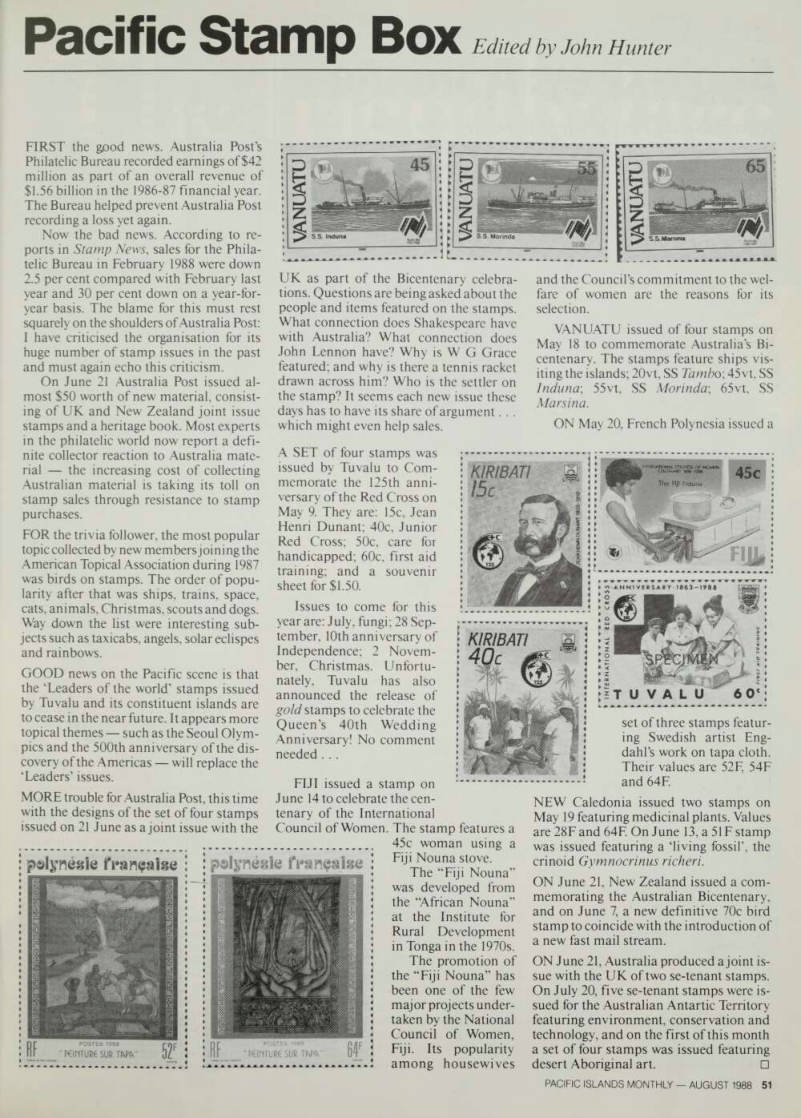
Edited by John Hunter
FIRST the good news. Australia Post’s Philatelic Bureau recorded earnings of $42 million as part of an overall revenue of $1.56 billion in the 1986-87 financial year.
The Bureau helped prevent Australia Post recording a loss yet again.
Now the bad news. According to re ports in Stamp News , sales for the Phila telic Bureau in February 1988 were down 2.5 per cent compared with February last year and 30 per cent down on a year-for year basis. The blame for this must rest squarely on the shoulders of Australia Post: I have criticised the organisation for its huge number of stamp issues in the past and must again echo this criticism.
On June 21 Australia Post issued al most $5O worth of new material, consist ing of UK and New Zealand joint issue stamps and a heritage book. Most experts in the philatelic world now report a defi nite collector reaction to Australia mate rial the increasing cost of collecting Australian material is taking its toll on stamp sales through resistance to stamp purchases.
FOR the trivia follower, the most popular topic collected by new members joining the American Topical Association during 1987 was birds on stamps. The order of popu larity after that was ships, trains, space, cats, animals, Christmas, scouts and dogs.
Way down the list were interesting sub jects such as taxicabs, angels, solar eclispes and rainbows.
GOOD news on the Pacific scene is that the ‘Leaders of the world’ stamps issued by Tuvalu and its constituent islands are to cease in the near future. It appears more topical themes such as the Seoul Olym pics and the 500th anniversary of the dis covery of the Americas will replace the ‘Leaders’ issues.
MORE trouble for Australia Post, this time with the designs of the set of four stamps issued on 21 June as a joint issue with the
UK as part of the Bicentenary celebra tions. Questions are being asked about the people and items featured on the stamps.
What connection does Shakespeare have with Australia? What connection does John Lennon have? Why is W G Grace featured; and why is there a tennis racket drawn across him? Who is the settler on the stamp? It seems each new issue these days has to have its share of argument. . . which might even help sales.
A SET of four stamps was issued by Tuvalu to Com memorate the 125th anni versary of the Red Cross on May 9. They are: 15c, Jean Henri Dunant; 40c, Junior Red Cross; 50c, care for handicapped; 60c, first aid training; and a souvenir sheet for $1.50.
Issues to come for this year are: July, fungi; 28 Sep tember, 10th anniversary of Independence; 2 Novem ber, Christmas. Unfortu nately, Tuvalu has also announced the release of gold stamps to celebrate the Queen’s 40th Wedding Anniversary! No comment needed. . .
FIJI issued a stamp on June 14 to celebrate the cen tenary of the International
Council of Women. The stamp features a
45c woman using a Fiji Nouna stove.
The “Fiji Nouna” was developed from the “African Nouna” at the Institute for Rural Development in Tonga in the 19705.
The promotion of the “Fiji Nouna” has been one of the few major projects under taken by the National Council of Women, Fiji. Its popularity among housewives
and the Council’s commitment to the wel fare of women are the reasons for its selection.
VANUATU issued of four stamps on May 18 to commemorate Australia’s Bi centenary. The stamps feature ships vis iting the islands; 20vt, SS Tambo\ 45 vt, SS lnduna\ 55vt, SS Morinda\ 65vt, SS Marsina.
ON May 20, French Polynesia issued a
set of three stamps featur ing Swedish artist Eng dahl’s work on tapa cloth.
Their values are 52F, 54F and 64F.
NEW Caledonia issued two stamps on May 19 featuring medicinal plants. Values are 28F and 64F. On June 13, a 51F stamp was issued featuring a ‘living fossil’, the crinoid Gymnocrinus richeri.
ON June 21, New Zealand issued a com memorating the Australian Bicentenary, and on June 7, a new definitive 70c bird stamp to coincide with the introduction of a new fast mail stream.
ON June 21, Australia produced a joint is sue with the UK of two se-tenant stamps.
On July 20, five se-tenant stamps were is sued for the Australian Antartic Territory featuring environment, conservation and technology, and on the first of this month a set of four stamps was issued featuring desert Aboriginal art. □
Aggie Grey: A Tribute
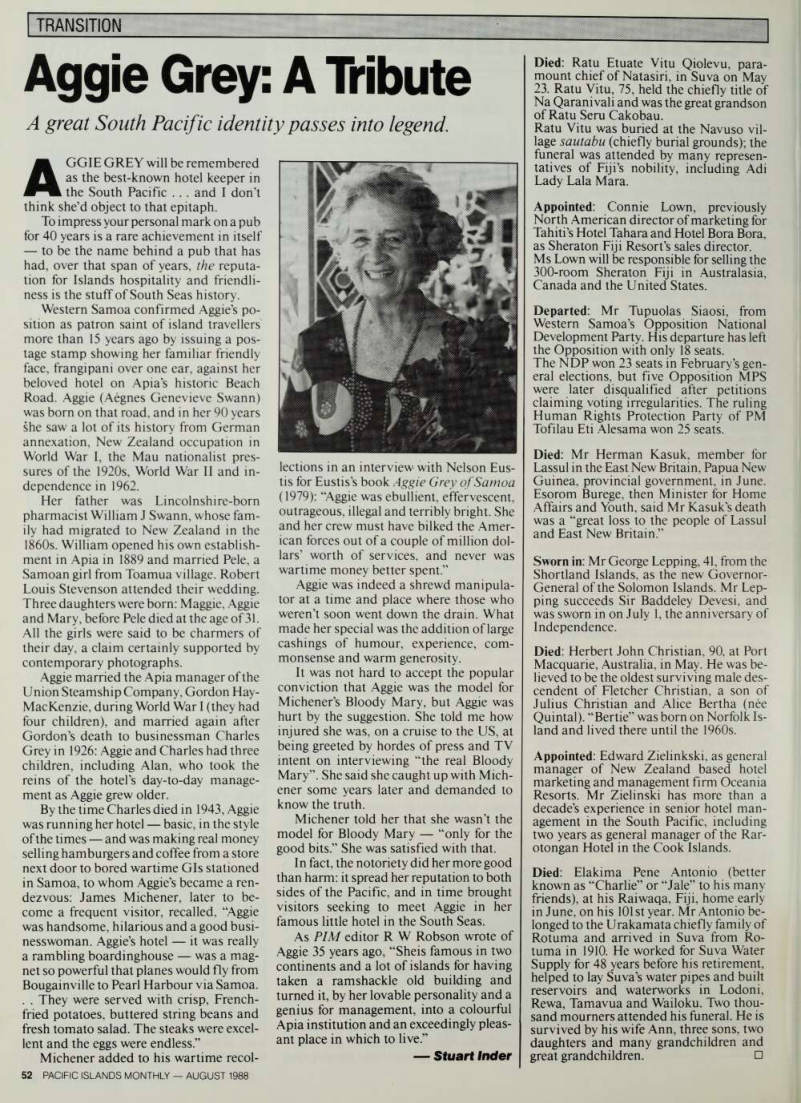
Transition
A great South Pacific identity passes into legend.
AGGIE GREY will be remembered as the best-known hotel keeper in the South Pacific .. . and I don’t think she’d object to that epitaph.
To impress your personal mark on a pub for 40 years is a rare achievement in itself to be the name behind a pub that has had, over that span of years, the reputa tion for Islands hospitality and friendli ness is the stuff of South Seas history.
Western Samoa confirmed Aggie’s po sition as patron saint of island travellers more than 15 years ago by issuing a pos tage stamp showing her familiar friendly face, frangipani over one ear, against her beloved hotel on Apia’s historic Beach Road. Aggie (Aegnes Genevieve Swann) was born on that road, and in her 90 years she saw a lot of its history from German annexation, New Zealand occupation in World War I, the Mau nationalist pres sures of the 19205, World War II and in dependence in 1962.
Her father was Lincolnshire-born pharmacist William J Swann, whose fam ily had migrated to New Zealand in the 1860 s. William opened his own establish ment in Apia in 1889 and married Pele, a Samoan girl from Toamua village. Robert Louis Stevenson attended their wedding.
Three daughters were born: Maggie, Aggie and Mary, before Pele died at the age of 31.
All the girls were said to be charmers of their day, a claim certainly supported by contemporary photographs.
Aggie married the Apia manager of the Union Steamship Company, Gordon Hay- MacKenzie, during World War I (they had four children), and married again after Gordon’s death to businessman Charles Grey in 1926: Aggie and Charles had three children, including Alan, who took the reins of the hotel’s day-to-day manage ment as Aggie grew older.
By the time Charles died in 1943, Aggie was running her hotel basic, in the style of the times and was making real money selling hamburgers and coffee from a store next door to bored wartime Gls stationed in Samoa, to whom Aggie’s became a ren dezvous: James Michener, later to be come a frequent visitor, recalled, “Aggie was handsome, hilarious and a good busi nesswoman. Aggie’s hotel it was really a rambling boardinghouse was a mag net so powerful that planes would fly from Bougainville to Pearl Harbour via Samoa. . . They were served with crisp, French fried potatoes, buttered string beans and fresh tomato salad. The steaks were excel lent and the eggs were endless.”
Michener added to his wartime recol-
lections in an interview with Nelson Eus tis for Eustis’s book Aggie Grey of Samoa (1979): “Aggie was ebullient, effervescent, outrageous, illegal and terribly bright. She and her crew must have bilked the Amer ican forces out of a couple of million dol lars’ worth of services, and never was wartime money better spent.”
Aggie was indeed a shrewd manipula tor at a time and place where those who weren’t soon went down the drain. What made her special was the addition of large cashings of humour, experience, com monsense and warm generosity.
It was not hard to accept the popular conviction that Aggie was the model for Michener’s Bloody Mary, but Aggie was hurt by the suggestion. She told me how injured she was, on a cruise to the US, at being greeted by hordes of press and TV intent on interviewing “the real Bloody Mary”. She said she caught up with Mich ener some years later and demanded to know the truth.
Michener told her that she wasn’t the model for Bloody Mary “only for the good bits.” She was satisfied with that.
In fact, the notoriety did her more good than harm: it spread her reputation to both sides of the Pacific, and in time brought visitors seeking to meet Aggie in her famous little hotel in the South Seas.
As PIM editor R W Robson wrote of Aggie 35 years ago, “Sheis famous in two continents and a lot of islands for having taken a ramshackle old building and turned it, by her lovable personality and a genius for management, into a colourful Apia institution and an exceedingly pleas ant place in which to live.”
Stuart Inder
Died: Ratu Etuate Vitu Qiolevu, para mount chief of Natasiri, in Suva on May 23. Ratu Vitu, 75, held the chiefly title of Na Qaranivali and was the great grandson of Ratu Seru Cakobau.
Ratu Vitu was buried at the Navuso vil lage sautabu (chiefly burial grounds); the funeral was attended by many represen tatives of Fiji’s nobility, including Adi Lady Lala Mara.
Appointed: Connie Lown, previously North American director of marketing for Tahiti’s Hotel Tahara and Hotel Bora Bora, as Sheraton Fiji Resort’s sales director.
Ms Lown will be responsible for selling the 300-room Sheraton Fiji in Australasia, Canada and the United States.
Departed: Mr Tupuolas Siaosi, from Western Samoa’s Opposition National Development Party. His departure has left the Opposition with only 18 seats.
The NDP won 23 seats in February’s gen eral elections, but five Opposition MPS were later disqualified after petitions claiming voting irregularities. The ruling Human Rights Protection Party of PM Tofilau Eti Alesama won 25 seats.
Died: Mr Herman Kasuk, member for Lassul in the East New Britain, Papua New Guinea, provincial government, in June.
Esorom Burege, then Minister for Home Affairs and Youth, said Mr Kasuk’s death was a “great loss to the people of Lassul and East New Britain.”
Sworn in; Mr George Lepping, 41, from the Shortland Islands, as the new Governor- General of the Solomon Islands. Mr Lep ping succeeds Sir Baddeley Devesi, and was sworn in on July 1, the anniversary of Independence.
Died: Herbert John Christian, 90, at Port Macquarie, Australia, in May. He was be lieved to be the oldest surviving male des cendent of Fletcher Christian, a son of Julius Christian and Alice Bertha (nee Quintal). “Bertie” was born on Norfolk Is land and lived there until the 19605.
Appointed: Edward Zielinkski, as general manager of New Zealand based hotel marketing and management firm Oceania Resorts. Mr Zielinski has more than a decade’s experience in senior hotel man agement in the South Pacific, including two years as general manager of the Rar otongan Hotel in the Cook Islands.
Died: Elakima Pene Antonio (better known as “Charlie” or “Jale” to his many friends), at his Raiwaqa, Fiji, home early in June, on his 101 st year. Mr Antonio be longed to the Urakamata chiefly family of Rotuma and arrived in Suva from Ro tuma in 1910. He worked for Suva Water Supply for 48 years before his retirement, helped to lay Suva’s water pipes and built reservoirs and waterworks in Lodoni, Rewa, Tamavua and Wailoku. Two thou sand mourners attended his funeral. He is survived by his wife Ann, three sons, two daughters and many grandchildren and great grandchildren. □
Advertisements & other items, p. 53 (1 item)
•Fiji
TK e men o
ace
Shipping Schedules
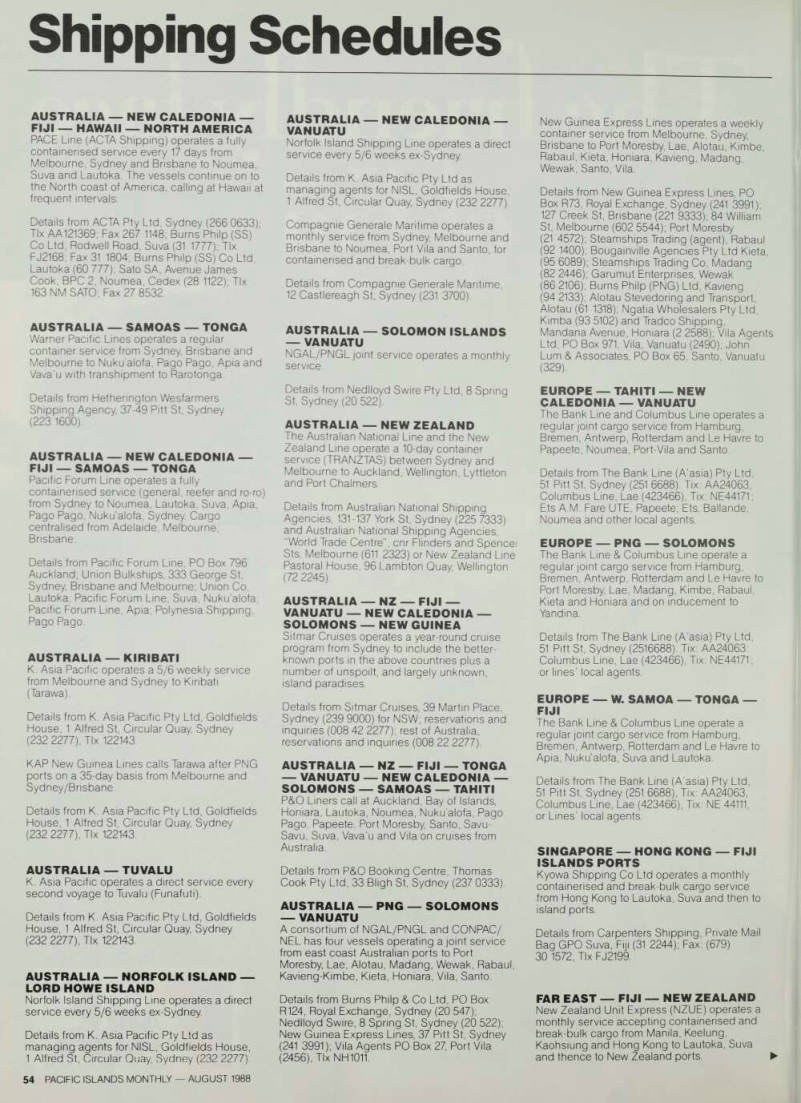
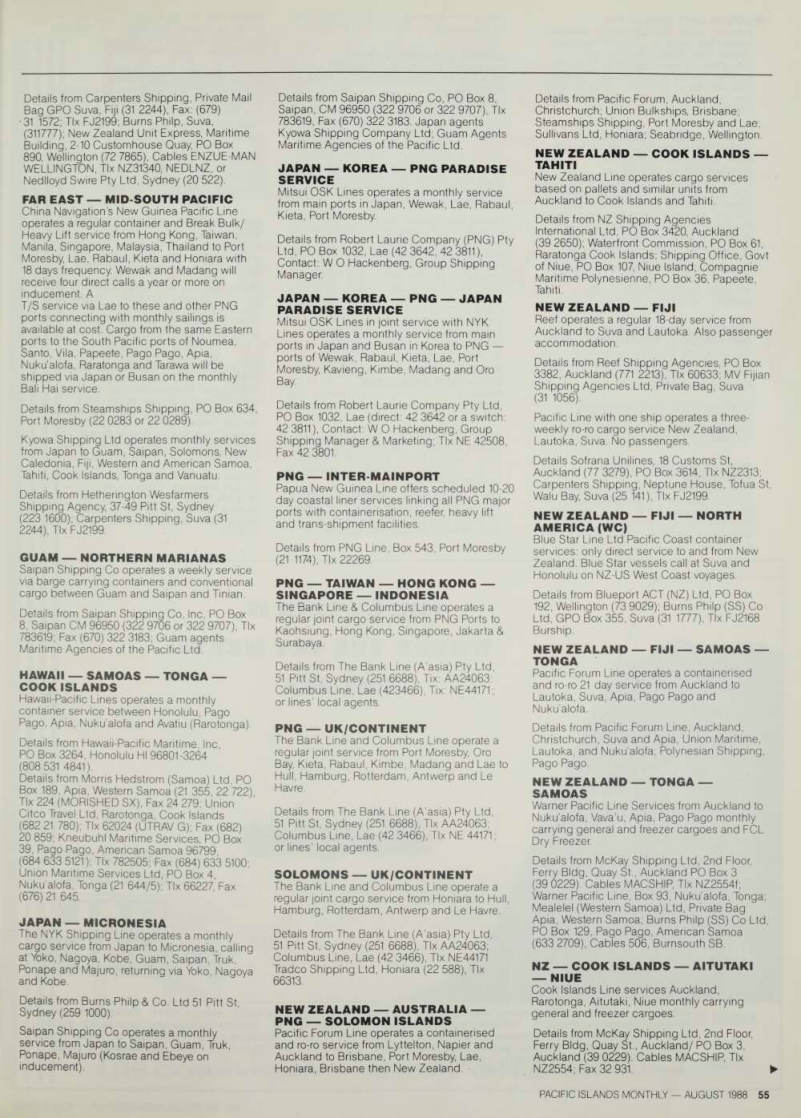
Australia New Caledonia
Fiji Hawaii North America
PACE Line (ACTA Shipping) operates a fully containerised service every 17 days from Melbourne, Sydney and Brisbane to Noumea, Suva and Lautoka. The vessels continue on to the North coast of America, calling at Hawaii at frequent intervals.
Details from ACTA Pty Ltd, Sydney (266 0633); Tlx AA121369; Fax 267 1148: Burns Philp (SS) Co Ltd, Rodwell Road, Suva (31 1777); Tlx FJ2168: Fax 31 1804; Burns Philp (SS) Co Ltd, Lautoka (60 777); Sato SA, Avenue James Cook, BPC 2, Noumea, Cedex (28 1122); Tlx
163 Nm Sato; Fax 27 8532.
Australia Samoas Tonga
Warner Pacific Lines operates a regular container service from Sydney, Brisbane and Melbourne to Nuku’alofa, Pago Pago, Apia and Vava'u with transhipment to Rarotonga.
Details from Hetherington Wesfarmers Shipping Agency, 37-49 Pitt St, Sydney (223 1600).
Australia New Caledonia
Fiji Samoas Tonga
Pacific Forum Line operates a fully containerised service (general, reefer and ro-ro) from Sydney to Noumea, Lautoka, Suva, Apia,
Pago Pago, Nuku’alofa, Sydney. Cargo
centralised from Adelaide, Melbourne, Brisbane.
Details from Pacific Forum Line, PO Box 796 Auckland: Union Bulkships, 333 George St, Sydney, Brisbane and Melbourne: Union Co, Lautoka; Pacific Forum Line, Suva, Nuku’alofa: Pacific Forum Line, Apia; Polynesia Shipping,
Pago Pago.
Australia Kiribati
K. Asia Pacific operates a 5/6 weekly service from Melbourne and Sydney to Kiribati (Tarawa).
Details from K. Asia Pacific Pty Ltd, Goldfields House, 1 Alfred St, Circular Quay, Sydney (232 2277), Tlx 122143.
KAP New Guinea Lines calls Tarawa after PNG ports on a 35-day basis from Melbourne and
Sydney/Brisbane.
Details from K. Asia Pacific Pty Ltd, Goldfields House, 1 Alfred St, Circular Quay, Sydney (232 2277), Tlx 122143,
Australia Tuvalu
K. Asia Pacific operates a direct service every second voyage to Tuvalu (Funafuti).
Details from K. Asia Pacific Pty Ltd, Goldfields House, 1 Alfred St, Circular Quay, Sydney (232 2277), Tlx 122143.
Australia Norfolk Island
Lord Howe Island
Norfolk Island Shipping Line operates a direct service every 5/6 weeks ex-Sydney.
Details from K. Asia Pacific Pty Ltd as managing agents for NISL, Goldfields House, 1 Alfred St, Circular Quay, Sydney (232 2277).
Australia New Caledonia
Vanuatu
Norfolk Island Shipping Line operates a direct service every 5/6 weeks ex-Sydney.
Details from K. Asia Pacific Pty Ltd as managing agents for NISL, Goldfields House, 1 Alfred St, Circular Quay, Sydney (232 2277).
Compagnie Generate Maritime operates a monthly service from Sydney, Melbourne and Brisbane to Noumea, Port Vila and Santo, for containerised and break-bulk cargo.
Details from Compagnie Generate Maritime, 12 Castlereagh St, Sydney (231 3700).
Australia Solomon Islands
Vanuatu
NGAL/PNGL joint service operates a monthly service.
Details from Nedlloyd Swire Pty Ltd, 8 Spring
St, Sydney (20 522).
Australia New Zealand
The Australian National Line and the New Zealand Line operate a 10-day container service (TRANZTAS) between Sydney and Melbourne to Auckland, Wellington, Lyttleton and Port Chalmers.
Details from Australian National Shipping Agencies, 131-137 York St, Sydney (225 7333) and Australian National Shipping Agencies, “World Trade Centre", cnr Flinders and Spencei Sts, Melbourne (611 2323) or New Zealand Line Pastoral House, 96 Lambton Quay, Wellington (72 2245).
Australia Nz Fiji
Vanuatu New Caledonia
Solomons New Guinea
Sitmar Cruises operates a year-round cruise program from Sydney to include the better known ports in the above countries plus a number of unspoilt, and largely unknown, island paradises.
Details from Sitmar Cruises, 39 Martin Place, Sydney (239 9000) for NSW; reservations and inquiries (008 42 2277), rest of Australia, reservations and inquiries (008 22 2277).
Australia Nz Fiji Tonga
Vanuatu New Caledonia
Solomons Samoas Tahiti
P&O Liners call at Auckland, Bay of Islands, Honiara, Lautoka, Noumea, Nukualofa, Pago Pago, Papeete, Port Moresby, Santo, Savu- Savu, Suva, Vava’u and Vila on cruises from Australia.
Details from P&O Booking Centre, Thomas Cook Pty Ltd, 33 Bligh St, Sydney (237 0333).
Australia Png Solomons
Vanuatu
A consortium of NGAL/PNGL and CONPAC/ NEL has four vessels operating a joint service from east coast Australian ports to Port Moresby, Lae, Alotau, Madang, Wewak, Rabaul, Kavieng-Kimbe, Kieta, Honiara, Vila, Santo.
Details from Burns Philp & Co Ltd, PO Box R 124, Royal Exchange, Sydney (20 547); Nedlloyd Swire, 8 Spring St, Sydney (20 522); New Guinea Express Lines, 37 Pitt St, Sydney (241 3991); Vila Agents PO Box 27, Port Vila
(2456), Tlx Nhioii.
New Guinea Express Lines operates a weekly container service from Melbourne, Sydney, Brisbane to Port Moresby, Lae, Alotau, Kimbe, Rabaul, Kieta, Honiara, Kavieng, Madang, Wewak, Santo, Vila.
Details from New Guinea Express Lines, PO Box R 73, Royal Exchange, Sydney (241 3991); 127 Creek St, Brisbane (221 9333); 84 William St, Melbourne (602 5544); Port Moresby (21 4572); Steamships Trading (agent), Rabaul (92 1400); Bougainville Agencies Pty Ltd Kieta, (95 6089); Steamships Trading Co, Madang (82 2446); Garumut Enterprises, Wewak (86 2106); Burns Philp (PNG) Ltd, Kavieng (94 2133); Alotau Stevedoring and Transport, Alotau (61 1318); Ngatia Wholesalers Pty Ltd, Kimba (93 5102) and Tradco Shipping, Mandana Avenue, Honiara (2 2588); Vila Agents Ltd, PO Box 971, Vila, Vanuatu (2490); John Lum & Associates, PO Box 65, Santo, Vanuatu (329).
Europe Tahiti New
Caledonia Vanuatu
The Bank Line and Columbus Line operates a regular joint cargo service from Hamburg, Bremen, Antwerp, Rotterdam and Le Havre to Papeete, Noumea, Port-Vila and Santo.
Details from The Bank Line (A’asia) Pty Ltd, 51 Pitt St, Sydney (251 6688). Tix: AA24063, Columbus Line. Lae (423466). Tix: NE44171; Ets A.M. Fare LITE, Papeete; Ets, Ballande, Noumea and other local agents.
Europe Png Solomons
The Bank Line & Columbus Line operate a regular joint cargo service from Hamburg, Bremen, Antwerp, Rotterdam and Le Havre to Port Moresby, Lae, Madang, Kimbe, Rabaul, Kieta and Honiara and on inducement to Yandina.
Details from The Bank Line (A’asia) Pty Ltd, 51 Pitt St, Sydney (2516688). Tix: AA24063: Columbus Line, Lae (423466), Tix: NE44171; or lines’ local agents.
Europe W. Samoa Tonga
Fiji
The Bank Line & Columbus Line operate a regular joint cargo service from Hamburg, Bremen, Antwerp, Rotterdam and Le Havre to Apia, Nuku’alofa, Suva and Lautoka.
Details from The Bank Line (A’asia) Pty Ltd, 51 Pitt St, Sydney (251 6688), Tix: AA24063, Columbus Line, Lae (423466), Tix: NE 44111, or Lines’ local agents.
Singapore Hong Kong Fiji
Islands Ports
Kyowa Shipping Co Ltd operates a monthly containerised and break-bulk cargo service from Hong Kong to Lautoka, Suva and then to island ports.
Details from Carpenters Shipping, Private Mail Bag GPO Suva, Fiji (31 2244); Fax: (679) 30 1572, Tlx FJ2199.
Far East Fiji New Zealand
New Zealand Unit Express (NZUE) operates a monthly service accepting containerised and break-bulk cargo from Manila, Keelung, Kaohsiung and Hong Kong to Lautoka, Suva and thence to New Zealand ports. ►
Details from Carpenters Shipping, Private Mail Bag GPO Suva, Fiji (31 2244), Fax: (679) •31 1572; Tlx FJ2199; Burns Philp, Suva, (311777); New Zealand Unit Express, Maritime Building, 2-10 Customhouse Quay, PO Box 890, Wellington (72 7865), Cables ENZUE-MAN
Wellington, Tlx Nz31340, Nedlnz, Or
Nedlloyd Swire Pty Ltd, Sydney (20 522).
Far East Mid-South Pacific
China Navigation’s New Guinea Pacific Line operates a regular container and Break Bulk/ Heavy Lift service from Hong Kong, Taiwan, Manila, Singapore, Malaysia, Thailand to Port Moresby, Lae, Rabaul, Kieta and Honiara with 18 days frequency. Wewak and Madang will receive four direct calls a year or more on inducement. A T/S service via Lae to these and other PNG ports connecting with monthly sailings is available at cost. Cargo from the same Eastern ports to the South Pacific ports of Noumea, Santo, Vila, Papeete, Pago Pago, Apia, Nuku’alofa, Raratonga and Tarawa will be shipped via Japan or Busan on the monthly Bali Hai service.
Details from Steamships Shipping, PO Box 634, Port Moresby (22 0283 or 22 0289).
Kyowa Shipping Ltd operates monthly services from Japan to Guam, Saipan, Solomons, New Caledonia, Fiji, Western and American Samoa, Tahiti, Cook Islands, Tonga and Vanuatu.
Details from Hetherington Wesfarmers Shipping Agency, 37-49 Pitt St, Sydney (223 1600); Carpenters Shipping, Suva (31 2244), Tlx FJ2199.
Guam Northern Marianas
Saipan Shipping Co operates a weekly service via barge carrying containers and conventional cargo between Guam and Saipan and Tinian.
Details from Saipan Shipping Co, Inc, PO Box 8, Saipan CM 96950 (322 9706 or 322 9707), Tlx 783619; Fax (670) 322 3183; Guam agents Maritime Agencies of the Pacific Ltd.
Hawaii Samoas Tonga
Cook Islands
Hawaii-Pacific Lines operates a monthly container service between Honolulu, Pago Pago, Apia, Nuku'alofa and Avatiu (Rarotonga).
Details from Hawaii-Pacific Maritime, Inc, PO Box 3264, Honolulu HI 96801-3264 (808 531 4841).
Details from Morris Hedstrom (Samoa) Ltd, PO Box 189, Apia, Western Samoa (21 355, 22 722), Tlx 224 (MORISHED SX), Fax 24 279; Union Citco Travel Ltd, Rarotonga, Cook Islands (682 21 780); Tlx 62024 (UTRAV G); Fax (682) 20 859; Kneubuhl Maritime Services, PO Box 39, Pago Pago, American Samoa 96799, (684 633 5121); Tlx 782505; Fax (684) 633 5100; Union Maritime Services Ltd, PO Box 4, Nuku’alofa, Tonga (21 644/5); Tlx 66227,’ Fax (676) 21 645.
Japan —Micronesia
The NYK Shipping Line operates a monthly cargo service from Japan to Micronesia, calling at Yoko, Nagoya, Kobe, Guam, Saipan, Truk, Ponape and Majuro, returning via Yoko, Nagoya and Kobe.
Details from Burns Philp & Co. Ltd 51 Pitt St, Sydney (259 1000).
Saipan Shipping Co operates a monthly service from Japan to Saipan, Guam, Truk, Ponape, Majuro (Kosrae and Ebeye on inducement).
Details from Saipan Shipping Co, PO Box 8, Saipan, CM 96950 (322 9706 or 322 9707), Tlx 783619, Fax (670) 322 3183. Japan agents Kyowa Shipping Company Ltd; Guam Agents Maritime Agencies of the Pacific Ltd.
Japan Korea Png Paradise
Service
Mitsui OSK Lines operates a monthly service from main ports in Japan, Wewak, Lae, Rabaul, Kieta, Port Moresby.
Details from Robert Laurie Company (PNG) Pty Ltd, PO Box 1032, Lae (42 3642, 42 3811), Contact: W O Hackenberg, Group Shipping Manager.
Japan Korea Png Japan
Paradise Service
Mitsui OSK Lines in joint service with NYK Lines operates a monthly service from main ports in Japan and Busan in Korea to PNG ports of Wewak, Rabaul, Kieta, Lae, Port Moresby, Kavieng, Kimbe, Madang and Oro Bay.
Details from Robert Laurie Company Pty Ltd, PO Box 1032, Lae (direct: 42 3642 or a switch: 42 3811), Contact: W O Hackenberg, Group Shipping Manager & Marketing; Tlx NE 42508, Fax 42 3801,
Png Inter-Mainport
Papua New Guinea Line offers scheduled 10-20 day coastal liner services linking all PNG major ports with containerisation, reefer, heavy lift and trans-shipment facilities.
Details from PNG Line, Box 543, Port Moresby (21 1174), Tlx 22269.
Png Taiwan Hong Kong
Singapore Indonesia
The Bank Line & Columbus Line operates a regular joint cargo service from PNG Ports to Kaohsiung, Hong Kong, Singapore, Jakarta & Surabaya.
Details from The Bank Line (A'asia) Pty Ltd, 51 Pitt St, Sydney (251 6688), Tix. AA24063: Columbus Line, Lae (423466), Tix: NE44171; or lines' local agents.
Png Uk/Continent
The Bank Line and Columbus Line operate a regular joint service from Port Moresby, Oro Bay, Kieta, Rabaul, Kimbe, Madang and Lae to Hull, Hamburg, Rotterdam, Antwerp and Le Havre.
Details from The Bank Line (A'asia) Pty Ltd, 51 Pitt St. Sydney (251 6688), Tlx AA24063; Columbus Line, Lae (42 3466), Tlx NE 44171; or lines’ local agents.
Solomons Uk/Continent
The Bank Line and Columbus Line operate a regular joint cargo service from Honiara to Hull, Hamburg, Rotterdam, Antwerp and Le Havre.
Details from The Bank Line (A’asia) Pty Ltd, 51 Pitt St, Sydney (251 6688), Tlx AA24063; Columbus Line, Lae (42 3466), Tlx NE44171 Tradco Shipping Ltd, Honiara (22 588), Tlx 66313.
New Zealand Australia
Png Solomon Islands
Pacific Forum Line operates a containerised and ro-ro service from Lyttelton, Napier and Auckland to Brisbane, Port Moresby, Lae, Honiara, Brisbane then New Zealand.
Details from Pacific Forum, Auckland, Christchurch; Union Bulkships, Brisbane; Steamships Shipping, Port Moresby and Lae; Sullivans Ltd, Honiara; Seabridge, Wellington,
New Zealand Cook Islands
Tahiti
New Zealand Line operates cargo services based on pallets and similar units from Auckland to Cook Islands and Tahiti.
Details from NZ Shipping Agencies International Ltd, PC Box 3420, Auckland (39 2650); Waterfront Commission, PC Box 61, Raratonga Cook Islands; Shipping Office, Govt of Niue, PC Box 107, Niue Island: Compagnie Maritime Polynesienne, PC Box 36, Papeete, Tahiti.
New Zealand Fiji
Reef operates a regular 18-day service from Auckland to Suva and Lautoka. Also passenger accommodation.
Details from Reef Shipping Agencies, PC Box 3382, Auckland (771 2213), Tlx 60633; MV Fijian Shipping Agencies Ltd, Private Bag, Suva (31 1056).
Pacific Line with one ship operates a three weekly ro-ro cargo service New Zealand, Lautoka, Suva. No passengers.
Details Sofrana Unilines, 18 Customs St, Auckland (77 3279). PC Box 3614, Tlx NZ2313; Carpenters Shipping, Neptune House, Tofua St, Walu Bay, Suva (25 141), Tlx FJ2199.
New Zealand Fiji North
America (Wc)
Blue Star Line Ltd Pacific Coast container services: only direct service to and from New Zealand. Blue Star vessels call at Suva and Honolulu on NZ-US West Coast voyages.
Details from Blueport ACT (NZ) Ltd, PC Box 192, Wellington (73 9029); Burns Philp (SS) Co Ltd, GPO Box 355, Suva (31 1777), Tlx FJ2168 Burship.
New Zealand Fiji Samoas
Tonga
Pacific Forum Line operates a containerised and ro-ro 21 day service from Auckland to Lautoka, Suva, Apia, Pago Pago and Nuku’alofa.
Details from Pacific Forum Line, Auckland, Christchurch, Suva and Apia, Union Maritime, Lautoka, and Nuku’alofa; Polynesian Shipping, Pago Pago.
New Zealand Tonga
Samoas
Warner Pacific Line Services from Auckland to Nuku'alofa, Vava'u, Apia, Pago Pago monthly carrying general and freezer cargoes and FCL Dry Freezer.
Details from McKay Shipping Ltd, 2nd Floor, Ferry Bldg, Quay St., Auckland PO Box 3 (39 0229). Cables MACSHIP, Tlx NZ2554f; Warner Pacific Line, Box 93, Nuku’alofa, Tonga; Mealelel (Western Samoa) Ltd, Private Bag Apia, Western Samoa; Burns Philp (SS) Co Ltd, PO Box 129, Pago Pago, American Samoa (633 2709), Cables 506, Burnsouth SB.
Nz Cook Islands Aitutaki
Niue
Cook Islands Line services Auckland, Rarotonga, Aitutaki, Niue monthly carrying general and freezer cargoes.
Details from McKay Shipping Ltd, 2nd Floor, Ferry Bldg, Quay St., Auckland/ PO Box 3, Auckland (39 0229). Cables MACSHIP, Tlx NZ2554; Fax 32 931. ►
◄ South East Asia - Fiji
Nedlloyd Lines (NZEAS) Service operates regular fast cargo service from Surabaya, Jakarta, Port Kelang, Bangkok and Singapore via New Zealand to Suva and Lautoka. Details from Carpenters Shipping, Neptune House. 3/4 Floor, Tofua St, Walu Bay, Suva. (31 2244) Fax: 679 30 1572 Tlx; FJ2199
Tahiti New Caledonia -
Vanuatu Solomon Islands
New Zealand Png -
Singapore Europe
Polish Ocean Lines operates semi-container type vessels to the following ports: from Papeete. Noumea, Santo, Vila, Yandina, Honiara, Auckland, Singapore, Port Kelang, Penang then to Mediterranean ports and Europe via the Suez Canal (other New Zealand ports subject to inducement).
Details from Universal Shipping Agencies Ltd, 7th Floor, 14 Emily PI., Auckland 1 (39 0931, 39 0727, 32 104). Tlx; 21 517
Taiwan - Hong Kong -
Singapore Indonesia Png
The Bank Line & Columbus Line operate a regular joint cargo service from Kaohsiung, Hong Kong, Singapore, Jakarta, Surabaya to Papua New Guinea Ports.
Details from The Bank Line (A'asia) Pty Ltd., 51 Pitt St, Sydney (25 6688). Tlx: AA24063; Columbus Line. Lae (423466); Tlx: NE44171; or lines’ local agents.
Europe Tahiti New
Caledonia
Compagnie Generale Maritime operates services from Europe and Mediterranean ports to Papeete and Noumea using three ro-ro and multi-purpose vessels thus ensuring a bi-monthly sailing to and from.
Details from Compagnie Generale Maritime, 12 Castlereagh St, Sydney (2313700).
Europe Tahiti New
Caledonia - New Zealand
Vanuatu Solomons Png
Europe
Polish Ocean Lines offers regular monthly sailings for containerised and break-bulk cargo, also conventional reefer space and reefer containers from Hamburg, Rotterdam, Dunkirk, Le Havre to Papeete, Noumea, Auckland, Santo, Honiara, Rabaul, Lae.
Singapore, returning to Europe via Suez.
Other ports in the South Pacific can be served directly with inducement or otherwise via trans-shipment.
Details from Sotama, BP 9170, Papeete (42 7805), Tlx Sotama 373FP; SATO BP, C 2 Noumea Cedex (27 2094), Tlx 163 NM; Universal Shipping Agencies, PO Box 2282, Auckland (30 930), Tlx 21517; Vanua Navigation, PO Box 44, Vila (2027), Tlx 1033; Melan Chine Shipping Co. PO Box 71, Honiara (21 678), Tlx 66335; Steamships Trading Co Ltd, PO Box 85, Lae (42 4666), Tlx 42423; Union Steamship Co NZ Ltd; PO Box 50, Apia (21 781), Tlx 225; Warner Pacific Line, PO Box 93, Nukualofa (22 088), Tlx 66219; Fiji Agents TBA.
Europe Tahiti W Samoa -
Fiji - New Caledonia
Nedlloyd offers regular cargo services from Continental ports to Papeete, Apia, Fiji and New Caledonia.
Details Nedlloyd (Aust) Pty Ltd, Spring St, Sydney (27 3801); Carpenters Shipping, Ist Floor, Harbour Centre Bldg, 100 Thomson St. Suva (31 2244) Tlx 2199FJ and Vetari St, Lautoka (63 988), Tlx 5215FJ.
Uk W Samoa Tonga Fiji
The Bank Line and Columbus Line operate a regular joint cargo service from Hull, to Apia. Nukualofa, Suva and Lautoka.
Details from the Bank Line (A'asia) Pty Ltd, 51 Pitt St, Sydney (251 6688), Tlx; AA24063, Columbus Line, Lae (42 3466), Tlx NE44111 or Line’s local agents.
Uk - Png Solomons
The Bank Line and Columbus Line operate a regular joint cargo service from Hull, to Port Moresby, Lae, Madang, Kimbe, Rabaul, Kieta and Honiara and on inducement to Yandina.
Details from The Bank Line (A’asia) Pty Ltd, 51 Pitt St, Sydney (251 6688), Tlx AA24063; Columbus Line, Lae (42 3466), Tlx; NE44171; or Line’s local agents.
UK - TAHITI - NEW CALEDONIA -
Vanuatu
The Bank Line and Columbus Line operate a regular joint cargo service from Hull, to Papeete, Noumea. Port-Vila and Santo Details from the Bank Line (A'asia) Pty Ltd, 51 Pitt St, Sydney (251 6688), Tlx AA24063, Columbus Line, Lae (42 3466), Tlx NE44171: Ets A.M. Fare UTE. Papeete; Ets Ballande, Noumea and other local agents.
Us Hawaii Micronesia
Png
PM&O Lines operates two fully self-contained container vessels on a sailing frequency of every 30 days between the San Francisco Bay Area, Los Angeles, Honolulu and Majuro, Ebeye, Kosrae, Ponape, Truk, Saipan, Yap, Palau, Cebu, Davao, Manila, Lae, Kieta and Rabaul.
Details from PM&O Lines, 353 Sacramento St, San Francisco, California 94111 (415 421 5400), Tlx 278016 PMO UR; owner's Representative, PO Box 803, Saipan, NMI 96950 (234 6819), Tlx 783605
Cmcaa.
Advertisements & other items, pp. 56-57 (1 item)
Bali
YOU’LL FIND IT,
WHERE THE SKY MEETS
THE SEA
TONGA
KIRIBATI
VANUATU
COOK ISLAND
SOLOMON ISLANDS
NEW CALEDONIA
U.S. SAMOA
WESTERN SAMOA
FRENCH POLYNESIA
JAPAN . KOREA
RORO. CONTAINER &
R.BULK SHIPPING
BALI
HAI SERVICE
AGENTS
and
PHONE
SUVA:Burns Philp(B.P) 311777 Carpenter Shipping (C.S) 312244 LAUTOKArB P 60777 C.S 63988 APIA:B P 22611 PAGOPAGO Polynesia Shipping Services Ltd. 633-1211 PAPEETE;Compagnie Maritime Polynesienne 42.84.02 NOUMEArEtablissements Ballande 687-283384 V1LA:8.P2456 SANTO:B P 230 HONlARA:Sullivans (Solomon Islands) Ltd 21645 TARAWA:Shipping Corporation of Kiribati 26195 NUKUALOFA:B.P 21500 BUSANrfor general cargo Young Chang Shipping Co., Ltd. 753-0451 for vehicle Pan Continental Shipping Co.. Ltd. 778-7680 Soyang Shipping Co.. Ltd 752-7755 JAPAN:for general cargo Swire 03-230-9245 for vehicle NYK Lines 03-284-5506 Mitsui O.S.K 03-584-0916
BANK LINE and
COLUMBUS LINE
24 day service to
Europe.
Need we say more...
n D G The Joint Service Partners offer facilities for shipment of: Containers (FCL/LCL) and Break-bulk Cargo plus reefer space and deeptanks for carriage of vegetable oils and other liquid bulk cargo.
Carriers also accept heavy lifts, overlength and cumbersome parcels.
Ports of Service: Loading: Papeete, Apia, Suva, Lautoka, Noumea, Port Vila, Santo, Honiara, Port Moresby, Lae, Madang, Kimbe, Rabaul, Kieta, Darwin. For; Rotterdam, Antwerp, Hamburg, Hull, Dunkirk, Le Havre.
Additional ports on enquiry.
Please contact our regional offices for further information: The Bank Line (Australasia) Pty Ltd Columbus Line Reederei GmbH Suite 801, 51 Pitt St, P.O. Box 1667, Lae/Papua New Guinea.
Sydney, NSW, Australia 2000 Phone: 423466/423487/AH. 422481 Phone 251 6688 Telex 24063 Telex: Colline NE 441 71 The South Pacific Specialists for over 75 years
The More Things Change
Out Of The Past
A 50th anniversary selection of news and opinions from the pages of the August 1938 issue o/Pacific Islands Monthly.
BEFORE long, there will be far reaching adjustments of territorial boundaries. To what extent are they likely to affect Pacific territories?
Today, the world is an armed camp, echoing to the tramp of marching men and, more significantly, to the whirr of aeroplane engines. If the nations go into a general dogfight, the issue will remain maybe for years completely in doubt; and it would be idle to speculate here about the future of the Pacific. But if the world’s international problems (which, reduced to their common factors, are simply matters of land ownership, colonisation and freer trade) are to be settled peacefully, then de cisions must be taken that will affect im portant Pacific territories.
Before there can be hope of peace, two things must happen. The injustices of the Versailles Treaty must be removed; and the nations that control vast colonial Empires must find a formula through which the landless nations especially Germany, Japan and Italy can be given free access to new lands for the settlement of their ex cess population, new markets for their goods, and new sources of raw material. ★ ★ ★ ASM ALL party of native police, led by Patrol Officer Francis H Moy, was suddenly attacked by natives in thick bush on the Upper Liron River, a tributary of the Markham, about 50 miles from Lae, New Guinea, early in August.
A shower of arrows was the first warn ing of attack and a native constable was wounded. The police rallied quickly and drove off the attackers with rifle fire, dur ing which one of the hostile natives was killed. Mr Moy got his party into a semi protected position and kept off the hostile natives with rifle fire. He reported the at tack on his portable radio set and District Officer Taylor, with police reinforce ments, went out by aeroplane to Kaiapit, a landing ground in the vicinity of the Liron River.
It was reported on August 6 that Mr Taylor had returned to Salamaua with the wounded constable and a bush native, whom Mr Moy’s party had arrested on a charge of murder. Mr Taylor reported that Mr Moy’s party was now in no danger, and was carrying on.
A EUROPE AN planter shot and wounded in the leg a male half caste whom he had caught in a love tryst with his native wife close to his plan tation. The planter apparently scared the guilty couple. His wife grabbed the gun, with the result that the discharge lodged in the man’s leg.
It is stated that the planter had known of the affair for some time and had warned the half-caste to keep away. ★ ★ ★ AN Australian reviewer describing a new book on Tahiti by one Cecil Lewis says: “It is, admittedly, a very tourist-soiled Eden, but the remains of an Eden none theless. It was sufficiently like the Eden of Mr Lewis’s imagination to astonish and dazzle him, so that he writes like one who reels under the impact of some stunning blow. He feels that these carefree, beauti ful, and somewhat indolent Tahitians had hit upon a way of life that really did ensure peace and happiness for all”.
The reviewer, who apparently knows Tahiti, says: “It was in Tahiti that Mr Lewis took leave of his youth, and in the record ing thereof he has merely temporarily taken leave of his senses”. ★ ★ ★ THE period when the first men and women and children who were the progenitors of the great Polynesian race moved out from Indonesia in their narrow, low canoes is a moot point the as tute scientist will dodge if he can, but if cornered probably he might admit maybe late BC or early AD.
The evidence is based too much upon ancient and untrustworthy genealogies.
However, once the general movement out of Indonesia was under way, the evi dence became more convincing. It is at this point that Dr Peter H Buck (Te Rangi Hi roa), the New Zealand ethnologist, starts his new book Vikings of the Sunrise , a de scriptive study of Polynesia. Dr Buck is himself a Polynesian now, probably, the most famous living Maori.
Dr Buck neatly confines the Polyne sians in what he calls the Polynesian tri angle: that is, all that area embraced within a line drawn from Hawaii on the north down to Easter Island, then back across to New Zealand and up to Hawaii again. So
many thousands of square miles of the world’s greatest ocean are involved that it is little wonder that Captain James Cook described the race as the “most extensive nation on earth”. ★ ★ ★ RESIDENTS who have been in the islands long enough to have known the elder generations of Tahitians, their courtly manners and stately cere mony, the gracious hospitality that was their custom, the beauty and unique id iom of their native music, are most grati fied to learn of the measures initiated by the present Governor of French Oceania to preserve what is remaining of the old culture, restore to memory the ancient po etry, revive the splendour of the old cho rus singing, inspire in the younger Tahitians a pride in their ancestors and the history of their race, conserve and extend their native handicrafts and protect them in the ownership of their ancestral lands.
His excellency has recently designated two more islands Raivavae and Tubuai to be closed as places of residence to all except natives of those islands. ★ ★ ★ ANOTHER letter is to hand from Mr Marc T Greene, that world wandering American journalist who specialises in foreign affairs. During the past two or three years, he has written to PIM from parts of the world.
Recently, he has been in the Dutch East Indies. Writing from Sourabaya, he ex presses emphatic disagreement with opin ions expressed in PIM regarding the Japanese menace: “I do not believe that you need concern yourself much more over Japan. If she comes out of this China business without being broken altogether she will be too weakened to be any menace to anyone for a long time to come, if ever again. I hear, here, the most amazing stories of the hard ships of life in Japan now for the masses, and it is getting worse all the time.
“I do not in the least agree with you on Willard Price’s stuff. I think it is absolute rot. He sacrifices facts, accuracy, every thing, to the dollar quest and getting books out about every three months. He is also much on the Japanese side. I do not think his stuff is sound at all, and I reckon to know a little about Japan myself.” □
Advertisements & other items, pp. 59-60 (1 item)
Fid Pioneer
If Component Systems ■ 500 watts ( pmpb) U 5 +5 UR graphic ezMiizer \ I DAT inf out ■ Multiprogram timer ■ Surromtd Sou ft ■CD Fade Edit Synchro system ■ IdeaUcr digital s 01 nth spectrum analyzer ■ Remote controllable, motor-driven volume ■CD di d circuitry ■ Full-function remote control ■ Full-logic control ■ Dolby* B Ni nd ■ 23cm cone woofer with elastic composite diaphragm developed f I choose my music with care. Sometimes it’s the oldies. Sometimes it’s the totally new. But there’s one kind I can’t stand —the kind that’s weak or distorted. That’s why my choice in a personal hi-fi is PERSONNA PLUS —the powerful system that hates distortion and noise as much as I do. My PERSONNA Z-90R has a huge 500 watts of peak music power output, and three-way speaker systems that sound bigger than all outdoors. The graphic equalizer with spectrum analyzer lets me tailor the sound to my tastes. And there’s the double, auto-reverse cassette deck, quartz-PLL synthesizer FM/AM tuner, full-auto turntable and the optional six-disc Multi-play CD player. But best of all —I can operate the whole system, including the volume, by remote control. At first, it looked too hard to use. Wrong! Pioneer made it easy. They made my choice easy, too. PERSONNA PLUS —also available in the Z-70R and Z-50R systems—is the choice I recommend to you.
The future of sound and vision.
For further information, please contact: Australia: Pioneer Electronics Australia Pty. Ltd. (Incorporated in Victoria), P.O. Box 295, Mordialloc, Victoria, 3195 Tel: 580-9911 Fiji Islands: Brijlal & Company, G.P.O. Box No. 362, Suva, Fiji Islands Tel: 22258 New Zealand: Monaco Distributors Ltd., 41 Poland Road, Glenfield, Auckland, New Zealand Tel: (09) 444-9144 Norfolk Island; Burnt Pine Traders Ltd., P.O. Box 21, Norfolk Island Vanuatu: Burns Philp (Vanuatu) Ltd, Vila, Vanuatu Nauru Island: Jacob Enterprises, P.O. Box N 0.4, Republic of Nauru Tahiti; Tahiti Hi-Fi, P.O. Box 848, Papeete, Tahiti New Caledonia: Menard Pacifique Sari, B.P. 3899, Noumea, New Caledonia Tel: 27*62*23 American Samoa: Transpac Corporation, P.O. Box 1477, Pago Pago, American Samoa 96799 Tel: 633-5224 Rarotonga: South Seas International Ltd, P.O. Box 49, Rarotonga, Cook Islands Tel: 2327
On all frontiers
Far from the everyday world, Mitsubishi vehicles are working on the edges of the unknown.
On the frontiers of science, it is the highspeed research vehicle, the Galant HSR, testing the limits of control at over 320km/h. m 215 On the frontiers of civilization, the Pajero, proving levels of stamina in harsh desert climates. On all frontiers, Mitsubishi vehicles are pushing forward the boundaries of technology.
It is this rigorous scrutiny under abnormal conditions that produces superior motor cars. For like much innovative technology, Mitsubishi vehicles are the product of a desire to understand the unknown, forged in the vibrant pioneering environment that makes up all frontiers.
Mitsubishi Motors is now offering a free 36-page PR magazine featuring interesting articles and exciting photos. If interested, write to; P.l. Advertising, International Business Planning Department, Office of International Business, Mitsubishi Motors Corporation, 33-8, Shiba 5-chome, Minato-ku, Tokyo 108, Japan.
AMERICAN SAMOA: MORRIS SCANLAN SERVICE INC. P.O. Box 367, Pago Pago, Tel. 633-5520/AUSTRALIA; MITSUBISHI MOTORS AUSTRALIA LTD. Box 1284, South Road, Clovelly Park, South Australia 5042, Tel. (08) 275-7223/FIJI: NIVIS MOTOR & MACHINERY CO., LTD. G.P.O. Box 150, Suva, Tel. 383411 /FRENCH POLYNESIA (TAHITI): ETS-BREDIN FRERES ET FILS P.O. Box 21, Papeete, Tahiti, Tel. 4-202-58/NEW CALEDONIA: SOCIETE D'IMPORTATION D AUTO DU PACIFIQUE SUD S.A.
B.P. 438 Rond Point du Pacifique, Noumea, Tel. 274144/NEW ZEALAND: MITSUBISHI MOTORS NEW ZEALAND LTD. Todd Park, Heriot Drive, Private Bag, Porirua, Tel. 370-109/NORFOLK ISLAND: BORRYS LTD. P.O. Box 169, Norfolk Island, Tel. 2114/PAPUA NEW GUINEA: TOBA PTY. LTD. P.O. Box 503, Port Moresby, Tel. 21-7874/ SOLOMON ISLANDS: HARVEST PACIFIC LTD. G.P.O. Box 88, Honiara, Guadalcanal, Tel. 30128/TONGA: SITANI MAPI CO., LTD. P.O. Box 83, Nuku’ALOFA, Tel. 21-044/ VANUATU: SOCOMETRA B.P 06 Routede Lagon, Port-Vila, Tel. 2314/WESTERN SAMOA; AM. MACDONALD HOLDINGS LTD. P.O. Box 576, Apia, Tel. 22022/SAIPAN/ POHNPEI/MAJURO/KOSRAE/TRUK/YAP/BELAU: MICRONESIAN MOTORS, INC. 997 South Marine Drive, Tamuning, Guam 96911, Tel. 646-6827 A
MITSUBISHI
MOTORS