Pacific
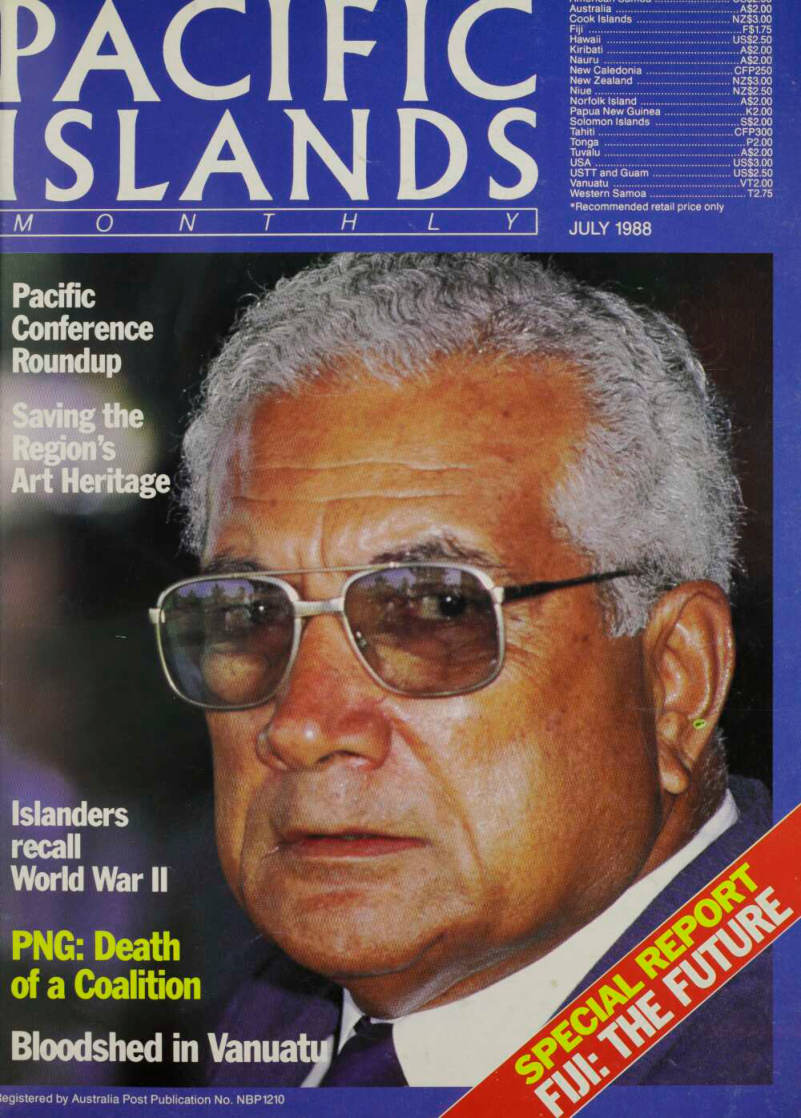

Islands
Monthly
Australia A 52.00 Cook Islands NZ$3.OO Fiji F 51.75 Hawaii US$2.5O Kiribati A 52.00 Nauru A 52.00 New Caledonia CFP2SO New Zealand NZ$3.OO Niue NZ$2.5O Norfolk Island A 52.00 Papua New Guinea K 2.00 Solomon Islands 552.00 Tahiti CFP3OO Tonga P 2.00 Tuvalu A 52.00
Usa Us$3.Oo
USTT and Guam US$2.5O Vanuatu VT2.00 Western Samoa T 2.75 ♦Recommended retail price only
July 1988
Pacific Conference Roundup Art Heritage
Islanders recall World War II PNG: Death of a Coalition Bloodshed in Vanuatu
legistered by Australia Post Publication No. NBPI2IO
Cover Photograph: Matthew Mckee
Advertisements & other items, pp. 2-4 (1 item)
A symphony on wheels
Our search for the
ultimate in rear wheel
control technology
makes every Mazda
driver a maestro.
Truly great music gives you a feeling of freedom and of joy. At Mazda, we believe this is also the feeling you should get from driving a truly great car; a car like the new Mazda 626.
Its unique suspension geometry is tuned with the precision of a Stradivarius. And the results are sensational. High speed lane changes become smooth legato passages.
Cornering loses its histrionic swerving. All that remains is extraordinary control.
What’s behind it all.
The reason is that Mazda has been concentrating on developing rear wheel suspension systems that actually help steer the car. It started! with the award winning TTL suspension found on the 323 and the original 626.
The search for the ultimate continued with the development of a 4-Wheel Steering system. What we learned in that search was applied to the development of our award winning DTS System for the RX-7 and the E-Link suspension for the 329. This continuous process of refinement has come full circle again to the new 626, and applied to its TTL suspension. We’ve completely recalculated its suspension geometry to deliver a feeling of control that’s clearly superior and absolutely exhilarating.
Keeping on our toes.
It’s Mazda’s unique dedication to engineering the ultimate in rear wheel toe control and suspension technology that has resulted in such enjoyable driving in the Mazda 626.
And in fact, in all Mazda vehicles.
But don’t take our word for it.
Take one out for a drive, and become a maestro of the road.
New Mazda 626 Models and features shown may not be available in your area. Please consult your local Mazda dealer. This warranty is valid only in Australia.
Your kind of car.
mazoa
© Mazda Motor Corporation
YEAR/
60.000 KM
WARRANTY
Sound that's absolutely enchanting, even in the somewhat less than enchanting environment of a moving automobile. This is Clarion's uncompromising standard, realized by the sophisticated use of electronic features that are easy to use. And there’s a wide selection of models to meet your individual taste.
Clarion reliability? It's no pipe dream. Clarion Car Stereo. Listen and drive happily ever after. Vslcjl 10l I •Dolby and the double-D symbol are trademarks of Dolby Laboratories Licensing Corporation.
FOLLOW THE MUSIC
6M STEREO MAGI-TUNE/ DIVERSITY
Q 9900 X
W I I gis
SCN RPT
BLS LD 180
TUNE
For further information Australia: Amalgamated Wireless (Australasia) Ltd., 554 Parramatta Road, Ashfield, N S W., 2131 / New Zealand: AWA New Zealand Limited, P.O. Box 50-248, Ponrua / Fiji Islands: Bnjla &Co L d GTO. Box 362. Suva Tahiti; HI FI., VAIRAATOA. Avenue Chef Vairaatoa B.P. 1128, Papeete / New Caledonia: Caldis, 8.P.M1, Noumea Cedex I Guam: Micropac Audio Inc., P.O. Box 3478, Agana, Guam 96910, US A Tel: 472 8091 Cable Lode.
HIFI AUDIO AGANA / Vanuatu: The Sound Centre, PO. Box 434, Vila I Cook Islands: South Seas International Ltd., P.O. Box 49, Rarotonga / Papua New Guinea: Hagemeyer (PN G.) Pty Ltd., P.O Box 1428, Boroko, Port Moresby
Pacific
Islands
Monthly
Vol 59, No. 7
Voice Of The Pacific
July, ’BB
Cover Story 37
SPECIAL REPORT: The new Fiji is a fact of life: more than a year after its first military coup, the Republic has learned that governing a country is a complex and subtle affair. Under Ratu Sir Kamisese Mara’s experienced leadership and despite recent security problems, Fiji is beginning to recover from social and economic upheavals and to progress haltingly, but confidently.
POLITICAL RIVALRY SPAWNS RIOTS IN VILA 10 Is this the end for Barak Sope? Or for Walter Lini?
Png’S Coalition Fails Again 13
The search for stability ends in near-farce
Pacific Researchers Gather 16
Regional security, development and technology on the agenda in Tasmania
Nz’S Governor General Tours The
Islands 18
Sir Paul Reeves mixes friendship with diplomacy
New Caledonia: Future Imperfect 19
A radical plan for partition could be a recipe for disaster
Page 10
Arms Shipments, Caches And
Rumours 19
After the shock, a spiral of wild stories ON THE TRAIL OF WORLD WAR II
History 23,25
Searching for war relics and counting the cost to the region
Page 46
Who Owns Island
Culture? 46, 48
I wo reports on thefight to keep Pacific art in the Pacific
Acting Editor Carson Creagh Art Director Warren Scott Editorial Adviser John Carter Contributors Vivian Carroll lan Connellan David J Haden Peter Huck Jack Kelleher Jai Kumar David S North Ed Rampell Stan Ritova David Robie Nicolas Rothwell Frank Senge Gabriel Singh Larry Writer
Publisher Geraldine Raton Managing Editor Arnold Earnshaw
Advertising Sales Sydney & Melbourne — Warren Grey (02) 288 3521 Fergus Maclagan (02) 412 3918; Brisbane — Robert Walker (07) 371 0533 Adelaide — Hastwell Williamson Representations (08) 79 9522
Australian cover price is recommended retail only. Registered by Australia Post, publication No. NBPI2IO, Copyright Pacific Publications (Aust) Pty Ltd.
Advertisements & other items, pp. 5-6 (3 items)
Departments
OPINION 7
PACIFIC REPORT 30
TROPICALITIES 44
TRADE WINDS 34
STAMPS 51
ISLAND PRESS 52
TRANSITION 45
SHIPPING 53
OUT OF THE PAST 58
5
PACIFIC ISLANDS MONTHLY JULY 1988
A Pacific Publications Production.
Founded 1930 (USPS 952480) 64-76 Kippax St, Surry Hills, NSW 2010; Telex: AA20124; Fax: (02) 288 3322; Cables: PACPUB Sydney; Telephone: (02) 288 3000.
Pacific Islands Monthly (APPS No.
NBP 1210) is published monthly by Pa cific Publications Pty Ltd, a division of Nationwide News, 2 Holt St, Surry Hills, NSW 2010. Second class postage paid at Honolulu, Hawaii, POSTMASTER.
Send address changes to PACIFIC IS
LANDS MONTHLY, PO Box 22250,
Honolulu, Hawaii 96822. Typeset by David Graphics, Sydney, and printed by Progress Press, 2 Keys Rd, Moorabbin, Victoria.
corrugated-iron tanks.
Arnall water tanks. The longer-
life tanks with up to
3 times the lifespan of ordinary
corrugated-iron tanks.
-A.
I -
Ideal for:
• Domestic use
• Village water supply
• Mining & Rural
areas
• General industry
• Public utility buildings,
schools etc.
CHECK THE
ADVANTAGES
Wide range of capacities A size to suit every need, with a choice of 2,3, 5 or 10,000
gallon capacities.
Water stays cleaner, longer Steel roof, walls and floor, with 3 times the normal galvanising thickness. Arnall’s
unique design keeps water free
from dust, insects and leaves.
Minimum site preparation Can be placed on the ground, on concrete-slab or timber
platform, and are flat-packed
for easy transportation to remote sites.
Easy to assemble yourself
Fully-prefabricated, with stepby-step instructions for preparing foundations, and
assembling. Precision-made
components are easy to handle and fast to fix.
ADMSfON OF THE
AN! CORPORATION
imiw 25 Pacific Hwy, Bennetts Green, N.S.W. Australia. Phone; (049) 489099 FAX; (049) 484087
FORMORE INFORMATION, CONTACT YOUR NEAREST DISTRIBUTOR:
NOUMEA &
TAHITI
Sun Pacific Company Ph: Noumea 27 8026
PAPUA NEW
GUINEA
John Lysaght Lae Ph: 42 1866 Port Moresby Ph: 26 4688
RABAUL
Rabaul Metal Industries Ph: 92 1044 92 1875
VANUATU
Vate Industries Ph: 2273
WESTERN SAMOA
Natural Foods Ph: 22800 23380
NORFOLK
ISLAND
Irvines Limited Ph:(6723) 2065
LORD HOWE
ISLAND
Lagoon Stores P.O. Box 1
PEM85134
Of The Year
Opinion
Leader Of The Year
Nominations for Pacific is lands Monthly's Leader Of The Year began arriving within days of the publication of our June issue. Readers’ choices contain quite a few surprises, but an interest ing overall pattern has already started to emerge.
As well as the men and women who have contributed so much to the development of the Pacific over past years, and whose legacy will con tinue to guide policy decisions and national identites for generations to come, there have been many nomi nations for younger leaders; not yet in positions of power, perhaps, but faces that will appear with growing fre quency in the future.
Nevertheless, the “establishment” is well represented, with names that are familiar to observers of the region.
Mr Brian Doyle of Helensvale, Queensland and a former resident of Tonga, contributed a nomination of King Taufa’ahau Tupou, cleverly written to contain a word for each year of His Majesty’s life: “While the rest of the Pacific re gion erupts around him and media prominent leaders in the region vac illate, the quiet achiever His Majesty King Taufa’ahau Tupou IV stands head and shoulders above them all.
“Over the past years he has led his people quietly forward in an atmos phere of stable government, at a pace they can accept and understand.
“Beyond doubt, the Leader Of The Year and a role model.”
Although we do not ask that read ers’ nominations contain the same number of words as their subjects’ lives, we are looking forward to hear ing who you think has made the great est contribution to the stability, change in world attention, develop ment or evolution of this, our Pacific.
Perhaps the Leader Of The \fear may turn out to be the elusive Mo hammed Rafiq Kahan, apparent mastermind of the Fiji arms-smug
gling affair. His actions have certainly galvanised international public inter est in the Republic at a time when badly needed calm was beginning to return to its affairs.
Not only has Mr Kahan embar rassed Australian Customs and Fed eral Police through his ability to escape detection and arrest, he has spot lighted the world media’s inability to resist “beating up” a story in the ab sence of hard information.
As Jai Kumar reports on Page 20, newspaper, radio and television cov erage of the arms affair have spun a few facts into a complex web of spec ulation: with the ultimate effect that the interim government in Fiji has in troduced draconian security laws that give the military and police almost unlimited powers to detain without charge, to search property and to in vestigate matters no government has the “right” to see.
Despite the paranoiac reactions of politicians both in Fiji and other parts of the region, investment and confi dence in Fiji is returning: and it may well be that Mr Bungo Ishizaki, prin cipal investment advisor for the Jap anese development firm Electrical Industrial Enterprises (which is in vesting a significant amount in tour ism development in Fiji) is chosen as the most influential person in the re gion for 1988.
Perhaps you would prefer to name a scientist, activist, artist or re searcher rather than a politician: the United Nations Environment Pro gram, for example, has recently hon oured two Pacific islanders Sione Latuila Tongilava of Tonga and Sheila Davis of New Zealand for their contributions to environmental conservation.
Nominations should be addressed to Pacific Islands Monthly , GPO Box 4245, Sydney Australia 2001, and should be mailed before November 1.
Advertisements & other items, pp. 7-8 (1 item)
Pacific
SLANDS
I month l y~] FIJI; Distribution and subscriptions: Desai Bookshops, PO Box 160, Suva, Fiji. Phone Suva 23036.
Advertising: Fiji Times & Herald Ltd, 20 Gordon St., Suva Phone 31-4111, telex FJ2124.
FRENCH POLYNESIA: Distribution: Hachette Pacifique 10 Ave., Bruat, Papeete. Phone 25-610.
HAWAII: UNITED STATES: Distribution: PIM, Hawaii, PO Box 22250, Honolulu, Hawaii, 96822. Advertising; Brian C Asqill, Apt. 1308,1676 Ala Moana Blvd., Honolulu, Hawaii, 96815. Phone (808) 955-9718.
JAPAN: Advertising and subscriptions: Universal Media Corporation, GPO Box 46, Tokyo. Phone 666-3036, cable UNIMEDIA Tokyo, telex 2524665.
MALAYSIA: Advertising and subscriptions: Worldwide Media Services, 57-B Komplex Damai, Jin Dato Haji Eusoff, Kuala Lumpur. Phone 63-9340, cables WORLDMEDIA Kuala Lumpur, telex 31533.
VANUATU: Distribution: The Vanuatu Stationery and Book Centre, PO Box 557 Port Vila, Advertising: Norman Bros. Bookshop. Port Vila Phone 2232.
NEW CALEDONIA: Distribution: Depot Centre de Presse Michel Pentecost. CBP2, Noumea. Phone 27- 2434, 27-4729.
NEW ZEALAND: Distribution: Gordon & Gotch, PO Box 584, 2 Carr Road, Mt Roskill, Auckland 4.
Advertising: McKay International Media Reps Ltd, C/- Albany PO, Auckland 10, New Zealand. Phone 413-9119.
Telex NZ22701, FAX 413-9110.
WELLINGTON: Ross Quaid Media, 1 Scholes Ln., Petone. (04) 68-7593, PO Box 38699, Petone.
PAPUA NEW GUINEA: Distribution: Gordon & Gotch, PO Box 3395, Port Moresby. Phone 25-4551. 25-4855.
Advertising: Ken Head, PNG Post-Courier, PO Box 85, Port Moresby. Phone 21-2577, telex 22120.
SOLOMON ISLANDS: Distribution and Advertising: The Bookshop, (Norman Bros.) PO Box 503, Honiara.
PHILIPPINES: Advertising: The GF Group, 12 San Ignacio St., Uroaneta Village, Makati, Metro Manila. Phone 817-7299, telex 45950 and 4233.
UNITED KINGDOM F A Smyth and Associates, 23A Aylmer Parade, London NZOPO, England. Phone (01) 340 5088, fax (01)341 9602.
UNITED STATES MAINLAND: Advertising: Joshua B. Powers Jr, Powers International Inc., Suite 708, 271 Madison Ave., New York, NY 10016. Phone 867-9580, Subscriptions: PIM, Hawaii, PO Box 22250, Honolulu.
Hawaii, 96822.
SUBSCRIPTIONS
American Samoa...
Australia Canada Cook Islands Fiji French Polynesia ..
Guam Hawaii Japan Kiribati Micronesia Nauru New Caledonia New Zealand Niue Norfolk Island Northern Marianas Papua New Guinea Solomon Islands ...
Tonga Tuvalu United Kingdom ...
US (Mainland) Vanuatu Western Samoa Elsewhere ...US$45
..AUSS24
...US$45
AUS$46
,.AUS$46
...US$45 ...US$45 ...US$45 ...US$38
,AUS$46
...US$35
AUS$42
...US$32
AUS$42
AUS$46
AUS$42
..US$36
AUS$42
AUS$46
AUS$46
.. AUS$46
,.Stg£28 ...US$45
AUS$42
AUS$60
AUS$63
Payments to Pacific Islands Monthly. Subscriptions Dept, GPO Box 5223BB, Melbourne 3001, Australia.
Subscriptions rates includes the cost of airspeeding to all destinations set out above. Direct airmail rates on application.
I I I I 9 I « / * V $ R /.
SSsS
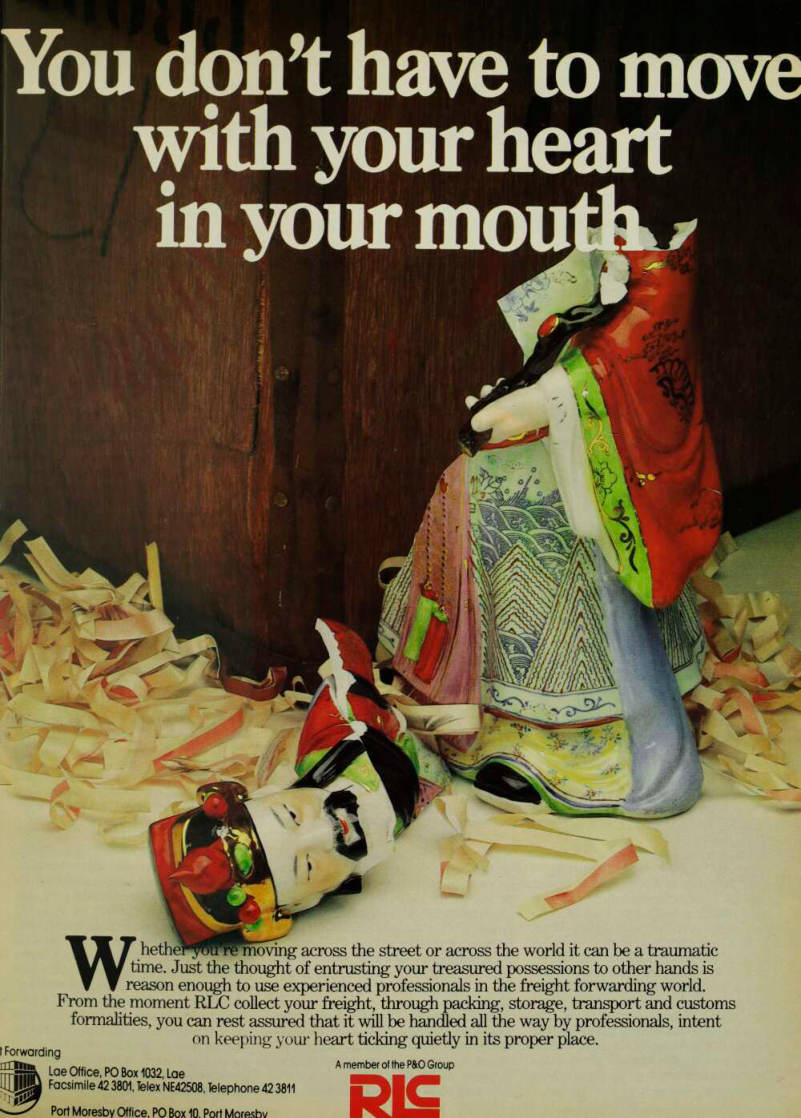
a r: 4 S rs I fIP - *s*l r v \\ i I Forwarding JL ThetheFfWU re moving across the street or across the world it can be a traumatic VV time. Just the thought of entrusting your treasured possessions to other hands is ▼ T reason enough to use experienced professionals in the freight forwarding world.
From the moment RLC collect your freight, through packing, storage, transport and customs formalities, you can rest assured that it will be handled all the way by professionals, intent on keeping your heart ticking quietly in its proper place. riini\ Lae office - P0 Box 1032 > Lae lim Facsimile 42 3801, Telex NE42508, Telephone 42 3811 rjgSy Port Moresby Office. PO Box 10. Port Moresbv A member of the P&O Group
Why Unity Is Essential
Now more than ever there is a need for the region to speak with one voice.
SIR SRIDATH Ramphal, Secretary General of the Commonwealth, chose as the theme for his ad dress to May’s Islands 88 conference in Hobart, John Donne’s words “No man is an island”.
What was not made clear was the second part of that often-quoted line: “... entire of itself’. Sir Sridath’s con cern was with the need for Oceania to develop a regional consciousness for security purposes but his concept can be extended to apply to regional consciousness on a politi cal and social level without torturing the metaphor. No where is this more clear than in two recent developments that point up the overdue need for island nations to com bine in the interests of regional sovereignty: the Kingdom of Tonga’s qualified support for an international waste disposal facility, and Fiji’s introduction of security laws more akin to South Africa than the Pacific.
Tonga’s decision has given shape to the threat of the Pacific a region apparently composed of small islands set in an almost limitless sea being an ideal dumping ground not only for the superpowers’ aid largesse, but also for the effluent of more wasteful societies.
While they mouthe pieties about self-determination, strategic importance and human rights, nations of the First World are anxious that somebody else should take care of the hazardous wastes they produce. It seems they have fixed on this vast ocean, as conveniently far from their population centres as Mururoa Atoll is from Paris, be cause its inhabitants are few in number and without the power to deny them.
For that reason alone, a unified voice (perhaps an ex panded version of the Federated States of Micronesia) is essential if genuine autonomy and control are to be ex erted over the Pacific’s future. Far more than security against military or commercial threats, the region’s island states must forgo their sentimental division into Micro nesia, Polynesia and Melanesia and present their more powerful neighbours with a single negotiating partner.
A corollary to Tonga’s potential exploitation as a palm fringed garbage dump emerged as Pacific Islands Monthly was going to press: the announcement by Ratu Sir Kam isese Mara as spokesman for Fiji’s still military-domi nated government that new security laws were to be put into effect to guard against “subversion” and “threats to internal security”. The laws have shocked other govern ments as well as human-rights activists throughout the re gion, as they threaten basic provisions of privacy, habeas corpus and freedom from harrassment.
The announcement also threatens Fiji’s faltering steps toward stability and respectability, for political allies and investors alike. The temptation to compare Fiji with re pressive regimes such as South Africa must be avoided, if only because the latter has resource wealth that makes it an essential, trading partner for many nations.
Brigadier Rabuka’s assertions that he is but a simple soldier, guided by prayer and patriotism, have the same unsettling tone as the reasons advanced by military lead ers in Panama, Chile and a host of nations whose desti nies have been shaped by the philosophies of the officers’
training school. Government is not that simple, and nei ther are the solutions to perceived threats: other nations have learned that it is uneconomical to use sledgeham mers to crack walnuts.
If Fiji is to grow and to regain its income from tourism and agriculture, it must learn again to nurture its people.
They cannot be forced to obey the dictates of men who see a threat around every corner. What is needed is a gen uine investigation of the origin and destination of the arms caches and shipments discovered in recent weeks. The in vestigation must be conducted in the open, no matter how embarrassing its results, because the region is watching Fiji very closely.
In the same way the Republic must prepare to take its place among Pacific nations on regional terms. Dreams of a return to the bosom of the Commonwealth are just that; no monarch would risk public censure by a recon ciliation with one government that has disenfranchised an entire ethnic group while continuing an association with the country that group regards as its homeland.
Rather, Brigadier Rabuka must take Fiji’s stengths its industrial experience, agricultural wealth and the pool of talent it has produced and offer them to Oceania.
They are powerful bargaining tools, and can be employed to the advantage of the Republic and its people as well as to the overall benefit of the region.
PNG: The Honeymoon’s Over
THE almost Ruritanian flavour of politics in Papua New Guinea has inspired much comment in the past month; a good deal of it, both within PNG and in international reports, bordering on the supercilious.
But humour and the inevitable comparison of the on-again, off-again search for a Coalition Government that will bring some degree of stability to the country to a failed betrothal is inappropriate, for it masks the desperation many Papua New Guineans feel about their homeland’s immediate future. Too many politicians feel PNG’s rich resources, and the wealth they promise, are panaceas to a shocking lack of development in many vital areas (health and education, transport and social legislation among them) and to a growing reliance on vigilante groups to combat random violence, rape and robbery.
There are persistent rumours to the effect that Paias Wingti’s days as Prime Minister are numbered, primarily inspired by his attempt to placate electorate and provin cial supporters through the appointment of National Party leader Michael Mel as his Deputy. The more has aroused long-simmering anger and fear among Papuans and New Guinea Islanders, who have developed power blocs that are essential to the parliamentary process, much less sta ble and efficient government.
Whether a battered Pangu Pati can regroup and attract new allies, in the absence of Michael Somare and under the apparently unwilling leadership of Rabbie Namaliu, is a matter of real concern not only in Papua New Guinea but in the region as a whole. What price a Melanesian Spearhead when the point of the spear is fractured? □
Advertisements & other items, p. 9 (1 item)
Opinion
Port Vila Erupts
Vanuatu
Barak Sope’s ill-fated bid to oust PM Walter Lini brought unprecedented riots and police violence to normally peaceful Vanuatu. David Robie reports.
MANY OF the ni-Vanuatu land rights protesters wore garlands of namele leaves a sacred sym bol of peace when they marched into the heart of Port Vila on the morning of May 16. Three hours later the normally placid town was at war.
By then the protesters had shrunk from a crowd of 3000 to 150, but these were hardcore anti-govemment militants in an ugly mood fuelled by alcohol. They bat tled the small and inexperienced Vanuatu Mobile Force, a paramilitary police unit, stormed government buildings and went on a rampage of destruction through the capital’s Rue Higginson.
One man was conspicuous on the si delines at the height of the uprising Barak Sope, the renegade Minister of Tourism, Immigration and Transport and secretary-general of the ruling Vanuaaku Pati. His presence during the rioting led to his sacking from the cabinet and cost him any hope of be coming Prime Minister with Vanuaaku support.
Despite his insistence that he was ac tually trying to calm the rioters with a loudhailer he was later taken to hospi tal suffering from a whiff of teargas Sope’s credibility has evaporated. But not his power.
In the wake of the May riots, Sope’s support in the cabinet and party has eroded. His backing appears to have shrunk mainly to militants from his stronghold island of Ifira, though last month he was trying to forge a coalition with the opposition Union of Moderate Parties (UMP) to bring down the Lini Government.
The mainly Francophone UMP was embroiled in a leadership struggle of its own: accusing new Opposition Leader Maxime Carlot of “betraying our policy on land tenure” by taking part in the dem onstration, party president Serge Vohor sacked him. However, Carlot, while ad mitting Vohor had the power to dismiss him as party secretary-general, insisted he was still Opposition leader and was pre paring to join forces with Sope.
Vanuaaku has a slender majority of six in the 46-seat Parliament. Four of the rul ing party’s MPs (including Sope) are be lieved to be rebels and if all 20 Opposition MPs combine with them they could bring down the government.
Most ni-Vanuatu perceive Sope as hav ing orchestrated the anti-government challenge and its tragic results (one death and damaged estimated at almost SA2 million) to further his political ambitions.
Yet many expatriate businesspeople re gard him as the most powerful man in Vanuatu and believe he could yet come out on top. This month’s party congress is ex pected to resolve the crisis ... or split the
tourism and stevedoring) and nurtured a controversial link with Libya.
Although several militants from Ifira who were sent to Libya for training in “journalism” now act as his bodyguards, the Libyan connection has been grossly exagerrated by the news media: Aus tralian PM Bob Hawke alienated many ni- Vanuatu for his allegations of Libyan in volvement in the country’s crisis, and
party, with severe consequences for Van uatu’s political stability.
The rivalry between Prime Minister Father Walter Lini and Sope is ironical after their long struggle together and con radeship in the Vanuaaku Pati while fight ing for independence. Lini, 45, educated as an Anglican priest at St John’s Theo logical College in Auckland, has always opted for conciliation rather than divisiveness.
In the early post-independence years, Sope was best known as Vanuatu’s outspo ken roving ambassador, the scourge of French colonial policies in the region. Later he became something of an enigma as he expanded his business interests (mainly in
Grace Molisa, a senior official in the Prime Minister’s Office, responded to the claim with a sweep of her arm toward the har bour of Port Vila: “Where are the Libyans?”
Nevertheless, according to one com mentator, Sope “is a man who after 17 years in politics, remains even to his own people a shadowy figure who has ap peared to the world outside Vanuatu as al most menacing in his elusiveness.”
After the general election last Novem ber, when the Vanuaaku Pati suffered its greatest reverse, Sope again came under the spotlight when he announced he in tended to become Prime Minister. At 36, the Melbourne and University of the South
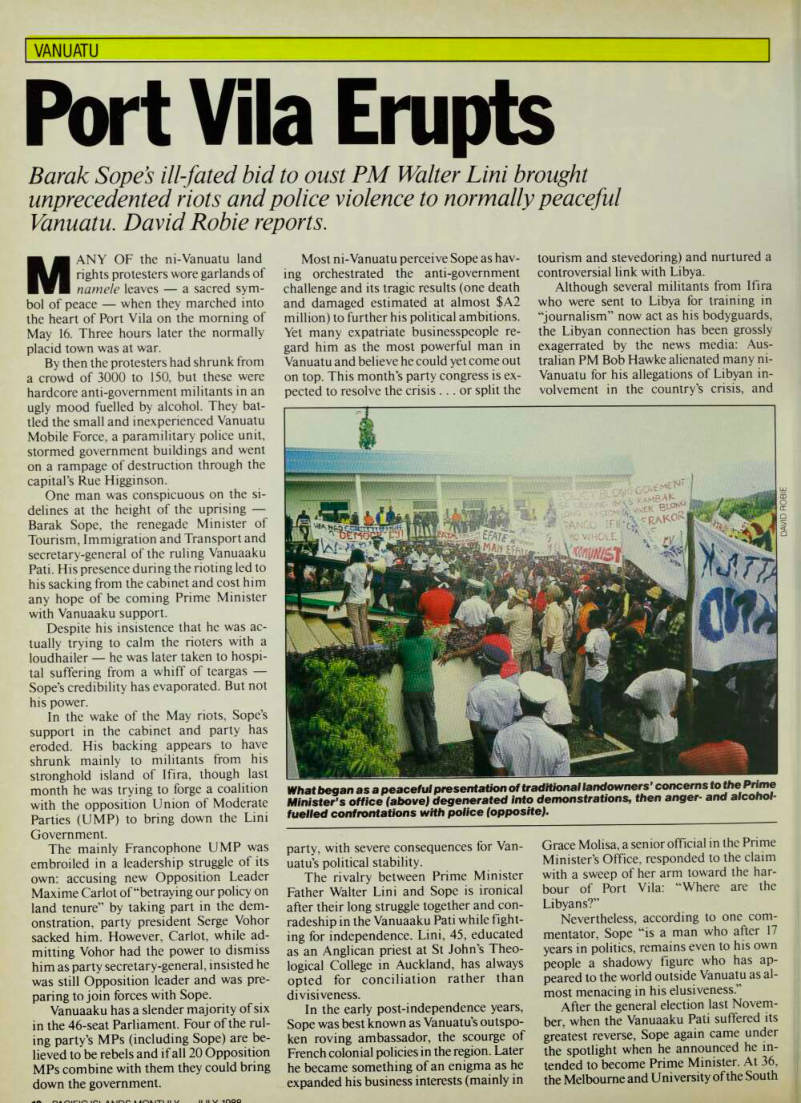
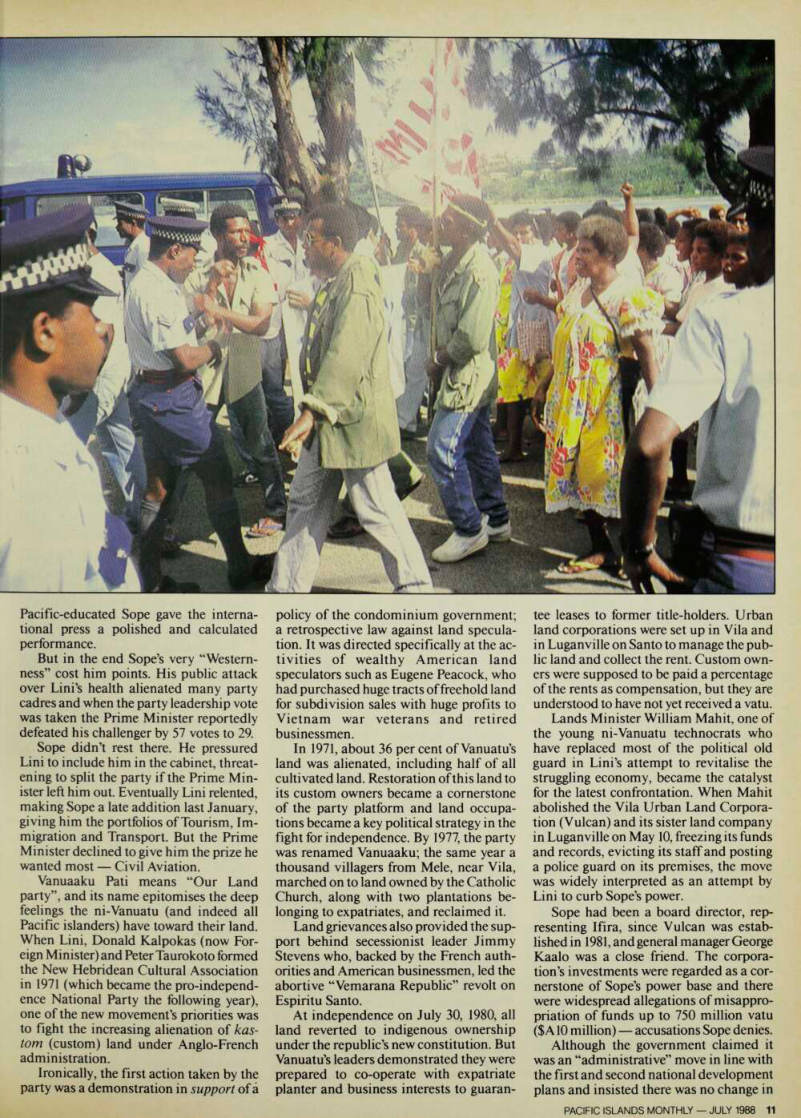
What began as a peaceful presentation of traditional landowners’ concerns to the Prime Minister’s office (above) degenerated into demonstrations, then anger- and alcohol fuelled confrontations with police (opposite).
Pacific-educated Sope gave the international press a polished and calculated performance.
But in the end Sope’s very “Westernness” cost him points. His public attack over Lini’s health alienated many party cadres and when the party leadership vote was taken the Prime Minister reportedly defeated his challenger by 57 votes to 29.
Sope didn’t rest there. He pressured Lini to include him in the cabinet, threatening to split the party if the Prime Minister left him out. Eventually Lini relented, making Sope a late addition last January, giving him the portfolios of Tourism, Immigration and Transport. But the Prime Minister declined to give him the prize he wanted most Civil Aviation.
Vanuaaku Pati means “Our Land party”, and its name epitomises the deep feelings the ni-Vanuatu (and indeed all Pacific islanders) have toward their land.
When Lini, Donald Kalpokas (now Foreign Minister) and Peter Taurokoto formed the New Hebridean Cultural Association in 1971 (which became the pro-independence National Party the following year), one of the new movement’s priorities was to fight the increasing alienation of kastom (custom) land under Anglo-French administration.
Ironically, the first action taken by the party was a demonstration in support of a
policy of the condominium government; a retrospective law against land specula tion. It was directed specifically at the ac tivities of wealthy American land speculators such as Eugene Peacock, who had purchased huge tracts of freehold land for subdivision sales with huge profits to Vietnam war veterans and retired businessmen.
In 1971, about 36 per cent of Vanuatu’s land was alienated, including half of all cultivated land. Restoration of this land to its custom owners became a cornerstone of the party platform and land occupa tions became a key political strategy in the fight for independence. By 1977, the party was renamed Vanuaaku; the same year a thousand villagers from Mele, near Vila, marched on to land owned by the Catholic Church, along with two plantations be longing to expatriates, and reclaimed it.
Land grievances also provided the sup port behind secessionist leader Jimmy Stevens who, backed by the French auth orities and American businessmen, led the abortive “Vemarana Republic” revolt on Espiritu Santo.
At independence on July 30, 1980, all land reverted to indigenous ownership under the republic’s new constitution. But Vanuatu’s leaders demonstrated they were prepared to co-operate with expatriate planter and business interests to guaran
tee leases to former title-holders. Urban land corporations were set up in Vila and in Luganville on Santo to manage the pub lie land and collect the rent. Custom own ers were supposed to be paid a percentage of the rents as compensation, but they are understood to have not yet received a vatu, Lands Minister William Mahit, one of the young ni-Vanuatu technocrats who have replaced most of the political old guard in Lini’s attempt to revitalise the struggling economy, became the catalyst for the latest confrontation. When Mahit abolished the Vila Urban Land Corpora tion (Vulcan) and its sister land company in Luganville on May 10, freezing its funds and records, evicting its staff and posting a police guard on its premises, the move was widely interpreted as an attempt by Lini to curb Sope’s power, Sope had been a board director, rep resenting Ifira, since Vulcan was estab lished in 1981, and general manager George Kaalo was a close friend. The corpora tion’s investments were regarded as a cor nerstone of Sope’s power base and there were widespread allegations of misappro priation of funds up to 750 million vatu ($A 10 million) accusations Sope denies.
Although the government claimed it was an “administrative” move in line with the first and second national development plans and insisted there was no change in
◄ land policy, Sope branded the sudden sei zure of the corporation a “surprise com mando attack”. He claimed the shutdown was an assault on party policy and the na tion’s constitution, which guarantees that all land belongs to customary owners.
“Vanuaaku means our land,” he said.
“Before independence the land issue was the foundation for the Vanuaaku Pati: take away that you’re destroying the party.”
Sope launched his counterattack by or ganising meetings of Ifira, Erakor and Pango, the three villages that hold cus tomary land in the capital, and his mili tants set up a protest march on the Prime Minister’s Office on Monday, May 16.
Supposed to be non-political and peace ful, the 3000 marchers soon unfurled ban ners claiming Lini Hemi Wan Komunist “Lini Wants Communism” de nouncing the Prime Minister one moment as a communist and the next as a fascist.
Ifira militants armed with iron bars and clubs attacked Vietnamese-owned busi nesses and wrecked a police truck. Many marchers chanted: “We want a revolution like in Fiji”. Outer islanders, who com prise most of the town’s 20,000 popula tion, felt threatened by the demonstration.
After a petition was presented to Lands Minister Mahit seeking the repeal of the closure of Vulcan, most of the demonstra tors disbanded peacefully. But about 150 militants, fuelled by a drunken barbecue on the port foreshore, stoned the Hotel de Poste. Telephone operators fled, cutting outward international phone links until the next day. Parliament and adjoining government offices were attacked; most of the shop and office windows in Rue Hig ginson were smashed and many of the shops looted.
Vanuatu Mobile Force soldiers were called in to quell the rioters with teargas.
They battled the militants in scenes of violence never seen before in Vanuatu, even during the struggle for independ ence. “The people who caused the dis turbance failed to respect their chiefs and custom,” Lini lamented. “The namele leaves were abused by the rioters.”
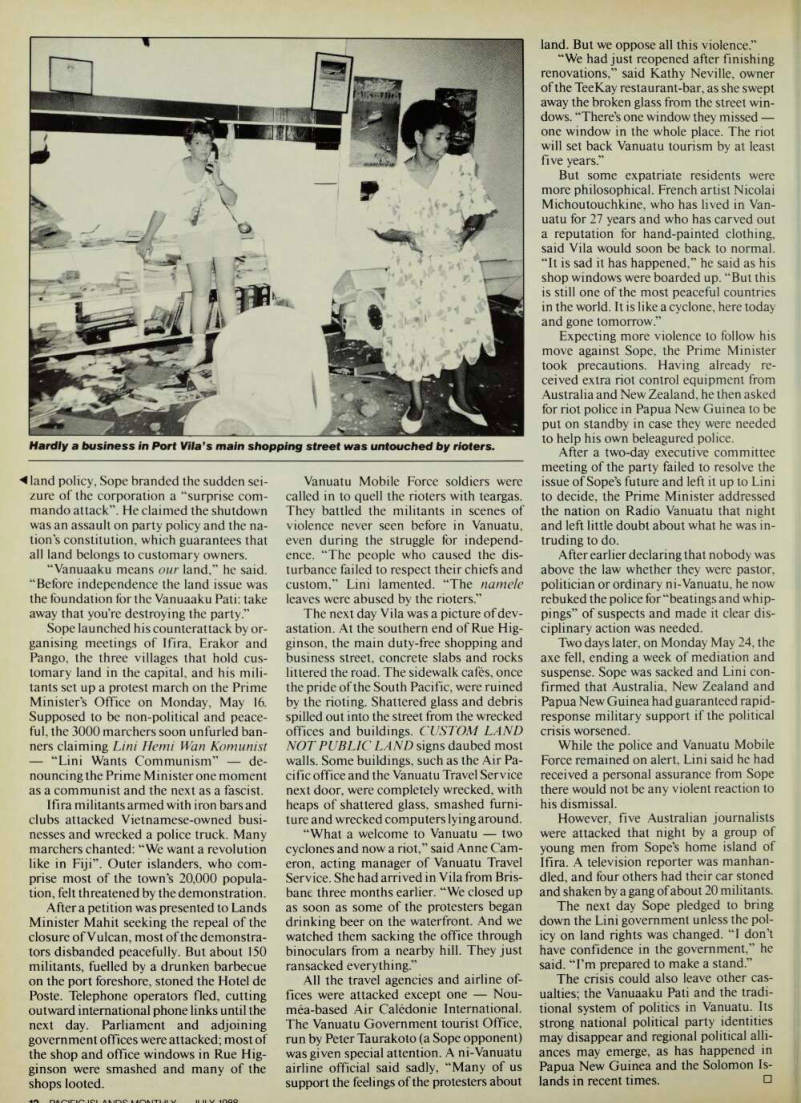
The next day Vila was a picture of dev astation. At the southern end of Rue Hig ginson, the main duty-free shopping and business street, concrete slabs and rocks littered the road. The sidewalk cafes, once the pride of the South Pacific, were ruined by the rioting. Shattered glass and debris spilled out into the street from the wrecked offices and buildings. CUSTOM LAND NOT PUBLIC LAND signs daubed most walls. Some buildings, such as the Air Pa cific office and the Vanuatu Travel Service next door, were completely wrecked, with heaps of shattered glass, smashed furni ture and wrecked computers lying around.
“What a welcome to Vanuatu two cyclones and now a riot,” said Anne Cam eron, acting manager of Vanuatu Travel Service. She had arrived in Vila from Bris bane three months earlier. “We closed up as soon as some of the protesters began drinking beer on the waterfront. And we watched them sacking the office through binoculars from a nearby hill. They just ransacked everything.”
All the travel agencies and airline of fices were attacked except one Nou mea-based Air Caledonie International.
The Vanuatu Government tourist Office, run by Peter Taurakoto (a Sope opponent) was given special attention. A ni-Vanuatu airline official said sadly, “Many of us support the feelings of the protesters about
land. But we oppose all this violence.”
“We had just reopened after finishing renovations,” said Kathy Neville, owner of the Tee Kay restaurant-bar, as she swept away the broken glass from the street win dows. “There’s one window they missed one window in the whole place. The riot will set back Vanuatu tourism by at least five years.”
But some expatriate residents were more philosophical. French artist Nicolai Michoutouchkine, who has lived in Van uatu for 27 years and who has carved out a reputation for hand-painted clothing, said Vila would soon be back to normal.
“It is sad it has happened,” he said as his shop windows were boarded up. “But this is still one of the most peaceful countries in the world. It is like a cyclone, here today and gone tomorrow.”
Expecting more violence to follow his move against Sope, the Prime Minister took precautions. Having already re ceived extra riot control equipment from Australia and New Zealand, he then asked for riot police in Papua New Guinea to be put on standby in case they were needed to help his own beleagured police.
After a two-day executive committee meeting of the party failed to resolve the issue of Sope’s future and left it up to Lini to decide, the Prime Minister addressed the nation on Radio Vanuatu that night and left little doubt about what he was in truding to do.
After earlier declaring that nobody was above the law whether they were pastor, politician or ordinary ni-Vanuatu, he now rebuked the police for “beatings and whip pings” of suspects and made it clear dis ciplinary action was needed.
Two days later, on Monday May 24, the axe fell, ending a week of mediation and suspense. Sope was sacked and Lini con firmed that Australia, New Zealand and Papua New Guinea had guaranteed rapid response military support if the political crisis worsened.
While the police and Vanuatu Mobile Force remained on alert, Lini said he had received a personal assurance from Sope there would not be any violent reaction to his dismissal.
However, five Australian journalists were attacked that night by a group of young men from Sope’s home island of Ifira. A television reporter was manhan dled, and four others had their car stoned and shaken by a gang of about 20 militants.
The next day Sope pledged to bring down the Lini government unless the pol icy on land rights was changed. “I don’t have confidence in the government,” he said. “I’m prepared to make a stand.”
The crisis could also leave other cas ualties; the Vanuaaku Pati and the tradi tional system of politics in Vanuatu. Its strong national political party identities may disappear and regional political alli ances may emerge, as has happened in Papua New Guinea and the Solomon Is lands in recent times. □
Hardly a business in Port Vila’s main shopping street was untouched by rioters.
Why The Coalition Failed
Papua New Guinea
Frank Senge examines the saga of attempts to bring political stability to PNG
IT WAS to be Papua New Guinea’s political marriage of the decade. But the Grand Coalition of the country’s two largest parties effectively the Government and the Opposition turned out to be a second-rate farce.
On Wednesday, May 25, Prime Min ister Paias Wingti and Opposition Pangu Pati leader Rabbie Namaliu signed into existence the merger of Mr Wingti’s People’s Democratic Movement (PDM) and former PM Michael Somare’s Pangu Pati, now led by Mr Namaliu. (See Pacific Islands Monthly , June).
Plagued by constant no confidence motions; a weak electoral system; a less than adequate provincial government sys tem; scores of senior government minis ters and members facing serious charges; and continous jockeying for power and material benefits by politicians, the two leaders decided to combine to weed out the bad and make the necessary constitu tional amendments.
Their combined numbers gave them 60 members, five more than the number needed to gain government. To make con stitutional amendments they needed only 12 more votes: these could be supplied by the five existing government coalition partners, who could muster 34 votes.
It looked as if for the first time in 12 years of independence, PNG would get a stable government.
But the two leaders either overplayed their hand or underestimated the various regional factions in their camps. The Grand Coalition lasted exactly seven days.
The following Wednesday, June 1, Mr Wingti dumped Pangu for its smaller Op position partner, the National Party headed by Michael Mel.
Even for a country used to constant changes of governments and leadership, the collapse of the Coalition was a record, beaten only by the failure of the Grand Coalition formed by the same two parties in April.
In that earlier marriage, sealed with a handshake by Mr Wingti and Mr Somare, the two parties had split up in two and a half days.
The double divorce, effected within 39 days, has sent the two parties reeling, al most certainly not to come together in such a marriage bid again at least not in this term of Parliament. And the question re maining in most people’s minds is why such an ideal coalition aimed at bring ing stability to the nation’s political sys tem failed not once, but twice.
The parties concerned are not giving
any straight answers. Mr Wingti, with his normal reluctance to assign blame, said the talks are history now and that he still re spects the spirit of the negotiations.
On the day he dumped Pangu he claimed that the entire understanding had been that Michael Somare would partici pate in the new Government. Even before the new cabinet was formed,’ the Foreign Affairs portfolio was reserved for him; but in the final days of negotiations Mr So mare, who had earlier accepted the port folio, declined.
Pangu, as is its wont, has piled all the blame on Mr Wingti. It claims Mr Wingti never had any intention of forming a Government and instead wanted to de stroy Pangu, his only real threat. It claims Mr Somare’s participation was never cen tral to the discussions, and that Mr Wingti was aware Mr Somare wanted out days be fore his decision.
The Grand Coalition (at least in the minds of its authors) was aimed at bring ing political stability to the country. But in its drawn-out and secret negotiations
and its dual failure, it cre ated the exact opposite: widespread confusion and uncertainty.
Several factors were apparently at work, most of them centred around new Pangu Pati leader Rabbie Namaliu.
It seems Mr Namaliu’s heart was in the first mar riage, but not the second.
He withdrew as principal negotiator after the first coalition failed, and re fused to have any part in the talks toward the sec ond. At the last minute re sponsibility was thrust on him when Mr Somare stepped down as party leader; the party caucus unanimously voted Mr Namaliu leader at a time when negotiations had already matured.
He tried to back the party out of the deal. Too late. He resigned from the party twice, two days after he was voted leader, but the caucus would not accept his resignation.
Reluctantly, he signed the memoran dum of understanding committing Pangu to a marriage with Mr Wingti’s People’s Democratic Movement, a union he was certain would fail again.
At the same time, as negotiations were going on with the PDM, Mr Namaliu was also involved in separate talks to form a New Guinea Islands Leaders Forum com prising politicians from the region. The forum voted as its leader former Minerals and Energy Minister John Kaputin.
When, during the talks with PDM, Mr Namaliu realised Mr Kaputin was going to be dropped as a Minister, he pressed for him to be included. As well, he wanted to include in the Coalition the Melanesian Alliance party headed by Father John Momis another New Guinea Islands man. The Prime Minister turned down both requests. ►
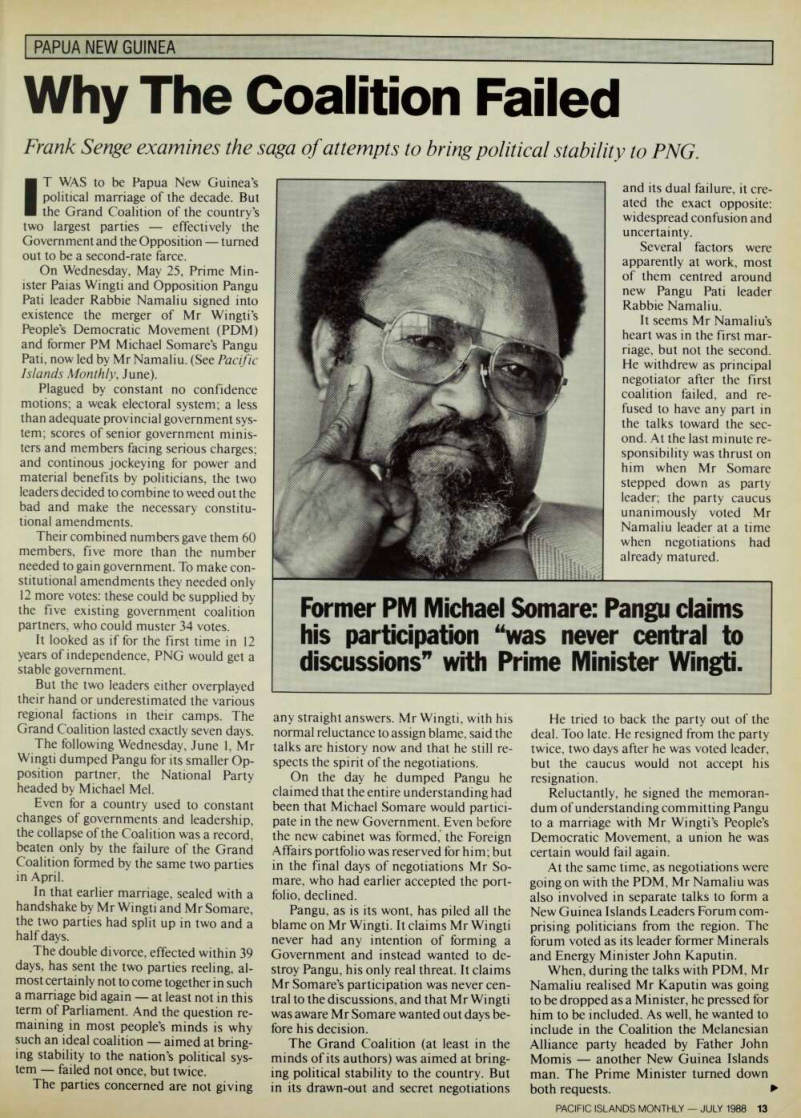
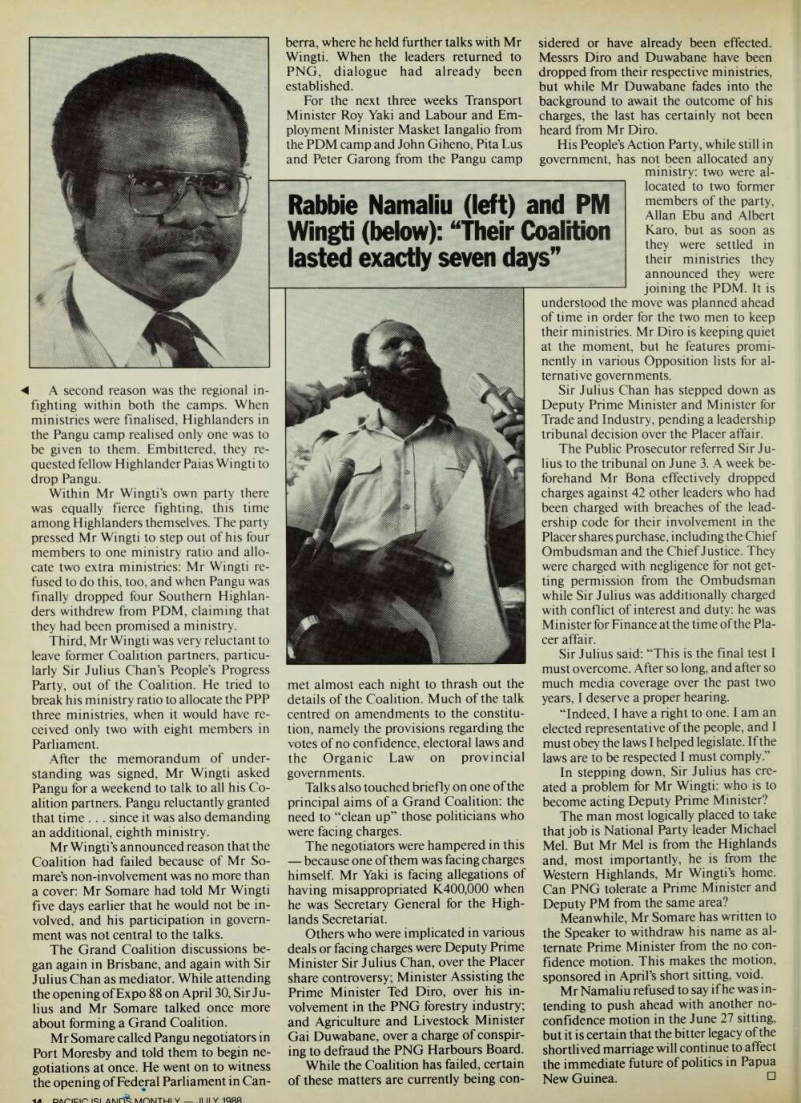
Former PM Michael Somare: Pangu claims his participation “was never central to discussions” with Prime Minister Wingti.
◄ A second reason was the regional in fighting within both the camps. When ministries were finalised, Highlanders in the Pangu camp realised only one was to be given to them. Embittered, they re quested fellow Highlander Paias Wingti to drop Pangu.
Within Mr Wingti’s own party there was equally fierce fighting, this time among Highlanders themselves. The party pressed Mr Wingti to step out of his four members to one ministry ratio and allo cate two extra ministries: Mr Wingti re fused to do this, too, and when Pangu was finally dropped four Southern Highlan ders withdrew from PDM, claiming that they had been promised a ministry.
Third, Mr Wingti was very reluctant to leave former Coalition partners, particu larly Sir Julius Chan’s People’s Progress Party, out of the Coalition. He tried to break his ministry ratio to allocate the PPP three ministries, when it would have re ceived only two with eight members in Parliament.
After the memorandum of under standing was signed, Mr Wingti asked Pangu for a weekend to talk to all his Co alition partners. Pangu reluctantly granted that time . .. since it was also demanding an additional, eighth ministry.
Mr Wingti’s announced reason that the Coalition had failed because of Mr So mare’s non-involvement was no more than a cover: Mr Somare had told Mr Wingti five days earlier that he would not be in volved, and his participation in govern ment was not central to the talks.
The Grand Coalition discussions be gan again in Brisbane, and again with Sir Julius Chan as mediator. While attending the opening of Expo 88 on April 30, Sir Ju lius and Mr Somare talked once more about forming a Grand Coalition.
Mr Somare called Pangu negotiators in Port Moresby and told them to begin ne gotiations at once. He went on to witness the opening of Federal Parliament in Can
berra, where he held further talks with Mr Wingti. When the leaders returned to PNG, dialogue had already been established.
For the next three weeks Transport Minister Roy Yaki and Labour and Em ployment Minister Masket langalio from the PDM camp and John Giheno, Pita Lus and Peter Garong from the Pangu camp
met almost each night to thrash out the details of the Coalition. Much of the talk centred on amendments to the constitu tion, namely the provisions regarding the votes of no confidence, electoral laws and the Organic Law on provincial governments.
Talks also touched briefly on one of the principal aims of a Grand Coalition: the need to “clean up” those politicians who were facing charges.
The negotiators were hampered in this —because one of them was facing charges himself. Mr Yaki is facing allegations of having misappropriated K 400,000 when he was Secretary General for the High lands Secretariat.
Others who were implicated in various deals or facing charges were Deputy Prime Minister Sir Julius Chan, over the Placer share controversy; Minister Assisting the Prime Minister Ted Diro, over his in volvement in the PNG forestry industry; and Agriculture and Livestock Minister Gai Duwabane, over a charge of conspir ing to defraud the PNG Harbours Board, While the Coalition has failed, certain of these matters are currently being con
sidered or have already been effected.
Messrs Diro and Duwabane have been dropped from their respective ministries, but while Mr Duwabane fades into the background to await the outcome of his charges, the last has certainly not been heard from Mr Diro.
His People’s Action Party, while still in government, has not been allocated any
ministry: two were al located to two former members of the party, Allan Ebu and Albert Karo, but as soon as they were settled in their ministries they announced they were joining the PDM. It is
understood the move was planned ahead of time in order for the two men to keep their ministries. Mr Diro is keeping quiet at the moment, but he features promi nently in various Opposition lists for al ternative governments.
Sir Julius Chan has stepped down as Deputy Prime Minister and Minister for Trade and Industry, pending a leadership tribunal decision over the Placer affair.
The Public Prosecutor referred Sir Ju lius to the tribunal on June 3. A week be forehand Mr Bona effectively dropped charges against 42 other leaders who had been charged with breaches of the lead ership code for their involvement in the Placer shares purchase, including the Chief Ombudsman and the Chief Justice. They were charged with negligence for not get ting permission from the Ombudsman while Sir Julius was additionally charged with conflict of interest and duty: he was Minister for Finance at the time of the Pla cer affair.
Sir Julius said: “This is the final test I must overcome. After so long, and after so much media coverage over the past two years, I deserve a proper hearing.
“Indeed, I have a right to one. I am an elected representative of the people, and I must obey the laws I helped legislate. If the laws are to be respected I must comply.”
In stepping down, Sir Julius has cre ated a problem for Mr Wingti: who is to become acting Deputy Prime Minister?
The man most logically placed to take that job is National Party leader Michael Mel. But Mr Mel is from the Highlands and, most importantly, he is from the Western Highlands, Mr Wingti’s home.
Can PNG tolerate a Prime Minister and Deputy PM from the same area?
Meanwhile, Mr Somare has written to the Speaker to withdraw his name as al ternate Prime Minister from the no con fidence motion. This makes the motion, sponsored in April’s short sitting, void.
Mr Namaliu refused to say if he was in tending to push ahead with another no confidence motion in the June 27 sitting, but it is certain that the bitter legacy of the shortlived marriage will continue to affect the immediate future of politics in Papua New Guinea. D
Rabble Namaliu (left) and PM Wingti (below): “Their Coalition lasted exactly seven days”
Beer, Tobacco and Buai Curbs
Frank Senge reports on efforts to control abuse of PNG’s most popular drugs.
WHEN Mr David Unagi, Liquor Licensing Commissioner for the National Capital District In terim Commission Port Moresby’s city council announced in May that all ma jor supermarkets would cease to operate their liquor outlets, it looked like just an other liquor ban, one of the many that have been tried and found wanting in PNG.
The main stores, Steamships and Bums Philp, refused to comment on the move, knowing that keeping silent in the past had helped. Such announcements are as reg ular as the changing of governments.
The real motive of the move became clear later. Curbing the drink problem was only a side issue: the authority was in real ity embarking on a course ultimately to transfer all the retail stores in the capital from foreign owners to nationals.
Mr Unagi said his decision was not anti investment, as his critics have claimed.
“Genuine investors will admire our new found common sense,” he said. “We look ridiculous at present allowing foreigners to retail our basic staples to us.”
The decision was gazetted and is now
in force. Supermarkets thus banned from selling liquor can let their office space to a national under the new law.
Mr Unagi has promised that if his plan were defeated in court (should one of the affected businesses take the matter for le gal interpretation) he would introduce a Private Member’s bill to Parliament to ban foreign companies from retailing beer and spirits throughout the nation.
At the same time the city councils of Port Moresby and Lao are making a major drive to curb buai (betel nut) chewing and smoking. In April, the Morobe provincial government cabinet approved an appli cation from the Lae City Interim Author ity to ban the chewing of betel nut and smoking in theatres and conference rooms and on public transport.
The authority spent much of the month of May conducting an awareness cam paign in the city. City general manager Richard Moaitz said the reaction had been “surprisingly good”. He had been “dread ing” public response when he announced the measure, but the reaction had been congratulatory calls and letters.
Mr Moaitz said he had been told he was a “black colonial”, referring to similar measures under the Australian adminis tration. “I wish to tell my critics that it is time standards were established for the good of the whole community,” he said.
Any person caught breaking the anti-buai and anti-smoke laws will be under new public nuisance rules.
In Port Moresby, the National Capital District Interim Commission is also cracking down on buai chewing and smoking on public transport, with similar penalties being imposed.
There have been previous attempts at banning smoking: an Act of Parliament outlaws smoking within government pre cincts, but nobody has taken note to date; and a Public Service circular of January 14, 1988, prohibits smoking in govern ment buildings on threat of dismissal. But even that has not worked.
Only one other town authority Go roka was crazy enough to impose a buai ban in 1985. It was a disaster: instead of officers chasing buai chewers, the chewers almost mugged the officers. □
Advertisements & other items, p. 15 (2 items)
Papua New Guinea
The Pacific Islands Rely
ON THE ENERGY OF BORAL
ill m * Norfolk Island Norfolk Island 2419 Papua New Guinea Port Moresby 214248 Lae 422574 Rabaul 921225 Wewak 862125 Tonga Nukualofa 21388 Cook Islands Rarotonga 24460 American Samoa Pago Pago 6332170 Fiji Suva 24035 Lautoka 60088 Sigatoka 50578 Labasa 82973 All through the Pacific Islands, people rely on Boral Speed-E-Gas LP Gas for their energy needs.
Boral has terminals throughout the area, and is proud to be a leading supplier.
Speed-E-Gas is clean, efficient and low in cost.
It's the ideal energy source for cooking and water heating in homes, motels and hotels, and for a wide range of industrial uses.
So call Boral. We have the energy you’re looking for.
BORAL GAS
Vanuatu Santo 455 Port Vila 2046 Solomon Islands Honiara 21833 Boral Gas Limited, Bth Floor, IBM House, 168 Kent St., Sydney, NSW 2000. Tel: (02) 278512.
Islands 88: A Meeting Of
Australia
Islands 88: A Meeting Of Pacific Minds By Vivian Carroll
By Vivian Carroll
POLITICAL and economic prob lems stemming from geographical isolation, cultural insularity and resource dependence are common to is lands and rural communities throughout the world.
This May, two international meetings addressed the large-scale political, eco nomic, cultural and energy resource issues facing small island states and remote lan dlocked regions. Both were held in the southern hemisphere for the first time and simultaneously at the University of Tasmania in Hobart.
Islands 88, the second Conference of the Islands of the World, and ERIC V, the fifth Energy for Rural and Island Communities Conference, drew 170 delegates from 25 countries; chiefly Pacific rim and oceanic nations but also from France, West Ger many, Israel, India, Sri Lanka, Mauritius, the Maldives and Jamaica. Opened by Sir Ninian Stephen, Australia’s Governor- General, Islands 88 took an interdiscipli nary problem-oriented approach devel oped further by the concurrent ERIC V meeting. Diplomats met with field devel opment workers, technologists sat with economists, environmental scientists lunched with administrators and academ ics heard the tales of island fishermen.
Issues on the agenda included pros pects for self-reliance; islands as sovereign states; women and human resources in is land development; appropriate economic
development through innovation and a critical examination of tourism.
Mr Arthur Boyd, an economist and resident of the US-administered San Juan Islands, said tourism should not be seen as an “economic panacea” for the problems of small island states. There were consid erable risks for the continuity of island so cieties when tourist numbers rose to upset the level of local resources and infrastruc ture such as medical care, roads, food and water supplies and local policing. The sought-after economic multiplier effect of tourism could often run into the negative in vulnerable communities. Dangers also existed in abandoning traditional activi ties in favour of modern development op tions; small inns, for example, are better suited to island economies than five-star hotel complexes that divert money from the local community.
Dr David Lowenthal, a geographer at University College, London, believes is landers have “justified misgivings” about change and could do well to exchange per ceived rewards for stability. Even at Is lands 88, outsiders offering “solutions” were often part of the problem. According to Dr Lowenthal, outsiders find a power vacuum in islands and become over-zeal ous on their inhabitants’ behalf. Even the suggestion that an International Associ ation of Islands of the World be estab lished met with the steely response: “Whose initiative; what motive?”
Lowenthal says islanders need to be generalists flexible enough to move be tween occupations and developments as they change unlike, for example, Brit ish coalminers who are now unable to shift location or occupation.
Possibilities for more rational air trans port systems (both for passengers and freight) were examined, as were shipping services often difficult to maintain at economic and efficient levels.
Throughout discussions in workshops and plenary sessions, it was agreed that a major condition allowing island dwellers the opportunity to maintain and improve their social and economic wellbeing was a degree of administrative autonomy; which includes an element of local control over the use of natural resources so the pro ceeds of short-term production are rein vested in the local area.
In the field of human resources, prob lems include the formulation of appropri ate education policies in countries from which a high proportion of young adults will emigrate, and migration as a partial solution to unemployment or other local difficulties.
Although a formal association of is lands did not emerge this year, delegates and individuals can now work together through a secretariat at the Small Islands Centre at (believe it or not) the University of Calgary, Canada. □
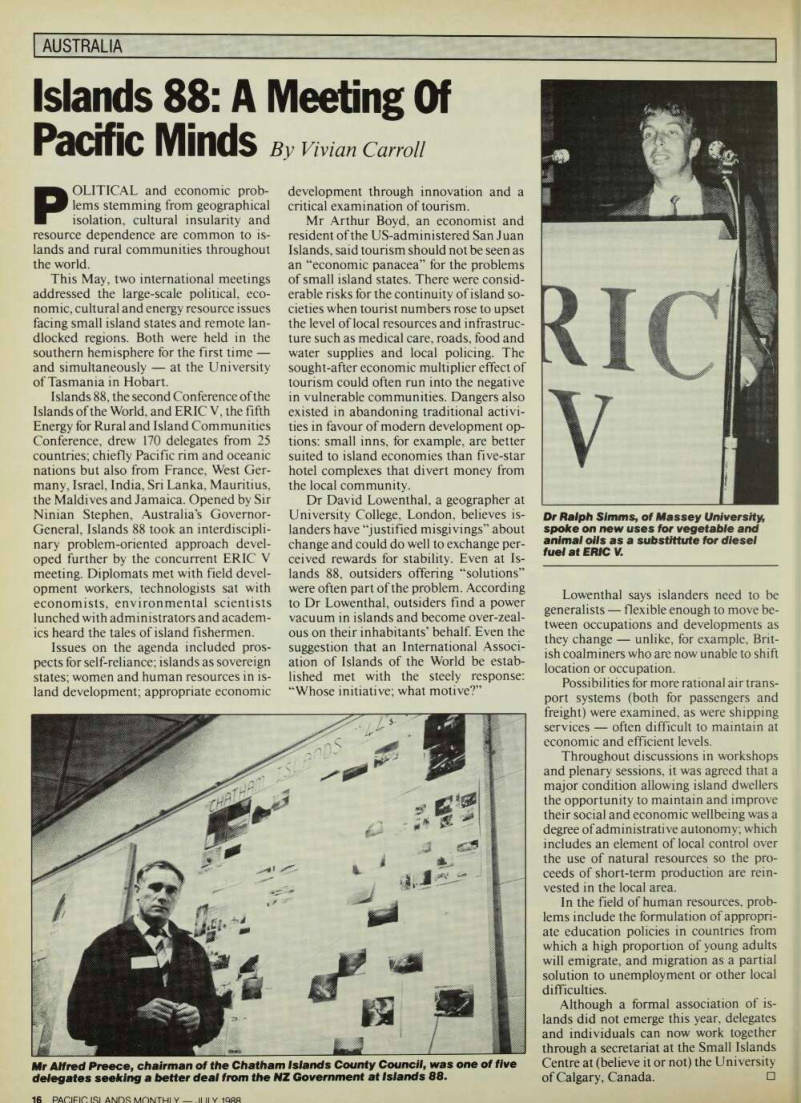
Mr Alfred Preece, chairman of the Chatham Islands County Council, was one of five delegates seeking a better deal from the NZ Government at Islands 88.
Dr Ralph Simms, of Massey University, spoke on new uses for vegetable and animal oils as a substitute for diesel fuel at ERIC V.
Advertisements & other items, p. 16 (1 item)
16
PACIFIC: ISI ANDS MDMTHI Y .11 II V IQfi«
New Energy For The Islands
By Vivian Carroll
I STAND NATIONS are increasingly turning to renewable energy systems to meet growing demands for electricity and combustion fuels, especially for re mote or rural areas. Like other developing nations, Pacific states have a special in terest in breaking away from a depend ence on fossil fuels: energy prices controlled by external political forces and vulnera bility to the resources policies of suppliers lie at the heart of much Third World debt.
Now atmospheric warming the “greenhouse effect” that is due in part to the burning of fossil fuels could lead to melting ice caps, rising sea levels and the disappearance of many low-lying islands.
According to Dr John Todd, organiser of the fifth Energy for Rural and Island Communities Conference (ERIC V), held in Hobart concurrently with the interna tional “Islands 88” conference, such global environmental problems demand the greater use of renewable energy alterna tives such as solar, wind, biomass and mini-hydro sources; a move about which he is very optimistic. “The pessimists were weeded out years ago,” said Dr Todd who, after five days of workshops and papers, had seen his confidence vindicated.
“People who five years ago were research ing equipment are now out in the market place selling their systems.”
But most important to Dr Todd, him self a physicist and environmental scien tist, is the human side the social, cultural and political aspects. “First we neeed to identify problems, then talk about the technology,” he said.
Researchers at the Energy Studies Unit of the University of the South Pacific would agree. The ESU has been monitor ing a number of solar or photovoltaic (PV) schemes in Papua New Guinea, Tuvalu, Tonga, Fiji and the Solomon Islands. They have found that hardware alone is not the answer.
In 1986, Tuvalu received 150 EEC-sup plied household lighting systems. Tonga received another 80, and medical refrig eration units were distributed to PNG (12), Tuvalu (10) and the Solomons (five); but because of islanders’ low per capita in comes, PV schemes have required subsi dies or capital grants from governments, co-operatives or aid agencies.
The ESU recommends a “total PV package”, which could provide remote householders with easily understood in formation on their PV system, training and technical support including spare parts.
Dr John Twidell, of the Energy Studies Unit at the University of Strathclyde, Scotland, spoke on the problem of how to make technical solutions to energy needs translate across cultural and geographical borders. In Fiji, Dr Twidell was told a so lar water heating unit at the University of
the South Pacific ran barely lukewarm.
Curious, the world authority on solar en ergy systems investigated, found the situ ation as described and climbed on to the roof to check the installation.
All was fine, except that it had been placed on the south side of the building away from the prevailing sun. The install ers had followed to the letter instructions for European conditions printed on the European packaging.
Many papers demonstrated the matu rity of hybrid systems: those using com binations of solar, wind or diesel power to run “stand alone” units independent of es tablished energy grids. Advances in die sel-powered generators, microprocessors, coated surfaces and turbine engineering coupled with vigorous competition among component producers has led to a multi plicity of choices for island communities.
Appropriate technologists reported heartening progress with micro-hydro power units in PNG and hand-held water pumps made from common PVC piping and other readily available materials, which have succeeded in island situations where intensive engineering or power based projects had failed.
Rice husks, a once-wasted fifth of In
dia’s rice crop, are now being used to fuel cooking stoves and hot water units in vil lage homes and hotels: one example of the expanding range of so-called biomass fuels suitable for adoption by Pacific states, no tably Fiji, where biomass combustion en ergy is used in the sugar industry and where electricity and copra drying proj ects have been proposed for outer islands.
Coconut shell husk is another biomass fuel with obvious potential in the Pacific, but what about coconut oil? Dr Ralph Simms of Massey University, New Zea land, has run deisel-engined tractors on esters refined from vegetable oils, includ ing coconut. Esters have a high cetane or combustibility value, and tests in England have confirmed that vegetable or tallow (animal fat) esters blend perfectly with diesel fuel and give slightly better en gine wear characteristics than neat diesel.
Even rancid butter could be used if waste from the European Community’s “mountain” of over-production could be purchased cheaply. Although esters re main two to three times more costly than diesel (prices will vary according to loca tion), they could take the pressure off die sel supplies in remote areas when drums run dry before supply ships arrive. □
Regional Security Force
Commonwealth Head Calls For
By Vivian Carroll
ISLANDS 88 began with a plea from Commonwealth Secretary General Sir Sridath Ramphal for a new interna tional regime to provide security meas ures and assistance for small island states.
His plan would see a multinational force established under the United Nations Constitution for the use of small nations and outside the veto of major powers.
With the detection of any threat such as military invasion, drug running or il legal fishing, island states could call on the UN force to police the situation.
“My contention is that the phenomena of small island states challenges us to evolve new forms of order that accept col lective responsibility for securing the sov ereignty and territorial integrity.”
Security is an obvious area for concern, with the Commonwealth alone having 15 island members with populations of fewer than 200,000. These could not adequately provide for defence against “predators” including not only other states but com mercial interests often more powerful than some small nations.
“All countries should adopt more en lightened attitudes to sovereignty. Like personal freedom within societies, sover
eignty within the world community has to be trimmed at the edges if it is to be se cured for all,” Sir Sridath said.
“Self-reliance means striking a proper balance between minimal and abject de pendency. Self-sufficiency is not attaina ble, even if it were desirable which I greatly doubt.
“Equally, small islands do not aspire to be human sanctuaries a kind of pro tected species.”
Small islands could best determine their paths to the next century by devel oping maximum domestic strengths. This requires a world environment supportive without being overpowering, helpful with out inducing helplessness.
Small island nations faced a broader range of issues than continental states of similar size.
Economic advancement and moder nisation are desirable, concluded Sir Sri dath, but there are emerging cultural dangers from the impact of large-scale tourism, cable and satellite television, the attractiveness of islands as transit points for drug trafficking, the corruption as sociated with tax havens, casinos and the provision of financial services. □
Back To The Islands
New Zealand
Sir Paul Reeves revives his ties with the region.
By Jack Kelleher
IT HAD been an emotional experience and one that still enveloped him. Sir Paul Reeves used his hands to indicate the sense of family that was part of the Maori life, his heritage, and the effect of offering that relationship back to the world from which it came.
“I see it as something that binds us, and doesn’t divide us,” he said. Partnership in the region had taken on a new meaning for him; the experience of meeting so many people in their own countries had con firmed his hopes for the region and for the significance of New Zealand as a part of the South Pacific.
New Zealand was not the major power of the region, he said, but it did have re sources to make available on terms set by the islanders: “We seem to have a sensi tivity about this, which they welcome and appreciate.”
Sir Paul was conscious of the pathfind ing nature of the tour. In the Tokelaus His Excellency was constitutionally in a part of New Zealand and the territory in which he is the Queen’s representative, but on most of the islands he was not. A quite dif ferent protocol was involved.
Was the extent of the tour evidence of new thinking from the Ministry of For eign Affairs, testing the possibilities when the Queen’s representative in New Zea land is Maori? Whatever its origin, the tour through Tonga, Western Samoa, the Cook Islands, Vanuatu, the Solomon Islands and Papua New Guinea had been an outstand
ing success, he acknowledged.
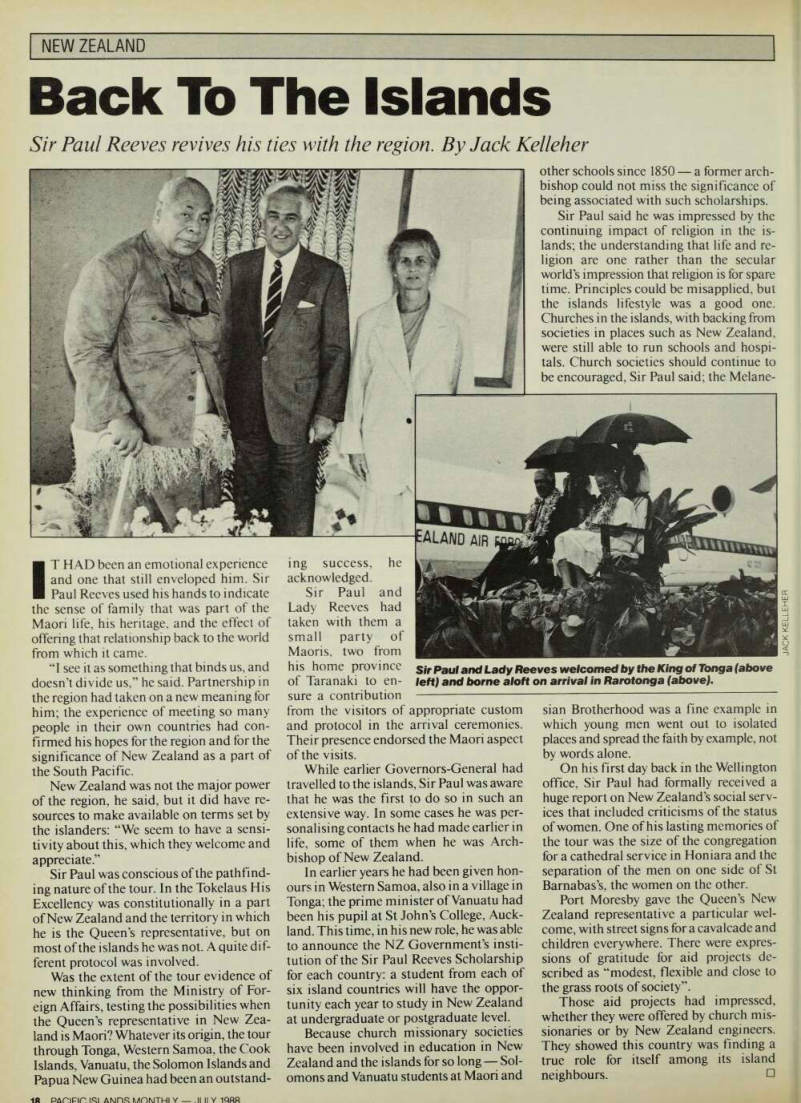
Sir Paul and Lady Reeves had taken with them a small party of Maoris, two from his home province of Taranaki to en sure a contribution
from the visitors of appropriate custom and protocol in the arrival ceremonies.
Their presence endorsed the Maori aspect of the visits.
While earlier Governors-General had travelled to the islands, Sir Paul was aware that he was the first to do so in such an extensive way. In some cases he was per sonalising contacts he had made earlier in life, some of them when he was Arch bishop of New Zealand.
In earlier years he had been given hon ours in Western Samoa, also in a village in Tonga; the prime minister of Vanuatu had been his pupil at St John’s College, Auck land. This time, in his new role, he was able to announce the NZ Government’s insti tution of the Sir Paul Reeves Scholarship for each country: a student from each of six island countries will have the oppor tunity each year to study in New Zealand at undergraduate or postgraduate level.
Because church missionary societies have been involved in education in New Zealand and the islands for so long Sol omons and Vanuatu students at Maori and
other schools since 1850 a former arch bishop could not miss the significance of being associated with such scholarships.
Sir Paul said he was impressed by the continuing impact of religion in the is lands; the understanding that life and re ligion are one rather than the secular world’s impression that religion is for spare time. Principles could be misapplied, but the islands lifestyle was a good one.
Churches in the islands, with backing from societies in places such as New Zealand, were still able to run schools and hospi tals. Church societies should continue to be encouraged, Sir Paul said; the Melane-
sian Brotherhood was a fine example in which young men went out to isolated places and spread the faith by example, not by words alone.
On his first day back in the Wellington office, Sir Paul had formally received a huge report on New Zealand’s social serv ices that included criticisms of the status of women. One of his lasting memories of the tour was the size of the congregation for a cathedral service in Honiara and the separation of the men on one side of St Barnabas’s, the women on the other.
Port Moresby gave the Queen’s New Zealand representative a particular wel come, with street signs for a cavalcade and children everywhere. There were expres sions of gratitude for aid projects de scribed as “modest, flexible and close to the grass roots of society”.
Those aid projects had impressed, whether they were offered by church mis sionaries or by New Zealand engineers.
They showed this country was finding a true role for itself among its island neighbours. D
Sir Paul and Lady Reeves welcomed by the King of Tonga (above left) and borne aloft on arrival in Rarotonga (above).
Advertisements & other items, p. 18 (1 item)
PAniFir. isi andr mdnthi y ,ii ji y iqrr
Partition For New Caledonia?
New Caledonia
A radical caldoche plan for the troubled territory.
By David Robie
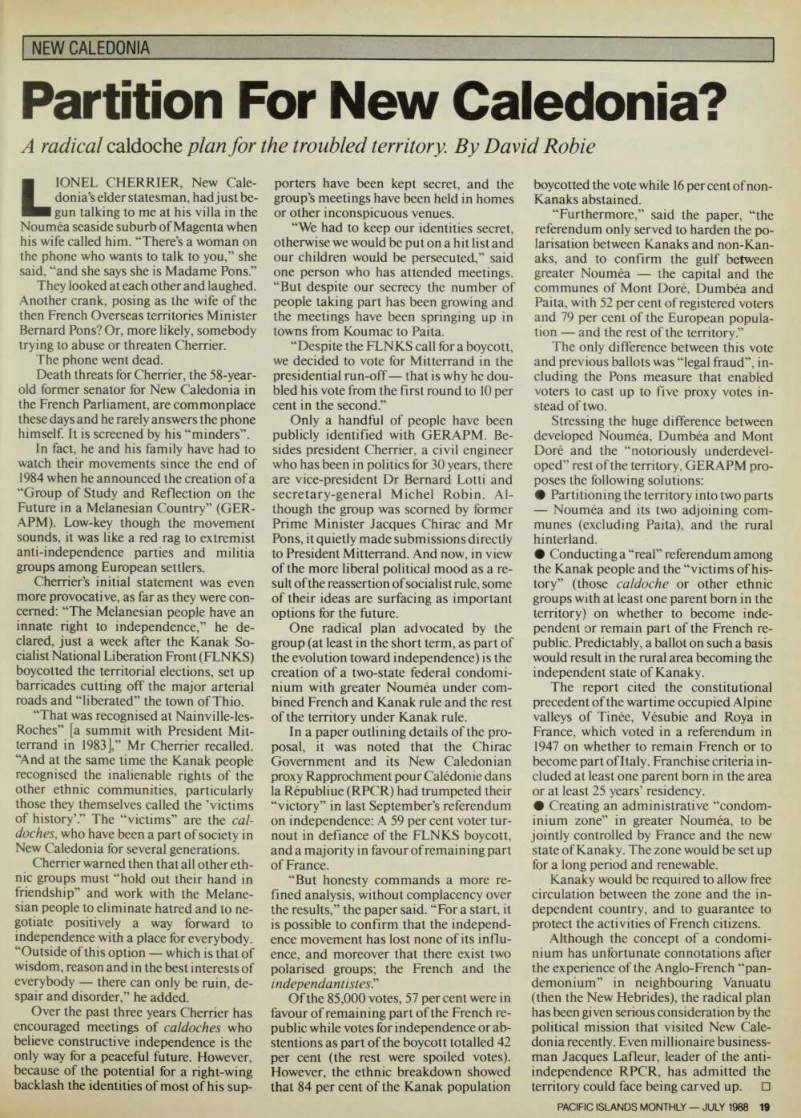
Lionel Cherrier, New Cale
donia’s elder statesman, had just be gun talking to me at his villa in the Noumea seaside suburb of Magenta when his wife called him. “There’s a woman on the phone who wants to talk to you,” she said, “and she says she is Madame Pons.”
They looked at each other and laughed.
Another crank, posing as the wife of the then French Overseas territories Minister Bernard Pons? Or, more likely, somebody trying to abuse or threaten Cherrier.
The phone went dead.
Death threats for Cherrier, the 58-year old former senator for New Caledonia in the French Parliament, are commonplace these days and he rarely answers the phone himself. It is screened by his “minders”.
In fact, he and his family have had to watch their movements since the end of 1984 when he announced the creation of a “Group of Study and Reflection on the Future in a Melanesian Country” (GER APM). Low-key though the movement sounds, it was like a red rag to extremist anti-independence parties and militia groups among European settlers.
Chenier’s initial statement was even more provocative, as far as they were con cerned: “The Melanesian people have an innate right to independence,” he de clared, just a week after the Kanak So cialist National Liberation Front (FLNKS) boycotted the territorial elections, set up barricades cutting off the major arterial roads and “liberated” the town of Thio.
“That was recognised at Nainville-les- Roches” [a summit with President Mit terrand in 1983],” Mr Cherrier recalled.
“And at the same time the Kanak people recognised the inalienable rights of the other ethnic communities, particularly those they themselves called the ’victims of history’.” The “victims” are the cal doches, who have been a part of society in New Caledonia for several generations.
Cherrier warned then that all other eth nic groups must “hold out their hand in friendship” and work with the Melane sian people to eliminate hatred and to ne gotiate positively a way forward to independence with a place for everybody.
“Outside of this option which is that of wisdom, reason and in the best interests of everybody there can only be ruin, de spair and disorder,” he added.
Over the past three years Cherrier has encouraged meetings of caldoches who believe constructive independence is the only way for a peaceful future. However, because of the potential for a right-wing backlash the identities of most of his sup
porters have been kept secret, and the group’s meetings have been held in homes or other inconspicuous venues.
“We had to keep our identities secret, otherwise we would be put on a hit list and our children would be persecuted,” said one person who has attended meetings.
“But despite our secrecy the number of people taking part has been growing and the meetings have been springing up in towns from Koumac to Paita.
“Despite the FLNKS call for a boycott, we decided to vote for Mitterrand in the presidential run-off that is why he dou bled his vote from the first round to 10 per cent in the second.”
Only a handful of people have been publicly identified with GERAPM. Be sides president Chenier, a civil engineer who has been in politics for 30 years, there are vice-president Dr Bernard Lotti and secretary-general Michel Robin. Al though the group was scorned by former Prime Minister Jacques Chirac and Mr Pons, it quietly made submissions directly to President Mitterrand. And now, in view of the more liberal political mood as a re sult of the reassertion of socialist rule, some of their ideas are surfacing as important options for the future.
One radical plan advocated by the group (at least in the short term, as part of the evolution toward independence) is the creation of a two-state federal condomi nium with greater Noumea under com bined French and Kanak rule and the rest of the territory under Kanak rule.
In a paper outlining details of the pro posal, it was noted that the Chirac Government and its New Caledonian proxy Rapprochment pour Caledonie dans la Republiue (RPCR) had trumpeted their “victory” in last September’s referendum on independence: A 59 per cent voter tur nout in defiance of the FLNKS boycott, and a majority in favour of remaining part of France.
“But honesty commands a more re fined analysis, without complacency over the results,” the paper said. “For a start, it is possible to confirm that the independ ence movement has lost none of its influ ence, and moreover that there exist two polarised groups; the French and the independantistes Of the 85,000 votes, 57 per cent were in favour of remaining part of the French re public while votes for independence or ab stentions as part of the boycott totalled 42 per cent (the rest were spoiled votes).
However, the ethnic breakdown showed that 84 per cent of the Kanak population
boycotted the vote while 16 per cent of non- Kanaks abstained.
“Furthermore,” said the paper, “the referendum only served to harden the po larisation between Kanaks and non-Kan aks, and to confirm the gulf between greater Noumea the capital and the communes of Mont Dore, Dumbea and Paita, with 52 per cent of registered voters and 79 per cent of the European popula tion and the rest of the territory.”
The only difference between this vote and previous ballots was “legal fraud”, in cluding the Pons measure that enabled voters to cast up to five proxy votes in stead of two.
Stressing the huge difference between developed Noumea, Dumbea and Mont Dore and the “notoriously underdevel oped” rest of the territory, GERAPM pro poses the following solutions: • Partitioning the territory into two parts Noumea and its two adjoining com munes (excluding Paita), and the rural hinterland. • Conducting a “real” referendum among the Kanak people and the “victims of his tory” (those caldoche or other ethnic groups with at least one parent born in the territory) on whether to become inde pendent or remain part of the French re public. Predictably, a ballot on such a basis would result in the rural area becoming the independent state of Kanaky.
The report cited the constitutional precedent of the wartime occupied Alpine valleys of Tinee, Vesubie and Roya in France, which voted in a referendum in 1947 on whether to remain French or to become part of Italy. Franchise criteria in cluded at least one parent born in the area or at least 25 years’ residency. • Creating an administrative “condom inium zone” in greater Noumea, to be jointly controlled by France and the new state of Kanaky. The zone would be set up for a long period and renewable.
Kanaky would be required to allow free circulation between the zone and the in dependent country, and to guarantee to protect the activities of French citizens.
Although the concept of a condomi nium has unfortunate connotations after the experience of the Anglo-French “pan demonium” in neighbouring Vanuatu (then the New Hebrides), the radical plan has been given serious consideration by the political mission that visited New Cale donia recently. Even millionaire business man Jacques Lafleur, leader of the anti independence RPCR, has admitted the territory could face being carved up. □
Arms Finds Spark Furore
Fiji
Gun-running reports long on rumour, short on facts.
By Jai Kumar
THE ALREADY tense atmosphere of the South Pacific was high lighted late in May the discovery by Australian Customs in Sydney of a 16tonne container of arms and ammunition.
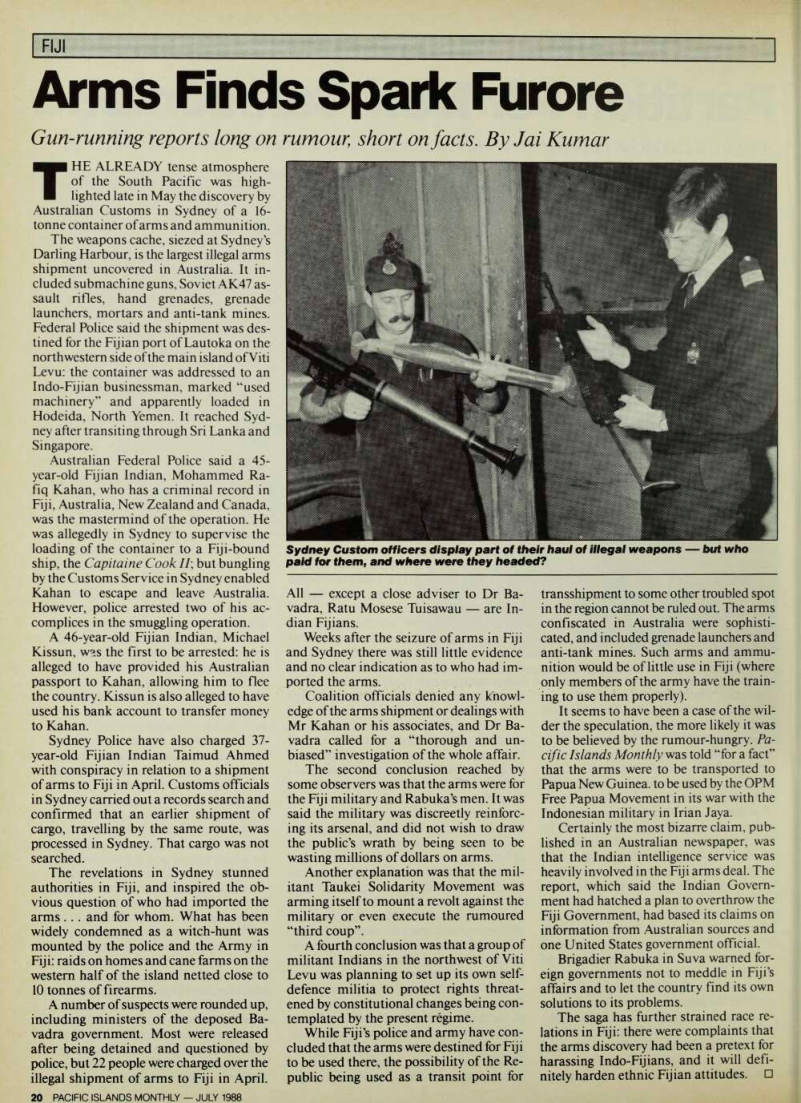
The weapons cache, siezed at Sydney’s Darling Harbour, is the largest illegal arms shipment uncovered in Australia. It in cluded submachine guns, Soviet AK47 as sault rifles, hand grenades, grenade launchers, mortars and anti-tank mines.
Federal Police said the shipment was des tined for the Fijian port of Lautoka on the northwestern side of the main island of Viti Levu: the container was addressed to an Indo-Fijian businessman, marked “used machinery” and apparently loaded in Hodeida, North Yemen. It reached Syd ney after transiting through Sri Lanka and Singapore.
Australian Federal Police said a 45year-old Fijian Indian, Mohammed Ra fiq Kahan, who has a criminal record in Fiji, Australia, New Zealand and Canada, was the mastermind of the operation. He was allegedly in Sydney to supervise the loading of the container to a Fiji-bound ship, the Capitaine Cook //; but bungling by the Customs Service in Sydney enabled Kahan to escape and leave Australia.
However, police arrested two of his ac complices in the smuggling operation.
A 46-year-old Fijian Indian, Michael Kissun, was the first to be arrested: he is alleged to have provided his Australian passport to Kahan, allowing him to flee the country. Kissun is also alleged to have used his bank account to transfer money to Kahan.
Sydney Police have also charged 37year-old Fijian Indian Taimud Ahmed with conspiracy in relation to a shipment of arms to Fiji in April. Customs officials in Sydney carried out a records search and confirmed that an earlier shipment of cargo, travelling by the same route, was processed in Sydney. That cargo was not searched.
The revelations in Sydney stunned authorities in Fiji, and inspired the ob vious question of who had imported the arms... and for whom. What has been widely condemned as a witch-hunt was mounted by the police and the Army in Fiji: raids on homes and cane farms on the western half of the island netted close to 10 tonnes of firearms.
A number of suspects were rounded up, including ministers of the deposed Ba vadra government. Most were released after being detained and questioned by police, but 22 people were charged over the illegal shipment of arms to Fiji in April.
All except a close adviser to Dr Ba vadra, Ratu Mosese Tuisawau are In dian Fijians.
Weeks after the seizure of arms in Fiji and Sydney there was still little evidence and no clear indication as to who had im ported the arms.
Coalition officials denied any knowl edge of the arms shipment or dealings with Mr Kahan or his associates, and Dr Ba vadra called for a “thorough and un biased” investigation of the whole affair.
The second conclusion reached by some observers was that the arms were for the Fiji military and Rabuka’s men. It was said the military was discreetly reinforc ing its arsenal, and did not wish to draw the public’s wrath by being seen to be wasting millions of dollars on arms.
Another explanation was that the mil itant Taukei Solidarity Movement was arming itself to mount a revolt against the military or even execute the rumoured “third coup”.
A fourth conclusion was that a group of militant Indians in the northwest of Viti Levu was planning to set up its own self defence militia to protect rights threat ened by constitutional changes being con templated by the present regime.
While Fiji’s police and army have con cluded that the arms were destined for Fiji to be used there, the possibility of the Re public being used as a transit point for
transshipment to some other troubled spot in the region cannot be ruled out. The arms confiscated in Australia were sophisti cated, and included grenade launchers and anti-tank mines. Such arms and ammu nition would be of little use in Fiji (where only members of the army have the train ing to use them properly).
It seems to have been a case of the wil der the speculation, the more likely it was to be believed by the rumour-hungry. Pa cific Islands Monthly was told “for a fact” that the arms were to be transported to Papua New Guinea, to be used by the OPM Free Papua Movement in its war with the Indonesian military in Irian Jaya.
Certainly the most bizarre claim, pub lished in an Australian newspaper, was that the Indian intelligence service was heavily involved in the Fiji arms deal. The report, which said the Indian Govern ment had hatched a plan to overthrow the Fiji Government, had based its claims on information from Australian sources and one United States government official.
Brigadier Rabuka in Suva warned for eign governments not to meddle in Fiji’s affairs and to let the country find its own solutions to its problems.
The saga has further strained race re lations in Fiji: there were complaints that the arms discovery had been a pretext for harassing Indo-Fijians, and it will defi nitely harden ethnic Fijian attitudes. □
Sydney Custom officers display part of their haul of illegal weapons -but who paid for them, and where were they headed?
Advertisements & other items, p. 21 (1 item)
Experience
A NEW DRIVING
> :G at--- ■" -■■'-A
SBS
- - >VaB a- . - • m A
•V^NJIXVSJ
TOMOx
Pv
A HIGHER STANDARD:
ALL NEW COROLLAS NOW COME WITH
TOYOTA MULTI-VALVE ENGINES.
Here is a blend of elegance and performance usually found only in big, luxury cars. That’s because Toyota believes everyone should enjoy the newest automotive advancements. And the latest example of this thinking is the all-new Corolla. It has an elegantly rounded shape to be proud of. And the high output and efficient multi-valve engine in all Corollas puts their performance in far better shape.
Expand your driving experience to new horizons with the all-new Corolla. Toyota World’s No. 1 producer of multi-valve engines.
TOYOTA
Tuna Bill Passed
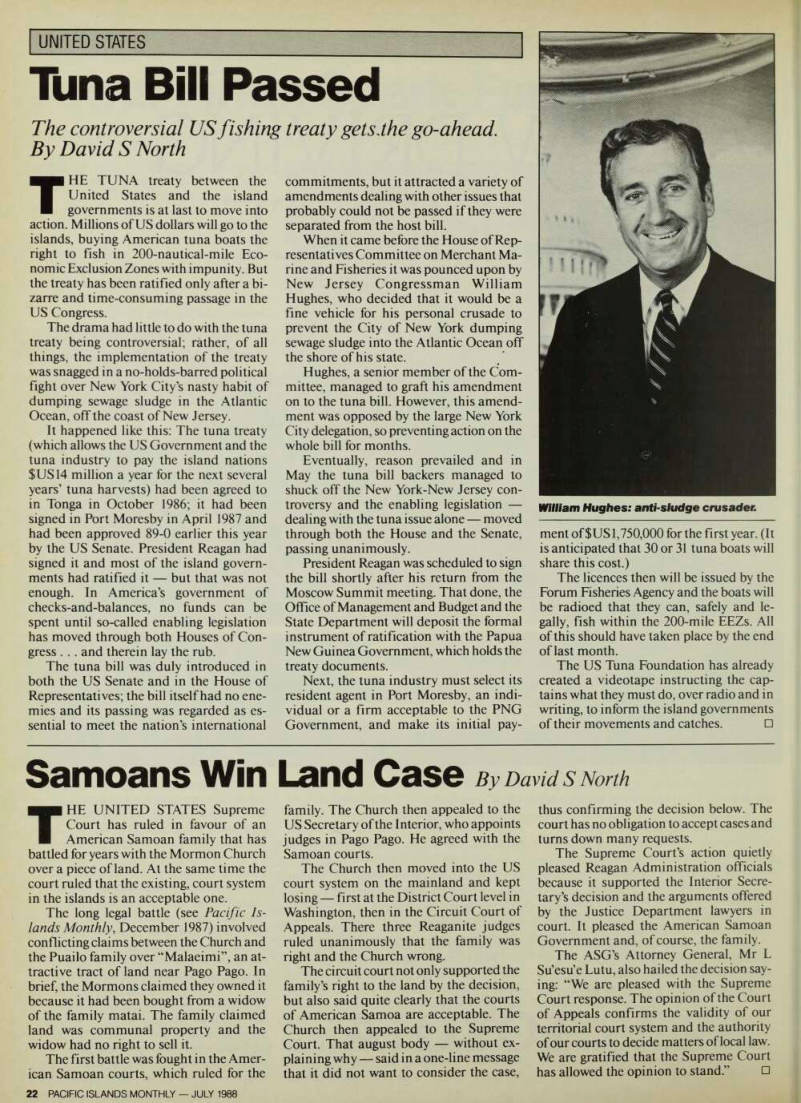
United States
The controversial US fishing treaty gets .the go-ahead.
By David S North
THE TUNA treaty between the United States and the island governments is at last to move into action. Millions of US dollars will go to the islands, buying American tuna boats the right to fish in 200-nautical-mile Eco nomic Exclusion Zones with impunity. But the treaty has been ratified only after a bi zarre and time-consuming passage in the US Congress.
The drama had little to do with the tuna treaty being controversial; rather, of all things, the implementation of the treaty was snagged in a no-holds-barred political fight over New York City’s nasty habit of dumping sewage sludge in the Atlantic Ocean, off the coast of New Jersey.
It happened like this: The tuna treaty (which allows the US Government and the tuna industry to pay the island nations SUSI 4 million a year for the next several years’ tuna harvests) had been agreed to in Tonga in October 1986; it had been signed in Port Moresby in April 1987 and had been approved 89-0 earlier this year by the US Senate. President Reagan had signed it and most of the island govern ments had ratified it but that was not enough. In America’s government of checks-and-balances, no funds can be spent until so-called enabling legislation has moved through both Houses of Con gress ... and therein lay the rub.
The tuna bill was duly introduced in both the US Senate and in the House of Representatives; the bill itself had no ene mies and its passing was regarded as es sential to meet the nation’s international
commitments, but it attracted a variety of amendments dealing with other issues that probably could not be passed if they were separated from the host bill.
When it came before the House of Rep resentatives Committee on Merchant Ma rine and Fisheries it was pounced upon by New Jersey Congressman William Hughes, who decided that it would be a fine vehicle for his personal crusade to prevent the City of New York dumping sewage sludge into the Atlantic Ocean off the shore of his state.
Hughes, a senior member of the Com mittee, managed to graft his amendment on to the tuna bill. However, this amend ment was opposed by the large New York City delegation, so preventing action on the whole bill for months.
Eventually, reason prevailed and in May the tuna bill backers managed to shuck off the New York-New Jersey con troversy and the enabling legislation dealing with the tuna issue alone moved through both the House and the Senate, passing unanimously.
President Reagan was scheduled to sign the bill shortly after his return from the Moscow Summit meeting. That done, the Office of Management and Budget and the State Department will deposit the formal instrument of ratification with the Papua New Guinea Government, which holds the treaty documents.
Next, the tuna industry must select its resident agent in Port Moresby, an indi vidual or a firm acceptable to the PNG Government, and make its initial pay-
merit of SUS 1,750,000 for the first year. (It is anticipated that 30 or 31 tuna boats will share this cost.) The licences then will be issued by the Forum Fisheries Agency and the boats will be radioed that they can, safely and le gally, fish within the 200-mile EEZs. All of this should have taken place by the end of last month.
The US Tuna Foundation has already created a videotape instructing the cap tains what they must do, over radio and in writing, to inform the island governments of their movements and catches. □
William Hughes: anti-sludge crusader.
Samoans Win Land Case
By David S North
The United States Supreme
Court has ruled in favour of an American Samoan family that has battled for years with the Mormon Church over a piece of land. At the same time the court ruled that the existing, court system in the islands is an acceptable one.
The long legal battle (see Pacific Islands Monthly, December 1987) involved conflicting claims between the Church and the Puailo family over “Malaeimi”, an attractive tract of land near Pago Pago. In brief, the Mormons claimed they owned it because it had been bought from a widow of the family matai. The family claimed land was communal property and the widow had no right to sell it.
The first battle was fought in the American Samoan courts, which ruled for the
family. The Church then appealed to the US Secretary of the Interior, who appoints judges in Pago Pago. He agreed with the Samoan courts.
The Church then moved into the US court system on the mainland and kept losing first at the District Court level in Washington, then in the Circuit Court of Appeals. There three Reaganite judges ruled unanimously that the family was right and the Church wrong.
The circuit court not only supported the family’s right to the land by the decision, but also said quite clearly that the courts of American Samoa are acceptable. The Church then appealed to the Supreme Court. That august body without explaining why said in a one-line message that it did not want to consider the case,
thus confirming the decision below. The court has no obligation to accept cases and turns down many requests, The Supreme Court’s action quietly pleased Reagan Administration officials because it supported the Interior Secre tary’s decision and the arguments offered by the Justice Department lawyers in court. It pleased the American Samoan Government and, of course, the family, The ASG’s Attorney General, Mr L Su’esu’e Lutu, also hailed the decision say ing: “We are pleased with the Supreme Court response. The opinion of the Court of Appeals confirms the validity of our territorial court system and the authority of our courts to decide matters of local law.
We are gratified that the Supreme Court has allowed the opinion to stand.” □
Courtesy East-West Center, Hawaii
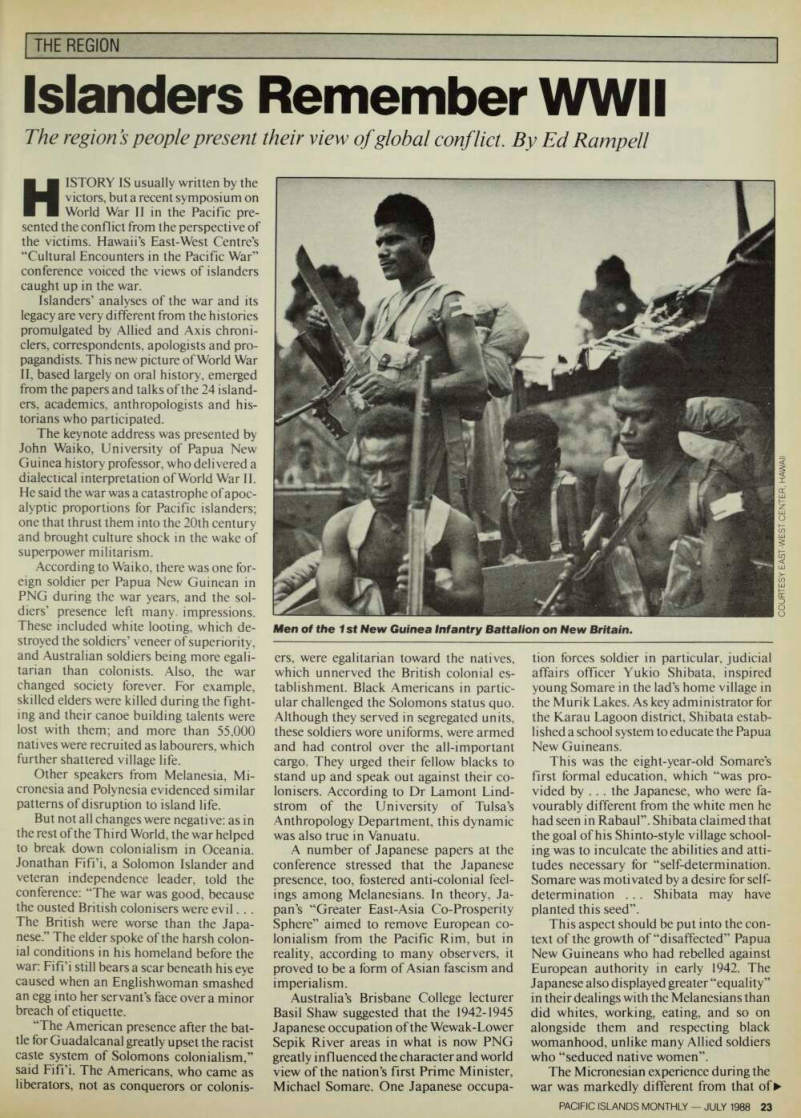
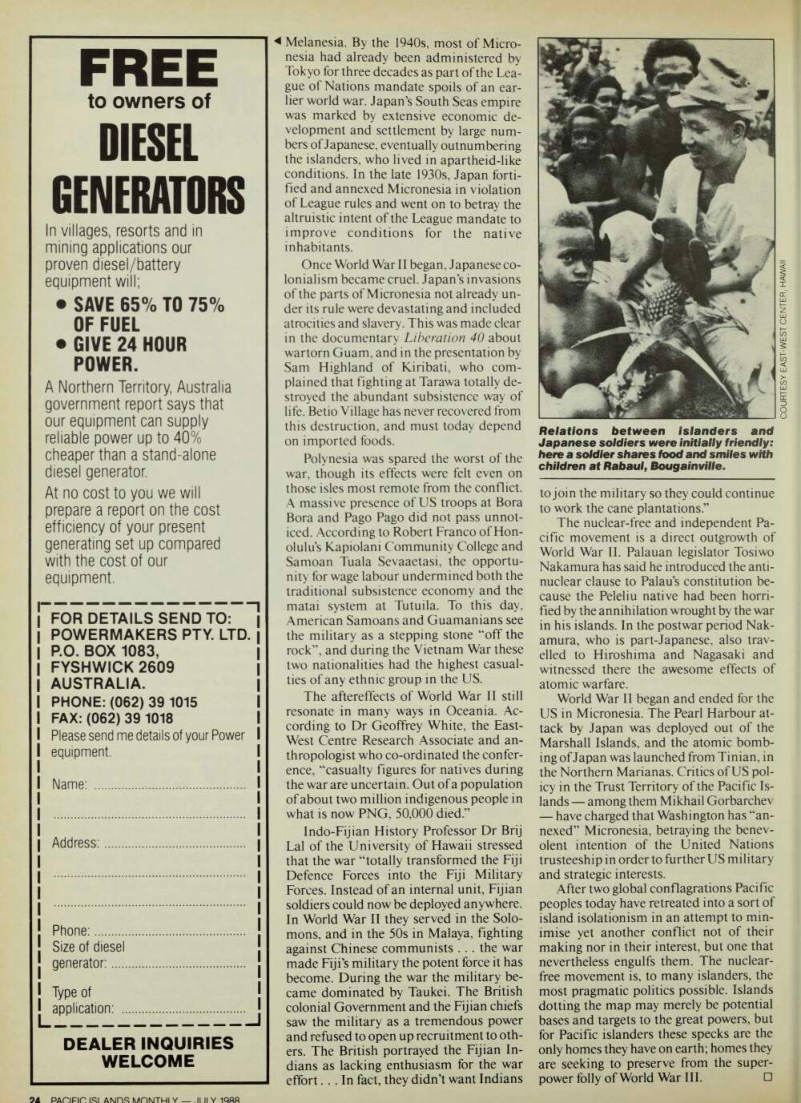
The Region
Islanders Remember WWII
The region’s people present their view ofglobal conflict.
By Ed Rampell
HISTORY IS usually written by the victors, but a recent symposium on World War II in the Pacific pre sented the conflict from the perspective of the victims. Hawaii’s East-West Centre’s “Cultural Encounters in the Pacific War” conference voiced the views of islanders caught up in the war.
Islanders’ analyses of the war and its legacy are very different from the histories promulgated by Allied and Axis chroni clers, correspondents, apologists and pro pagandists. This new picture of World War 11, based largely on oral history, emerged from the papers and talks of the 24 island ers, academics, anthropologists and his torians who participated.
The keynote address was presented by John Waiko, University of Papua New Guinea history professor, who delivered a dialectical interpretation of World War 11.
He said the war was a catastrophe of apoc alyptic proportions for Pacific islanders; one that thrust them into the 20th century and brought culture shock in the wake of superpower militarism.
According to Waiko, there was one for eign soldier per Papua New Guinean in PNG during the war years, and the sol diers’ presence left many, impressions.
These included white looting, which de stroyed the soldiers’ veneer of superiority, and Australian soldiers being more egali tarian than colonists. Also, the war changed society forever. For example, skilled elders were killed during the fight ing and their canoe building talents were lost with them; and more than 55,000 natives were recruited as labourers, which further shattered village life.
Other speakers from Melanesia, Mi cronesia and Polynesia evidenced similar patterns of disruption to island life.
But not all changes were negative: as in the rest of the Third World, the war helped to break down colonialism in Oceania.
Jonathan Fifi’i, a Solomon Islander and veteran independence leader, told the conference: “The war was good, because the ousted British colonisers were evil. ..
The British were worse than the Japa nese.” The elder spoke of the harsh colon ial conditions in his homeland before the war: Fifi’i still bears a scar beneath his eye caused when an Englishwoman smashed an egg into her servant’s face over a minor breach of etiquette.
“The American presence after the bat tle for Guadalcanal greatly upset the racist caste system of Solomons colonialism,” said Fifi’i. The Americans, who came as liberators, not as conquerors or colonis-
ers, were egalitarian toward the natives, which unnerved the British colonial es tablishment. Black Americans in partic ular challenged the Solomons status quo.
Although they served in segregated units, these soldiers wore uniforms, were armed and had control over the all-important cargo. They urged their fellow blacks to stand up and speak out against their co lonisers. According to Dr Lament Lind strom of the University of Tulsa’s Anthropology Department, this dynamic was also true in Vanuatu.
A number of Japanese papers at the conference stressed that the Japanese presence, too, fostered anti-colonial feel ings among Melanesians. In theory, Ja pan’s “Greater East-Asia Co-Prosperity Sphere” aimed to remove European co lonialism from the Pacific Rim, but in reality, according to many observers, it proved to be a form of Asian fascism and imperialism.
Australia’s Brisbane College lecturer Basil Shaw suggested that the 1942-1945 Japanese occupation of the Wewak-Lower Sepik River areas in what is now PNG greatly influenced the character and world view of the nation’s first Prime Minister, Michael Somare. One Japanese occupa
tion forces soldier in particular, judicial affairs officer Yukio Shibata, inspired young Somare in the lad’s home village in the Murik Lakes. As key administrator for the Karau Lagoon district, Shibata estab lished a school system to educate the Papua New Guineans.
This was the eight-year-old Somare’s first formal education, which “was pro vided by .. . the Japanese, who were fa vourably different from the white men he had seen in Rabaul”. Shibata claimed that the goal of his Shinto-style village school ing was to inculcate the abilities and atti tudes necessary for “self-determination.
Somare was motivated by a desire for self determination ... Shibata may have planted this seed”.
This aspect should be put into the con text of the growth of “disaffected” Papua New Guineans who had rebelled against European authority in early 1942. The Japanese also displayed greater “equality” in their dealings with the Melanesians than did whites, working, eating, and so on alongside them and respecting black womanhood, unlike many Allied soldiers who “seduced native women”.
The Micronesian experience during the war was markedly different from that of ►
Men of the 1st New Guinea Infantry Battalion on New Britain.
Courtesy East-West Center, Hawaii
* Melanesia. By the 19405, most of Micro nesia had already been administered by Tokyo for three decades as part of the Lea gue of Nations mandate spoils of an ear lier world war. Japan’s South Seas empire was marked by extensive economic de velopment and settlement by large num bers of Japanese, eventually outnumbering the islanders, who lived in apartheid-like conditions. In the late 19305, Japan forti fied and annexed Micronesia in violation of League rules and went on to betray the altruistic intent of the League mandate to improve conditions for the native inhabitants.
Once World War II began, Japanese co lonialism became cruel. Japan’s invasions of the parts of Micronesia not already un der its rule were devastating and included atrocities and slavery. This was made clear in the documentary Liberation 40 about wartorn Guam, and in the presentation by Sam Highland of Kiribati, who com plained that fighting at Tarawa totally de stroyed the abundant subsistence way of life. Betio Village has never recovered from this destruction, and must today depend on imported foods.
Polynesia was spared the worst of the war, though its effects were felt even on those isles most remote from the conflict.
A massive presence of US troops at Bora Bora and Pago Pago did not pass unnot iced. According to Robert Franco of Hon olulu’s Kapiolani Community College and Samoan Tuala Sevaaetasi, the opportu nity for wage labour undermined both the traditional subsistence economy and the matai system at Tutuila. To this day, American Samoans and Guamanians see the military as a stepping stone “off the rock”, and during the Vietnam War these two nationalities had the highest casual ties of any ethnic group in the US.
The aftereffects of World War II still resonate in many ways in Oceania. Ac cording to Dr Geoffrey White, the East- West Centre Research Associate and an thropologist who co-ordinated the confer ence, “casualty figures for natives during the war are uncertain. Out of a population of about two million indigenous people in what is now PNG, 50,000 died.”
Indo-Fijian History Professor Dr Brij Lai of the University of Hawaii stressed that the war “totally transformed the Fiji Defence Forces into the Fiji Military Forces. Instead of an internal unit, Fijian soldiers could now be deployed anywhere.
In World War II they served in the Solo mons, and in the 50s in Malaya, fighting against Chinese communists ... the war made Fiji’s military the potent force it has become. During the war the military be came dominated by Taukei. The British colonial Government and the Fijian chiefs saw the military as a tremendous power and refused to open up recruitment to oth ers. The British portrayed the Fijian In dians as lacking enthusiasm for the war effort... In fact, they didn’t want Indians
to join the military so they could continue to work the cane plantations.”
The nuclear-free and independent Pa cific movement is a direct outgrowth of World War 11. Palauan legislator Tosiwo Nakamura has said he introduced the anti nuclear clause to Palau’s constitution be cause the Peleliu native had been horri fied by the annihilation wrought by the war in his islands. In the postwar period Nak amura, who is part-Japanese, also trav elled to Hiroshima and Nagasaki and witnessed there the awesome effects of atomic warfare.
World War II began and ended for the US in Micronesia. The Pearl Harbour at tack by Japan was deployed out of the Marshall Islands, and the atomic bomb ing of Japan was launched from Tinian, in the Northern Marianas. Critics of US pol icy in the Trust Territory of the Pacific Is lands among them Mikhail Gorbarchev have charged that Washington has “an nexed” Micronesia, betraying the benev olent intention of the United Nations trusteeship in order to further US military and strategic interests.
After two global conflagrations Pacific peoples today have retreated into a sort of island isolationism in an attempt to min imise yet another conflict not of their making nor in their interest, but one that nevertheless engulfs them. The nuclear free movement is, to many islanders, the most pragmatic politics possible. Islands dotting the map may merely be potential bases and targets to the great powers, but for Pacific islanders these specks are the only homes they have on earth; homes they are seeking to preserve from the super power folly of World War 111. □
Relations between islanders and Japanese soldiers were initially friendly: here a soldier shares food and smiles with children at Rabaul, Bougainville.
Advertisements & other items, p. 24 (2 items)
24
PAniFin isi ANn.q mdmthi y .1111 y -iqrr
Generators
FREE
to owners of
DIESEL
GENERATORS
In villages, resorts and in mining applications our proven diesel/battery equipment will;
• SAVE 65% TO 75%
OF FUEL
• GIVE 24 HOUR
POWER.
A Northern Territory, Australia government report says that our equipment can supply reliable power up to 40% cheaper than a stand-alone diesel generator.
At no cost to you we will prepare a report on the cost efficiency of your present generating set up compared with the cost of our equipment.
FOR DETAILS SEND TO:
POWERMAKERS PTY. LTD.
P.0.80X 1083,
FYSHWICK 2609
AUSTRALIA.
I PHONE: (062) 39 1015
I FAX: (062) 39 1018
I Please send me details of your Power I equipment.
I Name: Address: Phone: Size of diesel generator; Type of application:
DEALER INQUIRIES
WELCOME
Hunting The Relics of War
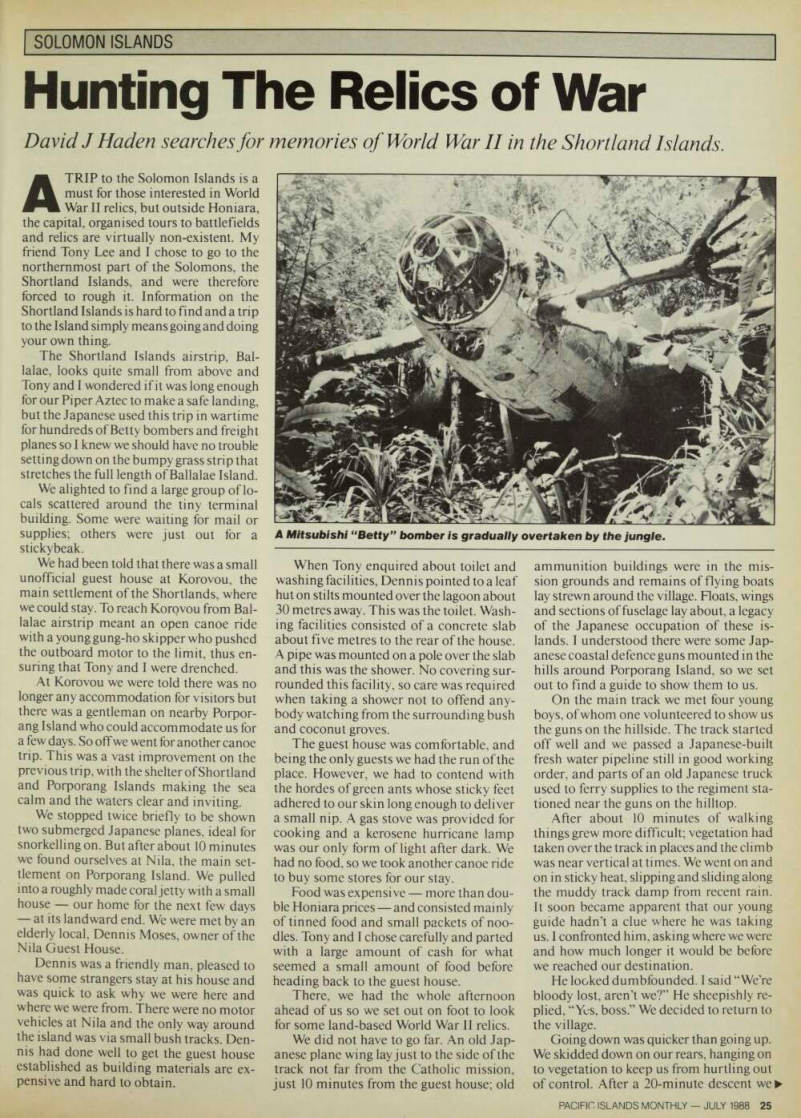
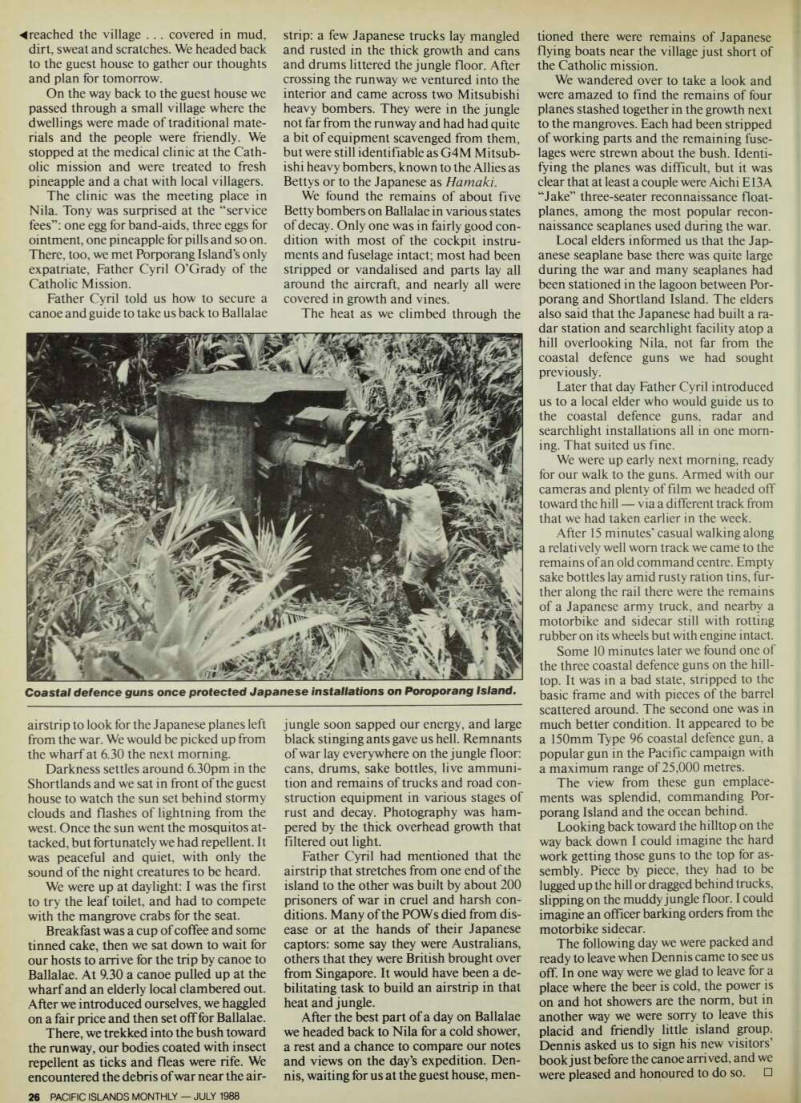
Solomon Islands
David J Haden searches for memories of World War II in the Shortland Islands.
ATRIP to the Solomon Islands is a must for those interested in World War II relics, but outside Honiara, the capital, organised tours to battlefields and relics are virtually non-existent. My friend Tony Lee and I chose to go to the northernmost part of the Solomons, the Shortland Islands, and were therefore forced to rough it. Information on the Shortland Islands is hard to find and a trip to the Island simply means going and doing your own thing.
The Shortland Islands airstrip, Bal lalae, looks quite small from above and Tony and I wondered if it was long enough for our Piper Aztec to make a safe landing, but the Japanese used this trip in wartime for hundreds of Betty bombers and freight planes so I knew we should have no trouble setting down on the bumpy grass strip that stretches the full length of Ballalae Island.
We alighted to find a large group of lo cals scattered around the tiny terminal building. Some were waiting for mail or supplies; others were just out for a stickybeak.
We had been told that there was a small unofficial guest house at Korovou, the main settlement of the Shortlands, where we could stay. To reach Korovou from Bal lalae airstrip meant an open canoe ride with a young gung-ho skipper who pushed the outboard motor to the limit, thus en suring that Tony and I were drenched.
At Korovou we were told there was no longer any accommodation for visitors but there was a gentleman on nearby Porpor ang Island who could accommodate us for a few days. So off we went for another canoe trip. This was a vast improvement on the previous trip, with the shelter of Shortland and Porporang Islands making the sea calm and the waters clear and inviting.
We stopped twice briefly to be shown two submerged Japanese planes, ideal for snorkelling on. But after about 10 minutes we found ourselves at Nila, the main set tlement on Porporang Island. We pulled into a roughly made coral jetty with a small house our home for the next few days at its landward end. We were met by an elderly local, Dennis Moses, owner of the Nila Guest House.
Dennis was a friendly man, pleased to have some strangers stay at his house and was quick to ask why we were here and where we were from. There were no motor vehicles at Nila and the only way around the island was via small bush tracks. Den nis had done well to get the guest house established as building materials are ex pensive and hard to obtain.
When Tony enquired about toilet and washing facilities, Dennis pointed to a leaf hut on stilts mounted over the lagoon about 30 metres away. This was the toilet. Wash ing facilities consisted of a concrete slab about five metres to the rear of the house.
A pipe was mounted on a pole over the slab and this was the shower. No covering sur rounded this facility, so care was required when taking a shower not to offend any body watching from the surrounding bush and coconut groves.
The guest house was comfortable, and being the only guests we had the run of the place. However, we had to contend with the hordes of green ants whose sticky feet adhered to our skin long enough to deliver a small nip. A gas stove was provided for cooking and a kerosene hurricane lamp was our only form of light after dark. We had no food, so we took another canoe ride to buy some stores for our stay.
Food was expensive more than dou ble Honiara prices and consisted mainly of tinned food and small packets of noo dles. Tony and I chose carefully and parted with a large amount of cash for what seemed a small amount of food before heading back to the guest house.
There, we had the whole afternoon ahead of us so we set out on foot to look for some land-based World War II relics.
We did not have to go far. An old Jap anese plane wing lay just to the side of the track not far from the Catholic mission, just 10 minutes from the guest house; old
ammunition buildings were in the mis sion grounds and remains of flying boats lay strewn around the village. Floats, wings and sections of fuselage lay about, a legacy of the Japanese occupation of these is lands. I understood there were some Jap anese coastal defence guns mounted in the hills around Porporang Island, so we set out to find a guide to show them to us.
On the main track we met four young boys, of whom one volunteered to show us the guns on the hillside. The track started off well and we passed a Japanese-built fresh water pipeline still in good working order, and parts of an old Japanese truck used to ferry supplies to the regiment sta tioned near the guns on the hilltop.
After about 10 minutes of walking things grew more difficult; vegetation had taken over the track in places and the climb was near vertical at times. We went on and on in sticky heat, slipping and sliding along the muddy track damp from recent rain.
It soon became apparent that our young guide hadn’t a clue where he was taking us. I confronted him, asking where we were and how much longer it would be before we reached our destination.
He looked dumbfounded. I said “We’re bloody lost, aren’t we?” He sheepishly re plied, “Yes, boss.” We decided to return to the village.
Going down was quicker than going up.
We skidded down on our rears, hanging on to vegetation to keep us from hurtling out of control. After a 20-minute descent we ►
A Mitsubishi “Betty” bomber is gradually overtaken by the jungle.
◄reached the village . . . covered in mud, dirt, sweat and scratches. We headed back to the guest house to gather our thoughts and plan for tomorrow.
On the way back to the guest house we passed through a small village where the dwellings were made of traditional mate rials and the people were friendly. We stopped at the medical clinic at the Cath olic mission and were treated to fresh pineapple and a chat with local villagers.
The clinic was the meeting place in Nila. Tony was surprised at the “service fees”: one egg for band-aids, three eggs for ointment, one pineapple for pills and so on.
There, too, we met Porporang Island’s only expatriate, Father Cyril O’Grady of the Catholic Mission.
Father Cyril told us how to secure a canoe and guide to take us back to Ballalae
strip: a few Japanese trucks lay mangled and rusted in the thick growth and cans and drums littered the jungle floor. After crossing the runway we ventured into the interior and came across two Mitsubishi heavy bombers. They were in the jungle not far from the runway and had had quite a bit of equipment scavenged from them, but were still identifiable as G4M Mitsub ishi heavy bombers, known to the Allies as Bettys or to the Japanese as Hamaki.
We found the remains of about five Betty bombers on Ballalae in various states of decay. Only one was in fairly good con dition with most of the cockpit instru ments and fuselage intact; most had been stripped or vandalised and parts lay all around the aircraft, and nearly all were covered in growth and vines.
The heat as we climbed through the
airstrip to look for the Japanese planes left from the war. We would be picked up from the wharf at 6.30 the next morning.
Darkness settles around 6.30 pm in the Shortlands and we sat in front of the guest house to watch the sun set behind stormy clouds and flashes of lightning from the west. Once the sun went the mosquitos at tacked, but fortunately we had repellent. It was peaceful and quiet, with only the sound of the night creatures to be heard.
We were up at daylight: I was the first to try the leaf toilet, and had to compete with the mangrove crabs for the seat.
Breakfast was a cup of coffee and some tinned cake, then we sat down to wait for our hosts to arrive for the trip by canoe to Ballalae. At 9.30 a canoe pulled up at the wharf and an elderly local clambered out.
After we introduced ourselves, we haggled on a fair price and then set off for Ballalae.
There, we trekked into the bush toward the runway, our bodies coated with insect repellent as ticks and fleas were rife. We encountered the debris of war near the air
jungle soon sapped our energy, and large black stinging ants gave us hell. Remnants of war lay everywhere on the jungle floor: cans, drums, sake bottles, live ammuni tion and remains of trucks and road con struction equipment in various stages of rust and decay. Photography was ham pered by the thick overhead growth that filtered out light.
Father Cyril had mentioned that the airstrip that stretches from one end of the island to the other was built by about 200 prisoners of war in cruel and harsh con ditions. Many of the POWs died from dis ease or at the hands of their Japanese captors: some say they were Australians, others that they were British brought over from Singapore. It would have been a de bilitating task to build an airstrip in that heat and jungle.
After the best part of a day on Ballalae we headed back to Nila for a cold shower, a rest and a chance to compare our notes and views on the day’s expedition. Den nis, waiting for us at the guest house, men
tioned there were remains of Japanese flying boats near the village just short of the Catholic mission.
We wandered over to take a look and were amazed to find the remains of four planes stashed together in the growth next to the mangroves. Each had been stripped of working parts and the remaining fuse lages were strewn about the bush. Identi fying the planes was difficult, but it was clear that at least a couple were Aichi EI3A “Jake” three-seater reconnaissance float planes, among the most popular recon naissance seaplanes used during the war.
Local elders informed us that the Jap anese seaplane base there was quite large during the war and many seaplanes had been stationed in the lagoon between Por porang and Shortland Island. The elders also said that the Japanese had built a ra dar station and searchlight facility atop a hill overlooking Nila, not far from the coastal defence guns we had sought previously.
Later that day Father Cyril introduced us to a local elder who would guide us to the coastal defence guns, radar and searchlight installations all in one morn ing. That suited us fine.
We were up early next morning, ready for our walk to the guns. Armed with our cameras and plenty of film we headed off toward the hill via a different track from that we had taken earlier in the week.
After 15 minutes’ casual walking along a relatively well worn track we came to the remains of an old command centre. Empty sake bottles lay amid rusty ration tins, fur ther along the rail there were the remains of a Japanese army truck, and nearby a motorbike and sidecar still with rotting rubber on its wheels but with engine intact.
Some 10 minutes later we found one of the three coastal defence guns on the hill top. It was in a bad state, stripped to the basic frame and with pieces of the barrel scattered around. The second one was in much better condition. It appeared to be a 150 mm Type 96 coastal defence gun, a popular gun in the Pacific campaign with a maximum range of 25,000 metres.
The view from these gun emplace ments was splendid, commanding Por porang Island and the ocean behind.
Looking back toward the hilltop on the way back down I could imagine the hard work getting those guns to the top for as sembly. Piece by piece, they had to be lugged up the hill or dragged behind trucks, slipping on the muddy jungle floor. I could imagine an officer barking orders from the motorbike sidecar.
The following day we were packed and ready to leave when Dennis came to see us off. In one way were we glad to leave for a place where the beer is cold, the power is on and hot showers are the norm, but in another way we were sorry to leave this placid and friendly little island group.
Dennis asked us to sign his new visitors’ book just before the canoe arrived, and we were pleased and honoured to do so. □
Coastal defence guns once protected Japanese installations on Poroporang Island.
The Right To Development
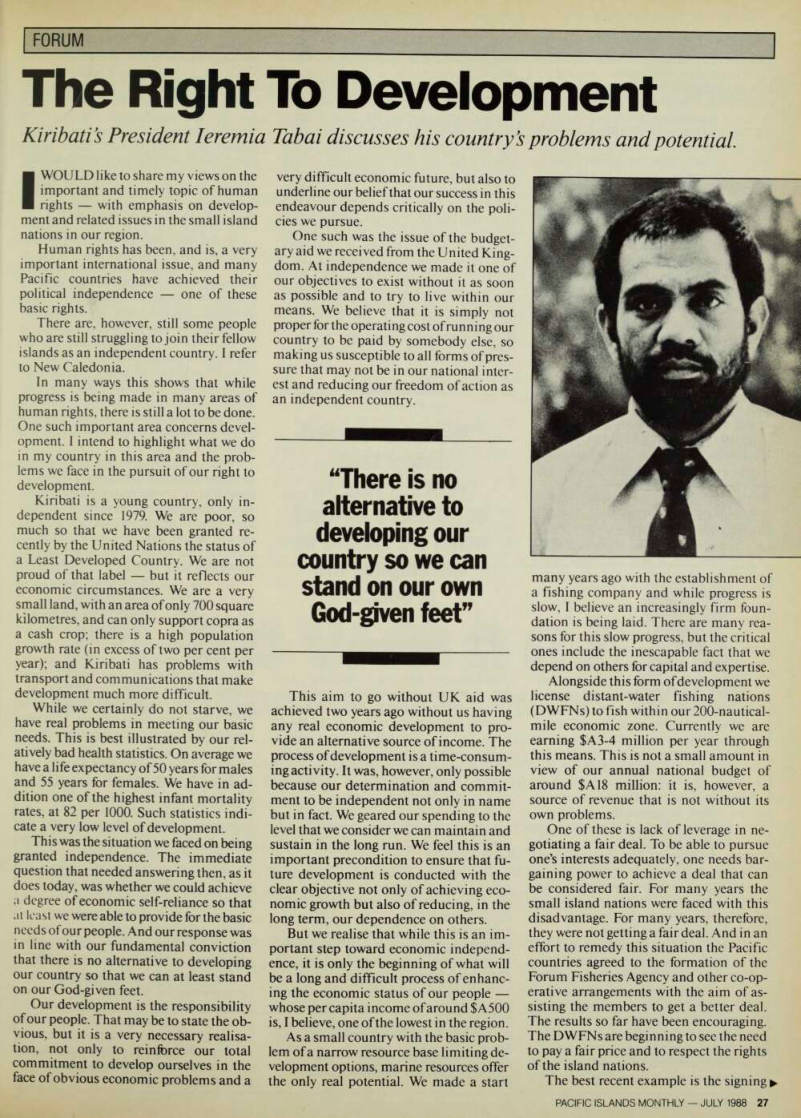
Forum
Kiribati’s President leremia Tabai discusses his country’s problems and potential.
I WOULD like to share my views on the important and timely topic of human rights with emphasis on develop ment and related issues in the small island nations in our region.
Human rights has been, and is, a very important international issue, and many Pacific countries have achieved their political independence one of these basic rights.
There are, however, still some people who are still struggling to join their fellow islands as an independent country. I refer to New Caledonia.
In many ways this shows that while progress is being made in many areas of human rights, there is still a lot to be done.
One such important area concerns devel opment. I intend to highlight what we do in my country in this area and the prob lems we face in the pursuit of our right to development.
Kiribati is a young country, only in dependent since 1979, We are poor, so much so that we have been granted re cently by the United Nations the status of a Least Developed Country. We are not proud of that label but it reflects our economic circumstances. We are a very small land, with an area of only 700 square kilometres, and can only support copra as a cash crop; there is a high population growth rate (in excess of two per cent per year); and Kiribati has problems with transport and communications that make development much more difficult.
While we certainly do not starve, we have real problems in meeting our basic needs. This is best illustrated by our rel atively bad health statistics. On average we have a life expectancy of 50 years for males and 55 years for females. We have in ad dition one of the highest infant mortality rates, at 82 per 1000. Such statistics indi cate a very low level of development.
This was the situation we faced on being granted independence. The immediate question that needed answering then, as it does today, was whether we could achieve a degree of economic self-reliance so that ai least we were able to provide for the basic needs of our people. And our response was in line with our fundamental conviction that there is no alternative to developing our country so that we can at least stand on our God-given feet.
Our development is the responsibility of our people. That may be to state the ob vious, but it is a very necessary realisa tion, not only to reinforce our total commitment to develop ourselves in the face of obvious economic problems and a
very difficult economic future, but also to underline our belief that our success in this endeavour depends critically on the poli cies we pursue.
One such was the issue of the budget ary aid we received from the United King dom. At independence we made it one of our objectives to exist without it as soon as possible and to try to live within our means. We believe that it is simply not proper for the operating cost of running our country to be paid by somebody else, so making us susceptible to all forms of pres sure that may not be in our national inter est and reducing our freedom of action as an independent country.
"There is no alternative to developing our country so we can stand on our own God-given feet”
This aim to go without UK aid was achieved two years ago without us having any real economic development to pro vide an alternative source of income. The process of development is a time-consum ing activity. It was, however, only possible because our determination and commit ment to be independent not only in name but in fact. We geared our spending to the level that we consider we can maintain and sustain in the long run. We feel this is an important precondition to ensure that fu ture development is conducted with the clear objective not only of achieving eco nomic growth but also of reducing, in the long term, our dependence on others.
But we realise that while this is an im portant step toward economic independ ence, it is only the beginning of what will be a long and difficult process of enhanc ing the economic status of our people whose per capita income of around SASOO is, I believe, one of the lowest in the region.
As a small country with the basic prob lem of a narrow resource base limiting de velopment options, marine resources offer the only real potential. We made a start
many years ago with the establishment of a fishing company and while progress is slow, I believe an increasingly firm foun dation is being laid. There are many rea sons for this slow progress, but the critical ones include the inescapable fact that we depend on others for capital and expertise.
Alongside this form of development we license distant-water fishing nations (DWFNs) to fish within our 200-nautical mile economic zone. Currently we are earning SA3-4 million per year through this means. This is not a small amount in view of our annual national budget of around SAIB million: it is, however, a source of revenue that is not without its own problems.
One of these is lack of leverage in ne gotiating a fair deal. To be able to pursue one’s interests adequately, one needs bar gaining power to achieve a deal that can be considered fair. For many years the small island nations were faced with this disadvantage. For many years, therefore, they were not getting a fair deal. And in an effort to remedy this situation the Pacific countries agreed to the formation of the Forum Fisheries Agency and other co-op erative arrangements with the aim of as sisting the members to get a better deal.
The results so far have been encouraging.
The DWFNs are beginning to see the need to pay a fair price and to respect the rights of the island nations.
The best recent example is the signings
of a multilateral fishing treaty with the USA, with the aim of resolving the differ ence between the island nations and the US over illegal fishing within the region’s eco nomic zones. There is now a move to adopt the same regional approach with Japan.
The clear lesson for all is that being poor or weak will not attract to us fair consid eration or sympathy. We simply have to fend for ourselves.
That problem is further compounded by another hangover from the past: the idea that our interests are somehow subordi nate to the interests of other people and in particular those of larger countries whose friendship, it is assumed, is sufficient rea son for us to continue to hang on to the apron-strings of the colonial past. This was very evident a few years ago, when we con cluded a fishing deal with the USSR.
I do not want to dwell long on that ex cept to highlight a certain aspect that is relevant in our attempt to pursue our na tional development goals. The deal is a commercial one. That is not said to please anybody but that is exactly what it is.
We have no time for ideological de bates. We cannot afford the luxury of in volving ourselves in those. Our people expect us to deal with their urgent prob lems of development.
The adverse press we received over the deal with the Soviet Union was unjusti fied and misleading. What we did is very easy to understand. The important thing to note, however, is that somehow, being a small island nation, we are expected to follow others blindly. And that is why our right and capacity to pursue our national interests were, and are, being questioned.
We will continue to make commercial deals with the Russians or with anybody else, if it is in our national interest to do so. We are determined not to allow any thing to stand in the way of our development.
Another obvious area for our devel opment effort is the improvement of the rural and subsistence way of life. This has been our way of life for hundreds of years and there is no viable alternative. To have a proper and balanced development, we cannot afford to ignore the rural areas, home to around 70 per cent of our people who earn their living from rural and sub sistence resources. We must improve transport, communications and fishing access so their lives can be generally made easier. That is why we see the need for such projects as causeway construction, reef blasting and push-handcarts.
We are, in addition to these projects, giving local authorities more powers and resources to allow them to have a greater say in the direction of development in their own areas. We believe it is a most impor tant part of the program to encourage self reliance and independence the under lying theme of our government policies.
In talking about development in a small island nation such as mine it is impossible
not to talk about development aid. In our case, our development budget, which broadly corresponds to our capital ex penditure, is around SA2O million an nually, nearly all of which comes from external aid sources. We are therefore heavily dependent on this source of finan cial assistance for our development pro gram. Most of this assistance is also provided on a bilateral basis rather than on a multilateral basis, making it a diffi cult type of finance to deal with. We all know that not all of these aid offers origi nate out of humanitarian considerations.
The donors also have their own self-inter est to pursue and as a result our relations can become adversely affected because of the likely differences in priority or objec tives. Accepting aid could also become a problem if it side-tracked us from pursu ing our fundamental long term interest.
To reduce the chance of this we are di
“We have wasted important years trying to establish a market when we should be developing the product”
versifying our sources of funding. Since independence we have attracted assist ance from many sources. In particular, we recently became a member of the World Bank and its affiliated financial institu tions to provide the necessary backup in case our source of assistance dries up or is reduced significantly with an adverse im pact on our development effort.
But that is not to say that we are not grateful for this assistance, and I want to thank all those who have offered us help in may ways.
One way to assist the development process is to address trade issues on a re gional basis. Some of the small island na tions, however, find it very difficult to expand their trade. Our experience in this respect has been very tough. Until a few years ago, our export was dominated by phosphate. Now our export is confined virtually to two products fish and co pra both of which have suffered severe adverse price movements, reducing our economy to a state of near stagnation.
Some very tight budgeting has therefore become necessary to keep our finances under control.
In recognition of the problems of ex panding export trade for island nations, the SPARTECA regional trade agreement was drawn up. The agreement aimed to en courage the island countries to export to Australia and New Zealand by giving them tariff-free access to those markets. While nobody can disagree with those noble aims, it soon became apparent that there is an urgent need to improve the agree ment, or at least to look for far more con crete ways in which countries such as ours can start to feel that they benefit as well.
In my view SPARTECA worsens the problem of the widening economic gap: as a member of this part of the region, and as a member of the Forum and other regional institutions, we object strongly to this state of affairs. While I know it would be un reasonable for us to demand the end of the agreement, we do submit that new and im aginative arrangements be put into mo tion to address directly the peculiar problems of the smaller island nations.
What is required is a new frame of mind, a new attitude capable of responding to problems that may not fit with the existing rules of the game.
What changes are being made are probably too minor or too slow to be of any significance. Let me give you an example.
In our attempt to develop our economic base we have developed one product line, namely salt, for which (according to all ad vice) the main constraint to further de velopment is the need for a reliable market.
With expected annual production of only around 25,000 tonnes, finding a mar ket in the region should not be a problem.
It is a tiny amount in relation to the re gional consumption. We have, however, wasted a few important years trying to es tablish a market when we should be de veloping and producing the product. As a result the development of this particular project has been delayed with an unfor tunate effect on our development effort.
In view of our being one of the poorest island nations in the South Pacific, and knowing that SPARTECA is essentially of very little value to us, we expect an offer to buy our salt to assist us in resolving our marketing problem. No such offer has come, but I hope that in time we will get a more positive response from those who are able to assist. While this is just one specific problem, is indicative of the range of problems we face in the pursuit of our economic goal. One basic consideration in all this is the need for us to develop an ex port trade, or an industry that would be able to support our national economy.
And despite the known problems of our narrow resource base and long distance from possible markets, I believe it is still possible not only to take advantage of the regional markets, but also the wider world markets. Progress in these areas would make an important contribution to the process of development. □
Islanders Help Themselves To New Homes

Solomon Islands
Larry Writer reports on a unique scheme to repair the ravages of Cyclone Namu.
CYCLONE NAMU ravaged the Solomon Islands in May 1986. By the time it had roared on its way, Namu’s winds and rain had laid waste to much of the Solomons’ central region. The provinces of Malaita and Guadalcanal suffered most. In Malaita, 7500 or 49 per cent of homes were destroyed; in Guadalcanal, 1600 or 22 percent.
Today the reconstruction of housing in these areas is all but complete, thanks to a remarkable exercise in self-help where the dispossessed villagers were encouraged to rebuild their own houses.
The aid scheme with a difference was born after the Solomon Islands Government announced it could not follow other aid programs, supplying the materials and building the houses for the villagers. Consequently, a consortium was set up. It worked out a system by which it would supply vital materials to allow the villagers to rebuild the roofs of their own homes. (The frames are built with local timber.) But to receive the aid, the villagers would have to pay SSSO toward the cost of each house and had to be in a sit-
uation where local materials were unavail able due to cyclone damage.
The consortium comprised the Euro pean Economic Community, New Zea land, Canada, the Netherlands and the United Nations Development Program based in Suva. The consortium would also send advisers to the villages to demon strate how to construct houses to better withstand cyclones of the future.
The EEC’s Allan Kitchener, manager of the Rural Housing Reconstruction Pro ject, reports from his Honiara base that the project is nearing completion and has been a success ... despite the earlier skepti cism of “experts” in Europe who pre dieted that the project would be scuttled by corruption and wantokism.
Kitchener says this has not happened because care was taken to closely super vise every stage of the program and to carry out a public education campaign com prising leaflets, radio broadcasts and teams of experts visiting the villages.
“Also, village people themselves have the final say in who actually receives the materials not some bureaucrat sitting
in Honiara (me) who does not understand the social and political complexities of life in the stricken areas,” says Kitchener.
In the Solomons, most houses are built using unsawn timber for the foundation posts, roof purlins, rafters and wall frames, Split betel nut palms are fashioned into floors and sago palm leaves cover the roofs and walls. Villagers use traditional lash ing techniques with vines and bush ropes as well as nails and screws to put together structures that will last up to 10 years (un less it’s hit by another cyclone), Families qualifying for the roofing aid were each given 22 sheets of roofing iron, a quantity of ridge capping, 12 kilograms of roofing nails, two kilos of ordinary nails and four kilos of binding wire enough to make a roof for one house for each fam ily. The materials were manufactured overseas, then shipped to Honiara and distributed to each village ward, Allan Kitchener adds that the element of self help has caused the villagers totake the project more seriously than if they were given the aid with no strings attached and everything done for them. □
Advertisements & other items, p. 29 (1 item)
bowman/
BUILDING IN THE SOLOMONS
Bowmans Ltd., a wholly owned Solomon Island Company, stock a complete range of hardware and building materials and are the leading distributors and importers of products for the construction industry in the country.
Bowmans were selected by the Solomon Island Government as the major supplier of building materials for the Government's Rural Housing Reconstruction Project against strong tenderers from Europe, Japan, Australia and New Zealand.
Product quality, keen prices and excellent before and after Sale Service are the key to their success.
Bowmans are proud of being awarded the $2.2 million contract to supply roofing materials to that project, and for being given the opportunity to help ensure it's overall success.
Ph.(677) 21901
Bowmans Ltd.
P.O. Box 514 Honiara
SOLOMON ISLANDS
Fax (677)22943
Pacific Report
□ Family Continues Fight
THE family of the late former Premier of the Cook Islands, Albert Henry, believe their father was unjustly treated when he was convicted of conspiracy charges.
They are defending his right to have “Sir” engraved on his tombstone, though Albert Henry was striped of his knight hood in 1980.
The late Premier was convicted of con spiracy charges involving $337,000 of Cook Islands Government money. Tupui Ariki Henry, son of Albert Henry, is emphatic that his father was not guilty.
“We are putting ’Sir’ back on the tomb stone on the strength that the old man was not guilty,” Tupui Henry said. Mr Henry claims to have in his possession files that state the truth.
“We don’t think our father was right; we know he was right, and have the evi dence that proves him right.
“But it can’t be decided in any court because the court’s decision was unap pealable ... it has to be made known some other way.”
Albert Royle Henry was knighted by Queen Elizabeth II in 1974.
The $337,000 that caused his knight hood to be withdrawn was used to charter planes to fly Cook Islands voters from New Zealand to Rarotonga before the 1978 election, which saw Albert Henry voted back to power.
He died in 1981 Mr Albert Henry, but his family has had a tombstone engraved bearing the words Sir Albert Royle Henry.
Tupui Henry said the family is trying to clear his father’s tainted name and have his knighthood restored: he had ap proached NZ Prime Minister David Lange about the matter, so far without success.
Albert Henry originally pleaded not guilty to the conspiracy charges, but changed his plea to guilty and was sen tenced to three years’ probation with a condition that he did not become a can didate for political office.
“Dad was advised by his lawyers to plead guilty because that way the fine would be minimum, he would carry on as premier and he would carry on as Sir Al bert that’s why he changed his plea,” said Mr Tupui Henry.
Albert Henry’s tombstone was made in Auckland, and Mr Tupui Henry said it would be taken back to the Cook Islands and placed on his father’s grave.
“At the moment there’s just his bust. It’s a centre of interest not only for the locals, but tourists as well,” he said.
“Although Dad may not have his name cleared by the court, it will be cleared by the people who knew him and they will re member him as Sir Albert Henry.”
The tombstone arrived in Rarotonga in May: however, the family has not de cided when to have it mounted.
□ Aquaculture On Guam
THE United States Army Corps of Engi neers is investigating the environmental impact of proposals to fill wetlands on Guam for construction of aquaculture ponds and facilities.
According to Colonel Chip Wanner, Honolulu District Engineer, work would promote the aquaculture industry, but should any federal or Guam agency notify the Corps that proposed activity is detri mental to fish and wildlife or other envi ronmental or cultural resources, the Corps would issue a suspension order and, if nec essary, direct remedial measures be taken.
□ Rabaul Vulcanology Rumbles
AUTHORITIES in Papua New Guinea’s East New Britain province believe they know the identity of those responsible for harassment of staff and damage to equip ment at the Rabaul vulcanological observatory.
The incidents, which resulted in the resignation of two expatriate members of the observatory staff and the threatened resignation of the observatory chief, Doc tor Peter Lowenstein, were apparently caused by disgruntled former employees at the observatory.
Efforts are under way to identify those involved before the matter is placed in the hands of law enforcement agencies. Ra baul’s Disaster Control Committee mon itors the equipment, and can take measures to evacuate town residents in the event of an eruption.
□ 2500-Year-Old Fijians Found
A TEAM of New Zealand archaeologists excavating burial sites at the Sigatoka sand dunes 90 kilometres west of Suva has re covered the remains of about 50 people and according to radiocarbon dating the sites are around 2500 years old.
The leader of the New Zealand team, Doctor Simon Best of Auckland Univer sity, said the burial sites are not only im portant to Fiji, but to the whole of the South Pacific. They strongly resemble those of the early Polynesians who colon ised parts of the South Pacific.
The remains will be given to the Fiji Museum, except for some that will be sent to New Zealand for further study then re turned and re-buried at the sites.
□ Violence Mars Samoa Cricket
THE 1988 Samoan Cricket Competition has been cancelled following violence in volving two village cricket teams. The
cause of the violence was an umpire’s con troversial decision that resulted in mem bers of one team attacking those of the other with cricket bats.
Samoan cricket is a modified version of the English game and requires a differ ent kind of bat, ball and stumps. The num ber of players is almost unlimited, and fatalities have resulted in the past from the use of cricket bats in disputes.
□ Nz Fisheries Row Resolved?
DAYS after public uproar greeted a June Waitangi Tribunal ruling that Northland Maoris have under the 1940 Treaty of Waitangi exclusive ownership of their fisheries, a radical plan was mooted to soothe the row. The proposal, for a fish eries corporation owned and controlled jointly by the State and Maori people, was rejected by Maori members of the NZ government’s working committee on fish ing rights; nor was it approved by cabinet ministers.
Although the tribunal’s ruling is not le gally binding, Mana Motuhake party leader Matiu Rata hailed it as heralding a new economic order for Maoridom . .. while hostile fishing industry leaders warned of violence over the claims.
□ University Branch In Tonga
A multi-million dollar extension of the Pa cific and Asia Christian University is to be established in Tonga by Youth With A Mission, an international inter-denomi national organisation that established the university in Hawaii in 1982.
“In this university we put God first,” said Mr David Holmes, director of a re search institute set up as part of the uni versity’s overall planning. “We believe that if God is put first in education, then the whole man is built up. It is not just a ques tion of knowledge knowledge must come with wisdom.”
The director said his institute will first determine the specific needs of the King dom and the means by which the univer sity can fulfill those needs. A board of reference, consisting mainly of Tongans, will oversee the project.
Among the specific objectives of the extension are: to provide tertiary educa tion within the Kingdom in selected dis ciplines at a cost within reach of the people: to establish a model pre-school and early childhood education centre for the devel opment of new curricula and teacher training; to provide seminars, workshops, and short courses of significance for those in business and Government; and to fa cilitate the establishment of new Tongan businesses and to enhance those already established.
Although the university has met all the requirements for the purpose of issuing university degrees under the state laws of Hawaii, it is not yet accredited by any agency or association recognised by the US Commissioner of Education.
□ Hospital Plan For Pacific
THE Ministry of Health and staff of the National Hospital in Apia will be receiv ing special assistance in hospital opera tions improvements under a program funded by USAID’s Regional Office in Suva, Fiji. Mercy International Health Services, which, conducted a hospital charges and budget study and provided basic computer training for the Ministry’s finance staff several months ago, will be in charge of this new project.
Mercy will provide an expert team composed of a hospital administrator, hospital finance officer, nurse director and plant engineer to work on-site in Apia with the appropriate hospital staff and depart ments. After a review of each depart ment’s current operations the team, with its Samoan counterparts, will prepare an action plan for improvements in each hos pital department.
Assistance will also be provided through the formation of an in-service ed ucation committee at the National Hos pital to encourage utilisation of local personnel in providing a large portion of training needs at the facility.
On a broader regional scale, selected employees from each of the four Federated States of Micronesia will receive speci alised training in hospital electronic equipment repair under a training pro gram being provided by Mercy.
A complete biomedical equipment in ventory of each of the FSM hospitals was completed as the first step in the program.
This was followed by a site visit to each of the participating hospitals by Mr Tom Schuessler, a Mercy biomedical electron ics engineer. Mr Scheussler met with health directors and trainees to determine spe cific skills each should acquire during the formal training phase of the project. Dur ing the next phase of the project the four trainees will spend three months at St Jo seph Mercy Hospital in Mason City, lowa, where they will receive intensive training by the regional hospital’s biomedical elec tronics staff under the direction of Mr Schuessler.
It is also planned to provide them with an introduction to refrigeration repair and other skills particularly needed to help maintain equipment at FSM health care facilities. The four will then return to their hospitals, accompanied by instructors from the biomedical electronics staff at Mercy Hospital, who will assist the newly trained technicians in implementing maintenance and repair programs. The hospitals will also be provided with elec tronics tool kits and basic test equipment.
□ Fiji Indians Look To Nz
A YEAR after the first military coup in Fiji, Fiji Indians are still inquiring for re sidency in New Zealand. Figures released at the end of April showed applications granted were doubling compared with the same month last year. A peak was reached in December 1987, when 64 families were granted residency. An application now costs SNZ2OO, so people unlikely to suc ceed are advised not to apply.
□ Niueans Object To French Aid
NIUEANS in New Zealand have objected to their government accepting aid from the French. About 21,000 signed a petition ob jected to their government accepting a major aid package for a new telecommun ication system. The objectors, mainly concerned by continued nuclear bomb testing, presented their petition to Mr Vi vian Young, leader of the Niuean Oppo sition People’s Action Party, who was visiting Wellington.
□ Skin Specialist Honoured
DR lAN PRYOR, former director of Wel lington Hospital’s epidemiology unit and well known for research work in the is lands, was presented with an honorary Doctor of Science degree at Victoria Uni versity, Wellington. His early research fo cused on health problems of Maori people, while later research was conducted in the Pacific, notably in Tokelau. □
□ Solar Water For The Islands
“OUR SOLAR systems currently supply village water to at least seven Torres Strait Island communities: in fact, there are more island communities on our order list.”
Mono Pumps (Australia) Pty Ltd’s export manager Rick Bertisan is delighted with the wide acceptance of the Mono Suntron solar water-pumping system in the Torres Strait Islands. Bertisan says water re sources on these islands are limited, so systems were developed to collect water from hillside soaks by collection galleries to a lined well. Water is then pumped via a surface-mounted system housed in a shed with the equipment on the roof.
Coconut Island, for example, with a population of 150 people, is served by a 16 solar panel system pumping 16,000 to 21,500 litres per day at a 20-metre head.
The Mono solar system has no wearing parts compared with a windmill-powered system; spare parts are readily available and solar power is adaptable to every site, while wind power is only adaptable to some. Mono Suntron pumps, made in Mordialloc, Victoria, have been exten sively tested in the Australian outback, where they operate from an hour after sunrise to within an hour of sunset.
□ Dumped ... On Page One
ELECTRICORP and private firms in New Zealand shipped toxic wastes to Wales for incineration last year, the Auckland Sun day Star noted in a postscript to a Page One lead, reporting that the Tongan Cab inet would consider a secret plan to burn and dump toxic wastes from the United States. Details had been leaked to the pa per, the Sunday Star reported.
□ To Fiji From The Cooks
CASHMORE MCNICOL, a clothing company and one of the Cook Islands’ largest private employers, is reported to be moving its opperations to Fiji. The New Zealand based company was originally the Olsen Clothing Company; its factory in Rarotonga employed about 50 people, most of them women.
□ Fiji Tourism Stirs Again
NEW ZEALANDERS are beginning to inquire again at travel agencies about Fiji resorts, but bookings have only been tric kling in. One agency that has taken a few bookings said the present trend was to book accommodation on Viti Levu for one night rather than longer holidays, at this stage, on smaller islands.
□ Bcl Wants Ban Lifted
BOUGAINVILLE Copper chairman Don Carruthers has called for a lifting of the 15year ban on exploration on Bougainville.
Mr Carruthers informed BCL share holders that the Bougainville Copper Agreement was due for review this year and that lifting of the local moratorium on ex ploration headed BCL’s priorities for the review of the agreement.
The agreement provides for discus sions between BCL and the Papua New Guinea Government every seven years to ensure it is operating fairly (Bougainville Copper is 53.6 per cent owned by CRA, 19.1 per cent by the PNG Government, and the rest by public shareholders).
Initial discussions on the review had taken place with both the PNG and Prov incial Governments, and a timetable for the review was being drawn up. “Because of the long lead times in exploration, eval uation and development of any resource that may be discovered, it is of the utmost importance that the moratorium now be lifted,” Carruthers said.
The PNG Government had indicated it is willing to lift the exploration ban, but the Provincial Government has stated that questions of compensation and the social
sffiMsr“
Bougainville Copper recorded a profit in 1987 ofsA 147.7 million (K 93.6 million), up 106 per cent on the previous year and the best result in real terms since 1974. The increased profit reflected exceptionally good copper prices, particularly in the second half of the year. Copper prices had reached a record SUS 1.45 per pound at the end of the year, taking the average for the year to USBI cents compared with US6I cents in 1986.
Gold prices had also been strong, averaging SUS 447 per ounce in 1987 compared with SUS36B the previous year.
□ New Firefighter
A NEW high-pressure firefighting pump has been released by Pacific Pump Company of Rydalmere, NSW. Called the QP2O3SE, the new firefighter is of alloy construction and is fitted as standard with a three-way firefighting outlet that provides two 2.5 cm (1 ”) outlets and one 3.5 cm (1 “) outlets. The unit is capable of a maximum head in excess of 74.9 m (246 ft) and an output pressure of more than 100 PSI.
Maximum flow is 400 litres (88 gallons) per minute.
Due to the variety of applications for such a pump, Pacific is offering the QP2O3SE in both Honda and Briggs & Stratton petrol-powered configurations and Acme diesel-powered form.
Advertisements & other items, pp. 30-31 (2 items)
30
PAHIFir. IS! AMDS MONTHI Y .1111 Y IQftft
Building in the Pacific
John Lysaght (Papua New Guinea) Pty Ltd wishes to congratulate Bowmans Limited of Honiara on being selected as the major supplier of building materials for the Solomon Islands Government Rural Housing Reconstruction Project.
John Lysaght are very proud that their “Twice The Life’’
Zincalume Custom Orb® Corrugated Roof Sheeting was selected as the roof sheeting for this worthwhile project.
We are also pleased to advise that we were able to meet the rigid timetable required to successfully carry out the contract.
Trade Winds
Hawaii’s Irradiation Scandal
By Michael Moriarty
HAWAII’S PAPAYA industry has been suffering since September 1984, when the United States En vironmental Protection Agency disal lowed the use of ethylene dibromide (EDB) as a post-harvest fumigating agent. This treatment had been used as a measure to kill the larvae and eggs of the Mediterra nean fruit fly, the melon fly and the ori ental fruit fly, preventing their spread to North Amercia and protecting the main land’s billion dollar fruit growing industry.
EDB had been effective, but had also been implicated as a carcinogen and was considered by the Food and Drug Admin istration to be too dangerous; its ban left the industry temporarily unable to export to its main markets in North America and Japan. Shortly thereafter, the use of a “double-dip” hot water bath (a new proc ess) and “vapour heat” treatment (used before EDB) were approved.
Amid the celebration some batches of fruit treated by the double-dip method reached North America carrying the lar vae of the dreaded fruit fly. This problem was eventually overcome, but the situa tion was confused once more by effects on the fruit. In order to withstand the double dip method, papayas had to be picked ear lier and so were not as sweet; the product began to lose the uniform high quality
growers had worked so hard to achieve.
It was soon suggested that irradiation be used as an effective killer of fruit fly lar vae. This it does well: the texture of the fruit is unaffected and picking can occur at the proper time to insure sweetness. The State of Hawaii had been involved in testing ir radiation from 1967 to 1980 in the centre of Honolulu, and evidence has surfaced of an accident involving a leaking Cobalt 60 source, contamination of the facility and the release of radioactive waste water into a public sewer. The incident has had the effect of calling into question the safety of irradiation technology and the credibility of the State of Hawaii’s role as a protector of the public.
The key question is whether such a fa cility, is a safe neighbour. Evidently, quite a few citizens of Hawaii County (where the main papaya industry is located) don’t think so: they formed the “East Hawaii Coalition To Stop Food Irradiation” to oppose construction of an irradiation fa cility in Hawaii County.
The coalition points to the dangers of the facility and questions the safety of ir radiated food; Unique Radiolytic Prod ucts (URPs) are formed in irradiated foods and the Hungarian Academy of Sciences has found more than 1400 adverse effects of food irradiation.
Opponents also point out that the source for the radioactivity is Cobalt 60 from America’s troubled nuclear power industry: those who oppose nuclear power see irradiation as spreading waste the Nu clear Regulatory Commission does not know how to deal with, since hazardous waste disposal sites do not find commu nities queuing to welcome them. But what of the market? Japan understandably wants no part of irradiated fruit after its own horrifying experience of nuclear en ergy in 1945.
Joining the Japanese are England and West Germany, both of which have out lawed the sale of irradiated food. Con sumer acceptance in America seems mixed at best: all 1200 members of the Southern California Grocers’ Association announced they would not sell irradiated papayas and 60 to 75 per cent of Ha waii’s papayas are marketed in Los An geles. The State of Maine has outlawed the sale of irradiated food outright.
Whether it’s safe or otherwise, the mat ter of building an irradiation facility may come down to the political clout each side is able to muster. Realistically, the decid ing factor in whether such a facility is built, may turn out to be whether Americans like the idea of eating food that has been ex posed to nuclear waste. □
NZ Garment Workers Pretest
By Robin Bromby
IN LATE May workers took to the streets of Christchurch, in New Zea land’s South Island, with banners call ing for controls on Fijian goods. It was the most obvious manifestation of growing union anger at competition from low-paid island workers an anger that grows with every factory closure and one that looks like becoming a major political issue in economically depressed New Zealand.
In May, Christchurch garment maker R W Saunders Ltd closed its factory and fired all 95 workers. Another clothing firm, Lane Walker Rudkin, had previously an nounced the closing of its garment plants in the small South Island towns of Te muka and Westport.
The closures reflect the deep economic recession that has swept across New Zea land, particularly the South Island, and the government’s allowing 50 per cent of gar ment content to be imported. Already an Auckland company, Miller Apparel, has entered a joint venture with two Fijian companies and Melbourne’s Stafford Group that will eventually employ 2500 Fijian workers.
When clothing workers took to the streets of Christchurch, some of the signs specifically attacked Fiji for costing NZ workers’ jobs; others complained “Free
Trade Zones Formal Slavery”.
The recession has affected not just the garment industry, but most of New Zea land manufacturing. Barely a day goes by but the newspapers report another factory closure, but Fijian labour is a clear target.
There are fears that, as things turn worse in New Zealand, feelings will turn against countries seen to be doing well at New Zealand’s expense. There is certainly con cern within Austrade, the Australian fed eral trade organisation, that continuing de industrialisation of New Zealand will turn the country against the Closer Economic Relationship accord if Australians are seen to be getting the better of the deal.
It is an issue that has joined both em ployers and unions in New Zealand. Chris Pickrill, managing director of the Lane Walker Rudkin subsidiary that closed two factories in May, has been reported as say ing the government had gone overboard to provide help to South Pacific Forum countries. The Textile and Garment Trade Group estimates that within a year the Fi jian garment industry could grow to half the size of New Zealand’s.
Fiji has been rubbing further salt in the wounds by taking out advertisements in New Zealand papers promoting the tax incentives offered to new industries. □
Advertisements & other items, pp. 33-34 (1 item)
Tropical Reef Shipyard
LTD.
CAIRNS
NORTH QUEENSLAND
AUSTRALIA
SERVICING P.N.G. AND THE PACIFIC
SHIP REPAIRS AND MAINTENANCE
MAIN SLIPWAY CAPACITY
3,000 TONNES
PLUS
4 SLIPWAYS RATED AT
100 TONNES
To minimize a ship's time out of service, our shipyard works 24 hours per day, 7 days a week. B- • ;-j ’• f * ♦ , 555 r -'l'jj
FOR INFORMATION
PLEASE CONTACT...
Tropical Reef Shipyard Pty Ltd
SMITH’S CREEK, CAIRNS
P.O. BOX 44
QUEENSLAND 4870 AUSTRALIA
PHONE (070) 51 6877 (6 lines)
TELEX AA 48206 “RANTRO”
FAX. NO: (070) 51 0798.
1 Who can you bank on to be there
for you throughout the Pacific?
Travelling around the Pacific’s a breeze when you bank on Westpac. Because Westpac is the most widely represented bank in the South Pacific.
When you’re away from home, money worries should be the least of your problems. And that’s why you can bank on us at Westpac we’re equipped to handle your needs.
Call in to any Westpac office for friendly advice on travel finance, such as MASTERCARD, FOREIGN
CURRENCY EXCHANGE, TELEGRAPHIC
TRANSFERS and TRAVELLERS CHEQUES.
%l# You can bank on Westpac
Travel Finance
Branches Bahrain ■ Beijing ■ Chicago ■ Columbus ■ Frankfurt ■ Hong Kong ■ Honiara ■ Houston ■ Jakarta ■ Jersey ■ Kuala Lumpur ■ London ■ Los , York ■ Niue ■ Port Moresby ■ San Francisco ■ Seoul ■ Singapore ■ Suva ■ Sydney B Taipei B Tokyo B Port Vila B Wellington
Fiji
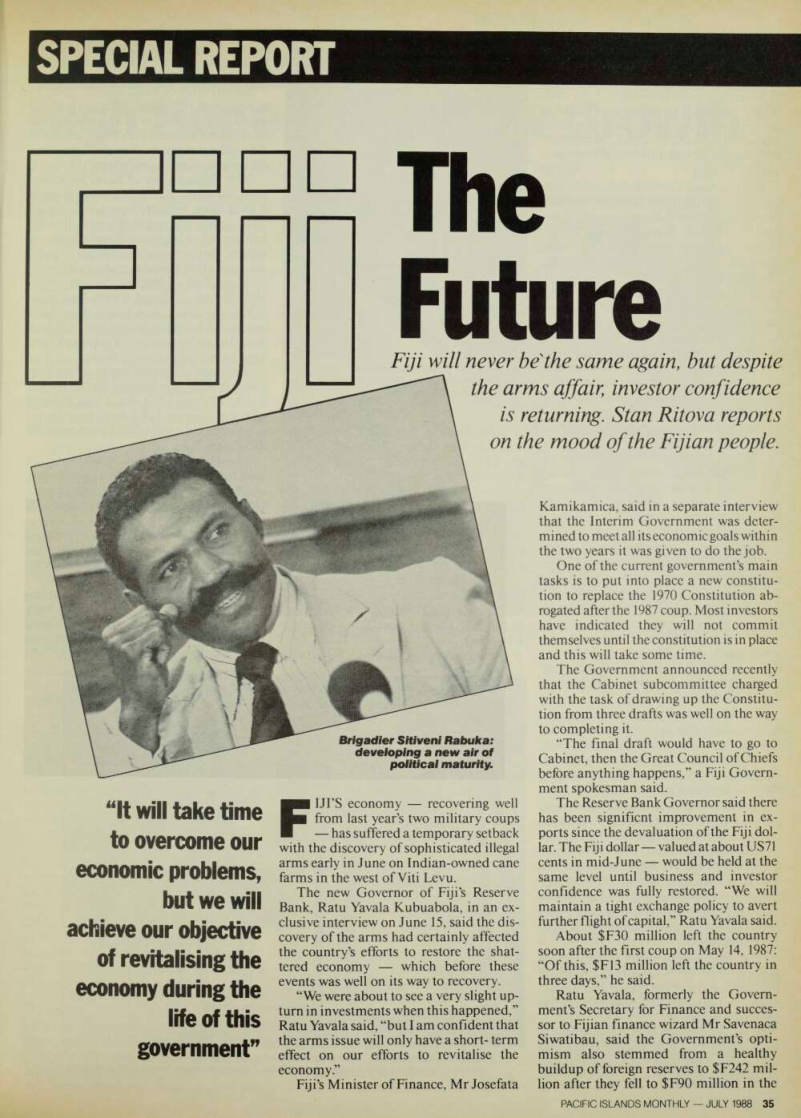
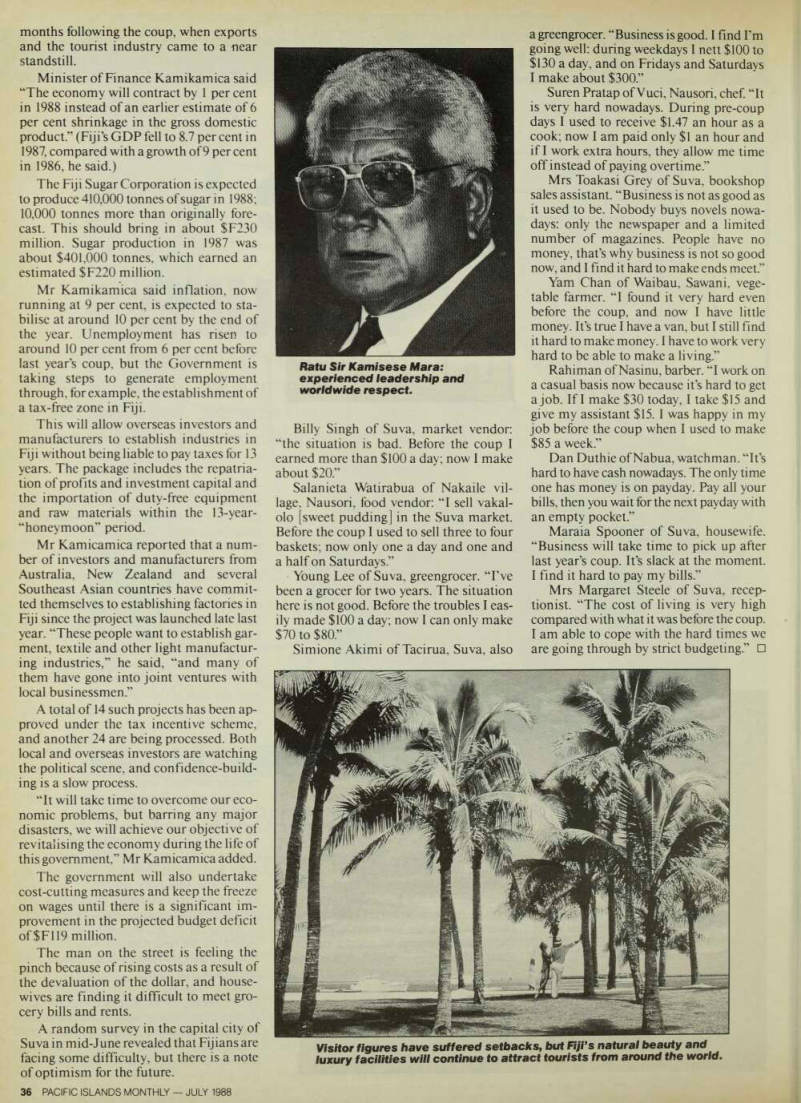
Special Report
The Future
Fiji will never be'the same again, but despite the arms affair, investor confidence \ is returning. Stan Ritova reports \ on the mood of the Fijian people.
“It will take time to overcome our economic problems, but we will achieve our objective of revitalising the economy during the life of this government”
FIJI’S economy recovering well from last year’s two military coups has suffered a temporary setback with the discovery of sophisticated illegal arms early in June on Indian-owned cane farms in the west of Viti Levu.
The new Governor of Fiji’s Reserve Bank, Ratu Yavala Kubuabola, in an ex clusive interview on June 15, said the dis covery of the arms had certainly affected the country’s efforts to restore the shat tered economy which before these events was well on its way to recovery.
“We were about to see a very slight up turn in investments when this happened,”
Ratu Yavala said, “but I am confident that the arms issue will only have a short- term effect on our efforts to revitalise the economy.”
Fiji’s Minister of Finance, Mr Josefata
Kamikamica, said in a separate interview that the Interim Government was deter mined to meet all its economic goals within the two years it was given to do the job.
One of the current government’s main tasks is to put into place a new constitu tion to replace the 1970 Constitution ab rogated after the 1987 coup. Most investors have indicated they will not commit themselves until the constitution is in place and this will take some time.
The Government announced recently that the Cabinet subcommittee charged with the task of drawing up the Constitu tion from three drafts was well on the way to completing it.
“The final draft would have to go to Cabinet, then the Great Council of Chiefs before anything happens,” a Fiji Govern ment spokesman said.
The Reserve Bank Governor said there has been significnt improvement in ex ports since the devaluation of the Fiji dol lar. The Fiji dollar valued at about US7I cents in mid-June would be held at the same level until business and investor confidence was fully restored. “We will maintain a tight exchange policy to avert further flight of capital,” Ratu Yavala said.
About SF3O million left the country soon after the first coup on May 14, 1987: “Of this, SFI3 million left the country in three days,” he said.
Ratu Yavala, formerly the Govern ment’s Secretary for Finance and succes sor to Fijian finance wizard Mr Savenaca Siwatibau, said the Government’s opti mism also stemmed from a healthy buildup of foreign reserves to $F242 mil lion after they fell to SF9O million in the
Brigadier Sdiveni Rabuka: developing a new air of political maturity.
months following the coup, when exports and the tourist industry came to a near standstill.
Minister of Finance Kamikamica said “The economy will contract by 1 per cent in 1988 instead of an earlier estimate of 6 per cent shrinkage in the gross domestic product.” (Fiji’s GDP fell to 8.7 per cent in 1987, compared with a growth of 9 per cent in 1986, he said.) The Fiji Sugar Corporation is expected to produce 410,000 tonnes of sugar in 1988; 10,000 tonnes more than originally fore cast. This should bring in about SF23O million. Sugar production in 1987 was about $401,000 tonnes, which earned an estimated SF22O million.
Mr Kamikamica said inflation, now running at 9 per cent, is expected to sta bilise at around 10 per cent by the end of the year. Unemployment has risen to around 10 per cent from 6 per cent before last year’s coup, but the Government is taking steps to generate employment through, for example, the establishment of a tax-free zone in Fiji.
This will allow overseas investors and manufacturers to establish industries in Fiji without being liable to pay taxes for 13 years. The package includes the repatria tion of profits and investment capital and the importation of duty-free equipment and raw materials within the 13-year “honeymoon” period.
Mr Kamicamica reported that a num ber of investors and manufacturers from Australia, New Zealand and several Southeast Asian countries have commit ted themselves to establishing factories in Fiji since the project was launched late last year. “These people want to establish gar ment, textile and other light manufactur ing industries,” he said, “and many of them have gone into joint ventures with local businessmen.”
A total of 14 such projects has been ap proved under the tax incentive scheme, and another 24 are being processed. Both local and overseas investors are watching the political scene, and confidence-build ing is a slow process.
“It will take time to overcome our eco nomic problems, but barring any major disasters, we will achieve our objective of revitalising the economy during the life of this government,” Mr Kamicamica added.
The government will also undertake cost-cutting measures and keep the freeze on wages until there is a significant im provement in the projected budget deficit of SFII9 million.
The man on the street is feeling the pinch because of rising costs as a result of the devaluation of the dollar, and house wives are finding it difficult to meet gro cery bills and rents.
A random survey in the capital city of Suva in mid-June revealed that Fijians are facing some difficulty, but there is a note of optimism for the future.
Billy Singh of Suva, market vendor: “the situation is bad. Before the coup I earned more than $lOO a day; now I make about $20.”
Salanieta Watirabua of Nakaile vil lage, Nausori, food vendor: “I sell vakal olo [sweet pudding] in the Suva market.
Before the coup I used to sell three to four baskets; now only one a day and one and a half on Saturdays.”
Young Lee of Suva, greengrocer. “I’ve been a grocer for two years. The situation here is not good. Before the troubles I eas ily made $lOO a day; now I can only make $7O to $80.”
Simione Akimi of Tacirua, Suva, also
a greengrocer. “Business is good. I find I’m going well: during weekdays I nett $lOO to $l3O a day, and on Fridays and Saturdays I make about $300.”
Suren Pratap of Vuci, Nausori, chef. “It is very hard nowadays. During pre-coup days I used to receive $1.47 an hour as a cook; now I am paid only $1 an hour and if I work extra hours, they allow me time off instead of paying overtime.”
Mrs Toakasi Grey of Suva, bookshop sales assistant. “Business is not as good as it used to be. Nobody buys novels nowa days: only the newspaper and a limited number of magazines. People have no money, that’s why business is not so good now, and I find it hard to make ends meet.”
Yam Chan of Waibau, Sawani, vege table farmer. “I found it very hard even before the coup, and now I have little money. It’s true I have a van, but I still find it hard to make money. I have to work very hard to be able to make a living.”
Rahiman of Nasinu, barber. “I work on a casual basis now because it’s hard to get a job. If I make $3O today, I take $l5 and give my assistant $l5. I was happy in my job before the coup when I used to make $B5 a week.”
Dan Duthie of Nabua, watchman. “It’s hard to have cash nowadays. The only time one has money is on payday. Pay all your bills, then you wait for the next payday with an empty pocket.”
Maraia Spooner of Suva, housewife.
“Business will take time to pick up after last year’s coup. It’s slack at the moment.
I find it hard to pay my bills.”
Mrs Margaret Steele of Suva, recep tionist. “The cost of living is very high compared with what it was before the coup.
I am able to cope with the hard times we are going through by strict budgeting.” □
Visitor figures have suffered setbacks, but Fiji’s natural beauty and luxury facilities will continue to attract tourists from around the world.
Ratu Sir Kamisese Mara: experienced leadership and worldwide respect.
High Hopes, But Slow Growth
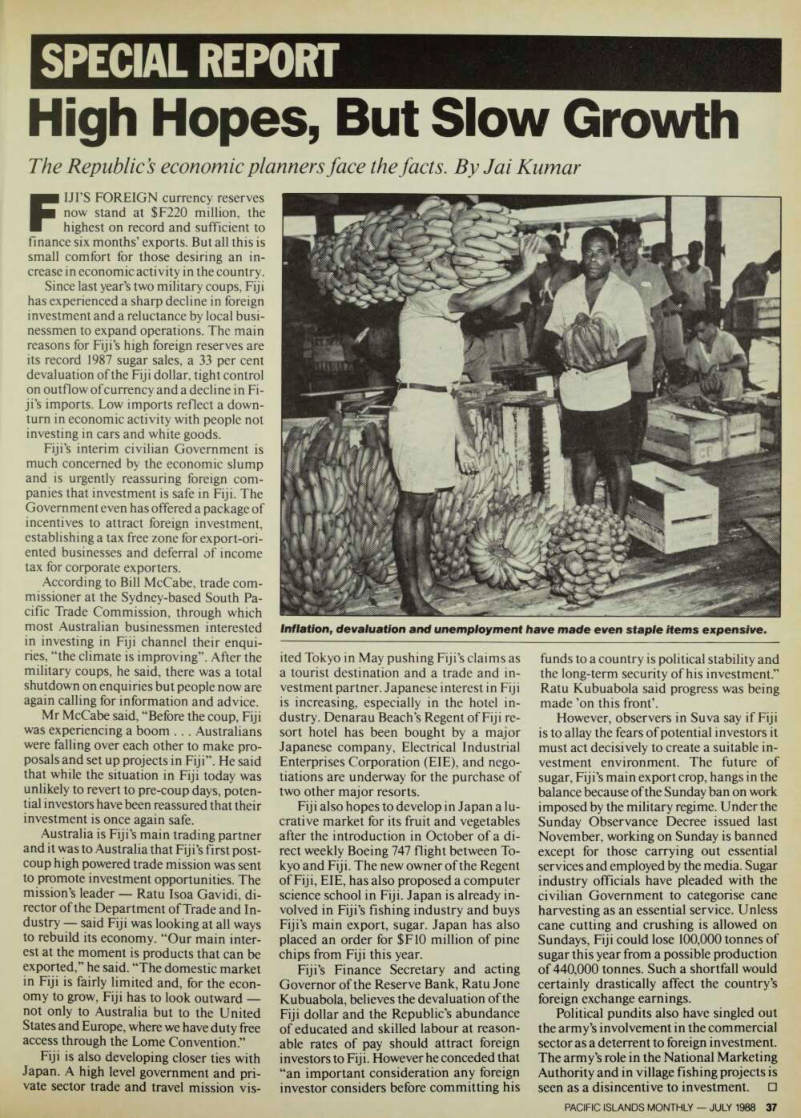
The Republic’s economic planners face the facts.
By Jai Kumar
FIJI’S FOREIGN currency reserves now stand at SF22O million, the highest on record and sufficient to finance six months’ exports. But all this is small comfort for those desiring an in crease in economic activity in the country.
Since last year’s two military coups, Fiji has experienced a sharp decline in foreign investment and a reluctance by local busi nessmen to expand operations. The main reasons for Fiji’s high foreign reserves are its record 1987 sugar sales, a 33 per cent devaluation of the Fiji dollar, tight control on outflow of currency and a decline in Fi ji’s imports. Low imports reflect a down turn in economic activity with people not investing in cars and white goods.
Fiji’s interim civilian Government is much concerned by the economic slump and is urgently reassuring foreign com panies that investment is safe in Fiji. The Government even has offered a package of incentives to attract foreign investment, establishing a tax free zone for export-ori ented businesses and deferral of income tax for corporate exporters.
According to Bill McCabe, trade com missioner at the Sydney-based South Pa cific Trade Commission, through which most Australian businessmen interested in investing in Fiji channel their enqui ries, “the climate is improving”. After the military coups, he said, there was a total shutdown on enquiries but people now are again calling for information and advice.
Mr McCabe said, “Before the coup, Fiji was experiencing a boom . . . Australians were falling over each other to make pro posals and set up projects in Fiji”. He said that while the situation in Fiji today was unlikely to revert to pre-coup days, poten tial investors have been reassured that their investment is once again safe.
Australia is Fiji’s main trading partner and it was to Australia that Fiji’s first post coup high powered trade mission was sent to promote investment opportunities. The mission’s leader Ratu Isoa Gavidi, di rector of the Department of Trade and In dustry said Fiji was looking at all ways to rebuild its economy. “Our main inter est at the moment is products that can be exported,” he said. “The domestic market in Fiji is fairly limited and, for the econ omy to grow, Fiji has to look outward not only to Australia but to the United States and Europe, where we have duty free access through the Lome Convention.”
Fiji is also developing closer ties with Japan. A high level government and pri vate sector trade and travel mission vis-
ited Tokyo in May pushing Fiji’s claims as a tourist destination and a trade and in vestment partner. Japanese interest in Fiji is increasing, especially in the hotel in dustry. Denarau Beach’s Regent of Fiji re sort hotel has been bought by a major Japanese company, Electrical Industrial Enterprises Corporation (EIE), and nego tiations are underway for the purchase of two other major resorts.
Fiji also hopes to develop in Japan a lu crative market for its fruit and vegetables after the introduction in October of a di rect weekly Boeing 747 flight between To kyo and Fiji. The new owner of the Regent of Fiji, EIE, has also proposed a computer science school in Fiji. Japan is already in volved in Fiji’s fishing industry and buys Fiji’s main export, sugar. Japan has also placed an order for SFIO million of pine chips from Fiji this year.
Fiji’s Finance Secretary and acting Governor of the Reserve Bank, Ratu Jone Kubuabola, believes the devaluation of the Fiji dollar and the Republic’s abundance of educated and skilled labour at reason able rates of pay should attract foreign investors to Fiji. However he conceded that “an important consideration any foreign investor considers before committing his
funds to a country is political stability and the long-term security of his investment.”
Ratu Kubuabola said progress was being made ’on this front’.
However, observers in Suva say if Fiji is to allay the fears of potential investors it must act decisively to create a suitable in vestment environment. The future of sugar, Fiji’s main export crop, hangs in the balance because of the Sunday ban on work imposed by the military regime. Under the Sunday Observance Decree issued last November, working on Sunday is banned except for those carrying out essential services and employed by the media. Sugar industry officials have pleaded with the civilian Government to categorise cane harvesting as an essential service. Unless cane cutting and crushing is allowed on Sundays, Fiji could lose 100,000 tonnes of sugar this year from a possible production of 440,000 tonnes. Such a shortfall would certainly drastically affect the country’s foreign exchange earnings.
Political pundits also have singled out the army’s involvement in the commercial sector as a deterrent to foreign investment.
The army’s role in the National Marketing Authority and in village fishing projects is seen as a disincentive to investment. □
Inflation, devaluation and unemployment have made even staple items expensive.
Tourism Makes A Slow Recovery
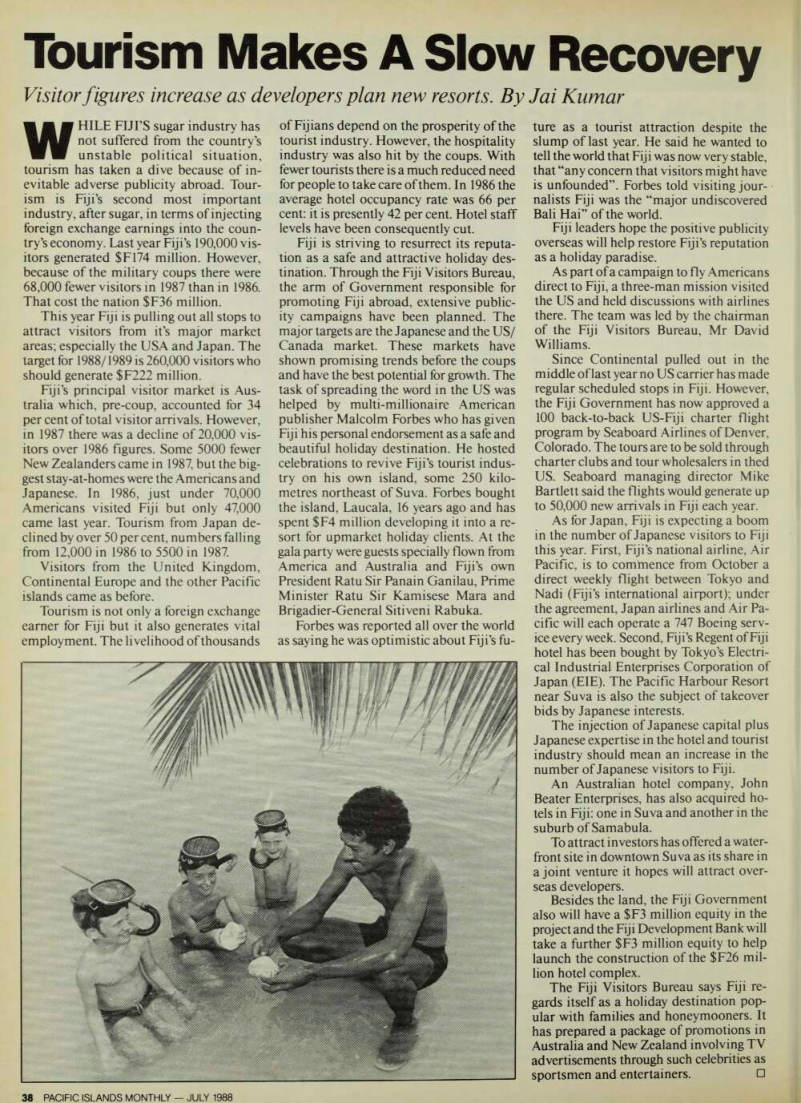
Visitor figures increase as developers plan new resorts.
By Jai Kumar
WHILE FIJI’S sugar industry has not suffered from the country’s unstable political situation, tourism has taken a dive because of in evitable adverse publicity abroad. Tour ism is Fiji’s second most important industry, after sugar, in terms of injecting foreign exchange earnings into the coun try’s economy. Last year Fiji’s 190,000 vis itors generated SFI74 million. However, because of the military coups there were 68,000 fewer visitors in 1987 than in 1986.
That cost the nation SF36 million.
This year Fiji is pulling out all stops to attract visitors from it’s major market areas; especially the USA and Japan. The target for 1988/1989 is 260,000 visitors who should generate 5F222 million.
Fiji’s principal visitor market is Aus tralia which, pre-coup, accounted for 34 per cent of total visitor arrivals. However, in 1987 there was a decline of 20,000 vis itors over 1986 figures. Some 5000 fewer New Zealanders came in 1987, but the big gest stay-at-homes were the Americans and Japanese. In 1986, just under 70,000 Americans visited Fiji but only 47,000 came last year. Tourism from Japan de clined by over 50 percent, numbers falling from 12,000 in 1986 to 5500 in 1987.
Visitors from the United Kingdom, Continental Europe and the other Pacific islands came as before.
Tourism is not only a foreign exchange earner for Fiji but it also generates vital employment. The livelihood of thousands
of Fijians depend on the prosperity of the tourist industry. However, the hospitality industry was also hit by the coups. With fewer tourists there is a much reduced need for people to take care of them. In 1986 the average hotel occupancy rate was 66 per cent: it is presently 42 per cent. Hotel staff levels have been consequently cut.
Fiji is striving to resurrect its reputa tion as a safe and attractive holiday des tination. Through the Fiji Visitors Bureau, the arm of Government responsible for promoting Fiji abroad, extensive public ity campaigns have been planned. The major targets are the Japanese and the US/ Canada market. These markets have shown promising trends before the coups and have the best potential for growth. The task of spreading the word in the US was helped by multi-millionaire American publisher Malcolm Forbes who has given Fiji his personal endorsement as a safe and beautiful holiday destination. He hosted celebrations to revive Fiji’s tourist indus try on his own island, some 250 kilo metres northeast of Suva. Forbes bought the island, Laucala, 16 years ago and has spent SF4 million developing it into a re sort for upmarket holiday clients. At the gala party were guests specially flown from America and Australia and Fiji’s own President Ratu Sir Panain Ganilau, Prime Minister Ratu Sir Kamisese Mara and Brigadier-General Sitiveni Rabuka.
Forbes was reported all over the world as saying he was optimistic about Fiji’s fu-
ture as a tourist attraction despite the slump of last year. He said he wanted to tell the world that Fiji was now very stable, that “any concern that visitors might have is unfounded”. Forbes told visiting jour nalists Fiji was the “major undiscovered Bali Hai” of the world.
Fiji leaders hope the positive publicity overseas will help restore Fiji’s reputation as a holiday paradise.
As part of a campaign to fly Americans direct to Fiji, a three-man mission visited the US and held discussions with airlines there. The team was led by the chairman of the Fiji Visitors Bureau, Mr David Williams.
Since Continental pulled out in the middle of last year no US carrier has made regular scheduled stops in Fiji. However, the Fiji Government has now approved a 100 back-to-back US-Fiji charter flight program by Seaboard Airlines of Denver, Colorado. The tours are to be sold through charter clubs and tour wholesalers in thed US. Seaboard managing director Mike Bartlett said the flights would generate up to 50,000 new arrivals in Fiji each year.
As for Japan, Fiji is expecting a boom in the number of Japanese visitors to Fiji this year. First, Fiji’s national airline, Air Pacific, is to commence from October a direct weekly flight between Tokyo and Nadi (Fiji’s international airport); under the agreement, Japan airlines and Air Pa cific will each operate a 747 Boeing serv ice every week. Second, Fiji’s Regent of Fiji hotel has been bought by Tokyo’s Electri cal Industrial Enterprises Corporation of Japan (EIE). The Pacific Harbour Resort near Suva is also the subject of takeover bids by Japanese interests.
The injection of Japanese capital plus Japanese expertise in the hotel and tourist industry should mean an increase in the number of Japanese visitors to Fiji.
An Australian hotel company, John Beater Enterprises, has also acquired ho tels in Fiji: one in Suva and another in the suburb of Samabula.
To attract investors has offered a water front site in downtown Suva as its share in a joint venture it hopes will attract over seas developers.
Besides the land, the Fiji Government also will have a SF3 million equity in the project and the Fiji Development Bank will take a further SF3 million equity to help launch the construction of the SF26 mil lion hotel complex.
The Fiji Visitors Bureau says Fiji re gards itself as a holiday destination pop ular with families and honeymooners. It has prepared a package of promotions in Australia and New Zealand involving TV advertisements through such celebrities as sportsmen and entertainers. □
Fijians Set For Seoul
Gabriel Singh looks at Fiji’s Olympic hopefuls.
FIJI ATTENDS the 24th Summer Olympiad in Seoul, South Korea for the sheer experience of it.
There are no glittering medal prospects among the 35 men and women likely to travel halfway across the world for the Sep tember 17 to October 2 Games. At the of ficial closing of entries, Fiji had indicated the young Republic would be represented by 48 competitors; but actual athletes will be 35 and possibly fewer, Dr Robin Mitch ell, Olympic team doctor and Fiji Ama teur Sports Association (the national ruling body of all amateur codes) secretary said.
Dr Mitchell and airline executive Vidha Lakhan, who will be Fiji’s Head of Dele gation, were part of Fiji’s debut at the 1988 15th Winter Olympics in Calgary, Can ada, where Norway-based electrical engi neering student Rusiate Roqoyawa competed in the 15-kilometre cross-coun try skiing event. He finished 82nd out of a field of 92 starters, having broken one of his skis at the four-kilometre mark, but was delighted at not having finished last.
It’s the same spirit that drives his com pariots to the Summer Games in a strange and exciting land.
Lakhan and Dr Mitchell have been raising funds to get Fiji to the Games: their efforts have resulted in costs to the indi vidual athlete being halved. (Accommo dation and travel to Seoul for 20 days works out at $F3400 per athlete.) Fiji’s best medal hopes lies with boxing and yachting. The Fiji Amateur Boxing Federation will make a return to Olympic participation for the first time since the 1956 Melbourne Games, and its entrants are considered medal hopes simply be cause of the nature of the sport. “You never can tell: a lot depends on the draws,” Dr Mitchell said in Suva.
Fiji’s last major triumph at an inter national meet was a boxing gold at the 1982 Commonwealth Games in Brisbane, where Tongan Sani Fine knocked out a Ugandan to take the light heavyweight gold medal. Fine was later refused Fijian citi zenship despite marrying a Rotuman and returned to Tonga.
Yachting, considered by many in Fiji as an elitist sport, could also cause su prises. Local stalwarts Tony Philp, his son Tony Jnr and David Ashby all competed at the Los Angles Games. Ashby, naval ar chitect Colin Dunlop and Tony Philp sen ior are the trio for the three-man Soling event, and Philp junior is also regarded as a medal hope in the sailboarding events.
Athletics will feature two of Fiji’s great est all-time competitors. American-trained decathlete Albert Miller, who set a new South Pacific Games record to grab gold in Noumea last December, is the Fiji Amateur Athletics Federation’s fulltime coach. Veteran 400-metre specialist Joe Rodan is also a sure to compete in Korea.
A 12-member squad with only two women, javelin specialist Mereoni Vibose and sprinter Sainiana Tukana, will be trimmed to eight athletes for the Games.
Fiji’s hopes could also lie in the middle distance events, with six squad members in the 1500-metre to marathon events.
Fiji has four athletes sprinter Inoke Bainimoli, Miriama Chambault (who opted for New Caledonian citizenship just before last December’s SPG) Rodan and Miller—who all finished well back in their events in Los Angeles, but the experience led Miller to return home and establish a new South Pacific decathlon record.
On the down side, lack of competition is stunting the progress of swimming.
Sharon Pickering (the only member of the Olympic squad to have competed at the Los Angeles Games) took Fiji by storm by returning home from Noumea with two gold, two silver and two bronze medals.
Her fellow Fijian swimmers are Cina Munch, Tracey Powell, Angela Birch, Ja son Chute and Craig Pratt.
Swimming is on the upsurge following the success of Fiji’s SPG outing and heart ening performances at the January 1988 Auckland Age Group championships. This annual event is used as a building ground for upcoming Fiji swimmers, most of whom go on to SPG glory. But the time does not quite seem set for Fiji to make a mark at the prestigous Olympic level.
Similarily, Fiji’s judo team is hoping for experience that will give it dominance in regional events at home. Black belts Vi liame Takayawa, Simione Kuruvoli and Joe Wainiqolo all medallists at the 1987 SPG are in the team to Seoul, and all three have a wealth of tournament expe rience. Kuruvoli is Fiji’s best bet to prog ress in the tournament.
Likewise, Fijian cycling’s finely trained core of enthusiasts knows better than to dream of medals. Instead hard, unrelent ing training must ensure that even when beaten, Fiji will go out gallantly.
That is the Olympic flame that burns in the hearts of Fiji athletes: to leave be hind the political traumas of home for one fling at international fame and fortune. □
Advertisements & other items, p. 39 (1 item)
Iinm®
141 U L' 4-4
PTY. LTD.
117 York St., Sydney Cables: Henco Sydney.
C.P.O. Box 3949 Telephone: 261 1955.
For
specialised
and
personalised
buying
service
throughout
the
Pacific Islands
and the East
LOCAL AGENTS AND
REPRESENTATION
PAPUA NEW GUINEA
RABAUL: M. & C. Seeto, P.O. Box 131, Rabaul.
Telephone 92 2919
FIJI
K. Witherington Ltd., P.O. Box 293, Suva.
Telephone 22 356.
VANUATU
John Lum & Associates, P.O. Box 65, Santo.
Telephone 329.
Exporters
General
Merchants
Japan’s Stake In Fiji’s Future
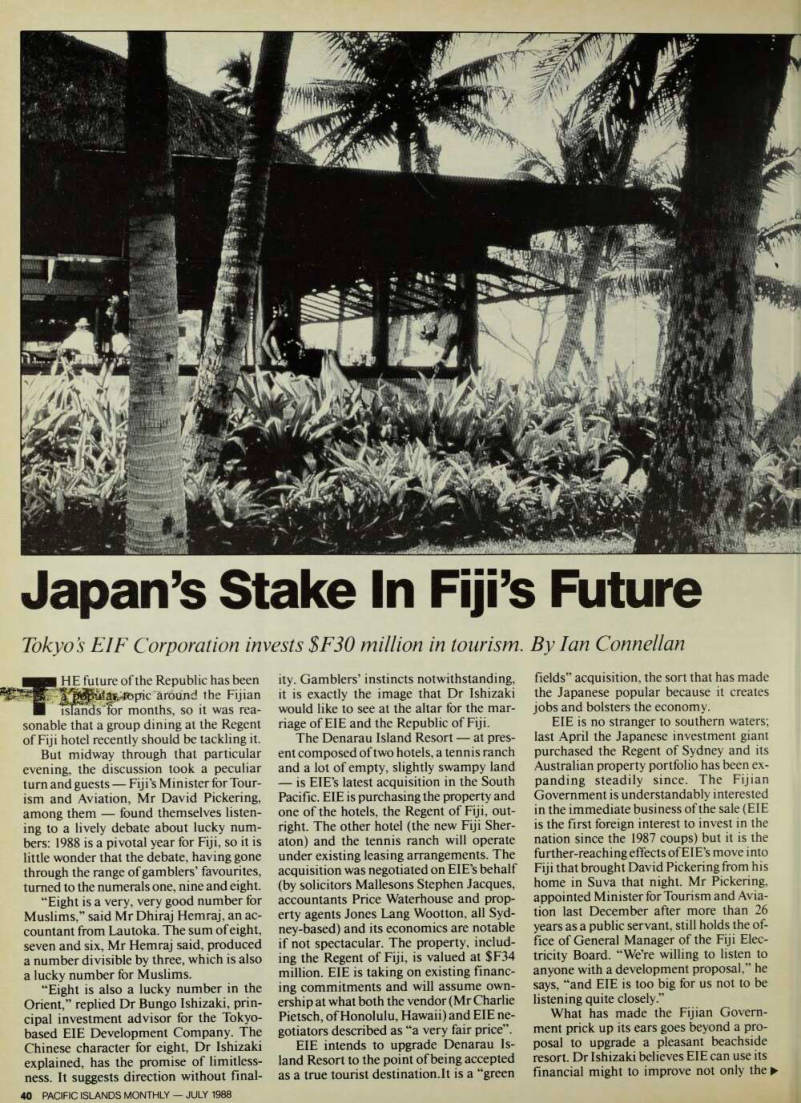
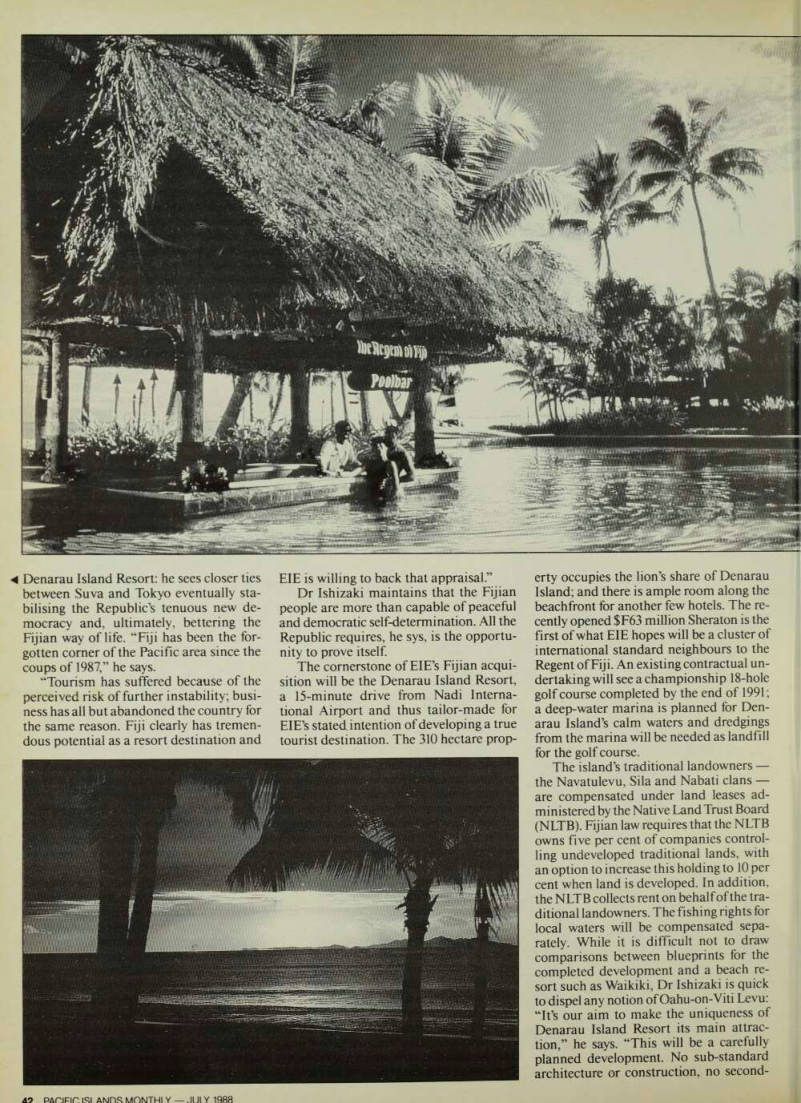
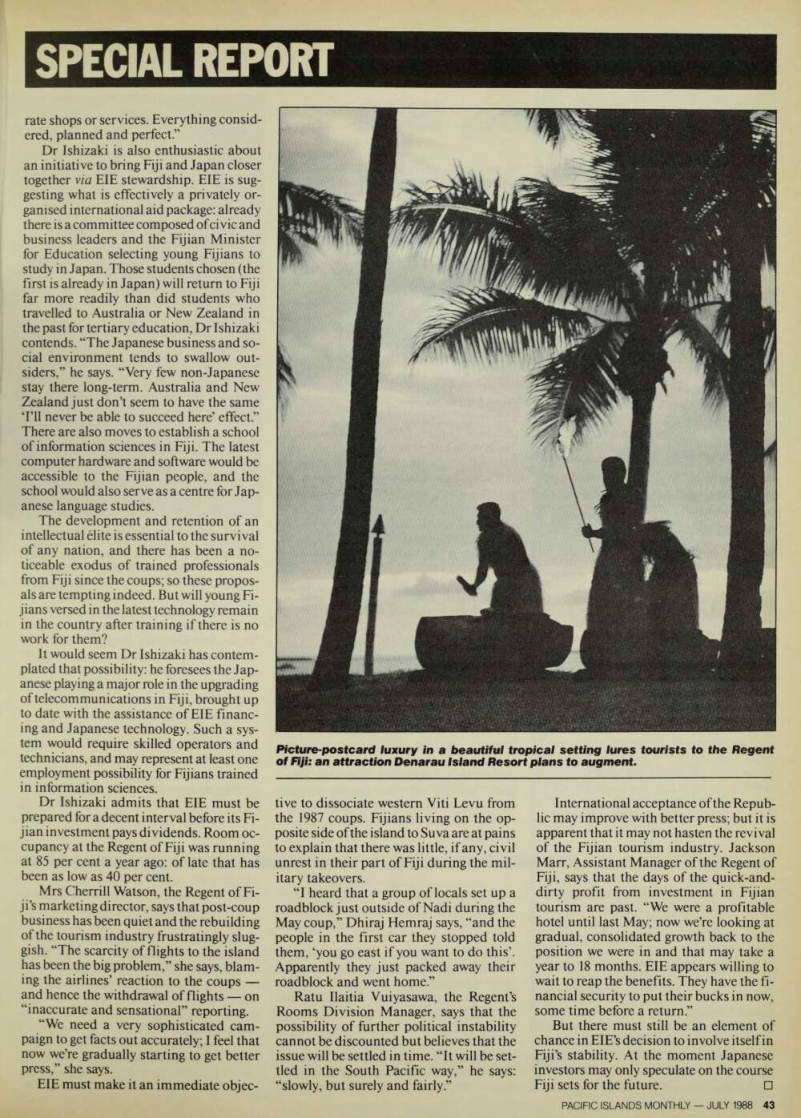
Tokyo’s EIF Corporation invests SF3O million in tourism.
By lan Connellan
mgm HE future of the Republic has been pnc around the Fijian ■ ‘SlaSds'ror months, so it was reasonable that a group dining at the Regent of Fiji hotel recently should be tackling it.
But midway through that particular evening, the discussion took a peculiar tumandguests Fiji’s Minister for Tourism and Aviation, Mr David Pickering, among them found themselves listening to a lively debate about lucky numbers: 1988 is a pivotal year for Fiji, so it is little wonder that the debate, having gone through the range of gamblers’ favourites, turned to the numerals one, nine and eight, “Eight is a very, very good number for Muslims,” said Mr Dhiraj Hemraj, an accountant from Lautoka. The sum of eight, seven and six, Mr Hemraj said, produced a number divisible by three, which is also a lucky number for Muslims.
“Eight is also a lucky number in the Orient ” replied Dr Bungo Ishizaki, principal investment advisor for the Tokyobased EIE Development Company. The Chinese character for eight, Dr Ishizaki explained, has the promise of limitlessness. It suggests direction without final-
ity. Gamblers’ instincts notwithstanding, it is exactly the image that Dr Ishizaki would like to see at the altar for the mar riage of EIE and the Republic of Fiji.
The Denarau Island Resort at pres ent composed of two hotels, a tennis ranch and a lot of empty, slightly swampy land —is ElE’s latest acquisition in the South Pacific. EIE is purchasing the property and one of the hotels, the Regent of Fiji, out right. The other hotel (the new Fiji Sher aton) and the tennis ranch will operate under existing leasing arrangements. The acquisition was negotiated on ElE’s behalf (by solicitors Mallesons Stephen Jacques, accountants Price Waterhouse and prop erty agents Jones Lang Wootton, all Syd ney-based) and its economics are notable if not spectacular. The property, includ ing the Regent of Fiji, is valued at SF34 million. EIE is taking on existing financ ing commitments and will assume own ership at what both the vendor (Mr Charlie Pietsch, of Honolulu, Hawaii) and EIE ne gotiators described as “a very fair price”.
EIE intends to upgrade Denarau Is land Resort to the point of being accepted as a true tourist destination.lt is a “green
fields” acquisition, the sort that has made the Japanese popular because it creates jobs and bolsters the economy, EIE is no stranger to southern waters; last April the Japanese investment giant purchased the Regent of Sydney and its Australian property portfolio has been ex panding steadily since. The Fijian Government is understandably interested in the immediate business of the sale (EIE is the first foreign interest to invest m the nation since the 1987 coups) but it is the further-reaching effects of ElE’s move into Fiji that brought David Pickering from his home in Suva that night. Mr Pickering, appointed Minister for Tourism and Avia tion last December after more than 26 years as a public servant, still holds the ot fice of General Manager of the Fiji Elec tricity Board. Were willing to hsten to anyone with a development proposal, he says, “and EIE is too big for us not to be listening quite closely.”
What has made the Fijian Govern ment pnck up its ears goes beyond a pro posal to upgrade a pleasant beachside resort. Dr Ishizaki believes EIE can use its financial might to improve not only the ►
◄ Denarau Island Resort: he sees closer ties between Suva and Tokyo eventually sta bilising the Republic’s tenuous new de mocracy and, ultimately, bettering the Fijian way of life. “Fiji has been the for gotten comer of the Pacific area since the coups of 1987,” he says.
“Tourism has suffered because of the perceived risk of further instability; busi ness has all but abandoned the country for the same reason. Fiji clearly has tremen dous potential as a resort destination and
EIE is willing to back that appraisal.”
Dr Ishizaki maintains that the Fijian people are more than capable of peaceful and democratic self-determination. All the Republic requires, he sys, is the opportu nity to prove itself.
The cornerstone of ElE’s Fijian acqui sition will be the Denarau Island Resort, a 15-minute drive from Nadi Interna tional Airport and thus tailor-made for ElE’s stated intention of developing a true tourist destination. The 310 hectare prop-
erty occupies the lion’s share of Denarau Island; and there is ample room along the beachfront for another few hotels. The re cently opened SF63 million Sheraton is the first of what EIE hopes will be a cluster of international standard neighbours to the Regent of Fiji. An existing contractual un dertaking will see a championship 18-hole golf course completed by the end of 1991; a deep-water marina is planned for Den arau Island’s calm waters and dredgings from the marina will be needed as landfill for the golf course.
The island’s traditional landowners the Navatulevu, Sila and Nabati clans are compensated under land leases ad ministered by the Native Land Trust Board (NLTB). Fijian law requires that the NLTB owns five per cent of companies control ling undeveloped traditional lands, with an option to increase this holding to 10 per cent when land is developed. In addition, the NLTB collects rent on behalf of the tra ditional landowners. The fishing rights for local waters will be compensated sepa rately. While it is difficult not to draw comparisons between blueprints for the completed development and a beach re sort such as Waikiki, Dr Ishizaki is quick to dispel any notion ofOahu-on-Viti Levu: “It’s our aim to make the uniqueness of Denarau Island Resort its main attrac tion,” he says. “This will be a carefully planned development. No sub-standard architecture or construction, no second
rate shops or services. Everything consid ered, planned and perfect.”
Dr Ishizaki is also enthusiastic about an initiative to bring Fiji and Japan closer together via EIE stewardship. EIE is sug gesting what is effectively a privately or ganised international aid package: already there is a committee composed of civic and business leaders and the Fijian Minister for Education selecting young Fijians to study in Japan. Those students chosen (the first is already in Japan) will return to Fiji far more readily than did students who travelled to Australia or New Zealand in the past for tertiary education. Dr Ishizaki contends. “The Japanese business and so cial environment tends to swallow out siders,” he says. “Very few non-Japanese stay there long-term. Australia and New Zealand just don’t seem to have the same ‘l’ll never be able to succeed here’ effect.”
There are also moves to establish a school of information sciences in Fiji. The latest computer hardware and software would be accessible to the Fijian people, and the school would also serve as a centre for Jap anese language studies.
The development and retention of an intellectual elite is essential to the survival of any nation, and there has been a no ticeable exodus of trained professionals from Fiji since the coups; so these propos als are tempting indeed. But will young Fi jians versed in the latest technology remain in the country after training if there is no work for them?
It would seem Dr Ishizaki has contem plated that possibility: he foresees the Jap anese playing a major role in the upgrading of telecommunications in Fiji, brought up to date with the assistance of EIE financ ing and Japanese technology. Such a sys tem would require skilled operators and technicians, and may represent at least one employment possibility for Fijians trained in information sciences.
Dr Ishizaki admits that EIE must be prepared for a decent interval before its Fi jian investment pays dividends. Room oc cupancy at the Regent of Fiji was running at 85 per cent a year ago; of late that has been as low as 40 per cent.
Mrs Cherrill Watson, the Regent of Fi ji’s marketing director, says that post-coup business has been quiet and the rebuilding of the tourism industry frustratingly slug gish. “The scarcity of Bights to the island has been the big problem,” she says, blam ing the airlines’ reaction to the coups and hence the withdrawal of flights on “inaccurate and sensational” reporting.
“We need a very sophisticated cam paign to get facts out accurately; I feel that now we’re gradually starting to get better press,” she says.
EIE must make it an immediate objec-
tive to dissociate western Viti Levu from the 1987 coups. Fijians living on the op posite side of the island to Suva are at pains to explain that there was little, if any, civil unrest in their part of Fiji during the mil itary takeovers.
“I heard that a group of locals set up a roadblock just outside of Nadi during the May coup,” Dhiraj Hemraj says, “and the people in the first car they stopped told them, ‘you go east if you want to do this’.
Apparently they just packed away their roadblock and went home.”
Ratu Ilaitia Vuiyasawa, the Regent’s Rooms Division Manager, says that the possibility of further political instability cannot be discounted but believes that the issue will be settled in time. “It will be set tled in the South Pacific way,” he says: “slowly, but surely and fairly.”
International acceptance of the Repub lic may improve with better press; but it is apparent that it may not hasten the revival of the Fijian tourism industry. Jackson Marr, Assistant Manager of the Regent of Fiji, says that the days of the quick-and dirty profit from investment in Fijian tourism are past. “We were a profitable hotel until last May; now we’re looking at gradual, consolidated growth back to the position we were in and that may take a year to 18 months. FIE appears willing to wait to reap the benefits. They have the fi nancial security to put their bucks in now, some time before a return.”
But there must still be an element of chance in ElE’s decision to involve itself in Fiji’s stability. At the moment Japanese investors may only speculate on the course Fiji sets for the future. □
Picture-postcard luxury in a beautiful tropical setting lures tourists to the Regent of Fiji: an attraction Denarau Island Resort plans to augment.
Advertisements & other items, pp. 41-42 (2 items)
Tk
e inen o fF.
'l' ace
42
PAP.IPir l.qi ANDB MDNTHI Y .11 Jl Y 1988
Tropicalities
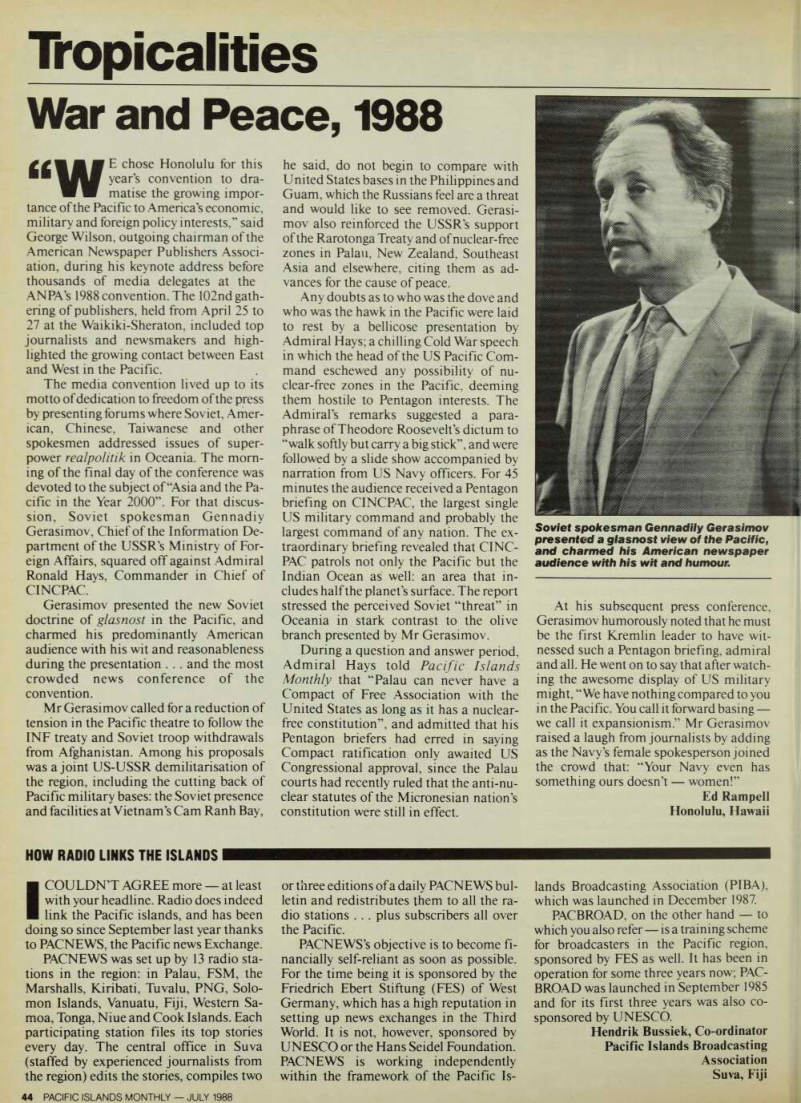
War and Peace, 1988
M M E chose Honolulu for this ** year’s convention to dra- W W matise the growing impor tance of the Pacific to America’s economic, military and foreign policy interests,” said George Wilson, outgoing chairman of the American Newspaper Publishers Associ ation, during his keynote address before thousands of media delegates at the ANPA’s 1988 convention. The 102nd gath ering of publishers, held from April 25 to 27 at the Waikiki-Sheraton, included top journalists and newsmakers and high lighted the growing contact between East and West in the Pacific.
The media convention lived up to its motto of dedication to freedom of the press by presenting forums where Soviet, Amer ican, Chinese, Taiwanese and other spokesmen addressed issues of super power realpolitik in Oceania. The morn ing of the final day of the conference was devoted to the subject of “Asia and the Pa cific in the Year 2000”. For that discus sion, Soviet spokesman Gennadiy Gerasimov, Chief of the Information De partment of the USSR’s Ministry of For eign Affairs, squared off against Admiral Ronald Hays, Commander in Chief of
Cincpac.
Gerasimov presented the new Soviet doctrine of glasnost in the Pacific, and charmed his predominantly American audience with his wit and reasonableness during the presentation . . . and the most crowded news conference of the convention.
Mr Gerasimov called for a reduction of tension in the Pacific theatre to follow the INF treaty and Soviet troop withdrawals from Afghanistan. Among his proposals was a joint US-USSR demilitarisation of the region, including the cutting back of Pacific military bases: the Soviet presence and facilities at Vietnam’s Cam Ranh Bay,
he said, do not begin to compare with United States bases in the Philippines and Guam, which the Russians feel are a threat and would like to see removed. Gerasi mov also reinforced the USSR’s support of the Rarotonga Treaty and of nuclear-free zones in Palau, New Zealand, Southeast Asia and elsewhere, citing them as ad vances for the cause of peace.
Any doubts as to who was the dove and who was the hawk in the Pacific were laid to rest by a bellicose presentation by Admiral Hays; a chilling Cold War speech in which the head of the US Pacific Com mand eschewed any possibility of nu clear-free zones in the Pacific, deeming them hostile to Pentagon interests. The Admiral’s remarks suggested a para phrase of Theodore Roosevelt’s dictum to “walk softly but carry a big stick”, and were followed by a slide show accompanied by narration from US Navy officers. For 45 minutes the audience received a Pentagon briefing on CINCPAC, the largest single US military command and probably the largest command of any nation. The ex traordinary briefing revealed that CINC PAC patrols not only the Pacific but the Indian Ocean as well: an area that in cludes half the planet’s surface. The report stressed the perceived Soviet “threat” in Oceania in stark contrast to the olive branch presented by Mr Gerasimov.
During a question and answer period, Admiral Hays told Pacific Islands Monthly that “Palau can never have a Compact of Free Association with the United States as long as it has a nuclear free constitution”, and admitted that his Pentagon briefers had erred in saying Compact ratification only awaited US Congressional approval, since the Palau courts had recently ruled that the anti-nu clear statutes of the Micronesian nation’s constitution were still in effect.
At his subsequent press conference, Gerasimov humorously noted that he must be the first Kremlin leader to have wit nessed such a Pentagon briefing, admiral and all. He went on to say that after watch ing the awesome display of US military might, “We have nothing compared to you in the Pacific. You call it forward basing we call it expansionism.” Mr Gerasimov raised a laugh from journalists by adding as the Navy’s female spokesperson joined the crowd that: “Your Navy even has something ours doesn’t women!”
Ed Rampell Honolulu, Hawaii
How Radio Links The Islands
I COULDN’T AGREE more at least with your headline. Radio does indeed link the Pacific islands, and has been doing so since September last year thanks to PACNEWS, the Pacific news Exchange.
PACNEWS was set up by 13 radio sta tions in the region: in Palau, FSM, the Marshalls, Kiribati, Tuvalu, PNG, Solo mon Islands, Vanuatu, Fiji, Western Sa moa, Tonga, Niue and Cook Islands. Each participating station files its top stories every day. The central office in Suva (staffed by experienced journalists from the region) edits the stories, compiles two
or three editions of a daily PACNEWS bul letin and redistributes them to all the ra dio stations . . . plus subscribers all over the Pacific.
PACNEWS’s objective is to become fi nancially self-reliant as soon as possible.
For the time being it is sponsored by the Friedrich Ebert Stiftung (FES) of West Germany, which has a high reputation in setting up news exchanges in the Third World. It is not, however, sponsored by UNESCO or the Hans Seidel Foundation.
PACNEWS is working independently within the framework of the Pacific Is
lands Broadcasting Association (PIBA), which was launched in December 1987.
PACBROAD, on the other hand to which you also refer is a training scheme for broadcasters in the Pacific region, sponsored by FES as well. It has been in operation for some three years now; PAC BROAD was launched in September 1985 and for its first three years was also co sponsored by UNESCO.
Hendrik Bussiek, Co-ordinator Pacific Islands Broadcasting Association Suva, Fiji
Soviet spokesman Gennadily Gerasimov presented a glasnost view of the Pacific, and charmed his American newspaper audience with his wit and humour.
Transition
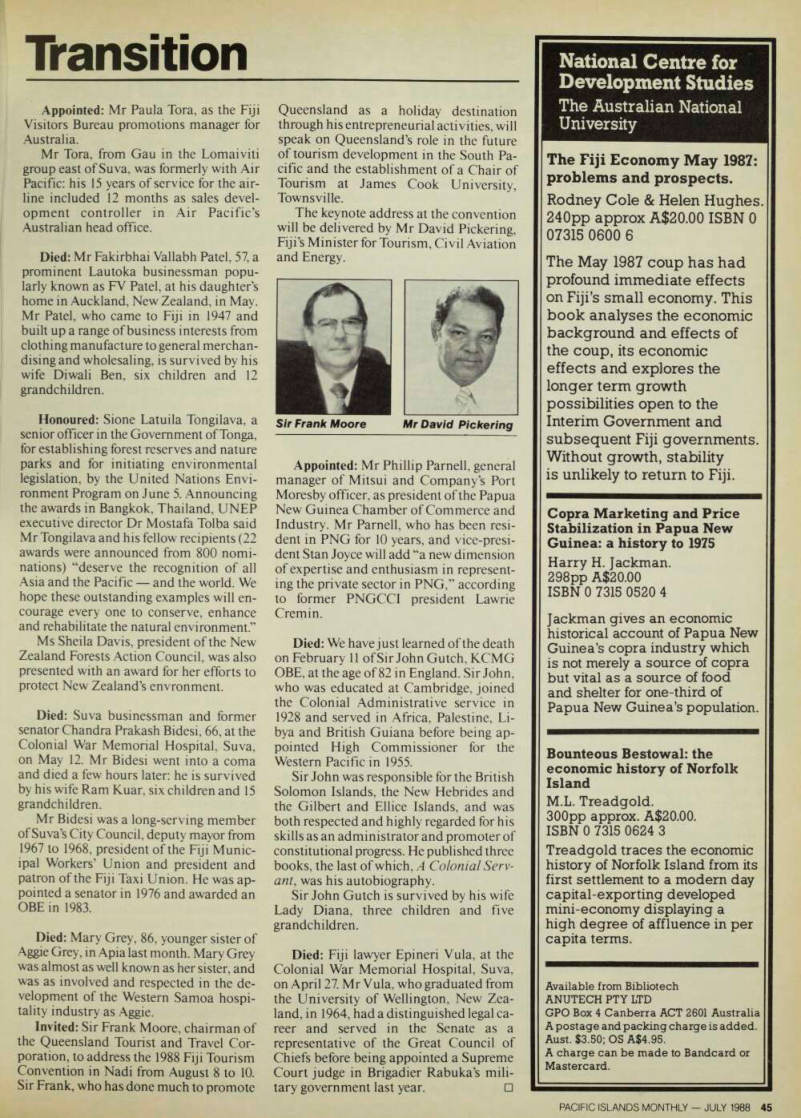
Appointed: Mr Paula Tora, as the Fiji Visitors Bureau promotions manager for Australia.
Mr Tora, from Gau in the Lomaiviti group east of Suva, was formerly with Air Pacific: his 15 years of service for the air line included 12 months as sales devel opment controller in Air Pacific’s Australian head office.
Died: Mr Fakirbhai Vallabh Patel, 57, a prominent Lautoka businessman popu larly known as FV Patel, at his daughter’s home in Auckland, New Zealand, in May.
Mr Patel, who came to Fiji in 1947 and built up a range of business interests from clothing manufacture to general merchan dising and wholesaling, is survived by his wife Diwali Ben, six children and 12 grandchildren.
Honoured: Sione Latuila Tongilava, a senior officer in the Government of Tonga, for establishing forest reserves and nature parks and for initiating environmental legislation, by the United Nations Envi ronment Program on June 5. Announcing the awards in Bangkok, Thailand, UNEP executive director Dr Mostafa Tolba said Mr Tongilava and his fellow recipients (22 awards were announced from 800 nomi nations) “deserve the recognition of all Asia and the Pacific and the world. We hope these outstanding examples will en courage every one to conserve, enhance and rehabilitate the natural environment.”
Ms Sheila Davis, president of the New Zealand Forests Action Council, was also presented with an award for her efforts to protect New Zealand’s envronment.
Died: Suva businessman and former senator Chandra Prakash Bidesi, 66, at the Colonial War Memorial Hospital, Suva, on May 12. Mr Bidesi went into a coma and died a few hours later: he is survived by his wife Ram Kuar, six children and 15 grandchildren.
Mr Bidesi was a long-serving member of Suva’s City Council, deputy mayor from 1967 to 1968, president of the Fiji Munic ipal Workers’ Union and president and patron of the Fiji Taxi Union. He was ap pointed a senator in 1976 and awarded an OBE in 1983.
Died: Mary Grey, 86, younger sister of Aggie Grey, in Apia last month. Mary Grey was almost as well known as her sister, and was as involved and respected in the de velopment of the Western Samoa hospi tality industry as Aggie.
Invited: Sir Frank Moore, chairman of the Queensland Tourist and Travel Cor poration, to address the 1988 Fiji Tourism Convention in Nadi from August 8 to 10.
Sir Frank, who has done much to promote
Queensland as a holiday destination through his entrepreneurial activities, will speak on Queensland’s role in the future of tourism development in the South Pa cific and the establishment of a Chair of Tourism at James Cook University, Townsville.
The keynote address at the convention will be delivered by Mr David Pickering, Fiji’s Minister for Tourism, Civil Aviation and Energy.
Appointed: Mr Phillip Parnell, general manager of Mitsui and Company’s Port Moresby officer, as president of the Papua New Guinea Chamber of Commerce and Industry. Mr Parnell, who has been resi dent in PNG for 10 years, and vice-presi dent Stan Joyce will add “a new dimension of expertise and enthusiasm in represent ing the private sector in PNG,” according to former PNGCCI president Lawrie Cremin.
Died: We have just learned of the death on February 11 of Sir JohnGutch, KCMG OBE, at the age of 82 in England. Sir John, who was educated at Cambridge, joined the Colonial Administrative service in 1928 and served in Africa, Palestine, Li bya and British Guiana before being ap pointed High Commissioner for the Western Pacific in 1955.
Sir John was responsible for the British Solomon Islands, the New Hebrides and the Gilbert and Ellice Islands, and was both respected and highly regarded for his skills as an administrator and promoter of constitutional progress. He published three books, the last of which, A Colonial Serv ant, was his autobiography.
Sir John Gutch is survived by his wife Lady Diana, three children and five grandchildren.
Died: Fiji lawyer Epineri Vula, at the Colonial War Memorial Hospital, Suva, on April 27. Mr Vula, who graduated from the University of Wellington, New Zea land, in 1964, had a distinguished legal ca reer and served in the Senate as a representative of the Great Council of Chiefs before being appointed a Supreme Court judge in Brigadier Rabuka’s mili tary government last year. □
Sir Frank Moore
Mr David Pickering
Advertisements & other items, p. 45 (1 item)
Development Studies
National Centre for
The Australian National
University
The Fiji Economy May 1987: problems and prospects.
Rodney Cole & Helen Hughes. 240 pp approx A 520.00 ISBN 0 07315 0600 6 The May 1987 coup has had profound immediate effects on Fiji’s small economy. This book analyses the economic background and effects of the coup, its economic effects and explores the longer term growth possibilities open to the Interim Government and subsequent Fiji governments.
Without growth, stability is unlikely to return to Fiji.
Copra Marketing and Price Stabilization in Papua New Guinea: a history to 1975 Harry H. Jackman. 298 pp A 520.00
ISBN 0 7315 0520 4
Jackman gives an economic historical account of Papua New Guinea’s copra industry which is not merely a source of copra but vital as a source of food and shelter for one-third of Papua New Guinea’s population.
Bounteous Bestowal: the economic history of Norfolk Island M.L. Treadgold. 300 pp approx. A 520.00.
ISBN 0 7315 0624 3
Treadgold traces the economic history of Norfolk Island from its first settlement to a modern day capital-exporting developed mini-economy displaying a high degree of affluence in per capita terms.
Available from Bibliotech
ANUTECH PTY LTD
GPO Box 4 Canberra ACT 2601 Australia A postage and packing charge is added.
Aust. $3.50; OS A 54.95.
A charge can be made to Bandcard or Mastercard.
He Maungarongo Kia Tau Ai Te Rangimarie
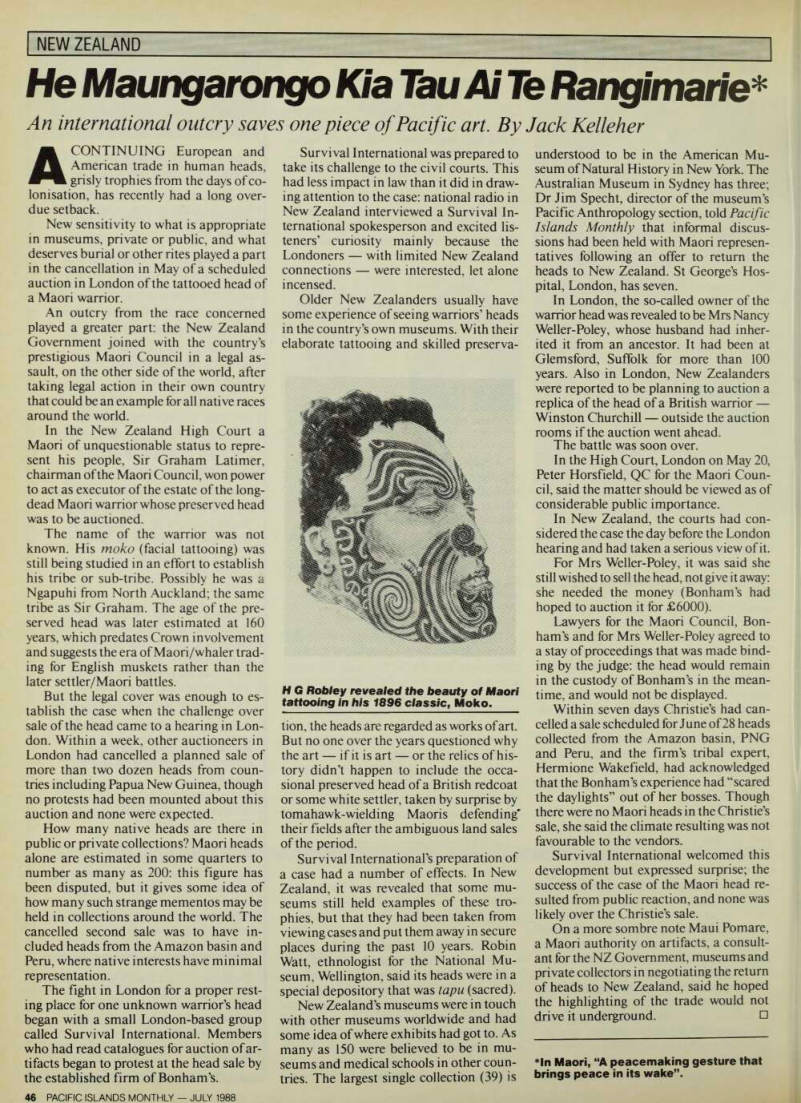
New Zealand
An international outcry saves one piece of Pacific art.
By Jack Kelleher
A CONTINUING European and American trade in human heads, grisly trophies from the days of co lonisation, has recently had a long over due setback.
New sensitivity to what is appropriate in museums, private or public, and what deserves burial or other rites played a part in the cancellation in May of a scheduled auction in London of the tattooed head of a Maori warrior.
An outcry from the race concerned played a greater part: the New Zealand Government joined with the country’s prestigious Maori Council in a legal as sault, on the other side of the world, after taking legal action in their own country that could be an example for all native races around the world.
In the New Zealand High Court a Maori of unquestionable status to repre sent his people, Sir Graham Latimer, chairman of the Maori Council, won power to act as executor of the estate of the long dead Maori warrior whose preserved head was to be auctioned.
The name of the warrior was not known. His moko (facial tattooing) was still being studied in an effort to establish his tribe or sub-tribe. Possibly he was a Ngapuhi from North Auckland; the same tribe as Sir Graham. The age of the pre served head was later estimated at 160 years, which predates Crown involvement and suggests the era of Maori/whaler trad ing for English muskets rather than the later settler/Maori battles.
But the legal cover was enough to es tablish the case when the challenge over sale of the head came to a hearing in Lon don. Within a week, other auctioneers in London had cancelled a planned sale of more than two dozen heads from coun tries including Papua New Guinea, though no protests had been mounted about this auction and none were expected.
How many native heads are there in public or private collections? Maori heads alone are estimated in some quarters to number as many as 200: this figure has been disputed, but it gives some idea of how many such strange mementos may be held in collections around the world. The cancelled second sale was to have in cluded heads from the Amazon basin and Peru, where native interests have minimal representation.
The fight in London for a proper rest ing place for one unknown warrior’s head began with a small London-based group called Survival International. Members who had read catalogues for auction of ar tifacts began to protest at the head sale by the established firm of Bonham’s.
Survival International was prepared to take its challenge to the civil courts. This had less impact in law than it did in draw ing attention to the case: national radio in New Zealand interviewed a Survival In ternational spokesperson and excited lis teners’ curiosity mainly because the Londoners with limited New Zealand connections were interested, let alone incensed.
Older New Zealanders usually have some experience of seeing warriors’ heads in the country’s own museums. With their elaborate tattooing and skilled preserva-
tion, the heads are regarded as works of art.
But no one over the years questioned why the art if it is art or the relics of his tory didn’t happen to include the occa sional preserved head of a British redcoat or some white settler, taken by surprise by tomahawk-wielding Maoris defending' their fields after the ambiguous land sales of the period.
Survival International’s preparation of a case had a number of effects. In New Zealand, it was revealed that some mu seums still held examples of these tro phies, but that they had been taken from viewing cases and put them away in secure places during the past 10 years. Robin Watt, ethnologist for the National Mu seum, Wellington, said its heads were in a special depository that was tapu (sacred).
New Zealand’s museums were in touch with other museums worldwide and had some idea of where exhibits had got to. As many as 150 were believed to be in mu seums and medical schools in other coun tries. The largest single collection (39) is
understood to be in the American Mu seum of Natural History in New York. The Australian Museum in Sydney has three; Dr Jim Specht, director of the museum’s Pacific Anthropology section, told Pacific Islands Monthly that informal discus sions had been held with Maori represen tatives following an offer to return the heads to New Zealand. St George’s Hos pital, London, has seven.
In London, the so-called owner of the warrior head was revealed to be Mrs Nancy Weller-Poley, whose husband had inher ited it from an ancestor. It had been at Glemsford, Suffolk for more than 100 years. Also in London, New Zealanders were reported to be planning to auction a replica of the head of a British warrior Winston Churchill outside the auction rooms if the auction went ahead.
The battle was soon over.
In the High Court, London on May 20, Peter Horsfield, QC for the Maori Coun cil, said the matter should be viewed as of considerable public importance.
In New Zealand, the courts had con sidered the case the day before the London hearing and had taken a serious view of it.
For Mrs Weller-Poley, it was said she still wished to sell the head, not give it away: she needed the money (Bonham’s had hoped to auction it for £6000).
Lawyers for the Maori Council, Bon ham’s and for Mrs Weller-Poley agreed to a stay of proceedings that was made bind ing by the judge; the head would remain in the custody of Bonham’s in the mean time, and would not be displayed.
Within seven days Christie’s had can celled a sale scheduled for June of 28 heads collected from the Amazon basin, PNG and Peru, and the firm’s tribal expert, Hermione Wakefield, had acknowledged that the Bonham’s experience had “scared the daylights” out of her bosses. Though there were no Maori heads in the Christie’s sale, she said the climate resulting was not favourable to the vendors.
Survival International welcomed this development but expressed surprise; the success of the case of the Maori head re sulted from public reaction, and none was likely over the Christie’s sale.
On a more sombre note Maui Pomare, a Maori authority on artifacts, a consult ant for the NZ Government, museums and private collectors in negotiating the return of heads to New Zealand, said he hoped the highlighting of the trade would not drive it underground. □
*ln Maori, “A peacemaking gesture that brings peace in its wake”.
H G Robley revealed the beauty of Maori tattooing in his 1896 classic, Moko.
Advertisements & other items, p. 47 (1 item)
r
Va Set in ten acres of tropical gardens, the Islander is located midway between the airport and the city centre, within 5 minutes drive of Central Government Offices, Parliament House and the National Museum.
Facilities include: • 186 deluxe rooms and suites • Direct-dial telephones with computer modems • Colour TV and in-house video • Complete secretarial services • Conference and banquet ting facilities for up to 500 people • Travel agency Florist Hire car service
Hairdressing salon
Boutique News agency Coffee shop Restaurant Cocktail bar
Night club
4 glass backed squash courts 2 synthetic grass tennis courts
Fully equipped gymnasium
Swimming pool
Complimentary airport transfers
The location is only one reason you will choose the Islander. The luxurious accommodations together with the superb cuisine, whether it be from our Kofi Haus Coffee Shop, from the elegant Sanamarie A ’La Carte restaurant, or from our 24 hour room service, and the professional service from our courteous staff are all reasons why the Islander is Papua New Guinea’s
only truly International Hotel.
The Pacific has great hotels... the Islander is the great hotel of the Pacific. m x * * * m The Islander Hotel PO Box 1981, Boroko, Papua New Guinea
-AAAAA
What Price Oceanic Art?
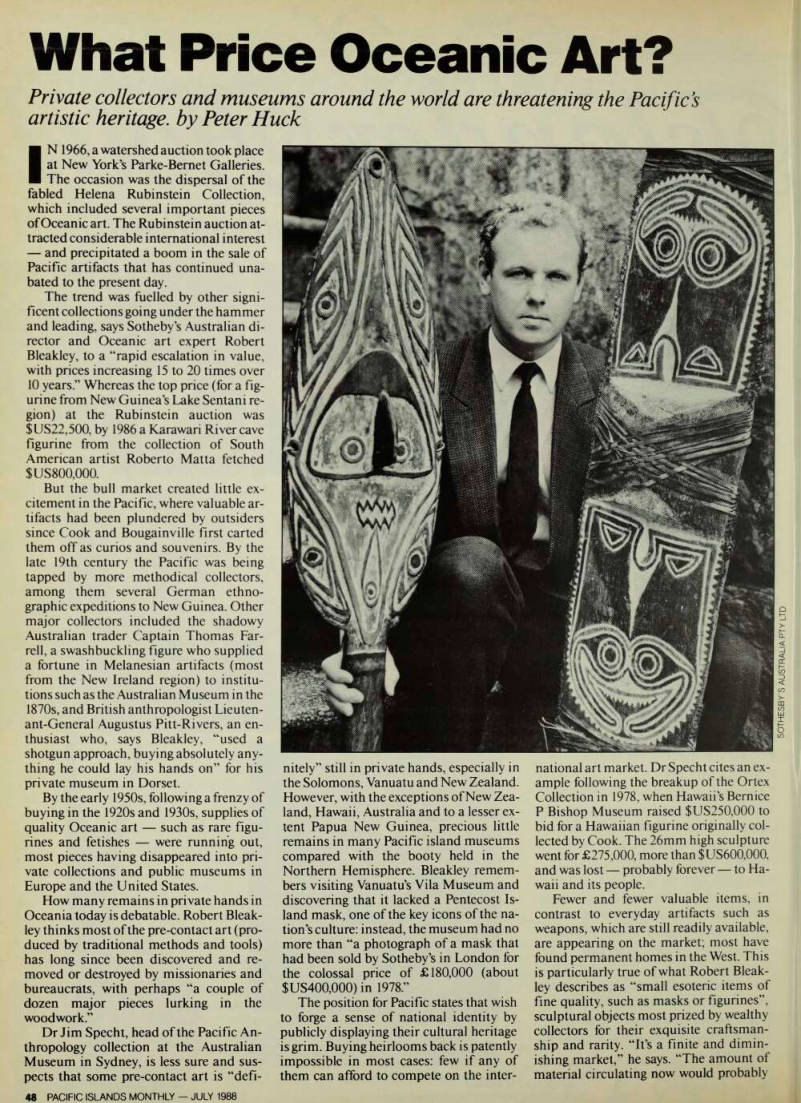
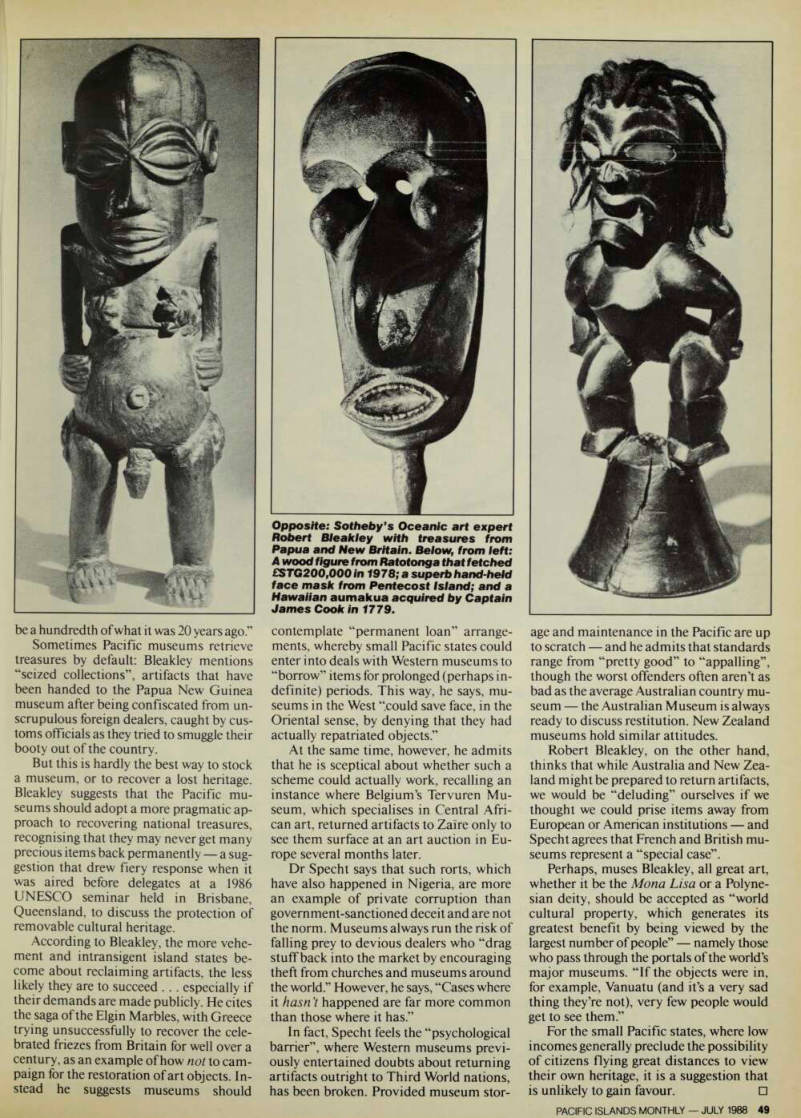
Private collectors and museums around the world are threatening the Pacific’s
artistic heritage.
by Peter Huck
IN 1966, a watershed auction took place at New York’s Parke-Bemet Galleries.
The occasion was the dispersal of the fabled Helena Rubinstein Collection, which included several important pieces of Oceanic art. The Rubinstein auction at tracted considerable international interest and precipitated a boom in the sale of Pacific artifacts that has continued una bated to the present day.
The trend was fuelled by other signi ficent collections going under the hammer and leading, says Sotheby’s Australian di rector and Oceanic art expert Robert Bleakley, to a “rapid escalation in value, with prices increasing 15 to 20 times over 10 years.” Whereas the top price (for a fig urine from New Guinea’s Lake Sentani re gion) at the Rubinstein auction was $U522,500, by 1986 a Karawari River cave figurine from the collection of South American artist Roberto Malta fetched
$ Usboo,Ooo.
But the bull market created little ex citement in the Pacific, where valuable ar tifacts had been plundered by outsiders since Cook and Bougainville first carted them off as curios and souvenirs. By the late 19th century the Pacific was being tapped by more methodical collectors, among them several German ethno graphic expeditions to New Guinea. Other major collectors included the shadowy Australian trader Captain Thomas Far rell, a swashbuckling figure who supplied a fortune in Melanesian artifacts (most from the New Ireland region) to institu tions such as the Australian Museum in the 1870 s, and British anthropologist Lieuten ant-General Augustus Pitt-Rivers, an en thusiast who, says Bleakley, “used a shotgun approach, buying absolutely any thing he could lay his hands on” for his private museum in Dorset.
By the early 19505, following a frenzy of buying in the 1920 s and 19305, supplies of quality Oceanic art such as rare figu rines and fetishes were running out, most pieces having disappeared into pri vate collections and public museums in Europe and the United States.
How many remains in private hands in Oceania today is debatable. Robert Bleak ley thinks most of the pre-contact art (pro duced by traditional methods and tools) has long since been discovered and re moved or destroyed by missionaries and bureaucrats, with perhaps “a couple of dozen major pieces lurking in the woodwork.”
Dr Jim Specht, head of the Pacific An thropology collection at the Australian Museum in Sydney, is less sure and sus pects that some pre-contact art is “defi-
nitely” still in private hands, especially in the Solomons, Vanuatu and New Zealand.
However, with the exceptions of New Zea land, Hawaii, Australia and to a lesser ex tent Papua New Guinea, precious little remains in many Pacific island museums compared with the booty held in the Northern Hemisphere. Bleakley remem bers visiting Vanuatu’s Vila Museum and discovering that it lacked a Pentecost Is land mask, one of the key icons of the na tion’s culture: instead, the museum had no more than “a photograph of a mask that had been sold by Sotheby’s in London for the colossal price of £lBO,OOO (about $US400,000) in 1978.”
The position for Pacific states that wish to forge a sense of national identity by publicly displaying their cultural heritage is grim. Buying heirlooms back is patently impossible in most cases: few if any of them can afford to compete on the inter
national art market. Dr Specht cites an ex ample following the breakup of the Ortex Collection in 1978, when Hawaii’s Bernice P Bishop Museum raised $U5250,000 to bid for a Hawaiian figurine originally col lected by Cook. The 26mm high sculpture went for £275,000, more than SUS6OO,OOO, and was lost probably forever to Ha waii and its people.
Fewer and fewer valuable items, in contrast to everyday artifacts such as weapons, which are still readily available, are appearing on the market; most have found permanent homes in the West. This is particularly true of what Robert Bleak ley describes as “small esoteric items of fine quality, such as masks or figurines”, sculptural objects most prized by wealthy collectors for their exquisite craftsman ship and rarity. “It’s a finite and dimin ishing market,” he says. “The amount of material circulating now would probably
be a hundredth of what it was 20 years ago.”
Sometimes Pacific museums retrieve treasures by default: Bleakley mentions “seized collections”, artifacts that have been handed to the Papua New Guinea museum after being confiscated from un scrupulous foreign dealers, caught by cus toms officials as they tried to smuggle their booty out of the country.
But this is hardly the best way to stock a museum, or to recover a lost heritage.
Bleakley suggests that the Pacific mu seums should adopt a more pragmatic ap proach to recovering national treasures, recognising that they may never get many precious items back permanently a sug gestion that drew fiery response when it was aired before delegates at a 1986 UNESCO seminar held in Brisbane, Queensland, to discuss the protection of removable cultural heritage.
According to Bleakley, the more vehe ment and intransigent island states be come about reclaiming artifacts, the less likely they are to succeed ... especially if their demands are made publicly. He cites the saga of the Elgin Marbles, with Greece trying unsuccessfully to recover the cele brated friezes from Britain for well over a century, as an example of how not to cam paign for the restoration of art objects. In stead he suggests museums should
contemplate “permanent loan” arrange ments, whereby small Pacific states could enter into deals with Western museums to “borrow” items for prolonged (perhaps in definite) periods. This way, he says, mu seums in the West “.could save face, in the Oriental sense, by denying that they had actually repatriated objects.”
At the same time, however, he admits that he is sceptical about whether such a scheme could actually work, recalling an instance where Belgium’s Tervuren Mu seum, which specialises in Central Afri can art, returned artifacts to Zaire only to see them surface at an art auction in Eu rope several months later.
Dr Specht says that such rorts, which have also happened in Nigeria, are more an example of private corruption than government-sanctioned deceit and are not the norm. Museums always run the risk of falling prey to devious dealers who “drag stuff back into the market by encouraging theft from churches and museums around the world.” However, he says, “Cases where it hasn’t happened are far more common than those where it has.”
In fact, Specht feels the “psychological barrier”, where Western museums previ ously entertained doubts about returning artifacts outright to Third World nations, has been broken. Provided museum stor-
age and maintenance in the Pacific are up to scratch and he admits that standards range from “pretty good” to “appalling”, though the worst offenders often aren’t as bad as the average Australian country mu seum the Australian Museum is always ready to discuss restitution. New Zealand museums hold similar attitudes.
Robert Bleakley, on the other hand, thinks that while Australia and New Zea land might be prepared to return artifacts, we would be “deluding” ourselves if we thought we could prise items away from European or American institutions and Specht agrees that French and British mu seums represent a “special case”.
Perhaps, muses Bleakley, all great art, whether it be the Mona Lisa or a Polyne sian deity, should be accepted as “world cultural property, which generates its greatest benefit by being viewed by the largest number of people” namely those who pass through the portals of the world’s major museums. “If the objects were in, for example, Vanuatu (and it’s a very sad thing they’re not), very few people would get to see them.”
For the small Pacific states, where low incomes generally preclude the possibility of citizens flying great distances to view their own heritage, it is a suggestion that is unlikely to gain favour. □
Opposite: Sotheby’s Oceanic art expert Robert Bleakley with treasures from Papua and New Britain. Below, from left: A wood figure from Ratotonga that fetched £STG200,000 in 1978; a superb hand-held face mask from Pentecost Island; and a Hawaiian aumakua acquired by Captain James Cook in 1779.
Advertisements & other items, p. 50 (1 item)
... Bandag!
Bandag Cold Process Retreads save you money when you buy them, and continue to save you money as you drive on them.
Not only are they much cheaper than new tyres, they outperform most new tyres and are far superior to any other retread.
The unique Bandag Cold Process method gives you increased mileage, longer casing life, minimum downtime and
outstanding performance.
Whether you are responsible for one vehicle or a whole fleet, Bandag Cold Process Retreads are your best investment for truck and bus tyres. Stop spending more than you have t 0... contact your nearest Bandag dealer today.
FIJI: Fiji (Bandag) Limited, 23 Sonoma Street, Walu Bay, Suva. Fiji. Phone: ISD 679 315255. Fiji (Bandag) Limited, Ritove Street, Labasa, Fiji. Phone: ISD 679 81161. NEW CALEDONIA: Societe Nouvelle Noumea Pneus, 180 Rue Ampere Ducos, Noumea, New Caledonia. Phone: ISD 687 284528, 282956. PAPUA NEW GUINEA: Tyre Services, Milfordhaven Road, Lae. Papua New Guinea. Phone: ISD 675 425624, 421851. SOLOMON ISLANDS: D.WM. (Bandag) Retreading, Ranandi Industrial Centre, Kukum Highway, Honiara, Solomon Islands. Phone: ISD 677 30104. VANUATU: Vanuatu Retreading, B.P 303, Port Vila, Vanuatu Phonp- A7B 9811 BAN 4208
Pacific Stamp Box
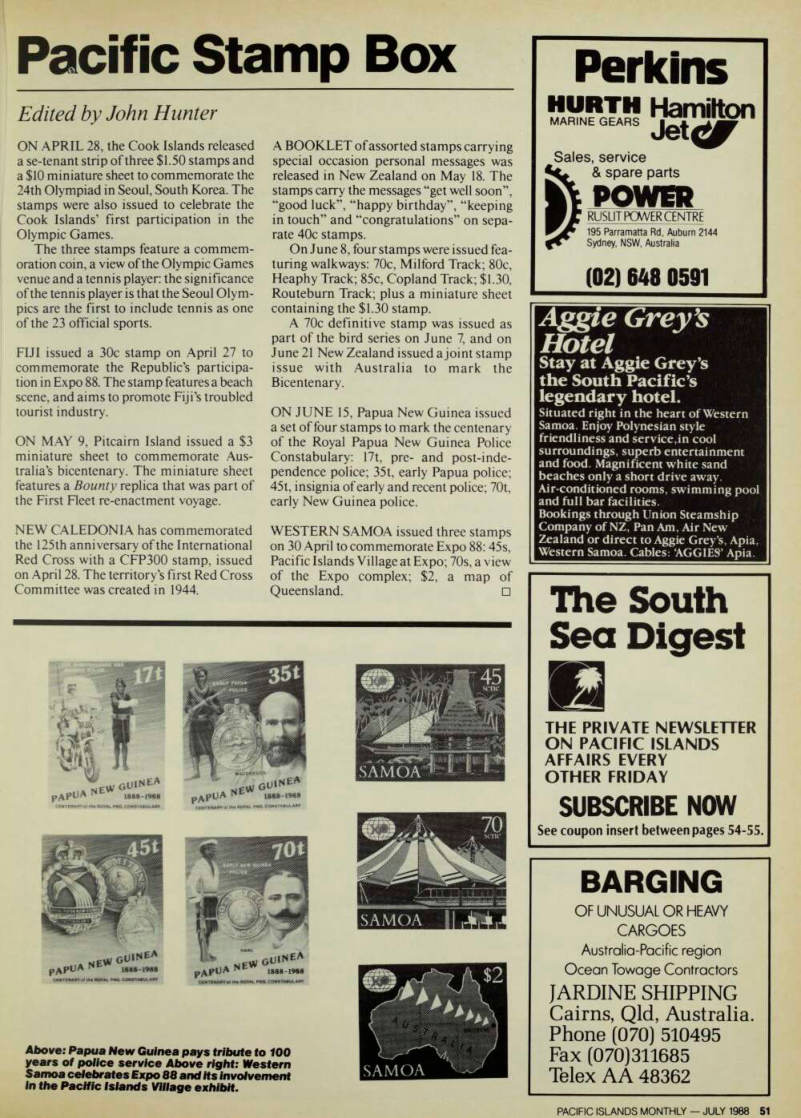
Edited by John Hunter
ON APRIL 28, the Cook Islands released a se-tenant strip of three $1.50 stamps and a $lO miniature sheet to commemorate the 24th Olympiad in Seoul, South Korea. The stamps were also issued to celebrate the Cook Islands’ first participation in the Olympic Games.
The three stamps feature a commem oration coin, a view of the Olympic Games venue and a tennis player: the significance of the tennis player is that the Seoul Olym pics are the first to include tennis as one of the 23 official sports.
FIJI issued a 30c stamp on April 27 to commemorate the Republic’s participa tion in Expo 88. The stamp features a beach scene, and aims to promote Fiji’s troubled tourist industry.
ON MAY 9, Pitcairn Island issued a $3 miniature sheet to commemorate Aus tralia’s bicentenary. The miniature sheet features a Bounty replica that was part of the First Fleet re-enactment voyage.
NEW CALEDONIA has commemorated the 125th anniversary of the International Red Cross with a CFP3OO stamp, issued on April 28. The territory’s first Red Cross Committee was created in 1944.
A BOOKLET of assorted stamps carrying special occasion personal messages was released in New Zealand on May 18. The stamps carry the messages “get well soon”, “good luck”, “happy birthday”, “keeping in touch” and “congratulations” on sepa rate 40c stamps.
On June 8, four stamps were issued fea turing walkways: 70c, Milford Track; 80c, Heaphy Track; 85c, Copland Track; $1.30, Routeburn Track; plus a miniature sheet containing the $1.30 stamp.
A 70c definitive stamp was issued as part of the bird series on June 7, and on June 21 New Zealand issued a joint stamp issue with Australia to mark the Bicentenary.
ON JUNE 15, Papua New Guinea issued a set of four stamps to mark the centenary of the Royal Papua New Guinea Police Constabulary; 17t, pre- and post-inde pendence police; 35t, early Papua police; 45t, insignia of early and recent police; 70t, early New Guinea police.
WESTERN SAMOA issued three stamps on 30 April to commemorate Expo 88:455, Pacific Islands Village at Expo; 70s, a view of the Expo complex; $2, a map of Queensland. □
Above: Papua New Guinea pays tribute to 100 years of police service Above right: Western Samoa celebrates Expo 88 and its involvement in the Pacific Islands Village exhibit.
Advertisements & other items, p. 51 (1 item)
HSSTJ {jkmjjtpn
Perkins
Sales, service & spare parts
ft POWER
mt RUSLIT POWER CENTRE
195 Parramatta Rd, Auburn 2144 Sydney, NSW, Australia (02) 648 0591
Aggie Greys
Hotel
Stay at Aggie Grey’s
the South Pacific’s
legendary hotel.
Situated right in the heart of Western Samoa. Enjoy Polynesian style friendliness and service,in cool surroundings, superb entertainment and food. Magnificent white sand beaches only a short drive away.
Air-conditioned rooms, swimming pool and full bar facilities.
Bookings through Union Steamship Company of NZ, Pan Am, Air New Zealand or direct to Aggie Grey’s, Apia, Western Samoa. Cables: AGGIES’ Apia.
Hie South
Sea Digest
(M
THE PRIVATE NEWSLETTER
ON PACIFIC ISLANDS
AFFAIRS EVERY
OTHER FRIDAY
SUBSCRIBE NOW
See coupon insert between pages 54-55
BARGING
OF UNUSUAL OR HEAVY
CARGOES
Australia-Pacific region Ocean Towage Contractors
JARDINE SHIPPING
Cairns, Qld, Australia Phone (070) 510495 Fax (070)311685 Telex AA 48362
The Island Press
Reports from the papers, compiled
by John Carter
ALMOST 20 PER CENT of the cases of sexually transmitted diseases reported for the first quarter this year fell in the 15 to 19 year age group, according to figures re leased by the Ministry of Health yesterday.
Of the 251 cases recorded for Suva, 50 cases were in the age group which was sup posed to be at school, the ministry’s direc tor of Preventive and Primary Health Services, Dr Salesi Katoanga, said.
From the Fiji Times , Suva.
POOR family planning is one cause of the current baby boom in Port Moresby, ac cording to Esther Mirisa of the Family Planning Association of PNG.
And she is pointing the accusing finger at men, saying they ignored family plan ning measures.
She said: “Often courses conducted on family planning are attended by women only and this is not very helpful”.
From the Papua New Guinea Post-Courier , Port Moresby.
PEOPLE from the gold-rich areas of Por gera and Mount Kare between Enga and
Southern Highlands provinces have gone beer-crazy.
In Porgera and Paiela areas of Enga, under-aged and old people are reported drunk almost every day.
And they are drinking with money from the sale of gold.
In Tari, the entire district seems to be full of drunks, according to the provincial secretary, Mr Francis Awesa.
From the Papua New Guinea Post-Courier , Port Moresby.
PEOPLE IN the Whitesands area of Van uatu’s southern island of Tanna are suffer ing from severe malnutrition now that volcanic ash has burnt their crops.
According to Radio Vanuatu there are numerous cases of school children faint ing in class every day because they do not have enough to eat.
From the Cook Islands News , Rarotonga.
AS SOME of you may have observed, our current aluminium longboat has been
nicknamed “Tin”. It is therefore anyone’s guess as to what the new boat will end up being christened. The retiring Governor has made the suggestion it be called “Brit ish Bounty”: however, it is more likely to end up being called “Tin Two”, “Super Tin” or perhaps even “Tin Can”.
Whatever name is bestowed on the new longboat, if it can perform as well as its earlier New Zealand-built counterpart, Pitcairners’ main form of ocean transpor tation will indeed stand us in good stead.
From the Pitcairn Miscellany , Pitcairn Island.
SAVENACA Ravunaceva yesterday spent his entire three years’ savings on a gift for his mother.
Savenaca, 28, earned the money while serving a prison term in Naboro.
Yesterday he walked into a Suva shop and bought two sets of mugs as a Mother’s Day present with the $l6 he had saved in jail.
From the Fiji Times , Suva.
Advertisements & other items, p. 52 (1 item)
Mmir
TAIA\R --- Papua New Guinea's
nationwide airline connection to
from the World.
it
DOMESTIC
Talair serves all provinces In P.N.G., many on a daily basis. No other airline comes close to serving the 130 ports a week that Talair does. Charter services also are available. •***B
INTERNATIONAL
Using our computerised system
in any of our 12 International Travel Centres, we can book you anywhere in the world 0n...
planes, trains, luxury liners
arrange rental cars, hostels, motels or hotels. « I
AUiR
Panguna - 95 8020 • Arawa - 95 2113 • Mt. Hagen - 52 2465 Boroko - 25 7655 • Tabubil - 58 9228 • Goroka - 72 1355 • Lae - 42 2316 Madang - 82 2757 • Rabaul - 82 2882 • Wewak - 86 2012 Vanimo - 87 1180 • Port Moresby - 21 4766 • Waigani - 25 7877 Brisbane Metropolitan Area - 229 1177 Outside Brisbane - 008 777879
MMIR
M ft:}
lATA
QUALITY IN AIR TRANSPORT
Shipping Schedules
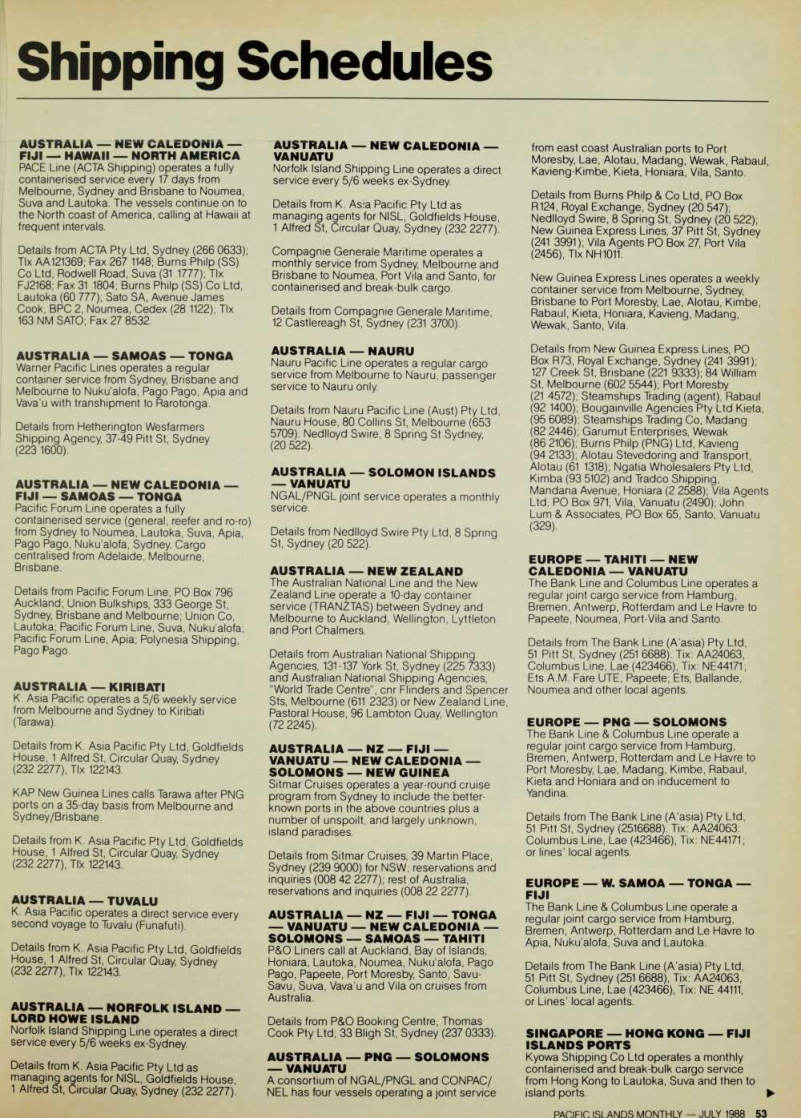
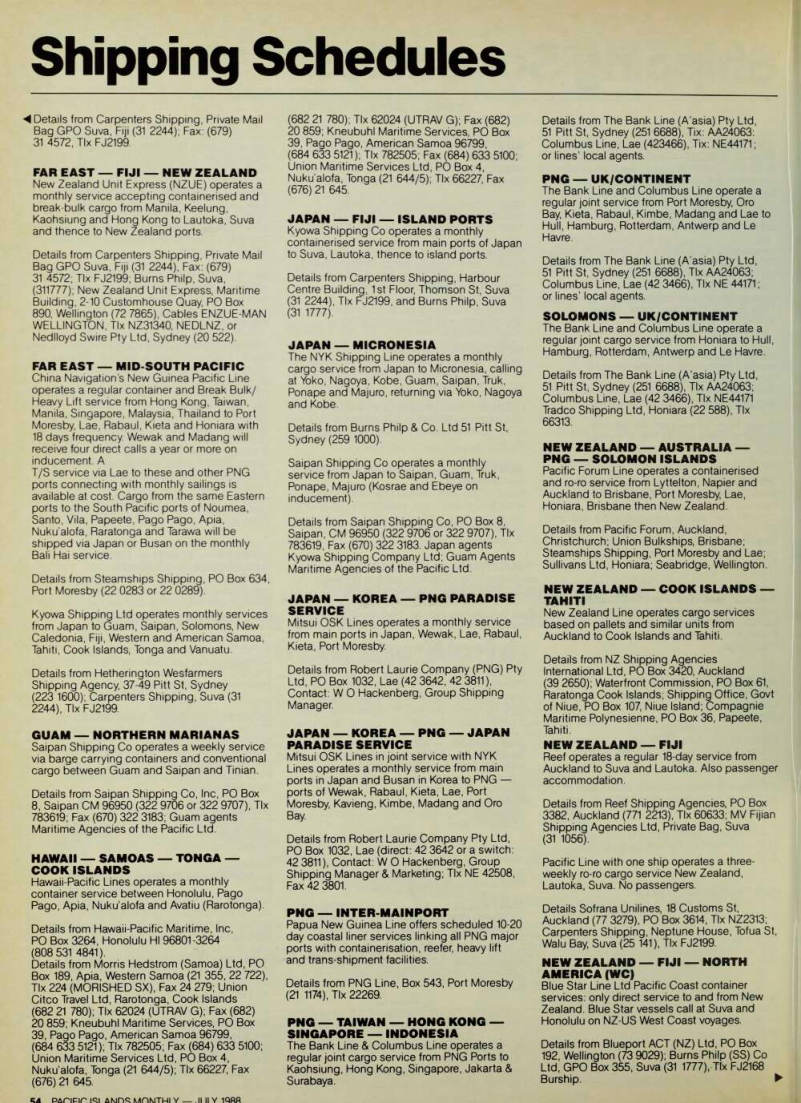
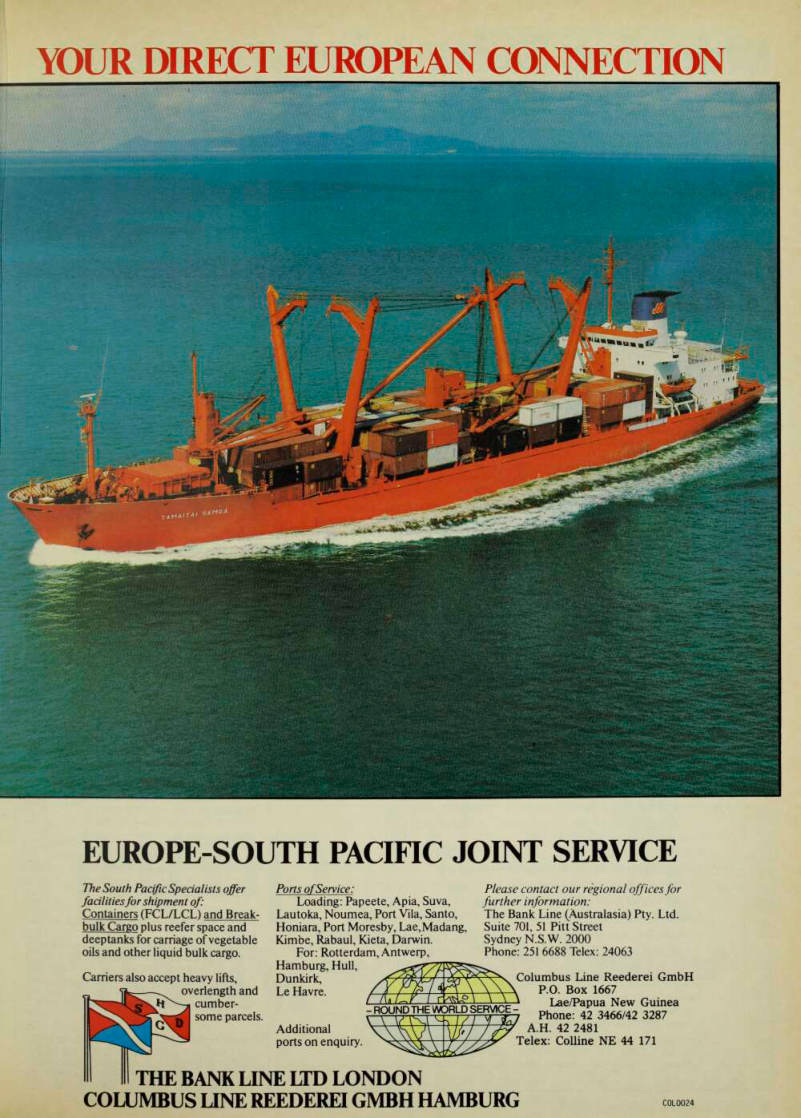
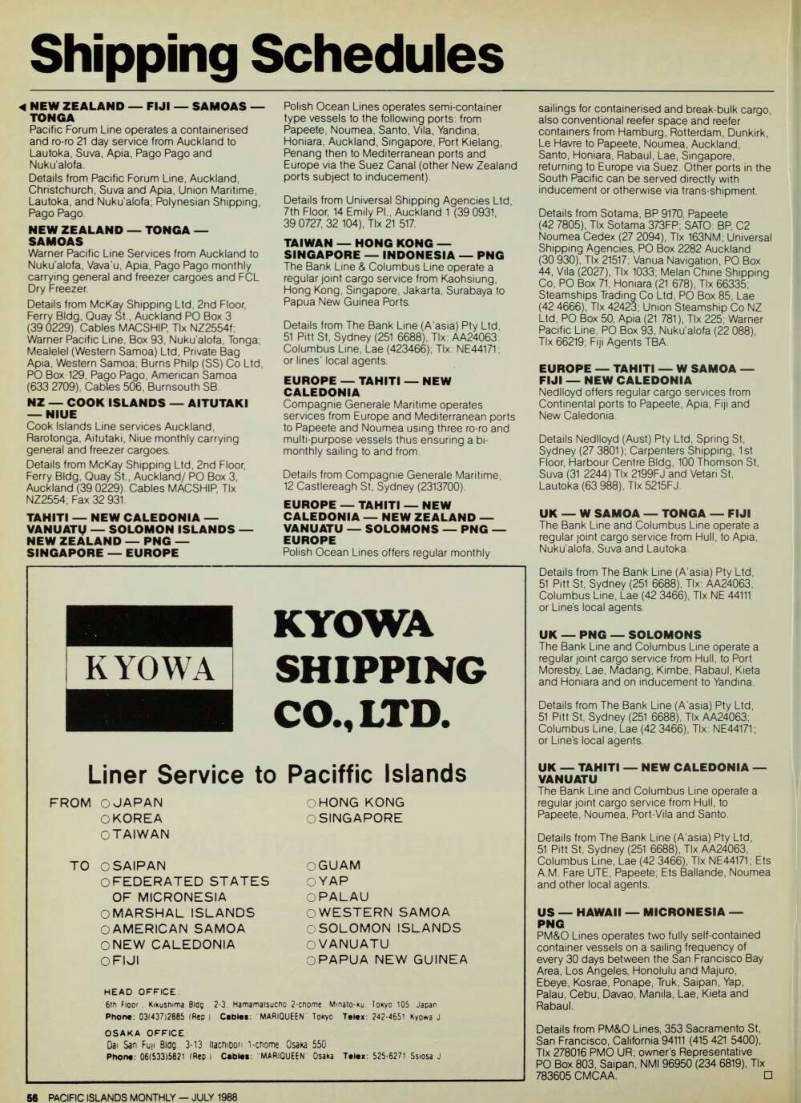
Australia New Caledonia
Fiji Hawaii North America
PACE Line (ACTA Shipping) operates a fully containerised service every 17 days from Melbourne, Sydney and Brisbane to Noumea, Suva and Lautoka. The vessels continue on to the North coast of America, calling at Hawaii at frequent intervals.
Details from ACTA Pty Ltd, Sydney (266 0633); Tlx AA121369; Fax 267 1148; Burns Philp (SS) Co Ltd, Rodwell Road, Suva (31 1777); Tlx FJ2168; Fax 31 1804; Burns Philp (SS) Co Ltd, Lautoka (60 777); Sato SA, Avenue James Cook, BPC 2, Noumea, Cedex (28 1122); Tlx
163 Nm Sato; Fax 27 8532.
Australia Samoas Tonga
Warner Pacific Lines operates a regular container service from Sydney, Brisbane and Melbourne to Nuku’alofa, Pago Pago, Apia and Vava’u with transhipment to Rarotonga, Details from Hetherington Wesfarmers Shipping Agency, 37-49 Pitt St, Sydney (223 1600).
Australia New Caledonia
Fiji Samoas Tonga
Pacific Forum Line operates a fully containerised service (general, reefer and ro-ro) from Sydney to Noumea, Lautoka, Suva, Apia, Pago Pago, Nuku’alofa, Sydney. Cargo centralised from Adelaide, Melbourne, Brisbane.
Details from Pacific Forum Line, PO Box 796 Auckland; Union Bulkships, 333 George St, Sydney, Brisbane and Melbourne; Union Co, Lautoka; Pacific Forum Line, Suva, Nuku'alofa; Pacific Forum Line, Apia; Polynesia Shipping, Pago Pago.
Australia Kiribati
K. Asia Pacific operates a 5/6 weekly service from Melbourne and Sydney to Kiribati (Tarawa).
Details from K. Asia Pacific Pty Ltd, Goldfields House, 1 Alfred St, Circular Quay, Sydney (232 2277), Tlx 122143.
KAP New Guinea Lines calls Tarawa after PNG ports on a 35-day basis from Melbourne and Sydney/Brisbane.
Details from K. Asia Pacific Pty Ltd, Goldfields House, 1 Alfred St, Circular Quay, Sydney (232 2277), Tl* 122143.
Australia Tuvalu
K. Asia Pacific operates a direct service every second voyage to Tuvalu (Funafuti).
Details from K. Asia Pacific Pty Ltd, Goldfields House, 1 Alfred St, Circular Quay, Sydney (232 2277), Tlx 122143.
Australia Norfolk Island
Lord Howe Island
Norfolk Island Shipping Line operates a direct service every 5/6 weeks ex-Sydney.
Details from K. Asia Pacific Pty Ltd as managing agents for NISL, Goldfields House, 1 Alfred St, Circular Quay, Sydney (232 2277).
Australia New Caledonia
Vanuatu
Norfolk Island Shipping Line operates a direct service every 5/6 weeks ex-Sydney.
Details from K. Asia Pacific Pty Ltd as managing agents for NISL, Goldfields House, 1 Alfred St, Circular Quay, Sydney (232 2277), Compagnie Generale Maritime operates a monthly service from Sydney, Melbourne and Brisbane to Noumea, Port Vila and Santo, for containerised and break-bulk cargo.
Details from Compagnie Generale Maritime,
12 Castlereagh St, Sydney (231 3700).
Australia Nauru
Nauru Pacific Line operates a regular cargo service from Melbourne to Nauru, passenger service to Nauru only.
Details from Nauru Pacific Line (Aust) Pty Ltd, Nauru House, 80 Collins St, Melbourne (653 5709). Nedlloyd Swire, 8 Spring St Sydney, (20 522).
Australia Solomon Islands
Vanuatu
NGAL/PNGL joint service operates a monthly service.
Details from Nedlloyd Swire Pty Ltd, 8 Spring
St, Sydney (20 522).
Australia New Zealand
The Australian National Line and the New Zealand Line operate a 10-day container service (TRANZTAS) between Sydney and Melbourne to Auckland, Wellington, Lyttleton and Port Chalmers.
Details from Australian National Shipping Agencies, 131-137 York St, Sydney (225 7333) and Australian National Shipping Agencies, "World Trade Centre", cnr Flinders and Spencer Sts, Melbourne (611 2323) or New Zealand Line, Pastoral House, 96 Lambton Quay, Wellington (72 2245).
Australia Nz Fiji
Vanuatu New Caledonia
Solomons New Guinea
Sitmar Cruises operates a year-round cruise program from Sydney to include the better known ports in the above countries plus a number of unspoilt, and largely unknown, island paradises.
Details from Sitmar Cruises, 39 Martin Place, Sydney (239 9000) for NSW; reservations and inquiries (008 42 2277); rest of Australia, reservations and inquiries (008 22 2277).
Australia Nz Fiji Tonga
Vanuatu New Caledonia
Solomons Samoas Tahiti
P&O Liners call at Auckland, Bay of Islands, Honiara, Lautoka, Noumea, Nuku’alofa, Pago Pago, Papeete, Port Moresby, Santo, Savu- Savu, Suva, Vava'u and Vila on cruises from Australia.
Details from P&O Booking Centre, Thomas Cook Pty Ltd, 33 Bligh St, Sydney (237 0333).
Australia Png Solomons
Vanuatu
A consortium of NGAL/PNGL and CONPAC/ NEL has four vessels operating a joint service
from east coast Australian ports to Port Moresby, Lae, Alotau, Madang, Wewak, Rabaul, Kavieng-Kimbe, Kieta, Honiara, Vila, Santo.
Details from Burns Philp & Co Ltd, PO Box R 124, Royal Exchange, Sydney (20 547); Nedlloyd Swire, 8 Spring St, Sydney (20 522); New Guinea Express Lines, 37 Pitt St, Sydney (241 3991); Vila Agents PO Box 27, Port Vila
(2456), Tlx Nhioii.
New Guinea Express Lines operates a weekly container service from Melbourne, Sydney, Brisbane to Port Moresby. Lae, Alotau, Kimbe, Rabaul, Kieta, Honiara, Kavieng, Madang, Wewak, Santo, Vila.
Details from New Guinea Express Lines, PO Box R 73, Royal Exchange, Sydney (241 3991); 127 Creek St, Brisbane (221 9333); 84 William St, Melbourne (602 5544); Port Moresby (21 4572); Steamships Trading (agent), Rabaul (92 1400); Bougainville Agencies Pty Ltd Kieta, (95 6089); Steamships Trading Co, Madang (82 2446); Garumut Enterprises, Wewak (86 2106); Burns Philp (PNG) Ltd, Kavieng (94 2133); Alotau Stevedoring and Transport, Alotau (61 1318); Ngatia Wholesalers Pty Ltd, Kimba (93 5102) and Tradco Shipping, Mandana Avenue, Honiara (2 2588); Vila Agents Ltd, PO Box 971, Vila, Vanuatu (2490); John Lum & Associates, PO Box 65, Santo, Vanuatu (329).
Europe Tahiti New
Caledonia Vanuatu
The Bank Line and Columbus Line operates a regular joint cargo service from Hamburg, Bremen, Antwerp, Rotterdam and Le Havre to Papeete, Noumea, Port-Vila and Santo.
Details from The Bank Line (A'asia) Pty Ltd, 51 Pitt St, Sydney (251 6688). Tix: AA24063, Columbus Line, Lae (423466), Tix: NE44171; Ets A.M. Fare DTE, Papeete; Ets, Ballande, Noumea and other local agents.
Europe Png Solomons
The Bank Line & Columbus Line operate a regular joint cargo service from Hamburg, Bremen, Antwerp, Rotterdam and Le Havre to Port Moresby, Lae, Madang, Kimbe, Rabaul, Kieta and Honiara and on inducement to Yandina.
Details from The Bank Line (A’asia) Pty Ltd, 51 Pitt St, Sydney (2516688). Tix: AA24063; Columbus Line, Lae (423466), Tix: NE44171; or lines’ local agents.
Europe W. Samoa Tonga
Fiji
The Bank Line & Columbus Line operate a regular joint cargo service from Hamburg, Bremen, Antwerp, Rotterdam and Le Havre to Apia, Nuku'alofa, Suva and Lautoka.
Details from The Bank Line (A'asia) Pty Ltd, 51 Pitt St, Sydney (251 6688), Tix: AA24063, Columbus Line, Lae (423466), Tix: NE 44111, or Lines’ local agents.
Singapore Hong Kong Fiji
Islands Ports
Kyowa Shipping Co Ltd operates a monthly containerised and break-bulk cargo service from Hong Kong to Lautoka, Suva and then to island ports. ►
◄ Details from Carpenters Shipping, Private Mail Bag GPO Suva, Fiji (31 2244); Fax: (679) 31 4572, Tlx FJ2199.
Far East Fiji New Zealand
New Zealand Unit Express (NZUE) operates a monthly service accepting containerised and break-bulk cargo from Manila, Keelung, Kaohsiung and Hong Kong to Lautoka, Suva and thence to New Zealand ports.
Details from Carpenters Shipping, Private Mail Bag GPO Suva. Fiji (31 2244), Fax: (679) 31 4572; Tlx FJ2199; Burns Philp, Suva. (311777); New Zealand Unit Express, Maritime Building, 2-10 Customhouse Quay, PO Box 890, Wellington (72 7865), Cables ENZUE-MAN
Wellington, Tlx Nz31340. Nedlnz, Or
Nedlloyd Swire Pty Ltd, Sydney (20 522).
Far East Mid-South Pacific
China Navigation’s New Guinea Pacific Line operates a regular container and Break Bulk/ Heavy Lift service from Hong Kong, Taiwan, Manila, Singapore, Malaysia, Thailand to Port Moresby, Lae, Rabaul, Kieta and Honiara with 18 days frequency. Wewak and Madang will receive four direct calls a year or more on inducement. A T/S service via Lae to these and other PNG ports connecting with monthly sailings is available at cost. Cargo from the same Eastern ports to the South Pacific ports of Noumea.
Santo, Vila, Papeete, Pago Pago, Apia, Nukualofa, Raratonga and Tarawa will be shipped via Japan or Busan on the monthly Bali Hai service.
Details from Steamships Shipping, PO Box 634, Port Moresby (22 0283 or 22 0289).
Kyowa Shipping Ltd operates monthly services from Japan to Guam, Saipan. Solomons, New Caledonia, Fiji, Western and American Samoa, Tahiti, Cook Islands, Tonga and Vanuatu.
Details from Hetherington Wesfarmers Shipping Agency, 37-49 Pitt St, Sydney (223 1600); Carpenters Shipping, Suva (31 2244), Tlx FJ2199.
Guam Northern Marianas
Saipan Shipping Co operates a weekly service via barge carrying containers and conventional cargo between Guam and Saipan and Tinian.
Details from Saipan Shipping Co, Inc, PO Box 8, Saipan CM 96950 (322 9706 or 322 9707), Tlx 783619; Fax (670) 322 3183; Guam agents Maritime Agencies of the Pacific Ltd.
Hawaii Samoas Tonga
Cook Islands
Hawaii-Pacific Lines operates a monthly container service between Honolulu, Pago Pago, Apia, Nuku’alofa and Avatiu (Rarotonga).
Details from Hawaii-Pacific Maritime, Inc, PO Box 3264, Honolulu HI 96801-3264 (808 531 4841).
Details from Morris Hedstrom (Samoa) Ltd, PO Box 189, Apia, Western Samoa (21 355, 22 722), Tlx 224 (MORISHED SX), Fax 24 279; Union Citco Travel Ltd, Rarotonga, Cook Islands (682 21 780); Tlx 62024 (UTRAV G); Fax (682) 20 859; Kneubuhl Maritime Services, PO Box 39, Pago Pago, American Samoa 96799, (684 633 5121); Tlx 782505; Fax (684) 633 5100; Union Maritime Services Ltd, PO Box 4, Nuku’alofa, Tonga (21 644/5); Tlx 66227, Fax (676) 21 645.
(682 21 780); Tlx 62024 (UTRAV G); Fax (682) 20 859; Kneubuhl Maritime Services, PO Box 39, Pago Pago, American Samoa 96799, (684 633 5121); Tlx 782505; Fax (684) 633 5100; Union Maritime Services Ltd, PO Box 4, Nukualofa, Tonga (21 644/5); Tlx 66227, Fax (676) 21 645.
Japan Fiji Island Ports
Kyowa Shipping Co operates a monthly containerised service from main ports of Japan to Suva, Lautoka, thence to island ports.
Details from Carpenters Shipping, Harbour Centre Building, Ist Floor, Thomson St, Suva (31 2244), Tlx FJ2199, and Burns Philp, Suva (31 1777).
Japan Micronesia
The NYK Shipping Line operates a monthly cargo service from Japan to Micronesia, calling at Yoko, Nagoya, Kobe, Guam, Saipan, Truk, Ponape and Majuro, returning via Yoko, Nagoya and Kobe.
Details from Burns Philp & Co. Ltd 51 Pitt St, Sydney (259 1000).
Saipan Shipping Co operates a monthly service from Japan to Saipan, Guam, Truk, Ponape, Majuro (Kosrae and Ebeye on inducement).
Details from Saipan Shipping Co, PO Box 8, Saipan, CM 96950 (322 9706 or 322 9707), Tlx 783619, Fax (670) 322 3183. Japan agents Kyowa Shipping Company Ltd; Guam Agents Maritime Agencies of the Pacific Ltd.
Japan Korea Png Paradise
Service
Mitsui OSK Lines operates a monthly service from main ports in Japan, Wewak, Lae, Rabaul, Kieta, Port Moresby.
Details from Robert Laurie Company (PNG) Pty Ltd, PO Box 1032, Lae (42 3642, 42 3811), Contact: W O Hackenberg, Group Shipping Manager.
Japan Korea Png Japan
Paradise Service
Mitsui OSK Lines in joint service with NYK Lines operates a monthly service from main ports in Japan and Busan in Korea to PNG ports of Wewak, Rabaul, Kieta, Lae, Port Moresby, Kavieng, Kimbe, Madang and Oro Bay.
Details from Robert Laurie Company Pty Ltd, PO Box 1032, Lae (direct: 42 3642 or a switch; 42 3811), Contact. W O Hackenberg, Group Shipping Manager & Marketing; Tlx NE 42508, Fax 42 3801.
Png Inter-Mainport
Papua New Guinea Line offers scheduled 10-20 day coastal liner services linking all PNG major ports with containerisation, reefer, heavy lift and trans-shipment facilities.
Details from PNG Line, Box 543, Port Moresby (21 1174), Tlx 22269.
Png Taiwan Hong Kong
Singapore Indonesia
The Bank Line & Columbus Line operates a regular joint cargo service from PNG Ports to Kaohsiung, Hong Kong, Singapore, Jakarta & Surabaya.
Details from The Bank Line (A'asia) Pty Ltd, 51 Pitt St, Sydney (251 6688), Tix; AA24063: Columbus Line, Lae (423466), Tix; NE44171; or lines’ local agents.
Png Uk/Continent
The Bank Line and Columbus Line operate a regular joint service from Port Moresby, Oro Bay, Kieta, Rabaul, Kimbe, Madang and Lae to Hull, Hamburg, Rotterdam, Antwerp and Le Havre.
Details from The Bank Line (A’asia) Pty Ltd, 51 Pitt St, Sydney (251 6688), Tlx AA24063; Columbus Line, Lae (42 3466), Tlx NE 44171; or lines’ local agents.
Solomons Uk/Continent
The Bank Line and Columbus Line operate a regular joint cargo service from Honiara to Hull, Hamburg, Rotterdam, Antwerp and Le Havre.
Details from The Bank Line (A’asia) Pty Ltd, 51 Pitt St, Sydney (251 6688), Tlx AA24063; Columbus Line, Lae (42 3466), Tlx NE44171 Tradco Shipping Ltd, Honiara (22 588), Tlx 66313.
New Zealand Australia
Png Solomon Islands
Pacific Forum Line operates a containerised and ro-ro service from Lyttelton, Napier and Auckland to Brisbane, Port Moresby, Lae, Honiara, Brisbane then New Zealand.
Details from Pacific Forum, Auckland, Christchurch; Union Bulkships, Brisbane; Steamships Shipping, Port Moresby and Lae; Sullivans Ltd, Honiara; Seabridge, Wellington.
New Zealand Cook Islands
Tahiti
New Zealand Line operates cargo services based on pallets and similar units from Auckland to Cook Islands and Tahiti.
Details from NZ Shipping Agencies International Ltd, PC Box 3420, Auckland (39 2650); Waterfront Commission, PC Box 61, Raratonga Cook Islands; Shipping Office, Govt of Niue, PO Box 107, Niue Island; Compagnie Maritime Polynesienne, PO Box 36, Papeete, Tahiti.
New Zealand Fiji
Reef operates a regular 18-day service from Auckland to Suva and Lautoka. Also passenger accommodation.
Details from Reef Shipping Agencies, PO Box 3382, Auckland (771 2213), Tlx 60633; MV Fijian Shipping Agencies Ltd, Private Bag, Suva (31 1056).
Pacific Line with one ship operates a three weekly ro-ro cargo service New Zealand, Lautoka, Suva. No passengers.
Details Sofrana Unilines, 18 Customs St, Auckland (77 3279). PO Box 3614, Tlx NZ2313; Carpenters Shipping, Neptune House, Tofua St, Walu Bay, Suva (25 141), Tlx FJ2199.
New Zealand Fiji North
America (Wc)
Blue Star Line Ltd Pacific Coast container services: only direct service to and from New Zealand. Blue Star vessels call at Suva and Honolulu on NZ-US West Coast voyages.
Details from Blueport ACT (NZ) Ltd, PO Box 192, Wellington (73 9029); Burns Philp (SS) Co Ltd, GPO Box 355, Suva (31 1777), Tfx FJ2168 Burship. ►
A New Zealand Fiji Samoas
Tonga
Pacific Forum Line operates a containerised and ro-ro 21 day service from Auckland to Lautoka, Suva, Apia, Pago Pago and Nuku’alofa.
Details from Pacific Forum Line, Auckland, Christchurch, Suva and Apia, Union Maritime, Lautoka, and Nuku’alofa; Polynesian Shipping, Pago Pago.
New Zealand Tonga
Samoas
Warner Pacific Line Services from Auckland to Nuku’alofa, Vava’u, Apia, Pago Pago monthly carrying general and freezer cargoes and FCL Dry Freezer.
Details from McKay Shipping Ltd, 2nd Floor, Ferry Bldg, Ouay St., Auckland PO Box 3 (39 0229). Cables MACSHIP, Tlx NZ2554f; Warner Pacific Line, Box 93, Nuku'alofa, Tonga; Mealelel (Western Samoa) Ltd, Private Bag Apia, Western Samoa; Burns Philp (SS) Co Ltd, PO Box 129, Pago Pago, American Samoa (633 2709), Cables 506, Burnsouth SB.
Nz Cook Islands Aitutaki
Niue
Cook Islands Line services Auckland, Rarotonga, Aitutaki, Niue monthly carrying general and freezer cargoes.
Details from McKay Shipping Ltd, 2nd Floor, Ferry Bldg, Ouay St., Auckland/ PO Box 3, Auckland (39 0229), Cables MACSHIP, Tlx NZ2554; Fax 32 931.
Tahiti New Caledonia
Vanuatu Solomon Islands
New Zealand Png
Singapore Europe
Polish Ocean Lines operates semi-container type vessels to the following ports: from Papeete, Noumea, Santo, Vila, Yandina, Honiara, Auckland, Singapore, Port Kielang, Penang then to Mediterranean ports and Europe via the Suez Canal (other New Zealand ports subject to inducement).
Details from Universal Shipping Agencies Ltd, 7th Floor, 14 Emily PI., Auckland 1 (39 0931, 39 0727, 32 104), Tlx 21 517.
Taiwan Hong Kong
Singapore Indonesia Png
The Bank Line & Columbus Line operate a regular joint cargo service from Kaohsiung, Hong Kong, Singapore, Jakarta, Surabaya to Papua New Guinea Ports.
Details from The Bank Line (A’asia) Pty Ltd, 51 Pitt St. Sydney (251 6688), Tlx: AA24063: Columbus Line, Lae (423466); Tlx: NE44171; or lines’ local agents.
Europe Tahiti New
Caledonia
Compagnie Generate Maritime operates services from Europe and Mediterranean ports to Papeete and Noumea using three ro-ro and multi-purpose vessels thus ensuring a bi monthly sailing to and from.
Details from Compagnie Generate Maritime, 12 Castlereagh St, Sydney (2313700).
Europe Tahiti New
Caledonia New Zealand
Vanuatu Solomons Png
Europe
Polish Ocean Lines offers regular monthly
sailings for containerised and break-bulk cargo, also conventional reefer space and reefer containers from Hamburg, Rotterdam, Dunkirk, Le Havre to Papeete, Noumea, Auckland, Santo, Honiara, Rabaul, Lae, Singapore, returning to Europe via Suez. Other ports in the South Pacific can be served directly with inducement or otherwise via trans-shipment.
Details from Sotama, BP 9170, Papeete (42 7805), Tlx Sotama 373FP; SATO: BP, 02 Noumea Cedex (27 2094), Tlx 163 NM; Universal Shipping Agencies, PO Box 2282 Auckland (30 930), Tlx 21517; Vanua Navigation, PO Box 44, Vila (2027), Tlx 1033; Melan Chine Shipping Co, PO Box 71, Honiara (21 678), Tlx 66335; Steamships Trading Co Ltd, PO Box 85, Lae (42 4666), Tlx 42423; Union Steamship Co NZ Ltd, PO Box 50, Apia (21 781), Tlx 225; Warner Pacific Line, PO Box 93, Nukualofa (22 088), Tlx 66219; Fiji Agents TBA.
Europe Tahiti W Samoa
Fiji New Caledonia
Nedlloyd offers regular cargo services from Continental ports to Papeete, Apia, Fiji and New Caledonia.
Details Nedlloyd (Aust) Pty Ltd, Spring St, Sydney (27 3801); Carpenters Shipping, Ist Floor, Harbour Centre Bldg, 100 Thomson St, Suva (31 2244) Tlx 2199FJ and Vetari St, Lautoka (63 988), Tlx 5215FJ.
Uk W Samoa Tonga Fiji
The Bank Line and Columbus Line operate a regular joint cargo service from Hull, to Apia, Nukualofa, Suva and Lautoka.
Details from The Bank Line (A'asia) Pty Ltd, 51 Pitt St, Sydney (251 6688), Tlx: AA24063, Columbus Line, Lae (42 3466), Tlx NE 44111 or Line’s local agents.
Uk Png Solomons
The Bank Line and Columbus Line operate a regular joint cargo service from Hull, to Port Moresby, Lae, Madang, Kimbe, Rabaul, Kieta and Honiara and on inducement to Yandina.
Details from The Bank Line (A’asia) Pty Ltd, 51 Pitt St. Sydney (251 6688), Tlx AA24063; Columbus Line, Lae (42 3466), Tlx: NE44171; or Line’s local agents.
Uk Tahiti New Caledonia
Vanuatu
The Bank Line and Columbus Line operate a regular joint cargo service from Hull, to Papeete, Noumea, Port-Vila and Santo.
Details from The Bank Line (A'asia) Pty Ltd, 51 Pitt St, Sydney (251 6688), Tlx AA24063, Columbus Line, Lae (42 3466), Tlx NE44171; Ets A.M. Fare UTE, Papeete; Ets Ballande, Noumea and other local agents.
Us Hawaii Micronesia
Png
PM&O Lines operates two fully self-contained container vessels on a sailing frequency of every 30 days between the San Francisco Bay Area, Los Angeles, Honolulu and Majuro, Ebeye, Kosrae, Ponape, Truk, Saipan, Yap, Palau, Cebu, Davao, Manila, Lae, Kieta and Rabaul.
Details from PM&O Lines, 353 Sacramento St, San Francisco, California 94111 (415 421 5400), Tlx 278016 PMC UR; owner’s Representative PO Box 803, Saipan, NMI 96950 (234 6819), Tlx
783605 Cmcaa. □
Advertisements & other items, pp. 54-57 (2 items)
Shipping Schedules
54
PAriPir iqi AMnQ momtwi y— n n Y iQftfl
Your Direct European Connection
— m ' «...
EUROPE-SOUTH PACIFIC JOINT SERVICE
The South Pacific Specialists offer facilities for shipment of: Containers (FCL/LCL) and Breakbulk Cargo plus reefer space and deeptanks for carriage of vegetable oils and other liquid bulk cargo.
Carriers also accept heavy lifts, overlength and cumbersome parcels.
Ports of Service: Loading; Papeete, Apia, Suva, Lautoka, Noumea, Port Vila, Santo, Honiara, Port Moresby, Lae,Madang, Kimbe, Rabaul, Kieta, Darwin.
For: Rotterdam, Antwerp, Hamburg, Hull, Dunkirk, Le Havre.
Please contact our regional offices for further information: The Bank Line (Australasia) Pty. Ltd.
Suite 701, 51 Pitt Street Sydney N.S.W. 2000 Phone: 251 6688 Telex: 24063
- ROUND THE WORLD SERVICE
Additional ports on enquiry.
P.O. Box 1667 Lae/Papua New Guinea Phone: 42 3466/42 3287 A.H. 42 2481 Telex: Colline NE 44 171
THE BANK LINE LTD LONDON
COLUMBUS LINE REEDEREI GMBH HAMBURG
COL0024
Hkyowa
SHIPPING
CO., LTD.
Liner Service to Paciffic Islands
HEAD OFFICE
6th Floor Kikusmma Bldg 2-3, Hamamatsucno 2-cnome Mmato-ku Tokyo 105 Japan Phone: 03(437)2885 (Rep ) Cables; MARIQUEEN Tokyo Telex: 242-4651 Kyowa J
OSAKA OFFICE
Dai San Fuji Bldg 3-13 llachibon 1-cnome Osaka 550 Phone: 06(533)5821 (Rep ) Cables; "MARIQUEEN Osaka Telex: 525-6271 Ssiosa J
FROM ©JAPAN
OKOREA
OTAIWAN
OHONG KONG
OSINGAPORE
TO O SAIPAN
©FEDERATED STATES
OF MICRONESIA
©MARSHAL ISLANDS
©AMERICAN SAMOA
©NEW CALEDONIA
©FIJI
©GUAM
©YAP
©PALAU
©WESTERN SAMOA
©SOLOMON ISLANDS
©VANUATU
©PAPUA NEW GUINEA
a m m S 3 m
is now
*cT / /
and a
In the past year ACTA has established a successful new shipping service between Australia and Fiji. ACTA’s success is the result of getting all the ingredients right.
ACTA boasts a purpose built fleet of ships, backed by on-shore and after-sail service that can’t be beaten.
We’ll keep your fresh food fresh, frozen foods frozen while protecting your more fragile exports as if they were our own. Having set the standard for first m m class service between Australia and Fiji, not to mention W B both coasts of North America, we’re determined to * stay in front.
With ACTA, Fiji is a simply a hop, ship and
lumo
S
away
a jump away. jm m i a M /B [B S a a a a a a a a a a jm a a a
ACAOO32
New Guinea Goes To Air
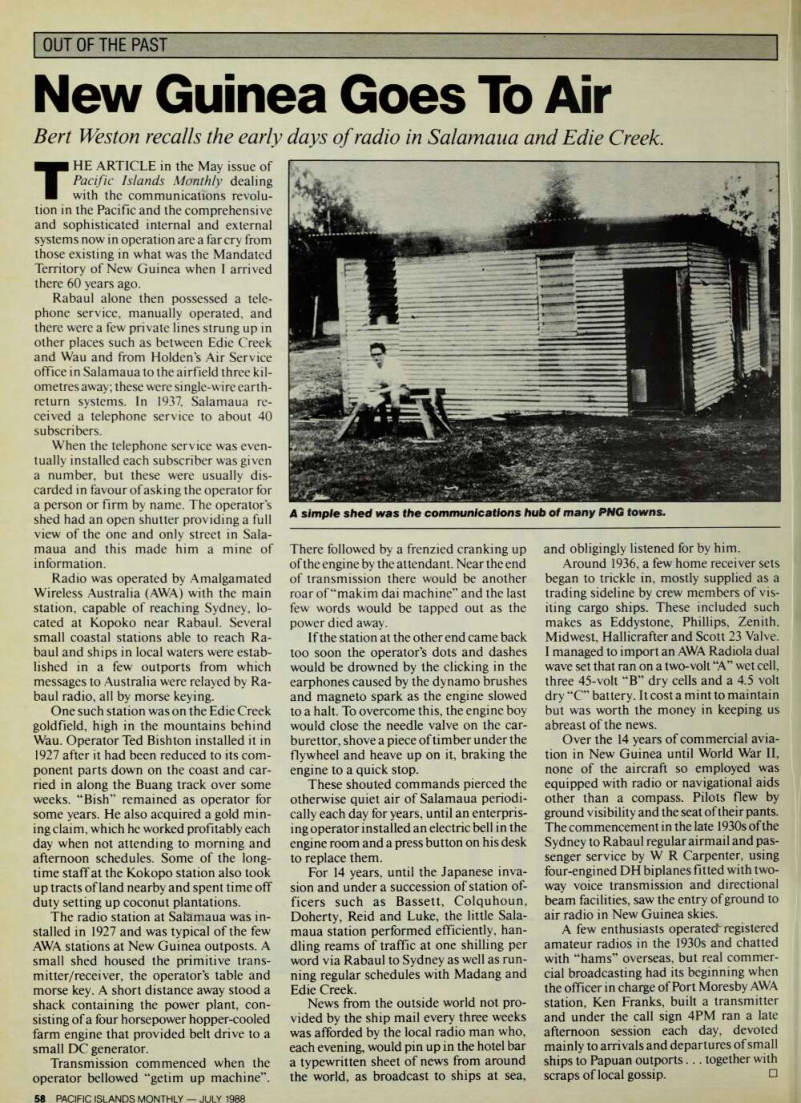
Out Of The Past
Bert Weston recalls the early days of radio in Salamaua and Edie Creek.
THE ARTICLE in the May issue of Pacific Islands Monthly dealing with the communications revolu tion in the Pacific and the comprehensive and sophisticated internal and external systems now in operation are a far cry from those existing in what was the Mandated Territory of New Guinea when I arrived there 60 years ago.
Rabaul alone then possessed a tele phone service, manually operated, and there were a few private lines strung up in other places such as between Edie Creek and Wau and from Holden’s Air Service office in Salamaua to the airfield three kil ometres away; these were single-wire earth return systems. In 1937, Salamaua re ceived a telephone service to about 40 subscribers.
When the telephone service was even tually installed each subscriber was given a number, but these were usually dis carded in favour of asking the operator for a person or firm by name. The operator’s shed had an open shutter providing a full view of the one and only street in Sala maua and this made him a mine of information.
Radio was operated by Amalgamated Wireless Australia (AWA) with the main station, capable of reaching Sydney, lo cated at Kopoko near Rabaul. Several small coastal stations able to reach Ra baul and ships in local waters were estab lished in a few outports from which messages to Australia were relayed by Ra baul radio, all by morse keying.
One such station was on the Edie Creek goldfield, high in the mountains behind Wau. Operator Ted Bishton installed it in 1927 after it had been reduced to its com ponent parts down on the coast and car ried in along the Buang track over some weeks. “Bish” remained as operator for some years. He also acquired a gold min ing claim, which he worked profitably each day when not attending to morning and afternoon schedules. Some of the long time staff at the Kokopo station also took up tracts of land nearby and spent time off duty setting up coconut plantations.
The radio station at Salamaua was in stalled in 1927 and was typical of the few AWA stations at New Guinea outposts. A small shed housed the primitive trans mitter/receiver, the operator’s table and morse key. A short distance away stood a shack containing the power plant, con sisting of a four horsepower hopper-cooled farm engine that provided belt drive to a small DC generator.
Transmission commenced when the operator bellowed “getim up machine”.
There followed by a frenzied cranking up of the engine by the attendant. Near the end of transmission there would be another roar of “makim dai machine” and the last few words would be tapped out as the power died away.
If the station at the other end came back too soon the operator’s dots and dashes would be drowned by the clicking in the earphones caused by the dynamo brushes and magneto spark as the engine slowed to a halt. To overcome this, the engine boy would close the needle valve on the car burettor, shove a piece of timber under the flywheel and heave up on it, braking the engine to a quick stop.
These shouted commands pierced the otherwise quiet air of Salamaua periodi cally each day for years, until an enterpris ing operator installed an electric bell in the engine room and a press button on his desk to replace them.
For 14 years, until the Japanese inva sion and under a succession of station of ficers such as Bassett, Colquhoun, Doherty, Reid and Luke, the little Sala maua station performed efficiently, han dling reams of traffic at one shilling per word via Rabaul to Sydney as well as run ning regular schedules with Madang and Edie Creek.
News from the outside world not pro vided by the ship mail every three weeks was afforded by the local radio man who, each evening, would pin up in the hotel bar a typewritten sheet of news from around the world, as broadcast to ships at sea,
and obligingly listened for by him.
Around 1936, a few home receiver sets began to trickle in, mostly supplied as a trading sideline by crew members of vis iting cargo ships. These included such makes as Eddystone, Phillips, Zenith, Midwest, Hallicrafter and Scott 23 Valve.
I managed to import an AWA Radiola dual wave set that ran on a two-volt “A” wet cell, three 45-volt “B” dry cells and a 4.5 volt dry “C” battery. It cost a mint to maintain but was worth the money in keeping us abreast of the news.
Over the 14 years of commercial avia tion in New Guinea until World War 11, none of the aircraft so employed was equipped with radio or navigational aids other than a compass. Pilots flew by ground visibility and the seat of their pants.
The commencement in the late 1930 s of the Sydney to Rabaul regular airmail and pas senger service by W R Carpenter, using four-engined DH biplanes fitted with two way voice transmission and directional beam facilities, saw the entry of ground to air radio in New Guinea skies.
A few enthusiasts operated registered amateur radios in the 1930 s and chatted with “hams” overseas, but real commer cial broadcasting had its beginning when the officer in charge of Port Moresby AWA station, Ken Franks, built a transmitter and under the call sign 4PM ran a late afternoon session each day, devoted mainly to arrivals and departures of small ships to Papuan outports... together with scraps of local gossip. □
A simple shed was the communications hub of many PNG towns.
Advertisements & other items, pp. 59-60 (1 item)
yes - SSSIA fUJS
Shelf Component Systems I ■ 500 watts (pmpo) MS + 5 UR graphic 1 - \DAT in/out M Multiprogram timer MSummh Sou ft ■CD Fade Edit Synchro system MldqaUpr digital s pith spectrum analyzer ■ Remote controllable, motor driven volume MC circuitry M Full-function remote control M Full-logic control M Dolby* nd M23cm cone woofer with elastic composite diaphragm develop
PERS 0
I choose my music with care. Sometimes it’s the oldies. Sometimes it’s the totally new. But there’s one kind I can’t stand —the kind that’s weak or distorted. That’s why my choice in a personal hi-fi is PERSON NA PLUS —the powerful system that hates distortion and noise as much as I do. My PERSONNA Z-90R has a huge 500 watts of peak music power output, and three-way speaker systems that sound bigger than all outdoors. The graphic equalizer with spectrum analyzer lets me tailor the sound to my tastes. And there’s the double, auto-reverse cassette deck, quartz-PLL synthesizer FM/AM tuner, full-auto turntable and the optional six-disc Multi-play CD player. But best of all—l can operate the whole system, including the volume, by remote control. At first, it looked too hard to use. Wrong! Pioneer made it easy. They made my choice easy, too. PERSONNA PLUS—also available in the Z-70R and Z-50R systems —is the choice I recommend to you.
CD PIONEER
The future of sound and vision.
For further information, please contact: Australia: Pioneer Electronics Australia Pty. Ltd. (Incorporated in Victoria), P-O- Box 295, Mordialloc, Victoria, 3195 Tel: 580-9911 Fiji Islands; Brijlal & Company, G.P.O. Box No. 362, Suva, Fiji Islands Tel: 22258 New Zealand: Monaco Distributors Ltd., 41 Poland Road, Glenfield, Auckland, New Zealand Tel: (09) 444-9144 Norfolk Island; Burnt Pine Traders Ltd., P.O. Box 21, Norfolk Island Vanuatu: Burns Philp (Vanuatu) Ltd, Vila, Vanuatu Nauru Island; Jacob Enterprises, P.O. Box N 0.4, Republic of Nauru Tahiti: Tahiti Hi-Fi, P.O. Box 848, Papeete, Tahiti New Caledonia: Menard Pacifique Sari, B.P. 3899, Noumea, New Caledonia Tel: 27-62*23 American Samoa: Transpac Corporation, P.O. Box 1477, Pago Pago, American Samoa 96799 Tel: 633-5224 Rarotonga: South Seas International Ltd, P.O. Box 49, Rarotonga, Cook Islands Tel: 2327
.42"
On all frontiers
Far from the everyday world, Mitsubishi vehicles are working on the edges of the unknown, On the frontiers of science, it is the highspeed research vehicle, the Galant HSR, testing the limits of control at over 320km/h. j On the frontiers of civilization, the Pajero, proving levels of stamina in harsh desert climates. On all frontiers, Mitsubishi vehicles are pushing forward the boundaries of technology.
It is this rigorous scrutiny under abnormal conditions that produces superior motor cars. For like much innovative technology, Mitsubishi vehicles are the product of a desire to understand the unknown, forged in the vibrant pioneering environment that makes up all frontiers.
Mitsubishi Motors is now offering a free 36-page PR magazine featuring interesting articles and exciting photos. If interested, write to: P.l. Advertising, International Business Planning Department, Office of International Business, Mitsubishi Motors Corporation, 33-8, Shiba 5-chome, Minato-ku, Tokyo 108, Japan.
AMERICAN SAMOA; MORRIS SCANLAN SERVICE INC. P.O. Box 367, Pago Pago, Tel. 633-5520/AUSTRALIA: MITSUBISHI MOTORS AUSTRALIA LTD. Box 1284, South Road, Clovelly Park, South Australia 5042, Tel. (08) 275-7223/FIJI: NIVIS MOTOR & MACHINERY CO., LTD. G.P.O. Box 150, Suva, Tel. 383411 /FRENCH POLYNESIA (TAHITI): ETS-BREDIN FRERES ET FILS P.O. Box 21, Papeete, Tahiti, Tel, 4-202-58/NEW CALEDONIA: SOCIETE DIMPORTATION D AUTO DU PACIFIQUE SUDS.A.
B.P. 438 Rond Point du Pacifique, Noumea, Tel. 274144/NEW ZEALAND: MITSUBISHI MOTORS NEW ZEALAND LTD. Todd Park, Heriot Drive, Private Bag, Porirua, Tel. 370-109/NOR FOLK ISLAND: BORRYS LTD, P.O. Box 169, Norfolk Island, Tel. 2114/PAPUA NEW GUINEA; TOBA PTY. LTD. P.O. Box 503, Port Moresby, Tel 21-7874/ SOLOMON ISLANDS: HARVEST PACIFIC LTD. G.P.O. Box 88, Honiara, Guadalcanal, Tel. 30128/TONGA; SITANI MAPI CO., LTD. P.O. Box 83. Nuku'ALOFA, Tel. 21-044/ VANUATU: SOCOMETRA B.P. 06 Routede Lagon, Port-Vila, Tel. 2314/WESTERN SAMOA: AM. MACDONALD HOLDINGS LTD. PO. Box 576, Apia, Tel 22022/SAIPAN/ POHNPEI/MAJURO/KOSRAE/TRUK/YAP/BELAU: MICRONESIAN MOTORS, INC. 997 South Marine Drive, Tamuning, Guam 96911, Tel. 646-6827 A
MITSUBISHI
MOTORS