Pacific

Islands
Monthly
fimvMvuM wuiiiwu uwyb.v/v Australia A 52.00 Cook Islands NZ$3.OO Fiji F 51.75 Hawaii US$2.5O Kiribati A 52.00 Nauru A 52.00 New Caledonia CFP2SO New Zealand NZ$3.OO Niue NZ$2.5O Norfolk Island A 52.00 Papua New Guinea K 2.00 Solomon Islands 552.00 Tahiti CFP3OO Tonga P 2.00 Tuvalu A 52.00
Usa Us$3.Oo
USTT and Guam US$2.5O Vanuatu VT2.00 Western Samoa T 2.75 ♦Recommended retail price only
June, 1988
Wm Oki Ims?
t
egistered by Australia Post Publication No. NBPI2IO
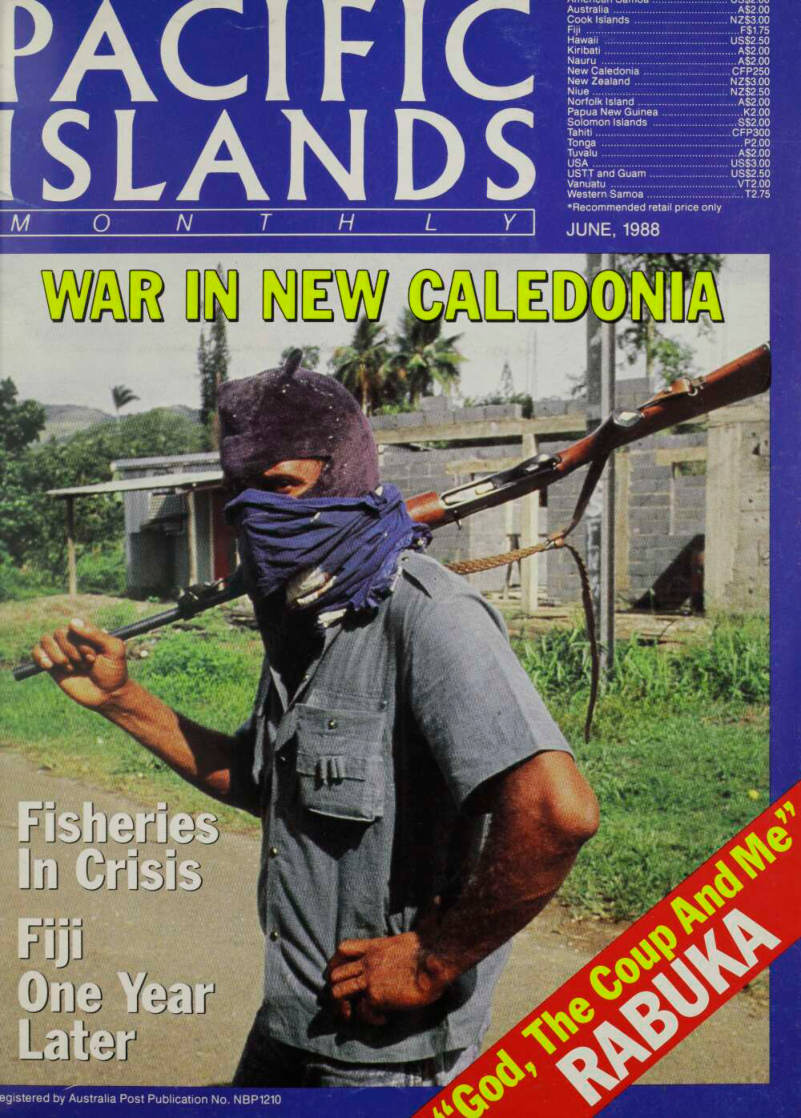
Cover Photograph: Tom Haley, Sipa
Advertisements & other items, p. 2 (1 item)
The pinnacle of
sporty pr -
From the onset, the Legend has represented an exquisite integration of Honda's engineering, technology and quality craftsmanship. A car whose performance unrestricted by old-world pedigrees became the index of excellence for the discerning motorist. For this selective driver, Honda proudly presents the new Legend Sports Coupe. Its regal aerodynamic bearing makes it classic. Its generous interior makes it rewarding. And its sporty demeanour makes it unique.
Elegance refined by sporting demands.
To give prestigious performance a sporting chance, Legend's appeal begins with the quality that is most easily recognized sleek, athletic looks that are aerodynamically refined. The remarkable drag coefficient of 0.30 reduces wind resistance and enhances the whisper-quiet ride. Legend's lavishly appointed cabin is a low-stress environment that sets the stage for high-powered fun.
Already hailed as a stunning technological achievement in the Legend sedan, Honda's potent race-bred V-6 assumes even greater prominence here. A larger 2.7-liter SOHC 24-valve engine provides liquid-smooth response across its entire operating range, satisfying your thirst for exhilaration to the fullest degree. For an equivalent level of handling response, Legend's 4-wheel double wishbone suspension takes a page from Formula One racing cars, adding uncommon stability at every turn of the road. And just as quickly as Legend's performance begins, Honda's four-wheel-disc anti-lock brake system brings it to a fast, smooth conclusion.
The Legend Sports Coupe. An experience born of Honda's most prestigious automotive technologies. And bred by its commitment to make driving uniquely exhilarating.
U HONDA
II V T Specifications and equipment may vary in some countries.
Honda engines have powered the Williams/Honda team to consecutive Formula One Constructors' Championships in 1986 and 1987, and dominated the Grand Prix world.
For 1988, Honda engines will continue to compete in motor sport's toughest arena with the Lotus and McLaren Teams. rrrfrf oW
SJSBI
an AUSTRALIA: Honda Australia Pty., Ltd. Lot 95 Sharps Road, Tullamarine, Victoria 3043/NEW ZEALAND; NZMC Limited Manners Plaza, 57-65 Manners St.. Wellington/PAPUA NEW GUINEA: Toba Pty., Ltd. P.O Box 503, Port Moresby/TAHITI: Honda Distribution S.A. R.L BP 1665, Papeete/KIRIBATI: Atoll Motor & Marino Services P.O. Box 49, Bairiki Tarawa, Republic of Kiribati/ U.S. TRUST TERRITORY: United Micronesia Development Association P.O. Box 235, CHRB Saipan CM 96950/COOK ISLANDS: Cook Islands Motor Centre Ltd. P.O. Box 74, Rarotonga/ GUAM: Mark's Motor Co., Inc. P.O. Box DV, Agana/WESTERN SAMOA: Motor Distributors (Samoa) Ltd. P.O. Box 576, Apia/SOLOMON ISLANDS: Lee Kwok Kuen & Co., Ltd. P.O. Box 537, Honiara/ NEW CALEDONIA: Soci6te Du Chalandage 8, Rue de la somme-B.P 97, Noumea/NAURU: Nauru Cooperation Republic of Nauru/FIJI: Coral Island Motors Ltd. Robertson Road, Suva, Fiji/ AMERICAN SAMOA: Holiday Motors, Parts and Service P.O. Box 968, Pago Pago, American Samoa 96799: Heleck’s Service Center Ltd. P.O. Box 1138. Pago Pago, American Samoa 96799/TONGA: Tonga Industrial Traders P.O. Box 1035, Nukualofa, Tonga/NORFOLK ISLAND: Duncombe Bay Garage New Cascade Road, Norfolk Island/VANUATU: Honda Farm Ltd. P.O. Box 1031, Pori Vila, Vanuatu
Pacific
Islands
Monthly
Vol 59. NO. 6
Voice Of The Pacific
June, ’BB
Cover Story s
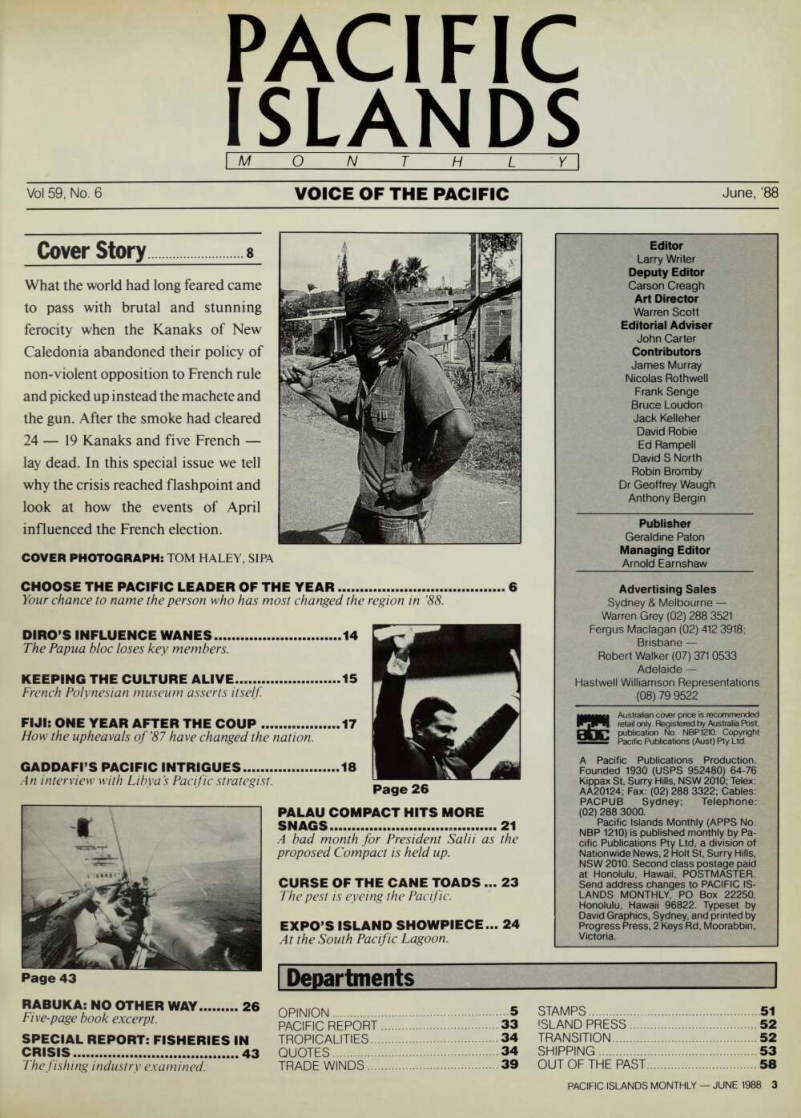
What the world had long feared came to pass with brutal and stunning ferocity when the Kanaks of New Caledonia abandoned their policy of non-violent opposition to French rule and picked up instead the machete and the gun. After the smoke had cleared 24 19 Kanaks and five French lay dead. In this special issue we tell why the crisis reached flashpoint and look at how the events of April influenced the French election.
CHOOSE THE PACIFIC LEADER OF THE YEAR 6 Your chance to name the person who has most changed the region in ’BB.
Diro’S Influence Wanes 14
The Papua bloc loses key members.
Keeping The Culture Alive 15
French Polynesian museum asserts itself.
FIJI: ONE YEAR AFTER THE COUP 17 How the upheavals of’B7 have changed the nation.
Gaddafi’S Pacific Intrigues 18
An interview with Libya’s Pacific strategist.
Page 26
Page 43
Rabuka: No Other Way 26
Five-page book excerpt.
Special Report: Fisheries In
Crisis ... 43
The fishing industry examined.
Palau Compact Hits More
Snags 21
A bad month for President Salii as the proposed Compact is held up.
CURSE OF THE CANE TOADS ... 23 The pest is eyeing the Pacific.
Expo’S Island Showpiece... 24
At the South Pacific Lagoon.
Editor Larry Writer Deputy Editor
Carson Creagh
Art Director Warren Scott Editorial Adviser John Carter Contributors James Murray Nicolas Rothwell
Frank Senge
Bruce Loudon Jack Kelleher David Robie Ed Rampell David S North Robin Bromby
Dr Geoffrey Waugh
Anthony Bergin
Publisher Geraldine Raton
Managing Editor
Arnold Earnshaw Advertising Sales Sydney & Melbourne — Warren Grey (02) 288 3521
Fergus Maclagan (02) 412 3918;
Brisbane — Robert Walker (07) 371 0533 Adelaide — Hastwell Williamson Representations (08) 79 9522
Australian cover price is recommended retail only. Registered by Australia Post, publication No. NBP 1210. Copyright Pacific Publications (Aust) Pty Ltd.
Advertisements & other items, pp. 3-4 (3 items)
Departments
OPINION 5
PACIFIC REPORT 33
TROPICALITIES 34
QUOTES 34
TRADE WINDS 39
STAMPS 51
'SLAND PRESS 52
TRANSITION 52
SHIPPING 53
OUT OF THE PAST 58
3
PACIFIC ISLANDS MONTHLY JUNE 1988
A Pacific Publications Production.
Founded 1930 (USPS 952480) 64-76 Kippax St, Surry Hills, NSW 2010; Telex: AA20124; Fax; (02) 288 3322; Cables: PACPUB Sydney; Telephone: (02) 288 3000.
Pacific Islands Monthly (APPS No.
NBP 1210) is published monthly by Pa cific Publications Pty Ltd, a division of Nationwide News, 2 Holt St, Surry Hills, NSW 2010. Second class postage paid at Honolulu, Hawaii, POSTMASTER.
Send address changes to PACIFIC IS
LANDS MONTHLY, PO Box 22250,
Honolulu, Hawaii 96822. Typeset by David Graphics, Sydney, and printed by Progress Press, 2 Keys Rd, Moorabbin, Victoria.
Perso
vrsomA
elf Component Systems m ■ 500 watts (pmpo) B 5 + 5 UR graphic efijmlizer DAT in!out M Multiprogram timer USunomm Soun ■CO Fade Edit Synchro system ■ Idea Up r digital s ith spectrum analyzer M Remote controllable, motor-driven volume MCD d circuitry ■ Full-function remote control ■ Full-logic control ■ Dolby* B Ni M23cm cone woofer with elastic composite diaphragm developed i
Z-90R I choose my music with care. Sometimes it’s the oldies. Sometimes it’s the totally new. But there’s one kind I can’t stand —the kind that’s weak or distorted. That’s why my choice in a personal hi-fi is PERSONNA PLUS—the powerful system that hates distortion and noise as much as I do. My PERSONNA Z-90R has a huge 500 watts of peak music power output, and three-way speaker systems that sound bigger than all outdoors. The graphic equalizer with spectrum analyzer lets me tailor the sound to my tastes. And there’s the double, auto-reverse cassette deck, quartz-PLL synthesizer FM/AM tuner, full-auto turntable and the optional six-disc Multi-play CD player. But best of all—l can operate the whole system, including the volume, by remote control. At first, it looked too hard to use. Wrong! Pioneer made it easy. They made my choice easy, too. PERSONNA PLUS—also available in the Z-70R and Z-50R systems—is the choice I recommend to you.
CD PIONEER
The future of sound and vision.
For further information, please contact: Australia; Pioneer Electronics Australia Pty. Ltd. (Incorporated in Victoria), P.O. Box 295, Mordialloc, Victoria, 3195 Tel: 580-9911 Fiji Islands: Brijlal & Company, G.P.O. Box No. 362, Suva, Fiji Islands Tel; 22258 New Zealand: Monaco Distributors Ltd., 41 Poland Road, Glenfield, Auckland, New Zealand Tel: (09) 444-9144 Norfolk Island: Burnt Pine Traders Ltd., P.O. Box 21, Norfolk Island Vanuatu: Burns Philp (Vanuatu) Ltd., Vila, Vanuatu Nauru Island: Jacob Enterprises, P.O. Box N 0.4, Republic of Nauru Tahiti: Tahiti Hi-Fi, P.O. Box 848, Papeete, Tahiti New Caledonia: Menard Pacifique Sari, B.P. 3899, Noumea, New Caledonia Tel; 27.62*23 American Samoa: Transpac Corporation, P.O. Box 1477, Pago Pago, American Samoa 96799 Tel; 633-5224 Rarotonga: South Seas International Ltd., P.O. Box 49, Rarotonga, Cook Islands Tel; 2327
New Caledonia:
Opinion
New Caledonia: Blood On The Tricolor
After a violent and tragic month, France’s troubled Pacific territory must ponder new directions.
THE VIOLENCE that convulsed New Caledonia during last month’s Presidential and regional elec tions has changed forever the tenor of political life in that small and apparently fated territory. On one hand, events have dealt a crippling blow to those colons who would see Noumea forever an outlying suburb of Paris.
Despite their rhetoric and their unnerving willingness to open fire on anyone who threatens their hegemony of eco nomic and political authority, New Caledonia’s loyalists have been deeply shaken by the “muscular mobilisation” of separatist Kanaks.
The discipline and commitment demonstrated in such coups de foudre as the humiliating capture of Captain Philippe Legorjus, head of France’s elite anti-terrorist squad, seem to have amazed even the Kanaks themselves and though finally overwhelmed at Ouvea by Captain Legorjus and his vastly superior numbers and weaponry, the newfound confidence those partial successes have en gendered will doubtless continue to affect Kanak political bargaining.
Naturally, the Right has trotted out “proof’ that the militants were trained and armed by Libya: but the truth is that many of the FLNKS “terrorists” received their ed ucation not in Tripoli but in the Army of the Republic of France. Perhaps their familiarity with French strategy en abled them to anticipate the Army’s actions, and thus to effectively paralyse 9000 troops for almost a fortnight. . . albeit with the loss of at least 30 guerrillas.
But before the supporters of Kanaky congratulate themselves too heartily, they should take stock of just what they have accomplished. It seems certain President Fran cois Mitterrand and his Prime Minister, Michel Rocard, will win control of France’s Government. It seems certain, too, that the Pons statute will be repealed and elements of the Pisani plan introduced in its place. But that is all.
While Jean-Marie Le Pen’s New Caledonian support ers can express their own political philosophies, and while the leaders of the RPCR can continue to exert almost complete control over the territory’s economy, the com plexities of the real world will ensure progress in whatever direction to an independent Kanaky, to a Kanaky in dependent in association with France, or perhaps to New Caledonia’s election to the status of a metropolitan departement is slow and painful.
FLNKS President Tjibaou will have to move swiftly to consolidate and to assert his authority over his “troops”.
And he will have to begin dialogue with all sections of New Caledonian and French politics if he is to maintain his
primacy. The day of token Melanesian representation, ep itomised by Dick Ukeiwe, may have passed: in its place must be a more mature, more responsible and above all more politically sagacious Kanak presence.
If the gains (in regional sympathy, if not in tangible im provement) of last month are to remain meaningful, they must be followed by more than speeches. Now is the time for the FLNKS to demonstrate that its desires are worthy of attention; if it cannot do so, the organisation will have condemned the people and the land it claims to love to a bloody and tragic future. □
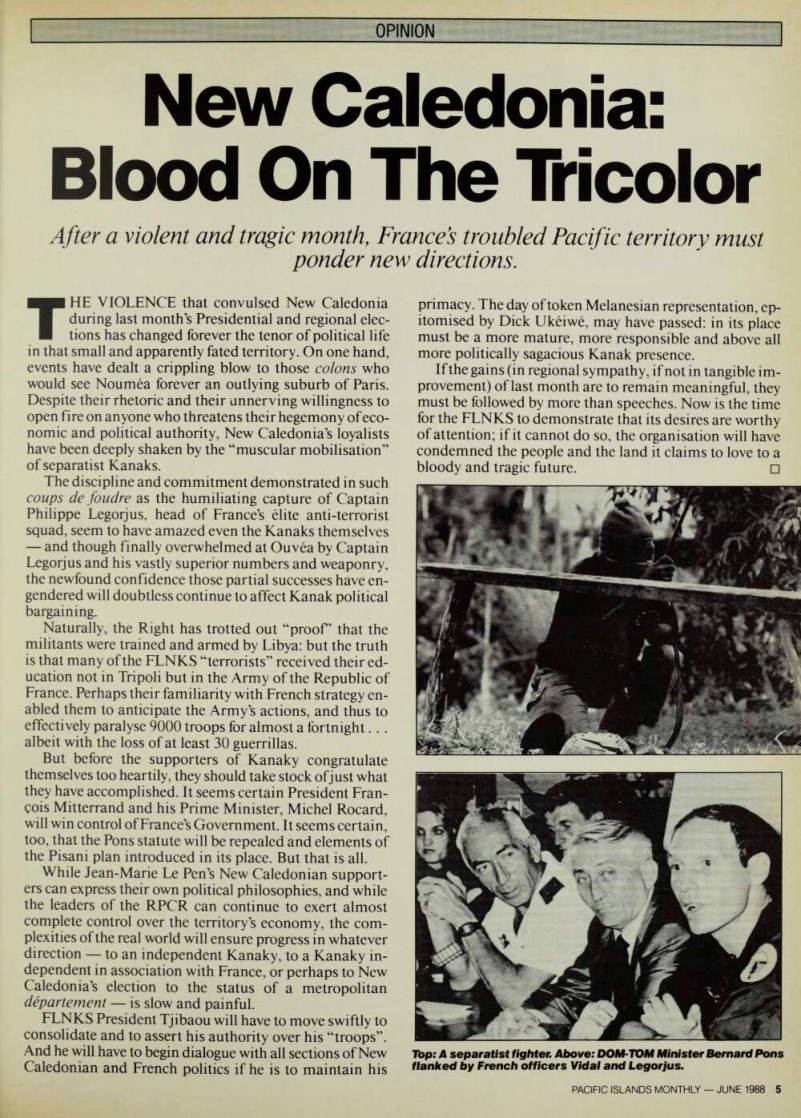
Top: A separatist fighter. Above: DOM-TOM Minister Bernard Pons flanked by French officers Vidal and Legorjus.
Leader Of The Year
Your Say
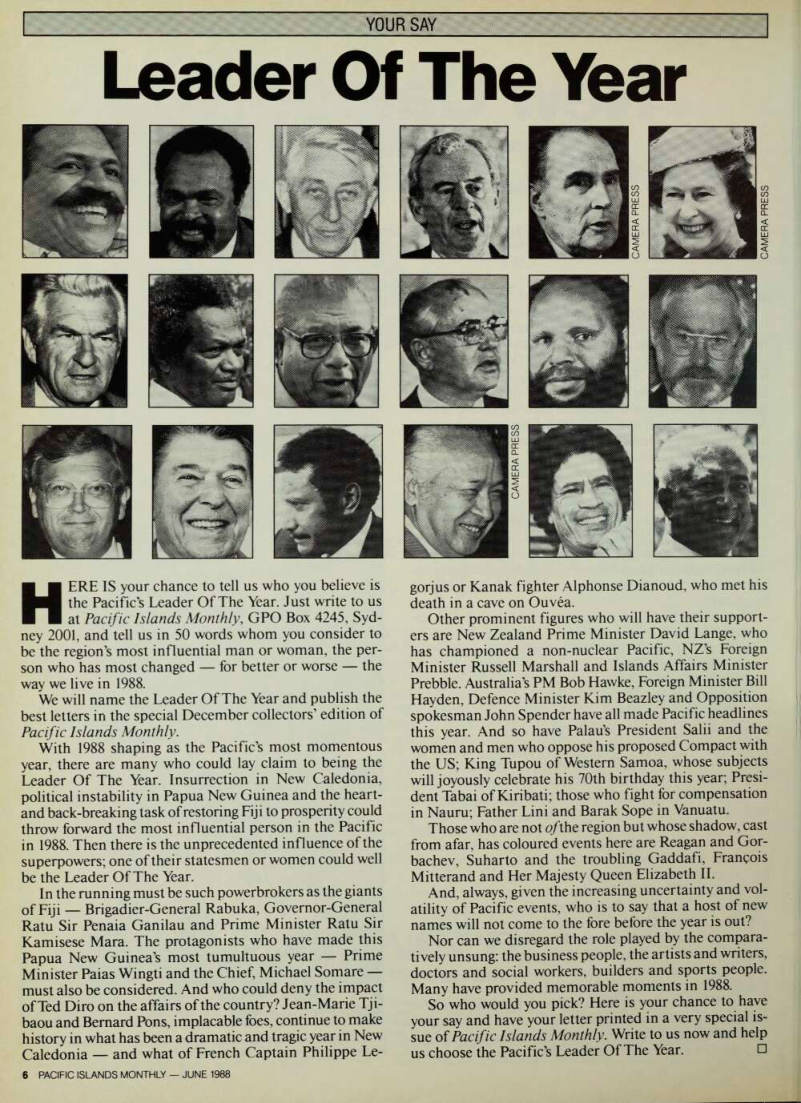
HERE IS your chance to tell us who you believe is the Pacific’s Leader Of The Year. Just write to us at Pacific Islands Monthly , GPO Box 4245, Syd ney 2001, and tell us in 50 words whom you consider to be the region’s most influential man or woman, the per son who has most changed for better or worse the way we live in 1988.
We will name the Leader Of The Year and publish the best letters in the special December collectors’ edition of Pacific Islands Monthly.
With 1988 shaping as the Pacific’s most momentous year, there are many who could lay claim to being the Leader Of The Year. Insurrection in New Caledonia, political instability in Papua New Guinea and the heart and back-breaking task of restoring Fiji to prosperity could throw forward the most influential person in the Pacific in 1988. Then there is the unprecedented influence of the superpowers; one of their statesmen or women could well be the Leader Of The Year.
In the running must be such powerbrokers as the giants of Fiji Brigadier-General Rabuka, Governor-General Ratu Sir Penaia Ganilau and Prime Minister Ratu Sir Kamisese Mara. The protagonists who have made this Papua New Guinea’s most tumultuous year Prime Minister Paias Wingti and the Chief, Michael Somare must also be considered. And who could deny the impact of Ted Diro on the affairs of the country? Jean-Marie Tji baou and Bernard Pons, implacable foes, continue to make history in what has been a dramatic and tragic year in New Caledonia and what of French Captain Philippe Le
gorjus or Kanak fighter Alphonse Dianoud, who met his death in a cave on Ouvea.
Other prominent figures who will have their support ers are New Zealand Prime Minister David Lange, who has championed a non-nuclear Pacific, NZ’s Foreign Minister Russell Marshall and Islands Affairs Minister Prebble. Australia’s PM Bob Hawke, Foreign Minister Bill Hayden, Defence Minister Kim Beazley and Opposition spokesman John Spender have all made Pacific headlines this year. And so have Palau’s President Salii and the women and men who oppose his proposed Compact with the US; King Tupou of Western Samoa, whose subjects will joyously celebrate his 70th birthday this year; Presi dent Tabai of Kiribati; those who fight for compensation in Nauru; Father Lini and Barak Sope in Vanuatu.
Those who are not of the region but whose shadow, cast from afar, has coloured events here are Reagan and Gor bachev, Suharto and the troubling Gaddafi, Francois Mitterand and Her Majesty Queen Elizabeth 11.
And, always, given the increasing uncertainty and vol atility of Pacific events, who is to say that a host of new names will not come to the fore before the year is out?
Nor can we disregard the role played by the compara tively unsung: the business people, the artists and writers, doctors and social workers, builders and sports people.
Many have provided memorable moments in 1988.
So who would you pick? Here is your chance to have your say and have your letter printed in a very special is sue of Pacific Islands Monthly. Write to us now and help us choose the Pacific’s Leader Of The Year. □
Advertisements & other items, p. 7 (1 item)
Few businesses compare, in terms
of risk and expense, with those involved in the exploration of natural resources. Whether you're seeking minerals or oil and gas, logistics is a key factor. From the commencement of seismic to the final demob you need a company with proven reliability.
The RLC Special Projects Division has been involved in servicing exploration ventures for over twenty years. You may want a rig from Singapore or consumables from Australia, parts from the U.S. or a submersible from Scotland. A phone call is all it takes.
Our business is to help you get on with serious business. .l f <: 1 * r M J I 3 k, 11 I i w m m Robert Laurie Company Pty Ltd Telex NE22337 Facsimile 21 7895 Telephone 21 7413 r * * 1 . Special Projects ♦
Days Of Rage
New Caledonia
Days Of Rage And Mourning
War comes to the Pacific as Kanaks finally abandon non-violent resistance to
French rule.
By Carson Creagh
AS THE tumult dies after the most momentous month in the troubled history of New Caledonia, it is at last possible to tentatively assess the ef fects of the Kanaks’ decision to abandon non-violent resistance and resort to “mus cular mobilisation” to achieve their objectives.
Ultimately, the Kanaks demand noth ing less than independence and self-deter mination, but for now they will accept, they say, social justice, land rights and a greater say in the administration of the territory.
The events of April and May will change New Caledonia for ever. As Pacific Is lands Monthly went to press: France was still firmly in control; at least 26 Kanaks and French gendarmes, soldiers and sup porters had been killed; the FLNKS was established as a force to be respected; the controversial Pons Statute had been tor pedoed; the conservative Government of Jacques Chirac had been swept from of fice with events in New Caledonia a telling factor in its demise.
The drama began at dawn on April 22, when a “commando” of 40 or so Kanaks descended on police quarters at Fayaoue, the administrative centre on Ouvea, larg est of the Loyalty Islands, and there hacked to death four gendarmes. Three Kanaks were injured in the raid, which ended with 27 police taken hostage and handcuffed. A first group of 11 hostages was taken to the south of the island, to be released several days later; the remaining 16 were trans ported to the tribal territory of Gossana, in the far north of the island, and hidden in a cave known locally as the “sacred hole”.
Authorities in Paris set up a “crisis centre” at the Hotel Matignon (the govern ment headquarters) and reinforcements were flown to New Caledonia. Ouvea was declared a zone militaire and entry was forbidden to the Press.
More than 300 soldiers were sent to
Ouvea’s north, but were unable to locate the militants’ hiding place: the “sacred hole” was eventually found, but proved unassailable: captors and military officers prepared for the long process of negotiation.
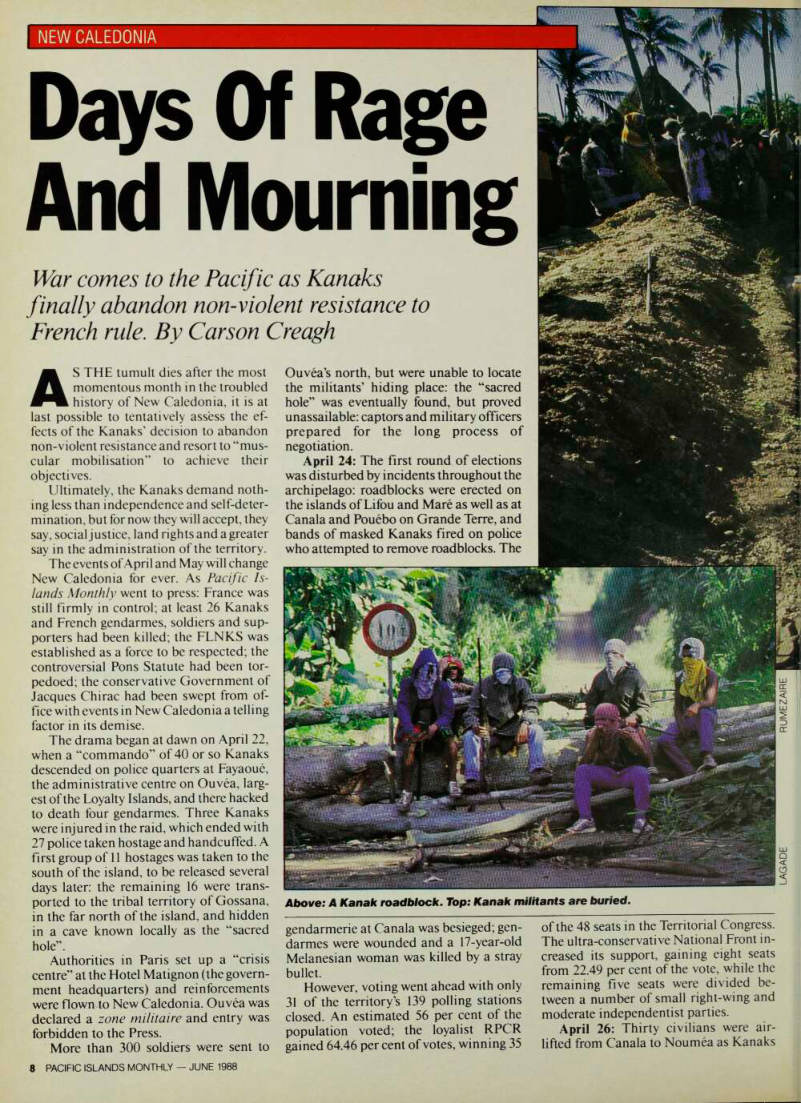
April 24: The first round of elections was disturbed by incidents throughout the archipelago: roadblocks were erected on the islands of Lifou and Mare as well as at Canala and Pouebo on Grande Terre, and bands of masked Kanaks fired on police who attempted to remove roadblocks. The
gendarmerie at Canala was besieged; gendarmes were wounded and a 17-year-old Melanesian woman was killed by a stray bullet.
However, voting went ahead with only 31 of the territory’s 139 polling stations closed. An estimated 56 per cent of the population voted; the loyalist RPCR gained 64.46 per cent of votes, winning 35
of the 48 seats in the Territorial Congress, The ultra-conservative National Front in creased its support, gaining eight seats from 22.49 per cent of the vote, while the remaining five seats were divided be tween a number of small right-wing and moderate independentist parties, April 26: Thirty civilians were air lifted from Canala to Noumea as Kanaks
Above: A Kanak roadblock.
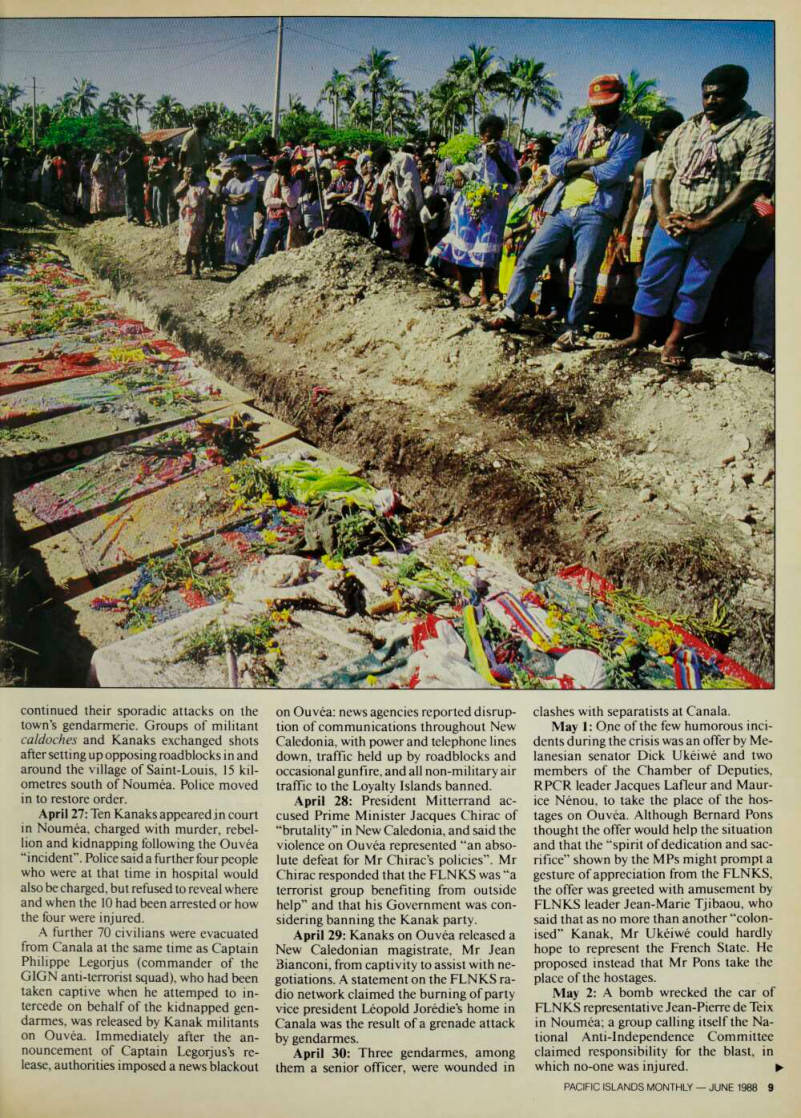
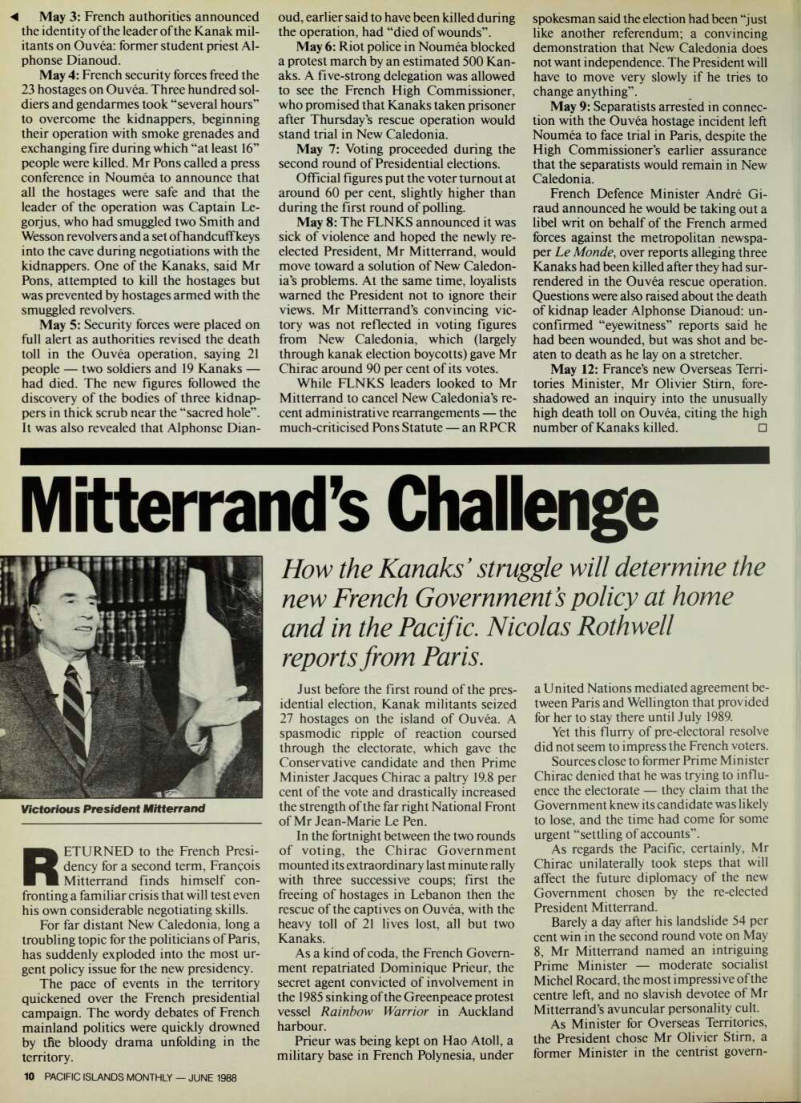
Top: Kanak militants are buried.
Lagade
Rumeza1Re
continued their sporadic attacks on the town’s gendarmerie. Groups of militant caldoches and Kanaks exchanged shots after setting up opposing roadblocks in and around the village of Saint-Louis, 15 kil ometres south of Noumea. Police moved in to restore order.
April 27: Ten Kanaks appeared in court in Noumea, charged with murder, rebel lion and kidnapping following the Ouvea “incident”. Police said a further four people who were at that time in hospital would also be charged, but refused to reveal where and when the 10 had been arrested or how the four were injured.
A further 70 civilians were evacuated from Canala at the same time as Captain Philippe Legorjus (commander of the GIGN anti-terrorist squad), who had been taken captive when he attemped to in tercede on behalf of the kidnapped gen darmes, was released by Kanak militants on Ouvea. Immediately after the an nouncement of Captain Legorjus’s re lease, authorities imposed a news blackout
on Ouvea: news agencies reported disrup tion of communications throughout New Caledonia, with power and telephone lines down, traffic held up by roadblocks and occasional gunfire, and all non-military air traffic to the Loyalty Islands banned.
April 28: President Mitterrand ac cused Prime Minister Jacques Chirac of “brutality” in New Caledonia, and said the violence on Ouvea represented “an abso lute defeat for Mr Chirac’s policies”. Mr Chirac responded that the FLNKS was “a terrorist group benefiting from outside help” and that his Government was con sidering banning the Kanak party.
April 29: Kanaks on Ouvea released a New Caledonian magistrate, Mr Jean Bianconi, from captivity to assist with ne gotiations. A statement on the FLNKS ra dio network claimed the burning of party vice president Leopold Joredie’s home in Canala was the result of a grenade attack by gendarmes.
April 30: Three gendarmes, among them a senior officer, were wounded in
clashes with separatists at Canala.
May 1: One of the few humorous inci dents during the crisis was an offer by Me lanesian senator Dick Ukeiwe and two members of the Chamber of Deputies, RPCR leader Jacques Lafleur and Maur ice Nenou, to take the place of the hos tages on Ouvea. Although Bernard Pons thought the offer would help the situation and that the “spirit of dedication and sac rifice” shown by the MPs might prompt a gesture of appreciation from the FLNKS, the offer was greeted with amusement by FLNKS leader Jean-Marie Tjibaou, who said that as no more than another “colon ised” Kanak, Mr Ukeiwe could hardly hope to represent the French State. He proposed instead that Mr Pons take the place of the hostages.
May 2: A bomb wrecked the car of FLNKS representative Jean-Pierre de Teix in Noumea; a group calling itself the Na tional Anti-Independence Committee claimed responsibility for the blast, in which no-one was injured. *
◄ May 3: French authorities announced the identity of the leader of the Kanak mil itants on Ouvea: former student priest Al phonse Dianoud.
May 4: French security forces freed the 23 hostages on Ouvea. Three hundred sol diers and gendarmes took “several hours” to overcome the kidnappers, beginning their operation with smoke grenades and exchanging fire during which “at least 16” people were killed. Mr Pons called a press conference in Noumea to announce that all the hostages were safe and that the leader of the operation was Captain Le goijus, who had smuggled two Smith and Wesson revolvers and a set of handcuff keys into the cave during negotiations with the kidnappers. One of the Kanaks, said Mr Pons, attempted to kill the hostages but was prevented by hostages armed with the smuggled revolvers.
May 5: Security forces were placed on full alert as authorities revised the death toll in the Ouvea operation, saying 21 people two soldiers and 19 Kanaks had died. The new figures followed the discovery of the bodies of three kidnap pers in thick scrub near the “sacred hole”.
It was also revealed that Alphonse Dian
oud, earlier said to have been killed during the operation, had “died of wounds”.
May 6: Riot police in Noumea blocked a protest march by an estimated 500 Kanaks. A five-strong delegation was allowed to see the French High Commissioner, who promised that Kanaks taken prisoner after Thursday’s rescue operation would stand trial in New Caledonia.
May 7: Voting proceeded during the second round of Presidential elections.
Official figures put the voter turnout at around 60 per cent, slightly higher than during the first round of polling.
May 8: The FLNKS announced it was sick of violence and hoped the newly reelected President, Mr Mitterrand, would move toward a solution of New Caledonia’s problems. At the same time, loyalists warned the President not to ignore their views. Mr Mitterrand’s convincing vietory was not reflected in voting figures from New Caledonia, which (largely through kanak election boycotts) gave Mr Chirac around 90 per cent of its votes.
While FLNKS leaders looked to Mr Mitterrand to cancel New Caledonia’s recent administrative rearrangements the much-criticised Pons Statute an RPCR
spokesman said the election had been “just like another referendum ; a convincing demonstration that New Caledonia does not want independence. The President will have to move very slowly if he tries to change anything”, May 9: Separatists arrested in connec tion with the Ouvea hostage incident left Noumea to face trial in Paris, despite the High Commissioner’s earlier assurance that the separatists would remain in New Caledonia.
French Defence Minister Andre Gi raud announced he would be taking out a libel writ on behalf of the French armed forces against the metropolitan newspa per Le Monde, over reports alleging three Kanaks had been killed after they had sur rendered in the Ouvea rescue operation, Questions were also raised about the death of kidnap leader Alphonse Dianoud: un confirmed “eyewitness” reports said he had been wounded, but was shot and be aten to death as he lay on a stretcher, May 12: France’s new Overseas Terri tories Minister, Mr Olivier Stim, fore shadowed an inquiry into the unusually high death toll on Ouvea, citing the high number of Kanaks killed. □
Mitterrand’s Challenge
How the Kanaks’ struggle will determine the new French Government’s policy at home and in the Pacific. Nicolas Rothwell reports from Paris.
RETURNED to the French Presidency for a second term, Francois Mitterrand finds himself confronting a familiar crisis that will test even his own considerable negotiating skills.
For far distant New Caledonia, long a troubling topic for the politicians of Paris, has suddenly exploded into the most urgent policy issue for the new presidency.
The pace of events in the territory quickened over the French presidential campaign. The wordy debates of French mainland politics were quickly drowned by the bloody drama unfolding in the territory.
Just before the first round of the pres idential election, Kanak militants seized 27 hostages on the island of Ouvea. A spasmodic ripple of reaction coursed through the electorate, which gave the Conservative candidate and then Prime Minister Jacques Chirac a paltry 19.8 per cent of the vote and drastically increased the strength of the far right National Front of Mr Jean-Marie Le Pen.
In the fortnight between the two rounds of voting, the Chirac Government mounted its extraordinary last minute rally with three successive coups; first the freeing of hostages in Lebanon then the rescue of the captives on Ouvea, with the heavy toll of 21 lives lost, all but two Kanaks.
As a kind of coda, the French Govern ment repatriated Dominique Prieur, the secret agent convicted of involvement in the 1985 sinking of the Greenpeace protest vessel Rainbow Warrior in Auckland harbour.
Prieur was being kept on Hao Atoll, a military base in French Polynesia, under
a United Nations mediated agreement be tween Paris and Wellington that provided for her to stay there until July 1989.
Yet this flurry of pre-electoral resolve did not seem to impress the French voters.
Sources close to former Prime Minister Chirac denied that he was trying to influ ence the electorate they claim that the Government knew its candidate was likely to lose, and the time had come for some urgent “settling of accounts”.
As regards the Pacific, certainly, Mr Chirac unilaterally took steps that will affect the future diplomacy of the new Government chosen by the re-elected President Mitterrand.
Barely a day after his landslide 54 per cent win in the second round vote on May 8, Mr Mitterrand named an intriguing Prime Minister moderate socialist Michel Rocard, the most impressive of the centre left, and no slavish devotee of Mr Mitterrand’s avuncular personality cult.
As Minister for Overseas Territories, the President chose Mr Olivier Stim, a former Minister in the centrist govern-
Victorious President Mitterrand
ment of President Giscard d’Estaing.
Mr Stim is an old Pacific hand and a canny choice to try to reduce tension in New Caledonia he may reassure the fiercely patriotic European settler community in the territory that France is not about to sell them down the river.
But twin problems confront France and President Mitterrand as he moves to address the nation’s Pacific woes.
First President Mitterrand has called new legislative elections for June, in a bid to secure a moderate socialist majority and a clear mandate for his new political creed; the fostering of unity, tolerance and national consensus.
Thus breakthroughs in New Caledonia must wait on the achievement of political stability in France.
Second and far more important, the situation in New Caledonia is more deeply polarised than at any time in the recent past and Mr Mitterrand’s return to power may only worsen that division.
The political balance in Noumea is a grisly mirror of the changes that have taken place in Metropolitan France; for the New Caledonian National Front is the newly ascendant party among the territory’s Europeans.
Once again the absence of a political centre in New Caledonia is the island’s greatest tragedy.
Conservatives in the Caledonian establishment party, the Rassemblement Pour la Caledonie dans la Republique, find
their uncompromising attitudes subtly reinforced by the rhetoric of their Gaullist counterparts in France.
Meanwhile the main political leaders of the pro independent Kanaks believe Mr Mitterrand is the man who will grant them their wish.
Yet here is the heart of the problem. The President knows his history, and doubtless sees, like many French commentators, the alarming parallels between the current situation in New Caledonia and the earlier colonial debacle of Algeria.
In place now is a recipe for disaster: a French leader anxious to increase the political rights of Kanaks, the memory of recent bloodshed, and an edgy European loyalist majority, armed to the teeth and deeply suspicious of Mr Mitterrand’s intention.
What the President’s strategy will be remains unclear —just the way he likes it.
But several basic truths now guide French policy.
First, the territory is small and wins no votes; second, all major parties support France’s presence in the Pacific; third, action must be taken or more blood will flow, especially now a re-elected socialist President has raised Kanak hopes.
Although his is a distinctly un-French approach, the new look Mitterrand may opt for a vaguely drafted scheme to provide something like independence in association a solution similar to that applied by the US to some of its territories.
If the Kanaks and Europeans might be persuaded to agree, there could even be a move to introduce the kind of advanced autonomy that now exists in French Po lynesia, providing for local political con trol backed by hefty external funding, Imposing full independence on the Eu ropeans of New Caledonia might be be yond even Mr Mitterrand’s powers of persuasion.
The worst alternative is the one now being most vigorously discussed by the more creative fantasists of empire on the French right partition, This was in the air when France rela tantly gave Vanuatu its freedom in 1980 and it was applied in the case of the Indian Ocean territory of Mayotte, But dividing the island of Grande Terre down its mountain spine would simply draw a line through the problem, admit the need for apartheid and invent a West Bank for the Pacific.
What is required in today’s New Cale donia is a human solution, not a grand scheme to command the future, President Mitterrand definitely needs a mediator who can bridge both commu nities and who can speak for the interests of all New Caledonians, not just Kanaks or whites. He needs a man who is neither FLNKS nor RPCR a man of that long ignored force, the centre. Step forward, Nidoish Naisseline, both traditional chief and most Parisian of all Kanak politicians your time has come at last. □
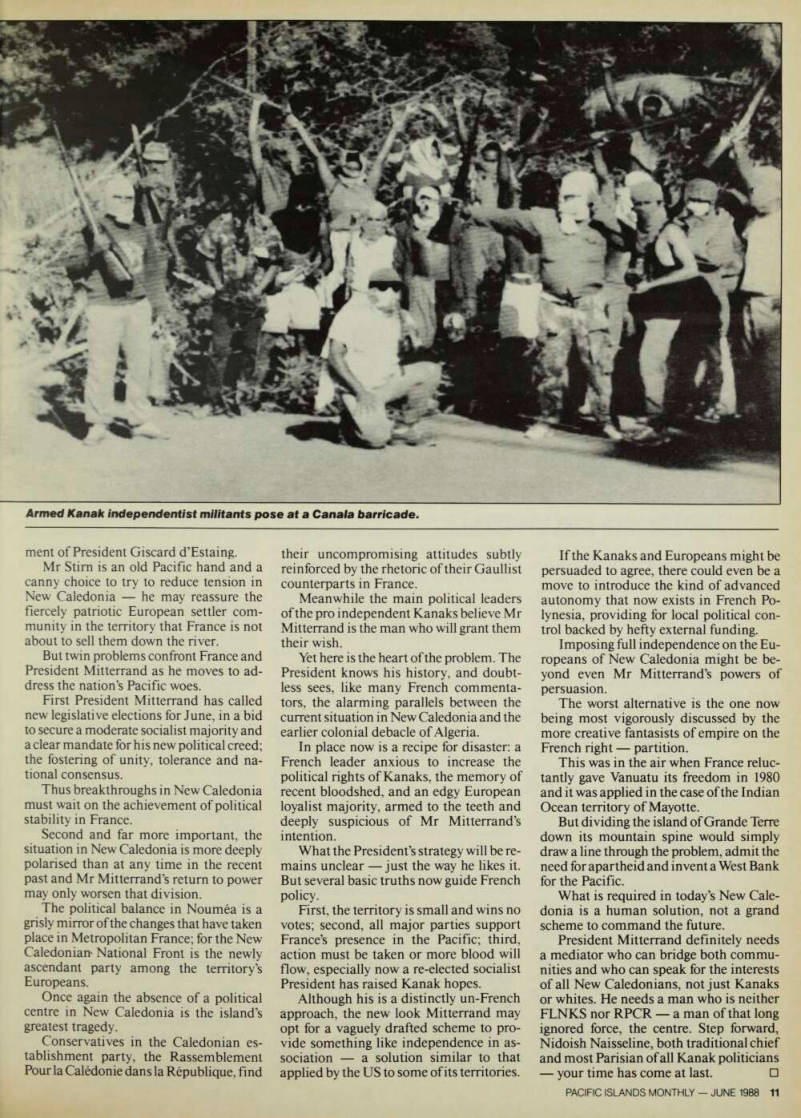
Armed Kanak independentist militants pose at a Canala barricade.
Tjibaou: “Why We Fight”
New Caledonia
The FLNKS leader speaks out.
By David Robie
KANAK LEADER Jean-Marie Tji baou has warned French auth orities for several years that their policies risked plunging New Caledonia into an Algerian-style war of independ ence against France.
While the previous Socialist govern ment had embarked on reforms directed at “independence in association” with France, the conservative Government of Prime Minister Jacques Chirac refused to negotiate with or to listen to the Kanaks.
“The truth is that France has created a system of apartheid here,” says Tjibaou, President of the Kanak Socialist National Liberation Front (FLNKS). “French rule is based on delusions: it fosters the illusion that there is no problem here yet it turns our country into an armed camp with 9000 troops. It spreads the illusion that tourists are welcome, yet stops them coming to Kanak areas on the pretext that they are not ‘safe’.”
One of the most provocative acts prior to the recent elections was the jailing of the then president of the Loyalty Islands re gional government, Yeiwene Yeiwene, for a week at Christmas 1987. Both he and Tji baou were accused of making “subver sive” speeches after they had called on Kanaks to take steps to defend them selves. Yeiwene was freed only after judi cial intervention from France.
Now Tjibaou, a 51-year-old former Jes uit priest regarded as a “moderate” among the FLNKS leadership, regards the elec tion-time bloodshed with resigned sad ness. He attempted without success to negotiate a path through the New Cale donian minefield . . . and the inevitable uprising occurred.
Tjibaou has also repeatedly warned of the consequences of the military nomad isation of Kanak areas on the east coast of Grande Terre, a strategy of intimidation adopted during the Algerian War. “Kan aky looks like an occupied country,” he says. “The troops deployed everywhere is just like France at the end of World War II.” It is estimated there is one paramili tary gendarme, policeman or soldier for every six Kanaks.
After the attack on the Fayaoue gen darme barracks on Ouvea Island, Tjibaou spelt out his views in a broadcast from Ra dio Djiido, the independent Kanak radio station: “My first reaction is that it was a distressing result of the despicable, parti san politics of the Rally for Caledonia in the Republic (RPCR). People searching for somebody to blame should lay the respon sibility at their door.
“Instead, today we confront the [Pons] statute, which crowns a system that refuses to take into consideration the Kanak people and their revindication [reclaiming their rights]. This is controlled by a clique that ruins the land, drives the Kanaks from their own land and that occupies the mines and controls business. It is this RPCR ‘state’ that Mr Mitterrand has denounced in France. And it is these people who are today learning a lesson they failed to learn after the killing of 10 Kanaks in the Hienghene massacre.
“Their sort of politics. .. is institutionalised violence. Our people have never accepted colonialism, never accepted being colonised by France: as a consequence, there has always been action and reaction, “The year 1878 [when an insurrection against French rule was led by Kanak Chief Atai] was among our most important dates. There was 1917 [another insurrection], and more recently 1984 [the election boycott that resulted in 32 deaths]. There have been the death of Pierre Declercq, the French-born independence leader murdered in 1981, the death of Eloi Machoro, assassinated by French police marksmen in 1985, the Hienghene Ten, the militants of Ouegoa, and those of Thio . . .
“For all these killings there has been no judgement, nor any reaction from the RPCR. In fact, the colons have approved, even encouraged it as ‘justice’ served on our people “The problem is the presence of the Kanak people and their return to liberty in their own country. Mr Pons pretended we are a tiny group and that we don’t speak
for more than about 12-13,000 people. He would not accept the revindication of the Kanak people as the basic problem. Thus we have been forced to struggle for our cause, the freedom of our people and we will always do so.
“Before the referendum we said it, we stated it again before these elections and we are still saying it: we must claim our right to independence, our place in the United Nations, and our militants must win the battle. The quitters at the toughest moments will be judged by history.
“RPCR leaders claimed they would harass and prevent the ‘manipulators and instigators of the violence’ moving around, and threatened Kanak leaders who called for a boycott of the elections, but they’ve done that since they stole our country; they’ve always done that. The Indegenat code repressed Kanaks and prevented them moving around with freedom the RPCR statement is nothing new: coloni alism continues.
“They just repeat what their grandfath ers did in stealing our country. But what is important is to denounce these leaders, because it would have been possible to ne gotiate with Mr Chirac if it hadn t been for this local clique and their political Mafia.
It’s always the same thing. The thieves re fuse to recognise their own subversive ways. From the moment when they stole our country, they have tried to eliminate everybody who denounces their evil deeds.
“I hope public opinion will grasp the truth about this clique, which has been bailed out by Mr Chirac. I hope Jhe new Government will sort things out. □
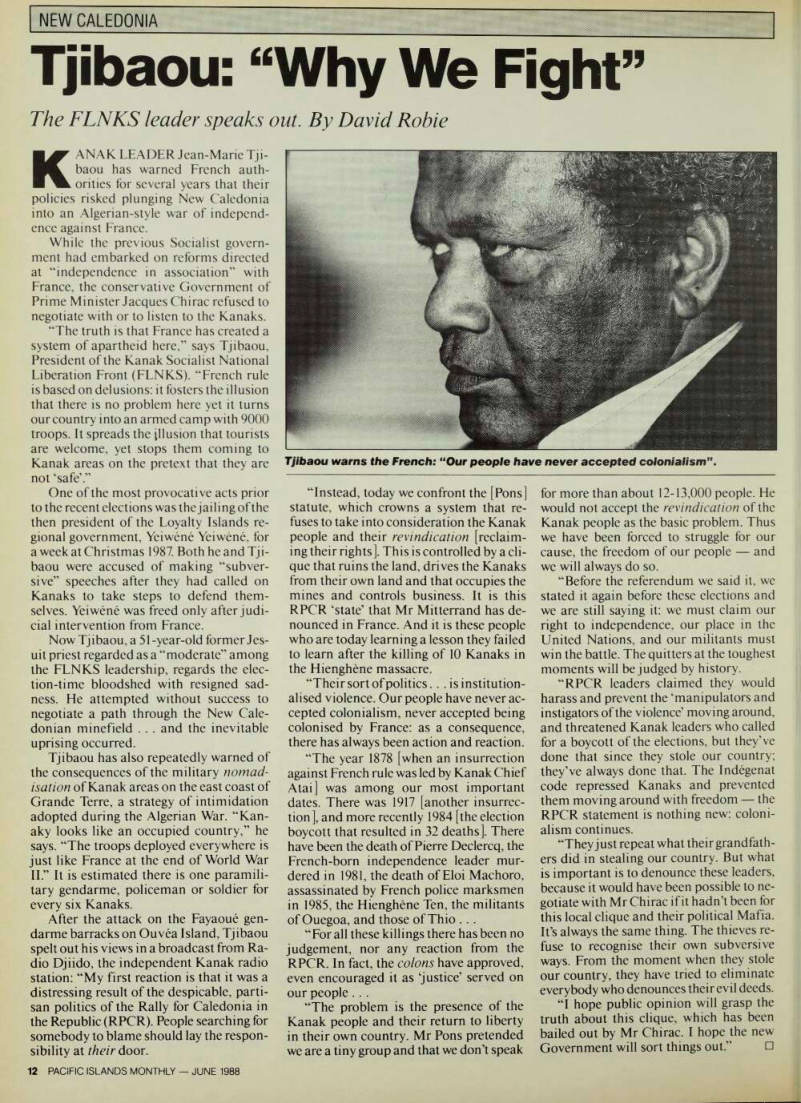
Tjibaou warns the French: “Our people have never accepted colonialism
Widows Seek Justice
Kanak women plead for a retrial of the killers.
By David Robie.
ACQUITTAL of the Hienghene killers last October has often been cited by pro-independence Kanak leaders as a key factor in the April insur rection. Eight days after the rebellion be gan, one of the accused, Jose Lapetite, 31, was shot dead by Kanak snipers on his farm near Voh. His three brothers, father and two other men who who took part in the Hienghene ambush also appear likely targets.
The Hienghene affair still casts a pall over the French judicial system more than three years after the massacre that shocked New Caledonia. Five widows and the families of 10 Kanaks who were killed in an ambush just after nightfall on Decem ber 5, 1984, are now appealing to the Eu ropean Court of Human Rights for a retrial of the accused. Among the 16 legal peti tioners are FLNKS leader Jean-Marie Tji baou, who lost two brothers in the slaughter, and seven survivors, including another of Tjibaou’s brothers, Vianney.
The seven accused were acquitted by a predominantly European jury after a 10day trial last October and set free. Their acquittal shocked Kanaks and prompted condemnation by world human rights and justice groups.
The massacre at Wan’yaat, near the east coast township of Hienghene where Tji baou is mayor, has been unprecedented since reprisals following a Kanak rebel lion at the time of World War I.
The families of the victims have no right of appeal, so the petitioners’ lawyers have now turned to international tribunals.
The lawyers, including International League of Human Rights vice-president Michel Tubiana, allege the trial violated the UN Human Rights Convention in two ways: the families and survivors did not have their case examined fairly by an in dependent and impartial tribunal, and the court never considered their civil rights.
The Hienghene appeal petition points out that seven of the nine jury members were white, one was mixed race and the other of Javanese descent. No Kanaks were included. “It is quite shocking that an eth nic group particularly concerned in this affair 10 people from this group were killed should be totally excluded from the judicial process,” the petition says.
“It was equally shocking that the Eu ropean population, mostly hostile to emancipation of the Melanesians, re garded the deaths of these victims as sym bolic and for the case to become a political game. Thus it was quite impossible for an impartial trial ”
The seven accused mixed-race settlers were set free in spite of their self-incrimi
nating testimony before an examining magistrate, in which they admitted killing the unarmed pro-independence militants in a dynamile-and-rifle ambush on De cember 5, 1984.
All 17 Kanaks who were attacked were passengers in two pickup trucks whose path was blocked by a coconut palm felled across the track between Hienghene and Tiendanite village. The seven survivors scrambled into hiding in bamboo thickets or swam across Hienghene River; four were wounded.
Among sworn statements made by the killers before examining magistrate Fran cois Semur, were: Maurice Mitride (regarded as the ringleader; the ambush took place outside his homestead): “The fusillade lasted for a few minutes of brisk firing and was fol
lowed up in the meadow where the members of the FLNKS fled. Certain Me lanesians were shot at point blank range by some of us.”
Raoul Lapetite: “The fu sillade on the track lasted at the most about three min utes ... A second fusillade
then began [in the meadow]. Indeed the panic-stricken fugitives were caught in the crossfire of at least four guns ...
“There we fired on all that moved, on all the shadows... I can assure that it was a shooting out of hell. Nearly all seven of us possessed automatic rifles . . ”
Jean-Claude Lapetite: “Just in front of me, I saw some Melanesians jump into the water ... I fired three shots. I was unable to fire again because my gun had no more cartridges in it... They were wounded and fell, and immediately afterwards they were fired on again . . . We continued to fire on [the wounded] until they didn’t move any more.”
The case made world headlines when magistrate Semur freed the accused on September 29, 1986, amid accusations that he was under political pressure. The ac cused had been charged with the murder of 10 Kanaks and with the attempted mur der of the seven others.
Semur gave a non-lieu ruling: no case to answer.
Released from Cap Est prison before dawn on October 1,1986, the accused were taken to a secret hideout in Noumea. Pho tographs of them were splashed across the front page of Les Nouvelles Caledon iennes, and they appeared on state-run television defending the massacre.
Identified by survivors and other wit nesses on the night of the ambush, the ac cused escaped to the west coast township
of Voh after burning down Tjibaou’s home near Hienghene River. They were helped by other settlers to elude police. After five days, Maurice Mitride gave himself up on December 10, 1984, saying he couldn’t live with his conscience.
The following day, stockily built Raoul Lapetite, 58, four of his five sons Jacques, Jean-Claude, Jose and Jesse and Robert Sineimene, 24, were also ar rested near Voh. Lapetite’s fifth son, 14year-old Jerry, was apprehended in Nou mea but later released as a minor.
At least another eight mostly white at tackers including a woman identi fied as having taken part were never charged.
Several of ringleader Maurice Mitride’s ancestors came from Reunion, a French possession in the Indian Ocean. He is slight
“The seven accused were acquitted by a predominantly European jury and set free”
and dark-skinned; his sons could easily be mistaken for Kanaks. Sineimene’s mother is a Kanak from Lifou; his father Ja vanese. Yet all seven fervently consider themselves European, and it was appar ently the Mitrides’ loyalty to the European notion of land ownership that inspired the violence, following Kanak suggestions to Mitride and Lapetite that their land should be shared again with the traditional indig enous owners.
After the uproar over the release of the accused, an appeal tribunal later rejected Semur’s verdict and ruled on November 20, 1986 that the seven accused must face trial. Under a legal anomaly they were al lowed to remain at liberty until the trial.
The trial began almost a year later on October 19, 1987.
Three leading French civil rights law yers and a local Tahitian lawyer repre sented the survivors and victims’ families.
Calling for sentences of nine and seven years for the accused, public prosecutor Henri Lacazau described the killings as ritual execution. The ambush, he said, was planned and premeditated: “All the dead were found face down on the ground or in the river, and were riddled with bullets and lead shot.”
Ten days after the trial began, the jury of nine acquitted the accused, returning a verdict of “legitimate self-defence”.
And now the widows of the victims de pend on a European court for justice. □
The Chief Steps Down

I Papua New Guinea
Michael Somare, hailed as the father of PNG independence, resigns as
head of the Pangu Pati he founded in 1967.
By Carson Creagh
Michael Somare, Papua New
Guinea’s most widely respected politician and the man hailed as the father of his country’s independence, chose a significant moment to resign as Opposition leader and head of the Pangu Pati he founded.
This month marks the 21 st birthday of Pangu an anniversary that in the West marks the transition from youth to re sponsible adulthood. In 1967, a newly emerged educated elite saw the need (and opportunity) for a political entity that would force the pace of self-determination and eventual independence from Aus tralia. At the head of that movement was a young teacher who had seen some of the most momentous events in PNG’s his tory; the destruction of the Australian Ad ministration as Japanese troops drove the mastas from their homes; the return of a governing corps that had been shaken by the exposure of its vulnerability; the emergence of the Third World as an inter national force; and the admission by Aus
tralian authorities that independence, once considered a matter for the 21st century, was a matter of greater priority.
Central to many of those events was a man who moved with intelligence, assur ance and ambition between traditional so ciety and the demands of Western democracy. Michael Somare brought a talent honed in the fierce debates and last ing rivalries of village politics to the broader sphere of economic and social de velopment. the longstanding Papuan- Flighlander tussle for power, and the cre ation of PNG as a focus for Melanesian re gional primacy.
His decision to resign as head of Pangu Pati had been foreshadowed by months of instability in PNG politics: the continuing uncertainty of a government surviving constant threats of votes of no confidence only through unceasing negotiation; the looming presence of Ted Diro and his des tabilising Papuan bloc; and not least the ambition and readiness to assume lead
ership of his young deputy, former For eign Minister Rabbie Namaliu.
As Pacific Islands Monthly went to press, negotiations were continuing in Port Moresby to resurrect the Grand Coalition that offers PNG its only hope of restoring stable government. Mr Somare is believed to have called on Prime Minister Paias Wingti to select the “best and brightest” from the Pangu Pati, the Papuan bloc, the People’s Democratic Party, the National Party, the PPP and the Melanesian Alli ance to form a Government that would have the effect of restoring stable leader ship and sealing the fate of Mr Diro’s con tinuing bid for influence. Essential to all these considerations are Mr Somare’s in sistence on altering the Constitution to ex clude the danger of a vote of no confidence every six months, and his ability to give the Coalition the numbers it needs. Sources say Mr Somare is willing to complete his four-year term as PNG’s Foreign Minister, with Mr Namaliu taking the Deputy Prime Ministership under Mr Wingti. □
Advertisements & other items, p. 14 (1 item)
Longlife Products
mSM
AND FRESH DAIRY FOODS,
QUALITY YOU CAN TRUST
Q.U.F. Industries Ltd. offers an export award winning range of Longlife products as well as a complete range of quality fresh dairy foods.
With 19 years’ experience as a producer of UHT Longlife Products, Q.U.F. has the product knowledge and expertise to provide you with outstanding service in the 1980 s. Q.U.F. is widely recognised as an innovator, being the first in Australia to introduce UHT Milk, Flavoured Milk and Fruit Juice in Longlife Tetra Brik packs. • Pauls Longlife Milk is natural, liquid cow’s milk with no preservatives or additives and is available in 250m1, 500 ml, and 1 litre sizes. • Breaka Flavoured Milk is offered in delicious Chocolate, Strawberry and Vanilla Malt flavours in the 250m1, and 6 x 250 ml multipack. • Pauls Longlife Thickened Cream is ideal for whipping or pouring. • Popper 100% Fruit Juice is available in a wide range of refreshing flavours, in 1 Litre, 250m1, and 6 x 250 ml multipacks. • Pauls Longlife products will keep fresh for up to 6 months without refrigeration. • Pauls fresh dairy products including milk, cream, yoghurt and cottage cheese are available in an extensive range of flavours and sizes.
TRADE ENQUIRIES:
Q.U.F. INDUSTRIES LTD.
P.O. Box 12, South Brisbane, Queensland 4101, Australia.
Telephone: (07) 844 0151
Telex: QUFEXP AA141025 Fax: 61-7-8463668. ;• - J J=
6 PACK
n
MRS
jQ9VFRUrr.iI urn.-
KIiLK
4s^ mt
fOHA
Thickened Cream
milK
<SP
CHOCOLATE
Custodian Of The Culture
French Polynesia
Manouche Lehartel is preserving Polynesian tradition.
By Nicolas Rothwell.
AGAINST the backdrop of Tahiti’s Pointe des Pecheurs, Manouche Lehartel is presiding over a gradual reassertion of Polynesian culture and tradition. Director and curator of the 10year-old Museum of Tahiti and the Islands, she believes that a new awareness, a “rehabilitation of our own original and distinct culture”, is under way across French Polynesia.
An intriguing guide to the evolution of this complex French territory, Mademoiselle Lehartel herself embodies Tahiti’s history: a “demi” of mixed descent, she is proud of both her Polynesian and Norman origins.
The elegant Museum of Tahiti and the Islands seeks both to trace the mingling of these two cultures and to record Polynesia’s more distant past. But the budget allocated for these tasks is minimal.
Yet it plays an increasingly important part in the life of French Polynesia; it is designed as an educational exhibition, and its visitors include 20,000 school children a year, as well as the same number of tourists. Adults from the territory are rarely seen, and this is largely because of a generational division. “Adult Tahitians do not have a museographic culture museums are just not yet part of the cultural landscape; but the children who visit love it, and their generation will keep returning,”
Mlle Lehartel ventures.
She sees a new emphasis on Polynesian culture across the territory; visible in scores of tiny shifts in behaviour and attitude, and arising from a change in the education systern: “When I was at school, all we learned in history was ‘Our ancestors the Gauls’,
but this has changed with the political ev olution of the Territory, and its statute of internal autonomy our leaders have in troduced a more Polynesian schooling, “There is a new willingness to leam who we are, to learn our history and culture and now the museum plays an important role, for it is in the Museum that teachers can find the support for their work.”
Although traditional culture has been sharply modified by the European pres ence, the Polynesian mentality is still alive, especially among the young. Mile Lehar tel explains that people of her parents’ generation rarely visit the museum; in their world, it was always a mark of sophisti cation to speak an unaccented French: “the less Polynesian you were, the better your chances of success”. But the younger gen eration is keen to find its own culture once again.
Tell-tale signs of this process can be seen throughout Tahiti: young men sport tra ditional long hairstyles, there is a revival of tattooing, Polynesian housing is be coming more common, and customary spectacles and performances are in vogue, “We are seeing a complete rehabilitation of everything that was once central to tra dition everything that was until re cently a brand of non-evolution,” she says, Accompanying these changes is a re surgence of the Tahitian language, domi nant dialect of the French Polynesian islands. It was until recently forbidden to speak Tahitian at school. Now it is a com pulsory subject; Tahitian is also spoken on television and radio, and increasingly in debates in the Territorial Assembly. “We are seeing,” according to Mile Lehartel,
“the reaffirmation of its existence as something different from the French cul ture we have lived for the past century.”
She contrasts French Polynesia’s devel opment with that of two other Polynesian lands Hawaii, where the traditional culture is all but forgotten, and New Zea land, where there is “no serious intent” to assimilate the Maori culture: “Here in Ta hiti, a good part of society, without being mixed by blood, has seen an evolution; they have bathed in French culture. To day, though there is no denial of that French influence, there is a growing rec ognition of the Polynesian tradition, an awareness that this is not just a little over seas replica of France.”
Mile Lehartel traces the unusually tranquil immixtion together of French and Polynesian influences in Tahiti to the re silient, adaptive character of the indige nous Polynesian culture: polytheistic, so able to change belief systems easily; and so easily persuaded to accept external influ ence. She believes that a commitment to economic development and the resurg ence of pride and respect in the Polynesian traditions will contribute to the peaceful evolution of a more just society. “This is only a paradise on condition it is a para dise for everyone,” she warns.
The Museum of Tahiti and the Islands is the sole full-scale historical and archaeological centre in the entire terri tory from the southerly Australs to the near-equatorial Marquesas, from the So ciety group around Tahiti to the easterly Tuamotus and the Gambier islands.
However, the Museum of Tahiti itself only has a thin collection of many objects; in part because so many priceless Polyne sian pieces have found their way overseas to the great museums of Europe and America. One of Mile Lehartel’s first priorities is to secure the return of some of these objects: the British Museum, for ex ample, has collections from Captain Cook’s voyages and of the London Mis sionary Society, yet does not display them because there are no Polynesian galleries at present; there are also significant hold ings in the Musee de I’Homme in Paris and New York’s Metropolitan Museum.
Equally, French provincial museums such as those at Lille, La Rochelle and Orleans have major Polynesian collections.
“This museum is little-known because it is young, but we are beginning to be known we want donations or returns, the restitution of objects. There are many pieces that could easily be returned to us and it would be a courteous gesture, much appreciated,” she notes. □
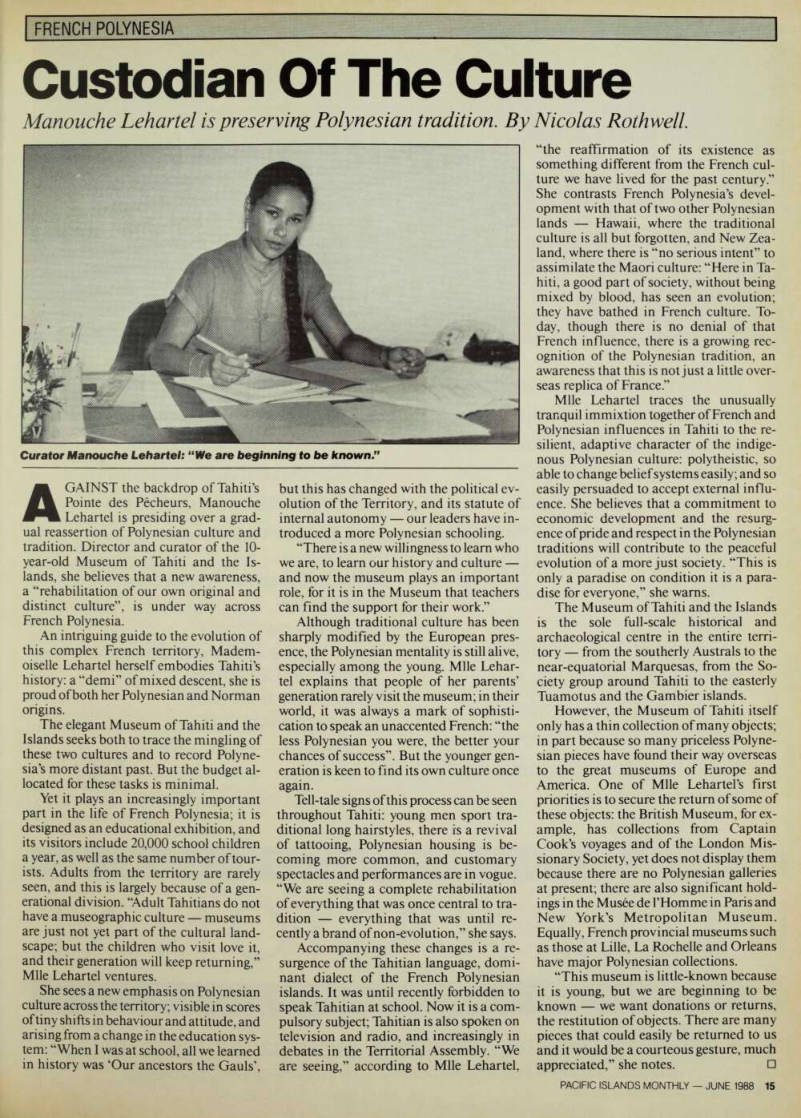
Curator Manouche Lehartel: “We are beginning to be known"
Advertisements & other items, p. 16 (1 item)
this century
See the largest
international trade fair
Australia has witnessed
this century
No agency, wholesaler, manufacturer or retailer should miss the Australian Bicentennial International Trade Fair.
The Fair offers a rare opportunity to see the very latest products from around the world.
Many being shown in Australia for the first time.
See over 550 exhibitors from 35 countries including Australia. sbu will see everything from high technology equipment to clothing, from engineering to electrical goods.
Well over 100 categories.
Admission free to trade buyers.
For free passes and full details on companies exhibiting and products being displayed write to the organisers; IS Riddell Exhibition Promotions P/L., Riddell House, 135-141 Burnley Street, Richmond, Vic. 3121. Australia.
Telephone: (613) 429 6088.
Facsimile: (613) 427 0829.
Telex: AA31494MTC85.
An endorsed Bicentennial activity.
THE AUSTRALIAN BICENTENNIAL
INTERN AT lONAL
Royal Exhibition Building, Melbourne, Australia. 23rd-31st July, 1988.
Trade days: July 25th & 26th-10.00am. to 6.00 pm. July 27th-29th-11.00am. to 10.00 pm. rid 3l79
One Year After The Coup
Fiji
Bruce Loudon, The Australian’s Asia-Pacific Editor, looks at life in post coup Fiji.
AFTER a year of almost ceaseless racial rhetoric, it might be ex pected that Fiji would now be a place of boundless bitterness, with the ri val Fijian and Indian communities at each other’s throats.
In some respects it is. Many of the most doleful prognostications at the time of last year’s first coup have been realised. But for almost the first time, perhaps, there are some hopeful signs on the horizon.
Superficially at least, paradise has been regained even if the political, social and economic undercurrents in Fiji society are of such a magnitude and intensity that they could at any moment explode into a third, even more devastating, military takeover.
Indeed, only a few weeks ago, senior of ficers of the Fiji Military Forces (FMF) headed by the now Brigadier-General Ra buka discussed just that a third mili tary takeover based on their belief that the objectives of the original May 14 coup had been betrayed. At the time, the proposal was shelved. But there is little doubt the officers are waiting and watching, and they would have no compunction about launching a third coup if they judged it to be necessary to ensure the Fiji-for-the-Fi jians objective was achieved.
A year after the first coup, the 6000strong military force highly disci plined, well trained and fiercely loyal to Brigadier Rabuka remains the only cohesive body in the country; in effect the progenitor as well as the sole arbiter of all that happens.
For the rest, there is division and un certainty. And within that division and uncertainty there remains considerable inter-racial goodwill.
Brigadier Rabuka’s supporters seek to create an impression of unity among the Fijians, who comprise just under half the 750,000 population. There isn’t.
Brigadier Rabuka is personally popu lar. Dressed in a T-shirt and with a gleam ing smile, he looks for all the world like an American football star and lady-killer as he stares down from large colour posters displayed in Suva shops.
A commoner, he is apparently more popular than any other Fijian leader in cluding the veteran President, Ratu Sir Penaia Ganilau, and the Prime Minister, Ratu Sir Kamisese Mara.
But in his quest for Fijian hegemony he has divided the nation; racial bigots of the militant Taukei movement, so influential and so close to him through much of the past year, are now highly critical of the Mara Government though not, signif
icantly, of Brigadier-General Rabuka.
To the Left, too, Fiji is divided. In last year’s election many younger Fijians voted for Dr Bavadra. The suggestion now is that if another election were held today, even more would do so. Increasingly it is Fiji ans younger, better educated and wor ried and not just Indians who are seeking permission to emigrate, appar ently convinced that the country has been ruined by Brigadier Rabuka.
Fijians in the great middle ground seem to support Brigadier Rabuka and the nominally civilian Government he has put in place. They identify with his national ism, believe he is right and, say Indians, are manifestly more assertive, if no less friendly, in their attitude toward other ethnic groups.
What, then, of the Indians? They are still leaving. They’re still trooping around to the Australian and New Zealand em bassies seeking permission to migrate. In creasingly, they are disadvantaged.
At the time of the first coup, for ex ample, the top Public Service posts of de partmental permanent secretary were about evenly divided between Fijians and Indians. Today, all but four of the 26 po sitions are held by Fijians.
And in the private sector as well Indian workers are being replaced by Fijians. On the insistence of the Government, posi tive discrimination in favour of Fijians is in full swing.
The Indian mood is still one of deep apprehension, though less because of any perceived direct threat to themselves than because they see no future for their children.
Equally, however, there is now among the Indians the first optimism that has been seen in a year. Tourists are back. For eign aid has been restored. The economy is picking up. The Indian shopkeepers are getting rich again.
The events of the past year have made it clear that Fijians are not going to be ruled by Indians. And within the Indian com munity there is now an increasing (if sul len) acceptance of that reality, something that makes the constitutional changes now being contemplated much more bearable, if no less unwelcome.
“If the buggers want the political power, let them get on with it,” one Indian said.
“They must just leave me alone to run my shop and fill my bank account for the day when I may leave and go to Australia.”
For him, the present situation in Fiji, with Ratu Mara’s Government in power, underwritten by and beholden to Briga
dier Rabuka and the military, is about the best that could be hoped for.
In the five months the Government has been in office it has overseen a remarkable return of business confidence. Even for eign investors are returning, and that has as much to do with the persona of Ratu Mara as anything else.
Perhaps the most grim and dark days in Fiji were seen after Brigadier Rabuka staged his second coup. The Taukei extre mists were in full flight and the first re publican Cabinet was under their control.
Fiji was locked in a vice of authoritarian rule and fundamental religious zeal.
Brigadier Rabuka’s sudden realisation in December that Fiji was bleeding to death and that he had no alternative but to call in Ratu Mara to save the situation changed all that. But it would be wrong to be unduly optimistic about the situation, and any expectation that Fiji will return to its pre-May 1987 democracy and prosper ity is misplaced.
Fiji will not return to those days, and the real sadness about what Brigadier Ra buka did last year is that he has changed the country forever.
He and his supporters eagerly talk about a return to the Commonwealth, about a return to international respecta bility, about the Queen resuming her place as Head of State.
This is just so much pie-in-the-sky nonsense: legal draftsmen are working on a new Constitution aimed at sorting out once and for all the mess wrought by the two coups, but there is no hope of a return to the sort of multiracial democracy that served the country so well for 17 years.
It is Brigadier Rabuka and his beloved FMF as well as the Great Council of Chiefs whose writ now runs, and they have de cided the new Constitution will enshrine and give effect to the objectives of the orig inal coup Fijian hegemony.
Any attempt by Ratu Mara to divert from the goal of installing a Fijian oligar chy would see Brigadier Rabuka’s men back on the streets. It is he, not the Pres ident or Prime Minister, who continues to hold the whip hand.
Once the new Constitution is in place and parliamentary elections are held, there is a better-than-ever chance Brigadier Ra buka will enter the race and win hands down. Both Ratu Ganilau and Ratu Mara are old and increasingly frail. There is no other chief waiting in the wings to take their place. So Brigadier Rabuka is the re pository of all the hopes and aspirations of the Fijian nationalists. □
Gaddafi’s Pacific Intrigues
The Region
In an exclusive interview, Nicolas Rothwell talks to Libya’s chief Oceania strategist
COLONEL GADDAFI’S shadowy international revolutionary organ isation Mathaba, established in the Libyan capital of Tripoli and dispensing funds to liberation movements around the world, is run by a most unlikely radical.
Tunku Mohammed Hassan di Tiro, a Sumatran prince, fervent Muslim and bit ter opponent of Indonesia, is the chair man of Mathaba’s political committee.
In an exclusive interview with Pacific Islands Monthly , at his headquarters in Tripoli, he outlined Mathaba’s organisa tion and aims for the Asia Pacific region.
The Mathaba Against Imperialism, Racism, Zionism and Fascism, to give the front its rather inclusive full title, is “the Libyan way of supporting liberation movements, either morally or financially, depending on the situation but not mili tarily,” Hassan di Tiro explained.
It was set up in 1985 and is headed by Colonel Gaddafi himself, who attended the Mathaba Asian Pacific Conference in Tripoli last year.
Mathaba appears to be a parallel struc ture, operating unofficially and independ ently of the Libyan foreign ministry and separate from the covert channels that may supply arms to radical causes supported by the Libyan regime, such as the IRA or Philippines separatists.
Hassan di Tiro himself makes the cru cial decisions, and runs a personal net work of contacts with the liberation movement leaders Libya supports, among them Jacob Prai of the OPM (Free Papua Movement) of West Papua and Yann Ce lene Uregei of New Caledonia’s Kanak radical faction, FULK (United Kanak Liberation Front).
Although he denies all knowledge of the controversial plans by an Australian Ab original delegation to visit Libya or of the attempted visit by Tahitian pro-inde pendence activists that was thwarted in Sydney in April, he expresses strong sup port for the Aboriginal cause.
But Hassan di Tiro’s chief message is one of unremitting hostility to Indonesia.
He makes clear that Mathaba’s efforts are focused on supporting the various inde pendence movements active across the In donesian Archipelago, including his own Aceh Sumatra Liberation Front.
“We are making advances against In donesia, both on the ground and diplo matically, with Fretilin (East Timor Liberation Front), the OPM, the Republic of the South Moluccas; we are all one.
“They come to Tripoli sometimes, but we are always in touch, above ground and underground, inside and outside, and I
shall see to it when Aceh wins so do OPM and the Moluccans.”
Hassan di Tiro’s alliance with Colo nel Gaddafi is based on Islamic solidar ity. His native king dom of Aceh, in the northern part of Su matra, was long known as the “Ver andah of Islam” be cause of the vigour of the Moslem faith there.
But the deep commitment of Li bya to the disman tling of Indonesia, which Libya sees as a Javanese colonial
power that has taken over the Dutch Em pire, suggests the future will see constant Libyan activity in the Asia-Pacific region.
Hassan di Tiro explains that it is in Australia’s interest to befriend the libera tion movements fighting against Indone sia. “We want eternal friendship with the people of Australia, who are our neigh bours. We know what Australia means to us, strategically and economically, so we want to co-operate but if the Aus tralians want the Javanese to colonise us, that’s another story.”
Although Hassan di Tiro is predictably coy about the details of Libyan support for radical movements, claiming Mathaba only provides money, reliable reports sug gest arms shipments have gone to groups such as the Philippines Muslim Moro reb els. More common are the “training courses” provided in past years to cadres from Pacific nations such as New Cale donia and Vanuatu.
Hassan di Tiro flatly claims, “The Ja vanese days of controlling Aceh are near an end. The Javanese have no right to rule any territory outside their own island, the main centre of Indonesia’s population.” In other words, his goal is the complete dis memberment of Indonesia.
Mathaba itself, he says, does not fund the Aceh Sumatra Liberation Front, be cause Aceh is a rich country that can sup port the Front’s European headquarters in Stockholm and other missions as well as its Tripoli embassy. The organisation’s chief concern is with “moral duties”.
He laments Australia’s closure of Li byan offices and stresses that Mathaba has no political or economic intent in the Pa-
cific or anywhere else outside Libya. “Very simply, Libya supports the principle of self determination,” he contends.
This means that in New Caledonia and French Polynesia, “We back the natives.
We take the UN position for self-deter mination: it’s not a matter of political in trigue; it’s just a question of justice. The French should talk things over.”
On Australia’s Aborigines, Hassan di Tiro admits that Mathaba has not studied this problem deeply or made it a high priority: “The question is justice. I am sure the Australians should not compromise about it, the Aborigines should get their due, as citizens, as human beings.
Hassen di Tiro’s way of operating the Mathaba Front seems to rely on close per sonal links between key leaders. Of radical Kanak leader Yann Celene Uregei, he says, “We are so close they make me their spokesman when they are not here.” Mr Uregei, in an interview with The Aus tralian in Noumea last year, confirmed his close link with Tripoli and said his FULK faction had been funded by Libya.
Hassan di Tiro’s personal support for the mission of OPM chief Jacob Prai is such that he offers expansively to send him to Australia on a diplomatic tour. Another figure with whom he is friendly is South Moluccan separatist Dr Manu Sama.
An independence fighter, heir to a line of rulers, a polished diplomat who yet ins ists he should be “on the battlefield where my ancestors died”, Hassan di Tiro neatly incarnates Libya’s determined support for liberation fronts: the means may be bloody, the Libyan philosophy runs, but the cause justifies the bloodshed. □
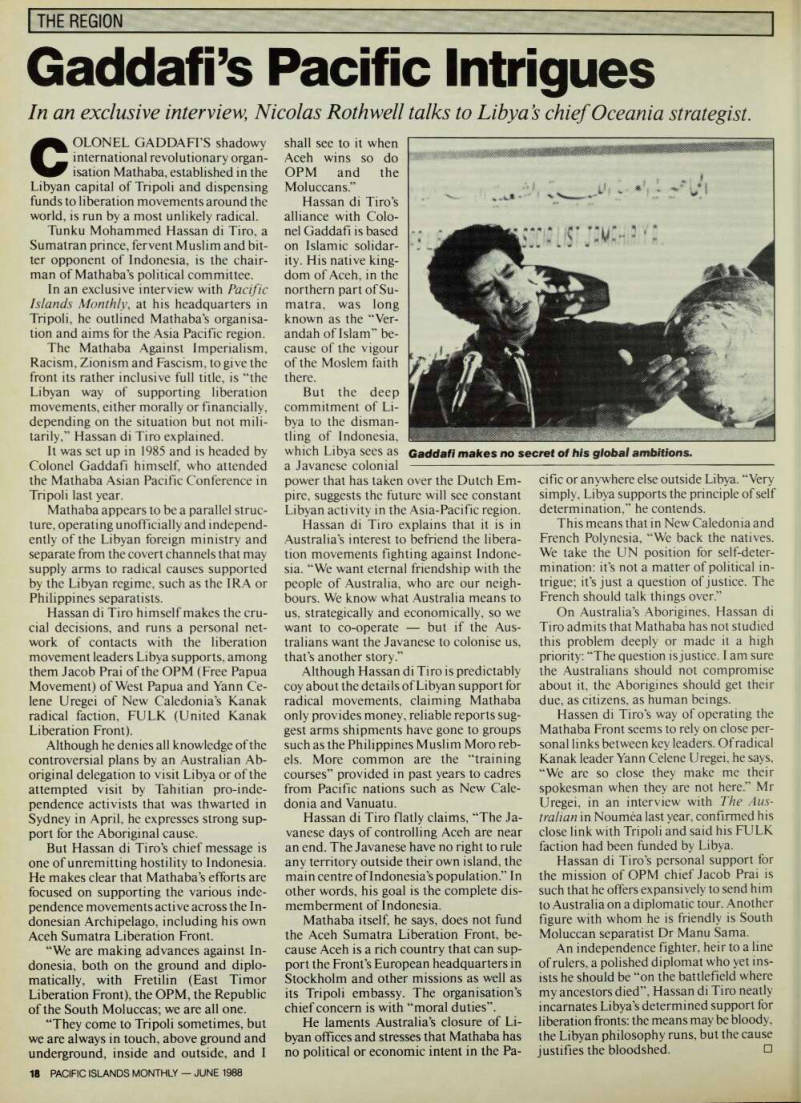
Gaddafi makes no secret of his global ambitions.
New Deal For Maoris
New Zealand
Sweeping reforms in Maori Affairs.
By Jack Kelleher
DEVOLUTION in the administra tion of Maori affairs by the New Zealand Government? Or demolition?
That was the first reaction to the refor mist Labour Government’s recent green paper inviting national discussion on pro posals to replace the long-established Maori Affairs Department by transferring funds to general departments enabling them to cater more specifically for Maori descended New Zealanders, and also by transferring funds to iwi or tribal groups.
The department’s biggest impact has probably been in providing a central focus and encouragement for Maori culture and arts, already alive and well in musical and regional ways.
The spotlight, however, has been on departmental support for private business deals that seem always to have flaws or al leged irregularities. And the record for Maoris in health, education, employment, adequate accommodation and ability to keep out of the country’s jails has been ap palling. No one doubted that something had to change.
And it was lost on no one that tribal affiliations and tribal leadership had faded as a positive influence on young Maoris.
Inter-tribal warfare had been the main factor in welcoming the original white set tlers and the guns available for pur chase in the tragic land deals. But the tribes were a positive influence, and the sub tribal marae or community meeting house remained a place for spiritual rejuvena tion long after urban Maoris had joined the general movement to the cities.
Maori Affairs Minister Koro Wetere, who started on a month-long round of Maori centres days after producing the discussion paper, is bound to make much of this argument on the marae he visits be fore finishing on funding for a takeover by other departments and by the tribes, if the funding and encouragement is no more than was available to the old department.
The Minister brought 70 kaumatua (elders) to Parliament House for a briefing on the plan, titled He Tirohanga Rangapu Partnership Perspectives which em phasised a new partnership but was seen mainly as a proposed phasing out of the Maori Affairs by April 1, 1990.
Mr Wetere, who has weathered many a political storm in the administration of his portfolio, stressed the need to refocus ad ministration on the tribes. He said it was sad that some young Maoris living in the cities did not know their tribal associ ations. He acknowledged that no iwi or tribes as such existed in the cities and
that it would take time to put appropriate structures in place.
Prime Minister David Lange said the reforms would replace a system devised in the 1950 s and no longer coping. He said most of the ideas in the paper are negoti able but the principles remain firm. The new ministry would have a Treasury-like function; the Government was not pre pared to release control of the purse-strings to the iwi.
He confirmed that the report sug gested “positive discrimination”, a form of affirmative action for Maori staff; if two equally well-qualified people applied for a job and one were a Maori, preference would be given to the Maori.
A seven-point statement of objectives generally sets out to honour the Treaty of Waitangi, separately safeguarded in an ef fectively operating tribunal, and to work for the elimination of “gaps” in policy on education, social welfare, economic and cultural matters. The new Ministry of Maori Policy would be mainly advisory to the Government in the same way as Treasury.
Maori elders and Opposition leader Jim Bolger raised the question of extension of time for submissions beyond the six weeks available. Mr Wetere said he would con sider this, but many of the issues in the document had been “amongst our people for some time”.
First and most influential criticism came from Maori Council chairman Sir Graham Latimer, who referred to an as similation rather than a partnership. He claimed it was a reversion to 1960, when the Hunn Report on the department rec ommended similar assimilation policies, and led to issues such as the Land March and the growth of gangs.
A leader among Maori women, Ms Ti tewhai Harawira, claimed a return of em phasis to tribal authorities meant a return to rule by men. A spokeswoman for a Maori nationalist group, Ms Atareta Poananga of Te Ahi Kaa, charged that the devolution proposals meant demolition of power for Maoris. They would be more di vided than ever.
A practical early effect was on the 1000 staff in the present department. The pro posed Ministry of Maori Policy will em ploy up to 100 people, with an indeterminate number of the balance going to other departments and to the tribal or ganisations that are established. The Pub lic Service Association is the departmental union, and its delegates claimed staff were already getting out when the best people could not afford to be lost. □
Advertisements & other items, p. 19 (1 item)
Pty. Ltd
k i
117 York St„ Sydney Cables: Henco Sydney.
C.P.O. Box 3949 Telephone: 261 1955.
For
specialised
and
personalised
buying
service
throughout
the
Pacific islands
and the East
LOCAL AGENTS AND
REPRESENTATION
PAPUA NEW GUINEA
RABAUL: M. & C. Seeto, P.O. Box 131, Rabaul.
Telephone 92 2919
FIJI
K. Witherington Ltd., P.O. Box 293, Suva.
Telephone 22 356.
VANUATU
John Lum & Associates, P.O. Box 65, Santo.
Telephone 329.
Exporters
General
London Learns The Pacific Way
Icy England hosts a spectacular island exhibition.
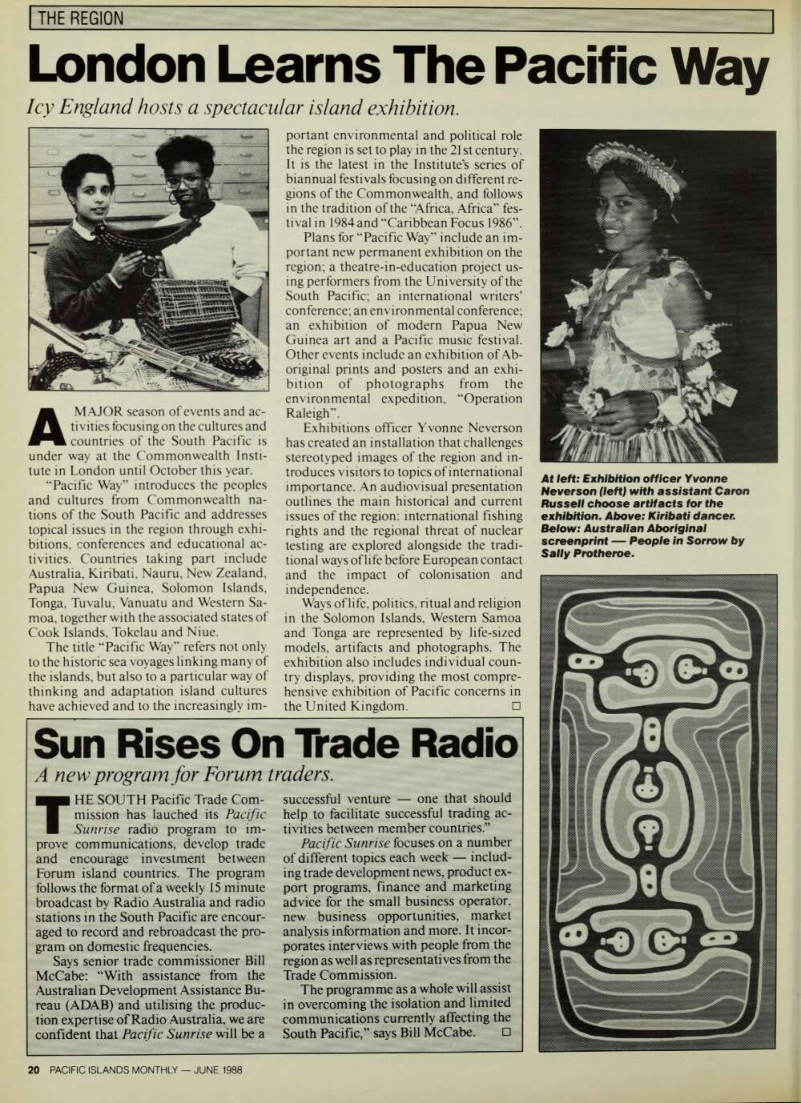
A MAJOR season of events and ac tivities focusing on the cultures and countries of the South Pacific is under way at the Commonwealth Insti tute in London until October this year.
“Pacific Way” introduces the peoples and cultures from Commonwealth na tions of the South Pacific and addresses topical issues in the region through exhi bitions, conferences and educational ac tivities. Countries taking part include Australia, Kiribati, Naum, New Zealand, Papua New Guinea, Solomon Islands, Tonga, Tuvalu, Vanuatu and Western Sa moa, together with the associated states of Cook Islands, Tokelau and Niue.
The title “Pacific Way” refers not only to the historic sea voyages linking many of the islands, but also to a particular way of thinking and adaptation island cultures have achieved and to the increasingly im
portant environmental and political role the region is set to play in the 21 st century.
It is the latest in the Institute’s series of biannual festivals focusing on different re gions of the Commonwealth, and follows in the tradition of the “Africa, Africa” fes tival in 1984 and “Caribbean Focus 1986”.
Plans for “Pacific Way” include an im portant new permanent exhibition on the region; a theatre-in-education project us ing performers from the University of the South Pacific; an international writers’ conference; an environmental conference; an exhibition of modem Papua New Guinea art and a Pacific music festival.
Other events include an exhibition of Ab original prints and posters and an exhi bition of photographs from the environmental expedition, “Operation Raleigh”.
Exhibitions officer Yvonne Neverson has created an installation that challenges stereotyped images of the region and in troduces visitors to topics of international importance. An audiovisual presentation outlines the main historical and current issues of the region: international fishing rights and the regional threat of nuclear testing are explored alongside the tradi tional ways of life before European contact and the impact of colonisation and independence.
Ways of life, politics, ritual and religion in the Solomon Islands, Western Samoa and Tonga are represented by life-sized models, artifacts and photographs. The exhibition also includes individual coun try displays, providing the most compre hensive exhibition of Pacific concerns in the United Kingdom. □
At left: Exhibition officer Yvonne Neverson (left) with assistant Caron Russell choose artifacts for the exhibition. Above: Kiribati dancer.
Below: Australian Aboriginal screenprint People in Sorrow by Sally Protheroe.
Sun Rises On Trade Radio
A new program for Forum traders.
THE SOUTH Pacific Trade Commission has lauched its Pacific Sunrise radio program to improve communications, develop trade and encourage investment between Forum island countries. The program follows the format of a weekly 15 minute broadcast by Radio Australia and radio stations in the South Pacific are encouraged to record and rebroadcast the program on domestic frequencies.
Says senior trade commissioner Bill McCabe: “With assistance from the Australian Development Assistance Bureau (ADAB) and utilising the production expertise of Radio Australia, we are confident that Pacific Sunrise will be a
successful venture one that should help to facilitate successful trading ac tivities between member countries.”
Pacific Sunrise focuses on a number of different topics each week includ ing trade development news, product ex port programs, finance and marketing advice for the small business operator, new business opportunities, market analysis information and more. It incor porates interviews with people from the region as well as representatives from the Trade Commission.
The programme as a whole will assist in overcoming the isolation and limited communications currently affecting the South Pacific,” says Bill McCabe. □
Another Blow To Compact
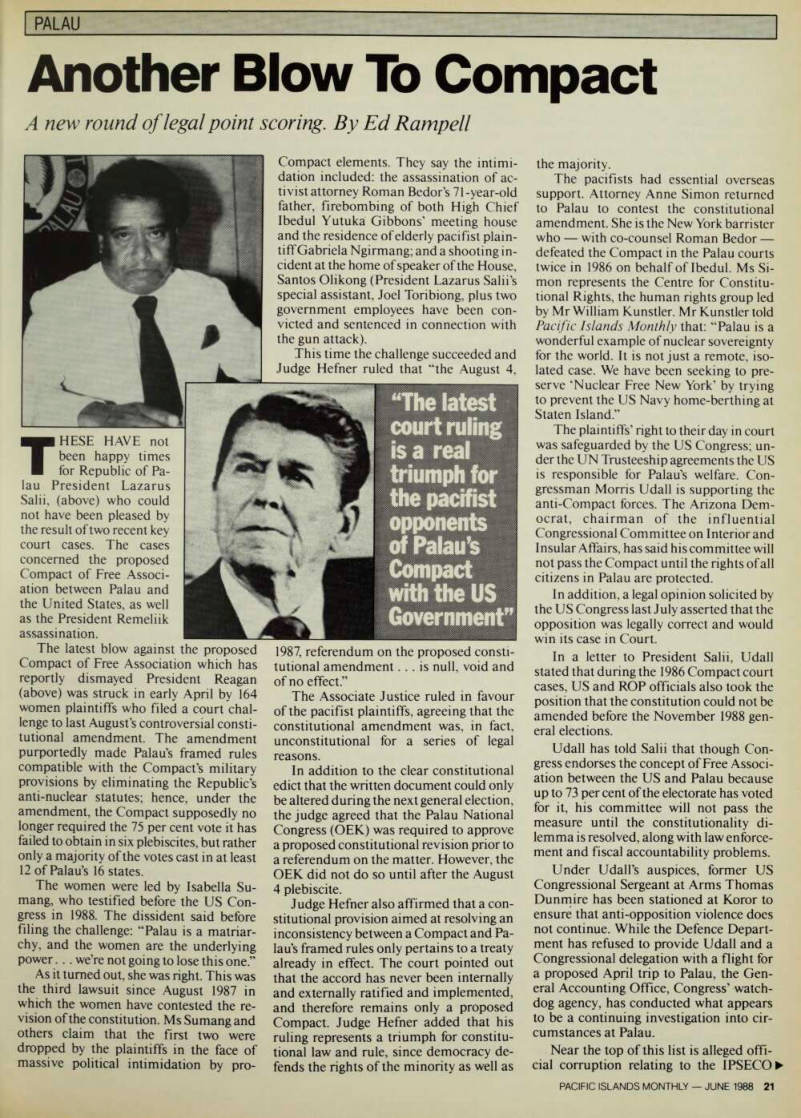
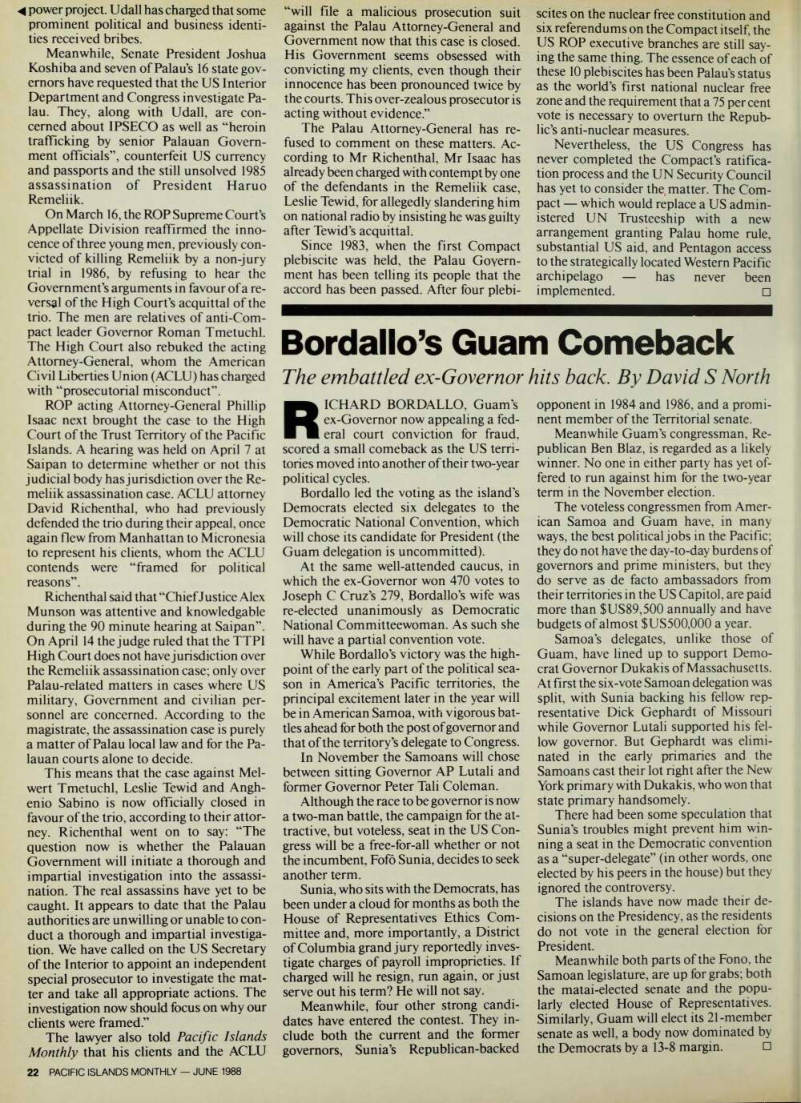
Palau
A new round of legal point scoring.
By Ed Rampell
These have not been happy times for Republic of Pa lau President Lazarus Salii, (above) who could not have been pleased by the result of two recent key court cases. The cases concerned the proposed Compact of Free Associ ation between Palau and the United States, as well as the President Remeliik assassination.
The latest blow against the proposed Compact of Free Association which has reportly dismayed President Reagan (above) was struck in early April by 164 women plaintiffs who filed a court challenge to last August’s controversial constitutional amendment. The amendment purportedly made Palau’s framed rules compatible with the Compact’s military provisions by eliminating the Republic’s anti-nuclear statutes; hence, under the amendment, the Compact supposedly no longer required the 75 per cent vote it has failed to obtain in six plebiscites, but rather only a majority of the votes cast in at least 12 of Palau’s 16 states.
The women were led by Isabella Sumang, who testified before the US Congress in 1988. The dissident said before filing the challenge: “Palau is a matriarchy, and the women are the underlying power .. . we’re not going to lose this one.”
As it turned out, she was right. This was the third lawsuit since August 1987 in which the women have contested the revision of the constitution. Ms Sumang and others claim that the first two were dropped by the plaintiffs in the face of massive political intimidation by pro-
Compact elements. They say the intimi dation included: the assassination of ac tivist attorney Roman Bedor’s 71-year-old father, firebombing of both High Chief Ibedul Yutuka Gibbons’ meeting house and the residence of elderly pacifist plain tiff Gabriela Ngirmang; and a shooting in cident at the home of speaker of the House, Santos Olikong (President Lazarus Salii’s special assistant, Joel Toribiong, plus two government employees have been con victed and sentenced in connection with the gun attack).
This time the challenge succeeded and Judge Hefner ruled that “the August 4,
1987, referendum on the proposed consti tutional amendment... is null, void and of no effect.”
The Associate Justice ruled in favour of the pacifist plaintiffs, agreeing that the constitutional amendment was, in fact, unconstitutional for a series of legal reasons. in addition to the clear constitutional edict that the written document could only be altered during the next general election, the judge agreed that the Palau National Congress (OEK) was required to approve a proposed constitutional revision prior to a referendum on the matter. However, the OEK did not do so until after the August 4 plebiscite, Judge Hefner also affirmed that a con stitutional provision aimed at resolving an inconsistency between a Compact and Pa lau’s framed rules only pertains to a treaty already in effect. The court pointed out that the accord has never been internally and externally ratified and implemented, and therefore remains only a proposed Compact. Judge Hefner added that his ruling represents a triumph for constitu tional law and rule, since democracy de fends the rights of the minority as well as
the majority.
The pacifists had essential overseas support. Attorney Anne Simon returned to Palau to contest the constitutional amendment. She is the New York barrister who with co-counsel Roman Bedor defeated the Compact in the Palau courts twice in 1986 on behalf of Ibedul. Ms Si mon represents the Centre for Constitu tional Rights, the human rights group led by Mr William Kunstler. Mr Kunstler told Pacific Islands Monthly that: “Palau is a wonderful example of nuclear sovereignty for the world. It is not just a remote, iso lated case. We have been seeking to pre serve ‘Nuclear Free New York’ by trying to prevent the US Navy home-berthing at Staten Island.”
The plaintiffs’ right to their day in court was safeguarded by the US Congress; un der the UN Trusteeship agreements the US is responsible for Palau’s welfare. Con gressman Morris Udall is supporting the anti-Compact forces. The Arizona Dem ocrat, chairman of the influential Congressional Committee on Interior and Insular Affairs, has said his committee will not pass the Compact until the rights of all citizens in Palau are protected.
In addition, a legal opinion solicited by the US Congress last July asserted that the opposition was legally correct and would win its case in Court.
In a letter to President Salii, Udall stated that during the 1986 Compact court cases, US and ROP officials also took the position that the constitution could not be amended before the November 1988 gen eral elections.
Udall has told Salii that though Con gress endorses the concept of Free Associ ation between the US and Palau because up to 73 per cent of the electorate has voted for it, his committee will not pass the measure until the constitutionality di lemma is resolved, along with law enforce ment and fiscal accountability problems.
Under Udall’s auspices, former US Congressional Sergeant at Arms Thomas Dun mire has been stationed at Koror to ensure that anti-opposition violence does not continue. While the Defence Depart ment has refused to provide Udall and a Congressional delegation with a flight for a proposed April trip to Palau, the Gen eral Accounting Office, Congress’ watch dog agency, has conducted what appears to be a continuing investigation into cir cumstances at Palau.
Near the top of this list is alleged offi cial corruption relating to the IPSECO^
“The latest court ruling is a real triumph for the pacifist opponents of Palau’s Compact with the US Government”
4 power project. Udall has chained that some prominent political and business identi ties received bribes.
Meanwhile, Senate President Joshua Koshiba and seven of Palau’s 16 state gov ernors have requested that the US Interior Department and Congress investigate Pa lau. They, along with Udall, are con cerned about IPSECO as well as “heroin trafficking by senior Palauan Govern ment officials”, counterfeit US currency and passports and the still unsolved 1985 assassination of President Haruo Remeliik.
On March 16, the ROP Supreme Court’s Appellate Division reaffirmed the inno cence of three young men, previously con victed of killing Remeliik by a non-jury trial in 1986, by refusing to hear the Government’s arguments in favour of a re versal of the High Court’s acquittal of the trio. The men are relatives of anti-Com pact leader Governor Roman Tmetuchl.
The High Court also rebuked the acting Attorney-General, whom the American Civil Liberties Union (ACLU) has charged with “prosecutorial misconduct”.
ROP acting Attorney-General Phillip Isaac next brought the case to the High Court of the Trust Territory of the Pacific Islands. A hearing was held on April 7 at Saipan to determine whether or not this judicial body has jurisdiction over the Re meliik assassination case. ACLU attorney David Richenthal, who had previously defended the trio during their appeal, once again flew from Manhattan to Micronesia to represent his clients, whom the ACLU contends were “framed for political reasons”.
Richenthal said that “Chief Justice Alex Munson was attentive and knowledgable during the 90 minute hearing at Saipan”.
On April 14 the judge ruled that the TTPI High Court does not have jurisdiction over the Remeliik assassination case; only over Palau-related matters in cases where US military. Government and civilian per sonnel are concerned. According to the magistrate, the assassination case is purely a matter of Palau local law and for the Pa lauan courts alone to decide.
This means that the case against Mel wert Tmetuchl, Leslie Tewid and Angh enio Sabino is now officially closed in favour of the trio, according to their attor ney. Richenthal went on to say: “The question now is whether the Palauan Government will initiate a thorough and impartial investigation into the assassi nation. The real assassins have yet to be caught. It appears to date that the Palau authorities are unwilling or unable to con duct a thorough and impartial investiga tion. We have called on the US Secretary of the Interior to appoint an independent special prosecutor to investigate the mat ter and take all appropriate actions. The investigation now should focus on why our clients were framed.”
The lawyer also told Pacific Islands Monthly that his clients and the ACLU
“will file a malicious prosecution suit against the Palau Attorney-General and Government now that this case is closed.
His Government seems obsessed with convicting my clients, even though their innocence has been pronounced twice by the courts. This over-zealous prosecutor is acting without evidence.”
The Palau Attorney-General has re fused to comment on these matters. Ac cording to Mr Richenthal, Mr Isaac has already been charged with contempt by one of the defendants in the Remeliik case, Leslie Tewid, for allegedly slandering him on national radio by insisting he was guilty after Tewid’s acquittal.
Since 1983, when the first Compact plebiscite was held, the Palau Govern ment has been telling its people that the accord has been passed. After four plebi
scites on the nuclear free constitution and six referendums on the Compact itself, the US ROP executive branches are still say ing the same thing. The essence of each of these 10 plebiscites has been Palau’s status as the world’s first national nuclear free zone and the requirement that a 75 per cent vote is necessary to overturn the Repub lic’s anti-nuclear measures.
Nevertheless, the US Congress has never completed the Compact’s ratifica tion process and the UN Security Council has yet to consider the, matter. The Com pact which would replace a US admin istered UN Trusteeship with a new arrangement granting Palau home rule, substantial US aid, and Pentagon access to the strategically located Western Pacific archipelago has never been implemented. □
Bordallo’s Guam Comeback
The embattled ex-Governor hits back.
By David S North
Richard bordallo, Guam’s ex-Govemor now appealing a fed eral court conviction for fraud, scored a small comeback as the US terri tories moved into another of their two-year political cycles.
Bordallo led the voting as the island’s Democrats elected six delegates to the Democratic National Convention, which will chose its candidate for President (the Guam delegation is uncommitted).
At the same well-attended caucus, in which the ex-Governor won 470 votes to Joseph C Cruz’s 279, Bordallo’s wife was re-elected unanimously as Democratic National Committeewoman. As such she will have a partial convention vote.
While Bordallo’s victory was the high point of the early part of the political sea son in America’s Pacific territories, the principal excitement later in the year will be in American Samoa, with vigorous bat tles ahead for both the post of governor and that of the territory’s delegate to Congress.
In November the Samoans will chose between sitting Governor AP Lutali and former Governor Peter Tali Coleman.
Although the race to be governor is now a two-man battle, the campaign for the at tractive, but voteless, seat in the US Con gress will be a free-for-all whether or not the incumbent, Fofo Sunia, decides to seek another term.
Sunia, who sits with the Democrats, has been under a cloud for months as both the House of Representatives Ethics Com mittee and, more importantly, a District of Columbia grand jury reportedly inves tigate charges of payroll improprieties. If charged will he resign, run again, or just serve out his term? He will not say.
Meanwhile, four other strong candi dates have entered the contest. They in clude both the current and the former governors, Sunia’s Republican-backed
opponent in 1984 and 1986, and a promi nent member of the Territorial senate.
Meanwhile Guam’s congressman, Re publican Ben Blaz, is regarded as a likely winner. No one in either party has yet of fered to run against him for the two-year term in the November election.
The voteless congressmen from Amer ican Samoa and Guam have, in many ways, the best political jobs in the Pacific; they do not have the day-to-day burdens of governors and prime ministers, but they do serve as de facto ambassadors from their territories in the US Capitol, are paid more than $U589,500 annually and have budgets of almost SUSSOO,OOO a year.
Samoa’s delegates, unlike those of Guam, have lined up to support Demo crat Governor Dukakis of Massachusetts.
At first the six-vote Samoan delegation was split, with Sunia backing his fellow rep resentative Dick Gephardt of Missouri while Governor Lutali supported his fel low governor. But Gephardt was elimi nated in the early primaries and the Samoans cast their lot right after the New York primary with Dukakis, who won that state primary handsomely.
There had been some speculation that Sunia’s troubles might prevent him win ning a seat in the Democratic convention as a “super-delegate” (in other words, one elected by his peers in the house) but they ignored the controversy.
The islands have now made their de cisions on the Presidency, as the residents do not vote in the general election for President.
Meanwhile both parts of the Fono, the Samoan legislature, are up for grabs; both the matai-elected senate and the popu larly elected House of Representatives.
Similarly, Guam will elect its 21-member senate as well, a body now dominated by the Democrats by a 13-8 margin. □
Mantis Wildlife
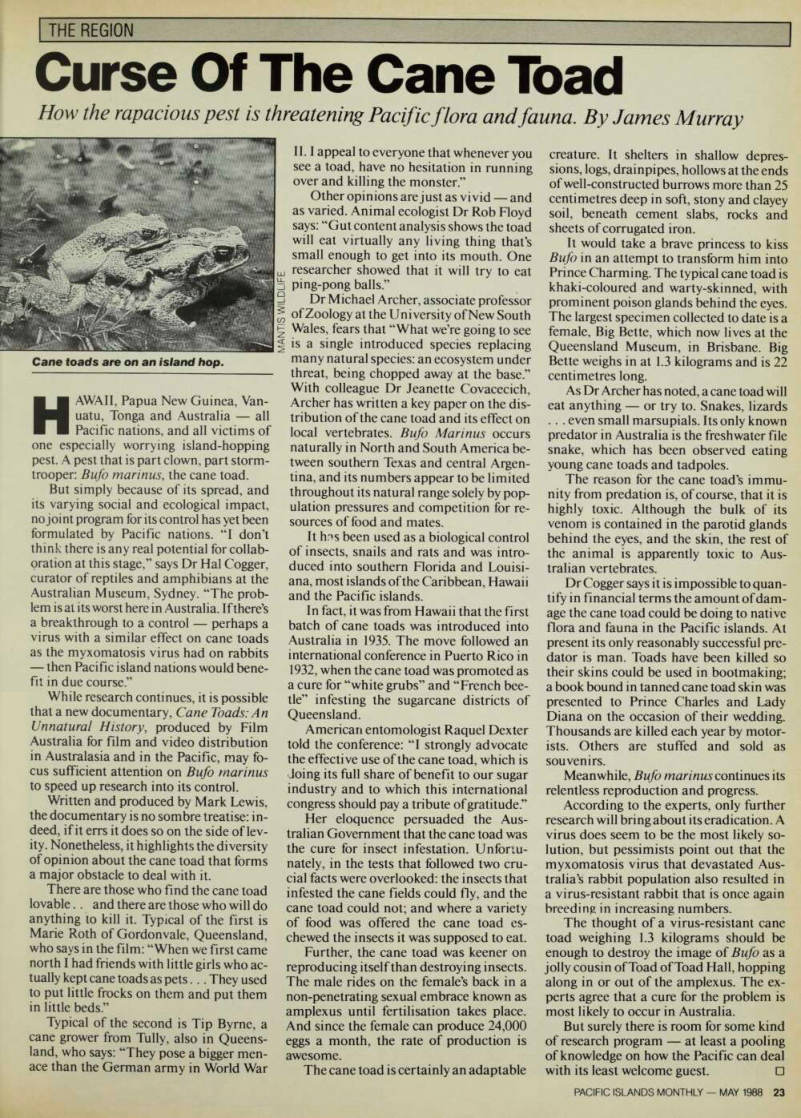
Curse Of The Cane Toad
How the rapacious pest is threatening Pacific flora and fauna.
By James Murray
HAWAII, Papua New Guinea, Van uatu, Tonga and Australia all Pacific nations, and all victims of one especially worrying island-hopping pest. A pest that is part clown, part storm trooper: Bufo marinus, the cane toad.
But simply because of its spread, and its varying social and ecological impact, no joint program for its control has yet been formulated by Pacific nations. “I don’t think there is any real potential for collab oration at this stage,” says Dr Hal Cogger, curator of reptiles and amphibians at the Australian Museum, Sydney. “The prob lem is at its worst here in Australia. If there’s a breakthrough to a control perhaps a virus with a similar effect on cane toads as the myxomatosis virus had on rabbits then Pacific island nations would bene fit in due course.”
While research continues, it is possible that a new documentary, Cane Toads: An Unnatural History, produced by Film Australia for film and video distribution in Australasia and in the Pacific, may fo cus sufficient attention on Bufo marinus to speed up research into its control.
Written and produced by Mark Lewis, the documentary is no sombre treatise: in deed, if it errs it does so on the side of lev ity. Nonetheless, it highlights the diversity of opinion about the cane toad that forms a major obstacle to deal with it.
There are those who find the cane toad lovable. . and there are those who will do anything to kill it. Typical of the first is Marie Roth of Gordonvale, Queensland, who says in the film: “When we first came north I had friends with little girls who ac tually kept cane toads as pets... They used to put little frocks on them and put them in little beds.”
Typical of the second is Tip Byrne, a cane grower from Tully, also in Queens land, who says: “They pose a bigger men ace than the German army in World War
II. I appeal to everyone that whenever you see a toad, have no hesitation in running over and killing the monster.”
Other opinions are just as vivid — and as varied. Animal ecologist Dr Rob Floyd says: “Gut content analysis shows the toad will eat virtually any living thing that’s small enough to get into its mouth. One researcher showed that it will try to eat ping-pong balls.”
Dr Michael Archer, associate professor ofZoology at the University of New South Wales, fears that “What we’re going to see is a single introduced species replacing many natural species: an ecosystem under threat, being chopped away at the base.”
With colleague Dr Jeanette Covacecich, Archer has written a key paper on the dis tribution of the cane toad and its effect on local vertebrates. Bufo Marinus occurs naturally in North and South America be tween southern Texas and central Argen tina, and its numbers appear to be limited throughout its natural range solely by pop ulation pressures and competition for re sources of food and mates.
It hr*s been used as a biological control of insects, snails and rats and was intro duced into southern Florida and Louisi ana, most islands of the Caribbean, Hawaii and the Pacific islands.
In fact, it was from Hawaii that the first batch of cane toads was introduced into Australia in 1935. The move followed an international conference in Puerto Rico in 1932, when the cane toad was promoted as a cure for “white grubs” and “French bee tle” infesting the sugarcane districts of Queensland.
American entomologist Raquel Dexter told the conference: “1 strongly advocate the effective use of the cane toad, which is doing its full share of benefit to our sugar industry and to which this international congress should pay a tribute of gratitude.”
Her eloquence persuaded the Aus tralian Government that the cane toad was the cure for insect infestation. Unfortu nately, in the tests that followed two cru cial facts were overlooked: the insects that infested the cane fields could fly, and the cane toad could not; and where a variety of food was offered the cane toad es chewed the insects it was supposed to eat.
Further, the cane toad was keener on reproducing itself than destroying insects.
The male rides on the female’s back in a non-penetrating sexual embrace known as amplexus until fertilisation takes place.
And since the female can produce 24,000 eggs a month, the rate of production is awesome.
The cane toad is certainly an adaptable
creature. It shelters in shallow depres sions, logs, drainpipes, hollows at the ends of well-constructed burrows more than 25 centimetres deep in soft, stony and clayey soil, beneath cement slabs, rocks and sheets of corrugated iron.
It would take a brave princess to kiss Bufo in an attempt to transform him into Prince Charming. The typical cane toad is khaki-coloured and warty-skinned, with prominent poison glands behind the eyes.
The largest specimen collected to date is a female. Big Bette, which now lives at the Queensland Museum, in Brisbane. Big Bette weighs in at 1.3 kilograms and is 22 centimetres long.
As Dr Archer has noted, a cane toad will eat anything or try to. Snakes, lizards . . . even small marsupials. Its only known predator in Australia is the freshwater file snake, which has been observed eating young cane toads and tadpoles.
The reason for the cane toad’s immu nity from predation is, of course, that it is highly toxic. Although the bulk of its venom is contained in the parotid glands behind the eyes, and the skin, the rest of the animal is apparently toxic to Aus tralian vertebrates.
Dr Cogger says it is impossible to quan tify in financial terms the amount of dam age the cane toad could be doing to native flora and fauna in the Pacific islands. At present its only reasonably successful pre dator is man. Toads have been killed so their skins could be used in bootmaking; a book bound in tanned cane toad skin was presented to Prince Charles and Lady Diana on the occasion of their wedding.
Thousands are killed each year by motor ists. Others are stuffed and sold as souvenirs.
Meanwhile, Bufo marinus continues its relentless reproduction and progress.
According to the experts, only further research will bring about its eradication. A virus does seem to be the most likely so lution, but pessimists point out that the myxomatosis virus that devastated Aus tralia’s rabbit population also resulted in a virus-resistant rabbit that is once again breeding in increasing numbers.
The thought of a virus-resistant cane toad weighing 1.3 kilograms should be enough to destroy the image of Bufo as a jolly cousin of Toad of Toad Hall, hopping along in or out of the amplexus. The ex perts agree that a cure for the problem is most likely to occur in Australia.
But surely there is room for some kind of research program at least a pooling of knowledge on how the Pacific can deal with its least welcome guest. □
Cane toads are on an island hop.
Mantis Wildlife
Expo’s Island Showpiece
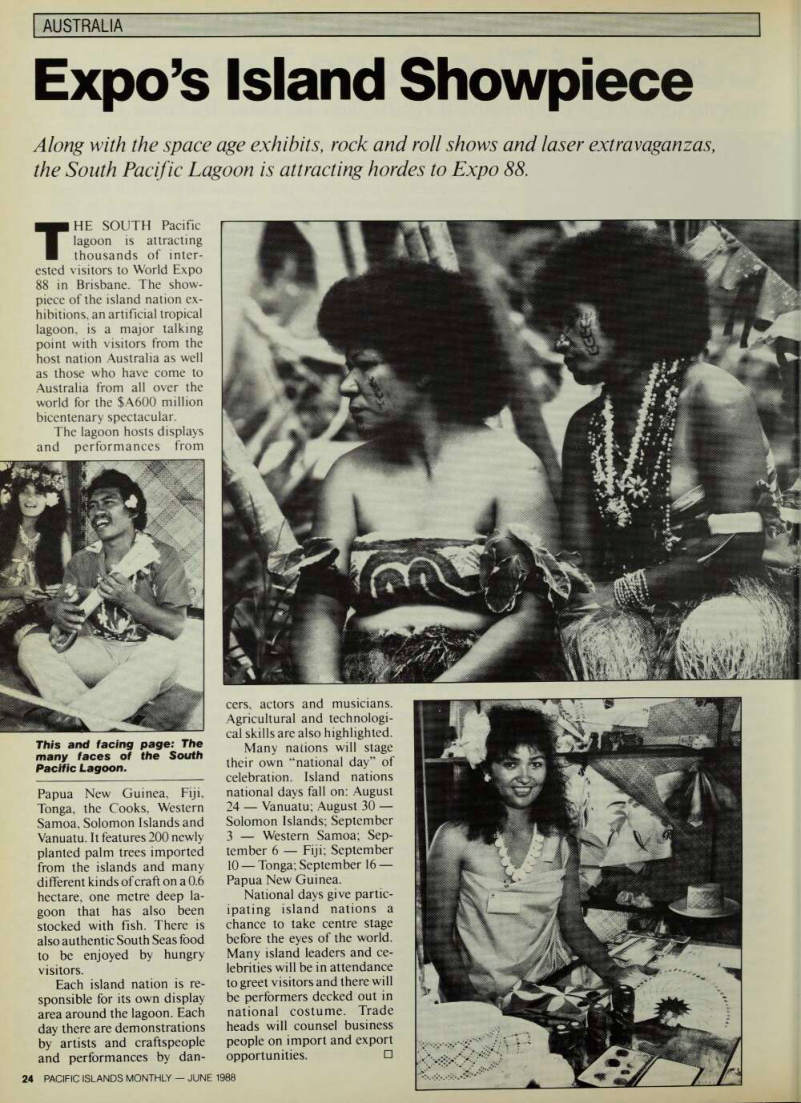
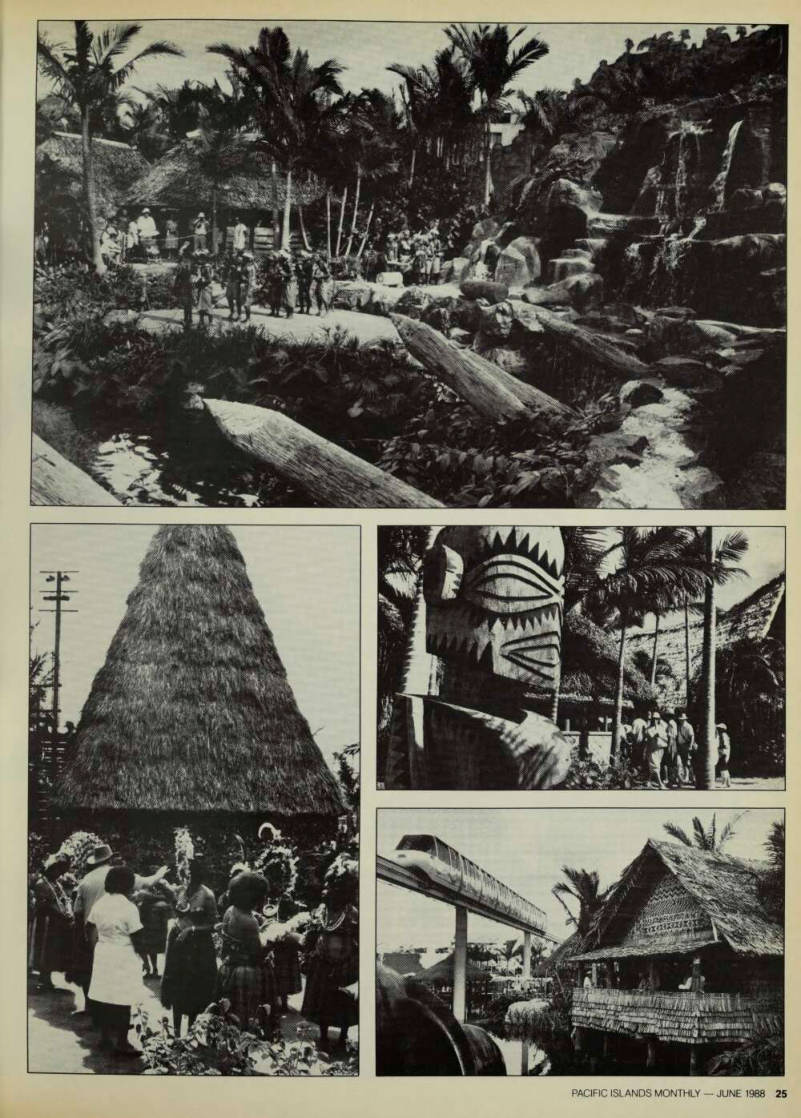
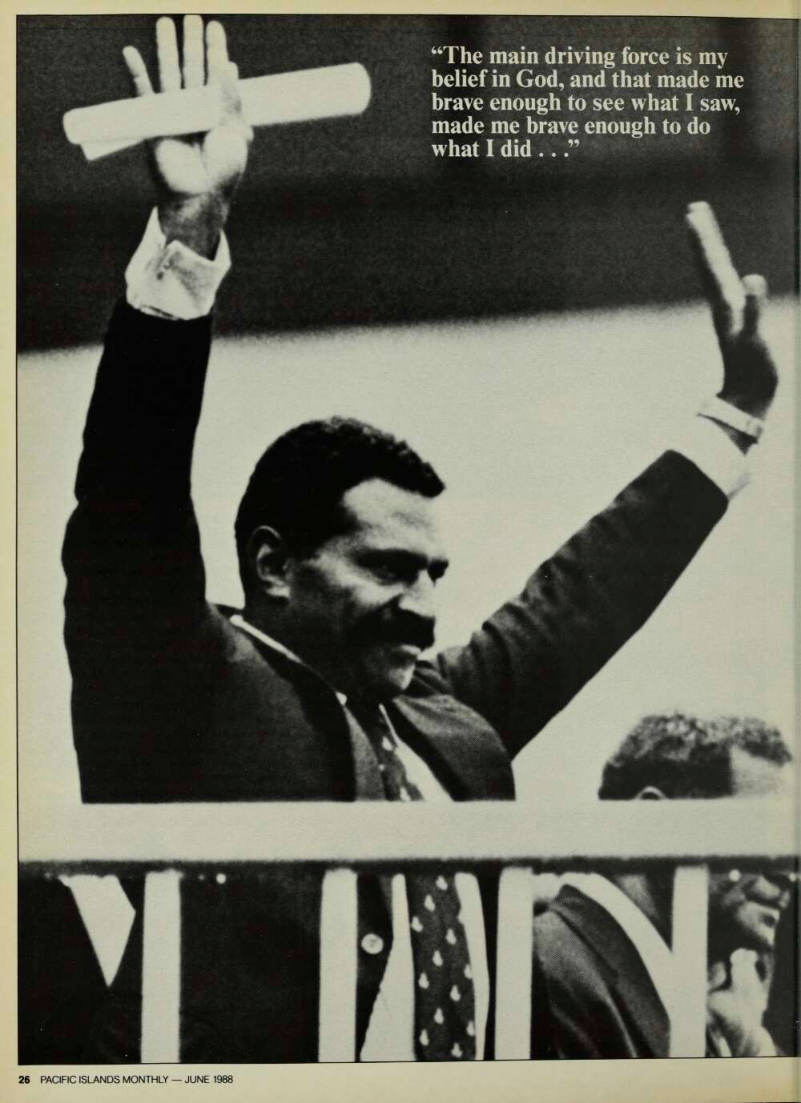
Australia
Along with the space age exhibits, rock and roll shows and laser extravaganzas, the South Pacific Lagoon is attracting hordes to Expo 88.
THE SOUTH Pacific lagoon is attracting thousands of inter ested visitors to World Expo 88 in Brisbane. The show piece of the island nation ex hibitions, an artificial tropical lagoon, is a major talking point with visitors from the host nation Australia as well as those who have come to Australia from all over the world for the SA6OO million bicentenary spectacular.
The lagoon hosts displays and performances from
Papua New Guinea, Fiji, Tonga, the Cooks, Western Samoa, Solomon Islands and Vanuatu. It features 200 newly planted palm trees imported from the islands and many different kinds of craft on a 0.6 hectare, one metre deep la goon that has also been stocked with fish. There is also authentic South Seas food to be enjoyed by hungry visitors.
Each island nation is re sponsible for its own display area around the lagoon. Each day there are demonstrations by artists and craftspeople and performances by dan-
cers, actors and musicians.
Agricultural and technologi cal skills are also highlighted.
Many nations will stage their own “national day” of celebration. Island nations national days fall on: August 24 Vanuatu; August 30 Solomon Islands; September 3 Western Samoa; Sep tember 6 Fiji; September 10 Tonga; September 16 Papua New Guinea.
National days give partic ipating island nations a chance to take centre stage before the eyes of the world.
Many island leaders and ce lebrities will be in attendance to greet visitors and there will be performers decked out in national costume. Trade heads will counsel business people on import and export opportunities. □
This and facing page: The many faces of the South Pacific Lagoon.
“The main driving force is my belief in God, and that made me brave enough to see what I saw, made me brave enough to do what I did ..."
Rabuka
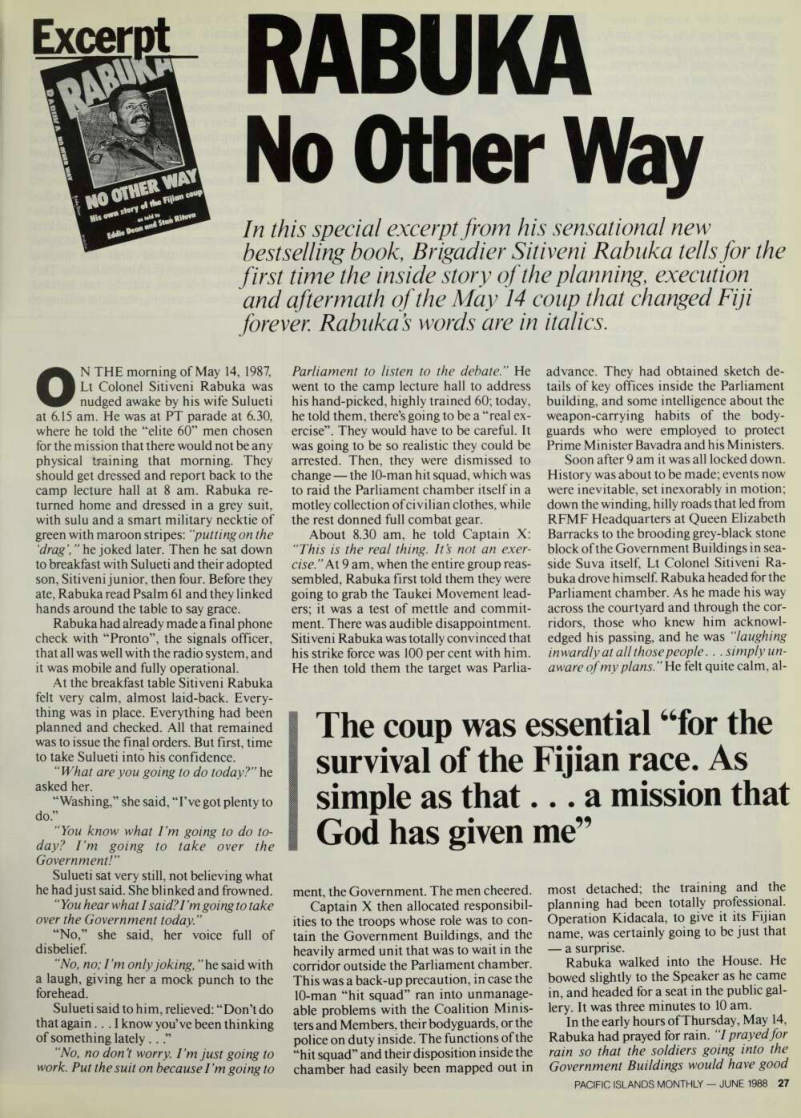
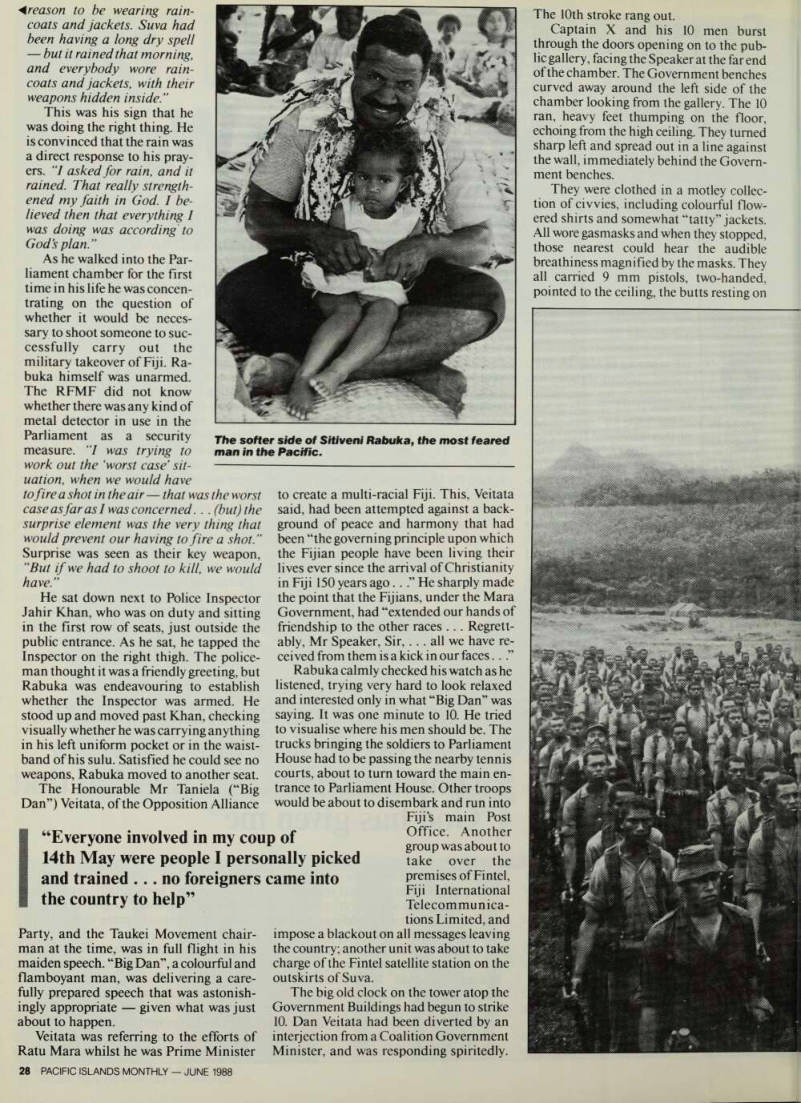
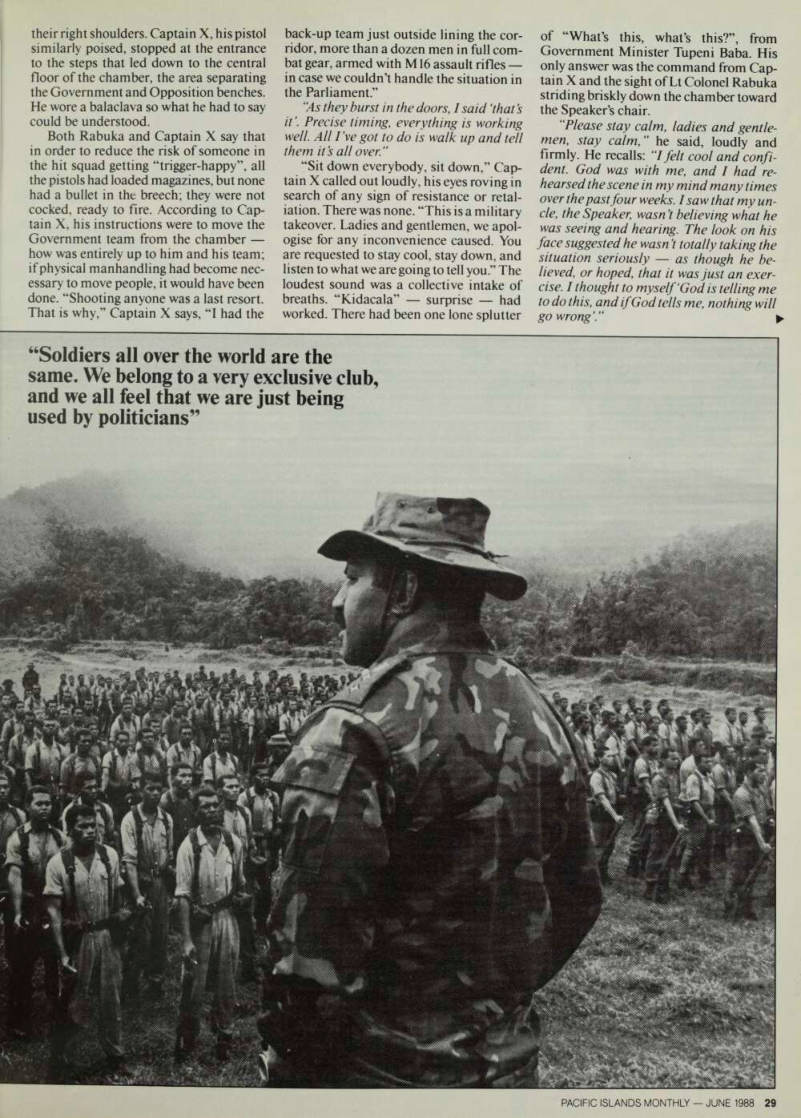

No Other Way
In this special excerpt from his sensational new bestselling book, Brigadier SRabuka tells for the first time the inside story of the planning, execution and aftermath of the May 14 coup that changed Fiji forever. Rabuka s words are in italics.
ON THE morning of May 14, 1987, Lt Colonel Sitiveni Rabuka was nudged awake by his wife Sulueti at 6.15 am. He was at PT parade at 6.30, where he told the “elite 60” men chosen for the mission that there would not be any physical training that morning. They should get dressed and report back to the camp lecture hall at 8 am. Rabuka re turned home and dressed in a grey suit, with sulu and a smart military necktie of green with maroon stripes: “putting on the ‘drag’, ” he joked later. Then he sat down to breakfast with Sulueti and their adopted son, Sitiveni junior, then four. Before they ate, Rabuka read Psalm 61 and they linked hands around the table to say grace.
Rabuka had already made a final phone check with “Pronto”, the signals officer, that all was well with the radio system, and it was mobile and fully operational.
At the breakfast table Sitiveni Rabuka felt very calm, almost laid-back. Every thing was in place. Everything had been planned and checked. All that remained was to issue the final orders. But first, time to take Sulueti into his confidence.
“What are you going to do today?” he asked her.
“Washing,” she said, “Pve got plenty to do.”
“You know what I’m going to do to day? I’m going to take over the Government!”
Sulueti sat very still, not believing what he had just said. She blinked and frowned.
“You hear what I said? I’m going to take over the Government today.”
“No,” she said, her voice full of disbelief.
“No, no; I’m only joking, ”he said with a laugh, giving her a mock punch to the forehead.
Sulueti said to him, relieved: “Don’t do that again... I know you’ve been thinking of something lately ...”
“No, no don’t worry. I’m just going to work. Put the suit on because I’m going to
Parliament to listen to the debate.” He went to the camp lecture hall to address his hand-picked, highly trained 60; today, he told them, there’s going to be a “real exercise”. They would have to be careful. It was going to be so realistic they could be arrested. Then, they were dismissed to change the 10-man hit squad, which was to raid the Parliament chamber itself in a motley collection of civilian clothes, while the rest donned full combat gear.
About 8.30 am, he told Captain X: “This is the real thing. It’s not an exercise.” At 9 am, when the entire group reassembled, Rabuka first told them they were going to grab the Taukei Movement leaders; it was a test of mettle and commitment. There was audible disappointment, Sitiveni Rabuka was totally convinced that his strike force was 100 per cent with him.
He then told them the target was Parlia-
The coup was essential "Tor the survival of the Fijian race. As simple as that... a mission that God has given me”
ment, the Government. The men cheered.
Captain X then allocated responsibil ities to the troops whose role was to con tain the Government Buildings, and the heavily armed unit that was to wait in the corridor outside the Parliament chamber.
This was a back-up precaution, in case the 10-man “hit squad” ran into unmanage able problems with the Coalition Minis ters and Members, their bodyguards, or the police on duty inside. The functions of the “hit squad” and their disposition inside the chamber had easily been mapped out in
advance. They had obtained sketch de tails of key offices inside the Parliament building, and some intelligence about the weapon-carrying habits of the body guards who were employed to protect Prime Minister Bavadra and his Ministers, Soon after 9 am it was all locked down, History was about to be made; events now were inevitable, set inexorably in motion; down the winding, hilly roads that led from RFMF Headquarters at Queen Elizabeth Barracks to the brooding grey-black stone block ofthe Government Buildings in sea side Suva itself, Lt Colonel Sitiveni Ra buka drove himself. Rabuka headed for the Parliament chamber. As he made his way across the courtyard and through the cor ridors, those who knew him acknowl edged his passing, and he was “ laughing inwardly at all those people . . . simply un aware of my plans.” He felt quite calm, al
most detached; the training and the planning had been totally professional.
Operation Kidacala, to give it its Fijian name, was certainly going to be just that a surprise.
Rabuka walked into the House. He bowed slightly to the Speaker as he came in, and headed for a seat in the public gal lery. It was three minutes to 10 am.
In the early hours of Thursday, May 14, Rabuka had prayed for rain. “I prayed for rain so that the soldiers going into the Government Buildings would have good
treason to be wearing rain coats and jackets. Suva had been having a long dry spell but it rained that morning, and everybody wore rain coats and jackets, with their weapons hidden inside”
This was his sign that he was doing the right thing. He is convinced that the rain was a direct response to his pray ers. “I asked for rain, and it rained. That really strength ened my faith in God. I be lieved then that everything I was doing was according to God’s plan.”
As he walked into the Par liament chamber for the first time in his life he was concen trating on the question of whether it would be neces sary to shoot someone to suc cessfully carry out the military takeover of Fiji. Ra buka himself was unarmed.
The RFMF did not know whether there was any kind of metal detector in use in the Parliament as a security measure. ‘7 was trying to work out the ‘worst case’ sit uation, when we would have
tofire a shot in the air that was the worst case as far as I was concerned. . . (but) the surprise element was the very thing that would prevent our having to fire a shot. ”
Surprise was seen as their key weapon, “ But if we had to shoot to kill, we would have.”
He sat down next to Police Inspector Jahir Khan, who was on duty and sitting in the first row of seats, just outside the public entrance. As he sat, he tapped the inspector on the right thigh. The police man thought it was a friendly greeting, but Rabuka was endeavouring to establish whether the Inspector was armed. He stood up and moved past Khan, checking visually whether he was carrying anything in his left uniform pocket or in the waist band of his sulu. Satisfied he could see no weapons, Rabuka moved to another seat, The Honourable Mr Taniela (“Big Dan”) Veitata, of the Opposition Alliance
“Everyone involved in my coup of 14th May were people I personally picked and trained ... no foreigners came into the country to help”
Party, and the Taukei Movement chair man at the time, was in full flight in his maiden speech. “Big Dan”, a colourful and flamboyant man, was delivering a care fully prepared speech that was astonish ingly appropriate given what was just about to happen.
Veitata was referring to the efforts of Ratu Mara whilst he was Prime Minister
to create a multi-racial Fiji. This, Veitata said, had been attempted against a back ground of peace and harmony that had been “the governing principle upon which the Fijian people have been living their lives ever since the arrival of Christianity in Fiji 150 years ago...” He sharply made the point that the Fijians, under the Mara Government, had “extended our hands of friendship to the other races ... Regrett ably, Mr Speaker, Sir,... all we have re ceived from them is a kick in our faces...”
Rabuka calmly checked his watch as he listened, trying very hard to look relaxed and interested only in what “Big Dan” was saying. It was one minute to 10. He tried to visualise where his men should be. The trucks bringing the soldiers to Parliament House had to be passing the nearby tennis courts, about to turn toward the main en trance to Parliament House. Other troops would be about to disembark and run into
Fiji’s main Post Office. Another group was about to take over the premises ofFintel, Fiji International Telecommunica tions Limited, and
impose a blackout on all messages leaving the country; another unit was about to take charge of the Fintel satellite station on the outskirts of Suva.
The big old clock on the tower atop the Government Buildings had begun to strike 10. Dan Veitata had been diverted by an interjection from a Coalition Government Minister, and was responding spiritedly.
The 10th stroke rang out.
Captain X and his 10 men burst through the doors opening on to the pub lic gallery, facing the Speaker at the far end of the chamber. The Government benches curved away around the left side of the chamber looking from the gallery. The 10 ran, heavy feet thumping on the floor, echoing from the high ceiling. They turned sharp left and spread out in a line against the wall, immediately behind the Govern ment benches.
They were clothed in a motley collec tion of civvies, including colourful flow ered shirts and somewhat “tatty” jackets.
All wore gasmasks and when they stopped, those nearest could hear the audible breathiness magnified by the masks. They all carried 9 mm pistols, two-handed, pointed to the ceiling, the butts resting on
The softer side of Sitiveni Rabuka, the most feared man in the Pacific.
their right shoulders. Captain X, his pistol similarly poised, stopped at the entrance to the steps that led down to the central floor of the chamber, the area separating the Government and Opposition benches.
He wore a balaclava so what he had to say could be understood.
Both Rabuka and Captain X say that in order to reduce the risk of someone in the hit squad getting “trigger-happy”, all the pistols had loaded magazines, but none had a bullet in the breech; they were not cocked, ready to fire. According to Cap tain X, his instructions were to move the Government team from the chamber how was entirely up to him and his team; if physical manhandling had become nec essary to move people, it would have been done. “Shooting anyone was a last resort.
That is why,” Captain X says, “I had the
back-up team just outside lining the cor ridor, more than a dozen men in full com bat gear, armed with Ml 6 assault rifles in case we couldn’t handle the situation in the Parliament.”
“As they burst in the doors, I said ‘that’s it ’. Precise timing, everything is working well. All I’ve got to do is walk up and tell them it’s all over.”
“Sit down everybody, sit down,” Cap tain X called out loudly, his eyes roving in search of any sign of resistance or retal iation. There was none. “This is a military takeover. Ladies and gentlemen, we apol ogise for any inconvenience caused. You are requested to stay cool, stay down, and listen to what we are going to tell you.” The loudest sound was a collective intake of breaths. “Kidacala” surprise had worked. There had been one lone splutter
of “What’s this, what’s this?”, from Government Minister Tupeni Baba. His only answer was the command from Cap tain X and the sight of Lt Colonel Rabuka striding briskly down the chamber toward the Speaker’s chair.
“Please stay calm, ladies and gentle men, stay calm,” he said, loudly and firmly. He recalls: “I felt cool and confi dent. God was with me, and I had re hearsed the scene in my mind many times over the past four weeks. I saw that my un cle, the Speaker, wasn’t believing what he was seeing and hearing. The look on his face suggested he wasn’t totally taking the situation seriously as though he be lieved, or hoped, that it was just an exer cise. I thought to myself'God is telling me to do this, and if God tells me, nothing will go wrong’.” *
“Soldiers all over the world are the same. We belong to a very exclusive club, and we all feel that we are just being used by politicians”
◄ Rabuka mounted the steps to where the Speaker sat, stopped beside his elaborate chair, turned and faced the Parliament chamber. An element of farce entered the proceedings here; Rabuka didn’t find out until much later that the rest of the take over proceeded with him standing on the Speaker’s foot but he was totally obli vious to the fact. Apparently, when he reached the Speaker’s dais, his uncle went to stand up but couldn’t because Rabuka had planted his heavy right foot on that of his uncle. Rabuka says he was concentrat ing so hard on what he was doing, he sim ply wasn’t aware the Speaker was effectively pinned to the spot.
“Mr Prime Minister, please lead your team down to the right... Policeman, keep the passage clear. Stay down, remain calm.” Dr Timoci Bavadrasat motionless, disbelief written all over his face. “Mr Prime Minister, Sir, will you lead your team now.” There was emphasis on the “now”, and hands were thrust into hip pockets with deliberation, in a gesture de signed to further emphasise the instruc tion. Bavadra stood, and began leading his team out of the Parliament. The earlier lone voice, Tupeni Baba, declined to leave.
Rabuka gave him a specific, personal di rective: “Go.” Baba went.
When the chamber had cleared, it was four minutes past 10. “I had taken over the Government, not for power or personal gain, but to save my people from blood shed.” Rabuka prayed briefly, thanking God for the achievement.
Sitiveni Rabuka is emphatic that he has no real regrets for his actions. ‘7 do not think that I have any regrets at all. Per-
haps the only regret I have is that there was no other way we could have done it.”
Outside the Parliament, where Rabuka had followed his men, the Government Ministers and members were about to be loaded on to trucks to be taken to Queen Elizabeth Barracks and locked in the guardroom on a temporary basis. Once again, Tupeni Baba objected. “No, no,” he shouted, “we are not getting into the trucks.” Rabuka took a loaded Ml 6 from the nearest soldier, cocked it and pointed at Baba’s head. "Move, ” he said.
By the end of the day there had been no contact with Ratu Sir Kamisese Mara, who was a phone call away. An Alliance Party member had phoned Mara at the Fijian
Resort from the Parliament tea-room soon after the coup, to tell him what Rabuka had done. The former Prime Minister was vis ibly, and strongly, affected by the news. He went pale, and appeared very weak.
For Rabuka, whether Ratu Mara would co-operate by joining his Council of Min isters was his biggest worry. Without Ratu Mara, he believed there would be a major credibility gap. He agonised about ring ing, trying to pluck up courage because he was not sure about how the nation’s most respected politician would react to the coup, and its implications. “I needed Ratu Mara. The Fijians needed him. So did the nation.”
It was in the early hours of Friday, May 15, when the call reached Ratu Mara’s wife, Adi Lady Lala, to whom he apologised for the lateness of the call, Ratu Mara came on line, and Rabuka paused again how would he react, given that the coup had ef fectively brought to a halt all that Ratu Mara had worked for over 17 years?
He asked had Ratu Mara heard about the coup?
“Yes”. Rabuka invited him to join his Council of Ministers, taking the Foreign Affairs and Civil Aviation portfolios, “I accept”.
“What about your reputation, sir?”
Ratu Mara replied that his reputation was of no use if the nation was in ruins, Ra buka thanked him for his co-operation and rang off, elated.
“I nearly hit the roof as I jumped and cheered.” □
An extract /romßabuka: No Other Way by Eddie Dean and Stan Ritova. Copyright text® The Marketing Team International Ltd, 1988. Photographs ® Stan Ritova, 1988. Published by Doubleday at $12.95 in Australia and $17.95 in New Zealand (incl GST). Published in Fiji by The Mar keting Team International at $9.95. All rights reserved. □
Rabuka returns to the Parliament chamber, scene of his dramatic coup.
Advertisements & other items, pp. 30-31 (1 item)
Road-Hugging, Rock-Riling,
m \ -*■ i P * %r * V Ji tr a?*. m > HILUX 4WD Regular Cab, Long Wheelbase One tough truck just got tougher. Toyota’s dedication to superior performance vehicles takes a step forward today with the New Hilux.: A refined front grille and bumper design, new instrument panel for a feeling of spaciousness and command and plush colour co-ordinated trim are a few new additions to the New Hilux.
And extensive anti-corrosive galvanealed steel protection now includes the tailgate panel and rear door panel, making Hilux more durable than ever before.
Yet for all its improvements, the best of the original Hilux is also AMERICAN SAMOA: BURNS PHILP (SOUTH SEA) CO., LTD., P.O. Box 129, Pago PagoCOOK 'ELANDS: COOK I SLA J| AUTOMOTIVE SUPPLIES COMPANY, a Division of Burns Philp (South Sea) Co., Ltd., G.P.O. Box 355, a m I f J 1 C 1 I Tamuning. KIRIBATI: TARAWA MOTORS. A Division of Bairiki Holdings Ltd., 36 Bamki Tarawa, NAURU: NAjl SERVICE IMPORTATION AUTOMOBILE DU PACIFIQUE. Rond-Point du Pacifique (Station Total) B.P. 438, Noumea NORFOLK ISLAND: BORRY’S LIMITED, P.O. Box 169. PAPUA NEW GUINEA: ELA MOTORS, A Division of Burns Pltjr CORPORATION, P.O. Box 267, Saipan. SOLOMON ISLANDS: SOLOMON ISLANDS •NVESTMENTSI LTD., G.P.O. Box ft TONGA: BURNS PHILP (TONGA) LTD., P.O. Box 55, Nuku’alofa. VANUATU; VANUATU MOTORS. A Division of Burns Phßi
QUALITY SERVICE
f ic-Tough. The New Hilux.
& ' : ~W 4 1 ■K > I ' i iv K -. • x U 'N V 4 i ■ sre: a big tailgate conveniently hinged for quick loading and unloading; reinforced front suspension to smooth out e bumps, and bias-mounted, extra-heavy-duty rear shocks and knobbly tyres to take on any terrain.
Toyota’s long history of super-responsive engines, ruggedness, reliability and comfort goes without saying. And in the Hilux, it’s yours in both 2-wheel-drive and 4x4 versions.
So, after comprehensive testing and thorough quality control, the New Hilux is ready to bring a new standard of toughness to the Pacific.
Areas where gaivaneaied steel is used And isn’t that exactly what you expect from Toyota?
DING CORPORATION LTD., Private Bag, Rarotonga. FIJI; >IA: ATKINS KROLL, INC., 443 South Marine Drive,
ERATIVE SOCIETY, Central Pacific. NEW CALEDONIA:
HILP (SOUTH SEA) CO.. LTD., P.O. Box 39. Alofi.
Ltd., PO. Box 75, Port Moresby SAIPAN: MICROL
TAHITI: NIPPON AUTOMOTO. B.P. 342, Papeete.
:u) Ltd., P.O. Box 18, Port Vila WESTERN SAMOA:
TOYOTA
Rabuka’s Way
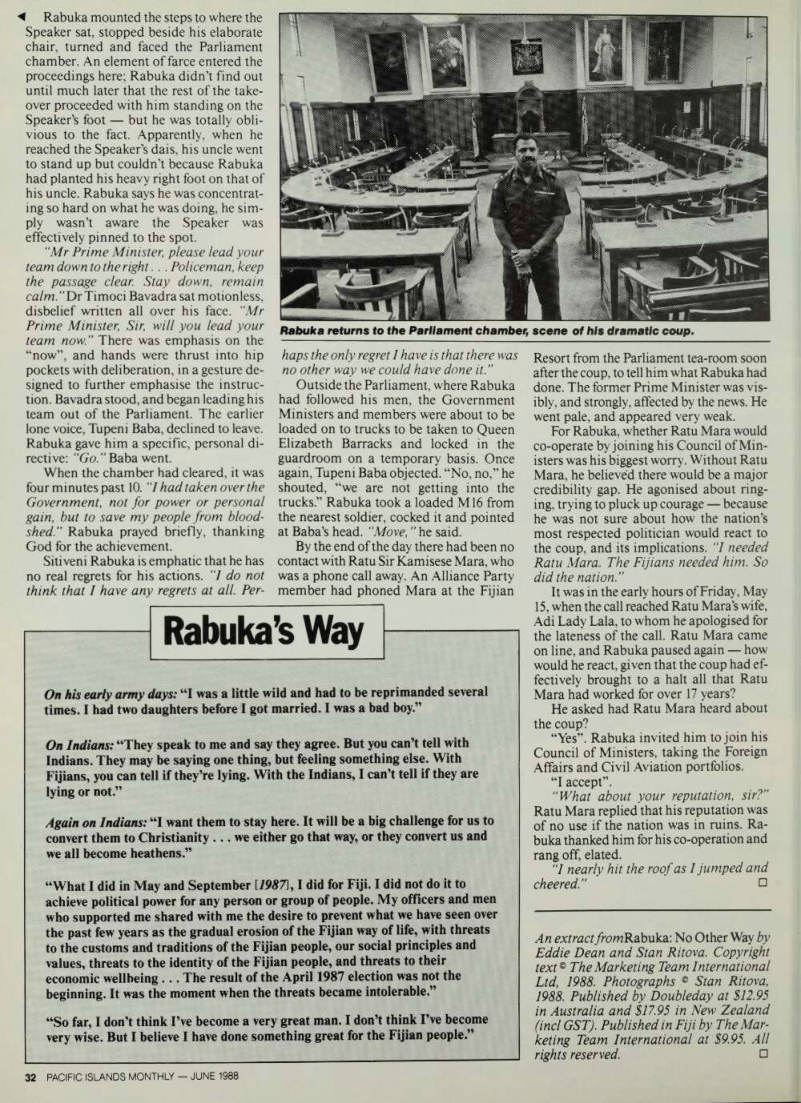
On his early army days: “I was a little wild and had to be reprimanded several times. I had two daughters before I got married. I was a bad boy.”
On Indians: “They speak to me and say they agree. But you can’t tell with Indians. They may be saying one thing, but feeling something else. With Fijians, you can tell if they’re lying. With the Indians, I can’t tell if they are lying or not.”
Again on Indians: “I want them to stay here. It will be a big challenge for us to convert them to Christianity ... we either go that way, or they convert us and we all become heathens.”
“What I did in May and September [1987\, I did for Fiji. I did not do it to achieve political power for any person or group of people. My officers and men who supported me shared with me the desire to prevent what we have seen over the past few years as the gradual erosion of the Fijian way of life, with threats to the customs and traditions of the Fijian people, our social principles and values, threats to the identity of the Fijian people, and threats to their economic wellbeing ... The result of the April 1987 election was not the beginning. It was the moment when the threats became intolerable.”
“So far, I don’t think I’ve become a very great man. I don’t think I’ve become very wise. But I believe I have done something great for the Fijian people.”
Pacific Report
□ W Samoan Women’S Vote Plea
WESTERN SAMOA’S National Council of Women has called for the abolition of the country’s present electoral system, whereby only chiefs can vote. The council wants the introduction of a wider fran chise system that would give women and all people over the age of 21 the vote.
□ King Tupou Celebrations
FIVE DAYS of feasting, parades, dancing, sporting events and church services will mark the 70th birthday this year of Ton ga’s King Taufa’ahau Tupou. The celebra tions will last from June 30 to July 4.
□ Tuvalu Census In ’B9
TUVALU’S FIRST population census for 10 years will be conducted in June 1989.
The 1979 census showed that Tuvalu had a population of 7348: a survey in 1985 in dicated the figure had risen to 8300.
□ Fiji Stays Aloof
FIJI’S PRIME Minister, Ratu Sir Kam isese Mara, has indicated Fiji will not be come a member of either the new Melanesian or Polynesian groupings in the South Pacific.
□ Png Immigration Upgrade
PNG’S IMMIGRATION services are being upgraded to bring them in line with international practice. The move is a di rect result of the findings of an inquiry into complaints of long delays experienced in dealing with the Immigration Division of the Department of Foreign Affairs.
□ Png Crocodile Attack
MADANG police recovered the remains of a 47-year-old man who was taken by a crocodile. The man’s wife had watched helplessly while the crocodile attacked and dragged him into the Gogol River, where he’d gone for a drink.
□ Rongelap Fallout Fear
A SENATOR from the Marshall Islands has claimed that United States officials deliberately covered up a medical study that showed plutonium infection among the inhabitants of Rongelap exposed to hydrogen bomb tests in 1954. The island was later evacuated, but the islanders re turned to the remote atoll three years later after US officials declared it safe.
□ Australia’S Fiji Promise
AUSTRALIA’S new Ambassador to Fiji, Mr Robert Cotton, promised that his country would work with Fiji “with sym pathy and understanding” of the complex issues facing it. The ambassador said Aus tralia had a firm commitment to a sound and positive relationship with Fiji and he would do his best to strengthen it.
□ Gandhi’S Ultimatum
THE EXTREMIST Fijian Nationalist Party sent a message to the Indian Prime Minister, Mr Gandhi, asking his country to repatriate Fiji’s Indians. It was signed by the party president, Mr Sakeasi Butad roka, and claimed that Fiji’s political sta bility had been shattered by the Indian presence.
□ Enga Clans Clash
A FIGHT involving about 2000 clansmen in Papua New Guinea’s Enga Province re sulted in the burning of 30 houses and the destruction of other property. The clash between Lakoi and Okongk clansmen oc curred after Okongk clansmen attacked and seriously injured a Lakoi clansman early in May.
□ Judge Slams Aid Lack
THE MOST senior judge in Fiji, Chief Justice Sir Timoci Tuivaga, has expressed regret at a shortage of judges in his coun try because of a lack of financial aid from Australia, New Zealand and Britain.
□ Fijians Oversee Soviet Pullout
FIJI’S FOUR-MAN contribution to the United Nations observer unit in Afghan istan has left for Kabul. The two majors and two captains will be part of a 50member UN military team overseeing the initial withdrawal of Soviet troops from Afghanistan this month.
□ Gg’S Pig Clubbing Outcry
THE GOVERNOR General of New Zea land, Sir Paul Reeves, caused an outcry in his country by clubbing two pigs to death during ceremonies in Vanuatu. The kill ings took place as part of a Melanesian rit ual in honour of visitors of high status.
□ Micronesia Probe
THE UNITED Nations Trusteeship Council began hearings on progress to ward self-Government and the economic and social progress of Micronesia the last remaining territory under interna tional trusteeship. In its three-week ses sion, the Council considered a United States report on the region, also known as the Trust Territory of the Pacific islands.
□ Fiji Sunday Rules Eased
AN EASING of Fiji’s strict Sunday ob servance rules has been announced. This will permit work in the sugar and rice in dustries, limited public transport and family picnics. But bans will remain on organised sport and retail trading. They followed recommendations by a Cabinet committee chaired by the sabbath decree’s author, the army commander, Brigadier- General Sitiveni Rabuka, after taking submissions from a wide section of the community. □
Advertisements & other items, pp. 33-34 (2 items)
Development Studies
National Centre for
The Australian National
University
The Fiji Economy May 1987: problems and prospects.
Rodney Cole & Helen Hughes 240 pp approx A 520.00 ISBN 0 07315 0600 6 The May 1987 coup has had profound immediate effects on Fiji’s small economy. This book analyses the economic background and effects of the coup, its economic effects and explores the longer term growth possibilities open to the Interim Government and subsequent Fiji governments.
Without growth, stability is unlikely to return to Fiji.
Copra Marketing and Price Stabilization in Papua New Guinea: a history to 1975 Harry H. Jackman. 298 pp A 520.00
ISBN 0 7315 0520 4
Jackman gives an economic historical account of Papua New Guinea’s copra industry which is not merely a source of copra but vital as a source of food and shelter for one-third of Papua New Guinea’s population.
Bounteous Bestowal: the economic history of Norfolk Island M.L. Treadgold. 300 pp approx. A 520.00.
ISBN 0 7315 0624 3
Treadgold traces the economic history of Norfolk Island from its first settlement to a modern day capital-exporting developed mini-economy displaying a high degree of affluence in per capita terms.
Available from Bibliotech
ANUTECH PTY LTD
GPO Box 4 Canberra ACT 2601 Australia A postage and packing charge is added.
Aust. $3.50; OS A 54.95.
A charge can be made to Bandcard or Mastercard.
Tropicalities
A bright new regular feature that lets you, our readers, have your say. Send your letters to Pacific Islands Monthly, GPO Box 4245, Sydney, NSW, Australia 2001.
PNG Law
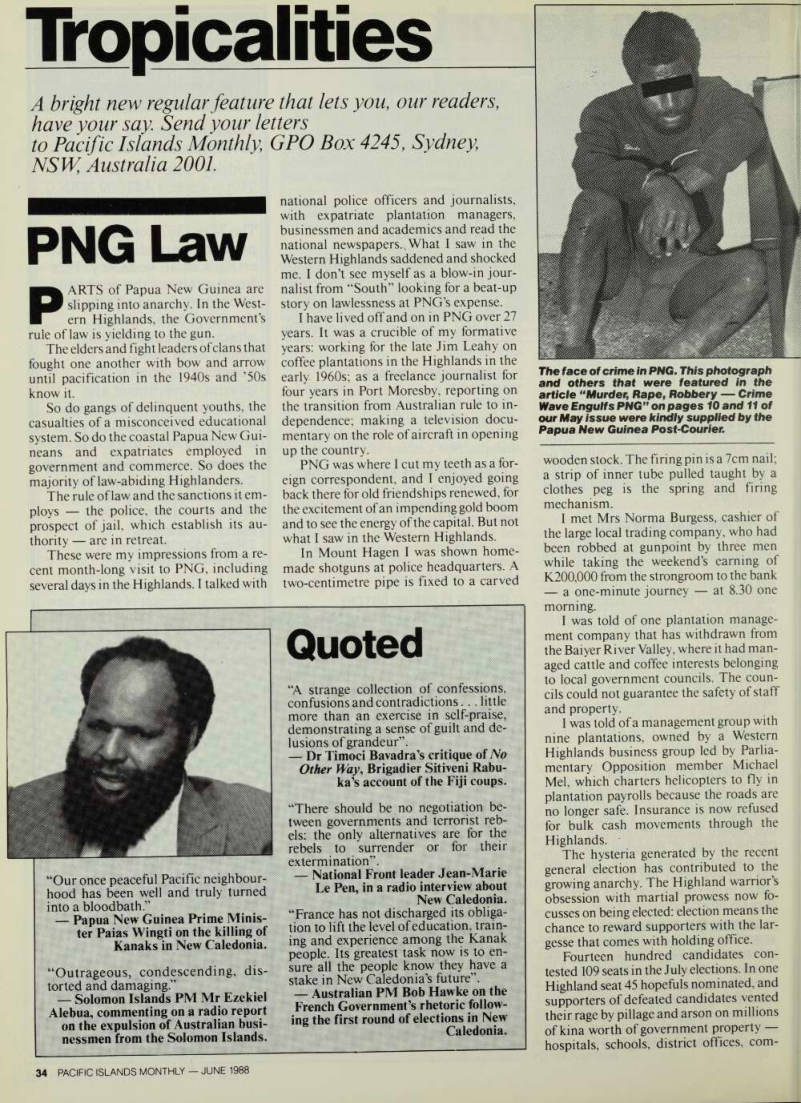
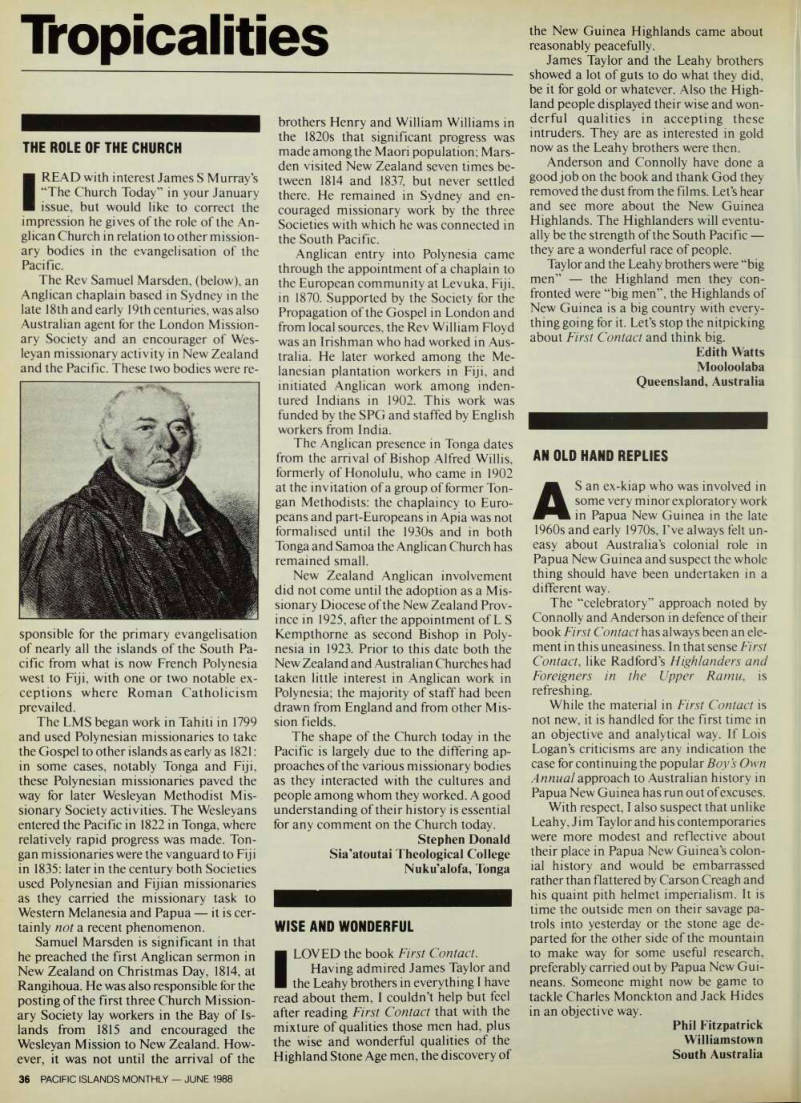
PARTS of Papua New Guinea are slipping into anarchy. In the West ern Highlands, the Government’s rule of law is yielding to the gun.
The elders and fight leaders of clans that fought one another with bow and arrow until pacification in the 1940 s and ’sos know it.
So do gangs of delinquent youths, the casualties of a misconceived educational system. So do the coastal Papua New Gui neans and expatriates employed in government and commerce. So does the majority of law-abiding Highlanders.
The rule of law and the sanctions it em ploys the police, the courts and the prospect of jail, which establish its au thority are in retreat.
These were my impressions from a re cent month-long visit to PNG, including several days in the Highlands. I talked with
national police officers and journalists, with expatriate plantation managers, businessmen and academics and read the national newspapers.. What I saw in the Western Highlands saddened and shocked me. I don’t see myself as a blow-in jour nalist from “South” looking for a beat-up story on lawlessness at PNG’s expense.
I have lived off and on in PNG over 27 years. It was a crucible of my formative years: working for the late Jim Leahy on coffee plantations in the Highlands in the early 19605; as a freelance journalist for four years in Port Moresby, reporting on the transition from Australian rule to in dependence; making a television docu mentary on the role of aircraft in opening up the country.
PNG was where I cut my teeth as a for eign correspondent, and I enjoyed going back there for old friendships renewed, for the excitement of an impending gold boom and to see the energy of the capital. But not what I saw in the Western Highlands.
In Mount Hagen I was shown home made shotguns at police headquarters. A two-centimetre pipe is fixed to a carved
wooden stock. The firing pin is a 7cm nail; a strip of inner tube pulled taught by a clothes peg is the spring and firing mechanism.
I met Mrs Norma Burgess, cashier of the large local trading company, who had been robbed at gunpoint by three men while taking the weekend’s earning of K 200.000 from the strongroom to the bank a one-minute journey at 8.30 one morning.
I was told of one plantation manage ment company that has withdrawn from the Baiyer River Valley, where it had man aged cattle and coffee interests belonging to local government councils. The coun cils could not guarantee the safety of staff and property.
I was told of a management group with nine plantations, owned by a Western Highlands business group led by Parlia mentary Opposition member Michael Mel, which charters helicopters to fly in plantation payrolls because the roads are no longer safe. Insurance is now refused for bulk cash movements through the Highlands.
The hysteria generated by the recent general election has contributed to the growing anarchy. The Highland warrior’s obsession with martial prowess now fo cusses on being elected: election means the chance to reward supporters with the lar gesse that comes with holding office.
Fourteen hundred candidates con tested 109 seats in the July elections. In one Highland seat 45 hopefuls nominated, and supporters of defeated candidates vented their rage by pillage and arson on millions of kina worth of government property hospitals, schools, district offices, corn
The face of crime in PNG. This photograph and others that were featured in the article “Murder, Rape, Robbery - Crime Wave Engulfs PNG” on pages 10 and 11 of our May issue were kindly supplied by the Papua New Guinea Post-Courier.
munity centres; by beating electoral offi cials and teachers, and by the rape of wives, nurses and female teachers.
And the Government response? Prime Minister Paias Wingti won’t accept that PNG has a problem with lawlessness. He prefers to talk of “the growing pains of a young country”. His remedy is to develop PNG’s agricultural and fishing resources for the twofold purpose of generating wealth, and to dissipate antisocial behav iour through expanded opportunities for employment.
As a long-term solution, no one could quarrel with that. As a solution to the cur rent crisis, it’s like draining the pool while ignoring someone drowning.
I’ve known Dick Hagon since the early 19605. He’s lived in the Western High lands since 1954, when he turned a tract of uninhabited swamp into the largest and one of the best coffee plantations in the country.
He sold out after 20 years, but retains other commercial interests. Five years ago the PNG Government invited him to res cue the Wahgi-Mek group of plantations, owned by two local government councils.
Debts of K 5.7 million had taken it to the wall; Hagon is now turning it round, re paying creditors at K 1.5 million a year with a commitment to clear all debts by 1990.
“I’m like a lot of Australians who’ve lived the best years of their lives in this country,” he told me. “I want to see it through its difficulties.”
He agrees with PM Wingti on the need for massive rural development, but he also wants radical action to combat lawless ness now: rewards to police informers leading to convictions; surrender to police of all firearms and ammunition, regard less of licences; a maximum security prison, preferably on an offshore island, to isolate and contain hard-core criminals; and expanded recruitment and better pay, training and equipment for PNG’s de moralised police force.
Hagon should be judged by his deeds as much as by his words. He was instru mental in establishing a Law and Order Committee in Mount Hagen to liaise with police; in setting up rewards for police in formants. It has helped, he says... but it’s not by itself enough.
Lawlessness is probably worst in the
Western Highlands, but it’s also a problem in major urban centres such as Port Mo resby and Lae. There it surfaces through the so-called “raskol” gangs of delinquent youths, casualties from a school system that discards all but a handful before high school, and that does nothing to prepare the balance for the workforce.
They come to the cities in search of work or job training, are rebuffed, and gravitate to gangs that burgle and rape.
Bonds of camaraderie are forged in def ence against a society that rejects them.
That’s the judgment of Dr Bruce Har ris, of the University of California, San Diego, a social anthropologist who speci alises in urban outcast gangs and who for 18 months has been studying Port Mores by’s “raskol” gangs through the Institute of Applied Social and Economic Research for the PNG Government.
Media reports in Australia and New Zealand have stamped Lae and Port Mo resby as cities where no woman, especially a white woman, is safe. While Harris de plores rape, he insists it is motivated not by the need for sexual release but as an outlet for pent-up rage, frustration and the sense of failure in a society that relegates its unemployed and unemployable to the scrapheap. The victim may be singled out for a real or imagined slight, he says. The rapist may believe the woman or the wom an’s husband must be punished; or it may be Melanesian male pride humiliated at taking orders from a woman.
Former chief-of-staff Tim Sinclair made the point in the PNG Post Courier in September. Rape, he said, “is commit ted by people who feel the need to prove they are not just third-rate dropouts. The unconscious thinking goes: ‘You might have the brains, money and good life, but I’ll show you I’ve got manhood.’ It is pay back by those who feel cheated by life.”
Harris wants the highly centralised po lice and court system decentralised. Port Moresby is not a city, he insists, but a clus ter of immigrant tribal communities. “The most potent forces for social control shame, ostracism and gossip are those communities,” he says. “We should have local police posts, police who are known and trusted by local communities and lo cal courts that try wrongdoers in front of their own people.
“As it is, we’re squandering our most precious resource, the cohesive pressure of those communities as well as the authority of the elders.
Chris Ashton
Sydney Australia.
New Directions
I HAVE been a subscriber to Pacific Is lands Monthly for at least a decade, and have enjoyed the opportunity it has provided to keep me informed.
In recent years, however, the emphasis now seems to be on politics, where previ ously facts about people and areas were the significant subjects. It seems to me you are trying to be another Time or Newsweek : but in this approach you have lost your previous intimate touch with the area.
Alfred Murphy
Heraldsburg California, USA Politics and economics are determining directions in the Pacific as never before, and well continue to cover these subjects accurately and in depth. However there is still plenty of room in our pages for fea tures on the arts, sport, medicine, travel and personalities and well keep on bring ing our readers these as well.
The Editor
Setting The Record Straight
I HOPE you will correct two errors with regard to an incident involving Mr Jean-Marie Tjibaou in New York, as reported in your November 1987 issue.
I never voiced any suspicions on the subject: in fact, I have never spoken about the matter. In addition, it should be noted that the meeting at which Mr Tjibaou was to speak was a meeting of Non-Aligned Countries, not a meeting of the United Nations Decolonisation Committee.
Thank you for your co-operation.
Robert van Lierop
Vanuatu Permanent Representative to the United Nations Port Vila, Vanuatu
The Role Of The Church
I READ with interest James S Murray’s “The Church Today” in your January issue, but would like to correct the impression he gives of the role of the An glican Church in relation to other mission ary bodies in the evangelisation of the Pacific.
The Rev Samuel Marsden, (below), an Anglican chaplain based in Sydney in the late 18th and early 19th centuries, was also Australian agent for the London Mission ary Society and an encourager of Wes leyan missionary activity in New Zealand and the Pacific. These two bodies were re-
sponsible for the primary evangelisation of nearly all the islands of the South Pa cific from what is now French Polynesia west to Fiji, with one or two notable ex ceptions where Roman Catholicism prevailed.
The LMS began work in Tahiti in 1799 and used Polynesian missionaries to take the Gospel to other islands as early as 1821: in some cases, notably Tonga and Fiji, these Polynesian missionaries paved the way for later Wesleyan Methodist Mis sionary Society activities. The Wesleyans entered the Pacific in 1822 in Tonga, where relatively rapid progress was made. Ton gan missionaries were the vanguard to Fiji in 1835; later in the century both Societies used Polynesian and Fijian missionaries as they carried the missionary task to Western Melanesia and Papua it is cer tainly not a recent phenomenon.
Samuel Marsden is significant in that he preached the first Anglican sermon in New Zealand on Christmas Day, 1814, at Rangihoua. He was also responsible for the posting of the first three Church Mission ary Society lay workers in the Bay of Is lands from 1815 and encouraged the Wesleyan Mission to New Zealand. How ever, it was not until the arrival of the
brothers Henry and William Williams in the 1820 s that significant progress was made among the Maori population; Mars den visited New Zealand seven times be tween 1814 and 1837, but never settled there. He remained in Sydney and en couraged missionary work by the three Societies with which he was connected in the South Pacific.
Anglican entry into Polynesia came through the appointment of a chaplain to the European community at Levuka, Fiji, in 1870. Supported by the Society for the Propagation of the Gospel in London and from local sources, the Rev William Floyd was an Irishman who had worked in Aus tralia. He later worked among the Me lanesian plantation workers in Fiji, and initiated Anglican work among inden tured Indians in 1902. This work was funded by the SPG and staffed by English workers from India.
The Anglican presence in Tonga dates from the arrival of Bishop Alfred Willis, formerly of Honolulu, who came in 1902 at the invitation of a group of former Ton gan Methodists: the chaplaincy to Euro peans and part-Europeans in Apia was not formalised until the 1930 s and in both Tonga and Samoa the Anglican Church has remained small.
New Zealand Anglican involvement did not come until the adoption as a Mis sionary Diocese of the New Zealand Prov ince in 1925, after the appointment of L S Kempthorne as second Bishop in Poly nesia in 1923. Prior to this date both the New Zealand and Australian Churches had taken little interest in Anglican work in Polynesia; the majority of staff had been drawn from England and from other Mis sion fields.
The shape of the Church today in the Pacific is largely due to the differing ap proaches of the various missionary bodies as they interacted with the cultures and people among whom they worked. A good understanding of their history is essential for any comment on the Church today.
Stephen Donald
Sia’atoutai Theological College Nukualofa, Tonga
Wise And Wonderful
I LOVED the book First Contact .
Having admired James Taylor and the Leahy brothers in everything I have read about them, I couldn’t help but feel after reading First Contact that with the mixture of qualities those men had, plus the wise and wonderful qualities of the Highland Stone Age men, the discovery of
the New Guinea Highlands came about reasonably peacefully.
James Taylor and the Leahy brothers showed a lot of guts to do what they did, be it for gold or whatever. Also the High land people displayed their wise and won derful qualities in accepting these intruders. They are as interested in gold now as the Leahy brothers were then.
Anderson and Connolly have done a good job on the book and thank God they removed the dust from the films. Let’s hear and see more about the New Guinea Highlands. The Highlanders will eventu ally be the strength of the South Pacific they are a wonderful race of people.
Taylor and the Leahy brothers were “big men” the Highland men they con fronted were “big men”, the Highlands of New Guinea is a big country with every thing going for it. Let’s stop the nitpicking about First Contact and think big.
Edith Watts
Mooloolaba Queensland, Australia
An Old Hand Replies
AS an ex-kiap who was involved in some very minor exploratory work in Papua New Guinea in the late 1960 s and early 19705, I’ve always felt un easy about Australia’s colonial role in Papua New Guinea and suspect the whole thing should have been undertaken in a different way.
The “celebratory” approach noted by Connolly and Anderson in defence of their book First Contact has always been an ele ment in this uneasiness. In that sense First Contact , like Radford’s Flighlanders and Foreigners in the Upper Ramu, is refreshing.
While the material in First Contact is not new, it is handled for the first time in an objective and analytical way. If Lois Logan’s criticisms are any indication the case for continuing the popular Boy s Own Annual approach to Australian history in Papua New Guinea has run out of excuses.
With respect, I also suspect that unlike Leahy, Jim Taylor and his contemporaries were more modest and reflective about their place in Papua New Guinea’s colon ial history and would be embarrassed rather than flattered by Carson Creagh and his quaint pith helmet imperialism. It is time the outside men on their savage pa trols into yesterday or the stone age de parted for the other side of the mountain to make way for some useful research, preferably carried out by Papua New Gui neans. Someone might now be game to tackle Charles Monckton and Jack Hides in an objective way.
Phil Fitzpatrick
Williamstown South Australia
Quoted
“Our once peaceful Pacific neighbour hood has been well and truly turned into a bloodbath.”
Papua New Guinea Prime Minis ter Paias Wingti on the killing of Kanaks in New Caledonia.
“Outrageous, condescending, dis torted and damaging”
Solomon Islands PM Mr Ezekiel Alebua, commenting on a radio report on the expulsion of Australian busi nessmen from the Solomon Islands.
“A strange collection of confessions, confusions and contradictions. . .little more than an exercise in self-praise, demonstrating a sense of guilt and de lusions of grandeur”, Dr Timoci Bavadra’s critique of No Other Way , Brigadier Sitiveni Rabu ka’s account of the Fiji coups.
“There should be no negotiation be tween governments and terrorist reb els: the only alternatives are for the rebels to surrender or for their extermination”.
National Front leader Jean-Marie Le Pen, in a radio interview about New Caledonia.
“France has not discharged its obliga tion to lift the level of education, train ing and experience among the Kanak people. Its greatest task now is to en sure all the people know they have a stake in New Caledonia’s future”.
Australian PM Bob Hawke on the French Government’s rhetoric follow ing the first round of elections in New Caledonia.
Riding The Island Book Boom
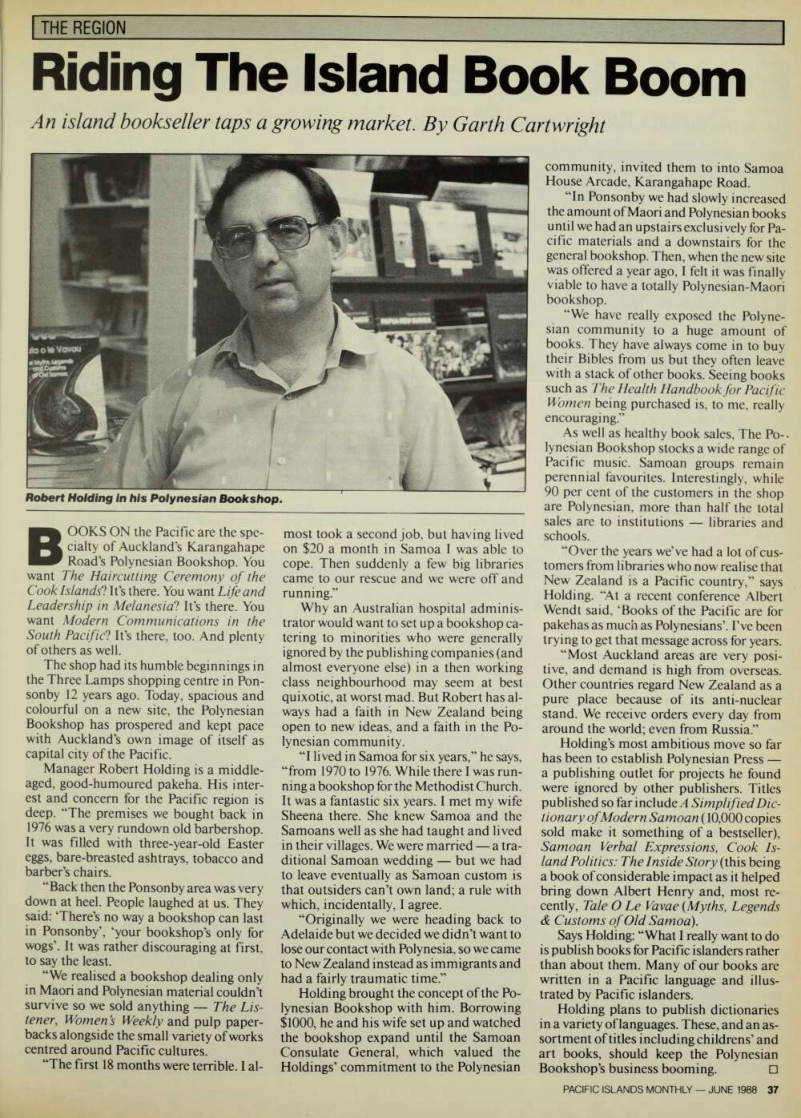
The Region
An island bookseller taps a growing market.
By Garth Cartwright
BOOKS ON the Pacific are the spe cialty of Auckland’s Karangahape Road’s Polynesian Bookshop. You want The Haircutting Ceremony of the Cook Islands? It’s there. You want Life and Leadership in Melanesia? It’s there. You want Modern Communications in the South Pacific? It’s there, too. And plenty of others as well.
The shop had its humble beginnings in the Three Lamps shopping centre in Pon sonby 12 years ago. Today, spacious and colourful on a new site, the Polynesian Bookshop has prospered and kept pace with Auckland’s own image of itself as capital city of the Pacific.
Manager Robert Holding is a middle aged, good-humoured pakeha. His inter est and concern for the Pacific region is deep. “The premises we bought back in 1976 was a very rundown old barbershop.
It was filled with three-year-old Easter eggs, bare-breasted ashtrays, tobacco and barber’s chairs.
“Back then the Ponsonby area was very down at heel. People laughed at us. They said: ‘There’s no way a bookshop can last in Ponsonby’, ‘your bookshop’s only for wogs’. It was rather discouraging at first, to say the least.
“We realised a bookshop dealing only in Maori and Polynesian material couldn’t survive so we sold anything The Lis tener, Women s Weekly and pulp paper backs alongside the small variety of works centred around Pacific cultures.
“The first 18 months were terrible. I al
most took a second job, but having lived on $2O a month in Samoa I was able to cope. Then suddenly a few big libraries came to our rescue and we were off and running.”
Why an Australian hospital adminis trator would want to set up a bookshop ca tering to minorities who were generally ignored by the publishing companies (and almost everyone else) in a then working class neighbourhood may seem at best quixotic, at worst mad. But Robert has al ways had a faith in New Zealand being open to new ideas, and a faith in the Po lynesian community.
“I lived in Samoa for six years,” he says, “from 1970 to 1976. While there I was run ning a bookshop for the Methodist Church.
It was a fantastic six years. I met my wife Sheena there. She knew Samoa and the Samoans well as she had taught and lived in their villages. We were married a tra ditional Samoan wedding but we had to leave eventually as Samoan custom is that outsiders can’t own land; a rule with which, incidentally, I agree.
“Originally we were heading back to Adelaide but we decided we didn’t want to lose our contact with Polynesia, so we came to New Zealand instead as immigrants and had a fairly traumatic time.”
Holding brought the concept of the Po lynesian Bookshop with him. Borrowing $lOOO, he and his wife set up and watched the bookshop expand until the Samoan Consulate General, which valued the Holdings’ commitment to the Polynesian
community, invited them to into Samoa House Arcade, Karangahape Road.
“In Ponsonby we had slowly increased the amount of Maori and Polynesian books until we had an upstairs exclusively for Pa cific materials and a downstairs for the general bookshop. Then, when the new site was offered a year ago, I felt it was finally viable to have a totally Polynesian-Maori bookshop.
“We have really exposed the Polyne sian community to a huge amount of books. They have always come in to buy their Bibles from us but they often leave with a stack of other books. Seeing books such as The Health Handbook for Pacific Women being purchased is, to me, really encouraging.”
As well as healthy book sales, The Po lynesian Bookshop stocks a wide range of Pacific music. Samoan groups remain perennial favourites. Interestingly, while 90 per cent of the customers in the shop are Polynesian, more than half the total sales are to institutions libraries and schools.
“Over the years we’ve had a lot of cus tomers from libraries who now realise that New Zealand is a Pacific country,” says Holding. “At a recent conference Albert Wendt said, ‘Books of the Pacific are for pakehas as much as Polynesians’. I’ve been trying to get that message across for years.
“Most Auckland areas are very posi tive, and demand is high from overseas.
Other countries regard New Zealand as a pure place because of its anti-nuclear stand. We receive orders every day from around the world; even from Russia.”
Holding’s most ambitious move so far has been to establish Polynesian Press a publishing outlet for projects he found were ignored by other publishers. Titles published so far included Simplified Dic tionary of Modern Samoan (10,000 copies sold make it something of a bestseller), Samoan Verbal Expressions, Cook Is land Politics: The Inside Story (this being a book of considerable impact as it helped bring down Albert Henry and, most re cently, Tale O Le Vavae {Myths, Legends & Customs of Old Samoa).
Says Holding: “What I really want to do is publish books for Pacific islanders rather than about them. Many of our books are written in a Pacific language and illus trated by Pacific islanders.
Holding plans to publish dictionaries in a variety of languages. These, and an as sortment of titles including childrens’ and art books, should keep the Polynesian Bookshop’s business booming. □
Robert Holding in his Polynesian Bookshop.
Here’s To A New Islands Brew
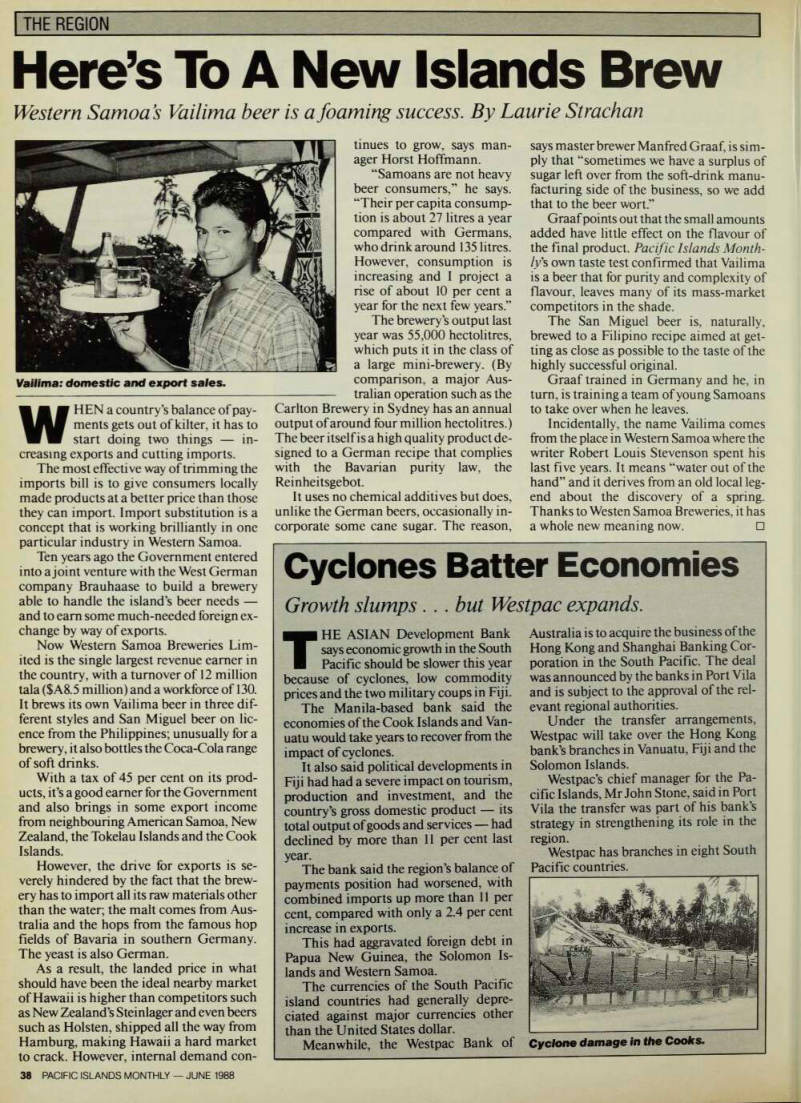
Western Samoa’s Vailima beer is a foaming success.
By Laurie Strachan
WHEN a country’s balance of pay ments gets out of kilter, it has to start doing two things in creasing exports and cutting imports.
The most effective way of trimming the imports bill is to give consumers locally made products at a better price than those they can import. Import substitution is a concept that is working brilliantly in one particular industry in Western Samoa.
Ten years ago the Government entered into a joint venture with the West German company Brauhaase to build a brewery able to handle the island’s beer needs and to earn some much-needed foreign ex change by way of exports.
Now Western Samoa Breweries Lim ited is the single largest revenue earner in the country, with a turnover of 12 million tala (SAB.S million) and a workforce of 130.
It brews its own Vailima beer in three dif ferent styles and San Miguel beer on lic ence from the Philippines; unusually for a brewery, it also bottles the Coca-Cola range of soft drinks.
With a tax of 45 per cent on its prod ucts, it’s a good earner for the Government and also brings in some export income from neighbouring American Samoa, New Zealand, the Tokelau Islands and the Cook Islands.
However, the drive for exports is se verely hindered by the fact that the brew ery has to import all its raw materials other than the water; the malt comes from Aus tralia and the hops from the famous hop fields of Bavaria in southern Germany.
The yeast is also German.
As a result, the landed price in what should have been the ideal nearby market of Hawaii is higher than competitors such as New Zealand’s Steinlager and even beers such as Holsten, shipped all the way from Hamburg, making Hawaii a hard market to crack. However, internal demand con
tinues to grow, says man ager Horst Hoffmann.
“Samoans are not heavy beer consumers,” he says.
“Their per capita consump tion is about 27 litres a year compared with Germans, who drink around 135 litres.
However, consumption is increasing and I project a rise of about 10 per cent a year for the next few years.”
The brewery’s output last year was 55,000 hectolitres, which puts it in the class of a large mini-brewery. (By comparison, a major Aus tralian operation such as the
Carlton Brewery in Sydney has an annual output of around four million hectolitres.) The beer itself is a high quality product designed to a German recipe that complies with the Bavarian purity law, the Reinheitsgebot.
It uses no chemical additives but does, unlike the German beers, occasionally incorporate some cane sugar. The reason,
says master brewer Manfred Graaf, is sim ply that “sometimes we have a surplus of sugar left over from the soft-drink manu facturing side of the business, so we add that to the beer wort.”
Graaf points out that the small amounts added have little effect on the flavour of the final product. Pacific Islands Month ly's own taste test confirmed that Vailima is a beer that for purity and complexity of flavour, leaves many of its mass-market competitors in the shade.
The San Miguel beer is, naturally, brewed to a Filipino recipe aimed at get ting as close as possible to the taste of the highly successful original.
Graaf trained in Germany and he, in turn, is training a team of young Samoans to take over when he leaves.
Incidentally, the name Vailima comes from the place in Western Samoa where the writer Robert Louis Stevenson spent his last five years. It means “water out of the hand” and it derives from an old local leg end about the discovery of a spring.
Thanks to Westen Samoa Breweries, it has a whole new meaning now. □
Vailima: domestic and export sales.
Cyclones Batter Economies
Growth slumps.. . but Westpac expands.
THE ASIAN Development Bank says economic growth in the South Pacific should be slower this year because of cyclones, low commodity prices and the two military coups in Fiji.
The Manila-based bank said the economies of the Cook Islands and Van uatu would take years to recover from the impact of cyclones.
It also said political developments in Fiji had had a severe impact on tourism, production and investment, and the country’s gross domestic product its total output of goods and services had declined by more than 11 per cent last year.
The bank said the region’s balance of payments position had worsened, with combined imports up more than 11 per cent, compared with only a 2.4 per cent increase in exports.
This had aggravated foreign debt in Papua New Guinea, the Solomon Is lands and Western Samoa.
The currencies of the South Pacific island countries had generally depre ciated against major currencies other than the United States dollar.
Meanwhile, the Westpac Bank of
Australia is to acquire the business of the Hong Kong and Shanghai Banking Cor poration in the South Pacific. The deal was announced by the banks in Port Vila and is subject to the approval of the rel evant regional authorities.
Under the transfer arrangements, Westpac will take over the Hong Kong bank’s branches in Vanuatu, Fiji and the Solomon Islands.
Westpac’s chief manager for the Pa cific Islands, Mr John Stone, said in Port Vila the transfer was part of his bank’s strategy in strengthening its role in the region.
Westpac has branches in eight South Pacific countries.
Cyclone damage in the Cooks.
Trade Winds
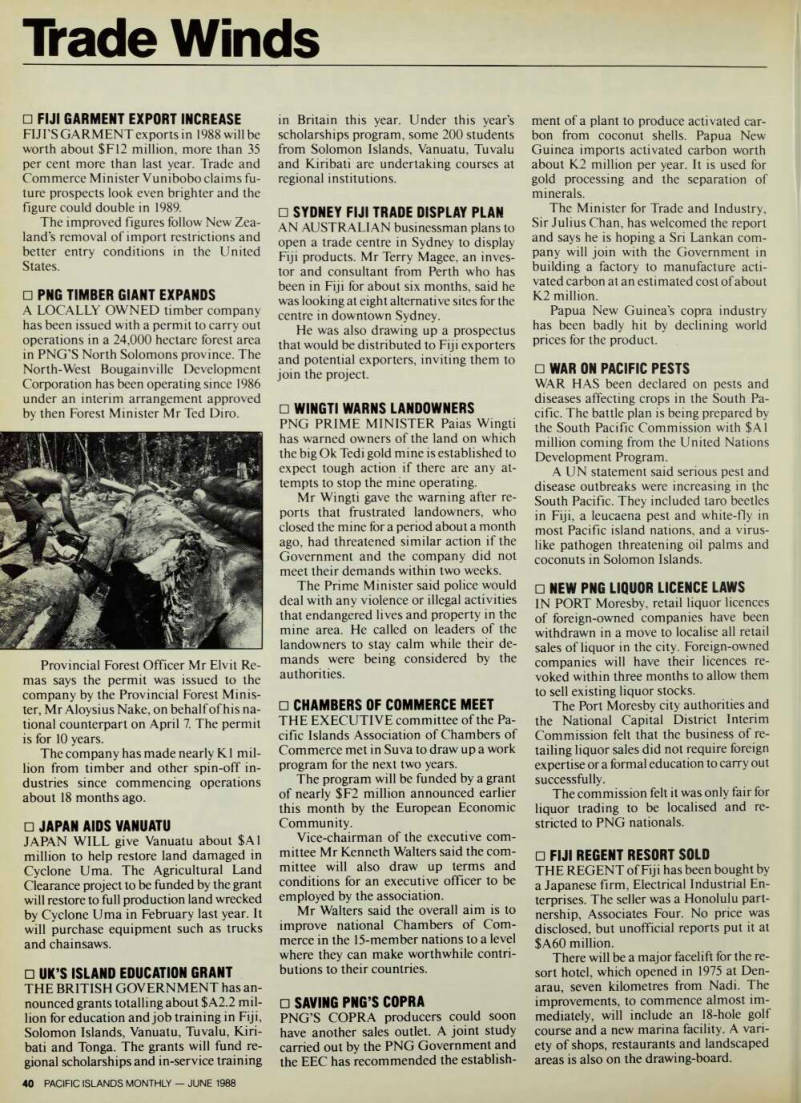
□ Union Overhaul
PAPUA NEW Guinea’s Trade Union Congress (TUC) has called for better-ed ucated union leaders and a more informed work force. The general secretary of the TUC, Mr Lawrence Titimur, said these were necessary if the union movement is to make a real contribution to PNG’s eco nomic development.
Mr Titimur said the country’s growth in the past had been adversely affected by uneducated union leaders and a lack of understanding by ordinary workers of normal industrial relations practices.
He said the TUC worker education program due to start later this year would help rectify this. The program, funded by the International Labour Organisation, will cost about $A700,000.
□ Chan’S Investment Plea
PNG’S Trade and Industry Minister Sir Julius Chan has told a group of Singapore journalists that Papua New Guinea would welcome long-term investment from their businessmen.
Sir Julius said long-term investment from Singapore, tied to the development of natural resources in PNG, would also
allow the country to benefit from the transfer of Singaporean knowledge and experience.
At present Singapore’s investment in Papua New Guinea is directed at whole saling and trading, leaving the country with very little benefit from profits.
□ Suharto’S Economic Advice
INDONESIA’S PRESIDENT Suharto has urged Pacific countries to boost employ ment and harness technological change.
He was opening the 44 th session of the United Nations Economic and Social Commission for Asia and the Pacific (ES CAP) in Jakarta.
Mr Suharto called on countries to make better use of their most abundant resource people. He told delegates from 47 na tions that to increase employment and re duce poverty would require improved education and training.
□ Fiji’S Reserves Grow
FIJI’S RESERVES have grown to SFI6S million, sufficient to finance nearly six and a half months of imports. The latest Re serve Bank figures show an increase of about SFBO million since last November.
The total reserves were SF27 million more than at the time of the first coup last May. However, since that time, Fiji has devalued by 33 per cent.
The Bank also says that demand for credit is still depressed, despite moves by the interim civilian Government to en courage investment.
□ Old Ways Under Fire
A CALL for changes to certain aspects of Fijian culture and tradition to allow Fiji ans to develop successful commercial ventures has been made by Fiji’s Minister for Trade and Energy, Mr Vunibobo. But he warned that Fijian businesses could not expect to enjoy full Government protec tion indefinitely.
He said some marriage obligations and other traditional duties were preventing Fijians developing efficient commercial and industrial undertakings. Mr Vuni bobo said, however, that any changes to tradition and culture could only be ef fected by persuasion and discussion rather than through legislation and regulation. He urged the Ministry of Education to intro duce business studies in the school curriculum. I
□ Fiji Garment Export Increase
FIJI’S GARMENT exports in 1988 will be worth about SFI2 million, more than 35 per cent more than last year. Trade and Commerce Minister Vunibobo claims fu ture prospects look even brighter and the figure could double in 1989.
The improved figures follow New Zea land’s removal of import restrictions and better entry conditions in the United States.
□ Png Timber Giant Expands
A LOCALLY OWNED timber company has been issued with a permit to carry out operations in a 24,000 hectare forest area in PNG’S North Solomons province. The North-West Bougainville Development Corporation has been operating since 1986 under an interim arrangement approved by then Forest Minister Mr Ted Diro.
Provincial Forest Officer Mr Elvit Re mas says the permit was issued to the company by the Provincial Forest Minis ter, Mr Aloysius Nake, on behalf of his na tional counterpart on April 7. The permit is for 10 years.
The company has made nearly K 1 mil lion from timber and other spin-off in dustries since commencing operations about 18 months ago.
□ Japan Aids Vanuatu
JAPAN WILL give Vanuatu about SAI million to help restore land damaged in Cyclone Uma. The Agricultural Land Clearance project to be funded by the grant will restore to full production land wrecked by Cyclone Uma in February last year. It will purchase equipment such as trucks and chainsaws.
□ Uk’S Island Education Grant
The British Government Has An
nounced grants totalling about $A2.2 mil lion for education and job training in Fiji, Solomon Islands, Vanuatu, Tuvalu, Kiri bati and Tonga. The grants will fund re gional scholarships and in-service training
in Britain this year. Under this year’s scholarships program, some 200 students from Solomon Islands, Vanuatu, Tuvalu and Kiribati are undertaking courses at regional institutions.
□ Sydney Fiji Trade Display Plan
AN AUSTRALIAN businessman plans to open a trade centre in Sydney to display Fiji products. Mr Terry Magee, an inves tor and consultant from Perth who has been in Fiji for about six months, said he was looking at eight alternative sites for the centre in downtown Sydney.
He was also drawing up a prospectus that would be distributed to Fiji exporters and potential exporters, inviting them to join the project.
□ Wingti Warns Landowners
PNG PRIME MINISTER Paias Wingti has warned owners of the land on which the big Ok Tedi gold mine is established to expect tough action if there are any at tempts to stop the mine operating.
Mr Wingti gave the warning after re ports that frustrated landowners, who closed the mine for a period about a month ago, had threatened similar action if the Government and the company did not meet their demands within two weeks.
The Prime Minister said police would deal with any violence or illegal activities that endangered lives and property in the mine area. He called on leaders of the landowners to stay calm while their de mands were being considered by the authorities.
□ Chambers Of Commerce Meet
THE EXECUTIVE committee of the Pa cific Islands Association of Chambers of Commerce met in Suva to draw up a work program for the next two years.
The program will be funded by a grant of nearly SF2 million announced earlier this month by the European Economic Community.
Vice-chairman of the executive com mittee Mr Kenneth Walters said the com mittee will also draw up terms and conditions for an executive officer to be employed by the association.
Mr Walters said the overall aim is to improve national Chambers of Com merce in the 15-member nations to a level where they can make worthwhile contri butions to their countries.
□ Saving Png’S Copra
PNG’S COPRA producers could soon have another sales outlet. A joint study carried out by the PNG Government and the EEC has recommended the establish
ment of a plant to produce activated car bon from coconut shells. Papua New Guinea imports activated carbon worth about K 2 million per year. It is used for gold processing and the separation of minerals.
The Minister for Trade and Industry, Sir Julius Chan, has welcomed the report and says he is hoping a Sri Lankan com pany will join with the Government in building a factory to manufacture acti vated carbon at an estimated cost of about K 2 million.
Papua New Guinea’s copra industry has been badly hit by declining world prices for the product.
□ War On Pacific Pests
WAR HAS been declared on pests and diseases affecting crops in the South Pa cific. The battle plan is being prepared by the South Pacific Commission with SAI million coming from the United Nations Development Program.
A UN statement said serious pest and disease outbreaks were increasing in the South Pacific. They included taro beetles in Fiji, a leucaena pest and white-fly in most Pacific island nations, and a virus like pathogen threatening oil palms and coconuts in Solomon Islands.
□ New Png Liquor Licence Laws
IN PORT Moresby, retail liquor licences of foreign-owned companies have been withdrawn in a move to localise all retail sales of liquor in the city. Foreign-owned companies will have their licences re voked within three months to allow them to sell existing liquor stocks.
The Port Moresby city authorities and the National Capital District Interim Commission felt that the business of re tailing liquor sales did not require foreign expertise or a formal education to carry out successfully.
The commission felt it was only fair for liquor trading to be localised and re stricted to PNG nationals.
□ Fiji Regent Resort Sold
THE REGENT of Fiji has been bought by a Japanese firm, Electrical Industrial En terprises. The seller was a Honolulu part nership, Associates Four. No price was disclosed, but unofficial reports put it at SA6O million.
There will be a major facelift for the re sort hotel, which opened in 1975 at Den arau, seven kilometres from Nadi. The improvements, to commence almost im mediately, will include an 18-hole golf course and a new marina facility. A vari ety of shops, restaurants and landscaped areas is also on the drawing-board.
The statement said the construction projects would generate 700 jobs; a major boost for Fiji, which has suffered rising unemployment and an economic slump since the two military coups last year.
□ Eec To Fund Island Projects
THE EEC is to provide a total of $ A 16.3 million for three development projects in the South Pacific. An official communique issued after a two-day conference in Western Samoa said the three programs included agricultural and telecommunications projects. Assistance will also be provided to the Pacific Islands Association of Chambers of Commerce.
The meeting, in Apia, was between eight Pacific countries and a delegation from the European Commission headed by its vice-president, Mr Lorenzo Natali, A five-year regional agricultural program includes a series of food crop pilot projects and the establishment of a small permanent secretariat in Apia.
The telecommunications plan calls for satellite earth stations to be built in Apia and Kiritimati in Kiribati, and ship-toshore maritime radio stations in Tonga and Solomon Islands.
□ Nz Oil Find
NEW ZEALAND has made a major new oil discovery in the western North Island
province of Taranaki the second major oil discovery in the area this year.
Energy Minister Mr David Butcher says the first estimate of the field’s contents suggest it contains at least 40 million bar rels of oil, worth nearly SUS3OO million.
The find is of major importance, as the Government is thinking of selling its in terests in the Taranaki oilfields. The latest find could mean New Zealand will not have to import oil for some years.
□ Png’S First Cement Factory
PAPUA NEW Guinea’s first cement fac tory is to be built at Manetai in the North Solomons Province. The Minister for Trade and Industry, Sir Julius Chan, says developers of the factory, the Bougainville Development Corporation and a Euro pean Community group, are finalising the establishment of the factory.
Sir Julius says the KlB million factory will be capable of producing 80,000 tonnes of concrete a year.
The Bougainville Development Cor poration will own 78 per cent of the share in the factory and the European Com munity group the remaining 22 per cent.
□ Kiribati/Tuvalu Fishing Boost
JAPAN HAS granted a total of almost $A3.5 million to help Kiribati and Tuvalu develop their fishing industries. Just over
SA2 million has been granted by Japan to Kiribati and will enable the capacity of a fish cold storage plant on Betio island to be doubled to 200 tonnes, The project is aimed at enhancing the quality of fish handled by the cold store and to improve fishing operations generally.
Japan has also granted just over $A 1.25 million to Tuvalu for a number of projects, including the purchase of machinery and equipment for fisheries and training ves sels and to help modernise facilities in Tu va uto create a ase f° r exports, aiiotrai ia’C c. „ traimimp pi cnrc run > c M ° r,JI “Ltllbt THE AUSTRALIAN Government has a B ree d to give top priority to requests for training assistance from Fiji, following ta * s uva between a team from the Australian International Development Assistance Bureau and senior Fiji Government officials, During the meeting, the Fiji represen latlves pointed out that most ministries, institutions and agencies had suffered considerable staff losses since the military coups of last year.
The two sides agreed on the urgency of framing immediate training needs while taking long-term development objectives into account as well. □
Advertisements & other items, pp. 39-42 (1 item)
Talair
X4L4IR --- Papua New Guinea's
nationwide airline connection to
from the World.
I *
DOMESTIC
Talair serves all provinces in P.N.G., many on a daily basis. No other airline comes close to serving the 130 ports a week that Talair does. Charter services also are available.
INTERNATIONAL
Using our computerised system
in any of our lz International Travel Centres, we can book you anywhere in the world 0n...
planes, trains, luxury liners,
arrange rental cars, hostels, motels or hotels.
Panguna - 95 8020 • Arawa - 95 2113 • Mt. Hagen - 52 2465 Boroko - 25 7655 • Tabubil - 58 9228 • Goroka - 72 1355 • Lae - 42 2316 Madang - 82 2757 • Rabaul - 82 2882 • Wewak - 86 2012 Vanimo - 87 1180 • Port Moresby - 21 4766 • Waigani - 25 7877 Brisbane Metropolitan Area - 2291177 Outside Brisbane - 008 777879
TALAIR
ATA
A\A\
QUALITY IN AIR TRANSPORT
THE PACIFIC ISLANDS RELY
ON THE ENERGY OF BORAL
\ V i All through the Pacific Islands, people rely on Boral Speed-E-Gas LP Gas for their energy needs.
Boral has terminals throughout the area, and is proud to be a leading supplier.
Speed-E-Gas is clean, efficient and low in cost.
It’s the ideal energy source for cooking and water heating in homes, motels and hotels, and for a wide range of industrial uses.
So call Boral. We have the energy you’re looking for. * ii!
Cook Islands Rarotonga 24460 Norfolk Island Norfolk Island 2419 Papua New Guinea Port Moresby 214248 Lae 422574 Rabaul 921225 Wewak 86 2125 Tonga Nukualofa 21388 American Samoa Pago Pago 6332170 Fiji Suva 24035 Lautoka 60088 Sigatoka 50578 Labasa 82973 Vanuatu Santo 455 Port Vila 2046
BORAL GAS
Solomon Islands Honiara 21833 Boral Gas Limited, Bth Floor, IBM House, 168 Kent St., Sydney, NSW 2000. Tel: (02) 278512.
Peak Music Powej^jutput e V-790A is ready for digital when you are, with a whopping 550 watts /IPO) of output for big music thrills, true high fidelity 3-way speakers for perb music reproduction, extra sound dimension from the Surround Sound makers,and wireless remote control of virtually all system functions. Advanced itures include a 5-band graphic equalizer and spectrum analyzer, a 20-station iFM +lO MW/SWI/SW2) memory preset quartz synthesizer tuner with direct 10-key >ut tuning, a Dolby B NR double cassette deck with continuous playback, and a ly automatic turntable. Discover for yourself the satisfying sound experience of Hi-fi Midi System V-790A
/VA’s POWER MASTER.
Ifore Power s Fidelitand .
AIWA
•Dolby and the double-D symbol are trademarks of Dolby Laboratories Licensing Corporation.
Gordon Box 5518, Boroko, Port bex Ptv Ltd 12 Barcoo Street, East Roseville, Sydney, N.S.W. 2069, AUSTRALIA PHONE: (02) 406-6277/Oceania Indent Agency (P.N.G.) Pty. L |d - Ago St C SLy Papua New Guinea Ph6nE: 256411/The Sound Centre Ltd. P.O. Box 434 Port Vila, Repubi.ic of Vanuatu PHONE:^ Q 2 of Bros. 190 Renw.ck Road_ PTX Box 49C» Suva Fu; ONE: 24350/Hardy Distributors Ltd. P.O. Box 5919 5 How Street, Auckland, New Zealand PHONE; (09) 399-1 75/Hi»ivox 79, Rue de Sebastopol, r 1458 Noumea, New Caledonia PHONE: RO. Box 269, Papeete, Tahiti PHONE: 2-4814/Micropac Audio, Inc. !4.66/Harvest Pacific Limited G.P.O Box 517. Honiara. Solomon Islands PHONE: 131/Fare Hi-Fi Stereo Rue du Marechal Foch r Ooerative society Republic of Nauru . Box 3478 Agana, Guam 96910 PHONE: Duty Free Shop Private Bag P.O. Box 92. Rarotonga. Cook Island/Nauru Co-Operative Society HepuDi.c
Fisheries In Crisis
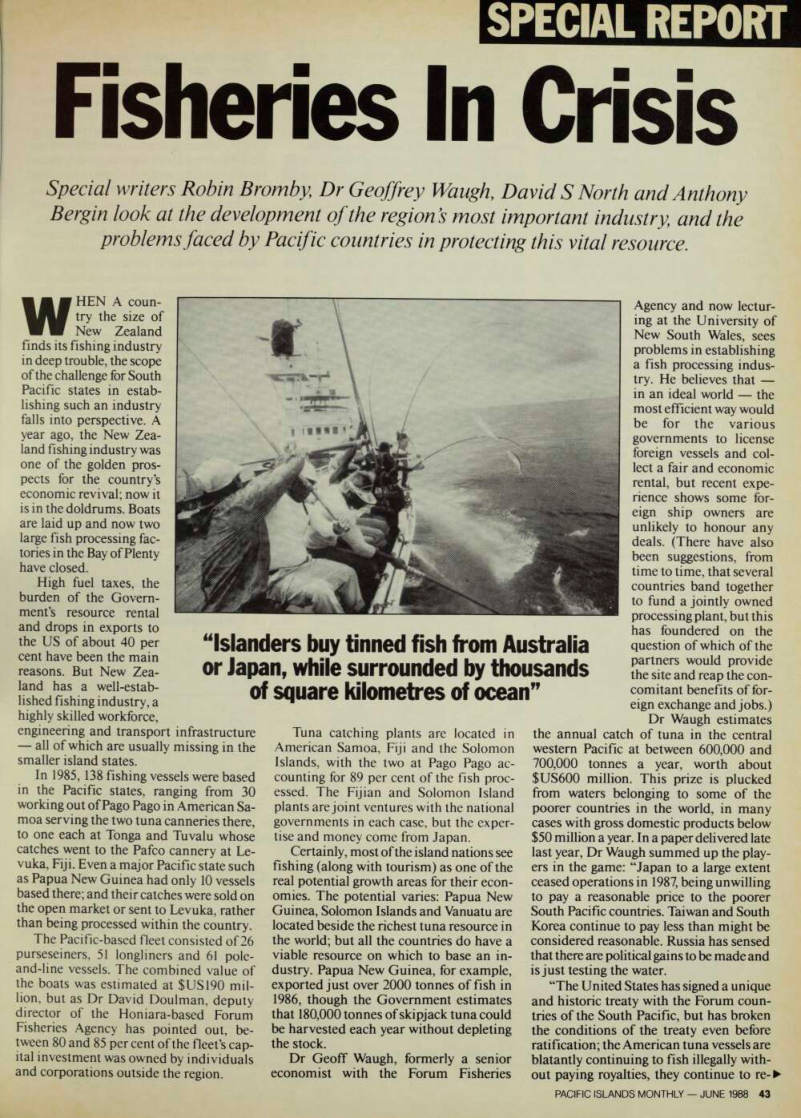
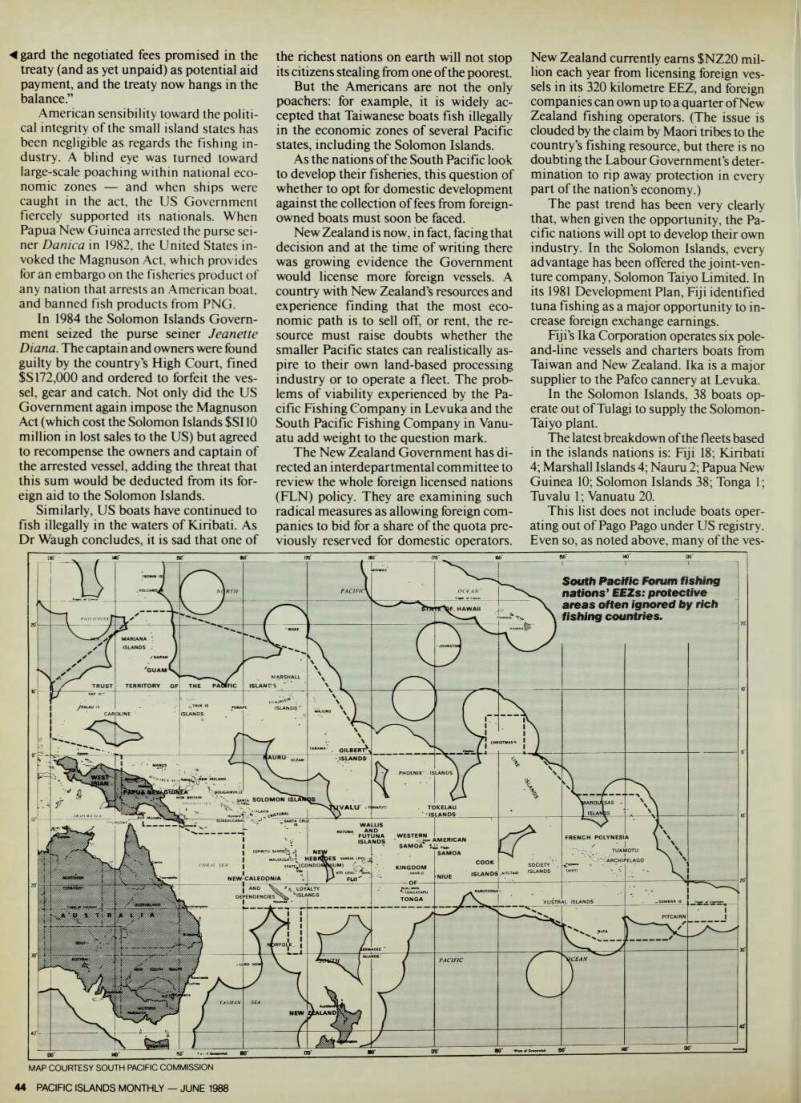
Special Report
Special writers Robin Bromby, Dr Geoffrey Waugh, David S North and Anthony Bergin look at the development of the region’s most important industry and the problems faced by Pacific countries in protecting this vital resource.
WHEN A coun try the size of New Zealand finds its fishing industry in deep trouble, the scope of the challenge for South Pacific states in estab lishing such an industry falls into perspective. A year ago, the New Zea land fishing industry was one of the golden pros pects for the country’s economic revival; now it is in the doldrums. Boats are laid up and now two large fish processing fac tories in the Bay of Plenty have closed.
High fuel taxes, the burden of the Govern ment’s resource rental and drops in exports to the US of about 40 per cent have been the main reasons. But New Zea land has a well-estab lished fishing industry, a highly skilled workforce,
engineering and transport infrastructure all of which are usually missing in the smaller island states.
In 1985, 138 fishing vessels were based in the Pacific states, ranging from 30 working out of Pago Pago in American Sa moa serving the two tuna canneries there, to one each at Tonga and Tuvalu whose catches went to the Pafco cannery at Le vuka, Fiji. Even a major Pacific state such as Papua New Guinea had only 10 vessels based there; and their catches were sold on the open market or sent to Levuka, rather than being processed within the country.
The Pacific-based fleet consisted of 26 purseseiners, 51 longliners and 61 pole and-line vessels. The combined value of the boats was estimated at SUSI9O mil lion, but as Dr David Doulman, deputy director of the Honiara-based Forum Fisheries Agency has pointed out, be tween 80 and 85 per cent of the fleet’s cap ital investment was owned by individuals and corporations outside the region.
Tuna catching plants are located in American Samoa, Fiji and the Solomon Islands, with the two at Pago Pago ac counting for 89 per cent of the fish proc essed. The Fijian and Solomon Island plants are joint ventures with the national governments in each case, but the exper tise and money come from Japan.
Certainly, most of the island nations see fishing (along with tourism) as one of the real potential growth areas for their econ omies. The potential varies: Papua New Guinea, Solomon Islands and Vanuatu are located beside the richest tuna resource in the world; but all the countries do have a viable resource on which to base an in dustry. Papua New Guinea, for example, exported just over 2000 tonnes of fish in 1986, though the Government estimates that 180,000 tonnes of skipjack tuna could be harvested each year without depleting the stock.
Dr Geoff Waugh, formerly a senior economist with the Forum Fisheries
Agency and now lectur ing at the University of New South Wales, sees problems in establishing a fish processing indus try. He believes that in an ideal world the most efficient way would be for the various governments to license foreign vessels and col lect a fair and economic rental, but recent expe rience shows some for eign ship owners are unlikely to honour any deals. (There have also been suggestions, from time to time, that several countries band together to fund a jointly owned processing plant, but this has foundered on the question of which of the partners would provide the site and reap the con comitant benefits of for eign exchange and jobs.) Dr Waugh estimates
the annual catch of tuna in the central western Pacific at between 600,000 and 700,000 tonnes a year, worth about SUS6OO million. This prize is plucked from waters belonging to some of the poorer countries in the world, in many cases with gross domestic products below $5O million a year. In a paper delivered late last year, Dr Waugh summed up the play ers in the game: “Japan to a large extent ceased operations in 1987, being unwilling to pay a reasonable price to the poorer South Pacific countries. Taiwan and South Korea continue to pay less than might be considered reasonable. Russia has sensed that there are political gains to be made and is just testing the water.
“The United States has signed a unique and historic treaty with the Forum coun tries of the South Pacific, but has broken the conditions of the treaty even before ratification; the American tuna vessels are blatantly continuing to fish illegally with out paying royalties, they continue to re- ►
“Islanders buy tinned fish from Australia or Japan, while surrounded by thousands of square kilometres of ocean”
◄ gard the negotiated fees promised in the treaty (and as yet unpaid) as potential aid payment, and the treaty now hangs in the balance.”
American sensibility toward the politi cal integrity of the small island states has been negligible as regards the fishing in dustry. A blind eye was turned toward large-scale poaching within national eco nomic zones and when ships were caught in the act, the US Government fiercely supported its nationals. When Papua New Guinea arrested the purse sei ner Danica in 1982, the United States in voked the Magnuson Act, which provides for an embargo on the fisheries product of any nation that arrests an American boat, and banned fish products from PNG.
In 1984 the Solomon Islands Govern ment seized the purse seiner Jeanette Diana. The captain and owners were found guilty by the country’s High Court, fined $S 172,000 and ordered to forfeit the ves sel, gear and catch. Not only did the US Government again impose the Magnuson Act (which cost the Solomon Islands SSI 10 million in lost sales to the US) but agreed to recompense the owners and captain of the arrested vessel, adding the threat that this sum would be deducted from its for eign aid to the Solomon Islands.
Similarly, US boats have continued to fish illegally in the waters of Kiribati. As Dr Waugh concludes, it is sad that one of
the richest nations on earth will not stop its citizens stealing from one of the poorest.
But the Americans are not the only poachers: for example, it is widely ac cepted that Taiwanese boats fish illegally in the economic zones of several Pacific states, including the Solomon Islands.
As the nations of the South Pacific look to develop their fisheries, this question of whether to opt for domestic development against the collection of fees from foreign owned boats must soon be faced.
New Zealand is now, in fact, facing that decision and at the time of writing there was growing evidence the Government would license more foreign vessels. A country with New Zealand’s resources and experience finding that the most eco nomic path is to sell off, or rent, the re source must raise doubts whether the smaller Pacific states can realistically as pire to their own land-based processing industry or to operate a fleet. The prob lems of viability experienced by the Pa cific Fishing Company in Levuka and the South Pacific Fishing Company in Vanu atu add weight to the question mark.
The New Zealand Government has di rected an interdepartmental committee to review the whole foreign licensed nations (FLN) policy. They are examining such radical measures as allowing foreign com panies to bid for a share of the quota pre viously reserved for domestic operators.
New Zealand currently earns SNZ2O mil lion each year from licensing foreign ves sels in its 320 kilometre EEZ, and foreign companies can own up to a quarter of New Zealand fishing operators. (The issue is clouded by the claim by Maori tribes to the country’s fishing resource, but there is no doubting the Labour Government’s deter mination to rip away protection in every part of the nation’s economy.) The past trend has been very clearly that, when given the opportunity, the Pa cific nations will opt to develop their own industry. In the Solomon Islands, every advantage has been offered the joint-ven ture company, Solomon Taiyo Limited. In its 1981 Development Plan, Fiji identified tuna fishing as a major opportunity to in crease foreign exchange earnings.
Fiji’s Ika Corporation operates six pole and-line vessels and charters boats from Taiwan and New Zealand. Ika is a major supplier to the Pafco cannery at Levuka.
In the Solomon Islands, 38 boats op erate out of Tulagi to supply the Solomon- Taiyo plant.
The latest breakdown of the fleets based in the islands nations is: Fiji 18; Kiribati 4; Marshall Islands 4; Nauru 2; Papua New Guinea 10; Solomon Islands 38; Tonga 1; Tuvalu 1; Vanuatu 20.
This list does not include boats oper ating out of Pago Pago under US registry.
Even so, as noted above, many of the ves-
Map Courtesy South Pacific Commission
sels listed are not owned by nationals of the countries from which they operate.
Their operations are viewed by govern ments as creating employment, adding value to the resource and generating for eign exchange.
Dr Waugh says such gains may be il lusory. He argues that the “value-added” case falls down if fish processing is unec onomically fostered at the expense of other more productive activities. Pafco plant in Levuka faced so many problems that the Japanese partner, C Itoh, pulled out in 1987 when its agreement with the Fijian Government expired. Pafco’s major sup plier, Ika Corporation, has faced financial difficulties for several years.
As for employment, Dr Waugh argues that to be of value, jobs created must not just replace those in another sector of the economy; even then, there are doubts whether propping up an inefficient indus try is the best way to create employment.
As for foreign exchange, Waugh acknowl edges the concern in the mind of many government officials and planners that so many people have to buy imported fish the incongruous sight of islanders going to the supermarket for tinned fish from Aus tralia or Japan while being surrounded by thousands of square kilometres of ocean.
But if locally produced fish costs more than the imported varieties, it hits the pockets of the consumers most of whom are on very low incomes.
And if the venture goes wrong, it can create serious repercussions. One closed factory in Australia or New Zealand is a minor hiccup, but in a tiny economy it can be critical.
Then there is the initial cost. One 1983 study published by the South Pacific Commission showed that the average American purse seiner of 1100 tonnes costs about SUSII million to build and almost SUS 3 million a year to run. When placed against gross domestic products for ex ample, the Solomon Islands’, at SAI62 million the scale of the undertaking for the smaller states is daunting. By 1983, Fi ji’s Ika Corporation had accumulated losses of $F2.24 million. Vanuatu’s South Pacific Fishing Company, owned primar ily by Mitsui, had by 1984 accumulated losses of SUS 3.7 million.
A case could be made for the Pacific states to take a two-pronged approach to development: foreign participation in ex pansion of offshore fisheries, and locally funded expansion of onshore fisheries.
The offshore fisheries are lucrative but require large amounts of capital, both for harvesting and processing. The onshore fisheries are labour-intensive and can be operated with small vessels.
Fiji, Solomon Islands and Vanuatu all have had some experience with offshore fisheries. Fiji has developed both onshore and offshore operations. There is an abun dance of tuna and reasonable supplies of
baitfish (which is crucial, especially to pole-and-line operators). While Pafco’s operation at Levuka shows what can be done in processing, the decision to operate vessels through the Government-owned Ika Corporation clearly has not.
In a paper published by Hawaii’s East- West Centre, Dr David Doulman identi fied one significant handicap to expand ing the fishing industry: trans-shipment.
The only shore-based trans-shipment bases in the Pacific islands that have the capacity to service the international tuna fishery are in Palau and Vanuatu.
Dr Doulman identified the Federated States of Micronesia, Papua New Guinea and Guam as the most promising loca tions for trans-shipment operations.
Already, the Japanese are financing a wharf and cold store at Majuro in the Mar
shall Islands to serve about 400 boats, most of them Japanese, working in the islands’ waters. Papua New Guinea and Fiji have both been keen to attract a similar base to one of their ports.
But, Doulman stresses, any projects established in the Pacific to exploit tuna fishing should be: internationally compet itive in terms of cost and price; produce a finished item that is international quality; provide fair returns to equity partners; have competent managers and marketing expertise to ensure the industries endure; and contribute to the socio-economic goals of the host governments.
The tuna fishing resource in the Pa cific has rich potential. Whether it can be reaped and exploited to the benefit of all the participants and island nations re mains to be seen. Robin Bromby □
Tuna Wars
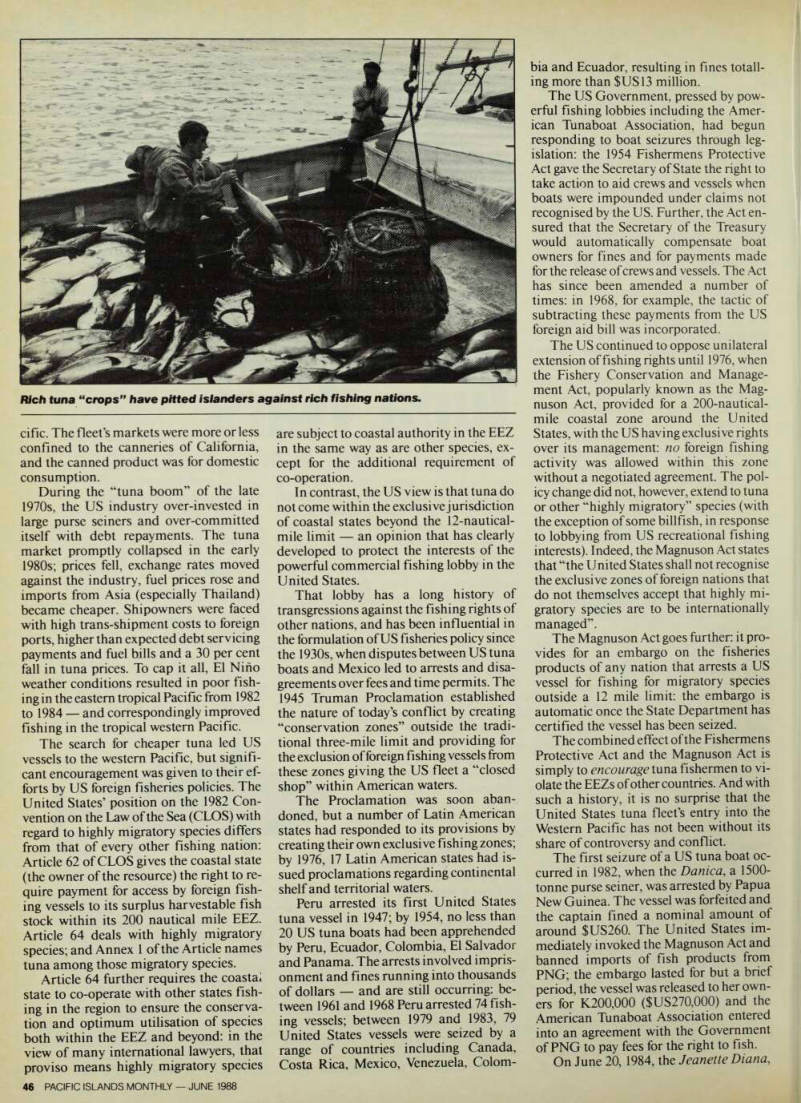
The struggle continues.
By Dr Geoffrey Waugh
THE SOUTH PACIFIC’S tuna fishery is one of the region’s most valuable industries. Yellowfm, bigeye, skipjack and albacore tuna some 700,000 tonnes a year, worth nearly SUS6OO million are the prizes in an international game being played by rich fishing countries as they attempt to snatch resources from their accepted owners, the poorer nations of Oceania.
The game is a serious one, and has at times descended to a conflict little short of warfare. It is made all the more desperate because the island countries whose resources are threatened are poor, in many cases with gross domestic products less than SUSSO million, and few
other sources of income.
At risk are vast schools of fish harvested by a range of countries Japan, Taiwan, Korea, the United States, and to some extent the USSR which operate traditional longline and pole-and-line vessels or fleets of modern purse seiners. The largest sin
gle Distant Water Fishing Nation (DWFN) fleet is the Japanese longline fleet, of about 800 vessels ranging in size from 20 to more than 300 tonnes. Based in Japanese ports, the longliners pursue yellowfm and bigeye tuna, together with some billfish, for their domestic sashimi market. They operate throughout the central Western Pacific from the Federated States of Micronesia (FSM) in the north across to Kiribati in the east and south to Papua New Guinea and the Solomon Islands. A number of Japanese boats fish for the valuable blue-
fm tuna in Australian waters, Japan is also the only DWFN with pole and-line vessels, which harvest skipjack for tataki (sashimi lightly grilled over straw). Isolated from direct competition with purse seiners, the 100 or so pole-and line vessels fish mainly from Micronesia across to Kiribati. Pole-and-line boats are less profitable than purse seiners, and have to a great extent been superseded for the bulk of the fishery, Vessels from Taiwan and Korea were initially all longliners, restricted to the more southerly and easterly areas of Kir ibati and the Cook Islands. There they competed with the Japanese for albacore,
which is used for canning and is sold prin cipally in North America and Europe.
More recently, however, Korea and Taiwan appear to have turned to purse seining and longlining for the Japanese sashimi market, with the result that their presence in PNG waters has increased, Smaller in overall size than the Asian tuna fleets but immeasurably greater in its impact on the South Pacific is the United States purse seine fleet which, ironically, was developed in and operated initially in the waters of the eastern Pa- ►
cific. The fleet’s markets were more or less confined to the canneries of California, and the canned product was for domestic consumption.
During the “tuna boom” of the late 19705, the US industry over-invested in large purse seiners and over-committed itself with debt repayments. The tuna market promptly collapsed in the early 1980 s; prices fell, exchange rates moved against the industry, fuel prices rose and imports from Asia (especially Thailand) became cheaper. Shipowners were faced with high trans-shipment costs to foreign ports, higher than expected debt servicing payments and fuel hills and a 30 per cent fall in tuna prices. To cap it all, El Nino weather conditions resulted in poor fishing in the eastern tropical Pacific from 1982 to 1984 and correspondingly improved fishing in the tropical western Pacific.
The search for cheaper tuna led US vessels to the western Pacific, but significant encouragement was given to their efforts by US foreign fisheries policies. The United States’ position on the 1982 Convention on the Law of the Sea (CLOS) with regard to highly migratory species differs from that of every other fishing nation: Article 62 of CLOS gives the coastal state (the owner of the resource) the right to require payment for access by foreign fishing vessels to its surplus harvestable fish stock within its 200 nautical mile EEZ.
Article 64 deals with highly migratory species; and Annex 1 of the Article names tuna among those migratory species.
Article 64 further requires the coastai state to co-operate with other states fishing in the region to ensure the conservation and optimum utilisation of species both within the EEZ and beyond: in the view of many international lawyers, that proviso means highly migratory species
are subject to coastal authority in the EEZ in the same way as are other species, ex cept for the additional requirement of co-operation.
In contrast, the US view is that tuna do not come within the exclusive jurisdiction of coastal states beyond the 12-nautical mile limit an opinion that has clearly developed to protect the interests of the powerful commercial fishing lobby in the United States.
That lobby has a long history of transgressions against the fishing rights of other nations, and has been influential in the formulation of US fisheries policy since the 19305, when disputes between US tuna boats and Mexico led to arrests and disa greements over fees and time permits. The 1945 Truman Proclamation established the nature of today’s conflict by creating “conservation zones” outside the tradi tional three-mile limit and providing for the exclusion of foreign fishing vessels from these zones giving the US fleet a “closed shop” within American waters.
The Proclamation was soon aban doned, but a number of Latin American states had responded to its provisions by creating their own exclusive fishing zones; by 1976, 17 Latin American states had is sued proclamations regarding continental shelf and territorial waters, Peru arrested its first United States tuna vessel in 1947; by 1954, no less than 20 US tuna boats had been apprehended by Peru, Ecuador, Colombia, El Salvador and Panama. The arrests involved impris onment and fines running into thousands of dollars and are still occurring: be tween 1961 and 1968 Peru arrested 74 fish ing vessels; between 1979 and 1983, 79 United States vessels were seized by a range of countries including Canada, Costa Rica, Mexico, Venezuela, Colom
bia and Ecuador, resulting in fines totall ing more than SUSI 3 million.
The US Government, pressed by pow erful fishing lobbies including the Amer ican Tunaboat Association, had begun responding to boat seizures through leg islation: the 1954 Fishermens Protective Act gave the Secretary of State the right to take action to aid crews and vessels when boats were impounded under claims not recognised by the US. Further, the Act en sured that the Secretary of the Treasury would automatically compensate boat owners for fines and for payments made for the release of crews and vessels. The Act has since been amended a number of times: in 1968, for example, the tactic of subtracting these payments from the US foreign aid bill was incorporated.
The US continued to oppose unilateral extension of fishing rights until 1976, when the Fishery Conservation and Manage ment Act, popularly known as the Mag nuson Act, provided for a 200-nautical mile coastal zone around the United States, with the US having exclusive rights over its management: no foreign fishing activity was allowed within this zone without a negotiated agreement. The pol icy change did not, however, extend to tuna or other “highly migratory” species (with the exception of some billfish, in response to lobbying from US recreational fishing interests). Indeed, the Magnuson Act slates that “the United States shall not recognise the exclusive zones of foreign nations that do not themselves accept that highly mi gratory species are to be internationally managed”.
The Magnuson Act goes further: it pro vides for an embargo on the fisheries products of any nation that arrests a US vessel for fishing for migratory species outside a 12 mile limit: the embargo is automatic once the State Department has certified the vessel has been seized.
The combined effect of the Fishermens Protective Act and the Magnuson Act is simply to encourage tuna fishermen to vi olate the EEZs of other countries. And with such a history, it is no surprise that the United States tuna fleet’s entry into the Western Pacific has not been without its share of controversy and conflict.
The first seizure of a US tuna boat oc curred in 1982, when the Danica, a 1500tonne purse seiner, was arrested by Papua New Guinea. The vessel was forfeited and the captain fined a nominal amount of around SUS26O. The United States im mediately invoked the Magnuson Act and banned imports of fish products from PNG; the embargo lasted for but a brief period, the vessel was released to her own ers for K 200,000 ($U5270,000) and the American Tunaboat Association entered into an agreement with the Government of PNG to pay fees for the right to fish.
On June 20, 1984, the Jeanette Diana,
Rich tuna “crops” have pitted islanders against rich fishing nations.
a purse seiner of 1073 tonnes under the command of Captain Jose Finete, was seized by a Solomon Islands patrol boat after a two-hour chase that ended only when the patrol boat fired three shots across the seiner’s bow. Despite the cap tain’s (and the owners’) vigorous denials of the charge of illegal fishing, they were found guilty by the High Court, fined a to tal of $172,000 and the vessel, its gear and illegal catch were forfeited by the court.
The Solomons Government sought to sell the vessel for 5513.9 million; for its part, the US Government responded predicta bly with a total ban on imports of fish products from the Solomons under the Magnuson Act.. . and agreed to recom pense the owners and captain of the ar rested vessel, adding the threat that this compensation would be deducted from aid payments to the Solomons. The dispute continued for seven months and it was not until April 1985 that agreement was reached: the Solomon Islands sold the Je anette Diana back to her owners for $51770,000, and the embargo was lifted.
The Jeanette Diana case, a host of sim ilar acts of piracy, and a protracted dis pute with the Republic of Kiribati led to negotiations between the United States and the Forum nations. Ten meetings over two and a half years culminated in the
signing of a treaty in Port Moresby early in 1987, giving the Forum countries around SUS6O million over a five-year period in return for access to their tuna resources.
The tuna industry itself contributes only 10 per cent of the fee.
The treaty is unique in a number of ways. First, it is the first treaty between a single nation the United States and a region, represented by the South Pacific Forum. Second, it is the first time the US has accepted the concept of the 200-mile limit for highly migratory species. And third, the US has agreed to pay not only for fishing within the 200-mile EEZ, but also for fishing in the “high seas pockets” enclosed by each nation’s EEZ.
The situation should have improved from that point. But American purse sei ners have continued to fish illegally. There have been many reports of US tuna boats operating without permission in Forum members’ EEZs, but nothing to compare to the mass invasion that occurred in April 1987, when a RNZAF Orion reconnais sance aircraft photographed 10 purse sei ners in Kiribati waters; some of them engaged in fishing. Despite vigorous pro tests (and evidence of wrongdoing), the US Government did nothing, preferring to view any interference by Kiribati as an “act of hostility”.
Kiribati eventually did reply to the United States’ taunts, and with a combi nation of tact and cunning arrested the Tradition. Caught in action and with fresh fish in her hold, there was no alternative for the vessel’s owners but to plead guilty.
Fines were in excess of SUS3OO,OOO, and the vessel was sold back to her owners for SUSI million.
There are hopeful signs today that the war, if not over, may be drawing to a close.
The US has signed an agreement with the South Pacific Forum to regulate the actions of US tuna vessels in its waters, and poaching should eventually disappear. Yet the whole sad story is an object lesson in the politics of might (often rationalised as the workings of the free market): to quote the Government of Kiribati, ‘it is with great regret that we find that our trust in the word of the United States has been shaken ... It is a matter of great sadness that the government of the richest nation on Earth cannot (will not!) stop its citizens stealing one of the few natural resources of some of the poorest people on Earth”. □
Dr Geoffrey Waugh, Senior Lecturer in Economics at the University of New South Wales, has a special interest in the eco nomics of the South Pacific tuna fishery.
Advertisements & other items, pp. 47-48 (1 item)
Hai Service
TONGA
KIRIBATI
VANUATU
COOK ISLAND
SOLOMON ISLANDS
NEW CALEDONIA
U.S. SAMOA
WESTERN SAMOA
FRENCH POLYNESIA
JAPAN . KOREA
YOU’LL FIND IT,
WHERE THE SKY MEETS
THE SEA
RORO, CONTAINER i
B.BULK SHIPPING
BALI
HAI SERVICE
AGENTS
and
PHONE
SUVA:Burns Philp(B.P) 311777 Carpenter Shipping (C.S) 312244 LAUTOKArB P 60777 C S 63988 APIA:B P 22611 PAGOPAGO rPolynesia Shipping Services Ltd 633-1211 PAPEETErCompagnie Maritime Polynesienne 42 84 02 NOUMEA;Etablissements Ballande 687-283384 VILA:B P 2456 SANTO:B P 230 HONlARA:Sullivans (Solomon Islands) Ltd 21645 TARAWA:Shipping Corporation of Kiribati 26195 NUKUALOFA:B P 21500 BUSANifor general cargo Young Chang Shipping Co . Ltd 753-0451 for vehicle Pan Continental Shipping Co, Ltd 778-7680 Soyang Shipping Co., Ltd 752-7755 JAPANdor general cargo Swire 03-230-9245 for vehicle NYK Lines 03-284-5506 Mitsui O.S.K 03-584-0916
FREE
to owners of
DIESEL
GENERATORS
In villages, resorts and in mining applications our proven diesel/battery equipment will;
• SAVE 65% TO 75%
OF FUEL
• GIVE 24 HOUR
POWER.
A Northern Territory, Australia government report says that our equipment can supply reliable power up to 40% cheaper than a stand-alone diesel generator.
At no cost to you we will prepare a report on the cost efficiency of your present generating set up compared with the cost of our equipment.
[”FOR DETAILS SEND TO:
POWERMAKERS PTY. LTD.
P.0.80X 1083,
FYSHWICK 2609
AUSTRALIA.
I PHONE: (062) 39 1015
I FAX: (062) 39 1018
I Please send me details of your Power I equipment.
I Name: Address: Phone: Size of diesel
j generator:
I Type of
DEALER INQUIRIES
WELCOME
Treaty Snagged
David S North examines the bizarre process that saw the United States’ vital Tuna Treaty delayed for more than a year.
PACIFIC ISLAND governments and the tuna industry have both suf fered as a result of seemingly re mote and unconnected matters, including New York City’s practice of dumping sew age sludge in the Atlantic Ocean; a natural disaster killing oysters and clams else where on America’s Atlantic coast; and the arrival of foreign-built barges on the Mis sissippi River.
No United States Government funds in the form of tuna fishing fees can go to island governments, and no US tunaboats can fish safely within island states’ EEZs because of these complications. They all relate to the internal politics of the Amer ican Government and have nothing to do either with tuna or the Pacific.
The Tuna Treaty, after much hard ne gotiating, was signed more than a year ago in Port Moresby; it has since been ratified by island governments, approved by a 89- 0 vote in the US Senate, and has President Reagan’s signature. But no funds can be voted until enabling legislation has moved through both houses of Congress . . . and therein lies the problem.
The tuna bill, which will allow the US Government and the tuna industry to pay island nations about SUS 12 million a year for the next several years for tuna harvests, was introduced in both the Senate and House of Representatives. The bill itself has no enemies and is regarded as some thing that must be passed to meet the na tion’s international commitments, but those very qualities are delaying passage.
What often happens when a non-con troversial piece of “must” legislation ap pears is that it becomes, in the jargon of Capitol Hill, a “Christmas tree”. Such a bill attracts extraneous ornaments amend ments dealing with other issues that prob ably could not be passed if they were not linked to a handy legislative vehicle.
When it came before the House of Rep resentatives Committee on Merchant Ma rine and Fisheries, the bill was pounced on by a New Jersey Congressman, William Hughes, who decided it would be a fine vehicle for his own personal crusade to prevent the City of New York dumping sewage sludge into the Atlantic Ocean off the shore of his state (and his district).
Hughes managed to graft his amend ment on to the tuna bill, but the New York City delegation (defending their city’s filthy practices) blocked the bill from consider ation until May, when it was finally passed sans ornaments.
The bill has also attracted other, less controversial, amendments. One, backed by Committee Chairman Congressman Jones from North Carolina, called for a disaster relief program to cope with red tide, a poisonous alga that kills oysters and clams off the coast of his district. The other sought to curb the use of foreign-built barges on America’s inland waterways, notably the Mississippi River.
Meanwhile, the tuna industry contin ues to face a more familiar problem: America’s love of dolphins and a con certed international effort by scientists and conservationists to curb their slaughter by tuna fishermen.
Several years ago Congress passed the Marine Mammal Protection Act, aimed largely at minimising the annual dolphin kill by tunaboats. Some species of dol phins (notably spotted dolphins and spin ner dolphins) swim with yellowfin tuna, and tunaboats set their huge purse seines when they see dolphins; it is possible for tunaboats to “back down” their boats and herd the dolphins out of the nets which now must be designed to open and allow dolphins to escape.
Congress said that the American in dustry, with 35 to 40 boats, was permitted to kill no more than 20,500 dolphins a year and placed observers on the boats to count the kills. Although figures must be esti mated for some tuna fisheries, the US Pa cific tuna fleet has in the past been responsible for the more or less accidental deaths of as many as 480,000 dolphins in a single season. In 1984 Congress said the Department of Commerce should extend similar regulations to foreign tuna in the States if they ignored the kill ratios.
In April, environmental groups in Cal ifornia and in Washington lowered the boom on the Department of Commerce for failing to implement the 1984 legislation; the Department had, over a period of four years, simply issued no regulations on the subject. Earth Island Institute and the Marine Mammal Fund sued the Com merce Department in a San Francisco court, saying the lack of regulations was contrary to US law; while a US Senate Committee grilled Commerce Depart ment officials on the same subject.
The Committee hearings secured more attention than the court case because the environmentalists showed gruesome film of dolphins drowning in a tuna purse-seine net: and a few days after the hearings, the long-delayed regulations were issued. □
Fishing Grounds
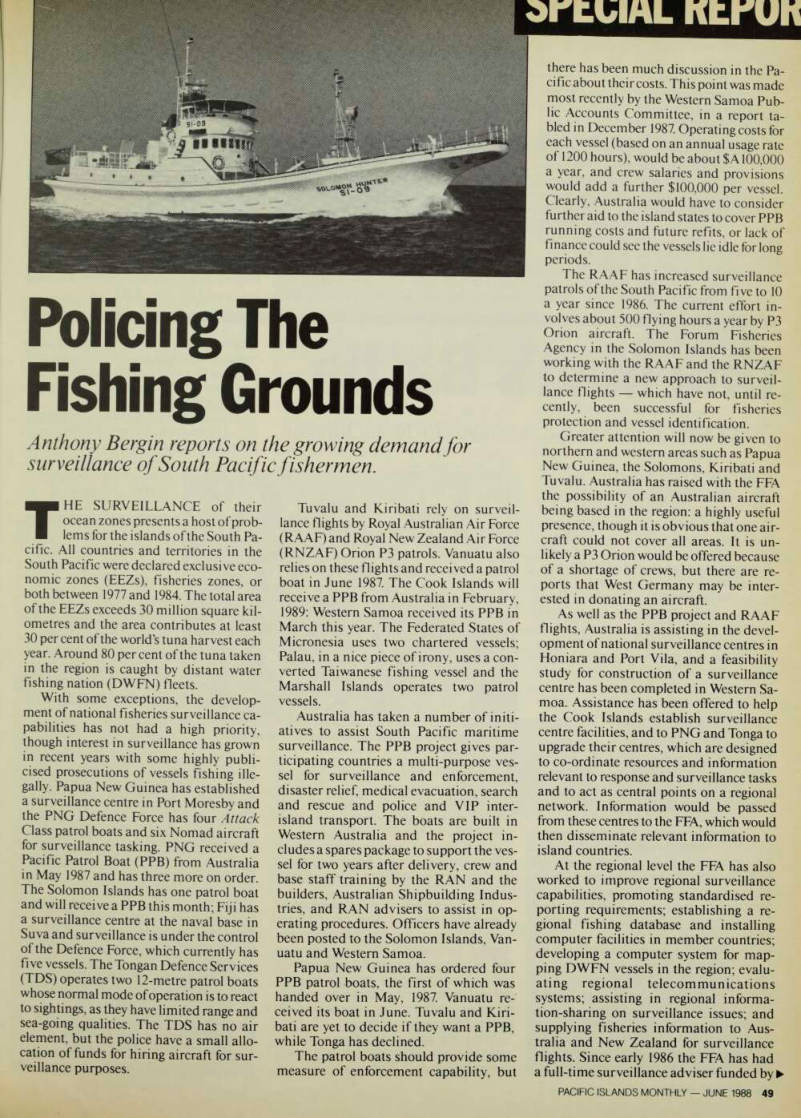
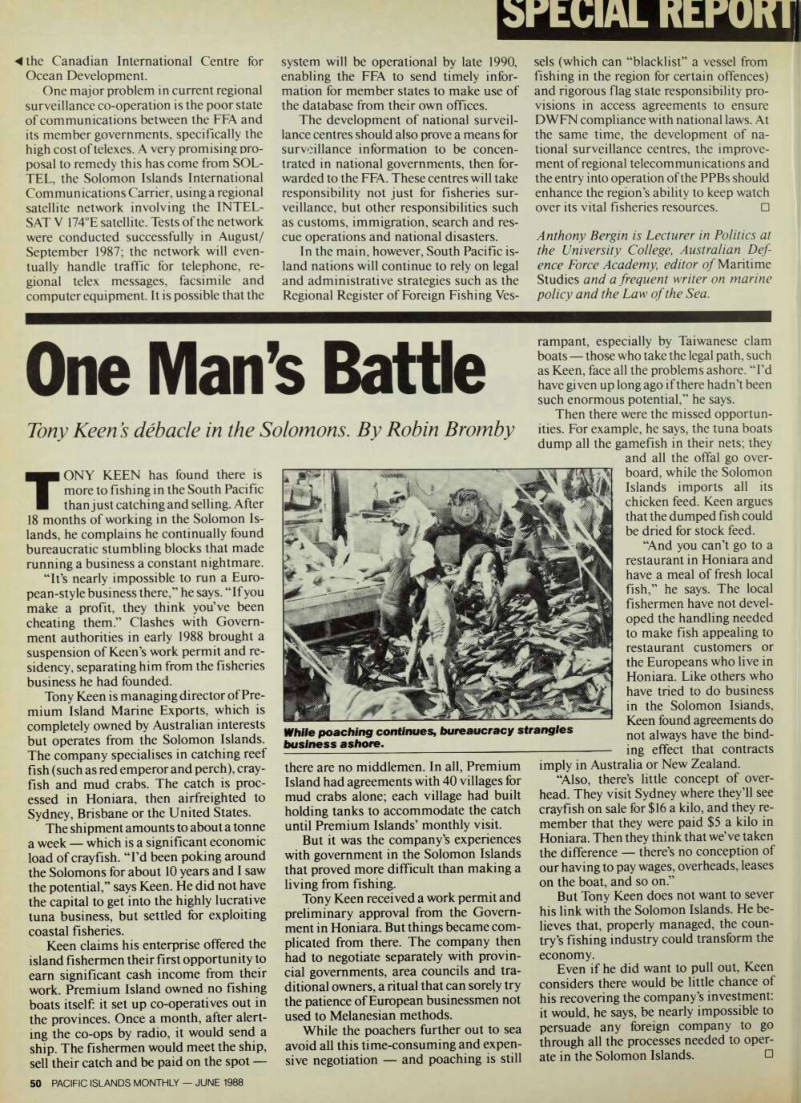
Policing The Fishing Grounds
Anthony Bergin reports on the growing demand for surveillance of South Pacific fishermen.
THE SURVEILLANCE of their ocean zones presents a host of prob lems for the islands of the South Pa cific. All countries and territories in the South Pacific were declared exclusive eco nomic zones (EEZs), fisheries zones, or both between 1977 and 1984. The total area of the EEZs exceeds 30 million square kil ometres and the area contributes at least 30 per cent of the world’s tuna harvest each year. Around 80 per cent of the tuna taken in the region is caught by distant water fishing nation (DWFN) fleets.
With some exceptions, the develop ment of national fisheries surveillance ca pabilities has not had a high priority, though interest in surveillance has grown in recent years with some highly publi cised prosecutions of vessels fishing ille gally. Papua New Guinea has established a surveillance centre in Port Moresby and the PNG Defence Force has four Attack Class patrol boats and six Nomad aircraft for surveillance tasking. PNG received a Pacific Patrol Boat (PPB) from Australia in May 1987 and has three more on order.
The Solomon Islands has one patrol boat and will receive a PPB this month; Fiji has a surveillance centre at the naval base in Suva and surveillance is under the control of the Defence Force, which currently has five vessels. The Tongan Defence Services (TDS) operates two 12-metre patrol boats whose normal mode of operation is to react to sightings, as they have limited range and sea-going qualities. The TDS has no air element, but the police have a small allo cation of funds for hiring aircraft for sur veillance purposes.
Tuvalu and Kiribati rely on surveil lance flights by Royal Australian Air Force (RAAF) and Royal New Zealand Air Force (RNZAF) Orion P 3 patrols. Vanuatu also relies on these flights and received a patrol boat in June 1987. The Cook Islands will receive a PPB from Australia in February, 1989: Western Samoa received its PPB in March this year. The Federated States of Micronesia uses two chartered vessels; Palau, in a nice piece of irony, uses a con verted Taiwanese fishing vessel and the Marshall Islands operates two patrol vessels, Australia has taken a number of initi atives to assist South Pacific maritime surveillance. The PPB project gives par ticipating countries a multi-purpose ves sel for surveillance and enforcement, disaster relief, medical evacuation, search and rescue and police and VIP inter island transport. The boats are built in Western Australia and the project in eludes a spares package to support the ves sel for two years after delivery, crew and base staff training by the RAN and the builders, Australian Shipbuilding Indus tries, and RAN advisers to assist in op crating procedures. Officers have already been posted to the Solomon Islands, Van uatu and Western Samoa, Papua New Guinea has ordered four PPB patrol boats, the first of which was handed over in May, 1987. Vanuatu re ceived its boat in June. Tuvalu and Kiri bati are yet to decide if they want a PPB, while Tonga has declined, The patrol boats should provide some measure of enforcement capability, but
there has been much discussion in the Pa cific about their costs. This point was made most recently by the Western Samoa Pub lic Accounts Committee, in a report ta bled in December 1987. Operating costs for each vessel (based on an annual usage rate of 1200 hours), would be about $A 100,000 a year, and crew salaries and provisions would add a further $lOO,OOO per vessel.
Clearly, Australia would have to consider further aid to the island states to cover PPB running costs and future refits, or lack of finance could see the vessels lie idle for long periods.
The RAAF has increased surveillance patrols of the South Pacific from five to 10 a year since 1986. The current effort in volves about 500 flying hours a year by P 3 Orion aircraft. The Forum Fisheries Agency in the Solomon Islands has been working with the RAAF and the RNZAF to determine a new approach to surveil lance flights which have not, until re cently, been successful for fisheries protection and vessel identification.
Greater attention will now be given to northern and western areas such as Papua New Guinea, the Solomons, Kiribati and Tuvalu. Australia has raised with the FFA the possibility of an Australian aircraft being based in the region: a highly useful presence, though it is obvious that one air craft could not cover all areas. It is un likely a P 3 Orion would be offered because of a shortage of crews, but there are re ports that West Germany may be inter ested in donating an aircraft.
As well as the PPB project and RAAF flights, Australia is assisting in the devel opment of national surveillance centres in Honiara and Port Vila, and a feasibility study for construction of a surveillance centre has been completed in Western Sa moa. Assistance has been offered to help the Cook Islands establish surveillance centre facilities, and to PNG and Tonga to upgrade their centres, which are designed to co-ordinate resources and information relevant to response and surveillance tasks and to act as central points on a regional network. Information would be passed from these centres to the FFA, which would then disseminate relevant information to island countries.
At the regional level the FFA has also worked to improve regional surveillance capabilities, promoting standardised re porting requirements; establishing a re gional fishing database and installing computer facilities in member countries; developing a computer system for map ping DWFN vessels in the region; evalu ating regional telecommunications systems; assisting in regional informa tion-sharing on surveillance issues; and supplying fisheries information to Aus tralia and New Zealand for surveillance flights. Since early 1986 the FFA has had a full-time surveillance adviser funded by ►
◄ the Canadian International Centre for Ocean Development.
One major problem in current regional surveillance co-operation is the poor state of communications between the FFA and its member governments, specifically the high cost of telexes. A very promising pro posal to remedy this has come from SOL TEL, the Solomon Islands International Communications Carrier, using a regional satellite network involving the INTEL SAT V 174°E satellite. Tests of the network were conducted successfully in August/ September 1987; the network will even tually handle traffic for telephone, re gional telex messages, facsimile and computer equipment. It is possible that the
system will be operational by late 1990, enabling the FFA to send timely infor mation for member states to make use of the database from their own offices.
The development of national surveil lance centres should also prove a means for surveillance information to be concen trated in national governments, then for warded to the FFA. These centres will take responsibility not just for fisheries sur veillance, but other responsibilities such as customs, immigration, search and res cue operations and national disasters.
In the main, however. South Pacific is land nations will continue to rely on legal and administrative strategies such as the Regional Register of Foreign Fishing Ves
sels (which can “blacklist” a vessel from fishing in the region for certain offences) and rigorous flag state responsibility pro visions in access agreements to ensure DWFN compliance with national laws. At the same time, the development of na tional surveillance centres, the improve ment of regional telecommunications and the entry into operation of the PPBs should enhance the region’s ability to keep watch over its vital fisheries resources. □ Anthony Bergin is Lecturer in Politics at the University College, Australian Def ence Force Academy, editor of Maritime Studies and a frequent writer on marine policy and the Law of the Sea.
One Man’s Battle
Tony Keen s debacle in the Solomons.
By Robin Bromby
TONY KEEN has found there is more to fishing in the South Pacific than just catching and selling. After 18 months of working in the Solomon Is lands, he complains he continually found bureaucratic stumbling blocks that made running a business a constant nightmare.
“It’s nearly impossible to run a Euro pean-style business there,” he says. “If you make a profit, they think you’ve been cheating them.” Clashes with Govern ment authorities in early 1988 brought a suspension of Keen’s work permit and re sidency, separating him from the fisheries business he had founded.
Tony Keen is managing director of Pre mium Island Marine Exports, which is completely owned by Australian interests but operates from the Solomon Islands.
The company specialises in catching reef fish (such as red emperor and perch), cray fish and mud crabs. The catch is proc essed in Honiara, then airfreighted to Sydney, Brisbane or the United States.
The shipment amounts to about a tonne a week which is a significant economic load of crayfish. “I’d been poking around the Solomons for about 10 years and I saw the potential,” says Keen. He did not have the capital to get into the highly lucrative tuna business, but settled for exploiting coastal fisheries.
Keen claims his enterprise offered the island fishermen their first opportunity to earn significant cash income from their work. Premium Island owned no fishing boats itself: it set up co-operatives out in the provinces. Once a month, after alert ing the co-ops by radio, it would send a ship. The fishermen would meet the ship, sell their catch and be paid on the spot
there are no middlemen. In all. Premium Island had agreements with 40 villages for mud crabs alone; each village had built holding tanks to accommodate the catch until Premium Islands’ monthly visit.
But it was the company’s experiences with government in the Solomon Islands that proved more difficult than making a living from fishing.
Tony Keen received a work permit and preliminary approval from the Government in Honiara. But things became complicated from there. The company then had to negotiate separately with provincial governments, area councils and traditional owners, a ritual that can sorely try the patience of European businessmen not used to Melanesian methods.
While the poachers further out to sea avoid all this time-consuming and expensive negotiation and poaching is still
rampant, especially by Taiwanese clam boats those who take the legal path, such as Keen, face all the problems ashore. “I’d have given up long ago if there hadn’t been such enormous potential,” he says.
Then there were the missed opportun ities. For example, he says, the tuna boats dump all the gamefish in their nets; they
and all the offal go over board, while the Solomon Islands imports all its chicken feed. Keen argues that the dumped fish could be dried for stock feed.
“And you can’t go to a restaurant in Honiara and have a meal of fresh local fish,” he says. The local fishermen have not devel oped the handling needed to make fish appealing to restaurant customers or the Europeans who live in Honiara. Like others who have tried to do business in the Solomon Islands, Keen found agreements do not always have the bind ing effect that contracts
imply in Australia or New Zealand.
“Also, there’s little concept of over head. They visit Sydney where they’ll see crayfish on sale for $l6 a kilo, and they re member that they were paid $5 a kilo in Honiara. Then they think that we’ve taken the difference there’s no conception of our having to pay wages, overheads, leases on the boat, and so on.”
But Tony Keen does not want to sever his link with the Solomon Islands. He be lieves that, properly managed, the coun try’s fishing industry could transform the economy.
Even if he did want to pull out, Keen considers there would be little chance of his recovering the company’s investment: it would, he says, be nearly impossible to persuade any foreign company to go through all the processes needed to oper ate in the Solomon Islands. □
While poaching continues, bureaucracy strangles business ashore.
Pacific Stamp Box
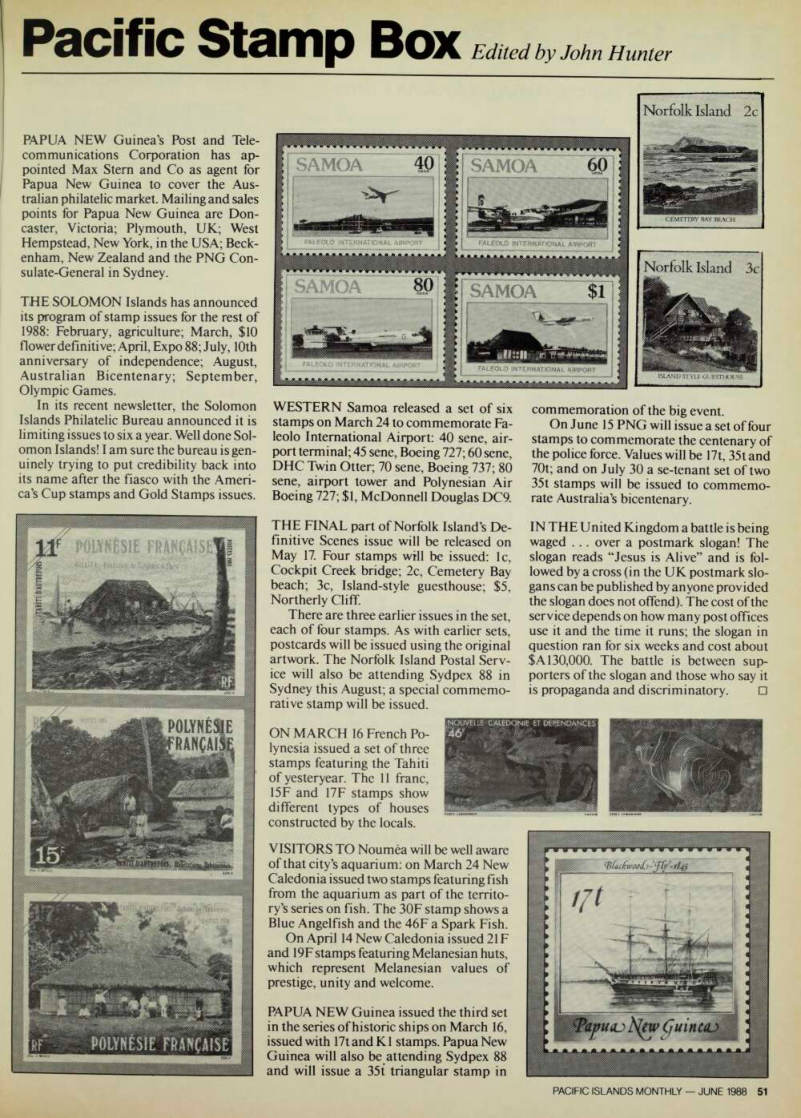
Edited by John Hunter
PAPUA NEW Guinea’s Post and Tele communications Corporation has ap pointed Max Stern and Co as agent for Papua New Guinea to cover the Aus tralian philatelic market. Mailing and sales points for Papua New Guinea are Don caster, Victoria; Plymouth, UK; West Hempstead, New York, in the USA; Beck enham, New Zealand and the PNG Con sulate-General in Sydney.
THE SOLOMON Islands has announced its program of stamp issues for the rest of 1988: February, agriculture; March, $lO flower definitive; April, Expo 88; July, 10th anniversary of independence; August, Australian Bicentenary; September, Olympic Games.
In its recent newsletter, the Solomon Islands Philatelic Bureau announced it is limiting issues to six a year. Well done Sol omon Islands! I am sure the bureau is gen uinely trying to put credibility back into its name after the fiasco with the Ameri ca’s Cup stamps and Gold Stamps issues.
WESTERN Samoa released a set of six stamps on March 24 to commemorate Fa leolo International Airport: 40 sene, air port terminal; 45 sene, Boeing 727; 60 sene, DHC Twin Otter; 70 sene, Boeing 737; 80 sene, airport tower and Polynesian Air Boeing 727; $l, McDonnell Douglas DC9.
THE FINAL part of Norfolk Island’s De finitive Scenes issue will be released on May 17. Four stamps will be issued: Ic, Cockpit Creek bridge; 2c, Cemetery Bay beach; 3c, Island-style guesthouse; $5, Northerly Cliff.
There are three earlier issues in the set, each of four stamps. As with earlier sets, postcards will be issued using the original artwork. The Norfolk Island Postal Serv ice will also be attending Sydpex 88 in Sydney this August; a special commemo rative stamp will be issued.
ON MARCH 16 French Po lynesia issued a set of three stamps featuring the Tahiti of yesteryear. The 11 franc, 15F and 17F stamps show different types of houses constructed by the locals.
VISITORS TO Noumea will be well aware of that city’s aquarium: on March 24 New Caledonia issued two stamps featuring fish from the aquarium as part of the territo ry’s series on fish. The 30F stamp shows a Blue Angelfish and the 46F a Spark Fish.
On April 14 New Caledonia issued 21F and 19F stamps featuring Melanesian huts, which represent Melanesian values of prestige, unity and welcome.
PAPUA NEW Guinea issued the third set in the series of historic ships on March 16, issued with 17t and K 1 stamps. Papua New Guinea will also be attending Sydpex 88 and will issue a 35t triangular stamp in
commemoration of the big event.
On June 15 PNG will issue a set of four stamps to commemorate the centenary of the police force. Values will be 17t, 35t and 70t; and on July 30 a se-tenant set of two 35t stamps will be issued to commemo rate Australia’s bicentenary.
IN THE United Kingdom a battle is being waged ... over a postmark slogan! The slogan reads “Jesus is Alive” and is fol lowed by a cross (in the UK postmark slo gans can be published by anyone provided the slogan does not offend). The cost of the service depends on how many post offices use it and the time it runs; the slogan in question ran for six weeks and cost about $ A 130,000. The battle is between sup porters of the slogan and those who say it is propaganda and discriminatory. □
The Island Press
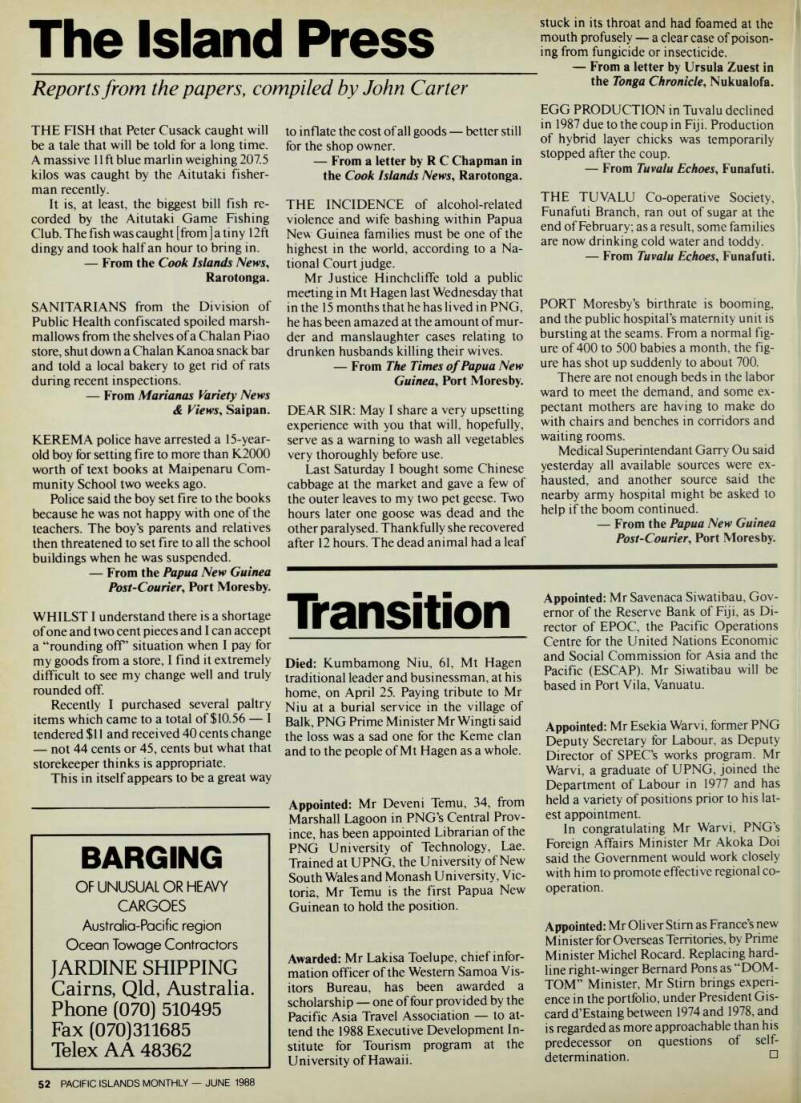
Reports from the papers, compiled by John Carter
THE FISH that Peter Cusack caught will be a tale that will be told for a long time.
A massive 11 ft blue marlin weighing 207.5 kilos was caught by the Aitutaki fisher man recently.
It is, at least, the biggest bill fish re corded by the Aitutaki Game Fishing Club. The fish was caught [from ] a tiny 12ft dingy and took half an hour to bring in.
From the Cook Islands News, Rarotonga.
SANITARIANS from the Division of Public Health confiscated spoiled marsh mallows from the shelves of a Chalan Piao store, shut down a Chalan Kanoa snack bar and told a local bakery to get rid of rats during recent inspections.
From Marianas Variety News & Views , Saipan.
KEREMA police have arrested a 15-year old boy for setting fire to more than K2OOO worth of text books at Maipenaru Com munity School two weeks ago.
Police said the boy set fire to the books because he was not happy with one of the teachers. The boy’s parents and relatives then threatened to set fire to all the school buildings when he was suspended.
From the Papua New Guinea Post-Courier , Port Moresby.
WHILST I understand there is a shortage of one and two cent pieces and I can accept a “rounding off’ situation when I pay for my goods from a store, I find it extremely difficult to see my change well and truly rounded off.
Recently I purchased several paltry items which came to a total of $10.56 I tendered $ll and received 40 cents change not 44 cents or 45, cents but what that storekeeper thinks is appropriate.
This in itself appears to be a great way
to inflate the cost of all goods better still for the shop owner.
From a letter by R C Chapman in the Cook Islands News , Rarotonga.
THE INCIDENCE of alcohol-related violence and wife bashing within Papua New Guinea families must be one of the highest in the world, according to a Na tional Court judge.
Mr Justice Hinchcliffe told a public meeting in Mt Hagen last Wednesday that in the 15 months that he has lived in PNG, he has been amazed at the amount of mur der and manslaughter cases relating to drunken husbands killing their wives.
From The Times of Papua New Guinea , Port Moresby.
DEAR SIR: May I share a very upsetting experience with you that will, hopefully, serve as a warning to wash all vegetables very thoroughly before use.
Last Saturday I bought some Chinese cabbage at the market and gave a few of the outer leaves to my two pet geese. Two hours later one goose was dead and the other paralysed. Thankfully she recovered after 12 hours. The dead animal had a leaf
stuck in its throat and had foamed at the mouth profusely a clear case of poison ing from fungicide or insecticide.
From a letter by Ursula Zuest in the Tonga Chronicle , Nukualofa.
EGG PRODUCTION in Tuvalu declined in 1987 due to the coup in Fiji. Production of hybrid layer chicks was temporarily stopped after the coup.
From Tuvalu Echoes , Funafuti.
THE TUVALU Co-operative Society, Funafuti Branch, ran out of sugar at the end of February; as a result, some families are now drinking cold water and toddy.
From Tuvalu Echoes , Funafuti.
PORT Moresby’s birthrate is booming, and the public hospital’s maternity unit is bursting at the seams. From a normal fig ure of 400 to 500 babies a month, the fig ure has shot up suddenly to about 700.
There are not enough beds in the labor ward to meet the demand, and some ex pectant mothers are having to make do with chairs and benches in corridors and waiting rooms.
Medical Superintendant Garry Ou said yesterday all available sources were ex hausted, and another source said the nearby army hospital might be asked to help if the boom continued.
From the Papua New Guinea Post-Courier , Port Moresby.
Transition
Died: Kumbamong Niu, 61, Mt Hagen traditional leader and businessman, at his home, on April 25. Paying tribute to Mr Niu at a burial service in the village of Balk, PNG Prime Minister Mr Wingti said the loss was a sad one for the Kerne clan and to the people of Mt Hagen as a whole.
Appointed: Mr Deveni Temu, 34, from Marshall Lagoon in PNG’s Central Prov ince, has been appointed Librarian of the PNG University of Technology, Lae.
Trained at UPNG, the University of New South Wales and Monash University, Vic toria, Mr Temu is the first Papua New Guinean to hold the position.
Awarded: Mr Lakisa Toelupe, chief infor mation officer of the Western Samoa Vis itors Bureau, has been awarded a scholarship one of four provided by the Pacific Asia Travel Association to at tend the 1988 Executive Development In stitute for Tourism program at the University of Hawaii.
Appointed: Mr Savenaca Siwatibau, Gov ernor of the Reserve Bank of Fiji, as Di rector of EPOC, the Pacific Operations Centre for the United Nations Economic and Social Commission for Asia and the Pacific (ESCAP). Mr Siwatibau will be based in Port Vila, Vanuatu.
Appointed: Mr Esekia Warvi, former PNG Deputy Secretary for Labour, as Deputy Director of SPEC’s works program. Mr Warvi, a graduate of UPNG, joined the Department of Labour in 1977 and has held a variety of positions prior to his lat est appointment.
In congratulating Mr Warvi, PNG’s Foreign Affairs Minister Mr Akoka Doi said the Government would work closely with him to promote effective regional co operation.
Appointed: Mr Oliver Stim as France’s new Minister for Overseas Territories, by Prime Minister Michel Rocard. Replacing hard line right-winger Bernard Pons as “DOM TOM” Minister, Mr Stim brings experi ence in the portfolio, under President Gis card d’Estaing between 1974 and 1978, and is regarded as more approachable than his predecessor on questions of self determination. D
Advertisements & other items, p. 52 (1 item)
Barging
OF UNUSUAL OR HEAVY
CARGOES
Australia-Pacific region Ocean Towage Contractors
JARDINE SHIPPING
Cairns, Qld, Australia.
Phone (070) 510495 Fax (070)311685 Telex AA 48362
Shipping Schedules
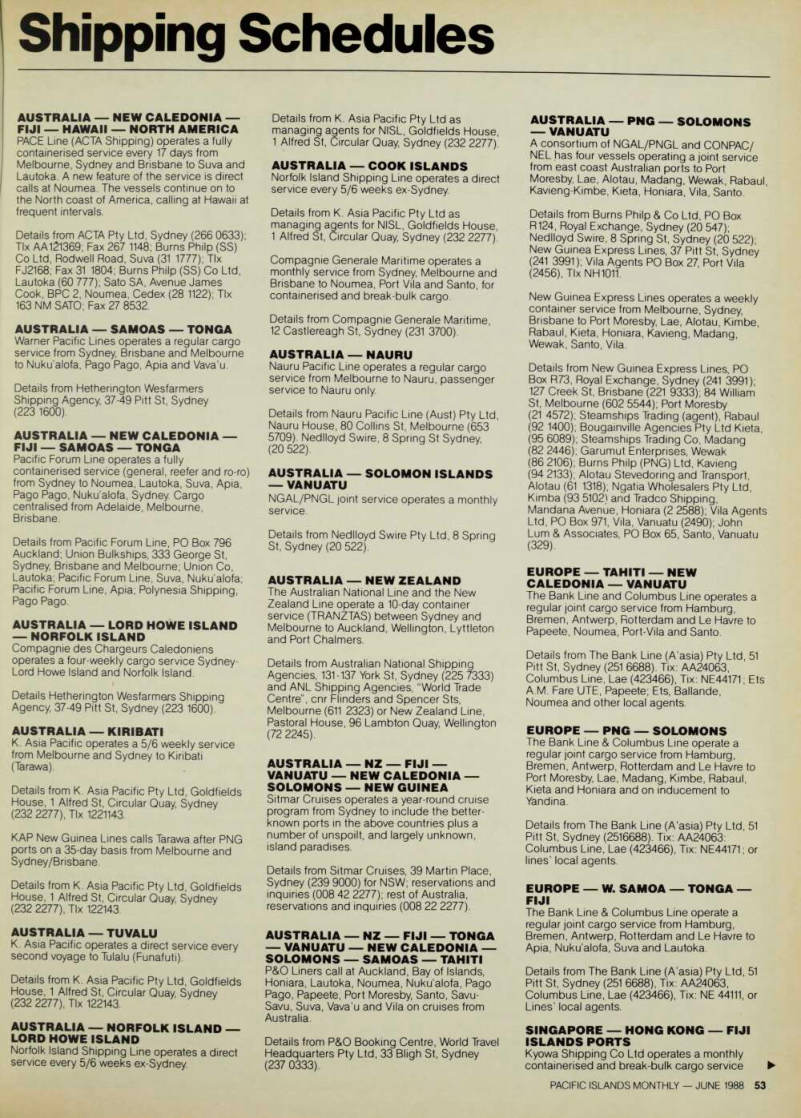

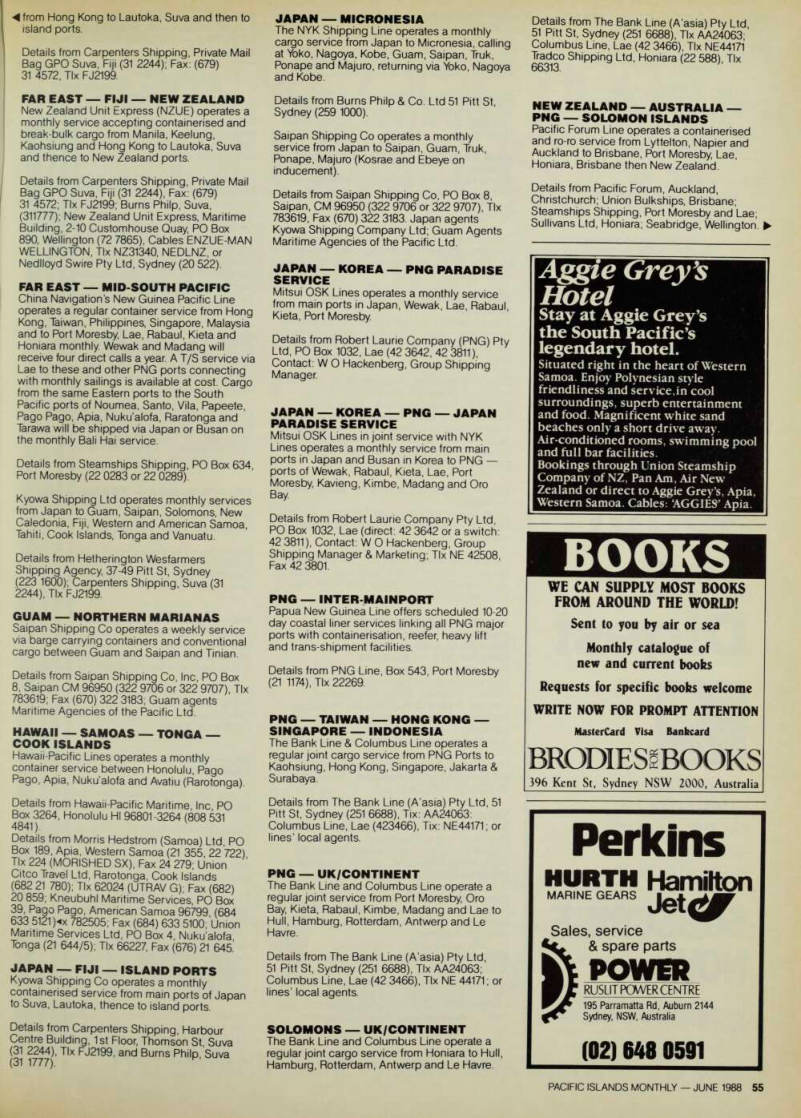
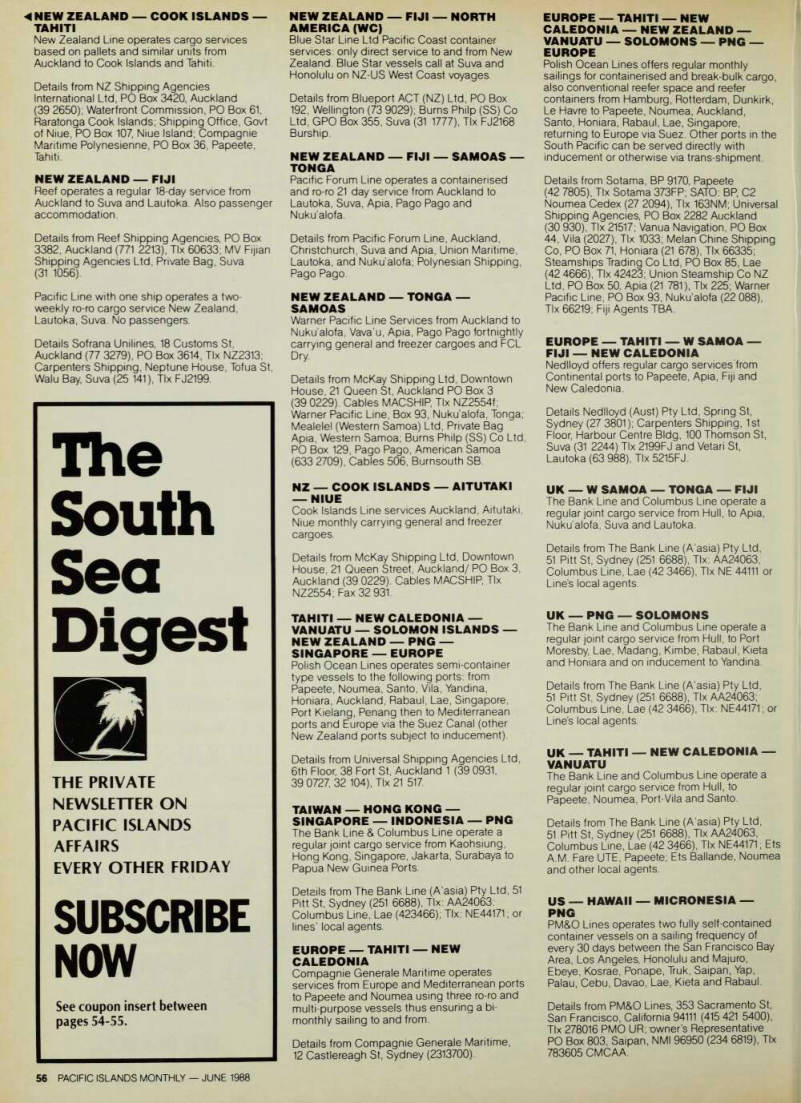
Australia New Caledonia
Fiji Hawaii North America
PACE Line (ACTA Shipping) operates a fully containerised service every 17 days from Melbourne, Sydney and Brisbane to Suva and Lautoka. A new feature of the service is direct calls at Noumea. The vessels continue on to the North coast of America, calling at Hawaii at frequent intervals.
Details from ACTA Pty Ltd, Sydney (266 0633); Tlx AA121369; Fax 267 1148; Burns Philp (SS) Co Ltd, Rodwell Road, Suva (31 1777); Tlx FJ2168; Fax 31 1804; Burns Philp (SS) Co Ltd, Lautoka (60 777); Sato SA, Avenue James Cook, BPC 2, Noumea, Cedex (28 1122); Tlx
163 Nm Sato; Fax 27 8532.
Australia Samoas Tonga
Warner Pacific Lines operates a regular cargo service from Sydney, Brisbane and Melbourne to Nuku’alofa, Pago Pago, Apia and Vava’u.
Details from Hetherington Wesfarmers Shipping Agency, 37-49 Pitt St, Sydney (223 1600).
Australia New Caledonia
Fiji Samoas Tonga
Pacific Forum Line operates a fully containerised service (general, reefer and ro-ro) from Sydney to Noumea, Lautoka, Suva, Apia, Pago Pago, Nuku’alofa, Sydney. Cargo centralised from Adelaide, Melbourne, Brisbane.
Details from Pacific Forum Line, PO Box 796 Auckland; Union Bulkships, 333 George St, Sydney, Brisbane and Melbourne; Union Co, Lautoka; Pacific Forum Line, Suva, Nukualofa; Pacific Forum Line, Apia; Polynesia Shipping, Pago Pago.
Australia Lord Howe Island
Norfolk Island
Compagnie des Chargeurs Caledoniens operates a four-weekly cargo service Sydney- Lord Howe Island and Norfolk Island.
I Details Hetherington Wesfarmers Shipping Agency, 37-49 Pitt St, Sydney (223 1600).
Australia Kiribati
K. Asia Pacific operates a 5/6 weekly service from Melbourne and Sydney to Kiribati (Tarawa).
Details from K. Asia Pacific Pty Ltd, Goldfields House, 1 Alfred St, Circular Quay, Sydney (232 2277). Tlx 1221143.
KAP New Guinea Lines calls Tarawa after PNG ports on a 35-day basis from Melbourne and Sydney/Brisbane.
Details from K. Asia Pacific Pty Ltd, Goldfields House, 1 Alfred St, Circular Quay, Sydney (232 2277), Tlx 122143.
Australia Tuvalu
K. Asia Pacific operates a direct service every second voyage to Tulalu (Funafuti).
Details from K. Asia Pacific Pty Ltd, Goldfields House, 1 Alfred St, Circular Quay, Sydney (232 2277), Tlx 122143.
Australia Norfolk Island
Lord Howe Island
Norfolk Island Shipping Line operates a direct service every 5/6 weeks ex-Sydney.
Details from K. Asia Pacific Pty Ltd as managing agents for NISL, Goldfields House, 1 Alfred St, Circular Quay, Sydney (232 2277).
Australia Cook Islands
Norfolk Island Shipping Line operates a direct service every 5/6 weeks ex-Sydney.
Details from K. Asia Pacific Pty Ltd as managing agents for NISL, Goldfields House, 1 Alfred St, Circular Quay, Sydney (232 2277).
Compagnie Generale Maritime operates a monthly service from Sydney, Melbourne and Brisbane to Noumea, Port Vila and Santo, for containerised and break-bulk cargo.
Details from Compagnie Generale Maritime, 12 Castlereagh St, Sydney (231 3700).
Australia Nauru
Nauru Pacific Line operates a regular cargo service from Melbourne to Nauru, passenger service to Nauru only.
Details from Nauru Pacific Line (Aust) Pty Ltd, Nauru House, 80 Collins St, Melbourne (653 5709). Nedlloyd Swire, 8 Spring St Sydney, (20 522).
Australia Solomon Islands
Vanuatu
NGAL/PNGL joint service operates a monthly service.
Details from Nedlloyd Swire Pty Ltd, 8 Spring
St, Sydney (20 522).
Australia New Zealand
The Australian National Line and the New Zealand Line operate a 10-day container service (TRANZTAS) between Sydney and Melbourne to Auckland, Wellington, Lyttleton and Port Chalmers.
Details from Australian National Shipping Agencies, 131-137 York St, Sydney (225 7333) and ANL Shipping Agencies, "World Trade Centre", cnr Flinders and Spencer Sts, Melbourne (611 2323) or New Zealand Line, Pastoral House, 96 Lambton Quay, Wellington (72 2245).
Australia Nz Fiji
Vanuatu New Caledonia
Solomons New Guinea
Sitmar Cruises operates a year-round cruise program from Sydney to include the better known ports in the above countries plus a number of unspoilt, and largely unknown, island paradises.
Details from Sitmar Cruises, 39 Martin Place, Sydney (239 9000) for NSW; reservations and inquiries (008 42 2277); rest of Australia, reservations and inquiries (008 22 2277).
Australia Nz Fiji Tonga
Vanuatu New Caledonia
Solomons Samoas Tahiti
P&O Liners call at Auckland, Bay of Islands, Honiara, Lautoka, Noumea, Nuku’alofa, Pago Pago, Papeete, Port Moresby, Santo, Savu- Savu, Suva, Vava’u and Vila on cruises from Australia.
Details from P&O Booking Centre, World Travel Headquarters Pty Ltd, 33 Bligh St, Sydney (237 0333).
Australia Png Solomons
Vanuatu
A consortium of NGAL/PNGL and CONPAC/ NEL has four vessels operating a joint service from east coast Australian ports to Port Moresby, Lae, Alotau, Madang, Wewak, Rabaul, Kavieng-Kimbe, Kieta, Honiara, Vila, Santo.
Details from Burns Philp & Co Ltd, PO Box R 124, Royal Exchange, Sydney (20 547); Nedlloyd Swire, 8 Spring St. Sydney (20 522); New Guinea Express Lines, 37 Pitt St, Sydney (241 3991); Vila Agents PO Box 27, Port Vila
(2456). Tlx Nhioii.
New Guinea Express Lines operates a weekly container service from Melbourne, Sydney.
Brisbane to Port Moresby, Lae, Alotau, Kimbe, Rabaul, Kieta, Honiara, Kavieng, Madang, Wewak, Santo, Vila.
Details from New Guinea Express Lines, PO Box R 73, Royal Exchange, Sydney (241 3991); 127 Creek St, Brisbane (221 9333); 84 William St, Melbourne (602 5544); Port Moresby (21 4572); Steamships Trading (agent), Rabaul (92 1400); Bougainville Agencies Pty Ltd Kieta, (95 6089); Steamships Trading Co, Madang (82 2446); Garumut Enterprises, Wewak (86 2106); Burns Philp (PNG) Ltd, Kavieng (94 2133); Alotau Stevedoring and Transport, Alotau (61 1318); Ngatia Wholesalers Pty Ltd, Kimba (93 5102) and Tradco Shipping, Mandana Avenue, Honiara (2 2588); Vila Agents Ltd, PO Box 971, Vila, Vanuatu (2490); John Lum & Associates, PO Box 65, Santo, Vanuatu (329).
Europe Tahiti New
Caledonia Vanuatu
The Bank Line and Columbus Line operates a regular joint cargo service from Hamburg, Bremen, Antwerp, Rotterdam and Le Havre to Papeete, Noumea, Port-Vila and Santo.
Details from The Bank Line (A’asia) Pty Ltd, 51 Pitt St, Sydney (251 6688). Tix: AA24063, Columbus Line, Lae (423466), Tix: NE44171; Ets A M. Fare DTE, Papeete; Ets, Ballande, Noumea and other local agents.
Europe Png Solomons
The Bank Line & Columbus Line operate a regular joint cargo service from Hamburg, Bremen, Antwerp, Rotterdam and Le Havre to Port Moresby, Lae, Madang, Kimbe, Rabaul, Kieta and Honiara and on inducement to Yandina.
Details from The Bank Line (A’asia) Pty Ltd, 51 Pitt St, Sydney (2516688). Tix: AA24063: Columbus Line, Lae (423466), Tix: NE44171; or lines’ local agents.
Europe W. Samoa Tonga
Fiji
The Bank Line & Columbus Line operate a regular joint cargo service from Hamburg, Bremen, Antwerp, Rotterdam and Le Havre to Apia, Nukualofa, Suva and Lautoka.
Details from The Bank Line (A’asia) Pty Ltd, 51 Pitt St, Sydney (251 6688), Tix: AA24063, Columbus Line, Lae (423466), Tix: NE 44111, or Lines’ local agents.
Singapore Hong Kong Fiji
Islands Ports
Kyowa Shipping Co Ltd operates a monthly containerised and break-bulk cargo service ►
◄ from Hong Kong to Lautoka, Suva and then to island ports.
Details from Carpenters Shipping, Private Mail Bag GPO Suva, Fiji (31 2244); Fax: (679) 31 4572. Tlx FJ2199.
Far East Fiji New Zealand
New Zealand Unit Express (NZUE) operates a monthly service accepting containerised and break-bulk cargo from Manila, Keelung, Kaohsiung and Hong Kong to Lautoka, Suva and thence to New Zealand ports.
Details from Carpenters Shipping, Private Mail Bag GPO Suva. Fiji (31 2244), Fax: (679) 31 4572; Tlx FJ2199; Burns Philp, Suva, (311777); New Zealand Unit Express, Maritime Building, 2-10 Customhouse Quay, PO Box 890, Wellington (72 7865). Cables ENZUE-MAN
Wellington. Tlx Nz31340, Nedlnz, Or
Nedlloyd Swire Pty Ltd, Sydney (20 522).
Far East Mid-South Pacific
China Navigation’s New Guinea Pacific Line operates a regular container service from Hong Kong, Taiwan, Philippines, Singapore, Malaysia and to Port Moresby, Lae, Rabaul, Kieta and Honiara monthly. Wewak and Madang will receive four direct calls a year. A T/S service via Lae to these and other PNG ports connecting with monthly sailings is available at cost. Cargo from the same Eastern ports to the South Pacific ports of Noumea, Santo, Vila, Papeete, Pago Pago, Apia, Nuku’alofa, Raratonga and Tarawa will be shipped via Japan or Busan on the monthly Bali Hai service.
Details from Steamships Shipping, PO Box 634, Port Moresby (22 0283 or 22 0289).
Kyowa Shipping Ltd operates monthly services from Japan to Guam, Saipan, Solomons, New Caledonia, Fiji, Western and American Samoa, Tahiti, Cook Islands, Tonga and Vanuatu.
Details from Hetherington Wesfarmers Shipping Agency, 37-49 Pitt St, Sydney (223 1600); Carpenters Shipping, Suva (31 2244), Tlx FJ2199.
Guam Northern Marianas
Saipan Shipping Co operates a weekly service via barge carrying containers and conventional cargo between Guam and Saipan and Tinian.
Details from Saipan Shipping Co, Inc, PO Box 8, Saipan CM 96950 (322 9706 or 322 9707). Tlx 783619; Fax (670) 322 3183; Guam agents Maritime Agencies of the Pacific Ltd.
Hawaii Samoas Tonga
Cook Islands
Hawaii-Pacific Lines operates a monthly container service between Honolulu, Pago Pago, Apia, Nukualofa and Avatiu (Rarotonga).
Details from Hawaii-Pacific Maritime, Inc, PO Box 3264, Honolulu HI 96801-3264 (808 531 4841).
Details from Morris Hedstrom (Samoa) Ltd, PO Box 189, Apia, Western Samoa (21 355, 22 722) Tlx 224 (MORISHED SX), Fax 24 279; Union Citco Travel Ltd, Rarotonga, Cook Islands (682 21 780); Tlx 62024 (UTRAV G); Fax (682) 20 859; Kneubuhl Maritime Services, PO Box 39, Pago Pago, American Samoa 96799, (684 633 5121 )«x 782505; Fax (684) 633 5100; Union Maritime Services Ltd, PO Box 4, Nuku’alofa Tonga (21 644/5); Tlx 66227, Fax (676) 21 645.'
Japan Fiji Island Ports
Kyowa Shipping Co operates a monthly containerised service from main ports of Japan to Suva, Lautoka, thence to island ports.
Details from Carpenters Shipping, Harbour Centre Building, Ist Floor, Thomson St. Suva (31 2244), Tlx FJ2199, and Burns Philp, Suva (31 1777). M
Japan Micronesia
The NYK Shipping Line operates a monthly cargo service from Japan to Micronesia, calling at Yoko, Nagoya, Kobe, Guam, Saipan, Truk, Ponape and Majuro, returning via Yoko, Nagoya and Kobe.
Details from Burns Philp & Co. Ltd 51 Pitt St, Sydney (259 1000).
Saipan Shipping Co operates a monthly service from Japan to Saipan, Guam, Truk, Ponape, Majuro (Kosrae and Ebeye on inducement).
Details from Saipan Shipping Co, PO Box 8, Saipan, CM 96950 (322 9706 or 322 9707), Tlx 783619, Fax (670) 322 3183. Japan agents Kyowa Shipping Company Ltd; Guam Agents Maritime Agencies of the Pacific Ltd.
Japan Korea Png Paradise
Service
Mitsui OSK Lines operates a monthly service from main ports in Japan, Wewak. Lae, Rabaul, Kieta, Port Moresby.
Details from Robert Laurie Company (PNG) Pty Ltd, PO Box 1032, Lae (42 3642, 42 3811), Contact. W O Hackenberg, Group Shipping Manager.
Japan Korea Png Japan
Paradise Service
Mitsui OSK Lines in joint service with NYK Lines operates a monthly service from main ports in Japan and Busan in Korea to PNG ports of Wewak, Rabaul, Kieta, Lae, Port Moresby, Kavieng, Kimbe, Madang and Oro Bay.
Details from Robert Laurie Company Pty Ltd, PO Box 1032, Lae (direct: 42 3642 or a switch: 42 3811), Contact: W O Hackenberg, Group Shipping Manager & Marketing; Tlx NE 42508, Fax 42 3801.
Png Intermainport
Papua New Guinea Line offers scheduled 10-20 day coastal liner services linking all PNG major ports with containerisation, reefer, heavy lift and trans-shipment facilities.
Details from PNG Line, Box 543, Port Moresby (21 1174), Tlx 22269.
Png Taiwan Hong Kong
Singapore Indonesia
The Bank Line & Columbus Line operates a regular joint cargo service from PNG Ports to Kaohsiung, Hong Kong, Singapore, Jakarta & Surabaya.
Details from The Bank Line (A’asia) Pty Ltd, 51 Pitt St, Sydney (251 6688), Tix: AA24063: Columbus Line, Lae (423466), Tix: NE44171; or lines’ local agents.
Png Uk/Continent
The Bank Line and Columbus Line operate a regular joint service from Port Moresby, Oro Bay, Kieta, Rabaul, Kimbe, Madang and Lae to Hull, Hamburg, Rotterdam, Antwerp and Le Havre.
Details from The Bank Line (A’asia) Pty Ltd, 51 Pitt St, Sydney (251 6688), Tlx AA24063; Columbus Line. Lae (42 3466), Tlx NE 44171; or lines’ local agents.
Solomons Uk/Continent
The Bank Line and Columbus Line operate a regular joint cargo service from Honiara to Hull, Hamburg, Rotterdam, Antwerp and Le Havre.
Details from The Bank Line (A’asia) Pty Ltd 51 Pitt St. Sydney (251 6688), Tlx AA24063; ’
Columbus Line, Lae (42 3466), Tlx NE44171 Tradco Shipping Ltd. Honiara (22 588), Tlx 66313.
New Zealand Australia
Png Solomon Islands
Pacific Forum Line operates a containerised and ro-ro service from Lyttelton, Napier and Auckland to Brisbane, Port Moresby, Lae, Honiara, Brisbane then New Zealand.
Details from Pacific Forum, Auckland, Christchurch: Union Bulkships, Brisbane; Steamships Shipping, Port Moresby and Lae; Sullivans Ltd, Honiara; Seabridge, Wellington
◄ New Zealand Cook Islands
Tahiti
New Zealand Line operates cargo services based on pallets and similar units from Auckland to Cook Islands and Tahiti.
Details from NZ Shipping Agencies International Ltd, PO Box 3420, Auckland (39 2650); Waterfront Commission, PO Box 61, Raratonga Cook Islands; Shipping Office, Govt of Niue, PO Box 107, Niue Island; Compagnie Maritime Polynesienne, PO Box 36, Papeete, Tahiti.
New Zealand Fiji
Reef operates a regular 18-day service from Auckland to Suva and Lautoka. Also passenger accommodation.
Details from Reef Shipping Agencies, PO Box 3382, Auckland (771 2213), Tlx 60633; MV Fijian
Shipping Agencies Ltd, Private Bag, Suva
(31 1056).
Pacific Line with one ship operates a two weekly ro-ro cargo service New Zealand, Lautoka, Suva. No passengers.
Details Sofrana Unilines, 18 Customs St, Auckland (77 3279), PO Box 3614, Tlx NZ2313; Carpenters Shipping, Neptune House, Tofua St, Walu Bay, Suva (25 141), Tlx FJ2199.
New Zealand Fiji North
America (Wc)
Blue Star Line Ltd Pacific Coast container services: only direct service to and from New Zealand. Blue Star vessels call at Suva and Honolulu on NZ-US West Coast voyages.
Details from Blueport ACT (NZ) Ltd, PO Box 192, Wellington (73 9029); Burns Philp (SS) Co Ltd, GPO Box 355, Suva (31 1777), Tlx FJ2168 Burship.
New Zealand Fiji Samoas
Tonga
Pacific Forum Line operates a containerised and ro-ro 21 day service from Auckland to Lautoka, Suva, Apia, Pago Pago and Nukualofa.
Details from Pacific Forum Line, Auckland, Christchurch, Suva and Apia, Union Maritime, Lautoka, and Nukualofa; Polynesian Shipping, Pago Pago.
New Zealand Tonga
Samoas
Warner Pacific Line Services from Auckland to Nuku’alofa, Vava’u, Apia, Pago Pago fortnightly carrying general and freezer cargoes and FCL Dry.
Details from McKay Shipping Ltd, Downtown House, 21 Queen St, Auckland PO Box 3 (39 0229). Cables MACSHIP, Tlx NZ2554f; Warner Pacific Line, Box 93, Nuku’alofa, Tonga; Mealelel (Western Samoa) Ltd, Private Bag Apia, Western Samoa; Burns Philp (SS) Co Ltd, PO Box 129, Pago Pago, American Samoa (633 2709), Cables 506, Burnsouth SB.
Nz Cook Islands Aitutaki
Niue
Cook Islands Line services Auckland, Aitutaki, Niue monthly carrying general and freezer cargoes.
Details from McKay Shipping Ltd, Downtown House, 21 Queen Street, Auckland/ PO Box 3, Auckland (39 0229). Cables MACSHIP, Tlx NZ2554; Fax 32 931.
Tahiti New Caledonia
Vanuatu Solomon Islands
New Zealand Png
Singapore Europe
Polish Ocean Lines operates semi-container type vessels to the following ports: from Papeete, Noumea, Santo, Vila, Yandina, Honiara, Auckland, Rabaul, Lae, Singapore, Port Kielang, Penang then to Mediterranean ports and Europe via the Suez Canal (other New Zealand ports subject to inducement).
Details from Universal Shipping Agencies Ltd, 6th Floor, 38 Fort St, Auckland 1 (39 0931, 39 0727, 32 104), Tlx 21 517.
Taiwan Hong Kong
Singapore Indonesia Png
The Bank Line & Columbus Line operate a regular joint cargo service from Kaohsiung, Hong Kong, Singapore, Jakarta, Surabaya to Papua New Guinea Ports.
Details from The Bank Line (A'asia) Pty Ltd, 51 Pitt St, Sydney (251 6688), Tlx: AA24063: Columbus Line, Lae (423466); Tlx: NE44171; or lines’ local agents.
Europe Tahiti New
Caledonia
Compagnie Generate Maritime operates services from Europe and Mediterranean ports to Papeete and Noumea using three ro-ro and multi-purpose vessels thus ensuring a bi monthly sailing to and from.
Details from Compagnie Generale Maritime, 12 Castlereagh St, Sydney (2313700).
Europe Tahiti New
Caledonia New Zealand
Vanuatu Solomons Png
Europe
Polish Ocean Lines offers regular monthly sailings for containerised and break-bulk cargo, also conventional reefer space and reefer containers from Hamburg, Rotterdam, Dunkirk, Le Havre to Papeete, Noumea, Auckland, Santo, Honiara, Rabaul, Lae, Singapore, returning to Europe via Suez. Other ports in the South Pacific can be served directly with inducement or otherwise via trans-shipment.
Details from Sotama, BP 9170, Papeete (42 7805), Tlx Sotama 373FP; SATO: BP, 02 Noumea Cedex (27 2094), Tlx 163 NM; Universal Shipping Agencies, PO Box 2282 Auckland (30 930), Tlx 21517; Vanua Navigation, PO Box 44, Vila (2027), Tlx 1033; Melan Chine Shipping Co, PO Box 71, Honiara (21 678), Tlx 66335; Steamships Trading Co Ltd, PO Box 85, Lae (42 4666), Tlx 42423; Union Steamship Co NZ Ltd, PO Box 50, Apia (21 781), Tlx 225; Warner Pacific Line, PO Box 93, Nukualofa (22 088), Tlx 66219; Fiji Agents TBA.
Europe Tahiti W Samoa
Fiji New Caledonia
Nedlloyd offers regular cargo services’from Continental ports to Papeete, Apia, Fiji and New Caledonia.
Details Nedlloyd (Aust) Pty Ltd, Spring St, Sydney (27 3801); Carpenters Shipping, Ist Floor, Harbour Centre Bldg, 100 Thomson St, Suva (31 2244) Tlx 2199FJ and Vetari St, Lautoka (63 988), Tlx 5215FJ.
Uk W Samoa Tonga Fiji
The Bank Line and Columbus Line operate a regular joint cargo service from Hull, to Apia, Nukualofa, Suva and Lautoka.
Details from The Bank Line (A’asia) Pty Ltd, 51 Pitt St. Sydney (251 6688), Tlx: AA24063, Columbus Line, Lae (42 3466), Tlx NE 44111 or Line's local agents.
Uk Png Solomons
The Bank Line and Columbus Line operate a regular joint cargo service from Hull, to Port Moresby, Lae, Madang, Kimbe, Rabaul, Kieta and Honiara and on inducement to Yandina.
Details from The Bank Line (A’asia) Pty Ltd, 51 Pitt St, Sydney (251 6688), Tlx AA24063; Columbus Line, Lae (42 3466), Tlx: NE44171; or Line’s local agents.
Uk Tahiti New Caledonia
Vanuatu
The Bank Line and Columbus Line operate a regular joint cargo service from Hull, to Papeete, Noumea, Port-Vila and Santo.
Details from The Bank Line (A’asia) Pty Ltd, 51 Pitt St, Sydney (251 6688), Tlx AA24063, Columbus Line, Lae (42 3466), Tlx NE44171; Ets A M. Fare UTE, Papeete; Ets Ballande, Noumea and other local agents.
Us Hawaii Micronesia
Png
PM&O Lines operates two fully self-contained container vessels on a sailing frequency of every 30 days between the San Francisco Bay Area, Los Angeles, Honolulu and Majuro, Ebeye, Kosrae, Ponape, Truk, Saipan, Yap, Palau, Cebu, Davao, Lae, Kieta and Rabaul.
Details from PM&O Lines, 353 Sacramento St, San Francisco, California 94111 (415 421 5400), Tlx 278016 PMO UR; owner’s Representative PO Box 803, Saipan, NMI 96950 (234 6819), Tlx
783605 Cmcaa.
Advertisements & other items, pp. 54-57 (1 item)
corrugated-iron tanks.
Arnall water tanks. The longer-
life tanks with up to
3 times the lifespan of ordinary
corrugated-iron tanks.
r §2
Ideal for:
• Domestic use
• Village water supply
• Mining & Rural
areas
• General industry
• Public utility buildings,
schools etc.
CHECK THE
ADVANTAGES
Wide range of capacities A size to suit every need, with a choice of 2,3, 5 or 10,000
gallon capacities.
Water stays cleaner, longer Steel roof, walls and floor, with 3 times the normal galvanising thickness. Arnall’s unique design keeps water free from dust, insects and leaves.
Minimum site preparation Can be placed on the ground, on concrete-slab or timber
platform, and are flat-packed
for easy transportation to remote sites.
Easy to assemble yourself Fully-prefabricated, with stepby-step instructions for preparing foundations, and assembling. Precision-made components are easy to handle and fast to fix.
L.
A DIVISION OF TH6
ANI CORPORATION
UMfFED
25 Pacific Hwy, Bennetts Green, N.S.W. Australia. Phone; (049) 489099 FAX; (049) 484087
FOiTmORE INFORMATION, CONTACT YOUR NEAREST DISTRIBUTOR:
NOUMEA &
TAHITI
Sun Pacific Company Ph; Noumea 27 8026
PAPUA NEW
GUINEA
John Lysaght Lae Ph: 42 1866 Port Moresby Ph; 26 4688
RABAUL
Rabaul Metal Industries Ph: 92 1044 92 1875
VANUATU WESTERN SAMOA NORFOLK
Vate Natural Foods ISLAND Industries Ph: 22800 23380 Irvines Limited Ph: 2273 Ph: (6723) 2065
LORD HOWE
ISLAND
Lagoon Stores P.O. Box 1
PEM85134
Aggie Grey's
Hotel
Stay at Aggie Grey’s
the South Pacific’s
legendary hotel.
Situated right in the heart of Western Samoa. Enjoy Polynesian style friendliness and service,in cool surroundings, superb entertainment and food. Magnificent white sand beaches only a short drive away.
Air-conditioned rooms, swimming pool and full bar facilities.
Bookings through Union Steamship Company of NZ, Pan Am, Air New Zealand or direct to Aggie Grey’s, Apia, Western Samoa. Cables: AGGIES’ Apia.
BOOKS
WE CAN SUPPLY MOST BOOKS
FROM AROUND THE WORLD!
Sent to you by air or sea Monthly catalogue of new and current books Requests for specific books welcome
WRITE NOW FOR PROMPT ATTENTION
Master Card Visa Bankcard
BRODIESSBOOKS
396 Kent St, Sydney NSW 2000, Australia
Perkins
SSIKTif jlK2jpr n
Sales, service & spare parts
ft POWER
Wt RUSLIT POWER CENTRE
195 Parramatta Rd, Auburn 2144 Sydney, NSW, Australia (02) 648 0591
The
South
Digest
m
THE PRIVATE
NEWSLETTER ON
PACIFIC ISLANDS
AFFAIRS
EVERY OTHER FRIDAY
SUBSCRIBE
NOW
See coupon insert between pages 54-55.
BANK LINE and
COLUMBUS LINE
24 day service to
Europe.
Need we say more...
G D The Joint Service Partners offer facilities for shipment of: Containers (FCiyLCL) and Break-bulk Cargo plus reefer space and deeptanks for carriage of vegetable oils and other liquid bulk cargo.
Carriers also accept heavy lifts, overlength and cumbersome parcels.
Ports of Service: Loading: Papeete, Apia, Suva, Lautoka, Noumea, Port Vila, Santo, Honiara, Port Moresby, Lae, Madang, Kimbe, Rabaul, Kieta, Darwin. For; Rotterdam, Antwerp, Hamburg, Hull, Dunkirk, Le Havre.
Additional ports on enquiry.
Please contact our regional offices for further information: The Bank Line (Australasia) Pty Ltd Columbus Line Reederei GmbH Suite 801, 51 Pitt St, P.O. Box 1 667, Lae/Papua New Guinea.
Sydney, NSW, Australia 2000 Phone: 423466/423487/AH. 422481 Phone 251 6688 Telex 24063 Telex: Colline NE 441 71 The South Pacific Specialists for over 75 years
Ratu Sukuna’s Crowning Moment
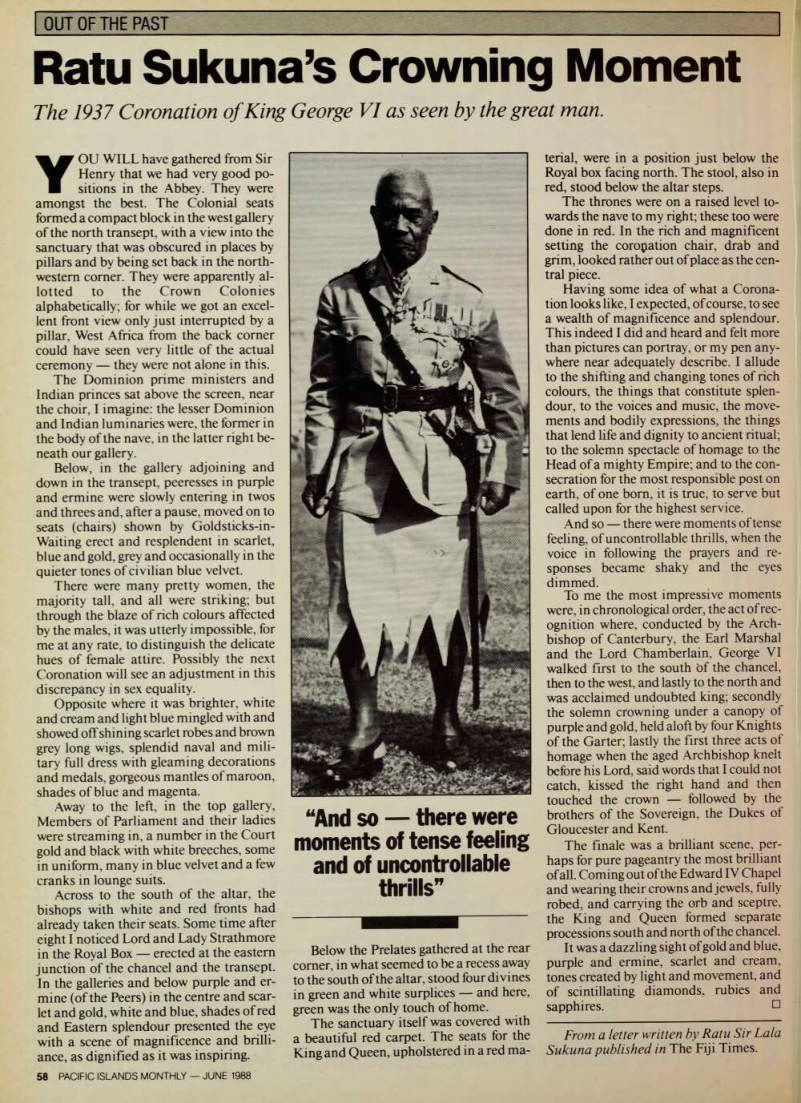
Out Of The Past
The 1937 Coronation of King George VI as seen by the great man.
YOU WILL have gathered from Sir Henry that we had very good po sitions in the Abbey. They were amongst the best. The Colonial seats formed a compact block in the west gallery of the north transept, with a view into the sanctuary that was obscured in places by pillars and by being set back in the north western corner. They were apparently al lotted to the Crown Colonies alphabetically; for while we got an excel lent front view only just interrupted by a pillar, West Africa from the back comer could have seen very little of the actual ceremony they were not alone in this.
The Dominion prime ministers and Indian princes sat above the screen, near the choir, I imagine: the lesser Dominion and Indian luminaries were, the former in the body of the nave, in the latter right be neath our gallery.
Below, in the gallery adjoining and down in the transept, peeresses in purple and ermine were slowly entering in twos and threes and, after a pause, moved on to seals (chairs) shown by Goldsticks-in- Waiting erect and resplendent in scarlet, blue and gold, grey and occasionally in the quieter tones of civilian blue velvet.
There were many pretty women, the majority tall, and all were striking; but through the blaze of rich colours affected by the males, it was utterly impossible, for me at any rate, to distinguish the delicate hues of female attire. Possibly the next Coronation will see an adjustment in this discrepancy in sex equality.
Opposite where it was brighter, white and cream and light blue mingled with and showed off shining scarlet robes and brown grey long wigs, splendid naval and mili tary full dress with gleaming decorations and medals, gorgeous mantles of maroon, shades of blue and magenta.
Away to the left, in the top gallery, Members of Parliament and their ladies were streaming in, a number in the Court gold and black with white breeches, some in uniform, many in blue velvet and a few cranks in lounge suits.
Across to the south of the altar, the bishops with white and red fronts had already taken their seats. Some time after eight I noticed Lord and Lady Strathmore in the Royal Box erected at the eastern junction of the chancel and the transept.
In the galleries and below purple and er mine (of the Peers) in the centre and scar let and gold, white and blue, shades of red and Eastern splendour presented the eye with a scene of magnificence and brilli ance, as dignified as it was inspiring.
Below the Prelates gathered at the rear comer, in what seemed to be a recess away to the south of the altar, stood four divines in green and white surplices and here, green was the only touch of home.
The sanctuary itself was covered with a beautiful red carpet. The seats for the King and Queen, upholstered in a red ma
terial, were in a position just below the Royal box facing north. The stool, also in red, stood below the altar steps.
The thrones were on a raised level to wards the nave to my right; these too were done in red. In the rich and magnificent setting the coronation chair, drab and grim, looked rather out of place as the cen tral piece.
Having some idea of what a Corona tion looks like, I expected, of course, to see a wealth of magnificence and splendour.
This indeed I did and heard and felt more than pictures can portray, or my pen any where near adequately describe. I allude to the shifting and changing tones of rich colours, the things that constitute splen dour, to the voices and music, the move ments and bodily expressions, the things that lend life and dignity to ancient ritual; to the solemn spectacle of homage to the Head of a mighty Empire; and to the con secration for the most responsible post on earth, of one bom, it is true, to serve but called upon for the highest service.
And so there were moments of tense feeling, of uncontrollable thrills, when the voice in following the prayers and re sponses became shaky and the eyes dimmed.
To me the most impressive moments were, in chronological order, the act of rec ognition where, conducted by the Arch bishop of Canterbury, the Earl Marshal and the Lord Chamberlain, George VI walked first to the south of the chancel, then to the west, and lastly to the north and was acclaimed undoubted king; secondly the solemn crowning under a canopy of purple and gold, held aloft by four Knights of the Garter; lastly the first three acts of homage when the aged Archbishop knelt before his Lord, said words that I could not catch, kissed the right hand and then touched the crown followed by the brothers of the Sovereign, the Dukes of Gloucester and Kent.
The finale was a brilliant scene, per haps for pure pageantry the most brilliant of all. Coming out of the Edward IV Chapel and wearing their crowns and jewels, fully robed, and carrying the orb and sceptre, the King and Queen formed separate processions south and north of the chancel.
It was a dazzling sight of gold and blue, purple and ermine, scarlet and cream, tones created by light and movement, and of scintillating diamonds, rubies and sapphires. D
From a letter written by Ratu Sir Lala Sukuna published in The Fiji Times.
“And so - there were moments of tense feeling and of uncontrollable thrills”
Advertisements & other items, pp. 59-60 (1 item)
anyhow
have a Winfield he* 1 ™ smoking wanning
On all frontiers
Far from the everyday world, Mitsubishi vehicles are working on the edges of the unknown.
On the frontiers of civilization, the Pajero, proving levels of stamina in harsh desert climates. On all frontiers, Mitsubishi vehi- On the frontiers of science, it is the highspeed research vehicle, the Galant HSR, testing the limits of control at over 320km/h. i cles are pushing forward the boundaries of technology.
It is this rigorous scrutiny under abnormal conditions that produces superior motor cars. For like much innovative technology, Mitsubishi vehicles are the product of a desire to understand the unknown, forged in the vibrant pioneering environment that makes up all frontiers.
Mitsubishi Motors is now offering a free 36-page PR magazine featuring interesting articles and exciting photos. If interested, write to: P.l. Advertising, International Business Planning Department, Office of International Business, Mitsubishi Motors Corporation, 33-8, Shiba 5-chome, Minato-ku, Tokyo 108, Japan.
AMERICAN SAMOA- MORRIS SCANLAN SERVICE INC. P.O. Box 367, Pago Pago, Tel. 633-5520/AUSTRALIA: MITSUBISHI MOTORS AUSTRALIA LTD. Box 1284, South Road, Clovelly Park, South Australia 5042, Tel. (08) 275-7223/FIJI: NIVIS MOTOR & MACHINERY CO., LTD. G.P.O. Box 150, Suva, Tel. 383411 / FRENCH POLYNESIA (TAHITI)- ETS-BREDIN FRERES ET FILS PO Box 21, Papeete, Tahiti, Tel. 4-202-58/NEW CALEDONIA: SOCIETE D IMPORTATION D'AUTO DU PACIFIQUE SUD SA.
B.P 438 Rond Point du Pacifique, Noumea, Tel. 274144/NEW ZEALAND: MITSUBISHI MOTORS NEW ZEALAND LTD, Todd Park, Heriot Drive, Private Bag, Ponrua, Tel. 370-109/NORFOLK ISLAND: BORRYS LTD. P.O. Box 169, Norfolk Island, Tel. 2114/PAPUA NEW GUINEA: TOBA PTY. LTD. P O Box 503, Port Moresby, Tel 21-7874/ SOLOMON ISLANDS: HARVEST PACIFIC LTD. G.P.O. Box 88, Honiara, Guadalcanal, Tel. 30128/TONGA: SITANI MAPI CO., LTD. P.O. Box 83, Nuku’ALOFA, Tel. 21-044/ VANUATU: SOCOMETRA B.P 06 Routede Lagon, Port-Vila, Tel. 2314/WESTERN SAMOA: A.M. MACDONALD HOLDINGS LTD. P.O. Box 576, Apia, Tel. 22022/SAIPAN/ POHNPEI/MAJURO/KOSRAE/TRUK/YAP/BELAU: MICRONESIAN MOTORS, INC. 997 South Marine Drive, Tamuning, Guam 96911, Tel. 646-6827 A
MITSUBISHI
MOTORS