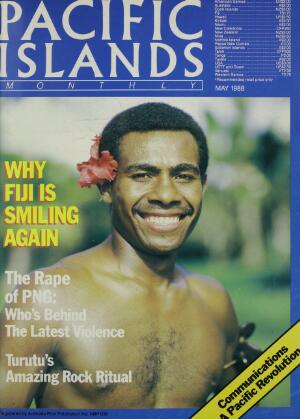
Pacific



Islands
Monthly
American Samoa Übs2.oo Australia . A 52.00 Cook Islands NZS3.OO Fiji F 51.75 Hawaii USS2.SO Kiribati A 52.00 Nauru A 52.00 New Caledonia CFP2SO New Zealand NZS3.OO Niue NZS2.SO Norfolk Island A 52.00 Papua New Guinea K 2.00 Solomon Islands 552.00 Tahiti CFP3OO Tonga P 2.00 Tuvalu A 52.00
Usa Uss3.Oo
USTT and Guam USS2.SO Vanuatu VT2.00 Western Samoa T 2.75 ♦Recommended retail price only
May 1988
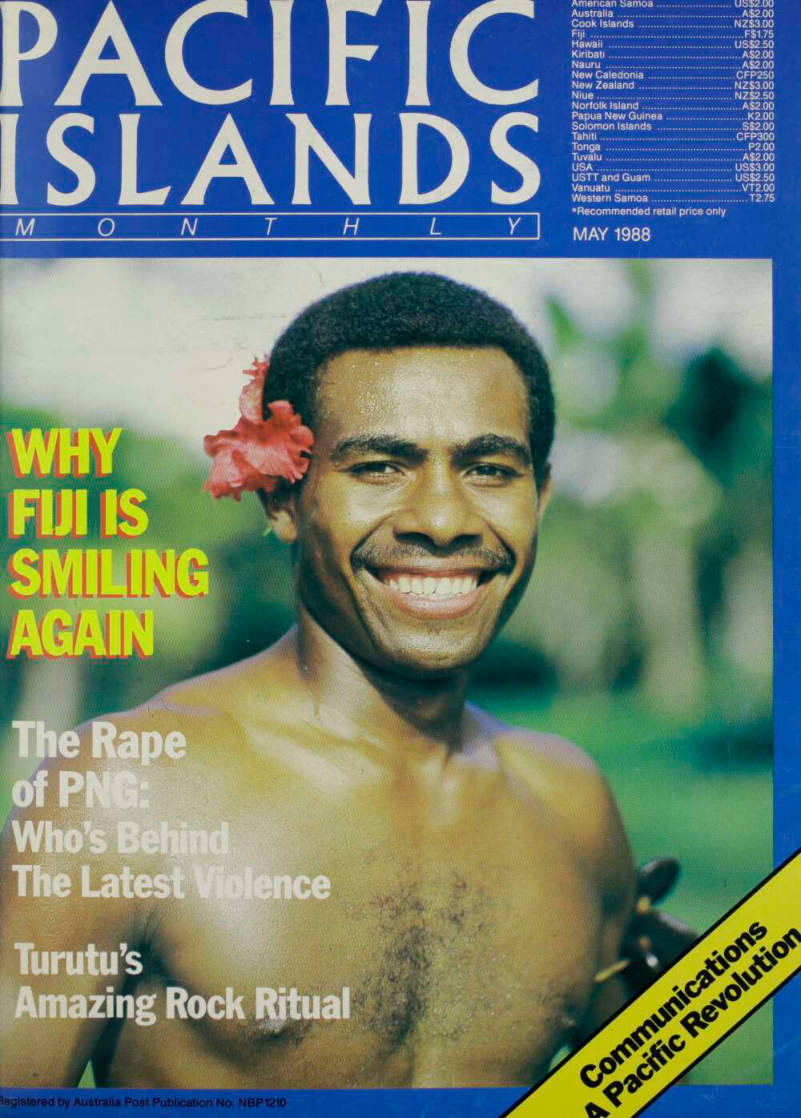
Why”
runs in
Amazing Rock Ritual
Cover Story 32
COVER PORTRAIT: Australian Picture Library
Advertisements & other items, pp. 2-4 (1 item)
It’s your turn.
Take it, with the
advantage of Mazda’s
unique rear wheel
control technology.
Whether it’s a hairpin turn, a winding turn, or for that matter, a high-speed lane change, the new Mazda 626 imparts a feeling of freedom and confidence. A feeling born of Mazda’s long search for the ultimate in rear wheel control technology.
The ultimate; those are pretty strong words to use. But then, words like that have been used by automotive experts and drivers around the world to describe the Mazda 626 and the unique feeling its rear suspension delivers.
What’s behind it all.
The reason is that for quite some time now Mazda has been concentrating on developing rear suspension systems that actually help steer the car. It started with the award winning TTL suspension found! on the 323 and the original 626.
The search for the ultimate
mtinued with the development of 4-Wheel Steering system. What e learned in that search was applied »the development of our award inning DTS system for the RX-7 id the E-Link suspension for the J 9. This continuous process of finement has come full circle jain to the new 626, and applied its TL suspension. We’ve completely calculated its suspension geometry i deliver a feeling of control that’s clearly superior and absolutely exhilarating.
Keeping on our toes.
It’s Mazda’s unique dedication to engineering the ultimate in rear wheel toe control and suspension technology that has resulted in such enjoyable driving in the Mazda 626.
And in fact, in all Mazda vehicles.
Take one out for yourself and see. And turn on to real driving pleasure.
New Mazda 626 Models and features shown may not be available in your area. Please consult your local Mazda dealer. This warranty is valid only in Australia.
Enter the “Mazda Photo Contest ’B9. ”
For further information, please contact your nearest Mazda dealer. Contest closes on June 30, 1988.
Your kind of car.
mazoa
© Mazda Motor Corporation
ScSc
A
vIk.'^&SSK&S
j^ggo^gt^A- ;
w *a* vW.vV a V a V. m. vV'. %>*" %W
a s3i^3^i3^*w
v.
>Xtv
»''®» w’- -“ * -- *%
tißnsSSlm
mmK/M. II
*_sV J^V
* .*v :*v ?y%* ‘ «*%*• ■*•
P ..' se V‘ ■s^Mf* :
'*'v
■S-im
V ' » ’ * ' * •*• dk^ : «* % < % .s^ a# #> a# \S V r«S * y •*: s > * > » ♦ * * ; - * **■■ * , - >• jf * m 4 ■ k *&\ m % 1 ■: %>k ;- «t '- ; :« : - '■ ■* * k > ■* iijpgj^4fc^* 1 * 1 * « ■■ -> e '; ; jfir * * « * V - \ * S? *v - '«• °-; ‘;ft ®%s. '■S, *' * - -5 ♦. ’^* VV% *>"k ■%»; : %>«- % *<S A *■* K** -%, J - .J= i %*^ ; %%r r *‘ ' S " ' ' % A%f xy? ! .k A. *••*■■ 'l# »•* ..1»
Pacific
Islands
Monthly
Vol 59, No. 5
Voice Of The Pacific
May, 'BB
Business boosts Fiji’s economic recovery: In an exclusive interview, Russell Leitch, president of the Australia Fiji Business Council, is confident of the ability of business to rescue Fiji and restore it to pre-coup prosperity.
Murder, Rape, Robbery 10
Politicians and police are powerless to stop PNG’s crime wave.
Png Parliament
Suspended 12
The implications of Mr Wingti’s controversial move.
Keeping The Language
Alive 14
Archivists record the voices of Vanuatu.
First Maori Bishop Consecrated 16
Pacific church elders gather in New Zealand.
Western Samoa Election 16
The final result.
A Magical Mystery Tour 22
Eleven Tahitians on an Asian Pacific wild goose chase.
New Caledonia Election 22
A preview.
Bavadra Keeps The Flame Alive 23
Exclusive interview with the ousted Fiji leader.
Page 41
Amazing Stone Lifters 24
It’s sport, legend and tradition all in one.
Forum: Palau The Us Angle 26
America slams critics of its Palau policy.
Ratu Mara Speaks Out 35
The Prime Minister gives his nation hope.
Special Report: The Communications
Revolution 41
Communications are zooming the Pacific into the 21st century. Our report looks at this brave new world.
Page 35
Editor Larry Writer Deputy Editor Carson Creagh Art Director Warren Scott Editorial Adviser John Carter Contributors James Murray Nicolas Rothwell Frank Senge Jai Kumar Jack Kelleher Dr Roman Grynberg Ed Rampell James D. Berg Liz Fell Danielle Roberts
Publisher Geraldine Raton Managing Editor Arnold Earnshaw
Advertising Sales Sydney & Melbourne Warren Grey (02) 288 3521 Fergus Maclagan (02) 412 3918; Brisbane Robert Walker (07) 3710533 Adelaide Hastwell Williamson Representations (08) 79 9522
Australian cover price is recommended retail only Registered by Australia Post, publication No. NBP 1210, Copyright Pacific Publications (Aust) Pty Ltd
Advertisements & other items, pp. 5-6 (3 items)
Departments
OPINION 7
LETTERS 8
PACIFIC REPORT 28
TRADE WINDS 38
ISLAND PRESS 51
TRANSITIONS 51
BOOKS 52
SHIPPING SCHEDULES 53
OUT OF THE PAST 58
5
PACIFIC ISLANDS MONTHLY MAY 1988
A Pacific Publications Production.
Founded 1930 (USPS 952480) 64-76 Kippax St, Surry Hills, NSW 2010; Telex: AA20124; Fax; (02)288 3322; Cables; PACPUB Sydney: Telephone: (02) 288 3000.
Pacific Islands Monthly (APPS No.
NBP1210) is published monthly by Pa cific Publications Pty Ltd, a division of Nationwide News, 2 Holt St, Surry Hills, NSW 2010. Second class pos tage paid at Honolulu, Hawaii, POST MASTER. Send address changes to
PACIFIC ISLANDS MONTHLY, PO Box
22250, Honolulu, Hawaii 96822. Ty peset by David Graphics, Sydney, and printed by Progress Press, 2 Keys Rd.
Moorabbin, Victoria.
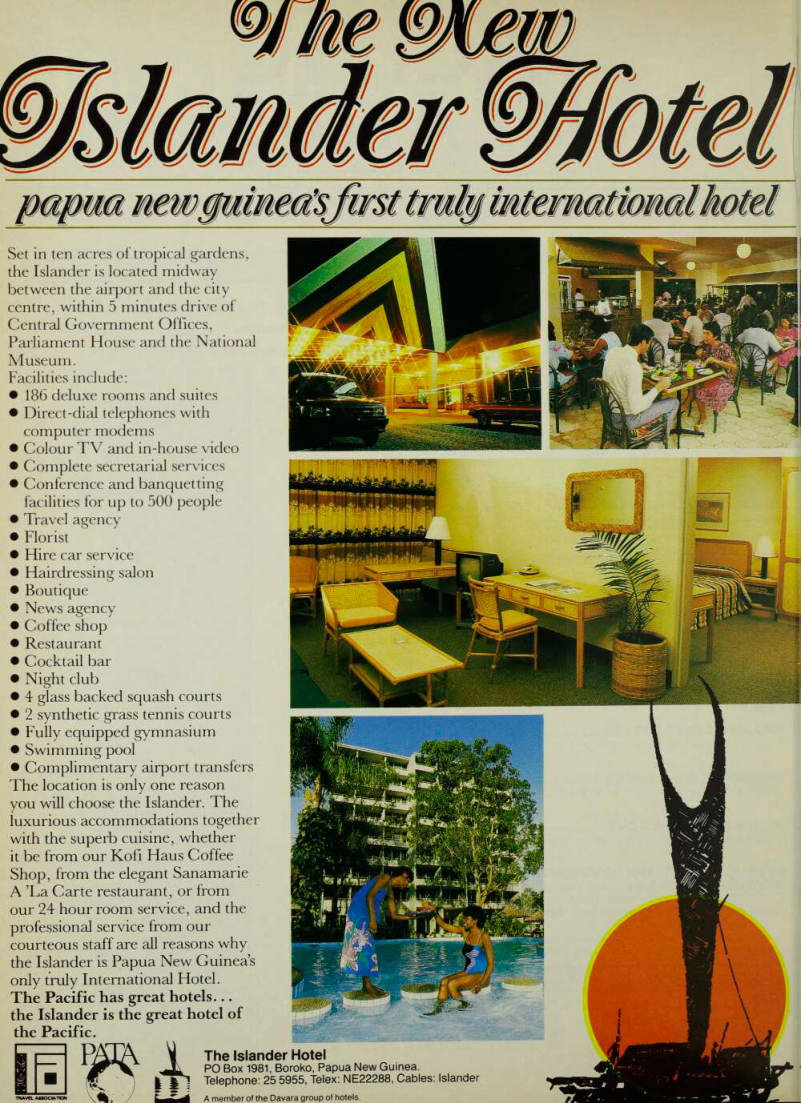
Set in ten acres of tropical gardens,
the Islander is located midway between the airport and the city centre, within 5 minutes drive of Central Government Offices, Parliament House and the National Museum.
Facilities include: • 186 deluxe rooms and suites • Direct-dial telephones with computer modems • Colour TV and in-house video • Complete secretarial services • Conference and banquetting facilities for up to 500 people • Travel agency • Florist • Hire car service • Hairdressing salon
• Boutique
• News agency • Coffee shop • Restaurant • Cocktail bar • Night club • 4 glass backed squash courts • 2 synthetic grass tennis courts
• Fully equipped gymnasium
• Swimming pool
• Complimentary airport transfers
The location is only one reason you will choose the Islander. The luxurious accommodations together with the superb cuisine, whether it be from our Kofi Haus Coffee Shop, from the elegant Sanamarie A ’La Carte restaurant, or from our 24 hour room service, and the professional service from our courteous staff are all reasons why the Islander is Papua New Guinea’s
only truly International Hotel.
The Pacific has great hotels... the Islander is the great hotel of the Pacific.
IK 1 I I € : m The Islander Hotel PO Box 1981, Boroko, Papua New Guinea.
Telephone; 25 5955, Telex: NE22288, Cables; Islander A member of the Davara group of hotels.
Putting People Before Politics
Opinion
Arch-enemies Wingti and Somare’s coalition is PNG’s only hope for unity.
APRIL WAS perhaps PNG’s most momentous month since Independence. It was certainly its most tumultuous. For much of the period, because of a series of political crises, an escalation of lawlessness, and vicious rumours concerning personal improprieties in high places, the nation seemed on the verge of chaos, its institutions in danger of disintegration. The atmos phere in Port Moresby was electric as public faith in the powers of government and the motives of the country’s leaders reached a nadir.
As this parlous situation came to a head the Prime Minister Paias Wingti and the leader of the opposition Pangu Pati Michael Somare on April 20 made a stunning announcement. They would join forces in a grand coali tion. The move was met with scepticism at first. The one time firm friends had become implacable foes. But scep ticism was soon replaced by the realisation that the alli ance of the PNG giants may well be the nation’s only hope of stability.
On April 11, Parliament resumed for the first time in seven months. Two and a half hours later it was sus pended. In so doing, Mr Wingti had defused a vote of no confidence in him that seemed likely to succeed. Mr Ted Diro was then named Special Minister of State assisting the Prime Minister. The opposition cried “dictatorship”.
The credibility of Mr Wingti was in tatters. The Govern ment was hopelessly divided.
Most of the blame for this untenable situation must be sheeted home to the disruptive and destabilising Mr Diro and his People’s Action Party (PAP). Although corruption allegations against him remained unresolved, Mr Diro had continued in a naked bid for power, seemingly without regard for the damage he was doing to the Government and the nation.
Thirty minutes before Parliament resumed on April 11, Mr Diro is understood to have handed Mr Wingti a list of non-negotiable demands. Failure to grant them, he warned, would result in the PAP defecting to the opposi tion to topple the Government. The demands were as ar rogant as they were unrealistic: the appointment of Mr Diro as Special Minister of State by 11.30 that morning; his appointment as Deputy Prime Minister within one month; PAP ministries in the Government be increased from five to seven, and include the portfolios of Foreign Affairs and Finance and Planning; the Commission of In quiry into the Forest Industry be scrapped.
Mr Wingti, it is understood, acceded to these de mands, appointing Mr Diro Special Minister of State and adjourning Parliament.
In the days that followed, according to sources close to the severely compromised PM, Mr Wingti underwent a crisis of conscience as well he might. After some sleep less nights, he decided to put paid to Diro’s destabilising influence by getting into bed with Mr Somare in what at first seemed a blatant marriage of convenience. This new grand coalition (which includes the Peoples’ Progress Party of Sir Julius Chan) does not need the PAP for a ma
jority, and its formation therefore skittled the obnoxious ambitions of Mr Diro.
Mr Wingti and Mr Somare say their alliance will re store stability and provide the means whereby the issues that have rent PNG may be addressed and solved. The pair have pledged to put egos and personal animosity aside in the interest of the nation. They must now tackle the problems of lawlessness, media censorship, misbehav iour and corruption in high places, impediments to the rural development program and the crisis in education.
PNG’s neighbours have no choice but to wish the new administration well and to support it so long as the lead ers stay true to their promise to put the nation before their own factional interests. Events will move rapidly over the coming weeks and no one can predict the detailed form of PNG’s new Government. Although composed of odd bedfellows indeed, it may well be the only hope for a coun try desperately in need of unity. □
Fiji Back In Business
THE GUARDED optimism of Mr Russell Leitch, president of the Australia Fiji Business Council, is an accurate reflection of the feelings of all of Fiji’s friends and business partners. The essence of Mr Leitch’s message to Fiji (see our story on Page 32) is this: “There are many problems still unsolved, but you have splendid resources, a strong and willing workforce, sugar is in good shape, the tourists are trickling back ... now is the best time you’ll have to recover”. Clearly, these are all reasons why smiles are at last returning to Fijian faces.
But Mr Leitch knows the battle to return Fiji to pre coup levels of prosperity is far from won. Rather, the opening shots have just been fired. He is under no illu sions. Nor is Ratu Sir Kamisese Mara, Fiji’s Prime Min ister. In his ringing address to the nation (which we publish on Page 35) he, while brimming with confidence over Fi ji’s potential for recovery, does not try to sweep the prob lems of his country under the carpet. Lingering racial bitterness, the brain drain, the country’s tourist image and many other bugbears all have to be put to rights.
This frank message was also the theme of his talks with political leaders in Great Britain and France. Ratu Mara’s honesty is, to many, every bit as encouraging as rising trade and tourism figures. It signifies that the polemical and pie-in-the-sky rhetoric that has riddled many Fijian lead ers’ public utterances since the May 14,1987, coup has been assigned to the same scrap heap where today rust the dis credited revisionist dreams of the Taukei.
There is no place for false and unrealistic hopes in post coup Fiji. The situation is far too serious. And those run ning the nation know it. They also know that Fiji’s only chance is for everyone indigenous Fijian, Indian Fi jian, neighbours and allies to work together long, hard and harmoniously for the greater good of the Republic. □
Letters
Tourist Outrage
From The Times of PNG March 10-16, 1988 AS EIGHT visitors to PNG who were robbed between Baiyer River and Mt Hagen last week an event that went unreported in this coun try’s newspapers, like many other tourist victim crimes we are forced to answer “no” to the question, “Does PNG reason ably ensure the safety of its tourists?”
PNG’s greatest tourist attractions its rural scenery and peoples increasingly cannot be visited without worry of some crime being perpetrated. Yet while such guaranteed popular tourist spots such as the Baiyer River Sanctuary are ignored, the Government proposes a nearly K 1 million expenditure for Moresby’s Sea World, which offers a tourist attraction that both Australian and American tourists can view in their own lands at less cost. Is it any wonder that we can question the priorities in tourism related expenditure?
In the past week, we have experienced or learned: (1) the fear of being attacked by a dozen bandits armed with shotguns, rifles and semi-automatics, some with previous criminal records; (2) the indis putable assurance from a Mt Hagen po liceman that the road was safe and that we needed no police escort; (3) the finding from police reports that other robberies had taken place on that road only three days before our visit; (4) the loss and dam age of more than K7OOO worth of our property, much of it not insured; and (5) the finding that attacks on tourists are not rare, occur in many parts of PNG, both in cities and in rural areas, and sometimes produce far greater humiliation and harm than what we experienced.
Contemplating all these facts, we spent our last days in PNG in the recognition that tourists are not safe here, that the com pensation opportunities that PNG clans can use are not open to us, and that the criminals will usually remain free to con tinue their crimes.
Are these problems due to the budget?
Hardly. It would cost toea to post tourist advisories at the entrance to police sta tions, to override unknowledgeable police officers. It would cost far less than the ri diculous K 1 million Sea World proposed expenditure to conduct police escorts to all the proven tourist attractions.
Most of us leave this country with many newfound wantoks and the recognition that PNG has some of the world’s frien dliest people. But even these people have told us that nothing constructive is being done to protect tourists, and whatever we could do to warn other potential tourists even if it hurts PNG’s tourism industry should be done.
Clearly, tourists to this country are not going to receive reasonable guarantees of
their safety. We say enough is enough, and since the Government will not do any thing about this intolerable situation we will act. Until tourist safety can be guar anteed, potential visitors must be warned of PNG’s dangers.
On returning home, and armed with newspaper and police on past tourist crimes, we will approach the travel agency associations in the US and Australia and their respective embassies. It is time that official travel advisories were issued for this country. The PNG Government has complete freedom of choice in choosing whether it wants overseas visitors, but if it does, greater responsibility for their safety must be taken.
Since the Government has not taken action, we will.
Angry Tourists
Nicolaus Stephens Durham, California Larry Orsak Orange, California Joseph Somp Wau, PNG June Myles New York, NY Jack DeLong Lakewood, Colorado Thomas McNeill Valencia, California Jerry & Marjorie Ewers Denver, Colorado Greg Bachman Valencia, California
Kava The Real Story
IT WAS both pleasant and encouraging to read Nicolas Roth well’s article, “Kava: A Pacific Ritual” {(Pacific Is lands Monthly, February, 1988). Pleasant because it makes a welcome change to the negative media coverage kava has been re ceiving in recent years; and encouraging because at last the true story of kava per se is coming out in black and white.
And there is a lot of subtle but mean ingful authentic information about Vanu atu kava in the article that should be taken careful note of. Kava may be a Pacific pur suit at present but it is a commodity with a future whose potential is yet to be tapped.
But perhaps for one to fully appreciate it one needs to come in contact with it first hand, as Mr Rothwell has.
Meto Nganga General Manager Vanuatu Commodities Marketing Board
Advertisements & other items, pp. 8-9 (1 item)
Pacific
SLANDS
[MONTH l y~ I
FIJI: Distribution and subscriptions: Desai Bookshops, PO Box 160, Suva, Fiji. Phone Suva 23036.
Advertising: Fiji Times & Herald Ltd, 20 Gordon St., Suva, Phone 31-4111, telex FJ2124.
FRENCH POLYNESIA: Distribution; Hachette Pacifique 10 Ave., Bruat, Papeete. Phone 25-610.
HAWAII; UNITED STATES: Distribution: PIM, Hawaii, PO Box 22250, Honolulu, Hawaii, 96822. Advertising: Brian C Asgill, Apt. 1308,1676 Ala Moana Blvd., Honolulu, Hawaii, 96815. Phone (808) 955-9718.
JAPAN: Advertising and subscriptions: Universal Media Corporation, GPO Box 46, Tokyo. Phone 666-3036, cable UNIMEDIA Tokyo, telex 2524665.
MALAYSIA: Advertising and subscriptions: Worldwide Media Services, 57-B Komplex Damai, Jin Dato Haji Eusoff, Kuala Lumpur. Phone 63-9340, cables WORLDMED1A Kuala Lumpur, telex 31533.
VANUATU: Distribution; The Vanuatu Stationery and Book Centre, PO Box 557 Port Vila. Advertising: Norman Bros. Bookshop. Port Vila Phone 2232.
NEW CALEDONIA: Distribution: Depot Centre de Presse Michel Pentecost. CBP2, Noumea. Phone 27- 2434, 27-4729.
NEW ZEALAND: Distribution: Gordon & Gotch, PO Box 584, 2 Carr Road, Mt Roskill, Auckland 4 Advertising: McKay International Media Reps Ltd, C/- Albany PO, Auckland 10, New Zealand. Phone 413-9119.
Telex NZ22701, FAX 413-9110.
WELLINGTON: Ross Quaid Media, 1 Scholes Ln., Petone. (04) 68-7593, PO Box 38699, Petone.
PAPUA NEW GUINEA: Distribution: Gordon & Gotch, PO Box 3395, Port Moresby. Phone 25-4551, 25-4855.
Advertising: Ken Head, PNG Post-Courier, PO Box 85, Port Moresby. Phone 21-2577, telex 22120.
SOLOMON ISLANDS: Distribution and Advertising; The Bookshop, (Norman Bros.) PO Box 503, Honiara.
PHILIPPINES; Advertising: The GF Group, 12 San Ignacio St,, Uroaneta Village, Makati, Metro Manila. Phone 817-7299, telex 45950 and 4233.
UNITED KINGDOM F A Smyth and Associates, 23A Aylmer Parade, London NZOPO, England. Phone (01)340 5088, fax (01)341 9602.
UNITED STATES MAINLAND: Advertising: Joshua B Powers Jr,, Powers International Inc., Suite 708, 271 Madison Ave., New York, NY 10016. Phone 867-9580, Subscriptions: PIM, Hawaii, PO Box 22250, Honolulu.
Hawaii, 96822.
SUBSCRIPTIONS
American Samoa...
Australia Canada Cook Islands Fiji French Polynesia ..
Guam Hawaii Japan Kiribati Micronesia Nauru New Caledonia New Zealand Niue Norfolk Island Northern Marianas Papua New Guinea Solomon Islands ...
Tonga Tuvalu United Kingdom ...
US (Mainland) Vanuatu Western Samoa ...
Elsewhere ...US$45
AUSS24
...US$45
AUS$46
AUS$46
...US$45 ...US$45 ...US$45 ...US$38
AUS$46
...US$35
,AUS$42
...US$32
AUS$42
.AUS$46
AUS$42
...US$36
AUS$42
.AUS$46
AUS$46
AUS$46
,.Stg£28 ...US$45
AUS$42
,AUS$60
AUS$63
Payments to Pacific Islands Monthly: Subscriptions Dept, GPO Box 5223BB, Melbourne 3001, Australia Subscriptions rates includes the cost of airspeeding to all destinations set out above. Direct airmail rates on application.
Uur tamily sports
quite 9 racVsamats
iP ji/ I - - ■ Is getting things from A to B, when and how you want them, an important part of your business?
Then no doubt you will agree that finding the efficient and relevant services can be very frustrating.
That is why RLC have a family of divisions. These are designed to cover
. 1 UCMgIICU LU LUVCI
every aspect of the logistical our family.
A member of the P&O Group nightmares involved in
relocating equipment,
supplies and products
whether by air, land or sea.
With over twenty years of experience in Papua New Guinea RLC, a member of the P&O family, can say with confidence leave it to Robert Laurie Company Pty Limited Stevedoring Import Export Services Trucking & Transport Ships Agency Special Projects
Murder, Rape, Robbery
Crime Wave Engulfs PNG
Police and politicians stand by helplessly as an escalation of lawlessness terrifies a nation. By Frank Senge in Port Moresby
SEVENTH Day Adventist Pastor Peter Knopper, 32, of Perth, Aus tralia, was used to crime and crim inals. Since arriving in Papua New Guinea in 1985 he had lived and worked among people who accepted crime as a normal part of their lives. Pastor Knopper was very aware that even as a man of God, there was always a chance he could become a victim of crime. But he liked his calling. He wrote to his Pastor father saying: “My life and work here is everything I’ve ever imag ined it to be. I’m enjoying every moment of it and I plan to stay on for 10 years.”
It was not to be. On the evening of Wednesday, March 16, a man shot him at point-blank range as the pastor was re turning from his generator house. Nine shotgun pellets entered his face and head.
Sherry Knopper found her husband lying in a pool of blood, unconscious. He died on the way to the hospital.
Before Pastor Knopper’s body was flown out, more than 3000 Gorokans gathered to mourn his death and to con tribute cash to his wife and parents who flew up to take his body home to Australia.
As was demonstrated by the many mourners, most people in PNG, as else where, are peace-loving. They don’t like crime. As one rape victim put it: “The ma jority of the people are good. Only one per cent are freaks.”
That one per cent represents a stark and growing problem in PNG. The country’s public image is tainted. People are killed or maimed and ruined. Foreign invest ment is stayed. Tourism is retarded: what traveller wants to put his or her life at risk?
Each day the newspapers are full of news of riots, murder, robbery and rape.
The Wednesday before Pastor Knopper was shot, masked men held up five tour ists and three nationals returning from the popular Baiyer River Bird Sanctuary. The thieves ran off with Kl6OO worth of prop erty. Those tourists were lucky: they had prompt police help. But others have writ ten blistering letters to newspapers around the world describing their dangerous and bitter experiences in Papua New Guinea (see Letters, page 8).
PNG’s Culture and Tourism Minister Albert Karo is worried. “Tourism will def initely be effected by problems associated with law and order, particularly when tourists themselves are attacked or robbed
of their possessions,” he says.
In the immediate term Mr Karo wants tour operators, embassies and consuls to inform tourists of the problems they may face in PNG and to advise them to take precautions.
The US State Department, in fact, has already advised its citizens to take care. Its warning reads: “The Department of State advises US citizens that there is a contin uing crime problem in rural and urban areas of PNG. Individuals are advised not to travel alone into rural areas.
The PNG Chamber of Commerce and Industry warns visitors and intending res idents that the country is “experiencing a serious law and order problem created by both social and economic factors.”
From the national point of view, no place seems safe from criminals. Western Highlands province, the heart of the lu crative coffee industry; Lae, the commer cial centre; Madang, the tourist destination; Rabaul, the cocoa and copra port; Arawa, home of Bougainville Cop per; and Port Moresby, the capital, are all hotbeds of lawlessness.
The hard-core criminal is no respecter of the famous, the high office holder or the handicapped. A knight and former Gov ernor-General, Sir Tore Lokoloko, was robbed in broad daylight while playing golf. Prime Minister Paias Wingti nar rowly escaped being robbed while at a friend’s house. In 1987, criminals broke into the Cheshire Home for Handicapped Children but were chased away. In 1985 a deaf woman was pack raped.
To curb crime, a curfew was imposed in 1985 in Port Moresby and anti-criminal paramilitary operations have been carried out in Lae and the Western Highlands more than once. In Rabaul and Lae, frus trated and angry residents have formed vi olent vigilante groups that have sometimes caused more harm than the criminals themselves.
The tourist destinations of Madang and Wewak along the north coast of the New Guinea mainland have on many occa sions virtually been held under siege by armed criminals.
In March this year, the North Solo mons provincial Government declared the province a trouble zone and began “Op eresen Mekim Save” (“teach them a les son”). Police mobile squads literally razed everything in trouble areas to the ground.
“Operesen Mekim Save” has been brought to bear on Enga and the Southern High lands provinces as well.
Police action, however, has often had negative effects. On two occasions parlia mentarians from Enga and the Southern Highlands electorates raided by the police complained of brutality and even rape and succeeded in having the police operations investigated.
No parliament sitting is concluded without mention of law and order. Indeed, the topic is often the main subject for de bate. Parliament and cabinet have consid ered solutions ranging from the death penalty, public flogging and castration to asking for Australian and New Zealand soldiers to be brought in to control crime.
Attempts at setting policy and pro grams to overcome the law and order problem have taken much of consecutive governments’ time, energy and money.
Each year there have been reports, sub missions, papers, seminars and expert opinions offered on the crisis at the ex pense of private organisations and the tax payer; but the problem only grows worse.
Crime figures cited in the 1984 Wil liam Clifford, Louise Morauta and Barry
Stuart report on law and order show that there were 44 murders and attempted murders in 1976 and 274 in 1983, an in crease of 523 per cent; rape and attempted rape rose from 102 to 465 for the same period an increase of 356 per cent; and assault rose 233 per cent for the period.
Dangerous driving resulting in death has risen 1917 per cent between 1976 and 1982.
In February, a resident sociologist Bruce M Harris released his two-year study on criminal gangs in PNG through the In stitute of Applied Social and Economic Research (lASER).
Harris confirms that the police force is only as effective now as it was 10 years ago, while gangs and criminals have become increasingly sophisticated. (In 1985, the then Police Commissioner, David Tasion, went further. He admitted his force had deteriorated since 1978.) Harris says that today’s gangs are “ef ficient organisations, which operate with little fear of apprehension”. An estimated five per cent of stolen property is re covered and just one in 30 break and en ters and one in 15 stolen vehicles result in arrests. About 40 houses are broken into every night in Port Moresby.
PNG Police Commissioner Paul To hian discounts Mr Harris’ statistics as in accurate, but admits that Harris’ three possible crime scenarios give much food for thought.
Harris refers to the “Organised Crime ►
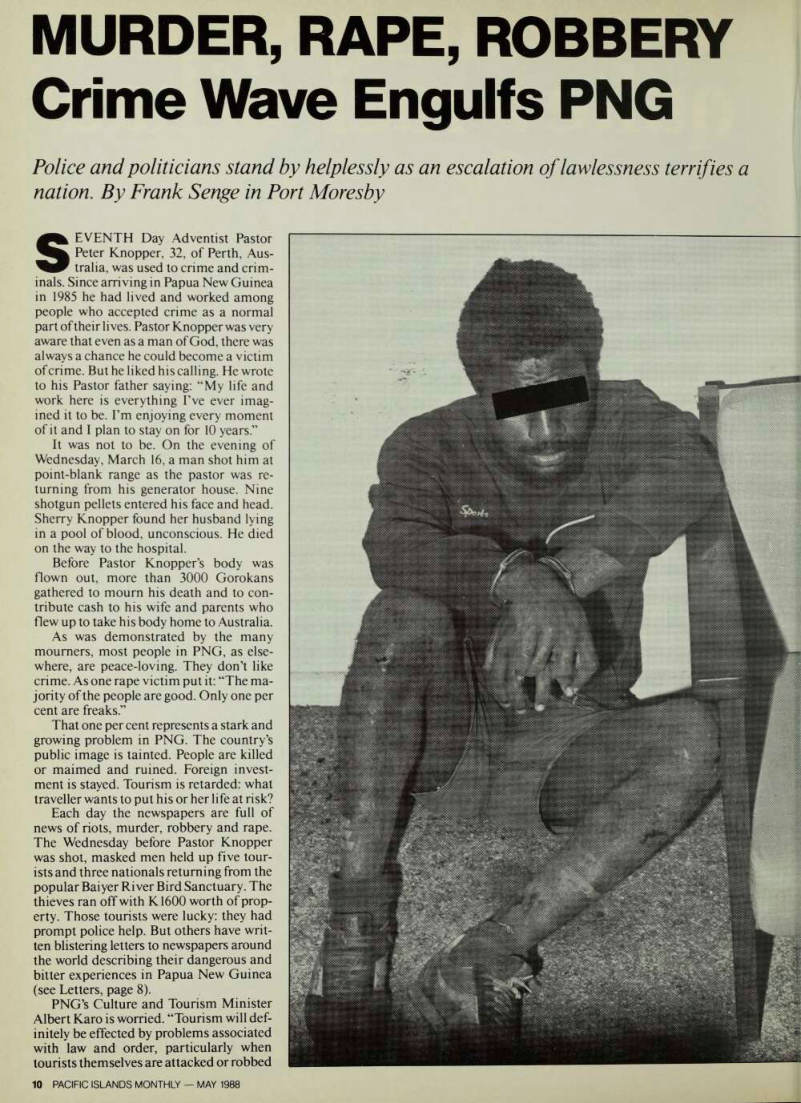
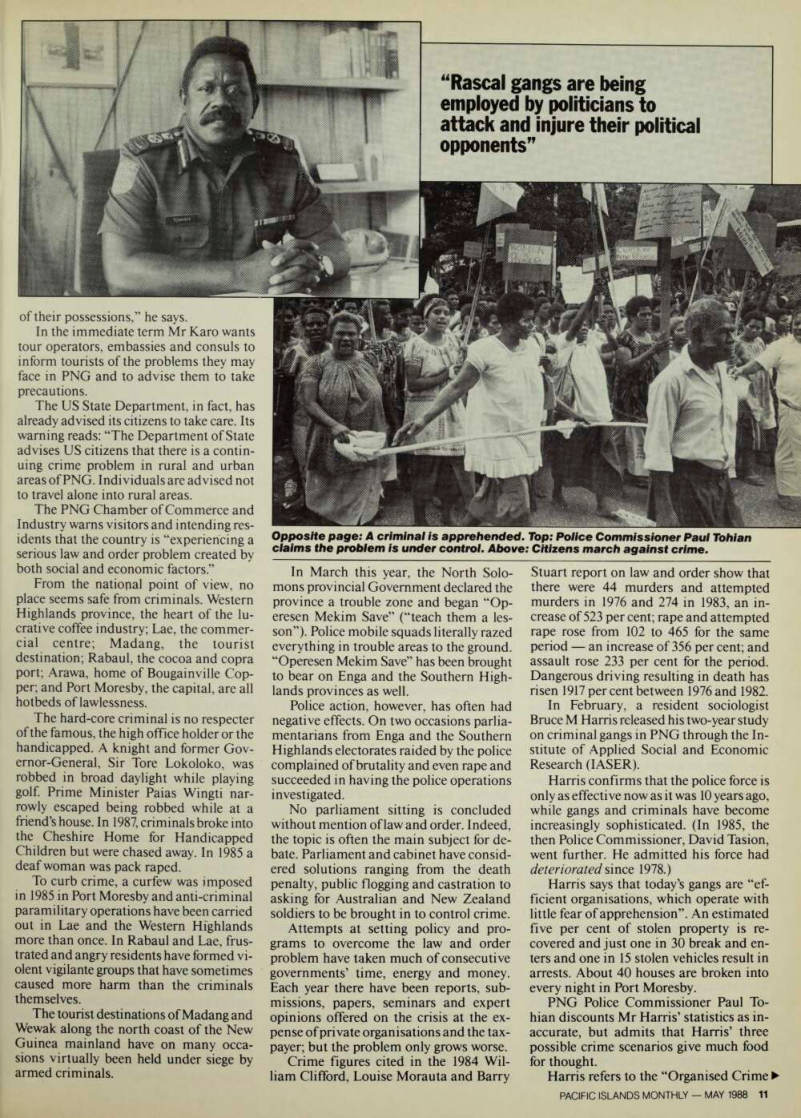
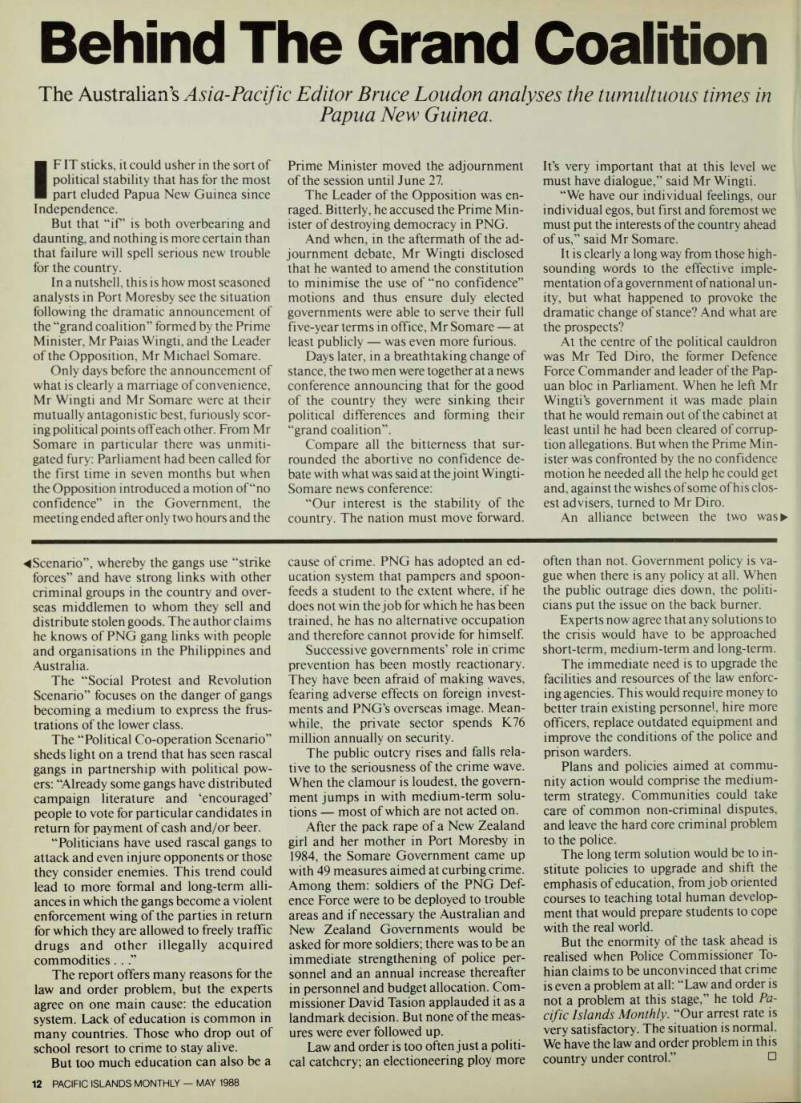
Opposite page: A criminal is apprehended. Top: Police Commissioner Paul Tohian claims the problem is under control. Above: Citizens march against crime.
“Rascal gangs are being employed by politicians to attack and injure their political opponents”
◄Scenario”, whereby the gangs use “strike forces” and have strong links with other criminal groups in the country and over seas middlemen to whom they sell and distribute stolen goods. The author claims he knows of PNG gang links with people and organisations in the Philippines and Australia.
The “Social Protest and Revolution Scenario” focuses on the danger of gangs becoming a medium to express the frus trations of the lower class.
The “Political Co-operation Scenario” sheds light on a trend that has seen rascal gangs in partnership with political pow ers: “Already some gangs have distributed campaign literature and ‘encouraged’ people to vote for particular candidates in return for payment of cash and/or beer.
“Politicians have used rascal gangs to attack and even injure opponents or those they consider enemies. This trend could lead to more formal and long-term alli ances in which the gangs become a violent enforcement wing of the parties in return for which they are allowed to freely traffic drugs and other illegally acquired commodities. ..”
The report offers many reasons for the law and order problem, but the experts agree on one main cause: the education system. Lack of education is common in many countries. Those who drop out of school resort to crime to stay alive.
But too much education can also be a
cause of crime. PNG has adopted an ed ucation system that pampers and spoon feeds a student to the extent where, if he does not win the job for which he has been trained, he has no alternative occupation and therefore cannot provide for himself.
Successive governments’ role in crime prevention has been mostly reactionary.
They have been afraid of making waves, fearing adverse effects on foreign invest ments and PNG’s overseas image. Mean while, the private sector spends K 76 million annually on security.
The public outcry rises and falls rela tive to the seriousness of the crime wave.
When the clamour is loudest, the govern ment jumps in with medium-term solu tions most of which are not acted on.
After the pack rape of a New Zealand girl and her mother in Port Moresby in 1984, the Somare Government came up with 49 measures aimed at curbing crime.
Among them: soldiers of the PNG Def ence Force were to be deployed to trouble areas and if necessary the Australian and New Zealand Governments would be asked for more soldiers; there was to be an immediate strengthening of police per sonnel and an annual increase thereafter in personnel and budget allocation. Com missioner David Tasion applauded it as a landmark decision. But none of the meas ures were ever followed up.
Law and order is too often just a politi cal catchcry; an electioneering ploy more
often than not. Government policy is va gue when there is any policy at all. When the public outrage dies down, the politi cians put the issue on the back burner.
Experts now agree that any solutions to the crisis would have to be approached short-term, medium-term and long-term.
The immediate need is to upgrade the facilities and resources of the law enforc ing agencies. This would require money to better train existing personnel, hire more officers, replace outdated equipment and improve the conditions of the police and prison warders.
Plans and policies aimed at commu nity action would comprise the medium term strategy. Communities could take care of common non-criminal disputes, and leave the hard core criminal problem to the police.
The long term solution would be to in stitute policies to upgrade and shift the emphasis of education, from job oriented courses to teaching total human develop ment that would prepare students to cope with the real world.
But the enormity of the task ahead is realised when Police Commissioner To hian claims to be unconvinced that crime is even a problem at all: “Law and order is not a problem at this stage,” he told Pa cific Islands Monthly. “Our arrest rate is very satisfactory. The situation is normal.
We have the law and order problem in this country under control.” □
Behind The Grand Coalition
The Australian’s Asia-Pacific Editor Bruce Loudon analyses the tumultuous times in Papua New Guinea.
IF IT sticks, it could usher in the sort of political stability that has for the most part eluded Papua New Guinea since Independence.
But that “if’ is both overbearing and daunting, and nothing is more certain than that failure will spell serious new trouble for the country.
In a nutshell, this is how most seasoned analysts in Port Moresby see the situation following the dramatic announcement of the “grand coalition” formed by the Prime Minister, Mr Paias Wingti, and the Leader of the Opposition, Mr Michael Somare.
Only days before the announcement of what is clearly a marriage of convenience, Mr Wingti and Mr Somare were at their mutually antagonistic best, furiously scor ing political points off each other. From Mr Somare in particular there was unmiti gated fury: Parliament had been called for the first time in seven months but when the Opposition introduced a motion of “no confidence” in the Government, the meeting ended after only two hours and the
Prime Minister moved the adjournment of the session until June 27.
The Leader of the Opposition was en raged. Bitterly, he accused the Prime Min ister of destroying democracy in PNG.
And when, in the aftermath of the ad journment debate, Mr Wingti disclosed that he wanted to amend the constitution to minimise the use of “no confidence” motions and thus ensure duly elected governments were able to serve their full five-year terms in office, Mr Somare at least publicly was even more furious.
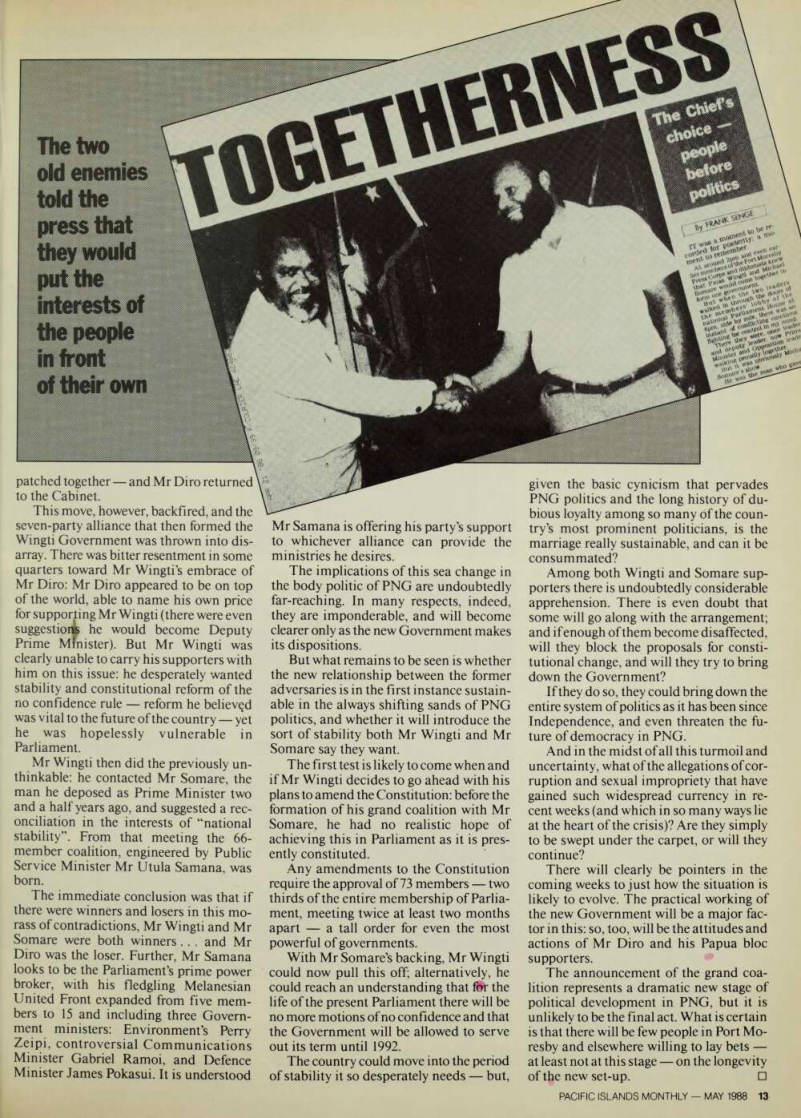
Days later, in a breathtaking change of stance, the two men were together at a news conference announcing that for the good of the country they were sinking their political differences and forming their “grand coalition”.
Compare all the bitterness that sur rounded the abortive no confidence de bate with what was said at the joint Wingti- Somare news conference: “Our interest is the stability of the country. The nation must move forward.
It’s very important that at this level we must have dialogue,” said Mr Wingti.
“We have our individual feelings, our individual egos, but first and foremost we must put the interests of the country ahead of us,” said Mr Somare.
It is clearly a long way from those high sounding words to the effective imple mentation of a government of national un ity, but what happened to provoke the dramatic change of stance? And what are the prospects?
At the centre of the political cauldron was Mr Ted Diro, the former Defence Force Commander and leader of the Pap uan bloc in Parliament. When he left Mr Wingti’s government it was made plain that he would remain out of the cabinet at least until he had been cleared of corrup tion allegations. But when the Prime Min ister was confronted by the no confidence motion he needed all the help he could get and, against the wishes of some of his clos est advisers, turned to Mr Diro.
An alliance between the two was^
patched together and Mr Diro returned to the Cabinet.
This move, however, backfired, and the seven-party alliance that then formed the Wingti Government was thrown into dis array. There was bitter resentment in some quarters toward Mr Wingti’s embrace of Mr Diro: Mr Diro appeared to be on top of the world, able to name his own price for supporting Mr Wingti (there were even suggestion he would become Deputy Prime Minister). But Mr Wingti was clearly unable to carry his supporters with him on this issue: he desperately wanted stability and constitutional reform of the no confidence rule reform he believed was vital to the future of the country yet he was hopelessly vulnerable in Parliament.
Mr Wingti then did the previously un thinkable: he contacted Mr Somare, the man he deposed as Prime Minister two and a half years ago, and suggested a rec onciliation in the interests of “national stability”. From that meeting the 66member coalition, engineered by Public Service Minister Mr Utula Samana, was born.
The immediate conclusion was that if there were winners and losers in this mo rass of contradictions, Mr Wingti and Mr Somare were both winners.. . and Mr Diro was the loser. Further, Mr Samana looks to be the Parliament’s prime power broker, with his fledgling Melanesian United Front expanded from five mem bers to 15 and including three Govern ment ministers: Environment’s Perry Zeipi, controversial Communications Minister Gabriel Ramoi, and Defence Minister James Pokasui. It is understood
Mr Samana is offering his party’s support to whichever alliance can provide the ministries he desires.
The implications of this sea change in the body politic of PNG are undoubtedly far-reaching. In many respects, indeed, they are imponderable, and will become clearer only as the new Government makes its dispositions.
But what remains to be seen is whether the new relationship between the former adversaries is in the first instance sustainable in the always shifting sands of PNG politics, and whether it will introduce the sort of stability both Mr Wingti and Mr Somare say they want.
The first test is likely to come when and if Mr Wingti decides to go ahead with his plans to amend the Constitution: before the formation of his grand coalition with Mr Somare, he had no realistic hope of achieving this in Parliament as it is presently constituted.
Any amendments to the Constitution require the approval of 73 members two thirds of the entire membership of Parliament, meeting twice at least two months apart a tall order for even the most powerful of governments.
With Mr Somare’s backing, Mr Wingti could now pull this off; alternatively, he could reach an understanding that for the life of the present Parliament there will be no more motions of no confidence and that the Government will be allowed to serve out its term until 1992.
The country could move into the period of stability it so desperately needs but,
given the basic cynicism that pervades PNG politics and the long history of du bious loyalty among so many of the coun try’s most prominent politicians, is the marriage really sustainable, and can it be consummated?
Among both Wingti and Somare sup porters there is undoubtedly considerable apprehension. There is even doubt that some will go along with the arrangement; and if enough of them become disaffected, will they block the proposals for consti tutional change, and will they try to bring down the Government?
If they do so, they could bring down the entire system of politics as it has been since Independence, and even threaten the fu ture of democracy in PNG.
And in the midst of all this turmoil and uncertainty, what of the allegations of cor ruption and sexual impropriety that have gained such widespread currency in re cent weeks (and which in so many ways lie at the heart of the crisis)? Are they simply to be swept under the carpet, or will they continue?
There will clearly be pointers in the coming weeks to just how the situation is likely to evolve. The practical working of the new Government will be a major fac tor in this: so, too, will be the attitudes and actions of Mr Diro and his Papua bloc supporters.
The announcement of the grand coa lition represents a dramatic new stage of political development in PNG, but it is unlikely to be the final act. What is certain is that there will be few people in Port Mo resby and elsewhere willing to lay bets at least not at this stage on the longevity of the new set-up. □
Keeping The Language Alive
Vanuatu
The voices of Vanuatu are recorded for posterity. By Nicolas Rothwell
IN THE furthest forests of verdant Am bae, .in the deepest valleys of Pente cost; all across the scattered islands of Vanuatu, something strange and wonder ful is taking place. Even as the forces of modern civilisation spread inexorably across the archipelago. ni-Vanuatu field workers are collecting a rich store of myths and traditions the vanishing cultural patrimony of their new nation.
Conceived a decade ago and run on a shoestring budget, the Pacific’s most suc cessful oral traditions collection project is an intense and idiosyncratic exer cise. In place of western-trained anthro pologists, volunteers from different language groups have fanned out across the islands, equipped only with tape-re corders and enthusiasm, in a race to cap ture the fine thread of traditional life for future generations. Despite the tenacious hold of custom in Vanuatu, old ways are being eroded or subtly changed, and have almost died out completely in some of the islands: the oral traditions project aims to document the songs, dances and myths of the ancestral culture, and so to restore among the younger generations of ni-Van uatu (people of Vanuatu) a sense of pride in the world of their forefathers.
The scheme, the brainchild of ethno musicologist Peter Crowe and linguist Jean-Michel Charpentier, was launched with the approval of the nation’s Cultural Centre, and is now presided over by Van uatu Museum and Cultural Centre direc tor Dr Kirk Huffman. Already 36 field workers are active, each in his own lin guistic and cultural area; slowly, as the years pass, the project grows in ambition and complexity, with the gift of a new camera or video system from donor governments but the entire enterprise is still co-ordinated from the inspired con fusion of Dr Huffman’s office in Port Vila, one of the South Pacific’s most charmed (and most cluttered) corners.
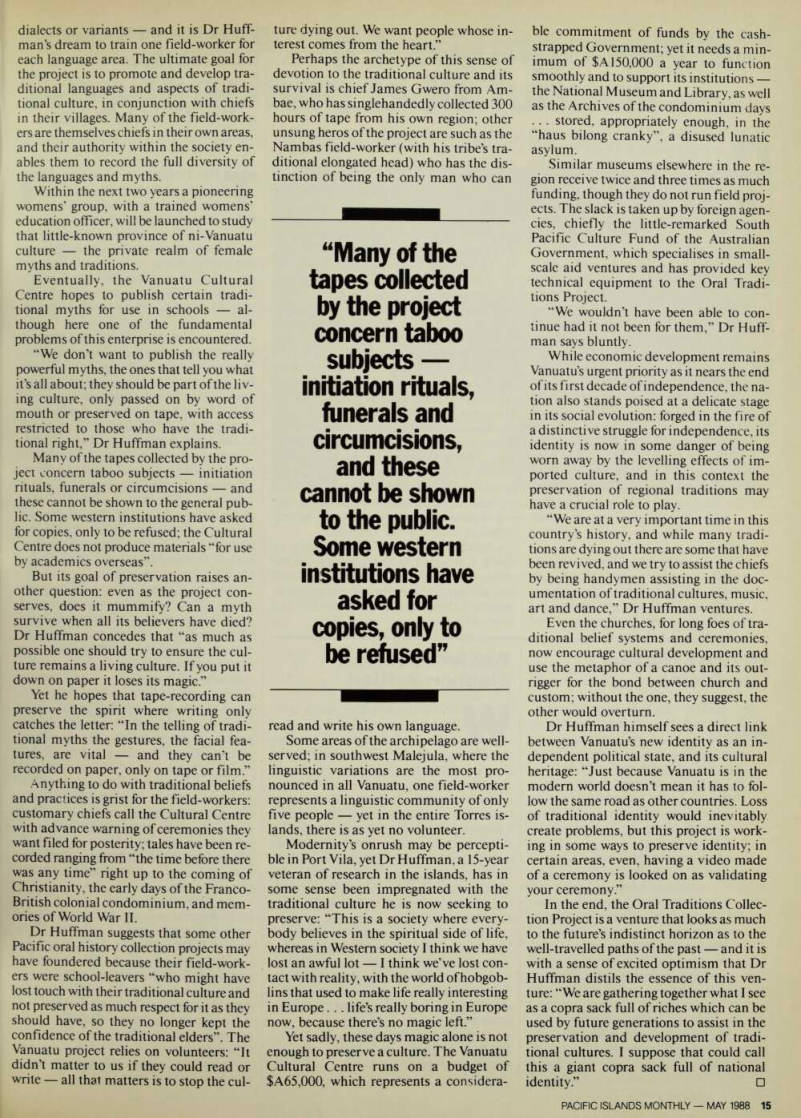
Since 1982, the field workers have been instructed in the transcription of their own languages by the Australian National Uni versity’s Dr Darryl Tryon, a pre-eminent authority on South Pacific linguistics but the project remains a race against time rather than a measured and conventional research venture: “The amount we’ve got already would take years to transcribe, but the most important thing is to get material on tape from the old people before they die, and to try to get young people interested,”
Dr Huffman explains.
“We wouldn’t need to do any of this if
the younger generations were interested in ensuring the cultures continued, and sat down and learned the songs and dances they have the rights to but the world is changing, and things will die out.”
Yet this sombre note is counterbal anced by the sheer range and exuberance of the traditional culture, and the passion of the field-workers. Vanuatu has 105 sep arate languages as well as uncounted
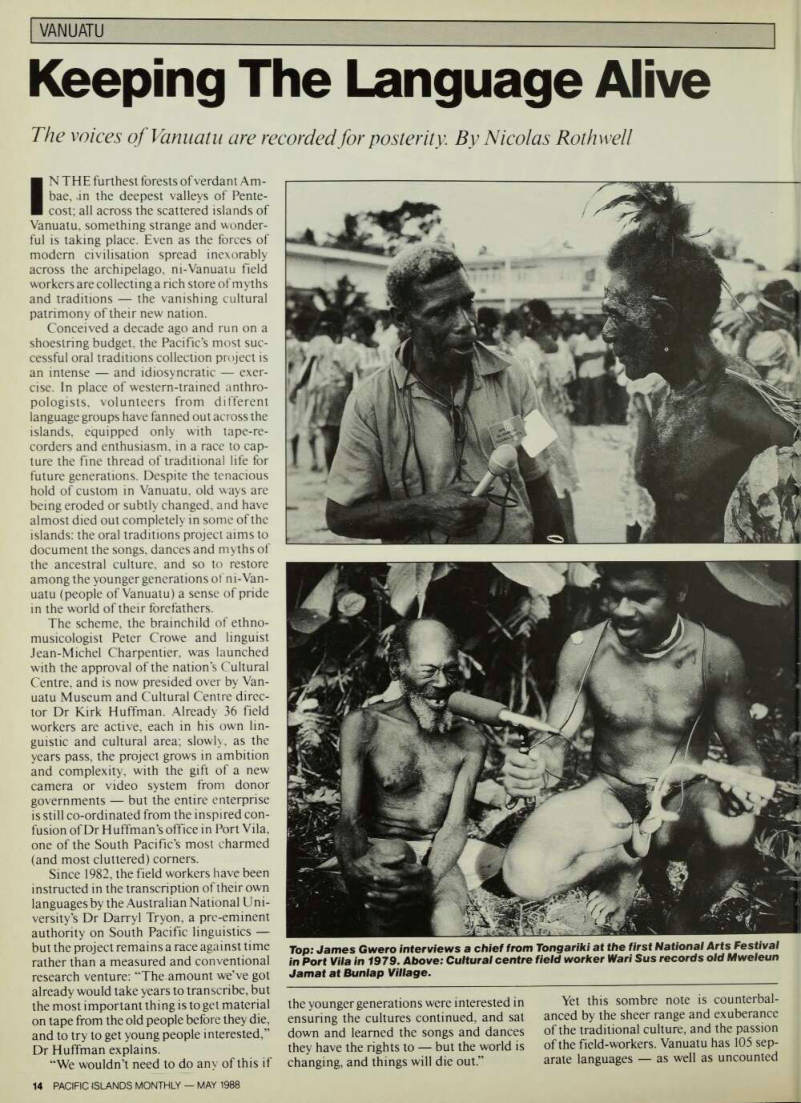
Top: James Gwero interviews a chief from Tongariki at the first National Arts Festival in Port Vila in 1979. Above: Cultural centre field worker Wari Sus records old Mweleun Jamat at Bunlap Village.
dialects or variants and it is Dr Huff man’s dream to train one field-worker for each language area. The ultimate goal for the project is to promote and develop tra ditional languages and aspects of tradi tional culture, in conjunction with chiefs in their villages. Many of the field-work ers are themselves chiefs in their own areas, and their authority within the society en ables them to record the full diversity of the languages and myths.
Within the next two years a pioneering womens’ group, with a trained womens’ education officer, will be launched to study that little-known province of ni-Vanuatu culture the private realm of female myths and traditions.
Eventually, the Vanuatu Cultural Centre hopes to publish certain tradi tional myths for use in schools al though here one of the fundamental problems of this enterprise is encountered.
“We don’t want to publish the really powerful myths, the ones that tell you what it’s all about; they should be part of the liv ing culture, only passed on by word of mouth or preserved on tape, with access restricted to those who have the tradi tional right,” Dr Huffman explains.
Many of the tapes collected by the pro ject concern taboo subjects initiation rituals, funerals or circumcisions and these cannot be shown to the general pub lic. Some western institutions have asked for copies, only to be refused; the Cultural Centre does not produce materials “for use by academics overseas”.
But its goal of preservation raises an other question: even as the project con serves, does it mummify? Can a myth survive when all its believers have died?
Dr Huffman concedes that “as much as possible one should try to ensure the cul ture remains a living culture. If you put it down on paper it loses its magic.”
Yet he hopes that tape-recording can preserve the spirit where writing only catches the letter; “In the telling of tradi tional myths the gestures, the facial fea tures, are vital and they can’t be recorded on paper, only on tape or film.”
Anything to do with traditional beliefs and practices is grist for the field-workers: customary chiefs call the Cultural Centre with advance warning of ceremonies they want filed for posterity; tales have been re corded ranging from “the time before there was any time” right up to the coming of Christianity, the early days of the Franco- British colonial condominium, and mem ories of World War 11.
Dr Huffman suggests that some other Pacific oral history collection projects may have foundered because their field-work ers were school-leavers “who might have lost touch with their traditional culture and not preserved as much respect for it as they should have, so they no longer kept the confidence of the traditional elders”. The Vanuatu project relies on volunteers: “It didn’t matter to us if they could read or write all that matters is to stop the cul
ture dying out. We want people whose in terest comes from the heart.”
Perhaps the archetype of this sense of devotion to the traditional culture and its survival is chief James Gwero from Am bae, who has singlehandedly collected 300 hours of tape from his own region; other unsung heros of the project are such as the Nambas field-worker (with his tribe’s tra ditional elongated head) who has the dis tinction of being the only man who can
“Many of the tapes collected by the project concern taboo subjects initiation rituals, funerals and circumcisions, and these cannot be shown to the public.
Some western institutions have asked for copies, only to be refused”
read and write his own language.
Some areas of the archipelago are well served; in southwest Malejula, where the linguistic variations are the most pro nounced in all Vanuatu, one field-worker represents a linguistic community of only five people yet in the entire Torres is lands, there is as yet no volunteer.
Modernity’s onrush may be percepti ble in Port Vila, yet Dr Huffman, a 15-year veteran of research in the islands, has in some sense been impregnated with the traditional culture he is now seeking to preserve: “This is a society where every body believes in the spiritual side of life, whereas in Western society I think we have lost an awful lot I think we’ve lost con tact with reality, with the world of hobgob lins that used to make life really interesting in Europe... life’s really boring in Europe now, because there’s no magic left.”
Yet sadly, these days magic alone is not enough to preserve a culture. The Vanuatu Cultural Centre runs on a budget of $A65,000, which represents a considera
ble commitment of funds by the cash strapped Government; yet it needs a min imum of SA 150,000 a year to function smoothly and to support its institutions the National Museum and Library, as well as the Archives of the condominium days . . . stored, appropriately enough, in the “haus bilong cranky”, a disused lunatic asylum.
Similar museums elsewhere in the re gion receive twice and three times as much funding, though they do not run field proj ects. The slack is taken up by foreign agen cies, chiefly the little-remarked South Pacific Culture Fund of the Australian Government, which specialises in small scale aid ventures and has provided key technical equipment to the Oral Tradi tions Project.
“We wouldn’t have been able to con tinue had it not been for them,” Dr Huff man says bluntly.
While economic development remains Vanuatu’s urgent priority as it nears the end of its first decade of independence, the na tion also stands poised at a delicate stage in its social evolution: forged in the fire of a distinctive struggle for independence, its identity is now in some danger of being worn away by the levelling effects of im ported culture, and in this context the preservation of regional traditions may have a crucial role to play.
“We are at a very important time in this country’s history, and while many tradi tions are dying out there are some that have been revived, and we try to assist the chiefs by being handymen assisting in the doc umentation of traditional cultures, music, art and dance,” Dr Huffman ventures.
Even the churches, for long foes of tra ditional belief systems and ceremonies, now encourage cultural development and use the metaphor of a canoe and its out rigger for the bond between church and custom; without the one, they suggest, the other would overturn.
Dr Huffman himself sees a direct link between Vanuatu’s new identity as an in dependent political state, and its cultural heritage: “Just because Vanuatu is in the modern world doesn’t mean it has to fol low the same road as other countries. Loss of traditional identity would inevitably create problems, but this project is work ing in some ways to preserve identity; in certain areas, even, having a video made of a ceremony is looked on as validating your ceremony.”
In the end, the Oral Traditions Collec tion Project is a venture that looks as much to the future’s indistinct horizon as to the well-travelled paths of the past and it is with a sense of excited optimism that Dr Huffman distils the essence of this ven ture: “We are gathering together what I see as a copra sack full of riches which can be used by future generations to assist in the preservation and development of tradi tional cultures. I suppose that could call this a giant copra sack full of national identity.” □
NZ Recognises Fiji
Jack Kelleher reports on the new ambassador
NEW ZEALAND’S appointment of an ambassador to Fiji, to succeed its retiring high commissioner, was seen in the New Zealand Parliament as the first formal indication of recognition of the new regime. Brian Absolum, previously New Zealand high commissioner in West ern Samoa, was succeeding high commis sioner to Fiji Rod Gates.
Initial public reaction focused on the names, and seemed to miss the upgrading of the office.
But New Zealand Opposition leader Jim Bolger observed that by the change of title the country was recognising the new Government’s declaration of a republic: representatives between Commonwealth countries used the term high commis sioner, and by making the change the New Zealand Government was acknowledging the change in Suva. The Opposition wel comed the resumption of diplomatic ties with Fiji.
Mr Bolger said he hoped Prime Min ister Ratu Sir Kamisese Mara’s visit to London would turn out to be the first step in returning Fiji to the Commonwealth under a democratically elected government.
New Zealand Foreign Minister Russell Marshall had made no point of the title in announcing Mr Absolum’s appointment.
He said that at a time when much remains to be done to restore both political and
economic stability in Fiji, it is essential that New Zealand monitor the situation closely and “maintain contact with the interim Government”.
Asked whether the appointment meant recognition of the new Government, Mr Marshall said it was not usual for New Zealand to formally declare a position on recognition. The practice had been for this to “be inferred from the nature and level of our dealings with a particular Government”.
The appointment did not represent any change, he insisted. “We had an ambas sador before; we are now appointing a new ambassador to take his place.”
Before his posting to Western Samoa Mr Absolum served in Canberra as dep uty high commissioner, and in other countries.
Before retiring high commissioner Gates returned to Wellington, and the for eign affairs department, he was enter tained at a Government House dinner in Suva. Former Prime Minister Timoci Ba vadra invited him to lake part in the lay ing of foundation posts for a new meeting house in the village of Viseisei.
At an interview in his own office in Suva, Gates said he had great faith in the resilience of the Fiji people. “They will pull out of their problems because of the com mitment they have to their country and culture.” □
France’s Nuclear
Site Switch
AUSTRALIA’S Foreign Minister, Mr Hayden, says his Government will maintain its strong opposition to French nuclear testing in the Pacific re gardless of where tests are conducted.
French newspaper reports say a deci sion has been made to move the under ground nuclear test program from Mururoa Atoll to nearby Fangataufa Is land for safety reasons.
The Commander-In-Chief of French Naval Forces in the Pacific, Pierre Thi reaut, is reported to have said the move follows concern that repeated under ground blasts might eventually damage geological formations beneath Mururoa.
Mr Hayden said that this corroborated the views expressed by a scientific inves tigation several years ago. The scientists stated that long-term testing was likely to cause degeneration of the coral reef and possible leakage of radioactive material.
Meanwhile, the New Zealand Govern ment has issued a statement saying the re ported move to Fangataufa has caused serious doubts about Mururoa’s safety. □
Election Settled
Western Samoan Election Settled
WESTERN SAMOA has a new Prime Minister. Tofilau Eti has been elected leader of the Hu man Rights Protection Party and leader of the Government, following voting in Western Samoa’s Legislative Assembly.
In the voting, which was strictly along party lines, Tofilau obtained 24 votes. His opponent, Tupua Tamasese Efi, the leader of the ruling coalition party, received 23 votes. Tofilau was Prime Minister of Western Samoa from 1983 to 1985. The new speaker of the House is Aeau Peniamina.
Tofilau is expected to announce his Cabinet lineup soon.
Meanwhile, the country’s Supreme Court has dismissed the first of nine pe titions filed following the country’s gen eral election in February. The petition, by former speaker Nonumalo Sofaro, alleged errors in the electoral role and imperson ation at the polls.
In dismissing the petition, Mr Justice Maxwell said the court was not satisfied that the errors pointed out could have changed the outcome of the election. □
gather.
First Maori Bishop Consecrated in NZ
Pacific church elders
By Jack Kelleher
THE TIMBER industry town, in a clearing of the great pine forest of New Zealand’s North Island, had never seen such a gathering of princes of the church. Its experience of Pacific is landers was as mill workers. Now Tokoroa was putting down its version of a red car pet, as island and other Catholic dignitar ies gathered for the consecration of the church’s first Maori bishop. Max Takuira Mariu.
The ceremony might have been held at Little Waihi, on the thermal shore of Lake Taupo where Max grew up, or at Hawke’s Bay where he’d been working as a priest.
Tokoroa, north of Taupo and west of Hawke’s Bay, was chosen for its tribal neu trality: its Papa O Te Aroha marae is known as the home of all tribes.
In stately procession, before 5000 watchers, came the burly agriculturist for his people Cardinal Pio Taofi Nu’u of Sa moa and the Tokelaus; charismatic and el derly Bishop Patrick Hurley of Western Samoa; Archbishop of Fiji Petero Mataca; Bishop Loft of Auki in the Solomons; Bishop Patelisio Finau of Tonga; Bishop Michel Coppenrath of Tahiti.
Because the new bishop was a member of the French-originating, teacher-ori ented Society of Mary, so too were many of the prelates and guests including Father John Foliaki, representing the so ciety’s Province of Oceania. Minister Ko rowetere represented the New Zealand Government. After Cardinal Tom Wil liams of New Zealand, Bishop Finau and the Bishop of Hamilton, Edward Gaines, performed the ceremony, the island prel ates joined in endorsing the ordination.
While boys of the new bishop’s old col lege, Hato Paora at Feilding, sang and 10 of New Zealand’s 11 other Maori priests stood by, the new bishop, clad in a Maori cloak, and with tears on his face, con fronted his parents, Mary and Maihi Mariu. “I must take to heart the words, the Son of Man came not to be served but to serve,” he said.
Aged 35, the fourth of eight children, he is descended from the earliest Maori Catholics (from Kerehi, in the late 1840 s the first Catholic in Ngati Tuwharetoa). He was ordained a priest in 1971 and under went open heart surgery two years later yet he managed to carry on with his fa vourite recreations of tennis and golf.
On Easter Monday he left for Rome, for a congress and to meet Pope John Paul 11.
When he returns it will be as Auxiliary Bishop to the Diocese of Hamilton, prob ably based at Tokoroa. □
Why Teaching Is In Turmoil

The Region
David Robie and Carson Creagh examine the crisis in Pacific education
PACIFIC policy makers face a di lemma that is at once blindingly simple and exquisitely complex.
Heirs of a colonial education system that sought behind its pious claims of “de velopment” to educate natives as la bourers and servants while giving the children of the white masters a metropol itan education, they govern nations that are ill-prepared for the tomorrow that, in most cases, has already arrived.
As more and more school-leavers dis cover they cannot find work, pressure grows to change the curriculum that trained them. Proponents argue that the strategy of creating national and regional universities such as the University of Papua New Guinea (UPNG) in Port Mo resby, the University of Technology in Lae and the University of the South Pacific (USP) in Fiji creates an underemployed elite . . . and an elite that is trained pri marily for politics rather than the devel opment of emerging nations. Graduates in law and economics are numerous; those in technical, scientific or educational disci plines are all too uncommon.
Those who support a redefinition of educational priorities propose a re-orien tation toward rural needs, claiming that training for a degree of self-sufficiency in village and agricultural sectors will lead to the creation of rural employment oppor tunities and will perhaps slow the drift of unemployed rural youth to the cities. It is a laudable and, on the surface, workable approach, according to observers outside the affected countries and one that re quires a massive change of emphasis from tertiary professional education to primary and lower secondary schooling.
But it ignores history, for the despised colonialist curriculum took the same path and is now acknowledged as having been as ineffective as it was paternalistic. Dr Sheldon Weeks, of the Education Re search Unit at UPNG, wrote recently that “indigenous parents rightly saw the prac tical curriculum as inferior in status and feared it would exclude their children from access to the modem sector... where jobs, high income and social and political power were to be obtained”.
Yet today’s parents are calling for a cur riculum that is at once practical, offering a greater chance of employment in the ru ral sector, and one that will raise the qual ity and availability of white-collar trainees.
They seek the best of both elements of the old colonial curriculum while rejecting the philosophies, the appearance and the products of that curriculum.
The opposite approach (and the ap proach currently in favour with most South Pacific governments) is to look to the needs of the future by training managerial and professional leaders: without high quality tertiary education, they say, there will simply be no teachers, health workers, en gineers or scientists, lawyers or writers.
The situation is particularly poignant in Papua New Guinea. With a national lit eracy rate of around 30 per cent, it is claimed that universities train those who will train the next generation; but exami nation of postgraduate careers indicates that there is little motive for graduates to use their skills in low-status, poorly paid work as teachers or regional health offi cers: they elect to stay in the cities, where they have at least a chance of finding em ployment commensurate with their expectations.
The corollary of this result was exam ined by Dr Ken Gannicott, senior lecturer at the Australian Defence Force Academy at the University of New South Wales and director of the Centre for Studies in Man agement and Logistics. His findings are depressing for those who support the no tion of graduates training the leaders of to morrow. In truth, says Dr Gannicott, “Papua New Guinea receives a very poor payoff on its educational investment. Rates of return to all levels of education are low by the standards of other developing countries, while private returns are high.
The extent of public subsidy is highest at university level the level where, it has
been discovered, social returns are lowest.”
Dr Gannicott’s research, which ap plied the concept ofjudging the returns to the nation as a whole from its investment in education in comparison with returns to private industry for the same national investment, revealed that although PNG spends one of the highest proportions of GNP on education of all developing coun tries, it succeeds in educating a worryingly low percentage of children.
The number of primary schools, for ex ample, increased from 1762 at Independ ence to 2224 by 1983 yet enrolments expanded by an annual average of only 3.9 per cent. During the same period the num ber of institutions of higher learning dou bled, from 30 to 60, and enrolments increased by a yearly average of 7.3 per cent almost twice as much as primary school enrolments.
“It does not seem harsh to note that progress has been modest,” Dr Gannicott says. “Increases in the numbers attending school at primary and secondary level have barely been sufficient to keep pace with the increase in numbers of the relevant age groups.” Less than one third of the popu lation aged 15 or over can read or write; 86 per cent of the adult population has re ceived no formal education, and of the 14 per cent who have attended school, 80 per cent have gone no further than primary level; only two thirds of the relevant age group are enrolled in primary school and a shockingly low 13 per cent are in sec ondary school. ►
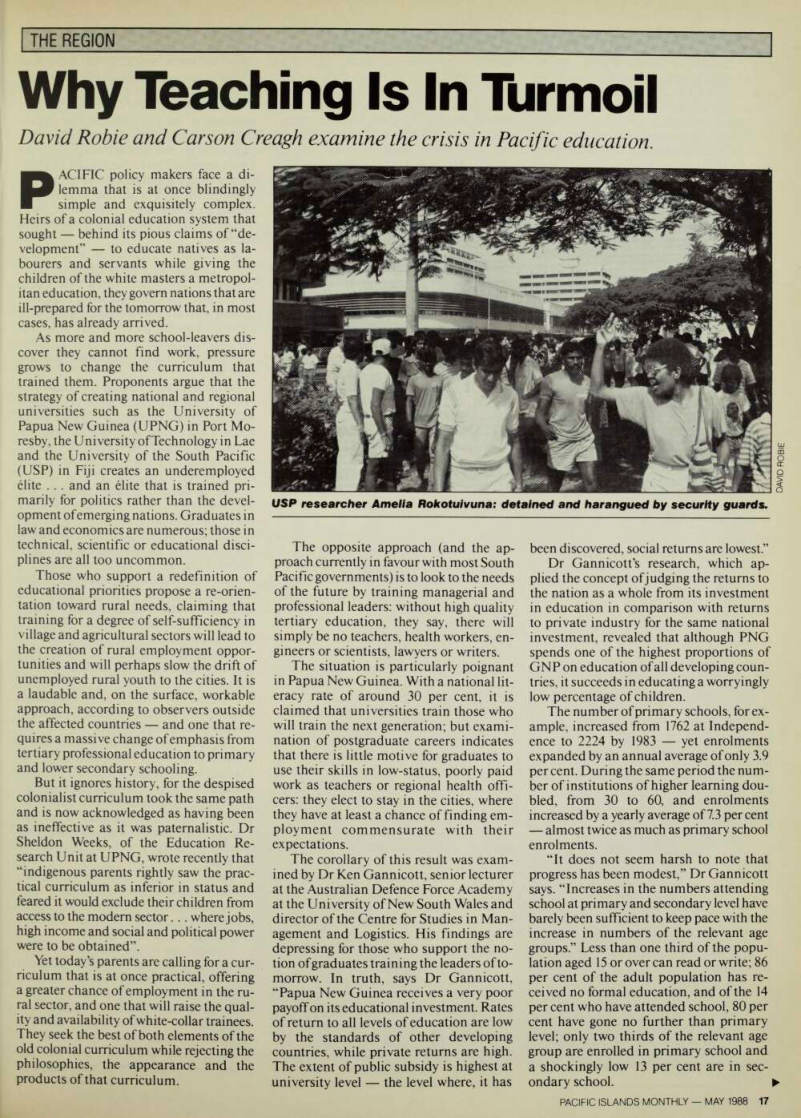
USP researcher Amelia Rokotuivuna: detained and harangued by security guards.
David Robie
Equally depressing is Dr Gannicott’s conclusion, presented in an ANU Re search School of Pacific Studies paper.
“Economic returns to human capital in vestment in PNG are low,” he writes, “not because of a lack of demand for skills but because the education system is internally inefficient: the output it produces, from primary graduates onward, is both expen sive and of poor quality.”
What, then, is the future for education in PNG? Dr Gannicott notes that the Government has learned from the expe rience of other developing nations that education seems not to play any direct role in creating employment but that it has, if anything, learned the lesson too well.
Education at lower levels has stagnated and there is a severe shortage of high-level manpower, producing a recipe for main taining a labour force with low skill levels and, ironically, for denying the benefits of higher education to those sectors of the economy that need it most. He argues for rigorous cost cutting at all levels, espe cially in the tertiary sector, and for ex panded enrolments (which necessitates expanded facilities) at primary and sec ondary levels to overcome continued shortages of higher level manpower.
Academics and university students alike might feel threatened by the severe streamlining suggested, but in the long term they would reap the benefits of a new approach. Arguing that heavy subsidies and absence of tertiary fees are luxuries PNG cannot afford. Dr Gannicott advo cates “novel and cost-reducing forms of management/academic structure” at UPPG and UoT. These include a broad reduction in the range of courses offered, those deleted to be made available at uni-
versities in Australasia or southeast Asia; “cost sharing” in which universities would take on expensive expatriate staff for six or nine months, after which their services would be on offer to the private sector as consultants or researchers; and with drawal of public funding to small tertiary institutions offering training that can be provided more cheaply or at a higher standard in overseas locations.
Below the tertiary level, Dr Gannicott proposes a realignment of teacher train ing; provision of higher quality and ex panded resources to teachers; the introduction of school fees at national high schools and the raising of fees at provin cial high schools; and a searching exami nation of the practice of boarding high school students.
The adoption of these strategies would result immediately in significant amounts of funding becoming available for capital works the construction of new schools and their linking, through upgraded com munications, with others and in in creased proficiency in the delivery of education. None are total solutions, of course, but they offer a model of efficiency that would not only inspire confidence in PNG’s education and technical training, but would please international aid donors anxious to see their assistance being used in a “businesslike” manner.
THE University of the South Pacific is today facing the gravest threat to its existence since last year’s coups.
Already troubled by financial difficulties, the campus now also faces a crisis over academic freedom.
A small group of “new wave” indige nous thinkers who have played a key role in shaping the university’s identity over the past seven years are now gravely con cerned about their future. “We are con fronted with academic censorship,” said one university academic, who declined to be named. “The university faces the big gest threat in its 20-year history.”
A handful of USP lecturers was in volved in drawing up the progressive re form policies of the multiracial Fiji Labour Party; others, while not being involved politically, were still suspected by the con servative Fijian establishment as having a hand in the party’s spectacular rise to power last year.
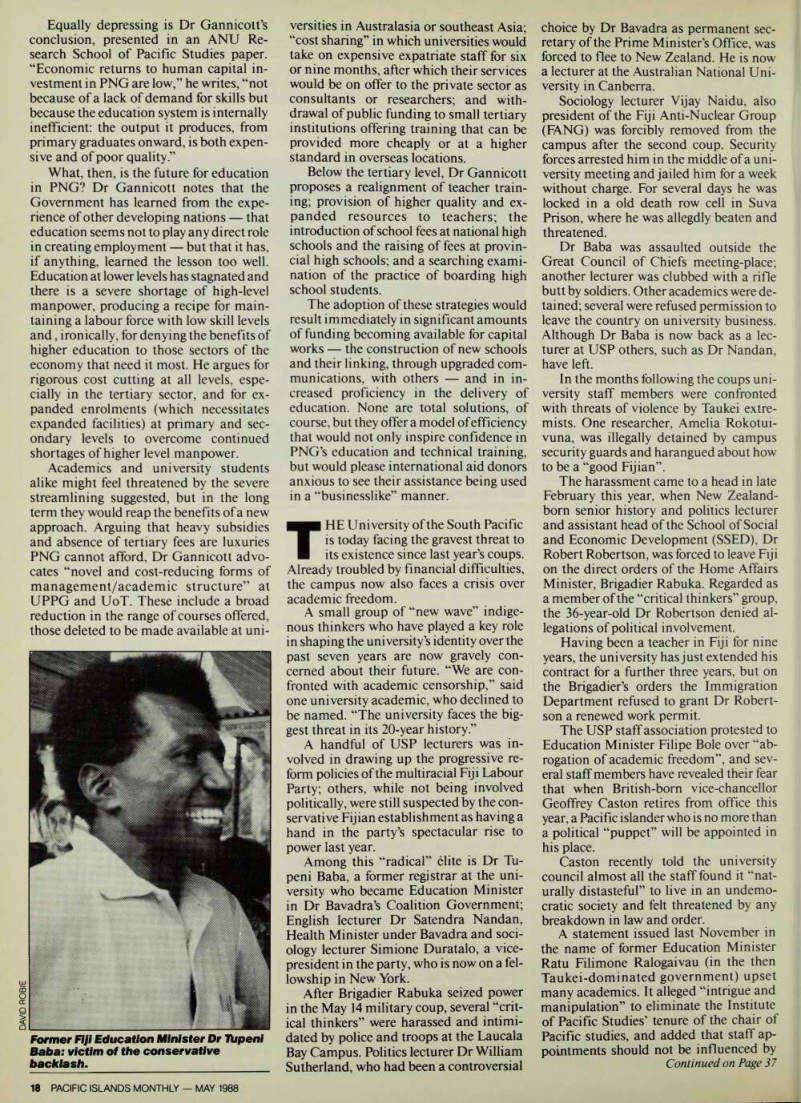
Among this “radical” elite is Dr Tu peni Baba, a former registrar at the uni versity who became Education Minister in Dr Bavadra’s Coalition Government; English lecturer Dr Satendra Nandan, Health Minister under Bavadra and soci ology lecturer Simione Duratalo, a vice president in the party, who is now on a fel lowship in New York.
After Brigadier Rabuka seized power in the May 14 military coup, several “crit ical thinkers” were harassed and intimi dated by police and troops at the Laucala Bay Campus. Politics lecturer Dr William Sutherland, who had been a controversial
choice by Dr Bavadra as permanent sec retary of the Prime Minister’s Office, was forced to flee to New Zealand. He is now a lecturer at the Australian National Uni versity in Canberra.
Sociology lecturer Vijay Naidu, also president of the Fiji Anti-Nuclear Group (FANG) was forcibly removed from the campus after the second coup. Security forces arrested him in the middle of a uni versity meeting and jailed him for a week without charge. For several days he was locked in a old death row cell in Suva Prison, where he was allegdly beaten and threatened.
Dr Baba was assaulted outside the Great Council of Chiefs meeting-place; another lecturer was clubbed with a rifle butt by soldiers. Other academics were de tained; several were refused permission to leave the country on university business.
Although Dr Baba is now back as a lec turer at USP others, such as Dr Nandan, have left.
In the months following the coups uni versity staff members were confronted with threats of violence by Taukei extre mists. One researcher, Amelia Rokotui vuna, was illegally detained by campus security guards and harangued about how to be a “good Fijian”.
The harassment came to a head in late February this year, when New Zealand born senior history and politics lecturer and assistant head of the School of Social and Economic Development (SSED), Dr Robert Robertson, was forced to leave Fiji on the direct orders of the Home Affairs Minister, Brigadier Rabuka. Regarded as a member of the “critical thinkers” group, the 36-year-old Dr Robertson denied al legations of political involvement.
Having been a teacher in Fiji for nine years, the university has just extended his contract for a further three years, but on the Brigadier’s orders the Immigration Department refused to grant Dr Robert son a renewed work permit.
The USP staff association protested to Education Minister Filipe Bole over “ab rogation of academic freedom”, and sev eral staff members have revealed their fear that when British-born vice-chancellor Geoffrey Gaston retires from office this year, a Pacific islander who is no more than a political “puppet” will be appointed in his place.
Gaston recently told the university council almost all the staff found it “nat urally distasteful” to live in an undemo cratic society and felt threatened by any breakdown in law and order.
A statement issued last November in the name of former Education Minister Ratu Filimone Ralogaivau (in the then Taukei-dominated government) upset many academics. It alleged “intrigue and manipulation” to eliminate the Institute of Pacific Studies’ tenure of the chair of Pacific studies, and added that staff ap pointments should not be influenced by
Continued on Page 37
Former Fiji Education Minister Dr Tupeni Baba: victim of the conservative backlash.
Continued from Page 18
“personal prejudice, professional jealousy and political bias” to exclude Pacific is landers from jobs at a university that be longed to them. Furthermore, “the university council will need to begin now to look to look for an indigenous Pacific islander to be the next vice-chancellor when the contract of the incumbent ex pires shortly”.
The university, built on the site of a for mer Royal New Zealand Air Force flying boat base at Laucala Bay, was opened in 1968. It is jointly controlled by 11 countries Cook Islands, Fiji, Kiribati, Nauru, Niue, Solomon Islands, Tokelau, Tonga, Tuvalu, Vanuatu and Western Somoa and depends on Fiji for 60 per cent (about $l3 million) of its annual working budget.
Australia and New Zealand also contrib ute to the university, largely through scholarships for students.
The staff reflects 60 different nation alities and there are 2000 full-time stu dents, with 7000 part-timers at Laucala Bay. There is also a campus at Alafua, Western Samoa, where the Agriculture School is sited. Kiribati has the Institute for Atoll Research; Tonga, the Institute of Rural Technology; Vanuatu, the Lan guages Centre and Law Unit. As well, there are university extension centres in 10 of the member countries.
Apart from regional students, includ ing some from New Caledonia, the uni versity also accepts scholarship students from Ethiopia, Flong Kong, the Maldives and Zimbabwe on Commonwealth grants.
As USP began to feel the effects of a staff shortage in the wake of the coups, Aus tralia has been filling immediate gaps by providing short-term lecturers. While this assistance fulfils teaching demands, it does nothing to satisfy the university’s desper ate need to retain an experienced and skilled body of staff capable of developing courses and programs that meet the re gion’s development needs and its varied cultural and racial mix.
Latest reports from Suva suggest USP is overcoming the most basic of its prob lems, with approaches from academics in Australasia and Europe to fill vacancies exacerbated by Fiji’s “brain drain” of up per level personnel in all fields.
However, the future holds problems of its own as USP’s staff confronts the like lihood of an at least partial realisation of the new Fijian spirit. The University’s for mer radical stance was more suited to the comfort of Commonwealth membership, and there is a growing chance some pro grams especially in the social sciences will face serious questions of their place in a now radically conservative society.
Not only will the philosophies of lecturers be subject to close scrutiny, but there will likely be fewer students willing to risk of ficial disapproval of enrolling in courses with a subject outline or approach critical of Fiji’s new aspirations. □
Advertisements & other items, pp. 19-21 (1 item)
Hawaiian Tel
Private Line Channels. Microwave and Fiber Systems. Local Area Networks and VAN’s.
Consulting. PBXs. Operations and Maintenance. International Calling. Multiplexers.
Packet Switching. Data Comm. Pagers. Systems Integration. Project Management. Network Planning, Designing, Engineering and Construction Services. Traini
There’s
more to
Hawaiian Tel
than meets
the ear.
HAWAIIAN TEL fHT3
Beyond the call keting
o o o Q o o o o o o° o° o & If & 0
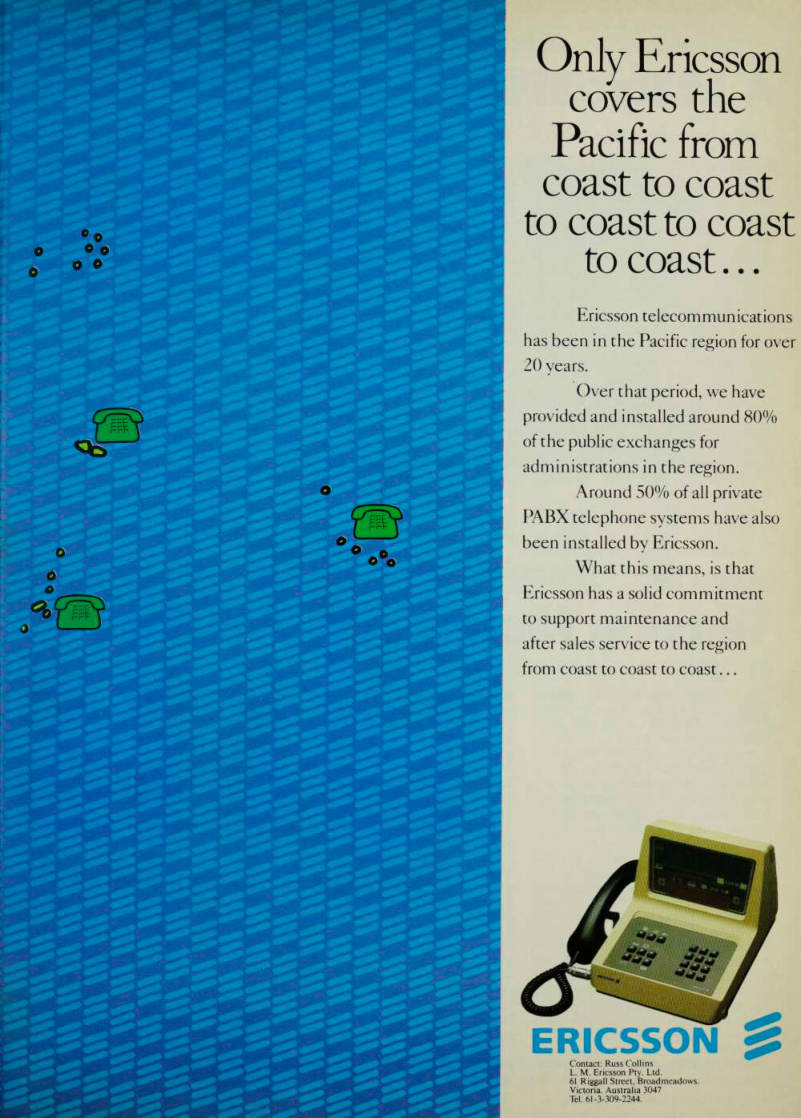
Only Ericsson
covers the
Pacific from
coast to coast
to coast to coast
to coast...
Ericsson telecommunications has been in the Pacific region for over 20 years.
Over that period, we have provided and installed around 80% of the public exchanges for administrations in the region.
Around 50% of all private PABX telephone systems have also been installed by Ericsson.
What this means, is that Ericsson has a solid commitment to support maintenance and after sales service to the region from coast to coast to coast... 33 f
ERICSSON
Contact: Russ Collins L. M. Ericsson Pty. Ltd. 61 Riggall Street, Broadmeadows.
Victoria. Australia 3047 Tel. 61-3-309-2244.
A Magical Mystery Tour
TAHITI, AUSTRALIA, SINGAPORE, KUALA LUMPUR ... AND BACK
Tahitians take a trip to nowhere. By Larry Writer
THE PACIFIC has long had good reason to be wary of Colonel Muammar Gaddafi. Intelligence networks have buzzed during the past few years with Libya’s destabilising efforts in PNG, Vanuatu and New Caledonia. But in April the spectre of the Mediterranean strongman descended on the Pacific once more and had its wings burned.
In a sensational, if bizarre, incident the Libyan threat to the region was made to seem more ludicrous than sinister. A del egation of Tahitians who may or may not have been taking up an offer to visit Libya was involved in a headline-grabbing, Asian-Pacific wild goose chase.
Colonel Gaddafi has declared that he wants to set up an “anti-imperialist” in ternational front because “the small na tions of the Pacific are in danger”. Libya, he said, would “shoulder the responsibil ity to provide a place where struggling forces could gather”.
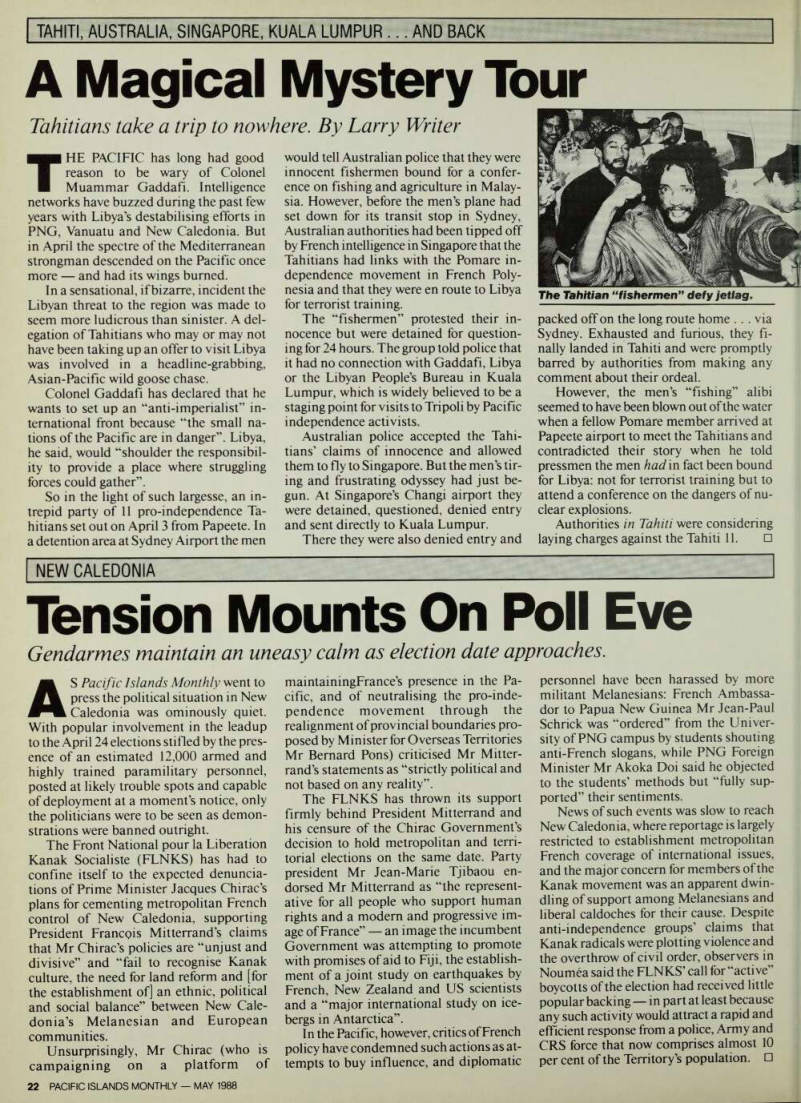
So in the light of such largesse, an in trepid party of 11 pro-independence Ta hitians set out on April 3 from Papeete. In a detention area at Sydney Airport the men
would tell Australian police that they were innocent fishermen bound for a confer ence on fishing and agriculture in Malay sia. However, before the men’s plane had set down for its transit stop in Sydney, Australian authorities had been tipped off by French intelligence in Singapore that the Tahitians had links with the Pomare in dependence movement in French Poly nesia and that they were en route to Libya for terrorist training.
The “fishermen” protested their in nocence but were detained for question ing for 24 hours. The group told police that it had no connection with Gaddafi, Libya or the Libyan People’s Bureau in Kuala Lumpur, which is widely believed to be a staging point for visits to Tripoli by Pacific independence activists.
Australian police accepted the Tahi tians’ claims of innocence and allowed them to fly to Singapore. But the men’s tir ing and frustrating odyssey had just be gun. At Singapore’s Changi airport they were detained, questioned, denied entry and sent directly to Kuala Lumpur.
There they were also denied entry and
packed off on the long route home ... via Sydney. Exhausted and furious, they fi nally landed in Tahiti and were promptly barred by authorities from making any comment about their ordeal.
However, the men’s “fishing” alibi seemed to have been blown out of the water when a fellow Pomare member arrived at Papeete airport to meet the Tahitians and contradicted their story when he told pressmen the men had in fact been bound for Libya: not for terrorist training but to attend a conference on the dangers of nu clear explosions.
Authorities in Tahiti were considering laying charges against the Tahiti 11. □
The Tahitian “ fishermen” defy jetlag.
Tension Mounts On Poll Eve
New Caledonia
Gendarmes maintain an uneasy calm as election date approaches.
AS Pacific Islands Monthly went to press the political situation in New Caledonia was ominously quiet, With popular involvement in the leadup to the April 24 elections stifled by the presence of an estimated 12,000 armed and highly trained paramilitary personnel, posted at likely trouble spots and capable of deployment at a moment’s notice, only the politicians were to be seen as demonstrations were banned outright.
The Front National pour la Liberation Kanak Socialiste (FLNKS) has had to confine itself to the expected denunciations of Prime Minister Jacques Chirac’s plans for cementing metropolitan French control of New Caledonia, supporting President Francois Mitterrand’s claims that Mr Chirac’s policies are “unjust and divisive” and “fail to recognise Kanak culture, the need for land reform and [for the establishment of] an ethnic, political and social balance” between New Caledonia’s Melanesian and European communities.
Unsurprisingly, Mr Chirac (who is campaigning on a platform of
maintaining France’s presence in the Pacific, and of neutralising the pro-independence movement through the realignment of provincial boundaries proposed by Minister for Overseas Territories Mr Bernard Pons) criticised Mr Mitterrand’s statements as “strictly political and not based on any reality”.
The FLNKS has thrown its support firmly behind President Mitterrand and his censure of the Chirac Government s decision to hold metropolitan and territorial elections on the same date. Party president Mr Jean-Marie Tjibaou endorsed Mr Mitterrand as “the representative for all people who support human rights and a modern and progressive image of France” an image the incumbent Government was attempting to promote with promises of aid to Fiji, the establishment of a joint study on earthquakes by French, New Zealand and US scientists and a “major international study on icebergs in Antarctica”.
In the Pacific, however, critics of French policy have condemned such actions as attempts to buy influence, and diplomatic
personnel have been harassed by more militant Melanesians: French Ambassa dor to Papua New Guinea Mr Jean-Paul Schrick was “ordered” from the Univer sity of PNG campus by students shouting anti-French slogans, while PNG Foreign Minister Mr Akoka Doi said he objected to the students’ methods but “fully sup ported” their sentiments.
News of such events was slow to reach New Caledonia, where reportage is largely restricted to establishment metropolitan French coverage of international issues, and the major concern for members of the Kanak movement was an apparent dwin dling of support among Melanesians and liberal caldoches for their cause. Despite anti-independence groups’ claims that Kanak radicals were plotting violence and the overthrow of civil order, observers in Noumea said the FLNKS’ call for “active” boycotts of the election had received little popular backing in part at least because any such activity would attract a rapid and efficient response from a police. Army and CRS force that now comprises almost 10 per cent of the Territory’s population. □
Bavadra Keeps The Flame Alive
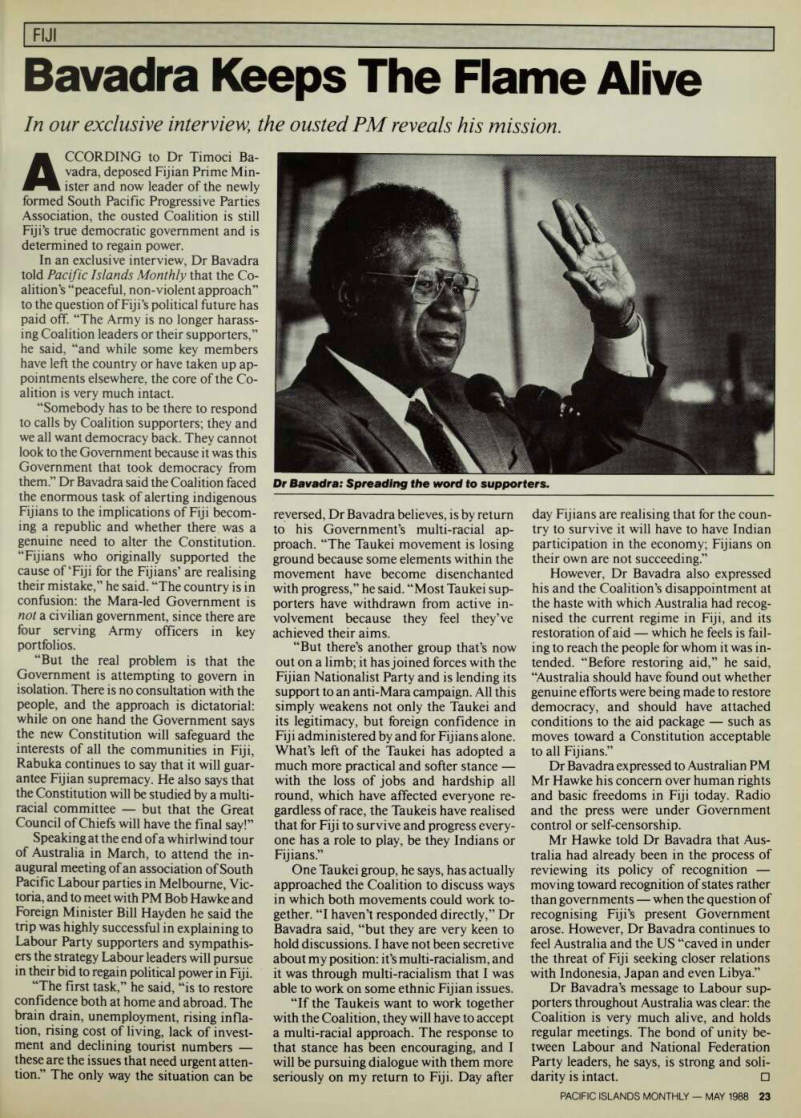
Fiji
In our exclusive interview, the ousted PM reveals his mission
ACCORDING to Dr Timoci Ba vadra, deposed Fijian Prime Min ister and now leader of the newly formed South Pacific Progressive Parties Association, the ousted Coalition is still Fiji’s true democratic government and is determined to regain power.
In an exclusive interview, Dr Bavadra told Pacific Islands Monthly that the Co alition’s “peaceful, non-violent approach” to the question of Fiji’s political future has paid off. “The Army is no longer harass ing Coalition leaders or their supporters,” he said, “and while some key members have left the country or have taken up ap pointments elsewhere, the core of the Co alition is very much intact.
“Somebody has to be there to respond to calls by Coalition supporters; they and we all want democracy back. They cannot look to the Government because it was this Government that took democracy from them.” Dr Bavadra said the Coalition faced the enormous task of alerting indigenous Fijians to the implications of Fiji becom ing a republic and whether there was a genuine need to alter the Constitution.
“Fijians who originally supported the cause of‘Fiji for the Fijians’ are realising their mistake,” he said. “The country is in confusion: the Mara-led Government is not a civilian government, since there are four serving Army officers in key portfolios.
“But the real problem is that the Government is attempting to govern in isolation. There is no consultation with the people, and the approach is dictatorial: while on one hand the Government says the new Constitution will safeguard the interests of all the communities in Fiji, Rabuka continues to say that it will guar antee Fijian supremacy. He also says that the Constitution will be studied by a multi racial committee but that the Great Council of Chiefs will have the final say!”
Speaking at the end of a whirlwind tour of Australia in March, to attend the in augural meeting of an association of South Pacific Labour parties in Melbourne, Vic toria, and to meet with PM Bob Hawke and Foreign Minister Bill Hayden he said the trip was highly successful in explaining to Labour Party supporters and sympathis ers the strategy Labour leaders will pursue in their bid to regain political power in Fiji.
“The first task,” he said, “is to restore confidence both at home and abroad. The brain drain, unemployment, rising infla tion, rising cost of living, lack of invest ment and declining tourist numbers these are the issues that need urgent atten tion.” The only way the situation can be
reversed, Dr Bavadra believes, is by return to his Government’s multi-racial ap proach. “The Taukei movement is losing ground because some elements within the movement have become disenchanted with progress,” he said. “Most Taukei sup porters have withdrawn from active in volvement because they feel they’ve achieved their aims.
“But there’s another group that’s now out on a limb; it has joined forces with the Fijian Nationalist Party and is lending its support to an anti-Mara campaign. All this simply weakens not only the Taukei and its legitimacy, but foreign confidence in Fiji administered by and for Fijians alone.
What’s left of the Taukei has adopted a much more practical and softer stance with the loss of jobs and hardship all round, which have affected everyone re gardless of race, the Taukeis have realised that for Fiji to survive and progress every one has a role to play, be they Indians or Fijians.”
One Taukei group, he says, has actually approached the Coalition to discuss ways in which both movements could work to gether. “I haven’t responded directly,” Dr Bavadra said, “but they are very keen to hold discussions. I have not been secretive about my position: it’s multi-racialism, and it was through multi-racialism that I was able to work on some ethnic Fijian issues.
“If the Taukeis want to work together with the Coalition, they will have to accept a multi-racial approach. The response to that stance has been encouraging, and I will be pursuing dialogue with them more seriously on my return to Fiji. Day after
day Fijians are realising that for the coun try to survive it will have to have Indian participation in the economy; Fijians on their own are not succeeding.”
However, Dr Bavadra also expressed his and the Coalition’s disappointment at the haste with which Australia had recog nised the current regime in Fiji, and its restoration of aid which he feels is fail ing to reach the people for whom it was in tended. “Before restoring aid,” he said, “Australia should have found out whether genuine efforts were being made to restore democracy, and should have attached conditions to the aid package such as moves toward a Constitution acceptable to all Fijians.”
Dr Bavadra expressed to Australian PM Mr Hawke his concern over human rights and basic freedoms in Fiji today. Radio and the press were under Government control or self-censorship.
Mr Hawke told Dr Bavadra that Aus tralia had already been in the process of reviewing its policy of recognition moving toward recognition of states rather than governments when the question of recognising Fiji’s present Government arose. However, Dr Bavadra continues to feel Australia and the US “caved in under the threat of Fiji seeking closer relations with Indonesia, Japan and even Libya.”
Dr Bavadra’s message to Labour sup porters throughout Australia was clear: the Coalition is very much alive, and holds regular meetings. The bond of unity be tween Labour and National Federation Party leaders, he says, is strong and soli darity is intact. □
Dr Bavadra: Spreading the word to supporters.
Rumtu’s Amazing Rock Lifters
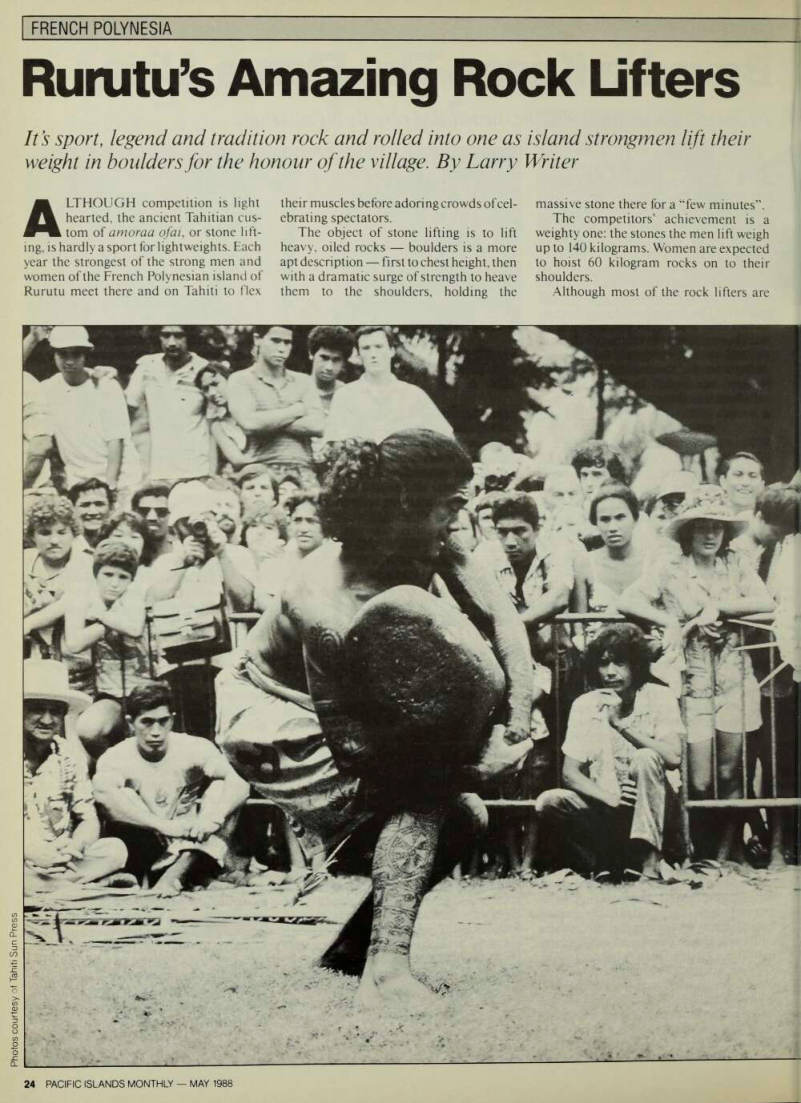
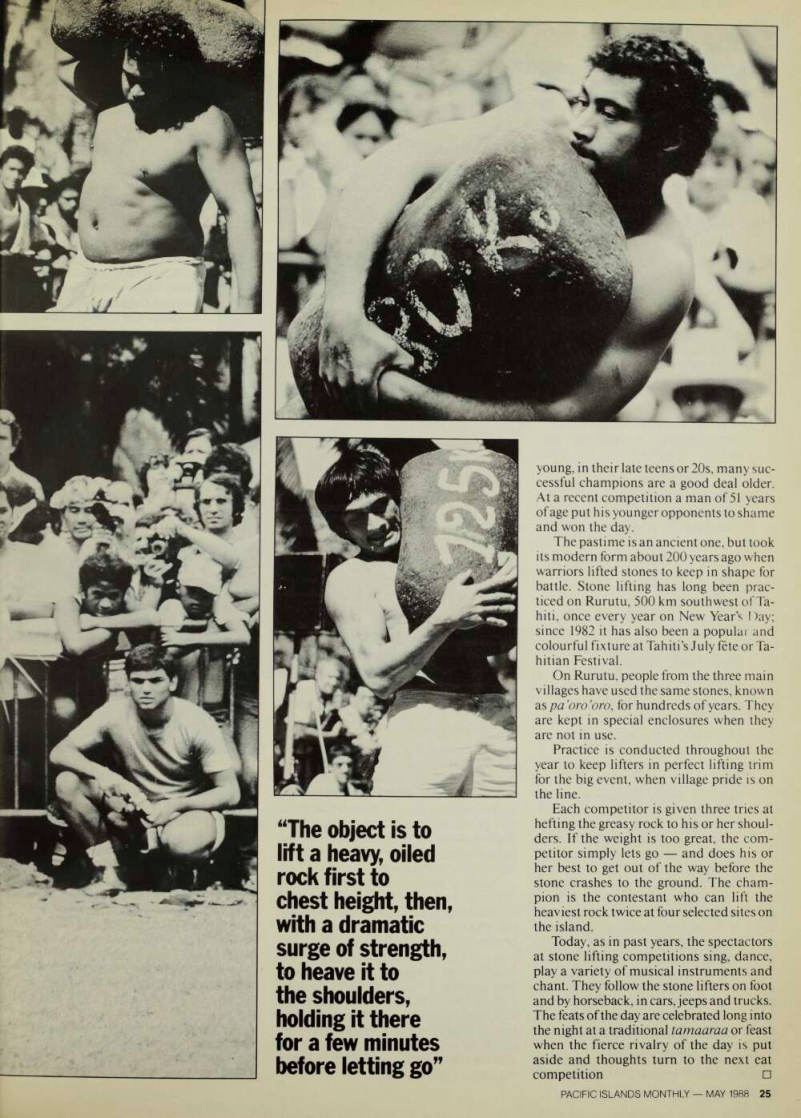
French Polynesia
It’s sport, legend and tradition rock and rolled into one as island strongmen lift their weight in boulders for the honour of the village. By Larry Writer
ALTHOUGH competition is light hearted, the ancient Tahitian cus tom of amoraa ofai, or stone lift ing, is hardly a sport for lightweights. Each year the strongest of the strong men and women of the French Polynesian island of Rurutu meet there and on Tahiti to flex
their muscles before adoring crowds of cel ebrating spectators.
The object of stone lifting is to lift heavy, oiled rocks boulders is a more apt description first to chest height, then with a dramatic surge of strength to heave them to the shoulders, holding the
massive stone there for a “few minutes”.
The competitors’ achievement is a weighty one: the stones the men lift weigh up to 140 kilograms. Women are expected to hoist 60 kilogram rocks on to their shoulders.
Although most of the rock lifters are
young, in their late teens or 20s, many suc cessful champions are a good deal older.
At a recent competition a man of 51 years of age put his younger opponents to shame and won the day.
The pastime is an ancient one, but look its modern form about 200 years ago when warriors lifted stones to keep in shape for battle. Stone lifting has long been prac ticed on Rurutu, 500 km southwest of Ta hiti, once every year on New Year’s Day; since 1982 it has also been a popular and colourful fixture at Tahiti’s July fete or Ta hitian Festival.
On Rurutu, people from the three main villages have used the same stones, known as pa ’oro ’oro , for hundreds of years. They are kept in special enclosures when they are not in use.
Practice is conducted throughout the year to keep lifters in perfect lifting trim for the big event, when village pride is on the line.
Each competitor is given three tries at hefting the greasy rock to his or her shoul ders. If the weight is too great, the com petitor simply lets go and does his or her best to get out of the way before the stone crashes to the ground. The cham pion is the contestant who can lift the heaviest rock twice at four selected sites on the island.
Today, as in past years, the spectactors at stone lifting competitions sing, dance, play a variety of musical instruments and chant. They follow the stone lifters on foot and by horseback, in cars, jeeps and trucks.
The feats of the day are celebrated long into the night at a traditional tamaaraa or feast when the fierce rivalry of the day is put aside and thoughts turn to the next eat competition □
"The object is to lift a heavy, oiled rock first to chest height, then, with a dramatic surge of strength, to heave it to the shoulders, holding it there for a few minutes before letting go”
Palau: The US Angle
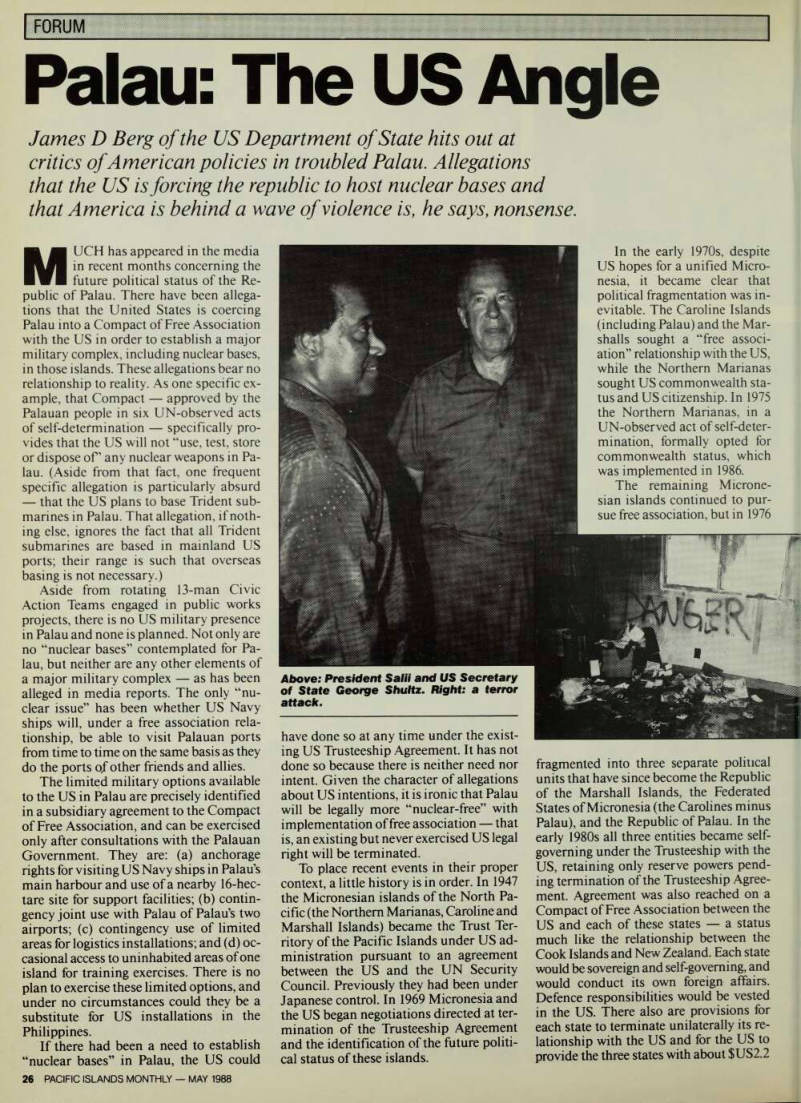

Forum
James D Berg of the US Department of State hits out at critics of American policies in troubled Palau. Allegations that the US is forcing the republic to host nuclear bases and that America is behind a wave of violence is, he says, nonsense.
MUCH has appeared in the media in recent months concerning the future political status of the Re public of Palau. There have been allega tions that the United States is coercing Palau into a Compact of Free Association with the US in order to establish a major military complex, including nuclear bases, in those islands. These allegations bear no relationship to reality. As one specific ex ample, that Compact approved by the Palauan people in six UN-observed acts of self-determination specifically pro vides that the US will not “use, test, store or dispose of’ any nuclear weapons in Pa lau. (Aside from that fact, one frequent specific allegation is particularly absurd that the US plans to base Trident sub marines in Palau. That allegation, if noth ing else, ignores the fact that all Trident submarines are based in mainland US ports; their range is such that overseas basing is not necessary.) Aside from rotating 13-man Civic Action Teams engaged in public works projects, there is no US military presence in Palau and none is planned. Not only are no “nuclear bases” contemplated for Pa lau, but neither are any other elements of a major military complex as has been alleged in media reports. The only “nu clear issue” has been whether US Navy ships will, under a free association rela tionship, be able to visit Palauan ports from time to time on the same basis as they do the ports of other friends and allies.
The limited military options available to the US in Palau are precisely identified in a subsidiary agreement to the Compact of Free Association, and can be exercised only after consultations with the Palauan Government. They are: (a) anchorage rights for visiting US Navy ships in Palau’s main harbour and use of a nearby 16-hec tare site for support facilities; (b) contin gency joint use with Palau of Palau’s two airports; (c) contingency use of limited areas for logistics installations; and (d) oc casional access to uninhabited areas of one island for training exercises. There is no plan to exercise these limited options, and under no circumstances could they be a substitute for US installations in the Philippines.
If there had been a need to establish “nuclear bases” in Palau, the US could
have done so at any time under the exist ing US Trusteeship Agreement. It has not done so because there is neither need nor intent. Given the character of allegations about US intentions, it is ironic that Palau will be legally more “nuclear-free” with implementation of free association that is, an existing but never exercised US legal right will be terminated.
To place recent events in their proper context, a little history is in order. In 1947 the Micronesian islands of the North Pa cific (the Northern Marianas, Caroline and Marshall Islands) became the Trust Ter ritory of the Pacific Islands under US ad ministration pursuant to an agreement between the US and the UN Security Council. Previously they had been under Japanese control. In 1969 Micronesia and the US began negotiations directed at ter mination of the Trusteeship Agreement and the identification of the future politi cal status of these islands.
In the early 19705, despite US hopes for a unified Micro nesia, it became clear that political fragmentation was in evitable. The Caroline Islands (including Palau) and the Mar shalls sought a “free associ ation” relationship with the US, while the Northern Marianas sought US commonwealth sta tus and US citizenship. In 1975 the Northern Marianas, in a UN-observed act of self-deter mination, formally opted for commonwealth status, which was implemented in 1986.
The remaining Microne sian islands continued to pur sue free association, but in 1976
fragmented into three separate political units that have since become the Republic of the Marshall Islands, the Federated States of Micronesia (the Carolines minus Palau), and the Republic of Palau. In the early 1980 s all three entities became self governing under the Trusteeship with the US, retaining only reserve powers pend ing termination of the Trusteeship Agree ment. Agreement was also reached on a Compact of Free Association between the US and each of these states a status much like the relationship between the Cook Islands and New Zealand. Each state would be sovereign and self-governing, and would conduct its own foreign affairs.
Defence responsibilities would be vested in the US. There also are provisions for each state to terminate unilaterally its re lationship with the US and for the US to provide the three states with about SUS 2.2
Above: President Salii and US Secretary of State George Shultz. Right: a terror attack.
billion in grant assistance over 15 years, with periodic adjustments for inflation. In 1986, following UN-observed acts of self determination in which the majority of the people of these states rejected full inde pendence and approved free association, the Marshall Islands and Federated States entered into free association with the United States as sovereign, self-governing nations.
The Trusteeship for Palau could not end, however, because Palau had yet to complete its approval of the Compact ac cording to its own constitutional require ments. The dilemma was that Palau’s Constitution declared Palau “nuclear-free” in language inconsistent with US defence responsibilities in a free association rela tionship. Those responsibilities require that US Navy ships have access to Palauan ports for visits on the same basis as to the ports of other friends and allies. Since nearly half of the US Navy’s ships are nu clear-powered and some are capable of carrying nuclear weapons (and the US neither confirms nor denies the presence of nuclear weapons on its ships), Palauan courts had ruled that the Compact of Free Association was in conflict with the nu clear provisions of Palau’s Constitution.
However, the Constitution also provides that these provisions could be overridden by a 75 percent majority vote for free association.
In five acts of self-determination the Palauan people, by majorities ranging from 62 to 72 percent, rejected full inde pendence and approved the Compact of Free Association, including US defence responsibility. But the constitutionally mandated 75 percent vote was never achieved. However, another constitu tional clause permits amendment of that document by a simple majority in three fourths of Palau’s states. In a referendum on August 4, 1987, 72 percent approved an amendment reducing the vote required for free association from 75 percent to a sim ple majority.
That amendment was accepted by the Palau National Congress and confirmed by the Trial Division of Palau’s Supreme Court. It was in effect when, on August 21, 1987, 73 percent of Palau’s voters in a sixth act of self-determination voted to bring the Compact into force as soon as possible. (As with all other acts of self-determination, UN observers subsequently reported the act was fairly and appropriately con ducted.) The Palauan Government then certified to the US Government that ap proval of the Compact had been com pleted in accordance with Palau’s constitutional processes. This action cleared the way for the US to take steps es sential under US legislation to implement the new relationship with Palau and ter minate the trusteeship.
Against the above background allega tions that the US is somehow coercing Pa lau into an undesired relationship with the US are nonsense. These allegations ignore
the facts that free association (including US defence responsibility) had been the objective of Palau’s elected leaders and Government since 1971; that Palau’s Government is freely elected by the Pa lauan people; that most members of Pa lau’s legislature support that relationship (as do most traditional leaders); and that this objective, favoured by the majority of elected and traditional leaders, was en dorsed by large majorities of the Palauan people in six acts of self-determination.
The violence that took place in Palau recently is, of course, tragic and deeply to be regretted. Some related cases are already before the courts, so detailed comment would be inappropriate. However, one can observe that in Palau’s volatile atmos phere, some of that violence may be at tributable to the frustration of a few among the large majority who perceived that their free choice for the political future of Palau has been thwarted time and again by a rel atively small minority. That is not an ex cuse for criminal violence but it may be an explanation.
Other allegations are equally ludicrous, especially one to the effect that the US has withheld funds from Palau in an effort to blackmail Palau into free association. In fact, US grants to Palau in recent years have resulted in one of the highest levels of as sistance, on a per capita basis, received by any state or territory in the Pacific. The Palauan Government’s recent financial problems arose from its own over-obliga tion of available funds. Similarly, it has been argued that the US Government en couraged Palau to assume a large debt in connection with development of a new power plant. The US Government in fact advised the Palauan Government against that contract. Both actions were unfortun ate, but the US cannot be responsible for actions taken by Palau in its exercise of self government.
The “last word” on these issues should appropriately go to the President of the Senate of the Palau National Congress, who recently said: “We have shown to the entire world that the basic rule of democracy majority rule is at work in our islands and that we stand for human rights on our shores.
Let it be known to the world that the in terest and welfare of the citizens of the Re public of Palau come first and foremost in our islands, and that we will not tolerate outside interests which invade our home land disguised in the cloak of an over zealous anti-nuclear movement. Let it be known that no outside interference or in fluence will deter us from our cherished, ultimate goal of self-governance.” □ Mr Berg has been deeply involved in Mi cronesian affairs since 1971 —first as a Peace Corps volunteer in the islands and then (until his present appointment) as a participant in the future political status negotiations between Micronesia and the United States.
Advertisements & other items, p. 27 (1 item)
Generators
FREE
to owners of
DIESEL
GENERATORS
In villages, resorts and in mining applications our proven diesel/battery equipment will;
• SAVE 65% TO 75%
OF FUEL
• GIVE 24 HOUR
POWER.
A Northern Territory, Australia government report says that our equipment can supply reliable power up to 40% cheaper than a stand-alone diesel generator.
At no cost to you we will prepare a report on the cost efficiency of your present generating set up compared with the cost of our equipment.
FOR DETAILS SEND TO:
POWERMAKERS PTY. LTD.
P.O. BOX 1083,
FYSHWICK 2609
AUSTRALIA.
PHONE: (062) 39 1015
FAX: (062) 39 1018
Please send me details of your Power equipment.
Name: Address: Phone: Size of diesel generator: Type of application: ..
DEALER INQUIRIES
WELCOME
Pacific Report
□ Nauru Buys More Us Land
THE NAURU Phosphate Royalty Trust is purchasing more land in the United States as part of its investment portfolio. The trust, which administers royalties from phosphate mining on Nauru, will develop 240 hectares of land in Portland, Oregon, in conjunction with an American prop erty developer. The purchase price was in excess of SUSI 6 million.
□ Png Typhoid Threat
PNG HAS allocated K 200,000 to fight an increase in the number of typhoid cases in Port Moresby. The money will be used to improve conditions at settlements, where poor sewerage and water supply systems are blamed for the spread of the disease.
□ Alebua Survives
The Solomon Islands’ Prime Min
ister, Mr Ezekiel Alebua, has survived a no confidence motion by one vote. The leader of the Opposition SAS Party, Mr Alan Qurusu, had claimed Mr Alebua’s government was corrupt, lacked co-ordi nation, favoured foreign businessmen and was implementing harsh fiscal policies that were hurting the people.
□ Taukei Warning
THE TAUKEI Movement in Fiji has warned that the impatience for change among indigenous Fijian people could erupt into “terrible violence in the streets”.
The movement also called for the Great Council of Chiefs to assemble immedi ately and to take over the running of the country.
□ Britain Bows Out
BRITAIN IS to give its final contribution in budgetary assistance to Vanuatu under the United Kingdom-Vanuatu Independ ence Settlement of 1980. Britain will pro vide up to $A200,000 toward Vanuatu’s 1988 budget.
□ Aid Theft Inquiry
THE AUSTRALIAN Government is seeking details of allegations about mis appropriation of Australian aid to Vanu atu. The Australian High Commission in Vanuatu has been asked to provide any in formation available on the alleged misuse of $ A 100,000 from funds provided for cyclone relief.
□ Bougainville Blackout
THE ISLAND of Bougainville in PNG found itself in communications isolation following sabotage by landowners of a te lecommunications repeater station.
Members of the Mohata clan disabled the repeater station on Mount Takaniat, demanding greater compensation for the use of their mountaintop by the Posts and Telecommunications Corporation.
□ Villagers Isolate Png
COMMUNICATIONS with and within Papua New Guinea were disrupted for several days last month by the village own ers of a mountaintop. The Buang people, who own the top of Mount Shungol in Mo robe Province between Port Moresby and Lae, entered the telecommunications sta tion sited there and put it out of action.
A similar demand and similar tac tics cut off the island of Bougainville for a week early in April.
□ Australian Aid Increases
AUSTRALIAN Government officials say there will be a cash increase in Australia’s aid to the South Pacific next financial year because the Foreign Minister, Mr Hay den, has ruled there will be no decline in Australian aid to the region in real terms.
This will mean a payment to the South Pa cific next financial year of at least SA72 million, compared with SA62 million this financial year.
□ Fiji Accepts “No Strings” Aid
FIJI SAYS its opposition to French policy in New Caledonia and French nuclear testing remains unchanged despite its ac ceptance of French aid. The Information Minister, Mr Walker, says Fiji’s position has not been compromised by the aid grants and that Fiji, which also receives aid from Australia, New Zealand, Britain and the United States, speaks for itself on in ternational issues.
□ More Money For Png
PNG’S DEPUTY Secretary of Finance, Mr Koari Tarata, and Australia’s High Commissioner, Mr Lance Joseph, signed an agreement in April allocating more than SA3 million in Australian aid. The money is to be spent on control of rust in coffee crops, on agricultural research and on im provements to help realise the economic potential of Papua New Guinea’s least-de veloped areas.
□ World Bank Report Challenged
THE PNG Opposition has disputed a World Bank report that the average an nual income of Papua New Guineans is equivalent to SUS7OO. Mr Michael So mare has asked Finance and Planning Minister Galewa Kwarara how the Bank had reached its conclusion, saying the re port is grossly incorrect because there are Papua New Guineans in the rural areas of the country who would earn no more than two kina for months on end.
Mr Somare challenged the World Bank and the Government to be realistic in compiling such reports in order to give a true picture of how the country’s economy is being managed.
□ Help For Fijian Businesses
FIJI’S INTERIM Government is consid ering setting up a fund to encourage the country’s Melanesian population to be come more involved in business ventures.
The proposed fund, called a tax-free-zone unit trust, would buy shares in companies starting up business in the tax-free areas being established by the Government and would make money available to indige nous Fijian business people at very fa vourable rates of interest.
□ Png Drug Scare
PAPUA NEW Guinea is experiencing a big increase in drug trafficking mostly can nabis. The author of a Government re port, Doctor Bruce Francis, says cannabis grown in the PNG Highlands has become recognised internationally as being of ex tremely good quality, and cheaper than cannabis obtainable elsewhere. He fears corrupt politicians will become involved with the gangs in the drug trade. □
Advertisements & other items, pp. 28-31 (1 item)
Books
WE CAN SUPPLY MOST BOOKS
FROM AROUND THE WORLD!
Sent to you by air or sea Monthly catalogue of new and current books Requests for specific books welcome
WRITE NOW FOR PROMPT ATTENTION
Master Card Visa Bankcard
BRODIESSBOOKS
396 Kent St, Sydney NSW 2000, Australia
BARGING
OF UNUSUAL OR HEAVY
CARGOES
Australia-Pacific region Ocean Towage Contractors
JARDINE SHIPPING
Cairns, Qld, Australia.
Phone (070) 510495 Fax (070)311685 Telex AA 48362
IMMP’ra . ■ t % • / COMMEMORATING 25 YEARS OF TOYOTA IN PAPUA NEW GUINEA
, wkm-'
Lr' mi&i fc l ■ j ::-f is ■ : ■ “ ■' --■ K'^awk m ar et 4
TOYOTA
SUPRA
m w I Ur 41
ELA MOTORS PORT MORESBY SHOWROOM
■. 1 * . m
TOYOTA
>' i V iH t
ELI I
• Vi® For 25 years, Toyota motor vehicles have been
serving Papua New Guinea, assisting in
development by providing the right kind of vehicles to meet the needs of our people.
WHEELS FOR THE NATION
PORT MORESBY 217036 • LAE 422322 • RABAUL 921988 • MADANG 822188 • GOROKA 721844 •MT HAGEN 521888 WEWAK 862255 • POPONDETTA 297240 • KAVIENG 942132 • KIETA 956083 •KIMBE 935155 • TABUBIL 589060 • VANIMO 871254 A MEMBER OF THE BURNS PHILP GROUP
Road-Hugging, Rock-Biting, Pa
\ p * m - V % m & r i v HILUX 4WD Regular Cab, Long Wheelbase One tough truck just got tougher. Toyota’s dedication to superic performance vehicles takes a step forward today with the New Hilux A refined front grille and bumper design, new instrument panel I for a feeling of spaciousness and command and plush colour co-ordinated trim are a few new additions to the New Hilux.
And extensive anti-corrosive galvanealed steel protection now includes the tailgate panel and rear door panel, making Hilux more durable than ever before.
Yet for all its improvements, the best of the original Hilux is als: AMERICAN SAMOA: BURNS PHILP (SOUTH SEA) CO., LTD., P.O. Box 129, Pago Pago. COOK ISLANDS: COOK ISU M AUTOMOTIVE SUPPLIES COMPANY, A Division of Burns Philp (South Sea) Co,, Ltd., G.P.O. Box 355, Suva. GUAM &RK I f 1Y i 1 I£\ Tamuning. KIRIBATI: TARAWA MOTORS, A Division of Bairiki Holdings Ltd., P.O. Box 36, Bamki, Tarawa NAURU: NAIL- SERVICE IMPORTATION AUTOMOBILE DU PACIFIQUE, Rond-Point du Pacifique (Station Total) B.P. 438, Noumea. NIUE; NORFOLK ISLAND: BORRY’S LIMITED. P.O. Box 169. PAPUA NEW GUINEA: ELA MOTORS, A Division of Burns PI CORPORATION. P.O. Box 267, Saipan. SOLOMON ISLANDS: SOLOMON ISLANDS INVESTMENTS LTD., G.P.O. Box i* TONGA: BURNS PHILP (TONGA) LTD., P.O. Box 55, Nukualofa. VANUATU: VANUATU MOTORS, A Division of Burns PM □i idmo dun d /cm itn m ITD pn Rn*lRR Ania
QUALITY SERVICE
Ific-louglL The New Hilux
' r . % V k % In I \ I v r 4 * . 1 4 - ■ ere: a big tailgate conveniently hinged for quick loading and unloading; reinforced front suspension to smooth out le bumps, and bias-mounted, extra-heavy-duty rear shocks and knobbly tyres to take on any terrain.
Toyota’s long history of super-responsive engines, ruggedness, reliability and comfort goes without saying. And in the Hilux, it’s yours in both 2-wheel-drive and 4X4 versions.
So, after comprehensive testing and thorough quality control, the New Hilux is ready to bring a new standard of toughness to the Pacific.
And isn’t that exactly what you expect from Toyota?
Areas where galvanealed steel is used DING CORPORATION LTD., Private Bag, Rarotonga. FIJI: SIA: ATKINS KROLL, INC., 443 South Marine Drive,
>ERATIVE SOCIETY, Central Pacific, NEW CALEDONIA:
’HILP (SOUTH SEA) CO., LTD., P.O. Box 39, Alofi.
Ltd., P.O. Box 75, Port Moresby. SAIPAN: MICROL i TAHITI: NIPPON AUTOMOTO, B.P. 342, Papeete itu) Ltd., P.O. Box 18, Port Vila. WESTERN SAMOA:
TOYOTA
Backing A Business Recovery
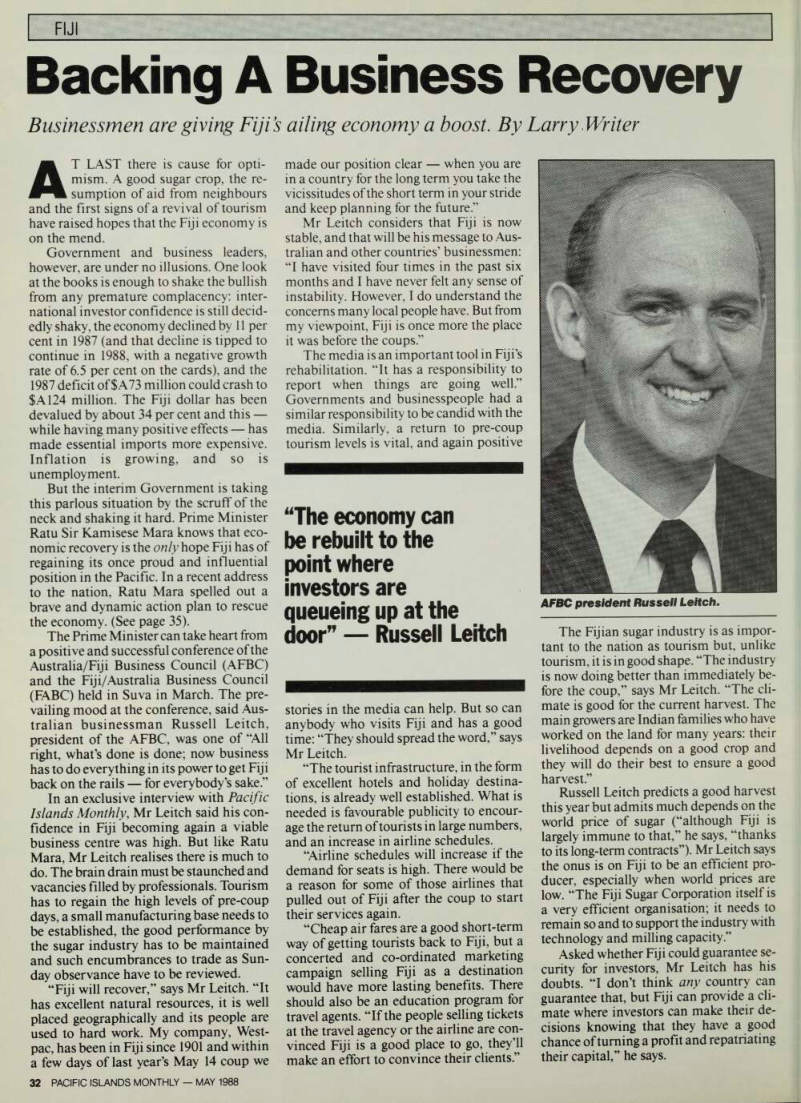
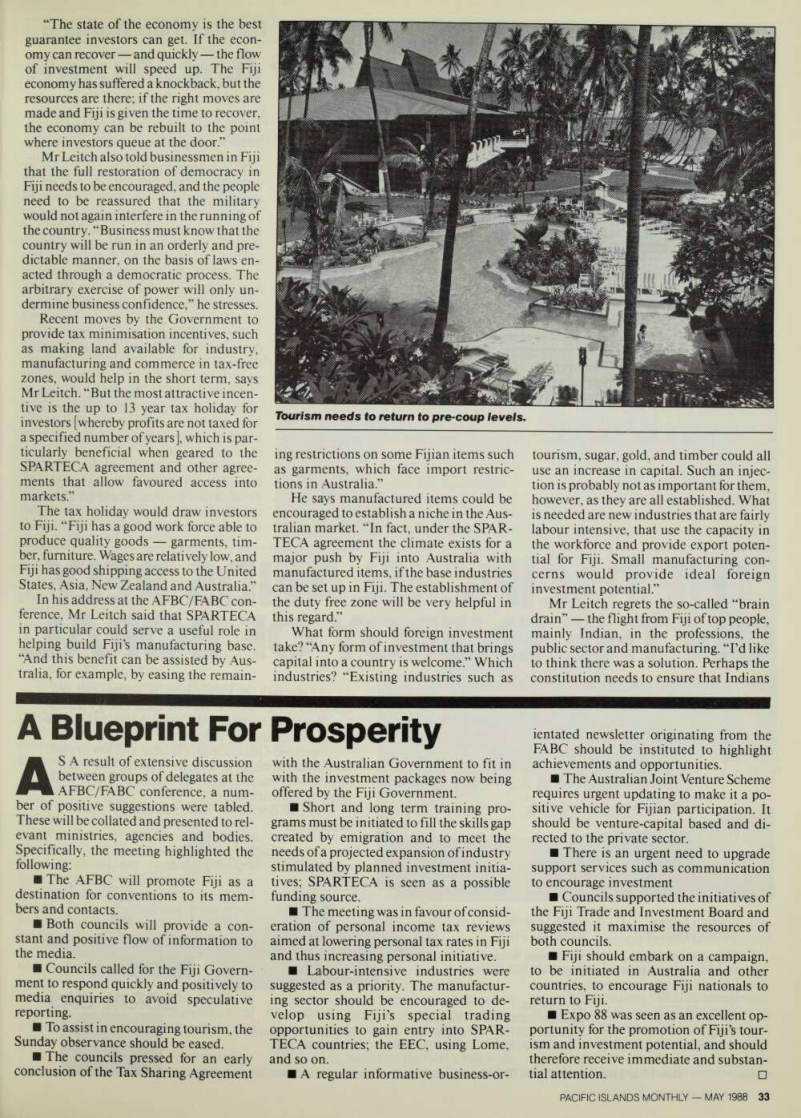
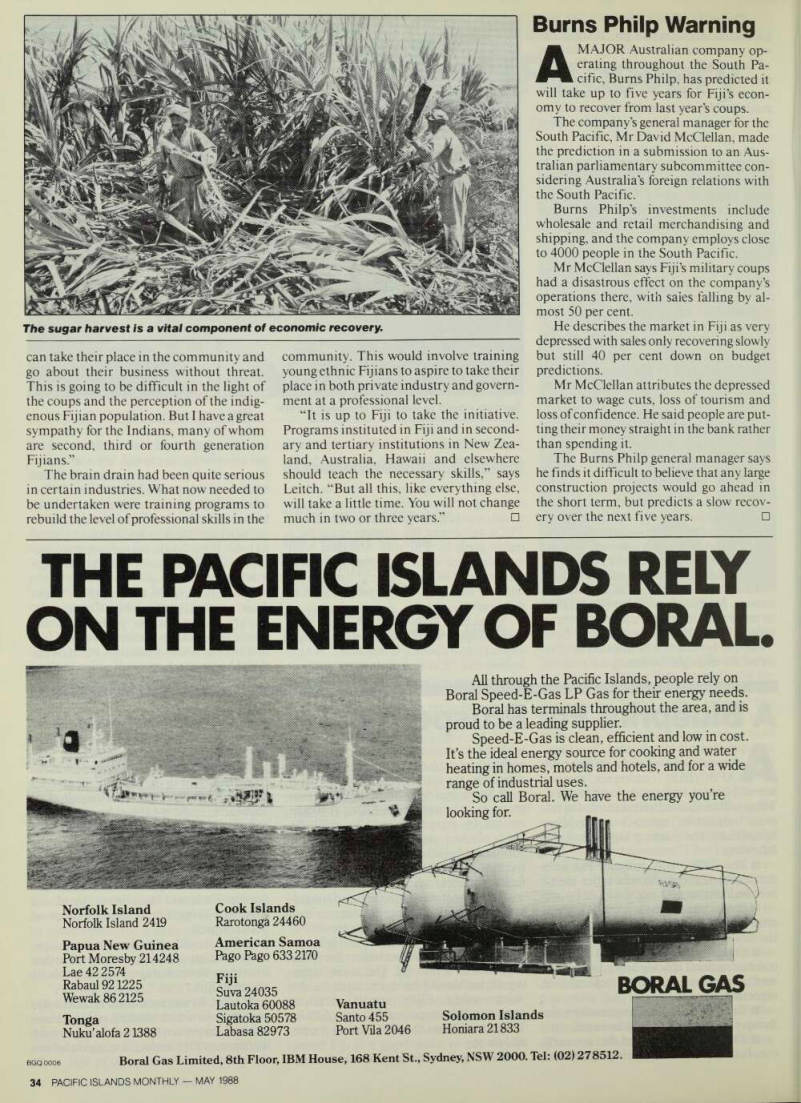
Fiji
Businessmen are giving Fiji s ailing economy a boost.
By Larry Writer
AT LAST there is cause for opti mism. A good sugar crop, the re sumption of aid from neighbours and the first signs of a revival of tourism have raised hopes that the Fiji economy is on the mend.
Government and business leaders, however, are under no illusions. One look at the books is enough to shake the bullish from any premature complacency: inter national investor confidence is still decid edly shaky, the economy declined by 11 per cent in 1987 (and that decline is tipped to continue in 1988, with a negative growth rate of 6.5 per cent on the cards), and the 1987 deficit of SA73 million could crash to SAI24 million. The Fiji dollar has been devalued by about 34 per cent and this while having many positive effects has made essential imports more expensive.
Inflation is growing, and so is unemployment.
But the interim Government is taking this parlous situation by the scruff of the neck and shaking it hard. Prime Minister Ratu Sir Kamisese Mara knows that eco nomic recovery is the only hope Fiji has of regaining its once proud and influential position in the Pacific. In a recent address to the nation, Ratu Mara spelled out a brave and dynamic action plan to rescue the economy. (See page 35).
The Prime Minister can take heart from a positive and successful conference of the Australia/Fiji Business Council (AFBC) and the Fiji/Australia Business Council (FABC) held in Suva in March. The pre vailing mood at the conference, said Aus tralian businessman Russell Leitch, president of the AFBC, was one of “All right, what’s done is done; now business has to do everything in its power to get Fiji back on the rails for everybody’s sake.”
In an exclusive interview with Pacific Islands Monthly, Mr Leitch said his con fidence in Fiji becoming again a viable business centre was high. But like Ratu Mara, Mr Leitch realises there is much to do. The brain drain must be staunched and vacancies filled by professionals. Tourism has to regain the high levels of pre-coup days, a small manufacturing base needs to be established, the good performance by the sugar industry has to be maintained and such encumbrances to trade as Sun day observance have to be reviewed.
“Fiji will recover,” says Mr Leitch. “It has excellent natural resources, it is well placed geographically and its people are used to hard work. My company, West pac, has been in Fiji since 1901 and within a few days of last year’s May 14 coup we
made our position clear when you are in a country for the long term you take the vicissitudes of the short term in your stride and keep planning for the future.”
Mr Leitch considers that Fiji is now stable, and that will be his message to Aus tralian and other countries’ businessmen; “I have visited four times in the past six months and I have never felt any sense of instability. However, I do understand the concerns many local people have. But from my viewpoint, Fiji is once more the place it was before the coups.”
The media is an important tool in Fiji’s rehabilitation. “It has a responsibility to report when things are going well.”
Governments and businesspeople had a similar responsibility to be candid with the media. Similarly, a return to pre-coup tourism levels is vital, and again positive
“The economy can be rebuilt to the point where investors are queueing up at the door” Russell Leitch
stories in the media can help. But so can anybody who visits Fiji and has a good time: “They should spread the word,” says Mr Leitch.
“The tourist infrastructure, in the form of excellent hotels and holiday destina tions, is already well established. What is needed is favourable publicity to encour age the return of tourists in large numbers, and an increase in airline schedules.
“Airline schedules will increase if the demand for seats is high. There would be a reason for some of those airlines that pulled out of Fiji after the coup to start their services again.
“Cheap air fares are a good short-term way of getting tourists back to Fiji, but a concerted and co-ordinated marketing campaign selling Fiji as a destination would have more lasting benefits. There should also be an education program for travel agents. “If the people selling tickets at the travel agency or the airline are con vinced Fiji is a good place to go, they’ll make an effort to convince their clients.”
The Fijian sugar industry is as impor tant to the nation as tourism but, unlike tourism, it is in good shape. “The industry is now doing better than immediately be fore the coup,” says Mr Leitch. “The cli mate is good for the current harvest. The main growers are Indian families who have worked on the land for many years: their livelihood depends on a good crop and they will do their best to ensure a good harvest.”
Russell Leitch predicts a good harvest this year but admits much depends on the world price of sugar (“although Fiji is largely immune to that,” he says, “thanks to its long-term contracts”). Mr Leitch says the onus is on Fiji to be an efficient pro ducer, especially when world prices are low. “The Fiji Sugar Corporation itself is a very efficient organisation; it needs to remain so and to support the industry with technology and milling capacity.”
Asked whether Fiji could guarantee se curity for investors, Mr Leitch has his doubts. “I don’t think any country can guarantee that, but Fiji can provide a cli mate where investors can make their de cisions knowing that they have a good chance of turning a profit and repatriating their capital,” he says.
AFBC president Russell Leitch.
“The state of the economy is the best guarantee investors can get. If the econ omy can recover—and quickly the flow of investment will speed up. The Fiji economy has suffered a knockback, but the resources are there; if the right moves are made and Fiji is given the time to recover, the economy can be rebuilt to the point where investors queue at the door.”
Mr Leitch also told businessmen in Fiji that the full restoration of democracy in Fiji needs to be encouraged, and the people need to be reassured that the military would not again interfere in the running of the country. “Business must know that the country will be run in an orderly and pre dictable manner, on the basis of laws en acted through a democratic process. The arbitrary exercise of power will only un dermine business confidence,” he stresses.
Recent moves by the Government to provide tax minimisation incentives, such as making land available for industry, manufacturing and commerce in tax-free zones, would help in the short term, says Mr Leitch. “But the most attractive incen tive is the up to 13 year tax holiday for investors [whereby profits are not taxed for a specified number of years], which is par ticularly beneficial when geared to the SPARTECA agreement and other agree ments that allow favoured access into markets.”
The tax holiday would draw investors to Fiji. “Fiji has a good work force able to produce quality goods garments, tim ber, furniture. Wages are relatively low, and Fiji has good shipping access to the United States, Asia, New Zealand and Australia.”
In his address at the AFBC/FABC con ference, Mr Leitch said that SPARTECA in particular could serve a useful role in helping build Fiji’s manufacturing base.
“And this benefit can be assisted by Aus tralia, for example, by easing the remain-
ing restrictions on some Fijian items such as garments, which face import restrictions in Australia.”
He says manufactured items could be encouraged to establish a niche in the Australian market. “In fact, under the SPAR- TECA agreement the climate exists for a major push by Fiji into Australia with manufactured items, if the base industries can be set up in Fiji. The establishment of the duty free zone will be very helpful in this regard.”
What form should foreign investment take? “Any form of investment that brings capital into a country is welcome.” Which industries? “Existing industries such as
tourism, sugar, gold, and timber could all use an increase in capital. Such an injec tion is probably not as important for them, however, as they are all established. What is needed are new industries that are fairly labour intensive, that use the capacity in the workforce and provide export poten tial for Fiji. Small manufacturing con cerns would provide ideal foreign investment potential.”
Mr Leitch regrets the so-called “brain drain” the flight from Fiji of top people, mainly Indian, in the professions, the public sector and manufacturing. “I’d like to think there was a solution. Perhaps the constitution needs to ensure that Indians
Tourism needs to return to pre-coup levels.
can take their place in the community and go about their business without threat, This is going to be difficult in the light of the coups and the perception of the indigenous Fijian population. But I have a great sympathy for the Indians, many of whom are second, third or fourth generation Fijians.’’
The brain drain had been quite serious in certain industries. What now needed to be undertaken were training programs to rebuild the level of professional skills in the
community. This would involve training young ethnic Fijians to aspire to take their place in both private industry and govern ment at a professional level.
“It is up to Fiji to take the initiative.
Programs instituted in Fiji and in second ary and tertiary institutions in New Zea land, Australia, Hawaii and elsewhere should teach the necessary skills,” says Leitch. “But all this, like everything else, will take a little time. You will not change much in two or three years.” □
The sugar harvest is a vital component of economic recovery.
A Blueprint For Prosperity
AS A result of extensive discussion between groups of delegates at the AFBC/FABC conference, a number of positive suggestions were tabled.
These will be collated and presented to relevant ministries, agencies and bodies, Specifically, the meeting highlighted the following: ■ The AFBC will promote Fiji as a destination for conventions to its members and contacts. ■ Both councils will provide a conslant and positive flow of information to the media. ■ Councils called for the Fiji Government to respond quickly and positively to media enquiries to avoid speculative reporting. ■ To assist in encouraging tourism, the Sunday observance should be eased. ■ The councils pressed for an early conclusion of the Tax Sharing Agreement
with the Australian Government to fit in with the investment packages now being offered by the Fiji Government. ■ Short and long term training pro grams must be initiated to fill the skills gap created by emigration and to meet the needs of a projected expansion of industry stimulated by planned investment initia lives; SPARTECA is seen as a possible funding source. ■ The meeting was in favour of consid eration of personal income tax reviews aimed at lowering personal tax rates in Fiji and thus increasing personal initiative. ■ Labour-intensive industries were suggested as a priority. The manufactur ing sector should be encouraged to de velop using Fiji’s special trading opportunities to gain entry into SPAR TECA countries; the EEC, using Lome, and so on. ■ A regular informative business-or
ientated newsletter originating from the FABC should be instituted to highlight achievements and opportunities, ■ The Australian Joint Venture Scheme requires urgent updating to make it a po sitive vehicle for Fijian participation. It should be venture-capital based and di reeled to the private sector. ■ There is an urgent need to upgrade support services such as communication to encourage investment ■ Councils supported the initiatives of the Fiji Trade and Investment Board and suggested it maximise the resources of both councils. ■ Fiji should embark on a campaign, to be initiated in Australia and other countries, to encourage Fiji nationals to return to Fiji. ■ Expo 88 was seen as an excellent op portunity for the promotion of Fiji’s tour ism and investment potential, and should therefore receive immediate and substan tial attention. □
Burns Philp Warning
A MAJOR Australian company op erating throughout the South Pa cific, Burns Philp, has predicted it will take up to five years for Fiji’s econ omy to recover from last year’s coups.
The company’s general manager for the South Pacific, Mr David McClellan, made the prediction in a submission to an Aus tralian parliamentary subcommittee con sidering Australia’s foreign relations with the South Pacific.
Burns Philp’s investments include wholesale and retail merchandising and shipping, and the company employs close to 4000 people in the South Pacific.
Mr McClellan says Fiji’s military coups had a disastrous effect on the company’s operations there, with saies falling by al most 50 per cent.
He describes the market in Fiji as very depressed with sales only recovering slowly but still 40 per cent down on budget predictions.
Mr McClellan attributes the depressed market to wage cuts, loss of tourism and loss of confidence. He said people are put ting their money straight in the bank rather than spending it.
The Burns Philp general manager says he finds it difficult to believe that any large construction projects would go ahead in the short term, but predicts a slow recov ery over the next five years. □
Advertisements & other items, p. 34 (1 item)
On The Energy Of Boral.
THE MCIFIC ISLANDS RELY
& All through the Pacific Islands, people rely on Boral Speed-E-Gas LP Gas for their energy needs.
Boral has terminals throughout the area, and is proud to be a leading supplier.
Speed-E-Gas is clean, efficient and low in cost.
It’s the ideal energy source for cooking and water heating in homes, motels and hotels, and for a wide range of industrial uses.
So call Boral. We have the energy you’re looking for. * 1 Cook Islands Norfolk Island Norfolk Island 2419 Papua New Guinea Port Moresby 214248 Lae 422574 Rabaul 921225 Wewak 862125 Tonga Nukualofa 21388 Rarotonga 24460 American Samoa Pago Pago 633 2170 Fiji Suva 24035 Lautoka 60088 Sigatoka 50578 Labasa 82973
BORAL GAS
Vanuatu Santo 455 Port Vila 2046 Solomon Islands Honiara 21833 Boral Gas Limited, Bth Floor, IBM House, 168 Kent St., Sydney, NSW 2000. Tel: (02) 278512. ■
Ratu Mara: “Our Great Challenge”
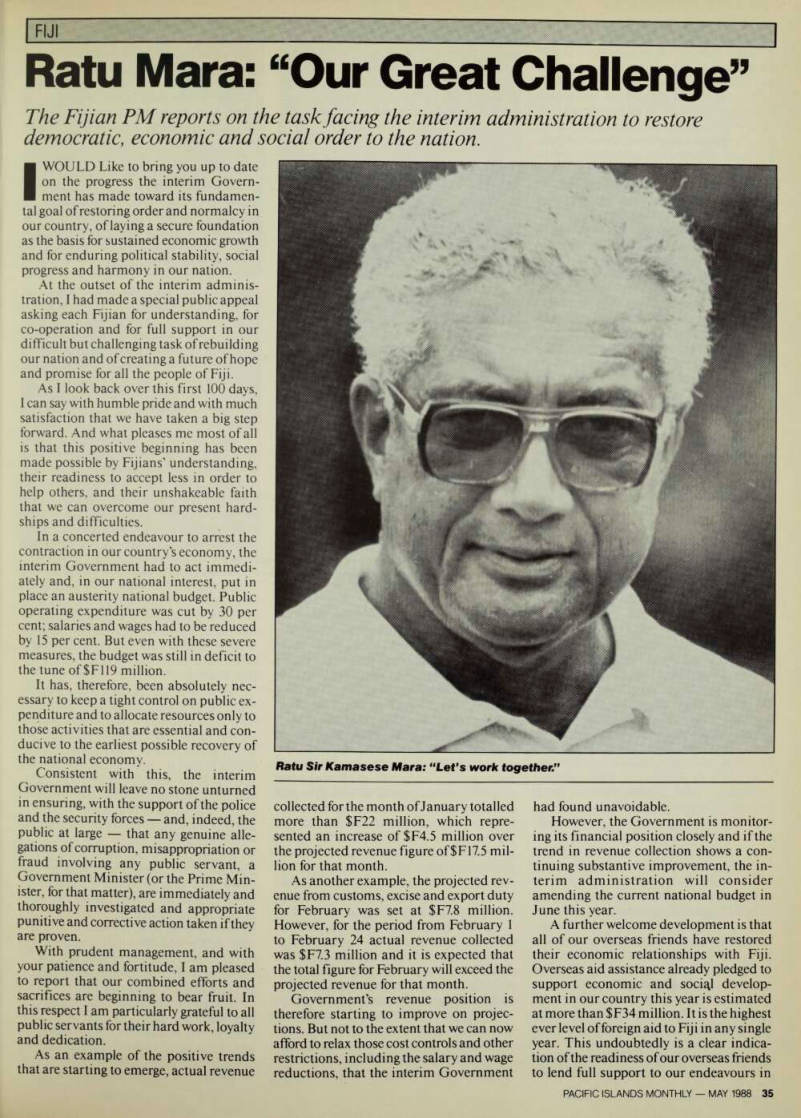
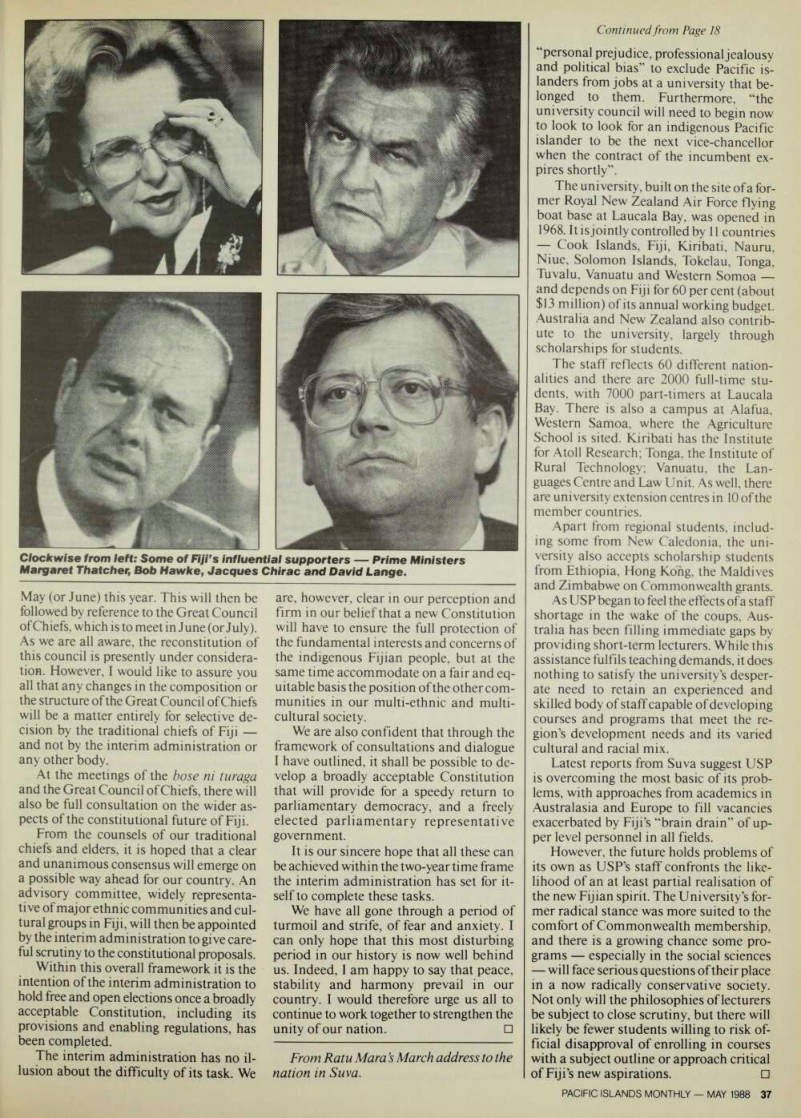
Fiji
The Fijian PM reports on the task facing the interim administration to restore democratic, economic and social order to the nation.
I WOULD Like to bring you up to date on the progress the interim Govern ment has made toward its fundamen tal goal of restoring order and normalcy in our country, of laying a secure foundation as the basis for sustained economic growth and for enduring political stability, social progress and harmony in our nation.
At the outset of the interim adminis tration, I had made a special public appeal asking each Fijian for understanding, for co-operation and for full support in our difficult but challenging task of rebuilding our nation and of creating a future of hope and promise for all the people of Fiji.
As I look back over this first 100 days, I can say with humble pride and with much satisfaction that we have taken a big step forward. And what pleases me most of all is that this positive beginning has been made possible by Fijians’ understanding, their readiness to accept less in order to help others, and their unshakeable faith that we can overcome our present hard ships and difficulties.
In a concerted endeavour to arrest the contraction in our country’s economy, the interim Government had to act immedi ately and, in our national interest, put in place an austerity national budget. Public operating expenditure was cut by 30 per cent; salaries and wages had to be reduced by 15 per cent. But even with these severe measures, the budget was still in deficit to the tune of SFII9 million.
It has, therefore, been absolutely nec essary to keep a tight control on public ex penditure and to allocate resources only to those activities that are essential and con ducive to the earliest possible recovery of the national economy.
Consistent with this, the interim Government will leave no stone unturned in ensuring, with the support of the police and the security forces and, indeed, the public at large that any genuine alle gations of corruption, misappropriation or fraud involving any public servant, a Government Minister (or the Prime Min ister, for that matter), are immediately and thoroughly investigated and appropriate punitive and corrective action taken if they are proven.
With prudent management, and with your patience and fortitude, I am pleased to report that our combined efforts and sacrifices are beginning to bear fruit. In this respect I am particularly grateful to all public servants for their hard work, loyalty and dedication.
As an example of the positive trends that are starting to emerge, actual revenue
collected for the month of January totalled more than SF22 million, which represented an increase of $F4.5 million over the projected revenue figure 0f5F17.5 million for that month.
As another example, the projected revenue from customs, excise and export duty for February was set at SF7.B million.
However, for the period from February 1 to February 24 actual revenue collected was $F7.3 million and it is expected that the total figure for February will exceed the projected revenue for that month.
Government’s revenue position is therefore starting to improve on projections. But not to the extent that we can now afford to relax those cost controls and other restrictions, including the salary and wage reductions, that the interim Government
had found unavoidable, However, the Government is monitor ing its financial position closely and if the trend in revenue collection shows a con tinuing substantive improvement, the in terim administration will consider amending the current national budget in June this year.
A further welcome development is that all of our overseas friends have restored their economic relationships with Fiji, Overseas aid assistance already pledged to support economic and social develop ment in our country this year is estimated at more than SF34 million. It is the highest ever level of foreign aid to Fiji in any single year. This undoubtedly is a clear indica tion of the readiness of our overseas friends to lend full support to our endeavours in
Ratu Sir Kamasese Mara: “Let's work together."
Fiji. It is comforting to know that we do not stand alone as a member of the inter national community of nations, but that we do have friends who genuinely care for our future.
I would like to express our sincere ap preciation to all the governments and in ternational organisations that have rallied to our support. I can assure them that their generous contribution will greatly facili tate the economic recovery and social sta bility we all want for Fiji, and which we must have if we are to ensure lasting peace and harmony in our country.
I n my address to you last December and in my New Year message to the nation, I informed you then that the protection of employment and the creation of new jobs for our people was an immediate priority of the interim Government. As we saw it, this was to be approached in several ways.
One was to implement development proj ects in the public sector. In the capital budget for this year, a total of SFS7 million is to be spent on capital works. Work has already begun on several projects.
The SF34 million in foreign aid already committed to Fiji for this year will be used to complement and to supplement our ef forts in the public sector. And we shall continue our efforts to attract additional capital aid to Fiji.
The interim Government will, for ex ample, be following up my recent discus sions in South Korea and Japan, for the South Korean Government to assist in the financing of the reconstruction of the Ba and Sigatoka River bridges, and for the Government of Japan to consider financ ing the construction of a new teaching hospital complex in Suva.
These projects, if successfully followed through, will contribute not only in pro viding jobs for hundreds of our people but also in improving economic and social services. But in addition to all these, it is the private sector we believe that has tre mendous potential to bring about and to foster the quick recovery of our economy.
The essential first step must be to re store and to raise the level of investor con fidence, both within our own business community and among overseas busi nessmen. We have begun that process and we are succeeding in restoring that confi dence. Furthermore, with the establish ment of special tax free zones, the interim Government has been making every ef fort to attract increased investment inter est and participation in Fiji. In this regard I am most grateful to the Australia/Fiji and Fiji/Australia Business Councils for the constructive contribution they have made.
In particular, I wish to acknowledge with Warm appreciation the extremely helpful attitude they have adopted in agreeing unanimously to express their collective confidence in the future of Fiji as a focus for substantial business investment and development.
Indeed, as a direct reflection of the growing business interest and confidence
in Fiji, 20 new investment proposals involving local businessmen and overseas partners have already been received to take full advantage of the tax free facilities that were recently introduced. Of these applications, three have already been approved and 17 are still being processed by the Fiji Trade and Investment Board.
The establishment of these new enterprises will create many new jobs for our people and earn increased foreign exchange for our country.
The interim Government will continue to do its utmost to encourage and promote new investment in our country, in order to stimulate and accelerate our economic recovery and provide employment and income generation for our people.
Tourism is another major area of primary focus by the interim administration.
A number of tourist development projects with a total value of more than SF3OO million are already in the pipeline.
“The essential first step must be to restore and to raise the level of investor confidence”
In January this year, Government re cruited a tourist expert to work with the Ministry of Tourism to identify small projects for indigenous Fijians. The objec tive of this project is to diversify and to spread the location of tourism-related ac tivities, so as to help in improving eco nomic conditions in our rural areas and at the same time create employment for our rural population.
Meanwhile, the Fiji Visitors Bureau has embarked on an active marketing cam paign to restore growth in tourist visitor arrivals in Fiji. In fact, forward bookings look optimistic for the tourist industry for the rest of this year. And plans for the ex pansion of our tourist industry have been given a real boost by the recent start of the Nadi airport terminal redevelopment pro ject. This is estimated to cost $F 10 million and will create 200 new jobs.
In my discussions with the Govern ment of Japan during my recent visit to Tokyo, I was able to urge the Japanese authorities to facilitate the commence ment by our own Air Pacific of direct air services to Japan later this year.
With Air Pacific flying to Japan, and with the renewed Japanese business inter est in direct participation in hotel devel opment and operation in Fiji, I have every confidence that we can develop an impor
tant tourist market in Japan.
Australia, of course, will continue to be Fiji’s most important tourist market. Ac cordingly, we welcome the recent under taking by the Australia-Fiji Business Council to promote Fiji as a continuing destination for Australian tourists and as an attractive venue for holding conven tions and meetings.
The commencement of improvement in the Government’s financial position, the increased and extended public sector pro grams of public works, the restoration of overseas economic aid support for Fiji, the return of investor confidence, the start of new joint venture businesses in our coun try, and the gradual recovery of our tour ism industry are all positive indications that our economy is moving forward.
If we can continue and perservere with our concerted and united efforts, with our sacrifice and readiness to help our fellow men with hard work and an unyielding de termination never to be defeated, I have no doubt that our present endeavours to overcome our economic difficulties will be rewarded ultimately with resounding success.
In my address on December 8, I also said that the formation of an acceptable Constitution for our country was without question another top priority for the in terim administration. To this end, a cab inet committee has already started looking at proposals for a new constitution. We re gard this task as a matter of paramount national importance.
We also recognise that it would have to be approached delicately, with meticulous care and with extra sensitivity, but tem pered by a realisation and an acceptance that the only solution that can have any real hope of lasting success is one that takes fully into account the realities of the pres ent situation.
By various decrees that have already been promulgated, order and normalcy have been restored to the functioning of Government and of public services. An independent judiciary has been re-estab lished. Under the new fundamental rights and freedoms decree, basic human rights and fundamental freedoms have been re stored. But we have begun a new stage in our life as a nation. We are now a republic the Republic of Fiji.
We must realise that there can never be a return to the Dominion status we had before this change in our Constitution.
Nevertheless, the interim administration is firmly committed to exploring every possible avenue of an acceptable arrange ment that would allow the entire people of Fiji the opportunity to be able to show, in the most direct way, their continuing loy alty to, and affection for, the British Crown.
In keeping with traditional Fijian cus tom and courtesy... the recommenda tions of our cabinet on the Constitution will be conveyed first to a special meeting of traditional chiefs from all parts of Fiji.
This hose ni turaga will be convened in
May (or June) this year. This will then be followed by reference to the Great Council of Chiefs, which is to meet in J une (or July).
As we are all aware, the reconstitution of this council is presently under considera tion. However, I would like to assure you all that any changes in the composition or the structure of the Great Council of Chiefs will be a matter entirely for selective de cision by the traditional chiefs of Fiji and not by the interim administration or any other body.
At the meetings of the bose ni turaga and the Great Council of Chiefs, there will also be full consultation on the wider as pects of the constitutional future of Fiji.
From the counsels of our traditional chiefs and elders, it is hoped that a clear and unanimous consensus will emerge on a possible way ahead for our country. An advisory committee, widely representa tive of major ethnic communities and cul tural groups in Fiji, will then be appointed by the interim administration to give care ful scrutiny to the constitutional proposals.
Within this overall framework it is the intention of the interim administration to hold free and open elections once a broadly acceptable Constitution, including its provisions and enabling regulations, has been completed.
The interim administration has no il lusion about the difficulty of its task. We
are, however, clear in our perception and firm in our belief that a new Constitution will have to ensure the full protection of the fundamental interests and concerns of the indigenous Fijian people, but at the same time accommodate on a fair and eq uitable basis the position of the other com munities in our multi-ethnic and multi cultural society.
We are also confident that through the framework of consultations and dialogue I have outlined, it shall be possible to de velop a broadly acceptable Constitution that will provide for a speedy return to parliamentary democracy, and a freely elected parliamentary representative government.
It is our sincere hope that all these can be achieved within the two-year time frame the interim administration has set for it self to complete these tasks.
We have all gone through a period of turmoil and strife, of fear and anxiety. I can only hope that this most disturbing period in our history is now well behind us. Indeed, I am happy to say that peace, stability and harmony prevail in our country. I would therefore urge us all to continue to work together to strengthen the unity of our nation. □
From Ratu Mara s March address to the nation in Suva.
Clockwise from left: Some of Fiji's influential supporters - Prime Ministers Margaret Thatcher, Bob Hawke, Jacques Chirac and David Lange.
Trade Winds
A Coconut Shell And Driftwood
Steam Engine For The Islands
AN AUSTRALIAN-designed and built steam engine that runs on sawmill offcuts and coconut shells is now undergoing final tests in Sydney before shipment to the island of Atiu in the Cook Islands. Forerunner of a new export drive in “appropriate technology”, the en gine is designed to bring electricity and in dustrial power to remote communities, sawmills and workshops at a fraction of the cost of conventional diesel units.
Island Steam and Engineering Co (ISE) has been developing its Island 11/150 Steam Engine for the past five years. The first order came from the Cook Islands Government. Delivering 225 horsepower, the engine is capable of handling a typical 150 kW generator/alternator.
The engine is designed for simplicity of operation, on-the-spot repair and main tenance by village tradesmen, and cheap ness of operation using a variety of solid fuels ranging from sawmill offcuts to co conut shells, oil palm detritus, chaff and grain stalks and driftwood.
The cost of diesel fuel is doubled or more for many remote communities by the cost of transporting it in barrels aboard lo cal trucks and supply boats. In many Third World countries this cost far outweighs the labour-intensive collection and prepara tion of local wood fuels. Even in countries such as Australia and New Zealand, re mote sawmills burn off waste wood 24 hours a day simply for disposal while in the same plant a diesel plant is burning oil.
ISE managing director Sandy Storey says, “The design requirements have been from the beginning simplicity, ease of es sential repairs and maximum visibility of those parts most prone to wear or failure.
It is almost axiomatic that if a machine part is visibly ‘wrong’ it is repairable with basic tools, experience and common-sense qualities which are abundantly avail able in the Third World.”
Storey engaged mechanical engineer Jack Doherty in 1984 to undertake the de sign and development of the Island en gine. Another Australian engineer, Paul Bailey, was chiefly responsible for bring ing out the production model.
According to Storey, the engine’s cost effectiveness is obvious when fuel com parisons are made. Remote communities able to grow and provide their own fuel should get power for 12 to 18 cents (Aus tralian) per kilowatt hour where power from conventional diesel systems can cost between 60 cents and As 2 per kWh.
As well as providing electricity, the Is land 11/150 engine can provide rotational
power by a belt from the flywheel for a sawmill or other industrial activity, or provide a simple back-and-forth move ment for pumping or grinding.
Development authorities in the South Pacific have shown great interest in the system and ISE is actively pursuing orders for more than a dozen engines. Under de velopment is a larger 500 kW engine.
United Nations Water Resource
Program Underway
THE UNITED Nations Develop ment Program has approved SUS 1.5 million ($F2.3 million) for the de velopment of water resources in the South Pacific.
This project, which is located in the In stitute of Natural Resources at the Uni versity of the South Pacific, Fiji, follows a pilot activity funded by the United Na tions Department of Technical Co-oper ation for Development (DTCD), which has been carried out over the past 18 months to assess water resources needs in Pacific island countries.
Individual country\projects have been initiated for Kiribati, Tuvalu and the Sol omon Islands.
Chief technical adviser Dr Peter Had wen will continue as head of the new pro ject. He will be assisted by technical staff based in Fiji and other Pacific islands in cluding Solomon Islands, Western Sa moa, Vanuatu, Tuvalu, Papua New Guinea, Palau, Kiribati, Federated States of Micronesia and the Cook Islands.
The project will be executed by DTCD and will strengthen national water auth orities by enhancing their capacity to plan, co-ordinate and manage water-related policies and activities. This will involve training of local personnel as well as the fielding of specialist staff and consultants to provide technical guidance and support to regional governments.
Among its activities, the project will conduct geological and engineering stud ies; explore and assess surface as well as ground water; provide various options on alternative water supply systems; and as sist governments to review water legisla tion and prepare draft water laws and regulations. These activities may generate significant follow-up investment by bilat eral and multilateral donors.
During 1987-1991, the project will also collaborate with USP to establish a re gional information centre on aspects of water development.
Surveillance Centres To Protect
Fishing Industry
Australian officials say the South Pacific should have a regional sur veillance network within five years. The network would be based around
national surveillance centres in the island states, the Pacific patrol boats being built and supplied by Australia and surveil lance flights by Australia and New Zealand.
The officials say that in the next two years Australia will help establish na tional surveillance centres in Vanuatu, Western Samoa and the Cook Islands.
Papua New Guinea and Tonga are to be given assistance to upgrade their centres.
The Solomon Islands surveillance centre, established with assistance from Australia’s defence co-operation program, was opened in March.
The Australian officials say discus sions are going on with Kiribati on whether Australia could help it set up a surveil lance centre. The use of the centres was discussed at a March meeting in Vanuatu of 13 of the South Pacific Forum countries and the Forum Fishing Agency.
Staff from the surveillance centres would receive training at the Australian Maritime college in Launceston, Tas mania. The college would also train crew of the 12 Pacific patrol boats Australia plans to provide to the island states.
Meanwhile, the Solomons Islands Government is to hold talks with the United States over the reported discovery of two American tuna boats illegally fish ing in the Solomons exclusive economic zone. The boats were sighted from the air in March.
The boats had been tracked by the newly opened maritime surveillance centre in Honiara, one of a number being established in the South Pacific under the Australian defence co-operation program.
The Solomon Islands Police Commis sioner, Mr Fred Soaki, said the American tuna boats had been photographed fishing less than 160 kilometres from land.
Mr Soaki said the sightings had been referred to the Solomon Islands Depart ment of Foreign Affairs, which would take up the matter with the United States Government.
The seizure of another American tuna boat by Solomon Islands authorities sev eral years ago resulted in the United States finalising a fishing agreement with South Pacific countries.
□ Terramat Bailed Out
PAPUA NEW Guinea’s Department of Trade and Industry is moving to save a new local industry based on production of ter ramat, a by-product of coconut fibres.
Terramat, used to stop erosion in civil engineering projects, is made by Dylup Industries in the Madang province. The company has been facing problems of marketing, competition and lack of local support.
The PNG Deputy Prime Minister, Sir
Julius Chan, has directed the department to mount a marketing program to increase sales of terramat both within PNG and overseas.
Sir Julius says tests carried out on his PNG terramat show the product to be of superior quality and would compete di rectly with similar products on the mar ket. Government departments and institutions in the country have been asked to use terramat in civil engineering projects.
□ Coffee Quota Change
THE INTERNATIONAL Coffee Organ isation has accepted Papua New Guinea’s request for a change in the date of its coffee stock verification from March to Decem ber. The change means that Papua New Guinea’s coffee quota for next year would increase along with its export earnings.
□ Hydropower Construction
THE EUROPEAN Investment Bank has announced a low interest loan of about $ A 3 million for construction of a hydropower plant at Afulilo Falls on the Western Sa moa island of Upolu.
The loan, under the third Lome Con vention, will help build a 10 million cubic metre storage reservoir, power plant, transmission network extensions and auxiliary equipment.
The project is jointly financed by the Asian Development Bank, the Interna tional Development Association and the Commission of the European Communities.
□ Ok Tedi’S Big Profit
PNG’S COPPER and gold mine Ok Tedi has reported a big profit increase for the year ending December 31. Ok Tedi Min ing Limited, which manages the mine, says profits rose by $ A 42 million over the same period for the previous year.
The managing director and chief ex ecutive Mr R J Carter says the result is a significant step in the project’s progress of improving profitability. He attributed the improvement to a stronger operating per formance and the commencement of cop per concentrate production. Strong prices for both gold and copper also assisted returns.
Mr Carter forecast further improve ment as the mine’s construction program nears completion.
BHP is the managing shareholder in Ok Tedi, with other principal parties Amoco Corporation, the Papua New Guinea Government and a German consortium.
□ Samoa Fights Fishing Edict
THE WESTERN Samoa Government is protesting to the United States against a Congressional decision to stop funding new fisheries development in Western Samoa.
Congress has said future fisheries de velopment in the region could be financed from the five-year fishing treaty recently ►
signed by the United States and the South Pacific Forum Fisheries Agency.
Government officials in Apia said the decision meant Western Samoan devel opment plans costing more than SAS mil lion dollars would have to be funded locally. The plans include construction of a research vessel now being built in the United States.
□ Communications Bank Slammed
PAPUA NEW Guinea’s Finance Minister has strongly criticised a decision by the Government’s Post and Telecommunica tions Corporation (PTC) to set up a com mercial bank.
According to board chairman Mr Elias Vuvu, the corporation has been prompted by the high profits it is making from its op erations to set up the bank, which would operate from 40 branches in the country where the PTC also provides postal and telecommunications services.
The PNG Finance and Planning Min ister, Mr Kwarara, says the corporation’s first task is to improve services and any profits made should be put into expanding and improving services to more areas of the country.
Meanwhile, the Governor of the Bank of Papua New Guinea, Sir Henry Torob ert, says the PTC move is permissible un der the country’s Banking Act.
□ Protecting Cardamom
THE GOVERNMENT whip in PNG’s Parliament has called for the establish ment of a Cardamom Industry Board to protect growers and promote overseas marketing of the crop.
Mr Pawa Sisioka says cardamom has the potential to become a major revenue earner for PNG given the right kind of support and assistance. Papua New Guinea exports about four hundred tonnes of the spice each year.
It is grown as a cash crop by village people in the Highlands and in less than two years’ production to September last year, their efforts earned K 2.7 million.
The Member for the Highlands seat of Karimui Nomane, Mr Sisioka wants a commodity board set up for the carda mom industry similar to boards for other large rural industries.
Mr Sisioka also says a watch needs to be kept on foreigners who, he claims, are out to make quick money at the expense of village growers.
□ Uk Cargo Carrier For Tuvalu
A NEW passenger and cargo vessel for Tu valu has been launched in Britain. The 1200 tonne vessel, the Nivaga Two, was built at a cost of nearly SA7 million from
Britain’s overseas aid program.
The vessel will carry children to and from school, patients to hospital, food, consumer goods and the police around the nine islands of Tuvalu.
The ship will undergo sea trials before sailing for Funafuti later this year.
□ Guidelines For Business Growth
A CONFERENCE in Canberra has been told that the business sector had to be en couraged to make a major contribution to the South Pacific’s economic development.
The assistant executive director of the National Centre for Development Studies, Mr Rodney Cole, was opening a seminar on private investment in the South Pa cific, held by the centre and the Common wealth Secretariat and the World Bank.
The meeting considered obstacles to private investment, reviewed the role of Pacific governments and made recom mendations on investment promotion.
A special economic adviser to the Commonwealth Secretariat, Doctor Vin cent Cable, said debt problems had en couraged more developing countries to seek foreign capital. He said the tradi tional source of such capital has been the United States and Europe, but in future Japan would be the major source of in vestment funds.
□ Vanuatu Deficit
VANUATU RECORDED a balance of trade deficit of $56 million in 1987. Fig ures published by the National Planning and Statistics Office put the total value of imports at $76 million while its exports were about $2O million. The volume of co pra exported by the Republic decreased by 12 per cent from 42,000 tonnes in 1986 to 31,000 tonnes in 1987.
However, total export receipts from copra, Vanuatu’s main export earner, in creased by 56 per cent to $7 million. This was due to higher copra prices on the world market.
□ Solomons Satellite Contract
THE BRITISH company, Cable and Wireless, has been selected to develop a domestic satellite communications sys tem for Solomon Islands. Cable and Wire less set up the country’s international satellite services about nine years ago and holds half of the shares in the operating company, Soltel.
The Minister for Posts and Commu nications, Mr John Maetia, said he hoped that work on the domestic system would start in about three months.
Five earth stations will be constructed in the major administrative centres in the islands, all of which will be linked to Hon
iara through the Intelsat satellite. The pro ject is expected to cost about $5 million.
□ Coffee Share Float
PAPUA NEW Guinea’s big coffee pro ducer Angco Pty Ltd, of Goroka, has floated 5 million one kina shares and chairman Mr Kagul Koroka has invited “ordinary people” to buy shares. The company wants capital for agricultural development.
□ Cook Islands Bank Search
THE COOK Islands Development Bank has been advertising locally for a general manager because it cannot afford to pay the salary demanded by overseas applicants. The bank’s deputy chairman, Mr Lionel Browne, said the position had been advertised overseas for three months, but the bank was unable to pay the salary asked for as the bank did not now benefit from a salary-supplementary scheme, un der which overseas aid was used to fund half the salary of a general manager. Mr Browne said the board was confident that there were suitably qualified locals to fill the senior post.
□ Hotel Chain Buyer Names
MR ADRIAN Zecha, a Hong Kong hotelier, is reported to have bought the Southern Pacific Hotel Corporation, owner of 38 hotels in Australia, New Zea land, Fiji and Tahiti, from Singapore busi nessman Tan Sri Khoo Teck Puat, who acquired the corporation in 1981 for SA7S million. Mr Zecha is believed to have paid SA39O million for the hotel chain.
Tan Sri Khoo, currently believed to be liv ing in Thailand or Taiwan, is alleged to be “wanted” by Brunei legal authorities on fraud charges involving the National Bank of Brunei, the chairman of which, Khoo Ban Hock, son of Tan Sri Khoo, was sent to prison for four years in February for his part in the fraud.
□ Offshore Crime
AUSTRALIAN CRIME authorities, in Fiji for talks with Mr Sailosi Kepa, Fiji’s Minister for Justice and Attorney-Gen eral, and others in the judiciary, warned in a press conference in Suva that Aus tralian and other criminals were using off shore banking systems established in islands to “launder” their money.
Australia was also becoming increasingly concerned, he said, that Pacific states were being used to reroute drugs, particularly cocaine, to Australia. With the United States market becoming saturated and Europe clamping down very effectively on drug pedlars, the drug cartels were turning to Australia.
Advertisements & other items, pp. 39-40 (2 items)
Director
vfy Pacific Bureau for
XT/ Economic Co-operation
Applications are invited from citizens of member countries for the position of Director of the South Pacific Bureau for Economic Co-operation (SPEC).
SPEC is the Secretariat of the South Pacific Forum which is comprised of the Leaders of the following independent countries of the South Pacific region: Australia, Cook Islands, Federated States of Micronesia, Fiji, Kiribati, Nauru, New Zealand, Niue, Papua New Guinea, Republic of the Marshall Islands, Solomon Islands, Tonga, Tuvalu and Western Samoa.
A regional organisation based in Suva, SPEC was established to encourage cooperation in the South Pacific not only between member states in the region, but also between island member states and the more industrialised countries on all aspects of economic development, trade, transport, tourism, telecommunications, and energy.
QUALIFICATIONS:
Applicants should have: • proven administrative ability; • wide experience in trade, economic and financial matters affecting Forum countries; and • an in-depth understanding of the political, social and economic structures of Forum countries.
Applicants should be able to approach the political and economic development of the Region in a bold and imaginative fashion, and to adapt conventional theories of economic co-operation according to the particular requirements of Forum countries.
Wide experience in dealing with Governments within and outside the region at the highest diplomatic, political and official levels is also required.
DUTIES:
The Director of SPEC is required: (i) To act as Secretary to the South Pacific Forum and its Committees, Councils and Working Groups: and to direct the role of SPEC as Secretariat to the Forum. (ii) To maintain continuing contact and consultations with member Governments and regional and international organisations operating in the region at the highest political and official levels. (Hi) To direct the execution of the work programme, the basic objective of which is to encourage and promote regional co-operation and consultation in the economic development of Forum Island countries through regional trade expansion, regional industrialisation and the development of transport, telecommunications, energy development, tourism and regional development planning in related fields; (iv) To direct the preparation of reports and recommendations for consideration by the SPEC Committee and the Forum; (v) To participate at Regional and International meetings; (vi) To travel within and outside the region in the execution of these duties; and (vii) To undertake such other other functions as may be decided from time to time by member Governments.
CONDITIONS:
The appointee will be based at SPEC Headquarters in Suva, Fiji. Appointment which is renewable for one more term only will be on a three year contract. Further details of terms and conditions of service can be obtained from the South Pacific Bureau for Economic Co-operation, P.O. Box 856, Suva, Fiji.
REMUNERATION:
Salary is related to the Fiji Public Service salary structure with various allowances where applicable. Total remuneration is payable in Fiji dollars in Suva free of Fiji tax for non-Fiji citizens. Life, accident and medical insurance schemes are additional benefits.
APPLICATIONS:
Applications close on 30 June 1988 and should be addressed with full particulars to:
The Chairman
South Pacific Forum
Office of the Prime Minister
Apia
WESTERN SAMOA
Trade Winds
Century
The Communications Revolution
Into The 21 st Century
New technology is transforming the Pacific: once bedevilled by poor and unreliable communications, the region is being united by television, radio and satellite telecommunications links.
Media observer and communications expert Liz Fell profiles the organisations, the problems and the expanding market for telecommunications in a region so broad it encompasses a quarter of the globe.
PACIFIC NATIONS, for so long kept out in the cold by gaps in interna tional telecommunications links, are flexing their muscles as transnational corporations and statutory authorities court their business. Despite the estab lished expertise of Japanese, American and European suppliers, the region’s at tention is increasingly directed toward Australia, whose three publicly owned communications carriers are searching out new business opportunities as neighbour ing countries are moving to update and ex tend their telecommunications networks.
Telecom Australia has established close relationships with its domestic counter parts in PNG, Tonga, Fiji and New Zea land, while the Overseas Tele communications Commission (OTC) is focusing on a regional satellite network for the Forum countries.
Australia’s domestic satellite company, Aussat Pty Ltd, already provides com munications for NZ and is poised to com pete with OTC in the provision of international services for multinational corporations operating in countries cov ered by its regional “footprint”.
The catalyst for much of this activity is SPEC’s South Pacific Telecommunica tions Development Program, which has received an annual $A600,000 aid grant since 1983 from Australia and NZ, the “Big Brothers” of the region.
The focus of the program is the estab lishment of rural trunk links to outlying areas and isolated islands, where telecom munication services for health, education or humble personal telephone calls are virtually nonexistent.
The 1980 South Pacific Forum meeting agreed that telecommunications, particu larly satellite communications, was a high priority for breaking down the social and economic divisions between urban elites and the rural poor, and for encouraging in
vestment and development in the region.
The original idea behind the SPEC program was to adopt a regional approach so all nations could benefit from co-ordinated planning, equipment standardisation, shared satellite usage and bulk purchasing. Such a regional approach may appear to be efficient and rational but it has sometimes failed to recognise the independent and competitive spirit within the region or its diversity of cultural and political perspectives.
Each nation is actively pursuing its own priorities and timetables for telecom development, a fact that was highlighted when some participants complained about SPEC’s unsuccessful attempt to secure World Bank program funding last year, SPEC director Henry Naisali admitted he was shocked at the “almost entirely negative response” to his inquiry about support for World Bank funds when delegates attended the program meeting in Tonga last November.
The World Bank has agreed to examine the funding needs of the two largest countries Fiji and Papua New Guinea which are now busy drawing up master plans to meet its criteria for securing loans, As a first step, the Bank gave $A650,000 to PNG for a management and network consultancy. Telecom Australia International Ltd (TAI) tendered for the contract, but missed out after making it to the short list of seven. TAI has since secured another contract to develop a PNG policy on private automatic telephone exchanges (PABX), and is now considering opportunities related to the installation of a new fibre optic cable system.
TAPs business development manager, Laurie West, says breaking into international markets is “a tough, competitive business” and there are dangers associated with moving offshore “too hard and too fast”.
West, who has developed close work ing links with telecom executives and en gineers in NZ, Tonga, Vanuatu and Fiji through training and consultancy serv ices, cites the case of Tonga’s Telecom munications Commission, which has signed an “agency agreement” with TAI allowing it to tap into Telecom Australia’s resources on a commercial basis.
This agreement meant that when Tonga gave Ericsson Australia the contract to supply small digital (AXE) telephone ex changes for rural communications in the Ha’apai and Vava’u island groups, TAI was asked to provide the specialist training, Ericsson has another contract to supply Australian-made rural exchanges for Fiji’s telecom authority, with which TAI has a long-term co-operation arrangement, TAI has completed a tariff study for Fiji that, says West, is now being implemented as part of Fiji’s plan to restructure its do mestic telephone business. The Fiji ad ministration has announced plans to privatise this business within 12 months; plans that were on the Alliance govern menfs agenda just before it was thrown out of office in the 1987 elections. The priva tisation scheme involves forming a lim ited liability company with initial capital that will, it is hoped, be supplied by the World Bank. The Government will main tain a major share, with a minority hold ing going to private shareholders.
Fintel Ltd, the company licensed to op erate Fiji’s international services, is already privatised with a 49 per cent share in the hands of the British giant, Cable & Wireless.
Cable & Wireless (originally Imperial and International Communications Ltd) has a long association with the region, going back tc the days when the island na tions were British colonies. Aside from Fiji, Cable & Wireless owns shares in the in temational franchise for the Solomon Is-^
◄ lands (51 per cent), Tonga (100 per cent), the Cook Islands (100 per cent) and Van uatu (33 per cent).
Throughout the region a number of governments have begun to review their organisational arrangements with carriers such as Cable & Wireless and to explore other potential partners.
OTC has moved ouickly to take advan tage of this opportunity, which would al low it to expand its international business and assist development at the same time.
An OTC team guided by Rod Masterton, regional manager for the Pacific and Asia, conducted the right research and let it be known it was interested in managing or operating networks on a joint venture basis with other South Pacific governments. The tiny Republic of Kiribati made the first approach, and on April 1 this year OTC International Ltd (OTCI) commenced a contract to manage Kiribati’s national and international network on a commercial basis (see Page 49).
Another opportunity arose in the Sol omon Islands, where the Government de cided to merge its national and international operations and to examine joint venture proposals from carriers other than Cable & Wireless. Early last year, British Telecom appeared to have ousted its UK competitor, securing the Solomon Islands tender. However, negotiations with BT broke down and the Government re opened the tender. OTC was invited to make a bid along with NEC Japan, British Telecom and Cable & Wireless.
The atmosphere soon resembled an overheated auction, with Solomons poli ticians playing games with the incumbeht C & W until they finally negotiated ac ceptable terms. In April they announced they had signed a new Memorandum of Understanding with Cable & Wireless.
As another element in OTCI’s strategy, it has offered to assist SPEC program members with the design, implementa tion and operation of their satellite links to outlying islands and rural areas.
Access to satellite capacity was the highest priority in 1979, when Australia rejected a request from Forum countries to provide Southwest Pacific capacity on the planned Aussat satellites. Nearly 10 years later and following an apparently endless stream of requests for help from the US, Japan, Europe and the international consortium Intelsat, the program mem bers finally opted to use Intelsat’s satellite system which they already use for in ternational calls.
The major “unknown” on the horizon is Pacstar, a joint satellite venture involv ing the PNG Government and TRT Com munications in the United States. TRT is owned by United Nuclear Corporation, which produces fuel and reactor cores for the US Navy, services US military air craft and operates nuclear facilities for the US Department of Energy.
Although TRT appears to be an odd partner, it has offered PNG a deal that in
eludes free access to satellite capacity for PNG’s domestic communications in the early 19905: the Pacstar system is also de signed to provide communications for other small Pacific island countries in a much more cost-effective way than Intel sat or Aussat. At this stage Pacstar is still a “paper plan”, but if it eventuates it could be in direct competition with both Aussat and Intelsat.
OTC, Australia’s Intelsat member, sug gested to a SPEC meeting that cost savings could be gained if all countries “pooled” their domestic and international Intelsat circuits, and OTCI has designed a net work model with a demand assignment multiple access (DAMA) switch which, rather than making each country pay for unused Intelsat capacity during off-peak hours, allocates a circuit only when it is needed for a call.
The most controversial aspect of OT CI’s model is the fact that the DAMA switch or “hub” would be based in Syd ney. This raises sensitive issues of na tional sovereignty and control, as Masterton readily acknowledges, and un less some arrangement is devised that al lows each nation to exercise control over its own national and international cir cuits, the Sydney hub may prove a stum bling block to acceptance of the OTCI proposal. Masterton says that countries investigating the proposal agreed it suited their requirements when they visited OTC’s Sydney facilities in early April.
At the same time Aussat, Australia’s third carrier, is anxious to secure a share of the lucrative international market and by doing so poses a direct threat to OTC’s present monopoly. In 1985, Aussat re versed an earlier Australian decision and spent a little more than $1 million modi fying its third satellite to beam across the Southwest Pacific. Both new Aussat sat ellites could provide powerful interna tional services in the Pacific region.
The Australian Government prohibits Aussat providing international services, but all this is expected to change when it announces the results of a current review of telecommunications policy. The NZ Government has also announced major policy changes that will allow other com panies to compete with Telecom NZ in both national and international services.
In the face of this potential competi tion, OTC is racing to create more tele communications capacity and to tie up private network customers by the early 19905. One element in its strategy is a high speed, high-capacity submarine optical fibre cable system between Australia and New Zealand that will be in place in 1991.
The next stage is to extend the cable so it joins with other systems to North Amer ica and Asia by the mid 19905. Pac- Rim East, as it is called, will link NZ to Hawaii and PacßimWest will connect Sydney to Guam. Along the way, other Pa cific nations will be able to benefit from enhanced communications links. □
Advertisements & other items, p. 42 (1 item)
Marks
NOTICE
KIKKOMAN
TRADE
MARKS
Notice is hereby given that Kikkoman Corporation, a corporation duly orgainised and existing under the laws of Japan, of 339, Noda, Noda City, Chiba, Japan, is the sole proprietor in Nauru and elsewhere of the following Trade Marks;
KIKKOMAN
Used in respect of the following: Coffee, tea, cocoa, sugar, rice, tapioca, sago, coffee substitutes, flour, and preparations made from cereals, bread, biscuits, cakes, pastry and confectionery, ices, honey, treacle, yeast, baking powder, salt, mustard, pepper, vinegar, sauces, spices, ice.
The proprietor claims all rights in respect of the above Trade Marks and will take all necessary legal steps against any person or company infringing those rights.
F.B. RICE & CO.
PATENT ATTORNEYS,
Sydney, Australia
Poor Reception For TV Moguls
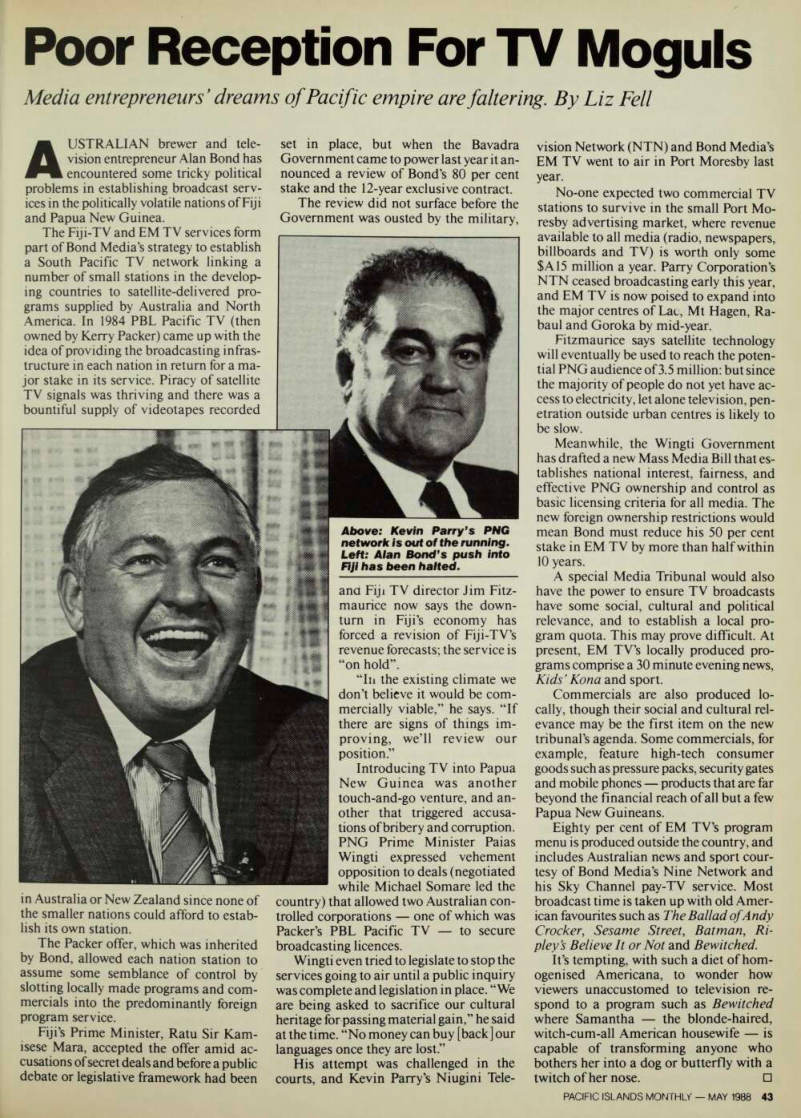
Media entrepreneurs’ dreams of Pacific empire are faltering.
By Liz Fell
AUSTRALIAN brewer and tele vision entrepreneur Alan Bond has encountered some tricky political problems in establishing broadcast serv ices in the politically volatile nations of Fiji and Papua New Guinea.
The Fiji-TV and EM TV services form part of Bond Media’s strategy to establish a South Pacific TV network linking a number of small stations in the develop ing countries to satellite-delivered pro grams supplied by Australia and North America. In 1984 PBL Pacific TV (then owned by Kerry Packer) came up with the idea of providing the broadcasting infras tructure in each nation in return for a ma jor stake in its service. Piracy of satellite TV signals was thriving and there was a bountiful supply of videotapes recorded
in Australia or New Zealand since none of the smaller nations could afford to estab lish its own station.
The Packer offer, which was inherited by Bond, allowed each nation station to assume some semblance of control by slotting locally made programs and com mercials into the predominantly foreign program service.
Fiji’s Prime Minister, Ratu Sir Kam isese Mara, accepted the offer amid ac cusations of secret deals and before a public debate or legislative framework had been
set in place, but when the Bavadra Government came to power last year it an nounced a review of Bond’s 80 per cent stake and the 12-year exclusive contract, The review did not surface before the Government was ousted by the military,
ana Fiji TV director Jim Fitz maurice now says the down turn in Fiji’s economy has forced a revision of Fiji-TV’s revenue forecasts; the service is “on hold”.
“In the existing climate we don’t believe it would be com mercially viable,” he says. “If there are signs of things im proving, we’ll review our position.”
Introducing TV into Papua New Guinea was another touch-and-go venture, and an other that triggered accusa tions of bribery and corruption.
PNG Prime Minister Paias Wingti expressed vehement opposition to deals (negotiated while Michael Somare led the
country) that allowed two Australian con trolled corporations one of which was Packer’s PBL Pacific TV to secure broadcasting licences.
Wingti even tried to legislate to stop the services going to air until a public inquiry was complete and legislation in place. “We are being asked to sacrifice our cultural heritage for passing material gain,” he said at the time. “No money can buy [back] our languages once they are lost.”
His attempt was challenged in the courts, and Kevin Parry’s Niugini Tele
vision Network (NTN) and Bond Media’s EM TV went to air in Port Moresby last year.
No-one expected two commercial TV stations to survive in the small Port Mo resby advertising market, where revenue available to all media (radio, newspapers, billboards and TV) is worth only some SAIS million a year. Parry Corporation’s NTN ceased broadcasting early this year, and EM TV is now poised to expand into the major centres of Lac, Mt Hagen, Ra baul and Goroka by mid-year.
Fitzmaurice says satellite technology will eventually be used to reach the poten tial PNG audience of 3.5 million: but since the majority of people do not yet have ac cess to electricity, let alone television, pen etration outside urban centres is likely to be slow.
Meanwhile, the Wingti Government has drafted a new Mass Media Bill that es tablishes national interest, fairness, and effective PNG ownership and control as basic licensing criteria for all media. The new foreign ownership restrictions would mean Bond must reduce his 50 per cent stake in EM TV by more than half within 10 years.
A special Media Tribunal would also have the power to ensure TV broadcasts have some social, cultural and political relevance, and to establish a local pro gram quota. This may prove difficult. At present, EM TV’s locally produced pro grams comprise a 30 minute evening news, Kids’ Kona and sport.
Commercials are also produced lo cally, though their social and cultural rel evance may be the first item on the new tribunal’s agenda. Some commercials, for example, feature high-tech consumer goods such as pressure packs, security gates and mobile phones products that are far beyond the financial reach of all but a few Papua New Guineans.
Eighty per cent of EM TV’s program menu is produced outside the country, and includes Australian news and sport cour tesy of Bond Media’s Nine Network and his Sky Channel pay-TV service. Most broadcast time is taken up with old Amer ican favourites such as The Ballad of Andy Crocker , Sesame Street , Batman, Ri pleys Believe It or Not and Bewitched.
It’s tempting, with such a diet of hom ogenised Americana, to wonder how viewers unaccustomed to television re spond to a program such as Bewitched where Samantha the blonde-haired, witch-cum-all American housewife is capable of transforming anyone who bothers her into a dog or butterfly with a twitch of her nose. □
Above: Kevin Parry’s PNG network is out of the running.
Left: Alan Bond’s push into Fiji has been halted.
How Radio Links The Islands
Radio is the most effective and cost effective news and entertainment medium
for the islands of the Pacific.
By Jai Kumar
IN THE MAJORITY of developed countries television is now taken for granted as the prime means of trans mitting news, education and entertain ment; but for the bulk of the less developed nations of the South Pacific, radio re mains the main medium of information and entertainment.
The scattered geographical nature of the region’s island states makes radio the most effective and cost-effective medium. It plays a vital role in everyday life on remote islands and in many cases is those islands’ sole means of contact with the outside world. In most cases tele phones simply do not exist and shipping and airline services are of only minor value: neither are they as reliable, or as im mediate, as radio.
For these scattered island nations in times of emergency, radio becomes liter ally a lifeline. When a hurricane or flood strikes, radio is the only workable means of contact with administrators, relief serv ices or medical personnel. And it has a vi tal social function as well: while residents of cities and larger towns have the luxury of daily or weekly newspapers, the remote villager is totally dependent on radio for news from around the world as well as do mestic news. Radio is also firmly estab lished as the main source of entertainment.
Fiji
The Fiji Broadcasting Commission (FBC) provides a national AM service in Eng lish, Fijian and Hindustani, and has FM stations in Suva and Lautoka. The FBC broadcasts under the callsign “Radio Fiji” and has repeater stations across the coun try, enabling it to provide a full coverage to smaller and less populated islands from sam to 11 pm on weekdays and to mid night on weekends.
The FBC is semi-commercial, deriv ing half its income from advertising and the rest from government grants. Fiji has a fully commercial radio station, FM96, which began operation in 1985. FM96’s programs are broadcast in English only but the music is mixed, with Fijian and Hindi songs played on a regular basis. FM96 has news bulletins but lacks national coverage its broadcasts can only be picked up in Suva, Lautoka and surrounding areas.
While Radio Fiji is free from govern ment control, its commissioners are government appointees; their main brief is to provide policy guidelines to the net work’s management.
Tonga
Radio in Tonga is under the control of the Tonga Broadcasting Commission (TBC), whose main studio is located in the capi
tal, Nuku’alofa. The TBC’s powerful transmitter reaches all of the South Pa cific under the callsign “Call of the Friendly Islands”.
Western Samoa
Western Samoa’s radio station 2AP has studios at Apia and broadcasts in English and Samoan. It began operation in 1948 and is totally government funded and owned. However, it does accept some ad vertising. Radio is under the direction of the Communications Ministry.
Kiribati And Tuvalu
The island group formerly known as the Gilbert and Ellice Islands has separate ra dio networks. Radio Kiribati is funded by the Government and operates under the Broadcasting and Publications Authority.
Its programs are mostly in Kiribati, but news is also broadcast in English. Radio Kiribati derives some revenue from ad vertising, mostly on a local basis.
Radio Tuvalu operates from Funafuti and is an arm of the Information Depart ment. It broadcasts mainly in the Tuval uan language, but news broadcasts are also in English.
Solomon Islands
Broadcasting in the Solomon Islands is administered by the Solomon Islands Broadcasting Corporation (SIBC), an in dependent statutory body. Broadcasts are in English and Pidgin, and the SIBC’s stu dios and transmitting facilities have re cently been modernised.
Papua New Guinea
The National Broadcasting Commission (NBC) came into being in December 1973, taking over the functions of the Australian Broadcasting Commission, which had op erated radio broadcasting in PNG since the end of World War 11.
The NBC’s main stations are in Port Moresby, but there is a number of regional stations catering to provincial audiences.
Problems And Potential
Radio will continue to be a vital source of information and entertainment for Pacific island nations in the foreseeable future.
While television is just around the corner for many island governments, it would be prohibitively expensive to provide local broadcasting services and most will have to rely on imported news and entertain ment ... with the host of social problems raised by such “media colonialism”.
Even with the advent of satellite serv ices from Australia, New Zealand and the United States, television remains largely a dream for most South Pacific states sim
ply because it is economically not a viable proposition and is unlikely to be so without massive (and wasteful) subsidies.
In that light, island radio broadcasters are fully concious of their responsibility of providing more and better news services.
However, their greatest problems are lack of trained personnel and lack of adequate funding to maintain existing networks, develop new areas of coverage and install transmitters powerful enough to span the often great distances involved.
Most islands networks provide a do mestic news service and a reasonable cov erage of local news but for world news they must rely on Radio Australia’s Pacific Reports and relay Radio Australia’s cur rent-affairs programs or provide edited versions of these to their listeners. While Radio New Zealand has had ambitions of making inroads in this area, its effective ness has been held in check by low-pow ered transmitters.
Perhaps the region’s greatest commu nications problem, at least as far as radio is concerned, is that while most stations can obtain news easily from London, Moscow, Sydney or New York through Radio Australia, the BBC and the Voice of America, they are unable to learn what’s happening to island neighbours.
Radio executives and administrators have wrestled with the problem at every meeting, deciding without fail to press for the establishment of a regional news serv ice and to seek national and international support for this badly needed resource. But because of the cost involved (and a host of regional political rivalries) the news scheme has remained firmly on the draw ing board, to Radio Australia’s continued advantage.
Radio Australia has succeeded in is lands radio, and has maintained its firm grip on news services, because of its pow erful transmitters (which broadcast 24 hours a day to the Pacific) and its network of reliable stringers.
Radio New Zealand also regards itself as a part of Pacific broadcasting, and claims to be better informed than Radio Australia about events in island nations.
However, because of its low-powered transmitters it cannot provide an effective Pacific bulletin.
UNESCO and the Hans Seidel Foun dation of West Germany have now funded and established a Suva-based training and news exchange service known as “Pac broad”. This unit acts as a clearing house for islands news; each participating coun try files two stories each day by telex to Suva, where they are edited and compiled into a bulletin that is then redistributed to all radio stations without cost. □
Hi Tech On The High Seas
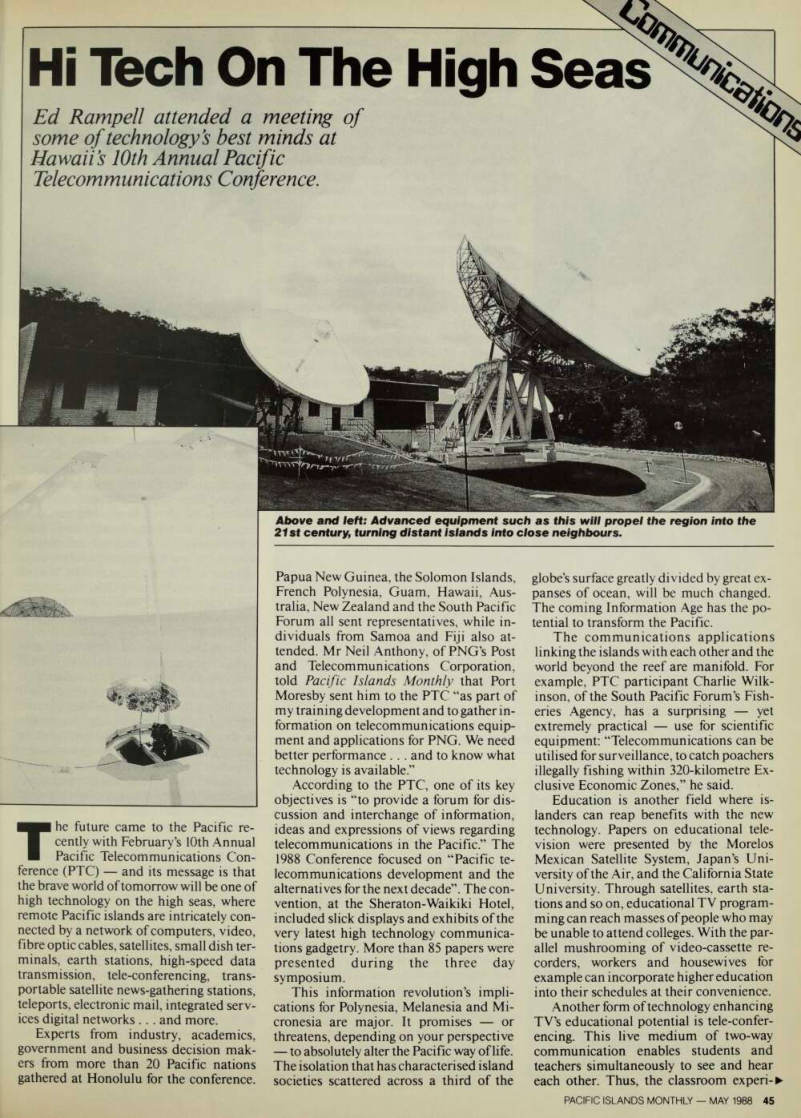
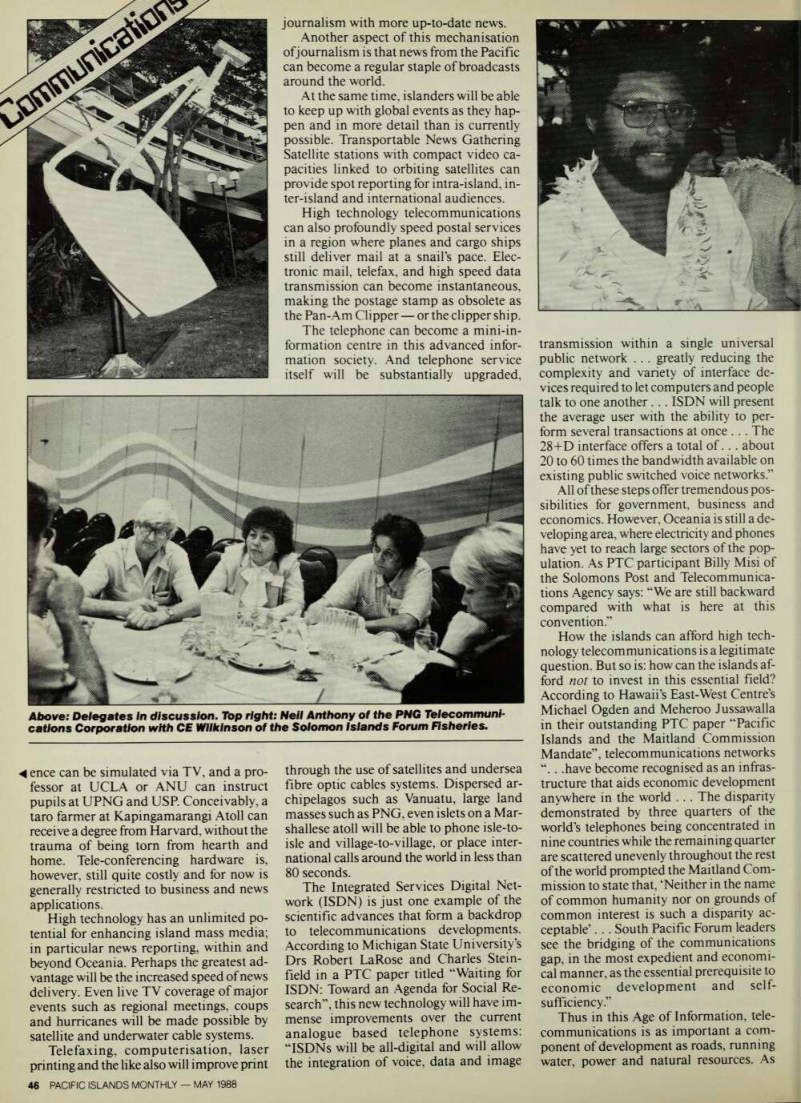
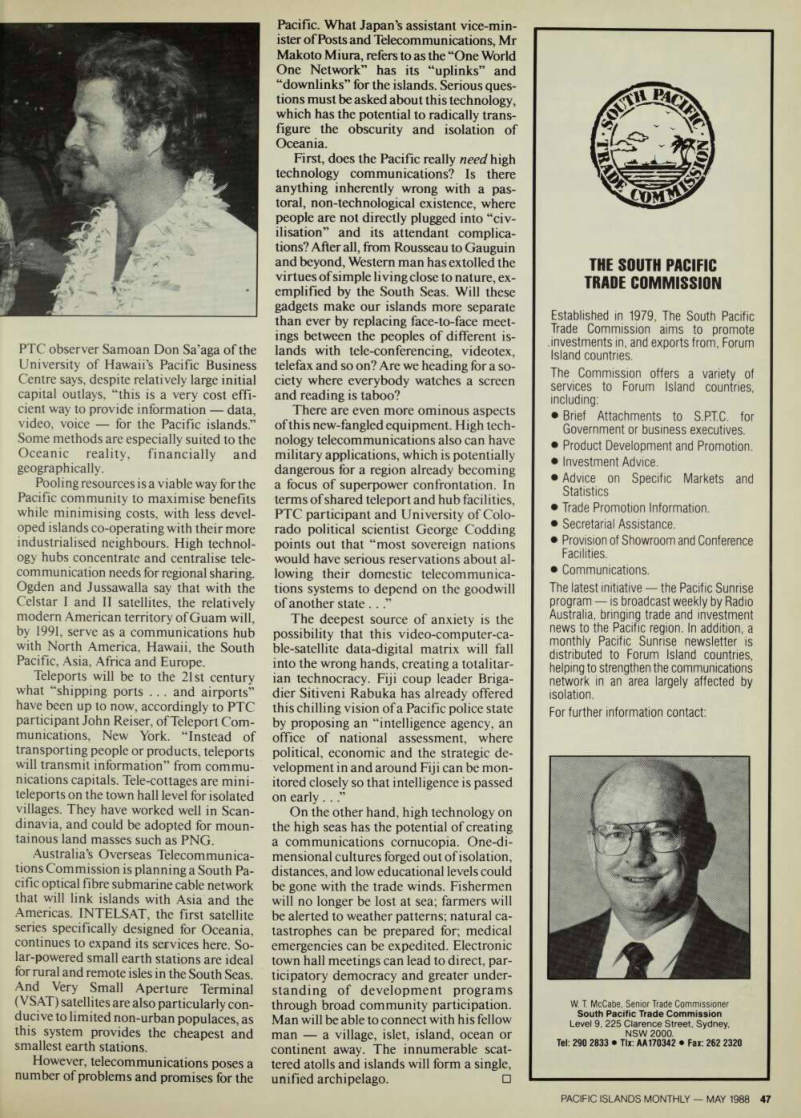
Ed Rampell attended a meeting of some of technology’s best minds at Hawaii’s 10th Annual Pacific Telecommunications Conference.
The future came to the Pacific recently with February’s 10th Annual Pacific Telecommunications Conference (PTC) and its message is that the brave world of tomorrow will be one of high technology on the high seas, where remote Pacific islands are intricately connected by a network of computers, video, fibre optic cables, satellites, small dish terminals, earth stations, high-speed data transmission, tele-conferencing, transportable satellite news-gathering stations, teleports, electronic mail, integrated services digital networks ... and more.
Experts from industry, academics, government and business decision makers from more than 20 Pacific nations gathered at Honolulu for the conference,
Papua New Guinea, the Solomon Islands, French Polynesia, Guam, Hawaii, Aus tralia, New Zealand and the South Pacific Forum all sent representatives, while in dividuals from Samoa and Fiji also at tended. Mr Neil Anthony, of PNG’s Post and Telecommunications Corporation, told Pacific Islands Monthly that Port Moresby sent him to the PTC “as part of my training development and to gather in formation on telecommunications equip ment and applications for PNG. We need better performance ... and to know what technology is available.”
According to the PTC, one of its key objectives is “to provide a forum for dis cussion and interchange of information, ideas and expressions of views regarding telecommunications in the Pacific.” The 1988 Conference focused on “Pacific te lecommunications development and the alternatives for the next decade”. The con vention, at the Sheraton-Waikiki Hotel, included slick displays and exhibits of the very latest high technology communica tions gadgetry. More than 85 papers were presented during the three day symposium.
This information revolution’s impli cations for Polynesia, Melanesia and Mi cronesia are major. It promises or threatens, depending on your perspective to absolutely alter the Pacific way of life.
The isolation that has characterised island societies scattered across a third of the
globe’s surface greatly divided by great ex panses of ocean, will be much changed.
The coming Information Age has the po tential to transform the Pacific.
The communications applications linking the islands with each other and the world beyond the reef are manifold. For example, PTC participant Charlie Wilk inson, of the South Pacific Forum’s Fish eries Agency, has a surprising yet extremely practical use for scientific equipment: “Telecommunications can be utilised for surveillance, to catch poachers illegally fishing within 320-kilometre Ex clusive Economic Zones,” he said.
Education is another field where is landers can reap benefits with the new technology. Papers on educational tele vision were presented by the Morelos Mexican Satellite System, Japan’s Uni versity of the Air, and the California State University. Through satellites, earth sta tions and so on, educational TV program ming can reach masses of people who may be unable to attend colleges. With the par allel mushrooming of video-cassette re corders, workers and housewives for example can incorporate higher education into their schedules at their convenience.
Another form of technology enhancing TV’s educational potential is tele-confer encing. This live medium of two-way communication enables students and teachers simultaneously to see and hear each other. Thus, the classroom experi-^
Above and left: Advanced equipment such as this will propel the region into the 21st century, turning distant islands into close neighbours.
4 ence can be simulated via TV, and a professor at UCLA or ANU can instruct pupils at UPNG and USP. Conceivably, a taro farmer at Kapingamarangi Atoll can receive a degree from Harvard, without the trauma of being tom from hearth and home. Tele-conferencing hardware is, however, still quite costly and for now is generally restricted to business and news applications.
High technology has an unlimited potential for enhancing island mass media; in particular news reporting, within and beyond Oceania. Perhaps the greatest advantage will be the increased speed of news delivery. Even live TV coverage of major events such as regional meetings, coups and hurricanes will be made possible by satellite and underwater cable systems.
Telefaxing, computerisation, laser printing and the like also will improve print
journalism with more up-to-date news.
Another aspect of this mechanisation of journalism is that news from the Pacific can become a regular staple of broadcasts around the world.
At the same time, islanders will be able to keep up with global events as they hap pen and in more detail than is currently possible. Transportable News Gathering Satellite stations with compact video ca pacities linked to orbiting satellites can provide spot reporting for intra-island, in ter-island and international audiences.
High technology telecommunications can also profoundly speed postal services in a region where planes and cargo ships still deliver mail at a snail’s pace. Elec tronic mail, telefax, and high speed data transmission can become instantaneous, making the postage stamp as obsolete as the Pan-Am Clipper or the clipper ship.
The telephone can become a mini-in formation centre in this advanced infor mation society. And telephone service itself will be substantially upgraded.
through the use of satellites and undersea fibre optic cables systems. Dispersed ar chipelagos such as Vanuatu, large land masses such as PNG, even islets on a Mar shallese atoll will be able to phone isle-to isle and village-to-village, or place inter national calls around the world in less than 80 seconds.
The Integrated Services Digital Net work (ISDN) is just one example of the scientific advances that form a backdrop to telecommunications developments, According to Michigan State University s Drs Robert Laßose and Charles Stein field in a PTC paper titled Waiting for ISDN: Toward an Agenda for Social Re search”, this new technology will have inl mense improvements over the current analogue based telephone systems.
“ISDNs will be all-digital and will allow the integration of voice, data and image
transmission within a single universal public network .. . greatly reducing the complexity and variety of interface de vices required to let computers and people talk to one another. .. ISDN will present the average user with the ability to per form several transactions at once ... The 28+D interface offers a total of.. . about 20 to 60 times the bandwidth available on existing public switched voice networks.”
All of these steps offer tremendous pos sibilities for government, business and economics. However, Oceania is still a de veloping area, where electricity and phones have yet to reach large sectors of the pop ulation. As PTC participant Billy Misi of the Solomons Post and Telecommunica tions Agency says: “We are still backward compared with what is here at this convention.”
How the islands can afford high tech nology telecommunications is a legitimate question. But so is: how can the islands af ford not to invest in this essential field?
According to Hawaii’s East-West Centre’s Michael Ogden and Meheroo Jussawalla in their outstanding PTC paper “Pacific Islands and the Maitland Commission Mandate”, telecommunications networks “.. .have become recognised as an infras tructure that aids economic development anywhere in the world ... The disparity demonstrated by three quarters of the world’s telephones being concentrated in nine countries while the remaining quarter are scattered unevenly throughout the rest of the world prompted the Maitland Com mission to state that, ‘Neither in the name of common humanity nor on grounds of common interest is such a disparity ac ceptable’ . .. South Pacific Forum leaders see the bridging of the communications gap, in the most expedient and economi cal manner, as the essential prerequisite to economic development and self sufficiency.”
Thus in this Age of Information, tele communications is as important a com ponent of development as roads, running water, power and natural resources. As
Above: Delegates In discussion. Top right: Neil Anthony of the PNG Telecommuni cations Corporation with CE Wilkinson of the Solomon Islands Forum Fisheries.
PTC observer Samoan Don Sa’aga of the University of Hawaii’s Pacific Business Centre says, despite relatively large initial capital outlays, “this is a very cost effi cient way to provide information data, video, voice for the Pacific islands.”
Some methods are especially suited to the Oceanic reality, financially and geographically.
Pooling resources is a viable way for the Pacific community to maximise benefits while minimising costs, with less devel oped islands co-operating with their more industrialised neighbours. High technol ogy hubs concentrate and centralise tele communication needs for regional sharing.
Ogden and Jussawalla say that with the Celstar I and II satellites, the relatively modern American territory of Guam will, by 1991, serve as a communications hub with North America, Hawaii, the South Pacific, Asia, Africa and Europe.
Teleports will be to the 21st century what “shipping ports . . . and airports” have been up to now, accordingly to PTC participant John Reiser, of Teleport Com munications, New York. “Instead of transporting people or products, teleports will transmit information” from commu nications capitals. Tele-cottages are mini teleports on the town hall level for isolated villages. They have worked well in Scan dinavia, and could be adopted for moun tainous land masses such as PNG.
Australia’s Overseas Telecommunica tions Commission is planning a South Pa cific optical fibre submarine cable network that will link islands with Asia and the Americas. INTELSAT, the first satellite series specifically designed for Oceania, continues to expand its services here. So lar-powered small earth stations are ideal for rural and remote isles in the South Seas.
And Very Small Aperture Terminal (VSAT) satellites are also particularly con ducive to limited non-urban populaces, as this system provides the cheapest and smallest earth stations.
However, telecommunications poses a number of problems and promises for the
Pacific. What Japan’s assistant vice-min ister of Posts and Telecommunications, Mr Makoto Miura, refers to as the “One World One Network” has its “uplinks” and “downlinks” for the islands. Serious ques tions must be asked about this technology, which has the potential to radically trans figure the obscurity and isolation of Oceania.
First, does the Pacific really need high technology communications? Is there anything inherently wrong with a pas toral, non-technological existence, where people are not directly plugged into “civ ilisation” and its attendant complica tions? After all, from Rousseau to Gauguin and beyond, Western man has extolled the virtues of simple living close to nature, ex emplified by the South Seas. Will these gadgets make our islands more separate than ever by replacing face-to-face meet ings between the peoples of different is lands with tele-conferencing, videotex, telefax and so on? Are we heading for a so ciety where everybody watches a screen and reading is taboo?
There are even more ominous aspects of this new-fangled equipment. High tech nology telecommunications also can have military applications, which is potentially dangerous for a region already becoming a focus of superpower confrontation. In terms of shared teleport and hub facilities, PTC participant and University of Colo rado political scientist George Codding points out that “most sovereign nations would have serious reservations about al lowing their domestic telecommunica tions systems to depend on the goodwill of another state . ..”
The deepest source of anxiety is the possibility that this video-computer-ca ble-satellite data-digital matrix will fall into the wrong hands, creating a totalitar ian technocracy. Fiji coup leader Briga dier Sitiveni Rabuka has already offered this chilling vision of a Pacific police state by proposing an “intelligence agency, an office of national assessment, where political, economic and the strategic de velopment in and around Fiji can be mon itored closely so that intelligence is passed on early . ..”
On the other hand, high technology on the high seas has the potential of creating a communications cornucopia. One-di mensional cultures forged out of isolation, distances, and low educational levels could be gone with the trade winds. Fishermen will no longer be lost at sea; farmers will be alerted to weather patterns; natural ca tastrophes can be prepared for; medical emergencies can be expedited. Electronic town hall meetings can lead to direct, par ticipatory democracy and greater under standing of development programs through broad community participation.
Man will be able to connect with his fellow man a village, islet, island, ocean or continent away. The innumerable scat tered atolls and islands will form a single, unified archipelago. □
Advertisements & other items, pp. 47-48 (1 item)
m
& rS u * * © * &
THE SOUTH PACIFIC
TRADE COMMISSION
Established in 1979, The South Pacific Trade Commission aims to promote .investments in, and exports from, Forum Island countries.
The Commission offers a variety of services to Forum Island countries, including: • Brief Attachments to S.RT.C. for Government or business executives. • Product Development and Promotion. • Investment Advice. • Advice on Specific Markets and Statistics • Trade Promotion Information. • Secretarial Assistance. • Provision of Showroom and Conference Facilities. • Communications.
The latest initiative the Pacific Sunrise program is broadcast weekly by Radio Australia, bringing trade and investment news to the Pacific region. In addition, a monthly Pacific Sunrise newsletter is distributed to Forum Island countries, helping to strengthen the communications network in an area largely affected by isolation.
For further information contact: W. I. McCabe, Senior Trade Commissioner South Pacific Trade Commission Level 9, 225 Clarence Street, Sydney,
NSW 2000.
Tel: 290 2833 • Tlx: AA170342 • Fax: 262 2320
PTY.LT
117 York St., Sydney Cables: Henco Sydney.
C.P.O. Box 3949 Telephone: 261 1955.
For
specialised
and
personalised
buying
service
throughout
the
Pacific Islands
and the East.
LOCAL AGENTS AND
REPRESENTATION
PAPUA NEW GUINEA
RABAUL: M. & C. Seeto, P.O. Box 131, Rabaul.
Telephone 92 2919
FIJI
K. Witherington Ltd., P.O. Box 293, Suva.
Telephone 22 356.
VANUATU
John Lum & Associates, P.O. Box 65, Santo.
Telephone 329.
Exporters
General
Merchants
Fit To Print
Press standards in the region are threatened by growing
government intervention.
By Danielle Robinson
THE EDITORIAL independence and sophistication of publications in the South Pacific are as diverse as the region’s economic and social devel opment: local publications can be as un ashamedly domestic as the Tuvalu Echoes, which carries the 1987 livestock and poul try census as front-page news, or as sophisticated as Papua New Guinea’s big gest-selling daily, the Post-Courier.
They can be as outspoken as Papua New Guinea’s The Times, which unas hamedly plasters the faces of MPs who “fail to perform” on its front page, or as apolitical as the community-oriented Nor folk Islander. According to academics and editors who have worked in the region, the difficulties facing the press are complex and so ingrained that there is little pros pect of rapid change not least because consumers are by and large, receiving the coverage they want from their press.
There is a surprisingly large number of publications in the region, from regular dailies of varying sophisticiation to ran domly printed weeklies, bi-monthlies and small news-sheets.
But only a handful can afford or at tempt the publication standards of the Australian or American papers, and ex cluding the French Pacific region, sophis ticated dailies are confined to Papua New Guinea and Fiji.
Western Samoa and the Cook Islands print regular newspapers, but their facili ties (and, of course, their potential audi ence) cannot be compared with anything in more populous PNG or Fiji.
The coups in Fiji last year forced the closure of its most outspoken newspaper, the Fiji Sun: its remaining newspaper, the Fiji Times, agreed to a policy of “self-cen sorship” of potentially divisive stories solely, as editor Vijendra Kumar has said, in order to continue to provide coverage of international and domestic events to Fiji’s news-starved public. There have lately been signs of an easing of censorship in Fiji, and more open critical comment on the state of the economy is beginning to creep back; but politically sensitive sub jects must perforce wait for easier times to be addressed in full.
Mr Philip Harkness, publisher of the Fiji Sun, is presently trying to sell the pa per to local interests, but doubts it will re turn to its former outspoken ways in the near future. He believes that once some thing like freedom of the press is beaten down, it is doubly hard to ever return to the same level.
In PNG, contentious new media laws
aimed at diluting foreign control are threatening editorial freedom, and the ex isting media has recently come under at tack from the government for its outspokenness: PNG Post-Courier editor Luke Sela has even been threatened with charges of sedition.
The general manager of the Papua New Guinea Post Courier , Mr Don Kennedy, responded to the proposed bill with a statement that is typical of the opposition it has inspired: “This is the sort of legis lation you would expect to find under a dictatorship, not in a democratic country such as PNG.
“Despite Government assurances that freedom of the press would not be inter fered with, such a proposal provides a mechanism by which the control of the Press can be implemented.”
The French Pacific territories have well established newspapers and magazines such as Les Nouvelles Caledoniennes and La Depeche de Tahiti, though they are un derstandably supportive of their governments.
The bulk of the South Pacific must li kewise rely on small local publications which, if not government offshoots, are usually dependent on official support.
Mr Harkness pointed out that the def inition of freedom of the press differs markedly in Australia and America from what exists in the South Pacific region.
“You’ll find most South Pacific publica tions will lean toward the Singaporean model, which is far less aggressive than in Australia,” he says.
The social conservatism of the South Pacific acts to restrict freedom of the press, according to Professor Grant McCall of the University of New South Wales. “The smaller publications have to operate un der a kind of self-censorship so they don’t offend the chiefs, for example, or offend the church: the missionary movement has been very strong in the region,” he says.
Apart from the political and social problems facing newspapers, there are practical problems choking the growth of the press sheer economic disadvantage is enough to prevent commercial publish ers expanding into the region. “If there is no economic growth there is no market for the goods companies would want to ad vertise in the papers,” says the University of Sydney’s Dr John Connell.
“I am not very confident that the press will become any more open than it is at present. The role of the press is really in its infancy, and whether it grows to be an adolescent remains to be seen.” □
Advertisements & other items, p. 48 (1 item)
48
PACIFIC ISL \NDS MONTHLY MAY 1988
New Island Satellite link
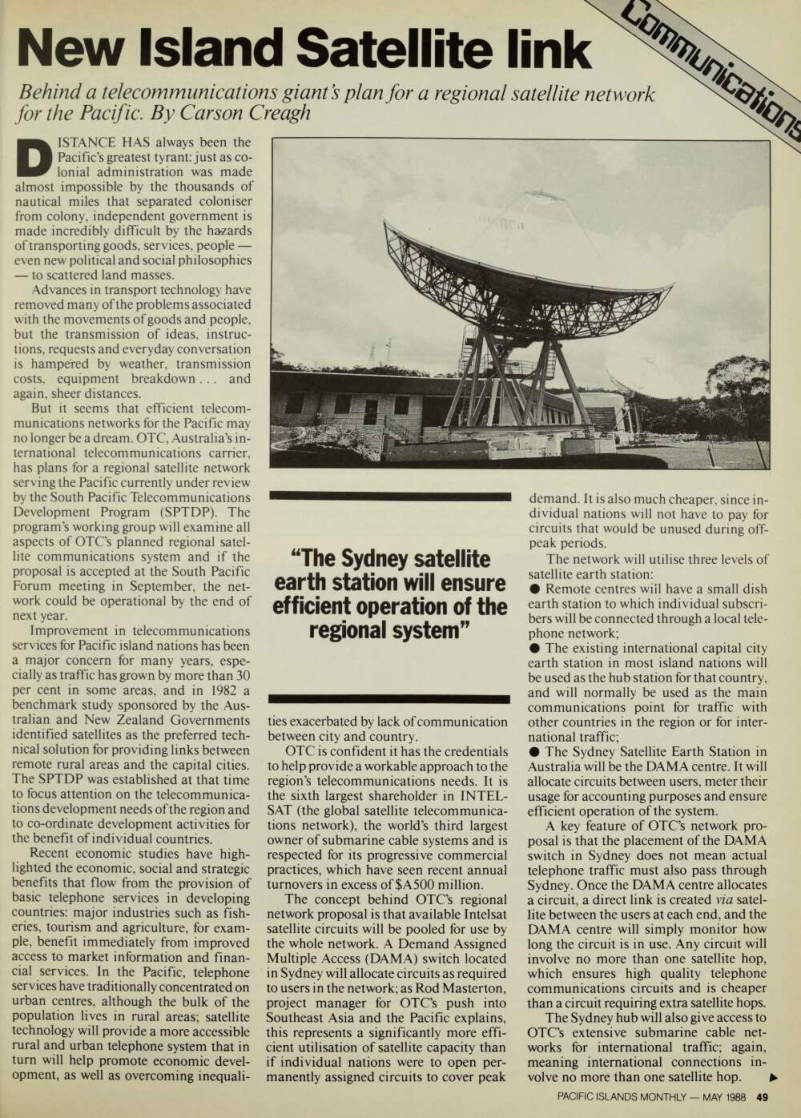

Behind a telecommunications giant’s plan for a regional satellite network
for the Pacific.
By Carson Creagh
DISTANCE HAS always been the Pacific’s greatest tyrant: just as co lonial administration was made almost impossible by the thousands of nautical miles that separated coloniser from colony, independent government is made incredibly difficult by the hazards of transporting goods, services, people even new political and social philosophies to scattered land masses.
Advances in transport technology have removed many of the problems associated with the movements of goods and people, but the transmission of ideas, instruc tions, requests and everyday conversation is hampered by weather, transmission costs, equipment breakdown ... and again, sheer distances.
But it seems that efficient telecom munications networks for the Pacific may no longer be a dream. OTC, Australia’s in ternational telecommunications carrier, has plans for a regional satellite network serving the Pacific currently under review by the South Pacific Telecommunications Development Program (SPTDP). The program’s working group will examine all aspects of OTC’s planned regional satel lite communications system and if the proposal is accepted at the South Pacific Forum meeting in September, the net work could be operational by the end of next year.
Improvement in telecommunications services for Pacific island nations has been a major concern for many years, espe cially as traffic has grown by more than 30 per cent in some areas, and in 1982 a benchmark study sponsored by the Aus tralian and New Zealand Governments identified satellites as the preferred tech nical solution for providing links between remote rural areas and the capital cities.
The SPTDP was established at that time to focus attention on the telecommunica tions development needs of the region and to co-ordinate development activities for the benefit of individual countries.
Recent economic studies have high lighted the economic, social and strategic benefits that flow from the provision of basic telephone services in developing countries: major industries such as fish eries, tourism and agriculture, for exam ple, benefit immediately from improved access to market information and finan cial services. In the Pacific, telephone services have traditionally concentrated on urban centres, although the bulk of the population lives in rural areas; satellite technology will provide a more accessible rural and urban telephone system that in turn will help promote economic devel opment, as well as overcoming inequali-
“The Sydney satellite earth station will ensure efficient operation of the regional system”
ties exacerbated by lack of communication between city and country.
OTC is confident it has the credentials to help provide a workable approach to the region’s telecommunications needs. It is the sixth largest shareholder in INTEL SAT (the global satellite telecommunica tions network), the world’s third largest owner of submarine cable systems and is respected for its progressive commercial practices, which have seen recent annual turnovers in excess of SASOO million.
The concept behind OTC’s regional network proposal is that available Intelsat satellite circuits will be pooled for use by the whole network. A Demand Assigned Multiple Access (DAMA) switch located in Sydney will allocate circuits as required to users in the network; as Rod Masterton, project manager for OTC’s push into Southeast Asia and the Pacific explains, this represents a significantly more effi cient utilisation of satellite capacity than if individual nations were to open per manently assigned circuits to cover peak
demand. It is also much cheaper, since in dividual nations will not have to pay for circuits that would be unused during off peak periods.
The network will utilise three levels of satellite earth station: • Remote centres will have a small dish earth station to which individual subscri bers will be connected through a local tele phone network; • The existing international capital city earth station in most island nations will be used as the hub station for that country, and will normally be used as the main communications point for traffic with other countries in the region or for inter national traffic; • The Sydney Satellite Earth Station in Australia will be the DAM A centre. It will allocate circuits between users, meter their usage for accounting purposes and ensure efficient operation of the system.
A key feature of OTC’s network pro posal is that the placement of the DAM A switch in Sydney does not mean actual telephone traffic must also pass through Sydney. Once the DAMA centre allocates a circuit, a direct link is created via satel lite between the users at each end, and the DAMA centre will simply monitor how long the circuit is in use. Any circuit will involve no more than one satellite hop, which ensures high quality telephone communications circuits and is cheaper than a circuit requiring extra satellite hops.
The Sydney hub will also give access to OTCs extensive submarine cable net works for international traffic; again, meaning international connections in volve no more than one satellite hop. ►
Under the terms of the proposal, OTC will structure a network tariff on a per minute basis to cover both the satellite and network switching costs.
OTC plans to have full backup facilities at its DAM A control centre in the event of technical failure. An additional level of backup capacity will also be built in to ensure the network is virtually failure-proof,
As well as installing and maintaining facilities, OTC is to train local personnel to manage island installations.
Another issue of concern to some na tions relates to the question of national sovereignty and the level of control they will have over a network managed from abroad. “OTC is sensitive to these con cems, and won’t be seeking absolute con
trol over the network,” says Masterton. “In fact, our network proposal includes plans for a management board composed of par ticipating nations, which will be respon sible for determining (in consultation with OTC) the structure of the network and fu ture directions for its development.”
As part of the current examination by the SPTDP working group, an expert con sultant will be looking at this and other in stitutional issues.
Masterton is confident OTC’s proposal will be viewed favourably, especially since Kiribati has recently signed a two-year contract to develop its telecommunica tions network to an international capacity.
Aside from the region’s growing need for communications, the OTC proposal represents a hard-headed business prop osition: at a cost of SA3 million for instal lation and initial operating costs it is a major investment, but Masterton antici pates a net return of 12 to 14 per cent to OTC, after an introductory period in which establishment costs will outweigh profits. “We are looking at a 150 to 300 per cent increase in traffic,” he says, “espe cially where networks simply do not exist at present. Communications will be the world’s single largest industry before the end of this century and OTC aims to be providing a significant amount of com munications hardware and services by that time.” □
INTELSAT, the global satellite communications network.
Advertisements & other items, p. 50 (1 item)
big for you, here’s
c&c
If the world’s most
advanced PABX is too
big for you, here’s
the next best thing.
£ m ..
Aie world’s most advanced P/ V 1L... * NEC’s NEAX 2400 IMS is the world’s most advanced PABX.
It is renowned as much for its" reliability as it is for its features.
But perhaps the key to its phenomenal world wide success is its completely modular design, allowing it to grow with you up to 23,000 phone lines.
To some, however, despite its attraction, it is just too big.
For those people, NEC have introduced
the NEAX 2400 SDS.
It has all the advantages of the NEAX 2400 IMS, but it is smaller, handling up to five hundred phone lines.
It can still give you the advantages of public and private ISDN.
And the NEAX 2400 SDS can link with your own or with outside computers through NEC’s Open Application Interface.
It can form a vital cost-saving part in your NEC PABX network.
And it offers over two hundred service features enhancing productivity, reducing costs and improving efficiency.
The new NEAX 2400 SDS. The world’s most advanced PABX, but smaller.
On display at A.T.U.G. ’BB at the Royal Exhibition Buildings. Melbourne, from April 19th to 21st.
Call us now for more information on NEC PABX on (008) 338120 or an NEC office listed below.
Phone Sydney (02) 4368111. Melbourne (03) 2675599. Brisbane (07) 2528800. Adelaide (08) 373 2022. Perth (09) 3252155.
NEC
.INTAS ME LB NCX2O2S
The Island Press
Reports from the papers, compiled by John Carter
THE ORGANISERS of Sunday’s peace march say that it is to bring people to the Prince of Peace, Jesus Christ, yet they have some funny ideas. Powes Parkop said they were marching on Palm Sunday morning “just like Jesus marched into Jerusalem”.
Either Mr Parkop doesn’t know his Bible too well, or donkeys will be handed out at the start of the march.
From Tok Pilai in the University of Papua New Guinea’s Uni Tavur.
A KUNDIAWA rugby league official has laid a complaint against Police Minister and Chimbu MP Peter Kuman for inde cent exposure and inciting a riot.
Brothers rugby league team coach Wally Yegiora, who is also a reserve policeman, filed the complaint with police station commander Mr Robert Kalasim on Sunday.
The provincial police commander, Chief Inspector Allan Kundi, confirmed yesterday that complaints had been laid against Kuman.
Mr Yegiora alleges that Kuman bared his private parts publicly during the main rugby league fixture between Souths and Brothers on Sunday and incited a riot.
From the Papua New Guinea Post-Courier, Port Moresby.
IT IS COSTING the Government nearly K 12.5 million a year to keep its vehicles on the road.
That is far too high, says personnel management secretary Wep Kanawi, and he is determined to do something about it.
For starters, he has issued strict instruc tions to departmental heads at both na tional and provincial level to control the use of government vehicles.
From the Papua New Guinea Post-Courier, Port Moresby.
THIEVES AND vandals have been active in recent weeks and the incidence of prop erty-related offences is increasing.
These offences include: ■ Three reports of the theft of fuel from motor vehicles; ■ More than $lOOO worth of goods sto len from the jetty during unloading of the last ship; ■ Three reports of stolen motor vehicles; ■ $5OO worth of malicious damage to plant and equipment belonging to a local industry; □ The annual theft of palm seeds has started; □ A new one for Norfolk visitors had their clothing stolen from a clothesline at their holiday accommodation.
From The Norfolk Islander.
DURING THE Cabinet meeting earlier this month, child abuse was one of the is sues that generated serious discussion. It was pointed out by directors whose de partments are involved with the handling of child abuse cases that one of the reasons behind the increase in child abuse is that parents, especially mothers, do not spend enough time with their children. One di rector pointed out that many mothers work during the day then rush to the bingo games, thus having no time at all for an end-of-the-day family get-together or eve ning prayer.
From The ASG Report of the Amer ican Samoa Government, Pago Pago.
EUROMARCHE, the giant low-priced supermarket and department store in the Moana Nui Shopping Centre in the Com mune of Punaauia, came up with an orig inal idea for celebrating the Chinese New Year. Its pastry kitchen prepared a cake 30.25 metres long! And it was one solid piece of cake that was later cut into 3000 pieces and given to Euromarche cus tomers on February 13.
From Tahiti Sun Press, Papeete.
ALL PUBLIC officers have again been re minded about the type of dress they wear to work. In a circular from the Ministry of Public Service, the Permanent Secretary, Mr James Saliga, reminded all public of ficers to dress properly in a manner that would draw respect to their offices. “It is noted with pity that some officers have been wearing jeans, T-shirts, soccer and rugby jerseys and boots to work,” Mr Sal iga said.
From The Nius, Honiara, Solomon Islands.
RESULTS OF the 1987 Livestock Census for three islands have been released by the Agricultural Division. The pig population of Tuvalu has shown a decline of 923 pigs since the 1986 Census, a drop of more than 11 per cent. The greatest changes have been in Nukulaelae, where pig numbers have dropped by 1024 since 1987 to a total of 347, a drop of almost 75 per cent. On Fun afuti pig numbers have reached 1736, an increase of 1016 since 1986 or an increase of 141 per cent. On Vaitupu the number of pigs has dropped from 2139 to 1130 or by 47 per cent since last year.
From Tuvalu Echoes, Funafuti.
Transition
Appointed: New Zealand’s new High Commissioner to Western Samoa, Mr J R Martin. He succeeds Mr Brian Absolum, who has been appointed New Zealand’s Ambassador to Fiji.
Mr Martin was previously head of the Middle East and African division of the New Zealand Ministry of Foreign Affairs in Wellington.
Appointed: Australia’s new ambassador to Fiji, Mr Robert Cotton, who arrived in Suva at the end of March. Mr Cotton is a career diplomat who has served in Sri Lanka. He is the son of former Australian Government Minister and diplomat Sir Robert Cotton.
Appointed: Nr Neil Paparella, general manager of Morris Hedstrom, the Car penter Group’s retail division, has been appointed a director of Carpenters Fiji Ltd, the group’s principal operating company.
Mr Dennis Cuthers, chief accountant and corporate secretary of Carpenters Fiji Ltd, has been appointed to the boards of W R Carpenter (South Pacific) Ltd, and Car penters Fiji Ltd. He has also been made a
director of Morris Hedstrom Samoa Ltd and Morris Hedstrom Tonga Ltd.
Mr Hector Hatch, general manager (administration) for Carpenters Fiji Ltd, has become a director of W R Carpenter (South Pacific) Ltd. Mr Hatch, who has been with the Group for 13 years, contin ues as a director of Carpenters Fiji.
Appointed: Toshihiko Nomiyama, as Jap anese guest relations manager for the Sheraton Fiji Resort. Mr Nomiyama was formerly the operator of Uncle Inc restau rants and coffee shops in Tokyo and sales promotion assistant manager for the Wes tin Akasaka Prince Hotel, which is also lo cated in Tokyo.
Sheraton Fiji Resort general manager Chris Gorring said the new position re flected a renewed interest by the Japanese in Fiji as a destination.
“With a new Air Pacific 747 service ex pected to start between Japan and Fiji in October, as well as an additional Air New Zealand flight between Auckland, Nadi, and Japan in April, the number of Japa nese into Fiji should increase substantially”. □
Book Reviews
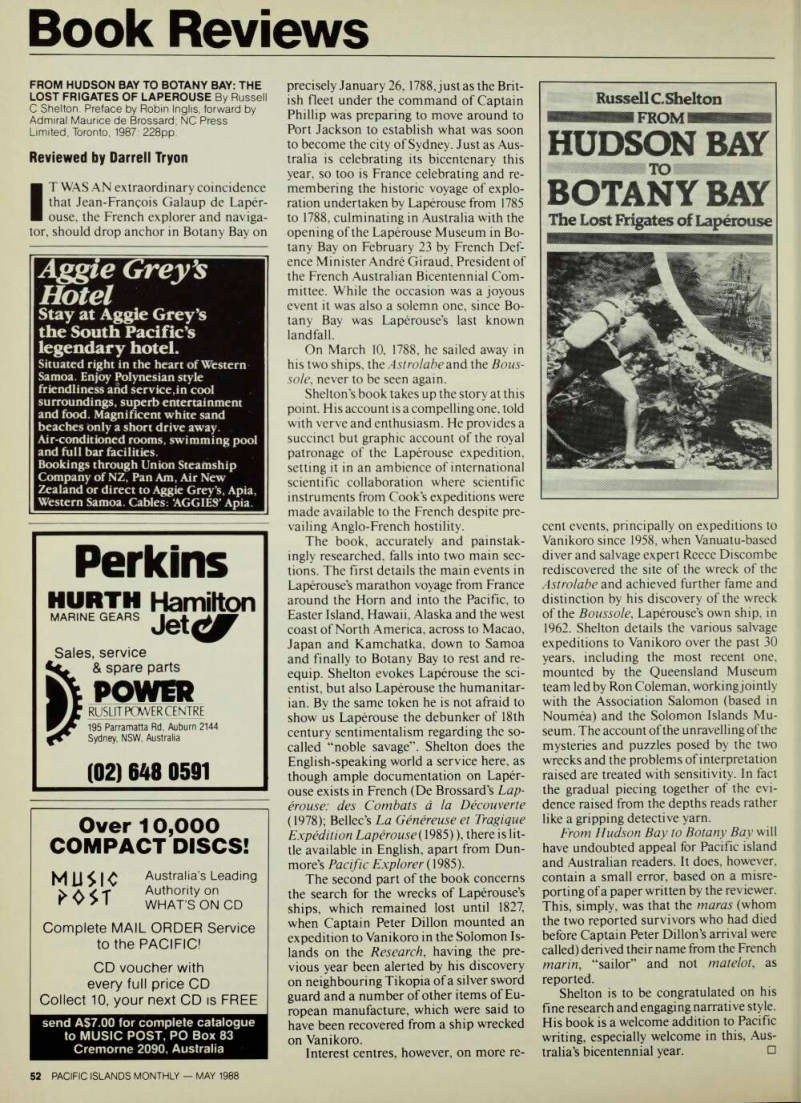
FROM HUDSON BAY TO BOTANY BAY: THE
Lost Frigates Of Laperouse By Russell
C Shelton. Preface by Robin Inglis, forward by Admiral Maurice de Brossard; NC Press Limited, Toronto, 1987: 228 pp.
Reviewed by Darrell Tryon
IT WAS AN extraordinary coincidence that Jean-Francois Galaup de Laper ouse, the French explorer and naviga tor, should drop anchor in Botany Bay on
precisely January 26,1788, just as the Brit ish fleet under the command of Captain Phillip was preparing to move around to Port Jackson to establish what was soon to become the city of Sydney. Just as Aus tralia is celebrating its bicentenary this year, so too is France celebrating and re membering the historic voyage of explo ration undertaken by Laperouse from 1785 to 1788, culminating in Australia with the opening of the Laperouse Museum in Bo tany Bay on February 23 by French Def ence Minister Andre Giraud, President of the French Australian Bicentennial Com mittee. While the occasion was a joyous event it was also a solemn one, since Bo tany Bay was Laperouse’s last known landfall.
On March 10, 1788, he sailed away in his two ships, the Astrolabe and the Bous sole,, never to be seen again.
Shelton’s book takes up the story at this point. His account is a compelling one, told with verve and enthusiasm. He provides a succinct but graphic account of the royal patronage of the Laperouse expedition, setting it in an ambience of international scientific collaboration where scientific instruments from Cook’s expeditions were made available to the French despite pre vailing Anglo-French hostility.
The book, accurately and painstak ingly researched, falls into two main sec tions. The first details the main events in Laperouse’s marathon voyage from France around the Horn and into the Pacific, to Easter Island, Hawaii, Alaska and the west coast of North America, across to Macao, Japan and Kamchatka, down to Samoa and finally to Botany Bay to rest and re equip. Shelton evokes Laperouse the sci entist, but also Laperouse the humanitar ian. By the same token he is not afraid to show us Laperouse the debunker of 18th century sentimentalism regarding the so called “noble savage”. Shelton does the English-speaking world a service here, as though ample documentation on Laper ouse exists in French (De Brossard’s Lap erouse: des Combats a la Decouverte (1978); Bellec’s La Genereuse et Tragique Expedition Laperouse{ l9Bs)), there is lit tle available in English, apart from Dun more’s Pacific Explorer ( 1985).
The second part of the book concerns the search for the wrecks of Laperouse’s ships, which remained lost until 1827, when Captain Peter Dillon mounted an expedition to Vanikoro in the Solomon Is lands on the Research , having the pre vious year been alerted by his discovery on neighbouring Tikopia of a silver sword guard and a number of other items of Eu ropean manufacture, which were said to have been recovered from a ship wrecked on Vanikoro.
Interest centres, however, on more re-
cent events, principally on expeditions to Vanikoro since 1958, when Vanuatu-based diver and salvage expert Reece Discombe rediscovered the site of the wreck of the Astrolabe and achieved further fame and distinction by his discovery of the wreck of the Boussole, Laperouse’s own ship, in 1962. Shelton details the various salvage expeditions to Vanikoro over the past 30 years, including the most recent one, mounted by the Queensland Museum team led by Ron Coleman, working jointly with the Association Salomon (based in Noumea) and the Solomon Islands Mu seum. The account of the unravelling of the mysteries and puzzles posed by the two wrecks and the problems of interpretation raised are treated with sensitivity. In fact the gradual piecing together of the evi dence raised from the depths reads rather like a gripping detective yarn.
From Hudson Bay to Botany Bay will have undoubted appeal for Pacific island and Australian readers. It does, however, contain a small error, based on a misre porting of a paper written by the reviewer.
This, simply, was that the maras (whom the two reported survivors who had died before Captain Peter Dillon’s arrival were called) derived their name from the French marin, “sailor” and not matelot, as reported.
Shelton is to be congratulated on his fine research and engaging narrative style.
His book is a welcome addition to Pacific writing, especially welcome in this, Aus tralia’s bicentennial year. □
Advertisements & other items, p. 52 (1 item)
Perkins
Aggie Grey's
Hotel
Stay at Aggie Grey’s
the South Pacific’s
legendary hotel.
Situated right in the heart of Western Samoa. Enjoy Polynesian style friendliness and service,in cool surroundings, superb entertainment and food. Magnificent white sand beaches only a short drive away.
Air-conditioned rooms, swimming pool and full bar facilities.
Bookings through Union Steamship Company of NZ, Pan Am, Air New Zealand or direct to Aggie Grey’s, Apia, Western Samoa. Cables: AGGIES’ Apia.
Perkins
HURTH Hamilton
MARINE GEARS
Sales, service & spare parts
POWiB^
RUSLIT POWER CENTRE
195 Parramatta Rd, Auburn 2144 Sydney, NSW, Australia (02) 648 0591
Over 10,000
COMPACT DISCS!
i>o*T
Australia’s Leading Authority on
WHAT’S ON CD
Complete MAIL ORDER Service to the PACIFIC!
CD voucher with every full price CD Collect 10, your next CD is FREE send A 57.00 for complete catalogue
to MUSIC POST, PO Box 83
Cremorne 2090, Australia
Shipping Schedules
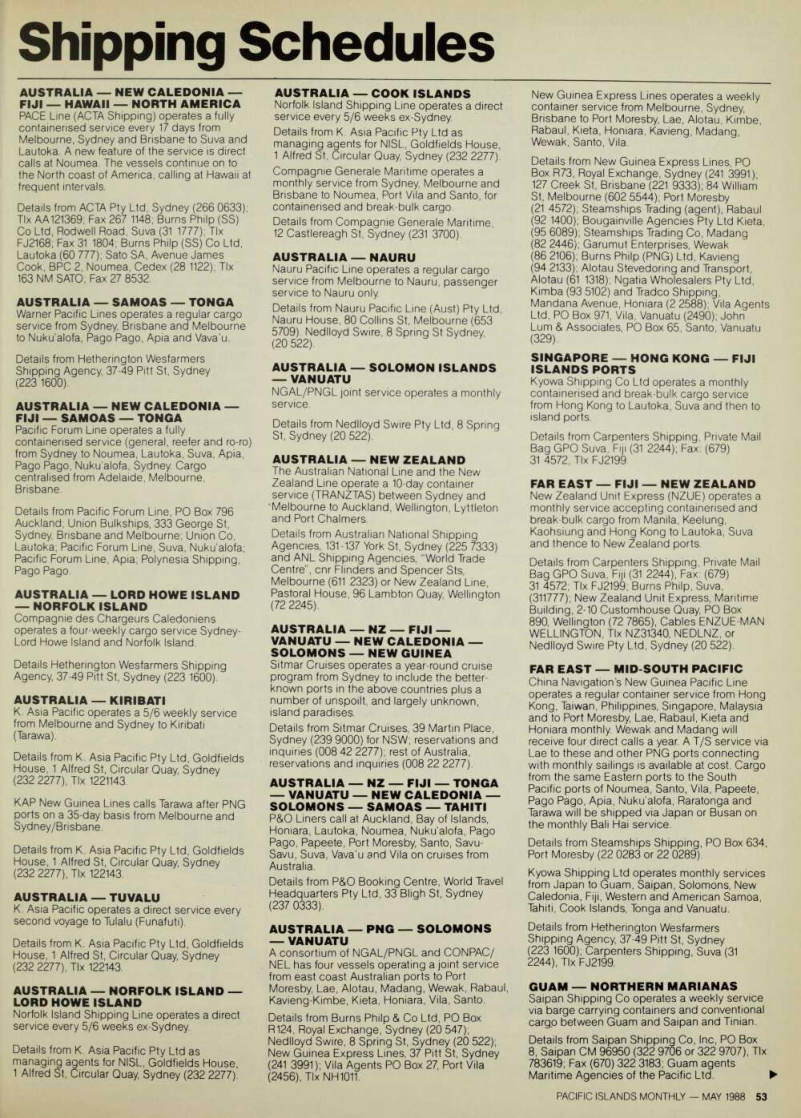
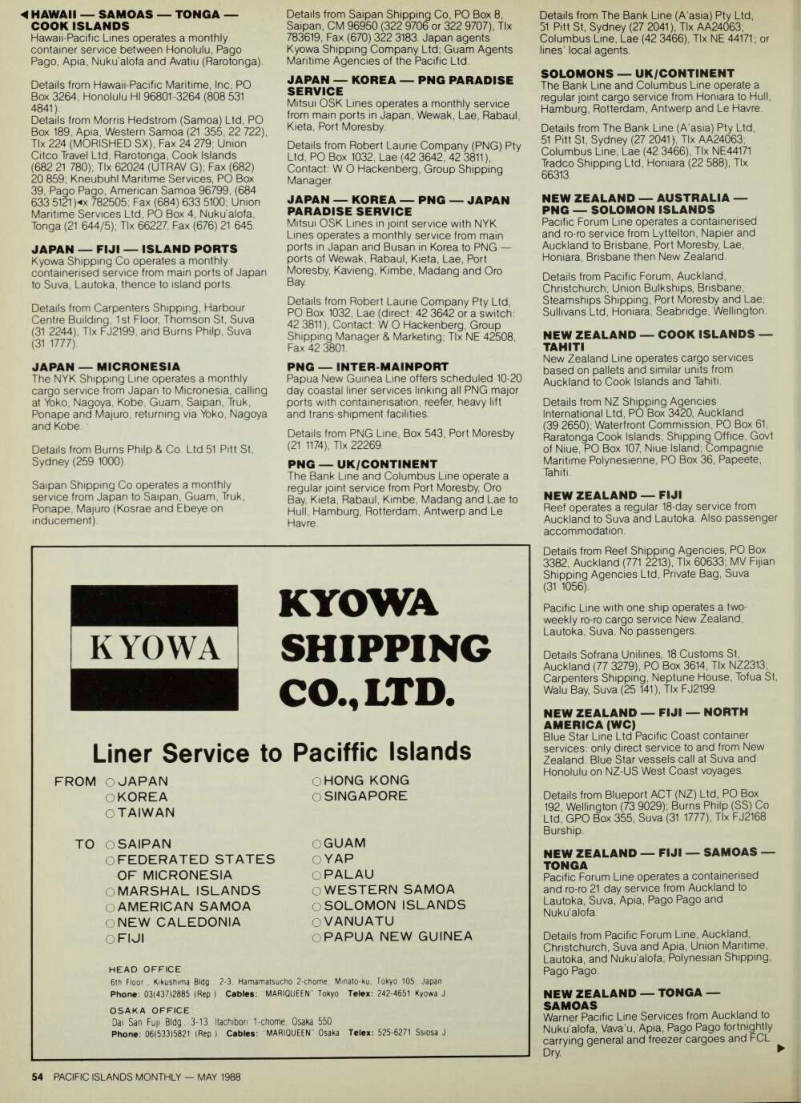

Australia New Caledonia
Fiji Hawaii North America
PACE Line (ACTA Shipping) operates a fully containerised service every 17 days from Melbourne, Sydney and Brisbane to Suva and Lautoka. A new feature of the service is direct calls at Noumea. The vessels continue on to the North coast of America, calling at Hawaii at frequent intervals.
Details from ACTA Pty Ltd, Sydney (266 0633); Tlx A A 121369; Fax 267 1148; Burns Philp (SS) Co Ltd, Rodwell Road, Suva (31 1777); Tlx FJ2168; Fax 31 1804; Burns Philp (SS) Co Ltd, Lautoka (60 777); Sato SA, Avenue James Cook, BPC 2, Noumea, Cedex (28 1122); Tlx
163 Nm Sato; Fax 27 8532,
Australia Samoas Tonga
Warner Pacific Lines operates a regular cargo service from Sydney, Brisbane and Melbourne to Nuku’alofa, Pago Pago, Apia and Vava’u.
Details from Hetherington Wesfarmers Shipping Agency, 37-49 Pitt St, Sydney (223 1600).
Australia New Caledonia
Fiji Samoas Tonga
Pacific Forum Line operates a fully containerised service (general, reefer and ro-ro) from Sydney to Noumea, Lautoka, Suva, Apia, Pago Pago, Nuku’alofa, Sydney. Cargo centralised from Adelaide, Melbourne, Brisbane.
Details from Pacific Forum Line, PO Box 796 Auckland; Union Bulkships, 333 George St, Sydney, Brisbane and Melbourne; Union Co, Lautoka; Pacific Forum Line, Suva, Nuku’alofa; Pacific Forum Line, Apia; Polynesia Shipping, Pago Pago.
Australia Lord Howe Island
Norfolk Island
Compagnie des Chargeurs Caledoniens operates a four-weekly cargo service Sydney- Lord Howe Island and Norfolk Island.
Details Hetherington Wesfarmers Shipping Agency, 37-49 Pitt St, Sydney (223 1600).
Australia Kiribati
K, Asia Pacific operates a 5/6 weekly service from Melbourne and Sydney to Kiribati (Tarawa).
Details from K. Asia Pacific Pty Ltd, Goldfields House, 1 Alfred St, Circular Quay, Sydney (232 2277), Tlx 1221143.
KAP New Guinea Lines calls Tarawa after PNG ports on a 35-day basis from Melbourne and Sydney/Brisbane.
Details from K. Asia Pacific Pty Ltd, Goldfields House, 1 Alfred St, Circular Quay, Sydney (232 2277), Tlx 122143.
Australia Tuvalu
K. Asia Pacific operates a direct service every second voyage to Tulalu (Funafuti).
Details from K. Asia Pacific Pty Ltd, Goldfields House, 1 Alfred St, Circular Quay, Sydney (232 2277), Tlx 122143.
Australia Norfolk Island
Lord Howe Island
Norfolk Island Shipping Line operates a direct service every 5/6 weeks ex-Sydney.
Details from K. Asia Pacific Pty Ltd as managing agents for NISL, Goldfields House, 1 Alfred St, Circular Quay, Sydney (232 2277).
Australia Cook Islands
Norfolk Island Shipping Line operates a direct service every 5/6 weeks ex-Sydney.
Details from K. Asia Pacific Pty Ltd as managing agents for NISL, Goldfields House, 1 Alfred St, Circular Quay, Sydney (232 2277).
Compagnie Generate Maritime operates a monthly service from Sydney, Melbourne and Brisbane to Noumea, Port Vila and Santo, for containerised and break-bulk cargo.
Details from Compagnie Generate Maritime,
12 Castlereagh St, Sydney (231 3700).
Australia Nauru
Nauru Pacific Line operates a regular cargo service from Melbourne to Nauru, passenger service to Nauru only.
Details from Nauru Pacific Line (Aust) Pty Ltd, Nauru House, 80 Collins St, Melbourne (653 5709). Nedlloyd Swire, 8 Spring St Sydney, (20 522).
Australia Solomon Islands
Vanuatu
NGAL/PNGL joint service operates a monthly service.
Details from Nedlloyd Swire Pty Ltd, 8 Spring
St, Sydney (20 522).
Australia New Zealand
The Australian National Line and the New Zealand Line operate a 10-day container service (TRANZTAS) between Sydney and Melbourne to Auckland, Wellington, Lyttleton and Port Chalmers.
Details from Australian National Shipping Agencies, 131-137 York St, Sydney (225 7333) and ANL Shipping Agencies, “World Trade Centre”, enr Flinders and Spencer Sts, Melbourne (611 2323) or New Zealand Line, Pastoral House, 96 Lambton Quay, Wellington (72 2245).
Australia Nz Fiji
Vanuatu New Caledonia
Solomons New Guinea
Sitmar Cruises operates a year-round cruise program from Sydney to include the better known ports in the above countries plus a number of unspoilt, and largely unknown, island paradises.
Details from Sitmar Cruises, 39 Martin Place, Sydney (239 9000) for NSW; reservations and inquiries (008 42 2277); rest of Australia, reservations and inquiries (008 22 2277).
Australia Nz Fiji Tonga
Vanuatu New Caledonia
Solomons Samoas Tahiti
P&O Liners call at Auckland, Bay of Islands, Honiara, Lautoka, Noumea, Nuku’alofa, Pago Pago, Papeete, Port Moresby, Santo, Savu- Savu, Suva, Vava'u and Vila on cruises from Australia.
Details from P&O Booking Centre, World Travel Headquarters Pty Ltd, 33 Bligh St, Sydney (237 0333).
Australia Png Solomons
Vanuatu
A consortium of NGAL/PNGL and CONPAC/ NEL has four vessels operating a joint service from east coast Australian ports to Port Moresby, Lae, Alotau, Madang, Wewak, Rabaul, Kavieng-Kimbe, Kieta, Honiara, Vila, Santo.
Details from Burns Philp & Co Ltd, PO Box R 124, Royal Exchange, Sydney (20 547); Nedlloyd Swire, 8 Spring St, Sydney (20 522); New Guinea Express Lines, 37 Pitt St, Sydney (241 3991); Vila Agents PO Box 27, Port Vila
(2456), Tlx Nhioii.
New Guinea Express Lines operates a weekly container service from Melbourne, Sydney, Brisbane to Port Moresby, Lae, Alotau, Kimbe, Rabaul, Kieta, Honiara, Kavieng, Madang, Wewak, Santo, Vila.
Details from New Guinea Express Lines, PO Box R 73, Royal Exchange, Sydney (241 3991); 127 Creek St, Brisbane (221 9333); 84 William St, Melbourne (602 5544); Port Moresby (21 4572); Steamships Trading (agent), Rabaul (92 1400); Bougainville Agencies Pty Ltd Kieta, (95 6089); Steamships Trading Co, Madang (82 2446); Garumut Enterprises, Wewak (86 2106); Burns Philp (PNG) Ltd, Kavieng (94 2133); Alotau Stevedoring and Transport, Alotau (61 1318); Ngatia Wholesalers Pty Ltd, Kimba (93 5102) and Trade© Shipping, Mandana Avenue, Honiara (2 2588); Vila Agents Ltd, PO Box 971, Vila, Vanuatu (2490); John Lum & Associates, PO Box 65, Santo, Vanuatu (329).
Singapore Hong Kong Fiji
Islands Ports
Kyowa Shipping Co Ltd operates a monthly containerised and break-bulk cargo service from Hong Kong to Lautoka, Suva and then to island ports.
Details from Carpenters Shipping, Private Mail Bag GPO Suva, Fiji (31 2244); Fax: (679) 31 4572, Tlx FJ2199.
Far East Fiji New Zealand
New Zealand Unit Express (NZUE) operates a monthly service accepting containerised and break-bulk cargo from Manila, Keelung, Kaohsiung and Hong Kong to Lautoka, Suva and thence to New Zealand ports.
Details from Carpenters Shipping, Private Mail Bag GPO Suva, Fiji (31 2244), Fax: (679) 31 4572; Tlx FJ2199; Burns Philp, Suva, (311777); New Zealand Unit Express, Maritime Building, 2-10 Customhouse Quay, PO Box 890, Wellington (72 7865), Cables ENZUE-MAN
Wellington, Tlx Nz31340, Nedlnz, Or
Nedlloyd Swire Pty Ltd, Sydney (20 522).
Far East Mid-South Pacific
China Navigation’s New Guinea Pacific Line operates a regular container service from Hong Kong, Taiwan, Philippines, Singapore, Malaysia and to Port Moresby, Lae, Rabaul, Kieta and Honiara monthly. Wewak and Madang will receive four direct calls a year. A T/S service via Lae to these and other PNG ports connecting with monthly sailings is available at cost. Cargo from the same Eastern ports to the South Pacific ports of Noumea, Santo, Vila, Papeete, Pago Pago, Apia, Nukualofa, Raratonga and Tarawa will be shipped via Japan or Busan on the monthly Bali Hai service.
Details from Steamships Shipping, PO Box 634, Port Moresby (22 0283 or 22 0289).
Kyowa Shipping Ltd operates monthly services from Japan to Guam, Saipan, Solomons, New Caledonia, Fiji, Western and American Samoa, Tahiti, Cook Islands, Tonga and Vanuatu, Details from Hetherington Wesfarmers Shipping Agency, 37-49 Pitt St, Sydney (223 1600); Carpenters Shipping, Suva (31 2244), Tlx FJ2199.
Guam Northern Marianas
Saipan Shipping Co operates a weekly service via barge carrying containers and conventional cargo between Guam and Saipan and Tinian.
Details from Saipan Shipping Co, Inc, PO Box 8, Saipan CM 96950 (322 9706 or 322 9707), Tlx 783619; Fax (670) 322 3183; Guam agents Maritime Agencies of the Pacific Ltd. ►
◄ Hawaii Samoas Tonga
Cook Islands
Hawaii-Pacific Lines operates a monthly container service between Honolulu, Pago Pago, Apia, Nukualofa and Avatiu (Rarotonga).
Details from Hawaii-Pacific Maritime, Inc, PO Box 3264, Honolulu HI 96801-3264 (808 531 4841).
Details from Morris Hedstrom (Samoa) Ltd, PO Box 189, Apia, Western Samoa (21 355, 22 722), Tlx 224 (MORISHED SX), Fax 24 279; Union Citco Travel Ltd, Rarotonga, Cook Islands (682 21 780); Tlx 62024 (UTRAV G); Fax (682) 20 859; Kneubuhl Maritime Services, PO Box 39, Pago Pago, American Samoa 96799, (684 633 5121 )«x 782505; Fax (684) 633 5100; Union Maritime Services Ltd, PO Box 4, Nuku'alofa, Tonga (21 644/5); Tlx 66227, Fax (676) 21 645.
Japan Fiji Island Ports
Kyowa Shipping Co operates a monthly containerised service from main ports of Japan to Suva, Lautoka, thence to island ports.
Details from Carpenters Shipping, Harbour Centre Building, Ist Floor, Thomson St, Suva (31 2244), Tlx FJ2199, and Burns Philp, Suva (31 1777).
Japan Micronesia
The NYK Shipping Line operates a monthly cargo service from Japan to Micronesia, calling at Yoko, Nagoya, Kobe, Guam, Saipan, Truk, Ponape and Majuro, returning via Yoko, Nagoya and Kobe.
Details from Burns Philp & Co. Ltd 51 Pitt St, Sydney (259 1000).
Saipan Shipping Co operates a monthly service from Japan to Saipan, Guam, Truk, Ponape, Majuro (Kosrae and Ebeye on inducement).
Details from Saipan Shipping Co, PO Box 8, Saipan, CM 96950 (322 9706 or 322 9707), Tlx 783619, Fax (670) 322 3183. Japan agents Kyowa Shipping Company Ltd; Guam Agents Maritime Agencies of the Pacific Ltd.
Japan Korea Png Paradise
Service
Mitsui OSK Lines operates a monthly service from main ports in Japan, Wewak, Lae, Rabaul, Kieta, Port Moresby.
Details from Robert Laurie Company (PNG) Pty Ltd, PO Box 1032, Lae (42 3642, 42 3811), Contact: W O Hackenberg, Group Shipping Manager.
Japan Korea Png Japan
Paradise Service
Mitsui OSK Lines in joint service with NYK Lines operates a monthly service from main ports in Japan and Busan in Korea to PNG ports of Wewak, Rabaul, Kieta, Lae, Port Moresby, Kavieng, Kimbe, Madang and Oro Bay.
Details from Robert Laurie Company Pty Ltd, PO Box 1032, Lae (direct: 42 3642 or a switch. 42 3811), Contact: W O Hackenberg, Group Shipping Manager & Marketing; Tlx NE 42508, Fax 42 3801.
Png Inter-Mainport
Papua New Guinea Line offers scheduled 10-20 day coastal liner services linking all PNG major ports with containerisation, reefer, heavy lift and trans-shipment facilities.
Details from PNG Line, Box 543, Port Moresby (21 1174), Tlx 22269.
Png Uk/Continent
The Bank Line and Columbus Line operate a regular joint service from Port Moresby, Oro Bay, Kieta, Rabaul, Kimbe, Madang and Lae to Hull, Hamburg, Rotterdam, Antwerp and Le Havre.
Details from The Bank Line (A'asia) Pty Ltd, 51 Pitt St, Sydney (27 2041), Tlx AA24063; Columbus Line, Lae (42 3466), Tlx NE 44171; or lines' local agents.
Solomons Uk/Continent
The Bank Line and Columbus Line operate a regular joint cargo service from Honiara to Hull, Hamburg, Rotterdam, Antwerp and Le Havre.
Details from The Bank Line (A’asia) Pty Ltd, 51 Pitt St, Sydney (27 2041), Tlx AA24063; Columbus Line, Lae (42 3466), Tlx NE44171 Tradco Shipping Ltd, Honiara (22 588), Tlx 66313.
New Zealand Australia
Png Solomon Islands
Pacific Forum Line operates a containerised and ro-ro service from Lyttelton, Napier and Auckland to Brisbane, Port Moresby, Lae, Honiara, Brisbane then New Zealand.
Details from Pacific Forum, Auckland, Christchurch; Union Bulkships, Brisbane; Steamships Shipping, Port Moresby and Lae, Sullivans Ltd, Honiara; Seabridge, Wellington.
New Zealand Cook Islands
Tahiti
New Zealand Line operates cargo services based on pallets and similar units from Auckland to Cook Islands and Tahiti.
Details from NZ Shipping Agencies International Ltd, PO Box 3420, Auckland (39 2650); Waterfront Commission, PO Box 61, Raratonga Cook Islands; Shipping Office, Govt of Niue, PO Box 107, Niue Island; Compagnie Maritime Polynesienne, PO Box 36, Papeete, Tahiti.
New Zealand Fiji
Reef operates a regular 18-day service from Auckland to Suva and Lautoka. Also passenger accommodation.
Details from Reef Shipping Agencies, PO Box 3382, Auckland (771 2213), Tlx 60633; MV Fijian Shipping Agencies Ltd, Private Bag, Suva (31 1056).
Pacific Line with one ship operates a two weekly ro-ro cargo service New Zealand, Lautoka, Suva. No passengers.
Details Sofrana Unilines, 18 Customs St, Auckland (77 3279). PO Box 3614, Tlx NZ2313; Carpenters Shipping, Neptune House, Tofua St, Walu Bay, Suva (25 141), Tlx FJ2199.
New Zealand Fiji North
America (Wc)
Blue Star Line Ltd Pacific Coast container services: only direct service to and from New Zealand. Blue Star vessels call at Suva and Honolulu on NZ-US West Coast voyages.
Details from Blueport ACT (NZ) Ltd, PO Box 192, Wellington (73 9029); Burns Philp (SS) Co Ltd, GPO Box 355, Suva (31 1777), Tlx FJ2168 Burship.
New Zealand Fiji Samoas
Tonga
Pacific Forum Line operates a containerised and ro-ro 21 day service from Auckland to Lautoka, Suva, Apia, Pago Pago and Nukualofa.
Details from Pacific Forum Line, Auckland, Christchurch, Suva and Apia, Union Maritime, Lautoka, and Nukualofa; Polynesian Shipping, Pago Pago.
New Zealand Tonga
Samoas
Warner Pacific Line Services from Auckland to Nukualofa, Vava'u, Apia, Pago Pago fortnightly carrying general and freezer cargoes and FCL Dry. ►
◄ Details from McKay Shipping Ltd, Downtown House, 21 Queen St, Auckland PO Box 3 (39 0229). Cables MACSHIP, Tlx NZ2554f; Warner Pacific Line, Box 93, Nukualofa, Tonga; Mealelel (Western Samoa) Ltd, Private Bag Apia, Western Samoa; Burns Philp (SS) Co Ltd, PO Box 129, Pago Pago, American Samoa (633 2709), Cables 506, Burnsouth SB.
Nz Cook Islands Aitutaki
Niue
Cook Islands Line services Auckland, Aitutaki, Niue monthly carrying general and freezer cargoes.
Details from McKay Shipping Ltd, Downtown House, 21 Queen Street, Auckland/ PO Box 3, Auckland (39 0229). Cables MACSHIP, Tlx NZ2554; Fax 32 931.
Tahiti New Caledonia
Vanuatu Solomon Islands
New Zealand Png
Singapore Europe
Polish Ocean Lines operates semi-container type vessels to the following ports: from Papeete, Noumea, Santo, Vila, Yandina, Honiara, Auckland, Rabaul, Lae, Singapore, Port Kielang, Penang then to Mediterranean ports and Europe via the Suez Canal (other New Zealand ports subject to inducement).
Details from Universal Shipping Agencies Ltd, 6th Floor, 38 Fort St, Auckland 1 (39 0931, 39 0727, 32 104), Tlx 21 517.
Europe Tahiti New
Caledonia
Compagnie Generale Maritime operates services from Europe and Mediterranean ports to Papeete and Noumea using three ro-ro and multi-purpose vessels thus ensuring a bi monthly sailing to and from.
Details from Compagnie Generale Maritime, 12 Castlereagh St, Sydney (2313700).
Europe Tahiti New
Caledonia New Zealand
Vanuatu Solomons Png
Europe
Polish Ocean Lines offers regular monthly sailings for containerised and break-bulk cargo, also conventional reefer space and reefer containers from Hamburg, Rotterdam, Dunkirk, Le Havre to Papeete, Noumea, Auckland, Santo, Honiara, Rabaul, Lae, Singapore, returning to Europe via Suez. Other ports in the South Pacific can be served directly with inducement or otherwise via trans-shipment.
Details from Sotama, BP 9170, Papeete (42 7805), Tlx Sotama 373FP; SATO: BP, C 2 Noumea Cedex (27 2094), Tlx 163 NM; Universal Shipping Agencies, PO Box 2282 Auckland (30 930), Tlx 21517; Vanua Navigation, PO Box 44, Vila (2027), Tlx 1033; Melan Chine Shipping Co, PO Box 71, Honiara (21 678), Tlx 66335; Steamships Trading Co Ltd, PO Box 85, Lae (42 4666), Tlx 42423; Union Steamship Co NZ Ltd, PO Box 50, Apia (21 781), Tlx 225; Warner Pacific Line, PO Box 93, Nukualofa (22088), Tlx 66219; Fiji Agents TBA.
Europe Tahiti W Samoa
Fiji New Caledonia
Nedlloyd offers regular cargo services from Continental ports to Papeete, Apia, Fiji and New Caledonia.
Details Nedlloyd (Aust) Pty Ltd, Spring St, Sydney (27 3801); Carpenters Shipping, Ist Floor, Harbour Centre Bldg, 100 Thomson St, Suva (31 2244) Tlx 2199FJ and Vetari St, Lautoka (63 988), Tlx 5215FJ.
Uk Europe W Samoa
Tonga Fiji
The Bank Line and Columbus Line operate a regular joint cargo service from Hull, Hamburg, Bremen, Antwerp, Rotterdam and Le Havre to Apia, Nukualofa, Suva and Lautoka.
Details from The Bank Line (A’asia) Pty Ltd, 51 Pitt St, Sydney (27 2041), Tlx: AA24063, Columbus Line, Lae (42 3466), Tlx NE 44111 or Line’s local agents.
Uk Europe Png
Solomons
The Bank Line and Columbus Line operate a regular joint cargo service from Hull, Hamburg, Bremen, Antwerp, Rotterdam and Le Havre to Port Moresby, Lae, Madang, Kimbe, Rabaul, Kieta and Honiara and on inducement to Yandina.
Details from The Bank Line (A’asia) Pty Ltd, 51 Pitt St, Sydney (27 2041), Tlx AA24063; Columbus Line, Lae (42 3466), Tlx: NE44171; or Line’s local agents.
Uk/Europe Tahiti New
Caledonia Vanuatu
The Bank Line and Columbus Line operate a regular joint cargo service from Hull, Hamburg, Bremen, Antwerp, Rotterdam and Le Havre to Papeete, Noumea, Port-Vila and Santo.
Details from The Bank Line (A’asia) Pty Ltd, 51 Pitt St, Sydney (27 2041), Tlx AA24063.
Columbus Line, Lae (42 3466), Tlx NE44171; Ets A M, Fare UTE, Papeete; Ets Ballande, Noumea and other local agents.
Us Hawaii Micronesia
Png
PM&O Lines operates two fully self-contained container vessels on a sailing frequency of every 30 days between the San Francisco Bay Area, Los Angeles, Honolulu and Majuro, Ebeye, Kosrae, Ponape, Truk, Saipan, Yap, Palau, Cebu, Davao, Lae, Kieta and Rabaul.
Details from PM&O Lines, 353 Sacramento St, San Francisco, California 94111 (415 421 5400), Tlx 278016 PMO UR; owner’s Representative PC Box 803, Saipan, NMI 96950 (234 6819), Tlx
783605 Cmcaa.
Advertisements & other items, pp. 54-57 (1 item)
Co., Ltd.
KYOWA
KYOWA
SHIPPING
CO., LTD.
Liner Service to Paciffic Islands
FROM OJAPAN OHONG KONG
OKOREA OSINGAPORE
OTAIWAN
TO OSAIPAN
OFEDERATED STATES
OF MICRONESIA
OMARSHAL ISLANDS
OAMERICAN SAMOA
ONEW CALEDONIA
O FIJI
OGUAM
OYAP
OPALAU
OWESTERN SAMOA
OSOLOMON ISLANDS
OVANUATU
OPAPUA NEW GUINEA
HEAD OFFICE
6th Floor , Kikushima Bldg . 2-3. Hamamatsucho 2-chome. Mmato-ku. Tokyo 105, Japan Phone: 03(437)2885 (Rep ) Cables: MARIQUEEN" Tokyo Telex: 242-4651 Kyowa J
OSAKA OFFICE
Dai San Fuji Bldg. 3-13. Itachibon 1-chome, Osaka 550.
Phone: 06(533)5821 (Rep ) Cables: "MARIQUEEN" Osaka Telex: 525-6271 Ssiosa J
b M s
can
When it comes to shipping, ACTA really know their onions.
Which makes the addition of Noumea to the ports we service welcome news for Australian exporters.
ACTA boasts a purpose built fleet of ships, backed by on-shore and after-sail service that can’t be beaten.
We’ll keep your fresh food fresh, frozen foods frozen and protect your more fragile exports as if they were our own.
And deliver the same first class service established by ACTA between Australia and Fiji, not to mention both coasts of North America.
The new ACTA service between Australia and Noumea.
If you have a first class product, it’s the only way to travel. jm m £ s g m B B Sydney (02) 2660633, Melbourne (03) 611 2000, Brisbane (07) 2213116
cruis
to Nouih
S E /B S S s m m © © M W ®® A tough act to follow /S|/S|/S[/Sj x
TALAIR ... Papua New Guinea's
nationwide airline connection to and
from the World.
I it
DOMESTIC
Talair serves all provinces in P.N.G., many on a daily basis. No other airline comes close to serving the 130 ports a week that Talair does. Charter services also are available.
INTERNATIONAL
Using our computerised system in any of our 12 International Travel Centres, we can book you anywhere in the world 0n... planes, trains, luxury liners arrange rental cars, hostels, motels or hotels. « • AM Panguna - 95 8020 • Arawa - 95 2113 • Mt. Hagen - 52 2465 Boroko - 25 7655 • Tabubil - 58 9228 • Goroka - 72 1355 • Lae - 42 2316 Madang - 82 2757 • Rabaul - 82 2882 • Wewak - 86 2012 Vanimo - 87 1180 • Port Moresby - 21 4766 • Waigani - 25 7877 Brisbane Metropolitan Area - 229 1177 Outside Brisbane - 008 777879
MWIR
ATA
QUALITY IN AIR TRANSPORT
YOUR DIRECT EUROPEAN CONNECTION
m ■ U» ■U« &
EUROPE-SOUTH PACIFIC JOINT SERVICE
The South Pacific Specialists offer facilities for shipment of: Containers (FCL/LCL) and Breakbulk Cargo plus reefer space and deeptanks for carriage of vegetable oils and other liquid bulk cargo.
Carriers also accept heavy lifts, overlength and cumbersome parcels.
Ports of Service: Loading: Papeete, Apia, Suva, Lautoka, Noumea, Port Vila, Santo, Honiara, Port Moresby, Lae,Madang, Kimbe, Rabaul, Kieta, Darwin.
For; Rotterdam, Antwerp, Hamburg, Hull, Dunkirk, Le Havre.
Additional ports on enquiry.
- ROUND THE WORLD SERVICE -
Please contact our regional offices for further information: The Bank Line (Australasia) Pty. Ltd.
Suite 701, 51 Pitt Street Sydney N.S.W. 2000 Phone; 251 6688 Telex; 24063 Columbus Line Reederei GmbH P.O. Box 1667 Lae/Papua New Guinea Phone: 42 3466/42 3287 A.H. 42 2481 Telex: Colline NE 44 171
THE BANK LINE LTD LONDON
COLUMBUS LINE REEDEREI GMBH HAMBURG
A “True Man” Remembered
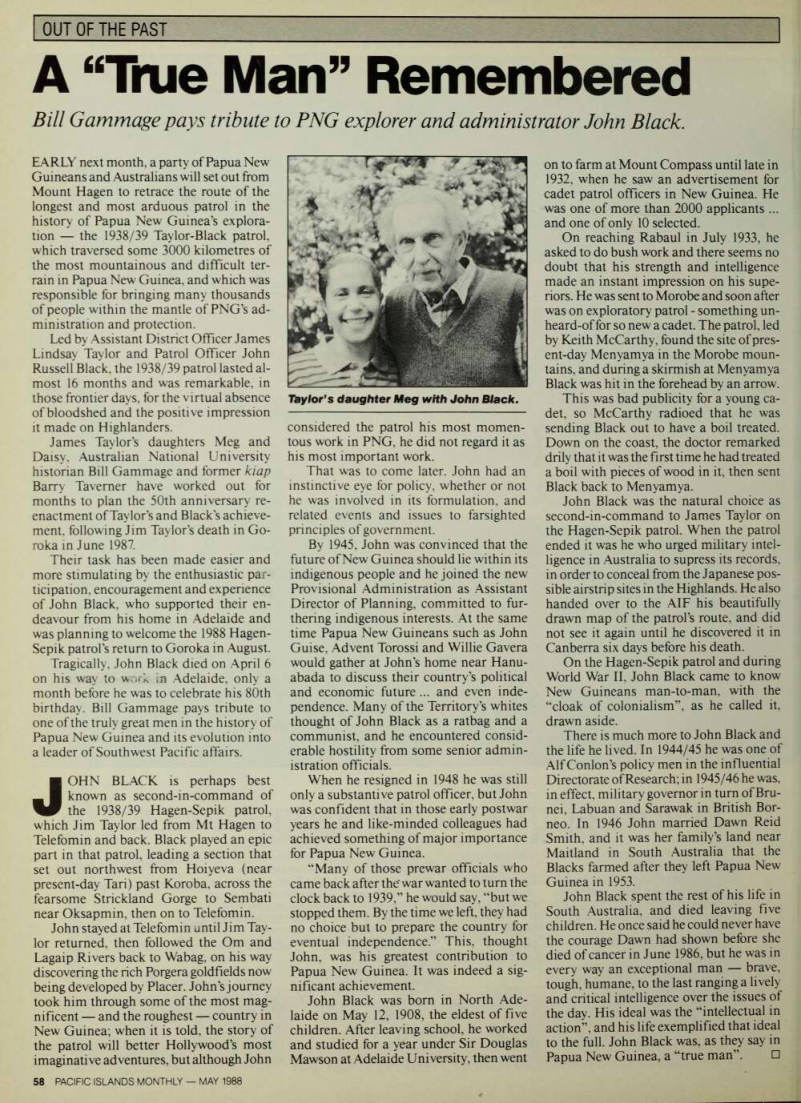
Out Of The Past
Bill Gammage pays tribute to PNG explorer and administrator John Black
EARLY next month, a party of Papua New Guineans and Australians will set out from Mount Hagen to retrace the route of the longest and most arduous patrol in the history of Papua New Guinea’s explora tion the 1938/39 Taylor-Black patrol, which traversed some 3000 kilometres of the most mountainous and difficult ter rain in Papua New Guinea, and which was responsible for bringing many thousands of people within the mantle of PNG’s ad ministration and protection.
Led by Assistant District Officer James Lindsay Taylor and Patrol Officer John Russell Black, the 1938/39 patrol lasted al most 16 months and was remarkable, in those frontier days, for the virtual absence of bloodshed and the positive impression it made on Highlanders.
James Taylor’s daughters Meg and Daisy, Australian National University historian Bill Gammage and former kiap Barry Taverner have worked out for months to plan the 50th anniversary re enactment of Taylor’s and Black’s achieve ment. following Jim Taylor’s death in Go roka in June 1987.
Their task has been made easier and more stimulating by the enthusiastic par ticipation, encouragement and experience of John Black, who supported their en deavour from his home in Adelaide and was planning to welcome the 1988 Hagen- Sepik patrol’s return to Goroka in August.
Tragically. John Black died on April 6 on his way to work in Adelaide, only a month before he was to celebrate his 80th birthday. Bill Gammage pays tribute to one of the truly great men in the history of Papua New Guinea and its evolution into a leader of Southwest Pacific affairs.
JOHN BLACK is perhaps best known as second-in-command of the 1938/39 Hagen-Sepik patrol, which Jim Taylor led from Mt Hagen to Telefomin and back. Black played an epic part in that patrol, leading a section that set out northwest from Hoiyeva (near present-day Tari) past Koroba, across the fearsome Strickland Gorge to Sembati near Oksapmin, then on to Telefomin.
John stayed at Telefomin until Jim Tay lor returned, then followed the Om and Lagaip Rivers back to Wabag, on his way discovering the rich Porgera goldfields now being developed by Placer. John’s journey took him through some of the most mag nificent and the roughest country in New Guinea; when it is told, the story of the patrol will better Hollywood’s most imaginative adventures, but although John
considered the patrol his most momen tous work in PNG, he did not regard it as his most important work.
That was to come later. John had an instinctive eye for policy, whether or not he was involved in its formulation, and related events and issues to farsighted principles of government.
By 1945, John was convinced that the future of New Guinea should lie within its indigenous people and he joined the new Provisional Administration as Assistant Director of Planning, committed to fur thering indigenous interests. At the same time Papua New Guineans such as John Guise, Advent Torossi and Willie Gavera would gather at John’s home near Hanu abada to discuss their country’s political and economic future... and even inde pendence. Many of the Territory’s whites thought of John Black as a ratbag and a communist, and he encountered consid erable hostility from some senior admin istration officials.
When he resigned in 1948 he was still only a substantive patrol officer, but John was confident that in those early postwar years he and like-minded colleagues had achieved something of major importance for Papua New Guinea.
“Many of those prewar officials who came back after the' war wanted to turn the clock back to 1939,” he would say, “but we stopped them. By the time we left, they had no choice but to prepare the country for eventual independence.” This, thought John, was his greatest contribution to Papua New Guinea. It was indeed a sig nificant achievement.
John Black was born in North Ade laide on May 12, 1908, the eldest of five children. After leaving school, he worked and studied for a year under Sir Douglas Mawson at Adelaide University, then went
on to farm at Mount Compass until late in 1932, when he saw an advertisement for cadet patrol officers in New Guinea. He was one of more than 2000 applicants ... and one of only 10 selected.
On reaching Rabaul in July 1933, he asked to do bush work and there seems no doubt that his strength and intelligence made an instant impression on his supe riors. He was sent to Morobe and soon after was on exploratory patrol - something un heard-of for so new a cadet. The patrol, led by Keith McCarthy, found the site of pres ent-day Menyamya in the Morobe moun tains, and during a skirmish at Menyamya Black was hit in the forehead by an arrow.
This was bad publicity for a young ca det, so McCarthy radioed that he was sending Black out to have a boil treated.
Down on the coast, the doctor remarked drily that it was the first time he had treated a boil with pieces of wood in it, then sent Black back to Menyamya.
John Black was the natural choice as second-in-command to James Taylor on the Hagen-Sepik patrol. When the patrol ended it was he who urged military intel ligence in Australia to supress its records, in order to conceal from the Japanese pos sible airstrip sites in the Highlands. He also handed over to the AIF his beautifully drawn map of the patrol’s route, and did not see it again until he discovered it in Canberra six days before his death.
On the Hagen-Sepik patrol and during World War 11, John Black came to know New Guineans man-to-man, with the “cloak of colonialism”, as he called it, drawn aside.
There is much more to John Black and the life he lived. In 1944/45 he was one of Alf Conlon’s policy men in the influential Directorate of Research; in 1945/46 he was, in effect, military governor in turn of Bru nei, Labuan and Sarawak in British Bor neo. In 1946 John married Dawn Reid Smith, and it was her family’s land near Maitland in South Australia that the Blacks farmed after they left Papua New Guinea in 1953.
John Black spent the rest of his life in South Australia, and died leaving five children. He once said he could never have the courage Dawn had shown before she died of cancer in June 1986, but he was in every way an exceptional man brave, tough, humane, to the last ranging a lively and critical intelligence over the issues of the day. His ideal was the “intellectual in action”, and his life exemplified that ideal to the full. John Black was, as they say in Papua New Guinea, a “true man”. □
Taylor’s daughter Meg with John Black.
Advertisements & other items, pp. 59-60 (1 item)
soaring power.
Avante. Mo than
a symbol of
AVANTE 9100 R
* $ D \ S >5 $ 7T7af’s right, Avante is more than a symbol of soaring power. It is power itself, and can bestow power on you.
Take the Avante 9100 R component system —it puts 350W/ch. of music power right in your hands, for music power output that reaches prodigious, soaring heights!
What’s more, the 9100 R gives you the power to tailor output with a built-in 7-band graphic equalizer/spectrum analyzer. And it offers Pioneer “SR” audio/video remote control for full remote-control command not only of the Avante 9100 R, but of any Pioneer product with the “SR” logo.
Not only that, it brings a full-logic double auto-reverse cassette deck, a quartz-PLL synthesized tuner with 24 randomaccess station presets (FM/AM), a fully automatic turntable, and a 4-way speaker system that boasts rich, heavy bass, stunning mids, and crystal-clear highs.
But the Avante 9100 R is more than the sum of its superior parts.
It’s the “pure sound” component system so sophisticated, that it simply began as state-of-the-art technology, ending as a welcome addition to any music lover’s home because its woodgrain cabinet blends so beautifully with home decor.
The Avante 9100 R, with power, real power—the kind of power it takes to make music come alive —and your spirit soar!
Note: The PD-M4O Multi-Play CD player and EX-9000(BK) Dynamic Expander, shown in this ad, are available as options.
The Avante 41 OOP (350W/ch. PMPO) and Avante 3100 (270W/ch. PMPO) are also available. Ask your Pioneer dealer for details.
PIONEER
The future of sound and vision.
For further information, please contact: Australia: Pioneer Electronics Australia Pty. Ltd. (Incorporated in Victoria), P.O. Box 295, Mordialloc, Victoria, 3195 Tel: 580-9911 Fiji Islands: Brijlal & Company, G.P.O. Box No. 362, Suva, Fiji Islands Tel; 22258 New Zealand: Monaco Distributors Ltd., 41 Poland Road, Glenfield, Auckland, New Zealand Tel: (09) 444-9144 Norfolk Island: Burnt Pine Traders Ltd., P.O. Box 21, Norfolk Island Vanuatu: Burns Philp (Vanuatu) Ltd., Vila, Vanuatu Nauru Island: Jacob Enterprises, P.O. Box N 0.4, Republic of Nauru Tahiti: Tahiti Hi-Fi, P.O. Box 848, Papeete, Tahiti New Caledonia: Menard Pacifique Sari, B.P. 3899, Noumea, New Caledonia Tel: 27.62*23 American Samoa: Transpac Corporation, P.O. Box 1477, Pago Pago, American Samoa 96799 Tel: 633-5224 Rarotonga: South Seas International Ltd., P.O. Box 49, Rarotonga, Cook Islands Tel: 2327
OVER 100 VICTORIES IN ’B7.
From the desert furnaces of the Middle East to the foothills of the Himalayas, from the barren Australian outback to European and American rally circuits, Mitsubishi vehicles tallied over 100 wins in competitive race and rally events all over the world.
MICH
eun • • -V ••• jag—g ON Mitsubishi’s winning tradition continues.
When Mitsubishi Pajeros, Starions and Lancers racked up more than 100 victories in 1986, it was simply a good year for their racing. Now that they have done the same in 1987, they have started a tradition—a tradition of winning big.
However, these high-performance passenger cars, GT sports cars and multi-purpose 4WD vehicles enter such events not for the sake of winning alone but to test their levels of performance, safety and reliability under the most demanding conditions that can be found.
Their high-tech performance features are being proved and improved each time they enter a race. But you're the real winner as the benefits get passed on to you.
In every corner of the globe, both professional drivers in competitive races and private owners on the highways alike, are part of the Mitsubishi winning tradition.
AMERICAN SAMOA; MORRIS SCANLAN SERVICE INC. P.O. Box 367, Pago Pago, Tel 633-5520/AUSTRALIA MITSUBISHI MOTORS AUSTRALIA LTD. Box 1284. South Road, Clovelly Park, South Australia 5042, Tel (08) 275-.7223/FIJI: NIVIS MOTOR & MACHINERY CO.. LTD. G.PO Box 150, Suva, Tel 383411 /FRENCH POLYNESIA (TAHITI): ETS-BREDIN FRERES ET FILS P.O. Box 21, Papeete, Tahiti, Tel. 4-202-58/NEW CALEDONIA: SOCIETE DIMPORTATION DAUTO DU PACIFIQUE SUD S.A. B P 438 Rond Point du Pacifique, Noumea, Tel, 274144/NEW ZEALAND: MITSUBISHI MOTORS NEW ZEALAND LTD. Todd Park, Heriot Drive, Private Bag, Porirua, Tel.
ISLAND: BORRYS LTD. P.O. Box 169, Norfolk Island,Tel. 2114/PAPUA NEWGUINEA:TOBAPTY. LTD. P.O. Box 503, Port Moresby, Te1.21-7874/SOLOMON ISLANDS; HARVEST PACIFIC LTD. G P.O. Box 88, Honiara, Guadalcanal, Tel 30128/TONGA: SITANI MAPI CO., LTD. P.O. Box 83, Nuku ALOFA, Tel 21 -044/VANUATU: SOCOMEJRA B_P 06 Route de Lagon, Port-Vila, Tel. 2314/WESTERN SAMOA: A M MACDONALD HOLDINGS LTD. P.O. Box 576, Apia, Tel 22022/SAIPAN/POHNPEI/MAJURO/KOSRAE/TRUK/YAP/ BELAU: MICRONESSIAN MOTORS, INC. 997 South Marine Drive, Tamuning, Guam 96911. Tel. 646-6827 A
MITSUBISHI
MOTORS