Pacific

Islands
Monthly
American Samoa US$2.OO Australia A 52.00 Cook Islands NZ$3.OO Fiji F 51.75 Hawaii US$2.5O Kiribati A 52.00 Nauru A 52.00 New Caledonia CFP2SO New Zealand NZ$3.OO Niue NZ$2.5O Norfolk Island A 52.00 Papua New Guinea K 2.00 Solomon Islands 552.00 Tahiti CFP3OO Tonga P 2.00 Tuvalu A 52.00
Usa Us$3.Oo
USTT and Guam US$2.5O Vanuatu VT2.00 Western Samoa T 2.75 ♦Recommended retail price only
April 1988
Inside
Expo 88
Bid To
Sack
Wingti
"• ■ at--..
Lange’S
Brave
Pacific
egistered by Australia Post Publication No. NBPI2IO
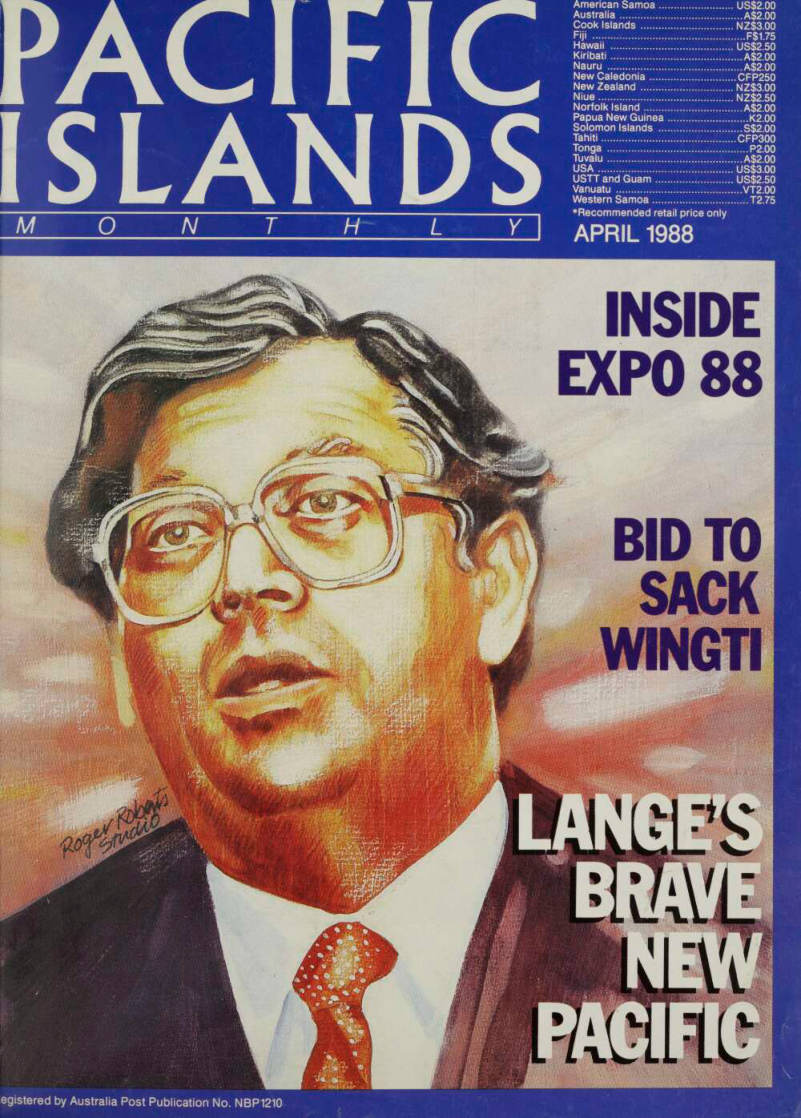
Cover Portrait: Roger Roberts
Advertisements & other items, p. 2 (1 item)
The pinnacle of
sporty pr .
From the onset, the Legend has represented an exquisite integration of Honda's engineering, technology and quality craftsmanship. A car whose performance unrestricted by old-world pedigrees became the index of excellence for the discerning motorist. For this selective driver, Honda proudly presents the new Legend Sports Coupe. Its regal aerodynamic bearing makes it classic. Its generous interior makes it rewarding. And its sporty demeanour makes it unique.
Elegance refined by sporting demands.
To give prestigious performance a sporting chance, Legend's appeal begins with the quality that is most easily recognized sleek, athletic looks that are aerodynamically refined. The remarkable drag coefficient of 0.30 reduces wind resistance and enhances the whisper-quiet ride. Legend's lavishly appointed cabin is a low-stress environment that sets the stage for high-powered fun.
Already hailed as a stunning technological achievement in the Legend sedan, Honda's potent race-bred V-6 assumes even greater prominence here. A larger 2.7-liter SOHC 24-valve engine provides liquid-smooth response across its entire operating range, satisfying your thirst for exhilaration to the fullest degree. For an equivalent level of handling response, Legend's 4-wheel double wishbone suspension takes a page from Formula One racing cars, adding uncommonr stability at every turn of the road. And just as quickly as Legend's performance begins, Honda's four-wheel-disc anti-lock brake system brings it to a fast, smooth conclusion..
The Legend Sports Coupe. An experience born of Honda's most prestigious automotiveE technologies. And bred by its commitment to make driving uniquely exhilarating.
Specifications and equipment may vary in some countries.
Honda engines have powered the Williams/Honda team to consecutive Formula One Constructors' Championships in 1986 and 1987, and dominated the Grand Prix world.
For 1988 , Honda engines will continue to compete in motor sport's toughest arena with the Lotus and McLaren Teams.
MODI'
61 m r
AUSTRALIA:
Honda Australia Pty, Ltd. Lot 95 Sharps Road, Tullamarine, Victoria 3043/NEW ZEALAND: NZMC Limited Manners Plaza, 57-65 Manners St_„ Wellington/PAPUA NEW GUINEA: lution S.A. R.L B.R 1665, Papeete/KIRI ciation P.O. Box 235, CHRB Saipan Cl NEW CALEDONIA: Soci6t6 Du Chalandage 8, Rue de la Toba Pty., Ltd. P.O._Box 503, Port Moresby/TAHITI: Honda n EBP GUAM: Mark's Motor Co., Inc. P.O Box DV, Agana/WESTERN SAMOA: Motor Distributors (Samoa) Ltd. P.O. Box 576,_Apia/SOLOMON 'SLANDS._Lee Kwok Kuen ( ' Rnhprfsnn U.S. TRUST TERRITORY: United Micronesia Development Association IU. (Nauru ouuycrcmuii ncpuunv. QC7QQ/TONftA- AMERICAN SAMOA: Holiday Motors, Parts and Service P.O. Box 968, Pago Pago, American Samoa 96 J 99; He,eck ’ s Se ™'ce P 0 Box 1031, Pori Vila, Vanuatu Tonga Industrial Traders P.O. Box 1035, Nukualofa, Tonga/NORFOLK ISLAND: Duncombe Bay Garage New Cascade Road. Norfolk Island/VANUATU. Honda Farm Ltd. k.u. bo
Islands
Pacific
Monthly
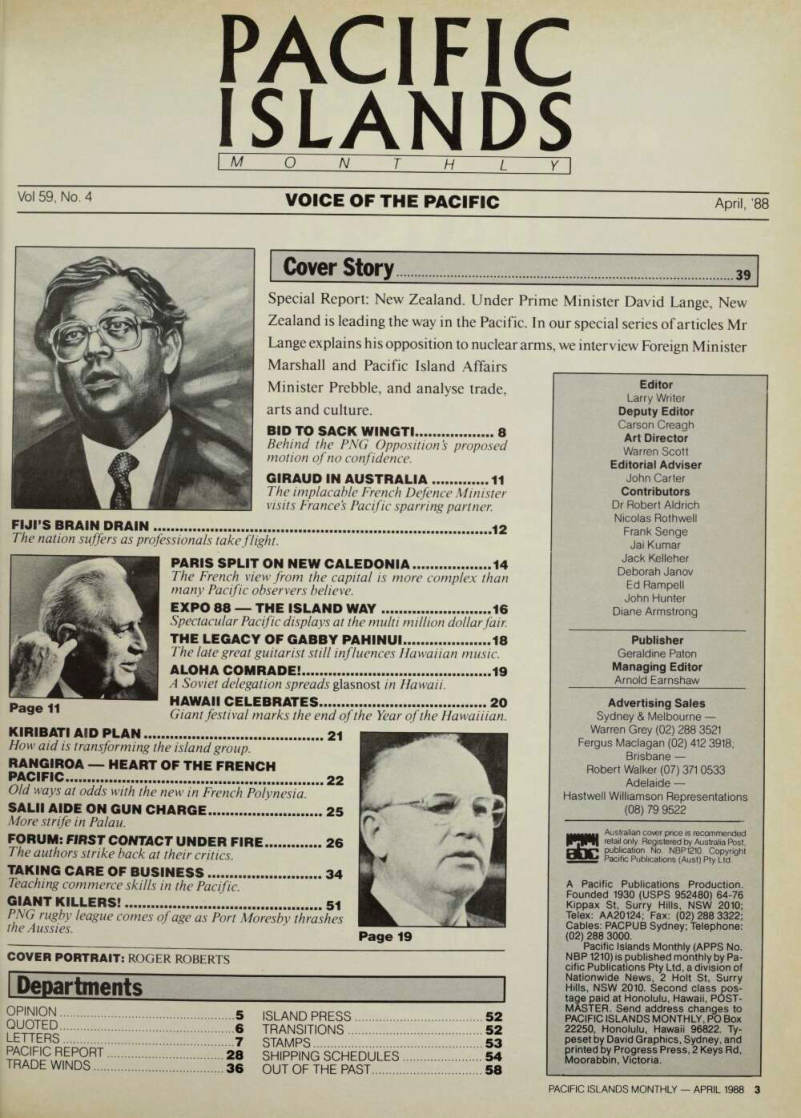
Vol 59, No. 4
Voice Of The Pacific
April, 'BB
Cover Story 39
Special Report; New Zealand. Under Prime Minister David Lange, New Zealand is leading the way in the Pacific. In our special series of articles Mr Lange explains his opposition to nuclear arms, we interview Foreign Minister
Marshall and Pacific Island Affairs Minister Prebble, and analyse trade, arts and culture.
Bid To Sack Wingti 8
Behind the PNG Opposition’s proposed motion of no confidence.
Giraud In Australia 11
The implacable French Defence Minister visits France’s Pacific sparring partner.
Fiji’S Brain Drain
The nation suffers as professionals take flight.
Page 11
Paris Split On New Caledonia 14
The French view from the capital is more complex than many Pacific observers believe.
Expo 88 The Island Way 16
Spectacular Pacific displays at the multi million dollar fair.
The Legacy Of Gabby Pahinui 18
The la-te great guitarist still influences Hawaiian music.
Aloha Comrade! 19
A Soviet delegation spreads glasnost in Hawaii.
Hawaii Celebrates 20
Giant festival marks the end of the Year of the Hawaiiian.
Kiribati Aid Plan 21
How aid is transforming the island group.
Rangiroa Heart Of The French
Pacific 22
Old ways at odds with the new in French Polynesia.
Salii Aide On Gun Charge 25
More strife in Palau.
Forum: Ffrst Contactunder Fire 26
The authors strike back at their critics.
Taking Care Of Business 34
Teaching commerce skills in the Pacific.
Giant Killers!
PNG rugby league comes of age as Port Moresby thrashes the Aussies.
Page 19
Editor Larry Writer Deputy Editor Carson Creagh Art Director Warren Scott Editorial Adviser John Carter Contributors Dr Robert Aldrich Nicolas Rothwell Frank Senge Jai Kumar Jack Kelleher Deborah Janov Ed Rampell John Hunter Diane Armstrong
Publisher Geraldine Raton
Managing Editor
Arnold Earnshaw
Advertising Sales Sydney & Melbourne — Warren Grey (02) 288 3521 Fergus Maclagan (02) 412 3918; Brisbane — Robert Walker (07) 371 0533 Adelaide — Hastwell Williamson Representations (08) 79 9522
Australian cover price is recommended retail only. Registered by Australia Post, publication No, NBPI2IO. Copyright Pacific Publications (Aust) Pty Ltd.
Advertisements & other items, pp. 3-4 (3 items)
Departments
OPINION 5
QUOTED 6
LETTERS 7
PACIFIC REPORT . .. 28
TRADE WINDS 36
ISLAND PRESS 52
TRANSITIONS 52
STAMPS 53
SHIPPING SCHEDULES 54
OUT OF THE PAST 58
3
PACIFIC ISLANDS MONTHLY APRIL 1988
A Pacific Publications Production.
Founded 1930 (USPS 952480) 64-76 Kippax St, Surry Hills. NSW 2010; Telex: AA20124; Fax: (02)288 3322; Cables; PACPUB Sydney: Telephone: (02) 288 3000.
Pacific Islands Monthly (APPS No.
NBP1210) is published monthly by Pa cific Publications Pty Ltd, a division of Nationwide News, 2 Holt St, Surry Hills, NSW 2010. Second class pos tage paid at Honolulu, Hawaii, POST MASTER. Send address changes to
PACIFIC ISLANDS MONTHLY, PO Box
22250, Honolulu, Hawaii 96822. Ty peset by David Graphics, Sydney, and printed by Progress Press, 2 Keys Rd, Moorabbin, Victoria.
anyhow
have a
Winfield
% * * A r ITH haza rD
smoking
bning
WA WV2 CC494/80
A Cynical Grab For Power
Opinion
Why this month’s proposed motion of no confidence in Mr Wingti is a flagrant abuse of the democratic process.
PAPUA NEW Guinea is destined for further dis ruption this month as the country’s leaders prepare to contest yet another vote of no confidence in a government. Of all the Pacific nations, PNG with its many problems is possibly the least well equipped to cope with the destabilising, debilitating and cynical exercise in power usurpation that this all too frequently used piece of leg islation has become. A prime mover of this latest motion, Mr Michael Somare, has himself faced no fewer than eight such votes and has lost office twice as a result.
What was enshrined in the Constitution as a worthy and well-meant safeguard against abuse of power by bad governments has become, in the hands of opportunistic politicians as little interested in integrity as they are in the will of the electorate, nothing more than a convenient tool
to facilitate blatant power grabs.
The PNG Constitution decrees that a motion of no confidence can be moved in the prime minister or a min ister provided that there is one week’s notice and that it is supported by 10 per cent of the total seats in parliament. The calling of the motion usually unleashes a round of political horse-trading and non-aligned politicians are engulfed in the largesse of those who are courting their support.
PNG’s latest proposed motion of no confidence, directed this time against the Prime Minister Mr Wingti, is scheduled for this month and is as cyn ical as any yet mounted. Its proponents the Pangu Pati and the National and Melanesian Alliance Parties claim
the motion has been necessitated by a plethora of Govern ment failings. Cited are a “billion Kina budget bungle”, the Government’s inability to provide free education, a K 46 million diversion of EEC funds meant for agriculture to “general” items, the oppressive mass media bill and a failure in housing policy.
True, there is much in that list to inspire a lack of con fidence. But it is understood that the Opposition has been plotting the no confidence motion since last August long before the advent of the above issues. Had the Government not precipitated or encountered these prob lems, it is reasonable to assume that the Opposition would have found another set with which to wallop Mr Wingti.
The bankruptcy of the latest motion of no confidence is further exposed by the Opposition’s courtship of the übiquitous Mr Ted Diro. The disgraced former Govern ment minister is a central figure in perhaps the one issue genuinely worthy of a vote of no confidence the timber
“The motion can contribute to instability in a nation that is crying out for steady, strong and long-term leadership”
industry scandal and the Commission of Inquiry’s charges of perjury against Mr Diro, not to mention the former def ence force leader’s alleged acceptance of funds from In donesian military strongman Murdani. But, beleaguered though Mr Diro is, this motion of no confidence puts him in a position of some influence.
Mr Diro makes no secret of the fact that he seeks the Deputy Prime Ministership. He has called on Mr Wingti to confirm that the post will be his once he is cleared of the charges that have shaken his career (but what will hap pen if Mr Diro is found guilty?). Confident of his position, he has warned that if his demands are not met he will cross the floor, taking his People’s Action Party with him.
It is ironic that Sir Julius Chan, the present Deputy Prime Minister who stands to lose his position in the
event of Mr Wingti bestowing the post on Mr Diro has himself been the ar chitect of many no confidence votes and himself used the legislation to tor ment and harass Mr Somare during the Chiefs time in power.
Once more it is left to Father John Momis, himself an Opposition stal wart, to be the quiet voice of reason and fair play amid a strident cacophony.
“Get rid of the vote of no confidence,” he says. “It has outlived its usefulness.”
It comes as no surprise that Father Momis has the support of Mr Wingti.
The PM says, quite rightly, that elected governments should be left to fulfil their mandate and not be distracted by mid term challenges.
But it should not be forgotten how in
1985 the then deputy leader of the Pangu Pati crossed the floor in a vote of no confidence, taking 15 party members with him and tearing apart PNG’s largest party in the process. This person was rewarded by Sir Julius Chan with the alternative Prime Ministership. His name was Paias Wingti.
The axiom about those who live by the sword often being themselves impaled comes readily to mind. But if Mr Wingti is defeated (an unlikely prospect) it will be the most hollow of victories for his opponents and, a dam aging blow to a nation in need of answers.
The fathers of PNG, in the interests of the country, must take a long, non-partisan look at the motion of no con fidence. They must consider whether its retention is worth the instability it causes in a nation crying out for steady, strong and long-term leadership. Then they may well pass a no confidence motion of their own on this counter-pro ductive piece of legislation. □
Pride And Prejudice
France must learn that Pacific responsibilities go hand in hand with privileges.
AUSTRALIA hosted visits by two symbols of France’s puissance in the South Pacific during March: the helicopter carrier Jeanne d’Arc and Mr Andre Giraud, the French Defence Minister. Both were symbols of France’s intention of signalling to the region that she has a strong and a legitimate presence here. As such, both visitors served only to exacerbate the war of words that is being fought over sovereignty and self determination in Oceania.
The Jeanne d’Arc was an immediate and obvious tar get for protests against France’s intransigence with regard to nuclear testing; in fact, those with a Francophobe axe to grind could find in the vessel’s visit justification for almost all their prejudices.
France’s position was not helped, however, by Mr Gi raud’s own intransigent response to questioning by Aus tralian reporters. Admittedly, he must have found many of their questions annoying but he cannot claim to be used to a pliable Press back in Paris. It is difficult to be lieve that he was not thoroughly briefed on Australian prejudices as far as France is concerned, which raises the disturbing possibility that he knew very well what to ex pect ... and was prepared to push through his statements without regard to the consequences. Mr Giraud’s attitude to the Australian Press was not an isolated response, how ever: in talks with senior politicians including the Prime Minister, Mr Hawke, and Defence Minister Kim Beazley, his disdain for Australia’s regional role earned him little approval or likelihood of a sympathetic response to France’s claims of Pacific representation.
Pacific Islands Monthly has been accused of “France bashing” in its reports on New Caledonia and French Po lynesia, but critics should note that all three of these places are to be found on the map of the South Pacific. For that reason alone, this and other interested publications have the right and the responsibility of assessing the impact of any nation’s actions in the Pacific on every inhabitant of that vast region quite apart from a journalistic respon sibility to report events in the Pacific from a Pacific per spective. What France (or any nation) may intend from the distance and comfort of its capital has a significance to all the peoples of Oceania.
The fact that both France and Australia seem woefully ignorant of each other’s priorities and philosophies, es pecially as they concern relations between the two na tions, is cause for real concern. Australia’s retreat on its position of support for New Caledonian independence has shocked and disappointed many people in the region: the change from “independence” to “self-determination” represents a new mood of self-interest and isolationism that is morally no different from France’s own highly sim plistic approach to international relations.
In plain language, France has reaffirmed its intention of going its own way with or without the approval of, and in defiance of the disapproval of, its allies. There are no surprises in this, but Australia has suddenly and unex
pectedly adopted an attitude of compliance with the French attitude: the era of Australia being the advocate of Pacific dignity has ended with a barely audible whimper.
But Mr Giraud and his colleagues should not take too much comfort from the new Australian position, for they must sooner or later realise that a continued and active French presence in the Pacific brings with it not only priv ileges but responsibilities.
French Polynesia and New Caledonia cannot be played as pawns in the NATO game. If, indeed, France is the globally significant nation she claims to be, her respon sibilities are to the globe. For the sake of her shining past and her potentially bright future, France should remem ber that Oceania consists of small areas of land united by not separated by a vast area of water. The Pacific community has need of good neighbours. □
Quoted
“To refresh your memory, let me remind you that I was not born in a tent yesterday, nor am I a Johnny-come-lately.”
Mr John Kaputin, PNG’s Minister for Minerals and Energy (and mixed meta phors) responding to press reporters that his position was in jeopardy.
“If you people figure out how to get along with France, let us know.”
US Senator J J Exon (Nevada) to reporters in New Zealand during a visit by a US Congressional dele gation. Quoted in Washing ton Pacific Report.
“Mr Somare seems to have a way of arriving at conclusions based on little or no evidence.”
PNG Environment and Conservation Minister Mr Perry Zeipi, responding to Opposition criticism of the Government’s mining policy.
“A waste of time.”
The head of PNG’s Fi nance Department, Mr John Vulpindi, in a scathing at tack on the country’s system of public accounts.
“My job is so frustrating I want to resign.”
Mr Vulpindi again, on his position as head of the Finance Department.
“Australia’s collaboration with neighbouring countries has never been better.”
Australia’s Foreign Affairs Minister Mr Bill Hayden, responding to criti cism by the opposition leader Mr Howard.
“The United States, Britain and France are not close to joining the South Pacific nu clear-free zone treaty.”
New Zealand’s Foreign Minister Mr Marshall at a disarmament conference sponsored by the United Nations in Geneva.
“The Fiji military must give an assurance that it will not again interfere in the running of the country.”
The president of the Australia-Fiji Business Council, Mr Russell Leitch, at a conference of the organi sation in Suva.
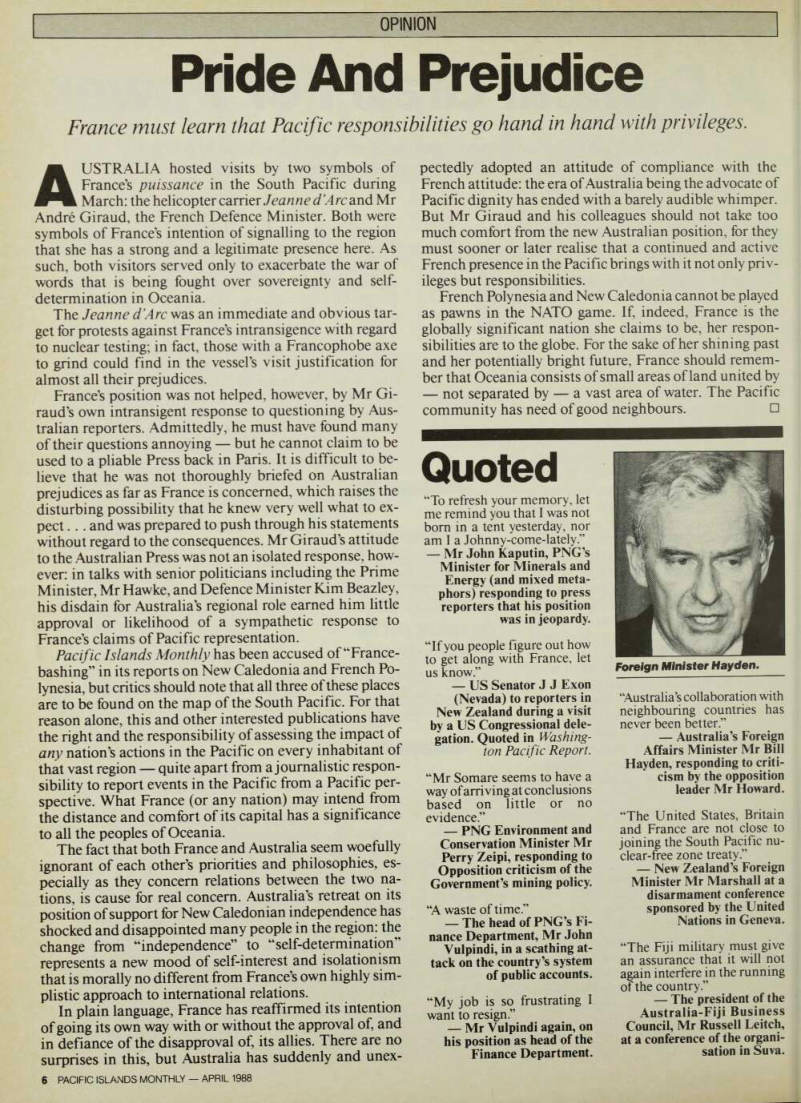
Foreign Minister Hayden.
Letters
Fair Games
THE ARTICLE by Carson Creagh in your January issue on the South Pacific Games demonstrates his lack of understanding.
The last paragraph in particular of his story is in direct conflict with the constitutions of the participating countries or should be.
Sports administrators have a respon sibility to see that their country or terri tory is represented in regional games. They should be charged with this responsibility by the constitution that guides them: people may consider this to be a simplistic or “head in the sand” approach, but every one is entitled to their own opinion.
It is unfortunate that politics regularly use sport because it presents perhaps the best platform for demonstration. All na tional sports administrators should be at tempting to maintain an autonomous body that does not make decisions on the basis of race, politics or religion.
Governments do sometimes try to stop sports teams travelling, which thwarts both athletes’ and administrators’ prepa rations that cover many months and often years.
Please, Mr Creagh do not criticise sports administrators for doing their job (usually voluntarily, I should add). They should not have to make political judg ments; and they should not have to be political clairvoyants.
Brian J Wightman
Nukualofa Tonga
Out Of The Frying Pan ...
I WRITE to congratulate you on your ex cellent February Opinion, “Why Conser vation Is Crucial”, in which you refer to the importance of the Convention on In ternational Trade in Endangered Species
(Cites).
I would also draw readers’ attention to another article in the same issue: “In Praise of Fried Fruit Bat”, which suggests that the pest problem of fruit bats in Madang and other parts of Papua New Guinea could be alleviated by exporting the animals, fro zen, to Guam.
Readers may not be aware that over-ex ploitation of many fruit bat species in Guam and some other South Pacific countries has resulted in the recent listing of nine species by CITES. International trade in flying foxes is now controlled and monitored ... and anyone contemplating setting up in the frozen fruit bat trade would be well advised to contact Papua New Guinea’s Department of Environ ment and Conservation to ensure that ex port permits are.
Frank Antram
Director TRAFFIC Oceania □
The Japanese Invasion
YOUR ARTICLE titled “Japan’s Busi ness Invasion” by Tony Siaguru in the February issue was good and productive for international advancement.
In addition to Mr Siaguru’s observa tions, I believe that there are three more problem areas in the Japanese “business invasion”, particularly regarding its ODA (Official Development Assistance). 1) Only about one per cent of total Japa nese ODA goes to the Pacific Islands. 2) Allocated only every single fiscal year, the amount can hardly match recipients’ five-year or seven-year development plans. 3) Fiji or Nauru cannot be recipients of Japanese ODA because their GNP per capita is too high to qualify. Even if the Northern Marianas, with its population of 33,000, need funds to match the rapid in crease of Japanese tourists, who will num ber more than 160,000 in 1988, the islands cannot get the Japanese ODA because it is a US territory.
If Pacific Islands Monthly and other in ternational magazines continue to carry articles such as Mr Siaguru contributed, Japan may find a solution to its Pacific problems.
Hiroshi Nakajima
Executive Director The Pacific Society Tokyo
Us Samoa To Vote
CONTRARY TO correspondent David North’s report in your January issue, American Samoa has non-voting mem bership on the Republican National Com mittee and will be participating at the Republican National Convention in New Orleans.
Under Republican rules, expansion of membership and addition of convention delegations can only be approved at the quadrennial national conventions. That procedure was adopted long ago so that all players in the presidential game would play by an unchanging, pre-determined set of rules each presidential election cycle, and is one of the reasons we have won the White House four of the past five elections.
The Republican Party of American Sa moa was only organised in 1985, hence this year is the first convention at which the subject of our affiliation can be addressed.
In January, the Republican National Committee voted to recommend to the convention a rule change that would grant our party a .full, voting membership and would authorise us to send voting dele gates to all future conventions. We antici pate convention approval of this change in New Orleans this August.
Amata Radewagen
Republican National Committeewoman for American Samoa Washington DC
Advertisements & other items, p. 7 (1 item)
Pacific
SLANDS
M N T H FIJI: Distribution and subscriptions: Desai Bookshops, PO Box 160, Suva, Fiji. Phone Suva 23036 Advertising: Fiji Times & Herald Ltd, 20 Gordon St., Suva.
Phone 31-4111, telex FJ2124.
FRENCH POLYNESIA; Distribution: Hachette Pacifique 10 Ave., Bruat, Papeete. Phone 25-610.
HAWAII: UNITED STATES: Distribution: PIM, Hawaii, PO Box 22250, Honolulu, Hawaii, 96822. Advertising: Brian C Asgill, Apt, 1308,1676 Ala Moana Blvd., Honolulu, Hawaii, 96815, Phone (808) 955-9718.
JAPAN: Advertising and subscriptions: Universal Media Corporation, GPO Box 46, Tokyo. Phone 666-3036 cable UNIMEDIA Tokyo, telex 2524665.
MALAYSIA: Advertising and subscriptions: Worldwide Media Services, 57-B Komplex Damai, Jin Dato Haji Eusoff, Kuala Lumpur. Phone 63-9340, cables WORLDMEDIA Kuala Lumpur, telex 31533.
VANUATU: Distribution: The Vanuatu Stationery and Book Centre, PO Box 557 Port Vila. Advertising: Norman Bros. Bookshop. Port Vila Phone 2232.
NEW CALEDONIA: Distribution: Depot Centre de Presse Michel Pentecost. CBP2, Noumea. Phone 27- 2434, 27-4729.
NEW ZEALAND: Distribution: Gordon & Gotch, PO Box 584, 2 Carr Road, Mt Roskill, Auckland 4.
Advertising: McKay International Media Reps Ltd, C/- Albany PO, Auckland 10, New Zealand, Phone 413-9119.
Telex NZ22701, FAX 413-9110.
WELLINGTON: Ross Quaid Media, 1 Scholes Ln Petone. (04) 68-7593, PO Box 38699, Petone.
PAPUA NEW GUINEA; Distribution: Gordon & Gotch, PO Box 3395, Port Moresby. Phone 25-4551. 25-4855.
Advertising; Ken Head, PNG Post-Courier, PO Box 85 Port Moresby. Phone 21-2577, telex 22120.
SOLOMON ISLANDS: Distribution and Advertising; The Bookshop, (Norman Bros.) PO Box 503, Honiara.
PHILIPPINES: Advertising; The GF Group, 12 San Ignacio St., Uroaneta Village, Makati, Metro Manila. Phone 817-7299, telex 45950 and 4233.
UNITED KINGDOM F A Smyth and Associates, 23A Aylmer Parade, London NZOPO, England. Phone (01) 340 5088, fax (01)341 9602.
UNITED STATES MAINLAND: Advertising: Joshua B. Powers Jr., Powers International Inc., Suite 708, 271 Madison Ave., New York, NY 10016. Phone 867-9580, Subscriptions: PIM, Hawaii, PO Box 22250, Honolulu.
Hawaii, 96822.
SUBSCRIPTIONS
American Samoa US$45 Australia AUSS24 Canada US$45 Cook Islands AUS$46 Fiji AUS$46 French Polynesia US$45 Guam US$45 Hawaii US$45 Japan US$38 Kiribati AUS$46 Micronesia US$35 Nauru AUS$42 New Caledonia US$32 New Zealand AUS$42 Niue AUS$46 Norfolk Island AUS$42 Northern Marianas US$36 Papua New Guinea AUS$42 Solomon Islands AUS$46 Tonga AUS$46 Tuvalu AUS$46 United Kingdom Stg£28 US (Mainland) US$45 Vanuatu AUS$42 Western Samoa AUS$60 Elsewhere AUS$63 Payments to Pacific Islands Monthly: Subscriptions Dept, GPO Box 5223BB, Melbourne 3001, Australia.
Subscriptions rates includes the cost of airspeeding to all destinations set out above. Direct airmail rates on application.
Bid To Sack Wingti
Papua New Guinea
Frank Senge examines the PNG Opposition’s bid to oust PMPaias Wingti, and finds a cynical exploitation of the Constitution for personal power.
AMOTION of no confidence in the Government is one of the most fre quently exercised sections of the Papua New Guinea Constitution. It is a mini-election in Parliament, where poli ticians can veto the people’s choice and elect their own government often switching party affiliations with abandon and with no thought for personal integrity or credibility.
The two post-independence govern ments of Michael Somare had eight votes of no confidence moved against it in seven years, from 1978 to 1985. Two succeeded in ousting Mr Somare from office, once in 1980 and again in November, 1985.
Now Mr Somare, for the first time on the opposition benches after an election, is poised to move his own no confidence motion against the nine-month-old Government of Prime Minister Paias Wingti in this month’s sitting of Parlia ment. The Opposition has been planning the motion since last August, when Mr Wingti took government by a three-vote majority. That narrow victory and an other very close vote for the speakership in November 1987, when 14 Government
members voted for the Opposition can didate, has encouraged the Opposition to forge ahead with its plans, despite Mr Wingti’s obvious numerical strength at the moment. The Government coalition has 68 members to the Opposition’s 40.
An Opposition task force called the Policy and Strategy Committee was formed for the purpose of preparing for the no confidence motion. The committee is headed by Mr Somare’s Pangu Pati deputy leader, Rabbie Namaliu, and comprises
parliamentarians from the three Opposition coalition par ties Pangu, National and Melanesian Alliance.
The Opposition has yet to spell out clearly the sins of the Wingti Government that it wants to remedy by removing it from power. But in press statements released in the past the Opposition has accused the Government of making a “bil lion Kina bungle” when it brought down the country’s biggest budget since Independ ence, in November last year. It has charged the Government with not living up to its prom ise to provide free education and diverting K 46 million from the European Economic Com munity targeted specifically for agriculture, toward general items in the budget.
The Opposition has also spoken out against the Govern
ment’s proposed mass media bill, its housing policy, its proposal to place members on sta tutory boards and city councils, and drastic cuts to education and health allocations.
It once announced that if successful it would introduce a mini-budget aimed at shifting the present Government’s empha sis on economic devel opment back to the social sector. However no more has been heard of this particular plan.
It is not at present
certain whether the Opposition will move the no confidence vote in this sitting or at a later meeting.
An Opposition spokesman said: “It will be an eleventh-hour decision. Much of it depends on the rumblings in government.”
The uncertainty arises from the un clear position of the key figure in the Op position’s plans: controversial former Defence Force commander Ted Diro, leader of the People’s Action Party. Mr Diro also heads the Papuan Bloc in
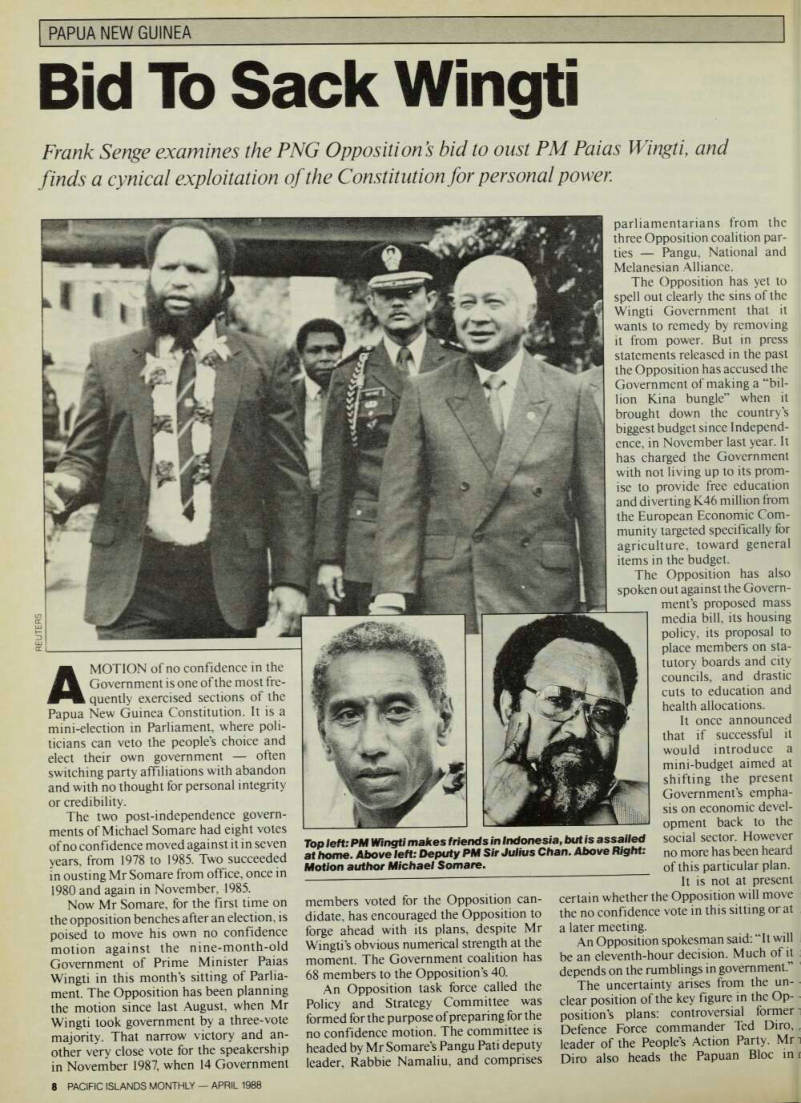
Top left: PM Wingti makes friends in Indonesia, but is assailed at home. Above left: Deputy PM Sir Julius Chan. Above Right: Motion author Michael Somare.
Reuters
Parliament.
Mr Diro has been the cause of these “rumblings” in the Government. He is claiming the job of Deputy Prime Mimster along with one senior ministry. He resigned his Foreign Affairs portfolio when he was charged with five counts of perjury by the Forestry Commission of Inquiry in which he features prominently. Mr Diro’s deputy party leader, Aruru Matiabe, was sacked by Mr Wingti when he tried to defend him. Mr Matiabe said it was normal for politicians to receive money from overseas sources, when it was revealed at the inquiry that Mr Diro had received U 55139,000 from Indonesian army chief Benny Murdani to fund his elections.
Traditionally, the post of Deputy Prime Minister has gone to the party with the second largest numbers in Government,
The Peoples Action Party has 12 members, six more than Deputy Prime Minister Sir Julius Chan’s People’s Progress Party. In addition, Mr Diro has the support of another eight members from the Papuan region. Mr Wingti said of his decision not to make Mr Diro his deputy: “It was a very difficult decision. The bloc had the numbers but there was the inquiry. I could not give it to him.” The PM leaves no doubt, however, that Mr Diro would take the Deputy’s job were he to be cleared of the charges.
“What happens after the Commission of Inquiry is dictated by politics and numbers. Ted and me, we have a firm understanding. We talk about things that I will not disclose,” Mr Wingti said.
There is conflicting information as to whether Mr Diro will support the Oppo-
ssion no confidence move. Opposition members claim that Mr Diro has been talking to them and that he would pull out of the Government, taking 17 members with him. But sources close to Mr Diro say he has pledged to stay with the Govern ment until he is cleared.
People’s Action Party president Vin cent Eri says: “A vote of no confidence is one possible way to get some sort of re dress ... It is some kind of light at the end of the tunnel unless there is some solution before that.” “Redress”, as Mr Eri puts it, means nothing less than Mr Wingti giving the Deputy Prime Ministership to Mr Diro. What has kept the Papuan Bloc from playing too great a role in the motion has been, first, the number of ministries it has in the Government. The Papuans have been given the biggest allocation of II ►
“Mr Wingti’s position is simple enough. Mr Diro will not be promoted until he is cleared of charges of perjury and other serious allegations”
<4 ministries and the speakership. Second, though they openly support Mr Diro they are keen to see him cleared of the charges he now faces. Perjury alone carries a pen alty of 14 years’ imprisonment in PNG.
A senior member of the Papuan Bloc, Mr Robert Suckling, says: “We have a young, hard-working and creative Prime Minister who spends 24 hours a day thinking about PNG. Why should we blindly change him? Why change some thing that works? The vote of no confi dence is a wild dream. The chance of it succeeding is as remote as flying to the moon.” Sharing Mr Suckling’s view are Civil Aviation Minister Hugo Berghuser, Foreign Affairs Minister Akoka Doi, En vironment and Conservation Minister Perry Zeipi and at least two other, minis ters, as well as ordinary members.
The Papua Party, led by Finance and Planning Minister Galeva Kwarara, has been silent on the no confidence motion, but the party knows it will never retain the important Finance and Planning portfo lio with a new government so is thus un likely to move with the Opposition.
Mr Diro himself knows that defecting to the Opposition will not save him from the charges he now faces, nor will he au tomatically win the Deputy Prime Min istership in a new government.
If Diro stays with the Government, his numbers intact, he is assured of the Dep uty Prime Minister’s job once cleared of the charges. If Mr Wingti should change his mind, however, and refuse to make Mr Diro his deputy the entire Papuan Bloc will rally behind Mr Diro and propose him as Prime Minister in another vote of no con fidence, a senior member said.
On the no confidence motion, Mr Wingti is keeping quiet. He told Pacific Is lands Monthly : “My attitude is to wait for [the motion] to come. I don’t want to waste time on things from which the nation won’t gain any benefit. It’s better to engage in productive work. We have made a firm commitment to govern the country; my ministers are working hard; our policy is in place and I am sorting out the imple mentation process. I have no time for such things as no confidence motions.”
Mr Wingti claims to have firm control of his Government. He says he has not ne gotiated with any Opposition parties.
A group of five members within Mr Wingti’s own People’s Democratic Move ment gave him notice that they would move out if they are not given one min istry. However, one of them later claimed the ultimatum was a bluff.
There is also the usual five or six fence sitters, mainly defectors from the Oppo sition who have signed on again with the
Opposition without resigning from the Government.
The major parties Sir Julius Chan’s PPP, Father Momis’ Melanesian Alliance and Michael Mel’s National Party are keeping unusually quiet on the issue.
If the Opposition has been testing the waters, as it appears to have been doing, it may well have discovered that the no con fidence motion may not succeed.
It may go down in the tally books as the vote of no confidence never taken. □
No Confidence: Uses And Abuses
r ER THE election in July last Mjk year, many PNG politicians pro " * posed that certain sections of the Constitution be amended or deleted alto gether. Among these was the provision for votes of no confidence. f u n omi ?’ one the authors o the PNG constitution, said the provi si°n had outlived its usefulness, while the man who had used it most often and who had benefited from it most, Sir Julius C han, says it is a useful tool in the hands ot the people to change bad governments and also to keep those who are in power on their toes. ...
Pnme Minister Mr Wingti will sup port any moves to do away with the pro vision. He told Pacific Islands Monthly, e are waiting for Father Momis to in tr° w? 11 h U P-’’
What, then, is this motion of no con idence and how has it been used over the years since Independence?
Section 145 of the Constitution stipu ates that a motion of no confidence can be moved in the Prime Minister or a min ister provided there is one week’s notice and that it is supported by a number of members not less than one tenth of the to tal number of seats in parliament.
No confidence votes have bedevilled PNG since 1975.
Here is a history of the power play.
A motion cannot be moved 12 months before elections or six months after the for mation of a new government following elections.
The provision was first exercised in August 1978, by the late Sir (then Mr) lam bakey Okuk when he was the Opposition leader. Sir lambakey moved the motion when Mr Somare tried to introduce the controversial leadership code. The vote was never taken. Sir lambakey withdrew it on grounds that he did not have the numbers.
Later that year, however, another party leader, Roy Evans, introduced the motion again. Mr Somare defeated it by 68 votes to 35. In November 1978, Sir Julius Chan’s People’s Progress Party withdrew from Mr Somare’s Government and sponsored Op position leader Sir lambakey Okuk as the alternative Prime Minister. The vote was beaten 63 to 45 by Mr Somare’s Pangu Pati and the United Party, which had defected from the Opposition to join the Government.
In September 1979, Papua Party leader Galeva Kwarara, who was in the Oppo sition, moved another vote of no confi dence in Mr Somare. It was again defeated, this time 63-64.
Finally, in March 1980, the Opposition put up Sir Julius Chan as alternative Prime Minister and parliament for the first time ousted Michael Somare in a vote of no confidence. Mr Somare was beaten 57 to 49 in the vote, taken on March 11.
Mr Somare, then in Opposition, moved his only vote of no confidence in a min ister against Police Minister Warren Dutton in 1981, but was defeated.
The next year the people returned Mi
chad Somare to power in the second na tional elections.
Sir lambakey Okuk moved a vote of no confidence in November 1984 but with drew it as he had done in 1978, and for the same reasons.
In March 1985, Pangu Pati deputy leader Paias Wingti crossed the floor with 15 others, splitting the biggest political party in PNG in half. He was enticed across by Sir Julius Chan, who promptly named him alternative Prime Minister.
Mr Somare defeated the motion with the help of Sir lambakey’s National Party 68 votes to 19.
The Opposition was undeterred. On November 21 1985, Mr Somare fell to a Sir Julius sponsored vote that put Mr Wingti in power. Wingti scored 58 votes to So mare’s 51.
It was a well-planned move. Mr Wingti had 18 months to rule. A vote could not be taken in the first six months. Neither could it be taken in the next 12 months, because they were the 12 months leading to the elections in 1987. It was 18 months of un disturbed political sailing and Mr Wingti used the opportunity to make sure he was returned to power.
During all these protected periods he has proposed drastic changes to the public service and changed the Government’s policy emphasis from the social sector to the economic sector.
His period of freedom from a motion of no confidence expired in January 1988, when the six months’ grace specified by the Constitution lapsed.
April is the first opportunity in 24 months for a motion to be made. The Op position is losing no time. □
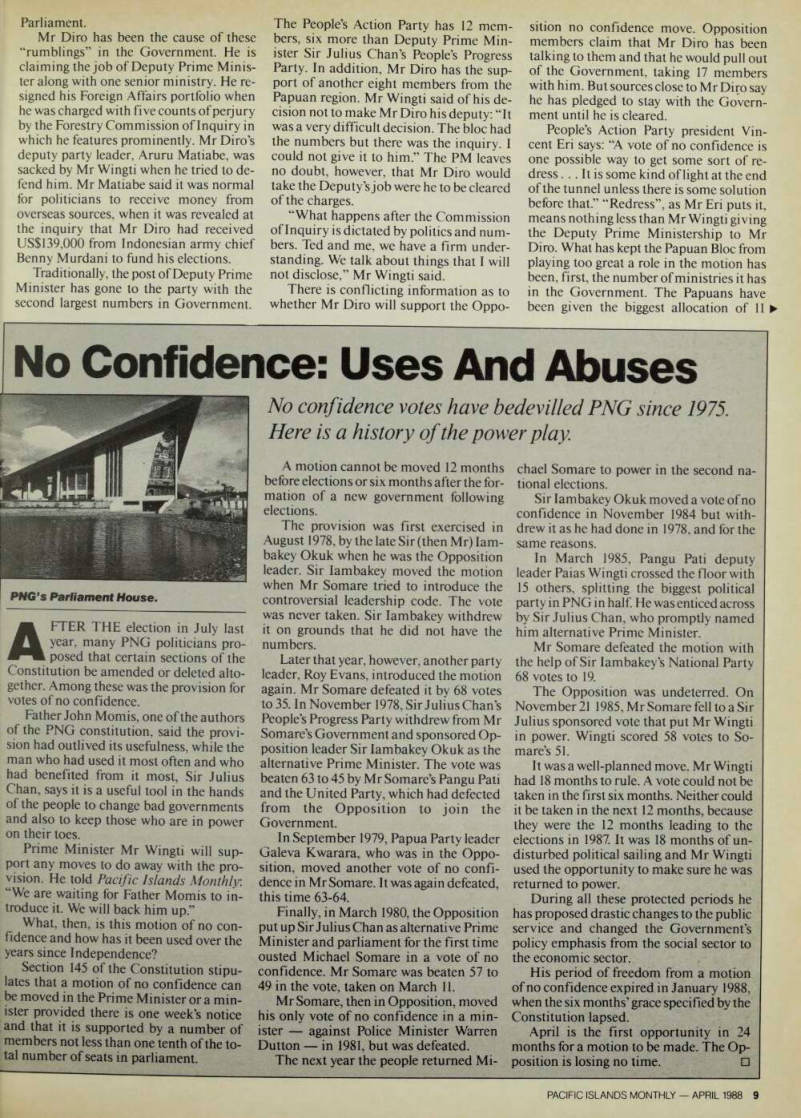
PNG’s Parliament House.
The Diro Factor
The disgraced former minister has much to gain
ON MARCH 9, Prime Minister Paias Wingti told a delegation of Papuans that their leader, Mr Ted Diro, would not be given the Deputy Prime Minister’s job. The meeting was the first time Mr Wingti had received an official delegation claiming to represent the Pap uan people; he has previously given the same message to party executives, and twice told Mr Diro himself he would not have the job.
Mr Wingti’s position is simple enough.
Mr Diro will not be promoted until he is cleared of five charges of lying under oath and other serious allegations now before a Commission of Inquiry investigating the PNG forestry industry. And Mr Wingti has maintained his stand under strong pres sure of the Papuans moving out, splitting his majority in Parliament and possibly losing him government; of letters from gangs threatening to burn down parlia ment house; of threats to his own life; and of Mr Diro’s Central Province electorate embarking on a mass (and possibly un controlled) demonstration.
Now it seems Mr Wingti had the sup port of the majority of the Papuans all along. At the March 9 meeting he had on his side Civil Aviation Minister Hugo Berghuser and Finance and Planning Minister Galeva Kwarara. Both are mem bers of the Papuan Bloc.
The next day nine members of the par liamentary wing of Mr Diro’s People’s Action Party (PAP) met and agreed to stay with the Government. Only three mem bers Mr Diro, his deputy Arum Ma tiabe and Daniel Itu were absent. The meeting sacked Mr Matiabe and launched a strong attack on the party executive, claiming it had been making “highly in flammatory and misleading statements” regarding the party’s position in govern ment without the knowledge or consent of elected members.
Mr Matiabe was accused of having failed to take on the role of party leader while Mr Diro was attending to what the meeting described as “personal prob lems”. Mr Diro was called on to return
from Australia for urgent meetings on the deputy leadership, his own problems and confirmation of the party’s loyalty to the Government.
Party president Mr Vincent Eri, his deputy, Professor John Waiko, and sec retary lan Glanville were strongly cau tioned and the meeting decided to make substantial amendments to the party con stitution to remove most of the powers vested in the executive.
Subsequent events have revealed that only a few groups in Port Moresby have been stirring Papuan emotions. A meet ing of Papuan premiers at Milne Bay in February strongly supported the Wingti Government and its emphasis on eco nomic development; and even in Central Province village leaders have called on their people to dissociate themselves from such movements.
Much of the support for Mr Wingti comes from the Papua bloc itself, which has the greatest number of ministers in the government. As one Papuan member put it, “There may be a few disgruntled lead ers but the region has not lost at all. In fact, they have got the best deal they will have in a long time.” D
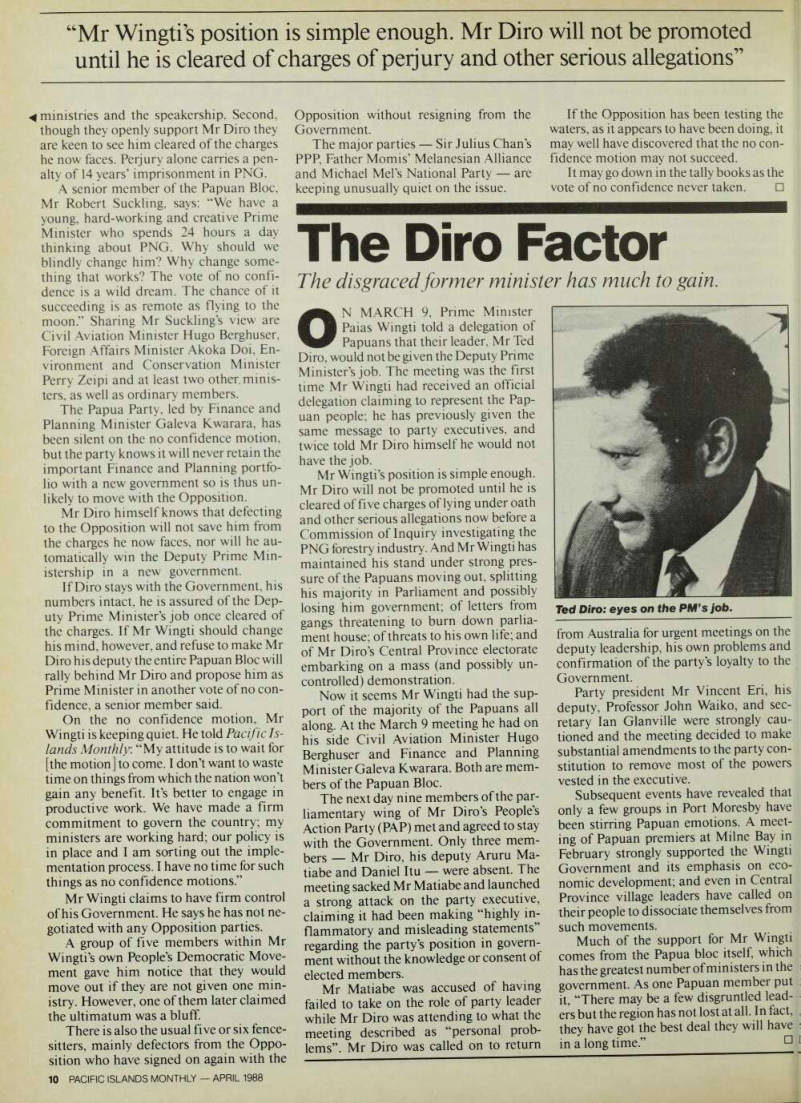
Ted Diro: eyes on the PM’s job.
Monsieur Giraud Says “Non!”
The Region
France refuses to back down on controversial Pacific policies.
By Larry Writer
Despite the handshakes, the smiles, the ceremony and the gifts, the abiding message from French Defence Minister Andre Giraud at the conelusion of his recent visit to Australia was that his Government and the Australian administration would continue to disagree over France’s Pacific policy.
Mr Giraud and Australian Prime Minister Bob Hawke spent two hours discussing bilateral and regional issues, including French nuclear testing at Mururoa Atoll and French policy in New Caledonia. At the meeting, said Australian officials, the pair had agreed to “bury the hatchet”, so ending officially a year-long freeze in relations imposed by French Prime Minister Chirac after bitter Australian
condemnation of France’s Pacific activities.
Mr Giraud and Mr Hawke each guar anteed that his country was prepared to discuss “any issue at any time”. However, said officials, the pair recognised “that there will continue to be differences of opinion on Pacific issues”. While in Can berra Mr Giraud, the first French Minis ter to visit Australia since 1985, also had talks with his Australian counterpart, Defence Minister Kim Beazley, and act ing Minister for Foreign Affairs and Trade, Senator Evans.
Later, at a sumptuous gathering on board the French navy ship Jeanne d’Arc on Sydney Harbour, Mr Giraud said: “My talks with Mr Hawke were cordial and
successful. We share many common opin ions. There is largely more to unite our countries than to disagree about.” He added that France and Australia “had a vital interest in the Pacific, and so we have the same interests in developing peace and stability in the region.”
However, never during his Australian visit did the French Foreign Minister in dicate that France would make any concession to critics of its Pacific policy.
He explained that France had stepped up its profile in the region to put an end to any “misconceptions” that it was not a legiti mate part of the Pacific. Mr Giraud said France had every right to continue nuclear testing on Mururoa, as the atoll was French territory. He especially discounted criti cism from the South Pacific Forum, which has continually made it clear to France that countries in the Pacific region are against the tests.
Mr Giraud nas a reputation of being the member of the Chirac Government most favourably disposed toward Australia. But in a television interview he bluntly told Australian nuclear opponents to stop in terfering in matters that did not concern them. “France is not thinking of stopping nuclear testing at Mururoa,” Mr Girand said. “It’s not your country; mind your own business.”
When asked whether New Caledonia would always remain part of France, the Minister countered: “Will Tasmania be come an independent country because it is an island?”
While in Australia, Mr Giraud awarded Australian war heroine Nancy Wake the French Legion of Honour medal and in Sydney opened the La Perouse Museum, France’s bicentennial gift to Australia.
There, an anti-nuclear artist thrust a painting into his hands. It was titled: Ura nium You Can’t Have Your Yellowcake And Eat It Too.
There were also demonstrations against the visit of the Jeanne d’Arc. The helicop ter carrier was the target of the Sydney Peace Squadron, Australians For Kanak Independence and the Pacific Peace Fleet.
The Fleet’s spokesperson, Elizabeth Mor ley, said: “We object to the arrogance of French policies in the Pacific. We are also concerned that France is planning a huge increase in its nuclear arsenal just when the US and USSR are reducing theirs.”
At the end of his Australian visit Mr Giraud flew to New Caledonia, where a regional election will be contested on April 24, coinciding with the first round of French Presidential elections. □
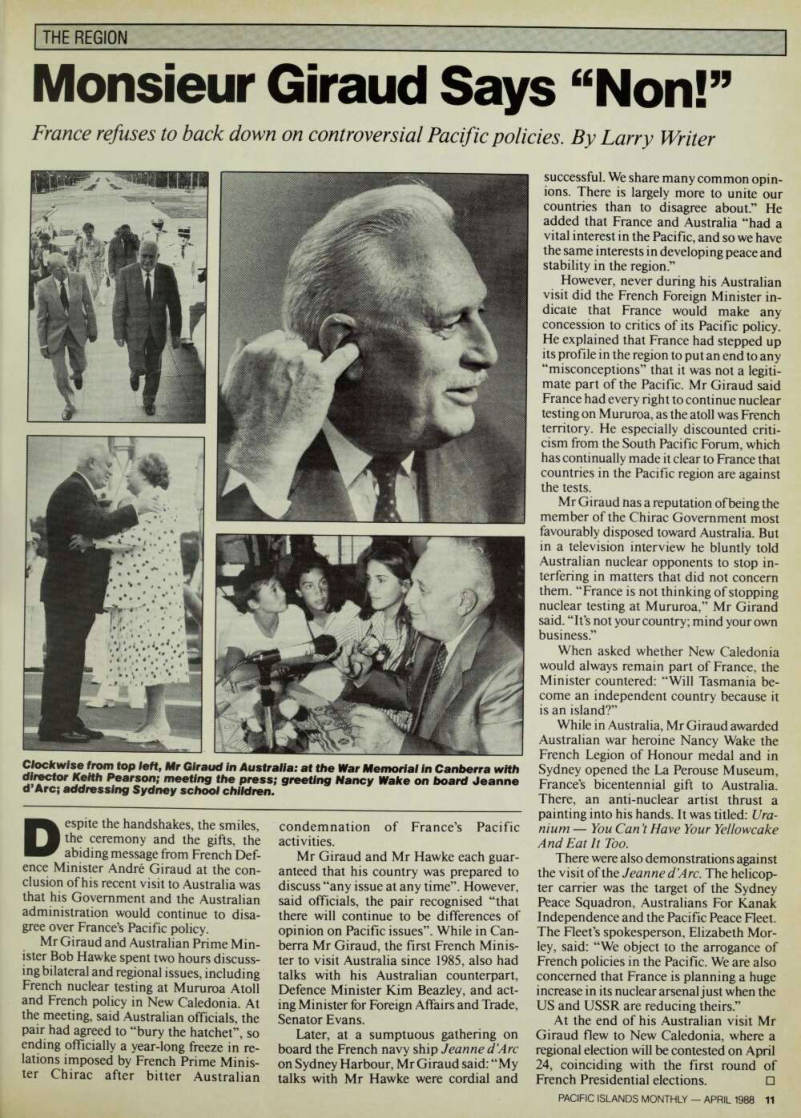
Clockwise front top left, Mr Giraud in Australia: at the War Memorial in Canberra with director Keith Pearson; meeting the press; greeting Nancy Wake on board Jeanne
d’Arc; addressing Sydney school children.
Professionals On The Run
Fiji
Fiji’s brain drain hampers economic recovery.
ONE OF Fiji’s most pressing problems to day, along with how to revive its economy, attract more tourists and woo for eign investment, is how to fill key professional positions, particularly those where spe cial skills are required.
The Republic, which is now struggling to get back on the rails after last year’s coups, is faced with the problem of a massive and unprecedented brain drain. Indians who make up 51 per cent of the population and who domi nated most professions in the past teachers, doctors, law yers, computer operators, nurses and administrators are now leaving the country for such places as Australia, Canada, New Zealand and the United States.
Historically, Indian par ents who themselves had lit tle education and had served as labourers on sugar cane plantations placed great em phasis on educating their children, with the result that these children found them selves to be academically qualified for positions in most professions.
However, the scene is now changing rapidly. Indians in senior positions within the civil service say they have been forced to retire or to leave prematurely. Several who were permanent secretaries have been retired; heads of other departments, such as the commissioner for inland revenue, the comptroller of customs, senior health ad ministrators and labour offi cers, have resigned and
doctors and nurses have left the service.
It is not only the public sector that has been affected.
Banks and organisations such as the Fiji Electricity Author ity, the Fiji Sugar Corpora tion and the media (in particular the national radio station, Radio Fiji, and the two newspapers, the Fiji Times and the Fiji Sun) have lost most of their senior In dian staff.
Sir Vijay Singh, chief ex ecutive of the Fiji Sugar Cane Growers’ Council; Justice Ki shore Govind, a judge of the Supreme Court, and the for mer police commissioner, Mr Raman, are now living in Australia.
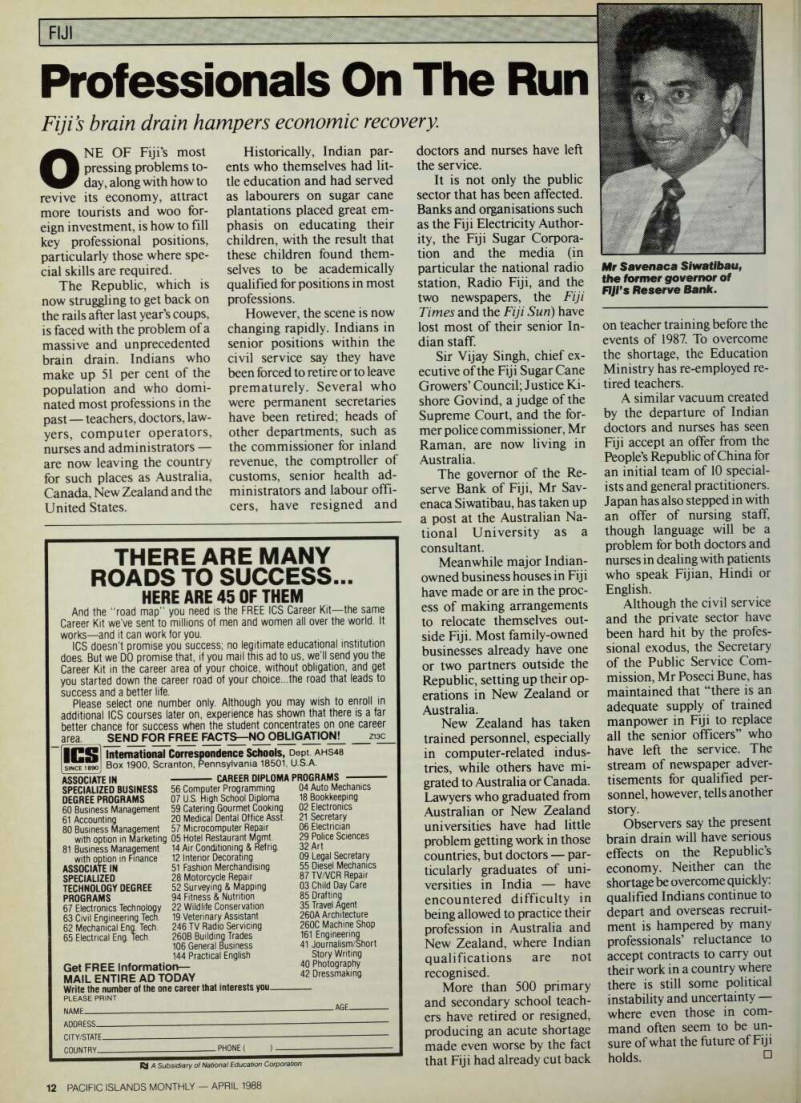
The governor of the Re serve Bank of Fiji, Mr Sav enaca Siwatibau, has taken up a post at the Australian Na tional University as a consultant.
Meanwhile major Indian owned business houses in Fiji have made or are in the proc ess of making arrangements to relocate themselves out side Fiji. Most family-owned businesses already have one or two partners outside the Republic, setting up their op erations in New Zealand or Australia.
New Zealand has taken trained personnel, especially in computer-related indus tries, while others have mi grated to Australia or Canada.
Lawyers who graduated from Australian or New Zealand universities have had little problem getting work in those countries, but doctors par ticularly graduates of uni versities in India have encountered difficulty in being allowed to practice their profession in Australia and New Zealand, where Indian qualifications are not recognised.
More than 500 primary and secondary school teach ers have retired or resigned, producing an acute shortage made even worse by the fact that Fiji had already cut back
on teacher training before the events of 1987. To overcome the shortage, the Education Ministry has re-employed re tired teachers.
A similar vacuum created by the departure of Indian doctors and nurses has seen Fiji accept an offer from the People’s Republic of China for an initial team of 10 special ists and general practitioners.
Japan has also stepped in with an offer of nursing staff, though language will be a problem for both doctors and nurses in dealing with patients who speak Fijian, Hindi or English.
Although the civil service and the private sector have been hard hit by the profes sional exodus, the Secretary of the Public Service Com mission, Mr Poseci Bune, has maintained that “there is an adequate supply of trained manpower in Fiji to replace all the senior officers” who have left the service. The stream of newspaper adver tisements for qualified per sonnel, however, tells another story.
Observers say the present brain drain will have serious effects on the Republic’s economy. Neither can the shortage be overcome quickly: qualified Indians continue to depart and overseas recruit ment is hampered by many professionals’ reluctance to accept contracts to carry out their work in a country where there is still some political instability and uncertainty where even those in com mand often seem to be un sure of what the future of Fiji holds. a
Mr Savenaca Siwatibau, the former governor of Fiji’s Reserve Bank.
Advertisements & other items, pp. 12-13 (1 item)
Roads To Success...
THERE ARE MANY
HERE ARE 45 OF THEM
And the “road map" you need is the FREE ICS Career Kit —the same Career Kit we've sent to millions of men and women all over the world. It works—and it can work for you.
ICS doesn’t promise you success; no legitimate educational institution does. But we DO promise that, if you mail this ad to us, we’ll send you the Career Kit in the career area of your choice, without obligation, and get you started down the career road of your choice...the road that leads to success and a better life.
Please select one number only. Although you may wish to enroll in additional ICS courses later on, experience has shown that there is a far better chance for success when the student concentrates on one career area. SEND FOR FREE FACTS—NO OBLIGATION! ziac_ International Correspondence Schools, Dept ahsas Box 1900, Scranton, Pennsylvania 18501, U.S.A.
CAREER DIPLOMA PROGRAMS
56 Computer Programming 07 U S. High School Diploma 59 Catering Gourmet Cooking 20 Medical Dental Office Asst. 57 Microcomputer Repair with option in Marketing 05 Hotel Restaurant Mgmt. 81 Business Management 14 Air Conditioning & Refrig. with option in Finance 12 Interior Decorating ASSOCIATE IN 51 Fashion Merchandising SPECIALIZED 28 Motorcycle Repair TECHNOLOGY DEGREE 52 Surveying & Mapping PROGRAMS 94 Fitness & Nutrition 67 Electronics Technology 22 Wildlife Conservation 63 Civil Engineering Tech. 19 Veterinary Assistant 62 Mechanical Eng. Tech. 246 TV Radio Servicing 65 Electrical Eng. Tech. 2608 Building Trades 106 General Business 144 Practical English Get FREE Information—
MAIL ENTIRE AD TODAY
Write the number of the one career that interests you—
PLEASE PRINT
NAME.
ADDRESS
ASSOCIATE IN
SPECIALIZED BUSINESS
DEGREE PROGRAMS
60 Business Management 61 Accounting 80 Business Management 04 Auto Mechanics 18 Bookkeeping 02 Electronics 21 Secretary 06 Electrician 29 Police Sciences 32 Art 09 Legal Secretary 55 Diesel Mechanics 87 TV/VCR Repair 03 Child Day Care 85 Drafting 35 Travel Agent 260 A Architecture 260 C Machine Shop 161 Engineering 41 Journalism/Short Story Writing 40 Photography 42 Dressmaking
CITY/STATE.
COUNTRY—
, PHONE(
Rfl A Subsidiary of National Education Corporation
* CITIZEN
Wfe’vegot
yourwatch
* ¥ r. % M ■ i.
I a." • J\ m *2
OCITIZE3
W It We’ve got fashion creations, sports innovations, high-tech inspirations. For any situation - there’s a Citizen watch.
* CITIZEN
FOR FURTHER INFORMATION, PLEASE CONTACT:
Australia: Citizen Watches Australia Pty Lt< 122 Old Pittwater Road, Brookvale, NSW 21C Tel: 939 7077. Cable: Citizen Sydney.
Telex; AA26633. Fax: 932864.
Fiji Islands: Tappoo Limited, P.O. Box Sigatoka, Fiji. Tel: 50199. Telex: FJ4244.
New Zealand: Citizen Watches (N.Z.) Ltd..
P.O. Box 9518, Auckland, New Zealand.
Tel: 543 393. Telex: 21429. Fax: 544177.
Norfolk Island: Landy & Co.. P.O. Box 31, Norfolk Island, 2899, South Pacific. Tel: 2163.
American Samoa: Malaloa Duty Free Shoppers.
P.O. Box 2183, Pago Pago.
American Samoa. 96799. Tel: 633 5513.
Tahiti: Morgan Vernex. Fare Ute B.P. 449. Tafut Tel: 2.03.09.
New Caledonia: Est. Ballande. B.P. Box C 4.
Noumea. New Caledonia. Tel; 27.20.31.
Rarotonga: South Seas International Ltd..
P.O. Box 49. Rarotonga. Cook Islands. Tel: 2327 Papua New Guinea: Kara Pty. Limited, P.O. Box 329, Port Moresby. Tel: 25 6044.
Paris Split On Pacific Role
New Caledonia
The metropolitan French view of New Caledonia is much more complex than many
Pacific observers think.
By Dr Robert Aldrich
NEW CALEDONIA may not have occupied a great deal of space on the front pages of daily newspa pers recently, but the territory’s situation is far from resolved. Violent confronta tions in the town of Poindimie, on the northeastern coast of Grande Terre, pitted Kanak nationalists against French gen darmes in February. In January, the French National Assembly approved the new plan for the territory put forward by the Government of Jacques Chirac and elections have been called for April 24 to select leaders for the re-drawn regions and the Congress of New Caledonia elec tions the FLNKS has said it will boycott.
Not coincidentally, the voting will be held the same day as the first round of voting for the French Presidency.
New Caledonia is not the central issue in the contest to choose a new President, but all parties see a chance to win votes through their positions on New Cale donia. In fact Maurice Satineau, in his re cently published book Le Miroir de Noumea {The Mirror of Noumea), argues that each party’s position on New Cale donia is determined largely by the possi bility of scoring electoral points in France.
Yet metropolitan France’s attitudes to New Caledonia are more diverse and more subtle than they may appear at first glance.
No real consensus on the future of the is lands exists, and the program designed by Chirac’s Minister for Overseas Depart ments and Territories (“Dom-Tom” to the French), Mr Bernard Pons, is far from winning unanimous approval. Efforts are now being made to discuss different points of view on New Caledonia. One major at tempt was a seminar held in January at the National Assembly in Paris.
The meeting was organised by the new Assocation pour I’Evolution Pacifique de la Nouvelle-Caledonie (Association for the Pacific Evolution of New Caledonia), headed by Socialist politician and former Secretary of State for Overseas Depart ments and Territories George Lemoine.
The aims of Lemoine’s organisation are to “aid in the Pacific evolution of the terri tory” and, significantly, to “ensure the presence of France in the South Pacific”.
In opening the seminar, Lemoine said that the situation in New Caledonia is now “stalemated” by the lead-up to the presi dential election and by the wait for the im plementation of the Pons program.
However, the time is now ripe for discus sions that could lead to a peaceful solution of the New Caledonia problem.
The first speaker at the Paris meeting, Alain Rollat (who covers the South Pacific for France’s most respected newspaper, Le Monde), characterised the situation since the September 1987 referendum as an “impasse”. The referendum which was boycotted by the FLNKS and in which the remaining 50 per cent of the electorate voted almost unanimously for New Caledonia to remain an integral part of France has produced only unhelpful results.
Rollat argued that it is necessary for “the state to eliminate inequalities and create reconciliation”, but such has manifestly not been the case with the present Government. The State should be an “arbiter” between the different interests, though current policy is simply to dismiss the activities of the FLNKS as the work of agitators; and French authorities in the territory avoid meeting those who do not support their views ... an approach that hardly facilitates dialogue. The FLNKS, Rollat believes, does not want a complete break with France, but the intransigence of the Chirac Government provides ammunition for more radical elements in the pro-independence coalition.
Jean-Louis Seunn, professor of political science at the University of Bordeaux, emphasised legal questions and warned against underestimating the results of the referendum, since it was carried out in conformity with the French constitution and is legally binding Seurin agrees with Rollat that Paris
must act as an arbiter and must work out a consensus but argues that Melanesians must be reminded it is legally impossible to have a referendum reserved for them alone; likewise, the Socialists must be re minded that “the State has to do more than console Jean-Marie Tjibaou”.
Jean-Pierre Doumenge, a geographer from Bordeaux and author of several au thoritative studies of Melanesian society in New Caledonia, also pointed to long term structural problems in New Cale donia particularly the disparities be tween different regions and economic sectors. Greater development would re duce ethnic and regional inequality and make the territory less dependent on oul side investment and expertise. But it is important, said Doumenge, to work out an “intercommunal pact” for the evolution ot the territory.
The final speaker was Jean Chesneaux, a former professor at the Sorbonne whose most recent book is Transpacijiques {re viewed in Pacific Islands Monthly in Jan uary). Chesneaux posed a senes o questions about the future ol New Caje donia and France’s role in the South Pa cific: does a French presence in the South Pacific, for example, necessarily demand sovereignly’Other co “ n ‘;' e “^J;| 1 n S^p ; l ] ’‘ many and Japan are able to ™ amta cific presence without such sovereig y.
Chesneaux also questions thc dcg ec of identification between New Caledonia and metropolitan France, arguing that poll
Reuters
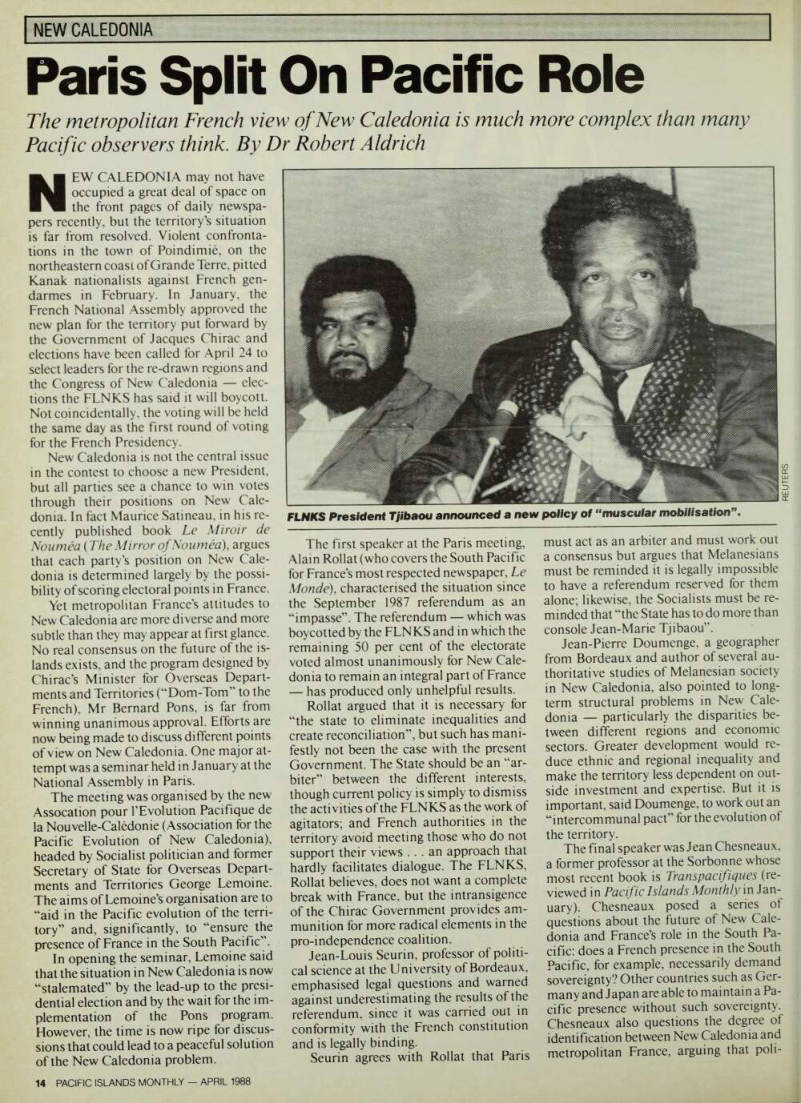
FLNKS President Tjibaou announced a new policy of “muscular mobilisation".
cymakers must reflect on the strategic value Noumea does or does not of fer. (For his part, Chesneaux agreed with Admiral Alexandre Sanguinetti, who was in the audience, that New Caledonia’s strategic value alone is minimal.) These discussions left many questions unanswered, including how a new govern ment whether Socialist or conservative would act. In any case, as Alain Rollat suggested, action of any kind would be dif ficult. Unresolved, too, was the method by which regional and ethnic inequalities could be attacked and how a consenus could be reached. But the talks at least in dicate to an often simplistic Australian media the diversity of opinions that exist in metropolitan France.
In the parliamentary debates on the Pons law in December, the Socialist Party strongly criticised the proposals presented by the conservative Government. The French Communist Party has condemned French “colonialism” in New Caledonia, as has the small Parti Socialiste Unifie and groups on the far left. But even members of the coalition in power particularly several in the UDF, the more moderate partners of Jacques Chirac’s RPR have questioned the Government’s approach.
Demonstrations of support for Kanaks have attracted thousands of participants in Paris and have been endorsed by trade unions, a variety of political parties and by influential individuals.
The different Kanak support groups are generally sympathetic to the FLNKS and independence for New Caledonia, but a second current of opinion, widespread in the Socialist Party and in some parts of the UDF, sees the need for a solution to the New Caledonian question that does not necessarily involve total independence.
The FLNKS is accepted as a legitimate mouthpiece for the Melanesians, though it does not represent the opinions of all Kan aks. Only a redesigned relationship be tween France and the territory, says this “pragmatic” group, can allow a redressing of Melanesian grievances, safeguards for Caldoches and’other groups and a pres ervation of France’s wider interests in the Pacific region.
The starting point for Bernard Pons’ argument, of course, is that New Cale donia is legally part of the French Repub lic and that the referendum of September confirms the desire of the majority of the territory’s population to retain that status.
At the extreme, the French view can become exaggerated and polemical. A new work by French Senator Pierre Lacour, ti tled De I’Oceanic au Pacifique: Histoire et Enjeux {From Oceania to the Pacific: History and Stakes) insists on the “incon testable right of France to be present in the Pacific and to remain there, in spite of the perfidious campaigns of denigration” to which France is subjected. Following the fashionable argument that “the centre of the world is inexorably moving toward the Pacific basin, which is now destined for a
formidable economic development and will soon become the favoured terrain for Big Power struggles”, Lacour demands that France take a strong role in the region. He charges that “Anglo-Saxon” hostility to the French has historical roots and that Aus tralians in particular have tried to thwart France’s ambitions. “We saw this only too well when France and Great Britain re cognised the ‘independence’ of Vanuatu in fact, an Australian protectorate by proxy, which furthermore does not exclude shore rights for Soviet ships. Whence also comes the impudence with which Australia con demns France’s nuclear tests (after having organised them itself) and the incorrect ness or the guilty complicity of New Zea land in welcoming the subversive missionaries of Greenpeace.”
Such is the diversity of French atti tudes. The Pacific and Australasian me
dia have often caricatured the French viewpoint, seeing it as unanimous and hardline. They have ridiculed legitimate French concerns, using the shorthand of “colonialism” as sufficient interpretation.
They have mistakenly reported aspects of French policy and have exhibited a lack of understanding (and lack of interest in) the French political system.
In reality, politicians and scholars in France have a rather more complex and much less unanimous view of the Pa cific and the role that France can and should play in the region. □
Dr Robert Aldrich is Senior Lecturer in Economic History at the University of Sydney and a specialist in French history.
His forthcoming book, The French in the South Pacific 1842-1945, is to be pub lished by MacMillan.
Poll Violence Grows
A spate of riots and kidnapping marks the end of peaceful protest in New Caledonia.
CAMPAIGNING for local elections in New Caledonia scheduled for April 24 began in a bad climate in February, when a “commando group” of 100 FLNKS activists attacked gendarmes with stones and cudgels in the northeast coast township of Poindimie. e ebruary '22 incident in which 15 gendarmes were injured and 10 taken hosage by Kanaks protesting the alienation of traditional tribal property for a hospital, also saw four military vehicles and two civ! ian cars flrebombed by members of icti tribe. Night-long talks between mil- Hants and officials saw the hostages released; the Kanaks involved escaped into surrounding bush but over the next few days 11 were captured The Poindimie “incident” reached flashpoint after months of futile discussion between administration and mumcipality officers who intended to build a regional hospital on the site as one of a number ofurban development projects and Tieti clans, who claimed the land as their own. Clan members occupied the land for three months, with the support of the FLNKS, and as a symbol of its commitment FLNKS officials decided to hold the organisation’s annual Congress in Poindimie over the weekend of February 19 and 20.
On the day before the Congress was to begin, however, gendarmes expelled the “squatters”, forcing the FLNKS to relocate its meetings on land owned by the neighbouring Tibarama tribe. Reports from Noumea say the gendarmes were taken by surprise by the “commando” group, apparently organised by the FLNKS’s radical left-wing Partie de Lib-
eralion Kanak (Palika), and that the at tack though criticised by the FLNKS leadership reflects the separatists’ new strategy of “muscular mobilisation” ex pounded by party president Jean-Marie Tjibaou after the Tibarama Congress, Pro-independence Kanaks and Euro peans have chosen, said Tjibaou, to re pudiate the statutes devised by French Minister for Overseas Territories Bernard Pons through a process of “active boycot t]ng”, “But the FLNKS is determined to negotiate a real self-determination Act leading to independence,” Mr Tjibaou cautioned .. .. , T u he P o^ can " not be excluded as New Caledonia moves closer to this month’s elections, timed to comc ! de w 1 ltl ? the metr opohtan French presidential elections, The anti-independence movement was Quick to respond to the Poindimie inci dents this February: Rapprochement pout a dans la Republique (RPCR) President Jacques Lafleur called, unsur pn singly, for the immediate dissolution of FLNKS because of its “terrorist” methods and branded its members
subversives .
New Caledonian issues look set to be come major stakes in the pre-election period. If the FLNKS fails in its strategy, French Prime Minister Jacques Chirac will claim its ineffectiveness as proof of the correctness of his policies ... and as a much-needed boost to his own presiden tial ambitions. But if trouble does strike, as seems increasingly likely, current Pres idem Francois Mitterrand will find it hard to resist exploiting the situation. □
Expo 88.. .The Island Way
Australia
Spectacular island displays will star at Expo.
By Larry Writer
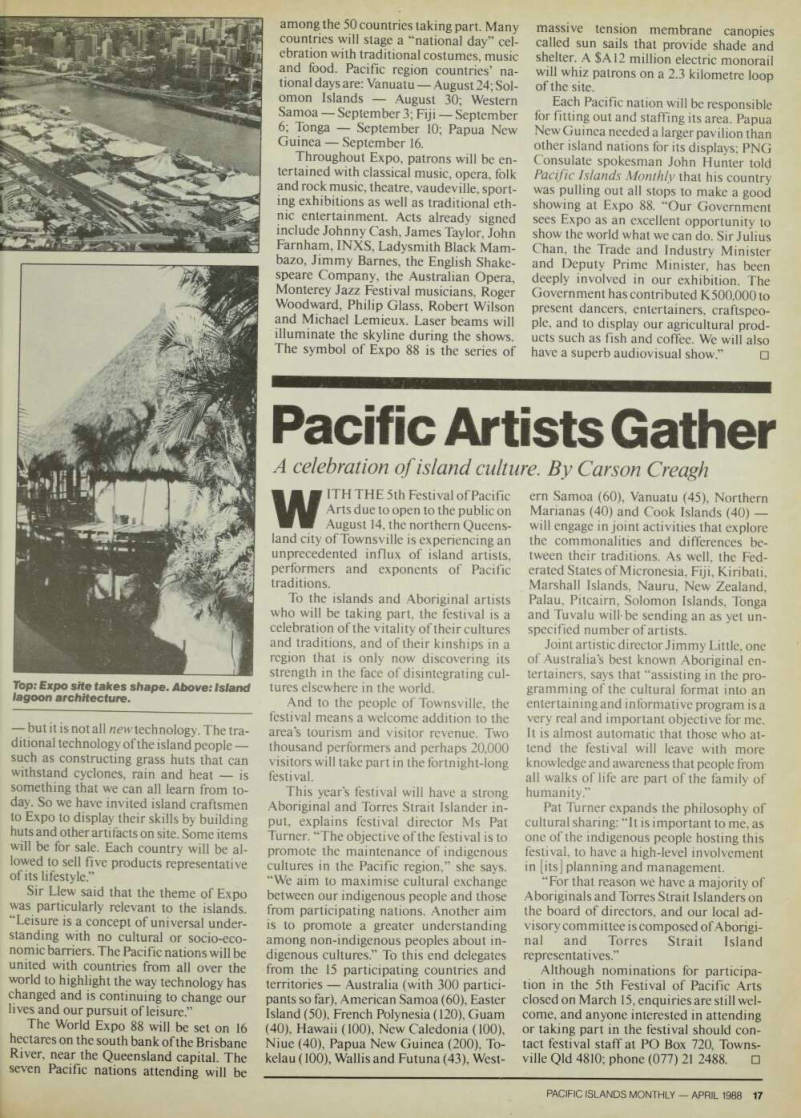
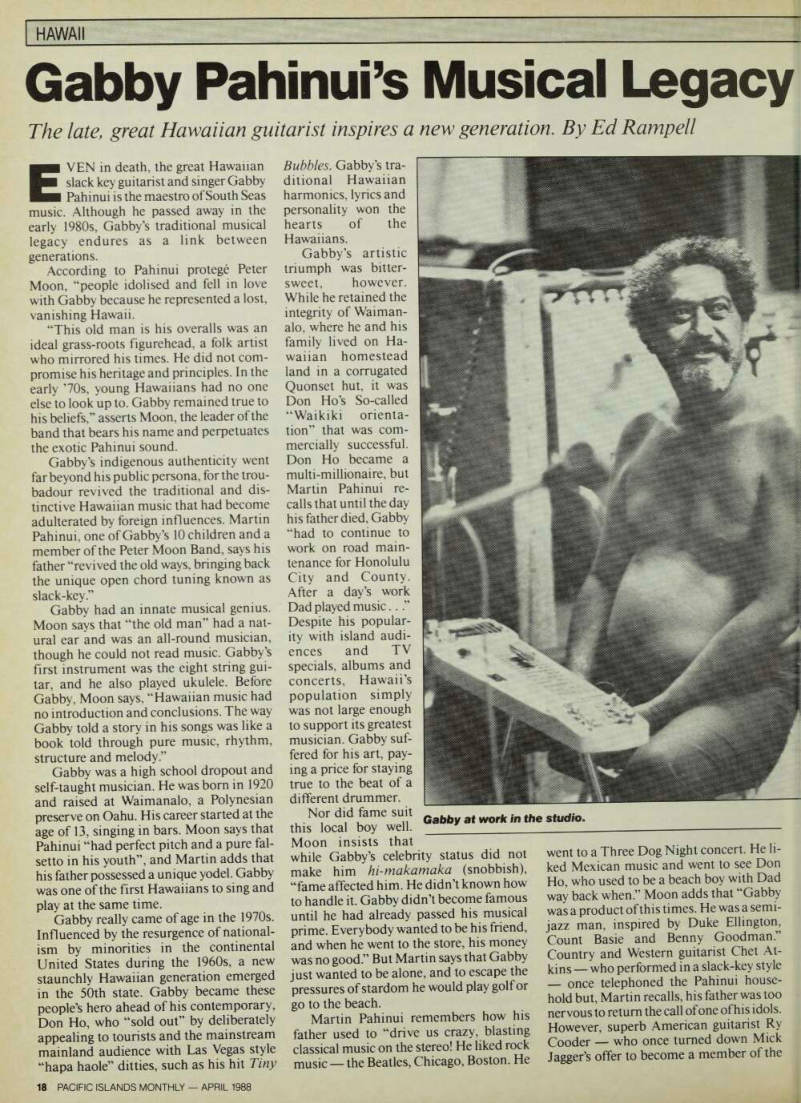
TRUE TO the spirit of Australia’s SA6OO million World Expo 88, the laser-lit, glitziest, most costly world fair ever, Pacific nations will show off their wares around an articifial tropical lagoon complete with island outriggers and 200 newly planted palm trees. Papua New Guinea, Fiji, Tonga, the Cook Islands, Solomon Islands, Western Samoa and Vanuatu will all have their displays by the 0.6 hectare, 1 metre deep lagoon that will be stocked with fish and sailing craft. The palm trees, as well as coral grit for the pathways connecting the exhibits, have been brought from the islands. A South Seas restaurant offering such fare as Shrimp Louie Salad and Chicken Adobe will satisfy what is hoped will be hordes of hungry visitors keen for some island am bience. World Expo 88 opens on April 30 in Brisbane and will run for six months.
Said Sir Llew Edwards, chairman of Expo 88: “Expo will give the Pacific is lands a chance to promote themselves to
the world in a Pacific island environ ment.” In addition to the lagoon, this en vironment will feature a Samoan oval fate (island house), traditional dancing groups, hand carving demonstrations, war can oes, a Fijian meeting house and musical performances.
There will also be business conference facilities where Pacific governments and companies will put their products on dis play, promote trade and tourism in their region and enhance diplomatic relations with other nations.
Sir Llew told Pacific Islands Monthly that Expo 88 organisers had made Aus tralia’s Pacific neighbours a top priority.
“We have extended invitations to island royalty, prime ministers and politicians, as well as leaders in business and tourism.
The response has been excellent and we hope to see such influential figures as King Tupou, Mr Wingti, Mr Somare, Sir Julius Chan, Ratu Mara, Mr Robati and Father Walter Lini in attendence. There will be
many islanders among the expected 750,000 overseas visitors as well.
“We have given the island nations SA2- $ A 3 million to help ensure that island cul ture, trade and tourism opportunities are effectively presented,” said Sir Llew.
The theme of Expo 88 is “Leisure In The Age Of Technology”. Said the chair man: “We all live in the age of technology
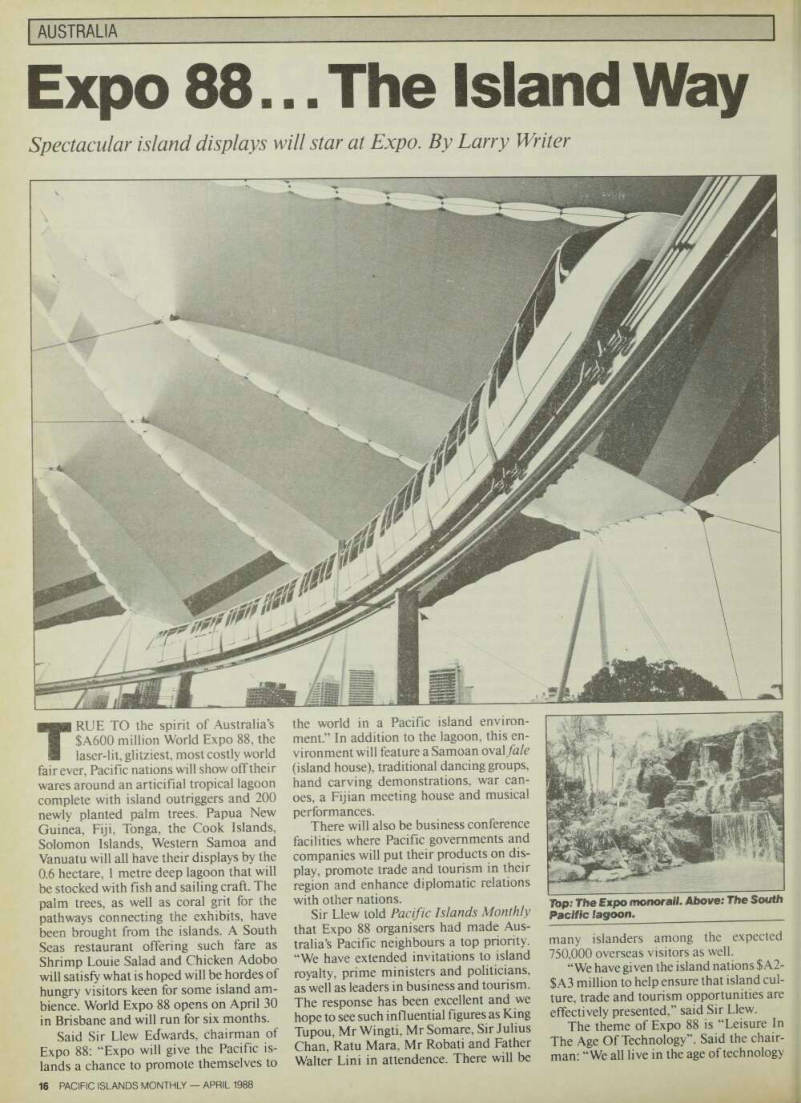
lb p; The Expo monorail. Above: The South Pacific! a goon.
but it is not all new technology. The tra ditional technology of the island people such as constructing grass huts that can withstand cyclones, rain and heat is something that we can all learn from to day. So we have invited island craftsmen to Expo to display their skills by building huts and other artifacts on site. Some items will be for sale. Each country will be al lowed to sell five products representative of its lifestyle.”
Sir Llew said that the theme of Expo was particularly relevant to the islands.
“Leisure is a concept of universal under standing with no cultural or socio-eco nomic barriers. The Pacific nations will be united with countries from all over the world to highlight the way technology has changed and is continuing to change our lives and our pursuit of leisure.”
The World Expo 88 will be set on 16 hectares on the south bank of the Brisbane River, near the Queensland capital. The seven Pacific nations attending will be
among the 50 countries taking part. Many countries will stage a “national day” cel ebration with traditional costumes, music and food. Pacific region countries’ na tional days are: Vanuatu August 24; Sol omon Islands August 30; Western Samoa September 3; Fiji September 6; Tonga September 10; Papua New Guinea September 16.
Throughout Expo, patrons will be en tertained with classical music, opera, folk and rock music, theatre, vaudeville, sport ing exhibitions as well as traditional eth nic entertainment. Acts already signed include Johnny Cash, James Taylor, John Farnham, INXS, Ladysmith Black Mam bazo, Jimmy Barnes, the English Shake speare Company, the Australian Opera, Monterey Jazz Festival musicians, Roger Woodward, Philip Glass, Robert Wilson and Michael Lemieux. Laser beams will illuminate the skyline during the shows.
The symbol of Expo 88 is the series of
massive tension membrane canopies called sun sails that provide shade and shelter. A SAI2 million electric monorail will whiz patrons on a 2.3 kilometre loop of the site.
Each Pacific nation will be responsible for fitting out and staffing its area. Papua New Guinea needed a larger pavilion than other island nations for its displays; PNG Consulate spokesman John Hunter told Pacific Islands Monthly that his country was pulling out all slops to make a good showing at Expo 88. “Our Government sees Expo as an excellent opportunity to show the world what we can do. Sir Julius Chan, the Trade and Industry Minister and Deputy Prime Minister, has been deeply involved in our exhibition. The Government has contributed K 500,000 to present dancers, entertainers, craftspeo ple, and to display our agricultural prod ucts such as fish and coffee. We will also have a superb audiovisual show.” □
Top: Expo site takes shape. Above: island lagoon architecture.
Pacific Artists Gather
A celebration of island culture.
By Carson Creagh
WITH THE sth Festival of Pacific Arts due to open to the public on August 14, the northern Queens land city of Townsville is experiencing an unprecedented influx of island artists, performers and exponents of Pacific traditions.
To the islands and Aboriginal artists who will be taking part, the festival is a celebration of the vitality of their cultures and traditions, and of their kinships in a region that is only now discovering its strength in the face of disintegrating cul tures elsewhere in the world.
And to the people of Townsville, the festival means a welcome addition to the area’s tourism and visitor revenue. Two thousand performers and perhaps 20,000 visitors will take part in the fortnight-long festival.
This year’s festival will have a strong Aboriginal and Torres Strait Islander in put, explains festival director Ms Pat Turner. “The objective of the festival is to promote the maintenance of indigenous cultures in the Pacific region,” she says.
“We aim to maximise cultural exchange between our indigenous people and those from participating nations. Another aim is to promote a greater understanding among non-indigenous peoples about in digenous cultures.” To this end delegates from the 15 participating countries and territories Australia (with 300 partici pants so far), American Samoa (60), Easter Island (50), French Polynesia (120), Guam (40), Hawaii (100), New Caledonia (100), Niue (40), Papua New Guinea (200), To kelau (100), Wallis and Futuna (43), West
ern Samoa (60), Vanuatu (45), Northern Marianas (40) and Cook Islands (40) will engage in joint activities that explore the commonalities and differences be tween their traditions. As well, the Fed erated States of Micronesia, Fiji, Kiribati, Marshall Islands, Nauru, New Zealand, Palau, Pitcairn, Solomon Islands, Tonga and Tuvalu will-be sending an as yet un specified number of artists.
Joint artistic director Jimmy Little, one of Australia’s best known Aboriginal en tertainers, says that “assisting in the pro gramming of the cultural format into an entertaining and informative program is a very real and important objective for me.
It is almost automatic that those who at tend the festival will leave with more knowledge and awareness that people from all walks of life are part of the family of humanity.”
Pat Turner expands the philosophy of cultural sharing: “It is important to me, as one of the indigenous people hosting this festival, to have a high-level involvement in [its] planning and management.
“For that reason we have a majority of Aboriginals and Torres Strait Islanders on the board of directors, and our local ad visory committee is composed of Aborigi nal and Torres Strait Island representatives.”
Although nominations for participa tion in the sth Festival of Pacific Arts closed on March 15, enquiries are still wel come, and anyone interested in attending or taking part in the festival should con tact festival staff at PO Box 720, Towns ville Qld 4810; phone (077) 21 2488. □
Gabby Pahinui’s Musical Legacy
Hawaii
The late, great Hawaiian guitarist inspires a new generation.
By Ed Rampell
EVEN in death, the great Hawaiian slack key guitarist and singer Gabby Pahinui is the maestro of South Seas music. Although he passed away in the early 1980 s, Gabby’s traditional musical legacy endures as a link between generations.
According to Pahinui protege Peter Moon, “people idolised and fell in love with Gabby because he represented a lost, vanishing Hawaii.
“This old man is his overalls was an ideal grass-roots figurehead, a folk artist who mirrored his times. He did not com promise his heritage and principles. In the early ’7os, young Hawaiians had no one else to look up to. Gabby remained true to his beliefs,” asserts Moon, the leader of the band that bears his name and perpetuates the exotic Pahinui sound.
Gabby’s indigenous authenticity went far beyond his public persona, for the trou badour revived the traditional and dis tinctive Hawaiian music that had become adulterated by foreign influences. Martin Pahinui, one of Gabby’s 10 children and a member of the Peter Moon Band, says his father “revived the old ways, bringing back the unique open chord tuning known as slack-key.”
Gabby had an innate musical genius.
Moon says that “the old man” had a nat ural ear and was an all-round musician, though he could not read music. Gabby’s first instrument was the eight string gui tar, and he also played ukulele. Before Gabby, Moon says, “Hawaiian music had no introduction and conclusions. The way Gabby told a story in his songs was like a book told through pure music, rhythm, structure and melody.”
Gabby was a high school dropout and self-taught musician. He was born in 1920 and raised at Waimanalo, a Polynesian preserve on Oahu. His career started at the age of 13, singing in bars. Moon says that Pahinui “had perfect pitch and a pure fal setto in his youth”, and Martin adds that his father possessed a unique yodel. Gabby was one of the first Hawaiians to sing and play at the same time.
Gabby really came of age in the 19705.
Influenced by the resurgence of national ism by minorities in the continental United States during the 19605, a new staunchly Hawaiian generation emerged in the 50th state. Gabby became these people’s hero ahead of his contemporary, Don Ho, who “sold out” by deliberately appealing to tourists and the mainstream mainland audience with Las Vegas style “hapa haole” ditties, such as his hit Tiny
Bubbles. Gabby’s tra ditional Hawaiian harmonics, lyrics and personality won the hearts of the Hawaiians.
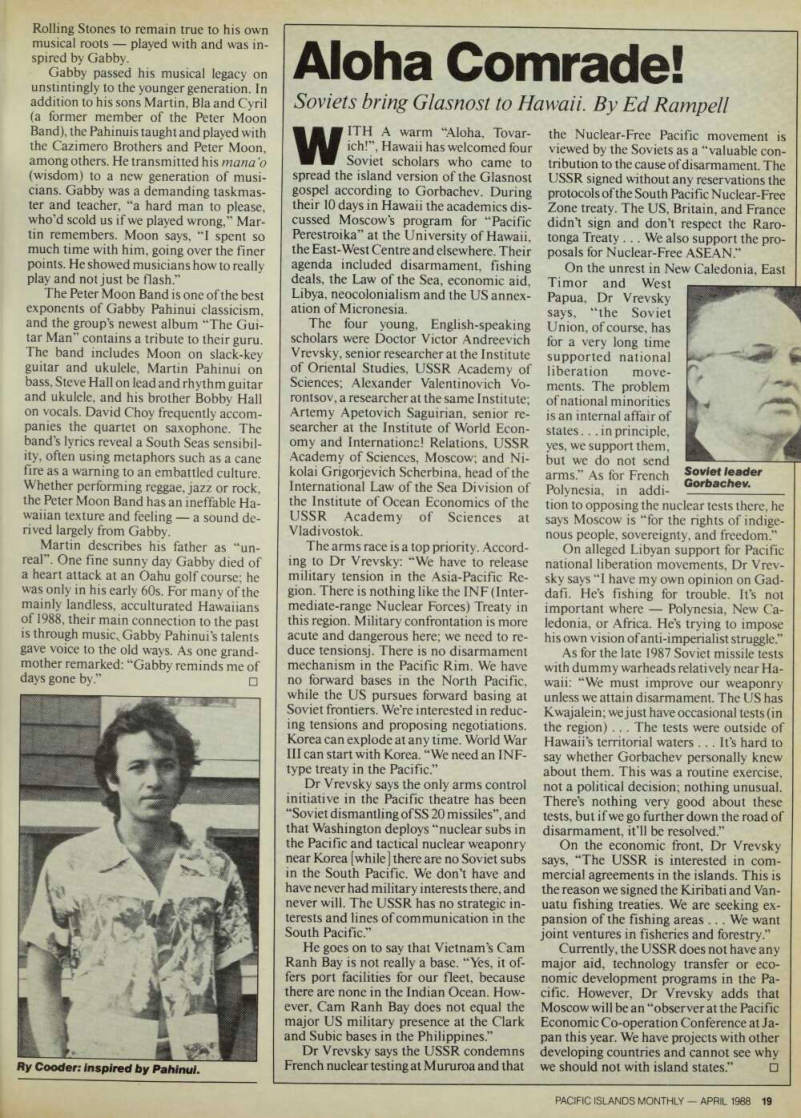
Gabby’s artistic triumph was bitter sweet, however.
While he retained the integrity of Waiman alo, where he and his family lived on Ha waiian homestead land in a corrugated Quonset hut, it was Don Ho’s So-called “Waikiki orienta tion” that was com mercially successful.
Don Ho became a multi-millionaire, but Martin Pahinui re calls that until the day his father died, Gabby “had to continue to work on road main tenance for Honolulu City and County.
After a day’s work Dad played music...”
Despite his popular ity with island audi ences and TV specials, albums and concerts, Hawaii’s population simply was not large enough to support its greatest musician. Gabby suf fered for his art, pay ing a price for staying true to the beat of a different drummer.
Nor did fame suit this local boy well.
Moon insists that
while Gabby’s celebrity status did not make him hi-makamaka (snobbish), “fame affected him. He didn’t known how to handle it. Gabby didn’t become famous until he had already passed his musical prime. Everybody wanted to be his friend, and when he went to the store, his money was no good.” But Martin says that Gabby just wanted to be alone, and to escape the pressures of stardom he would play golf or go to the beach.
Martin Pahinui remembers how his father used to “drive us crazy, blasting classical music on the stereo! He liked rock music the Beatles, Chicago, Boston. He
went to a Three Dog Night concert. He li ked Mexican music and went to see Don Ho, who used to be a beach boy with Dad way back when” Moon adds that “Gabby was a product of this times. He was a semi jazz man, inspired by Duke Ellington, Count Basie and Benny Goodman.”
Country and Western guitarist Chet At kins w ho performed in a slack-key style once telephoned the Pahinui house hold but, Martin recalls, his father was too nervous to return the call of one of his idols.
However, superb American guitarist Ry Cooder who once turned down Mick Jagger’s offer to become a member of the
Gabby at work in the studio.
Rolling Stones to remain true to his own musical roots played with and was in spired by Gabby.
Gabby passed his musical legacy on unstintingly to the younger generation. In addition to his sons Martin, Bla and Cyril (a former member of the Peter Moon Band), the Pahinuis taught and played with the Cazimero Brothers and Peter Moon, among others. He transmitted his mana o (wisdom) to a new generation of musi cians. Gabby was a demanding taskmas ter and teacher, “a hard man to please, who’d scold us if we played wrong,” Mar tin remembers. Moon says, “I spent so much time with him, going over the finer points. He showed musicians how to really play and not just be flash.”
The Peter Moon Band is one of the best exponents of Gabby Pahinui classicism, and the group’s newest album “The Gui tar Man” contains a tribute to their guru.
The band includes Moon on slack-key guitar and ukulele, Martin Pahinui on bass, Steve Hall on lead and rhythm guitar and ukulele, and his brother Bobby Hall on vocals. David Choy frequently accom panies the quartet on saxophone. The band’s lyrics reveal a South Seas sensibil ity, often using metaphors such as a cane fire as a warning to an embattled culture.
Whether performing reggae, jazz or rock, the Peter Moon Band has an ineffable Ha waiian texture and feeling a sound de rived largely from Gabby.
Martin describes his father as “un real”. One fine sunny day Gabby died of a heart attack at an Oahu golf course; he was only in his early 60s. For many of the mainly landless, acculturated Hawaiians of 1988, their main connection to the past is through music.. Gabby Pahinui’s talents gave voice to the old ways. As one grand mother remarked: “Gabby reminds me of days gone by.” □
Ry Cooder: inspired by Pahinui.
Aloha Comrade!
Soviets bring Glasnost to Hawaii.
By Ed Rampell
WITH A warm “Aloha, Tovar ich!”, Hawaii has welcomed four Soviet scholars who came to spread the island version of the Glasnost gospel according to Gorbachev. During their 10 days in Hawaii the academics dis cussed Moscow’s program for “Pacific Perestroika” at the University of Hawaii, the East-West Centre and elsewhere. Their agenda included disarmament, fishing deals, the Law of the Sea, economic aid, Libya, neocolonialism and the US annex ation of Micronesia.
The four young, English-speaking scholars were Doctor Victor Andreevich Vrevsky, senior researcher at the Institute of Oriental Studies, USSR Academy of Sciences; Alexander Valentinovich Vo rontsov, a researcher at the same Institute; Artemy Apetovich Saguirian, senior re searcher at the Institute of World Econ omy and Internationa! Relations, USSR Academy of Sciences, Moscow; and Ni kolai Grigorjevich Scherbina, head of the International Law of the Sea Division of the Institute of Ocean Economics of the USSR Academy of Sciences at Vladivostok.
The arms race is a top priority. Accord ing to Dr Vrevsky: “We have to release military tension in the Asia-Pacific Re gion. There is nothing like the INF (Inter mediate-range Nuclear Forces) Treaty in this region. Military confrontation is more acute and dangerous here; we need to re duce tensions). There is no disarmament mechanism in the Pacific Rim. We have no forward bases in the North Pacific, while the US pursues forward basing at Soviet frontiers. We’re interested in reduc ing tensions and proposing negotiations.
Korea can explode at any time. World War 111 can start with Korea. “We need an INF type treaty in the Pacific.”
Dr Vrevsky says the only arms control initiative in the Pacific theatre has been “Soviet dismantling of SS 20 missiles”, and that Washington deploys “nuclear subs in the Pacific and tactical nuclear weaponry near Korea [while] there are no Soviet subs in the South Pacific. We don’t have and have never had military interests there, and never will. The USSR has no strategic in terests and lines of communication in the South Pacific.”
He goes on to say that Vietnam’s Cam Ranh Bay is not really a base. “Yes, it of fers port facilities for our fleet, because there are none in the Indian Ocean. How ever, Cam Ranh Bay does not equal the major US military presence at the Clark and Subic bases in the Philippines.”
Dr Vrevsky says the USSR condemns French nuclear testing at Mururoa and that
the Nuclear-Free Pacific movement is viewed by the Soviets as a “valuable con tribution to the cause of disarmament. The USSR signed without any reservations the protocols of the South Pacific Nuclear-Free Zone treaty. The US, Britain, and France didn’t sign and don’t respect the Raro tonga Treaty .. .We also support the pro posals for Nuclear-Free ASEAN.”
On the unrest in New Caledonia, East
Timor and West Papua, Dr Vrevsky says, “the Soviet Union, of course, has for a very long time supported national liberation move ments. The problem of national minorities is an internal affair of states... in principle, yes, we support them, but we do not send arms.” As for French Polynesia, in addi-
tion to opposing the nuclear tests there, he says Moscow is “for the rights of indige nous people, sovereignty, and freedom.”
On alleged Libyan support for Pacific national liberation movements. Dr Vrev sky says “I have my own opinion on Gad dafi. He’s fishing for trouble. It’s not important where Polynesia, New Ca ledonia, or Africa. He’s trying to impose his own vision of anti-imperialist struggle.”
As for the late 1987 Soviet missile tests with dummy warheads relatively near Ha waii: “We must improve our weaponry unless we attain disarmament. The US has Kwajalein; we just have occasional tests (in the region) .. . The tests were outside of Hawaii’s territorial waters ... It’s hard to say whether Gorbachev personally knew about them. This was a routine exercise, not a political decision; nothing unusual.
There’s nothing very good about these tests, but if we go further down the road of disarmament, it’ll be resolved.”
On the economic front, Dr Vrevsky says, “The USSR is interested in com mercial agreements in the islands. This is the reason we signed the Kiribati and Van uatu fishing treaties. We are seeking ex pansion of the fishing areas ... We want joint ventures in fisheries and forestry.”
Currently, the USSR does not have any major aid, technology transfer or eco nomic development programs in the Pa cific. However, Dr Vrevsky adds that Moscow will be an “observer at the Pacific Economic Co-operation Conference at Ja pan this year. We have projects with other developing countries and cannot see why we should not with island states.” □
Soviet leader Gorbachev.
Ho’olokahi For A Year Of Pride
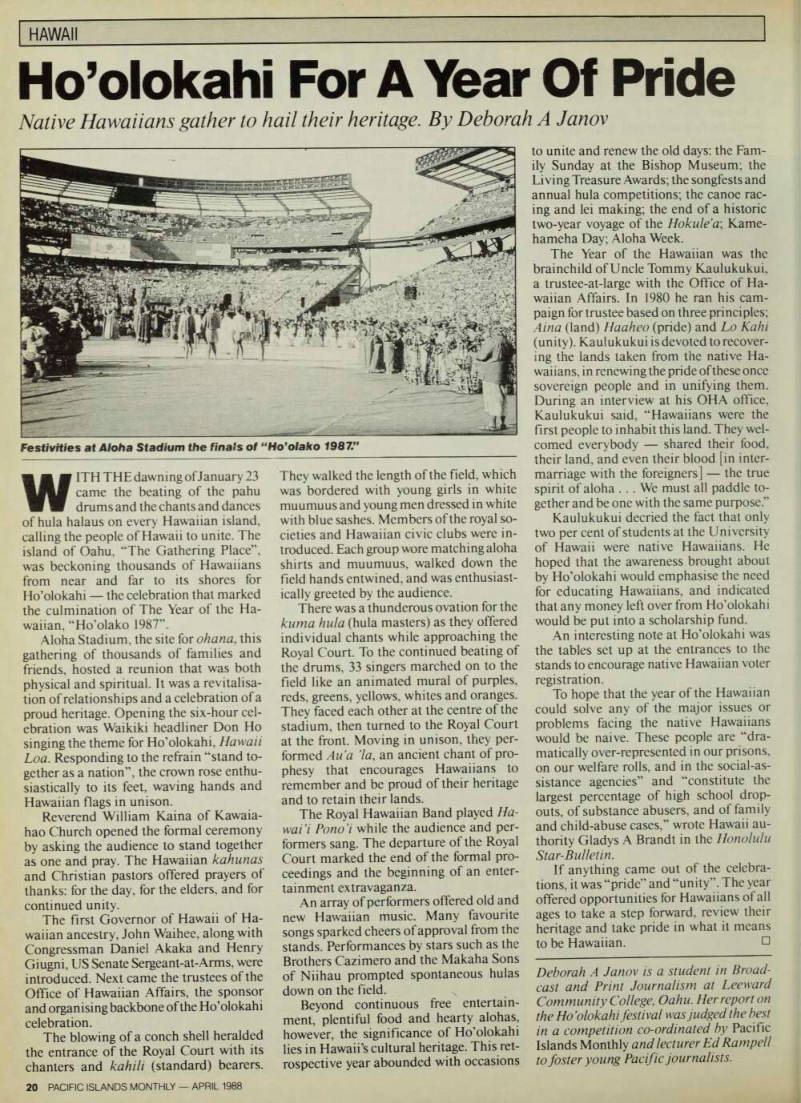
Native Hawaiians gather to hail their heritage.
By Deborah A Janov
WITH THE dawning of January 23 came the beating of the pahu drums and the chants and dances of hula halaus on every Hawaiian island, calling the people of Hawaii to unite. The island of Oahu, “The Gathering Place”, was beckoning thousands of Hawaiians from near and far to its shores for Ho’olokahi the celebration that marked the culmination of The Year of the Hawaiian, “Ho’olako 1987”.
Aloha Stadium, the site for ohana , this gathering of thousands of families and friends, hosted a reunion that was both physical and spiritual. It was a revitalisation of relationships and a celebration of a proud heritage. Opening the six-hour celebration was Waikiki headliner Don Ho singing the theme for Ho’olokahi, Hawaii Loa. Responding to the refrain “stand together as a nation”, the crown rose enthusiastically to its feet, waving hands and Hawaiian flags in unison.
Reverend William Kaina of Kawaiahao Church opened the formal ceremony by asking the audience to stand together as one and pray. The Hawaiian kahunas and Christian pastors offered prayers of thanks: for the day, for the elders, and for continued unity.
The first Governor of Hawaii of Hawaiian ancestry, John Waihee, along with Congressman Daniel Akaka and Henry Giugni, US Senate Sergeant-at-Arms, were introduced. Next came the trustees of the Office of Hawaiian Affairs, the sponsor and organising backbone of the Ho’olokahi celebration.
The blowing of a conch shell heralded the entrance of the Royal Court with its chanters and kahili (standard) bearers,
They walked the length of the field, which was bordered with young girls in white muumuus and young men dressed in white with blue sashes. Members of the royal so cieties and Hawaiian civic clubs were in troduced. Each group wore matching aloha shirts and muumuus, walked down the field hands entwined, and was enthusiast ically greeted by the audience.
There was a thunderous ovation for the kuma hula (hula masters) as they offered individual chants while approaching the Royal Court. To the continued beating of the drums, 33 singers marched on to the field like an animated mural of purples, reds, greens, yellows, whites and oranges.
They faced each other at the centre of the stadium, then turned to the Royal Court at the front. Moving in unison, they per formed Au’a ’la, an ancient chant of pro phesy that encourages Hawaiians to remember and be proud of their heritage and to retain their lands.
The Royal Hawaiian Band played Ha wai’i Pono’i while the audience and per formers sang. The departure of the Royal Court marked the end of the formal pro ceedings and the beginning of an enter tainment extravaganza.
An array of performers offered old and new Hawaiian music. Many favourite songs sparked cheers of approval from the stands. Performances by stars such as the Brothers Cazimero and the Makaha Sons of Niihau prompted spontaneous hulas down on the field.
Beyond continuous free entertain ment, plentiful food and hearty alohas, however, the significance of Ho’olokahi lies in Hawaii’s cultural heritage. This ret rospective year abounded with occasions
to unite and renew the old days: the Fam ily Sunday at the Bishop Museum; the Living Treasure Awards; the songfests and annual hula competitions; the canoe rac ing and lei making; the end of a historic two-year voyage of the Hokulea\ Kame hameha Day; Aloha Week.
The Year of the Hawaiian was the brainchild of Uncle Tommy Kaulukukui, a trustee-at-large with the Office of Ha waiian Affairs. In 1980 he ran his cam paign for trustee based on three principles; Aina (land) Haaheo (pride) and Lo Kahi (unity). Kaulukukui is devoted to recover ing the lands taken from the native Ha waiians, in renewing the pride of these once sovereign people and in unifying them.
During an interview at his OHA office, Kaulukukui said, “Hawaiians were the first people to inhabit this land. They wel comed everybody shared their food, their land, and even their blood [in inter marriage with the foreigners] the true spirit of aloha ... We must all paddle to gether and be one with the same purpose.”
Kaulukukui decried the fact that only two per cent of students at the University of Hawaii were native Hawaiians. He hoped that the awareness brought about by Ho’olokahi would emphasise the need for educating Hawaiians, and indicated that any money left over from Ho’olokahi would be put into a scholarship fund.
An interesting note at Ho’olokahi was the tables set up at the entrances to the stands to encourage native Hawaiian voter registration.
To hope that the year of the Hawaiian could solve any of the major issues or problems facing the native Hawaiians would be naive. These people are “dra matically over-represented in our prisons, on our welfare rolls, and in the social-as sistance agencies” and “constitute the largest percentage of high school drop outs, of substance abusers, and of family and child-abuse cases,” wrote Hawaii au thority Gladys A Brandt in the Honolulu Star-Bulletin.
If anything came out of the celebra tions, it was “pride” and “unity”. The year offered opportunities for Hawaiians of all ages to take a step forward, review their heritage and take pride in what it means to be Hawaiian. □
Deborah A Janov is a student in Broad cast and Print Journalism at Leeward Community College, Oahu. Her report on the Ho’olokahi festival was judged the best in a competition co-ordinated by Pacific Islands Monthly and lecturer Ed Rampell to foster young Pacific journalists.
Festivities at Aloha Stadium the finals of “Ho’olako 1987.”
Grass-Roots Growth Strategy
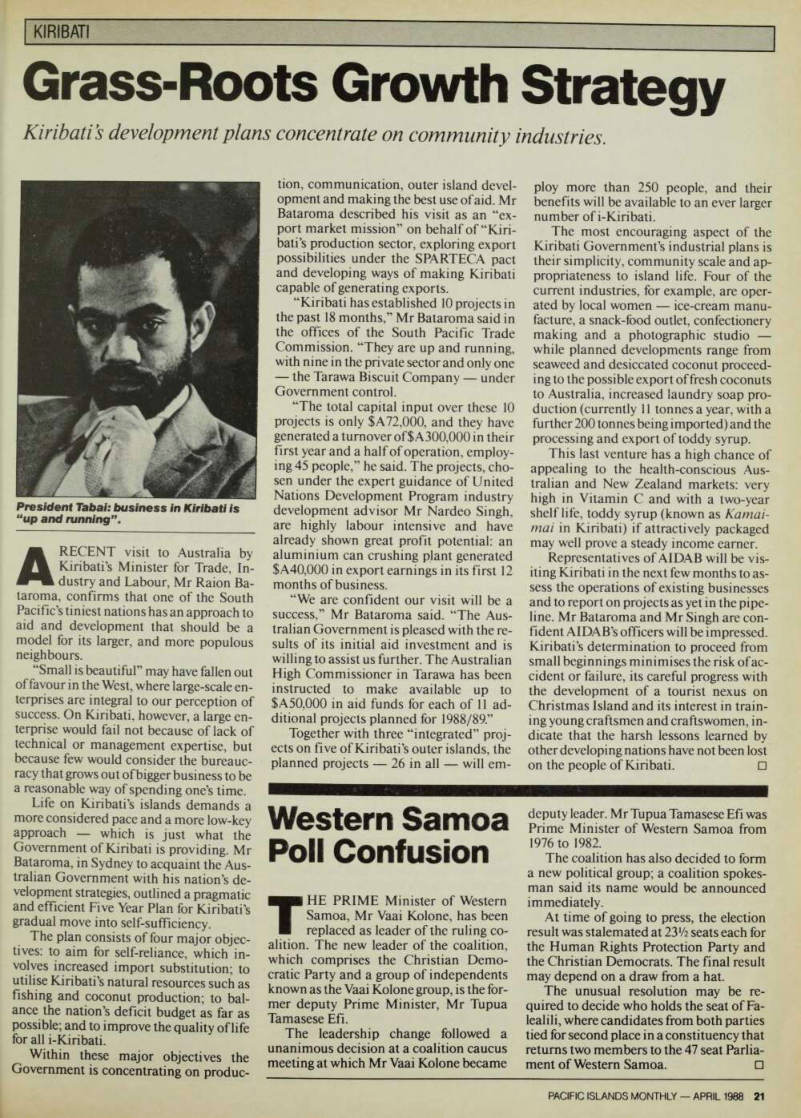
Kiribati
Kiribati’s development plans concentrate on community industries.
A RECENT visit to Australia by Kiribati’s Minister for Trade, In dustry and Labour, Mr Raion Ba taroma, confirms that one of the South Pacific’s tiniest nations has an approach to aid and development that should be a model for its larger, and more populous neighbours.
“Small is beautiful” may have fallen out of favour in the West, where large-scale en terprises are integral to our perception of success. On Kiribati, however, a large en terprise would fail not because of lack of technical or management expertise, but because few would consider the bureauc racy that grows out of bigger business to be a reasonable way of spending one’s time.
Life on Kiribati’s islands demands a more considered pace and a more low-key approach which is just what the Government of Kiribati is providing. Mr Bataroma, in Sydney to acquaint the Aus tralian Government with his nation’s de velopment strategies, outlined a pragmatic and efficient Five Year Plan for Kiribati’s gradual move into self-sufficiency.
The plan consists of four major objec tives: to aim for self-reliance, which in volves increased import substitution; to utilise Kiribati’s natural resources such as fishing and coconut production; to bal ance the nation’s deficit budget as far as possible; and to improve the quality of life for all i-Kiribati.
Within these major objectives the Government is concentrating on produc
tion, communication, outer island development and making the best use of aid. Mr Bataroma described his visit as an “export market mission” on behalf of “Kiribati’s production sector, exploring export possibilities under the SPARTECA pact and developing ways of making Kiribati capable of generating exports.
“Kiribati has established 10 projects in the past 18 months,” Mr Bataroma said in the offices of the South Pacific Trade Commission. “They are up and running, with nine in the private sector and only one the Tarawa Biscuit Company under Government control.
“The total capital input over these 10 projects is only $A72,000, and they have generated a turnover ofsA3oo,ooo in their first year and a half of operation, employmg 45 people,” he said. The projects, chosen under the expert guidance of United Nations Development Program industry development advisor Mr Nardeo Singh, are highly labour intensive and have already shown great profit potential: an aluminium can crushing plant generated $A40,000 in export earnings in its first 12 months of business.
“We are confident our visit will be a success,” Mr Bataroma said. “The Australian Government is pleased with the resuits of its initial aid investment and is willing to assist us further. The Australian High Commissioner in Tarawa has been instructed to make available up to $A50,000 in aid funds for each of 11 additional projects planned for 1988/89.”
Together with three “integrated” projects on five of Kiribati’s outer islands, the planned projects 26 in all will em-
ploy more than 250 people, and their benefits will be available to an ever larger number of i-Kiribati.
The most encouraging aspect of the Kiribati Government’s industrial plans is their simplicity, community scale and ap propriateness to island life. Four of the current industries, for example, are oper ated by local women ice-cream manu facture, a snack-food outlet, confectionery making and a photographic studio while planned developments range from seaweed and desiccated coconut proceed ingto the possible export of fresh coconuts to Australia, increased laundry soap pro duction (currently 11 tonnes a year, with a further 200 tonnes being imported) and the processing and export of toddy syrup, This last venture has a high chance of appealing to the health-conscious Aus tralian and New Zealand markets: very high in Vitamin C and with a two-year shelf life, toddy syrup (known as Kamai mai in Kiribati) if attractively packaged may well prove a steady income earner, Representatives of AIDAB will be vis iting Kiribati in the next few months to as sess the operations of existing businesses and to report on projects as yet in the pipe line. Mr Bataroma and Mr Singh are con fident AIDAB’s officers will be impressed, Kiribati’s determination to proceed from small beginnings minimises the risk of ac cident or failure, its careful progress with the development of a tourist nexus on Christmas Island and its interest in train ing young craftsmen and craftswomen, in dicate that the harsh lessons learned by other developing nations have not been lost on the people of Kiribati. □
President Tabai: business in Kiribati is “up and running
Poll Confusion
Western Samoa Poll Confusion
THE PRIME Minister of Western Samoa, Mr Vaai Kolone, has been replaced as leader of the ruling co alition. The new leader of the coalition, which comprises the Christian Demo cratic Party and a group of independents known as the Vaai Kolone group, is the for mer deputy Prime Minister, Mr Tupua Tamasese Efi.
The leadership change followed a unanimous decision at a coalition caucus meeting at which Mr Vaai Kolone became
deputy leader. Mr Tupua Tamasese Efi was Prime Minister of Western Samoa from 1976 to 1982.
The coalition has also decided to form a new political group; a coalition spokes man said its name would be announced immediately.
At time of going to press, the election result was stalemated at 23 V 2 seats each for the Human Rights Protection Party and the Christian Democrats. The final result may depend on a draw from a hat.
The unusual resolution may be re quired to decide who holds the seat of Fa lealili, where candidates from both parties tied for second place in a constituency that returns two members to the 47 seat Parlia ment of Western Samoa. □
Heart Of The French Pacific
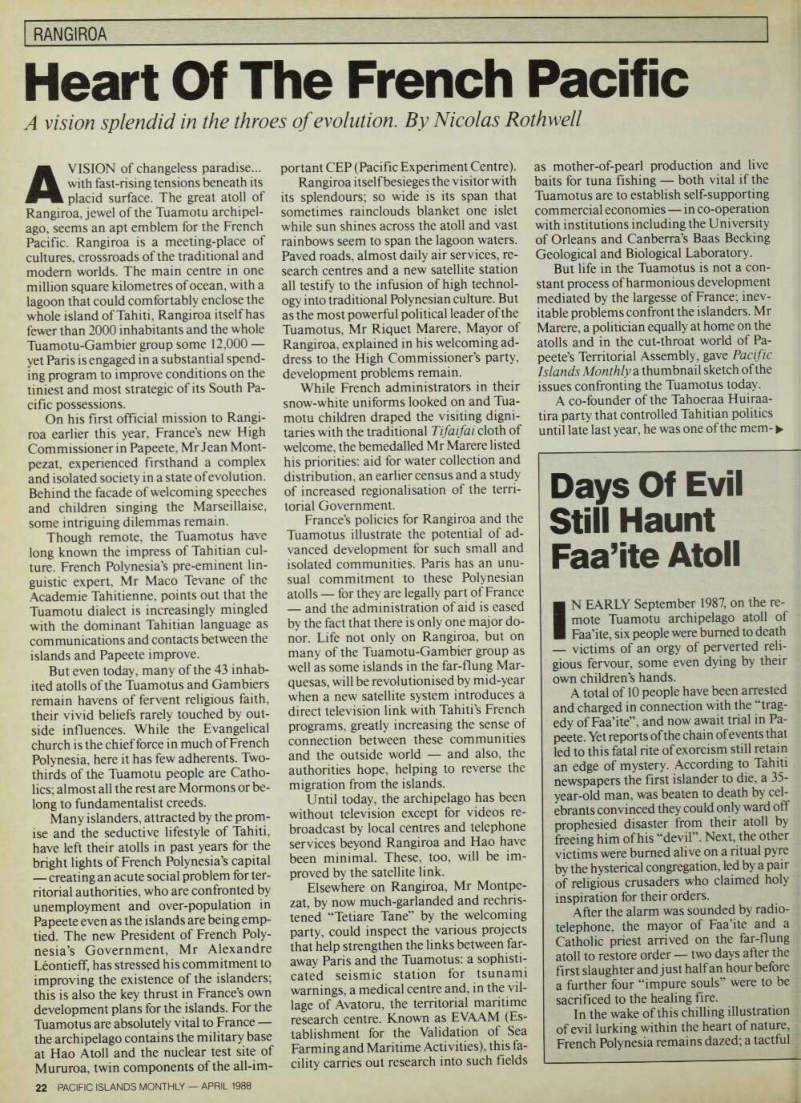
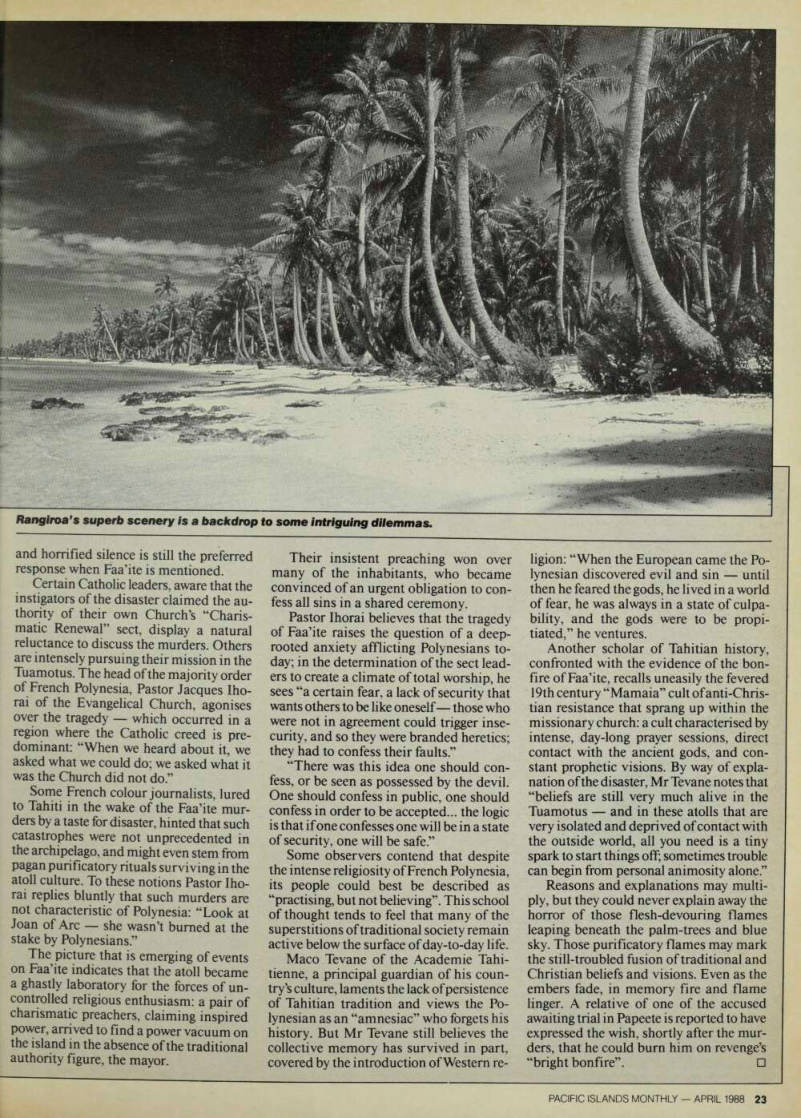
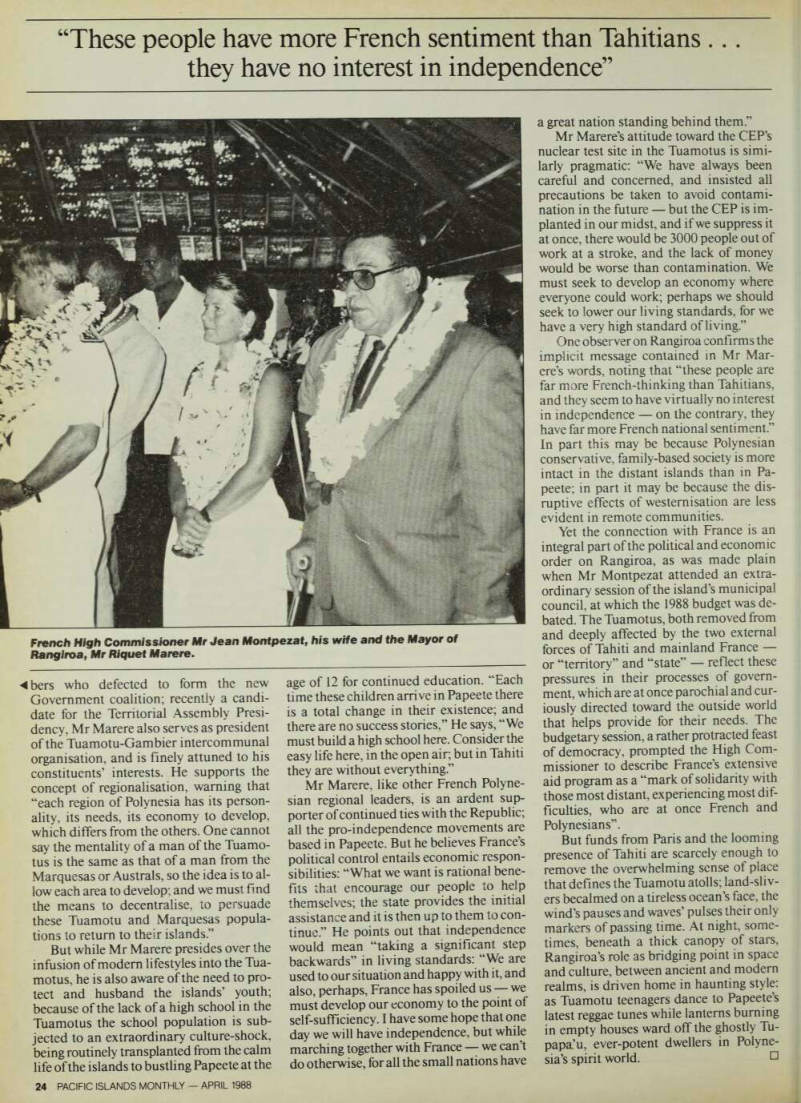
Rangiroa
A vision splendid in the throes of evolution.
By Nicolas Rothwell
A VISION of changeless paradise... with fast-rising tensions beneath its placid surface. The great atoll of Rangiroa, jewel of the Tuamotu archipel ago, seems an apt emblem for the French Pacific. Rangiroa is a meeting-place of cultures, crossroads of the traditional and modem worlds. The main centre in one million square kilometres of ocean, with a lagoon that could comfortably enclose the whole island of Tahiti, Rangiroa itself has fewer than 2000 inhabitants and the whole Tuamotu-Gambier group some 12,000 yet Paris is engaged in a substantial spend ing program to improve conditions on the tiniest and most strategic of its South Pa cific possessions.
On his first official mission to Rangi roa earlier this year, France’s new High Commissioner in Papeete, Mr Jean Mont pezat, experienced firsthand a complex and isolated society in a state of evolution.
Behind the facade of welcoming speeches and children singing the Marseillaise, some intriguing dilemmas remain.
Though remote, the Tuamotus have long known the impress of Tahitian cul ture. French Polynesia’s pre-eminent lin guistic expert, Mr Maco Tevane of the Academic Tahitienne, points out that the Tuamotu dialect is increasingly mingled with the dominant Tahitian language as communications and contacts between the islands and Papeete improve.
But even today, many of the 43 inhab ited atolls of the Tuamotus and Gambiers remain havens of fervent religious faith, their vivid beliefs rarely touched by out side influences. While the Evangelical church is the chief force in much of French Polynesia, here it has few adherents. Two thirds of the Tuamotu people are Catho lics; almost all the rest are Mormons or be long to fundamentalist creeds.
Many islanders, attracted by the prom ise and the seductive lifestyle of Tahiti, have left their atolls in past years for the bright lights of French Polynesia’s capital creating an acute social problem for ter ritorial authorities, who are confronted by unemployment and over-population in Papeete even as the islands are being emp tied. The new President of French Poly nesia’s Government, Mr Alexandre Leontieff, has stressed his commitment to improving the existence of the islanders; this is also the key thrust in France’s own development plans for the islands. For the Tuamotus are absolutely vital to France the archipelago contains the military base at Hao Atoll and the nuclear test site of Mururoa, twin components of the all-im
portant CEP (Pacific Experiment Centre).
Rangiroa itself besieges the visitor with its splendours; so wide is its span that sometimes rainclouds blanket one islet while sun shines across the atoll and vast rainbows seem to span the lagoon waters.
Paved roads, almost daily air services, re search centres and a new satellite station all testify to the infusion of high technol ogy into traditional Polynesian culture. But as the most powerful political leader of the Tuamotus, Mr Riquet Marere, Mayor of Rangiroa, explained in his welcoming ad dress to the High Commissioner’s party, development problems remain.
While French administrators in their snow-white uniforms looked on and Tua motu children draped the visiting digni taries with the traditional Tifaifai cloth of welcome, the bemedalled Mr Marere listed his priorities; aid for water collection and distribution, an earlier census and a study of increased regionalisation of the terri torial Government.
France’s policies for Rangiroa and the Tuamotus illustrate the potential of ad vanced development for such small and isolated communities. Paris has an unu sual commitment to these Polynesian atolls for they are legally part of France and the administration of aid is eased by the fact that there is only one major do nor. Life not only on Rangiroa, but on many of the Tuamotu-Gambier group as well as some islands in the far-flung Mar quesas, will be revolutionised by mid-year when a new satellite system introduces a direct television link with Tahiti’s French programs, greatly increasing the sense of connection between these communities and the outside world and also, the authorities hope, helping to reverse the migration from the islands.
Until today, the archipelago has been without television except for videos re broadcast by local centres and telephone services beyond Rangiroa and Hao have been minimal. These, too, will be im proved by the satellite link.
Elsewhere on Rangiroa, Mr Montpe zat, by now much-garlanded and rechris tened “Tetiare Tane” by the welcoming party, could inspect the various projects that help strengthen the links between far away Paris and the Tuamotus: a sophisti cated seismic station for tsunami warnings, a medical centre and, in the vil lage of Avatoru, the territorial maritime research centre. Known as EVAAM (Es tablishment for the Validation of Sea Farming and Maritime Activities), this fa cility carries out research into such fields
as mother-of-pearl production and live baits for tuna fishing both vital if the Tuamotus are to establish self-supporting commercial economies in co-operation with institutions including the University of Orleans and Canberra’s Baas Becking Geological and Biological Laboratory.
But life in the Tuamotus is not a con stant process of harmonious development mediated by the largesse of France; inev itable problems confront the islanders. Mr Marere, a politician equally at home on the atolls and in the cut-throat world of Pa peete’s Territorial Assembly, gave Pacific Islands Monthly a thumbnail sketch of the issues confronting the Tuamotus today.
A co-founder of the Tahoeraa Huiraa tira party that controlled Tahitian politics until late last year, he was one of the mem- ►
and horrified silence is still the preferred response when Faa’ite is mentioned.
Certain Catholic leaders, aware that the instigators of the disaster claimed the au thority of their own Church’s “Charis matic Renewal” sect, display a natural reluctance to discuss the murders. Others are intensely pursuing their mission in the Tuamotus. The head of the majority order of French Polynesia, Pastor Jacques Iho rai of the Evangelical Church, agonises over the tragedy which occurred in a region where the Catholic creed is pre dominant: “When we heard about it, we asked what we could do; we asked what it was the Church did not do.”
Some French colour journalists, lured to Tahiti in the wake of the Faa’ite mur ders by a taste for disaster, hinted that such catastrophes were not unprecedented in the archipelago, and might even stem from pagan purificatory rituals surviving in the atoll culture. To these notions Pastor Iho rai replies bluntly that such murders are not characteristic of Polynesia: “Look at Joan of Arc she wasn’t burned at the stake by Polynesians.”
The picture that is emerging of events on Faa’ite indicates that the atoll became a ghastly laboratory for the forces of un controlled religious enthusiasm: a pair of charismatic preachers, claiming inspired power, arrived to find a power vacuum on the island in the absence of the traditional authority figure, the mayor.
Their insistent preaching won over many of the inhabitants, who became convinced of an urgent obligation to con fess all sins in a shared ceremony.
Pastor Ihorai believes that the tragedy of Faa’ite raises the question of a deep rooted anxiety afflicting Polynesians to day; in the determination of the sect lead ers to create a climate of total worship, he sees “a certain fear, a lack of security that wants others to be like oneself—those who were not in agreement could trigger inse curity, and so they were branded heretics; they had to confess their faults.”
“There was this idea one should con fess, or be seen as possessed by the devil, One should confess in public, one should confess in order to be accepted... the logic is that if one confesses one will be in a state of security, one will be safe.”
Some observers contend that despite the intense religiosity of French Polynesia, its people could best be described as “practising, but not believing”. This school of thought tends to feel that many of the superstitions of traditional society remain active below the surface of day-to-day life.
Maco Tevane of the Academic Tahi tienne, a principal guardian of his coun try’s culture, laments the lack of persistence of Tahitian tradition and views the Po lynesian as an “amnesiac” who forgets his history. But Mr Tevane still believes the collective memory has survived in part, covered by the introduction of Western re
ligion: “When the European came the Po lynesian discovered evil and sin until then he feared the gods, he lived in a world of fear, he was always in a state of culpa bility, and the gods were to be propi tiated,” he ventures, Another scholar of Tahitian history, confronted with the evidence of the bon fire of Faa’ite, recalls uneasily the fevered 19th century “Mamaia” cult of anti-Chris tian resistance that sprang up within the missionary church: a cult characterised by intense, day-long prayer sessions, direct contact with the ancient gods, and con stant prophetic visions. By way of expla nation of the disaster, Mr Tevane notes that “beliefs are still very much alive in the Tuamotus and in these atolls that are very isolated and deprived of contact with the outside world, all you need is a tiny spark to start things off; sometimes trouble can begin from personal animosity alone.”
Reasons and explanations may multi ply, but they could never explain away the horror of those flesh-devouring flames leaping beneath the palm-trees and blue sky. Those purificatory flames may mark the still-troubled fusion of traditional and Christian beliefs and visions. Even as the embers fade, in memory fire and flame linger. A relative of one of the accused awaiting trial in Papeete is reported to have expressed the wish, shortly after the mur ders, that he could burn him on revenge’s “bright bonfire”. □
Rangiroa’s superb scenery is a backdrop to some Intriguing dilemmas.
“These people have more French sentiment than Tahitians ... they have no interest in independence”
◄ bers who defected to form the new Government coalition; recently a candidate for the Territorial Assembly Presidency, Mr Marere also serves as president of the Tuamotu-Gambier intercommunal organisation, and is finely attuned to his constituents’ interests. He supports the concept of regionalisation, warning that “each region of Polynesia has its personality, its needs, its economy to develop, which differs from the others. One cannot say the mentality of a man of the Tuamotus is the same as that of a man from the Marquesas or Australs, so the idea is to allow each area to develop; and we must find the means to decentralise, to persuade these Tuamotu and Marquesas populations to return to their islands.”
But while Mr Marere presides over the infusion of modem lifestyles into the Tuamotus, he is also aware of the need to protect and husband the islands’ youth; because of the lack of a high school in the Tuamotus the school population is subjected to an extraordinary culture-shock, being routinely transplanted from the calm life of the islands to bustling Papeete at the
age of 12 for continued education. “Each time these children arrive in Papeete there is a total change in their existence; and there are no success stories,” He says, We must build a high school here. Consider the easy life here, in the open air; but in Tahiti they are without everything.”
Mr Marere, like other French Polyne sian regional leaders, is an ardent sup porter of continued ties with the Republic; all the pro-independence movements are based in Papeete. But he believes Frances political control entails economic respon sibilities: “What we want is rational bene fits that encourage our people to help themselves; the state provides the initial assistance and it is then up to them to con tinue.” He points out that independence would mean “taking a significant step backwards” in living standards: We are used to our situation and happy with it, and also, perhaps, France has spoiled us we must develop our economy to the point ot self-sufficiency. I have some hope that one day we will have independence, but while marching together with France we can t do otherwise, for all the small nations have
a great nation standing behind them.”
Mr Marere’s attitude toward the CEP’s nuclear test site in the Tuamotus is simi larly pragmatic: “We have always been careful and concerned, and insisted all precautions be taken to avoid contami nation in the future but the CEP is im planted in our midst, and if we suppress it at once, there would be 3000 people out of work at a stroke, and the lack of money would be worse than contamination. We must seek to develop an economy where everyone could work; perhaps we should seek to lower our living standards, for we have a very high standard of living.”
One observer on Rangiroa confirms the implicit message contained in Mr Mar ere’s words, noting that “these people are far more French-thinking than Tahitians, and they seem to have virtually no interest in independence on the contrary, they have far more French national sentiment.”
In part this may be because Polynesian conservative, family-based society is more intact in the distant islands than in Pa peete; in part it may be because the dis ruptive effects of westernisation are less evident in remote communities.
Yet the connection with France is an integral part of the political and economic order on Rangiroa, as was made plain when Mr Montpezat attended an extra ordinary session of the island’s municipal council, at which the 1988 budget was de bated. The Tuamotus, both removed from and deeply affected by the two external forces of Tahiti and mainland France or “territory” and “state” reflect these pressures in their processes of govern ment, which are at once parochial and cur iously directed toward the outside world that helps provide for their needs. The budgetary session, a rather protracted feast of democracy, prompted the High Com missioner to describe France’s extensive aid program as a “mark of solidarity with those most distant, experiencing most dif ficulties, who are at once French and Polynesians”.
But funds from Paris and the looming presence of Tahiti are scarcely enough to remove the overwhelming sense of place that defines the Tuamotu atolls; land-sliv ers becalmed on a tireless ocean’s face, the wind’s pauses and waves’ pulses their only markers of passing time. At night, some times, beneath a thick canopy of stars, Rangiroa’s role as bridging point in space and culture, between ancient and modem realms, is driven home in haunting style: as Tuamotu teenagers dance to Papeete’s latest reggae tunes while lanterns burning in empty houses ward off the ghostly Tu papa’u, ever-potent dwellers in Polyne sia’s spirit world. D
French High Commissioner Mr Jean Montpezat, his wife and the Mayor of Rangiroa, Mr Riquet Marere.
Still Haunt
Days Of Evil Still Haunt Faa’ite Atoll
IN EARLY September 1987, on the re mote Tuamotu archipelago atoll of Faa’ite, six people were burned to death victims of an orgy of perverted reli gious fervour, some even dying by their own children’s hands.
A total of 10 people have been arrested and charged in connection with the “trag edy of Faa’ite”, and now await trial in Pa peete. Yet reports of the chain of events that led to this fatal rite of exorcism still retain an edge of mystery. According to Tahiti newspapers the first islander to die, a 35year-old man, was beaten to death by cel ebrants convinced they could only ward off prophesied disaster from their atoll by freeing him of his “devil”. Next, the other victims were burned alive on a ritual pyre by the hysterical congregation, led by a pair of religious crusaders who claimed holy inspiration for their orders.
After the alarm was sounded by radio telephone, the mayor of Faa’ite and a Catholic priest arrived on the far-flung atoll to restore order two days after the first slaughter and just half an hour before a further four “impure souls” were to be sacrificed to the healing fire.
In the wake of this chilling illustration of evil lurking within the heart of nature, French Polynesia remains dazed; a tactful
Salii Aide Guilty Of Gun Attack
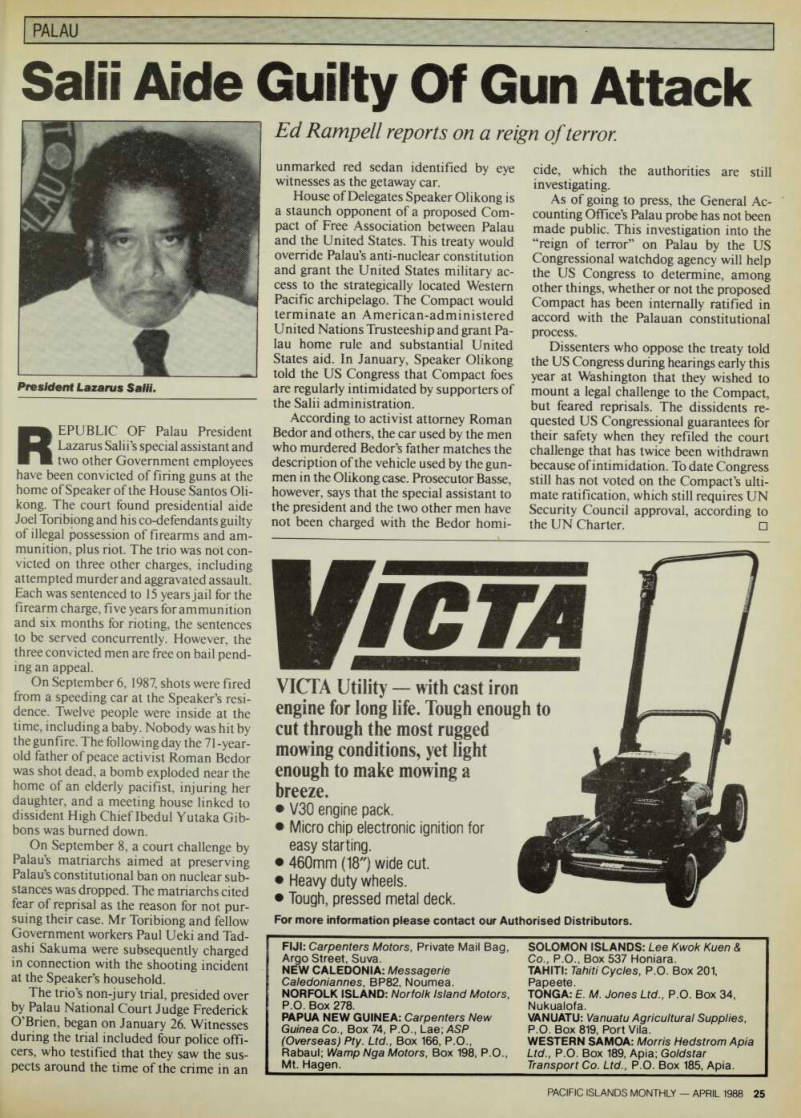
Palau
REPUBLIC OF Palau President Lazarus Salii’s special assistant and two other Government employees have been convicted of firing guns at the home of Speaker of the House Santos Oli kong. The court found presidential aide Joel Toribiong and his co-defendants guilty of illegal possession of firearms and am munition, plus riot. The trio was not con victed on three other charges, including attempted murder and aggravated assault.
Each was sentenced to 15 years jail for the firearm charge, five years for ammunition and six months for rioting, the sentences to be served concurrently. However, the three convicted men are free on bail pend ing an appeal.
On September 6, 1987, shots were fired from a speeding car at the Speaker’s resi dence. Twelve people were inside at the time, including a baby. Nobody was hit by the gunfire. The following day the 71 -year old father of peace activist Roman Bedor was shot dead, a bomb exploded near the home of an elderly pacifist, injuring her daughter, and a meeting house linked to dissident High Chief Ibedul Yutaka Gib bons was burned down.
On September 8, a court challenge by Palau’s matriarchs aimed at preserving Palau’s constitutional ban on nuclear sub stances was dropped. The matriarchs cited fear of reprisal as the reason for not pur suing their case. Mr Toribiong and fellow Government workers Paul Ueki and Tad ashi Sakuma were subsequently charged in connection with the shooting incident at the Speaker’s household.
The trio’s non-jury trial, presided over by Palau National Court Judge Frederick O’Brien, began on January 26. Witnesses during the trial included four police offi cers, who testified that they saw the sus pects around the time of the crime in an
Ed Rampell reports on a reign of terror.
unmarked red sedan identified by eye witnesses as the getaway car.
House of Delegates Speaker Olikong is a staunch opponent of a proposed Com pact of Free Association between Palau and the United States. This treaty would override Palau’s anti-nuclear constitution and grant the United States military ac cess to the strategically located Western Pacific archipelago. The Compact would terminate an American-administered United Nations Trusteeship and grant Pa lau home rule and substantial United States aid. In January, Speaker Olikong told the US Congress that Compact foes are regularly intimidated by supporters of the Salii administration.
According to activist attorney Roman Bedor and others, the car used by the men who murdered Bedor’s father matches the description of the vehicle used by the gun men in the Olikong case. Prosecutor Basse, however, says that the special assistant to the president and the two other men have not been charged with the Bedor homi
cide, which the authorities are still investigating.
As of going to press, the General Ac counting Office’s Palau probe has not been made public. This investigation into the “reign of terror” on Palau by the US Congressional watchdog agency will help the US Congress to determine, among other things, whether or not the proposed Compact has been internally ratified in accord with the Palauan constitutional process.
Dissenters who oppose the treaty told the US Congress during hearings early this year at Washington that they wished to mount a legal challenge to the Compact, but feared reprisals. The dissidents re quested US Congressional guarantees for their safety when they refiled the court challenge that has twice been withdrawn because of intimidation. To date Congress still has not voted on the Compact’s ulti mate ratification, which still requires UN Security Council approval, according to the UN Charter. □
President Lazarus Salii.
Advertisements & other items, p. 25 (1 item)
|fjCTA
VICTA Utility with cast iron engine for long life. Tough enough to cut through the most rugged mowing conditions, yet light enough to make mowing a breeze. • V3O engine pack. • Micro chip electronic ignition for easy starting. • 460 mm (18") wide cut. • Heavy duty wheels. • Tough, pressed metal deck.
For more information please contact our Authorised Distributors
FIJI; Carpenters Motors, Private Mail Bag, Argo Street, Suva.
NEW CALEDONIA: Messagerie Caledoniannes, BPB2, Noumea.
NORFOLK ISLAND: Norfolk Island Motors, P.O. Box 278.
PAPUA NEW GUINEA: Carpenters New Guinea Co., Box 74, P. 0., Lae; ASP (Overseas) Pty. Ltd., Box 166, P. 0., Rabaul; Wamp Nga Motors, Box 198, P. 0., Mt. Hagen.
SOLOMON ISLANDS: Lee Kwok Kuen & Co., P. 0., Box 537 Honiara.
TAHITI: Tahiti Cycles, P.O. Box 201, Papeete.
TONGA: E. M. Jones Ltd., P.O. Box 34, Nukualofa.
VANUATU: Vanuatu Agricultural Supplies, P.O. Box 819, Port Vila.
WESTERN SAMOA: Morris Hedstrom Apia Ltd., P.O. Box 189, Apia; Goldstar Transport Co. Ltd., P.O. Box 185, Apia.
First Contact Under Fire
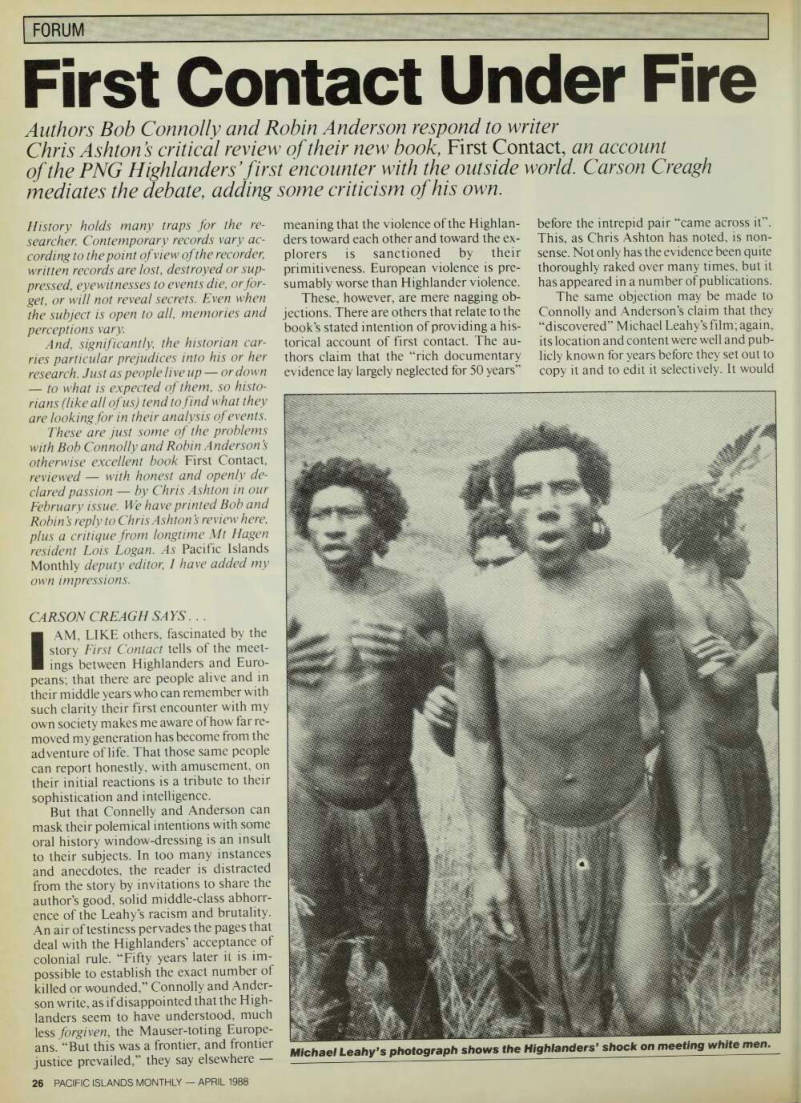
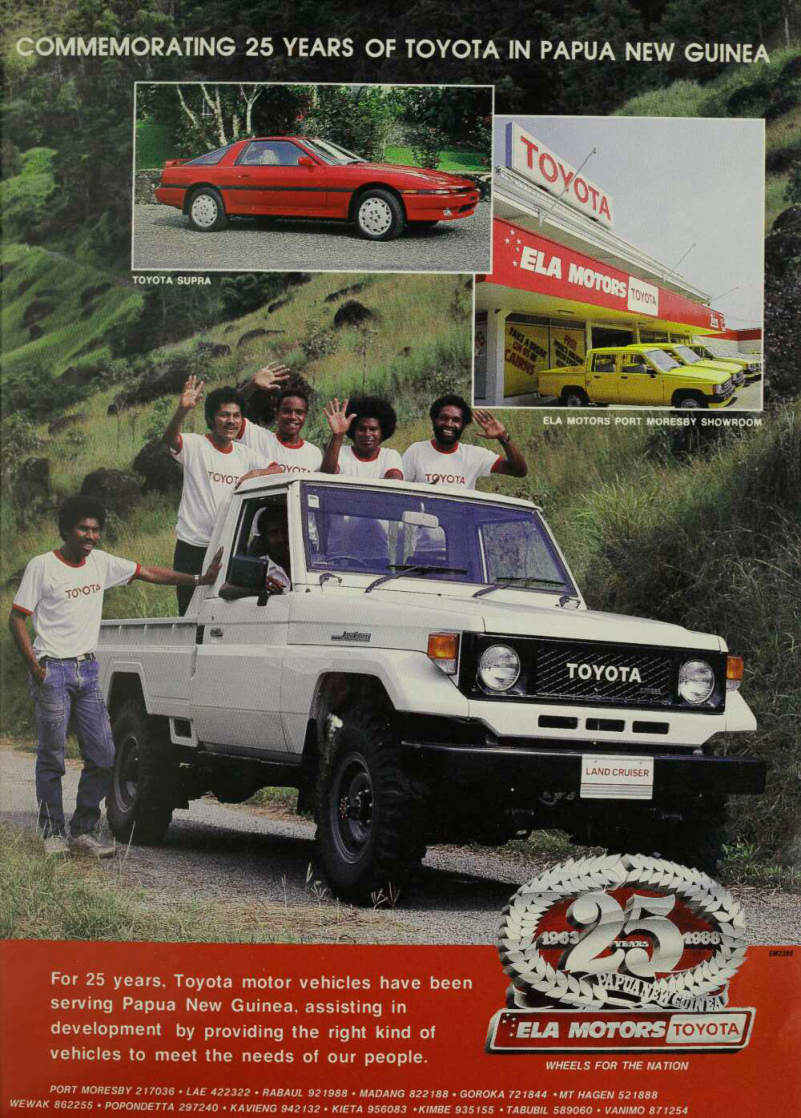
Forum
Authors Bob Connolly and Robin Anderson respond to writer Chris Ashton’s critical review of their new book, First Contact, an account of the PNG Highlanders’first encounter with the outside world. Carson Creagh mediates the debate, adding some criticism of his own.
History holds many traps for the re searcher. Contemporary records vary ac cording to the point of view ofthe recorder, written records are lost, destroyed or sup pressed, eyewitnesses to events die, or for get, or will not reveal secrets. Even when the subject is open to all, memories and perceptions vary.
And, significantly, the historian car ries particular prejudices into his or her research. Just as people live up or down to what is expected of them, so histo rians (like all of us) tend to find what they are looking for in their analysis of events.
These are just some of the problems with Bob Connolly and Robin Anderson’s otherwise excellent book First Contact, reviewed with honest and openly de clared passion by Chris Ashton in our February issue. We have printed Bob and Robin s reply to Chris Ashton s review here, plus a critique from longtime Mt Hagen resident Lois Logan. As Pacific Islands Monthly deputy editor, I have added my own impressions.
Carson Creagh Says. . .
I AM, LIKE others, fascinated by the story First Contact tells of the meet ings between Highlanders and Euro peans; that there are people alive and in their middle years who can remember with such clarity their first encounter with my own society makes me aware of how far re moved my generation has become from the adventure of life. That those same people can report honestly, with amusement, on their initial reactions is a tribute to their sophistication and intelligence.
But that Connelly and Anderson can mask their polemical intentions with some oral history window-dressing is an insult to their subjects. In too many instances and anecdotes, the reader is distracted from the story by invitations to share the author’s good, solid middle-class abhorr ence of the Leahy’s racism and brutality.
An air of testiness pervades the pages that deal with the Highlanders’ acceptance of colonial rule. “Fifty years later it is im possible to establish the exact number of killed or wounded,” Connolly and Ander son write, as if disappointed that the High landers seem to have understood, much less forgiven , the Mauser-toting Europe ans. “But this was a frontier, and frontier justice prevailed,” they say elsewhere
meaning that the violence of the Highlanders toward each other and toward the explorers is sanctioned by their primitiveness. European violence is presumably worse than Highlander violence, These, however, are mere nagging objections. There are others that relate to the book’s stated intention of providing a hislorical account of first contact. The authors claim that the “rich documentary evidence lay largely neglected for 50 years”
before the intrepid pair “came across it”, This, as Chris Ashton has noted, is non sense. Not only has the evidence been quite thoroughly raked over many times, but it has appeared in a number of publications.
The same objection may be made to Connolly and Anderson’s claim that they “discovered” Michael Leahy’s film; again, its location and content were well and pub licly known for years before they set out to copy it and to edit it selectively. It would
Michael Leahy’s photograph shows the Highlanders' shock on meeting while men.
appear the same process has “enhanced” their book ... in which case it can make no claim to be history.
The book’s analysis of events and their broader meaning is selective at best and downright shoddy at worst. Certainly the young women “married” to the Aus tralians were, in part, a sacrifice by their fellow tribespeople. But they were also power-brokers of considerable influence, which is of far greater importance as far as the Highlanders are concerned. They, un fettered by fashionable racial guilt, real ised the potential for economic and political profit that lay in what was always perceived to be a liaison of convenience with the explorers, and utilised it for its advantages of shell wealth, steel and sim ple social cachet as if to demonstrate to rival and enemy clans that “we” are on such good terms with the white men that they will buy our women. What better way of keeping up with the Joneses than by marrying them?
Errors of omission compound the problems. James Lindsay Taylor, one of the most formidable from an intellectual as well as historical point of view figures in the exploration and administration of PNG, is given scant attention. Yet his life, his philosophy and his actions contradict the authors’ central tenet that all Europe ans were rapacious black haters who could kill anyone who stood in their way.
This is offensive as much for its inac curacy as for its implicit insult to Taylor.
He was certainly of a different stamp from the Leahys; he was an administrator, not a prospector, so his motives were more disinterested. He was a sensitive, roman tic man whose identification with the people he helped govern was so complete he married a Wahgi woman.
He did not, however, see the people of the Highlands as some prelapsarian ideal of humanity. He recognised their weak nesses as well as their strengths, their ag gressive and politicised society. And he was a European, far from home and with few other Europeans for company. Natu rally he would be sympathetic to the actions of his countrymen simply because he could understand the whole unspoken, unseen basis for their actions. Would a co lonialist Highlander have acted any dif ferently if he were a patrol officer in Australia? Connolly and Anderson are not interested in such idle speculation; with a true Calvinist’s appetite for fallibility, they point out the forest and ignore the trees.
One final point should be made. Mi chael, Dan, Jim and Patrick Leahy, James Taylor and their fellows were entering adulthood when their fathers’ generation returned from the bloody savagery of World War I. They themselves were facing what was to become The Great Depres sion. They cannot be expected to have shared the perceptions of the 1980 s, and by looking down on them for being men of their time the authors are inviting the same fate from future readers of First Contact.
808 Connolly And
Robin Anderson Say . . .
CHRIS Ashton, in his review of our book First Contact, says we were “spot on” in our assessment of Mi chael Leahy. Not everyone agrees. Leahy’s family was extremely annoyed that cer tain information was revealed that other writers Ashton among them had in the past chosen to ignore. The family re sponse underlines the difficulties writers can sometimes face when dealing with near-contemporary historical events and personalities.
“Ashton’s review was so completely uninformed we were left wondering if he had muddled his time and place.”
The latter part of Ashton’s review un wittingly illustrates these difficulties, which seem particularly to apply when the subject in question is Australia’s colonial role in PNG. Many Australians Ashton among them lived and worked there, and so have a vested interest, naturally, in what is written about the place: a bias, if you like. They are capable of reacting with hostility when newcomers stray into “their” patch, particularly when the writ ing attempts to be analytical of what Aus tralians did there rather than merely celebratory. This antipathy can border on the hilarious, as in the PNG “old hand” who stated the reason some academics wrote critically of our stewardship in PNG was that they were jealous about missing out on the fun of being there!
Ashton’s review places him securely in this myopic camp. Thus when we attempt, as a backdrop to the story of contact in the Highlands, to present an analysis of Aus tralia’s wider role in prewar New Guinea as opposed to merely celebrating it, Ash ton labels us “urban liberals”, driven to overcompensate for our guilty cringe over the sins of “white supremacy”. When we describe pre-contact Highlands culture as vigorous and viable (hardly an unreason able proposition) Ashton has us describ ing it as “almost Arcadian”, which it manifestly wasn’t. When we suggest the colonial period was a mixed blessing again hardly a revolutionary proposition Ashton has us describing it as “an un mitigated evil”, which again, it was not.
Ashton says our assessment of Aus tralian colonialism in prewar New Guinea
is “nonsense”, because we say it was largely exploitative. He says Australia put far more into New Guinea than it took out, which even a cursory look at, for example, the Bulolo Gold Dredging Company would reveal as nonsense. About a hundred tons of gold taken out and 10 per cent paid in royalties (most of which went back into the mining industry infrastructure); nothing much in it for the New Guineans.
But this is hardly original stuff. It was the usual colonial situation, which has been thoroughly documented and exam ined by a generation of distinguished scholars. Indeed, Ashton’s review was so completely uninformed we were left won dering whether for one reason or another he had muddled his time and place. Our book is predominantly about prewar New Guinea the League [of Nations] Man date. It is not about pre- or postwar Papua, and it touches lightly on Australia’s post war trusteeship of Papua and New Guinea.
The mandated Territory of New Guinea was a very different place from the colony of Papua, and Ashton might like to start his education by reading what Hubert Murray had to say about New Guinea be fore the war. He regarded it as a foreign country, with an administration domi nated by white business interests who ex ploited the place for all they were worth, despite the efforts of a handful of dedi cated and able government officers.
No well-informed student of this sub ject matter could seriously disagree with Murray today, just as no well-informed student would deny that Australia’s postwar record in Papua and New Guinea was a very different story; and one which, by and large, Australia has reason for look ing back on with a measure of pride.
We would suggest that Chris Ashton is the one who got out of his depth in this matter, not us.
Lois Logan Says. . .
I WISH to make some comments about First Contact, and have the first-hand knowledge to be able to do so, as I lived in the Western Highlands Province of Papua New Guinea from 1970 to 1985, know the area well, know Danny Leahy and his sons, know most of the Hagen people who are represented in the book, and know Joh and Clem Leahy very well.
I have a basic knowledge of the local dia lect, and worked in the newspaper busi ness in Hagen before joining the staff of the then Premier Nambuga Mara OBE as his assistant.
I saw Bob Connolly and Robin Ander son making the movie First Contact, which we watched at George Leahy’s and later at Joh Leahy’s coffee shed, in 1984.1 knew the book would be forthcoming, and that Connolly and Anderson were plan ning a second film. I have eagerly awaited both of them.
Continued on page 50
Fi r st Contact (the book) is disappoint ing, and hardly likely to be a bestseller ex cept among that small audience familiar with the Western Highlands of Papua New Guinea and its recent history.
The Leahy brothers, the late James Taylor and the Hagen people themselves experienced a shifting of their lives in 1933 when they met. The massive impact of first contact and its aftermath does not per vade the book: contact that was the very first meeting between a sophisticated and diverse stone age culture and an arguably less sophisticated Caucasian influence is not portrayed effectively; precious records in the form of movie film and still pho tographs by Mick Leahy create little, if any, impression.
The book also errs, for example, by not explaining the naming of some of the Papua New Guinea people in the book.
This has, in some cases, been done in a specific way, but meaning is lost because the naming process is not explained by the authors. It appears as if people have mas sive names when in fact their representa tive clan name has also been mentioned. (This style of naming is only used by clans around Mount Hagen and does not apply to the naming of Papua New Guineans from other areas such as from around Go-
roka. To make matters worse, nowhere in the book is any explanation of pronunci ation given about names.) One example of the naming process is Ndika Opramb Rumint, on Page 107.
Ndika (pronounced Jika or Jiga) repre sents the (Ndika) Jiga clan; Opramb Rum int (pronunciation Roomint) is his name.
Similarly, on Page 108, Mokei Nambuka (Sir) Wamp Wan should be divided as Mokei (Mogei): Nambuka (pronounced Nam-boo-ga); is the sub-clan. Wamp Wan, the name, when translated from the Melpa language means Wamp = man, wan - top or leader. Sir Wamp Wan was honoured with a CBE in 1981/1982.
Because there is no explanation of
names as such, the significance of the names and tribal affiliations is lost. Yet it was that incessant inter- and intra-tribal competition and conflict in which the Leahys and Taylor unwittingly found themselves. To the Hagens (the Yamugas, the Jigas and the Mogeis), once the white men had been perceived as “friendly spir its”, a tremendous competition took place between and within clans to see which clan or sub-clan could win their favour. This happened because the white men were perceived as having supernatural powers and were believed to bring added strength or prestige to the clan that “won” them.
Leahy and Taylor were oblivious to these undercurrents; when they moved from one site to another, the Hagen people would have perceived such a move as being a shift in favouritism from one clan to an other, and jealousies and tribal repercus sions would have resulted. First Contact makes no attempt to cover those aspects, with the result that it lacks depth and substance.
Other inaccuracies occur when Mick Leahy’s son is referred to as Joe, when his name is Johannes and he has always been known as Jo, or Joh.
Inaccurate and vague details occur in many places throughout First Contact; I can only express the disappointment I felt at such excellent material being treated with less dynamism and less accuracy than the subject warrants. □
Mlcheal Leahy In Wabag, 1934.
Pacific Report
□ Shelled Out
THIEVES ON the Gazelle Peninsula of Papua New Guinea raided a woman’s house and stole more than SASOOO worth of traditional shell money.
□ Fiji Court Backlog
THE FIJI Government announced amendments to the country’s criminal procedure code, with the aim of reducing a backlog of more than 140 cases pending in the High Court.
□ Vanuatu Airport Upgrade
AUSTRALIA is to fund the upgrading of 10 of Vanuatu’s 26 airfields. The work, which will involve hardening the runway surfaces and putting in drainage, is ex pected to cost more than SAI million.
□ Nz’S Fiji Edict
NEW ZEALAND’S High Court ordered the New Zealand Government to say whether it recognised the Fiji Govern ment. The order was made by Mr Justice Quilliam, who is hearing a case in which the Fiji High Commission in Wellington is fighting eviction from the premises it currently occupies.
□ Kiribati In Canberra
A DELEGATION from Kiribati held talks in Canberra on ways in which Australia could help the country’s industrial devel opment plans. The delegation was led by the Kiribati Minister for Trade, Industry and Labour, Mr Raion Bataroma.
□ Tate In Fiji
AUSTRALIA’S Justice Minister, Senator Tate, was the first Australian Government Minister to go to Fiji since the military coups when he visited there as part of a tour of Southeast Asia and the Pacific.
□ W Samoa’S Games Squad
WESTERN SAMOA announced plans to send 20 athletes and officials to this year’s Olympic Games in the South Korean cap ital, Seoul.
□ Second Boat On Png Patrol
PAPUA NEW Guinea’s Defence Force re ceived a second patrol boat from Australia under the two countries’ defence co-op eration program. The Pacific Class patrol boat, Dreger, joined its sister boat, Tar angau, in patrolling Papua New Guinea’s coastal economic zone.
□ Aussie Medics Return
THREE AUSTRALIAN doctors resumed work in Fiji’s two major hospitals in Suva and Lautoka under an Australian aid pro gram. Their return follows the resumption of Australian aid to Fiji.
□ Png Pay Reviewed
THE PARLIAMENTARY Salaries Tri bunal in PNG began a major review of the salaries and allowances of national parliamentarians.
□ Tv Crew Deported
A BRITISH television crew was deported from Papua New Guinea on orders from the Foreign Minister, Mr Akoka Doi. The crew had been accused by local newspa pers of using a script with references to cannibalism.
□ Gendarmes Under Fire
IN NEW Caledonia, police detained a Melanesian after shots were fired at par amilitary gendarmes south of Noumea.
Two gendarme patrols came under fire near the Melanesian village of Saint-Louis, but no one was hurt.
□ Png Uni Boost
PNG PM Mr Wingti said he would forgo buying a new executive aircraft and that some of the money saved would go to pro viding funds for university scholarships.
University students at three campuses had boycotted classes over a Government de cision to axe the scholarships for mature age students.
□ Racial Strife In Fiji
SECURITY FORCES in Fiji mounted guard on an Indian settlement, following an outbreak of violence between Fijians and Indians in Viti Levu.
□ Ok Tedi Reopened
THE OK TEDI mine in Papua New Guin ea’s Western Province was reopened fol
lowing Government intervention, after angry landowners had closed it down. The landowners, the Oksapmin people, were angered by the recent death of a clansman and chopped down trees, blocking access roads to the mine site and damaging some property.
□ Security Conference
DELEGATES FROM 14 South Pacific is land nations held discussions in Suva on regional security. The delegates identified a wide range of political, military, eco nomic and other issues affecting regional security.
□ Christian Radio For Tonga
KING TUPOU of Tonga has granted AM and FM broadcasting licences to United Christian Broadcasters Pacific Ltd, an Auckland based non-denominational, non-profit Christian organisation.
□ Marshall In Paris
THE NEW Zealand Foreign Minister, Russell Marshall, visited Paris for talks with French officials aimed at forging bet ter relations between the two countries. Mr Marshall met his French counterpart, Mr Jean-Bemard Raimond, and the Foreign Trade Minister, Mr Michel Noir.
□ Visa Fraud
A WOMAN was jailed for 15 months in Fiji for taking $ Al4OO from two women after promising them Australian visas. It was the second such conviction in Suva recently.
□ Png Typhoid Alert
Typhoid is on the increase in Port Mo resby. Cases have risen from an average of between two and five per month to 23 per month so far this year. The increase is due to a damaged and inadequate sewerage system, and the lack of a good water sup ply to many parts of the city.
□ Labour Policy Mission
A MISSION with the task ofimproving la bour policies will begin a tour of six South Pacific nations later this year. Senior government officials from Australia, New Zealand and six smaller South Pacific countries will visit the Cook Islands, Kir ibati, Solomon Islands, Western Samoa, Vanuatu and Tonga.
□ Png Jails Slammed
A UNITED Nations consultant reported that PNG jails lack the most basic security and that mass breakouts are inevitable unless immediate changes are made. □
Advertisements & other items, pp. 28-31 (1 item)
Aggie Grey's
Hotel
Stay at Aggie Grey’s
the South Pacific’s
legendary hotel.
Situated right in the heart of Western Samoa. Enjoy Polynesian style friendliness and service,in cool surroundings, superb entertainment and food. Magnificent white sand beaches only a short drive away.
Air-conditioned rooms, swimming pool and full bar facilities.
Bookings through Union Steamship Company of NZ, Pan Am, Air New Zealand or direct to Aggie Grey’s, Apia, Western Samoa. Cables; AGGIES’ Apia.
COMMEMORATING 25 YEARS OF TOYOTA IN PAPUA NEW GUINEA : \M / W\\X • ■.tf % . z * *
TOYOTA SUPRA
r- It •U \ J V ELA MOTORs PORT MORESBY SHOWROOM *mr3St V.
TOYOTA
> y 3d
• IVL*
For 25 years, Toyota motor vehicles have been
serving Papua New Guinea, assisting in
development by providing the right kind of vehicles to meet the needs of our people.
WHEELS FOR THE NATION
PORT MORESBY 217036 • LAE 422322 • RABAUL 921988 • MADANG 822188 • GOROKA 721844 •MT HAGEN 521888 WEWAK 862255 • POPONDETTA 297240 • KAVIENG 942132 • KIETA 956083 •KIMBE 935155 • TABUBIL 589060 • VANIMO 871254
Road-Hugging, Rock-Riling, Pa
\ a£ 1 J p A %r Jo*** m ■ > HILUX 4WD Regular Cab, Long Wheelbase One tough truck just got tougher. Toyota’s dedication to superio performance vehicles takes a step forward today with the New Hilu:i A refined front grille and bumper design, new instrument panel for a feeling of spaciousness and command and plush colour co-ordinated trim are a few new additions to the New Hilux.
And extensive anti-corrosive galvanealed steel protection now includes the tailgate panel and rear door panel, making Hilux more durable than ever before.
Yet for all its improvements, the best of the original Hilux is als? - AMERICAN SAMOA: BURNS PHILP (SOUTH SEA) CO., LTD., P.O. Box 129, Pago Pago. COOK ISLANDS: COOK I L Jz /I AUTOMOTIVE SUPPLIES COMPANY, A Division of Burns Philp (South Sea) Co., Ltd., G.P.O. Box 355, AM Tamuning, KIRIBATI: TARAWA MOTORS, A Division of Bairiki Holdings Ltd., P.O. Box 36, BamkiTarawa. NAURU: NAtt El S a m SERVICE IMPORTATION AUTOMOBILE DU PACIFIQUE, Rond-Point du Pacifique (Station Total) B.P. 438, Noumea. NIUE3 NORFOLK ISLAND: BORRY’S LIMITED, P.O. Box 169. PAPUA NEW GUINEA: ELA MOTORS, A Division of Burns P CORPORATION, P.O. Box 267, Saipan. SOLOMON ISLANDS: SOLOMON ISLANDS INVESTMENTS LTD., G.P.O. Box l ‘ TONGA: BURNS PHILP (TONGA) LTD., P.O. Box 55, Nukualofa. VANUATU: VANUATU MOTORS, A Division of Burns PH
QUALITY SERVICE
ific-Tough. The New Hllim.
at V * *w»
IKr *
« V ■ i y ■» u * l * 'V n •I K 3re: a big tailgate conveniently hinged for quick loading and unloading; reinforced front suspension to smooth out ie bumps, and bias-mounted, extra-heavy-duty rear shocks and knobbly tyres to take on any terrain.
Toyota’s long history of super-responsive engines, ruggedness, reliability and comfort goes without saying. And in the Hilux, it’s yours in both 2-wheel-drive and 4x4 versions.
So, after comprehensive testing and thorough quality control, the New Hilux is ready to bring a new standard of toughness to the Pacific.
Areas where galvanealed steel is used And isn’t that exactly what yOU expect from Toyota?
DING CORPORATION LTD., Private Bag, Rarotonga. FIJI: »IA: ATKINS KROLL, INC., 443 South Marine Drive,
ERATIVE SOCIETY, Central Pacific. NEW CALEDONIA*
HILP (SOUTH SEA) CO., LTD., P.O. Box 39, Alofi.
Ltd., P.O. Box 75, Port Moresby. SAIPAN: MICROL
TAHITI; NIPPON AUTOMOTO, B.P. 342 Papeete
u) Ltd., P.O. Box 18, Port Vila. WESTERN SAMOA:
TOYOTA
Ela Motors Wheels For The Nation
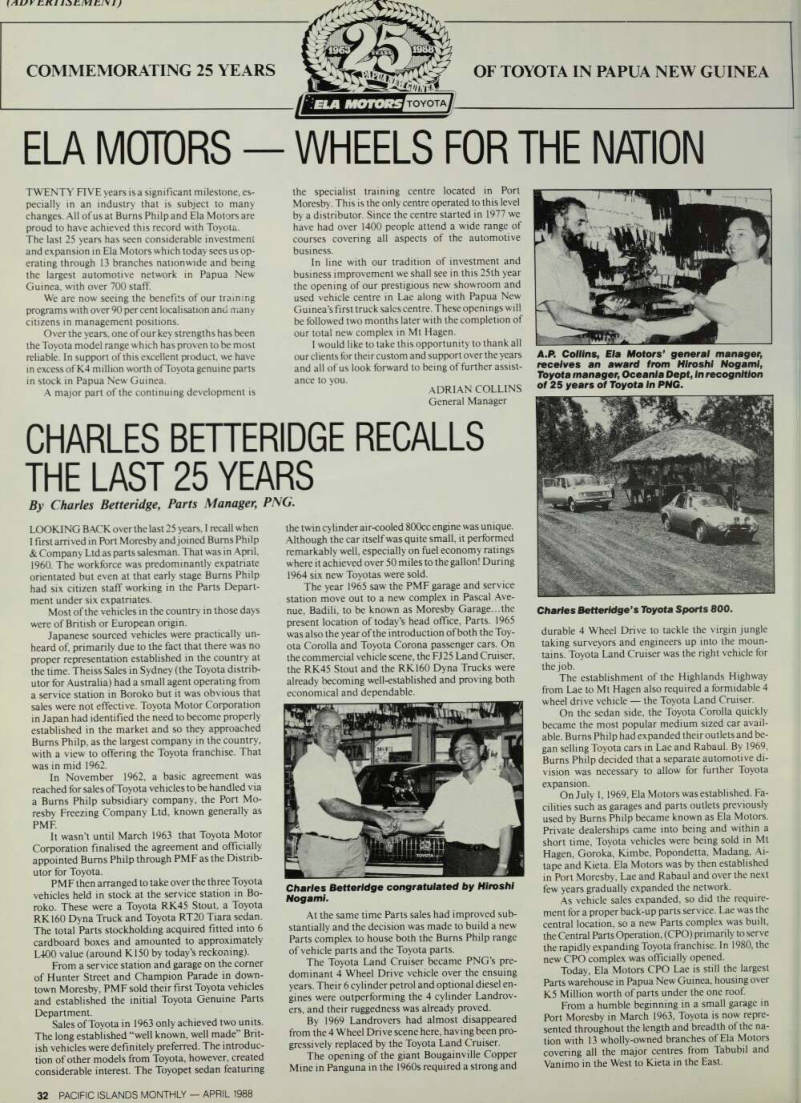
Commemorating 25 Years
Of Toyota In Papua New Guinea
[slUr Cl\l hjCLIYILLiy 1)
TWENTY FIVE years is a significant milestone, es pecially in an industry that is subject to many changes. All of us at Bums Philp and Ela Motors are proud to have achieved this record with Toyota.
The last 25 years has seen considerable investment and expansion in Ela Motors which today sees us op erating through 13 branches nationwide and being the largest automotive network in Papua New Guinea, with over 700 staff.
We are now seeing the benefits of our training programs with over 90 per cent localisation and many citizens in management positions.
Over the years, one of our key strengths has been the Toyota model range which has proven to be most reliable. In support of this excellent product, we have in excess of K 4 million worth of Toyota genuine parts in stock in Papua New Guinea.
A major part of the continuing development is
the specialist training centre located in Port Moresby. This is the only centre operated to this level by a distributor. Since the centre started in 1977 we have had over 1400 people attend a wide range of courses covering all aspects of the automotive business.
In line with our tradition of investment and business improvement we shall see in this 25th year the opening of our prestigious new showroom and used vehicle centre in Lae along with Papua New Guinea’s first truck sales centre. These openings will be followed two months later with the completion of our total new complex in Mt Hagen.
I would like to take this opportunity to thank all our clients for their custom and support over the years and all of us look forward to being of further assist
ance to you.
Adrian Collins
General Manager
Charles Betteridge Recalls
The Last 25 Years
By Charles Betteridge, Parts Manager, PNG.
LOOKING BACK over the last 25 years, I recall when I first arrived in Port Moresby and joined Bums Philp & Company Ltd as parts salesman. That was in April, 1960. The workforce was predominantly expatriate orientated but even at that early stage Bums Philp had six citizen staff working in the Parts Depart ment under six expatriates.
Most of the vehicles in the country in those days were of British or European origin.
Japanese sourced vehicles were practically un heard of, primarily due to the fact that there was no proper representation established in the country at the time. Theiss Sales in Sydney (the Toyota distrib utor for Australia) had a small agent operating from a service station in Boroko but it was obvious that sales were not effective. Toyota Motor Corporation in Japan had identified the need to become properly established in the market and so they approached Bums Philp, as the largest company in the country, with a view to offering the Toyota franchise. That was in mid 1962.
In November 1962, a basic agreement was reached for sales of Toyota vehicles to be handled via a Bums Philp subsidiary company, the Port Mo resby Freezing Company Ltd, known generally as
Pmf.
It wasn’t until March 1963 that Toyota Motor Corporation finalised the agreement and officially appointed Bums Philp through PMF as the Distrib utor for Toyota.
PMF then arranged to take over the three Toyota vehicles held in stock at the service station in Bo roko. These were a Toyota RK4S Stout, a Toyota RKI6O Dyna Truck and Toyota RT2O Tiara sedan.
The total Parts stockholding acquired fitted into 6 cardboard boxes and amounted to approximately L4OO value (around Kl5O by today’s reckoning).
From a service station and garage on the comer of Hunter Street and Champion Parade in down town Moresby, PMF sold their first Toyota vehicles and established the initial Toyota Genuine Parts Department.
Sales of Toyota in 1963 only achieved two units.
The long established “well known, well made” Brit ish vehicles were definitely preferred. The introduc tion of other models from Toyota, however, created considerable interest. The Toyopet sedan featuring
the twin cylinder air-cooled 800 cc engine was unique.
Although the car itself was quite small, it performed remarkably well, especially on fuel economy ratings where it achieved over 50 miles to the gallon! During 1964 six new Toyotas were sold.
The year 1965 saw the PMF garage and service station move out to a new complex in Pascal Ave nue, Badili, to be known as Moresby Garage...the present location of today’s head office, Parts. 1965 was also the year of the introduction of both the Toy ota Corolla and Toyota Corona passenger cars. On the commercial vehicle scene, the FJ2S Land Cruiser, the RK4S Stout and the RKI6O Dyna Trucks were already becoming well-established and proving both economical and dependable.
At the same time Parts sales had improved sub stantially and the decision was made to build a new Parts complex to house both the Bums Philp range of vehicle parts and the Toyota parts.
The Toyota Land Cruiser became PNG’s pre dominant 4 Wheel Drive vehicle over the ensuing years. Their 6 cylinder petrol and optional diesel en gines were outperforming the 4 cylinder Landrov ers, and their ruggedness was already proved.
By 1969 Landrovers had almost disappeared from the 4 Wheel Drive scene here, having been pro gressively replaced by the Toyota Land Cruiser.
The opening of the giant Bougainville Copper Mine in Panguna in the 1960 s required a strong and
durable 4 Wheel Drive to tackle the virgin jungle taking surveyors and engineers up into the moun tains. Toyota Land Cruiser was the right vehicle for the job.
The establishment of the Highlands Highway from Lae to Mt Hagen also required a formidable 4 wheel drive vehicle the Toyota Land Cruiser.
On the sedan side, the Toyota Corolla quickly became the most popular medium sized car avail able. Burns Philp had expanded their outlets and be gan selling Toyota cars in Lae and Rabaul. By 1969, Bums Philp decided that a separate automotive di vision was necessary to allow for further Toyota expansion.
On July 1,1969, Ela Motors was established. Fa cilities such as garages and parts outlets previously used by Bums Philp became known as Ela Motors.
Private dealerships came into being and within a short time, Toyota vehicles were being sold in Mt Hagen, Goroka, Kimbe, Popondetta, Madang, Ai tape and Kieta. Ela Motors was by then established in Port Moresby, Lae and Rabaul and over the next few years gradually expanded the network.
As vehicle sales expanded, so did the require ment for a proper back-up parts service. Lae was the central location, so a new Parts complex was built, the Central Parts Operation, (CPO) primarily to serve the rapidly expanding Toyota franchise. In 1980, the new CPO complex was officially opened.
Today, Ela Motors CPO Lae is still the largest Parts warehouse in Papua New Guinea, housing over K 5 Million worth of parts under the one roof.
From a humble beginning in a small garage in Port Moresby in March 1963, Toyota is now repre sented throughout the length and breadth of the na tion with 13 wholly-owned branches of Ela Motors covering all the major centres from Tabubil and Vanimo in the West to Kieta in the East.
Charles Betieridge congratulated by Hiroshi Nogami.
A.P. Collins, Ela Motors’ general manager, receives an award from Hiroshi Nogami, Toyota manager, Oceania Dept, In recognition of 25 years of Toyota in PNG.
Charles Betteridge’s Toyota Sports 800.
Advertisements & other items, p. 33 (1 item)
Add the finishing touches
Shelf Component Systems
w 3 y
to your fantasy, ..
The dream comes true with NEW PERSONNA PLUS shelf-size component systems, and the model X-550R —a sound system more than brimming with high fidelity, and feature-packed!
In fact, boasting a full 350 W of high-power (PMPO) output, the X-550R delivers the convenience of remote control for amp tuner, deck, turntable*, and an optional CD player, plus a 5-band graphic equalizer for frequency distribution adjustments —and still there’s more!
Like sensational Surround Sound for rich, ambient sound, and the beauty of Stereo Wide, for extended stereo effects.
Then there’s a Double Auto-Reverse Cassette Deck with Deck I-n relay play for continuous auto-reverse playback, plus synchrorecording for Deck I-n tape duplication, to say nothing of great features like normal/high-speed copy, Music Search, and Dolby* B Noise Reduction.
Still, there’s more to the X-550R than this, and more to NEW PLUS than the system X-550 R—like the X-880R, with 440 W of high power (PMPO), and the X-220, with 270 W (PMPO), P°' n t' s that 'f is the beauty of pure sound and NEW PERSONNA PLUS that lets your imagination take flight!
X-550R only ‘“Dolby” and the double-D symbol are trademarks of Dolby Licensing Corporation.
NOTE: The PD-XBB CD player and S-XIA “surround sound” system are included in the photograph, but both are options.
Laboratories rear-speaker
CD PIONEER
The future of sound and vision.
For further information, please contact: S, L alia ; o F l o ?f er Electronics Australia Pty. Ltd. (Incorporated in Victoria), P.O. Box 295, Mordialloc, Victoria, 3195 Tel: 580-9911 Fiji Islands: Bnjlal & Company, G.P.O. Box No. 362, Suva, Fiji Islands Tel: 22258 New Zea and: Monaco Distributors Ltd, 41 Poland Road, Glenfield, Auckland, New Zealand Tel: (09) 444-9144 Norfolk Island: Burnt Pine Traders Ltd, P.O. Box 21, Norfolk Island Vanuatu: Burns Philp (Vanuatu) Ltd, Vila, Vanuatu Nauru Island; Jacob Enterprises, P.O. Box N 0.4, Republic of Nauru Tahiti: Tahiti Hi-Fi, P.O. Box 848, Papeete, Tahiti New Caledonia: Menard Pacifique Sari, B.P. 3899, Noumea, New Caledonia Tel: 27.62*23 American Samoa: Transpac Corporation, P.O. Box 1477, Pago Pago American Samoa 96799 Tel: 633-5224 Rarotonga: South Seas International Ltd, P.O. Box 49, Rarotonga, Cook Islands Tel; 2327
Taking Care Of Business
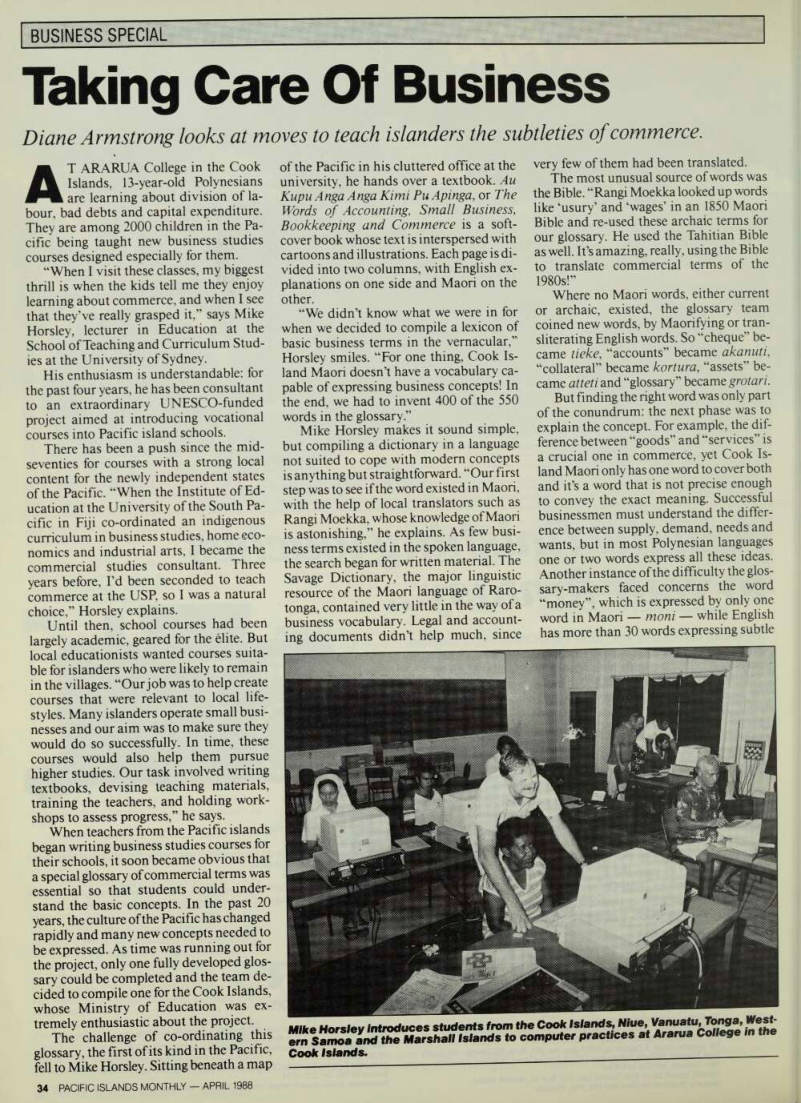
Business Special
Diane Armstrong looks at moves to teach islanders the subtleties of commerce
AT ARARUA College in the Cook Islands, 13-year-old Polynesians are learning about division of la bour, bad debts and capital expenditure.
They are among 2000 children in the Pa cific being taught new business studies courses designed especially for them.
“When I visit these classes, my biggest thrill is when the kids tell me they enjoy learning about commerce, and when I see that they’ve really grasped it,” says Mike Horsley, lecturer in Education at the School of Teaching and Curriculum Stud ies at the University of Sydney.
His enthusiasm is understandable: for the past four years, he has been consultant to an extraordinary UNESCO-funded project aimed at introducing vocational courses into Pacific island schools.
There has been a push since the mid seventies for courses with a strong local content for the newly independent slates of the Pacific. “When the Institute of Ed ucation at the University of the South Pa cific in Fiji co-ordinated an indigenous curriculum in business studies, home eco nomics and industrial arts, I became the commercial studies consultant. Three years before, I’d been seconded to teach commerce at the USP, so I was a natural choice,” Horsley explains.
Until then, school courses had been largely academic, geared for the elite. But local educationists wanted courses suita ble for islanders who were likely to remain in the villages. “Our job was to help create courses that were relevant to local life styles. Many islanders operate small busi nesses and our aim was to make sure they would do so successfully. In time, these courses would also help them pursue higher studies. Our task involved writing textbooks, devising leaching materials, training the teachers, and holding work shops to assess progress,” he says.
When teachers from the Pacific islands began writing business studies courses for their schools, it soon became obvious that a special glossary of commercial terms was essential so that students could under stand the basic concepts. In the past 20 years, the culture of the Pacific has changed rapidly and many new concepts needed to be expressed. As time was running out for the project, only one fully developed glos sary could be completed and the team de cided to compile one for the Cook Islands, whose Ministry of Education was ex tremely enthusiastic about the project.
The challenge of co-ordinating this glossary, the first of its kind in the Pacific, fell to Mike Horsley. Sitting beneath a map
of the Pacific in his cluttered office at the university, he hands over a textbook. Au Kupu Anga Anga Kimi Pu Apinga, or The Words of Accounting, Small Business, Bookkeeping and Commerce is a softcover book whose text is interspersed with cartoons and illustrations. Each page is divided into two columns, with English explanations on one side and Maori on the other.
“We didn’t know what we were in for when we decided to compile a lexicon of basic business terms in the vernacular,”
Horsley smiles. “For one thing, Cook Island Maori doesn’t have a vocabulary capable of expressing business concepts! In the end, we had to invent 400 of the 550 words in the glossary.”
Mike Horsley makes it sound simple, but compiling a dictionary in a language not suited to cope with modern concepts is anything but straightforward. “Our first step was to see if the word existed in Maori, with the help of local translators such as Rangi Moekka, whose knowledge of Maori is astonishing,” he explains. As few business terms existed in the spoken language, the search began for written material. The Savage Dictionary, the major linguistic resource of the Maori language of Rarotonga, contained very little in the way of a business vocabulary. Legal and accounting documents didn’t help much, since
very few of them had been translated.
The most unusual source of words was the Bible. “Rangi Moekka looked up words like ‘usury’ and ‘wages’ in an 1850 Maori Bible and re-used these archaic terms for our glossary. He used the Tahitian Bible as well. It’s amazing, really, using the Bible to translate commercial terms of the 1980 s!”
Where no Maori words, either current or archaic, existed, the glossary team coined new words, by Maorifying or tran sliterating English words. So “cheque” be came tieke, “accounts” became akanuti, “collateral” became kortura, “assets” be came atteti and “glossary” became grotari.
But finding the right word was only part of the conundrum; the next phase was to explain the concept. For example, the dif ference between “goods” and “services” is a crucial one in commerce, yet Cook Is land Maori only has one word to cover both and it’s a word that is not precise enough to convey the exact meaning. Successful businessmen must understand the differ ence between supply, demand, needs and wants, but in most Polynesian languages one or two words express all these ideas.
Another instance of the difficulty the glos sary-makers faced concerns the word “money”, which is expressed by only one word in Maori moni while English has more than 30 words expressing subtle
Mike Horsley introduces students from the Cook Islands, Niue, Vanuatu, Tonga, West ern Samoa and the Marshall Islands to computer practices at Ararua Collegae in the Cook Islands.
shades of meaning. “In the Niue dialect, it took a whole page of text to explain the concept of capital,” Horsley recalls.
When the problems had been ironed out, the words coined and the concepts ex plained, the text had to be submitted for approval to the Ministry of Education. It wasn’t always accepted. “While we were working on the glossary, a turnover tax was introduced into the Cook Islands. After a lot of effort, the translators came up with a Maori translation whose connotation was of a boat capsizing. That analogy wasn’t very well received by the political leaders!” he laughs.
The glossary has had immediate prac tical results. It is now possible to keep rec ords in Maori, while bookkeeping had been difficult in the past simply because there were no words for column headings.
Translating commercial terms into Maori will help preserve the local language, by increasing its ability to express modern business concepts and thus make business education available to all Cook Islanders; not only those who speak English well.
The glossary is only one of the achieve ments of the UNESCO Vocational Curric ulum Program. In the process of creating three new courses, the project team pro duced 60 textbooks in home economics, industrial arts and business studies for 80 new classes. Classes in all three now exist in Niue, Vanuatu, Western Samoa, Tonga, Tuvalu and the Cook Islands, while the Solomon Islands, Tokelau, Kiribati and Nauru have classes in industrial arts and home economics. Some 28 syllabuses for upper primary and junior secondary classes have been designed and nine glos saries are being developed.
According to Mike Horsley, the most remarkable feature of the project was its totally Pacific character. “The project was flexible enough to allow each country to decide whether it needed more teacher training or more textbooks. Local priori ties determined how they adapted the pro ject. Vanuatu, for example, decided to make business studies part of other courses, while other countries decided to make it separate. All our decisions were reached by Pacific-style negotiation: until everyone agreed, no progress was made!”
Some chapters were common to all the textbooks, but the teachers who wrote them were able to put in specific material relevant to their own islands, so instead of being remote the books deal with specific local issues. Niue’s commerce textbook, for example, discusses how the local plumber runs his business and illustrates a lesson about government services with a story about the primary school teacher having an accident and going to the local hospital.
In structuring the courses, the project team kept in mind that they were aiming to help people succeed in their own com munities. “We didn’t want to impose a set of values alien to the local culture, but we had to get the students to look at what was going on around them and see how sue
cessful business people in their commu nities had combined the needs of their society with the demands of business methods,” Horsley says.
“We never lost sight of the need to rein force local culture and to make the chil dren see the value of their traditional way of doing things.”
There’s a story in the Niue textbook about two men shipwrecked on an unin habited island. Piri, the islander, survives by catching crabs, climbing palms for co conuts and using sticks to light a fire, while George Barnaby Shaw, the Englishman, is helpless. When a rescue boat finally ar rives, Piri is doing fine but all that’s left of the Englishman is a skeleton! Anecdotes like this were meant to relate to the chil dren’s lifestyles.
“My biggest thrill is when the kids tell me they enjoy learning about commerce, and when I see they’ve really grasped it”
Mike Horsley
Pacific attitudes to family and posses sions had to be considered when writing the texts. Not many commerce books list “relatives” as a cause of business failure, but the Cook Island glossary does! “Ac counting is certainly the produce of the First World way of thinking, and giving gifts is a cultural phenomenon,” says Hor sley, “but to make the students commer cially literate, we had to bring the issue into the open and make them think about it.
We wanted them to understand that while it’s perfectly okay to give away the profits, giving away the capital means losing your business.”
One of the most valuable results of this project was the creation of what Mike Horsley describes as “The Curriculum Family”. Because this whole project was based on sharing resources and pooling knowledge, teachers and curriculum offi cers were constantly visiting each other’s countries. “We all became like a real ex tended family,” says Horsley. “Wherever we happened to visit, we were always ac commodated at the homes of the local teachers or their families, and we all be came very close. Once, when a flight was cancelled, we all lived with the local cur riculum officer and his family for a week!
And later, when some of them came to Australia, they stayed with me.”
He recounts his favourite example of the closeness and co-operation that this pro ject engendered: “I arrived in Niue to train local teachers in business studies, but just as I disembarked, to my surprise the four of them embarked: they were all going to a colleague’s funeral in Auckland. Because we’d been working together in developing the texts I was able to step in and take their classes during their absence.”
The logistics of getting teachers to gether during the project presented many challenges, as the process involved trav elling to atolls and islands scattered over thousands of kilometres. The only way to reach the remote Pacific atoll of Tokelau, for example, is by taking the Sunday boat from Western Samoa. To make sure they caught it, project members from Fiji booked on the Saturday flight from Suva to Apia. Unfortunately, Nausori airport was closed due to floods, so grabbing all their textbooks and photocopying equip ment, they caught a taxi to Nadi, hoping to reach Sydney in time to board a plane to Apia so they could still catch the boat.
Relieved, they made the flight. In Apia, they received urgent customs clearance, jumped into a car and rushed to the port
. . . just as the boat for Tokelau disap peared from view!
In this context satellite communica tion seems incongruous, but for the du ration of the project curriculum officers spoke to each other using the University of the South Pacific satellite. Each country had a satellite centre so officers could dis cuss courses. “My phone was linked to it in Sydney, while Fred Griffiths, the pro ject co-ordinator, chaired the sessions from the USP’s central office in Suva, and par ticipants in remote islands were able to discuss their ideas using space-age tech nology,” he says.
The project has had some failures.
Some books weren’t finished, others proved too difficult. Some officers dropped out, some trials were disastrous.
“For some countries, investment in this project wasn’t worthwhile,” says Horsely.
“I would like to review the project to see why some succeeded more than others. I feel that we didn’t always get the right people for the task, but in most countries the participants were magnificent, and their results reflect their dedication. These teachers had the right blend of idealism and realism to make the project succeed.”
The successes far outweigh the fail ures, however. Although funds stopped in July 1987, some countries have generated enough momentum to continue with the work on their own. Eight are developing their own glossaries, including the Mar shall Islands, which only came to observe the project. One of the most illuminating comments on the value of the project is that some of the teachers who taught the new commerce courses took their own pre cepts so seriously that they have now gone into business for themselves! □
Trade Winds
□ Fiji And Australian Businessmen
Pledge Mutual Support.
A JOINT meeting of the Austraiia-Fiji and Fiji-Australia Business Councils has ex pressed confidence in Fiji’s future and has spoken of an “enormous amount of good will” between Fiji and Australia.
In a communique issued after the two day meeting at The Fijian Hotel at Cuvu, delegates said Fiji should continue as a destination for Australian tourists and “a forum for substantial business investment and development”.
The councils approved several propos als to be submitted to the Government.
Among them are: ■ A planned campaign in Australia and elsewhere to encourage Fiji nationals who have emigrated to return home to re verse a worrying “brain drain”. ■ Initiate training programs to fill the “skills gap” created by emigration. ■ Relaxation of the present Sunday trading and sporting bans in Fiji, which the councils said would encourage tourism. ■ Early conclusion of a “tax sparing”
agreement with the Australian Govern ment to fit in with investment incentive packages now being offered by the Fiji Government. ■ The Fiji Government to respond quickly and positively to media enquiries to avoid speculative reporting about the country, especially overseas. ■ Improved communications facilities in Fiji to encourage investors. ■ Updating of the Australian joint ven ture scheme about which many delegates said they knew nothing. ■ A lowering of personal income tax in Fiji, increasing personal initiatives. ■ Using Expo 88 in Brisbane to pro mote tourism and investment potential.
Fiji welcomed increased Australian di rect investment in Fiji, the Prime Minis ter, Ratu Sir Kamisese Mara, said in a message to the conference. Ratu Sir Kam isese’s keynote address, which was to be delivered at the opening, was read out by the acting Prime Minister, Mr Josefata Kamikamica. Bad weather delayed the Prime Minister’s return to Fiji after an of
ficial trip overseas.
In his message, Ratu Sir Kamisese said the interim administration was focusing at the moment on restoring stability and growth in Fiji’s economy and providing incentives for investment.
The immediate need was to provide people with the chance for regular em ployment and for increased income gen eration to maintain a reasonable standard of living.
“It is in this regard that the message I would like to convey to you today is that we welcome increased Australian direct investment in Fiji”, he said.
Ratu Sir Kamisese said more Aus tralian companies should take advantage of the special tax concession facilities in troduced recently.
The Fiji dollar devaluation and the tax free factory or tax free zone facilities would, it was hoped, make Fiji more attractive as a manufacturing base, he said.
The Prime Minister also urged a sys tematic examination of the South Pacific Regional Trade and Economic Co-opera
tion Agreement (SPARTECA) so that it was used fully. The interim administration was also fully committed to developing an ac ceptable constitutional framework that would return Fiji to full parliamentary de mocracy, he said.
He assured investors of the safety of their investments, protection of their pro prietary rights and freedom to operate in line with existing regulations. □ □ FIJI TO BE A DUTY-FREE HAVEN THE LOSS of duty-free access to the United States by Hong Kong, Singapore, South Korea and Taiwan has stimulated the Government of the Republic of Fiji to offer entrepreneurs from these Asian na tions known as the “four tigers” for their aggressive manufacturing and marketing strategies tax-free zones and factories.
A Fijian trade mission to Southeast Asia has set out to convince investors that the events of 1987 are history and that all Fi jians are working hard to get the country’s economy back on the rails.
“Enquiries are coming in about ma rine, fisheries and agricultural develop ment, exploitation of mineral resources and manufacture for export,” said Fi nance Minister Josefata Kamikamica.
“There are several large tourism projects pending and I have conferred with over seas business people looking at multi-mil lion dollar schemes here.”
Noteworthy in the incentives package is the Government’s encouragement of foreign investors to move into empty fac tories premises vacated by Indian owned businesses in forced sales. □ SECOND PRIZE WILL COST YOU ...
HOTEL AND resort proprietors in a number of South Pacific locations were at first flattered, then increasingly suspi cious of “awards” granted by a Spanish or ganisation calling itself EDITURIN of Madrid, publishers of International Commerce and Tourism. In the Cook Is lands, for example, Bill Tschan of the Ava rua firm JPI Ltd was informed that his business had won the “International Award Grand Prix for the Best Quality and Service”. Mr Tschan reported the good news to the Cook Islands News, only to learn next day that the owners of the Muri Beachcomber Motel, Arorangi Travel and Lagoon Lodges had all received the same letter.
AH “winners” were asked to advance SUS27OO to EDITURIN as acceptance of an invitation to a “gala dinner” in Mad rid. As well as being presented with the “Bronze and Marble Trophy” and a di ploma, the multiple winners were to re ceive promotional material, a videocassette recording of the gala dinner and publicity in a “special edition” of Ex ecutive and Traveller Guide a myste riously unknown publication.
No news has been received from Mad rid expressing regret that Pacific prize winners could not attend the dinner.
□ Us, Marianas In Betel Furore
ANGER has greeted a United States Cus toms Service refusal to admit betel nut from the Northern Marianas to the US mainland, citing “possible violation of FD & C regulations” whereby the US author ity has decided Marianas betel appears to contain “deleterious substances”.
The wrangle is taken from the realms of comedy by the United States’ contin ued importation of betel nut from the Philippines and Thailand, prompting ac cusations of favouritism and double standards. “We have been chewing betel nuts for as long as cowboys have chewed tobacco,” says Marianas Government of ficial John Delßosario Junior. “I might note that chewing tobacco isn’t a ‘delete rious substance’: it’s a cancer causing substance.
“Doesn’t betel from the Philippines and Thailand contain the same ‘deleterious substance’ that the US has assumed to be contained in betel nuts from the Northern Marianas?”
Betel nut is an important crop in many parts of the Pacific, and though tests have shown it does contain toxins and that it has a deleterious long-term effect on users, it is considered an essential part of islands life. The Government of the Northern Marianas is considering further protests and official action against the US Cus toms Service, which to date has not re sponded to Mr Delßosario’s accusations.
□ Cocoa Down, Coffee Up
A REPORT from Westpac’s Economic Department notes that despite buffer stock purchases, the world price of cocoa has continued to decline by as much as 25 per cent in the case of Papua New Guinea co coa. Falling prices are a result of record stock holdings, currently estimated at 38 per cent of seasonal production. With an other significant surplus forecast for this year, the report says, prices are expected to remain weak.
In the'same report, PNG’s coffee grow ers gained some relief from weak prices with an 18.5 per cent increase in produc
tion and price increases of at least 15 per cent. Although world production of mild coffees is expected to decrease by as much as 10 per cent this year, PNG coffee con tinues to bring good prices in the inter national marketplace, with the International Coffee Organisation’s Com posite Daily Price index reaching SUS 1.21 per pound by mid-February.
□ Dining Out In Niue
A NEW SNZ 150,000 tourist restaurant on Niue Island is scheduled to open in May.
It is one of the largest private investment projects ever undertaken on Niue, and will give a much-needed boost to a slowly de veloping visitor industry.
Called Sails of Niue, the restaurant is situated at Makapu Point overlooking Al oft Bay about four kilometres north of the main village of Aloft. Owned by Salome and Stafford Guest, it is built from New Zealand timber and was designed with a contemporary Polynesian look; heavy beams and a high roof supported by ex terior poles.
Stafford Guest says the restaurant will be exclusively for visitors to Niue, and will feature local foods adapted for European palates.
Although Niue’s population is still dropping as the outflow of residents to New Zealand continues, Guest sees Niue as a holiday base for many New Zealanders seeking a quiet and safe vacation close to home. Last year the island welcomed a re cord number of visitors, and is expecting another good season this year.
□ Us Paper From Png
THE Scott Paper Company has been in vited by the Papua New Guinea Govern ment to set up a pulp paper mill and a reforestation project in the country. The Prime Minister, Mr Wingti, says the de cision to invite the American firm was in line with the aim of the Government to promote local processing of PNG timber for both local and overseas markets.
Mr Wingti says the project would bring up to SA7OO million into the country.
provide 5000 jobs and paper products from the mill would be sold to markets in the Asian and Pacific regions.
□ Shellfish Venture To Continue
AUSTRALIA and Papua New Guinea are to continue an arrangement for the joint management of rock lobster fishing and prawning between the two countries.
Under the deal concerning rock lobs ters, fishing will be primarily for the bene fit of the traditional inhabitants of the Torres Strait Islands and the Gulf of Papua.
The Australia-PNG agreement bans all trawling for rock lobsters during their
breeding migration.
□ New Deal For Fijian Sugar
FIJI HAS begun renegotiating a sugar agreement with the New Zealand subsid iary of the Australian company, CSR. Un der the current three-year contract, which expired in March, the New Zealand Sugar Company has bought 57,000 tonnes of sugar a year at the free market price of about $A0.16 a kilogram and the New Zea land Government has been supplement ing the price by 20 per cent.
But a New Zealand Embassy spokes man in Suva says his Government at pres ent has not given any consideration to the compensation scheme and that it will not extend the sugar agreement, though it has resumed development aid suspended after last year’s military coups in Fiji.
□ Adb To Diversify Lending
THE ASIAN Development Bank says it will give more attention to providing loans that contribute to a greater diversity of agricultural production. The Bank’s pres ident, Mr Masao Fujioka, said most lend ing was already directed toward agriculture and related works but more attention should be given to loans for diversified agricultural projects.
Mr Jujioka was speaking to reporters in Papua New Guinea after visiting a small-holder cocoa development project in Central Province. The Asian Develop ment Bank is funding the project with a loan of nearly SAI3 million.
□ Farmers Support Trade Ties
AUSTRALIA’S National Farmers’ Fed eration has called for an extension of the
country’s Closer Economic Relations (CER) agreement with New Zealand.
In a submission to a Government re view of the agreement, the Farmers’ Fed eration says Australia’s first priority should be to seek “genuine reform of world trade on a multilateral basis”. However, an ex tension of the trade agreement with New Zealand would leave the two countries in a better position if the current round of multilateral trade negotiations is not successful.
The Federation says the Australia-New Zealand agreement could also form the base for a wider Pacific Rim agreement.
□ Nz Inflation Down, Jobless Up
THE GOVERNOR of New Zealand’s Re serve Bank, Mr Spencer Russell, has pre dicted that the country’s annual inflation rate will be five per cent this year.
In a speech to a gathering of bankers in Wellington, Mr Russell gave a strong en dorsement of the Lange Government’s policies to bring down inflation, saying the focus on inflation was based on a convic tion that a poor inflation record over the past 10 years had been the root cause of New Zealand’s economic problems.
Mr Russell added that the success so far in bringing down inflation laid the basis for sustained economic growth.
Meanwhile, New Zealand has re corded its highest unemployment figure since the Great Depression of the 19305.
According to figures from the Labour De partment, more than 101,000 people, or 7.6 per cent of the workforce, were registered as unemployed at the end of 1987. The NZ Reserve Bank has also predicted that the unemployment rate will rise during the next 12 months. □ MAORI TO HEAD NZ COAL BODY THE NEW Zealand Government has ap pointed a Maori to head a large state owned company for the first time.
He is Mr Bob Henare, 54, a business consultant who was formerly deputy gen eral manager of New Zealand Railways.
Mr Henare has been named chairman of New Zealand’s Coal Corporation (Coal corp), which mines and owns most of the country’s coal resources.
□ Kiribati, Korea In Fishing Deal
SOUTH KOREAN fishing boats are to operate in the 200-nautical-mile Exclu sive Economic Zone of Kiribati under an agreement signed in the country’s admin istrative centre, Bairiki.
The signatories to the agreement are the Kiribati Government and the Korean Deep Sea Fisheries Association. A state ment from the Ministry of Natural Re sources Development said the association would pay a fee of about $ A 420,000 for the right to fish in the waters of Kiribati for one year.
The statement did not specify what type of boats, or how many, were covered by the agreement. D
Outrigger Design For Export Boat Contract
An Australian firm uses traditional ideas in a boat for the islands.
AFTER EXTENSIVE sea trials and top level demonstrations in Papua New Guinea, the Sydney based company TPS Marine is to commence construction of its first batch of 10 fully welded aluminium fishing and transport boats aimed at the Pacific islands market.
The first 10 will be manufactured in Papua New Guinea by Niugini Steel un der a contract placed by TPS’ Papua New Guinea subsidiary, TPS Marine (PNG) Pty Limited.
Mr Peter Martin, managing director of TPS Holdings Limited, says the TPS Sea cruiser 28 has been designed for Pacific islands fishing and transport.
“We have come up with a new export based product that is very attractive to the people of the island nations,” says Mr Martin. “The demonstration and sea trials held in Papua New Guinea were attended by leading membersof the Govern ment and public service, together with representa tives of leading trading houses in the area.”
The TPS Seacruiser 28 is 8.6 metres long, has a beam of 4.26 metres and a main hull beam of 1.2 metres. It is constructed of fully welded 2.5 mm (12 gauge) alu minium plate powered by an outboard motor or diesel inboard motor.
The Seacruiser has been designed us ing a traditional style with a central hull and outriggers affixed to either side. Solid
aluminium platforms are affixed to the hull and each outrigger. The boat weighs some 580 kilograms, has a load carrying capacity of 750 kilograms and is likely to sell for $ A 10,000 for the outboard version and $A 11,000 for the diesel version.
TPS is aiming to construct the boats by sub-contract or on a joint venture basis along the lines of the initial construction in Papua New Guinea. The manufacturer would purchase the pre-cut boats in kit form together with a jig to enable easy fab rication of the finished boats.
Says Peter Marlin: “We are using a typ ical Polynesian design that has been proven over hundreds of years for its buoyancy, stability and load carrying capabilities. It will be ideal for fishing and inter-island transport; it will also be able to carry a number of village members together with additional cargo.
“The strength of construction will mean minimum maintenance requirements to gether with the ability to handle the rough est use, particularly in coral lagoons and other hostile environments.” □
The 8.6-mefre Seacruiser employs outriggers for stability and buoyancy.
Advertisements & other items, pp. 37-38 (2 items)
An Endangered Species!
SKILLED STAFF . . . SKILLED STAFF . . . SKILLED STAFF
• Scientific, Technical, Academic and Managerial Professionals' placement service • We can help the individual who seeks professional placing • We can find specialists for your organisation • Computer listing of positions sought and available • Australian, New Zealand and South East Asian regions iA
EXPERT AT FINDING EXPERTS
MEDIUS PTY. LT, P.O. Box 203, Kirwan, Old 4814 Aust Ph (077) 251542. Fax: (077) 25 1342 Cirak Parker Ad. TIHOI SKILLED STAFF . . . SKILLED STAFF . . . SKILLED STAFF
Australian
Maritime College
CERTIFICATE OF COMPETENCY -
MARINE ENGINEER
Preparatory studies for the following Department of Transport & Communications Certificates will be offered by the College over the period 13 August - 25 November, 1988.
ENGINEER CLASS I - PART B
ENGINEER CLASS II - PART B
All examinations for the award of the Certificates will be conducted at the College at the end of the course.
Intending applicants should have had appropriate sea-going engineering experience.
FEES- There are no course fees. However, overseas applicants will be expected to pay an 'Overseas Students Charge' of SASO9 before a visa will be issued. An examination fee of $92 is payable to the DOTC.
Single room accommodation is available on campus at attractive rates (currently $9O per week).
For application forms and further details, contact: The Admissions Officer
AUSTRALIAN MARITIME COLLEGE
PO Box 986,
LAUNCESTON. Tas. 7250
Australia Telephone, ISD 61 03 260731
Trade Winds
Nuclear Diplomacy:
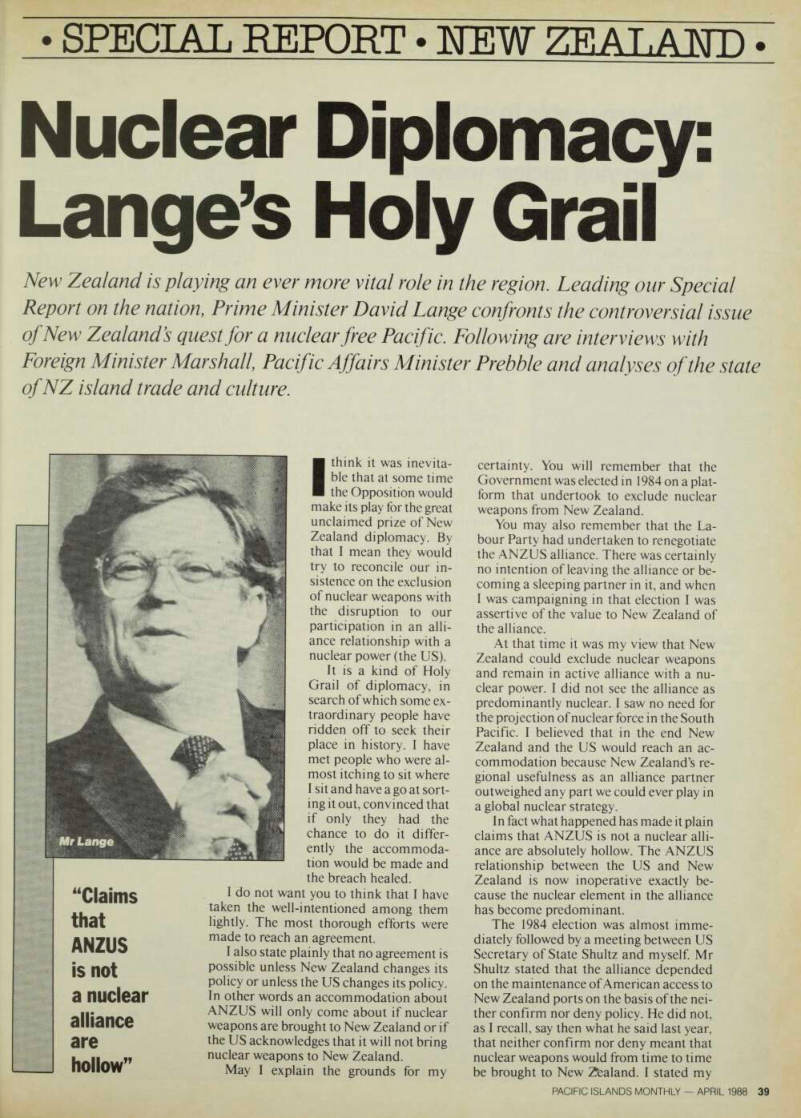
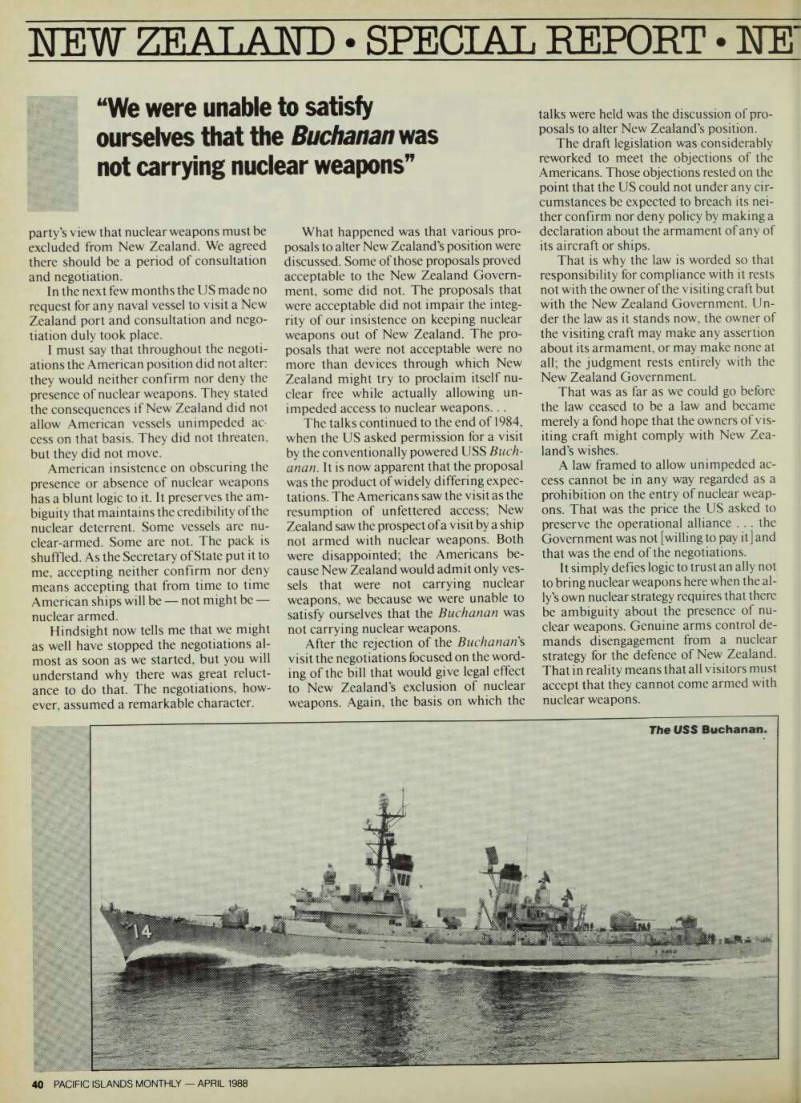
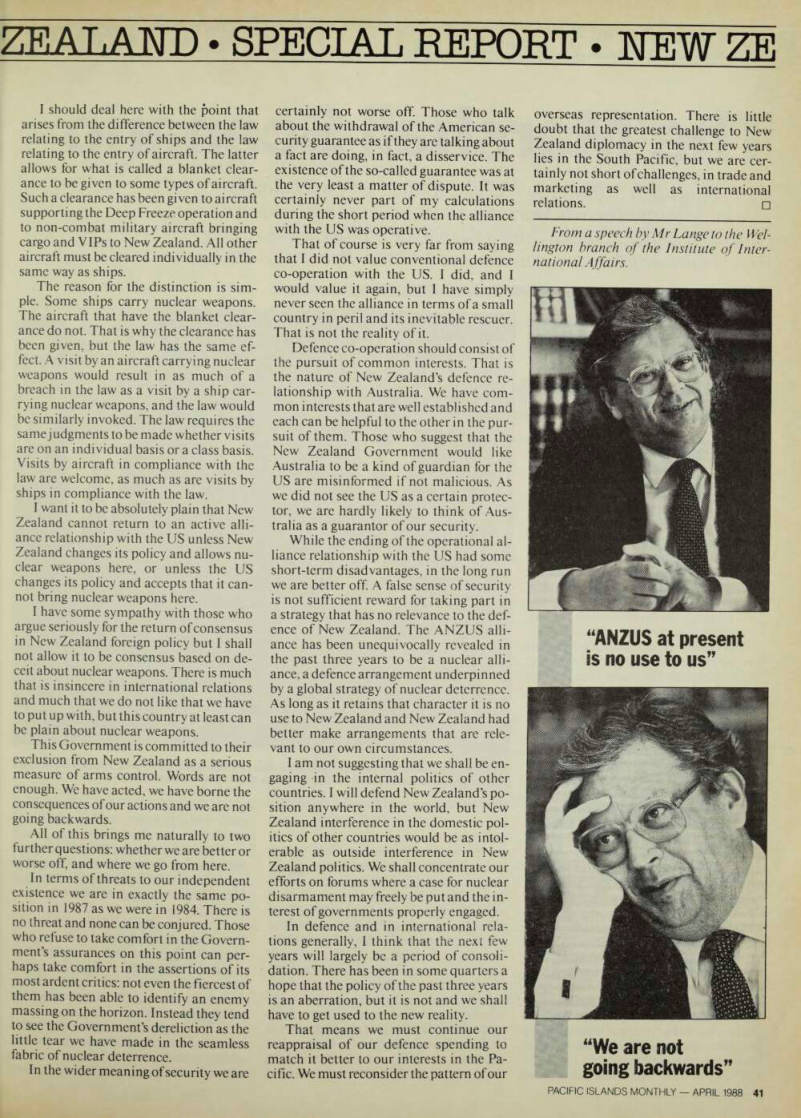
Special Report New Zealand
Nuclear Diplomacy: Lange’s Holy Grail
New Zealand is playing an ever more vital role in the region. Leading our Special Report on the nation, Prime Minister David Lange confronts the controversial issue of New Zealand’s quest for a nuclear free Pacific. Following are interviews with Foreign Minister Marshall, Pacific Affairs Minister Prebble and analyses of the state ofNZ island trade and culture.
I think it was inevita ble that at some time the Opposition would make its play for the great unclaimed prize of New Zealand diplomacy. By that I mean they would try to reconcile our in sistence on the exclusion of nuclear weapons with the disruption to our participation in an alli ance relationship with a nuclear power (the US).
It is a kind of Holy Grail of diplomacy, in search of which some ex traordinary people have ridden off to seek their place in history. I have met people who were al most itching to sit where I sit and have a go at sort ing it out, convinced that if only they had the chance to do it differ ently the accommoda tion would be made and the breach healed.
I do not want you to think that I have taken the well-intentioned among them lightly. The most thorough efforts were made to reach an agreement.
I also state plainly that no agreement is possible unless New Zealand changes its policy or unless the US changes its policy.
In other words an accommodation about ANZUS will only come about if nuclear weapons are brought to New Zealand or if the US acknowledges that it will not bring nuclear weapons to New Zealand.
May I explain the grounds for my
certainty. You will remember that the Government was elected in 1984 on a plat form that undertook to exclude nuclear weapons from New Zealand.
You may also remember that the La bour Party had undertaken to renegotiate the ANZUS alliance. There was certainly no intention of leaving the alliance or be coming a sleeping partner in it, and when I was campaigning in that election I was assertive of the value to New Zealand of the alliance.
At that time it was my view that New Zealand could exclude nuclear weapons and remain in active alliance with a nu clear power. I did not see the alliance as predominantly nuclear. I saw no need for the projection of nuclear force in the South Pacific. I believed that in the end New Zealand and the US would reach an ac commodation because New Zealand’s re gional usefulness as an alliance partner outweighed any part we could ever play in a global nuclear strategy.
In fact what happened has made it plain claims that ANZUS is not a nuclear alli ance are absolutely hollow. The ANZUS relationship between the US and New Zealand is now inoperative exactly be cause the nuclear element in the alliance has become predominant.
The 1984 election was almost imme diately followed by a meeting between US Secretary of State Shultz and myself. Mr Shultz stated that the alliance depended on the maintenance of American access to New Zealand ports on the basis of the nei ther confirm nor deny policy. He did not, as I recall, say then what he said last year, that neither confirm nor deny meant that nuclear weapons would from time to time be brought to New Zealand. I stated my
Mr Lange
“Claims that
Anzus
is not a nuclear alliance are hollow”
“We were unable to satisfy ourselves that the was not carrying nuclear weapons”
party’s view that nuclear weapons must be excluded from New Zealand. We agreed there should be a period of consultation and negotiation.
In the next few months the US made no request for any naval vessel to visit a New Zealand port and consultation and negotialion duly took place.
I must say that throughout the negotiations the American position did not alter; they would neither confirm nor deny the presence of nuclear weapons. They stated the consequences if New Zealand did not allow American vessels unimpeded access on that basis. They did not threaten, but they did not move.
American insistence on obscuring the presence or absence of nuclear weapons has a blunt logic to it. It preserves the ambiguity that maintains the credibility of the nuclear deterrent. Some vessels are nuclear-armed. Some are not. The pack is shuffled. As the Secretary of Stale put it to me, accepting neither confirm nor deny means accepting that from time to time American ships will be not might be — nuclear armed.
Hindsight now tells me that we might as well have stopped the negotiations almost as soon as we started, but you will understand why there was great reluctance to do that. The negotiations, however, assumed a remarkable character.
What happened was that various pro posals to alter New Zealand’s position were discussed. Some of those proposals proved acceptable to the New Zealand Govern ment, some did not. The proposals that were acceptable did not impair the integ rity of our insistence on keeping nuclear weapons out of New Zealand. The pro posals that were not acceptable were no more than devices through which New Zealand might try to proclaim itself nu clear free while actually allowing un impeded access to nuclear weapons...
The talks continued to the end of 1984, when the US asked permission for a visit by the conventionally powered USS Buck anan. It is now apparent that the proposal was the product of widely differing expec tations. The Americans saw the visit as the resumption of unfettered access; New Zealand saw the prospect ofa visit by a ship not armed with nuclear weapons. Both were disappointed; the Americans be cause New Zealand would admit only ves sels that were not carrying nuclear weapons, we because we were unable to satisfy ourselves that the Buchanan was not carrying nuclear weapons.
After the rejection of the Buchanan's visit the negotiations focused on the word ing of the bill that would give legal effect to New Zealand’s exclusion of nuclear weapons. Again, the basis on which the
talks were held was the discussion of pro posals to alter New Zealand’s position.
The draft legislation was considerably reworked to meet the objections of the Americans. Those objections rested on the point that the US could not under any cir cumstances be expected to breach its nei ther confirm nor deny policy by making a declaration about the armament of any of its aircraft or ships.
That is why the law is worded so that responsibility for compliance with it rests not with the owner of the visiting craft but with the New Zealand Government. Un der the law as it stands now, the owner of the visiting craft may make any assertion about its armament, or may make none at all; the judgment rests entirely with the New Zealand Government.
That was as far as we could go before the law ceased to be a law and became merely a fond hope that the owners of vis iting craft might comply with New Zea land’s wishes.
A law framed to allow unimpeded ac cess cannot be in any way regarded as a prohibition on the entry of nuclear weap ons. That was the price the US asked to preserve the operational alliance ... the Government was not [willing to pay it] and that was the end of the negotiations.
It simply defies logic to trust an ally not to bring nuclear weapons here when the al ly’s own nuclear strategy requires that there be ambiguity about the presence of nu clear weapons. Genuine arms control de mands disengagement from a nuclear strategy for the defence of New Zealand.
That in reality means that all visitors must accept that they cannot come armed with nuclear weapons.
The USS Buchanan.
I should deal here with the point that arises from the difference between the law relating to the entry of ships and the law relating to the entry of aircraft. The latter allows for what is called a blanket clear ance to be given to some types of aircraft.
Such a clearance has been given to aircraft supporting the Deep Freeze operation and to non-combat military aircraft bringing cargo and VIPs to New Zealand. All other aircraft must be cleared individually in the same way as ships.
The reason for the distinction is sim ple. Some ships carry nuclear weapons.
The aircraft that have the blanket clear ance do not. That is why the clearance has been given, but the law has the same ef fect. A visit by an aircraft carrying nuclear weapons would result in as much of a breach in the law as a visit by a ship car rying nuclear weapons, and the law would be similarly invoked. The law requires the same judgments to be made whether visits are on an individual basis or a class basis.
Visits by aircraft in compliance with the law are welcome, as much as are visits by ships in compliance with the law.
I want it to be absolutely plain that New Zealand cannot return to an active alli ance relationship with the US unless New Zealand changes its policy and allows nu clear weapons here, or unless the US changes its policy and accepts that it can not bring nuclear weapons here.
I have some sympathy with those who argue seriously for the return of consensus in New Zealand foreign policy but I shall not allow it to be consensus based on de ceit about nuclear weapons. There is much that is insincere in international relations and much that we do not like that we have to put up with, but this country at least can be plain about nuclear weapons.
This Government is committed to their exclusion from New Zealand as a serious measure of arms control. Words are not enough. We have acted, we have borne the consequences of our actions and we are not going backwards.
All of this brings me naturally to two further questions: whether we are better or worse off, and where we go from here.
In terms of threats to our independent existence we are in exactly the same po sition in 1987 as we were in 1984. There is no threat and none can be conjured. Those who refuse to take comfort in the Govern ment’s assurances on this point can per haps take comfort in the assertions of its most ardent critics: not even the fiercest of them has been able to identify an enemy massing on the horizon. Instead they tend to see the Government’s dereliction as the little tear we have made in the seamless fabric of nuclear deterrence.
In the wider meaning of security we are
certainly not worse off. Those who talk about the withdrawal of the American se curity guarantee as if they are talking about a fact are doing, in fact, a disservice. The existence of the so-called guarantee was at the very least a matter of dispute. It was certainly never part of my calculations during the short period when the alliance with the US was operative.
That of course is very far from saying that I did not value conventional defence co-operation with the US. I did, and I would value it again, but I have simply never seen the alliance in terms of a small country in peril and its inevitable rescuer.
That is not the reality of it.
Defence co-operation should consist of the pursuit of common interests. That is the nature of New Zealand’s defence re lationship with Australia. We have com mon interests that are well established and each can be helpful to the other in the pur suit of them. Those who suggest that the New Zealand Government would like Australia to be a kind of guardian for the US are misinformed if not malicious. As we did not see the US as a certain protec tor, we are hardly likely to think of Aus tralia as a guarantor of our security.
While the ending of the operational al liance relationship with the US had some short-term disadvantages, in the long run we are better off. A false sense of security is not sufficient reward for taking part in a strategy that has no relevance to the def ence of New Zealand. The ANZUS alli ance has been unequivocally revealed in the past three years to be a nuclear alli ance, a defence arrangement underpinned by a global strategy of nuclear deterrence.
As long as it retains that character it is no use to New Zealand and New Zealand had better make arrangements that are rele vant to our own circumstances.
I am not suggesting that we shall be en gaging in the internal politics of other countries. I will defend New Zealand’s po sition anywhere in the world, but New Zealand interference in the domestic pol itics of other countries would be as intol erable as outside interference in New Zealand politics. We shall concentrate our efforts on forums where a case for nuclear disarmament may freely be put and the in terest of governments properly engaged.
In defence and in international rela tions generally, 1 think that the next few years will largely be a period of consoli dation. There has been in some quarters a hope that the policy of the past three years is an aberration, but it is not and we shall have to get used to the new reality.
That means we must continue our reappraisal of our defence spending to match it better to our interests in the Pa cific. We must reconsider the pattern of our
overseas representation. There is little doubt that the greatest challenge to New Zealand diplomacy in the next few years lies in the South Pacific, but we are cer tainly not short of challenges, in trade and marketing as well as international relations. n
From a speech by Mr Lange to the Wel lington branch of the Institute of Inter national Affairs.
“ANZUS at present is no use to us”
“We are not going backwards”
Advertisements & other items, pp. 40-41 (2 items)
New Zealand • Special Report • Ne
40
PACIFIC ISLANDS MONTHLY APRIL 1988
Zealand ♦ Special Report ♦ New Ze
41
PACIFIC ISLANDS MONTHLY APRIL 1988
The Marshall Scenario
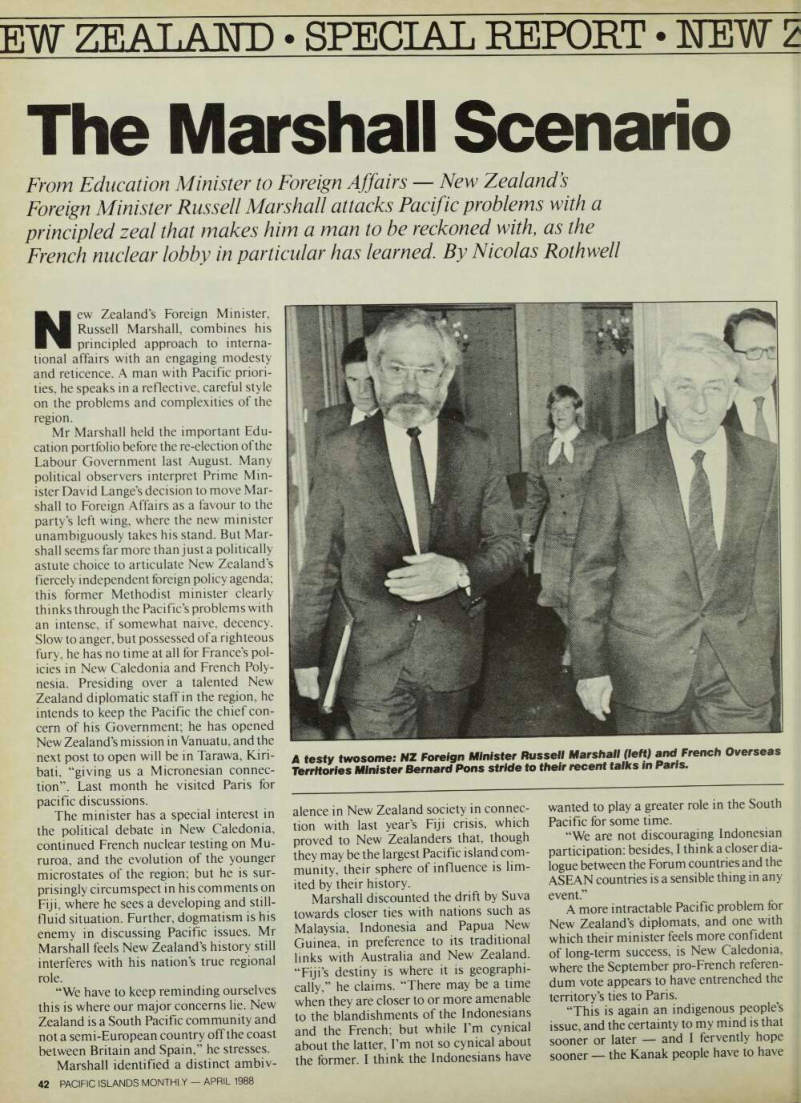
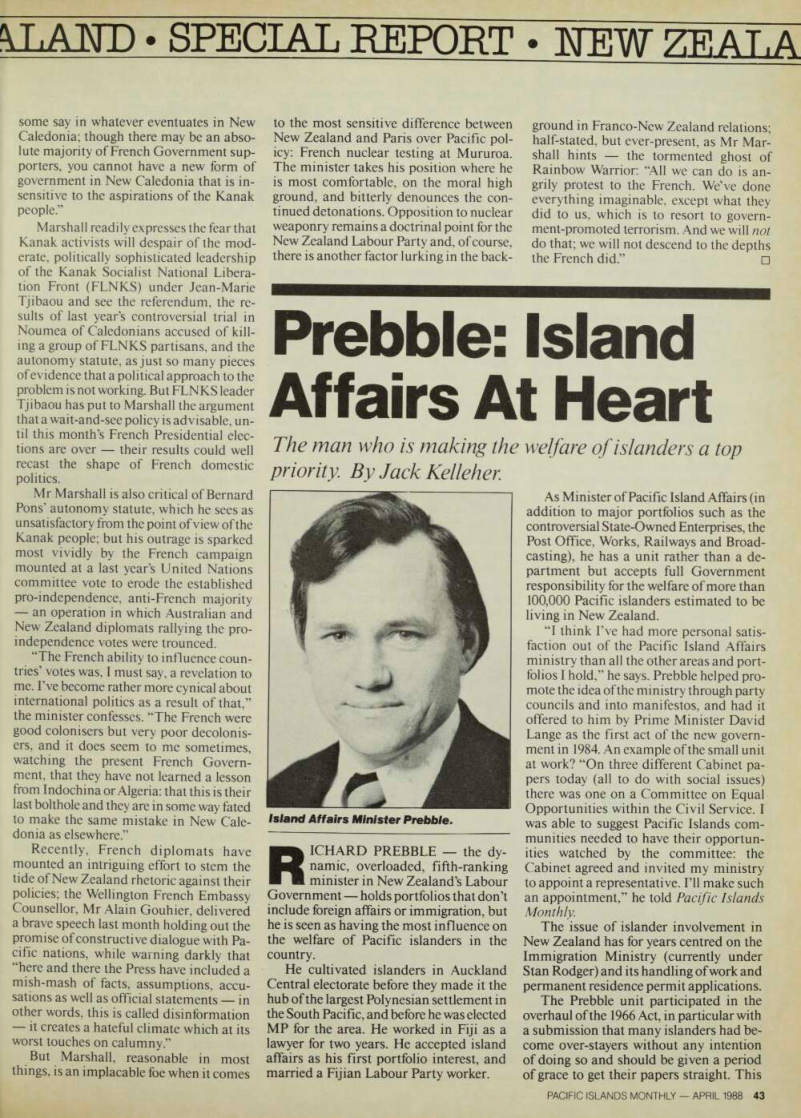
From Education Minister to Foreign Affairs New Zealand’s Foreign Minister Russell Marshall attacks Pacific problems with a principled zeal that makes him a man to be reckoned with, as the French nuclear lobby in particular has learned. By Nicolas Rothwell
New Zealand’s Foreign Minister, Russell Marshall, combines his principled approach to interna tional affairs with an engaging modesty and reticence. A man with Pacific priori ties, he speaks in a reflective, careful style on the problems and complexities of the region.
Mr Marshall held the important Edu cation portfolio before the re-election of the Labour Government last August. Many political observers interpret Prime Min ister David Lange’s decision to move Mar shall to Foreign Affairs as a favour to the party’s left wing, where the new minister unambiguously takes his stand. But Mar shall seems far more than just a politically astute choice to articulate New Zealand’s fiercely independent foreign policy agenda; this former Methodist minister clearly thinks through the Pacific’s problems with an intense, if somewhat naive, decency.
Slow to anger, but possessed of a righteous fury, he has no time at all for France’s pol icies in New Caledonia and French Poly nesia. Presiding over a talented New Zealand diplomatic staff in the region, he intends to keep the Pacific the chief con cern of his Government; he has opened New Zealand’s mission in Vanuatu, and the next post to open will be in Tarawa, Kiri bati, “giving us a Micronesian connec tion”. Last month he visited Paris for pacific discussions.
The minister has a special interest in the political debate in New Caledonia, continued French nuclear testing on Mu ruroa, and the evolution of the younger microstates of the region; but he is sur prisingly circumspect in his comments on Fiji, where he sees a developing and still fluid situation. Further, dogmatism is his enemy in discussing Pacific issues. Mr Marshall feels New Zealand’s history still interferes with his nation’s true regional role.
“We have to keep reminding ourselves this is where our major concerns lie. New Zealand is a South Pacific community and not a semi-European country off the coast between Britain and Spain,” he stresses.
Marshall identified a distinct ambiv-
alence in New Zealand society in connection with last year’s Fiji crisis, which proved to New Zealanders that, though they may be the largest Pacific island community their sphere of influence is limited by their history.
Marshall discounted the drift by Suva towards closer ties with nations such as Malaysia, Indonesia and Papua New Guinea, in preference to its traditional links with Australia and New Zealand, “Fiji’s destiny is where it is geographically,” he claims. “There may be a time when they are closer to or more amenable to the blandishments of the Indonesians and the French; but while I’m cynical about the latter, I’m not so cynical about the former. I think the Indonesians have
wanted to play a greater role in the South Pacific for some time, “We are not discouraging Indonesian participation: besides, I think a closer/Im logue between the Forum countries and the ASEAN countries is a sensible thing in any
event.” U 1 r
A more intractable Pacific problem tor New Zealand’s diplomats, and one with which their minister feels more contident of long-term success, is New Caledonia, where the September pro-French referen dum vote appears to have entrenched t e territory’s ties to Paris, “This is again an indigenous peoples issue, and the certainty to my mind is that sooner or later and I fervently hope sooner the Kanak people have to have
A testy twosome: NZ Foreign Minister Bus sell Marshall (left) and French Overseas Territories Minister Bernard Pons stride to their recent talks in Paris.
some say in whatever eventuates in New Caledonia; though there may be an abso lute majority of French Government sup porters, you cannot have a new form of government in New Caledonia that is in sensitive to the aspirations of the Kanak people.”
Marshall readily expresses the fear that Kanak activists will despair of the mod erate, politically sophisticated leadership of the Kanak Socialist National Libera tion Front (FLNKS) under Jean-Marie Tjibaou and see the referendum, the re sults of last year’s controversial trial in Noumea of Caledonians accused of kill ing a group of FLNKS partisans, and the autonomy statute, as just so many pieces of evidence that a political approach to the problem is not working. But FLNKS leader Tjibaou has put to Marshall the argument that a wait-and-see policy is advisable, un til this month’s French Presidential elec tions are over their results could well recast the shape of French domestic politics.
Mr Marshall is also critical of Bernard Pons’ autonomy statute, which he sees as unsatisfactory from the point of view of the Kanak people; but his outrage is sparked most vividly by the French campaign mounted at a last year’s United Nations committee vote to erode the established pro-independence, anti-French majority an operation in which Australian and New Zealand diplomats rallying the pro independence votes were trounced.
“The French ability to influence coun tries’ votes was, I must say, a revelation to me. I’ve become rather more cynical about international politics as a result of that,” the minister confesses. “The French were good colonisers but very poor decolonis ers, and it does seem to me sometimes, watching the present French Govern ment, that they have not learned a lesson from Indochina or Algeria: that this is their last bolthole and they are in some way fated to make the same mistake in New Cale donia as elsewhere.”
Recently, French diplomats have mounted an intriguing effort to stem the tide of New Zealand rhetoric against their policies; the Wellington French Embassy Counsellor, Mr Alain Gouhier, delivered a brave speech last month holding out the promise of constructive dialogue with Pa cific nations, while warning darkly that “here and there the Press have included a mish-mash of facts, assumptions, accu sations as well as official statements in other words, this is called disinformation it creates a hateful climate which at its worst touches on calumny.”
But Marshall, reasonable in most things, is an implacable foe when it comes
to the most sensitive difference between New Zealand and Paris over Pacific pol icy: French nuclear testing at Mururoa.
The minister takes his position where he is most comfortable, on the moral high ground, and bitterly denounces the con tinued detonations. Opposition to nuclear weaponry remains a doctrinal point for the New Zealand Labour Party and, of course, there is another factor lurking in the back
ground in Franco-New Zealand relations; half-stated, but ever-present, as Mr Mar shall hints the tormented ghost of Rainbow Warrior: “All we can do is an grily protest to the French. We’ve done everything imaginable, except what they did to us, which is to resort to govern ment-promoted terrorism. And we will not do that; we will not descend to the depths the French did.” n
Advertisements & other items, p. 42 (1 item)
Ew Zealand • Special Report ♦ New Z
42
PACIFIC ISLANDS MONTHLY APRIL 1988
Prebble: Island
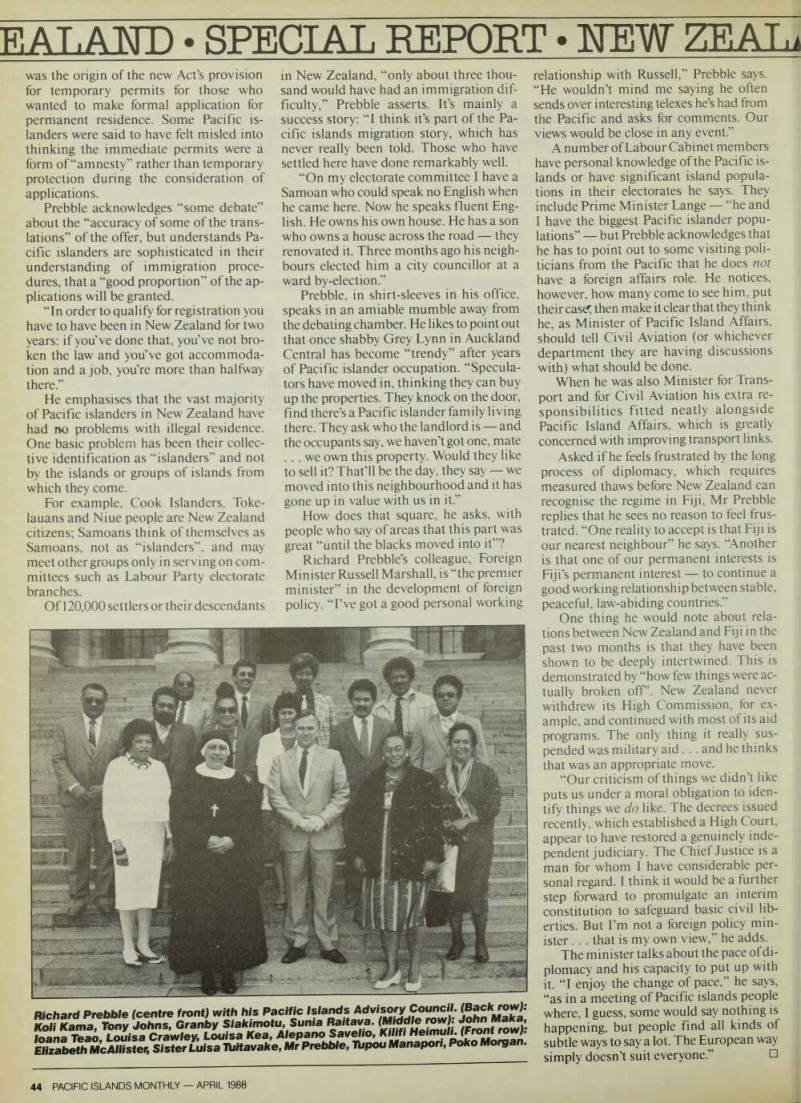
Affairs At Heart
The man who is making the welfare of islanders a top
priority.
By Jack Kelleher.
Richard Prebble The Dy
namic, overloaded, fifth-ranking minister in New Zealand’s Labour Government holds portfolios that don’t include foreign affairs or immigration, but he is seen as having the most influence on the welfare of Pacific islanders in the country.
He cultivated islanders in Auckland Central electorate before they made it the hub of the largest Polynesian settlement in the South Pacific, and before he was elected MP for the area. He worked in Fiji as a lawyer for two years. He accepted island affairs as his first portfolio interest, and married a Fijian Labour Party worker.
As Minister of Pacific Island Affairs (in addition to major portfolios such as the controversial State-Owned Enterprises, the Post Office, Works, Railways and Broad casting), he has a unit rather than a de partment but accepts full Government responsibility for the welfare of more than 100,000 Pacific islanders estimated to be living in New Zealand.
“I think I’ve had more personal satis faction out of the Pacific Island Affairs ministry than all the other areas and port folios I hold,” he says. Prebble helped pro mote the idea of the ministry through party councils and into manifestos, and had it offered to him by Prime Minister David Lange as the first act of the new govern ment in 1984. An example of the small unit at work? “On three different Cabinet pa pers today (all to do with social issues) there was one on a Committee on Equal Opportunities within the Civil Service. I was able to suggest Pacific Islands com munities needed to have their opportun ities watched by the committee: the Cabinet agreed and invited my ministry to appoint a representative. I’ll make such an appointment,” he told Pacific Islands Monthly.
The issue of islander involvement in New Zealand has for years centred on the Immigration Ministry (currently under Stan Rodger) and its handling of work and permanent residence permit applications.
The Prebble unit participated in the overhaul of the 1966 Act, in particular with a submission that many islanders had be come over-stayers without any intention of doing so and should be given a period of grace to get their papers straight. This
Island Affairs Minister Prebble.
was the origin of the new Act’s provision for temporary permits for those who wanted to make formal application for permanent residence. Some Pacific is landers were said to have felt misled into thinking the immediate permits were a form of “amnesty” rather than temporary protection during the consideration of applications.
Prebble acknowledges “some debate” about the “accuracy of some of the trans lations” of the offer, but understands Pa cific islanders are sophisticated in their understanding of immigration proce dures, that a “good proportion” of the ap plications will be granted.
“In order to qualify for registration you have to have been in New Zealand for two years: if you’ve done that, you’ve not bro ken the law and you’ve got accommoda tion and a job, you’re more than halfway there.”
He emphasises that the vast majority of Pacific islanders in New Zealand have had no problems with illegal residence.
One basic problem has been their collec tive identification as “islanders” and not by the islands or groups of islands from which they come.
For example, Cook Islanders, Toke lauans and Niue people are New Zealand citizens; Samoans think of themselves as Samoans, not as “islanders”, and may meet other groups only in serving on com mittees such as Labour Party electorate branches.
Of 120,000 settlers or their descendants
in New Zealand, “only about three thou sand would have had an immigration dif ficulty,” Prebble asserts. It’s mainly a success story: “I think it’s part of the Pa cific islands migration story, which has never really been told. Those who have settled here have done remarkably well.
“On my electorate committee I have a Samoan who could speak no English when he came here. Now he speaks fluent Eng lish. He owns his own house. He has a son who owns a house across the road they renovated it. Three months ago his neigh bours elected him a city councillor at a ward by-election.”
Prebble, in shirt-sleeves in his office, speaks in an amiable mumble away from the debating chamber. He likes to point out that once shabby Grey Lynn in Auckland Central has become “trendy” after years of Pacific islander occupation. “Specula tors have moved in, thinking they can buy up the properties. They knock on the door, find there’s a Pacific islander family living there. They ask who the landlord is and the occupants say, we haven’t got one, mate ... we own this property. Would they like to sell it? That’ll be the day, they say we moved into this neighbourhood and it has gone up in value with us in it.”
How does that square, he asks, with people who say of areas that this part was great “until the blacks moved into it”?
Richard Prebble’s colleague, Foreign Minister Russell Marshall, is “the premier minister” in the development of foreign policy. “I’ve got a good personal working
relationship with Russell,” Prebble says.
“He wouldn’t mind me saying he often sends over interesting telexes he’s had from the Pacific and asks for comments. Our views would be close in any event.”
A number of Labour Cabinet members have personal knowledge of the Pacific is lands or have significant island popula tions in their electorates he says. They include Prime Minister Lange “he and I have the biggest Pacific islander popu lations” but Prebble acknowledges that he has to point out to some visiting poli ticians from the Pacific that he does not have a foreign affairs role. He notices, however, how many come to see him, put their case*; then make it clear that they think he, as Minister of Pacific Island Affairs, should tell Civil Aviation (or whichever department they are having discussions with) what should be done.
When he was also Minister for Trans port and for Civil Aviation his extra re sponsibilities fitted neatly alongside Pacific Island Affairs, which is greatly concerned with improving transport links.
Asked if he feels frustrated by the long process of diplomacy, which requires measured thaws before New Zealand can recognise the regime in Fiji, Mr Prebble replies that he sees no reason to feel frus trated. “One reality to accept is that Fiji is our nearest neighbour” he says. “Another is that one of our permanent interests is Fiji’s permanent interest to continue a good working relationship between stable, peaceful, law-abiding countries.”
One thing he would note about rela tions between New Zealand and Fiji in the past two months is that they have been shown to be deeply intertwined. This is demonstrated by “how few things were ac tually broken off’. New Zealand never withdrew its High Commission, for ex ample, and continued with most of its aid programs. The only thing it really sus pended was military aid. . . and he thinks that was an appropriate move.
“Our criticism of things we didn’t like puts us under a moral obligation to iden tify things we do like. The decrees issued recently, which established a High Court, appear to have restored a genuinely inde pendent judiciary. The Chief Justice is a man for whom I have considerable per sonal regard. I think it would be a further step forward to promulgate an interim constitution to safeguard basic civil lib erties. But I’m not a foreign policy min ister ... that is my own view,” he adds.
The minister talks about the pace of di plomacy and his capacity to put up with it. “I enjoy the change of pace,” he says, “as in a meeting of Pacific islands people where, I guess, some would say nothing is happening, but people find all kinds of subtle ways to say a lot. The European way simply doesn’t suit everyone.” □
Richard Prebble (centre front) with his Pacific Islands AdviMry Council. (Bfek row): Koli Kama, Tony Johns, Granby Siakimotu, Sunia Raitave. (Middle row): John Maka, loana Teao, Louuisa Crawley, Louisa Kea, Alepano Savelio, Kilifi Heimuli. (Front row): Elizabeth McAllister, Sister Luisa Tuitavake, Mr Prebble, Tupou Manapori, Poko Morgan.
Advertisements & other items, pp. 43-44 (2 items)
■Lliaud ♦ Special Report ♦ New Zeala
43
PACIFIC ISLANDS MONTHLY APRIL 1988
Ealand • Special Report • New Zeali
44
PACIFIC ISLANDS MONTHLY APRIL 1988
Island Cultures
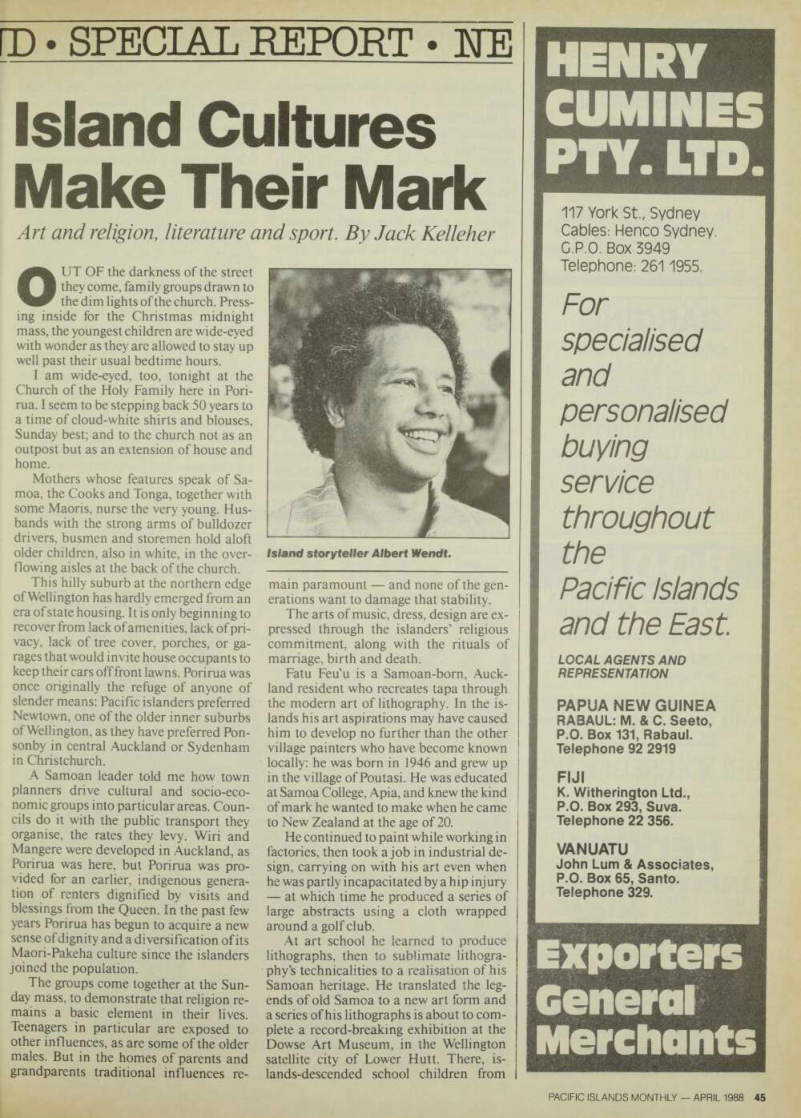
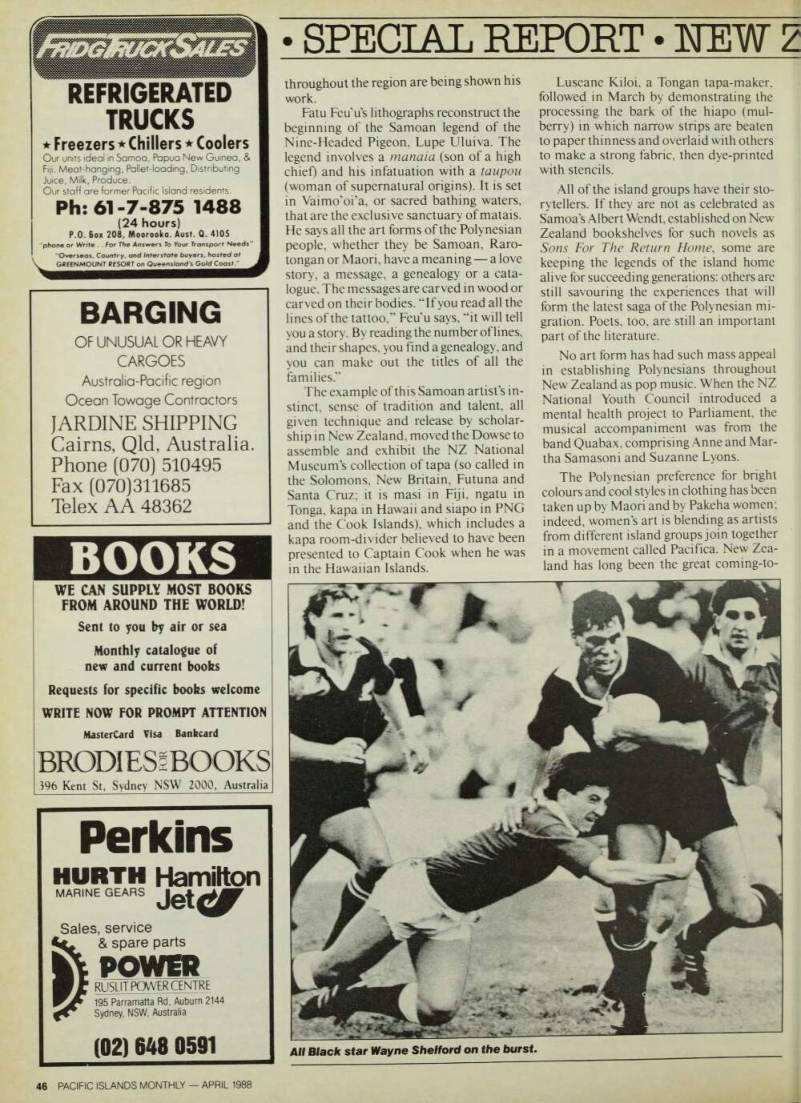
Make Their Mark
Art and religion , literature and sport .
By Jack Kelleher
OUT OF the darkness of the street they come, family groups drawn to the dim lights of the church. Press ing inside for the Christmas midnight mass, the youngest children are wide-eyed with wonder as they are allowed to stay up well past their usual bedtime hours.
I am wide-eyed, too, tonight at the Church of the Holy Family here in Pori rua. I seem to be stepping back 50 years to a time of cloud-white shirts and blouses, Sunday best; and to the church not as an outpost but as an extension of house and home.
Mothers whose features speak of Sa moa, the Cooks and Tonga, together with some Maoris, nurse the very young. Hus bands with the strong arms of bulldozer drivers, busmen and storemen hold aloft older children, also in white, in the over flowing aisles at the back of the church.
This hilly suburb at the northern edge of Wellington has hardly emerged from an era of state housing. It is only beginning to recover from lack of amenities, lack of pri vacy, lack of tree cover, porches, or ga rages that would invite house occupants to keep their cars off front lawns. Porirua was once originally the refuge of anyone of slender means: Pacific islanders preferred Newtown, one of the older inner suburbs of Wellington, as they have preferred Pon sonby in central Auckland or Sydenham in Christchurch.
A Samoan leader told me how town planners drive cultural and socio-eco nomic groups into particular areas. Coun cils do it with the public transport they organise, the rates they levy. Wiri and Mangere were developed in Auckland, as Porirua was here, but Porirua was pro vided for an earlier, indigenous genera tion of renters dignified by visits and blessings from the Queen. In the past few years Porirua has begun to acquire a new sense of dignity and a diversification of its Maori-Pakeha culture since the islanders joined the population.
The groups come together at the Sun day mass, to demonstrate that religion re mains a basic element in their lives.
Teenagers in particular are exposed to other influences, as are some of the older males. But in the homes of parents and grandparents traditional influences re-
main paramount and none of the gen erations want to damage that stability.
The arts of music, dress, design are ex pressed through the islanders’ religious commitment, along with the rituals of marriage, birth and death.
Fatu Feu’u is a Samoan-born, Auck land resident who recreates tapa through the modern art of lithography. In the is lands his art aspirations may have caused him to develop no further than the other village painters who have become known locally: he was born in 1946 and grew up in the village of Poutasi. He was educated at Samoa College, Apia, and knew the kind of mark he wanted to make when he came to New Zealand at the age of 20.
He continued to paint while working in factories, then took a job in industrial de sign, carrying on with his art even when he was partly incapacitated by a hip injury at which time he produced a series of large abstracts using a cloth wrapped around a golf club.
At art school he learned to produce lithographs, then to sublimate lithogra phy’s technicalities to a realisation of his Samoan heritage. He translated the leg ends of old Samoa to a new art form and a series of his lithographs is about to com plete a record-breaking exhibition at the Dowse Art Museum, in the Wellington satellite city of Lower Hutt. There, is lands-descended school children from
Island storyteller Albert Wendt.
throughout the region are being shown his work.
Fatu Feu’u’s lithographs reconstruct the beginning of the Samoan legend of the Nine-Headed Pigeon. Lupe Uluiva. The legend involves a manaia (son of a high chief) and his infatuation with a taupou (woman of supernatural origins). It is set in Vaimo’oi’a, or sacred bathing waters, that are the exclusive sanctuary of matais.
He says all the art forms of the Polynesian people, whether they be Samoan, Raro tongan or Maori, have a meaning a love story, a message, a genealogy or a cata logue. The messages are carved in wood or carved on their bodies. “If you read all the lines of the tattoo,” Feu’u says, “it will tell you a story. By reading the number of lines, and their shapes, you find a genealogy, and you can make out the titles of all the families.”
The example of this Samoan artist’s in stinct, sense of tradition and talent, all given technique and release by scholar ship in New Zealand, moved the Dowse to assemble and exhibit the NZ National Museum’s collection of tapa (so called in the Solomons, New Britain, Futuna and Santa Cruz; it is masi in Fiji, ngatu in Tonga, kapa in Hawaii and siapo in PNG and the Cook Islands), which includes a kapa room-divider believed to have been presented to Captain Cook when he was in the Hawaiian Islands.
Luseane Kiloi, a Tongan tapa-maker, followed in March by demonstrating the processing the bark of the hiapo (mul berry) in which narrow strips are beaten to paper thinness and overlaid with others to make a strong fabric, then dye-printed with stencils.
All of the island groups have their sto rytellers. If they are not as celebrated as Samoa’s Albert Wendt, established on New Zealand bookshelves for such novels as Sons For The Return Home, some are keeping the legends of the island home alive for succeeding generations; others are still savouring the experiences that will form the latest saga of the Polynesian mi gration. Poets, too, are still an important part of the literature.
No art form has had such mass appeal in establishing Polynesians throughout New Zealand as pop music. When the NZ National Youth Council introduced a mental health project to Parliament, the musical accompaniment was from the band Quabax, comprising Anne and Mar tha Samasoni and Suzanne Lyons.
The Polynesian preference for bright colours and cool styles in clothing has been taken up by Maori and by Pakeha women; indeed, women’s art is blending as artists from different island groups join together in a movement called Pacifica. New Zea land has long been the great coming-to-
All Black star Wayne Shelford on the burst.
gether place of island people, and could produce something entirely new.
Pacific Islanders have also introduced New Zealand to a more exuberant version of the Maori’s extended family, which has been under great pressure as cousins and further generations are accommodated in limited space and with small resources, Hospitality has developed as an art form, rising above the pressures.
Left to themselves, the new settlers entertain each other with nothing more complicated than an islands-style cricket bat or a pack of cards. Nothing bridges the generations more effectively, Polynesians say, than cards. Elders teach the youngsters new tricks, such as the universal “suipi”, or sweep.
But in New Zealand the islanders have also become sports page heroes. Rugby union, rugby league, softball and netball even bowls, at a Commonwealth Games tournament have shown how dedicated to excellence Pacific islanders can be.
Rugby union stars such as Michael Jones, following in the footsteps of Bernie Fraser and Bryan Williams, have elevated the national game to an art form, with a
grace of movement that is the aficionado’s delight. Jimmy Peau, New Zealand and Commonwealth boxing champion, also follows a long line of island fighters trained in Auckland.
The arts know no perimeters. Perhaps the different expressions of hospitality will take longest to blend as Pacific islanders merge in the New Zealand community, Louisa Crawley, deputy director of the Government’s Pacific Island Affairs Ad visory Unit, says the most difficult aspect of life in New Zealand is the different way of “accepting” people, “Islanders tend to welcome anyone, to like them immediately,” she says. “As they live with us we discover the less pleasant things. The tendency in New Zealand is to watch and observe first. If you make it, you’ll be accepted. Not before.”
Many questions remain. Will Pacific islanders in New Zealand preserve their traditional hospitality? Will they pick up long-lost pieces of their culture, as Maoris have done, in a renaissance? At this stage there are few answers. Polynesians and Pakehas, however, are confident that the process of integration is working well, n
Advertisements & other items, pp. 45-46 (3 items)
Id • Special Report • Ne
45
PACIFIC ISLANDS MONTHLY APRIL 1988
buying
117 York St., Sydney Cables: Henco Sydney.
C.P.O. Box 5949 Telephone: 261 1955.
For
specialised
and
personalised
buying
service
throughout
the
Pacific Islands
and the East.
LOCAL AGENTS AND
REPRESENTATION
PAPUA NEW GUINEA
RABAUL: M. & C. Seeto, P.O. Box 131, Rabaul.
Telephone 92 2919
FIJI
K. Witherington Ltd., P.O. Box 293, Suva.
Telephone 22 356.
VANUATU
John Lum & Associates, P.O. Box 65, Santo.
Telephone 329.
7% ww
REFRIGERATED
TRUCKS
★ Freezers ★Chillers ★ Coolers
Our units ideal in Samoa, Papua New Guinea, & Fiji. Meat-hanging, Pallet-loading, Distributing Juice, Milk, Produce.
Our staff are former Pacific Island residents.
Ph; 61 -7-875 1488
(24 hours)
P.O. Box 208, Moorooka. Aust. Q. 4105 "phone or Write . . For The Answers To Your Transport Needs' "Overseas, Country, and Interstate buyers, hosted at . GREENMOUNT RESORT on Queensland's Gold Coast."
BARGING
OF UNUSUAL OR HEAVY
CARGOES
Australia-Pacific region Ocean Towage Contractors
JARDINE SHIPPING
Cairns, Qld, Australia.
Phone (070) 510495 Fax (070)311685 Telex AA 48362
BOOKS
WE CAN SUPPLY MOST BOOKS
FROM AROUND THE WORLD!
Sent to you by air or sea Monthly catalogue of new and current books Requests for specific books welcome
WRITE NOW FOR PROMPT ATTENTION
Master Card Visa Banbcard
BRODIESSBOOKS
396 Kent St, Sydney NSW 2000, Australia
Perkins
HURTH Hamilton
MARINE GEARS J
Sales, service & spare parts
fit POWER
■ f RUSLIT POWER CENTRE
WA> 195 Parramatta Rd, Auburn 2144 Sydney, NSW, Australia (02) 648 0591
• Special Report • New Z
46
PACIFIC ISLANDS MONTHLY APRIL 1988
Trading Partners
Good neighbours make good business partners but there are problems to be solved. By Jack Kelleher
ENTREPRENEURIAL and manufacturing energy is having more effeet on trade between the Pacific islands and New Zealand than planning by governments and commissions. The forces combine, however, in the response of New Zealand garment manufacturers to the establishment of a new tax-free zone in Fiji.
Fiji has a need to encourage industry now more than ever and the New Zealand Government has just instituted a pohey of allowing Fiji-made clothing into the country duty-free, without licence. Put these factors together, add the cost of lahour in Fiji (attractive in comparison with labour costs in New Zealand) and it is easy to see why New Zealand manufacturers should transfer, mothball or try to dispose of their plants, open factories in Fiji and ship their goods home. ... lsn 1 a " B°°d news for Fiji, however: Fijians m New Zealand are among workers losing jobs through factory close-downs m Gisborne, Auckland and Whangarei.
Women, who make up 97 per cent of this workforce, are the most affected by the drying up of work in New Zealand, and the
prospect of their employers setting up op erations in Fiji.
Manufacturers setting off on this trail need to beware of a rule requiring 50 per cent of the total cost of production to be sourced in Fiji which would limit the origin of materials. And when the finished product is brought back to New Zealand, it must be competitive with imports arriv ing under reduced protection during the next three years.
Forestry is moving in the same direc tion, with Forest Products (Fiji) Ltd, a new joint venture between New Zealand and Hong Kong companies, gaining approval to operate a tax-free factory at Lautoka, to manufacture prefabricated houses for export to New Zealand. It is the first en tirely overseas-owned company to take advantage of the scheme. Forest Products, a New Zealand giant, claims to have a process that can make use of timber un suitable for other purposes. It plans ini tially to employ 72 people and to export 200 houses, earning more than $F600,000 in its first year.
Trade between the islands and New Zealand has languished in recent years in
spite of the reduction of NZ trade barriers and the establishment of programs to aid the production and marketing of island goods. There are no trade barriers in New Zealand that are not already in the process of being dismantled; in fact, the last two items on the list of dutiable goods coconut cream and passionfruit juice will be duty free by July 1. Australia will still have a few products left on-quota, specifically in the areas of textiles, clothing and footwear.
New Zealand has worked positively to achieve the aims of the South Pacific Region Trade and Economic Co-operation Agreement (SPARTECA); in the assistance area a $lOO,OOO fund is available to help island companies employ consultants to examine markets in New Zealand, The aid program, administered through the Ministry of Foreign Affairs rather than Trade and Industry, already has marketing studies and promotions under way.
There are plans to help Samoans establish that their honey is disease-free in order to satisfy the German market. Another study aims to improve the canning of food, and a third will examine the bottling of fish for export.
New Zealand provides only a tenth of
the economic aid that flows to island communities, but from New Zealand’s point of view it is now the main part of its international aid commitment. NZ imports from the islands have decreased, mainly because they were concentrated in value on a couple of products and countries: the collapse of Nauru’s phosphate and decreased use of Papua New Guinea coffee had a disproportionate effect on total trade figures. When the Fiji sugar harvest was in jeopardy, after the coup, SPARTECA looked to be undone.
In fact, SPARTECA was needed as never before. Imports to New Zealand decreased from the 1983 figure of SNZBO million to the 1987 mark of SNZ6S million. Reduction in phosphate use had much to do with that, as Nauru battled problems unlike any other community s: its exports of phosphate plummeted from a value of SNZ42 million in 1983 to just $l5 million in 1987.
PNG’s SNZ9 million worth of exports in 1983 almost doubled by 1986 and dropped to SNZB million the following year as coffee prices fell.
In the same period, Fiji increased its production of manufactured items and became a promising platform for research
assistance. To a lesser extent the same ap plied in Samoa and Tonga: Melanesian countries continued to rely heavily on ex port uses for sawn tropical timbers.
Fijian imports to New Zealand have been more stable than most; only $lOO,OOO down in the year to December 1987, from SNZI9.S million the year before. Sugar alone earned more than SNZII million, Cook Islands has averaged SNZS mil lion export earnings in the past five years; Western Samoa has earned SNZ9.B mil lion, Tonga SNZ4.2 million, Vanuatu SNZBOO,OOO, Niue SNZ 187,000 and Kiri bati SNZ7I,OOO.
Exporters may have a new major com petitor in New Zealand if all trade barriers are to fall. They will need to sidestep prod ucts from Taiwan, Korea and Indonesia.
SPARTECA s architects believe they have prevented items from these countnes in filtrating areas such as Fiji s tax-free zone with their 50 per cent requirement for lo cal cost.
Trade between the islands and New Zealand, as everywhere, still has room for the initiative and imagination on the part of the individual: New Zealand s partici pants in SPARTECA are trying to encour age that.
Advertisements & other items, pp. 47-50 (3 items)
Kikkoman
NOTICE
TRADE
MARKS
Notice is hereby given that Kikkoman Corporation, a corporation duly organised and existing under the laws of Japan, of 339, Noda, Noda City, Chiba, Japan, is the sole proprietor in Nauru and elsewhere of the following Trade Mark:
i. KIKKOMAN
Used in respect of the following: Coffee, tea, cocoa, sugar, rice, tapioca, sago, coffee substitutes, flour, and preparations made from cereals, bread, biscuits, cakes, pastry and confectionery, ices, honey, treacle, yeast, baking powder, salt, mustard, pepper, vinegar, sauces, spices, ice.
The proprietor claims all rights in respect of the above Trade Marks and will take all necessary legal steps against any person or company infringing those rights.
F.B. RICE & CO.
PATENT ATTORNEYS,
Sydney, Australia
X4L4IR --- Papua New Guinea's
nationwide airline connection to and
from the World.
<0 I it
DOMESTIC
Talair serves all provinces in P.IM.G., many on a daily basis. No other airline comes close to serving the 130 ports a week that Talair does. Charter services also are available.
INTERNATIONAL
Using our computerised system in any of our 12 International Travel Centres, we can book you anywhere in the world planes, trains, luxury liners arrange rental cars, hostels, motels or hotels. —» I I Panguna - 95 8020 • Arawa - 95 2113 • Mt. Hagen - 52 2465 Boroko - 25 7655 • Tabubil - 58 9228 • Goroka - 72 1355 • Lae - 42 2316 Madang - 82 2757 • Rabaul - 82 2882 • Wewak - 86 2012 Vanlmo - 87 1180 • Port Moresby - 21 4766 • Walganl - 25 7877 Brisbane Metropolitan Area - 229 1177 Outside Brisbane - 008 777879
Uii
ATA
QUALITY IN AIR TRANSPORT
41 U
Peak Music Powej^Jutput 3% Hi-fi Midi System 790 A e V-790A is ready for digital when you are, with a whopping 550 watts , MPO) of output for big music thrills, true high fidelity 3-way speakers for perb music reproduction, extra sound dimension from the Surround Sound eakers,and wireless remote control of virtually all system functions. Advanced itures include a 5-band graphic equalizer and spectrum analyzer, a 20-station •FM+ 10 MW/SWi/SW 2 ) memory preset quartz synthesizer tuner with direct 10-key )ut tuning, a Dolby B NR double cassette deck with continuous playback, and a ly automatic turntable. Discover for yourself the satisfying sound experience of
WA’s POWER MASTER.
More Power, Fidelity, and Style
AIWA
v "3* 1 1 1 1 •Dolby and the double-D symbol are trademarks of Dolby Laboratories Licensing Corporation. >6x p Ltd. 12 Barcoo Street, East Roseville, Sydney, N.S.W. 2069, AUSTRALIA PHONE; (02) 406-6277/Oceania Indent Agency (P.N.G.) Pty., Ltd. Ago St., Gordon Box 5518, Boroko, Port Guinea PHONE: 256411/The Sound Centre Ltd. P.O. Box 434 Port Vila, Repubilic of Vanuatu PHONE: 2035/P. Hargovind Bros. 190 Renwick Road PO. Box 490 Suva Fiji bO/H ® rd y. D,s . tnbutors Ltd. PO. Box 5919 5 How Street, Auckland, New Zealand PHONE: (09) 399-175/Hifivox 79, Rue de Sebastopol, B.P. 1458 Noumea, New Caledonia PHONE: Pac,,lc Limited G.P.O Box 517. Honiara. Solomon Islands PHONE; 131/Fare Hi-Fi Stereo Rue du Marechal Foch—PO. Box 269, Papeete, Tahiti PHONE: 2-4814/Micropac Audio, Inc. ox 3478 Agana, Guam 96910 PHONE: 646-9304/Rartotonga Duty Free Shop Private Bag P.O. Box 92. Rarotonga. Cook Island/Nauru Co-Operative Society Republic of Nauru
THE PACIFIC ISLANDS RELY
ON THE ENERGY OF BORAL
saiMiia
a' w V Norfolk Island Norfolk Island 2419 Papua New Guinea Port Moresby 214248 Lae 42 2574 Rabaul 921225 Wewak 862125 Tonga Nukualofa 21388 Cook Islands Rarotonga 24460 American Samoa Pago Pago 633 2170 Fiji Suva 24035 Lautoka 60088 Sigatoka 50578 Labasa 82973 Vanuatu Santo 455 Port Vila 2046 All through the Pacific Islands, people rely on Boral Speed-E-Gas LP Gas for their energy needs.
Boral has terminals throughout the area, and is proud to be a leading supplier.
Speed-E-Gas is clean, efficient and low in cost.
It's the ideal energy source for cooking and water heating in homes, motels and hotels, and for a wide range of industrial uses.
So call Boral. We have the energy you’re looking for.
Solomon Islands Honiara 21833
BORAL GAS
Boral Gas Limited, Bth Floor, IBM House, 168 Kent St., Sydney, NSW 2000. Tel: (02) 278512.
Special Report • New Zealand • Spe
48
PACIFIC ISLANDS MONTHLY APRIL 1988
First Contact
Continued from page 27
Giant Killers!
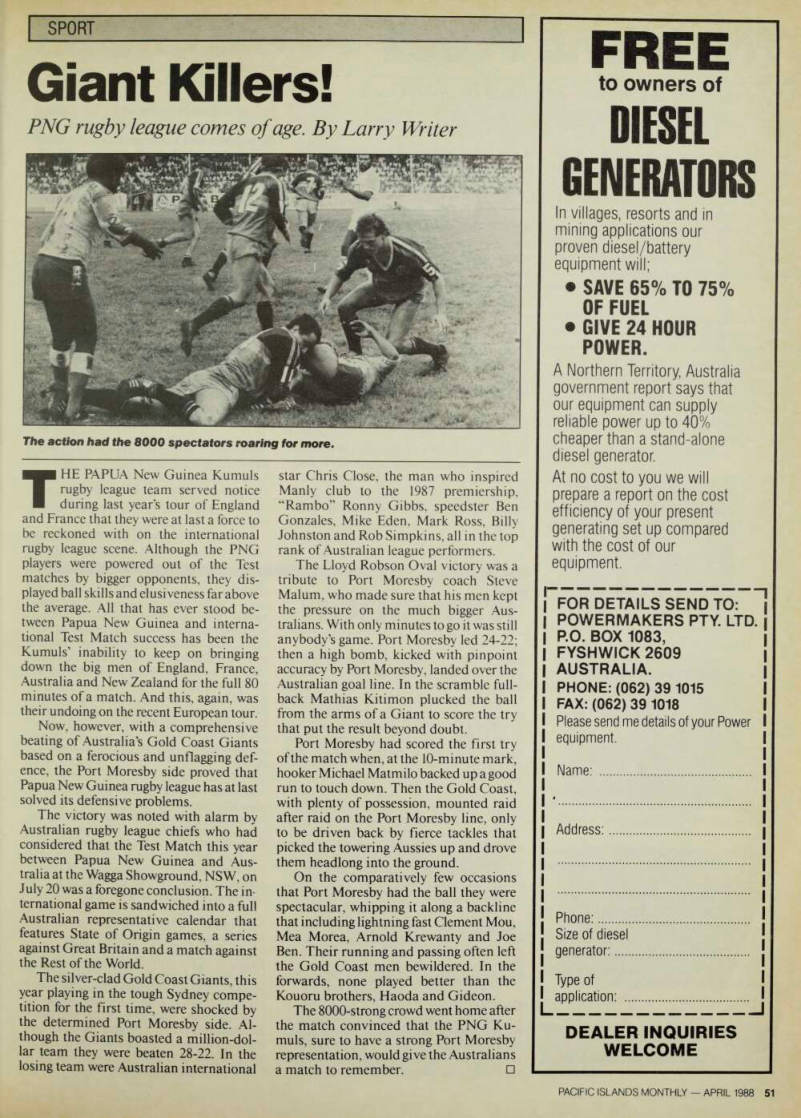
Sport
PNG rugby league comes of age.
By Larry Writer
THE PAPUA New Guinea Kumuls rugby league team served notice during last year’s tour of England and France that they were at last a force to be reckoned with on the international rugby league scene. Although the PNG players were powered out of the Test matches by bigger opponents, they dis played ball skills and elusiveness far above the average. All that has ever stood be tween Papua New Guinea and interna tional Test Match success has been the Kumuls’ inability to keep on bringing down the big men of England, France, Australia and New Zealand for the full 80 minutes of a match. And this, again, was their undoing on the recent European tour.
Now, however, with a comprehensive beating of Australia’s Gold Coast Giants based on a ferocious and unflagging def ence, the Port Moresby side proved that Papua New Guinea rugby league has at last solved its defensive problems.
The victory was noted with alarm by Australian rugby league chiefs who had considered that the Test Match this year between Papua New Guinea and Aus tralia at the Wagga Showground, NSW, on July 20 was a foregone conclusion. The in ternational game is sandwiched into a full Australian representative calendar that features State of Origin games, a series against Great Britain and a match against the Rest of the World.
The silver-clad Gold Coast Giants, this year playing in the tough Sydney compe tition for the first time, were shocked by the determined Port Moresby side. Al though the Giants boasted a million-dol lar team they were beaten 28-22. In the losing team were Australian international
star Chris Close, the man who inspired Manly club to the 1987 premiership, “Rambo” Ronny Gibbs, speedster Ben Gonzales, Mike Eden, Mark Ross, Billy Johnston and Rob Simpkins, all in the top rank of Australian league performers.
The Lloyd Robson Oval victory was a tribute to Port Moresby coach Steve Malum, who made sure that his men kept the pressure on the much bigger Aus tralians. With only minutes to go it was still anybody’s game. Port Moresby led 24-22; then a high bomb, kicked with pinpoint accuracy by Port Moresby, landed over the Australian goal line. In the scramble full back Mathias Kitimon plucked the ball from the arms of a Giant to score the try that put the result beyond doubt.
Port Moresby had scored the first try of the match when, at the 10-minute mark, hooker Michael Matmilo backed up a good run to touch down. Then the Gold Coast, with plenty of possession, mounted raid after raid on the Port Moresby line, only to be driven back by fierce tackles that picked the towering Aussies up and drove them headlong into the ground.
On the comparatively few occasions that Port Moresby had the ball they were spectacular, whipping it along a backline that including lightning fast Clement Mou, Mea Morea, Arnold Krewanty and Joe Ben. Their running and passing often left the Gold Coast men bewildered. In the forwards, none played better than the Kouoru brothers, Haoda and Gideon.
The 8000-strong crowd went home after the match convinced that the PNG Ku muls, sure to have a strong Port Moresby representation, would give the Australians a match to remember. □
The action had the 8000 spectators roaring for more.
Advertisements & other items, p. 51 (1 item)
Generators
FREE
to owners of
DIESEL
GENERATORS
In villages, resorts and in mining applications our proven diesel/battery equipment will;
• SAVE 65% TO 75%
OF FUEL
• GIVE 24 HOUR
POWER.
A Northern Territory, Australia government report says that our equipment can supply reliable power up to 40% cheaper than a stand-alone diesel generator.
At no cost to you we will prepare a report on the cost efficiency of your present generating set up compared with the cost of our equipment.
FOR DETAILS SEND TO:
POWERMAKERS PTY. LTD.
P.O. BOX 1083,
FYSHWICK 2609
AUSTRALIA.
PHONE: (062) 39 1015
FAX: (062) 39 1018
Please send me details of your Power equipment.
Name: Address: Phone: Size of diesel generator: Type of aoolication: i
DEALER INQUIRIES
WELCOME
The Island Press
Reports from the papers, compiled by John Carter
FIJI’S NEW envoy to the United King dom will travel to meet the Queen in a car riage drawn by two horses rather than four when he presents his credentials at Buck ingham Palace next month.
In keeping with protocol, the Queen has downgraded the new envoy to a two-horse ranking because he will no longer be a high commissioner, but an ambassador.
From the Fiji Times , Suva IT HAS been a quiet week, according to superintendent Tanielu Galuvao, the po lice press officer. There was no fatal acci dent or serious crime. A taxi driver, Galuvao said, was involved in a race with another vehicle and had used a pistol to shoot at the door of the other car. He has been charged with possession of an unlaw ful weapon.
From the Samoa Times , Apia WHAT IS wrong with the dressing of young men in our town today?
Why do they wear their jeans unbut toned at the waist and low on their hips as if their trousers are going to fall off?
Why do they prefer big baggy shirts which they write on and tear up so that they soon fall apart? ... I say what about our young men? Where are their minds and hearts?
They dress more like urban terrorists than the hope of this nation’s future.
From a letter by “Man Watcher” in the Papua New Guinea Post-Courier , Port Moresby IF ANYONE’S been lucky this month it’s the Prime Minister.
Dr Pupeke Robati took second prize in the Takuvaine Rugby Club raffle drawn recently to win $11,500.
What’s ironical is that his winning ticket was sold to him by the leader of the Op position and MP for Takuvaine, Geoffrey Henry.
From the Cook Islands News , Rarotonga THE 1987 DUX of Avarua School, Robert Moana Matamaki, will be heading back to school this year with a new hair cut.
The 14-year-old lad had his long hair plaited into 51 hairlocks on Saturday and cut by various people in a ceremony at his parents’ home in Takuvaine.
Robert, dressed in white, sat on a beautifully decorated chair where his friends proceeded to singly cut a lock of hair each.
From the Cook Islands News , Rarotonga
A SECURITY man told police yesterday he had been forced to do all the work for thieves who broke into the Talair hangar at Madang on Wednesday night.
Madang acting provincial police comtender Nelson Kass. said yesterday three masked men armed with bush knives held up the lone security man outside the hangar and “made the poor man do all the dirty work for them . - F D rom ‘ he Post-Couner , Port Moresby INI r, XT r* ■ „ 00 o POLICE IN Papua New Guinea say a man s head was blown off by a shotgun blast and 19 houses were burned when Highlands clansmen raided a rival village, More than 800 clansmen of the Kinimbi and Igom clans are said to have raided a village in the Baiyer River area owned by the rival Kopi and Kimbu clans.
Papua New Guinea police say it happened when Kopi and Kimbu men were at a meeting with the Western Highlands Peace and Good Order Committee.
From Radio Australia’s Pacific Report
A MOUNT Hagen lecturer says two uni formed policemen bashed him up in the street yesterday “for no good reason”, and then drove off.
Mr Cletus Kaytopa, a lecturer at Holy Trinity Teachers College, said he was just leaving a friend’s home when the police men pulled up in a van, jumped out and bashed him and a companion.
When he asked them why, they offered no explanation and drove off.
From the Papua New Guinea Post-Courier , Port Moresby CAN YOU believe that one pineapple ex ported to Queensland, Australia, for about 80 toea returns to PNG in three cans at K 2.50 each.
Well it’s true, according to Mr Michael Stoll, an expert and consultant in export marketing who has been hired by the Aus tralian Department of Trade and Foreign Affairs to conduct seminars in PNG.
He told a four-day seminar attended by about 20 businessmen that PNG had the potential of setting up manufacturing industries.
From the Papua New Guinea Post-Courier , Port Moresby
Tawake Veilesiyaki, 39, Of Rai
waqa: ‘T grew my beard as a sign of mourning, and have had it for two months.
The only problem that I have is food end ing up in it. I have to clean my beard quite often.”
From a Fiji Times survey on “Why men grow beards”
Transition
Died; James Grundy, former director of the Fiji Employers Consultative Associ ation, in Suva’s Colonial War Memorial Hospital on January 13. Born in Middle ton, Lancashire in 1908, Mr Grundy was a rubber planter in India prior to serving in the British Army in India during World War 11. He later worked in Malaya and Singapore before joining FECA as direc tor in 1960.
Died: Campbell “Bambi” Quintal, 68, of Norfolk Island, on February 10. Known as “a Norfolk Islander of the old school gentle, courteous at all times”, Mr Quintal was a member of one of Norfolk Island’s most famous families and his death was a cause of sadness for all, according to the Norfolk Islander.
Name Changed: Mr David Unagi, mem ber for Moresby North-East in the Papua New Guinea Parliament, announced in February that he has changed his name to David Moshe Dayan Unagi.
Died: Mr Herbert “Bert” Kienzle, 83, in Sydney. Mr Kienzle’s long and honoura ble association with Papua New Guinea began in 1927, when he was appointed manager of a rubber plantation at Kanu sia. In the 1930 s he established a mining
company in the Yodda Valley, near Go roka, and later set up his own rubber plan tation there. Mr Kienzle’s most famous contribution to PNG history was his in volvement with the Australian retreat along the Kokoda Trail in 1942. He assem bled and assisted some 6000 carriers soon known as “Fuzzy Wuzzy Angels” and played a vital part in helping AIF sol diers survive the crossing of the Owen Stanley Range. Mr Kienzle is survived by his wife Naril, three sons, two daughters and several adopted Papua New Guinean children.
Appointed: Dr David J Doulman, as dep uty director of the South Pacific Forum Fisheries Agency in Honiara, Solomon Is lands. Formerly Chief Fisheries Econo mist in Papua New Guinea and director of the East-West Centre’s tuna project, Mr Doulman is an internationally acclaimed expert on tuna fisheries and the author of two books on fisheries in the South Pacific.
Appointed: Mr Michael M Maue, as pro ject officer with the South Pacific Bureau for Economic Co-operation. Mr Maue is a Bachelor of Economics graduate from the University of Papua New Guinea and joined SPEC from PNG’s Department of Foreign Affairs, where he was assistant secretary in its Pacific Australia and New Zealand branch. As project officer (Eu ropean Community), Mr Maue will be re sponsible for the administration of SPEC’s EC-funded regional program. □
Pacific Stamp Box
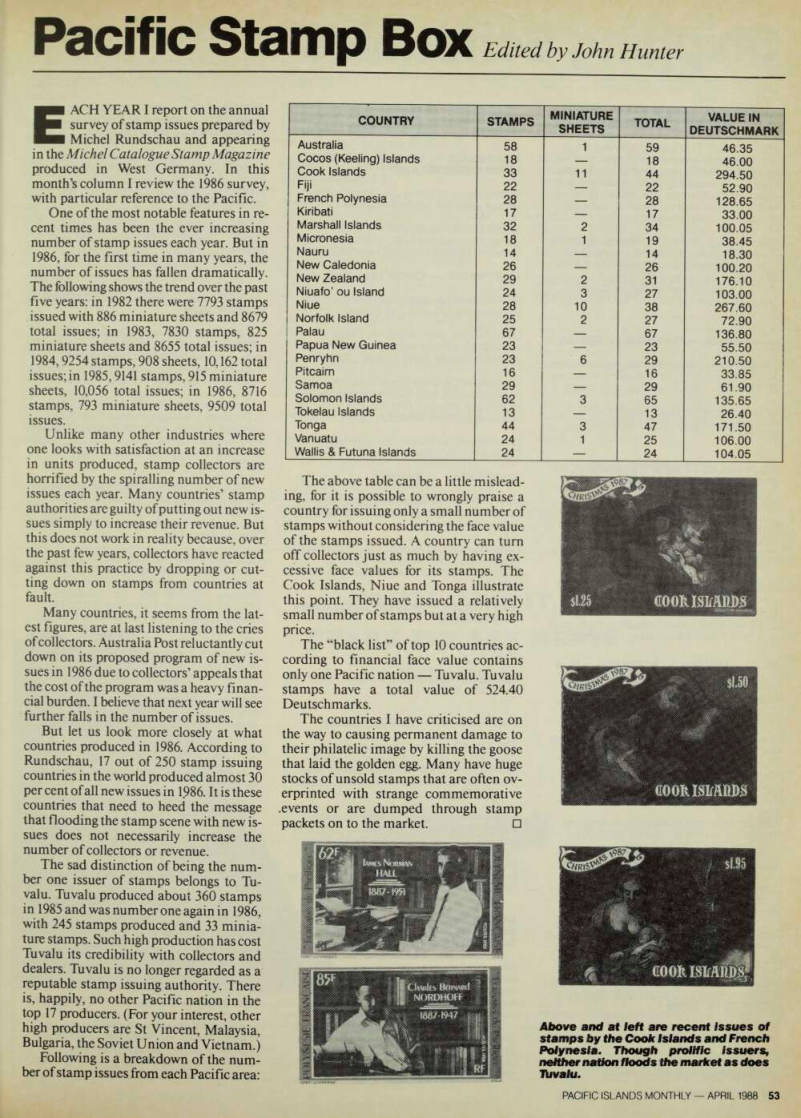
Edited by John Hunter
EACH YEAR I report on the annual survey of stamp issues prepared by Michel Rundschau and appearing in the Michel Catalogue Stamp Magazine produced in West Germany. In this month’s column I review the 1986 survey, with particular reference to the Pacific.
One of the most notable features in re cent times has been the ever increasing number of stamp issues each year. But in 1986, for the first time in many years, the number of issues has fallen dramatically.
The following shows the trend over the past five years: in 1982 there were 7793 stamps issued with 886 miniature sheets and 8679 total issues; in 1983, 7830 stamps, 825 miniature sheets and 8655 total issues; in 1984,9254 stamps, 908 sheets, 10,162 total issues; in 1985,9141 stamps, 915 miniature sheets, 10,056 total issues; in 1986, 8716 stamps, 793 miniature sheets, 9509 total issues.
Unlike many other industries where one looks with satisfaction at an increase in units produced, stamp collectors are horrified by the spiralling number of new issues each year. Many countries’ stamp authorities are guilty of putting out new is sues simply to increase their revenue. But this does not work in reality because, over the past few years, collectors have reacted against this practice by dropping or cut ting down on stamps from countries at fault.
Many countries, it seems from the lat est figures, are at last listening to the cries of collectors. Australia Post reluctantly cut down on its proposed program of new is sues in 1986 due to collectors’ appeals that the cost of the program was a heavy finan cial burden. I believe that next year will see further falls in the number of issues.
But let us look more closely at what countries produced in 1986. According to Rundschau, 17 out of 250 stamp issuing countries in the world produced almost 30 per cent of all new issues in 1986. It is these countries that need to heed the message that flooding the stamp scene with new is sues does not necessarily increase the number of collectors or revenue.
The sad distinction of being the num ber one issuer of stamps belongs to Tu valu. Tuvalu produced about 360 stamps in 1985 and was number one again in 1986, with 245 stamps produced and 33 minia ture stamps. Such high production has cost Tuvalu its credibility with collectors and dealers. Tuvalu is no longer regarded as a reputable stamp issuing authority. There is, happily, no other Pacific nation in the top 17 producers. (For your interest, other high producers are St Vincent, Malaysia, Bulgaria, the Soviet Union and Vietnam.) Following is a breakdown of the num ber of stamp issues from each Pacific area:
The above table can be a little mislead ing, for it is possible to wrongly praise a country for issuing only a small number of stamps without considering the face value of the stamps issued. A country can turn off collectors just as much by having ex cessive face values for its stamps. The Cook Islands, Niue and Tonga illustrate this point. They have issued a relatively small number of stamps but at a very high price.
The “black list” of top 10 countries ac cording to financial face value contains only one Pacific nation Tuvalu. Tuvalu stamps have a total value of 524.40 Deutschmarks.
The countries I have criticised are on the way to causing permanent damage to their philatelic image by killing the goose that laid the golden egg. Many have huge stocks of unsold stamps that are often ov erprinted with strange commemorative events or are dumped through stamp packets on to the market. □
Above and at left are recent issues of stamps by the Cook Islands and French Polynesia. Though prolific issuers, neither nation floods the market as does Tuvalu.
Country
Stamps
Miniature
Sheets
Total
Value In
Deutschmark
Australia 58 1 59 46.35 Cocos (Keeling) Islands 18 — 18 46.00 Cook Islands 33 11 44 294.50
Fiji
22 — 22 52.90
French Polynesia
28 — 28 128.65 Kiribati 17 — 17 33.00 Marshall Islands 32 2 34 100.05 Micronesia 18 1 19 38.45 Nauru 14 — 14 18.30 New Caledonia 26 — 26 100.20 New Zealand 29 2 31 176.10 Niuafo’ ou Island 24 3 27 103.00 Niue 28 10 38 267.60 Norfolk Island 25 2 27 72.90 i Palau 67 — 67 136.80 Papua New Guinea 23 — 23 55.50
Penryhn
23 6 29 210.50 Pitcairn 16 — 16 33.85 Samoa 29 — 29 61.90 Solomon Islands 62 3 65 135.65 Tokelau Islands 13 — 13 26.40
Tonga
44 3 47 171.50 Vanuatu 24 1 25 106.00 Wallis & Futuna Islands 24 - 24 104.05
Shipping Schedules
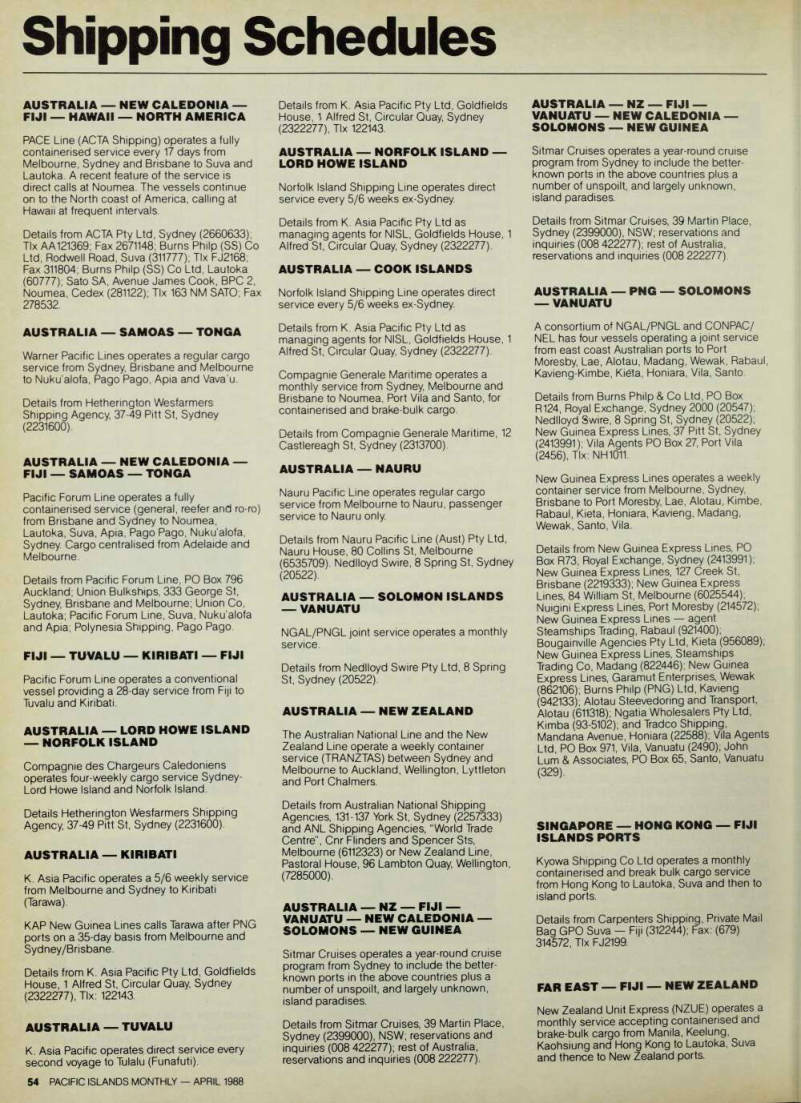
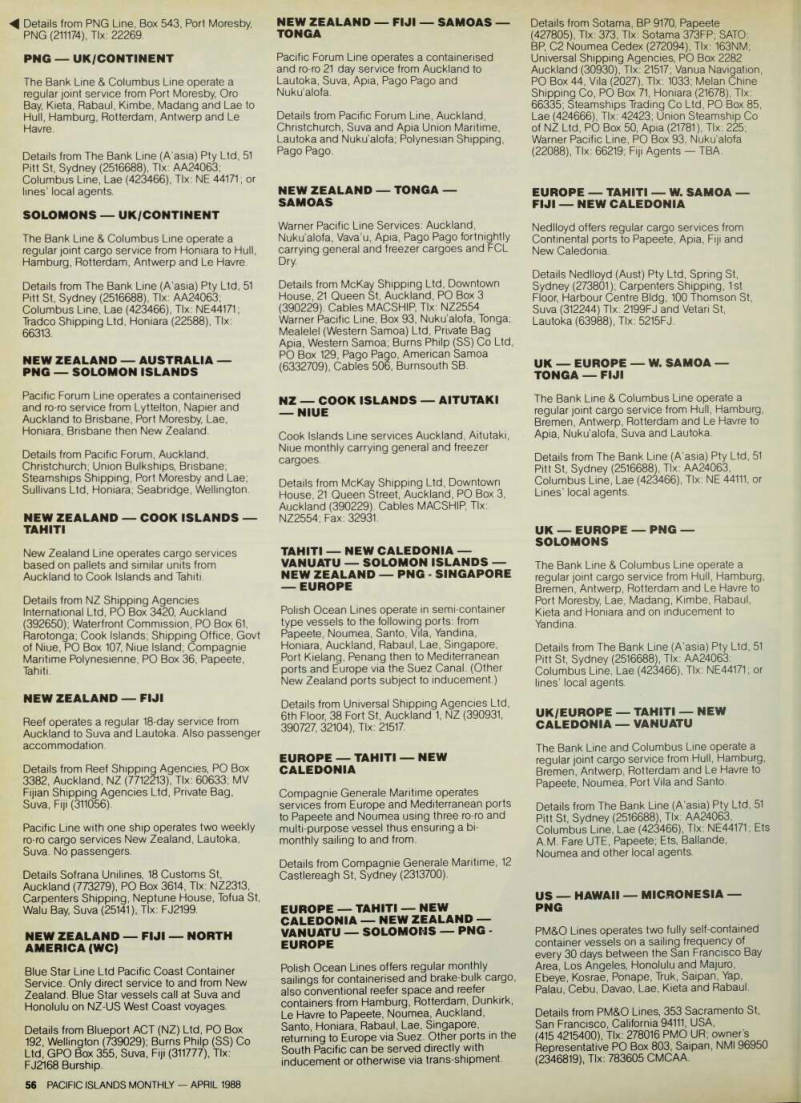
Australia New Caledonia
Fiji Hawaii North America
PACE Line (ACTA Shipping) operates a fully containerised service every 17 days from Melbourne, Sydney and Brisbane to Suva and Lautoka. A recent feature of the service is direct calls at Noumea. The vessels continue on to the North coast of America, calling at Hawaii at frequent intervals.
Details from ACTA Pty Ltd, Sydney (2660633); Tlx AA121369; Fax 2671148; Burns Philp (SS) Co Ltd, Rodwell Road, Suva (311777); Tlx FJ2168; Fax 311804; Burns Philp (SS) Co Ltd, Lautoka (60777); Sato SA, Avenue James Cook, BPC 2, Noumea. Cedex (281122); Tlx 163 NM SATO; Fax 278532.
Australia Samoas Tonga
Warner Pacific Lines operates a regular cargo service from Sydney, Brisbane and Melbourne to Nukualofa, Pago Pago, Apia and Vava’u.
Details from Hetherington Wesfarmers
Shipping Agency, 37-49 Pitt St, Sydney
(2231600).
Australia New Caledonia
Fiji Samoas Tonga
Pacific Forum Line operates a fully containerised service (general, reefer and ro-ro) from Brisbane and Sydney to Noumea, Lautoka, Suva, Apia, Pago Pago, Nukualofa, Sydney. Cargo centralised from Adelaide and Melbourne.
Details from Pacific Forum Line, PO Box 796 Auckland; Union Bulkships, 333 George St, Sydney, Brisbane and Melbourne; Union Co, Lautoka; Pacific Forum Line, Suva, Nukualofa and Apia; Polynesia Shipping, Pago Pago.
Fiji Tuvalu Kiribati Fiji
Pacific Forum Line operates a conventional vessel providing a 28-day service from Fiji to Tuvalu and Kiribati.
Australia Lord Howe Island
Norfolk Island
Compagnie des Chargeurs Caledoniens
operates four-weekly cargo service Sydney- Lord Howe Island and Norfolk Island.
Details Hetherington Wesfarmers Shipping Agency, 37-49 Pitt St, Sydney (2231600).
Australia Kiribati
K. Asia Pacific operates a 5/6 weekly service from Melbourne and Sydney to Kiribati (Tarawa).
KAP New Guinea Lines calls Tarawa after PNG ports on a 35-day basis from Melbourne and
Sydney/Brisbane.
Details from K. Asia Pacific Pty Ltd, Goldfields House, 1 Alfred St, Circular Quay, Sydney (2322277), Tlx; 122143.
Australia Tuvalu
K. Asia Pacific operates direct service every second voyage to Tulalu (Funafuti).
Details from K. Asia Pacific Pty Ltd, Goldfields House, 1 Alfred St, Circular Quay, Sydney (2322277), Tlx 122143.
Australia Norfolk Island
Lord Howe Island
Norfolk Island Shipping Line operates direct service every 5/6 weeks ex-Sydney.
Details from K. Asia Pacific Pty Ltd as managing agents for NISL, Goldfields House, 1 Alfred St, Circular Quay, Sydney (2322277).
Australia Cook Islands
Norfolk Island Shipping Line operates direct service every 5/6 weeks ex-Sydney.
Details from K. Asia Pacific Pty Ltd as managing agents for NISL, Goldfields House, 1 Alfred St, Circular Quay, Sydney (2322277).
Compagnie Generale Maritime operates a monthly service from Sydney, Melbourne and Brisbane to Noumea, Port Vila and Santo, for containerised and brake-bulk cargo.
Details from Compagnie Generale Maritime, 12 Castlereagh St, Sydney (2313700).
Australia Nauru
Nauru Pacific Line operates regular cargo service from Melbourne to Nauru, passenger service to Nauru only.
Details from Nauru Pacific Line (Aust) Pty Ltd, Nauru House, 80 Collins St, Melbourne (6535709). Nedlloyd Swire, 8 Spring St, Sydney (20522).
Australia Solomon Islands
Vanuatu
NGAL/PNGL joint service operates a monthly service.
Details from Nedlloyd Swire Pty Ltd, 8 Spring St, Sydney (20522).
Australia New Zealand
The Australian National Line and the New Zealand Line operate a weekly container service (TRANZTAS) between Sydney and Melbourne to Auckland, Wellington, Lyttleton and Port Chalmers.
Details from Australian National Shipping Agencies, 131-137 York St. Sydney (2257333) and ANL Shipping Agencies, “World Trade Centre”, Cnr Flinders and Spencer Sts, Melbourne (6112323) or New Zealand Line, Pastoral House, 96 Lambton Quay, Wellington, (7285000).
Australia Nz Fiji
Vanuatu New Caledonia
Solomons New Guinea
Sitmar Cruises operates a year-round cruise program from Sydney to include the better known ports in the above countries plus a number of unspoilt, and largely unknown, island paradises.
Details from Sitmar Cruises, 39 Martin Place, Sydney (2399000), NSW; reservations and inquiries (008 422277); rest of Australia, reservations and inquiries (008 222277).
Australia Nz Fiji
Vanuatu New Caledonia
Solomons New Guinea
Sitmar Cruises operates a year-round cruise program from Sydney to include the better known ports in the above countries plus a number of unspoilt, and largely unknown, island paradises.
Details from Sitmar Cruises, 39 Martin Place, Sydney (2399000), NSW; reservations and inquiries (008 422277); rest of Australia, reservations and inquiries (008 222277).
Australia Png Solomons
Vanuatu
A consortium of NGAL/PNGL and CONPAC/ NEL has four vessels operating a joint service from east coast Australian ports to Port Moresby, Lae, Alotau, Madang, Wewak, Rabaul, Kavieng-Kimbe, Kieta, Honiara, Vila, Santo.
Details from Burns Philp & Co Ltd, PC Box R 124, Royal Exchange, Sydney 2000 (20547); Nedlloyd Swire, 8 Spring St, Sydney (20522); New Guinea Express Lines, 37 Pitt St, Sydney (2413991); Vila Agents PO Box 27, Port Vila
(2456), Tlx: Nhioii.
New Guinea Express Lines operates a weekly container service from Melbourne, Sydney, Brisbane to Port Moresby, Lae, Alotau, Kimbe, Rabaul, Kieta, Honiara, Kavieng, Madang, Wewak, Santo, Vila.
Details from New Guinea Express Lines, PO Box R 73, Royal Exchange, Sydney (2413991); New Guinea Express Lines, 127 Creek St, Brisbane (2219333); New Guinea Express Lines, 84 William St, Melbourne (6025544); Nuigini Express Lines, Port Moresby (214572); New Guinea Express Lines agent Steamships Trading, Rabaul (921400); Bougainville Agencies Pty Ltd, Kieta (956089); New Guinea Express Lines, Steamships Trading Co, Madang (822446); New Guinea Express Lines, Garamut Enterprises, Wewak (862106); Burns Philp (PNG) Ltd, Kavieng (942133); Alotau Steevedoring and Transport, Alotau (611318); Ngatia Wholesalers Pty Ltd, Kimba (93-5102); and Tradco Shipping, Mandana Avenue, Honiara (22588); Vila Agents Ltd, PO Box 971, Vila, Vanuatu (2490); John Lum & Associates, PO Box 65, Santo, Vanuatu (329).
Singapore Hong Kong Fiji
Islands Ports
Kyowa Shipping Co Ltd operates a monthly containerised and break bulk cargo service from Hong Kong to Lautoka, Suva and then to island ports.
Details from Carpenters Shipping, Private Mail Bag GPO Suva Fiji (312244); Fax: (679) 314572, Tlx FJ2199.
Far East Fiji New Zealand
New Zealand Unit Express (NZUE) operates a monthly service accepting containerised and brake-bulk cargo from Manila, Keelung, Kaohsiung and Hong Kong to Lautoka, Suva and thence to New Zealand ports.
Details from Carpenters Shipping, Private Mail Bag GPO Suva (312244), Fax: (679) 314572; Tlx FJ2199; Burns Philp, Suva (311777); New Zealand Unit Express, Maritime Building, 2-10 Customhouse Quay, PO Box 890, Wellington
(727865), Cables: Enzue-Man Wellington,
Tlx: NZ31340, NEDLNZ, or Nedlloyd Swire Pty Ltd. Sydney (20522).
Far East Mid-S. Pacific
China Navigation’s New Guinea Pacific Line operates a regular container service from Hong Kong, Taiwan, Philippines, Singapore, Malaysia and to Port Moresby, Lae, Rabaul, Kieta and Honiara monthly. Wewak and Madang will receive four direct calls a year. A T/S service via Lae to these and other PNG ports connecting with monthly sailings is available at cost. Cargo from the same Eastern ports to the South Pacific ports of Noumea, Santo, Vila, Papeete, Pago Pago, Apia, Nukualofa, Raratonga and Tarawa will be shipped via Japan or Busan on the monthly Bali Hai service.
Details from Steamships Shipping, PO Box 634, Port Moresby (220283 or 220289).
Kyowa Shipping Ltd operates monthly services from Japan to Guam, Saipan, Solomons, New Caledonia, Fiji, Western and American Samoa, Tahiti, Cook Islands, Tonga and Vanuatu.
Details from Hetherington Wesfarmers Shipping Agency, 37-49 Pitt St, Sydney (2231600); Carpenters Shipping, Suva (312244), Tlx: FJ2199.
Guam Northern Marianas
Saipan Shipping Co Inc operates a weekly service via barge carrying containers and conventional cargo between Guam and Saipan and Tinian.
Details from Saipan Shipping Co Inc, PO Box 8 Saipan. CM 96950 (322 9706 or 3229707), Tlx: 783619; Fax: (670) 3223183; Guam agents Maritime Agencies of the Pacific Ltd.
Hawaii Samoas Tonga
Cook Islands
Hawaii-Pacific Lines operates monthly container service between Honolulu, Pago Pago, Apia, Nukualofa and Avatiu (Rarotonga).
Details from Hawaii-Pacific Maritime Inc, PO Box 3264. Honolulu. HI 96801-3264 (808 53114841).
Details from: Morris Hedstrom (Samoa) Ltd PO Box 189, Apia, Western Samoa (21355, 22722) Tlx: 224 (MORISHED SX), Fax. 24-279; Union ’
Citco Travel Ltd, Rarotonga, Cook Islands (682 21780); Tlx: 62024 (UTRAV G); Fax: (682) 20859; Kneubuhl Maritime Services, PO Box 39, Pago Pago, American Samoa, 96799 (684 6335121 / 22); Tlx: 782505; Fax: (684) 6335100; Union Maritime Services Ltd, PO Box 4, Nukualofa Tonga (21644/5); Tlx; 66227, Fax: (676) 21645.’
Japan Fiji Island Ports
Kyowa Shipping Co Ltd operates a monthly containerised service from main ports of Japan to Suva, Lautoka, thence to island ports.
Details from Carpenters Shipping, Harbour Centre Building, Ist Floor, Thomson St, Suva (312244), Tlx; FJ2199 and Burns Philp, Suva (311777).
Japan Micronesia
The NYK Shipping Line operates a monthly cargo service from Japan to Micronesia, calling at Yoko, Nagoya, Kobe, Guam, Saipan, Truk, Ponape and Majuro, returning via Yoko, Nagoya and Kobe.
Details from Burns Philp & Co Ltd, 51 Pitt St Sydney (2591000).
Saipan Shipping Co Inc operates a monthly service from Japan to Saipan, Guam, Truk, Ponape, Majuro (Kosrae and Ebeye on inducement).
Details from Saipan Shipping Co Inc, PO Box 8 Saipan, CM 96950 (322 9706 or 3229707), Tlx: ’ 783619, Fax: (670) 3223183. Japan agents Kyowa Shipping Company Ltd; Guam Agents Maritime Agencies of the Pacific Ltd.
Japan Korea Png Japan
Paradise Service
Mitsui OSK Lines in joint service with NYK Lines operates a monthly service from main ports in Japan and Busan in Korea to PNG ports of Wewak, Rabaul, Kieta, Lae, Port Moresby, Kavieng, Kimbe, Madang and Oro Bay.
Details from Robert Laurie Company Pty Ltd, PO Box 1032, Lae/PNG (Direct: 423642 or Switch: 423811), Contact: W O Hackenberg, Group Shipping Manager & Marketing; Tlx: NE 42508, Fax: 423801.
Png Inter-Mainport
Papua New Guinea Line offers scheduled 10-20 day coastal liner services linking all PNG major ports with containerisation, reefer, heavy lift and trans-shipment facilities.
Details from PNG Line, Box 543, Port Moresby, PNG (211174), Tlx: 22269.
Png Uk/Continent
The Bank Line & Columbus Line operate a regular joint service from Port Moresby, Oro Bay, Kieta, Rabaul, Kimbe, Madang and Lae to Hull, Hamburg, Rotterdam, Antwerp and Le Havre.
Details from The Bank Line (A'asia) Pty Ltd, 51 Pitt St. Sydney (2516688), Tlx: AA24063; Columbus Line, Lae (423466), Tlx; NE 44171; or lines’ local agents.
Solomons Uk/Continent
The Bank Line & Columbus Line operate a regular joint cargo service from Honiara to Hull, Hamburg, Rotterdam, Antwerp and Le Havre.
Details from The Bank Line (A’asia) Pty Ltd, 51 Pitt St, Sydney (2516688), Tlx: AA24063; Columbus Line, Lae (423466), Tlx: NE44171; Tradco Shipping Ltd, Honiara (22588), Tlx: 66313.
New Zealand Australia
Png Solomon Islands
Pacific Forum Line operates a containerised and ro-ro service from Lyttelton, Napier and Auckland to Brisbane, Port Moresby, Lae, Honiara, Brisbane then New Zealand.
Details from Pacific Forum, Auckland, Christchurch; Union Bulkships, Brisbane; Steamships Shipping, Port Moresby and Lae; Sullivans Ltd, Honiara; Seabridge, Wellington.
New Zealand Cook Islands
Tahiti
New Zealand Line operates cargo services based on pallets and similar units from Auckland to Cook Islands and Tahiti.
Details from NZ Shipping Agencies International Ltd, PO Box 3420, Auckland (392650); Waterfront Commission, PO Box 61, Rarotonga; Cook Islands; Shipping Office, Govt of Niue, PO Box 107, Niue Island; Compagnie Maritime Polynesienne, PO Box 36, Papeete, Tahiti.
New Zealand —Fiji
Reef operates a regular 18-day service from Auckland to Suva and Lautoka. Also passenger accommodation.
Details from Reef Shipping Agencies, PO Box 3382, Auckland, NZ (7712213), Tlx: 60633; MV
Fijian Shipping Agencies Ltd, Private Bag,
Suva, Fiji (311056).
Pacific Line with one ship operates two weekly ro-ro cargo services New Zealand, Lautoka, Suva. No passengers.
Details Sofrana Unilines, 18 Customs St, Auckland (773279), PO Box 3614, Tlx: NZ2313, Carpenters Shipping, Neptune House, Tofua St, Walu Bay. Suva (25141), Tlx: FJ2199.
New Zealand Fiji North
America (Wc)
Blue Star Line Ltd Pacific Coast Container Service. Only direct service to and from New Zealand. Blue Star vessels call at Suva and Honolulu on NZ-US West Coast voyages.
Details from Blueport ACT (NZ) Ltd, PO Box 192, Wellington (739029); Burns Philp (SS) Co Ltd. GPO Box 355, Suva, Fiji (311777), Tlx: FJ2168 Burship.
New Zealand Fiji Samoas
Tonga
Pacific Forum Line operates a containerised and ro-ro 21 day service from Auckland to Lautoka, Suva, Apia, Pago Pago and Nukualofa.
Details f/om Pacific Forum Line, Auckland, Christchurch, Suva and Apia Union Maritime, Lautoka and Nukualofa; Polynesian Shipping,
Pago Pago.
New Zealand Tonga
Samoas
Warner Pacific Line Services: Auckland, Nukualofa, Vava’u, Apia, Pago Pago fortnightly carrying general and freezer cargoes and FCL Dry.
Details from McKay Shipping Ltd, Downtown House, 21 Queen St, Auckland, PO Box 3 (390229). Cables MACSHIP, Tlx: NZ2554 Warner Pacific Line, Box 93, Nukualofa, Tonga; Mealelel (Western Samoa) Ltd, Private Bag Apia, Western Samoa, Burns Philp (SS) Co Ltd, PO Box 129, Pago Pago, American Samoa (6332709), Cables 506, Burnsouth SB.
Nz Cook Islands Aitutaki
Niue
Cook Islands Line services Auckland, Aitutaki, Niue monthly carrying general and freezer cargoes.
Details from McKay Shipping Ltd, Downtown House, 21 Queen Street, Auckland, PO Box 3, Auckland (390229). Cables MACSHIP, Tlx: NZ2554; Fax: 32931.
Tahiti New Caledonia
Vanuatu Solomon Islands
New Zealand Png - Singapore
Europe
Polish Ocean Lines operate in semi-container type vessels to the following ports: from Papeete, Noumea, Santo, Vila, Yandina, Honiara, Auckland, Rabaul, Lae, Singapore, Port Kielang, Penang then to Mediterranean ports and Europe via the Suez Canal. (Other New Zealand ports subject to inducement.) Details from Universal Shipping Agencies Ltd, 6th Floor, 38 Fort St, Auckland 1, NZ (390931, 390727, 32104), Tlx: 21517.
Europe Tahiti New
Caledonia
Compagnie Generale Maritime operates services from Europe and Mediterranean ports to Papeete and Noumea using three ro-ro and multi-purpose vessel thus ensuring a bi monthly sailing to and from.
Details from Compagnie Generale Maritime, 12
Castlereagh St, Sydney (2313700).
Europe Tahiti New
Caledonia New Zealand
Vanuatu Solomons Png -
Europe
Polish Ocean Lines offers regular monthly sailings for containerised and brake-bulk cargo, also conventional reefer space and reefer containers from Hamburg, Rotterdam, Dunkirk, Le Havre to Papeete, Noumea, Auckland, Santo, Honiara, Rabaul, Lae, Singapore, returning to Europe via Suez. Other ports in the South Pacific can be served directly with inducement or otherwise via trans-shipment.
Details from Sotama, BP 9170, Papeete (427805), Tlx: 373, Tlx: Sotama 373FP; SATO; BP, C 2 Noumea Cedex (272094), Tlx: 163 NM; Universal Shipping Agencies, PO Box 2282 Auckland (30930), Tlx: 21517; Vanua Navigation, PO Box 44, Vila (2027), Tlx: 1033; Melan Chine Shipping Co, PO Box 71, Honiara (21678), Tlx: 66335; Steamships Trading Co Ltd, PO Box 85, Lae (424666), Tlx: 42423; Union Steamship Co of NZ Ltd, PO Box 50, Apia (21781), Tlx: 225; Warner Pacific Line, PO Box 93, Nukualofa (22088), Tlx: 66219; Fiji Agents TBA.
Europe Tahiti W. Samoa
Fiji New Caledonia
Nedlloyd offers regular cargo services from Continental ports to Papeete, Apia, Fiji and New Caledonia.
Details Nedlloyd (Aust) Pty Ltd, Spring St, Sydney (273801); Carpenters Shipping, Ist Floor, Harbour Centre Bldg, 100 Thomson St, Suva (312244) Tlx: 2199FJ and Vetari St, Lautoka (63988), Tlx: 5215FJ.
Uk Europe W. Samoa
Tonga Fiji
The Bank Line & Columbus Line operate a regular joint cargo service from Hull, Hamburg, Bremen, Antwerp, Rotterdam and Le Havre to Apia, Nukualofa, Suva and Lautoka.
Details from The Bank Line (A’asia) Pty Ltd, 51 Pitt St. Sydney (2516688), Tlx: AA24063, Columbus Line, Lae (423466), Tlx: NE 44111, or Lines’ local agents.
Uk Europe Png
Solomons
The Bank Line & Columbus Line operate a regular joint cargo service from Hull, Hamburg, Bremen, Antwerp, Rotterdam and Le Havre to Port Moresby, Lae, Madang, Kimbe, Rabaul, Kieta and Honiara and on inducement to Yandina.
Details from The Bank Line (A’asia) Pty Ltd, 51 Pitt St, Sydney (2516688), Tlx: AA24063: Columbus Line, Lae (423466), Tlx: NE44171; or lines’ local agents.
Uk/Europe Tahiti New
Caledonia Vanuatu
The Bank Line and Columbus Line operate a regular joint cargo service from Hull, Hamburg, Bremen, Antwerp, Rotterdam and Le Havre to Papeete, Noumea, Port Vila and Santo.
Details from The Bank Line (A’asia) Pty Ltd, 51 Pitt St, Sydney (2516688), Tlx: AA24063, Columbus Line, Lae (423466), Tlx; NE44171; Ets A.M. Fare UTE, Papeete; Ets, Ballande, Noumea and other local agents.
Us Hawaii Micronesia
Png
PM&O Lines operates two fully self-contained container vessels on a sailing frequency of every 30 days between the San Francisco Bay Area, Los Angeles, Honolulu and Majuro, Ebeye, Kosrae, Ponape, Truk, Saipan, Yap, Palau, Cebu, Davao. Lae, Kieta and Rabaul.
Details from PM&O Lines, 353 Sacramento St, San Francisco, California 94111, USA, (415 4215400), Tlx: 278016 PMO UR; owner’s Representative PO Box 803, Saipan, NMI 96950
(2346819). Tlx: 783605 Cmcaa.
Advertisements & other items, pp. 55-57 (1 item)
Hai Service
TONGA
KIRIBATI
VANUATU
COOK ISLAND
SOLOMON ISLANDS
NEW CALEDONIA
U.S. SAMOA
WESTERN SAMOA
FRENCH POLYNESIA
JAPAN . KOREA
YOU’LL FIND IT,
WHERE THE SKY MEETS
THE SEA
RORO. CONTAINER &
B.BULK SHIPPING
BALI
HAI SERVICE
AGENTS
and
PHONE
SUVA:Burns Philp(B.P) 311777 Carpenter Shipping (C.S) 312244 LAUTOKA:B P 60777 C S 63988 APIA:B P 22611 PAGOPAGO :Polynesia Shipping Services Ltd. 633-1211 PAPEETE:Compagnie Maritime Polynesienne 42.84.02 NOUMEA:Etablissements Ballande 687-283384 VILA:B P 2456 SANTO; BP 230 HONlARAiSullivans (Solomon Islands) Ltd 21645 TARAWA:Shipping Corporation of Kiribati 26195 NUKUALOFA:B P2l 500 BUSAN:for general cargo Young Chang Shipping Co., Ltd. 753-0451 for vehicle Pan Continental Shipping Co , Ltd 778-7680 Soyang Shipping Co., Ltd 752-7755 JAPANrfor general cargo Swire 03-230-9245 for vehicle NYK Lines 03-284-5506 Mitsui O.S.K 03-584-0916
BANK LINE and
COLUMBUS LINE
24 day service to
Europe.
Need we say more...
D G The Joint Service Partners offer facilities for shipment of: Containers (FCL/LCL) and Break-bulk Cargo plus reefer space and deeptanks for carriage of vegetable oils and other liquid bulk cargo.
Carriers also accept heavy lifts, overlength and cumbersome parcels.
Ports of Service; Loading: Papeete, Apia, Suva, Lautoka, Noumea, Port Vila, Santo, Honiara, Port Moresby, Lae, Madang, Kimbe, Rabaul, Kieta, Darwin. For: Rotterdam, Antwerp, Hamburg, Hull, Dunkirk, Le Havre.
Additional ports on enquiry.
Please contact our regional offices for further information: The Bank Line (Australasia) Pty Ltd Columbus Line Reederei GmbH Suite 801, 51 Pitt St, P.O. Box 1 667, Lae/Papua New Guinea.
Sydney, NSW, Australia 2000 Phone: 423466/423487/AH. 422481 Phone 251 6688 Telex 24063 Telex: Colline NE 441 71 The South Pacific Specialists for over 75 years
How They Killed Yamamoto
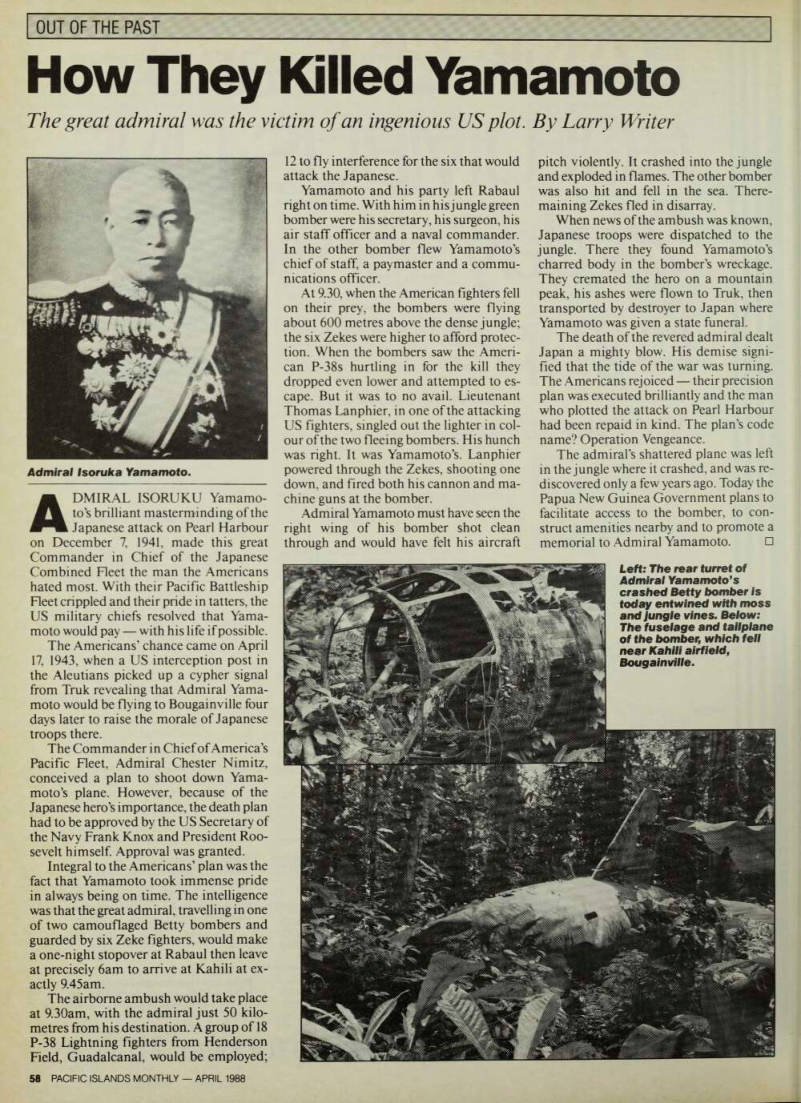
Out Of The Past
The great admiral was the victim of an ingenious US plot.
By Larry Writer
Admiral Isoruku Yamamo
to’s brilliant masterminding of the Japanese attack on Pearl Harbour on December 7, 1941, made this great Commander in Chief of the Japanese Combined Fleet the man the Americans hated most. With their Pacific Battleship Fleet crippled and their pride in tatters, the US military chiefs resolved that Yama moto would pay with his life if possible.
The Americans’ chance came on April 17, 1943, when a US interception post in the Aleutians picked up a cypher signal from Truk revealing that Admiral Yama moto would be flying to Bougainville four days later to raise the morale of Japanese troops there.
The Commander in Chief of America’s Pacific Fleet, Admiral Chester Nimitz, conceived a plan to shoot down Yama moto’s plane. However, because of the Japanese hero’s importance, the death plan had to be approved by the US Secretary of the Navy Frank Knox and President Roo sevelt himself. Approval was granted.
Integral to the Americans’ plan was the fact that Yamamoto took immense pride in always being on time. The intelligence was that the great admiral, travelling in one of two camouflaged Betty bombers and guarded by six Zeke fighters, would make a one-night stopover at Rabaul then leave at precisely 6am to arrive at Kahili at ex actly 9.45 am.
The airborne ambush would take place at 9.30 am, with the admiral just 50 kilo metres from his destination. A group of 18 P-38 Lightning fighters from Henderson Field, Guadalcanal, would be employed;
12 to fly interference for the six that would attack the Japanese.
Yamamoto and his party left Rabaul right on time. With him in his jungle green bomber were his secretary, his surgeon, his air staff officer and a naval commander.
In the other bomber flew Yamamoto’s chief of staff, a paymaster and a commu nications officer.
At 9.30, when the American fighters fell on their prey, the bombers were flying about 600 metres above the dense jungle; the six Zekes were higher to afford protec tion. When the bombers saw the Ameri can P-38s hurtling in for the kill they dropped even lower and attempted to es cape. But it was to no avail. Lieutenant Thomas Lanphier, in one of the attacking US fighters, singled out the lighter in col our of the two fleeing bombers. His hunch was right. It was Yamamoto’s. Lanphier powered through the Zekes, shooting one down, and fired both his cannon and ma chine guns at the bomber.
Admiral Yamamoto must have seen the right wing of his bomber shot clean through and would have felt his aircraft
pitch violently. It crashed into the jungle and exploded in flames. The other bomber was also hit and fell in the sea. There maining Zekes fled in disarray.
When news of the ambush was known, Japanese troops were dispatched to the jungle. There they found Yamamoto’s charred body in the bomber’s wreckage.
They cremated the hero on a mountain peak, his ashes were flown to Truk, then transported by destroyer to Japan where Yamamoto was given a state funeral.
The death of the revered admiral dealt Japan a mighty blow. His demise signi fied that the tide of the war was turning.
The Americans rejoiced their precision plan was executed brilliantly and the man who plotted the attack on Pearl Harbour had been repaid in kind. The plan’s code name? Operation Vengeance.
The admiral’s shattered plane was left in the jungle where it crashed, and was re discovered only a few years ago. Today the Papua New Guinea Government plans to facilitate access to the bomber, to con struct amenities nearby and to promote a memorial to Admiral Yamamoto. □
Admiral Isoruka Yamamoto.
Left: The rear turret of Admiral Yamamoto’s crashed Betty bomber is today entwined with moss and jungle vines. Below: The fuselage and tailplane of the bomber, which fell near Kahili airfield, Bougainville.
Advertisements & other items, pp. 59-60 (1 item)
clarion
Sound that's absolutely enchanting, even in the somewhat less than enchanting environment of a moving automobile. This is Clarions uncompromising standard, realized by the sophisticated use of electronic features that are easy to use. And there’s a wide selection of models to meet your individual taste.
Clarion reliability? It's no pipe dream. Clarion Car Stereo. Listen and drive happily ever after. *Dolby and the double-D symbol are trademarks of Dolby Laboratories Licensing Corporation.
FOLLOW THE MUSIC
AW STEREO MAGI-TUNE DIVERSITY
s s •••■; r**; ch i © 9900 X
STOP/EJECT
* * main* ...
SCN RPT
BLS LD 180
PnE)
PLAY/PROGHAM
m For further information Australia: Amalgamated Wireless (Australasia) Ltd, 554 Parramatta Road, Ashfield, NS W , 2131 / New Zealand; AWA New Zealand Limited, PO. Box 50 248, Ponrua / Fiji Islands: Bnjlal & Co., Ltd, G.P.O. Box 362, Suva Tahiti: HI FI, VAIRAATOA. Avenue Chef Vairaatoa BP. 1128, Papeete / New Caledonia: Caldis, B.PMI, Noumea Cedex / Guam: Micropac Audio lnc„ P.O Box 3478, Agana, Guam 96910, US A Tel: 472-8091, Cable Code: HIFI AUDIO AGANA I Vanuatu; The Sound Centre, PO Box 434, Vila / Cook Islands: South Seas International Ltd, P.O Box 49, Rarotonga / Papua New Guinea; Hagemeyer (PN G.) Pty Ltd, PO Box 1428, Boroko, Port Moresby.
OVER 100 VICTORIES IN ’B7.
From the desert furnaces of the Middle East to the foothills of the Himalayas, from the barren Australian outback to European and American rally circuits, Mitsubishi vehicles tallied over 100 wins in competitive race and rally events all over the world.
Mitsubishi’s winning tradition continues.
When Mitsubishi Pajeros, Starions and Lancers racked up more than 100 victories in 1986, it was simply a good year for their racing. Now that they have done the same in 1987, they have started a tradition—a tradition of winning big, However, these high-performance passenger cars, GT sports cars and multi-purpose 4WD vehicles enter such events not for the sake of winning alone but to test their levels of performance, safety and reliability under the most demanding conditions that can be found.
Their high-tech performance features are being proved and improved each time they enter a race. But you're the real winner as the benefits get passed on to you.
In every corner of the globe, both professional drivers in competitive races and private owners on the highways alike, are part of the Mitsubishi winning tradition.
AMERICAN SAMOA: MORRIS SCANbSNJ SERVICE INC. P.O. Box 367, Pago Pago, Tel. 633-5520/AU SIR ALIA MITSUBISHI MOTORS AUSTRALIA LTD. Box 1284, South Road, <3>welly F&rfc, SoLth Australia 5042/Tjfef (08) 275.7223/FIJI: NIVIS MOTOR & MACHINERY CO.. LTD. G.P.O. Box 150, Suva, Tel. 383411/FRENCH POLYNESIA (TAHITI): Q ETS-BREDIN FRERES ET FILS P.0.80x 21, Papeete, Tahiti, Tel. 4-202-58/NEW CALEDONIA: SOCIETE D IMPORTATION D AUTO DU PACIFIQUE SUD S.A. B.P. 438 Rond /Point du Pacifique, Noumea, Tel 274144/NEW ZEALAND; MITSUBISHI MOTORS NEW ZEALAND LTD. Todd Park, Heriot Drive, Private Bag. Porirua, Tel. 370-109/NORFOLK ISLAND: BORRYS LTD. P O. Norfolk Island, Tel. 2114/PAPUA NEWGUINEA:TOBAPTY. LTD. P.O. Box 503, Port Moresby, Tel. 21-7874/SOLOMON ISLANDS: HARVEST LTD. G.fJb Box Tel. 30128/TONGA: SITANI MAPI CO., LTD. P.O. Box 83, Nuku ALOFA, Tel. 21 -044/VANUATU: SOCOMETRA B.P. 06 Route Port-Vita* Tel. 2314/WESTERN SAMOA; AM. MACDONALD HOLDINGS LTD. P.O. Box 576, Apia, Tel. 22022/SAIPAN/POHNPEI/MAJURO/KOSRAE/TRUK/YAP/ BELAU: MICRONESSIAN MOTORS, INC. 997 South Marine Drive, Tamuning, Guam 96911, Tel. 646-6827
MICM
61-IN i sT7=ir?jorsi
AOVi
wb| A
MITSUBISHI
MOTORS