Pacific


Islands
Monthly
American Samoa US$2.OO Australia A 52.00 Cook Islands NZ$3.OO Fiji F 51.75 Hawaii US$2.5O Kiribati A 52.00 Nauru A 52.00 New Caledonia CFP2SO New Zealand NZ$3.OO Niue NZ$2.5O Norfolk Island A 52.00 Papua New Guinea K 2.00 Solomon Islands 552.00 Tahiti CFP3OO Tonga P 2.00 Tuvalu A 52.00
Usa Us$3.Oo
USTT and Guam US$2.5O Vanuatu VT2.00 Western Samoa T 2.75 •Recommended retail price only
March 1988
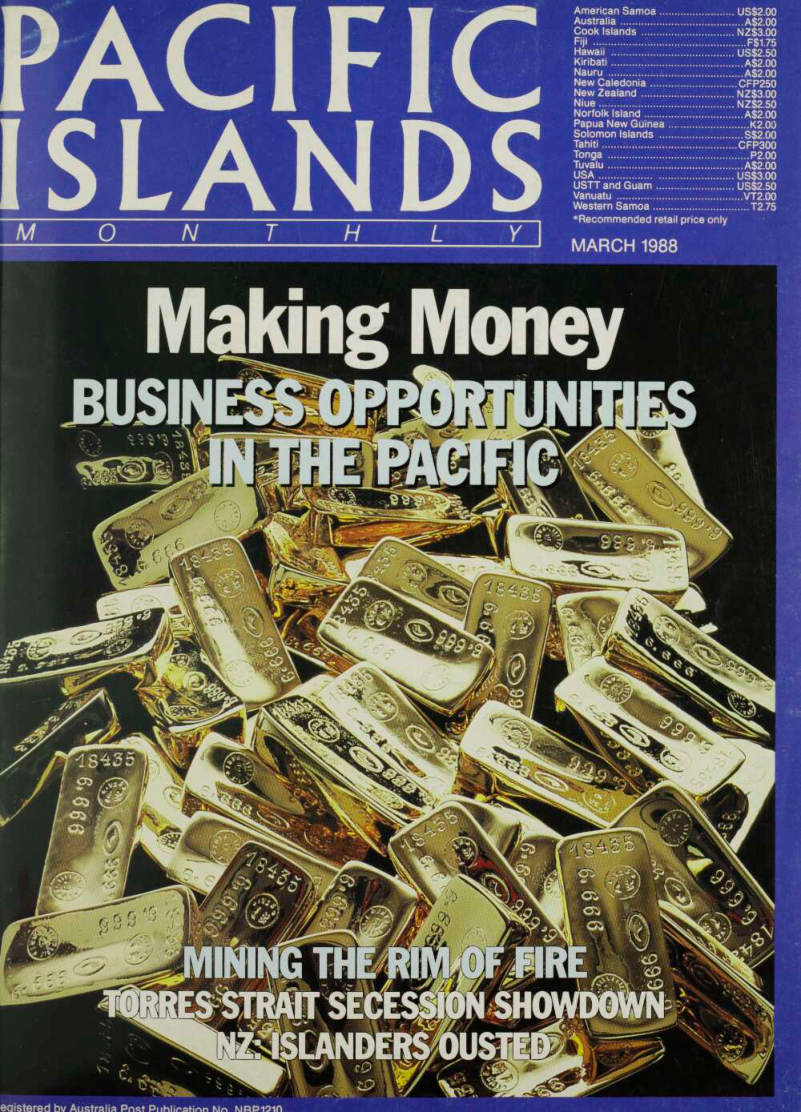
Making Money
t
Cover Photo: Australian Picture Library
Advertisements & other items, pp. 2-4 (1 item)
It’s your turn.
Take it, with the
advantage of Mazda’s
unique rear wheel
control technology.
Whether it’s a hairpin turn, a winding turn, or for that matter, a high-speed lane change, the new Mazda 626 imparts a feeling of freedom and confidence. A feeling born of Mazda’s long search for the ultimate in rear wheel control technology.
The ultimate; those are pretty strong words to use. But then, words like that have been used by automotive experts and drivers around the world to describe the Mazda 626 and the unique feeling its ? rear suspension delivers.
What’s behind it all.
The reason is that for quite some time now Mazda has been concentrating on developing rear sus- ■ pension systems that actually help steer the car. It started with the award winning TTL suspension foum on the 323 and the original 626.
The search for the ultimate
>ntinued with the development of 4-Wheel Steering system. What b learned in that search was applied i the development of our award inning DTS system for the RX-7 id the E-Link suspension for the !9. This continuous process of finement has come full circle ;ain to the new 626, and applied its TL suspension. We’ve completely calculated its suspension geometry deliver a feeling of control that’s clearly superior and absolutely exhilarating.
Keeping on our toes.
It’s Mazda’s unique dedication to engineering the ultimate in rear wheel toe control and suspension technology that has resulted in such enjoyable driving in the Mazda 626.
And in fact, in all Mazda vehicles.
Take one out for yourself and see. And turn on to real driving pleasure.
New Mazda 626 Models and features shown may not be available in your area. Please consult your local Mazda dealer. This warranty is valid only in Australia.
YEAR/
60.000 KM
WARRANTY
Enter the “Mazda Photo Contest ’B9 ”
For further information, please contact your nearest Mazda dealer. Contest closes on June 30, 1988.
St Your kind of car.
mazoa
© Mazda Motor Corporation
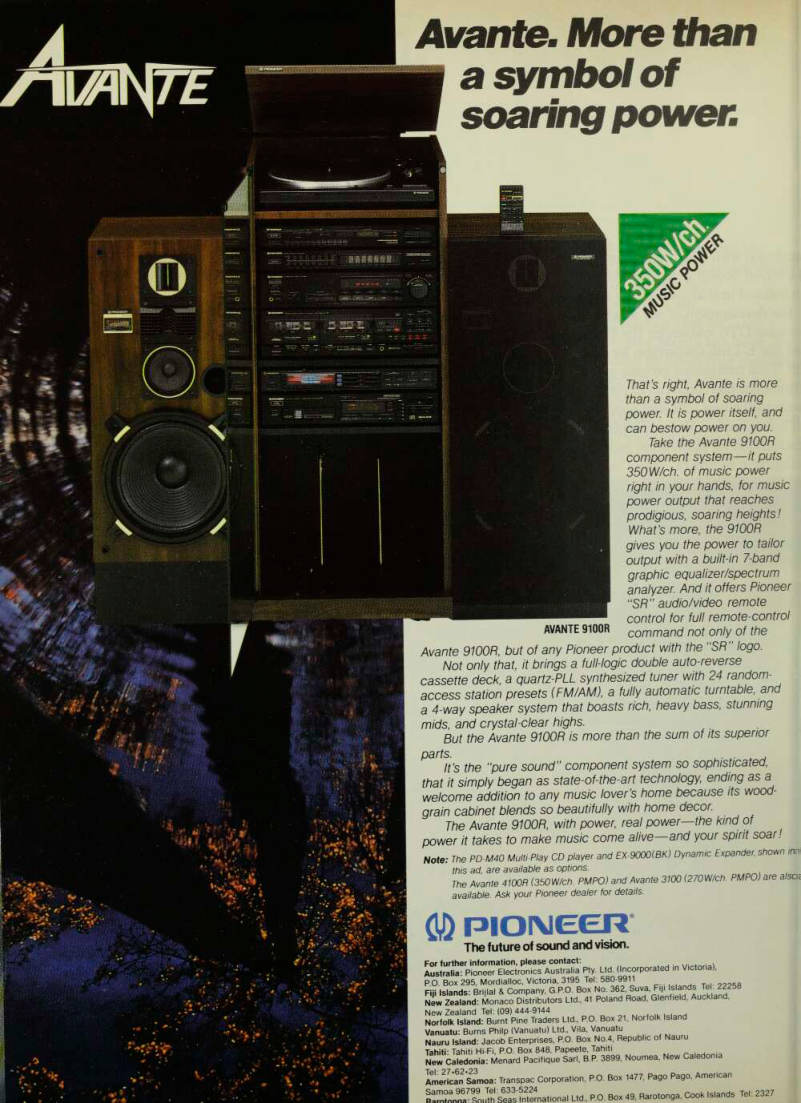
Avante. more them
a symbol of
soaring power.
s <b $ 9° V s * That’s right, Avante is more than a symbol of soaring power. It is power itself, and can bestow power on you.
Take the Avante 9100 R component system —it puts 350W/ch. of music power right in your hands, for music power output that reaches prodigious, soaring heights!
What’s more, the 9100 R gives you the power to tailor output with a built-in 7-band graphic equalizer/spectrum analyzer. And it offers Pioneer “SR” audio/video remote control for full remote-control AVANTE 9100 R command not only of the Avante 9100 R, but of any Pioneer product with the “SR” logo.
Not only that, it brings a full-logic double auto-reverse cassette deck, a quartz-PLL synthesized tuner with 24 randomaccess station presets (FM/AM), a fully automatic turntable, and a 4-way speaker system that boasts rich, heavy bass, stunning mids, and crystal-clear highs.
But the Avante 9100 R is more than the sum of its superior Pa %’s the “pure sound” component system so sophisticated, that it simply began as state-of-the-art technology, ending as a welcome addition to any music lover’s home because its woodgrain cabinet blends so beautifully with home decor.
The Avante 9100 R, with power, real power—the kind of power it takes to make music come alive —and your spirit soar!
Note: The PD-M4O Multi-Play CD player and EX-9000(BK) Dynamic Expander, shown in n this ad, are available as options.
The Avante 4100 R (350W/ch. PMPO) and Avante 3100 (270W/ch. PMPO) are alsa available. Ask your Pioneer dealer for details.
AD PIOMEER
The future of sound and vision.
For further information, please contact; . , .
Australia; Pioneer Electronics Australia Pty. Ltd. (Incorporated in Victoria), P.O. Box 295, Mordialloc, Victoria, 3195 Tel: 580-9911 Fiji Islands; Brijlal & Company, G.P.O. Box No. 362, Suva, Fiji Islands - 22258 New Zealand; Monaco Distributors Ltd., 41 Poland Road, Glenfield, Auckland, New Zealand Tel: (09) 444-9144 .. ~.. . nH Norfolk Island: Burnt Pine Traders Ltd., P.O. Box 21, Norfolk Island Vanuatu: Burns Philp (Vanuatu) Ltd., Vila, Vanuatu Nauru Island; Jacob Enterprises, P.O. Box N 0.4, Republic of Nauru Tahiti- Tahiti Hi-Fi, P.O. Box 848, Papeete, Tahiti .
New Caledonia: Menard Pacifique Sari, B.P. 3899, Noumea, New Caledonia Lrtan'4 3 »w: Transpac Corporation, P.O. Box 1477, Pago Pago, American Samoa 96799 Tel: 633-5224 x
Pacific
Islands
Monthly
Vol 59, No. 3
Voice Of The Pacific
March, ’BB
Page 36
Cover Story se
The Pacific presents many challenges for would-be investors small internal markets, a lack of skilled labour, high costs, irregular transport and large distances between nations but there remain real business prospects in most
territories. A nation by nation analysis
by Robin Bromby.
Torres Strait On The
Brink 10
A plea for independence.
Nz’S Illegal Immigrant
Crackdown 12
The Government gets tough on island over-stayers.
Maori Land Rights
Struggle 13
Continuing battle escalates.
Aid Rush To Fiji 14
Foreign assistance is now flooding in to the beleaguered nation.
Leontieff Gets Tough 16
French Polynesia s strongman takes off the gloves.
Png A Nation Divided 18
Why regionalism is tearing the country apart.
Page 26
Mining The Rim Of Fire 20
El Dorado or albatross for the region?
CASTING THEIR FATE TO THE WINDS 24 The year’s big long haul yacht races.
Forum: Indonesia A Giant Awakens... 26
Behind Indonesia’s Pacific ambitions.
Hawaii’S Renaissance Man 47
Maui Loa: artist, surfer, activist.
Editor Larry Writer Deputy Editor
Carson Creagh
Art Director Warren Scott Editorial Advisei John Carter Contributors
Frank Senge
Nicolas Rothwell Jack Kelleher Robin Bromby John Connell Karen Earnshaw Ed Rampell John Hunter Sven Wahlroos
Publisher Geraldine Raton Managing Editor Arnold Earnshaw
Advertising Sales Sydney & Melbourne Lawson Dixon (02) 288 3541 Fergus Maclagan (02) 412 3918; Brisbane Robert Walker (07) 371 0533 Adelaide Hastwell Williamson Representations (08) 79 9522
Australian cover price is recommended retail only. Registered by Australia Post, publication No. NBPI2K). Copyright Pacific Publications (Aust) Pty Ltd
Advertisements & other items, pp. 5-6 (3 items)
Departments
OPINION 7
QUOTES 8
LETTERS 9
PACIFIC REPORT 29
TRADE WINDS 33
TRANSITION 48
ISLAND PRESS 48
STAMPS 49
BOOKS 50
SHIPPING SCHEDULES 52
OUT OF THE PAST 58
5
PACIFIC ISLANDS MONTHLY MARCH 1988
A Pacific Publications Production.
Founded 1930 (USPS 952480) 64-76 Kippax St, Surry Hills, NSW 2010; Telex: AA20124; Fax: (02)288 3322; Cables: PACPUB Sydney; Telephone: (02) 288 3000.
Pacific Islands Monthly (APPS No.
NBP1210) is published monthly by Pa cific Publications Pty Ltd, a division of Nationwide News, 2 Holt St, Surry Hills, NSW 2010. Second class pos tage paid at Honolulu, Hawaii, POST MASTER. Send address changes to
PACIFIC ISLANDS MONTHLY, PO Box
22250, Honolulu, Hawaii 96822. Ty peset by David Graphics, Sydney, and printed by Progress Press, 2 Keys Rd, Moorabbin, Victoria.
Also available in De Luxe Mild
a a ft: V a ■ ft v a W V ft ft V V'.
I V V -V. p* V.
Si v BE y w V V V ■ '■ *3 ■ V y V HS H HI M H V V M M ■ ■ Si y v y * v V y V y v... s M ft ft ft y y y v y v V V V V y y v v V V V M y v ft V V v ft ft V V V V V V ft ■ V y ft ft v V ft V V V V V V - .ft V 5 V M ft 9 v v ' V V ft * V ■ ft ft V V ■ ft ft ■ ■ w V 8 V ’ !
V ■ '■ ■ V ft V * ft ■ «v ' & m *k m % i? *# rgp < sA# * m *
pigppi
•* *%« W <C * BR t? % V " ■ m % \ **,* ■m m * e ; *m mm *m S9j ■«- »\:% - ►«**- *j?S» *KS y v% • w *
Also available in De Luxe Mild
▼ JL AlV* , %
•»■ * ‘ J» » ’ “• <■“’»' 4 **W ,* »V .♦ *►
Fiji Returns To The Fold
Opinion
Whatever the rights or wrongs of resuming aid to Fiji, assistance from neighbours is the nation’s best hope of rehabilitation
THE resumption of Australian and New Zealand aid to Fiji and of US recognition has been criticised both by former Prime Minister Timoci Bavadra, and in some small states of the South Pacific. The move constitutes, they say, a de facto recognition of the Govern ment and implicit approval of the coups of last year.
Papua New Guinea PM Paias Wingti, on the other hand, has hailed the re sumption of aid as a counter to Fiji’s threat ened “isolation” in a re gion where mutual dependence extends be yond traditional ties to the 20th century world of trade, diplomacy and most important of all to defence.
Both positions are un derstandable and contain elements of truth neither proponents or opponents have acknowledged. The
Republic of Fiji has in some ways been recognised by the Australian Government’s decision to deal diplomatically with states rather than governments; a deliberate and pragmatic move into Realpolitik and global strategy that is not so much “supine”, as former South Australian Pre mier and vocal Rabuka critic Don Dunstan has claimed, as cognisant of Fiji’s vital role in South Pacific defence and of its central position in a region where too many small states have become aid dependencies.
In fact, Fiji’s new Government (in many ways simply its Alliance Government in new clothes) has played the game as well as the larger nations have and more cold bloodedly than its detractors would have believed possi ble. It has flirted with powers none of those larger nations would like to see gaining influence in the region, such as
France and Indonesia, of fering them concessions in return for generous aid and hardware before taking only what it wanted and turning back to its older, more familiar partners such as Australia and New Zealand, which in the past few weeks have re-estab lished economic and mil itary ties.
The real pawns in this game are not abstractions of power or technical as sistance, but the people of Fiji. Trade relations, aid packages and defence agreements translate as employment, health care and badly needed exper tise to the Melanesian, Po lynesian, European and Indian citizens of a nation hit hard by the events of the past year. Unemployment is crippling communities where no provisions exist for assisting those out of work; the “brain drain” has left ordinary Fijians as well as the members of the eth nic and military elites without medical, emer
gency and technical services. All that is set to change, and it seems everyone will be a winner.
Chinese doctors are being attracted by generous em ployment provisions, and Chinese energy experts are coming to expand Fiji’s rural power grid with solar gen erators; Australian medical aid will flow to public hos pitals and community health care facilities; Australian, New Zealand and French mining personnel will unlock the promise of mineral riches that will bring Fiji not only desperately needed foreign exchange, but jobs in a variety of industries.
Australia will see its former position regained in great part, with “fine print” guidelines that are designed to route aid to those most in need. New Zealand’s occupation of ►
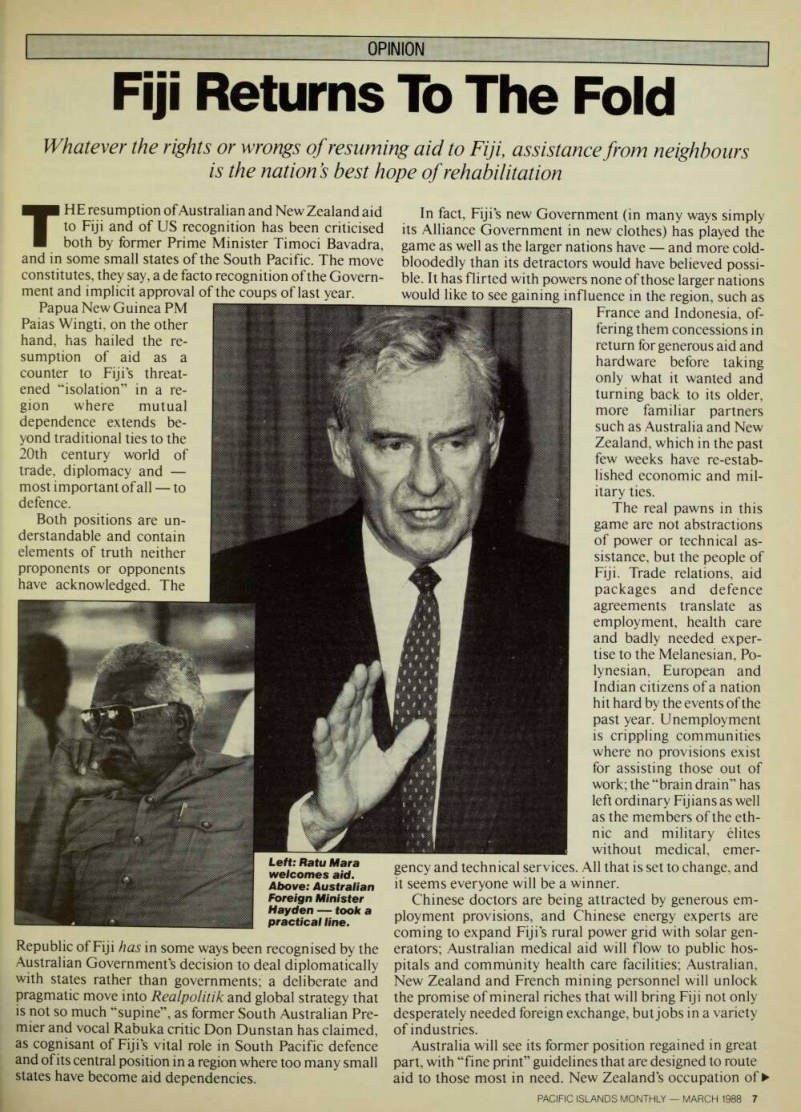
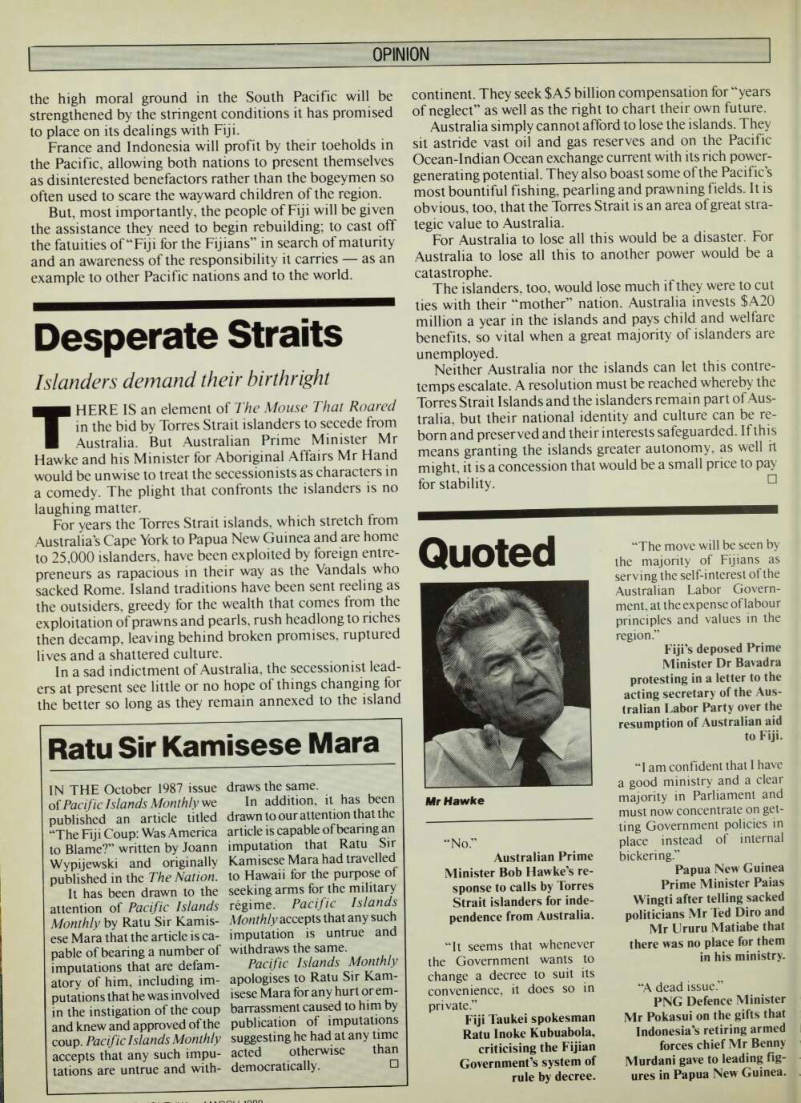
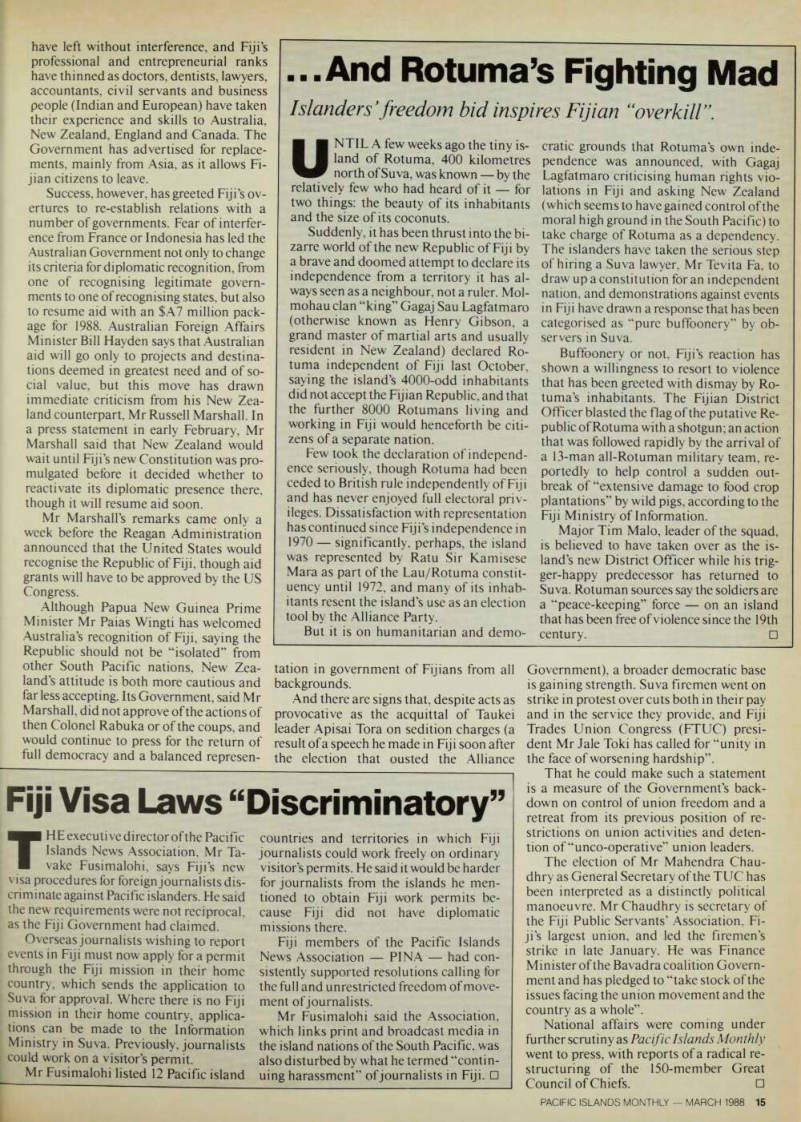
Left: Ratu Mara welcomes aid.
Above: Australian Foreign Minister Hayden -took a practical line.
the high moral ground in the South Pacific will be strengthened by the stringent conditions it has promised to place on its dealings with Fiji.
France and Indonesia will profit by their toeholds in the Pacific, allowing both nations to present themselves as disinterested benefactors rather than the bogeymen so often used to scare the wayward children of the region.
But, most importantly, the people of Fiji will be given the assistance they need to begin rebuilding; to cast off the fatuities of “Fiji for the Fijians” in search of maturity and an awareness of the responsibility it carries as an example to other Pacific nations and to the world.
Desperate Straits
Islanders demand their birthright
THERE IS an element of The Mouse That Roared in the bid by Torres Strait islanders to secede from Australia. But Australian Prime Minister Mr Hawke and his Minister for Aboriginal Affairs Mr Hand would be unwise to treat the secessionists as characters in a comedy. The plight that confronts the islanders is no laughing matter.
For years the Torres Strait islands, which stretch from Australia’s Cape York to Papua New Guinea and are home to 25,000 islanders, have been exploited by foreign entre preneurs as rapacious in their way as the Vandals who sacked Rome. Island traditions have been sent reeling as the outsiders, greedy for the wealth that comes from the exploitation of prawns and pearls, rush headlong to riches then decamp, leaving behind broken promises, ruptured lives and a shattered culture.
In a sad indictment of Australia, the secessionist lead ers at present see little or no hope of things changing for the better so long as they remain annexed to the island
continent. They seek SAS billion compensation for “years of neglect” as well as the right to chart their own future.
Australia simply cannot afford to lose the islands. They sit astride vast oil and gas reserves and on the Pacific Ocean-Indian Ocean exchange current with its rich power generating potential. They also boast some of the Pacific’s most bountiful fishing, pearling and prawning fields. It is obvious, too, that the Torres Strait is an area of great stra tegic value to Australia.
For Australia to lose all this would be a disaster. For Australia to lose all this to another power would be a catastrophe.
The islanders, too, would lose much if they were to cut ties with their “mother” nation. Australia invests SA2O million a year in the islands and pays child and welfare benefits, so vital when a great majority of islanders are unemployed.
Neither Australia nor the islands can let this contre temps escalate. A resolution must be reached whereby the Torres Strait Islands and the islanders remain part of Aus tralia, but their national identity and culture can be re born and preserved and their interests safeguarded. If this means granting the islands greater autonomy, as well it might, it is a concession that would be a small price to pay for stability. n
Ratu Sir Kamisese Mara
IN THE October 1987 issue of Pacific Islands Monthly we published an article titled “The Fiji Coup: Was America to Blame?” written by Joann Wypijewski and originally published in the The Nation.
It has been drawn to the attention of Pacific Islands Monthly by Ratu Sir Kamis ese Mara that the article is ca pable of bearing a number of imputations that are defam atory of him, including im putations that he was involved in the instigation of the coup and knew and approved of the coup. Pacific Islands Monthly accepts that any such impu tations are untrue and with
draws the same.
In addition, it has been drawn to our attention that the article is capable of bearing an imputation that Ratu Sir Kamisese Mara had travelled to Hawaii for the purpose of seeking arms for the military regime. Pacific Islands Monthly accepts that any such imputation is untrue and withdraws the same.
Pacific Islands Monthly apologises to Ratu Sir Kam isese Mara for any hurt or em barrassment caused to him by publication of imputations suggesting he had at any time acted otherwise than democratically. □
Quoted
“No.”
Australian Prime Minister Bob Hawke’s re sponse to calls by Torres Strait islanders for inde pendence from Australia.
“It seems that whenever the Government wants to change a decree to suit its convenience, it does so in private.”
Fiji Taukei spokesman Ratu Inoke Kubuabola, criticising the Fijian Government’s system of rule by decree.
“The move will be seen by the majority of Fijians as serving the self-interest of the Australian Labor Govern ment, at the expense of labour principles and values in the region.”
Fiji’s deposed Prime Minister Dr Bavadra protesting in a letter to the acting secretary of the Aus tralian Labor Party oyer the resumption of Australian aid to Fiji.
“I am confident that I have a good ministry and a clear majority in Parliament and must now concentrate on get ting Government policies in place instead of internal bickering.”
Papua New Guinea Prime Minister Paias Wingti after telling sacked politicians Mr Ted Diro and Mr Ururu Matiabe that there was no place for them in his ministry.
“A dead issue.”
PNG Defence Minister Mr Pokasui on the gifts that Indonesia’s retiring armed forces chief Mr Benny Murdani gave to leading fig ures in Papua New Guinea.
Mr Hawke
Advertisements & other items, p. 8 (1 item)
Opinion
Letters
Strange Bedfellows
IT IS MY duty to express concern about the visit to Fiji by the French Frigate Balny between January 24 and 28. The visit re flects closer links between Suva and Paris.
While Fiji’s trade links with the French via the European Economic Community are perhaps unavoidable, the post-May 1987 trend toward closer “friendly” ties with Paris are not essential and are likely to sour Fiji’s relations with her Melane sian neighbours. On a broader level, con nections with France (which systematically denies the right of self-determination to her colonies, including New Caledonia and French Polynesia) does not contribute to Fiji’s international image.
It is well known that the French have tested more than 80 nuclear bombs on Mururoa. These tests continue despite protests by Pacific nations and despite the call by the International Court of Justice at the Hague for the tests to be discontin ued. The Pacific Council of Churches, the World Council of Churches and the Pa cific Trade Union Council have all called for an end to these tests. Protests by Ta hitians, who are increasingly aware of the danger of the tests, are suppressed.
In the early 1970 s Fiji was involved with Australia and New Zealand in sponsoring a United Nations Resolution against the tests. More than a decade later, after hav ing resorted to terrorism in sinking the Greenpeace flagship Rainbow Warrior in Auckland Harbour, the French carry on their tests. They also send a warship to Fiji on a “goodwill” visit!
On the issue of self-determination for colonised people, the French are being stubborn. Calls for independence in New Caledonia and Tahiti have been forcefully resisted by the French. In New Caledonia, where the French have alienated 90 per cent of the land, Kanaks have been im prisoned, beaten up, shot at even killed for seeking national sovereignty.
It is unbecoming for Fiji, where the protection of indigenous rights was the pretext for the overthrow of the constitu tional and democratic process, to frater nise with a power that has for so long oppressed the native peoples of neigh bouring territories. Under normal demo cratic circumstances, supporters of a nuclear-free and independent Pacific would have organised peaceful protests against the visit by the French frigate to Suva. These would have shown our re gional neighbours and the world that not all the people of Fiji want closer ties with those who deny the wishes of a majority of Pacific peoples to live in freedom, with justice and peace.
Vijay Naidu Fiji Anti-Nuclear Group Suva, Fiji
Manuscripts Bureau Seeks Help
THE Pacific Manuscripts Bureau was es tablished in 1968 with the aim of locating unpublished or “semi-published” mate rial of current or potential value to re search workers involved in Pacific studies whether historical, literary or scientific.
The Bureau welcomes documents of all kinds and on all subjects: diaries, note books, genealogies and family records; unpublished novels, stories and plays; songs, music and drawings; newspapers and letters; records of plantation, mining, trading, business and shipping activities and any material that falls within the def inition of “unpublished” material. Even a brief personal letter could help future gen erations understand how people lived and thought in the islands.
As part of the Bureau’s activities, it has published an index covering the period 1930 to 1945 at present out of print, but possibly available in the future on micro film and one from 1945 to 1955. The 1945-55 index is available for SA2S plus postage from; Pacific Manuscripts Bureau GPO Box 4, Canberra ACT, Australia 2601.
I am writing to ask your readers not only to support the Pacific Manuscripts Bu reau through the loan of manuscript ma terial (which will be copied at no cost to its owners and returned with a microcopy, if requested), but to contact the Bureau at the address above to express their interest in-principle in our continuing to publish indexes of our collections. This would be of great help in assessing whether the in terest level is high enough to repay the large financial burden of their preparation and publication.
The Pacific Manuscript Bureau would be happy to send a brochure describing its aims and activities to any readers of Pa cific Islands Monthly , and invites them to contact the Bureau if they have material they feel would be of interest to us.
Bess Flores Executive Director Pacific Manuscripts Bureau Australian National University Canberra, Australia
Australia’S Role
AUSTRALIA’S shadow Foreign Minister John Spender is right. We should be pay ing as much, if not more, attention to events in our own backyard instead of poking our nose into the affairs of South Africa. Instability in PNG, poverty in the Torres Strait, Fiji still a powderkeg, and what about the Aboriginals? Let’s get our priorities in order, Mr Hayden.
Patricia Pawes Shrimpton Western Australia
Advertisements & other items, p. 9 (1 item)
Pacific
SLANDS
IMONT H L Y 1
FIJI: Distribution and subscriptions: Desai Bookshops, PO Box 160, Suva, Fiji, Phone Suva 23036 Advertising: Fiji Times & Herald Ltd, 20 Gordon St., Suva Phone 31-4111, telex FJ2124.
FRENCH POLYNESIA: Distribution: Hachette Pacifique 10 Ave., Bruat, Papeete. Phone 25-610.
HAWAII: UNITED STATES: Distribution: PIM, Hawaii, PO Box 22250, Honolulu, Hawaii, 96822 Advertising: Brian C Asqill, Apt. 1308,1676 Ala Moana Blvd , Honolulu Hawaii, 96815. Phone (808) 955-9718.
JAPAN: Advertising and subscriptions: Universal Media Corporation, GPO Box 46, Tokyo. Phone 666-3036, cable UNIMEDIA Tokyo, telex 2524665.
MALAYSIA: Advertising and subscriptions: Worldwide Media Services, 57-B Komplex Damai, Jin Dato Haji Eusoff, Kuala Lumpur. Phone 63-9340, cables WORLDMEDIA Kuala Lumpur, telex 31533.
VANUATU: Distribution: The Vanuatu Stationery and Book Centre, PO Box 557 Port Vila Advertising: Norman Bros. Bookshop. Port Vila Phone 2232.
NEW CALEDONIA; Distribution: Depot Centre de Presse Michel Pentecost. CBP2, Noumea. Phone 27- 2434, 27-4729.
NEW ZEALAND: Distribution: Gordon & Gotch, PO Box 584, 2 Carr Road, Mt Roskill, Auckland 4.
Advertising: McKay International Media Reps Ltd, C/- Albany PO, Auckland 10, New Zealand. Phone 413-9119 Telex NZ22701, FAX 413-9110.
WELLINGTON: Ross Quaid Media, 1 Scholes Ln., Petone. (04) 68-7593, PO Box 38699, Petone.
PAPUA NEW GUINEA: Distribution: Gordon & Gotch, PO Box 3395, Port Moresby. Phone 25-4551, 25-4855.
Advertising; Ken Head, PNG Post-Courier, PO Box 85, Port Moresby. Phone 21-2577, telex 22120.
SOLOMON ISLANDS: Distribution and Advertising: The Bookshop, (Norman Bros.) PO Box 503, Honiara.
PHILIPPINES; Advertising: The GF Group, 12 San Ignacio St, Uroaneta Village, Makati, Metro Manila. Phone 817-7299, telex 45950 and 4233.
UNITED KINGDOM; F A Smyth and Associates, 23A Aylmer Parade, London NZOPO, England Phone (01) 340 5088, fax (01)341 9602 UNITED STATES MAINLAND: Advertising; Joshua B Powers Jr., Powers International Inc., Suite 708, 271 Madison Ave , New York, NY 10016. Phone 867-9580, Subscriptions: PIM, Hawaii, PO Box 22250, Honolulu.
Hawaii, 96822.
SUBSCRIPTIONS
American Samoa...
Australia Canada Cook Islands Fiji French Polynesia ..
Guam Hawaii Japan Kiribati Micronesia Nauru New Caledonia New Zealand Niue Norfolk Island Northern Marianas Papua New Guinea Solomon Islands ...
Tonga Tuvalu United Kingdom ...
US (Mainland) Vanuatu Western Samoa ...
Elsewhere ...US$45
~AUSS24
...US$45
,AUSS46
~AUSS46
...US$45 ...US$45 ...US$45
..US$3B
AUSS46
...US$35
AUSS42
...US$32
AUSS42
AUSS46
AUSS42
...US$36
AUSS42
AUSS46
AUSS46
AUSS46
..Stg£2B ...US$45
AUSS42
AUSS6O
AUSS63
Payments to Pacific Islands Monthly: Subscriptions Dept, GPO Box 522388, Melbourne 3001, Australia.
Subscriptions rates includes the cost of airspeeding to all destinations set out above. Direct airmail rates on application.
Torres Strait
Islands
Torres Strait On The Brink
Australian PM Bob Hawke refused the islanders’ bid for independence.
Now the scene seems set for a secession showdown between the islands and their “mother” country.
By Larry Writer
IT WAS ONE birthday present Aus tralia could have done without. As the nation was letting its hair down in preparation for the Bicentenary celebra tions on January 26, its leaders were rocked by a bid by Torres Strait Islanders to secede.
A group of 400 elders representing communities on 15 islands notified the Australian Government of its non-nego tiable bid for independence. The drastic move, they said, was necessary to main tain the identity of the islanders. Saying they were ignored and neglected and that their islands were being destroyed by out side economic interests, the group also de manded multi-billion dollar compensation from Australia.
The islands, annexed by Australia m 1879, stretch from Cape York to Papua New Guinea and have a population of about 25,000, mostly of Melanesian ori gin. Australia is well aware of the Torres Strait Islands’ considerable strategic and economic potential. They lie above gas and oil basins, as well as the Indian Ocean-Pa cific Ocean exchange current with its tre mendous power generation potential.
The chairman of the Torres Strait Is lands Co-Operative Council, Mr George Mye, said secession was the only alterna tive after “50 years of neglect by Aus tralian governments and being ignored by the present Prime Minister, Mr Hawke.
Mr Hawke in turn accused the island
ers of taking blatant advantage of Aus tralia’s bicentennial celebrations to launch their bid for independence, and added that the bid had no chance of success. He then sent the Minister for Aboriginal Affairs, Mr Gerry Hand, to the islands to hear the islanders’ grievances.
The islanders interpreted this as a per sonal slight and professed “anger and dis appointment” that the PM would not visit the islands himself. Said acting chairman of the Torres Strait Islanders’ Council, Mr Getanto Lui Jnr, “We feel it is a very ir responsible attitude by the Prime Minis ter because he did not come up with an alternative [to our demands]. By rejecting our demands outright, we feel he is reject ing the islanders as part of Australia, anyway. It is time Mr Hawke sat up and took notice of what we are about.”
The executive chairman of the Torres Strait Independence Working Party, Mr Jim Akee, called Mr Hawke’s attitude “mental and moral thuggery” and blamed the Australian Prime Minister for a heart attack suffered by Mr Mye.
When Mr Hand arrived in the Torres Strait Islands, the secessionist leaders pre sented him with their grievances. They complained that since annexation their lands had been despoiled and desecrated by foreign economic interests; that it was difficult for islanders to find jobs as most positions were filled by Asians and Euro peans; and that outside interests had made no attempt to understand or respect tra ditional Torres Strait Islands culture, grouping islanders and Australian Aborig ines together for bureaucratic convenience.
The islanders told Mr Hand that they
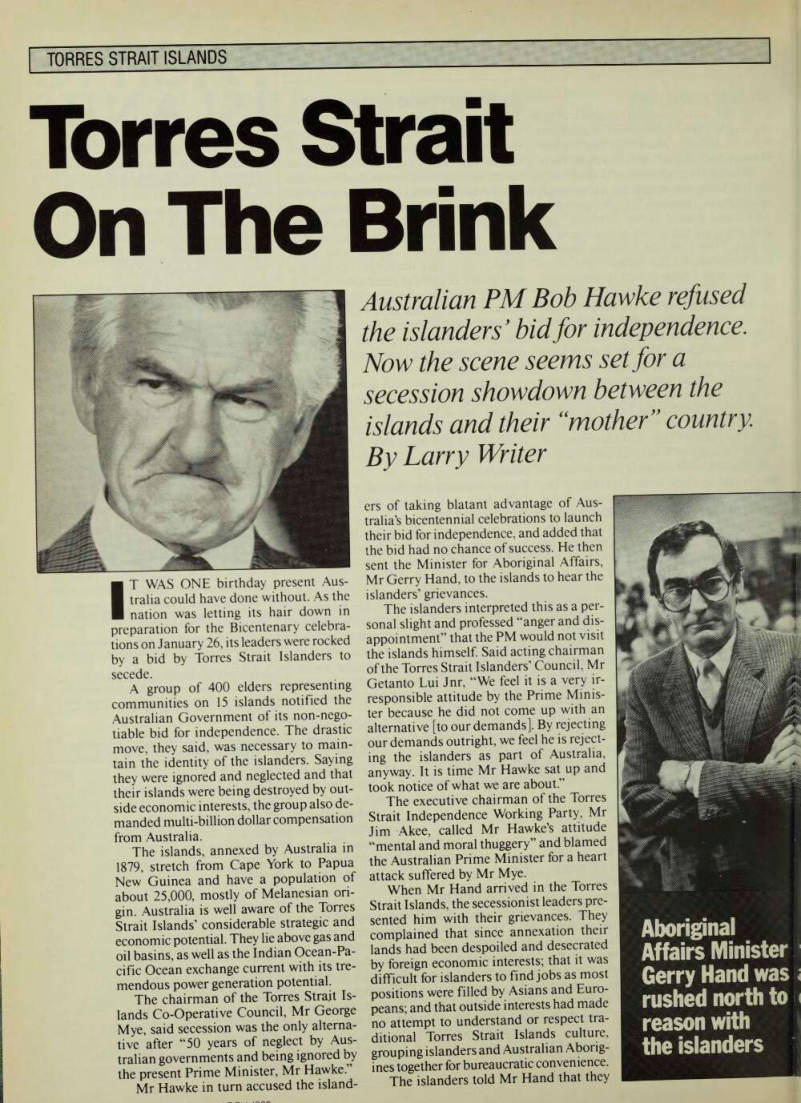
Aboriginal Affairs Minister Gerry Hand was rushed north to reason with the islanders
had been neglected and oppressed in re turn for turning over their lands and re sources to outsiders. They said they had no control over their welfare, particularly in regard to the granting of mining leases and commercial fishing operations, and that electricity, sewerage and housing were inadequate. Finally, the irate islanders upped their compensation demand from the original SA3 billion to SAS billion and stressed to Mr Hand that they would not retreat from their independence call.
Said the Torres Strait Independence Working Party’s Mr Jim Akee: “Mr Hand came here convinced we were all bluff.
Now he knows we are not open to offers.
We want to talk to Mr Hawke, we want im mediate autonomy and identification as an independent nation.”
Mr Hand met with Mr Hawke on his return to Australia. Mr Hawke’s response was flatly to reject the islanders’ inde pendence claim, calling it “unrealistic”.
However, he said he would establish an in ter-departmental committee to conduct an urgent investigation into the islanders’ so cial and economic concerns.
He conceded that the islanders had many “obviously legitimate” grievances, including lack of basic services, exploita
tion of fisheries resources and growing numbers of PNG immigrants. The issue of greater autonomy for the islands would also be examined. Mr Hawke said he would visit the islands when the committee’s work was completed, possibly in a few months’ time.
Should the Torres Strait Islanders suc ceed in their secession bid, they would stand to lose Australia’s SA2O million per year investment in the islands, as well as unemployment and child welfare pay ments. But it is understood pro-secession ists would hope to enjoy financial patronage of the sort Australia has granted to PNG since that nation’s independence.
This, they believe, would open the way for a re-emergence of traditional culture and the replacement of Asian and European administrators by native islanders.
Significantly and ominously for secessionists who had hoped for support from the South Pacific Forum Melane sian Spearhead leader, PNG Prime Min ister Paias Wingti, is unsympathetic to the islanders’ plight. Mr Wingti has said he considers the issue an internal matter for the Australian Government to resolve. He said his Government would not hold talks with the secessionist leaders. □
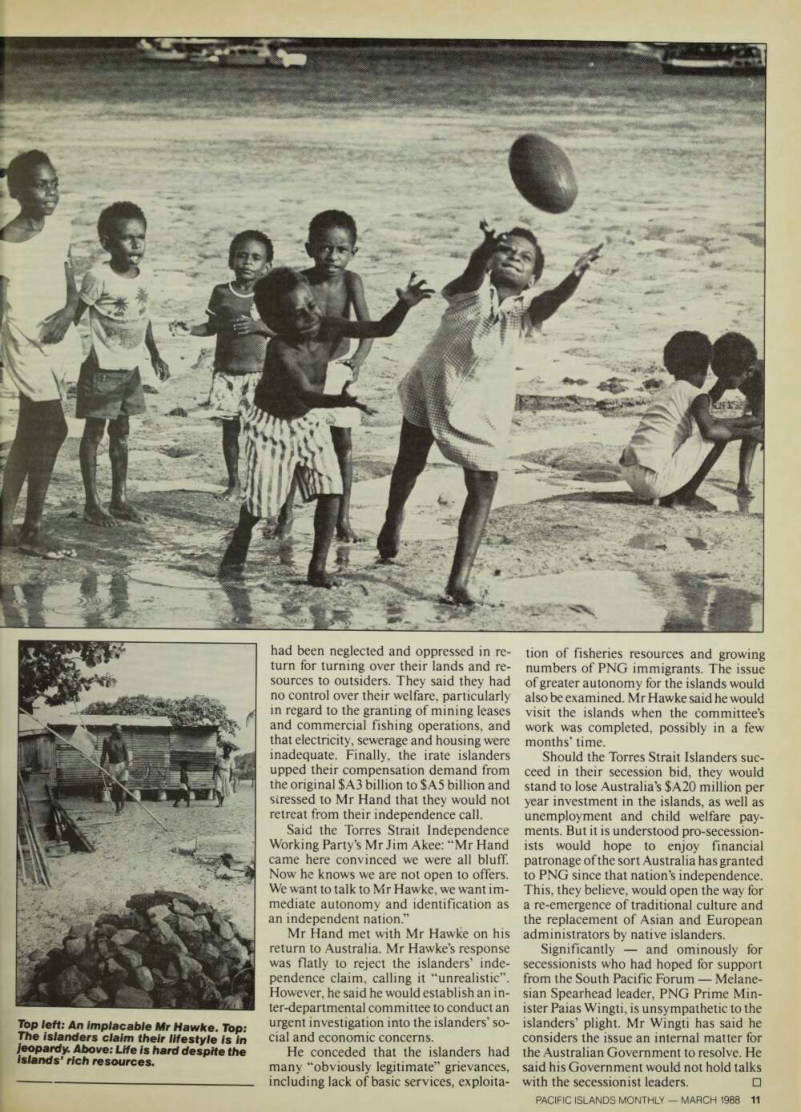
Top left: An implacable Mr Hawke. Top: The islanders claim their lifestyle is in jeopardy. Above: Life is hard despite the islands’ rich resources.
Target: Illegal Immigrants
New Zealand
A Government crackdown on over-stayers.
By Jack Kelleher
MANY thousands of Pacific is landers, most from Tonga and Western Samoa, face deporta tion from New Zealand for over-slaying visitor permits. Many have been in the country for years and have settled into communities and jobs. They have been smoked out by an apparent amnesty that offered a type of permit in return for ille gal settlers registering.
The permit was attractive in that it gave the immigrant immediate legality. But it was temporary a “gift of lime”, as one immigration officer puts it, to apply for permanent residence. If years on the run had caused them to be overawed by the novelty of becoming legal, even for a few months, it did seem to be understood by some that an interim legitimacy was in volved and that it would need to be con firmed later.
What has blurred the issue for many of the islanders is that the New Zealand me dia referred to the whole offer as an "am nesty” as if permanent residence were available from initial registration, though the Government publicity was never so sweeping. And islanders who read on and who understood the temporary permit was intended to give them only lime and op portunity to apply for permanent resi dence, didn’t seem to realise they would have no head start with such an applica tion; that they would have to meet routine requirements which could involve a specific skill as listed from lime to lime, qualification under "family reunion” reg ulations or sponsorship by other family members.
Islanders are more likely to qualify un der family and race assimilation provi sions than they are by skill: many have won employment but not in those skilled oc cupations that cause the NZ Government to seek immigrants worldwide.
The Government inliative has seen nothing like the uproar of night raids by immigration officers accompanied by po lice of a decade ago, when suspected ille gal immigrants were confronted in their homes before dawn, mostly in the semi-in dustrial suburbs of cities where ghettos were forming. The Labour parliamentary opposition of the day joined in a clamour that persuaded authorities to be more civilised.
Labour in government is more effec tive. Last year it passed a new Immigra tion Act that owed something to an earlier National bill heavily criticised in both the community and Parliament. The bill re quired over-stayers to prove innocence
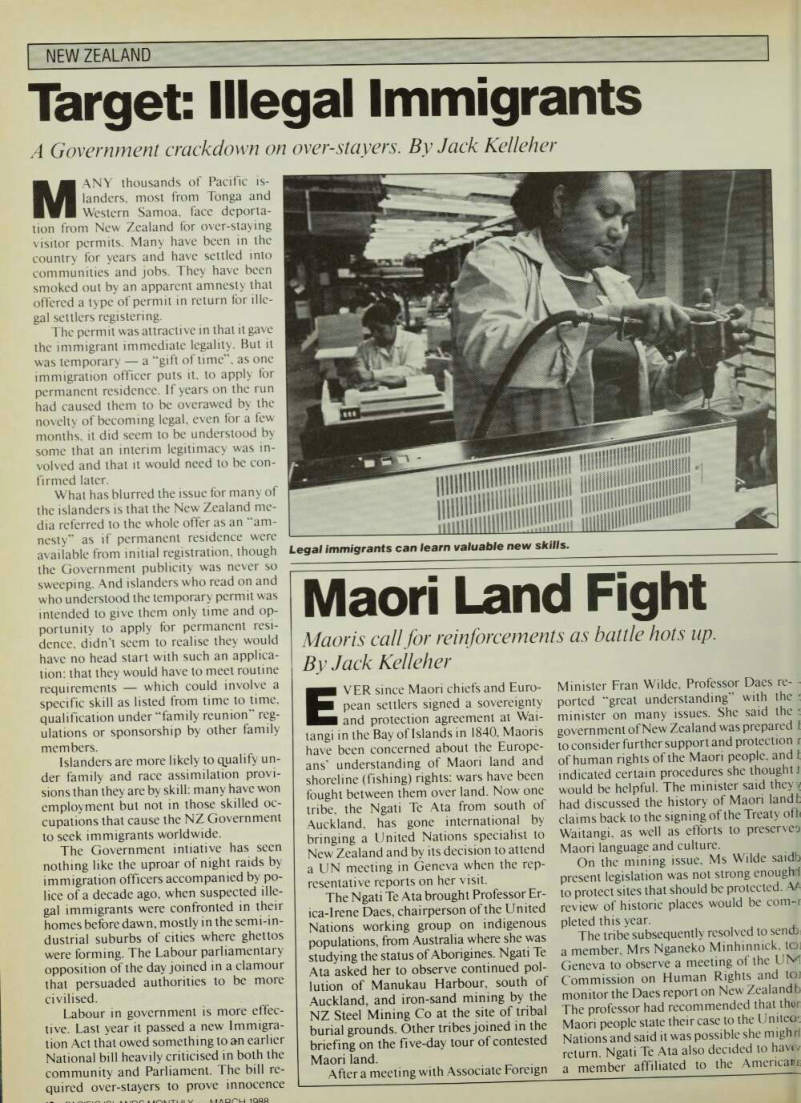
Legal immigrants can learn valuable new skills.
rather than continuing to require the Lahour Department to prove the offence a charge that was failing increasingly often on purely technical grounds. The Act gave all over-stayers of the past five years a pcnodoflhree months in which to register for a temporary permit that would allow them to apply for permanent residence.
Immigrants from more than five years ns 0 pre-August 1983 are those who became entitled to automatic permanent residency as a matter of policy rather than legislative absolution. The position of islanders who have over-stayed visitor permils in New Zealand was further confused by a visa-free scheme, introduced a year ago, for tourists from Tonga, Fiji and Western Samoa. Charter flights were arriving; tourism was suddenly in fashion, The scheme was soon knocked on the head and the Government claimed islanders now formed the majority of over-stayers.
Another factor provides much of the heat in the current controversy. European and other over-stayers of visitor permits have established themselves in greater number than any official figures recogmse, but their pale faces and individual lifestyles cause them to disappear. American nuclear refugees figure in this ealeulation. Of the 12,000 in over-slayers New Zealand, half are believed to have settled or drifted to the Auckland area sometimes referred to as the de facto capital of the South Pacific. Only a small percentage
of non-islands people responded to the new legislation’s insistence on registration for temporary permit and application for per manent status (“amnesty” in all headlines).
Islanders responded mainly in No vember, when the offer was made, but they too dropped off from December when civil rights groups began protesting, mainly over the misconception that permanent resi dence was being granted. Immigration Department director Don Bond defends the advertising on this point, and denies a charge that Samoan immigrants are re ceiving negative replies to applications for permanent citizenship that come so fast as to indicate automatic reaction. He ins ists that none of these had yet been proc essed. Niue Islanders have no need to be concerned because they are citizens any way, he points out.
The Council for Civil Liberties also charges that a SNZ22O fee required with an application for permanent residence is an imposition on some islanders, espe dally where their chances of being ac cepted are slim. There are also objections that the new law gives officials access to files from social welfare, Telecom, the Post Office, housing and transport depart ments. Bruce Jenkins, a supervising im migration officer in Auckland, acknowleges; “We have the ability to ac cess information from other departments and local bodies.” But the department said
it would look first to employers when it re sumed its checks for over-stayers after the expiry of the “amnesty” in February.
Established New Zealanders seem in terested mainly in any suggestion of un fairness in the enforcement of laws, rather than in which laws are enacted or their ef fects. They rose against the night raids on island over-stayers, and they are inter ested in the present campaign mainly for the suggestion that it discriminates against islanders and is not so effective in encouraging American and European over-stayers to register.
Indeed, some Americans have become quite verbal about the stale of the world (especially the nuclear threat back home) while clearing a non-nuclear patch for themselves in New Zealand and pitching into conservation issues; and there is cur iosity about their interest in the law on re sidency, and how easily they may have won “permanent visitor” permits. Fijian In dians were once regular work-permit holders as seasonal grubbers of tussock (an open country weed) in a scheme that inev itably produced some over-slaying. Fijian Indian migration is an issue again, with Indians keen to remove themselves from their country’s its present political turmoil.
One of the more encouraging devel opments in New Zealand, however, is that despite Government concern, the various islander groups seems to have developed closer relationships with Maoris. □
Maori Land Fight
Maoris call for reinforcements as battle hots up.
By Jack Kelleher
EVER since Maori chiefs and Euro pean settlers signed a sovereignly and protection agreement at Wai langi in the Bay of Islands in 1840, Maoris have been concerned about the Europe ans’ understanding of Maori land and shoreline (fishing) rights: wars have been fought between them over land. Now one tribe, the Ngati Te Ata from south of Auckland, has gone international by bringing a United Nations specialist to New Zealand and by its decision to attend a UN meeting in Geneva when the rep resentative reports on her visit.
The Ngati Te Ata brought Professor Er ica-Irene Daes, chairperson of the United Nations working group on indigenous populations, from Australia where she was studying the status of Aborigines. Ngati Te Ata asked her to observe continued pol lution of Manukau Harbour, south of Auckland, and iron-sand mining by the NZ Steel Mining Co at the site of tnbal burial grounds. Other tribes joined in the briefing on the five-day tour of contested Maori land.
After a meeting with Associate Foreign
Minister Fran Wilde, Professor Daes re- ported “great understanding” with the ; minister on many issues. She said the t government of New Zealand was prepared t to consider further support and protection r of human rights of the Maori people, and t indicated certain procedures she thought t would be helpful. The minister said theyy had discussed the history of Maori landfc claims back to the signing of the Treaty ofh Waitangi, as well as efforts to preserves Maori language and culture.
On the mining issue, Ms Wilde saidb present legislation was not strong enoughrl to protect sites that should be protected. AA review of historic places would be com-r pleted this year.
The tribe subsequently resolved to sencbi a member, Mrs Nganeko Minhinnick, toj Geneva to observe a meeting of the UM Commission on Human Rights and lot monitor the Daes report on New Zealandb The professor had recommended that thor Maori people state their case to the Uniteoe Nations and said it was possible she migh rl return Ngali Te Ata also decided to havtv a member affiliated to the Americans
Indian Treaty Council (recognised by the UN) and to seek representation of other tribes to provide a national platform.
Meanwhile, old land issues have resurfaced in the Tauranga district, a forestry trade outlet and retirement stretch on the Bay of Plenty northeast of Rotorua. Forced sale of a block of land raised questions in Maori minds about its status at a time when even a town hall had been occupied as a signal of Maori determination to
revive historic land claims. The owners of the block and a chief of the hapu or sub tribe involved, Ngati Tamawhariua, agreed to remain off the land pending consider ation of the case in Wellington in Febru ary. The block was part of 47,385 hectares of land confiscated in 1865: much of the land is now Tauranga City.
Many land disputes concern the legal ity or fairness of old confiscations, and of sales some Maoris argue could not have
involved contemporary signatories in per petuity, where land was tribal, and which could not have involved fishing rights that were specifically protected by the treaty.
Settlers seeking land had found some chiefs eager to barter anything for guns they could use for protection against (or for settling old scores with) other tribes; the settlers had little insight into tribal tradi tions and the rights of anyone in a tribe to sell access to food.
Some Maori land negotiators in the south of the North Island were more as tute than historians have acknowledged.
These chiefs sold blocks on condition that one tenth was to be held in trust for the fu ture benefit of the chiefs and their heirs.
This agreement, dated from a deed of 1839 between the New Zealand Land Company and 16 chiefs, is still being enforced in claims in Wellington, Taranaki, Mana walu and Nelson provinces.
One of the tenths involves Athletic Park, New Zealand Rugby Union head quarters, operated on peppercorn rental.
It highlights the claimants’ assurance that some of the land could hardly be returned, and that the ancestors would accept land elsewhere in New Zealand or cash com pensation. Such a claim, lodged in Wel lington early in January, is the largest to go before the Waitangi Tribunal that is cre ating precedents for new thinking and de cision-making on Maori rights. □
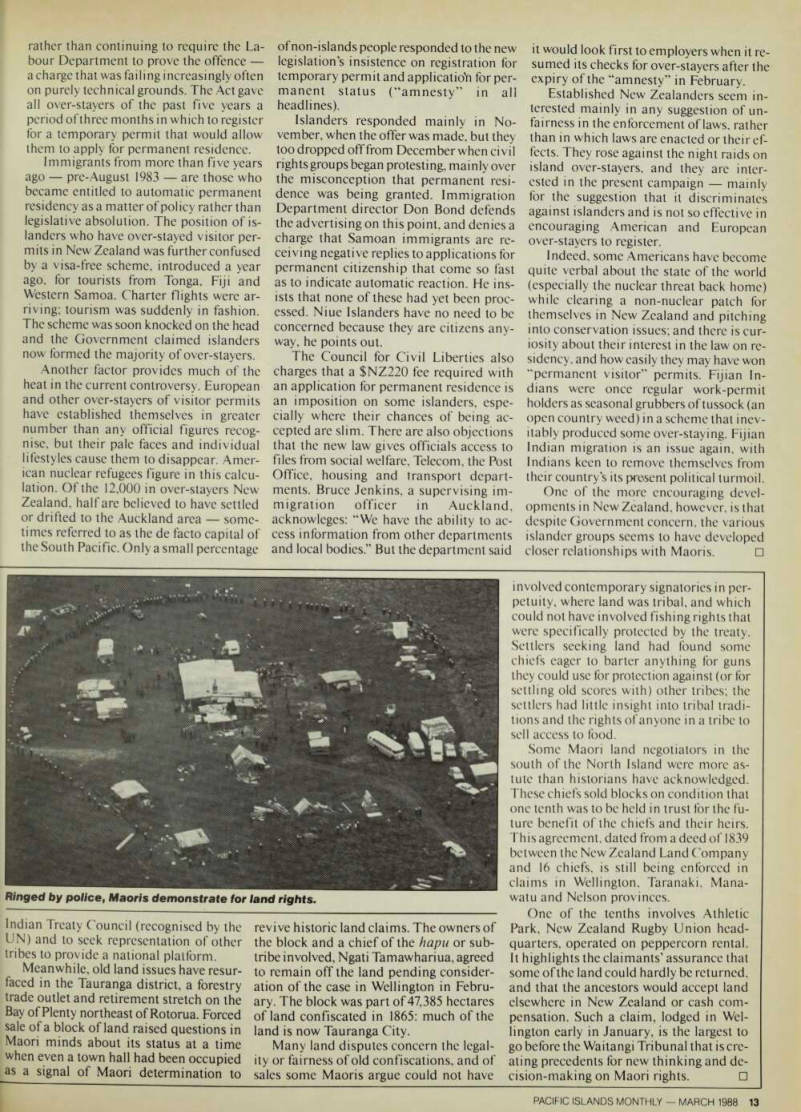
Ringed by police, Maoris demonstrate for land rights.
The Rush To Recognition
Fiji
Australian and US aid plans balance erosion of media freedom and civil rights.
EVENTS IN the Republic of Fiji over past weeks reflect a continuing de cline in human rights, balanced by recent announcements of aid to flow to those Fijians who need it most.
The political and economic situation is serious; overall economic indicators have improved and sugar production has in creased, but markets have contracted and Fiji’s dependence on one major primary industry has made it a natural target for nations and ideologies seeking a stronger presence in the Pacific. Official state ments provide little comfort to those in vulnerable positions, and unemployment in a nation that has no unemployment re lief has forced many into realising the emptiness of a call to return to traditional ways and economies. Tourism is in de cline, with numbers reduced and those who do come from Australia and New Zealand spending far less than their pred ecessors; as well, major investors have withdrawn from planned developments and replacements are proving hard to find.
Public discussion even public awareness will suffer with the Govern ment’s announcement of laws to control the country’s media through a system of lic ences designed to prevent “irresponsible reporting” that might incite “racial feel ings and social tension”, according to the Fiji Post.
The announcement came soon after seven Government decrees that, as well as regulating internal matters such as ex penditure and the structure of the police force, judiciary and civil service, gave no tice of major changes in the conduct ot public affairs. Members of the then Royal Fiji Military Forces have been munity from prosecution in any civill or criminal matters arising from the 1V»/ coups. Fijian citizens will no longer be able to seek redress for assault, wrongful arrest or destruction of property during the coups and their aftermath, Full executive power is to be vested in the President, Ratu Sir Penaia Gamlau, who will have all the powers formerly ex ercised by the Governor General, The legal system is to be extensively al tered, with the current Supreme Court dis banded and replaced by a nine-member High Court whose makeup is yet to be an nounced. The Court of Appeal is to be maintained, but a new Supreme Court will take the place of the Privy Council m Lon don as Fiji’s final court of appeal, The net effect of the decrees, say F.ji ans who have left the country, will be to concentrate ethnic Fijian control of the nation’s affairs, further removing minor ities from power or licence to seek com pensation and entrenching the role of the Great Council of Chiefs. The Ministry of
Information in Suva has stated that the decrees are only temporary, and that they are “essential to create confidence and stability” while the country’s new consti tution is prepared. They “reflect the Government’s awareness of the people’s determination to return to normal life,” says the Ministry, and that with increased international financial confidence, “the tourists, investors, aid donors, trade and international moneylenders [are] ex pected to follow ”
Former Supreme Court judge Mr Jus tice Kishore Govind, however, has criti cised the decrees and the Ministry of Information’s assertion that they are de signed to promote confidence in human rights in Fiji. He said in Sydney where he had flown with his family after they had received anonymous threats in Suva that he would consider returning to Fiji and to the bench only after the military had been demobilised and full democracy had been restored.
A few days after Justice Govind’s call for a return to democracy, three members (one aged 72) of the Taukei movement made a farcical attempt to take over Radio Fiji, armed with a traditional war club they had stolen from the Fiji Museum. Threat ening bloodshed if they were not given air time to announce their intention of taking over the country, the three were soon over powered and removed by police. One, 30year-old lawyer Kitione Vuetaki, told a Suva court at a committal hearing that the authorities had no right to prosecute him because “the real authority rests with the Great Council of Chiefs”.
In further developments, the Govern ment released 162 prisoners jailed for “political offences” during the period be tween the election of the Bavadra Govern ment and the October 7 declaration of Independence, but did not define^ what constituted a “political offence . A spokesman for the Coalition Government said 21 of the 23 former ministers were out of work and that no-one would employ them for fear that they would be seen to be sympathetic to non-Melanesian Fijians.
Many of those who would like to leave Fiji have been prevented by a blacklist at first denied, then admitted by the Government that seeks to control the overseas movement of potentially critical Fijians, whether Melanesian, Indian or European. Among them was Robert Keith- Reid, publisher of Islands Business mag azine, who was at first prevented from leaving Fiji on a business trip but was fi nally allowed to board his aircraft after a heated discussion with officials. Many
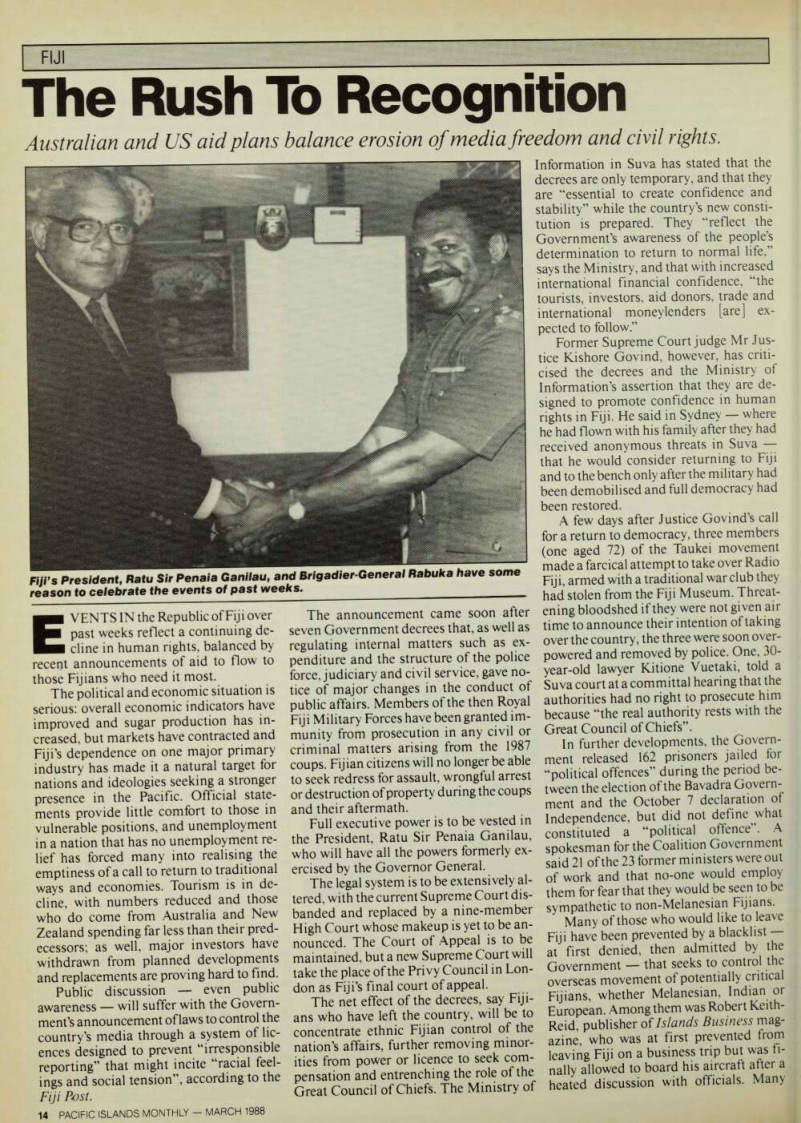
Fiji’s President, Ratu Sir Penaia-Gnilau, and Brigadier-General Rabuka have some reason to celebrate the events of past weeks.
have left without interference, and Fiji’s professional and entrepreneurial ranks have thinned as doctors, dentists, lawyers, accountants, civil servants and business people (Indian and European) have taken their experience and skills to Australia, New Zealand, England and Canada. The Government has advertised for replace ments, mainly from Asia, as it allows Fi jian citizens to leave.
Success, however, has greeted Fiji’s ov ertures to re-establish relations with a number of governments. Fear of interfer ence from France or Indonesia has led the Australian Government not only to change its criteria for diplomatic recognition, from one of recognising legitimate govern ments to one of recognising states, but also to resume aid with an SA7 million pack age for 1988. Australian Foreign Affairs Minister Bill Hayden says that Australian aid will go only to projects and destina tions deemed in greatest need and of so cial value, but this move has drawn immediate criticism from his New Zea land counterpart, Mr Russell Marshall. In a press statement in early February, Mr Marshall said that New Zealand would wait until Fiji’s new Constitution was pro mulgated before it decided whether to reactivate its diplomatic presence there, though it will resume aid soon.
Mr Marshall’s remarks came only a week before the Reagan Administration announced that the United States would recognise the Republic of Fiji, though aid grants will have to be approved by the US Congress.
Although Papua New Guinea Prime Minister Mr Paias Wingti has welcomed Australia’s recognition of Fiji, saying the Republic should not be “isolated” from other South Pacific nations, New Zea land’s attitude is both more cautious and far less accepting. Its Government, said Mr Marshall, did not approve of the actions of then Colonel Rabuka or of the coups, and would continue to press for the return of full democracy and a balanced represen
tation in government of Fijians from all backgrounds.
And there are signs that, despite acts as provocative as the acquittal of Taukei leader Apisai Tora on sedition charges (a result of a speech he made in Fiji soon after the election that ousted the Alliance
Government), a broader democratic base is gaining strength. Suva firemen went on strike in protest over cuts both in their pay and in the service they provide, and Fiji Trades Union Congress (FTUC) presi dent Mr Jale Toki has called for “unity in the face of worsening hardship”.
That he could make such a statement is a measure of the Government’s back down on control of union freedom and a retreat from its previous position of re strictions on union activities and deten tion of “unco-operative” union leaders.
The election of Mr Mahendra Chau dhry as General Secretary of the TUC has been interpreted as a distinctly political manoeuvre. Mr Chaudhry is secretary of the Fiji Public Servants’ Association, Fi ji’s largest union, and led the firemen’s strike in late January. He was Finance Minister of the Bavadra coalition Govern ment and has pledged to “take stock of the issues facing the union movement and the country as a whole”.
National affairs were coming under further scrutiny as Pacific Islands Monthly went to press, with reports of a radical re structuring of the 150-member Great Council of Chiefs. □
Fiji Visa Laws “Discriminatory”
THEexecutive director of the Pacific Islands News Association, Mr Ta vake Fusimalohi, says Fiji’s new visa procedures for foreign journalists dis criminate against Pacific islanders. He said the new requirements were not reciprocal, as the Fiji Government had claimed.
Overseas journalists wishing to report events in Fiji must now apply for a permit through the Fiji mission in their home country, which sends the application to Suva for approval. Where there is no Fiji mission in their home country, applica tions can be made to the Information Ministry in Suva. Previously, journalists could work on a visitor’s permit.
Mr Fusimalohi listed 12 Pacific island
countries and territories in which Fiji journalists could work freely on ordinary visitor’s permits. He said it would be harder for journalists from the islands he men tioned to obtain Fiji work permits be cause Fiji did not have diplomatic missions there.
Fiji members of the Pacific Islands News Association PINA had con sistently supported resolutions calling for the full and unrestricted freedom of move ment of journalists.
Mr Fusimalohi said the Association, which links print and broadcast media in the island nations of the South Pacific, was also disturbed by what he termed “contin uing harassment” of journalists in Fiji. □
...And Rotuma’s Fighting Mad
Islanders’ freedom bid inspires Fijian “overkill”.
UNTIL A few weeks ago the tiny island of Rotuma, 400 kilometres north of Suva, was known by the relatively few who had heard of it for two things: the beauty of its inhabitants and the size of its coconuts.
Suddenly, it has been thrust into the bizarre world of the new Republic of Fiji by a brave and doomed attempt to declare its independence from a territory it has always seen as a neighbour, not a ruler. Molmohau clan “king” Gagaj Sau Lagfatmaro (otherwise known as Henry Gibson, a grand master of martial arts and usually resident in New Zealand) declared Rotuma independent of Fiji last October, saying the islands 4000-odd inhabitants did not accept the Fijian Republic, and that the further 8000 Rotumans living and working in Fiji would henceforth be citizens of a separate nation.
Few took the declaration of independence seriously, though Rotuma had been ceded to British rule independently of Fiji and has never enjoyed full electoral privileges. Dissatisfaction with representation has continued since Fiji’s independence in 1970 significantly, perhaps, the island was represented by Ratu Sir Kamisese Mara as part of the Lau/Rotuma constiluency until 1972, and many of its inhabitants resent the island's use as an election tool by the Alliance Party.
But it is on humanitarian and demo-
cratic grounds that Rotuma’s own inde pendence was announced, with Gagaj Lagfatmaro criticising human rights vio lations in Fiji and asking New Zealand (which seems to have gained control of the moral high ground in the South Pacific) to take charge of Rotuma as a dependency, The islanders have taken the serious step of hiring a Suva lawyer, Mr Tevita Fa, to draw up a constitution for an independent nation, and demonstrations against events in Fiji have drawn a response that has been categorised as “pure buffoonery” by ob servers in Suva.
Buffoonery or not, Fiji’s reaction has shown a willingness to resort to violence that has been greeted with dismay by Ro tuma’s inhabitants. The Fijian District Officer blasted the flag of the putative Re public of Rotuma with a shotgun; an action that was followed rapidly by the arrival of a 13-man all-Rotuman military team, re portedly to help control a sudden out break of “extensive damage to food crop plantations” by wild pigs, according to the Fiji Ministry of Information, Major Tim Malo, leader of the squad, is believed to have taken over as the is land’s new District Officer while his trig ger-happy predecessor has returned to Suva. Rotuman sources say the soldiers are a “peace-keeping” force on an island that has been free of violence since the 19th century. □
Leontieff Gets Tough
French Polynesia
A steely realist takes control in Tahiti. Exclusive interview by Nicolas Rothwell
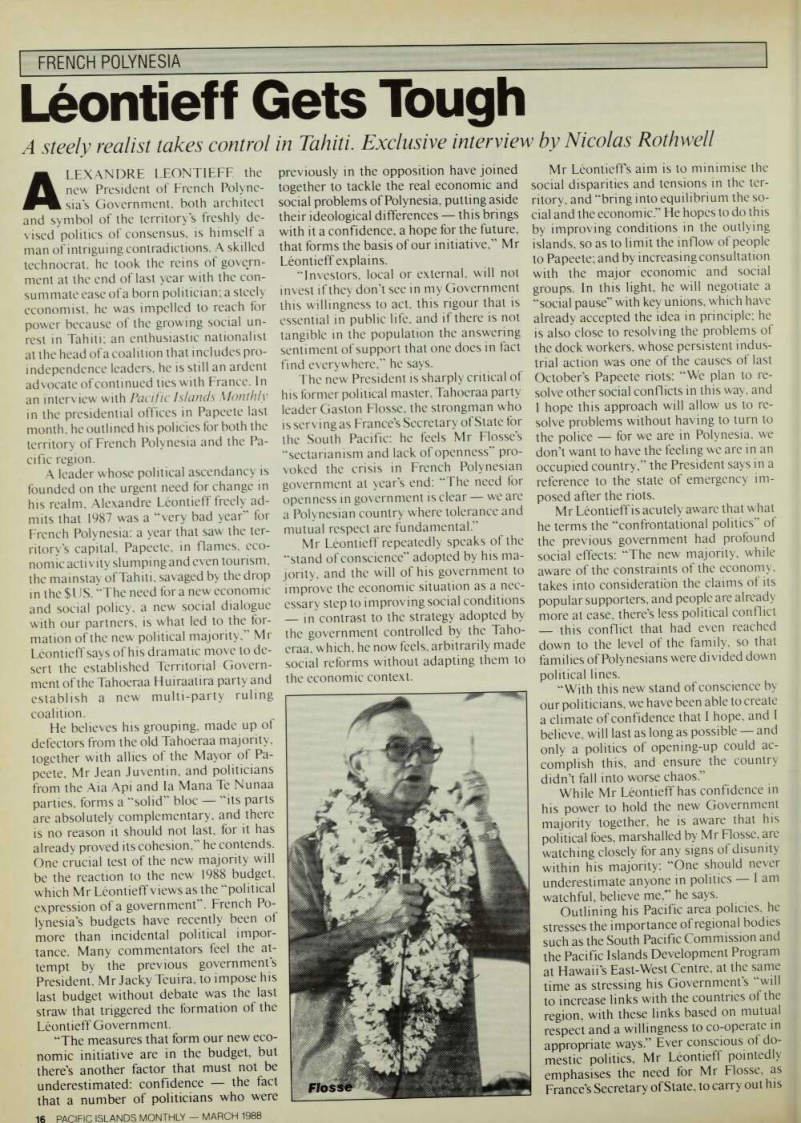
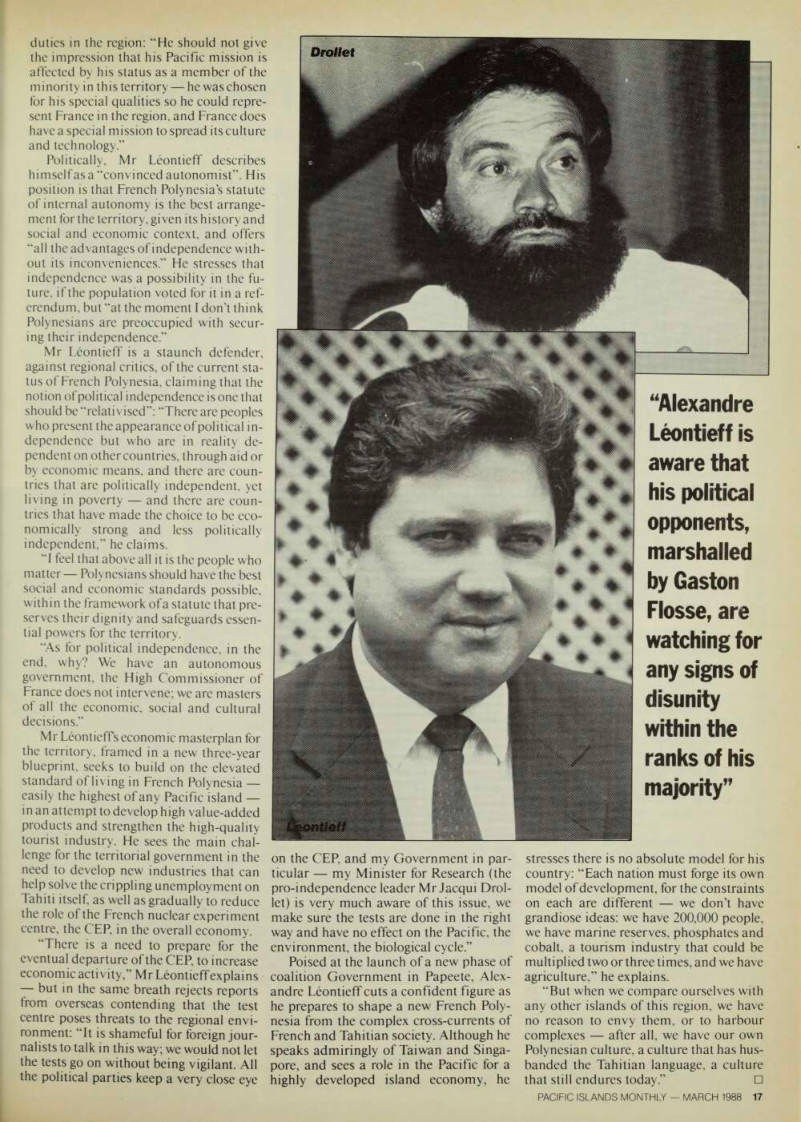
Alexandre leontieff the new President of French Polyne sia’s Government, both architect and symbol of the territory’s freshly de vised politics of consensus, is himself a man of intriguing contradictions. A skilled technocrat, he look the reins of govern ment at the end of last year with the con summate ease of a born politician; a steely economist, he was impelled to reach for power because of the growing social un rest in Tahiti; an enthusiastic nationalist at the head of a coalition that includes pro independence leaders, he is still an ardent advocate of continued lies with France. In an interview with Pacific Islands Monthly in the presidential offices in Papeete last month, he outlined his policies for both the territory of French Polynesia and the Pa cific region.
A leader whose political ascendancy is founded on the urgent need for change in his realm. Alexandre Leontieff freely ad mits that 1987 was a “very bad year” for French Polynesia; a year that saw the ter ritory’s capital, Papeete, in flames, eco nomic activity slumpingand even tourism, the mainstay ofTahili, savaged by the drop in the SUS. “The need for a new economic and social policy, a new social dialogue with our partners, is what led to the for mation of the new political majority,” Mr Leontieff says of his dramatic move to de sert the established Territorial Govern ment of the Tahoeraa Huiraalira parly and establish a new multi-party ruling coalition.
He believes his grouping, made up of defectors from the old Tahoeraa majority, together with allies of the Mayor of Pa peete, Mr Jean Juvenlin, and politicians from the Aia Api and la Mana Te Nunaa parlies, forms a “solid” bloc “its parts are absolutely complementary, and there is no reason it should not last, for it has already proved its cohesion,” he contends.
One crucial test of the new majority will be the reaction to the new 1988 budget, which Mr Leontieff views as the “political expression of a government”. French Po lynesia’s budgets have recently been of more than incidental political impor tance. Many commentators feel the at tempt by the previous government’s President, Mr Jacky Teuira, to impose his last budget without debate was the last straw that triggered the formation of the Leontieff Government.
“The measures that form our new eco nomic initiative are in the budget, but there’s another factor that must not be underestimated: confidence the fact that a number of politicians who were
previously in the opposition have joined together to tackle the real economic and social problems of Polynesia, putting aside their ideological differences this brings with it a confidence, a hope for the future, that forms the basis of our initiative,” Mr Leontieff explains.
"Investors, local or external, will not invest if they don't see in my Government this willingness to act, this rigour that is essential in public life, and if there is not tangible in the population the answering sentiment of support that one does in fact find everywhere,” he says.
The new President is sharply critical of his former political master. Tahoeraa party leader Gaston Flosse, the strongman who is serving as France’s Secretary of Stale for the South Pacific; he feels Mr Flosses “sectarianism and lack of openness” pro voked the crisis in French Polynesian government at year’s end: “The need for openness in government is clear we are a Polynesian country where tolerance and mutual respect are fundamental.
Mr Leontieff repeatedly speaks of the “stand of conscience” adopted by his ma jority, and the will of his government to improve the economic situation as a nec essary step to improving social conditions in contrast to the strategy adopted by the government controlled by the Taho craa, which, he now feels, arbitrarily made social reforms without adapting them to the economic context.
Mr Leontieffs aim is to minimise the social disparities and tensions in the ter ritory, and “bring into equilibrium the so cial and the economic.” He hopes to do this by improving conditions in the outlying islands, so as to limit the inflow of people to Papeete; and by increasing consultation with the major economic and social groups. In this light, he will negotiate a “social pause” with key unions, which have already accepted the idea in principle; he is also close to resolving the problems of the dock workers, whose persistent indus trial action was one of the causes of last October’s Papeete riots: “We plan to re solve other social conflicts in this way, and I hope this approach will allow us to re solve problems without having to turn to the police for we are in Polynesia, we don’t want to have the feeling we are in an occupied country,” the President says in a reference to the state of emergency im posed after the riots.
Mr Leontieff is acutely aware that what he terms the “confrontational politics” of the previous government had profound social effects; “The new majority, while aware of the constraints of the economy, takes into consideration the claims of its popular supporters, and people are already more at ease, there’s less political conflict this conflict that had even reached down to the level of the family, so that families of Polynesians were divided down political lines.
“With this new stand of conscience by our politicians, we have been able to create a climate of confidence that I hope, and 1 believe, will last as long as possible and only a politics of opening-up could ac complish this, and ensure the country didn’t fall into worse chaos.”
While Mr Leontieff has confidence in his power to hold the new Government majority together, he is aware that his political foes, marshalled by Mr Flosse, are watching closely for any signs of disunity within his majority; “One should never underestimate anyone in politics I am watchful, believe me,"’ he says.
Outlining his Pacific area policies, he stresses the importance of regional bodies such as the South Pacific Commission and the Pacific Islands Development Program at Hawaii’s East-West Centre, at the same time as stressing his Government’s “will to increase links with the countries of the region, with these links based on mutual respect and a willingness to co-operate in appropriate ways.” Ever conscious of do mestic politics, Mr Leontieff pointedly emphasises the need for Mr Flosse, as France’s Secretary of State, to carry out his
duties in the region: “He should not give the impression that his Pacific mission is affected by his status as a member of the minority in this territory he was chosen for his special qualities so he could repre sent France in the region, and France does have a special mission to spread its culture and technology.”
Politically, Mr Leontieff describes himself as a “convinced autonomist”. His position is that French Polynesia’s statute of internal autonomy is the best arrange ment for the territory, given its history and social and economic context, and offers “all the advantages of independence with out its inconveniences.” He stresses that independence was a possibility in the fu ture, if the population voted for it in a ref erendum, but “at the moment I don’t think Polynesians are preoccupied with secur ing their independence.”
Mr Leontieff is a staunch defender, against regional critics, of the current sta tus of French Polynesia, claiming that the notion of political independence is one that should be “relativised”: “There are peoples who present the appearance of political in dependence but who are in reality de pendent on other countries, through aid or by economic means, and there are coun tries that are politically independent, yet living in poverty and there are coun tries that have made the choice to be eco nomically strong and less politically independent,” he claims.
“I feel that above all it is the people who matter Polynesians should have the best social and economic standards possible, within the framework of a statute that pre serves their dignity and safeguards essen tial powers for the territory.
“As for political independence, in the end, why? We have an autonomous government, the High Commissioner of France does not intervene; we are masters of all the economic, social and cultural decisions.”
Mr Leontieffs economic masterplan for the territory, framed in a new three-year blueprint, seeks to build on the elevated standard of living in French Polynesia easily the highest of any Pacific island in an attempt to develop high value-added products and strengthen the high-quality tourist industry. He sees the main chal lenge for the territorial government in the need to develop new industries that can help solve the crippling unemployment on Tahiti itself, as well as gradually to reduce the role of the French nuclear experiment centre, the CEP, in the overall economy.
“There is a need to prepare for the eventual departure of the CEP, to increase economic activity,” Mr Leontieff explains but in the same breath rejects reports from overseas contending that the test centre poses threats to the regional envi ronment: “It is shameful for foreign jour nalists to talk in this way; we would not let the tests go on without being vigilant. All the political parties keep a very close eye
on the CEP, and my Government in par ticular my Minister for Research (the pro-independence leader Mr Jacqui Drol let) is very much aware of this issue, we make sure the tests are done in the right way and have no effect on the Pacific, the environment, the biological cycle.”
Poised at the launch of a new phase of coalition Government in Papeete, Alex andre Leontieff cuts a confident figure as he prepares to shape a new French Poly nesia from the complex cross-currents of French and Tahitian society. Although he speaks admiringly of Taiwan and Singa pore, and sees a role in the Pacific for a highly developed island economy, he
stresses there is no absolute model for his country; “Each nation must forge its own model of development, for the constraints on each are different we don’t have grandiose ideas: we have 200,000 people, we have marine reserves, phosphates and cobalt, a tourism industry that could be multiplied two or three times, and we have agriculture,” he explains.
“But when we compare ourselves with any other islands of this region, we have no reason to envy them, or to harbour complexes after all, we have our own Polynesian culture, a culture that has hus banded the Tahitian language, a culture that still endures today.” □
“Alexandre Leontieff is aware that his political opponents, marshalled by Gaston Flosse, are watching for any signs of disunity within the ranks of his majority”
Divisions Rock The Nation
Papua New Guinea
Regional jealousies and entrenched cultural factions threaten Papua New Guinea’s
political and economic stability.
By Frank Senge
UNITY IN Diversity” was the motto coined by Papua New Guinea’s founding fathers to describe the unification of the new nation’s more than 700 distinct language groups, as well as many different cultures and traditions, under one democratic government.
But over the years, political leaders more concerned with providing goods and services to supporters in their own regions have failed to formulate policies and to lay down infrastructures that guarantee unity and provide machinery to solve the inev itable differences in PNG’s diverse cul tures. Now that diversity is threatening the unity and stability of the nation.
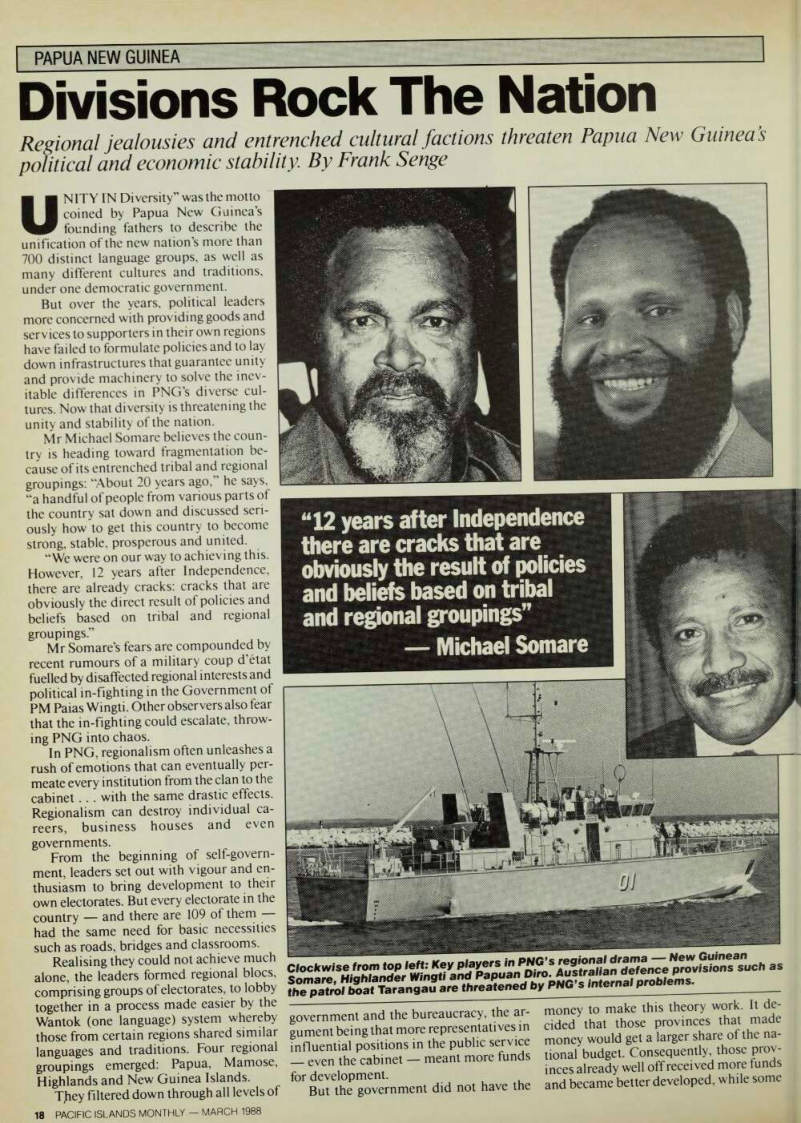
Mr Michael Somare believes the coun try is heading toward fragmentation be cause of its entrenched tribal and regional groupings; “About 20 years ago, he says, “a handful of people from various parts of the country sat down and discussed seri ously how to get this country to become strong, stable, prosperous and united.
“We were on our way to achieving this.
However, 12 years after Independence, there are already cracks: cracks that are obviously the direct result of policies and beliefs based on tribal and regional
groupings.”
Mr Somare’s fears are compounded by recent rumours of a military coup d’etat fuelled by disaffected regional interests and political in-fighting in the Government of PM Paias Wingti. Other observers also fear that the in-fighting could escalate, throw ing PNG into chaos.
In PNG, regionalism often unleashes a rush of emotions that can eventually per meate every institution from the clan to the cabinet... with the same drastic effects.
Regionalism can destroy individual ca reers, business houses and even governments.
From the beginning of self-govern ment, leaders set out with vigour and en thusiasm to bring development to their own electorates. But every electorate in the country and there are 109 of them had the same need for basic necessities such as roads, bridges and classrooms.
Realising they could not achieve much alone, the leaders formed regional blocs, comprising groups of electorates, to lobby together in a process made easier by the Wantok (one language) system whereby those from certain regions shared similar languages and traditions. Four regional groupings emerged: Papua, Mamose, Highlands and New Guinea Islands.
They filtered down through all levels of
government and the bureaucracy, the ar gument being that more representatives m influential positions in the public service even the cabinet meant more funds for development.
But the government did not have the
money to make this theory work. It de cided that those provinces that made money would get a larger share of the na tional budget. Consequently, those prov inces already well off received more funds and became better developed, while some
“12 years after Independence there are cracks that are obviously the result of policies and beliefs based on tribal and regional groupings”
Michael Somare
Clockwise from top left: Key Players in PNG's regional drama-New Guinean Somare, Highlander Wingti and Papuan Diro. Australian defence provision such as the patrol boat Tarangau are thereatend by PNG's internal problems.
provincial capitals still have buildings from the days of the Australian adminis tration and unpaved streets.
The provinces of former German New Guinea, with their German plantations able to contribute more to the national purse, received more in return. Mean while, the provinces of Papua, which had been administered by the English and Australians, missed out on the money but had the educated elite.
Hence the dilemma. Papuans want more funds to develop their region; New Guineans seek high office.
The one institution dominated by Pap uans has always been the PNG Defence Force. Papuans such as Ted Diro, Ken Noga, Gago Mamai and Tony Huai worked their way up in the force to become Commanders; and when they left to pur sue other interests, fellow Papuans slipped into senior positions in the force.
Many New Guinean soldiers believe that Papuan Commanders deliberately try to keep them at the bottom of the hier archy. However, until now, Defence was the only institution where regionalism was not a factor. So it is ironic that the Defence Force is at the centre of the current re gional controversy.
On January 14, the Government an nounced the sacking of three of the Def ence Force’s oldest and most senior colonels. All are Papuans; Chief of Staff Colonel Robert Dademo, Assistant Sec retary for Border Liaison Colonel Lima Dotaona and Defence Attache to Aus tralia Colonel Kwago Guria.
They were removed for professional jealousy, lobbying politicians for promo tions and, in the case of one, compromis ing his position with the Indonesians all of which led to an alleged deterioration of discipline and low morale in the force.
The charges were identical to those used a month earlier, when Defence Force Commander Brigadier General Tony Huai was sacked.
Sacking a commander is not unusual the force has had five different com manders in 12 years but influencing defence middle management affairs was a different matter altogether. New Com mander Rochus Lokinap told Pacific Is lands Monthly that the soldiers were becoming increasingly agitated. “They are saying that the Government has taken them for a ride for far too long,” he says.
The three-man defence council that recommended the sackings of the Pap uans to Cabinet comprised Defence Min ister James Pokasui, Defence Secretary Stephen Mokis and the new Commander, Brigadier General Rochus Lokinap; all from the New Guinea Islands region. The council swears the decision had no re gional bias, but many people are not convinced, Papuan politicians are outraged by the dismissals. During the vote in Cabinet, Papuan Ministers combined to try to out
vote the sackings but did not have the numbers. Only diplomacy by Prime Min ister Wingti averted a mass walkout.
Mr Wingti could not, however, stop the embittered Papuan ministers leaking the proceedings to the media and publicly challenging the decision, thereby once more shattering Government unity, and the controversy immediately triggered long held and bitter complaints by disaffected members over unequal distribution of wealth, and health and education funding.
Ted Diro’s fight to wrest the deputy Prime Ministership from Sir Julius Chan has become a symbolic battle for equal rights for Papua. Former Defence Com mander Gago Mamai has said the defence force was first politicised in 1977 when the then commander, Ken Noga, resigned to contest the national elections under a Pangu Pati ticket. When he failed to win he rejoined the force, but it has never been the same, Mr Mamai says. Soldiers have always been suspicious of Commanders influenced by outside political forces, and their reluctance to accept a political role appears to be genuine. General Lokinap rules out a military coup unseating the
government: different regional groupings in the force, he says, are far too strong to allow any one faction to take power.
General Mamai agrees. “There would have to be a bloody mutiny in the force first,” he says, adding that logistically and strategically the defence force could not control the country effectively.
Recent rumours of an imminent coup reported in the Australian media have been blamed on Australian intelligence misin formation ... or disinformation. Com mander Lokinap said he has intelligence information that the greatest threat to PNG is a political coup, not a military coup.
“Arms are entering the country illegally,” he says, and fear that “Criminals and gangs could be employed to hold the Govern ment to ransom.”
As Pacific Islands Monthly was going to press, two Papuan based gangs wrote to the Opposition, threatening to burn down Parliament House and to kill Prime Min ister Wingti and his Defence Minister Mr Pokasui if Central member Ted Diro were not given the Deputy Prime Ministership.
Mr Diro’s People’s Action Party disso ciated itself from the threats. □
Advertisements & other items, p. 19 (1 item)
The Pacific
WE DELIVER
Pacific Islands Monthly is the only current affairs magazine which can deliver an in-depth look at the world’s most
important emerging region - the Pacific.
A coup in Fiji; a record smashed at the South Pacific Games; a major business deal in Port Moresby; a film festival in Hawaii. Pacific Islands Monthly writers and photographers are on the spot to bring you news and commentary on all
SsC® EVERY MONTH
To keep yourself fully Informed about the Pacific Islands, subscribe now.
PACIFIC ISLANDS MONTHLY
SUBSCRIPTION DEPARTMENT, G.P.O. BOX 522388
MELBOURNE 3001 AUSTRALIA
Please send me Pacific Islands Monthly for one year (for 12 month subscription prices see page 9) I enclose my cheque for $ (made payable to Pacific Islands Monthly) or debit $ to my □ Bankcard □ Visacard □ Mastercard
NAME
SIGNATURE
ADDRESS
JJJ. I I I I
1 Expiry JDate ...
STATE.
Mining The Rim Of Fire
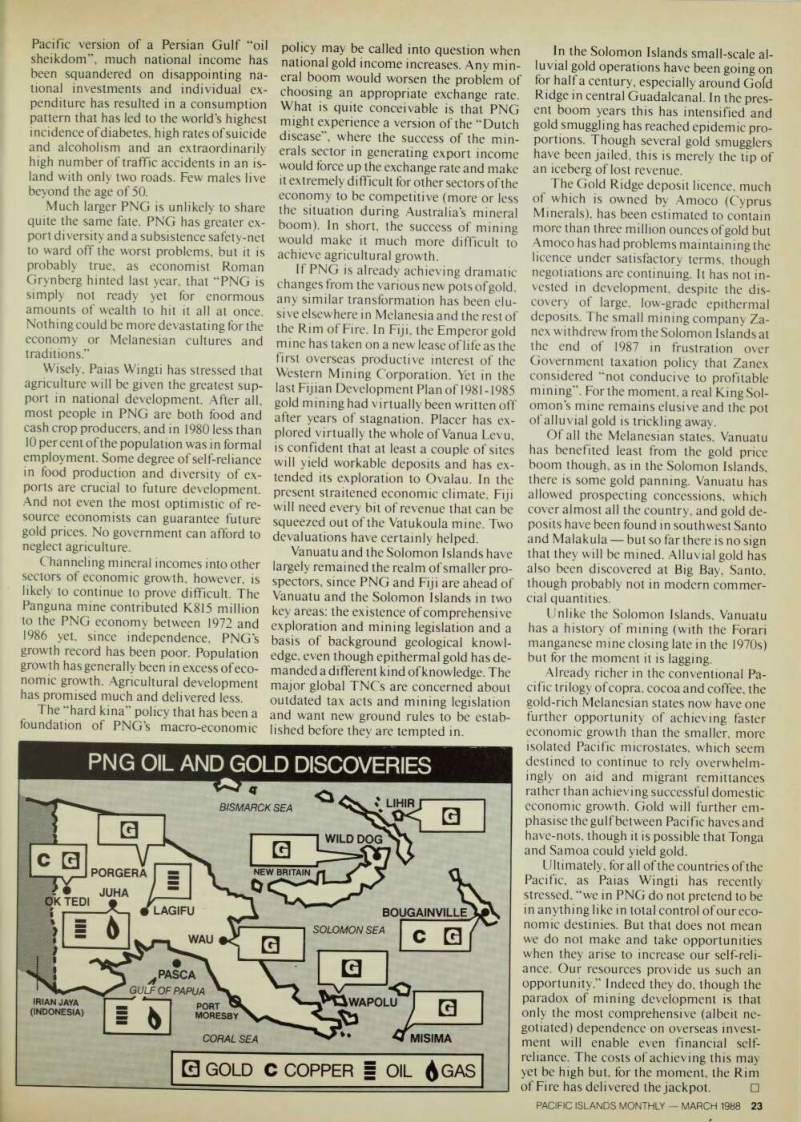
The Region
The Pacific’s fabled mining field an El Dorado or an albatross for the region?
By geographer Dr John Connell
MORE THAN 400 years ago the Spanish explorer Alvaro de Mcn dana set out from Peru lo dis cover the legendary Isles of Solomon, said lo have been visited by the Incas and ex pected lo be the source of great riches. It is unknown if the Spaniards ever found gold, and by the beginning of the 17th cen tury they had abandoned all attempts lo settle in Vanuatu and the Solomon Islands.
But now, for many Melanesians and European "explorers” alike, the dream of King Solomon’s mines lives on. primarily in Papua New Guinea, but also in the Sol omon Islands and through most of the so called Rim of Fire from the Philippines to Indonesia, Vanuatu and Fiji and south lo New Zealand. Indeed the rim surrounds the Pacific rim itself and further recent gold discoveries have been made in all these countries, as well as Japan and Chile.
In PNG, mining spans exactly 100 years. The first gold rush of 1878 brought white miners to the hinterland of Port Mo resby. They were unsuccessful but were followed, in 1888, by north Queensland miners crowding into Sudesl Island in Milne Bay to pan for alluvial gold. But within a short time, much to European re sentment, it was the islanders who were producing the bulk of PNG’s gold; a situ ation destined to be repealed elsewhere, often after Europeans had abandoned un profitable workings.
After Sudest there were many new dis coveries of alluvial gold on nearby islands, then on the mainland of southeastern New Guinea and, most dramatically, around Bulolo and Wau in Morobe province. From the 1920 s onward, PNG’s greatest gold rush transformed the valleys around the richest alluvial goldfield in the country. Euro pean miners’ fortunes were made, and lost; and as writer Hank Nelson records, local communities evaded them, worked for them, traded with them, fought them and slept with them”. These communities could scarcely avoid the transformation wrought by the gold rush, nor could Me lanesians in the Eastern Highlands, the Sepik and Bougainville, as the alluvial miners moved their frontier onward.
Gold mining in Fiji had a very similar history to that of PNG. The first alluvial mineworking began in 1886, with limited success. When agricultural commodity prices plunged in the late 1920 s and gold prices rose, the stage was set for the
development of the Emperor gold mine at Valukoula.
In the Solomon Islands much the same occurred on a small scale, but the various minor gold rushes never transformed in comes and lives as dramatically as in PNG.
PNG’s first great mining era was in every way superficial. The mines were for alluvial gold, often temporary and often having little long-term impact on the lives of miners and Melanesians. The miners’ contribution to colonial economies was equally brief. Not so with the second phase of mining, the construction of the vast Panguna copper mines in the mountains of Bougainville, close to the liny pre-war Kupei gold mine. After much wrangling over land ownership, compensation and royally payments, what quickly became the largest hole in the southern hemisphere ushered in a new era.
Massive capital flows from the vast in ternational mining giant CRA led to the construction of a local subsidiary BCL (Bougainville Copper Limited) and by 1972 the first copper was being exported.
Prior to independence, the national Government negotiated new contract terms, achieving greater success.
Huge incomes from Panguna more than a third of national income in the early years contributed to development in PNG, emphasised the relative wealth of the North Solomons province (which already produced much of PNG’s copra and
cocoa), provided jobs, developed new skills, and set the country on the path of rapid transformation.
The wealth that Panguna generated within PNG, despite the substantial "loss” of profits southward, was initially not wholly welcome. The Bougainvilleans re sented the loss of land for mines and sought to prevent any further loss.
But mining continued and, a decade later, opposition to mining had virtually ceased. One factor that has contributed to this is gold. Panguna, once a copper mine where gold (and silver) were trivial by products, now produces the same value of gold as copper. Outside Fr John Momis’s Melanesian Alliance, few PNG politicians seek to prevent further mine construction, merely questioning some of the details of royalties, contracts, employment and rev enue flows. The mining explosion has ar rived in PNG.
There is a rush for shares in new min ing companies as soon as they are released on to the PNG market. The release of Pla cer Pacific shares in July 1986 prompted an extraordinary rush. Shares specifically set aside for PNG investors were eagerly taken up, but equally sold off to foreign buyers by ministers, politicians and pub lic servants after fast profits.
By global standards, Panguna is one of the last great copper mines to be con structed. If mineral discoveries at Pan guna were belated, they were well in
advance of those made in the Highlands of PNG. It was not until 1968 that the era of exploitation and discovery brought ge ologists into the most remote Highlands, propelled by high global copper prices and aided by new survey techniques. A decade later Ok Tedi, the first of the Highlands mines, was in production.
In 1981 Sir Julius Chan enthusiasti cally announced that “Ok Tedi represents the pot of gold at the end of the rainbow”.
It was a brilliant phrase, for gold prices were just about to surge through the roof and there was no shortage of rainbows in the rainforests of the Star Mountains. But it was not before years of struggle that the mine eventually came into production. By 1987 what started out as a copper mine had become the largest gold mine outside South Africa.
The third mining era PNG’s second gold rush began in the 1980 s. Indeed, without its gold cap Ok Tedi might never have become a mine. Crucial to the new gold rush was the dramatic rise in world gold prices in 1980-1981, which levelled off in the next few years and soared again in 1986 and 1987, precipitating a new wave of mining and exploitation.
Gold has traditionally been a hedge against inflation, and in the inflationary era that prevailed until the stock market crash of October 1987 it became a major source of investment. Though a deflation ary rather than inflationary period now seems probable and gold prices may fall much further than they did at the start of February, when the gold index dropped to its lowest level since November 1986, they are most unlikely to plunge toward the prices of the 19705.
Copper and nickel prices in the next couple of years should reach higher levels than in the mid-1980s, hence for each of the key Pacific minerals the price pros pects are extremely good. The gold market is unlikely to slump and mining is unlikely to become uneconomic even in the more inaccessible parts of the South Pacific. A worsening political situation in South Af rica, though unlikely to stop South Afri can gold trading, could push Rim of Fire prices even higher.
The combination of new exploration, gold price increases and the necessity for the PNG Government to extend mining development beyond Bougainville guar anteed the wave of drilling, construction, negotiation and share issuing that marked the 1980 s. Without domestic capital and technical skills, virtually all elements of mining have been a function of interna tional capital and expertise. Transna tional corporations (TNCs) have multiplied in the Highlands and islands of PNG. New deposits of gold, oil, natural gas, copper and other minerals includ ing platinum are continuing to be dis covered in what may be commercial quantities, and exploration is far from over.
Mining in PNG has been slowed by
inhospitable terrain (especially in the rainforests that covered Ok Tedi), the ab sence of infrastructure, limited knowl edge of geological formations that are quite different from other world regions and previously unattractive gold prices. Even the relatively accessible Porgera mine in Enga province is 2300 metres above sea level, in mountainous rainforests with a rainfall 0f360 centimetres a year. Only the most attractive prices could overcome such disadvantages, and tempt into the Pacific the TNCs that have been essential for pro viding finance, technology and expertise.
The new mines are quite different from the old alluvial workings. All are closely associated with hot springs and ancient volcanic activity at the mobile junction of the Australian and Pacific geological plates. These are the epithermal mines, whose discovery demanded new geologi cal techniques and where processing de-
This year gold is likely to represent almost half of the total value of Papua New Guinea’s exports
mands new chemical skills. A series of discoveries has transformed PNG; most valuable are the potential mines at Por gera, Misima and, above all, Lihir, the jewel in the crown of the new era.
The size and number of the epithermal deposits points to a long-term future for gold mining. On the tiny island of Lihir, off the eastern coast of New Ireland, de posits are estimated at more than 25 mil lion ounces. If production reaches its anticipated target of one million ounces per year (worth around SA6SO million at current prices) Lihir could become one of the world’s largest gold mines. Explora tion on Lihir did not even begin until 1982, yet this is the ultimate crock of gold. Lihir alone rivals the known gold resources of Australia, the world’s fourth largest gold producer, and exploration is not yet even complete. Not surprisingly, Lihir has proved to be a catalyst to further explo ration throughout the Rim of Fire. A mi nor problem at Lihir is the nature of the Rim itself. Lihir is a caldera, a collapsed volcano; temperatures are extremely high and some coastal gold deposits are en gulfed in boiling water.
The long period often around 10 years it lakes to get a large mine into production means that only Ok Tedi and Panguna are currently exporting copper, gold and other minerals. Even so, in 1986 gold exports alone according to Bank of PNG figures were valued at K4Ol million, some 40 per cent of total exports, and by far the single most important commodity.
Indeed, the value of gold exports has dou bled since 1984. Copper trailed at K 156 million. The total value of agricultural ex ports reached only K 332 million, domi nated by K 209 million worth of coffee. For the first lime, gold was more important than the whole of the agricultural sector.
This year gold is likely to be almost half the total value of PNG’s exports.
When Misima, Lihirand Porgeracome into production (as all should do) in the next two or three years, PNG’s gold output will rise from 36 tonnes a year to about 75 tonnes by 1992, a leap that will more than compensate for probable declines at Pan guna and Ok Tedi. Other smaller mines may come into full production in the 19905, at Kainantu (Eastern Highlands) and per haps at Hidden Valley (Morobe), Laloki (Central Province) or Tabar Island, north of Lihir. In November 1987 new survey re sults suggested that Safia (Northern Prov ince) might be larger than any of these; the limes of Papua New Guinea welcomed “an El Dorado”.
The mining boom has also led to changes for the TNCs themselves, creat ing through mergers a new generation of extremely powerful mining giants, of which BHP and Placer are outstanding examples. After mergers, Placer has joined Ok Tedi Mining Corporation as the two largest gold producers in the world, both producing an output of about one million ounces in 1987. The sixth largest gold min ing company in the world was Bougain ville Copper Limited with 530,000 ounces.
Placer is currently developing Porgera (along with two Australian companies), owns the whole of Misima, controls Kid ston, the largest gold mine in Australia, and has major interests in Canada.
Three of the largest gold mining com panies in the world are thus prominently represented in PNG, a measure of the ex traordinary significance of PNG gold and its new role in world gold trade and pro duction. In a decade, PNG will have moved from its present seventh place to become the third largest gold producer in the world behind south Arica and the So viet Union.
For small developing nations, bargain ing with massive TNCs has never been easy. Symbolic of the struggle for local de velopment are arguments over whether a mining town should be built on Misima Island, or miners flown in and out from Queensland. The assumption that Mis ima would be a marginal mine and have a life of no more than 10 years led to Placer preferring “commuter-mining”, withK
4 miners flying in from Cairns, as they had done at Kidston in Queensland, rather than construct a temporary mining town and other expensive infrastructure on a remote island. The PNG Minerals and Energy Minister, John Kaputin, sup ported Placer’s proposal but other cabinet ministers and local politicians sought a much greater degree of local involvement, consumer spending in PNG and a rather less visible form of neo-colonial develop ment, with Misima an economic satellite of northern Queensland. After three years of discussion, no agreement has yet been reached.
Ilisnotonly in mining ilselflhatTNCs are involved. In January the MP for Mo resby North-West, Robert Suckling, called on the Government to ensure that all con tracts associated with Misima mine pro ject be awarded to PNG companies to avoid what he described as “The Ok Tedi fiasco” where many supportive contract ing services were awarded to foreign and not local companies.
Environmental issues have also proved difficult to resolve. Substantial compen sation muled the worst complaints from Bougainville, but the loss of cyanide drums into the Fly River below Ok Tedi caused more serious attention to be given to pol lution. Environmentalists in PNG have argued that though environmental impact assessments must be made, the Govern ment has rarely taken a lough line.
PNG Prime Minister Paias Wingti has continued past policies toward foreign in vestment. Speaking in Sydney last year, he emphasised that “we welcome foreign in vestment on our terms. If we cannot ob tain at first the terms we consider acceptable, we will negotiate very robustly so as to achieve those terms. If we cannot agree over the negotiating table then let us simply agree to disagree.”
No disagreements have yet led to the abandonment of mine concessions. The PNG Government has had to accept some mining company proposals since, in the demand for foreign capital, it is crucial for governments to keep mining companies and banks onside. Development of Ok Tedi became very difficult in 1984 when major banks became disillusioned with both PNG and the project which world prices then suggested was risky and in any case, banks are wary of countries ori ented to commodity production. At Ok Tedi the tailings dam was deferred, per haps indefinitely, and PNG-based econ omist Roman Grynberg suggested that “miners have PNG by the throat when, at Misima, the Government signed the country’s first-ever secret agreement with a mining company.
Mr Wingti has emphasised that his Government is not anxious to take up eq uity shares in new mining ventures, though it reserves the right to purchase up to 30 per cent of equity, which would tie up a great deal of scarce capital and impose some risks. Though the Government has taken up 20 per cent of Misima, it prefers to generate revenue through taxing prof its. It even declared that the 20 per cent Government share in Bougainville copper could be sold off to generate much-needed capital for rural development. The Government has also tried to persuade TNCs to undertake as much infrastruc ture investment as possible, to minimise the risk of any withdrawal if prices fall.
Wingti has also stated; “Most of our mines, actual and prospective, are in re mote areas. Mining is a means to what we regard as real or true development. We will not override legitimate local interests, which are our end, in pursuit of the means.” However, a very crucial question that has posed enormous difficulties in several existing mining areas, including Boungainville and Ok Tedi, is who exactly are “local” people. Deciding where the “local” region is has caused enormous dif ficulties for employment and compensa tion policies.
At Porgera what was once a thinly pop ulated area now has a growing population hotly contesting land ownership and thus access to incomes and jobs. On Misima. too, there has been a steady migration of young men for several years in eager an ticipation of prestigious, exciting and highly paid employment. However, min ing is a classic capital-intensive industry and the unskilled jobs that are the prov ince of “local” workers are hard to gel.
In the Highlands especially there has been widespread concern over “foreign ers” from other parts of PNG, especially from the richer coastal areas, seizing the best jobs and profiting at local expense.
Access to income is at least as crucial as access to jobs, and has been a source of constant political friction. At the start of mining in Panguna, Alexis Sarei, later the Provincial Premier, declared that “Bou gainville was not a fat cow to be milked for the rest of Papua New Guinea”, and de manded a greater share of benefits for Bougainville. A brief secession movement led to the abortive declaration of a Repub lic of the North Solomons and the even tual emergence of the first real provincial government there.
Around Ok Tedi there was a move to establish a North Fly Provincial Govern ment, breaking away from Western Prov ince, and everywhere there have been disagreements over the local, regional and
The paradox of Pacific mining development: mineral self reliance for island nations depends on overseas investment
national distribution of spoils. All this emphasises the local and the regional in equalities that have followed mining de velopment and the friction over vast new incomes, access to jobs and contracting services. At the national level, too, the at tractions of political power and jockeying for that power can only increase.
Beyond revenue, mining has brought obvious benefits. Papua New Guineans have gained new jobs in exploration, con struction, transport and in the public and private mine bureaucracy. In some re spects there has even been an “internal brain drain” as skilled economists, sci entists and others are attracted by high mine salaries. But Papua New Guineans have predominantly taken their place in the lower levels of the workforce.
At a national level, the costs and bene fits will continue to be even more mixed.
A major cost is that PNG is wholly de pendent on external capital to finance mine development and therefore depend ent on the movement of global commod ity prices and whims of international corporate decision-makers. The gold price fall in January and February, to prices that are still exceptionally high by historical levels, has already led to a decline in the commitment to exploration in “high-cost” areas, including PNG and the rest of the Rim of Fire. The giant TNCs have pulled back further than more local companies.
Higher costs and the longer times re quired for exploration, negotiation and development in these more remote areas have meant that companies needing to conserve their capital have had to reduce their activities drastically.
Garry Davies, chairman of Solomon Pacific Resources Ltd, recently told Busi ness Review Weekly that “exploration in the Pacific is still moving ahead, and we are getting very good grades at our Wai nivesi plant in Fiji, but the need to get into production is fundamental. You can’t go back to the marketplace for money. We have cut back in the Pacific; in this envi ronment you have got to be more hard nosed.” Though the PNG Government anticipates that by the end of the century mining will have taken on a much more indigenous flavour, the experience of mines elsewhere in the developing world suggests that a radical change is rather un likely. When world gold prices sneeze, PNG cannot avoid catching cold.
The final destiny of the wealth PNG’s golden future will bring is a critical issue.
PNG has had a continual balance of pay ments deficit since 1980 as the import of consumer goods maintains some living standards at very high levels. In nearby Nauru, where phosphate has resulted m a
Pacific version of a Persian Gulf “oil sheikdom”, much national income has been squandered on disappointing na tional investments and individual ex penditure has resulted in a consumption pattern that has led to the world’s highest incidence of diabetes, high rates of suicide and alcoholism and an extraordinarily high number of traffic accidents in an is land with only two roads. Few males live beyond the age of 50.
Much larger PNG is unlikely to share quite the same fate. PNG has greater ex port diversity and a subsistence safety-net to ward off the worst problems, but it is probably true, as economist Roman Grynberg hinted last year, that “PNG is simply not ready yet for enormous amounts of wealth to hit it all at once.
Nothing could be more devastating for the economy or Melanesian cultures and traditions.”
Wisely, Paias Wingti has stressed that agriculture will be given the greatest sup port in national development. After all, most people in PNG are both food and cash crop producers, and in 1980 less than 10 per cent of the population was in formal employment. Some degree of self-reliance in food production and diversity of ex ports are crucial to future development.
And not even the most optimistic of re source economists can guarantee future gold prices. No government can afford to neglect agriculture.
Channeling mineral incomes into other sectors of economic growth, however, is likely to continue to prove difficult. The Panguna mine contributed KBl5 million to the PNG economy between 1972 and 1986 yet, since independence, PNG’s growth record has been poor. Population growth has generally been in excess of eco nomic growth. Agricultural development has promised much and delivered less.
The “hard kina” policy that has been a foundation of PNG’s macro-economic
policy may be called into question when national gold income increases. Any min eral boom would worsen the problem of choosing an appropriate exchange rate.
What is quite conceivable is that PNG might experience a version of the “Dutch disease”, where the success of the min erals sector in generating export income would force up the exchange rate and make it extremely difficult for other sectors of the economy to be competitive (more or less the situation during Australia’s mineral boom). In short, the success of mining would make it much more difficult to achieve agricultural growth.
If PNG is already achieving dramatic changes from the various new pots of gold, any similar transformation has been elu sive elsewhere in Melanesia and the rest of the Rim of Fire. In Fiji, the Emperor gold mine has taken on a new lease of life as the first overseas productive interest of the Western Mining Corporation. Yet in the last Fijian Development Plan of 1981 -1985 gold mining had virtually been written off after years of stagnation. Placer has ex plored virtually the whole of Vanua Levu, is confident that at least a couple of sites will yield workable deposits and has ex tended its exploration to Ovalau. In the present straitened economic climate, Fiji will need every bit of revenue that can be squeezed out of the Vatukoula mine. Two devaluations have certainly helped.
Vanuatu and the Solomon Islands have largely remained the realm of smaller pro spectors, since PNG and Fiji are ahead of Vanuatu and the Solomon Islands in two key areas: the existence of comprehensive exploration and mining legislation and a basis of background geological knowl edge, even though epithermal gold has de manded a different kind ofknowledge. The major global TNCs are concerned about outdated tax acts and mining legislation and want new ground rules to be estab lished before they are tempted in.
In the Solomon Islands small-scale al luvial gold operations have been going on for half a century, especially around Gofd Ridge in central Guadalcanal. In the pres ent boom years this has intensified and gold smuggling has reached epidemic pro portions. Though several gold smugglers have been jailed, this is merely the tip of an iceberg of lost revenue.
The Gold Ridge deposit licence, much of which is owned by Amoco (Cyprus Minerals), has been estimated to contain more than three million ounces of gold but Amoco has had problems maintaining the licence under satisfactory terms, though negotiations are continuing. It has not in vested in development, despite the dis covery of large, low-grade epithermal deposits. The small mining company Za nex withdrew from the Solomon Islands at the end of 1987 in frustration over Government taxation policy that Zanex considered “not conducive to profitable mining”. For the moment, a real King Sol omon’s mine remains elusive and the pot of alluvial gold is trickling away.
Of all the Melanesian states, Vanuatu has benefited least from the gold price boom though, as in the Solomon Islands, there is some gold panning. Vanuatu has allowed prospecting concessions, which cover almost all the country, and gold de posits have been found in southwest Santo and Malakula but so far there is no sign that they will be mined. Alluvial gold has also been discovered at Big Bay, Santo, though probably not in modern commer cial quantities.
Unlike the Solomon Islands, Vanuatu has a history of mining (with the Forari manganese mine closing late in the 19705) but for the moment it is lagging.
Already richer in the conventional Pa cific trilogy of copra, cocoa and coffee, the gold-rich Melanesian states now have one further opportunity of achieving faster economic growth than the smaller, more isolated Pacific microstates, which seem destined to continue to rely overwhelm ingly on aid and migrant remittances rather than achieving successful domestic economic growth. Gold will further em phasise the gulf between Pacific haves and have-nots, though it is possible that Tonga and Samoa could yield gold.
Ultimately, for all of the countries of the Pacific, as Paias Wingli has recently stressed, “we in PNG do not pretend to be in anything like in total control of our eco nomic destinies. But that does not mean we do not make and take opportunities when they arise to increase our self-reli ance. Our resources provide us such an opportunity.” Indeed they do, though the paradox of mining development is that only the most comprehensive (albeit ne gotiated) dependence on overseas invest ment will enable even financial self reliance. The costs of achieving this may yet be high but, for the moment, the Rim of Fire has delivered the jackpot. □
Advertisements & other items, p. 20 (1 item)
20
/-.i lol AKir>c MOMTMI Y- MARCH 1988
Casting Their Fate To The Wind
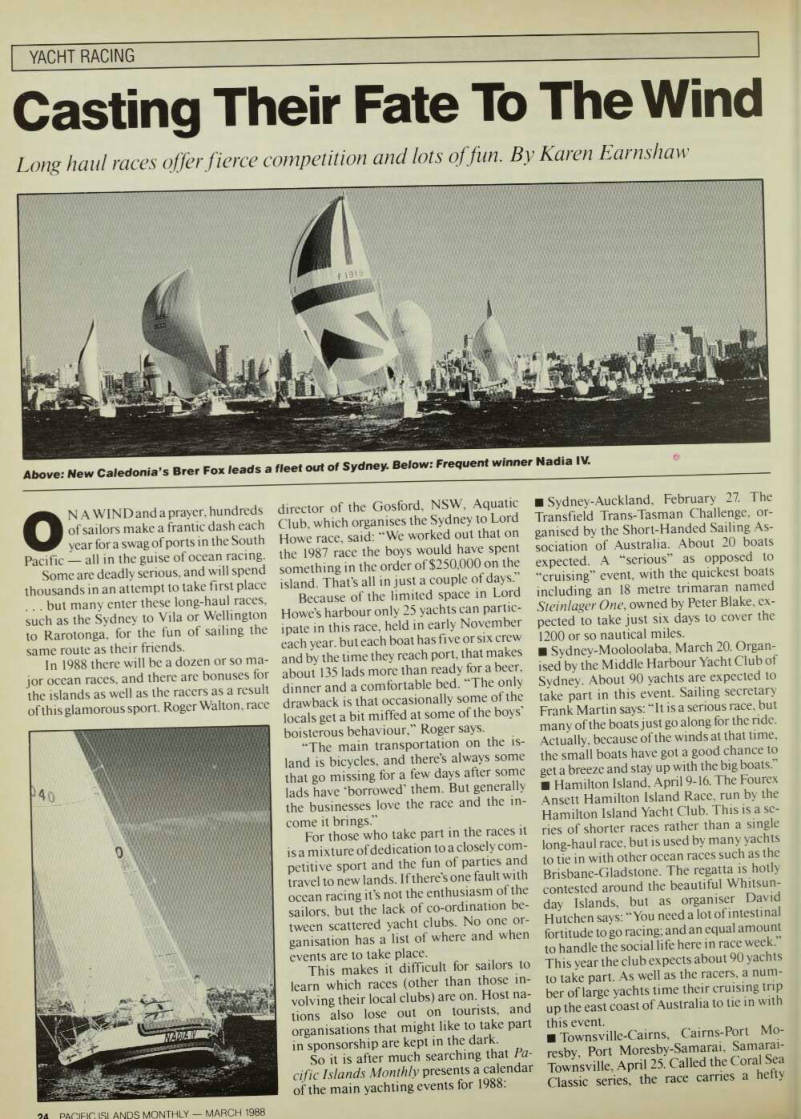
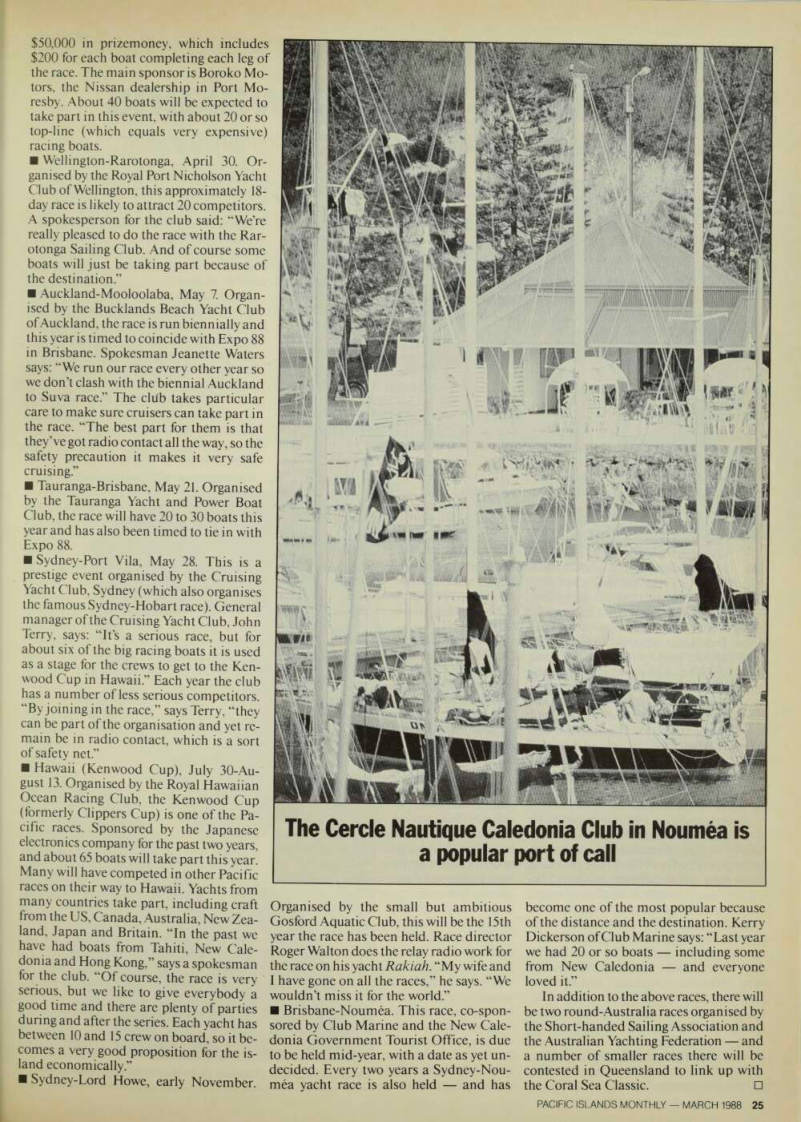
Yacht Racing
Long haul races offer fierce competition and lots of fun.
By Karen Earnshaw
ON A WIND and a prayer, hundreds of sailors make a frantic dash each year for a swag of ports in the South Pacific all in the guise of ocean racing.
Some are deadly serious, and will spend thousands in an attempt to take first place but many enter these long-haul races, such as the Sydney to Vila or Wellington to Rarotonga, for the fun of sailing the same route as their friends.
In 1988 there will be a dozen or so ma jor ocean races, and there are bonuses for the islands as well as the racers as a result of this glamorous sport. Roger Walton, race
■ Sydney-Auckland, February 27. The Transfield Trans-Tasman Challenge, or ganised by the Short-Handed Sailing As sociation of Australia. About 20 boats expected. A “serious” as opposed to “cruising” event, with the quickest boats including an 18 metre trimaran named Stein lager One , owned by Peter Blake, ex pected to take just six days to cover the 1200 or so nautical miles. ■ Sydney-Mooloolaba, March 20. Organ ised by the Middle Harbour Yacht Club of Sydney. About 90 yachts are expected to take part in this event. Sailing secretary Frank Martin says: “It is a serious race, but many of the boats just go along for the nde.
Actually, because of the winds at that time, the small boats have got a good chance to get a breeze and stay up with the big boats. ■ Hamilton Island, April 9-16. The Fourex Ansett Hamilton Island Race, run by the Hamilton Island Yacht Club. This is a se ries of shorter races rather than a single long-haul race, but is used by many yachts to tie in with other ocean races such as the Brisbane-Gladstone. The regatta is hotly contested around the beautiful Whitsun day Islands, but as organiser David Hutchen says; “You need a lot of intestinal fortitude to go racing; and an equal amount to handle the social life here in race week.
This year the club expects about 90 yachts to take part. As well as the racers, a num ber of large yachts time their cruising trip up the east coast of Australia to tie in with this event. A ■ Townsville-Cairns, Cairns-Port Mo resby, Port Moresby-Samarai, Samarai- Townsville, April 25. Called the Coral Sea Classic series, the race cames a helty
director of the Gosford, NSW, Aquatic Club, which organises the Sydney to Lord Howe race, said: “We worked out that on the 1987 race the boys would have spent something in the order of $250,000 on the island. That’s all in just a couple of days.”
Because of the limited space in Lord Howe’s harbour only 25 yachts can partic ipate in this race, held in early November each year, but each boat has five or six crew and by the time they reach port, that makes about 135 lads more than ready for a beer, dinner and a comfortable bed. The only drawback is that occasionally some of the locals get a bit miffed at some of the boys boisterous behaviour,” Roger says.
“The main transportation on the is land is bicycles, and there’s always some that go missing for a few days after some lads have ‘borrowed’ them. But generally the businesses love the race and the in come it brings.”
For those who take part in the races it is a mixture of dedication to a closely com petitive sport and the fun of parties and travel to new lands. If there’s one fault with ocean racing it’s not the enthusiasm of the sailors, but the lack of co-ordination be tween scattered yacht clubs. No one or ganisation has a list of where and when events are to take place.
This makes it difficult for sailors to learn which races (other than those in volving their local clubs) are on. Host na tions also lose out on tourists, and organisations that might like to take part in sponsorship are kept in the dark.
So it is after much searching that Pa cific Islands Monthly presents a calendar of the main yachting events for 1988:
Above: New Caledonia's Brer Fox leads a flee, out of Sydney. Below: Frequent winner Nadia IV.
$50,000 in prizemoney, which includes $2OO for each boat completing each leg of the race. The main sponsor is Boroko Mo tors, the Nissan dealership in Port Mo resby. About 40 boats will be expected to take part in this event, with about 20 or so top-line (which equals very expensive) racing boats. ■ Wellington-Rarotonga, April 30. Or ganised by the Royal Port Nicholson Yacht Club of Wellington, this approximately 18day race is likely to attract 20 competitors.
A spokesperson for the club said: “We’re really pleased to do the race with the Rar otonga Sailing Club. And of course some boats will just be taking part because of the destination.” ■ Auckland-Mooloolaba, May 7. Organ ised by the Bucklands Beach Yacht Club of Auckland, the race is run biennially and this year is timed to coincide with Expo 88 in Brisbane. Spokesman Jeanette Waters says: “We run our race every other year so we don’t clash with the biennial Auckland to Suva race.” The club takes particular care to make sure cruisers can take part in the race. “The best part for them is that they’ve got radio contact all the way, so the safety precaution it makes it very safe cruising.” ■ Tauranga-Brisbane, May 21. Organised by the Tauranga Yacht and Power Boat Club, the race will have 20 to 30 boats this year and has also been timed to tie in with Expo 88. ■ Sydney-Port Vila, May 28. This is a prestige event organised by the Cruising Yacht Club, Sydney (which also organises the famous Sydney-Hobart race). General manager of the Cruising Yacht Club, John Terry, says: “It’s a serious race, but for about six of the big racing boats it is used as a stage for the crews to get to the Ken wood Cup in Hawaii.” Each year the club has a number of less serious competitors.
“By joining in the race,” says Terry, “they can be part of the organisation and yet re main be in radio contact, which is a sort of safety net.” ■ Hawaii (Kenwood Cup), July 30-Au gust 13. Organised by the Royal Hawaiian Ocean Racing Club, the Kenwood Cup (formerly Clippers Cup) is one of the Pa cific races. Sponsored by the Japanese electronics company for the past two years, and about 65 boats will take part this year.
Many will have competed in other Pacific races on their way to Hawaii. Yachts from many countries take part, including craft from the US, Canada, Australia, New Zea land, Japan and Britain. “In the past we have had boats from Tahiti, New Cale donia and Hong Kong,” says a spokesman for the club. “Of course, the race is very serious, but we like to give everybody a good time and there are plenty of parties during and after the series. Each yacht has between 10 and 15 crew on board, so it be comes a very good proposition for the is land economically.” ■ Sydney-Lord Howe, early November.
Organised by the small but ambitious Gosford Aquatic Club, this will be the 15th year the race has been held. Race director Roger Walton does the relay radio work for the race on his yacht Rakiah. “My wife and I have gone on all the races,” he says. “We wouldn’t miss it for the world.” ■ Brisbane-Noumea. This race, co-spon sored by Club Marine and the New Cale donia Government Tourist Office, is due to be held mid-year, with a date as yet un decided. Every two years a Sydney-Nou mea yacht race is also held and has
become one of the most popular because of the distance and the destination. Kerry Dickerson of Club Marine says: “Last year we had 20 or so boats including some from New Caledonia and everyone loved it.”
In addition to the above races, there will be two round-Australia races organised by the Short-handed Sailing Association and the Australian Yachting Federation and a number of smaller races there will be contested in Queensland to link up with the Coral Sea Classic. □
The Cercle Nautique Caledonia Club in Nouméa is a popular port of call
Advertisements & other items, p. 24 (1 item)
24
PAriFir. ISI AMDS MONTHLY MARCH 1988
Indonesia: A Giant Awakens
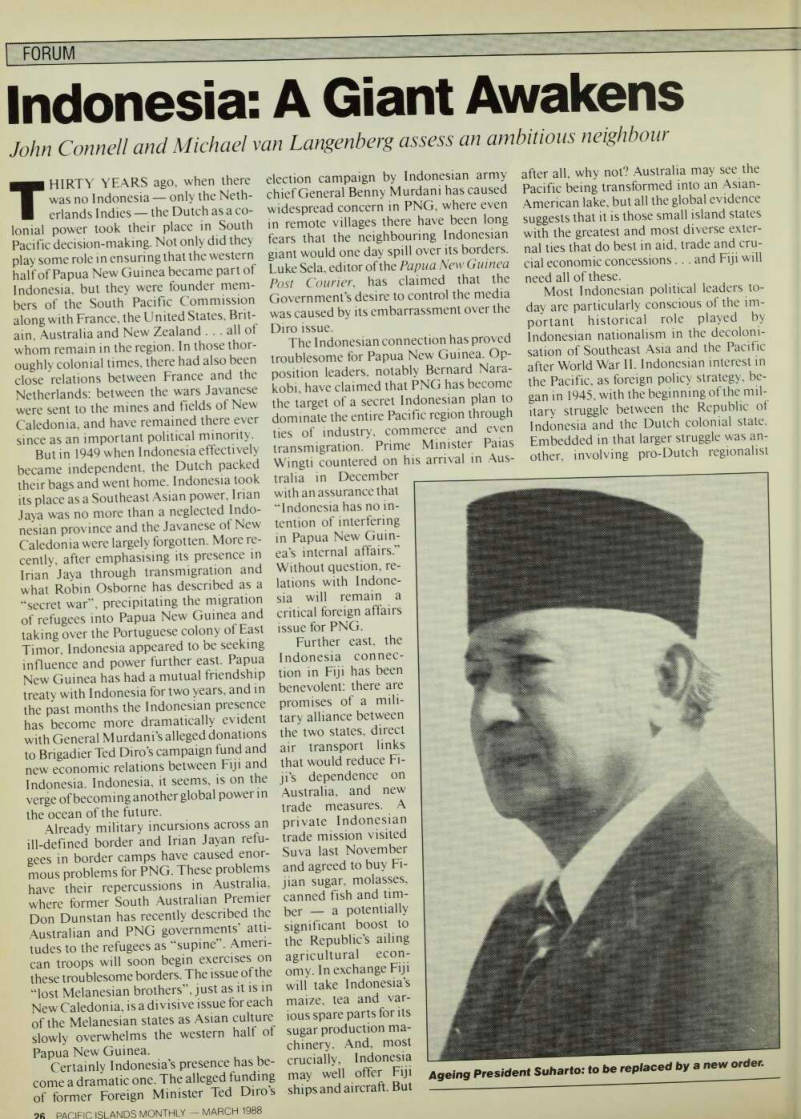
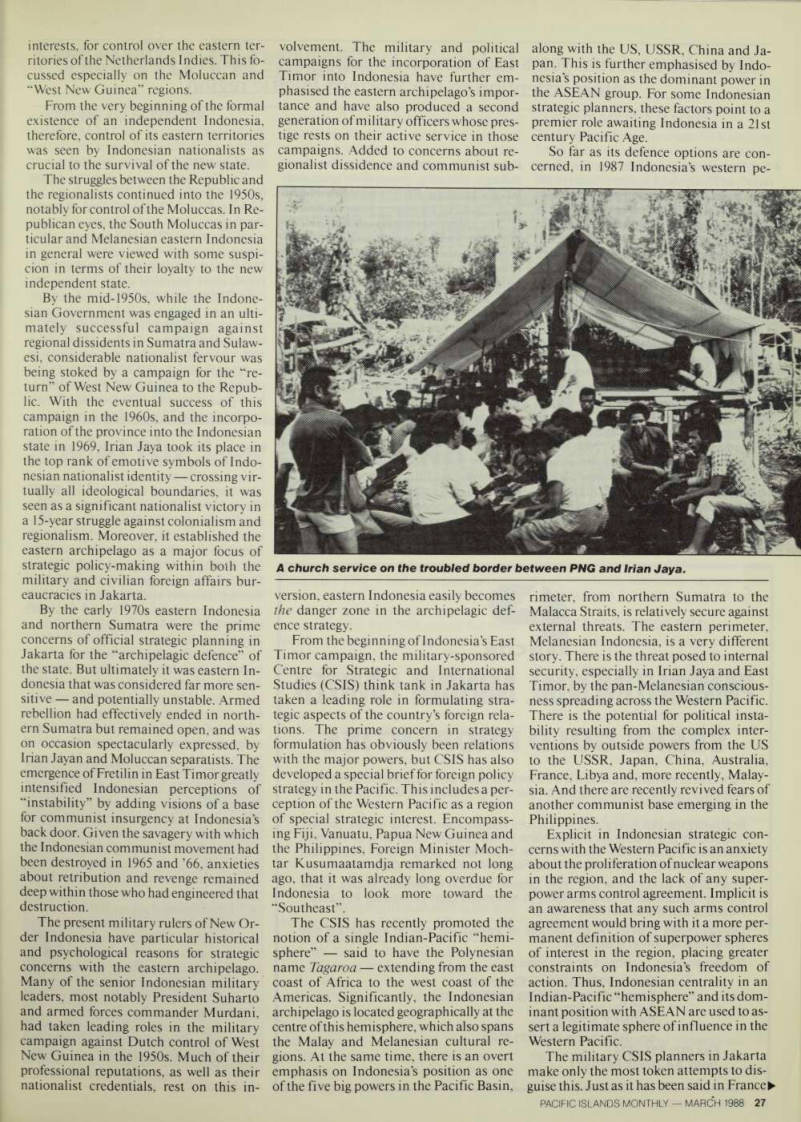
Forum
John Connell and Michael van Langenberg assess an ambitious neighbour
THIRTY YEARS ago, when there was no Indonesia only the Neth erlands Indies the Dutch as a co lonial power took their place in South Pacific decision-making. Not only did they play some role in ensuring that the western half of Papua New Guinea became part of Indonesia, but they were founder mem bers of the South Pacific Commission along with France, the United States, Brit ain, Australia and New Zealand ... all of whom remain in the region. In those thor oughly colonial times, there had also been close relations between France and the Netherlands; between the wars Javanese were sent to the mines and fields of New Caledonia, and have remained there ever since as an important political minority.
But in 1949 when Indonesia effectively became independent, the Dutch packed their bags and went home. Indonesia look its place as a Southeast Asian power, Irian Jaya was no more than a neglected Indo nesian province and the Javanese of New Caledonia were largely forgotten. More re cently, after emphasising its presence in Irian Jaya through transmigration and what Robin Osborne has described as a “secret war”, precipitating the migration of refugees into Papua New Guinea and taking over the Portuguese colony of East Timor, Indonesia appeared to be seeking influence and power further east. Papua New Guinea has had a mutual friendship treaty with Indonesia for two years, and in the past months the Indonesian presence has become more dramatically evident with General Murdani’s alleged donations to Brigadier Ted Diro’s campaign fund and new economic relations between Fiji and Indonesia. Indonesia, it seems, is on the verge of becoming another global power m the ocean of the future.
Already military incursions across an ill-defined border and Irian Jayan refu gees in border camps have caused enor mous problems for PNG. These problems have their repercussions in Australia, where former South Australian Premier Don Dunstan has recently described the Australian and PNG governments atti tudes to the refugees as “supine . Ameri can troops will soon begin exercises on these troublesome borders. The issue of the “lost Melanesian brothers”, just as it is in New Caledonia, is a divisive issue for each of the Melanesian states as Asian culture slowly overwhelms the western half of Papua New Guinea.
Certainly Indonesia’s presence has be come a dramatic one. The alleged funding of former Foreign Minister Ted Diros
election campaign by Indonesian army chief General Benny Murdani has caused widespread concern in PNG, where even in remote villages there have been long fears that the neighbouring Indonesian giant would one day spill over its borders.
Luke Sela, editor of the Papua New Guinea Post Courier , has claimed that the Government s desire to control the media was caused by its embarrassment over the Diro issue.
The Indonesian connection has proved troublesome for Papua New Guinea. Op position leaders, notably Bernard Nara kobi, have claimed that PNG has become the target of a secret Indonesian plan to dominate the entire Pacific region through ties of industry, commerce and even transmigration. Prime Minister Paias Wingti countered on his arrival in Aus
tralia in December with an assurance that “Indonesia has no in tention of interfering in Papua New Guin ea’s internal affairs.”
Without question, re lations with Indone sia will remain a critical foreign affairs issue for PNG.
Further east, the Indonesia connec tion in Fiji has been benevolent: there are promises of a mili tary alliance between the two states, direct air transport links that would reduce Fi ji’s dependence on Australia, and new trade measures. A private Indonesian trade mission visited Suva last November and agreed to buy Fi jian sugar, molasses, canned fish and tim ber a potentially significant boost to the Republic’s ailing
agricultural econ
omy. In exchange Fiji will take Indonesia’s maize, tea and var ious spare parts for its sugar production ma chinery. And, most crucially, Indonesia may well offer Fiji ships and aircraft. But
after all, why not? Australia may see the Pacific being transformed into an Asian- American lake, but all the global evidence suggests that it is those small island states with the greatest and most diverse exter nal ties that do best in aid, trade and cru cial economic concessions... and Fiji will need all of these.
Most Indonesian political leaders to day are particularly conscious of the im portant historical role played by Indonesian nationalism in the decoloni sation of Southeast Asia and the Pacific after World War 11. Indonesian interest in the Pacific, as foreign policy strategy, be gan in 1945, with the beginning of the mil itary struggle between the Republic of Indonesia and the Dutch colonial state.
Embedded in that larger struggle was an other, involving pro-Dutch regionalisl
Ageing President Suharto: to be replaced by a new order.
interests, for control over the eastern ter ritories of the Netherlands Indies. This fo cussed especially on the Moluccan and “West New Guinea” regions.
From the very beginning of the formal existence of an independent Indonesia, therefore, control of its eastern territories was seen by Indonesian nationalists as crucial to the survival of the new state.
The struggles between the Republic and the regionalists continued into the 19505, notably for control of the Moluccas. In Re publican eyes, the South Moluccas in par ticular and Melanesian eastern Indonesia in general were viewed with some suspi cion in terms of their loyalty to the new independent state.
By the mid-19505, while the Indone sian Government was engaged in an ulti mately successful campaign against regional dissidents in Sumatra and Sulaw esi, considerable nationalist fervour was being stoked by a campaign for the “re turn” of West New Guinea to the Repub lic. With the eventual success of this campaign in the 19605, and the incorpo ration of the province into the Indonesian state in 1969, Irian Jaya took its place in the top rank of emotive symbols of Indo nesian nationalist identity crossing vir tually all ideological boundaries, it was seen as a significant nationalist victory in a 15-year struggle against colonialism and regionalism. Moreover, it established the eastern archipelago as a major focus of strategic policy-making within both the military and civilian foreign affairs bur eaucracies in Jakarta.
By the early 1970 s eastern Indonesia and northern Sumatra were the prime concerns of official strategic planning in Jakarta for the “archipelagic defence” of the state. But ultimately it was eastern In donesia that was considered far more sen sitive and potentially unstable. Armed rebellion had effectively ended in north ern Sumatra but remained open, and was on occasion spectacularly expressed, by Irian Jayan and Moluccan separatists. The emergence of Fretilin in East Timor greatly intensified Indonesian perceptions of “instability” by adding visions of a base for communist insurgency at Indonesia’s back door. Given the savagery with which the Indonesian communist movement had been destroyed in 1965 and ’66, anxieties about retribution and revenge remained deep within those who had engineered that destruction.
The present military rulers of New Or der Indonesia have particular historical and psychological reasons for strategic concerns with the eastern archipelago.
Many of the senior Indonesian military leaders, most notably President Suharto and armed forces commander Murdani, had taken leading roles in the military campaign against Dutch control of West New Guinea in the 19505. Much of their professional reputations, as well as their nationalist credentials, rest on this in
volvement. The military and political campaigns for the incorporation of East Timor into Indonesia have further em phasised the eastern archipelago’s impor tance and have also produced a second generation of military officers whose pres tige rests on their active service in those campaigns. Added to concerns about re gionalist dissidence and communist sub-
version, eastern Indonesia easily becomes the danger zone in the archipelagic def ence strategy.
From the beginning of Indonesia’s East Timor campaign, the military-sponsored Centre for Strategic and International Studies (CSIS) think tank in Jakarta has taken a leading role in formulating stra tegic aspects of the country’s foreign rela tions. The prime concern in strategy formulation has obviously been relations with the major powers, but CSIS has also developed a special brief for foreign policy strategy in the Pacific. This includes a per ception of the Western Pacific as a region of special strategic interest. Encompass ing Fiji, Vanuatu, Papua New Guinea and the Philippines, Foreign Minister Modi tar Kusumaatamdja remarked not long ago, that it was already long overdue for Indonesia to look more toward the “Southeast”.
The CSIS has recently promoted the notion of a single Indian-Pacific “hemi sphere” said to have the Polynesian name Tagaroa extending from the east coast of Africa to the west coast of the Americas. Significantly, the Indonesian archipelago is located geographically at the centre of this hemisphere, which also spans the Malay and Melanesian cultural re gions. At the same time, there is an overt emphasis on Indonesia’s position as one of the five big powers in the Pacific Basin,
along with the US, USSR, China and Ja pan. This is further emphasised by Indo nesia’s position as the dominant power in the ASEAN group. For some Indonesian strategic planners, these factors point to a premier role awaiting Indonesia in a 21st century Pacific Age.
So far as its defence options are con cerned, in 1987 Indonesia’s western pe
rimeter, from northern Sumatra to the Malacca Straits, is relatively secure against external threats. The eastern perimeter, Melanesian Indonesia, is a very different story. There is the threat posed to internal security, especially in Irian Jaya and East Timor, by the pan-Melanesian conscious ness spreading across the Western Pacific.
There is the potential for political insta bility resulting from the complex inter ventions by outside powers from the US to the USSR, Japan, China, Australia, France, Libya and, more recently, Malay sia. And there are recently revived fears of another communist base emerging in the Philippines.
Explicit in Indonesian strategic con cerns with the Western Pacific is an anxiety about the proliferation of nuclear weapons in the region, and the lack of any super power arms control agreement. Implicit is an awareness that any such arms control agreement would bring with it a more per manent definition of superpower spheres of interest in the region, placing greater constraints on Indonesia’s freedom of action. Thus, Indonesian centrality in an Indian-Pacific “hemisphere” and its dom inant position with ASEAN are used to as sert a legitimate sphere of influence in the Western Pacific.
The military CSIS planners in Jakarta make only the most token attempts to dis guise this. Just as it has been said in France►
A church service on the troubled border between PNG and Irian Jaya.
Over the next five years Indonesian foreign policy will pay considerably more attention to the Western Pacific region
◄that “we are there because the Pacific is there”, so Dr Djalal, a senior official in the Indonesian Ministry of Foreign Affairs, has proclaimed that the Pacific is “where all the major powers of the world are, so why not Indonesia? We certainly wish to have a place there”. Moreover, Indonesian foreign policy makers are conscious of the potential fragility of internal PNG politics and the possible flow of this instability into Irian Jaya.
Indonesia fears a “Lebanon trap” with a breakdown of political stability in PNG, the rise of a variety of dissident factions, the growth of further pan-Melanesian sen timent and a flow-on effect that would strengthen the separatist Free Papua Movement (OPM) in Irian Jaya. Pressures will then develop within Indonesia for military intervention inside PNG.
The cycle of escalation may be irresist ible and costly. Indonesia is now playing an active role in attempting to maintain a “co-operative” and stable political system in PNG hence its considerable “sphere of influence” interest in PNG politics
expressed in regular consultations about strategic planning, promises of special re lations between PNG and ASEAN and even financial assistance from Indonesia.
The sphere of interest emphasis in In donesian foreign policy is likely to in crease as a new, more confident generation of leaders takes over in Jakarta. They will be less concerned by a need to draw a sharp contrast with the aggressive Sukarnoist policies of the 1960 s than Suharto’s government has been.
There are even signs of a yearning among some of the younger civilian and military politicians for the national pride of the days of Guided Democracy and their aggressive foreign policy.
So far as recent developments in Fiji are concerned, Indonesia has much to be wary about in the politics of indigenous Me lanesian power being asserted there. For the immediate future, Indonesia must ac commodate to these developments and ensure there is no spillover into Melane sian Indonesia: Jakarta certainly does not share Malaysia’s new enthusiasm for the
direction of Fiji’s republican politics.
For the longer term, the potentially destabilising influences in Melanesian In donesia from the Taukei and Kanaky movements must be a matter of consid erable concern in Jakarta’s strategic-plan ning bureaucracy. Over the next five years Indonesian foreign policy will pay consid erably more attention to the Western Pa cific. The border with PNG, in particular, will be less sacrosanct in Indonesian eyes if perceived strategic interests and nation alist pride in Jakarta are threatened. After 1993, when Suharto’s term as president ends, political control of the New Order government in Jakarta will most probably have passed entirely to the hands of a new generation of military and civilian leaders.
And Indonesia is not the only Asian power to take an interest in the region. Ja pan, of course, has widespread business interests and is now a major aid donor (and also the largest aid donor in Indonesia).
China has a diplomatic presence in West ern Samoa and Fiji. Taiwan has an hon orary consul in Tonga, while the Solomon Islands is the only country in the world that has managed to recognise both Chinas.
South Korea is expanding its trade and mining interests and was one of the first countries to recognise Colonel Rabukas regime in Fiji. More recently Malaysia is also taking its place.
Indeed, virtually every substantial state in Asia is currently expanding its interests in the Pacific and now especially in politi cally unstable Fiji. Though Malaysia has had an embassy in Fiji for some years, the nature of the relationship has changed emphatically since the coups. There will be much closer trade links, and Malaysia’s constitution has been a partial model for that of Fiji. Not surprisingly, many Fiji ans see Malaysia as a model for the kind of state they wish to become, with the “sons of the soil” firmly in control.
Australia’s Foreign Minister, Bill Hay den, has drawn a similar conclusion. Here, at least, one Asian nation has gone far be yond trade: it has become a model for a new Fijian future. And in a last irony, PNG is reported to be contemplating member ship in ASEAN. Many thousands of years ago, the ancestors of Pacific islanders mi grated south and east from Asia: now such ancient ties are being brought together again. For better or worse, Asia is moving closer to the South Pacific. □
Dr John Connell and Dr Michael van Langenberg are researchers with the Re search Institute for Asia and the Pacific at the University of Sydney.
Advertisements & other items, p. 28 (1 item)
Pancontinental Mining Limited
p
PANCON
SEEKS GOLD PROPERTIES
Pancontinental Mining Limited is a successful Australian exploration and mining company with a proven record of discovery, evaluation, development and diversification.
Following the discovery and successful development of the wholly owned 100 000 oz p.a. Paddington Gold Mine in the Eastern Goldfields of Western Australia, Pancon has expanded its exploration programme throughout Australia and offshore to Indonesia, Papua New Guinea and Fiji.
In an effort to continue this rapid growth Pancon is seeking equity either through purchase or joint venture, in advanced gold prospects in Eastern Australia and the Southwest Pacific.
Opportunities offered by companies or individuals will be welcomed and immediate attention is assured.
Please address proposals or enquiries to:- General Manager Exploration, Pancontinental Mining Limited, 9-13 Young Street,
SYDNEY, NSW 2000.
or:- Telephone (02) 231 1022 Fax (02) 231 3674 Telex AA 70938 PANGET
Pacific Report
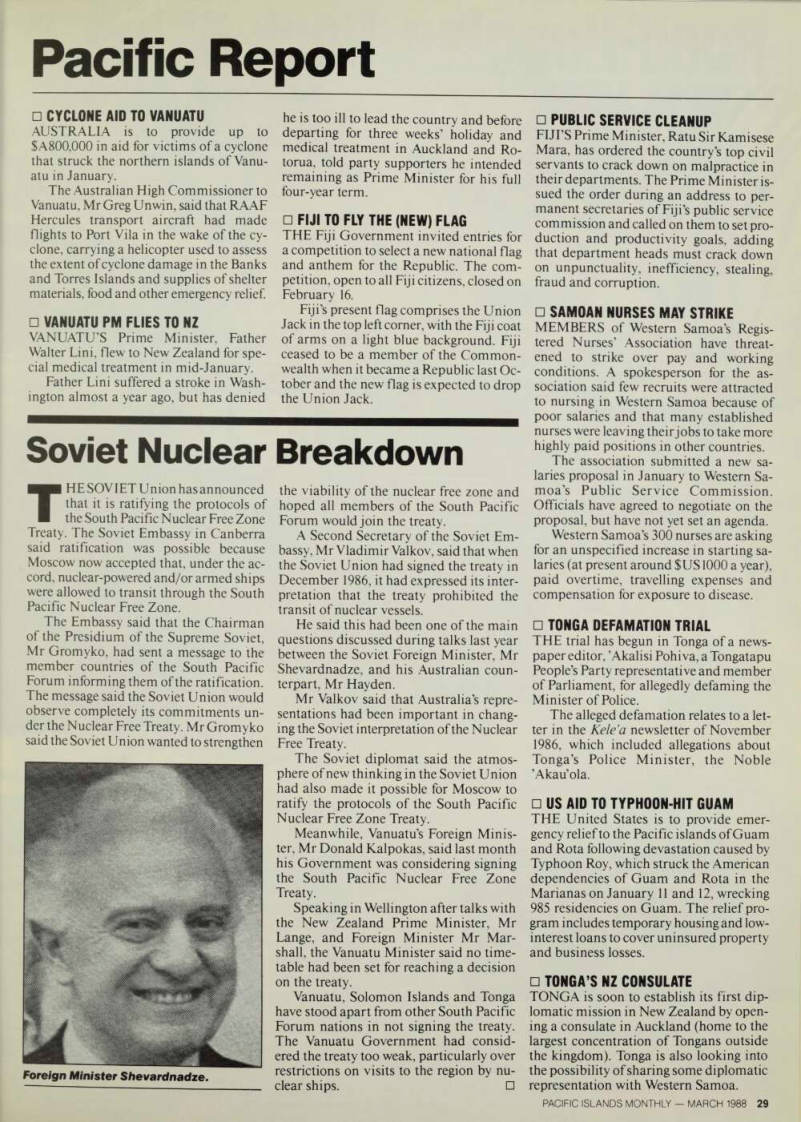
□ Cyclone Aid To Vanuatu
AUSTRALIA is to provide up to SABOO,OOO in aid for victims of a cyclone that struck the northern islands of Vanu atu in January.
The Australian High Commissioner to Vanuatu, Mr Greg Unwin, said that RAAF Hercules transport aircraft had made flights to Port Vila in the wake of the cy clone, carrying a helicopter used to assess the extent of cyclone damage in the Banks and Torres Islands and supplies of shelter materials, food and other emergency relief.
□ Vanuatu Pm Flies To Nz
VANUATU’S Prime Minister, Father Walter Lini, flew to New Zealand for spe cial medical treatment in mid-January.
Father Lini suffered a stroke in Wash ington almost a year ago, but has denied
he is too ill to lead the country and before departing for three weeks’ holiday and medical treatment in Auckland and Ro torua, told party supporters he intended remaining as Prime Minister for his full four-year term. □ FIJI TO FLY THE (NEW) FLAG THE Fiji Government invited entries for a competition to select a new national flag and anthem for the Republic. The com petition, open to all Fiji citizens, closed on February 16.
Fiji’s present flag comprises the Union Jack in the top left comer, with the Fiji coat of arms on a light blue background. Fiji ceased to be a member of the Common wealth when it became a Republic last Oc tober and the new flag is expected to drop the Union Jack.
□ Public Service Cleanup
FIJI’S Prime Minister, Ratu Sir Kamisese Mara, has ordered the country’s top civil servants to crack down on malpractice in their departments. The Prime Minister is sued the order during an address to per manent secretaries of Fiji’s public service commission and called on them to set pro duction and productivity goals, adding that department heads must crack down on unpunctuality, inefficiency, stealing, fraud and corruption.
□ Samoan Nurses May Strike
MEMBERS of Western Samoa’s Regis tered Nurses’ Association have threat ened to strike over pay and working conditions. A spokesperson for the as sociation said few recruits were attracted to nursing in Western Samoa because of poor salaries and that many established nurses were leaving their jobs to take more highly paid positions in other countries.
The association submitted a new sa laries proposal in January to Western Sa moa’s Public Service Commission.
Officials have agreed to negotiate on the proposal, but have not yet set an agenda.
Western Samoa’s 300 nurses are asking for an unspecified increase in starting sa laries (at present around SUS 1000 a year), paid overtime, travelling expenses and compensation for exposure to disease.
□ Tonga Defamation Trial
THE trial has begun in Tonga of a news paper editor, ’Akalisi Pohiva, a Tongatapu People’s Party representative and member of Parliament, for allegedly defaming the Minister of Police.
The alleged defamation relates to a let ter in the Kele’a newsletter of November 1986, which included allegations about Tonga’s Police Minister, the Noble ’Akau’ola.
□ Us Aid To Typhoon-Hit Guam
THE United States is to provide emer gency relief to the Pacific islands of Guam and Rota following devastation caused by Typhoon Roy, which struck the American dependencies of Guam and Rota in the Marianas on January 11 and 12, wrecking 985 residencies on Guam. The relief pro gram includes temporary housing and low interest loans to cover uninsured property and business losses.
□ Tonga’S Nz Consulate
TONGA is soon to establish its first dip lomatic mission in New Zealand by open ing a consulate in Auckland (home to the largest concentration of Tongans outside the kingdom). Tonga is also looking into the possibility of sharing some diplomatic representation with Western Samoa.
Advertisements & other items, pp. 29-32 (2 items)
THESOVlETUnionhasannounced
Soviet Nuclear Breakdown
that it is ratifying the protocols of the South Pacific Nuclear Free Zone Treaty. The Soviet Embassy in Canberra said ratification was possible because Moscow now accepted that, under the accord, nuclear-powered and/or armed ships were allowed to transit through the South Pacific Nuclear Free Zone.
The Embassy said that the Chairman of the Presidium of the Supreme Soviet, Mr Gromyko, had sent a message to the member countries of the South Pacific Forum informing them of the ratification, The message said the Soviet Union would observe completely its commitments uner the Nuclear Free Treaty. Mr Gromyko said the Soviet Union wanted to strengthen
the viability of the nuclear free zone and hoped all members of the South Pacific Forum would join the treaty.
A Second Secretary of the Soviet Em bassy, Mr Vladimir Valkov, said that when the Soviet Union had signed the treaty in December 1986, it had expressed its inter pretation that the treaty prohibited the transit of nuclear vessels.
He said this had been one of the main questions discussed during talks last year between the Soviet Foreign Minister, Mr Shevardnadze, and his Australian coun terpart, Mr Hayden.
Mr Valkov said that Australia’s repre sentations had been important in chang ing the Soviet interpretation of the Nuclear Free Treaty.
The Soviet diplomat said the atmos phere of new thinking in the Soviet Union had also made it possible for Moscow to ratify the protocols of the South Pacific Nuclear Free Zone Treaty.
Meanwhile, Vanuatu’s Foreign Minis ter, Mr Donald Kalpokas, said last month his Government was considering signing the South Pacific Nuclear Free Zone Treaty.
Speaking in Wellington after talks with the New Zealand Prime Minister, Mr Lange, and Foreign Minister Mr Mar shall, the Vanuatu Minister said no time table had been set for reaching a decision on the treaty.
Vanuatu, Solomon Islands and Tonga have stood apart from other South Pacific Forum nations in not signing the treaty.
The Vanuatu Government had consid ered the treaty too weak, particularly over restrictions on visits to the region by nu clear ships. □
Foreign Minister Shevardnadze.
Road-Hugging, Rock-Biting, Pa
KIW
i ii i pt * V 0 P % «r m mm 2K *- * < * **%r S~' * tr- 4?"
I HILUX 4WD Regular Cab, Long Wheelbase One tough truck just got tougher. Toyota’s dedication to superh performance vehicles takes a step forward today with the New Hilu A refined front grille and bumper design, new instrument pan© for a feeling of spaciousness and command and plush colour co-ordinated trim are a few new additions to the New Hilux.
And extensive anti-corrosive galvanealed steel protection now includes the tailgate panel and rear door panel, making Hilux mores durable than ever before.
Yet for all its improvements, the best of the original Hilux is all* AMERICAN SAMOA; BURNS PHILP (SOUTH SEA) CO., LTD., P.O. Box 129, Pago Paga COOK 'ELANDS: COOK 198 XAVAT AUTOMOTIVE SUPPLIES COMPANY, A Division of Burns Philp (South S ®f C °U Lt^G^° B^^i 3 Ta ra^/a N aURU: NM I Tamunina KIRIBATI; TARAWA MOTORS, A Division of Bamki Holdings Ltd., P.O. Box 36, Ba nk! larawa. nauk .
" I * * ■ SERVICE 9 |MPORTATION AUTOMOBILE DU PACIFIQUE, Rond-Point du Pacifique (Station Total) 8.P.438, Noumea. NIUU
QUAUTY SERVICE
fic-Tough. The New Hllux.
wigs ;;*>»> ;■» * I'\ V mk i - 1 1%. >-r Y n pii u > 1 * re: a big tailgate conveniently hinged for quick loading and unloading; reinforced front suspension to smooth out ’ bumps, and bias-mounted, extra-heavy-duty rear shocks and knobbly tyres to take on any terrain.
Toyota’s long history of super-responsive engines, ruggedness, reliability and comfort goes without saying. And in the Hilux, it’s yours in both 2-wheel-drive and 4X4 versions.
So, after comprehensive testing and thorough quality control, the New Hilux is ready to bring a new standard of toughness to the Pacific.
And isn’t that exactly what you expect from Toyota?
Areas where galvanealed steel is used NJG CORPORATION LTD., Private Bag, Rarotonga. FI, ATKINS KROLL, INC., 443 South Marine Drive, RATIVE SOCIETY, Central Pacific. NEW CALEDONI LP (SOUTH SEA) CO., LTD., PO. Box 39, Alofi.
' Box 75, Port Mores by- SAIPAN: MICROL
FAHITI: NIPPON AUTOMOTO, B.P. 342, Papeete
I Ltd.. PO. Box 18, Port Vila. WESTERN SAMOA:
TOYOTA
FREE
to owners of
DIESEL
GENERATORS
In villages, resorts and in mining applications our proven diesel/battery equipment will;
• SAVE 65% TO 75%
OF FUEL
• GIVE 24 HOUR
POWER.
A Northern Territory, Australia government report says that our equipment can supply reliable power up to 40% cheaper than a stand-alone diesel generator.
At no cost to you we will prepare a report on the cost efficiency of your present generating set up compared with the cost of our equipment.
FOR DETAILS SEND TO:
POWERMAKERS PTY. LTD.
P.O. BOX 1083,
FYSHWICK 2609
AUSTRALIA.
PHONE: (062) 39 1015
FAX: (062) 39 1018
Please send me details of your Power equipment.
Name: Address: Phone: Size of diesel generator: Type of application: .
DEALER INQUIRIES
WELCOME
Pacific Report
THE AUSTRALIAN Government has agreed to fund the first year of a research project to help South Pa cific food producers improve and increase their exports to Australia and New Zealand.
The project will concentrate on im proving food handling and shipping tech niques for coconuts, bananas and taro, as well as conduct market research and pro motion for a wide range of horticultural products.
Exports of some of these products have been hampered by spoilage and uneven ripening during transit to Australia and New Zealand.
Scientists involved in the initiative have already begun a series of experimental shipments of bananas from the Cook Is lands to Auckland.
An outline of the project was endorsed by several South Pacific nations at a re gional agriculture meeting held in West ern Samoa last October.
The Australian International Devel opment Aid Bureau will pay for the tech nical expertise of a post-harvest horticulturist, as well as the cost of trials and associated research.
The project will be managed by the Australian Centre for International Agri cultural Research.
□ Con Man Jailed In Fiji
IN FIJI, a man accused of cheating people wanting to emigrate to Australia of more than $A30,000 has been jailed for two and a half years. Wasu Dewan Nair, 48, had pleaded not guilty to 14 charges of obtain ing money by false pretences.
Suva Magistrates Court was told that Nair obtained up to SF4OOO a time from 15 people by promising to obtain visas for them to work in Australia.
□ New Military Head For Noumea
THE commander of French forces in New Caledonia, General Michel Franceschi, is to be replaced this month. An announce ment in Paris said the general New Ca ledonia’s military chief for more than three y ears would be succeeded by General Jacques Vidal.
Under General Franceschi’s com mand, French military numbers in New Caledonia have doubled to 6000.
□ Samoa’S Unwelcome Gift
WESTERN Samoan authorities are not pleased by Australia’s gift of a new patrol boat for use in Western Samoa’s waters.
The Parliamentary Public Accounts Committee, which has drastically re duced the funding previously allocated for the patrol boat’s running costs, says the gift is a classic example of aid that can be a
burden to the economy.
According to the committee, the cost of fuel to run the patrol boat for one day would equal that used by the country’s police force for an entire year.
□ French Technical Aid To Fiji
FRENCH aid in the South Pacific has in creased with the assignment of a French computer expert to manage computer op erations and train staff for an offshore mineral prospecting organisation based in Suva. France is also offering training for personnel for islanders at its new Univer sity in Tahiti.
□ Health On Horseback
THREE aid post orderlies in Papua New Guinea’s Morobe Province have com pleted training in riding and horse man agement in a pilot project to test whether more effective health patrols can be con ducted to remote areas in the mountain ous Morobe province.
Present patrols are infrequent because they are conducted on foot and take a long time. The use of the horses will be ob served over the coming year and if suc cessful, more health workers will be taking to horseback to help promote health in the remote areas.
Study
NZ Asthma Study
WHY ARE Tokelauan children twice as susceptible to asthma in New Zealand as in their own is lands? Research has shown the trend is so; other islanders have shown a similar in crease in respiratory complaints in New Zealand, but it has been more pronounced for the Tokelauans. A group of 500 Toke lauan children in Wellington’s Porirua and Hutt Valley areas were studied in 1986, to bring old data up to date, and a New Zea land medical team is now off to the To kelaus to make comparative tests with children in the islands.
Team leader Dr Julian Crane, senior medical lecturer at Wellington School of Medicine, is accompanying a physiologist and a technician to the islands and will spend six weeks on Fakaofu atoll to com plete the survey. He says the differences could be caused by environment: the is lands have relatively few flowering plants and the open houses and outdoor lifestyle mean there is less dust.
New Zealand, he points out, has many species of grasses; and house dust mites in clothing and carpets also can trigger an al lergic reaction.
Trade Winds
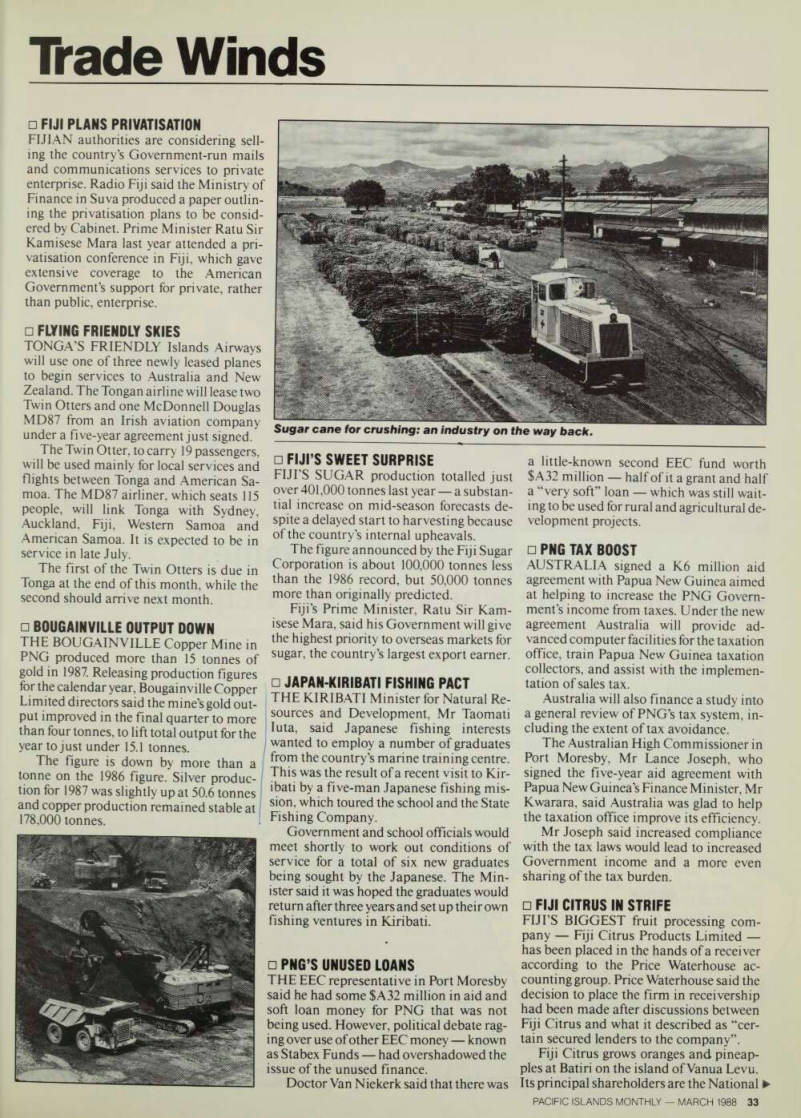
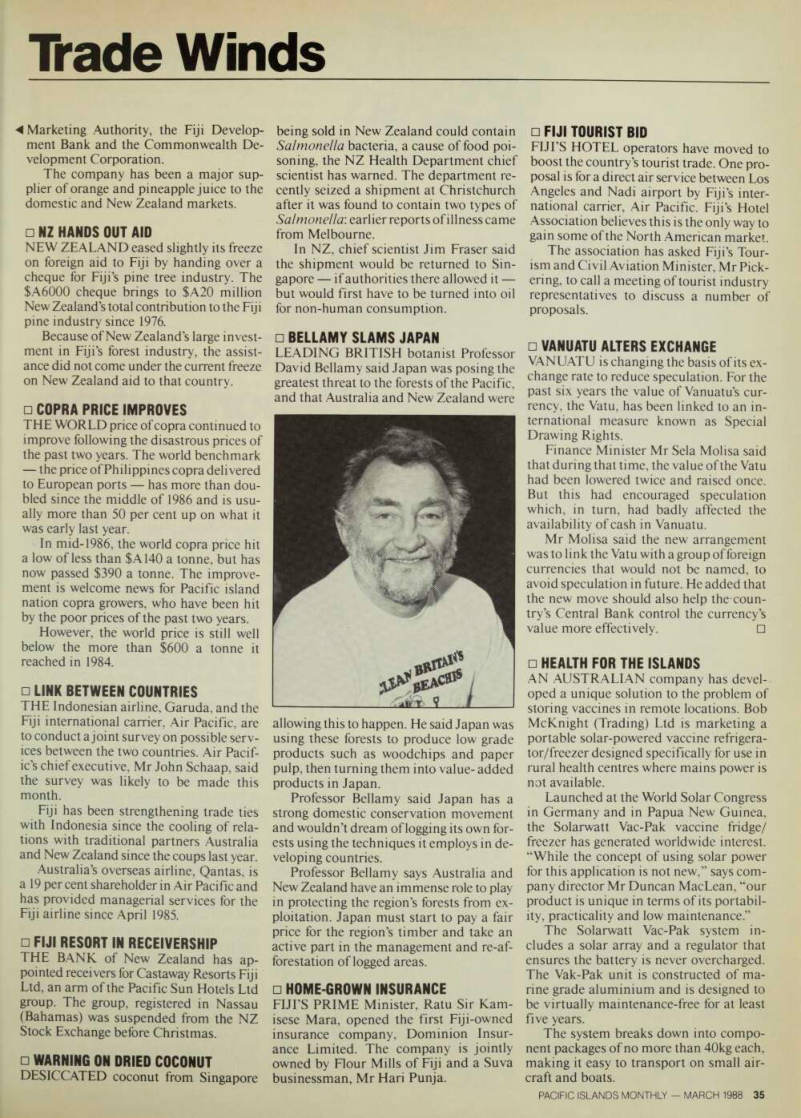
□ Fiji Plans Privatisation
FIJIAN authorities are considering sell ing the country’s Government-run mails and communications services to private enterprise. Radio Fiji said the Ministry of Finance in Suva produced a paper outlin ing the privatisation plans to be consid ered by Cabinet. Prime Minister Ratu Sir Kamisese Mara last year attended a pri vatisation conference in Fiji, which gave extensive coverage to the American Government’s support for private, rather than public, enterprise.
□ Flying Friendly Skies
TONGA’S FRIENDLY Islands Airways will use one of three newly leased planes to begin services to Australia and New Zealand. The Tongan airline will lease two Twin Otters and one McDonnell Douglas MDB7 from an Irish aviation company under a five-year agreement just signed.
The Twin Otter, to carry 19 passengers, will be used mainly for local services and flights between Tonga and American Sa moa. The MDB7 airliner, which seats 115 people, will link Tonga with Sydney, Auckland, Fiji, Western Samoa and American Samoa. It is expected to be in service in late July.
The first of the Twin Otters is due in Tonga at the end of this month, while the second should arrive next month.
□ Bougainville Output Down
THE BOUGAINVILLE Copper Mine in PNG produced more than 15 tonnes of gold in 1987. Releasing production figures for the calendar year, Bougainville Copper Limited directors said the mine’s gold out put improved in the final quarter to more than four tonnes, to lift total output for the year to just under 15.1 tonnes.
The figure is down by more than a tonne on the 1986 figure. Silver produc tion for 1987 was slightly up at 50.6 tonnes and copper production remained stable at 178,000 tonnes.
□ Fiji’S Sweet Surprise
FIJI’S SUGAR production totalled just over 401,000 tonnes last year a substan tial increase on mid-season forecasts de spite a delayed start to harvesting because of the country’s internal upheavals.
The figure announced by the Fiji Sugar Corporation is about 100,000 tonnes less than the 1986 record, but 50,000 tonnes more than originally predicted.
Fiji’s Prime Minister, Ratu Sir Kam isese Mara, said his Government will give the highest priority to overseas markets for sugar, the country’s largest export earner.
□ Japan-Kiribati Fishing Pact
THE KIRIBATI Minister for Natural Re sources and Development, Mr Taomati luta, said Japanese fishing interests wanted to employ a number of graduates from the country’s marine training centre.
This was the result of a recent visit to Kir ibati by a five-man Japanese fishing mis sion, which toured the school and the State Fishing Company.
Government and school officials would meet shortly to work out conditions of service for a total of six new graduates being sought by the Japanese. The Min ister said it was hoped the graduates would return after three years and set up their own fishing ventures in Kiribati.
□ Png’S Unused Loans
THE EEC representative in Port Moresby said he had some SA32 million in aid and soft loan money for PNG that was not being used. However, political debate rag ing over use of other EEC money known as Stabex Funds had overshadowed the issue of the unused finance.
Doctor Van Niekerk said that there was
a little-known second EEC fund worth $ A 32 million half of it a grant and half a “very soft” loan which was still wait ing to be used for rural and agricultural de velopment projects.
□ Png Tax Boost
AUSTRALIA signed a K 6 million aid agreement with Papua New Guinea aimed at helping to increase the PNG Govern ment’s income from taxes. Under the new agreement Australia will provide ad vanced computer facilities for the taxation office, train Papua New Guinea taxation collectors, and assist with the implemen tation of sales tax.
Australia will also finance a study into a general review of PNG’s tax system, in cluding the extent of tax avoidance.
The Australian High Commissioner in Port Moresby, Mr Lance Joseph, who signed the five-year aid agreement with Papua New Guinea’s Finance Minister, Mr Kwarara, said Australia was glad to help the taxation office improve its efficiency.
Mr Joseph said increased compliance with the tax laws would lead to increased Government income and a more even sharing of the tax burden.
□ Fiji Citrus In Strife
FIJI’S BIGGEST fruit processing com pany Fiji Citrus Products Limited has been placed in the hands of a receiver according to the Price Waterhouse ac counting group. Price Waterhouse said the decision to place the firm in receivership had been made after discussions between Fiji Citrus and what it described as “cer tain secured lenders to the company”.
Fiji Citrus grows oranges and pineap ples at Batiri on the island of Vanua Levu.
Its principal shareholders are the National ►
Sugar cane for crushing: an industry on the way back.
◄ Marketing Authority, the Fiji Develop ment Bank and the Commonwealth De velopment Corporation.
The company has been a major sup plier of orange and pineapple juice to the domestic and New Zealand markets.
□ Nz Hands Out Aid
NEW ZEALAND eased slightly its freeze on foreign aid to Fiji by handing over a cheque for Fiji’s pine tree industry. The SA6OOO cheque brings to SA2O million New Zealand’s total contribution to the Fiji pine industry since 1976.
Because of New Zealand’s large invest ment in Fiji’s forest industry, the assist ance did not come under the current freeze on New Zealand aid to that country.
□ Copra Price Improves
THE WORLD price of copra continued to improve following the disastrous prices of the past two years. The world benchmark the price of Philippines copra delivered to European ports has more than dou bled since the middle of 1986 and is usu ally more than 50 per cent up on what it was early last year.
In mid-1986, the world copra price hit a low of less than SAI4O a tonne, but has now passed $390 a tonne. The improve ment is welcome news for Pacific island nation copra growers, who have been hit by the poor prices of the past two years.
However, the world price is still well below the more than $6OO a tonne it reached in 1984.
□ Link Between Countries
THE Indonesian airline, Garuda, and the Fiji international carrier, Air Pacific, are to conduct a joint survey on possible serv ices between the two countries. Air Pacif ic’s chief executive, Mr John Schaap, said the survey was likely to be made this month.
Fiji has been strengthening trade ties with Indonesia since the cooling of rela tions with traditional partners Australia and New Zealand since the coups last year.
Australia’s overseas airline, Qantas, is a 19 per cent shareholder in Air Pacific and has provided managerial services for the Fiji airline since April 1985.
□ Fiji Resort In Receivership
THE BANK of New Zealand has ap pointed receivers for Castaway Resorts Fiji Ltd, an arm of the Pacific Sun Hotels Ltd group. The group, registered in Nassau (Bahamas) was suspended from the NZ Stock Exchange before Christmas.
□ Warning On Dried Coconut
DESICCATED coconut from Singapore
being sold in New Zealand could contain Salmonella bacteria, a cause of food poi soning, the NZ Health Department chief scientist has warned. The department re cently seized a shipment at Christchurch after it was found to contain two types of Salmonella : earlier reports of illness came from Melbourne.
In NZ, chief scientist Jim Fraser said the shipment would be returned to Sin gapore if authorities there allowed it but would first have to be turned into oil for non-human consumption.
□ Bellamy Slams Japan
LEADING BRITISH botanist Professor David Bellamy said Japan was posing the greatest threat to the forests of the Pacific, and that Australia and New Zealand were
allowing this to happen. He said Japan was using these forests to produce low grade products such as woodchips and paper pulp, then turning them into value- added products in Japan.
Professor Bellamy said Japan has a strong domestic conservation movement and wouldn’t dream of logging its own for ests using the techniques it employs in de veloping countries.
Professor Bellamy says Australia and New Zealand have an immense role to play in protecting the region’s forests from ex ploitation. Japan must start to pay a fair price for the region’s timber and take an active part in the management and re-af forestation of logged areas.
□ Home-Grown Insurance
FIJI’S PRIME Minister, Ratu Sir Kam isese Mara, opened the first Fiji-owned insurance company, Dominion Insur ance Limited. The company is jointly owned by Flour Mills of Fiji and a Suva businessman, Mr Hari Punja.
□ Fiji Tourist Bid
FIJI’S HOTEL operators have moved to boost the country’s tourist trade. One pro posal is for a direct air service between Los Angeles and Nadi airport by Fiji’s inter national carrier, Air Pacific. Fiji’s Hotel Association believes this is the only way to gain some of the North American market.
The association has asked Fiji’s Tour ism and Civil Aviation Minister, Mr Pick ering, to call a meeting of tourist industry representatives to discuss a number of proposals.
□ Vanuatu Alters Exchange
VANUATU is changing the basis of its ex change rate to reduce speculation. For the past six years the value of Vanuatu’s cur rency, the Vatu, has been linked to an in ternational measure known as Special Drawing Rights.
Finance Minister Mr Sela Molisa said that during that time, the value of the Vatu had been lowered twice and raised once.
But this had encouraged speculation which, in turn, had badly affected the availability of cash in Vanuatu.
Mr Molisa said the new arrangement was to link the Vatu with a group of foreign currencies that would not be named, to avoid speculation in future. He added that the new move should also help the coun try’s Central Bank control the currency’s value more effectively. □
□ Health For The Islands
AN AUSTRALIAN company has devel oped a unique solution to the problem of storing vaccines in remote locations. Bob McKnight (Trading) Ltd is marketing a portable solar-powered vaccine refrigera tor/freezer designed specifically for use in rural health centres where mains power is not available.
Launched at the World Solar Congress in Germany and in Papua New Guinea, the Solarwatt Vac-Pak vaccine fridge/ freezer has generated worldwide interest.
“While the concept of using solar power for this application is not new,” says com pany director Mr Duncan Mac Lean, “our product is unique in terms of its portabil ity, practicality and low maintenance.”
The Solarwatt Vac-Pak system in cludes a solar array and a regulator that ensures the battery is never overcharged.
The Vak-Pak unit is constructed of ma rine grade aluminium and is designed to be virtually maintenance-free for at least five years.
The system breaks down into compo nent packages of no more than 40kg each, making it easy to transport on small air craft and boats.
Advertisements & other items, p. 34 (1 item)
Plan your Pacific Business
with the people who know the neighbourhood If you're scanning the South Pacific for business opportunities in import government assistance and encouragement offered by each country or export, manufacturing or investment, you'd be wise to use the best even on alternative methods of financing your possible investment, guides to the local area. Backing this up is our provision of basic facilities for visiting business- You'll find them at the South Pacific Trade Commission - where since men; secretarial assistance, advanced communication facilities, plus 1979, many businessmen have enjoyed the benefits of our facilities. conference and interviewing rooms.
We provide advice and assistance to potential Pacific investors which Let the South Pacific Trade Commission introduce you to our includes data on the comparative advantages of different locations -on neighbourhood and to the people you may well do business with^
\ ISLANDS
AUSTRALIA
ESPIRITU ,
0 VANUATU
EFATE
U-
Soulh Pacific Trade Commission
BORA BORA
A TAHAA
FUJI
COOK <> O
ISLANDS 6 a
O 0
WANGAIA
A % u o 1Z
V\ NOF
nd •) > ISLA 9 * SC! 37 $ Si
NEW
ZEALAND
9th Floor, 225 Clarence Street, SYDNEY N.S.W. 2000 Phone: (02) 290 2833-Telex: AA7o342*Fax: (02) 29 8277
Special Report
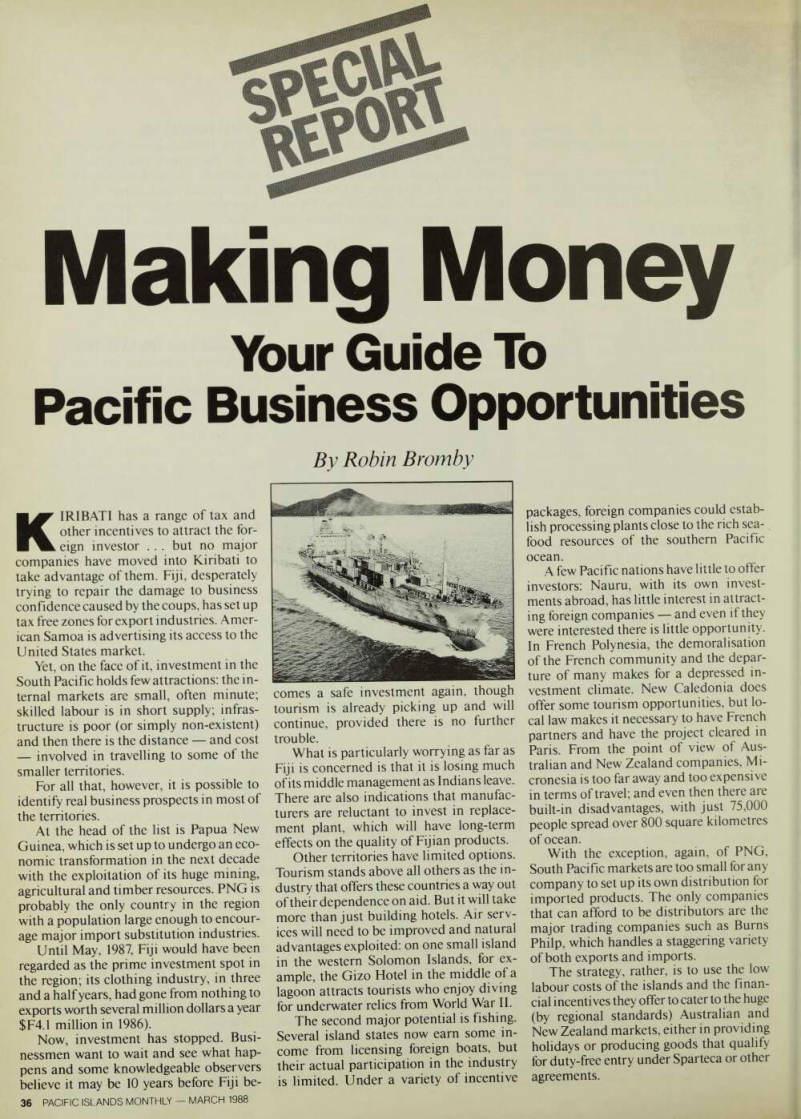
Making Money
Your Guide To Pacific Business Opportunities
By Robin Bromby
KIRIBATI has a range of tax and other incentives to attract the for eign investor ... but no major companies have moved into Kiribati to take advantage of them. Fiji, desperately trying to repair the damage to business confidence caused by the coups, has set up lax free zones for export industries. Amer ican Samoa is advertising its access to the United States market.
Yet, on the face of it, investment in the South Pacific holds few attractions: the in ternal markets are small, often minute; skilled labour is in short supply; infras tructure is poor (or simply non-existent) and then there is the distance and cost involved in travelling to some of the smaller territories.
For all that, however, it is possible to identify real business prospects in most of the territories.
At the head of the list is Papua New Guinea, which is set up to undergo an eco nomic transformation in the next decade with the exploitation of its huge mining, agricultural and timber resources. PNG is probably the only country in the region with a population large enough to encour age major import substitution industries.
Until May, 1987, Fiji would have been regarded as the prime investment spot in the region; its clothing industry, in three and a half years, had gone from nothing to exports worth several million dollars a year SF4.I million in 1986).
Now, investment has stopped. Busi nessmen want to wait and see what hap pens and some knowledgeable observers believe it may be 10 years before Fiji be-
comes a safe investment again, though tourism is already picking up and will continue, provided there is no further trouble.
What is particularly worrying as far as Fiji is concerned is that it is losing much of its middle management as Indians leave.
There are also indications that manufac turers are reluctant to invest in replace ment plant, which will have long-term effects on the quality of Fijian products.
Other territories have limited options.
Tourism stands above all others as the in dustry that offers these countries a way out of their dependence on aid. But it will take more than just building hotels. Air serv ices will need to be improved and natural advantages exploited: on one small island in the western Solomon Islands, for ex ample, the Gizo Hotel in the middle of a lagoon attracts tourists who enjoy diving for underwater relics from World War 11.
The second major potential is fishing.
Several island states now earn some in come from licensing foreign boats, but their actual participation in the industry is limited. Under a variety of incentive
packages, foreign companies could estab lish processing plants close to the rich sea food resources of the southern Pacific ocean.
A few Pacific nations have little to offer investors: Nauru, with its own invest ments abroad, has little interest in attract ing foreign companies and even if they were interested there is little opportunity.
In French Polynesia, the demoralisation of the French community and the depar ture of many makes for a depressed in vestment climate. New Caledonia does offer some tourism opportunities, but lo cal law makes it necessary to have French partners and have the project cleared in Paris. From the point of view of Aus tralian and New Zealand companies, Mi cronesia is too far away and too expensive in terms of travel; and even then there are built-in disadvantages, with just 75,000 people spread over 800 square kilometres of ocean.
With the exception, again, of PNG, South Pacific markets are too small for any company to set up its own distribution for imported products. The only companies that can afford to be distributors are the major trading companies such as Burns Philp, which handles a staggering variety of both exports and imports.
The strategy, rather, is to use the low labour costs of the islands and the finan cial incentives they offer to cater to the huge (by regional standards) Australian and New Zealand markets, either in providing holidays or producing goods that qualify for duty-free entry under Sparteca or other agreements.
Papua New Guinea
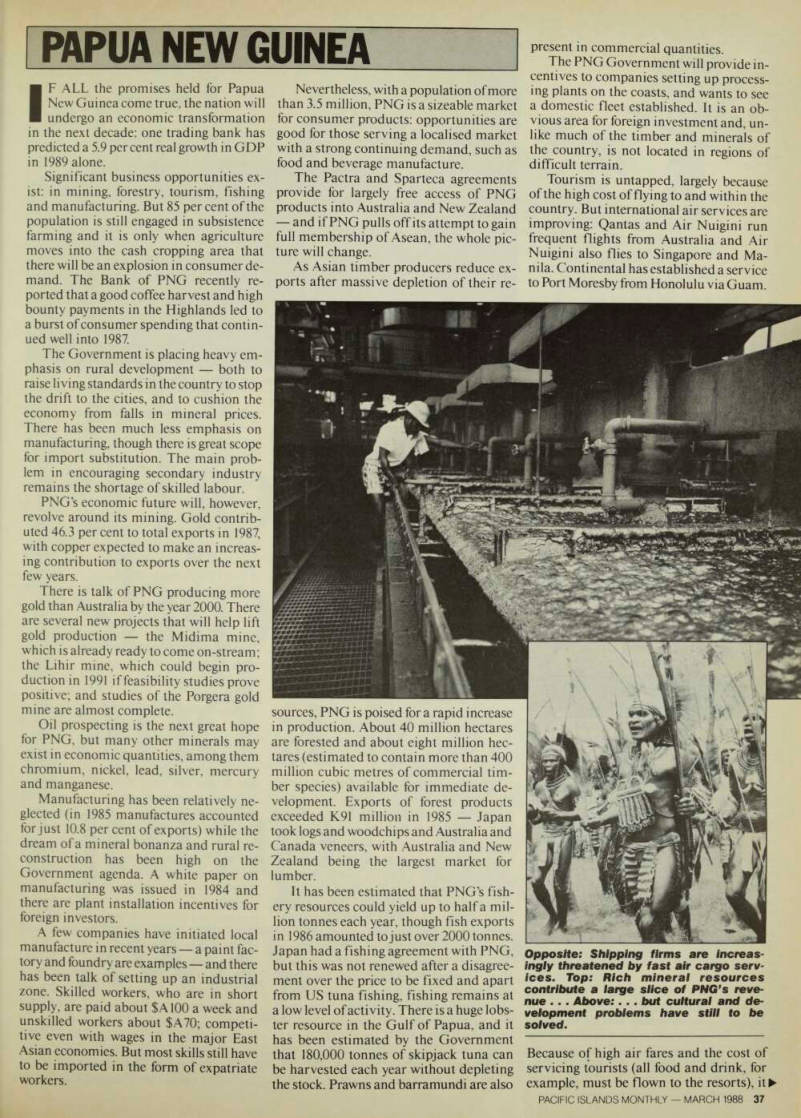
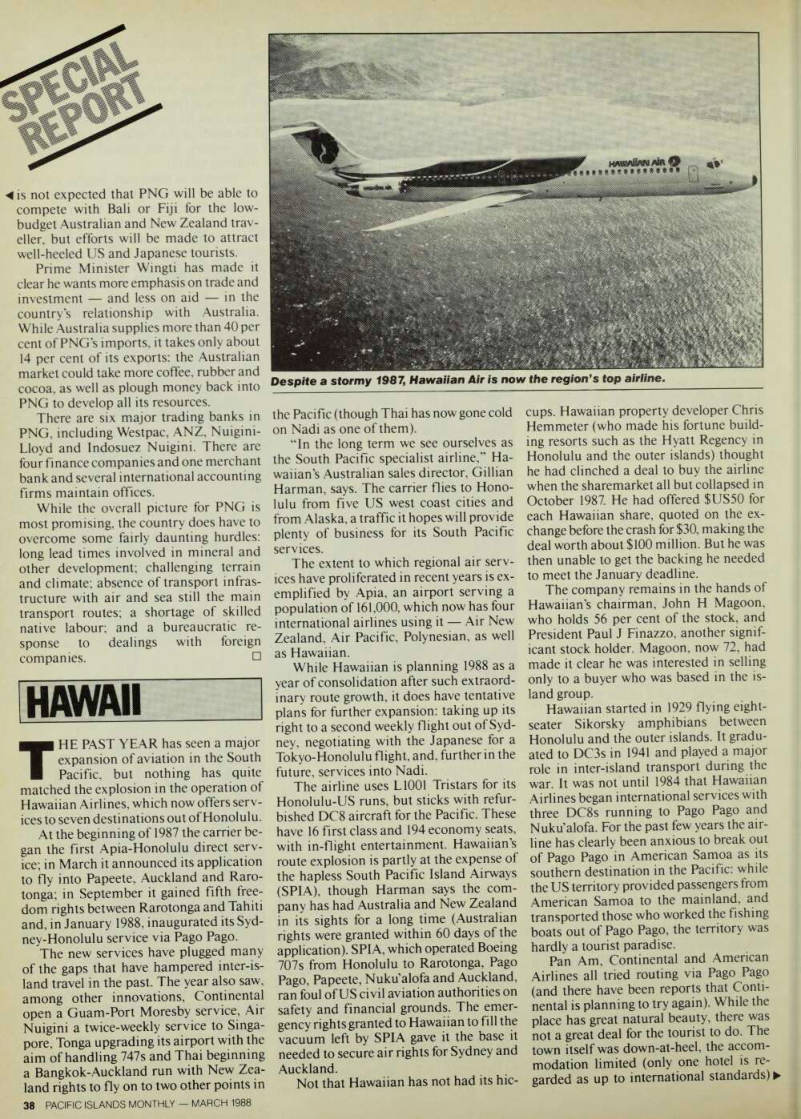
IF ALL the promises held for Papua New Guinea come true, the nation will undergo an economic transformation in the next decade: one trading bank has predicted a 5.9 per cent real growth in GDP in 1989 alone.
Significant business opportunities ex ist: in mining, forestry, tourism, fishing and manufacturing. But 85 per cent of the population is still engaged in subsistence farming and it is only when agriculture moves into the cash cropping area that there will be an explosion in consumer de mand. The Bank of PNG recently re ported that a good coffee harvest and high bounty payments in the Highlands led to a burst of consumer spending that contin ued well into 1987.
The Government is placing heavy em phasis on rural development both to raise living standards in the country to stop the drift to the cities, and to cushion the economy from falls in mineral prices.
There has been much less emphasis on manufacturing, though there is great scope for import substitution. The main prob lem in encouraging secondary industry remains the shortage of skilled labour.
PNG’s economic future will, however, revolve around its mining. Gold contrib uted 46.3 per cent to total exports in 1987, with copper expected to make an increas ing contribution to exports over the next few years.
There is talk of PNG producing more gold than Australia by the year 2000. There are several new projects that will help lift gold production the Midima mine, which is already ready to come on-stream; the Lihir mine, which could begin pro duction in 1991 if feasibility studies prove positive; and studies of the Porgera gold mine are almost complete.
Oil prospecting is the next great hope for PNG, but many other minerals may exist in economic quantities, among them chromium, nickel, lead, silver, mercury and manganese.
Manufacturing has been relatively ne glected (in 1985 manufactures accounted for just 10.8 per cent of exports) while the dream of a mineral bonanza and rural re construction has been high on the Government agenda. A white paper on manufacturing was issued in 1984 and there are plant installation incentives for foreign investors.
A few companies have initiated local manufacture in recent years a paint fac tory and foundry are examples and there has been talk of setting up an industrial zone. Skilled workers, who are in short supply, are paid about SAIOO a week and unskilled workers about SA7O; competi tive even with wages in the major East Asian economies. But most skills still have to be imported in the form of expatriate workers.
Nevertheless, with a population of more than 3.5 million, PNG is a sizeable market for consumer products: opportunities are good for those serving a localised market with a strong continuing demand, such as food and beverage manufacture.
The Pactra and Sparteca agreements provide for largely free access of PNG products into Australia and New Zealand and if PNG pulls off its attempt to gain full membership of Asean, the whole picture will change.
As Asian timber producers reduce exports after massive depletion of their re-
sources, PNG is poised for a rapid increase in production. About 40 million hectares are forested and about eight million hec tares (estimated to contain more than 400 million cubic metres of commercial tim ber species) available for immediate de velopment. Exports of forest products exceeded K9l million in 1985 Japan took logs and woodchips and Australia and Canada veneers, with Australia and New Zealand being the largest market for lumber.
It has been estimated that PNG’s fish ery resources could yield up to half a mil lion tonnes each year, though fish exports in 1986 amounted to just over 2000 tonnes.
Japan had a fishing agreement with PNG, but this was not renewed after a disagree ment over the price to be fixed and apart from US tuna fishing, fishing remains at a low level of activity. There is a huge lobs ter resource in the Gulf of Papua, and it has been estimated by the Government that 180,000 tonnes of skipjack tuna can be harvested each year without depleting the stock. Prawns and barramundi are also
present in commercial quantities.
The PNG Government will provide in centives to companies setting up process ing plants on the coasts, and wants to see a domestic fleet established. It is an ob vious area for foreign investment and, un like much of the timber and minerals of the country, is not located in regions of difficult terrain.
Tourism is untapped, largely because of the high cost of flying to and within the country. But international air services are improving: Qantas and Air Nuigini run frequent flights from Australia and Air Nuigini also flies to Singapore and Ma nila. Continental has established a service to Port Moresby from Honolulu via Guam.
Because of high air fares and the cost of servicing tourists (all food and drink, for example, must be flown to the resorts), it ►
Opposite: Shipping firms are increas ingly threatened by fast air cargo serv ices. Top: Rich mineral resources contribute a large slice of PNG’s reve nue ... Above:... but cultural and de velopment problems have still to be solved.
◄ is not expected that PNG will be able to compete with Bali or Fiji for the low budget Australian and New Zealand trav eller, but efforts will be made to attract well-heeled US and Japanese tourists.
Prime Minister Wingti has made it clear he wants more emphasis on trade and investment and less on aid in the country’s relationship with Australia.
While Australia supplies more than 40 per cent of PNG’s imports, it takes only about 14 per cent of its exports: the Australian market could take more coffee, rubber and cocoa, as well as plough money back into PNG to develop all its resources.
There are six major trading banks in PNG, including Westpac, ANZ, Nuigini- Lloyd and Indosuez Nuigini. There are four finance companies and one merchant bank and several international accounting firms maintain offices.
While the overall picture for PNG is most promising, the country does have to overcome some fairly daunting hurdles: long lead times involved in mineral and other development; challenging terrain and climate; absence of transport infras tructure with air and sea still the main transport routes; a shortage of skilled native labour; and a bureaucratic re sponse to dealings with foreign companies. □
Hawaii
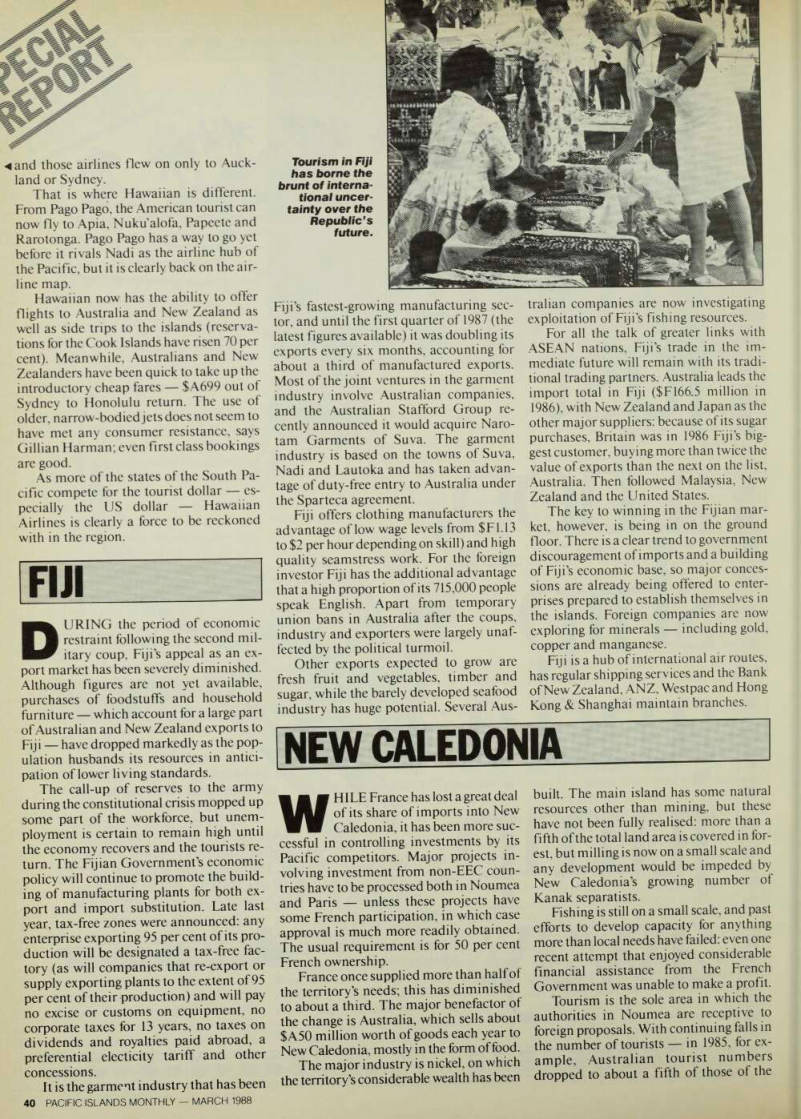
THE PAST YEAR has seen a major expansion of aviation in the South Pacific, but nothing has quite matched the explosion in the operation of Hawaiian Airlines, which now offers serv ices to seven destinations out of Honolulu.
At the beginning of 1987 the carrier be gan the first Apia-Honolulu direct serv ice; in March it announced its application to fly into Papeete, Auckland and Raro tonga; in September it gained fifth free dom rights between Rarotonga and Tahiti and, in January 1988, inaugurated its Syd ney-Honolulu service via Pago Pago.
The new services have plugged many of the gaps that have hampered inter-is land travel in the past. The year also saw, among other innovations, Continental open a Guam-Port Moresby service, Air Nuigini a twice-weekly service to Singa pore, Tonga upgrading its airport with the aim of handling 747 s and Thai beginning a Bangkok-Auckland run with New Zea land rights to fly on to two other points in
the Pacific (though Thai has now gone cold on Nadi as one of them). -in the long term we see ourselves as the South Pacific specialist airline,” Hawaiian’s Australian sales director, Gillian Harman, says. The carrier flies to Honolulu from five US west coast cities and from Alaska, a traffic it hopes will provide plenty of business for its South Pacific services.
The extent to which regional air services have proliferated in recent years is exemplified by Apia, an airport serving a population of 161,000, which now has four international airlines using it Air New Zealand, Air Pacific, Polynesian, as well as Hawaiian While Hawaiian is planning 1988 as a year of consolidation after such extraordinary route growth, it does have tentative plans for further expansion: taking up its right to a second weekly flight out of Sydney, negotiating with the Japanese for a Tokyo-Honolulu flight, and, further in the future, services into Nadi.
The airline uses LlOOl Tristars for its Honolulu-US runs, but sticks with refurbished DCS aircraft for the Pacific. These have 16 first class and 194 economy seats, with in-flight entertainment. Hawaiian’s route explosion is partly at the expense of the hapless South Pacific Island Airways (SPIA), though Harman says the company has had Australia and New Zealand in its sights for a long time (Australian rights were granted within 60 days of the application). SPIA, which operated Boeing 707 s from Honolulu to Rarotonga, Pago Pago, Papeete, Nukualofa and Auckland, ran foul of US civil aviation authorities on safety and financial grounds. The emergency rights granted to Hawaiian to fill the vacuum left by SPIA gave it the base it needed to secure air rights for Sydney and Auckland.
Not that Hawaiian has not had its hie-
cups. Hawaiian property developer Chris Hemmeter (who made his fortune build ing resorts such as the Hyatt Regency in Honolulu and the outer islands) thought he had clinched a deal to buy the airline when the sharemarket all but collapsed in October 1987. He had offered SUSSO for each Hawaiian share, quoted on the ex change before the crash for $3O, making the deal worth about $lOO million. But he was then unable to get the backing he needed to meet the January deadline, The company remains in the hands of Hawaiian’s chairman, John H Magoon, who holds 56 per cent of the stock, and President Paul J Finazzo, another sigmf icant stock holder. Magoon, now 72, had made it clear he was interested in selling only to a buyer who was based in the is land group. .
Hawaiian started in 1929 flying eight seater Sikorsky amphibians between Honolulu and the outer islands. It gradu ated to DC3s in 1941 and played a major role in inter-island transport during t e war. It was not until 1984 that Hawaiian Airlines began international services with three DCBs running to Pago Pago and Nukualofa. For the past few years the air line has clearly been anxious to break out of Pago Pago in American Samoa as its southern destination in the Pacitic: while the US territory provided passengers trom American Samoa to the mainland, and transported those who worked the fishing boats out of Pago Pago, the temtory was hardly a tourist paradise.
Pan Am, Continental and American Airlines all tried routing via Pago Pago (and there have been reports that Conti nental is planning to try again). While the place has great natural beauty, there was not a great deal for the tourist to do. The town itself was down-at-heel, the accom modation limited (only one hotel is re garded as up to international standards) ►
Despite a stormy 1987, Hawaiian Air is now the region’s top airline.
M and those airlines flew on only to Auck land or Sydney.
That is where Hawaiian is different.
From Pago Pago, the American tourist can now fly to Apia, Nukualofa, Papeete and Rarotonga. Pago Pago has a way to go yet before it rivals Nadi as the airline hub of the Pacific, but it is clearly back on the air line map.
Hawaiian now has the ability to offer flights to Australia and New Zealand as well as side trips to the islands (reserva tions for the Cook Islands have risen 70 per cent). Meanwhile, Australians and New Zealanders have been quick to take up the introductory cheap fares $A699 out of Sydney to Honolulu return. The use of older, narrow-bodied jets does not seem to have met any consumer resistance, says Gillian Harman; even first class bookings are good.
As more of the states of the South Pa cific compete for the tourist dollar es pecially the US dollar Hawaiian Airlines is clearly a force to be reckoned with in the region.
Advertisements & other items, p. 39 (1 item)
away
ai ai iii imi isi isi m m isi mm ibim m m m m m bi biijsi anm lii.Bn u lanai an m m mi isMailm
is now
A • I FV
jump
away
ACT
/ / *> all A m m /m m I /m m jm s In the past year ACTA has established a successful new shipping service between Australia and Fiji. ACTA’s success is the result of getting the ingredients right.
ACTA boasts a purpose built fleet of ships, backed by on-shore and after-sail service that can’t be beaten.
We’ll keep your fresh food fresh, frozen foods frozen while protecting your more fragile exports as if they were our own. Having set the standard for first class service between Australia and Fiji, not to mention both coasts of North America, we’re determined to stay in front.
With ACTA, Fiji is simply a hop, ship and a jump away. /S?
S S s m/m A tough act to follow B B B E E B E BEEBE
ACAOO32
Fiji
DURING the period of economic restraint following the second mil itary coup, Fiji’s appeal as an ex port market has been severely diminished.
Although figures are not yet available, purchases of foodstuffs and household furniture which account for a large part of Australian and New Zealand exports to Fiji have dropped markedly as the pop ulation husbands its resources in antici pation of lower living standards.
The call-up of reserves to the army during the constitutional crisis mopped up some part of the workforce, but unem ployment is certain to remain high until the economy recovers and the tourists re turn. The Fijian Government’s economic policy will continue to promote the build ing of manufacturing plants for both ex port and import substitution. Late last year, tax-free zones were announced: any enterprise exporting 95 per cent of its pro duction will be designated a tax-free fac tory (as will companies that re-export or supply exporting plants to the extent of 95 per cent of their production) and will pay no excise or customs on equipment, no corporate taxes for 13 years, no taxes on dividends and royalties paid abroad, a preferential eleclicity tariff and other concessions.
It is the garment industry that has been
Fiji’s fastest-growing manufacturing sector, and until the first quarter of 1987 (the latest figures available) it was doubling its exports every six months, accounting for about a third of manufactured exports, Most of the joint ventures in the garment industry involve Australian companies, and the Australian Stafford Group recently announced it would acquire Narotarn Garments of Suva. The garment industry is based on the towns of Suva, Nadi and Lautoka and has taken advantage of duty-free entry to Australia under the Sparteca agreement.
Fiji offers clothing manufacturers the advantage of low wage levels from $F 1.13 to $2 per hour depending on skill) and high quality seamstress work. For the foreign investor Fiji has the additional advantage thal a high proportion of its 715,000 people speak English. Apart from temporary union bans in Australia after the coups, industry and exporters were largely unaffected by the political turmoil.
Other exports expected to grow are fresh fruit and vegetables, timber and sugar while the barely developed seafood industry has huge potential. Several Aus-
tralian companies are now investigating exploitation of Fiji’s fishing resources, For all the talk of greater links with ASEAN nations, Fijis trade in the im mediate future will remain with its tradi tional trading partners. Australia leads the import total in Fiji ($F 166.5 million in 1986), with New Zealand and Japan as the other major suppliers: because of its sugar purchases, Britain was in 1986 Fiji’s big gest customer, buying more than twice the value of exports than the next on the list, Australia. Then followed Malaysia, New Zealand and the United States.
The key to winning in the Fijian mar ket, however, is being in on the ground floor. There is a clear trend to government discouragement of imports and a building of Fiji’s economic base, so major conces sions are already being offered to enter prises prepared to establish themselves m the islands. Foreign companies are now exploring for minerals including gold, copper and manganese.
Fiji is a hub of international air routes, has regular shipping services and the Bank of New Zealand, ANZ, Westpac and Hong Kong & Shanghai maintain branches.
Tourism in Fiji has borne the brunt of interna tional uncer tainty over the Republic’s future.
New Caledonia
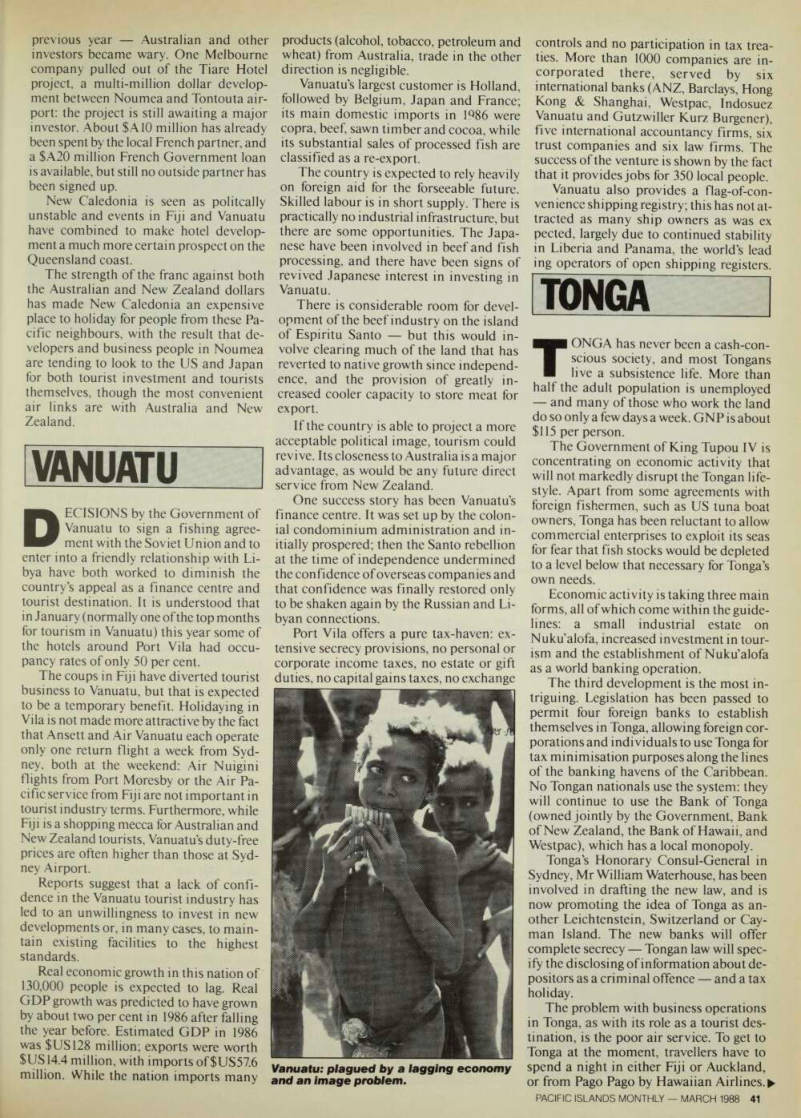
WHILE France has lost a great deal of its share of imports into New Caledonia, it has been more suc cessful in controlling investments by its Pacific competitors. Major projects in volving investment from non-EEC coun tries have to be processed both in Noumea and Paris unless these projects have some French participation, in which case approval is much more readily obtained.
The usual requirement is for 50 per cent French ownership.
France once supplied more than half of the territory’s needs; this has diminished to about a third. The major benefactor of the change is Australia, which sells about $ A5O million worth of goods each year to New Caledonia, mostly in the form of food.
The major industry is nickel, on which the territory’s considerable wealth has been
built. The main island has some natural resources other than mining, but these have not been fully realised: more than a fifth of the total land area is covered in for est, but milling is now on a small scale and any development would be impeded by New Caledonia’s growing number of Kanak separatists.
Fishing is still on a small scale, and past efforts to develop capacity for anything more than local needs have failed; even one recent attempt that enjoyed considerable financial assistance from the French Government was unable to make a profit.
Tourism is the sole area in which the authorities in Noumea are receptive to foreign proposals. With continuing falls in the number of tourists in 1985, for ex ample, Australian tourist numbers dropped to about a fifth of those of the
previous year Australian and other investors became wary. One Melbourne company pulled out of the Tiare Hotel project, a multi-million dollar develop ment between Noumea and Tontouta air port: the project is still awaiting a major investor. About SAIO million has already been spent by the local French partner, and a SA2O million French Government loan is available, but still no outside partner has been signed up.
New Caledonia is seen as politcally unstable and events in Fiji and Vanuatu have combined to make hotel develop ment a much more certain prospect on the Queensland coast.
The strength of the franc against both the Australian and New Zealand dollars has made New Caledonia an expensive place to holiday for people from these Pa cific neighbours, with the result that de velopers and business people in Noumea are tending to look to the US and Japan for both tourist investment and tourists themselves, though the most convenient air links are with Australia and New Zealand.
Vanuatu
DECISIONS by the Government of Vanuatu to sign a fishing agree ment with the Soviet Union and to enter into a friendly relationship with Li bya have both worked to diminish the country’s appeal as a finance centre and tourist destination. It is understood that in January (normally one of the top months for tourism in Vanuatu) this year some of the hotels around Port Vila had occu pancy rates of only 50 per cent.
The coups in Fiji have diverted tourist business to Vanuatu, but that is expected to be a temporary benefit. Holidaying in Vila is not made more attractive by the fact that Ansett and Air Vanuatu each operate only one return flight a week from Syd ney, both at the weekend: Air Nuigini flights from Port Moresby or the Air Pa cific service from Fiji are not important in tourist industry terms. Furthermore, while Fiji is a shopping mecca for Australian and New Zealand tourists, Vanuatu’s duty-free prices are often higher than those at Syd ney Airport.
Reports suggest that a lack of confi dence in the Vanuatu tourist industry has led to an unwillingness to invest in new developments or, in many cases, to main tain existing facilities to the highest standards.
Real economic growth in this nation of 130,000 people is expected to lag. Real GDP growth was predicted to have grown by about two per cent in 1986 after falling the year before. Estimated GDP in 1986 was SUSI2B million; exports were worth SUS 14.4 million, with imports of $U557.6 million. While the nation imports many
products (alcohol, tobacco, petroleum and wheat) from Australia, trade in the other direction is negligible.
Vanuatu’s largest customer is Holland, followed by Belgium, Japan and France; its main domestic imports in were copra, beef, sawn timber and cocoa, while its substantial sales of processed fish are classified as a re-export.
The country is expected to rely heavily on foreign aid for the forseeable future.
Skilled labour is in short supply. There is practically no industrial infrastructure, but there are some opportunities. The Japa nese have been involved in beef and fish processing, and there have been signs of revived Japanese interest in investing in Vanuatu.
There is considerable room for devel opment of the beef industry on the island of Espiritu Santo but this would in volve clearing much of the land that has reverted to native growth since independ ence, and the provision of greatly in creased cooler capacity to store meat for export.
If the country is able to project a more acceptable political image, tourism could revive. Its closeness to Australia is a major advantage, as would be any future direct service from New Zealand.
One success story has been Vanuatu’s finance centre. It was set up by the colon ial condominium administration and in itially prospered; then the Santo rebellion at the time of independence undermined the confidence of overseas companies and that confidence was finally restored only to be shaken again by the Russian and Li byan connections.
Port Vila offers a pure tax-haven: ex tensive secrecy provisions, no personal or corporate income taxes, no estate or gift duties, no capital gains taxes, no exchange
controls and no participation in tax trea ties. More than 1000 companies are in corporated there, served by six international banks (ANZ, Barclays, Hong Kong & Shanghai, Westpac, Indosuez Vanuatu and Gutzwiller Kurz Burgener), five international accountancy firms, six trust companies and six law firms. The success of the venture is shown by the fact that it provides jobs for 350 local people.
Vanuatu also provides a flag-of-con venience shipping registry; this has not at tracted as many ship owners as was ex pected, largely due to continued stability in Liberia and Panama, the world’s lead ing operators of open shipping registers.
Vanuatu: plagued by a lagging economy and an image problem.
Tonga
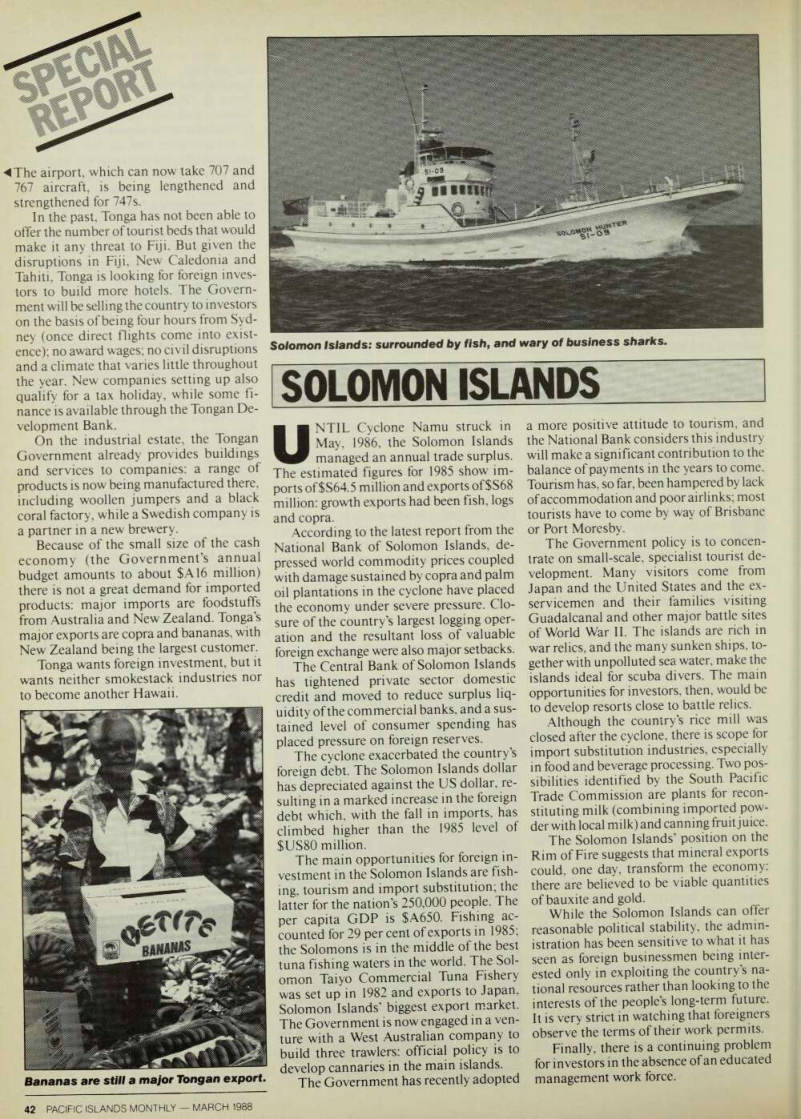
has never been a cash-con scious society, and most Tongans live a subsistence life. More than half the adult population is unemployed and many of those who work the land do so only a few days a week. GNP is about slls per person.
The Government of King Tupou IV is concentrating on economic activity that will not markedly disrupt the Tongan life style. Apart from some agreements with foreign fishermen, such as US tuna boat owners, Tonga has been reluctant to allow commercial enterprises to exploit its seas for fear that fish stocks would be depleted to a level below that necessary for Tonga’s own needs.
Economic activity is taking three main forms, all of which come within the guide lines: a small industrial estate on Nukualofa, increased investment in tour ism and the establishment of Nukualofa as a world banking operation.
The third development is the most in triguing. Legislation has been passed to permit four foreign banks to establish themselves in Tonga, allowing foreign cor porations and individuals to use Tonga for tax minimisation purposes along the lines of the banking havens of the Caribbean.
No Tongan nationals use the system; they will continue to use the Bank of Tonga (owned jointly by the Government, Bank of New Zealand, the Bank of Hawaii, and Westpac), which has a local monopoly.
Tonga’s Honorary Consul-General in Sydney, Mr William Waterhouse, has been involved in drafting the new law, and is now promoting the idea of Tonga as an other Leichtenstein, Switzerland or Cay man Island. The new banks will offer complete secrecy Tongan law will spec ify the disclosing of information about de positors as a criminal offence and a tax holiday.
The problem with business operations in Tonga, as with its role as a tourist des tination, is the poor air service. To get to Tonga at the moment, travellers have to spend a night in either Fiji or Auckland, or from Pago Pago by Hawaiian Airlines. ►
◄ The airport, which can now take 707 and 767 aircraft, is being lengthened and strengthened for 7475.
In the past, Tonga has not been able to offer the number of tourist beds that would make it any threat to Fiji. But given the disruptions in Fiji, New Caledonia and Tahiti, Tonga is looking for foreign inves tors to build more hotels. The Govern ment will be selling the country to investors on the basis of being four hours from Syd ney (once direct flights come into exist ence); no award wages: no civil disruptions and a climate that varies little throughout the year. New companies setting up also qualify for a tax holiday, while some fi nance is available through the Tongan De velopment Bank.
On the industrial estate, the Tongan Government already provides buildings and services to companies: a range of products is now being manufactured there, including woollen jumpers and a black coral factory, while a Swedish company is a partner in a new brewery.
Because of the small size of the cash economy (the Government’s annual budget amounts to about SAI6 million) there is not a great demand for imported products: major imports are foodstuffs from Australia and New Zealand. Tonga’s major exports are copra and bananas, with New Zealand being the largest customer.
Tonga wants foreign investment, but it wants neither smokestack industries nor to become another Hawaii.
Bananas are still a major Tongan export.
Solomon Islands
UNTIL Cyclone Namu struck in May, 1986, the Solomon Islands managed an annual trade surplus.
The estimated figures for 1985 show im ports of 5564.5 million and exports ofsS6B million: growth exports had been fish, logs and copra.
According to the latest report from the National Bank of Solomon Islands, de pressed world commodity prices coupled with damage sustained by copra and palm oil plantations in the cyclone have placed the economy under severe pressure. Clo sure of the country’s largest logging oper ation and the resultant loss of valuable foreign exchange were also major setbacks.
The Central Bank of Solomon Islands has tightened private sector domestic credit and moved to reduce surplus liq uidity of the commercial banks, and a sus tained level of consumer spending has placed pressure on foreign reserves.
The cyclone exacerbated the country’s foreign debt. The Solomon Islands dollar has depreciated against the US dollar, re sulting in a marked increase in the foreign debt which, with the fall in imports, has climbed higher than the 1985 level of SUSBO million.
The main opportunities for foreign in vestment in the Solomon Islands are fish ing, tourism and import substitution; the latter for the nation’s 250,000 people. The per capita GDP is SA6SO. Fishing ac counted for 29 per cent of exports in 1985: the Solomons is in the middle of the best tuna fishing waters in the world. The Sol omon Taiyo Commercial Tuna Fishery was set up in 1982 and exports to Japan, Solomon Islands’ biggest export market.
The Government is now engaged in a ven ture with a West Australian company to build three trawlers: official policy is to develop cannaries in the main islands.
The Government has recently adopted
a more positive attitude to tourism, and the National Bank considers this industry will make a significant contribution to the balance of payments in the years to come.
Tourism has, so far, been hampered by lack of accommodation and poor airlinks; most tourists have to come by way of Brisbane or Port Moresby.
The Government policy is to concen trate on small-scale, specialist tourist de velopment. Many visitors come from Japan and the United States and the ex servicemen and their families visiting Guadalcanal and other major battle sites of World War 11. The islands are rich in war relics, and the many sunken ships, to gether with unpolluted sea water, make the islands ideal for scuba divers. The main opportunities for investors, then, would be to develop resorts close to battle relics.
Although the country’s rice mill was closed after the cyclone, there is scope for import substitution industries, especially in food and beverage processing. Two pos sibilities identified by the South Pacific Trade Commission are plants for recon stituting milk (combining imported pow der with local milk) and canning fruit juice.
The Solomon Islands’ position on the Rim of Fire suggests that mineral exports could, one day, transform the economy: there are believed to be viable quantities of bauxite and gold.
While the Solomon Islands can offer reasonable political stability, the admin istration has been sensitive to what it has seen as foreign businessmen being inter ested only in exploiting the country’s na tional resources rather than looking to the interests of the people’s long-term future.
It is very strict in watching that foreigners observe the terms of their work permits.
Finally, there is a continuing problem for investors in the absence of an educated management work force.
Solomon Islands: surrounded by fish, and wary of business sharks.
Western Samoa
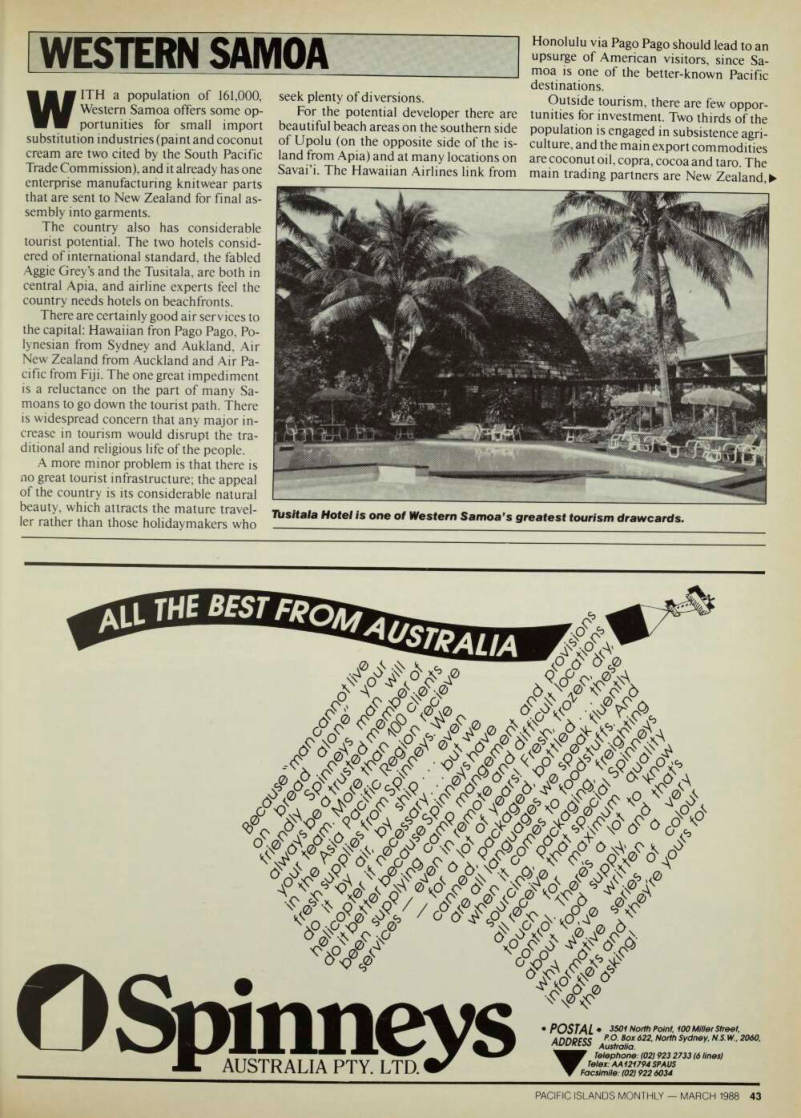
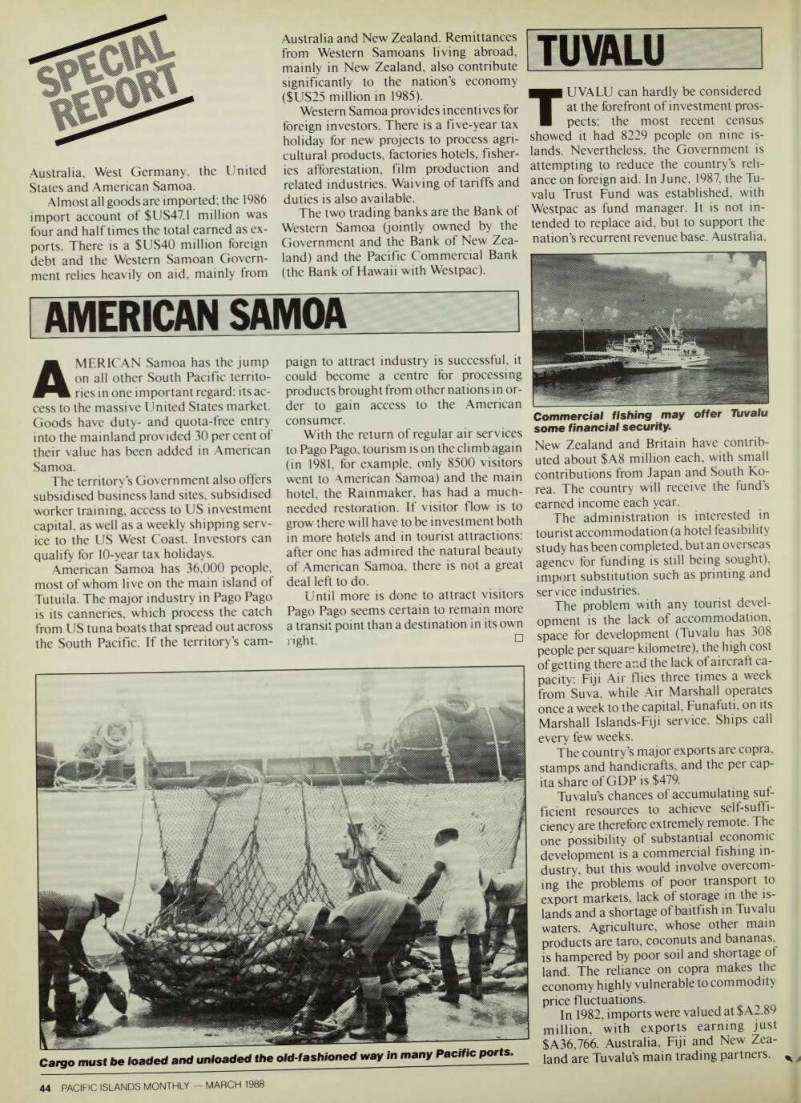
WITH a population of 161,000, Western Samoa offers some op portunities for small import substitution industries (paint and coconut cream are two cited by the South Pacific Trade Commission), and it already has one enterprise manufacturing knitwear parts that are sent to New Zealand for final as sembly into garments.
The country also has considerable tourist potential. The two hotels consid ered of international standard, the fabled Aggie Grey’s and the Tusitala, are both in central Apia, and airline experts feel the country needs hotels on beachfronts.
There are certainly good air services to the capital: Hawaiian fron Pago Pago, Po lynesian from Sydney and Aukland, Air New Zealand from Auckland and Air Pa cific from Fiji. The one great impediment is a reluctance on the part of many Sa moans to go down the tourist path. There is widespread concern that any major in crease in tourism would disrupt the tra ditional and religious life of the people.
A more minor problem is that there is no great tourist infrastructure; the appeal of the country is its considerable natural beauty, which attracts the mature travel ler rather than those holidaymakers who
seek plenty of diversions.
For the potential developer there are beautiful beach areas on the southern side of Upolu (on the opposite side of the is land from Apia) and at many locations on Savai’i. The Hawaiian Airlines link from
Honolulu via Pago Pago should lead to an upsurge of American visitors, since Sa moa is one of the better-known Pacific destinations.
Outside tourism, there are few oppor tunities for investment. Two thirds of the population is engaged in subsistence agri culture, and the main export commodities are coconut oil, copra, cocoa and taro. The main trading partners are New Zealand>
Tusitala Hotel is one of Western Samoa’s greatest tourism drawcards.
Australia, West Germany, the United States and American Samoa.
Almost all goods are imported; the 1986 import account of SUS47.I million was four and half times the total earned as ex ports. There is a SUS4O million foreign debt and the Western Samoan Govern ment relies heavily on aid, mainly from
Australia and New Zealand. Remittances from Western Samoans living abroad, mainly in New Zealand, also contribute significantly to the nation’s economy (SUS2S million in 1985).
Western Samoa provides incentives for foreign investors. There is a five-year tax holiday for new projects to process agri cultural products, factories hotels, fisher ies afforestation, film production and related industries. Waiving of tariffs and duties is also available.
The two trading banks are the Bank of Western Samoa (jointly owned by the Government and the Bank of New Zea land) and the Pacific Commercial Bank (the Bank of Hawaii with Westpac).
Advertisements & other items, p. 43 (1 item)
s^doin^n
nO9 ZZ6 (ZO) ei!UJ!SODj A
snVdSWHW xeiei (seuii 9) ££iz £Z6 (ZO) euoqdeiei ouojfsnv ccjiinnw 090 Z ' M S N 'AeupAs upon ZZ9 xog o d v teens ieim 00) WOd UPON to9£ *IVI SOd cP 0 N \> o>>y V <> o Vo r o? n^|, /% an Aid vnvdisnv t
MSmm.
//oV o x 0® ■OJ, i>-0 -o v */>
V/p t-i
4? r «W3 / <N O^
N VV 0
i\o c Vj&sT
American Samoa
has the jump on all other South Pacific territo ries in one important regard; its ac cess to the massive United States market.
Goods have duly- and quota-free entry into the mainland provided 30 per cent of their value has been added in American Samoa.
The territory’s Government also offers subsidised business land sites, subsidised worker training, access to US investment capital, as well as a weekly shipping serv ice to the US West Coast. Investors can qualify for 10-year tax holidays.
American Samoa has 36,000 people, most of whom live on the main island of Tutuila. The major industry in Pago Pago is its canneries, which process the catch from US tuna boats that spread out across the South Pacific. If the territory’s cam
paign to attract industry is successful, it could become a centre for processing products brought from other nations in or der to gain access to the American consumer.
With the return of regular air services to Pago Pago, tourism is on the climb again (in 1981, for example, only 8500 visitors went to American Samoa) and the main hotel, the Rainmaker, has had a much needed restoration. If visitor flow is to grow there will have to be investment both in more hotels and in tourist attractions: after one has admired the natural beauty of American Samoa, there is not a great deal left to do.
Until more is done to attract visitors Pago Pago seems certain to remain more a transit point than a destination in its own right. G
Cargo must be loaded and unloaded the old-fashioned way in many Pacific ports.
Tuvalu
can hardly be considered at the forefront of investment pros pects: the most recent census showed it had 8229 people on nine is lands. Nevertheless, the Government is attempting to reduce the country’s reli ance on foreign aid. In June, 1987, the Tu valu Trust Fund was established, with Westpac as fund manager. It is not in tended to replace aid, but to support the nation’s recurrent revenue base. Australia,
New Zealand and Britain have contrib uted about SAB million each, with small contributions from Japan and South Ko rea. The country will receive the fund’s earned income each year.
The administration is interested in tourist accommodation (a hotel feasibility study has been completed, but an overseas agencv for funding is still being sought), import substitution such as printing and service industries.
The problem with any tourist devel opment is the lack of accommodation, space for development (Tuvalu has 308 people per square kilometre), the high cost of getting there and the lack of aircraft ca pacity: Fiji Air flies three times a week from Suva, while Air Marshall operates once a week to the capital, Funafuti, on its Marshall Islands-Fiji service. Ships call every few weeks.
The country’s major exports are copra, stamps and handicrafts, and the per cap ita share of GDP is $479.
Tuvalu’s chances of accumulating suf ficient resources to achieve self-suffi ciency are therefore extremely remote. The one possibility of substantial economic development is a commercial fishing in dustry, but this would involve overcom ing the problems of poor transport to export markets, lack of storage in the is lands and a shortage of baitfish in Tuvalu waters. Agriculture, whose other main products are taro, coconuts and bananas, is hampered by poor soil and shortage of land. The reliance on copra makes the economy highly vulnerable to commodity price fluctuations.
In 1982, imports were valued at $A2.89 million, with exports earning just $A36,766. Australia, Fiji and New Zea land are Tuvalu’s main trading partners.
Commercial fishing may offer liivalu some financial security.
Cook Islands
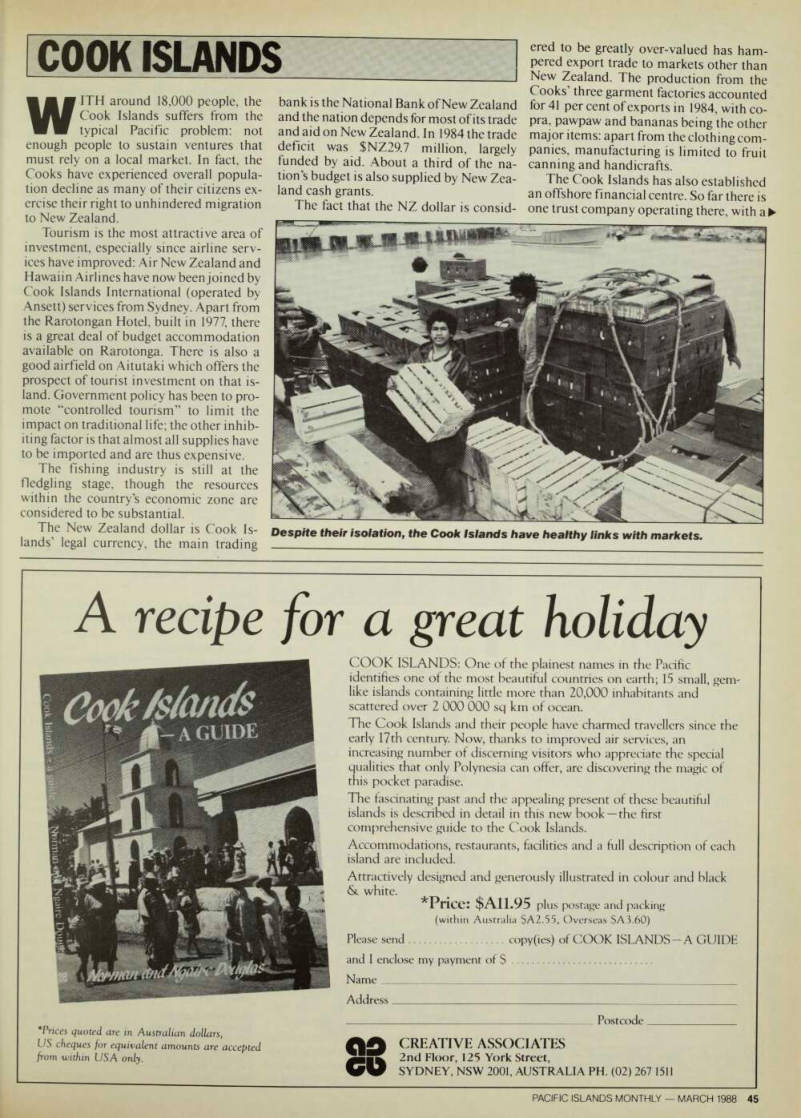
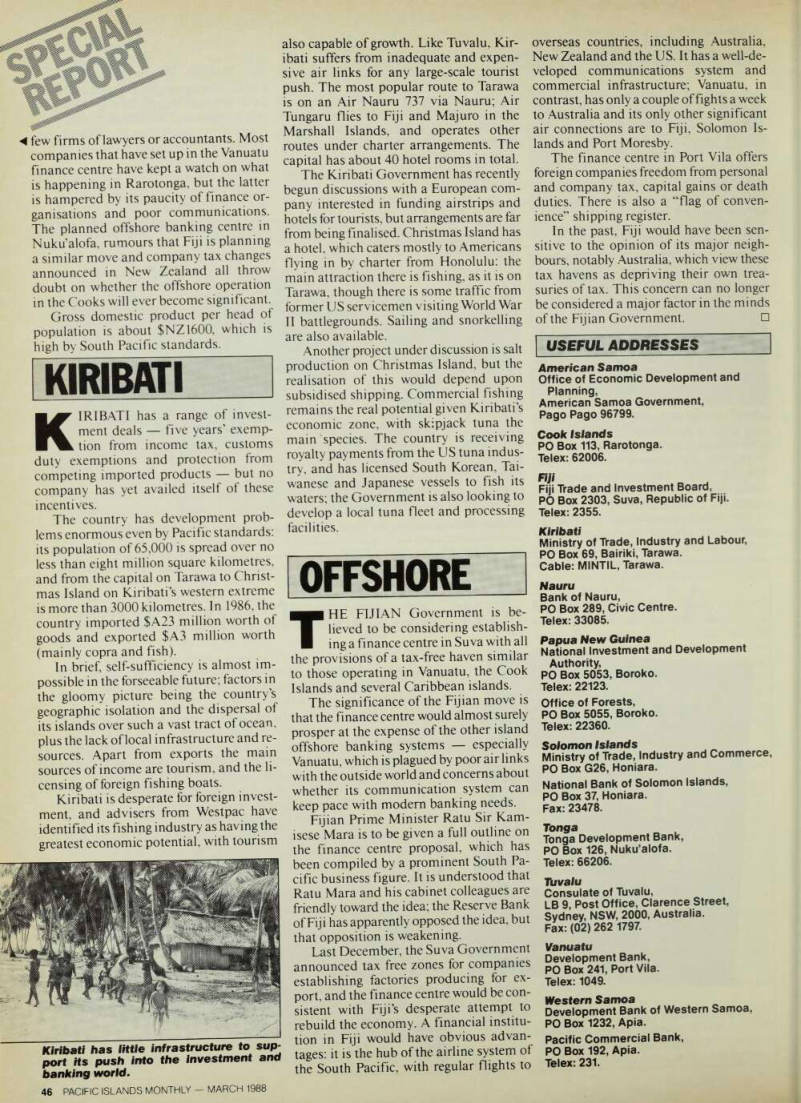
WITH around 18,000 people, the Cook Islands suffers from the typical Pacific problem; not enough people to sustain ventures that must rely on a local market. In fact, the Cooks have experienced overall popula tion decline as many of their citizens ex ercise their right to unhindered migration to New Zealand.
Tourism is the most attractive area of investment, especially since airline serv ices have improved: Air New Zealand and Hawaiin Airlines have now been joined by Cook Islands International (operated by Ansett) services from Sydney. Apart from the Rarotongan Hotel, built in 1977, there is a great deal of budget accommodation available on Rarotonga. There is also a good airfield on Aitutaki which offers the prospect of tourist investment on that is land. Government policy has been to pro mote “controlled tourism” to limit the impact on traditional life; the other inhib iting factor is that almost all supplies have to be imported and are thus expensive.
The fishing industry is still at the fledgling stage, though the resources within the country’s economic zone are considered to be substantial.
The New Zealand dollar is Cook Is lands’ legal currency, the main trading
bank is the National Bank of New Zealand and the nation depends for most of its trade and aid on New Zealand. In 1984 the trade deficit was $NZ29.7 million, largely funded by aid. About a third of the na tion’s budget is also supplied by New Zea land cash grants.
The fact that the NZ dollar is consid
ered to be greatly over-valued has ham pered export trade to markets other than New Zealand. The production from the Cooks’ three garment factories accounted for 41 per cent of exports in 1984, with co pra, pawpaw and bananas being the other major items: apart from the clothing com panies, manufacturing is limited to fruit canning and handicrafts.
The Cook Islands has also established an offshore financial centre. So far there is one trust company operating there, with a ►
Despite their isolation, the Cook Islands have healthy links with markets.
◄ few firms of lawyers or accountants. Most companies that have set up in the Vanuatu finance centre have kept a watch on what is happening in Rarotonga, but the latter is hampered by its paucity of finance or ganisations and poor communications.
The planned offshore banking centre in Nukualofa, rumours that Fiji is planning a similar move and company tax changes announced in New Zealand all throw doubt on whether the offshore operation in the Cooks will ever become significant.
Gross domestic product per head of population is about SNZI6OO, which is high by South Pacific standards.
Advertisements & other items, p. 45 (1 item)
A recipe for a great holiday
w i COOK ISLANDS: One of the plainest names in the Pacific identifies one of the most beautiful countries on earth; 15 small, gemlike islands containing little more than 20,000 inhabitants and scattered over 2 000 000 sq km of ocean.
The Cook Islands and their people have charmed travellers since the early 17th century. Now, thanks to improved air services, an increasing number of discerning visitors who appreciate the special qualities that only Polynesia can offer, are discovering the magic of this pocket paradise.
The fascinating past and the appealing present of these beautiful islands is described in detail in this new book —the first comprehensive guide to the Cook Islands.
Accommodations, restaurants, facilities and a full description of each island are included.
Attractively designed and generously illustrated in colour and black <Sc white. *Price: $A11.95 plus postage and packing (within Australia $A2.55, Overseas $A3.60) Please send copy(ies) of COOK ISLANDS —A GUIDE and I enclose my payment of $ Name Address Postcode *Prices quoted are in Australian dollars, US cheques for equivalent amounts are accepted CREATIVE ASSOCIATES from within USA only. 2nd Floor, 125 York Street, vll SYDNEY, NSW 2001, AUSTRALIA PH. (02) 267 1511
Kiribati
has a range of invest ment deals five years’ exemp tion from income tax, customs duty exemptions and protection from competing imported products but no company has yet availed itself of these incentives.
The country has development prob lems enormous even by Pacific standards: its population of 65,000 is spread over no less than eight million square kilometres, and from the capital on Tarawa to Christ mas Island on Kiribati’s western extreme is more than 3000 kilometres. In 1986, the country imported SA23 million worth of goods and exported SA3 million worth (mainly copra and fish).
In brief, self-sufficiency is almost im possible in the forseeable future; factors in the gloomy picture being the country’s geographic isolation and the dispersal of its islands over such a vast tract of ocean, plus the lack of local infrastructure and re sources. Apart from exports the main sources of income are tourism, and the li censing of foreign fishing boats.
Kiribati is desperate for foreign invest ment, and advisers from Westpac have identified its fishing industry as having the greatest economic potential, with tourism
also capable of growth. Like Tuvalu, Kir ibati suffers from inadequate and expen sive air links for any large-scale tourist push. The most popular route to Tarawa is on an Air Nauru 737 via Nauru; Air Tungaru flies to Fiji and Majuro in the Marshall Islands, and operates other routes under charter arrangements. The capital has about 40 hotel rooms in total.
The Kiribati Government has recently begun discussions with a European com pany interested in funding airstrips and hotels for tourists, but arrangements are far from being finalised. Christmas Island has a hotel, which caters mostly to Americans flying in by charter from Honolulu: the main attraction there is fishing, as it is on Tarawa, though there is some traffic from former US servicemen visiting World War II battlegrounds. Sailing and snorkelling are also available.
Another project under discussion is salt production on Christmas Island, but the realisation of this would depend upon subsidised shipping. Commercial fishing remains the real potential given Kiribati’s economic zone, with skipjack tuna the main species. The country is receiving royalty payments from the US tuna indus try, and has licensed South Korean, Tai wanese and Japanese vessels to fish its waters; the Government is also looking to develop a local tuna fleet and processing facilities.
Kiribati has little infrastructure to sup port its push into the investment and banking world.
Offshore
THE FIJIAN Government is be lieved to be considering establish ing a finance centre in Suva with all the provisions of a tax-free haven similar to those operating in Vanuatu, the Cook Islands and several Caribbean islands.
The significance of the Fijian move is that the finance centre would almost surely prosper at the expense of the other island offshore banking systems especially Vanuatu, which is plagued by poor air links with the outside world and concerns about whether its communication system can keep pace with modern banking needs.
Fijian Prime Minister Ratu Sir Kam isese Mara is to be given a full outline on the finance centre proposal, which has been compiled by a prominent South Pa cific business figure. It is understood that Ratu Mara and his cabinet colleagues are friendly toward the idea; the Reserve Bank of Fiji has apparently opposed the idea, but that opposition is weakening.
Last December, the Suva Government announced tax free zones for companies establishing factories producing for ex port, and the finance centre would be con sistent with Fiji’s desperate attempt to rebuild the economy. A financial institu tion in Fiji would have obvious advan tages: it is the hub of the airline system of the South Pacific, with regular flights to
overseas countries, including Australia, New Zealand and the US. It has a well-de veloped communications system and commercial infrastructure; Vanuatu, in contrast, has only a couple of fights a week to Australia and its only other significant air connections are to Fiji, Solomon Is lands and Port Moresby, The finance centre in Port Vila offers foreign companies freedom from personal and company tax, capital gains or death duties. There is also a “flag of conven ience” shipping register, In the past, Fiji would have been sen sitive to the opinion of its major neigh hours, notably Australia, which view these tax havens as depriving their own trea suries of tax. This concern can no longer be considered a major factor in the minds of the Fijian Government. □
Useful Addresses
American Samoa Office of Economic Development and Planning, American Samoa Government, Pago Pago 96799.
Cook Islands PO Box 113, Rarotonga.
Telex: 62006.
Fiji Fiji Trade and Investment Board, PO Box 2303, Suva, Republic of Fiji.
Telex: 2355.
Kiribati Ministry of Trade, Industry and Labour, PO Box 69, Bairiki, Tarawa.
Cable: MINTIL, Tarawa.
Nauru Bank of Nauru, PO Box 289, Civic Centre.
Telex: 33085.
Papua New Guinea National Investment and Development Authority, PO Box 5053, Boroko.
Telex: 22123.
Office of Forests, PO Box 5055, Boroko.
Telex: 22360.
Solomon Islands Ministry of Trade, Industry and Commerce, PO Box G 26, Honiara.
National Bank of Solomon Islands, PO Box 37, Honiara.
Fax: 23478.
Tonga Tonga Development Bank, PO Box 126, Nukualofa.
Telex: 66206. 7 iivalu Consulate of Tuvalu, LB 9, Post Office, Clarence Street, Sydney, NSW, 2000, Australia.
Fax; (02) 262 1797.
Vanuatu Development Bank, PO Box 241, Port Vila.
Telex: 1049.
Western Samoa Development Bank of Western Samoa, PO Box 1232, Apia.
Pacific Commercial Bank, PO Box 192, Apia.
Telex: 231.
Maui Loa Renaissance Man
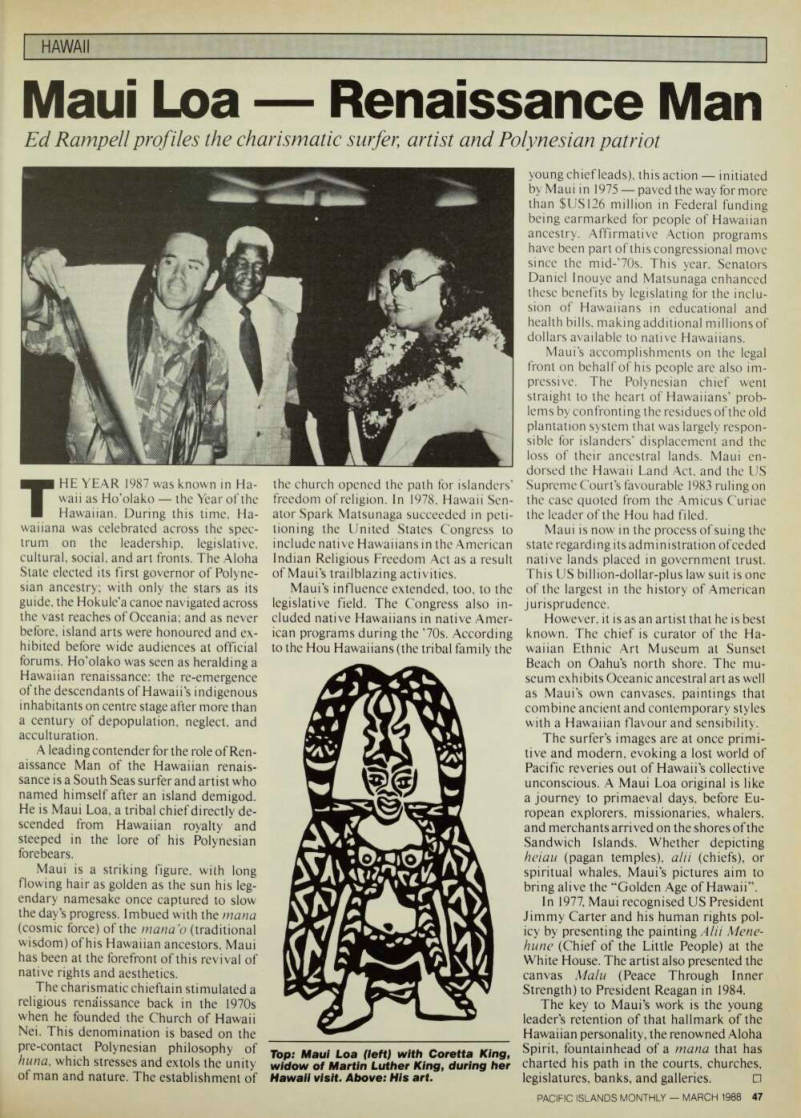
Ed Rampell profiles the charismatic surfer, artist and Polynesian patriot
THE YEAR 1987 was known in Ha waii as Ho’olako the Year of the Hawaiian. During this lime. Ha waiiana was celebrated across the spec trum on the leadership, legislative, cultural, social, and art fronts. The Aloha Slate elected its first governor of Polyne sian ancestry; with only the stars as its guide, the Hokule’a canoe navigated across the vast reaches of Oceania; and as never before, island arts were honoured and ex hibited before wide audiences at official forums. Ho’olako was seen as heralding a Hawaiian renaissance: the re-emergence of the descendants of Hawaii’s indigenous inhabitants on centre stage after more than a century of depopulation, neglect, and acculturation.
A leading contender for the role of Ren aissance Man of the Hawaiian renais sance is a South Seas surfer and artist who named himself after an island demigod.
He is Maui Loa, a tribal chief directly de scended from Hawaiian royalty and steeped in the lore of his Polynesian forebears.
Maui is a striking figure, with long flowing hair as golden as the sun his leg endary namesake once captured to slow the day’s progress. Imbued with the mana (cosmic force) of the mana’o (traditional wisdom) of his Hawaiian ancestors, Maui has been at the forefront of this revival of native rights and aesthetics.
The charismatic chieftain stimulated a religious renaissance back in the 1970 s when he founded the Church of Hawaii Nei. This denomination is based on the pre-contact Polynesian philosophy of huna , which stresses and extols the unity of man and nature. The establishment of
the church opened the path for islanders' freedom of religion. In 1978, Hawaii Sen ator Spark Malsunaga succeeded in peti tioning the United Stales Congress to include native Hawaiians in the American Indian Religious Freedom Act as a result of Maui’s trailblazing activities.
Maui’s influence extended, too, to the legislative field. The Congress also in cluded native Hawaiians in native Amer ican programs during the ’7os. According to the Hou Hawaiians (the tribal family the
young chief leads), this action initiated by Maui in 1975 paved the way for more than SUSI 26 million in Federal funding being earmarked for people of Hawaiian ancestry. Affirmative Action programs have been part of this congressional move since the mid-’7os. This year. Senators Daniel Inouye and Malsunaga enhanced these benefits by legislating for the inclu sion of Hawaiians in educational and health bills, makingadditional millionsof dollars available to native Hawaiians.
Maui’s accomplishments on the legal front on behalf of his people are also im pressive. The Polynesian chief went straight to the heart of Hawaiians’ prob lems by confronting the residues of the old plantation system that was largely respon sible for islanders' displacement and the loss of their ancestral lands. Maui en dorsed the Hawaii Land Act, and the US Supreme Court’s favourable 1983 ruling on the case quoted from the Amicus Curiae the leader of the Hou had filed.
Maui is now in the process of suing the stale regarding its administration ofceded native lands placed in government trust.
This US billion-dollar-plus law suit is one of the largest in the history of American jurisprudence.
However, it is as an artist that he is best known. The chief is curator of the Ha waiian Ethnic Art Museum at Sunset Beach on Oahu’s north shore. The mu seum exhibits Oceanic ancestral art as well as Maui’s own canvases, paintings that combine ancient and contemporary styles with a Hawaiian flavour and sensibility.
The surfer’s images are at once primi tive and modern, evoking a lost world of Pacific reveries out of Hawaii’s collective unconscious. A Maui Loa original is like a journey to primaeval days, before Eu ropean explorers, missionaries, whalers, and merchants arrived on the shores of the Sandwich Islands. Whether depicting heiau (pagan temples), alii (chiefs), or spiritual whales, Maui’s pictures aim to bring alive the “Golden Age of Hawaii’’.
In 1977, Maui recognised US President Jimmy Carter and his human rights pol icy by presenting the painting Alii Mene hune (Chief of the Little People) at the White House. The artist also presented the canvas Main (Peace Through Inner Strength) to President Reagan in 1984.
The key to Maui’s work is the young leader’s retention of that hallmark of the Hawaiian personality, the renowned Aloha Spirit, fountainhead of a mana that has charted his path in the courts, churches, legislatures, banks, and galleries. □
Top: Maui Loa (left) with Coretta King, widow of Martin Luther King, during her Hawaii visit. Above: His art.
The Island Press
Compiled by John Carter
THE MINISTER for Civil Aviation and Acting Minister for Culture and Tourism, Mr Berghuser, has described as deplorable the lack of publicity and hospitality dur ing the 14-hour stopover by the Russian cruise ship Maxim Gorky in Port Mo resby on the weekend.
Mr Berghuser said despite its short stop, an effort should have been made for the 600 tourists who had made the effort to see the country.
From the Papua New Guinea Post-Courier , Port Moresby.
DURING THE week members of the Norfolk Island Police Force cleared a cul tivated plot of well established marihuana plants conservatively valued at some $20,000.
Discovery of the plot was due to the community spirit of the owner of the land who, during clearing operations decided to lake a walk down his/her valley and came upon the well-grown plants in a shel tered spot quite near the walking track.
There were bags for seed, trays for drying, a spade and shovel and some fer tiliser, together with a half-44-gallom drum used for watering.
From The Norfolk Islander.
HA'ANO ISLAND hasjusl four small vil lages. The largest is Ha'ano village, with 214 residents, according to the latest cen sus. The island has only one vehicle a motorbike owned by the Health Depart ment. and one public telephone, which stands at the Ha’ano Primary school building, but the people are served by five churches: Free Wesleyan, Free Church of Tonga, Church ofTonga, Seventh Day Ad ventist, and Mormon.
From an article in the Tonga Chronicle on life on the island of Ha’ano in the Ha’apai Group.
PORT MORESBY’S first baby of the New Year .. . and his mother .. . have set the nurses and doctors to check the record books. For Mrs Dayleen Sylvester, the mother, it was her second baby born on New Year’s Day. The first one was born exactly one year earlier, on New Year’s Day.
From the Papua New Guinea Post-Courier , Port Moresby.
A HONIARA court has fined an Aus tralian $4OO after he admitted having sex ual affairs with two local male partners.
The Australian told the court he had for gotten he was in another country when he committed the offences.
From the Cook Islands News , Rarotonga.
GOROKA: A total of K 99.503 was raised through the singing of Christmas carols in Australia to build a new office and train ing complex in Goroka.
The new office and training complex is part of the Christian Institute of Coun selling, an ecumenical institute that trains church and government workers in coun selling and communication skills.
From The Times of Papua New Guinea.
AS OUTSIDERS in Tonga, we have been worried about the large consumption of beer by the local people and also by the lack of censorship on videos. We have been
concerned about these problems here be cause alcohol and videos are helping to ruin tens of thousands of young lives back in New Zealand. We feel sure that unless the problems are seriously addressed here you may very well have the same problem in future despite Tonga’s being a bigger church-attending nation per capita than New Zealand.
From a letter in the Tonga Chronicle from Paul Somerville, leader of the New Zealand, Te Hou Ora- Tokoroa youth group in Tonga to play rugby.
FOUND: A pair of brown ladies shoes. . . at the National Stadium.
From Laucala Campus Informa tion in the University of the South Pacific Bulletin.
A 30-YEAR-OLD man died and another was seriously injured after a dynamite blast at Palakau Village, Mussau Island, in the New Ireland Province.
The dead man was Gordon Uri, and the injured man is Keven Levai.
They were out fishing in a canoe when the incident occurred.
According to police reports, Uri had lit the home-made dynamite and was about to throw it at a school of fish when it ex ploded. killing him instantly and injuring Levai.
From the Papua New Guinea Post-Courier , Port Moresby.
Transition
Visiting: The Director of SPEC, Mr Henry Naisali, paid an official visit to Papua New Guinea in January. During his stay in Port Moresby, the Director held discussions with the Prime Minister, Mr Wingli; the Acting Minister for Foreign Affairs and Minister for Finance and Planning, Mr Dwarara; the Acting Secretary for Foreign Affairs, Mr Balagetuna; the Secretary for Trade and Industry, Mr Peipul and offi cials of the Departments of Civil Aviation and transport.
Mr Naisali also interviewed a number of Papua New Guinea candidates for professional positions within SPEC in Fiji before returning to PSEC Headquarters.
Appointed: Mr Rene Charles Wilson, as Deputy Director (Administration, Fi nance and Political) of SPEC. Mr Wilson replaces Mr Trevor Sofield, who has re turned to the Australian Foreign Service.
Mr Wilson, 40, joined the New Zea
land Ministry of Foreign Affairs in 1975 and holds an MA Honours in Political Studies from the University of Auckland.
Before becoming Deputy Director of SPEC he was Counsellor and Consul General in the New Zealand Embassy in Jakarta.
Appointed: Chief Executive and Director of British Petroleum Fiji, Mr Paul Man ueli, has been chosen to chair the 1988 Fiji Tourism Convention.
Mr Manueli, who was awarded the OBE in 1974, was the former Commander of Fi ji’s Royal Military Forces and retired from military service in 1979. He has since taken up several directorships, including that of the FTIB, the National Bank of Fiji, Tro pik Wood Industries and the Ika Corpo ration, of which he is chairman.. Mr Manueli’s military, professional and vol untary services to the community have spanned almost the entire spectrum of ca reer opportunities in Fiji.
This year’s convention theme will be “Fiji The Way Ahead”, and will ad dress the problems facing the industry. The convention itself will be staged later than usual, from August 8 to 10.
Advertisements & other items, p. 48 (1 item)
Books
WE CAN SUPPLY MOST BOOKS
FROM AROUND THE WORLD!
Sent to you by air or sea Monthly catalogue of new and current boohs Requests for specific boohs welcome
WRITE NOW FOR PROMPT ATTENTION
Master Card Visa Bankcard
BRODIESSBOOKS
396 Kent St, Sydney NSW 2000, Australia
Pacific Stamp Box
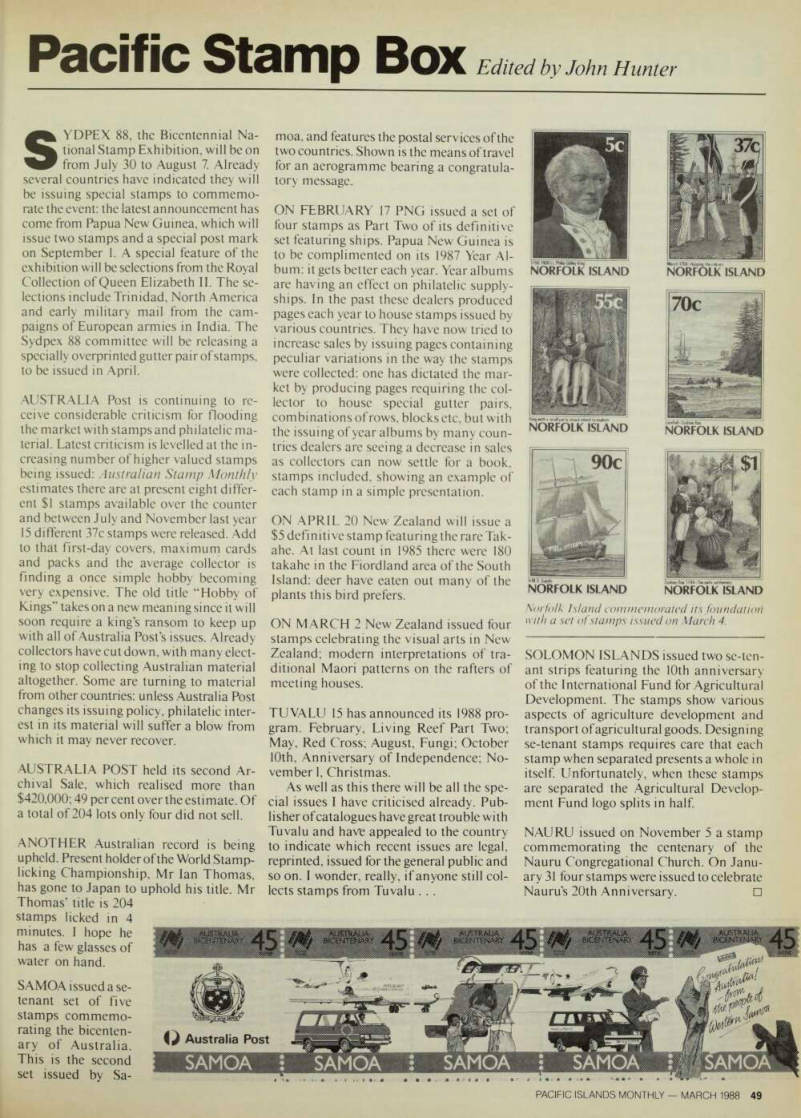
Edited by John Hunter
SYDPEX 88, the Bicentennial Na tional Stamp Exhibition, will be on from July 30 to August 7. Already several countries have indicated they will be issuing special stamps to commemo rate the event: the latest announcement has come from Papua New Guinea, which will issue two stamps and a special post mark on September 1. A special feature of the exhibition will be selections from the Royal Collection of Queen Elizabeth 11. The se lections include Trinidad, North America and early military mail from the cam paigns of European armies in India. The Sydpex 88 committee will be releasing a specially overprinted gutter pair of stamps, to be issued in April.
AUSTRALIA Post is continuing to re ceive considerable criticism for flooding the market with stamps and philatelic ma terial. Latest criticism is levelled at the in creasing number of higher valued stamps being issued: Australian Stamp Monthly estimates there are at present eight differ ent $1 stamps available over the counter and between July and November last year 15 different 37c stamps were released. Add to that first-day covers, maximum cards and packs and the average collector is finding a once simple hobby becoming very expensive. The old title “Hobby of Rings” lakes on a new meaning since it will soon require a king’s ransom to keep up with all of Australia Post’s issues. Already collectors have cut down, with many elect ing to stop collecting Australian material altogether. Some are turning to material from other countries: unless Australia Post changes its issuing policy, philatelic inter est in its material will suffer a blow from which it may never recover.
AUSTRALIA POST held its second Ar chival Sale, which realised more than $420,000; 49 per cent over the estimate. Of a total of 204 lots only four did not sell.
ANOTHER Australian record is being upheld. Present holder of the World Stamp licking Championship, Mr lan Thomas, has gone to Japan to uphold his title. Mr Thomas’ title is 204
stamps licked in 4 minutes. I hope he has a few glasses of water on hand.
SAMOA issued a se tenant set of five stamps commemo rating the bicenten ary of Australia.
This is the second set issued by Sa
moa, and features the postal services of the two countries. Shown is the means of travel for an aerogramme bearing a congratula tory message.
ON FEBRUARY 17 PNG issued a set of four stamps as Part Two of its definitive set featuring ships. Papua New Guinea is to be complimented on its 1987 Year Al bum: it gels better each year. Year albums are having an effect on philatelic supply ships. In the past these dealers produced pages each year to house stamps issued by various countries. They have now tried to increase sales by issuing pages containing peculiar variations in the way the stamps were collected: one has dictated the mar ket by producing pages requiring the col lector to house special gutter pairs, combinations of rows, blocks etc, but with the issuing of year albums by many coun tries dealers are seeing a decrease in sales as collectors can now settle for a book, stamps included, showing an example of each stamp in a simple presentation.
ON APRIL 20 New Zealand will issue a S 5 definitive stamp featuring the rare Tak ahe. At last count in 1985 there were 180 takahe in the Fiordland area of the South Island: deer have eaten out many of the plants this bird prefers.
ON MARCH 2 New Zealand issued four stamps celebrating the visual arts in New Zealand; modern interpretations of tra ditional Maori patterns on the rafters of meeting houses.
TUVALU 15 has announced its 1988 pro gram. February, Living Reef Part Two; May, Red Cross; August, Fungi; October 10th, Anniversary of Independence; No vember 1, Christmas.
As well as this there will be all the spe cial issues I have criticised already. Pub lisher of catalogues have great trouble with Tuvalu and have appealed to the country to indicate which recent issues are legal, reprinted, issued for the general public and so on. I wonder, really, if anyone still col lects stamps from Tuvalu . . .
SOLOMON ISLANDS issued two se-len ant strips featuring the 10th anniversary of the International Fund for Agricultural Development. The stamps show various aspects of agriculture development and transport of agricultural goods. Designing se-tenant stamps requires care that each stamp when separated presents a whole in itself. Unfortunately, when these stamps are separated the Agricultural Develop ment Fund logo splits in half.
NAURU issued on November 5 a stamp commemorating the centenary of the Nauru Congregational Church. On Janu ary 31 four stamps were issued to celebrate Nauru’s 20th Anniversary. □
Norfolk Island commemorated its foundation with a set of stamps issued on March 4.
Book Reviews
Through Melanesian Eyes: An
anthology of PNG writing compiled by Ganga Powell. Macmillan Australia.
Reviewed by Susan Simons THROUGH Melanesian Eyes is an intriguing collection of stories in which the selection and arrange ment of pieces allow the stories to play multiple roles. The first important consid eration is that the book is designed as a re source for young Papua New Guineans, particularly secondary school students, “. . . to acquaint them with the writings of their own people”. Ganga Powell has thoughtfully selected each piece of writing to represent major literary forms prose, poetry, fiction and drama.
The selection opens with traditional legends and songs taken from the vast rep ertoire of Melanesian oral tradition. The little that has been translated and tran scribed gives us only the merest glimmer of the continuing vitality and relevance of a body of songs and stories that, in the ver nacular, is still the major vehicle for cre ative expression. The anonymous song of mourning. My Polupiri Brother, de scribes a young widow’s pain and loss after the death of her husband in local warfare: Favoured and skilful hunter what shall Ido? lam tearing my new string bag in which I intended to carry potatoes for you for the first time.
I am in pain and grief as I take off my bridal decorations.
My brother, my brother, to show that I love you even in death, I am pulling out my hair.
My Polupiri brother, I am hurt all the more For it is not a dream that you are going away With the love that I have come to experience. . .
Some of the gems from the heady days of accelerated social change and growing political awareness of the 1960 s and ’7os are included in the section Society and So cial Change. The fears and frustrations of the colonial era are faced with irony and wry humour in John Waiko’s play The Un expected Hawk, and John Kasiapwalova’s short story Betel-nut is Bad Magic for Aeroplanes. The use of Tok Pisin, vernac ular language and colloquial forms of spo ken English give these pieces a particular pertinence. Kumalau Tawali’s poem The Bush Kanaka Speaks has appeared be fore, as have some other items in the an thology, but they well deserve a wider audience: The Kiap shouts at us forcing the veins to stand out in his neck
nearly forcing the excreta out of his bottom he says; you are ignorant.
He says: you are ignorant, but can he shape a canoe, tie a mast, fix an outrigger?
Can he steer a canoe through the night without losing his way?
Does he know when a turtle comes ashore to lay its eggs?
The question of cultural identity pro vides good material for debate on the need for a Melanesian Way. My only complaint is that Ms Powell did not reprint in full John Kasiapwalova’s remarkable poem The Reluctant Flame — perhaps the most powerful call for freedom in the emerging literature of any new nation.
Ganga Powell is to be congratulated on a thoughtful, inspiring and fearless an thology. She has not veered away from what some may consider controversial choices, especially since her intended pri mary audience is secondary school chil dren. But it is essential that young readers are exposed to the best of their country’s creative minds, and in this selection they will find the strengths and conflicts that have shaped its recent history. □
Papua New Guinea People In
CHANGE A Social Studies Resource Kit - Film Australia. ISBN O 642 11955 4. $l2O.
Reviewed by John Hunter FOR MANY people, Papua New Guinea is the ‘kid next door’. He has always been there as a child, then grown to maturity but we’ve never really got to know him. People of the Pacific need to know more about their nearest neigh bour and to understand more about the country and its people. One way is through the school system; children should know more about their neighbours from an early age.
While this is easy to say, it can prove difficult in practice due to a perennial scarcity of resource material on PNG. In 1987 a school project kit was produced by Peter Leyland Publishing. Called Papua New Guinea Today, it consists of photo graphs, an audio tape and teacher’s book.
Just recently a second kit appeared, called Papua New Guinea People in Change.
It’s a social studies kit for upper primary and secondary classes and consists of two video cassettes, an audio cassette and comprehensive teacher’s guide. It seeks to answer two questions: what is traditional culture? and how and why do cultures change?
The kit introduces children to the Bar uya tribe of the Eastern Highlands in Papua New Guinea, through a Film Aus
tralia video produced by lan Dunlop. A second video contains copies of New Guinea Patrol, which records James Sin clair’s 1950 s Southern Highlands patrol, and Yumi Yet, which covers the 1975 In dependence celebrations.
An audio tape is also provided to en able children to hear a variety of Papua New Guinea music and to hear two stories read in Pidgin. Teachers have a compre hensive guide that suggests ways of pro gramming the course to include subjects such as art, music, science, language and so on. The guide provides resource ma terial on Baruya society, a list of books and films, the stories on the audio cassette and games that can be played by the children.
The study of the Baruyans is a sensitive one: at no time are children encouraged to condemn, accept value judgments, laugh at or look down on another society. Cer tainly the material enables a better under standing of Papua New Guinea, its cultures and the great changes that have sped the country ahead “ 10,000 years in a lifetime”.
I believe the kit is of great value to any student or adult, for it captures moments in history. I would very much like to sit in on a class and to watch students discuss life in the village, make traditional houses, cook sweet potato, exchange pigs and per form a sing-sing. D
Business Development In The
Highlands Of Papua New Guinea:
Pacific Islands Development Program Research Report No 6. By Ben R Finney.
Published by East-West Centre, Honolulu, 1987.
Isbn U-86638-094-9.
Reviewed by John Connell SOME MIGHT envy Ben Finney. After completing a master’s thesis on the history of Hawaiian surfing and a doctorate on Tahitian village economics, he has de voted many years to studies of Pacific Tourism and traditional Polynesian navigation.
Two decades ago Finney also found lime to make a pioneer study of business development and economic growth in the Eastern Highlands of Papua New Guinea.
His book Big Men and Business (ANU Press and University of Hawaii, 1973) quickly became a pioneer study of how some Gorokans became cash crop pro ducers, affluent businessmen and na tional politicians within a single generation. The Gorokans pointed the way for many other Highlanders to follow as coffee, cash and capitalism brought a new era to the region. Almost 20 years later the Pacific islands Development Program, then engaged in a wider study of business development in the Pacific, commis sioned Ben Finney to return to Goroka and
examine again business development in the Highlands.
In Finney’s first book on Goroka he concluded that the traditional culture of the Eastern Highlands “pre-adapted” the people to modern commercial develop ment, through the emergence of entrepre neurs willing and able to exploit the opportunities offered by the new market economy. Many of these grass-roots busi nessmen began their careers through trad ing pigs, shells and other valuables, usually both as individuals and on behalf of the clan. Subsequently they followed the style if not the substance of traditional status mobility. Eastern Highlanders quickly accepted both economic innova tion and new forms of economic activity but, in most respects, retained the basis of their traditional culture.
In some respects little had changed.
Gorokans remained “conspicuous inves tors”, gaining prestige and status by in vesting in visible commercial assets.
Wealth and social standing more than ever are measured in terms of coffee produc tion, business assets and cash flow. Once again entrepreneurship was closely re lated to leadership, and there were intense rivalries for power and authority within the competitive and fluid leadership system.
At the same time the older business groups that with government support had initiated the almost complete localisation of business in the Highlands, had disin
tegrated through tension and jealousy and been replaced by more cohesive and man ageable businesses based on nuclear fam ilies. If business had become more individualistic, the new businessmen nonetheless were still closely identified with their clans, contributing to ceremon ial expenses, clan payments, school fees and so on, through which they gained both prestige and clan support. Clan support remains crucial as a source of land, labour and also cash. Traditional influences have barely dwindled.
Again Finney found that businessmen were unable to escape the necessity to dis tribute largesse to clansmen, and unres trained demands and generosity often led to bankruptcy and business failure. In other words, the very factors that enabled businessmen to prosper were all too often exactly those that led to the demise of po tentially successful businesses. Only a few younger men were easily able to escape the confines of the wantok system. One means by which the most successful entrepre neurs achieved this was by delegating the daily management of their business to ex patriates who were both experienced managers and better able to withstand the demands of customary obligations. So the largest businesses are best able to regulate the wantok system, as smaller businesses collapse under the strain, and there are virtually no skilled Gorokan managers.
Finney observes: “The rough egalilar
ianism of traditional times, where every man had a more or less equal chance to strive for wealth and power, has been re placed by a social system that is beginning to look more and more stratified.” The youngest university-educated entrepre neurs are increasingly investing outside the province (one buying up land in Brisbane, Queensland), to avoid customary obliga tions and to make greater profits away from Goroka, where the best rural and urban land has already long been sold. However, though Finney argues that entrepreneurial values are so widespread that there will be such constant challenges for business prominence and disputes over land tenure that few businesses will survive more than one generation, there is just as much evi dence that some business elites in the new development corporations are now ex tremely well entrenched.
Indeed, in the end, Finney’s conclu sions are not wholly convincing both be cause he was only in the Eastern Highlands for 15 days and because he has taken no apparent note of social scientists who pre ceded him in the Eastern Highlands and whose conclusions are far from being so sanguine.
The new rapacious entrepreneurs have scarcely created a society where the rural and urban poor can face the future with confidence. Perhaps Ben Finney will re turn again, stay longer and reveal the darker side of the moon. □
Advertisements & other items, pp. 51-52 (1 item)
Ml4Ir
X4L4IR --- Papua New Guinea's
nationwide airline connection to and
from the World.
I It
DOMESTIC
Talair serves all provinces in P.N.G., many on a daily basis. No other airline comes close to serving the 130 ports a week that Talair does. Charter services also are available.
INTERNATIONAL
Using our computerised system
in any of our 12 International Travel Centres, we can book you anywhere in the world 0n...
planes, trains, luxury liners,
arrange rental cars, hostefs, motels or hotels. 11
AIA
Panguna - 95 8020 • Arawa - 95 2113 • Mt. Hagen - 52 2465 Boroko - 25 7655 • Tabubil - 58 9228 • Goroka - 72 1355 • Lae - 42 2316 Madang - 82 2757 • Rabaul - 82 2882 • Wewak - 86 2012 Vanimo - 87 1180 • Port Moresby - 21 4766 • Waigani - 25 7877 Brisbane Metropolitan Area - 229 1177 Outside Brisbane - 008 777879
ML4IR
ATA
QUALITY IN AIR TRANSPORT
4L41
r , ,
fmDG&ucxSALES
L 1 A
REFRIGERATED
TRUCKS
★ Freezers ★ Chillers ★ Coolers Our units ideal in Samoa, Papua New Guinea, & Fiji. Meat-hanging, Pallet-loading, Distributing Juice, Milk, Produce.
Our staff are former Pacific Island residents.
Ph: 61 -7-875 1488 (24 hours) P.O. Box 208, Moorooka. Aust. Q. 4105 "phone or Write . . For The Answers To Your Transport Needs"
"Overseas, Country, and Interstate buyers, hosted at GREENMOUNT RESORT on Queensland’s Gold Coast " \
BARGING
OF UNUSUAL OR HEAVY
CARGOES
Australia-Pacific region Ocean Towage Contractors
JARDINE SHIPPING
Cairns, Qld, Australia.
Phone (070) 510495 Fax (070)311685 Telex AA 48362
Over 10,000
COMPACT DISCS!
MU*IC
Australia’s Leading Authority on
WHAT’S ON CD
Complete MAIL ORDER Service to the PACIFIC!
CD voucher with every full price CD Collect 10, your next CD is FREE send A 57.00 for complete catalogue
to MUSIC POST, PO Box 83
Cremorne 2090, Australia
Perkins
HURTH Hamilton
MARINE GEARS
Sales, service & spare parts
fit POWER
RUSLIT POWER CENTRE
195 Parramatta Rd, Auburn 2144 Sydney, NSW, Australia (02) 648 0591
Shipping Schedules
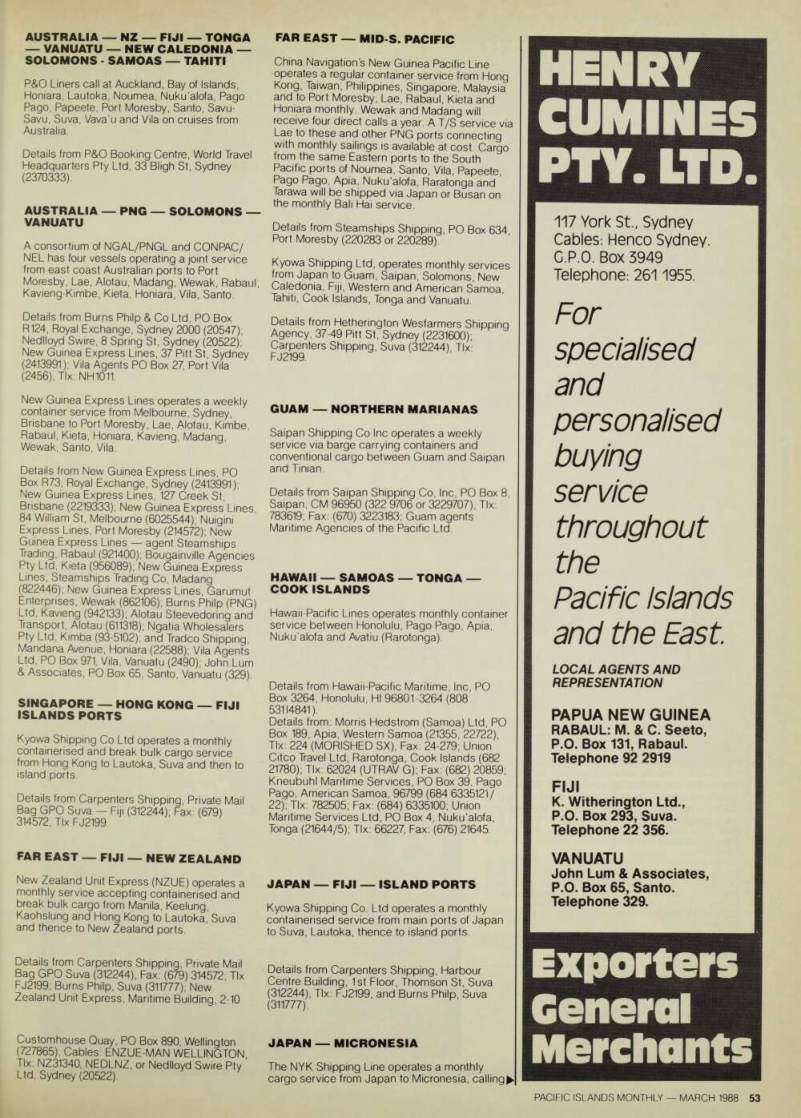

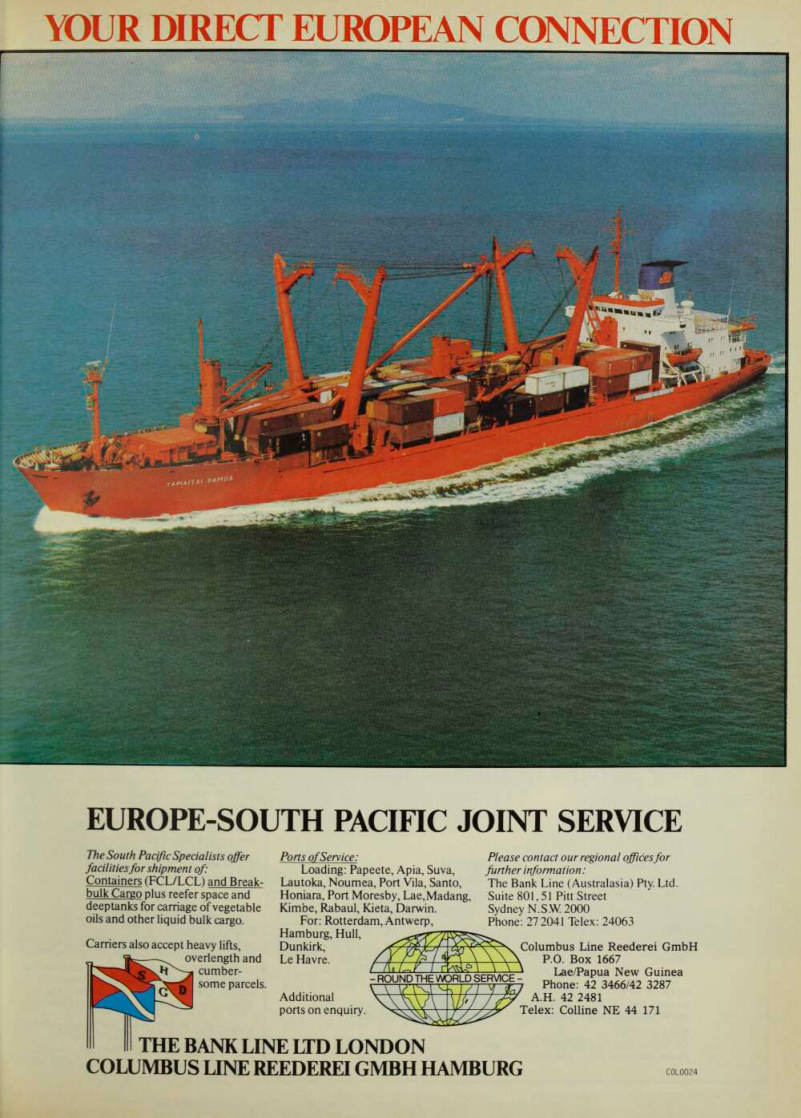
Australia New Caledonia
Fiji Hawaii North America
PACE Line (ACTA Shipping) operates a fully containerised service every 17 days from Melbourne, Sydney and Brisbane to Suva and Lautoka. A recent feature of the service is direct calls at Noumea. The vessels continue on to the North coast of America, calling at Hawaii at frequent intervals.
Details from ACTA Pty Ltd, Sydney (2660633); Tlx AA121369; Fax 2671148; Burns Philp (SS) Co Ltd, Rodwell Road, Suva (311777); Tlx FJ2168; Fax 311804; Burns Philp (SS) Co Ltd, Lautoka (60777); Sato SA, Avenue James Cook, BPC 2, Noumea, Cedex (281122); Tlx 163 NM SATO; Fax 278532.
Australia Samoas Tonga
Warner Pacific Lines operates a regular cargo service from Sydney, Brisbane and Melbourne to Nukualofa, Pago Pago, Apia and Vava'u.
Details from Hetherington Wesfarmers Shipping Agency, 37-49 Pitt St, Sydney (2231600).
Australia New Caledonia
Fiji Samoas Tonga
Pacific Forum Line operates a fully containerised service (general, reefer and ro-ro) from Brisbane and Sydney to Noumea, Lautoka, Suva, Apia, Pago Pago, Nukualofa, Sydney Cargo centralised from Adelaide and Melbourne.
Details from Pacific Forum Line, PO Box 796 Auckland; Union Bulkships, 333 George St, Sydney, Brisbane and Melbourne; Union Co, Lautoka; Pacific Forum Line, Suva, Nukualofa and Apia; Polynesia Shipping, Pago Pago.
Fiji Tuvalu Kiribati Fiji
Pacific Forum Line operates a conventional vessel providing a 28-day service from Fiji to Tuvalu and Kiribati.
Australia Lord Howe Island
Norfolk Island
Compagnie des Chargeurs Caledoniens operates four-weekly cargo service Sydney- Lord Howe Island and Norfolk Island.
Details Hetherington Wesfarmers Shipping Agency, 37-49 Pitt St, Sydney (2231600).
Australia Kiribati
K. Asia Pacific operates a 5/6 weekly service from Melbourne and Sydney to Kiribati (Tarawa) KAP New Guinea Lines calls Tarawa after PNG ports on a 35-day basis from Melbourne and
Sydney/Brisbane.
Details from K. Asia Pacific Pty Ltd, Goldfields House, 1 Alfred St, Circular Quay, Sydney (2322277), Tlx: 122143.
Australia Tuvalu
K. Asia Pacific operates direct service every second voyage to Tulalu (Funafuti).
Details from K. Asia Pacific Pty Ltd, Goldfields House, 1 Alfred St, Circular Quay, Sydney (2322277), Tlx 122143.
Australia Norfolk Island
Lord Howe Island
Norfolk Island Shipping Line operates direct service every 5/6 weeks ex-Sydney.
Details from K. Asia Pacific Pty Ltd as managing agents for NISL, Goldfields House, 1 Alfred St, Circular Quay, Sydney (2322277).
Australia Cook Islands
Norfolk Island Shipping Line operates direct service every 5/6 weeks ex-Sydney.
Details from K. Asia Pacific Pty Ltd as managing agents for NISL, Goldfields House, 1 Alfred St, Circular Quay, Sydney (2322277).
Compagnie Generate Maritime operates a monthly service from Sydney, Melbourne and Brisbane to Noumea, Port Vila and Santo, for containerised and break bulk cargo.
Details from Compagnie Generate Maritime, 12 Castlereagh St, Sydney (2313700).
Australia Nauru
Nauru Pacific Line operates regular cargo service from Melbourne to Nauru, passenger service to Nauru only.
Details from Nauru Pacific Line (Aust) Pty Ltd, Nauru House, 80 Collins St, Melbourne (6535709). Nedlloyd Swire, 8 Spring St, Sydney (20522).
Australia Solomon Islands
Vanuatu
NGAL/PNGL joint service operates a monthly service.
Details from Nedlloyd Swire Pty Ltd, 8 Spring St, Sydney (20522).
Australia New Zealand
The Australian National Line and the New Zealand Line operate a weekly container service (TRANZTAS) between Sydney and Melbourne to Auckland, Wellington, Lyttleton and Port Chalmers.
Details from Australian National Shipping Agencies, 131-137 York St, Sydney (2257333) and ANL Shipping Agencies, “World Trade Centre", Cnr Flinders and Spencer Sts, Melbourne (6112323) or New Zealand Line, Pastoral House, 96 Lambton Quay, Wellington, (7285000).
Australia Nz Fiji
Vanuatu New Caledonia
Solomons New Guinea
Sitmar Cruises operates a year-round cruise program from Sydney to include the better known ports in the above countries plus a number of unspoilt, and largely unknown, island
paradises.
Details from Sitmar Cruises, 39 Martin Place, Sydney (2399000), NSW; reservations and inquiries (008 422277); rest of Australia reservations and inquiries (008 2222//).
Australia Nz Fiji Tonga
Vanuatu New Caledonia
Solomons - Samoas Tahiti
P&O Liners call at Auckland, Bay of Islands, Honiara, Lautoka, Noumea, Nuku’alofa, Pago Pago, Papeete, Port Moresby, Santo, Savu- Savu, Suva, Vava’u and Vila on cruises from Australia.
Details from P&O Booking Centre, World Travel Headquarters Pty Ltd, 33 Bligh St, Sydney (2370333).
Australia Png Solomons
Vanuatu
A consortium of NGAL/PNGL and CONPAC/ NEL has four vessels operating a joint service from east coast Australian ports to Port Moresby, Lae, Alotau, Madang, Wewak, Rabaul, Kavieng-Kimbe, Kieta, Honiara, Vila, Santo.
Details from Burns Philp & Co Ltd, PO Box R 124, Royal Exchange, Sydney 2000 (20547); Nedlloyd Swire, 8 Spring St, Sydney (20522); New Guinea Express Lines, 37 Pitt St, Sydney (2413991); Vila Agents PO Box 27, Port Vila
(2456), Tlx: Nhioii.
New Guinea Express Lines operates a weekly container service from Melbourne, Sydney, Brisbane to Port Moresby, Lae, Alotau, Kimbe, Rabaul, Kieta, Honiara, Kavieng, Madang, Wewak, Santo, Vila.
Details from New Guinea Express Lines, PO Box R 73, Royal Exchange, Sydney (2413991); New Guinea Express Lines, 127 Creek St, Brisbane (2219333); New Guinea Express Lines, 84 William St, Melbourne (6025544); Nuigini Express Lines, Port Moresby (214572); New Guinea Express Lines agent Steamships Trading, Rabaul (921400); Bougainville Agencies Pty Ltd, Kieta (956089); New Guinea Express Lines, Steamships Trading Co, Madang (822446); New Guinea Express Lines, Garumut Enterprises, Wewak (862106); Burns Philp (PNG) Ltd, Kavieng (942133); Alotau Steevedoring and Transport, Alotau (611318); Ngatia Wholesalers Pty Ltd, Kimba (93-5102); and Tradco Shipping Mandana Avenue, Honiara (22588); Vila Agents Ltd, PO Box 971, Vila, Vanuatu (2490); John Lum & Associates, PO Box 65, Santo, Vanuatu (329).
Singapore Hong Kong Fiji
Islands Ports
Kyowa Shipping Co Ltd operates a monthly containerised and break bulk cargo service from Hong Kong to Lautoka, Suva and then to island ports.
Details from Carpenters Shipping, Private Mail Bag GPO Suva Fiji (312244); Fax: (679) 314572, Tlx FJ2199.
Far East Fiji New Zealand
New Zealand Unit Express (NZUE) operates a monthly service accepting containerised and break bulk cargo from Manila, Keelung, Kaohslung and Hong Kong to Lautoka, Suva and thence to New Zealand ports.
Details from Carpenters Shipping, Private Mail Bag GPO Suva (312244), Fax: (679) 314572; Tlx FJ2199; Burns Philp, Suva (311777); New Zealand Unit Express, Maritime Building, 2-10 Customhouse Quay, PO Box 890, Wellington
(727865), Cables: Enzue-Man Wellington,
Tlx; NZ31340, NEDLNZ, or Nedlloyd Swire Pty Ltd, Sydney (20522).
Far East Mid-S. Pacific
China Navigation’s New Guinea Pacific Line operates a regular container service from Hong Kong, Taiwan, Philippines, Singapore, Malaysia and to Port Moresby, Lae, Rabaul, Kieta and Honiara monthly. Wewak and Madang will receive four direct calls a year. A T/S service via Lae to these and other PNG ports connecting with monthly sailings is available at cost. Cargo from the same Eastern ports to the South Pacific ports of Noumea, Santo. Vila, Papeete, Pago Pago, Apia, Nuku’alofa, Raratonga and Tarawa will be shipped via Japan or Busan on the monthly Bali Hai service.
Details from Steamships Shipping, PO Box 634 Port Moresby (220283 or 220289).
Kyowa Shipping Ltd, operates monthly services from Japan to Guam, Saipan, Solomons, New Caledonia, Fiji, Western and American Samoa, Tahiti, Cook Islands, Tonga and Vanuatu.
Details from Hetherington Wesfarmers Shipping Agency, 37-49 Pitt St, Sydney (2231600) Carpenters Shipping, Suva (312244), Tlx: F J 2199.
Guam Northern Marianas
Saipan Shipping Co Inc operates a weekly service via barge carrying containers and conventional cargo between Guam and Saipan and Tinian.
Details from Saipan Shipping Co, Inc, PO Box 8, Saipan, CM 96950 (322 9706 or 3229707). Tlx: 783619; Fax: (670) 3223183; Guam agents Maritime Agencies of the Pacific Ltd.
Hawaii Samoas Tonga
Cook Islands
Hawaii-Pacific Lines operates monthly container service between Honolulu, Pago Pago, Apia, Nuku’alofa and Avatiu (Rarotonga).
Details from Hawaii-Pacific Maritime, Inc, PO Box 3264, Honolulu, HI 96801-3264 (808 53114841).
Details from: Morris Hedstrom (Samoa) Ltd, PO Box 189, Apia, Western Samoa (21355, 22722), Tlx: 224 (MORISHED SX), Fax: 24-279; Union Citco Travel Ltd, Rarotonga, Cook Islands (682 21780); Tlx: 62024 (UTRAV G); Fax: (682) 20859; Kneubuhl Maritime Services, PO Box 39, Pago Pago, American Samoa, 96799 (684 6335121/ 22); Tlx: 782505; Fax; (684) 6335100; Union Maritime Services Ltd, PO Box 4, Nuku’alofa, Tonga (21644/5); Tlx: 66227, Fax: (676) 21645.
Japan Fiji Island Ports
Kyowa Shipping Co. Ltd operates a monthly containerised service from main ports of Japan to Suva, Lautoka, thence to island ports.
Details from Carpenters Shipping, Harbour Centre Building, Ist Floor, Thomson St, Suva (312244), Tlx: FJ2199, and Burns Philp, Suva (311777).
Japan Micronesia
The NYK Shipping Line operates a monthly cargo service from Japan to Micronesia, calling►
◄ at Yoko, Nagoya, Kobe, Guam, Saipan, Truk, Ponape and Majuro, returning via Yoko, Nagoya and Kobe.
Details from Burns Philp & Co. Ltd, 51 Pitt St, Sydney (2591000).
Saipan Shipping Co Inc operates a monthly service from Japan to Saipan, Guam, Truk, Ponape, Majuro (Kosrae and Ebeye on inducement).
Details from Saipan Shipping Co Inc, PO Box 8, Saipan, CM 96950 (322 9706 or 3229707), Tlx: 783619, Fax: (670) 3223183. Japan agents Kyowa Shipping Company Ltd; Guam Agents Maritime Agencies of the Pacific Ltd.
Japan Korea Png Japan
Paradise Service
Mitsui OSK Lines in joint service with Nyk Lines operates a monthly service from main ports in Japan and Busan in Korea to PNG ports of Wewak, Rabaul, Kieta, Lae, Port Moresby, Kavieng, Kimbe, Madang and Oro Bay.
Details from Robert Laurie Company Pty Ltd, PO Box 1032, Lae/PNG (Direct: 423642 or Switch: 423811), Contact: W O Hackenberg, Group Shipping Manager & Marketing; Tlx; NE 42508, Fax: 423801.
Png Inter-Mainport
Papua New Guinea Line offers scheduled 10-20 day coastal liner services linking all PNG major ports with containerisation, reefer, heavy lift and trans-shipment facilities.
Details from PNG Line, Box 543, Port Moresby, PNG (211174), Tlx: 22269.
Png Uk/Continent
The Bank Line & Columbus Line operate a regular joint service from Port Moresby, Oro Bay, Kieta, Rabaul, Kimbe, Madang and Lae to Hull, Hamburg, Rotterdam, Antwerp and Le Havre.
Details from The Bank Line (A'asia) Pty Ltd, 51 Pitt St, Sydney (272041), Tlx: AA24063; Columbus Line, Lae (423466), Tlx: NE 44171; or lines’ local agents.
Solomons Uk/Continent
The Bank Line & Columbus Line operate a regular joint cargo service from Honiara to Hull, Hamburg, Rotterdam, Antwerp and Le Havre.
Details from The Bank Line (A’asia) Pty Ltd, 51 Pitt St, Sydney (272041), Tlx: AA24063; Columbus Line, Lae (423466), Tlx: NE44171; Tradco Shipping Ltd, Honiara (22588), Tlx: 66313.
New Zealand Australia
Png Solomon Islands
Pacific Forum Line operates a containerised and ro-ro service from Lyttelton, Napier and Auckland to Brisbane, Port Moresby, Lae, Honiara, Brisbane then New Zealand.
Details from Pacific Forum, Auckland, Christchurch; Union Bulkships, Brisbane; Steamships Shipping, Port Moresby and Lae, Sullivans Ltd, Honiara; Seabridge, Wellington.
New Zealand Cook Islands
Tahiti
New Zealand Line operates cargo services
based on pallets and similar units from Auckland to Cook Islands and Tahiti, Details from NZ Shipping Agencies International Ltd, PO Box 3420, Auckland (392650); Waterfront Commission, PO Box 61, Rarotonga; Cook Islands; Shipping Office, Govt, of Niue, PO Box 107, Niue Island; Compagnie Maritime Polynesienne, PO Box 36,
Papeete, Tahiti.
New Zealand —Fiji
Reef operates a regular 18-day service from Auckland to Suva and Lautoka. Also passenger accommodation.
Details from Reef Shipping Agencies, PO Box 3382, Auckland, NZ (7712213), Tlx: 60633; MV Fijian Shipping Agencies Ltd, Private Bag, Suva, Fiji (311056).
Pacific Line with one ship operates two weekly ro-ro cargo services New Zealand, Lautoka, Suva. No passengers.
Details Sofrana Unilines, 18 Customs St, Auckland (773279), PO Box 3614, Tlx: NZ2313, Carpenters Shipping, Neptune House, Tofua St, Walu Bay, Suva (25141), Tlx: FJ2199.
New Zealand Fiji North
America (Wc)
Blue Star Line Ltd Pacific Coast Container Service. Only direct service to and from New Zealand, Blue Star vessels call at Suva and Honolulu on NZ-US West Coast voyages.
Details from Blueport ACT (NZ) Ltd, PO Box 192, Wellington (739029); Burns Philp (SS) Co Ltd, GPO Box 355, Suva, Fiji (311777), Tlx: FJ2168 Burship.
A New Zealand Fiji Samoas
Tonga
Pacific Forum Line operates a containerised and ro-ro 21 day service from Auckland to Lautoka, Suva, Apia, Pago Pago and Nuku'alofa Details from Pacific Forum Line, Auckland, Christchurch, Suva and Apia, Union Maritime, Lautqka, and Nuku’alofa; Polynesian Shipping,
Pago Pago.
New Zealand Tonga
Samoas
Warner Pacific Line Services: Auckland, Nuku’alofa, Vava’u, Apia, Pago Pago fortnightly carrying general and freezer cargoes and FCL Dry Details from McKay Shipping Ltd, Downtown House, 21 Queen St, Auckland, PO Box 3 (390229). Cables MACSHIP, Tlx: NZ2554f; Warner Pacific Line, Box 93, Nuku’alofa, Tonga; Mealelel (Western Samoa) Ltd, Private Bag Apia, Western Samoa, Burns Philp (SS) Co Ltd, PO Box 129, Pago Pago, American Samoa (6332709), Cables 506, Burnsouth SB.
Nz Cook Islands Aitutaki
Niue
Cook Islands Line services Auckland, Aitutaki, Niue monthly carrying general and freezer cargoes.
Details from McKay Shipping Ltd, Downtown House, 21 Queen Street, Auckland, PO Box 3, Auckland (390229). Cables MACSHIP, Tlx; NZ2554; Fax: 32931.
Tahiti New Caledonia
Vanuatu Solomon Islands
New Zealand Png - Singapore
Europe
Polish Ocean Lines operate in semi-container type vessels to the following ports: from Papeete, Noumea, Santo, Vila, Yandina, Honiara, Auckland, Rabaul, Lae, Singapore, Port Kielang, Penang then to Mediterranean ports and Europe via the Suez Canal. (Other New Zealand ports subject to inducement.) Details from Universal Shipping Agenciejs Ltd, 6th Floor, 38 Fort St, Auckland 1, NZ (390931, 390727, 32104), Tlx. 21517.
Europe Tahiti New
Caledonia
Compagnie Generale Maritime operates services from Europe and Mediterranean ports to Papeete and Noumea using three ro-ro and multi-purpose vessels thus ensuring a bi monthly sailing to and from.
Details from Compagnie Generale Maritime, 12
Castlereagh St, Sydney (2313700).
Europe Tahiti New
Caledonia New Zealand
Vanuatu Solomons Png -
Europe
Polish Ocean Lines offers regular monthly sailings for containerised and break bulk cargo, also conventional reefer space and reefer containers from Hamburg, Rotterdam, Dunkirk, Le Havre to Papeete, Noumea, Auckland, Santo, Honiara, Rabaul, Lae, Singapore, returning to Europe via Suez. Other ports in the South
Pacific can be served directly with inducement or otherwise via transshipment.
Details from Sotama, BP 9170, Papeete (427805), Tlx; 373, Tlx; Sotama 373FP; SATO: BP, C 2 Noumea Cedex (272094), Tlx: 163 NM; Universal Shipping Agencies, PC Box 2282 Auckland (30930), Tlx; 21517, Vanua Navigation, PO Box 44, Vila (2027), Tlx; 1033; Melan Chine Shipping Co, PO Box 71, Honiara (21678), Tlx; 66335; Steamships Trading Co Ltd, PO Box 85, Lae (424666), Tlx: 42423; Union Steamship Co of NZ Ltd, PO Box 50, Apia (21781), Tlx: 225; Warner Pacific Line, PO Box 93, Nukualofa (22088), Tlx: 66219; Fiji Agents TBA.
Europe Tahiti W. Samoa
Fiji New Caledonia
Nedlloyd offers regular cargo services from Continental ports to Papeete, Apia, Fiji and Nev\ Caledonia.
Details Nedlloyd (Aust.) Pty Ltd, Spring St, Sydney (273801); Carpenters Shipping, Ist Floor, Harbour Centre Bldg, 100 Thomson St, Suva (312244) Tlx: 2199FJ and Vetari St, Lautoka (63988), Tlx: 5215FJ.
Uk Europe W. Samoa
Tonga Fiji
The Bank Line & Columbus Line operate a regular joint cargo service from Hull, Hamburg, Bremen, Antwerp, Rotterdam and Le Havre to Apia, Nukualofa, Suva and Lautoka.
Details from The Bank Line (A’asia) Pty Ltd, 51 Pitt St, Sydney (272041), Tlx: AA24063, Columbus Line, Lae (423466), Tlx: NE 44111, or Lines’ local agents.
Uk Europe Png
Solomons
The Bank Line & Columbus Line operate a regular joint cargo service from Hull, Hamburg, Bremen, Antwerp, Rotterdam and Le Havre to Port Moresby, Lae, Madang, Kimbe, Rabaul, Kieta and Honiara and on inducement to Yandina.
Details from The Bank Line (A’asia) Pty Ltd, 51 Pitt St, Sydney (272041), Tlx. AA24063: Columbus Line, Lae (423466), Tlx: NE44171; or lines’ local agents.
Uk/Europe Tahiti New
Caledonia Vanuatu
The Bank Line and Columbus Line operate a regular joint cargo service from Hull, Hamburg, Bremen, Antwerp, Rotterdam and Le Havre to Papeete, Noumea, Port-Vila and Santo.
Details from The Bank Line (A’asia) Pty Ltd, 51 Pitt St, Sydney (272041), Tlx: AA24063, Columbus Line, Lae (423466), Tlx: NE44171; Ets A.M. Fare UTE, Papeete; Ets, Ballande, Noumea and other local agents.
Us Hawaii Micronesia
Png
PM&O Lines operates two fully self-contained container vessels on a sailing freguency of every 30 days between the San Francisco Bay Area, Los Angeles, Honolulu and Majuro, Ebeye Kosrae, Ponape, Truk, Saipan, Yap, Palau, Cebu, Davao, Lae, Kieta and Rabaul.
Details from PM&O Lines. 353 Sacramento St, San Francisco, California 94111, USA, (415 4215400), Tlx: 278016 PMC UR; owners Representative PO Box 803, Saipan, NMI 96950
(2346819), Tlx: 783605 Cmcaa.
Advertisements & other items, pp. 53-57 (1 item)
Cumines
HENRY
PTY. LTD.
117 York St., Sydney Cables: Henco Sydney.
C.P.O. Box 3949 Telephone: 261 1955.
For
specialised
and
personalised
buying
service
throughout
the
Pacific Islands
and the East.
LOCAL AGENTS AND
REPRESENTATION
PAPUA NEW GUINEA
RABAUL: M. & C. Seeto, P.O. Box 131, Rabaul.
Telephone 92 2919
FIJI
K. Witherington Ltd., P.O. Box 293, Suva.
Telephone 22 356.
VANUATU
John Lum & Associates, P.O. Box 65, Santo.
Telephone 329.
Exporters
General
Merchants
mSBi
LONGLIFE PRODUCTS
AND FRESH DAIRY FOODS,
QUALITY YOU CAN TRUST
Q.U.F. Industries Ltd. otters an export award winning range of Longlife products as well as a complete range of quality fresh dairy foods.
With 19 years’ experience as a producer of UHT Longlife Products, Q.U.F. has the product knowledge and expertise to provide you with outstanding service in the 1980 s. Q.U.F. is widely recognised as an innovator, being the first in Australia to introduce UHT Milk, Flavoured Milk and Fruit Juice in Longlife Tetra Brik packs. • Pauls Longlife Milk is natural, liquid cow’s milk with no preservatives or additives and is available in 250m1, 500 ml, and 1 litre sizes. • Breaka Flavoured Milk is offered in delicious Chocolate, Strawberry and Vanilla Malt flavours in the 250m1, and 6 x 250 ml multipack. • Pauls Longlife Thickened Cream is ideal for whipping or pouring. • Popper 100% Fruit Juice is available in a wide range of refreshing flavours, in 1 Litre, 250m1, and 6 x 250 ml multipacks. • Pauls Longlife products will keep fresh for up to 6 months without refrigeration. • Pauls fresh dairy products including milk, cream, yoghurt and cottage cheese are available in an extensive range of flavours and sizes.
TRADE ENQUIRIES:
Q.U.F. INDUSTRIES LTD.
P.O. Box 12, South Brisbane, Queensland 4101, Australia.
Telephone: (07) 844 0151
Telex: QUFEXP AA141025 Fax: 61-7-8463668.
I MU •JIM
6 RACK
f^UHT
w w: m a*/, if r vs A
miLK
YOUR DIRECT EUROPEAN CONNECTION
EUROPE-SOUTH PAaFIC JOINT SERVICE
The South Pacific Specialists offer facilities for shipment of: Containers (FCL/LCL) and Breakbulk Cargo plus reefer space and deeptanks for carriage of vegetable oils and other liquid bulk cargo.
Carriers also accept heavy lifts, overlength and cumbersome parcels.
G\ D Ports of Service: Loading; Papeete, Apia, Suva, Lautoka, Noumea, Port Vila, Santo, Honiara, Port Moresby, Lae,Madang, Kimbe, Rabaul, Kieta, Darwin.
For; Rotterdam, Antwerp, Hamburg, Hull, Dunkirk, Le Havre.
- ROUND THE WORLD SERVICE
Additional ports on enquiry. s Please contact our regional offices for further information: The Bank Line (Australasia) Pty. Ltd.
Suite 801,51 Pitt Street Sydney N.S.W. 2000 Phone: 27 2041 Telex: 24063 Columbus Line Reederei GmbH P.O. Box 1667 Lae/Papua New Guinea Phone; 42 3466/42 3287 A.H. 42 2481 Telex; Colline NE 44 171
THE BANK LINE LTD LONDON
COLUMBUS LINE REEDEREI GMBH HAMBURG
KYOWA
KYOWA
SHIPPING
CO., LTD.
Liner Service to Paciffic Islands
FROM
OJAPAN
OKOREA
©TAIWAN
OHONG KONG
OSINGAPORE
TO
O SAIPAN
OFEDERATED STATES
OF MICRONESIA
OMARSHAL ISLANDS
O AMERICAN SAMOA
ONEW CALEDONIA
OFIJI
OGUAM
OYAP
OPALAU
OWESTERN SAMOA
OSOLOMON ISLANDS
OVANUATU
OPAPUA NEW GUINEA
HEAD OFFICE:
6th Floor., Kikushima Bldg , 2-3, Hamamatsucho 2-chome, Mmato-ku, Tokyo 105. Japan Phone: 03(437)2885 (Rep ) Cables; MARIQUEEN' Tokyo Telex: 242-4651 Kyowa J
OSAKA OFFICE
Dai San Fuji Bldg. 3-13, Itachibon 1-chome, Osaka 550.
Phone: 06(533)5821 (Rep ) Cables: MARIQUEEN" Osaka Telex: 525-6271 Ssiosa J
nusn OCEAN IMES
General Management, 10 Lutego 24,81-364 GDYNIA, POLAND, Phone: 20-19-01, Cables: POLOCEAN Telex: 054-231 & Q v.l’j s..v V if. mi ♦ fsv; • - 1 “ ‘TV 2 [M ; v.'. vt 1 •i • 5 v ; :*• .. ■'i i * *-<• *V > . A ■> .K ’• * * » • ; rv ••
•rasgSß
I -.v
•;-.VKv’
WPS
LA
Happy Birthday HMS Bounty
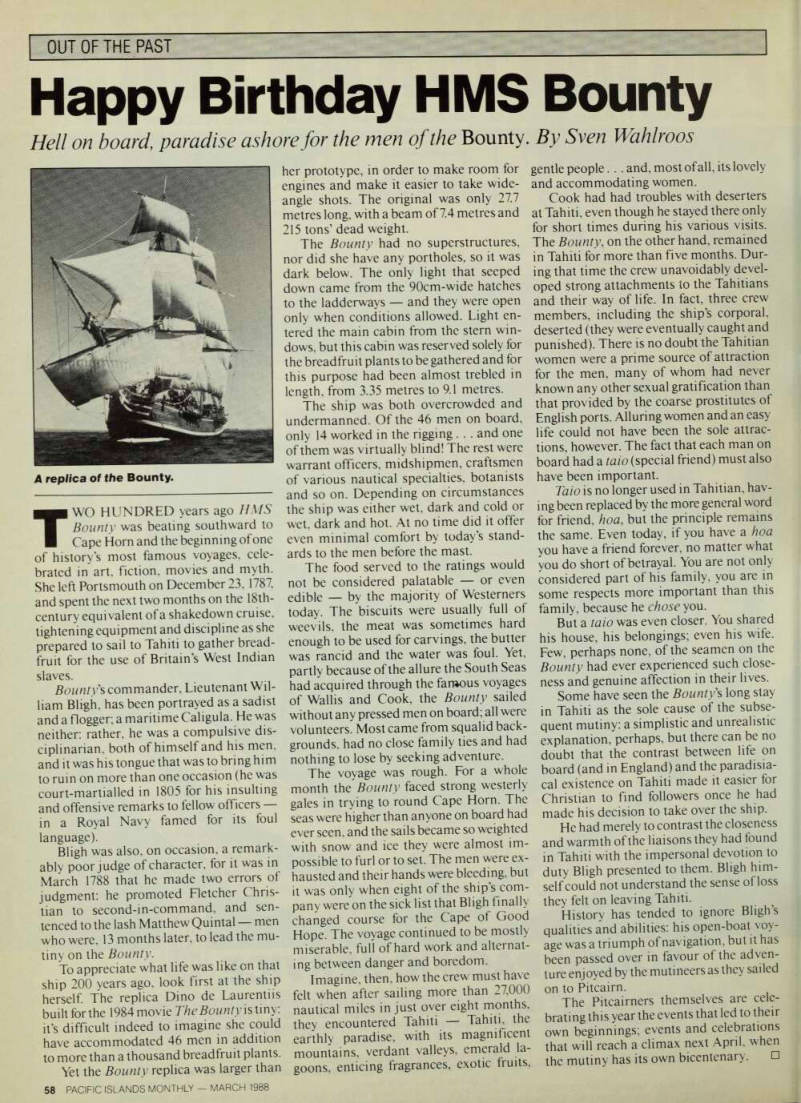
Hell on board, paradise ashore for the men of the Bounty.
By Sven Wahlroos
TWO HUNDRED years ago HMS Bounty was beating southward to Cape Horn and the beginning of one of history’s most famous voyages, cele brated in art, fiction, movies and myth.
She left Portsmouth on December 23, 1787, and spent the next two months on the 18th century equivalent of a shakedown cruise, tightening equipment and discipline as she prepared to sail to Tahiti to gather bread fruit for the use of Britain’s West Indian slaves.
Bounty's commander. Lieutenant Wil liam Bligh, has been portrayed as a sadist and a flogger; a maritime Caligula. He was neither; rather, he was a compulsive dis ciplinarian, both of himself and his men, and it was his tongue that was to bring him to ruin on more than one occasion (he was court-martialled in 1805 for his insulting and offensive remarks to fellow officers in a Royal Navy famed for its foul language).
Bligh was also, on occasion, a remark ably poor judge of character, for it was in March 1788 that he made two errors of judgment; he promoted Fletcher Chris tian to second-in-command, and sen tenced to the lash Matthew Quintal men who were, 13 months later, to lead the mu tiny on the Bounty.
To appreciate what life was like on that ship 200 years ago, look first at the ship herself. The replica Dino de Laurentns built forthe 1984 movie The Bounty isiiny: it’s difficult indeed to imagine she could have accommodated 46 men in addition to more than a thousand breadfruit plants.
Yet the Bounty replica was larger than
her prototype, in order to make room for engines and make it easier to take wide angle shots. The original was only 27.7 metres long, with a beam of 7.4 metres and 215 tons’ dead weight.
The Bounty had no superstructures, nor did she have any portholes, so it was dark below. The only light that seeped down came from the 90cm-wide hatches to the ladderways and they were open only when conditions allowed. Light en tered the main cabin from the stern win dows, but this cabin was reserved solely for the breadfruit plants to be gathered and for this purpose had been almost trebled in length, from 3.35 metres to 9.1 metres.
The ship was both overcrowded and undermanned. Of the 46 men on board, only 14 worked in the rigging . . . and one of them was virtually blind! The rest were warrant officers, midshipmen, craftsmen of various nautical specialties, botanists and so on. Depending on circumstances the ship was either wet, dark and cold or wet, dark and hot. At no time did it offer even minimal comfort by today’s stand ards to the men before the mast.
The food served to the ratings would not be considered palatable or even edible by the majority of Westerners today. The biscuits were usually full of weevils, the meat was sometimes hard enough to be used for carvings, the butter was rancid and the water was foul. Yet, partly because of the allure the South Seas had acquired through the famous voyages of Wallis and Cook, the Bounty sailed without any pressed men on board; all were volunteers. Most came from squalid back grounds, had no close family ties and had nothing to lose by seeking adventure.
The voyage was rough. For a whole month the Bounty faced strong westerly gales in trying to round Cape Horn. The seas were higher than anyone on board had ever seen, and the sails became so weighted with snow and ice they were almost im possible to furl or to set. The men were ex hausted and their hands were bleeding, but it was only when eight of the ship’s com pany were on the sick list that Bligh finally changed course for the Cape of Good Hope. The voyage continued to be mostly miserable, full of hard work and alternat ing between danger and boredom.
Imagine, then, how the crew must have felt when after sailing more than 27,000 nautical miles in just over eight months, they encountered Tahiti Tahiti, the earthly paradise, with its magnificent mountains, verdant valleys, emerald la goons, enticing fragrances, exotic fruits,
gentle people. . . and, most of all, its lovely and accommodating women.
Cook had had troubles with deserters at Tahiti, even though he stayed there only for short times during his various visits.
The Bounty, on the other hand, remained in Tahiti for more than five months. Dur ing that time the crew unavoidably devel oped strong attachments to the Tahitians and their way of life. In fact, three crew members, including the ship’s corporal, deserted (they were eventually caught and punished). There is no doubt the Tahitian women were a prime source of attraction for the men, many of whom had never known any other sexual gratification than that provided by the coarse prostitutes of English ports. Alluring women and an easy life could not have been the sole attrac tions, however. The fact that each man on board had a taio (special friend) must also have been important.
Taio is no longer used in Tahitian, hav ing been replaced by the more general word for friend, hoa, but the principle remains the same. Even today, if you have a hoa you have a friend forever, no matter what you do short of betrayal. You are not only considered part of his family, you are in some respects more important than this family, because he chose you.
But a taio was even closer. You shared his house, his belongings; even his wife.
Few, perhaps none, of the seamen on the Bounty had ever experienced such close ness and genuine affection in their lives.
Some have seen the Bounty's long stay in Tahiti as the sole cause of the subse quent mutiny: a simplistic and unrealistic explanation, perhaps, but there can be no doubt that the contrast between life on board (and in England) and the paradisia cal existence on Tahiti made it easier for Christian to find followers once he had made his decision to take over the ship.
He had merely to contrast the closeness and warmth of the liaisons they had found in Tahiti with the impersonal devotion to duty Bligh presented to them. Bligh him self could not understand the sense of loss they felt on leaving Tahiti.
History has tended to ignore Bhgh’s qualities and abilities: his open-boat voy age was a triumph of navigation, but it has been passed over in favour of the adven ture enjoyed by the mutineers as they sailed on to Pitcairn.
The Pitcairners themselves are cele brating this year the events that led to their own beginnings; events and celebrations that will reach a climax next April, when the mutiny has its own bicentenary. □
A replica of the Bounty.
Advertisements & other items, pp. 58-60 (2 items)
Out Of The Past
fram
Steel Kit-form Buildings
.1 *s A Va /A
JSSSfe C
Space-Frame PRE-ENGINEERED kit form buildings have been designed to cover a wide range of industrial and rural applications.
Space-Frame engineering facilities with
computer aided design and drafting will produce drawings in 24 hours.
The building kit can be shipped out in less than three weeks.
Because of the advanced design techniques and the use of high tensile steel throughout the building, the kit is very light, making the cost of shipping very minimal compared to conventional structures.
It also means the whole building can be erected without the use of a crane. In remote areas of PNG and other Pacific Islands components have been flown in by helicopter to some sites.
frame
SPACEFRAME BUILDINGS PTY. LTD.
61 DIDSBURY STREET, EAST BRISBANE, 4169,
QUEENSLAND, AUSTRALIA. TELEX AA42862.
PHONE (07) 393 1455 FAX (07) 391 5016
FOR MORE INFORMATION & BROCHURE
POST COUPON TODAY
r
SPACEFRAME BUILDINGS PTY. LTD.
61 DIDSBURY ST., EAST BRISBANE, 4169, AUST.
NAME.
ADDRESS.
POSTCODE PHONE.
J
A ? v i V 3S nt i IB ©soa 0 » sJ THE HIMALAYA RALLY-1 ST & 2ND OVERALL WINNERS.
VICTORY ON THE ROOF OF THE WORLD. rally is the Himalaya rally, 3000 kilometers of treacherous desert and alpine track. Then try to imagine the sheer resilience of the vehicle that manages to come in first. In the 1987 Himalaya Rally, that car was Imagine a rally where the hazards include encounters with lone tigers, and where leopards crouch on precipices watching the vehicles wind 4000 meters up onto the roof ofthe world. Such a 1 m m m m the Mitsubishi Starion. In fact, both first and second overall winners were Starions.
For six days, from New Delhi to the Kandhi Pass in the Himalayas and back again, the two Mitsubishi Starions literally dominated the event from the start.
This kind of performance is a result of Mitsubishi Motors' policy of seeking out the harshest conditions in which to test the reliability of their vehicles, and where better than on the roof of the world. r* AMERICAN SAMOA: MORRIS SCANLAN SERVICE INC. PO Box 367, Pago Pago, Tel 633-5520/AUSTRALIA: MITSUBISHI MOTORS AUSTRALIA LTD. B ° x Road, Clovelly Park, South Australia 5042, Tel [08) 275-7223/FUI: NIVIS MOTOR & MACHINERY CO , LTD. G.PO Box 150, Suva, Tel 383411 /FRENCH POLYNESIA (TAHITI): ETS-BREDIN FRERES ET FILS PO Box 21, Papeete, Tahiti, Tel 4-202-58/NEW CALEDONIA; SOCIETE DIMPORTATION D AUTO DU PACIFIQUE SUD S.A B P Point du Paciflque Noumea, Tel 274144/NEW ZEALAND: MITSUBISHI MOTORS NEW ZEALAND LTD. Todd Park, Henot Drive. Private Bag, Ponrua, Tel 370-109/NORFOLK ISLAND: BORRYS LTD. P O Box 169,‘Norfolk Island, Tel 2114/PAPUA NEW GUINEA: TOBA PTY. LTD. PO. Box 503, Port Moresby Tel 21-7874/SOLOMON ISLANDS. HARVEST PACIFIC LTD. G.PO. Box 88, Honiara, Guadalcanal, Tel 30128/TONGA: SITANI MAFI CO.. LTD PO. Box 83, Nuku ALOFA, Tel 21-044/VANUATU: SOCOMETRA 06 Route de Lagon, Port-Vila, Tel 2314/WESTERN SAMOA: A M MACDONALD HOLDINGS LTD. PO Box 576, Apia, Tel. 22022/SAIPAN/POHNPEI/MAJURO/KOSRAE/TRUK/YAP/ BELAU; MICRONESSIAN MOTORS, INC. 997 South Marine Drive, Tamuning, Guam 96911, Tel 646-6827 A
MITSUBISHI
MOTORS