Pacific

Islands
Monthly
American Samoa US$2.OO Australia A 52.00 Cook Islands NZ$3.OO Fiji F 51.75 Hawaii US$2.5O Kiribati A 52.00 Nauru A 52.00 New Caledonia CFP2SO New Zealand NZ$3.OO Niue NZ$2.5O Norfolk Island A 52.00 Papua New Guinea K 2.00 Solomon Islands 552.00 Tahiti CFP3OO Tonga P 2.00 Tuvalu A 52.00
Usa Us$3.Oo
USTT and Guam US$2.5O Vanuatu VT2.00 Western Samoa T 2.75 ♦Recommended retail price only
r
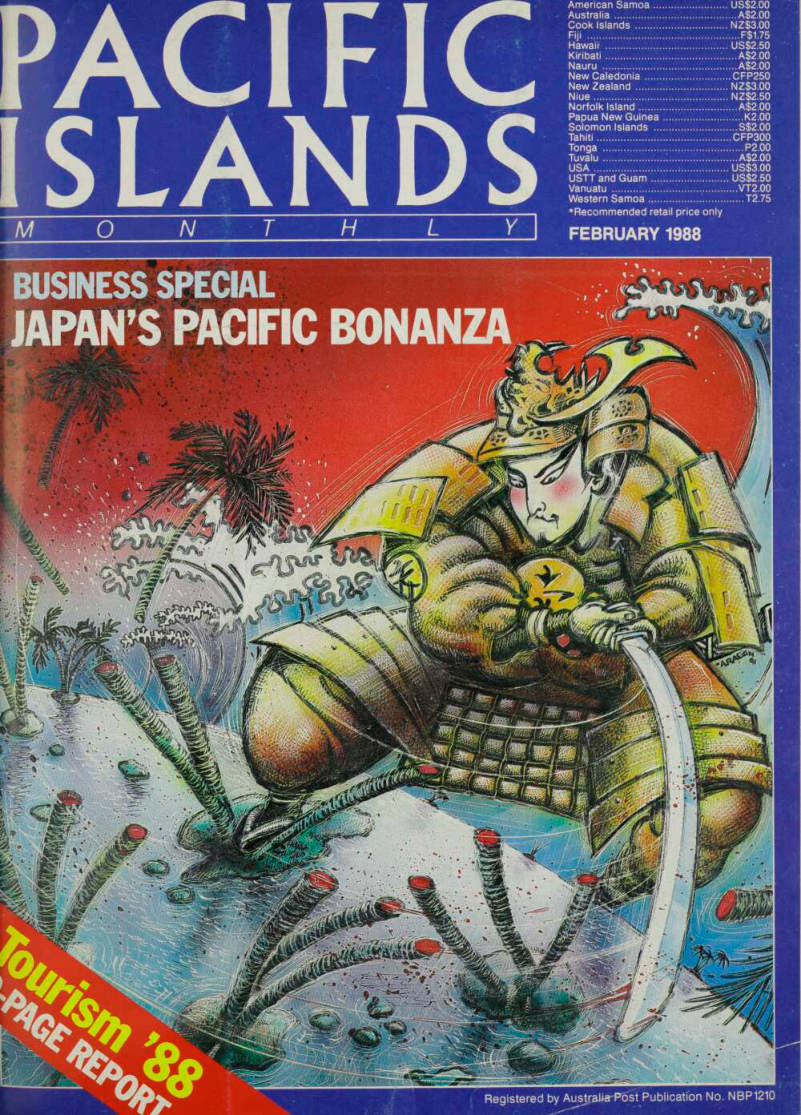
Business Special
Japan’S Pacific Bonanza
Registered by AusJralwrFost Publication No. NBPI2IO
Cover Illustration: Ed Aragon
Advertisements & other items, p. 2 (1 item)
The pinnacle of
sporty pr -
From the onset, the Legend has represented an exquisite integration of Honda's engineering, technology and quality craftsmanship. A car whose performance unrestricted by old-world pedigrees became the index of excellence for the discerning motorist. For this selective driver, Honda proudly presents the new Legend Sports Coupe. Its regal aerodynamic bearing makes it classic. Its generous interior makes it rewarding. And its sporty demeanour makes it unique.
Elegance refined by sporting demands.
To give prestigious performance a sporting chance, Legend's appeal begins with the quality that is most easily recognized sleek, athletic looks that are aerodynamically refined. The remarkable drag coefficient of 0.30 reduces wind resistance and enhances the whisper-quiet ride. Legend's lavishly appointed .cabin is a low-stress environment that sets the stage for high-powered fun.
Already hailed as a stunning technological achievement in the Legend sedan, Honda's potent race-bred V-6 assumes even greater prominence here. A larger 2.7-liter SOHC 24-valve engine provides liquid-smooth response across its entire operating range, satisfying your thirst for exhilaration to the fullest degree. For an equivalent level of handling response, Legend's 4-wheel double t wishbone suspension takes a page from Formula One racing cars, adding uncommon stability at every turn of the road. And just as quickly as Legend's performance begins, Honda's four-wheel-disc anti-lock brake system brings it to a fast, smooth conclusion.
The Legend Sports Coupe. An experience born of Honda's most prestigious automotive technologies. And bred by its commitment to make driving uniquely exhilarating. (Hhoxda
JF=>F=-
m Specifications and equipment may vary in some countries.
Honda engines have powered the Williams/Honda team to consecutive Formula One Constructors' Championships in 1986 and 1987, and dominated the Grand Prix world.
For 1988, Honda engines will continue to compete in motor sport's toughest arena with the Lotus and McLaren Teams.
Mod' an
POWERED by HONDA
AUSTRALIA: Honda Australia Pty, Ltd. Lot 95 Sharps Road, Tullamarine, Victoria 3043/NEW ZEALAND: NZMC Limited Manners Plaza, 57-65 Manners St , Wellington/PAPUA NEW GUINEA: Toba Pty., Ltd. P.O Box 503, Port Moresby/TAHITI: Honda Distribution S.A. R.L B.P 1665, Papeete/KIRIBATI: Atoll Motor & Marino Services P.O. Box 49, Bairiki Tarawa, Republic of Kiribati/ U.S. TRUST TERRITORY: United Micronesia Development Association P.O. Box 235, CHRB Saipan CM 96950/COOK ISLANDS: Cook Islands Motor Centre Ltd. P.O. Box 74, Rarotonga/ GUAM: Mark’s Motor Co., Inc. P.O. Box DV, Agana/WESTERN SAMOA: Motor Distributors (Samoa) Ltd. P.O. Box 576, Apia/SOLOMON ISLANDS: Lee Kwok Kuen & Co., Ltd. P.O. Box 537, Honiara/ NEW CALEDONIA: Soci6t6 Du Chalandage 8, Rue de la somme-B.P 97, Noumea/NAURU: Nauru Cooperation Republic of Nauru/FIJI: Coral Island Motors Ltd. Robertson Road, Suva, Fiji/ AMERICAN SAMOA: Holiday Motors, Parts and Service P.O. Box 968, Pago Pago, American Samoa 96799; Heleck’s Service Center Ltd. P.O. Box 1138. Pago Pago, American Samoa 96799/TONGA; Tonga Industrial Traders P.O. Box 1035, Nukualofa, Tonga/NORFOLK ISLAND: Duncombe Bay Garage New Cascade Road, Norfolk Island/VANUATU: Honda Farm Ltd. P.O. Box 1031, Pori Vila, Vanuatu
Pacific
Islands
Monthly
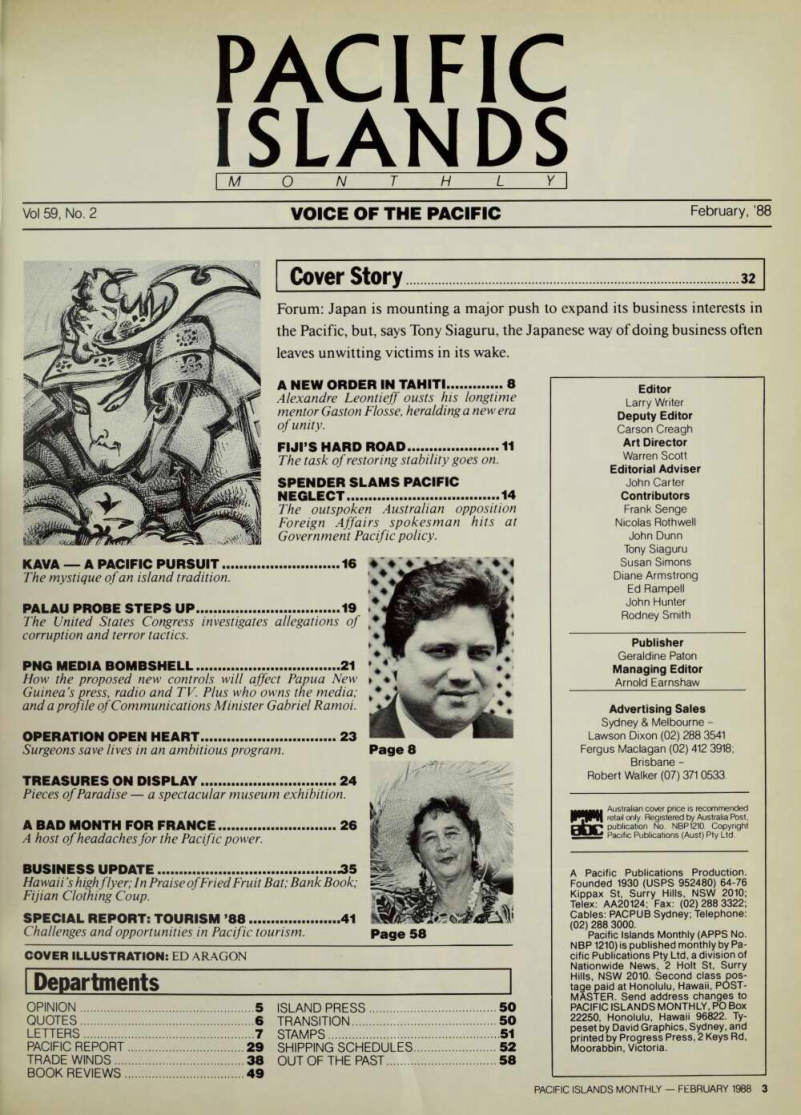
Vol 59, No. 2
Voice Of The Pacific
February, ’BB
Cover Story 32
Forum: Japan is mounting a major push to expand its business interests in the Pacific, but, says Tony Siaguru, the Japanese way of doing business often
leaves unwitting victims in its wake.
A New Order In Tahiti 8
Alexandre Leontieff ousts his longtime mentor Gaston Flosse, heralding a new era of unity.
Fiji’S Hard Road 11
The task of restoring stability goes on.
Spender Slams Pacific
Neglect 14
The outspoken Australian opposition Foreign Affairs spokesman hits at Government Pacific policy.
Kava A Pacific Pursuit 16
The mystique of an island tradition.
Palau Probe Steps Up 19
The United States Congress investigates allegations of corruption and terror tactics.
Png Media Bombshell 21
How the proposed new controls will affect Papua New Guinea’s press, radio and TV. Plus who owns the media; and a profile of Communications Minister Gabriel Ramoi.
Operation Open Heart 23
Surgeons save lives in an ambitious program.
Treasures On Display 24
Pieces of Paradise a spectacular museum exhibition.
A Bad Month For France 26
A host of headaches for the Pacific power.
Business Update .35
Hawaii’s high flyer; In Praise of Fried Fruit Bat; Bank Book; Fijian Clothing Coup.
Special Report: Tourism ’Bb 41
Challenges and opportunities in Pacific tourism.
Page 8
Page 58
Editor Larry Writer Deputy Editor Carson Creagh Art Director Warren Scott Editorial Adviser John Carter Contributors Frank Senge Nicolas Rothwell John Dunn Tony Siaguru Susan Simons Diane Armstrong Ed Rampell John Hunter Rodney Smith Publisher Geraldine Raton Managing Editor Arnold Earnshaw Advertising Sales Sydney & Melbourne - Lawson Dixon (02) 288 3541 Fergus Maclagan (02) 412 3918; Brisbane - Robert Walker (07) 371 0533.
Australian cover price is recommended retail only. Registered by Australia Post, publication No. NBPI2IO. Copyright Pacific Publications (Aust) Pty Ltd.
Departments
Opinion 5
Quotes 6
Letters 7
Pacific Report 29
Trade Winds 38
Book Reviews 49
Island Press 50
Transition 50
Stamps 51
Shipping Schedules 52
Out Of The Past 58
Advertisements & other items, pp. 3-4 (2 items)
3
PACIFIC ISLANDS MONTHLY FEBRUARY 1988
A Pacific Publications Production.
Founded 1930 (USPS 952480) 64-76 Kippax St, Surry Hills, NSW 2010; Telex: AA20124; Fax: (02)288 3322; Cables: PACPUB Sydney: Telephone: (02) 288 3000.
Pacific Islands Monthly (APPS No.
NBP1210) is published monthly by Pa cific Publications Pty Ltd, a division of Nationwide News, 2 Holt St, Surry Hills, NSW 2010. Second class pos tage paid at Honolulu, Hawaii, POST MASTER. Send address changes to
PACIFIC ISLANDS MONTHLY, PO Box
22250, Honolulu, Hawaii 96822. Ty peset by David Graphics, Sydney, and printed by Progress Press, 2 Keys Rd, Moorabbin, Victoria.
* Citizen
■ ■« ir .
our
¥ r «*• r % t v<
CITIZEN
m /I We’ve got fashion creations, sports innovations, high-tech inspirations. For any situation - there’s a Citizen watch.
* CITIZEN
FOR FURTHER INFORMATION. PLEASE CONTACT:
Australia: Citizen Watches Australia Pty. Ltd- -122 Old Pittwater Road, Brookvale. NSW 2100.
Tel: 939 7077. Cable: Citizen Sydney.
Telex; AA26633. Fax; 932864.
Fiji Islands: Tappoo Limited, P.O. Box, Sigatoka. Fiji. TeL 50199. Telex: FJ4244.
New Zealand: Citizen Watches (N. 2.) Ltd., P.O. Box 9518, Auckland. New Zealand.
Tel: 543 393. Telex: 21429. Fax: 544177.
Norfolk Island: Landy & Co., P.O. Box 31.
Norfolk Island. 2899, South Pacific. Tel: 2163.
American Samoa: Malaloa Duty Free Shoppers.
P.O. Box 2183, Pago Pago.
American Samoa. 96799. Tel: 633 5513.
Tahiti: Morgan Vernex, Fare Lite B.P. 449, Tahiti.
Tel: 2.03.09.
New Caledonia: Est. Ballande, B.P. Box C 4.
Noumea. New Caledonia. Tel; 27.20.31.
Rarotonga: South Seas International Ltd., P.O. Box 49, Rarotonga, Cook Islands. Tel; 2327 Papua New Guinea: Kara Pty. Limited.
P.O. Box 329. Port Moresby. Tel: 25 6044.
Thorns Among The Roses
Opinion
The Wingti Government’s excellent record has been tarnished lately by a series of potentially costly misjudgments and ministerial fiascos.
THE GOVERNMENT of Paias Wingti has much of which it can be proud. Its rural development pro gram the Prime Minister’s personal obsession is a highly praiseworthy scheme that, if successful, will make Papua New Guinea more self-sufficient, its citizens more prosperous and self-respecting, as well as enticing people from the relative anonymity and welfare queues of the cities back to the rich traditions of the provinces.
Also to the Government’s credit is its responsible for eign policy. Mr Wingti has made his nation more secure by locking Indonesia and Australia into trade and defence agreements, is establishing a host of new trading partners, and is an influential and eloquent spokesman for Me lanesian interests all over the Pacific.
The Government has benefited, too, by the dedicated
work of Sir Julius Chan in getting the business commu nity on side.
However, the Government’s record is not all rosy. Ma jor debits must be the decision to appoint national MPs to Government agency boards, the forcing of foreign owned coffee exporting companies to sell out by October, and the Government’s seeming inability to do anything about the country’s continuing law and order problems.
The Wingti Administration’s image has not been helped by the series of scandals, gaffes and fiascos that have dogged the steps of the once influential, now dis graced, Ted Diro and the hapless Mr Matiabe.
But the proposal with the potential to do the most tell ing damage to the Government is the controversial bill, announced by Communications Minister Mr Gabriel Ra moi, to control the nation’s media by the establishment of a mass media tribunal. Despite the Government’s high sounding claims that such controls will ensure the pres ervation of national ideals and put the brakes on foreign ownership, the bill reeks of Iron Curtain regulation.
Shackling of the media has no place in this otherwise energetic and free-spirited nation. And the sections of the bill that direct a licensee to publish whatever the minister deems to be of national importance, and that prohibit the publication of material prohibited by the minister, the mass media tribunal or the censor, are shackles of the most blatant kind.
When announcing the proposed legislation, Mr Ramoi said the bill was non-negotiable. Mr Wingti has since said he is seeking consultation with media owners, the churches, the opposition and business, a considerable softening of the original stance. It is hoped that this con sultation will help the Government see the error of its way and scrap this odious legislation.
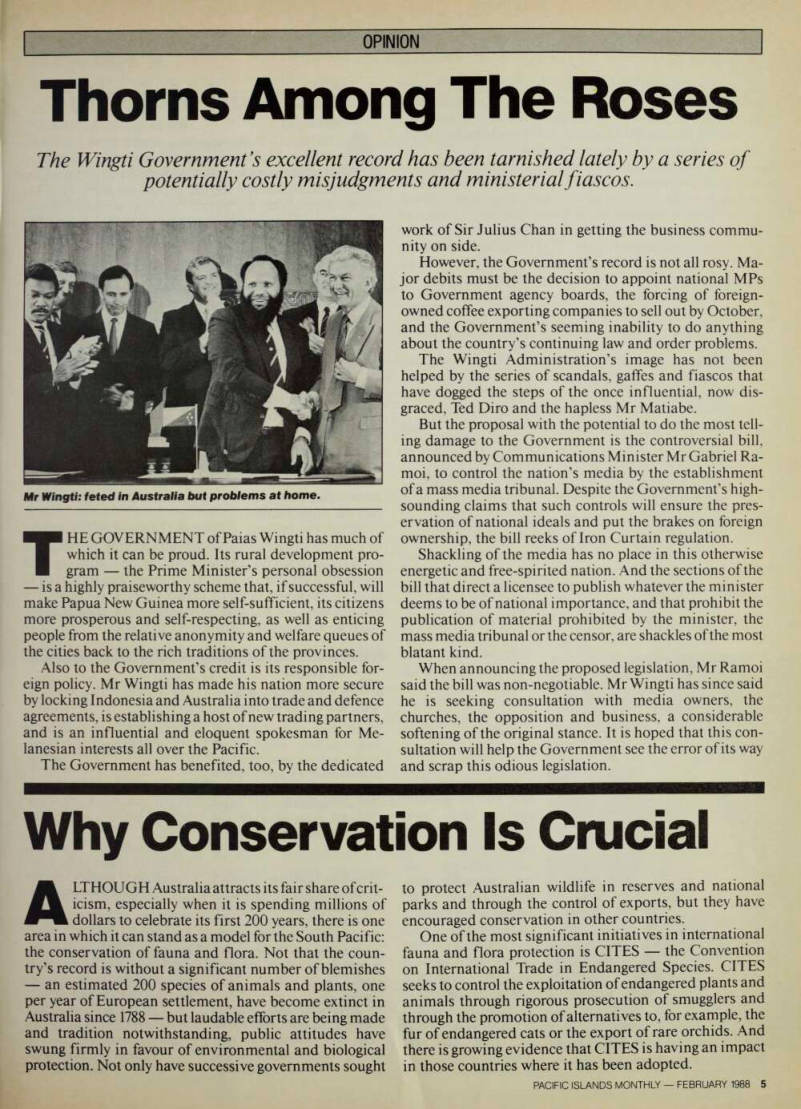
Mr Wingti: feted in Australia but problems at home.
Why Conservation Is Crucial
ALTHOUGH Australia attracts its fair share of crit icism, especially when it is spending millions of dollars to celebrate its first 200 years, there is one area in which it can stand as a model for the South Pacific: the conservation of fauna and flora. Not that the coun try’s record is without a significant number of blemishes an estimated 200 species of animals and plants, one per year of European settlement, have become extinct in Australia since 1788 but laudable efforts are being made and tradition notwithstanding, public attitudes have swung firmly in favour of environmental and biological protection. Not only have successive governments sought
to protect Australian wildlife in reserves and national parks and through the control of exports, but they have encouraged conservation in other countries.
One of the most significant initiatives in international fauna and flora protection is CITES the Convention on International Trade in Endangered Species. CITES seeks to control the exploitation of endangered plants and animals through rigorous prosecution of smugglers and through the promotion of alternatives to, for example, the fur of endangered cats or the export of rare orchids. And there is growing evidence that CITES is having an impact in those countries where it has been adopted.
But adoption has not been universal, and for a variety of reasons almost 70 nations have not signed the Conven tion. Among them are Fiji, Kiribati, Marshall Islands, the Federated States of Micronesia, Solomon Islands, Tonga, Tuvalu, Vanuatu and Western Samoa.
In the face of pressing economic and social needs, it is tempting to dismiss conservation as a side issue until one looks at the record in other developing nations. Brazil is destroying its greatest natural resource, the rainforest of the Amazon basin, at a rate of hectares per day for the immediate and long-term benefit of firms based in strong First World nations. Similarly, much of northern Africa’s growing desert (the Sahara is expanding southward at more than 25 kilometres a year) is “fed” by agricultural practices that allow the destruction of habitats and finely evolved natural systems. In the Pacific, the problem is growing too: timber exploitation, mainly in PNG and the Solomons, is endangering whole human communities as well as animal and plant groups. Even coastal fishermen are feeling the effects as the denudation of inland forests brings soil runoff to reefs, killing fish and corals.
A more telling statistic is that the International Union for the Conservation of Nature and Natural Resources’
Red Data Book , which lists animals and plants endan gered, or at risk of extinction, includes 237 animals alone in the Pacific region. No-one knows for sure how many plants are at risk; just as no-one knows for sure what effect the extinction of any one of those animals or plants will have on whole ecosystems, or the potential benefits to hu mans of chemicals extracted from animals (such as ma rine organisms) or plants. Quite apart from potential benefits to humanity, what value can we place on the sur vival of even the lowliest organism for its own sake? We are presumptuous if we decide which plants and animals may live, and which may not: just as we are when we di-
vide societies along racial, religious or ethnic lines.
The Pacific at tracts tourists and scientists because it is perceived as one of the planet’s last un spoiled regions. Un less Pacific peoples realise that their landscapes and their plant and animal communities are non-renewable, non negotiable re sources, their quaint customs and attrac tive artifacts are des tined to become savagely inappro priate reminders of how the inhabitants of paradise gradually sold their way into perdition.
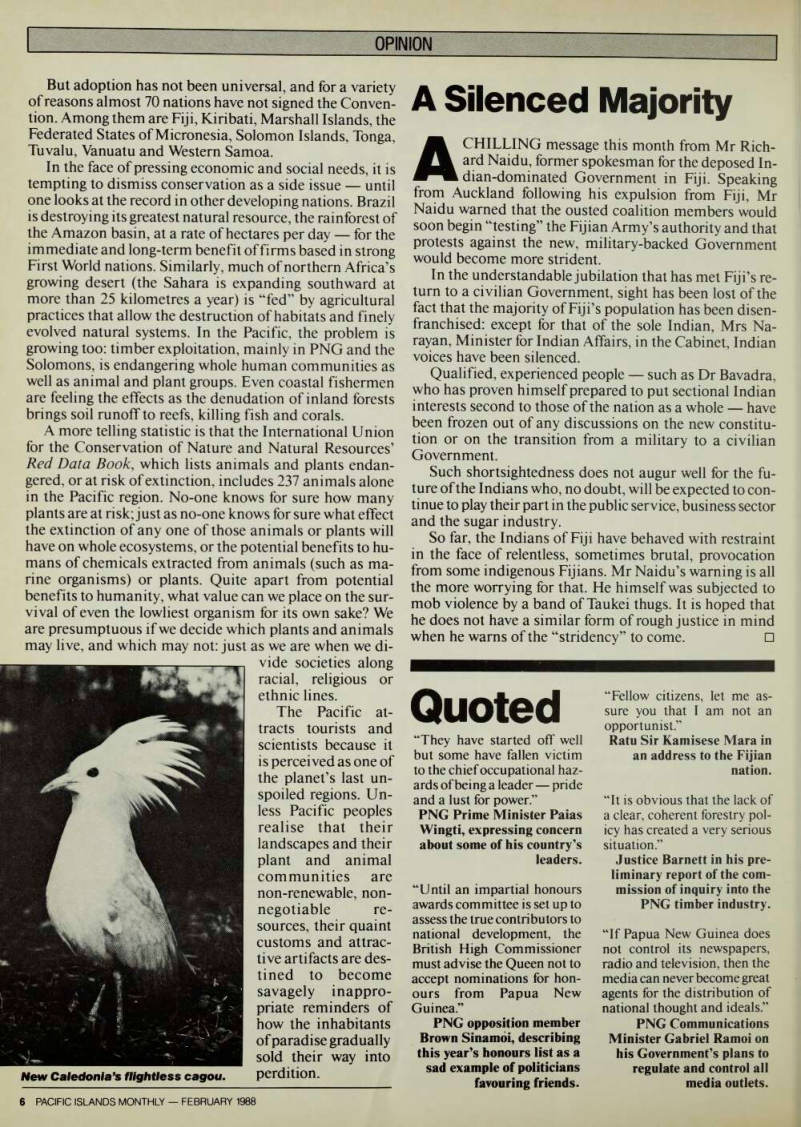
New Caledonia’s flightless cagou.
A Silenced Majority
A CHILLING message this month from Mr Rich ard Naidu, former spokesman for the deposed In dian-dominated Government in Fiji. Speaking from Auckland following his expulsion from Fiji, Mr Naidu warned that the ousted coalition members would soon begin “testing” the Fijian Army’s authority and that protests against the new, military-backed Government would become more strident.
In the understandable jubilation that has met Fiji’s re turn to a civilian Government, sight has been lost of the fact that the majority of Fiji’s population has been disen franchised: except for that of the sole Indian, Mrs Na rayan, Minister for Indian Affairs, in the Cabinet, Indian voices have been silenced.
Qualified, experienced people such as Dr Bavadra, who has proven himself prepared to put sectional Indian interests second to those of the nation as a whole have been frozen out of any discussions on the new constitu tion or on the transition from a military to a civilian Government.
Such shortsightedness does not augur well for the fu ture of the Indians who, no doubt, will be expected to con tinue to play their part in the public service, business sector and the sugar industry.
So far, the Indians of Fiji have behaved with restraint in the face of relentless, sometimes brutal, provocation from some indigenous Fijians. Mr Naidu’s warning is all the more worrying for that. He himself was subjected to mob violence by a band of Taukei thugs. It is hoped that he does not have a similar form of rough justice in mind when he warns of the “stridency” to come. □
Quoted
“They have started off well but some have fallen victim to the chief occupational haz ards of being a leader pride and a lust for power.”
PNG Prime Minister Paias Wingti, expressing concern about some of his country's leaders.
“Until an impartial honours awards committee is set up to assess the true contributors to national development, the British High Commissioner must advise the Queen not to accept nominations for hon ours from Papua New Guinea.”
PNG opposition member Brown Sinamoi, describing this year's honours list as a sad example of politicians favouring friends.
“Fellow citizens, let me as sure you that I am not an opportunist.”
Ratu Sir Kamisese Mara in an address to the Fijian nation.
“It is obvious that the lack of a clear, coherent forestry pol icy has created a very serious situation.”
Justice Barnett in his pre liminary report of the com mission of inquiry into the PNG timber industry.
“If Papua New Guinea does not control its newspapers, radio and television, then the media can never become great agents for the distribution of national thought and ideals.”
PNG Communications Minister Gabriel Ramoi on his Government's plans to regulate and control all media outlets.
Letters
Remembering The Heroes
I READ with great interest the story “Bringing The Heroes Back Home” in January Pacific Islands Monthly. As a veteran of the Pacific War myself, I can share with the families of those airmen the relief, even after 40 or so years, of knowing what had happened to their boys.
One thing that emerges from Mr Hiar i’s excellent story is the work being done by the Papua New Guinea Government to catalogue the crash sites and to preserve relics of the conflict; not to glorify war, but to show future generations the price so many paid so they could live and grow in freedom. The PNG Government is to be congratulated for this concern, although I would like to see more involvement by Australian Government and veterans’ or ganisations. I do not know whether the Japanese Government takes an official in terest in bringing its own heroes home, or whether it is only veterans’ organisations and the like who take such care, but I wish our own old soldiers would display the same kind of interest, instead of concen trating on remembering their comrades by preserving their memory in alcohol.
Malcolm Harradence (ex RAAF) Blackheath, New South Wales Australia
High-Minded “Attackers” Of Fiji
I CANNOT understand the attitude of countries like New Zealand and Australia.
They attack Fiji for taking control of their own destiny away from Indian owner ship of media, business and government control and they criticise Fijian foot ballers for playing in South Africa.
Where will this hypocrisy end? Both of these countries trade with South Africa, and both have sportsmen who compete in South Africa. Rugby and cricket players from New Zealand and cricketers from Australia even tennis “ace” Pat Cash have travelled to South Africa. Have they been attacked at home in newspapers?
Have they been attacked by the same newspapers that attack Brigadier Rabuka for giving Fiji back to the Fijians?
Pacific Islands Monthly has been prominent in this hypocrisy. You publish ridiculous theories how the CIA made the coup, then you attack the Russians for dar ing to sail their ships in the Pacific. Let me tell you, the old days are over! The Pacific Ocean does not belong to Australia, Rus sia, England or America any more: it be longs to the people who were here before anyone.
J K Raiwalui
Samabula Republic of Fiji
The Games Must Stop
LIKE many observers of Pacific affairs, I’ve been concerned about the continuing gamesmanship being played in Palau: in your journal as well as newspapers, I read of assassinations, bombings, corruption, threats, riots, mysterious fires, all appar ently directed against opponents of the Compact of Free Association with the United States.
I am not supporting or decrying the Compact: I am neither a citizen of Palau nor of the United States, and it would be impertinent of me to tell the people of Pa lau which way to vote. But there is defi nitely something rotten there, and it is past the point where the Governments of Palau and the USA can get away with the tactics of intimidation.
The economy of Palau is in tatters, with forced retrenchments from the civil serv ice, investors scared off by bullying, aid apparently slashed and, as my Palauan friends tell me, little incentive to work for an administration that seems more wor ried about its enemies than the citizens it is elected to serve.
The situation is not one-sided, how ever: the USA, Home of the Free, seems to be treading as gently and as diplomatically as it did in the Solomons during the tuna wars. It is high time the investigating team of the General Accounting Office finished its work (surely they have enough infor mation by now!) and reported, so the people of Palau and of the world can see what is really going on. The Compact question has to be settled, and settled soon.
The Soviets are just over the horizon, waiting for an opportunity to expand their own interest and influence in the Pacific.
Dr C R Buell
Orchard Road Singapore
More Arts Please
THE LATEST issues of your magazine have covered many political topics. What interests me is the material on crafts, film, music, culture and sport. Can we not have a little more feature material in the magazine?
Thorkild Hoy,
Maglehoj, Farum, Denmark.
While it is our policy to present read ers with the big political stories, we are now expanding our feature pages to bring you articles on the arts and sport.
From this issue onward, too, there will be more business news pages in Pacific Islands Monthly. Editor.
Advertisements & other items, p. 7 (1 item)
Pacific
SLANDS
I M O N T H L Y I FIJI: Distribution and subscriptions: Desai Bookshops, PO Box 160, Suva, Fiji. Phone Suva 23036.
Advertising: Fiji Times & Herald Ltd, 20 Gordon St., Suva.
Phone 31-4111, telex FJ2124.
FRENCH POLYNESIA: Distribution: Hachette Pacifique 10 Ave., Bruat, Papeete. Phone 25-610.
HAWAII: UNITED STATES: Distribution: PIM, Hawaii, PO Box 22250, Honolulu, Hawaii, 96822. Advertising; Brian C Asgill, Apt. 1308,1676 Ala Moana Blvd., Honolulu, Hawaii, 96815. Phone (808) 955-9718.
JAPAN: Advertising and subscriptions: Universal Media Corporation, GPO Box 46, Tokyo. Phone 666-3036, cable UNIMEDIA Tokyo, telex 2524665.
MALAYSIA; Advertising and subscriptions: Worldwide Media Services, 57-B Komplex Damai, Jin Dato Haji Eusoff, Kuala Lumpur. Phone 63-9340, cables WORLDMEDIA Kuala Lumpur, telex 31533.
VANUATU: Distribution: The Vanuatu Stationery and Book Centre, PO Box 557 Port Vila. Advertising: Norman Bros. Bookshop. Port Vila Phone 2232.
NEW CALEDONIA: Distribution: Depot Centre de Presse Michel Pentecost, CBP2, Noumea. Phone 27- 2434, 27-4729.
NEW ZEALAND: Distribution: Gordon & Gotch, PO Box 584 , 2 Carr Road, Mt Roskill, Auckland 4.
Advertising: McKay International Media Reps Ltd, C/- Albany PO, Auckland 10, New Zealand. Phone 413-9119.
Telex NZ22701, FAX 413-9110.
WELLINGTON: Ross Quaid Media, 1 Scholes Ln„ Petone. (04) 68-7593, PO Box 38699, Petone PAPUA NEW GUINEA: Distribution: Gordon & Gotch, PO Box 3395, Port Moresby Phone 25-4551, 25-4855.
Advertising: Ken Head, PNG Post-Courier, PO Box 85, Port Moresby. Phone 21-2577, telex 22120.
SOLOMON ISLANDS: Distribution and Advertising: The Bookshop, (Norman Bros.) PO Box 503, Honiara.
PHILIPPINES: Advertising: The GF Group, 12 San Ignacio St., Uroaneta Village, Makati, Metro Manila. Phone 817-7299, telex 45950 and 4233.
UNITED KINGDOM: The Herald & Weekly Times Ltd, No 1 Maltravers St., London WC2R3DZ, England. Phone (01) 836-5162, telex London 21989.
UNITED STATES MAINLAND: Advertising: Joshua B. Powers Jr., Powers International Inc., Suite 708, 271 Madison Ave., New York, NY 10016. Phone 867-9580, Subscriptions: PIM, Hawaii, PO Box 22250, Honolulu.
Hawaii, 96822.
SUBSCRIPTIONS
American Samoa...
Australia Canada Cook Islands Fiji French Polynesia Guam Hawaii Japan Kiribati Micronesia Nauru New Caledonia New Zealand Niue Norfolk Island Northern Marianas Papua New Guinea Solomon Islands ...
Tonga Tuvalu United Kingdom ...
US (Mainland) Vanuatu Western Samoa ...
Elsewhere ...US$45
AUS$24
...US$45
AUS$46
AUS$46
...US$45 ...US$45 ..US$45 ...US$38
AUSS46
...US$35
AUS$42
...US$32
AUS$42
AUS$46
AUS$42
...US$36
AUS$42
AUS$46
AUS$46
AUS$46
..Stg£28 ...US$45
AUS$42
AUS$60
AUS$63
Payments to Pacific Islands Monthly: Subscriptions Dept, GPO Box 5223BB, Melbourne 3001, Australia Subscriptions rates includes the cost of airspeeding to all destinations set out above. Direct airmail rates on application.
A New Order Takes Charge
French Polynesia
Alexandre Leontieffs sudden rise to power may see an end to Tahiti’s bitter
confrontational politics.
By Nicolas Rothwell.
BEHIND THE sound and fury of changing government in Papeete at year’s end, a far more subtle and profound transformation was taking place in French Polynesia a territory where the calm grace of surface appearances is always deceptive, and revolutionary pas sions lurk unknown.
When Alexandre Leontieff, the young, technocratic new President of the Terri torial Assembly, staged his December coup, ending the political control of his long-time mentor, Gaston Flosse, insiders in Papeete were slow to realise this was more than a routine convulsion in the es tablished sanctuaries of power; more than a quarrel within the ruling house.
In fact, the direct antecedent to the Leontieff coup was an event outside Pa peete’s incestuous political arena an event that has already assumed symbolic significance throughout Tahiti, as quickly as it passes into the realms of myth the October riots that swept the capital, leav ing many harbourside shopfronts smok ing ruins.
Emblem of a failing order, or portent of greater turmoils to come, the “troubles” in Papeete served as pretext for a sudden splintering of French Polynesia’s political order; Mr Leontieff was able to pull to gether a coalition drawn from the ranks both of the Gaullist establishment Taho eraa Huiraatira and the many-faceted op position parties.
Even if his reign is brief, this one act has drastically redefined the political map of the territory, and ended an era of con frontational politics an era that was in disputably dominated by the Tahoeraa’s master politician, Mr Gaston Flosse.
Yet this shake-up of French Polynesia’s power structure is complicated by one ov erarching factor the crucial influence exerted by the coming April’s mainland French Presidential campaign on the political complexion of all the overseas territories.
The socialist incumbent, Mr Francois Mitterrand, will face determined chal lenges from a pair of conservative con tenders one, the current Prime Minister, Mr Jacques Chirac, is the Tahoeraa’s es tablished patron; the other, economic affairs guru and former Prime Minister Raymond Barre, is likely to attract the support of Mr Leontieff.
But significantly, elements of the new ruling coalition are already pledged to
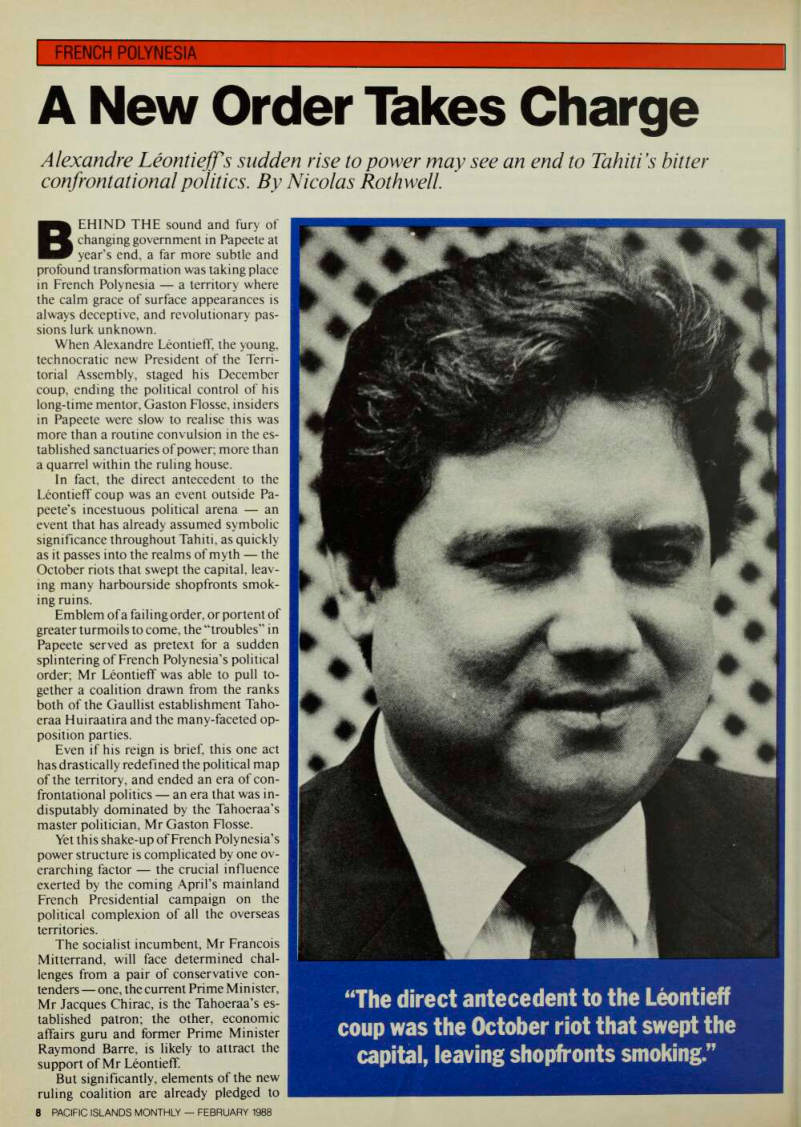
"The direct antecedent to the léontieff coup was the October riot that swept the caoital, leaving shopfronts smoking."
supporting the Mitterrand candidacy, so an early and fundamental test of the “non ideological” Leontieff Government is in prospect.
Relations between the territory and the distant French mainland or“metropol” are also complicated by the tangled web of political alliances caused by the Leontieff coup. Prime Minister Chirac’s own Ras semblement Pour la Republique (RPR) is bound to support Mr Flosse, who is a member of the Chirac Cabinet in his ca pacity as minister with responsibility for Pacific affairs; yet, now out of govern ment, Mr Flosse’s Tahoeraa may be a less capable campaigning force.
For Mr Flosse himself, the ousting of the territorial Government led by his loyal lieutenant, Mr Jacky Teuira, was a body blow, since a part of his prestige and effectiveness in the South Pacific stemmed from his local power base.
Should Mr Mitterrand win the Presi dential poll, Mr Flosse would lose his portfolio, and France’s entire Pacific pol icy would almost certainly be revised.
An unlikely agent of that change emerged just before new year in Paris, when Mr Leontieff himself suggested to President Mitterrand that he give consid eration to reactivating a moribund instru ment of French influence in the Pacific —the South Pacific Council, presided over by a prominent radical intellectual, Mr Regis Debray.
Indeed, since he assumed control of the territorial Government, Mr Leontieff has been on an intriguing political journey. His conservative critics complain that he is under the malign influence of leftists in his governing coalition but the truth seems to be that he believes French Polynesia, a delicate society in a stage of transition, needs a politics of unity more than the confrontational techniques that main tained the Tahoeraa in power.
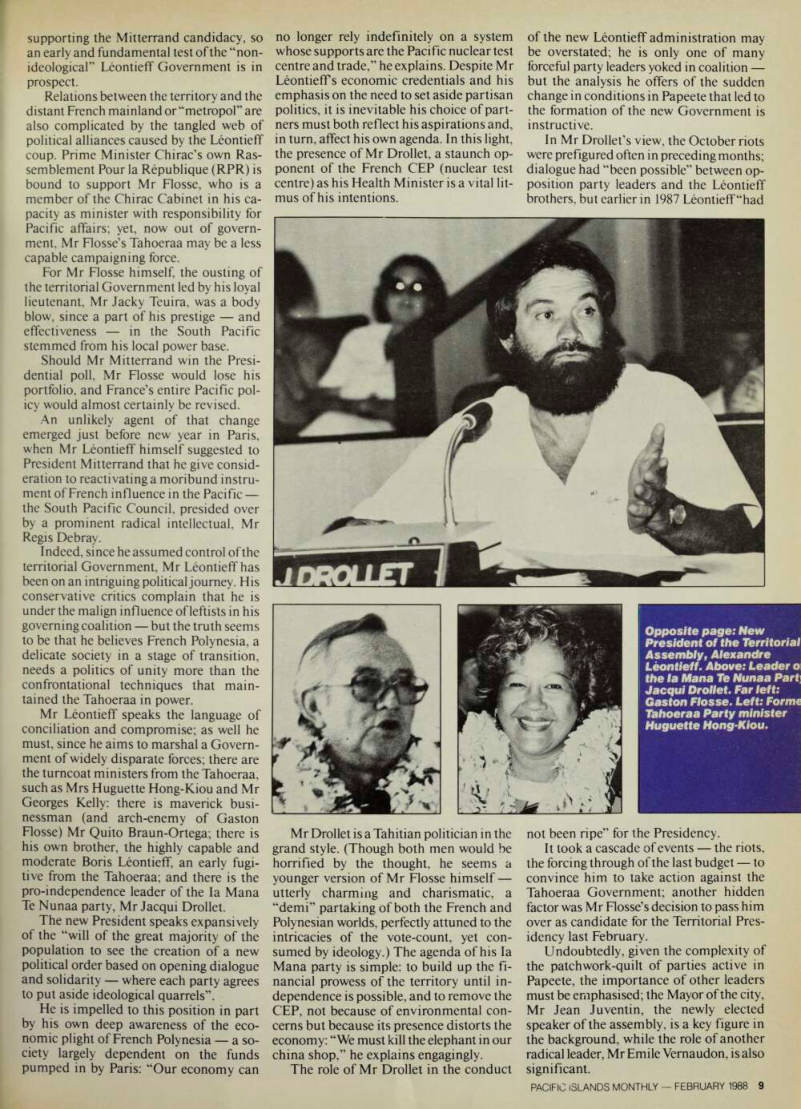
Mr Leontieff speaks the language of conciliation and compromise; as well he must, since he aims to marshal a Govern ment of widely disparate forces; there are the turncoat ministers from the Tahoeraa, such as Mrs Huguette Hong-Kiou and Mr Georges Kelly; there is maverick busi nessman (and arch-enemy of Gaston Flosse) Mr Quito Braun-Ortega; there is his own brother, the highly capable and moderate Boris Leontieff, an early fugi tive from the Tahoeraa; and there is the pro-independence leader of the la Mana Te Nunaa party, Mr Jacqui Drollet.
The new President speaks expansively of the “will of the great majority of the population to see the creation of a new political order based on opening dialogue and solidarity where each party agrees to put aside ideological quarrels”.
He is impelled to this position in part by his own deep awareness of the eco nomic plight of French Polynesia a so ciety largely dependent on the funds pumped in by Paris: “Our economy can
no longer rely indefinitely on a system whose supports are the Pacific nuclear test centre and trade,” he explains. Despite Mr Leontieffs economic credentials and his emphasis on the need to set aside partisan politics, it is inevitable his choice of part ners must both reflect his aspirations and, in turn, affect his own agenda. In this light, the presence of Mr Drollet, a staunch op ponent of the French CEP (nuclear test centre) as his Health Minister is a vital lit mus of his intentions.
of the new Leontieff administration may be overstated; he is only one of many forceful party leaders yoked in coalition but the analysis he offers of the sudden change in conditions in Papeete that led to the formation of the new Government is instructive.
In Mr Drollet’s view, the October riots were prefigured often in preceding months; dialogue had “been possible” between op position party leaders and the Leontieff brothers, but earlier in 1987 Leontieff “had
Mr Drollet is a Tahitian politician in the grand style. (Though both men would be horrified by the thought, he seems a younger version of Mr Flosse himself utterly charming and charismatic, a “demi” partaking of both the French and Polynesian worlds, perfectly attuned to the intricacies of the vote-count, yet consumed by ideology.) The agenda of his la Mana party is simple: to build up the financial prowess of the territory until independence is possible, and to remove the CEP, not because of environmental concerns but because its presence distorts the economy: “We must kill the elephant in our china shop,” he explains engagingly.
The role of Mr Drollet in the conduct
not been ripe” for the Presidency, It took a cascade of events the riots, the forcing through of the last budget to convince him to lake action against the Tahoeraa Government; another hidden factor was Mr Flosse’s decision to pass him over as candidate for the Territorial Pres idency last February, Undoubtedly, given the complexity of the patchwork-quilt of parties active in Papeete, the importance of other leaders must be emphasised; the Mayor of the city, Mr Jean Juventin, the newly elected speaker of the assembly, is a key figure in the background, while the role of another radical leader, Mr Emile Vemaudon, is also significant.
Opposite page: New President of the Territorial Assembly, Alexandre Léontieff. Above: Leader o[?] the la Mana Te Nunaa Part y Jacqui Drollet. Far left: Gaston Flosse. Left: Forme Tahoeraa Party minister Huguette Hong-Kiou.
“Times are changing... and this is what Gaston Flosse did not understand this need of the young to express themselves.”
M But analysts are now recognising the extent to which Mr Leontieffs decision to lead the defection from the Tahoeraa was a personal one a move that grew from the troubled ties between himself and Mr Flosse; and in that pattern can be traced other tokens of change now gusting through Tahiti.
One intimate of Mr Leontieff ventures that the riots were “only the tip of an ice berg of change, they were symptoms; for we have an economy that desperately needs a new source of funds, we have a fast growing population but no jobs this means the time is here for action, and the broader the consensus, the better it is”.
Leontieffs supporters tend to claim that their new administration will be more “Tahitian”, that it will avoid the confron tational styles supposedly characteristic of French mainland politics.
Another of the inner circle, this “court
of Czar Alexandre”, hints at the prevailing optic being employed by Polynesian ob servers to explain December’s palace coup: “This was as much about generations as about politics you can see it all over the territory the young displaces the old and assumes power.”
This pattern is traced in the realm of social change, where the once-undisputed writ of the family elders is now increas ingly challenged by members of the cos mopolitan younger generation. Many of Tahiti’s young have come to develop a bit ter resentment toward the consumerism obsessed, tourism-fuelled society that has failed to provide them with the jobs they need to enjoy the lifestyles that have been promised them.
Significantly, as these changes are tak ing place, the established political al legiances enjoyed by parties such as the Tahoeraa may begin to break down, not
only at the parliamentary level but also amongst the electorate, as younger family members proceed to break ranks with their elders.
“Times are changing it is May ’6B that has been happening here over the past few months, and this is what Gaston Flosse didn’t understand this need of the younger generation to express them selves,” one thoughtful political insider comments.
But a key Tahoeraa loyalist, one of Mr Flosse’s most trusted aides, sees things differently; he views Leontieff as a turn
coat who could never have won power at the polls, and so was forced to sieze it by parliamentary manoeuvre.
In this version of events, Flosse figures not as an old reactionary but as the friend of youth as the first Polynesian politi cian who gave opportunities to younger leaders, a rare meritocrat who rewarded brilliance and enterprise. And nothing is as certain, for those who entertain this view, as that Mr Flosse will sweep back to power again in the next election, van quishing the ungrateful prodigal.
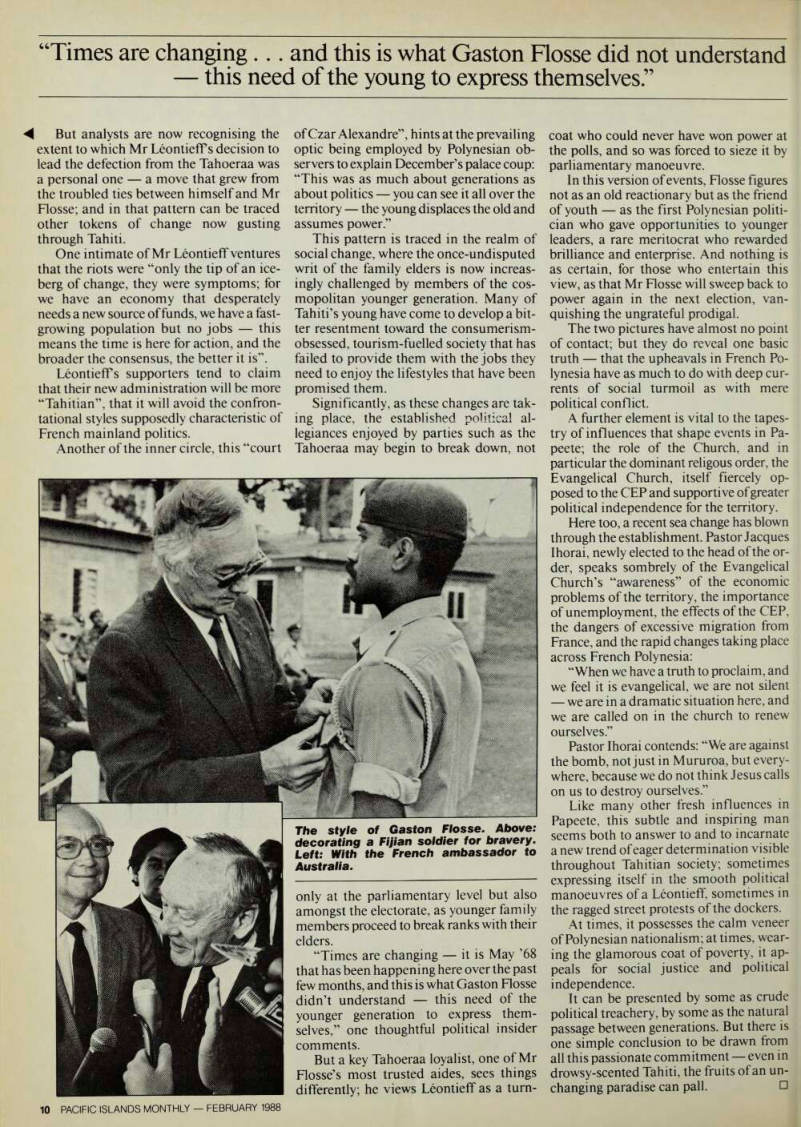
The two pictures have almost no point of contact; but they do reveal one basic truth that the upheavals in French Po lynesia have as much to do with deep cur rents of social turmoil as with mere political conflict.
A further element is vital to the tapes try of influences that shape events in Pa peete; the role of the Church, and in particular the dominant religous order, the Evangelical Church, itself fiercely op posed to the CEP and supportive of greater political independence for the territory.
Here too, a recent sea change has blown through the establishment. Pastor Jacques Ihorai, newly elected to the head of the or der, speaks sombrely of the Evangelical Church’s “awareness” of the economic problems of the territory, the importance of unemployment, the effects of the CEP, the dangers of excessive migration from France, and the rapid changes taking place across French Polynesia: “When we have a truth to proclaim, and we feel it is evangelical, we are not silent we are in a dramatic situation here, and we are called on in the church to renew ourselves.”
Pastor Ihorai contends: “We are against the bomb, not just in Mururoa, but every where, because we do not think Jesus calls on us to destroy ourselves.”
Like many other fresh influences in Papeete, this subtle and inspiring man seems both to answer to and to incarnate a new trend of eager determination visible throughout Tahitian society; sometimes expressing itself in the smooth political manoeuvres of a Leontieff, sometimes in the ragged street protests of the dockers.
At times, it possesses the calm veneer of Polynesian nationalism; at times, wear ing the glamorous coat of poverty, it ap peals for social justice and political independence.
It can be presented by some as crude political treachery, by some as the natural passage between generations. But there is one simple conclusion to be drawn from all this passionate commitment even in drowsy-scented Tahiti, the fruits of an un changing paradise can pall. □
T he style of Gaston Flosse. Above: decorating a Fijian soldier for bravery.
Left: With the French ambassador to Australia.
Counting The Cost

Fiji
Fiji struggles to restore stability.
By John Dunn
FIJI WILL probably never be the same again, but it does seem the sit uation looks considerably more promising than in the dark days after May 14. Nevertheless, it is also clear that there are still very many problems to overcome.
Several developments, both internally and externally, in the early days of 1988 appear likely to play an important part in shaping the immediate outcome for Fiji.
At home the principal plus is that the nation remains not only violence-free but remarkably settled and stable. The new ci vilian Government headed by former Prime Minister Ratu Sir Kamisese Mara is settling in and adopting a low-key and commendably cautious approach to its
rule. Its most important initial task is the approval of the interim constitution, which will become the supreme law of the coun try until a new constitution is adopted.
The publication of its details and their acceptance, or otherwise, will largely hold the key to the future administration of the country.
In the meantime, an extremely tough budget is in place in an attempt to halt the nation’s deteriorating financial situation.
The uncertainty that followed the first coup caused a negative growth rate of 11 per cent last year but the budget is de signed not only to arrest that trend but to cut the negative growth rate by about half in 1988. Indirect taxes will be increased,
with excise rates being raised on ciga rettes, tobacco, beer, spirits and petrol.
As well, a two per cent duty has been placed on major exports including sugar, timber, gold and silver while the hotel turnover tax has been increased by three per cent to eight per cent.
These additional costs will make it even tougher for the majority of the population, already hard hit by prices that have risen about a third since the first coup. Traders have reported a general downturn of about 50 per cent in sales with some items, such as meat, falling by about 80 per cent.
Shoppers are relying on the staples such as potatoes and onions.
The cost of living is not the only aspect of Fiji’s daily life that has been affected. A severe brain drain is under way among professional people, ranging from doctors and lawyers to teachers and those with management expertise. Almost all are In dian and they have decided their future lies elsewhere, mainly in Australia, New Zea land or Canada.
The area worst hit is medicine, where hospital attention has been curtailed be cause of lack of skilled staff, causing the virtual elimination of elective surgery. The new civilian Government is well aware of this alarming situation and is searching actively for staff in several Asian countries.
However, while these problems are real and disturbing enough, there are some pluses on the home front, quite apart from the return of general community stability and orderliness.
The threat to peace posed by the mili tant Taukei movement seems to be under control even if it has not been completely extinguished.
An end-of-year demonstration by Tau kei extremists, who want the Government to take a harder and tougher pro-Fijian line or disband, and the Great Council of Chiefs to have a stronger and more direct voice in Government decisions, was turned aside with no violence and only a minor disruption to the newfound calm.
The movement has been virtually neu tralised by a split within its ranks, with a significant number of members happy to go along with the more moderate stance of the new civilian administration.
In fact, one of the Taukei leaders, Mr Taniela Veitata, has accepted a ministerial (Employment and Industrial Relations) and cabinet position that has taken con siderable steam out of the Taukei stand.
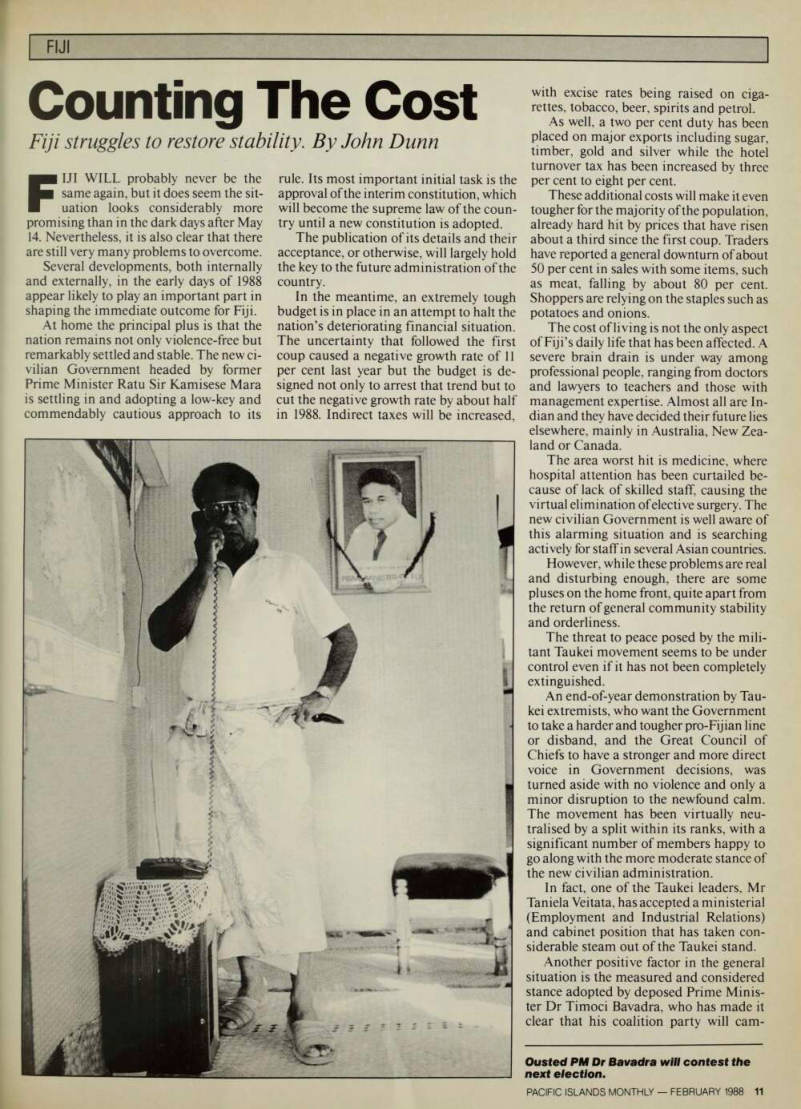
Another positive factor in the general situation is the measured and considered stance adopted by deposed Prime Minis ter Dr Timoci Bavadra, who has made it clear that his coalition party will cam-
Ousted PM Dr Bavadra will contest the next election.
paign for the next election but will do so in a “lawful and peaceful way”.
Dr Bavadra spends almost all his time now at his home village of Viseisei on the western side of tne main island of Viti Levu, but continues to monitor the politi cal developments in Suva. Fie has kept well clear of any controversial comments but did react to the suggestion that Australia may recognise the new civilian Govern ment. He called on Australia, and New Zealand, “to withhold any recognition until guarantees of democracy were given”.
In the same statement, his first for more than two months, Dr Bavadra made it plain that he expects to be consulted about the new constitution but there is, of course, no guarantee that this will happen.
The Australian move to recognise Fiji stems not from any desire to condone the political happenings of the past eight months but from a considerable concern that Australia could lose touch with, and influence in, not only Fiji but with the re gion as a whole.
The Australian Government fears the Soviet Union and Libya might attempt to step up their role in the South Pacific by taking advantage of the vacuum created by the stand-off that has developed.
Australia, too, is watching carefully the French attitude to the situation because it does not want Paris to replace it as Fiji’s major source of aid and vital trading part ner. Rumours persist that the French have been active indeed in Fiji, offering an aid package worth about SAI2 million, show ing a willingness to discuss help with cap ital works which, in turn, would provide badly needed employment, and to be dis cussing the possible sale of helicopters.
Miles Johnston, president of the Fijian Law Society, has expressed strong doubts about the French Government’s motives.
“It is early days yet but we are just seeing the tip of the iceberg with the French,” he says. “They will exert a great deal of politi cal influence and it will have two effects.
One will be to reduce the pressure in fa vour of the Kanak movement in New Ca ledonia; the other will be to diminish the
criticism of their bomb tests at Mururoa.”
Australia is expected to stop short of recognis ing the Fijian Govern ment officially, and would sidestep that problem by changing the basis on which it estab lishes diplomatic rela tions with other countries, from one of recognising govern
ments to that of recognising states.
If the Australian cabinet adopts this proposal it is likely Australian aid and defence pacts with Fiji (which were suspended following the coup) will be reinstated, allowing Australia to resume its
normal, substantial role with the country.
The Australian media has been watch ing this particular aspect with great inter est. The Melbourne Herald saw value in it.
Noting that “Australia’s interests in the South Pacific have been diminished by events in Fiji,” it observed: “It is apparent that outside powers are more than willing to take advantage of the situation.”
The Herald added: “Too much is at stake in the South Pacific and too much needs to be done for the well-being of its people for Australia to stand aside and let others take the running.”
Fiji cannot yet be written off as a po tential trouble spot, but it does seem that the worst in physical terms may be finished. Whether democracy is also fin ished remains to be seen. □
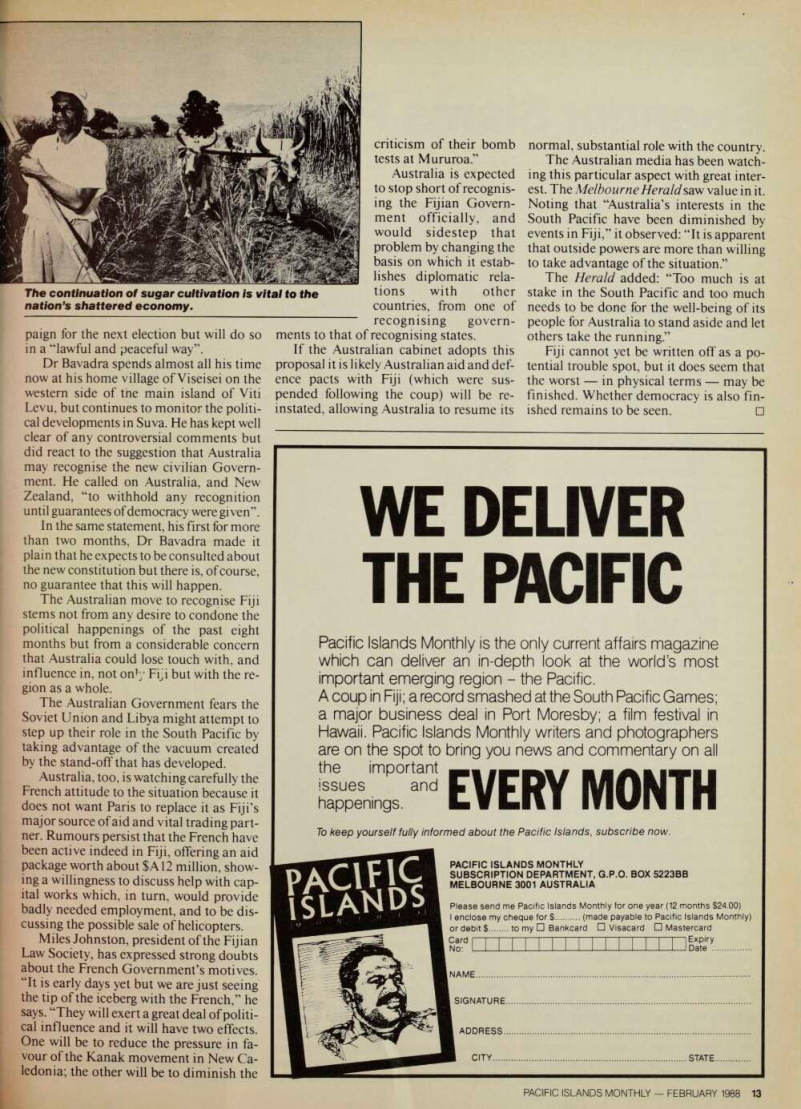
The continuation of sugar cultivation is vital to the nation’s shattered economy.
Advertisements & other items, pp. 12-13 (1 item)
anyhow
have a
Winfield
tfr* efiLr* A H okinc bning vn/a
WE DELIVER
THE PACIFIC
Pacific Islands Monthly is the only current affairs magazine which can deliver an in-depth look at the world’s most important emerging region - the Pacific.
A coup in Fiji; a record smashed at the South Pacific Games; a major business deal in Port Moresby: a film festival in Hawaii. Pacific Islands Monthly writers and photographers are on the spot to bring you news and commentary on all the important issues and
happenings.
EVERY MONTH
To keep yourself fully informed about the Pacific Islands, subscribe now.
PACIFIC ISLANDS MONTHLY
SUBSCRIPTION DEPARTMENT, G.P.O. BOX 522388
MELBOURNE 3001 AUSTRALIA
Please send me Pacific Islands Monthly for one year (12 months $24.00) I enclose my cheque for $ (made payable to Pacific Islands Monthly) or debit $ to my □ Bankcard □ Visacard □ Mastercard Sr i i i i i i i i isa?
SIGNATURE.
ADDRESS.
CITY.
STATE,
Spender Slams Pacific Neglect
Australia
Australia’s shadow Foreign Minister speaks out.
By Larry Writer
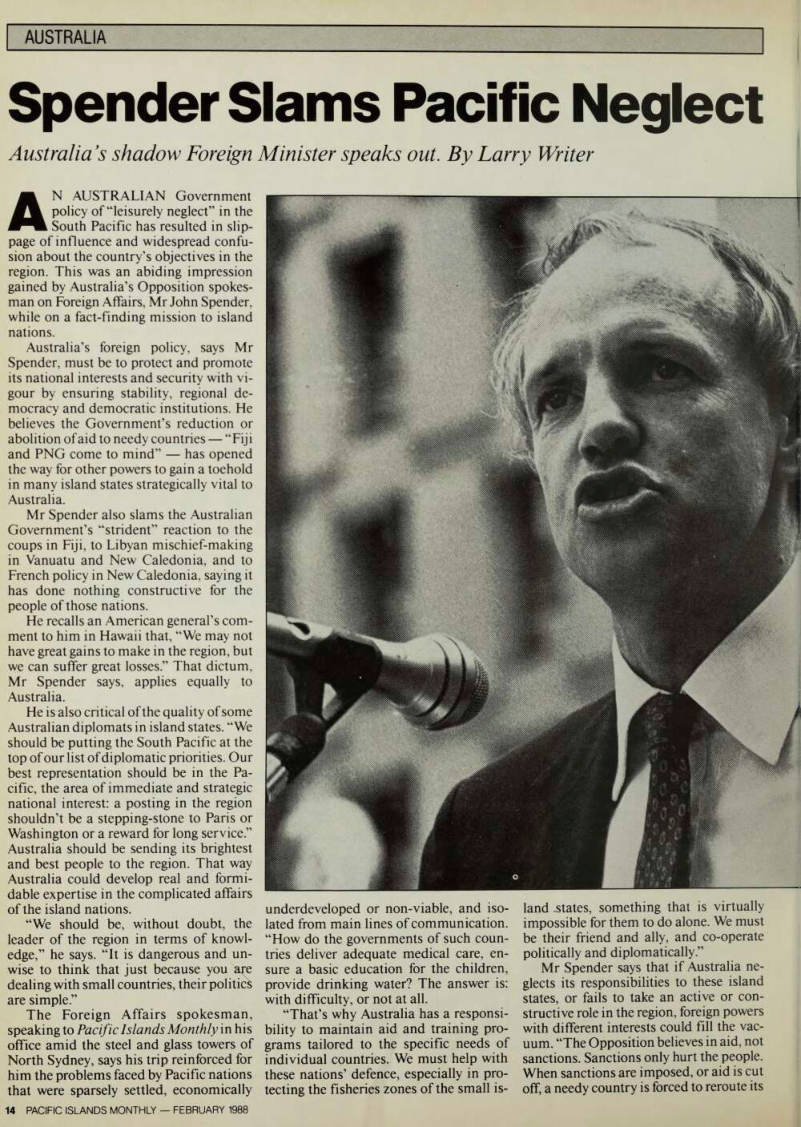
AN AUSTRALIAN Government policy of “leisurely neglect” in the South Pacific has resulted in slip page of influence and widespread confu sion about the country’s objectives in the region. This was an abiding impression gained by Australia’s Opposition spokes man on Foreign Affairs, Mr John Spender, while on a fact-finding mission to island nations.
Australia’s foreign policy, says Mr Spender, must be to protect and promote its national interests and security with vi gour by ensuring stability, regional de mocracy and democratic institutions. He believes the Government’s reduction or abolition of aid to needy countries “Fiji and PNG come to mind” has opened the way for other powers to gain a toehold in many island states strategically vital to Australia.
Mr Spender also slams the Australian Government’s “strident” reaction to the coups in Fiji, to Libyan mischief-making in Vanuatu and New Caledonia, and to French policy in New Caledonia, saying it has done nothing constructive for the people of those nations.
He recalls an American general’s com ment to him in Hawaii that, “We may not have great gains to make in the region, but we can suffer great losses.” That dictum, Mr Spender says, applies equally to Australia.
He is also critical of the quality of some Australian diplomats in island states. “We should be putting the South Pacific at the top of our list of diplomatic priorities. Our best representation should be in the Pa cific, the area of immediate and strategic national interest: a posting in the region shouldn’t be a stepping-stone to Paris or Washington or a reward for long service.”
Australia should be sending its brightest and best people to the region. That way Australia could develop real and formi dable expertise in the complicated affairs of the island nations.
“We should be, without doubt, the leader of the region in terms of knowl edge,” he says. “It is dangerous and un wise to think that just because you are dealing with small countries, their politick are simple.”
The Foreign Affairs spokesman, speaking to Pacific Islands Monthly in his office amid the steel and glass towers of North Sydney, says his trip reinforced for him the problems faced by Pacific nations that were sparsely settled, economically
underdeveloped or non-viable, and iso lated from main lines of communication.
“How do the governments of such coun tries deliver adequate medical care, en sure a basic education for the children, provide drinking water? The answer is: with difficulty, or not at all.
“That’s why Australia has a responsi bility to maintain aid and training pro grams tailored to the specific needs of individual countries. We must help with these nations’ defence, especially in pro tecting the fisheries zones of the small is
land .states, something that is virtually impossible for them to do alone. We must be their friend and ally, and co-operate politically and diplomatically.”
Mr Spender says that if Australia ne glects its responsibilities to these island states, or fails to take an active or con structive role in the region, foreign powers with different interests could fill the vac uum. “The Opposition believes in aid, not sanctions. Sanctions only hurt the people.
When sanctions are imposed, or aid is cut off, a needy country is forced to reroute its
energies. Necessity becomes the mother of invention and, to survive, the disaffected country looks elsewhere for assistance.”
The Opposition spokesman says a nu clear-free Pacific is “a nonsense”. “I op pose the concept of the South Pacific Nuclear Free Zone. Compliance with such a proposal would tie Australia’s hands were we ever required to offer, say, America base facilities of one kind or another.
“Does a nuclear-free zone mean we are
free from the threat of a nuclear war? No country on earth is free from that threat.
Does a nuclear-free zone mean your na tion is free from the passage of nuclear powered ships? There is no way any major maritime power would agree to that. Nu clear powered ships can be found in the navies of the United States, the USSR, Britain, France and China. More such ships will be built as nuclear energy be comes increasingly efficient. These are all realities and words can’t change them.”
Nevertheless, Mr Spender opposes
French nuclear testing on Mururoa but, ever the pragmatist, feels there is little that can be done to put a stop to them and sees little chance that the French will take their tests elsewhere.
The flamboyant politician welcomes Fiji’s return to civilian government but has misgivings about the yet to be promul gated constitution. He is concerned that it could entrench racial or ethnic back grounds as a basis for voting, and that it
may ensure that a group of a partic ular background enjoys a guaran teed majority.
A lawyer him self, Mr Spender also sees a need for the constitution to be enforced by an independent judi ciary. “No matter how brilliantly it is worded, the con stitution will only be as good as its capacity to protect the rights of the people. This takes a strong and inde pendent court.
The world is lit tered with consti tutions that are ignored by subser vient or terrified judges.”
Another clear conclusion he drew was that Aus tralia and the world would have to get used to deal ing with a very dif ferent Fiji from the one we have known. “There are bound to be tee thing problems for us and for the Fi jians themselves,” he says. “The re lationship be tween indigenous Fijians and Indi ans is something that will have to be
worked out by all Fijians. I hope they can do it without violence.” Many of the people of the islands he visited, he says, sympathised with Brigadier Rabuka’s ideals, but took issue with the methods he used to achieve them, A Western Samoan MP had told him that the events in Fiji had initiated a ripple effect that would spread throughout the entire region. “The coups were an exam pie of how the old ways and customs were under challenge and in danger of breaking down. If the chiefly system had held, the
coups could never have happened,” Mr Spender says.
The Australian Government could not be proud of its position on New Cale donia. Mr Spender says its “strident” ap proach to French policy there had not succeeded in helping the cause of Kanak independence; it had merely only alien ated the French. There are, he says, some indications that a number of FLNKS members are becoming impatient with the peaceful tactics of FLNKS leader Tji baou. These people are prime customers for Libyan arms dealers, says Mr Spender.
Libya would make trouble for France wherever it could as payment in kind for French support of the Government in Chad. “Some people in New Caledonia believe now that violence is the only op tion left. I hope that card is not played.
Something achieved through violence can be worse than what it has replaced.
“For the time being the FLNKS must realise that, as hard as it is for them, a small voice is better than no voice. They should contest the New Caledonia elections after the French Presidential elections. The French, for their part, must make an effort to listen to legitimate Kanak grievances such as those concerning land rights.
However, the French track record at lis tening is not heartening. The best hope for the country is for all parties to try to re solve differences without bloodshed. And that requires leadership.”
Mr Spender hits out at the Australian Government for cutting its aid to PNG by $AlOm in 1986. “This was an extraordi narily stupid move. We didn’t even tell them it was going to happen we just went ahead and did it.
“Papua New Guineans, understanda bly, regard this heavy-handedness as an arrogant way of doing business. It has un dermined their confidence in our inten tions. The cutting of a relatively small amount of aid money has undone a great deal of good and we have now to overcome that,” says Mr Spender.
“The aid reduction has caused PNG to believe that Australia is less reliable now than it has been in the past and that PNG should now court new friends and trade and defence arrangements. But I don’t think you’ll find PNG rushing out and signing defence agreements with the So viet Union!” Mr Spender adds that Aus tralia has to learn to live with PNG’s emerging assertions of independence.
He is “not paranoid” about incursions into the region by such powers as the USSR, Indonesia and Libya. “At the end of the day,” he says, “we are here and they are not. We have geography on our side.
Players will come and go. The Soviets do not live here; we do.
“Our strategic interests are obvious. We must use our economic and military strength to benefit the countries in the re gion, to benefit ourselves, because we are going to be here forever.” □
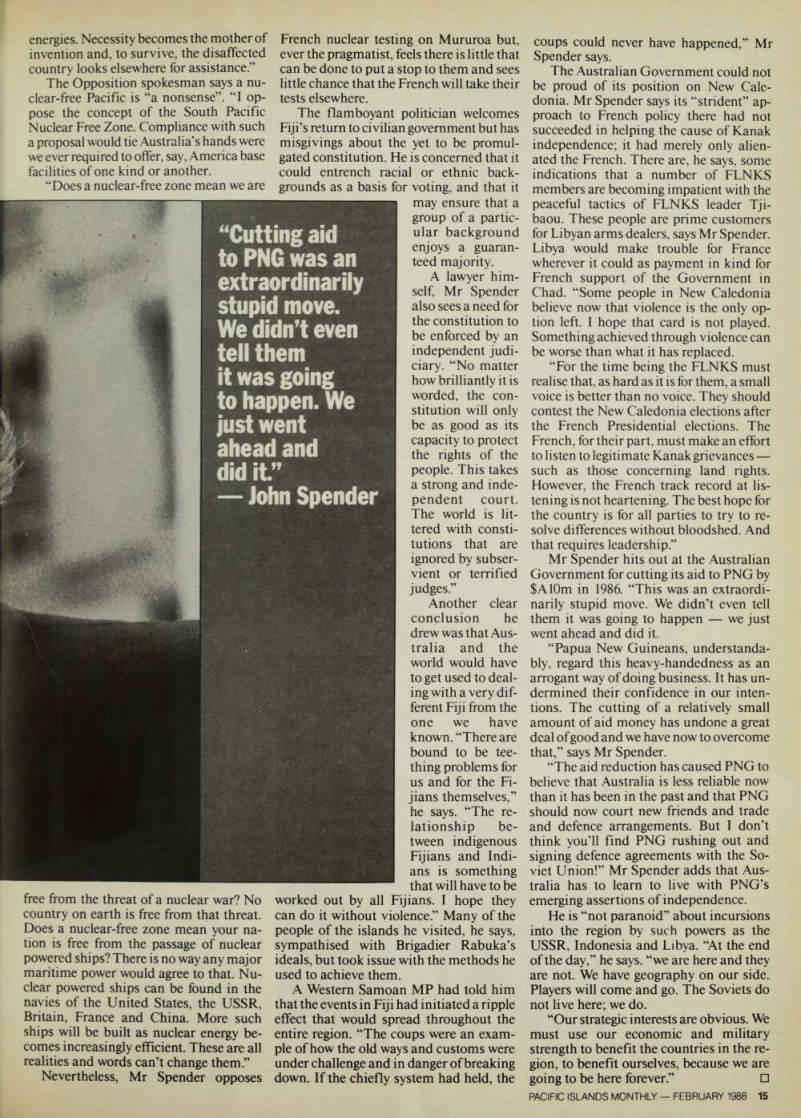
“Cutting aid to PNG was an extraordinarily stupid move.
We didn’t even tell them it was going to happen. We just went ahead and did it.” -John Spender
Kava: A Pacific Ritual
The Region
Peace and contact with the spiritual word are granted by the roots of the
“intoxicatingpepper”.
By Nicolas Rothwell
AS THE SUN sets each evening across the islands of Vanuatu, men’s thoughts turn to Piper methysticum the wondrous kava root, emblem of tradition and custom, gateway to dreams and the spirit world.
Kava, long frowned on by colonial authorities in Vanuatu, has undergone a remarkable renaissance since independ ence came to this country in 1980. Though common across much of the Pacific in dif ferent forms, the drinking of kava reaches a peculiar intensity here: for ni-Vanuatu it has become an intriguing amalgam of es tablished ritual practice and new social enthusiasm, and though the pattern is echoed in other island societies, it has come to form a central thread of Vanuatu’s new political and cultural fabric.
The kava plant, related to the domestic pepper bush and found through much of the Pacific islands, has been carried across the ocean by man; only male kava plants have ever been found, indicating that it has spread solely by human division of the
roots and does not repro duce sexually. The drink prepared from the plant is a mild soporific its effects often live up to its Latin name, which some translate as “intoxicat ing pepper”.
Kava-drinking forms part of the cultures of countries in Polynesia, Melanesia and Micro nesia, and the custom is encountered from as far east as Hawaii to as far west as certain parts of Papua New Guinea where some experts be lieve the shrub may have originated.
While Vanuatu’s kava is reputed to be the most potent in the region, sev eral other island states have made it a central part of their culture; Fiji, where the drink is known as yaqona, Samoa and Tonga, and the Microne sian state of Ponape, which even includes the kava-drinking shell on its national flag.
Vanuatu kava-drink ing was by tradition an exclusively male ritual, and remains in modern
society a largely male preserve. A substi tute for alcohol consumption, which has fallen in the fast-growing capital of Port Vila in the post-independence years, the drink is almost always consumed as eve ning falls. Men gather at a nakamal, or kava-drinking hut, where a fresh brew is readily available. Here they find a quiet at mosphere of almost awe-inspiring shared respect, as other drinkers consume the bit ter-tasting drink in half-coconut shell cups, and “listen” reflectively to its effect on mind and body.
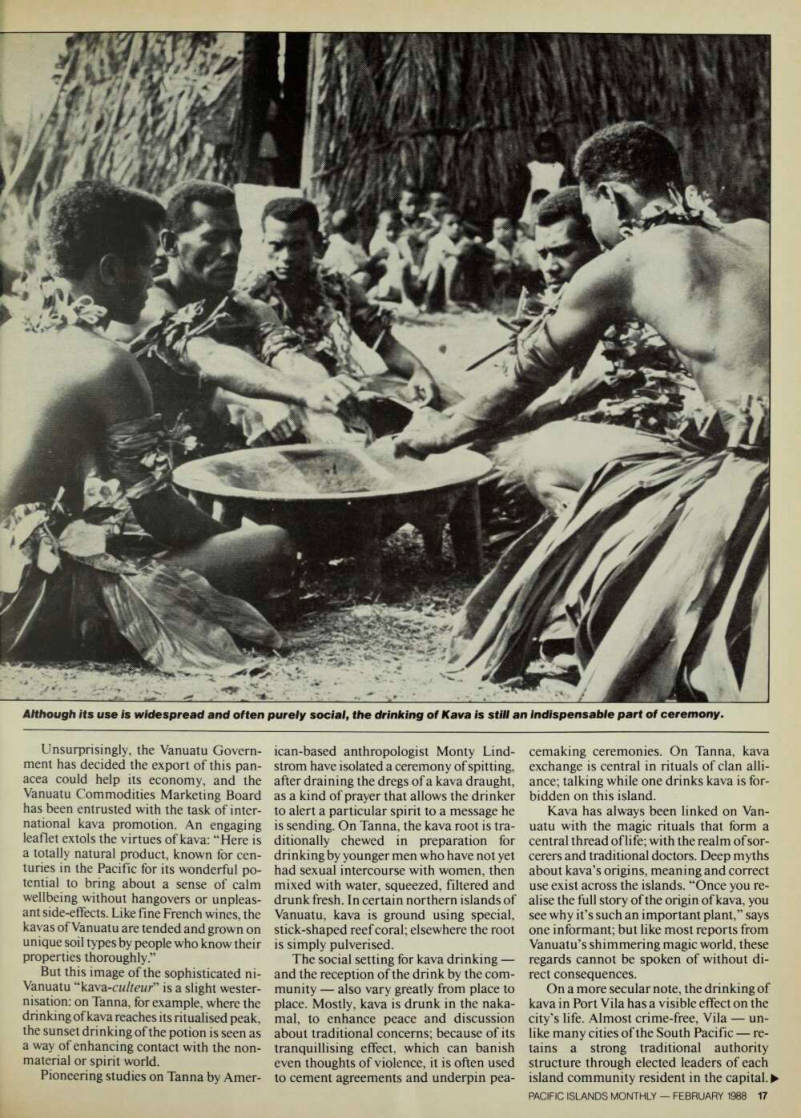
This phenomenon is an adaptation of the more ceremonial kava-drinking com mon on many of the islands of Vanuatu, where a range of customs surround the preparation of the drink. The nakamal in some areas is a sacred men’s meeting place; on certain islands such as Tanna, drinking of kava has profound religious and social meaning, bringing the drinker into con tact with the spirit world.
While Fiji’s yaqona drinkers have only six subspecies of the plant from which to
choose, more than 40 found on the islands of Vanuatu some so strong they are rarely, if ever, used in the preparation of the drink are described in The Kavas of Vanuatu by Vincent Lebot and Pierre Cabalion (published by Orfton). Kava po tency is measured in lactones, and the kava-plant with the highest count comes from the island of Epi. According to con noisseurs, different types of kava have dif ferent effects, which can be modified by the preparation of the drink: it may be strained in special ways, chewed or mixed.
The 54 nakamals in Port Vila tend to offer their customers a blend of various popular types. Purer effects can be obtained in the islands an area of Pentecost, for ex ample, is well-known for a kava that gives the drinker a feeling of exceptional mental clarity on the following day.
Though much-studied, the effects of kava remain bafflingly complex. The ac tive ingredient of the root is a mixture of between 12 and 14 chemicals, mostly anaesthetics and analgesics. The plant contains a highly effective natural pain killer, and pharmaceutical companies around the world have recently begun re searching its properties as the drinking of kava across the Pacific has gained inter national attention. One French company is studying the prospects of producing a natural form of Valium from the root, while a German group is in the experimental stages of manufacturing a kava-based pill to combat menstrual pains and to ease childbirth. A slimming aid based on kava could be a runaway marketing success, some kava researchers believe.
Advocates of kava stress that it is an ex tremely healthy drink if consumed in moderation. No studies of its longterm ef fects have been undertaken, but it is easy to find old men on Tanna who have drunk potent kava daily over the past 60 years without perceptible ill-effects.
For a time the United States Food and Drug Administration banned the impor tation into the US of powdered kava, which is drunk widely by the 60,000-strong Sa moan community on the West Coast, but this ban was lifted a year and a half ago.
Kava researchers point to the drink’s nat ural properties: it is high in fibre, low in calories, mildly tranquillising, anti-bac terial and anti-fungal, a painkiller, a gentle diuretic and an appetite-suppressant. In cosmopolitan Port Vila, the male-only tradition has been sufficiently eroded to allow weight-conscious expatriate women to drink a nightly kava-shell or two at cer tain nakamals.
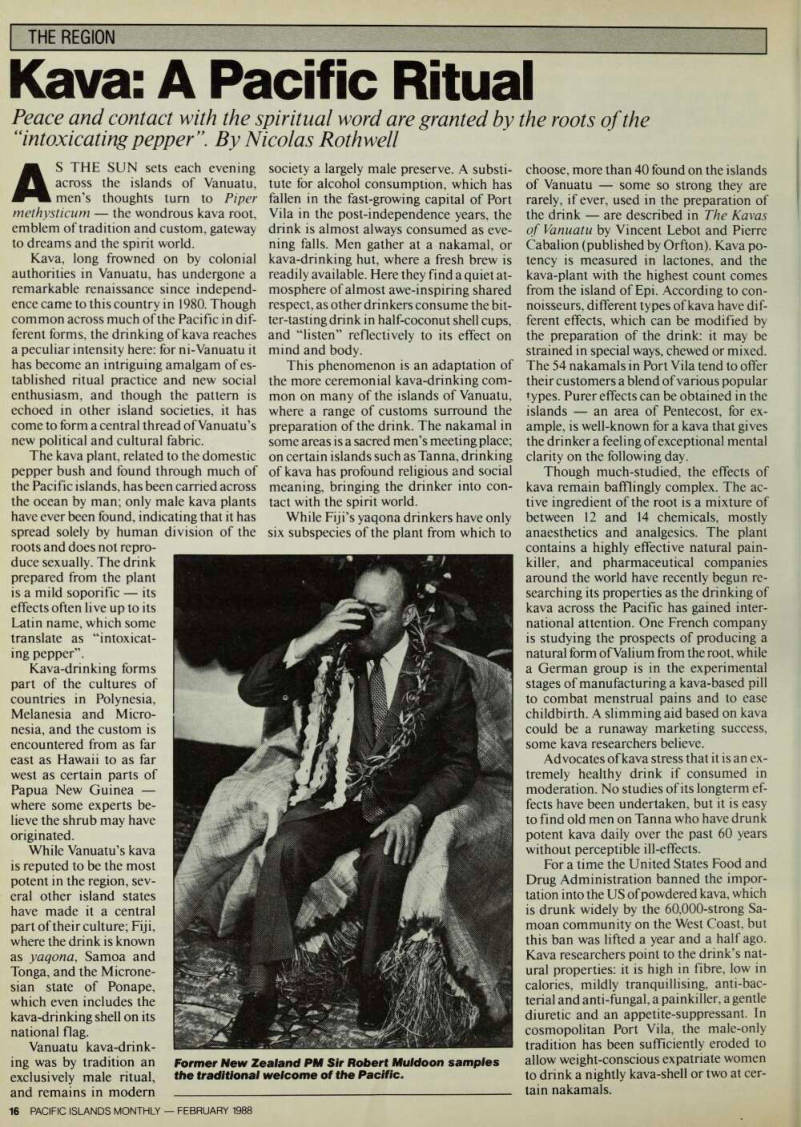
Former New Zealand PM Sir Robert Muldoon samples the traditional welcome of the Pacific.
Unsurprisingly, the Vanuatu Govern ment has decided the export of this pan acea could help its economy, and the Vanuatu Commodities Marketing Board has been entrusted with the task of inter national kava promotion. An engaging leaflet extols the virtues of kava: “Here is a totally natural product, known for cen turies in the Pacific for its wonderful po tential to bring about a sense of calm wellbeing without hangovers or unpleas ant side-effects. Like fine French wines, the kavas of Vanuatu are tended and grown on unique soil types by people who know their properties thoroughly.”
But this image of the sophisticated ni- Vanuatu “kava -culteur" is a slight wester nisation: on Tanna, for example, where the drinking of kava reaches its ritualised peak, the sunset drinking of the potion is seen as a way of enhancing contact with the non material or spirit world.
Pioneering studies on Tanna by Amer
ican-based anthropologist Monty Lindstrom have isolated a ceremony of spitting, after draining the dregs of a kava draught, as a kind of prayer that allows the drinker to alert a particular spirit to a message he is sending. On Tanna, the kava root is traditionally chewed in preparation for drinking by younger men who have not yet had sexual intercourse with women, then mixed with water, squeezed, filtered and drunk fresh. In certain northern islands of Vanuatu, kava is ground using special, stick-shaped reef coral; elsewhere the root is simply pulverised.
The social setting for kava drinking and the reception of the drink by the community also vary greatly from place to place. Mostly, kava is drunk in the nakamal, to enhance peace and discussion about traditional concerns; because of its tranquillising effect, which can banish even thoughts of violence, it is often used to cement agreements and underpin pea-
cemaking ceremonies. On Tanna, kava exchange is central in rituals of clan alli ance; talking while one drinks kava is for bidden on this island.
Kava has always been linked on Van uatu with the magic rituals that form a central thread oflife; with the realm of sor cerers and traditional doctors. Deep myths about kava’s origins, meaning and correct use exist across the islands. “Once you re alise the full story of the origin of kava, you see why it’s such an important plant,” says one informant; but like most reports from Vanuatu’s shimmering magic world, these regards cannot be spoken of without di rect consequences.
On a more secular note, the drinking of kava in Port Vila has a visible effect on the city’s life. Almost crime-free, Vila un like many cities of the South Pacific re tains a strong traditional authority structure through elected leaders of each island community resident in the capital. ►
Although its use is widespread and often purely social, the drinking of Kava is still an indispensable part of ceremony.
influence of the church remains strong; but the popularity of kava, increas ingly drunk instead of alcohol, is also a crucial factor. In the late 19705, when the independence movement became a sig nificant force in the then-condominium of the New Hebrides, a revival of tradi tional customs was a natural avenue for the expression of nationalist sentiments. The first nakamal in Vila was opened in 1979, and kava has rapidly become the national drink of Vanuatu. Its use is also increasing fast in the outer islands and is spreading to areas where it was not drunk in the past, or where it was banned by missions.
One of kava’s most enthusiastic advo cates, Vanuatu Cultural Centre anthropol ogist Dr Kirk Huffmann, who has spent the past 13 years in the country, explains succinctly that, “just as God gave the Ar abs oil, so he gave Vanuatu kava.” He de scribes kava’s effects in admiring terms: “It is a very relaxing drink, and makes you very peaceful and thoughtful without affecting your mental or speech processes at all although if you drink several shells of very strong kava it can affect your limbs.
“Used in the proper way, with the right amount of respect for the culture, it’s a very sophisticated way to end the day,” he ventures.
Dr Huffmann stresses that kava is not a hallucinogen, even if “with certain kinds you can get the impression you can hear things, very far away.” It is non-add ictive, though Dr Huffmann contends charmingly that, “what is addictive about it is not the drink itself but the atmosphere in which it is drunk: that friendly, quiet at mosphere. When I’m away from Vila I miss it, but I wouldn’t call that an addic tion so much as a longing.”
He gives a poignant account of the ef fect of Vanuatu kava on the drinker, as he “listens to” its effect: “When you drink kava, you hear the real world. The world falls into its right proportions when you’re in the nakamal and you’re drinking kava, it could be the real world with the atmosphere, you realise whatever worries you may have aren’t really all that impor tant at all.” Yet the evident enthusiasm of ni-Vanuatu men for the kava nakamal has had one pronounced effect in Vila; to some extent, it emphasises the division of the sexes into different worlds.
Mrs Maria Crowby, a newly elected op position MP and one of the first two women to sit in Vanuatu’s post-independ ence parliament, believes kava-drinking has been transformed from its traditional role into a “way of life” in the city. “Maybe once a week would be alright the men may be calm under kava, but they leave everything to the women. All the respon sibility rests with the woman; it’s as if there is no father.”
More pragmatically, Mrs Grace Mol isa, a highly placed government official and women’s council leader, points out that “viewing the way women are affected
by all kinds of things, I would say I prefer men to drink kava than alcohol they are less likely to end up in hospital with bro ken bones. With kava they always come home to look for food and a bed to sleep in, so from that point of view it would be in women’s interests that men drink kava.”
Mrs Molisa concedes that, “having a set time each evening when men are abso lutely absent from the home doesn’t help” in promoting the equal sharing of house hold duties between the sexes, but she feels clearly that the new and evolving role of kava in Vanuatu’s modern society has a great importance: “Kava has a signifi cance; it’s not something you drink just like a juice,” she says, “and kava-drinking will continue to evolve and form a pattern. At the moment it’s good business... and it’s also cheaper than alcohol.”
While kava forms such a central part of both the ritual and secular life of the ni- Vanuatu, the plant has yet to penetrate deep into some other Melanesian coun tries. Both the Solomon Islands and Papua New Guinea are predominantly betel-nut chewing areas, though there are two re gions of Papua New Guinea; one an iso lated West Sepik zone, one in Gogodala, where kava is drunk. Noumea’s first kava nakamal opened recently, and the drink is now becoming popular with Kanaks in New Caledonia ... though ni-Vanuatu visitors say that, at CFP3OO for a single kava shell, the price is exorbitant.
Sadly, kava’s recent transmission to Australia has been less fortunate. North ern Territory Aborigines were introduced to kava in the early 1960 s by two Fijian missionaries, who saw the root as a prom ising substitute for alcohol. Press reports, often of the “killer kava scourge” variety, indicate that Aborigines, unskilled in the proper use of the drink, have been mixing it with spirits or even adulterating the kava powder base. The West Australian Government recently proposed a volun tary ban on kava importation. Dr Huff mann, speaking carefully, comments that, “with the rather sad state of affairs in Aus tralia, I can’t help but have the feeling some Aboriginal groups are in such a difficult and estranged state, the nature of the problems facing them now may force them psychologically to overdo anything that comes along.”
Symbol both of custom’s return and new nationhood, kava in Vanuatu bridges past and present with each shell. And every sunset, as the Pacific’s most unchanging splendour spreads across the islands, the drinking of kava is a ritual made afresh both for the magic realms of passing times, and for the quiet fellowships newborn anew each night in Vila’s nakamals. After kava, men fall silent. They listen gently through the twilight air, a numbness in their mouths, a slowness in their limbs; then a sound seems to reach them from beyond the horizon, and the kava plant whispers its wordless secrets once again. □
Advertisements & other items, p. 18 (1 item)
into The
IMEL
Services
Reach Out
Thousands
of Miles
into The
Pacific. It's
where we
work.
• Heavy Engineering • Air Conditioning • Sheetmetal • Electrical • Refrigeration • Quality work • Competitive prices.
P^^IMEL
INDUSTRIAL AND MARINE
ENGINEERING LIMITED
Tel: 312133. Telex: FJ2195
P.O. Box 296, Suva FIJI ISLANDS
FAX: 312854
“the complete Engineering Company of the South Pacific”.
Probe Intensifies
Palau
Investigation into a reign of terror.
By Ed Rampell
American congressional
investigators flew to Palau from Washington and Honolulu late last year to probe a reign of terror that has con tinued in the world’s first national nuclear free zone throughout the 1980 s. The Gen eral Accounting Office (GAO) team ex amined the events of the September night when peace activist/attorney Roman Be dor’s 71 -year-old father was murdered and a meeting house and the home of another elderly pacifist were firebombed. The at tacks remain unsolved.
The GAO is also looking into other in cidents such as the June, 1985, assassina tion of Palau President Haruo Remeliik; the “bankrupting” of the Republic via the IPSECO power project; alleged use of Pa lau as a transit point between Asia and America for drug trafficking; alleged mas sive Government corruption; and a string of arson attacks and political intimidation.
The GAO which is the US Congress watchdog agency is specifically striv ing to determine whether or not Palauan citizens have been denied their constitu tional rights. This point is essential be cause when Congress passed initial Compact legislation last year, it was with the specific stipulation that America’s fi nal approval would only be granted after the people of Palau passed the accord in full accordance with the Republic’s con stitutional process.
However, the September 7 events preempted a court challenge to the Com pact set for the following day. On Septem ber 8, “intimidated” dissidents dropped their court case. The US House of Rep resentatives, led by Congressman Morris Udall (Democrat, Arizona) is concerned that Palauans have been denied their guaranteed right to due process of law. If so, this would mean that the Compact had not been passed in accordance with the Republic of Palau Constitution and hence that it had not met its requirements for passage by the US Congress.
According to a GAO investigator, Con gress will not vote on the Compact until the agency’s report is completed and turned over to the congressmen. This means that the Compact could yet again be held up indefinitely, or even killed.
The United States has jurisdiction over Palau because the Republic is an Ameri can administered United Nations Trust Territory. The Compact would replace the 41-year-old Trusteeship with a new politi cal relationship granting Palau home rule and substantial economic aid, in exchange for Pentagon access to the strategically lo
cated Western Pacific archipelago 800 kil ometres east of the troubled Philippines.
However, the Compact’s military provi sions conflict with Palau’s anti-nuclear constitution, and the fledgling nation’s political status process has been dead locked since 1983, despite 10 related na tional referendums.
The GAO probe is a preliminary in vestigation. The team of about seven ex aminers probed Palau for two weeks as a result of their findings, the US Congress will decide whether to launch a criminal investigation at Palau with the power to indict.
Since the political violence of 1981, when then-President Remeliik’s office was firebombed during the first of two tur bulent general strikes, indictments throughout what has been called a reign of terror have been rare. The only convic tions (for Remeliik’s assassination) were overturned by the Palauan high court, amid international outcries of a frame-up.
Recently, the Palau police charged three men, including Joel Toribiong, President Salii’s special assistant, with shooting at the home of Speaker of the House Santos Olikong.
People at all levels of Palauan society will be investigated, including, it is re ported, some occupying high ranks in the Palauan Government. “Nobody is above suspicion and investigation,” says a GAO member.
However, some critics of the Palau probe fear a whitewash, citing a lack of time, manpower, and funding for the ini tial investigation. There’s also concern that terrified Palauans may not be too anxious to speak out, fearing reprisal. Further more, critics of American policy in Palau are anxious, they say, that the US admin istration already rocked by the Iran contra affair may not want to open up a scandal that could possibly link America to covert actions at Palau.
Meanwhile, the Compact languishes in political limbo, as it continues to await the US Congress, UN Trusteeship and Secu rity Council approval it legally requires approval that may hinge on what the GAO investigators uncover. □
Advertisements & other items, pp. 19-20 (1 item)
Victa
Utility with cast iron
engine for long life. Tough enough to
cut through the most rugged
mowing conditions, yet light
enough to make mowing a
breeze.
• V3O engine pack.
• Micro chip electronic ignition for
easy starting.
• 460 mm (18") wide cut.
• Heavy duty wheels.
• Tough, pressed metal deck.
For more information please contact our Authorised Distributors FIJI: Carpenters Motors, Private Mail Bag, Argo Street, Suva.
NEW CALEDONIA: Messagerie Caledoniannes, BPB2, Noumea.
NORFOLK ISLAND: Norfolk Island Motors.
P.O. Box 278.
PAPUA NEW GUINEA: Carpenters New Guinea Co., Box 74, P. 0., Lae; ASP (Overseas) Pty. Ltd., Box 166, P. 0., Rabaul; Wamp Nga Motors, Box 198, P. 0., Mt. Hagen.
SOLOMON ISLANDS: Lee Kwok Kuen & Co., P. 0., Box 537 Honiara.
TAHITI: Tahiti Cycles. P.O. Box 201, Papeete.
TONGA: E. M. Jones Ltd., P.O. Box 34, Nukualofa.
VANUATU: Vanuatu Agricultural Supplies, P.O. Box 819, Port Vila.
WESTERN SAMOA: Morris Hedstrom Apia Ltd., P.O. Box 189, Apia: Goldstar Transport Co. Ltd., P.O. Box 185, Apia.
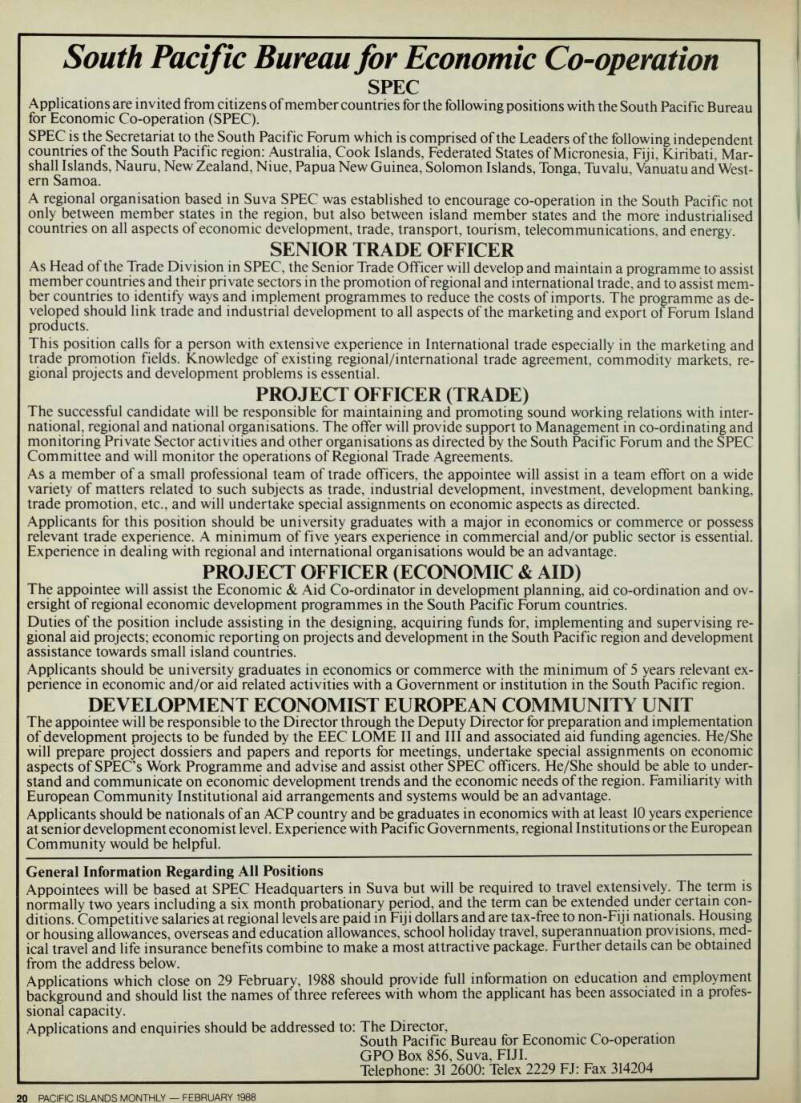
South Pacific Bureau for Economic Co-operation
SPEC
Applications are invited from citizens of member countries for the following positions with the South Pacific Bureau for Economic Co-operation (SPEC).
SPEC is the Secretariat to the South Pacific Forum which is comprised of the Leaders of the following independent countries of the South Pacific region: Australia, Cook Islands, Federated States of Micronesia, Fiji, Kiribati, Marshall Islands, Nauru, New Zealand, Niue, Papua New Guinea, Solomon Islands, Tonga, Tuvalu, Vanuatu and Western Samoa.
A regional organisation based in Suva SPEC was established to encourage co-operation in the South Pacific not only between member states in the region, but also between island member states and the more industrialised countries on all aspects of economic development, trade, transport, tourism, telecommunications, and energy.
SENIOR TRADE OFFICER
As Head of the Trade Division in SPEC, the Senior Trade Officer will develop and maintain a programme to assist member countries and their private sectors in the promotion of regional and international trade, and to assist member countries to identify ways and implement programmes to reduce the costs of imports. The programme as developed should link trade and industrial development to all aspects of the marketing and export of Forum Island products.
This position calls for a person with extensive experience in International trade especially in the marketing and trade promotion fields. Knowledge of existing regional/international trade agreement, commodity markets, regional projects and development problems is essential.
PROJECT OFFICER (TRADE)
The successful candidate will be responsible for maintaining and promoting sound working relations with international, regional and national organisations. The offer will provide support to Management in co-ordinating and monitoring Private Sector activities and other organisations as directed by the South Pacific Forum and the SPEC Committee and will monitor the operations of Regional Trade Agreements.
As a member of a small professional team of trade officers, the appointee will assist in a team effort on a wide variety of matters related to such subjects as trade, industrial development, investment, development banking, trade promotion, etc., and will undertake special assignments on economic aspects as directed.
Applicants for this position should be university graduates with a major in economics or commerce or possess relevant trade experience. A minimum of five years experience in commercial and/or public sector is essential.
Experience in dealing with regional and international organisations would be an advantage.
PROJECT OFFICER (ECONOMIC & AID)
The appointee will assist the Economic & Aid Co-ordinator in development planning, aid co-ordination and oversight of regional economic development programmes in the South Pacific Forum countries.
Duties of the position include assisting in the designing, acquiring funds for, implementing and supervising regional aid projects; economic reporting on projects and development in the South Pacific region and development assistance towards small island countries.
Applicants should be university graduates in economics or commerce with the minimum of 5 years relevant experience in economic and/or aid related activities with a Government or institution in the South Pacific region.
DEVELOPMENT ECONOMIST EUROPEAN COMMUNITY UNIT
The appointee will be responsible to the Director through the Deputy Director for preparation and implementation of development projects to be funded by the EEC LOME II and 111 and associated aid funding agencies. He/She will prepare project dossiers and papers and reports for meetings, undertake special assignments on economic aspects of SPEC’s Work Programme and advise and assist other SPEC officers. He/She should be able to understand and communicate on economic development trends and the economic needs of the region. Familiarity with European Community Institutional aid arrangements and systems would be an advantage.
Applicants should be nationals of an ACP country and be graduates in economics with at least 10 years experience at senior development economist level. Experience with Pacific Governments, regional Institutions or the European Community would be helpful.
General Information Regarding All Positions Appointees will be based at SPEC Headquarters in Suva but will be required to travel extensively. The term is normally two years including a six month probationary period, and the term can be extended under certain conditions. Competitive salaries at regional levels are paid in Fiji dollars and are tax-free to non-Fiji nationals. Housing or housing allowances, overseas and education allowances, school holiday travel, superannuation provisions, medical travel and life insurance benefits combine to make a most attractive package. Further details can be obtained from the address below.
Applications which close on 29 February, 1988 should provide full information on education and employment background and should list the names of three referees with whom the applicant has been associated in a professional capacity.
Applications and enquiries should be addressed to: The Director, South Pacific Bureau for Economic Co-operation GPO Box 856, Suva, FIJI.
Telephone: 31 2600: Telex 2229 FJ: Fax 314204
Shackling The Media
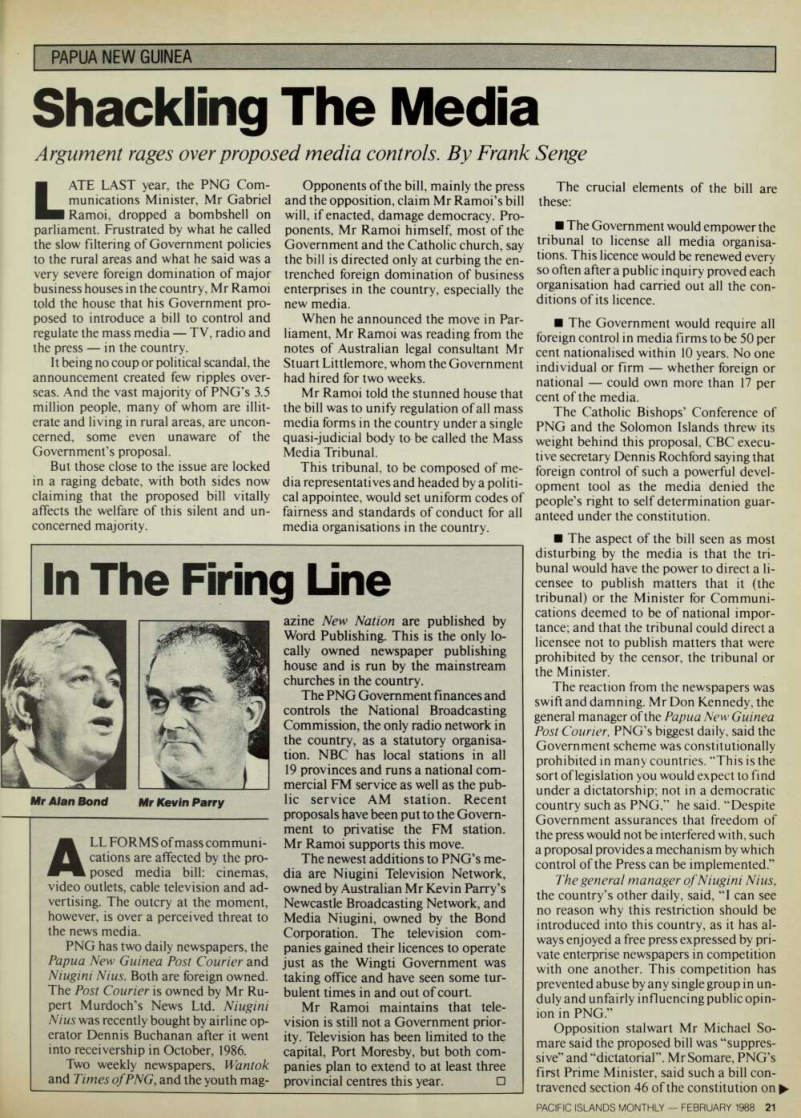
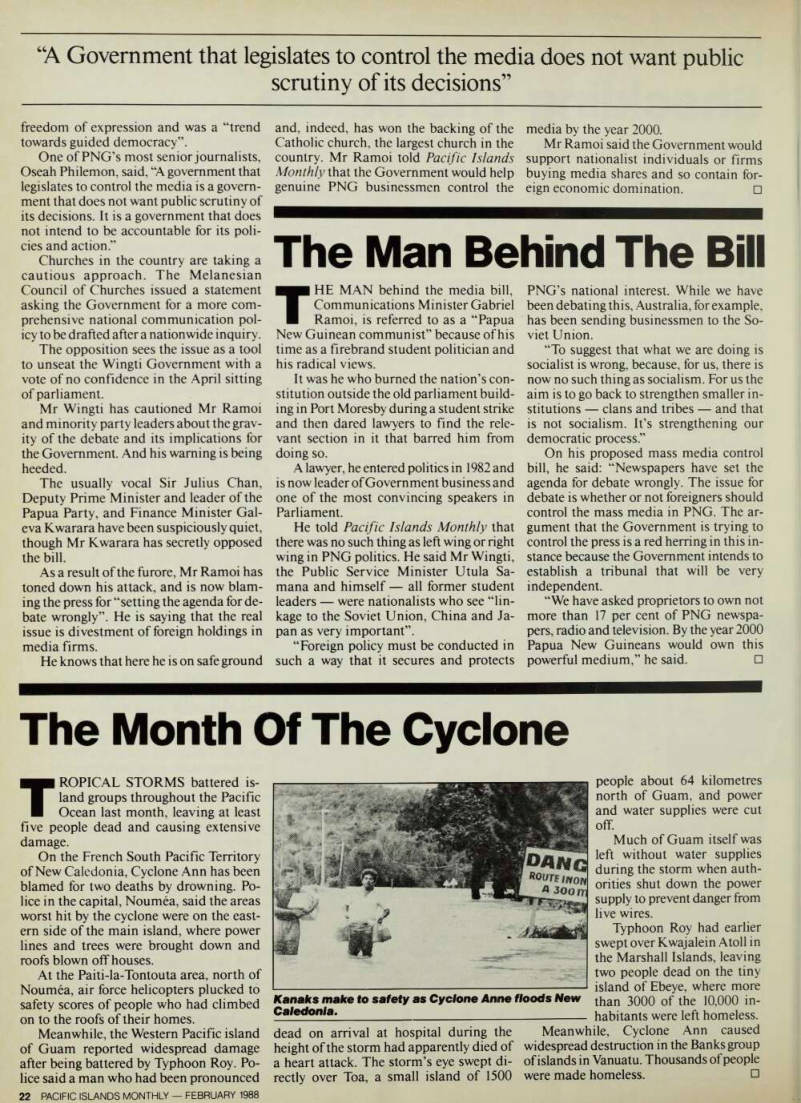
Papua New Guinea
Argument rages over proposed media controls.
By Frank Senge
LATE LAST year, the PNG Com munications Minister, Mr Gabriel Ramoi, dropped a bombshell on parliament. Frustrated by what he called the slow filtering of Government policies to the rural areas and what he said was a very severe foreign domination of major business houses in the country, Mr Ramoi told the house that his Government pro posed to introduce a bill to control and regulate the mass media TV, radio and the press in the country.
It being no coup or political scandal, the announcement created few ripples over seas. And the vast majority of PNG’s 3.5 million people, many of whom are illit erate and living in rural areas, are uncon cerned, some even unaware of the Government’s proposal.
But those close to the issue are locked in a raging debate, with both sides now claiming that the proposed bill vitally affects the welfare of this silent and un concerned majority.
Opponents of the bill, mainly the press and the opposition, claim Mr Ramoi’s bill will, if enacted, damage democracy. Pro ponents, Mr Ramoi himself, most of the Government and the Catholic church, say the bill is directed only at curbing the en trenched foreign domination of business enterprises in the country, especially the new media.
When he announced the move in Par liament, Mr Ramoi was reading from the notes of Australian legal consultant Mr Stuart Littlemore, whom the Government had hired for two weeks.
Mr Ramoi told the stunned house that the bill was to unify regulation of all mass media forms in the country under a single quasi-judicial body to be called the Mass Media Tribunal.
This tribunal, to be composed of me dia representatives and headed by a politi cal appointee, would set uniform codes of fairness and standards of conduct for all media organisations in the country.
The crucial elements of the bill are these: ■ The Government would empower the tribunal to license all media organisa tions. This licence would be renewed every so often after a public inquiry proved each organisation had carried out all the con ditions of its licence. ■ The Government would require all foreign control in media firms to be 50 per cent nationalised within 10 years. No one individual or firm whether foreign or national could own more than 17 per cent of the media.
The Catholic Bishops’ Conference of PNG and the Solomon Islands threw its weight behind this proposal, CBC execu tive secretary Dennis Rochford saying that foreign control of such a powerful devel opment tool as the media denied the people’s right to self determination guar anteed under the constitution. ■ The aspect of the bill seen as most disturbing by the media is that the tri bunal would have the power to direct a li censee to publish matters that it (the tribunal) or the Minister for Communi cations deemed to be of national impor tance; and that the tribunal could direct a licensee not to publish matters that were prohibited by the censor, the tribunal or the Minister.
The reaction from the newspapers was swift and damning. Mr Don Kennedy, the general manager of the Papua New Guinea Post Courier, PNG’s biggest daily, said the Government scheme was constitutionally prohibited in many countries. “This is the sort of legislation you would expect to find under a dictatorship; not in a democratic country such as PNG,” he said. “Despite Government assurances that freedom of the press would not be interfered with, such a proposal provides a mechanism by which control of the Press can be implemented.”
The general manager ofNiugini Nius, the country’s other daily, said, “I can see no reason why this restriction should be introduced into this country, as it has al ways enjoyed a free press expressed by pri vate enterprise newspapers in competition with one another. This competition has prevented abuse by any single group in un duly and unfairly influencing public opin ion in PNG.”
Opposition stalwart Mr Michael So mare said the proposed bill was “suppres sive” and “dictatorial”. Mr Somare, PNG’s first Prime Minister, said such a bill con travened section 46 of the constitution on
“A Government that legislates to control the media does not want public scrutiny of its decisions”
freedom of expression and was a “trend towards guided democracy”.
One of PNG’s most senior journalists, Oseah Philemon, said, “A government that legislates to control the media is a govern ment that does not want public scrutiny of its decisions. It is a government that does not intend to be accountable for its poli cies and action.”
Churches in the country are taking a cautious approach. The Melanesian Council of Churches issued a statement asking the Government for a more com prehensive national communication pol icy to be drafted after a nationwide inquiry.
The opposition sees the issue as a tool to unseat the Wingti Government with a vote of no confidence in the April sitting of parliament.
Mr Wingti has cautioned Mr Ramoi and minority party leaders about the grav ity of the debate and its implications for the Government. And his warning is being heeded.
The usually vocal Sir Julius Chan, Deputy Prime Minister and leader of the Papua Party, and Finance Minister Gal eva Kwarara have been suspiciously quiet, though Mr Kwarara has secretly opposed the bill.
As a result of the furore, Mr Ramoi has toned down his attack, and is now blam ing the press for “setting the agenda for de bate wrongly”. He is saying that the real issue is divestment of foreign holdings in media firms.
He knows that here he is on safe ground
and, indeed, has won the backing of the Catholic church, the largest church in the country. Mr Ramoi told Pacific Islands Monthly that the Government would help genuine PNG businessmen control the
media by the year 2000.
Mr Ramoi said the Government would support nationalist individuals or firms buying media shares and so contain for eign economic domination. □
In The Firing Line
ALL FORMS of mass communi cations are affected by the pro posed media bill: cinemas, video outlets, cable television and ad vertising. The outcry at the moment, however, is over a perceived threat to the news media.
PNG has two daily newspapers, the Papua New Guinea Post Courier and Niugini Nius. Both are foreign owned.
The Post Courier is owned by Mr Ru pert Murdoch’s News Ltd. Niugini Nius was recently bought by airline op erator Dennis Buchanan after it went into receivership in October, 1986.
Two weekly newspapers, Wantok and Times of PNG, and the youth mag
azine New Nation are published by Word Publishing. This is the only lo cally owned newspaper publishing house and is run by the mainstream churches in the country.
The PNG Government finances and controls the National Broadcasting Commission, the only radio network in the country, as a statutory organisa tion. NBC has local stations in all 19 provinces and runs a national com mercial FM service as well as the pub lic service AM station. Recent proposals have been put to the Govern ment to privatise the FM station.
Mr Ramoi supports this move.
The newest additions to PNG’s me dia are Niugini Television Network, owned by Australian Mr Kevin Parry’s Newcastle Broadcasting Network, and Media Niugini, owned by the Bond Corporation. The television com panies gained their licences to operate just as the Wingti Government was taking office and have seen some tur bulent times in and out of court.
Mr Ramoi maintains that tele vision is still not a Government prior ity. Television has been limited to the capital, Port Moresby, but both com panies plan to extend to at least three provincial centres this year. □
Mr Alan Bond
Mr Kevin Parry
The Man Behind The Bill
THE MAN behind the media bill, Communications Minister Gabriel Ramoi, is referred to as a “Papua New Guinean communist” because of his time as a firebrand student politician and his radical views.
It was he who burned the nation’s con stitution outside the old parliament build ing in Port Moresby during a student strike and then dared lawyers to find the rele vant section in it that barred him from doing so.
A lawyer, he entered politics in 1982 and is now leader of Government business and one of the most convincing speakers in Parliament.
He told Pacific Islands Monthly that there was no such thing as left wing or right wing in PNG politics. He said Mr Wingti, the Public Service Minister Utula Sa mana and himself all former student leaders were nationalists who see “lin kage to the Soviet Union, China and Ja pan as very important”.
“Foreign policy must be conducted in such a way that it secures and protects
PNG’s national interest. While we have been debating this, Australia, for example, has been sending businessmen to the So viet Union.
“To suggest that what we are doing is socialist is wrong, because, for us, there is now no such thing as socialism. For us the aim is to go back to strengthen smaller in stitutions clans and tribes and that is not socialism. It’s strengthening our democratic process.”
On his proposed mass media control bill, he said: “Newspapers have set the agenda for debate wrongly. The issue for debate is whether or not foreigners should control the mass media in PNG. The ar gument that the Government is trying to control the press is a red herring in this in stance because the Government intends to establish a tribunal that will be very independent.
“We have asked proprietors to own not more than 17 per cent of PNG newspa pers, radio and television. By the year 2000 Papua New Guineans would own this powerful medium,” he said. □
The Month Of The Cyclone
TROPICAL STORMS battered is land groups throughout the Pacific Ocean last month, leaving at least five people dead and causing extensive damage.
On the French South Pacific Territory of New Caledonia, Cyclone Ann has been blamed for two deaths by drowning. Po lice in the capital, Noumea, said the areas worst hit by the cyclone were on the east ern side of the main island, where power lines and trees were brought down and roofs blown off houses.
At the Paiti-la-Tontouta area, north of Noumea, air force helicopters plucked to safety scores of people who had climbed on to the roofs of their homes.
Meanwhile, the Western Pacific island of Guam reported widespread damage after being battered by Typhoon Roy. Po lice said a man who had been pronounced
dead on arrival at hospital during the height of the storm had apparently died of a heart attack. The storm’s eye swept di rectly over Toa, a small island of 1500
people about 64 kilometres north of Guam, and power and water supplies were cut off.
Much of Guam itself was left without water supplies during the storm when auth orities shut down the power supply to prevent danger from live wires.
Typhoon Roy had earlier swept over Kwajalein Atoll in the Marshall Islands, leaving two people dead on the tiny island of Ebeye, where more than 3000 of the 10,000 in habitants were left homeless.
Meanwhile, Cyclone Ann caused widespread destruction in the Banks group of islands in Vanuatu. Thousands of people were made homeless. □
Kanaks make to safety as Cyclone Anne floods New Caledonia.
Operation Open Heart
Health
An Australian medical team saves lives in Tonga.
A VOLUNTEER heart team from Australia’s Sydney Adventist Hos pital completed 17 life-saving op erations in Tonga in 1987 as phase two of a three-pronged attack on heart disease in the South Pacific. The project has been named “Operation Open Heart for Tonga”. Fifteen other patients received urgently needed surgical help during the team’s first visit in 1986.
Congenital heart defects and rheu matic heart disease are major problems among the Tongan population and in the past very little could be done to assist those who were stricken. Rheumatic heart disease is the consequence of infection with common bacteria, and it affects the hearts of people in their teens.
The disorder often results in severe dis ability and early death. Common symp toms of rheumatic heart disease are breathlessness and an inability to exercise or perform everyday activities. Teenagers cannot attend school or participate in nor mal activities, young mothers are unable to care for their children, and young men are unable to work.
Setting up the volunteer heart team op eration was not easy. Although Tonga’s government hospital in Nuku’alofa is well constructed and has good basic facilities, it was not equipped for the advanced sur gery performed by the Sydney Adventist Hospital team. Much additional equip ment had to be installed to allow cardiac surgery to take place.
Transporting the medical/surgical team and necessary specialised equipment to Tonga was a major exercise. Several tonnes ($A400,000 worth) of specialised equip ment, oxygen cylinders, drugs and dispos ables were shipped to Tonga most carried free by the Royal Australian Navy.
Several Australian medical corpora tions lent $150,000 worth of diagnostic and monitoring equipment to the team. Oth ers donated $lOO,OOO worth of disposable equipment. One manufacturer donated $lB,OOO worth of artificial heart valves; another, $15,000 worth of surgical instru ments; yet another company gave $20,000 cash. Besides corporate donations, indi viduals have contributed a total of $150,000 since the “Operation Open Heart for Tonga” appeal was launched.
The volunteer team on the most recent visit to the island comprised 52 medical, nursing, technical and support personnel.
Not only did these volunteeers donate their time to the project, but they paid their own air fares as well.
Not all 52 team members were in Tonga
at the same time. Some were part of an ad vance preparation team, some replaced team members unable to stay for the two weeks of the surgery program, and others completed the packing of the equipment after the visit.
The 17 heart surgery patients ranged from a three-year-old girl with a congeni tal heart defect to a 73-year-old man who was fitted with a pacemaker. However, most of the surgical recipients were in their teens and 20s.
One 14-year-old boy had severe dis eases in two heart valves. He had wasted to half his normal weight and could no longer attend school or play. He received two of the donated artificial valves.
Another patient, a 34-year-old mother of five, had her mitral valve replaced. She had been unable to do her housework and had spent long periods in hospital over many years. Another 18-year-old girl, whose mother had died from rheumatic heart disease and had herself been very ill with the same condition, had her valve re paired and now lives a normal life.
Six weeks after the surgery, heart team co-ordinator Dr John Wallace went to Tonga for a follow-up visit. “To see patients who six weeks before had been extremely sick doing well and participating in nor mal activities such as playing, attending school, and caring for children, was most rewarding,” Dr Wallace said.
“Doctors and nurses at the hospital ap preciated the opportunity to work with team members and to learn new skills.
Equipment installed at the hospital had been left in Tonga and has already proved invaluable in patient care there. The im petus given to Tongan public health edu cation programs on heart disease has been considerable,” said Dr Wallace.
Already the government of another South Pacific island has sought the help of the Sydney Adventist Hospital heart team.
However, the task currently being tackled by the team is to bring six Tongan children to Australia for treatment. These children all have complex congenital heart defects requiring special tests that could not be done by the team in Tonga. Now the team is faced with raising the funds needed to pay for these children’s treatment. It will cost the team around $5,000 each child’s operation, plus accommodation expenses.
What you can do to help Your donation can help the volunteer heart team. For information write to Sydney Adventist Hospital, 185 Fox Valley Rd, Wahroonga, NSW Australia 2076. □
Advertisements & other items, p. 23 (1 item)
Barging
The OPERATION OPEN HEART
FOR TONGA voluntary heart team wish to thank the following companies for their contribution to the project which has been able to bring new life and hope to many Tongan heart sufferers:
AIR PACIFIC
BURNS PHILP
FLYING TIGERS
HAWAIIAN AIRLINES
TONGA INDUSTRIAL
GASES
WARNER PACIFIC LINES
W 2 m
REFRIGERATED
TRUCKS
★ Freezers ★ Chillers ★ Coolers Our units ideal in Samoa, Papua New Guinea, & Fiji. Meat-hanging, Pallet-loading, Distributing Juice, Milk, Produce.
Our staff are former Pacific Island residents.
Ph: 61-7-875 1488 (24 hours) P.O. Box 208, Moorooka. Aust. Q. 4105 "phone or Write . . For The Answers To Your Transport Needs"
"Overseas, Country, and Interstate buyers, hosted at . GREENMOUNT RESORT on Queensland’s Gold Coast."
BARGING
OF UNUSUAL OR HEAVY
CARGOES
Australia-Pacific region Ocean Towage Contractors
JARDINE SHIPPING
Cairns, Qld, Australia.
Phone (070) 510495 Fax (070)311685 Telex AA 48362
ANTIQUE
" ' PACIFIC
ARTIFACTS
N
lilt
Send for details of items available. I also stock old engravings & books. Efficient postal service. Write stating interests.
COLIN HINCHCLIEEE
12 QUEENS STAITH MEWS
YORK. UNITED KINGDOM.
Treasures On Display
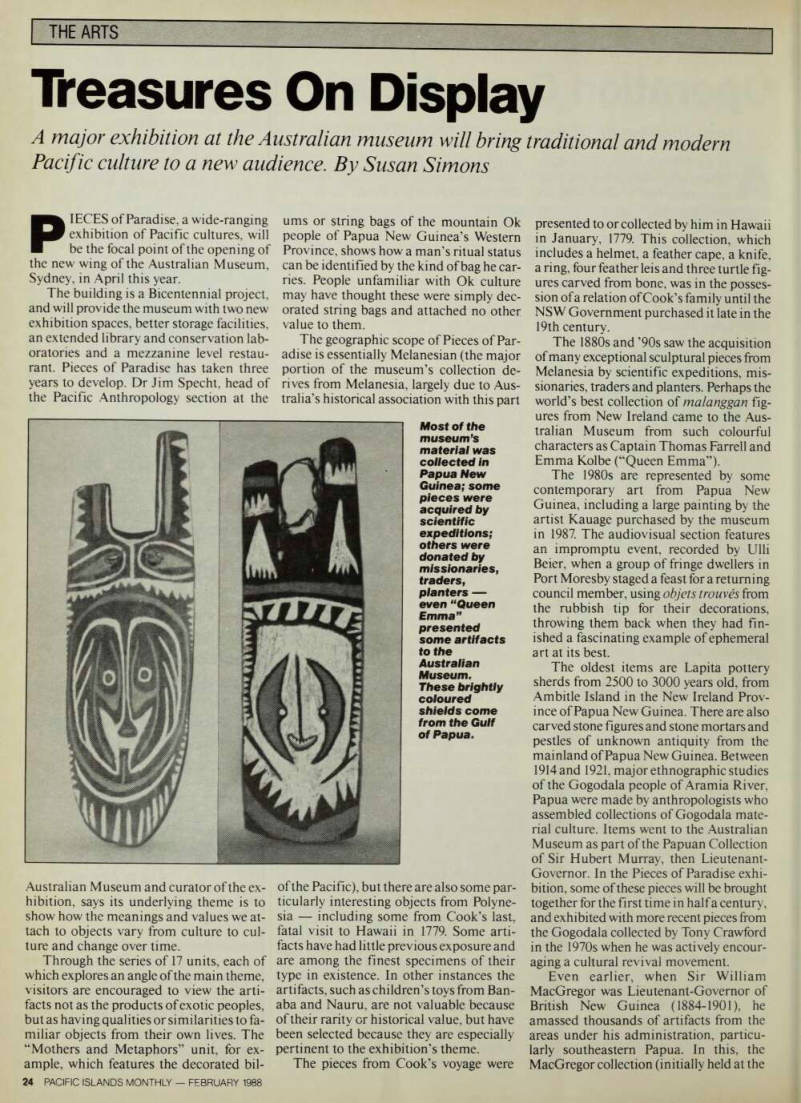
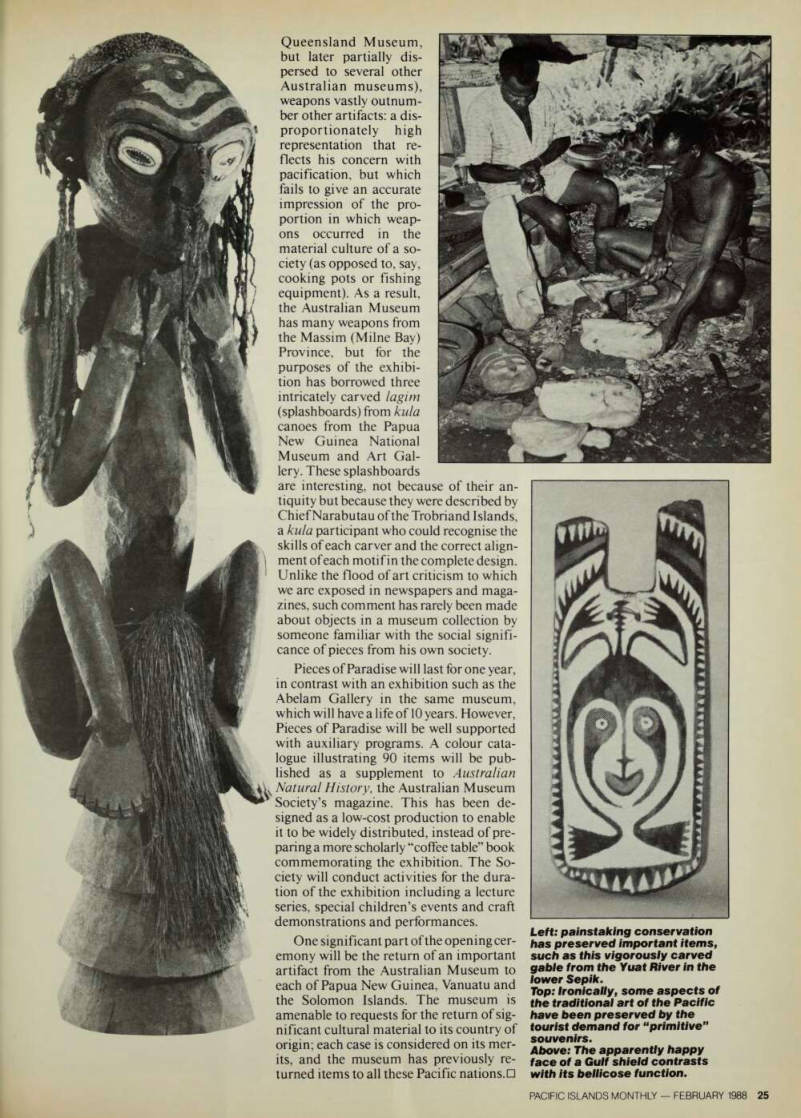
The Arts
A major exhibition at the Australian museum will bring traditional and modern
Pacific culture to a new audience.
By Susan Simons
PIECES of Paradise, a wide-ranging exhibition of Pacific cultures, will be the focal point of the opening of the new wing of the Australian Museum, Sydney, in April this year.
The building is a Bicentennial project, and will provide the museum with two new exhibition spaces, better storage facilities, an extended library and conservation laboratories and a mezzanine level restaurant. Pieces of Paradise has taken three years to develop. Dr Jim Specht, head of the Pacific Anthropology section at the
Australian Museum and curator of the exhibition, says its underlying theme is to show how the meanings and values we attach to objects vary from culture to culture and change over time.
Through the series of 17 units, each of which explores an angle of the main theme, visitors are encouraged to view the artifacts not as the products of exotic peoples, but as having qualities or similarities to familiar objects from their own lives. The “Mothers and Metaphors” unit, for example, which features the decorated bil-
urns or string bags of the mountain Ok people of Papua New Guinea’s Western Province, shows how a man’s ritual status can be identified by the kind of bag he carries. People unfamiliar with Ok culture may have thought these were simply decorated string bags and attached no other value to them.
The geographic scope of Pieces of Paradise is essentially Melanesian (the major portion of the museum’s collection derives from Melanesia, largely due to Australia s historical association with this part
of the Pacific), but there are also some par ticularly interesting objects from Polyne sia including some from Cook’s last, fatal visit to Hawaii in 1779. Some arti facts have had little previous exposure and are among the finest specimens of their type in existence. In other instances the artifacts, such as children’s toys from Ban aba and Nauru, are not valuable because of their rarity or historical value, but have been selected because they are especially pertinent to the exhibition’s theme.
The pieces from Cook’s voyage were
presented to or collected by him in Hawaii in January, 1779. This collection, which includes a helmet, a feather cape, a knife, a ring, four feather leis and three turtle fig ures carved from bone, was in the posses sion of a relation of Cook’s family until the NSW Government purchased it late in the 19th century.
The 1880 s and ’9os saw the acquisition of many exceptional sculptural pieces from Melanesia by scientific expeditions, mis sionaries, traders and planters. Perhaps the world’s best collection of malanggan fig ures from New Ireland came to the Aus tralian Museum from such colourful characters as Captain Thomas Farrell and Emma Kolbe (“Queen Emma”).
The 1980 s are represented by some contemporary art from Papua New Guinea, including a large painting by the artist Kauage purchased by the museum in 1987. The audiovisual section features an impromptu event, recorded by Ulli Beier, when a group of fringe dwellers in Port Moresby staged a feast for a returning council member, using objets trouves from the rubbish tip for their decorations, throwing them back when they had fin ished a fascinating example of ephemeral art at its best.
The oldest items are Capita pottery sherds from 2500 to 3000 years old, from Ambitle Island in the New Ireland Prov ince of Papua New Guinea. There are also carved stone figures and stone mortars and pestles of unknown antiquity from the mainland of Papua New Guinea. Between 1914 and 1921, major ethnographic studies of the Gogodala people of Aramia River, Papua were made by anthropologists who assembled collections of Gogodala mate rial culture. Items went to the Australian Museum as part of the Papuan Collection of Sir Hubert Murray, then Lieutenant- Governor. In the Pieces of Paradise exhi bition, some of these pieces will be brought together for the first time in half a century, and exhibited with more recent pieces from the Gogodala collected by Tony Crawford in the 1970 s when he was actively encour aging a cultural revival movement.
Even earlier, when Sir William MacGregor was Lieutenant-Governor of British New Guinea (1884-1901), he amassed thousands of artifacts from the areas under his administration, particu larly southeastern Papua. In this, the MacGregor collection (initially held at the
Most of the museum’s material was collected in Papua New Guinea; some pieces were acquired by scientific expeditions; others were donated by missionaries, traders, planters even “Queen Emma” presented some artifacts to the Australian Museum.
These brightly coloured shields come from the Gulf of Papua.
Queensland Museum, but later partially dis persed to several other Australian museums), weapons vastly outnum ber other artifacts: a dis proportionately high representation that re flects his concern with pacification, but which fails to give an accurate impression of the pro portion in which weap ons occurred in the material culture of a so ciety (as opposed to, say, cooking pots or fishing equipment). As a result, the Australian Museum has many weapons from the Massim (Milne Bay) Province, but for the purposes of the exhibi tion has borrowed three intricately carved lagim (splashboards) from kula canoes from the Papua New Guinea National Museum and Art Gal lery. These splashboards
are interesting, not because of their an tiquity but because they were described by Chief Narabutau of the Trobriand Islands, a kula participant who could recognise the skills of each carver and the correct align ment of each motif in the complete design.
Unlike the flood of art criticism to which we are exposed in newspapers and maga zines, such comment has rarely been made about objects in a museum collection by someone familiar with the social signifi cance of pieces from his own society.
Pieces of Paradise will last for one year, in contrast with an exhibition such as the Abelam Gallery in the same museum, which will have a life of 10 years. However, Pieces of Paradise will be well supported with auxiliary programs. A colour cata logue illustrating 90 items will be pub lished as a supplement to Australian Natural History, the Australian Museum Society’s magazine. This has been de signed as a low-cost production to enable it to be widely distributed, instead of pre paring a more scholarly “coffee table” book commemorating the exhibition. The So ciety will conduct activities for the dura tion of the exhibition including a lecture series, special children’s events and craft demonstrations and performances.
One significant part of the opening cer emony will be the return of an important artifact from the Australian Museum to each of Papua New Guinea, Vanuatu and the Solomon Islands. The museum is amenable to requests for the return of sig nificant cultural material to its country of origin; each case is considered on its mer its, and the museum has previously re turned items to all these Pacific nations. □
Left: painstaking conservation has preserved important items, such as this vigorously carved gable from the Yuat River in the lower Sepik.
Top: Ironically, some aspects of the traditional art of the Pacific have been preserved by the tourist demand for “ primitive" souvenirs.
Above: The apparently happy face of a Gulf shield contrasts with its bellicose function.
A Bad Month For France
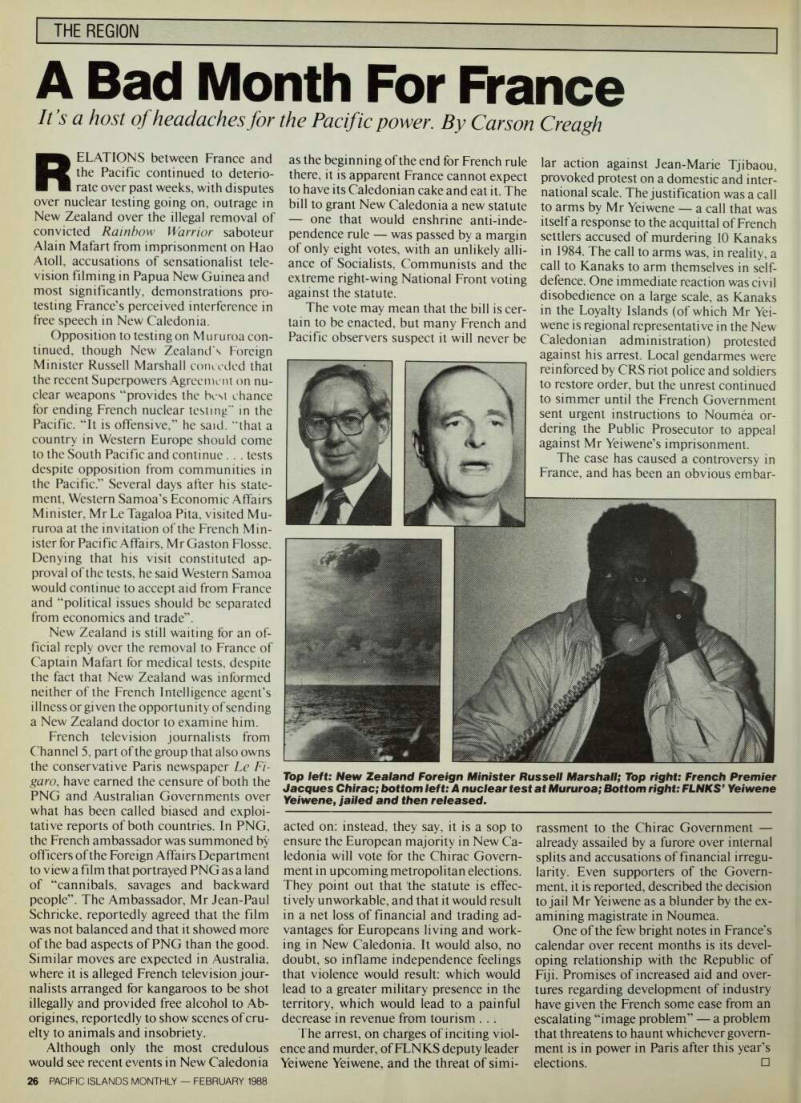
The Region
It’s a host of headaches for the Pacific power.
By Carson Creagh
RELATIONS between France and the Pacific continued to deterio rate over past weeks, with disputes over nuclear testing going on, outrage in New Zealand over the illegal removal of convicted Rainbow Warrior saboteur Alain Mafart from imprisonment on Hao Atoll, accusations of sensationalist tele vision filming in Papua New Guinea and most significantly, demonstrations pro testing France’s perceived interference in free speech in New Caledonia.
Opposition to testing on Mururoa con tinued, though New Zealand's Foreign Minister Russell Marshall conceded that the recent Superpowers Agreement on nu clear weapons “provides the best chance for ending French nuclear testing” in the Pacific. “It is offensive,” he said, “that a country in Western Europe should come to the South Pacific and continue. . . tests despite opposition from communities in the Pacific.” Several days after his state ment, Western Samoa’s Economic Affairs Minister, Mr Le Tagaloa Pita, visited Mu ruroa at the invitation of the French Min ister for Pacific Affairs, Mr Gaston Flosse.
Denying that his visit constituted ap proval of the tests, he said Western Samoa would continue to accept aid from France and “political issues should be separated from economics and trade”.
New Zealand is still waiting for an of ficial reply over the removal to France of Captain Mafart for medical tests, despite the fact that New Zealand was informed neither of the French Intelligence agent’s illness or given the opportunity of sending a New Zealand doctor to examine him.
French television journalists from Channel 5, part of the group that also owns the conservative Paris newspaper Le Fi garo, have earned the censure of both the PNG and Australian Governments over what has been called biased and exploi tative reports of both countries. In PNG, the French ambassador was summoned by officers of the Foreign Affairs Department to view a film that portrayed PNG as a land of “cannibals, savages and backward people”. The Ambassador, Mr Jean-Paul Schricke, reportedly agreed that the film was not balanced and that it showed more of the bad aspects of PNG than the good.
Similar moves are expected in Australia, where it is alleged French television jour nalists arranged for kangaroos to be shot illegally and provided free alcohol to Ab origines, reportedly to show scenes of cru elty to animals and insobriety.
Although only the most credulous would see recent events in New Caledonia
as the beginning of the end for French rule there, it is apparent France cannot expect to have its Caledonian cake and eat it. The bill to grant New Caledonia a new statute — one that would enshrine anti-inde pendence rule — was passed by a margin of only eight votes, with an unlikely alli ance of Socialists, Communists and the extreme right-wing National Front voting against the statute.
The vote may mean that the bill is cer tain to be enacted, but many French and Pacific observers suspect it will never be
acted on: instead, they say, it is a sop to ensure the European majority in New Caledonia will vote for the Chirac Government in upcoming metropolitan elections, They point out that the statute is effeclively unworkable, and that it would result in a net loss of financial and trading advantages for Europeans living and working in New Caledonia. It would also, no doubt, so inflame independence feelings that violence would result: which would lead to a greater military presence in the territory, which would lead to a painful decrease in revenue from tourism . . .
The arrest, on charges of inciting violence and murder, of FLNKS deputy leader Yeiwene Yeiwene, and the threat of simi-
lar action against Jean-Marie Tjibaou, provoked protest on a domestic and inter national scale. The justification was a call to arms by Mr Yeiwene a call that was itself a response to the acquittal of French settlers accused of murdering 10 Kanaks in 1984. The call to arms was, in reality, a call to Kanaks to arm themselves in self defence. One immediate reaction was civil disobedience on a large scale, as Kanaks in the Loyalty Islands (of which Mr Yei wene is regional representative in the New Caledonian administration) protested against his arrest. Local gendarmes were reinforced by CRS riot police and soldiers to restore order, but the unrest continued to simmer until the French Government sent urgent instructions to Noumea or dering the Public Prosecutor to appeal against Mr Yeiwene’s imprisonment.
The case has caused a controversy in France, and has been an obvious embar
rassment to the Chirac Government already assailed by a furore over internal splits and accusations of financial irregu larity. Even supporters of the Govern ment, it is reported, described the decision to jail Mr Yeiwene as a blunder by the ex amining magistrate in Noumea, One of the few bright notes in France’s calendar over recent months is its devel oping relationship with the Republic of Fiji. Promises of increased aid and over tures regarding development of industry have given the French some ease from an escalating “image problem” a problem that threatens to haunt whichever govern ment is in power in Paris after this year’s elections. □
Top left: New Zealand Foreign Minister Russell Marshall; Top right: French Premier Jacques Chirac; bottom left: A nuclear test at Mururoa; Bottom right: FLNKS’ Yeiwene Yeiwene, jailed and then released.
Advertisements & other items, p. 27 (1 item)
Follow The Music
Sound that's absolutely enchanting, even in the somewhat less than enchanting environment of a moving automobile. This is Clarion’s uncompromising standard, realized by the sophisticated use of electronic features that are easy to use. And there’s a wide selection of models to meet your individual taste.
Garion reliability? It's no pipe dream. Clarion Car Stereo. Listen and drive happily ever after. Vs Id I lUI ‘Dolby and the double-D symbol are trademarks of Dolby Laboratories Licensing Corporation.
MS I
ri f
AM STEREO MAGI-TUNE OIVERSITY
© 9900 X I ■ ■ mmamm CH 1 s s : : ;
STOP/EJECT
SCN RPT
C BIS LD 180
LEVEL
AUDIO CONTRU
TUNE
For further information Australia: Amalgamated Wireless (Australasia) Ltd. 554 Parramatta Road, Ashfield, NSW, 2131 / New Zealand: AWA New Zealand Limited, PO Box 50-248, Ponrua / Fiji Islands: Brijlal & Co, L GTO Box 362, Suva Tahiti: HI FI, VAIRAATOA Avenue Chef Vairaatoa B P 1128, Papeete / New Caledonia: Caldis, BPM 1. Noumea Cedex / Guam: Micropac Audio Inc, PO Box 3478, Agana, Guam M 472-TO9IJCaWe Code HIFI AUDIO AGANA / Vanuatu; The Sound Centre, PO. Box 434, Vila / Cook Islands; South Seas International Ltd, PO Box 49, Rarotonga / Papua New Guinea: Hagemeyer (PN G.) Pty Ltd, PO Box 1428, Boroko, Port Moresby
Who’s Afraid Of The Big Bad Wolff?
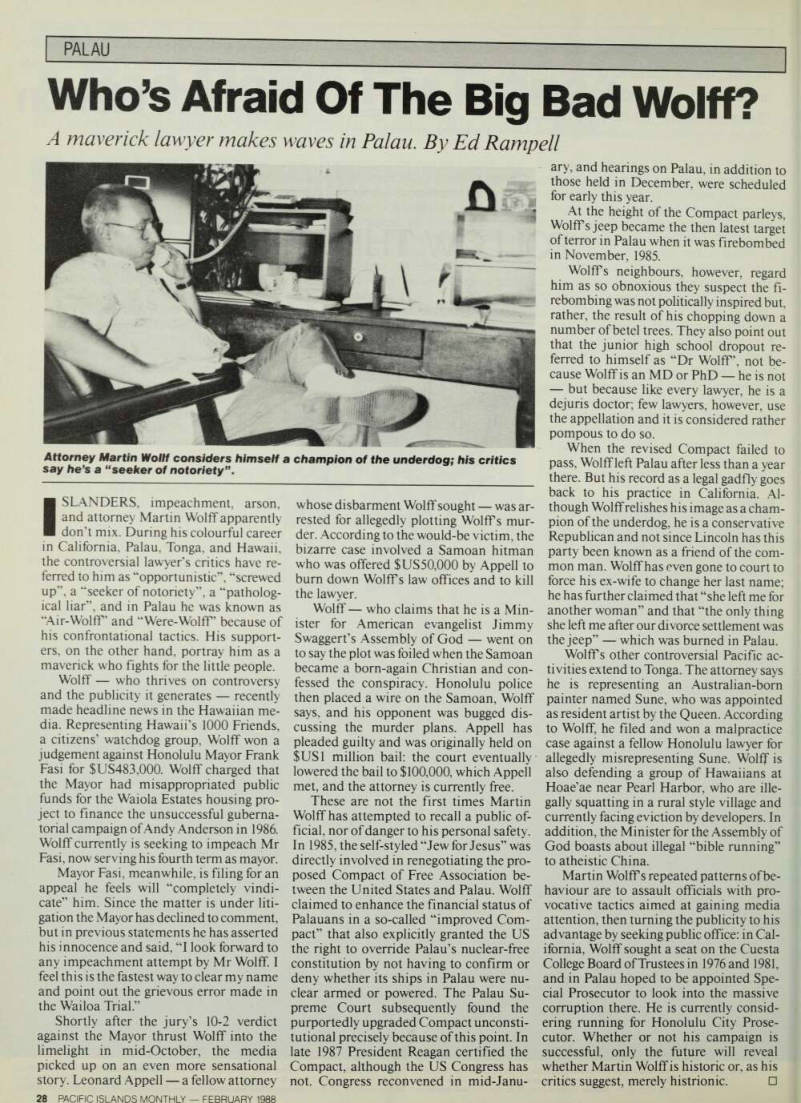
Palau
A maverick lawyer makes waves in Palau.
By Ed Rampell
I SLANDERS, impeachment, arson, and attorney Martin Wolff apparently don’t mix. During his colourful career in California, Palau, Tonga, and Hawaii, the controversial lawyer’s critics have re ferred to him as “opportunistic”, “screwed up”, a “seeker of notoriety”, a “patholog ical liar”, and in Palau he was known as “Air-Wolff” and “Were-Wolff’ because of his confrontational tactics. His support ers, on the other hand, portray him as a maverick who fights for the little people.
Wolff who thrives on controversy and the publicity it generates recently made headline news in the Hawaiian me dia. Representing Hawaii’s 1000 Friends, a citizens’ watchdog group, Wolff won a judgement against Honolulu Mayor Frank Fasi for $U5483,000. Wolff charged that the Mayor had misappropriated public funds for the Waiola Estates housing pro ject to finance the unsuccessful guberna torial campaign of Andy Anderson in 1986.
Wolff currently is seeking to impeach Mr Fasi, now serving his fourth term as mayor.
Mayor Fasi, meanwhile, is filing for an appeal he feels will “completely vindi cate” him. Since the matter is under liti gation the Mayor has declined to comment, but in previous statements he has asserted his innocence and said, “I look forward to any impeachment attempt by Mr Wolff. I feel this is the fastest way to clear my name and point out the grievous error made in the Wailoa Trial.”
Shortly after the jury’s 10-2 verdict against the Mayor thrust Wolff into the limelight in mid-October, the media picked up on an even more sensational story. Leonard Appell a fellow attorney
whose disbarment Wolff sought was ar rested for allegedly plotting Wolffs mur der. According to the would-be victim, the bizarre case involved a Samoan hitman who was offered SUSSO,OOO by Appell to burn down Wolffs law offices and to kill the lawyer.
Wolff who claims that he is a Min ister for American evangelist Jimmy Swaggert’s Assembly of God went on to say the plot was foiled when the Samoan became a born-again Christian and con fessed the conspiracy. Honolulu police then placed a wire on the Samoan, Wolff says, and his opponent was bugged dis cussing the murder plans. Appell has pleaded guilty and was originally held on SUSI million bail: the court eventually lowered the bail to $lOO,OOO, which Appell met, and the attorney is currently free.
These are not the first times Martin Wolff has attempted to recall a public of ficial, nor of danger to his personal safety.
In 1985, the self-styled “Jew for Jesus” was directly involved in renegotiating the pro posed Compact of Free Association be tween the United States and Palau. Wolff claimed to enhance the financial status of Palauans in a so-called “improved Com pact” that also explicitly granted the US the right to override Palau’s nuclear-free constitution by not having to confirm or deny whether its ships in Palau were nu clear armed or powered. The Palau Su preme Court subsequently found the purportedly upgraded Compact unconsti tutional precisely because of this point. In late 1987 President Reagan certified the Compact, although the US Congress has not. Congress reconvened in mid-Janu
ary, and hearings on Palau, in addition to those held in December, were scheduled for early this year.
At the height of the Compact parleys, Wolff s jeep became the then latest target of terror in Palau when it was firebombed in November, 1985.
Wolffs neighbours, however, regard him as so obnoxious they suspect the fi rebombing was not politically inspired but, rather, the result of his chopping down a number of betel trees. They also point out that the junior high school dropout re ferred to himself as “Dr Wolff’, not be cause Wolff is an MD or PhD he is not but because like every lawyer, he is a dejuris doctor; few lawyers, however, use the appellation and it is considered rather pompous to do so.
When the revised Compact failed to pass, Wolff left Palau after less than a year there. But his record as a legal gadfly goes back to his practice in California. Al though Wolff relishes his image as a cham pion of the underdog, he is a conservative Republican and not since Lincoln has this party been known as a friend of the com mon man. Wolff has even gone to court to force his ex-wife to change her last name; he has further claimed that “she left me for another woman” and that “the only thing she left me after our divorce settlement was the jeep” which was burned in Palau.
Wolff s other controversial Pacific ac tivities extend to Tonga. The attorney says he is representing an Australian-born painter named Sune, who was appointed as resident artist by the Queen. According to Wolff, he filed and won a malpractice case against a fellow Honolulu lawyer for allegedly misrepresenting Sune. Wolff is also defending a group of Hawaiians at Hoae’ae near Pearl Harbor, who are ille gally squatting in a rural style village and currently facing eviction by developers. In addition, the Minister for the Assembly of God boasts about illegal “bible running” to atheistic China.
Martin Wolffs repeated patterns of be haviour are to assault officials with pro vocative tactics aimed at gaining media attention, then turning the publicity to his advantage by seeking public office: in Cal ifornia, Wolff sought a seat on the Cuesta College Board of Trustees in 1976 and 1981, and in Palau hoped to be appointed Spe cial Prosecutor to look into the massive corruption there. He is currently consid ering running for Honolulu City Prose cutor. Whether or not his campaign is successful, only the future will reveal whether Martin Wolff is historic or, as his critics suggest, merely histrionic. □
Attorney Martin Wollf considers himself a champion of the underdog; his critics say he’s a “seeker of notoriety
Pacific Report
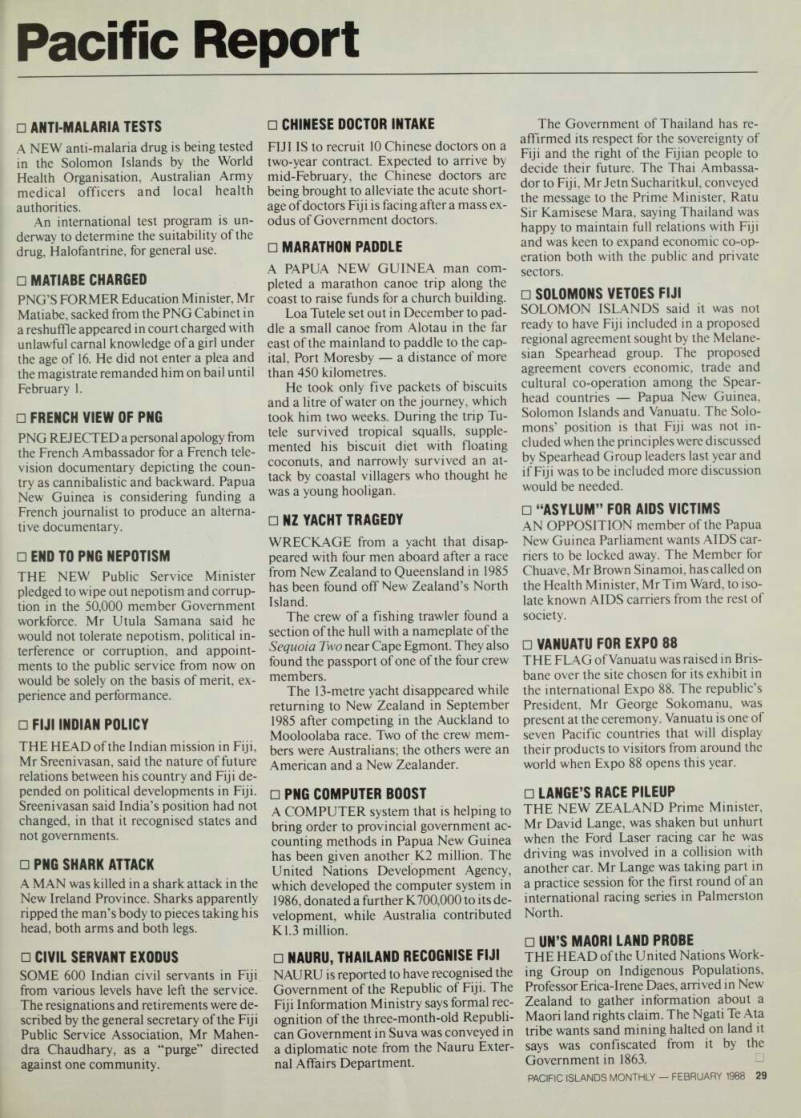
□ Anti-Malaria Tests
A NEW anti-malaria drug is being tested in the Solomon Islands by the World Health Organisation, Australian Army medical officers and local health authorities.
An international test program is un derway to determine the suitability of the drug, Halofantrine, for general use.
□ Matiabe Charged
PNG’S FORMER Education Minister, Mr Matiabe, sacked from the PNG Cabinet in a reshuffle appeared in court charged with unlawful carnal knowledge of a girl under the age of 16. He did not enter a plea and the magistrate remanded him on bail until February 1.
□ French View Of Png
PNG REJECTED a personal apology from the French Ambassador for a French tele vision documentary depicting the coun try as cannibalistic and backward. Papua New Guinea is considering funding a French journalist to produce an alterna tive documentary.
□ End To Png Nepotism
THE NEW Public Service Minister pledged to wipe out nepotism and corrup tion in the 50,000 member Government workforce. Mr Utula Samana said he would not tolerate nepotism, political in terference or corruption, and appoint ments to the public service from now on would be solely on the basis of merit, ex perience and performance.
□ Fiji Indian Policy
THE HEAD of the Indian mission in Fiji, Mr Sreenivasan, said the nature of future relations between his country and Fiji de pended on political developments in Fiji.
Sreenivasan said India’s position had not changed, in that it recognised states and not governments.
□ Png Shark Attack
A MAN was killed in a shark attack in the New Ireland Province. Sharks apparently ripped the man’s body to pieces taking his head, both arms and both legs.
□ Civil Servant Exodus
SOME 600 Indian civil servants in Fiji from various levels have left the service.
The resignations and retirements were de scribed by the general secretary of the Fiji Public Service Association, Mr Mahen dra Chaudhary, as a “purge” directed against one community.
□ Chinese Doctor Intake
FIJI IS to recruit 10 Chinese doctors on a two-year contract. Expected to arrive by mid-February, the Chinese doctors are being brought to alleviate the acute short age of doctors Fiji is facing after a mass ex odus of Government doctors.
□ Marathon Paddle
A Papua New Guinea Man Com
pleted a marathon canoe trip along the coast to raise funds for a church building.
Loa Tutele set out in December to pad dle a small canoe from Alotau in the far east of the mainland to paddle to the cap ital, Port Moresby a distance of more than 450 kilometres.
He took only five packets of biscuits and a litre of water on the journey, which took him two weeks. During the trip Tu tele survived tropical squalls, supple mented his biscuit diet with floating coconuts, and narrowly survived an at tack by coastal villagers who thought he was a young hooligan.
□ Nz Yacht Tragedy
WRECKAGE from a yacht that disap peared with four men aboard after a race from New Zealand to Queensland in 1985 has been found off New Zealand’s North Island.
The crew of a fishing trawler found a section of the hull with a nameplate of the Sequoia Two near Cape Egmont. They also found the passport of one of the four crew members.
The 13-metre yacht disappeared while returning to New Zealand in September 1985 after competing in the Auckland to Mooloolaba race. Two of the crew mem bers were Australians; the others were an American and a New Zealander.
□ Png Computer Boost
A COMPUTER system that is helping to bring order to provincial government ac counting methods in Papua New Guinea has been given another K 2 million. The United Nations Development Agency, which developed the computer system in 1986, donated a further K 700,000 to its de velopment, while Australia contributed K 1.3 million.
□ Nauru, Thailand Recognise Fiji
NAURU is reported to have recognised the Government of the Republic of Fiji. The Fiji Information Ministry says formal rec ognition of the three-month-old Republi can Government in Suva was conveyed in a diplomatic note from the Nauru Exter nal Affairs Department.
The Government of Thailand has re affirmed its respect for the sovereignty of Fiji and the right of the Fijian people to decide their future. The Thai Ambassa dor to Fiji, Mr Jetn Sucharitkul, conveyed the message to the Prime Minister, Ratu Sir Kamisese Mara, saying Thailand was happy to maintain full relations with Fiji and was keen to expand economic co-op eration both with the public and private sectors.
□ Solomons Vetoes Fiji
SOLOMON ISLANDS said it was not ready to have Fiji included in a proposed regional agreement sought by the Melane sian Spearhead group. The proposed agreement covers economic, trade and cultural co-operation among the Spear head countries Papua New Guinea, Solomon Islands and Vanuatu. The Solo mons’ position is that Fiji was not in cluded when the principles were discussed by Spearhead Group leaders last year and if Fiji was to be included more discussion would be needed.
□ “Asylum” For Aids Victims
AN OPPOSITION member of the Papua New Guinea Parliament wants AIDS car riers to be locked away. The Member for Chuave, Mr Brown Sinamoi, has called on the Health Minister, Mr Tim Ward, to iso late known AIDS carriers from the rest of society.
□ Vanuatu For Expo 88
THE FLAG of Vanuatu was raised in Bris bane over the site chosen for its exhibit in the international Expo 88. The republic’s President, Mr George Sokomanu, was present at the ceremony. Vanuatu is one of seven Pacific countries that will display their products to visitors from around the world when Expo 88 opens this year.
□ Lange’S Race Pileup
THE NEW ZEALAND Prime Minister, Mr David Lange, was shaken but unhurt when the Ford Laser racing car he was driving was involved in a collision with another car. Mr Lange was taking part in a practice session for the first round of an international racing series in Palmerston North.
□ Un’S Maori Land Probe
THE HEAD of the United Nations Work ing Group on Indigenous Populations, Professor Erica-Irene Daes, arrived in New Zealand to gather information about a Maori land rights claim. The Ngati Te Ata tribe wants sand mining halted on land it says was confiscated from it by the Government in 1863.
Advertisements & other items, pp. 30-31 (1 item)
Toyota
HILUX 4WD Regular Cab, Long Wheelbase One tough truck just got tougher. Toyota’s dedication to superh performance vehicles takes a step forward today with the New Hill A refined front grille and bumper design, new instrument panes for a feeling of spaciousness and command and plush colour co-ordinated trim are a few new additions to the New Hilux.
And extensive anti-corrosive galvanealed steel protection nowv includes the tailgate panel and rear door panel, making Hilux moree durable than ever before.
Yet for all its improvements, the best of the original Hilux is altl
TOYOTA
QUALITY SERVICE
AMERICAN SAMOA: BURNS PHILP (SOUTH SEA) CO., LTD., P.O. Box 129, Pago Pago, COOK ISLANDS: COOK ISLL AUTOMOTIVE SUPPLIES COMPANY, A Division of Burns Philp (South Sea) Co., Ltd., G.P.O. Box 355, Suva, GUAM & I Tamuning. KIRIBATI: TARAWA MOTORS, A Division of Bairiki Holdings Ltd., P.O. Box 36, Bairiki, Tarawa. NAURU: NAi SERVICE IMPORTATION AUTOMOBILE DU PACIFIQUE, Rond-Point du Pacifique (Station Total) B.P 438, Noumea. NIUE* NORFOLK ISLAND: BORRY’S LIMITED, P.O. Box 169. PAPUA NEW GUINEA: ELA MOTORS, A Division of Burns FI CORPORATION, P.O. Box 267, Saipan. SOLOMON ISLANDS: SOLOMON ISLANDS INVESTMENTS LTD., G.P.O. Box It TONGA: BURNS PHILP (TONGA) LTD., P.O. Box 55, Nukualofa. VANUATU: VANUATU MOTORS, A Division of Burns RR BURNS PHILP (SOUTH SEA) CO., LTD., P.O. Box 188, Apia.
ific-iougn. me New hiiuk.
V/ "' \ I.
I P* 1L i ■ m ** 'f 5 Y k -* * . **a li ' ' j » ft* ere; a big tailgate conveniently hinged for quick loading and unloading; reinforced front suspension to smooth out le bumps, and bias-mounted, extra-heavy-duty rear shocks and knobbly tyres to take on any terrain.
Toyota’s long history of super-responsive engines, ruggedness, reliability and comfort goes without saying. And in the Hilux, it’s yours in both 2-wheel-drive and 4X4 versions.
So, after comprehensive testing and thorough quality control, the New Hilux is ready to bring a new standard of toughness to the Pacific.
And isn’t that exactly what you expect from Toyota?
Areas where gaivanealed steel is used DING CORPORATION LTD., Private Bag, Rarotonga. FIJI: SIA: ATKINS KROLL, INC., 443 South Marine Drive,
[ERATIVE SOCIETY, Central Pacific. NEW CALEDONIA:
NLP (SOUTH SEA) CO., LTD., P.O. Box 39, Alofi.
M d ■ p O Box 75, Port Moresby. SAIPAN: MICROL >■ TAHITI: NIPPON AUTOMOTO, B.P. 342, Papeete. |ui Ltd., P.O. Box 18, Port Vila WESTERN SAMOA:
TOYOTA
Japan’s Business Invasion
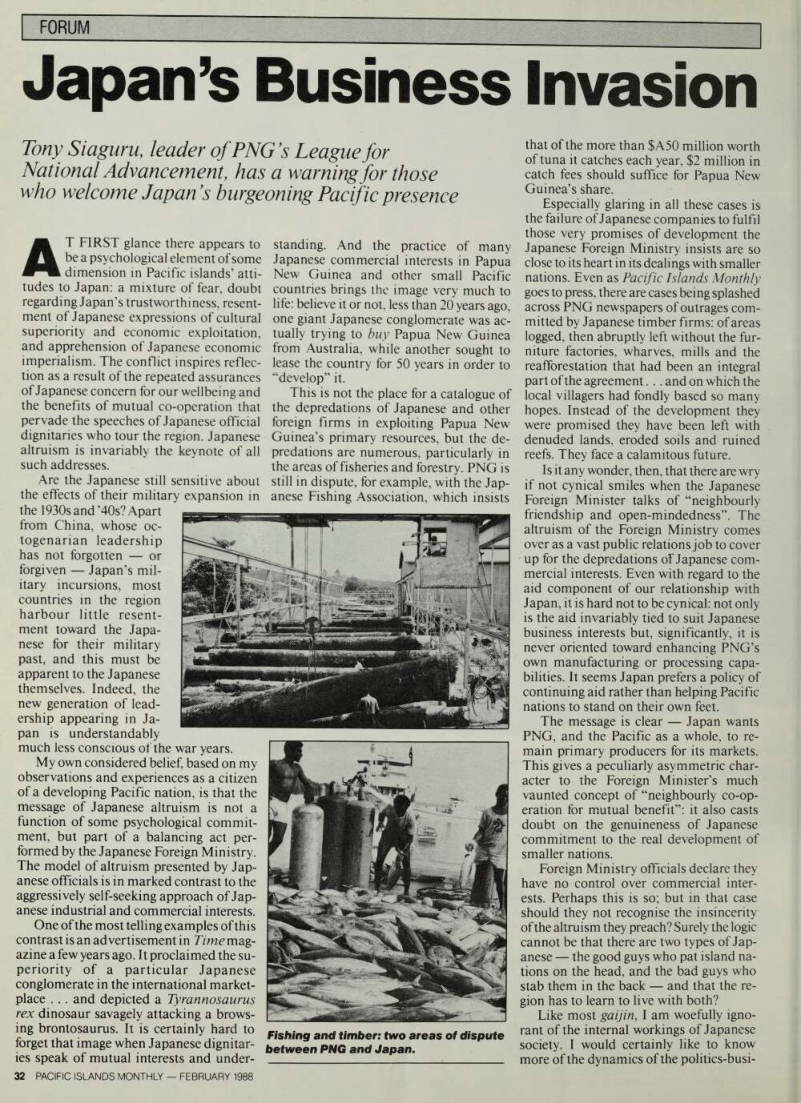
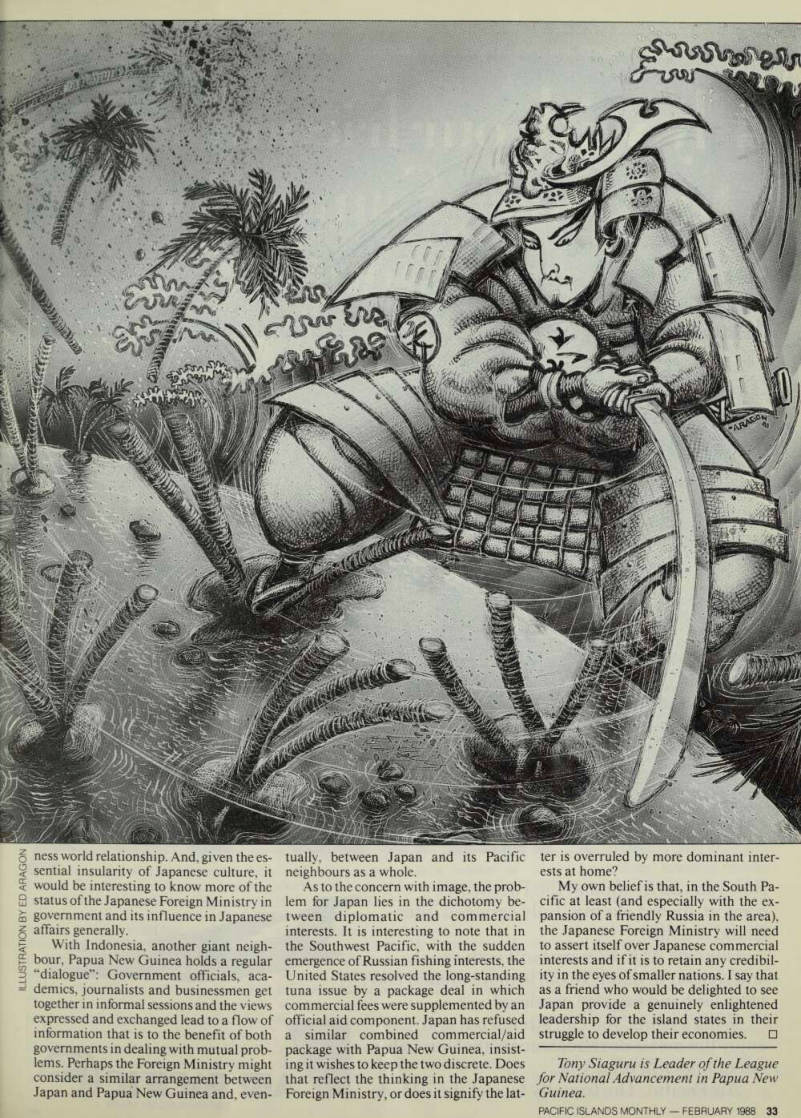
Forum
Tony Siaguru, leader of PNG’s League for National Advancement, has a warning for those who welcome Japan’s burgeoning Pacific presence
AT FIRST glance there appears to be a psychological element of some dimension in Pacific islands’ atti tudes to Japan: a mixture of fear, doubt regarding Japan’s trustworthiness, resent ment of Japanese expressions of cultural superiority and economic exploitation, and apprehension of Japanese economic imperialism. The conflict inspires reflec tion as a result of the repeated assurances of Japanese concern for our wellbeing and the benefits of mutual co-operation that pervade the speeches of Japanese official dignitaries who tour the region. Japanese altruism is invariably the keynote of all such addresses.
Are the Japanese still sensitive about the effects of their military expansion in
lie 1930 s and ’4os? Apart from China, whose oc togenarian leadership has not forgotten or forgiven Japan’s mil itary incursions, most countries in the region harbour little resent ment toward the Japa nese for their military past, and this must be apparent to the Japanese themselves. Indeed, the new generation of lead ership appearing in Ja pan is understandably
much less conscious of the war years.
My own considered belief, based on my observations and experiences as a citizen of a developing Pacific nation, is that the message of Japanese altruism is not a function of some psychological commit ment, but part of a balancing act per formed by the Japanese Foreign Ministry.
The model of altruism presented by Jap anese officials is in marked contrast to the aggressively self-seeking approach of Jap anese industrial and commercial interests.
One of the most telling examples of this contrast is an advertisement in Time mag azine a few years ago. It proclaimed the su periority of a particular Japanese conglomerate in the international market place ... and depicted a Tyrannosaurus rex dinosaur savagely attacking a brows ing brontosaurus. It is certainly hard to forget that image when Japanese dignitar ies speak of mutual interests and under
standing. And the practice of many Japanese commercial interests in Papua New Guinea and other small Pacific countries brings the image very much to life: believe it or not, less than 20 years ago, one giant Japanese conglomerate was ac tually trying to buy Papua New Guinea from Australia, while another sought to lease the country for 50 years in order to “develop” it.
This is not the place for a catalogue of the depredations of Japanese and other foreign firms in exploiting Papua New Guinea’s primary resources, but the de predations are numerous, particularly in the areas of fisheries and forestry. PNG is still in dispute, for example, with the Jap anese Fishing Association, which insists
that of the more than SASO million worth of tuna it catches each year, $2 million in catch fees should suffice for Papua New Guinea’s share.
Especially glaring in all these cases is the failure of Japanese companies to fulfil those very promises of development the Japanese Foreign Ministry insists are so close to its heart in its dealings with smaller nations. Even as Pacific Islands Monthly goes to press, there are cases being splashed across PNG newspapers of outrages com mitted by Japanese timber firms: of areas logged, then abruptly left without the fur niture factories, wharves, mills and the reafforestation that had been an integral part of the agreement... and on which the local villagers had fondly based so many hopes. Instead of the development they were promised they have been left with denuded lands, eroded soils and ruined reefs. They face a calamitous future.
Is it any wonder, then, that there are wry if not cynical smiles when the Japanese Foreign Minister talks of “neighbourly friendship and open-mindedness”. The altruism of the Foreign Ministry comes over as a vast public relations job to cover up for the depredations of Japanese com mercial interests. Even with regard to the aid component of our relationship with Japan, it is hard not to be cynical: not only is the aid invariably tied to suit Japanese business interests but, significantly, it is never oriented toward enhancing PNG’s own manufacturing or processing capa bilities. It seems Japan prefers a policy of continuing aid rather than helping Pacific nations to stand on their own feet.
The message is clear Japan wants PNG, and the Pacific as a whole, to re main primary producers for its markets.
This gives a peculiarly asymmetric char acter to the Foreign Minister’s much vaunted concept of “neighbourly co-op eration for mutual benefit”: it also casts doubt on the genuineness of Japanese commitment to the real development of smaller nations.
Foreign Ministry officials declare they have no control over commercial inter ests. Perhaps this is so; but in that case should they not recognise the insincerity of the altruism they preach? Surely the logic cannot be that there are two types of Jap anese the good guys who pat island na tions on the head, and the bad guys who stab them in the back and that the re gion has to learn to live with both?
Like most gaijin, I am woefully igno rant of the internal workings of Japanese society. I would certainly like to know more of the dynamics of the politics-busi-
Fishing and timber: two areas of dispute between PNG and Japan.
ness world relationship. And, given the es sential insularity of Japanese culture, it would be interesting to know more of the status of the Japanese Foreign Ministry in government and its influence in Japanese affairs generally.
With Indonesia, another giant neigh bour, Papua New Guinea holds a regular “dialogue”: Government officials, aca demics, journalists and businessmen get together in informal sessions and the views expressed and exchanged lead to a flow of information that is to the benefit of both governments in dealing with mutual prob lems. Perhaps the Foreign Ministry might consider a similar arrangement between Japan and Papua New Guinea and, even
tually, between Japan and its Pacific neighbours as a whole.
As to the concern with image, the prob lem for Japan lies in the dichotomy be tween diplomatic and commercial interests. It is interesting to note that in the Southwest Pacific, with the sudden emergence of Russian fishing interests, the United States resolved the long-standing tuna issue by a package deal in which commercial fees were supplemented by an official aid component. Japan has refused a similar combined commercial/aid package with Papua New Guinea, insist ing it wishes to keep the two discrete. Does that reflect the thinking in the Japanese Foreign Ministry, or does it signify the lat
ter is overruled by more dominant inter ests at home?
My own belief is that, in the South Pa cific at least (and especially with the ex pansion of a friendly Russia in the area), the Japanese Foreign Ministry will need to assert itself over Japanese commercial interests and if it is to retain any credibil ity in the eyes of smaller nations. I say that as a friend who would be delighted to see Japan provide a genuinely enlightened leadership for the island states in their struggle to develop their economies. □
Tony Siaguru is Leader of the League for National Advancement in Papua New Guinea.
Illustration By Ed Aragon
Advertisements & other items, p. 34 (1 item)
Fly with our friendly laces
to Western Samoa,Tonda
and \anualu.
€ .* €* * m J , i JNow you can fly around the Pacific in comfort aboard our big, fully serviced interisland aircraft.
Our new ATR 42’s are built with space and comfort in mind. Room to move around and room for hand luggage overhead.
What’s more, you can stretch out and enjoy the meals or refreshments that our cabin attendants will offer you.
Air Pacific. The friendly face of the islands
AIR PACIFIC
Hawaii High Flyer
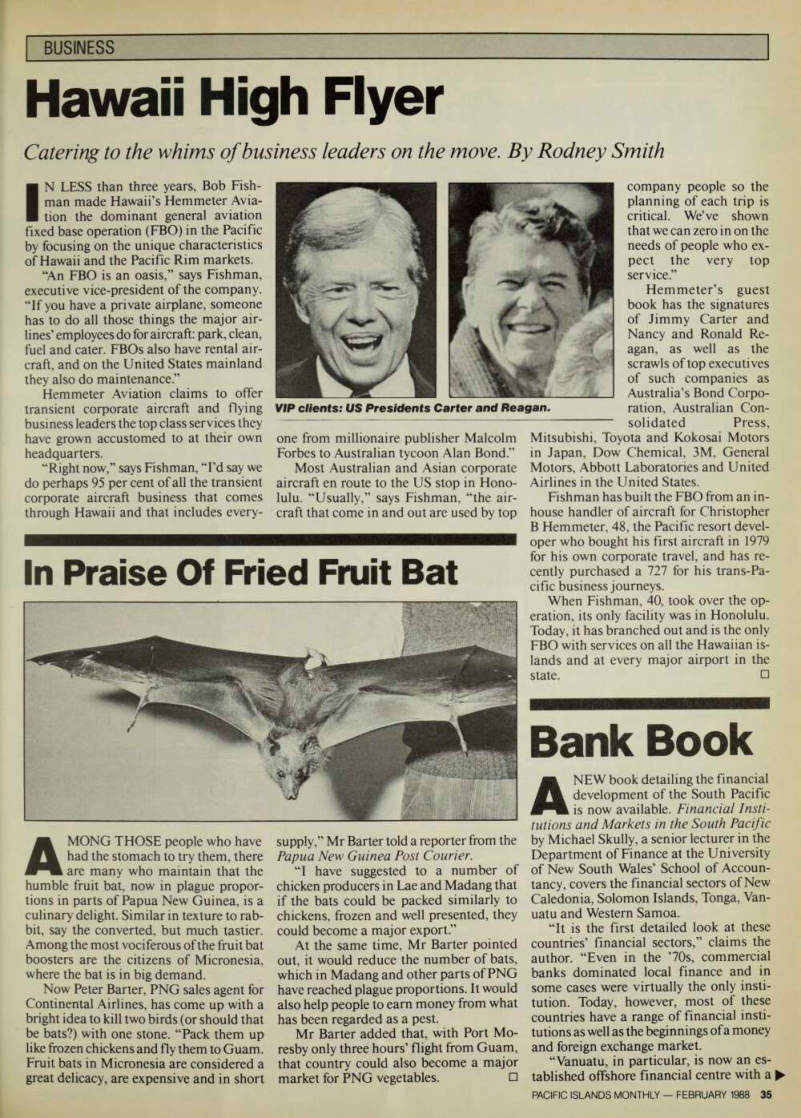
Business
Catering to the whims of business leaders on the move.
By Rodney Smith
IN LESS than three years, Bob Fish man made Hawaii’s Hemmeter Avia tion the dominant general aviation fixed base operation (FBO) in the Pacific by focusing on the unique characteristics of Hawaii and the Pacific Rim markets.
“An FBO is an oasis,” says Fishman, executive vice-president of the company.
“If you have a private airplane, someone has to do all those things the major air lines’ employees do for aircraft: park, clean, fuel and cater. FBOs also have rental air craft, and on the United States mainland they also do maintenance.”
Hemmeter Aviation claims to offer transient corporate aircraft and flying business leaders the top class services they have grown accustomed to at their own headquarters.
“Right now,” says Fishman, “I’d say we do perhaps 95 per cent of all the transient corporate aircraft business that comes through Hawaii and that includes every-
one from millionaire publisher Malcolm Forbes to Australian tycoon Alan Bond.”
Most Australian and Asian corporate aircraft en route to the US stop in Hono lulu. “Usually,” says Fishman, “the air craft that come in and out are used by top
company people so the planning of each trip is critical. We’ve shown that we can zero in on the needs of people who ex pect the very top service.”
Hemmeter’s guest book has the signatures of Jimmy Carter and Nancy and Ronald Re agan, as well as the scrawls of top executives of such companies as Australia’s Bond Corpo ration, Australian Con solidated Press,
Mitsubishi, Toyota and Kokosai Motors in Japan, Dow Chemical, 3M, General Motors, Abbott Laboratories and United Airlines in the United States.
Fishman has built the FBO from an in house handler of aircraft for Christopher B Hemmeter, 48, the Pacific resort devel oper who bought his first aircraft in 1979 for his own corporate travel, and has re cently purchased a 727 for his trans-Pa ciflc business journeys.
When Fishman, 40, took over the op eration, its only facility was in Honolulu.
Today, it has branched out and is the only FBO with services on all the Hawaiian is lands and at every major airport in the state. □
VIP clients: US Presidents Carter and Reagan.
In Praise Of Fried Fruit Bat
AMONG THOSE people who have had the stomach to try them, there are many who maintain that the humble fruit bat, now in plague propor tions in parts of Papua New Guinea, is a culinary delight. Similar in texture to rab bit, say the converted, but much tastier.
Among the most vociferous of the fruit bat boosters are the citizens of Micronesia, where the bat is in big demand.
Now Peter Barter, PNG sales agent for Continental Airlines, has come up with a bright idea to kill two birds (or should that be bats?) with one stone. “Pack them up like frozen chickens and fly them to Guam.
Fruit bats in Micronesia are considered a great delicacy, are expensive and in short
supply,” Mr Barter told a reporter from the Papua New Guinea Post Courier.
“I have suggested to a number of chicken producers in Lae and Madang that if the bats could be packed similarly to chickens, frozen and well presented, they could become a major export.”
At the same time, Mr Barter pointed out, it would reduce the number of bats, which in Madang and other parts of PNG have reached plague proportions. It would also help people to earn money from what has been regarded as a pest.
Mr Barter added that, with Port Mo resby only three hours’ flight from Guam, that country could also become a major market for PNG vegetables. □
Bank Book

ANEW book detailing the financial development of the South Pacific is now available. Financial Insti tutions and Markets in the South Pacific by Michael Skully, a senior lecturer in the Department of Finance at the University of New South Wales’ School of Accoun tancy, covers the financial sectors of New Caledonia, Solomon Islands, Tonga, Van uatu and Western Samoa.
“It is the first detailed look at these countries’ financial sectors,” claims the author. “Even in the ’7os, commercial banks dominated local finance and in some cases were virtually the only insti tution. Today, however, most of these countries have a range of financial insti tutions as well as the beginnings of a money and foreign exchange market.
“Vanuatu, in particular, is now an es tablished offshore financial centre with a ►
of international banks, trust com panies, accounting firms and solicitors.”
Skully explains that, given the in creased competition for international de velopment aid and foreign investment among developing countries, the respec tive governments are expecting their fi nancial sectors both to expand local savings and better allocate domestic investment.
The author says that Australia is very important to the region as Sydney often serves as the regional headquarters for major South Pacific businesses. It is also a significant source of development aid funds and a major trading partner for these countries.
Historically, he points out, Australian banks were similarly important, with the Commonwealth Bank initiating the sav ings banking services in both the Solomon Islands and what is now Vanuatu. The Westpac Banking Corporation likewise influenced the development of commer cial banking in Tonga and Western Sa moa. The Reserve Bank of Australia, too, once helped administer Vanuatu’s foreign exchange controls, and both Vanuatu and the Solomon Islands even once used Aus tralian dollars as local currency, he says.
The book devotes a separate chapter to such developments in each of the five countries. Each chapter, in turn, follows the same format, starting with a concise his tory of the country and its financial sector.
The author then examines the develop ment of each type of financial institution, the local money and foreign exchange markets, considers how these operations could be improved, and finally speculates on what future developments might oc cur. Financial Institutions and Markets in the South Pacific (Macmillan, $A98.95) is a handy guide to the region and should prove a valuable reference for business people as well as researchers in develop ment and financial economics. □
Clothing Coup
AUSTRALIAN garment maker the Stafford Group, and the Fiji-based Kelton Group, headed by Mr James Ah Koy and Mr Ramesh B Solanki, principal of Fiji’s biggest clothing manu facturer, Narotam Garments Limited, have formed Classic Apparel Manufactur ing Limited with hopes of establishing an international garment manufacturing en terprise. The move was announced by Stafford’s chairman, Mr Maurice Lubansky.
With authorised capital of SFIO mil lion and the Narotam factory in Suva as the nucleus, the new company will build a plant in Suva and factories in Suva and factories in Nausori, Lautoka, Ba and Nadi, employing more than 2500. □
Advertisements & other items, pp. 36-37 (2 items)
invites you to the
exhibition of the year.
A visit to Sydney, Australia during the Asian Pacific Trade and Industry Fair is a great opportunity for you to make new contacts, exchange information and ideas and foster new business for your company.
On show will be a whole host of products from Australia, Asia and the Pacific, representative of primary, manufacturing and service industries.
The theme of the Exhibition is “Partners In Progress” which expresses a marketing strategy aimed at developing trade between the nations of our region.
The Asian Pacific Trade and Industry Fair, through the support of the Australian Government,
PACIFIC TRADE & INDUSTRY
ftS,ftN F S APRIL 9-17.1988.
Australian Industry and its Trading Partners, will be one of the most important events to be held in Australia this decade.
The Exhibition will be staged against the backdrop of Australia’s Bicentennial. By registering as a trade visitor now, you can avoid delays and be assured of a visit that will be exciting for you and highly profitable for your company.
Sydney Convention
and Exhibition Centre, Darling f Harbour. * 7 o 0 mm
VISITOR REGISTRATION FORM
I Please send me my Overseas Visitor registration details including entry tickets.
Mr/Mrs/Miss Position
■ Company
Address Phone
T0T1528/A
Fax Please indicate □ your visitor classification.
A. □ Government E.
B. □ Finance/Banking F.
C. □ Production G.
D. □ Purchasing Please indicate □ your area of interest at the exhibition.
Manufacturing: A. □ Industrial Service Industry: C. □ Computer Services E. Transport F. □ Management Services Primary Industry: H.Q Agriculture I. □ Mining Send to; Total Concept Exhibitions P.O. Box 1221 Crows Nest, NSW 2065 Australia Telephone (02) 436 3266 Telex AA72262 TOCOEX. Fax (02) 439 7040 Telex □ Marketing □ Research/Development □ Other please specify B. □ Consumer D. □ Financial Services G.O Communications J. □ Fisheries Always the Best on Show
fram
Steel Kit-form Buildings
I / 4k m ri - IS m
5T "hEUcOPTEB
I RESCUE SERVICE yjr
L \
frame
SPACEFRAME BUILDINGS PTY. LTD.
61 DIDSBURY STREET, EAST BRISBANE, 4169,
QUEENSLAND, AUSTRALIA. TELEX AA42862.
PHONE (07) 393 1455 FAX (07) 391 5016 Space-Frame PRE-ENGINEERED kit form buildings have been designed to cover a wide range of industrial and rural applications.
Space-Frame engineering facilities with
computer aided design and drafting will produce drawings in 24 hours.
The building kit can be shipped out in less than three weeks.
Because of the advanced design techniques and the use of high tensile steel throughout the building, the kit is very light, making the cost of shipping very minimal compared to conventional structures.
It also means the whole building can be erected without the use of a crane. In remote areas of PNG and other Pacific Islands components have been flown in by helicopter to some sites.
FOR MORE INFORMATION & BROCHURE
POST COUPON TODAY
SPACEFRAME BUILDINGS PTY. LTD.
61 DIDSBURY ST., EAST BRISBANE, 4169, AUST.
NAME.
ADDRESS.
POSTCODE PHONE.
Trade Winds
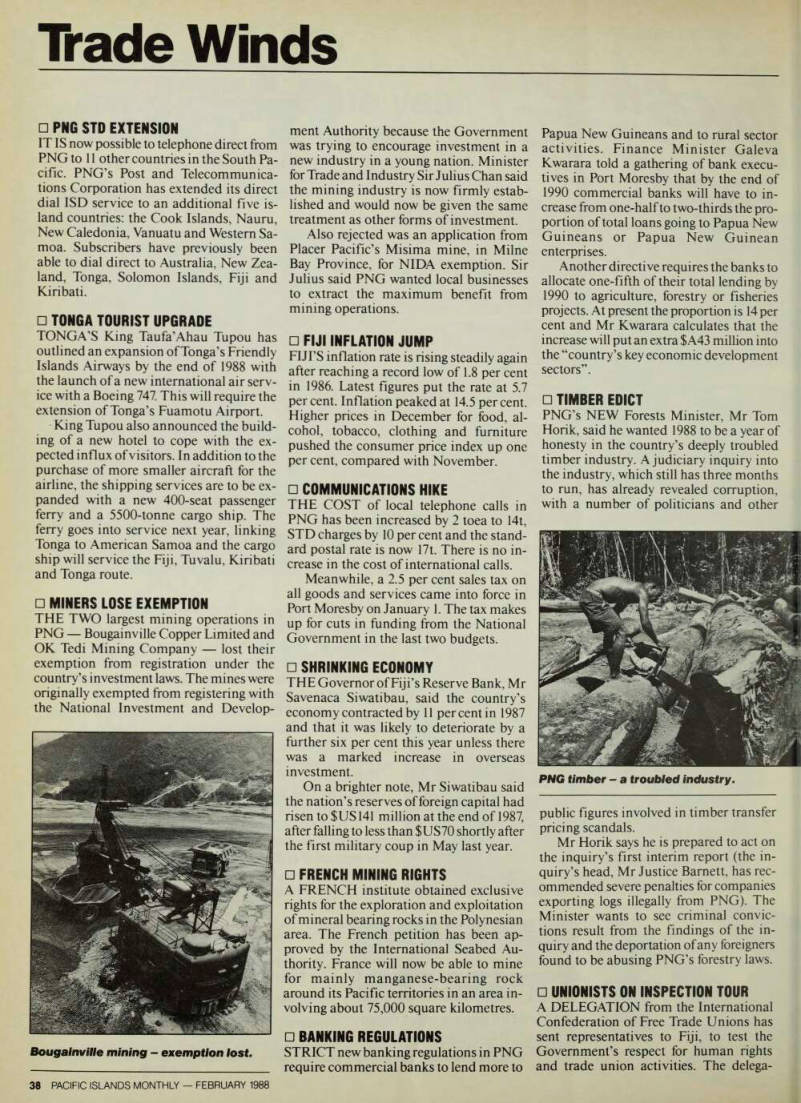
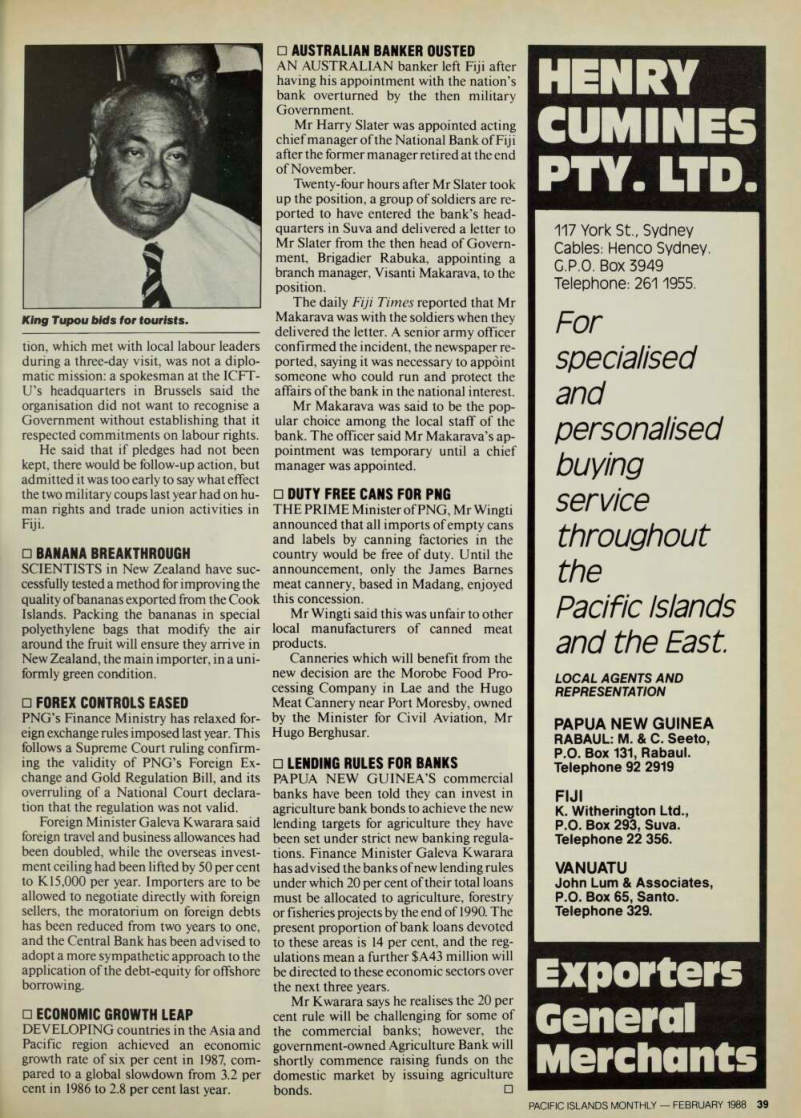
□ Png Std Extension
IT IS now possible to telephone direct from PNG to 11 other countries in the South Pa cific. PNG’s Post and Telecommunica tions Corporation has extended its direct dial ISD service to an additional five is land countries: the Cook Islands, Nauru, New Caledonia, Vanuatu and Western Sa moa. Subscribers have previously been able to dial direct to Australia, New Zea land, Tonga, Solomon Islands, Fiji and Kiribati.
□ Tonga Tourist Upgrade
TONGA’S King Taufa’Ahau Tupou has outlined an expansion of Tonga’s Friendly Islands Airways by the end of 1988 with the launch of a new international air serv ice with a Boeing 747. This will require the extension of Tonga’s Fuamotu Airport.
King Tupou also announced the build ing of a new hotel to cope with the ex pected influx of visitors. In addition to the purchase of more smaller aircraft for the airline, the shipping services are to be ex panded with a new 400-seat passenger ferry and a 5500-tonne cargo ship. The ferry goes into service next year, linking Tonga to American Samoa and the cargo ship will service the Fiji, Tuvalu, Kiribati and Tonga route.
□ Miners Lose Exemption
THE TWO largest mining operations in PNG Bougainville Copper Limited and OK Tedi Mining Company lost their exemption from registration under the country’s investment laws. The mines were originally exempted from registering with the National Investment and Develop-
ment Authority because the Government was trying to encourage investment in a new industry in a young nation. Minister for Trade and Industry Sir Julius Chan said the mining industry is now firmly estab lished and would now be given the same treatment as other forms of investment.
Also rejected was an application from Placer Pacific’s Misima mine, in Milne Bay Province, for NIDA exemption. Sir Julius said PNG wanted local businesses to extract the maximum benefit from mining operations.
□ Fiji Inflation Jump
FIJI’S inflation rate is rising steadily again after reaching a record low of 1.8 per cent in 1986. Latest figures put the rate at 5.7 per cent. Inflation peaked at 14.5 per cent.
Higher prices in December for food, al cohol, tobacco, clothing and furniture pushed the consumer price index up one per cent, compared with November.
□ Communications Hike
THE COST of local telephone calls in PNG has been increased by 2 toea to 14t, STD charges by 10 per cent and the stand ard postal rate is now 17t. There is no in crease in the cost of international calls.
Meanwhile, a 2.5 per cent sales tax on all goods and services came into force in Port Moresby on January 1. The tax makes up for cuts in funding from the National Government in the last two budgets.
□ Shrinking Economy
THE Governor of Fiji’s Reserve Bank, Mr Savenaca Siwatibau, said the country’s economy contracted by 11 per cent in 1987 and that it was likely to deteriorate by a further six per cent this year unless there was a marked increase in overseas investment.
On a brighter note, Mr Siwatibau said the nation’s reserves of foreign capital had risen to SUS 141 million at the end of 1987, after falling to less than SUS7O shortly after the first military coup in May last year.
□ French Mining Rights
A FRENCH institute obtained exclusive rights for the exploration and exploitation of mineral bearing rocks in the Polynesian area. The French petition has been ap proved by the International Seabed Au thority. France will now be able to mine for mainly manganese-bearing rock around its Pacific territories in an area in volving about 75,000 square kilometres.
□ Banking Regulations
STRICT new banking regulations in PNG require commercial banks to lend more to
Papua New Guineans and to rural sector activities. Finance Minister Galeva Kwarara told a gathering of bank execu tives in Port Moresby that by the end of 1990 commercial banks will have to in crease from one-half to two-thirds the pro portion of total loans going to Papua New Guineans or Papua New Guinean enterprises.
Another directive requires the banks to allocate one-fifth of their total lending by 1990 to agriculture, forestry or fisheries projects. At present the proportion is 14 per cent and Mr Kwarara calculates that the increase will put an extra $ A 43 million into the “country’s key economic development sectors”.
□ Timber Edict
PNG’s NEW Forests Minister, Mr Tom Horik, said he wanted 1988 to be a year of honesty in the country’s deeply troubled timber industry. A judiciary inquiry into the industry, which still has three months to run, has already revealed corruption, with a number of politicians and other
public figures involved in timber transfer pricing scandals.
Mr Horik says he is prepared to act on the inquiry’s first interim report (the in quiry’s head, Mr Justice Barnett, has rec ommended severe penalties for companies exporting logs illegally from PNG). The Minister wants to see criminal convic tions result from the findings of the in quiry and the deportation of any foreigners found to be abusing PNG’s forestry laws.
□ Unionists On Inspection Tour
A DELEGATION from the International Confederation of Free Trade Unions has sent representatives to Fiji, to test the Government’s respect for human rights and trade union activities. The delega-
Bougainville mining - exemption lost.
PNG timber - a troubled industry.
tion, which met with local labour leaders during a three-day visit, was not a diplo matic mission: a spokesman at the ICFT U’s headquarters in Brussels said the organisation did not want to recognise a Government without establishing that it respected commitments on labour rights.
He said that if pledges had not been kept, there would be follow-up action, but admitted it was too early to say what effect the two military coups last year had on hu man rights and trade union activities in Fiji.
□ Banana Breakthrough
SCIENTISTS in New Zealand have suc cessfully tested a method for improving the quality of bananas exported from the Cook Islands. Packing the bananas in special polyethylene bags that modify the air around the fruit will ensure they arrive in New Zealand, the main importer, in a uni formly green condition.
□ Forex Controls Eased
PNG’s Finance Ministry has relaxed for eign exchange rules imposed last year. This follows a Supreme Court ruling confirm ing the validity of PNG’s Foreign Ex change and Gold Regulation Bill, and its overruling of a National Court declara tion that the regulation was not valid.
Foreign Minister Galeva Kwarara said foreign travel and business allowances had been doubled, while the overseas invest ment ceiling had been lifted by 50 per cent to K 15,000 per year. Importers are to be allowed to negotiate directly with foreign sellers, the moratorium on foreign debts has been reduced from two years to one, and the Central Bank has been advised to adopt a more sympathetic approach to the application of the debt-equity for offshore borrowing.
□ Economic Growth Leap
DEVELOPING countries in the Asia and Pacific region achieved an economic growth rate of six per cent in 1987, com pared to a global slowdown from 3.2 per cent in 1986 to 2.8 per cent last year.
□ Australian Banker Ousted
AN AUSTRALIAN banker left Fiji after having his appointment with the nation’s bank overturned by the then military Government.
Mr Harry Slater was appointed acting chief manager of the National Bank of Fiji after the former manager retired at the end of November.
Twenty-four hours after Mr Slater took up the position, a group of soldiers are re ported to have entered the bank’s head quarters in Suva and delivered a letter to Mr Slater from the then head of Govern ment, Brigadier Rabuka, appointing a branch manager, Visanti Makarava, to the position.
The daily Fiji Times reported that Mr Makarava was with the soldiers when they delivered the letter. A senior army officer confirmed the incident, the newspaper re ported, saying it was necessary to appoint someone who could run and protect the affairs of the bank in the national interest.
Mr Makarava was said to be the pop ular choice among the local staff of the bank. The officer said Mr Makarava’s ap pointment was temporary until a chief manager was appointed.
□ Duty Free Cans For Png
THE PRIME Minister of PNG, Mr Wingti announced that all imports of empty cans and labels by canning factories in the country would be free of duty. Until the announcement, only the James Barnes meat cannery, based in Madang, enjoyed this concession.
Mr Wingti said this was unfair to other local manufacturers of canned meat products.
Canneries which will benefit from the new decision are the Morobe Food Pro cessing Company in Lae and the Hugo Meat Cannery near Port Moresby, owned by the Minister for Civil Aviation, Mr Hugo Berghusar.
□ Lending Rules For Banks
PAPUA NEW GUINEA’S commercial banks have been told they can invest in agriculture bank bonds to achieve the new lending targets for agriculture they have been set under strict new banking regula tions. Finance Minister Galeva Kwarara has advised the banks of new lending rules under which 20 per cent of their total loans must be allocated to agriculture, forestry or fisheries projects by the end of 1990. The present proportion of bank loans devoted to these areas is 14 per cent, and the reg ulations mean a further SA43 million will be directed to these economic sectors over the next three years.
Mr Kwarara says he realises the 20 per cent rule will be challenging for some of the commercial banks; however, the government-owned Agriculture Bank will shortly commence raising funds on the domestic market by issuing agriculture bonds. □
King Tupou bids for tourists.
Advertisements & other items, pp. 39-40 (1 item)
Pty. Ltd.
117 York St., Sydney Cables: Henco Sydney.
C.P.O. Box 5949 Telephone: 261 1955.
For
specialised
and
personalised
buying
service
throughout
the
Pacific Islands
and the East
LOCAL AGENTS AND
REPRESENTATION
PAPUA NEW GUINEA
RABAUL: M. & C. Seeto, P.O. Box 131, Rabaul.
Telephone 92 2919
FIJI
K. Witherington Ltd., P.O. Box 293, Suva.
Telephone 22 356.
VANUATU
John Lum & Associates, P.O. Box 65, Santo.
Telephone 329.
Exporters
General
Merchants
r V* V* Set in ten acres of tropical gardens, the Islander is located midway between the airport and the city centre, within 5 minutes drive of Central Government Offices, Parliament House and the National Museum.
Facilities include: • 186 deluxe rooms and suites • Direct-dial telephones with computer modems • Colour TV and in-house video • Complete secretarial services • Conference and banquet ting facilities for up to 500 people • Travel agency • Florist Hire car service
Hairdressing salon
Boutique
News agency
Coffee shop
Restaurant • Cocktail bar • Night club • 4 glass backed squash courts • 2 synthetic grass tennis courts
• Fully equipped gymnasium
• Swimming pool
• Complimentary airport transfers
The location is only one reason you will choose the Islander. The luxurious accommodations together with the superb cuisine, whether it be from our Kofi Haus Coffee Shop, from the elegant Sanamarie A ’La Carte restaurant, or from our 24 hour room service, and the professional service from our courteous staff are all reasons why the Islander is Papua New Guineas
only truly International Hotel.
The Pacific has great hotels... the Islander is the great hotel of the Pacific. -v i £ r The Islander Hotel PO Box 1981, Boroko, Papua New Guinea.
TalanhAno- OC, Tqlov Pahloc- IclanHor
Tourism ’88
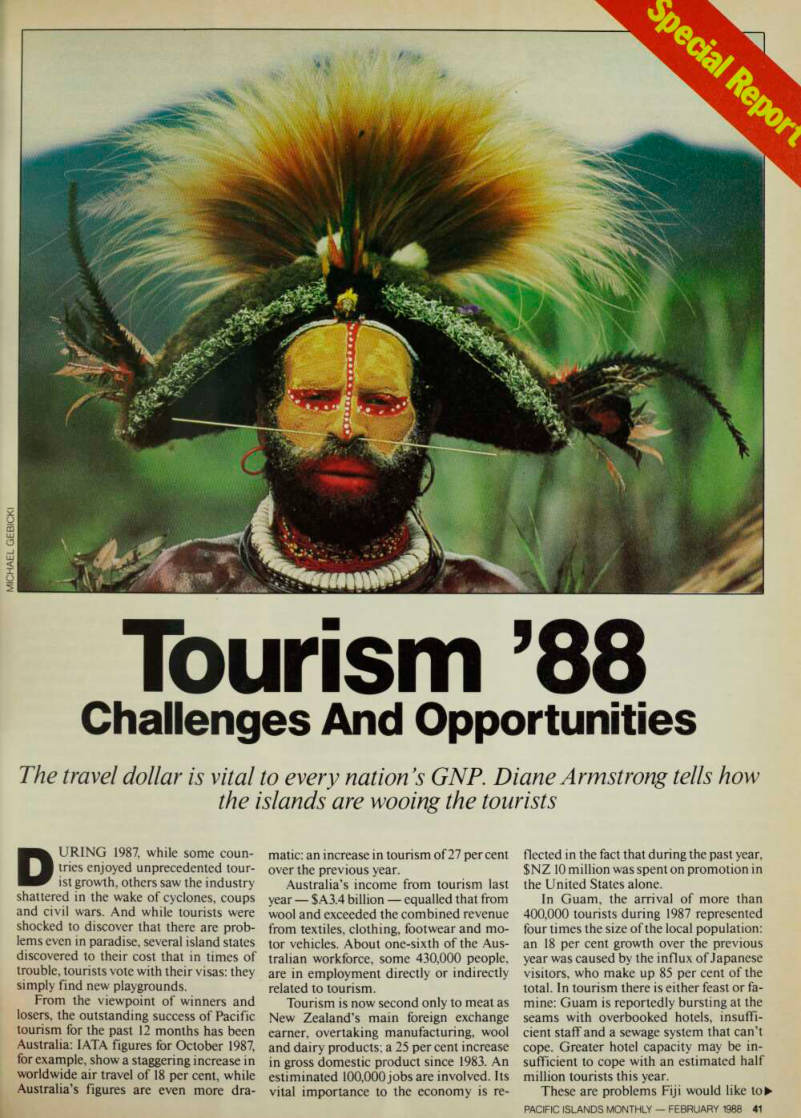
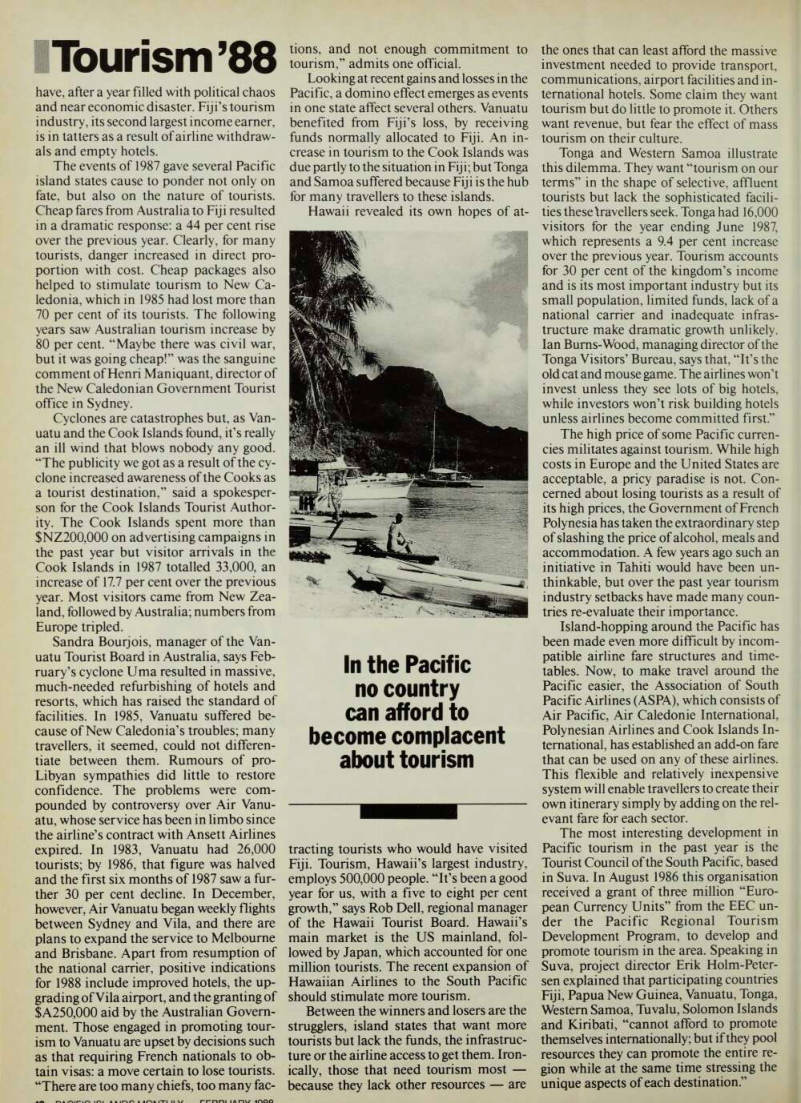
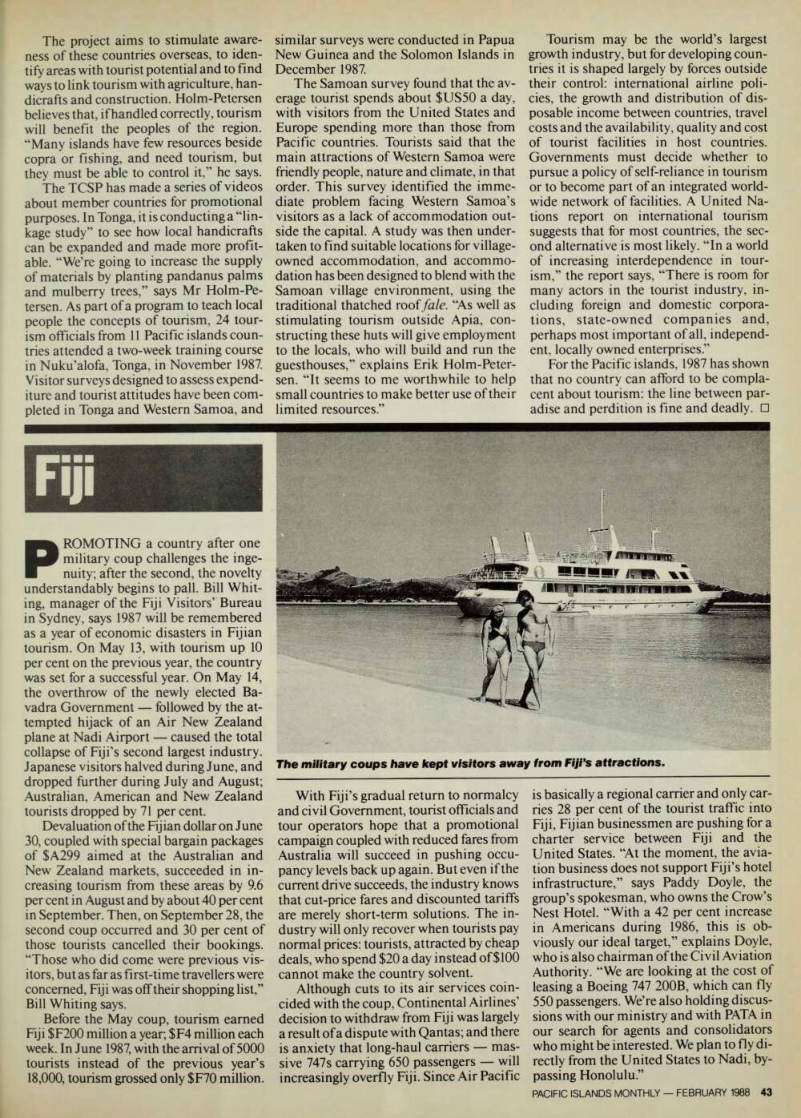
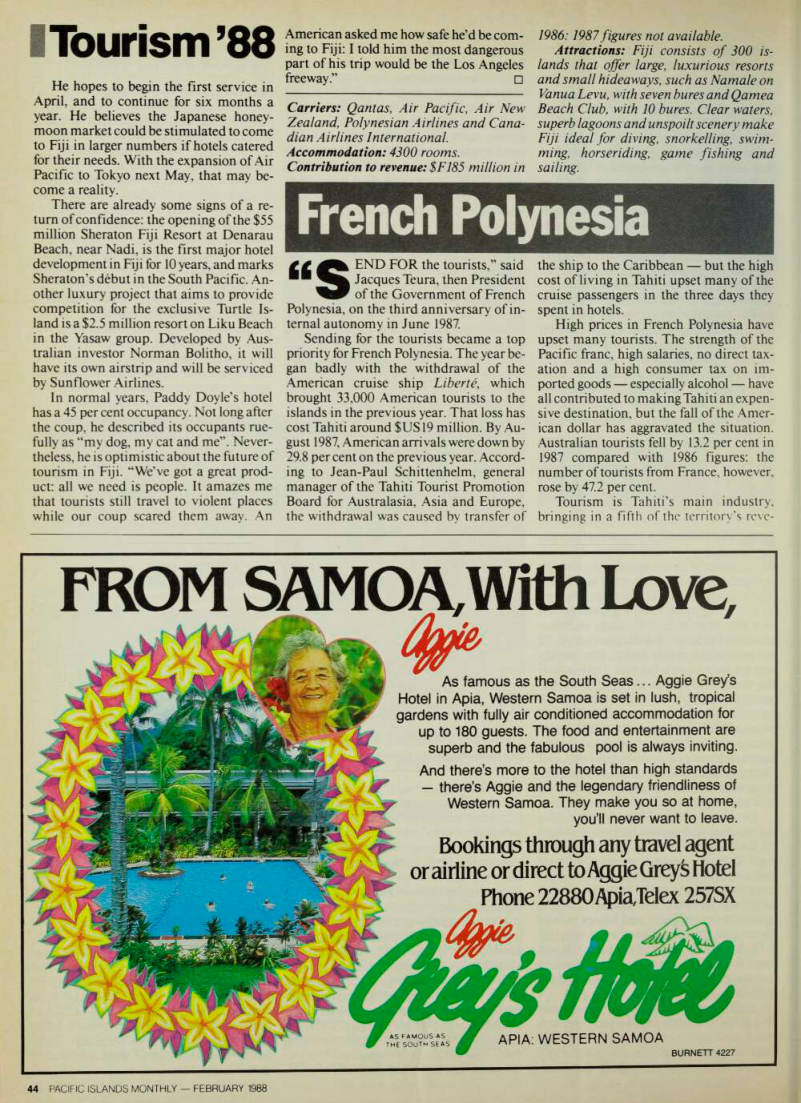
Challenges And Opportunities
The travel dollar is vital to every nation’s GNP. Diane Armstrong tells how the islands are wooing the tourists
DURING 1987, while some countries enjoyed unprecedented tourist growth, others saw the industry shattered in the wake of cyclones, coups and civil wars. And while tourists were shocked to discover that there are problems even in paradise, several island states discovered to their cost that in times of trouble, tourists vote with their visas: they simply find new playgrounds.
From the viewpoint of winners and losers, the outstanding success of Pacific tourism for the past 12 months has been Australia: IATA figures for October 1987, fer example, show a staggering increase in worldwide air travel of 18 per cent, while Australia’s figures are even more dra-
matic: an increase in tourism of 27 per cent over the previous year.
Australia’s income from tourism last year $A3.4 billion equalled that from wool and exceeded the combined revenue from textiles, clothing, footwear and motor vehicles. About one-sixth of the Australian workforce, some 430,000 people, are in employment directly or indirectly related to tourism.
Tourism is now second only to meat as New Zealand’s main foreign exchange earner, overtaking manufacturing, wool and dairy products; a 25 percent increase in gross domestic product since 1983. An estiminated 100,000 jobs are involved. Its vital importance to the economy is re-
fleeted in the fact that during the past year, SNZ 10 million was spent on promotion in the United States alone, In Guam, the arrival of more than 400,000 tourists during 1987 represented four times the size of the local population: an 18 per cent growth over the previous year was caused by the influx of Japanese visitors, who make up 85 per cent of the total. In tourism there is either feast or fa mine: Guam is reportedly bursting at the seams with overbooked hotels, insuffi dent staff and a sewage system that can’t cope. Greater hotel capacity may be in sufficient to cope with an estimated half million tourists this year.
These are problems Fiji would like to^
have, after a year filled with political chaos and near economic disaster. Fiji’s tourism industry, its second largest income earner, is in tatters as a result of airline withdraw als and empty hotels.
The events of 1987 gave several Pacific island states cause to ponder not only on fate, but also on the nature of tourists.
Cheap fares from Australia to Fiji resulted in a dramatic response: a 44 per cent rise over the previous year. Clearly, for many tourists, danger increased in direct pro portion with cost. Cheap packages also helped to stimulate tourism to New Ca ledonia, which in 1985 had lost more than 70 per cent of its tourists. The following years saw Australian tourism increase by 80 per cent. “Maybe there was civil war, but it was going cheap!” was the sanguine comment of Henri Maniquant, director of the New Caledonian Government Tourist office in Sydney.
Cyclones are catastrophes but, as Van uatu and the Cook Islands found, it’s really an ill wind that blows nobody any good.
“The publicity we got as a result of the cy clone increased awareness of the Cooks as a tourist destination,” said a spokesper son for the Cook Islands Tourist Author ity. The Cook Islands spent more than SNZ2OO,OOO on advertising campaigns in the past year but visitor arrivals in the Cook Islands in 1987 totalled 33,000, an increase of 17.7 per cent over the previous year. Most visitors came from New Zea land, followed by Australia; numbers from Europe tripled.
Sandra Bourjois, manager of the Van uatu Tourist Board in Australia, says Feb ruary’s cyclone Uma resulted in massive, much-needed refurbishing of hotels and resorts, which has raised the standard of facilities. In 1985, Vanuatu suffered be cause of New Caledonia’s troubles; many travellers, it seemed, could not differen tiate between them. Rumours of pro- Libyan sympathies did little to restore confidence. The problems were com pounded by controversy over Air Vanu atu, whose service has been in limbo since the airline’s contract with Ansett Airlines expired. In 1983, Vanuatu had 26,000 tourists; by 1986, that figure was halved and the first six months of 1987 saw a fur ther 30 per cent decline. In December, however, Air Vanuatu began weekly flights between Sydney and Vila, and there are plans to expand the service to Melbourne and Brisbane. Apart from resumption of the national carrier, positive indications for 1988 include improved hotels, the up grading of Vila airport, and the granting of $A250,000 aid by the Australian Govern ment. Those engaged in promoting tour ism to Vanuatu are upset by decisions such as that requiring French nationals to ob tain visas: a move certain to lose tourists.
“There are too many chiefs, too many fac
tions, and not enough commitment to tourism,” admits one official.
Looking at recent gains and losses in the Pacific, a domino effect emerges as events in one state affect several others. Vanuatu benefited from Fiji’s loss, by receiving funds normally allocated to Fiji. An in crease in tourism to the Cook Islands was due partly to the situation in Fiji; but Tonga and Samoa suffered because Fiji is the hub for many travellers to these islands.
Hawaii revealed its own hopes of at-
tracting tourists who would have visited Fiji. Tourism, Hawaii’s largest industry, employs 500,000 people. “It’s been a good year for us, with a five to eight per cent growth,” says Rob Dell, regional manager of the Hawaii Tourist Board. Hawaii’s main market is the US mainland, fol lowed by Japan, which accounted for one million tourists. The recent expansion of Hawaiian Airlines to the South Pacific should stimulate more tourism.
Between the winners and losers are the strugglers, island states that want more tourists but lack the funds, the infrastruc ture or the airline access to get them. Iron ically, those that need tourism most because they lack other resources are
the ones that can least afford the massive investment needed to provide transport, communications, airport facilities and in ternational hotels. Some claim they want tourism but do little to promote it. Others want revenue, but fear the effect of mass tourism on their culture.
Tonga and Western Samoa illustrate this dilemma. They want “tourism on our terms” in the shape of selective, affluent tourists but lack the sophisticated facili ties these travellers seek. Tonga had 16,000 visitors for the year ending June 1987, which represents a 9.4 per cent increase over the previous year. Tourism accounts for 30 per cent of the kingdom’s income and is its most important industry but its small population, limited funds, lack of a national carrier and inadequate infras tructure make dramatic growth unlikely. lan Bums-Wood, managing director of the Tonga Visitors’ Bureau, says that, “It’s the old cat and mouse game. The airlines won’t invest unless they see lots of big hotels, while investors won’t risk building hotels unless airlines become committed first.”
The high price of some Pacific curren cies militates against tourism. While high costs in Europe and the United States are acceptable, a pricy paradise is not. Con cerned about losing tourists as a result of its high prices, the Government of French Polynesia has taken the extraordinary step of slashing the price of alcohol, meals and accommodation. A few years ago such an initiative in Tahiti would have been un thinkable, but over the past year tourism industry setbacks have made many coun tries re-evaluate their importance.
Island-hopping around the Pacific has been made even more difficult by incom patible airline fare structures and time tables. Now, to make travel around the Pacific easier, the Association of South Pacific Airlines (ASPA), which consists of Air Pacific, Air Caledonie International, Polynesian Airlines and Cook Islands In ternational, has established an add-on fare that can be used on any of these airlines.
This flexible and relatively inexpensive system will enable travellers to create their own itinerary simply by adding on the rel evant fare for each sector.
The most interesting development in Pacific tourism in the past year is the Tourist Council of the South Pacific, based in Suva. In August 1986 this organisation received a grant of three million “Euro pean Currency Units” from the EEC un der the Pacific Regional Tourism Development Program, to develop and promote tourism in the area. Speaking in Suva, project director Erik Holm-Peter sen explained that participating countries Fiji, Papua New Guinea, Vanuatu, Tonga, Western Samoa, Tuvalu, Solomon Islands and Kiribati, “cannot afford to promote themselves internationally; but if they pool resources they can promote the entire re gion while at the same time stressing the unique aspects of each destination.”
In the Pacific no country can afford to become complacent about tourism
The project aims to stimulate awareness of these countries overseas, to idem tify areas with tourist potential and to find ways to link tourism with agriculture, handicrafts and construction. Holm-Petersen believes that, if handled correctly, tourism will benefit the peoples of the region.
“Many islands have few resources beside copra or fishing, and need tourism, but they must be able to control it,” he says, The TCSP has made a series of videos about member countries for promotional purposes. In Tonga, it is conducting a “linkage study” to see how local handicrafts can be expanded and made more profitable. “We’re going to increase the supply of materials by planting pandanus palms and mulberry trees,” says Mr Holm-Petersen. As part of a program to teach local people the concepts of tourism, 24 tourism officials from 11 Pacific islands countries attended a two-week training course in Nuku’alofa, Tonga, in November 1987.
Visitor surveys designed to assess expenditure and tourist attitudes have been completed in Tonga and Western Samoa, and
similar surveys were conducted in Papua New Guinea and the Solomon Islands in December 1987.
The Samoan survey found that the average tourist spends about SUSSO a day, with visitors from the United States and Europe spending more than those from Pacific countries. Tourists said that the main attractions of Western Samoa were friendly people, nature and climate, in that order. This survey identified the immediate problem facing Western Samoa’s visitors as a lack of accommodation outside the capital. A study was then undertaken to find suitable locations for villageowned accommodation, and accommodation has been designed to blend with the Samoan village environment, using the traditional thatched roof fale. “As well as stimulating tourism outside Apia, constructing these huts will give employment to the locals, who will build and run the guesthouses,” explains Erik Holm-Petersen. “It seems to me worthwhile to help small countries to make better use of their limited resources.”
Tourism may be the world’s largest growth industry, but for developing coun tries it is shaped largely by forces outside their control: international airline poli cies, the growth and distribution of dis posable income between countries, travel costs and the availability, quality and cost of tourist facilities in host countries, Governments must decide whether to pursue a policy of self-reliance in tourism or to become part of an integrated world wide network of facilities. A United Na tions report on international tourism suggests that for most countries, the sec ond alternative is most likely. “In a world of increasing interdependence in tour ism,” the report says, “There is room for many actors in the tourist industry, in eluding foreign and domestic corpora tions, state-owned companies and, perhaps most important of all, independ ent, locally owned enterprises.”
For the Pacific islands, 1987 has shown that no country can afford to be compla cent about tourism: the line between par adise and perdition is fine and deadly. □
He hopes to begin the first service in April, and to continue for six months a year. He believes the Japanese honey moon market could be stimulated to come to Fiji in larger numbers if hotels catered for their needs. With the expansion of Air Pacific to Tokyo next May, that may be come a reality.
There are already some signs of a re turn of confidence: the opening of the $55 million Sheraton Fiji Resort at Denarau Beach, near Nadi, is the first major hotel development in Fiji for 10 years, and marks Sheraton’s debut in the South Pacific. An other luxury project that aims to provide competition for the exclusive Turtle Is land is a $2.5 million resort on Liku Beach in the Yasaw group. Developed by Aus tralian investor Norman Bolitho, it will have its own airstrip and will be serviced by Sunflower Airlines.
In normal years, Paddy Doyle’s hotel has a 45 per cent occupancy. Not long after the coup, he described its occupants rue fully as “my dog, my cat and me”. Never theless, he is optimistic about the future of tourism in Fiji. “We’ve got a great prod uct: all we need is people. It amazes me that tourists still travel to violent places while our coup scared them away. An
American asked me how safe he’d be com ing to Fiji: I told him the most dangerous part of his trip would be the Los Angeles freeway.” □
Carriers: Qantas, Air Pacific, Air New Zealand, Polynesian Airlines and Cana dian Airlines International.
Accommodation: 4300 rooms.
Contribution to revenue: SFIBS million in
1986:1987figures not available.
Attractions: Fiji consists of 300 is lands that offer large, luxurious resorts and small hideaways, such as Namale on Vanua Levu, with seven bures and Qamea Beach Club, with 10 bures. Clear waters, superb lagoons and unspoilt scenery make Fiji ideal for diving, snorkelling, swim ming, horseriding, game fishing and sailing.
Advertisements & other items, p. 42 (1 item)
| i I 111
i I 111
Fiji
PROMOTING a country after one military coup challenges the inge nuity; after the second, the novelty understandably begins to pall. Bill Whit ing, manager of the Fiji Visitors’ Bureau in Sydney, says 1987 will be remembered as a year of economic disasters in Fijian tourism. On May 13, with tourism up 10 per cent on the previous year, the country was set for a successful year. On May 14, the overthrow of the newly elected Ba vadra Government followed by the at tempted hijack of an Air New Zealand plane at Nadi Airport caused the total collapse of Fiji’s second largest industry.
Japanese visitors halved during June, and dropped further during July and August; Australian, American and New Zealand tourists dropped by 71 per cent.
Devaluation of the Fijian dollar on June 30, coupled with special bargain packages of $A299 aimed at the Australian and New Zealand markets, succeeded in in creasing tourism from these areas by 9.6 per cent in August and by about 40 per cent in September. Then, on September 28, the second coup occurred and 30 per cent of those tourists cancelled their bookings.
“Those who did come were previous vis itors, but as far as first-time travellers were concerned, Fiji was off their shopping list,”
Bill Whiting says.
Before the May coup, tourism earned Fiji SF2OO million a year; SF4 million each week. In June 1987, with the arrival of 5000 tourists instead of the previous year’s 18,000, tourism grossed only SF7O million.
With Fiji’s gradual return to normalcy and civil Government, tourist officials and tour operators hope that a promotional campaign coupled with reduced fares from Australia will succeed in pushing occu pancy levels back up again. But even if the current drive succeeds, the industry knows that cut-price fares and discounted tariffs are merely short-term solutions. The in dustry will only recover when tourists pay normal prices: tourists, attracted by cheap deals, who spend $2O a day instead of $lOO cannot make the country solvent.
Although cuts to its air services coin cided with the coup, Continental Airlines’ decision to withdraw from Fiji was largely a result of a dispute with Qantas; and there is anxiety that long-haul carriers mas sive 747 s carrying 650 passengers will increasingly overfly Fiji. Since Air Pacific
is basically a regional carrier and only car ries 28 per cent of the tourist traffic into Fiji, Fijian businessmen are pushing for a charter service between Fiji and the United States. “At the moment, the avia tion business does not support Fiji’s hotel infrastructure,” says Paddy Doyle, the group’s spokesman, who owns the Crow’s Nest Hotel. “With a 42 per cent increase in Americans during 1986, this is ob viously our ideal target,” explains Doyle, who is also chairman of the Civil Aviation Authority. “We are looking at the cost of leasing a Boeing 747 2008, which can fly 550 passengers. We’re also holding discus sions with our ministry and with PATA in our search for agents and consolidators who might be interested. We plan to fly di rectly from the United States to Nadi, by passing Honolulu.”
The military coups have kept visitors away from Fiji’s attractions.
French Polynesia
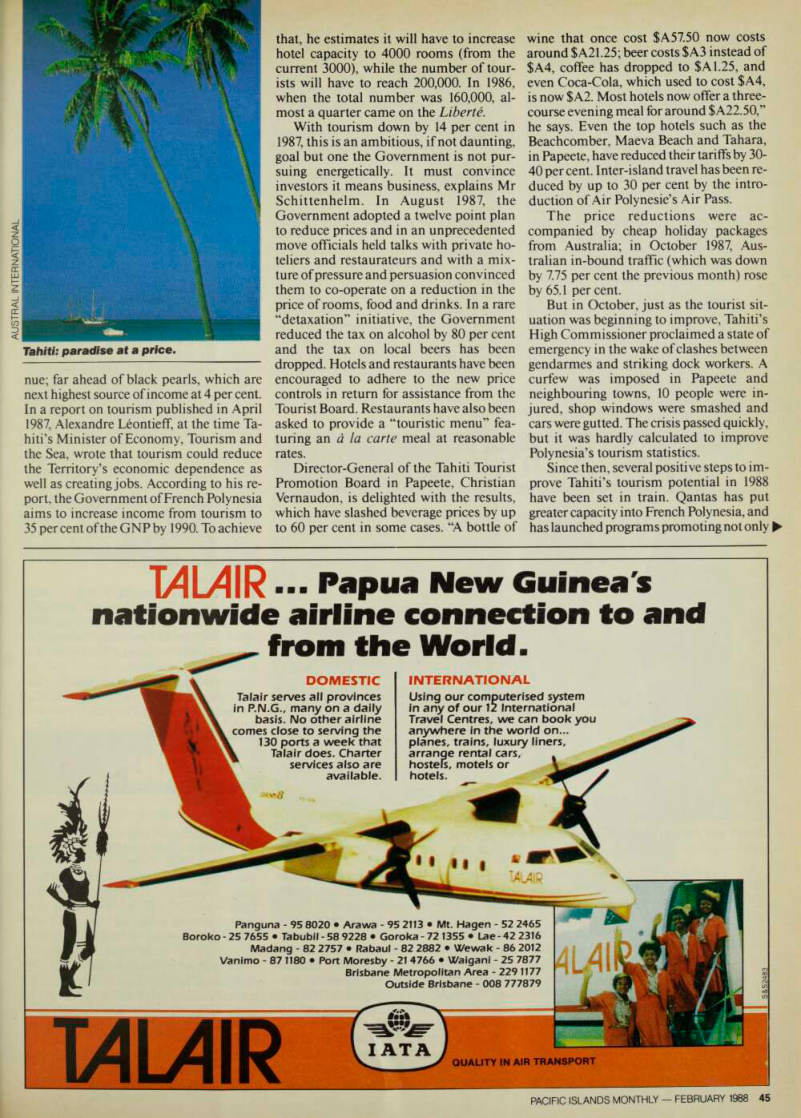
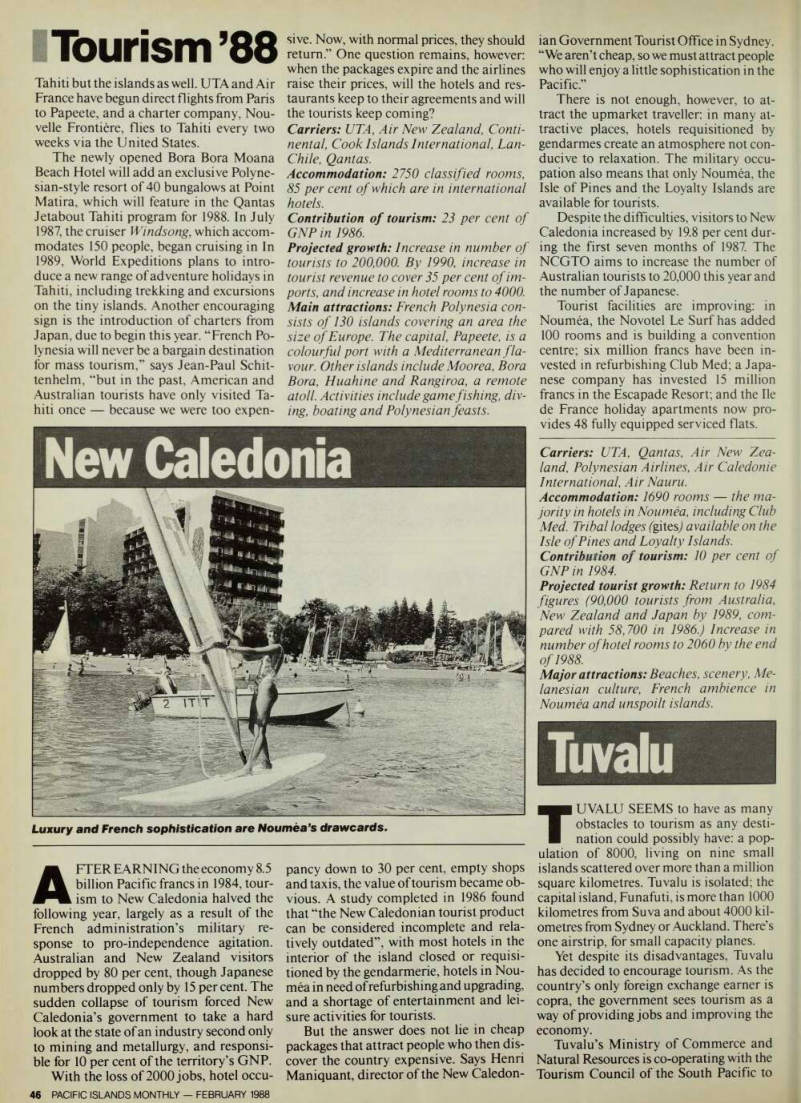
END FOR the tourists,” said Jacques Teura, then President of the Government of French Polynesia, on the third anniversary of in ternal autonomy in June 1987.
Sending for the tourists became a top priority for French Polynesia. The year be gan badly with the withdrawal of the American cruise ship Liberte, which brought 33,000 American tourists to the islands in the previous year. That loss has cost Tahiti around SUSI 9 million. By Au gust 1987, American arrivals were down by 29.8 per cent on the previous year. Accord ing to Jean-Paul Schittenhelm, general manager of the Tahiti Tourist Promotion Board for Australasia, Asia and Europe, the withdrawal was caused by transfer of
the ship to the Caribbean but the high cost of living in Tahiti upset many of the cruise passengers in the three days they spent in hotels.
High prices in French Polynesia have upset many tourists. The strength of the Pacific franc, high salaries, no direct tax ation and a high consumer tax on im ported goods especially alcohol have all contributed to making Tahiti an expen sive destination, but the fall of the Amer ican dollar has aggravated the situation.
Australian tourists fell by 13.2 per cent in 1987 compared with 1986 figures: the number of tourists from France, however, rose by 47.2 per cent.
Tourism is Tahiti’s main industry, bringing in a fifth of the territory’s rcvc-
nue; far ahead of black pearls, which are next highest source of income at 4 per cent, In a report on tourism published in April 1987, Alexandre Leontieflf, at the time Tahiti’s Minister of Economy, Tourism and the Sea, wrote that tourism could reduce the Territory’s economic dependence as well as creating jobs. According to his report, the Government of French Polynesia aims to increase income from tourism to 35 per cent of the GNP by 1990. To achieve
that, he estimates it will have to increase hotel capacity to 4000 rooms (from the current 3000), while the number of tour ists will have to reach 200,000. In 1986, when the total number was 160,000, al most a quarter came on the Liberte.
With tourism down by 14 per cent in 1987, this is an ambitious, if not daunting, goal but one the Government is not pur suing energetically. It must convince investors it means business, explains Mr Schittenhelm. In August 1987, the Government adopted a twelve point plan to reduce prices and in an unprecedented move officials held talks with private ho teliers and restaurateurs and with a mix ture of pressure and persuasion convinced them to co-operate on a reduction in the price of rooms, food and drinks. In a rare “detaxation” initiative, the Government reduced the tax on alcohol by 80 per cent and the tax on local beers has been dropped. Hotels and restaurants have been encouraged to adhere to the new price controls in return for assistance from the Tourist Board. Restaurants have also been asked to provide a “touristic menu” fea turing an a la carte meal at reasonable rates.
Director-General of the Tahiti Tourist Promotion Board in Papeete, Christian Vernaudon, is delighted with the results, which have slashed beverage prices by up to 60 per cent in some cases. “A bottle of
wine that once cost $A57.50 now costs around 5A21.25; beer costs SA3 instead of SA4, coffee has dropped to $ A 1.25, and even Coca-Cola, which used to cost SA4, is now SA2. Most hotels now offer a three course evening meal for around $A22.50,” he says. Even the top hotels such as the Beachcomber, Maeva Beach and Tahara, in Papeete, have reduced their tariffs by 30- 40 per cent. Inter-island travel has been re duced by up to 30 per cent by the intro duction of Air Polynesie’s Air Pass.
The price reductions were ac companied by cheap holiday packages from Australia; in October 1987, Aus tralian in-bound traffic (which was down by 7.75 per cent the previous month) rose by 65.1 per cent.
But in October, just as the tourist sit uation was beginning to improve, Tahiti’s High Commissioner proclaimed a state of emergency in the wake of clashes between gendarmes and striking dock workers. A curfew was imposed in Papeete and neighbouring towns, 10 people were in jured, shop windows were smashed and cars were gutted. The crisis passed quickly, but it was hardly calculated to improve Polynesia’s tourism statistics.
Since then, several positive steps to im prove Tahiti’s tourism potential in 1988 have been set in train. Qantas has put greater capacity into French Polynesia, and has launched programs promoting not only ►
Austral International
Tahiti: paradise at a price.
Tahiti but the islands as well. UTA and Air France have begun direct flights from Paris to Papeete, and a charter company, Nou velle Frontiere, flies to Tahiti every two weeks via the United States.
The newly opened Bora Bora Moana Beach Hotel will add an exclusive Polyne sian-style resort of 40 bungalows at Point Matira, which will feature in the Qantas Jetabout Tahiti program for 1988. In July 1987, the cruiser Windsong , which accom modates 150 people, began cruising in In 1989, World Expeditions plans to intro duce a new range of adventure holidays in Tahiti, including trekking and excursions on the tiny islands. Another encouraging sign is the introduction of charters from Japan, due to begin this year. “French Po lynesia will never be a bargain destination for mass tourism,” says Jean-Paul Schit tenhelm, “but in the past, American and Australian tourists have only visited Ta hiti once because we were too expen
sive. Now, with normal prices, they should return.” One question remains, however: when the packages expire and the airlines raise their prices, will the hotels and res taurants keep to their agreements and will the tourists keep coming?
Carriers: UTA, Air New Zealand, Conti nental, Cook Islands International, Lan- Chile, Qantas.
Accommodation: 2750 classified rooms, 85 per cent of which are in international hotels.
Contribution of tourism: 23 per cent of GNP in 1986.
Projected growth: Increase in number of tourists to 200,000. By 1990, increase in tourist revenue to cover 35 per cent of im ports, and increase in hotel rooms to 4000.
Main attractions: French Polynesia con sists of 130 islands covering an area the size of Europe. The capital, Papeete, is a colourful port with a Mediterranean fla vour. Other islands include Moorea, Bora Bora, Huahine and Rangiroa, a remote atoll. Activities include game fishing, div ing, boating and Polynesian feasts.
ian Government Tourist Office in Sydney.
“We aren’t cheap, so we must attract people who will enjoy a little sophistication in the Pacific.”
There is not enough, however, to at tract the upmarket traveller: in many at tractive places, hotels requisitioned by gendarmes create an atmosphere not con ducive to relaxation. The military occu pation also means that only Noumea, the Isle of Pines and the Loyalty Islands are available for tourists.
Despite the difficulties, visitors to New Caledonia increased by 19.8 per cent dur ing the first seven months of 1987. The NCGTO aims to increase the number of Australian tourists to 20,000 this year and the number of Japanese.
Tourist facilities are improving: in Noumea, the Novotel Le Surf has added 100 rooms and is building a convention centre; six million francs have been in vested in refurbishing Club Med; a Japa nese company has invested 15 million francs in the Escapade Resort; and the He de France holiday apartments now pro vides 48 fully equipped serviced flats.
Carriers: UTA, Qantas, Air New Zea land, Polynesian Airlines, Air Caledonie International, Air Nauru.
Accommodation: 1690 rooms the ma jority in hotels in Noumea, including Club Med. Tribal lodges (giles) available on the Isle of Pines and Loyalty Islands.
Contribution of tourism: 10 per cent of GNP in 1984.
Projected tourist growth: Return to 1984 figures (90,000 tourists from Australia, New Zealand and Japan by 1989, com pared with 58,700 in 1986.) Increase in number of hotel rooms to 2060 by the end of l9BB.
Major attractions: Beaches, scenery, Me lanesian culture, French ambience in Noumea and unspoilt islands.
Advertisements & other items, pp. 44-45 (1 item)
FROM SAMOA, With Lowe,
#> x V K .i Jr ■sn * As famous as the South Seas... Aggie Grey’s Hotel in Apia, Western Samoa is set in lush, tropical gardens with fully air conditioned accommodation for up to 180 guests. The food and entertainment are superb and the fabulous pool is always inviting.
And there’s more to the hotel than high standards there’s Aggie and the legendary friendliness of Western Samoa. They make you so at home, you’ll never want to leave.
Bookings through any travel agent
or airline or direct to Aggie Grey£ Hotel
Phone 22880Apia,Telex 2575 X
APIA: WESTERN SAMOA
BURNETT 4227
14L41R --- Papua New Guinea's
nationwide airline connection to and
from the World.
I *
DOMESTIC
Talair serves all provinces in P.N.G., many on a daily basis. No other airline comes close to serving the 130 ports a week that Talair does. Charter services also are available.
INTERNATIONAL
Using our computerised system
in any of our 12 International Travel Centres, we can book you anywhere in the world 0n...
planes, trains, luxury liners
arrange rental cars, hostels, motels or hotels. « I Panguna - 95 8020 • Arawa - 95 2113 • Mt. Hagen - 52 2465 Boroko - 25 7655 • Tabubil - 58 9228 • Goroka - 72 1355 • Lae - 42 2316 Madang - 82 2757 • Rabaul - 82 2882 • Wewak - 86 2012 Vanimo - 87 1180 • Port Moresby - 21 4766 • Waigani - 25 7877 Brisbane Metropolitan Area - 229 1177 Outside Brisbane - 008 777879
14MIR
Uii
AT A
4
QUALITY IN AIR TRANSPORT
New Caledonia
AFTER EARNING the economy 8.5 billion Pacific francs in 1984, tour ism to New Caledonia halved the following year, largely as a result of the French administration’s military re sponse to pro-independence agitation.
Australian and New Zealand visitors dropped by 80 per cent, though Japanese numbers dropped only by 15 per cent. The sudden collapse of tourism forced New Caledonia’s government to take a hard look at the state of an industry second only to mining and metallurgy, and responsi ble for 10 per cent of the territory’s GNP.
With the loss of 2000 jobs, hotel occu
pancy down to 30 per cent, empty shops and taxis, the value of tourism became ob vious. A study completed in 1986 found that “the New Caledonian tourist product can be considered incomplete and rela tively outdated”, with most hotels in the interior of the island closed or requisi tioned by the gendarmerie, hotels in Nou mea in need of refurbishing and upgrading, and a shortage of entertainment and lei sure activities for tourists, But the answer does not lie in cheap packages that attract people who then dis cover the country expensive. Says Henri Maniquant, director of the New Caledon-
Luxury and French sophistication are Noumea’s drawcards.
Tuvalu
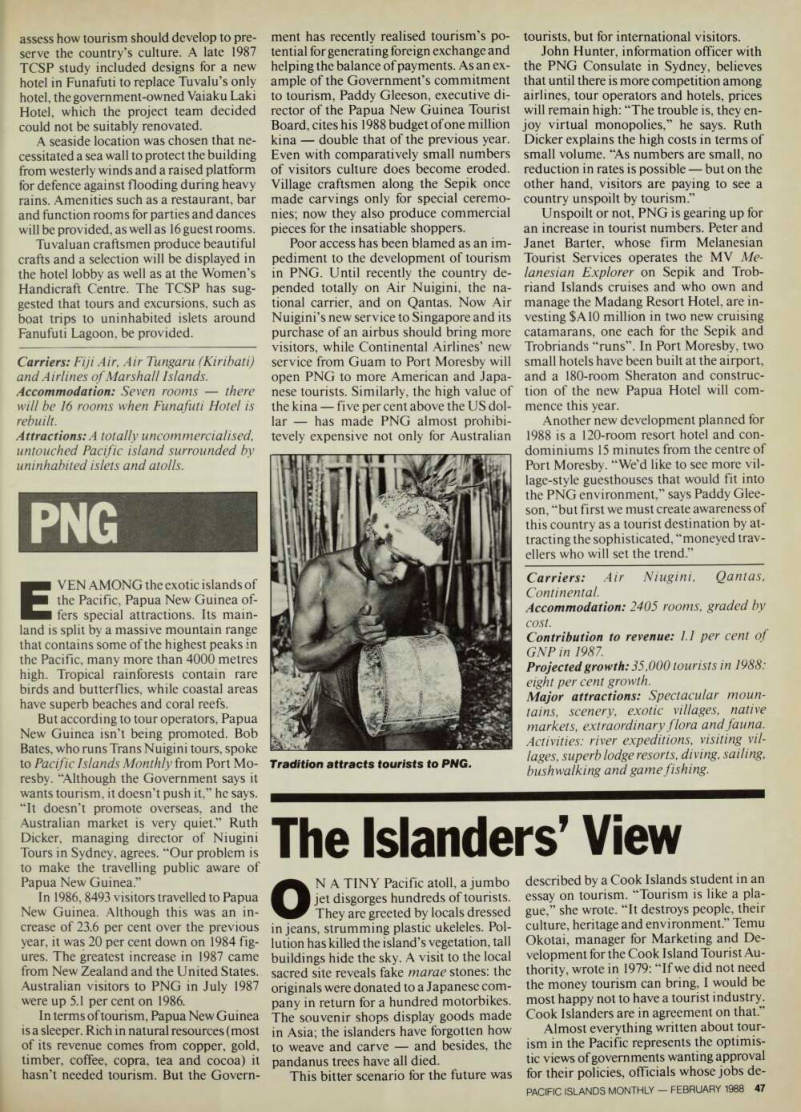
SEEMS to have as many obstacles to tourism as any desti nation could possibly have: a pop ulation of 8000, living on nine small islands scattered over more than a million square kilometres. Tuvalu is isolated; the capital island, Funafuti, is more than 1000 kilometres from Suva and about 4000 kil ometres from Sydney or Auckland. There’s one airstrip, for small capacity planes.
Yet despite its disadvantages, Tuvalu has decided to encourage tourism. As the country’s only foreign exchange earner is copra, the government sees tourism as a way of providing jobs and improving the economy.
Tuvalu’s Ministry of Commerce and Natural Resources is co-operating with the Tourism Council of the South Pacific to
assess how tourism should develop to pre serve the country’s culture. A late 1987 TCSP study included designs for a new hotel in Funafuti to replace Tuvalu’s only hotel, the government-owned Vaiaku Laki Hotel, which the project team decided could not be suitably renovated.
A seaside location was chosen that ne cessitated a sea wall to protect the building from westerly winds and a raised platform for defence against flooding during heavy rains. Amenities such as a restaurant, bar and function rooms for parties and dances will be provided, as well as 16 guest rooms.
Tuvaluan craftsmen produce beautiful crafts and a selection will be displayed in the hotel lobby as well as at the Women’s Handicraft Centre. The TCSP has sug gested that tours and excursions, such as boat trips to uninhabited islets around Fanufuti Lagoon, be provided.
Carriers: Fiji Air, Air Tungaru (Kiribati) and Airlines of Marshall Islands.
Accommodation: Seven rooms there will be 16 rooms when Funafuti Hotel is rebuilt.
Attractions: A totally uncommercialised, untouched Pacific island surrounded by uninhabited islets and atolls.
Advertisements & other items, p. 47 (1 item)
Png
EVEN AMONG the exotic islands of the Pacific, Papua New Guinea of fers special attractions. Its main land is split by a massive mountain range that contains some of the highest peaks in the Pacific, many more than 4000 metres high. Tropical rainforests contain rare birds and butterflies, while coastal areas have superb beaches and coral reefs.
But according to tour operators, Papua New Guinea isn’t being promoted. Bob Bates, who runs Trans Nuigini tours, spoke to Pacific Islands Monthly from Port Mo resby. “Although the Government says it wants tourism, it doesn’t push it,” he says.
“It doesn’t promote overseas, and the Australian market is very quiet.” Ruth Dicker, managing director of Niugini Tours in Sydney, agrees. “Our problem is to make the travelling public aware of Papua New Guinea.”
In 1986,8493 visitors travelled to Papua New Guinea. Although this was an in crease of 23.6 per cent over the previous year, it was 20 per cent down on 1984 fig ures. The greatest increase in 1987 came from New Zealand and the United States.
Australian visitors to PNG in July 1987 were up 5.1 per cent on 1986.
In terms of tourism, Papua New Guinea is a sleeper. Rich in natural resources (most of its revenue comes from copper, gold, timber, coffee, copra, tea and cocoa) it hasn’t needed tourism. But the Govern
ment has recently realised tourism’s po tential for generating foreign exchange and helping the balance of payments. As an ex ample of the Government’s commitment to tourism, Paddy Gleeson, executive di rector of the Papua New Guinea Tourist Board, cites his 1988 budget of one million kina double that of the previous year.
Even with comparatively small numbers of visitors culture does become eroded.
Village craftsmen along the Sepik once made carvings only for special ceremo nies; now they also produce commercial pieces for the insatiable shoppers.
Poor access has been blamed as an im pediment to the development of tourism in PNG. Until recently the country de pended totally on Air Nuigini, the na tional carrier, and on Qantas. Now Air Nuigini’s new service to Singapore and its purchase of an airbus should bring more visitors, while Continental Airlines’ new service from Guam to Port Moresby will open PNG to more American and Japa nese tourists. Similarly, the high value of the kina five per cent above the US dol lar has made PNG almost prohibi tevely expensive not only for Australian
tourists, but for international visitors.
John Hunter, information officer with the PNG Consulate in Sydney, believes that until there is more competition among airlines, tour operators and hotels, prices will remain high: “The trouble is, they en joy virtual monopolies,” he says. Ruth Dicker explains the high costs in terms of small volume. “As numbers are small, no reduction in rates is possible but on the other hand, visitors are paying to see a country unspoilt by tourism.”
Unspoilt or not, PNG is gearing up for an increase in tourist numbers. Peter and Janet Barter, whose firm Melanesian Tourist Services operates the MV Me lanesian Explorer on Sepik and Trob riand Islands cruises and who own and manage the Madang Resort Hotel, are in vesting SAIO million in two new cruising catamarans, one each for the Sepik and Trobriands “runs”. In Port Moresby, two small hotels have been built at the airport, and a 180-room Sheraton and construc tion of the new Papua Hotel will com mence this year.
Another new development planned for 1988 is a 120-room resort hotel and con dominiums 15 minutes from the centre of Port Moresby. “We’d like to see more vil lage-style guesthouses that would fit into the PNG environment,” says Paddy Glee son, “but first we must create awareness of this country as a tourist destination by at tracting the sophisticated, “moneyed trav ellers who will set the trend.”
Carriers: Air Niugini, Qantas, Continental.
Accommodation: 2405 rooms, graded by cost.
Contribution to revenue: 1.1 per cent of GNP in 1987.
Projected growth: 35,000 tourists in 1988: eight per cent growth.
Major attractions: Spectacular moun tains, scenery, exotic villages, native markets, extraordinary flora and fauna.
Activities: river expeditions, visiting vil lages, superb lodge resorts, diving, sailing, bushwalking and game fishing.
Tradition attracts tourists to PNG.
The Islanders’ View
ON A TINY Pacific atoll, a jumbo jet disgorges hundreds of tourists.
They are greeted by locals dressed in jeans, strumming plastic ukeleles. Pol lution has killed the island’s vegetation, tall buildings hide the sky. A visit to the local sacred site reveals fake marae stones: the originals were donated to a Japanese com pany in return for a hundred motorbikes.
The souvenir shops display goods made in Asia; the islanders have forgotten how to weave and carve and besides, the pandanus trees have all died.
This bitter scenario for the future was
described by a Cook Islands student in an essay on tourism. “Tourism is like a pla gue,” she wrote. “It destroys people, their culture, heritage and environment.” Temu Okotai, manager for Marketing and De velopment for the Cook Island Tourist Au thority, wrote in 1979: “If we did not need the money tourism can bring, I would be most happy not to have a tourist industry.
Cook Islanders are in agreement on that.”
Almost everything written about tour ism in the Pacific represents the optimis tic views of governments wanting approval for their policies, officials whose jobs de
pend on implementing those policies, or investors anxious to paint the situation in the best possible light. In contrast, soci ologists and anthropologists condemn the damage tourism wreaks on local cultures.
But we rarely hear the views of the island ers whose lives are affected by develop ments over which they have no control. As Mr Okotai points out, “How do you con trol tourism? And more importantly, at what stage of development is the maxi mum capacity reached?”.
Most islanders recognise the perils of an economy dependent on tourism. The spectre of Honolulu, as an example of how local cultures can be damaged by mass tourism, worries them. In an article in Pa cific Tourism , published by the Univer sity of the South Pacific, Malama and Penelope Meleisea wrote that a tourist in dustry should be the icing on the eco nomic cake. “Western Samoa has no need to promote itself as a plastic Hollywood fantasy of the South Seas,” they wrote.
Although it is generally accepted that tourism creates employment, it also cre ates vast social and economic gaps and ra cial resentments. In the hotel industry, for example, locals usually fill unskilled jobs while higher paid, higher status jobs are taken by Europeans and expatriates.
Many islanders resent the way the commercialisation of traditional skills and crafts and the use of non-traditional tools and materials have resulted in poor quality items being churned out for tourists. One Solomon Islander points out that carving done for money has lost its original function and artistic quality, though he realises tourist demand for the Solomon Islands carvings does have a po sitive effect: it motivates young people to become carvers, thus keeping alive the traditional arts.
All over the Pacific, a two-tier craft in dustry has sprung up: top quality work for the connoisseurs, inferior items for the souvenir shops. In Rotorua’s Whakare warewa thermal area, traditional Maori crafts are maintained with funds from tourist revenue, though mass-produced souvenirs with Maori motifs are sold in nearby shops. After listing the ways in which traditional wood-carving in Fiji has deteriorated through being commerci alised, one Fijian youth concedes that: “Fijian wood-carving could be a forgotten art if it were not for Tongan weaving: there’s no point hand-weaving a basket when you can buy a string bag, but tourist demand for local crafts brings an income to the vil lages.” A Tongan woman comments that performing traditional dances such as the tau olunga dance or the kailao, or war dance, for tourists reduces their authentic ity and dignity; yet despite their being bas tardised, these traditions ironically are also being kept alive by tourism. □
Advertisements & other items, p. 48 (1 item)
Airlines
WHICH SOUTH PACIFIC
AIRLINE HAS SPREAD
ITS WINGS TO OFFER
MORE THAN BLUE SKIES
AND PALM TREES?
Norfolk
Island
Airlines
In addition to operating airline services from Australia to Lord Howe and Norfolk Islands we own and manage two of Norfolk Island’s finest hotels together with Wholesale and Retail Travel Agencies in Sydney and Brisbane (with a Melbourne office opening shortly). Leading Australian companies such as Australian Airlines, TNT-Air and Wards Express contract Norfolk Island Airlines to fly their valuable overnight freight all over Australia. For an airline which was little more than a dream a decade ago we must be doing something right!
The Management Team which runs this very successful organisation is now available on either a consultancy or management contract basis to assist South Pacific nations with their aviation and tourist related needs, because being a small airline ourselves we genuinely understand the difficulties of airline operations in the South Pacific.
If you feel we could be of assistance, or you would just like to talk to us, contact Michael Childs at:- Norfolk Island Airlines Limited P.O. Box 905
BRISBANE QLD. 4001
AUSTRALIA
Ph: (61-7) 229 0488 Facsimile: (61-7) 229 7073
Book Reviews
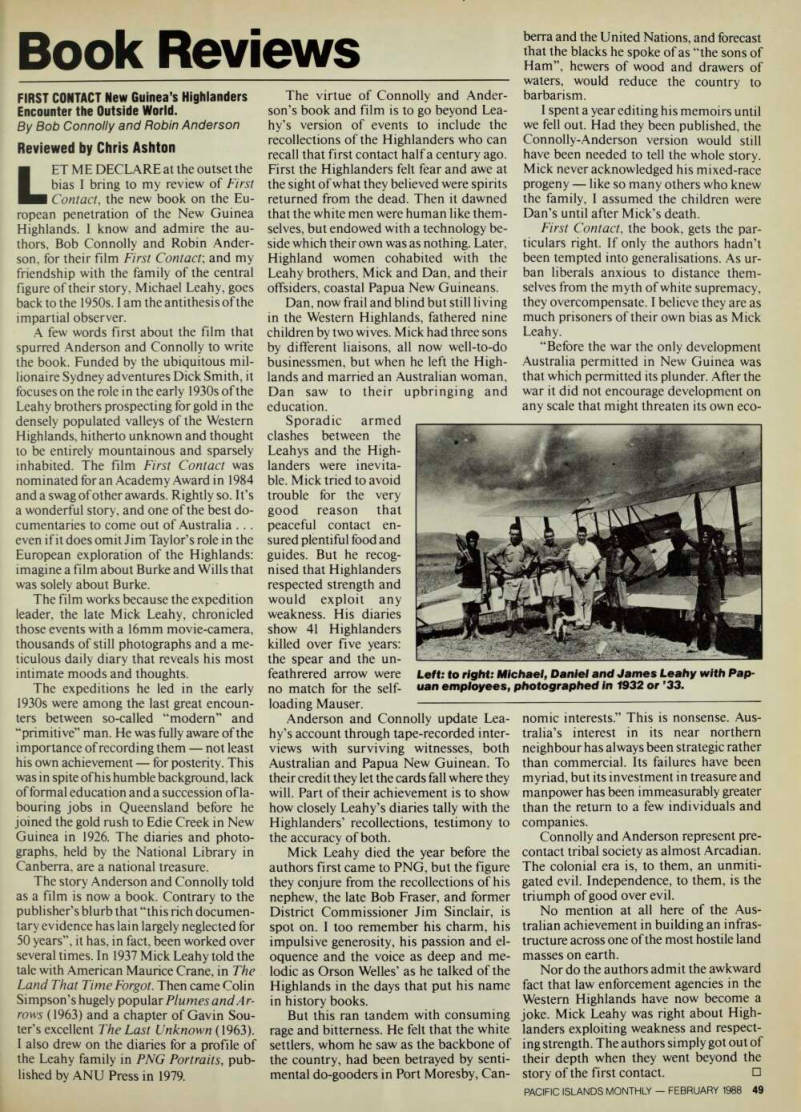
FIRST CONTACT New Guinea’s Highlanders Encounter the Outside World.
By Bob Connolly and Robin Anderson Reviewed by Chris Ashton LET ME DECLARE at the outset the bias I bring to my review of First Contact, the new book on the Eu ropean penetration of the New Guinea Highlands. I know and admire the au thors, Bob Connolly and Robin Ander son, for their film First Contact, and my friendship with the family of the central figure of their story, Michael Leahy, goes back to the 19505. I am the antithesis of the impartial observer.
A few words first about the film that spurred Anderson and Connolly to write the book. Funded by the übiquitous mil lionaire Sydney adventures Dick Smith, it focuses on the role in the early 1930 s of the Leahy brothers prospecting for gold in the densely populated valleys of the Western Highlands, hitherto unknown and thought to be entirely mountainous and sparsely inhabited. The film First Contact was nominated for an Academy Award in 1984 and a swag of other awards. Rightly so. It’s a wonderful story, and one of the best do cumentaries to come out of Australia . . . even if it does omit Jim Taylor’s role in the European exploration of the Highlands: imagine a film about Burke and Wills that was solely about Burke.
The film works because the expedition leader, the late Mick Leahy, chronicled those events with a 16mm movie-camera, thousands of still photographs and a me ticulous daily diary that reveals his most intimate moods and thoughts.
The expeditions he led in the early 1930 s were among the last great encoun ters between so-called “modem” and “primitive” man. He was fully aware of the importance of recording them not least his own achievement for posterity. This was in spite of his humble background, lack of formal education and a succession of la bouring jobs in Queensland before he joined the gold rush to Edie Creek in New Guinea in 1926. The diaries and photo graphs, held by the National Library in Canberra, are a national treasure.
The story Anderson and Connolly told as a film is now a book. Contrary to the publisher’s blurb that “this rich documen tary evidence has lain largely neglected for 50 years”, it has, in fact, been worked over several times. In 1937 Mick Leahy told the tale with American Maurice Crane, in The Land That Time Forgot. Then came Colin Simpson’s hugely popular Plumes and Ar rows (1963) and a chapter of Gavin Sou ter’s excellent The Last Unknown (1963).
I also drew on the diaries for a profile of the Leahy family in PNG Portraits, pub lished by ANU Press in 1979.
The virtue of Connolly and Ander son’s book and film is to go beyond Lea hy’s version of events to include the recollections of the Highlanders who can recall that first contact half a century ago.
First the Highlanders felt fear and awe at the sight of what they believed were spirits returned from the dead. Then it dawned that the white men were human like them selves, but endowed with a technology be side which their own was as nothing. Later, Highland women cohabited with the Leahy brothers, Mick and Dan, and their oflfsiders, coastal Papua New Guineans.
Dan, now frail and blind but still living in the Western Highlands, fathered nine children by two wives. Mick had three sons by different liaisons, all now well-to-do businessmen, but when he left the High lands and married an Australian woman, Dan saw to their upbringing and education.
Sporadic armed clashes between the Leahys and the High landers were inevita ble. Mick tried to avoid trouble for the very good reason that peaceful contact en sured plentiful food and guides. But he recog nised that Highlanders respected strength and would exploit any weakness. His diaries show 41 Highlanders killed over five years: the spear and the un feathrered arrow were no match for the self loading Mauser.
Anderson and Connolly update Lea hy’s account through tape-recorded inter views with surviving witnesses, both Australian and Papua New Guinean. To their credit they let the cards fall where they will. Part of their achievement is to show how closely Leahy’s diaries tally with the Highlanders’ recollections, testimony to the accuracy of both.
Mick Leahy died the year before the authors first came to PNG, but the figure they conjure from the recollections of his nephew, the late Bob Fraser, and former District Commissioner Jim Sinclair, is spot on. I too remember his charm, his impulsive generosity, his passion and el oquence and the voice as deep and me lodic as Orson Welles’ as he talked of the Highlands in the days that put his name in history books.
But this ran tandem with consuming rage and bitterness. He felt that the white settlers, whom he saw as the backbone of the country, had been betrayed by senti mental do-gooders in Port Moresby, Can
berra and the United Nations, and forecast that the blacks he spoke of as “the sons of Ham”, hewers of wood and drawers of waters, would reduce the country to barbarism.
I spent a year editing his memoirs until we fell out. Had they been published, the Connolly-Anderson version would still have been needed to tell the whole story.
Mick never acknowledged his mixed-race progeny like so many others who knew the family, I assumed the children were Dan’s until after Mick’s death.
First Contact , the book, gets the par ticulars right. If only the authors hadn’t been tempted into generalisations. As ur ban liberals anxious to distance them selves from the myth of white supremacy, they overcompensate. I believe they are as much prisoners of their own bias as Mick Leahy.
“Before the war the only development Australia permitted in New Guinea was that which permitted its plunder. After the war it did not encourage development on any scale that might threaten its own eco-
nomic interests.” This is nonsense. Aus tralia’s interest in its near northern neighbour has always been strategic rather than commercial. Its failures have been myriad, but its investment in treasure and manpower has been immeasurably greater than the return to a few individuals and companies.
Connolly and Anderson represent pre contact tribal society as almost Arcadian.
The colonial era is, to them, an unmiti gated evil. Independence, to them, is the triumph of good over evil.
No mention at all here of the Aus tralian achievement in building an infras tructure across one of the most hostile land masses on earth.
Nor do the authors admit the awkward fact that law enforcement agencies in the Western Highlands have now become a joke. Mick Leahy was right about High landers exploiting weakness and respect ing strength. The authors simply got out of their depth when they went beyond the story of the first contact. □
Left; to right: Michael, Daniel and James Leahy with Pap uan employees, photographed in 1932 or ’33.
The Island Press
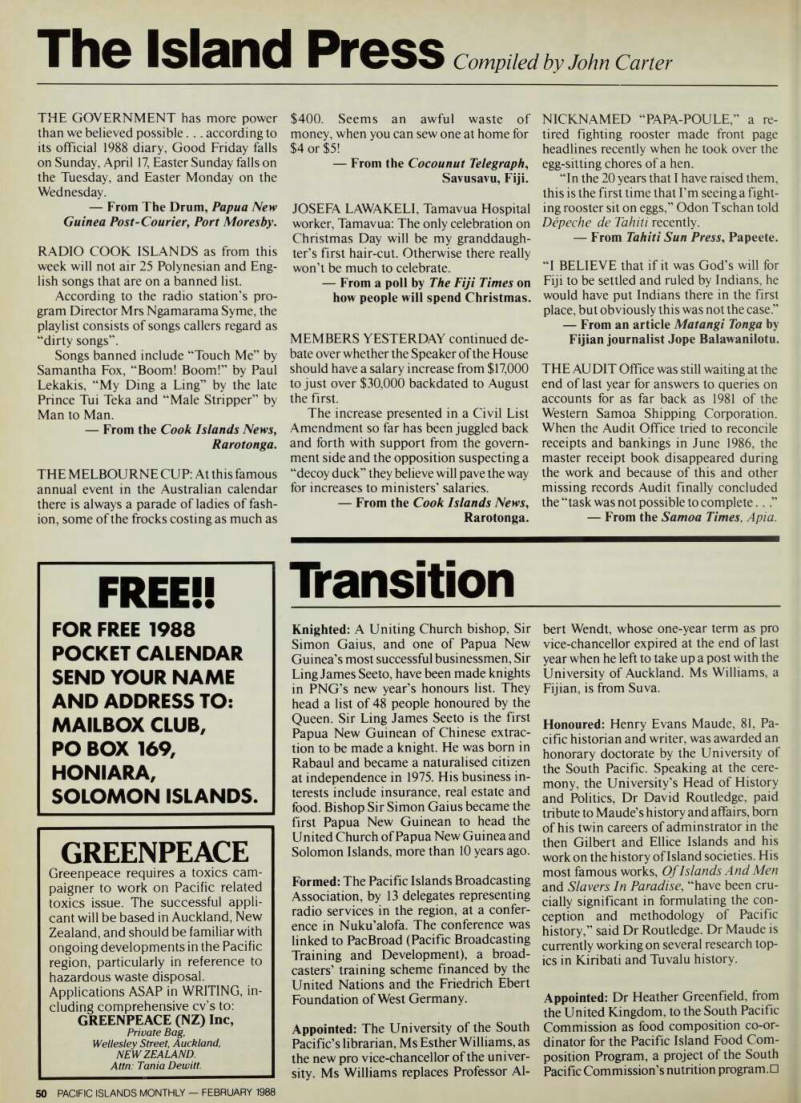
Compiled by John Carter
THE GOVERNMENT has more power than we believed possible. .. according to its official 1988 diary. Good Friday falls on Sunday, April 17, Easter Sunday falls on the Tuesday, and Easter Monday on the Wednesday.
From The Drum, Papua New Guinea Post-Courier , Port Moresby .
RADIO COOK ISLANDS as from this week will not air 25 Polynesian and Eng lish songs that are on a banned list.
According to the radio station’s pro gram Director Mrs Ngamarama Syme, the playlist consists of songs callers regard as “dirty songs”.
Songs banned include “Touch Me” by Samantha Fox, “Boom! Boom!” by Paul Lekakis, “My Ding a Ling” by the late Prince Tui Teka and “Male Stripper” by Man to Man.
From the Cook Islands News , Rarotonga.
THE MELBOURNE CUP: At this famous annual event in the Australian calendar there is always a parade of ladies of fash ion, some of the frocks costing as much as
$4OO. Seems an awful waste of money, when you can sew one at home for $4 or $5!
From the Cocounut Telegraph , Savusavu, Fiji.
JOSEFA LAWAKELI, Tamavua Hospital worker, Tamavua: The only celebration on Christmas Day will be my granddaugh ter’s first hair-cut. Otherwise there really won’t be much to celebrate.
From a poll by The Fiji Times on how people will spend Christmas.
MEMBERS YESTERDAY continued de bate over whether the Speaker of the House should have a salary increase from $17,000 to just over $30,000 backdated to August the first.
The increase presented in a Civil List Amendment so far has been juggled back and forth with support from the govern ment side and the opposition suspecting a “decoy duck” they believe will pave the way for increases to ministers’ salaries.
From the Cook Islands News , Rarotonga.
Nicknamed “Papa-Poule,” A Re
tired fighting rooster made front page headlines recently when he took over the egg-sitting chores of a hen.
“In the 20 years that I have raised them, this is the first time that I’m seeing a fight ing rooster sit on eggs,” Odon Tschan told Depeche de Tahiti recently.
From Tahiti Sun Press , Papeete.
“I BELIEVE that if it was God’s will for Fiji to be settled and ruled by Indians, he would have put Indians there in the first place, but obviously this was not the case.”
From an article Matangi Tonga by Fijian journalist Jope Balawanilotu.
THE AUDIT Office was still waiting at the end of last year for answers to queries on accounts for as far back as 1981 of the Western Samoa Shipping Corporation.
When the Audit Office tried to reconcile receipts and bankings in June 1986, the master receipt book disappeared during the work and because of this and other missing records Audit finally concluded the “task was not possible to complete...”
From the Samoa Times, Apia.
Transition
Knighted: A Uniting Church bishop, Sir Simon Gaius, and one of Papua New Guinea’s most successful businessmen. Sir Ling James Seeto, have been made knights in PNG’s new year’s honours list. They head a list of 48 people honoured by the Queen. Sir Ling James Seeto is the first Papua New Guinean of Chinese extrac tion to be made a knight. He was born in Rabaul and became a naturalised citizen at independence in 1975. His business in terests include insurance, real estate and food. Bishop Sir Simon Gaius became the first Papua New Guinean to head the United Church of Papua New Guinea and Solomon Islands, more than 10 years ago.
Formed: The Pacific Islands Broadcasting Association, by 13 delegates representing radio services in the region, at a confer ence in Nukualofa. The conference was linked to Pacßroad (Pacific Broadcasting Training and Development), a broad casters’ training scheme financed by the United Nations and the Friedrich Ebert Foundation of West Germany.
Appointed: The University of the South Pacific’s librarian, Ms Esther Williams, as the new pro vice-chancellor of the univer sity. Ms Williams replaces Professor Al
bert Wendt, whose one-year term as pro vice-chancellor expired at the end of last year when he left to take up a post with the University of Auckland. Ms Williams, a Fijian, is from Suva.
Honoured: Henry Evans Maude, 81, Pa cific historian and writer, was awarded an honorary doctorate by the University of the South Pacific. Speaking at the cere mony, the University’s Head of History and Politics, Dr David Routledge, paid tribute to Maude’s history and affairs, born of his twin careers of adminstrator in the then Gilbert and Ellice Islands and his work on the history of Island societies. His most famous works, Of Islands And Men and Slavers In Paradise , “have been cru cially significant in formulating the con ception and methodology of Pacific history,” said Dr Routledge. Dr Maude is currently working on several research top ics in Kiribati and Tuvalu history.
Appointed: Dr Heather Greenfield, from the United Kingdom, to the South Pacific Commission as food composition co-or dinator for the Pacific Island Food Com position Program, a project of the South Pacific Commission’s nutrition program.^
Advertisements & other items, p. 50 (1 item)
Free!!
FOR FREE 1988
POCKET CALENDAR
SEND YOUR NAME
AND ADDRESS TO:
MAILBOX CLUB,
PO BOX 169,
HONIARA,
SOLOMON ISLANDS.
GREENPEACE
Greenpeace requires a toxics campaigner to work on Pacific related toxics issue. The successful applicant will be based in Auckland, New Zealand, and should be familiar with ongoing developments in the Pacific region, particularly in reference to hazardous waste disposal.
Applications ASAP in WRITING, including comprehensive cv’s to;
GREENPEACE (NZ) Inc,
Private Bag, Wellesley Street, Auckland,
NEW ZEALAND.
Attn: Tania Dewitt.
Pacific Stamp Box
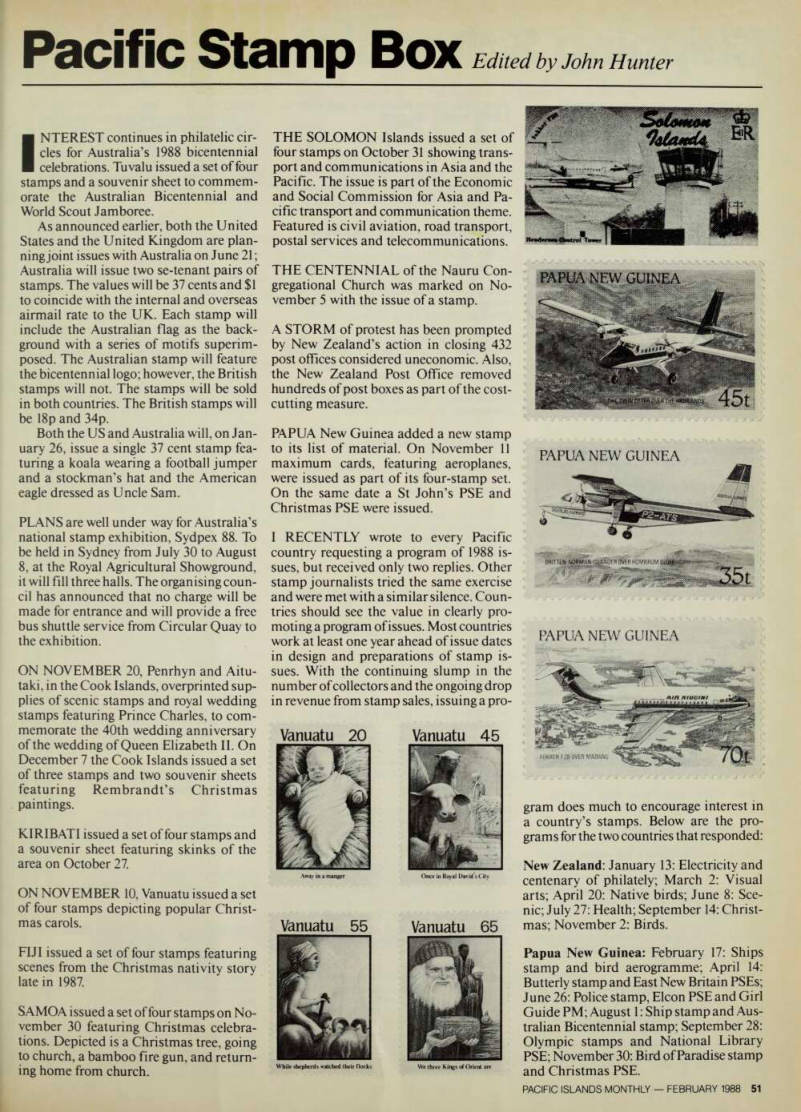
Edited by John Hunter
INTEREST continues in philatelic cir cles for Australia’s 1988 bicentennial celebrations. Tuvalu issued a set of four stamps and a souvenir sheet to commem orate the Australian Bicentennial and World Scout Jamboree.
As announced earlier, both the United States and the United Kingdom are plan ning joint issues with Australia on June 21; Australia will issue two se-tenant pairs of stamps. The values will be 37 cents and $1 to coincide with the internal and overseas airmail rate to the UK. Each stamp will include the Australian flag as the back ground with a series of motifs superim posed. The Australian stamp will feature the bicentennial logo; however, the British stamps will not. The stamps will be sold in both countries. The British stamps will be 18p and 34p.
Both the US and Australia will, on Jan uary 26, issue a single 37 cent stamp fea turing a koala wearing a football jumper and a stockman’s hat and the American eagle dressed as Uncle Sam.
PLANS are well under way for Australia’s national stamp exhibition, Sydpex 88. To be held in Sydney from July 30 to August 8, at the Royal Agricultural Showground, it will fill three halls. The organising coun cil has announced that no charge will be made for entrance and will provide a free bus shuttle service from Circular Quay to the exhibition.
ON NOVEMBER 20, Penrhyn and Aitu taki, in the Cook Islands, overprinted sup plies of scenic stamps and royal wedding stamps featuring Prince Charles, to com memorate the 40th wedding anniversary of the wedding of Queen Elizabeth 11. On December 7 the Cook Islands issued a set of three stamps and two souvenir sheets featuring Rembrandt’s Christmas paintings.
KIRIBATI issued a set of four stamps and a souvenir sheet featuring skinks of the area on October 27.
ON NOVEMBER 10, Vanuatu issued a set of four stamps depicting popular Christ mas carols.
FIJI issued a set of four stamps featuring scenes from the Christmas nativity story late in 1987.
SAMOA issued a set of four stamps on No vember 30 featuring Christmas celebra tions. Depicted is a Christmas tree, going to church, a bamboo fire gun, and return ing home from church.
THE SOLOMON Islands issued a set of four stamps on October 31 showing trans port and communications in Asia and the Pacific. The issue is part of the Economic and Social Commission for Asia and Pa cific transport and communication theme.
Featured is civil aviation, road transport, postal services and telecommunications.
THE CENTENNIAL of the Nauru Con gregational Church was marked on No vember 5 with the issue of a stamp.
A STORM of protest has been prompted by New Zealand’s action in closing 432 post offices considered uneconomic. Also, the New Zealand Post Office removed hundreds of post boxes as part of the cost cutting measure.
PAPUA New Guinea added a new stamp to its list of material. On November 11 maximum cards, featuring aeroplanes, were issued as part of its four-stamp set.
On the same date a St John’s PSE and Christmas PSE were issued.
I RECENTLY wrote to every Pacific country requesting a program of 1988 is sues, but received only two replies. Other stamp journalists tried the same exercise and were met with a similar silence. Coun tries should see the value in clearly pro moting a program of issues. Most countries work at least one year ahead of issue dates in design and preparations of stamp is sues. With the continuing slump in the number of collectors and the ongoing drop in revenue from stamp sales, issuing a pro-
gram does much to encourage interest in a country’s stamps. Below are the pro grams for the two countries that responded: New Zealand: January 13: Electricity and centenary of philately; March 2: Visual arts; April 20: Native birds; June 8: Sce nic; July 27: Health; September 14: Christ mas; November 2: Birds.
Papua New Guinea: February 17: Ships stamp and bird aerogramme; April 14: Butterly stamp and East New Britain PSEs; June 26: Police stamp, Eicon PSE and Girl Guide PM; August 1: Ship stamp and Aus tralian Bicentennial stamp; September 28: Olympic stamps and National Library PSE; November 30: Bird of Paradise stamp and Christmas PSE.
Shipping Schedules
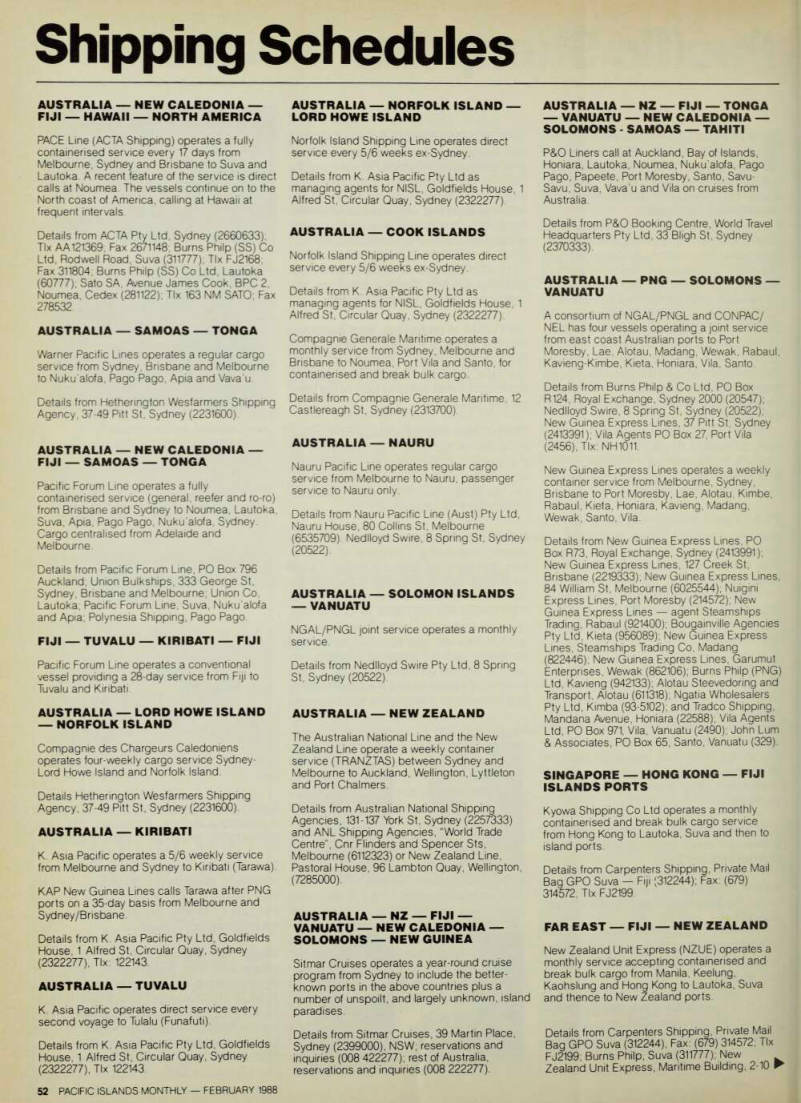

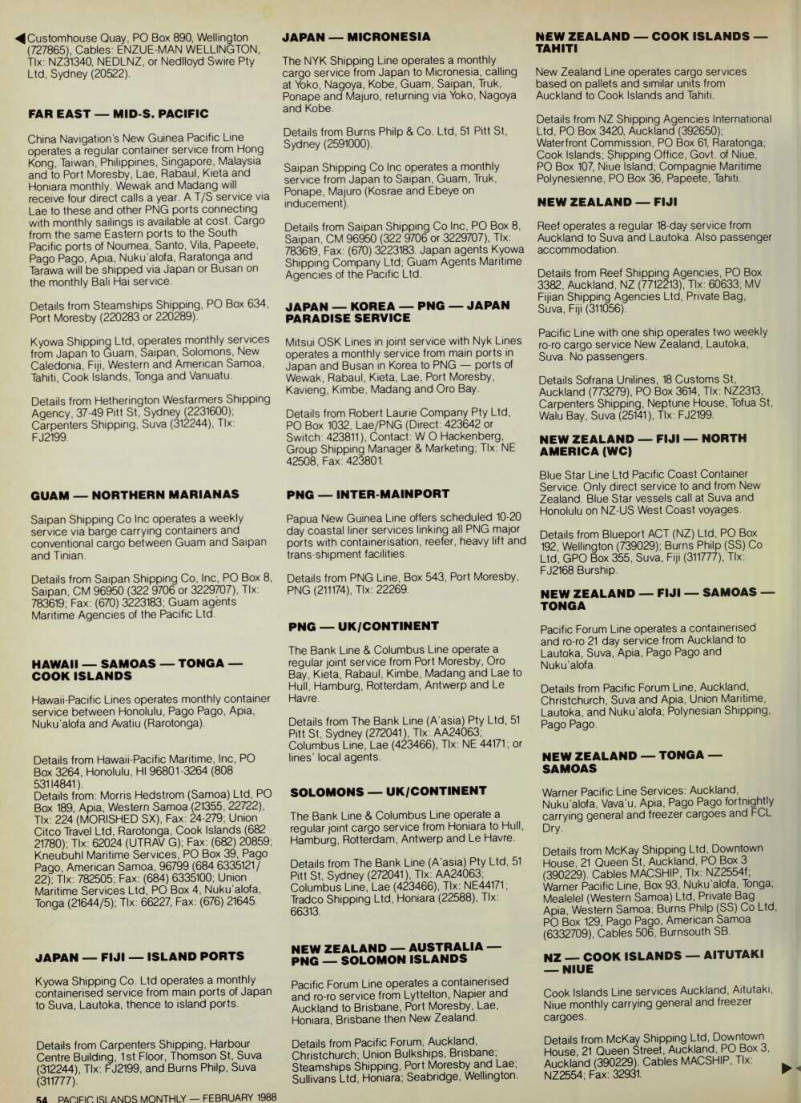
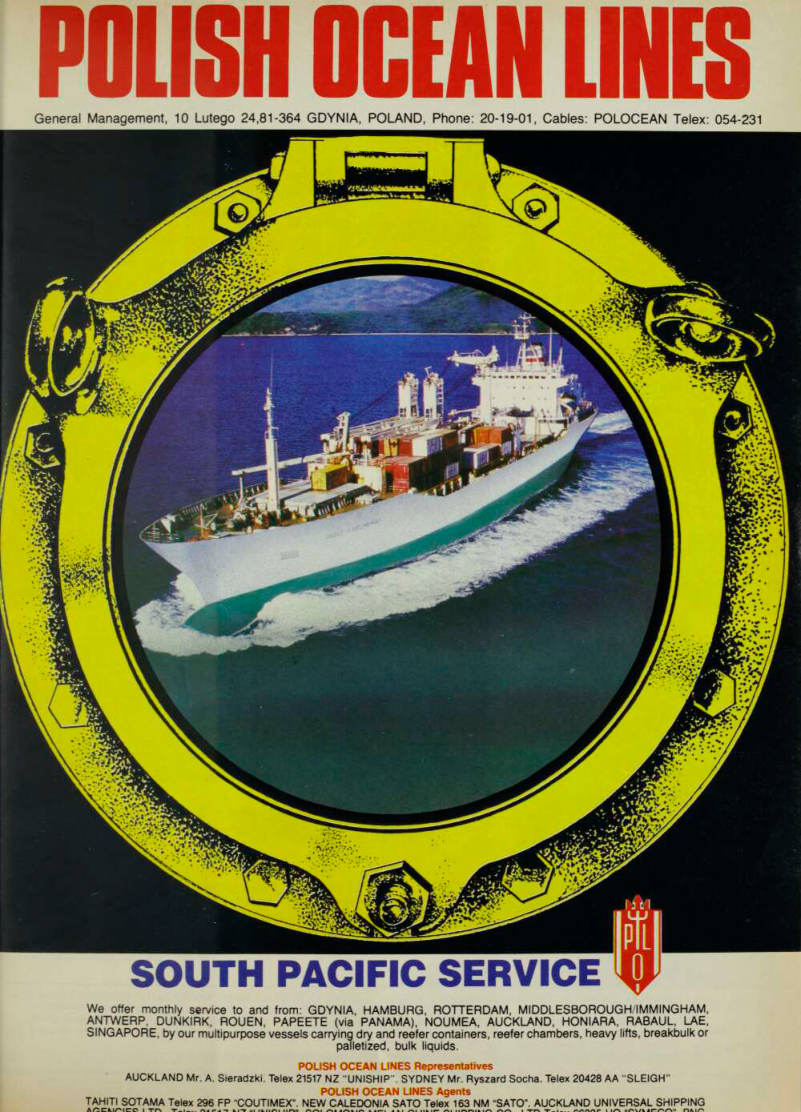
Australia New Caledonia
Fiji Hawaii North America
PACE Line (ACTA Shipping) operates a fully containerised service every 17 days from Melbourne, Sydney and Brisbane to Suva and Lautoka A recent feature of the service is direct calls at Noumea. The vessels continue on to the North coast of America, calling at Hawaii at frequent intervals.
Details from ACTA Pty Ltd, Sydney (2660633); Tlx AA121369; Fax 2671148: Burns Philp (SS) Co Ltd. Rodwell Road, Suva (311777); Tlx FJ2168.
Fax 311804; Burns Philp (SS) Co Ltd, Lautoka (60777); Sato SA, Avenue James Cook, BPC 2, Noumea, Cedex (281122); Tlx 163 NM SATO; Fax 278532.
Australia Samoas Tonga
Warner Pacific Lines operates a regular cargo service from Sydney, Brisbane and Melbourne to Nukualofa, Pago Pago, Apia and Vava'u.
Details from Hethenngton Wesfarmers Shipping Agency, 37-49 Pitt St, Sydney (2231600)
Australia New Caledonia
Fiji Samoas Tonga
Pacific Forum Line operates a fully containerised service (general, reefer and ro-ro) from Brisbane and Sydney to Noumea, Lautoka, Suva, Apia, Pago Pago, Nukualofa, Sydney.
Cargo centralised from Adelaide and Melbourne Details from Pacific Forum Line, PO Box 796 Auckland; Union Bulkships. 333 George St, Sydney, Brisbane and Melbourne; Union Co, Lautoka; Pacific Forum Line, Suva, Nukualofa and Apia; Polynesia Shipping, Pago Pago
Fiji Tuvalu Kiribati Fiji
Pacific Forum Line operates a conventional vessel providing a 28-day service from Fiji to Tuvalu and Kiribati
Australia Lord Howe Island
Norfolk Island
Compagnie des Chargeurs Caledoniens
operates four-weekly cargo service Sydney- Lord Howe Island and Norfolk Island Details Hetherington Wesfarmers Shipping Agency, 37-49 Pitt St, Sydney (2231600).
Australia Kiribati
K. Asia Pacific operates a 5/6 weekly service from Melbourne and Sydney to Kiribati (Tarawa).
KAP New Guinea Lines calls Tarawa after PNG ports on a 35-day basis from Melbourne and
Sydney/Brisbane.
Details from K. Asia Pacific Pty Ltd, Goldfields House, 1 Alfred St, Circular Quay, Sydney (2322277), Tlx: 122143.
Australia Tuvalu
K. Asia Pacific operates direct service every second voyage to Tulalu (Funafuti).
Details from K. Asia Pacific Pty Ltd, Goldfields House, 1 Alfred St, Circular Quay, Sydney (2322277), Tlx 122143.
Australia Norfolk Island
Lord Howe Island
Norfolk Island Shipping Line operates direct service every 5/6 weeks ex-Sydney.
Details from K Asia Pacific Pty Ltd as managing agents for NISL, Goldfields House, 1 Alfred St. Circular Ouay, Sydney (2322277).
Australia Cook Islands
Norfolk Island Shipping Line operates direct service every 5/6 weeks ex-Sydney.
Details from K. Asia Pacific Pty Ltd as managing agents for NISL, Goldfields House, 1
Alfred St, Circular Ouay, Sydney (2322277).
Compagnie Generale Maritime operates a monthly service from Sydney, Melbourne and Brisbane to Noumea, Port Vila and Santo, for containerised and break bulk cargo.
Details from Compagnie Generale Maritime, 12
Castlereagh St, Sydney (2313700).
Australia Nauru
Nauru Pacific Line operates regular cargo service from Melbourne to Nauru, passenger service to Nauru only.
Details from Nauru Pacific Line (Aust) Pty Ltd, Nauru House, 80 Collins St, Melbourne (6535709). Nedlloyd Swire, 8 Spring St, Sydney (20522).
Australia Solomon Islands
Vanuatu
NGAL/PNGL joint service operates a monthly service.
Details from Nedlloyd Swire Pty Ltd, 8 Spring
St, Sydney (20522).
Australia New Zealand
The Australian National Line and the New Zealand Line operate a weekly container service (TRANZTAS) between Sydney and Melbourne to Auckland, Wellington, Lyttleton and Port Chalmers.
Details from Australian National Shipping
Agencies, 131-137 York St, Sydney (2257333)
and ANL Shipping Agencies, “World Trade Centre”, Cnr Flinders and Spencer Sts, Melbourne (6112323) or New Zealand Line, Pastoral House, 96 Lambton Quay, Wellington, (7285000).
Australia Nz Fiji
Vanuatu New Caledonia
Solomons New Guinea
Sitmar Cruises operates a year-round cruise program from Sydney to include the better known ports in the above countries plus a number of unspoilt, and largely unknown, island paradises.
Details from Sitmar Cruises, 39 Martin Place, Sydney (2399000), NSW; reservations and inquiries (008 422277); rest of Australia, reservations and inquiries (008 222277).
Australia Nz Fiji Tonga
Vanuatu New Caledonia
Solomons - Samoas Tahiti
P&O Liners call at Auckland, Bay of Islands, Honiara, Lautoka, Noumea, Nukualofa, Pago Pago, Papeete, Port Moresby, Santo, Savu- Savu, Suva, Vava’u and Vila on cruises from Australia.
Details from P&O Booking Centre, World Travel Headquarters Pty Ltd, 33 Bligh St, Sydney (2370333).
Australia Png Solomons
Vanuatu
A consortium of NGAL/PNGL and CONPAC/ NEL has four vessels operating a joint service from east coast Australian ports to Port Moresby, Lae, Alotau, Madang, Wewak, Rabaul, Kavieng-Kimbe, Kieta, Honiara, Vila, Santo.
Details from Burns Philp & Co Ltd, PC Box R 124, Royal Exchange, Sydney 2000 (20547); Nedlloyd Swire, 8 Spring St, Sydney (20522); New Guinea Express Lines, 37 Pitt St, Sydney (2413991): Vila Agents PC Box 27, Port Vila
(2456), Tlx: Nhioii.
New Guinea Express Lines operates a weekly container service from Melbourne, Sydney, Brisbane to Port Moresby, Lae, Alotau. Kimbe, Rabaul, Kieta, Honiara, Kavieng, Madang, Wewak, Santo, Vila.
Details from New Guinea Express Lines, PC Box R 73, Royal Exchange, Sydney (2413991); New Guinea Express Lines, 127 Creek St, Brisbane (2219333); New Guinea Express Lines, 84 William St, Melbourne (6025544); Nuigini Express Lines, Port Moresby (214572); New Guinea Express Lines agent Steamships Trading, Rabaul (921400); Bougainville Agencies Pty Ltd, Kieta (956089); New Guinea Express Lines, Steamships Trading Co, Madang (822446); New Guinea Express Lines, Garumut Enterprises, Wewak (862106); Burns Philp (PNG) Ltd, Kavieng (942133); Alotau Steevedoring and Transport, Alotau (611318); Ngatia Wholesalers Pty Ltd, Kimba (93-5102); and Tradco Shipping, Mandana Avenue, Honiara (22588); Vila Agents Ltd, PC Box 971, Vila, Vanuatu (2490); John Lum & Associates, PC Box 65, Santo, Vanuatu (329).
Singapore Hong Kong Fiji
Islands Ports
Kyowa Shipping Co Ltd operates a monthly containerised and break bulk cargo service from Hong Kong to Lautoka, Suva and then to island ports.
Details from Carpenters Shipping, Private Mail Bag GPO Suva Fiji (312244); Fax; (679) 314572, Tlx FJ2199.
Far East Fiji New Zealand
New Zealand Unit Express (NZUE) operates a monthly service accepting containerised and break bulk cargo from Manila, Keelung, Kaohslung and Hong Kong to Lautoka, Suva and thence to New Zealand ports.
Details from Carpenters Shipping, Private Mail Bag GPO Suva (312244), Fax: (679) 314572; Tlx FJ2199; Burns Philp, Suva (311777); New Zealand Unit Express, Maritime Building, 2-10 W
Customhouse Quay, PO Box 890, Wellington
(727865), Cables: Enzue-Man Wellington,
Tlx: NZ31340, NEDLNZ, or Nedlloyd Swire Pty Ltd, Sydney (20522).
Far East Mid-S. Pacific
China Navigation’s New Guinea Pacific Line operates a regular container service from Hong Kong, Taiwan, Philippines, Singapore, Malaysia and to Port Moresby, Lae, Rabaul, Kieta and Honiara monthly. Wewak and Madang will receive four direct calls a year. A T/S service via Lae to these and other PNG ports connecting with monthly sailings is available at cost. Cargo from the same Eastern ports to the South Pacific ports of Noumea, Santo, Vila, Papeete, Pago Pago, Apia, Nuku’alofa, Raratonga and Tarawa will be shipped via Japan or Busan on the monthly Bali Hai service.
Details from Steamships Shipping, PO Box 634, Port Moresby (220283 or 220289).
Kyowa Shipping Ltd, operates monthly services from Japan to Guam, Saipan, Solomons, New Caledonia, Fiji. Western and American Samoa, Tahiti, Cook Islands, Tonga and Vanuatu.
Details from Hetherington Wesfarmers Shipping Agency. 37-49 Pitt St. Sydney (2231600); Carpenters Shipping, Suva (312244), Tlx: FJ2199.
Guam Northern Marianas
Saipan Shipping Co Inc operates a weekly service via barge carrying containers and conventional cargo between Guam and Saipan and Tinian.
Details from Saipan Shipping Co, Inc, PO Box 8, Saipan, CM 96950 (322 9706 or 3229707), Tlx: 783619; Fax: (670) 3223183; Guam agents Maritime Agencies of the Pacific Ltd.
Hawaii Samoas Tonga
Cook Islands
Hawaii-Pacific Lines operates monthly container service between Honolulu, Pago Pago, Apia, Nuku’alofa and Avatiu (Rarotonga).
Details from Hawaii-Pacific Maritime, Inc, PO Box 3264, Honolulu, HI 96801-3264 (808 53114841).
Details from: Morris Hedstrom (Samoa) Ltd, PO Box 189, Apia, Western Samoa (21355,22722), Tlx: 224 (MORISHED SX), Fax: 24-279; Union Citco Travel Ltd, Rarotonga, Cook Islands (682 21780); Tlx: 62024 (UTRAV G); Fax: (682) 20859; Kneubuhl Maritime Services, PO Box 39, Pago Pago, American Samoa, 96799 (684 6335121/ 22); Tlx: 782505; Fax: (684) 6335100; Union Maritime Services Ltd, PO Box 4, Nuku'alofa, Tonga (21644/5); Tlx: 66227, Fax: (676) 21645.
Japan Fiji Island Ports
Kyowa Shipping Co. Ltd operates a monthly containerised service from main ports of Japan to Suva, Lautoka, thence to island ports.
Details from Carpenters Shipping, Harbour Centre Building, Ist Floor, Thomson St, Suva (312244), Tlx: FJ2199, and Burns Philp, Suva (311777).
Japan Micronesia
The NYK Shipping Line operates a monthly cargo service from Japan to Micronesia, calling at Yoko, Nagoya, Kobe, Guam, Saipan, Truk, Ponape and Majuro, returning via Yoko, Nagoya and Kobe.
Details from Burns Philp & Co. Ltd, 51 Pitt St, Sydney (2591000).
Saipan Shipping Co Inc operates a monthly service from Japan to Saipan, Guam, Truk, Ponape, Majuro (Kosrae and Ebeye on inducement).
Details from Saipan Shipping Co Inc, PO Box 8, Saipan, CM 96950 (322 9706 or 3229707), Tlx: 783619, Fax: (670) 3223183. Japan agents Kyowa Shipping Company Ltd; Guam Agents Maritime Agencies of the Pacific Ltd.
Japan Korea Png Japan
Paradise Service
Mitsui OSK Lines in joint service with Nyk Lines operates a monthly service from main ports in Japan and Busan in Korea to PNG ports of Wewak, Rabaul, Kieta, Lae, Port Moresby, Kavieng, Kimbe, Madang and Oro Bay.
Details from Robert Laurie Company Pty Ltd, PO Box 1032, Lae/PNG (Direct: 423642 or Switch: 423811), Contact: W O Hackenberg, Group Shipping Manager & Marketing; Tlx. NE 42508, Fax: 423801.
Png Inter-Mainport
Papua New Guinea Line offers scheduled 10-20 day coastal liner services linking all PNG major ports with containerisation, reefer, heavy lift and trans-shipment facilities.
Details from PNG Line, Box 543, Port Moresby, PNG (211174), Tlx: 22269.
Png Uk/Continent
The Bank Line & Columbus Line operate a regular joint service from Port Moresby, Oro Bay, Kieta, Rabaul, Kimbe, Madang and Lae to Hull, Hamburg, Rotterdam, Antwerp and Le Havre.
Details from The Bank Line (A’asia) Pty Ltd, 51 Pitt St, Sydney (272041), Tlx: AA24063; Columbus Line, Lae (423466), Tlx: NE 44171; or lines’ local agents.
Solomons Uk/Continent
The Bank Line & Columbus Line operate a regular joint cargo service from Honiara to Hull, Hamburg, Rotterdam, Antwerp and Le Havre.
Details from The Bank Line (A’asia) Pty Ltd, 51 Pitt St, Sydney (272041), Tlx: AA24063; Columbus Line, Lae (423466), Tlx: NE44171; Tradco Shipping Ltd, Honiara (22588), Tlx: 66313.
New Zealand Australia
Png Solomon Islands
Pacific Forum Line operates a containerised and ro-ro service from Lyttelton, Napier and Auckland to Brisbane, Port Moresby, Lae, Honiara, Brisbane then New Zealand.
Details from Pacific Forum, Auckland, Christchurch; Union Bulkships, Brisbane; Steamships Shipping, Port Moresby and Lae; Sullivans Ltd, Honiara; Seabridge, Wellington.
New Zealand Cook Islands
Tahiti
New Zealand Line operates cargo services based on pallets and similar units from Auckland to Cook Islands and Tahiti.
Details from NZ Shipping Agencies International Ltd. PO Box 3420, Auckland (392650); Waterfront Commission, PO Box 61, Raratonga; Cook Islands; Shipping Office, Govt, of Niue, PO Box 107, Niue Island; Compagnie Maritime Polynesienne, PO Box 36, Papeete, Tahiti.
New Zealand —Fiji
Reef operates a regular 18-day service from Auckland to Suva and Lautoka. Also passenger accommodation.
Details from Reef Shipping Agencies, PO Box 3382, Auckland. NZ (7712213), Tlx: 60633; MV Fijian Shipping Agencies Ltd, Private Bag, Suva. Fiji (311056).
Pacific Line with one ship operates two weekly ro-ro cargo service New Zealand, Lautoka, Suva. No passengers.
Details Sofrana Unilines, 18 Customs St, Auckland (773279), PO Box 3614, Tlx: NZ2313, Carpenters Shipping, Neptune House, Tofua St, Walu Bay, Suva (25141), Tlx: FJ2199.
New Zealand Fiji North
America (Wc)
Blue Star Line Ltd Pacific Coast Container Service. Only direct service to and from New Zealand. Blue Star vessels call at Suva and Honolulu on NZ-US West Coast voyages.
Details from Blueport ACT (NZ) Ltd, PO Box 192, Wellington (739029); Burns Philp (SS) Co Ltd, GPO Box 355, Suva, Fiji (311777), Tlx: FJ2168 Burship,
New Zealand Fiji Samoas
Tonga
Pacific Forum Line operates a containerised and ro-ro 21 day service from Auckland to Lautoka, Suva, Apia, Pago Pago and Nukualofa.
Details from Pacific Forum Line, Auckland, Christchurch, Suva and Apia, Union Maritime, Lautoka, and Nukualofa; Polynesian Shipping.
Pago Pago.
New Zealand Tonga
Samoas
Warner Pacific Line Services: Auckland, Nukualofa, Vava’u, Apia, Pago Pago fortnightly carrying general and freezer cargoes and FCL Dry.
Details from McKay Shipping Ltd, Downtown House, 21 Queen St, Auckland, PO Box 3 (390229). Cables MACSHIP, Tlx: NZ2554f; Warner Pacific Line, Box 93, Nuku’alofa, Tonga; Mealelel (Western Samoa) Ltd, Private Bag Apia, Western Samoa; Burns Philp (SS) Co Ltd, PO Box 129, Pago Pago, American Samoa (6332709), Cables 506, Burnsouth SB.
Nz Cook Islands Aitutaki
Niue
Cook Islands Line services Auckland, Aitutaki, Niue monthly carrying general and freezer cargoes.
Details from McKay Shipping Ltd, Downtown House, 21 Queen Street. Auckland, PO Box 3, Auckland (390229). Cables MACSHIP. Tlx: NZ2554; Fax: 32931. w
◄ Tahiti New Caledonia
Vanuatu Solomon Islands
New Zealand Png - Singapore
Europe
Polish Ocean Lines operate in semi-container type vessels to the following ports: from Papeete, Noumea, Santo, Vila, Yandina, Honiara, Auckland, Rabaul, Lae, Singapore, Port Kielang, Penang then to Mediterranean ports and Europe via the Suez Canal. (Other New Zealand ports subject to inducement).
Details from Universal Shipping Agencies Ltd, 6th Floor, 38 Fort St. Auckland 1, NZ (390931, 390727, 32104), Tlx: 21517.
Europe Tahiti New
Caledonia
Compagnie Generale Maritime operates services from Europe and Mediterranean ports to Papeete and Noumea using three ro-ro and multi-purpose vessels thus ensuring a bi monthly sailing to and from.
Details from Compagnie Generale Maritime, 12
Castlereagh St, Sydney (2313700).
Europe Tahiti New
Caledonia New Zealand
Vanuatu Solomons Png -
Europe
Polish Ocean Lines offers regular monthly sailings for containerised and break bulk cargo, also conventional reefer space and reefer containers from Hamburg, Rotterdam, Dunkirk, Le Havre to Papeete, Noumea, Auckland, Santo, Honiara, Rabaul, Lae, Singapore, returning to Europe via Suez. Other ports in the South
Pacific can be served directly with inducement or otherwise via transshipment.
Details from Sotama, BP 9170, Papeete (427805), Tlx: 373. Tlx: Sotama 373FP; SATO: BP, C 2 Noumea Cedex (272094), Tlx; 163 NM; Universal Shipping Agencies, PO Box 2282 Auckland (30930), Tlx: 21517; Vanua Navigation, PO Box 44, Vila (2027), Tlx: 1033; Melan Chine Shipping Co, PO Box 71, Honiara (21678), Tlx: 66335; Steamships Trading Co Ltd, PO Box 85, Lae (424666), Tlx: 42423; Union Steamship Co of NZ Ltd, PO Box 50, Apia (21781), Tlx; 225; Warner Pacific Line, PO Box 93, Nukualofa (22088), Tlx: 66219; Fiji Agents TBA.
Europe Tahiti W. Samoa
Fiji New Caledonia
Nedlloyd offers regular cargo services from Continental ports to Papeete, Apia, Fiji and New Caledonia.
Details Nedlloyd (Aust.) Pty Ltd, Spring St, Sydney (273801); Carpenters Shipping, Ist Floor, Harbour Centre Bldg, 100 Thomson St, Suva (312244) Tlx: 2199FJ and Vetari St, Lautoka (63988), Tlx; 5215FJ.
Uk Europe W. Samoa
Tonga Fiji
The Bank Line & Columbus Line operate a regular joint cargo service from Hull, Hamburg, Bremen, Antwerp, Rotterdam and Le Havre to Apia, Nuku'alofa, Suva and Lautoka.
Details from The Bank Line (A’asia) Pty Ltd, 51 Pitt St, Sydney (272041), Tlx: AA24063, Columbus Line, Lae (423466), Tlx: NE 44111, or Lines’ local agents.
Uk Europe Png
Solomons
The Bank Line & Columbus Line operate a regular joint cargo service from Hull, Hamburg, Bremen, Antwerp, Rotterdam and Le Havre to Port Moresby, Lae, Madang, Kimbe, Rabaul, Kieta and Honiara and on inducement to Yandina.
Details from The Bank Line (A’asia) Pty Ltd, 51 Pitt St, Sydney (272041), Tlx: AA24063; Columbus Line, Lae (423466), Tlx; NE44171; or Lines’ local agents.
Uk/Europe Tahiti New
Caledonia Vanuatu
The Bank Line and Columbus Line operate a regular joint cargo service from Hull, Hamburg, Bremen, Antwerp, Rotterdam and Le Havre to Papeete, Noumea, Port-Vila and Santo.
Details from The Bank Line (A’asia) Pty Ltd, 51 Pitt St, Sydney (272041), Tlx: AA24063, Columbus Line, Lae (423466), Tlx: NE44171; Ets A.M. Fare DTE, Papeete; Ets, Ballande, Noumea and other local agents.
Us Hawaii Micronesia
Png
PM&O Lines operates two fully self-contained container vessels on a sailing frequency of every 30 days between the San Francisco Bay Area, Los Angeles, Honolulu and Majuro, Ebeye, Kosrae, Ponape, Truk, Saipan, Yap, Palau, Cebu, Davao, Lae, Kieta and Rabaul.
Details from PM&O Lines, 353 Sacramento St, San Francisco, California 94111, USA, (415 4215400), Tlx: 278016 PMO UR; owner’s Representative PO Box 803, Saipan, NMI 96950
(2346819), Tlx: 783605 Cmcaa.
Advertisements & other items, pp. 53-57 (2 items)
Europe.
BANK LINE and
COLUMBUS LINE
24 day service to
Europe.
Need we say more...
D G The Joint Service Partners offer facilities for shipment of: Containers (FCL/LCL) and Break-bulk Cargo plus reefer space and deeptanks for carriage of vegetable oils and other liquid bulk cargo.
Carriers also accept heavy lifts, overlength and cumbersome parcels.
Ports of Service: Loading: Papeete, Apia, Suva, Lautoka, Noumea, Port Vila, Santo, Honiara, Port Moresby, Lae, Madang, Kimbe, Rabaul, Kieta, Darwin. For: Rotterdam, Antwerp, Hamburg, Hull, Dunkirk, Le Havre.
Additional ports on enquiry.
Please contact our regional offices for further information: The Bank Line (Australasia) Pty Ltd Columbus Line Reederei GmbH Suite 801, 51 Pitt St, P.O. Box 1 667, Lae/Papua New Guinea.
Sydney, NSW. Australia 2000 Phone: 423466/423487/AH. 422481 Phone 27 2041 Telex 24063 Telex: Colline NE 441 71 The South Pacific Specialists for over 75 years
POUSH OCUNLMS
General Management, 10 Lutego 24,81-364 GDYNIA, POLAND, Phone: 20-19-01, Cables: POLOCEAN Telex: 054-231 © © & i 1 1 V’„* ' £~r' f.% sew X.
I "1.--',' tV‘.V VC >v‘
SOUTH PACIFIC SERVICE
We offer monthly service to and from: GDYNIA, HAMBURG, ROTTERDAM, MIDDLESBOROUGH/IMMINGHAM, ANTWERP, DUNKIRK, ROUEN, PAPEETE (via PANAMA), NOUMEA, AUCKLAND, HONIARA, RABAUL, LAE, SINGAPORE, by our multipurpose vessels carrying dry and reefer containers, reefer chambers, heavy lifts, breakbulk or pallr palletized, bulk liquids.
POLISH OCEAN LINES Representatives AUCKLAND Mr. A. Sieradzki. Telex 21517 NZ “UNISHIP”. SYDNEY Mr. Ryszard Socha. Telex 20428 AA “SLEIGH”
POLISH OCEAN LINES Agents
TAHITI SOTAMA Telex 296 FP “COUTIMEX”. NEW CALEDONIA SATO Telex 163 NM “SATO”. AUCKLAND UNIVERSAL SHIPPING I TH T«u u ait ■ in 11 p»n i /M iAk IA I «r-i a i ni ir ai 11 nnik i TPN I AAAAr LiA UOVIICAA” DMA
TONGA
KIRIBATI
VANUATU
COOK ISLAND
SOLOMON ISLANDS
NEW CALEDONIA
U.S. SAMOA
WESTERN SAMOA
FRENCH POLYNESIA
JAPAN . KOREA
YOU’LL FIND IT,
WHERE THE SKY MEETS
THE SEA
RORO. CONTAINER &
B.BULK SHIPPING
BALI
AGENTS
and
PHONE
SUVA:Burns Phiiptß.P, 311777 Carpenter Shipping (C, S >' 'se^nl Shipping Services Ltd. 633-1211 PAPEETEiOompagn e Merit me Polynesienne 4264.02 Corporation ol Kiribati 26195 SSiSa Shipping Co., Ltd. 753.0451 tor vehicte Pan Con.inen,a, Shipping rSSrrS NVK Lines 03-284-5506 Mitsui O.S.K 03-584-0916
POWI
s*“|jPi|gP
400 W
PMPO
Hi-fi Midi System Awesome music power that surrounds you—get it with AlWA’s impressive V-770A stereo system. The powerful amplifier section deliversan amazing 400 watts(PMPO)of )ower. Along with the built-in Surround Sound circuitry and the supplied pair of surround speakers, it fills every corner of your room with rich, exciting music. Plus, advanced eatures and functions iclude a 5-band graphic equalizer and spectrum analyzer, a quartz synthesizer 4-band tuner with 20 memory presets (10 FM + 10 AM/SWI/SW2), Surround Sound' control, Dolby B double cassette deck, fully automatic turntable, big 2-way bass reflex speakers, snd wireless remote control most system functions to assure you complete music pleasure.
V-770A . .surround yourself with pure sound excitement!
AIWA
‘Dolby and the Double-D symbol are trademarks of Dolby Laboratories Licensing Corporation.
Vlobex Pty., Ltd. 12 Barcoo Street, East Roseville, Sydney, N.S.W. 2069, AUSTRALIA PHONE: (02) 406-6277/Oceania Indent Agency (P.N.G.) Pty., Ltd. Ago St., Gordon Box 5518, Boroko, Port Moresby, Papua New Guinea PHONE: 256411 /The Sound Centre Ltd. P.O. Box 434 Port Vila, Vanuatu PHONE: 2035/P. Hargovind Bros. 190 Renwick Road P.O. Box 490 Suva Fiji PHONE: 24350/ Hardy Distributors Ltd. Wellersley Street, P.O. Box 5919, Auckland, New Zealand PHONE: (09) 399-175/Hifivox 79, Rue de Sebastopol, B.P. 1458 Noumea, New Caledonia PHONE; 27. 24. 56/Harvest Pacific Limited P.O. Box 517. Honiara. Solomon Islands PHONE: 131/Fare Hi-Fi Stereo Rue du Marechal Foch —P.O. Box 269, Papeete, Tahiti PHONE: 2-4814/Micropac Audio, Inc.
P.O. Box 3478 Agana, Guam 96910 PHONE: 472-8091, 472-8297/Rarotonga Duty Free Shop Private Bag P.O. Box 92. Rarotonga. Cook Island/Nauru Co-Operative Society Republic of Nauru
54
PAP.IFIC ISLANDS MONTHLY FEBRUARY 1988
Aggie In Her Heyday
Out Of The Past
Aggie Grey and her hotel have become a part of South Seas folklore.
SOUTH PACIFIC history is very much a history of men and their deeds. Women’s role, though of un deniable importance, is generally a back ground one.
There have, however, been a few women whose involvement in the story of the South Pacific has received widespread at tention; women whose lives and person alities have become legend. Three women stand out; all were queens, though only one was a member of “official” royalty.
Queen Salote ruled Tonga with wis dom, benevolence and deft skill for 47 years, during which her delightful person ality and innate nobility endeared her and her country to the world.
“Queen” Emma ruled her own comer of Papua New Guinea from 1890 to 1913, bending tens of thousands of her subjects (and not a few attractive young men) to her will before suiciding in Monte Carlo in 1913.
The third queen of the Pacific is still with us, still guiding the empire she cre ated. Agnes Genevieve Swann was bom on October 31, 1897, in Apia, Samoa: but it is as Aggie Grey that she is known and loved by her fellow Samoans, her thousands of clients, and by a world still looking for a taste of South Seas paradise.
Aggie, the second child of Apia phar macist William Swann and his beautiful Samoan bride Pele, has seen all the vicis situdes of Samoa’s winding road from col ony to independence: first German, then British colonial rule; then the coming of World War II and the modem American discovery of the Pacific.
Her father was a friend and confidant of Tusitala, Robert Louis Stevenson. An influential member of Apia’s business community, Swann knew the most im portant members of society, from admin istrators and military officers to Fiame Faumuina, O F Nelson and “Judge” Gurr, leaders of the Mau movement that strug gled for Samoan independence. Aggie grew up in this milieu; and with her striking looks (she and her sisters were known as the “Swann bouquet”) she could choose from a crowd of suitors.
Her first beau was a dashing young German officer, to whom she was engaged briefly before he was interned, along with the rest of Samoa’s German population, in 1914. His departure saddened her, but salvation in the form of New Zealander Gordon Hay-Mackenzie was around the corner. They were married in 1917, and it was Aggie’s nine-year marriage to Hay- Mackenzie that was to set her on the path
to becoming in her own way the first lady of the South Pacific.
Hay-Mackenzie’s death from tubercu losis in 1926 left Aggie and her three sur viving children (her first son, lan, died of tuberculosis at 20 months) alone and without a breadwinner. Again, salvation was soon to appear, and Aggie married Charles Grey late in 1926. Their life to gether was happy and productive they had three children but the twin shad ows of war and bankruptcy combined, ironically, to produce one of the region’s
most enduring havens. Charlie Grey was bankrupt by 1939 and died not long after American troops “occupied” Apia. Mean while, Aggie was supporting their children by making and selling (at her sister Mary’s urging) hamburgers and coffee to home sick US servicemen in a store on the site of her father’s pharmacy.
She was soon expanding and refurbish ing her Club (later hotel) next door, cadg ing and trading fresh food and supplies, cajoling US Navy cooks to provide luxu ries unobtainable in Apia. One young American soldier got to know her well, and when James Michener’s Tales of the South Pacific was published, the rollicking Bloody Mary was assumed to have been based on Aggie herself. Michener, let it be said, denies the suggestion emphatically: “Aggie was not the prototype Bloody
Mary,” he has said. “That worthy Ton kinese was on paper long before I met Ag gie. The catalogue of Aggie’s manipulations would fill a small book; of her kindness a library.”
“He didn’t talk very much, but I had the feeling he absorbed everything he heard in our bar,” Aggie recalls of Mich ener. “Certainly he must have listened to my South Seas ramblings!” And while she admits to having manipulated the war time situation to her family’s advantage, Aggie has proved much more than an op portunist. The departure of American troops in 1945 left her with a flourishing hotel; but how would she survive the aus terity of the postwar Pacific, especially since New Zealand was trying to impose prohibition?
Business was understandably quiet, and Aggie had to brave the vagaries of is land shipping to attract customers. Then, in 1952, when Gary Cooper and the cast of Return to Paradise landed in Western Sa moa, they put up at Aggie’s, of course, and their enjoyment of her hospitality helped spread the word that there was a place of rest and simple pleasure in what was, at the time, a far-flung corner of the world.
Aggie’s business grew as a result of the publicity the movie brought her, but it was not until independence and the establish ment of regular commercial flights to Tonga that her hotel became as accessible as it was famous.
Aware that part of Western Samoa’s at traction for tourists is its quiet and relaxed way of life, Aggie instituted/ifl/ifl, or “fun nights”, at her hotel and encouraged guests to join in the merriment, whether watch ing traditional dances or enjoying island feasts. She decided, however, that she would not go on expanding her hotel until, as she put it, guests became no more than room numbers, so she called a halt to ex pansion in the mid ’7os.
Life at “Aggie’s place” has continued in that vein ever since, capably managed by Aggie’s son Alan. The hotel’s focus is in ward, toward the pool and garden: and so Aggie’s life has begun to turn inward as her vitality and energy has been assailed by a series of strokes and the relentless advance of the years.
Now 90, and confined to a wheelchair, she is still very much the grande dame of her hotel, receiving special guests and vis iting the the hotel each day to keep an eye on its running and the rigorous standards that have made Aggie Grey, as well as her establishment, Western Samoa’s foremost “living national treasure”. D
"Gary Cooper helped spread the word that there was a picece of rest in a far-flung corner of the world"
Advertisements & other items, pp. 59-60 (1 item)
soaring power.
Avante. More than
a symbol of
U ; . „ j
AVANTE 9100 R
w * <c $ <p o s That’s right, Avante is more than a symbol of soaring power. It is power itself, and can bestow power on you.
Take the Avante 9100 R component system —it puts 350W/ch. of music power right in your hands, for music power output that reaches prodigious, soaring heights!
What’s more, the 9100 R gives you the power to tailor output with a built-in 7-band graphic equalizer/spectrum analyzer. And it offers Pioneer “SR” audio/video remote control for full remote-control command not only of the Avante 9100 R, but of any Pioneer product with the “SR” logo.
Not only that, it brings a full-logic double auto-reverse cassette deck, a quartz-PLL synthesized tuner with 24 randomaccess station presets (FM/AM), a fully automatic turntable, and ' a 4-way speaker system that boasts rich, heavy bass, stunning mids, and crystal-clear highs.
But the Avante 9100 R is more than the sum of its superior parts.
It’s the “pure sound” component system so sophisticated, that it simply began as state-of-the-art technology, ending as a welcome addition to any music lover’s home because its woodgrain cabinet blends so beautifully with home decor.
The Avante 9100 R, with power, real power—the kind of power it takes to make music come alive —and your spirit soar!
Note: The PD-M4O Multi-Play CD player and EX-9000(BK) Dynamic Expander, shown in this ad, are available as options.
The Avante 4100 R (350W/ch. PMPO) and Avante 3100 (270W/ch. PMPO) are also available. Ask your Pioneer dealer for details.
PIONEER
The future of sound and vision.
For further information, please contact; Australia: Pioneer Electronics Australia Pty. Ltd. (Incorporated in Victoria), P.O. Box 295, Mordialloc, Victoria, 3195 Tel: 580-9911 Fiji Islands: Brijlal & Company, G.P.O. Box No. 362, Suva, Fiji Islands Tel: 22258 New Zealand: Monaco Distributors Ltd., 41 Poland Road, Glenfield, Auckland, New Zealand Tel: (09) 444-9144 Norfolk Island: Burnt Pine Traders Ltd., P.O. Box 21, Norfolk Island Vanuatu: Burns Philp (Vanuatu) Ltd., Vila, Vanuatu Nauru Island: Jacob Enterprises, P.O. Box N 0.4, Republic of Nauru Tahiti: Tahiti Hi-Fi, P.O. Box 848, Papeete, Tahiti New Caledonia: Menard Pacifique Sari, B.P. 3899, Noumea, New Caledonia Tel: 27-62.23 American Samoa; Transpac Corporation, P.O. Box 1477, Pago Pago, American Samoa 96799 Tel: 633-5224 Rarotonga: South Seas International Ltd., P.O. Box 49, Rarotonga, Cook Islands Tel: 2327
I V {mm? m m g THE HIMALAYA RALLY-IST & 2ND OVERALL WINNERS.
VICTORY ON THE ROOF OF THE WORLD.
Imagine a rally where the hazards include encounters with lone tigers, and where leopards crouch on precipices watching the vehicles wind 4000 meters up onto the roof of the world. Such a 5 > rally is the Himalaya rally, 3000 kilometers of treacherous desert and alpine track. Then try to imagine the sheer resilience of the vehicle that manages to come in first. In the 1987 Himalaya Rally, that car was the Mitsubishi Starion. In fact, both first and second overall winners were Starions.
For six days, from New Delhi to the Kandhi Pass in the Himalayas and back again, the two Mitsubishi Starions literally dominated the event from the start.
This kind of performance is a result of Mitsubishi Motors' policy of seeking out the harshest conditions in which to test the reliability of their vehicles, and where better than on the roof of the world.
AMERICAN SAMOA: MORRIS SCANLAN SERVICE INC. P.O Box 367, Pago Pago, Tel. 633-5520/AUSTRALIA: MITSUBISHI MOTORS AUSTRALIA LTD, Box 1284, South Road, Clovelly Park, South Australia 5042, Tel. [08) 275-7223/FIJI: NIVIS MOTOR & MACHINERY CO., LTD. G.PO Box 150, Suva. Tel. 38341 1 /FRENCH POLYNESIA (TAHITI): ETS-BREDIN FRERES ET FILS PO Box 21, Papeete, Tahiti, Tel 4-202-58/NEW CALEDONIA; SOCIETE D IMPORTATION D AUTO DU PACIFIQUE SUD S A. B.P 438 Rond Point du Pacifique, Noumea, Tel, 274144/NEW ZEALAND: MITSUBISHI MOTORS NEW ZEALAND LTD. Todd Park, Henot Drive, Private Bag, Ponrua, Tel. 370-109/NORFOLK ISLAND: BORRYS LTD. P O Box 169, ‘“Norfolk Island. Tel 21 14/PAPUA NEW GUINEA; TOBAPTY. LTD. P O Box 503, Port Moresby, Tel 21-7874/SOLOMON ISLANDS: HARVEST PACIFIC LTD. G.PO Box 88, Honiara, Guadalcanal. Tel 30128/TONGA: SITANI MAPI CO., LTD. P O Box 83. Nuku ALOFA, Tel 21044/VANUATU: SOCOMETRA B.P 06 Route de Lagon, Port-Vila, Tel 2314/WESTERN SAMOA: A M. MACDONALD HOLDINGS LTD. PO. Box 576, Apia, Tel. 22022/SAIPAN/POHNPEI/MAJURO/KOSRAE/TRUK/YAP/ BELAU: MICRONESSIAN MOTORS, INC. 997 South Marine Drive. Tamuning, Guam 96911, Tel 646-6827 A
MITSUBISHI
MOTORS