Pacific



Islands
Monthly
American Samoa i jq«to nn Australia i«onn Cook Islands ... NZ$3 00 HLaii*:;:::;:;;:::;:: u S F $ $ 2 1 5 7 o Kiribati U fgSS
Nauru JIIZZIJeS
New Caledonia CFP2SO
E Z6aland ..’. NZ$3.OO
Norfoikisiand:::;:;::;:::;:;:;;;:;;:;:;:- n as2oo
Papua New Guinea K 2 00
Solomon Islands Ss2 00
jjs« lu :;::;;;::as2oo
Uss3.Oo
USTT and Guam US$2.5O Vanuatu \JT2 00 Western Samoa ..”...,"..,..12 75 ♦Recommended retail price only
January 1988
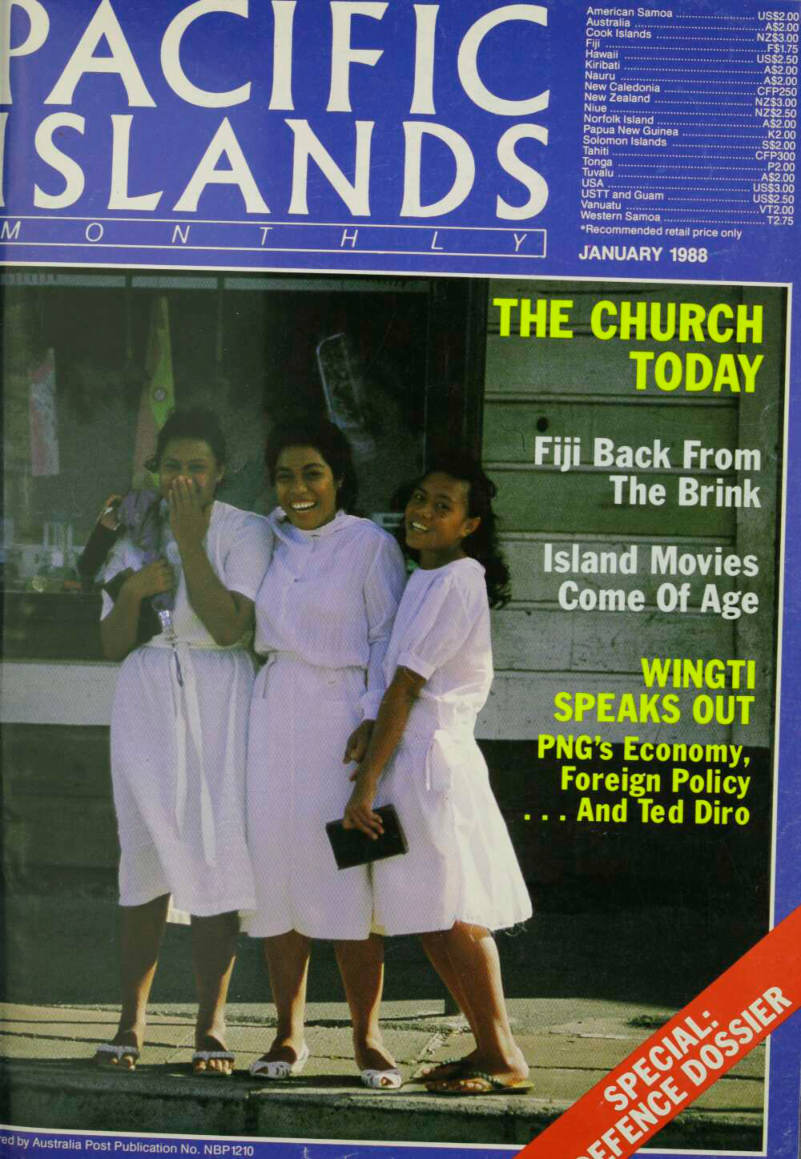
The Church
Today
Fiji Back From The Brink Island Movies Come Of Age
Wingti
Speaks Out
PNG’s Economy, I Foreign Policy k ... And Ted Diro
6d by Australia Post Publication No. NBPI2IO
Cover Photograph: David Mcgonigal
Advertisements & other items, pp. 2-4 (1 item)
Singing in the lane
Our search for the
ultimate in rear wheel
control technology has
made driving a Mazda
something to sing about
Go ahead, take the new Mazda 626 through its paces. And experience a feeling of freedom and of confidence that could only be the result of Mazda’s unique suspension geometry.
Now high speed lane changes, even in the rain, are something you can look forward to with pleasure.
Cornering loses its histrionic swerving; what remains is a sensation of extraordinary control.
Singing our praises.
Of course, you would expect us to say just this sort of thing in an ad. And so, all modesty aside, we’d like to point out that automotive experts and drivers the world over have been singing the praises of the Mazda 626 and the unique feeling its rear suspension technology delivers for quite some time.
What’s behind it all.
The reason is that for quite some time now Mazda has been concentrat-
ing on developing rear suspension systems that actually help steer the car. It started with the award winning TTL suspension found on the 323 and 626.
The search for the ultimate continued with the development of a 4-Wheel Steering system. What we learned in that search was applied to the development of our award winning DTS system for the RX-7 and the E-Link suspension for the 929.
This continuous process of refinement has come full circle again to the 626, and applied its TTL suspension. We’ve completely recalculated its suspension geometry to deliver a feeling of control that’s clearly superior and absolutely exhilarating.
Keeping on our toes.
It’s Mazda’s unique dedication to engineering the ultimate in rear wheel toe control and suspension technology that has resulted in such enjoyable driving in the Mazda 626.
And in fact, in all Mazda vehicles.
Take one out for yourself and see. You may just find yourself singing in the showers.
New Mazda 626 Models and features shown may not be available in your area Please consult your local Mazda dealer This warranty is valid only in Australia.
Your kind of car. © Mazda Motor Corporation
■ yi N .y v v.v
■> C- Or» CV wV'
wKjLVvVVWvV vV.vV'xV. ,
r v w ■"
St w op k \p*.sj w. vi*r v%?" Os* v%» ■ %*
SHSsfc*
RBMIorHI
itr.X^^Jt 9 '- »'' ■ *** * 3P* ■*rA >rv »‘ v^
r ■ *-‘"*V ** if&i
V o*%* »"- * ■ w * jr» v a --* - -■-■* '■ ■--' **' * • ~jf " J> * >' *t ■ i* 4v j/**s ■ ’
V ■ ■
V 1> Tv V' V
.tj;:tj; t> u
nmn: ,„
4# a#
Cj^S>
h# \^ _.._. . . • >•* V jn4k. ; % It•: « - ' fct*v p ♦.- * V* v "►* * *?* * **” ■■ *'- - v -•*•< v * - p * - * ■ - •: ■ . % ■. % St ■* . - - ■, \ «4* " ■■■ ; '■ ~■' -■' * - ■■• i' '|t>«|r f ■ife-* « 4 m. - - - %> V J*% 1 t# ’* lf * A, <» - ..- ». -_ . % ',-V *3T r **■ * * , 1 >V %i %• .? %«*W SK *■» »> *:}. ’% » * : fV 'j£ ■♦-= i?r*- % % I V' £*■ * ;s %« % E : %v"; s ' % _«, % ••■ % ■': \S H %# ;;j i^- : aJ %t iX %* a % W AV’ l :;AA,.V4^^.«"*lj: /«•■% ’ ;*«■ %m" m m: w. ta,
Pacific
Islands
Monthly
Vol 59, No. 1
Voice Of The Pacific
January, ’BB
Cover Story »
Forum: The Church Today. There are few areas on earth where the church offers such a strong chance for unity and progress as in the Pacific. James S Murray writes on the ever-changing patterns of religion in the region.
Fiji Back From The Brink 10
Ratu Sir Penaia Gamlau and Ratu Mara have been handed the task of resuscitating the economy and restoring democracy.
Sore’S Power Bid Fails 13
The victorious Vanuatu PM Father Walter Lini is in control. . .for now.
A Sporting Smokescreen... 19
The hype of New Caledonia’s South Pacific Games glosses over some ongoing problems.
Sounds Of Paradise 20
One dedicated composer’s quest to capture on record the vanishing music and natural sounds of the islands.
Wingti’S Business Offer 23
Incentives in PNG
Island Film Comes Of Age 23
Pacific movie makers steal the show at this year’s Hawaii Film Festival.
Solomons Pm Stirs Media 23
Some strong words for the Fourth Estate.
Expats To The Polls 24
French and American island dwellers are set to votefor their President.
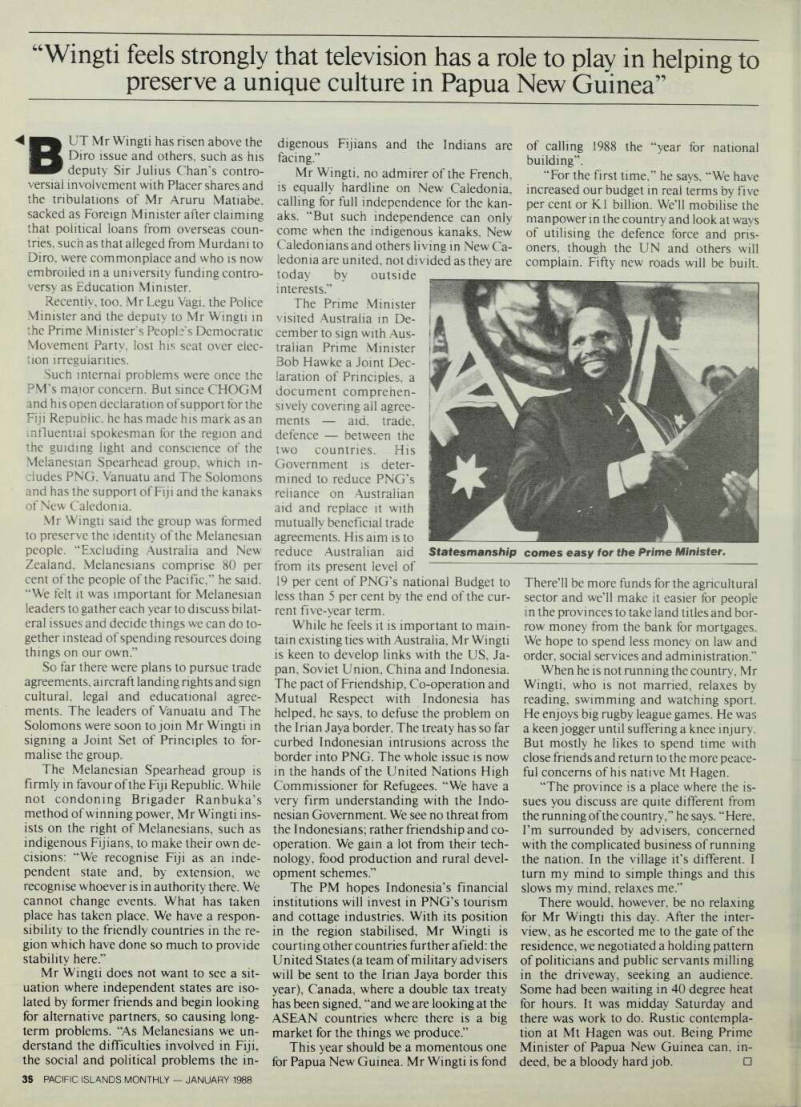
Paias Wingti Practical Visionary 32
An exclusive interview with the dynamic PNG Prime Minister.
Pacific Defence Dossier 37
A nation by nation review of defence strategies and capabilities.
Diving For Submarines Off Papua New
Guinea 44
How to get a fish eye view of World War II wrecks.
Pa 9 e 22
Page 32
Editor Larry Writer Deputy Editor
Carson Creagh
Art Director Warren Scott Editorial Adviser John Carter Contributors Peter Young Nicolas Rothwell John Dunn David S North Laurie Strachan Glen Roach Ed Rampell John Hunter Maclaren Hiari
Publisher Geraldine Raton
Managing Editor
Arnold Earnshaw
Advertising Sales Sydney & Melbourne - Lawson Dixon (02) 288 3541 Fergus Maclagan (02) 412 3918; Brisbane - Robert Walker (07) 371 0533.
I Australian cover price is recommended 1 retail only. Registered by Australia Post, i publication No. NBP 1210. Copyright I Pacific Publications (Aust) Pty Ltd
Departments
Opinion 7
Letters 9
Pacific Report 25
Trade Winds 28
Island Press 46
Transition 49
Book Reviews 48
Quotes 49
Stamps 51
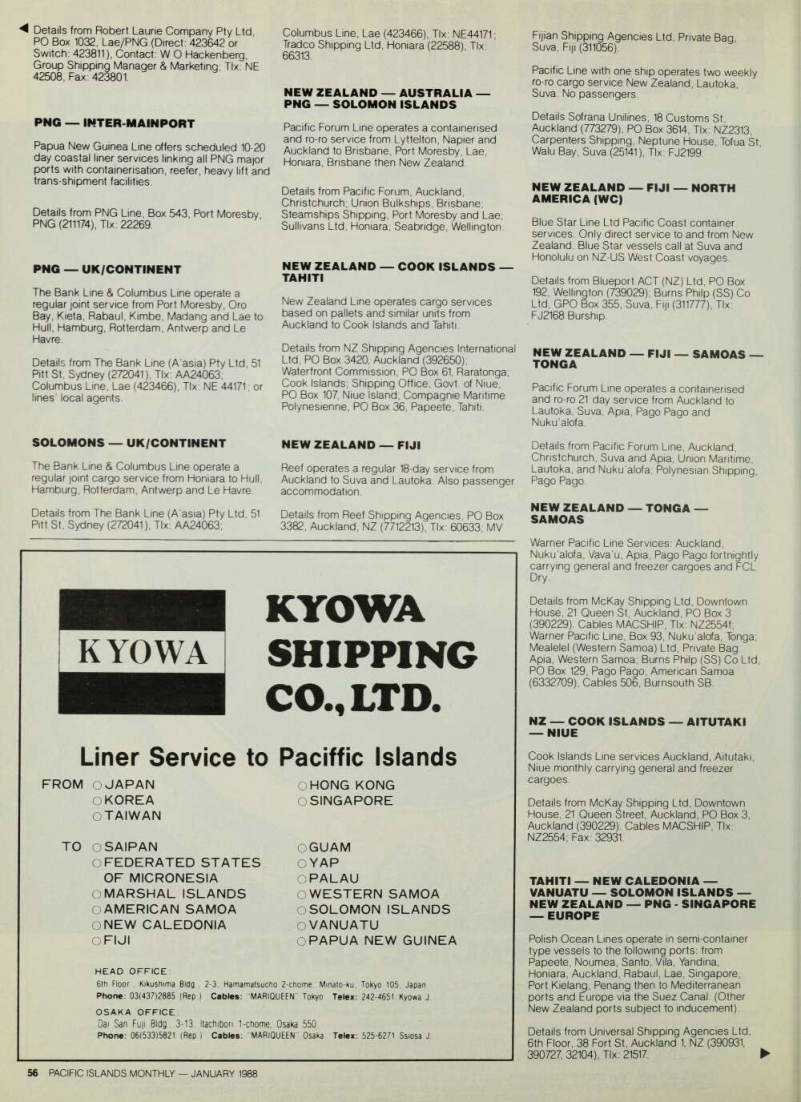
Shipping Schedules 52
Out Of The Past 58
Advertisements & other items, pp. 5-6 (2 items)
5
PACIFIC ISLANDS MONTHLY JANUARY 1988
A Pacific Publications Production.
Founded 1930 (USPS 952480) 64-76 Kippax St, Surry Hills, NSW 2010; Telex; AA20124; Fax: (02)288 3322; Cables: PACPUB Sydney; Telephone: (02) 288 3000.
Pacific Islands Monthly (APPS No.
NBP1210) is published monthly by Pa cific Publications Pty Ltd, a division of Nationwide News, 2 Holt St, Surry Hills, NSW 2010. Second class pos tage paid at Honolulu, Hawaii, POST MASTER. Send address changes to
PACIFIC ISLANDS MONTHLY, PO Box
22250, Honolulu, Hawaii 96822. Ty peset by David Graphics, Sydney, and printed by Progress Press, 2 Keys Rd, Moorabbin, Victoria.
us£,alwaY^
FUSILADE
The GRASS
WEEDKILLER! for
selective control of grass weeds in broadleaf crops.
FORSAFS
us£,alwaY^
■ READ LA BBIS
I CAUBFULCf.
\/rtemk inscctick* p 0j ortho*
ORTHENE
The SYSTEMIC
INSECTICIDE! for
use in rice and vegetable crops.
FURADAN
The granular Insecticide/ nematicide! for bananas, vegetables, sugarcane & rice.
FUNGINEX
The FUNGICIDAL
DIP! for treating cane sets before planting.
Controls Pineapple disease.
TALON WB
Kills RATS and MICE fast!
At home, or on the farm. The World’s most effective rodenticide.
gd , m
Attack .
V r
ATTACK
Kills a wide range of insect pests. Can be used on most crops.
GRAMOXONE
WEEDKILLER
. DESICCANT
GRAMOXONE
The fast acting TOTAL weedkillercan be used in most crops! Will not poison soil. For LONGTERM control, add DIURON 80. x
kSMliii
For full details on any ICI product, address your enquiry to “Export”, ICI New Zealand Limited, P.O. Box 900, AUCKLAND, NEW ZEALAND.
No Cause For Confidence
Opinion
An ailing leader and a shaky victory signal a need for the newly elected Vanua’aku Party to put an end to its internecine struggles.
WITH THE ruling Vanua’aku Party returned to power and Father Walter Lini named Prime Minister once again, Vanuatu’s post-election politics might seem unchanged but beneath this still surface, dramatic shifts are under way. The leadership of the VP Government remains in question, despite Father Lini’s successful defence of his post against an unprece dented challenge from his party’s secretary-general, Barak Sope. The Government itself, as it prepares for four more years shaping the nation, must be aware that its support is declining quickly; on present trends it could well lose the next election.
Father Lini and Barak Sope waged an extraordinary
contest for the leadership of party and country in the early days of December, before reaching a con sensus settlement as disarmingly traditional as it is unsatisfactory.
Rivalry gives way to amity.
The opposition Union of Moderate Parties has a clearer picture of its needs; Vincent Bou lekone, the leader in three unsuc cessful election campaigns, was quickly replaced by the articulate Maxime Carlot. The UMP can afford to be pleased with its per formance in the November 30 elections. It won 19 seats in the newly expanded 46-seat parlia ment and received 42 per cent of the popular vote, as against 33 per cent in 1983, while the VP saw its share drop below 50 per cent for the first time.
The allure that has long been attached to the VP as the party of the independence struggle may be wearing down, and the nine per cent swing away from the party is a warning signal that it must change or die. Some of this swing went to the UMP; some was ab sorbed by the group of small new parties that have emerged in the
past year, such as Labour and the New Peoples Party.
While these parties may not yet have a voice in parlia ment, their creation spells the end of the VP’s traditional map of Vanuatu politics which often amounts to a sim ple (and simplistic) Anglophone prescription of us versus them, VP versus UMP, progressive versus conservative.
The pattern of the election result was pervasive; in all
but one of the constituencies, the VP’s vote was on the decline.
Against this background, the retention of Father Lini as Prime Minister, with an expanded role going to Mr Sope, is arguably the worst of all possible outcomes for the VP and for the nation. Father Lini has not recovered his health and may soon take medical leave of absence. His deputy will wield limited authority at a time when the na tion needs concerted action on both diplomatic and economic fronts to regain a growth-path.
Mr Sope, a man with an instinctive and deep appre ciation of and appetite for power, may not be the answer to a fledgling democracy’s prayer either, despite his prom
ises to run the country more “on business lines”. Regional powers have serious doubts about his controversial “Libyan initiative” and his intriguing combination of fiercely non-aligned foreign poli cies with a taste for free enter prise. But even if this elusive figure reinforces his role as party and Government strongman, a power vacuum remains at the top.
Vanuatu’s priorities, as the na tion continues the difficult tran sition from independence to development, should be clear: it needs more education, more for eign aid, more investment and a careful meshing of traditional and modern values. Seen in this light, the VP Government’s running diplomatic war with the French is a quixotic struggle, covertly and ruinously directed at Vanuatu’s own large Francophone minority and the UMP.
This election over, the time has come for the VP (long a party of revolution and struggle) to re shape itself into a force capable of leading all ni-Vanuatu what ever their religion, island, ideol ogy or language forward. This
was the challenge the UMP’s Mr Carlot offered the Government on the first day of the new parliament in Port Vila, when he pledged his party’s efforts as a determined, but constructive, opposition. If the VP does not accept this challenge, devise and implement strong policies mar shalled by a strong leader, its days as Vanuatu’s dominant party could well be numbered.
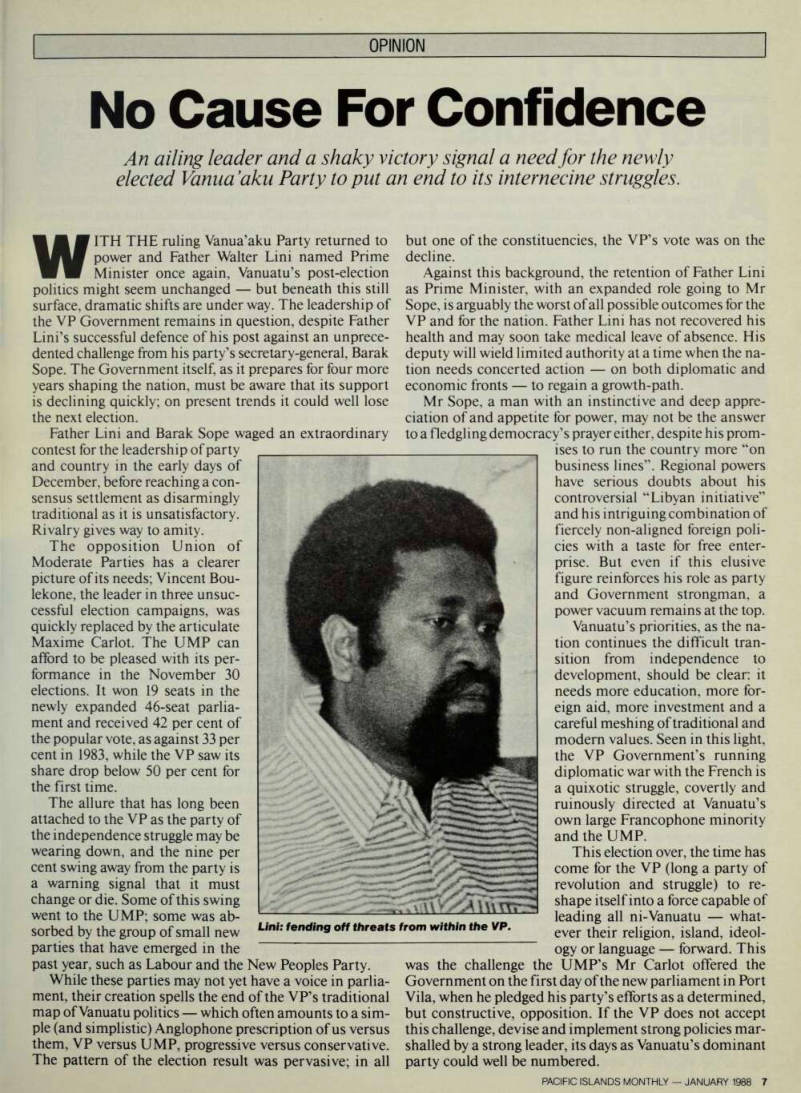
Lini: fending off threats from within the VP.
History Lessons
AMID CALLS from FLNKS leader Jean-Marie Tjibaou for kanaks to arm themselves in open defiance of New Caledonian law and from RPCR loyalists that virtually every member of the FLNKS be jailed for inciting revolution in gleeful adherence to New Caledonian law pro-independence Melanesians are recognising the essentially long-term nature of their struggle and are working toward economic, social and ed ucation strategies that will build a base from which an in dependent Kanaky can move to true nationhood.
These strategies are vital to the creation of meaningful
“kanakhood”, and likewise to the birth of an educated, experienced group that may one day steer Kanaky through the increasingly dangerous waters of the political Pacific.
But today, the fact that opportunities are denied to Me lanesians is a matter of record. And the denial of those opportunities, in the light of Mr Tjibaou’s call to arms, is a danger to every inhabitant of New Caledonia.
FLNKS spokesman Yeiwene Yeiwene points to statu tory inequalities that place kanaks at a disadvantage in virtually every area of regional and individual better ment, as potential fuel for unrest: fuel that, in addition to proposed changes to New Caledonia’s internal adminis tration, could well kindle the kanak revolution the French would seem to desire.
Such a revolution would cost lives needlessly, and would serve only to further erode France’s already shaky pres tige in the Pacific. It would make a mockery of French
claims to philosophical and moral superiority, and would lead to condemnation of the most damning kind: sanc tions that could topple an economy worryingly dependent on European Economic Community trading advantages, and sanctions that would certainly topple whichever met ropolitan government was responsible.
France is not alone in its apparent inability to learn from history, yet its tragic recapitulation of the past need not continue. Indochina need not have led to Algeria; Tahiti and New Caledonia are not inevitable consequences of Algeria. Even the FLNKS has entreated France to cover itself in glory, not ashes, by devising and implementing policies that reflect a true appreciation of other nations’ bitter colonial heritage. Kanak independence would be greatly to France’s advantage, both on a domestic level and in the eyes of Pacific nations, watching and hoping that the "‘Pacific century” will be ushered in by a gesture wor thy of the republic that sent the words liberte, egalite,fra ternite echoing around the world.
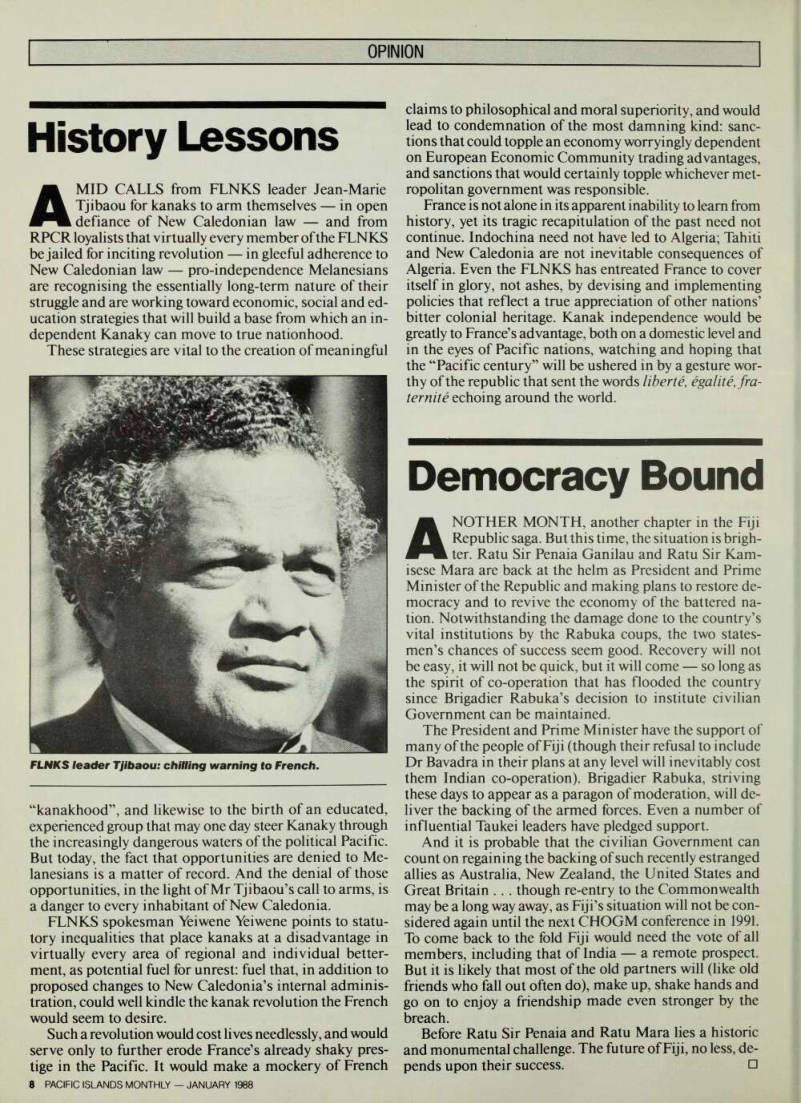
FLNKS leader Tjibaou: chilling warning to French.
Democracy Bound
ANOTHER MONTH, another chapter in the Fiji Republic saga. But this time, the situation is brigh ter. Ratu Sir Penaia Ganilau and Ratu Sir Kam isese Mara are back at the helm as President and Prime Minister of the Republic and making plans to restore de mocracy and to revive the economy of the battered na tion. Notwithstanding the damage done to the country’s vital institutions by the Rabuka coups, the two states men’s chances of success seem good. Recovery will not be easy, it will not be quick, but it will come so long as the spirit of co-operation that has flooded the country since Brigadier Rabuka’s decision to institute civilian Government can be maintained.
The President and Prime Minister have the support of many of the people of Fiji (though their refusal to include Dr Bavadra in their plans at any level will inevitably cost them Indian co-operation). Brigadier Rabuka, striving these days to appear as a paragon of moderation, will de liver the backing of the armed forces. Even a number of influential Taukei leaders have pledged support.
And it is probable that the civilian Government can count on regaining the backing of such recently estranged allies as Australia, New Zealand, the United States and Great Britain ... though re-entry to the Commonwealth may be a long way away, as Fiji’s situation will not be con sidered again until the next CHOGM conference in 1991.
To come back to the fold Fiji would need the vote of all members, including that of India a remote prospect.
But it is likely that most of the old partners will (like old friends who fall out often do), make up, shake hands and go on to enjoy a friendship made even stronger by the breach.
Before Ratu Sir Penaia and Ratu Mara lies a historic and monumental challenge. The future of Fiji, no less, de pends upon their success. □
Letters
Png’S Education Crisis
PAPUA NEW Guinea, a “late developer” when it comes to formal education, has in the past 20 years expanded tertiary edu cation dramatically. Today, there are more than 68 institutions: many of these are small and inefficient, but cater to regional, provincial and parochial interests.
The recent cuts at the University of PNG have demoralised staff: “there by the grace of God go I” is the prevailing atti tude. Staff associations have threatened legal action over breach of contract, and are demanding compensation of at least one year’s salary (instead of the three months’ notice the university has of fered). But this clause is not in the con tracts of citizens with tenure or five-year contracts.
Many Papua New Guinean staff have worked at the university for up to a dec ade, and the university has invested con siderable sums in their further education only now to dump them.
Papua New Guinea is a major Pacific power with tremendous fisheries re sources. To abolish the Department of Fisheries at the University is both coun terproductive and against the stated goal of developing primary industry. All den tal training has recently been amalga mated; the abolition of the Department of Dentistry will mean the Health Depart ment has to begin over again its programs for training technicians. The Educational Research Unit has gained a reputation for effective applied research that has bene fited the nation over the past 15 years. It will not be easy to start up such institu tions after they have been closed when and if the Government changes its mind.
There is also a major bottleneck in the number of students completing Science Foundation Year. Medicine, Fisheries, Dentistry, Biology and so on are all com peting for this limited pool of students.
Moves to add Foundation Year to the Na tional High Schools might further under mine the university. What is needed is more Grade 12 leavers there are only four National High Schools to increase the pool of available science students.
Perhaps the real tragedy for PNG will be that if the university is unable to hon our its contracts it undermines its ability to recruit expatriate and national staff in the future. People will not want to work in PNG if their contracts can be cancelled at short notice with minimal compensation.
Anyone considering a job in PNG should check with someone already there as to the security of their contract.
Sheldon Weeks Educational Research Unit University of PNG Port Moresby, PNG
A Nuclear-Free Pacific
WE, THE National Executive Council of the Episcopal Peace Fellowship (EPF) share our prayerful support for the South Pacific Nuclear-Free Zone. We are com mitted to work and witness any way we can for a nuclear-free Pacific. We believe that stockpiling, testing, transporting, or dis posing the waste of nuclear material, fuel or weaponry is a present danger to the wholeness and health of all Pacific peoples, as well as a threat to the security and in tegrity of their territories.
Now we understand that our own na tion is preparing a new “Pacific Initia tive”. First reports indicate this proposed alliance will allow and safeguard greater US presence therefore, greater US pres sure throughout the Pacific Basin. This in turn may well foreshadow an even greater political aggrandisement, with military, nuclear acceptance and accessi bility required of all our partners in the Pacific region.
The Rt Rev William Davidson and the Rev Layton P Zimmer Episcopal Peace Fellowship Washington, DC United States
Fiji Coup Questions
BETWEEN them in their two separate ar ticles your October correspondents Dr Brij Lai (Letters) and Joann Wypijewski (The Fiji Coup: Was America to Blame?) lo cate the two key factors to understanding the May coup in Fiji.
Wypijewski’s tightly argued case is ob viously the more contentious of the two statements, but for the interest of open minded readers may I just invite them to re-examine the much-circulated photo of Rabuka with the soldier in the balaclava on the day of the coup. If they have had any prolonged experience of living in Fiji I think they will have serious doubts as to whether the balaclava’d soldier pictured alongside Rabuka is either ethnic Fijian or (less likely anyway) a part-European.
For myself I have little doubt the man is neither.
Closer examination of all of the photos taken of the coup on May 14 might there fore prove interesting. So, incidently, might examination of the social composition of soldiers (conveniently?) out of the country at the time, such as those on courses in New Zealand.
C Griffin Dept of Agricultural and Intercultural Studies Western Australian College of Advanced Education Perth Western Australia
Advertisements & other items, p. 9 (1 item)
Pacific
SLANDS
Imp n t h l y \ FIJI: Distribution and subscriptions: Desai Bookshops, PO Box 160, Suva, Fiji Phone Suva 23036.
Advertising: Fiji Times & Herald Ltd, 20 Gordon St., Suva.
Phone 31-4111, telex FJ2124.
FRENCH POLYNESIA; Distribution: Hachette Pacifique 10 Ave., Bruat, Papeete. Phone 25-610.
HAWAII; UNITED STATES; Distribution: PIM, Hawaii, PO Box 22250, Honolulu, Hawaii, 96822. Advertising: Brian C Asgill, Apt. 1308,1676 Ala Moana Blvd., Honolulu, Hawaii, 96815. Phone (808) 955-9718.
JAPAN: Advertising and subscriptions; Universal Media Corporation, GPO Box 46, Tokyo Phone 666-3036, cable UNIMEDIA Tokyo, telex 2524665.
MALAYSIA: Advertising and subscriptions; Worldwide Media Services, 57-B Komplex Damai, Jin Dato Haji Eusoff, Kuala Lumpur. Phone 63-9340, cables WORLDMEDIA Kuala Lumpur, telex 31533.
VANUATU: Distribution: The Vanuatu Stationery and Book Centre, PO Box 557 Port Vila Advertising: Nor man Bros Bookshop. Port Vila Phone 2232.
NEW CALEDONIA: Distribution: Depot Centre de Presse Michel Pentecost. CBP2, Noumea. Phone 27- 2434, 27-4729.
NEW ZEALAND: Distribution: Gordon & Gotch, PO Box 584, 2 Carr Road, Mt Roskill, Auckland 4 Advertising: McKay International Media Reps Ltd, C/- Albany PO, Auckland 10, New Zealand. Phone 413-9119 Telex NZ22701, FAX 413-9110.
WELLINGTON: Ross Quaid Media, 1 Scholes Ln , Petone. (04) 68-7593, PO Box 38699, Petone PAPUA NEW GUINEA: Distribution: Gordon & Gotch, PO Box 3395, Port Moresby Phone 25-4551, 25-4855 Advertising: Ken Head, PNG Post-Courier, PO Box 85, Port Moresby. Phone 21-2577, telex 22120.
SOLOMON ISLANDS: Distribution and Advertising: The Bookshop, (Norman Bros.) PO Box 503, Honiara.
PHILIPPINES: Advertising: The GF Group, 12 San Ignacio St., Uroaneta Village, Makati, Metro Manila. Phone 817-7299, telex 45950 and 4233.
UNITED KINGDOM; The Herald & Weekly Times Ltd, No 1 Maltravers St., London WC2R3DZ, England. Phone (01) 836-5162, telex London 21989.
UNITED STATES MAINLAND: Advertising: Joshua B Powers Jr., Powers International Inc., Suite 708, 271 Madison Ave , New York, NY 10016. Phone 867-9580, Subscriptions: PIM, Hawaii, PO Box 22250, Honolulu.
Hawaii, 96822.
SUBSCRIPTIONS
American Samoa Australia Canada Cook Islands Fiji French Polynesia ...
Guam Hawaii Japan Kiribati Micronesia Nauru New Caledonia New Zealand Niue Norfolk Island Northern Marianas Papua New Guinea Solomon Islands ...
Tonga Tuvalu United Kingdom ...
US (Mainland) Vanuatu Western Samoa ...
Elsewhere ...US$45
AUSS24
...US$45
AUS$46
AUS$46
...US$45 ...US$45 ...US$45 . US$38
AUS$46
...US$35
AUS$42
...US$32
AUS$42
AUS$46
AUS$42
...US$36
AUS$42
,AUS$46
AUS$46
AUS$46
,.Stg£28 . US$45
AUS$42
AUS$60
AUS$63
Payments to Pacific Islands Monthly: Subscriptions Dept, GPO Box 5223BB, Melbourne 3001, Australia.
Subscriptions rates includes the cost of airspeeding to all destinations set out above. Direct airmail rates on application.
Back From The Brink
Fiji
Democracy and economic recovery are at last in sight.
FIJI HAS a civilian government once more, after the military, which seized power in May, decided to hand back power to former Governor- General Ratu Sir Penaia Ganilau who be comes the first President of the Republic of Fiji.
The change was the last link in a dra matic chain of events and top level dis cussions between military leader and head of the military government Brigadier Si tiveni Rabuka, Ratu Sir Penaia and for mer Prime Minister Ratu Sir Kamisese Mara.
Ratu Sir Penaia had earlier expressed his willingness to accept the President’s
position provided he was satisfied that the new Constitution, which will replace the 1970 Inde pendence Constitution, adequately protected the rights of all people in Fiji.
Brigadier Rabuka had officially offered the post to Ratu Sir Penaia; Ratu Sir Kamisese Mara had also accepted the Prime Ministership provided he had a free hand to se lect his own ministers and to set a time frame of two years to get the coun try back to parliamen tary democracy.
On December 5 the very day the execu tive council of the mili tary Government was to meet to discuss the two drafts of the new Consti
tution Brigadier Rabuka announced that he was abdicating and handing power back to the Governor General, whom he had now appointed as the first President of the Republic of Fiji. The surprise an nouncement shocked most ministers, and the brigadier was reportedly almost per suaded to change his mind.
All 22 ministers in the military admin istration have been given 10 months’ sal ary in compensation. The four newly appointed supreme court judges have also had their appointments terminated and have been paid three months’ salary in compensation. This is designed to give Ratu Sir Kamisese a free hand in putting in place an independent judiciary: the magistracy is also likely to be reorganised.
Brigadier Rabuka and Ratu Sir Penaia both addressed the nation in a radio
broadcast that night, outlining their rea sons for stepping down and for accepting new positions.
Brigadier Rabuka explained that from the very beginning he had made it clear he had no intention of keeping political power himself: he said his men and officers had supported him to “prevent what we had seen over the past few years; the gradual erosion of the Fijian way of life with threats to the customs and traditions of the Fijian people.”
In his address, the Brigadier also made it clear that the Bavadra win in the April election was not the beginning but “the moment when the threats became intol
erable”. He said the 1970 Constitution was “inad equate to protect the val ues and principles and way of life of the Fijian people”, particularly when a political party not predominantly Fijian was in power.
Ratu Sir Penaia said he and the Brigadier had agreed that Fiji should have the best Constitu tion that could be de vised. They were also in agreement on the maxi mum requirements that will be needed to protect the interests of indige nous Fijians: require ments that may eventually be reflected “in a number of ways”.
The leaders of Fiji, he said, desired a return to
parliamentary democracy and the re-es tablishment of links with the Crown.
Reaction locally was positive, and was hailed as a move in the right direction.
However, foreign governments, especially those of Australia and New Zealand, were reserved in their initial responses. New Zealand Foreign Minister Russell Mar shall said the changes were a substantial step forward and could lead to an increase in his country’s level of recognition of Fiji.
Australia also said it looked forward to seeing details of the new Constitution.
Australia’s acting Foreign Minister, Mi chael Duffy, said the appointments of Ratu Sir Penaia and Ratu Sir Kamisese indi cated an early return to a truly civilian government was now possible.
In a national radio broadcast, the newly appointed Prime Minister pleaded with
the people of Fiji to cast aside enmity and hatred and to put the past behind them.
He appealed for co-operation and prom ised in turn to do “everything possible” to put Fiji back on a sound footing as soon as possible.
Ratu Mara emphasised that his Government was only an interim govern ment and asked for everyone’s support to pave the way for general elections as soon as possible. He also took the opportunity of once again categorically denying that he was in any way involved in the two mili tary coups. “I say in all honesty and sin cerity that I was not a party to them, either prior to or after,” he said. “My action in becoming an adviser in previous admin istrations was motivated solely by my de sire to help my country in a time of need; a country for which I have sacrificed the greater part of my life.”
In his address to his cabinet ministers, Ratu Mara called on them to build bridges of understanding and co-operation be tween the people and the Government.
“The people of this country are looking to us for help and the world is looking at us with interest,” he said. “We cannot fail; we should not fail. If we do, we ourselves are failures.”
Observers in Fiji say the change was necessary to save the country from eco nomic ruin. Investor confidence has eroded to a level where even the most at tractive packages are not having the de sired effect of luring foreign investors.
Locally, no new investment is being made and the building and construction indus try has almost come to a halt. Indians in both professions and business are leaving the country, inflation is on the increase and unemployment is also rising. To restore confidence and win back the goodwill of the business community (and particularly of its Indian members), it was necessary to put in command a leader who has the image of a “saviour”.
The NFP/Labour coalition, deposed Government of Dr Timoci Bavadra, has made no official comment on the changes in leadership and the handing of power from a military to a civilian government.
In a letter to the Fiji Times, Dr Ba vadra explained that he was monitoring the situation closely and said “the public can accurately judge things for them selves.” However, he made it clear that “neither I nor my party were consulted about the composition of the interim government and have not to date been in vited to discuss any aspects of the newl
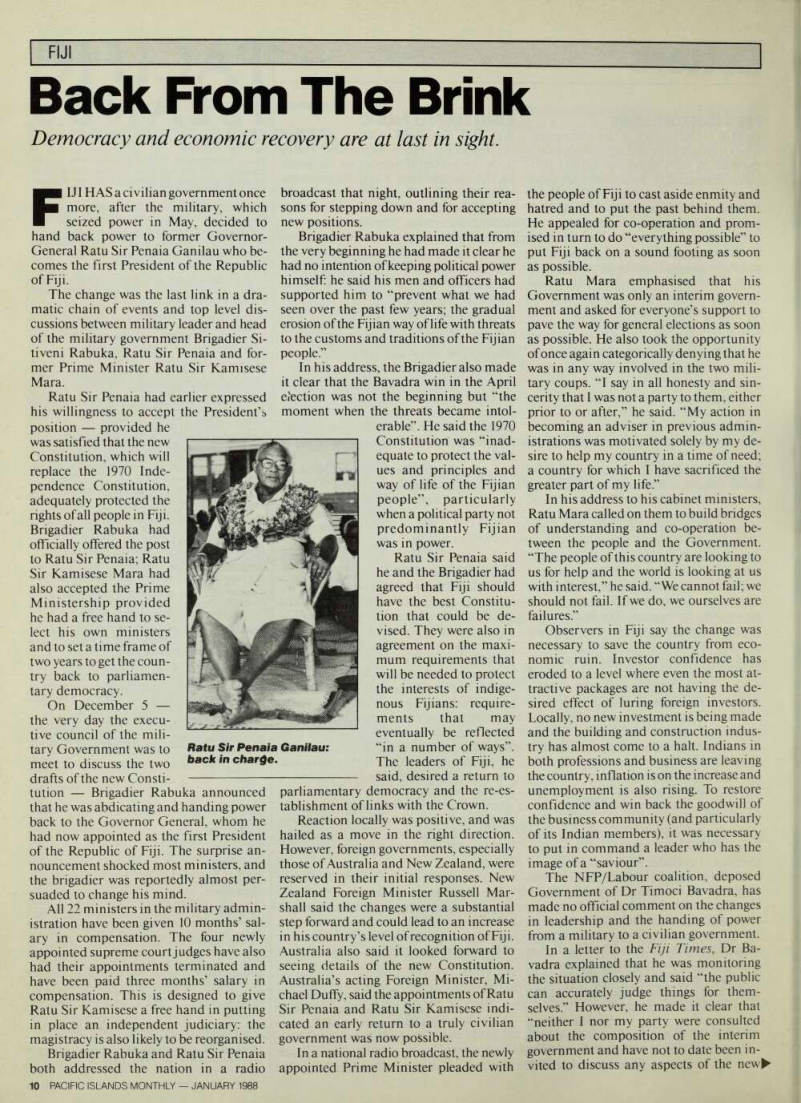
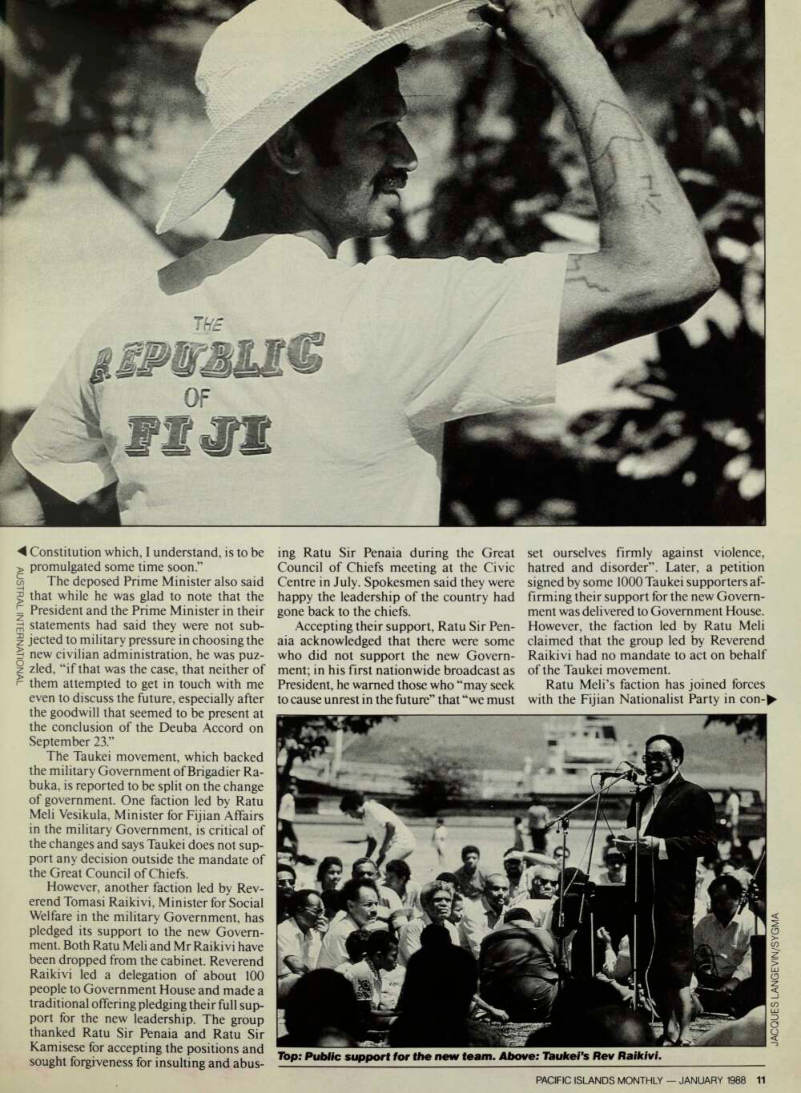
Ratu Sir Penaia Ganilau: back in charge.
Austral International
Constitution which, I understand, is to be promulgated some time soon.”
The deposed Prime Minister also said that while he was glad to note that the President and the Prime Minister in their statements had said they were not sub jected to military pressure in choosing the new civilian administration, he was puz zled, “if that was the case, that neither of them attempted to get in touch with me even to discuss the future, especially after the goodwill that seemed to be present at the conclusion of the Deuba Accord on September 23.”
The Taukei movement, which backed the military Government of Brigadier Ra buka, is reported to be split on the change of government. One faction led by Ratu Meli Vesikula, Minister for Fijian Affairs in the military Government, is critical of the changes and says Taukei does not sup port any decision outside the mandate of the Great Council of Chiefs.
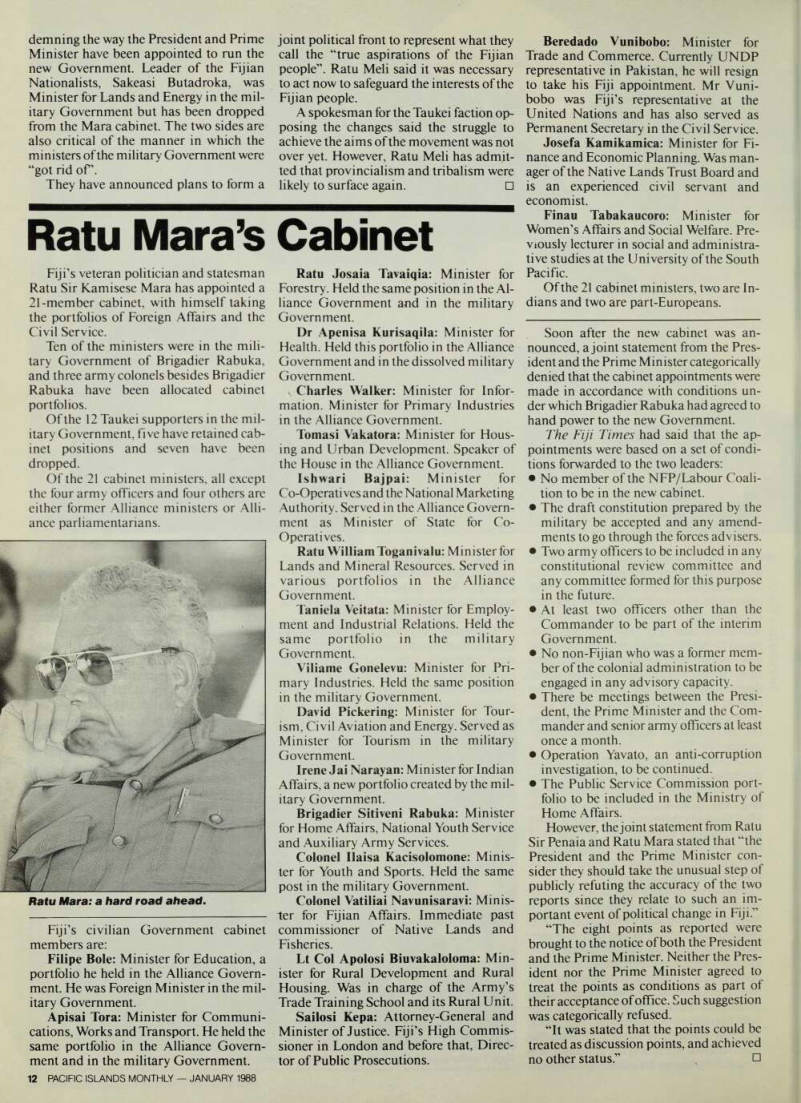
However, another faction led by Rev erend Tomasi Raikivi, Minister for Social Welfare in the military Government, has pledged its support to the new Govern ment. Both Ratu Meli and Mr Raikivi have been dropped from the cabinet. Reverend Raikivi led a delegation of about 100 people to Government House and made a traditional offering pledging their full sup port for the new leadership. The group thanked Ratu Sir Penaia and Ratu Sir Kamisese for accepting the positions and sought forgiveness for insulting and abus
ing Ratu Sir Penaia during the Great Council of Chiefs meeting at the Civic Centre in July. Spokesmen said they were happy the leadership of the country had gone back to the chiefs.
Accepting their support, Ratu Sir Pen aia acknowledged that there were some who did not support the new Govern ment; in his first nationwide broadcast as President, he warned those who “may seek to cause unrest in the future” that “we must
set ourselves firmly against violence, hatred and disorder”. Later, a petition signed by some 1000 Taukei supporters af firming their support for the new Govern ment was delivered to Government House.
However, the faction led by Ratu Meli claimed that the group led by Reverend Raikivi had no mandate to act on behalf of the Taukei movement.
Ratu Meli’s faction has joined forces with the Fijian Nationalist Party in con-^
Top: Public support for the new team. Above: Taukei’s Rev Raikivi.
Jacques Langevin/Sygma
demning the way the President and Prime Minister have been appointed to run the new Government. Leader of the Fijian Nationalists, Sakeasi Butadroka, was Minister for Lands and Energy in the military Government but has been dropped from the Mara cabinet. The two sides are also critical of the manner in which the ministers of the military Government were “got rid of’.
They have announced plans to form a
joint political front to represent what they call the “true aspirations of the Fijian people”. Ratu Meli said it was necessary to act now to safeguard the interests of the Fijian people.
A spokesman for the Taukei faction op posing the changes said the struggle to achieve the aims of the movement was not over yet. However, Ratu Meli has admit ted that provincialism and tribalism were likely to surface again. □
Beredado Vunibobo: Minister for Trade and Commerce. Currently UNDP representative in Pakistan, he will resign to take his Fiji appointment. Mr Vuni bobo was Fiji’s representative at the United Nations and has also served as Permanent Secretary in the Civil Service.
Josefa Kamikamica: Minister for Fi nance and Economic Planning. Was man ager of the Native Lands Trust Board and is an experienced civil servant and economist.
Finau Tabakaucoro: Minister for Women’s Affairs and Social Welfare. Pre viously lecturer in social and administra tive studies at the University of the South Pacific.
Of the 21 cabinet ministers, two are In dians and two are part-Europeans.
Ratu Mara’s Cabinet
Fiji’s veteran politician and statesman Ratu Sir Kamisese Mara has appointed a 21-member cabinet, with himself taking the portfolios of Foreign Affairs and the Civil Service.
Ten of the ministers were in the mili tary Government of Brigadier Rabuka, and three army colonels besides Brigadier Rabuka have been allocated cabinet portfolios.
Of the 12 Taukei supporters in the mil itary Government, five have retained cab inet positions and seven have been dropped.
Of the 21 cabinet ministers, all except the four army officers and four others are either former Alliance ministers or Alli ance parliamentarians.
Fiji’s civilian Government cabinet members are: Filipe Bole: Minister for Education, a portfolio he held in the Alliance Govern ment. He was Foreign Minister in the mil itary Government.
Apisai Tora: Minister for Communi cations, Works and Transport. He held the same portfolio in the Alliance Govern ment and in the military Government.
Ratu Josaia Tavaiqia: Minister for Forestry. Held the same position in the Al liance Government and in the military Government.
Dr Apenisa Kurisaqila: Minister for Health. Held this portfolio in the Alliance Government and in the dissolved military Government.
Charles Walker: Minister for Infor mation. Minister for Primary Industries in the Alliance Government.
Tomasi Vakatora: Minister for Hous ing and Urban Development. Speaker of the House in the Alliance Government.
Ishwari Bajpai: Minister for Co-Operatives and the National Marketing Authority. Served in the Alliance Govern ment as Minister of State for Co- Operatives.
Ratu William Toganivalu: Minister for Lands and Mineral Resources. Served in various portfolios in the Alliance Government.
Taniela Veitata: Minister for Employ ment and Industrial Relations. Held the same portfolio in the military Government.
Viliame Gonelevu: Minister for Pri mary Industries. Held the same position in the military Government.
David Pickering: Minister for Tour ism, Civil Aviation and Energy. Served as Minister for Tourism in the military Government.
Irene Jai Narayan: Minister for Indian Affairs, a new portfolio created by the mil itary Government.
Brigadier Sitiveni Rabuka: Minister for Home Affairs, National Youth Service and Auxiliary Army Services.
Colonel Ilaisa Kacisolomone: Minis ter for Youth and Sports. Held the same post in the military Government.
Colonel Vatiliai Navunisaravi: Minis ter for Fijian Affairs. Immediate past commissioner of Native Lands and Fisheries.
Lt Col Apolosi Biuvakaloloma: Min ister for Rural Development and Rural Housing. Was in charge of the Army’s Trade Training School and its Rural Unit.
Sailosi Kepa: Attorney-General and Minister of Justice. Fiji’s High Commis sioner in London and before that. Direc tor of Public Prosecutions.
Soon after the new cabinet was an nounced, a joint statement from the Pres ident and the Prime Minister categorically denied that the cabinet appointments were made in accordance with conditions un der which Brigadier Rabuka had agreed to hand power to the new Government.
The Fiji Times had said that the ap pointments were based on a set of condi tions forwarded to the two leaders: • No member of the NFP/Labour Coali tion to be in the new cabinet. • The draft constitution prepared by the military be accepted and any amend ments to go through the forces advisers. • Two army officers to be included in any constitutional review committee and any committee formed for this purpose in the future. • At least two officers other than the Commander to be part of the interim Government. • No non-Fijian who was a former mem ber of the colonial administration to be engaged in any advisory capacity. • There be meetings between the Presi dent, the Prime Minister and the Com mander and senior army officers at least once a month. • Operation Yavato, an anti-corruption investigation, to be continued. • The Public Service Commission port folio to be included in the Ministry of Home Affairs.
However, the joint statement from Ratu Sir Penaia and Ratu Mara stated that “the President and the Prime Minister con sider they should take the unusual step of publicly refuting the accuracy of the two reports since they relate to such an im portant event of political change in Fiji.”
“The eight points as reported were brought to the notice of both the President and the Prime Minister. Neither the Pres ident nor the Prime Minister agreed to treat the points as conditions as part of their acceptance of office. Such suggestion was categorically refused.
“It was stated that the points could be treated as discussion points, and achieved no other status.” □
Ratu Mara: a hard road ahead.
Lini Blocks Sope’s Power Bid
Vanuatu
By John Dunn
Vanuatu’s leader is still a force to be reckoned with.
VANUATU’S future role in the South Pacific will be one of the area’s greatest question marks, and one of its most fascinating studies, as the new year gets underway.
Until his stroke in Washington last February, 44-year-old Prime Minister Father Walter Lini had led his 130,000 people along an independent, non-aligned (or, as some would describe it, a relatively radical) road. There had been the connec tion with the Soviet Union in the form of the one-year, SA2 million fishing agree ment signed last January.
Then there had been the flirtation with Libya, in the form of training in Tripoli, in “journalism” and as bodyguards, of some 30 or 40 young party men. To this was added an attempt, albeit clumsy, by two Libyan agents to set up a bureau in Port Vila: a move that was wisely cancelled by the Vanuatu Government. Throughout all this has been the contretemps with the French over Vanuatu’s support for the in dependence-seeking kanaks in New Caledonia.
Father Lini’s illness and his recupera tion have taken him and his country out of the political limelight over recent months, though some issues kept simmering.
As the country’s election campaign geared up, difficulties with the French flared again. Vanuatu expelled French ambassador Henri Crepin-Leblond, claiming France was funding the Union of Moderate Parties (UMP) opposition, led by 43-year-old lawyer Vincent Boulekone.
A furious France denied the charges and withdrew almost all its diplomatic staffin Port Vila.
The election is now over and Lini’s Vanua’aku Party has retained govern ment, winning 26 of the 46 seats in the ex panded parliament. But instead of solving the arguments and settling the issues the election has opened a whole new set of possibilities, producing a situation that makes Vanuatu an even greater enigma.
Normally it would have been safe to as sume that Lini’s return to power would have meant a continuation of the coun try’s previous policies. But the situation became suddenly both cloudy and com plicated with the bid for power of Barak Sope, 36, secretary-general since 1976 of the Vanua’aku Party and the man long considered to be the power behind the na tion’s throne.
It has been generally accepted that Vanuatu’s independence has been the strategy of Sone who, from behind the|
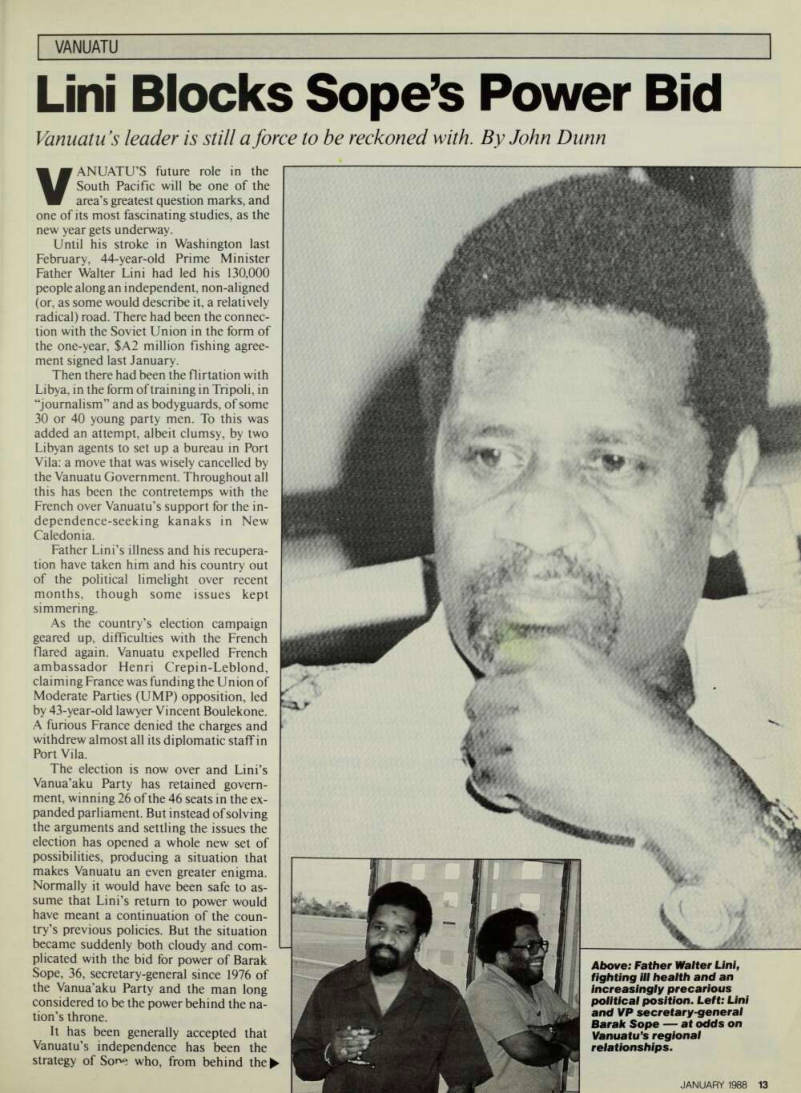
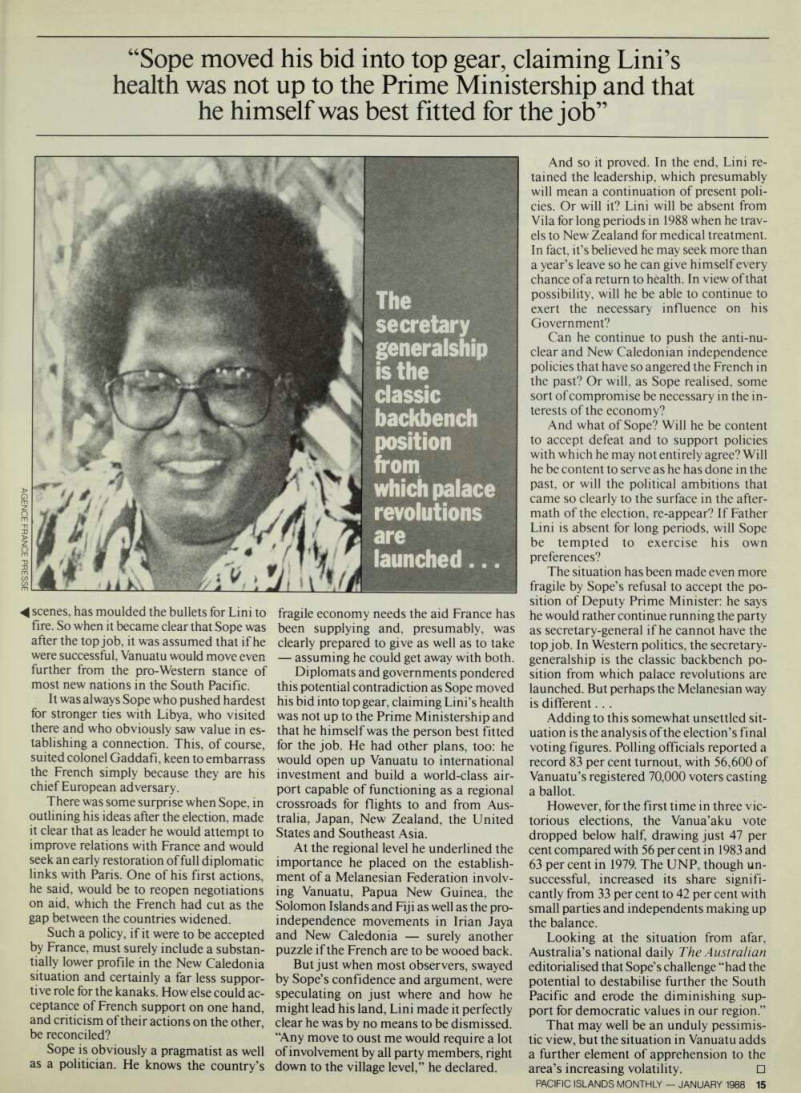
Above: Father Walter Lini, fighting ill health and an increasingly precarious political position. Left: Lini and VP secretary-general Barak Sope - at odds on Vanuatu’s regional relationships.
“Sope moved his bid into top gear, claiming Lini’s health was not up to the Prime Ministership and that he himself was best fitted for the job”
<4 scenes, has moulded the bullets for Lini to fire. So when it became clear that Sope was after the top job, it was assumed that if he were successful, Vanuatu would move even further from the pro-Western stance of most new nations in the South Pacific.
It was always Sope who pushed hardest for stronger ties with Libya, who visited there and who obviously saw value in es tablishing a connection. This, of course, suited colonel Gaddafi, keen to embarrass the French simply because they are his chief European adversary.
There was some surprise when Sope, in outlining his ideas after the election, made it clear that as leader he would attempt to improve relations with France and would seek an early restoration of full diplomatic links with Paris. One of his first actions, he said, would be to reopen negotiations on aid, which the French had cut as the gap between the countries widened.
Such a policy, if it were to be accepted by France, must surely include a substan tially lower profile in the New Caledonia situation and certainly a far less suppor tive role for the kanaks. How else could ac ceptance of French support on one hand, and criticism of their actions on the other, be reconciled?
Sope is obviously a pragmatist as well as a politician. He knows the country’s
fragile economy needs the aid France has been supplying and, presumably, was clearly prepared to give as well as to take assuming he could get away with both, Diplomats and governments pondered this potential contradiction as Sope moved his bid into top gear, claiming Lini’s health was not up to the Prime Ministership and that he himself was the person best fitted for the job. He had other plans, too: he would open up Vanuatu to international investment and build a world-class air port capable of functioning as a regional crossroads for flights to and from Aus tralia, Japan, New Zealand, the United States and Southeast Asia, At the regional level he underlined the importance he placed on the establish ment of a Melanesian Federation involv ing Vanuatu, Papua New Guinea, the Solomon Islands and Fiji as well as the pro independence movements in Irian Jaya and New Caledonia surely another puzzle if the French are to be wooed back, But just when most observers, swayed by Sope’s confidence and argument, were speculating on just where and how he might lead his land, Lini made it perfectly clear he was by no means to be dismissed, “Any move to oust me would require a lot of involvement by all party members, right down to the village level,” he declared.
And so it proved. In the end, Lini re tained the leadership, which presumably will mean a continuation of present poli cies. Or will it? Lini will be absent from Vila for long periods in 1988 when he trav els to New Zealand for medical treatment.
In fact, it’s believed he may seek more than a year’s leave so he can give himself every chance of a return to health. In view of that possibility, will he be able to continue to exert the necessary influence on his Government?
Can he continue to push the anti-nu clear and New Caledonian independence policies that have so angered the French in the past? Or will, as Sope realised, some sort of compromise be necessary in the in terests of the economy?
And what of Sope? Will he be content to accept defeat and to support policies with which he may not entirely agree? Will he be content to serve as he has done in the past, or will the political ambitions that came so clearly to the surface in the after math of the election, re-appear? If Father Lini is absent for long periods, will Sope be tempted to exercise his own preferences?
The situation has been made even more fragile by Sope’s refusal to accept the po sition of Deputy Prime Minister: he says he would rather continue running the party as secretary-general if he cannot have the top job. In Western politics, the secretary generalship is the classic backbench po sition from which palace revolutions are launched. But perhaps the Melanesian way is different.. .
Adding to this somewhat unsettled sit uation is the analysis of the election’s final voting figures. Polling officials reported a record 83 per cent turnout, with 56,600 of Vanuatu’s registered 70,000 voters casting a ballot.
However, for the first time in three vic torious elections, the Vanua’aku vote dropped below half, drawing just 47 per cent compared with 56 per cent in 1983 and 63 per cent in 1979. The UNP, though un successful, increased its share signifi cantly from 33 per cent to 42 per cent with small parties and independents making up the balance.
Looking at the situation from afar, Australia’s national daily The Australian editorialised that Sope’s challenge “had the potential to destabilise further the South Pacific and erode the diminishing sup port for democratic values in our region.”
That may well be an unduly pessimis tic view, but the situation in Vanuatu adds a further element of apprehension to the area’s increasing volatility. □
Agence France Presse
The secretary generalship is the classic backbench position from which palace revolutions are launched...
Advertisements & other items, pp. 13-14 (2 items)
13
JANUARY 1988
Bank
nliA Bank
Economic Indicators
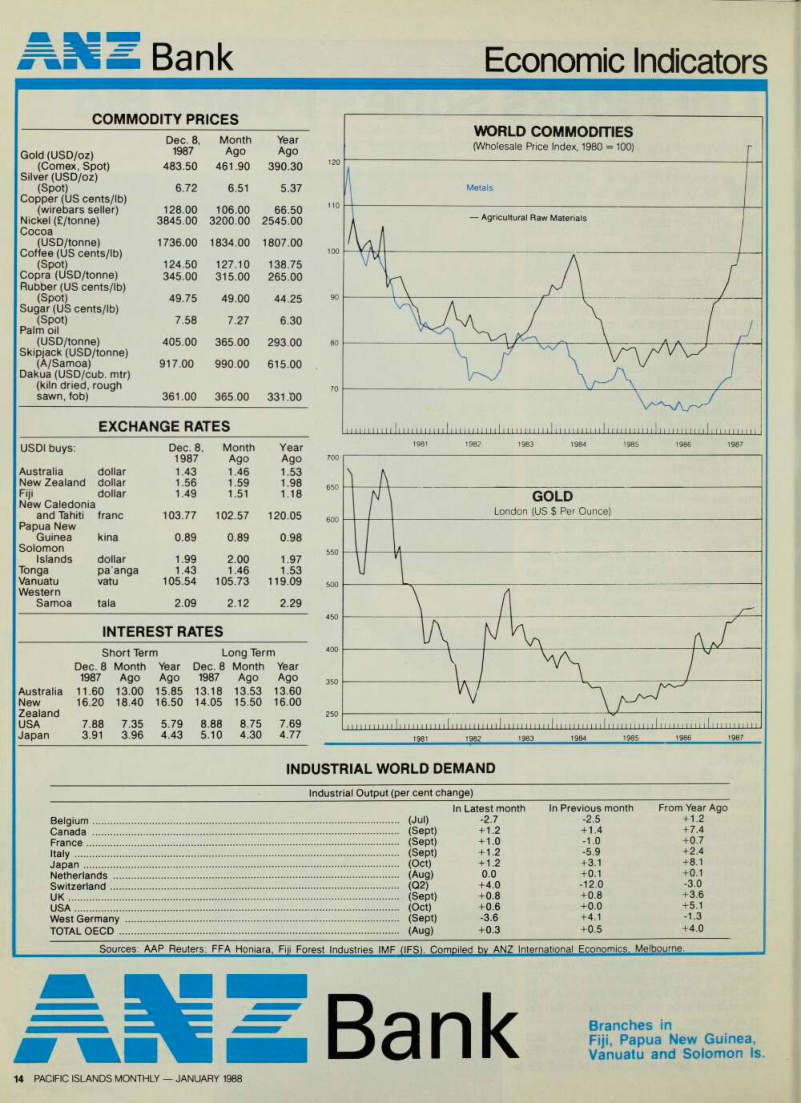
COMMODITY PRICES
INTEREST RATES
Short Term Long Term Dec. 8 Month Year Dec. 8 Month Year Australia New Zealand
USA
Japan 1987 11.60 16.20 7.88 3.91 Ago 13.00 18.40 7.35 3.96 Ago 15.85 16.50 5.79 4.43 1987 13.18 14.05 8.88 5.10 Ago 13.53 15.50 8.75 4.30
Ago
13.60 16.00 7.69 4.77
GOLD
London (US $ Per Ounce) 1982
INDUSTRIAL WORLD DEMAND
Bank
Branches in
Fiji, Papua New Guinea,
Vanuatu and Solomon Is.
The Church Today

Forum
The Pacific hosts a variety of religions some traditional, some radical. Yet there are few regions in the world where worship offers so strong a chance for unity and progress. By James S Murray
The peoples of the Pacific have in herited, for the most part, forms of Christianity derived from colonial backgrounds and while independence has largely brought about a severance of for mer colonial ties, with a few notable ex ceptions the Christian inheritance has been retained.
There are now signs of restiveness, es pecially in New Caledonia, where Cathol icism tends to be the faith of the governing and Envangelical Christianity the inspi ration of the kanak independence movement.
In Papua New Guinea, too, there are signs of irritation (to put it at its mildest) with colonial vestiges attached to church organisation, though the word “mission ary” does not seem as dirty as it has be come in parts of Africa and Asia and its synonym with “imperialist” remains un used by most Pacific peoples.
But if the ocean is “pacific”, there is a new mood these days among the region’s Christians that could lead to more ener getic articulations of a Christianity dis tinctively local, as the churches’ leadership and expertise have been increasingly indigenised.
Indeed, there is a growing appreciation by European clergy, theologians and teachers that Pacific Christianity has many insights to teach to traditional Western Christianity. The old fear of syncretism the assimilation of “pagan” culture into Christian forms has been overcome to a certain degree by the encouragement of what is called “inculturation”.
Yet inherited fears abound, and the presence of Asians of alien faiths within the Pacific can still arouse fears that be long more to traditional European preju dices. This has become apparent since the Rabuka coups in Fiji, where the Taukei movement has embraced not only an in cipient indigenous nationalism (which is understandable enough) but a detestation of the Hinduism and Islam the majority of Indians honour (though such honour seems as nominal as it is among most Western Christians).
It has seen the imposition of Christian norms over an actual majority, and the in troduction of a “sabbath” observance no longer in place in any developed country.
If the Fijian model seems unlikely to be
Australian Picture Library
imitated elsewhere in the Pacific, the steady inroads of more arbitrary Protes tantism from the United States should not be underestimated. The increasingly suc cessful evangelism of the Seventh Day Ad ventists in the Pacific could bring with it social practices and taboos as alien to Pa cific cultures as those imposed in Fiji.
One constraint on the process has been the indigenisation of the leadership and pastorate of the churches. Nonetheless, the social ills brought by European interven tion have not only dismayed many church leaders but turned some to patriarchal roles that were not their original preroga tive. The condemnation of alcohol, and of gambling and smoking an evangelistic plank of the Adventists and other funda mental Christians has attracted rather than repelled many Pacific Christians who have seen their cultures and societies un der moral threat.
It is interesting that much of the early evangelism of the Pacific was carried out not by foreign missionaries but by local converts; there was also pressure from paramount and high chiefs who carried their people with them into Christian al legiance, though the material induce ments foreign missionaries could offer played no small part in deciding which de nomination would win the day.
The Catholic Church was often the poor relation in such loyalty competitions, and the Protestant missionaries not the least chary in developing convenient Euro pean-derived prejudices to further the work of salvation. A resort to fear was not unknown, and the ignorance of Christian differences often employed to gain ascendancy.
Pacific cultures, too, found the disci
pline of celibacy extraordinary, and even if nuns and brothers showed compassion and lifelong devotion to their work, they seemed somewhat idiosyncratic on islands where family and tribal concepts were already in place. In general, apart from those areas where French influ ence has been predominant, Ca tholicism has made slow progress and its numerical presence is small.
Anglican missionary ac tivity, however, was often vig orous and was conducted by men and women with some char isma. The majority of these mis sionaries came from Australia or New Zealand, and had the early enthusiasm of the Reverend Samuel Marsden, whose honour as an apostle of distinction is leg endary in New Zealand.
The London Missionary So
ciety was also a prime mover, and along with the Wesleyans, showed remarkable influence and power. But their rivalry was often unseemly, and at times dangerously divisive in native societies. It was not surprising that a day would come when missionaries of the same colour as the indigenous peoples would be more readily accepted.
World War II saw influences from the US arriving with some subtlety, and the more traditional churches were soon confronted by well-financed incursions from missionaries of a more aggressive kind, whose funding was often aided by tithing and was dependent on scalps being collected in conversion statistics that would
impress the folks back home in the USA.
In Papua New Guinea such appear ances became a threat to the Christian bodies already settled there, which were soon faced by sizable challenges of recon struction after the ravages of war.
ANGAU the Australian-New Guinea Administration Unit was said by some older missionaries to turn an ob livious post-war eye to the former mu tually workable arrangement that had seen regions of missionary activity assigned to the London Missionary Society, the An glican Church or the Catholic Church.
Now others, seen as sheep-stealers, ar rived on the scene and were neither re buked by authorities nor sent packing.
Cargo-cultism also offered Messianic expectations of plenty to those who had observed the profligacy of war, and the new cults and often livelier churches of American origin seemed to offer a sur-
prising largesse both in spiritual stimuli and material rewards: the “Old Firm” was in rather depressed competitiveness.
Legends had meanwhile developed in the minds of the church supporters back home, both in Australia and those coun tries of Europe where converting the “no ble savage” was still a challenge; and if Father Damien, the leper saint of the Ha waiian island of Molokai, brought tears to the eyes of Catholic memory, Anglicans had more recent martyrs at the hands of the Japanese; these they canonised in an nual memory, if they had no mechanism by which they could become “saints” in the calendar of the church.
Yet it is in the favour of the major ►
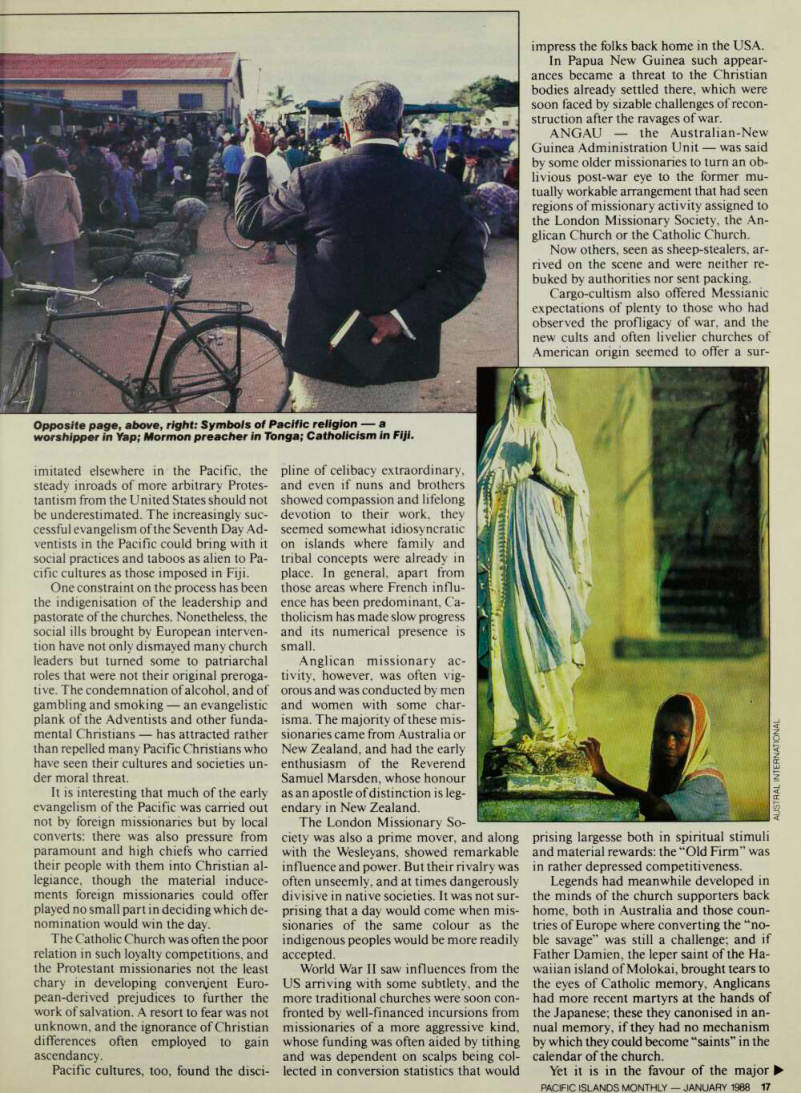
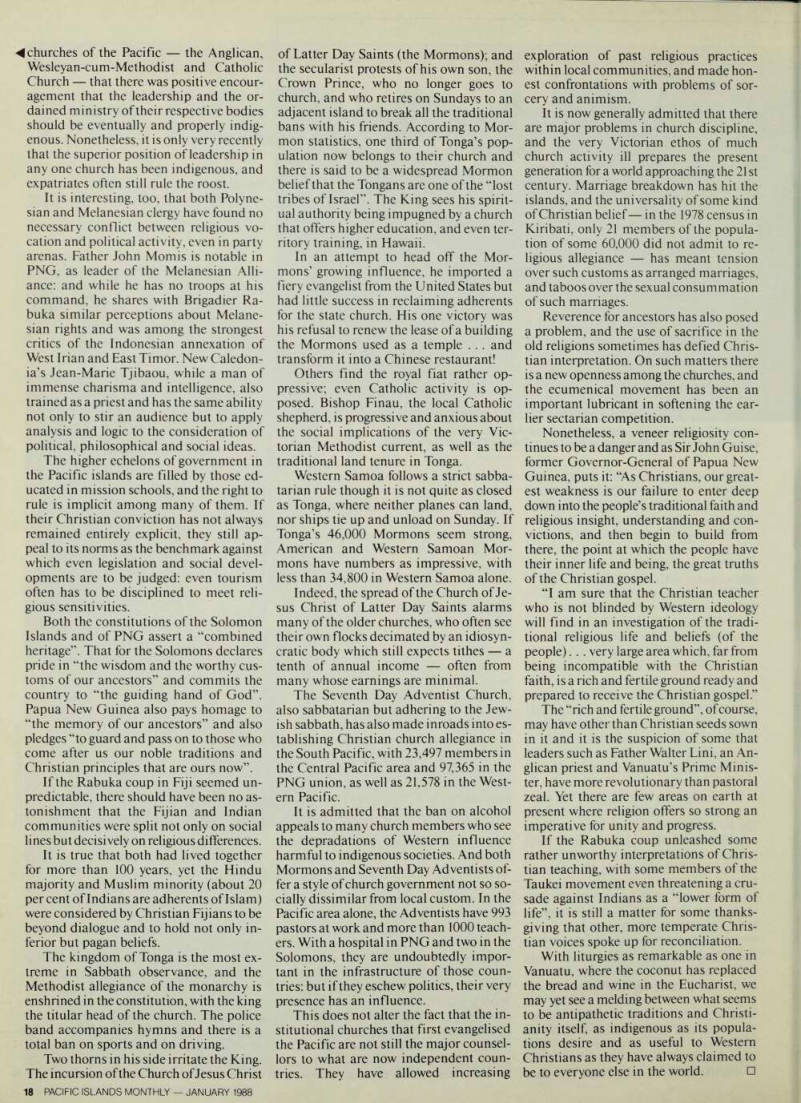
Opposite page, above, right: Symbols of Pacific religion - a worshipper in Yap; Mormon preacher in Tonga; Catholicism in Fiji.
Austral International
◄ churches of the Pacific the Anglican, Wesleyan-cum-Methodist and Catholic Church that there was positive encour agement that the leadership and the or dained ministry of their respective bodies should be eventually and properly indig enous. Nonetheless, it is only very recently that the superior position of leadership in any one church has been indigenous, and expatriates often still rule the roost.
It is interesting, too, that both Polyne sian and Melanesian clergy have found no necessary conflict between religious vo cation and political activity, even in party arenas. Father John Momis is notable in PNG, as leader of the Melanesian Alli ance: and while he has no troops at his command, he shares with Brigadier Ra buka similar perceptions about Melane sian rights and was among the strongest critics of the Indonesian annexation of West Irian and East Timor. New Caledon ia’s Jean-Marie Tjibaou, while a man of immense charisma and intelligence, also trained as a priest and has the same ability not only to stir an audience but to apply analysis and logic to the consideration of political, philosophical and social ideas.
The higher echelons of government in the Pacific islands are filled by those ed ucated in mission schools, and the right to rule is implicit among many of them. If their Christian conviction has not always remained entirely explicit, they still ap peal to its norms as the benchmark against which even legislation and social devel opments are to be judged: even tourism often has to be disciplined to meet reli gious sensitivities.
Both the constitutions of the Solomon Islands and of PNG assert a “combined heritage”. That for the Solomons declares pride in “the wisdom and the worthy cus toms of our ancestors” and commits the country to “the guiding hand of God”.
Papua New Guinea also pays homage to “the memory of our ancestors” and also pledges “to guard and pass on to those who come after us our noble traditions and Christian principles that are ours now”.
If the Rabuka coup in Fiji seemed un predictable, there should have been no as tonishment that the Fijian and Indian communities were split not only on social lines but decisively on religious differences.
It is true that both had lived together for more than 100 years, yet the Hindu majority and Muslim minority (about 20 per cent of Indians are adherents of Islam) were considered by Christian Fijians to be beyond dialogue and to hold not only in ferior but pagan beliefs.
The kingdom of Tonga is the most ex treme in Sabbath observance, and the Methodist allegiance of the monarchy is enshrined in the constitution, with the king the titular head of the church. The police band accompanies hymns and there is a total ban on sports and on driving.
Two thorns in his side irritate the King.
The incursion of the Church of Jesus Christ
of Latter Day Saints (the Mormons); and the secularist protests of his own son, the Crown Prince, who no longer goes to church, and who retires on Sundays to an adjacent island to break all the traditional bans with his friends. According to Mor mon statistics, one third of Tonga’s pop ulation now belongs to their church and there is said to be a widespread Mormon belief that the Tongans are one of the “lost tribes of Israel”. The King sees his spirit ual authority being impugned by a church that offers higher education, and even ter ritory training, in Hawaii.
In an attempt to head off the Mor mons’ growing influence, he imported a fiery evangelist from the United States but had little success in reclaiming adherents for the state church. His one victory was his refusal to renew the lease of a building the Mormons used as a temple . .. and transform it into a Chinese restaurant!
Others find the royal fiat rather op pressive; even Catholic activity is op posed. Bishop Finau, the local Catholic shepherd, is progressive and anxious about the social implications of the very Vic torian Methodist current, as well as the traditional land tenure in Tonga.
Western Samoa follows a strict Sabba tarian rule though it is not quite as closed as Tonga, where neither planes can land, nor ships tie up and unload on Sunday. If Tonga’s 46,000 Mormons seem strong, American and Western Samoan Mor mons have numbers as impressive, with less than 34,800 in Western Samoa alone.
Indeed, the spread of the Church of Je sus Christ of Latter Day Saints alarms many of the older churches, who often see their own flocks decimated by an idiosyn cratic body which still expects tithes a tenth of annual income often from many whose earnings are minimal.
The Seventh Day Adventist Church, also Sabbatarian but adhering to the Jew ish sabbath, has also made inroads into es tablishing Christian church allegiance in the South Pacific, with 23,497 members in the Central Pacific area and 97,365 in the PNG union, as well as 21,578 in the West ern Pacific.
It is admitted that the ban on alcohol appeals to many church members who see the depradations of Western influence harmful to indigenous societies. And both Mormons and Seventh Day Adventists of fer a style of church government not so so cially dissimilar from local custom. In the Pacific area alone, the Adventists have 993 pastors at work and more than 1000 teach ers. With a hospital in PNG and two in the Solomons, they are undoubtedly impor tant in the infrastructure of those coun tries; but if they eschew politics, their very presence has an influence.
This does not alter the fact that the in stitutional churches that first evangelised the Pacific are not still the major counsel lors to what are now independent coun tries. They have allowed increasing
exploration of past religious practices within local communities, and made hon est confrontations with problems of sor cery and animism.
It is now generally admitted that there are major problems in church discipline, and the very Victorian ethos of much church activity ill prepares the present generation for a world approaching the 21 st century. Marriage breakdown has hit the islands, and the universality of some kind of Christian belief in the 1978 census in Kiribati, only 21 members of the popula tion of some 60,000 did not admit to re ligious allegiance has meant tension over such customs as arranged marriages, and taboos over the sexual consummation of such marriages.
Reverence for ancestors has also posed a problem, and the use of sacrifice in the old religions sometimes has defied Chris tian interpretation. On such matters there is a new openness among the churches, and the ecumenical movement has been an important lubricant in softening the ear lier sectarian competition.
Nonetheless, a veneer religiosity con tinues to be a danger and as Sir John Guise, former Governor-General of Papua New Guinea, puts it: “As Christians, our great est weakness is our failure to enter deep down into the people’s traditional faith and religious insight, understanding and con victions, and then begin to build from there, the point at which the people have their inner life and being, the great truths of the Christian gospel.
“I am sure that the Christian teacher who is not blinded by Western ideology will find in an investigation of the tradi tional religious life and beliefs (of the people)... very large area which, far from being incompatible with the Christian faith, is a rich and fertile ground ready and prepared to receive the Christian gospel.”
The “rich and fertile ground”, of course, may have other than Christian seeds sown in it and it is the suspicion of some that leaders such as Father Walter Lini, an An glican priest and Vanuatu’s Prime Minis ter, have more revolutionary than pastoral zeal. Yet there are few areas on earth at present where religion offers so strong an imperative for unity and progress.
If the Rabuka coup unleashed some rather unworthy interpretations of Chris tian teaching, with some members of the Taukei movement even threatening a cru sade against Indians as a “lower form of life”, it is still a matter for some thanks giving that other, more temperate Chris tian voices spoke up for reconciliation.
With liturgies as remarkable as one in Vanuatu, where the coconut has replaced the bread and wine in the Eucharist, we may yet see a melding between what seems to be antipathetic traditions and Christi anity itself, as indigenous as its popula tions desire and as useful to Western Christians as they have always claimed to be to everyone else in the world. □
A Sporting Smokescreen
New Caledonia
By Carson Creagh
Politics mars the spirit of the South Pacific Games.
First Impressions Of New Ca
ledonia reveal the bitter irony and contradiction inherent in this troubled corner of French influence. The public address system at Tonlouta Air port, greeting competitors and visitors for the VIII South Pacific Games, inter spersed airline announcements with The Impossible Dream and I Did It My Way ... potent reminders of France’s ambi tions and its determination to ignore crit icism in the region.
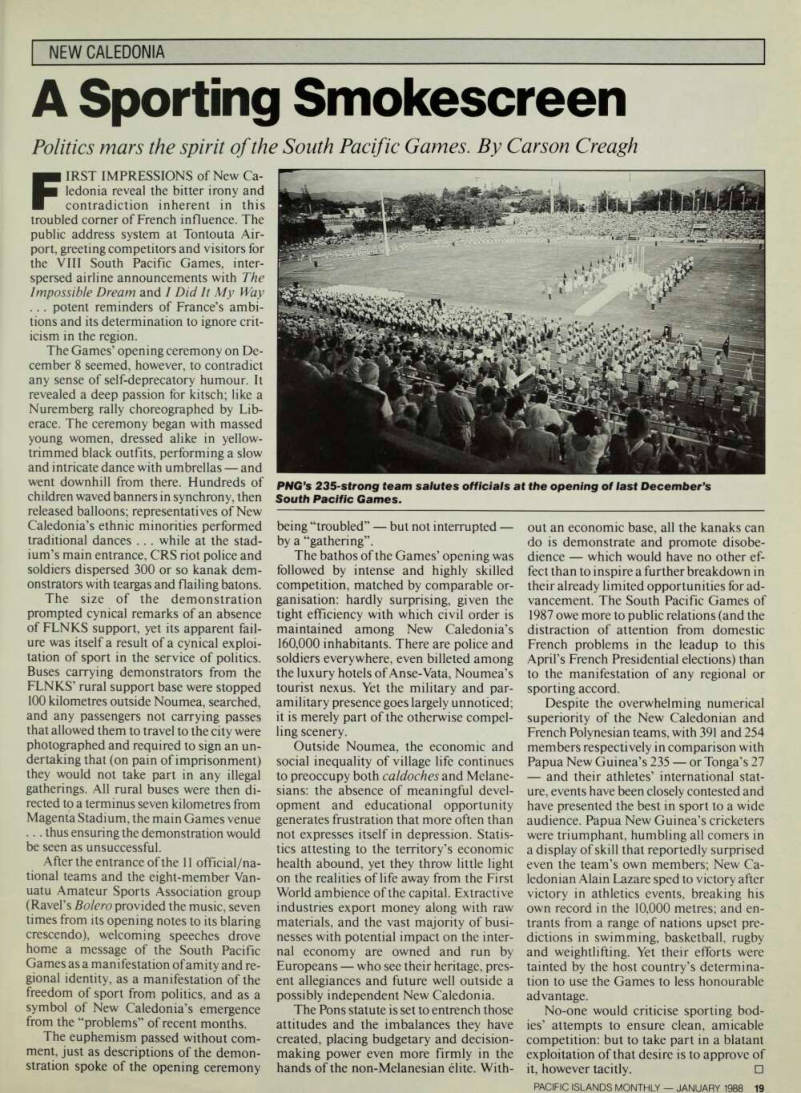
The Games’ opening ceremony on De cember 8 seemed, however, to contradict any sense of self-deprecatory humour. It revealed a deep passion for kitsch; like a Nuremberg rally choreographed by Lib erace. The ceremony began with massed young women, dressed alike in yellow trimmed black outfits, performing a slow and intricate dance with umbrellas and went downhill from there. Hundreds of children waved banners in synchrony, then released balloons; representatives of New Caledonia’s ethnic minorities performed traditional dances ... while at the stad ium’s main entrance, CRS riot police and soldiers dispersed 300 or so kanak dem onstrators with teargas and flailing batons.
The size of the demonstration prompted cynical remarks of an absence of FLNKS support, yet its apparent fail ure was itself a result of a cynical exploi tation of sport in the service of politics.
Buses carrying demonstrators from the FLNKS’ rural support base were stopped 100 kilometres outside Noumea, searched, and any passengers not carrying passes that allowed them to travel to the city were photographed and required to sign an un dertaking that (on pain of imprisonment) they would not take part in any illegal gatherings. All rural buses were then di rected to a terminus seven kilometres from Magenta Stadium, the main Games venue ... thus ensuring the demonstration would be seen as unsuccessful.
After the entrance of the 11 official/na tional teams and the eight-member Van uatu Amateur Sports Association group (Ravel’s Bolero provided the music, seven times from its opening notes to its blaring crescendo), welcoming speeches drove home a message of the South Pacific Games as a manifestation of amity and re gional identity, as a manifestation of the freedom of sport from politics, and as a symbol of New Caledonia’s emergence from the “problems” of recent months.
The euphemism passed without com ment, just as descriptions of the demon stration spoke of the opening ceremony
being “troubled” but not interrupted by a “gathering”.
The bathos of the Games’ opening was followed by intense and highly skilled competition, matched by comparable organisation: hardly surprising, given the tight efficiency with which civil order is maintained among New Caledonia’s 160,000 inhabitants. There are police and soldiers everywhere, even billeted among the luxury hotels of Anse-Vata, Noumea’s tourist nexus. Yet the military and paramilitary presence goes largely unnoticed; it is merely part of the otherwise compelling scenery.
Outside Noumea, the economic and social inequality of village life continues to preoccupy both caldoches and Melanesians: the absence of meaningful development and educational opportunity generates frustration that more often than not expresses itself in depression. Statistics attesting to the territory’s economic health abound, yet they throw little light on the realities of life away from the First World ambience of the capital. Extractive industries export money along with raw materials, and the vast majority of businesses with potential impact on the internal economy are owned and run by Europeans who see their heritage, present allegiances and future well outside a possibly independent New Caledonia.
The Pons statute is set to entrench those attitudes and the imbalances they have created, placing budgetary and decisionmaking power even more firmly in the hands of the non-Melanesian elite. With-
out an economic base, all the kanaks can do is demonstrate and promote disobe dience which would have no other ef feet than to inspire a further breakdown in their already limited opportunities for ad vancement. The South Pacific Games of 1987 owe more to public relations (and the distraction of attention from domestic French problems in the leadup to this April’s French Presidential elections) than to the manifestation of any regional or sporting accord.
Despite the overwhelming numerical superiority of the New Caledonian and French Polynesian teams, with 391 and 254 members respectively in comparison with Papua New Guinea’s 235 or Tonga’s 27 and their athletes’ international stat ure, events have been closely contested and have presented the best in sport to a wide audience. Papua New Guinea’s cricketers were triumphant, humbling all comers in a display of skill that reportedly surprised even the team’s own members; New Ca ledonian Alain Lazare sped to victory after victory in athletics events, breaking his own record in the 10,000 metres; and en trants from a range of nations upset pre dictions in swimming, basketball, rugby and weightlifting. Yet their efforts were tainted by the host country’s determina tion to use the Games to less honourable advantage.
No-one would criticise sporting bod ies’ attempts to ensure clean, amicable competition: but to take part in a blatant exploitation of that desire is to approve of it, however tacitly. □
PNG’s 235 -strong team salutes officials at the opening of last December’s South Pacific Games.
The Sounds Of Paradise
The Arts
Composer David Fanshawe’s quest to capture for posterity the vanishing music and natural sounds of the Pacific. By Laurie Strachan
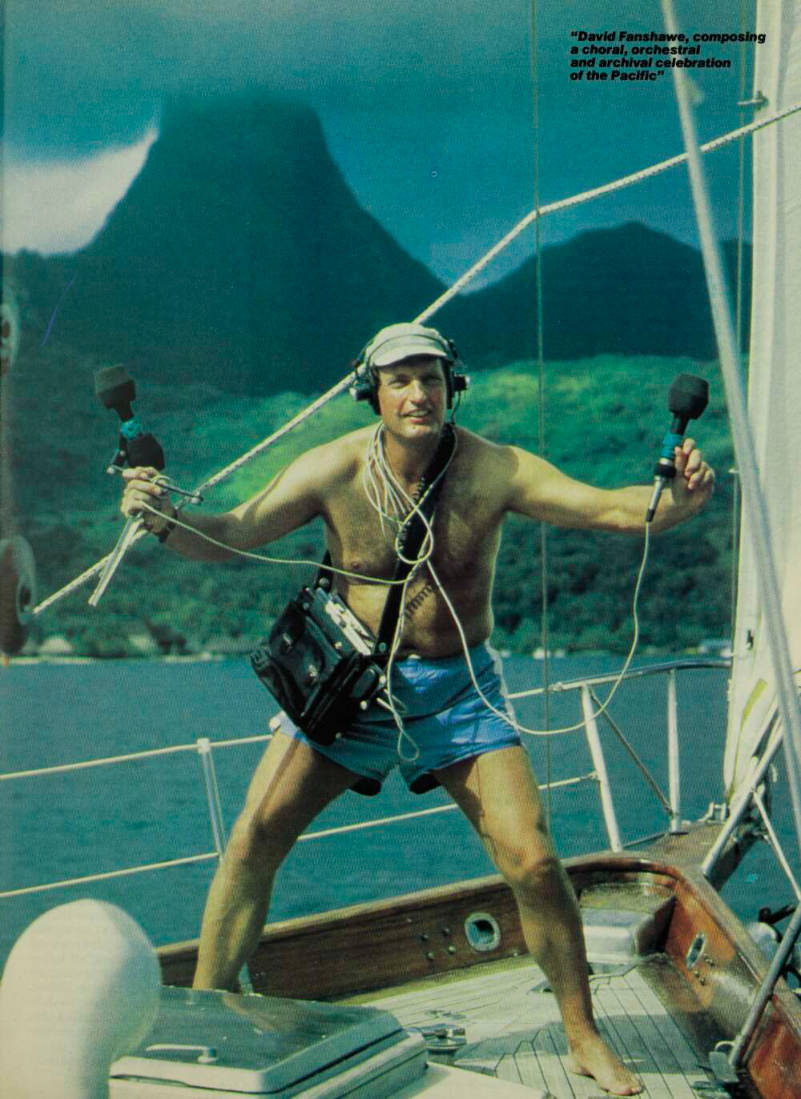
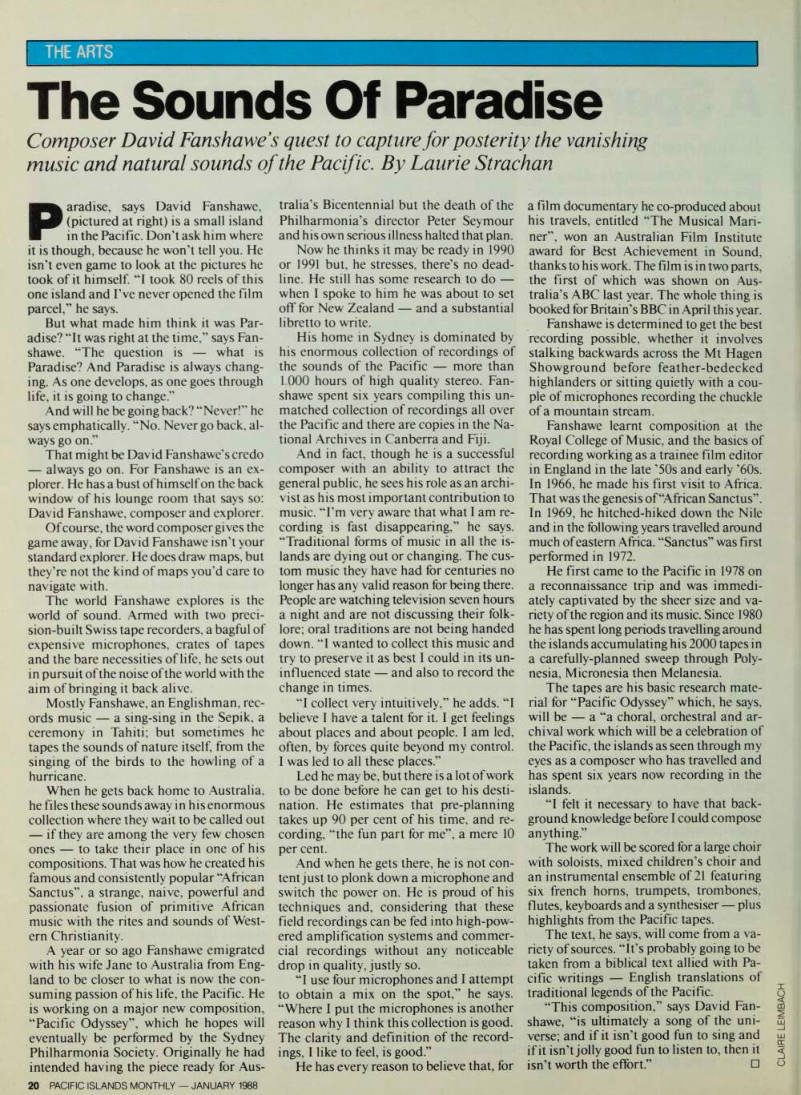
Paradise, says David Fanshawe, (pictured at right) is a small island in the Pacific. Don’t ask him where it is though, because he won’t tell you. He isn’t even game to look at the pictures he took of it himself. “I took 80 reels of this one island and I’ve never opened the film parcel,” he says.
But what made him think it was Par adise? “It was right at the time,” says Fan shawe. “The question is what is Paradise? And Paradise is always chang ing. As one develops, as one goes through life, it is going to change.”
And will he be going back? “Never!” he says emphatically. “No. Never go back, al ways go on.”
That might be David Fanshawe’s credo always go on. For Fanshawe is an ex plorer. He has a bust of himself on the back window of his lounge room that says so: David Fanshawe, composer and explorer.
Of course, the word composer gives the game away, for David Fanshawe isn’t your standard explorer. He does draw maps, but they’re not the kind of maps you’d care to navigate with.
The world Fanshawe explores is the world of sound. Armed with two preci sion-built Swiss tape recorders, a bagful of expensive microphones, crates of tapes and the bare necessities of life, he sets out in pursuit of the noise of the world with the aim of bringing it back alive.
Mostly Fanshawe, an Englishman, rec ords music a sing-sing in the Sepik, a ceremony in Tahiti; but sometimes he tapes the sounds of nature itself, from the singing of the birds to the howling of a hurricane.
When he gets back home to Australia, he files these sounds away in his enormous collection where they wait to be called out if they are among the very few chosen ones to take their place in one of his compositions. That was how he created his famous and consistently popular “African Sanctus”, a strange, naive, powerful and passionate fusion of primitive African music with the rites and sounds of West ern Christianity.
A year or so ago Fanshawe emigrated with his wife Jane to Australia from Eng land to be closer to what is now the con suming passion of his life, the Pacific. He is working on a major new composition, “Pacific Odyssey”, which he hopes will eventually be performed by the Sydney Philharmonia Society. Originally he had intended having the piece ready for Aus
tralia’s Bicentennial but the death of the Philharmonia’s director Peter Seymour and his own serious illness halted that plan.
Now he thinks it may be ready in 1990 or 1991 but, he stresses, there’s no dead line. He still has some research to do when I spoke to him he was about to set off for New Zealand and a substantial libretto to write.
His home in Sydney is dominated by his enormous collection of recordings of the sounds of the Pacific more than 1,000 hours of high quality stereo. Fan shawe spent six years compiling this un matched collection of recordings all over the Pacific and there are copies in the Na tional Archives in Canberra and Fiji.
And in fact, though he is a successful composer with an ability to attract the general public, he sees his role as an archi vist as his most important contribution to music. “I’m very aware that what I am re cording is fast disappearing,” he says.
“Traditional forms of music in all the is lands are dying out or changing. The cus tom music they have had for centuries no longer has any valid reason for being there.
People are watching television seven hours a night and are not discussing their folk lore; oral traditions are not being handed down. “I wanted to collect this music and try to preserve it as best I could in its un influenced state and also to record the change in times.
“I collect very intuitively,” he adds. “I believe I have a talent for it. I get feelings about places and about people. I am led, often, by forces quite beyond my control.
I was led to all these places.”
Led he may be, but there is a lot of work to be done before he can get to his desti nation. He estimates that pre-planning takes up 90 per cent of his time, and re cording, “the fun part for me”, a mere 10 per cent.
And when he gets there, he is not con tent just to plonk down a microphone and switch the power on. He is proud of his techniques and, considering that these field recordings can be fed into high-pow ered amplification systems and commer cial recordings without any noticeable drop in quality, justly so.
“I use four microphones and I attempt to obtain a mix on the spot,” he says.
“Where I put the microphones is another reason why I think this collection is good.
The clarity and definition of the record ings, I like to feel, is good.”
He has every reason to believe that, for
a film documentary he co-produced about his travels, entitled “The Musical Mari ner”, won an Australian Film Institute award for Best Achievement in Sound, thanks to his work. The film is in two parts, the first of which was shown on Aus tralia’s ABC last year. The whole thing is booked for Britain’s BBC in April this year.
Fanshawe is determined to get the best recording possible, whether it involves stalking backwards across the Mt Hagen Showground before feather-bedecked highlanders or sitting quietly with a cou ple of microphones recording the chuckle of a mountain stream.
Fanshawe learnt composition at the Royal College of Music, and the basics of recording working as a trainee film editor in England in the late ’sos and early ’6os.
In 1966, he made his first visit to Africa.
That was the genesis of “African Sanctus”.
In 1969, he hitched-hiked down the Nile and in the following years travelled around much of eastern Africa. “Sanctus” was first performed in 1972.
He first came to the Pacific in 1978 on a reconnaissance trip and was immedi ately captivated by the sheer size and va riety of the region and its music. Since 1980 he has spent long periods travelling around the islands accumulating his 2000 tapes in a carefully-planned sweep through Poly nesia, Micronesia then Melanesia.
The tapes are his basic research mate rial for “Pacific Odyssey” which, he says, will be a “a choral, orchestral and ar chival work which will be a celebration of the Pacific, the islands as seen through my eyes as a composer who has travelled and has spent six years now recording in the islands.
“I felt it necessary to have that back ground knowledge before I could compose anything.”
The work will be scored for a large choir with soloists, mixed children’s choir and an instrumental ensemble of 21 featuring six french horns, trumpets, trombones, flutes, keyboards and a synthesiser plus highlights from the Pacific tapes.
The text, he says, will come from a va riety of sources. “It’s probably going to be taken from a biblical text allied with Pa cific writings English translations of traditional legends of the Pacific.
“This composition,” says David Fan shawe, “is ultimately a song of the uni verse; and if it isn’t good fun to sing and if it isn’t jolly good fun to listen to, then it isn’t worth the effort.” □
Advertisements & other items, p. 21 (1 item)
'
wm V mm* m m m m i f 7, m M
Island Film Comes Of Age
The Arts
By Ed Rampell
The Hawaii Film Festival in focus.
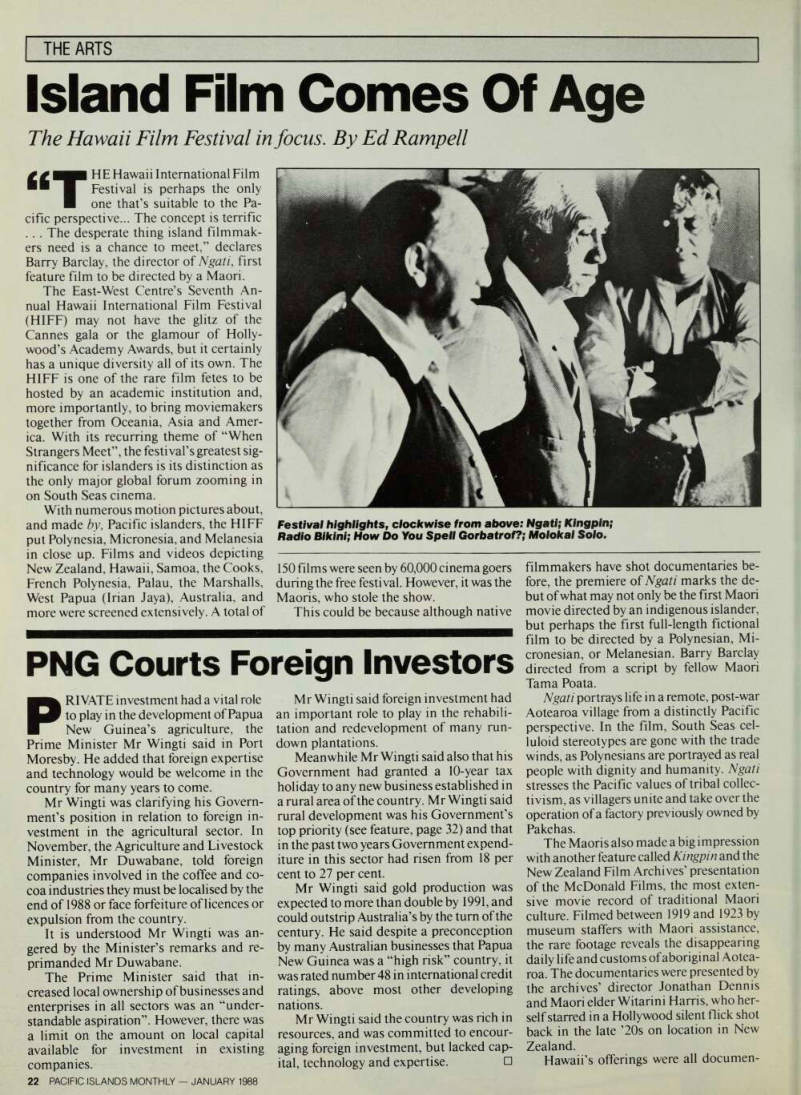
£ £ HE Hawaii International Film I Festival is perhaps the only one that’s suitable to the Pa cific perspective... The concept is terrific .. . The desperate thing island filmmak ers need is a chance to meet,” declares Barry Barclay, the director of Ngati , first feature film to be directed by a Maori.
The East-West Centre’s Seventh An nual Hawaii International Film Festival (HIFF) may not have the glitz of the Cannes gala or the glamour of Holly wood’s Academy Awards, but it certainly has a unique diversity all of its own. The HIFF is one of the rare film fetes to be hosted by an academic institution and, more importantly, to bring moviemakers together from Oceania, Asia and Amer ica. With its recurring theme of “When Strangers Meet”, the festival’s greatest sig nificance for islanders is its distinction as the only major global forum zooming in on South Seas cinema.
With numerous motion pictures about, and made by, Pacific islanders, the HIFF put Polynesia, Micronesia, and Melanesia in close up. Films and videos depicting New Zealand, Hawaii, Samoa, the Cooks, French Polynesia, Palau, the Marshalls, West Papua (Irian Jaya), Australia, and more were screened extensively. A total of
150 films were seen by 60,000 cinema goers during the free festival. However, it was the Maoris, who stole the show.
This could be because although native
filmmakers have shot documentaries be fore, the premiere of Ngati marks the de but of what may not only be the first Maori movie directed by an indigenous islander, but perhaps the first full-length fictional film to be directed by a Polynesian, Mi cronesian, or Melanesian. Barry Barclay directed from a script by fellow Maori Tama Poata.
Ngati portrays life in a remote, post-war Aotearoa village from a distinctly Pacific perspective. In the film, South Seas cel luloid stereotypes are gone with the trade winds, as Polynesians are portrayed as real people with dignity and humanity. Ngati stresses the Pacific values of tribal collec tivism, as villagers unite and take over the operation of a factory previously owned by Pakehas.
The Maoris also made a big impression with another feature called Kingpin and the New Zealand Film Archives’ presentation of the McDonald Films, the most exten sive movie record of traditional Maori culture. Filmed between 1919 and 1923 by museum staffers with Maori assistance, the rare footage reveals the disappearing daily life and customs of aboriginal Aotea roa. The documentaries were presented by the archives’ director Jonathan Dennis and Maori elder Witarini Harris, who her self starred in a Hollywood silent flick shot back in the late ’2os on location in New Zealand.
Hawaii’s offerings were all documen-
Festival highlights, clockwise from above: Ngati; Kingpin; Radio Bikini; How Do You Spell Gorbatrof?; Molokai Solo.
“The film festival is the only major global forum that zooms in on the cinema of the South Seas"
tary videos dedicated to the “Year of the Hawaiian”. West Beach Story is a propaganda attack on the proposed Waikiki-style development of Waianae Coast, a Polynesian preserve at Oahu. The powerful video is militant Hawaiian in content, and the point of view of the Japanese and other developers is never presented; Hawaiian codirector Puhipau, who was evicted in the early ’Bos for illegally “squatting” on state land, said: “I have found a gun to shoot back with. And this gun is my camera.”
Other Hawaii entries include Voyage of Rediscovery, about the Hokule’a, and The Hawaiians, a historical documentary direeled by non-natives.
One of the Festival’s strangest films was
Japan’s The Emperor’s Naked Army Marches On, a documentary about a guilt obsessed former soldier who tried to as sassinate Emperor Hirohito in 1969. Kenzo Okuzaki is an avenging angel seeking to unravel mysterious war crimes commit ted by the Imperial army during World War II at West Papua. These atrocities in elude Japanese cannibalism of Melane sians. However, the entire film is shot in Japan and Melanesians never appear on screen, because director Kazuo Hara’s West Papuan footage was all confiscated at the airport by the Indonesian colonial authorities.
Other Pacific pictures included Dan Baker’s documentary about Palauan
painter Charlie Gibbons, Kle Belau, and Robert Stone’s compilation film Radio Bikini, a very moving indictment of American nuclear testing in the Mar shalls. The 1947 docu-drama Royal Boy of Sanda was shot in Manu’a by George Ta hara and based on a story idea by a Sa moan high chief.
Although Ngati was nominated for the East-West Centre’s award for the film best promoting cross-cultural understanding, India’s Spices won, while China’s Old Well received a special commendation. How ever, what the Hawaii International Film Festival reveals most dramatically is that South Seas cinema is developing, and with the breakthrough film, Ngati , a new wave of Pacific pictures has emerged.
Islanders, who have long been depicted by outsiders— as typified by Dorothy La mour’s stereotypical Sarong Girl —are fi nally taking the cameras into their own hands and making movies with an Oceanic perspective and dimension about themselves. □
PNG Courts Foreign Investors
PRI VATE investment had a vital role to play in the development of Papua New Guinea’s agriculture, the Prime Minister Mr Wingti said in Port Moresby. He added that foreign expertise and technology would be welcome in the country for many years to come.
Mr Wingti was clarifying his Govern ment’s position in relation to foreign in vestment in the agricultural sector. In November, the Agriculture and Livestock Minister, Mr Duwabane, told foreign companies involved in the coffee and co coa industries they must be localised by the end of 1988 or face forfeiture of licences or expulsion from the country.
It is understood Mr Wingti was an gered by the Minister’s remarks and re primanded Mr Duwabane.
The Prime Minister said that in creased local ownership of businesses and enterprises in all sectors was an “under standable aspiration”. However, there was a limit on the amount on local capital available for investment in existing companies.
Mr Wingti said foreign investment had an important role to play in the rehabilitation and redevelopment of many rundown plantations.
Meanwhile Mr Wingti said also that his Government had granted a 10-year tax holiday to any new business established in a rural area of the country. Mr Wingti said rural development was his Government’s top priority (see feature, page 32) and that in the past two years Government expenditure in this sector had risen from 18 per cent to 27 per cent.
Mr Wingti said gold production was expected to more than double by 1991, and could outstrip Australia’s by the turn of the century. He said despite a preconception by many Australian businesses that Papua New Guinea was a “high risk” country, it was rated number 48 in international credit ratings, above most other developing nations.
Mr Wingti said the country was rich in resources, and was committed to encouraging foreign investment, but lacked capital, technology and expertise. □
Solomons PM
Stirs Media
NEWSPAPERS and broadcasting can make or break South Pacific development efforts, according to Solomon Islands PM Mr Ezekial Alebua.
But, he says, media coverage of the region still leaves much to be desired.
The Prime Minister was speaking in Honiara in December, at the opening of a conference on media reporting of Pacific affairs. The conference was sponsored by Pacbroad, which runs the news exchange system among the Pacific countries.
Mr Alebua said freedom of the press was a principle for healthy, democratic so cieties. In Solomon Islands, he said, this freedom was actively practiced and, in some instances, over-practiced. “The freedom of the press should always carry with it the responsibility to inform, edu cate and entertain, but not to confront and confuse,” he said.
Meanwhile, Solomon Islands will not send any new students to the University of the South Pacific in Suva this year. The Minister for Education, Mr Joini Tutua, said that foreign assistance would enable the Solomon Islands College of Higher Education to provide more advanced studies.
The Solomons will also stop sending students to the Fiji School of Medicine.
The Government, Mr Tutua said, was now looking to Papua New Guinea, Australia and New Zealand for the training of its doctors. However, students currently at the University of the South Pacific and the Fiji School of Medicine would be able to con tinue their studies there. □
Expats To The Polls
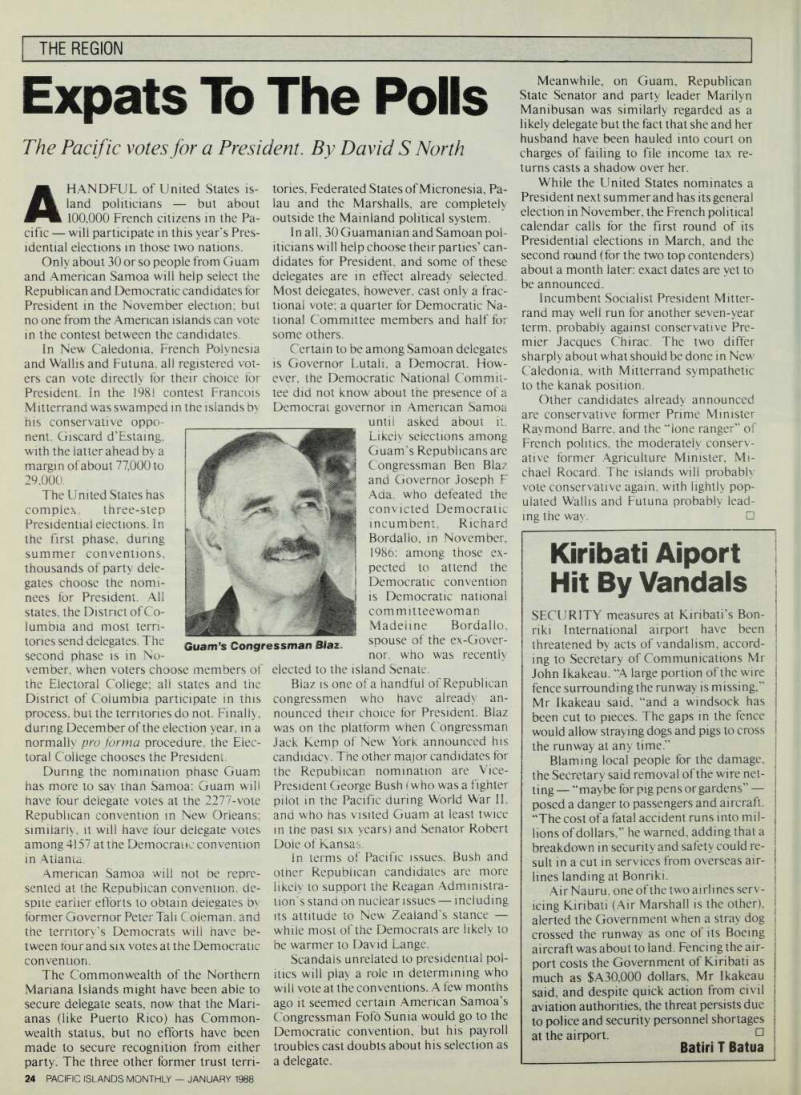
The Region
By David S North
The Pacific votes for a President.
A HANDFUL of United Stales is land politicians but about 100,000 French citizens in the Pa cific will participate in this year’s Pres idential elections in those two nations.
Only about 30 or so people from Guam and American Samoa will help select the Republican and Democratic candidates for President in the November election: but no one from the American islands can vote in the contest between the candidates.
In New Caledonia, French Polynesia and Wallis and Futuna, all registered vot ers can vole directly for their choice for President. In the 1981 contest Francois Mitterrand was swamped in the islands by
his conservative oppo nent, Giscard d’Esiamg. with the latter ahead by a margin of about 77,000 to 29,000.
The United States has complex three-step Presidential elections. In the first phase, during summer conventions, thousands of party dele gates choose the nomi nees for President. All slates, the District of Co lumbia and most terri tories send delegates. The second phase is in No
vember. when voters choose members of the Electoral College; all states and the District of Columbia participate in this process, but the territories do not. Finally, during December of the election year, in a normally pro forma procedure, the Elec toral College chooses the President.
During the nomination phase Guam has more to say than Samoa: Guam will have four delegate voles at the 2277-vote Republican convention in New Orleans: similarly, it will have four delegate votes among 4157 at the Democratic convention in Atlanta.
American Samoa will not oe repre sented at the Republican convention, de spite earlier efforts to obtain delegates bv former Governor Peter Tali Coleman, and the territory’s Democrats will have be tween tour and six votes at the Democratic convention.
The Commonwealth of the Northern Mariana Islands might have been able to secure delegate seats, now that the Mari anas (like Puerto Rico) has Common wealth status, but no efforts have been made to secure recognition from either party. The three other former trust terri-
taries, Federated States of Micronesia, Pa lau and the Marshalls, are completely outside the Mainland political system.
In all. 30 Guamanian and Samoan pol iticians will help choose their parties’ can didates for President, and some of these delegates are in effect already selected.
Most delegates, however, cast only a frac tional vote: a quarter for Democratic Na tional Committee members and half for some others.
Certain to be among Samoan delegates is Governor Lutali, a Democrat. How ever, the Democratic National Commit tee did not know about the presence of a Democrat governor in American Samoa
until asked about it.
Likely selections among Guam’s Republicans are Congressman Ben Blaz and Governor Joseph F Ada. wno defeated the convicted Democratic incumbent. Richard Bordallo, in November. 1986: among those ex pected to attend the Democratic convention is Democratic national committeewoman Madeline Bordallo, spouse of the ex-Gover nor. who was recently
elected to the island Senate.
Blaz is one of a handful of Republican congressmen who have already an nounced their choice for President. Blaz was on the platform when Congressman Jack Kemp of New York announced his candidacv. The other major candidates for the Republican nomination are Vice- President George Bush i who was a fighter pilot in the Pacific during World War 11. and who has visited Guam at least twice in tne oast six years) and Senator Robert Dole of Kansas.
In terms of Pacific issues. Bush and other Republican candidates are more likely to support the Reagan Administra tion's stand on nuclear issues including its attitude to New Zealand's stance while most of the Democrats are likely to be warmer to David Lange.
Scandals unrelated to presidential pol itics will play a role in determining who will vote at the conventions. A few months ago it seemed certain American Samoa’s Congressman Fofd Sunia would go to the Democratic convention, but his payroll troubles cast doubts about his selection as a delegate.
Meanwhile, on Guam, Republican State Senator and party leader Marilyn Manibusan was similarly regarded as a likely delegate but the fact that she and her husband have been hauled into court on charges of failing to file income tax re turns casts a shadow over her.
While the United Slates nominates a President next summer and has its general election in November, the French political calendar calls for the first round of its Presidential elections in March, and the second round (for the two top contenders) about a month later: exact dales are yet to be announced.
Incumbent Socialist President Mitter rand may well run for another seven-year term, probably against conservative Pre mier Jacques Chirac. The two differ sharply about what should be done in New Caledonia, with Mitterrand sympathetic to the kanak position.
Other candidates already announced are conservative former Prime Minister Raymond Barre. and the “lone ranger” of French politics, the moderately conserv ative former Agriculture Minister, Mi chael Rocard. The islands will probably vole conservative again, with lightly pop ulated Wallis and Futuna probably lead ing the way. □
Guam’s Congressman Blaz.
Kiribati Aiport
Hit By Vandals
SECURITY measures at Kiribati’s Bon riki International airport have been threatened by acts of vandalism, accord ing to Secretary of Communications Mr John Ikakeau. “A large portion of the wire fence surrounding the runway is missing,”
Mr Ikakeau said, “and a windsock has been cut to pieces. The gaps in the fence would allow straying dogs and pigs to cross the runway at any time.”
Blaming local people for the damage, the Secretary said removal of the wire net ting “maybe for pig pens or gardens” posed a danger to passengers and aircraft.
“The cost of a fatal accident runs into mil lions of dollars,” he warned, adding that a breakdown in security and safety could re sult in a cut in services from overseas air lines landing at Bonnki.
Air Nauru, one of the two airlines serv icing Kiribati (Air Marshall is the other), alerted the Government when a stray dog crossed the runway as one of its Boeing aircraft was about to land. Fencing the air port costs the Government of Kiribati as much as $A30,000 dollars, Mr Ikakeau said, and despite quick action from civil aviation authorities, the threat persists due to police and security personnel shortages at the airport. n
Batiri T Batua
Pacific Report
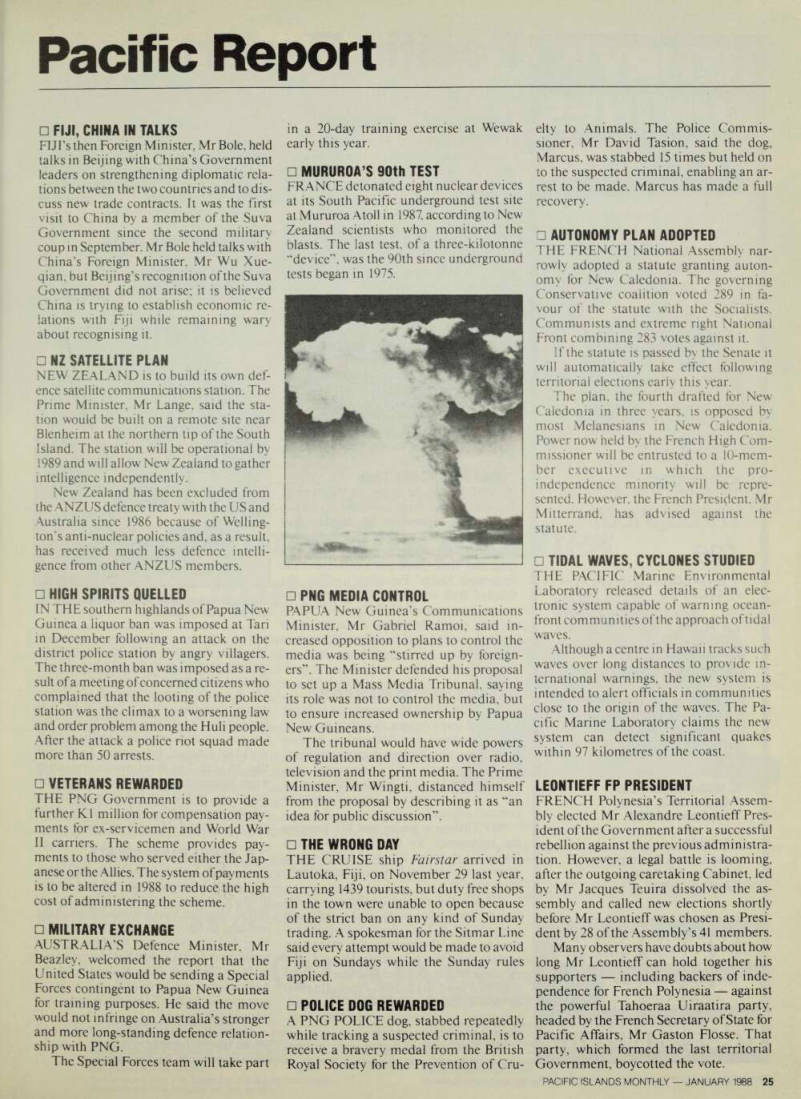
□ Fiji, China In Talks
FIJI’S then Foreign Minister, Mr Bole, held talks in Beijing with China’s Government leaders on strengthening diplomatic rela tions between the two countries and to dis cuss new trade contracts. It was the first visit to China by a member of the Suva Government since the second military coup in September. Mr Bole held talks with China’s Foreign Minister. Mr Wu Xue qian, but Beijing’s recognition of the Suva Government did not arise; it is believed China is trying to establish economic re lations with Fiji while remaining wary about recognising it.
□ Nz Satellite Plan
NEW ZEALAND is to build its own def ence satellite communications station. The Prime Minister, Mr Lange, said the sta tion would be built on a remote site near Blenheim at the northern tip of the South Island. The station will be operational by 1989 and will allow New Zealand to gather intelligence independently.
New Zealand has been excluded from the ANZUS defence treaty with the US and Australia since 1986 because of Welling ton’s anti-nuclear policies and, as a result, has received much less defence intelli gence from other ANZUS members.
□ High Spirits Quelled
IN THE southern highlands of Papua New Guinea a liquor ban was imposed at Tari in December following an attack on the district police station by angry villagers.
The three-month ban was imposed as a re sult of a meeting of concerned citizens who complained that the looting of the police station was the climax to a worsening law and order problem among the Huli people.
After the attack a police riot squad made more than 50 arrests.
□ Veterans Rewarded
THE PNG Government is to provide a further K 1 million for compensation pay ments for ex-servicemen and World War II carriers. The scheme provides pay ments to those who served either the Jap anese or the Allies. The system of payments is to be altered in 1988 to reduce the high cost of administering the scheme.
□ Military Exchange
AUSTRALIA’S Defence Minister, Mr Beazley, welcomed the report that the United States would be sending a Special Forces contingent to Papua New Guinea for training purposes. He said the move would not infringe on Australia’s stronger and more long-standing defence relation ship with PNG.
The Special Forces team will take part
in a 20-day training exercise at Wewak early this year.
□ Mururoa’S 90Th Test
FRANCE detonated eight nuclear devices at its South Pacific underground lest site at Mururoa Atoll in 1987, according to New Zealand scientists who monitored the blasts. The last test, of a three-kilotonne “device”, was the 90th since underground tests began in 1975.
□ Png Media Control
PAPUA New Guinea’s Communications Minister, Mr Gabriel Ramoi, said in creased opposition to plans to control the media was being “stirred up by foreign ers”. The Minister defended his proposal to set up a Mass Media Tribunal, saying its role was not to control the media, but to ensure increased ownership by Papua New Guineans.
The tribunal would have wide powers of regulation and direction over radio, television and the print media. The Prime Minister, Mr Wingti, distanced himself from the proposal by describing it as “an idea for public discussion”.
□ The Wrong Day
THE CRUISE ship Fairstar arrived in Lautoka, Fiji, on November 29 last year, carrying 1439 tourists, but duty free shops in the town were unable to open because of the strict ban on any kind of Sunday trading. A spokesman for the Sitmar Line said every attempt would be made to avoid Fiji on Sundays while the Sunday rules applied.
□ Police Dog Rewarded
A PNG POLICE dog, stabbed repeatedly while tracking a suspected criminal, is to receive a bravery medal from the British Royal Society for the Prevention of Cru
elty to Animals. The Police Commis sioner, Mr David Tasion, said the dog, Marcus, was stabbed 15 times but held on to the suspected criminal, enabling an ar rest to be made. Marcus has made a full recovery.
□ Autonomy Plan Adopted
THE FRENCH National Assembly nar rowly adopted a statute granting auton omy for New Caledonia. The governing Conservative coalition voted 289 in fa vour of the statute with the Socialists.
Communists and extreme right National Front combining 283 votes against it.
If the statute is passed by the Senate it will automatically lake effect following territorial elections early this year.
The plan, the fourth drafted for New Caledonia in three years, is opposed by most Melanesians in New Caledonia.
Power now held by the French High Com missioner will be entrusted to a 10-mem ber executive in which the pro independence minority will be repre sented. However, the French President, Mr Mitterrand, has advised against the statute.
□ Tidal Waves, Cyclones Studied
THE PACIFIC Marine Environmental Laboratory released details of an elec tronic system capable of warning ocean front communities of the approach of tidal waves.
Although a centre in Hawaii tracks such waves over long distances to provide in ternational warnings, the new system is intended to alert officials in communities close to the origin of the waves. The Pa cific Marine Laboratory claims the new system can detect significant quakes within 97 kilometres of the coast.
Leontieff Fp President
FRENCH Polynesia’s Territorial Assem bly elected Mr Alexandre Leontieff Pres ident of the Government after a successful rebellion against the previous administra tion. However, a legal battle is looming, after the outgoing caretaking Cabinet, led by Mr Jacques Teuira dissolved the as sembly and called new elections shortly before Mr Leontieff was chosen as Presi dent by 28 of the Assembly’s 41 members.
Many observers have doubts about how long Mr Leontieff can hold together his supporters including backers of inde pendence for French Polynesia against the powerful Tahoeraa Uiraatira party, headed by the French Secretary of State for Pacific Affairs, Mr Gaston Flosse. That party, which formed the last territorial Government, boycotted the vote.
□ French Claims Slammed
NEW ZEALAND’S Foreign Minister, Russell Marshall, reacted angrily to alle gations by the French Secretary of State for South Pacific Affairs, Mr Gaston Flosse, that New Zealand and Australia are fi nancing the region’s destabilisation.
Saying he was “outraged” by the claims, Mr Marshall challenged Mr Flosse to prove that French authorities had “proof’ Can berra and Wellington were behind those groups seeking independence from France.
The Foreign Minister said France had made no representations to New Zealand over the issue, and that the only proven act of terrorism in the region had been per petrated by the French secret service against the Greenpeace vessel Rainbow Warrior in New Zealand.
Mr Marshall added that France would be putting on blinkers if it believed recent troubles in Tahiti had been caused by others.
□ Nina Devastates Truk
IN THE Federated States of Micronesia, Tropical Storm Nina smashed into Truk Lagoon on November 24, leaving five people dead, 19 injured and thousands homeless. According to a joint statement from the Truk Governor’s office and the Federated States’ President’s office, the State of Truk was immediately declared a major disaster area: 60 per cent of housing in Truk was destroyed or damaged, most crops destroyed, and health problems were a danger due to clogged sewer lines and lack of fresh water.
□ Kanaks “Incited Revolution”
FRANCE’S PUBLIC prosecutor ordered a judicial inquiry into speeches made in New Caledonia last November by two kanak separatist leaders. A statement from the prosecutor’s office described the speeches by Mr Jean-Marie Tjibaou and Mr Yeiwene Yeiwene as an incitement to commit offences.
Mr Tjibaou is leader and Mr Yeiwene the spokesman for the Kanak Socialist National Liberation Front (FLNKS) which advocates New Caledonian independence from France.
During the annual conference of his Caledonian Union party, the largest group in the FLNKS, Mr Tjibaou called on kan aks to arm themselves for protection against pro-French loyalists. He said a ju ry’s acquittal in October of seven loyalists who shot dead 10 kanaks including two of Mr Tjibaou’s brothers in 1984, amounted to a licence to kill New Cale donia’s indigenous people.
Mr Yiewene said that to survive, kan aks must reorganise their own means of
self-defence, and compare their situation with that of the French who resisted the German occupation in World War 11.
Under French law, an investigating magistrate will decide whether to charge the two FLNKS leaders with instigating violence a criminal offence.
□ Png Boom Under Threat
PAPUA NEW GUINEA’S potential gold and oil boom may be in danger because of unreasonable compensation demands and allegedly outrageous statements by politi cal leaders.
In his 1988 Budget speech, Papua New Guinea’s Minerals and Energy Minister,
Mr John Kaputin, said he was increas ingly concerned over the number of “out rageous statements” by political leaders.
Mr Kaputin further warned his fellow parliamentarians that it was time they learned the “hard facts of life”. Papua New Guinea was still dependent on the outside world for finance, investment and exper tise, he said. The investment community must be convinced PNG was worth in vesting in, but outlandish statements and ridiculous demands made potential inves tors understandably very nervous.
□ W. Samoa Warns Soviets
WESTERN Samoa told the Soviet Union it remained strongly opposed to a Soviet military presence in the South Pacific. The Prime Minister Vaai Kolone delivered the message to the new Soviet Ambassador, Yuri Sokilov, who was visiting Apia to present credentials. Mr Sokolov is based in New Zealand. Vaai Kolone told the Ambassador any form of Soviet military presence in the Pacific would increase ten sions in the region.
However, Western Samoa welcomed Soviet involvement in economic co-oper ation with South Pacific nations. □
Chip sampling operations underway at PNG’s Ok Tedi mine.
Advertisements & other items, pp. 26-27 (1 item)
Cumines
PTY. LTD.
117 York St, Sydney Cables; Henco Sydney.
C.P.O. Box 5949 Telephone: 261 1955.
For
specialised
and
personalised
buying
service
throughout
the
Pacific Islands
and the East
LOCAL AGENTS AND
REPRESENTATION
PAPUA NEW GUINEA
RABAUL: M. & C. Seeto, P.O. Box 131, Rabaul.
Telephone 92 2919
FIJI
K. Witherington Ltd., P.O. Box 293, Suva.
Telephone 22 356.
VANUATU
John Lum & Associates, P.O. Box 65, Santo.
Telephone 329.
Shelf Component Systems
- - ' m & § / T n i —r
Acfcf the finishing touches
to your fantasy. ..
The dream comes true with NEW PERSONNA PLUS shelf-size component systems, and the model X-550R a sound system more than brimming with high fidelity, and feature-packed!
In fact, boasting a full 350 W of high-power (PMPO) output, the X-550R delivers the convenience of remote control for amp, tuner, deck, turntable 1 , and an optional CD player, plus a 5-band graphic equalizer for frequency distribution adjustments —and still there’s more!
Like sensational Surround Sound for rich, ambient sound, and the beauty of Stereo Wide, for extended stereo effects.
Then there’s a Double Auto-Reverse Cassette Deck with Deck I-II relay play for continuous auto-reverse playback, plus synchrorecording for Deck I-n tape duplication, to say nothing of great features like normal/high-speed copy, Music Search, and Dolby* B Noise Reduction.
Still, there’s more to the X-550R than this, and more to NEW PERSONNA PLUS than the system X-550 R—like the X-880R, with 440 W of high power (PMPO), and the X-220, with 270 W (PMPO), for example. The point is that it is the beauty of pure sound and NEW PERSONNA PLUS that lets your imagination take flight!
X-550R
DIGITAL AUDIO
COMPACT
m only *“Dolby” and the double-D symbol are trademarks of Dolby Laboratories Licensing Corporation.
NOTE: The PD-XBB CD player and S-XIA “surround sound” rear-speaker system are included in the photograph, but both are options.
GD PIONEER
The future of sound and vision.
For further information, please contact: Australia: Pioneer Electronics Australia Pty. Ltd. (Incorporated in Victoria), P.O. Box 295, Mordialloc, Victoria, 3195 Tel: 580-9911 Fiji Islands; Brijlal & Company, G.P.O. Box No. 362, Suva, Fiji Islands Tel; 22258 New Zealand: Monaco Distributors Ltd, 41 Poland Road, Glenfield, Auckland, New Zealand Tel: (09) 444-9144 Norfolk Island: Burnt Pine Traders Ltd, P.O. Box 21, Norfolk Island Vanuatu: Bums Philp (Vanuatu) Ltd, Vila, Vanuatu Nauru Island: Jacob Enterprises, P.O. Box N 0.4, Republic of Nauru Tahiti: Tahiti Hi-Fi, P.O. Box 848, Papeete, Tahiti New Caledonia: Menard Pacifique Sari, B.P. 3899, Noumea, New Caledonia Tel: 27.62*23 American Samoa: Transpac Corporation, P.O. Box 1477, Pago Pago, American Samoa 96799 Tel: 633-5224 Rarotonga: South Seas International Ltd, P.O. Box 49, Rarotonga, Cook Islands Tel: 2327
Trade Winds
□ Trans-Tasman Shipping Merger?
THE NEW ZEALAND Shipping Corpo ration is considering a merger with its Australian counterpart, the Australian National Line. Merger discussions be tween the two Government-owned ship ping companies were revealed in a speech yesterday to a Chartered Institute of Transport conference by the Corpora tion’s head of research and development, Tim Mac Kay.
In an address on deregulation in sea transport, Mr Mac Kay said close integra tion of New Zealand and Australian trade should be welcomed. Both countries were at the same end of the longest trade lanes in the world, had comparable commodity trade and depended heavily on favourable maritime transport services and rates.
The Australian National Line and the Corporation (which trades as the New Zealand Line) already run a joint Trans- Tasman service, Tranztas. Mr Mac Kay said the merger was one of a number of ra tionalisation options being studied by the Corporation.
□ Singapore Out In The Cold
SINGAPORE AIRLINES says it is “dis appointed” that the New Zealand Government hasn’t granted it a fourth service to New Zealand, but the airline welcomes Wellington’s decision to con sider a proposed formula that would per mit flights to increase automatically between the two countries to match de mand. Further discussions on the pro posal have been set down for early this year.
In a statement released in Wellington, Chew Tai Lu, general manager of Singa pore Airlines, said it was hoped an agree ment could be reached that would enable the airline to route a fourth service to New Zealand: further services could be added when needed.
According to Mr Chew, there is a “huge backlog” of up to 18,000 tourists over the peak period until February 28. New Zea land’s decision not to grant a fourth serv ice, he says, has “effectively stopped thousands of potential tourists”. □ RAN TO SURVEY NEW TRADE ROUTE A ROYAL AUSTRALIAN Navy ship will survey a new commercial shipping route between two of Papua New Guinea’s provincial capitals this year. HMAS Flin ders will survey a new, faster route be tween Port Moresby and Lae via the Star Reefs.
The survey is part of a five-year pro gram requested by the PNG Government to update and extend coverage of the country’s navigational charts, It is to be funded under Australia’s Kl 4 million per
year defence co-operation program with
Png.
□ Bougainville Mine Ban Lifted
A 17-YEAR-OLD moratorium on min eral and oil exploration in Papua New Guinea’s richest province could soon be lifted. The moratorium, imposed in 1971 following trouble on Bougainville Island with traditional landowners over the opening up of the Bougainville copper mine, should be lifted, according to Papua New Guinea’s Minerals and Energy Min ister, John Kaputin.
However, he is “extremely sensitive” to the concerns of the Bougainville people that led to the original moratorium being imposed and intends to hold talks with the province’s leaders before taking any action.
Bougainville Copper Limited’s Pan guna mine has only 10 to 15 years of op eration left and it is critical that the company be allowed to explore outside its present mine if it is to have time to develop another mine.
□ Joint Clothing Venture In Fiji
AN AUSTRALIAN firm is launching a multi-million dollar joint venture in Fiji to manufacture men’s clothing for Aus tralian and international markets. The project is the first of its kind to be an nounced in Fiji since the economic slump after two military coups and the procla mation of a Republic.
Chairman of the Stafford Group, Mr Maurice Lubansky, says his company and the Kelton Group in Fiji will acquire Na rotam Garments of Suva and use it as a base for the planned development. He pre dicts that the venture, costing around $A6.6 million, will become a world-class internationally competitive enterprise.
Plants are planned for the urban centres of Lautoka, Nadi, Da and Nausoir, even tually employing more than 2500.
□ Fiji Economy Fluctuating
FIJI WILL record a deficit of SUS 69 mil lion this year. According to the Minister for Economic Planning, Mr Isimeli Bose, the situation has been caused by a “down turn” in the country’s economy. The def icit will be $l5 million more than last year’s overall deficit of $54 million.
Officials say the gross domestic prod uct this year is expected to be 12 per cent lower than 1986 because of low sugar pro duction and a decline in tourist arrivals.
Sugar production is estimated at around 370,000 tonnes, with visitor arrivals esti mated at 190,000. Receipts from exports have increased from $2lB million to $238 million, but this is mainly because of the devaluation of the Fiji dollar.
Meanwhile, Fiji’s all-items industrial production index has increased by 63 per cent in the September quarter of 1987 in a rise largely linked to the resumption of sugar production.
A protest by sugar planters after the first military coup in May resulted in sugar production for the June quarter reaching only 403 tonnes.
The September quarter’s production figure was 187,000 tonnes, still well down on the record 239,000 tonnes produced in the third quarter of 1986.
Meanwhile, inflation in Fiji more than trebled in the 12 months to December. The Fiji Bureau of Statistics reported that a 1.2 per cent rise in the Consumer Price Index (CPI) for November set the annual infla tion rate 5.1 per cent. In November, 1986, it was 1.6 per cent. The CPI now stands at 112.4 on a base of 100 for average prices during 1985. Both inflation and the CPI have soared since the May coup.
The two devaluations of the $F since the first coup, totalling 33 per cent, have made imported goods much more expen sive. Lighting, food and clothing rose by 6.6 per cent, 1.5 per cent and 1.9 per cent, respectively.
□ Lome Convention Discussions
LEADERS FROM developing countries in Africa, the Caribbean and the Pacific have met in the European Community headquarters, Brussels, to review trade and assistance between Europe and the devel oping world. Ministers from 66 countries met under the chairmanship of Western Samoa’s Finance Minister, Mr Faasoo tauloa St Saili, to discuss criticisms of the newly revised Lome Convention, the agreement under which economic rela tionships is set out between the European Community and African, Caribbean and Pacific States the ACP.
Most observers describe the latest ver sion of the accord as an improvement in the level of trade concessions, but the ac cord has been criticised as not going far enough, especially in the area of stimulat ing large-scale industry in the ACP.
□ Png Corporation Investigated
PAPUA NEW GUINEA’S Finance Min ister has set up a committee to investigate allegations of malpractice in the opera tions of PNG’s semi-government Invest ment Corporation. The Minister, Mr Galeva Kwarara, suspended the Invest ment Corporation’s managing director, Mr Leo Hannet, and another senior officer in November, 1987, claiming the corporation had exceeded its authority by entering into contracts worth more than $ A 100,000 without his approval.
The investigating committee is to be headed by the managing director of the Papua New Guinea Banking Corporation, Mr Mekere Morauta, while the other members will be the Governor of the Bank of Papua New Guinea, Sir Henry Torob ert, and a lawyer with the Law Reform Commission.
The committee’s terms of reference in clude questions relating to Mr Hannet’s recent sacking of two senior staff as well as the terms and conditions of certain expa triate officers of the corporation. A report is expected shortly.
□ China-Fiji Trade Links
CHINA says it will continue to maintain economic, scientific and technological agreements with Fiji. China’s acting Pre mier, Mr Li Peng, gave the undertaking during talks in Beijing with Fiji’s Foreign Minister, Mr Filipe M’Bole. Mr Peng said China was willing to develop friendly and co-operative relations with Fiji because they shared much in common as devel oping countries.
□ New Exchange For Png
PAPUA New Guinea is to build a new in ternational telecommunications exchange to replace the one destroyed in Lae by a fire last September. The new exchange will cost about K 1.6 million and be built next to the country’s satellite earth station in Port Moresby. The international com munications firm, L M Ericsson, told PNG’s Post and Telecommunications Board it would be cheaper to build a new exchange than to repair the old one, be cause all the equipment in the exchange would need to be replaced.
□ Nz-Australia Trade Merger
NEW ZEALAND foreshadowed a possi ble merging of markets with Australia during a conference between the business councils of the two countries in Sydney.
New Zealand’s Minister for Trade, Mr Ay gill, said he wanted an examination of the possibility of taking the trans-Tasman re lationship beyond the free trade area.
Australia’s Minister for Trade Negoti ations, Mr Duffy, called for the removal of the few remaining areas of disagreement and cumbersome rules that were hamper ing free trade between Australia and New Zealand.
□ Coconut Smear
COCONUT PLANTERS in the Pacific and Asian region condemned what they call a smear campaign against coconut oil by the American Soya Bean Association.
A meeting of growers in Apia endorsed a campaign to lobby for keeping coconut oil markets open. Coconut oil is Western Sa moa’s main foreign exchange earner and plays a major role in the exports of other small Pacific islands.
□ Png Cigarette Sponsorship
THE Papua New Guinea Government and executives of cigarette companies made a breakthrough in their negotiations on sponsorship. Health Minister Tim Ward said it had been agreed that cigarette com panies would continue to sponsor sport ing and cultural events in PNG. But the companies had been told to use “brand names” only and not specifically the names of the cigarettes.
The PNG Government has been criti cised by sporting bodies following the pas sage of the Tobacco Product health control law in Parliament in November, prohib iting all forms of tobacco advertising and promotion in PNG.
Mr Ward said agreement had been reached by both parties about restrictions on advertising, government health warn ings on cigarette packets and related mat ters. The cigarette companies were given 12 months to comply with the law.
□ Farming Skills In W. Samoa
WESTERN Samoa’s Prime Minister, Vaai Kolone, called for agriculture to be taught at the country’s schools. Agriculture is not in the present curriculum and the Prime Minister said this could be one reason for a recent decline in farm production and a rise in unemployment. He said land de velopment was the backbone of Western Samoa’s economy and agricultural ex ports earned about 80 per cent of its rev enue each year. The slump in agricutural production is a major worry for the Government, especially with an election due early this year.
□ Kiribati Bank Shows Profit
THE Bank of Kiribati, in which Aus tralia’s Westpac Banking Corporation has a 51 per cent interest, recorded a profit of more than $A53,000 for the year ending last September.
Westpac’s chief manager for the Pacific Islands, Mr Jim Huey, said the figure is a reduction of 6.8 per cent over the previous year. But, despite the profit drop, deposits for the year rose by three-point-five-per cent to nearly $22 million.
□ Png Coffee Edict
THE PNG Government approved a reg ulation limiting foreign shareholding in coffee exporting companies and agencies.
Agriculture and Livestock Minister Mr Gai Duwabane told the National Parlia ment that they must be 90 per cent nation ally owned by next October 31. Penalties for non-compliance could include a re duction in coffee quotas. Of the 10 coffee exporters, one, Kumul Kopi, is 100 per cent owned by Papua New Guineans.
□ Fiji Chamber Of Commerce
ABOUT 120 Fijian businessmen, meeting in Suva, formed the Fijian Chamber of Commerce, with the aim, according to
Suva lawyer Mr Qoriniasi Bale, head of the interim committee, of supporting and helping Fijian participation in business.
He said Fijians had a bad record of busi ness managemment, and the chamber hoped to do something about it.
□ Post Courier Profit
POST Courier Ltd, of Papua New Guinea, has announced a consolidated after-tax profit of K 589,949 for the nine months ended June 30. The financial year ending, following the takeover by News Corpora tion Limited in February, was changed from September 30 to June 30 to satisfy the requirements of the Companies Code.
□ Solomons Ps Shake-Up
SOLOMONS Islands’ Cabinet approved plans to create a “cost-saving” public service by “critical internal reform” and a change in status of certain ministries con sidered suitable either for privatisation or a transformation to statutory authority.
□ Tuvalu Poultry Progress
SINCE A British-funded poultry farming project began in Tuvalu in January, 1985, with a nucleus of 50 imported birds, more than 4500 layer chicks have been sold to local farmers.
Progress is also reported from the broiler unit, and there is a growing interest in backyard poultry farming.
□ Wingti’S Business Message
PRIVATE investment had a vital role to play in the development of Papua New Guinea’s agriculture, the Prime Minister Mr Wingti said in Port Moresby. He added that foreign expertise and technology would be welcome in the country for many years to come.
Mr Wingti was clarifying his govern ment’s position in relation to foreign in vestment in the agricultural sector. In November, the Agriculture and Livestock Minister, Mr Duwabane, told foreign companies involved in the coffee and co coa industries they must be localised by the end of 1988 or face forfeiture of licences or expulsion from the country.
It is understood Mr Wingti was an gered by the Minister’s remarks and re primanded Mr Dewabane.
The Prime Minister said that in creased local ownership of businesses and enterprises in all sectors was an “under standable aspiration”. However, there was a limit on the amount on local capital available for investment in existing companies.
Mr Wingti said foreign investment had an important role to play in the rehabili tation and redevelopment of many run down plantations. He said the smallholder and the plantation sectors had existed side by side for a long time and he wanted this relationship to continue. □
Advertisements & other items, pp. 30-31 (1 item)
Road-Hugging. BgcK-biiiihi. Pa
it “ - ■P «r s m 0 » IP ► * m > 3* i HILUX 4WD Regular Cab, Long Wheelbase One tough truck just got tougher. Toyota’s dedication to superioji performance vehicles takes a step forward today with the New Hilux A refined front grille and bumper design, new instrument panel for a feeling of spaciousness and command and plush colour co-ordinated trim are a few new additions to the New Hilux.
And extensive anti-corrosive galvanealed steel protection now includes the tailgate panel and rear door panel, making Hilux more durable than ever before.
Yet for all its improvements, the best of the original Hilux is als
QUALITY SERVICE
AMERICAN SAMOA: BURNS PHILP (SOUTH SEA) CO., LTD., P.O. Box 129, Pago Pago. COOK ISLANDS: COOK ISLAB.
AUTOMOTIVE SUPPLIES COMPANY, A Division of Burns Philp (South Sea) Co., Ltd., G.P.O. Box 355, Suva. GUAM & Ml Tamuning. KIRIBATI: TARAWA MOTORS, A Division of Bairiki Holdings Ltd., P.O. Box 36, Bairiki, Tarawa. NAURU: NAU SERVICE IMPORTATION AUTOMOBILE DU PACIFIQUE, Rond-Point du Pacifique (Station Total) B.P 438, Noumea. NIUE;, NORFOLK ISLAND: BORRY’S LIMITED, P.O. Box 169. PAPUA NEW GUINEA: ELA MOTORS, A Division of Burns Phi CORPORATION, P.O. Box 267, Saipan. SOLOMON ISLANDS: SOLOMON ISLANDS INVESTMENTS LTD., G.P.O. Box 14C TONGA: BURNS PHILP (TONGA) LTD., P.O. Box 55, Nukualofa. VANUATU: VANUATU MOTORS, A Division of Burns Phi
ific-Tough. The New Hilux.
"“S* v > i % If Wk m i ¥ s. ?N| m %%> Y m OJ*.
'S s mt. * iv • -mi mt -ere: a big tailgate conveniently hinged for quick loading and unloading; reinforced front suspension to smooth out he bumps, and bias-mounted, extra-heavy-duty rear shocks and knobbly tyres to take on any terrain.
Toyota’s long history of super-responsive engines,
ruggedness, reliability and comfort goes without saying. And in the Hilux, it’s yours in both 2-wheel-drive and 4x4 versions.
So, after comprehensive testing and thorough quality control, the New Hilux is ready to bring a new standard of toughness to the Pacific.
Areas where galvanealed steel is used And isn’t that exactly What yOU expect from Toyota? <0 ADING CORPORATION LTD., Private Bag, Rarotonga. FIJI: iSIA; ATKINS KROLL, INC., 443 South Marine Drive,
)PERATIVE SOCIETY, Central Pacific. NEW CALEDONIA:
PHILP (SOUTH SEA) C 0„ LTD., P.O. Box 39, Alofi. 0 Ltd-, P.O. Box 75, Port Moresby. SAIPAN: MICROL ra TAHITI: NIPPON AUTOMOTO, B.P. 342, Papeete iatu) Ltd., P.O. Box 18, Port Vila. WESTERN SAMOA:
Practical Visionary
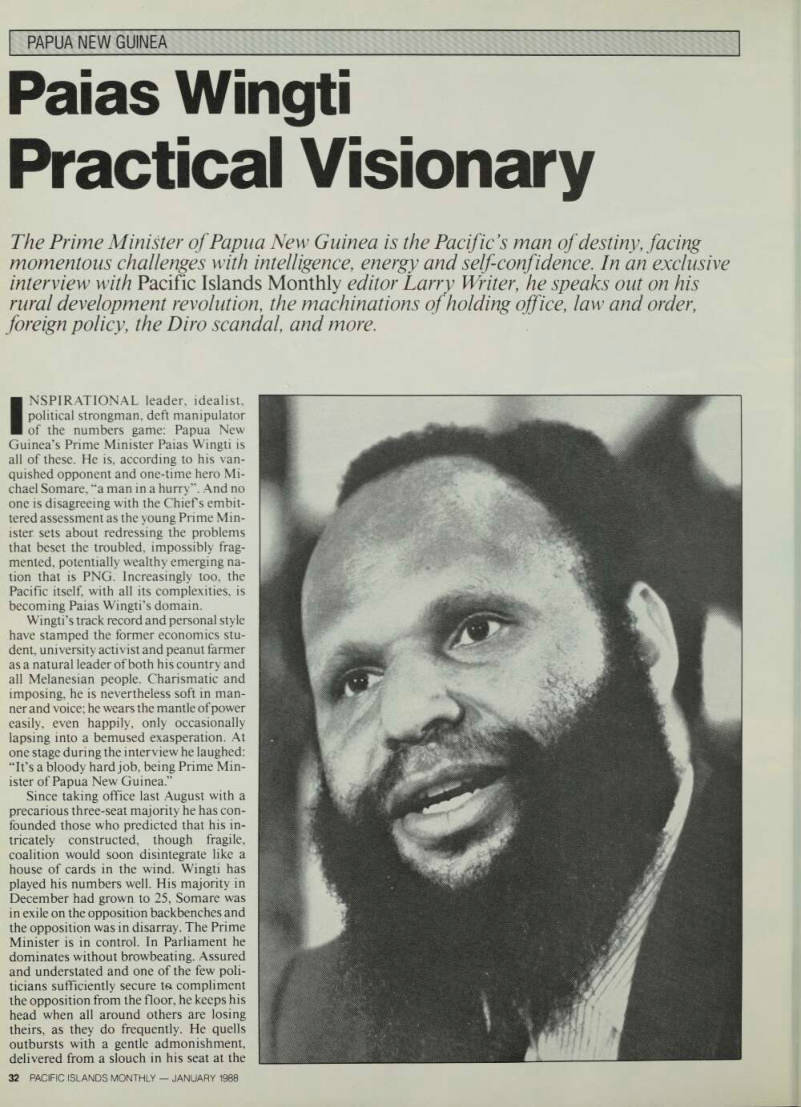
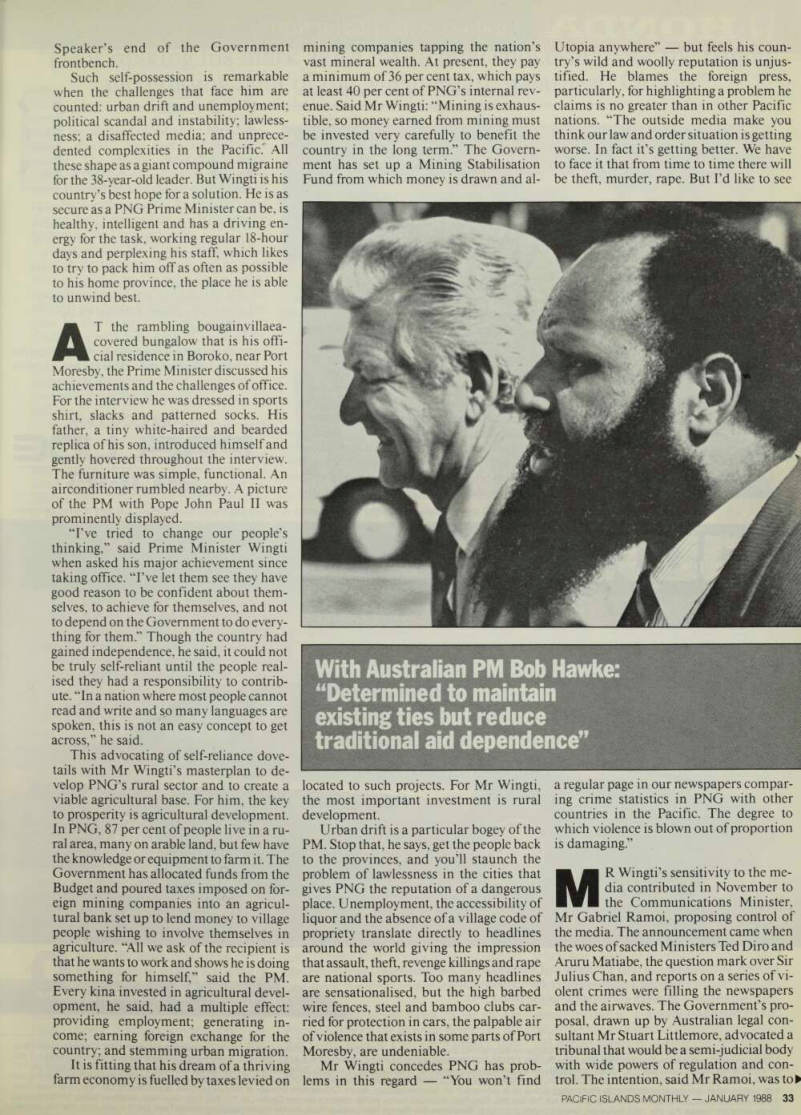

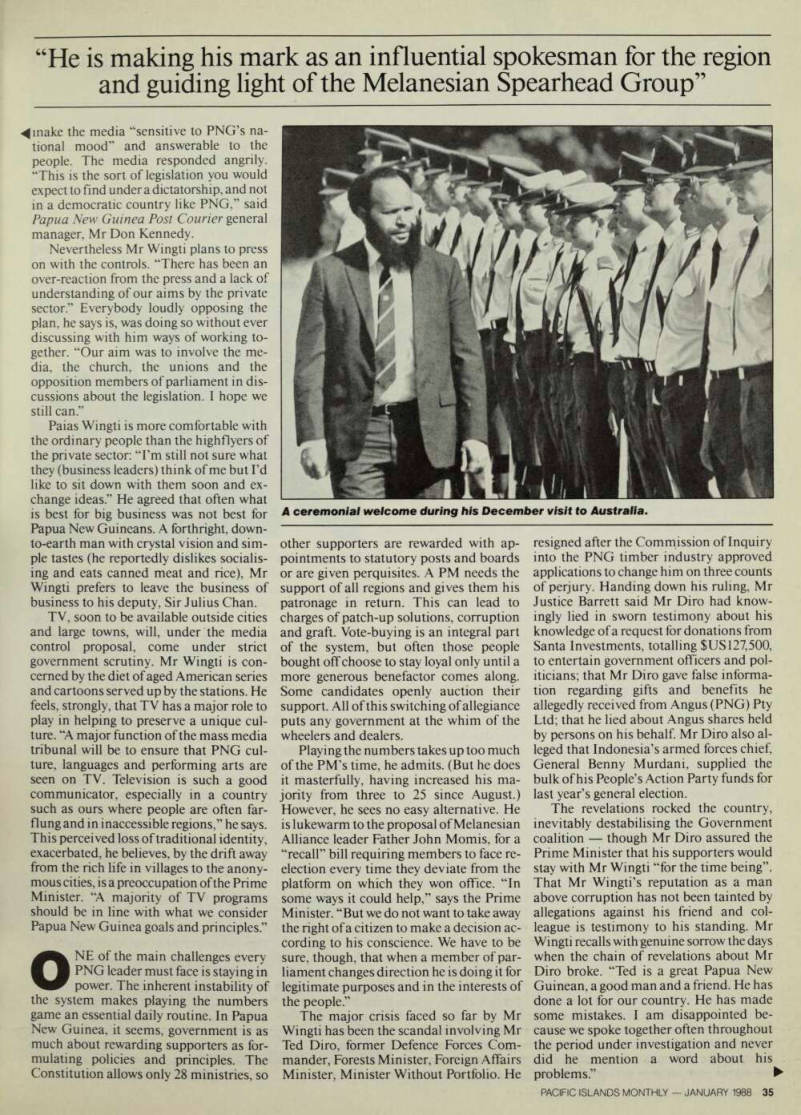
Papua New Guinea
Paias Wingti Practical Visionary
The Prime Minister of Papua New Guinea is the Pacific’s man of destiny, facing momentous challenges with intelligence, energy and self-confidence. In an exclusive interview with Pacific Islands Monthly editor Larry Writer, he speaks out on his rural development revolution, the machinations of holding office, law and order, foreign policy, the Diro scandal, and more.
INSPIRATIONAL leader, idealist, political strongman, deft manipulator of the numbers game: Papua New Guinea’s Prime Minister Paias Wingti is all of these. He is, according to his van quished opponent and one-time hero Mi chael Somare, “a man in a hurry”. And no one is disagreeing with the Chiefs embit tered assessment as the young Prime Min ister sets about redressing the problems that beset the troubled, impossibly frag mented, potentially wealthy emerging na tion that is PNG. Increasingly too, the Pacific itself, with all its complexities, is becoming Paias Wingti’s domain.
Wingti’s track record and personal style have stamped the former economics stu dent, university activist and peanut farmer as a natural leader of both his country and all Melanesian people. Charismatic and imposing, he is nevertheless soft in man ner and voice; he wears the mantle of power easily, even happily, only occasionally lapsing into a bemused exasperation. At one stage during the interview he laughed: “It’s a bloody hard job, being Prime Min ister of Papua New Guinea.”
Since taking office last August with a precarious three-seat majority he has con founded those who predicted that his in tricately constructed, though fragile, coalition would soon disintegrate like a house of cards in the wind. Wingti has played his numbers well. His majority in December had grown to 25, Somare was in exile on the opposition backbenches and the opposition was in disarray. The Prime Minister is in control. In Parliament he dominates without browbeating. Assured and understated and one of the few poli ticians sufficiently secure ta compliment the opposition from the floor, he keeps his head when all around others are losing theirs, as they do frequently. He quells outbursts with a gentle admonishment, delivered from a slouch in his seat at the
Speaker’s end of the Government frontbench.
Such self-possession is remarkable when the challenges that face him are counted: urban drift and unemployment; political scandal and instability; lawless ness; a disaffected media; and unprece dented complexities in the Pacific All these shape as a giant compound migraine for the 38-year-old leader. But Wingti is his country’s best hope for a solution. He is as secure as a PNG Prime Minister can be, is healthy, intelligent and has a driving en ergy for the task, working regular 18-hour days and perplexing his staff, which likes to try to pack him off as often as possible to his home province, the place he is able to unwind best.
AT the rambling bougainvillaea covered bungalow that is his offi cial residence in Boroko, near Port Moresby, the Prime Minister discussed his achievements and the challenges of office.
For the interview he was dressed in sports shirt, slacks and patterned socks. His father, a tiny white-haired and bearded replica of his son, introduced himself and gently hovered throughout the interview.
The furniture was simple, functional. An airconditioner rumbled nearby. A picture of the PM with Pope John Paul II was prominently displayed.
“I’ve tried to change our people’s thinking,” said Prime Minister Wingti when asked his major achievement since taking office. “I’ve let them see they have good reason to be confident about them selves, to achieve for themselves, and not to depend on the Government to do every thing for them.” Though the country had gained independence, he said, it could not be truly self-reliant until the people real ised they had a responsibility to contrib ute. “In a nation where most people cannot read and write and so many languages are spoken, this is not an easy concept to get across,” he said.
This advocating of self-reliance dove tails with Mr Wingti’s masterplan to de velop PNG’s rural sector and to create a viable agricultural base. For him, the key to prosperity is agricultural development.
In PNG, 87 per cent of people live in a ru ral area, many on arable land, but few have the knowledge or equipment to farm it. The Government has allocated funds from the Budget and poured taxes imposed on for eign mining companies into an agricul tural bank set up to lend money to village people wishing to involve themselves in agriculture. “All we ask of the recipient is that he wants to work and shows he is doing something for himself,” said the PM.
Every kina invested in agricultural devel opment, he said, had a multiple effect: providing employment; generating in come; earning foreign exchange for the country; and stemming urban migration.
It is fitting that his dream of a thriving farm economy is fuelled by taxes levied on
mining companies tapping the nation’s vast mineral wealth. At present, they pay a minimum of 36 per cent tax, which pays at least 40 per cent of PNG’s internal rev enue. Said Mr Wingti; “Mining is exhaus tible, so money earned from mining must be invested very carefully to benefit the country in the long term.” The Govern ment has set up a Mining Stabilisation Fund from which money is drawn and al-
Utopia anywhere” but feels his coun try’s wild and woolly reputation is unjus tified. He blames the foreign press, particularly, for highlighting a problem he claims is no greater than in other Pacific nations. “The outside media make you think our law and order situation is getting worse. In fact it’s getting better. We have to face it that from time to time there will be theft, murder, rape. But I’d like to see
With Australian PM Bob Hawke: “Determined to maintain existing ties but reduce traditional aid dependence”
located to such projects. For Mr Wingti, the most important investment is rural development.
Urban drift is a particular bogey of the PM. Stop that, he says, get the people back to the provinces, and you’ll staunch the problem of lawlessness in the cities that gives PNG the reputation of a dangerous place. Unemployment, the accessibility of liquor and the absence of a village code of propriety translate directly to headlines around the world giving the impression that assault, theft, revenge killings and rape are national sports. Too many headlines are sensationalised, but the high barbed wire fences, steel and bamboo clubs car ried for protection in cars, the palpable air of violence that exists in some parts of Port Moresby, are undeniable.
Mr Wingti concedes PNG has prob lems in this regard “You won’t find
a regular page in our newspapers compar ing crime statistics in PNG with other countries in the Pacific. The degree to which violence is blown out of proportion is damaging.”
MR Wingti’s sensitivity to the me dia contributed in November to the Communications Minister, Mr Gabriel Ramoi, proposing control of the media. The announcement came when the woes of sacked Ministers Ted Diro and Arum Matiabe, the question mark over Sir Julius Chan, and reports on a series of vi olent crimes were filling the newspapers and the airwaves. The Government’s pro posal, drawn up by Australian legal con sultant Mr Stuart Littlemore, advocated a tribunal that would be a semi-judicial body with wide powers of regulation and con trol. The intention, said Mr Ramoi, was toP
“He is making his mark as an influential spokesman for the region and guiding light of the Melanesian Spearhead Group”
the media “sensitive to PNG’s na tional mood” and answerable to the people. The media responded angrily.
“This is the sort of legislation you would expect to find under a dictatorship, and not in a democratic country like PNG,” said Papua New Guinea Post Courier general manager, Mr Don Kennedy.
Nevertheless Mr Wingti plans to press on with the controls. “There has been an over-reaction from the press and a lack of understanding of our aims by the private sector.” Everybody loudly opposing the plan, he says is, was doing so without ever discussing with him ways of working to gether. “Our aim was to involve the me dia, the church, the unions and the opposition members of parliament in dis cussions about the legislation. I hope we still can.”
Paias Wingti is more comfortable with the ordinary people than the highflyers of the private sector: “I’m still not sure what they (business leaders) think of me but I’d like to sit down with them soon and ex change ideas.” He agreed that often what is best for big business was not best for Papua New Guineans. A forthright, down to-earth man with crystal vision and sim ple tastes (he reportedly dislikes socialis ing and eats canned meat and rice), Mr Wingti prefers to leave the business of business to his deputy, Sir Julius Chan.
TV, soon to be available outside cities and large towns, will, under the media control proposal, come under strict government scrutiny. Mr Wingti is con cerned by the diet of aged American series and cartoons served up by the stations. He feels, strongly, that TV has a major role to play in helping to preserve a unique cul ture. “A major function of the mass media tribunal will be to ensure that PNG cul ture, languages and performing arts are seen on TV. Television is such a good communicator, especially in a country such as ours where people are often far flung and in inaccessible regions,” he says.
This perceived loss of traditional identity, exacerbated, he believes, by the drift away from the rich life in villages to the anony mous cities, is a preoccupation of the Prime Minister. “A majority of TV programs should be in line with what we consider Papua New Guinea goals and principles.”
ONE of the main challenges every PNG leader must face is staying in power. The inherent instability of the system makes playing the numbers game an essential daily routine. In Papua New Guinea, it seems, government is as much about rewarding supporters as for mulating policies and principles. The Constitution allows only 28 ministries, so
other supporters are rewarded with appointments to statutory posts and boards or are given perquisites. A PM needs the support of all regions and gives them his patronage in return. This can lead to charges of patch-up solutions, corruption and graft. Vote-buying is an integral part of the system, but often those people bought off choose to stay loyal only until a more generous benefactor comes along, Some candidates openly auction their support. All of this switching of allegiance puts any government at the whim of the wheelers and dealers.
Playing the numbers takes up too much of the PM’s time, he admits. (But he does it masterfully, having increased his majority from three to 25 since August.) However, he sees no easy alternative. He is lukewarm to the proposal of Melanesian Alliance leader Father John Momis, for a “recall” bill requiring members to face reelection every time they deviate from the platform on which they won office. “In some ways it could help,” says the Prime Minister. “But we do not want to take away the right of a citizen to make a decision according to his conscience. We have to be sure, though, that when a member of par- Lament changes direction he is doing it for legitimate purposes and in the interests of the people.”
The major crisis faced so far by Mr Wingti has been the scandal involving Mr Ted Diro, former Defence Forces Commander, Forests Minister, Foreign Affairs Minister, Minister Without Portfolio. He
resigned after the Commission of Inquiry into the PNG timber industry approved applications to change him on three counts of perjury. Handing down his ruling, Mr Justice Barrett said Mr Diro had know ingly lied in sworn testimony about his knowledge of a request for donations from Santa Investments, totalling SUS 127,500, to entertain government officers and pol iticians; that Mr Diro gave false informa tion regarding gifts and benefits he allegedly received from Angus (PNG) Pty Ltd; that he lied about Angus shares held by persons on his behalf. Mr Diro also al leged that Indonesia’s armed forces chief, General Benny Murdani, supplied the bulk of his People’s Action Party funds for last year’s general election.
The revelations rocked the country, inevitably destabilising the Government coalition though Mr Diro assured the Prime Minister that his supporters would stay with Mr Wingti “for the time being”.
That Mr Wingti’s reputation as a man above corruption has not been tainted by allegations against his friend and col league is testimony to his standing. Mr Wingti recalls with genuine sorrow the days when the chain of revelations about Mr Diro broke. “Ted is a great Papua New Guinean, a good man and a friend. He has done a lot for our country. He has made some mistakes. I am disappointed be cause we spoke together often throughout the period under investigation and never did he mention a word about his problems.” ►
A ceremonial welcome during his December visit to Australia.
“Wingti feels strongly that television has a role to play in helping to preserve a unique culture in Papua New Guinea”
UT Mr Wingti has risen above the Diro issue and others, such as his mm deputy Sir Julius Chan’s contro versial involvement with Placer shares and the tribulations of Mr Aruru Matiabe. sacked as Foreign Minister after claiming that political loans from overseas coun tries, such as that alleged from Murdani to Diro. were commonplace and who is now embroiled in a university funding contro versy as Education Minister.
Recently, too. Mr Legu Vagi, the Police Minister and the deputy to Mr Wingti in the Prime Minister's People's Democratic Movement Party, lost his seat over elec tion irregularities.
Such internal problems were once the PM’s major concern. But since CHOGM and his open declaration of support for the Fiji Republic, he has made his mark as an influential spokesman for the region and the guiding light and conscience of the Melanesian Spearhead group, which in cludes PNG. Vanuatu and The Solomons and has the support of Fiji and the kanaks of New Caledonia.
Mr Wingti said the group was formed to preserve the identity of the Melanesian people. “Excluding Australia and New Zealand, Melanesians comprise 80 per cent of the people of the Pacific,” he said.
“We felt it was important for Melanesian leaders to gather each year to discuss bilat eral issues and decide things we can do to gether instead of spending resources doing things on our own.”
So far there were plans to pursue trade agreements, aircraft landing rights and sign cultural, legal and educational agree ments. The leaders of Vanuatu and The Solomons were soon to join Mr Wingti in signing a Joint Set of Principles to for malise the group.
The Melanesian Spearhead group is firmly in favour of the Fiji Republic. While not condoning Brigader Ranbuka’s method of winning power, Mr Wingti ins ists on the right of Melanesians, such as indigenous Fijians, to make their own de cisions: “We recognise Fiji as an inde pendent state and, by extension, we recognise whoever is in authority there. We cannot change events. What has taken place has taken place. We have a respon sibility to the friendly countries in the re gion which have done so much to provide stability here.”
Mr Wingti does not want to see a sit uation where independent states are iso lated by former friends and begin looking for alternative partners, so causing long term problems. “As Melanesians we un derstand the difficulties involved in Fiji, the social and political problems the in
digenous Fijians and the Indians are facing.”
Mr Wingti, no admirer of the French, is equally hardline on New Caledonia, calling for full independence for the kan aks. “But such independence can only come when the indigenous kanaks. New Caledonians and others living in New Ca ledonia are united, not divided as they are
today by outside interests.”
The Prime Minister visited Australia in De cember to sign with Aus tralian Prime Minister Bob Hawke a Joint Dec laration of Principles, a document comprehen sively covering ail agree ments aid. trade, defence between the two countries. His Government is deter mined to reduce PNG’s reliance on Australian aid and replace it with mutually beneficial trade agreements. His aim is to reduce Australian aid from its present level of
19 per cent of PNG’s national Budget to less than 5 per cent by the end of the cur rent five-year term.
While he feels it is important to main tain existing ties with Australia, Mr Wingti is keen to develop links with the US, Ja pan, Soviet Union, China and Indonesia.
The pact of Friendship, Co-operation and Mutual Respect with Indonesia has helped, he says, to defuse the problem on the Irian Jaya border. The treaty has so far curbed Indonesian intrusions across the border into PNG. The whole issue is now in the hands of the United Nations High Commissioner for Refugees. “We have a very firm understanding with the Indo nesian Government. We see no threat from the Indonesians; rather friendship and co operation. We gam a lot from their tech nology, food production and rural devel opment schemes.”
The PM hopes Indonesia’s financial institutions will invest in PNG’s tourism and cottage industries. With its position in the region stabilised, Mr Wingti is courting other countries further afield: the United States (a team of military advisers will be sent to the Irian Jaya border this year), Canada, where a double tax treaty has been signed, “and we are looking at the ASEAN countries where there is a big market for the things we produce.”
This year should be a momentous one for Papua New Guinea. Mr Wingti is fond
of calling 1988 the “year for national building”.
“For the first time,” he says, “We have increased our budget in real terms by five per cent or K 1 billion. We’ll mobilise the manpower in the country and look at ways of utilising the defence force and pris oners, though the UN and others will complain. Fifty new roads will be built.
There’ll be more funds for the agricultural sector and we’ll make it easier for people in the provinces to take land titles and bor row money from the bank for mortgages.
We hope to spend less money on law and order, social services and administration.”
When he is not running the country, Mr Wingti, who is not married, relaxes by reading, swimming and watching sport.
He enjoys big rugby league games. He was a keen jogger until suffering a knee injury.
But mostly he likes to spend time with close friends and return to the more peace ful concerns of his native Mt Hagen.
“The province is a place where the is sues you discuss are quite different from the running of the country,” he says. “Here, I’m surrounded by advisers, concerned with the complicated business of running the nation. In the village it’s different. I turn my mind to simple things and this slows my mind, relaxes me.”
There would, however, be no relaxing for Mr Wingti this day. After the inter view, as he escorted me to the gate of the residence, we negotiated a holding pattern of politicians and public servants milling in the driveway, seeking an audience.
Some had been waiting in 40 degree heat for hours. It was midday Saturday and there was work to do. Rustic contempla tion at Mt Hagen was out. Being Prime Minister of Papua New Guinea can, in deed, be a bloody hard job. □
Statesmanship comes easy for the Prime Minister.
Advertisements & other items, p. 34 (1 item)
Revolutionary
at every .
The new Prelude is a sports coupe which will revolutionise conventional ideas of the relationship between a car and its driver.
It is a car with sporty, responsive handling to appeal to the keen driver: but through continual refinement by an enthusiastic team of engineers, the new Prelude 2.0i-16 adds a new dimension to the pleasure of motoring with almost extra-sensory handling performance. The secret is in Honda's revolutionary 4-wheel steering system. And it has no precedent in the modern motor car.
New Dimensions in Motoring.
Every revolution begins with a daring new initiative. The new Prelude features a bonnet line that is closer to the road than ever, conveying a real sports car feel. Inside, the wide glass area and wraparound console increase visibility and enhance a spacious, airy environment which centres on the needs of the driver. Each and every facet of performance elevates the relationship between man and machine to a higher level: the innovative 4-wheel double wishbone suspension, 4-wheel anti-lock braking, the race-bred 2.0 litre 16- and 12-valve engines... all work in perfect harmony to satisfy the Opposite direction* driver's wants and desires. Add to this the 4WS system on the 2.0M6, and you have a package which offers supreme handling with looks to match. The new Prelude is a revolutionary move in the right direction.
Breathtaking styling and exhilarating responsiveness geared to the true driving enthusiast's innermost desires. It's the Honda way. *The wheel angles are exaggerated for illustrative purposes.
Honda's 4WS is fitted to the 2.01-16 as a standard feature. 0 □MG Specifications and equipment may vary in some countries. n .
In 1986, Williams/Honda won the Formula 1 Constructors' Championship.
In 1987 , Honda's Formula 1 engines power both Williams and Lotus.
Thus, we continue to polish our expertise at the pinnacle of automotive technology.
AUSTRALIA: Honda Australia Pty., Ltd. Lot 95 Sharps Road,Tullamarine, Victoria 3043; Bennett Honda Pty., Ltd. 250 Victoria Road, Wetherill Park, NSW. 2164/NEW ZEALAND; NZMC Limited Manners Plaza, 57-65 Manners St., Wellington/PAPUA NEW GUINEA.Toba Pty., Ltd. P.O. Box 503, Port Moresby/TAHITI: Honda Distribution S.A. R.L. B.P 1665, Papeete/KIRIBA Atoll Motor & Marino Services PC). Box 49, Bairiki Tarawa, Republic of Kiribati/u.S. TRUST TERRITORV United Micronesia Development Association P.O. Box 235, CHRB Saipan CM 96950/COOK ISLANDS Cook Islands Motor Centre Ltd. P.O.
Box 74, Rarotonga/QUAM Mark’s Motor Co., Inc. P.O. Box DV, Agana/WESTERN SAMOA: Motor Distributors (Samoa) Ltd. P.O. Box 576, Apia/SOLOMON ISLANDS: Lee Kwok Kuen & Co., Ltd. P.O_ Box 537, Honiara/NEW CALEDONIA Soci6t6 Du Chalandage 8, Rue de la somme-B.P. 97, Noumea/NAURU; Nauru Cooperation Republic of Nauru/FIJI Coral Island Motors Ltd. Robertson Hoaa, Buva, Fiji/AMERICAN SAMOA Holiday Motors, Parts and Service P.O. Box 968, Pago Pago, American Samoa 96799: Heleck’s Service Center Ltd. P.O. Box 1138. Pago Pago American Samoai96799/TONGA: Tonga Industrial Traders P.O. Box 1035, Nukualofa, Tonga/NORFOLK ISLAND: Duncombe Bay Garage New Cascade Road, Norfolk Island/VANUATU: Honda Farm Ltd. P.O. Box 1031, Pori Vila, Vanuatu
Defence Dossier
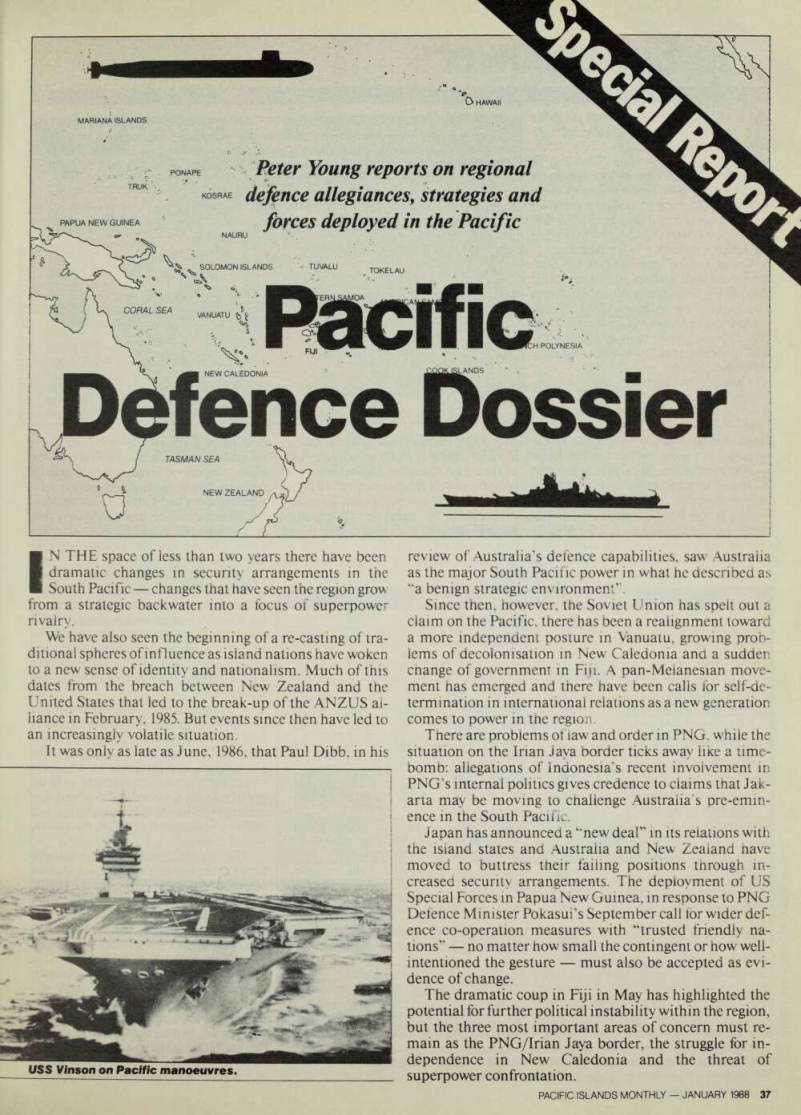
Pacific
Peter Young reports on regional defence allegiances, strategies and forces deployed in the Pacific
IN THE space of less than two years there have been dramatic changes in security arrangements in the South Pacific changes that have seen the region grou from a strategic backwater into a focus of superpower rivalry.
We have also seen the beginning of a re-castmg of tra ditional spheres of influence as island nations have woken to a new sense of identity and nationalism. Much of this dates from the breach between New Zealand and the United States that led to the break-up of the ANZUS al liance in February, 1985. But events since then have led to an increasingly volatile situation It was only as late as June, 1986. that Paul Dibb. in his
review of Australia's defence capabilities, saw' Australia as the major South Pacific power in what he described as “a benign strategic environment".
Since then, however, the Soviet Union has spelt out a claim on the Pacific, there has been a realignment toward a more independent posture in Vanuatu, growing proo lems of decolonisation in New Caledonia ana a sudden cnange of government in Fiji. A pan-Melanesian move ment has emerged and there have been calls for self-de termination in international relations as a new generation comes to power in the region.
There are problems of law and order in PNG. while the situation on the Irian Java border ticks away like a ume bomb: allegations of Indonesia’s recent involvement in PNG’s internal politics gives credence to claims that Jak arta may be moving to challenge Australia s pre-emin ence in the South Pacific.
Japan has announced a “new deal” in its relations with the island states and Australia and New' Zealand have moved to buttress their failing positions through in creased security arrangements. The deployment of US Special Forces in Papua New Guinea, in response to PNG Defence Minister Pokasui’s September call tor wider def ence co-operation measures with “trusted friendly na tions” no matter how small the contingent or how well intentioned the gesture must also be accepted as evi dence of change.
The dramatic coup in Fiji in May has highlighted the potential for further political instability within the region, but the three most important areas of concern must re main as the PNG/Irian Jaya border, the struggle for in dependence in New Caledonia and the threat of superpower confrontation.
USS Vinson on Pacific manoeuvres.
The Superpowers
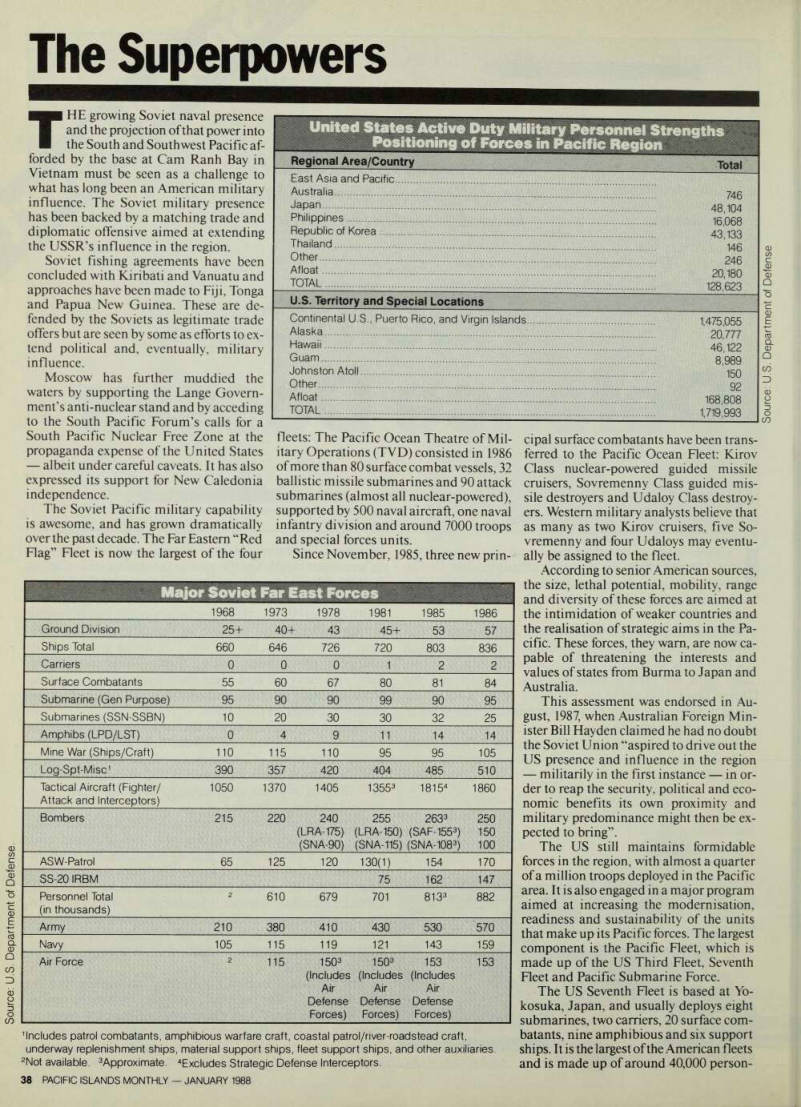
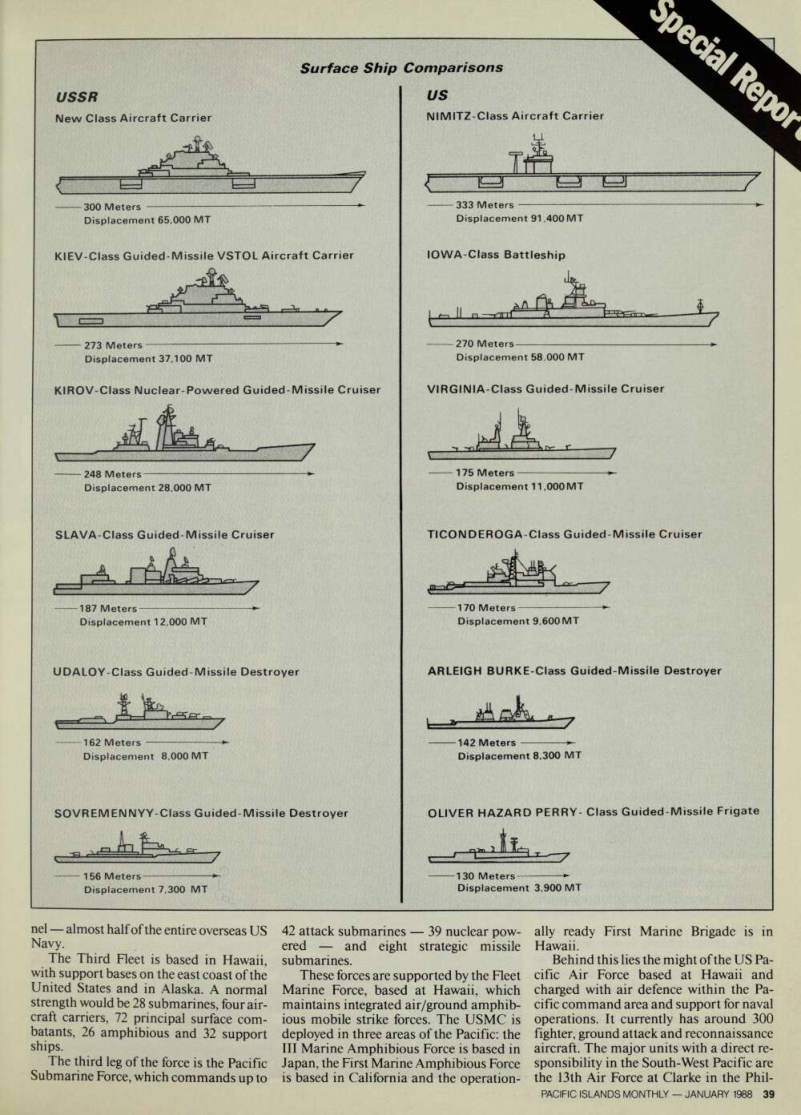
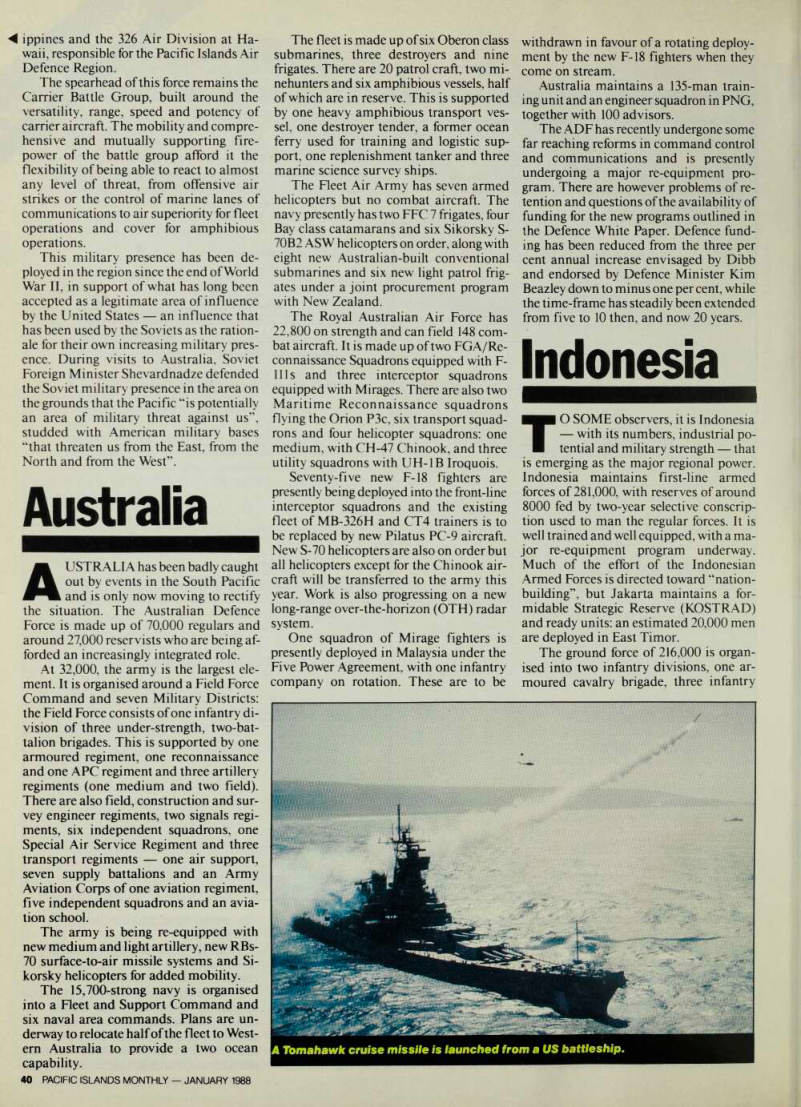
THE growing Soviet naval presence and the projection of that power into the South and Southwest Pacific af forded by the base at Cam Ranh Bay in Vietnam must be seen as a challenge to what has long been an American military influence. The Soviet military presence has been backed by a matching trade and diplomatic offensive aimed at extending the USSR’s influence in the region.
Soviet fishing agreements have been concluded with Kiribati and Vanuatu and approaches have been made to Fiji, Tonga and Papua New Guinea. These are de fended by the Soviets as legitimate trade offers but are seen by some as efforts to ex tend political and, eventually, military influence.
Moscow has further muddied the waters by supporting the Lange Govern ment’s anti-nuclear stand and by acceding to the South Pacific Forum’s calls for a South Pacific Nuclear Free Zone at the propaganda expense of the United States albeit under careful caveats. It has also expressed its support for New Caledonia independence.
The Soviet Pacific military capability is awesome, and has grown dramatically over the past decade. The Far Eastern “Red Flag” Fleet is now the largest of the four
includes patrol combatants, amphibious warfare craft, coastal patrol/river-roadstead craft, underway replenishment ships, material support ships, fleet support ships, and other auxiliaries. 2 Not available. Approximate. 4 Excludes Strategic Defense Interceptors.
fleets: The Pacific Ocean Theatre of Military Operations (TVD) consisted in 1986 of more than 80 surface combat vessels, 32 ballistic missile submarines and 90 attack submarines (almost all nuclear-powered), supported by 500 naval aircraft, one naval infantry division and around 7000 troops and special forces units.
Since November, 1985, three new prin-
cipal surface combatants have been trans ferred to the Pacific Ocean Fleet: Kirov Class nuclear-powered guided missile cruisers, Sovremenny Class guided mis sile destroyers and Udaloy Class destroy ers. Western military analysts believe that as many as two Kirov cruisers, five So vremenny and four Udaloys may eventu ally be assigned to the fleet.
According to senior American sources, the size, lethal potential, mobility, range and diversity of these forces are aimed at the intimidation of weaker countries and the realisation of strategic aims in the Pa cific. These forces, they warn, are now ca pable of threatening the interests and values of states from Burma to Japan and Australia.
This assessment was endorsed in Au gust, 1987, when Australian Foreign Min ister Bill Hayden claimed he had no doubt the Soviet Union “aspired to drive out the US presence and influence in the region militarily in the first instance in or der to reap the security, political and eco nomic benefits its own proximity and military predominance might then be ex pected to bring”.
The US still maintains formidable forces in the region, with almost a quarter of a million troops deployed in the Pacific area. It is also engaged in a major program aimed at increasing the modernisation, readiness and sustainability of the units that make up its Pacific forces. The largest component is the Pacific Fleet, which is made up of the US Third Fleet, Seventh Fleet and Pacific Submarine Force.
The US Seventh Fleet is based at Yo kosuka, Japan, and usually deploys eight submarines, two carriers, 20 surface com batants, nine amphibious and six support ships. It is the largest of the American fleets and is made up of around 40,000 person-
Source: U.S. Department of Defense.
Source: U.S. Department of Defense
United States Active Duty Military Personnel Strengths Positioning of Forces in Pacific Region Regional Area/Country Total East Asia and Pacific 1 Australia jar Japan Philippines Republic of Korea Thailand 48,104 16,068 43.133 Afloat on iftn
Total
128.623 U.S. Territory and Special Locations Continental U.S., Puerto Rico, and Virgin Islands Alaska 1,475,055 20 777 Hawaii 46 122 Guam 8 989 Johnston Atoll Other 150 92 Afloat
Total
168,808 1,719,993
I Major Soviet Far East Forces 1968 1973 1978 1981 1985 1986 Ground Division 25+ 40+ 43 45+ 53 57 Ships Total 660 646 726 720 803 836 Carriers 0 0 0 1 2 2 Surface Combatants 55 60 67 80 81 84 Submarine (Gen Purpose) 95 90 90 99 90 95 Submarines (SSN-SSBN) 10 20 30 30 32 25 Amphibs (LPD/LST) 0 4 9 11 14 14 Mine War (Ships/Craft) 110 115 110 95 95 105 Log-Spt-Misc 1 390 357 420 404 485 510 Tactical Aircraft (Fighter/ Attack and Interceptors) 1050 1370 1405 1355 3 1815 4 1860 Bombers 215 220 240
(Lra-175)
(Sna-90)
255 263 3
(Lra-150) (Saf-155 3 )
(Sna-115) (Sna-108 3 )
250 150 100 ASW-Patrol 65 125 120 130(1) 154 170
Ss-20 Irbm
75 162 147 Personnel Total (in thousands) 2 610 679 701 813 3 882 Army 210 380 410 430 530 570 Navy 105 115 119 121 143 159 Air Force 2 115 150 3 (Includes Air Defense Forces) 150 3 (Includes Air Defense Forces) 153 (Includes Air Defense Forces) 153
nel almost half of the entire overseas US Navy.
The Third Fleet is based in Hawaii, with support bases on the east coast of the United States and in Alaska. A normal strength would be 28 submarines, four air craft carriers, 72 principal surface com batants, 26 amphibious and 32 support ships.
The third leg of the force is the Pacific Submarine Force, which commands up to
-42 attack submarines 39 nuclear pow ered and eight strategic missile submarines.
These forces are supported by the Fleet Marine Force, based at Hawaii, which maintains integrated air/ground amphib ious mobile strike forces. The USMC is deployed in three areas of the Pacific: the 111 Marine Amphibious Force is based in Japan, the First Marine Amphibious Force is based in California and the operation
ally ready First Marine Brigade is in Hawaii.
Behind this lies the might of the US Pa cific Air Force based at Hawaii and charged with air defence within the Pa cific command area and support for naval operations. It currently has around 300 fighter, ground attack and reconnaissance aircraft. The major units with a direct re sponsibility in the South-West Pacific are the 13th Air Force at Clarke in the Phil-
M ippines and the 326 Air Division at Ha waii, responsible for the Pacific Islands Air Defence Region.
The spearhead of this force remains the Carrier Battle Group, built around the versatility, range, speed and potency of carrier aircraft. The mobility and compre hensive and mutually supporting fire power of the battle group afford it the flexibility of being able to react to almost any level of threat, from offensive air strikes or the control of marine lanes of communications to air superiority for fleet operations and cover for amphibious operations.
This military presence has been de ployed in the region since the end of World War II, in support of what has long been accepted as a legitimate area of influence by the United States — an influence that has been used by the Soviets as the ration ale for their own increasing military pres ence. During visits to Australia, Soviet Foreign Minister Shevardnadze defended the Soviet military presence in the area on the grounds that the Pacific “is potentially an area of military threat against us”, studded with American military bases “that threaten us from the East, from the North and from the West”.
Australia
has been badly caught out by events in the South Pacific and is only now moving to rectify the situation. The Australian Defence Force is made up of 70,000 regulars and around 27,000 reservists who are being af forded an increasingly integrated role.
At 32,000, the army is the largest ele ment. It is organised around a Field Force Command and seven Military Districts: the Field Force consists of one infantry di vision of three under-strength, two-bat talion brigades. This is supported by one armoured regiment, one reconnaissance and one APC regiment and three artillery regiments (one medium and two field).
There are also field, construction and sur vey engineer regiments, two signals regi ments, six independent squadrons, one Special Air Service Regiment and three transport regiments one air support, seven supply battalions and an Army Aviation Corps of one aviation regiment, five independent squadrons and an avia tion school.
The army is being re-equipped with new medium and light artillery, new RBs -70 surface-to-air missile systems and Si korsky helicopters for added mobility.
The 15,700-strong navy is organised into a Fleet and Support Command and six naval area commands. Plans are un derway to relocate half of the fleet to West ern Australia to provide a two ocean capability.
The fleet is made up of six Oberon class submarines, three destroyers and nine frigates. There are 20 patrol craft, two mi nehunters and six amphibious vessels, half of which are in reserve. This is supported by one heavy amphibious transport ves sel, one destroyer tender, a former ocean ferry used for training and logistic sup port, one replenishment tanker and three marine science survey ships.
The Fleet Air Army has seven armed helicopters but no combat aircraft. The navy presently has two FFC 7 frigates, four Bay class catamarans and six Sikorsky S -7082 ASW helicopters on order, along with eight new Australian-built conventional submarines and six new light patrol frig ates under a joint procurement program with New Zealand.
The Royal Australian Air Force has 22,800 on strength and can field 148 com bat aircraft. It is made up of two FGA/Re connaissance Squadrons equipped with F -111s and three interceptor squadrons equipped with Mirages. There are also two Maritime Reconnaissance squadrons flying the Orion P3c, six transport squad rons and four helicopter squadrons: one medium, with CH-47 Chinook, and three utility squadrons with UH-1B Iroquois.
Seventy-five new F-18 fighters are presently being deployed into the front-line interceptor squadrons and the existing fleet of MB-326H and CT4 trainers is to be replaced by new Pilatus PC-9 aircraft.
New S-70 helicopters are also on order but all helicopters except for the Chinook air craft will be transferred to the army this year. Work is also progressing on a new long-range over-the-horizon (OTH) radar system.
One squadron of Mirage fighters is presently deployed in Malaysia under the Five Power Agreement, with one infantry company on rotation. These are to be
withdrawn in favour of a rotating deploy ment by the new F-18 fighters when they come on stream.
Australia maintains a 135-man train ing unit and an engineer squadron in PNG, together with 100 advisors.
The ADF has recently undergone some far reaching reforms in command control and communications and is presently undergoing a major re-equipment pro gram. There are however problems of re tention and questions of the availability of funding for the new programs outlined in the Defence White Paper. Defence fund ing has been reduced from the three per cent annual increase envisaged by Dibb and endorsed by Defence Minister Kim Beazley down to minus one per cent, while the time-frame has steadily been extended from five to 10 then, and now 20 years.
Indonesia
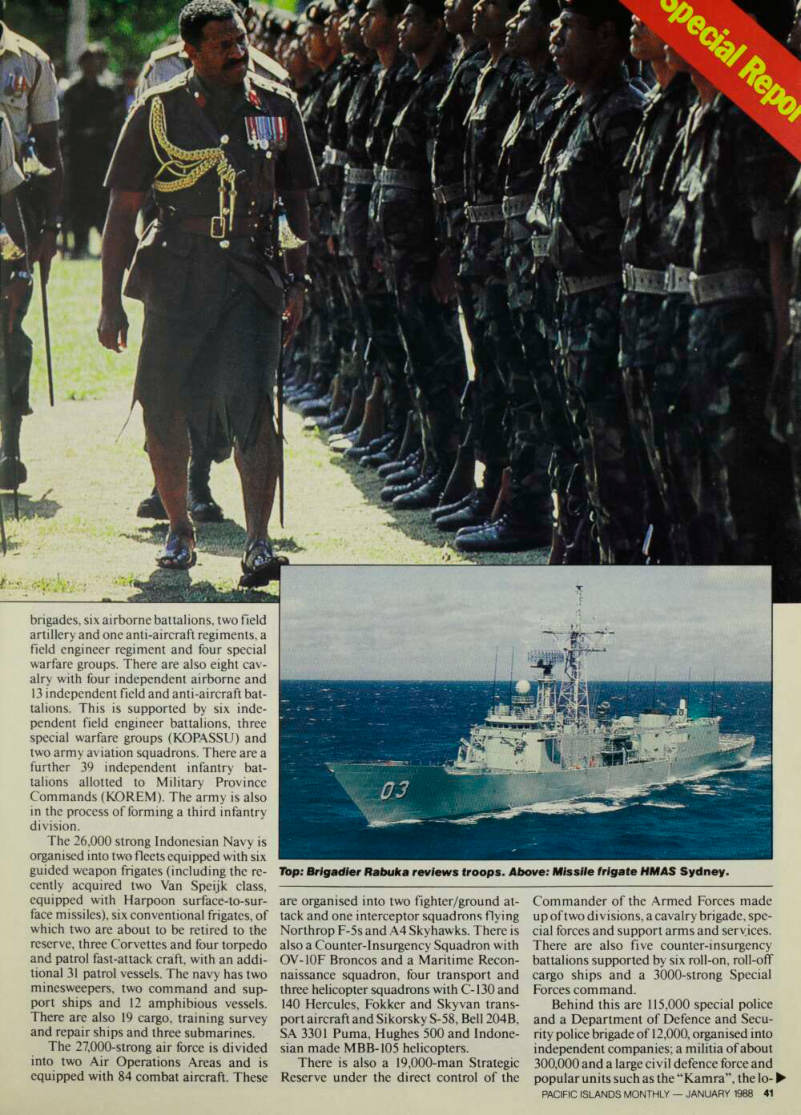
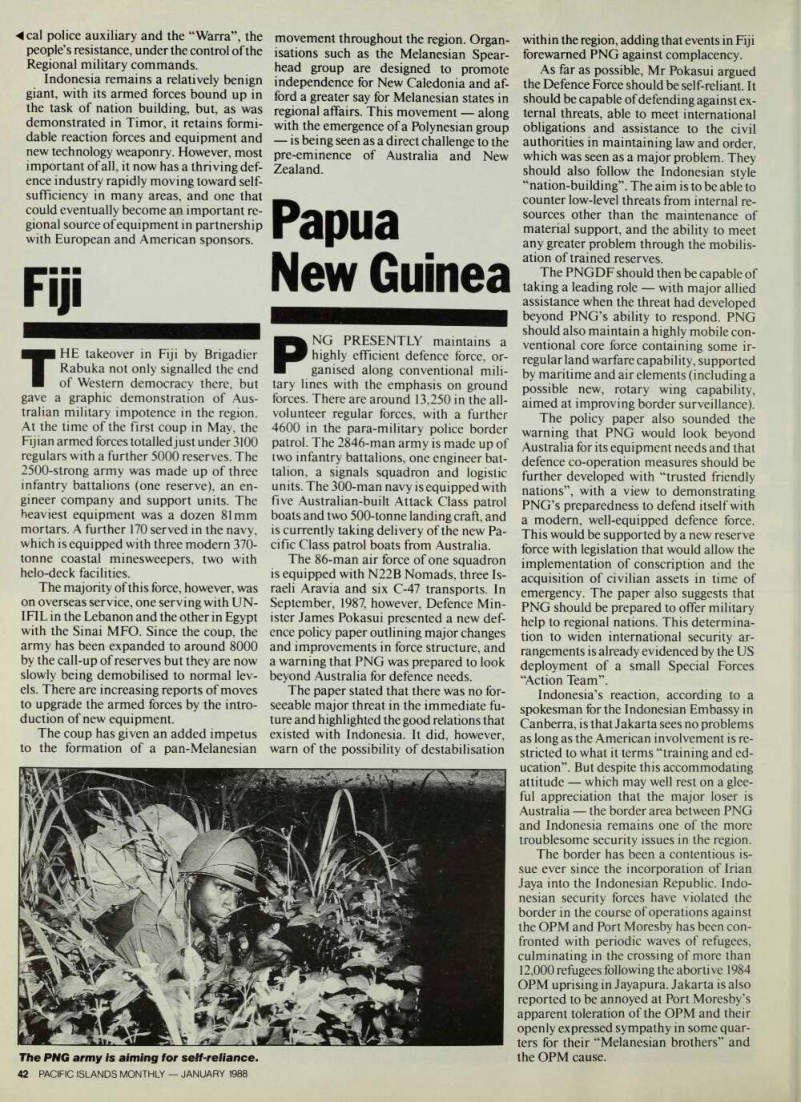
TO SOME observers, it is Indonesia with its numbers, industrial po tential and military strength that is emerging as the major regional power.
Indonesia maintains first-line armed forces of 281,000, with reserves of around 8000 fed by two-year selective conscrip tion used to man the regular forces. It is well trained and well equipped, with a ma jor re-equipment program underway.
Much of the effort of the Indonesian Armed Forces is directed toward “nation building”, but Jakarta maintains a for midable Strategic Reserve (KOSTRAD) and ready units: an estimated 20,000 men are deployed in East Timor.
The ground force of 216,000 is organ ised into two infantry divisions, one ar moured cavalry brigade, three infantry
A Tomahawk cruise missile is launched from a US battleship.
brigades, six airborne battalions, two field artillery and one anti-aircraft regiments, a field engineer regiment and four special warfare groups. There are also eight cav alry with four independent airborne and 13 independent field and anti-aircraft bat talions. This is supported by six inde pendent field engineer battalions, three special warfare groups (KOPASSU) and two army aviation squadrons. There are a further 39 independent infantry bat talions allotted to Military Province Commands (KOREM). The army is also in the process of forming a third infantry division.
The 26,000 strong Indonesian Navy is organised into two fleets equipped with six guided weapon frigates (including the re cently acquired two Van Speijk class, equipped with Harpoon surface-to-sur face missiles), six conventional frigates, of which two are about to be retired to the reserve, three Corvettes and four torpedo and patrol fast-attack craft, with an addi tional 31 patrol vessels. The navy has two minesweepers, two command and sup port ships and 12 amphibious vessels.
There are also 19 cargo, training survey and repair ships and three submarines.
The 27,000-strong air force is divided into two Air Operations Areas and is equipped with 84 combat aircraft. These
are organised into two fighter/ground attack and one interceptor squadrons flying Northrop F-5s and A 4 Skyhawks. There is also a Counter-Insurgency Squadron with OV-10F Broncos and a Maritime Reconnaissance squadron, four transport and three helicopter squadrons with C-130 and 140 Hercules, Fokker and Skyvan transport aircraft and Sikorsky S-58, Bell 2048, SA 3301 Puma, Hughes 500 and Indonesian made MBB-105 helicopters.
There is also a 19,000-man Strategic Reserve under the direct control of the
Commander of the Armed Forces made up of two divisions, a cavalry brigade, spe cial forces and support arms and services.
There are also five counter-insurgency battalions supported by six roll-on, roll-off cargo ships and a 3000-strong Special Forces command.
Behind this are 115,000 special police and a Department of Defence and Secu rity police brigade of 12,000, organised into independent companies; a militia of about 300,000 and a large civil defence force and popular units such as the “Kamra”, the lo- ►
Top: Brigadier Rabuka reviews troops. Above: Missile frigate HMAS Sydney.
◄ cal police auxiliary and the “ Warra”, the people’s resistance, under the control of the Regional military commands.
Indonesia remains a relatively benign giant, with its armed forces bound up in the task of nation building, but, as was demonstrated in Timor, it retains formi dable reaction forces and equipment and new technology weaponry. However, most important of all, it now has a thriving def ence industry rapidly moving toward self sufficiency in many areas, and one that could eventually become an important re gional source of equipment in partnership with European and American sponsors.
Fiji
THE takeover in Fiji by Brigadier Rabuka not only signalled the end of Western democracy there, but gave a graphic demonstration of Aus tralian military impotence in the region.
At the time of the first coup in May, the Fijian armed forces totalled just under 3100 regulars with a further 5000 reserves. The 2500-strong army was made up of three infantry battalions (one reserve), an en gineer company and support units. The heaviest equipment was a dozen 81mm mortars. A further 170 served in the navy, which is equipped with three modern 370tonne coastal minesweepers, two with helo-deck facilities.
The majority of this force, however, was on overseas service, one serving with UN IFIL in the Lebanon and the other in Egypt with the Sinai MFO. Since the coup, the army has been expanded to around 8000 by the call-up of reserves but they are now slowly being demobilised to normal lev els. There are increasing reports of moves to upgrade the armed forces by the intro duction of new equipment.
The coup has given an added impetus to the formation of a pan-Melanesian
movement throughout the region. Organ isations such as the Melanesian Spear head group are designed to promote independence for New Caledonia and af ford a greater say for Melanesian states in regional affairs. This movement along with the emergence of a Polynesian group is being seen as a direct challenge to the pre-eminence of Australia and New Zealand.
The PNG army is aiming for self-reliance.
Papua
New Guinea
PNG PRESENTLY maintains a highly efficient defence force, or ganised along conventional mili tary lines with the emphasis on ground forces. There are around 13,250 in the all volunteer regular forces, with a further 4600 in the para-military police border patrol. The 2846-man army is made up of two infantry battalions, one engineer bat talion, a signals squadron and logistic units. The 300-man navy is equipped with five Australian-built Attack Class patrol boats and two 500-tonne landing craft, and is currently taking delivery of the new Pa cific Class patrol boats from Australia.
The 86-man air force of one squadron is equipped with N 228 Nomads, three Is raeli Aravia and six C-47 transports. In September, 1987, however, Defence Min ister James Pokasui presented a new def ence policy paper outlining major changes and improvements in force structure, and a warning that PNG was prepared to look beyond Australia for defence needs.
The paper stated that there was no for seeable major threat in the immediate fu ture and highlighted the good relations that existed with Indonesia. It did, however, warn of the possibility of destabilisation
within the region, adding that events in Fiji forewarned PNG against complacency.
As far as possible, Mr Pokasui argued the Defence Force should be self-reliant. It should be capable of defending against ex ternal threats, able to meet international obligations and assistance to the civil authorities in maintaining law and order, which was seen as a major problem. They should also follow the Indonesian style “nation-building”. The aim is to be able to counter low-level threats from internal re sources other than the maintenance of material support, and the ability to meet any greater problem through the mobilis ation of trained reserves.
The PNGDF should then be capable of taking a leading role with major allied assistance when the threat had developed beyond PNG’s ability to respond. PNG should also maintain a highly mobile con ventional core force containing some ir regular land warfare capability, supported by maritime and air elements (including a possible new, rotary wing capability, aimed at improving border surveillance).
The policy paper also sounded the warning that PNG would look beyond Australia for its equipment needs and that defence co-operation measures should be further developed with “trusted friendly nations”, with a view to demonstrating PNG’s preparedness to defend itself with a modem, well-equipped defence force.
This would be supported by a new reserve force with legislation that would allow the implementation of conscription and the acquisition of civilian assets in time of emergency. The paper also suggests that PNG should be prepared to offer military help to regional nations. This determina tion to widen international security ar rangements is already evidenced by the US deployment of a small Special Forces “Action Team”.
Indonesia’s reaction, according to a spokesman for the Indonesian Embassy in Canberra, is that Jakarta sees no problems as long as the American involvement is re stricted to what it terms “training and ed ucation”. But despite this accommodating attitude which may well rest on a glee ful appreciation that the major loser is Australia the border area between PNG and Indonesia remains one of the more troublesome security issues in the region.
The border has been a contentious is sue ever since the incorporation of Irian Jaya into the Indonesian Republic. Indo nesian security forces have violated the border in the course of operations against the OPM and Port Moresby has been con fronted with periodic waves of refugees, culminating in the crossing of more than 12,000 refugees following the abortive 1984 OPM uprising in Jayapura. Jakarta is also reported to be annoyed at Port Moresby’s apparent toleration of the OPM and their openly expressed sympathy in some quar ters for their “Melanesian brothers” and the OPM cause.
Vanuatu
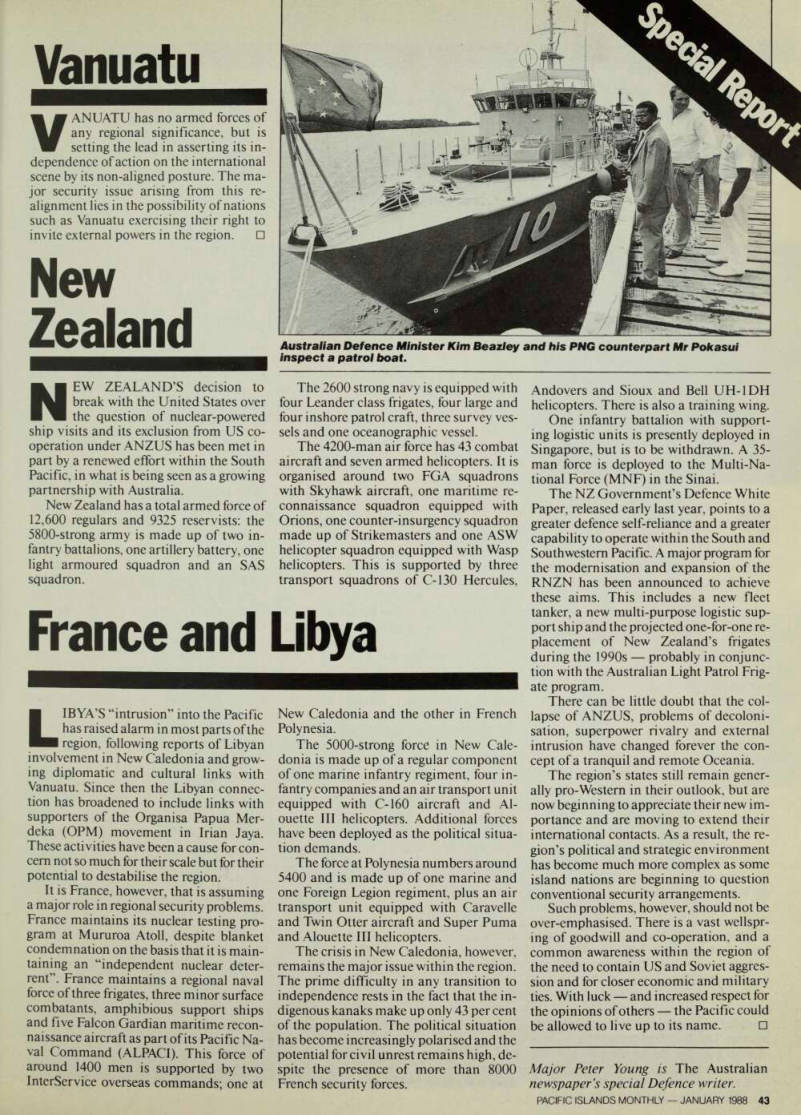
has no armed forces of any regional significance, but is setting the lead in asserting its in dependence of action on the international scene by its non-aligned posture. The ma jor security issue arising from this re alignment lies in the possibility of nations such as Vanuatu exercising their right to invite external powers in the region. □
Australian Defence Minister Kim Beazley and his PNG counterpart Mr Pokasui inspect a patrol boat.
Zealand
New Zealand
NEW ZEALAND’S decision to break with the United States over the question of nuclear-powered ship visits and its exclusion from US co operation under ANZUS has been met in part by a renewed effort within the South Pacific, in what is being seen as a growing partnership with Australia.
New Zealand has a total armed force of 12,600 regulars and 9325 reservists: the 5800-strong army is made up of two in fantry battalions, one artillery battery, one light armoured squadron and an SAS squadron.
The 2600 strong navy is equipped with four Leander class frigates, four large and four inshore patrol craft, three survey ves sels and one oceanographic vessel.
The 4200-man air force has 43 combat aircraft and seven armed helicopters. It is organised around two FGA squadrons with Skyhawk aircraft, one maritime re connaissance squadron equipped with Orions, one counter-insurgency squadron made up of Strikemasters and one ASW helicopter squadron equipped with Wasp helicopters. This is supported by three transport squadrons of C-130 Hercules,
Andovers and Sioux and Bell UH-IDH helicopters. There is also a training wing.
One infantry battalion with support ing logistic units is presently deployed in Singapore, but is to be withdrawn. A 35man force is deployed to the Multi-Na tional Force (MNF) in the Sinai.
The NZ Government’s Defence White Paper, released early last year, points to a greater defence self-reliance and a greater capability to operate within the South and Southwestern Pacific. A major program for the modernisation and expansion of the RNZN has been announced to achieve these aims. This includes a new fleet tanker, a new multi-purpose logistic sup port ship and the projected one-for-one re placement of New Zealand’s frigates during the 1990 s probably in conjunc tion with the Australian Light Patrol Frig ate program.
There can be little doubt that the col lapse of ANZUS, problems of decoloni sation, superpower rivalry and external intrusion have changed forever the con cept of a tranquil and remote Oceania.
The region’s states still remain gener ally pro-Western in their outlook, but are now beginning to appreciate their new im portance and are moving to extend their international contacts. As a result, the re gion’s political and strategic environment has become much more complex as some island nations are beginning to question conventional security arrangements.
Such problems, however, should not be over-emphasised. There is a vast wellspr ing of goodwill and co-operation, and a common awareness within the region of the need to contain US and Soviet aggres sion and for closer economic and military ties. With luck and increased respect for the opinions of others the Pacific could be allowed to live up to its name. □
France and Libya
LIBYA’S “intrusion” into the Pacific has raised alarm in most parts of the region, following reports of Libyan involvement in New Caledonia and grow ing diplomatic and cultural links with Vanuatu. Since then the Libyan connec tion has broadened to include links with supporters of the Organisa Papua Mer deka (OPM) movement in Irian Jaya.
These activities have been a cause for con cern not so much for their scale but for their potential to destabilise the region.
It is France, however, that is assuming a major role in regional security problems.
France maintains its nuclear testing pro gram at Mururoa Atoll, despite blanket condemnation on the basis that it is main taining an “independent nuclear deter rent”. France maintains a regional naval force of three frigates, three minor surface combatants, amphibious support ships and five Falcon Gardian maritime recon naissance aircraft as part of its Pacific Na val Command (ALPACI). This force of around 1400 men is supported by two Inter Service overseas commands; one at
New Caledonia and the other in French Polynesia.
The 5000-strong force in New Cale donia is made up of a regular component of one marine infantry regiment, four in fantry companies and an air transport unit equipped with C-160 aircraft and Al ouette 111 helicopters. Additional forces have been deployed as the political situa tion demands.
The force at Polynesia numbers around 5400 and is made up of one marine and one Foreign Legion regiment, plus an air transport unit equipped with Caravelle and Twin Otter aircraft and Super Puma and Alouette 111 helicopters.
The crisis in New Caledonia, however, remains the major issue within the region.
The prime difficulty in any transition to independence rests in the fact that the in digenous kanaks make up only 43 per cent of the population. The political situation has become increasingly polarised and the potential for civil unrest remains high, de spite the presence of more than 8000 French security forces.
Major Peter Young is The Australian newspaper’s special Defence writer.
Skin-Diving For Submarines
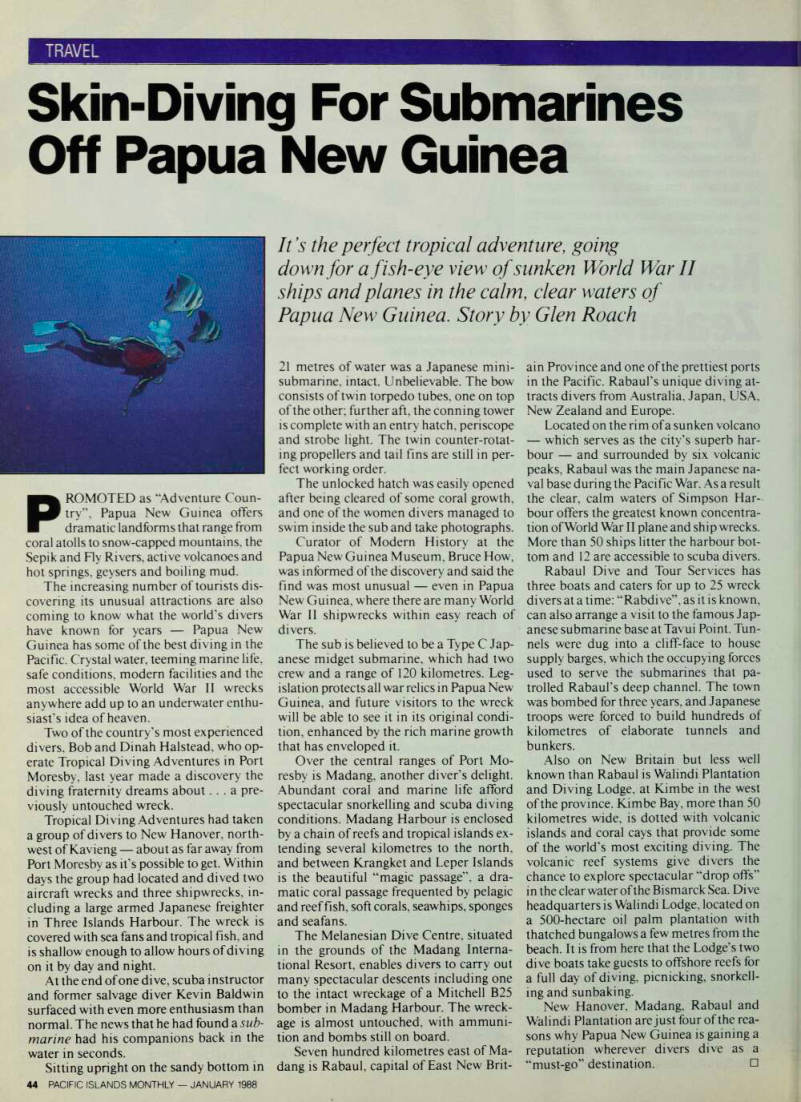
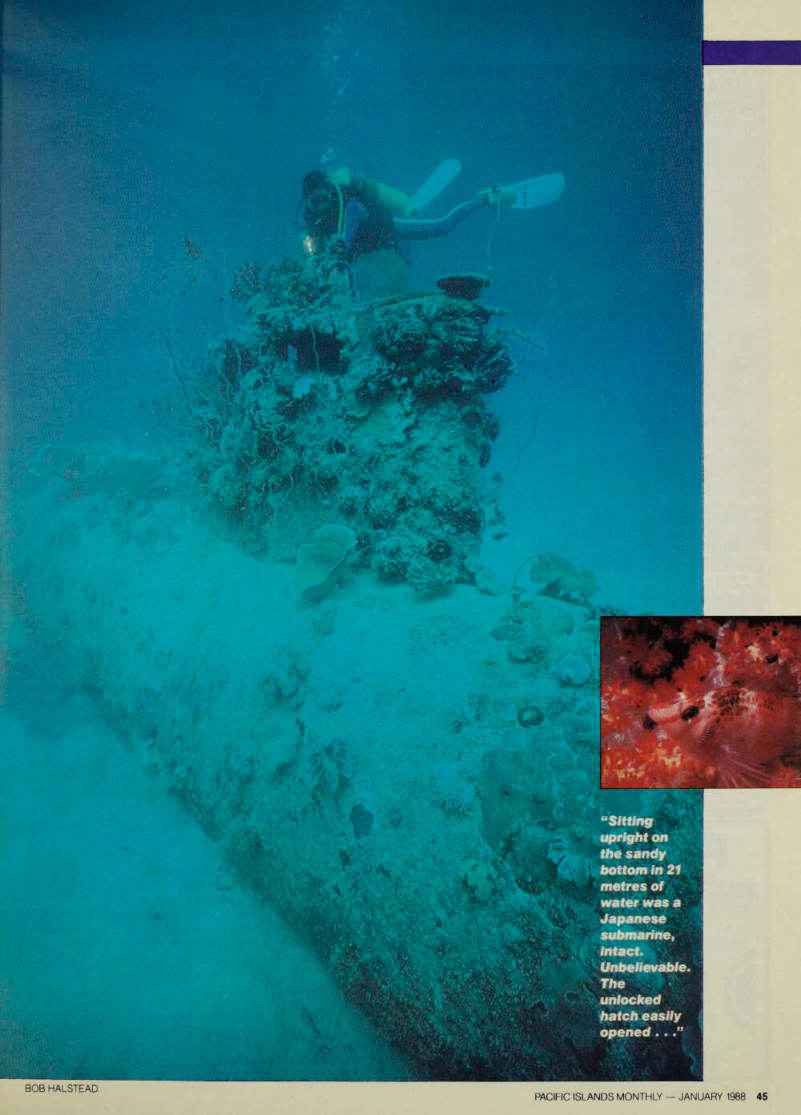
Travel
Skin-Diving For Submarines Off Papua New Guinea
It ’sthe perfect tropical adventure, going down for a fish-eye view of sunken World War II ships and planes in the calm, clear waters of Papua New Guinea. Story by Glen Roach
PROMOTED as “Adventure Coun try”, Papua New Guinea offers dramatic landforms that range from coral atolls to snow-capped mountains, the Sepik and Fly Rivers, active volcanoes and hot springs, geysers and boiling mud.
The increasing number of tourists dis covering its unusual attractions are also coming to know what the world’s divers have known for years Papua New Guinea has some of the best diving in the Pacific. Crystal water, teeming marine life, safe conditions, modern facilities and the most accessible World War II wrecks anywhere add up to an underwater enthu siast’s idea of heaven.
Two of the country’s most experienced divers. Bob and Dinah Halstead, who op erate Tropical Diving Adventures in Port Moresby, last year made a discovery the diving fraternity dreams about... a pre viously untouched wreck.
Tropical Diving Adventures had taken a group of divers to New Hanover, north west of Kavieng about as far away from Port Moresby as it’s possible to get. Within days the group had located and dived two aircraft wrecks and three shipwrecks, in cluding a large armed Japanese freighter in Three Islands Harbour. The wreck is covered with sea fans and tropical fish, and is shallow enough to allow hours of diving on it by day and night.
At the end of one dive, scuba instructor and former salvage diver Kevin Baldwin surfaced with even more enthusiasm than normal. The news that he had found a sub marine had his companions back in the water in seconds.
Sitting upright on the sandy bottom in
21 metres of water was a Japanese mini submarine, intact. Unbelievable. The bow consists of twin torpedo tubes, one on top of the other; further aft, the conning tower is complete with an entry hatch, periscope and strobe light. The twin counter-rotat ing propellers and tail fins are still in per fect working order.
The unlocked hatch was easily opened after being cleared of some coral growth, and one of the women divers managed to swim inside the sub and take photographs.
Curator of Modern History at the Papua New Guinea Museum, Bruce How, was informed of the discovery and said the find was most unusual even in Papua New Guinea, where there are many World War II shipwrecks within easy reach of divers.
The sub is believed to be a Type C Jap anese midget submarine, which had two crew and a range of 120 kilometres. Leg islation protects all war relics in Papua New Guinea, and future visitors to the wreck will be able to see it in its original condi tion, enhanced by the rich marine growth that has enveloped it.
Over the central ranges of Port Mo resby is Madang, another diver’s delight.
Abundant coral and marine life afford spectacular snorkelling and scuba diving conditions. Madang Harbour is enclosed by a chain of reefs and tropical islands ex tending several kilometres to the north, and between Krangket and Leper Islands is the beautiful “magic passage”, a dra matic coral passage frequented by pelagic and reef fish, soft corals, seawhips, sponges and seafans.
The Melanesian Dive Centre, situated in the grounds of the Madang Interna tional Resort, enables divers to carry out many spectacular descents including one to the intact wreckage of a Mitchell 825 bomber in Madang Harbour. The wreck age is almost untouched, with ammuni tion and bombs still on board.
Seven hundred kilometres east of Ma dang is Rabaul, capital of East New Brit
ain Province and one of the prettiest ports in the Pacific. Rabaul’s unique diving at tracts divers from Australia, Japan, USA, New Zealand and Europe.
Located on the rim of a sunken volcano which serves as the city’s superb har bour and surrounded by six volcanic peaks, Rabaul was the main Japanese na val base during the Pacific War. As a result the clear, calm waters of Simpson Har bour offers the greatest known concentra tion of World War II plane and ship wrecks.
More than 50 ships litter the harbour bot tom and 12 are accessible to scuba divers.
Rabaul Dive and Tour Services has three boats and caters for up to 25 wreck divers at a time: “Rabdive”, as it is known, can also arrange a visit to the famous Jap anese submarine base at Tavui Point. Tun nels were dug into a cliff-face to house supply barges, which the occupying forces used to serve the submarines that pa trolled Rabaul’s deep channel. The town was bombed for three years, and Japanese troops were forced to build hundreds of kilometres of elaborate tunnels and bunkers.
Also on New Britain but less well known than Rabaul is Walindi Plantation and Diving Lodge, at Kimbe in the west of the province. Kimbe Bay, more than 50 kilometres wide, is dotted with volcanic islands and coral cays that provide some of the world’s most exciting diving. The volcanic reef systems give divers the chance to explore spectacular “drop offs” in the clear water of the Bismarck Sea. Dive headquarters is Walindi Lodge, located on a 500-hectare oil palm plantation with thatched bungalows a few metres from the beach. It is from here that the Lodge’s two dive boats take guests to offshore reefs for a full day of diving, picnicking, snorkell ing and sunbaking.
New Hanover, Madang, Rabaul and Walindi Plantation are just four of the rea sons why Papua New Guinea is gaining a reputation wherever divers dive as a “must-go” destination. □
“Sitting upright on the sandy bottom in 21 metres of water was a Japanese submarine , intact.
Unbelievable.
The unlocked hatch easily opened . . ."
The Island Press
Reports from the papers, compiled by John Carter
THE MINISTRY of Natural Resources has said it has no evidence of any large scale gold smuggling out of Solomon Is lands as claimed by the Minister of Edu cation and Training, Mr Joini Tutua, in a radio interview recently.
Mr Tutua earlier claimed on SIBC that about Sls72 million worth of gold has been smuggled out of the country.
The Ministry of Natural Resources said in a press statement that to produce $72 million worth of gold would require about 170,000 people working with prospecting pans for six hours a day for 200 days a year.
This would be about 60 per cent of the to tal population of Solomon Islands.
From The Nius , Honiara I AM ATTEMPTING to co-ordinate a sponsorship scheme to help the villagers of Labu Tali preserve their turtles.
The details are rather up in the air at present, but if you would be interested in preserving a nest (it would cost you 20 kina!) then give me a ring .. .
If you do visit the turtles please don’t get involved in the usual tourist tricks of being photographed riding them etc. Give them as little disturbance as possible.
The villagers are honest responsible people There is a good chance the schemes could work.
So far as I have been able to find out, it is technically ILLEGAL to purchase tur tle eggs in the local markets Bob Lockhart From The Reporter , the PNG Univer sity of Technology, Lae THE UNIVERSITY of the South Pacific has expelled a Micronesian student for trying to set fire to the university’s dining hall. The 25-year-old student, from Truk in the Federated States of Micronesia, was convicted by the Suva Magistrate’s Court and given a suspended sentence. The court was told he set fire to the dining hall doors as he was angry over having to pay for his meals. The student left for Truk on Monday.
From the Cook Islands News , Rarotonga WESTERN SAMOA has recorded the first case of car theft in its history, and it seems to have been a professional job.
A man has been charged in connection with the disappearance of a Toyota pickup from the market.
It is alleged the blue pickup was later painted black, the engine changed and other alterations made.
From Tahi Tala Niue , Niue
THE OFFICE OF the Ombudsman has revealed that two thirds of complaints handled by the Ombudsman were made by public servants (government employ ees) about their employment.
This was stated in the Ombudsman Mr Isaac Qoloni’s Mid-Year report released in Honiara recently.
Government employees complained about everything from basic pay, allow ances, promotion and transfers, disci pline, dismissal, redundancy payments, pensions and other benefits, the report went on to say.
From The Nius , Honiara THE ANNUAL Report of the Niue Pub lic Service Commission sparked lively comments on the behaviour of public servants.
The member for Tuapa Mr Tama Po simani began by commenting on the num ber of public servants observed to be buying liquor from the Bond Store during working hours. It was not only the prob lem of purchasing of liquor, but there were also those public servants who were either drunk or who are actually drinking while on thejob.
Mr Posimani asked why these of fenders should not be dismissed, for they would be endangering the lives of those working alongside them.
From To hi Tala Niue, Niue A NEWLY arrived wife of a contract worker in Port Moresby was overheard discussing how much she enjoyed the life style here. “At home in the UK, I was con sidered a drunk. Out here, I’m considered perfectly normal,” she said.
From The Drum, Papua New Guinea Post-Courier , Port Moresby A 24-YEAR-OLD man from Tuapa, Mr Sione Ikitoa, has been sentenced to six months imprisonment when he was found guilty of cultivating cannabis (marijuana).
Police found two cannabis plants grow ing on Ikitoa’s taro plot.
Ikitoa told the court that he planted the seeds after receiving them from his brother in New Zealand to see if they would grow.
Only two plants grew. He had harvested leaves from one cannabis plant and smoked them.
Ikitoa was permitted weekend leave from prison to work on Saturdays on his taro garden to support his elderly grand parents. The court also ordered that he at tend church on Sunday.
From Tohi Tala Niue , Niue Island
Advertisements & other items, p. 46 (1 item)
Perkins
Aggie Grey's
Hotel
Stay at Aggie Grey’s
the South Pacific’s
legendary hotel.
Situated right in the heart of Western Samoa. Enjoy Polynesian style friendliness and service,in cool surroundings, superb entertainment and food. Magnificent white sand beaches only a short drive away.
Air-conditioned rooms, swimming pool and full bar facilities.
Bookings through Union Steamship Company of NZ, Pan Am, Air New Zealand or direct to Aggie Grey’s, Apia, Western Samoa. Cables: ‘AGGIES’ Apia.
Over 10,000
COMPACT DISCS!
MU*IC
Australia’s Leading Authority on
WHAT’S ON CD
Complete MAIL ORDER Service to the PACIFIC!
CD voucher with every full price CD Collect 10, your next CD is FREE send A 57.00 for complete catalogue
to MUSIC POST, PO Box 83
Cremorne 2090, Australia TS \
REFRIGERATED
TRUCKS
★ Freezers * Chillers * Coolers
Our units ideal in Samoa, Papua New Guinea, & Fiji. Meat-hanging, Pallet-loading, Distributing Juice, Milk, Produce.
Our staff are former Pacific Island residents.
Ph: 61-7-875 1488 (24 hours) P.O. Box 208, Moorooka. Aust. Q. 4105 'phone or Write . . For The Answers To Your Transport Heeds"
"Overseas, Country, and Interstate buyers, hosted at GREENMOUNT RESORT on Queensland’s Cold Coast."
Perkins
SSSKFJI
Sales, service & spare parts
Gt POWER
mt RUSH! POWER CENTRE
195 Parramatta Rd, Auburn 2144 Sydney, NSW, Australia (02) 648 0591
How Tanna’s Water Flowed Again
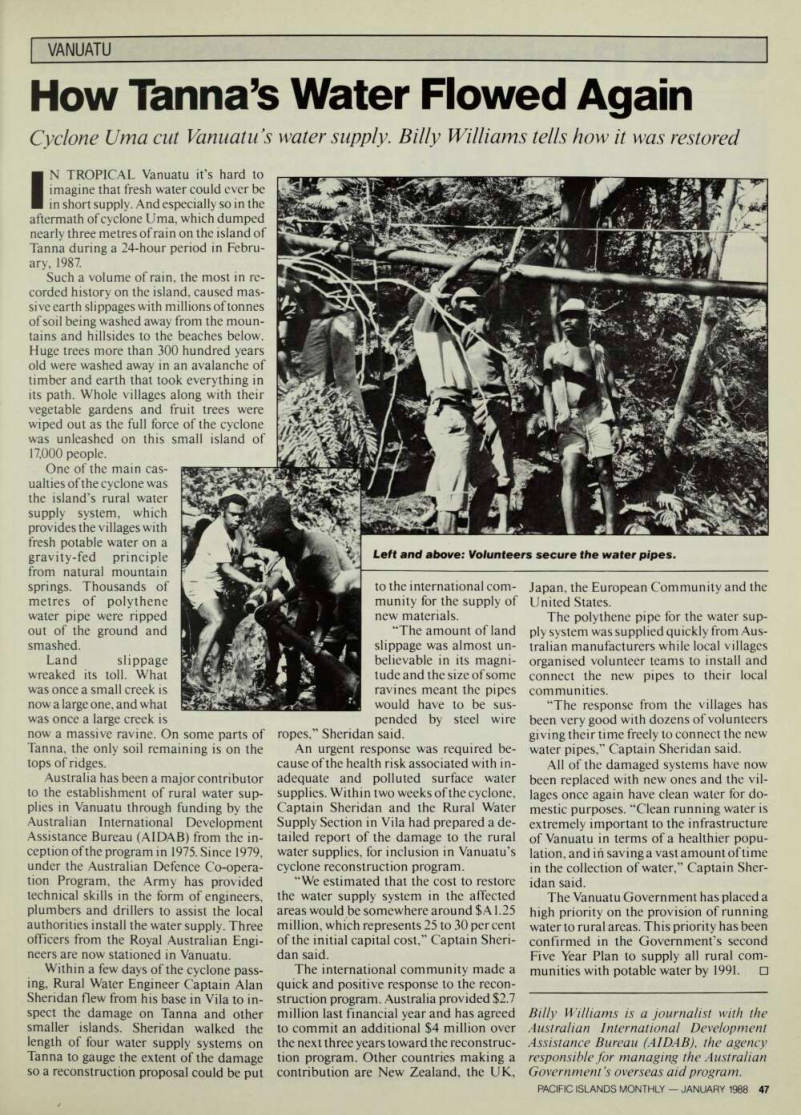
Vanuatu
Cyclone Uma cut Vanuatu’s water supply. Billy Williams tells how it was restored
IN TROPICAL Vanuatu it’s hard to imagine that fresh water could ever be in short supply. And especially so in the aftermath of cyclone Uma, which dumped nearly three metres of rain on the island of Tanna during a 24-hour period in Febru ary, 1987.
Such a volume of rain, the most in re corded history on the island, caused mas sive earth slippages with millions of tonnes of soil being washed away from the moun tains and hillsides to the beaches below.
Huge trees more than 300 hundred years old were washed away in an avalanche of timber and earth that took everything in its path. Whole villages along with their vegetable gardens and fruit trees were wiped out as the full force of the cyclone was unleashed on this small island of 17,000 people.
One of the main cas ualties of the cyclone was the island’s rural water supply system, which provides the villages with fresh potable water on a gravity-fed principle from natural mountain springs. Thousands of metres of polythene water pipe were ripped out of the ground and smashed.
Land slippage wreaked its toll. What was once a small creek is now a large one, and what was once a large creek is
now a massive ravine. On some parts of Tanna, the only soil remaining is on the tops of ridges.
Australia has been a major contributor to the establishment of rural water sup plies in Vanuatu through funding by the Australian International Development Assistance Bureau (AIDAB) from the in ception of the program in 1975. Since 1979, under the Australian Defence Co-opera tion Program, the Army has provided technical skills in the form of engineers, plumbers and drillers to assist the local authorities install the water supply. Three officers from the Royal Australian Engi neers are now stationed in Vanuatu.
Within a few days of the cyclone pass ing, Rural Water Engineer Captain Alan Sheridan flew from his base in Vila to in spect the damage on Tanna and other smaller islands. Sheridan walked the length of four water supply systems on Tanna to gauge the extent of the damage so a reconstruction proposal could be put
to the international com munity for the supply of new materials.
“The amount of land slippage was almost un believable in its magni tude and the size of some ravines meant the pipes would have to be sus pended by steel wire
ropes,” Sheridan said.
An urgent response was required be cause of the health risk associated with in adequate and polluted surface water supplies. Within two weeks of the cyclone, Captain Sheridan and the Rural Water Supply Section in Vila had prepared a de tailed report of the damage to the rural water supplies, for inclusion in Vanuatu’s cyclone reconstruction program.
“We estimated that the cost to restore the water supply system in the affected areas would be somewhere around SA 1.25 million, which represents 25 to 30 per cent of the initial capital cost,” Captain Sheri dan said.
The international community made a quick and positive response to the recon struction program. Australia provided $2.7 million last financial year and has agreed to commit an additional $4 million over the next three years toward the reconstruc tion program. Other countries making a contribution are New Zealand, the UK,
Japan, the European Community and the United States.
The polythene pipe for the water sup ply system was supplied quickly from Aus tralian manufacturers while local villages organised volunteer teams to install and connect the new pipes to their local communities.
“The response from the villages has been very good with dozens of volunteers giving their time freely to connect the new water pipes,” Captain Sheridan said.
All of the damaged systems have now been replaced with new ones and the vil lages once again have clean water for do mestic purposes. “Clean running water is extremely important to the infrastructure of Vanuatu in terms of a healthier popu lation, and in saving a vast amount of time in the collection of water,” Captain Sher idan said.
The Vanuatu Government has placed a high priority on the provision of running water to rural areas. This priority has been confirmed in the Government’s second Five Year Plan to supply all rural com munities with potable water by 1991. □
Billy Williams is a journalist with the Australian International Development Assistance Bureau (AIDAB), the agency responsible for managing the Australian Government’s overseas aid program.
Left and above: Volunteers secure the water pipes.
Book Reviews
TRANSPACIFIQUES: Observations et considerations diverses sur les Terres et Archipels du Grand Ocean By Jean Chesneaux; Editions la Decouverte, 1 Place Paul-Painleve, 75005 Paris.
Reviewed by Helen Hill WHAT does the average French citizen think and believe about the South Pacific? Are French images, dreams and beliefs about the South Seas based on a solid foundation of infor mation, or on myth, prejudice or decep tion? It is rare that we have the opportunity of looking into the minds of the French.
This book, unfortunately, will not help us. It has a different purpose, different audience, and is written in French a language most of us don’t read. Neverthe less, it has an extremely important pur pose, and one for which Pacific people (including Australians and New Zealand ers) should be thankful to Jean Ches neaux. It’s his belief that despite our time’s “fetishism of communication”, an “abyss of non-communication” separates public opinion in the countries of the Pacific from that in France. This book, clearly aimed at the casual reader rather than the spe cialist, has as its task the bridging of that abyss from the French side.
English-speaking readers will be some what surprised to find a book on the Pa cific for French readers beginning with a description of Canberra, complete with the “kitsch colonnades” of Civic and the fine wines of the Australian National Univer sity Staff Club. Those who know Can berra might be even more surprised to find it described as an early stronghold of the New Left! The portrait is here, however, because Canberra is where Chesneax’s own voyage of discovery of the South Pa cific started. Had he not come to the ANU in 1970 as a visiting Professor in Chinese and Vietnamese history, and become in volved with Australian academics op posed to the Vietnam war, he might have emerged with quite a different view of the Pacific region.
Indeed, by comparing his own intellec tual voyage (following contacts given to him in Canberra and New Zealand) with the journeys of Bougainville or Jules Veme, Chesneaux seems to be stressing the dif ficulties, for a Frenchman, of coming to a view of the Pacific that is not determined by the vast amount of cultural and politi cal preconceptions that cloud French of ficial thinking.
Yet it is these “cultural dreams” penned
by Verne, Melville and Stevenson and il lustrated by Gauguin, that are seen as pro viding some of the undesirable cultural baggage that ensures many French view the Pacific as an exotic place of pleasure, of unknowable mystery and significantly, of freedom from responsibility. The four chapters on “Cultural Dreams” covering the mutiny on the Bounty , the writings of Jules Verne and other novelists, and the role of anthropologists in the South Pa cific might seem a little out of place, in a book such as this, particularly as each topic is covered in a distinctly sketchy fashion.
However, Chesneaux’s technique appears to be to create some accord in the minds of his French readers by making connec tions with their existing images of the Pa cific before moving on to the more political and hard-hitting stuff, which will ques tion a great deal of their beliefs about France in the region.
Thus it is not until Chapter 17 that we begin to see some of the “state taboos” of France’s presence in the Pacific discussed.
According to Chesneaux, two logics com bine, both of which are officially regarded as essential for the interests of France. The first is the necessity of the “independent nuclear deterrent”; the other is France’s need to be regarded as a world power of medium size. These two have combined to produce the policy of nuclear testing on Mururoa a policy which, Chesneaux claims, continues due to bureaucratic and financial interests, mythology, and civil and military careerism rather than out of necessity for the defence of France.
He points out that it has never been demonstrated that Mururoa, chosen for its isolation when nuclear tests were carried out in the atmosphere, was indispensable for underground nuclear testing. But in the nine years between the geographical transfer of testing from the Sahara to Po lynesia, and the technological transfer from atmospheric to underground testing, so much was invested in the Centre de I’Ex perimentation du Pacifique (CEP) and associated commercial and military es tablishments, that its use has had to be jus tified regardless of whether it really is necessary.
Second, the policy of deterrence envis ages preventing war, not winning it. This is the basis on which the force de frappe is sold to the French people; a policy, how ever, that is inconsistent with continuous testing to perfect a weapon such as the neutron bomb. Third, Chesneaux asks, have there been any circumstances when France’s possession of the force de frappe
has made France any more independent or more powerful internationally? He can think of none.
Last, he points out that the CEP is lo calised in the Pacific region, yet its aim is to be part of a “global” strategy of which the priority areas are on the other side of the planet. How useful would they be in the event of an attack by the Soviet Union on France?
How does the French State react to these “taboo” questions being raised? We are not told in detail, but some interesting quotes from reconstructed ’6os radical Regis Debray, adviser to President Mit terrand on the South Pacific, are pro vided. When confronted with the question of almost complete unanimity in the Pa cific, including Australia and New Zea land, on the question of nuclear testing and France’s continued presence in new Ca ledonia, Debray talks of “a conspiracy be tween the customary law of islanders and the biblical morals of the missionaries from London”. Nineteenth century dis putes and prejudices are still alive and well.
Chesneaux comes down clearly on the side of the Pacific islanders and the Forum consensus, which have renewed opposi tion to the nuclear tests and supported the case of the Kanaks in the United Nations though he also points out many ex amples of Pacific prejudice and ignorance about France.
It’s a pity the author didn’t have the op portunity to visit more of the independent countries of Polynesia and Melanesia, to give French readers more insight into how small island states can survive independ ence and to break down prejudices that apply to countries such as Papua New Guinea and Vanuatu. His description of the Nuclear Free and Independent Pacific Movement, while highly flattering to its participants, seems to overestimate its size and level of regional co-ordination.
Chesneax’s position is, unfortunately, a minority one within France, but the people of the Pacific should be glad to have such an eloquent advocate within the French academic establishment who can put their case forward. His reputation as a scholar on Vietnam and China should en sure his book is read in France, despite the challenge it provides to the so-called “na tional consensus”. His next task is to try to bridge the abyss of non-communication between France and the Pacific from the other side by producing, not a translation of Transpacifiques but a book, in English, that will explain the French view of the Pacific to English-speaking readers.
Transition
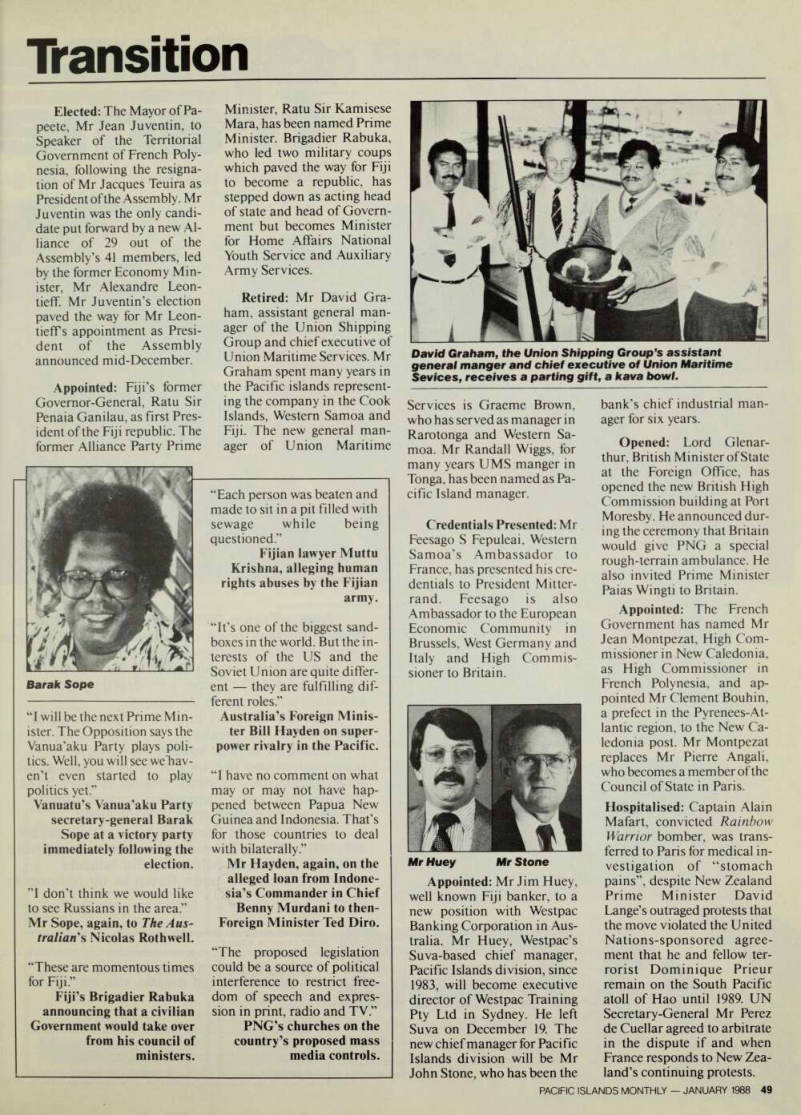
Elected: The Mayor of Pa peete, Mr Jean Juventin, to Speaker of the Territorial Government of French Poly nesia, following the resigna tion of Mr Jacques Teuira as President of the Assembly. Mr Juventin was the only candi date put forward by a new Al liance of 29 out of the Assembly’s 41 members, led by the former Economy Min ister, Mr Alexandre Leon tieff. Mr Juventin’s election paved the way for Mr Leon tieff s appointment as Presi dent of the Assembly announced mid-December.
Appointed: Fiji’s former Governor-General, Ratu Sir Penaia Ganilau, as first Pres ident of the Fiji republic. The former Alliance Party Prime
Minister, Ratu Sir Kamisese Mara, has been named Prime Minister. Brigadier Rabuka, who led two military coups which paved the way for Fiji to become a republic, has stepped down as acting head of state and head of Govern ment but becomes Minister for Home Affairs National Youth Service and Auxiliary Army Services.
Retired: Mr David Gra ham, assistant general man ager of the Union Shipping Group and chief executive of Union Maritime Services. Mr Graham spent many years in the Pacific islands represent ing the company in the Cook Islands, Western Samoa and Fiji. The new general man ager of Union Maritime
Services is Graeme Brown, who has served as manager in Rarotonga and Western Sa moa. Mr Randall Wiggs, for many years UMS manger in Tonga, has been named as Pa cific Island manager.
Credentials Presented: Mr Feesago S Fepuleai, Western Samoa’s Ambassador to France, has presented his cre dentials to President Mitter rand. Feesago is also Ambassador to the European Economic Community in Brussels, West Germany and Italy and High Commis sioner to Britain.
Appointed: Mr Jim Huey, well known Fiji banker, to a new position with Westpac Banking Corporation in Aus tralia. Mr Huey, Westpac’s Suva-based chief manager.
Pacific Islands division, since 1983, will become executive director of Westpac Training Pty Ltd in Sydney. He left Suva on December 19. The new chief manager for Pacific Islands division will be Mr John Stone, who has been the
bank’s chief industrial man ager for six years.
Opened: Lord Glenar thur, British Minister of State at the Foreign Office, has opened the new British High Commission building at Port Moresby. He announced dur ing the ceremony that Britain would give PNG a special rough-terrain ambulance. He also invited Prime Minister Paias Wingti to Britain.
Appointed: The French Government has named Mr Jean Montpezat, High Com missioner in New Caledonia, as High Commissioner in French Polynesia, and ap pointed Mr Clement Bouhin, a prefect in the Pyrenees-At lantic region, to the New Ca ledonia post. Mr Montpezat replaces Mr Pierre Angali, who becomes a member of the Council of State in Paris.
Hospitalised: Captain Alain Mafart, convicted Rainbow Warrior bomber, was trans ferred to Paris for medical in vestigation of “stomach pains”, despite New Zealand Prime Minister David Lange’s outraged protests that the move violated the United Nations-sponsored agree ment that he and fellow ter rorist Dominique Prieur remain on the South Pacific atoll of Hao until 1989. UN Secretary-General Mr Perez de Cuellar agreed to arbitrate in the dispute if and when France responds to New Zea land’s continuing protests.
“I will be the next Prime Min ister. The Opposition says the Vanua’aku Party plays poli tics. Well, you will see weliav en’t even started to play politics yet.”
Vanuatu’s Vanua’aku Party secretary-general Barak Sope at a victory party immediately following the election. ”1 don’t think we would like to see Russians in the area.”
Mr Sope, again, to 77 1 e Aus tralian's Nicolas Rothwell.
“These are momentous times for Fiji.”
Fiji’s Brigadier Rabuka announcing that a civilian Government would take over from his council of ministers.
“Each person was beaten and made to sit in a pit filled with sewage while being questioned.”
Fijian lawyer Muttu Krishna, alleging human rights abuses by the Fijian army.
“It’s one of the biggest sand boxes in the world. But the in terests of the US and the Soviet Union are quite differ ent they are fulfilling dif ferent roles.”
Australia’s Foreign Minis ter Bill Hayden on super power rivalry in the Pacific.
“I have no comment on what may or may not have hap pened between Papua New Guinea and Indonesia. That’s for those countries to deal with bilaterally.”
Mr Hayden, again, on the alleged loan from Indone sia’s Commander in Chief Benny Murdani to then- Foreign Minister Ted Diro.
“The proposed legislation could be a source of political interference to restrict free dom of speech and expres sion in print, radio and TV.”
PNG’s churches on the country’s proposed mass media controls.
Barak Sope
Mr Huey
Mr Stone
David Graham, the Union Shipping Group’s assistant general manger and chief executive of Union Maritime Sevices, receives a parting gift, a kava bowl.
Advertisements & other items, p. 50 (1 item)
fram
Steel Kit-form Buildings
k Mi Si Im w r M © JL rwwJmm Space-Frame PRE-ENGINEERED kit form buildings have been designed to cover a wide range of industrial and rural applications.
Space-Frame engineering facilities with computer aided design and drafting will produce drawings in 24 hours.
The building kit can be shipped out in less than three weeks.
Because of the advanced design techniques and the use of high tensile steel throughout the building, the kit is very light, making the cost of shipping very minimal compared to conventional structures.
It also means the whole building can be erected without the use of a crane. In remote areas of PNG and other Pacific Islands components have been flown in by helicopter to some sites.
FOR MORE INFORMATION & BROCHURE
POST COUPON TODAY
frame
SPACEFRAME BUILDINGS PTY. LTD.
61 DIDSBURY STREET, EAST BRISBANE, 4169,
QUEENSLAND, AUSTRALIA. TELEX AA42862.
PHONE (07) 393 1455 FAX (07) 391 5016
SPACEFRAME BUILDINGS PTY. LTD.
61 DIDSBURY ST., EAST BRISBANE, 4169, AUST.
NAME.
ADDRESS.
POSTCODE PHONE.
Pacific Stamp Box
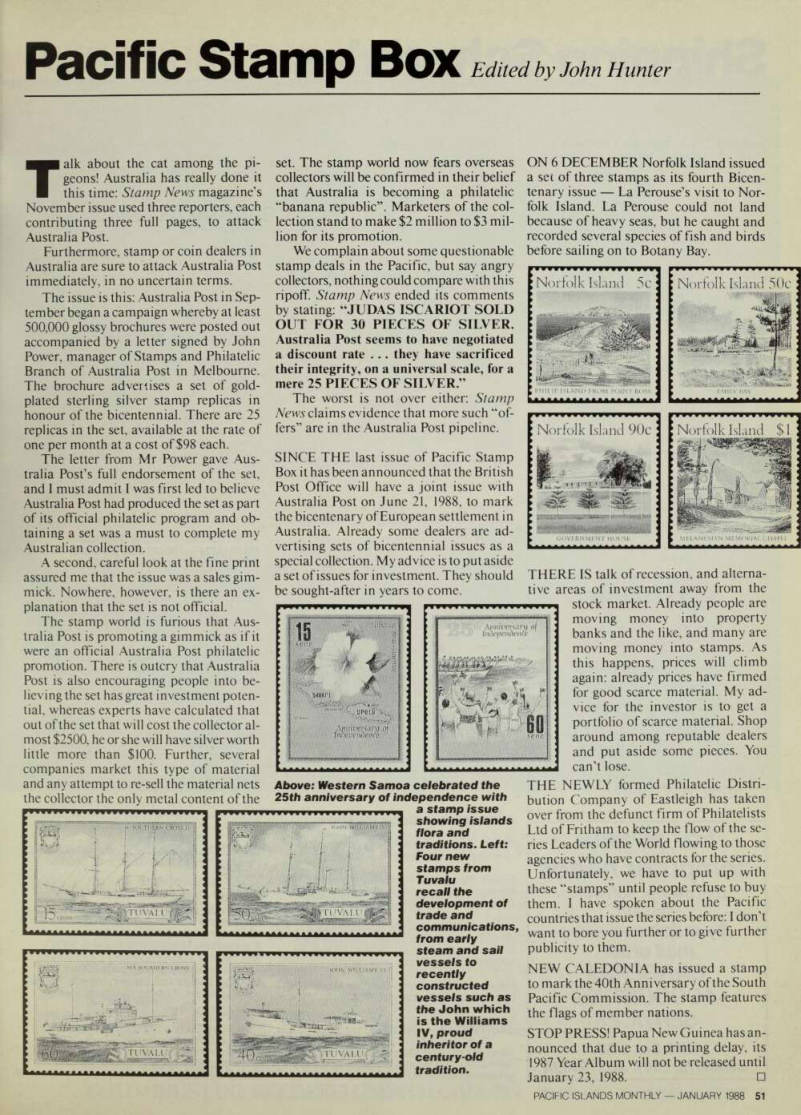
Edited by John Hunter
Talk about the cat among the pi geons! Australia has really done it this time: Stamp News magazine’s November issue used three reporters, each contributing three full pages, to attack Australia Post.
Furthermore, stamp or coin dealers in Australia are sure to attack Australia Post immediately, in no uncertain terms.
The issue is this: Australia Post in Sep tember began a campaign whereby at least 500,000 glossy brochures were posted out accompanied by a letter signed by John Power, manager of Stamps and Philatelic Branch of Australia Post in Melbourne.
The brochure advertises a set of gold plated sterling silver stamp replicas in honour of the bicentennial. There are 25 replicas in the set, available at the rale of one per month at a cost of $9B each.
The letter from Mr Power gave Aus tralia Post’s full endorsement of the set, and I must admit I was first led to believe Australia Post had produced the set as part of its official philatelic program and ob taining a set was a must to complete my Australian collection.
A second, careful look at the fine print assured me that the issue was a sales gim mick. Nowhere, however, is there an ex planation that the set is not official.
The stamp world is furious that Aus tralia Post is promoting a gimmick as if it were an official Australia Post philatelic promotion. There is outcry that Australia Post is also encouraging people into be lieving the set has great investment poten tial, whereas experts have calculated that out of the set that will cost the collector al most $2500, he or she will have silver worth little more than $lOO. Further, several companies market this type of material and any attempt to re-sell the material nets the collector the only metal content of the
set. The stamp world now fears overseas collectors will be confirmed in their belief that Australia is becoming a philatelic “banana republic”. Marketers of the col lection stand to make $2 million to $3 mil lion for its promotion.
We complain about some questionable stamp deals in the Pacific, but say angry collectors, nothing could compare with this ripoff. Stamp News ended its comments by stating: “JUDAS ISCARIOT SOLD
Out For 30 Pieces Of Silver.
Australia Post seems to have negotiated a discount rate ... they have sacrificed their integrity, on a universal scale, for a
Mere 25 Pieces Of Silver;’
The worst is not over either: Stamp News claims evidence that more such “of fers” are in the Australia Post pipeline.
SINCE THE last issue of Pacific Stamp Box it has been announced that the British Post Office will have a joint issue with Australia Post on June 21, 1988, to mark the bicentenary of European settlement in Australia. Already some dealers are ad vertising sets of bicentennial issues as a special collection. My advice is to pul aside a set of issues for investment. They should be sought-after in years to come.
ON 6 DECEMBER Norfolk Island issued a sec of three stamps as its fourth Bicen tenary issue La Perouse’s visit to Nor folk Island. La Perouse could not land because of heavy seas, but he caught and recorded several species of fish and birds before sailing on to Botany Bay.
THERE IS talk of recession, and allerna live areas of investment away from the
stock market. Already people are moving money into property banks and the like, and many are moving money into stamps. As this happens, prices will climb again; already prices have firmed for good scarce material. My ad vice for the investor is to gel a portfolio of scarce material. Shop around among reputable dealers and put aside some pieces. You can’t lose.
THE NEWLY formed Philatelic Distri bution Company of Eastleigh has taken over from the defunct firm of Philatelists Ltd of Fritham to keep the flow of the se ries Leaders of the World flowing to those agencies who have contracts for the series.
Unfortunately, we have to put up with these “stamps” until people refuse to buy them. I have spoken about the Pacific countries that issue the series before: I don’t want to bore you further or to give further publicity to them.
NEW CALEDONIA has issued a stamp to mark the 40th Anniversary of the South Pacific Commission. The stamp features the flags of member nations.
STOP PRESS! Papua New Guinea has an nounced that due to a printing delay, its 1987 Year Album will not be released until January 23, 1988. □
Above: Western Samoa celebrated the 25th anniversary of independence with
a stamp issue showing islands flora and traditions. Left: Four new stamps from Tuvalu recall the development of trade and communications, from early steam and sail vessels to recently constructed vessels such as the John which is the Williams IV, proud inheritor of a century-old tradition.
Shipping Schedules
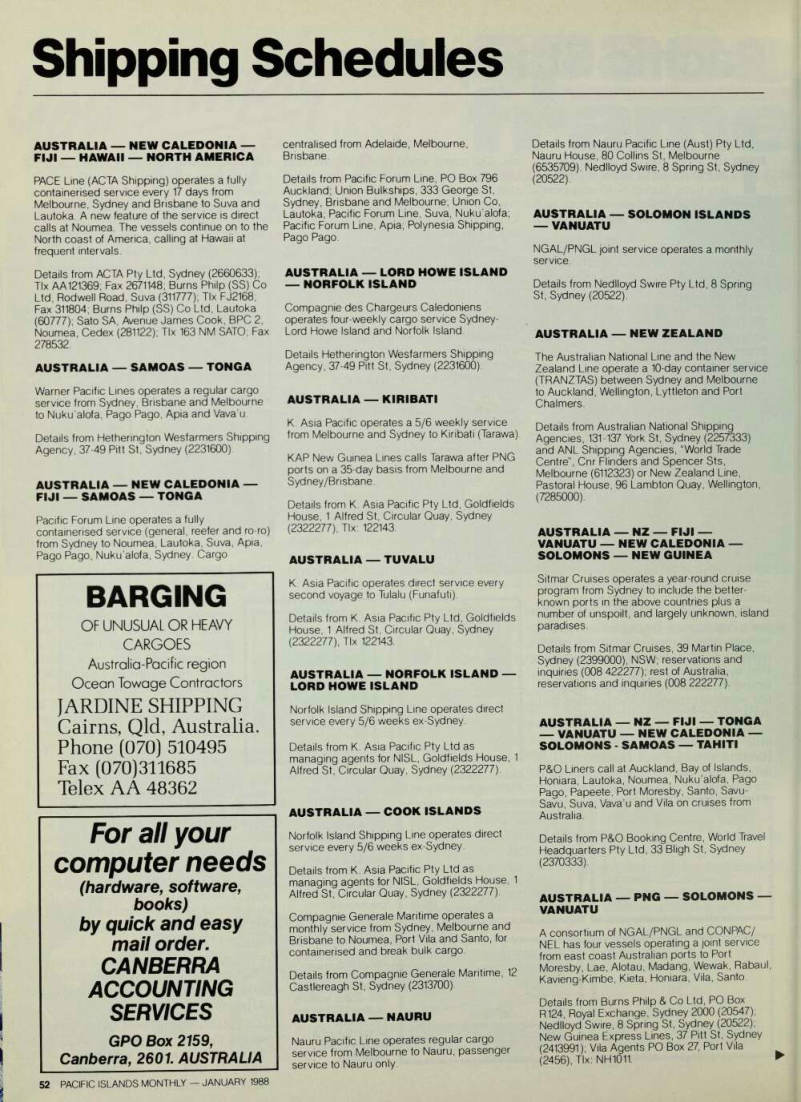
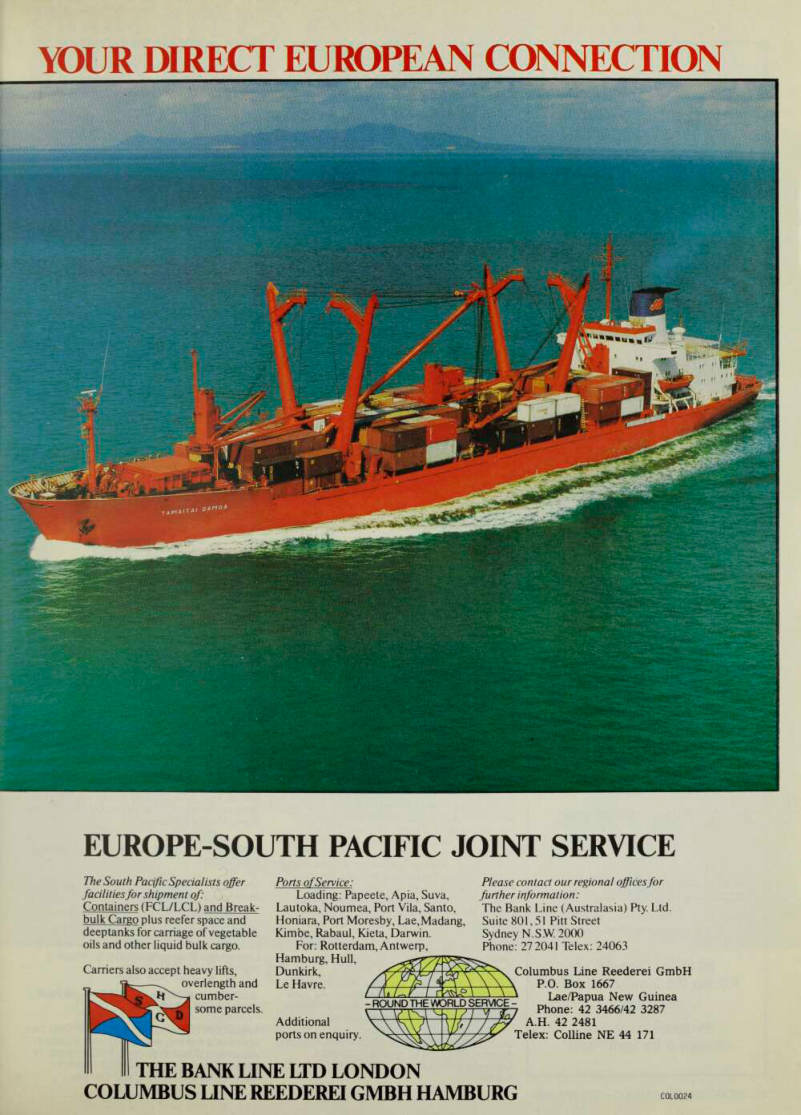
Australia New Caledonia
Fiji Hawaii North America
PACE Line (ACTA Shipping) operates a fully containerised service every 17 days from Melbourne, Sydney and Brisbane to Suva and Lautoka A new feature of the service is direct calls at Noumea. The vessels continue on to the North coast of America, calling at Hawaii at frequent intervals.
Details from ACTA Pty Ltd, Sydney (2660633); Tlx AA121369; Fax 2671148; Burns Philp (SS) Co Ltd, Rodwell Road, Suva (311777); Tlx FJ2168; Fax 311804; Burns Philp (SS) Co Ltd, Lautoka (60777); Sato SA, Avenue James Cook, BPC 2, Noumea, Cedex (281122); Tlx 163 NM SATO; Fax 278532.
Australia Samoas Tonga
Warner Pacific Lines operates a regular cargo service from Sydney, Brisbane and Melbourne to Nukualofa, Pago Pago, Apia and Vava’u.
Details from Hetherington Wesfarmers Shipping Agency. 37-49 Pitt St. Sydney (2231600).
Australia New Caledonia
Fiji Samoas Tonga
Pacific Forum Line operates a fully containerised service (general, reefer and ro-ro) from Sydney to Noumea, Lautoka, Suva, Apia, Pago Pago, Nukualofa, Sydney. Cargo
centralised from Adelaide, Melbourne, Brisbane.
Details from Pacific Forum Line, PO Box 796 Auckland; Union Bulkships, 333 George St, Sydney, Brisbane and Melbourne; Union Co, Lautoka; Pacific Forum Line, Suva, Nukualofa; Pacific Forum Line, Apia; Polynesia Shipping, Pago Pago.
Australia Lord Howe Island
Norfolk Island
Compagnie des Chargeurs Caledoniens operates four-weekly cargo service Sydney- Lord Howe Island and Norfolk Island.
Details Hetherington Wesfarmers Shipping Agency. 37-49 Pitt St, Sydney (2231600).
Australia Kiribati
K. Asia Pacific operates a 5/6 weekly service from Melbourne and Sydney to Kiribati (Tarawa) KAP New Guinea Lines calls Tarawa after PNG ports on a 35-day basis from Melbourne and Sydney/Brisbane.
Details from K. Asia Pacific Pty Ltd, Goldfields House, 1 Alfred St, Circular Quay, Sydney (2322277), Tlx: 122143.
Australia Tuvalu
K. Asia Pacific operates direct service every second voyage to Tulalu (Funafuti).
Details from K, Asia Pacific Pty Ltd, Goldfields House, 1 Alfred St, Circular Quay, Sydney (2322277), Tlx 122143.
Australia Norfolk Island
Lord Howe Island
Norfolk Island Shipping Line operates direct service every 5/6 weeks ex-Sydney.
Details from K. Asia Pacific Pty Ltd as managing agents for NISL, Goldfields House, 1 Alfred St, Circular Quay, Sydney (2322277).
Australia Cook Islands
Norfolk Island Shipping Line operates direct service every 5/6 weeks ex-Sydney.
Details from K. Asia Pacific Pty Ltd as managing agents for NISL, Goldfields House, 1 Alfred St, Circular Quay, Sydney (2322277).
Compagnie Generale Maritime operates a monthly service from Sydney, Melbourne and Brisbane to Noumea, Port Vila and Santo, for containerised and break bulk cargo.
Details from Compagnie Generale Maritime, 12 Castlereagh St, Sydney (2313700).
Australia Nauru
Nauru Pacific Line operates regular cargo service from Melbourne to Nauru, passenger service to Nauru only.
Details from Nauru Pacific Line (Aust) Pty Ltd, Nauru House, 80 Collins St, Melbourne (6535709). Nedlloyd Swire, 8 Spring St, Sydney (20522).
Australia Solomon Islands
Vanuatu
NGAL/PNGL joint service operates a monthly service.
Details from Nedlloyd Swire Pty Ltd, 8 Spring St, Sydney (20522).
Australia New Zealand
The Australian National Line and the New Zealand Line operate a 10-day container service (TRANZTAS) between Sydney and Melbourne to Auckland, Wellington, Lyttleton and Port Chalmers.
Details from Australian National Shipping Agencies, 131-137 York St, Sydney (2257333) and ANL Shipping Agencies, “World Trade Centre”, Cnr Flinders and Spencer Sts, Melbourne (6112323) or New Zealand Line, Pastoral House, 96 Lambton Quay, Wellington, (7285000).
Australia Nz Fiji
Vanuatu New Caledonia
Solomons New Guinea
Sitmar Cruises operates a year-round cruise program from Sydney to include the better known ports in the above countries plus a number of unspoilt, and largely unknown, island paradises.
Details from Sitmar Cruises, 39 Martin Place, Sydney (2399000), NSW; reservations and inquiries (008 422277); rest of Australia, reservations and inquiries (008 222277).
Australia Nz Fiji Tonga
Vanuatu New Caledonia
Solomons - Samoas Tahiti
P&O Liners call at Auckland, Bay of Islands, Honiara, Lautoka, Noumea, Nukualofa, Pago Pago, Papeete, Port Moresby, Santo, Savu- Savu, Suva, Vava’u and Vila on cruises from Australia.
Details from P&O Booking Centre, World Travel Headquarters Pty Ltd, 33 Bligh St, Sydney (2370333).
Australia Png Solomons
Vanuatu
A consortium of NGAL/PNGL and CONPAC/ NEL has four vessels operating a joint service from east coast Australian ports to Port Moresby, Lae, Alotau, Madang, Wewak, Rabaul, Kavieng-Kimbe, Kieta, Honiara, Vila, Santo.
Details from Burns Philp & Co Ltd, PO Box R 124, Royal Exchange, Sydney 2000 (20547); Nedlloyd Swire, 8 Spring St, Sydney (20522); New Guinea Express Lines, 37 Pitt St, Sydney (2413991); Vila Agents PO Box 27, Port Vila
(2456), Tlx: Nhioii.
4 New Guinea Express Lines operates a weekly container service from Melbourne, Sydney, Brisbane to Port Moresby, Lae, Alotau, Kimbe, Rabaul, Kieta, Honiara, Kavieng, Madang, Wewak, Santo, Vila.
Details from New Guinea Express Lines, PO Box R 73, Royal Exchange, Sydney (2413991); New Guinea Express Lines, 127 Creek St, Brisbane (2219333); New Guinea Express Lines, 84 William St, Melbourne (6025544); Nuigini Express Lines, Port Moresby (214572); New Guinea Express Lines agent Steamships Trading, Rabaul (921400); Bougainville Agencies Pty Ltd, Kieta (956089); New Guinea Express Lines, Steamships Trading Co, Madang (822446); New Guinea Express Lines, Garumut Enterprises, Wewak (862106); Burns Philp (PNG) Ltd, Kavieng (942133); Alotau Steevedoring and Transport, Alotau (611318); Ngatia Wholesalers Pty Ltd, Kimba (93-5102); and Tradco Shipping, Mandana Avenue, Honiara (22588); Vila Agents Ltd, PO Box 971, Vila, Vanuatu (2490); John Lum & Associates, PO Box 65, Santo, Vanuatu (329).
Singapore Hong Kong Fiji
Islands Ports
Kyowa Shipping Co Ltd operates a monthly containerised and break bulk cargo service from Hong Kong to Lautoka, Suva and then to island ports.
Details from Carpenters Shipping, Private Mail Bag GPO Suva Fiji (312244); Fax: (679) 314572, Tlx FJ2199.
Far East Fiji New Zealand
New Zealand Unit Express (NZUE) operates a monthly service accepting containerised and break bulk cargo from Manila, Keelung, Kaohslung and Hong Kong to Lautoka, Suva and thence to New Zealand ports.
Details from Carpenters Shipping, Private Mail Bag GPO Suva (312244), Fax: (679) 314572; Tlx FJZI99; Burns Philp, Suva (311777); New Zealand Unit Express, Maritime Building, 2-10 Customhouse Quay, PO Box 890, Wellington
(727865), Cables: Enzue-Man Wellington,
Tlx: NZ31340, NEDLNZ, or Nedlloyd Swire Pty Ltd, Sydney (20522).
Far East Mid-S. Pacific
China Navigation’s New Guinea Pacific Line operates a regular container service from Hong Kong, Taiwan, Philippines, Singapore, Malaysia and to Port Moresby, Lae, Rabaul, Kieta and Honiara monthly. Wewak and Madang will receive four direct calls a year. A T/S service via Lae to these and other PNG ports connecting with monthly sailings is available at cost. Cargo from the same Eastern ports to the South Pacific ports of Noumea, Santo, Vila, Papeete, Pago Pago, Apia, Nuku’alofa, Raratonga and Tarawa will be shipped via Japan or Busan on the monthly Bali Hai service.
Details from Steamships Shipping, PO Box 634, Port Moresby (220283 or 220289).
Kyowa Shipping Ltd, operates monthly services from Japan to Guam, Saipan, Solomons, New Caledonia, Fiji, Western and American Samoa, Tahiti, Cook Islands, Tonga and Vanuatu.
Details from Hetherington Wesfarmers Shipping Agency, 37-49 Pitt St, Sydney (2231600); Carpenters Shipping, Suva (312244), Tlx: FJ2199.
Guam Northern Marianas
Saipan Shipping Co Inc operates a weekly service via barge carrying containers and conventional cargo between Guam and Saipan and Tinian.
Details from Saipan Shipping Co, Inc, PC Box 8, Saipan, CM 96950 (322 9706 or 3229707), Tlx: 783619; Fax: (670) 3223183; Guam agents Maritime Agencies of the Pacific Ltd.
Hawaii Samoas Tonga
Cook Islands
Hawaii-Pacific Lines operates monthly container service between Honolulu, Pago Pago, Apia, Nuku’alofa and Avatiu (Rarotonga).
Details from Hawaii-Pacific Maritime, Inc, PC Box 3264, Honolulu, HI 96801-3264 (808 53114841), Details from: Morris Hedstrom (Samoa) Ltd, PO Box 189, Apia, Western Samoa (21355, 22722), Tlx: 224 (MORISHED SX), Fax: 24-279; Union Citco Travel Ltd, Rarotonga, Cook Islands (682 21780); Tlx; 62024 (UTRAV G); Fax: (682) 20859; Kneubuhl Maritime Services, PO Box 39, Pago Pago, American Samoa, 96799 (684 6335121/ 22); Tlx: 782505; Fax; (684) 6335100; Union Maritime Services Ltd, PO Box 4, Nuku’alofa, Tonga (21644/5); Tlx: 66227, Fax: (676) 21645.
Japan Fiji Island Ports
Kyowa Shipping Co. Ltd operates a monthly containerised service from main ports of Japan to Suva, Lautoka, thence to island ports.
Details from Carpenters Shipping, Harbour Centre Building, Ist Floor, Thomson St, Suva (312244), Tlx: FJ2199, and Burns Philp, Suva (311777).
Japan Micronesia
The NYK Shipping Line operates a monthly cargo service from Japan to Micronesia, calling at Yoko, Nagoya, Kobe, Guam, Saipan, Truk, Ponape and Majuro, returning via Yoko, Nagoya and Kobe.
Details from Burns Philp & Co. Ltd, 51 Pitt St, Sydney (2591000).
Saipan Shipping Co Inc operates a monthly service from Japan to Saipan, Guam, Truk, Ponape, Majuro (Kosrae and Ebeye on inducement).
Details from Saipan Shipping Co Inc, PO Box 8, Saipan, CM 96950 (322 9706 or 3229707), Tlx: 783619, Fax: (670) 3223183. Japan agents Kyowa Shipping Company Ltd; Guam Agents Maritime Agencies of the Pacific Ltd.
Japan Korea Png Paradise
Service
Mitsui OSK Lines operates a monthly service from main ports in Japan, Wewak, Lae, Rabaul, Kieta, Port Moresby.
Details from Robert Laurie Company (PNG) Pty Ltd, PO Box 1032, Lae/PNG (423642, 423811), Contact; W O Hackenberg, Group Shipping Manager.
Japan Korea Png Japan
Paradise Service
Mitsui OSK Lines in joint service with Nyk Lines operates a monthly service from main ports in Japan and Busan in Korea to PNG ports of Wewak, Rabaul, Kieta, Lae, Port Moresby, Kavieng, Kimbe, Madang and Oro Bay.
I Details from Robert Laurie Company Pty Ltd PO Box 1032, Lae/PNG (Direct: 423642 or Switch: 423811), Contact: W O Hackenberg, Group Shipping Manager & Marketing; Tlx: NE 42508, Fax: 423801.
Png Inter-Mainport
Papua New Guinea Line offers scheduled 10-20 day coastal liner services linking all PNG major ports with containerisation, reefer, heavy lift and trans-shipment facilities.
Details from PNG Line, Box 543, Port Moresby PNG (211174), Tlx: 22269.
Png Uk/Continent
The Bank Line & Columbus Line operate a regular joint service from Port Moresby, Oro Bay, Kieta, Rabaul, Kimbe, Madang and Lae to Hull, Hamburg, Rotterdam, Antwerp and Le Havre.
Details from The Bank Line (A'asia) Pty Ltd, 51 Pitt St, Sydney (272041). Tlx: AA24063; Columbus Line, Lae (423466), Tlx: NE 44171; or lines' local agents.
Solomons Uk/Continent
The Bank Line & Columbus Line operate a regular joint cargo service from Honiara to Hull, Hamburg, Rotterdam, Antwerp and Le Havre.
Details from The Bank Line (A'asia) Pty Ltd, 51 Pitt St, Sydney (272041), Tlx: AA24063;
Columbus Line, Lae (423466), Tlx. NE44171; Tradco Shipping Ltd, Honiara (22588), Tlx: 66313.
New Zealand Australia
Png Solomon Islands
Pacific Forum Line operates a containerised and ro-ro service from Lyttelton, Napier and Auckland to Brisbane, Port Moresby, Lae, Honiara, Brisbane then New Zealand.
Details from Pacific Forum, Auckland, Christchurch; Union Bulkships, Brisbane; Steamships Shipping, Port Moresby and Lae; Sullivans Ltd, Honiara; Seabridge, Wellington,
New Zealand Cook Islands
Tahiti
New Zealand Line operates cargo services based on pallets and similar units from Auckland to Cook Islands and Tahiti.
Details from NZ Shipping Agencies International Ltd, PO Box 3420, Auckland (392650); Waterfront Commission, PO Box 61, Raratonga; Cook Islands; Shipping Office, Govt, of Niue, PO Box 107, Niue Island; Compagnie Maritime Polynesienne, PO Box 36, Papeete, Tahiti.
New Zealand —Fiji
Reef operates a regular 18-day service from Auckland to Suva and Lautoka. Also passenger accommodation.
Details from Reef Shipping Agencies, PO Box 3382, Auckland, NZ (7712213), Tlx: 60633, MV
Fijian Shipping Agencies Ltd, Private Bag, Suva, Fiji (311056).
Pacific Line with one ship operates two weekly ro-ro cargo service New Zealand, Lautoka, Suva. No passengers.
Details Sofrana Unilines, 18 Customs St, Auckland (773279), PO Box 3614, Tlx: NZ2313, Carpenters Shipping, Neptune House, Tofua St Walu Bay, Suva (25141). Tlx: FJ2199.
New Zealand Fiji North
America (Wc)
Blue Star Line Ltd Pacific Coast container services. Only direct service to and from New Zealand, Blue Star vessels call at Suva and Honolulu on NZ-US West Coast voyages.
Details from Blueport ACT (NZ) Ltd, PO Box 192, Wellington (739029); Burns Philp (SS) Co Ltd, GPO Box 355, Suva, Fiji (311777), Tlx: FJ2168 Burship,
New Zealand Fiji Samoas
Tonga
Pacific Forum Line operates a containerised and ro-ro 21 day service from Auckland to Lautoka, Suva, Apia, Pago Pago and Nukualofa.
Details from Pacific Forum Line, Auckland, Christchurch, Suva and Apia, Union Maritime, Lautoka, and Nukualofa; Polynesian Shipping, Pago Pago,
New Zealand Tonga
Samoas
Warner Pacific Line Services: Auckland, Nukualofa, Vava’u, Apia, Pago Pago fortnightly carrying general and freezer cargoes and FCL Dry.
Details from McKay Shipping Ltd, Downtown House, 21 Queen St, Auckland, PO Box 3 (390229). Cables MACSHIP, Tlx: NZ2554f; Warner Pacific Line, Box 93, Nuku'alofa, Tonga; Mealelel (Western Samoa) Ltd, Private Bag Apia, Western Samoa; Burns Philp (SS) Co Ltd, PO Box 129, Pago Pago, American Samoa (6332709), Cables 506, Burnsouth SB.
Nz Cook Islands Aitutaki
Niue
Cook Islands Line services Auckland, Aitutaki, Niue monthly carrying general and freezer cargoes.
Details from McKay Shipping Ltd, Downtown House, 21 Queen Street, Auckland, PO Box 3, Auckland (390229). Cables MACSHIP, Tlx: NZ2554; Fax: 32931.
Tahiti New Caledonia
Vanuatu Solomon Islands
New Zealand Png - Singapore
Europe
Polish Ocean Lines operate in semi-container type vessels to the following ports: from Papeete, Noumea, Santo, Vila, Yandina, Honiara, Auckland, Rabaul, Lae, Singapore, Port Kielang, Penang then to Mediterranean ports and Europe via the Suez Canal. (Other New Zealand ports subject to inducement).
Details from Universal Shipping Agencies Ltd, 6th Floor, 38 Fort St, Auckland 1, NZ (390931, 390727, 32104), Tlx: 21517 ►
1 Europe Tahiti New
Caledonia
Compagnie Generate Maritime operates services from Europe and Mediterranean ports to Papeete and Noumea using three ro-ro and multi-purpose vessels thus ensuring a bi monthly sailing to and from.
Details from Compagnie Generale Maritime, 12 Castlereagh St, Sydney (2313700).
Europe Tahiti New
Caledonia New Zealand
Vanuatu Solomons Png -
Europe
Polish Ocean Lines offers regular monthly sailings for containerised and break bulk cargo, also conventional reefer space and reefer containers from Hamburg, Rotterdam, Dunkirk, Le Havre to Papeete, Noumea, Auckland, Santo, Honiara, Rabaul, Lae, Singapore, returning to Europe via Suez. Other ports in the South Pacific can be served directly with inducement or otherwise via transshipment.
Details from Sotama, BP 9170, Papeete (427805), Tlx: 373, Tlx: Sotama 373FP; SATO: BP, C 2 Noumea Cedex (272094), Tlx: 163 NM; Universal Shipping Agencies, PO Box 2282 Auckland (30930), Tlx: 21517; Vanua Navigation, PO Box 44, Vila (2027), Tlx: 1033; Melan Chine Shipping Co, PO Box 71, Honiara (21678), Tlx: 66335; Steamships Trading Co Ltd, PO Box 85, Lae (424666), Tlx: 42423; Union Steamship Co of NZ Ltd, PO Box 50, Apia (21781), Tlx: 225; Warner Pacific Line, PO Box 93, Nuku’alofa (22088), Tlx: 66219; Fiji Agents TBA.
Europe Tahiti W. Samoa
Fiji New Caledonia
Nedlloyd offers regular cargo services from Continental ports to Papeete, Apia, Fiji and New Caledonia.
Details Nedlloyd (Aust.) Pty Ltd, Spring St, Sydney (273801); Carpenters Shipping, Ist Floor, Harbour Centre Bldg, 100 Thomson St, Suva (312244) Tlx: 2199FJ and Vetari St, Lautoka (63988), Tlx: 5215FJ.
Uk Europe W. Samoa
Tonga Fiji
The Bank Line & Columbus Line operate a regular joint cargo service from Hull, Hamburg, Bremen, Antwerp, Rotterdam and Le Havre to Apia, Nuku'alofa, Suva and Lautoka.
Details from The Bank Line (A'asia) Pty Ltd, 51 Pitt St, Sydney (272041), Tlx: AA24063, Columbus Line, Lae (423466), Tlx: NE 44111, or Lines’ local agents.
Uk Europe Png
Solomons
The Bank Line & Columbus Line operate a regular joint cargo service from Hull, Hamburg, Bremen, Antwerp, Rotterdam and Le Havre to Port Moresby, Lae, Madang, Kimbe, Rabaul, Kieta and Honiara and on inducement to Yandina.
Details from The Bank Line (A'asia) Pty Ltd, 51 Pitt St, Sydney (272041), Tlx: AA24063: Columbus Line, Lae (423466), Tlx: NE44171; or Lines’ local agents.
Uk/Europe Tahiti New
Caledonia Vanuatu
The Bank Line and Columbus Line operate a regular joint cargo service from Hull, Hamburg, Bremen, Antwerp, Rotterdam and Le Havre to Papeete, Noumea, Port-Vila and Santo, Details from The Bank Line (A'asia) Pty Ltd, 51 Pitt St, Sydney (272041), Tlx: AA24063, Columbus Line, Lae (423466), Tlx; NE44171; Ets A.M. Fare LITE, Papeete; Ets, Ballande, Noumea and other local agents.
Us Hawaii Micronesia
Png
PM&O Lines operates two fully self-contained container vessels on a sailing frequency of every 30 days between the San Francisco Bay Area, Los Angeles, Honolulu and Majuro, Ebeye, Kosrae, Ponape, Truk, Saipan, Yap, Palau, Cebu, Davao, Lae, Kieta and Rabaul.
Details from PM&O Lines, 353 Sacramento St, San Francisco, California 94111, USA, (415 4215400), Tlx: 278016 PMC UR; owner’s Representative PO Box 803, Saipan, NMI 96950
(2346819), Tlx: 783605 Cmcaa.
Advertisements & other items, pp. 52-57 (1 item)
computer needs
BARGING
OF UNUSUAL OR HEAVY
CARGOES
Australia-Pacific region Ocean Towage Contractors
JARDINE SHIPPING
Cairns, Qld, Australia.
Phone (070) 510495 Fax (070)311685 Telex AA 48362
For all your
computer needs
(hardware, software, books) by quick and easy mail order.
CANBERRA
ACCOUNTING
SERVICES
GPO Box 2159, Canberra, 2601. AUSTRALIA
YOUR DIRECT EUROPEAN CONNECTION
'■ ' -■ •' ' u«
EUROPE-SOUTH PACIFIC JOINT SERVICE
The South Pacific Specialists offer facilities for shipment of: Containers (FCL/LCL) and Breakbulk Cargo plus reefer space and deeptanks for carriage of vegetable oils and other liquid bulk cargo.
Carriers also accept heavy lifts, overlength and cumbersome parcels.
Ports of Service: Loading; Papeete, Apia, Suva, Lautoka, Noumea, Port Vila, Santo, Honiara, Port Moresby, Lae,Madang, Kimbe, Rabaul, Kieta, Darwin.
For: Rotterdam, Antwerp, Hamburg, Hull, Dunkirk, Le Havre.
Please contact our regional offices for further information: The Bank Line (Australasia) Pty. Ltd.
Suite 801,51 Pitt Street Sydney N.S.W. 2000 Phone: 272041 Telex: 24063 Additional ports on enquiry.
Columbus Line Reederei GmbH P.O. Box 1667 ROUNDTHEWDRLD SERVICE- I*e/PapuaNew Guinea Phone: 42 3466/42 3287 A.H. 42 2481 Telex; Colline NE 44 171
THE BANK LINE LTD LONDON
COLUMBUS LINE REEDEREI GMBH HAMBURG
C0L0024
IMEL
Services
Reach Out
Thousands
of Miles
into The
Pacific. It's
where we
work.
• Heavy Engineering • Air Conditioning • Sheetmetal • Electrical • Refrigeration • Quality work • Competitive prices.
O^9>IMEL
/ INDUSTRIAL AND MARINE
ENGINEERING LIMITED
Tel: 312133. Telex: FJ2195
P.O. Box 296, Suva FIJI ISLANDS
FAX: 312854
“the complete Engineering Company of the South Pacific”.
POLISH OCEAN IMS
General Management, 10 Lutego 24,81-364 GDYNIA, POLAND, Phone: 20-19-01, Cables: POLOCEAN Telex: 054-231 Q Q m m & & CT :\v i sx *'S ff? rf vvr & v,? pi
SOUTH PACIFIC SERVICE
We offer monthly service to and from: GDYNIA, HAMBURG, ROTTERDAM, MIDDLESBOROUGH/IMMINGHAM, ANTWERP, DUNKIRK, ROUEN, PAPEETE (via PANAMA), NOUMEA, AUCKLAND, HONIARA, RABAUL, LAE, SINGAPORE, by our multipurpose vessels carrying dry and reefer containers, reefer chambers, heavy lifts, breakbulk or palletized, bulk liquids.
POLISH OCEAN LINES Representatives AUCKLAND Mr. A. Sieradzki. Telex 21517 NZ “UNISHIP". SYDNEY Mr. Ryszard Socha. Telex 20428 AA “SLEIGH”
POLISH OCEAN LINES Agents
SOTAMA Telex 296 FP “COUTIMEX". NEW CALEDONIA SATO Telex 163 NM “SATO”. AUCKLAND UNIVERSAL SHIPPING AGENCIES LTD., Telex 21517 NZ “UNISHIP". SOLOMONS MELAN CHINE SHIPPING CO., LTD Telex 66335 HO “SYMECO". PNG nrr Alim Tr\ a
KYOWA
KYOWA
SHIPPING
CO., LTD.
Liner Service to Paciffic Islands
FROM OJAPAN OHONG KONG
OKOREA OSINGAPORE
©TAIWAN
TO OSAIPAN
OFEDERATED STATES
OF MICRONESIA
OMARSHAL ISLANDS
©AMERICAN SAMOA
©NEW CALEDONIA
©FIJI
©GUAM
©YAP
©PALAU
©WESTERN SAMOA
©SOLOMON ISLANDS
©VANUATU
©PAPUA NEW GUINEA
HEAD OFFICE
6th Floor , Kikushima Bldg . 2-3, Hamamatsucho 2-chome Mmato-ku. Tokyo 105. Japan Phone: 03(437)2885 (Rep ) Cables: "MARIQUEEN" Tokyo Telex: 242-4651 Kyowa J
OSAKA OFFICE
Dai San Fuji Bldg. 3-13 Itachibon 1-chome, Osaka 550.
Phone: 06(533)5821 (Rep ) Cables. MARIQUEEN" Osaka Telex: 525-6271 Ssiosa J
A recipe for a great holiday
i *Prices quoted are in Australian dollars, US cheques for equivalent amounts are accepted from within USA only.
COOK ISLANDS: One of the plainest names in the Pacific identifies one of the most beautiful countries on earth; 15 small, germ like islands containing little more than 20,000 inhabitants and scattered over 2 000 000 sq km of ocean.
The Cook Islands and their people have charmed travellers since the early 17th century. Now, thanks to improved air services, an increasing number of discerning visitors who appreciate the special qualities that only Polynesia can offer, are discovering the magic of this pocket paradise.
The fascinating past and the appealing present of these beautiful islands is described in detail in this new book the first comprehensive guide to the Cook Islands.
Accommodations, restaurants, facilities and a full description of each island are included.
Attractively designed and generously illustrated in colour and black (Sc white. *Price: $A11.95 plus postage and packing (within Australia $A2.55, Overseas 5A3.60) Please send copy(ies) of COOK ISLANDS A GUIDE and I enclose my payment of $ Name : Address Postcode
CREATIVE ASSOCIATES
2nd Floor, 125 York Street,
VW SYDNEY, NSW 2001, AUSTRALIA
Bringing The Heroes Home
Out Of The Past
By Maclaren Hiari
The quest to find, and bury, the lost airmen ofWWII.
THE search to retrieve, identify and bury with full military honours the remains of some 2000 Allied air men both Americans and Australians lying in the jungles, swamps and waters of Papua New Guinea is continuing 43 years after World War II ended.
From Port Moresby to Lae, Goroka and Madang, or in a multitude of other places, the remains of aircraft four decades old are still lying in the matted undergrowth.
It was then a time of war, and the skies were filled with Liberator, Fortress, Mitchell and Havoc bombers, Airocobra, Kittyhawk, Thunderbolt and Lightning fighters and Dakota transport aircraft.
Their crews were young men, filled with the vigour of youth.
For hundreds of these young warriors, this land was to become their final resting place lost, but not forgotten, on some cloud-covered mountain or hidden among the foliage of a lowland rainforest. Their mortal remains lie amid the shattered wreckage of what was once a proud fighter, bomber or transport aircraft.
Most of the remains will never be found, despite combined efforts by agencies of the Papua New Guinea, Australian and US Governments. Many, however, have been located and re-buried in one of the Allied war cemeteries that dot PNG. For many more, their only memory is the words: “Missing in action, presumed dead”.
At the end of the war, the Royal Aus tralian Air Force, in conjunction with the United States Graves Registration Serv ice, mounted an extensive program to search for, and locate, Allied aircraft still missing. In the course of this program, which lasted for almost 40 years, a large number of aircraft were located: it seems incredible until one sees the terrain that aircraft are still being found.
The responsibility for continuing this program is now vested in the War Mu seum of the National Museum and Art Gallery in Port Moresby. The War Mu seum is responsible for documenting and recording aircraft losses incurred by Aus tralia, the US, New Zealand and Japan during World War 11. Extensive records are now held on most US aircraft, and many Australian losses. Information is being added every day: the latest recovery of the remains of three American and one Aus tralian airmen in the jungles of Oro Prov ince, in south-eastern PNG, is a good example of this combined effort, with the assistance of the local people.
An Orokavian man, Frank Egiamban, while on a hunting trip in July, 1986, found
the crash site of an American C-47, or DC 3, transport plane at the northern end of Middle Embi Lake, about 15 kilometres south-east of Popondetta. The plane, which carried a crew of three Americans and one Australian, was shot down on No vember 26, 1942, by Japanese fighter planes. When US troops reached the scene of the crash all the occupants were dead, and in the confusion prevailing at the time the battle of Buna was about to be fought the bodies were not recovered.
Mr Egiambari reported his find to lo cal wartime enthusiast David Penne father, who has had previous experience in locating and examining war relics. Both men visited the crash site and Pennefather discovered skeletal remains when he was sorting through debris. He contacted Bruce Hoy, Curator of the War Museum, who in formed the RAAF in Canberra.
The plane was indentified as a C-47 nicknamed Swamp Rat. It belonged to the 6th Troop Carrier Squadron of the 374th Troop Carrier Group, and the Australian crew member was its co-pilot.
In December, 1986, a two-man inves tigating team from the US Army Central Identification Office in Hawaii, Sergeants Randy Nash and Tom Baughman, spent a week in Popondetta and visited the crash site. Accompanied by Culture and Tour ism Development Officer Simon Akai and myself Maclaren Hiari, Senior Projects Officer with the Department of Oro the team photographed pieces of wreckage and prepared a crash-site sketch.
Further investigation revealed addi tional wreckage at the top of an 85-degree incline, at a distance of 60 metres from the main crash site. Remains of landing gear were found on the ridge and photo graphed: altogether wreckage on the ridge was scattered over a distance of 30 metres.
The US Army Central Identification Laboratory also sent a 12-man team to Oro Province in June, 1987, to recover the re mains of the four crew members.
A large portion of the aircraft re mained above ground and various parts of it were identifiable, though detached on impact. Swamp Rat had come to rest in dense jungle approximately two and a half hours walk from the old Dobuduru Air base, from which it took off on its last flight. The wreck itself sits at the bottom of a deep gully. It had hardly been affected by the elements over 46 years, though some bones were found buried about 40 centi metres beneath the jungle leaf litter.
A more detailed inspection of the crash site established that the plane dislodged its
wings as it ploughed through the trees: one wing was found on a slope about 40 metres from where the fuselage came to rest. Most of the wreck was in one spot, though pieces were found not far from the main wreck.
The CIL team spent three days in the jungle, painstakingly mapping and peg ging out the crash site and sifting through the remains. Some skeletal remains, dis covered earlier by Pennefather, were already evident. The team wanted to find the rest of the remains, if any, and to try to establish if any other personnel were in the plane at the time of the crash.
Various items from the plane were un covered within a small radius around the crash site: radios, a compass, flare pistols, gun cleaning kits and uniform buckles.
Bone fragments were uncovered just for ward of the cockpit area. Several teeth and portions of a skull, or skulls, were located a few centimetres below ground level. It was apparent the plane’s occupants had been projected forward among the wreck age of the cockpit. The bone fragments were placed in boxes for their journey back to Honolulu.
The team also found an RAAF identi fication tag, which confirmed the pres ence of the lone Australian airman at the time of the crash. The wreckage was then left as it had been dismantled.
To those who stumble across an air craft wreck, a word of warning: most air craft were carrying live ammunition, bombs, flares and oxygen cylinders at the time they crashed. Nothing should be picked up or removed from the wreckage, but its location and serial number, if vis ible (large yellow or white numbers painted on the tail, or a series of numbers painted below the pilot’s side window) should be reported to the National Museum, avia tion, maritime and war branch, which will arrange for a Defence Force team to visit the wreckage.
There are still 360 missing aircraft from the American sth and 13th Air Forces in PNG: 148 fighters, 163 bombers, 21 trans ports and 28 miscellaneous aircraft types, representing more than 1500 personnel. Of this number, approximately 35 per cent are thought to have crashed into the sea.
The War Museum has not completed its research into missing Australian, New Zealand and Japanese aircraft, but it is hoped authorities in these countries will assist. With the help of the villager on a hunting trip, the forestry survey worker, the geologist or bushwalker, many of these aircraft will be found in the years to come. n
Advertisements & other items, pp. 59-60 (1 item)
Do your Clients publicize
your message
without saying a word?
Regardless of what you wish to promote, it’s certain your message needs to be seen and there just isn’t a better, or more economical solution than the high quality printed acrylic sun visor.
This fashion conscious, sports accessory will publicize your message, or logo motif in the best
possible way... “at eye-level”.
The K’nTva Company are Australia’s
promotional aid professionals.
Their fantastic range of sun visors enjoy world-wide market acceptance.
Unrivaled for quality,
durability and
price. They come
in twenty opaque and six UV mod-
ified transparent
colours. Printing
capabilities
offer the choice of every foil / or ink colour
available. Up
to six different foil/ink colours can be printed
in tight registration
to your requirements.
The K’nl’va Art department can work from
bromides, artwork, or
(via the phone on
436 2584) faxed thru visual concepts. Most orders of printed Visors S 3 % § can be delivered FOB from Sydney in ten to fourteen working days from receipt of an official company order and credit securities.
Of course the cost per unit varies depending on the desired quantity and complexity of printing. An order for as little as one thousand units, printed in three different colours and including art make-up, printing blocks etc. would amount to a cost of no more than $l.BO each. Most orders usually work out much less.
So as a marketable promotional aid at a nominal RRP* of around $4.95, or rwp* of $2.50, K’nl’va Sun Visors can generate handsome profits.
So don’t be misled by poor imitations the
original Australian
K’nl’va Sun Visors are the value for
money premium
product. Give
them a call,
discuss quantity/
pricing details
and ask to see a sample.
You’ll see why K’nl’va f (Can-I-have-a) sun visors are the market leaders.* I By ENROCAST PROPRETARY UNITED Incap n I The K’nl’va Company 92 Reserve Road, Artarmon NSW 2064 Australia Tel: (02) 436 2325 Fax: (02) 436 2584 Telex: AA121822 (Quote SY 3708) : fi *RRP: Recommended retail price. *RWP: Recommended wholesale price. At time of publication
WGS: KV4392
THE WYNN’S SAFARI- VICTORY THREE YEARS IN A ROW
Conquering the lonely continent.
The challenge of the Australian continent is an elemental one, one that has tempted intrepid adventurers for hundreds of years. Early explorers, lonely, driven men found the lure of the vast red interior irresistible. It presented the chance of going beyond the realms of civilization, and many never made it back. For the Australian interior is a horribly unique one. Its desolation is total. A land that boasts more varieties of venomous creatures than any other continent does not invite intrusion nor welcome the faint-hearted.
Not much has changed in a hundred years. ■Ufa
PIAA
Snakes and crocodiles still rule this empty land and fools still try to cross it. Every year in August, brave men and women tackle a course of swamps, deserts and rain forest for the glory of winning the Australian Wynn's Safari, 6,500 km of the toughest rally country to be found anywhere. This year, for the third time in a row, it was the Mitsubishi Pajero that roared in, first and second to the cheers of the crowd waiting at the finish line in Darwin. in the incredibly demanding "Marathon Class", that for unmodified 4WDs (essentially the same vehicles that stock showrooms), Mitsubishi's superior durability won out, also for the third year in a row.
In fact, seven of the top ten positions were filled by Mitsubishi Pajeros.
The reason for that kind of unbeatable performance is simple. The active policy at Mitsubishi Motors is to seek out the worst possible conditions to prove the reliability of their vehicles. The ultimate performance test as it were. And the reward is more than just winning; it is the satisfaction of producing vehicles that, in appalling conditions have stood with and bested a select group of latter day adventurers distinguished by a common drive to go beyond the limits of endurance.
AMERICAN SAMOA: MORRIS SCAN LAN SERVICE INC. P.O Box 367 P^^^2^m A LTD I GRO EtaMM n/FRENCH POLY NESI A HITI): Road Clovelly Park South Australe 5042. Tel (08) 21b- J 222/PU\: "JJ® D AUTO DU PACIFIQUE SUD SABP 438 Rond ETS-BREDIN FRERES ET FILS P O Box 21 Papeete Tahiti. Tel 4-202-58/NEWCALETON D IMPU pnvate Bag Ponrua, Tel 370-109 NORFOLK £££ de Lac^^^rt^Vrta^T^2^4/^ESTCRN a SAWK3A: 6 X Tel 22022/SAIPAN/POHNPEI/MAJURO/KOSRAE/TRUK/YAP/ BELAU: MICRONESSIAN MOTORS, INC. 997 South Manne Dnve Tamunmg. Guam 96911 Tel 646 6827 A
MITSUBISHI
MOTORS