Pacific
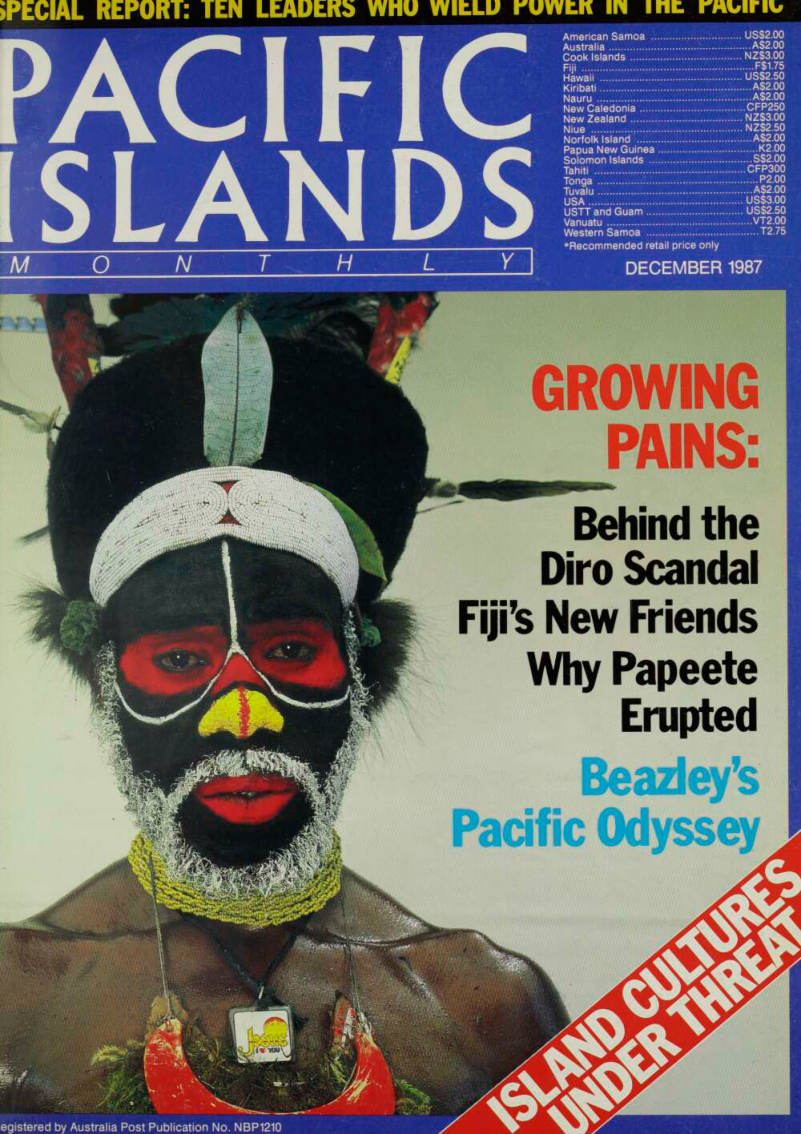
Islands
Monthly
SPECIAL REPORT: TEN LEADERS WHU WltLU ruwtif in int rni/inu
American Samoa USS2.OO Australia A 52.00 Cook Islands NZS3.OO Fiji F s l - 7 5 Hawaii USS2.SO Kiribati A 52.00 Nauru A 52.00 New Caledonia CFP2SO New Zealand NZS3.OO Niue NZS2.SO Norfolk Island A 52.00 Papua New Guinea K 2.00 Solomon Islands 552.00 Tahiti CFP3OO Tonga P 2.00 Tuvalu A 52.00
Usa Uss3.Oo
USTT and Guam USS2.SO Vanuatu VT2.00 Western Samoa T 2.75 ♦Recommended retail price only
December 1987
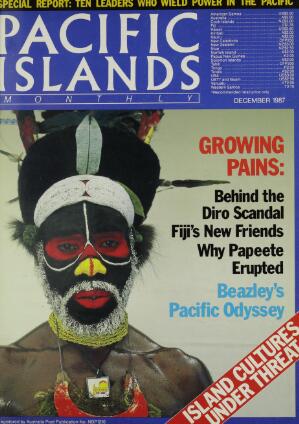
Growing
Pams:
Behind the Diro Scandal Fiji's New Friends Why Papeete Erupted Beazley's Pacific Odyssey
registered by Australia Post p
Advertisements & other items, p. 2 (1 item)
Revolutionary
at every .
The new Prelude is a sports coupe which will revolutionise conventional ideas of the relationship between a car and its driver.
It is a car with sporty, responsive handling to appeal to the keen driver: but through continual refinement by an enthusiastic team of engineers, the new Prelude 2.0i-16 adds a new dimension to the pleasure of motoring with almost extra-sensory handling performance. The secret is in Honda's revolutionary 4-wheel steering system. And it has no precedent in the modern motor car.
New Dimensions in Motoring.
Every revolution begins with a daring new initiative. The new Prelude features a bonnet line that is closer to the road than ever, conveying a real sports car feel. Inside, the wide glass area and wraparound console increase visibility and enhance a spacious, airy environment which centres on the needs of the driver. Each and every facet of performance elevates the relationship between man and machine to a higher level: the innovative 4-wheel double wishbone suspension, 4-wheel anti-lock braking, the race-bred 2.0 litre 16- and 12-valve engines... all work in perfect harmony to satisfy the Same direction* Opposite direction* driver's wants and desires. Add to this the 4WS system on the 2.0i-16, and you have a package which offers supreme handling with looks to match. The new Prelude is a revolutionary move in the right direction, Breathtaking styling and exhilarating responsiveness geared to the true driving enthusiast's innermost desires. It's the Honda way. *The wheel angles are exaggerated for illustrative purposes.
Honda's 4WS is fitted to the 2.0M6 as a standard feature,
(0) HONDA
PRELUDE
2.CK-I6
4111 Specifications and equipment may vary in some countries. ■m sa - i In 1986, Williams/Honda won the Formula 1 Constructors' Championship.
In 1987, Honda's Formula 1 engines power both Williams and Lotus.
Thus, we continue to polish our expertise at the pinnacle of automotive technology.
Mobil an AUSTRALIA: Honda Australia Pty, Ltd. Lot 95 Sharps Road, Tullamarine, Victoria 3043; Bennett Honda Pty, Ltd. 250 Victoria Road, Wetherill Park, N.S.W. 21 64/NEW ZEALAND: NZMC Limited Manners Plaza, 57-65 Manners St., Wellington/PAPUA NEW GUINE Toba Pty., Ltd. P.O. Box 503, Port Moresby/TAHITI Honda Distribution S.A. R.L. B.P 1665, Papeete/KIRIBATI: Atoll Motor & Marino Services P.O. Box 49, Bairiki Tarawa, Republic of Kiribati/U.S. TRUST TERRITORY: United Micronesia Development Association P.O. Box 235, CHRB Saipan CM 96950/COOK ISLANDS: Cook Islands Motor Centre Ltd. P.O.
Box 74, Rarotonga/GUAM: Mark’s Motor Co., Inc. P.O. Box DV, Agana/WESTERN SAMOA: Motor Distributors (Samoa) Ltd. P.O Box 576, Apia/SOLOMON ISLANDS: Lee Kwok Kuen & Co., Ltd. P.O. Box 537, Honiara/NEW CALEDONIA: Soci6t6 Du Chalandage 8, Rue de la somme-B.P 97, Noumea/NAURU: Nauru Cooperation Republic of Nauru/FIJI: Coral Island Motors Ltd. Robertson Road, Suva, Fiji/AMERICAN SAMOA: Holiday Motors, Parts and Service P.O. Box 968, Pago Pago, American Samoa 96799: Heleck’s Service Center Ltd. P.O. Box 1138. Pago Pago, American Samoa 96799/TONGA; Tonga Industrial Traders P.O. Box 1035, Nukualofa, Tonga/NORFOLK ISLAND: Duncombe Bay Garage New Cascade Road, Norfolk Island/VANUATU: Honda Farm Ltd. P.O. Box 1031, Pori Vila, Vanuatu
Pacific
Islands
Monthly
Vol 58, No. 12
Voice Of The Pacific
December, ’B7
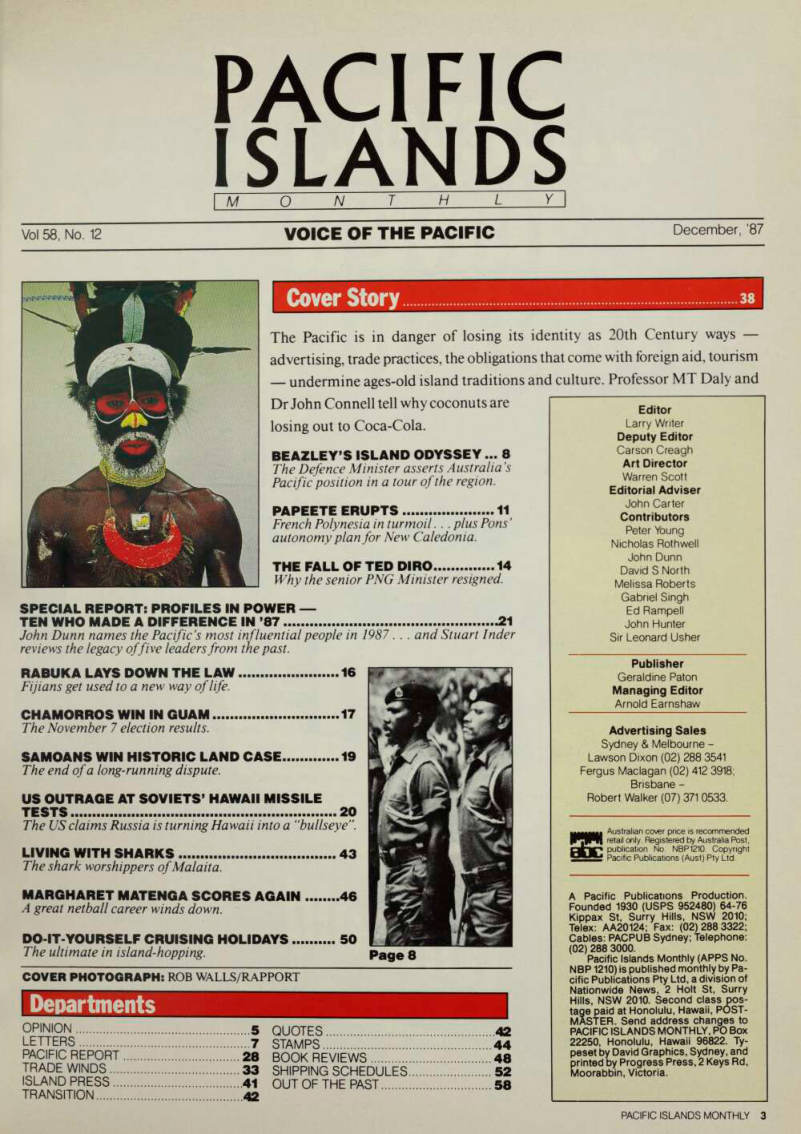
Cover Story 38
The Pacific is in danger of losing its identity as 20th Century ways advertising, trade practices, the obligations that come with foreign aid, tourism undermine ages-old island traditions and culture. Professor MT Daly and
Dr John Connell tell why coconuts are losing out to Coca-Cola.
Beazley’S Island Odyssey ... 8
The Defence Minister asserts Australia ’s Pacific position in a tour of the region.
Papeete Erupts 11
French Polynesia in turmoil. . .plus Pons’ autonomy plan for New Caledonia.
The Fall Of Ted Diro 14
Why the senior PNG Minister resigned.
Special Report: Profiles In Power
TEN WHO MADE A DIFFERENCE IN ’B7 .21 John Dunn names the Pacific’s most influential people in 1987. . . and Stuart Inder reviews the legacy of five leaders from the past.
Rabuka Lays Down The Law 16
Fijians get used to a new way of life.
Chamorros Win In Guam 17
The November 7 election results.
Samoans Win Historic Land Case 19
The end of a long-running dispute.
Us Outrage At Soviets’ Hawaii Missile
Tests 20
The US claims Russia is turning Flawaii into a “bullseye”.
Living With Sharks 43
The shark worshippers of Malaita.
Margharet Matenga Scores Again 46
A great netball career winds down.
Do-It-Yourself Cruising Holidays 50
The ultimate in island-hopping.
Cover Photograph: Rob Walls/Rapport
Page 8
Editor Larry Writer Deputy Editor
Carson Creagh
Art Director Warren Scott Editorial Adviser John Carter Contributors
Peter Young
Nicholas Rothwell John Dunn David S North Melissa Roberts
Gabriel Singh
Ed Rampell John Hunter Sir Leonard Usher
Publisher Geraldine Raton Managing Editor Arnold Earnshaw
Advertising Sales Sydney & Melbourne - Lawson Dixon (02) 288 3541 Fergus Maclagan (02) 412 3918; Brisbane - Robert Walker (07) 371 0533.
Australian cover price is recommended retail only. Registered by Australia Post, publication No. NBP1210. Copyright Pacific Publications (Aust) Pty Ltd.
Departments
Opinion 5
Letters 7
Pacific Report 28
Trade Winds 33
Island Press 41
Transition 42
Quotes 42
Stamps 44
Book Reviews 48
Shipping Schedules 52
Out Of The Past 58
Advertisements & other items, pp. 3-4 (2 items)
3
PACIFIC ISLANDS MONTHLY
A Pacific Publications Production.
Founded 1930 (USPS 952480) 64-76 Kippax St, Surry Hills, NSW 2010; Telex: AA20124; Fax: (02)288 3322; Cables: PACPUB Sydney: Telephone: (02) 288 3000.
Pacific Islands Monthly (APPS No.
NBP1210) is published monthly by Pa cific Publications Pty Ltd, a division of Nationwide News, 2 Holt St, Surry Hills, NSW 2010. Second class pos tage paid at Honolulu, Hawaii, POST MASTER. Send address changes to
PACIFIC ISLANDS MONTHLY, PO Box
22250, Honolulu, Hawaii 96822. Ty peset by David Graphics, Sydney, and printed by Progress Press. 2 Keys Rd, Moorabbin, Victoria.
anyhow
have a
Winfield
Five
faith
OKING
SM
RNING
WA WV2 CC494/80
Learning to Live with Fiji
Opinion
For better or worse, the republic is a fact of Pacific life. Now the world is coming to terms with the new Fiji.
AS THE convulsions caused by Fiji’s coups gradually subside to an acceptance that the Ra buka republic is here to stay there is, at last, some small hope that a form of demo cratic state may yet rise from the chaos of Fiji’s shattered stability.
True, some problems re main achingly far from reso lution tourism is in the doldrums, the economy is in dire straits, number of ex perienced government and business personnel have de parted, sugar may not be har
vested and many Indians are fearful and disaffected. But today there are indications that the republic’s leaders are taking steps to avert the economic and social disaster many thought inevitable after the upheaval.
The ideal of the coups to reassert Fijians’ ascend ancy in their own country remains in the heart of the country’s new leaders. But there are signs that these people have been made to recognise that master plans must be built on a firm foundation of economic growth, military security and social harmony.
To this end. Brigadier Rabuka has done much to allay fears that he is no more than a ruthless and wild-eyed seeker of power, and is adopting a more realistic and pro gressive stance. Curfews have been eased; the presses at the Fiji Times are rolling once more; freedom of worship for non-Christians has been guaranteed; political detai nees have been freed and road blocks dismantled. Cash registers in Indian-owned shops are ringing again.
Some restrictions remain, but all this is at least a be ginning: a first tentative step on the road to normalcy.
A first draft of the country’s new constitution is re portedly being circulated among the community and the Great Council of Chiefs prior to a planned promulgation early in 1988. Emergency measures will be incorporated into the upcoming budget to aid economic recovery.
Among these will be a review of existing incentive pack ages offered to investors.
Developments initiated before the coups are waiting on the framing of the new constitution: a$F 110 million com mercial property development, a SFS million resort com plex on Vanua Levu, and investments by Norwegian, US and Japanese concerns are poised to swing into action.
Former friends of Fiji are cautiously optimistic about
recent events. While deploring the cataclysmic events set in chain by then-Colonel Rabuka, Papua New Guinea, Australia, New Zealand, the United States and Britain are taking the pragmatic line that the coup has happened, that Fiji is no longer the way “the world should be” and per haps never will be again, and the republic is not about to go away. So why not make the best of things? PNG has formally recognised the republic. Australia, New Zea land, the US and UK, spurred by blatant overtures to Fiji by would-be partners such as France, Malaysia, Indone sia, Libya and the Soviet Union, are establishing “unof ficial” contact with Fiji.
Australian medical aid, happily, will continue to save Fijian lives. New Zealand and Australia have lifted union and shipping bans. Australia’s Foreign Minister, Bill Hayden, has sat down with his Fijian counterpart, Filipe Bole, to hear firsthand how the republic plans to restore constitutional democracy. Australia, through Qantas, has become a partner in Fiji’s national airline Air Pacific.
The aims of Brigadier Rabuka and his followers are not difficult to understand, to sympathise with: the strong arm methods he utilised to achieve them can never be condoned. But, for better or worse, the present republic is Fiji. A fact of life in the Pacific. Brigadier Rabuka has much to do, but the wheels of progress, if not spinning at full speed, have at least been oiled.
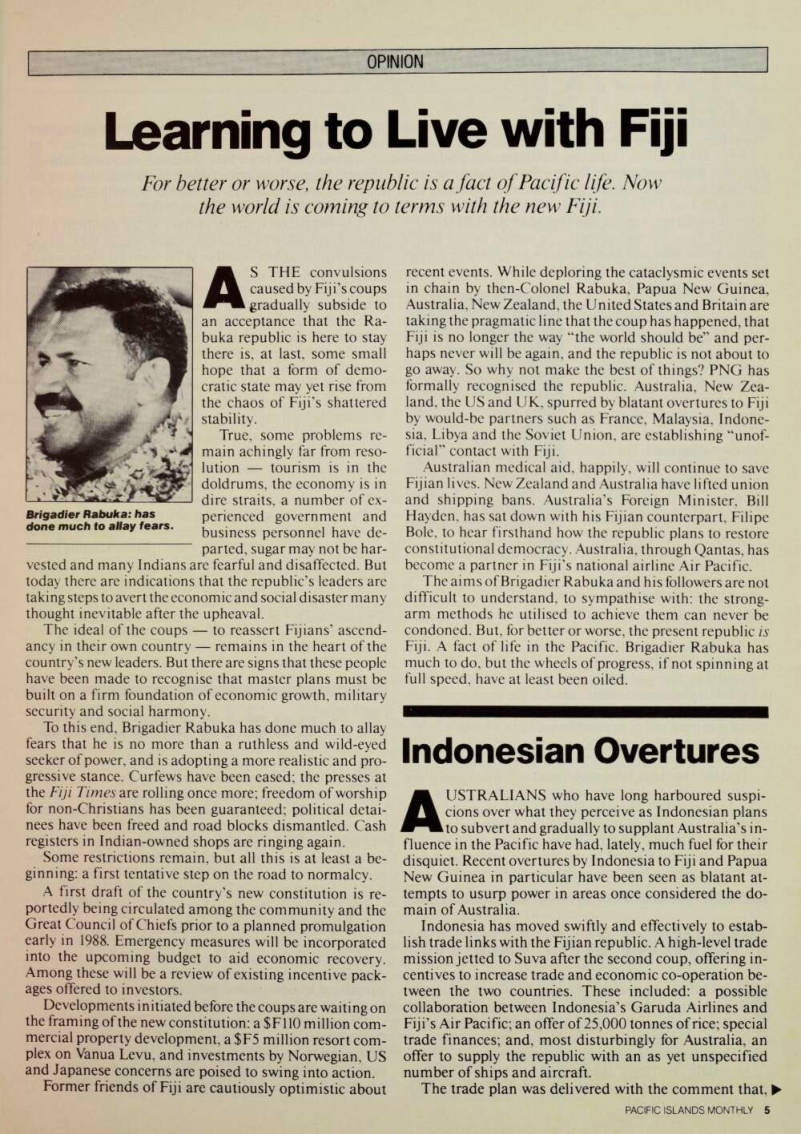
Brigadier Rabuka: has done much to allay fears.
Indonesian Overtures
AUSTRALIANS who have long harboured suspi cions over what they perceive as Indonesian plans to subvert and gradually to supplant Australia’s in fluence in the Pacific have had, lately, much fuel for their disquiet. Recent overtures by Indonesia to Fiji and Papua New Guinea in particular have been seen as blatant at tempts to usurp power in areas once considered the do main of Australia.
Indonesia has moved swiftly and effectively to estab lish trade links with the Fijian republic. A high-level trade mission jetted to Suva after the second coup, offering in centives to increase trade and economic co-operation be tween the two countries. These included: a possible collaboration between Indonesia’s Garuda Airlines and Fiji’s Air Pacific; an offer 0f25,000 tonnes of rice; special trade finances; and, most disturbingly for Australia, an offer to supply the republic with an as yet unspecified number of ships and aircraft.
The trade plan was delivered with the comment that, ►
◄ given Australia’s continued non-recognition of the Fijian republic, it could not afford to be too surprised by the deal.
Fiji’s former allies, including Australia, will read much into any trade agreement. Trade opens the door to mili tary and political ties. It is now considered inevitable that Indonesia and Fiji will open embassies in each other’s capital, and it is no secret that Brigadier Rabuka is an ad mirer of the deep and pivotal role played by the armed forces in the affairs of Indonesia. Experts believe a mod ified version of that military role will be written into the
new Fijian constitution.
Such an ardent trade, political and military partner of Indonesia sitting just 3160 kilometres northeast of Syd ney must be a worrisome prospect for Australia.
And what of the $205,000 “donation” given to the then PNG Government minister, the now-disgraced Ted Diro, by Indonesia’s Commander in-Chief Benny Murdani?
Diro was at the time PNG Foreign Minister and as such guardian of PNG’s border with Indonesian-controlled Irian Jaya. If it had been vir tually anyone but the hard-
anyone but the hardline and politically powerful Mur dani, Diro’s claims that the sum was no more than a gift would be easier for Australia to accept.
The Indonesian strongman’s implacable hostility to Australia is well-documented, and the “gift” has been in terpreted by many as an attempt to meddle in the affairs of a country where Australia continues to exercise consid erable influence. The chilling implication is that Indo nesia is setting out to expand its influence in the Pacific: an influence based on military muscle rather than any sense of commonality with the region’s peoples.
To date, there has been no official comment from Aus tralia about the Indonesian activity. However, when For eign Minister Bill Hayden recently said that the South Pacific was showing signs of “strain and even turbulence” and that Australia would need to display more skill in safeguarding its interests in the area, he would be remiss if he did not have Indonesia on his mind.
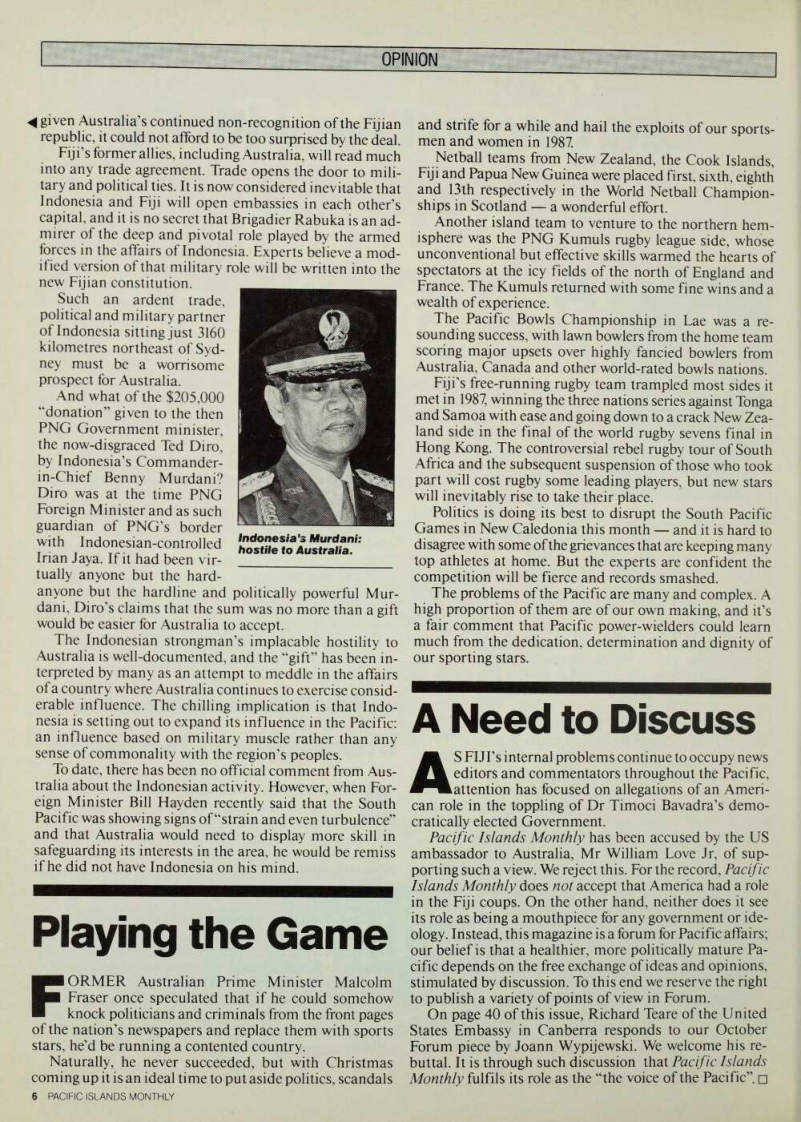
Indonesia’s Murdani: hostile to Australia.
Playing the Game
FORMER Australian Prime Minister Malcolm Fraser once speculated that if he could somehow knock politicians and criminals from the front pages of the nation’s newspapers and replace them with sports stars, he’d be running a contented country.
Naturally, he never succeeded, but with Christmas coming up it is an ideal time to put aside politics, scandals
and strife for a while and hail the exploits of our sports men and women in 1987.
Netball teams from New Zealand, the Cook Islands, Fiji and Papua New Guinea were placed first, sixth, eighth and 13th respectively in the World Netball Champion ships in Scotland a wonderful effort.
Another island team to venture to the northern hem isphere was the PNG Kumuls rugby league side, whose unconventional but effective skills warmed the hearts of spectators at the icy fields of the north of England and France. The Kumuls returned with some fine wins and a wealth of experience.
The Pacific Bowls Championship in Lae was a re sounding success, with lawn bowlers from the home team scoring major upsets over highly fancied bowlers from Australia, Canada and other world-rated bowls nations.
Fiji’s free-running rugby team trampled most sides it met in 1987, winning the three nations series against Tonga and Samoa with ease and going down to a crack New Zea land side in the final of the world rugby sevens final in Hong Kong. The controversial rebel rugby tour of South Africa and the subsequent suspension of those who took part will cost rugby some leading players, but new stars will inevitably rise to take their place.
Politics is doing its best to disrupt the South Pacific Games in New Caledonia this month and it is hard to disagree with some of the grievances that are keeping many top athletes at home. But the experts are confident the competition will be fierce and records smashed.
The problems of the Pacific are many and complex. A high proportion of them are of our own making, and it’s a fair comment that Pacific power-wielders could learn much from the dedication, determination and dignity of our sporting stars.
A Need to Discuss
AS FIJI’S internal problems continue to occupy news editors and commentators throughout the Pacific, attention has focused on allegations of an Ameri can role in the toppling of Dr Timoci Bavadra’s demo cratically elected Government.
Pacific Islands Monthly has been accused by the US ambassador to Australia, Mr William Love Jr, of sup porting such a view. We reject this. For the record, Pacific Islands Monthly does not accept that America had a role in the Fiji coups. On the other hand, neither does it see its role as being a mouthpiece for any government or ide ology. Instead, this magazine is a forum for Pacific affairs; our belief is that a healthier, more politically mature Pa cific depends on the free exchange of ideas and opinions, stimulated by discussion. To this end we reserve the right to publish a variety of points of view in Forum.
On page 40 of this issue, Richard Teare of the United States Embassy in Canberra responds to our October Forum piece by Joann Wypijewski. We welcome his re buttal. It is through such discussion that Pacific Islands Monthly fulfils its role as the “the voice of the Pacific”. □
Letters
Thumbs Down To Pacific Alliance
IN response to the article on a US/Pa cific alliance on page 34 of your Sep tember 1987 issue: Do the Pacific basin nations really need an alliance treaty that ties them to the escalating superpower ri valry arising in the region? Hopefully not.
Doing so would compromise and jeopar dise their independent status in interna tional spheres.
A US/Pacific treaty could only reduce the basin nations to supplicant clients rather than independent allies. A look at several areas of international intrigue in vites this conclusion.
The Pacific nations — the basin na tions, Japan, New Zealand, and several large metropolitan areas such as Hilo, Ha waii and Vancouver, Canada — have set into motion an unprecedented momen tum to curb nuclear proliferation. This anti-nuclear message has become a ne mesis to US nuclear policy makers and a clear message to the Soviets that a no nu clear tolerance exists in the Pacific.
Another area of concern arises out of the American paranoia over a purported Soviet bear thrashing out from Cam Ranh Bay. Perhaps the paranoia is over-exag gerated. A formidable Soviet military presence undoubtably exists, but it’s a pittance compared with American assets in the Philippines, Japan, Guam, South Korea and Hawaii.
A polarising defence agreement with the US would only serve to invite Soviet trickery instead of productive trade.
Sea-bed mining and fishing rights are other areas that invite Pacific supplica tion. Untold wealth from these finite re sources laps at the shores of the Pacific nations. Only international agreements as negotiated from positions of independ ence without duress can truly benefit the basin nations.
Advocates of avoiding a US/Pacific al liance can find supporting historical par allels in the Caribbean. Most noteworthy is the Reagan administration’s successful Caribbean Basin Initiative — a highly successful program that stimulated gulf economies without elaborate economic and defense agreements.
Perhaps a similar plan, a sort of Pacific Marshall Plan or a Pacific Basin Initia tive, is more timely. Such a plan would be more fruitful in fulfilling the needs of the Pacific nations, especially the basin na tions, than the alliance as proposed by LCdr Stavridis, the author of your article.
If the US desires mutual pact agree ments with its basin neighbours it must re cognise their new political consciousness.
Gus Comstock, Lemoore,
Ca 93245 Usa.
Vive La France!
Asa reader of Pacific Islands Monthly for many years, I must add my voice to those who have congratulated you on your new look and new place in regional affairs.
I have noted with alarm the coverage your journal has given the role of France in the Pacific in past years, and am happy to see more balanced writing making its appear ance. But I have some questions for you.
If France is so bad, why did the citizens of New Caledonia vote overwhelmingly for their country to remain a part of France?
If the independentist Kanaks boycot ted the referendum, why did the final vote add up to all the Europeans, Polynesians, Vietnamese and others (all in favour of staying as a part of the Republic) PLUS al most half the Kanaks also in favour of maintaining New Caledonia as a territory of France?
And even if the vote had been for in dependence, who would run the country of Kanaky? The Kanaks are not a major ity of the population, and if they claim to be democratic Socialists, they could not impose their ideas on the majority. Nei ther could they run the Government effec tively partly, perhaps, because the current Government of France has stopped them learning administration, but also because they simply do not have a plat form for an alternative Government.
Like many French people, I do not agree with nuclear weapons and do not support bomb testing at Mururoa atoll. But at least I can see that it has acquainted Po lynesians with technical matters and employments.
This of course is not a justification for exploding bombs in the Pacific, but I would ask how Pacific countries would react if France criticised them?
Jean-Claude Bonné
Bowen Hills Qld, Australia.
Nz’S Lunatic Left
THE challenge to the Lange Labour Government in New Zealand from the radicals of the party is typical of the tactics of the lunatic left. These people sat back silently and allowed the Prime Minister to win the election in a landslide then, from the safe haven of a great victory, came out of the woodwork and threatened to de stroy unity unless their own crackpot pol icies were adopted.
The electorate voted for David Lange’s policies, not for those of a ragtag band of Soviet sympathisers and fellow travellers.
They should be dealt with.
Athol Goodyear Palmerston North New Zealand.
Advertisements & other items, p. 7 (1 item)
Pacific
SLANDS
I M O N T H L Y I FIJI: Distribution and subscriptions: Desai Bookshops, PO Box 160, Suva, Fiji. Phone Suva 23036.
Advertising: Fiji Times & Herald Ltd, 20 Gordon St., Suva.
Phone 31-4111, telex FJ2124.
FRENCH POLYNESIA: Distribution: Hachette Pacifique 10 Ave., Bruat, Papeete. Phone 25-610.
HAWAII: UNITED STATES: Distribution: PIM, Hawaii, PO Box 22250, Honolulu, Hawaii, 96822 Advertising: Brian C Asgill, Apt. 1308,1676 Ala Moana Blvd., Honolulu, Hawaii, 96§15. Phone (808) 955-9718.
JAPAN: Advertising and subscriptions: Universal Media Corporation, GPO Box 46, Tokyo Phone 666-3036, cable UNIMEDIA Tokyo, telex 2524665.
MALAYSIA: Advertising and subscriptions: Worldwide Media Services, 57-B Komplex Damai, Jin Dato Haji Eusoff, Kuala Lumpur Phone 63-9340, cables WORLDMEDIA Kuala Lumpur, telex 31533.
VANUATU: Distribution; The Vanuatu Stationery and Book Centre, PO Box 557 Port Vila Advertising: Norman Bros Bookshop Port Vila Phone 2232.
NEW CALEDONIA: Distribution: Depot Centre de Presse Michel Pentecost. CBP2, Noumea Phone 27- 2434, 27-4729 NEW ZEALAND: Distribution: Gordon & Gotch, PO Box 584, 2 Carr Road, Mt Roskill. Auckland 4 Advertising: McKay International Media Reps Ltd, C/- Albany PO, Auckland 10, New Zealand. Phone 413-9119.
Telex NZ22701, FAX 413-9110.
WELLINGTON: Ross Quaid Media, 1 Scholes Ln„ Petone (04) 68-7593, PO Box 38699, Petone PAPUA NEW GUINEA; Distribution: Gordon & Gotch, PO Box 3395, Port Moresby Phone 25-4551, 25-4855.
Advertising: Ken Head, PNG Post-Courier, PO Box 85, Port Moresby. Phone 21-2577, telex 22120.
SOLOMON ISLANDS: Distribution and Advertising: The Bookshop, (Norman Bros ) PO Box 503, Honiara.
PHILIPPINES: Advertising: The GF Group, 12 San Ignacio St., Uroaneta Village, Makati, Metro Manila. Phone 817-7299, telex 45950 and 4233 UNITED KINGDOM: The Herald & Weekly Times Ltd, No 1 MaltraversSt., LondonWC2R3DZ, England Phone (01) 836-5162, telex London 21989.
UNITED STATES MAINLAND: Advertising: Joshua B Powers Jr,, Powers International Inc., Suite 708, 271 Madison Ave., New York, NY 10016. Phone 867-9580, Subscriptions: PIM, Hawaii, PO Box 22250, Honolulu Hawaii, 96822.
SUBSCRIPTIONS
American Samoa US$45 Australia AUSS24 Canada US$45 Cook Islands AUS$46 Fiji AUS$46 Payments to Pacific Islands Monthly: Subscriptions Dept, GPO Box 5223BB, Melbourne 3001, Australia, Subscriptions rates includes the cost of airspeeding to all destinations set out above. Direct airmail rates on application.
French Polynesia ..
Guam Hawaii Japan Kiribati Micronesia Nauru New Caledonia New Zealand Niue Norfolk Island Northern Marianas Papua New Guinea Solomon Islands ...
Tonga Tuvalu United Kingdom US (Mainland) ., Vanuatu Western Samoa Elsewhere ...US$45 ...US$45 ...US$45 ..US$38
AUS$46
...US$35
AUS$42
...US$32
AUS$42
AUS$46
AUS$42
..US$36
AUS$42
AUS$46
AUS$46
AUS$46
..Stg£28
...US$45
AUS$42
AUS$60
AUS$63
Kim Beazley’s Island Odyssey
The Region
By Fia Cumming
The Defence Minister asserts Australia’s Pacific perspective.
AUSTRALIAN Defence Minister Kim Beazley regards his South Pacific tour last month as a complete success. In the two-week tour, which covered Papua New Guinea, the Solomons, Vanuatu, Tuvalu and Kiribati, Mr Beazley became the first Australian Minister for Defence to visit the region for eight years, In doing so, he was able to gel to know the politicians with whom he has been dealing and will deal in forging closer relations between Australia and the Pacific, and to explain Australia’s new recognition of the importance of its own region to its strategic and military interests.
The area visited by Mr Beazley is one of critical military interest to Australia and was defined in this year’s White Paper on
South Pacific trip was also concerned with maturing relationships with South Pacific countries, and this was one of its main achievements. “If you are putting it in the broad, it was my first general trip to the South Pacific; my primary purpose was to get to know the individuals with whom we are dealing,” Mr Beazley said. “From that point of view, it was a howling success!
“The second purpose was to explain what has been evident since I made a statement on the Pacific in February, and in the White Paper, that Australia has changed its orientation in its defence plan ning to give a much higher priority to re lationships with countries in the Pacific area,” Mr Beazley said, “The value of the visit in those circum-
Defence, which set out the Government’s blueprint for strategic thinking.
The paper divided Australia’s strategic environment into two categories of inter est direct military interest and strategic concern. In rough terms, a line from Northern Papua New Guinea through the Solomons and Vanuatu defines the direct military interest zone up to about 1600 kilometres from Australia’s coastline. This is the area considered most vital to Aus tralia’s security, and the area in which it should be capable of “extensive defence operations”.
But according to the Minister, the
stances was to bring into focus what seemed a series of disparate activities, and to put them in a policy framework that is readily comprehensible to other politi cians. Sometimes the sorts of things we do in the Defence Co-operation Program get missed at a political level, and it helps to have someone in a position to discuss it with his counterparts.
“From another angle, for me it was very important to be able to state that part of the reason we want these changes in our relationships, and why the area is signifi cant to us, is that we recognise that the South Pacific presents a very different re
gional entity in the international political community than it did 10 years ago.”
Even a decade ago, Mr Beazley feels, most Pacific countries were either newly independent or about to become inde pendent, and nation-building tasks preoc cupied them. Today, they are established as separate nations and are turning to more international questions. “So we are deal ing with people who are now independent entities, entitled to respect on those grounds, and who have developed foreign policies,” he said. “Basically, the trip was a chance to say ‘we acknowledge this po sition, and we are here on the basis of equals, discussing matters of mutual concern’.”
That was, he believes, the attitude the Pacific nations wanted to see in Australia and one they have welcomed and ac cepted. On the broad question of Pacific relations, Mr Beazley made the point that a more relaxed, mature attitude was needed between neighbours sharing long term interests. He expressed it as a rela tionship on two planes.
“One is that Australia is in the region forever; we are geographically located here and we are not a classic metropolitan power. Therefore we have common, en during interests with the countries of the region in the area’s stability and its devel opment. Whatever happens in our day-to day relationships, this element should al ways be acknowledged in this country . . . and elsewhere.
“Then there is the second plane of ac tivities; how we do respond to day-to-day events, and what will our general inter national political outlooks constitute?
“We have to recognise that there will be differences of views, both on develop ments in the region and on international political systems in general, and we have to be able to live with and to respect the views of those who seek alignment or non alignment and we’re happy to do that.”
One of the constant topics during the tour, and one that provided the most co gent example of maturing relations, was the military takeover of Fiji just before the Minister set out. Mr Beazley said he pre sented Australia’s condemnation of the Rabuka coup strongly, but did not at tempt to impose this view on his host countries.
“It provided an opportunity simply to present our views, which are that we can not stand indifferent to an overthrow of a democratic government; that democracy is the ideology by which this country en dures,” he said. “We also have clear-cut
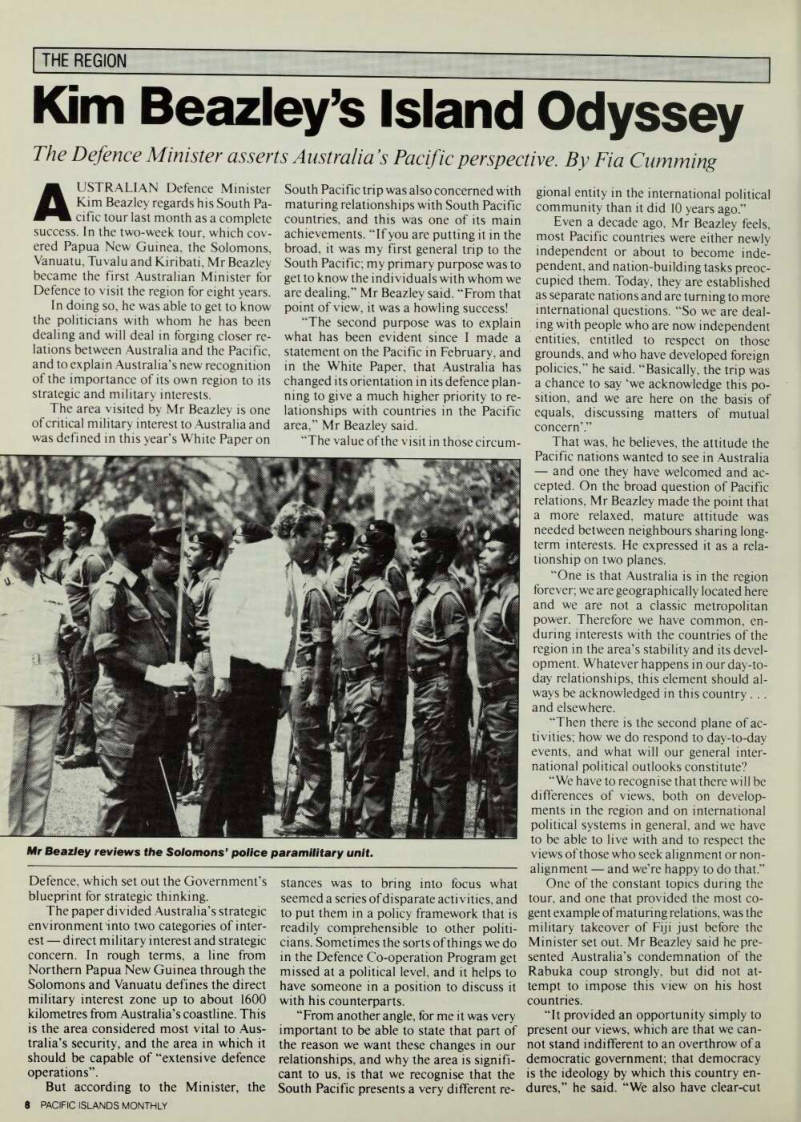
Mr Beazley reviews the Solomons’ police paramilitary unit.
views on the role of the military in de mocracies, and they don’t include govern ment. Nobody should assume that we accommodate developments in disagree ment with that easily.
“I think that view was largely respected in the area; they all have different attitudes about how they should approach their bilateral relations with Fiji in future, and obviously they pursue those views.
“We don’t seek to influence them in one way or another; we merely seek an under standing of why we adopt the views we do.”
The non-interventionist policy of the Hawke Government was also demon strated in Vanuatu. Despite past tensions including a ban on defence visits Mr Beazley claims differences have now been resolved in an atmosphere of mutual re spect. “We accept their right to determine their foreign policy in the way they see fit,”
he said. “Vanuatu has now given us an indication of what it requires in terms of infor mation and notice on such things as ship visits. We see Vanuatu’s position as reason able, and we’ll conform to it.
And there have recently been ship visits to Vanuatu.”
Mr Beazley said the issue
of Libyan involvement in Vanuatu was not even raised, though Australia’s concern
over growing links lay behind the former tensions. “We have made our point and said what we consider important, and I think the point’s been noted in the region; so there wasn’t any necessity to pursue it.”
In what could be seen as a veiled criticism of Foreign Affairs Minister Bill Hayden for his comments over Libya, Mr Beazley said, “I think we need to be more relaxed about it, not to view it as a crisis if somebody comes out and says something we don’t like. 1 can understand the way Bill Hay den has been conducting our foreign relations in the region
it’s essentially the same thing.
“I think there’s an understanding in the region that Australia doesn’t shoot from the hip when something is said with which we don’t agree, and that we’re prepared to act with patient diplomacy based on re spect for the right of other countries to have different views.”
On a more pragmatic level, Mr Bea zley’s trip was concerned with the nuts and bolts of defence relations, the Defence Co operation Program, and with maritime
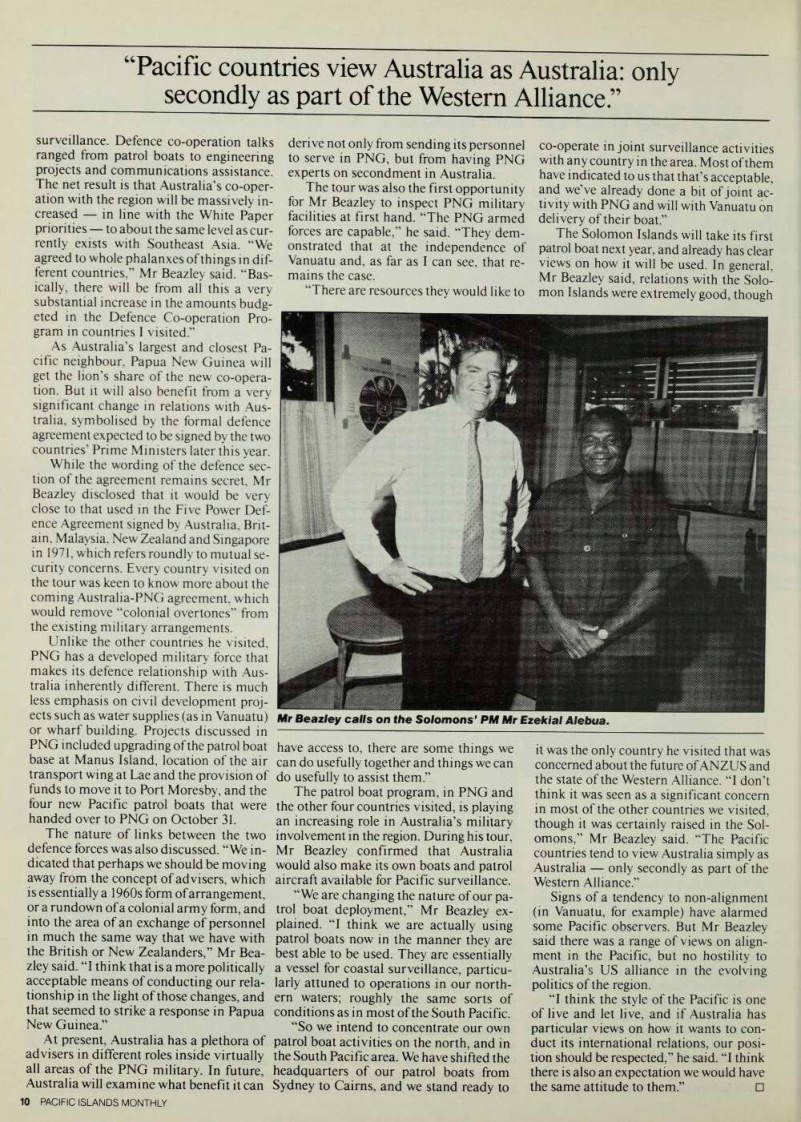
East Sepik dancers greet the Minister on arrival at Wewak, PNG.
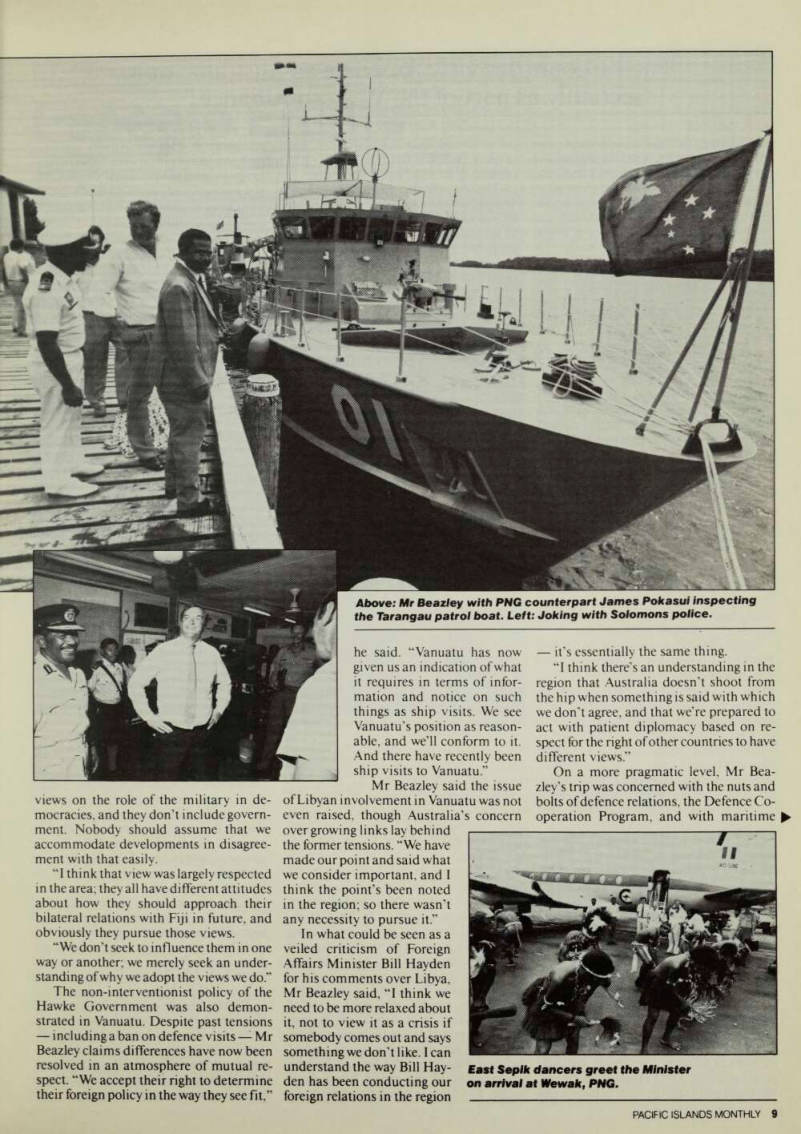
Above: Mr Beazley with PNG counterpart James Pokasui inspecting the Tarangau patrol boat. Left: Joking with Solomons police.
“Pacific countries view Australia as Australia: only secondly as part of the Western Alliance.”
surveillance. Defence co-operation talks ranged from patrol boats to engineering projects and communications assistance.
The net result is that Australia’s co-oper ation with the region will be massively in creased in line with the White Paper priorities to about the same level as cur rently exists with Southeast Asia. “We agreed to whole phalanxes of things in dif ferent countries,” Mr Beazley said. “Bas ically, there will be from all this a very substantial increase in the amounts budg eted in the Defence Co-operation Pro gram in countries I visited.”
As Australia’s largest and closest Pa cific neighbour, Papua New Guinea will get the lion’s share of the new co-opera tion. But it will also benefit from a very significant change in relations with Aus tralia, symbolised by the formal defence agreement expected to be signed by the two countries’ Prime Ministers later this year.
While the wording of the defence sec tion of the agreement remains secret, Mr Beazley disclosed that it would be very close to that used in the Five Power Def ence Agreement signed by Australia, Brit ain, Malaysia, New Zealand and Singapore in 1971, which refers roundly to mutual se curity concerns. Every country visited on the tour was keen to know more about the coming Australia-PNG agreement, which would remove “colonial overtones” from the existing military arrangements.
Unlike the other countries he visited, PNG has a developed military force that makes its defence relationship with Aus tralia inherently different. There is much less emphasis on civil development proj ects such as water supplies (as in Vanuatu) or wharf building. Projects discussed in PNG included upgrading of the patrol boat base at Manus Island, location of the air transport wing at Lae and the provision of funds to move it to Port Moresby, and the four new Pacific patrol boats that were handed over to PNG on October 31.
The nature of links between the two defence forces was also discussed. “We in dicated that perhaps we should be moving away from the concept of advisers, which is essentially a 1960 s form of arrangement, or a rundown of a colonial army form, and into the area of an exchange of personnel in much the same way that we have with the British or New Zealanders,” Mr Bea zley said. “I think that is a more politically acceptable means of conducting our rela tionship in the light of those changes, and that seemed to strike a response in Papua New Guinea.”
At present, Australia has a plethora of advisers in different roles inside virtually all areas of the PNG military. In future, Australia will examine what benefit it can
derive not only from sending its personnel to serve in PNG, but from having PNG experts on secondment in Australia.
The tour was also the first opportunity for Mr Beazley to inspect PNG military facilities at first hand. “The PNG armed forces are capable,” he said. “They demonstrated that at the independence of Vanuatu and, as far as I can see, that remains the case.
“There are resources they would like to
have access to, there are some things we can do usefully together and things we can do usefully to assist them.”
The patrol boat program, in PNG and the other four countries visited, is playing an increasing role in Australia’s military involvement in the region. During his tour, Mr Beazley confirmed that Australia would also make its own boats and patrol aircraft available for Pacific surveillance.
“We are changing the nature of our pa trol boat deployment,” Mr Beazley ex plained. “I think we are actually using patrol boats now in the manner they are best able to be used. They are essentially a vessel for coastal surveillance, particu larly attuned to operations in our north ern waters; roughly the same sorts of conditions as in most of the South Pacific.
“So we intend to concentrate our own patrol boat activities on the north, and in the South Pacific area. We have shifted the headquarters of our patrol boats from Sydney to Cairns, and we stand ready to
co-operate in joint surveillance activities with any country in the area Most of them have indicated to us that that’s acceptable and we’ve already done a bit of joint ac tivity with PNG and will with Vanuatu on delivery of their boat”
The Solomon Islands will take its first patrol boat next year, and already has clear views on how it will be used In general Mr Beazley said, relations with the Solo mon Islands were extremely good though 6
it was the only country he visited that was concerned about the future of ANZUS and the state of the Western Alliance. “I don’t think it was seen as a significant concern in most of the other countries we visited, though it was certainly raised in the Sol omons,” Mr Beazley said. “The Pacific countries tend to view Australia simply as Australia only secondly as part of the Western Alliance.”
Signs of a tendency to non-alignment (in Vanuatu, for example) have alarmed some Pacific observers. But Mr Beazley said there was a range of views on align ment in the Pacific, but no hostility to Australia’s US alliance in the evolving politics of the region, “I think the style of the Pacific is one of live and let live, and if Australia has particular views on how it wants to con duct its international relations, our posi tion should be respected,” he said. “I think there is also an expectation we would have the same attitude to them.” □
Mr Beazley calls on the Solomons’ PM Mr Ezekial Alebua.
Papeete Erupts
French Polynesia
Long-simmering discontent in Tahiti reaches boiling point.
By John Dunn
STRIFE HAS come to Tahiti, laying to rest, perhaps forever, its image as a carefree, idyllic tropical para dise. The transformation began in late Oc tober when some 500 rioters, mostly youths, rampaged through the streets of Papeete throwing stones and petrol bombs and looting shops.
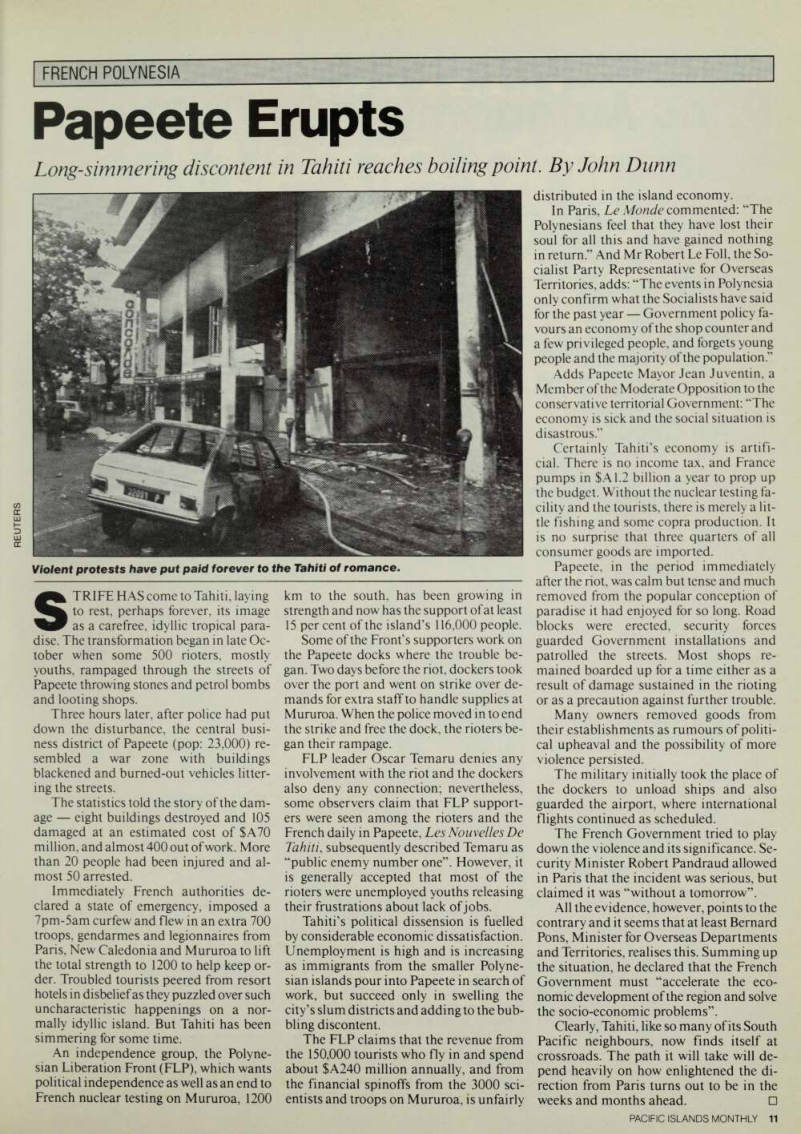
Three hours later, after police had put down the disturbance, the central busi ness district of Papeete (pop: 23,000) re sembled a war zone with buildings blackened and burned-out vehicles litter ing the streets.
The statistics told the story of the dam age eight buildings destroyed and 105 damaged at an estimated cost of SA7O million, and almost 400 out of work. More than 20 people had been injured and al most 50 arrested.
Immediately French authorities de clared a state of emergency, imposed a 7pm-sam curfew and flew in an extra 700 troops, gendarmes and legionnaires from Paris, New Caledonia and Mururoa to lift the total strength to 1200 to help keep or der. Troubled tourists peered from resort hotels in disbelief as they puzzled over such uncharacteristic happenings on a nor mally idyllic island. But Tahiti has been simmering for some time.
An independence group, the Polyne sian Liberation Front (FLP), which wants political independence as well as an end to French nuclear testing on Mururoa, 1200
km to the south, has been growing in strength and now has the support of at least 15 per cent of the island’s 116,000 people.
Some of the Front’s supporters work on the Papeete docks where the trouble be gan. Two days before the riot, dockers took over the port and went on strike over de mands for extra staff to handle supplies at Mururoa. When the police moved in to end the strike and free the dock, the rioters be gan their rampage.
FTP leader Oscar Temaru denies any involvement with the riot and the dockers also deny any connection; nevertheless, some observers claim that FTP support ers were seen among the rioters and the French daily in Papeete, Les Nouvelles De Tahiti, subsequently described Temaru as “public enemy number one”. However, it is generally accepted that most of the rioters were unemployed youths releasing their frustrations about lack of jobs.
Tahiti’s political dissension is fuelled by considerable economic dissatisfaction.
Unemployment is high and is increasing as immigrants from the smaller Polyne sian islands pour into Papeete in search of work, but succeed only in swelling the city’s slum districts and adding to the bub bling discontent.
The FTP claims that the revenue from the 150,000 tourists who fly in and spend about SA24O million annually, and from the financial spinoffs from the 3000 sci entists and troops on Mururoa, is unfairly
distributed in the island economy.
In Paris, Le Monde commented: “The Polynesians feel that they have lost their soul for all this and have gained nothing in return.” And Mr Robert Le Foil, the So cialist Party Representative for Overseas Territories, adds: “The events in Polynesia only confirm what the Socialists have said for the past year Government policy fa vours an economy of the shop counter and a few privileged people, and forgets young people and the majority of the population.”
Adds Papeete Mayor Jean Juventin, a Member of the Moderate Opposition to the conservative territorial Government: “The economy is sick and the social situation is disastrous.”
Certainly Tahiti’s economy is artifi cial. There is no income tax, and France pumps in SAI.2 billion a year to prop up the budget. Without the nuclear testing fa cility and the tourists, there is merely a lit tle fishing and some copra production. It is no surprise that three quarters of all consumer goods are imported.
Papeete, in the period immediately after the riot, was calm but tense and much removed from the popular conception of paradise it had enjoyed for so long. Road blocks were erected, security forces guarded Government installations and patrolled the streets. Most shops re mained boarded up for a time either as a result of damage sustained in the rioting or as a precaution against further trouble.
Many owners removed goods from their establishments as rumours of politi cal upheaval and the possibility of more violence persisted.
The military initially took the place of the dockers to unload ships and also guarded the airport, where international flights continued as scheduled.
The French Government tried to play down the violence and its significance. Se curity Minister Robert Pandraud allowed in Paris that the incident was serious, but claimed it was “without a tomorrow”.
All the evidence, however, points to the contrary and it seems that at least Bernard Pons, Minister for Overseas Departments and Territories, realises this. Summing up the situation, he declared that the French Government must “accelerate the eco nomic development of the region and solve the socio-economic problems”.
Clearly, Tahiti, like so many of its South Pacific neighbours, now finds itself at crossroads. The path it will take will de pend heavily on how enlightened the di rection from Paris turns out to be in the weeks and months ahead. □
Violent protests have put paid forever to the Tahiti of romance.
Pons Autonomy Plan “a Sham”
New Caledonia
Bernard Pons’ long-awaited plan for New Caledonia draws criticism.
THE PLAN for New Caledonian au tonomy announced in October by French Minister for Overseas De partments and Territories, Bernard Pons, and adopted by the conservative Chirac Government early in November, has drawn sharp criticism both from New Ca ledonian separatists and the President of France, Francois Mitterrand.
A spokeswoman for President Mitter rand said he feared “these questionable measures” could “quickly become intol erable to a large part of New Caledonia’s population”, and that he believed it would have been more appropriate to adopt the proposal “at a time of greater peace”.
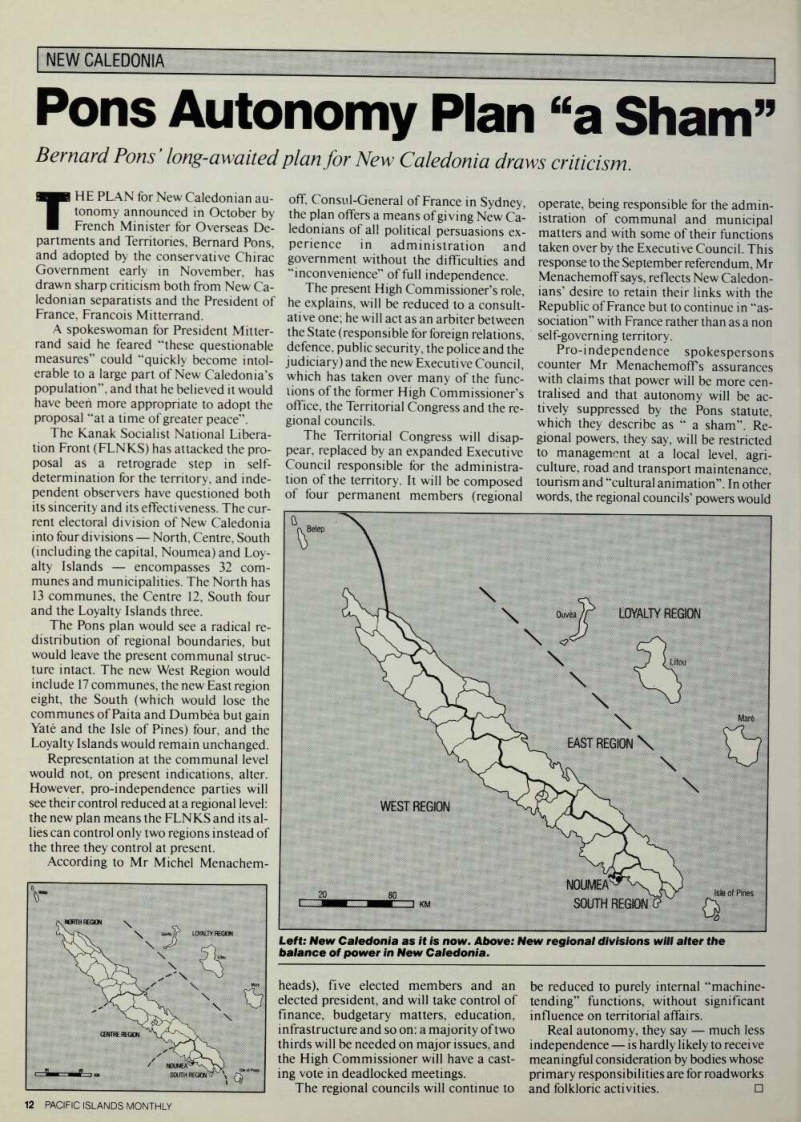
The Kanak Socialist National Libera tion Front (FLNKS) has attacked the pro posal as a retrograde step in self determination for the territory, and inde pendent observers have questioned both its sincerity and its effectiveness. The cur rent electoral division of New Caledonia into four divisions North, Centre, South (including the capital, Noumea) and Loy alty Islands encompasses 32 com munes and municipalities. The North has 13 communes, the Centre 12, South four and the Loyalty Islands three.
The Pons plan would see a radical re distribution of regional boundaries, but would leave the present communal struc ture intact. The new West Region would include 17 communes, the new East region eight, the South (which would lose the communes of Paita and Dumbea but gain Yate and the Isle of Pines) four, and the Loyalty Islands would remain unchanged.
Representation at the communal level would not, on present indications, alter.
However, pro-independence parties will see their control reduced at a regional level: the new plan means the FLNKS and its al lies can control only two regions instead of the three they control at present.
According to Mr Michel Menachem-
off, Consul-General of France in Sydney, the plan offers a means of giving New Ca ledonians of all political persuasions ex perience in administration and government without the difficulties and “inconvenience” of full independence.
The present High Commissioner’s role, he explains, will be reduced to a consult ative one; he will act as an arbiter between the State (responsible for foreign relations, defence, public security, the police and the judiciary) and the new Executive Council, which has taken over many of the func tions of the former High Commissioner’s office, the Territorial Congress and the re gional councils.
The Territorial Congress will disap pear, replaced by an expanded Executive Council responsible for the administra tion of the territory. It will be composed of four permanent members (regional
heads), five elected members and an elected president, and will take control of finance, budgetary matters, education, infrastructure and so on: a majority of two thirds will be needed on major issues, and the High Commissioner will have a casting vote in deadlocked meetings.
The regional councils will continue to
operate, being responsible for the admin istration of communal and municipal matters and with some of their functions taken over by the Executive Council. This response to the September referendum, Mr Menachemoff says, reflects New Caledon ians’ desire to retain their links with the Republic of France but to continue in “as sociation” with France rather than as a non self-governing territory.
Pro-independence spokespersons counter Mr Menachemoffs assurances with claims that power will be more cen tralised and that autonomy will be ac tively suppressed by the Pons statute, which they describe as “ a sham”. Re gional powers, they say, will be restricted to management at a local level, agri culture, road and transport maintenance, tourism and “cultural animation”. In other words, the regional councils’ powers would
be reduced to purely internal “machine tending” functions, without significant influence on territorial affairs, Real autonomy, they say much less independence is hardly likely to receive meaningful consideration by bodies whose primary responsibilities are for roadworks and folkloric activities. □
Left: New Caledonia as it is now. Above: New regional divisions will alter the balance of power in New Caledonia.
Advertisements & other items, p. 13 (1 item)
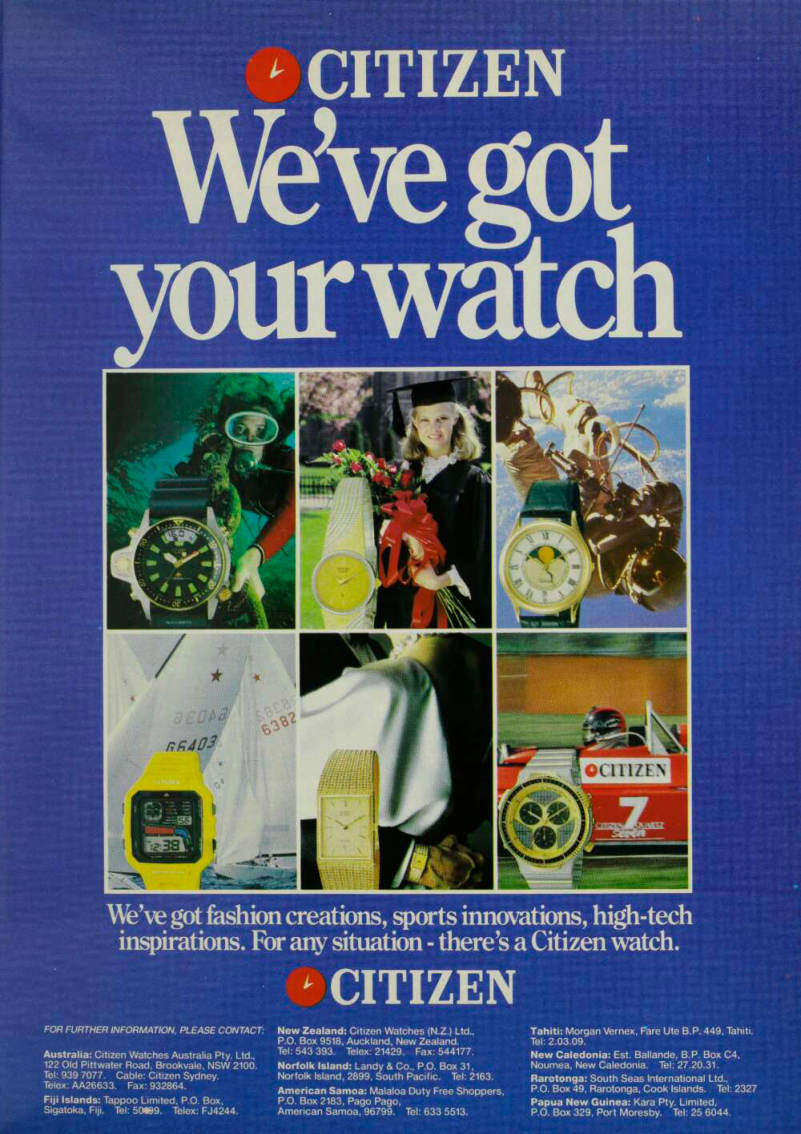
WfeVegot
CITIZEN
your watch
¥ y' y\ % £
©CITIZEN
w aa /# fc A • WeVe got fashion creations, sports innovations, high-tech inspirations. For any situation - there’s a Citizen watch.
CITIZEN
FOR FURTHER INFORMATION, PLEASE CONTACT:
Australia: Citizen Watches Australia Pty. Ltd., 122 Old Pittwater Road, Brookvale, NSW 2100.
Tel: 939 7077. Cable: Citizen Sydney.
Telex: AA26633. Fax: 932864.
Fiji Islands: Tappoo Limited, P.O. Box, Sigatoka, Fiji. Tel: SCXO9. Telex: FJ4244.
New Zealand: Citizen Watches (N.Z.) Ltd., P.O. Box 9518, Auckland, New Zealand.
Tel: 543 393. Telex: 21429. Fax: 544177.
Norfolk Island: Landy & Co., P.O. Box 31, Norfolk Island, 2899, South Pacific. Tel; 2163.
American Samoa: Malaloa Duty Free Shoppers, P.O. Box 2183, Pago Pago, American Samoa, 96799. Tel: 633 5513.
Tahiti: Morgan Vernex, Fare Lite B.P. 449, Tahiti.
Tel; 2.03.09.
New Caledonia: Est. Ballande, B.P. Box C 4, Noumea, New Caledonia. Tel: 27.20.31.
Rarotonga: South Seas International Ltd., P.O. Box 49, Rarotonga, Cook Islands. Tel: 2327 Papua New Guinea: Kara Pty. Limited, P.O. Box 329, Port Moresby. Tel: 25 6044.
Diro Scandal Escalates
Papua New Guinea
The timber inquiry unleashes a series of sensations.
By Frank Senge
THE Commission of Inquiry into the PNG timber industry looks set to be one of the country’s most con troversial investigations.
The inquiry cuts a path through six countries Australia, Hong Kong, In donesia, Malaysia, Singapore and Vanu atu. The “cast of characters” that has come under scrutiny by the inquiry involves the Governments of PNG and Vanuatu, an Indonesian army commander and busi nessmen from Australia, Malaysia, PNG and Singapore.
PNG’s foreign exchange and customs regulations and leadership code have been broken at various times, according to doc uments before the commission.
Already a central figure in one aspect of the inquiry, former Defence Force Commander and former Forests Minister Ted Diro, has been forced to resign as Minister Without Portfolio in the Wingti cabinet. Prime Minister Wingti accepted Mr Diro’s resignation with “great sad ness”: but it lifts a burden from his shoul ders. He does not now need to force Diro to resign and pull his Papua Action Party (PAP) from Government. PAP, with 18 members, is the second largest party in government, and Diro has assured the fragile coalition of his party’s support “for the time being”.
Mr Diro announced his resignation on Sunday, November 8, two days after com missioner Mr Justice Barnett approved applications to charge Mr Diro on three counts of perjury. Justice Barnett dis charged three further applications for per jury charges, which were made by counsel assisting the commission, John Reeve, when cross-examining Mr Diro on a state ment he had given to the commission previously.
In handing down his ruling on Friday, November 6, Justice Barnett said Mr Diro had knowingly lied in sworn testimony about his knowledge of a request for do nations from Santa Investments totalling SUS 127,500 to entertain government of ficers and politicians; that Mr Diro gave false information regarding gifts and benefits he allegedly received from Angus (PNG) Pty Ltd; and that he lied about An gus shares held by persons on is behalf. . Mr Justice Barnett who has warned Mr Diro several times to stop wandering in his testimony, or telling “half-truths” said: “It has been a sad duty for me to direct these prosecutions against Mr Diro, who has been for many years a leader in this country.
“I am, however, sure in my own mind
that he has been lying on oath to avoid the unpleasant exposure of his now admitted involvement in Angus.” Perjury carries a penalty of 14 years’ imprisonment in PNG.
The next day, Mr Diro concluded his cross-examination with the most startling revelation of all: he told the commission that Indonesia’s armed forces chief, Gen eral Benny Murdani, supplied the bulk of his People’s Action Party funds for this year’s general elections.
Mr Murdani paid SUS 139,400 into two accounts operated by Mr Diro in Port Mo resby. An Indonesian defence attache based in Port Moresby brought the money into the country from Singapore.
Mr Diro said Mr Murdani was a per sonal friend, and that he had raised the money through his construction com pany. Earlier, Mr Diro had told the in quiry that the money came from an
Australian businessman, Peter Chen. Mr Diro had earlier given this evidence in camera, claiming the information had na tional security implications, but the infor mation was made public after Deputy Justice Secretary James Baker assured the commission that there was no threat to national security.
Mr Diro said his disclosure would up set his friend, General Murdani, but hoped the armed forces chief would be under standing. “I hope he will not judge me too harshly,” Diro said.
The inquiry, already into its eighth month, has been full of amazing allega tions and admissions of corruption and malpractice within the timber industry.
Former secretary of Forestry Oscar Ma malai admitted receiving gifts and money from various individuals and companies associated with the Forestry Industries
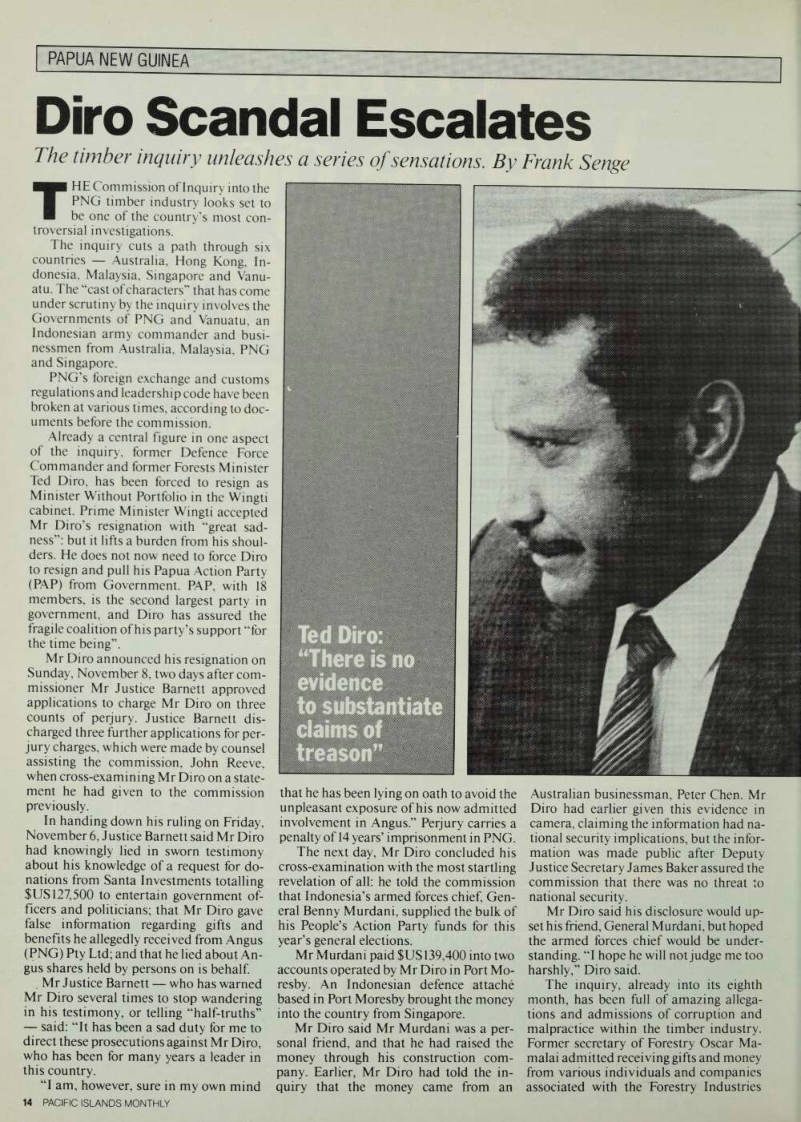
Ted Diro: "There is no evidence to subatantiate claims of treason"
Council (FIC); and a forestry officer ad mitted accepting a KlOOO bribe to clear logs without K 30,000 royalty money being paid, a prerequisite for log shipment un der the terms of the contract.
As the inquiry moves on to other as pects of its extended terms of reference, it leaves behind a feeling of somebody hav ing been already tried and convicted. In deed, Mr Diro said on his resignation that he had been put on a “media trial”.
There is at least some truth in his claim, as to some extent the whole inquiry was instigated after a series of revelations in the weekly, Times of Papua New Guinea.
Mr Wingti ordered the investigation into the history and activities of the tim ber industry, in particular Mr Diro’s in volvement with Angus (PNG) Pty Ltd, allegations of forestry officials receiving gifts and benefits for favourable treatment to companies and claims of price trans fering for shipment of logs.
Mr Diro was founding chairman of Angus (PNG), and the inquiry set out first to establish his role with regard to Angus after he became Minister for Forests.
In his opening submission on August 6, counsel assisting the inquiry John Reeve stated that Mr Diro began an association with Angus (Singapore) personnel Mo hammed Abdullah Ang, Charlie Coh, for mer Malaysian Foreign Affairs Minister Ghazali Shafei and F C Cheah in August, 1984. Messrs Ang and Shafei had attended the opening of the new PNG parliament with Malaysian Prime Minister Dr Sri Datuk Matahir, and the delegation held talks with then Prime Minister Michael
Revelations at Papua New Guinea’s Forestry Inquiry have the Central Bank checking to see if any of its rules and regulations have been broken. So far the bank has dis covered that there is no evidence of for mer Forests Minister Ted Diro ever having obtained permission to keep any bank accounts overseas.
Mr Diro has admitted on several oc casions that he owns a bank account in Singapore and has one held in trust for him in Hong Kong.
Governor of the Central Bank, Sir Henry Toßobert, said: “Normally we don't allow people to keep accounts outside the country unless there are special reasons ” In the Diro case, how ever, “it appears that approval has not been given.”
Sir Henry said approval is necessary for exchange control purposes, but any ap plication for approvals may still be processed. An initial search had shown that none had been obtained.
The bank is also checking to see if Mr Diro’s PNG bank reported monies he brought in from overseas. Sir Henry would not disclose if the Central Bank planned to take action at this stage.
Somare on how the Malaysian Overseas Investment Corporation could be in volved in the timber industry in PNG.
Mr Ang was managing director of MOIC at that time, but when MOIC (Ma laysia) began experiencing financial dif ficulties in late 1985, he resigned and registered a company of the same name in Singapore. The Angus companies are off
shoots of MOIC (Singa pore); which became interested in hotel devel opment and timber op erations in PNG.
MOIC went into liq uidation in Malaysia in mid-1986, but soon set up a branch office in PNG with interests in timber. Mr Reeve sub mitted that Mr Diro be came a representative of local landowners com pany Magi Woptenk in the Gadaisu area, where MOIC Investments had applied for a Timber Re source Permit. The ap plication was rejected.
PNG playwright John Kasaipwalova was an ex ecutive of MOIC Invest ments, and Mr Reeve said the same “cast of characters” incorpo rated Angus (PNG) with Mr Diro as chairman and
Mr John Kasaipwalova as a director and executive.
“Close ties were maintained at all times with Ta Sri Ghazali Shafei, Mohammed Abdullah Ang and Charlie Koh, manag ing director of the Angus group in Singa pore,” Mr Reeve said.
When Mr Diro became Forest Minis ter, he publicly renounced his connection with Angus but privately retained his 35 per cent interest in Angus.
After two months of denying that he had the interest, Mr Diro gave in to pres sure from Mr Reeve when confronted with documentary evidence of his share hold ing. “Yes, yes, that I concede,” Mr Diro said, but claimed the shares were for his People’s Action Party.
Mr Diro is also said to have short-cir cuited departmental advice and granted the permit to Angus when it resubmitted MOIC Investment’s application.
Mr Diro admitted he obtained an ex ecutive Jaguar XJ6 saloon from Singa pore through MOIC and Angus. The actual value of the car was understated to cus toms for the purpose of reducing customs duties, it was revealed.
Angus allegedly paid for a trip Mr Diro took to Australia and offered him cash amounting to SAISOO. Further, Mr Diro was to have been paid K 20,000 for con sultancy work he undertook for the Government of Vanuatu.
In his tax declaration he admitted re ceiving the money, but told the inquiry he had mistaken it with other monies from private firms in Vanuatu and denied re ceiving money from the Government.
The then opposition leader, Michael Somare, before he resigned on November 18, through a series of questions directed at Mr Wingti, charged that the Diro-Mur-
dani deal amounted to “high treason” and that Papua New Guinea’s sovereignity had been severely compromised internationally.
Mr Wingti said that any exchange of money between the two were conducted on an individual basis and the exchange did not involve the two governments they represented.
In a statement to parliament on Nov emeber 13, Mr Diro said he had known General Murdani since 1973 and that he (Murdani) was “a great friend and ally to Papua New Guinea”.
Said Mr Diro: “General Murdani is a very upright and a very principled soldier.
He is not a politician ... There is abso lutely no hard evidence to substantiate claims of treason. On the contrary there is hard and visible evidence of my successes in steering Papua New Guinea out of grave security risk situations.”
Mr Diro said he had received money from sources in other countries as well but the Indonesian connection created much interest in the country because the people of PNG had a certain “phobia” about In donesians ... a phobia that has been in herited and passed on by others who paint Indonesia as an enemy country in order to justify their defence expenditure. As Pa cific Islands Monthly went to press, fur ther revelations concerning Mr Diro were expected. □
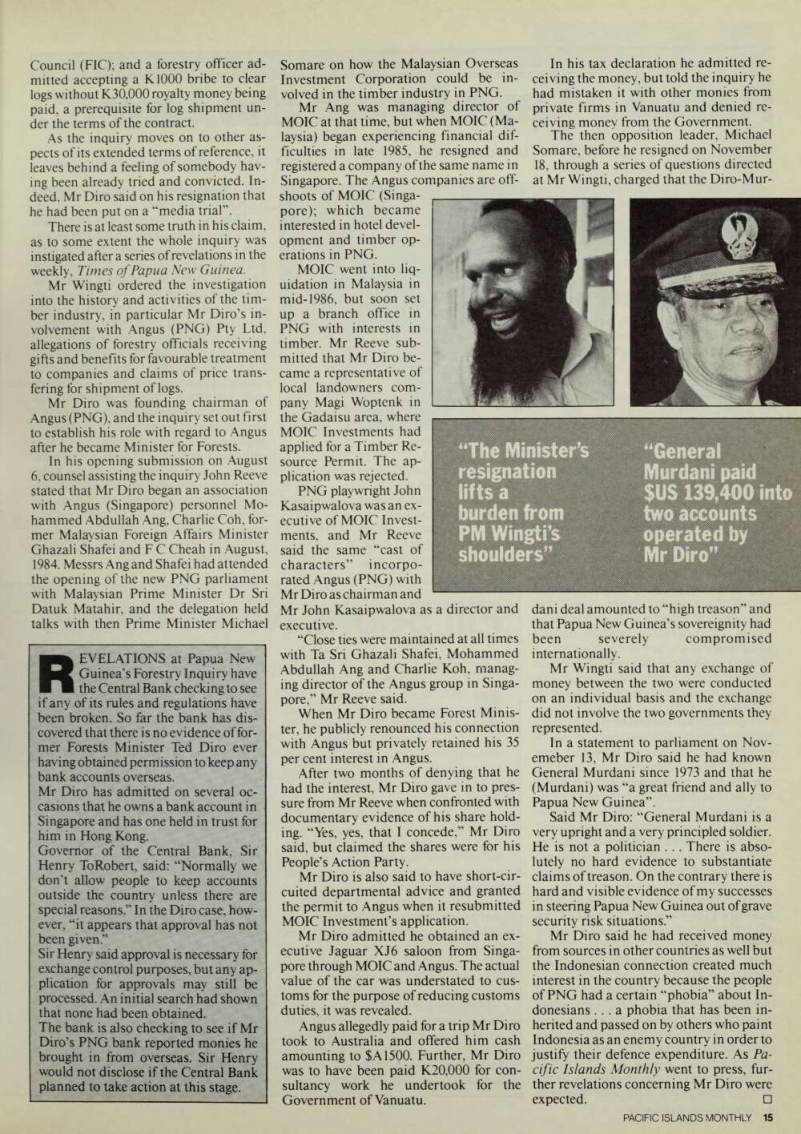
"The Minister's resignation lifts a burden from PM Wingti's shoulders”
“General Murdani paid $US 139,400 into two accounts operated by Mr Diro”
Rabuka Lays Down the Law
Fiji
Fijians grow used to some fundamental changes
SINCE the second mili tary coup of then-Colo nel Rabuka on September 25 and the official declaration of the Republic of Fiji on October 7, measures have been introduced restrict ing public and private activi ties on certain days.
An Bpm to Sam curfew was imposed immediately after the second coup, but the hours were later reduced to 9pm to Sam.
From Friday October 30, cur few hours were further reduced to 11pm to 4am.
Sunday has been declared the Sabbath and no trading, sports or commercial activity
are allowed. Effective from November 1, a Sunday Observance Decree dated Octo ber 20 stated that Sunday observance would begin at midnight on Saturday and end at midnight on Sunday. All picnics and outdoor gatherings are prohibited; no sport is allowed; no trade, retail or wholesale ac tivity is allowed, and no one is to engage in any office work; there is no public road transport, including buses and taxis; meetings and gatherings in public places except churches (which includes temples and mosques) are banned; no theatres are allowed to screen films, and no open-air entertainment is permitted; and hotels, bars and night clubs are closed except for bona fide tourists.
Fiji citizens used to their daily news papers at the breakfast table have had to become used to whatever news they hear on Radio Fiji, the national radio service.
The two daily newspapers, the Fiji Times and the Fiji Sun, were ordered to cease publication on the day of the second coup.
The Fiji Times was allowed to resume publication from November 6. It is now published with freedom of expression un der certain assurances it has given the mil itary Government.
The paper has said it will refrain from publishing anything that may incite eth nic antipathies or be prejudicial to public peace and order, and that great care and good judgement will be exercised in the selection and publication of letters.
The editor said the newspaper was not being censored, and was “more than pleased” to provide the assurances.
There was no indication from the pub lishers of the Fiji Sun on plans to resume publication.
Fiji citizens now pay an extra five cents for their newspaper. The price hike is to
cover increased costs due to two deval uations of the Fiji dollar.
Radio Fiji was allowed to broadcast music, commercials and news approved by the military command. No re-broadcast of any overseas news bulletin is allowed: Radio Fiji previously re-broadcast BBC
World News, Radio Australia News and the Voice of America.
The only commercial station in Fiji, FM 96 which was also shut down was later allowed to resume transmission after it agreed to abide by the same news guide lines as Radio Fiji. Ironically, people are now in the habit of tuning in to Radio Aus tralia or Radio New Zealand to learn what’s happening in their own country.
Meanwhile, people are adjusting and adapting to the presence of soldiers around them. Roadblocks and checkpoints manned by armed soldiers are a common sight and are routine for motorists, but what surprises most residents is that while Fiji has been expelled from the Common wealth and the country has severed its links with the Queen, the Fiji flag which has a replica of the Union Jack in the right hand corner still flutters from the flag poles of most Government buildings and other institutions. Fijian Government sta tionery still carries the OHMS stamp and Radio Fiji continues to play the British na tional anthem. □
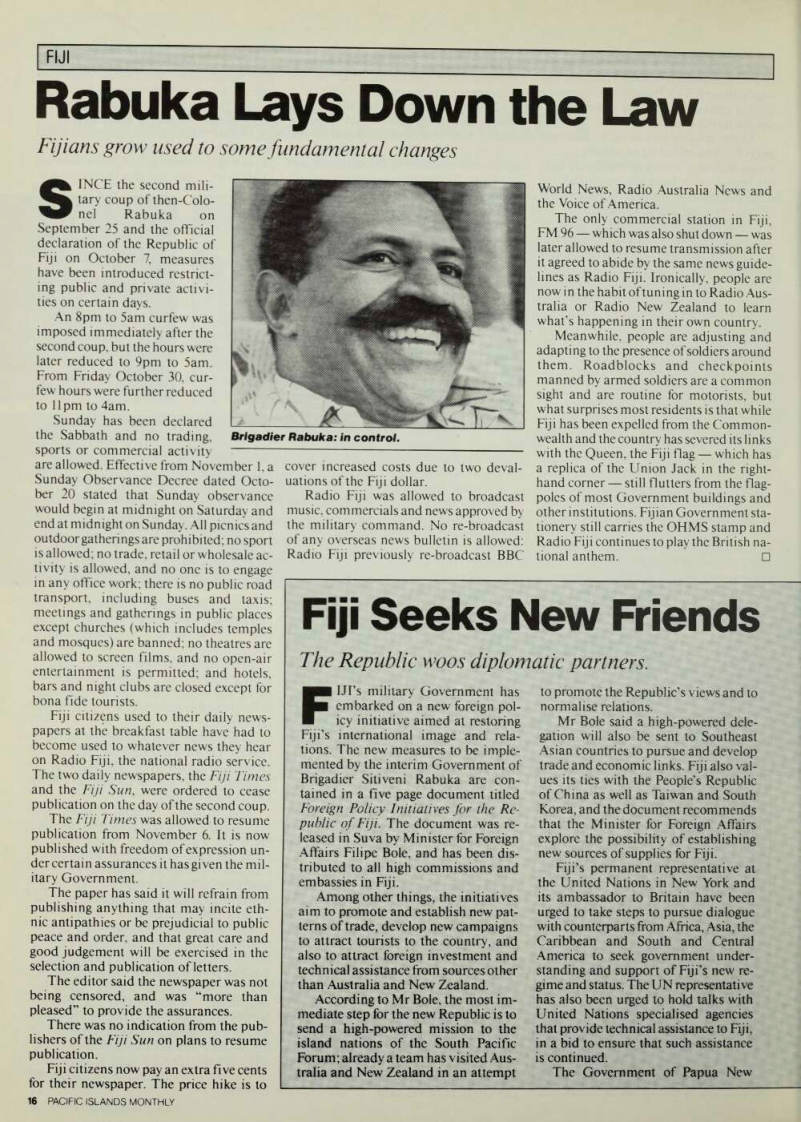
Brigadier Rabuka: in control.
Fiji Seeks New Friends
The Republic woos diplomatic partners.
FIJI’S military Government has embarked on a new foreign pol icy initiative aimed at restoring Fiji’s international image and rela tions. The new measures to be imple mented by the interim Government of Brigadier Sitiveni Rabuka are con tained in a five page document titled Foreign Policy Initiatives for the Re public of Fiji. The document was re leased in Suva by Minister for Foreign Affairs Filipe Bole, and has been dis tributed to all high commissions and embassies in Fiji.
Among other things, the initiatives aim to promote and establish new pat terns of trade, develop new campaigns to attract tourists to the country, and also to attract foreign investment and technical assistance from sources other than Australia and New Zealand.
According to Mr Bole, the most im mediate step for the new Republic is to send a high-powered mission to the island nations of the South Pacific Forum; already a team has visited Aus tralia and New Zealand in an attempt
to promote the Republic’s views and to normalise relations.
Mr Bole said a high-powered dele gation will also be sent to Southeast Asian countries to pursue and develop trade and economic links. Fiji also val ues its ties with the People's Republic of China as well as Taiwan and South Korea, and the document recommends that the Minister for Foreign Affairs explore the possibility of establishing new sources of supplies for Fiji.
Fiji’s permanent representative at the United Nations in New York and its ambassador to Britain have been urged to take steps to pursue dialogue with counterparts from Africa, Asia, the Caribbean and South and Central America to seek government under standing and support of Fiji’s new re gime and status. The UN representative has also been urged to hold talks with United Nations specialised agencies that provide technical assistance to Fiji, in a bid to ensure that such assistance is continued.
The Government of Papua New
Guinea has become the first govern ment to accord the military regime in Fiji full recognition, according to an of ficial statement from PNG. The deci sion to recognise the military Government in Fiji had been made in the interest of maintaining regional stability and security as well as co-op eration among countries of the South Pacific.
The Republic of (South) Korea has given the new regime de facto recog nition, while the British Government has authorised its Suva-based High Commissioner, Mr Roger Balthrop, to maintain contact with ministers of the military Government. Explaining his Government’s position, Mr Balthrop said his country’s policy is to recognise states rather than governments—so the question of recognising the military Government in Fiji did not arise.
Australia and New Zealand have not changed their earlier stand of not re cognising the military Government.
Among Southeast Asian countries, Indonesia and Malaysia were the first to publicly declare their support for the new military regime. Both countries have offered economic and trade pro posals, which, if accepted, could lead to greater trade between them and the new Republic of Fiji. O
Chamorros’ Big Win
Guam
The island settles its future.
By David S North
GUAM’S VOTERS chose the wife of convicted former Governor Richard Bordallo for a vacancy in the territorial senate, and strongly sup ported the Chamorro position on who should decide Guam’s political future in last month’s special election.
Political events elsewhere in the Pacific played an important role in the referen dum on the island’s political future. Those supporting the Chamorro position pointed to the Fijian coup and the problems of the Kanaks in New Caledonia as examples of the difficulties that indigenous people are having in controlling their own destinies.
Interestingly, none of the three leading candidates for the senate are Chamorro by birth; Mrs Bordallo, though a longtime resident of the island and a Chamorro rights advocate, is a haole but is warmly regarded by the Chamorro community.
She ran as a Democrat and was supported by her husband’s still effective political or ganisation. He is living on Guam and is free pending disposition of an appeal from his conviction for misusing his office.
The top candidates for the senate seat, left vacant by the death of Senator Pedro Sanchez, were Mrs Bordallo, with 8265 votes, Leslie Moreno, a Republican and a Filipino with 4298 votes, and Florence Sanchez, the Samoan-born widow of the late senator and a Democrat, who re ceived 2247 votes. They were followed by Ben Ada, a Chamorro, with 1584 votes, by Gordon Milloux, a Mainlander with 1280, and by four others, each with less than 1000 votes. Unlike most Guam elections, there was no primary election beforehand to se lect each party’s candidates, so there were several for each party.
The other part of the election related to Guam’s desire to work out a new relation ship with the United States. As part of this process the Guam Commission on Self Determination presented the voters with a draft Guam Commonwealth Act, the idea being that such a draft would repre sent Guam’s position as it began to ne gotiate with the Government in Washington. To test the feelings of the people, the voters had a chance in August to vote separately on 12 different articles; 10 of the articles were accepted, with votes ranging from 51 to 61 per cent. Novem ber’s vote was a re-run for the two articles turned down by slim margins in the Au gust voting.
Both of these articles have strong eth nic overtones. Article I calls for a Guam that is a “self-governing entity under over all United States sovereignty. . . (and). . . recognises the Chamorro people as a dis tinct group and recognises their right to determine their own political future . ..”
Article I has been interpreted to mean that only Chamorro voters would have the ul timate right to decide whether Guam seeks independence at some future date.
Article VII calls for granting the island Government control of the movement of aliens to Guam (now the responsibility of the Mainland’s Immigration Service) and would not permit aliens living on Guam to use their time on the island to qualify for citizenship. (US law now permits al iens living on Guam for five or more years to apply for citizenship.) This provision was unpopular in the Filipino commu nity, which feared that an island-con trolled immigration system would be more likely to deny visas to Filipinos than a Mainland system.
In the November vote, these two arti cles were divided into five sections, and all were thunderously approved, by mar gins as high as 66 per cent. Some 20,000 voters participated. □
Lange’s Nuke
Bombshell
Ed Rampell reports
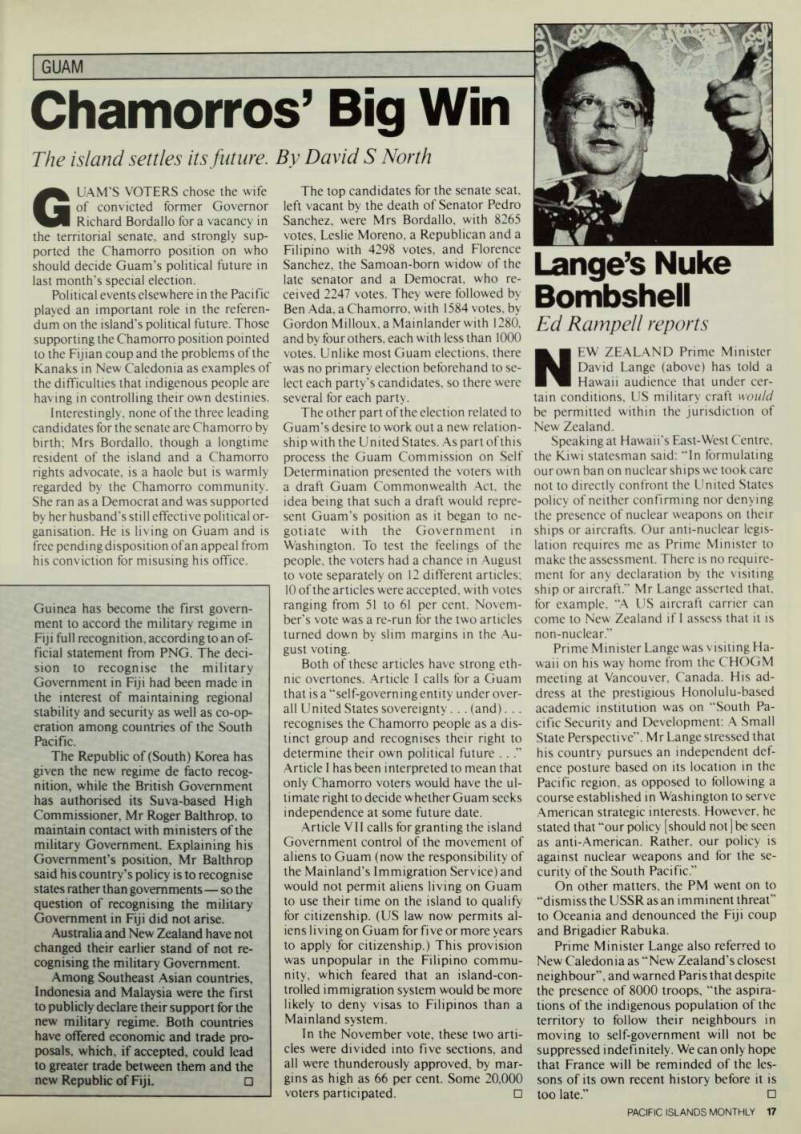
NEW ZEALAND Prime Minister David Lange (above) has told a Hawaii audience that under cer tain conditions, US military craft would be permitted within the jurisdiction of New Zealand.
Speaking at Hawaii’s East-West Centre, the Kiwi statesman said: “In formulating our own ban on nuclear ships we took care not to directly confront the United States policy of neither confirming nor denying the presence of nuclear weapons on their ships or aircrafts. Our anti-nuclear legis lation requires me as Prime Minister to make the assessment. There is no require ment for any declaration by the visiting ship or aircraft.” Mr Lange asserted that, for example, “A US aircraft carrier can come to New Zealand if I assess that it is non-nuclear.”
Prime Minister Lange was visiting Ha waii on his way home from the CHOGM meeting at Vancouver, Canada. His ad dress at the prestigious Honolulu-based academic institution was on “South Pa cific Security and Development: A Small State Perspective”. Mr Lange stressed that his country pursues an independent def ence posture based on its location in the Pacific region, as opposed to following a course established in Washington to serve American strategic interests. However, he stated that “our policy [should not] be seen as anti-American. Rather, our policy is against nuclear weapons and for the se curity of the South Pacific.”
On other matters, the PM went on to “dismiss the USSR as an imminent threat” to Oceania and denounced the Fiji coup and Brigadier Rabuka.
Prime Minister Lange also referred to New Caledonia as “New Zealand’s closest neighbour”, and warned Paris that despite the presence of 8000 troops, “the aspira tions of the indigenous population of the territory to follow their neighbours in moving to self-government will not be suppressed indefinitely. We can only hope that France will be reminded of the les sons of its own recent history before it is too late.” □
Advertisements & other items, p. 18 (1 item)
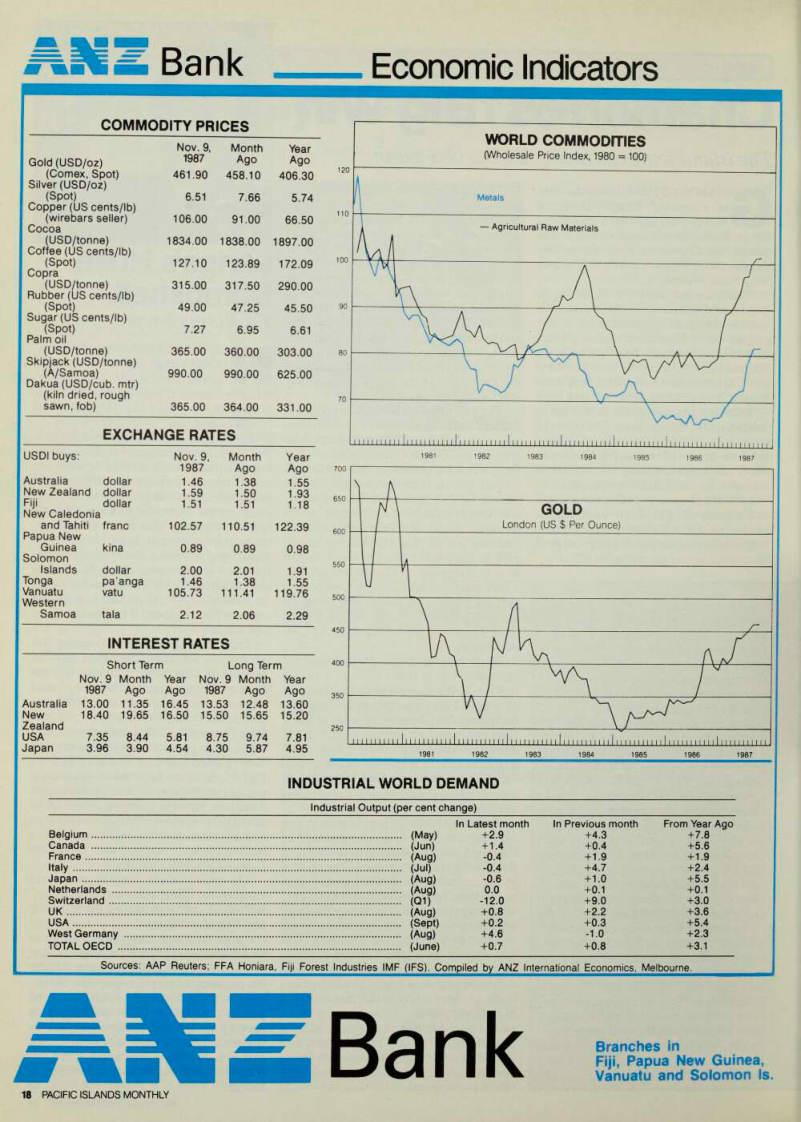
Bank
#%!!& Bank
Economic Indicators
COMMODITY PRICES
INTEREST RATES
Australia New Zealand
USA
Japan Short Term Nov. 9 Month Year 1987 Ago Ago 13.00 11.35 16.45 18.40 19.65 16.50
Long Term
Nov. 9 Month 1987 Ago 7.35 3.96 8.44 3.90 5.81 4.54 13.53 15.50 8.75 4.30 12.48 15.65 9.74 5.87 Year Ago 13.60 15.20 7.81 4.95
WORLD COMMODITIES
(Wholesale Price Index, 1980 = 100) Metals Agricultural Raw Materials
GOLD
London (US $ Per Ounce) 1954
INDUSTRIAL WORLD DEMAND
Industrial Output (per cent change) Sources: AAP Reuters; FFA Honiara, Fiji Forest Industries IMF (IPS). Compiled by ANZ International Economics. Melbourne.
Bank
Branches in
Fiji, Papua New Guinea,
Vanuatu and Solomon Is.
Samoans Win Land Case
American Samoa
A long-running and historic dispute is resolved.
By David S North
SAMOANS have won and the Mormons lost a major and, per haps, final round in a lengthy land dispute. A three-judge panel of the US Circuit Court of Appeals in Washington ruled unanimously in October that the High Court of American Samoa had ap propriately awarded a disputed piece of land near Pago Pago to the Puailoa family.
More important than the fate of the land was the impact of the ruling on two major features of life in American Samoa: the judges ruled that the US Court system in American Samoa, despite some unu sual features, met constitutional stand ards, resolving an argument that had been simmering for years if not decades.
Secondly, it ruled (although indirectly) against tampering with Samoan law, so continuing to bar the sale of communally owned land to non-Samoans. Because of this law there is a much higher incidence of land owned by the indigenous popula tion in American Samoa than there is in some other Pacific jurisdictions.
The land dispute is a long and com plicated one. Its origins trace back to 1906 when the Mor mons leased an at tractive piece of land called Malaeimi from Puailoa Vaiuli, a matai. The Mor-
mons developed part of the land, renewed the lease in 1944, and in 1953 bought the land from Saltaima, widow of the matai.
In 1978, the then matai, Tavete M Puai loa, went to court contending that the widow had no right to sell it to anyone and that it should be returned to the family.
The local trial court ruled against him, but in the next year the family started farming part of the land anyway. The Mormons sued on the grounds of trespass.
The family maintained one could not tres pass on land one owns. This time the trial court ruled for the family. The Mormons appealed to the High Court of American Samoa, and lost there as well.
Next the Church appealed to the Sec retary of the Interior in Washington, ask ing him to overrule the High Court. The Secretary refused. The Church’s lawyers then went to the US District Court in the District of Columbia, where they argued that the US Constitution did not permit the kinds of courts found in American Sa moa, and barred the taking of land with out due process.
Again the Mormons lost, so they took the case to the next highest US court, the Circuit Court of Appeals.
At the Circuit Court of Appeals no wit nesses are called, as facts are not in dis pute. The questions relate to the interpretation of the law. Three judges hear such cases, and interrupt proceedings to pepper the rival attorneys with questions.
All three judges are fairly recent Re agan Administration appointees. Presid ing was Laurence H Silberman, who once practised labour law in Hawaii and lec tured at the University of Hawaii.
The second judge was former US Sen ator James L Buckley who got to know something about the Pacific when he was
a member of the Senate Committee on Interior and In sular Affairs. The third was Douglas H Ginsburg, until re cently a professor at Harvard Law School who, soon after this appeal, was President Re agan’s unsuccessful appointee to the Su preme Court.
Arguing before
these three were prominent representa tives of two other conservative institu tions: Reagan’s Department of Justice on one side, and the Church of the Latter Day Saints on the other.
The Justice Department was repre sented by Douglas W Kmiec. The Mor mons, by Rex E Lee.
Kmeic carried the argument for the Secretary of Interior, thus supporting the position of the High Court and of the Puailoa family in Samoa.
The principal points made by Lee were that the Mormons had been denied the opportunity, at the US District Court level, to have a trial on several matters of con cern to them. Lee said that the Church’s long-time occupation of the property had not been given sufficient importance.
The 28-page ruling of the Circuit Court, handed down six months after the argu ment and written by Judge Ginsburg, stated that Congress had not denied any one due process by shaping the Samoan courts as it had, that the “Samoan court proceedings did not constitute gross error or arbitrary action in violation of the Fifth Amendment”, and that the Samoan courts’ handling of the land ownership is sues were not, therefore, subject to reversal.
The Appeals Court, in effect, allowed the Samoan communal land ownership law to stand (together with its provision that no one but persons who had at least 50 per cent Samoan blood can buy such land) without ruling directly on the con situtionality of this provision.
For the Samoans, the long battle may be over at last. □
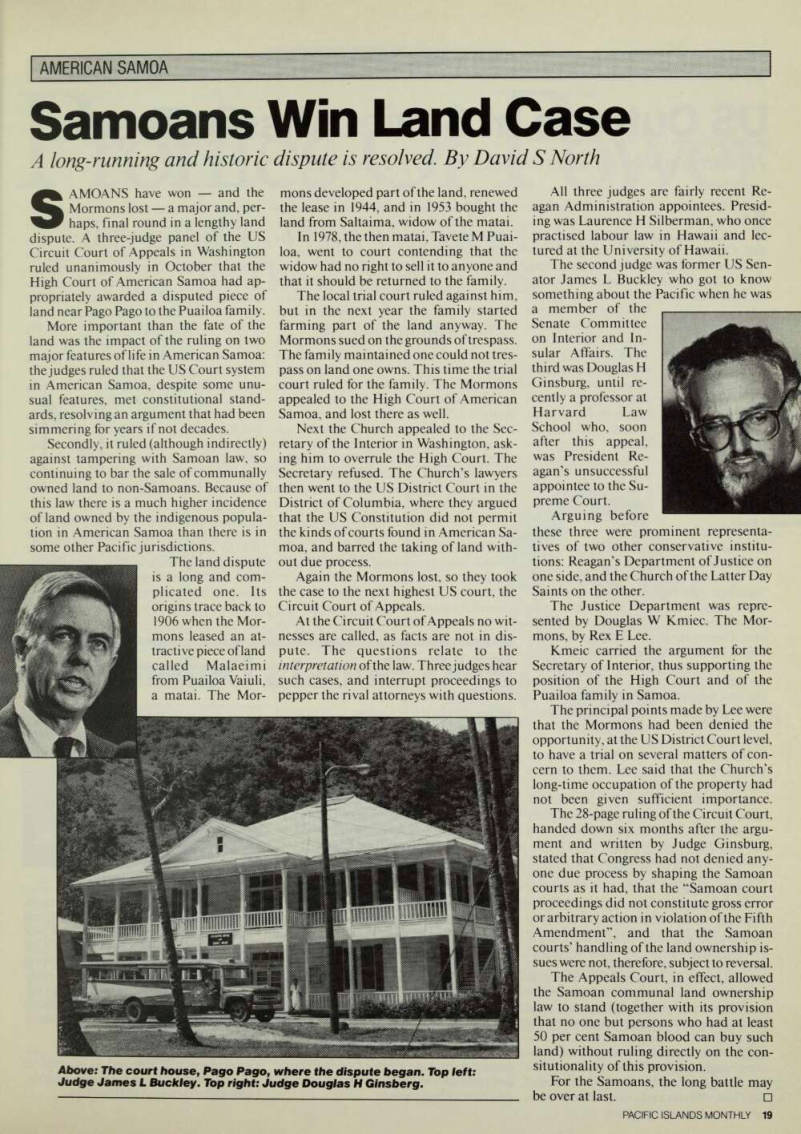
Above: The court house, Pago Pago, where the dispute began. Top left: Judge James L Buckley. Top right: Judge Douglas H Ginsberg.
IFTHESovietsigningofthe Rarotonga
Hawaii
US Outrage at Soviet Missile Tests
Hawaii could be a rocket “bullseye”.
By Ed Rampell
IFTHESovietsigningofthe Rarotonga
Treaty’s protocols on December 15, 1986, was the greatest triumph of Mik hail Gorbachev’s “Glasnost” policy in Oceania, the USSR’s September 29-30, 1987, intercontinental ballistic missile (ICBM) tests near the Hawaiian Islands is
Moscow’s biggest public relations dis aster in the Pacific.
TheSS-18 ICBM mis sile tests were soundly condemned from Honolulu to Wash ington by Hawaii and national US leaders.
Oahu Congress woman Patricia Saiki expressed “outrage” and “concern ... over Soviets turning Ha waii into an intercon tinental bullseye,” on
the floor of the House of Representatives on October 1.
The fiery response to the test firings from not only Rep Saiki, but from Gov ernor John Waihee, Rep Daniel Akaka, and officials from both the Stale and Def ence Departments as well is understand able. The test firings, as originally planned, would have included the overflight of sov ereign US territory by a Soviet ICBM for the first time in history. Moscow’s intent was for unprecedented “bracketing” tests, with the firing of two ICBMs north and south of the Hawaiian chain.
After the Kremlin announced plans for the tests'prior to their deployment, the US Government reacted strongly. On Sep tember 29, the first test failed, and on Sep tember 30, the Soviets successfully launched an ICBM with dummy war heads 1000 kilometres northwest of Kauai.
The program was then halted about a week earlier than planned, perhaps in response to US pressure.
Despite the fact that the first test with the missile destined to fly over Ha waii failed, the second successful test was the closest one in history to American soil. After the test firings reaction was rapid and angry. Rep Saiki collaborated with Senator Robert Dole, Senate Repub lican leader and presidential candidate, in introducing concurrent resolutions on the floors of both chambers of the US Con gress. Both measures were passed over whelmingly, and the House denounced the test firings as “a deliberate provocation of the United States and a direct threat to our
national security” that “demonstrate an utter disdain for civilised and acceptable standards of behaviour . . . the Soviet Union appears to have been practising. . . a strike on the United States ...”
Terming the tests a “new violation of the . . . SALT II Treaty”, the House Res olution called on US President Reagan to report to Congress within 10 days on So viet explanations for the experiments; on steps the US will take to make sure there is never a repeat performance; and what effect SDI (“Star Wars”) “could have against a missile launched in similar prox imity to US territory”.
Of particular concern to Hawaii lead ers is that “had this test misfired by only fractions of a second, lens of Soviet ballis tic missile test warheads could have landed on centres of population in the Hawaiian Islands.” The memory of the Japanese at tack on Pearl Harbour is still vivid here, and Hawaii serves as CINCPAC head quarters and purportedly stores an entire atomic arsenal (making it, in turn, a top Soviet nuclear target).
It’s not known why these tests oc curred at a lime when the superpowers are on the threshold of the first historic agree
ment to eliminate nuclear weapons. Ac cording to CINCPAC spokesperson Air Force Major Virginia Pribyla, this is Mos cow’s 11th ICBM test since 1985 in the North Pacific. “With the Pacific so vast an expanse, there is no reason for not con ducting these tests elsewhere, as the So viets have in the past,” she asserts.
One possible explanation is that the USSR tests are in retaliation for a secret US rocket test linked to “Star Wars” in the Aleutian Island of Shemya, close to Sib eria. In addition, the US has as recently as November 3 launched many mis siles from California to Kwajalein atoll in the Republic of the Marshall Islands for decades; 40 have been deployed since May, 1985. The Marshalls were the site of more than 100 US nuclear tests from 1946 to 1958, and “Star Wars” is currently tested at Kwajalein.
Nevertheless, the Soviet tests must call into question Moscow’s sincerity in rela tion to its signing and supporting of the South Pacific Nuclear Free Zone Treaty.
With the Hawaii tests, the USSR has lost much of the propaganda ground it had gained on those Western powers that re fuse to sign the accord. □
Soviet critic Senator Robert Dole.
PNG Boosts Defences
PAPUA NEW Guinea is to expand its armed forces with an emphasis on maritime and air capability un der a new defence policy. The Defence Minister, Mr James Pokasui, told Parlia ment that while diplomacy was the first line of defence it must be supplemented by a credible military deterrence capability.
He said the defence forces would be reorganised, with provision for highly mo bile land elements trained in guerrilla and anti-guerrilla techniques. Seaborne forces would be trained and equipped for clan destine operations, including mine-laying.
Mr Pokasui said while new patrol boats being supplied by Australia would give his country a new deep-water operations ca pability, they did not suit Papua New Guinea’s conditions and would need to be modified.
This also meant Papua New Guinea would look to new suppliers to acquire boats suited to security and defence.
The air squadron also would be mod ernised to provide greater reconnaissance and resupply capability, with the possible purchase of helicopters.
Mr Pokasui said defence force num bers should be lifted above the current 3500 limit, a reserve unit raised and pro vision be made for conscription. This would have the added benefit of helping resolve the nation’s unemployment prob lem, and allow Papua New Guinea to ful fill its international responsibilities such as contributing to United Nations peace keeping forces.
Mr Pokasui told Parliament the Government also planned to increase its military presence along the border with the Indonesian province of Irian Jaya. □
Patrol boats aid surveillance.
Profiles Of Power
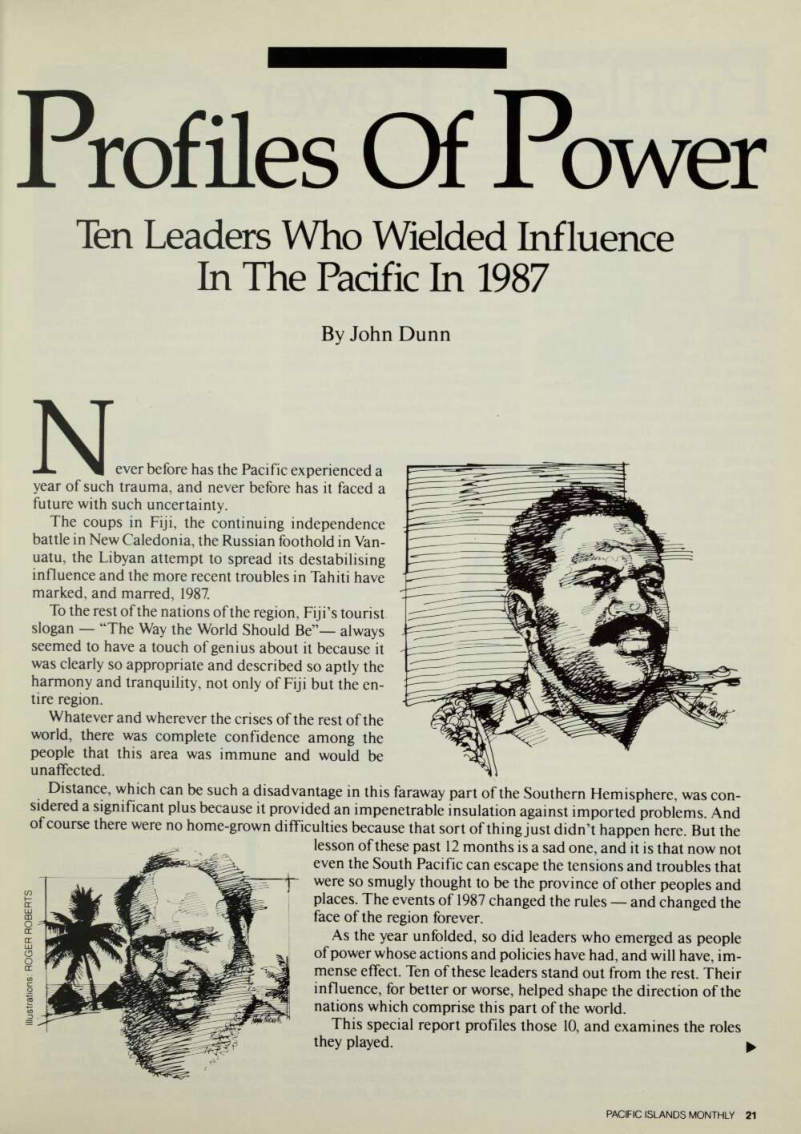
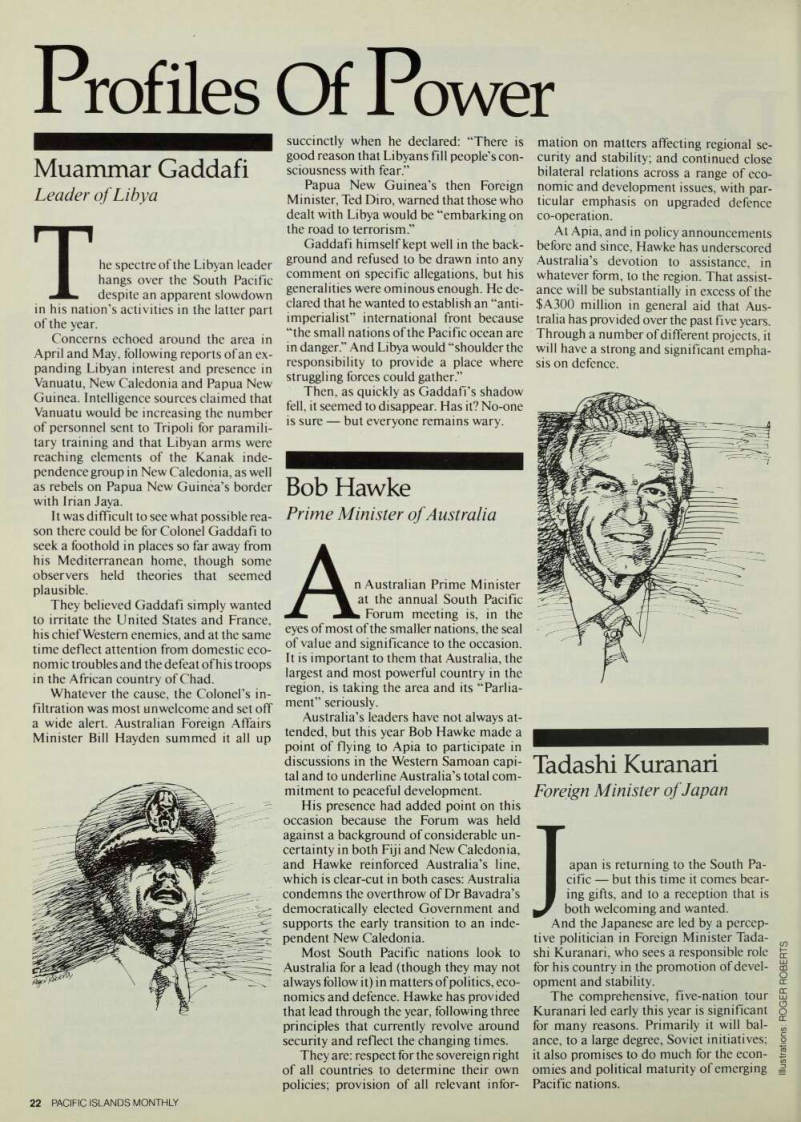
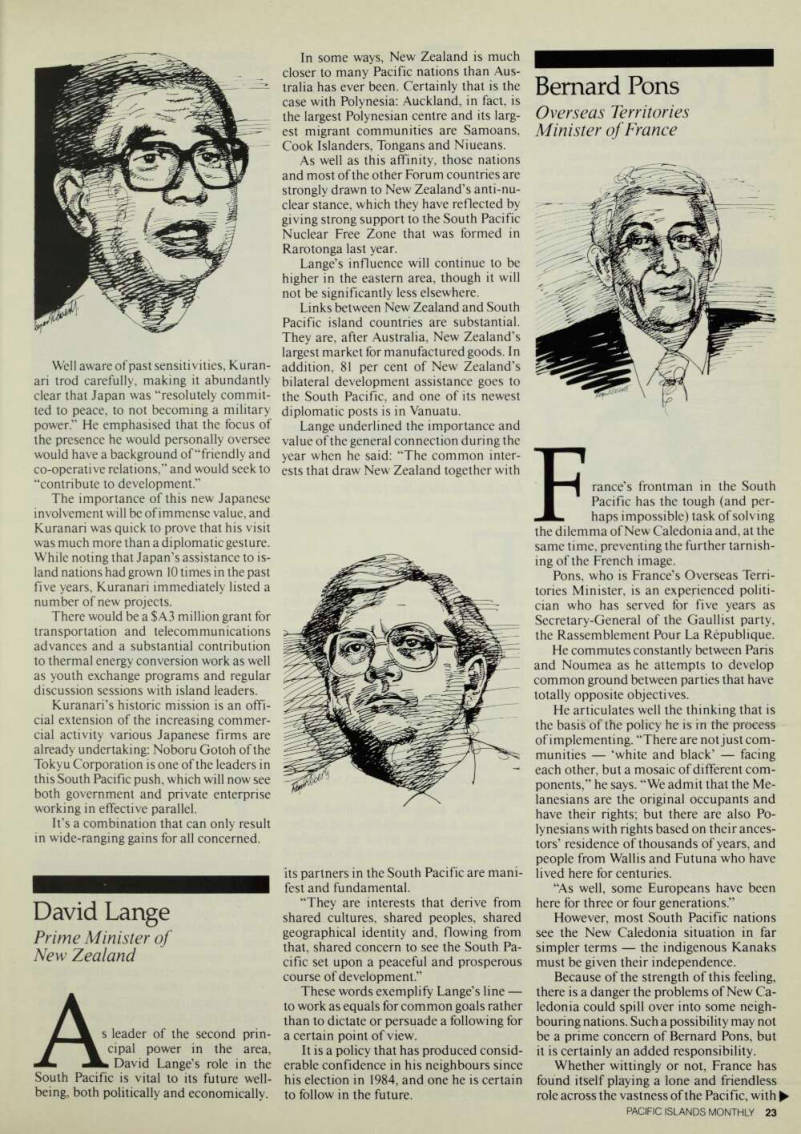
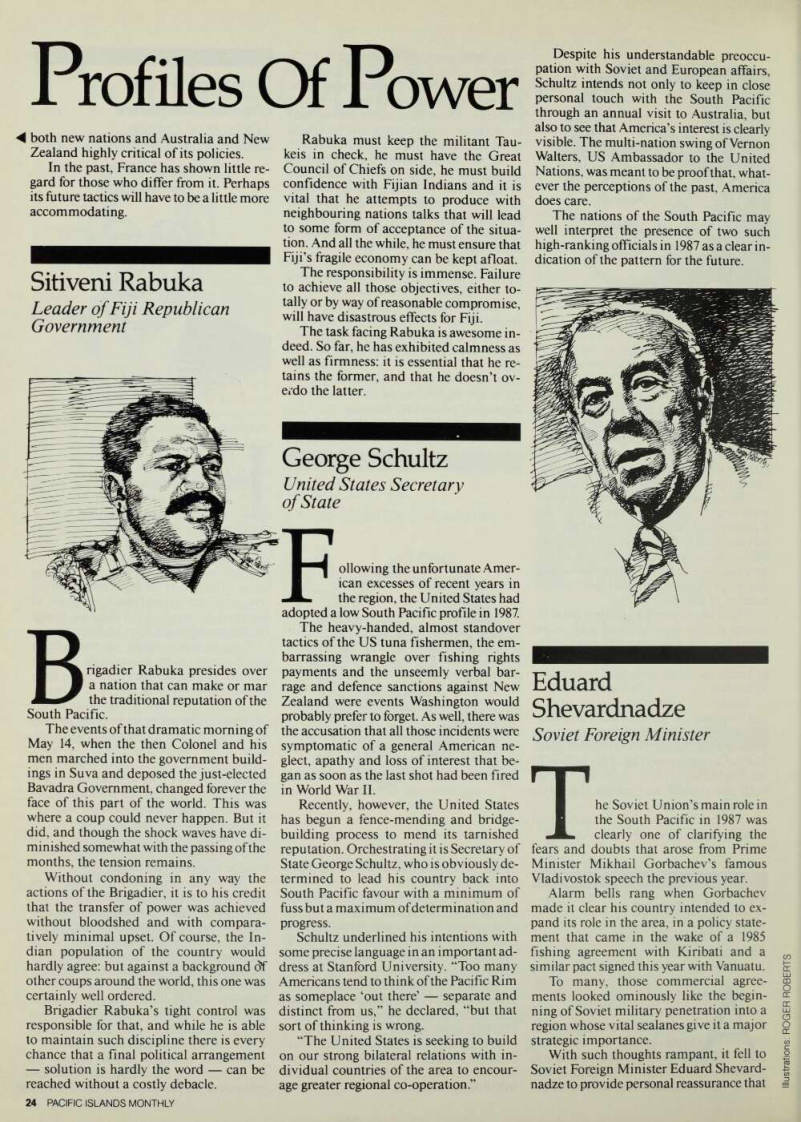
Ten Leaders Who Wielded Influence In The Pacific In 1987
By John Dunn
N JL. ever before has the Pacific experienced a year of such trauma, and never before has it faced a future with such uncertainty.
The coups in Fiji, the continuing independence battle in New Caledonia, the Russian foothold in Van uatu, the Libyan attempt to spread its destabilising influence and the more recent troubles in Tahiti have marked, and marred, 1987.
To the rest of the nations of the region, Fiji’s tourist slogan “The Way the World Should Be”— always seemed to have a touch of genius about it because it was clearly so appropriate and described so aptly the harmony and tranquility, not only of Fiji but the en tire region.
Whatever and wherever the crises of the rest of the world, there was complete confidence among the people that this area was immune and would be unaffected.
Distance, which can be such a disadvantage in this faraway part of the Southern Hemisphere, was con sidered a significant plus because it provided an impenetrable insulation against imported problems. And of course there were no home-grown difficulties because that sort of thing just didn’t happen here. But the
lesson of these past 12 months is a sad one, and it is that now not even the South Pacific can escape the tensions and troubles that were so smugly thought to be the province of other peoples and places. The events of 1987 changed the rules and changed the face of the region forever.
As the year unfolded, so did leaders who emerged as people of power whose actions and policies have had, and will have, im mense effect. Ten of these leaders stand out from the rest. Their influence, for better or worse, helped shape the direction of the nations which comprise this part of the world.
This special report profiles those 10, and examines the roles they played.
Muammar Gaddafi
Leader of Libya
T §■ he spectre of the Libyan leader j| hangs over the South Pacific ■JL. despite an apparent slowdown in his nation’s activities in the latter part of the year.
Concerns echoed around the area in April and May, following reports of an ex panding Libyan interest and presence in Vanuatu, New Caledonia and Papua New Guinea. Intelligence sources claimed that Vanuatu would be increasing the number of personnel sent to Tripoli for paramili tary training and that Libyan arms were reaching elements of the Kanak inde pendence group in New Caledonia, as well as rebels on Papua New Guinea’s border with Irian Jaya.
It was difficult to see what possible rea son there could be for Colonel Gaddafi to seek a foothold in places so far away from his Mediterranean home, though some observers held theories that seemed plausible.
They believed Gaddafi simply wanted to irritate the United States and France, his chief Western enemies, and at the same time deflect attention from domestic eco nomic troubles and the defeat of his troops in the African country of Chad.
Whatever the cause, the Colonel’s in filtration was most unwelcome and set off a wide alert. Australian Foreign Affairs Minister Bill Hayden summed it all up
succinctly when he declared: “There is good reason that Libyans fill people’s con sciousness with fear.”
Papua New Guinea’s then Foreign Minister, Ted Diro, warned that those who dealt with Libya would be “embarking on the road to terrorism.”
Gaddafi himself kept well in the back ground and refused to be drawn into any comment ort specific allegations, but his generalities were ominous enough. He de clared that he wanted to establish an “anti imperialist” international front because “the small nations of the Pacific ocean are in danger.” And Libya would “shoulder the responsibility to provide a place where struggling forces could gather.”
Then, as quickly as Gaddafi’s shadow fell, it seemed to disappear. Has it? No-one is sure but everyone remains wary.
Bob Hawke
Prime Minister of Australia
An Australian Prime Minister at the annual South Pacific ■ Forum meeting is, in the eyes of most of the smaller nations, the seal of value and significance to the occasion.
It is important to them that Australia, the largest and most powerful country in the region, is taking the area and its “Parlia ment” seriously.
Australia’s leaders have not always at tended, but this year Bob Hawke made a point of flying to Apia to participate in discussions in the Western Samoan capi tal and to underline Australia’s total com mitment to peaceful development.
His presence had added point on this occasion because the Forum was held against a background of considerable un certainty in both Fiji and New Caledonia, and Hawke reinforced Australia’s line, which is clear-cut in both cases; Australia condemns the overthrow of Dr Bavadra’s democratically elected Government and supports the early transition to an inde pendent New Caledonia.
Most South Pacific nations look to Australia for a lead (though they may not always follow it) in matters of politics, eco nomics and defence. Hawke has provided that lead through the year, following three principles that currently revolve around security and reflect the changing times.
They are: respect for the sovereign right of all countries to determine their own policies; provision of all relevant infor
mation on matters affecting regional se curity and stability; and continued close bilateral relations across a range of eco nomic and development issues, with par ticular emphasis on upgraded defence co-operation.
At Apia, and in policy announcements before and since, Hawke has underscored Australia’s devotion to assistance, in whatever form, to the region. That assist ance will be substantially in excess of the SA3OO million in general aid that Aus tralia has provided over the past five years.
Through a number of different projects, it will have a strong and significant empha sis on defence.
Tadashi Kuranari
Foreign Minister of Japan
Japan is returning to the South Pa cific but this time it comes bear ing gifts, and to a reception that is both welcoming and wanted.
And the Japanese are led by a percep tive politician in Foreign Minister Tada shi Kuranari, who sees a responsible role for his country in the promotion of devel opment and stability.
The comprehensive, five-nation tour Kuranari led early this year is significant for many reasons. Primarily it will bal ance, to a large degree, Soviet initiatives; it also promises to do much for the econ omies and political maturity of emerging Pacific nations.
Well aware of past sensitivities, Kuran ari trod carefully, making it abundantly clear that Japan was “resolutely commit ted to peace, to not becoming a military power.” He emphasised that the focus of the presence he would personally oversee would have a background of “friendly and co-operative relations,” and would seek to “contribute to development.”
The importance of this new Japanese involvement will be of immense value, and Kuranari was quick to prove that his visit was much more than a diplomatic gesture.
While noting that Japan’s assistance to is land nations had grown 10 times in the past five years, Kuranari immediately listed a number of new projects.
There would be a SA3 million grant for transportation and telecommunications advances and a substantial contribution to thermal energy conversion work as well as youth exchange programs and regular discussion sessions with island leaders.
Kuranari’s historic mission is an offi cial extension of the increasing commer cial activity various Japanese firms are already undertaking: Noboru Gotoh of the Tokyu Corporation is one of the leaders in this South Pacific push, which will now see both government and private enterprise working in effective parallel.
It’s a combination that can only result in wide-ranging gains for all concerned.
David Lange
Prime Minister of New Zealand As leader of the second prin cipal power in the area, David Lange’s role in the South Pacific is vital to its future well being, both politically and economically.
In some ways, New Zealand is much closer to many Pacific nations than Aus tralia has ever been. Certainly that is the case with Polynesia: Auckland, in fact, is the largest Polynesian centre and its larg est migrant communities are Samoans, Cook Islanders, Tongans and Niueans.
As well as this affinity, those nations and most of the other Forum countries are strongly drawn to New Zealand’s anti-nu clear stance, which they have reflected by giving strong support to the South Pacific Nuclear Free Zone that was formed in Rarotonga last year.
Lange’s influence will continue to be higher in the eastern area, though it will not be significantly less elsewhere.
Links between New Zealand and South Pacific island countries are substantial.
They are, after Australia, New Zealand’s largest market for manufactured goods. In addition, 81 per cent of New Zealand’s bilateral development assistance goes to the South Pacific, and one of its newest diplomatic posts is in Vanuatu.
Lange underlined the importance and value of the general connection during the year when he said: “The common inter ests that draw New Zealand together with
its partners in the South Pacific are mani fest and fundamental.
“They are interests that derive from shared cultures, shared peoples, shared geographical identity and, flowing from that, shared concern to see the South Pa cific set upon a peaceful and prosperous course of development.”
These words exemplify Lange’s line to work as equals for common goals rather than to dictate or persuade a following for a certain point of view.
It is a policy that has produced consid erable confidence in his neighbours since his election in 1984, and one he is certain to follow in the future.
Bernard Pons
Overseas Territories Minister of France
r> ranee’s frontman in the South I Pacific has the tough (and per- JL. haps impossible) task of solving the dilemma of New Caledonia and, at the same time, preventing the further tarnish ing of the French image.
Pons, who is France’s Overseas Terri tories Minister, is an experienced politi cian who has served for five years as Secretary-General of the Gaullist party, the Rassemblement Pour La Republique.
He commutes constantly between Paris and Noumea as he attempts to develop common ground between parties that have totally opposite objectives.
He articulates well the thinking that is the basis of the policy he is in the process of implementing. “There are not just com munities ‘white and black’ facing each other, but a mosaic of different com ponents,” he says. “We admit that the Me lanesians are the original occupants and have their rights; but there are also Po lynesians with rights based on their ances tors’ residence of thousands of years, and people from Wallis and Futuna who have lived here for centuries.
“As well, some Europeans have been here for three or four generations.”
However, most South Pacific nations see the New Caledonia situation in far simpler terms the indigenous Kanaks must be given their independence.
Because of the strength of this feeling, there is a danger the problems of New Ca ledonia could spill over into some neigh bouring nations. Such a possibility may not be a prime concern of Bernard Pons, but it is certainly an added responsibility.
Whether wittingly or not, France has found itself playing a lone and friendless role across the vastness of the Pacific, with
A both new nations and Australia and New Zealand highly critical of its policies.
In the past, France has shown little re gard for those who differ from it. Perhaps its future tactics will have to be a little more accommodating.
Sitiveni Rabuka Leader of Fiji Republican Government
r> rigadier Rabuka presides over W a nation that can make or mar the traditional reputation of the South Pacific.
The events of that dramatic morning of May 14, when the then Colonel and his men marched into the government build ings in Suva and deposed the just-elected Bavadra Government, changed forever the face of this part of the world. This was where a coup could never happen. But it did, and though the shock waves have di minished somewhat with the passing of the months, the tension remains.
Without condoning in any way the actions of the Brigadier, it is to his credit that the transfer of power was achieved without bloodshed and with compara tively minimal upset. Of course, the In dian population of the country would hardly agree: but against a background df other coups around the world, this one was certainly well ordered.
Brigadier Rabuka’s tight control was responsible for that, and while he is able to maintain such discipline there is every chance that a final political arrangement solution is hardly the word can be reached without a costly debacle.
Rabuka must keep the militant Tau keis in check, he must have the Great Council of Chiefs on side, he must build confidence with Fijian Indians and it is vital that he attempts to produce with neighbouring nations talks that will lead to some form of acceptance of the situa tion. And all the while, he must ensure that Fiji’s fragile economy can be kept afloat.
The responsibility is immense. Failure to achieve all those objectives, either to tally or by way of reasonable compromise, will have disastrous effects for Fiji.
The task facing Rabuka is awesome in deed. So far, he has exhibited calmness as well as firmness: it is essential that he re tains the former, and that he doesn’t ov erdo the latter.
George Schultz
United States Secretary
of State
T 7 ollowing the unfortunate Amer- I ican excesses of recent years in JL. the region, the United States had adopted a low South Pacific profile in 1987.
The heavy-handed, almost standover tactics of the US tuna fishermen, the em barrassing wrangle over fishing rights payments and the unseemly verbal bar rage and defence sanctions against New Zealand were events Washington would probably prefer to forget. As well, there was the accusation that all those incidents were symptomatic of a general American ne glect, apathy and loss of interest that be gan as soon as the last shot had been fired in World War 11.
Recently, however, the United States has begun a fence-mending and bridge building process to mend its tarnished reputation. Orchestrating it is Secretary of State George Schultz, who is obviously de termined to lead his country back into South Pacific favour with a minimum of fuss but a maximum of determination and progress.
Schultz underlined his intentions with some precise language in an important ad dress at Stanford University. “Too many Americans tend to think of the Pacific Rim as someplace ‘out there’ separate and distinct from us,” he declared, “but that sort of thinking is wrong.
“The United States is seeking to build on our strong bilateral relations with in dividual countries of the area to encour age greater regional co-operation.”
Despite his understandable preoccu pation with Soviet and European affairs, Schultz intends not only to keep in close personal touch with the South Pacific through an annual visit to Australia, but also to see that America’s interest is clearly visible. The multi-nation swing of Vernon Walters, US Ambassador to the United Nations, was meant to be proof that, what ever the perceptions of the past, America does care.
The nations of the South Pacific may well interpret the presence of two such high-ranking officials in 1987 as a clear in dication of the pattern for the future.
Eduard
Shevardnadze
Soviet Foreign Minister
nr 1 he Soviet Union’s main role in 1 the South Pacific in 1987 was clearly one of clarifying the fears and doubts that arose from Prime Minister Mikhail Gorbachev’s famous Vladivostok speech the previous year.
Alarm bells rang when Gorbachev made it clear his country intended to ex pand its role in the area, in a policy state ment that came in the wake of a 1985 fishing agreement with Kiribati and a similar pact signed this year with Vanuatu.
To many, those commercial agree ments looked ominously like the begin ning of Soviet military penetration into a region whose vital sealanes give it a major strategic importance.
With such thoughts rampant, it fell to Soviet Foreign Minister Eduard Shevard nadze to provide personal reassurance that
Moscow’s intentions were purely peace ful. To that end, his polished and charm ing performance in Australia was disarming indeed. Easily and affably, he set the tone at a lunch given by Australian Foreign Affairs Minister Bill Hayden.
“I have been told,” he said, “that in some of your coastal towns, facing the oceans, there are still cannons put there last century to fight off a Russian invasion.
That none of them has even fired a shot is in itself an eloquent fact.”
During talks with Hayden and Prime Minister Bob Hawke, Shevardnadze em phasised that Moscow sought only normal commercial and diplomatic relations with the small nations of the Pacific.
Shevardnadze’s style and credibility were well received, but the truth of the pol icy he promotes can be tested only by time; and there will be some who will want to reserve judgement on the words of the highest-ranking Russian ever to venture so deeply into the South Seas.
However, it must be said that his words overshadowed any current Soviet activity in Vanuatu and eased concern over Mos cow’s intentions at least a little.
Jean-Marie Tjibaou
New Caledonia FLNKS
Leader
T he success, or otherwise, of the game of patience that has been played so long and so well by Kanak leader Jean-Marie Tjibaou will probably have more effect on the peaceful future of the South Pacific than any other factor, Fiji included.
The battle for an independent New Ca ledonia waged by the Kanak Socialist Lib eration Front (FLNKS) has been waged relentlessly for years, and has been led with expert diplomacy by this former priest.
Apart from some isolated incidents, Tjibaou has been able to keep the lid on the aggressive factors in the self-govern ment movement and has managed to keep violence to a minimum. A militant, bot tom-line assessment of his performance, however, in terms of the gains achieved, would undoubtedly reveal that the tactics of dialogue and conciliation have failed. It would be no surprise if pressure began to mount on Tjibaou to take a much stronger and tougher line with the French.
Tjibaou is well aware of this. In addi tion to holding fast to his oft-repeated line “we call our country Kanaky and we are the irrevocable element that must be taken into account in any permanent so lution for the territory” he also sounds a strong warning. “Factions within the FLNKS are impatient with the non-vio lent strategy,” he says. “Of course our mil itants would prefer to take more positive action rather than letting themselves be struck by police.”
Some of those militants want to in volve Libya, Cuba and Vietnam by seek ing help from them. Again Tjibaou has so
far succeeded in maintaining his moder ate stance by preventing that.
But how long can he hold the line? As the French Government, buoyed by the September poll that voted by a massive 48,611 to 842 to remain a part of France, ignores the abstentions and marches on with its future plans for the territory, Tji baou counsels again.
“The referendum in no way changes the situation,” he points out. How it will change, and with what ramifications, de pends largely on the leadership of Jean- Marie Tjibaou.
Paias Wingti
Prime Minister of Papua New Guinea
T 7 very indication points to the f - Papua New Guinea of the fu lure under Prime Minister Paias Wingti being very different from the Papua New Guinea of the past.
Wingti has ambitious plans for his country and for what has become known as the Melanesian Spearhead, and he is bidding, albeit not too boldly, for a posi tion of power and influence not only within the region but also on the world stage.
Wingti sees a much more independent role ahead for Papua New Guinea. While its traditional ties with Australia will cer tainly remain, he aims to develop an un tied role both politically and commercially.
The Prime Minister wants to broaden his nation’s horizons and to develop strong associations with countries beyond his bailiwick, principally around the Pacific Rim the United States, the Soviet 'Union, China and Japan.
Says Wingti: “The Government now intends to move on to examine how re lations have been developing with other countries with substantial interests in our region, and to explore opportunities for increased, mutually beneficial, co operation.”
The first move in this new approach will be to establish trade commissioners in Australia, Japan and Europe and a dip lomatic mission in Beijing. That may be followed by a link with the non-aligned movement, though no firm decision on this step has yet been made. But despite this extension, Paias Wingti will continue to devote his principal attention to his own country and will not diminish his interest in relations with his neighbours.
He has firm rural development plans for his country. “I know what the priority is,” he says. “It’s to be with the people. To get the country moving and to get the people feeling it is moving.” □
Advertisements & other items, p. 24 (1 item)
Itf || Ii Oc I L| I Rua7Ov
24
PACIFIC ISLANDS MONTHLY
I
I I I 1 1 I
iTf II OC I l| I rUA7OV JL 1 V/l I yy I I V/ W
Leaders And Their Legacies
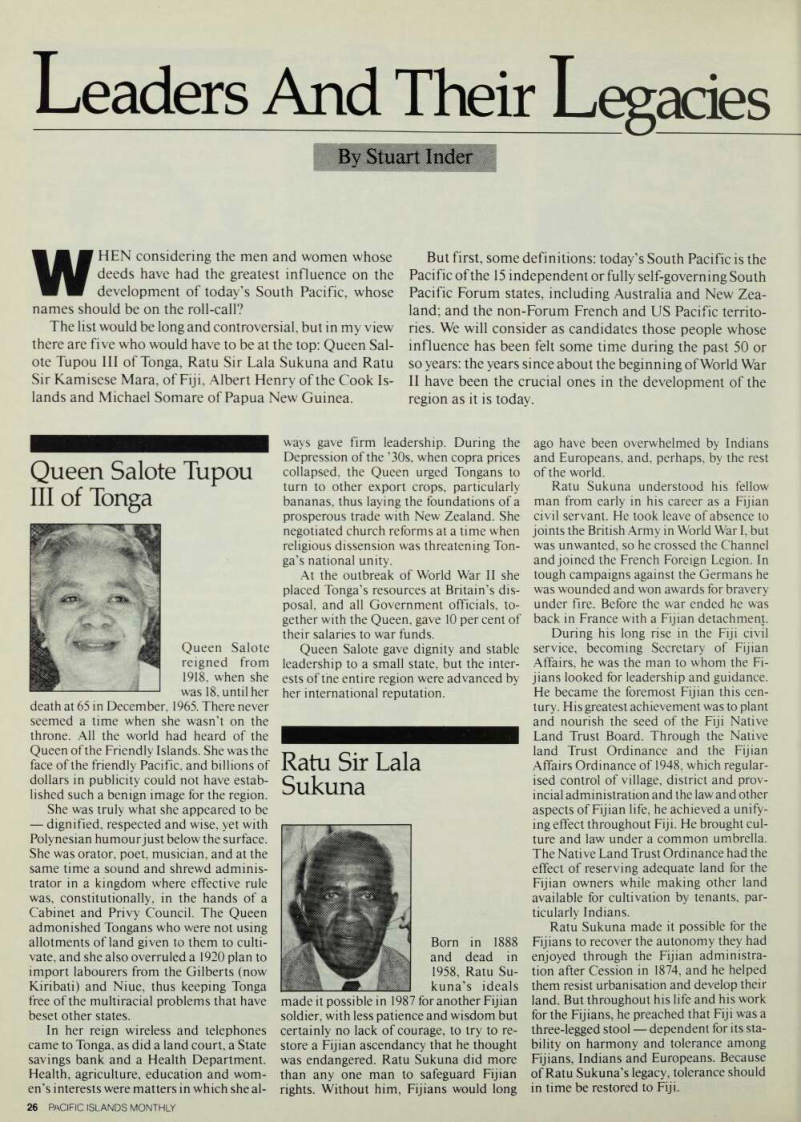
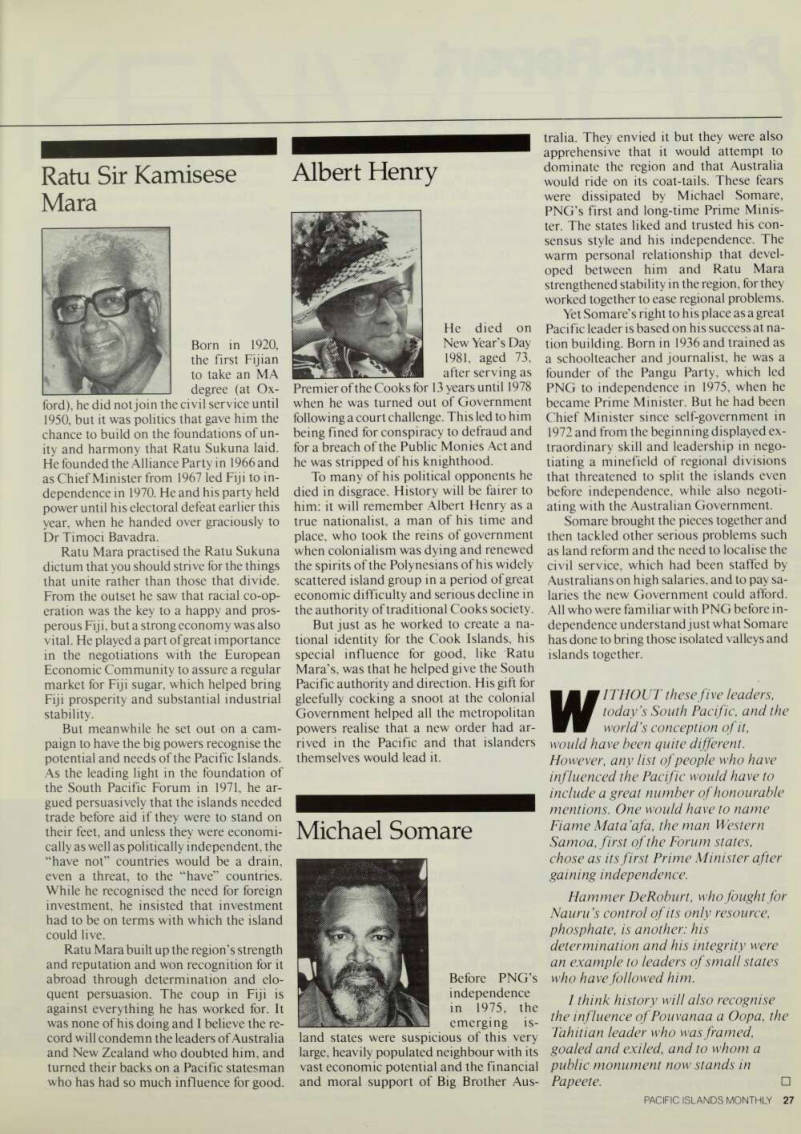
By Stuart Inder
WHEN considering the men and women whose deeds have had the greatest influence on the development of today’s South Pacific, whose names should be on the roll-call?
The list would be long and controversial, but in my view there are five who would have to be at the top: Queen Sal ote Tupou 111 of Tonga, Ratu Sir Lala Sukuna and Ratu Sir Kamisese Mara, of Fiji, Albert Henry of the Cook Is lands and Michael Somare of Papua New Guinea.
But first, some definitions: today’s South Pacific is the Pacific of the 15 independent or fully self-governing South Pacific Forum states, including Australia and New Zea land; and the non-Forum French and US Pacific territo ries. We will consider as candidates those people whose influence has been felt some time during the past 50 or so years: the years since about the beginning of World War II have been the crucial ones in the development of the region as it is today.
Queen Salote Tupou 111 of Tonga
Queen Salote reigned from 1918, when she was 18, until her
death at 65 in December, 1965. There never seemed a time when she wasn’t on the throne. All the world had heard of the Queen of the Friendly Islands. She was the face of the friendly Pacific, and billions of dollars in publicity could not have estab lished such a benign image for the region.
She was truly what she appeared to be dignified, respected and wise, yet with Polynesian humour just below the surface.
She was orator, poet, musician, and at the same time a sound and shrewd adminis trator in a kingdom where effective rule was, constitutionally, in the hands of a Cabinet and Privy Council. The Queen admonished Tongans who were not using allotments of land given to them to culti vate, and she also overruled a 1920 plan to import labourers from the Gilberts (now Kiribati) and Niue, thus keeping Tonga free of the multiracial problems that have beset other states.
In her reign wireless and telephones came to Tonga, as did a land court, a State savings bank and a Health Department.
Health, agriculture, education and wom en’s interests were matters in which she al
ways gave firm leadership. During the Depression of the ’3os, when copra prices collapsed, the Queen urged Tongans to turn to other export crops, particularly bananas, thus laying the foundations of a prosperous trade with New Zealand. She negotiated church reforms at a time when religious dissension was threatening Ton ga’s national unity.
At the outbreak of World War II she placed Tonga’s resources at Britain’s dis posal, and all Government officials, to gether with the Queen, gave 10 per cent of their salaries to war funds.
Queen Salote gave dignity and stable leadership to a small state, but the inter ests of the entire region were advanced by her international reputation.
Ratu Sir Lala Sukuna
Born in 1888 and dead in 1958, Ratu Su kuna’s ideals
made it possible in 1987 for another Fijian soldier, with less patience and wisdom but certainly no lack of courage, to try to re store a Fijian ascendancy that he thought was endangered. Ratu Sukuna did more than any one man to safeguard Fijian rights. Without him, Fijians would long
ago have been overwhelmed by Indians and Europeans, and, perhaps, by the rest of the world.
Ratu Sukuna understood his fellow man from early in his career as a Fijian civil servant. He took leave of absence to joints the British Army in World War I, but was unwanted, so he crossed the Channel and joined the French Foreign Legion. In tough campaigns against the Germans he was wounded and won awards for bravery under fire. Before the war ended he was back in France with a Fijian detachment.
During his long rise in the Fiji civil service, becoming Secretary of Fijian Affairs, he was the man to whom the Fi jians looked for leadership and guidance.
He became the foremost Fijian this cen tury. His greatest achievement was to plant and nourish the seed of the Fiji Native Land Trust Board. Through the Native land Trust Ordinance and the Fijian Affairs Ordinance of 1948, which regular ised control of village, district and prov incial administration and the law and other aspects of Fijian life, he achieved a unify ing effect throughout Fiji. He brought cul ture and law under a common umbrella.
The Native Land Trust Ordinance had the effect of reserving adequate land for the Fijian owners while making other land available for cultivation by tenants, par ticularly Indians.
Ratu Sukuna made it possible for the Fijians to recover the autonomy they had enjoyed through the Fijian administra tion after Cession in 1874, and he helped them resist urbanisation and develop their land. But throughout his life and his work for the Fijians, he preached that Fiji was a three-legged stool dependent for its sta bility on harmony and tolerance among Fijians, Indians and Europeans. Because of Ratu Sukuna’s legacy, tolerance should in time be restored to Fiji.
Ratu Sir Kamisese Mara
Born in 1920, the first Fijian to take an MA degree (at Ox
ford), he did not join the civil service until 1950, but it was politics that gave him the chance to build on the foundations of un ity and harmony that Ratu Sukuna laid.
He founded the Alliance Party in 1966 and as Chief Minister from 1967 led Fiji to in dependence in 1970. He and his party held power until his electoral defeat earlier this year, when he handed over graciously to Dr Timoci Bavadra.
Ratu Mara practised the Ratu Sukuna dictum that you should strive for the things that unite rather than those that divide.
From the outset he saw that racial co-op eration was the key to a happy and pros perous Fiji, but a strong economy was also vital. He played a part of great importance in the negotiations with the European Economic Community to assure a regular market for Fiji sugar, which helped bring Fiji prosperity and substantial industrial stability.
But meanwhile he set out on a cam paign to have the big powers recognise the potential and needs of the Pacific Islands.
As the leading light in the foundation of the South Pacific Forum in 1971, he ar gued persuasively that the islands needed trade before aid if they were to stand on their feet, and unless they were economi cally as well as politically independent, the “have not” countries would be a drain, even a threat, to the “have” countries.
While he recognised the need for foreign investment, he insisted that investment had to be on terms with which the island could live.
Ratu Mara built up the region’s strength and reputation and won recognition for it abroad through determination and elo quent persuasion. The coup in Fiji is against everything he has worked for. It was none of his doing and I believe the re cord will condemn the leaders of Australia and New Zealand who doubted him, and turned their backs on a Pacific statesman who has had so much influence for good.
Albert Henry
He died on New Year’s Day 1981, aged 73, after serving as
Premier of the Cooks for 13 years until 1978 when he was turned out of Government following a court challenge. This led to him being fined for conspiracy to defraud and for a breach of the Public Monies Act and he was stripped of his knighthood.
To many of his political opponents he died in disgrace. History will be fairer to him: it will remember Albert Henry as a true nationalist, a man of his time and place, who took the reins of government when colonialism was dying and renewed the spirits of the Polynesians of his widely scattered island group in a period of great economic difficulty and serious decline in the authority of traditional Cooks society.
But just as he worked to create a na tional identity for the Cook Islands, his special influence for good, like Ratu Mara’s, was that he helped give the South Pacific authority and direction. His gift for gleefully cocking a snoot at the colonial Government helped all the metropolitan powers realise that a new order had ar rived in the Pacific and that islanders themselves would lead it.
Michael Somare
Before PNG’s independence in 1975, the emerging is
land states were suspicious of this very large, heavily populated neighbour with its vast economic potential and the financial and moral support of Big Brother Aus
tralia. They envied it but they were also apprehensive that it would attempt to dominate the region and that Australia would ride on its coat-tails. These fears were dissipated by Michael Somare, PNG’s first and long-time Prime Minis ter. The states liked and trusted his con sensus style and his independence. The warm personal relationship that devel oped between him and Ratu Mara strengthened stability in the region, for they worked together to ease regional problems.
Yet Somare’s right to his place as a great Pacific leader is based on his success at na tion building. Born in 1936 and trained as a schoolteacher and journalist, he was a founder of the Pangu Parly, which led PNG to independence in 1975, when he became Prime Minister. But he had been Chief Minister since self-government in 1972 and from the beginning displayed ex traordinary skill and leadership in nego tiating a minefield of regional divisions that threatened to split the islands even before independence, while also negoti ating with the Australian Government.
Somare brought the pieces together and then tackled other serious problems such as land reform and the need to localise the civil service, which had been staffed by Australians on high salaries, and to pay sa laries the new Government could afford.
All who were familiar with PNG before in dependence understand just what Somare has done to bring those isolated valleys and islands together.
MMMITHOUT these five leaders, today's South Pacific, and the mW world’s conception of it, would have been quite different.
However, any list of people who have influenced the Pacific would have to include a great number of honourable mentions. One would have to name Fiame Mata ’afa, the man Western Samoa, first of the Forum states, chose as its first Prime Minister after gaining independence.
Hammer Deßoburt, who fought for Nauru’s control of its only resource, phosphate, is another: his determination and his integrity were an example to leaders of small states who have followed him.
I think history will also recognise the influence of Pouvanaa a Oopa, the Tahitian leader who was framed, goaled and exiled, and to whom a public monument now stands in Papeete. □
Pacific Report
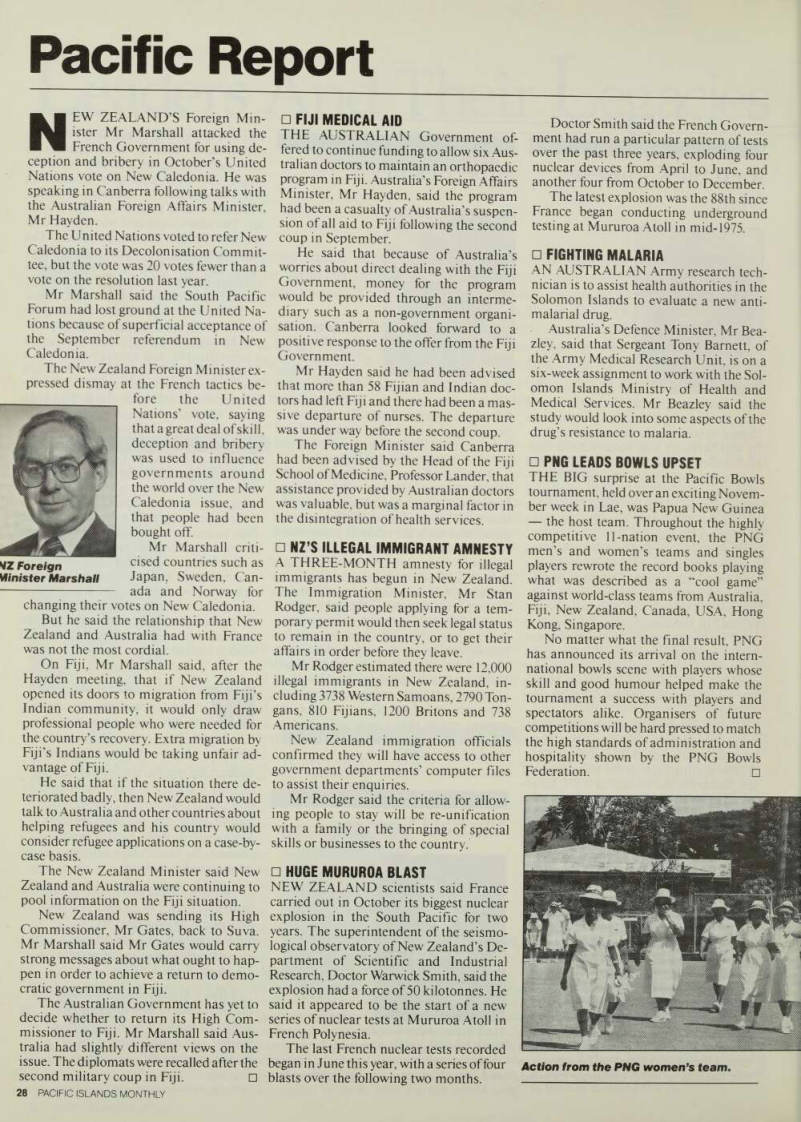
NEW ZEALAND’S Foreign Min ister Mr Marshall attacked the French Government for using de ception and bribery in October’s United Nations vote on New Caledonia. He was speaking in Canberra following talks with the Australian Foreign Affairs Minister, Mr Hayden.
The United Nations voted to refer New Caledonia to its Decolonisation Commit tee, but the vote was 20 votes fewer than a vote on the resolution last year.
Mr Marshall said the South Pacific Forum had lost ground at the United Na tions because of superficial acceptance of the September referendum in New Caledonia.
The New Zealand Foreign Minister ex pressed dismay at the French tactics be-
fore the United Nations’ vote, saying that a great deal of skill, deception and bribery was used to influence governments around the world over the New Caledonia issue, and that people had been bought off.
Mr Marshall criti cised countries such as Japan, Sweden, Can ada and Norway for
changing their votes on New Caledonia.
But he said the relationship that New Zealand and Australia had with France was not the most cordial.
On Fiji, Mr Marshall said, after the Hayden meeting, that if New Zealand opened its doors to migration from Fiji’s Indian community, it would only draw professional people who were needed for the country’s recovery. Extra migration by Fiji’s Indians would be taking unfair ad vantage of Fiji.
He said that if the situation there de teriorated badly, then New Zealand would talk to Australia and other countries about helping refugees and his country would consider refugee applications on a case-by case basis.
The New Zealand Minister said New Zealand and Australia were continuing to pool information on the Fiji situation.
New Zealand was sending its High Commissioner, Mr Gates, back to Suva.
Mr Marshall said Mr Gates would carry strong messages about what ought to hap pen in order to achieve a return to demo cratic government in Fiji.
The Australian Government has yet to decide whether to return its High Com missioner to Fiji. Mr Marshall said Aus tralia had slightly different views on the issue. The diplomats were recalled after the second military coup in Fiji. □
□ Fiji Medical Aid
THE AUSTRALIAN Government of fered to continue funding to allow six Aus tralian doctors to maintain an orthopaedic program in Fiji. Australia’s Foreign Affairs Minister, Mr Hayden, said the program had been a casualty of Australia’s suspen sion of all aid to Fiji following the second coup in September.
He said that because of Australia’s worries about direct dealing with the Fiji Government, money for the program would be provided through an interme diary such as a non-government organi sation. Canberra looked forward to a positive response to the offer from the Fiji Government.
Mr Hayden said he had been advised that more than 58 Fijian and Indian doc tors had left Fiji and there had been a mas sive departure of nurses. The departure was under way before the second coup.
The Foreign Minister said Canberra had been advised by the Head of the Fiji School of Medicine, Professor Lander, that assistance provided by Australian doctors was valuable, but was a marginal factor in the disintegration of health services.
□ Nz’S Illegal Immigrant Amnesty
A THREE-MONTH amnesty for illegal immigrants has begun in New Zealand.
The Immigration Minister, Mr Stan Rodger, said people applying for a tem porary permit would then seek legal status to remain in the country, or to get their affairs in order before they leave.
Mr Rodger estimated there were 12,000 illegal immigrants in New Zealand, in cluding 3738 Western Samoans, 2790 Ton gans, 810 Fijians, 1200 Britons and 738 Americans.
New Zealand immigration officials confirmed they will have access to other government departments’ computer files to assist their enquiries.
Mr Rodger said the criteria for allow ing people to stay will be re-unification with a family or the bringing of special skills or businesses to the country.
□ Huge Mururoa Blast
NEW ZEALAND scientists said France carried out in October its biggest nuclear explosion in the South Pacific for two years. The superintendent of the seismo logical observatory of New Zealand’s De partment of Scientific and Industrial Research, Doctor Warwick Smith, said the explosion had a force of 50 kilotonnes. He said it appeared to be the start of a new series of nuclear tests at Mururoa Atoll in French Polynesia.
The last French nuclear tests recorded began in June this year, with a series of four blasts over the following two months.
Doctor Smith said the French Govern ment had run a particular pattern of tests over the past three years, exploding four nuclear devices from April to June, and another four from October to December.
The latest explosion was the 88th since France began conducting underground testing at Mururoa Atoll in mid-1975.
□ Fighting Malaria
AN AUSTRALIAN Army research tech nician is to assist health authorities in the Solomon Islands to evaluate a new anti malarial drug.
Australia’s Defence Minister, Mr Bea zley, said that Sergeant Tony Barnett, of the Army Medical Research Unit, is on a six-week assignment to work with the Sol omon Islands Ministry of Health and Medical Services. Mr Beazley said the study would look into some aspects of the drug’s resistance to malaria.
□ Png Leads Bowls Upset
THE BIG surprise at the Pacific Bowls tournament, held over an exciting Novem ber week in Lae, was Papua New Guinea the host team. Throughout the highly competitive 11-nation event, the PNG men’s and women’s teams and singles players rewrote the record books playing what was described as a “cool game” against world-class teams from Australia, Fiji, New Zealand, Canada, USA, Hong Kong, Singapore.
No matter what the final result, PNG has announced its arrival on the intern national bowls scene with players whose skill and good humour helped make the tournament a success with players and spectators alike. Organisers of future competitions will be hard pressed to match the high standards of administration and hospitality shown by the PNG Bowls Federation. □
NZ Foreign Minister Marshall
Action from the PNG women’s team.
Advertisements & other items, pp. 29-32 (1 item)
Kenwood
360W\
Where in the world can you
enjoy sound like this!
All over the world, Kenwood audio is known for its excellent sound quality and meaningful functions . You can find this and economy too, in the new Midi M-311 audio system.
Compact and ultra-convenient, the M-311 includes many useful features such as Relay Play, High Speed Dubbing, Dolby* B noise reduction and microphone mixing. And this system is even ready for both CD and DAT, with dynamic and full-range speakers to go with it. ‘Trademark of Dolby Laboratories Licensing Corp. -311
Midi Compact Audio System
■ 360 W PMPO ■ Separate CD/DAT inputs with CD DIRECT switch ■ Double cassette deck ■Computerized direct tape program search (DPSS) BQuartz synthesized digital tuner with 12 memory presets ■ Fully automatic turntable with repeat BSOW fullrange speaker system ■ Optional 7-band stereo graphic equalizer
KENWOOD CORPORATION
Shionogi Shibuya Building, 17-5, 2-chome Shibuya, Shibuya-ku, Tokyo 150, Japan KENWOOD ELECTRONICS AUSTRALIA PTY. LTD. (incorporated in n.s.w.) 4E Woodcock Place, Lane Cove, N.S.W. 2066, Australia NEW ZEALAND PETER GILBERT LTD. Auckland Tel. 0011-64-9-5271313 FUJI PEPE'S DUTY FREE CENTRE LTD Tel 25496. 25497 PAPUA NEW GUINEA SO SVENSSON (N.G) LTD Port Moresby Tel. 212150. 212111 SOLOMON ISLANDS TECHNIQUE RADIOS CENTRE LTD. Honiara Tel. 416 NEW CALEDONIA HI-FI VOX Noumea Tel 27-2466 28-2931 VANUATU FUNG CHOI LUEN Port-Vila Tel 2556
TAHITI MAISON AURORE Papeete Tel 29703
AMERICAN SAMOA ISLAND PACIFIC AGENCIES. INC Pago Pago Tel. 633-4687
REPUBLIC OF NAURU NAURU CO-OPERATIVE SOCIETY
MARIANA ISLANDS J.C TENORIO ENTERPRISES Saipan Tel. 6445
Road-Hugging, Rock-Biting. Pai
\ m mmm % m* 0* m m ■t * m m * V ■ * ■ MM mr* y% ■ w*- > W HILUX 4WD Regular Cab, Long Wheelbase One tough truck just got tougher. Toyota’s dedication to superior] performance vehicles takes a step forward today with the New Hilux. j A refined front grille and bumper design, new instrument panel for a feeling of spaciousness and command and plush colour co-ordinated trim are a few new additions to the New Hilux.
And extensive anti-corrosive galvanealed steel protection now includes the tailgate panel and rear door panel, making Hilux more durable than ever before.
Yet for all its improvements, the best of the original Hilux is also
TOYOTA
QUALITY SERVICE
AMERICAN SAMOA: BURNS PHILP (SOUTH SEA) CO., LTD., P.O. Box 129, Pago Pago. COOK ISLANDS: COOK ISLAN AUTOMOTIVE SUPPLIES COMPANY, A Division of Burns Philp (South Sea) Co., Ltd., G.P.O. Box 355, Suva. GUAM & MX Tamuning. KIRIBATI: TARAWA MOTORS, A Division of Bairiki Holdings Ltd., P.O. Box 36, Bairiki, Tarawa. NAURU: NAUR SERVICE IMPORTATION AUTOMOBILE DU PACIFIQUE, Rond-Point du Pacifique (Station Total) B.P. 438, Noumea. NIUE: E NORFOLK ISLAND: BORRY’S LIMITED, P.O. Box 169. PAPUA NEW GUINEA: ELA MOTORS, A Division of Burns Phil CORPORATION, P.O. Box 267, Saipan. SOLOMON ISLANDS; SOLOMON ISLANDS INVESTMENTS LTD., G.P.O. Box 140,
fic-Tough. The New Hilux
3' s •f. % • I \ * I 5 t * %%> V * * -4* * * i ere; a big tailgate conveniently hinged for quick loading and unloading; reinforced front suspension to smooth out ie bumps, and bias-mounted, extra-heavy-duty rear shocks and knobbly tyres to take on any terrain.
Toyota’s long history of super-responsive engines, ruggedness, reliability and comfort goes without saying. And in the Hilux, it’s yours in both 2-wheel-drive and 4X4 versions.
So, after comprehensive testing and thorough quality control, the New Hilux is ready to bring a new standard of toughness to the Pacific.
And isn’t that exactly what you expect from Toyota?
Areas where galvanealed steel is used CORPORATION LTD., Private Bag, Rarotonga. FIJI: SIA: ATKINS KROLL, INC., 443 South Marine Drive,
PERATIVE SOCIETY, Central Pacific. NEW CALEDONIA:
3 HILP (SOUTH SEA) CO., LTD., RO. Box 39, Alofi. i Ltd., P.O. Box 75. Port Moresby. SAIPAN: MICROL a. TAHITI: NIPPON AUTOMOTO, B.P. 342, Papeete.
Ltd PO Rnx Ift Port Vila WESTERN SAMOA-
TOYOTA
Avante. More than
a symbol of
soaring power.
AVANTE 9100 R
* $ <P .0 $ That’s right, Avante is more than a symbol of soaring power. It is power itself, and can bestow power on you.
Take the Avante 9100 R component system—it puts 350W/ch. of music power right in your hands, for music power output that reaches prodigious, soaring heights I What’s more, the 9100 R gives you the power to tailor output with a built-in 7-band graphic equalizer/spectrum analyzer. And it offers Pioneer “SR” audio/video remote control for full remote-control command not only of the Avante 9100 R, but of any Pioneer product with the “SR” logo.
Not only that, it brings a full-logic double auto-reverse cassette deck, a quartz-PLL synthesized tuner with 24 randomaccess station presets (FM/AM), a fully automatic turntable, and a 4-way speaker system that boasts rich, heavy bass, stunning mids, and crystal-clear highs.
But the Avante 9100 R is more than the sum of its superior fJdl IS.
It’s the “pure sound” component system so sophisticated, that it simply began as state-of-the-art technology, ending as a welcome addition to any music lover’s home because its woodgrain cabinet blends so beautifully with home decor.
The Avante 9100 R, with power, real power—the kind of power it takes to make music come alive —and your spirit soar!
Note: The PD-M4O Multi-Play CD player and EX-9000(BK) Dynamic Expander, shown in this ad, are available as options.
The Avante 4100 R (350W/ch. PMPO) and Avante 3100 (270W/ch. PMPO) are also available. Ask your Pioneer dealer for details.
0 PIONEER
The future of sound and vision.
For further information, please contact: Australia; Pioneer Electronics Australia Pty. Ltd. (Incorporated in Victoria), P.O. Box 295, Mordialloc, Victoria, 3195 Tel: 580-9911 Fiji Islands: Brijlal & Company, G.P.O. Box No. 362, Suva, Fiji Islands Tel: 22258 New Zealand: Monaco Distributors Ltd., 41 Poland Road, Glenfield, Auckland, New Zealand Tel: (09) 444-9144 Norfolk Island: Burnt Pine Traders Ltd., P.O. Box 21, Norfolk Island Vanuatu: Burns Philp (Vanuatu) Ltd., Vila, Vanuatu Nauru Island: Jacob Enterprises, P.O. Box N 0.4, Republic of Nauru Tahiti: Tahiti Hi-Fi, P.O. Box 848, Papeete, Tahiti New Caledonia: Menard Pacifique Sari, B.P. 3899, Noumea, New Caledonia Tel: 27.62*23 American Samoa; Transpac Corporation, P.O. Box 1477, Pago Pago, American Samoa 96799 Tel: 633-5224
Trade Winds
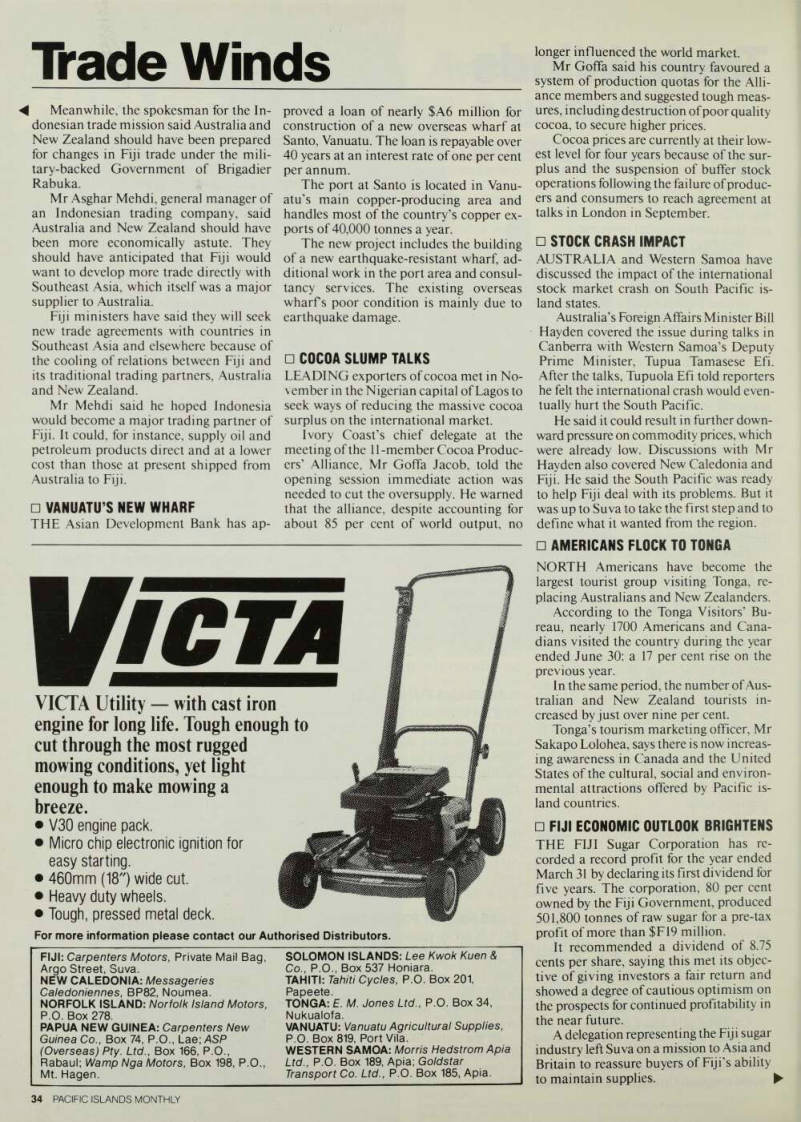

PAPUA NEW GUINEA has been chosen by the UK Government’s foreign aid investment arm, the Commonwealth Development Corpora tion (CDC), as the test site for its pilot pro ject into venture capital investment.
The wholly owned subsidiary of CDC, Venture Fund Pty Ltd, was set up in Port Moresby earlier this year with a start-up capital of £1 million.
Venture Fund is looking for PNG com panies in search of long-term finance on an equity rather than debt-servicing basis.
It can invest between K 100,000 and K 550,000 if this represents between 10 and 30 per cent of a company’s total share holding. Projections for a company’s pre tax profit within three to four years of in vestment should be between K 50,000 and K 100,000.
According to the Fund’s general man ager, lan Cardwell, criteria for investment are strong growth, profit potential, com petent and motivated management and willingness for the Fund to participate through consultation and nomination of a director to the company board.
The CDC, under whose auspices Ven ture Fund has been established, operates in 56 Third World countries, two-thirds of which are members of the Common wealth. Over 10 years it has invested some K7O million in PNG: Higaturu Oil Palm Pty Ltd, Milne Bay Estates Pty Ltd (also palm oil), the PNG Electricity Commis sion and Ramu Sugar Holdings Pty Ltd.
Elsewhere in the Pacific, CDC is partici pating in Fiji, the Solomons and Vanuatu.
But where CDC has £1.5 million com mitted around the world in a variety of fi nancial structures from majority equity to facilitation of loans from banks or other equity investors, PNG Venture Fund Pty Ltd is the Corporation’s first foray into venture capital.
“My own research showed there was a shortage of capital, especially venture capital, for small companies,” says Card well. “We don’t want to become actively involved in management. It’s rather a matter of backing good management already there, tweaking it at the edges, in sisting on certain controls and providing us with certain information as a condition of participation.
“We’ve chosen PNG to start with be cause it’s very exciting. In particular, there’s an active mining sector that will continue for at least another decade,”
Cardwell said some 60 inquiries had been made since Venture Fund had opened shop in mid-year. Twenty of these were now being followed up and he felt the Fund would eventually invest in between six and
10 companies. At the time of writing no commitments had been made.
“It’s clear there’s a lot of interest and it’s not confined to any particular sector,” he continued. “It varies from new ven tures to long-established companies, and from agriculture through light industry to helicopter transport to real estate and other service industries. There’s great diversity in size, ownership and style of management.”
Cardwell said the Fund’s requirement for detailed information had resulted in long intervals between the initial contact and the final decision on whether to com mit funds. PNG companies did not store and collate such data as a standard prac tice. “But I don’t see this as an insuperable difficulty,” he said. Chris Ashton
□ Australia-Nz-Canada Trade
THE NEW Zealand Minister for Over seas Trade told a visiting Canadian dele gation there will be a study of the viability of closer economic ties between their countries and Australia. Mr Mike Moore said the study would identify the benefits and costs of such a scheme. The liberal isation of trade barriers and other impe diments to free trade would be scrutinised.
Mr Moore said informal talks on closer trading and economic links had already started and the study would lead to further consultations. He said he expected to re ceive the report by the middle of next year.
□ Australia-Fiji Air Pact
AUSTRALIA and Fiji became partners in Fiji’s national airline, Air Pacific, despite tensions between the two Governments.
Qantas bought a 20 per cent interest in Air Pacific, which is 77 percent owned by the Fijian Government.
Air Pacific’s Chief Executive, Mr John Schaap, says the deal was a purely com mercial investment negotiated long before the first coup in Fiji last May. The other Air Pacific shareholders are Air New Zea land, Tonga, Solomon Islands, Nauru, Western Samoa and Kiribati.
□ Png Poultry Production Up
PAPUA NEW Guinea’s poultry industry is expected to further increase production by the end of this year. In 1980, the local industry could produce some 3700 tonnes of chickens less than half the country’s demand for poultry. The rest was imported.
By the end of 1987, however, local poul try production will have trebled to 10,300 tonnes; almost all the poultry meat con sumed in Papua New Guinea.
According to a report from Niugini Tablebirds, Lae, consumption is expected to increase over the next three years to reach 11,100 tonnes in 1989.
Deputy Prime Minister and Minister for Trade and Industry, Sir Julius Chan, says the increase in poultry meat produc tion will enable the country to become self sufficient.
□ Small Business Boost
A STUDY into small business in Papua New Guinea has recommended the estab lishment of a Small Enterprise Centre of Excellence, which could be funded by in ternational aid and offer one-stop facili ties for small enterprise advice.
It could also offer its services to under take consultancy work for small busi nesses on a self-financing basis.
The proposal is one of seven action plans proposed to stimulate small busi ness enterprises in the country. The PNG Government has also been asked for a “more concerted commitment” to small enterprise development.
□ Indonesian Courts Fiji Trade
AN Indonesian trade mission has begun talks in Suva with Fiji Government and business leaders.
It is the first foreign mission to visit Fiji since the new Republican Government announced it would diversify its trading partners following the cooling of relations with Australia and New Zealand. A Fiji trade mission visited Indonesia twice be tween the military coups in May and September.
Fiji’s interim Foreign Minister, Filipe Bole, named Indonesia as one of three countries where Fiji was considering set ting up trade offices. The others are Ma laysia and China, which (unlike Indonesia) have diplomatic missions in Suva.
Talks between Fiji Government offi cials and a visiting Indonesian commer cial delegation have culminated in an agreement in principle for a study to es tablish an air service between the two countries.
A statement from the military Govern ment in Suva says Fiji also wanted to take advantage of an Indonesian offer of a loan of 25,000 tonnes of rice.
Fiji has agreed to buy from Indonesia petroleum products, maize, cooking oil, tea and spare parts for the sugar industry.
Discussions will begin soon on aircraft and ships that Fiji plans to buy from Indonesia.
For its part, Indonesia will buy sugar, molasses, canned fish and timber prod ucts from Fiji. ►
<4 Meanwhile, the spokesman for the In donesian trade mission said Australia and New Zealand should have been prepared for changes in Fiji trade under the mili tary-backed Government of Brigadier Rabuka.
Mr Asghar Mehdi, general manager of an Indonesian trading company, said Australia and New Zealand should have been more economically astute. They should have anticipated that Fiji would want to develop more trade directly with Southeast Asia, which itself was a major supplier to Australia.
Fiji ministers have said they will seek new trade agreements with countries in Southeast Asia and elsewhere because of the cooling of relations between Fiji and its traditional trading partners, Australia and New Zealand.
Mr Mehdi said he hoped Indonesia would become a major trading partner of Fiji. It could, for instance, supply oil and petroleum products direct and at a lower cost than those at present shipped from Australia to Fiji.
□ Vanuatu’S New Wharf
THE Asian Development Bank has ap
proved a loan of nearly SA6 million for construction of a new overseas wharf at Santo, Vanuatu. The loan is repayable over 40 years at an interest rate of one per cent per annum.
The port at Santo is located in Vanu atu’s main copper-producing area and handles most of the country’s copper ex ports of 40,000 tonnes a year.
The new project includes the building of a new earthquake-resistant wharf, ad ditional work in the port area and consul tancy services. The existing overseas wharf s poor condition is mainly due to earthquake damage.
□ Cocoa Slump Talks
LEADING exporters of cocoa met in No vember in the Nigerian capital of Lagos to seek ways of reducing the massive cocoa surplus on the international market.
Ivory Coast’s chief delegate at the meeting of the 11-member Cocoa Produc ers’ Alliance, Mr Goffa Jacob, told the opening session immediate action was needed to cut the oversupply. He warned that the alliance, despite accounting for about 85 per cent of world output, no
longer influenced the world market.
Mr Goffa said his country favoured a system of production quotas for the Alli ance members and suggested tough meas ures, including destruction of poor quality cocoa, to secure higher prices.
Cocoa prices are currently at their low est level for four years because of the sur plus and the suspension of buffer stock operations following the failure of produc ers and consumers to reach agreement at talks in London in September.
□ Stock Crash Impact
AUSTRALIA and Western Samoa have discussed the impact of the international stock market crash on South Pacific is land states.
Australia’s Foreign Affairs Minister Bill Hayden covered the issue during talks in Canberra with Western Samoa’s Deputy Prime Minister, Tupua Tamasese Efi.
After the talks, Tupuola Efi told reporters he felt the international crash would even tually hurt the South Pacific.
He said it could result in further down ward pressure on commodity prices, which were already low. Discussions with Mr Hayden also covered New Caledonia and Fiji. He said the South Pacific was ready to help Fiji deal with its problems. But it was up to Suva to take the first step and to define what it wanted from the region.
□ Americans Flock To Tonga
NORTH Americans have become the largest tourist group visiting Tonga, re placing Australians and New Zealanders.
According to the Tonga Visitors’ Bu reau, nearly 1700 Americans and Cana dians visited the country during the year ended June 30: a 17 per cent rise on the previous year.
In the same period, the number of Aus tralian and New Zealand tourists in creased by just over nine per cent.
Tonga’s tourism marketing officer, Mr Sakapo Lolohea, says there is now increas ing awareness in Canada and the United States of the cultural, social and environ mental attractions offered by Pacific is land countries.
□ Fiji Economic Outlook Brightens
THE FIJI Sugar Corporation has re corded a record profit for the year ended March 31 by declaring its first dividend for five years. The corporation, 80 per cent owned by the Fiji Government, produced 501,800 tonnes of raw sugar for a pre-tax profit of more than SFI9 million.
It recommended a dividend of 8.75 cents per share, saying this met its objec tive of giving investors a fair return and showed a degree of cautious optimism on the prospects for continued profitability in the near future.
A delegation representing the Fiji sugar industry left Suva on a mission to Asia and Britain to reassure buyers of Fiji’s ability to maintain supplies. ►
◄ The delegation includes the managing director of the Fiji Sugar Corporation, Mr Rasheed Ali, the managing director of the Fiji Sugar Marketing Company, Mr John May, and the chairman of the Fiji Sugar Commission, Mr Gerald Barrack.
The delegation held discussions in Ku ala Lumpur and Hong Kong before going to London.
Malaysia buys 80,000 tonnes of Fiji sugar a year under a three-year contract ending in 1989. Britain is Fiji’s biggest sugar customer, taking 165,348 tonnes a year under a five-year contract due to ex pire in 1992.
Correspondents say Fiji’s sugar pro duction will drop from more than 500,000 tonnes to about 400,000 tonnes this year due to a late harvest following the first military coup in May and a six-month drought.
Meanwhile companies mining or ex ploring for minerals in Fiji were assured that the present policy on mining invest ments will continue. The Minister for Mineral Resources, Mr Sakeasi Butadr roka, gave the assurance in a meeting in Suva with representatives of 17 com panies holding mineral exploration licences.
, The Ministry of Information said the meeting followed concern by the mining companies of possible changes in legislation, covering the mining sector and that Mr Butadroka emphasised there would not be changes.
He said, however, the Government now required a percentage of royalties from minerals covered by the present legislation to be transferred to native Fijians.
HMnpn dcuicui
Ptc Under Review
THE West German Corporation Deutsche Telepost has been awarded a contract to conduct a major review of Papua New Guinea’s Post and Telecommunications Corporation (PTC).
The review, funded by the World Bank at a cost of around $A650,000, will cover all PTC network development plans and management areas; Deutsche Telepost will draw up an expansion plan between 1989 and 1993, and will make an independent assessment of the corporation’s management efficiency.
Communications Minister Gabriel Ramoi says the national Government hopes the review will provide improved objectives to meet the needs of customers in Papua New Guinea.
□ Air Niugini Expands
AIR Niugini made its inaugural flight to the Vanuatu capital of Port Vila on Octo ber 27. The service the first direct air link between Port Moresby, Port Vila and the Solomon Islands capital, Honiara will be a joint operation with the Solomon Islands Airways.
Both airlines have agreed to share prof its or losses on the routes between the three island capitals.
Air Niugini also made its inaugural flight to Singapore from Port Moresby on October 28, in a service in joint partner ship with Singapore Airlines.
This flight will be the second weekly service between the two capitals, which Air Niugini is contracted to operate on behalf of the two carriers.
□ Tonga Freighter Furore
THE PACIFIC Forum Line has denied re ports from Tonga that it plans to end its charter of two vessels, the Fua Kavenga and the Forum Samoa.
The King of Tonga in a statement said that the vessels were to be released from the Forum Line fleet to be run independently.
However, the manager of the line, Mr John MacLennan, said in Auckland the King had been given information based on a misunderstanding of the situation. Mr MacLennan says negotiations are in prog ress for the line to retain the two freighters.
Advertisements & other items, pp. 34-37 (1 item)
mowing conditions, yet light
VICTA Utility with cast iron
engine for long life. Tough enough to
cut through the most rugged
mowing conditions, yet light
enough to make mowing a
breeze.
• V3O engine pack.
• Micro chip electronic ignition for
easy starting.
• 460 mm (18") wide cut.
• Heavy duty wheels.
• Tough, pressed metal deck.
For more information please contact our Authorised Distributors.
FIJI: Carpenters Motors, Private Mail Bag, Argo Street, Suva.
NEW CALEDONIA: Messageries Caledoniennes, BPB2, Noumea.
NORFOLK ISLAND: Norfolk Island Motors, P.O. Box 278.
PAPUA NEW GUINEA: Carpenters New Guinea Co., Box 74, P. 0., Lae; ASP (Overseas) Pty. Ltd., Box 166, P. 0., Rabaul; Wamp Nga Motors, Box 198, P. 0., Mt. Hagen.
SOLOMON ISLANDS: Lee Kwok Kuen & Co., P. 0., Box 537 Honiara.
TAHITI: Tahiti Cycles, P.0.80x 201, Papeete.
TONGA: E. M. Jones Ltd., P.O. Box 34, Nukualofa.
VANUATU: Vanuatu Agricultural Supplies, P.O. Box 819, Port Vila.
WESTERN SAMOA: Morris Hedstrom Apia Ltd., P.O. Box 189, Apia; Goldstar Transport Co. Ltd., P.O. Box 185, Apia.
Private Line Channels. Microwave and Fiber Systems. Local Area Networks and VAN’s.
Consulting. PBXs. Operations and Maintenance. International Calling. Multiplexers.
Packet Switching. Data Comm. Pagers. Systems Integration. Project Management. Network Planning, Designing, Engineering and Con struction Services. Train!
There’s
more to
Hawaiian Tel
than meets
the ear.
HAWAIIAN TEL CT73
Beyond the call ketmg ■ - $ Jr % m m A 1
tmm
LONGLIFE PRODUCTS
AND FRESH DAIRY FOODS,
QUALITY YOU CAN TRUST
Q.U.F. Industries Ltd. offers an export award winning range ot Longlife products as well as a complete range of quality fresh dairy foods.
With 19 years' experience as a producer of UHT Longlife Products, Q.U.F. has the product knowledge and expertise to provide you with outstanding service in the 1980 s. Q.U.F. is widely recognised as an innovator, being the first in Australia to introduce UHT Milk, Flavoured Milk and Fruit Juice in Longlife Tetra Brik packs. • Pauls Longlife Milk is natural, liquid cow's milk with no preservatives or additives and is available in 250m1, 500 ml, and 1 litre sizes. • Breaka Flavoured Milk is offered in delicious Chocolate, Strawberry and Vanilla Malt flavours in the 250m1, and 6 x 250 ml multipack. • Pauls Longlife Thickened Cream is ideal for whipping or pouring. • Popper 100% Fruit Juice is available in a wide range of refreshing flavours, in 1 Litre, 250m1, and 6 x 250 ml multipacks, • Pauls Longlife products will keep fresh for up to 6 months without refrigeration. • Pauls fresh dairy products including milk, cream, yoghurt and cottage cheese are available in an extensive range of flavours and sizes.
TRADE ENQUIRIES:
Q.U.F. INDUSTRIES LTD.
P.O. Box 12, South Brisbane, Queensland 4101, Australia.
Telephone: (07) 844 0151
Telex: QUFEXP AA141025 Fax: 61-7-8463668.
6 PACK
r^STTN-'TUnAL
TST. longuh ikwijuck *£3 FE Thickened Cream
nuiK
CHOCOLATE
Sound that's absolutely enchanting, even in the somewhat less than enchanting environment of a moving automobile.
This is Clarions uncompromising standard, realized by the sophisticated use of electronic features that are easy to use. And there's a wide selection of models to meet your individual taste. Clarion reliability? It's no pipe dream. Clarion Car Stereo. Listen and drive happily ever after. ’Dolby and the double-D symbol are trademarks of Dolby Laboratories Licensing Corporation
FOLLOW THE MUSIC
©Clarion
AM STEREO MAGI TUNE/ OIVERSITT
i s s :«•: ch •»• ■ ■ * ... £ ■ m W m ***
NU S S : I.mm! *...?
9900 X Clarion am/fm stereo cassette
SCN RPT
BLS LD 180
tttti t-fff sr*
B 3
LEVEL
TUNE
For further information * u^ ll ‘* : c f m i f'9 a^ n d A W ' reless (Australasia) Ltd 554 Parramatta Road, Ashfield, NS W , 2131 / New Zealand: AWA New Zealand limited, P.O Box 50-248, Porirua / Fiji Islands: Bnjlal &Co . Ltd,, GPO Box 362, Suva HiFiiiimn ArAMWM TOA we "“ e C hef Vairaatoa 8.P_1128 Papeete / New Caledonia: Caldis, B.PMI, Noumea Cedex / Guam; Micropac Audio Inc, PO. Box 3478, Agana, Guam 96910, USA Tel: 472-8091 Cable Code HIFI AUDIO AGANA I Vanuatu: The Sound Centre, PO Box 434, Vila / Cook Islands; South Seas International Ltd, PO Box 49, Rarotonga / Papua New Guinea: Hagemeyer (PN G ) Pty Ltd ,P 0 Box 1428, Boroko, Port Moresby
The New Pacific Pirates
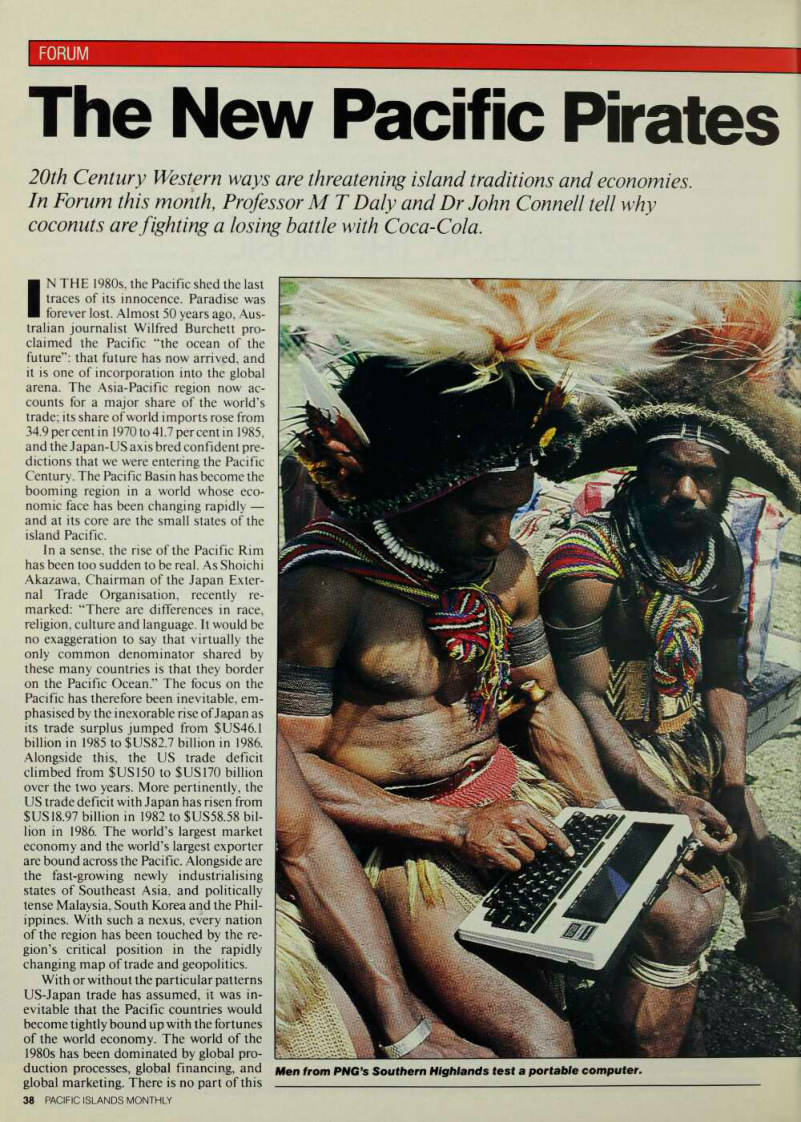
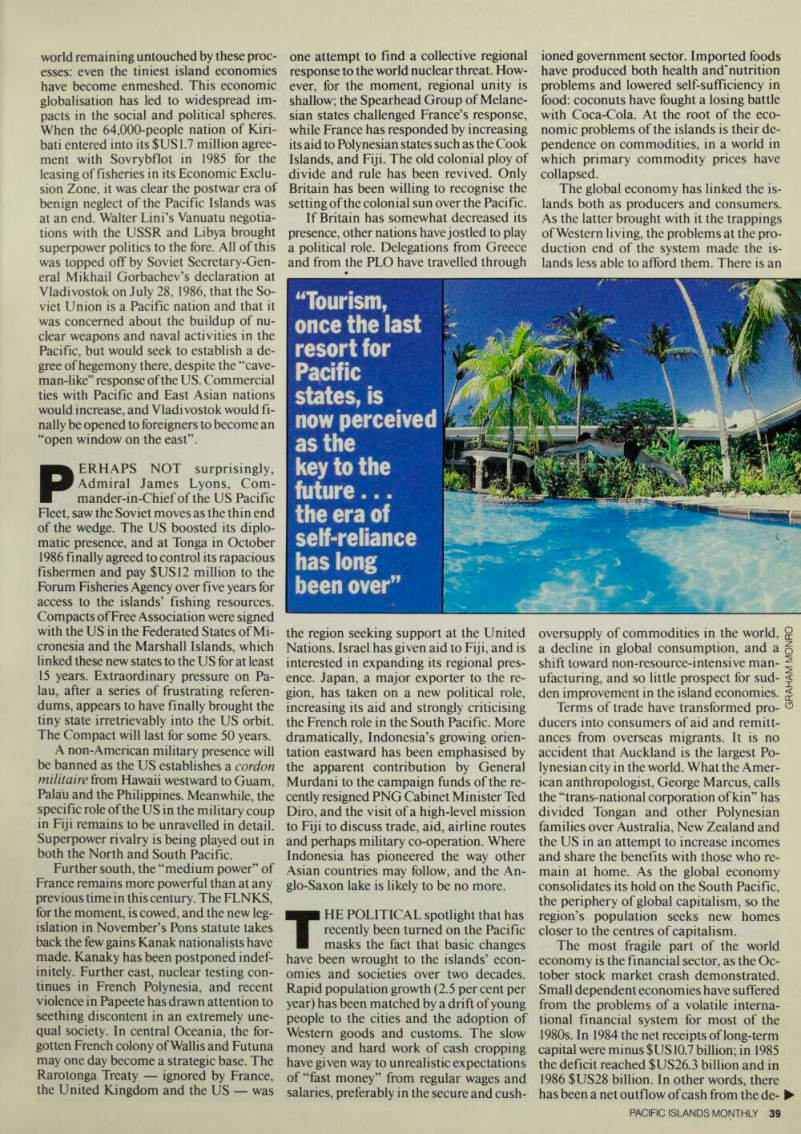
Forum
20th Century Western ways are threatening island traditions and economies.
In Forum this month, Professor M T Daly and Dr John Connell tell why coconuts are fighting a losing battle with Coca-Cola.
IN THE 1980 s, the Pacific shed the last traces of its innocence. Paradise was forever lost. Almost 50 years ago, Aus tralian journalist Wilfred Burchett pro claimed the Pacific “the ocean of the future”: that future has now arrived, and it is one of incorporation into the global arena. The Asia-Pacific region now ac counts for a major share of the world’s trade; its share of world imports rose from 34.9 per cent in 1970 to 41.7 per cent in 1985, and the Japan-US axis bred confident pre dictions that we were entering the Pacific Century. The Pacific Basin has become the booming region in a world whose eco nomic face has been changing rapidly and at its core are the small states of the island Pacific.
In a sense, the rise of the Pacific Rim has been too sudden to be real. As Shoichi Akazawa, Chairman of the Japan Exter nal Trade Organisation, recently re marked: “There are differences in race, religion, culture and language. It would be no exaggeration to say that virtually the only common denominator shared by these many countries is that they border on the Pacific Ocean.” The focus on the Pacific has therefore been inevitable, em phasised by the inexorable rise of Japan as its trade surplus jumped from SUS46.I billion in 1985 to SUSB2.7 billion in 1986.
Alongside this, the US trade deficit climbed from SUSISO to SUSI7O billion over the two years. More pertinently, the US trade deficit with Japan has risen from SUS 18.97 billion in 1982 to $U558.58 bil lion in 1986. The world’s largest market economy and the world’s largest exporter are bound across the Pacific. Alongside are the fast-growing newly industrialising states of Southeast Asia, and politically tense Malaysia, South Korea and the Phil ippines. With such a nexus, every nation of the region has been touched by the re gion’s critical position in the rapidly changing map of trade and geopolitics.
With or without the particular patterns US-Japan trade has assumed, it was in evitable that the Pacific countries would become tightly bound up with the fortunes of the world economy. The world of the 1980 s has been dominated by global pro duction processes, global financing, and global marketing. There is no part of this
Men from PNG’s Southern Highlands test a portable computer.
world remaining untouched by these proc esses: even the tiniest island economies have become enmeshed. This economic globalisation has led to widespread im pacts in the social and political spheres.
When the 64,000-people nation of Kiri bati entered into its SUSI. 7 million agree ment with Sovrybflot in 1985 for the leasing of fisheries in its Economic Exclu sion Zone, it was clear the postwar era of benign neglect of the Pacific Islands was at an end. Walter Lini’s Vanuatu negotia tions with the USSR and Libya brought superpower politics to the fore. All of this was topped off by Soviet Secretary-Gen eral Mikhail Gorbachev’s declaration at Vladivostok on July 28, 1986, that the So viet Union is a Pacific nation and that it was concerned about the buildup of nu clear weapons and naval activities in the Pacific, but would seek to establish a de gree of hegemony there, despite the “cave man-like” response of the US. Commercial ties with Pacific and East Asian nations would increase, and Vladivostok would fi nally be opened to foreigners to become an “open window on the east”.
PERHAPS NOT surprisingly, Admiral James Lyons, Com mander-! n-Chief of the US Pacific Fleet, saw the Soviet moves as the thin end of the wedge. The US boosted its diplo matic presence, and at Tonga in October 1986 finally agreed to control its rapacious fishermen and pay SUSI 2 million to the Forum Fisheries Agency over five years for access to the islands’ fishing resources.
Compacts of Free Association were signed with the US in the Federated States of Mi cronesia and the Marshall Islands, which linked these new states to the US for at least 15 years. Extraordinary pressure on Pa lau, after a series of frustrating referen dums, appears to have finally brought the tiny state irretrievably into the US orbit.
The Compact will last for some 50 years.
A non-American military presence will be banned as the US establishes a cordon militaire from Hawaii westward to Guam, Palau and the Philippines. Meanwhile, the specific role of the US in the military coup in Fiji remains to be unravelled in detail.
Superpower rivalry is being played out in both the North and South Pacific.
Further south, the “medium power” of France remains more powerful than at any previous time in this century. The FLNKS, for the moment, is cowed, and the new leg islation in November’s Pons statute takes back the few gains Kanak nationalists have made. Kanaky has been postponed indef initely. Further east, nuclear testing con tinues in French Polynesia, and recent violence in Papeete has drawn attention to seething discontent in an extremely une qual society. In central Oceania, the for gotten French colony of Wallis and Futuna may one day become a strategic base. The Rarotonga Treaty ignored by France, the United Kingdom and the US was
one attempt to find a collective regional response to the world nuclear threat. How ever, for the moment, regional unity is shallow; the Spearhead Group of Melane sian states challenged France’s response, while France has responded by increasing its aid to Polynesian states such as the Cook Islands, and Fiji. The old colonial ploy of divide and rule has been revived. Only Britain has been willing to recognise the setting of the colonial sun over the Pacific.
If Britain has somewhat decreased its presence, other nations have jostled to play a political role. Delegations from Greece and from the PLO have travelled through
the region seeking support at the United Nations. Israel has given aid to Fiji, and is interested in expanding its regional pres ence. Japan, a major exporter to the re gion, has taken on a new political role, increasing its aid and strongly criticising the French role in the South Pacific. More dramatically, Indonesia’s growing orien tation eastward has been emphasised by the apparent contribution by General Murdani to the campaign funds of the re cently resigned PNG Cabinet Minister Ted Diro, and the visit of a high-level mission to Fiji to discuss trade, aid, airline routes and perhaps military co-operation. Where Indonesia has pioneered the way other Asian countries may follow, and the An glo-Saxon lake is likely to be no more.
THE POLITICAL spotlight that has recently been turned on the Pacific masks the fact that basic changes have been wrought to the islands’ econ omies and societies over two decades.
Rapid population growth (2.5 per cent per year) has been matched by a drift of young people to the cities and the adoption of Western goods and customs. The slow money and hard work of cash cropping have given way to unrealistic expectations of “fast money” from regular wages and salaries, preferably in the secure and cush
ioned government sector. Imported foods have produced both health and'nutrition problems and lowered self-sufficiency in food: coconuts have fought a losing battle with Coca-Cola. At the root of the eco nomic problems of the islands is their de pendence on commodities, in a world in which primary commodity prices have collapsed.
The global economy has linked the is lands both as producers and consumers.
As the latter brought with it the trappings of Western living, the problems at the pro duction end of the system made the is lands less able to afford them. There is an
oversupply of commodities in the world, a decline in global consumption, and a shift toward non-resource-intensive man ufacturing, and so little prospect for sud den improvement in the island economies.
Terms of trade have transformed pro ducers into consumers of aid and remitt ances from overseas migrants. It is no accident that Auckland is the largest Po lynesian city in the world. What the Amer ican anthropologist, George Marcus, calls the “trans-national corporation of kin” has divided Tongan and other Polynesian families over Australia, New Zealand and the US in an attempt to increase incomes and share the benefits with those who re main at home. As the global economy consolidates its hold on the South Pacific, the periphery of global capitalism, so the region’s population seeks new homes closer to the centres of capitalism.
The most fragile part of the world economy is the financial sector, as the Oc tober stock market crash demonstrated.
Small dependent economies have suffered from the problems of a volatile interna tional financial system for most of the 1980 s. In 1984 the net receipts of long-term capital were minus SUS 10.7 billion; in 1985 the deficit reached $U526.3 billion and in 1986 SUS2B billion. In other words, there has been a net outflow of cash from the de
"Tourism, once the last resort for Pacific states, is now perceived as the key to the future... the era of self-reliance has long been over"
Graham Monro
“The unpredictable economic and political decisions of the global giants are transforming the Pacific Basin.”
veloping to the developed world. Since such figures (from the World Bank) do not include capital flight, they underestimate the problem: capital shortage stagnates growth in nations already damaged by de pressed prices for their goods, so a vicious circle of decline is set up. The danger for the small nations of the Pacific islands is that just as they attract world political at tention the world’s economic mecha nisms (particularly the financial system) have tended to turn against them, and in the wake of the stock market crash, inter national investment may well move away from the Pacific. Nonetheless, a future of increasing economic and political de pendence appears inevitable.
By international standards the econ omies of the South Pacific are tiny. Only the new gold rush in mineral-rich Papua New Guinea offers real prospects of sus tained economic growth. Elsewhere, es pecially in the tiny atoll states, the future is bleak; five of the independent states are on the United Nations list of 41 least-de veloped states. Slow economic growth has emphasised the problem of rising unem ployment and the migratory response. The smallest states are characterised by “earn ings” from aid and remittances that are much greater than locally generated in comes. The greatest income potential of several states is their strategic location.
Aid levels are some of the highest in the world: in the new Micronesian states less than 10 per cent of all income comes from locally generated production the re mainder is from a diversity of American aid and welfare schemes. Aid raises the lo cal exchange rate, distorts wages and makes local industries uncompetitive. In the course of this century much of the co lonial Pacific has gone from subsistence to subsidy; in the more affluent New Cale donia and French Polynesia, the islands are now consumer colonies of France isolated from their regional neighbours.
That extremely conservative and Christian Pacific states should establish economic ties with the Soviet Union and east Asian states is an indication of the se verity of economic development prob lems. Most new economic ventures are tied to overseas finance, and foreign invest ment has been gaining importance in every Pacific state. It has been concentrated in the minerals and energy sectors, the ex ploitation and processing of timber and fisheries and in very new service sector ac tivities such as telecommunications, tour ism, banking and finance. Vanuatu has led the way as an international finance centre.
Tourism, once the “last resort” for Pa cific states, is now perceived as the key to the future; in Tonga a new airstrip for wide bodied jets is symbolic of unwarranted
optimism. Manufacturing industry, the key to success in east Asia, is conspicuous by its absence; where it does exist it is primarily industrialisation by imitation and invitation, sustained only by the concessions of SPARTECA. The much-vaunted small industries centre in Tonga is as much a training ground for future migrants to acquire skills as a genuine contribution to national economic growth.
Television, the video industry and mass advertising are transforming cultures as they have never been threatened before; the overwhelmingly foreign content of the new media may, as Robert Underwood records for Guam, make islanders “homesick for places they have never been”. Rising expectations and political uncertainty are
likely to make migration more attractive, The era of self-reliance is long over even if development plans in the South Pacific continue to trumpet its virtues. This rhet one disguises the reality of the increasing incorporation of every phase of economic activity into the global economy. Small may still be beautiful, but it is also vul nerable; islands that once were vulnerable to natural hazards are now vulnerable to the unpredictable economic and political decisions of the global giants that are transforming the Pacific Basin. □ Professor M T Daly is Director of the Re search Institute for Asia and the Pacific at the University of Sydney, and Dr John Connell is Senior Lecturer in Geography at the University of Sydney.
US Rebukes Wypijewsky
WE AT the American Embassy were surprised that, in your October 1987 issue, you ran Joann Wypijewski’s article alleging United States involvement in Fiji’s May 14 coup.
The article is no more than a web of fabrications, half-truths, unfounded allegations and facts out of context. We are surprised that you did not at least note that the US Government con demned that coup from the outset and immediately after the coup terminated all US assistance programs to Fiji actions that no government would take if it had sponsored those who seized power in Fiji.
In fact, the position of the US Government on developments in Fiji closely parallels that of the Australian, British and the New Zealand Governments.
In early October Ambassador Sta pleton Roy, Deputy Assistant Secre tary for East Asia and Pacific Affairs, appeared before a subcommittee of the Foreign Affairs Committee of the US House of Representatives and referred to allegations of US involvement in the May 14 coup.
He categorically denied charges that the US was involved in or sympathetic toward the two coups by Colonel Rabuka.
He said: “The US Government had no knowledge of either coup before they took place. Had we had advance knowledge we would have strongly and vigorously opposed them.
“Throughout the recent develop ments in Fiji our overriding concern has been to preserve and restore parlia
mentary democracy so that the na tion’s political institutions could continue to reflect a broadly based consensus.
“Totally baseless suggestions that Ambassador Vemon Walters visited Fiji as part of an effort to undermine the Government of Prime Minister Ba vadra have, I think, been adequately refuted elsewhere. Suffice it to say that Ambassador Walters’ visit to the re gion had been long planned and was part of his annual pre-UN General As sembly consultations.
In the course of his trip he called on leaders in every Pacific island country accredited to the United Nations. His visit to Suva was approved in advance by the Government of Prime Minister Bavadra, and his schedule in Fiji was prepared in co-ordination with Dr Ba vadra’s own Foreign Ministry. The Ambassador’s discussions with Fiji Government leaders, particularly with Foreign Minister Datt, were cordial and constructive. We understand that Prime Minister Bavadra and his Cab inet colleagues shared that view.
“Our record in response to devel opments in Fiji since the elections last April, and before, have been fully con sistent with the American tradition of support for parliamentary democracy.
With that goal in mind, we will con tinue to use our influence to support progress toward a solution that is pro tective of the rights of all of Fiji’s people.”
Richard M Teare
Deputy Chief of Mission Embassy of the USA Canberra, Australia
The Island Press
Reports from the papers, compiled by John Carter
WE SHOULD be ashamed of ourselves!
Our beautiful public beaches and parks are rapidly becoming havens for rats and other vermin not nice places to enjoy the gifts of Nature. Stinking smells of gar bage and blowing papers are replacing fresh aromas of clean sea air and blowing palm fronds because of the trash being dumped on the ground and into the sea.
From the Marianas Variety News & Views, Saipan.
A MOTION in the House of Assembly which would require all of Niue’s Public Servants to take an oath that they will work diligently and conscientiously was de feated when the Assembly met on Thurs day of this week. The motion which generated a lot of discussion was put by the Member for Tuapa, Mr Tama Posimani, in what he described as an effort to make Public Servants realise that they have a re sponsibility to put in an honest day’s work.
From Tohi Tala Niue, Niue Island.
Dear Lifeline,
After I beat my wife up, following a do mestic argument, she took our child and went back to her village. I have tried un successfully several times to get them back.
Once our pastor was with me when I said I would forgive my wife for the wrongs she did against me but she still refused to come back.
I have been praying for my wife to re turn, as I miss my child a lot and feel that he needs care from both his mother and his father.
From the Lifeline column in the Papua New Guinea Post-Courier .
PARTS OF Alofi North were rocked by a loud explosion on Monday evening of this week. It turned out that the explosion occurred in an old pit-latrine which had been filled in and was being used as a dump for rubbish which could be burned.
Those in the know reckon that the explo sion resulted from a buildup of methane gas; when the rubbish was burned, the leaking gas ignited and a fairly interesting reaction occurred. Fortunately no injuries were reported.
From Tohi Tala Niue, Niue Island.
PROBLEMS WITH young Cook Is landers in New Zealand have reached peak point in the local communities there. Vol untary social worker and former golden voice of the ’6os Tereau Putoko (now Mrs Tokahere) said educating youth has be come a great problem as a lot of young people prefer to hang around town instead.
From the Cook Islands News, Rarotonga.
PAPUA NEW GUINEA jails are schools where bad boys learn to become professional criminals, prisons chief Pious Kerepia said in Lae. Addressing correc tional officers at Buimo Jail on Friday Mr Kerepia said he was concerned about the lack of maximum security for hardcore criminals at Buimo and many other jails throughout the country. “Our jails pro mote the criminal profession,” he said.
“Hardcore criminals mix freely with the rest and they all eat and live together every day. This is where lessons about how to commit rape, break and enter, robbery, murder and other serious crimes are taught to petty criminals and juveniles.”
From the Papua New Guinea Post- Courier, Port Moresby.
FIJI’S MILITARY leader Colonel Ra buka has called on his country to respect the religious beliefs of all races in Fiji. In a statement marking the Hindu festival of Diwali, the start of the Hindu New Year, Colonel Rabuka said the religious festi vals of the ethnic groups had made Fiji a rich and vibrant multi-racial and multi cultural nation. He gave an assurance that freedom of worship would continue to be guaranteed in Fiji.
Colonel Rabuka said indigenous Fiji ans who were Christians had been gener ous in permitting all people religious freedom.
From a Radio Australia report on a statement by Fiji’s Brigadier Rabuka.
THREE BROTHERS have been jailed for 11 years after admitting they chopped up a man they had suspected of killing their father through sorcery.
The National Court in Lae sentenced Kensy Iwing, 25, and his brothers Efsy, 21, and Piria, 20, all of Pindiu in Morobe Province, after they pleaded guilty to a charge of wilful murder. The court heard that on or about April 1 this year the three were with their father in the garden when they saw a man named Bahauke Witing, who was said to be a well-known sorcerer.
That afternoon, after the boys and their father returned home, the father became ill. He died three days later while they were taking him to hospital. . . In court yester day they asked the court for mercy, saying they had cattle, chickens and ducks they had to look after.
From the Papua New Guinea Post- Courier , Port Moresby.
TERMITES IN the Cook Islands and Tuvalu are to be studied in a South Pacific Commission project to determine why the insects are a problem in the Cooks.
According to a report from Tuvalu the
termites there leave coconut trees alone, although the same insects cause consid erable damage to coconut palms in the northern Cook Islands.
From the Cook Islands News, Rarotonga.
MILNE BAY Premier Navy Aule has brought a lot of shame on the Trobriand islanders by saying that the “free-love” life style of people could contribute to the spread of AIDS.
His provincial Finance Minister and Member for South Kiriwina, Mr Timothy Kaidama, said the premier had under mined the good work of the church work ers in the islands. “The church people have worked really hard so many people have accepted that sex is limited to marriage,” said Mr Kaidama.
Only a few girls slept with tourists, and such girls were considered as outcasts in traditional Kiriwina society, Mr Kai dama said.
From the Papua New Guinea Post- Courier, Port Moresby.
TWO MOTHERS in Labasa, who gave birth to babies which were not of the sex they wanted, made a secret deal to swap their babies! They managed to deceive everybody at the hospital, but the plot was revealed when one of the mothers re turned home with a baby boy, when her husband had been told by the hospital that she had had a baby girl!
From The Coconut Telegraph, Savusavu, Fiji.
THE GOVERNMENT will soon pass legislation to set up offshore banking here, a Government source told The Samoa Times. Details of the proposal are not yet available but the source said the operation will enable anybody with money to use the facility without explaining to anybody where his money came from.
From The Samoa Times, Apia.
APIA’S FIRST ever strip-tease was rather bare of support, according to spec tators at last weekend’s Miss South Pacific Pageant at the Tusitala Hotel.
People were reaching for ashtrays as the stripper, especially imported from Hon olulu, was fiddling around with the string holding up his “jock strap”, the only bit of clothing preventing him from wearing his birthday suit.
“The stripper would have been bom barded with ashtrays,” one spectator said, “if he had dared to take that thing off.” In fact, he would have been lucky to get out alive, he said.
From The Samoa Times, Apia.
Transition
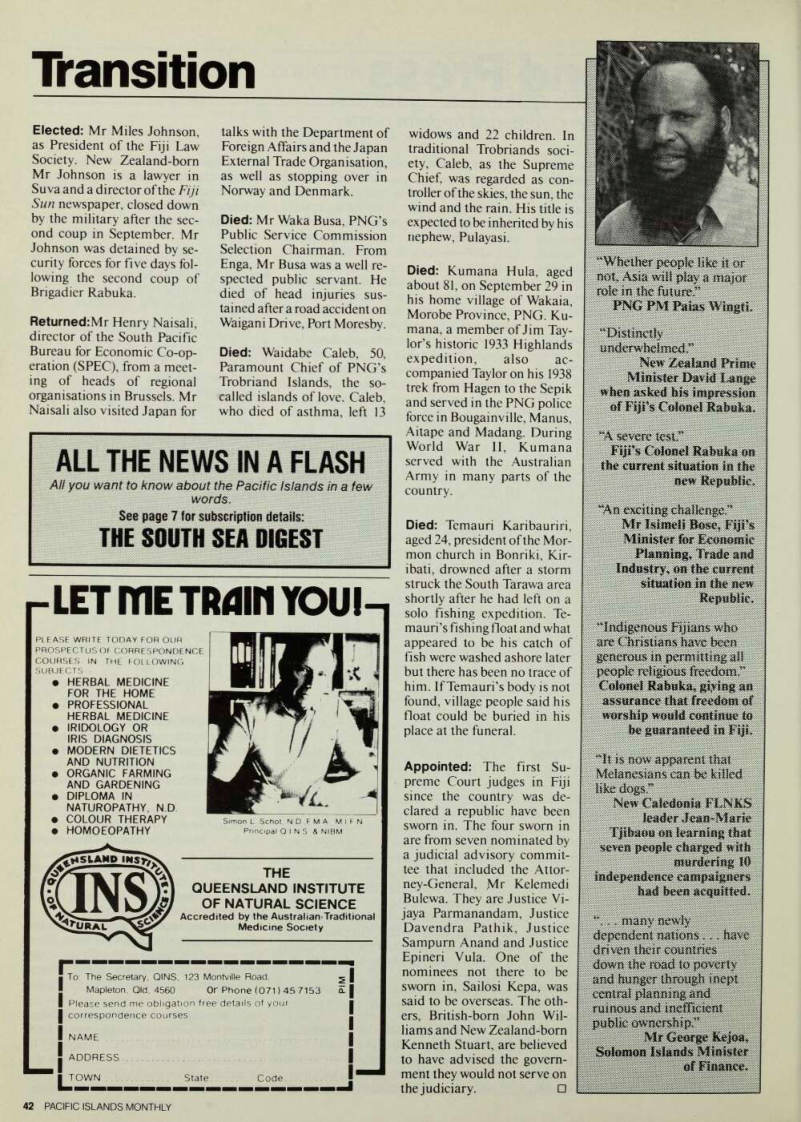
Elected: Mr Miles Johnson, as President of the Fiji Law Society. New Zealand-born Mr Johnson is a lawyer in Suva and a director of the Fiji Sun newspaper, closed down by the military after the second coup in September. Mr Johnson was detained by security forces for five days following the second coup of Brigadier Rabuka.
Returned:Mr Henry Naisali, director of the South Pacific Bureau for Economic Co-operation (SPEC), from a meeting of heads of regional organisations in Brussels. Mr Naisali also visited Japan for
talks with the Department of Foreign Affairs and the Japan External Trade Organisation, as well as stopping over in Norway and Denmark.
Died: Mr Waka Busa, PNG’s Public Service Commission Selection Chairman. From Enga, Mr Busa was a well re spected public servant. He died of head injuries sus tained after a road accident on Waigani Drive, Port Moresby, Died: Waidabe Caleb, 50, Paramount Chief of PNG’s Trobriand Islands, the so called islands of love. Caleb, who died of asthma, left 13
widows and 22 children. In traditional Trobriands soci ety, Caleb, as the Supreme Chief, was regarded as con troller of the skies, the sun, the wind and the rain. His title is expected to be inherited by his nephew, Pulayasi.
Died: Kumana Hula, aged about 81, on September 29 in his home village of Wakaia, Morobe Province, PNG. Ku mana, a member of Jim Tay lor’s historic 1933 Highlands expedition, also ac companied Taylor on his 1938 trek from Hagen to the Sepik and served in the PNG police force in Bougainville, Manus, Ailape and Madang. During World War 11, Kumana served with the Australian Army in many parts of the country.
Died: Temauri Karibauriri, aged 24, president of the Mor mon church in Bonriki, Kir ibati, drowned after a storm struck the South Tarawa area shortly after he had left on a solo fishing expedition. Te mauri’s fishing float and what appeared to be his catch of fish were washed ashore later but there has been no trace of him. If Temauri’s body is not found, village people said his float could be buried in his place at the funeral.
Appointed: The first Su preme Court judges in Fiji since the country was de clared a republic have been sworn in. The four sworn in are from seven nominated by a judicial advisory commit tee that included the Attor ney-General, Mr Kelemedi Bulewa. They are Justice Vi jaya Parmanandam, Justice Davendra Pathik, Justice Sampurn Anand and Justice Epineri Vula. One of the nominees not there to be sworn in, Sailosi Kepa, was said to be overseas. The oth ers, British-born John Wil liams and New Zealand-born Kenneth Stuart, are believed to have advised the govern ment they would not serve on the judiciary. □
Advertisements & other items, p. 42 (1 item)
Let Ide Trdin You!-.
“Whether people like it or not, Asia will play a major role in the future:' PNG PM Paias Wingti.
“Distinctly underwhelmed”
New Zealand Prime Minister David Lange when asked his impression of Fiji’s Colonel Rabuka.
“A severe test ”
Fiji's Colonel Rabuka on the current situation in the new Republic* “An exciting challenge ”
Mr Isi me) I Bose, Fiji’s Minister for Economic Planning, Trade and Industry, on the current situation in the new Republic, “Indigenous Fijians who are Christians have been generous in permitting all people religious freedom Colonel Rabnka, giying an assurance that freedom of worship would continue to be guaranteed in Fiji.
“It is now apparent that Melanesians can be killed llVo rtn<rc ”
New Caledonia FLNKS leader Jean-Marie Tjibaou on learning that seven people charged with murdering 10 independence campaigners had been acquitted. . many newly dependent nations ... have driven their countries down the road to poverty and hunger through inept central planning and ruinous and inefficient public ownership”
Mr George Kejoa, Solomon Islands Minister of Finance.
ALL THE NEWS IN A FLASH
AH you want to know about the Pacific islands in a few words.
See page 7 for subscription details:
THE SOUTH SEA DIGEST
LET IDE TRdin YOU!-.
PLEASE WRITE TODAY FOR OUR
PROSPECTUS OF CORRESPONDENCE
COURSES IN THE FOLLOWING
SUBJECTS
• HERBAL MEDICINE
FOR THE HOME
• PROFESSIONAL
HERBAL MEDICINE
• IRIDOLOGY OR
IRIS DIAGNOSIS
• MODERN DIETETICS
AND NUTRITION
• ORGANIC FARMING
AND GARDENING
• DIPLOMA IN
NATUROPATHY, N.D
• COLOUR THERAPY
• HOMOEOPATHY
< i X 7 m Simon L Schot. ND FMA MIFN Principal Q I N S & NIBM
SLAWP IHSWS.
oN§l
THE
QUEENSLAND INSTITUTE
OF NATURAL SCIENCE
Accredited by the Australian Traditional Medicine Society ■ To: The Secretary, QINS, 123 Montville Road, Mapleton, Old, 4560 Or Phone (071) 45 7153 E I Please send me obligation free details of your I correspondence courses
I NAME
ADDRESS
TOWN.. State Code.
Auckland Institute & Museum
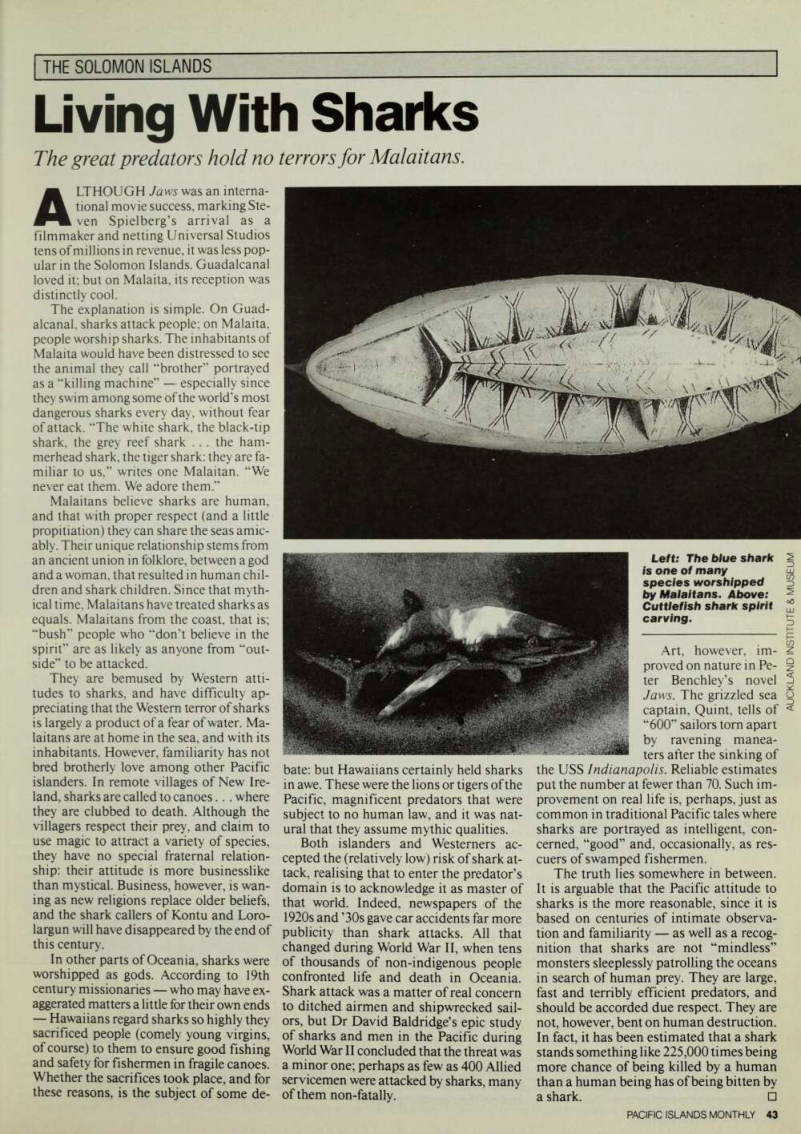
The Solomon Islands
Living With Sharks
The great predators hold no terrors for Malaitans
ALTHOUGH Jaws was an interna tional movie success, marking Ste ven Spielberg’s arrival as a filmmaker and netting Universal Studios tens of millions in revenue, it was less pop ular in the Solomon Islands. Guadalcanal loved it; but on Malaita, its reception was distinctly cool.
The explanation is simple. On Guad alcanal, sharks attack people; on Malaita, people worship sharks. The inhabitants of Malaita would have been distressed to see the animal they call “brother” portrayed as a “killing machine” especially since they swim among some of the world’s most dangerous sharks every day, without fear of attack. “The white shark, the black-tip shark, the grey reef shark ... the ham merhead shark, the tiger shark: they are fa miliar to us,” writes one Malaitan. “We never eat them. We adore them.”
Malaitans believe sharks are human, and that with proper respect (and a little propitiation) they can share the seas amic ably. Their unique relationship stems from an ancient union in folklore, between a god and a woman, that resulted in human chil dren and shark children. Since that myth ical time, Malaitans have treated sharks as equals. Malaitans from the coast, that is; “bush” people who “don’t believe in the spirit” are as likely as anyone from “out side” to be attacked.
They are bemused by Western atti tudes to sharks, and have difficulty ap preciating that the Western terror of sharks is largely a product of a fear of water. Ma laitans are at home in the sea, and with its inhabitants. However, familiarity has not bred brotherly love among other Pacific islanders. In remote villages of New Ire land, sharks are called to canoes... where they are clubbed to death. Although the villagers respect their prey, and claim to use magic to attract a variety of species, they have no special fraternal relation ship: their attitude is more businesslike than mystical. Business, however, is wan ing as new religions replace older beliefs, and the shark callers of Kontu and Loro largun will have disappeared by the end of this century.
In other parts of Oceania, sharks were worshipped as gods. According to 19th century missionaries who may have ex aggerated matters a little for their own ends Hawaiians regard sharks so highly they sacrificed people (comely young virgins, of course) to them to ensure good fishing and safety for fishermen in fragile canoes.
Whether the sacrifices took place, and for these reasons, is the subject of some de-
bate: but Hawaiians certainly held sharks in awe. These were the lions or tigers of the Pacific, magnificent predators that were subject to no human law, and it was nat ural that they assume mythic qualities.
Both islanders and Westerners ac cepted the (relatively low) risk of shark at tack, realising that to enter the predator’s domain is to acknowledge it as master of that world. Indeed, newspapers of the 1920 s and ’3os gave car accidents far more publicity than shark attacks. All that changed during World War 11, when tens of thousands of non-indigenous people confronted life and death in Oceania.
Shark attack was a matter of real concern to ditched airmen and shipwrecked sail ors, but Dr David Baldridge’s epic study of sharks and men in the Pacific during World War II concluded that the threat was a minor one; perhaps as few as 400 Allied servicemen were attacked by sharks, many of them non-fatally.
Art, however, im proved on nature in Pe ter Benchley’s novel Jaws. The grizzled sea captain, Quint, tells of “600” sailors tom apart by ravening manea ters after the sinking of
the USS Indianapolis. Reliable estimates put the number at fewer than 70. Such im provement on real life is, perhaps, just as common in traditional Pacific tales where sharks are portrayed as intelligent, con cerned, “good” and, occasionally, as res cuers of swamped fishermen, The truth lies somewhere in between, It is arguable that the Pacific attitude to sharks is the more reasonable, since it is based on centuries of intimate observa tion and familiarity as well as a recog nition that sharks are not “mindless” monsters sleeplessly patrolling the oceans in search of human prey. They are large, fast and terribly efficient predators, and should be accorded due respect. They are not, however, bent on human destruction, In fact, it has been estimated that a shark stands something like 225,000 times being more chance of being killed by a human than a human being has of being bitten by a shark. □
Auckland Institute & Museum
Left: The blue shark is one of many species worshipped by Malaitans. Above: Cuttlefish shark spirit carving.
Pacific Stamp Box
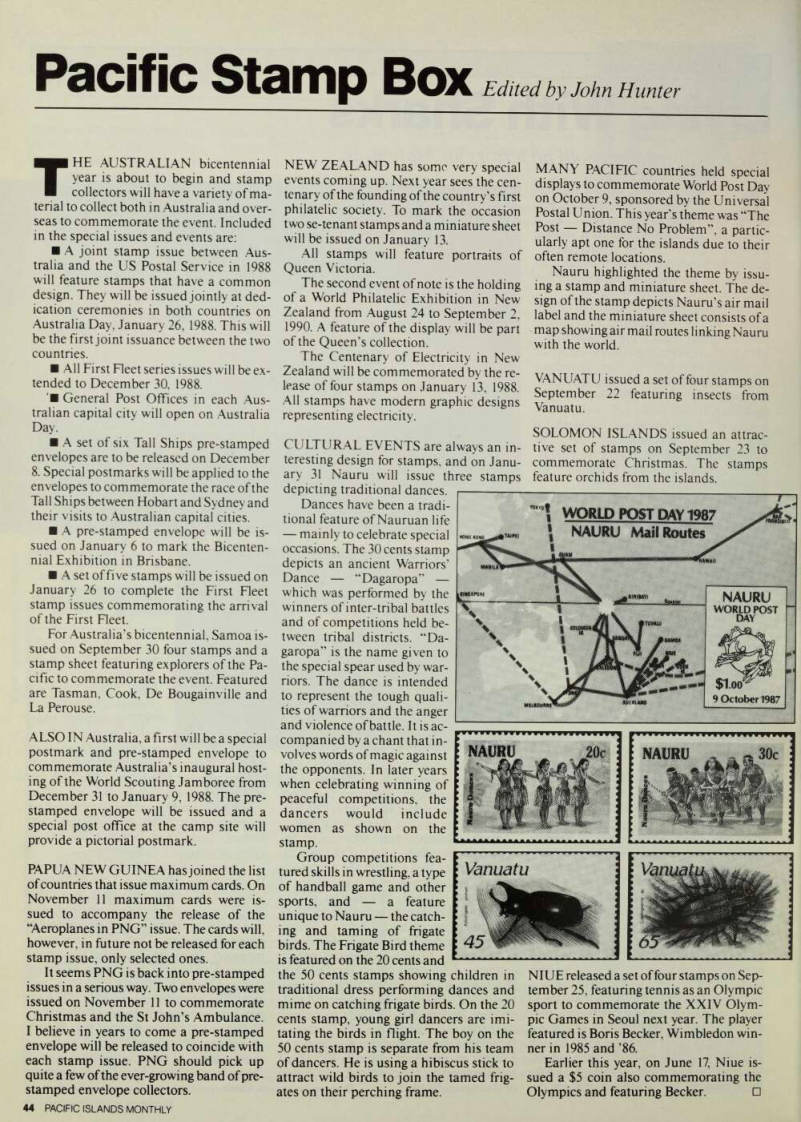
Edited by John Hunter
THE AUSTRALIAN bicentennial year is about to begin and stamp collectors will have a variety of ma terial to collect both in Australia and over seas to commemorate the event. Included in the special issues and events are: ■ A joint stamp issue between Aus tralia and the US Postal Service in 1988 will feature stamps that have a common design. They will be issued jointly at ded ication ceremonies in both countries on Australia Day, January 26, 1988. This will be the first joint issuance between the two countries. ■ All First Fleet series issues will be ex tended to December 30, 1988.
'■ General Post Offices in each Aus tralian capital city will open on Australia Day. ■ A set of six Tall Ships pre-stamped envelopes are to be released on December 8. Special postmarks will be applied to the envelopes to commemorate the race of the Tall Ships between Hobart and Sydney and their visits to Australian capital cities. ■ A pre-stamped envelope will be is sued on January 6 to mark the Bicenten nial Exhibition in Brisbane. ■ A set of five stamps will be issued on January 26 to complete the First Fleet stamp issues commemorating the arrival of the First Fleet.
For Australia’s bicentennial, Samoa is sued on September 30 four stamps and a stamp sheet featuring explorers of the Pa cific to commemorate the event. Featured are Tasman, Cook, De Bougainville and La Perouse.
ALSO IN Australia, a first will be a special postmark and pre-stamped envelope to commemorate Australia’s inaugural host ing of the World Scouting Jamboree from December 31 to January 9, 1988. The pre stamped envelope will be issued and a special post office at the camp site will provide a pictorial postmark.
PAPUA NEW GUINEA has joined the list of countries that issue maximum cards. On November 11 maximum cards were is sued to accompany the release of the “Aeroplanes in PNG” issue. The cards will, however, in future not be released for each stamp issue, only selected ones.
It seems PNG is back into pre-stamped issues in a serious way. Two envelopes were issued on November 11 to commemorate Christmas and the St John’s Ambulance.
I believe in years to come a pre-stamped envelope will be released to coincide with each stamp issue. PNG should pick up quite a few of the ever-growing band of pre stamped envelope collectors.
NEW ZEALAND has some very special events coming up. Next year sees the cen tenary of the founding of the country’s first philatelic society. To mark the occasion two se-tenant stamps and a miniature sheet will be issued on January 13.
All stamps will feature portraits of Queen Victoria.
The second event of note is the holding of a World Philatelic Exhibition in New Zealand from August 24 to September 2, 1990. A feature of the display will be part of the Queen’s collection.
The Centenary of Electricity in New Zealand will be commemorated by the re lease of four stamps on January 13, 1988.
All stamps have modern graphic designs representing electricity.
CULTURAL EVENTS are always an in teresting design for stamps, and on Janu ary 31 Nauru will issue three stamps
depicting traditional dances.
Dances have been a tradi tional feature of Nauruan life mainly to celebrate special occasions. The 30 cents stamp depicts an ancient Warriors’
Dance “Dagaropa” which was performed by the winners of inter-tribal battles and of competitions held be tween tribal districts. “Da garopa” is the name given to the special spear used by war riors. The dance is intended to represent the tough quali ties of warriors and the anger and violence of battle. It is ac companied by a chant that in volves words of magic against the opponents. In later years when celebrating winning of peaceful competitions, the dancers would include women as shown on the stamp.
Group competitions fea tured skills in wrestling, a type of handball game and other sports, and a feature unique to Nauru the catch ing and taming of frigate birds. The Frigate Bird theme is featured on the 20 cents and
the 50 cents stamps showing children in traditional dress performing dances and mime on catching frigate birds. On the 20 cents stamp, young girl dancers are imitating the birds in flight. The boy on the 50 cents stamp is separate from his team of dancers. He is using a hibiscus stick to attract wild birds to join the tamed frigates on their perching frame.
MANY PACIFIC countries held special displays to commemorate World Post Day on October 9, sponsored by the Universal Postal Union. This year’s theme was “The Post Distance No Problem”, a partic ularly apt one for the islands due to their often remote locations.
Nauru highlighted the theme by issu ing a stamp and miniature sheet. The de sign of the stamp depicts Nauru’s air mail label and the miniature sheet consists of a map showing air mail routes linking Nauru with the world.
VANUATU issued a set of four stamps on September 22 featuring insects from Vanuatu.
SOLOMON ISLANDS issued an attrac tive set of stamps on September 23 to commemorate Christmas. The stamps feature orchids from the islands.
NIUE released a set of four stamps on Sep tember 25, featuring tennis as an Olympic sport to commemorate the XXIV Olym pic Games in Seoul next year. The player featured is Boris Becker, Wimbledon win ner in 1985 and ’B6.
Earlier this year, on June 17, Niue is sued a $5 coin also commemorating the Olympics and featuring Becker. □
Advertisements & other items, p. 45 (1 item)
Aiwa
POWI
PMPO
mam Awesome music power that surrounds you—get it with AlWA’s impressive V-770A stereo system. The powerful amplifier section deliversan amazing4oo watts (PMPO)of power. Along with the built-in Surround Sound circuitry and the supplied pair of surround speakers, it fills every corner of your room with rich, exciting music. Plus, advanced features and functions iclude a 5-band graphic equalizer and spectrum analyzer, a quartz synthesizer 4-band tuner with 20 memory presets (10 FM + 10 AM/SWI/SW2), Surround Sound control, Dolby B double cassette deck, fully automatic turntable, big 2-way bass reflex speakers/ and wireless remote control most system functions to assure you complete music pleasure. .. .surround yourself with pure sound excitement!
Hi-fi Midi System V-770A
AIWA
'Dolby and the Double-D symbol are trademarks of Dolby Laboratories Licensing Corporation.
Mobex Pty., Ltd. 12 Barcoo Street, East Roseville, Sydney, N.S.W. 2069, AUSTRALIA PHONE: (02) 406-6277/Oceania Indent Agency (P.N.G.) Pty., Ltd. Ago St., Gordon Box 5518, Boroko, Port Moresby, Papua New Guinea PHONE: 256411/The Sound Centre Ltd. P.O. Box 434 Port Vila, Vanuatu PHONE: 2035/P. Hargovind Bros. 190 Renwick Road P O Box 490 Suva Fiji PHONE 24350/ Hardy Distributors Ltd. Wellersley Street, P.O. Box 5919, Auckland, New Zealand PHONE: (09) 399-175/Hifivox 79, Rue de Sebastopol, B.P. 1458 Noumea, New Caledonia PHONE: 27. 24 66/Harvest Pacific Limited P.O. Box 517. Honiara. Solomon Islands PHONE: 131/Fare Hi-Fi Stereo Rue du Marechal Foch —P.O. Box 269, Papeete, Tahiti PHONE: 2-4814/Micropac Audio, Inc.
P.O. Box 3478 Agana, Guam 96910 PHONE: 472-8091,472-8297/Rarotonga Duty Free Shop Private Bag P.O. Box 92. Rarotonga. Cook Island/Nauru Co-Operative Society Republic of Nauru
Netball Queen Scores Again
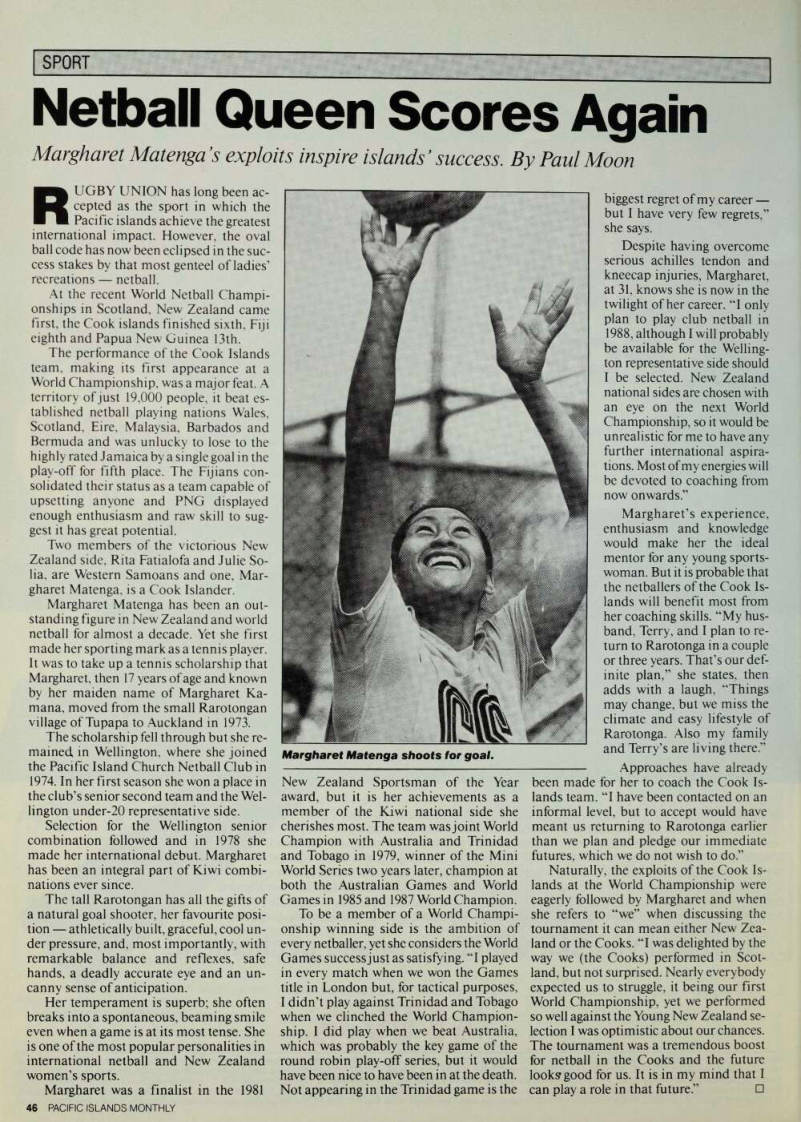
Sport
Margharet Matenga's exploits inspire islands’ success.
By Paul Moon
RUGBY UNION has long been ac cepted as the sport in which the Pacific islands achieve the greatest international impact. However, the oval ball code has now been eclipsed in the suc cess stakes by that most genteel of ladies’ recreations netball.
At the recent World Netball Champi onships in Scotland, New Zealand came first, the Cook islands finished sixth, Fiji eighth and Papua New Guinea 13th.
The performance of the Cook Islands team, making its first appearance at a World Championship, was a major feat. A territory of just 19,000 people, it beat es tablished netball playing nations Wales, Scotland, Eire, Malaysia, Barbados and Bermuda and was unlucky to lose to the highly rated Jamaica by a single goal in the play-off for fifth place. The Fijians con solidated their status as a team capable of upsetting anyone and PNG displayed enough enthusiasm and raw skill to sug gest it has great potential.
Two members of the victorious New Zealand side, Rita Fatialofa and Julie So lia, are Western Samoans and one, Mar gharet Matenga, is a Cook Islander.
Margharet Matenga has been an out standing figure in New Zealand and world netball for almost a decade. Yet she first made her sporting mark as a tennis player.
It was to take up a tennis scholarship that Margharet, then 17 years of age and known by her maiden name of Margharet Ka mana, moved from the small Rarotongan village of Tupapa to Auckland in 1973.
The scholarship fell through but she re mained in Wellington, where she joined the Pacific Island Church Netball Club in 1974. In her first season she won a place in the club’s senior second team and the Wel lington under-20 representative side.
Selection for the Wellington senior combination followed and in 1978 she made her international debut. Margharet has been an integral part of Kiwi combi nations ever since.
The tall Rarotongan has all the gifts of a natural goal shooter, her favourite posi tion athletically built, graceful, cool un der pressure, and, most importantly, with remarkable balance and reflexes, safe hands, a deadly accurate eye and an un canny sense of anticipation.
Her temperament is superb; she often breaks into a spontaneous, beaming smile even when a game is at its most tense. She is one of the most popular personalities in international netball and New Zealand women’s sports.
Margharet was a finalist in the 1981
New Zealand Sportsman of the Year award, but it is her achievements as a member of the Kiwi national side she cherishes most. The team was joint World Champion with Australia and Trinidad and Tobago in 1979, winner of the Mini World Series two years later, champion at both the Australian Games and World Games in 1985 and 1987 World Champion.
To be a member of a World Champi onship winning side is the ambition of every netballer, yet she considers the World Games success just as satisfying. “I played in every match when we won the Games title in London but, for tactical purposes, I didn’t play against Trinidad and Tobago when we clinched the World Champion ship. I did play when we beat Australia, which was probably the key game of the round robin play-off series, but it would have been nice to have been in at the death.
Not appearing in the Trinidad game is the
biggest regret of my career but I have very few regrets,” she says.
Despite having overcome serious achilles tendon and kneecap injuries, Margharet, at 31, knows she is now in the twilight of her career. “I only plan to play club netball in 1988, although I will probably be available for the Welling ton representative side should I be selected. New Zealand national sides are chosen with an eye on the next World Championship, so it would be unrealistic for me to have any further international aspira tions. Most of my energies will be devoted to coaching from now onwards.”
Margharet’s experience, enthusiasm and knowledge would make her the ideal mentor for any young sports woman. But it is probable that the netballers of the Cook Is lands will benefit most from her coaching skills. “My hus band, Terry, and I plan to re turn to Rarotonga in a couple or three years. That’s our def inite plan,” she states, then adds with a laugh, “Things may change, but we miss the climate and easy lifestyle of Rarotonga. Also my family and Terry’s are living there.”
Approaches have already
been made for her to coach the Cook Is lands team. “I have been contacted on an informal level, but to accept would have meant us returning to Rarotonga earlier than we plan and pledge our immediate futures, which we do not wish to do.”
Naturally, the exploits of the Cook Is lands at the World Championship were eagerly followed by Margharet and when she refers to “we” when discussing the tournament it can mean either New Zea land or the Cooks. “I was delighted by the way we (the Cooks) performed in Scot land, but not surprised. Nearly everybody expected us to struggle, it being our first World Championship, yet we performed so well against the Young New Zealand se lection I was optimistic about our chances.
The tournament was a tremendous boost for netball in the Cooks and the future looks good for us. It is in my mind that I can play a role in that future.” □
Margharet Matenga shoots for goal.
Advertisements & other items, pp. 47-48 (1 item)
mmOlCii
When you realise how far Australia is from the rest of the world it’s hardly surprising to find Australia is a world leader in communications technology.
OTC was one of the founders of Intelsat and has managed the development of some of the world’s largest, most sophisticated submarine cables.
Australia is a world leader in the development of second generation optical fibre cables - cables which will deliver our communication at very close to the speed
of light.
Australia’s OTC installed the first Intelsat 18 metre Standard A’ earth stations; developed and installed the first small dish satellite networks for remote communities in the Indian and Pacific Oceans and the
Antarctic; and supplies technology, marketing and
management solutions to many countries on a
consultancy basis.
This is just some of the expertise we can offer to you when you call OTC’s Corporate Development Manager in Sydney on 287 5410.
Australia might be half a world away, but we’re well worth talking to.
With OTC’s latest telecommunications technology,, no one’s far from anyone anymore.
mmOlCii
UNIVERSITY OF QUEENSLAND
AND
QUEENSLAND INSTITUTE OF MEDICAL RESEARCH
TROPICAL HEALTH PROGRAM
MASTER OF TROPICAL HEALTH
1988 This new Tropical Health Program focuses on the health status and health care of people in Southeast Asia and the Western Pacific, and emphasises Primary Health Care and intersectoral public health action as a means to achieve the goal of Health for All By the Year 2000.
The next Master in Tropical Health (MTH) course will commence early in June 1988. The course is divided into two parts. A common core course, lasting six months, will be taught at the University of Queensland, Brisbane, Australia, and include the following: • social, economic and behavioural sciences and health • the tropical environment and health • principles of epidemiology and health statistics • the epidemiology, management and control of disease • health services and health programs including primary health care.
On successful completion of this course, students will participate in a field program lasting five months, which will involve research work in small teams, in a designated country other than the students’ own.
Opportunities are also available for students to undertake a PhD.
Qualifications for entry Successful applicants will have either a degree in health, behavioural or related sciences and a minimum of two years’ relevant professional experience: or a basic professional qualification and five years’ professional experience that might be considered equivalent to the former requirement.
Profiency in the English language is essential.
Further Information Further details of the course and application forms are available from: The Administrative Officer Tropical Health Program Medical School Herston Road Herston, Brisbane, Old 4006
AUSTRALIA
Applications Should be submitted to the Administrative Officer no later than 1 February 1988. 6071871
Book Review
SAMOA: Nineteen Years in Polynesia By George Turner; Western Samoa Historical Trust and Commercial Printers,
Apia. Susii.So
Reviewed by Joseph Theroux
/ * m m ISTAKES,” said Samoa’s |U| first anthropologist, Augus ■Wß tin Kramer, “are particu larly unavoidable in Samoa.”
This should be the epigraph cautioning readers opening books that claim to ex plicate this Polynesian group, which has baffled administrators, teachers, diplo mats, businessmen, sailors and mission aries alike. I have yet to see a book on the subject that did not have its share of er rors, or one that doesn’t rehash old sub jects. It’s a pleasant surprise, then, to come across something besides the anecdotal travel book or the happy-talk history.
Yet George Turner’s book is not at all new. He published it in 1861, during a visit to Britain from his labours in Samoa for the London Missionary Society.
Misini Tana, as he was known to the Samoans, was originally sent to Tanna in the (then) New Hebrides, but was chased out by the inhabitants who had recently killed his brother missionary John Wil liams. He was then reassigned to Samoa, took up residence about 1841 and set about learning the language. He was soon giving sermons in Samoan, instructing his few converts in the mysteries of the New Tes tament and in 1844, helped set up the Sa moan Mission Seminary (now the Malua Theological College). There he taught scripture exposition, practical theology, scripture history, writing and composi tion, natural philosophy and “the ele ments of the English language”.
Like the other men with whom he worked, Turner contributed to Samoan society in a positive way. His accounts, with those of Stair and Williams and with George Pratt’s Grammar and Dictionary of the Samoan Language, defy the critics who complain that the missionaries did little more than impose restrictions on their flocks.
The Historical Trust and Commercial Printers deserve a vote of thanks for bring ing this and other books into print, and at reasonable prices. The larger reprint houses justify their inflated costs on the grounds that their market is small, but the presses in Papakura and Apia have shown it’s possible. However, a certain parochi alism creeps in when chapters not relating to Samoa are chopped out. The fine edi tion of The Cyclopedia of Samoa brought out by Commercial Printers was marred when sections on Tonga and Tahiti were removed. Turner’s book also loses some chapters. No doubt. . . but if the editions sells out, the publisher will perhaps be persuaded to issue the complete text. □
Advertisements & other items, p. 49 (1 item)
Cairns
The Parliament of the Commonwealth of Australia Joint Committee on Foreign Affairs, Defence and Trade
AUSTRALIA’S RELATIONS WITH ISLAND STATES OF
THE SOUTH PACIFIC
In 1986 the former Joint Committee on Foreign Affairs and Defence commenced an inquiry into Australia’s relations with the South Pacific, but deliberations ceased in June 1987 with the dissolution of Parliament. The newly constituted Joint Committee on Foreign Affairs, Defence and Trade has now re-referred the above subject to a Sub-Committee, with revised Terms of Reference; To investigate and report upon Australia’s foreign relations with the island states of the South Pacific, with particular reference to: 1. regional political and security issues; and 2. economic relations between Australia and the other South Pacific countries, including the appropriateness of Australia’s development assistance policies.
The Sub-Committee on Australia and the South Pacific, chaired by Mr David Charles, MP, invites submissions from persons and organisations regarding this inquiry. Submissions made to the previous inquiry will be adopted as evidence, and those who made submissions during the previous Parliament are invited to update them. Submissions should be forwarded by Friday 26 February 1988 to: Joanne Towner Secretary Sub-Committee on the South Pacific Joint Committee on Foreign Affairs, Defence and Trade <« Parliament House 3 Canberra ACT ?
AUSTRALIA 2600 «
TROPICAL REEF SHIPYARD
PTY.
LTD.
CAIRNS
NORTH QUEENSLAND
AUSTRALIA
SERVICING P.N.G. AND THE PACIFIC
SHIP REPAIRS AND MAINTENANCE
MAIN SLIPWAY CAPACITY
3,000 TONNES
PLUS
4 SLIPWAYS RATED AT
100 TONNES
To minimize a ship’s time out of service, our shipyard works 24 hours per day, 7 days a week.
I I 1 Wa
FOR INFORMATION
PLEASE CONTACT...
Tropical Reef Shipyard Pty Ltd
SMITH’S CREEK, CAIRNS
P.O. BOX 44
QUEENSLAND 4870 AUSTRALIA
PHONE (070) 51 6877 (6 lines)
TELEX AA 48206 “RANTRO”
FAX. NO: (070) 51 0798.
Cruising Holidays
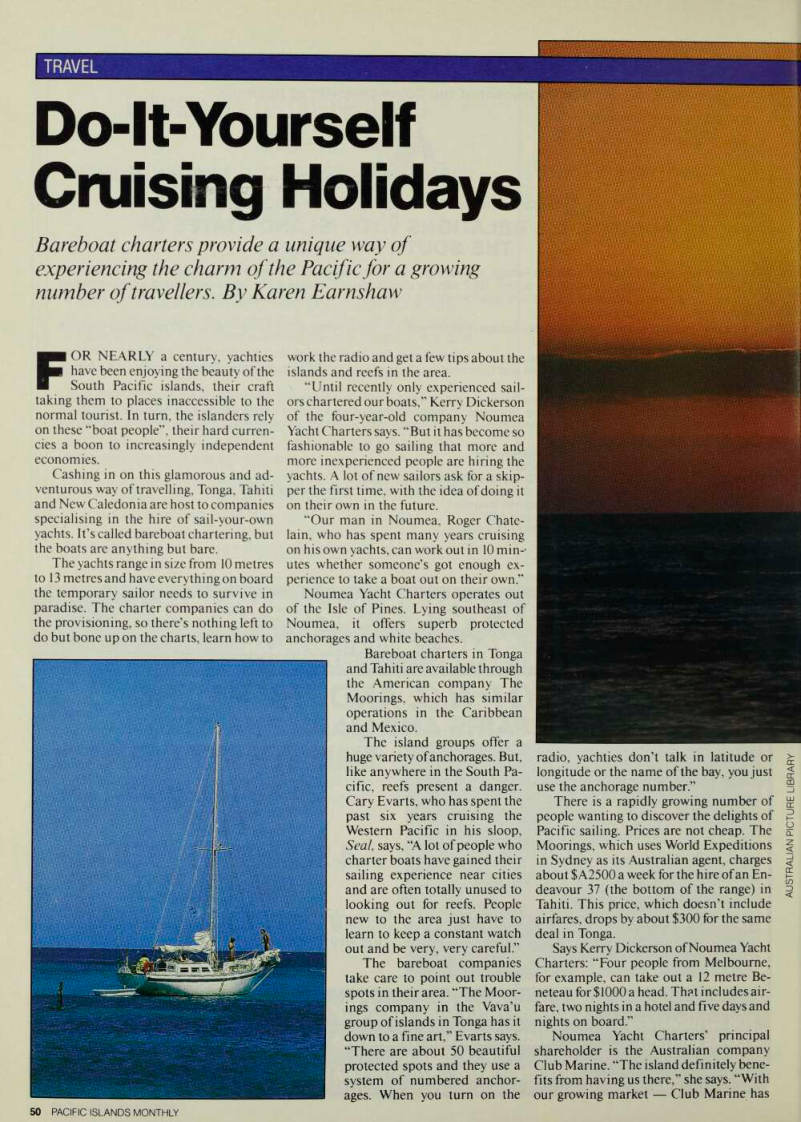
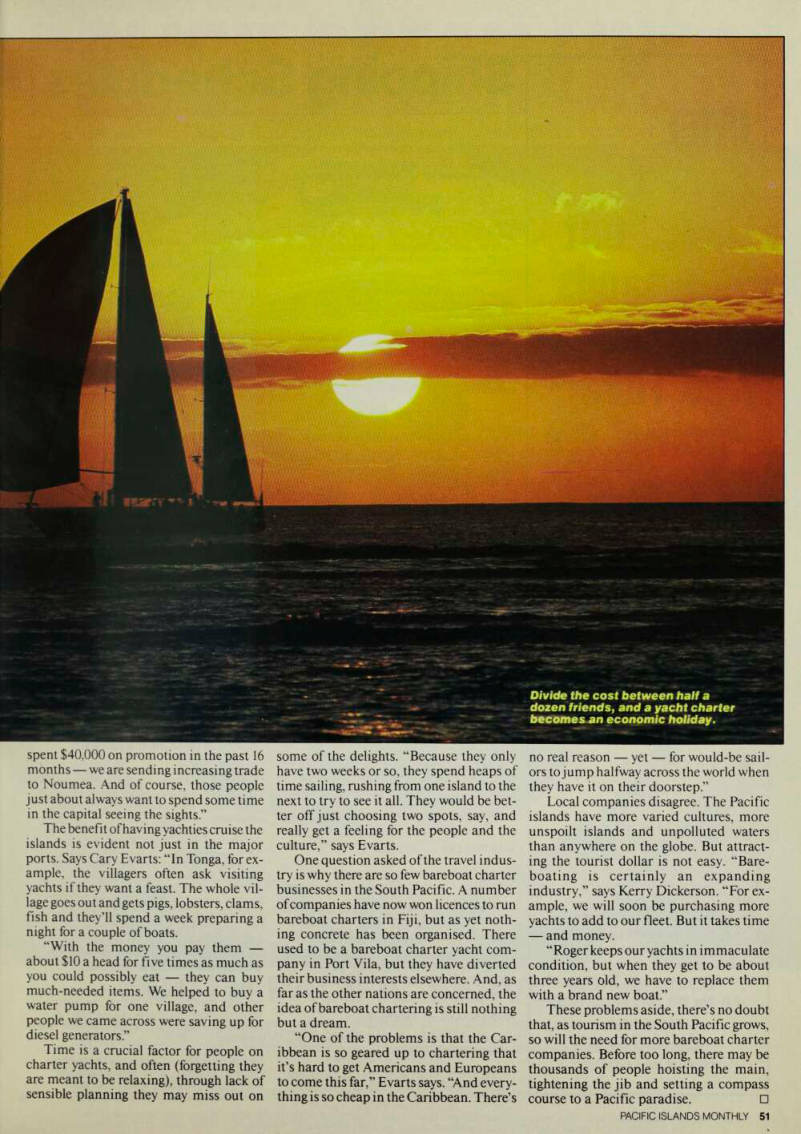
Travel
Do-It-Yourself Cruising Holidays
Bareboat charters provide a unique way of experiencing the charm of the Pacific for a growing number of travellers. By Karen Earnshaw
FOR NEARLY a century, yachties have been enjoying the beauty of the South Pacific islands, their craft taking them to places inaccessible to the normal tourist. In turn, the islanders rely on these “boat people”, their hard currencies a boon to increasingly independent economies.
Cashing in on this glamorous and adventurous way of travelling, Tonga, Tahiti and New Caledonia are host to companies specialising in the hire of sail-your-own yachts. It’s called bareboat chartering, but the boats are anything but bare.
The yachts range in size from 10 metres to 13 metres and have everything on board the temporary sailor needs to survive in paradise. The charter companies can do the provisioning, so there’s nothing left to do but bone up on the charts, learn how to
work the radio and get a few tips about the islands and reefs in the area.
“Until recently only experienced sail ors chartered our boats,” Kerry Dickerson of the four-year-old company Noumea Yacht Charters says. “But it has become so fashionable to go sailing that more and more inexperienced people are hiring the yachts. A lot of new sailors ask for a skip per the first time, with the idea of doing it on their own in the future, “Our man in Noumea, Roger Chate lain, who has spent many years cruising on his own yachts, can work out in 10 min-utes whether someone’s got enough ex perience to take a boat out on their own.”
Noumea Yacht Charters operates out of the Isle of Pines. Lying southeast of Noumea, it offers superb protected anchorages and white beaches.
Bareboat charters in Tonga and Tahiti are available through the American company The Moorings, which has similar operations in the Caribbean and Mexico.
The island groups offer a huge variety of anchorages. But, like anywhere in the South Pa cific, reefs present a danger.
Cary Evarts, who has spent the past six years cruising the Western Pacific in his sloop, Seal, says, “A lot of people who charter boats have gained their sailing experience near cities and are often totally unused to looking out for reefs. People new to the area just have to learn to keep a constant watch out and be very, very careful.”
The bareboat companies take care to point out trouble spots in their area. “The Moor ings company in the Vava’u group of islands in Tonga has it down to a fine art,” Evarts says.
“There are about 50 beautiful protected spots and they use a system of numbered anchor ages. When you turn on the
radio, yachties don’t talk in latitude or longitude or the name of the bay, you just use the anchorage number.”
There is a rapidly growing number of people wanting to discover the delights of Pacific sailing. Prices are not cheap. The Moorings, which uses World Expeditions in Sydney as its Australian agent, charges about $ A 2500 a week for the hire of an En deavour 37 (the bottom of the range) in Tahiti. This price, which doesn’t include airfares, drops by about $3OO for the same deal in Tonga.
Says Kerry Dickerson of Noumea Yacht Charters: “Four people from Melbourne, for example, can take out a 12 metre Be neteau for $lOOO a head. That includes air fare, two nights in a hotel and five days and nights on board.”
Noumea Yacht Charters’ principal shareholder is the Australian company Club Marine. “The island definitely bene fits from having us there,” she says. “With our growing market Club Marine has
Australian Picture Library
spent $40,000 on promotion in the past 16 months we are sending increasing trade to Noumea. And of course, those people just about always want to spend some time in the capital seeing the sights.”
The benefit of having yachties cruise the islands is evident not just in the major ports. Says Cary Evarts: “In Tonga, for ex ample, the villagers often ask visiting yachts if they want a feast. The whole vil lage goes out and gets pigs, lobsters, clams, fish and they’ll spend a week preparing a night for a couple of boats.
“With the money you pay them about $lO a head for five times as much as you could possibly eat they can buy much-needed items. We helped to buy a water pump for one village, and other people we came across were saving up for diesel generators.”
Time is a crucial factor for people on charter yachts, and often (forgetting they are meant to be relaxing), through lack of sensible planning they may miss out on
some of the delights. “Because they only have two weeks or so, they spend heaps of time sailing, rushing from one island to the next to try to see it all. They would be bet ter off just choosing two spots, say, and really get a feeling for the people and the culture,” says Evarts.
One question asked of the travel indus try is why there are so few bareboat charter businesses in the South Pacific. A number of companies have now won licences to run bareboat charters in Fiji, but as yet noth ing concrete has been organised. There used to be a bareboat charter yacht com pany in Port Vila, but they have diverted their business interests elsewhere. And, as far as the other nations are concerned, the idea of bareboat chartering is still nothing but a dream.
“One of the problems is that the Car ibbean is so geared up to chartering that it’s hard to get Americans and Europeans to come this far,” Evarts says. “And every thing is so cheap in the Caribbean. There’s
no real reason yet for would-be sail ors to jump halfway across the world when they have it on their doorstep.”
Local companies disagree. The Pacific islands have more varied cultures, more unspoilt islands and unpolluted waters than anywhere on the globe. But attract ing the tourist dollar is not easy. “Bare boating is certainly an expanding industry,” says Kerry Dickerson, “For ex ample, we will soon be purchasing more yachts to add to our fleet. But it takes time and money.
“Roger keeps our yachts in immaculate condition, but when they get to be about three years old, we have to replace them with a brand new boat.”
These problems aside, there’s no doubt that, as tourism in the South Pacific grows, so will the need for more bareboat charter companies. Before too long, there may be thousands of people hoisting the main, tightening the jib and setting a compass course to a Pacific paradise. □
Divide the cost between half a dozen friends, and a yacht charter becomes an economic holiday.
Shipping Schedules
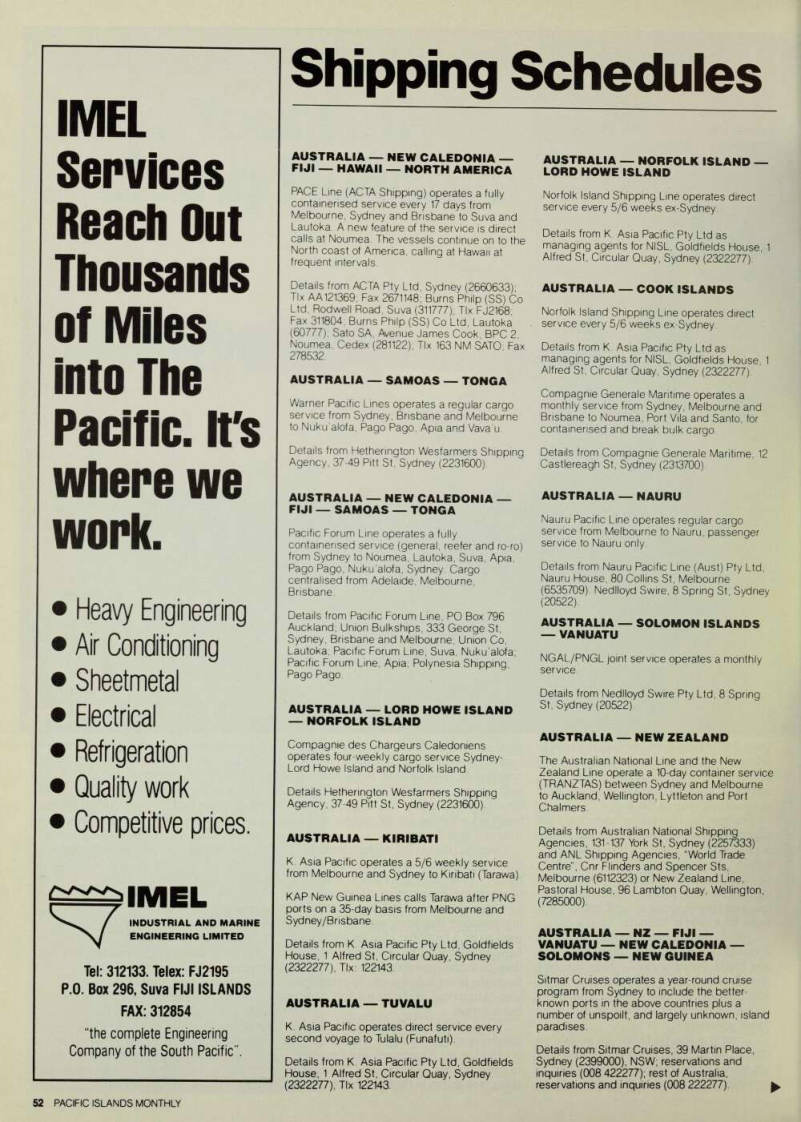
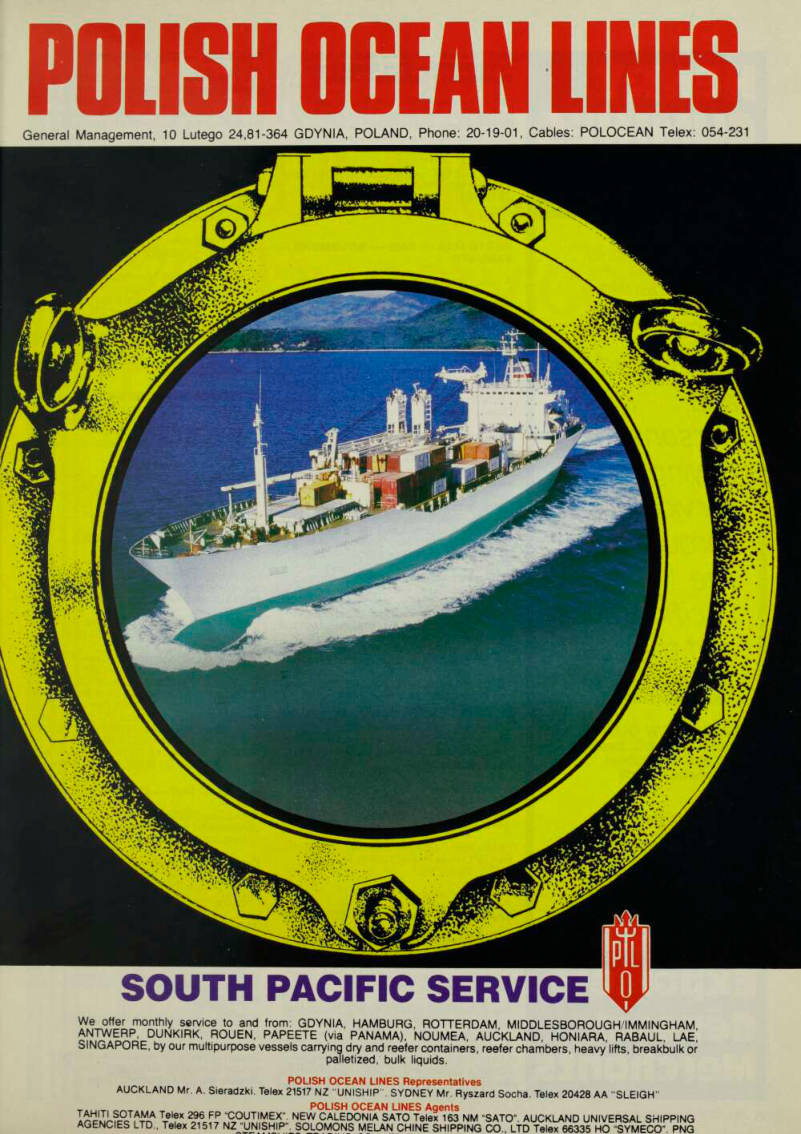

Australia New Caledonia
Fiji Hawaii North America
PACE Line (ACTA Shipping) operates a fully containerised service every 17 days from Melbourne, Sydney and Brisbane to Suva and Lautoka. A new feature of the service is direct calls at Noumea. The vessels continue on to the North coast of America, calling at Hawaii at frequent intervals.
Details from ACTA Pty Ltd, Sydney (2660633); Tlx AA121369; Fax 2671148; Burns Philp (SS) Co Ltd, Rodwell Road, Suva (311777); Tlx FJ2168; Fax 311804; Burns Philp (SS) Co Ltd, Lautoka (60777); Sato SA, Avenue James Cook, BPC 2 Noumea, Cedex (281122); Tlx 163 NM SATO Fax 278532.
Australia Samoas Tonga
Warner Pacific Lines operates a regular cargo service from Sydney, Brisbane and Melbourne to Nukualofa, Pago Pago, Apia and Vava'u.
Details from Hethenngton Wesfarmers Shipping Agency, 37-49 Pitt St, Sydney (2231600).
Australia New Caledonia
Fiji Samoas Tonga
Pacific Forum Line operates a fully containerised service (general, reefer and ro-ro) from Sydney to Noumea, Lautoka, Suva, Apia, Pago Pago, Nukualofa, Sydney. Cargo centralised from Adelaide, Melbourne, Brisbane.
Details from Pacific Forum Line, PO Box 796 Auckland; Union Bulkships, 333 George St, Sydney, Brisbane and Melbourne; Union Co, Lautoka; Pacific Forum Line, Suva, Nukualofa; Pacific Forum Line, Apia; Polynesia Shipping, Pago Pago
Australia Lord Howe Island
Norfolk Island
Compagnie des Chargeurs Caledoniens operates four-weekly cargo service Sydney- Lord Howe Island and Norfolk Island Details Hethenngton Wesfarmers Shipping Agency, 37-49 Pitt St, Sydney (2231600)
Australia Kiribati
K Asia Pacific operates a 5/6 weekly service from Melbourne and Sydney to Kiribati (Tarawa).
KAP New Guinea Lines calls Tarawa after PNG ports on a 35-day basis from Melbourne and Sydney/Brisbane Details from K Asia Pacific Pty Ltd, Goldfields House, 1 Alfred St, Circular Quay, Sydney (2322277), Tlx: 122143.
Australia Tuvalu
K. Asia Pacific operates direct service every second voyage to Tulalu (Funafuti).
Details from K. Asia Pacific Pty Ltd, Goldfields House, 1 Alfred St, Circular Quay, Sydney (2322277), Tlx 122143.
Australia Norfolk Island
Lord Howe Island
Norfolk Island Shipping Line operates direct service every 5/6 weeks ex-Sydney.
Details from K, Asia Pacific Pty Ltd as managing agents for NISL, Goldfields House, 1
Alfred St, Circular Quay, Sydney (2322277).
Australia Cook Islands
Norfolk Island Shipping Line operates direct service every 5/6 weeks ex-Sydney.
Details from K. Asia Pacific Pty Ltd as managing agents for NISL, Goldfields House, 1 Alfred St, Circular Quay, Sydney (2322277).
Compagnie Generate Maritime operates a monthly service from Sydney, Melbourne and Brisbane to Noumea, Port Vila and Santo, for containerised and break bulk cargo.
Details from Compagnie Generate Maritime, 12 Castlereagh St, Sydney (2313700).
Australia Nauru
Nauru Pacific Line operates regular cargo service from Melbourne to Nauru, passenger service to Nauru only.
Details from Nauru Pacific Line (Aust) Pty Ltd, Nauru House, 80 Collins St, Melbourne (6535709). Nedlloyd Swire, 8 Spring St, Sydney (20522).
Australia Solomon Islands
Vanuatu
NGAL/PNGL joint service operates a monthly service.
Details from Nedlloyd Swire Pty Ltd, 8 Spring St, Sydney (20522),
Australia New Zealand
The Australian National Line and the New Zealand Line operate a 10-day container service (TRANZTAS) between Sydney and Melbourne to Auckland, Wellington, Lyttleton and Port Chalmers.
Details from Australian National Shipping Agencies, 131-137 York St, Sydney (2257333) and ANL Shipping Agencies, “World Trade Centre", Cnr Flinders and Spencer Sts, Melbourne (6112323) or New Zealand Line, Pastoral House, 96 Lambton Quay, Wellington, (7285000).
Australia Nz Fiji
Vanuatu New Caledonia
Solomons New Guinea
Sitmar Cruises operates a year-round cruise program from Sydney to include the better known ports in the above countries plus a number of unspoilt, and largely unknown, island paradises.
Details from Sitmar Cruises, 39 Martin Place, Sydney (2399000), NSW; reservations and inquiries (008 422277); rest of Australia, reservations and inquiries (008 222277)
— Nz Fiji Tonga
Vanuatu New Caledonia
Solomons - Samoas Tahiti
P&O Liners call at Auckland, Bay of Islands, Honiara, Lautoka, Noumea, Nukualofa, Pago Pago, Papeete, Port Moresby, Santo, Savu- Savu, Suva, Vava’u and Vila on cruises from Australia.
Details from P&O Booking Centre, World Travel Headquarters Pty Ltd, 33 Bligh St, Sydney (2370333).
Australia Png Solomons
Vanuatu
A consortium of NGAL/PNGL and CONPAC/ NEL has four vessels operating a joint service from east coast Australian ports to Port Moresby, Lae, Alotau, Madang, Wewak, Rabaul, Kavieng-Kimbe, Kieta, Honiara, Vila, Santo.
Details from Burns Philp & Co Ltd, PC Box R 124, Royal Exchange, Sydney 2000 (20547); Nedlloyd Swire, 8 Spring St, Sydney (20522); New Guinea Express Lines, 37 Pitt St, Sydney (2413991); Vila Agents PC Box 27, Port Vila
(2456), Tlx: Nhioii.
New Guinea Express Lines operates a weekly container service from Melbourne, Sydney, Brisbane to Port Moresby, Lae, Alotau, Kimbe, Rabaul, Kieta, Honiara, Kavieng, Madang, Wewak, Santo, Vila.
Details from New Guinea Express Lines, PC Box R 73, Royal Exchange, Sydney (2413991); New Guinea Express Lines, 127 Creek St, Brisbane (2219333); New Guinea Express Lines, 84 William St, Melbourne (6025544); Nuigini Express Lines, Port Moresby (214572); New Guinea Express Lines agent Steamships Trading, Rabaul (921400); Bougainville Agencies Pty Ltd, Kieta (956089); New Guinea Express Lines, Steamships Trading Co, Madang (822446); New Guinea Express Lines, Garumut Enterprises, Wewak (862106); Burns Philp (PNG) Ltd, Kavieng (942133); Alotau Steevedoring and Transport, Alotau (611318); Ngatia Wholesalers Pty Ltd, Kimba (93-5102); and Tradco Shipping, Mandana Avenue, Honiara (22588); Vila Agents Ltd, PC Box 971, Vila, Vanuatu (2490); John Lum & Associates, PO Box 65, Santo, Vanuatu (329).
Singapore Hong Kong Fiji
Islands Ports
Kyowa Shipping Co Ltd operates a monthly containerised and break bulk cargo service from Hong Kong to Lautoka, Suva and then to island ports.
Details from Carpenters Shipping, Private Mail Bag GPO Suva Fiji (312244); Fax: (679) 314572, Tlx FJ2199.
Far East Fiji New Zealand
New Zealand Unit Express (NZUE) operates a monthly service accepting containerised and break bulk cargo from Manila, Keelung, Kaohslung and Hong Kong to Lautoka, Suva and thence to New Zealand ports.
Details from Carpenters Shipping, Private Mail Bag GPO Suva (312244), Fax: (679) 314572; Tlx FJ2199; Burns Philp, Suva (311777); New Zealand Unit Express, Maritime Building, 2-10 Customhouse Quay, PO Box 890, Wellington
(727865), Cables: Enzue-Man Wellington,
Tlx: NZ31340, NEDLNZ, or Nedlloyd Swire Pty Ltd, Sydney (20522).
Far East Mid-S. Pacific
China Navigation’s New Guinea Pacific Line operates a regular container service from Hong
Kong, Taiwan, Philippines, Singapore, Malaysia
and to Port Moresby, Lae, Rabaul, Kieta and Honiara monthly. Wewak and Madang will receive four direct calls a year. A T/S service via Lae to these and other PNG ports connecting with monthly sailings is available at cost. Cargo from the same Eastern ports to the South Pacific ports of Noumea, Santo, Vila, Papeete,
Pago Pago, Apia, Nukualofa, Raratonga and
Tarawa will be shipped via Japan or Busan on the monthly Bali Hai service Details from Steamships Shipping, PC Box 634 Port Moresby (220283 or 220289).
Kyowa Shipping Ltd, operates monthly services from Japan to Guam, Saipan, Solomons, New Caledonia, Fiji, Western and American Samoa, Tahiti, Cook Islands, Tonga and Vanuatu.
Details from Hetherington Wesfarmers Shipping Agency, 37-49 Pitt St, Sydney (2231600); Carpenters Shipping, Suva (312244), Tlx: FJ2199.
Guam Northern Marianas
Saipan Shipping Co Inc operates a weekly service via barge carrying containers and conventional cargo between Guam and Saipan and Tinian.
Details from Saipan Shipping Co, Inc, PC Box 8, Saipan, CM 96950 (322 9706 or 3229707), Tlx; 783619; Fax: (670) 3223183; Guam agents Maritime Agencies of the Pacific Ltd.
Hawaii Samoas Tonga
Cook Islands
Hawaii-Pacific Lines operates monthly container service between Honolulu, Pago Pago, Apia, Nukualofa and Avatiu (Rarotonga).
Details from Hawaii-Pacific Maritime, Inc, PC Box 3264, Honolulu, HI 96801-3264 (808 53114841).
Details from: Morris Hedstrom (Samoa) Ltd, PC Box 189, Apia, Western Samoa (21355, 22722), Tlx: 224 (MORISHED SX), Fax: 24-279; Union Citco Travel Ltd, Rarotonga, Cook Islands (682 21780); Tlx: 62024 (UTRAV G); Fax: (682) 20859; Kneubuhl Maritime Services, PC Box 39, Pago Pago, American Samoa, 96799 (684 6335121/ 22); Tlx: 782505; Fax: (684) 6335100; Union Maritime Services Ltd, PC Box 4, Nukualofa, Tonga (21644/5); Tlx: 66227, Fax: (676) 21645.
Japan Fiji Island Ports
Kyowa Shipping Co. Ltd operates a monthly containerised service from main ports of Japan to Suva, Lautoka, thence to island ports.
Details from Carpenters Shipping, Harbour Centre Building, Ist Floor, Thomson St, Suva (312244), Tlx: FJ2199, and Burns Philp, Suva (311777).
Japan Micronesia
The NYK Shipping Line operates a monthly cargo service from Japan to Micronesia, calling at Yoko, Nagoya, Kobe, Guam, Saipan, Truk, Ponape and Majuro, returning via Yoko, Nagoya and Kobe.
Details from Burns Philp & Co. Ltd, 51 Pitt St,
Sydney (2591000).
Saipan Shipping Co Inc operates a monthly service from Japan to Saipan, Guam, Truk, Ponape, Majuro (Kosrae and Ebeye on inducement).
I Details from Saipan Shipping Co Inc, PO Box 8 Saipan, CM 96950 (322 9706 or 3229707), Tlx: 783619, Fax: (670) 3223183. Japan agents Kyowa Shipping Company Ltd; Guam Agents Maritime Agencies of the Pacific Ltd.
Japan Korea Png Paradise
Service
Mitsui OSK Lines operates a monthly service from main ports in Japan, Wewak, Lae, Rabaul, Kieta, Port Moresby.
Details from Robert Laurie Company (PNG) Pty Ltd, PO Box 1032, Lae/PNG (423642, 423811), Contact: W O Hackenberg, Group Shipping Manager,
Japan Korea Png Japan
Paradise Service
Mitsui OSK Lines in joint service with Nyk Lines operates a monthly service from main ports in Japan and Busan in Korea to PNG ports of Wewak, Rabaul, Kieta, Lae, Port Moresby, Kavieng, Kimbe, Madang and Oro Bay Details from Robert Laurie Company Pty Ltd PO Box 1032, Lae/PNG (Direct 423642 or Switch: 423811), Contact: W O Hackenberg, Group Shipping Manager & Marketing; Tlx: NE 42508, Fax 423801.
Png Inter Mainport
Papua New Guinea Line offers scheduled 10-20 day coastal liner services linking all PNG major ports with containerisation, reefer, heavy lift and trans-shipment facilities.
Details from PNG Line. Box 543, Port Moresby PNG (211174), Tlx: 22269.
Png Uk/Continent
The Bank Line & Columbus Line operate a regular joint service from Port Moresby, Oro Bay, Kieta, Rabaul, Kimbe, Madang and Lae to Hull, Hamburg, Rotterdam, Antwerp and Le Havre.
Details from The Bank Line (A’asia) Pty Ltd, 51 Pitt St, Sydney (272041), Tlx: AA24063; Columbus Line, Lae (423466), Tlx: NE 44171; or lines’ local agents.
Solomons Uk/Continent
The Bank Line & Columbus Line operate a regular joint cargo service from Honiara to Hull, Hamburg, Rotterdam, Antwerp and Le Havre.
Details from The Bank Line (A’asia) Pty Ltd 51 Pitt St, Sydney (272041), Tlx: AA24063; Columbus Line, Lae (423466), Tlx: NE44171; Tradco Shipping Ltd, Honiara (22588), Tlx 66313
New Zealand Australia
Png Solomon Islands
Pacific Forum Line operates a containerised and ro-ro service from Lyttelton, Napier and Auckland to Brisbane, Port Moresby, Lae, Honiara, Brisbane then New Zealand.
Details from Pacific Forum, Auckland, Christchurch; Union Bulkships, Brisbane; Steamships Shipping, Port Moresby and Lae; Sullivans Ltd, Honiara; Seabridge, Wellington.
New Zealand Cook Islands
Tahiti
New Zealand Line operates cargo services based on pallets and similar units from Auckland to Cook Islands and Tahiti.
Details from NZ Shipping Agencies International Ltd, PO Box 3420, Auckland (392650); Waterfront Commission, PO Box 61, Raratonga; Cook Islands: Shipping Office, Govt, of Niue.
PO Box 107, Niue Island; Compagnie Maritime Polynesienne, PO Box 36, Papeete, Tahiti.
New Zealand —Fiji
Reef operates a regular 18-day service from Auckland to Suva and Lautoka. Also passenger accommodation.
Details from Reef Shipping Agencies, PO Box 3382, Auckland, NZ (7712213), Tlx: 60633; MV Fijian Shipping Agencies Ltd, Private Bag, Suva, Fiji (311056).
Pacific Line with one ship operates two weekly ro-ro cargo service New Zealand, Lautoka, Suva. No passengers.
Details Sofrana Unilines, 18 Customs St, Auckland (773279), PO Box 3614, Tlx: NZ2313, Carpenters Shipping, Neptune House, Tofua St, Walu Bay, Suva (25141), Tlx: FJ2199.
New Zealand Fiji North
America (Wc)
Blue Star Line Ltd Pacific Coast container services. Only direct service to and from New Zealand. Blue Star vessels call at Suva and Honolulu on NZ-US West Coast voyages.
Details from Blueport ACT (NZ) Ltd, PO Box 192, Wellington (739029); Burns Philp (SS) Co Ltd, GPO Box 355, Suva, Fiji (311777), Tlx: FJ2168 Burship.
New Zealand Fiji Samoas
Tonga
Pacific Forum Line operates a containerised and ro-ro 21 day service from Auckland to Lautoka, Suva, Apia, Pago Pago and Nukualofa.
Details from Pacific Forum Line, Auckland, Christchurch, Suva and Apia, Union Maritime, Lautoka, and Nukualofa; Polynesian Shipping, Pago Pago.
New Zealand Tonga
Samoas
Warner Pacific Line Services: Auckland, Nukualofa, Vava’u, Apia, Pago Pago fortnightly carrying general and freezer cargoes and FCL Dry.
Details from McKay Shipping Ltd, Downtown House, 21 Queen St, Auckland, PO Box 3 (390229). Cables MACSHIP, Tlx: NZ2554f; Warner Pacific Line, Box 93, Nuku’alofa, Tonga; Mealelel (Western Samoa) Ltd, Private Bag Apia, Western Samoa; Burns Philp (SS) Co Ltd, PO Box 129, Pago Pago, American Samoa (6332709), Cables 506, Burnsouth SB.
Nz Cook Islands Aitutaki
Niue
Cook Islands Line services Auckland, Aitutaki, Niue monthly carrying general and freezer cargoes.
Details from McKay Shipping Ltd, Downtown House, 21 Queen Street, Auckland, PO Box 3, Auckland (390229), Cables MACSHIP, Tlx: NZ2554; Fax: 32931.
Tahiti New Caledonia
Vanuatu Solomon Islands
New Zealand Png - Singapore
Europe
Polish Ocean Lines operate in semi-container type vessels to the following ports: from Papeete, Noumea, Santo, Vila, Yandina, Honiara, Auckland, Rabaul, Lae, Singapore, Port Kielang, Penang then to Mediterranean ports and Europe via the Suez Canal. (Other New Zealand ports subject to inducement).
Details from Universal Shipping Agencies Ltd, 6th Floor, 38 Fort St, Auckland 1, NZ (390931 390727, 32104), Tlx: 21517.
Europe Tahiti New
Caledonia
Compagnie Generale Maritime operates services from Europe and Mediterranean ports to Papeete and Noumea using three ro-ro and multi-purpose vessels thus ensuring a bi monthly sailing to and from.
Details from Compagnie Generale Maritime 12 Castlereagh St, Sydney (2313700).
Europe Tahiti New
Caledonia New Zealand
Vanuatu Solomons Png -
Europe
Polish Ocean Lines offers regular monthly sailings for containerised and break bulk cargo, also conventional reefer space and reefer containers from Hamburg, Rotterdam, Dunkirk,
Le Havre to Papeete, Noumea, Auckland, Santo, Honiara, Rabaul, Lae, Singapore, returning to Europe via Suez. Other ports in the South Pacific can be served directly with inducement or otherwise via transshipment.
Details from Sotama, BP 9170, Papeete (427805), Tlx: 373, Tlx: Sotama 373FP; SATO: BP, C 2 Noumea Cedex (272094), Tlx: 163 NM; Universal Shipping Agencies, PO Box 2282 Auckland (30930), Tlx: 21517; Vanua Navigation, PO Box 44, Vila (2027), Tlx: 1033; Melan Chine Shipping Co, PO Box 71, Honiara (21678), Tlx: 66335; Steamships Trading Co Ltd, PO Box 85, Lae (424666), Tlx: 42423; Union Steamship Co of NZ Ltd, PO Box 50, Apia (21781), Tlx: 225; Warner Pacific Line, PO Box 93, Nukualofa (22088), Tlx: 66219; Fiji Agents TBA,
Europe Tahiti W. Samoa
Fiji New Caledonia
Nedlloyd offers regular cargo services from Continental ports to Papeete, Apia, Fiji and New Caledonia.
Details Nedlloyd (Aust.) Pty Ltd, Spring St,
Sydney (273801); Carpenters Shipping, Ist
Floor, Harbour Centre Bldg, 100 Thomson St, Suva (312244) Tlx: 2199FJ and Vetari St, Lautoka (63988), Tlx: 5215FJ.
Uk Europe W. Samoa
Tonga Fiji
The Bank Line & Columbus Line operate a regular joint cargo service from Hull, Hamburg, Bremen, Antwerp, Rotterdam and Le Havre to Apia, Nukualofa, Suva and Lautoka.
Details from The Bank Line (A’asia) Pty Ltd, 51 Pitt St, Sydney (272041), Tlx: AA24063, Columbus Line, Lae (423466), Tlx: NE 44111, or Lines' local agents.
Uk Europe Png
Solomons
The Bank Line & Columbus Line operate a regular joint cargo service from Hull, Hamburg, Bremen, Antwerp, Rotterdam and Le Havre to Port Moresby, Lae, Madang, Kimbe, Rabaul, Kieta and Honiara and on inducement to Yandina.
Details from The Bank Line (A’asia) Pty Ltd, 51 Pitt St, Sydney (272041), Tlx: AA24063: Columbus Line, Lae (423466), Tlx: NE44171; or Lines' local agents.
Uk/Europe Tahiti New
Caledonia Vanuatu
The Bank Line and Columbus Line operate a regular joint cargo service from Hull, Hamburg, Bremen, Antwerp, Rotterdam and Le Havre to Papeete, Noumea, Port-Vila and Santo.
Details from The Bank Line (A’asia) Pty Ltd, 51 Pitt St, Sydney (272041), Tlx: AA24063, Columbus Line, Lae (423466), Tlx: NE44171; Ets A M. Fare UTE, Papeete; Ets, Ballande, Noumea and other local agents.
Us Hawaii Micronesia
Png
PM&O Lines operates two fully self-contained container vessels on a sailing frequency of every 30 days between the San Francisco Bay Area, Los Angeles, Honolulu and Majuro, Ebeye, Kosrae, Ponape, Truk, Saipan, Yap, Palau, Cebu, Davao, Lae, Kieta and Rabaul.
Details from PM&O Lines, 353 Sacramento St, San Francisco, California 94111, USA, (415 4215400), Tlx: 278016 PMO UR; owner's Representative PO Box 803, Saipan, NMI 96950
(2346819), Tlx: 783605 Cmcaa.
Advertisements & other items, pp. 52-57 (2 items)
Thousands
IMEL
Services
Reach Out
Thousands
of Miles
into The
Pacific. It's
where we
work.
• Heavy Engineering • Air Conditioning • Sheetmetal • Electrical • Refrigeration • Quality work • Competitive prices.
3 IMEL
/ INDUSTRIAL AND MARINE
ENGINEERING LIMITED
Tel: 312133. Telex: FJ2195
P.O. Box 296, Suva FIJI ISLANDS
FAX: 312854
“the complete Engineering Company of the South Pacific”.
Polish Ocean Unis
General Management, 10 Lutego 24,81-364 GDYNIA, POLAND, Phone: 20-19-01, Cables: POLOCEAN Telex: 054-231 Q *>-i 8 1 t 3 SB v *•> w %■¥ p
SOUTH PACIFIC SERVICE
We Offer monthly service to and from: GDYNIA, HAMBURG, ROTTERDAM, MIDDLESBOROUGH/IMMINGHAM, oi-RH NKI RK ’ ROUEN, PAPEETE (via PANAMA), NOUMEA, AUCKLAND, HONIARA, RABAUL, LAE, SINGAPORE, by our multipurpose vessels carrying dry and reefer containers, reefer chambers, heavy lifts, breakbulk or palletized, bulk liquids.
POLISH OCEAN LINES Representatives AUCKLAND Mr. A. Sieradzki. Telex 21517 NZ “UNISHIP". SYDNEY Mr. Ryszard Socha. Telex 20428 AA "SLEIGH”
TAUITI T POLISH OCEAN LINES Agents
?f x NEW CALEDONIA SATO Telex 163 NM “SATO”. AUCKLAND UNIVERSAL SHIPPING AGENCIES LTD., Telex 21517 NZ UNISHIP SOLOMONS MELAN CHINE SHIPPING CO., LTD Telex 66335 HO “SYMECO". PNG
117 York St., Sydney Cables: Henco Sydney.
C.P.O. Box 5949 Telephone: 261 1955.
For
specialised
and
personalised
buying
service
throughout
the
Pacific Islands
and the East
LOCAL AGENTS AND
REPRESENTATION
PAPUA NEW GUINEA
RABAUL: M. & C. Seeto, P.O. Box 131, Rabaul.
Telephone 92 2919
FIJI
K. Witherington Ltd., P.O. Box 293, Suva.
Telephone 22 356.
VANUATU
John Lum & Associates, P.O. Box 65, Santo.
Telephone 329.
BANK LINE and
COLUMBUS LINE
24 day service to
Europe.
Need we say more...
ti G D The Joint Service Partners offer facilities for shipment of: Containers (FCiyLCL) and Break-bulk Cargo plus reefer space and deeptanks for carriage of vegetable oils and other liquid bulk cargo.
Carriers also accept heavy lifts, overlength and cumbersome parcels.
Ports of Service: Loading: Papeete, Apia, Suva, Lautoka, Noumea, Port Vila, Santo, Honiara, Port Moresby, Lae, Madang, Kimbe, Rabaul, Kieta, Darwin. For: Rotterdam, Antwerp, Hamburg, Hull, Dunkirk, Le Havre.
Additional ports on enquiry.
Please contact our regional offices for further information: The Bank Line (Australasia) Pty Ltd Columbus Line Reederei GmbH Suite 801, 51 Pitt St, p.o. Box 1 667, Lae/Papua New Guinea.
Sydney, NSW, Australia 2000 Rhone: 423466/423487/AH. 422481 Phone 27 2041 Telex 24063 Telex; Colline NE 441 71 The South Pacific Specialists for over 75 years
TONGA
KIRIBATI
VANUATU
COOK ISLAND
SOLOMON ISLANDS
NEW CALEDONIA
U.S. SAMOA
WESTERN SAMOA
FRENCH POLYNESIA
JAPAN . KOREA
YOU’LL FIND IT,
WHERE THE SKY MEETS
THE SEA
RORO. CONTAINER &
B.BULK SHIPPING
BALI
HAI SERVICE
AGENTS
and
PHONE
SUVA:Burns Philp(B.P) 311777 Carpenter Shipping (C.S) 312244 LAUTOKArB P 60777 C.S 63988 APIA:B P 22611 PAGOPAGO ;Polynesia Shipping Services Ltd. 633-1211 PAPEETErCompagnie Maritime Polynesienne 42.84.02 NOUMEA:Etablissements Ballande 687-283384 VILA:B P 2456 SANTO:B P 230 HONlAßA:Sullivans (Solomon Islands) Ltd 21645 TARAWA:Shipping Corporation of Kiribati 26195 NUKUALOFA:B.P 21500 BUSAN:for general cargo Young Chang Shipping Co., Ltd. 753-0451 for vehicle Pan Continental Shipping Co., Ltd. 778-7680 Soyang Shipping Co., Ltd 752-7755 JAPANrfor general cargo Swire 03-230-9245 for vehicle NYK Lines 03-284-5506 Mitsui O.S.K 03-584-0916
Aggie Grey's
Hotel
Stay at Aggie Grey’s
the South Pacific’s
legendary hotel.
Situated right in the heart of Western Samoa. Enjoy Polynesian style friendliness and service,in cool surroundings, superb entertainment and food. Magnificent white sand beaches only a short drive away.
Air-conditioned rooms, swimming pool and full bar facilities.
Bookings through Union Steamship Company of NZ. Pan Am, Air New Zealand or direct to Aggie Grey’s, Apia, Western Samoa Cables: AGGIES’ Apia
yir.
REFRIGERATED
TRUCKS
★ Freezers ★ Chillers ★ Coolers Our units ideal in Samoa, Papua New Guinea, & Fiji. Meat-hanging, Pallet-loading, Distributing Juice, Milk, Produce.
Our staff are former Pacific Island residents.
Ph: 61 -7-875 1488 (24 hours) P.O. Box 208, Moorooka.
Australia Q. 4105 Phone or Write . . For The Answer To Your Transport Needs"
Perkins
hurth Hamilton
MARINE GEARS
Sales, service & spare parts
fit POWER
RUSLIT POWER CENTRE
195 Parramatta Rd, Auburn 2144 Sydney, NSW, Australia (02) 648 0591
Memories of Christmas
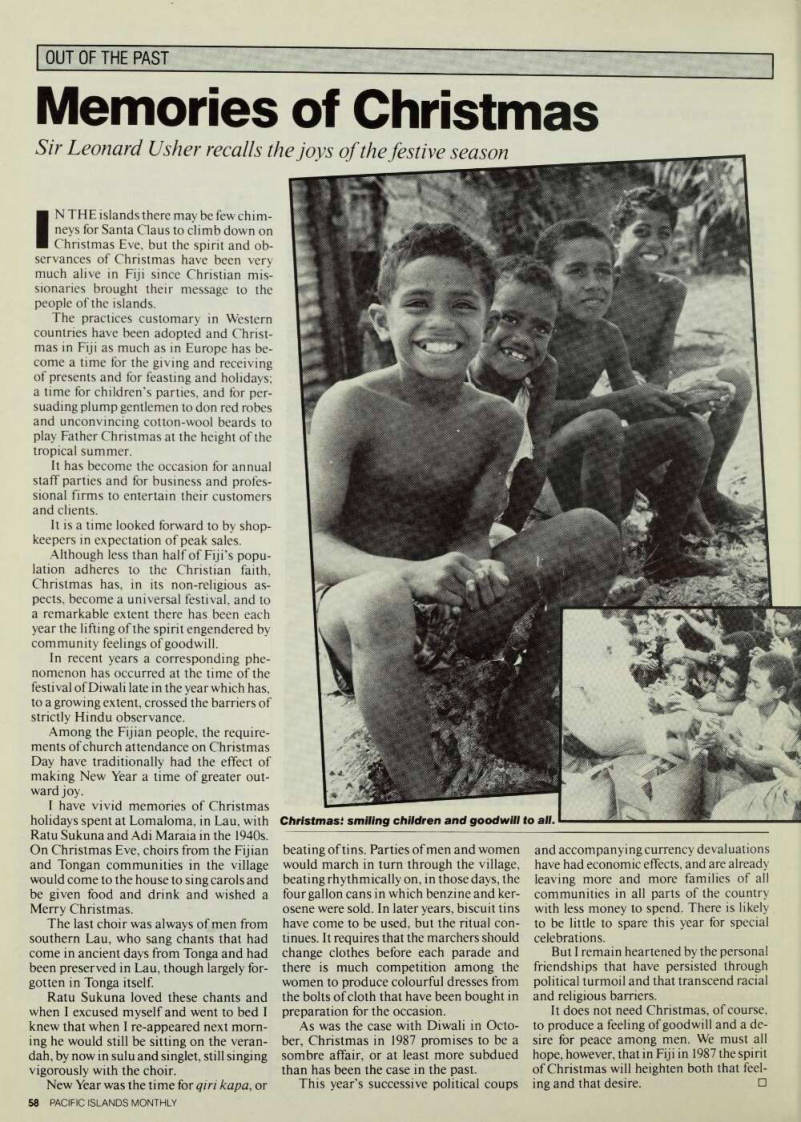
Out Of The Past
Sir Leonard Usher recalls the joys of the festive season
IN THE islands there may be few chim neys for Santa Claus to climb down on Christmas Eve, but the spirit and ob servances of Christmas have been very much alive in Fiji since Christian mis sionaries brought their message to the people of the islands.
The practices customary in Western countries have been adopted and Christ mas in Fiji as much as in Europe has be come a time for the giving and receiving of presents and for feasting and holidays; a time for children’s parties, and for per suading plump gentlemen to don red robes and unconvincing cotton-wool beards to play Father Christmas at the height of the tropical summer.
It has become the occasion for annual staff parties and for business and profes sional firms to entertain their customers and clients.
It is a time looked forward to by shop keepers in expectation of peak sales.
Although less than half of Fiji’s popu lation adheres to the Christian faith, Christmas has, in its non-religious as pects, become a universal festival, and to a remarkable extent there has been each year the lifting of the spirit engendered by community feelings of goodwill.
In recent years a corresponding phe nomenon has occurred at the time of the festival of Diwali late in the year which has, to a growing extent, crossed the barriers of strictly Hindu observance.
Among the Fijian people, the require ments of church attendance on Christmas Day have traditionally had the effect of making New Year a time of greater out ward joy.
I have vivid memories of Christmas holidays spent at Lomaloma, in Lau, with Ratu Sukuna and Adi Maraia in the 19405.
On Christmas Eve, choirs from the Fijian and Tongan communities in the village would come to the house to sing carols and be given food and drink and wished a Merry Christmas.
The last choir was always of men from southern Lau, who sang chants that had come in ancient days from Tonga and had been preserved in Lau, though largely for gotten in Tonga itself.
Ratu Sukuna loved these chants and when I excused myself and went to bed I knew that when I re-appeared next morn ing he would still be sitting on the veran dah, by now in sulu and singlet, still singing vigorously with the choir.
New Year was the time for qiri kapa, or
beating of tins. Parties of men and women would march in turn through the village, beating rhythmically on, in those days, the four gallon cans in which benzine and ker osene were sold. In later years, biscuit tins have come to be used, but the ritual con tinues. It requires that the marchers should change clothes before each parade and there is much competition among the women to produce colourful dresses from the bolts of cloth that have been bought in preparation for the occasion.
As was the case with Diwali in Octo ber, Christmas in 1987 promises to be a sombre affair, or at least more subdued than has been the case in the past.
This year’s successive political coups
and accompanying currency devaluations have had economic effects, and are already leaving more and more families of all communities in all parts of the country with less money to spend. There is likely to be little to spare this year for special celebrations.
But I remain heartened by the personal friendships that have persisted through political turmoil and that transcend racial and religious barriers.
It does not need Christmas, of course, to produce a feeling of goodwill and a de sire for peace among men. We must all hope, however, that in Fiji in 1987 the spirit of Christmas will heighten both that feel ing and that desire. □
Christmas: smiling children and goodwill to all.
Advertisements & other items, pp. 59-60 (1 item)
without saying a word?
Do your Clients publicize
your message
Regardless of what you wish to promote, it’s certain your message needs to be seen and there just isn’t a better, or more economical solution than the high quality printed acrylic sun visor.
This fashion conscious, sports accessory will publicize your message, or logo motif in the best
possible way... “at eye-level”.
The K’nTva Company are Australia’s
promotional aid professionals.
Their fantastic range of sun \ visors enjoy world-wide market acceptance.
Unrivaled for quality,
durability and
price. They come
in twenty opaque and six UV mod-
ified transparent
colours. Printing
capabilities
offer the choice of every foil or ink colour
available. Up
to six different foil/ink colours can be printed
in tight registration
to your requirements.
The K’nl’va Art depart ment can work from bromides, artwork, or (via the phone on 436 2584) faxed thru visual concepts. Most orders of printed Visors ©
-xrML/<^
By ENHOCAST PHJPHEIAfn LMJED I
in can be delivered fob from Sydney in ten to fourteen working days from receipt of an official company order and credit securities.
Of course the cost per unit varies depending on the desired quantity and complexity of printing. An order for as little as one thousand units, printed in three different colours and including art make-up, printing blocks etc. would amount to a cost of no more than $l.BO each. Most 1 1 orders usually work out much less.
So as a marketable promotional aid at a nominal rrp* of around $4.95, or rwp* of $2.50, / f K’nl’va Sun Visors can generate handsome profits.
So don’t be misled by poor imitations the
original Australian
K’nl’va Sun Visors are the value for
money premium
product. Give
them a call,
discuss quantity/
pricing details
and ask to see a sample.
You’ll see why K’nl’va (Can-I-have-a) sun visors are the market leaders.* The K’nl’va Company 92 Reserve Road, Artarmon NSW 2064 Australia Tel: (02) 436 2325 Fax: (02) 436 2584 Telex: AA121822 (Quote SY 3708) *RRP: Recommended retail price. *RWP: Recommended wholesale price. At time of publication
WGS: KV43J
★ Ist. overall, three years running ★ 2nd. overall. ★ Ist. Marathon Class, three years running. -■• 'T Darwin ■ * THE WYNN’S SAFARI- VICTORY THREE YEARS IN A ROW
Conquering the lonely continent.
The challenge of the Australian continent is an elemental one, one that has tempted intrepid adventurers for hundreds of years. Early explorers, lonely, driven men found the lure of the vast red interior irresistible. It presented the chance of going beyond the realms of civilization, and many never made it back. For the Australian interior is a horribly unique one. Its desolation is total. A land that boasts more varieties of venomous creatures than any other continent does not invite intrusion nor welcome the faint-hearted.
Not much has changed in a hundred years.
P/fl4 Snakes and crocodiles still rule this empty land and fools still try to cross it, Every year in August, brave men and women tackle a course of swamps, deserts and rain forest for the glory of winning the Australian Wynn's Safari, 6,500 km of the toughest rally country to be found anywhere. This year, for the third time in a row, it was the Mitsubishi Pajero that roared in, first and second to the cheers of the crowd waiting at the finish line in Darwin.
In the incredibly demanding "Marathon Class", that for unmodified 4WDs (essentially the same vehicles that stock showrooms), Mitsubishi's superior durability won out, also for the third year in a row.
In fact, seven of the top ten positions were filled by Mitsubishi Pajeros.
The reason for that kind of unbeatable performance is simple. The active policy at Mitsubishi Motors is to seek out the worst possible conditions to prove the reliability of their vehicles. The ultimate performance test as it were. And the reward is more than just winning; it is the satisfaction of producing vehicles that, in appalling conditions have stood with and bested a select group of latter day adventurers distinguished by a common drive to go beyond the limits of endurance.
AMERICAN SAMOA: MORRIS SCANLAN SERVICE INC. P.O. Box 367, Pago Pago, Tel. 633-5520/AUSTRALIA: MITSUBISHI MOTORS AUSTRALIA LTD. Box 1284, South Road, Clovelly Park, South Australia 5042, Tel. (08) 275-7223/FIJI: NIVIS MOTOR & MACHINERY CO., LTD. G.PO. Box 150, Suva, Tel 383411/FRENCH POLYNESIA (TAHITI): ETS-BREDIN FRERES ET FILS P.O. Box 21. Papeete, Tahiti. Tel. 4-202-58/NEW CALEDONIA; SOCIETE D IMPORTATION DAUTO DU PACIFIQUE SUD S.A. B P 438 Rond Point du Pacifique, Noumea, Tel 274144/NEW ZEALAND: MITSUBISHI MOTORS NEW ZEALAND LTD Todd Park. Heriot Drive. Private Bag, Porirua. Tel. 370-109/NORFOLK ISLAND: BORRYS LTD P.O. Box 169, Norfolk Island. Tel. 2114/PAPUA NEW GUINEA: TOBA PTY. LTD. P.O. Box 503, Port Moresby, Tel. 21-7874/SOLOMON ISLANDS: HARVEST PACIFIC LTD. G.PO Box 88, Honiara, Guadalcanal, Tel 30128/TONGA: SITANI MAPI CO., LTD. P.O. Box 83, Nuku ALOFA, Tel 21-044/VANUATU: SOCOMETRA B P 06 Route de Lagon, Port-Vila, Tel 2314/WESTERN SAMOA. A M. MACDONALD HOLDINGS LTD. P.O. Box 576, Apia, Tel 22022/SAIPAN/POHNPEI/MAJURO/KOSRAE/TRUK/YAP/ BELAU: MICRONESSIAN MOTORS, INC. 997 South Marine Drive, Tamuning, Guam 96911, Tel 646-6827 Aj q 1 q
PAG
Jm/r/W A
MITSUBISHI
MOTORS