Pacific



Islands
Monthly
RUSSIA MOVES IN: VANUATU POLL: PNG GOLD UPDATE: GAMES PREVIEW
American Samoa US$2.OO Australia A 52.00 Cook Islands NZ$3.OO Fiji F 51.75 Hawaii US$2.5O Kiribati A 52.00 Nauru A 52.00 New Caledonia CFP2SO New Zealand NZ$3.OO Niue NZ$2.5O Norfolk Island A 52.00 Papua New Guinea K 2.00 Solomon Islands 552.00 Tahiti CFP3OO Tonga P 2.00 Tuvalu A 52.00
Usa Us$3.Oo
USTT and Guam US$2.5O Vanuatu VT2.00 Western Samoa T 2.75 ♦Recommended retail price only
November 1987
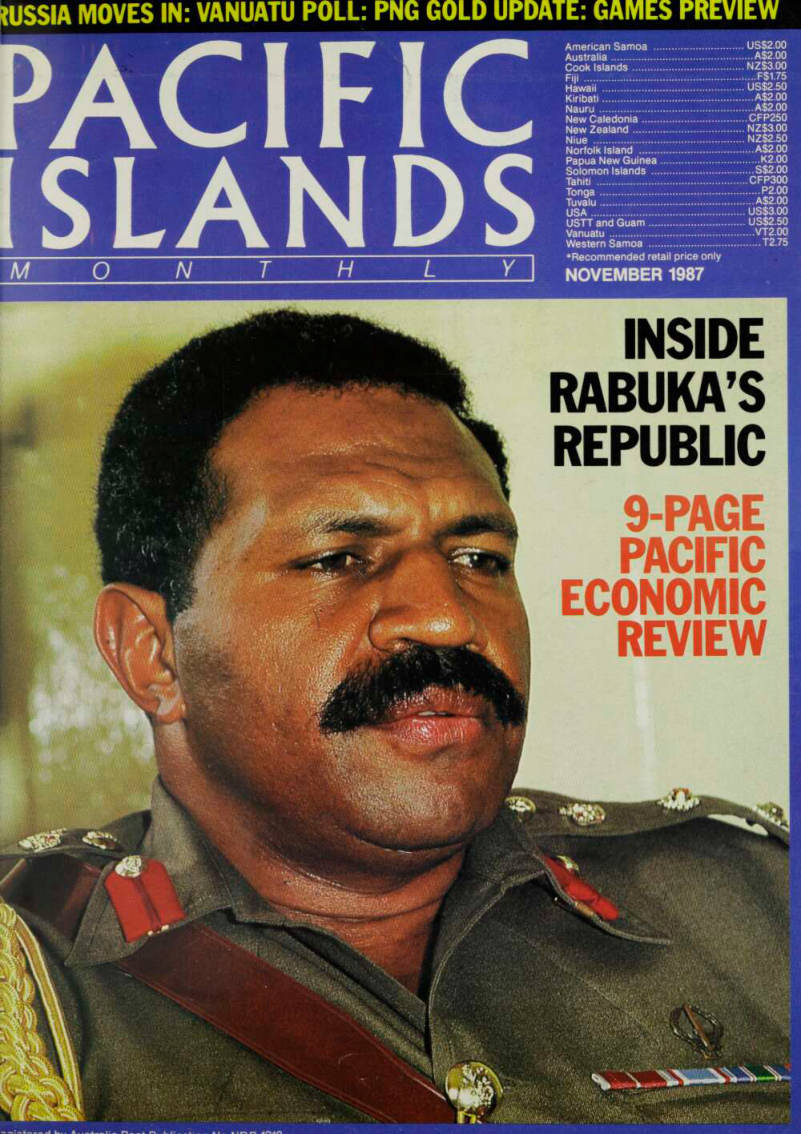
Inside
Rabuka’S
Republic
9-Page
Pacific
Economic
Review
Cover Photograph: Patrick Riviere/Sydney Freelance
Advertisements & other items, pp. 2-4 (1 item)
Do the twist
It’s a whole new kind
of driving. It’s a unique
Speed-Sensing 4-Wheel
Steering system. And
it’s developed by Mazda,
of course.
The pleasure of dancing; it comes from a harmony of mind and body so in tune that there is only a feeling of at oneness. It was just this kind of harmony between car and driver that Mazda has long been seeking with our innovations in rear suspension and toe control technology. A harmony that has now been realized with the development of Mazda’s unique Speed-
Sensing 4-Wheel Steering system.
Cornering confidence.
Drivers will be able to take corners at surprising speeds with surpr ing ease, because all four wheels are steering with them when they turn.
Steering with the mind.
Mazda’s 4WS system’s response to the driver’s steering is so fast, so natural, it’s as though the car had rei the driver’s mind.
Straight ahead to the fun.
Straight line stability is simply exhilarating since the 4WS system dismisses the effects of wind and uneven roads.
Twist and shout for joy.
Driving in narrow, twisting, congested city streets can be nervewracking. But Mazda’s 4WS system enables drivers to maneuver with incredible ease; making U-turns that others can’t, or simply sliding into a tight parking space.
Speed-sensational.
What gives this unique 4WS system the edge is that it controls the steering direction and angle of the rear wheels in response not only to steering input, but to variations in the car’s speed as well. So when driving over 35km/h the rear wheels are steered with the front wheels in the best angle vis-a-vis the car’s speed for mid-to-high speed handling stability that’s sensational. At lower speeds the rear wheels twist in the opposite direction for a dramatic difference in maneuverability.
The next step.
Mazda’s Speed-Sensing 4WS system is only the latest step in our long history of working to bring an experience of oneness with the car to drivers. And you can be sure that at Mazda, the dance won’t stop here.
This warranty is valid only in Australia Your kind of car.
mazoa
© Mazda Motor Corporation
- V W - ‘ ' ,*v .«**< v V VvV H* v%* vW . W > Vs» • *** fc W» «**_ L. . v v v ■•«« *** *■*% ’ , -. Ite’ . *W» ■» %»* v hn» fs* ■ #**
PLJI
: JP ' / -J*
* ■ s^EL*. mdJt. «Lt.
r <*j& ps*
'■■•v Wj t :>» s !
4PJ A M& , \
*&*•' ■»*'-#'■ * * <#* «4f 4 *« ■ - Jf . -.* * * 1 ■ = ■’ ‘ '■ % v \ |Ov > #' - :• "• • ■ ' , £< V s ’ » - '- -t * « .■* « - ,-■ « „* ■" * • ■ -. ?- %* iC*%# £»%.» •%» i> *•.
Pacific
Islands
Monthly
Vol 58, No. 11
Voice Of The Pacific
November, ’B7
Cover Story »
Fiji faces a turbulent future as Colonel Rabuka and his Council of Ministers take control. Nicholas Rothwell reports from the new republic on the Colonel’s triumphant second coup and details the many political, economic and social problems he must solve.
Vanuatu At The Polls 16
The Government should prevail, but the emergence of a strong opposition will give Father Walter Lini the fight of his life.
Preview:
South Pacific Games 18
Numbers are down for next month’s Games in New Caledonia but some exciting competition is assured.
Pons’ Autonomy Plan 19
France’s controversial scheme for the people of New Caledonia receives a mixed reaction in the territory.
Tjibaou’S New York
Poison Scare 19
Nauru’S Fight For A Future 20
The struggle is on to win compensation from phosphate miners.
INTERVIEW: DICK CARTER OF OK TEDI 21 The PNG mining giant’s new Managing Director speaks out on Ok Tedi’s future.
Hard Lessons For Us Lawmakers 23
Think tanks caution those who make US Pacific Policy.
Anzus Split Takes Its Toll 25
TheNZ military has been blitzed by the treaty breakdown.
The Pacific Economy:
A Special 9-Page Report 33
A breakdown of the island economies.
Forum: Russia In The Pacific 43
Defence expert Peter Young reveals Soviet ambitions.
ADVENTURE IN STYLE ON THE SEPIK 50 How to cruise the mighty river.
Page 43
Page 24
Editor Larry Writer Deputy Editor Carson Creagh Art Director Warren Scott Editorial Adviser John Carter Contributors Peter Young Nicholas Rothwell John Dunn David S. North Melissa Roberts Gabriel Singh Chris Ashton John Hunter Sir Leonard Usher Publisher Geraldine Raton Managing Editor Arnold Earnshaw Advertising Sales Sydney & Melbourne - Lawson Dixon (02) 288 3541 Fergus Maclagan (02) 412 3918; Brisbane - Robert Walker (07) 371 0533.
Australian cover price is recommended retail only. Registered by Australia Post, publication No. NBPI2IO, Copyright Pacific Publications (Aust) Pty Ltd
Advertisements & other items, pp. 5-6 (3 items)
Departments
OPINION 7
LETTERS 9
PACIFIC REPORT 29
STAMPS 45
TRANSITION 46
ISLANDS PRESS 47
BOOK REVIEWS 48
SHIPPING SCHEDULES 54
OUT OF THE PAST 58
5
PACIFIC ISLANDS MONTHLY
A Pacific Publications production.
Founded 1930 (USPS 952480) 64-76 Kippax St, Surry Hills, NSW 2010; GPO Box 4245, Sydney, NSW, 2001; Telex: AA20124; Fax: (02)288 3322; Cables: PACPUB Sydney; Telephone: (02) 288 3000.
Pacific Islands Monthly (APPS No, NBP1210) is published monthly for SUS4S per year by Pacific Publications Pty Ltd, a division of News Ltd, 2 Holt St, Surry Hills, NSW 2010. Second class postage paid at Honolulu, Hawaii, POSTMASTER. Send address changes to PACIFIC ISLANDS MONTHLY, PO Box 22250, Honolulu, Hawaii 96822. Typeset by David Graphics, Sydney, and printed by Progress Press, 2 Keys Rd, Moorabbin, Victoria.
C£ Pioneer
3*^ M i ■*&' » r % 7 f ►
Add the finishing touches
to your fantasy, ..
The dream comes true with NEW PERSONNA PLUS shelf-size component systems, and the model X-550R a sound system more than brimming with high fidelity, and feature-packed!
In fact, boasting a full 350 W of high-power (PMPO) output, the X-550R delivers the convenience of remote control for amp, tuner, deck, turntable 1 ; and an optional CD player, plus a 5-band graphic equalizer for frequency distribution adjustments —and still there’s more!
Like sensational Surround Sound for rich, ambient sound, and the beauty of Stereo Wide, for extended stereo effects.
Then there’s a Double Auto-Reverse Cassette Deck with Deck I-II relay play for continuous auto-reverse playback, plus synchrorecording for Deck I-II tape duplication, to say nothing of great features like normal/high-speed copy, Music Search, and Dolby* B Noise Reduction.
Still, there’s more to the X-550R than this, and more to NEW PERSONNA PLUS than the system X-550 R—like the X-880R, with 440 W of high power (PMPO), and the X-220, with 270 W (PMPO), for example. The point is that it is the beauty of pure sound and NEW PERSONNA PLUS that lets your imagination take flight!
X-550R m Tunction-switching only *“Dolby” and the double-D symbol are trademarks of Dolby Laboratories Licensing Corporation.
NOTE: The PD-XBB CD player and S-XIA “surround sound” rear-speaker system are included in the photograph, but both are options.
C£ PIONEER
The future of sound and vision.
For further information, please contact: Australia: Pioneer Electronics Australia Pty. Ltd. (Incorporated in Victoria), P.O. Box 295, Mordialloc, Victoria, 3195 Tel; 580-9911 Fiji Islands: Brijlal & Company, G.P.O. Box No. 362, Suva, Fiji Islands Tel; 22258 New Zealand: Monaco Distributors Ltd, 41 Poland Road, Glenfield, Auckland, New Zealand Tel; (09) 444-9144 Norfolk Island: Burnt Pine Traders Ltd, P.O. Box 21, Norfolk Island Vanuatu: Bums Philp (Vanuatu) Ltd, Vila, Vanuatu Nauru Island; Jacob Enterprises, P.O. Box N 0.4, Republic of Nauru Tahiti: Tahiti Hi-Fi, P.O. Box 848, Papeete, Tahiti New Caledonia: Menard Pacifique Sari, B.P. 3899, Noumea, New Caledonia Tel: 27*62*23 American Samoa: Transpac Corporation, P.O. Box 1477, Pago Pago, American Samoa 96799 Tel: 633-5224 Rarotonga: South Seas International Ltd, P.O. Box 49, Rarotonga, Cook Islands Tel: 2327
A Recipe for Ruin
Opinion
In his bid to turn back the clock, Colonel Rabuka is setting the new Fijian Republic on a collision course with disaster.
One of the inevitable consequences of Colonel Si tiveni Rabuka’s drive to lead Fiji back into what he and his Taukei Movement supporters choose to believe was a “Golden Age” was to lose some old and powerful friends. The Monarchy, Great Britain, Aus tralia, New Zealand, the United States, India and others all moved with haste to dissociate themselves from the actions of the military coup leaders.
But Fiji under Rabuka will not want for allies. Already Indonesia, Singapore, South Korea, Taiwan, even France, are negotiating trade and other reciprocal programs with the new republic.
Whether the new Fijian republic is now equipped to deal with the hardened deal makers of its new-found friends remains to be seen. Certainly the naive timbre of
many of its confused and conflicting statements on trade and defence would indicate that Fiji would be fair game for hard-nosed “partners”. However, it will come as a sur prise to absolutely nobody that there exist some other would-be “friends” of Fiji who are sitting back, waiting and watching.
Libya and the Soviet Union are past masters at the shadowy art of exploiting a destabilised country. They will have found much to encourage their ambitions in Colonel Rabuka and his followers and advisers’ erratic lurch to power. The Gaddafis and Gorbachevs of the world need fallow ground to sow their seeds. The new republic’s stance that an economy in tatters is an affordable price for a re turn to an ethnically pure agrarian society, adhering to the system of chiefs and unpolluted by Western influ ences, is fertile territory indeed.
The Taukei vision of Fijians reverting to an 18th cen tury economy in tribal villages betrays a limited grasp of reality. Taukei’s dream of a “racially pure” Fiji purged of Indian influence and industry, without Western trade and defence pacts, and with a press, judiciary and trade unions muzzled by military muscle is a recipe for ruin. So weak ened, so chaotic, so friendless, would such a Fiji be that it would be ripe for the plucking by a predatory power.
While researching his account of events in Fiji that be gins on page 10 of this issue, our reporter Nicholas Roth well himself one of many press people incarcerated after the September 26 coup did what Taukei seemingly has never done. He visited the Fiji Museum to catch up on a little history. There, available for everybody to read, is in formation that puts the lie forever to Taukei theories of racial purity.
The Movement’s single origin theory is demolished by archeological evidence that establishes that like many, many others’, Fiji’s culture and people evolved through a long and confused blending of many races. Similarly, his tory shows that the pre-British Fiji so lovingly and long ingly evoked by Colonel Rabuka and the Taukei Movement was a “nation” characterised by civil war, espionage, blackmail, bloodshed and subversion, and one that was easily taken over by a larger power.
The Colonel and his Taukei advisers would do well to heed the history of their homeland as it really was, not as they would like it to have been. They would do well to file their simplistic, revisionist version of events where it be longs under “Fiction” and to temper their danger ous ideological zeal with a practical, hard-line approach to solving the problems of Fiji. These problems include those they have themselves created, as well as those that wrought the undeniably well-founded discontent of native Fijians in the first place and which are endemic to any multi-racial society. If the country’s new leaders do not, they will propel Fiji the land they profess to love so much not into a Golden Age, but into a Dark Age.
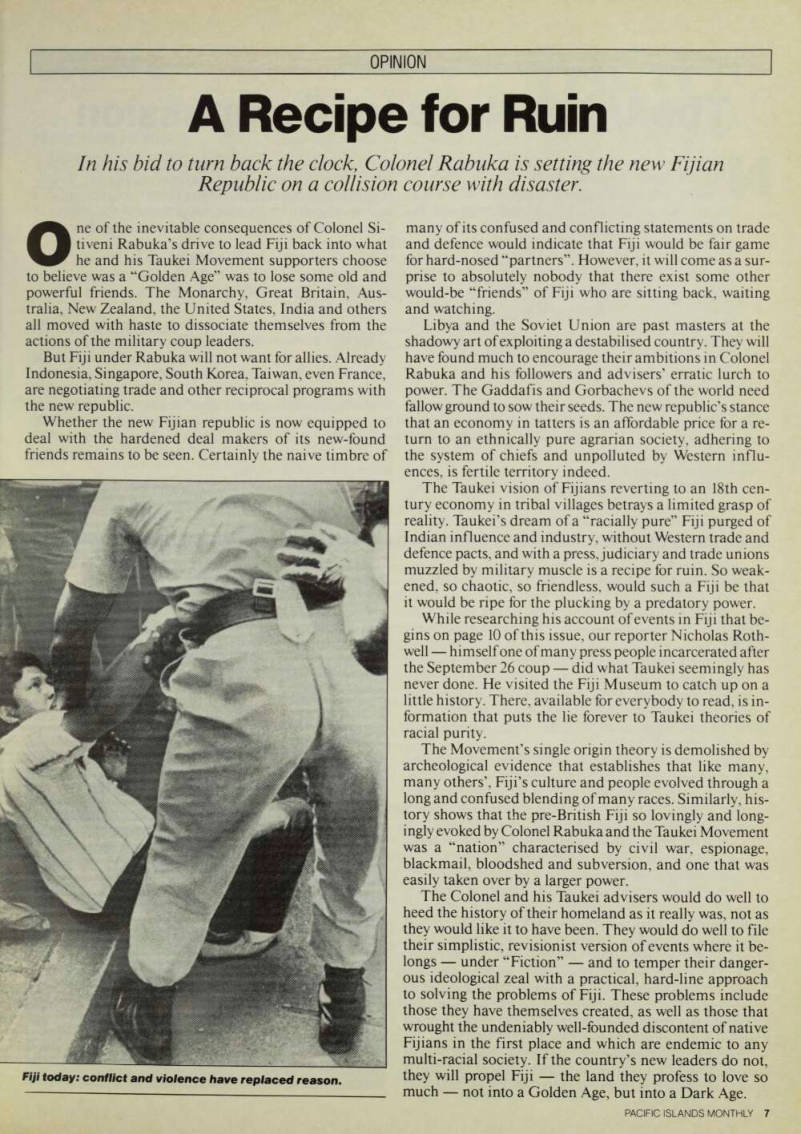
Fiji today: conflict and violence have replaced reason.
The US: A Need for Compassion
NEVER before has a strong, fair and compassionate United States presence in the Pacific been so needed. Today the region is struggling with a host of problems that reflect just how complicated and de manding the Pacific has become for all nations, including the US, that would claim a stake in its future.
Nuclear issues, political and racial differences in Fiji and New Caledonia, an increasing Soviet an Libyan pres ence, Japan’s growing financial role, fishing boundaries and treaties: all have to be faced squarely and resolved.
In the days when the Pacific was an “American lake”, the US had to do little more than send a little money here, a little muscle there, to keep its friends and preserve its interests. But such desultory involvement is no longer enough. The findings of recent studies and think tanks commissioned to gauge the Pacific’s attitudes to the United States and to advise policymakers in Washington make it clear that while the region is not generally hostile to the United States, there is widespread disappointment with many of its policies.
America has been accused by island nations at various times of being heavy-handed, out of touch with the real ities of the region and unduly driven by its own self-in
terest. Such criticism has stemmed from the United States’ implacable opposition to a nuclear-free Pacific, its dis inclination to distance itself from French colonial policies and bomb tests, its seeming acceptance of the actions of Colonel Rabuka and its fishing within island nations’ boundaries.
Such alienating policies often spur disaffected coun tries to turn to the Soviets, Libya and France; past masters at exploiting such disaffection. Vanuatu, Fiji and Nauru spring to mind.
The United States represents one of the best hopes for a peaceful, economically viable Pacific for the rest of this century and well into the next, but it must absorb some hard lessons. It needs to dispense its aid and influence and to formulate its Pacific policies with careful thought and compassion, and only after lengthy consideration of the needs of each country. As the think tanks so correctly recommend, the United States should recognise the Pa cific’s right to dignity and a degree of development that accords with its cultures.
If America heeds these lessons it will be doing much to contribute to a strong, secure Pacific. And that is in every one’s best interest.
PNG Chases the Tourists
W HILE IT is not exactly languishing, tourism in Papua New Guinea is in need of a significant boost. The PNG Department of Civil Aviation.
Tourism and Culture has identified many of the reasons for the country’s poor performance in its recent Five Year Tourism Development Plan; among them an inconsistent Government approach, inadequate promotion, high costs and a law and order situation “perceived as dangerous in the main international markets”.
Which is not to say that tour operators, hoteliers and resort managers are in difficulty: interest is still strong, but factors outside their control are limiting tourist inter est and access. The Government is moving already on several of the Plan’s recommendations, and a recent me dia tour to the Sepik and its fascinating diversity of land scapes, cultures and people is described on Page 50.
The challenges are twofold. As the Five Year Plan says, overseas “media editors should take a more responsible approach . . . and avoid sensational headlines.” It is cer tainly true that violence, rape and murder in PNG receive prominent coverage in Australia and New Zealand, es pecially when victims are European. But the inconsis tency of editorial attitudes, which fail to acknowledge that Sydney or Auckland are far more dangerous and violence prone than PNG, cannot begin to be combated until the Department’s promotion budget is closer to the recom mended K 25 million than its 1987 total of K 523,000.
The second challenge is to broaden the market base of tourism in PNG: to attract a greater number of visitors with more attractive exchange rates and prices, improved
access and better facilities. The current value of the kina is doing little to bring visitors: the Government’s aim of preserving PNG’s traditional culture is a laudable and mature one, but it must be balanced with the realisation that culture and tradition are dynamic.
Only by encouraging tourists can the income from tourism be used to protect the very things that attract vis itors and only visitors can convincingly give the lie to the sensational headlines. □
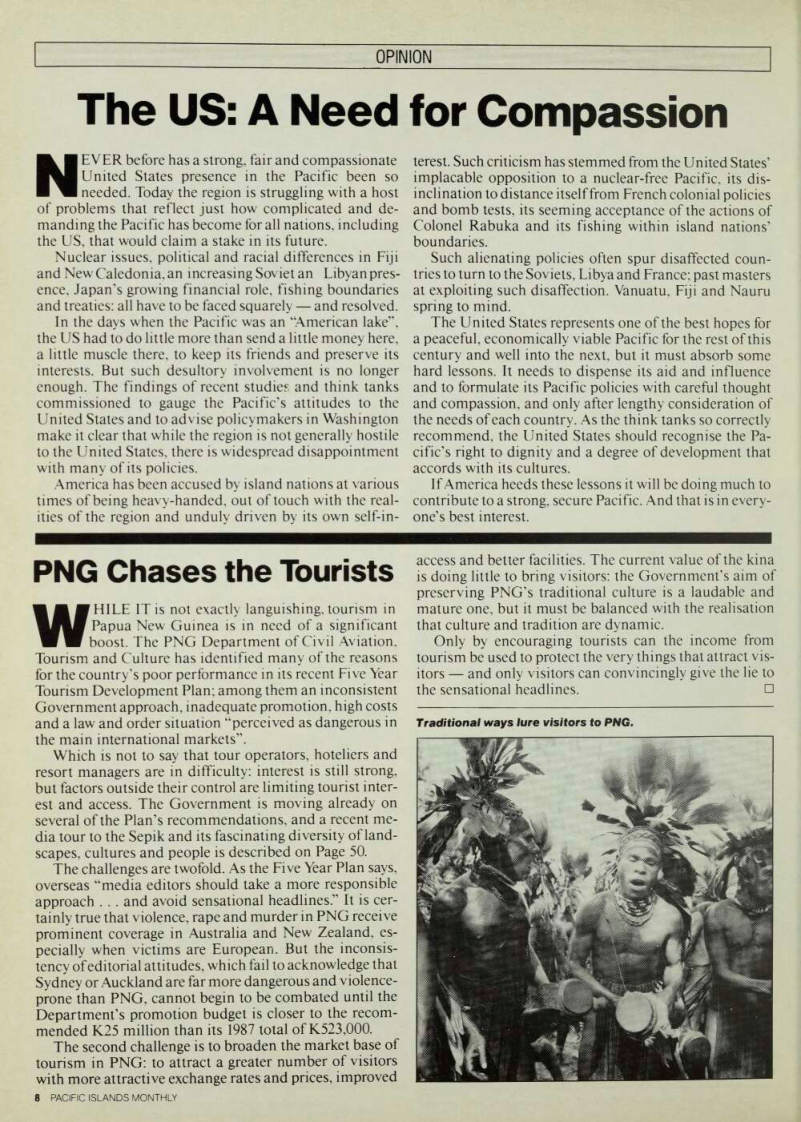
Traditional ways lure visitors to PNG.
Letters
Praise From Pm Wingti
Congratulations to News Limited on the new-look Pacific Islands Monthly. In deed, Pacific Islands Monthly is playing a vital role in the life of the island nations.
We enjoy your publication and look for ward to more of your interesting coverage of events in Papua New Guinea.
The Hon Paias Wingti Prime Minister Papua New Guinea
Fiji: The Real Tragedy
The tragedy of the two Fiji coups is that there is more at stake than just native land rights, as so many people sympathetic to Rabuka pretend. The democratically elected Government of early May was a coalition not only of Indians but also of progressive native Fijians. Bavadra him self, the Prime Minister, was obviously a Fijian. The land laws of Fiji could not have been changed without major native Fijian support.
To accuse the Indians of Fiji, who have lived there for generations and have con tributed so much to its economy, of want ing to take all power away from the native people is therefore, in my opinion, a dis tortion of reality.
I can understand, in light of what has happened to the native people of Hawaii, and what the French are perpetrating in New Caledonia, why native Fijians would feel militant about protecting their rights.
But are Rabuka and the chiefly hierarchy really doing that?
The real issue in Fiji is that the estab lished, conservative leadership of the Council of Chiefs and the old-line Alli ance big-wigs are trying to protect their own privileged status at the expense of popular reforms that could help all Fiji ans, native and Indian. The Army is pre tending to keep order but is really ending true democracy forever for the common people of Fiji in order to protect the inter ests of the old elite.
David A Chappell
Sea View Avenue Honolulu, Hawaii
Mead Accuracy Questioned
I have read Joseph Theroux’s review of Derek Freeman’s book in your magazine and read Freeman’s response. But for me, the real question is whether or not Mar garet Mead was a reliable reporter, ascer tained the facts, and then reported them correctly. Other evidence, unrelated to Sa moa, becomes relevant with reference to Mead’s accuracy in reporting. I suggest that persons interested in this question
read both the section on “gentle Arapesh” in Mead’s Sex and Temperament in Three Primitive Societies and Fortune’s paper, “Arapesh warfare”, American Anthropol ogist, 1939, 41, pp 21-41.
Fortune certainly did not regard the Arapesh as gentle.
I am sure that existing records to do with the Australian governance of New Guinea would provide useful information concerning the relative accuracy of Mead’s and Fortune’s depiction of the Arapesh.
Ronald C Johnson
Professor and Acting Chairman University of Hawaii at Manoa Honolulu
Nuclear Insanity
Re the article on US Secretary of State Mr George Shultz and his views on nu clear testing ( Pacific Islands Monthly, Au gust). Surely a man in his position must know that no nuclear testing is “safe” where does all the waste go?
World peace cannot be achieved by a nuclear arms build-up. The French should also have enough sense to know that nu clear testing is insane. I am certainly not anti-American or, for that matter, against any nationality, but this useless testing must cease if we are ever to protect our environment.
If nuclear weapons are safe, test them under the Eiffel Tower or in Lake Tahoe.
Spare innocent South Pacific islanders the tremendous harm caused by this testing.
But maybe I should be careful or I'll find a limpet mine attached to my dugout canoe someday.
Richard Thomas Joyce
Peace Corps Volunteer Solomon Islands
Your New-Look Magazine
Congratulations on Pacific Islands Monthly. The Pacific region is experienc ing the most dynamic changes in its his tory coups in once-stable Fiji, history making elections and referendums, all against a backdrop of unprecedented power playing by major nations with vested interests. Thanks to Pacific Is lands Monthly , we now have a top quality publication that reports and analyses with style and accuracy. Your new-style maga zine is long overdue and going by the Oc tober issue you have become the indispensible source of Pacific news and views. I hope you will maintain your high standards.
Charles Winton
Remuera Rd, Auckland New Zealand
Advertisements & other items, p. 9 (1 item)
Pacific
ISLANDS
I M O N T H L Y FIJI: Distribution and subscriptions; Desai Bookshops, PO Box 160, Suva, Fiji. Phone Suva 23036.
Advertising: Fiji Times & Herald Ltd, 20 Gordon St., Suva.
Phone 31-4111, telex FJ2124, FRENCH POLYNESIA: Distribution: Hachette Pacifique 10 Ave , Bruat, Papeete Phone 25-610.
HAWAII: UNITED STATES: Distribution: PIM, Hawaii, PO Box 22250, Honolulu, Hawaii, 96822 Advertising: Brian C Asgill, Apt. 1308,1676 Ala Moana Blvd., Honolulu, Hawaii, 96815. Phone (808) 955-9718.
JAPAN: Advertising and subscriptions: Universal Media Corporation, GPO Box 46, Tokyo. Phone 666-3036, cable UNIMEDIA Tokyo, telex 2524665 MALAYSIA: Advertising and subscriptions: Worldwide Media Services, 57-B Komplex Damai, Jin Dato Haji Eusoff, Kuala Lumpur. Phone 63-9340, cables WORLDMEDIA Kuala Lumpur, telex 31533.
VANUATU: Distribution; The Vanuatu Stationery and Book Centre, PO Box 557 Port Vila Advertising: Norman Bros Bookshop Port Vila Phone 2232.
NEW CALEDONIA: Distribution: Depot Centre de Presse Michel Pentecost. CBP2, Noumea Phone 27- 2434, 27-4729 NEW ZEALAND: Distribution: Gordon & Gotch, PO Box 584, 2 Carr Road, Mt Roskill, Auckland 4, Advertising: McKay International Media Reps Ltd, C/- Albany PO, Auckland 10, New Zealand. Phone 413-9119.
Telex NZ22701, FAX 413-9110 WELLINGTON: Ross Quaid Media, 1 Scholes Ln , Petone (04) 68-7593, PO Box 38699, Petone.
PAPUA NEW GUINEA: Distribution: Gordon & Gotch, PO Box 3395, Port Moresby Phone 25-4551, 25-4855 Advertising: Ken Head, PNG Post-Courier, PO Box 85, Port Moresby. Phone 21-2577, telex 22120 SOLOMON ISLANDS: Distribution and Advertising: The Bookshop, (Norman Bros ) PO Box 503, Honiara.
PHILIPPINES: Advertising; The GF Group, 12 San Ignacio St., Uroaneta Village, Makati, Metro Manila. Phone 817-7299, telex 45950 and 4233 UNITED KINGDOM: The Herald & Weekly Times Ltd, No 1 Maltravers St., London WC2R3DZ. England. Phone (01) 836-5162, telex London 21989.
UNITED STATES MAINLAND: Advertising: Joshua B. Powers Jr., Powers International Inc., Suite 708 , 271 Madison Ave., New York, NY 10016. Phone 867-9580, Subscriptions: PIM, Hawaii, PO Box 22250, Honolulu.
Hawaii, 96822.
SUBSCRIPTIONS
American Samoa US$45 Australia AUS$24 Canada US$45 Cook Islands AUS$46 Fiji AUS$46 French Polynesia US$45 Guam US$45 Hawaii US$45 Japan US$38 Kiribati AUS$46 Micronesia US$35 Nauru AUS$42 New Caledonia US$32 New Zealand AUS$42 Niue AUS$46 Norfolk Island AUS$42 Northern Marianas US$36 Papua New Guinea AUS$42 Solomon Islands AUS$46 Tonga AUS$46 Tuvalu AUS$46 United Kingdom Stg£28 US (Mainland) US$45 Vanuatu AUS$42 Western Samoa AUS$60 Elsewhere AUS$63 Payments to Pacific Islands Monthly: Subscriptions Dept, GPO Box 5223BB, Melbourne 3001, Australia.
Subscriptions rates includes the cost of airspeeding to all destinations set out above. Direct airmail rates on application.
Rabuka’s Republic
Fiji
The Colonel and his untried Council face a future beset with questions and problems. History will judge their success.
Colonel Sitiveni Rabuka’S
newly-declared Fijian Republic inherits a wealth of problems, a dearth of leaders and an economic out look redolent of the Third World.
When the Colonel proclaimed his na tion a republic, making his announce ment with theatrical timing at midnight on October 6, he was already aware interna tional opinion had condemned his second military take-over and the economic con sequences would be staggering; but even the possibility of sanctions did not per turb him. Of course, if imposed, they would hurt, he conceded, but Fiji would “survive”.
The Colonel’s second intervention has a steely resolve absent from the May take over. The September 26 coup was swiftly followed by the revocation of the 1970 Constitution, Rabuka’s proclamation that he was now “head of state”, the further de valuation of the Fijian dollar, declaration of a republic and announcement of a new Council of Ministers. All was done at breakneck speed, with little compromis ing or consultation.
The Commonwealth Heads of Government, meeting in Vancouver in mid-October, decided after hurried con sultations to expel Fiji from their ranks; Queen Elizabeth announced the Gover nor General, Ratu Sir Penaia Ganilau, was stepping aside. The declaration of the Fi jian Republic was accepted as a fait ac compli despite murmurs of regret from Buckingham Palace. Commonwealth leaders had clearly decided to minimise the confrontation with the new regime in Suva British diplomats are believed to have sent a message to the Colonel, sug gesting that as far as possible Fiji would not be adversely affected by the expulsion, widely seen as a temporary measure.
Australian Prime Minister Bob Hawke was in the vanguard of those advocating an expulsion for a suitable period; but Fi jian officials, relieved by the course fol lowed at the Vancouver conference, were confident their international relations would not be wrecked by the move. “We will apply to be readmitted as soon as we receive official notification of our re moval,” one senior regime figure said after the CHOGM conference.
Colonel Rabuka always knew there would initially be determined resistance to his scheme; he detained key political
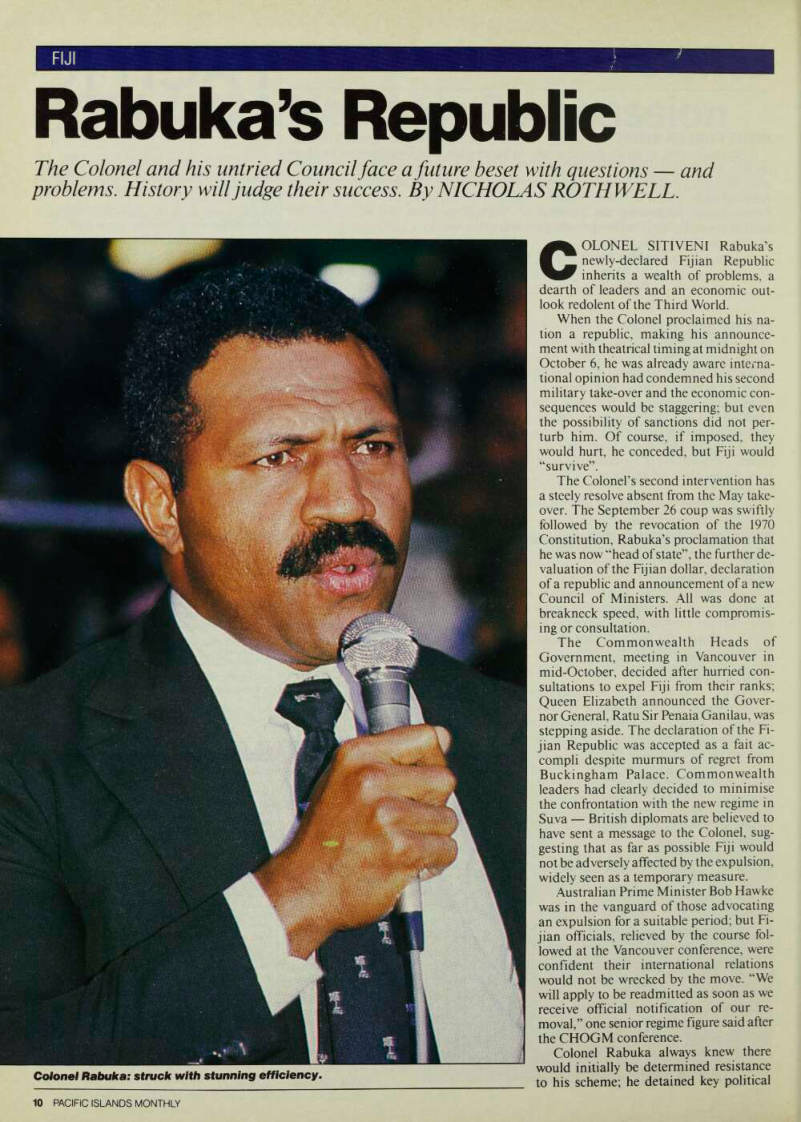
Colonel Rabuka: struck with stunning efficiency.
opponents and intimidated mainstream leaders of the establishment Alliance Party, which largely represented Fijians, while his soldiers consolidated their re newed grip on power during the first days of “Coup II”. He isolated the Governor General, Ratu Sir Penaia Ganilau in Government House, closed down or con trolled the local media and placed limits on the freedom of the overseas press corps.
Repression of trade unions came swiftly in the wake of the declaration of the re public; political activities by the Coalition parties of the Prime Minister deposed in the May coup, Dr Timoci Bavadra, have been limited. Functions of the senior members of the judiciary, loyal to the Governor General, were simply sus pended, and the public service purged.
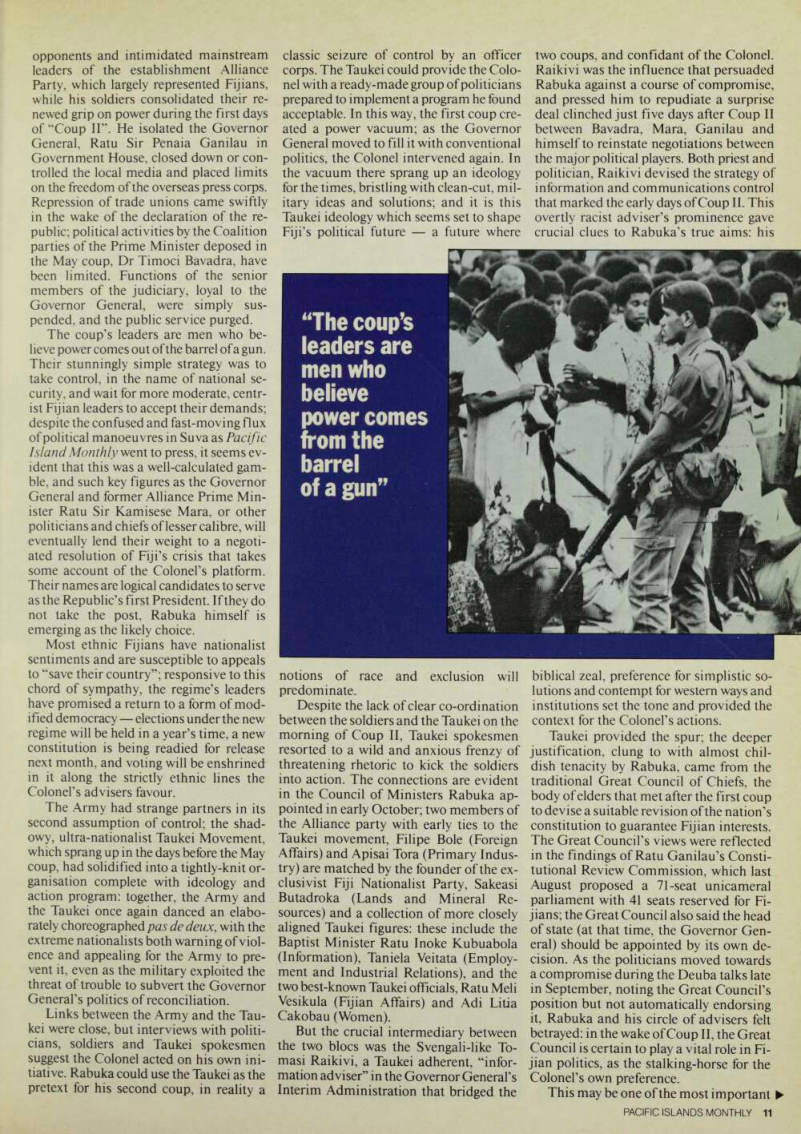
The coup’s leaders are men who be lieve power comes out of the barrel of a gun.
Their stunningly simple strategy was to take control, in the name of national se curity, and wait for more moderate, centr ist Fijian leaders to accept their demands; despite the confused and fast-moving flux of political manoeuvres in Suva as Pacific Island Monthly went to press, it seems ev ident that this was a well-calculated gam ble, and such key figures as the Governor General and former Alliance Prime Min ister Ratu Sir Kamisese Mara, or other politicians and chiefs of lesser calibre, will eventually lend their weight to a negoti ated resolution of Fiji’s crisis that takes some account of the Colonel’s platform.
Their names are logical candidates to serve as the Republic’s first President. If they do not take the post, Rabuka himself is emerging as the likely choice.
Most ethnic Fijians have nationalist sentiments and are susceptible to appeals to “save their country”; responsive to this chord of sympathy, the regime’s leaders have promised a return to a form of mod ified democracy elections under the new regime will be held in a year’s time, a new constitution is being readied for release next month, and voting will be enshrined in it along the strictly ethnic lines the Colonel’s advisers favour.
The Army had strange partners in its second assumption of control; the shad owy, ultra-nationalist Taukei Movement, which sprang up in the days before the May coup, had solidified into a tightly-knit or ganisation complete with ideology and action program: together, the Army and the Taukei once again danced an elabo rately choreographed pas de deux , with the extreme nationalists both warning of viol ence and appealing for the Army to pre vent it, even as the military exploited the threat of trouble to subvert the Governor General’s politics of reconciliation.
Links between the Army and the Tau kei were close, but interviews with politi cians, soldiers and Taukei spokesmen suggest the Colonel acted on his own ini tiative. Rabuka could use the Taukei as the pretext for his second coup, in reality a
classic seizure of control by an officer corps. The Taukei could provide the Colo nel with a ready-made group of politicians prepared to implement a program he found acceptable. In this way, the first coup cre ated a power vacuum; as the Governor General moved to fill it with conventional politics, the Colonel intervened again. In the vacuum there sprang up an ideology for the times, bristling with clean-cut, mil itary ideas and solutions; and it is this Taukei ideology which seems set to shape Fiji’s political future a future where
notions of race and exclusion will predominate.
Despite the lack of clear co-ordination between the soldiers and the Taukei on the morning of Coup 11, Taukei spokesmen resorted to a wild and anxious frenzy of threatening rhetoric to kick the soldiers into action. The connections are evident in the Council of Ministers Rabuka ap pointed in early October; two members of the Alliance party with early ties to the Taukei movement, Filipe Bole (Foreign Affairs) and Apisai Tora (Primary Indus try) are matched by the founder of the ex clusivist Fiji Nationalist Party, Sakeasi Butadroka (Lands and Mineral Re sources) and a collection of more closely aligned Taukei figures: these include the Baptist Minister Ratu Inoke Kubuabola (Information), Taniela Veitata (Employ ment and Industrial Relations), and the two best-known Taukei officials, Ratu Meli Vesikula (Fijian Affairs) and Adi Litia Cakobau (Women).
But the crucial intermediary between the two blocs was the Svengali-like To masi Raikivi, a Taukei adherent, “infor mation adviser” in the Governor General’s Interim Administration that bridged the
two coups, and confidant of the Colonel.
Raikivi was the influence that persuaded Rabuka against a course of compromise, and pressed him to repudiate a surprise deal clinched just five days after Coup II between Bavadra, Mara, Ganilau and himself to reinstate negotiations between the major political players. Both priest and politician, Raikivi devised the strategy of information and communications control that marked the early days of Coup 11. This overtly racist adviser’s prominence gave crucial clues to Rabuka’s true aims: his
biblical zeal, preference for simplistic so lutions and contempt for western ways and institutions set the tone and provided the context for the Colonel’s actions.
Taukei provided the spur; the deeper justification, clung to with almost chil dish tenacity by Rabuka, came from the traditional Great Council of Chiefs, the body of elders that met after the first coup to devise a suitable revision of the nation’s constitution to guarantee Fijian interests.
The Great Council’s views were reflected in the findings of Ratu Ganilau’s Consti tutional Review Commission, which last August proposed a 71-seat unicameral parliament with 41 seats reserved for Fi jians; the Great Council also said the head of state (at that time, the Governor Gen eral) should be appointed by its own de cision. As the politicians moved towards a compromise during the Deuba talks late in September, noting the Great Council’s position but not automatically endorsing it, Rabuka and his circle of advisers felt betrayed: in the wake of Coup 11, the Great Council is certain to play a vital role in Fi jian politics, as the stalking-horse for the Colonel’s own preference.
This may be one of the most important I
“The coup’s leaders are men who believe power comes from the barrel of a gun”
of the Colonel’s actions. Until May this year, Fiji was progressing fast into the world of modern politics. The authority of the chiefly system was being eroded, and Dr Bavadra himself represented the triumph of pluri-ethnic, non-traditional politics. His besting of the high chief of Lau, Ratu Mara, was a symbol of this change a shocking symbol to the Great Council, whose members, offered a chance by Rabuka’s first coup to reassert their au thority, naturally turned away from the path of one-man, one-vote democracy and sought to enshrine their own institution as the paramount body, looming above the parliamentary system.
After Coup 11, the Great Council’s scheme remains intact. The Colonel is at tempting to turn back the clock to re join the traditional, and political, systems of authority that were beginning to be prised apart in Fiji. In this sense, his action was aimed not against Ratu Ganilau and Ratu Mara as high chiefs, but against the two men as collaborators.in the secular be trayal and marginalisation of the Fijian Taukei in his own land.
This idealistic, atavistic motive lurks inside the minds of the coup-makers, to gether with a determined spirit honed sharp by methodist sentiments of self-sac rifice. A return to the traditional system is held so dear its economic cost is seen as of little consequence.
As the dollar was devalued on October 7, for the second time in three months, Ra buka described the 15.25 per cent lowering of the currency’s value as nothing more than a “short-term repercussion” of the take-over.
“The establishment of the republic and firm government will invite grounds for a return of investor confidence,” the Colo nel suggested, even as his nation’s foreign reserves hovered near the SFIOOm mark.
Indeed, the Colonel, on the same day he revoked the 1970 Constitution, made a chilling radio broadcast to the nation, warning his chosen path would be one of hardship, calling for “self-sufficiency” and hinting at a fantastical vision of the coun try’s future, based on the village traditions and rural development notions so beloved by Taukei ideologues.
Just after the second devaluation, Fiji’s leading technocrat, Reserve Bank Gover nor Savenaca Siwatibau, warned that the nation’s finances had to be saved at all costs, stressing the extent of the austerity measures being imposed: “And if some businesses are not efficient enough to sur vive, too bad they can’t be looked after at the expense of the country.”
An initial, late June devaluation of 17.75 per cent had managed to stem some of the outflow of capital after the first coup, and the all-important tourism industry was staging a patchy recovery but Fiji’s in flation, rising even before Coup 11, is now set to increase even further.
No less an authority than Ratu Mara,
in remarks reported by his son, Ratu Fi nau, contended in the wake of the second military intervention that the nation was headed for a devastated economic future, and would be bankrupt and short of food by the end of this year.
As in most Pacific states, the economic and political are interwined, and Fiji’s diplomatic isolation and parish status will almost certainly have profound effects on such vital areas as sugar sales to Com monwealth member nations. Australian companies have shelved projects worth $A2OOm as a result of Coup 11, tourist rev enues are denied Fiji as a result of can celled airline schedules, while the
inevitable problem of flight of skilled In dian professional labour looms.
Even worse, Fiji’s Indians wield an economic weapon they came close to de ploying in July and August a boycott of the all-important cane harvest. Although both Indian and Fijian community lead ers, for their different reasons, played down the short-lived harvest boycott, there was no doubt Fiji’s economy was hostage to the well-organised cane-field workers. Ex perts say the Army and Fijian population would be unable to bring in the crop, while the actual cane-crush is highly vulnerable to acts of sabotage of the kind threatened in the months after the first coup.
Commonwealth Heads
CHOGM: Fiji Out in the Cold
of Government formally de clared that Fiji is no longer a member of the Commonwealth at the CHOGM leaders' retreat. Lake Okan agan, Canada, on October 18.
Despite a plea from Colonel Ra buka, membership has lapsed with the emergence of the new republic; but the door to readmittance has been left open with an announcement that “a resolu tion of the problem by the people of Fiji” if necessary, with Common wealth assistance could see a recon sideration of Fiji’s membership at the next CHOGM conference in 1990.
The formal statement, delivered by Canadian Prime Minister Brian Mul roney, indicated that Fiji might reapply for membership once acceptable con stitutional arrangements had been made and expressed Commonwealth leaders’ “sadness” at the proclamation of the new republic and the resignation on October 16 of Fijian Governor Gen eral Ratu Sir Penaia Ganilau.
Official Fijian response reflects some division about the republic’s at titude to Commonwealth member ship. Mr Jona Senilagakali, permanent secretary of the Foreign Affairs Min istry, said on Saturday, October 17 that Fiji would reapply for membership within six months, while his Minister, Mr Filipe Bole, told AAP next day that Fiji would not make any hasty deci sions. The republic would “develop a strategy bearing in mind that the new Constitution would guarantee ethnic Fijian supremacy in Parliament,” he said, adding that Commonwealth membership had lapsed. “We were not expelled,” he stressed.
The CHOGM conference was the scene of heated discussion over Fiji’s membership status, with British PM Margaret Thatcher standing virtually alone against a coalition that included
Australian PM Bob Hawke, India’s Rajiv Gandhi, New Zealand PM David Lange, Dr Kenneth Kaunda ofZambia and Mr Robert Mugabe of Zimbabwe.
With the support of fellow Com monwealth leaders and the Queen, Mr Hawke managed to outmanoeuvre Mrs Thatcher, who sought to keep Fiji within the Commonwealth, declaring her position “an untenable charade”.
Mrs Thatcher’s refusal to consider any more than token sanctions against South Africa so angered other leaders that all 47 of them supported Mr Hawke’s attack on what he claimed was a campaign of disinformation by Mrs Thatcher.
Although Commonwealth leaders were united in their opposition to Mrs Thatcher, Indian Prime Minister Ra jiv Gandhi took a harder line against Fiji than Mr Hawke, comparing the military-backed republic’s constitu tional changes with the situation in South Africa. The Fijian minority, he said, had “taken over the political and human rights” of the Indian majority.
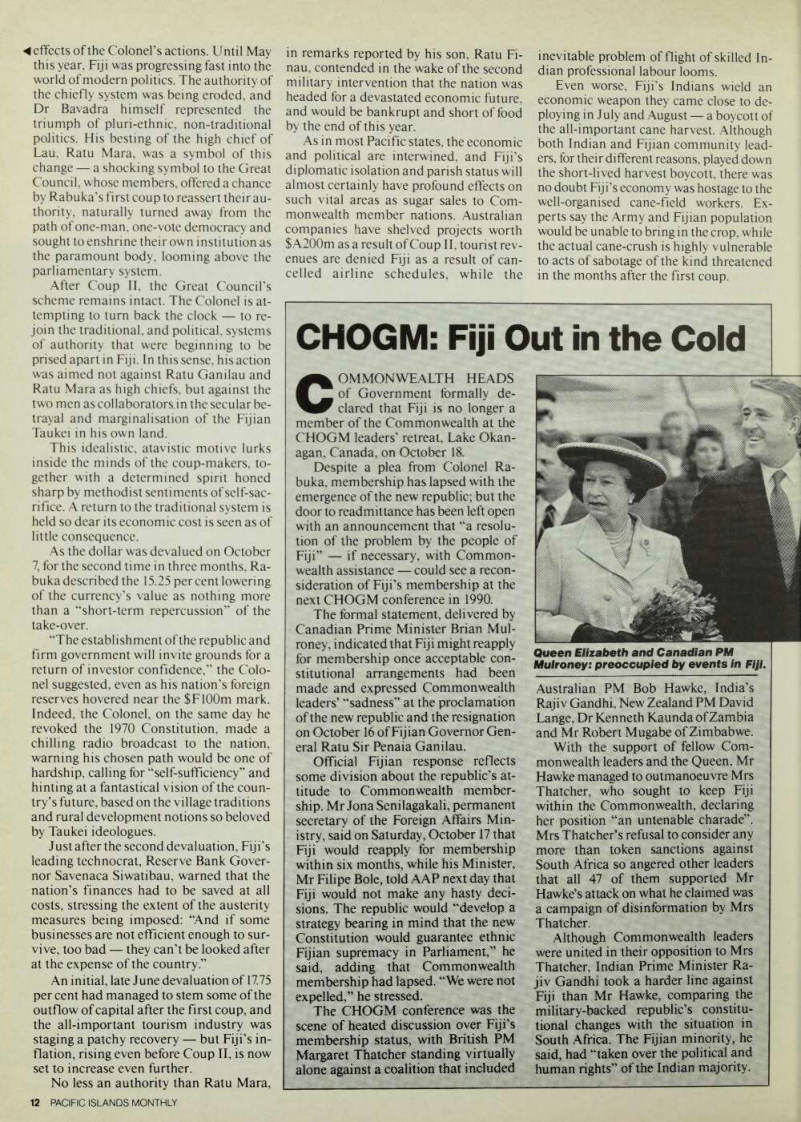
Queen Elizabeth and Canadian PM Mulroney: preoccupied by events in Fiji.
“Rabuka may find he is obliged to keep Fiji a police state,
complete with curfews and news blackouts”
The unspoken fear of all observers is that the rapidly-expanded Fijian army’s raw recruits, well-armed and under pres sure, may not be able to cope with the in evitable tensions the second coup will force to the surface. The cycle of reactions to such a take-over is well-known, and some reported its emergence after the May coup.
Shock, dismay, fear and anger give way to resolve and resistance. As the moderate Indian leaders have been intimidated or frozen out of the political process, the way is left clear for extremists to emerge. The prospect of compromise and the near-rev erential authority in which the Indian community holds Dr Bavadra, a constant voice of calm, have until now kept a lid on terrorism; but Rabuka may well find he is obliged to keep Fiji a police state, com plete with road-blocks, curfews and news black-outs, if only to prevent the country descending into of ethnic violence.
Yet all these effects and potential de velopments, difficult to quantify, are less significant over the short-term than the definite change in Fiji’s state wrought at a stroke by the two coups.
Once the showpiece of the Pacific, held up as a model multi-racial democracy and political and diplomatic leader of the newly independent island nations, Fiji is now, even if unfairly, perceived as the Ocean’s trouble-spot, symbol of failed institu tions, broken trust and hostility between rival peoples and cultures the post-co lonial experiment that went bad, the ex ample every contending Pacific party
draws on to show what must not be repeated.
This has led to a sharp change in the attitudes Pa cific region states take to wards Fiji. The reasoning follows simple lines: one coup may be carelessness; a second is harder to for give. Not only did the top pling of Bavadra pose an exquisite dilemma for the more radical, newly-inde pendent Melanesian states, confronted with the spectacle of a “progres sive” government ousted
by their own brother Melanesian nation alists; the continued disturbance of the democratic processes most island nations respect has opened a new range of possi bilities for the entire region.
Suddenly, the Pacific seems a cockpit of social and political tensions, with Fiji itself, crossroads of Melanesian and Po lynesian influence, meeting-point of post colonial design and native intent, perhaps only the first country to redefine its own internal system.
The “great powers” of the Pacific, Fiji’s traditional allies Great Britain, the USA, Australia and New Zealand, have all con demned the coup, as have the Melanesian Spearhead member nations Vanuatu, Papua New Guinea and the Solomon Is lands although Vanuatu’s Prime Min ister Walter Lini and Papua New Guinea’s
Paias Wingti have both stressed the view that Fi jians should be allowed to resolve their own prob lems. But Polynesian Tonga, intriguingly the major cultural influence on Fiji in the years preced ing British colonisation, also has much in common with post-coup Fiji; it is a monarchy that leaves little room for other races and enshrines methodism as a state religion.
For all the Colonel’s confidence that he was
fulfilling his obligations to Fiji’s people by intervening once again, he may have dealt not only his country, but also the entire re gion’s political culture, a savage blow.
Under the surface of well-policed calm, Fiji is now impossibly divided, its key leaders still possessing different visions.
The communities are split down stark eth nic lines: the largely Indian population west of the main island could well aim at secession, while even the traditional chiefs, clear beneficiaries of the second coup, are far from unified.
As Colonel Rabuka seeks to gather up the shattered fragments of the nation he hoped to unify in the proud spirit of its tra ditions, he could well cast his mind back to the reality behind the prelapsarian Fiji he imagines existed before the British came.
As the Fiji Museum catalogue sug gests, the Taukei dogmas of Fijian racial purity are unfounded: “The archaeolog ical record establishes that the Fijian people and culture varied widely with time, evolving through thousands of years of dynamic and confused blending of an cestral Polynesian, Melanesian and west Polynesian peoples.”
As for the idyll of Fijian social life un der the chiefly system, that dream of per fection Rabuka held up as his model, when he addressed the nation on September 25, speaking softly of “the hopes and expec tations of the Taukei”, the historical re cord paints a rather different picture of a nation warring and divided: “by the early 1800 s chaos reigned, the country being plagued by both local feuding and increas ingly bloody civil wars the heritage of a convoluted web of social relationships from a less-organised era meant this more extensive campaigning could only be sus tained against a background of espionage, intrigue, blackmail, and subversion.”
Fijians, and the people of the whole Pa cific region, must hope history is not poised to repeat itself. □
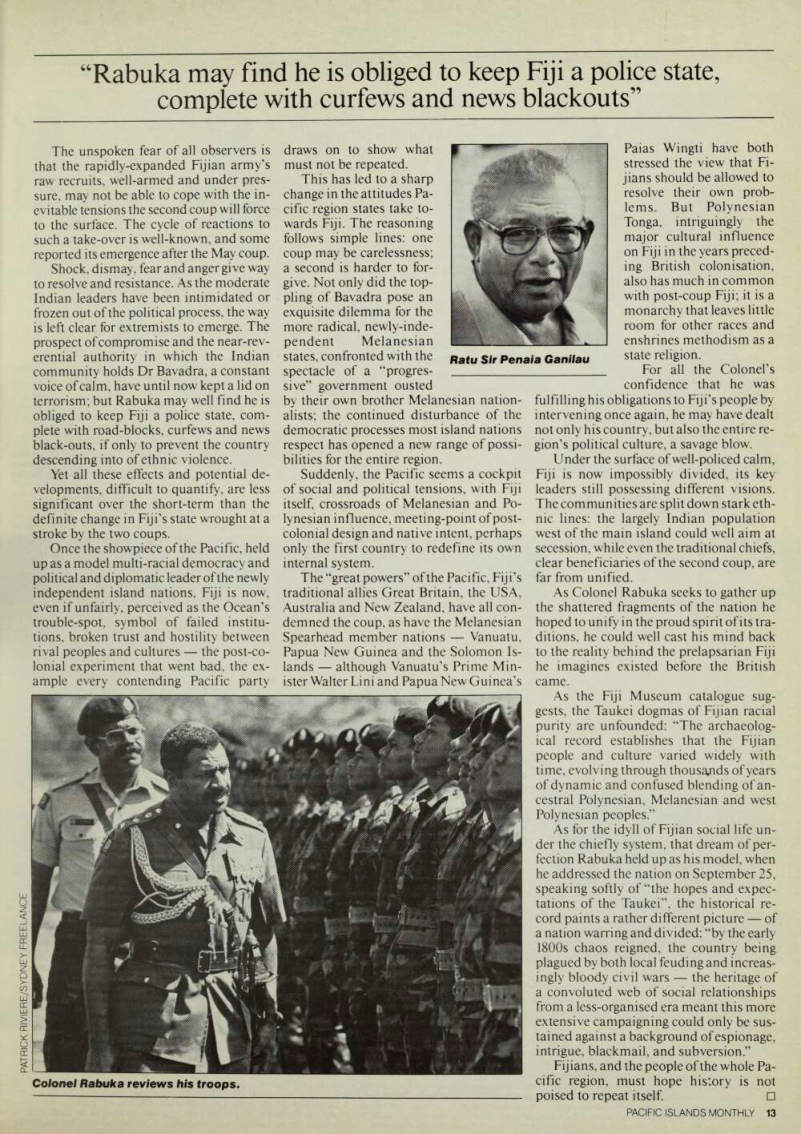
Colonel Rabuka reviews his troops.
Ratu Sir Penaia Ganilau
Advertisements & other items, p. 14 (1 item)
Revolutionary
at every
The new Prelude is a sports coupe which will revolutionise conventional ideas of the relationship between a car and its driver.
It is a car with sporty, responsive handling to appeal to the keen driver: but through continual refinement by an enthusiastic team of engineers, the new Prelude 2.0i-16 adds a new dimension to the pleasure of motoring with almost extra-sensory handling performance. The secret is in Honda's revolutionary 4-wheel steering system. And it has no precedent in the modern motor car.
New Dimensions in Motoring.
Every revolution begins with a daring new initiative. The new Prelude features a bonnet line that is closer to the road than ever, conveying a real sports car feel. Inside, the wide glass area and wraparound console •ncrease visibility and enhance a spacious, airy environment which centres on the needs of the driver. Each and every facet of performance elevates the relationship between man and machine to a higher level: the innovative 4-wheel double wishbone suspension, 4-wheel anti-lock braking, the race-bred 2.0 litre 16- and 12-valve engines... all work in perfect harmony to satisfy the Same direction* Opposite direction* driver's wants and desires. Add to this the 4WS system on the 2.0M6, and you have a package which offers supreme handling with looks to match. The new Prelude is a revolutionary move in the right direction.
Breathtaking styling and exhilarating responsiveness geared to the true driving enthusiast's innermost desires. It's the Honda way. *The wheel angles are exaggerated for illustrative purposes.
Honda's 4WS is fitted to the 2.0i-16 as a standard feature.
iHONDA
PRELUDE
2QMB
Specifications and equipment may vary in some countries. 4111 ■ In 1986, Williams/Honda won the Formula 1 Constructors' Championship.
In 1987, Honda's Formula 1 engines power both Williams and Lotus.
Thus, we continue to polish our expertise at the pinnacle of automotive technology.
Mobil 6 AUSTRALIA: Honda Australia Pty., Ltd. Lot 95SharpsRoad, Tullamarine, Victoria 3043; Bennett Honda Pty., Ltd. 250 Victoria Road, Wetherill Park, N.S.W. 2164/NEWZEALANt NZMC Limited Manners Plaza, 57-65 Manners St., Wellington/PAPUA NEW GUINEA. Toba Pty., Ltd. P.O. Box 503, Port Moresby/TAHITI Honda Distribution S.A. R.L B.R 1665, Papeete/KIRIBAT- Atoll Motor & Marino Services P.O. Box 49, Bairiki Tarawa. Republic of Kiribati/U.S. TRUST TERRITORY; United Micronesia Development Association P.O. Box 235, CHRB Saipan CM 96950/COOK ISLAND;- Cook Islands Motor Centre Ltd. P.O.
Box 74, Rarotonga/GUAM: Mark’s Motor Co., Inc. P.O. Box DV, Agana/WESTERN SAMOA: Motor Distributors (Samoa) Ltd. P.O. Box 576, Apia/SOLOMON ISLANDS Lee Kwok Kuen & Co., Ltd. P.O Box 537, Honiara/NEW CALEDONIA Soci6t6 Du Chalandage 8, Rue de la somme-B.P. 97, Noumea/NAURU; Nauru Cooperation Republic of Nauru/FIJI Coral Island Motors Ltd. Robertson Road, Suva, Fiji/AMERICAN SAMOA Holiday Motors, Parts and Service P.O. Box 968, Pago Pago, American Samoa 96799: Heleck’s Service Center Ltd. P.O. Box 1138 Pago Pago, American Samoa 96799/TONG Tonoa Industrial Traders P.O. Box 1035. Nukualofa. Tonaa/ RFOLK ISLAN Duncombe Bay Garage New Cascade Road, Norfolk Island/VANUATU Honda Farm Ltd. P.O. Box 1031, Pori Vila, Vanuatu
Council of Ministers: Who’s Who
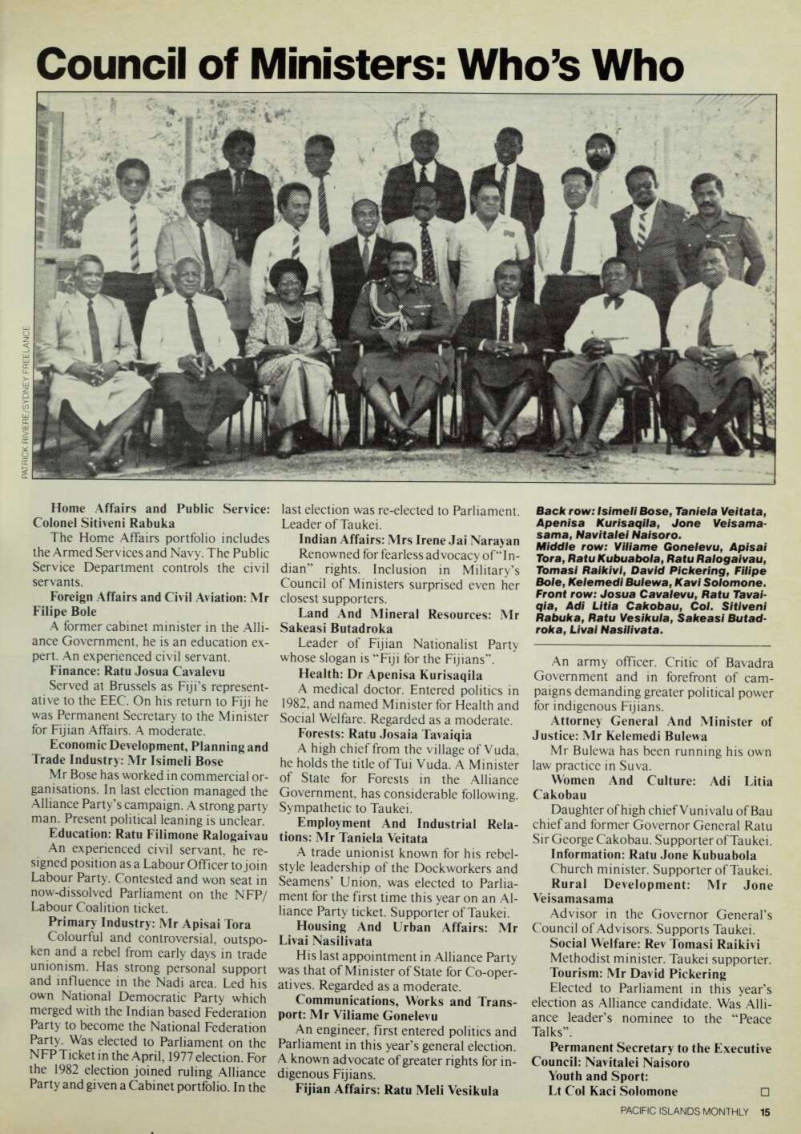
Home Affairs and Public Service: Colonel Sitiveni Rabuka The Home Affairs portfolio includes the Armed Services and Navy. The Public Service Department controls the civil servants.
Foreign Affairs and Civil Aviation: Mr Filipe Bole A former cabinet minister in the Alli ance Government, he is an education ex pert. An experienced civil servant.
Finance: Ratu Josua Cavalevu Served at Brussels as Fiji’s represent ative to the EEC. On his return to Fiji he was Permanent Secretary to the Minister for Fijian Affairs. A moderate.
Economic Development, Planning and Trade Industry: Mr Isimeli Bose Mr Bose has worked in commercial or ganisations. In last election managed the Alliance Party’s campaign. A strong party man. Present political leaning is unclear.
Education: Ratu Filimone Ralogaivau An experienced civil servant, he re signed position as a Labour Officer to join Labour Party. Contested and won seat in now-dissolved Parliament on the NFP/ Labour Coalition ticket.
Primary Industry: Mr Apisai Tora Colourful and controversial, outspo ken and a rebel from early days in trade unionism. Has strong personal support and influence in the Nadi area. Led his own National Democratic Party which merged with the Indian based Federation Party to become the National Federation Party. Was elected to Parliament on the NFP Ticket in the April, 1977 election. For the 1982 election joined ruling Alliance Party and given a Cabinet portfolio. In the
last election was re-elected to Parliament.
Leader of Taukei.
Indian Affairs: Mrs Irene Jai Narayan Renowned for fearless advocacy of “In dian” rights. Inclusion in Military’s Council of Ministers surprised even her closest supporters.
Land And Mineral Resources: Mr Sakeasi Butadroka Leader of Fijian Nationalist Party whose slogan is “Fiji for the Fijians”.
Health; Dr Apenisa Kurisaqila A medical doctor. Entered politics in 1982, and named Minister for Health and Social Welfare. Regarded as a moderate.
Forests: Ratu Josaia Tavaiqia A high chief from the village of Vuda, he holds the title of Tui Vuda. A Minister of State for Forests in the Alliance Government, has considerable following.
Sympathetic to Taukei.
Employment And Industrial Rela tions: Mr Taniela Veitata A trade unionist known for his rebel style leadership of the Dockworkers and Seamens’ Union, was elected to Parlia ment for the first time this year on an Al liance Party ticket. Supporter of Taukei.
Housing And Urban Affairs: Mr Livai Nasilivata His last appointment in Alliance Party was that of Minister of State for Co-oper atives. Regarded as a moderate.
Communications, Works and Trans port: Mr Viliame Gonelevu An engineer, first entered politics and Parliament in this year’s general election.
A known advocate of greater rights for in digenous Fijians.
Fijian Affairs: Ratu Meli Vesikula
An army officer. Critic of Bavadra Government and in forefront of cam paigns demanding greater political power for indigenous Fijians.
Attorney General And Minister of Justice: Mr Kelemedi Bulewa Mr Bulewa has been running his own law practice in Suva.
Women And Culture: Adi Litia Cakobau Daughter of high chief Vunivalu of Bau chief and former Governor General Ratu Sir George Cakobau. Supporter of Taukei.
Information: Ratu Jone Kubuabola Church minister. Supporter of Taukei.
Rural Development: Mr Jone Veisamasama Advisor in the Governor General’s Council of Advisors. Supports Taukei.
Social Welfare: Rev Tomasi Raikivi Methodist minister. Taukei supporter.
Tourism: Mr David Pickering Elected to Parliament in this year’s election as Alliance candidate. Was Alli ance leader’s nominee to the “Peace Talks”.
Permanent Secretary to the Executive Council: Navitalei Naisoro Youth and Sport: Lt Col Kaci Solomone □
Back row: Isimeli Bose, Taniela Veitata, Apenisa Kurisaqila, Jone Veisama sama, Navitalei Naisoro.
Middle row: Viliame Gonelevu, Apisai Tora, Ratu Kubuabola, Ratu Ralogaivau, Tomasi Raikivi, David Pickering, Filipe Bole, Kelemedi Bulewa, Kavi Solomone.
Front row: Josua Cavalevu, Ratu Tavai qia, Adi Litia Cakobau, Col. Sitiveni Rabuka, Ratu Vesikula, Sakeasi Butad roka, Livai Nasilivata.
Embattled Lini Set to Win
Vanuatu
Embattled Lini Set to Win Election preview by NICHOLAS ROTHWELL in Port Vila.
VANUATU’S ruling Vanua’aku Pati Government is poised to secure a further term of office in the forth coming general elections, despite the for mation of determined new Opposition parties and the emergence of serious prob lems within the ranks of the VP ruling elite.
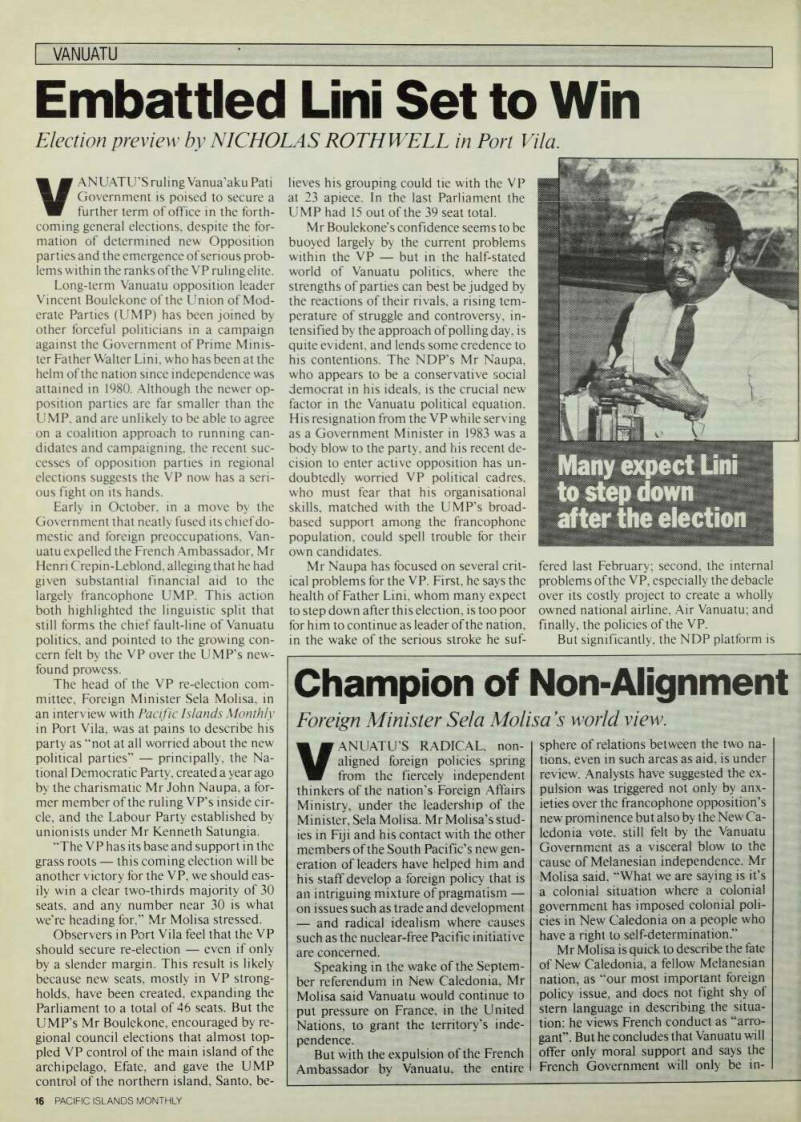
Long-term Vanuatu opposition leader Vincent Boulekone of the Union of Mod erate Parties (UMP) has been joined by other forceful politicians in a campaign against the Government of Prime Minis ter Father Walter Lini, who has been at the helm of the nation since independence was attained in 1980. Although the newer op position parties are far smaller than the UMP, and are unlikely to be able to agree on a coalition approach to running can didates and campaigning, the recent suc cesses of opposition parlies in regional elections suggests the VP now has a seri ous fight on its hands.
Early in October, in a move by the Government that neatly fused its chief do mestic and foreign preoccupations, Van uatu expelled the French Ambassador, Mr Henri Crepin-Leblond. alleging that he had given substantial financial aid to the largely francophone UMP. This action both highlighted the linguistic split that still forms the chief fault-line of Vanuatu politics, and pointed to the growing con cern felt by the VP over the UMP’s new found prowess.
The head of the VP re-election com mittee, Foreign Minister Sela Molisa, in an interview with Pacific Islands Monthly in Port Vila, was at pains to describe his party as “not at all worried about the new political parties” principally, the Na tional Democratic Party, created a year ago by the charismatic Mr John Naupa, a for mer member of the ruling VP's inside cir cle, and the Labour Party established by unionists under Mr Kenneth Satungia.
“The VP has its base and support in the grass roots this coming election will be another victory for the VP, we should eas ily win a clear two-thirds majority of 30 seats, and any number near 30 is what we’re heading for,” Mr Molisa stressed.
Observers in Port Vila feel that the VP should secure re-election even if only by a slender margin. This result is likely because new seats, mostly in VP strong holds, have been created, expanding the Parliament to a total of 46 seats. But the UMP’s Mr Boulekone, encouraged by re gional council elections that almost top pled VP control of the main island of the archipelago, Efate, and gave the UMP control of the northern island, Santo, be
lieves his grouping could tie with the VP at 23 apiece. In the last Parliament the UMP had 15 out of the 39 seat total.
Mr Boulekone’s confidence seems to be buoyed largely by the current problems within the VP but in the half-stated world of Vanuatu politics, where the strengths of parties can best be judged by the reactions of their rivals, a rising tem perature of struggle and controversy, in tensified by the approach of polling day, is quite evident, and lends some credence to his contentions. The NDP’s Mr Naupa, who appears to be a conservative social democrat in his ideals, is the crucial new factor in the Vanuatu political equation.
His resignation from the VP while serving as a Government Minister in 1983 was a body blow to the party, and his recent de cision to enter active opposition has un doubtedly worried VP political cadres, who must fear that his organisational skills, matched with the UMP’s broad based support among the francophone population, could spell trouble for their own candidates.
Mr Naupa has focused on several crit ical problems for the VP. First, he says the health of Father Lini, whom many expect to step down after this election, is too poor for him to continue as leader of the nation, in the wake of the serious stroke he suf-
fered last February; second, the internal problems of the VP, especially the debacle over its costly project to create a wholly owned national airline, Air Vanuatu; and finally, the policies of the VP.
But significantly, the NDP platform is
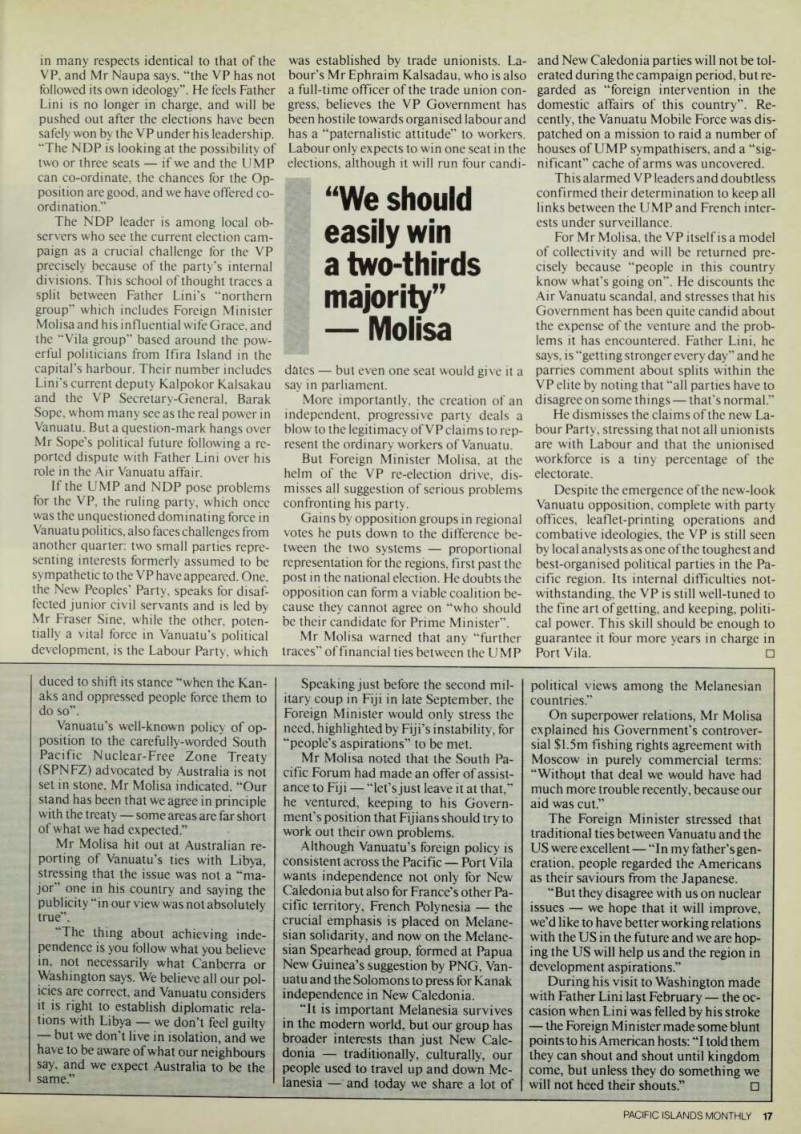
Many expect Lini to step down alter the election
in many respects identical to that of the VP, and Mr Naupa says, “the VP has not followed its own ideology”. He feels Father Lini is no longer in charge, and will be pushed out after the elections have been safely won by the VP under his leadership.
“The NDP is looking at the possibility of two or three seats if we and the UMP can co-ordinate, the chances for the Op position are good, and we have offered co ordination.”
The NDP leader is among local ob servers who see the current election cam paign as a crucial challenge for the VP precisely because of the party’s internal divisions. This school of thought traces a split between Father Lini’s “northern group” which includes Foreign Minister Molisa and his influential wife Grace, and the “Vila group” based around the pow erful politicians from Ifira Island in the capital’s harbour. Their number includes Lini’s current deputy Kalpokor Kalsakau and the VP Secretary-General, Barak Sope, whom many see as the real power in Vanuatu. But a question-mark hangs over Mr Sope’s political future following a re ported dispute with Father Lini over his role in the Air Vanuatu affair.
If the UMP and NDP pose problems for the VP, the ruling party, which once was the unquestioned dominating force in Vanuatu politics, also faces challenges from another quarter: two small parties repre senting interests formerly assumed to be sympathetic to the VP have appeared. One, the New Peoples’ Party, speaks for disaf fected junior civil servants and is led by Mr Fraser Sine, while the other, poten tially a vital force in Vanuatu’s political development, is the Labour Party, which
was established by trade unionists. La bour’s Mr Ephraim Kalsadau, who is also a full-time officer of the trade union con gress, believes the VP Government has been hostile towards organised labour and has a “paternalistic attitude” to workers.
Labour only expects to win one seat in the elections, although it will run four candi
“We should easily win a two-thirds majority”
Molisa
dates but even one seat would give it a say in parliament.
More importantly, the creation of an independent, progressive party deals a blow to the legitimacy of VP claims to rep resent the ordinary workers of Vanuatu.
But Foreign Minister Molisa, at the helm of the VP re-election drive, dis misses all suggestion of serious problems confronting his party.
Gains by opposition groups in regional votes he puts down to the difference be tween the two systems proportional representation for the regions, first past the post in the national election. He doubts the opposition can form a viable coalition be cause they cannot agree on “who should be their candidate for Prime Minister”.
Mr Molisa warned that any “further traces” of financial ties between the UMP
and New Caledonia parties will not be tol erated during the campaign period, but re garded as “foreign intervention in the domestic affairs of this country”. Re cently, the Vanuatu Mobile Force was dis patched on a mission to raid a number of houses of UMP sympathisers, and a “sig nificant” cache of arms was uncovered.
This alarmed VP leaders and doubtless confirmed their determination to keep all links between the UMP and French inter ests under surveillance.
For Mr Molisa, the VP itself is a model of collectivity and will be returned pre cisely because “people in this country know what’s going on”. He discounts the Air Vanuatu scandal, and stresses that his Government has been quite candid about the expense of the venture and the prob lems it has encountered. Father Lini, he says, is “getting stronger every day” and he parries comment about splits within the VP elite by noting that “all parties have to disagree on some things that’s normal.”
He dismisses the claims of the new La bour Party, stressing that not all unionists are with Labour and that the unionised workforce is a tiny percentage of the electorate.
Despite the emergence of the new-look Vanuatu opposition, complete with party offices, leaflet-printing operations and combative ideologies, the VP is still seen by local analysts as one of the toughest and best-organised political parties in the Pa cific region. Its internal difficulties not withstanding, the VP is still well-tuned to the fine art of getting, and keeping, politi cal power. This skill should be enough to guarantee it four more years in charge in Port Vila. □
Champion of Non-Alignment
Foreign Minister Sela Molisa’s world view.
Vanuatu’S Radical, Non
aligned foreign policies spring from the fiercely independent thinkers of the nation’s Foreign Affairs Ministry, under the leadership of the Minister, Sela Molisa. Mr Molisa’sstud ies in Fiji and his contact with the other members of the South Pacific’s new gen eration of leaders have helped him and his staff develop a foreign policy that is an intriguing mixture of pragmatism on issues such as trade and development and radical idealism where causes such as the nuclear-free Pacific initiative are concerned.
Speaking in the wake of the Septem ber referendum in New Caledonia, Mr Molisa said Vanuatu would continue to pul pressure on France, in the United Nations, to grant the territory’s inde pendence.
But with the expulsion of the French Ambassador by Vanuatu, the entire
sphere of relations between the two na tions, even in such areas as aid, is under review. Analysts have suggested the ex pulsion was triggered not only by anx ieties over the francophone opposition’s new prominence but also by the New Ca ledonia vote, still felt by the Vanuatu Government as a visceral blow to the cause of Melanesian independence. Mr Molisa said, “What we are saying is it’s a colonial situation where a colonial government has imposed colonial poli cies in New Caledonia on a people who have a right to self-determination.”
Mr Molisa is quick to describe the fate of New Caledonia, a fellow Melanesian nation, as ”our most important foreign policy issue, and does not fight shy of stern language in describing the situa tion: he views French conduct as “arro gant”. But he concludes that Vanuatu will offer only moral support and says the French Government will only be in
duced to shift its stance “when the Kan aks and oppressed people force them to do so”.
Vanuatu’s well-known policy of op position to the carefully-worded South Pacific Nuclear-Free Zone Treaty (SPNFZ) advocated by Australia is not set in stone, Mr Molisa indicated. “Our stand has been that we agree in principle with the treaty some areas are far short of what we had expected ”
Mr Molisa hit out at Australian re porting of Vanuatu’s ties with Libya, stressing that the issue was not a “ma jor” one in his country and saying the publicity “in our view was not absolutely true”.
“The thing about achieving inde pendence is you follow what you believe in, not necessarily what Canberra or Washington says. We believe all our pol icies are correct, and Vanuatu considers it is right to establish diplomatic rela tions with Libya we don’t feel guilty but we don’t live in isolation, and we have to be aware of what our neighbours say, and we expect Australia to be the same”
Speaking just before the second mil itary coup in Fiji in late September, the Foreign Minister would only stress the need, highlighted by Fiji’s instability, for “people’s aspirations” to be met.
Mr Molisa noted that the South Pa cific Forum had made an offer of assist ance to Fiji “let’s just leave it at that,” he ventured, keeping to his Govern ment’s position that Fijians should try to work out their own problems.
Although Vanuatu’s foreign policy is consistent across the Pacific Port Vila wants independence not only for New Caledonia but also for France’s other Pa cific territory, French Polynesia the crucial emphasis is placed on Melane sian solidarity, and now on the Melane sian Spearhead group, formed at Papua New Guinea’s suggestion by PNG, Van uatu and the Solomons to press for Kanak independence in New Caledonia.
“It is important Melanesia survives in the modern world, but our group has broader interests than just New Cale donia traditionally, culturally, our people used to travel up and down Me lanesia and today we share a lot of
political views among the Melanesian countries”
On superpower relations, Mr Molisa explained his Government’s controver sial sl.sm fishing rights agreement with Moscow in purely commercial terms: “Without that deal we would have had much more trouble recently, because our aid was cut ”
The Foreign Minister stressed that traditional ties between Vanuatu and the US were excellent “In my father’s gen eration, people regarded the Americans as their saviours from the Japanese.
“But they disagree with us on nuclear issues we hope that it will improve, we’d like to have better working relations with the US in the future and we are hop ing the US will help us and the region in development aspirations.”
During his visit to Washington made with Father Lini last February the oc casion when Lini was felled by his stroke the Foreign Minister made some blunt points to his American hosts: “I told them they can shout and shout until kingdom come, but unless they do something we will not heed their shouts.” □
Sporting Chance for SP Games
New Caledonia
Keen competition should save the South Pacific Games.
By Gabriel Singh.
NOUMEA IS THE setting for next month’s eighth South Pacific Games the island nations Olympics. But the quadrennial event may struggle to live up to its reputation as a spectacle. Organisers are dismayed at an expected drop in competitors to well be low the 2500 athletes at the last Games in Apia, Western Samoa.
The Kanak independence struggle prompted security fears and uncertainty surrounded the event, until South Pacific Games Council chairman Western Sa moan Peter Paul gave Noumea the “all clear” in September after a personal in spection of facilities and security arrangements.
Paul met and received a personal as surance on the safely of the competitors from FLNKS leader Jean-Marie Tjibaou.
He was shown a special police report on security for the duration of the Games from December 8-20.
Paul gave Noumea the go-ahead and the news was met with joy by thousands of sportsmen and women. But just as organ isers sighed with relief, they were hit by a boycott call by South Pacific Forum Chairman, Western Samoan Prime Min ister Kolone. Forum countries, however, have not reacted favourably to Kolone’s call but the harsher realities of depressive economic trends could still put paid to hopes of turning this event into the usual spectacular. Already Western Samoan squash and volleyball teams have said they can’t afford the trip.
Scarcity of money is felt throughout the region and some countries such as Fiji may not even be able to send even half their projected 300 entries. Fiji soccer became the first sport from the newly declared re public to withdraw from the Games after Colonel Rabuka imposed a total ban on Sunday sports and trading, which brought soccer to a halt. The Fiji Football Associ ation’s major earner, the four-day inter district tournament, was to have provided the 5F25,000 needed to equip the national soccer side. The tournament, to have been played over the 1970 October Independ ence holiday weekend, was cancelled and local soccer indefinitely suspended.
Other sports federations in Fiji face a similar problem in trying to send a full complement. Fundraising efforts have been low key because of the political up heaval and there is little hope of a govern ment grant.
Sports federations in other countries also face serious problems in raising the money needed to send teams.
This eighth Games is expected to be dominated by New Caledonia and Tahiti.
Fiji soccer’s withdrawal means the French contestants will share gold and silver med als. Fiji played Tahiti in the last two SPG gold medal games, held in Apia in 1983 and in Suva in 1979.
Swimming will be another event to have a strong French flavour, with perhaps to ken resistance coming from Fiji and Papua New Guinea.
Athletics is the one sport that could go ahead unscathed and provide spine-tin gling drama and excitement. Many new stars will emerge and there are old scores to be settled.
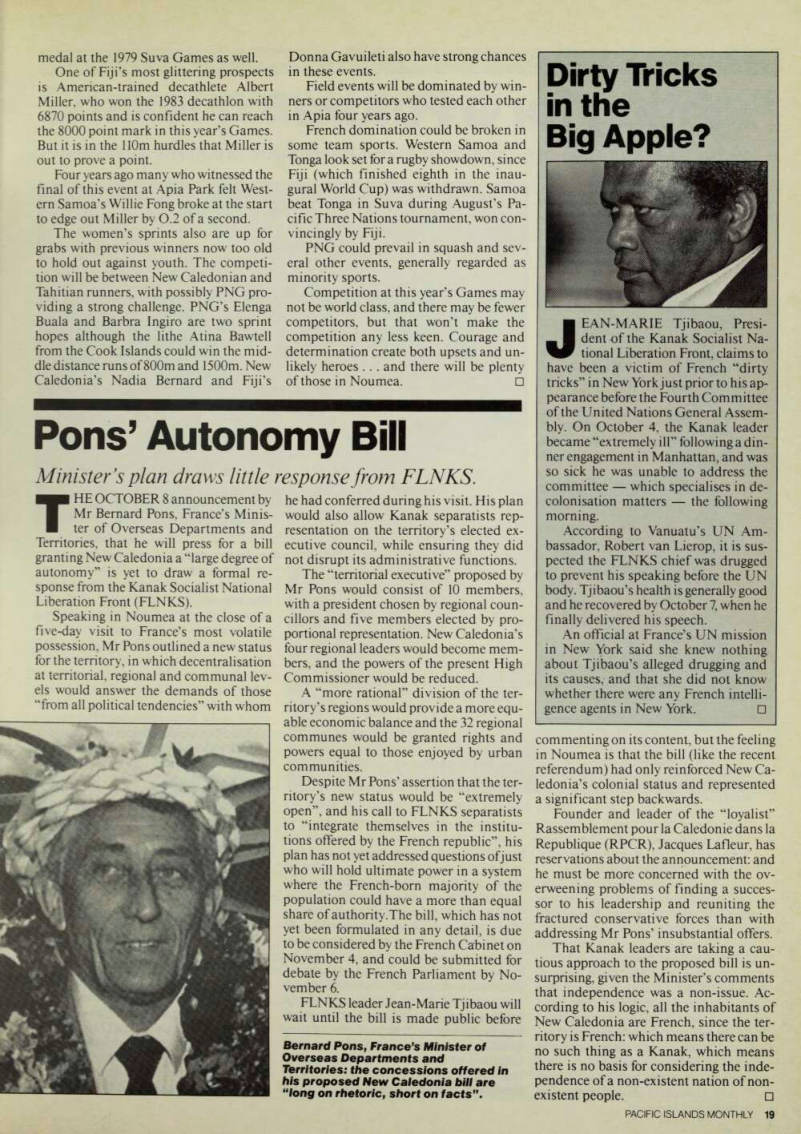
One man all runners in his field will be out to beat will be New Caledonian dis tance running champion Alain Lazare.
Lazare won the 1900 m, the 3000 m stee plechase, the 5000 m, the 10,000 m and the marathon: in fact, every event he entered at Apia four years ago. The fleet-footed Frenchman is held in awe and his scalp at the SPG will be an unforgettable prize for anyone good enough to beat him.
The men’s sprint events are wide open but the 400 m gold medal is to be defended by Fiji’s ageing warhorse Joe Rodan. Ro dan took gold in the 400 m and 400 m hur dles in Apia but his dominance could come to an end. Like Lazare, he won the gold
Picture by Asaeli Lave.
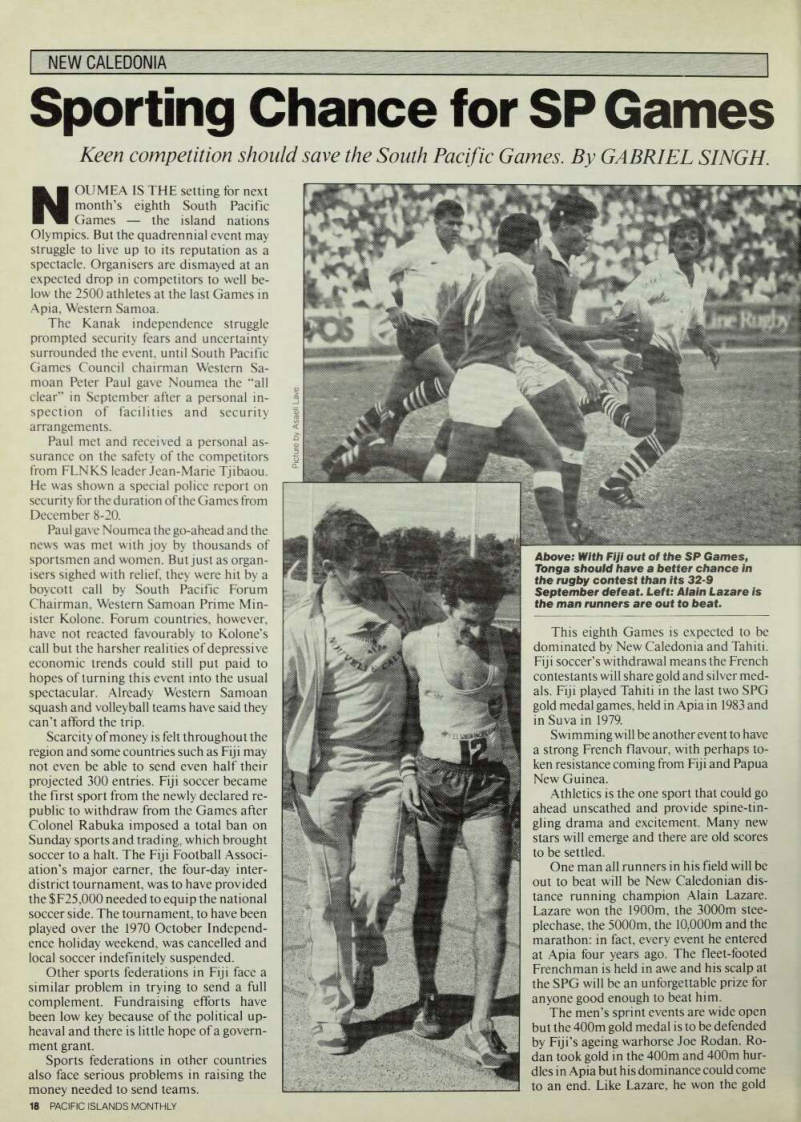
Above: With Fiji out of the SP Games, Tonga should have a better chance in the rugby contest than its 32-9 September defeat. Left: Alain Lazare is the man runners are out to beat.
medal at the 1979 Suva Games as well.
One of Fiji’s most glittering prospects is American-trained decathlete Albert Miller, who won the 1983 decathlon with 6870 points and is confident he can reach the 8000 point mark in this year’s Games.
But it is in the 110 m hurdles that Miller is out to prove a point.
Four years ago many who witnessed the final of this event at Apia Park felt West ern Samoa’s Willie Fong broke at the start to edge out Miller by 0.2 of a second.
The women’s sprints also are up for grabs with previous winners now too old to hold out against youth. The competi tion will be between New Caledonian and Tahitian runners, with possibly PNG pro viding a strong challenge. PNG’s Elenga Buala and Barbra Ingiro are two sprint hopes although the lithe Atina Bawtell from the Cook Islands could win the mid dle distance runs ofBoom and 1500 m. New Caledonia’s Nadia Bernard and Fiji’s
Donna Gavuileti also have strong chances in these events.
Field events will be dominated by win ners or competitors who tested each other in Apia four years ago.
French domination could be broken in some team sports. Western Samoa and Tonga look set for a rugby showdown, since Fiji (which finished eighth in the inau gural World Cup) was withdrawn. Samoa beat Tonga in Suva during August’s Pa cific Three Nations tournament, won con vincingly by Fiji.
PNG could prevail in squash and sev eral other events, generally regarded as minority sports.
Competition at this year’s Games may not be world class, and there may be fewer competitors, but that won’t make the competition any less keen. Courage and determination create both upsets and un likely heroes . . . and there will be plenty of those in Noumea. □
Pons’ Autonomy Bill
Minister’s plan draws little response from FLNKS.
THE OCTOBER 8 announcement by Mr Bernard Pons, France’s Minis ter of Overseas Departments and Territories, that he will press for a bill granting New Caledonia a “large degree of autonomy” is yet to draw a formal re sponse from the Kanak Socialist National Liberation Front (FLNKS).
Speaking in Noumea at the close of a five-day visit to France’s most volatile possession, Mr Pons outlined a new status for the territory, in which decentralisation at territorial, regional and communal lev els would answer the demands of those “from all political tendencies” with whom
he had conferred during his visit. His plan would also allow Kanak separatists rep resentation on the territory’s elected ex ecutive council, while ensuring they did not disrupt its administrative functions.
The “territorial executive” proposed by Mr Pons would consist of 10 members, with a president chosen by regional coun cillors and five members elected by pro portional representation. New Caledonia’s four regional leaders would become mem bers, and the powers of the present High Commissioner would be reduced.
A “more rational” division of the ter ritory’s regions would provide a more equ able economic balance and the 32 regional communes would be granted rights and powers equal to those enjoyed by urban communities.
Despite Mr Pons’ assertion that the ter ritory’s new status would be “extremely open”, and his call to FLNKS separatists to “integrate themselves in the institu tions offered by the French republic”, his plan has not yet addressed questions ofjust who will hold ultimate power in a system where the French-born majority of the population could have a more than equal share of authority. The bill, which has not yet been formulated in any detail, is due to be considered by the French Cabinet on November 4, and could be submitted for debate by the French Parliament by No vember 6.
FLNKS leader Jean-Marie Tjibaou will wait until the bill is made public before
commenting on its content, but the feeling in Noumea is that the bill (like the recent referendum) had only reinforced New Ca ledonia’s colonial status and represented a significant step backwards.
Founder and leader of the “loyalist”
Rassemblement pour la Caledonie dans la Republique (RPCR), Jacques Lafleur, has reservations about the announcement: and he must be more concerned with the ov erweening problems of finding a succes sor to his leadership and reuniting the fractured conservative forces than with addressing Mr Pons’ insubstantial offers.
That Kanak leaders are taking a cau tious approach to the proposed bill is un surprising, given the Minister’s comments that independence was a non-issue. Ac cording to his logic, all the inhabitants of New Caledonia are French, since the ter ritory is French: which means there can be no such thing as a Kanak, which means there is no basis for considering the inde pendence of a non-existent nation of non existent people. □
Bernard Pons, France's Minister of Overseas Departments and Territories: the concessions offered in his proposed New Caledonia bill are “long on rhetoric, short on facts”.
Big Apple?
Dirty Tricks in the Big Apple?
JEAN-MARIE Tjibaou, Presi dent of the Kanak Socialist Na tional Liberation Front, claims to have been a victim of French “dirty tricks” in New York just prior to his ap pearance before the Fourth Committee of the United Nations General Assem bly. On October 4, the Kanak leader became “extremely ill” following a din ner engagement in Manhattan, and was so sick he was unable to address the committee which specialises in de colonisation matters the following morning.
According to Vanuatu’s UN Am bassador. Robert van Lierop, it is sus pected the FLNKS chief was drugged to prevent his speaking before the UN body. Tjibaou’s health is generally good and he recovered by October 7, when he finally delivered his speech.
An official at France’s UN mission in New York said she knew nothing about Tjibaou’s alleged drugging and its causes, and that she did not know whether there were any French intelli gence agents in New York. □
Fighting for a Future
Nauru
A Commission battles to save the almost mined-out republic.
By John Dunn.
AN INDEPENDENT Commission headed by a Sri Lankan judge, and assisted by an Australian engineer and a Nauru Government official, is just more than half-way through a year-long inquiry which may bring a fresh future to the Republic of Nauru.
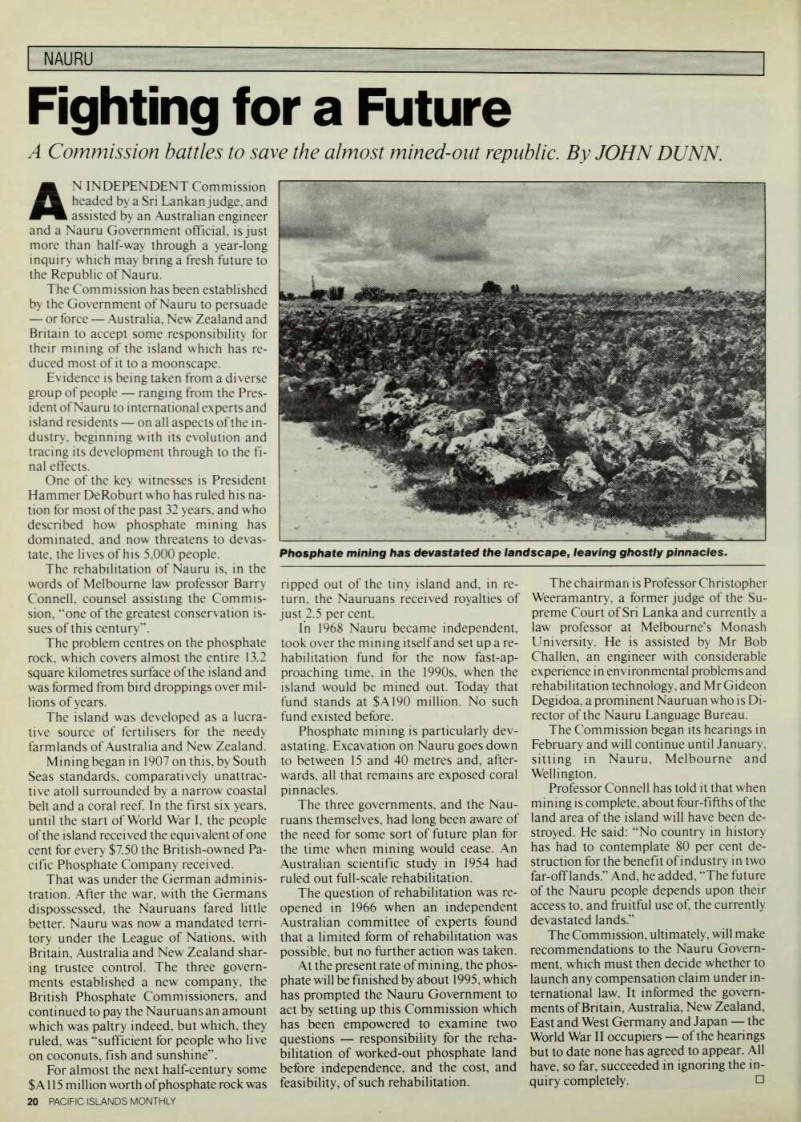
The Commission has been established by the Government of Nauru to persuade or force Australia, New Zealand and Britain to accept some responsibility for their mining of the island which has re duced most of it to a moonscape.
Evidence is being taken from a diverse group of people ranging from the Pres ident of Nauru to international experts and island residents on all aspects of the in dustry, beginning with its evolution and tracing its development through to the fi nal effects.
One of the key witnesses is President Hammer Deßoburt who has ruled his na tion for most of the past 32 years, and who described how phosphate mining has dominated, and now threatens to devas tate, the lives of his 5,000 people.
The rehabilitation of Nauru is, in the words of Melbourne law professor Barry Connell, counsel assisting the Commis sion, “one of the greatest conservation is sues of this century”.
The problem centres on the phosphate rock, which covers almost the entire 13.2 square kilometres surface of the island and was formed from bird droppings over mil lions of years.
The island was developed as a lucra tive source of fertilisers for the needy farmlands of Australia and New Zealand.
Mining began in 1907 on this, by South Seas standards, comparatively unattrac tive atoll surrounded by a narrow coastal belt and a coral reef. In the first six years, until the start of World War I, the people of the island received the equivalent of one cent for every $7.50 the British-owned Pa cific Phosphate Company received.
That was under the German adminis tration. After the war, with the Germans dispossessed, the Nauruans fared little better. Nauru was now a mandated terri tory under the League of Nations, with Britain, Australia and New Zealand shar ing trustee control. The three govern ments established a new company, the British Phosphate Commissioners, and continued to pay the Nauruans an amount which was paltry indeed, but which, they ruled, was “sufficient for people who live on coconuts, fish and sunshine”.
For almost the next half-century some $ All 5 million worth of phosphate rock was
ripped out of the tiny island and, in re turn, the Nauruans received royalties of just 2.5 per cent.
In 1968 Nauru became independent, took over the mining itself and set up a re habilitation fund for the now fast-ap proaching time, in the 19905, when the island would be mined out. Today that fund stands at SAI9O million. No such fund existed before.
Phosphate mining is particularly dev astating. Excavation on Nauru goes down to between 15 and 40 metres and, after wards, all that remains are exposed coral pinnacles.
The three governments, and the Nau ruans themselves, had long been aware of the need for some sort of future plan for the time when mining would cease. An Australian scientific study in 1954 had ruled out full-scale rehabilitation.
The question of rehabilitation was re opened in 1966 when an independent Australian committee of experts found that a limited form of rehabilitation was possible, but no further action was taken.
At the present rate of mining, the phos phate will be finished by about 1995, which has prompted the Nauru Government to act by setting up this Commission which has been empowered to examine two questions responsibility for the reha bilitation of worked-out phosphate land before independence, and the cost, and feasibility, of such rehabilitation.
The chairman is Professor Christopher Weeramantry, a former judge of the Su preme Court of Sri Lanka and currently a law professor at Melbourne’s Monash University. He is assisted by Mr Bob Challen, an engineer with considerable experience in environmental problems and rehabilitation technology, and Mr Gideon Degidoa, a prominent Nauruan who is Di rector of the Nauru Language Bureau.
The Commission began its hearings in February and will continue until January, sitting in Nauru, Melbourne and Wellington.
Professor Connell has told it that when mining is complete, about four-fifths of the land area of the island will have been de stroyed. He said: “No country in history has had to contemplate 80 per cent de struction for the benefit of industry in two far-off lands.” And, he added, “The future of the Nauru people depends upon their access to, and fruitful use of, the currently devastated lands.”
The Commission, ultimately, will make recommendations to the Nauru Govern ment, which must then decide whether to launch any compensation claim under in ternational law. It informed the govern ments of Britain, Australia, New Zealand, East and West Germany and Japan the World War II occupiers of the hearings but to date none has agreed to appear. All have, so far, succeeded in ignoring the in quiry completely. □
Phosphate mining has devastated the landscape, leaving ghostly pinnacles.
Shakeup at Ok Tedi
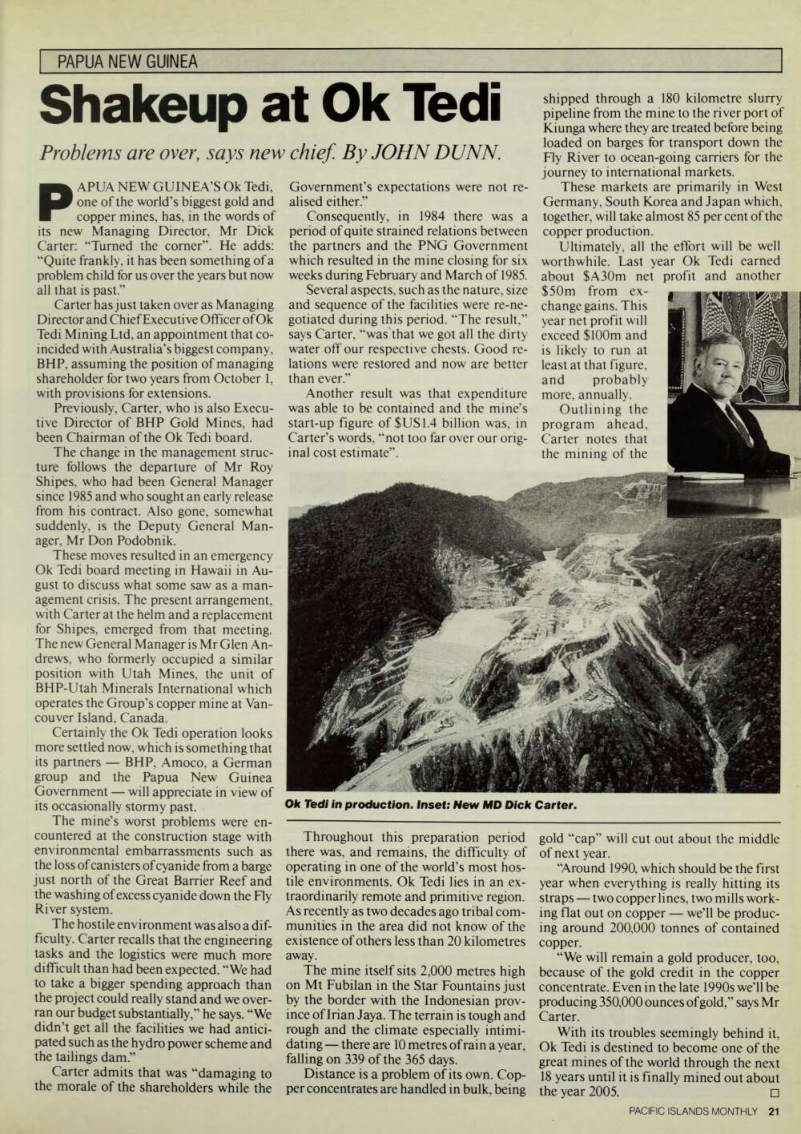
Papua New Guinea
Problems are over, says new chief.
By John Dunn.
Papua new guinea’s Ok Tedi, one of the world’s biggest gold and copper mines, has, in the words of its new Managing Director, Mr Dick Carter: “Turned the corner”. He adds: “Quite frankly, it has been something of a problem child for us over the years but now all that is past.”
Carter has just taken over as Managing Director and Chief Executive Officer of Ok Tedi Mining Ltd, an appointment that co incided with Australia’s biggest company, BHP, assuming the position of managing shareholder for two years from October 1, with provisions for extensions.
Previously, Carter, who is also Execu tive Director of BHP Gold Mines, had been Chairman of the Ok Tedi board.
The change in the management struc ture follows the departure of Mr Roy Shipes, who had been General Manager since 1985 and who sought an early release from his contract. Also gone, somewhat suddenly, is the Deputy General Man ager, Mr Don Podobnik, These moves resulted in an emergency Ok Tedi board meeting in Hawaii in Au gust to discuss what some saw as a man agement crisis. The present arrangement, with Carter at the helm and a replacement for Shipes, emerged from that meeting.
The new General Manager is Mr Glen An drews, who formerly occupied a similar position with Utah Mines, the unit of BHP-Utah Minerals International which operates the Group’s copper mine at Van couver Island, Canada.
Certainly the Ok Tedi operation looks more settled now, which is something that its partners BHP, Amoco, a German group and the Papua New Guinea Government will appreciate in view of its occasionally stormy past.
The mine’s worst problems were en countered at the construction stage with environmental embarrassments such as the loss of canisters of cyanide from a barge just north of the Great Barrier Reef and the washing of excess cyanide down the Fly River system.
The hostile environment was also a dif ficulty. Carter recalls that the engineering tasks and the logistics were much more difficult than had been expected. “We had to take a bigger spending approach than the project could really stand and we over ran our budget substantially,” he says. “We didn’t get all the facilities we had antici pated such as the hydro power scheme and the tailings dam ”
Carter admits that was “damaging to the morale of the shareholders while the
Government’s expectations were not re alised either.”
Consequently, in 1984 there was a period of quite strained relations between the partners and the PNG Government which resulted in the mine closing for six weeks during February and March of 1985.
Several aspects, such as the nature, size and sequence of the facilities were re-ne gotiated during this period. “The result,” says Carter, “was that we got all the dirty water off our respective chests. Good re lations were restored and now are better than ever.”
Another result was that expenditure was able to be contained and the mine’s start-up figure of SUSI. 4 billion was, in Carter’s words, “not too far over our orig inal cost estimate”.
Throughout this preparation period there was, and remains, the difficulty of operating in one of the world’s most hos tile environments. Ok Tedi lies in an ex traordinarily remote and primitive region.
As recently as two decades ago tribal com munities in the area did not know of the existence of others less than 20 kilometres away.
The mine itself sits 2,000 metres high on Mt Fubilan in the Star Fountains just by the border with the Indonesian prov ince of Irian Jaya. The terrain is tough and rough and the climate especially intimi dating there are 10 metres of rain a year, falling on 339 of the 365 days.
Distance is a problem of its own. Cop per concentrates are handled in bulk, being
shipped through a 180 kilometre slurry pipeline from the mine to the river port of Kiunga where they are treated before being loaded on barges for transport down the Fly River to ocean-going carriers for the journey to international markets.
These markets are primarily in West Germany, South Korea and Japan which, together, will take almost 85 per cent of the copper production.
Ultimately, all the effort will be well worthwhile. Last year Ok Tedi earned about $A3Om net profit and another
ssom from ex change gains. This year net profit will exceed SlOOm and is likely to run at least at that figure, and probably more, annually.
Outlining the program ahead.
Carter notes that the mining of the
gold “cap” will cut out about the middle of next year.
“Around 1990, which should be the first year when everything is really hitting its straps two copper lines, two mills work ing flat out on copper we’ll be produc ing around 200,000 tonnes of contained copper.
“We will remain a gold producer, too, because of the gold credit in the copper concentrate. Even in the late 1990 s we’ll be producing 350,000 ounces of gold,” says Mr Carter.
With its troubles seemingly behind it, Ok Tedi is destined to become one of the great mines of the world through the next 18 years until it is finally mined out about the year 2005. □
Ok Tedi in production. Inset: New MD Dick Carter.
Advertisements & other items, p. 22 (1 item)
Baimk
BANK
ECONOMIC INDICATORS
COMMODITY PRICES
INTEREST RATES
Australia New Zealand
USA
Japan Short Term Oct. 8 Month Year 1987 Ago Ago 11.35 12.10 17.85 19.65 19.60 16.50 Long Term Oct. 8 Month Year 1987 Ago Ago 12.48 12.94 13.85 15.65 15.75 15.35 8.44 3.90 7.31 4.00 5.96 4.75 9.74 5.87 9.27 5.38 7.95 4.65
WORLD COMMODITIES
(Wholesale Price Index, 1980 = 100) Metals Agricultural Raw Materials
GOLD
London (US $ Per Ounce) 1987 1984
INDUSTRIAL WORLD DEMAND
Industrial Output (per cent change) Belgium Canada France Italy Japan Netherlands Switzerland UK
USA
TOTAL OECD
Sources: AAP Reuters; FFA Honiara, Fiji Forest Industries IMF (IFS). Compiled by ANZ International Economics, Melbourne.
A
BAIMK
Branches in
Fiji, Papua New Guinea,
Vanuatu and Solomon Is
Hard Lessons for Lawmakers
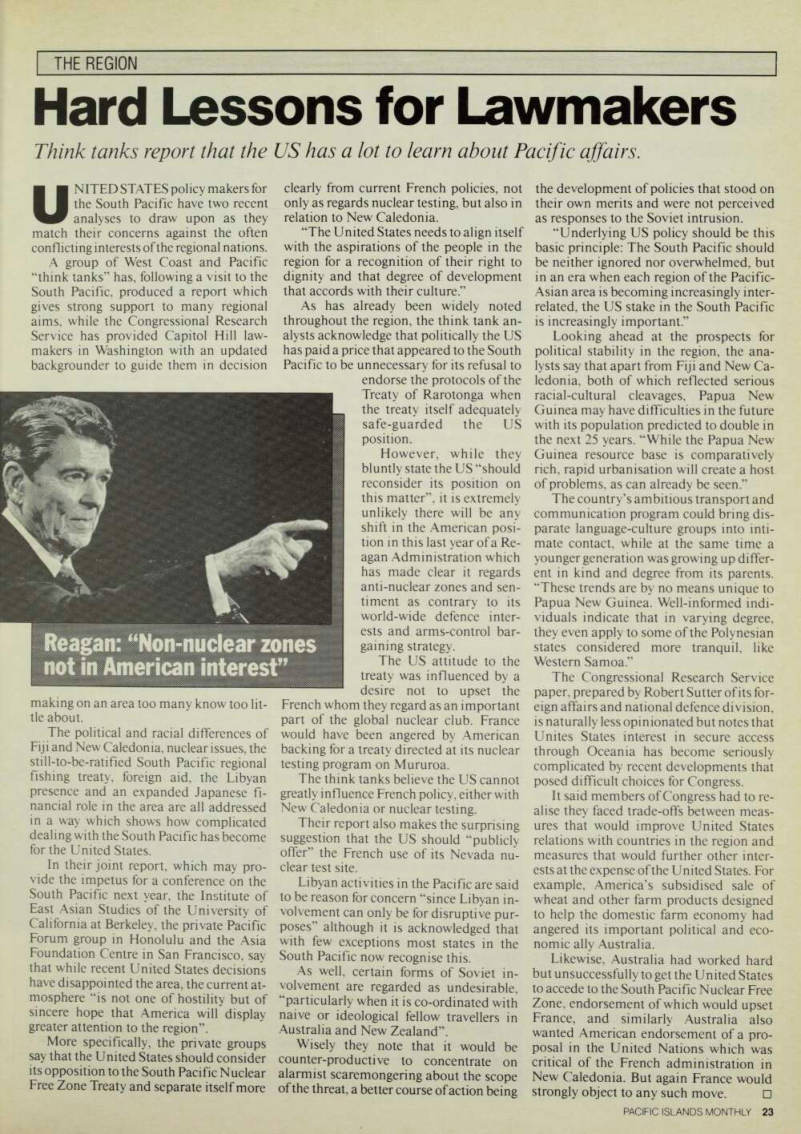
The Region
Think tanks report that the US has a lot to learn about Pacific affairs.
UNITED STATES policy makers for the South Pacific have two recent analyses to draw upon as they match their concerns against the often conflicting interests of the regional nations.
A group of West Coast and Pacific “think tanks” has, following a visit to the South Pacific, produced a report which gives strong support to many regional aims, while the Congressional Research Service has provided Capitol Hill law makers in Washington with an updated backgrounder to guide them in decision
making on an area too many know too lit tle about.
The political and racial differences of Fiji and New Caledonia, nuclear issues, the still-to-be-ratified South Pacific regional fishing treaty, foreign aid, the Libyan presence and an expanded Japanese fi nancial role in the area are all addressed in a way which shows how complicated dealing with the South Pacific has become for the United States.
In their joint report, which may pro vide the impetus for a conference on the South Pacific next year, the Institute of East Asian Studies of the University of California at Berkeley, the private Pacific Forum group in Honolulu and the Asia Foundation Centre in San Francisco, say that while recent United States decisions have disappointed the area, the current at mosphere “is not one of hostility but of sincere hope that America will display greater attention to the region”.
More specifically, the private groups say that the United States should consider its opposition to the South Pacific N uclear Free Zone Treaty and separate itself more
clearly from current French policies, not only as regards nuclear testing, but also in relation to New Caledonia.
“The United States needs to align itself with the aspirations of the people in the region for a recognition of their right to dignity and that degree of development that accords with their culture.”
As has already been widely noted throughout the region, the think tank an alysts acknowledge that politically the US has paid a price that appeared to the South Pacific to be unnecessary for its refusal to
endorse the protocols of the Treaty of Rarotonga when the treaty itself adequately safe-guarded the US position.
However, while they bluntly state the US “should reconsider its position on this matter”, it is extremely unlikely there will be any shift in the American posi tion in this last year of a Re agan Administration which has made clear it regards anti-nuclear zones and sen timent as contrary to its world-wide defence inter ests and arms-control bar gaining strategy.
The US attitude to the treaty was influenced by a desire not to upset the
French whom they regard as an important part of the global nuclear club. France would have been angered by American backing for a treaty directed at its nuclear testing program on Mururoa.
The think tanks believe the US cannot greatly influence French policy, either with New Caledonia or nuclear testing.
Their report also makes the surprising suggestion that the US should “publicly offer” the French use of its Nevada nu clear test site.
Libyan activities in the Pacific are said to be reason for concern “since Libyan in volvement can only be for disruptive pur poses” although it is acknowledged that with few exceptions most states in the South Pacific now recognise this.
As well, certain forms of Soviet in volvement are regarded as undesirable, “particularly when it is co-ordinated with naive or ideological fellow travellers in Australia and New Zealand”.
Wisely they note that it would be counter-productive to concentrate on alarmist scaremongering about the scope of the threat, a better course of action being
the development of policies that stood on their own merits and were not perceived as responses to the Soviet intrusion.
“Underlying US policy should be this basic principle: The South Pacific should be neither ignored nor overwhelmed, but in an era when each region of the Pacific- Asian area is becoming increasingly inter related, the US stake in the South Pacific is increasingly important.”
Looking ahead at the prospects for political stability in the region, the ana lysts say that apart from Fiji and New Ca ledonia, both of which reflected serious racial-cultural cleavages, Papua New Guinea may have difficulties in the future with its population predicted to double in the next 25 years. “While the Papua New Guinea resource base is comparatively rich, rapid urbanisation will create a host of problems, as can already be seen.”
The country’s ambitious transport and communication program could bring dis parate language-culture groups into inti mate contact, while at the same time a younger generation was growing up differ ent in kind and degree from its parents.
“These trends are by no means unique to Papua New Guinea. Well-informed indi viduals indicate that in varying degree, they even apply to some of the Polynesian states considered more tranquil, like Western Samoa.”
The Congressional Research Service paper, prepared by Robert Sutter of its for eign affairs and national defence division, is naturally less opinionated but notes that Unites States interest in secure access through Oceania has become seriously complicated by recent developments that posed difficult choices for Congress.
It said members of Congress had to re alise they faced trade-offs between meas ures that would improve United States relations with countries in the region and measures that would further other inter ests at the expense of the United States. For example, America’s subsidised sale of wheat and other farm products designed to help the domestic farm economy had angered its important political and eco nomic ally Australia.
Likewise, Australia had worked hard but unsuccessfully to get the United States to accede to the South Pacific Nuclear Free Zone, endorsement of which would upset France, and similarly Australia also wanted American endorsement of a pro posal in the United Nations which was critical of the French administration in New Caledonia. But again France would strongly object to any such move. □
Reagan: “Non-nuclear zones not in American interest”
Maori Claims Pile Up
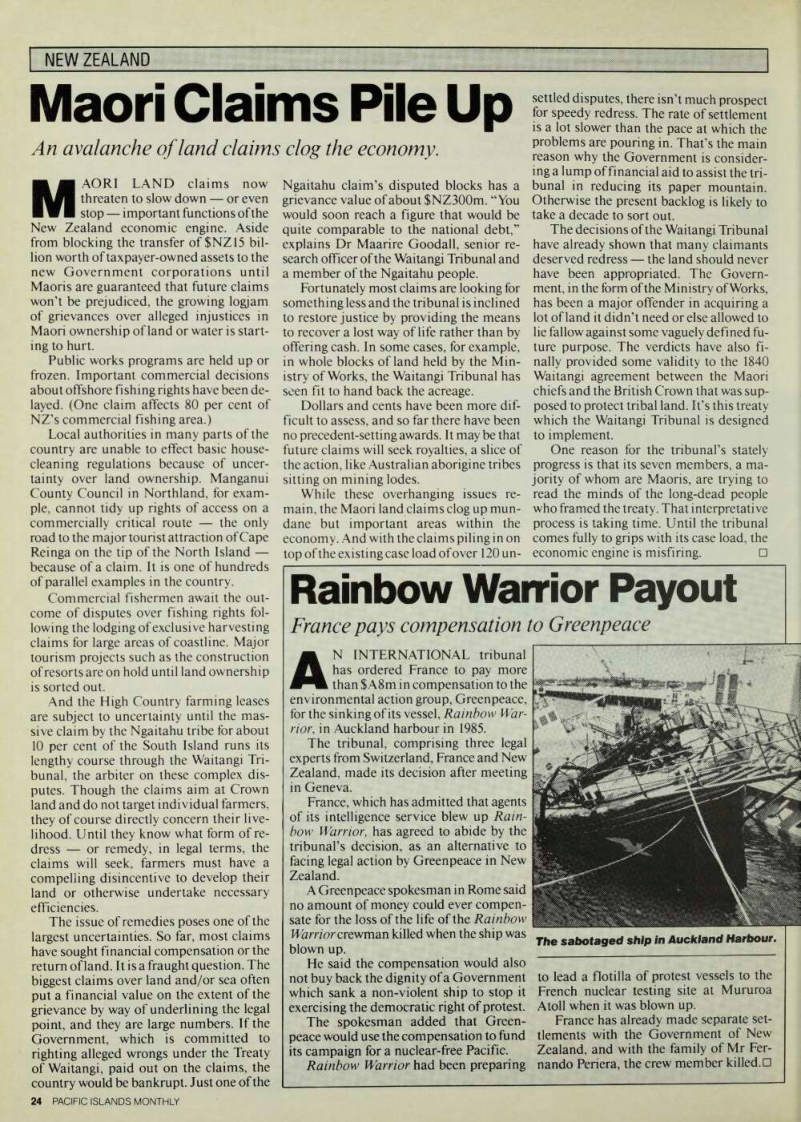
New Zealand
An avalanche of land claims clog the economy.
MAORI LAND claims now threaten to slow down or even stop important functions of the New Zealand economic engine. Aside from blocking the transfer of SNZIS bil lion worth of taxpayer-owned assets to the new Government corporations until Maoris are guaranteed that future claims won’t be prejudiced, the growing logjam of grievances over alleged injustices in Maori ownership of land or water is start ing to hurt.
Public works programs are held up or frozen. Important commercial decisions about offshore fishing rights have been de layed. (One claim affects 80 per cent of NZ’s commercial fishing area.) Local authorities in many parts of the country are unable to effect basic house cleaning regulations because of uncer tainty over land ownership. Manganui County Council in Northland, for exam ple, cannot tidy up rights of access on a commercially critical route the only road to the major tourist attraction of Cape Reinga on the tip of the North Island because of a claim. It is one of hundreds of parallel examples in the country.
Commercial fishermen await the out come of disputes over fishing rights fol lowing the lodging of exclusive harvesting claims for large areas of coastline. Major tourism projects such as the construction of resorts are on hold until land ownership is sorted out.
And the High Country farming leases are subject to uncertainty until the mas sive claim by the Ngaitahu tribe for about 10 per cent of the South Island runs its lengthy course through the Waitangi Tri bunal, the arbiter on these complex dis putes. Though the claims aim at Crown land and do not target individual farmers, they of course directly concern their live lihood. Until they know what form of re dress or remedy, in legal terms, the claims will seek, farmers must have a compelling disincentive to develop their land or otherwise undertake necessary efficiencies.
The issue of remedies poses one of the largest uncertainties. So far, most claims have sought financial compensation or the return of land. It is a fraught question. The biggest claims over land and/or sea often put a financial value on the extent of the grievance by way of underlining the legal point, and they are large numbers. If the Government, which is committed to righting alleged wrongs under the Treaty of Waitangi, paid out on the claims, the country would be bankrupt. Just one of the
Ngaitahu claim’s disputed blocks has a grievance value of about SNZ3OOm. “You would soon reach a figure that would be quite comparable to the national debt,” explains Dr Maarire Goodall, senior re search officer of the Waitangi Tribunal and a member of the Ngaitahu people.
Fortunately most claims are looking for something less and the tribunal is inclined to restore justice by providing the means to recover a lost way of life rather than by offering cash. In some cases, for example, in whole blocks of land held by the Min istry of Works, the Waitangi Tribunal has seen fit to hand back the acreage.
Dollars and cents have been more dif ficult to assess, and so far there have been no precedent-setting awards. It may be that future claims will seek royalties, a slice of the action, like Australian aborigine tribes sitting on mining lodes.
While these overhanging issues re main, the Maori land claims clog up mun dane but important areas within the economy. And with the claims piling in on top of the existing case load of over 120 un
settled disputes, there isn’t much prospect for speedy redress. The rate of settlement is a lot slower than the pace at which the problems are pouring in. That’s the main reason why the Government is consider ing a lump of financial aid to assist the tri bunal in reducing its paper mountain.
Otherwise the present backlog is likely to take a decade to sort out.
The decisions of the Waitangi Tribunal have already shown that many claimants deserved redress the land should never have been appropriated. The Govern ment, in the form of the Ministry of Works, has been a major offender in acquiring a lot of land it didn’t need or else allowed to lie fallow against some vaguely defined fu ture purpose. The verdicts have also fi nally provided some validity to the 1840 Waitangi agreement between the Maori chiefs and the British Crown that was sup posed to protect tribal land. It’s this treaty which the Waitangi Tribunal is designed to implement.
One reason for the tribunal’s stately progress is that its seven members, a ma jority of whom are Maoris, are trying to read the minds of the long-dead people who framed the treaty. That interpretative process is taking time. Until the tribunal comes fully to grips with its case load, the economic engine is misfiring. □
Rainbow Warrior Payout
France pays compensation to Greenpeace
AN INTERNATIONAL tribunal has ordered France to pay more than S ABm in compensation to the environmental action group, Greenpeace, for the sinking of its vessel, Rainbow War rior, in Auckland harbour in 1985.
The tribunal, comprising three legal experts from Switzerland, France and New Zealand, made its decision after meeting in Geneva.
France, which has admitted that agents of its intelligence service blew up Rain bow Warrior, has agreed to abide by the tribunal’s decision, as an alternative to facing legal action by Greenpeace in New Zealand.
A Greenpeace spokesman in Rome said no amount of money could ever compen sate for the loss of the life of the Rainbow Warrior crewman killed when the ship was blown up.
He said the compensation would also not buy back the dignity of a Government which sank a non-violent ship to stop it exercising the democratic right of protest.
The spokesman added that Green peace would use the compensation to fund its campaign for a nuclear-free Pacific.
Rainbow Warrior had been preparing
to lead a flotilla of protest vessels to the French nuclear testing site at Mururoa Atoll when it was blown up.
France has already made separate set tlements with the Government of New Zealand, and with the family of Mr Fer nando Periera, the crew member killed.□
The sabotaged ship in Auckland Harbour.
Military Morale Plummets
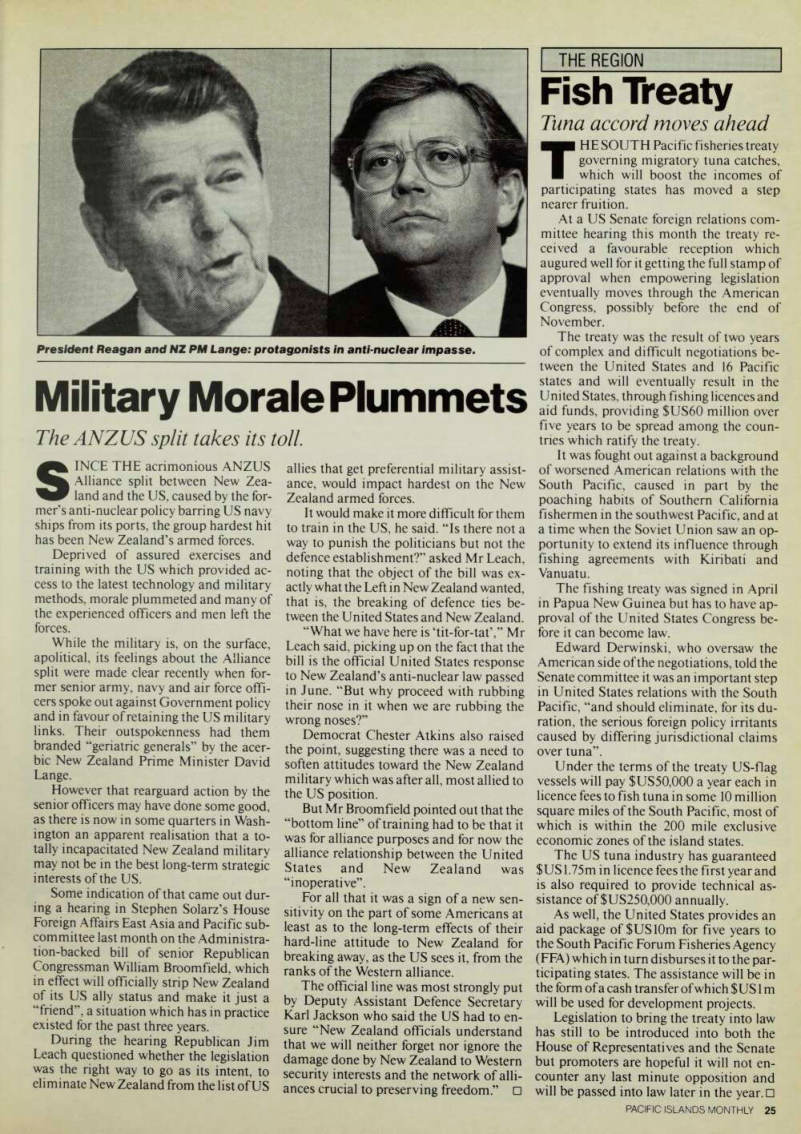
The ANZUS split takes its toll.
SINCE THE acrimonious ANZUS Alliance split between New Zealand and the US, caused by the former’s anti-nuclear policy barring US navy ships from its ports, the group hardest hit has been New Zealand’s armed forces.
Deprived of assured exercises and training with the US which provided access to the latest technology and military methods, morale plummeted and many of the experienced officers and men left the forces.
While the military is, on the surface, apolitical, its feelings about the Alliance split were made clear recently when former senior army, navy and air force officers spoke out against Government policy and in favour of retaining the US military links. Their outspokenness had them branded geriatric generals by the acerbic New Zealand Prime Minister David Lan S e - However that rearguard action by the senior officers may have done some good, as there is now in some quarters in Washington an apparent realisation that a totally incapacitated New Zealand military may not be in the best long-term strategic interests of the US.
Some indication of that came out during a hearing in Stephen Solarz s House Foreign Affairs East Asia and Pacific subcommittee last month on the Administration-backed bill of senior Republican Congressman William Broomfield, which m effect will officially strip New Zealand ° tS ir a - status anc * rnake it just a mend , a situation which has in practice existed for the past three years.
During the hearing Republican Jim each questioned whether the legislation was the right way to go as its intent, to ehmmate New Zealand from the list of US
allies that get preferential military assist ance, would impact hardest on the New Zealand armed forces, it would make it more difficult for them to train in the US, he said. “Is there not a way to punish the politicians but not the defence establishment?” asked Mr Leach, noting that the object of the bill was ex actly what the Left in New Zealand wanted, that is, the breaking of defence ties be tween the United States and New Zealand, “What we have here is ‘tit-for-tat’,” Mr Leach said, picking up on the fact that the bill is the official United States response to New Zealand’s anti-nuclear law passed in June. “But why proceed with rubbing their nose in it when we are rubbing the wrong noses?”
Democrat Chester Atkins also raised the point, suggesting there was a need to soften attitudes toward the New Zealand military which was after all, most allied to the US position, But Mr Broomfield pointed out that the “bottom line” of training had to be that it was for alliance purposes and for now the alliance relationship between the United States and New Zealand was “inoperative”.
For all that it was a sign of a new sett sitivity on the part of some Americans at least as to the long-term effects of their hard-line attitude to New Zealand for breaking away, as the US sees it, from the ranks of the Western alliance, The official line was most strongly put by Deputy Assistant Defence Secretary Karl Jackson who said the US had to en sure “New Zealand officials understand that we will neither forget nor ignore the damage done by New Zealand to Western security interests and the network of alli ances crucial to preserving freedom.” □
President Reagan and NZ PM Lange: protagonists in anti-nuclear impasse.
Fish Treaty
The Region
Tuna accord moves ahead
THE SOUTH Pacific fisheries treaty governing migratory tuna catches, which will boost the incomes of participating states has moved a step nearer fruition.
At a US Senate foreign relations com mittee hearing this month the treaty re ceived a favourable reception which augured well for it getting the full stamp of approval when empowering legislation eventually moves through the American Congress, possibly before the end of November.
The treaty was the result of two years of complex and difficult negotiations be tween the United States and 16 Pacific states and will eventually result in the United States, through fishing licences and aid funds, providing SUS6O million over five years to be spread among the coun tries which ratify the treaty.
It was fought out against a background of worsened American relations with the South Pacific, caused in part by the poaching habits of Southern California fishermen in the southwest Pacific, and at a time when the Soviet Union saw an op portunity to extend its influence through fishing agreements with Kiribati and Vanuatu.
The fishing treaty was signed in April in Papua New Guinea but has to have ap proval of the United States Congress be fore it can become law.
Edward Derwinski, who oversaw the American side of the negotiations, told the Senate committee it was an important step in United States relations with the South Pacific, “and should eliminate, for its du ration, the serious foreign policy irritants caused by differing jurisdictional claims over tuna”.
Under the terms of the treaty US-flag vessels will pay SUSSO,OOO a year each in licence fees to fish tuna in some 10 million square miles of the South Pacific, most of which is within the 200 mile exclusive economic zones of the island states.
The US tuna industry has guaranteed SUS 1.75 m in licence fees the first year and is also required to provide technical as sistance of $U5250,000 annually.
As well, the United States provides an aid package of SUSIOm for five years to the South Pacific Forum Fisheries Agency (FFA) which in turn disburses it to the par ticipating states. The assistance will be in the form of a cash transfer of which SUS 1 m will be used for development projects.
Legislation to bring the treaty into law has still to be introduced into both the House of Representatives and the Senate but promoters are hopeful it will not en counter any last minute opposition and will be passed into law later in the year.D
Sunia Set to Sink
American Samoa
Prosecution now seems certain.
By David S North.
FOFO SUNIA, American Samoa’s delegate to the US Congress, offered to resign his office if the US Attor ney’s Office in Washington dropped pay roll fraud charges against him, according to the authoritative Washington publica tion Roll Call.
The offer was refused, and Sunia and his principal aide, Matthew luli, face pos sible, perhaps probable, criminal prosecution.
Sunia, like other members of the US Congress, has control of a payroll of about SUS4OO,OOO a year. He has been accused of placing four prominent Samoans, in cluding a relative of his, and two uncles of luli, on the payroll in “ghost” jobs involv ing no work. Roll Call reported that one of the employees did not know that he was on the payroll, and never saw or received any cheques from the Government. (See article in Pacific Islands Monthly Octo ber, page 20.) The US Attorney in the District of Co lumbia, an appointee of the Reagan Ad ministration, has opted to press the case in Washington, DC, where the cheques were issued, rather than in American Sa moa, where the people on the payroll live.
This decision has proved to be an expen sive one, because it is said that as many as 20 witnesses from American Samoa have been flown to Washington at more than SUS2,OOO each in round-trip airfare at Government expense.
The legal situation, at time of writing, is; the staff of the US Attorney, Joseph diGenova, after an extensive investiga tion in both Washington and Pago Pago, reportedly offered to indict the Congress man and luli for only one felony, carrying a maximum prison sentence of 10 years, if they pleaded guilty to the single charge.
Alternatively, the US Attorney’s Office would proceed to seek indictments on a series of felony charges.
Sunia made a counter-offer to resign, according to Roll Call, but this was re fused. luli reportedly accepted the offer. (Typically, in such instances in US courts the person or persons accepting the plea bargain, as luli has been said to do, then testifies for the prosecution in the case.
Whether luli will do this is not known; at last report he remained on the Congress man’s payroll.) Since Sunia and the US Attorney’s of fice have not worked out a plea bargain, that office will proceed with its investi gations, and it is expected, perhaps in De cember, to seek a criminal indictment from a grand jury. A trial would follow. The whole process, unless short-circuited by a
plea bargain, could continue well into 1988.
Sunia, and all other Congressmen, face elections in November, 1988.
Sunia’s office has been largely silent on these stories, but it did issue the following statement: “Mr Sunia has not pleaded guilty to anything, and he has not heard anything like that at all. He has not seen or spoken to any investigators from the Se cret Service or any Assistant Attorneys General from the (United States) Depart ment of Justice.”
While the major Washington dailies have paid little attention to Sunia’s troubles, other than a single story in The Washington Post, there has been some speculation about who might seek his po sition if he vacates it before November, 1988. Should such a vacancy occur enough
in advance of the regular election to war rant it, the Governor of Samoa, A P Lutali, could call a special election.
Among the names bandied about in this connection are Eli Hunkin, a Democrat and one-time protege of the late, powerful Chairman of the House Insular Affairs Committee, Philip Burton. Hunkin is now Lt Governor of American Samoa. Also mentioned is Robert Urle, another Sa moan who has held a staff position in the US Congress. Still another name is that of the former Republican Governor of American Samoa, Peter Coleman.
But there will be no by-election until there is a vacancy, and Sunia is showing no outward signs of leaving his position.
He was a witness before a US Senate hear ing recently, in which he pressed for rapid Senate approval of the long-pending tuna treaty. He appeared recently at another Congressional hearing. At both, accord ing to observers, he seemed confident and cheerful. □
Guamanians go to Polls
DAVID SNORTH on the double-headed ballot.
GUAM’S VOTERS go to the polls on November 7 to fill a vacancy in the Territorial Senate and to continue the process of building a new relationship with the US mainland.
The two elections are unrelated, but they are being held the same day in an effort to save money.
The Senate vacancy occurred when Senator Pedro Sanchez, a Democrat, died in August. A four-way contest has devel oped for the seat, and interestingly, none of the three strongest candidates are of Chamorro ancestry (as Sanchez had been).
Two of the four candidates are Demo crats: Sanchez’ widow, a Samoan, and Madeline Bordallo (a Haole), wife of for mer Governor Ricardo Bordallo, who was defeated for re-election last year. Gover nor Bordallo’s case is on appeal. The vote for his wife may indicate how the island feels about the conviction.
The other two candidates are Repub licans: the Party organisation’s choice is Leslie Moreno, a Filipino, while the in dependent Republican is Harry Concep cion, the only candidate with Chamorro blood. The Democratic majority in the Senate is not at stake, as the party will con tinue to control the body no matter who wins in November.
The other part of the election relates to Guam’s desire to work out a new relation ship with the United States. To this end, the Guam Commission on Self Determi nation presented the voters with a draft
Guam Commonwealth Act. The idea is that such a draft would represent Guam’s bargaining posture as it began to negotiate with the US Government in Washington.
To test the population’s feelings, voters had a chance in August to vote separately on 12 different articles: 10 were accepted, with votes ranging from 51 to 61 per cent. No vember’s vote will be a re-run for the two articles turned down by slim margins in the August voting.
Both articles have strong ethnic over tones. Article I calls for a Guam which is a self-governing entity under United States sovereignty and which recognises Cha morros as a distinct group and also recog nises their right to determine their own political future.
This article has been interpreted to mean that only Chamorro voters would have the ultimate right to decide whether Guam seeks independence in the future.
Article VII calls for granting the island Government control of the movement of aliens to Guam (now the responsibility of the Mainland’s Immigration Service) and would not permit aliens living on Guam to use their time on the island to qualify for citizenship. (US law now permits al iens living on Guam for five or more years to apply for citizenship.) These proposed provisions were unpopular in the Filipino community, which feared that an island controlled immigration system would be more likely to deny visas to Filipinos than a Mainland system. □
Advertisements & other items, pp. 27-28 (1 item)
spectrum
The Wonderful World of Spectrum Stereo
If you value your freedom to choose the best things in life, you will appreciate the Kenwood Spectrum stereo system. Each component is separately engineered by world-leading audio specialists. Spectrum: the performance of a life-time, every time you listen.
senes
Spectrum 206 ■ Separate power and control amplifiers ■ 310Wx2 Music Power ■ Full system infra-red remote control ■ Built-in graphic equalizer ■ Digital tuner with two-programme system timer ■ Station Name Preset System ■ Full-logic double cassette deck ■ Relay-play ■ Relay and dual recording ■ Highspeed dubbing ■Quartz-PLL direct-drive turntable with programme memory 9 4-way 6-speaker Super Bass Radiator system ■ Options include CD player and surround sound processor LJ O O LU
KENWOOD CORPORATION
Shionogi Shibuya Building, 17-5, 2-chome Shibuya, Shibuya-ku, Tokyo 150, Japan KENWOOD ELECTRONICS AUSTRALIA PTY. LTD. (incorporated in ns.w> 4E Woodcock Place, Lane Cove, N.SW 2066, Australia NEW ZEALAND PETER GILBERT LTD. Auckland Tel. 0011-64-9-5271313 FUJI PEPE'S DUTY FREE CENTRE LTD. Tel. 25496. 25497 PAPUA NEW GUINEA SO. SVENSSON (N.G.) LTD. Port Moresby Tel. 212158. 212111 SOLOMON ISLANDS TECHNIQUE RADIOS CENTRE LTD. Honiara Tel. 416 NEW CALEDONIA HI-FI VOX Noumea Tel. 27-2466. 28-2931 VANUATU FUNG CHOI LUEN. Port-Vila Tel. 2556
TAHITI MAISON AURORE Papeete Tel. 29703
AMERICAN SAMOA ISLAND PACIFIC AGENCIES. INC. Pago Pago Tel. 633-4687
REPUBLIC OF NAURU NAURU CO-OPERATIVE SOCIETY
MARIANA ISLANDS J.C TENORIO ENTERPRISES Saipan Tel. 6445
Private Line Channels. Microwave and Fiber Systems. Local Area Networks and VAN’s.
Consulting. PBXs. Operations and Maintenance. International Calling. Multiplexers.
Packet Switching. Data Comm. Pagers. Systems Integration. Project Management. Network Planning, Designing, Engineering and Construction Services. Train!
There’s
more to
Hawaiian Tel
than meets
the ear.
HAWAIIAN TEL
Bevoiid the call ketmg » .
Pacific Report
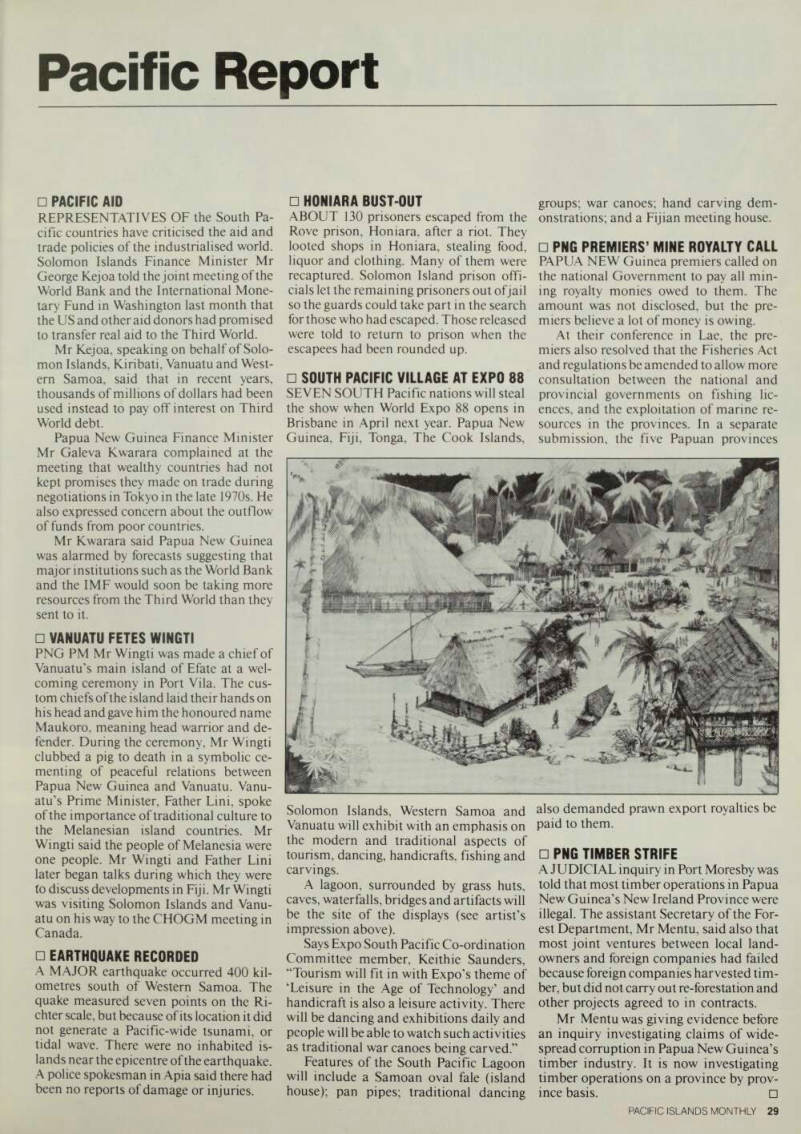
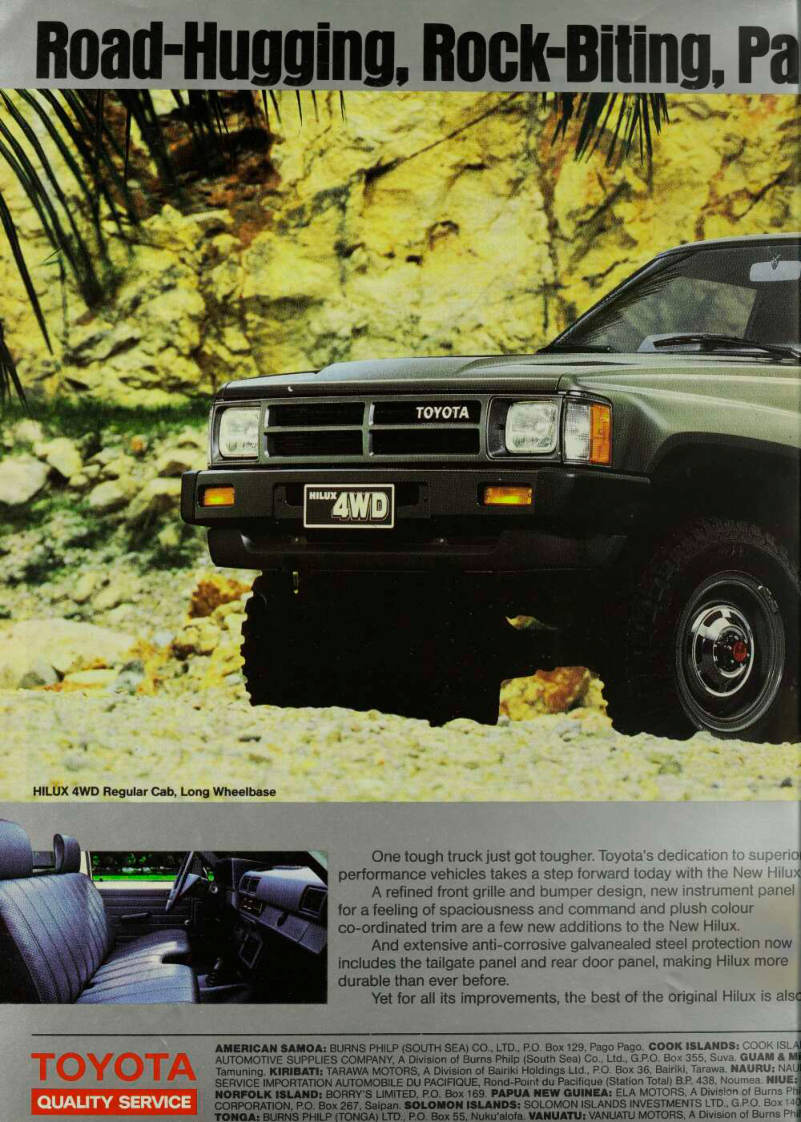

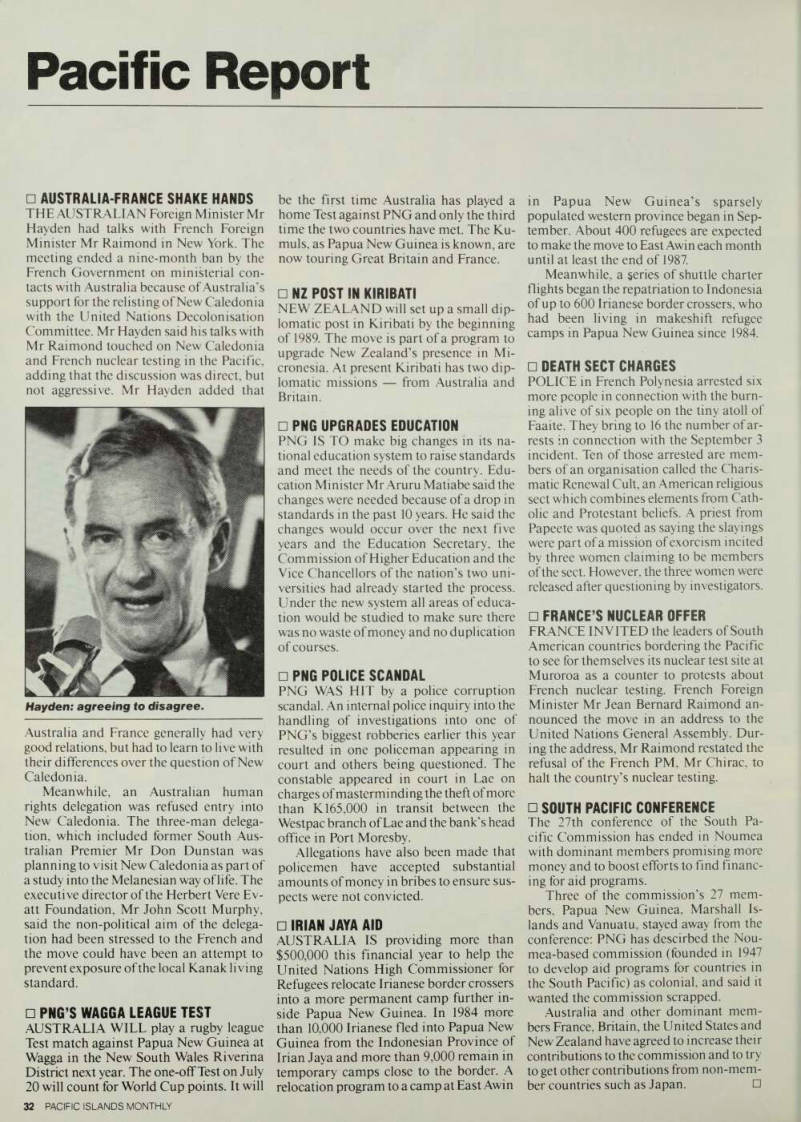
□ Pacific Aid
Representatives Of The South Pa
cific countries have criticised the aid and trade policies of the industrialised world.
Solomon Islands Finance Minister Mr George Kejoa told the joint meeting of the World Bank and the International Mone tary Fund in Washington last month that the US and other aid donors had promised to transfer real aid to the Third World.
Mr Kejoa, speaking on behalf of Solo mon Islands, Kiribati, Vanuatu and West ern Samoa, said that in recent years, thousands of millions of dollars had been used instead to pay off interest on Third World debt.
Papua New Guinea Finance Minister Mr Galeva Kwarara complained at the meeting that wealthy countries had not kept promises they made on trade during negotiations in Tokyo in the late 19705. He also expressed concern about the outflow of funds from poor countries.
Mr Kwarara said Papua New Guinea was alarmed by forecasts suggesting that major institutions such as the World Bank and the IMF would soon be taking more resources from the Third World than they sent to it.
□ Vanuatu Fetes Wingti
PNG PM Mr Wingti was made a chief of Vanuatu’s main island of Efate at a wel coming ceremony in Port Vila. The cus tom chiefs of the island laid their hands on his head and gave him the honoured name Maukoro, meaning head warrior and de fender. During the ceremony, Mr Wingti clubbed a pig to death in a symbolic ce menting of peaceful relations between Papua New Guinea and Vanuatu. Vanu atu’s Prime Minister, Father Lini, spoke of the importance of traditional culture to the Melanesian island countries. Mr Wingti said the people of Melanesia were one people. Mr Wingti and Father Lini later began talks during which they were to discuss developments in Fiji. Mr Wingti was visiting Solomon Islands and Vanu atu on his way to the CHOGM meeting in Canada.
□ Earthquake Recorded
A MAJOR earthquake occurred 400 kil ometres south of Western Samoa. The quake measured seven points on the Ri chter scale, but because of its location it did not generate a Pacific-wide tsunami, or tidal wave. There were no inhabited is lands near the epicentre of the earthquake.
A police spokesman in Apia said there had been no reports of damage or injuries.
□ Honiara Bust-Out
ABOUT 130 prisoners escaped from the Rove prison, Honiara, after a riot. They looted shops in Honiara, stealing food, liquor and clothing. Many of them were recaptured. Solomon Island prison offi cials let the remaining prisoners out ofjail so the guards could take part in the search for those who had escaped. Those released were told to return to prison when the escapees had been rounded up. □ SOUTH PACIFIC VILLAGE AT EXPO 88 SEVEN SOUTH Pacific nations will steal the show when World Expo 88 opens in Brisbane in April next year. Papua New Guinea, Fiji, Tonga, The Cook Islands,
Solomon Islands, Western Samoa and Vanuatu will exhibit with an emphasis on the modern and traditional aspects of tourism, dancing, handicrafts, fishing and carvings.
A lagoon, surrounded by grass huts, caves, waterfalls, bridges and artifacts will be the site of the displays (see artist’s impression above).
Says Expo South Pacific Co-ordination Committee member, Keithie Saunders, “Tourism will fit in with Expo’s theme of ‘Leisure in the Age of Technology’ and handicraft is also a leisure activity. There will be dancing and exhibitions daily and people will be able to watch such activities as traditional war canoes being carved.”
Features of the South Pacific Lagoon will include a Samoan oval fale (island house); pan pipes; traditional dancing
groups; war canoes; hand carving dem onstrations; and a Fijian meeting house.
□ Png Premiers’ Mine Royalty Call
PAPUA NEW Guinea premiers called on the national Government to pay all min ing royalty monies owed to them. The amount was not disclosed, but the pre miers believe a lot of money is owing.
At their conference in Lae, the pre miers also resolved that the Fisheries Act and regulations be amended to allow more consultation between the national and provincial governments on fishing lic ences, and the exploitation of marine re sources in the provinces. In a separate submission, the five Papuan provinces
also demanded prawn export royalties be paid to them.
□ Png Timber Strife
A JUDICIAL inquiry in Port Moresby was told that most timber operations in Papua New Guinea’s New Ireland Province were illegal. The assistant Secretary of the For est Department, Mr Mentu, said also that most joint ventures between local land owners and foreign companies had failed because foreign companies harvested tim ber, but did not carry out re-forestation and other projects agreed to in contracts.
Mr Mentu was giving evidence before an inquiry investigating claims of wide spread corruption in Papua New Guinea’s timber industry. It is now investigating timber operations on a province by prov ince basis. □
□ Australia-France Shake Hands
THE AUSTRALIAN Foreign Minister Mr Hayden had talks with French Foreign Minister Mr Raimond in New York. The meeting ended a nine-month ban by the French Government on ministerial con tacts with Australia because of Australia’s support for the relisting of New Caledonia with the United Nations Decolonisation Committee. Mr Hayden said his talks with Mr Raimond touched on New Caledonia and French nuclear testing in the Pacific, adding that the discussion was direct, but not aggressive. Mr Hayden added that
Australia and France generally had very good relations, but had to leam to live with their differences over the question of New Caledonia.
Meanwhile, an Australian human rights delegation was refused entry into New Caledonia. The three-man delega tion, which included former South Aus tralian Premier Mr Don Dunstan was planning to visit New Caledonia as part of a study into the Melanesian way of life. The executive director of the Herbert Vere Ev att Foundation, Mr John Scott Murphy, said the non-political aim of the delega tion had been stressed to the French and the move could have been an attempt to prevent exposure of the local Kanak living standard.
□ Png’S Wagga League Test
AUSTRALIA WILL play a rugby league Test match against Papua New Guinea at Wagga in the New South Wales Riverina District next year. The one-off Test on July 20 will count for World Cup points. It will
be the first time Australia has played a home Test against PNG and only the third time the two countries have met. The Ku muls, as Papua New Guinea is known, are now touring Great Britain and France.
□ Nz Post In Kiribati
NEW ZEALAND will set up a small dip lomatic post in Kiribati by the beginning of 1989. The move is part of a program to upgrade New Zealand’s presence in Mi cronesia. At present Kiribati has two dip lomatic missions from Australia and Britain.
□ Png Upgrades Education
PNG IS TO make big changes in its na tional education system to raise standards and meet the needs of the country. Edu cation Minister Mr Aruru Matiabe said the changes were needed because of a drop in standards in the past 10 years. He said the changes would occur over the next five years and the Education Secretary, the Commission of Higher Education and the Vice Chancellors of the nation’s two uni versities had already started the process.
Under the new system all areas of educa tion would be studied to make sure there was no waste of money and no duplication of courses.
□ Png Police Scandal
PNG WAS HIT by a police corruption scandal. An internal police inquiry into the handling of investigations into one of PNG’s biggest robberies earlier this year resulted in one policeman appearing in court and others being questioned. The constable appeared in court in Lae on charges of masterminding the theft of more than K 165,000 in transit between the Westpac branch of Lae and the bank’s head office in Port Moresby.
Allegations have also been made that policemen have accepted substantial amounts of money in bribes to ensure sus pects were not convicted.
□ Irian Java Aid
AUSTRALIA IS providing more than $500,000 this financial year to help the United Nations High Commissioner for Refugees relocate Irianese border crossers into a more permanent camp further in side Papua New Guinea. In 1984 more than 10,000 Irianese fled into Papua New Guinea from the Indonesian Province of Irian Jaya and more than 9,000 remain in temporary camps close to the border. A relocation program to a camp at East Awin
in Papua New Guinea’s sparsely populated western province began in Sep tember. About 400 refugees are expected to make the move to East Awin each month until at least the end of 1987.
Meanwhile, a series of shuttle charter flights began the repatriation to Indonesia of up to 600 Irianese border crossers, who had been living in makeshift refugee camps in Papua New Guinea since 1984.
□ Death Sect Charges
POLICE in French Polynesia arrested six more people in connection with the burn ing alive of six people on the tiny atoll of Faaite. They bring to 16 the number of ar rests in connection with the September 3 incident. Ten of those arrested are mem bers of an organisation called the Charis matic Renewal Cult, an American religious sect which combines elements from Cath olic and Protestant beliefs. A priest from Papeete was quoted as saying the slayings were part of a mission of exorcism incited by three women claiming to be members of the sect. However, the three women were released after questioning by investigators.
□ France’S Nuclear Offer
FRANCE INVITED the leaders of South American countries bordering the Pacific to see for themselves its nuclear test site at Muroroa as a counter to protests about French nuclear testing. French Foreign Minister Mr Jean Bernard Raimond an nounced the move in an address to the United Nations General Assembly. Dur ing the address, Mr Raimond restated the refusal of the French PM, Mr Chirac, to halt the country’s nuclear testing.
□ South Pacific Conference
The 27th conference of the South Pa cific Commission has ended in Noumea with dominant members promising more money and to boost efforts to find financ ing for aid programs.
Three of the commission’s 27 mem bers, Papua New Guinea, Marshall Is lands and Vanuatu, stayed away from the conference: PNG has descirbed the Nou mea-based commission (founded in 1947 to develop aid programs for countries in the South Pacific) as colonial, and said it wanted the commission scrapped.
Australia and other dominant mem bers France, Britain, the United States and New Zealand have agreed to increase their contributions to the commission and to try to get other contributions from non-mem ber countries such as Japan. □
Hayden: agreeing to disagree.
Advertisements & other items, pp. 30-31 (1 item)
Toyota
HILUX 4WD Regular Cab, Long Wheelbase m One tough truck just got tougher. Toyota’s dedication to superio performance vehicles takes a step forward today with the New Hiiux A refined front grille and bumper design, new instrument panel for a feeling of spaciousness and command and plush colour co-ordinated trim are a few new additions to the New Hiiux.
And extensive anti-corrosive galvanealed steel protection now includes the tailgate panel and rear door panel, making Hiiux more durable than ever before.
Yet for all its improvements, the best of the original Hiiux is als(
TOYOTA
QUALITY SERVICE
AMERICAN SAMOA: BURNS PHILP (SOUTH SEA) CO., LTD., P.O. Box 129, Pago Pago. COOK ISLANDS: COOK ISLA AUTOMOTIVE SUPPLIES COMPANY, A Division of Burns Philp (South Sea) Co., Ltd., G.P.O. Box 355, Suva. GUAM & Ml Tamuning. KIRIBATI; TARAWA MOTORS, A Division of Bairiki Holdings Ltd., P.O. Box 36, Bairiki, Tarawa. NAURU: NALH SERVICE IMPORTATION AUTOMOBILE DU PACIFIQUE, Rond-Point du Pacifique (Station Total) B.P. 438, Noumea. NIUE:| NORFOLK ISLAND: BORRY’S LIMITED, P.O. Box 169. PAPUA NEW GUINEA: ELA MOTORS, A Division of Burns Phi CORPORATION, P.O. Box 267, Saipan. SOLOMON ISLANDS: SOLOMON ISLANDS INVESTMENTS LTD., G.P.O. Box 1 4d TONGA: BURNS PHILP (TONGA) LTD., P.O. Box 55, Nukualofa. VANUATU: VANUATU MOTORS. A Division of Burns Phil
iflc-TouglL The New Hllux.
-P V‘ ? ' V a
rr vi
m % » v- I N-r \ - «r #4^ '• Jd 4 0* *4 *** W h * nwt lere: a big tailgate conveniently hinged for quick loading and unloading; reinforced front suspension to smooth out he bumps, and bias-mounted, extra-heavy-duty rear shocks and knobbly tyres to take on any terrain.
Toyota’s long history of super-responsive engines, ruggedness, reliability and comfort goes without saying. And in the Hilux, it’s yours in both 2-wheel-drive and 4x4 versions.
So, after comprehensive testing and thorough quality control, the New Hilux is ready to bring a new standard of toughness to the Pacific.
And isn’t that exactly what you expect from Toyota?
Areas where galvanealed steel is used *\DING CORPORATION LTD., Private Bag, Rarotonga. FIJI: ESIA: ATKINS KROLL, INC., 443 South Marine Drive,
OPERATIVE SOCIETY, Central Pacific. NEW CALEDONIA:
PHILP (SOUTH SEA) CO., LTD., P.O. Box 39. Alofi. ) Ltd., P.O. Box 75, Port Moresby. SAIPAN: MICROL a. TAHITI: NIPPON AUTOMOTO, B.P. 342, Papeete atu) Ltd., P.O. Box 18, Port Vila. WESTERN SAMOA:
TOYOTA
Economies
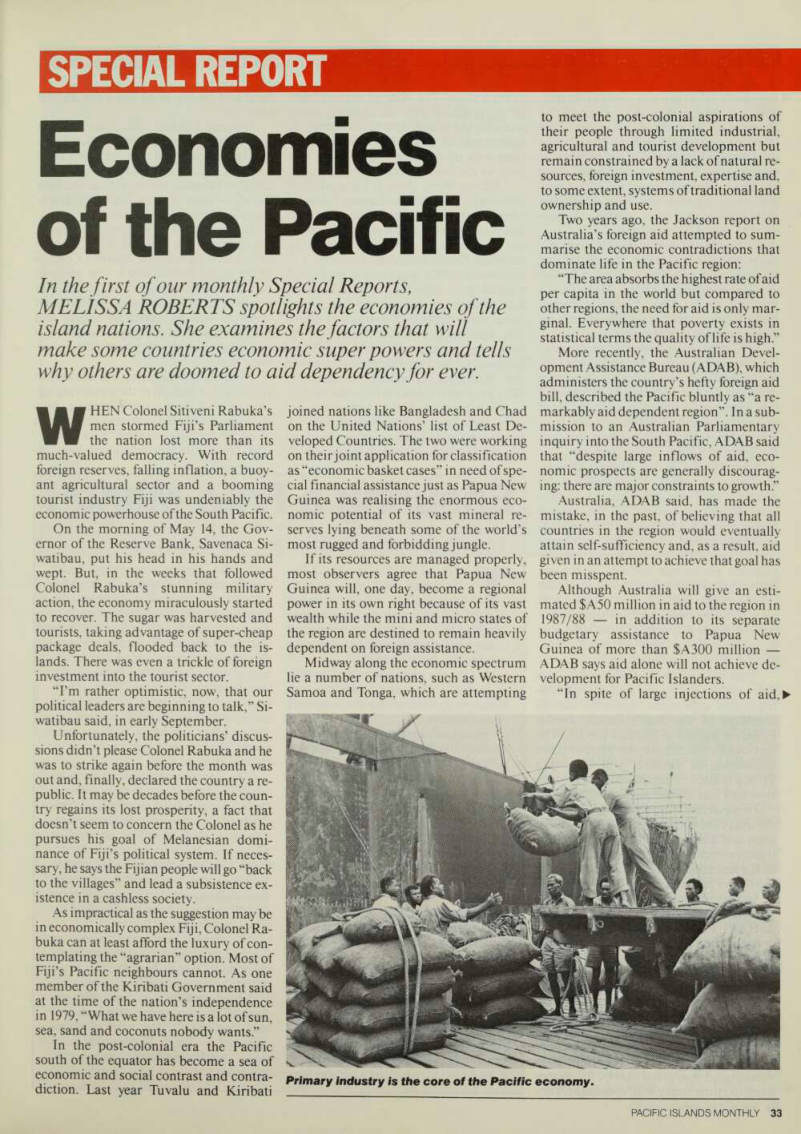
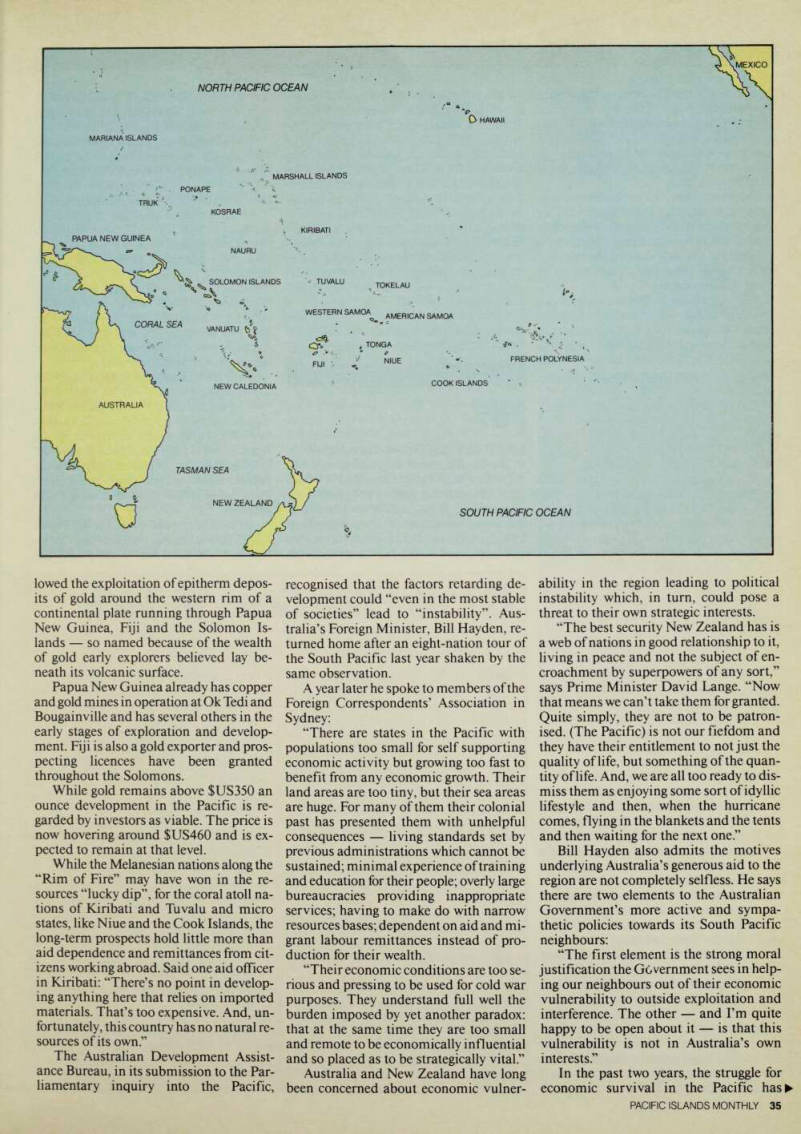
Special Report
Economies of the Pacific
In the first of our monthly Special Reports, MELISSA ROBERTS spotlights the economies of the island nations. She examines the factors that will make some countries economic super powers and tells why others are doomed to aid dependency for ever.
WHEN Colonel Sitiveni Rabuka’s men stormed Fiji’s Parliament the nation lost more than its much-valued democracy. With record foreign reserves, falling inflation, a buoy ant agricultural sector and a booming tourist industry Fiji was undeniably the economic powerhouse of the South Pacific.
On the morning of May 14, the Gov ernor of the Reserve Bank, Savenaca Si watibau, put his head in his hands and wept. But, in the weeks that followed Colonel Rabuka’s stunning military action, the economy miraculously started to recover. The sugar was harvested and tourists, taking advantage of super-cheap package deals, flooded back to the is lands. There was even a trickle of foreign investment into the tourist sector.
“I’m rather optimistic, now, that our political leaders are beginning to talk,” Si watibau said, in early September.
Unfortunately, the politicians’ discus sions didn’t please Colonel Rabuka and he was to strike again before the month was out and, finally, declared the country a re public. It may be decades before the coun try regains its lost prosperity, a fact that doesn’t seem to concern the Colonel as he pursues his goal of Melanesian domi nance of Fiji’s political system. If neces sary, he says the Fijian people will go “back to the villages” and lead a subsistence ex istence in a cashless society.
As impractical as the suggestion may be in economically complex Fiji, Colonel Ra buka can at least afford the luxury of con templating the “agrarian” option. Most of Fiji’s Pacific neighbours cannot. As one member of the Kiribati Government said at the time of the nation’s independence in 1979, “What we have here is a lot of sun, sea, sand and coconuts nobody wants.”
In the post-colonial era the Pacific south of the equator has become a sea of economic and social contrast and contra diction. Last year Tuvalu and Kiribati
joined nations like Bangladesh and Chad on the United Nations’ list of Least De veloped Countries. The two were working on their joint application for classification as “economic basket cases” in need of spe cial financial assistance just as Papua New Guinea was realising the enormous eco nomic potential of its vast mineral re serves lying beneath some of the world’s most rugged and forbidding jungle.
If its resources are managed properly, most observers agree that Papua New Guinea will, one day, become a regional power in its own right because of its vast wealth while the mini and micro states of the region are destined to remain heavily dependent on foreign assistance.
Midway along the economic spectrum lie a number of nations, such as Western Samoa and Tonga, which are attempting
to meet the post-colonial aspirations of their people through limited industrial, agricultural and tourist development but remain constrained by a lack of natural re sources, foreign investment, expertise and, to some extent, systems of traditional land ownership and use.
Two years ago, the Jackson report on Australia’s foreign aid attempted to sum marise the economic contradictions that dominate life in the Pacific region: “The area absorbs the highest rate of aid per capita in the world but compared to other regions, the need for aid is only mar ginal. Everywhere that poverty exists in statistical terms the quality of life is high.”
More recently, the Australian Devel opment Assistance Bureau (ADAB), which administers the country’s hefty foreign aid bill, described the Pacific bluntly as “a re markably aid dependent region”. In a sub mission to an Australian Parliamentary inquiry into the South Pacific, ADAB said that “despite large inflows of aid, eco nomic prospects are generally discourag ing: there are major constraints to growth.”
Australia, ADAB said, has made the mistake, in the past, of believing that all countries in the region would eventually attain self-sufficiency and, as a result, aid given in an attempt to achieve that goal has been misspent.
Although Australia will give an esti mated SASO million in aid to the region in 1987/88 in addition to its separate budgetary assistance to Papua New Guinea of more than SA3OO million ADAB says aid alone will not achieve de velopment for Pacific Islanders.
“In spite of large injections of aid>
Primary industry is the core of the Pacific economy.
< standards of living are tending to fall.
Trends to the year 2000 are worrying.” The Bureau says the small size of many of the countries added to their large populations causes a significant part of the problem. It believes their limited revenue bases, their remoteness from markets and high trans port costs, as well as their open economies with little government control, all con spire to retard development.
To that list of disadvantages many ex perts add the high cost of maintaining bureaucracies of a type that only a former colonial master can afford. More than a third of Papua New Guinea’s annual budget, for example, is swallowed up in re current administrative costs.
If ADAB’s assessments of post-colon ial economic trends in the region are cor rect, the task of removing what the agency calls the “major constraints to growth” now rests heavily with a new generation of university-educated politicians like lere mia Tabai, who, at 29, became the first President of Kiribati eight years ago.
Formerly the British Gilbert islands, Kiribati is a nation of 690 square kilo metres of land area dotted across 3.5 mil lion square kilometres of the central Pacific. With a population of only 60,000 it already suffers chronically from over population. While the search continues for valuable manganese nodules on the sea floor, the country’s only proven resources remain copra and fish. But when asked what he wants for his people President Ta bai’s response is simple: “I want to be able to say no to foreign aid,” he says, “self re spect is very important to us.”
That sort of determination led, this year, to the signing of a multilateral fish ing-access agreement between the 16 members of the South Pacific Forum Fisheries Agency (FFA) and the US. The agreement, which took two years of bitter negotiation to finalise, will be worth SUS6O million to the island nations in lic ence fees and US industry assistance.
However, the money can only flow once the treaty has been ratified by the US Con gress and although the Reagan Adminis tration recognises the strategic importance of the agreement it remains bound up in legislative red tape.
In the meantime, members of the American Tunaboat Association, says FFA director Philip Muller, continue to “poach” tuna in the 320 kilometre Exclu sive Economic Zones that surround the is lands. Last year Australia offered to supply naval patrol boats to the island states un der various defence co-operation agree ments, but there were few takers. Most could not afford the annual running costs of $A200,000.
While the wheels of government in Washington may grind slowly, the money from the tuna treaty will, eventually, flow
to the Pacific. The price of tuna sashimi for the tables of Japan, is currently rising and with the islands free to also conclude agreements on a bilateral or multilateral basis with other fishing nations, the out look for the industry seems bright.
Unfortunately, there is less optimism surrounding the future of copra. Prices on world markets have only risen slightly on last year, to about a fifth of their 1984 lev els. At a recent meeting in Suva called by the South Pacific Bureau for Economic Co operation (SPEC), copra producers formed a cartel in the hope of saving the industry but, with strong competition from other, more easily processed, sources of edible oils, analysts doubt that it will ever re cover. Particularly with Spain and Portu gal, both oil seed producers, now pressing the European Economic Community (EEC) to restrict imports from the Pacific.
With nowhere else to turn some na tions have been looking increasingly to wards tourism as a future source of income but the industry is severely under-devel
oped and patchy in all but a few Pacific countries.
Pre-coup Fiji had 360,000 arrivals last year while Western Samoa, which has a similar climate and sun, sea and sand which is just as attractive but with vir tually no facilities, managed to attract only 20,000 most of them nationals return ing to see family and friends.
Recognising the long-term potential of the industry, nevertheless, SPEC has es tablished a Suva-based Tourism Council of the South Pacific which now operates on a SUSS million grant from the EEC. On behalf of its 20 members (the independent states as well as American Samoa and French Polynesia) the council aims to co ordinate tourist development on a region wide basis.
More capital-intensive, but less subject to changes in fashion or the unnerving im pact of a military coup, is mining. New discoveries have led to an investment rush along the Pacific’s so-called “Rim of Fire”.
The latest mining techniques have al-
lowed the exploitation of epitherm depos its of gold around the western rim of a continental plate running through Papua New Guinea, Fiji and the Solomon Is lands so named because of the wealth of gold early explorers believed lay be neath its volcanic surface.
Papua New Guinea already has copper and gold mines in operation at Ok Tedi and Bougainville and has several others in the early stages of exploration and develop ment. Fiji is also a gold exporter and pros pecting licences have been granted throughout the Solomons.
While gold remains above SUS3SO an ounce development in the Pacific is re garded by investors as viable. The price is now hovering around SUS46O and is ex pected to remain at that level.
While the Melanesian nations along the “Rim of Fire” may have won in the re sources “lucky dip”, for the coral atoll na tions of Kiribati and Tuvalu and micro states, like Niue and the Cook Islands, the long-term prospects hold little more than aid dependence and remittances from cit izens working abroad. Said one aid officer in Kiribati: “There’s no point in develop ing anything here that relies on imported materials. That’s too expensive. And, un fortunately, this country has no natural re sources of its own.”
The Australian Development Assist ance Bureau, in its submission to the Par liamentary inquiry into the Pacific,
recognised that the factors retarding de velopment could “even in the most stable of societies” lead to “instability”. Aus tralia’s Foreign Minister, Bill Hayden, re turned home after an eight-nation tour of the South Pacific last year shaken by the same observation.
A year later he spoke to members of the Foreign Correspondents’ Association in Sydney: “There are states in the Pacific with populations too small for self supporting economic activity but growing too fast to benefit from any economic growth. Their land areas are too tiny, but their sea areas are huge. For many of them their colonial past has presented them with unhelpful consequences living standards set by previous administrations which cannot be sustained; minimal experience of training and education for their people; overly large bureaucracies providing inappropriate services; having to make do with narrow resources bases; dependent on aid and mi grant labour remittances instead of pro duction for their wealth.
“Their economic conditions are too se rious and pressing to be used for cold war purposes. They understand full well the burden imposed by yet another paradox: that at the same time they are too small and remote to be economically influential and so placed as to be strategically vital.”
Australia and New Zealand have long been concerned about economic vulner
ability in the region leading to political instability which, in turn, could pose a threat to their own strategic interests.
“The best security New Zealand has is a web of nations in good relationship to it, living in peace and not the subject of en croachment by superpowers of any sort,” says Prime Minister David Lange. “Now that means we can’t take them for granted.
Quite simply, they are not to be patron ised. (The Pacific) is not our fiefdom and they have their entitlement to not just the quality of life, but something of the quan tity of life. And, we are all too ready to dis miss them as enjoying some sort of idyllic lifestyle and then, when the hurricane comes, flying in the blankets and the tents and then waiting for the next one.”
Bill Hayden also admits the motives underlying Australia’s generous aid to the region are not completely selfless. He says there are two elements to the Australian Government’s more active and sympa thetic policies towards its South Pacific neighbours: “The first element is the strong moral justification the Government sees in help ing our neighbours out of their economic vulnerability to outside exploitation and interference. The other and I’m quite happy to be open about it is that this vulnerability is not in Australia’s own interests.”
In the past two years, the struggle for economic survival in the Pacific has I
◄ brought the “Cold War” between East and West into the heart of the region. An an nouncement from tiny Kiribati, in late 1985, that it was signing a fishing-access agreement with the Soviet Union sent State Department officials in Washington scur rying for their atlas.
President Tabai claimed that he was doing no more than looking after the fi nancial interests of his poverty-stricken people. While American fishermen poached his nation’s only viable resource the Russians, Tabai said, “were prepared to pay and pay on time”.
Washington, nevertheless, accused the President of Kiribati of undermining the defence of the West by turning what was once a “tranquil ANZUS lake” into an other Cold War battlefield. In late 1986 the agreement between Kiribati and the So viet Union collapsed when Moscow claimed it was not getting value for money out of the nation’s Central Pacific waters and wanted to halve its fleet of 16 ships and the licence fee of $A2.4 million it was pay ing to the Government in Taraway.
At one point an angry leremia Tabai declared: “The Americans think we are so poor we will bite at anything, but they are wrong,” and, almost as if to prove his ar gument, he rejected the new Soviet deal.
Vanuatu has since signed an agreement with the Soviet Union and Bill Hayden has laid the blame for Moscow’s successes squarely on the shoulders of the American Tunaboat Association and the Adminis tration in Washington.
“There can be little doubt,” Hayden says, “that the Soviet interest in doing fishing deals with South Pacific nations is connected to clumsy attempts by private American interests to exploit fishing areas (in the region).”
Japan, too, has signalled that it no longer intends taking the Pacific for granted. Although the region receives less than one per cent of its total aid budget, Tokyo’s assistance to the islands has been growing faster than contributions from any other donor. In 1985 the Japanese spent SA23 million in the islands and nearly SA6 million in Papua New Guinea. During a swing through the Pacific in January, For eign Minister Kuranari announced the es tablishment of a SUS 2 million special development fund for the region and in vited South Pacific Forum officials to make regular visits to Japan.
While Tokyo is keen to move in (to keep the Soviets out) it recognises that it has a lot to learn about the unique problems as sociated with donating aid to the mini and micro states of the Pacific. Japanese offi cials have regularly sought advice from Australian experts. “Their bureaucracy, for a start, is not geared towards projects that don’t run to millions of dollars,” said a Canberra-based aid officer.
While Australia has undertaken larger projects, such as the Maritime Training School in Tuvalu and a desiccated coco nut factory in Tonga, 95 of Canberra’s 169 current projects are valued at less than $A250,000. The 47 projects scheduled for Tonga in 1986/87, for example, totalled no more than SAS million. In the past year, the South Pacific Regional Trade and Eco nomic Co-operation Agreement (SPAR TECA), which gives island producers duty free access to Australian and New Zealand markets, has also emphasised the need for aid investment in export oriented industries.
“There is no point in allowing them into our markets,” observed an Australian of ficial, “unless they have something to sell.”
Ensuring a Free Market
A reborn Sparteca agreement protects Pacific trade.
THE NATIONS of the South Pa cific are of vital importance to Australia. Not only is the region of strategic importance as the nations straddle the sea lanes to Australia’s major trading partners, but they also constitute a large market.
In fact, the trade balance is so much in Australia’s favour that the issue has become a sore point over the years with island leaders.
Australia’s exports to the members of the South Pacific Forum in 1985/86, including New Zealand and Papua New Guinea, amounted to SA32I million.
Imports, on the other hand, were around one third of that figure, at SAI27 million. But in 1985 the Aus tralian and New Zealand Govern ments liberalised their import regulations to accord duty free and un restricted access to almost all island exports.
Excepted from the open market in Australia were four areas: sugar, steel, passenger motor vehicles and the prod ucts of the footware, clothing and tex tile industry which were protected by tariffs and quotas. While the clothing import quota has been liberalised more recently, some restrictions remain.
The decision revitalised the exist ing South Pacific Regional Trade and Economic Co-operation Agreement, (SPARTECA), which had been in force
since 1981 in order to encourage South Pacific trade. The agreement is a pref erential, non-reciprocal agreement be tween Australia, New Zealand and the member countries of the South Pacific Forum to progressively achieve duty free and unrestricted access to the mar kets of Australia and New Zealand over a wide range of products.
However the range of items pro duced by the South Pacific nations re mains small and often overlaps with goods already produced in Australia, such as tropical fruit.
The Sparteca agreement provides island exporters with help to promote their products in Australia and New Zealand and gain economic co-opera tion in projects. The Australian Government funds the South Pacific Trade Commissioner, who is based in Sydney and whose job it is to help is land states to develop goods for export and to seek new markets for their ex isting industries.
The revised agreement formed at the Forum’s regional committee on Trade, meeting in Nauru in 1985, also liber alised the rules of origin of goods.
Island governments see the re formed Sparteca agreement as a suc cess. In 1982, 97 per cent of goods exported by South Pacific island na tions were exported under the agreement. □
Advertisements & other items, p. 34 (1 item)
Special Report
Fiji
UNTIL last May, Fiji was the success story of the Pacific, the only country listed in ADAB’s “Self Sufficiency Model” cate gory for countries with a relatively high standard of living, skilled workforce and infrastructure and a very reasonable level of independence. It had successful tourist and sugar industries and was the only na
tion in the region with a manufacturing base. But the economy of post-coup Fiji is extremely vulnerable.
Investors are sitting back to watch what will happen on the political scene before they commit their money to the country.
And the situation has been exacerbated by the recent devaluation of the dollar.
“If the political situation in Fiji is not resolved shortly,” Westpac’s manager for the Western Pacific, Mr Russell Leitch, said, “the economy of Fiji will suffer further.”
According to Mr Leitch, the economy “dropped to a lower plane” after the first coup than the latest ruction. However, he said if a political solution was not soon found, investor confidence, and with it the economy, would suffer more.
“Fiji is in for a fairly tight period,” Mr Leitch said.
The second coup has pushed Fiji’s for eign exchange reserves down to SFIIO mil lion. According to the Governor of the Reserve Bank, Mr Savenaca Siwatibau, just weeks before the second coup the slide had been arrested and reserves had been stabilised at SFI3O million following a wild drop.
Before the original coup, Mr Siwatibau said, Fiji was “doing very well. Our infla tion rate was quite low last year it was
less than two per cent. Our foreign re serves were the highest they had been in fact it was SFI7O million extremely high compared to previous years and in vestments were beginning to come in. We were looking forward to a balance in our current account. Things were looking ex tremely good.”
To prevent the economy going into a tail spin, the currency was devalued, interest rates were uncapped, and rapidly hit 20 per cent, and public sector salaries were cut by 15 per cent.
In the private sector, some workers took cuts of 50 per cent.
But even the most prompt action could not recover lost investor confidence. The second coup struck a more savage blow as it proved the changes taking place in Fiji were far more than a temporary disruption.
“Fiji has permanently lost some in vestments through the coup and others have been delayed,” the South Pacific Trade Commissioner, Mr Bill McCabe, said.
“It will take time to rebuild investor confidence. Money is nervous.”
It is believed that projects worth hundreds of millions of dollars have been put on hold and observers say that Fiji has now lost some developments to other is land nations.
Investor confidence has also been hit by the Government’s slamming the door
on the flood of foreign exchange leaving the country.
While it was necessary to stem the flow, the penalty for the rigid control of the movement of capital is that it is hard to en tice new investment.
Money is nervous at home as well.
“Business is disastrous,” Mr McCabe said.
“Trade through consumer items in retail is way down about 50 per cent of what it was in early May. In some ways that is not too bad as imports are down and people are growing their own food. But the sales of big items, such as cars and refrig erators, are almost nil. There is simply no consumer confidence to spend what money they have.”
Situated on the trade route to Australia and the US, Fiji is the only independent South Pacific nation to have a significant manufacturing base. Its clothing industry already exports more than $F4m worth of goods to Australia, and it was expected be fore the coup that the industry could have been producing SFlOm worth of export income by the end of next year. Fiji’s sugar industry benefits from access to the lucra tive American market, but that, too, is un der a shadow following the coup as observers question the willingness of In dians to cultivate their holdings during a time of upheaval.
The tourist industry has also suffered with occupancies dropping to just five per cent immediately after the coup. They
quickly rose to 55 per cent, just covering break-even point, but the second coup will have further negative effects on this vital sector of the Fiji economy.
Burns Philp Goes Hi-Tech
A change ofpolicy for the trading giant.
THE ISLANDS trader and now industrial group Bums Philp & Co reported a 45 per cent jump in its after tax profits to SASB million for the year.
The Chief Executive of Bums Philp, Mr Andrew Turnbull, attributed the strong result to the performance of its recent acquisition, the American food giant, Fleishmann. He said the United States yeast and vinegar producer had “kicked in about SAI4 million” to help double the profit of the food arm.
The group lifted its pre-tax profit by 32 per cent to a record figure of $lOl million.
Bums Philp is in the process of shrugging off its traditional image of a south sea islands trader and is becom ing more heavily involved in high tech nology food production.
Mr Turnbull said the firm had ab solutely no regrets about its change in direction, but stressed it was not in tending to pull out of the Pacific. “There have been rumours, but we intend to keep our commitment to the region,” he said in Sydney.
Mr Turnbull described the com pany’s decision to expand in more lu crative directions as in keeping with the “hard nosed” business principles of the original founders. Bums Philp plans to continue its campaign of acquiring companies both in Australia and over seas that fit into the group’s core businesses.
The company has been hiving off its loss making or less profitable interests and concentrating on its core business, such as food production, hardware, shipping and trading and its invest ment interests. However, Mr Turnbull said Burns Philp’s shipping and trad ing as well as its Pacific division had reported improved results.
The company has divested itself of a range of businesses, including its photographic interests, its 50 per cent holding in the stevedoring company Conaust Ltd and its finance subsidiary Burns Philp Finance Ltd.
It is also in the process of selling Ira Berk Pty Ltd, its wholesale distribu tion network for Nissan motor vehi cles, which will result in a net loss to the
company, and Burns Philp Travel.
Despite losses in closing down or selling non-strategic businesses, Burns Philp netted an extraordinary profit on the sale of properties and investments, including the company’s plantations in Papua New Guinea.
The Pacific operations had experi enced a “big lift” from $A4.9m to $A7.lm, particularly through the prof itability of the Papua New Guinea op erations, where the company had successfully replicated its clean-up campaign. “We are doing what we did in Australia getting rid of the loss makers, which means a general im provement in the effectiveness and ef ficiency of business. It has come home with a bang,” Mr Turnbull said.
The company has spent a total of $A2OOm on Fleishmann’s, including the purchase price and the installation of state of the art Australian technol ogy. “The food division is coming through very strongly, and the US business is very attractive,” Mr Turn bull said.
Mr Turnbull said the company was keen to continue to make acquisitions and form joint ventures. “We are look ing at several possibilities in Australia and overseas,” he said.
Mr Turnbull said now that the core
businesses were “clean and tidy”, the group would continue to grow strongly.
He said the company would concen trate on consolidating the gains it made during the 1986/87 financial year, and said the present financial year would be profitable, but less dramatic. Equity profits, mainly from QBE Insurance, returned an improved result at $A 11.5 million.
The overall improvement in profit was partly offset by an increase in in come tax due to a rise in the corporate tax rate and the fact that the company is gradually using up its available tax losses.
Mr Turnbull said the company’s overall tax rate was significantly lower than the average corporate rate as a sig nificant proportion of the profits were earned overseas in countries that im posed a lower tax burden.
Mr Turnbull said the company ex perienced no foreign exchange expo sure, as they had naturally hedged their borrowings overseas against their in terests in each country.
He said Australian debt had been reduced through a recent rights issue and share placement, and added that their debts in the United States were at the comparatively low interest rate of eight per cent. □
Advertisements & other items, p. 36 (1 item)
Special Report
Nauru
THE island is, per capita, one of the rich est countries in the world. It is the only is land state that receives no aid, but actually gives some assistance to its neighbours.
Observers believe that aid may not be come necessary for Nauru if the returns from the country’s phosphate mining in dustry are invested wisely.
Nauru is a small, round island of just 24 square km and a population of around 7000. Its GNP is sloom, giving it a per capital income of $13,000.
While the phosphate lasts, Nauru will remain wealthy. However, the reserves of phosphate are rapidly being depleted and while the Government estimates there are 10 years of mining left, some observers be lieve the island could be worked out in less than three.
The country has few other prospects for development. The soil is poor and rainfall is irregular, limiting the prospects for agriculture.
A question mark hangs over the hus banding of the income from the phos phate mine, and according to ADAB, some technical financial assistance may be nec essary to prevent Nauru slipping from its self sufficient position.
Nauru is rated by ADAB as an “ Ex piring Resource Boom State”. (See our story on Nauru’s fight for compensation from Australian, NZ and British phosphate miners, on page 20.)
Nauru’s ravaged landscape.
Papua
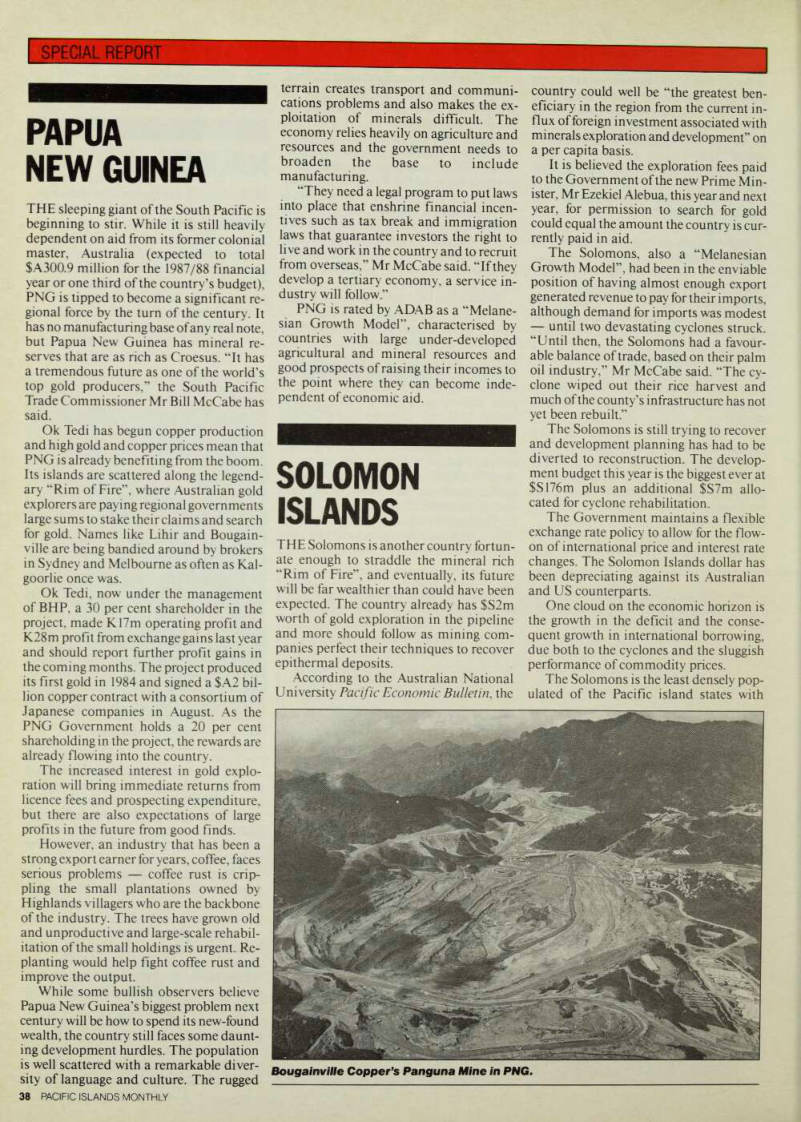
New Guinea
THE sleeping giant of the South Pacific is beginning to stir. While it is still heavily dependent on aid from its former colonial master, Australia (expected to total $A300.9 million for the 1987/88 financial year or one third of the country’s budget), PNG is tipped to become a significant re gional force by the turn of the century. It has no manufacturing base of any real note, but Papua New Guinea has mineral re serves that are as rich as Croesus. “It has a tremendous future as one of the world’s top gold producers,” the South Pacific Trade Commissioner Mr Bill McCabe has said.
Ok Tedi has begun copper production and high gold and copper prices mean that PNG is already benefiting from the boom.
Its islands are scattered along the legend ary “Rim of Fire”, where Australian gold explorers are paying regional governments large sums to stake their claims and search for gold. Names like Lihir and Bougain ville are being bandied around by brokers in Sydney and Melbourne as often as Kal goorlie once was.
Ok Tedi, now under the management of BHP. a 30 per cent shareholder in the project, made Kl7m operating profit and K2Bm profit from exchange gains last year and should report further profit gains in the coming months. The project produced its first gold in 1984 and signed a SA2 bil lion copper contract with a consortium of Japanese companies in August. As the PNG Government holds a 20 per cent shareholding in the project, the rewards are already flowing into the country.
The increased interest in gold explo ration will bring immediate returns from licence fees and prospecting expenditure, but there are also expectations of large profits in the future from good finds.
However, an industry that has been a strong export earner for years, coffee, faces serious problems coffee rust is crip pling the small plantations owned by Highlands villagers who are the backbone of the industry. The trees have grown old and unproductive and large-scale rehabil itation of the small holdings is urgent. Re planting would help fight coffee rust and improve the output.
While some bullish observers believe Papua New Guinea’s biggest problem next century will be how to spend its new-found wealth, the country still faces some daunt ing development hurdles. The population is well scattered with a remarkable diver sity of language and culture. The rugged
terrain creates transport and communi cations problems and also makes the ex ploitation of minerals difficult. The economy relies heavily on agriculture and resources and the government needs to broaden the base to include manufacturing.
“They need a legal program to put laws into place that enshrine financial incen tives such as tax break and immigration laws that guarantee investors the right to live and work in the country and to recruit from overseas,” Mr McCabe said. “If they develop a tertiary economy, a service in dustry will follow.”
PNG is rated by ADAB as a “Melane sian Growth Model”, characterised by countries with large under-developed agricultural and mineral resources and good prospects of raising their incomes to the point where they can become inde pendent of economic aid.
Solomon
Islands
THE Solomons is another country fortun ate enough to straddle the mineral rich “Rim of Fire”, and eventually, its future will be far wealthier than could have been expected. The country already has $S2m worth of gold exploration in the pipeline and more should follow as mining com panies perfect their techniques to recover epithermal deposits.
According to the Australian National University Pacific Economic Bulletin , the
country could well be “the greatest ben eficiary in the region from the current in flux of foreign investment associated with minerals exploration and development” on a per capita basis.
It is believed the exploration fees paid to the Government of the new Prime Min ister, Mr Ezekiel Alebua, this year and next year, for permission to search for gold could equal the amount the country is cur rently paid in aid.
The Solomons, also a “Melanesian Growth Model”, had been in the enviable position of having almost enough export generated revenue to pay for their imports, although demand for imports was modest until two devastating cyclones struck.
“Until then, the Solomons had a favour able balance of trade, based on their palm oil industry,” Mr McCabe said. “The cy clone wiped out their rice harvest and much of the county’s infrastructure has not yet been rebuilt.”
The Solomons is still trying to recover and development planning has had to be diverted to reconstruction. The develop ment budget this year is the biggest ever at $Sl76m plus an additional SS7m allo cated for cyclone rehabilitation.
The Government maintains a flexible exchange rate policy to allow for the flow on of international price and interest rate changes. The Solomon Islands dollar has been depreciating against its Australian and US counterparts.
One cloud on the economic horizon is the growth in the deficit and the conse quent growth in international borrowing, due both to the cyclones and the sluggish performance of commodity prices.
The Solomons is the least densely pop ulated of the Pacific island states with
Bougainville Copper’s Panguna Mine in PNG.
250.000 people sharing a land area of 28.000 square km. The GNP is a respect able $S22Bm and while that is already SS9OO per capita, it is certain to increase in coming years. The Solomons also has the most diverse agricultural base with ex port returns from copra, fish and timber as well as palm oil. It is the largest pro ducer of fish in the region and will benefit strongly from the fishing treaty with the United States.
Vanuatu
IRONICALLY, Father Walter Lini’s Van uatu, also a “Melanesian Growth Model”, is benefiting from the troubles in Fiji. The tourist industry began a long slide follow ing the revolt on Espiritu Santo led by Jimmy Stevens in 1980. But now tourism, an industry that fluctuates and turns with its host country’s fortunes, is beginning to
recover as many Australians opt for a safer tropical paradise.
Additional aircraft are being leased by the country’s airline to increase the num ber of visitors and, by the end of the year, it is expected that most hotels closed to re pair cyclone damage will be reopened.
When a severe cyclone struck in May, it caused 48 deaths and about $A35m worth of damage to agriculture and in frastructure. Aid donors quickly provided funds for a rehabilitation program esti mated at about s2om and, so far, 65 per cent of that money has been received from Australia, the UK and Japan.
The reconstruction of the damaged in frastructure may prove to have a hidden blessing as it could make a significant im provement to the country’s capital assets.
The potential for economic growth had been slipping before the cyclone struck.
Tourist numbers had been falling, dis couraged by the high exchange rate, the re duction in air services and the cost of flying to Vanuatu compared to similar destina
tions. Like its neighbours, Vanuatu was suffering from falling world prices for its copra, fish and beef.
However, the signing of agreements with both the US and the Soviets should net the country substantial foreign ex change earnings. Around 170,000 ni-Van uatu have almost 12,000 square km of land area, giving them one of the least densely populated countries. The country’s GNP is about sllsm, or $9OO per capita. It is es timated that only half the available arable land is used, so prospects for further growth are good.
Perhaps the most interesting of Vanu atu’s foreign exchange earning gambits is its International Finance Centre, a tax ha ven created by the British during condom inium rule in 1971. The finance centre has attracted a range of foreign banks and trust companies. The tax legislation is designed to make Vanuatu a pure tax haven in the mould of the Bahamas and Bermuda.
Vanuatu offers companies an environ ment free of foreign exchange control and a liberal set of company laws as well as a good range of financial and legal exper tise. Government revenue is raised from import and export duty. A 10 per cent tourist tax is charged on hotel and restau rants and a range of stamp duties and lic ence charges are levied on business.
The International Finance Centre now provides the Government with its third largest source of revenue and employs al most 300 ni-Vanuatu. The Government is also expected to garner about $300,000 in fees this year from the 70 ships on the country’s shipping register.
New Caledonia Picks Up
Tourists and trade are on the way back.
CLASHES in New Caledonia be tween French settlers and in digenous Kanaks have dealt a severe blow to the island’s economy.
Only 75,000 tourists visited the island this year, a considerable drop on the figure of 90,000 the year before. Aus tralians, particularly, are staying away in droves. In 1984, 26,500 Australians holidayed there. When the first viol ence broke out the numbers plum meted. The following year only 5,600 chose New Caledonia.
The number of visitors is creeping back up, however, with 9,800 Aus tralians venturing to New Caledonia last year.
The industry already turns over around CFPB billion a year, and New Caledonian authorities hope they will eventually be able to tempt 200,000 tourists to visit. The slump in tourism is worrying because the island’s main export earner, nickel, is suffering from severely depressed prices.
New Caledonia is one of the weal thiest islands in the South Pacific a wealth that is built on money pumped into the territory from France, but also on its rich nickel reserves.
The island is the world’s fourth big gest nickel producer, hiding a third of the world’s reserves beneath its rela tively sparsely populated surface.
However the USSR is another signifi cant nickel exporter and last year it an nounced a huge step up in its nickel exports, which forced prices down.
There is every indication that they will continue to flood the market. Concern over the future of the nickel industry has acted as a deterrent to new investment.
The mining industry remains the backbone of the economy, employing 3000 people and accounting for 85 per cent of export revenue.
While the industrial sector is begin ning to diversify, it is unlikely that New Caledonia will be able to establish a manufacturing base. The minimum salary is $1,200 a month fully 20 times higher than that paid in neigh bouring Vanuatu.
The revenue raised from its export activities only covers about 85 per cent of the value of the territory’s imports.
Despite the tension between France and Australia over the question of in dependence, trade with New Cale donia is growing rapidly. Australia sold more than $5O million worth of goods to the island last financial year, an in crease of 25 per cent. Australia now supplies most of the island’s fruit and vegetable requirements.
As well as the French Overseas Ter ritory of New Caledonia, with its pop ulation of 145,000, France administers French Polynesia (166,000) Wallis and Futuna (12,500).
France’s spending on the Pacific territories is considerable and totals in the vicinity of $ A24om on New Cale donia and $A4OOm on French Poly nesia per year. □
W Samoa
DESPITE the fact that last year Western Samoa managed to balance its current ac count and ended the year with a histori cally high overall surplus, all is not as well as it seems. Even though the Government salted away almost 54 million tala in for eign reserves, the balance of payments has serious structural problems. The only rea son Western Samoa was able to balance its books was because imports dropped to match the slump in its exports.
The country is categorised as “Subsist ence Affluence”, that is, enough natural wealth to support the population well above minimum subsistence level, but not at the level to which it aspires. Exports were down by tala 10 million, largely due to the fall in coconut oil prices. The Government responded by tightening its credit policy and reducing development expenditure in order to bring imports down. In the 1987 Budget, the Minister for Finance an nounced more fees would be introduced to compensate for the expected further de cline in export revenue.
While the vegetable oil price has rallied I
◄ slightly, Western Samoa’s coconut indus try is beset by problems. Even the price improvement has not made its coconut oil mill a viable economic proposition it operates at a heavy loss. Many of the is lands have to come to terms with the fact that the resources they depend on are worth progressively less. In 1985 coconut oil comprised almost half the country’s to tal exports but the price they receive is now around half the 1985 levels and about one fifth the 1984 price.
Western Samoa is keen to build up its fledgling tourist industry, which now makes up 20 per cent of export revenue.
Government expenditure is expected to be lower in the coming year than last, and despite the high foreign exchange re serves, it appears that Samoa will be forced to take out a national development loan of tala 2.5 million to pay for the Govern ment’s expenditure program.
Samoa’s 161,000 people share land area of almost 3000 square km. Their GNP of $ A 170 m gives them a per capita income of $llOO.
Tonga
THE realm of King Tupou IV, also ranked “Subsistence Affluence”, has hit on a scheme to ensure its growth outruns that of its island neighbours. It is the country’s Small Industry Centre where the Govern ment has provided the infrastructure for small export industries to set up.
“Tonga is doing remarkably well with the centre,” Mr McCabe said. “They are building fibreglass boats, surf skis, leather jackets and even make knitted jumpers for the US market.” The Tongan Government provides the buildings and facilities such as water, power and phones to make set ting up in Tonga as attractive as possible.
“They have reduced tax to attract busi ness and have streamlined the system to attract foreign investors,” Mr McCabe said.
Tonga is also attracting foreign invest ment with low rental and labour costs.
However, there are constraints to the es tablishment of a great many more manu facturing companies because like most Pacific nations, raw products are few, there is a limited market in the area and trans port costs to other more profitable desti nations are high.
Tonga is one of the more densely pop ulated nations with more than 150,000 people living on scattered islands with a total land area of less than 700 square km.
The GNP is about $All5m, or $lll per capita. Tonga also receives some income from the 40,000 Tongans who are working in Australia, the US and New Zealand. But income from remittances is irregular and
is often spent by the families on imported goods. It is also obtained at the cost of a large proportion of the country’s skilled labour.
However, all is not well with the coun try’s copra production. The largest indus trial concern is the desiccated coconut plant, largely financed by Australian aid, which has been rebuilt three times and is still not fully operational. For the factory to run at full capacity, Tonga would have to become a net importer of coconuts at a time when demand and prices for the product are sluggish at best.
Kiribati
THE nation faces particularly acute dif ficulties due to its resource poverty and its scattered coral atolls. Kiribati is made up of 33 islands that together make up just 800 square km of land area, and are host to 60,000 people, giving the country a pop ulation density of 88 people per square km.
But the country labours under the added difficulty of being scattered across five million square km of ocean, making even transport and communications prohibi tively expensive.
The country, rated a “Microstate” small populations and small land areas di vided between islands scattered over wide distances, remoteness from world mar kets, and with a high dependency on aid is destined to remain aid-dependent as it has no significant resources to exploit or base industries to rely on.
Kiribati has its Resource Equalisation Revenue Fund, which is based on the ac cumulated earnings from previous phos phate mining that is now exhausted. The fund contributes towards covering some of the country’s recurrent budgetary requirements.
The country has allowed its controver sial fishing deal with the Soviet Union to lapse after netting an estimated $2.4 mil lion. It is believed the Soviets were un willing to pay such a high premium for another year, which cast some doubts on the wealth of fish in Kiribati waters.
The nation is expected to benefit from payments, by the US Government and the American Tunaboat Association, for ac cess to its waters when the United States Congress ratifies the agreement signed in Tonga with the Forum Fisheries Agency last year.
This obligation, Mr McCabe said, should be particularly important to a small country wishing to decrease its depend ence on foreign aid.
Kiribati received foreign aid equal to more than half of its national income. The country’s GNP is just $A43m, giving it a per capita GNP of $650.
Advertisements & other items, p. 40 (1 item)
Services
IMEL
Reach Out
Thousands
of Miles
into The
Pacific. It's
where we
work.
• Heavy Engineering • Air Conditioning • Sheetmetal • Electrical • Refrigeration • Quality work • Competitive prices.
P^IMEL
f INDUSTRIAL AND MARINE
ENGINEERING LIMITED
Tel: 312133. Telex: FJ2195
P.O. Box 296, Suva FIJI ISLANDS
FAX: 312854
“the complete Engineering Company of the South Pacific”.
Tuvalu
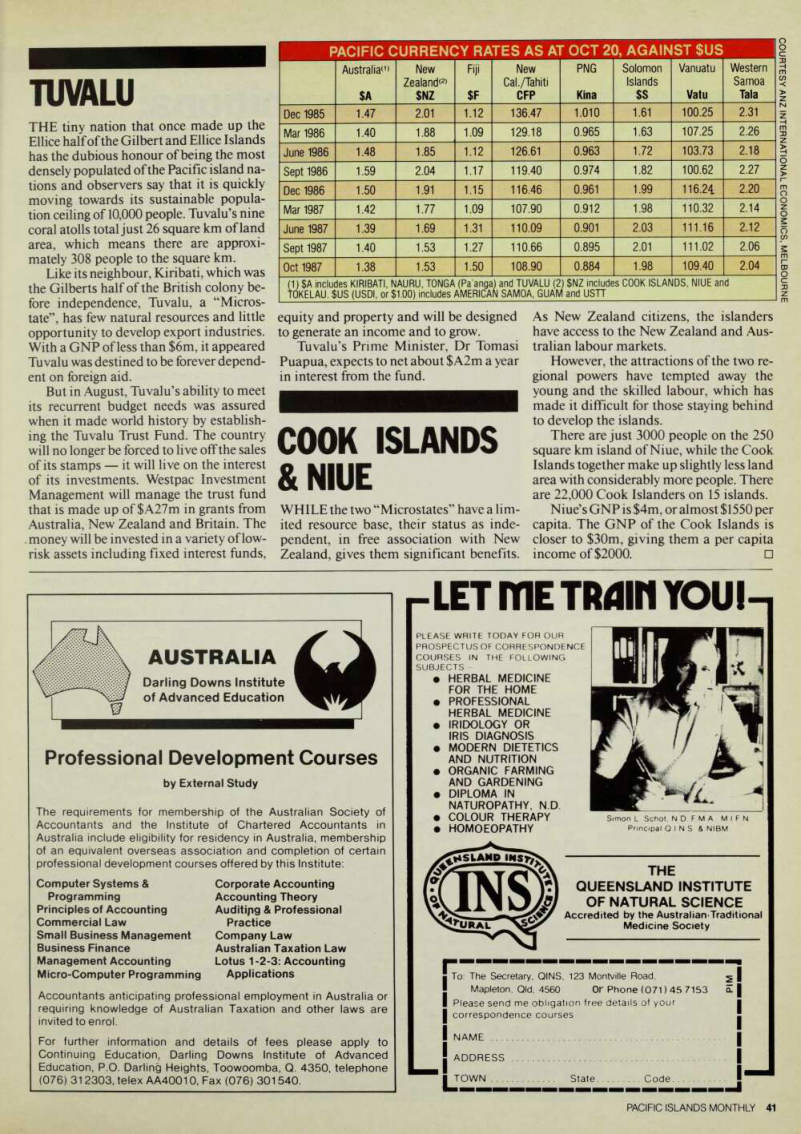
THE tiny nation that once made up the Ellice half of the Gilbert and Ellice Islands has the dubious honour of being the most densely populated of the Pacific island na tions and observers say that it is quickly moving towards its sustainable popula tion ceiling of 10,000 people. Tuvalu’s nine coral atolls total just 26 square km of land area, which means there are approxi mately 308 people to the square km.
Like its neighbour, Kiribati, which was the Gilberts half of the British colony be fore independence, Tuvalu, a “Micros tate”, has few natural resources and little opportunity to develop export industries.
With a GNP of less than s6m, it appeared Tuvalu was destined to be forever depend ent on foreign aid.
But in August, Tuvalu’s ability to meet its recurrent budget needs was assured when it made world history by establish ing the Tuvalu Trust Fund. The country will no longer be forced to live off the sales of its stamps it will live on the interest of its investments. Westpac Investment Management will manage the trust fund that is made up of $A27m in grants from Australia, New Zealand and Britain. The money will be invested in a variety of low risk assets including fixed interest funds,
equity and property and will be designed to generate an income and to grow.
Tuvalu’s Prime Minister, Dr Tomasi Puapua, expects to net about $ A2m a year in interest from the fund.
PACIFIC CURRENCY RATES AS AT OCT 20, AGAINST $US Australia* 1 * New Fiji New
Png
Solomon Vanuatu Western Zealand 12 * Cal./Tahiti Islands Samoa $A $NZ $F
Cfp
Kina $S Vatu Tala Dec 1985 1.47 2.01 1.12 136.47 1.010 1.61 100.25 2.31 Mar 1986 1.40 1.88 1.09 129.18 0.965 1.63 107.25 2.26 June 1986 1.48 1.85 1.12 126.61 0.963 1.72 103.73 2.18 Sept 1986 1.59 2.04 1.17 119.40 0.974 1.82 100.62 2.27 Dec 1986 1.50 1.91 1.15 116.46 0.961 1.99 116.24. 2.20 Mar 1987 1.42 1.77 1.09 107.90 0.912 1.98 110.32 2.14 June 1987 1.39 1.69 1.31 110.09 0.901 2.03 111.16 2.12 Sept 1987 1.40 1.53 1.27 110.66 0.895 2.01 111.02 2.06 Oct 1987 1.38 1.53 1.50 108.90 0.884 1.98 109.40 2.04 (1) $A includes KIRIBATI, NAURU. TONGA (Pa anga) and TUVALU (2) $NZ includes COOK ISLANDS, NIUE and TOKELAU. $US (USDI, or $1.00) includes AMERICA
N Samoa. Guan
1 and USTT I
Cook Islands
& Niue
WHILE the two “Microstates” have a lim ited resource base, their status as inde pendent, in free association with New Zealand, gives them significant benefits.
As New Zealand citizens, the islanders have access to the New Zealand and Aus tralian labour markets.
However, the attractions of the two re gional powers have tempted away the young and the skilled labour, which has made it difficult for those staying behind to develop the islands.
There are just 3000 people on the 250 square km island of Niue, while the Cook Islands together make up slightly less land area with considerably more people. There are 22,000 Cook Islanders on 15 islands.
Niue’s GNP is s4m, or almost $1550 per capita. The GNP of the Cook Islands is closer to s3om, giving them a per capita income of $2OOO. □
Advertisements & other items, p. 41 (1 item)
R-Leimetmiiiyouin
PLEASE WRITE TODAY FOR OUR
PROSPECTUS OF CORRESPONDENCE
COURSES IN THE FOLLOWING
SUBJECTS -
• HERBAL MEDICINE
FOR THE HOME
• PROFESSIONAL
HERBAL MEDICINE
• IRIDOLOGY OR
IRIS DIAGNOSIS
• MODERN DIETETICS
AND NUTRITION
• ORGANIC FARMING
AND GARDENING
• DIPLOMA IN
NATUROPATHY. N.D.
• COLOUR THERAPY
• HOMOEOPATHY
7 L Simon L Schot. NDFMA MIFN Principal O I N S & NIBM
ISLAND
INSW
§J
CHORAL
THE
QUEENSLAND INSTITUTE
OF NATURAL SCIENCE
Accredited by the AustralianTraditional Medicine Society ■ To: The Secretary, QINS, 123 Montville Road, s Mapleton, Old, 4560 Or Phone (071) 45 7153 E I Please send me obligation free details of your I correspondence courses
I NAME
j ADDRESS
State Code.
$
AUSTRALIA
Darling Downs Institute of Advanced Education a
Professional Development Courses
by External Study The requirements for membership of the Australian Society of Accountants and the Institute of Chartered Accountants in Australia include eligibility for residency in Australia, membership of an equivalent overseas association and completion of certain professional development courses offered by this Institute: Computer Systems & Programming Principles of Accounting Commercial Law Small Business Management Business Finance Management Accounting Micro-Computer Programming Corporate Accounting Accounting Theory Auditipg & Professional Practice Company Law Australian Taxation Law Lotus 1-2-3: Accounting Applications Accountants anticipating professional employment in Australia or requiring knowledge of Australian Taxation and other laws are invited to enrol.
For further information and details of fees please apply to Continuing Education, Darling Downs Institute of Advanced Education, P.O. Darling Heights, Toowoomba, Q. 4350, telephone (076) 312303, telex AA40010, Fax (076) 301540.
The Soviets are Here to Stay
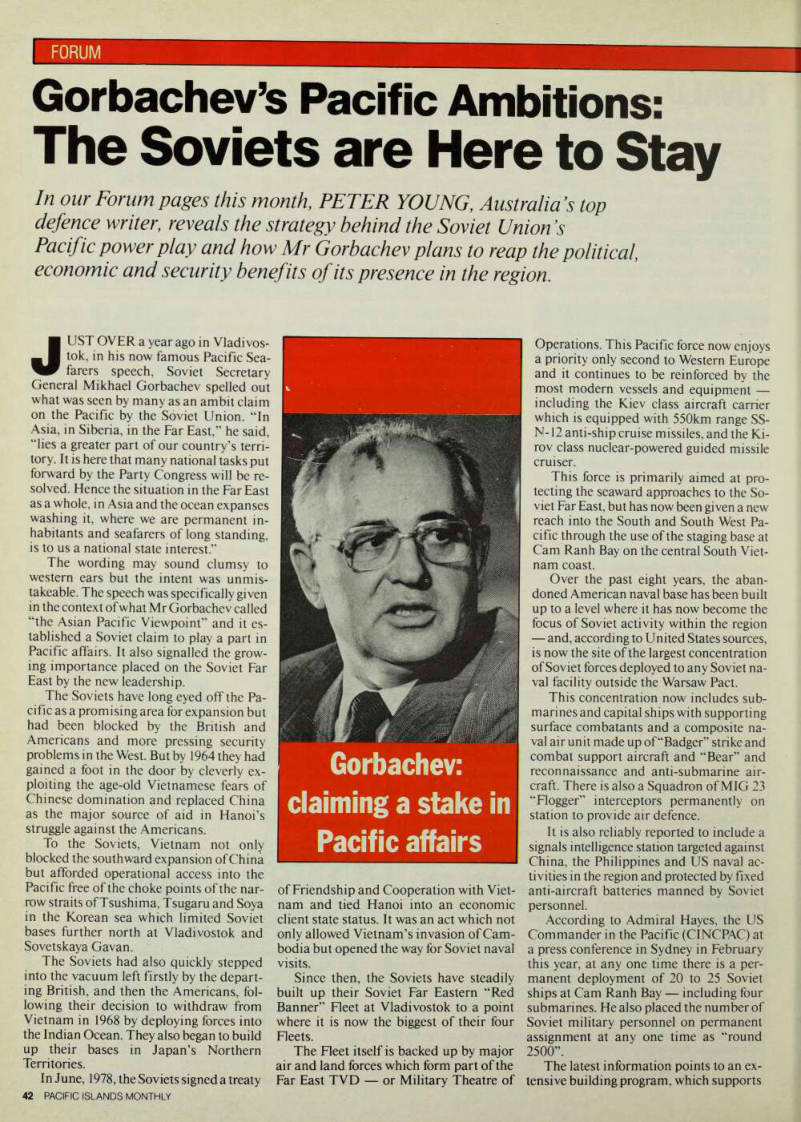
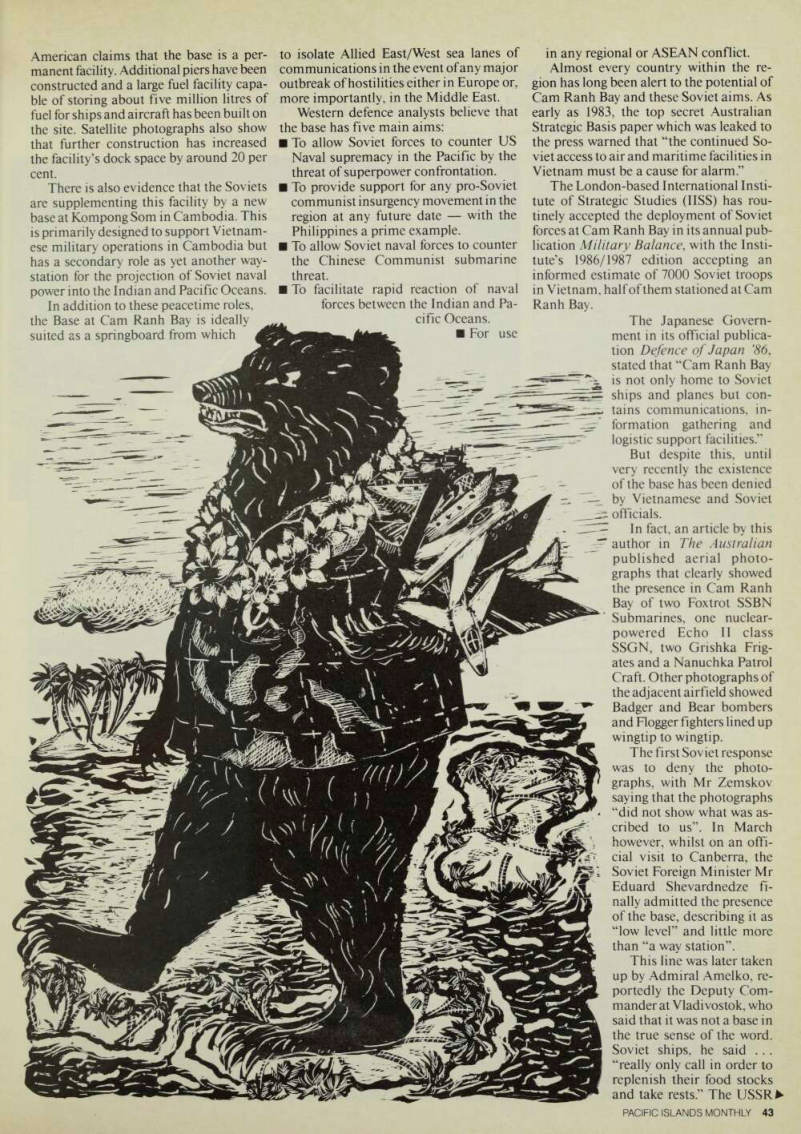
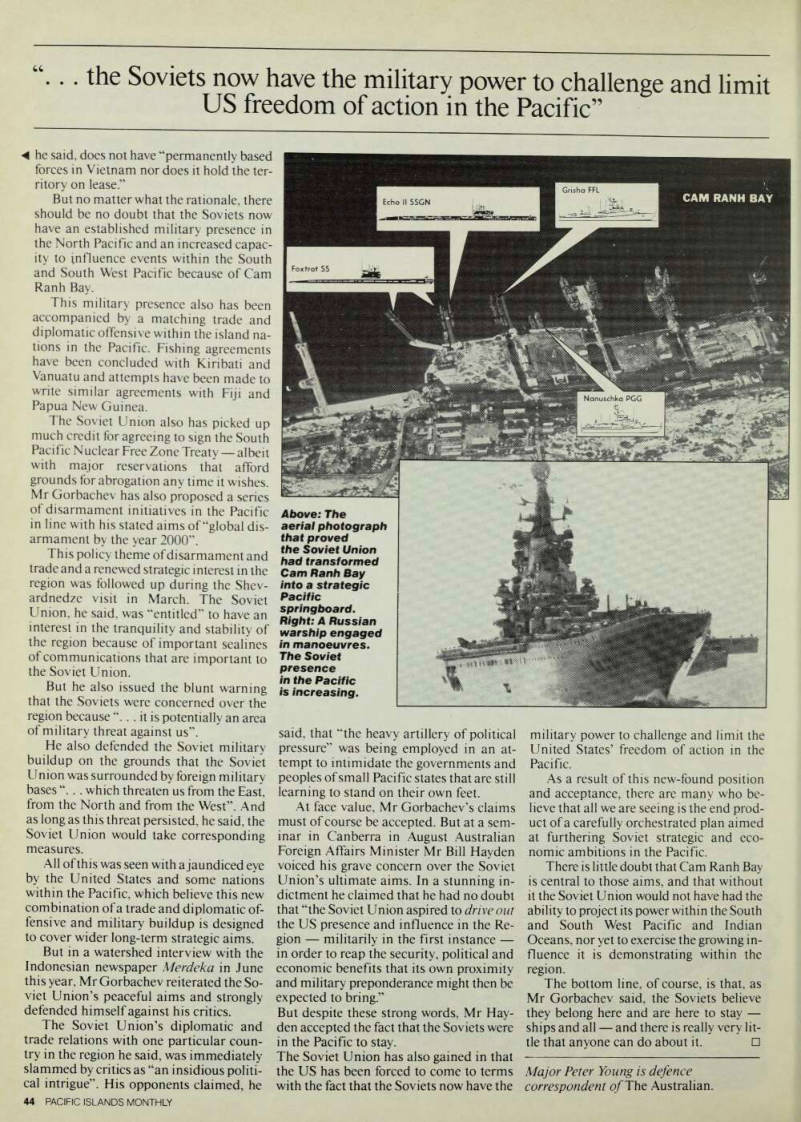
Forum
Gorbachev’s Pacific Ambitions: The Soviets are Here to Stay
In our Forum pages this month, PETER YOUNG, Australia’s top defence writer, reveals the strategy behind the Soviet Union Pacific power play and how Mr Gorbachev plans to reap the political, economic and security benefits of its presence in the region.
JUST OVER a year ago in Vladivos tok, in his now famous Pacific Sea farers speech, Soviet Secretary General Mikhael Gorbachev spelled out what was seen by many as an ambit claim on the Pacific by the Soviet Union. “In Asia, in Siberia, in the Far East,” he said, “lies a greater part of our country’s terri tory. It is here that many national tasks put forward by the Party Congress will be re solved. Hence the situation in the Far East as a whole, in Asia and the ocean expanses washing it, where we are permanent in habitants and seafarers of long standing, is to us a national state interest.”
The wording may sound clumsy to western ears but the intent was unmis takeable. The speech was specifically given in the context of what Mr Gorbachev called “the Asian Pacific Viewpoint” and it es tablished a Soviet claim to play a part in Pacific affairs. It also signalled the grow ing importance placed on the Soviet Far East by the new leadership.
The Soviets have long eyed off the Pa cific as a promising area for expansion but had been blocked by the British and Americans and more pressing security problems in the West. But by 1964 they had gained a foot in the door by cleverly ex ploiting the age-old Vietnamese fears of Chinese domination and replaced China as the major source of aid in Hanoi’s struggle against the Americans.
To the Soviets, Vietnam not only blocked the southward expansion of China but afforded operational access into the Pacific free of the choke points of the nar row straits of Tsushima, Tsugaru and Soya in the Korean sea which limited Soviet bases further north at Vladivostok and Sovetskaya Gavan.
The Soviets had also quickly stepped into the vacuum left firstly by the depart ing British, and then the Americans, fol lowing their decision to withdraw from Vietnam in 1968 by deploying forces into the Indian Ocean. They also began to build up their bases in Japan’s Northern Territories.
In June, 1978, the Soviets signed a treaty
of Friendship and Cooperation with Viet nam and tied Hanoi into an economic client state status. It was an act which not only allowed Vietnam’s invasion of Cam bodia but opened the way for Soviet naval visits.
Since then, the Soviets have steadily built up their Soviet Far Eastern “Red Banner” Fleet at Vladivostok to a point where it is now the biggest of their four Fleets.
The Fleet itself is backed up by major air and land forces which form part of the Far East TVD or Military Theatre of
Operations. This Pacific force now enjoys a priority only second to Western Europe and it continues to be reinforced by the most modern vessels and equipment including the Kiev class aircraft carrier which is equipped with 550 km range SS- N-12 anti-ship cruise missiles, and the Ki rov class nuclear-powered guided missile cruiser.
This force is primarily aimed at pro tecting the seaward approaches to the So viet Far East, but has now been given a new reach into the South and South West Pa cific through the use of the staging base at Cam Ranh Bay on the central South Viet nam coast.
Over the past eight years, the aban doned American naval base has been built up to a level where it has now become the focus of Soviet activity within the region and, according to United States sources, is now the site of the largest concentration of Soviet forces deployed to any Soviet na val facility outside the Warsaw Pact.
This concentration now includes sub marines and capital ships with supporting surface combatants and a composite na val air unit made up of “Badger” strike and combat support aircraft and “Bear” and reconnaissance and anti-submarine air craft. There is also a Squadron of MIG 23 “Flogger” interceptors permanently on station to provide air defence.
It is also reliably reported to include a signals intelligence station targeted against China, the Philippines and US naval ac tivities in the region and protected by fixed anti-aircraft batteries manned by Soviet personnel.
According to Admiral Hayes, the US Commander in the Pacific (CINCPAC) at a press conference in Sydney in February this year, at any one time there is a per manent deployment of 20 to 25 Soviet ships at Cam Ranh Bay including four submarines. He also placed the number of Soviet military personnel on permanent assignment at any one time as “round 2500”.
The latest information points to an ex tensive building program, which supports
Gorbachev: claiming a stake in Pacific affairs
American claims that the base is a per manent facility. Additional piers have been constructed and a large fuel facility capa ble of storing about five million litres of fuel for ships and aircraft has been built on the site. Satellite photographs also show that further construction has increased the facility’s dock space by around 20 per cent.
There is also evidence that the Soviets are supplementing this facility by a new base at Kompong Som in Cambodia. This is primarily designed to support Vietnam ese military operations in Cambodia but has a secondary role as yet another way station for the projection of Soviet naval power into the Indian and Pacific Oceans.
In addition to these peacetime roles, the Base at Cam Ranh Bay is ideally suited as a springboard from which A
to isolate Allied East/West sea lanes of communications in the event of any major outbreak of hostilities either in Europe or, more importantly, in the Middle East.
Western defence analysts believe that the base has five main aims: ■ To allow Soviet forces to counter US Naval supremacy in the Pacific by the threat of superpower confrontation. ■ To provide support for any pro-Soviet communist insurgency movement in the region at any future date with the Philippines a prime example. ■ To allow Soviet naval forces to counter the Chinese Communist submarine threat. ■ To facilitate rapid reaction of naval forces between the Indian and Pa cific Oceans. ■ For use
in any regional or ASEAN conflict.
Almost every country within the re gion has long been alert to the potential of Cam Ranh Bay and these Soviet aims. As early as 1983, the top secret Australian Strategic Basis paper which was leaked to the press warned that “the continued So viet access to air and maritime facilities in Vietnam must be a cause for alarm.”
The London-based International Insti tute of Strategic Studies (IISS) has rou tinely accepted the deployment of Soviet forces at Cam Ranh Bay in its annual pub lication Military Balance , with the Insti tute’s 1986/1987 edition accepting an informed estimate of 7000 Soviet troops in Vietnam, half of them stationed at Cam Ranh Bay.
The Japanese Govern ment in its official publica tion Defence of Japan ' B6, stated that “Cam Ranh Bay is not only home to Soviet ships and planes but con tains communications, in formation gathering and logistic support facilities.”
But despite this, until very recently the existence of the base has been denied by Vietnamese and Soviet officials.
In fact, an article by this author in The Australian published aerial photo graphs that clearly showed the presence in Cam Ranh Bay of two Foxtrot SSBN Submarines, one nuclear powered Echo II class SSGN, two Grishka Frig ates and a Nanuchka Patrol Craft. Other photographs of the adjacent airfield showed Badger and Bear bombers and Flogger fighters lined up wingtip to wingtip.
The first Soviet response was to deny the photo graphs, with Mr Zemskov saying that the photographs “did not show what was as cribed to us”. In March however, whilst on an offi cial visit to Canberra, the Soviet Foreign Minister Mr Eduard Shevardnedze fi nally admitted the presence of the base, describing it as “low level” and little more than “a way station”.
This line was later taken up by Admiral Amelko, re portedly the Deputy Com mander at Vladivostok, who said that it was not a base in the true sense of the word.
Soviet ships, he said . ..
“really only call in order to replenish their food stocks and take rests.” The USSR^
. the Soviets now have the military power to challenge and limit US freedom of action in the Pacific”
◄ he said, does not have “permanently based forces in Vietnam nor does it hold the ter ritory on lease.”
But no matter what the rationale, there should be no doubt that the Soviets now have an established military presence in the North Pacific and an increased capac ity to influence events within the South and South West Pacific because of Cam Ranh Bay.
This military presence also has been accompanied by a matching trade and diplomatic offensive within the island na tions in the Pacific. Fishing agreements have been concluded with Kiribati and Vanuatu and attempts have been made to write similar agreements with Fiji and Papua New Guinea.
The Soviet Union also has picked up much credit for agreeing to sign the South Pacific Nuclear Free Zone Treaty albeit with major reservations that afford grounds for abrogation any time it wishes.
Mr Gorbachev has also proposed a series of disarmament initiatives in the Pacific in line with his stated aims of “global dis armament by the year 2000”.
This policy theme ofdisarmament and trade and a renewed strategic interest in the region was followed up during the Shev ardnedze visit in March. The Soviet Union, he said, was “entitled” to have an interest in the tranquility and stability of the region because of important sealines of communications that are important to the Soviet Union.
But he also issued the blunt warning that the Soviets were concerned over the region because “... it is potentially an area of military threat against us”.
He also defended the Soviet military buildup on the grounds that the Soviet Union was surrounded by foreign military bases “... which threaten us from the East, from the North and from the West”. And as long as this threat persisted, he said, the Soviet Union would take corresponding measures.
All of this was seen with a jaundiced eye by the United States and some nations within the Pacific, which believe this new combination of a trade and diplomatic of fensive and military buildup is designed to cover wider long-term strategic aims.
But in a watershed interview with the Indonesian newspaper Merdeka in June this year, Mr Gorbachev reiterated the So viet Union’s peaceful aims and strongly defended himself against his critics.
The Soviet Union’s diplomatic and trade relations with one particular coun try in the region he said, was immediately slammed by critics as “an insidious politi cal intrigue”. His opponents claimed, he
said, that “the heavy artillery of political pressure” was being employed in an at tempt to intimidate the governments and peoples of small Pacific states that are still learning to stand on their own feet.
At face value, Mr Gorbachev’s claims must of course be accepted. But at a sem inar in Canberra in August Australian Foreign Affairs Minister Mr Bill Hayden voiced his grave concern over the Soviet Union’s ultimate aims. In a stunning in dictment he claimed that he had no doubt that “the Soviet Union aspired to drive out the US presence and influence in the Re gion militarily in the first instance in order to reap the security, political and economic benefits that its own proximity and military preponderance might then be expected to bring.”
But despite these strong words, Mr Hay den accepted the fact that the Soviets were in the Pacific to stay.
The Soviet Union has also gained in that the US has been forced to come to terms with the fact that the Soviets now have the
military power to challenge and limit the United States’ freedom of action in the Pacific.
As a result of this new-found position and acceptance, there are many who be lieve that all we are seeing is the end prod uct of a carefully orchestrated plan aimed at furthering Soviet strategic and eco nomic ambitions in the Pacific.
There is little doubt that Cam Ranh Bay is central to those aims, and that without it the Soviet Union would not have had the ability to project its power within the South and South West Pacific and Indian Oceans, nor yet to exercise the growing in fluence it is demonstrating within the region.
The bottom line, of course, is that, as Mr Gorbachev said, the Soviets believe they belong here and are here to stay ships and all and there is really very lit tle that anyone can do about it. □
Major Peter Young is defence correspondent of The Australian.
Above: The aerial photograph that proved the Soviet Union had transformed Cam Ranh Bay into a strategic Pacific springboard.
Right: A Russian warship engaged in manoeuvres.
The Soviet presence in the Pacific
is increasing.
Pacific Stamp Box
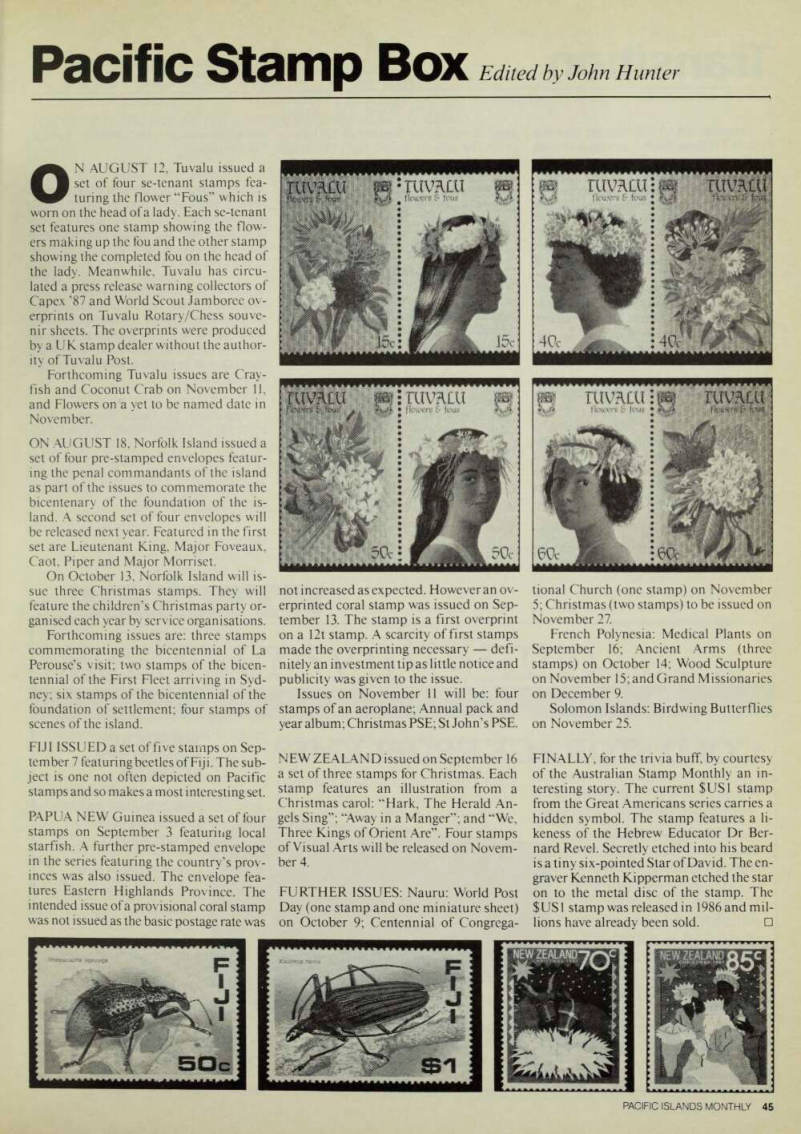
Edited by John Hunter
ON AUGUST 12, Tuvalu issued a set of four se-tenant stamps fea turing the flower “Fous” which is worn on the head of a lady. Each se-tenant set features one stamp showing the flow ers making up the fou and the other stamp showing the completed fou on the head of the lady. Meanwhile, Tuvalu has circu lated a press release warning collectors of Capex ’B7 and World Scout Jamboree ov erprints on Tuvalu Rotary/Chess souve nir sheets. The overprints were produced by a UK stamp dealer without the author ity of Tuvalu Post.
Forthcoming Tuvalu issues are Cray fish and Coconut Crab on November 11, and Flowers on a yet to be named dale in November.
ON AUGUST 18, Norfolk Island issued a set of four pre-stamped envelopes featur ing the penal commandants of the island as part of the issues to commemorate the bicentenary of the foundation of the is land. A second set of four envelopes will be released next year. Featured in the first set are Lieutenant King. Major Foveaux, Caot, Piper and Major Morrisel.
On October 13, Norfolk Island will is sue three Christmas stamps. They will feature the children’s Christmas party or ganised each year by service organisations.
Forthcoming issues are: three stamps commemorating the bicentennial of La Perouse’s visit; two stamps of the bicen tennial of the First Fleet arriving in Syd ney; six stamps of the bicentennial of the foundation of settlement; four stamps of scenes of the island.
FIJI ISSUED a set of five stamps on Sep tember 7 featuring beetles of Fiji. The sub ject is one not often depicted on Pacific stamps and so makes a most interesting set.
PAPUA NEW Guinea issued a set of four stamps on September 3 featuring local starfish. A further pre-stamped envelope in the series featuring the country’s prov inces was also issued. The envelope fea tures Eastern Highlands Province. The intended issue of a provisional coral stamp was not issued as the basic postage rate was
not increased as expected. However an ov erprinted coral stamp was issued on Sep tember 13. The stamp is a first overprint on a 12t stamp. A scarcity of first stamps made the overprinting necessary defi nitely an investment tip as little notice and publicity was given to the issue.
Issues on November 11 will be: four stamps of an aeroplane; Annual pack and year album; Christmas PSE; St John’s PSE.
NEW ZEALAND issued on September 16 a set of three stamps for Christmas. Each stamp features an illustration from a Christmas carol: “Hark, The Herald An gels Sing”; ‘Away in a Manger”; and “We, Three Kings of Orient Are”. Four stamps of Visual Arts will be released on Novem ber 4.
FURTHER ISSUES: Nauru: World Post Day (one stamp and one miniature sheet) on October 9; Centennial of Congrega-
tional Church (one stamp) on November 5; Christmas (two stamps) to be issued on November 27.
French Polynesia: Medical Plants on September 16; Ancient Arms (three stamps) on October 14; Wood Sculpture on November 15; and Grand Missionaries on December 9.
Solomon Islands; Birdwing Butterflies on November 25.
FINALLY, for the trivia buff, by courtesy of the Australian Stamp Monthly an in teresting story. The current SUSI stamp from the Great Americans series carries a hidden symbol. The stamp features a li keness of the Hebrew Educator Dr Ber nard Revel. Secretly etched into his beard is a tiny six-pointed Star of David. The en graver Kenneth Kipperman etched the star on to the metal disc of the stamp. The SUSI stamp was released in 1986 and mil lions have already been sold. □
Transition

Awarded: A $A7,500 Westpac training prize to Mr Been Timbo, an engineer with the Kiribati national fishing company Te Mautari. The Westpac Banking Corpora tion award will enable Mr Timbo to pur sue further trade and engineering studies in Australia.
Appointed: Mr James Bryant to chief executive of Union Shipping New Zea land, which combines the operations of the commercial division and the fleet divi sion of the Union Steam Ship Company of New Zealand Ltd.
Also, the company announces that it has named Mr Ken Urry chief executive of Union Shipping Australia, covering all Union group operations that are based in Australia.
Died: Mr Moses Qionibaravi, 49, the former deputy Prime Minister of Fiji and Minister for Finance in the Alliance Government from 1973 until its defeat this year. Mr Qionibaravi died of a liver ail
ment in Sydney on September 22. In one of his last official duties, Fiji’s Governor General Ratu Sir Penaia Ganilau said Mr Qionibaravi’s death was a “blow” to the country. “We have lost a true champion of all that is good about Fiji,” the Govenor General said. □ Appointed: Mr Lindsay Miscros, Sol omon Islands’ Assistant Secretary, For eign Affairs, as Solomons’ third non resident Roving Ambassador to the Re public of Korea, Japan and the Republic of China.
Mr Miscros, 37, is from Tikopia in Temotu Province.
Appointed: Mr Peter Peipul, current PNG Ambassador to the European Eco nomic Community in Brussels, Depart ment Head of the Government’s Department of Trade and Industry. The previous head of the Department, Mr Wep Kanawi, has been appointed Secretary to the Department of Personnel Manage
ment, previously the Public service Commission.
Appointed: The Women’s Represent ative in PNG’s East New Britain Provin cial Government, Mrs Margaret Lavutul; to Minister for Community Development and Women’s Affairs.
Expelled: French Ambassador to Van uatu, Mr Henri Crepin-Leblond was ex pelled after being charged by the Government with “interfering in internal affairs”. Mr Crepin-Leblond was given seven days to leave the country. (See story on pages 16, 17.) Appointed: Mr Lance Joseph as Aus tralia’s High Commissioner to PNG, suc ceeding Mr Michael Wilson who held the post from 1984. Mr Joseph was formerly Minister and Australia’s Deputy Perma nent Representative to the United Na tions from 1980 to 1984. □
Advertisements & other items, p. 46 (1 item)
Cold Storage Problems?
20' X 8' X B'6" refrigerated containers provide 25.6 cubic metres of storage for
products that require
temprature controlled conditions within a range of -30°C to 20°C.
Reliably and accurately
controlled to within Vz°C.
All equipment supplied in full pre-trip operating and food quality conditions Available for rent (min 3 months) or purchase. Delivery can be arranged throughout the Pacific.
WRECKAIR
CONTAINER
SERVICES
102 Derby St, Silverwater
NSW 2141 AUSTRALIA.
Fax (02) 648 4946.
Ph. (02) 748 3433.
Send the coupon below S and find out how y Wreckair Container y Services can S solve your * cold / storage problems / /
The Island Press
Reports from the papers, compiled by John Carter.
EAST NEW Britain MP Ereman To- Baining said yesterday he was fooled by Government Ministers into signing a let ter informing the Parliamentary Speaker he was joining the Government. “I did not write that letter, and although it carries my signature, I must admit I did not read it before I signed it,” he said.
The letter read: “I am writing to advise that I have now joined the Government and would like you to arrange sitting in Parliament so that I can be seated with other Members of the Government.”
From the Papua New Guinea Post-Courier , Port Moresby.
ARE YOU a wild and crazy person? Can you walk and smile at the same time? Like to have fun while you work? Do you like meeting visitors, being provided with a meal and getting paid for it? We could have a job for you in our restaurants and bar, so call me on Ph: 25800. Dull and boring people need not apply.
An advertisement for The Rarotongan Hotel in the Cook Island News A SENIOR officer of one of the city’s main trading banks was the leader of one side of a big brawl at Mulinuu on Saturday in which at least three people received head wounds from thrown stones and bottles.
The brawl apparently started after one of the bank officer’s party was beaten up by members of the other side. Unfortu nately for the other party the bank offi cer’s group outnumbered them at least four to one.
When the opponents became hard to find the rampaging members of the sec ond party turned on a van standing nearby and smashed the wind screen and even tried to smash a motorbike belonging to the other side.
From The Samoa Times, Apia BULOLO MP Mathew Bendumb was or dered out of Parliament yesterday be cause he was not wearing a tie. Mr Bendumb stood up to ask a series of ques tions of Prime Minister Mr Wingti but an MP raised a point of order about his dress.
Standing orders require all MPs to wear a tie when attending meetings. Mr Ben dumb said he had just been turned out of a hotel and was unable to dress up prop erly. But the Speaker insisted that he leave the chamber. About 10 minutes later, he was back wearing a tie.
From the Papua New Guinea Post-Courier, Port Moresby
A MAN IS in hospital with a head wound after being attacked with a husked coco nut. Superintendent Galuvao Tanielu said the man wounded was asleep at the mar ket when another man walked up and hit him on the head with the coconut. No rea son has been given for the attack, he said.
From The Samoa Times , Apia DISCOS, DEMOCRACY and “new reli gions” have all been bemoaned by the Youth and Home Affairs Minister. And Mr Burege blamed the loss of the traditional way of living on the educated elite.
“The educated elite, instead of looking at how our grandfathers had practised re ligion, dancing, traditional leadership, ed ucation and so on and using their knowledge to improve them have in stead promoted new religion, night disco dancing and new ways of having leader ship through voting.”
From the Papua New Guinea Post-Courier , Port Moresby HERE AT Pulau we have discovered that our hens are two fold really. Not only do they lay eggs, but are our only forecast of weather. Three to four means it will be hot and humid; five to six per day means it will be warm and sunny; one egg means it will be wet.
From The Pitcairn Miscellany, Pitcairn Island.
A CURIOUS thing happened on the night of August 24. Miss Tia Sika was hosting the evening program on Radio Tuvalu and was about to announce a $70,000 grant from the Canadian Government to buy a new transmitter for the station. Suddenly, the transmitter failed and Radio Tuvalu was off the air. Assistant technician Ma tanile losefa and Tuvalu’s telecommuni cations chief, Peter McQuarrie, were quickly on the scene, replacing fuses and getting the station back on air. Everyone agreed the grant had come just in time.
From Tuvalu Echoes, Funafuti A PUBLIC WORKS Department carpen ter injured at work in 1984 has to wait for his $6383 compensation because the Min istry of Employment and Industrial Re lations says it is short of money. The ministry has agreed to pay the worker un der the workmen’s compensation scheme but says payment can be made only after it receives extra money.
From The Fiji Times , Suva
LAE’S BID TO shake-off its crime troubled image suffered a setback at the weekend. An innocent club-goer was stoned to death, a pregnant woman was raped and a family robbed in an armed hold-up. But the police came through with flying colours. In each case they were able to make arrests.
From the Papua New Guinea Post-Courier , Port Moresby.
FOUR STUDENTS from Cambridge University in England have just com pleted two months of study on the island as part of their work towards their degrees.
Miss Hilary Chapman and Mr Nigel Has kins have been studying the distribution, behavioural patterns and life cycle of the fruit bat or peka. Hilary and Nigel have estimated the total fruit bat population at 4000 to 5000, although according to local experts there are at least 11,000.
From the To hi Tala Hiue, Niue THE FIRST CLUB has announced the date for its long awaited “Drag Queen” competition. It is happening this Friday.
The theme for the night will be “Vice- Versa”. In other words males will dress up as females and vice-versa!
From the Cook Island News , Rarotonga PRIME MINISTER Ezekiel Alebua has spoken highly of the work being carried out by the Guadalcanal Cultural Centre in finding out about the true history of Guadalcanal people and Solomon Islands as a whole... In his speech to mark the visit to the historical sites, Prime Minister Al ebua said: “Our people have been living on assumptions for a very long time, thinking that we originate from apes or belong to the ape family. Unveiling of some of the things that did happen many, many years ago, should prove this is not so, and find out how the people lived and what types of tools they used.”
From the Solomon Islands The Nius , Honiara THE TEENAGE son of a policeman at Saidor in Madang Province has been ar rested after a police raid on his father’s house uncovered apparently stolen goods.
Madang police commander Joe Dra pok said several armed men held up a trade store owner at Saidor and stole K 350 cash and trade store goods valued at more then
K3Oo.
From the Papua New Guinea Post Courier, Port Moresby
Book Reviews
THE TOTEM AND THE TRICOLOUR. A Short History of New Caledonia since 1774.
By Martyn Lyons, NSW University Press, 1986.
Reviewed by Stewart Firth TO READ the upbeat media releases of Gaston Flosse, the French Min ister for the South Pacific, is to gain the impression that French rule in New Caledonia has been uniquely beneficent, and that the territory is a model of multi racial harmony. Then why are there still 5700 French military personnel in New Caledonia?
One picture is painted by Flosse and other agencies of the French public rela tions machine cranked into gear since Rainbow Warrior. Another filters out from the FLNKS and their sympathisers else where in the region.
There were German, Australian, Brit ish and Anglo-French equivalents of the indignities imposed on the Kanaks in New Caledonia special laws designed to keep the Islanders in their place but it was only in New Caledonia that Melanesian people were restricted to reserves repre senting about one-tenth of the mainland.
The outnumbering of indigenous Fiji ans by Indians was an unintended conse quence of a policy meant to protect and preserve the Fijian way of life. But in New Caledonia, uniquely in Melanesia, the co lonial power encouraged the outnumber ing of the Melanesians as a means of thwarting independence.
The Totem and the Tricolour is con cise, well-written and contains new infor mation based on research in the Archives Nationales, but unfortunately it is not the short history of New Caledonia we have been waiting for. Marred throughout by errors of fact, spelling mistakes, ignorance of other scholarly work in the area and a lack of familiarity with New Caledonia it self, this book cannot be accepted as authoritative.
To take one example: on the issue of de population, the author is emphatic that the number of Kanaks fell from about 42,000 in 1887 to 28,000 in 1901. In fact the so called census of 1887 was wildly inaccur ate and cannot be relied upon. The Kanak population might well have declined as other Pacific island populations did in the late 19th century.
What, then, are we to make of a book about New Caledonia in which the names of President Mitterrand and Eloi Ma choro are consistently misspelled, even in the index? And whose author does not seem to know about the work of Kerry Howe, Bronwen Douglas, Alban Bensa and Marie-Joseph Dubois?
The answer can only be read with cau tion while awaiting something worthy of the subject. □
Advertisements & other items, pp. 48-49 (2 items)
Co., Ltd.
Australian
Maritime College
Fishing Around for a Future?
Today’s fishing industry needs men and women with practical and scientific expertise for careers in: • Resource Management • Marketing • Gear Technology • Fisheries Biology • Seafood Technology • Catching Sector The Australian Maritime College’s School of Fisheries offers courses designed to meet this need.
Bachelor of Applied Science (Fisheries Technology) Duration: Three years, full-time Graduate Diploma in Fisheries Technology Duration: One year, including 10 weeks spent on a project.
The courses cover fisheries biology, assessment and management; gear technology and post-harvest technology (care of the catch, quality control, economics, marketing and distribution).
There are no course fees other than the s2sop.a. government higher education administration fee ; and courses are approved under AUSTUDY. Scholarships and grants are also available.
For further information, contact: The Admissions Officer Australian Maritime College PO Box 986
LAUNCESTON, Tas. 7250
or telephone, ISD 61 03 260732 NJ7082
KYOWA
KYOWA
SHIPPING
CO., LTD.
Liner Service to Paciffic Islands
FROM OJAPAN OHONG KONG
OKOREA OSINGAPORE
OTAIWAN
TO OSAIPAN
OFEDERATED STATES
OF MICRONESIA
OMARSHAL ISLANDS
O AMERICAN SAMOA
ONEW CALEDONIA
O FIJI
OGUAM
OYAP
OPALAU
OWESTERN SAMOA
OSOLOMON ISLANDS
OVANUATU
OPAPUA NEW GUINEA
HEAD OFFICE
6th Floor , Kikushima Bldg , 2-3, Hamamatsucho 2-chome Mmato-ku, Tokyo 105. Japan Phone: 03(437)2885 (Rep) Cables: MARIQUEEN" Tokyo Telex: 242-4651 Kyowa J
OSAKA OFFICE
Dai San Fuji Bldg, 3-13, Itachibon 1-chome, Osaka 550.
Phone: 06(533)5821 (Rep ) Cables: MARIQUEEN’ Osaka Telex; 525-6271 Ssiosa J
PlM’s Mail Order bookshop
REPRINT NOW (WRITABLE!
15th Edition
PACIFIC ISLANDS YEAR BOOK
Contains over 550 pages crammed with all the facts you want on island groups of the Pacific - their history, geo-
graphy, etc. Handsomely hard
bound with heavy clear plastic
jacket for extra protection.
$A35.00 (See postage Cat. C)
"Vanuatu
-A GUIDE
Norman Douglas The story of Vanuatu’s intriguing past and the charm and attraction of its present are given skilful treatment in this new book on the new nation. Written in lively style, well illustrated in colour and black and white, and delightfully designed, this latest addition to Pacific Publications’ list of guides to the South Seas will capture the interest of both types of traveller -the armchair and the adventurer. Maps of islands and towns, accommodation and restaurant listings and guides to all kinds of activities are included. 5A14.95 (See postage Cat.B) v y
REFERENCE AND TRAVEL
15th EDITION
PACIFIC ISLANDS YEAR BOOK
FIJI HANDBOOK BUSINESS AND
TRAVEL GUIDE
11th EDITION
PAPUA NEW GUINEA HANDBOOK
BUSINESS AND TRAVEL GUIDE
Contains 280 pages packed with everything anyone needs to know about PNG - investor, traveller, writer, student, historian, importer, exporter, shipper, dealer or just a plain ordinary bookworm. There’s also enough material to kit out a travel agency with its large collection of maps, including a large fold-out map and full list of accommodation for visitors. $A13.95 (See postage Cat. B).
VANUATU - A GUIDE
THE FIJI EXPLORER S HANDBOOK
A splendid four-colour guide to some of the fascinating backwaters of Fiji, far away from the tourist resorts.
Author Kim Gravelle has camped and tramped it all himself and tells his stories with wit and charm. $A8.95 (See postage Cat. B).
RAMBLER S GUIDE TO NORFOLK
ISLAND is a comprehensive, but both readable and very portable book which traces the history, and the geography of Norfolk Island. It is the essential companion for anyone who wishes either to steep themselves in the unique history of this small island 900 miles north-east of Sydney, or simply wishes to browse with some guidance among its serene pines and acres. $A4.50 (See postage Cat. A).
BIOGRAPHIES AND HISTORY
DAY THAT I HAVE LOVED Percy
Chatterton’s charming account of the Papuan people. 132 pages. $A4.50 (See postage Cat. A.) EASTER ISLAND (Rapanui) endorsed by Thor Heyerdahl. $A6.40 (See postage Cat. B).
LANGUAGE SERIES
SAY IT IN FIJIAN
QUEEN EMMA R. W. Robson’s true story of the Samoan/American girl who defied convention and founded a commercial empire in 19th Century New Guinea. Over 240 pages. 29 authentic photographs. $A4.50 (See postage Cat. B).
TAHITI: ISLAND OF LOVE New
revised edition Robert Langdon gives a superb insight into the colourful history of the island and the people who brought it fame. $A4.00 (See postage Cat. B).
PACIFIC MAPS
Large and clear, up-to-date, in colour. In plastic envelopes.
PACIFIC ISLANDS
PAPUA NEW GUINEA
$A2.50 each (See postage Cat. A).
SAY IT IN FIJI-HINDI
SAY IT IN TAHITIAN
SAY IT IN RAROTONGAN
SAY IT IN MOTU
Milhalic’s INTRODUCTION TO NEW
GUINEA PIDGIN.
All $A3.00 each (See postage Cat. A)
PACIFIC ISLANDS MONTHLY SLIP
BINDER. Keeps 12 issues neatly on file. $A5.50 (See postage Cat. B).
PACKING AND POSTAGE RATES
NOTE: Prices quoted are in Australian dollars, but U.S. cheques (or equivalent amounts are acceptable from within USA only.
A Please tick the above titles you require and return this page together with your remittance of to: PIM’S MAIL ORDER BOOKSHOP GPO Box 4245,
SYDNEY, NSW, 2001, Australia
Name Address
ALL BOOKS ARE POSTED SURFACE
TIME FOR RECEIPT.
MAIL - PLEASE ALLOW SUITABLE
Sepik - Adventure in Style
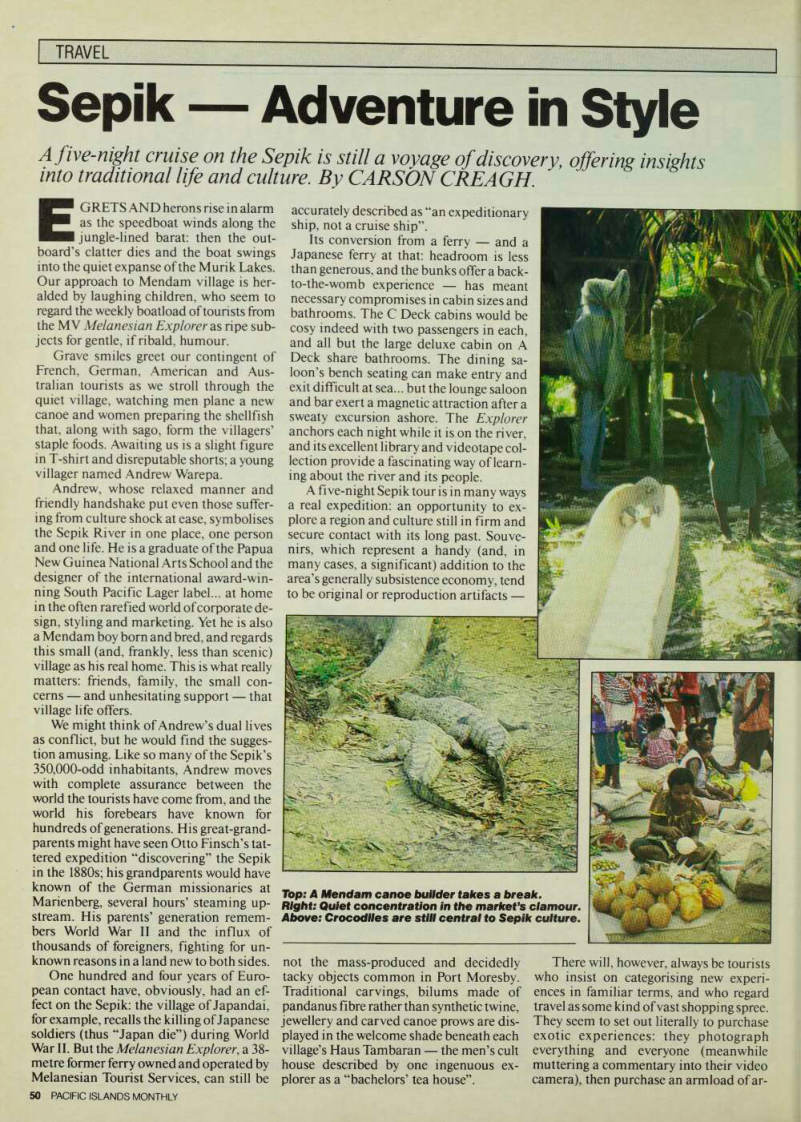
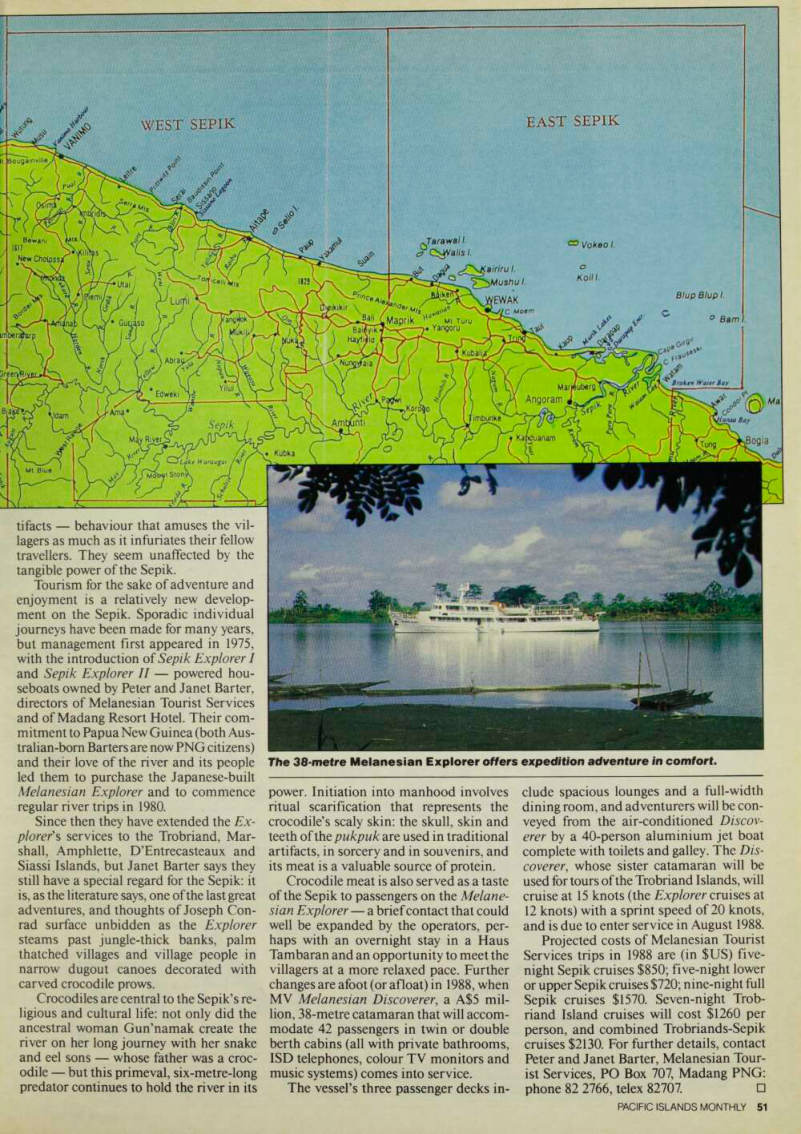
Travel
A five-night cruise on the Sepik is still a voyage of discovery , offering insights
into traditional life and culture.
By Carson Creagh.
EGRETS AND herons rise in alarm as the speedboat winds along the jungle-lined barat: then the out board’s clatter dies and the boat swings into the quiet expanse of the Murik Lakes.
Our approach to Mendam village is her alded by laughing children, who seem to regard the weekly boatload of tourists from the MV Melanesian Explorer as ripe sub jects for gentle, if ribald, humour.
Grave smiles greet our contingent of French, German, American and Aus tralian tourists as we stroll through the quiet village, watching men plane a new canoe and women preparing the shellfish that, along with sago, form the villagers’ staple foods. Awaiting us is a slight figure in T-shirt and disreputable shorts; a young villager named Andrew Warepa.
Andrew, whose relaxed manner and friendly handshake put even those suffer ing from culture shock at ease, symbolises the Sepik River in one place, one person and one life. He is a graduate of the Papua New Guinea National Arts School and the designer of the international award-win ning South Pacific Lager label... at home in the often rarefied world of corporate de sign, styling and marketing. Yet he is also a Mendam boy born and bred, and regards this small (and, frankly, less than scenic) village as his real home. This is what really matters: friends, family, the small con cerns and unhesitating support that village life offers.
We might think of Andrew’s dual lives as conflict, but he would find the sugges tion amusing. Like so many of the Sepik’s 350,000-odd inhabitants, Andrew moves with complete assurance between the world the tourists have come from, and the world his forebears have known for hundreds of generations. His great-grand parents might have seen Otto Finsch’s tat tered expedition “discovering” the Sepik in the 1880 s; his grandparents would have known of the German missionaries at Marienberg, several hours’ steaming up stream. His parents’ generation remem bers World War II and the influx of thousands of foreigners, fighting for un known reasons in a land new to both sides.
One hundred and four years of Euro pean contact have, obviously, had an ef fect on the Sepik: the village of Japandai, for example, recalls the killing of Japanese soldiers (thus “Japan die”) during World War 11. But the Melanesian Explorer , a 38metre former ferry owned and operated by Melanesian Tourist Services, can still be
accurately described as “an expeditionary ship, not a cruise ship”.
Its conversion from a ferry and a Japanese ferry at that: headroom is less than generous, and the bunks offer a back to-the-womb experience has meant necessary compromises in cabin sizes and bathrooms. The C Deck cabins would be cosy indeed with two passengers in each, and all but the large deluxe cabin on A Deck share bathrooms. The dining sa loon’s bench seating can make entry and exit difficult at sea... but the lounge saloon and bar exert a magnetic attraction after a sweaty excursion ashore. The Explorer anchors each night while it is on the river, and its excellent library and videotape col lection provide a fascinating way of learn ing about the river and its people.
A five-night Sepik tour is in many ways a real expedition: an opportunity to ex plore a region and culture still in firm and secure contact with its long past. Souve nirs, which represent a handy (and, in many cases, a significant) addition to the area’s generally subsistence economy, tend to be original or reproduction artifacts
not the mass-produced and decidedly tacky objects common in Port Moresby.
Traditional carvings, bilums made of pandanus fibre rather than synthetic twine, jewellery and carved canoe prows are dis played in the welcome shade beneath each village’s Haus Tambaran the men’s cult house described by one ingenuous ex plorer as a “bachelors’ tea house”.
There will, however, always be tourists who insist on categorising new experi ences in familiar terms, and who regard travel as some kind of vast shopping spree.
They seem to set out literally to purchase exotic experiences: they photograph everything and everyone (meanwhile muttering a commentary into their video camera), then purchase an armload of ar-
Top: A Mendam canoe builder takes a break.
Right: Quiet concentration in the market’s clamour.
Above: Crocodiles are still central to Sepik culture.
tifacts behaviour that amuses the vil lagers as much as it infuriates their fellow travellers. They seem unaffected by the tangible power of the Sepik.
Tourism for the sake of adventure and enjoyment is a relatively new develop ment on the Sepik. Sporadic individual journeys have been made for many years, but management first appeared in 1975, with the introduction of Sepik Explorer I and Sepik Explorer II powered hou seboats owned by Peter and Janet Barter, directors of Melanesian Tourist Services and of Madang Resort Hotel. Their com mitment to Papua New Guinea (both Aus tralian-born Barters are now PNG citizens) and their love of the river and its people led them to purchase the Japanese-built Melanesian Explorer and to commence regular river trips in 1980.
Since then they have extended the Ex plorer's services to the Trobriand, Mar shall, Amphlette, D’Entrecasteaux and Siassi Islands, but Janet Barter says they still have a special regard for the Sepik: it is, as the literature says, one of the last great adventures, and thoughts of Joseph Con rad surface unbidden as the Explorer steams past jungle-thick banks, palm thatched villages and village people in narrow dugout canoes decorated with carved crocodile prows.
Crocodiles are central to the Sepik’s re ligious and cultural life: not only did the ancestral woman Gun’namak create the river on her long journey with her snake and eel sons whose father was a croc odile but this primeval, six-metre-long predator continues to hold the river in its
power. Initiation into manhood involves ritual scarification that represents the crocodile’s scaly skin: the skull, skin and teeth of the pukpuk are used in traditional artifacts, in sorcery and in souvenirs, and its meat is a valuable source of protein.
Crocodile meat is also served as a taste of the Sepik to passengers on the Melane sian Explorer a brief contact that could well be expanded by the operators, per haps with an overnight stay in a Haus Tambaran and an opportunity to meet the villagers at a more relaxed pace. Further changes are afoot (or afloat) in 1988, when MV Melanesian Discoverer, a Ass mil lion, 38-metre catamaran that will accom modate 42 passengers in twin or double berth cabins (all with private bathrooms, ISD telephones, colour TV monitors and music systems) comes into service.
The vessel’s three passenger decks in
elude spacious lounges and a full-width dining room, and adventurers will be con veyed from the air-conditioned Discov erer by a 40-person aluminium jet boat complete with toilets and galley. The Dis coverer, whose sister catamaran will be used for tours of the Trobriand Islands, will cruise at 15 knots (the Explorer cruises at 12 knots) with a sprint speed of 20 knots, and is due to enter service in August 1988.
Projected costs of Melanesian Tourist Services trips in 1988 are (in SUS) five night Sepik cruises $850; five-night lower or upper Sepik cruises $720; nine-night full Sepik cruises $1570. Seven-night Trob riand Island cruises will cost $1260 per person, and combined Trobriands-Sepik cruises $2130. For further details, contact Peter and Janet Barter, Melanesian Tour ist Services, PO Box 707, Madang PNG: phone 82 2766, telex 82707. □
The 38-metre Melanesian Explorer offers expedition adventure in comfort.
Shipping Schedules
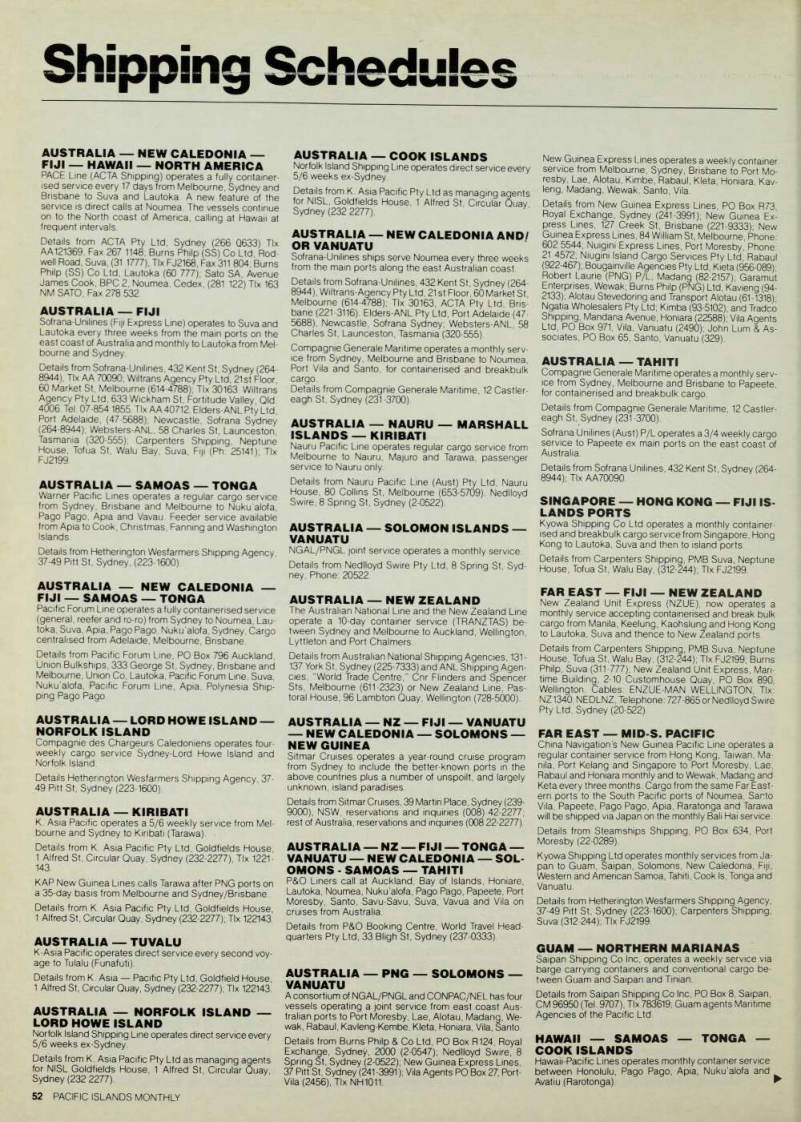

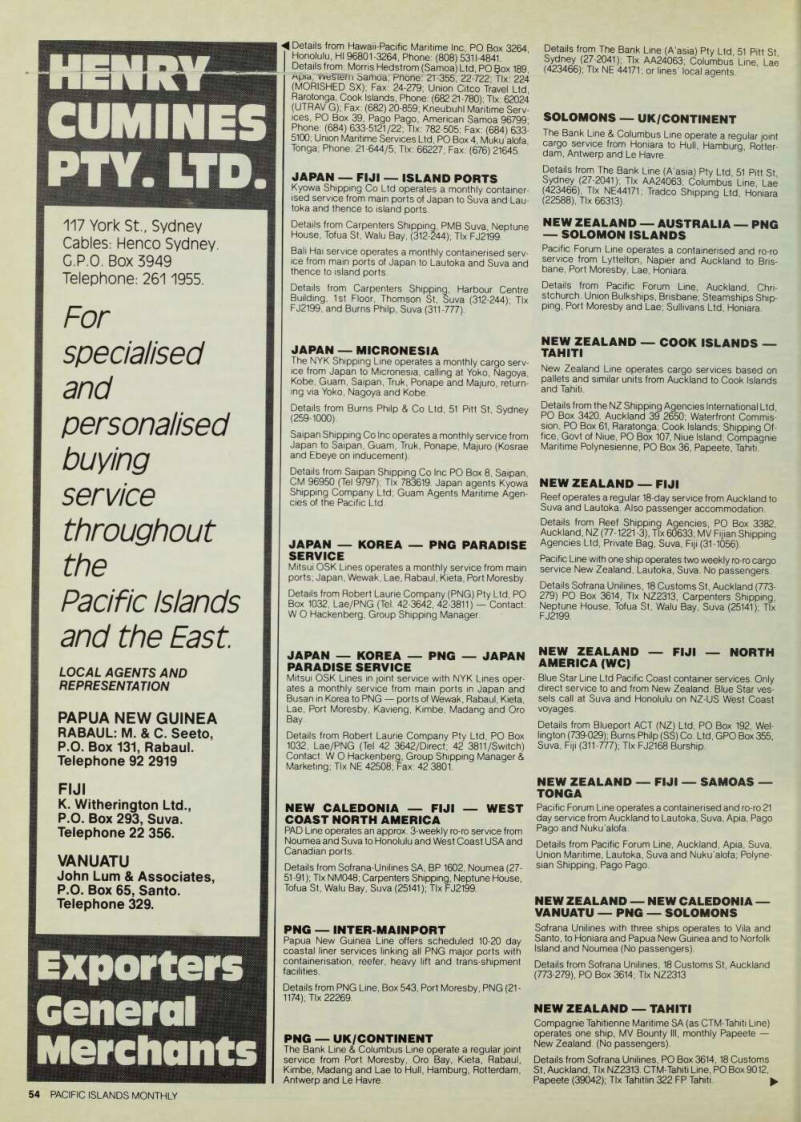
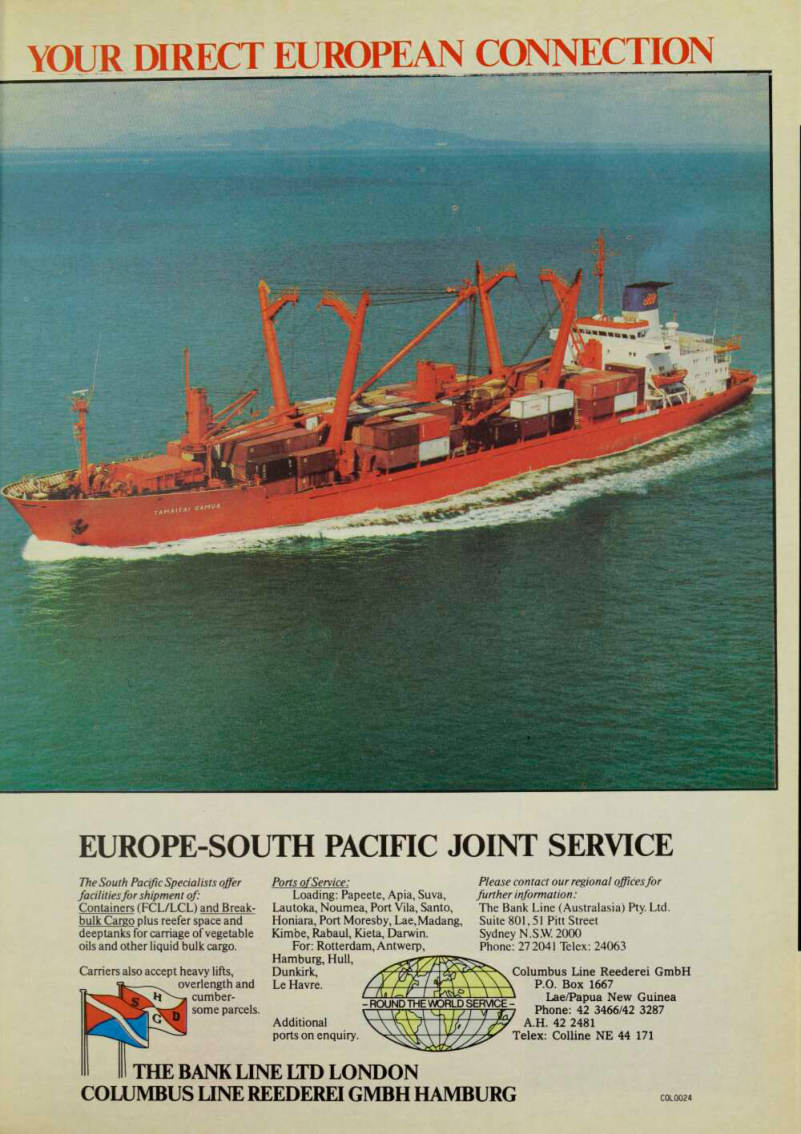
Australia New Caledonia
Fiji Hawaii North America
PACE Line (ACTA Shipping) operates a fully container ised service every 17 days from Melbourne, Sydney and Brisbane to Suva and Lautoka. A new feature of the service is direct calls at Noumea. The vessels continue on to the North coast of America, calling at Hawaii at frequent intervals Details from ACTA Pty Ltd, Sydney (266 0633) Tlx AA121369, Fax 267 1148; Burns Philp (SS) Co Ltd, Rod well Road, Suva, (31 1777), Tlx FJ2168, Fax 311 804 Burns Philp (SS) Co Ltd, Lautoka (60 777); Sato SA, Avenue James Cook, BPC 2, Noumea, Cedex, (281 122) Tlx 163
Nm Sato, Fax 278 532
Australia Fiji
Sofrana-Unilines (Fiji Express Line) operates to Suva and Lautoka every three weeks from the mam ports on the east coast of Australia and monthly to Lautoka from Mel bourne and Sydney.
Details from Sofrana-Unilines, 432 Kent St, Sydney (264- 8944), Tlx AA 70090; Wiltrans Agency Pty Ltd, 21st Floor 60 Market St, Melbourne (614-4788), Tlx 30163 Wiltrans Agency Pty Ltd, 633 Wickham St, Fortitude Valley Old 4006 Tel 07-854 1855 Tlx AA 40712. Elders-ANL Pty Ltd, Port Adelaide, (47-5688). Newcastle, Sofrana Sydney (264-8944), Websters-ANL, 58 Charles St, Launceston, Tasmania (320-555), Carpenters Shipping, Neptune House. Tofua St, Walu Bay, Suva, Fiji (Ph: 25141); Tlx FJ2199.
Australia Samoas Tonga
Warner Pacific Lines operates a regular cargo service from Sydney, Brisbane and Melbourne to Nukualofa, Pago Pago, Apia and Vavau. Feeder service available from Apia to Cook, Christmas, Fanning and Washington Islands.
Details from Hetherington Wesfarmers Shipping Agency 37-49 Pitt St, Sydney, (223-1600)
Australia New Caledonia
Fiji Samoas Tonga
Pacific Forum Line operates a fully containerised service (general, reefer and ro-ro) from Sydney to Noumea, Lau toka, Suva, Apia, Pago Pago, Nukualofa, Sydney, Cargo centralised from Adelaide, Melbourne, Brisbane Details from Pacific Forum Line, PO Box 796 Auckland, Union Bulkships, 333 George St, Sydney, Brisbane and Melbourne, Union Co, Lautoka, Pacific Forum Line, Suva, Nukualofa, Pacific Forum Line, Apia, Polynesia Ship ping Pago Pago
Australia Lord Howe Island
Norfolk Island
Compagnie des Chargeurs Caledoniens operates four weekly cargo service Sydney-Lord Howe Island and Norfolk Island Details Hetherington Wesfarmers Shipping Agency, 37- 49 Pitt St, Sydney (223-1600).
Australia Kiribati
K. Asia Pacific operates a 5/6 weekly service from Mel bourne and Sydney to Kiribati (Tarawa).
Details from K Asia Pacific Pty Ltd, Goldfields House, 1 Alfred St, Circular Quay, Sydney (232-2277), Tlx 1221- 143.
KAP New Guinea Lines calls Tarawa after PNG ports on a 35-day basis from Melbourne and Sydney/Bnsbane.
Details from K. Asia Pacific Pty Ltd, Goldfields House, 1 Alfred St, Circular Quay, Sydney (232-2277); Tlx 122143.
Australia Tuvalu
K-Asia Pacific operates direct service every second voy age to Tulalu (Funafuti).
Details from K. Asia Pacific Pty Ltd, Goldfield House, 1 Alfred St, Circular Quay, Sydney (232-2277); Tlx 122143.
Australia Norfolk Island
Lord Howe Island
Norfolk Island Shipping Line operates direct service every 5/6 weeks ex-Sydney.
Details from K. Asia Pacific Pty Ltd as managing agents for NISL Goldfields House, 1 Alfred St, Circular Quay, Sydney (232 2277).
Australia Cook Islands
Norfolk Island Shipping Line operates direct service every 5/6 weeks ex-Sydney.
Details from K Asia Pacific Pty Ltd as managing agents for NISL, Goldfields House, 1 Alfred St, Circular Quay Sydney (232 2277).
Australia New Caledonia And I
Or Vanuatu
Sofrana-Unilines ships serve Noumea every three weeks from the main ports along the east Australian coast Details from Sofrana-Unilines, 432 Kent St, Sydney (264- 8944), Wiltrans-Agency Pty Ltd, 21 st Floor, 60 Market St Melbourne (614-4788); Tlx 30163, ACTA Pty Ltd, Bris bane (221-3116). Elders-ANL Pty Ltd, Port Adelaide (47- 5688), Newcastle, Sofrana Sydney; Websters-ANL, 58 Charles St, Launceston, Tasmania (320-555) Compagnie Generate Maritime operates a monthly serv ice from Sydney, Melbourne and Brisbane to Noumea, Port Vila and Santo, for containerised and breakbulk cargo Details from Compagnie Generate Maritime, 12 Castler eagh St, Sydney (231-3700)
Australia Nauru Marshall
Islands Kiribati
Nauru Pacific Line operates regular cargo service from Melbourne to Nauru. Majuro and Tarawa, passenger service to Nauru only.
Details from Nauru Pacific Line (Aust) Pty Ltd, Nauru House, 80 Collins St, Melbourne (653-5709). Nedlloyd Swire, 8 Spring St. Sydney (2-0522).
Australia Solomon Islands
Vanuatu
NGAL/PNGL joint service operates a monthly service.
Details from Nedlloyd Swire Pty Ltd, 8 Spring St, Syd ney, Phone: 20522.
Australia New Zealand
The Australian National Line and the New Zealand Line operate a 10-day container service (TRANZTAS) be tween Sydney and Melbourne to Auckland, Wellington, Lyttleton and Port Chalmers.
Details from Australian National Shipping Agencies, 131 - 137 York St, Sydney (225-7333) and ANL Shipping Agen cies, "World Trade Centre," Cnr Flinders and Spencer Sts, Melbourne (611-2323) or New Zealand Line, Pas toral House, 96 Lambton Quay, Wellington (728-5000).
Australia Nz Fiji Vanuatu
New Caledonia Solomons
New Guinea
Sitmar Cruises operates a year-round cruise program from Sydney to include the better-known ports in the above countries plus a number of unspoilt, and largely unknown, island paradises.
Details from Sitmar Cruises, 39 Martin Place, Sydney (239- 9000), NSW, reservations and inquiries (008) 42-2277; rest of Australia, reservations and inquiries (008 22-2277).
Australia Nz Fiji Tonga
Vanuatu New Caledonia Sol
Omons - Samoas Tahiti
P&O Liners call at Auckland, Bay of Islands, Honiare, Lautoka, Noumea, Nukualofa, Pago Pago, Papeete, Port Moresby, Santo, Savu-Savu, Suva, Vavua and Vila on cruises from Australia.
Details from P&O Booking Centre, World Travel Head quarters Pty Ltd, 33 Bligh St, Sydney (237-0333).
Australia Png Solomons
Vanuatu
A consortium of NGAL/PNGL and CONPAC/NEL has four vessels operating a joint service from east coast Aus tralian ports to Port Moresby, Lae, Alotau, Madang, We wak, Rabaul, Kavleng-Kembe, Kleta, Honiara, Vila, Santo.
Details from Burns Philp & Co Ltd, PO Box R 124, Royal Exchange, Sydney, 2000 (2-0547); Nedlloyd Swire, 8 Spring St, Sydney (2-0522); New Guinea Express Lines, 37 Pitt St, Sydney (241 -3991); Vila Agents PO Box 27, Port- Vila (2456), Tlx NHIOII.
New Guinea Express Lines operates a weekly container service from Melbourne, Sydney, Brisbane to Port Mo resby, Lae, Alotau, Kimbe, Rabaul, Kleta, Honiara, Kav leng, Madang, Wewak, Santo, Vila.
Details from New Guinea Express Lines, PO Box R 73 Royal Exchange, Sydney (241-3991); New Guinea Ex press Lines, 127 Creek St, Brisbane (221-9333); New Guinea Express Lines, 84 William St, Melbourne, Phone: 602 5544; Nuigini Express Lines, Port Moresby, Phone: 21 4572; Niugini Island Cargo Services Pty Ltd, Rabaul (922-467); Bougainville Agencies Pty Ltd, Kieta (956-089) Robert Laurie (PNG) P/L, Madang (82-2157); Garamut Enterprises, Wewak; Burns Philp (PNG) Ltd, Kavieng (94- 2133); Alotau Stevedoring and Transport Alotau (61-1318) Ngatia Wholesalers Pty Ltd; Kimba (93-5102); and Tradco Shipping, Mandana Avenue, Honiara (22588); Vila Agents Ltd, PO Box 971, Vila, Vanuatu (2490); John Lum & As sociates, PO Box 65, Santo, Vanuatu (329).
Australia Tahiti
Compagnie Generate Maritime operates a monthly serv ice from Sydney, Melbourne and Brisbane to Papeete, for containerised and breakbulk cargo.
Details from Compagnie Generate Maritime, 12 Castler eagh St, Sydney (231-3700).
Sofrana Unilines (Aust) P/L operates a 3/4 weekly cargo service to Papeete ex main ports on the east coast of Australia.
Details from Sofrana Unilines, 432 Kent St, Sydney (264- 8944); Tlx AA70090.
Singapore Hong Kong Fiji Is
Lands Ports
Kyowa Shipping Co Ltd operates a monthly container ised and breakbulk cargo service from Singapore, Hong Kong to Lautoka, Suva and then to island ports.
Details from Carpenters Shipping, PMB Suva, Neptune House, Tofua St, Walu Bay, (312-244); Tlx FJ2199.
Far East Fiji New Zealand
New Zealand Unit Express (NZUE), now operates a monthly service accepting containerised and break bulk cargo from Manila, Keelung, Kaohslung and Hong Kong to Lautoka, Suva and thence to New Zealand ports.
Details from Carpenters Shipping, PMB Suva, Neptune House, Tofua St, Walu Bay, (312-244); Tlx FJ2199; Burns Philp, Suva (311-777); New Zealand Unit Express, Mari time Building, 2-10 Customhouse Quay, PO Box 890, Wellington. Cables: ENZUE-MAN WELLINGTON, Tlx: NZ1340. NEDLNZ, Telephone: 727-865 or Nedlloyd Swire Pty Ltd, Sydney (20-522).
Far East Mid-S. Pacific
China Navigation’s New Guinea Pacific Line operates a regular container service from Hong Kong, Taiwan, Ma nila, Port Kelang and Singapore to Port Moresby, Lae, Rabaul and Honiara monthly and to Wewak, Madang and Keta every three months. Cargo from the same Far East ern ports to the South Pacific ports of Noumea, Sarto Vila, Papeete, Pago Pago, Apia, Raratonga and Tarawa will be shipped via Japan on the monthly Bali Hai service.
Details from Steamships Shipping, PO Box 634, Port Moresby (22-0289).
Kyowa Shipping Ltd operates monthly services from Ja pan to Guam, Saipan, Solomons, New Caledonia, Fiji, Western and American Samoa, Tahiti, Cook Is, Tonga and Vanuatu.
Details from Hetherington Wesfarmers Shipping Agency, 37-49 Pitt St, Sydney (223-1600); Carpenters Shipping, Suva (312-244); Tlx FJ2199.
Guam Northern Marianas
Saipan Shipping Co Inc, operates a weekly service via barge carrying containers and conventional cargo be tween Guam and Saipan and Tinian, Details from Saipan Shipping Co Inc, PO Box 8, Saipan, CM 96950 (Tel. 9707), Tlx 783619; Guam agents Maritime Agencies of the Pacific Ltd.
Hawaii Samoas Tonga
Cook Islands
Hawaii-Pacific Lines operates monthly container service between Honolulu, Pago Pago, Apia, Nukualofa and Avatiu (Rarotonga). *
◄ Details from Hawaii-Pacific Maritime Inc, PO Box 3264 Honolulu, HI 96801 -3264, Phone: (808) 5311-4841. Details from: Morris Hedstrom (Samoa) Ltd, PO Box 189, apia, western oamoaTPnoner 2T-355, 22-722; Tlx: 224 (MORISHED SX); Fax: 24-279; Union Citco Travel Ltd Rarotonga, Cook Islands, Phone: (682 21-780); Tlx: 62024 (UTRAV G); Fax: (682) 20-859; Kneubuhl Maritime Serv ices, PO Box 39, Pago Pago, American Samoa 96799 Phone: (684) 633-5121/22; Tlx: 782-505; Fax: (684) 633- 5100; Union Maritime Services Ltd, PO Box 4, Muku’alofa Tonga; Phone: 21-644/5; Tlx: 66227; Fax: (676) 21645.
Japan Fiji Island Ports
Kyowa Shipping Co Ltd operates a monthly container ised service from main ports of Japan to Suva and Lau toka and thence to island ports.
Details from Carpenters Shipping, PMB Suva, Neptune House, Tofua St, Walu Bay, (312-244); Tlx FJ2199.
Bali Hai service operates a monthly containerised serv ice from main ports of Japan to Lautoka and Suva and thence to island ports.
Details from Carpenters Shipping, Harbour Centre Building, Ist Floor, Thomson St, Suva (312-244)- Tlx FJ2199, and Burns Philp, Suva (311-777).
Japan Micronesia
The NYK Shipping Line operates a monthly cargo serv ice from Japan to Micronesia, calling at Yoko, Nagoya, Kobe, Guam, Saipan, Truk, Ponape and Majuro, return ing via Yoko, Nagoya and Kobe.
Details from Burns Philp & Co Ltd, 51 Pitt St, Sydney (259-1000) Saipan Shipping Co Inc operates a monthly service from Japan to Saipan, Guam, Truk, Ponape, Majuro (Kosrae and Ebeye on inducement).
Details from Saipan Shipping Co Inc PO Box 8, Saipan, CM 96950 (Tel 9797); Tlx 783619. Japan agents Kyowa Shipping Company Ltd; Guam Agents Maritime Agen cies of the Pacific Ltd.
Japan Korea Png Paradise
Service
Mitsui OSK Lines operates a monthly service from main ports; Japan, Wewak, Lae, Rabaul, Kieta, Port Moresby.
Details from Robert Laurie Company (PNG) Pty Ltd, PO Box 1032, Lae/PNG (Tel. 42-3642, 42-3811) Contact: W O Hackenberg, Group Shipping Manager.
Japan Korea Png Japan
Paradise Service
Mitsui OSK Lines in joint service with NYK Lines oper ates a monthly service from main ports in Japan and Busan in Korea to PNG ports of Wewak, Rabaul, Kieta, Lae, Port Moresby, Kavieng, Kimbe, Madang and Oro Bay.
Details from Robert Laurie Company Pty Ltd, PO Box 1032, Lae/PNG (Tel 42 3642/Direct; 42 3811/Switch) Contact: W O Hackenberg, Group Shipping Manager & Marketing; Tlx NE 42508; Fax: 42 3801.
New Caledonia Fiji West
Coast North America
PAD Line operates an approx. 3-weekly ro-ro service from Noumea and Suva to Honolulu and West Coast USA and Canadian ports.
Details from Sofrana-Unilines SA, BP 1602, Noumea (27- SI-91 ); Tlx NMO4B; Carpenters Shipping, Neptune House, Tofua St, Walu Bay, Suva (25141); Tlx FJ2199.
Png Intermainport
Papua New Guinea Line offers scheduled 10-20 day coastal liner services linking all PNG major ports with containerisation, reefer, heavy lift and trans-shipment facilities.
Details from PNG Line, Box 543, Port Moresby, PNG (21- 1174); Tlx 22269.
Png Uk/Continent
The Bank Line & Columbus Line operate a regular joint service from Port Moresby, Oro Bay, Kieta, Rabaul, Kimbe, Madang and Lae to Hull, Hamburg, Rotterdam, Antwerp and Le Havre.
Details from The Bank Line (A'asia) Pty Ltd 51 Pitt St Sydney(2 7 -2°41); Tlx AA24063; Columbus Line, Lae (423466); Tlx NE 44171; or lines’ local agents.
Solomons Uk/Continent
The Bank Line & Columbus Line operate a regular joint cargo service from Honiara to Hull, Hamburg, Rotter dam, Antwerp and Le Havre.
Details from The Bank Line (A'asia) Pty Ltd, 51 Pitt St Sydney (27-2041); Tlx AA24063; Columbus Line Lae pimrileraia! 41711 Trad °° Sh ' PP ' n 9 LWI Honia,a
New Zealand Australia Png
Solomon Islands
Pacific Forum Line operates a containerised and ro-ro service from Lyttelton, Napier and Auckland to Bris bane, Port Moresby, Lae, Honiara.
Details from Pacific Forum Line, Auckland, Chri stchurch. Union Bulkships, Brisbane; Steamships Ship ping, Port Moresby and Lae; Sullivans Ltd, Honiara.
New Zealand Cook Islands
Tahiti
New Zealand Line operates cargo services based on pallets and similar units from Auckland to Cook Islands and Tahiti.
Details from the NZ Shipping Agencies International Ltd, PO Box 3420, Auckland 39 2650; Waterfront Commis sion, PC Box 61, Raratonga; Cook Islands; Shipping Of fice, Govt of Niue, PO Box 107, Niue Island; Compagnie Maritime Polynesienne, PO Box 36, Papeete, Tahiti.
New Zealand —Fiji
Reef operates a regular 18-day service from Auckland to Suva and Lautoka. Also passenger accommodation.
Details from Reef Shipping Agencies, PO Box 3382, Auckland, NZ (77-1221 -3), Tlx 60633; MV Fijian Shipping Agencies Ltd, Private Bag, Suva, Fiji (31-1056).
Pacific Line with one ship operates two weekly ro-ro cargo service New Zealand, Lautoka, Suva. No passengers.
Details Sofrana Unilines, 18 Customs St, Auckland (773- 279) PO Box 3614, Tlx NZ2313, Carpenters Shipping, Neptune House, Tofua St, Walu Bay, Suva (25141) Tlx FJ2199.
New Zealand Fiji North
America (Wc)
Blue Star Line Ltd Pacific Coast container services. Only direct service to and from New Zealand. Blue Star ves sels call at Suva and Honolulu on NZ-US West Coast voyages.
Details from Blueport ACT (NZ) Ltd, PO Box 192, Wel lington (739-029); Burns Philp (SS) Co. Ltd, GPO Box 355, Suva, Fiji (311-777); Tlx FJ2168 Burship.
New Zealand Fiji Samoas
Tonga
Pacific Forum Line operates a containerised and ro-ro 21 day service from Auckland to Lautoka, Suva, Apia, Pago Pago and Nukualofa.
Details from Pacific Forum Line, Auckland, Apia, Suva, Union Maritime, Lautoka, Suva and Nukualofa; Polyne sian Shipping, Pago Pago,
New Zealand New Caledonia
Vanuatu Png Solomons
Sofrana Unilines with three ships operates to Vila and Santo, to Honiara and Papua New Guinea and to Norfolk Island and Noumea (No passengers).
Details from Sofrana Unilines, 18 Customs St, Auckland (773-279), PO Box 3614; Tlx NZ2313
New Zealand Tahiti
Compagnie Tahitienne Maritime SA (as CTM-Tahiti Line) operates one ship, MV Bounty 111, monthly Papeete New Zealand. (No passengers).
Details from Sofrana Unilines, PO Box 3614,18 Customs St, Auckland, Tlx NZ2313. CTM-Tahiti Line, PO Box 9012, Papeete (39042); Tlx Tahitlin 322 FP Tahiti.
◄ N 2 Cook Islands Aitutaki
Niue
ocoa loiariuo Ln'ici seivToesr Muckiarfd, Aitutaki, Niue monthly carrying general and freezer cargoes.
Details from McKay Shipping Ltd, Downtown House 21 Queen Street, Auckland, PO Box 3, Auckland Phone 39 0229. Cables MACSHIP, Tlx: NZ2554; Fax: 32-931.
Tahiti New Caledonia Vanu
Atu Solomon Islands New
Zealand Png Singapore
Europe
Polish Ocean Lines operate in semi-container type ves sels to the following ports: from Papeete, Noumea, Santo Vila, Yandma, Honiara, Auckland, Rabaul, Lae, Singa pore, Port Kielang, Penang then to Mediterranean ports and Europe via the Suez Canal. (Other New Zealand ports subject to inducement) Details from Universal Shipping Agencies Ltd, 6th Floor 38 Fort St, Auckland 1, New Zealand (390931 390727 32104), Tlx 21517.
Europe Tahiti New
Caledonia
Compagnie Generate Maritime operates services from Europe and Mediterranean ports to Papeete and Nou mea using three ro-ro and multi-purpose vessels thus ensuring a bi-monthly sailing to and from.
Details Compagnie Generate Maritime, 12 Castlereaqh St, Sydney (231-3700).
Europe Tahiti New Cale
Donia New Zealand Vanuatu
Solomons Png Europe
Polish Ocean Lines offers regular monthly sailings for containerised and break bulk cargo, also conventional reefer space and reefer containers from Hamburg, Rot terdam, Dunkirk, Rouen to Papeete, Noumea, Auckland, Santo, Honiara, Rabaul, Lae, Singapore, returning to Eu rope via Suez. Other ports in the South Pacific can be served directly with inducement or otherwise via transshipment Details from Sotama, BP 9170, Papeete, Tel. 427805, Tlx 373, Tlx Sotama 373FP; SATO: BP, C 2 Noumea Cedex Tel. 272094, Tlx 163 NM: Universal Shipping Agencies, PO Box 2282 Auckland, Tel. 30930 Tlx 21517: Vanua Navi gation, PO Box 44, Vila, Tel. 2027, Tlx 1033; Melan Chine Shipping Co., PO Box 71, Honiara, Tel. 21678, Tlx 66335: Steamships Trading Co. Ltd., PO Box 85, Lae, Tel. 424666, Tlx 42423; Union Steamship Co, of NZ Ltd, PO Box 50, Apia, Tel. 21781, Tlx 225; Warner Pacific Line, PO Box 93, Nukualofa, Tel. 22088, Tlx 66219; Fiji Agents TBA.
Europe Tahiti W. Samoa Fiji
New Caledonia
Nedlloyd offers regular cargo services from Continental ports to Papeete, Apia, Fiji and New Caledonia.
Details Nedlloyd (Aust.) Pty Ltd, Spring St, Sydney (27- 3801); Carpenters Shipping, Ist Floor, Harbour Centre Bldg, 100 Thomson St, Suva (312-244) Tlx 2199FJ and Vetari St, Lautoka (63988), Tlx 5215FJ.
Uk N. Continent W. Samoa
Tonga Fiji
The Bank Line & Columbus Line operate a regular joint cargo service from Hull, Hamburg, Bremen, Antwerp, Rotterdam and Le Havre to Apia, Nukualofa, Suva and Lautoka.
Details from The Bank Line (A'asia) Pty Ltd, 51 Pitt St, Sydney (27-2041), Tlx AA24063, Columbus Line, Lae (423- 466), Tlx NE 44111, or Lines’ local agents.
Uk N. Continent Png
Solomons
The Bank Line & Columbus Line operate a regular joint cargo service from Hull, Hamburg, Bremen, Antwerp, Rotterdam and Le Havre to Port Moresby, Lae, Madang, Kimbe, Rabaul, Kieta and Honiara and on inducement to Yandina.
Details from The Bank Line (A’asia) Pty Ltd, 51 Pitt St, Sydney (27-2041), Tlx AA 24063. Columbus Line, Lae (42- 3466), Tlx NE 44171; or Lines' local agents
Uk/N. Continent Tahiti New
Caledonia Vanuatu
The Bank Line and Columbus Line operate a regular joint cargo service from Hull, Hamburg, Bremen, Antwerp, Rotterdam and Le Havre to Papeete, Noumea, Port-Vila and Santo.
Details from The Bank Line (A’asia) Pty Ltd, 51 Pitt St Sydney (27-2041), Tlx AA 24063, Columbus Line Lae (42- 3466), Tlx NE 44171; Ets A.M. Fare UTE, Papeete- Ets Ballande, Noumea and other local agents,
Us Hawaii Micronesia Png
Philippines
PM&O Lines operates two fully self-contained container vessels on a sailing frequency of every 30 days between the San Francisco Bay Area, Los Angeles, Honolulu and Majuro, Ebeye, Kosrae, Ponape, Truk, Saipan, Yap, Pa lau, Cebu, Davao, Lae, Kieta and Rabaul.
Details from PM&O Lines, 353 Sacramento St, San Fran cisco, California 94111, USA (415) 421-5400, Tlx 278016 PMO UR; owner’s Representative PO Box 803 Saipan NMI 96950, Ph. 234-6819, Tlx 783-605 CMCAA. ’
Us Noumea Fiji
PAD Line operates a 3-weekly ro-ro service from west coast USA and Canada to Noumea, Suva and Lautoka.
Details from Sofrana Unilines BP 1602, Noumea (27-51- 91), Tlx NMO4B; Carpenters Shipping, Neptune House Tofua St, Walu Bay, Suva (25141), Tlx FJ2199 Trans-Aus tral Shipping Pty Ltd, PO Box R 232, Royal Exchange 2000 (231-8411). Tlx AA21204,
Advertisements & other items, pp. 53-56 (1 item)
to Noum
mmmmm wwwwwmmSMSMWMMMMMMWMM
’ fel
acf m m gf m m
can
When it comes to shipping, ACTA really know their onions.
Which makes the addition of Noumea to the ports we service welcome news for Australian exporters.
ACTA boasts a purpose built fleet of ships, backed by on-shore and after-sail service that can’t be beaten.
We’ll keep your fresh food fresh, frozen foods frozen and protect your more fragile exports as if they were our own.
And deliver the same first class service established by ACTA between Australia and Fiji, not to mention both coasts of North America.
The new ACTA service between Australia and Noumea.
If you have a first class product, it’s the only way to travel.
J Sydney (02) 2660633, Melbourne (03) 611 2000, Brisbane (07) 221 3116
to Noum
■ m I m gf if m m gf m m m [ad I gf s /HI 1 m jm is if m m if if if if if if if if Atoughacttofolbw /fij/if|,/e|/if/if if /b| ifj r*\ (acf |S? lacf
‘ACIF 1C ISLAND MONTHLY
U_LIl
PTY. LTD.
117 York St, Sydney Cables: Henco Sydney.
C.P.O. Box 3949 Telephone: 261 1955.
For
specialised
and
personalised
buying
service
throughout
the
Pacific Islands
and the East
LOCAL AGENTS AND
REPRESENTATION
PAPUA NEW GUINEA
RABAUL: M. & C. Seeto, P.O. Box 131, Rabaul.
Telephone 92 2919
FIJI
K. Witherington Ltd., P.O. Box 293, Suva.
Telephone 22 356.
VANUATU
John Lum & Associates, P.O. Box 65, Santo.
Telephone 329.
Exporters
General
Merchants
YOUR DIRECT EUROPEAN CONNECTION
■ * 4 b JK
EUROPE-SOUTH PACIFIC JOINT SERVICE
The South Pacific Specialists offer facilities for shipment of: Containers (FCL/LCL) and Breakbulk Cargo plus reefer space and deeptanks for carriage of vegetable oils and other liquid bulk cargo.
Carriers also accept heavy lifts, overlength and cumbersome parcels.
Ports of Service: Loading: Papeete, Apia, Suva, Lautoka, Noumea, Port Vila, Santo, Honiara, Port Moresby, Lae,Madang, Kimbe, Rabaul, Kieta, Darwin.
For; Rotterdam, Antwerp, Hamburg, Hull, Dunkirk, Le Havre.
Additional \ \'
ports on enquiry. Ns^
ROUND THE WORLD SERVICE -
Please contact our regional offices for further information: The Bank Line (Australasia) Pty. Ltd.
Suite 801,51 Pitt Street Sydney N.S.W. 2000 Phone; 27 2041 Telex: 24063 Columbus Line Reederei GmbH P.O. Box 1667 Lae/Papua New Guinea Phone: 42 3466/42 3287 A.H. 42 2481 Telex: Colline NE 44 171
THE BANK LINE LTD LONDON
COLUMBUS LINE REEDEREI GMBH HAMBURG
C0L0024
IMPORT/FXPORT
Sourcing and Buying Trade Financial Services Transher Facilities.
PACIFIC MARKETING
& HOLDINGS (Vanuatu) Telex Aust: SECCO 72917 Fax Aust: (02) 969 9729 Phone Aust: (02) 90 3527
SINGAPORE, AUST.
PHILIPPINES, N.Z., FIJI
VANUATU. TAtWAtf
Perkins
SSETJ
Sales, service & spare parts
POWER
Wt RUSLIT POWER CENTRE
1195 Parramatta Rd, Auburn 2144 Sydney, NSW, Australia (02) 648 0591
For all your
computer needs
(hardware, software, books) by quick and easy mail order.
CANBERRA
ACCOUNTING
SERVICES
GPO Box 2159, Canberra, 2601. AUSTRALIA
Aggie Grey’s
Hotel
Stay at Aggie Grey’s
the South Pacific’s
legendary hotel.
Situated right in the heart of Western Samoa. Enjoy Polynesian style friendliness and service,in cool surroundings, superb entertainment and food. Magnificent white sand beaches only a short drive away.
Air-conditioned rooms, swimming pool and full bar facilities.
Bookings through Union Steamship Company of NZ, Pan Am, Air New Zealand or direct to Aggie Grey’s, Apia, Western Samoa. Cables: ‘AGGIES’ Apia.
Hits Town
A New Ship Hits Town
THE M/V Urte is arrived at Honolulu on November 1, 1987 to commence a liner container service exclusively linking Ha waii with American and Western Samoa, Tonga and the Cook Islands. Hawaii-Pa cific Lines Ltd, with Honolulu manage ment, will operate the inter-island service providing island merchants regularly scheduled access to new markets and products. Service frequency will be monthly between Honolulu and, in rota tion, the ports of: Pago Pago, American Samoa, Apia, Western Samoa, Nukualofa, Tonga and Avatiu Harbor, Rarotonga, the Cook Islands.
The line will offer the Cook Islands the first direct link with the US (ie Hawaii) and also be the first ever container service to the Cook Islands. It will also be the only scheduled service between a US port and Tonga. Transit times between Honolulu and the four ports will vary from nine to 15 days.
The Urte is 1985-built self-sustaining 100 metre German container vessel with a capacity of 170 20ft containers. In ad dition to offering full container service in 20ft dry vans, HPL will offer refrigerated containers and accept Less Than Con tainer Load (“LCL”) cargoes at Pier I, Honolulu, where Honolulu cargo opera tion will be conducted.
McCabe, Hamilton & Renny Co., Ltd has been appointed stevedore for loading and discharging at Honolulu. □
Advertisements & other items, p. 57 (1 item)
Polish Ocean W|
General Management. 10 Lutego 24,81-364 GDYNIA. POLAND, Phone: 20-19-01, Cables: POLOCEAN Telex: 054-231 m >Y <p Q u tn m - "T #r'.
'M M X * JV.
AS: >•- . i ’.» • T .7>V' v ; : * * v* •• *1 -..0* ts ?rr} - »• . :;-;V V.V4 A - ..■ n'
SOUTH PACIFIC SERVICE
We offer monthly service to and from; GDYNIA, HAMBURG, ROTTERDAM, MIDDLESBOROUGH/IMMINGHAM, ANTWERP, DUNKIRK, ROUEN, PAPEETE (via PANAMA), NOUMEA, AUCKLAND, HONIARA, RABAUL, LAE, SINGAPORE, by our multipurpose vessels carrying dry and reefer containers, reefer chambers, heavy lifts, breakbulk or
palletized, bulk liquids.
POLISH OCEAN LINES Representatives AUCKLAND Mr. A. Sieradzki. Telex 21517 NZ “UNISHIP”. SYDNEY Mr. Ryszard Socha. Telex 20428 AA “SLEIGH”
POLISH OCEAN LINES Agents
TAHITI SOTAMA Telex 296 FP “COUTIMEX”. NEW CALEDONIA SATO Telex 163 NM “SATO”. AUCKLAND UNIVERSAL SHIPPING AGENCIES LTD., Telex 21517 NZ “UNISHIP". SOLOMONS MELAN CHINE SHIPPING CO., LTD Telex 66335 HO “SYMECO". PNG STEAMSHIPS TRADING CO., LTD Telex 42423 NE “STEAM”.
Fiji’s Age Of Innocence
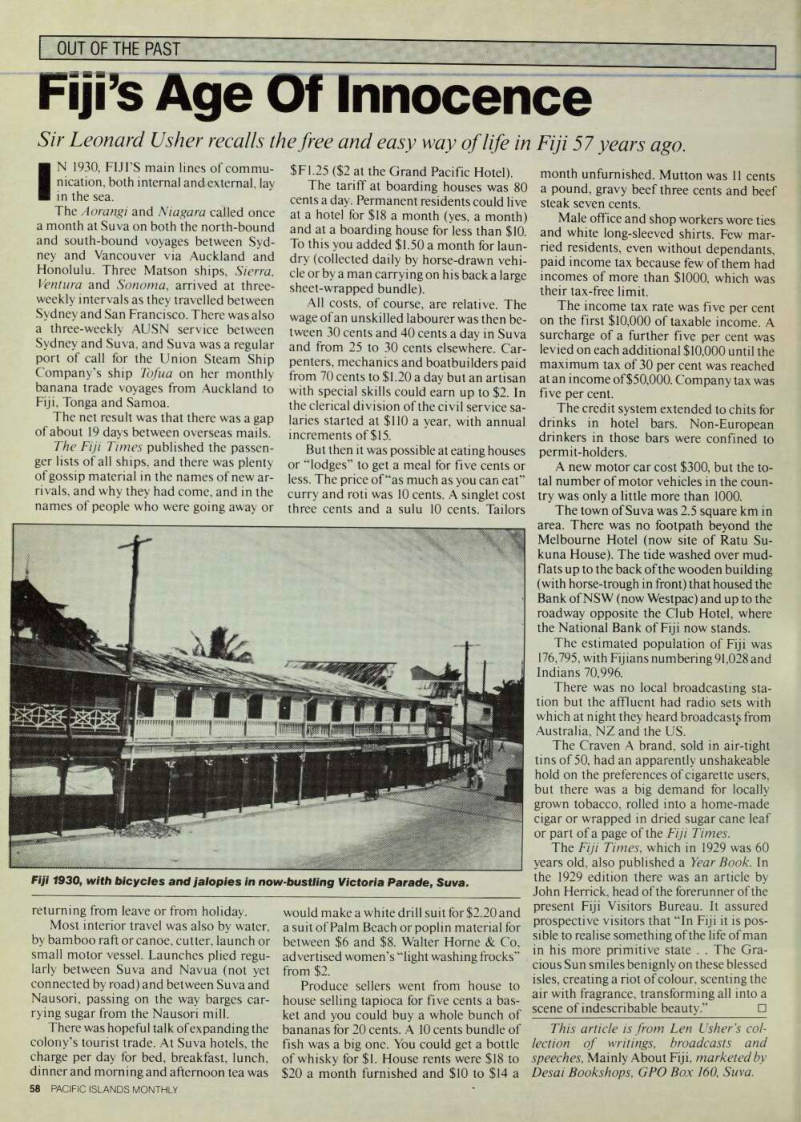
Out Of The Past
Sir Leonard Usher recalls the free and easy way of life in Fiji 5 7 years ago
IN 1930, FIJI’S main lines of commu nication, both internal and external, lay in the sea.
The Aorangi and Niagara called once a month at Suva on both the north-bound and south-bound voyages between Syd ney and Vancouver via Auckland and Honolulu. Three Matson ships, Sierra, Ventura and Sonoma , arrived at three weekly intervals as they travelled between Sydney and San Francisco. There was also a three-weekly AUSN service between Sydney and Suva, and Suva was a regular port of call for the Union Steam Ship Company’s ship Tofua on her monthly banana trade voyages from Auckland to Fiji, Tonga and Samoa.
The net result was that there was a gap of about 19 days between overseas mails.
The Fiji Times published the passen ger lists of all ships, and there was plenty of gossip material in the names of new ar rivals, and why they had come, and in the names of people who were going away or
returning from leave or from holiday.
Most interior travel was also by water, by bamboo raft or canoe, cutter, launch or small motor vessel. Launches plied regu larly between Suva and Navua (not yet connected by road) and between Suva and Nausori, passing on the way barges car rying sugar from the Nausori mill.
There was hopeful talk of expanding the colony’s tourist trade. At Suva hotels, the charge per day for bed, breakfast, lunch, dinner and morning and afternoon tea was
$F 1.25 ($2 at the Grand Pacific Hotel).
The tariff at boarding houses was 80 cents a day. Permanent residents could live at a hotel for $lB a month (yes, a month) and at a boarding house for less than $lO.
To this you added $1.50 a month for laun dry (collected daily by horse-drawn vehi cle or by a man carrying on his back a large sheet-wrapped bundle).
All costs, of course, are relative. The wage of an unskilled labourer was then be tween 30 cents and 40 cents a day in Suva and from 25 to 30 cents elsewhere. Car penters, mechanics and boatbuilders paid from 70 cents to $1.20 a day but an artisan with special skills could earn up to $2. In the clerical division of the civil service sa laries started at sllO a year, with annual increments of sls.
But then it was possible at eating houses or “lodges” to get a meal for five cents or less. The price of “as much as you can eat” curry and roti was 10 cents. A singlet cost three cents and a sulu 10 cents. Tailors
would make a white drill suit for $2.20 and a suit of Palm Beach or poplin material for between $6 and SB. Walter Horne & Cos, advertised women’s “light washing frocks” from $2.
Produce sellers went from house to house selling tapioca for five cents a bas ket and you could buy a whole bunch of bananas for 20 cents. A 10 cents bundle of fish was a big one. You could get a bottle of whisky for sl. House rents were $lB to S2O a month furnished and $lO to sl4 a
month unfurnished. Mutton was 11 cents a pound, gravy beef three cents and beef steak seven cents.
Male office and shop workers wore ties and white long-sleeved shirts. Few mar ried residents, even without dependants, paid income tax because few of them had incomes of more than SIOOO, which was their tax-free limit.
The income tax rate was five per cent on the first SIO,OOO of taxable income. A surcharge of a further five per cent was levied on each additional SIO,OOO until the maximum tax of 30 per cent was reached at an income of $50,000. Company tax was five per cent.
The credit system extended to chits for drinks in hotel bars. Non-European drinkers in those bars were confined to permit-holders.
Anew motor car cost S3OO, but the to tal number of motor vehicles in the coun try was only a little more than 1000.
The town of Suva was 2.5 square km in area. There was no footpath beyond the Melbourne Hotel (now site of Ratu Su kuna House). The tide washed over mud flats up to the back of the wooden building (with horse-trough in front) that housed the Bank of NSW (now Westpac) and up to the roadway opposite the Club Hotel, where the National Bank of Fiji now stands.
The estimated population of Fiji was 176,795, with Fijians numbering 91,028 and Indians 70,996.
There was no local broadcasting sta tion but the affluent had radio sets with which at night they heard broadcasts from Australia, NZ and the US.
The Craven A brand, sold in air-tight tins of 50, had an apparently unshakeable hold on the preferences of cigarette users, but there was a big demand for locally grown tobacco, rolled into a home-made cigar or wrapped in dried sugar cane leaf or part of a page of the Fiji Times.
The Fiji Times , which in 1929 was 60 years old, also published a Year Book. In the 1929 edition there was an article by John Herrick, head of the forerunner of the present Fiji Visitors Bureau. It assured prospective visitors that “In Fiji it is pos sible to realise something of the life of man in his more primitive state . . The Gra cious Sun smiles benignly on these blessed isles, creating a riot of colour, scenting the air with fragrance, transforming all into a scene of indescribable beauty.” □
This article is from Len Usher’s col lection of writings, broadcasts and speeches, Mainly About Fiji, marketed by Desai Bookshops, GPO Box 160, Suva.
Fiji 1930, with bicycles and jalopies in now-bustling Victoria Parade, Suva.
Advertisements & other items, pp. 59-60 (1 item)
Aiwa
POWI
'V mS
PMPO
& Awesome music power that surrounds you—get it with AlWA’s impressive V-770A stereo system. The powerful amplifier section delivers an amazing 400 watts(PMPO)of power. Along with the built-in Surround Sound circuitry and the supplied pair of surround speakers, it fills every corner of your room with rich, exciting music. Plus, advanced features and functions iclude a 5-band graphic equalizer and spectrum analyzer, a quartz synthesizer 4-band tuner with 20 memory presets (10 FM + 10 AM/SWI/SW2), Surround Sound' control, Dolby B double cassette deck, fully automatic turntable, big 2-way bass reflex speakers, and wireless remote control most system functions to assure you complete music pleasure. .. .surround yourself with pure sound excitement!
Hi-fi Midi System V-770A
AIWA
'Dolby and the Double-D symbol are trademarks of Dolby Laboratories Licensing Corporation.
M K D K. rCO ° S SS, Roseville > Sydney- NS W 2069, AUSTRALIA PHONE: (02) 406-6277/Oceania Indent Agency (P.N.G.) Pty., Ltd. Ago St., Gordon Box 5518 Boroko Port Moresby, Papua New Guinea PHONE: 256411/The Sound Centre Ltd. P.O. Box 434 Port Vila, Vanuatu PHONE: 2035/P. Hargovind Bros. 190 Renwick Road P.O. Box 490 Suva Fiji PHONE- 24350/ R«/ r u y D,s n ‘ )ut o rs i Ltd : WeNersley Street, P.O. Box 5919, Auckland, New Zealand PHONE; (09) 399-175/Hifivox 79, Rue de Sebastopol, B.P. 1458 Noumea, New Caledonia PHONE-' 27 24 PHONE; 131/Fare Hi-Fi Stereo Ruedu Marechal Foch-P.O. Box 269, Papeete, Tahiti PHONE: 2-4814/Micropac Audio, Inc.
P.O. Box 3478 Agana, Guam 96910 PHONE: 472-8091,472-8297/Rarotonga Duty Free Shop Private Bag P.O. Box 92. Rarotonga. Cook Island/Nauru Co-Operative Society Republic of Nauru
THE WYNN’S SAFARI- VICTORY THREE YEARS IN A ROW
Conquering the lonely continent.
The challenge of the Australian continent is an elemental one, one that has tempted intrepid adventurers for hundreds of years. Early explorers, lonely, driven men found the lure of the vast red interior irresistible. It presented the chance of going beyond the realms of civilization, and many never made it back. For the Australian interior is a horribly unique one. Its desolation is total. A land that boasts more varieties of venomous creatures than any other continent does not invite intrusion nor welcome the faint-hearted.
Not much has changed in a hundred years.
Jtm
m Snakes and crocodiles still rule this empty land and fools still try to cross it. Every year in August, brave men and women tackle a course of swamps, deserts and rain forest for the glory of winning the Australian Wynn's Safari, 6,500 km of the toughest rally country to be found anywhere. This year, for the third time in a row, it was the Mitsubishi Pajero that roared in, first and second to the cheers of the crowd waiting at the finish line in Darwin.
In the incredibly demanding "Marathon Class", that for unmodified 4WDs (essentially the same vehicles that stock showrooms), Mitsubishi's superior durability won out, also for the third year in a row.
In fact, seven of the top ten positions were filled by Mitsubishi Pajeros.
The reason for that kind of unbeatable performance is simple. The active policy at Mitsubishi Motors is to seek out the worst possible conditions to prove the reliability of their vehicles. The ultimate performance test as it were. And the reward is more than just winning; it is the satisfaction of producing vehicles that, in appalling conditions have stood with and bested a select group of latter day adventurers distinguished by a common drive to go beyond the limits of endurance.
MITSUBISHI
MOTORS
AMERICAN SAMOA: MORRIS SCANLAN SERVICE INC. P.O. Box 367, Pago Pago, Tel. 633-5520/AUSTRALIA; MITSUBISHI MOTORS AUSTRALIA LTD. Box 1284, South Road, Clovelly Park, South Australia 5042, Tel (08) 275-7223/FIJI: NIVIS MOTOR & MACHINERY CO., LTD. G.PO Box 150, Suva. Tel 383411/FRENCH POLYNESIA (TAHITI): ETS-BREDIN FRERES ET FILS PO. Box 21, Papeete, Tahiti, Tel 4-202-58/NEW CALEDONIA: SOCIETE D IMPORTATION D AUTO DU PACIFIQUE SUD S.A. B P Point du Pacifique, Noumea, Tel 274144/NEW ZEALAND: MITSUBISHI MOTORS NEW ZEALAND LTD Todd Park, Heriot Drive. Private Bag, Porirua, Tel. 370-109/NORFOLK ISLAND; BORRYS LTD PO Box 169, Norfolk Island, Tel 21 14/PAPUA NEW GUINEA: TOBA PTY. LTD P.O. Box 503, Port Moresby, Tel 21-7874/SOLOMON ISLANDS: HARVEST PACIFIC LTD. G.PO Box 88. Honiara. Guadalcanal, Tel 30128/TONGA: SITANI MAPI CO., LTD. PO. Box 83. Nuku ALOFA. Tel 21 044/VANUATU; SOCOMETRA B P 06 Route de Lagon, Port-VNa, Tel 2314/WESTERN SAMOA: A M. MACDONALD HOLDINGS LTD. PO Box 576, Apia, Tel 22022/SAIPAN/POHNPEI/MAJURO/KOSRAE/TRUK/YAP/ BELAU: MICRONESSIAN MOTORS. INC. 997 South Marine Drive, Tamuning, Guam 96911, Tel 646-6827