Legal Battle Shakes Kingdom
p. 35 · Read in the full issue
Tonga
DA VID ROBIE reports on an unprecedented constitutional challenge to Tonga s royal cabinet a challenge that has shaken the conservative nation.
A CRUSADING Tongan editor and member of Parliament has won a historic legal battle against his country’s nobility and ruling establish ment. In a rare constitutional challenge to the monarchy-dominated Government by a commoner, ’Akilisi Pohiva has been awarded 26,500 pa’anga (about SNZ3O,OOO) damages plus costs for unfair dismissal and denial of free speech.
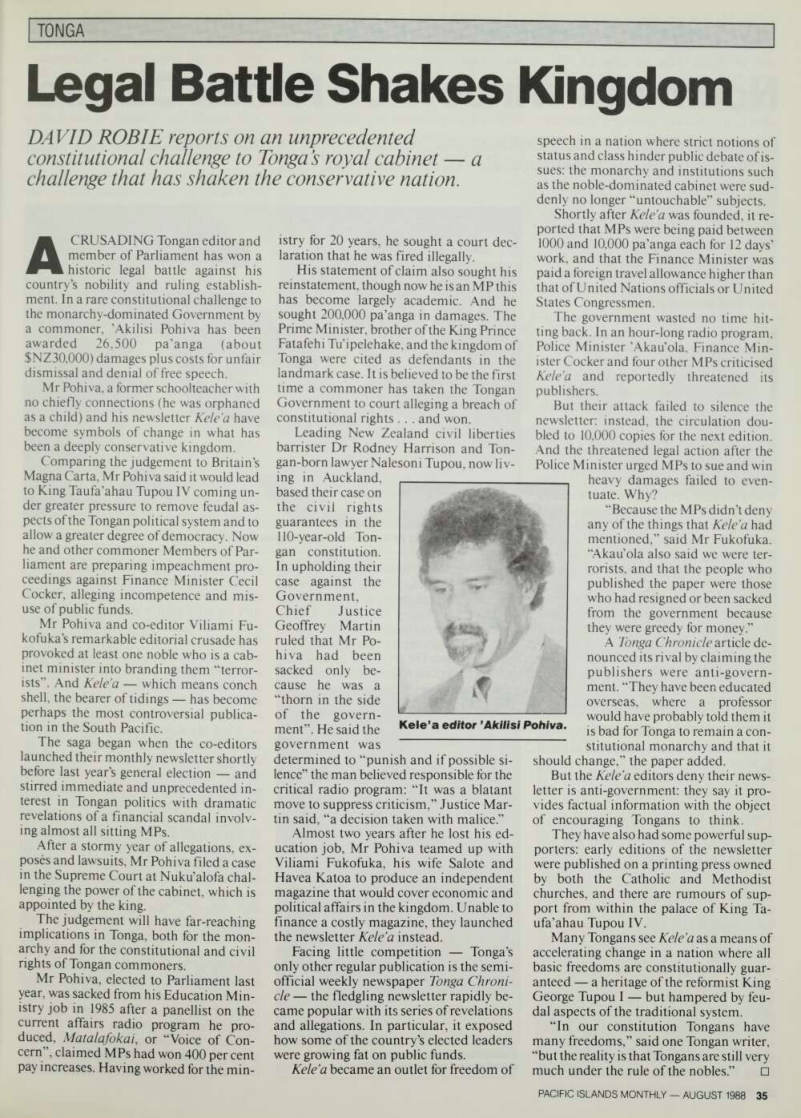
Mr Pohiva, a former schoolteacher with no chiefly connections (he was orphaned as a child) and his newsletter Kele’a have become symbols of change in what has been a deeply conservative kingdom.
Comparing the judgement to Britain’s Magna Carta, Mr Pohiva said it would lead to King Taufa’ahau Tupou IV coming un der greater pressure to remove feudal as pects of the Tongan political system and to allow a greater degree of democracy. Now he and other commoner Members of Par liament are preparing impeachment pro ceedings against Finance Minister Cecil Cocker, alleging incompetence and mis use of public funds.
Mr Pohiva and co-editor Viliami Fu kofuka’s remarkable editorial crusade has provoked at least one noble who is a cab inet minister into branding them “terror ists”. And Kele’a which means conch shell, the bearer of tidings has become perhaps the most controversial publica tion in the South Pacific.
The saga began when the co-editors launched their monthly newsletter shortly before last year’s general election and stirred immediate and unprecedented in terest in Tongan politics with dramatic revelations of a financial scandal involv ing almost all sitting MPs.
After a stormy year of allegations, ex poses and lawsuits, Mr Pohiva filed a case in the Supreme Court at Nukualofa chal lenging the power of the cabinet, which is appointed by the king.
The judgement will have far-reaching implications in Tonga, both for the mon archy and for the constitutional and civil rights of Tongan commoners.
Mr Pohiva, elected to Parliament last year, was sacked from his Education Min istry job in 1985 after a panellist on the current affairs radio program he pro duced, Matalafokai , or “Voice of Con cern , claimed MPs had won 400 per cent pay increases. Having worked for the min
istry for 20 years, he sought a court dec laration that he was fired illegally.
His statement of claim also sought his reinstatement, though now he is an MP this has become largely academic. And he sought 200,000 pa’anga in damages. The Prime Minister, brother of the King Prince Fatafehi Tu’ipelehake, and the kingdom of Tonga were cited as defendants in the landmark case. It is believed to be the first time a commoner has taken the Tongan Government to court alleging a breach of constitutional rights . . . and won.
Leading New Zealand civil liberties barrister Dr Rodney Harrison and Ton gan-born lawyer Nalesoni Tupou, now liv
ing in Auckland, based their case on the civil rights guarantees in the 110-year-old Ton gan constitution.
In upholding their case against the Government, Chief Justice Geoffrey Martin ruled that Mr Po hiva had been sacked only be cause he was a “thorn in the side of the govern ment”. He said the government was
determined to “punish and if possible si lence” the man believed responsible for the critical radio program: “It was a blatant move to suppress criticism,” Justice Mar tin said, “a decision taken with malice.”
Almost two years after he lost his ed ucation job, Mr Pohiva teamed up with Viliami Fukofuka, his wife Salote and Havea Katoa to produce an independent magazine that would cover economic and political affairs in the kingdom. Unable to finance a costly magazine, they launched the newsletter Kele’a instead.
Facing little competition Tonga’s only other regular publication is the semi official weekly newspaper Tonga Chroni cle the fledgling newsletter rapidly be came popular with its series of revelations and allegations. In particular, it exposed how some of the country’s elected leaders were growing fat on public funds.
Kele’a became an outlet for freedom of
speech in a nation where strict notions of status and class hinder public debate of is sues: the monarchy and institutions such as the noble-dominated cabinet were sud denly no longer “untouchable” subjects.
Shortly after Kele’a was founded, it re ported that MPs were being paid between 1000 and 10,000 pa’anga each for 12 days’ work, and that the Finance Minister was paid a foreign travel allowance higher than that of United Nations officials or United States Congressmen.
The government wasted no time hit ting back. In an hour-long radio program.
Police Minister ’Akau’ola, Finance Min ister Cocker and four other MPs criticised Kele’a and reportedly threatened its publishers.
But their attack failed to silence the newsletter: instead, the circulation dou bled to 10,000 copies for the next edition.
And the threatened legal action after the Police Minister urged MPs to sue and win
heavy damages failed to even tuate. Why?
“Because the MPs didn’t deny any of the things that Kele’a had mentioned,” said Mr Fukofuka.
“Akau’ola also said we were ter rorists, and that the people who published the paper were those who had resigned or been sacked from the government because they were greedy for money.”
A Tonga Chronicle article de nounced its rival by claiming the publishers were anti-govern ment. “They have been educated overseas, where a professor would have probably told them it is bad for Tonga to remain a con stitutional monarchy and that it
should change,” the paper added, But the Kele’a editors deny their news letter is anti-government: they say it pro vides factual information with the object of encouraging Tongans to think.
They have also had some powerful sup porters: early editions of the newsletter were published on a printing press owned by both the Catholic and Methodist churches, and there are rumours of sup port from within the palace of King Ta ufa’ahau Tupou IV.
Many Tongans see Kele’a as a means of accelerating change in a nation where all basic freedoms are constitutionally guar anteed a heritage of the reformist King George Tupou I but hampered by feu dal aspects of the traditional system, “In our constitution Tongans have many freedoms,” said one Tongan writer, “but the reality is that Tongans are still very much under the rule of the nobles.” □
Kele’a editor ’Akilisi Pohiva.