Saving Pacific Plants
pp. 28-29 · Read in the full issue
The Region
Hawaii is the centre of a major effort to conserve rare plants, for their
medical potential as well as beauty.
By Rodney N Smith
TWO BOTANIC gardens in Hawaii have recently joined an interna tional effort directed by the Centre for Plant Conservation in the United States to save endangered native plant species.
Their exciting and daunting mission is to bring into cultivation as many sur viving species of plants native to Hawaii, Guam and American Samoa as possible.
No American gardens face a more daunting task than the Waimea Arbore tum and Botanic Garden on the north shore of Oahu, or the Pacific Tropical Bo tanic Garden on the southern side of the “Garden Isle” of Kauai; the native flora of Hawaii is by far the most critically endan gered in the United States. Of 1800 native plants more than 800 are listed as threat ened or endangered, according to Keith Woolliams, director of the Waimea Gar den; and there are no more than 3000 plant species listed in the US as a whole.
Preservation is not a new interest for Hawaii’s botanists but the spectre of massive plant extinction is; projected rates of disappearance for the next two decades exceed anything since the extinction of the dinosaurs, ending some 65 million years ago. “The public is increasingly aware of how rapidly tropical habitats are being de stroyed and how many of the numerous plant and animal species they contain are lost,” according to Donald Falk, director of the Centre for Plant Conservation, a privately financed national initiative.
Botanists estimate that there may be as many as 40,000 plant species are in trouble around the world.
Coincidentally, all this is taking place as scientists are making discoveries with profound medical and economic conse quences. “In 1960, a child suffering from leukemia had only one chance in five of remission. Now, thanks to drugs prepared from a tropical forest plant, the same child has four chances in five,” according to Norman Myers, an international consult ant on environmental issues.
Whenever a medical prescription is filled, there is a 50 per cent chance the medication owes its origin to “startpoint materials” from wild organisms. The in ternational Nature Conservancy has esti mated the value of these drugs to be in excess of SUSIO billion a year; if non-pre scription drugs are included, the esti mated value exceeds a staggering SUS4O billion each year.
Scientists now believe it is imperative to preserve the broadest possible “gene pool” on which they can draw for possible future discoveries. Indeed, the Duke of
Edinburgh has referred to such programs as “essential to human survival”.
To understand the challenge facing Ha waii’s botanic gardens, Woolliams says it is important to understand that this spe cial island chain is the most remote archi pelago in the world around 2300 nautical miles from the American main land, and 4000 from Japan and the plant life that has evolved there is like nothing else in the world.
“Everybody talks about the Galapagos and they are fabulous, but they don’t have a thing on Hawaii,” according to Wool liams. “I always think Darwin would have loved the Hawaiian Islands if he’d got here instead of the Galapagos.
“Hawaii was really an open book for all that plant life,” he says. “There were no grazing animals, no need for spines, no
need for poisons . . . and no man. Hawaii was unoccupied, so plants could move into the open spaces with no competition. But the native flora began to disappear with the arrival of Polynesian man and his slash and burn culture. Most of the low vege tation was gone by the time Captain Cook arrived, and today half the surviving spe cies are endangered.”
The two Hawaiian gardens were in vited to join the Centre for Plant Conser vation in 1985. They are charged with bringing into cultivation the threatened and endangered plants not just of Hawaii, but also of Guam and American Samoa.
Waimea Arboretum, Oahu, is located in an area of extraordinary natural beauty.
Founded in 1973, the privately owned gar den is part of Waimea Falls Park over looking the famous surfing beach at
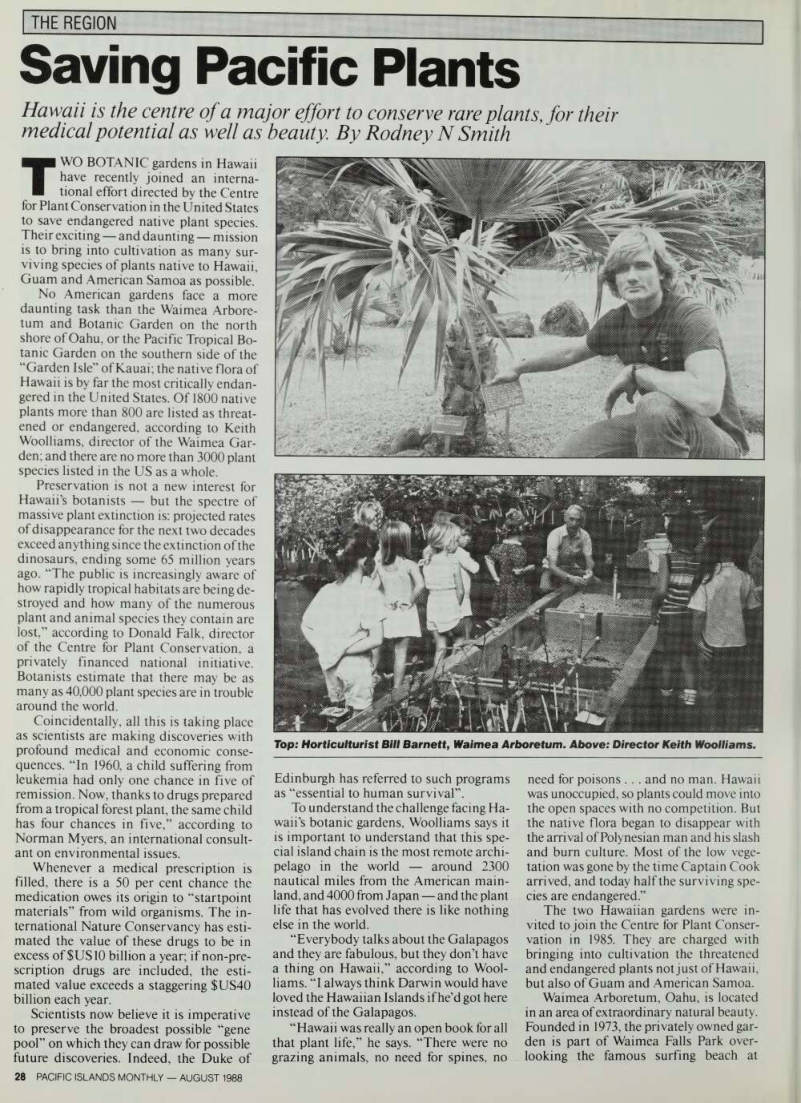
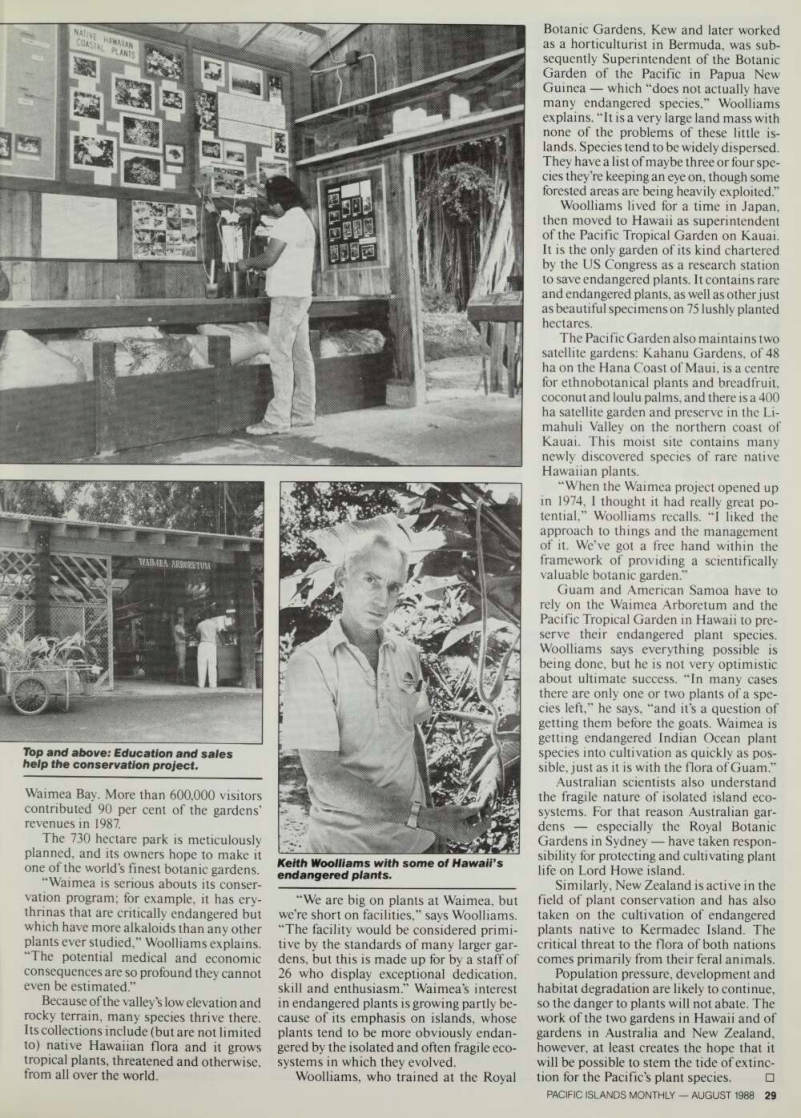
Top: Horticulturist Bill Barnett, Waimea Arboretum. Above: Director Keith Woolliams.
Waimea Bay. More than 600,000 visitors contributed 90 per cent of the gardens’ revenues in 1987.
The 730 hectare park is meticulously planned, and its owners hope to make it one of the world’s finest botanic gardens.
“Waimea is serious abouts its conser vation program; for example, it has ery thrinas that are critically endangered but which have more alkaloids than any other plants ever studied,” Woolliams explains.
“The potential medical and economic consequences are so profound they cannot even be estimated.”
Because of the valley’s low elevation and rocky terrain, many species thrive there.
Its collections include (but are not limited to) native Hawaiian flora and it grows tropical plants, threatened and otherwise, from all over the world.
“We are big on plants at Waimea, but we’re short on facilities,” says Woolliams.
“The facility would be considered primi tive by the standards of many larger gar dens, but this is made up for by a staff of 26 who display exceptional dedication, skill and enthusiasm.” Waimea’s interest in endangered plants is growing partly be cause of its emphasis on islands, whose plants tend to be more obviously endan gered by the isolated and often fragile eco systems in which they evolved.
Woolliams, who trained at the Royal
Botanic Gardens, Kew and later worked as a horticulturist in Bermuda, was sub sequently Superintendent of the Botanic Garden of the Pacific in Papua New Guinea which “does not actually have many endangered species,” Woolliams explains. “It is a very large land mass with none of the problems of these little is lands. Species tend to be widely dispersed.
They have a list of maybe three or four spe cies they’re keeping an eye on, though some forested areas are being heavily exploited.”
Woolliams lived for a time in Japan, then moved to Hawaii as superintendent of the Pacific Tropical Garden on Kauai.
It is the only garden of its kind chartered by the US Congress as a research station to save endangered plants. It contains rare and endangered plants, as well as other just as beautiful specimens on 75 lushly planted hectares.
The Pacific Garden also maintains two satellite gardens: Kahanu Gardens, of 48 ha on the Hana Coast of Maui, is a centre for elhnobotanical plants and breadfruit, coconut and loulu palms, and there is a 400 ha satellite garden and preserve in the Li mahuli Valley on the northern coast of Kauai. This moist site contains many newly discovered species of rare native Hawaiian plants.
“When the Waimea project opened up in 1974, I thought it had really great po tential,” Woolliams recalls. “I liked the approach to things and the management of it. We’ve got a free hand within the framework of providing a scientifically valuable botanic garden.”
Guam and American Samoa have to rely on the Waimea Arboretum and the Pacific Tropical Garden in Hawaii to pre serve their endangered plant species.
Woolliams says everything possible is being done, but he is not very optimistic about ultimate success. “In many cases there are only one or two plants of a spe cies left,” he says, “and it’s a question of getting them before the goats. Waimea is getting endangered Indian Ocean plant species into cultivation as quickly as pos sible, just as it is with the flora of Guam.”
Australian scientists also understand the fragile nature of isolated island eco systems. For that reason Australian gar dens especially the Royal Botanic Gardens in Sydney have taken respon sibility for protecting and cultivating plant life on Lord Howe island.
Similarly, New Zealand is active in the field of plant conservation and has also taken on the cultivation of endangered plants native to Kermadec Island. The critical threat to the flora of both nations comes primarily from their feral animals.
Population pressure, development and habitat degradation are likely to continue, so the danger to plants will not abate. The work of the two gardens in Hawaii and of gardens in Australia and New Zealand, however, at least creates the hope that it will be possible to stem the tide of extinc tion for the Pacific’s plant species. □
Top and above: Education and sales help the conservation project.
Keith Woolliams with some of Hawaii’s endangered plants.