A “Gift Of Health” For The Islands
pp. 30-31 · Read in the full issue
Health
Peter Schroeder reports on Hawaii’s “floatingdoctors’’.
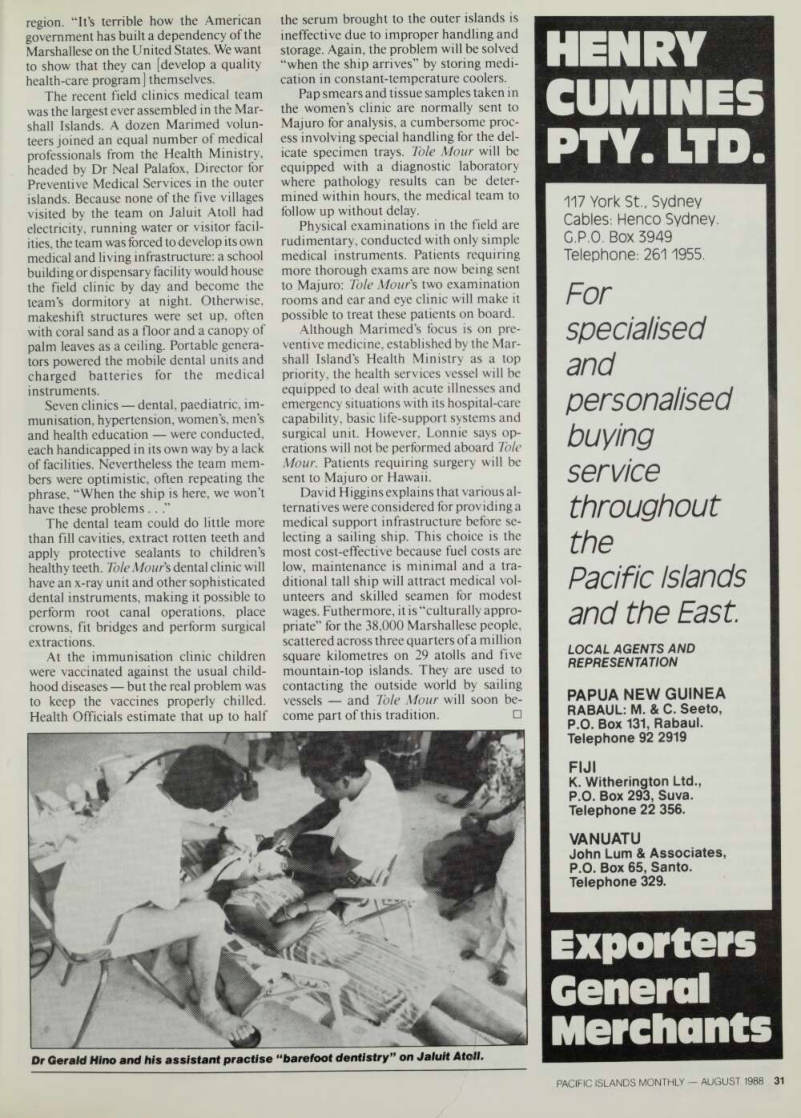
DOCTOR Gerald Hino filled yet another tooth cavity on Jaluit Atoll, one of the outer Marshall Islands, and said in frustration, “I’ve heard of barefoot dentistry, but I never thought I’d be practising it myself If only we had the ship now, I could do so much more.”
The Honolulu-based dentist is a mem ber of the Marimed Foundation volunteer medical team that conducts regular med ical clinics and health education programs in the Marshall Islands. The ship to which Dr Hino was referring is Marimed’s new 47 metre topsail schooner, Tole Mour, being rigged and outfitted as a health serv ices vessel in Seattle, Washington.
Equipped with modern medical equip ment, the sailing ship’s health-care facili ties will allow the medical team, composed of dentists, physicians, nurses and medi cal technicians, to render more than just rudimentary health care.
However, Tole Mour meaning “gift of health and life” in Marshallese won’t be delivered until late next year. For the interim, Marimed will continue to operate two-week field clinics that are limited by the space and weight restrictions imposed by existing air and boat services, a limi tation that severely curtails the supplies,
medication and equipment that can be taken to these remote islands.
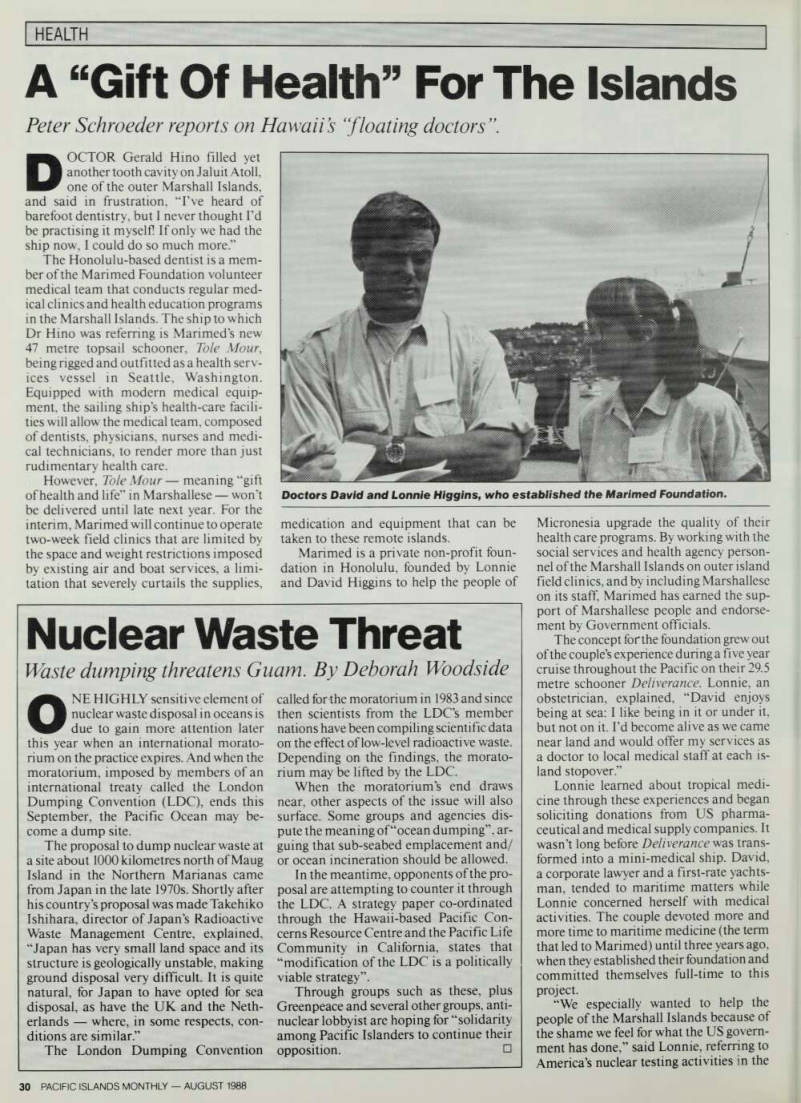
Marimed is a private non-profit foundation in Honolulu, founded by Lonnie and David Higgins to help the people of
Micronesia upgrade the quality of their health care programs. By working with the social services and health agency person nel of the Marshall Islands on outer island field clinics, and by including Marshallese on its staff, Marimed has earned the sup port of Marshallese people and endorse ment by Government officials.
The concept forthe foundation grew out of the couple’s experience during a five year cruise throughout the Pacific on their 29.5 metre schooner Deliverance. Lonnie, an obstetrician, explained, “David enjoys being at sea: I like being in it or under it, but not on it. I’d become alive as we came near land and would offer my services as a doctor to local medical staff at each is land stopover.”
Lonnie learned about tropical medi cine through these experiences and began soliciting donations from US pharma ceutical and medical supply companies. It wasn’t long before Deliverance was trans formed into a mini-medical ship. David, a corporate lawyer and a first-rate yachts man, tended to maritime matters while Lonnie concerned herself with medical activities. The couple devoted more and more time to maritime medicine (the term that led to Marimed) until three years ago, when they established their foundation and committed themselves full-time to this project.
“We especially wanted to help the people of the Marshall Islands because of the shame we feel for what the US govern ment has done,” said Lonnie, referring to America’s nuclear testing activities in the
Doctors David and Lonnie Higgins, who established the Marimed Foundation.
region. “It’s terrible how the American government has built a dependency of the Marshallese on the United States. We want to show that they can [develop a quality health-care program] themselves.
The recent field clinics medical team was the largest ever assembled in the Mar shall Islands. A dozen Marimed volun teers joined an equal number of medical professionals from the Health Ministry, headed by Dr Neal Palafox, Director for Preventive Medical Services in the outer islands. Because none of the five villages visited by the team on Jaluit Atoll had electricity, running water or visitor facil ities, the team was forced to develop its own medical and living infrastructure: a school building or dispensary facility would house the field clinic by day and become the team’s dormitory at night. Otherwise, makeshift structures were set up, often with coral sand as a floor and a canopy of palm leaves as a ceiling. Portable genera tors powered the mobile dental units and charged batteries for the medical instruments.
Seven clinics dental, paediatric, im munisation, hypertension, women’s, men’s and health education were conducted, each handicapped in its own way by a lack of facilities. Nevertheless the team mem bers were optimistic, often repeating the phrase, “When the ship is here, we won’t have these problems ...”
The dental team could do little more than fill cavities, extract rotten teeth and apply protective sealants to children’s healthy teeth. ToleMour's dental clinic will have an x-ray unit and other sophisticated dental instruments, making it possible to perform root canal operations, place crowns, fit bridges and perform surgical extractions.
At the immunisation clinic children were vaccinated against the usual child hood diseases but the real problem was to keep the vaccines properly chilled.
Health Officials estimate that up to half
the serum brought to the outer islands is ineffective due to improper handling and storage. Again, the problem will be solved “when the ship arrives” by storing medi cation in constant-temperature coolers.
Pap smears and tissue samples taken in the women’s clinic are normally sent to Majuro for analysis, a cumbersome proc ess involving special handling for the del icate specimen trays. Tole Mour will be equipped with a diagnostic laboratory where pathology results can be deter mined within hours, the medical team to follow up without delay.
Physical examinations in the field are rudimentary, conducted with only simple medical instruments. Patients requiring more thorough exams are now being sent to Majuro: Tole Mour' s two examination rooms and ear and eye clinic will make it possible to treat these patients on board.
Although Marimed’s focus is on pre ventive medicine, established by the Mar shall Island’s Health Ministry as a top priority, the health services vessel will be equipped to deal with acute illnesses and emergency situations with its hospital-care capability, basic life-support systems and surgical unit. However, Lonnie says op erations will not be performed aboard Tole Mour. Patients requiring surgery will be sent to Majuro or Hawaii.
David Higgins explains that various al ternatives were considered for providing a medical support infrastructure before se lecting a sailing ship. This choice is the most cost-effective because fuel costs are low, maintenance is minimal and a tra ditional tall ship will attract medical vol unteers and skilled seamen for modest wages. Futhermore, it is “culturally appro priate” for the 38,000 Marshallese people, scattered across three quarters ofa million square kilometres on 29 atolls and five mountain-top islands. They are used to contacting the outside world by sailing vessels and Tole Mour will soon be come part of this tradition. □
Dr Gerald Hino and his assistant practise “barefoot dentistry" on Jaluit Atoll.