Opening Up The Skyways
p. 26 · Read in the full issue
A bold new plan could share air travel revenue in the region.
ONE OF the most useful contribu tions Australia and New Zealand could make to South Pacific de velopment would be to allow island air lines to fly with full traffic rights across the Tasman Sea. According to Dr Christopher Kissling, a fellow in human geography at the Australian National University’s Re search School in Pacific Studies, access to routes now largely controlled by Qantas and Air New Zealand would give island aviation a significant boost.
Dr Kissling’s paper, presented at the re cent Islands 88 conference in Hobart, ar gued that small Pacific carriers have not been able to negotiate bilateral air service agreements that offer them real equality with neighbouring developed countries.
While Australian and New Zealand car riers have fifth-freedom rights in the is lands, Dr Kissling says, most Pacific airlines have only terminating rights in the two developed countries.
At the moment, Trans-Tasman air traffic originates mainly from Cairns, Brisbane, Sydney, Melbourne and Hobart in Australia and from Auckland, Welling ton and Christchurch in New Zealand (with proposals for a new international airport at the South Island township of Queenstown currently being evaluated).
Dr Kissing argues that tourism is one of the few sectors of island economies with real growth prospects. Unless the small nations of the South Pacific themselves control aviation and tourist infrastruc ture, much of the money spent by tourists will not stay long in the island community.
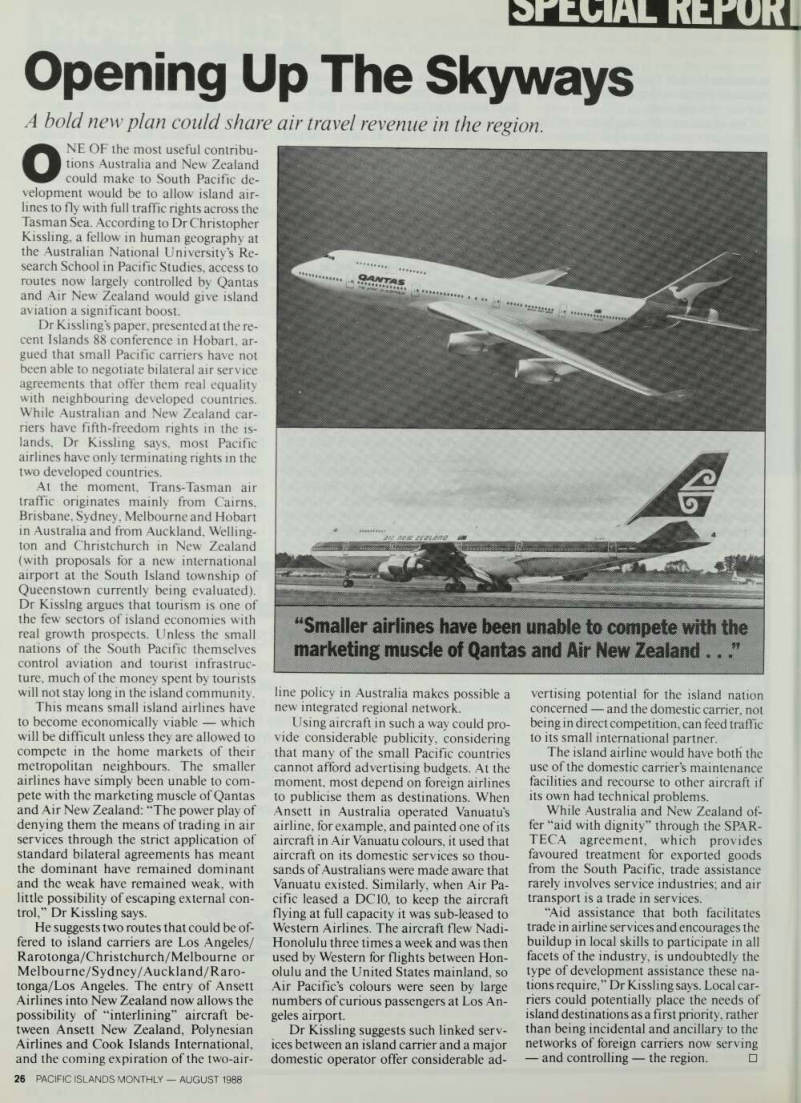
This means small island airlines have to become economically viable which will be difficult unless they are allowed to compete in the home markets of their metropolitan neighbours. The smaller airlines have simply been unable to com pete with the marketing muscle of Qantas and Air New Zealand: “The power play of denying them the means of trading in air services through the strict application of standard bilateral agreements has meant the dominant have remained dominant and the weak have remained weak, with little possibility of escaping external con trol,” Dr Kissling says.
He suggests two routes that could be of fered to island carriers are Los Angeles/ Rarotonga/Christchurch/Melbourne or Melbourne/Sydney/Auckland/Raro tonga/Los Angeles. The entry of Ansett Airlines into New Zealand now allows the possibility of “interlining” aircraft be tween Ansett New Zealand, Polynesian Airlines and Cook Islands International, and the coming expiration of the two-air-
line policy in Australia makes possible a new integrated regional network.
Using aircraft in such a way could provide considerable publicity, considering that many of the small Pacific countries cannot afford advertising budgets. At the moment, most depend on foreign airlines to publicise them as destinations. When Ansett in Australia operated Vanuatu’s airline, for example, and painted one of its aircraft in Air Vanuatu colours, it used that aircraft on its domestic services so thousands of Australians were made aware that Vanuatu existed. Similarly, when Air Pacific leased a DC 10, to keep the aircraft flying at full capacity it was sub-leased to Western Airlines. The aircraft flew Nadi- Honolulu three times a week and was then used by Western for flights between Honolulu and the United States mainland, so Air Pacific’s colours were seen by large numbers of curious passengers at Los Angeles airport.
Dr Kissling suggests such linked services between an island carrier and a major domestic operator offer considerable ad-
vertising potential for the island nation concerned and the domestic carrier, not being in direct competition, can feed traffic to its small international partner, The island airline would have both the use of the domestic carrier’s maintenance facilities and recourse to other aircraft if its own had technical problems.
While Australia and New Zealand of fer “aid with dignity” through the SPAR TECA agreement, which provides favoured treatment for exported goods from the South Pacific, trade assistance rarely involves service industries; and air transport is a trade in services, “Aid assistance that both facilitates trade in airline services and encourages the buildup in local skills to participate in all facets of the industry, is undoubtedly the type of development assistance these na tions require,” Dr Kissling says. Local car riers could potentially place the needs of island destinations as a first priority, rather than being incidental and ancillary to the networks of foreign carriers now serving and controlling the region. □
"Smaller airlines have been unable to compete with the marketing muscle of Qantas and Air New Zealand..."