Shipping
pp. 24-25 · Read in the full issue
Island destinations wait for services at the convenience of major shipping lines.
IN 1977 the Government of Papua New Guinea sold the PNG Shipping Cor poration to the Steamships Trading Company; in 10 years the line lost $A9.5 million. Last year, the region’s own Pacific Forum Line announced an operating profit of $A707,000, but chief executive John McLennan predicted that in 1988 the line would reveal a loss of about SABOO,OOO.
Forum, McLennan said, was suffering intense competition from the large con tainer lines over Fiji-Australia trade. This is the most lucrative run in the South Pa cific, and the Forum Line earned income there that helped sustain less economic routes. The amount of cargo available in Suva had fallen with the coups’ disloca tion of the economy, and this was exac erbated by the entry of other shipping lines that needed to make only minor diver sions from normal routes to call at Suva.
Suva is the South Pacific’s main port but, according to Dr Kissling (who has been involved with a SPEC/UN study of transport in the Pacific) Fiji has seen the port as a source of revenue, which has in creased the cost of using it as a trans ship ment centre. The only other place that could be developed as a major trans ship ment port is Pago Pago, but it has limited flat land on which to stack containers. Fiji does have major export and import car goes, while American Samoa apart from tuna has little meaningful export gen erating capacity.
Nukualofa’s wharf was damaged by a cyclone and aid money has been pumped in to upgrade it; Apia’s facilities are min imal (the wharf can only just accommo date Forum Line ships), but there is substantial inter-island traffic. At the main Cook Islands port of Avatui, which was also devastated by cyclones, aid money is helping reclamation of part of the reef area for container stacking.
Because of the large amount of military traffic, Tahiti and New Caledonia both have ex cellent ports. But at Port Vila, wharf facilities are not of the highest standard and were de signed to handle local copra vessels; further north at Santo, the Asian Development Bank
is backing an SA6 million new wharf.
Honiara, too, can only just accommodate large ships, and the wharf itself is not strong enough to take heavy vehicles so containers tend to be unpacked by the side of the ship. Port Moresby has excellent port facilities.
Elsewhere, loading and unloading is time-consuming. At Niue and Tokelau, ships stand off while lighters battle through the surf. Vessels calling at Kiribati are met by tug and barge from the island, and cargo is transferred at sea.
But it is not just wharves and cranes that cause problems. In many islands there aren’t enough sheds to cope with the as sembly of export cargo or incoming goods.
Ships are held up by demands for detailed paperwork Dr Kissling says that many ports in the South Pacific suffer from “bu reaucracy gone mad” and if something goes wrong aboard ship, getting repairs can often be a nightmare: tradesmen, espe cially electrical tradesmen, are in short supply on many islands. Ships need to travel to Sydney or, increasingly, to Asia for dry docking; which, if there is only one ship on a particular service, means no service for all the time that involves.
Shipping problems mirror those of aviation and are summed up by Dr Keith Trace, an economist at Monash Univer sity: “The small and scattered island pop ulations, requiring efficient, adequate and economic services while generating very limited cargo volumes, posed (and con-
tinue to pose) considerable problems from the viewpoint of the transport operator.”
In the 19th century, shipping services were subsidised by governments or mis sion societies: even the giant Burns Philp managed its network of services in the is lands ony with a subsidy from Australian governments. As islands became inde pendent, so they often lost the subsidies from the former colonial ruler.
Just as has happened in aviation, ad vances in technology now allow ships to travel far greater distances without refuell ing so they tend to drop ports that had been generating low cargo volumes and had been used mainly for bunkering. Also, as with 747 jumbos, shipowners cannot af ford to have large container ships working a “milk run” through the South Pacific.
The Pacific Forum Line, established in 1978 with a working capital of $U5312,000, was though to be the answer: a shipping line owned by all the South Pacific Forum countries. Dr Trace says, however, that not only was the line undercapitaliseed, it made mistakes in chartering vessels.
Forum lost more than SUSI 6 million in its first three years, though it has provided services operators solely concerned with profit may not have undertaken.
Writing in Transport and Communi cations for Pacific Microstates , Bruce Middleton, a New Zealand diplomat with an interest in shipping, identified another hurdle to be overcome for shipping: ’Pa cific leaders have to face enormous capi tals cost of infrastructure development.
There are no economies of scale: a country
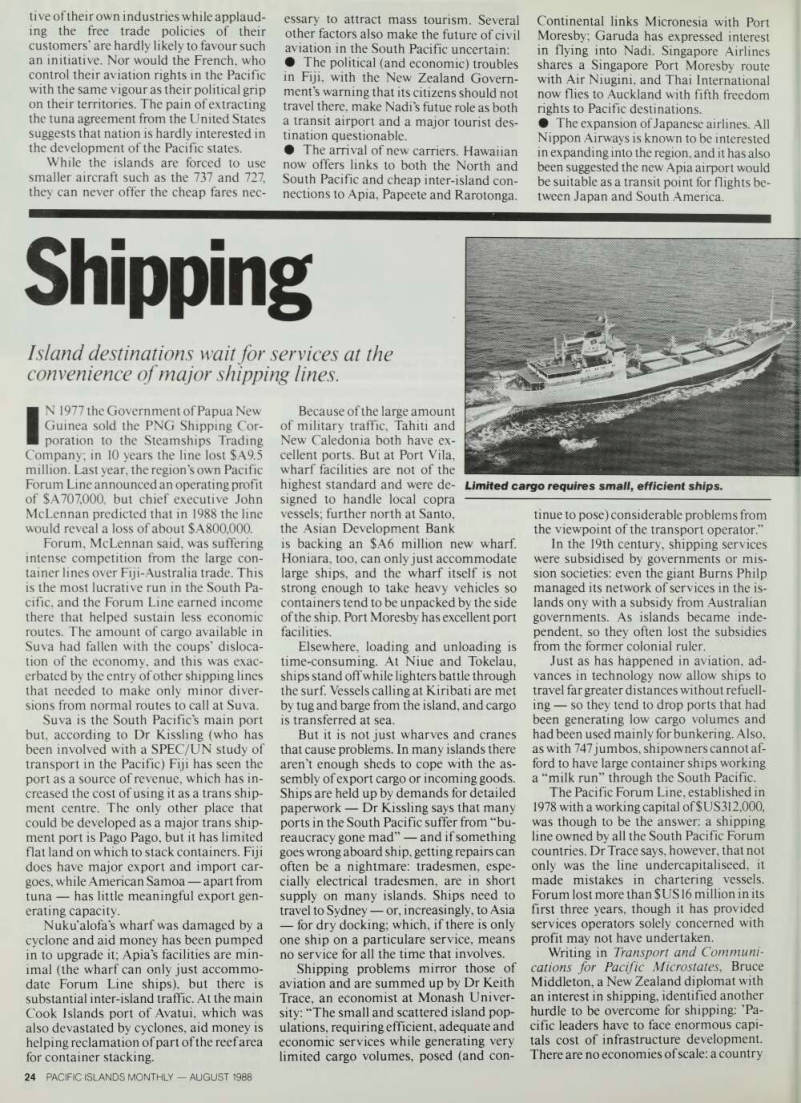
Limited cargo requires small, efficient ships.
as small as Niue or Tuvalu with only a few thousand people still needs an airport, a harbour and wharves.
One of the contributing factors to the Forum Line’s costs is that while there is an over-supply of semi-skilled seamen in the Pacific, most of the officers are expatriate.
There have been some attempts to train is landers to officer standard, but they have been inadequate; in the meantime, the line must pay its officers high rates of pay at a time when there is severe over-capacity in shipping, which in turn has led to price cutting on a massive scale.
Keith Trace summarises the four cate gories of Pacific shipping services: • Large trans-Pacific (Asia to North America) container ships that do not call at island ports. • Japan Australia, Australia New Zea land North America container ships that pass close to island ports and may make limited stops. For example, the PACE Line advertises a fully containerised service every 17 days from Melbourne, Sydney and Brisbane leaving for North America but calling at Noumea, Suva and Lautoka. • Direct services to Pacific island ports, operated by smaller and older vessels, fre quently by semi-container and conven tional vessels. • Inter-island services, in general un
profitable (Burns Philp has abandoned this trade). An example is the Forum run from Fiji to Kiribati and Tuvalu. Dr Trace believes shipping in the Pacific is still in a transitional era; it has yet to adjust fully to the container age and the growing capital intensity of vessels, and direct services have continued rather than being replaced by main regional trans shipment centres with feeder services to smaller ports.
Because of this, he says, island trade does not reap the benefits of economies of scale in shipping.
Moreover, ships now calling at ports through voyages because of over-capacity might no longer call once world trade picks up again; this is hardly a reliable basis for the development of island trade.
Dr Trace also argues that regional ship ping is in general old and inefficiently managed. Substantial fleet modernisa tion is required, including the scrapping of obsolete tonnage.
It seems that a priority is to develop one regional loading centre, just as Hong Kong and Singapore have emerged in that role in east Asia. Suva would normally be a logical choice, but the political uncer tainty in Fiji would deter any major in vestment by other island nations.
Australasian and New Zealand ports are crippled by high costs and unreliable
unions.
Meanwhile, the shipping industry as with aviation is largely controlled outside the region; companies such as PACE, Columbus, Bank, China Naviga tion, Kyowa, NYK, Mitsui OSK and Pol ish Ocean Lines mean for shipping what the dominance of Qantas, Air New Zea land, CP Air and UTA imply for air serv ice. All concentrate on the more lucrative routes, leaving the scraps to the Pacific Forum Line or Air Tungaru.
Christopher Kissling says that his ar gument can be applied to shipping as much as it can aviation: if Australia and New Zealand allow island companies even a small share of the trans Tasman business, their ships could be profitable. With ship ping, however, there is an additional hur dle in that if Pacific vessels operate in competition with Australian and New Zealand companies, Australasian mari time unions would demand that the is landers be paid equivalent wages; which would effectively destroy the economics of Pacific operators.
It seems it is one thing for metropolitan powers to donate aid money for airport ex tensions, a new wharf or an inter-island trader vessel, but quite another to alllow those small island countries a share of the lucrative Pacific transport industry.