Aviation
pp. 22-24 · Read in the full issue
As major airlines maintain their grip on the region’s traffic, prospects are bleak for Pacific carriers.
WHEN Hawaiian Airlines opened its weekly Sydney/Pago Pago/ Honolulu air service several months ago, not only did it find plenty of people eager to fly the new route the airline’s offices were besieged with enqui ries for freight space.
Because the airline flies DCS jets that space was limited, but is shows how great the demand is for airfreight capacity in the South Pacific.
However, island exporters and import ers face significant problems in using ma jor international airlines. Those airlines will always give preference to cargo booked for the entire journey over consignments that might be booked into Nadi or Pago Pago and the fact that most (if not all) the region’s countries suffer from an. im balance of trade means space used to fly in goods will be empty for the remainder of the flight.
That problem applies on long-haul routes between Australia and New Zea land at one end, and North America at the other. But flights within the islands have a different drawback; the aircraft used are often small in terms of cargo capacity.
Some cannot take the containers designed for the holds of DC 10 and 747 aircraft, so consignments have to be broken down if transshipment is involved.
Qantas, for example, charters a 737 three times a week to operate its Brisbane/ Honiara service. Air New Zealand flies only twice a week between Auckland and Apia, using 737 or 767 aircraft; its thrice weekly service to Tonga uses Boeing 7375.
After fuel and passenger baggage, operat ing requirements and small cargo holds can place severe restrictions on how much freight can be accepted.
Most airfreight space is taken by higher value food products from the island states where the commodity can bear the cost of air freight, and where the producers do not want to flood the market with landing a shipment by sea. Some root crops are flown out of Fiji to North America, while Fijian and Cook Island textile manufac turers are now employing airfreight to Australia and New Zealand.
A recent publication from the Univer sity of the South Pacific, Transport and Communications for Pacific Microstates , edited by Christopher Kissling, sums up the problem; “The timing of arrival of per ishable produce in air shipments for spe cific markets can be all-important to the success or otherwise of a marketing exer cise. Seldom, however, do the needs of the freight sector manage to dictate aircraft schedules set up more for the convenience of passengers, a majority of whom have
origins and destinations other than the Pacific islands.”
In some ways, the island states have been disadvantaged by progress. The de velopment of larger aircraft with greatly extended range has meant fewer refuelling stops; the Boeing 7475 P (Special Perform ance), for example, can fly from Sydney to San Francisco non-stop.
Dr Kissling draws attention to another problem: in order to win freight business for their won airlines, agents had to be ap pointed in the major metropolitan mar kets. Often this was the national carrier of the country concerned which was flying the same route as the island airline and was in direct competition. He cites a study of Air Pacific weighbills that reveals many instances of freight travelling on rounda bout routes; yielding the first carrier the lion’s share of the cargo charges, even though Air Pacific had been designated first carrier by the consignor.
In a 1974 study, Australian carriers ac counted for 75 per cent of cargo from Aus tralia to Fiji, while Air New Zealand and then National Airways Corporation (now the domestic arm of Air New Zealand) consigned 99 per cent of Fiji-bound cargo from New Zealand.
The island states of the Pacific states have a limited number of products for ex port and they are largely price-takers. They are also largely what might be called trans port-takers.
In the 19705, as those states of the Pa cific that had been under British, New Zealand or Australian rule became inde pendent, local airlines began to appear: Air Nauru, Air Niugini, Air Pacific, Solomon Islands Airways, Air Tungaru and Polyne sian Airlines. But though there has been a travel boom in the South Pacific over the past 10 to 20 years, the local airlines have not grown in proportion to that increase.
In 1986 the managing director of Singa pore Airlines, Mr Cheong Choong Kong, said that the rapid growth of passenger traffic in the Asia-Pacific area was provid ing challenges in terms of developing suit able airports, tourist facilities and the right kind of aircraft.
Apia’s runway can now take 747 and DC 10 aircraft, but Apia itself has only 350 first class hotel rooms (though it was an nounced in 1986 that the Royal Samoan Hotel, with 227 rooms, was to be built).
Tonga’s airport, which can now take 767 and DCB aircraft, is being lengthened and strengthened for 7475. In the Solomons, Kuwait supplied 5A6.5 million to pay for an 1100-metres extension to the Hender son airfield at Honiara.
Nevertheless, airfields in the region are still of widely varying standard. In Fiji, Nadi Airport is excellent by world stand ards, and Nausori near Suva can take Boeing 737 jets. Tonga’s international air port is not up to top standards in terms of navigational equipment, and the airport at Vava’u will be upgraded to take 737 jets and 748 turbo-props.
A study is under way on upgrading Port Vila to take 767 aircraft; this would mean a great deal to the languishing tourist in dustry in Vanuatu, which has been hit both by political unrest and cyclones. The air port at present lacks 24-hour capability, which severely limits its potential as a stopover point.
There is another advantage to Faleola’s new 747 status it and Pago Pago, which is only about 15 minutes’ flying time away, can now be alternative airports if the other is closed in.
Rarotonga has been improved so that* the outer engines of 747 aircraft no longer overhang the edges of the runway, and turning areas for jets have been extended.
Port Moresby has world-class facilities, while at the other end Kiribati’s airfield is plagued by coral dust a serious threat to jet aircraft.
The two-engined jet still dominates Pacific air routes, especially the 737 and 767 but despite the 767’s reliability, it is caught by the 90-minute rule that means it can be no more than an hour and a halfs flying time from the nearest airstrip. The A3OO and the new Boeing 757 are simi larly affected.
These regulations do not inhibit oper ations between most of the islands and Australia and New Zealand, but only four engined jets have the range to operate to Hawaii and the United States. Air Pacif ic’s attempt to break into the long-haul traffic was a cautionary tale. In 1983, the airline leased a DC 10 and launched Pro ject America, with three flights a week to Honolulu. Air Pacific was already losing money and the failure of the new service to attract sufficient passengers had the ef fect of doubling the airline’s loss to FlO million in 1984 and Fll million in 1985.
Qantas has since bought a share of Air Pacific, which effectively ended Ansett’s
chances of dominating the South Pacific.
The Australian company had ambitions of developing an integrated airline system within the region, and its failure to acquire the management of Air Pacific was a bitter pill. Had Ansett, in effect, controlled the Fijian carrier it would have been in a pow erful position: it already operated Polyne sian Airlines and Cook Islands International, as well as having Ansett New Zealand as a second domestic network ca pable of feeding into a Pacific operation.
Things, however, did not work out that way: Ansett had already quit Air Vanuatu (of which it owned 49 per cent) because of losses and, more crucially, the problems caused by the Vanuatu Government’s de sire to control the airline a function An sett obviously though it was better fitted to fulfil. Now Ansett is pulling out of Cook Islands International Airways because of poor financial performance, and how long it will continue to operate Polynesian Air lines is a matter of speculation.
At one stage Ansett had ambitions to equip Polynesian with 767 airliners and, when the 90-minute rule was relaxed (there is now talk of engines being re-rated to al low a 120-minute rule), it would fly to Ha waii. Certainly, when the Cook Islands’ then premier Sir Thomas Davis signed with Ansett, he was confident the coun try’s national carrier would soon be show ing its clours in North America.
But neither airline had the potential of Air Pacific, carrying with it Fiji’s traffic rights to Hawaii, the US mainland, Can ada, Japan, Singapore and South Korea.
That and the high (and highly profita ble) utilisation of aircraft, which would have been possible with two major do mestic networks and three international airlines was a heady prospect for Ansett.
Without such an integrated approach, island airlines face an uphill battle. Air Nauru, with only a tiny local population,
was almost brought to its knees in 1985: it cut services drastically, sacked 26 aircrew and disposed of five aircraft because its network of 26 destinations was running it into enormous losses. Even the giant Pan Am found the Pacific experience ruinous and was succeeded by United, which had its own domestic service. Kiribati’s Air Tungaru, in an attempt to link its nation with Hawaii and tap the tourist market, leased a Boeing 727 but failed to attract enough business to pay its way.
At time of writing Qantas is negotiat ing with the aim of taking a share of Air New Zealand; some aviation experts ar gue that the two airlines are, separately, too small to compete with the giants of world aviation. In support of that analysis, air line executive John King has written that the International Civil Aviation Organi sation recognises the need for developing areas such as the South Pacific and Car ibbean to merge their air rights. Mr King, who has worked for Ansett and been a di rector of both Air Vanuatu and Polynesian Airlines, added: “The microstates of the South Pacific should be encouraged to pool their air traffic resources’ and developed states with which they interact should re cognise this need... It provides a glimmer of hope that substantial deficits need not be the everlasting headache of island governments called upon to shore up ail ing national carriers.”
King also asked whether Qantas would really suffer if Air Tungaru, for example, had fifth freedom rights out of Sydney via the Solomon Islands: “One lonely mixed configuration 8727-100 QC can make but a small intrusion into the totality of Qan tas operations internationally.”
Such a change in policy would most likely come from Australia and New Zea land (if it were to come at all); the Japa nese, who send large numbers of tourists to the South Pacific and are highly protec
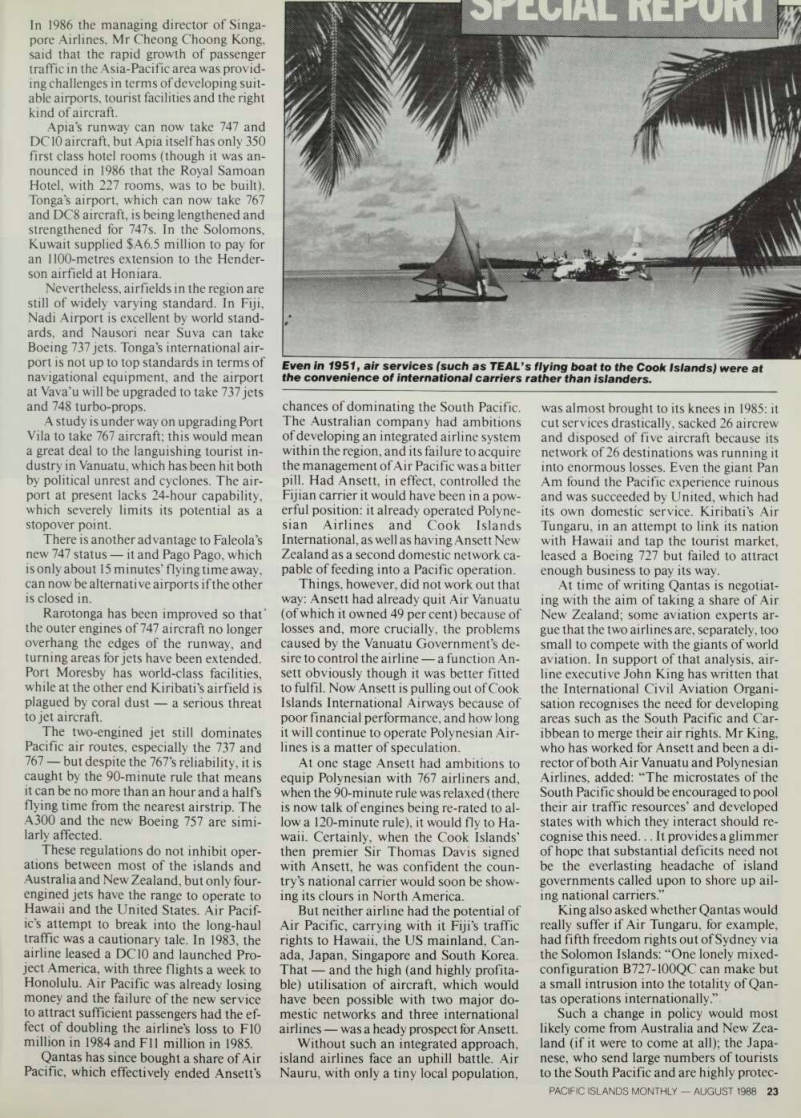
Even in 1951, air services (such as TEAL’s flying boat to the Cook Islands) were at the convenience of international carriers rather than islanders.
tive of their own industries while applaud ing the free trade policies of their customers’ are hardly likely to favour such an initiative. Nor would the French, who control their aviation rights in the Pacific with the same vigour as their political grip on their territories. The pain of extracting the tuna agreement from the United States suggests that nation is hardly interested in the development of the Pacific states.
While the islands are forced to use smaller aircraft such as the 737 and 727, they can never offer the cheap fares nec
essary to attract mass tourism. Several other factors also make the future of civil aviation in the South Pacific uncertain: The political (and economic) troubles in Fiji, with the New Zealand Government’s warning that its citizens should not travel there, make Nadi’s futue role as both a transit airport and a major tourist destmation Questionable. The arrival of new carriers. Hawaiian now offers links to both the North and South Pacific and cheap inter-island connections to Apia, Papeete and Rarotonga.
Continental links Micronesia with Port Moresby; Garuda has expressed interest in Hying into Nadi. Singapore Airlines shares a Singapore Port Moresby route with Air Niugini, and Thai International now Hies to Auckland with fifth freedom rights to Pacific destinations, The expansion of Japanese airlines. All Nippon Airways is known to be interested in expanding into the region, and it has also been suggested the new Apia airport would be suitable as a transit point for Hights be tween Japan and South America.