Transport
pp. 21-22 · Read in the full issue
Special Report
Transport In The Pacific
Burdened by high costs, imperfect timetables and a low share of international traffic, the region faces great problems in carrying people and freight by sea or air. A special report
by Robin Bromby
THE States of the South Pacific re main in thrall to the major nations of the region and their own op erators in the transport industry. At tempts by Pacific nations to run their own transport systems are typified by com mercial nightmares: Air Pacific and Air Nauru have both suffered extensive losses, while smaller island operators have failed to gain the traffic rights that would make them commercially viable. In shipping, the Pacific Forum Line owned by the is land governments is predicted to make a loss this year as “foreign” shippers be come predators on the more lucrative routes.
Transport links run by outsiders have generally been tailored to operators’ rather than Pacific clients’ needs; for example, Ansett has withdrawn from both Air Van uatu and Cook Islands International Air ways for its own commercial reasons. The major shipping companies are eager to service the port of Suva because of the vol ume of freight available there, but will not often call at smaller Pacific ports so eat ing away at the Forum Line’s most lucra tive runs and leaving it financially less attractive calls at Apia or Nuku’alofa.
There are inherent transport problems in the Pacific: low export volumes mean that containers bringing in consumer goods and food often have to be shipped out empty. Nations such as Tonga and Western Samoa can rebuild their airport runways, but do not have the accommo dation and other infrastructure to cope with the number of people who could be flown in. Schedules to smaller countries are often dictated by the seven-day pack age holiday concept; if in, say, March this
year a Sydney businessperson had wanted to go to Vanuatu, he would have had to spend a week there Air Vanuatu and Ansett fly out of Sydney only at weekends, Historically, transport links have been al their best when keeping them thus has been in the interests of the metropolitan powers or colonial companies. Bums Philp was a good example of this principle, being subsidised by Australia, but it was exemplified by Germany before World War I.
The establishment of monopolies in the
German colonies of New Guinea, West ern Samoa, Nauru and the Caroline Is lands meant German-registered ships operating in the South Pacific were second in number only to those with British re gistry; companies such as Lloyd had their own wharves in Sydney, so frequent were their services to the islands, Concern and attention to transport is not a major issue. Most of the states are small in area, internal air services and in ter-island shipping are not subject to com- ►
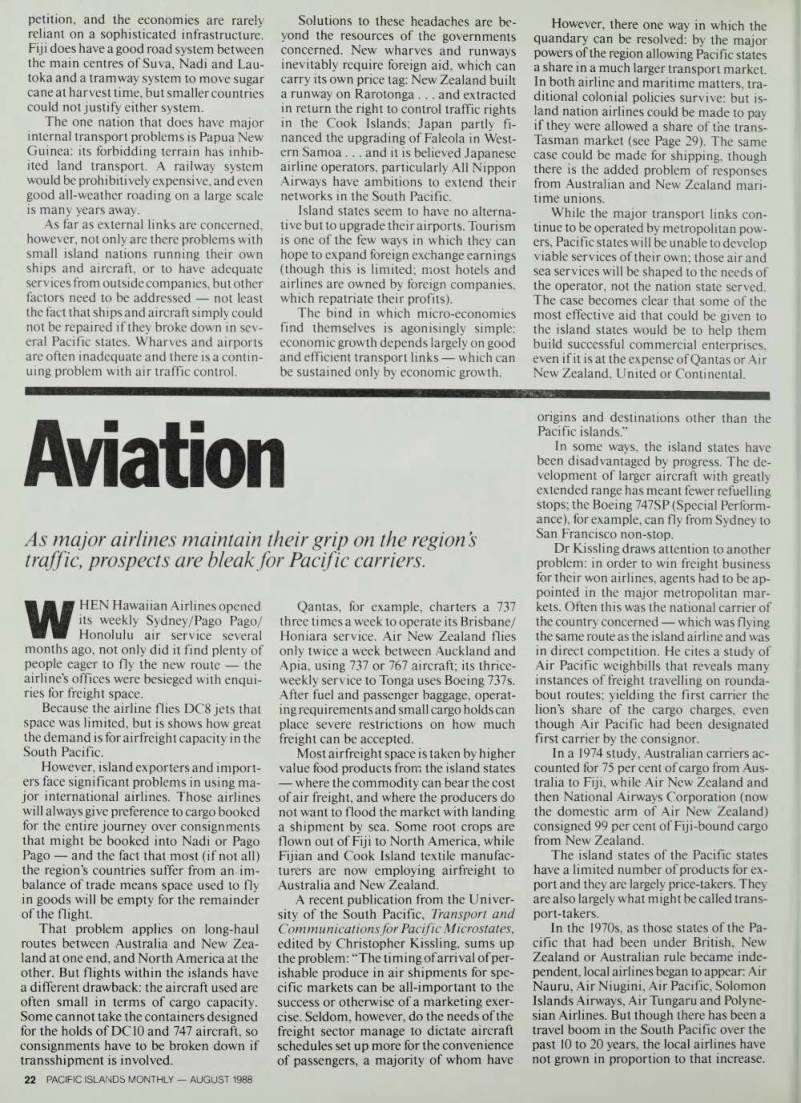
The way things were: an inter-islands tramp steamer of colonial days.
petition, and the economies are rarely reliant on a sophisticated infrastructure.
Fiji does have a good road system between the main centres of Suva, Nadi and Lau toka and a tramway system to move sugar cane at harvest time, but smaller countries could not justify either system.
The one nation that does have major internal transport problems is Papua New Guinea: its forbidding terrain has inhib ited land transport. A railway system would be prohibitively expensive, and even good all-weather reading on a large scale is many years away.
As far as external links are concerned, however, not only are there problems with small island nations running their own ships and aircraft, or to have adequate services from outside companies, but other factors need to be addressed not least the fact that ships and aircraft simply could not be repaired if they broke down in sev eral Pacific states. Wharves and airports are often inadequate and there is a contin uing problem with air traffic control.
Solutions to these headaches are be yond the resources of the governments concerned. New wharves and runways inevitably require foreign aid, which can carry its own price tag: New Zealand built a runway on Rarotonga . . . and extracted in return the right to control traffic rights in the Cook Islands; Japan partly fi nanced the upgrading of Faleola in West ern Samoa . . . and it is believed Japanese airline operators, particularly All Nippon Airways have ambitions to extend their networks in the South Pacific.
Island states seem to have no alterna tive but to upgrade their airports. Tourism is one of the few ways in which they can hope to expand foreign exchange earnings (though this is limited; most hotels and airlines are owned by foreign companies, which repatriate their profits).
The bind in which micro-economies find themselves is agonisingly simple: economic growth depends largely on good and efficient transport links which can be sustained only by economic growth.
However, there one way in which the quandary can be resolved; by the major powers of the region allowing Pacific states a share in a much larger transport market.
In both airline and maritime matters, tra ditional colonial policies survive: but is land nation airlines could be made to pay if they were allowed a share of the trans- Tasman market (see Page 29). The same case could be made for shipping, though there is the added problem of responses from Australian and New Zealand mari time unions.
While the major transport links con tinue to be operated by metropolitan pow ers, Pacific states will be unable to develop viable services of their own; those air and sea services will be shaped to the needs of the operator, not the nation state served.
The case becomes clear that some of the most effective aid that could be given to the island states would be to help them build successful commercial enterprises, even if it is at the expense of Qantas or Air New Zealand, United or Continental.