Taufa’ahau Tupou IV Turns 70
pp. 16-17 · Read in the full issue
Tonga
Polynesia’s greatest monarch celebrates.
By Gabriel Singh
IT WAS by far the largest and most ex travagant birthday bash the South Pa cific has ever seen.
Tonga, Polynesia’s ancient oldest and only remaining kingdom, revelled in the international limelight during the five-day 70th birthday celebrations for King Ta ufa’ahau Tupou IV. The royal capital of Nuku’alofa was inundated, with hotels and guest houses fully booked. Tongans from outlying islands and hundreds of overseas based residents added to the kaleidoscope.
The 170 islands of the group are scat tered over a vast area, but their actual land area is only 691 square kilometres. Just west of the international dateline, Tonga is the first country to usher in the new day.
According to legend the demigod Maui yanked the islands out of the sea with a fish hook; they were settled 3000 years ago by people who soon gained a reputation as great seafarers, undertaking long journeys in double-hulled canoes called kalia, which held up to 200 people.
By the 13th century the Tongan empire stretched from Rotuma and part of Fiji’s Lau Group to Wallis and Futuna, Samoa, Tokelau and Niue.
Captain James Cook was the first Eu ropean to land on Tongatapu in 1777. He presented his hosts with a male Galapagos tortoise which, though blind, could be seen wandering around the royal compound until 1966. A plaque marks the spot where Cook rested under a banyan tree at Mu’a, more than two centuries ago.
Methodist missionaries returned to Tonga in 1822 after being forced out in 1804, and their most noteworthy convert was the Chief of Ha’apai, who with their help in 1845 became King George Tupou I, ruler of a united Tonga. King George was baptised in 1831.
In 1862 he freed the slave class from the obligation to perform labour for chiefs and made hereditary nobles of chiefs, and at the same time established a constitutional government with a Privy Council and rep resentation for both commoners and no bles in a legislative assembly.
This system institutionalised into the Tongan Constitution of 1875 re mains in force today. King George died in 1893, at the age of 97, the creator of a united Christian Tonga.
Germany wished to include Tonga in its Pacific empire late in the 19th century, but bowed to British pressure in exchange for a free hand in Samoa. A new Treaty of Friendship signed in 1900 gave Britain control of Tonga’s foreign affairs as a means of forestalling encroachments by other for eign powers; British protection remained
King Taufa’ahau was born on July 4, 1918 and with his birth came the unifica tion of Tonga’s three ancient kingly lines: the ancient Ha’a (tribes with the status of kings) of the Tu’i Tonga, Tu’i Ha’atakalaua and Tu’i Kanokupolu. His Majesty’s li neage can be traced to the ancient Tu’i Tonga through his mother Queen Salote Tupou 111, while his father’s can be traced to the lineage of Tu’i Ha’atakalaua.
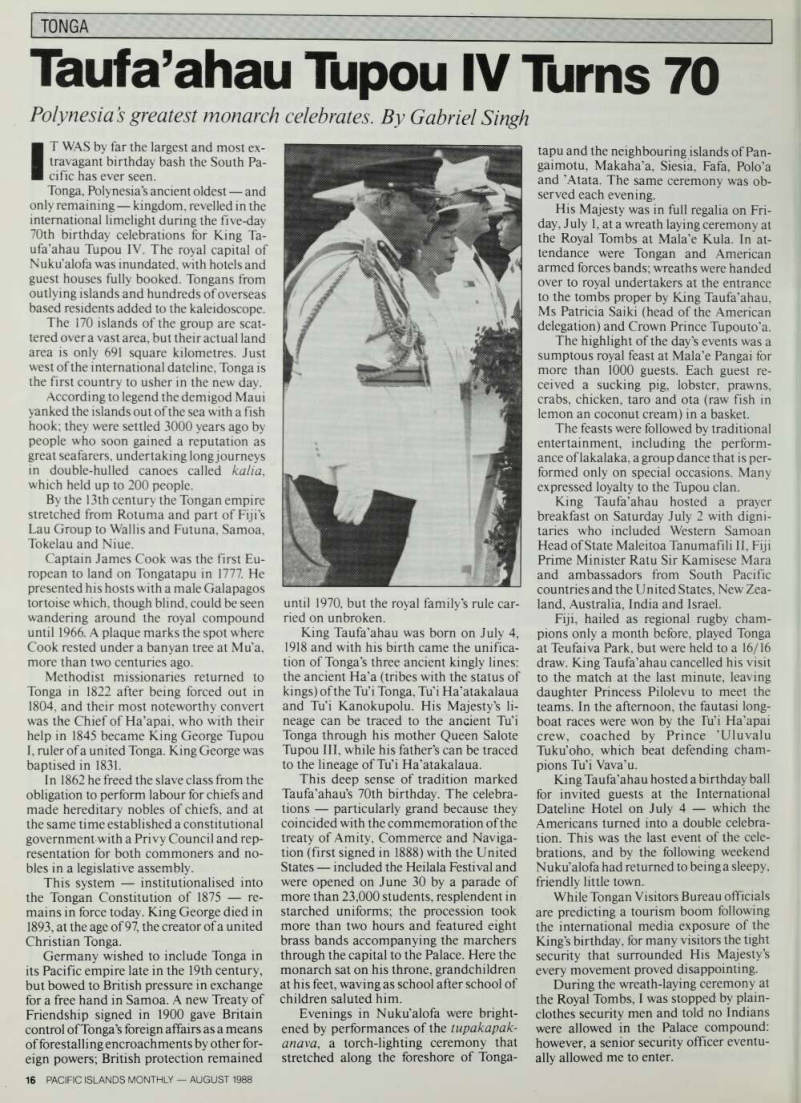
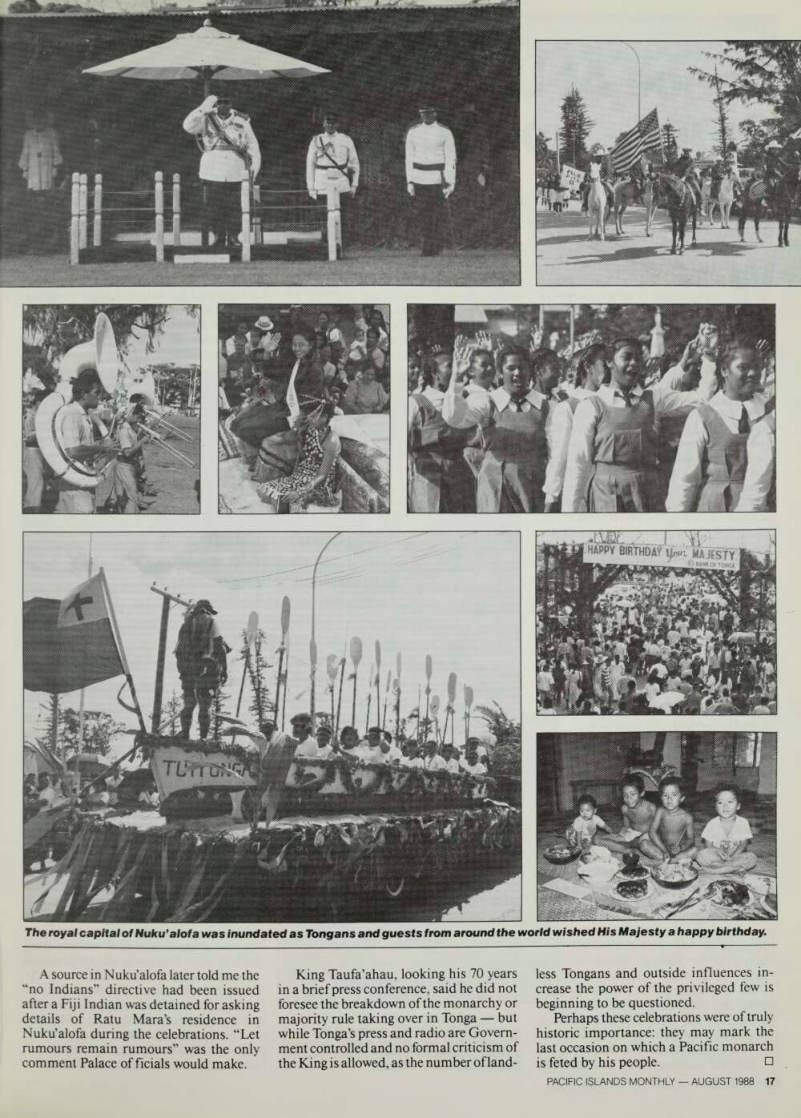
This deep sense of tradition marked Taufa’ahau’s 70th birthday. The celebra tions particularly grand because they coincided with the commemoration of the treaty of Amity, Commerce and Naviga tion (first signed in 1888) with the United States included the Heilala Festival and were opened on June 30 by a parade of more than 23,000 students, resplendent in starched uniforms; the procession took more than two hours and featured eight brass bands accompanying the marchers through the capital to the Palace. Here the monarch sat on his throne, grandchildren at his feet, waving as school after school of children saluted him.
Evenings in Nuku’alofa were bright ened by performances of the tupakapak anava, a torch-lighting ceremony that stretched along the foreshore of Tonga
tapu and the neighbouring islands of Pan gaimotu, Makaha’a, Siesia, Fafa, Polo’a and ’Atata. The same ceremony was ob served each evening.
His Majesty was in full regalia on Fri day, July 1, at a wreath laying ceremony at the Royal Tombs at Mala’e Kula. In at tendance were Tongan and American armed forces bands; wreaths were handed over to royal undertakers at the entrance to the tombs proper by King Taufa’ahau, Ms Patricia Saiki (head of the American delegation) and Crown Prince Tupouto’a.
The highlight of the day’s events was a sumptous royal feast at Mala’e Pangai for more than 1000 guests. Each guest re ceived a sucking pig, lobster, prawns, crabs, chicken, taro and ota (raw fish in lemon an coconut cream) in a basket.
The feasts were followed by traditional entertainment, including the perform ance of lakalaka, a group dance that is per formed only on special occasions. Many expressed loyalty to the Tupou clan.
King Taufa’ahau hosted a prayer breakfast on Saturday July 2 with digni taries who included Western Samoan Head of State Maleitoa Tanumafili 11, Fiji Prime Minister Ratu Sir Kamisese Mara and ambassadors from South Pacific countries and the United States, New Zea land, Australia, India and Israel.
Fiji, hailed as regional rugby cham pions only a month before, played Tonga at Teufaiva Park, but were held to a 16/16 draw. King Taufa’ahau cancelled his visit to the match at the last minute, leaving daughter Princess Pilolevu to meet the teams. In the afternoon, the fautasi long boat races were won by the Tu’i Ha’apai crew, coached by Prince ’Uluvalu Tuku’oho, which beat defending cham pions Tu’i Vava’u.
King Taufa’ahau hosted a birthday ball for invited guests at the International Dateline Hotel on July 4 which the Americans turned into a double celebra tion. This was the last event of the cele brations, and by the following weekend Nuku’alofa had returned to being a sleepy, friendly little town.
While Tongan Visitors Bureau officials are predicting a tourism boom following the international media exposure of the King’s birthday, for many visitors the tight security that surrounded His Majesty’s every movement proved disappointing.
During the wreath-laying ceremony at the Royal Tombs, I was stopped by plain clothes security men and told no Indians were allowed in the Palace compound: however, a senior security officer eventu ally allowed me to enter.
until 1970, but the royal family’s rule car ried on unbroken.
A source in Nukualofa later told me the “no Indians” directive had been issued after a Fiji Indian was detained for asking details of Ratu Mara’s residence in Nukualofa during the celebrations. “Let rumours remain rumours” was the only comment Palace of ficials would make.
King Taufa’ahau, looking his 70 years in a brief press conference, said he did not foresee the breakdown of the monarchy or majority rule taking over in Tonga but while Tonga’s press and radio are Govern ment controlled and no formal criticism of the King is allowed, as the number of land
less Tongans and outside influences in crease the power of the privileged few is beginning to be questioned, Perhaps these celebrations were of truly historic importance: they may mark the last occasion on which a Pacific monarch is feted by his people. □
The royal capital of Nuku’alofa was inundated as Tongans and guests from around the world wished His Majesty a happy birthday.