Peace At Last -
pp. 18-19 · Read in the full issue
New Caledonia
Peace At Last - Or A Recipe For Ruin?
Nicolas Rothwell reports from Paris on the talks that may provide a solution to New Caledonia’s struggle for self-determination.
WHEN France’s Prime Minister, Mr Michel Rocard, announced a comprehensive agreement on the future of New Caledonia, reached in dra matic style on the morning of June 26, he not only pulled off a dramatic political coup for his newly appointed Govern ment, but pointed a way forward out of the New Caledonian morass.
Any resolution of the long-running cri sis in this French Pacific territory has seemed impossible in recent years but after the completion of the Paris accord between Jean-Marie Tjibaou of the Kanak Socialist National Liberation Front (FLNKS) and Jacques Lafleur of the Ras semblement pour la Caledonie dans la Re publique (RPCR), it is clear several drastic changes in the overall equation laid the groundwork for the accord so carefully midwifed by Mr Rocard.
Although Tjibaou must now persuade FLNKS militants at a special congress at Thio in late July to agree to the terms of the accord, and Mr Lafleur must also sell the deal to his supporters in the European settler community on the territory, it seems certain that a period of cooling off will now follow. Observers were stunned by the de termination and evident sincerity both
camps brought to the Paris talks held in the Hotel Matignon, the office of the French Prime Minister. They put forward as the reasons for the sudden break in the deadlock a number of key factors.
First, the re-election of President Mitterand for a second seven-year term (and the prompt election of a divided parliament without a strong majority for the president’s own So cialist Party) has created an atmos phere of enthusiasm for the politics of tolerance, consensus and open ness. The dramatic defeat of Gaull ist presidential candidate Jacques Chirac in the May poll, despite his staging of the hostage rescue on Ouvea, undercut conservative forces in French politics and dis mayed the Caledonian loyalists
in the main die hard Chirac supporters counting on the prolongation of their par ty’s rule on the French mainland.
Political commentators in Paris also
point out that the scale of the bloodshed on Ouv’aaea, and the alarming speed at which the situation in the territory was spiralling out of control earlier in the year, convinced the leaders of both communi ties in New Caledonia that the time had come for negotiations the alternative
was more death and mayhem.
And on a more personal level, sources close to Caldoche leader Lafleur make no secret of the fact that he is ailing; it is said he believed he was the only politician in the pro-French camp with the authority to negotiate a settlement with the Kanaks, and stressed his determination to see an agreement during his own lifetime. Like wise, the reflective Tjibaou is not a man with a taste for violence, and evidently persuaded others in his delegation that an
acceptable solution was in reach.
The complex deal signed by Kanaks and Caldoches provides for a careful mix of political and economic changes, all to be watched over by France. Each of the controversial points of difference between the two communities is not so much ad dressed, as erased.
Later this year, French voters will take part in a referendum that will define the State’s responsibilities toward New Cale donia. For the following 12 months from July 14, New Caledonia will be governed directly by the High Commissioner as rep resentative of the State. This spells the end of the statute pushed through Parliament in Paris early this year by former Minister for Overseas Territories Bernard Pons, who was mystified by the signature of the ac cord. “I don’t understand what could have
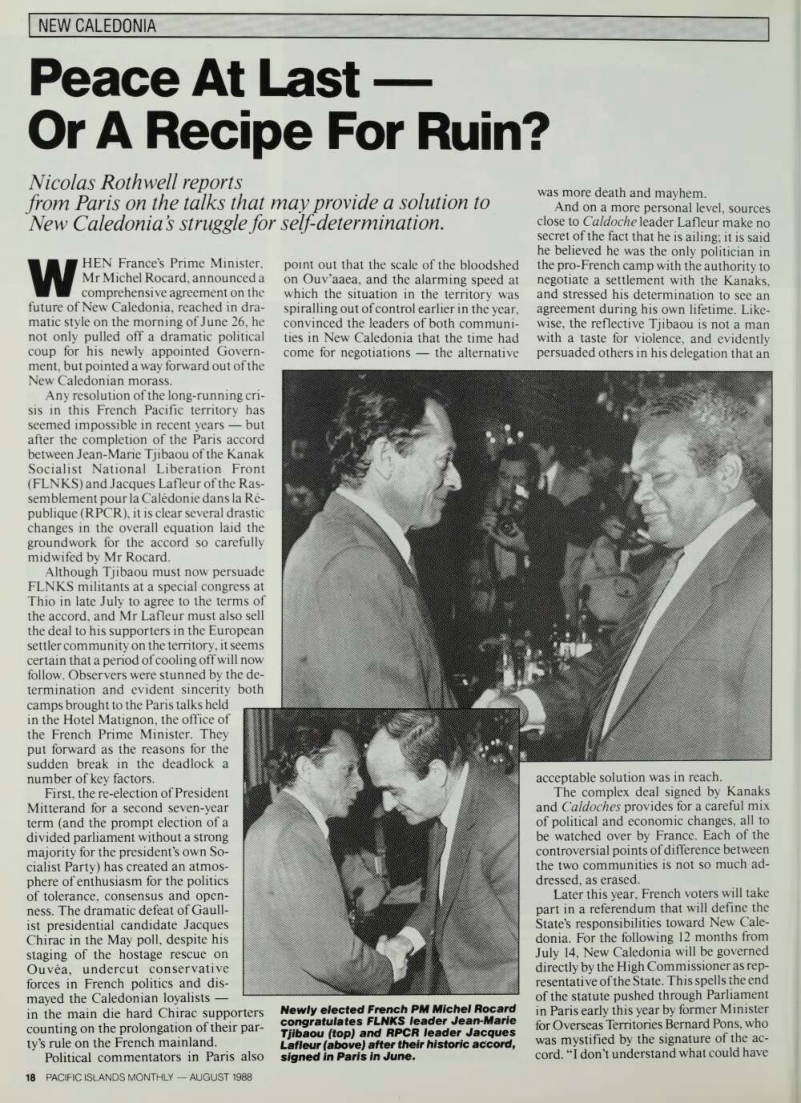
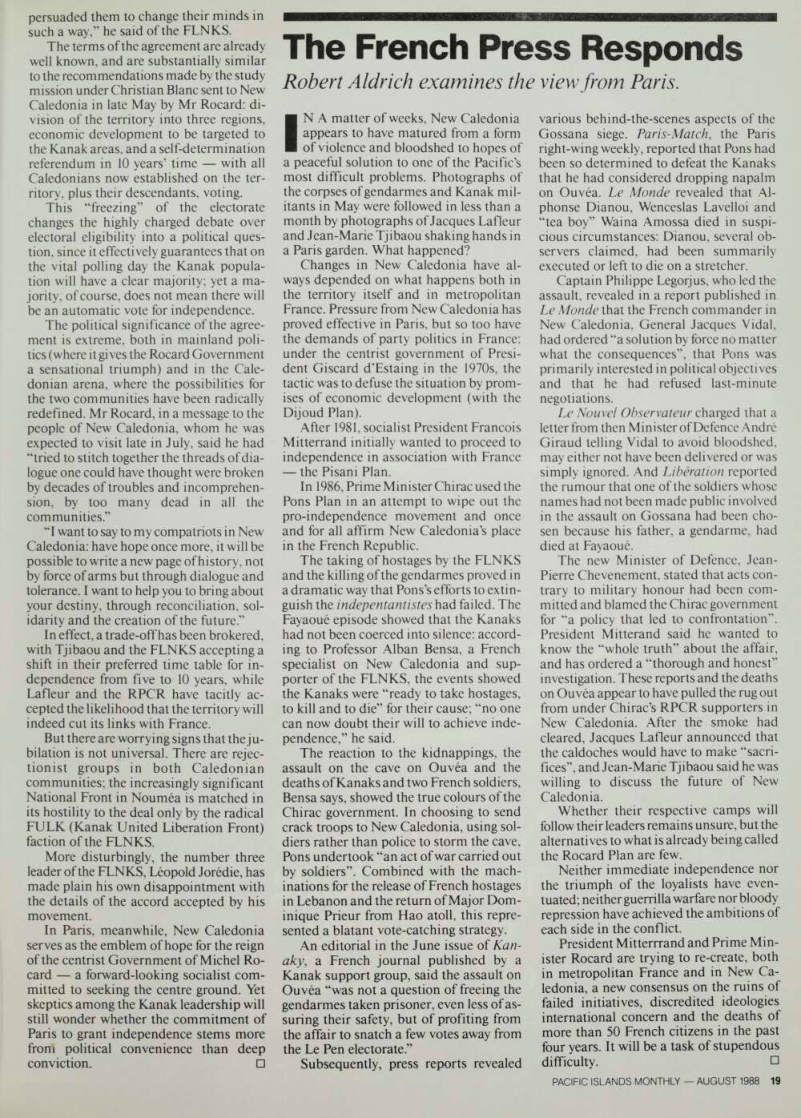
Newly elected French PM Michel Rocard congratulates FLNKS leader Jean-Marie Tjibaou (top) and RPCR leader Jacques Lafleur (above) after their historic accord, signed in Paris in June.
persuaded them to change their minds in such a way,” he said of the FLNKS.
The terms of the agreement are already well known, and are substantially similar to the recommendations made by the study mission under Christian Blanc sent to New Caledonia in late May by Mr Rocard: di vision of the territory into three regions, economic development to be targeted to the Kanak areas, and a self-determination referendum in 10 years’ time with all Caledonians now established on the ter ritory, plus their descendants, voting.
This “freezing” of the electorate changes the highly charged debate over electoral eligibility into a political ques tion, since it effectively guarantees that on the vital polling day the Kanak popula tion will have a clear majority; yet a ma jority, of course, does not mean there will be an automatic vote for independence.
The political significance of the agree ment is extreme, both in mainland poli tics (where it gives the Rocard Government a sensational triumph) and in the Cale donian arena, where the possibilities for the two communities have been radically redefined. Mr Rocard, in a message to the people of New Caledonia, whom he was expected to visit late in July, said he had “tried to stitch together the threads of dia logue one could have thought were broken by decades of troubles and incomprehen sion, by too many dead in all the communities.”
“I want to say to my compatriots in New Caledonia: have hope once more, it will be possible to write a new page of history, not by force of arms but through dialogue and tolerance. I want to help you to bring about your destiny, through reconciliation, sol idarity and the creation of the future.”
In effect, a trade-off has been brokered, with Tjibaou and the FLNKS accepting a shift in their preferred time table for in dependence from five to 10 years, while Lafleur and the RPCR have tacitly ac cepted the likelihood that the territory will indeed cut its links with France.
But there are worrying signs that the j ü bilation is not universal. There are rejec tionist groups in both Caledonian communities; the increasingly significant National Front in Noumea is matched in its hostility to the deal only by the radical FULK (Kanak United Liberation Front) faction of the FLNKS.
More disturbingly, the number three leader of the FLNKS, Leopold Joredie, has made plain his own disappointment with the details of the accord accepted by his movement.
In Paris, meanwhile, New Caledonia serves as the emblem of hope for the reign of the centrist Government of Michel Ro card a forward-looking socialist com mitted to seeking the centre ground. Yet skeptics among the Kanak leadership will still wonder whether the commitment of Paris to grant independence stems more from political convenience than deep conviction. □