No Rainbow For Nuclear Refugees
pp. 14-15 · Read in the full issue
Marshall Islands
Three years after the irradiated population from the atoll of Rongelap was
evacuated, the islanders are still suffering.
By David Robie
MORE THAN 300 nuclear refu gees evacuated from Rongelap atoll by the Rainbow Warrior shortly before the peace ship was bombed in New Zealand three years ago are still looking for a new home after an inde pendent report has confirmed some of their radiation fears.
Elders of the islanders, now living a harsh lifestyle on Mejato in the Marshall Islands, are seeking an uninhabited island on Majuro atoll close to the capital of the republic. But they have not lost hope of re luming to their home and are still lobby ing for a full health and radiological survey on Rongelap.
The US Department of Energy (DOE) is claimed by the report to have had evi dence the Rongelap islanders may have suffered from radiation exposure for sev eral years after the Bravo thermonuclear test in 1954 yet it lets them live on their contaminated atoll without explaining the medical findings to them. Even though DOE scientists monitored depressed white blood-cell counts and high levels of plu tonium in the urine of the Rongelap is landers, the report claims, they interpreted the findings as “anomalous”.
The medical data emerged during a re cent scientific review of a 1982 DOE re port that concluded that all but the atoll’s northern ring of islets the islanders’ food larder was now safe. The United States Congress ordered the review after a sec ond mass exodus by islanders aboard the Rainbow Warrier in May 1985; the pop ulation had earlier been evacuated by United States authorities after the Bravo test and allowed to return three years later.
The islanders are not satisfied with the impartiality of the latest survey; they be lieve they were used as quinea pigs by US authorities to monitor the long-term ef fects of radiation on a human population, and had sought a study conducted by for eign researchers. They are also still seek ing SUS 6 million to pay for a full radiological survey of their homeland and in compensation for their exile.
The islanders last year sought a three member team to conduct the investiga tion; Canadian radiobiologist Dr Rosalie Bertell, author of No Immediate Danger (an expose on how world nuclear auth orities cover up the dangers and conse quences of irradiation) and a researcher for the Toronto-based International Institute of Concern for Public Health; and West Germans Dr Ute Boikat, of the Univer sity of Bremen, and Bemd Franke, of Hei delberg’s Institute of Energy and Environmental Research.
But the Marshall Islands Government, acting under pres sure from US authorities, re fused to give a clearance for this team under Dr Bertell’s direc tion alone. Another possibility had been a team headed by American radiation specialist Dr Robert Gale, who went to the So viet Union to perform bone marrow transplants on radiation victims after the 1986 Chernobyl meltdown disaster.
That proposal also fell through.
Instead, an 11-member panel of international experts was set up that included Dr Bertell and Mr Franke. The panel’s prelimi nary report to the Congress house appropriations subcommittee has concluded that returning to Rongelap is “permissible” for adults providing they are given geographical and dietary restric tions. The team deferred any recommendation on children until further review.
Bertell and Franke dissented, calling for more extensive phys ical examinations and radioac tivity measurements.
Among the majority was Dr Robert Conard. who headed the Marshall Islands medical pro gram for Brookhaven National
Laboratory from 1957 to 1980. In his first year in charge, three years after the Bravo Test, the laboratory produced a document that declared: “Greater knowledge [of ra diation effects on human beings] is badly needed ... Though the radioactive con tamination of Rongelap island is consid ered perfectly safe for human habitation, the levels of activity are higher than those found in other inhabited locations in the world. The habitation of these people on the island will afford the most valuable ecological radiation data on human beings.”
Thirty-one years of tragedy and suffer ing forced 320 Rongelap Islanders to abandon their atoll. They were evacuated at their own request less than two months before the Greenpeace movement’s flag ship was sabotaged by French agents in Auckland harbour on July 10, 1985.
The nuclear refugees settled on Me jato, a 16-hectare uninhabited island on the northwestern tip of the vast Kwajalein atoll across the lagoon from the US missile testmg range. Today living conditions re main bleak: a village has been constructed
from their stripped buildings on Ronge lap, but life remains hard and depressing and food is always running short. The Rongelap elders believe they will be able to build a better life on Majuro atoll, wherea new home is being considered.
Their ordeal began on March 1, 1954 now known as Bikini Day when the United States dropped a 15 megaton ther monuclear bomb on Bikini atoll, 160 km west of Rongelap. Taken off three days later, the Rongelap islanders were allowed to return in 1957, but the damage had already been done: a legacy of leukaemia, miscarriages, birth defects, thyroid tu mours and damaged genes.
“Like many of our women exposed during the bomb tests, I have many mis carriages; seven,” says Lijon Eknilang, one of the island leaders. “I have lived in fear and I feel my life is in danger. I sometimes feel my body is on fire.”
Miscarriages used to be rare on Ron gelap. “Now miscarriages happen all the time. We take them for granted,” Eknilang says. “We never used to have problems with mentally retarded children, or youngsters
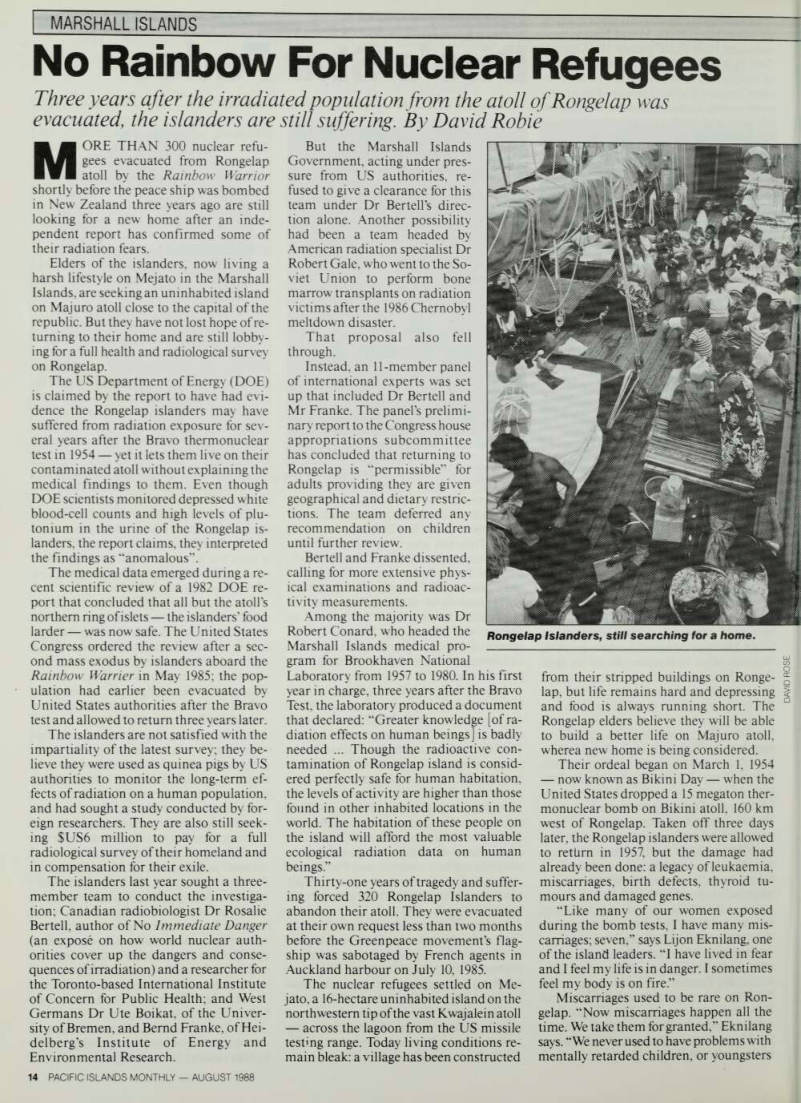
Rongelap Islanders, still searching for a home.
with stunted growth. Now it is frequent.
“There have been at least six or seven ‘jellyfish babies’ they have no face. They have short bodies, stubby legs and look fat and shapeless. They live for half a day or so and then die.
“Losing my homeland really hurts. It hurts me terribly. It is sad for our children; they’ll grow up hearing about our tradi tional home, but I don’t know if they will ever be able to go back there.”
Rongelap elders, supported by Ameri can lawyers and Bertell and Franke (who obtained the controversial medical data) said the DOE should have investigated what were obvious signs of radiation dis ease and kept the islanders fully informed.
Instead, they claimed, the agency had “covered up” the data to deflect criticism from the US nuclear-weapons program and avoid high compensation claims.
However, officials of the DOE and sci entists at Bookhaven laboratory, which has tested the Rongelap Islanders since 195 Z claimed the data had “little medical sig nificance” and that radiation “posed no health danger”.
The 1982 survey, translated into the Marshallese language and labelled by government scientists as the “last word” on the controversy, neglected to mention the urine and blood tests. Instead it gave assurances that living in the southern part of the atoll and eating local food exposed the inslanders to less radiation than the maximum permissible dose in the United States. However, it did not say plutonium levels in the soil were 500 times greater than average levels in the Northern Hem isphere and that radioactivity in local fruit exceeded US standards.
DOE officials denied there had been any coverup. “There were lots of things that might have been added to that re port,” one official told the Washington Post. “The people who wrote it made their choices based on what they believed to be most significant for the people who had to use it: there was no attempt to conceal information.”
However, Bertell, computing averages for the control groups from 1957 to 1961. found abnormally low counts of mono cytes; large white blood cells produced in bone marrow to fight bacteria. Exposure to high levels of radiation can depress the production of monocytes.
Compared with the normal range of 200 to 800 monocytes per cubic millilitre of blood, the control group averaged 169 but scored as low as 60.
Bertell said the data indicated high ra diation levels on Rongelap after the then Atomic Energy Commission (which later became the Department of Energy) de clared it safe or that fallout from the Bravo test reached further than estimated, to contaminate control group members. “It should’ve at lease raised questions about contamination of Rongelap,” she told the Post. “They should never have been al lowed to go back in 1957.” □