High Hopes, But Slow Growth
p. 37 · Read in the full issue
The Republic’s economic planners face the facts.
By Jai Kumar
FIJI’S FOREIGN currency reserves now stand at SF22O million, the highest on record and sufficient to finance six months’ exports. But all this is small comfort for those desiring an in crease in economic activity in the country.
Since last year’s two military coups, Fiji has experienced a sharp decline in foreign investment and a reluctance by local busi nessmen to expand operations. The main reasons for Fiji’s high foreign reserves are its record 1987 sugar sales, a 33 per cent devaluation of the Fiji dollar, tight control on outflow of currency and a decline in Fi ji’s imports. Low imports reflect a down turn in economic activity with people not investing in cars and white goods.
Fiji’s interim civilian Government is much concerned by the economic slump and is urgently reassuring foreign com panies that investment is safe in Fiji. The Government even has offered a package of incentives to attract foreign investment, establishing a tax free zone for export-ori ented businesses and deferral of income tax for corporate exporters.
According to Bill McCabe, trade com missioner at the Sydney-based South Pa cific Trade Commission, through which most Australian businessmen interested in investing in Fiji channel their enqui ries, “the climate is improving”. After the military coups, he said, there was a total shutdown on enquiries but people now are again calling for information and advice.
Mr McCabe said, “Before the coup, Fiji was experiencing a boom . . . Australians were falling over each other to make pro posals and set up projects in Fiji”. He said that while the situation in Fiji today was unlikely to revert to pre-coup days, poten tial investors have been reassured that their investment is once again safe.
Australia is Fiji’s main trading partner and it was to Australia that Fiji’s first post coup high powered trade mission was sent to promote investment opportunities. The mission’s leader Ratu Isoa Gavidi, di rector of the Department of Trade and In dustry said Fiji was looking at all ways to rebuild its economy. “Our main inter est at the moment is products that can be exported,” he said. “The domestic market in Fiji is fairly limited and, for the econ omy to grow, Fiji has to look outward not only to Australia but to the United States and Europe, where we have duty free access through the Lome Convention.”
Fiji is also developing closer ties with Japan. A high level government and pri vate sector trade and travel mission vis-
ited Tokyo in May pushing Fiji’s claims as a tourist destination and a trade and in vestment partner. Japanese interest in Fiji is increasing, especially in the hotel in dustry. Denarau Beach’s Regent of Fiji re sort hotel has been bought by a major Japanese company, Electrical Industrial Enterprises Corporation (EIE), and nego tiations are underway for the purchase of two other major resorts.
Fiji also hopes to develop in Japan a lu crative market for its fruit and vegetables after the introduction in October of a di rect weekly Boeing 747 flight between To kyo and Fiji. The new owner of the Regent of Fiji, EIE, has also proposed a computer science school in Fiji. Japan is already in volved in Fiji’s fishing industry and buys Fiji’s main export, sugar. Japan has also placed an order for SFIO million of pine chips from Fiji this year.
Fiji’s Finance Secretary and acting Governor of the Reserve Bank, Ratu Jone Kubuabola, believes the devaluation of the Fiji dollar and the Republic’s abundance of educated and skilled labour at reason able rates of pay should attract foreign investors to Fiji. However he conceded that “an important consideration any foreign investor considers before committing his
funds to a country is political stability and the long-term security of his investment.”
Ratu Kubuabola said progress was being made ’on this front’.
However, observers in Suva say if Fiji is to allay the fears of potential investors it must act decisively to create a suitable in vestment environment. The future of sugar, Fiji’s main export crop, hangs in the balance because of the Sunday ban on work imposed by the military regime. Under the Sunday Observance Decree issued last November, working on Sunday is banned except for those carrying out essential services and employed by the media. Sugar industry officials have pleaded with the civilian Government to categorise cane harvesting as an essential service. Unless cane cutting and crushing is allowed on Sundays, Fiji could lose 100,000 tonnes of sugar this year from a possible production of 440,000 tonnes. Such a shortfall would certainly drastically affect the country’s foreign exchange earnings.
Political pundits also have singled out the army’s involvement in the commercial sector as a deterrent to foreign investment.
The army’s role in the National Marketing Authority and in village fishing projects is seen as a disincentive to investment. □
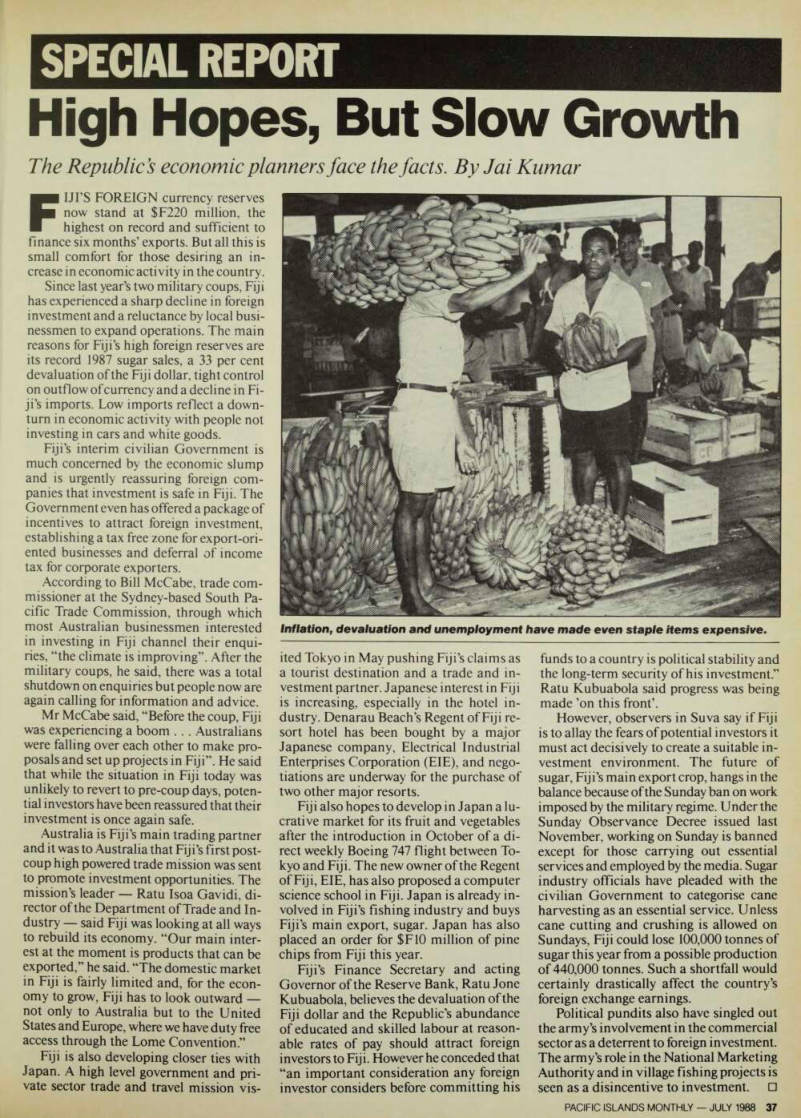
Inflation, devaluation and unemployment have made even staple items expensive.