Fiji
pp. 35-36 · Read in the full issue
Special Report
The Future
Fiji will never be'the same again, but despite the arms affair, investor confidence \ is returning. Stan Ritova reports \ on the mood of the Fijian people.
“It will take time to overcome our economic problems, but we will achieve our objective of revitalising the economy during the life of this government”
FIJI’S economy recovering well from last year’s two military coups has suffered a temporary setback with the discovery of sophisticated illegal arms early in June on Indian-owned cane farms in the west of Viti Levu.
The new Governor of Fiji’s Reserve Bank, Ratu Yavala Kubuabola, in an ex clusive interview on June 15, said the dis covery of the arms had certainly affected the country’s efforts to restore the shat tered economy which before these events was well on its way to recovery.
“We were about to see a very slight up turn in investments when this happened,”
Ratu Yavala said, “but I am confident that the arms issue will only have a short- term effect on our efforts to revitalise the economy.”
Fiji’s Minister of Finance, Mr Josefata
Kamikamica, said in a separate interview that the Interim Government was deter mined to meet all its economic goals within the two years it was given to do the job.
One of the current government’s main tasks is to put into place a new constitu tion to replace the 1970 Constitution ab rogated after the 1987 coup. Most investors have indicated they will not commit themselves until the constitution is in place and this will take some time.
The Government announced recently that the Cabinet subcommittee charged with the task of drawing up the Constitu tion from three drafts was well on the way to completing it.
“The final draft would have to go to Cabinet, then the Great Council of Chiefs before anything happens,” a Fiji Govern ment spokesman said.
The Reserve Bank Governor said there has been significnt improvement in ex ports since the devaluation of the Fiji dol lar. The Fiji dollar valued at about US7I cents in mid-June would be held at the same level until business and investor confidence was fully restored. “We will maintain a tight exchange policy to avert further flight of capital,” Ratu Yavala said.
About SF3O million left the country soon after the first coup on May 14, 1987: “Of this, SFI3 million left the country in three days,” he said.
Ratu Yavala, formerly the Govern ment’s Secretary for Finance and succes sor to Fijian finance wizard Mr Savenaca Siwatibau, said the Government’s opti mism also stemmed from a healthy buildup of foreign reserves to $F242 mil lion after they fell to SF9O million in the
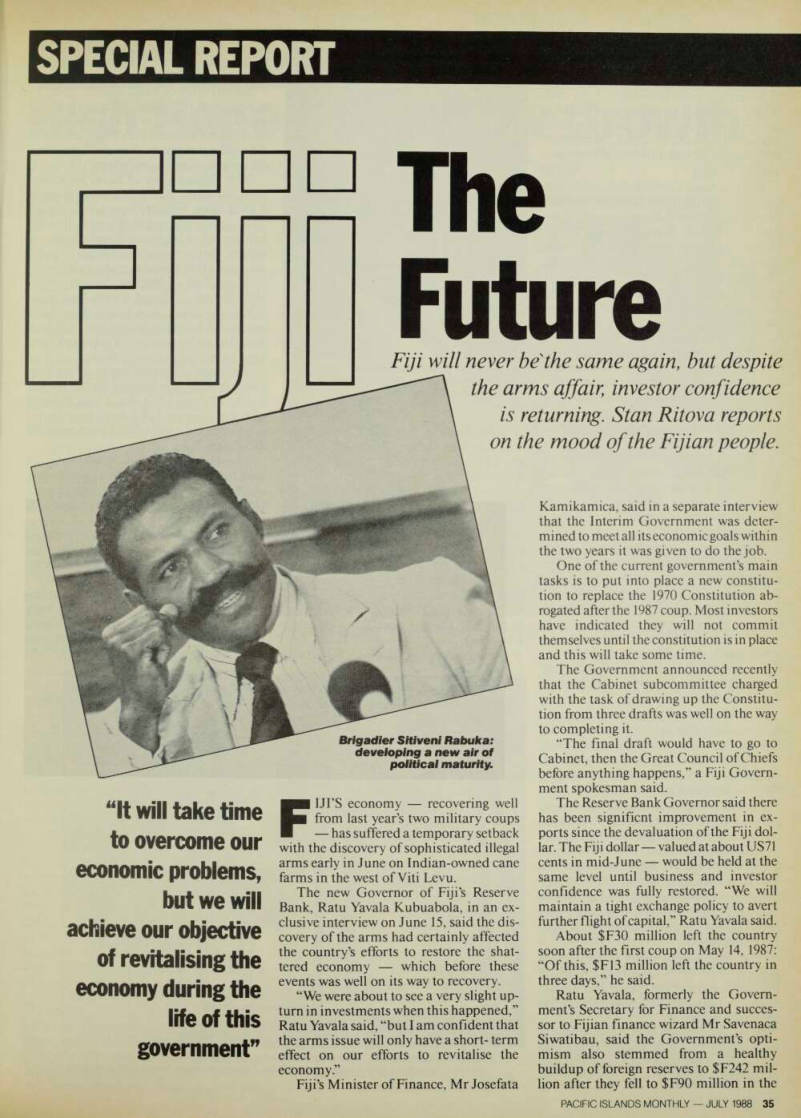
Brigadier Sdiveni Rabuka: developing a new air of political maturity.
months following the coup, when exports and the tourist industry came to a near standstill.
Minister of Finance Kamikamica said “The economy will contract by 1 per cent in 1988 instead of an earlier estimate of 6 per cent shrinkage in the gross domestic product.” (Fiji’s GDP fell to 8.7 per cent in 1987, compared with a growth of 9 per cent in 1986, he said.) The Fiji Sugar Corporation is expected to produce 410,000 tonnes of sugar in 1988; 10,000 tonnes more than originally fore cast. This should bring in about SF23O million. Sugar production in 1987 was about $401,000 tonnes, which earned an estimated SF22O million.
Mr Kamikamica said inflation, now running at 9 per cent, is expected to sta bilise at around 10 per cent by the end of the year. Unemployment has risen to around 10 per cent from 6 per cent before last year’s coup, but the Government is taking steps to generate employment through, for example, the establishment of a tax-free zone in Fiji.
This will allow overseas investors and manufacturers to establish industries in Fiji without being liable to pay taxes for 13 years. The package includes the repatria tion of profits and investment capital and the importation of duty-free equipment and raw materials within the 13-year “honeymoon” period.
Mr Kamicamica reported that a num ber of investors and manufacturers from Australia, New Zealand and several Southeast Asian countries have commit ted themselves to establishing factories in Fiji since the project was launched late last year. “These people want to establish gar ment, textile and other light manufactur ing industries,” he said, “and many of them have gone into joint ventures with local businessmen.”
A total of 14 such projects has been ap proved under the tax incentive scheme, and another 24 are being processed. Both local and overseas investors are watching the political scene, and confidence-build ing is a slow process.
“It will take time to overcome our eco nomic problems, but barring any major disasters, we will achieve our objective of revitalising the economy during the life of this government,” Mr Kamicamica added.
The government will also undertake cost-cutting measures and keep the freeze on wages until there is a significant im provement in the projected budget deficit of SFII9 million.
The man on the street is feeling the pinch because of rising costs as a result of the devaluation of the dollar, and house wives are finding it difficult to meet gro cery bills and rents.
A random survey in the capital city of Suva in mid-June revealed that Fijians are facing some difficulty, but there is a note of optimism for the future.
Billy Singh of Suva, market vendor: “the situation is bad. Before the coup I earned more than $lOO a day; now I make about $20.”
Salanieta Watirabua of Nakaile vil lage, Nausori, food vendor: “I sell vakal olo [sweet pudding] in the Suva market.
Before the coup I used to sell three to four baskets; now only one a day and one and a half on Saturdays.”
Young Lee of Suva, greengrocer. “I’ve been a grocer for two years. The situation here is not good. Before the troubles I eas ily made $lOO a day; now I can only make $7O to $80.”
Simione Akimi of Tacirua, Suva, also
a greengrocer. “Business is good. I find I’m going well: during weekdays I nett $lOO to $l3O a day, and on Fridays and Saturdays I make about $300.”
Suren Pratap of Vuci, Nausori, chef. “It is very hard nowadays. During pre-coup days I used to receive $1.47 an hour as a cook; now I am paid only $1 an hour and if I work extra hours, they allow me time off instead of paying overtime.”
Mrs Toakasi Grey of Suva, bookshop sales assistant. “Business is not as good as it used to be. Nobody buys novels nowa days: only the newspaper and a limited number of magazines. People have no money, that’s why business is not so good now, and I find it hard to make ends meet.”
Yam Chan of Waibau, Sawani, vege table farmer. “I found it very hard even before the coup, and now I have little money. It’s true I have a van, but I still find it hard to make money. I have to work very hard to be able to make a living.”
Rahiman of Nasinu, barber. “I work on a casual basis now because it’s hard to get a job. If I make $3O today, I take $l5 and give my assistant $l5. I was happy in my job before the coup when I used to make $B5 a week.”
Dan Duthie of Nabua, watchman. “It’s hard to have cash nowadays. The only time one has money is on payday. Pay all your bills, then you wait for the next payday with an empty pocket.”
Maraia Spooner of Suva, housewife.
“Business will take time to pick up after last year’s coup. It’s slack at the moment.
I find it hard to pay my bills.”
Mrs Margaret Steele of Suva, recep tionist. “The cost of living is very high compared with what it was before the coup.
I am able to cope with the hard times we are going through by strict budgeting.” □
Visitor figures have suffered setbacks, but Fiji’s natural beauty and luxury facilities will continue to attract tourists from around the world.
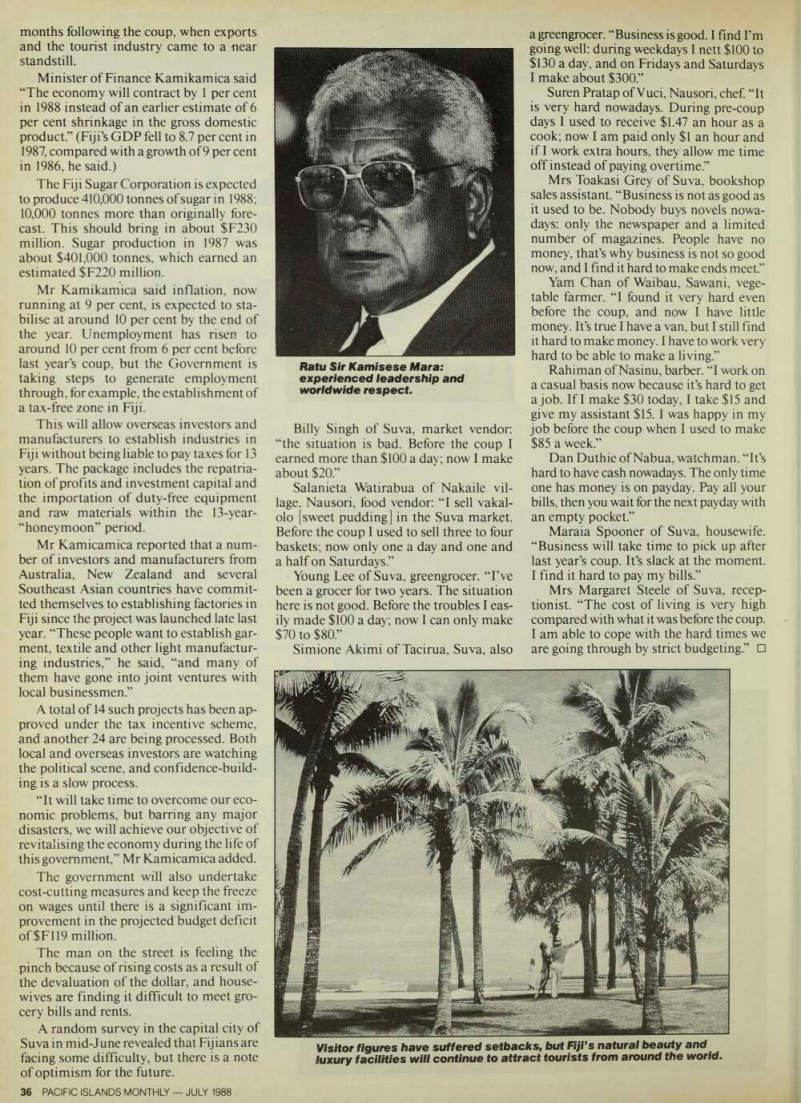
Ratu Sir Kamisese Mara: experienced leadership and worldwide respect.