Tourism Makes A Slow Recovery
p. 38 · Read in the full issue
Visitor figures increase as developers plan new resorts.
By Jai Kumar
WHILE FIJI’S sugar industry has not suffered from the country’s unstable political situation, tourism has taken a dive because of in evitable adverse publicity abroad. Tour ism is Fiji’s second most important industry, after sugar, in terms of injecting foreign exchange earnings into the coun try’s economy. Last year Fiji’s 190,000 vis itors generated SFI74 million. However, because of the military coups there were 68,000 fewer visitors in 1987 than in 1986.
That cost the nation SF36 million.
This year Fiji is pulling out all stops to attract visitors from it’s major market areas; especially the USA and Japan. The target for 1988/1989 is 260,000 visitors who should generate 5F222 million.
Fiji’s principal visitor market is Aus tralia which, pre-coup, accounted for 34 per cent of total visitor arrivals. However, in 1987 there was a decline of 20,000 vis itors over 1986 figures. Some 5000 fewer New Zealanders came in 1987, but the big gest stay-at-homes were the Americans and Japanese. In 1986, just under 70,000 Americans visited Fiji but only 47,000 came last year. Tourism from Japan de clined by over 50 percent, numbers falling from 12,000 in 1986 to 5500 in 1987.
Visitors from the United Kingdom, Continental Europe and the other Pacific islands came as before.
Tourism is not only a foreign exchange earner for Fiji but it also generates vital employment. The livelihood of thousands
of Fijians depend on the prosperity of the tourist industry. However, the hospitality industry was also hit by the coups. With fewer tourists there is a much reduced need for people to take care of them. In 1986 the average hotel occupancy rate was 66 per cent: it is presently 42 per cent. Hotel staff levels have been consequently cut.
Fiji is striving to resurrect its reputa tion as a safe and attractive holiday des tination. Through the Fiji Visitors Bureau, the arm of Government responsible for promoting Fiji abroad, extensive public ity campaigns have been planned. The major targets are the Japanese and the US/ Canada market. These markets have shown promising trends before the coups and have the best potential for growth. The task of spreading the word in the US was helped by multi-millionaire American publisher Malcolm Forbes who has given Fiji his personal endorsement as a safe and beautiful holiday destination. He hosted celebrations to revive Fiji’s tourist indus try on his own island, some 250 kilo metres northeast of Suva. Forbes bought the island, Laucala, 16 years ago and has spent SF4 million developing it into a re sort for upmarket holiday clients. At the gala party were guests specially flown from America and Australia and Fiji’s own President Ratu Sir Panain Ganilau, Prime Minister Ratu Sir Kamisese Mara and Brigadier-General Sitiveni Rabuka.
Forbes was reported all over the world as saying he was optimistic about Fiji’s fu-
ture as a tourist attraction despite the slump of last year. He said he wanted to tell the world that Fiji was now very stable, that “any concern that visitors might have is unfounded”. Forbes told visiting jour nalists Fiji was the “major undiscovered Bali Hai” of the world.
Fiji leaders hope the positive publicity overseas will help restore Fiji’s reputation as a holiday paradise.
As part of a campaign to fly Americans direct to Fiji, a three-man mission visited the US and held discussions with airlines there. The team was led by the chairman of the Fiji Visitors Bureau, Mr David Williams.
Since Continental pulled out in the middle of last year no US carrier has made regular scheduled stops in Fiji. However, the Fiji Government has now approved a 100 back-to-back US-Fiji charter flight program by Seaboard Airlines of Denver, Colorado. The tours are to be sold through charter clubs and tour wholesalers in thed US. Seaboard managing director Mike Bartlett said the flights would generate up to 50,000 new arrivals in Fiji each year.
As for Japan, Fiji is expecting a boom in the number of Japanese visitors to Fiji this year. First, Fiji’s national airline, Air Pacific, is to commence from October a direct weekly flight between Tokyo and Nadi (Fiji’s international airport); under the agreement, Japan airlines and Air Pa cific will each operate a 747 Boeing serv ice every week. Second, Fiji’s Regent of Fiji hotel has been bought by Tokyo’s Electri cal Industrial Enterprises Corporation of Japan (EIE). The Pacific Harbour Resort near Suva is also the subject of takeover bids by Japanese interests.
The injection of Japanese capital plus Japanese expertise in the hotel and tourist industry should mean an increase in the number of Japanese visitors to Fiji.
An Australian hotel company, John Beater Enterprises, has also acquired ho tels in Fiji: one in Suva and another in the suburb of Samabula.
To attract investors has offered a water front site in downtown Suva as its share in a joint venture it hopes will attract over seas developers.
Besides the land, the Fiji Government also will have a SF3 million equity in the project and the Fiji Development Bank will take a further SF3 million equity to help launch the construction of the SF26 mil lion hotel complex.
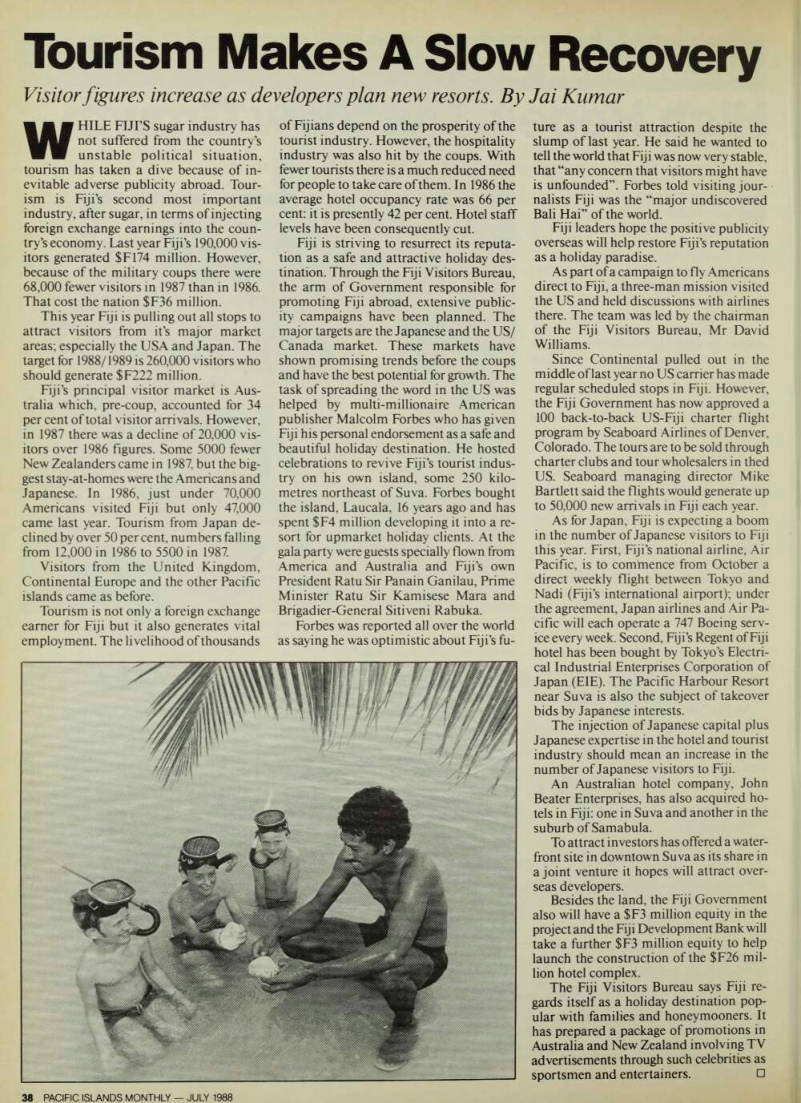
The Fiji Visitors Bureau says Fiji re gards itself as a holiday destination pop ular with families and honeymooners. It has prepared a package of promotions in Australia and New Zealand involving TV advertisements through such celebrities as sportsmen and entertainers. □